Oklahoma Politics Category
The Oklahoma State House of Representatives is considering SJR 34, a resolution proposing a constitutional amendment to change Oklahoma's nominating process for state appeals courts to match the federal method: Nomination by the chief executive with the advice and consent of the legislature. This would put the entire process of choosing members of the Court of Civil Appeals, Court of Criminal Appeals, and State Supreme Court, and filling vacancies in district courts, into the hands of elected officials who are directly accountable to the voters.
The current system lacks this accountability: When a vacancy occurs, a 15-member Judicial Nominating Commission fields applications and gives the Governor three candidates to choose from. The JNC consists of six members appointed by the Governor (or the previous governor; the terms are staggered), six members elected by attorneys who are members of the Oklahoma Bar Association, one member each appointed by the President Pro Tempore of the State Senate and the Speaker of the State House, and the 15th member appointed by the other 14. The members chosen by the Governor and by the OBA come from the 1967 congressional district boundaries, notwithstanding the shifts in population (particularly the growth of the two main metro areas relative to the rest of the state) in the intervening 56 years.
Even in the selection of JNC members, the Governor's hands are tied: Only three of his six appointees may come from the same political party. No such restriction is placed on the members chosen by the private lawyers' club.
Those six members are:
District 1: Mary Quinn Cooper, McAfee & Taft, major donor to Democratic candidates such as State Rep. Suzanne Schrieber and congressional candidates Kendra Horn, Brad Carson, Kojo Asamoa-Caesar.
District 2: Weldon Stout, Jr., Muskogee, also principally a donor to Democrat candidates
District 3: James Bland, McAlester, does not show up as a political donor.
District 4: David Butler, Lawton, also principally a donor to Democrat candidates. (There is an Enid attorney with the same name, different middle initial, who is also a Democrat donor.)
District 5: Joel Hall, Oklahoma City, gave $500 20 years ago to a Republican running for Corporation Commissioner
District 6: David K. Petty, Guymon, is a consistent donor to state and national Democrat candidates, including Barack Obama, Hillary Clinton, and the DCCC and DSCC.
You must be a member of the private lawyers' club to have a vote for the only 6 seats on the commission for attorneys. In fact, you have to be a member of the private lawyers' club to practice law in Oklahoma. You may recall that in 2017, the Oklahoma Bar Association sponsored a "President's Cruise" to the oppressive, Communist island prison known as Cuba, putting cash (ultimately coming from Oklahomans unfortunate enough to interact with the judicial system) into the hands of the brutal regime that tramples on human rights and jails its dissidents.
SJR 34 passed the Senate 32-14, passed out of the House Rules Committee with a 6-3 vote, and is now waiting for a vote on the floor of the State House. There is a hitch, however: The engrossed Senate version follows the federal pattern of advice and consent from the Senate only, while the House Rules Committee substitute would require a judicial nomination to pass the House as well as the Senate. If the current House floor version passes, either the Senate would have to agree to the House version, or there would be a conference committee followed by final votes on the compromise version in each chamber.
OCPA points out:
Unlike the U.S. Constitution's checks and balances, Oklahoma Supreme Court justices are not truly selected and vetted by your elected officials.In reality, justices are selected and vetted by Oklahoma's unelected Judicial Nominating Commission, guided by a small network of lawyers from the state Bar Association.
The end result has been that Oklahoma's left-leaning Supreme Court keeps legislating from the bench and throwing out conservative reforms.
The OCPA is providing an online form to help you contact your State Representative to encourage support for SJR 34.
There may have been a day where partisan differences did not matter in the courtroom, but now partisan affiliation is predictive of differences in judicial philosophy. Republicans are the party of original intent and judicial restraint. An attorney who backs Democrats to control the Federal government is pushing for judges who will make up the rules and rewrite laws according to their ideological preferences; who will implement Lenin's "Who? Whom?" approach to justice, with a big dollop of DEI ladled on top.
If the proposed amendment is approved by the voters, the OBA could still voice their opinions of judges and justices nominated by the Governor, just as the ABA comments on Federal court nominees. While Kevin Stitt has managed some great appointments to the State Supreme Court, despite the JNC's leftist tilt, we need our elected Chief Executive to have a free hand to choose Oklahoma's version of a Clarence Thomas or Antonin Scalia, without the interference of a left-leaning private lawyers' club.
MORE: The application page has links to judicial district maps for State Supreme Court, State Court of Criminal Appeals, State Court of Civil Appeals, and District Courts.
STILL MORE: Back in January, OCPA's Ray Carter reported: "Oklahoma defies the trend noted of more conservative jurists being appointed in southern states. The median state supreme court PAJID score in Oklahoma has been between 70 and 75, reflecting a strong liberal slant, throughout almost the entirety of the 49-year period reviewed, only dipping slightly in recent years." The PAJID scores, a measure designed by researchers at Auburn University and the University of Georgia, were published in the December 2023 edition of the journal "State Politics & Policy Quarterly," a publication of the American Political Science Association.
That same OCPA report provided a more comprehensive analysis of the political contributions of JNC members since 2000:
Of the 32 individuals appointed to the JNC by the Oklahoma Bar Association from 2000 to today, 22 bar-association appointees (nearly 69 percent) have directed most of their campaign donations to Democrats, based on information obtained from public filings maintained by the Oklahoma Ethics Commission, and Federal Election Commission filings and state records that are searchable on the nonprofit Open Secrets website.Only one bar appointee to the JNC since 2000 has overwhelmingly donated to Republican candidates.
Furthermore, from 2000 to today, eight individuals who have chaired the JNC have been donors to Democratic campaigns.
In addition, Oklahoma's Judicial Nominating Commission operates without transparency. The group does not hold public meetings. The group does not interview candidates in public. And the commission does not reveal how members vote on judicial nominees. Research conducted by the 1889 Institute in 2019 found that Oklahoma's JNC is among the most secretive in the nation.
MORE: Oklahomans for Life has been calling for judicial nomination reform for many years, because leftist justices have been obstacles to the desire of a majority of Oklahomans to protect unborn children:
Please send an email to houserepub@okforlife.org to urge support for SJR 34.The Oklahoma Supreme Court has long been notoriously unsupportive of protecting the lives of unborn children. Before Roe v. Wade was overturned by the U.S. Supreme Court in 2022, the Oklahoma Supreme Court repeatedly struck down or blocked enforcement of pro-life laws which were widely viewed by others as constitutional under Roe v. Wade - laws providing reasonable regulation of abortion in ways that did not prevent abortion.
Since the U.S. Supreme Court's 2022 Dobbs decision ruled there is no so-called "right" to abortion under the U.S. Constitution, the Oklahoma Supreme Court has continued to strike down or block enforcement of newly enacted Oklahoma pro-life laws. To many observers, the actions of the Oklahoma Supreme Court majority have been arbitrary and capricious and reveal a deep pro-abortion bias.
The method of appointing Oklahoma's Supreme Court justices has been highly problematic in the eyes of pro-life Oklahomans. A committee over which the Oklahoma Bar Association exerts very heavy influence selects three nominees, and the Governor is required to pick one of the three. Given that the American Bar Association has adopted an official position in support of abortion, it is not surprising that laws protecting Oklahoma's unborn children have not found favor with our state Supreme Court.
Senate Joint Resolution (SJR) 34, pending in the Oklahoma House of Representatives, would allow the people of Oklahoma to vote on a method of selecting our Supreme Court justices which closely mirrors the federal system - nomination of a justice whom the Governor believes to be highly qualified, with confirmation by the Oklahoma legislature.
Please send one email to houserepub@okforlife.org to reach members of the Oklahoma House of Representatives and urge support for SJR 34. Ask Representatives to allow Oklahoma voters to adopt the U.S. Constitution's method of picking Supreme Court justices.
Published February 29, 2024. Postdated to keep it at the top of the page until the polls close.
Tuesday, March 5, 2024, is Oklahoma's presidential primary. On election day, polls are open from 7:00 a.m. to 7:00 p.m. You'll be able to cast an early ballot at one or more locations in each county at the following times, which includes Saturday as it's a federal election:
- Thursday, February 29, 2024: 8:00 a.m. to 6:00 p.m.
- Friday, March 1, 2024: 8:00 a.m. to 6:00 p.m.
- Saturday, March 2, 2024: 8:00 a.m. to 2:00 p.m.
Tulsa County will have early voting at Fair Meadows, 4609 E. 21st Street. This is a brand new location for early voting. Wagoner County, which will be voting on eight propositions affecting a total of 1.8 cents in county sales tax as well as a 5% lodging tax, has two early-voting locations: NSU Broken Arrow Campus, 3100 E New Orleans St., and First Baptist Church, Wagoner, 401 NE 2nd Street.
If you need help finding your polling place, or if you'd like to study a sample ballot before you go, the Oklahoma State Election Board has a one-stop-shop online voter tool. Put in your name and date of birth, and they'll look you up in the database, find your polling place and show you a photo of it and a map, will let you see a printable sample ballot, and, if you're voting absentee, it will show you when your ballot arrived at your county election board. Many precinct boundaries have changed since the last presidential cycle, and precinct locations may have changed very recently, so double-check before you head for the polls, and don't forget to bring your photo ID.
The presidential preference primary is the only thing on the ballot in Tulsa County. Republicans, Democrats, and Libertarians all have a presidential primary, and Democrats have invited independent voters to vote in their primary.
By party in order of filing:
Republican:
- Donald J. Trump, 77, Palm Beach, FL, former President
- Nikki Haley, 51, Kiawah Island, SC, former Governor of South Carolina and Ambassador to the United Nations
- Ron DeSantis, 45, Tallahassee, FL, Governor of Florida and former congressman
- Chris Christie, 61, Mendham, NJ, former Governor of New Jersey
- Ryan L. Binkley, 56, Dallas, TX, pastor and entrepreneur
- David Stuckenberg, 42, Tampa, FL, founder and CEO of tech company
- Asa Hutchinson, 73, Rogers, AR, former Governor of Arkansas
- Vivek Ramaswamy, 38, Columbus, OH, pharmaceutical company founder
Democrat:
- Dean Phillips, 54, Wayzata, MN, congressman
- Joseph R Biden Jr, 81, Wilmington, DE, current resident of the White House
- Armando Mando Perez-Serrato, 47, Orange, CA. Mando doesn't say much about himself, but has strong opinions about his Democratic opponents.
- Marianne Williamson, 71, Washington, DC, novelist
- Stephen Lyons, 62, Damascus, MD, plumbing company owner
- Cenk Uygur, 53, Los Angeles, CA, blogger and podcaster
Libertarian:
Jacob Hornberger, 73, Broadlands, VA, lawyer, president of the Future of Freedom Foundation
Chase Oliver, 38, Atlanta, GA, self-described activist
Joseph "Joe Exotic Tiger King" Maldonado is running for president as a Democrat from federal prison in Texas, but he is not on the Oklahoma ballot.
The Green Papers has the nitty-gritty of delegate allocation rules for Oklahoma Republicans and Democrats. In a nutshell, Democrat delegates are allocated proportionally for each congressional district and statewide, but a candidate must have at least 15% of the vote to receive any delegates. Republicans use a semi-proportional method in each congressional district (3 delegates each): If a candidate gets more than 50% of the vote, he gets all the delegates in that jurisdiction. If two candidates get more than 15%, the one with the most votes gets 2 delegates and 2nd place gets 1. If three candidates get more than 15% all three get a delegate. The 28 statewide at-large delegates are allocated proportionally among candidates who have at least 15% of the vote, but if any candidate gets more than 15% of the vote, he gets all 28. It's possible, if a big enough proportion of the vote goes to candidates with less than 15% of the vote, for some number of uncommitted delegates to be allocated.
I will be voting for Florida Gov. Ron DeSantis in the Republican presidential primary. More about that in another entry. I encourage Wagoner County voters to defeat the eight tax proposals on their ballot and demand that their county commissioners consult with the public before putting a massive tax increase on the ballot.
 In my pre-presidential primary post, I provide a detailed explanation of the delegate allocation process for Oklahoma. As I mentioned in the same post, I am voting for Florida Governor Ron DeSantis in the 2024 Oklahoma Republican Primary.
A BatesLine reader asked me why the names of so many candidates are still going to be on the ballot, even though some dropped out weeks ago. The ballot was set in stone shortly after the end of the filing period in early December. It takes time to design and print ballots and to program ballot scanners to correctly tabulate that ballot design. Absentee ballots have to go out early, particularly for Oklahomans serving in the military. There's no time to reprint ballots. Ever year we've had a presidential primary, we've had no-longer active candidates on the ballot, and we often have barely- or never-active candidates running for city, county, and state offices. Even if a candidate isn't sending mail pieces or doing robocalls, you're still allowed to vote for him or her.
You might think that all this is moot. We appear to be headed for a Trump-Biden rematch. All but three of the Republican candidates (Trump, Haley, Stuckenburg) have suspended their campaigns. There hasn't been a serious primary challenge to an incumbent president since 1992, and only in the unusual circumstances of 1976, with an unelected incumbent, did a challenge have a real shot at succeeding. The Oklahoma County Republican Party is hosting an Official Trump Victory Party tomorrow night, a significant departure from the mandatory neutrality expected of party organizations during an active primary campaign.
But in the grand sweep of American history, the idea that you must actively campaign for president is a relative novelty. In 1952, within living memory, Dwight D. Eisenhower didn't give his first campaign speech until June 4, after the last primary had already been held. Eisenhower couldn't engage in partisan political activity until then; he was still on active duty as commander of NATO forces in Europe until May 31.
Democratic Party rule changes after 1968 began the movement toward binding primaries that put a premium on expensive mass media spending, but it wasn't until the advent of Super Tuesday in 1988 that the weight of the nominating process shifted definitively from caucuses and conventions to primaries. It was not unreasonable, as recently as 1968, for the incumbent president not to bother filing for primaries or to actively campaign.
Recently, Tara Ross wrote of the reluctance with which George Washington accepted his election to the presidency. Electors were elected in some states by popular vote and were appointed by the legislature in others, and each elector, at that time, cast two ballots. Every elector cast one of his ballots for Washington, with John Adams winning a majority of the remaining ballots, scattered among 11 candidates. None of the candidates actively campaigned for office. Electors cast their ballots for Washington not knowing if he would accept.
The vision of the Framers of the Constitution was that citizens would choose a trusted and knowledgeable neighbor from their city or region to represent them in the Electoral College, and that electors from each state would deliberate and cast ballots for the public servant best equipped to head serve as Chief Executive of the federal government. No campaigning would be necessary, because the electors would have the solemn obligation and privilege to research possible candidates, their successes and failures, their strengths and flaws. Ideally, ambition-driven campaigning would be viewed as unseemly and disqualifying.
But now presidential candidates must raise tens of millions of dollars and begin campaign efforts as soon as the midterm elections are over. To win the nomination, you must win primaries, which means you must reach a vast number of primary voters who are barely paying attention, and to get their attention you need money for TV ads, direct mail, robocalls and robotexts, and people to manage all of that, plus the ground game. Underperforming expectations in an early state means the money dries up; donors are no longer willing to invest in your future prospects.
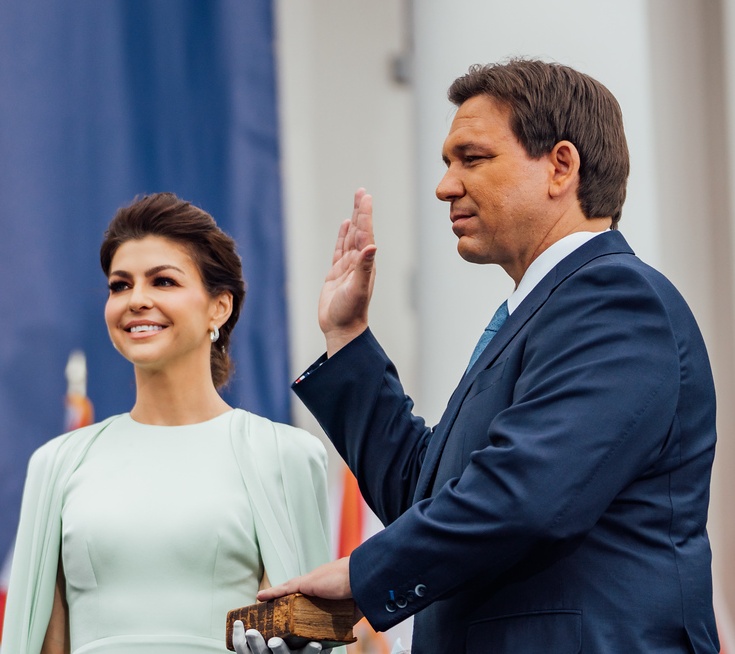 In 2022, Florida Gov. Ron DeSantis managed to win re-election by 20 percentage points in what had been a purple state (remember 2000?), while the expected "Red Wave" failed to materialize anywhere else. DeSantis used his power as governor effectively to accomplish a conservative agenda, removing two Soros-backed district attorneys who refused to prosecute crimes, dismantling DEI bureaucracies at the state's universities, re-creating the state's New College as a classical liberal arts college with a governing board filled with conservative thinkers like anti-woke campaigner Christopher Rufo, and defied the mighty Disney Corporation. While Trump was celebrating the vaccine he fast-tracked, DeSantis's appointed state Surgeon General, Dr. Joseph Ladapo, issued a caution for young men because of a higher risk of heart-related adverse effects.
At the heart of all of these DeSantis successes was a focus on results: understanding and wielding the authority that the voters had granted him to accomplish the priorities that he had promised the voters, hiring and appointing people with the intelligence, diligence, and character to accomplish the goals he set. You do not hear DeSantis or his fans making excuses for failure, mainly because he hasn't had many failures; DeSantis just gets things done.
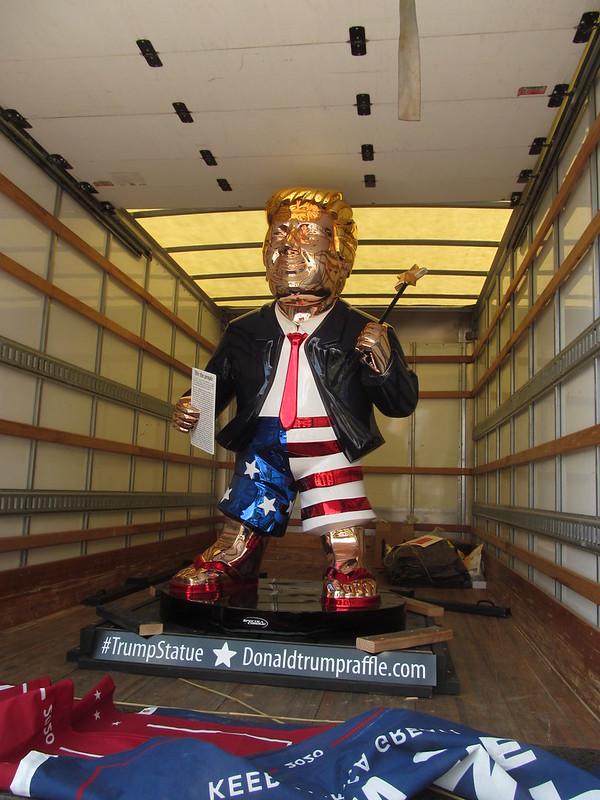 DeSantis's polling lead began to disappear as partisan prosecutors began filing case after case attempting to put former president Donald Trump in prison or at least off of the ballot. Understandably but mistakenly, many Republican voters felt that the only way to defy politically motivated misuses of the justice system was to rally behind Trump. Trump and his allies attacked DeSantis's admirable record, minimizing his achievements and even making wild and ridiculous false claims (e.g., the guy who ousted two Soros DAs is somehow Soros's puppet). Trump ran to DeSantis's left on abortion, transgenderism, and woke Disney.
Trump and his followers asserted that Trump did not need to earn the 2024 GOP nomination but was owed it. DeSantis was accused of what seems to be the greatest crime in the opinion of too many: Being disloyal to Trump. To these people, it doesn't matter who would be the most effective Republican nominee and conservative chief executive: Loyalty, not to principle, not even to a party, but to one man, is the supreme virtue and disloyalty the unforgivable sin.
I rarely take time to watch movies -- I tend to unwind with a classic sitcom episode -- but a couple of months ago during a business trip, I took the time to re-watch a film I had seen and enjoyed, The Death of Stalin, Armando Ianucci's dark comedy about the power struggle around the demise of the murderous Soviet leader, starring Jeffrey Tambour as Gyorgy Malenkov and Steve Buscemi as Nikita Khrushchev. I followed it up with Downfall, a German-language dramatization of the final days of Hitler in his Berlin bunker, based in part on the account of the young woman who was the genocidal dictator's personal secretary.
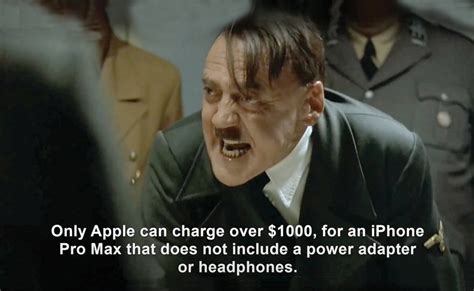 Shortly after the latter film was released, there was a frequently recurring video meme that repurposed the scene where Hitler has a conniption after the generals tell him that the remaining armies are unable to come to the rescue; new subtitles were added to adapt the scene to imagine various famous people reacting to bad news, for example, Hillary Clinton learning that she is about to lose the 2008 Democratic nomination for president to Barack Obama (language warning). Hilarious adaptations aside, Downfall is an enthralling, thought-provoking film.
The common element in the two movies is that, despite the terminal weakness of Dear Leader -- Stalin has had a stroke and lost control of his bladder and bowels, Hitler reigns over less than a square mile of territory and will soon kill himself -- his minions fall all over themselves to affirm their loyalty. These appear to be men of intelligence and leadership, they see that Dear Leader is leading the nation to disaster, there are enough of them to band together and push him out of power -- and yet they cannot break free. In Death of Stalin, Vyacheslav Molotov (played by Michael Palin) loudly denounces his wife for crimes against the state and justifies dead Stalin's decision to imprison and presumably execute her, right until the moment she walks back through the door of their flat.
Now, Donald Trump is no genocidal autocrat, and he did a great deal of good during his term of office, but these movies brought to mind the cult of personality that has surrounded him and which he actively encourages. Nothing Trump does is ever a mistake. It may seem like a mistake that he appointed numerous cabinet members whom he now denounces as disloyal idiots, but really he is playing 10-dimensional chess and only seeming to fail in order to expose the swamp. Elected officials, hoping for a share of the public adulation Trump enjoys, fall all over themselves to praise Trump, to claim his endorsement, and to make excuses for him. Trump made many unforced errors, but he does not show any indication of having learned from his mistakes to become a more strategic, focused, and self-disciplined leader.
The November election may very well end up as a rematch between Trump and Biden (or more likely, the Democrats will replace Biden after Trump is officially nominated by the Republican National Convention), but for now we have a much better choice on tomorrow's primary ballot.
If enough of us who understand that Ron DeSantis is the best choice vote for him, he can win delegates to the national convention. Maybe God will bless us, as He has blessed Florida, with better leadership than we deserve.
In addition to Oklahoma's presidential preference primary on March 5, 2024, a small number of local jurisdictions will have propositions: Haskell, Norman, Oilton (2), Dewey County, Logan County (3), McIntosh County, Major County, and Sharon-Mutual Public Schools (Dewey & Woodward Counties). One school district, Mannsville in Carter & Johnston Counties, has a special election for an unexpired board seat.
The longest ballot will be in Wagoner County, which has eight propositions relating to county sales taxes:
- Proposition No. 1: Make permanent the temporary 0.80% for operations and road and bridge improvements, originally approved in 2017
- Proposition No. 2: Make permanent the temporary 0.10% for Sheriff Office capital outlay and operations, originally approved in 2017
- Proposition No. 3: Make permanent the temporary 0.10% for General Fund purposes, originally approved in 2017
- Proposition No. 4: Repurpose half of the permanent 0.30% fire tax approved in 2004 to establish and provide ambulance service.
- Proposition No. 5: 0.125% for 30 years for courthouse facilities
- Proposition No. 6: 0.25% permanent for jail facilities and operations
- Proposition No. 7: 0.125% for 30 years for fairgrounds facilities
- Proposition No. 8: 5% lodging tax in unincorporated areas for parks and recreational facilities
Proponents call the package "Half a Penny for Wagoner County," referring to the new taxes in propositions 5, 6, and 7, but not considering the increase in taxes resulting from making a penny in temporary taxes permanent. The Wagoner County website has a PowerPoint with details on each proposition "for educational purposes only... does not imply an endorsement."
Some opposition has arisen, pointing out that this amounts to a 38% increase in the county's sales tax rate, from 1.3 cents to 1.8 cents on the dollar. That's on top of the state 4.5% sales tax and any city sales taxes. A group called Taxed Enough Already (TEA) points out that this will push total sales tax rates in the cities of Coweta and Wagoner up to 10.3%. Compare that to the combined 8.417% we pay in the City of Tulsa. While Gov. Stitt just signed a bill eliminating the state sales taxes on groceries, to go into effect in August, city and county sales taxes will continue to be imposed on necessities.
John Dobberstein of the Broken Arrow Sentinel has a detailed report on the Wagoner County propositions, specifically on a presentation made by Wagoner County Engineer Rachael Cooper to the Broken Arrow City Council. "Cooper admitted no public hearings had been scheduled about the tax proposals but they would be forthcoming in the next 60 days." The same article has links to the ballot resolutions approved by the Wagoner County Commission and notes the haste with which the propositions were moved forward.
District 1 Wagoner County Commissioner James Hanning said information was given to him about the propositions the morning of a recent County Commission meeting and he was asked to vote to whether approve the language with no prior knowledge.Hanning said he didn't know how the numbers were created but he was unsure 0.8% would be satisfactory or even enough to maintain roads in the county.
"We all, as well as Broken Arrow see the destruction of our roads and how much more it's costing us to fix them. So I don't know where the numbers came from. I'm simply telling you they were never presented to me," he told the Broken Arrow City Council after Cooper's presentation to them.
Firefighters in rural fire districts are unhappy that their permanent earmarked revenue stream is going to be cut in half (emphasis added).
Everyone agrees Wagoner County needs an ambulance service, and service should be improved across the county, but firefighters say taking away funds their departments rely on would hurt their ability to maintain equipment, attend training, or recruit and retain firefighters.On Monday night, firefighters asked County Commissioner Christina Edwards about what data supports the cut.
Edwards, who supports the ballot measure, was unable to answer the question.
The community also asked County Commissioner Tim Kelly, who also supports the proposal, the same question in a separate meeting.
His response was, "I get it. That's all you need to know."
Kelly was asked if he could provide the statistics and he said he could if he wanted to....
Another concern firefighters have is the county acknowledges never consulting any of the fire departments before proposing the idea.
I don't live in Wagoner County, but I would be reluctant to approve a permanent earmarked tax or any temporary tax longer than 5 years duration, as it eliminates opportunities for rebalancing revenues and priorities as costs and needs change. The need for Proposition No. 4 illustrates the hazard: Those who believe that the 0.30% fire district sales tax is generating more revenue than needed for that purpose now have to fight the holders of the concentrated benefit to repurpose the tax.
It's sketchy, to put it mildly, to schedule a sales tax election on a low-turnout date, with no hearings prior to the vote to put the propositions on the ballot and even one of the County Commissioners apparently kept in the dark. That kind of behavior by elected officials shouldn't be rewarded by the voters.
MORE:
KTUL: Wagoner County's 'half a penny campaign' draws debate over real cost of tax propositions
KOTV: Special Election In Wagoner County Could Impact Sales Tax
Group of Wagoner County residents holds rally against proposed sales tax increase
ELECTION RESULTS: Tulsa County school district bond issues all passed by a wide margin, each proposition exceeding 80% in favor. School bond issues fell short of the 60% threshold in Canute, Krebs, Silo, and Tupelo. In Boswell, Tuttle, and Weleetka school districts, a majority of voters voted against the bond propositions.
Best turnout: Edmond Public Schools, where over 10,000 voters showed up to approve two school bond issues with just shy of 80% in favor of each.
Worst turnout: Nobody -- zero of 21 registered voters -- in the Billings Public Schools district in Garfield County showed up to vote on adding themselves to the Garfield County 522 Ambulance Service District in the Billings Public Schools district. According to the Enid News, there were four propositions across the county relating to the ambulance service: Voters in the existing ambulance district cast two separate votes to annex into the district the parts of the Billings and Pond Creek-Hunter school districts in Garfield County, approving by 132-6 and 128-7, respectively. Voters in the affected part of Pond Creek-Hunter voted 11-5 in favor. Presumably annexation needed approval from both the existing district and the area to be annexed; with a tie 0-0 vote, it appears that the Billings annexation (about 32.25 sq. mi. in the northeast corner of the county) will not go forward.
The Garfield County Election Board posted the sample ballots on its Facebook group, which is better than not at all, but Facebook makes it very unpleasant for people who do not have accounts to access content on that platform. The proposition states that approval would have raised property tax rates by 3 mills; for a homestead worth $100,000, 3 mills on appraised value of $11,000 less $1,000 homestead exemption amounts to $30 per year.
In Collinsville Ward 1, only 31 people voted. Incumbent Brad Francis beat challenger Gary Cole 17-14. For want of a nail....
Sand Springs Ward 6 incumbent councilor Brian Jackson won re-election with 63% of the 325 votes cast.
In the entire state of Oklahoma, with over 400 school districts, each with at least one seat up for election this year, there were only 22 seats that required a primary because more than two candidates ran. In 13 of those 22 seats, a candidate received more than 50% of the vote and was elected; a runoff between the top two candidates will held for only 9 seats.
This coming Tuesday, February 13, 2024, is Oklahoma's annual school board primary election. Polls will be open from 7 a.m. to 7 p.m. A list of all of Tuesday's elections across Oklahoma can be found on the Oklahoma State Election Board website. You can access your sample ballot on the election board's Oklahoma voter portal.
As one of 10 election days authorized by law this year, Tuesday is also host to some municipal elections and special elections, including several school district general-obligation bond issues. As in all non-Federal Oklahoma elections, early voting is available the Thursday and Friday before election day from 8 a.m. to 6 p.m. at designated locations; in Tulsa County and most counties, that's at the county election board headquarters.
Only a small percentage of Tulsa County voters will have a reason to go to the polls. The only school board races on the ballot this Tuesday are those that drew three or more candidates. If a candidate receives more than 50% of the vote this Tuesday, he or she will be elected; if not, the top two candidates will advance to the school board general election on April 2, 2024, which is where you will find school board elections that have only two candidates.
There are several contested school board seats in Tulsa County, including three in the Tulsa Public Schools district, but all of them drew only two candidates, so you will see them on the ballot in April.
In Tulsa County, there are general obligation bond issues in Bixby, Sand Springs, and Jenks school districts, and a single city council seat each in Collinsville and Sand Springs.
Bixby school bond issues:
- School district web page on the bond issue
- Bixby bond issue Bond Transparency Act disclosure: The district has $192,440,000 left to be paid off from the 2022 and 2016 bond issues.
- Proposition No. 1: $11,500,000 "for the purpose of constructing, equipping, repairing and remodeling school buildings, acquiring school furniture, fixtures and equipment and acquiring and improving school sites"
- Proposition No. 2: $500,000 "for the purpose of purchasing transportation equipment"
Jenks school bond issues:
- School district web page on the bond issue
- Jenks bond issue Bond Transparency Act disclosure: "The School District has 49,945,000 in unissued building bonds authorized at an election held on the 10th day of February 2015." The disclosure lists specific bond expenditures from each election going back to 2019.
- Proposition No. 1: $18,180,000 "for the purpose of constructing, equipping, repairing and remodeling school buildings, acquiring school furniture, fixtures and equipment and acquiring and improving school sites"
- Proposition No. 2: $820,000 "for the purpose of purchasing transportation equipment"
Sand Springs school bond issues:
- School district web page on the bond issue
- Sand Springs bond issue Bond Transparency Act disclosure: The disclosure lists specific bond expenditures from each election going back to 2009. Sand Springs district has $23,308,959 in outstanding bond debt, including principal and interest.
- Proposition No. 1: $111,875,000 "for the purpose of improving or acquiring school sites, constructing, repairing, remodeling and equipping school buildings, and acquiring school furniture, fixtures and equipment; or in the alternative to acquire all or a distinct portion of such property pursuant to a lease purchase arrangement"
- Proposition No. 2: $2,625,000 "for the purpose of acquiring transportation equipment and auxiliary transportation equipment; or in the alternative to acquire all or a distinct portion of such property pursuant to a lease purchase arrangement"
For each candidate, ballot name is followed by full voter registration name in parentheses, if different, then age, party of voter registration, social media profiles and websites.
Collinsville city council, Ward 1:
- Brad Francis (Orville Brad Francis), incumbent, 76, R. LinkedIn profile, Facebook profile.
- Gary Cole (Gary D Cole Sr), 68, R. Facebook profile.
(Larry Shafer was the only candidate for mayor and has been re-elected.)
Sand Springs city council, Ward 4:
- Brian Jackson (Brian Michael Jackson), incumbent, 41, I. LinkedIn, Facebook profile. Jackson ran in the Republican primary for State House District 66 in 2018. He finished 2nd in the primary then lost to Jadine Nollan in the runoff. He changed registration from Republican to Independent sometime between the primary and November 2.
- David B. Parker, 61, R. LinkedIn profile, real estate Facebook page, personal Facebook profile.
(Beau Wilson, Ward 5, and Jim Spoon, at-large, were the only candidates in their respective races and have been re-elected.)
Here's a brief introduction to the six candidates running for three seats Tulsa Public Schools Board of Education, drawing on public information, including filing information, voter registration records, and social media accounts. All addresses are in the City of Tulsa. Because there are only two candidates in each race, each seat will be decided on Tuesday, April 2, 2024. I will add links to this page as more social media accounts are discovered and campaign websites are stood up, and this page will have a link to detailed candidate profiles later in the campaign season.
A brief panic during the filing period suggests nervousness by Tulsa's educational establishment about the outcome of these elections, in the form of letters from Tulsa Mayor G. T. Bynum IV, City Councilors Vanessa Hall Harper and Lori Decter Wright, State Rep. Monroe Nichols, and others urging the school board to waive board policy requiring a national search and public input in hiring a replacement for ex-Superintendent Deborah Gist and to hire Interim Superintendent Ebony Johnson to fill the permanent position immediately. The letters claimed to be concerned about local control, which appears to mean foundation control, as opposed to control by a board where three members had been recently endorsed by the voting public.
Following the process set out in board policy would have placed the hiring of a new superintendent after the seating of two or three new board members, resulting in a board that could well have a majority of four or five members who are independent of the private foundations that steered TPS policy during Gist's tenure. As Tulsa Parents Voice has documented, nearly all of the alumni of the Broad (rhymes with "road") Center for the Management of School Systems that populated the upper levels of the TPS org chart have departed this year. (The Broad Center involvement in public education has received criticism across the political spectrum; see these two 2018 articles by Betty Casey in Tulsa Kids. Eli Broad's controlling approach to "venture philanthropy" strongly resembles that taken by certain Tulsa philanthropists.)
Those executive vacancies would have been filled by a new superintendent under a new board majority, but now they can be filled by a long-time TPS administrator with a board majority of four favorable to Gist's failed policies and private foundation direction. Letters from community leaders allowed the current board majority to pretend to be responding to public demand in discarding board policy, bypassing public input and a thorough search for a new district leader. The two elected African-American women on the board, Rev. Jennettie Marshall and E'lena Ashley, voted against making Johnson permanent superintendent. Ms. Ashley commented after the vote on Facebook:
As I commend and congratulate our Dr. Ebony Johnson for her new 'permanent role' as TPS Superintendent, I am conflicted. I consider Dr. Ebony an excellent communicator and she certainly appears to have what it takes to make change.It also saddens me that we now as the Tulsa Public Schools board have...
- set precedent for Tulsa Public Schools by throwing away the rules in which the board established to ensure we performed our due diligence and ensured we in fact did all in our powers to find the best, most qualified person to lead TPS as Superintendent.
- set precedent to 'Circumvent the Rights' of the very students we are promising to Teach and Protect.
What we're teaching our young children is that when the rules don't fit our needs or agenda, we simply ignore them or find the best most expedient solution to get around them.
That's not how our students should expect their life's decisions to be made and they most certainly shouldn't see the leaders of their schools acting in such nefarious ways.
Here are brief profiles of each of the TPS school board candidates:
TPS Office No. 2:
This is a special election to fill the seat for the remaining year of an unexpired four-year term. Judith Barba Perez was elected to this seat in 2021, winning a three-way primary with 201 votes out of 379 cast. Barba Perez resigned in 2023 after she moved out of Oklahoma, and Diamond Marshall was appointed by the board to replace her until a special election could be held. Diamond Marshall declined to file for election.
Calvin Michael Moniz, 38, 2607 E. 6th St., Independent, Voter ID 720718072. Voted 11 times in the last four years. Did not vote in the February 2021 school board election. Social media: Campaign website, LinkedIn, personal Facebook profile, campaign Facebook page, campaign Instagram, personal Instagram (private, with 1,850 followers and 2,382 posts), campaign Twitter. A personal Twitter account @CalvinMoniz is no longer online. Moniz supported bypassing board policy to make Ebony Johnson permanent superintendent without the required nationwide search and public input.
KanDee N. Washington, 56, 2211 N. Xanthus Ave., Independent, Voter ID 720570162. Voted 5 times in the last four years. Did not vote in the February 2021 school board election. Social media: Campaign Facebook page.
TPS Office No. 5:
This is a regular election. John Croisant won the open seat in 2020, finishing first in the February primary with 44% in a field of five, then narrowly winning the postponed general election in June, 52% to 48% over Shane Saunders, thanks to an 834-vote advantage in absentee ballots and early voting.
John Thomas Croisant, 62 E. Woodward Blvd., Democrat, Voter ID 720699462. Voted 12 times in the last 4 years. Voted in the 2020 primary and general school board elections. Social media: Campaign website, LinkedIn profile, campaign Facebook page, personal Facebook profile, business Facebook page. Croisant voted to bypass board policy and make Ebony Johnson permanent superintendent without the required nationwide search and public input.
Teresa Ann Peña, 1127 S. College Ave., Republican, Voter ID 720206476. Voted 4 times in the last 4 years. Voted in the 2020 general school board election. Social media: Campaign website, LinkedIn profile, campaign Facebook page, personal Facebook profile.
TPS Office No. 6:
This race is for a full four-year term for the open seat currently held by Jerry Griffin, who is not running for re-election. He defeated long-time establishment incumbent Ruth Ann Fate in 2020.
Maria Mercedes Seidler, 7057 E. 52nd St., Republican, Voter ID 801571311. Voted 10 times in the last 4 years, including the 2020 general school board election. Social media: LinkedIn profile, personal Facebook profile, personal Twitter account. Seidler spoke at the December 11 TPS board meeting in favor of following board policy and conducting a nationwide search with public input for a new permanent superintendent.
Sarah Adrianne Smith, 5431 S. 67th East Pl., Democrat, Voter ID 720429536. Voted 9 times in the last 4 years, including the 2020 general school board election. Social media: Campaign website, LinkedIn profile, campaign Facebook page, personal Facebook profile, campaign Twitter account. Smith applauded the school board's decision to bypass board policy to make Ebony Johnson permanent superintendent without the required nationwide search and public input.
UPDATE: At the close of the filing period, we have three contested races for Tulsa school board, and contests for single seats in Berryhill, Owasso, and Union. The remaining 13 seats (including two each in Keystone and Liberty and the Tulsa Tech Center seat), are uncontested. Maria Mercedes Seidler filed for TPS Office No. 6, making that a two-woman contest for the open seat. Alan Staab filed but withdrew for TPS Office No. 5, so there are no Tulsa County contests with more than two candidates, and there will be no February 13 primary; all of these races will be settled on April 2, 2024. (Backup copy of candidate filings.candidatefilings_12082023.pdf)
Today, Wednesday, December 6, 2023, is the final day of filing for school board races in every public school district across Oklahoma. Candidates may file at the county election board until 5 p.m. today.
K-12 school districts will have a single seat, Office No. 4, up for election to a five-year term. K-8 dependent districts (Keystone is the only one in Tulsa County) have three seats that rotate through three-year terms, and also have a single seat on the ballot. Each year one of 7 Technology Center seats is on the ballot for a 7-year term; this year that is Office No. 1.
Tulsa, with 7 board members, has two seats up for a four-year term (No. 5 and No. 6) and the one-year unexpired term of Office No. 2.
After the second day of filing in Tulsa County, 13 seats have drawn only one candidate, 2 seats (Berryhill and Owasso) have drawn two candidates, and in Tulsa Office No. 5, incumbent John Croisant has drawn two challengers. No one has filed for Liberty Office No. 4.
Nor has any candidate filed for the Tulsa Technology Center Office No. 1, not even incumbent Rev. Dr. Ray Owens, pastor of Metropolitan Baptist Church and a board member of several non-profit organizations. This district mainly covers North Tulsa, from 11th Street South to 86th Street North, mainly west of Yale, plus Gilcrease Hills and neighborhoods just west of downtown.
Filing is also open for a number of municipalities; candidates have filed for city office in Collinsville, Owasso, and Sand Springs.
(Here is the a link to the latest list of candidates for Tulsa County school board and city council seats.)
School board filing always comes at a busy and distracted time of year. As I've written before, it's almost as if school board elections were deliberately scheduled to escape the notice of potential candidates and voters.
The school board primary election will be held on February 13, 2024, for those seats where there are three or more candidates. If no one wins a majority of the vote in the February election, a runoff will be held on April 2, 2024. If a seat draws only two candidates, the election will be held on April 2, 2024.
The Tulsa district, largest in the state, has two out of seven seats up for election to a four-year term, Offices No. 5 and 6, plus the remaining one-year term of Office No. 2, previously held by Judith Barba-Perez, who resigned earlier this year. As mentioned, incumbent John Croisant, first elected in 2020, is being challenged by retired TPS teacher Theresa Pena and Alan Staab. The Board appointed Diamond Marshall to serve District 2 until this year's school elections; the winner of this election will serve just one year. Marshall has not filed for election, but Calvin Michael Moniz has, and Candee Washington is expected to file as well.
Jerry Griffin, the incumbent in District 6, is not expected to run for re-election; he upset 24-year incumbent Ruth Ann Fate in 2020. So far Sarah Smith is the only candidate for that seat. Based on the age (45) listed on the filing, this is Democrat Sarah Adrienne Smith, registered to vote at 5431 S 67 E PL. (I don't know why the filing list omits addresses, which help to disambiguate names. There are 21 Sarah Smiths in Tulsa County, 9 in the Tulsa Public School District, 2 in Election District 6.) Her campaign kickoff was co-hosted by former Tulsa County Democratic Party chairman Keith McArtor. Here is Sarah Smith's personal Facebook profile. She is using the left-wing ActBlue platform for campaign donations.
You'll find a map of Tulsa Public Schools board districts here. District 2 is mainly between Admiral and Pine, with a bit of territory south to 11th Street around TU and Will Rogers High School. Booker T. Washington High School is also within District 2's boundaries. District 5 is mainly midtown west of Yale, around Edison High School, and District 6 is midtown from roughly Yale to Mingo.
Back during the 2019 filing period, I wrote at length about why school board races are so important, why they deserve much more attention than they receive, and why it's a shame that so few candidates run and so few voters turn out. During the pandemic school closures of 2020, parents and the general public began to learn more about what their children were being taught (and often how little they were being taught). More people are alert to what's at stake, and Tulsa has had some very contentious elections in recent years. We're hoping that trend will continue, but with more victories for school board members who will ask tough questions of the administration, who will represent the community's values and priorities, and who will stop the use of schools as missionary outposts for the Gramscian Left.
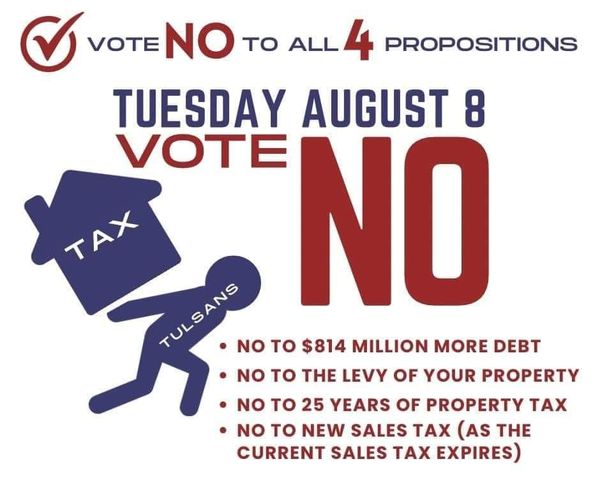
Originally posted on August 1, 2023. Post-dating to August 8 so it remains at the top of the page through election day. A previous entry has a just-the-facts discussion of the four August 8 bond issue and sales tax propositions.
Here are seven reasons to vote no on all four City of Tulsa ballot propositions at the special election next Tuesday, August 8, 2023:
1. Two-and-a-half years too early: The proposed sales tax may not go into effect until January 1, 2026.* A lot can change in two years and five months. Economic and global circumstances two years from now may be very different -- just think how different the world was two-and-a-half years ago -- and our priorities may change with those circumstances. We shouldn't commit nearly a billion dollars in spending so far in advance, nor should we start borrowing (and paying interest) on revenue that's two-and-a-half years in the future.
2. Hamstringing the next mayor and council: The proposals block the ability of new city officials to pursue capital improvements to implement their election platforms. A new mayor and city council will be elected in 2024, but the August 8 proposals lock up funding for capital improvements until 2030, after the end of the next mayor's term of office in 2028. It's selfish on the part of lame duck mayor GT Bynum IV, who is not running for re-election, to lock in spending priorities for his successor. There's plenty of time before the current tax runs out for the new mayor and council to decide on a new package. The new officials will have 10 months after taking office in December 2024 to put together a package and put it before the voters.
3. Too vague: $162 million is "itemized" for "citywide" but unspecified lists in broad categories -- streets, sidewalks, alleys, ADA implementation (whatever that means), bridge replacement. This list of vague citywide items includes traffic engineering, which is not a capital improvement but an operational responsibility, and project engineering inspection and testing, which in the past was always priced into individual projects as essential to any construction project. In the original 1980 "third-penny" sales tax vote and its early successors, specific intersections, bridges, widening projects, water and sewer lines, etc., were listed in the sales tax ordinance or general obligation bond issue, committing the city to specific projects with definable costs. It was possible to see whether or not funding was going to the most urgent needs and whether all parts of the city were given due consideration. These vague "citywide" line items don't give the voters anyway of telling whether we're being offered good value for money or whether contractor profits are being padded.
We also don't have specifics on nearly $80 million, divided between Proposition 1 and Proposition 4 for "Additional costs for completion of previously approved street projects listed in Improve Our Tulsa Proposition No 1 approved at an election held on November 12, 2019." Which projects overran? How much does each project require for completion?
Besides the "citywide" and "additional costs" items, many other line items are vague and undefined; some of them are outlined below.
4. $75 million for undefined "housing initiatives": When government sets out to solve a social problem, the money is wasted and the problem gets worse. $22 trillion was spent during the first 50 years of the War on Poverty, and there are more people dependent on government than ever before. The city wants $75 million to solve the homeless problem but they won't tell us how they will spend that money, not even why they think $75 million is the right amount to ask for.
The money will be spent in accordance with the recommendations of the Housing, Homelessness, and Mental Health Task Force, a group of the usual suspects and yacht guests that includes exactly one person who might have some direct experience dealing with homeless people.
The people in charge of our city government and the philanthropocrats** who control them see human beings as mere animals, automata that respond to stimuli in predictable ways. Their thinking goes that if you provide the proper environment and nutrients, people will thrive, just like plants do. That way of thinking leads to the arrogant belief that enough government money can fix anything: "If we can put a man on the moon" -- solve an engineering problem using the unchanging laws of physics and chemistry -- "we can end homelessness" -- a complex set of human tragedies that find their explanation in spiritual truths denied by the philanthropocrats and their minions.
The Founding Fathers and the Framers of the Constitution, informed by a Biblical anthropology, understood that all human beings are created in the image of God and as such have inherent dignity and worth, but also that all human beings are marred by the Fall, and inclined by nature to selfishness and evil, which requires the internal restraint of the Holy Spirit, a conscience externally restrained by the social pressure of a moral society, or, as a last resort, the threat of state violence to prevent violent evil.
Christian ministries like City of Hope Outreach and John 3:16 Mission have helped homeless people successfully leave the streets and rebuild their lives, because they begin with a true understanding of human nature. Materialist philanthropists and social service agencies, no matter how well-intentioned, cannot hope to address the problem and will likely only enable more of the self-destructive and societally destructive behavior they claim to be able to stop, if only they had enough money to spend.
5. Gilcrease Museum held hostage: Bynum IV & Co. are demanding another $7 million in "matching funds for improvements." In 2016, Tulsans approved $65 million to renovate Gilcrease Museum. In 2020, we were told that it had to be demolished and rebuilt. (Bynum IV chief of staff Blake Ewing wrongly claimed at the Tulsa GOP forum that we didn't know until the museum was closed that demolition was necessary. In July 2021, the doors closed for what we were told would be three years. In March 2023 we were told that more money was required, and recently we were told that the museum won't be open to the public until 2026. Bynum IV & Co. will have deprived an entire generation of Tulsa students of the opportunity to visit Gilcrease Museum during their high school years.
Like the proverbial car dealer who throws your keys on the roof and won't get them down until you buy a new car, Tulsa mis-leaders are demanding more money before they'll let us enjoy the priceless collection of artwork, artifacts, and historical documents that we, the Citizens of Tulsa, own. They don't deserve any more trust when they've already betrayed us over and over again. To earn our trust, the first step is to reopen Gilcrease, and put our collection back on display, with the money they already have in hand.
6. PAC in danger: Now City Hall mis-leaders want $55,790,000 for "Tulsa Performing Arts Center - facility renovation, infrastructure, loading dock improvements, safety and ADA improvements." This is more than half of the money for specified projects in Proposition 2. Given our experience with Gilcrease Museum, I would expect a similar bait-and-switch:
- Tulsans approve funding for PAC renovations
- Mis-leaders "discover" "serious problems" requiring demolition (or gutting)
- PAC closes with a promise to reopen in three years
- Mis-leaders "discover" a need for more money to reopen
- Construction delays keep PAC closed for two more years
I believe that Tulsa's mis-leaders wanted a new building for Gilcrease all along***, just like they wanted a new Arkansas River pedestrian bridge, and I strongly suspect they want a new PAC, but they know they cannot convince the voters to approve demolition of a beloved landmark or the full cost of the new facility. So they will deceive Tulsa voters, and if voters are stupid, they will fail to learn anything from past behavior and will let themselves be deceived once again.
Do we want to go for five or more years without a venue for Broadway theater, symphony, ballet, and opera? Until they deliver a new Gilcrease Museum to our satisfaction, we shouldn't trust Tulsa's mis-leaders with another precious cultural institution.
7. Millions more for a toxic lake: Work on the Zink Dam isn't complete yet, and the City wants another $3.5 million (per Proposition 2 in the bond issue resolution) or $5 million (per public statements) for "Zink Lake - infrastructure." Blake Ewing said during the Tulsa GOP forum that this was for parking lots, but when I asked where the document was that spells this out, I didn't get an answer. Meanwhile, Tulsa citizens have unanswered questions about toxic chemicals seeping into the lake from ground water under the refineries, past and present, along the river. Ewing dismissed these concerns as a "political, fun, fun hot button thing to get upset about."
In May 1979, Tulsa voters rejected the first attempt to pass a "third penny" sales tax for capital improvements. The list of projects was too vague, lacked guarantees that money would be spent as promised, and included some big projects that voters didn't want. In October 1980, 60% of Tulsa voters approved a more specific package with better safeguards and without the most objectionable projects. City of Tulsa officials have plenty of time to give us a solid package if we say no to this one.
Thanks to Jesse Rodgers and City Elders for the logo at the top of the page.
 The Tulsa County Republican Party has officially come out in opposition to the four City of Tulsa propositions for sales tax and general obligation bonds on the August 8, 2023, ballot ("Improve Our Tulsa 3"):
Republican Party of Tulsa County Takes Stance on
Improve Our Tulsa 3 Bond Package
Tulsa GOP is asking voters to Vote No on August 8thTULSA, OK (08/02/2023)
On August 8th, the City of Tulsa is asking all residents to vote on the Improve Our Tulsa 3 bond package. We love Tulsa; however, Improve Our Tulsa is the wrong approach at this time. It is vague and unvetted by the citizens. This package is being rushed when we have over two years to renew the current tax. Our biggest concerns about this package are the $75MM for UNDEFINED housing initiatives in the housing package, additional funding for the Gilcrease Museum, and the uncertainty with Zink Lake. Should this package be passed, the next Mayor will be hamstrung with the responsibility of implementing something he or she had no part in creating. How is this fair for our next Mayor?
We should learn from our history, in May 1979 Tulsa voters rejected the first attempt to pass a "third penny" sales tax for capital improvements. The list of projects was too vague, lacked guarantees that money would be spent as promised, and included some big projects that voters didn't want. In October 1980, 60% of Tulsa voters approved a more specific package with better safeguards and without the most objectionable projects. City of Tulsa officials have plenty of time to give us a solid package if we say no to this one. (batesline.com)
These are just a few reasons why the Republican Party of Tulsa County is asking you, the Tulsa voters, to VOTE NO on ALL FOUR propositions on August 8th because history tells us..... WE. CAN. DO. BETTER.
MORE: District 5 City Councilor Grant Miller explains why he voted against sending the package to the voters:
The mayor continues to dismiss the real and valid concerns of Tulsans claiming that people who don't like the idea of not having a plan for $75M of spending on homelessness or want answers regarding chemicals in the river before spending millions on a recreational area are "...just folks, like Councilor Miller, who object to things for the sake of objecting to them." (Link in comments). We can do better than the Mayor's package and come up with something that actually works for Tulsa, instead. And there is absolutely no reason to rush into this. We have more than enough time to go back to the drawing board according to Chief of Staff, Blake Ewing. Everything is and will be funded through 2025. So why did the Mayor say it would be a disaster?! He knows that's not true. Dismissing Tulsans' very serious concerns is terribly arrogant.
Here's the link to Councilor Miller's comments on KRMG.
UPDATE: The Tulsa County Republican Party hosted a forum on the August 8 vote on Thursday, July 27, 2023, at 6 p.m., at the Embassy Church, 7100 E. 31st Street. The panelists included City Councilors Christian Bengel and Grant Miller, Mayor's Chief of Staff Blake Ewing, and me, Michael Bates. Darryl Baskin moderated the discussion and provided a live stream, which is archived on his TulsaLiveEvents.com Vimeo channel.
On Tuesday, August 8, 2023, on a day when there is nothing else on the ballot, on a day when only 14 jurisdictions across the entire State of Oklahoma have an election, City of Tulsa voters will be confronted with four ballot propositions, one to enact a new sales tax, and three for new general obligation bond issues. Combined, voters are being asked to approve $815,415,000 in new capital spending, not counting bond interest and fees.
The "temporary" 0.95% sales tax would go into effect when the current 2021 Miscellaneous Capital lmprovements Temporary Sales Tax (approved in 2019) expires on December 31, 2025, or earlier if that tax raises $193 million before that time. Based on my tally of sales tax revenues since the Improve Our Tulsa 2 tax went into effect, and assuming a 5% increase in revenues year-on-year (which is based on recent numbers), we might hit $193 million collected in October 2025, boosted by the increase in the Improve Our Tulsa 2 tax rate from 0.45% to 0.95% in July 2025. Even so, it means that we will vote on a tax and the list of projects to be funded more than two years before the tax goes into effect. Why so early? Why not wait at least until a new mayor and council take office in November 2024 and have had time to assess priorities and re-estimate project costs?
The new sales tax would expire on June 30, 2030, with no provision for an earlier expiration if receipts are better than forecast. If the new sales tax is defeated, Tulsa's overall city sales tax rate would be 2.7% and combined state, county, and city sales tax rate of 7.567%. If the new sales tax passes, the overall city sales tax rate would be 3.65%, an increase of 35.2%.
On the jump page, the ballot language for the four propositions, the ordinances and resolutions approved by the City Council for each, and the list of projects for each:
Monday, May 22, 2023, Gov. Kevin Stitt vetoed HB 1236, a bill that, by the change of a single word, would have significantly neutered Oklahoma's deterrent against Strategic Lawsuits Against Public Participation (SLAPPs). Deep-pocketed and powerful public figures have used meritless lawsuits to punish critics and chill free speech. The process is the punishment: Without anti-SLAPP laws, someone trying to crush critical speech can simply file a lawsuit, without even making a prima facie case that actionable defamation occurred. Even if the defendant ultimately prevails, the defendant faces enormous costs to defend the suit, privacy-invading discovery requests, and time and costs to respond to interrogatories and attend depositions, just to get to the point where the court would be willing to consider a dismissal, to say nothing of the additional time, stress, and expense involved in getting to a jury trial.
Anti-SLAPP laws like the Oklahoma Citizens Participation Act (OCPA) provide a bypass of the process-punishment by allowing for an early motion to dismiss, where the plaintiff has to put his cards on the table at the beginning of the process, and the defendant can move to dismiss on the basis of free-speech protecting precedents such as New York Times v. Sullivan.
Court of Civil Appeals Chief Judge Thomas Thornbrugh described the purpose of anti-SLAPP laws in Southwest Orthopaedic Specialists v. Allison:
Anti-SLAPP legislation appears to be the result of an increasing tendency by parties with substantial resources to file meritless lawsuits against critics or opponents, with the intent of discouraging or silencing those critics by burdening them with the time, stress, and cost of a legal action. To carry out this purpose, anti-SLAPP acts typically provide an accelerated dismissal procedure, available immediately after a suit is filed, in order to weed out meritless suits early in the litigation process.
Anti-SLAPP laws also protect speech by making falsely accused commentators and reporters whole for the funds they spent defending themselves, thus deterring meritless suits designed only to silence them. 12 O.S. 1438 states:
Section 1438. A. If the court orders dismissal of a legal action under the Oklahoma Citizens Participation Act, the court shall award to the moving party:1. Court costs, reasonable attorney fees and other expenses incurred in defending against the legal action as justice and equity may require; and
2. Sanctions against the party who brought the legal action as the court determines sufficient to deter the party who brought the legal action from bringing similar actions described in the Oklahoma Citizens Participation Act.
HB 1236, which was co-authored by House Speaker Charles McCall and Senate Majority Floor Leader Greg McCortney, simply changed the "shall" highlighted above to "may."
In his veto message, Gov. Stitt explained his reasons for rejecting the bill:
Pursuant to the authority vested in me by Section 11 of Article VI of the Oklahoma Constitution,I have vetoed Enrolled House Bill 1236.Enrolled House Bill 1236 would amend the Oklahoma Citizens Participation Act, which is
designed to deter lawsuits intended to chill Oklahomans' right of free speech, right to petition and right of association. Currently, defendants who secure dismissal of lawsuits under the Act are entitled to mandatory costs, attorney fees, other expenses, and potential sanctions. The Bill would make discretionary what is now mandatory.Such a change would undermine the Act's purpose, ensuring a greater frequency of frivolous lawsuits against Oklahomans exercising free speech. Although I would support an amendment providing for mandatory attorney fees only when a strategic lawsuit against public participation (SLAPP) is found to be frivolous, this amendment would go too far in relaxing a needed deterrent.
For these reasons, I have vetoed Enrolled House Bill 1236.
If awarding costs was a matter of discretion, a district judge might take note of a plaintiff's money, power, and connections, and decline to impose court costs after dismissing a SLAPP case for failing to make a prima facie case. A district judge might be worried that a wealthy, powerful, and connected plaintiff might recruit an opponent for his re-election.
We live in a time when mainstream media organizations, press outlets with the resources to fight a lengthy court battle, have chosen to become mouthpieces for the powerful, "to afflict the afflicted and comfort the comfortable," to invert Mr. Dooley's appraisal of the newspaper business. If the public is to hear about the evil deeds and corrupt practices of the powerful, it will fall to courageous outsiders who would be devastated by attritional lawfare waged by the deep-pocketed. The Oklahoma Citizens Participation Act provides essential protection to these truth tellers. One of my proudest accomplishments in a quarter-century of public involvement is my part in getting the OCPA through the legislature, with the essential help and leadership of Rep. John Trebilcock, Sen. Rick Brinkley, and Sen. Anthony Sykes. Thank you, Governor Stitt, for protecting the law's ability to protect us.
MORE: Over the weekend, Jonathan Small, president of the other OCPA (Oklahoma Council of Public Affairs) urged Gov. Stitt to veto HB 1236:
"Special interests who have for years tried to silence Oklahoma conservative voices have now asked lawmakers to make it easier to stifle conservative views," Small said.Under current law, a defendant sued for defamation who wins a motion to dismiss asserting a First Amendment privilege is entitled to costs, attorney fees, and a sanction "sufficient to deter the party who brought the legal action." ...
"The special interests lobbying for this bill are saying the quiet part out loud: they want to bully opposing voices with no accountability," Small said. "Governor Stitt has never been one to give in to bully tactics, and OCPA encourages him to veto this bill."
OCPA journalist Ray Carter quoted national organizations supporting press freedom on the importance of anti-SLAPP laws, with high praise for Oklahoma's law:
The Institute for Free Speech ranks Oklahoma's current anti-SLAPP law among the best in the nation, noting the law "protects the exercise of the right of free speech, right to petition, and right to association.""Anti-SLAPP statutes are designed to address a structural problem within American law: namely, an unscrupulous litigant can use litigation strategically to suppress or punish speech he or she dislikes," the Institute for Free Speech notes. "Such a litigant would typically claim that the speech constituted defamation and then sue others to harass them, silence them, or force them to bear significant litigation costs. Those who are faced with such a lawsuit ... are often presented with a harsh choice - accede to the litigant's demand for settlement (which may include paying compensation, ceasing criticism, and apologizing) or continue to bear heavy legal fees as the suit progresses. Either choice may entail substantial losses of speech, reputation, time, and money. These are costs defendants must bear even when faced with lawsuits that plaintiffs have a minimal chance of winning."
The Institute says that strong anti-SLAPP laws like Oklahoma's current law "encourage potential plaintiffs to think twice before hauling speakers into court with weak or frivolous cases."
The Reporters Committee for Freedom of the Press notes, "SLAPPs have become an all-too-common tool for intimidating and silencing criticism through expensive, baseless legal proceedings."
The Reporters Committee notes that strong anti-SLAPP laws, such as the one that currently exists in Oklahoma, "are intended to prevent people from using courts, and potential threats of a lawsuit, to intimidate people who are exercising their First Amendment rights. In terms of reporting, news organizations and individual journalists can use anti-SLAPP statutes to protect themselves from the financial threat of a groundless defamation case brought by a subject of an enterprise or investigative story."
Writing for the Nieman Journalism Lab in 2021, Peter Coe, a lecturer in law at the University of Reading, noted that SLAPP lawsuits were "increasingly being used by powerful people to shut down criticism from activists, academics, whistleblowers, and journalists."
"SLAPPs are used to try to prevent the public from learning about matters of public interest that could harm the reputation of a company or government," Coe wrote. "They typically take the form of defamation lawsuits, but very often the companies or individuals who start these claims know they will never win. Rather, the aim of the claim (what makes it a SLAPP) is to dissuade journalists from reporting on a controversial story by making it as costly and time-consuming as possible."
UPDATE 2023/05/25: An attempt to override the veto this morning failed overwhelmingly, with only 36 House members voting to override and 61 voting to sustain. I'm told that House rules would allow another override attempt, perhaps after additional arm-twisting. Contact your state rep and encourage him or her to vote against any further attempts. OCPA's Jonathan Small announced that any vote in favor of override would be scored negatively in their ratings of legislators.
Tony Lauinger, State Chairman of Oklahomans for Life, who has tirelessly, for decades and at his own expense, lobbied on behalf of the unborn at the State Capitol, is calling on Oklahomans who oppose abortion to support SB 368. In his message below, Lauinger rightly points out the short-term thinking of those who insist on absolute abolition right now. The bill passed both houses overwhelmingly, but the Senate rejected the House's amendments, and the bill was referred to conference committee consisting of Senators Garvin, Rosino, Haste, Daniels, Treat, and Hicks and the standing House Conference Committee on Public Health, consisting of Representatives Roe, Hasenbeck, Newton, Randleman, Stark, and Ranson. (Sen. Hicks and Rep. Ranson are the only two Democrats on the conference committee.)
Oklahoma is a democracy, with a constitution that authorizes initiative and referendum. A law that is only supported by 4% of the population is vulnerable to a well-funded initiative petition campaign that would be cast as a choice between that "extreme" 4% position and a "moderate" position (abortion on demand) supported by 30% or more of the voters. SB 368, enacting restrictions supported by 71% of the population, offers a much more defensible position against counterattack. State courts are less likely to find an overwhelmingly popular law unconstitutional. Referendum backers will not see an easy target.
In 2017, the Kansas State Supreme Court struck down an anti-abortion law, finding a right to abortion in the Kansas state constitution's language stating that "all men are possessed of equal and inalienable natural rights." When legislators sent a constitutional amendment to the voters, asserting that the Kansas state constitution should not be construed to grant a right to abortion, the voters defeated it, with 59% voting no.
I trust Tony Lauinger's judgment, grounded as it is in years of his successful efforts to inform, persuade, and change hearts and minds, over that of the "principled" "abolitionists" who insist on the strictest terms and the harshest punishments right now. The ringleaders of that movement are at best dupes of the abortion industry or at worst its paid influencers, using emotional manipulation and religious guilt on Christians of tender conscience to push for laws that will trigger a pro-abortion backlash and turn the mushy middle, the persuadables, against protecting unborn children at all.
In time, Oklahomans who have been persuaded to see the humanity of the unborn child, worthy of legal protection, will see the logic of extending that protection regardless of the circumstances of conception. I came to that conclusion decades ago, but it didn't happen overnight.
Here's the email from Oklahomans for Life:
One Last Chance to Defend Unborn Child Against Unlimited Abortion on Demand in Oklahoma:URGENT: Email Senate & House to Pass SB 368
Due to the heroic efforts of Senator Julie Daniels, we have one last chance to fortify Oklahoma's ability to defeat the abortion industry's constitutional amendment imposing unlimited abortion on demand on our state. Please send an email to senaterepub@okforlife.org and a second email to houserepub@okforlife.org urging SUPPORT for SB 368. Your two emails could be identical, and brief. Please send even if you have done so previously.
This essential pro-life legislation, which did not get approved earlier in the session, has been revised and inserted in a different bill. The new bill, SB 368, must pass both chambers of the legislature this week, before adjournment Friday. It is urgent to contact Senators and House members with emails of Support for SB 368. The goal is to provide permanent protection for future generations of Oklahoma children.
Two ominous developments have occurred in recent weeks. The Oklahoma Supreme Court showed its hostility to unborn children by striking down a pro-life law enacted last year, and Wisconsin became the latest state in which the abortion industry won a statewide election that centered on abortion. Pro-abortion forces are now 7-0 in statewide votes since Roe v. Wade was overturned last June: seven pro-abortion victories, zero pro-abortion defeats.
A poll of Oklahoma voters' attitudes about abortion shows our current criminal law, abortion prohibited except to save a mother's life, is supported by just four percent (4%) of Oklahoma voters. SB 368, which would prohibit ninety-five percent (95%) of all abortions, reflects a pro-life position enacted last year in Oklahoma's civil abortion law, which includes rape reported to law enforcement and incest of a minor reported to law enforcement, and is supported by 71% of Oklahoma voters.
Those thinking SB 368 is not pro-life "enough" are thinking short-term rather than recognizing the reality of pro-abortion momentum since Roe v Wade was overturned last June. The abortion industry has huge advantages in money and pro-abortion media bias, and the initiative-petition process in our state leaves us totally dependent on "the consent of the governed," raw democracy, in defending a position supported by only 4% of voters.
We have two choices:
1. modify our current law to fortify our state against the pro-abortion onslaught that is coming by enacting SB 368 which would prohibit 95% of all abortions and represents a pro-life position supported by 71% of Oklahoma voters; or
2. take the short-term approach, refuse to act, and then lose the right to life for ALL unborn children in Oklahoma when the constitutional amendment is adopted next year bringing unlimited, unrestricted abortion on demand to our state.
No unborn child in Oklahoma will have a right to life under the constitutional amendment the abortion industry will propose. That's the pro-abortion option.
Will the pro-life option be one that is supported by 4% of Oklahoma voters, or one that is supported by 71% of Oklahoma voters? That is what's at stake. That is why SB 368 is absolutely essential.
Please send an email to senaterepub@okforlife.org and a second email to houserepub@okforlife.org urging SUPPORT for SB 368.
Thank you.
Tony Lauinger, State Chairman
Food for thought: The abolitionists are basically recycling Never-Trumper arguments.
THE OTHER PERSPECTIVE: State Rep. Jim Olsen (R-Roland) explains his opposition to SB 368.
UPDATE 2023/05/24: Today, the Senate rescinded its rejection of the House amendments to its bill and also rescinded its request for a conference committee. From page 2 of this morning's Senate Journal:
Senator Garvin asked unanimous consent, which was granted, that the Senate rescind the rejection of the House amendments and the request for conference for SB 368.
What this would seem to mean is that the same bill, the version with House Amendments, has now been approved by both House and Senate.
Some thoughts on the April 4, 2023, school board and municipal results, from my live-tweet thread. (ThreadReaderApp unroll here.)
At 7:36 pm, early results in the Tulsa school board election came from 4 of the 18 precincts in District 1, all east of the river (and thus incumbent Stacey Woolley's home turf). Woolley led Jared Buswell 366 to 67, also dominating absentee and early voting, 160-29. At that point in the Bixby election, only absentee/early votes were in, with incumbent Matt Dotson leading Julie Bentley, 79-42.
In Tulsa and Bixby, challengers Buswell and Bentley were running on platforms supporting transparency and parental rights and opposing obscene materials in school libraries.
At 7:50 pm, we were still waiting for three big west-of-the-river precincts to report, but Woolley's home precinct was also yet to come in. Woolley was leading 865-359. Buswell won the two working-class precincts on the west end of Chas Page Blvd, but not downtown-adjacent neighborhoods, like Owen Park, The [formerly Brady] Heights, and Crosbie Heights.
By 8:00 pm, Woolley had won her home precinct, North Maple Ridge & Swan Lake, 412 to 80. Buswell won the precinct encompassing Red Fork and Carbondale, including Webster HS, 132 to 61 -- dominating but by a smaller percentage and with a much lower turnout.
Buswell won his own precinct (720123), but only 100-72. Woolley won the old West Tulsa precinct, just across the river from downtown. That precinct includes the Westport Apartments and a great deal of public housing. The only precincts yet to report were the Gilcrease Hills precincts in Osage County; those also went to Woolley.
There were upsets, but not in the high-profile Tulsa and Bixby school board races. In Berryhill, challenger Danny Bean defeated incumbent Doc Geiger, 170-76. Tracy Hanlon defeated incumbent Rusty Gunn for a seat on the Sand Springs school board, 289-220. Jerald Freeman defeated Skiatook city councilor Joyce Jech, 98-77.
In Broken Arrow, Oklahoma's 4th largest city, Mayor Debra Wimpee had a good night, even though she wasn't on the ballot. Her endorsed candidates won in all three council races. Adding this election to the 2021 results, the entire council is composed of her allies. Vice Mayor Christi Gillespie won a rematch against longtime councilor Mike Lester, the incumbent she beat in 2019. Challenger Joe Franco beat incumbent Scott Eudey. In the at-large council seat, incumbent Johnnie Parks survived with 45% of the vote. William Vaughn improved his 2019 performance with 36%, but voters opposed to Parks split their votes with two other candidates once again. Some conservative organizations backed George Ghesquire, who finished third.
The award for the lowest turnout in any Oklahoma election went to the Town of Ochelata in Washington Co., which had only 10 voters. There were two propositions on the ballot that each tied 5 votes for, 5 against. The propositions were to decide whether the Town Clerk and Town Treasurer would become offices appointed by the Board of Trustees, rather than elected. Ochelata has 279 registered voters. The Town of Avant in Osage County also voted whether to appoint Town Clerk and Treasurer, and the votes also were tied 8 to 8 for both propositions, but there are only 186 voters, so they managed 8.6% turnout!
Biggest turnout was for a regular election was for a seat on the board of the Indian Capital Tech Center -- 8,029 votes over 4 counties and parts of 4 more. Challenger Mark Walters defeated incumbent Scott Chambers, 4,158 to 3,871. Ascend Action was the consulting team supporting Walters's campaign.
The biggest turnout of all was for the Oklahoma County special election for County Clerk. Republican Marissa Treat (wife of State Senate President Pro Tempore Greg Treat) won 52% to 48%, with a total vote of 42,410.
Last results of the night came from Washita County. All precincts in the state had reported by 9:35 pm.
As I was tweeting, I was periodically refreshing the Oklahoma State Election Board results page, which brought to mind a number of suggestions for improvements, which I tweeted out @OKElections (but with no response):
- A visible permalink for each race, so I don't go all the way back to Achille when I'm refreshing the Tulsa results. This would also make it easier to point people (via Twitter and elsewhere on social media) directly to a specific result of interest.
- Make it possible to look up sample ballots without needing the name and birthdate of a voter in that jurisdiction. Right now there is no simple way to see the ballot title for a proposition in another jurisdiction except to find a voter in that jurisdiction and plug his/her name and date of birth into the OK voter portal.
- Put geographical name first in the list of entities, e.g. "Broken Arrow, City of," "Ochelata, Town of," so that all municipal elections in the results list sort by geographical name, as is the case for school districts. I don't always remember whether a municipality is a city or a town.
- Group local results by type of jurisdiction. Right now, the city and town results are mixed in alphabetically with K-12 and technology center school districts. All results for cities are between Cimarron Public Schools and Colcord Public Schools, and all results for towns are between Tonkawa Public Schools and Tulsa Public Schools.
The day after the election, the Tulsa Whirled decided to report on a Tulsa Public Schools audit finding involving $364,000 in questionably legal contracts. Although the report had been discussed in the TPS board meeting on Monday night, the Whirled delayed reporting on it until it was too late to inform voters deciding whether the school board president deserved another term. TPS board and administration deserve some blame as well -- the open records request wasn't answered until Wednesday morning. The report from the audit firm is dated March 30, 2023, the Thursday before the election.
April 4, 2023, is general election day across Oklahoma for school board races and for municipalities that use the default forms of municipal government established by state statute. Many cities with city charters that define a customized government structure still use the default dates for city elections. As is all too typical for local elections, many races failed to draw more than one candidate.
Polls are open from 7 a.m. to 7 p.m. To find your polling place and take a look at sample ballots, visit the Oklahoma State Election Board's voter portal.
Four Tulsa County school districts have school board races on the ballot. For Tulsa Office No. 1, incumbent Democrat Stacey Woolley faces Republican challenger Jared Buswell. For Berryhill Office No. 3, Danny Bean vs. Doc Geiger. For Bixby Office No. 3, Julie Bentley vs. Matt Dotson. For Sand Springs Office No. 3, Tracy Hanlon vs. Rusty Gunn.
Three Broken Arrow city council seats are on the ballot: Mike Lester v. Christie Gillespie in District 3, Scott Eudey vs. Joe Franco in DIstrict 4, and four candidates for the at-large council seat: George Ghesquire, Sonjia J. Potter, William Vaughn, Johnnie D. Parks. One Bixby city council seat, Monica Rios v. Ken Hirshey. One Skiatook seat: Joyce Jech vs. Jerald Freeman.
Below is a list of candidates running in Tulsa County school board and municipal elections. The name as it appears on the ballot is followed by the name under which the candidate is registered to vote, the party of voter registration, age as of election day, and then a list of web pages and social media profiles related to each candidate:
School Board seats
Except in the Tulsa school district, voters anywhere in a school district can vote in the election for any school board seat, regardless of election district. In the Tulsa school district, only voters in Election District No. 1 may vote.
Tulsa Public Schools, Office No. 1:
- Jared Buswell (Jared David Buswell), R, 39, 1860 W. 58th St.: campaign website, personal FB, campaign FB.
- Stacey Woolley (Stacey Ryan Woolley), D, 47, 1110 E. 20th St., incumbent: campaign website, personal FB, campaign FB.
- Danny Bean (Daniel Earle Bean), R, 42: personal FB
- Doc Geiger (James Conrad Geiger), R, 73, incumbent: personal FB
- Julie Bentley (Julie Lynn Bentley), R, 52: personal FB, campaign FB.
- Matt Dotson (Matthew Ray Dotson), R, 42, incumbent: personal FB.
- Tracy Hanlon (Tracy Anne Hanlon), R, 42: personal FB
- Rusty Gunn (Rusty Don Gunn), R, 45, incumbent since 2013: personal FB
City Council seats
Three Broken Arrow city council seats are on the ballot. Under the statutory charter, registered voters from anywhere in the city can vote in all races. In Bixby, only residents of Council District 3 may vote; incumbent councilor Paul Blair is not seeking re-election. Under Skiatook's city charter, registered voters from anywhere in the city can vote in all races.
Broken Arrow City Council Ward 3:
- Christi Gillespie, (Christi D. Gillespie), R, 53, incumbent, vice mayor: personal FB, campaign FB.
- Mike Lester (Michael Edward Lester), R, 75, former incumbent: personal FB, campaign FB
Broken Arrow City Council Ward 4:
- Scott Eudey (Scott Riley Eudey), R, 49, incumbent: personal FB, campaign FB
- Joe Franco (Joseph Dale Franco), R, 45: personal FB, campaign FB
Broken Arrow City Council At-Large:
- George Ghesquire (George Camiel Ghesquire III), R, 54: personal FB, campaign FB
- Johnnie D. Parks, R, 75, incumbent: personal FB, campaign FB
- Sonjia J. Potter (Sonjia Juanita Potter), R, 76: No social media or website found
- William Vaughn (William Daniel Vaughn), R, 49: personal FB, campaign FB
- Ken Hirshey (Kenneth Loyd Hirshey, Jr.), R, 63: Oklahoma Environmental Quality Board website, company website
- Monica Rios (Monica Joi Rios), R, 48: personal FB, campaign FB
- Jerald Freeman, R, 85: personal FB
- Joyce Jech (Joyce May Jech), R, 77, incumbent: campaign FB
Endorsements:
If I could vote in the TPS Office 1 race, I would vote for Republican challenger Jared Buswell. Buswell, a member of Asbury Church, serves as chairman of the board of Favor International, a Christian ministry working in war-affected areas of Africa -- specifically northern Uganda and South Sudan -- to relieve suffering, proclaim the gospel, build churches and Christian leadership, educate, build community infrastructure, and train to empower economic development. Buswell has been involved with Favor since 2012 and has helped to build Favor's donor base from $300,000 to $6 million per year. Buswell also has a business called Look Inside Tulsa, which uses 360-degree spherical photography to provide VR views of home and building interiors. Originally from Milwaukee, Wisconsin, he came to Tulsa in 2001 to attend Oral Roberts University and has lived in west Tulsa since 2007.
His opponent, incumbent Democrat Stacey Woolley, has presided over the continued decline of Tulsa Public Schools, which badly underperforms the rest of the state by every measure. The Whirled's endorsement is inadvertently damning. The Whirled says that, "Among her top accomplishments is refocusing school meetings to student achievement and simplifying operational votes to a consent agenda." This was a move against public transparency and accountability: Last July, the consent agenda was used to hide the board's acceptance of a grant from a non-profit funded by the Chinese Communist Party; it was only exposed because board members E'Lena Ashley, Jerry Griffin, and Jennettie Marshall voted against the consent agenda as a whole.
The Whirled also applauds Woolley for "help[ing to] update the superintendent's evaluation, making it among the nation's few based almost entirely on student outcomes." If that's so, why does Deborah Gist still have a job, when student outcomes continue to be abysmal? And yet Woolley has repeatedly voted to extend Gist's contract.
Election District 1 includes all of the Tulsa school district west of the Arkansas River, plus downtown Tulsa, the neighborhoods along Charles Page Blvd west of downtown, the southern portion of Gilcrease Hills, Brady Heights, Pearl District south of 6th Street, Tracy Park, Swan Lake, North Maple Ridge, and Riverview. Like most of his prospective constituents, Buswell lives west of the river, in a modest home valued by the county assessor at $119,221, located in Woodview Heights near 61st and Union. Woolley lives in the wealthiest neighborhood in the ward, North Maple Ridge, in the extreme eastern extent of the district, in a home valued by the county assessor at $585,301. It is a sadly frequent redistricting technique to gerrymander a few exclusive neighborhoods into an otherwise working-class, middle-class district, so as to maximize the number of the connected and wealthy on an elected board or council.
In the Bixby school board race, I would vote for challenger Julie Bentley over incumbent Matt Dotson. Bentley is a certified teacher who has taught 13 years in the Bixby district and is the mom of a current Bixby High School student. Dotson appears to be a subservient rubber stamp for superintendent Rob Miller, who has expressed his contempt for concerned citizens who speak at board meetings. Dotson refused to take a firm stand against inappropriate books in the curriculum and the library, preferring to invest total confidence in the district employee he's supposed to be holding accountable. (Miller's blog View from the Edge, which he ended in 2017, shortly before he was hired as Bixby superintendent, reveals his hostility to public accountability for the performance of public schools.)
Endorsements from conservative groups:
- Tulsa County Republican Party: Jared Buswell (Tulsa schools, Office 1), Julie Bentley (Bixby schools, Office 3).
- Bixby Parents Voice: Julie Bentley (Bixby schools, Office 3).
- Moms for Liberty: Jared Buswell (Tulsa schools, Office 1), Julie Bentley (Bixby schools, Office 3).
- Oklahomans for the Second Amendment (OK2A): Jared Buswell (Tulsa schools, Office 1), Julie Bentley (Bixby schools, Office 3); Christie Gillespie (Broken Arrow Council 3), Joe Franco (Broken Arrow Council 4), George Ghesquire (Broken Arrow Council At-Large). William Vaughn (Broken Arrow Council At-Large) also had an A-rated survey.
- Oklahomans for Health and Parental Rights: Jared Buswell (Tulsa schools, Office 1), Julie Bentley (Bixby schools, Office 3); Christie Gillespie (Broken Arrow Council 3), Joe Franco (Broken Arrow Council 4). George Ghesquire and William Vaughn in the Broken Arrow Council At-Large election each had an A-rated survey, but OKHPR did not endorse in that race.
The incumbent and challenger in the Tulsa School Board District 1 race have each raised over $50,000 according to campaign contribution and expenditures reports filed with the Tulsa Public Schools district clerk.
As of the March 20, 2023, close of the pre-election reporting period, Democrat incumbent Stacey Woolley had raised $51,798, while Republican challenger Jared Buswell had raised $58,643.
Woolley's donor list includes contributors connected with the foundations whose influence has propelled Tulsa Public Schools toward its abysmal academic performance. Maximum $2,900 donors include the Lynn Schusterman Revocable Trust, the Stacy Schusterman Revocable Trust, Frederic Dorwart (attorney for the George Kaiser Family Foundation and related entities), and Philip Kaiser (son of George Kaiser). George Kaiser made a personal donation of $500. Big Democrat donors George Krumme and Burt Holmes also gave maximum donations. Attorney Robert A. Curry gave $1,500 in aggregate, and Joseph Parker Jr. and Robert Thomas each gave $1,000. Employees of the Charles and Lynn Schusterman Family Foundation, the George Kaiser Family Foundation, Tulsa Community Foundation, Zarrow Family Foundations also appear on Woolley's list of contributors. Other notable names include left-wing Democrat Tulsa City Councilors Laura Bellis and Lori Decter Wright, former Democrat Mayor M. Susan Savage and her ex-husband Grant Hall, Democrat State Reps. Melodye Blancett and Suzanne Schreiber (also a former school board member), and Democrat former school board member Cindy Decker, head of GKFF-backed Tulsa Educare. "Friends of Shawna Keller," the campaign committee of the east Tulsa school board incumbent defeated a year ago by E'Lena Ashley, gave $1,000 to Woolley.
Republican challenger Jared Buswell raised $57,643.55, including $6,573.55 in in-kind contributions. Buswell received maximum $2,900 contributions from H. Michael Krimbill, L. Avery Krimbill, Christie Glesener, Tom Culver, and Vivienne Culver. The latter two contributions were in-kind as office rent reductions. Buswell received several large PAC contributions: Oklahoma Conservative Political Action Committee (OCPAC), $2,350; Women Working for Oklahoma PAC, $2,000; Oklahoma Realtors PAC, $1,000. Other lare donors include Brian & Pauline Robinson, $2,500; Kent Glesener, $2,500; Rob Prulhiere, $2,000; Julia Sublett, $2,000; Suzanne Behr, $1,500; Frances Fleming, $1,500; Michael Phillips, $1,500 (including $250 in-kind for yard signs); Jody Tell, $1,200; Matthew Watson, $1,000; Ken Sellers, $1,000; Thomas Carruth, $1,000; Michael Ross, $1,000; Reed Downey Jr, $1,000; Alvin Loeffler, $1,000. Former District Attorney Tim Harris, who ran unsuccessfully for the District 7 board seat last year, contributed $250 to Buswell. Buswell reports giving $2,750 to his own campaign, plus another $349.48 in in-kind contributions, purchasing push cards, yard signs, and other printing for the campaign.
The initial set of documents sent by inquiries@tulsaschools.org in response to my Open Records request did not include the full list of Woolley's contributors. Melissa Remington of Tulsa Parents Voice observed that the sum of itemized contributions in Schedule A was over $30,000 less than the reported contribution total. Remington also noticed that the list of contributions abruptly ended on January 17, 2023, despite a well-publicized fundraiser hosted by Democrat former Mayor Kathy Taylor and Democrat State Rep. Monroe Nichols on February 16. Remington called the discrepancies to the attention of Woolley, the school board clerk, the Oklahoma Ethics Commission, and others.
Remington and I subsequently received an update to our separate open records requests from Emma Garrett-Nelson, whose email signature gives "pronouns" "(she/her/hers)" and describes herself as Executive Director of Communications & Strategy, with the following statement: "We uncovered a glitch in our Adobe PDF reader that we've since addressed, so please use these rather than the files we sent you on March 28. This is everything responsive to your request." The attachment was an oddly-formatted report of contributions only, in which the page header appeared at different places on the page and contribution amounts appeared in a variety of font sizes, including unnecessarily small. The original version was clearly a scan of the filed hardcopy report, complete with the Tulsa Public Schools "RECEIVED" date stamp. The new contributions-only report has no scanning artifacts -- text is selectable and there are no date stamps.
The explanation of "a glitch in our Adobe PDF reader" doesn't fit the evidence. In the original version there are no indications that the reverse sides of pages were not scanned or that consecutive pages were missed by a scanner. An explanation more consistent with the evidence is that the Woolley campaign failed to submit a complete report by the deadline, whether or not accidentally.
This raises a concern with the current process. The "Executive Director of Communications & Strategy" is likely to depend on the goodwill of her boss, Superintendent Deborah Gist, for her continued employment. She would have some incentive to help cover over the mistakes of an incumbent candidate who has been an unquestioning supporter of her boss. It would be best for all concerned if all campaign ethics reporting, for every office and proposition in every political subdivision at every level, were through the Oklahoma Ethics Commission's Guardian system, rather than forcing citizens to make open records requests to access campaign filings that should be accessible to the public the instant they are submitted.
To its credit, for the first time in a long time the Tulsa Whirled reported on the pre-election ethics filings, but reporter Lenzy Krehbiel-Burton failed to notice the discrepancy in contributions and didn't find any significance in the maximum donations to Woolley. The Whirled reporter found it interesting that current school board member E'Lena Ashley contributed to Jared Buswell's campaign, but not that former board members Suzanne Schreiber, Cindy Decker, and Shawna Keller (via her campaign fund) did.
FILES: The following are the files provided by the Tulsa Public Schools district clerk in response to my open records request. I have run each through optical character recognition and changed file names to improve consistency and searchability.
- Ethics-Tulsa-School-D1-Jared_Buswell-2022Q4.pdf
- Ethics-Tulsa-School-D1-Jared_Buswell-2023-PreElection.pdf
- Ethics-Tulsa-School-D1-Stacey_Woolley-2022Q4.pdf
- Ethics-Tulsa-School-D1-Stacey_Woolley-2023-PreElection-Original.pdf
- Ethics-Tulsa-School-D1-Stacey_Woolley-2023-PreElection-Contributions-Revised.pdf
More warnings from professionals who work with teenagers about the dangers of legalizing recreational marijuana by passing Oklahoma State Question 820 and the damage already caused by the dysfunctional medical marijuana regime approved through SQ 788 in 2018.
School Administrators Urge NO Vote on SQ 820
OKCPS Superintendent Sean McDaniel: "Legalizing recreational marijuana for adults will lead to more children having access and trying it"
School administrators from across the state gathered at the state capitol today to encourage a NO vote on SQ 820, the effort to legalize recreational marijuana in the state. All speakers iterated they were making these statements as individuals with experience in our schools and were not speaking on behalf of the entities where they are employed.
Muskogee Superintendent Dr. Jarod Mendenhall led off the event. "Under the cover of the state's medical marijuana program, we have seen an increase in students using marijuana. SQ 820 will increase that access and puts our schools in a very difficult situation because marijuana's use is so difficult to detect. As educators our goal is to maximize a student's ability to achieve, but marijuana strikes at that very core. Ingesting THC as the adolescent brain is actively developing has horrible consequences. Marijuana use among those under 25 harms brain development including difficulty in thinking, problem solving, and memory loss," Mendenhall stated.
Dr. Matt Posey, Superintendent of Bethel Public Schools a rural school district in Pottawatomie County serving approximately 400 students, was among the speakers.
"Speaking as an Oklahoma citizen, I'm deeply concerned about the possibility of legalizing recreational marijuana and its potential impact on Oklahoma students and education. Teen marijuana use is already a major concern, and I anticipate that recreational legalization will only exacerbate the current problems by dramatically increasing accessibility," Posey stated.
"Bethel Public Schools does not take a position for, or against, SQ820. However, I urge voters to further consider the potential impacts that legalizing recreational marijuana may have on Oklahoma students and the school environment. We must take steps to ensure that our students have access to safe and healthy academic environments with an emphasis on their overall health and well-being," Posey concluded.
Guthrie High School principal Chris LeGrande also expressed his concerns. "As a school administrator speaking as a private citizen, the legalization of recreational marijuana is very concerning. Marijuana in its simplest form is a gateway drug that leads to more serious drug addictions. Marijuana's use creates a carefree persona that is detrimental to learning and subsequent academic achievement," state LeGrande.
A few school leaders who could not attend also issued statements in opposition to State Question 820. One of these was Dr. Joe Siano who served as Superintendent for Norman Public Schools for 17 years.
"Schools across our state have seen an increase in marijuana usage under the medical marijuana system. Moving to legalizing recreational marijuana will make this worse. Our school leaders want the focus to be on academic achievement, but the proliferation of marijuana in our communities and the consequential increase in its usage among our students and in our schools takes us away from that central mission. Not only does recreational legalization lead to more individual lives being sidetracked by addiction, but it diverts the resources of our schools, ultimately hurting all of our children, our families, and our communities," stated Siano.
Oklahoma City Public Schools District 89 serves more student than any other in the state. Their leader, Superintendent Sean McDaniel also provided a statement.
"During my more than 30 years working to improve the lives of young people, it is still heart-breaking to see a child damage, or even destroy, a promising future by starting down the road of substance abuse which often begins with marijuana. The record is clear, legalizing recreational marijuana for adults will lead to more children having access and trying it out. With today's high THC, that means the more of our youth and young adults will have their addiction circuitry activated.. No amount of tax dollars is worth putting one life, one family, one community, through the pain that can cause.
The school administrators were joined and supported by state legislators and members of the law enforcement community as well as Protect Our Kids NO 820 Co-Chairs, former Governor Frank Keating and former Commissioner of the Dept. of Mental Health and Substance Abuse Services Terri White.
Earlier coverage of SQ 820:
More commentary opposed to SQ 820, on the ballot this Tuesday, March 7, 2023. (My earlier SQ 820 blog post covers campaign finances, the actual text of the proposition, and more voices against the proposition.)
Twitter user Chels (@ChesterTweet) has a link-rich thread "explaining why every Oklahoman should vote NO on SQ820." Chels is a returned Oklahoma who lived in Colorado during the vote on marijuana legalization there and its aftermath. You can find the full thread captured on ThreadReader and here as a PDF. Among the concerns:
3:In CO, we witnessed many ppl who relied on pot to function have to switch to hard drugs b/c they could no longer afford it legally or illegally. Many died. Legalizing will harm children who can no longer afford to experiment. They will also turn to hard drugs as an alternative.8: Every state that has legalized marijuana deteriorated rapidly following legalization. This includes but certainly isn't limited to increased homelessness, increased crime, legalizing other drugs, fentanyl overdoses...etc. (Oregon, CA, Washington, MA, NY, Colorado, etc.)
9: Colorado got comfortable with cannabis, the stakes raised and now it's onto psilocybin and currently discussing safe places to do heroin. No end in sight.
10: In CO, there are numerous reports of violence at cannabis shops. Several security guards have been shot, one killed. Armed robberies are common b/c of the amount of cash on hand. Unfortunately, marijuana has proven to be a breeding ground for other illegal activities.
Chels backs those statements up with a long list of links to crime rates and criminal activity following the legalization of marijuana in Colorado. Dispensaries themselves are significant targets for burglary and armed robbery because of the amounts of cash typically available. Chels then adds a string of links and screenshots from studies on the mental health effects of marijuana.
Jamison Faught at Muskogee Politico has several recent reports on state leaders and elected officials opposing SQ 820, including U. S. Sen. James Lankford, Muskogee police chief Johnny Teehee, 39 of 48 members of the Oklahoma Senate, former Mental Health Commissioner Terri White, and the Oklahoma Sheriffs' Association, Oklahoma District Attorneys' Association and the Oklahoma Association of Chiefs of Police.
You can click the links above for full statements, but here are a few key points:
Sen. Lankford writes:
Drug cartels--from not just south of the border, but also Asia--are now deeply ingrained across Oklahoma, operating grow facilities that ship marijuana across the country. Oklahomans often now wake up to read the news about the latest execution-style murder, human trafficking, or prostitution at a grow facility in rural Oklahoma.... Oklahoma is now the top source for black market marijuana in the nation. So much for the argument that widening legal access to a drug gets rid of the illicit market.Thousands of acres of land and buildings are being purchased across Oklahoma by foreign nationals and perhaps even governments to grow marijuana. In fact, two years after medical marijuana passed in Oklahoma, people in the state sold more land to foreign entities than any other state in America.
Chief Teehee:
When my father returned from serving in Vietnam, he turned to alcohol to cope. Marijuana was the gateway drug that entrapped my mother and held her until she finally got clean in prison. If not for my grandparents and the small town of Vian, there is no telling where I would be today. But they stuck with me, shepherded me, and led me on a better path. That was tough. I don't know that it would have been successful in a world with legal weed. It is already tough enough to evade the world of substance abuse, but if recreational marijuana is given legal status, it will be even more difficult....Legalizing recreational marijuana tells Oklahomans - including those under the age of 21 - that marijuana must not be that bad. Nothing could be further from the truth. Today's marijuana has much higher concentration of THC, the component that creates the "high" and that is addictive. Consumption has been correlated with increased prevalence of suicidal ideation, psychoses, and schizophrenia. Addiction leads to poor decision-making as an addict looks to feed a habit.
The state senators echoed the above concerns about the health impacts of marijuana and the growth of organized crime and also pointed out that:
- The maximum $25 penalty for violating laws related to smoking marijuana in public is not a deterrent and will lead to more Oklahomans being exposed to second-hand marijuana smoke.
- This state question permits smoking and use of marijuana around toddlers and infants.
- This state question makes it more difficult for courts to address marijuana issues in custody and visitation cases.
- Our state's medical marijuana system is slowly improving and adding recreational will make it even more difficult to get that system to where Oklahomans think it should be.
- Because of the passage of SQ 780 in 2016, minor marijuana possession charges are no longer punishable by imprisonment, so SQ 820 is not needed for this purpose.
(The nine senators that did not sign the statement opposing SQ 820 are Kevin Matthews (D-11), Mary Boren (D-16), Julia Kirt (D-30), Nathan Dahm (R-33), Jo Anna Dossett (D-35) Carri Hicks (D-40), Michael Brooks (D-44), Kay Floyd (D-46), George Young (D-48) -- all 8 Democrat state senators, plus Republican Nathan Dahm.)
Sheriffs, DAs, and police chiefs have spoken out against Yes on 820's dishonest ads:
The Yes on 820 campaign commercials claim passage will "make our communities safer"."SQ 820 throws a match into the middle of what already is a powder keg in rural Oklahoma," said Sheriff Damon Devereaux of Logan County who also serves as President of the Oklahoma Sheriffs' Association. "Illegal grows, black market operations, organized crime, even execution style killings were all spawned by the poorly drafted initiative petition known as 788, and 820 builds on that flawed process," Devereaux continued.
Former Commissioner White, who is CEO of the Mental Health Association of Oklahoma, writes:
White has been a longtime advocate for strong brain health. Her opposition to 820 is based in science. Marijuana, particularly the high content THC marijuana of today, has health risks for all brains - particularly developing brains in youth and young adults and those vulnerable to addiction. "Oklahoma already has high rates of mental health and substance use issues and the door to get into treatment is too narrow. We cannot in good conscience exacerbate this problem; we must protect our youth and young adults," White said.The science is clear that high content THC marijuana has been associated with an increase in suicidal ideation, the onset of psychosis, and the activation of addiction circuitry especially in brains under the age of 25 where the prefrontal cortex is not yet fully developed.
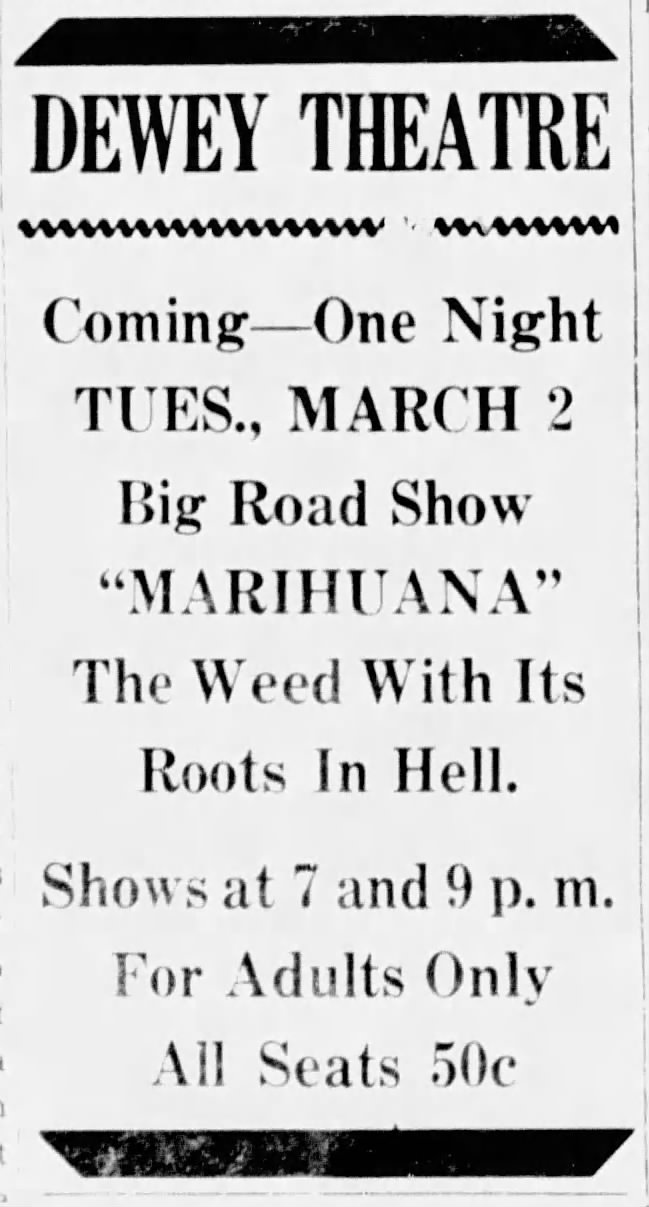 All of Oklahoma's voters have an election on Tuesday, March 7, 2023. The only thing on the ballot is State Question 820, which would enact a law to legalize marijuana for any purpose, over and above the "medical" marijuana law, SQ 788, approved by voters in June 2018.
I will be voting NO - AGAINST THE PROPOSITION, and I hope you will join me in turning out to cast a no vote and encouraging friends and family to do the same. Polls will be open on election day, Tuesday, March 7, 2023, from 7:00 a.m. to 7:00 p.m. Early voting will be available on Thursday, March 2, and Friday, March 3, 2023, from 8:00 a.m. to 6 p.m. at at least one location in each county; Tulsa County will have early voting at the election board downtown and at the Hardesty Regional Library in south Tulsa.
In 2018, Oklahoma voters approved "medical" marijuana, perhaps imagining pharmacists in white coats measuring carefully calibrated doses of THC to relieve the pain of terminal cancer patients. Instead, dispensaries with punny names (e.g. "Dank of Oklahoma," "Oklahoma Natural Grass") filled every vacant storefront selling varieties with names that evoke lost weekends and Cheech and Chong albums, rather than pharmaceutical precision: "Maui Wowie," "Acapulco Gold," "Bad Parent," "Gary Satan," "Kingpin Kush OG," and "Terdz," which reportedly smells of "sweet diesel, fruit, and candy." According to an LA Times video report, Oklahoma has 2,301 dispensaries compared to 913 in California, and nearly as many licensed cultivators as the Golden State -- 8,014 in Oklahoma and 8,757 in California.
What SQ 788 made bad, SQ 820 would make worse. Among other provisions, SQ 820 would forbid taking marijuana use into consideration in child custody decisions. This goes beyond removing criminal sanctions for low-level use and treats the use of a mind-altering drug as inconsequential.
Unlike most state questions, SQ 820 is not a constitutional amendment. If approved by a majority of voters statewide, a new piece of legislation, 16 pages in length, will be enacted into law, adding Sections 431 through 446 to Title 63, Public Health & Safety, the same as if the legislature had passed a bill. The actual legislation is contained in pages 3-18 of the PDF for State Question 820 on the Oklahoma Secretary of State website. (The PDF also includes legal challenges concerning the validity of the proposal, petition tallies, and the legal battle over the summary that will appear on the ballot.) Because SQ 820 is statutory, the legislature could subsequently amend the law contained in this state question, but political considerations would deter a legislator from making changes to a question approved by a majority of voters in his own district.
Eighteen Oklahoma state questions legalizing marijuana in some form have been filed with the Secretary of State, beginning with SQ 501 in 1973, a single-page proposition that would have removed all "civil or criminal penalties for the use, possession, cultivation, distribution, or possession with intent to distribute, of marihuana by persons eighteen years of age or older." Distributing to a minor would have been a misdemeanor with a maximum fine of $100. The petition failed for an insufficient number of signatures, and that was the last attempt for until SQ 768 in 2014, a medical marijuana proposal which garnered less than half the signatures required. Of the 18 proposed state questions, six were withdrawn by their proponents, five failed to garner sufficient signatures, four were abandoned (no signatures ever filed), one (SQ 813) was stricken from the ballot by the Oklahoma Supreme Court in 2020 for lack of an accurate and sufficient gist to advise petition signers of the full scope of the proposed constitutional amendment; the remaining two are SQ 788 and SQ 820, both statutory proposals. The proponents of SQ 820 also proposed SQ 821 as a backup if the State Supreme Court had held that SQ 820 violated the single-subject requirement of the Oklahoma Constitution.
Yes on 820 - Oklahomans for Sensible Marijuana Laws raised $3,229,547.76 as of December 31, 2022, the last date they had to file a full contributions and expenditures report. They have spent $4,183,920.28 as of Friday, February 24, 2003. Major individual pro-pot contributors include Stacy Schusterman ($250,000), Harold Hamm's ex-wife Sue Ann Arnall ($100,000), and George Krumme ($25,000). The Charles & Lynn Schusterman Family Philanthropies gave $50,000, and the United Food & Commercial Workers International Union donated $30,000.
Most of the financial support for the "vote yes" cause has come from out-of-state leftist organizations. The Just Trust for Action of Asheville, NC, which is targeting Oklahoma for "criminal justice reform" (aka releasing dangerous criminals from prison) has contributed $1,171,400.00. The New Approach Advocacy Fund of Washington DC has contributed $750,319.95 some of which was in-kind "campaign advising." The ACLU has donated $570,476.00, including "staff time." Drug Policy Action of New York City gave $218,000.01.
It is disappointing to see the Oklahoma Council of Public Affairs on the list of Just Trust for Action grant recipients, along with the ACLU of Oklahoma, the Terence Crutcher Foundation, the leftist Oklahoma Policy Institute, and the Catholic Conference of Oklahoma. OCPA is conservative on most issues but has been outspoken in support of "criminal justice reform" measures that have turned criminals loose to continue to prey on law-abiding Oklahomans. While OCPA published an critical article by Mike Brake on the impact of medical marijuana in 2021, I was unable to find any commentary on ocpathink.org regarding SQ 820.
Protect Our Kids No 820, chaired by former Oklahoma Governor Frank Keating, has spent $158,150.00 as of Friday. They have not yet been required to file a full campaign and expenditures report, which is due on a quarterly basis.
Organizational opponents of SQ 820 include the Oklahoma Farm Bureau, the Oklahoma Sheriff's Association, the Oklahoma State Chamber, and the Oklahoma Cattlemen's Association. The Farm Bureau's press release cites "the effects the marijuana industry has on rural Oklahoma, including placing significant strain on rural utility providers and making common land management practices like herbicide application a greater challenge." The State Chamber states:
Oklahoma passed SQ 788 in 2018, making medical marijuana legal, but it failed to create a regulatory system needed for a true medical marijuana program. SQ 820 also lacks a sufficient regulatory scheme and implementation plan, both of which are essential for introducing recreational marijuana into the state.SQ 820 adversely affects the state in a variety of ways, including its impact on children, workforce reliability and limited regulatory environment, as well as law enforcement concerns.
"Oklahoma is still trying to sort out the aftereffects of our hastily approved medical marijuana program. To this day, our state is suffering from serious regulatory and enforcement issues," said Chad Warmington, president and CEO of The State Chamber. "SQ 820 has many unforeseen consequences that will no doubt add to the overall marijuana crisis in Oklahoma. Approving SQ 820 makes the situation worse without solving the problems that persist. We encourage Oklahomans to say 'No' to SQ 820."
Even some pro-cannabis forces are opposed to SQ 820. Jed Green, director of Oklahomans for Responsible Cannabis Action, and proponent of two proposals that failed to reach the ballot, filed petitions with the Oklahoma Supreme Court challenging the legal sufficiency and constitutionallity of SQ 820. A Reddit post raises concerns that SQ 820 will drive mom-and-pop dispensaries and growers out of business, in favor of big corporate growers and retailers.
MORE:
Oklahomans for Responsible Cannabis Action, a pro-pot group that has not endorsed SQ 820, has a matter-of-fact SQ 820 FAQ sheet.
Parents Opposed to Pot: Bursting the Bubble of Marijuana Hype (poppot.org) is a cornucopia of information on the medical and social damage done by marijuana use. This article on the upcoming Oklahoma vote reports on 10 marijuana-related deaths last year -- 6 due to a teen driver who tested positive for cannabis, 4 involving a farm operated by Chinese nationals under an illegally obtained grow license.
Tulsa constitutional attorney Leah Farish has done two interviews on marijuana, health, and the law on her Conversation Balloons podcast:
- Ken Finn, MD, a board-certified pain management physician in Colorado
- Jordan Davidson, a former teen marijuana addict who now, at age 22, works for Smart Approaches to Marijuana, which opposes legalization but advocates for treatment, rather than incarceration, for low-level users.
League of Women Voters forum on SQ 820 features Tulsa County District Attorney Steve Kunzweiler and Tulsa Health Department director Bruce Dart speaking in opposition to the proposal and speaking of the dangers in terms of public health and law enforcement. Paid proponent Michelle Tilley's rebuttal avoided the issues raised by Kunzweiler and Dart with vague claims of "scare tactics" and by saying that the legislature could fix problems later. We are still trying to fix problems caused by SQ 788. While there is value in the initiative and referendum process, as a bypass for a legislature that has lost its way, it is a lousy way to enact complex legislation, which needs the scrutiny that the legislative process can provide.
Marijuana Moment coverage of Oklahoma propositions
Above: 75 years ago today, a newspaper advertisement from the February 27, 1948, Washington Countian of Dewey, Oklahoma, for the movie "Marihuana: The Weed with Its Roots in Hell"
Tuesday, Februrary 14, 2023, is the annual school primary for all Oklahoma public school districts. Polls are open from 7 a.m. to 7 p.m. You can view your sample ballot and find the address of your polling place at the Oklahoma Voter Portal.
At least one school board seat in every district is up for re-election every year, but this year as always few are contested. Up through the 2018 election, any contested school board seat would be on the ballot for the 2nd Tuesday in February, with a runoff on the 1st Tuesday in April if no one won a majority of the vote. Now, the February election is regarded as a primary and the April election as a general, so any race with only two candidates automatically occurs in April, and the April election serves as a runoff for races with three or more candidates where none wins more than 50% of the vote.
Tulsa County has only one school board race on Tuesday's ballot: Owasso Office No. 3. Incumbent Neal Kessler, a 47-year-old registered Republican, is being challenged by Republican Vincent Donaldson, 67, and Democrat Kristy Moon, 41. Donaldson is a retired Tulsa Public School teacher with 21 years of service, 18 of which were in special education, and is now a Realtor. The Tulsa County Republican Party Candidate Committee interviewed and recommended Vincent Donaldson.
Here are their social media and web pages.
Vincent Donaldson: Campaign website, campaign FB page, personal FB profile.
Neal Kessler: Campaign website, campaign FB page, personal FB profile.
Kristy Moon: Campaign FB page.
Owasso schools have been in the news, and not in a good way, several times in the past year, garnering the attention of Libs of TikTok as well as traditional media. In October, Owasso superintendent Margaret Coates banned a student's father from school grounds; the father had confronted his board member after a board meeting over pornographic materials in the school library. A federal judge slapped down the school's ban. During the previous school year, Owasso middle school teacher Tyler Wrynn posted a TikTok video telling his students, "F--- your parents! I'm your parents now!" While Wrynn left Owasso (and wound up at Tulsa Will Rogers High School), Owasso parents reasonably want to know how a self-proclaimed anarchist hostile to parental authority over their middle-school children gets hired by their allegedly conservative district.
Three other Tulsa County districts each have two bond issues on the ballot. School bond issues result in a property tax increase, as the annual debt service for each bond is divided across the district's total assessed property value, resulting in the tax rate increase. The increase in property taxes from a bond issue approval may be offset by a decrease as previous bond issues are paid off, but approving any bond issue will result in higher property taxes than if the bond issue were defeated. Unlike most propositions in Oklahoma, school bond issues must pass by 60% of those voting. The 2017 School Bond Transparency Act, requires school districts to publish details of their proposed and past bond issue expenditures; see below to links for those districts with bond issues on the ballot. Except where noted, Proposition No. 1 is always for "constructing, equipping, repairing and remodeling school buildings, acquiring school furniture, fixtures and equipment and acquiring and improving school sites" (building and equipment) and Proposition No. 2 is for "purchasing transportation equipment."
Jenks Public Schools:
- Jenks 2023 bond transparency act statement
- Proposition No. 1 (building & equipment): $16,255,000
- Proposition No. 2 (transportation equipment): $945,000 for
Skiatook Public Schools:
- Skiatook 2023 bond transparency act statement
- Proposition No. 1 (building & equipment): $13,470,000
- Proposition No. 2 (transportation equipment): $730,000
Union Public Schools:
- Union 2023 bond transparency act statement
- Proposition No. 1 (building & equipment): $146,540,000
- Proposition No. 2 (transportation equipment): $5,460,000
In our neighboring counties, there are contested elections for school board Office No. 3 in Chouteau-Mazie, Claremore, and Wagoner, and school bond issue propositions (links go to the Bond Transparency Act notice for each district). Prop 1 is for buildings & equipment, Prop 2 for transportation equipment unless otherwise noted.
- Bartlesville: Prop 1, $37,400,000; Prop 2, $600,000.
- Catoosa: Prop for buildings & equipment, $9,000,000 to cover elementary school cost overruns
- Coweta: Prop for buildings & equipment, $50,200,000
- Fort Gibson: Prop 1, $6,400,000; Prop 2, $600,000.
- Inola: Prop 1, $2,075,000; Prop 2, $510,000.
- Olive: Prop 1, $830,000; Prop 2, $285,000.
- Osage Hills: Prop 1, $195,100; Prop 2, $100,000.
- Sequoyah (Rogers Co.): Prop 1, $18,385,000; Prop 2, $400,000.
- Woodland (Osage Co.): Proposition (transportation equipment) $460,000.
Some municipalities also have elections. Broken Arrow has a 25-year electric franchise vote on the ballot for Public Service Company of Oklahoma. Bristow has a mayor's race, and there is one city council race each in Okmulgee and Pawhuska.
MORE: A couple of images from a promotional flyer for Sequoyah's bond issue illustrate the ugliness that modern school governance and finance produces. Here is the Rogers County Model School (later Sequoyah School), 1914-1915, a dignified two-story brick schoolhouse:
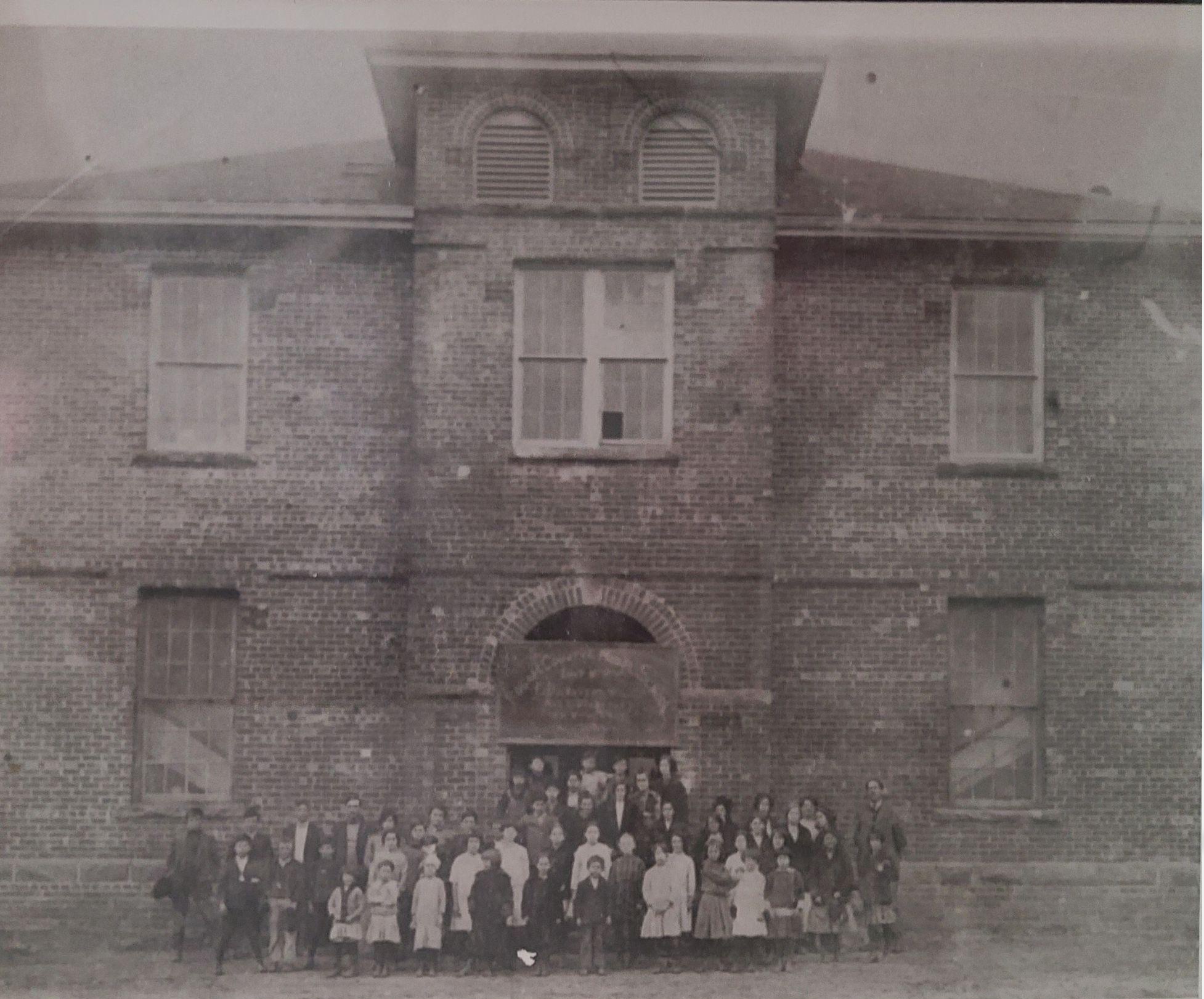
And here is "the vision of the future" -- a massive, mostly empty parking lot surrounded by metal buildings with a bit of decorative brickwork:
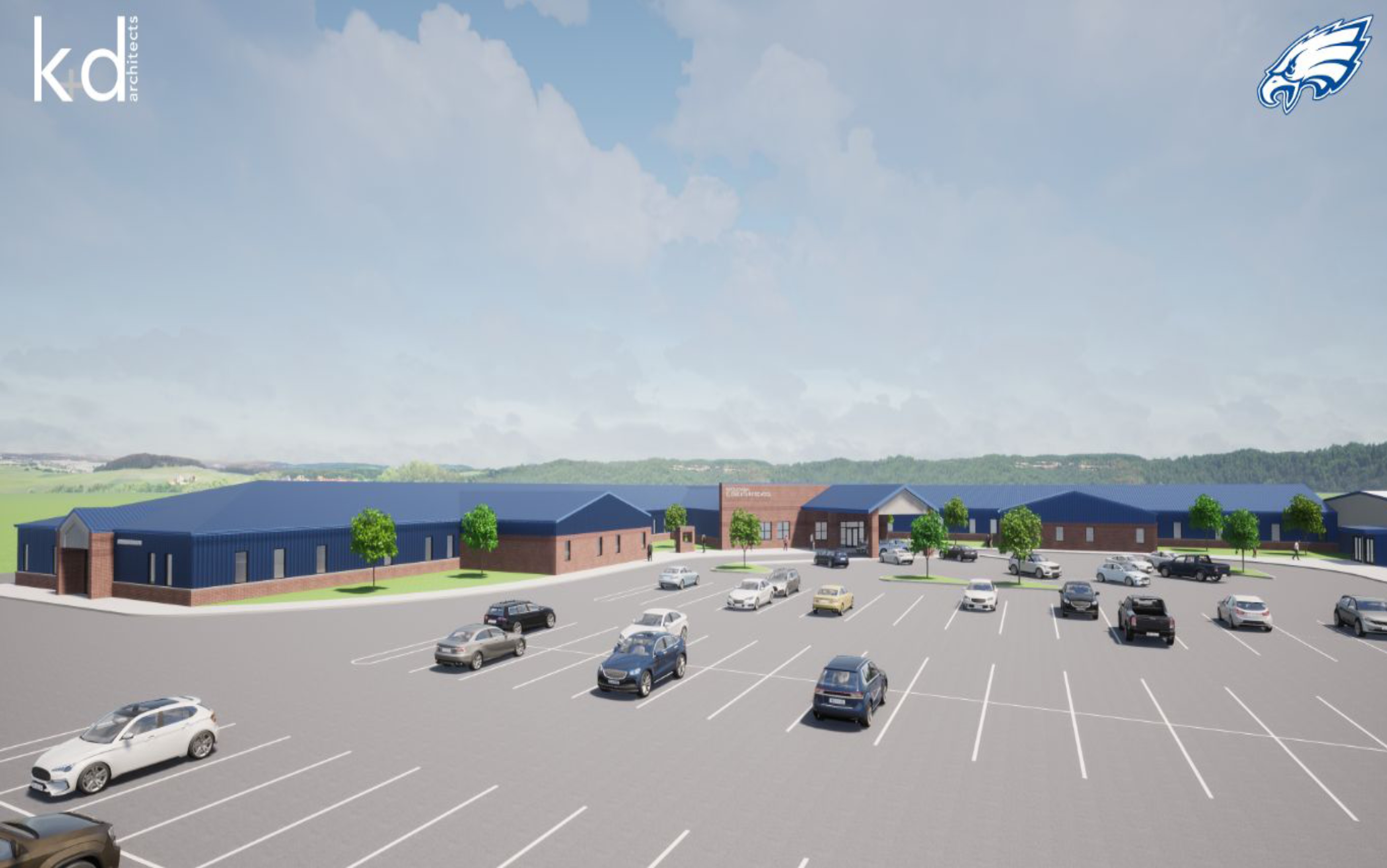
UPDATE: An election day morning email from the Tulsa County Republican Party adds some perspective:
Happy Valentine's DayNothing says, "I LOVE YOU" quite like higher taxes and fees
In select areas of Tulsa County there are elections today. On the day when we should be thinking of flowers and chocolates and romantic dinners, we must take a brief moment out of our time and VOTE!
School bonds affect your property taxes. I'm sure they are telling you that your property tax won't increase if you pass their Bond Package, but what they fail to tell you is that if the bond FAILS, your property taxes WILL go down.
Fun fact:
One of the reasons the schools fight so hard to keep our School Board and bond package elections when you least expect an election (like Valentine's Day) is because of low voter turnout which gives them the advantage on getting the bond passed or their candidate elected.
City of Broken Arrow Residents ONLY Special PSO Utility Franchise ElectionThis is to vote on the 25-year renewal - PSO currently pays the City of Broken Arrow a 2% franchise fee on gross receipts that goes into the general fund. Under the new agreement, an additional 1% fee is to be used for improvements like street lighting, underground utilities, etc.
Going from 2% to 3% is a 50% increase on the fees we pay as consumers. You don't think PSO is absorbing the cost of the increase now do you?
Because this is a "fee" (fancy word for tax), it only requires a simple majority vote.
Tulsa County Republican Chairman Ronda Vuillemont-Smith is seeking a second two-year term in that office. During her first term, Ronda built a record of success in advancing Republican principles and Republican candidates.
I first met Ronda sometime around 2010, as she became active in local politics through the Tea Party movement, founding the Tulsa 9/12 Project to help promote the restoration of America's founding principles to government at every level. In 2012, Ronda and I were part of the coalition that defeated the county "Vision 2" tax increase. I proudly endorsed her in her first run for Tulsa County GOP chairman back in 2015, a race she lost by a slim margin.
In my 2015 endorsement, I wrote this, which I feel even more strongly today than I did then.
In a state where Republicans are overwhelmingly dominant, Democrats are not the chief threat to the implementation of Republican policies. The biggest threat comes from Republicans who wear the name but don't understand or adhere to the principles the party professes. They may simply be corrupt or self-dealing, or they may be liberals who have realized that registering Republican is their only hope of winning.From Capitol Hill to City Hall, the actions and inactions of elected Republican officials have made the activists who helped them get elected wonder what, exactly, was the point of their exertions.
In such an environment, the role of party leadership must shift. When a party is a minority or just beginning to dream of majority status, you will gladly take any elected official who will bear the (R) after their name. But in our current environment, we need party leaders who will protect the Republican brand, who will be a voice for the grassroots party activists to counterbalance well-heeled lobbyists.
Ronda Vuillemont-Smith has shown herself willing to confront Republican elected officials when they need it. She's also shown herself to be a skilled and experienced organizer. That's why, if I were at this morning's Tulsa County GOP Convention, Ronda would have my vote.
Ronda has had numerous successes in her first term as chairman, but she knows that there is more to be done to build a party organization that successfully turns out the Republican vote and that builds our bench and at the same time improves local government by helping conservative Republicans win non-partisan races for city council and school board.
A leader, even a highly skilled organizer like Ronda, can only take on a handful of projects of reform and improvement at one time while still successfully executing the routine duties of the office -- running precinct meetings and county conventions three out of every four years, rallying volunteers for voter turnout, fielding questions from the media, providing resources to Republican candidates, keeping the office staffed, running county conventions, and raising money to keep all of these activities going. Tulsa County Republicans would serve themselves and their cause best by reelecting Ronda Vuillemont-Smith as Tulsa County GOP chairman.
In-person absentee voting will be available at in every county on Wednesday through Friday, November 2 - 4, 2022 from 8 a.m. to 6 p.m., and on Saturday, November 5, 2022, from 8 a.m. to 2 p.m. In most counties, this will be at the County Election Board office or county courthouse; here is the full list of absentee-in-person voting sites. Seven counties have two absentee-in-person sites, including these four in the Tulsa metro area:
- Osage County: Fairgrounds Ag Building, Pawhuska; First Baptist Church, Skiatook (West Rogers Campus)
- Rogers County: Election Board; Central Baptist Church in Owasso
- Tulsa County: Election Board, 555 N. Denver; Hardesty Regional Library
- Wagoner County: First Baptist Church, Wagoner; NSU-BA, Broken Arrow
Polls will be open Tuesday, November 8, 2022, from 7 a.m. until 7 p.m. In addition to the general election for federal, statewide, legislative, county, and judicial elections, runoffs for Tulsa City Council will be held in three seats. Unusually, there are no state questions on the ballot. Here is the complete list of ballot items, sorted by county.
NOTE: Precinct boundaries, voting locations, and district boundaries have changed, in some cases dramatically. Enter your name and date of birth on the Oklahoma State Election Board's online voter portal and you will see where to vote and your sample ballot.
In response to popular demand, I have assembled the guidance detailed below into a
downloadable, printable, single-page PDF.
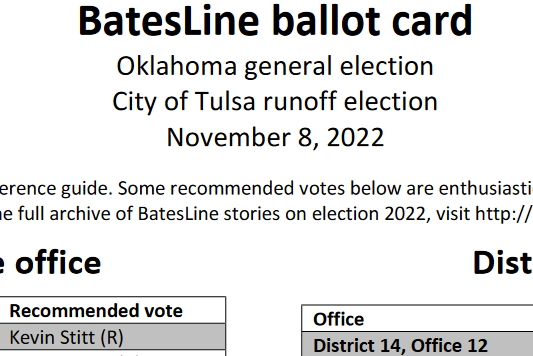
Here are the candidates I'm recommending and (if in the district) voting for in the Oklahoma general election and City of Tulsa runoff election on November 8, 2022. (This entry will change as I decide to add more detail, link previous articles, or discuss additional races between now and election day. The entry is post-dated to keep it at the top.)
As I post this, I'm still unsure about several races, and there are other races I had planned to write about in detail, but time is short, people are voting, and many have asked for a summary of my recommendations.
District 5: Grant Miller (L)
District 6: Christian Bengel (R)
District 7: Ken Reddick (R)
Council races are officially non-partisan, and marking a straight-party vote doesn't cover these races. We need east and southeast Tulsa voters to elect all three of these conservative challengers, to defeat the left-wing incumbents, in order to have even the beginnings of a conservative voice at City Hall.
Statewide:
Governor: Kevin Stitt (R)
Lt. Governor: Matt Pinnell (R)
Attorney General: Lynda Steele (L)
Treasurer: Todd Russ (R)
Superintendent of Public Instruction: Ryan Walters (R)
Commissioner of Labor: Will Daugherty (L)
Corporation Commissioner: Kim David (R)
Why not straight-ticket GOP? A phony conservative and Biden donor, Gentner Drummond, won the GOP nomination for Attorney General with the help of massive amounts of dark money. The incumbent Labor Commissioner, Leslie Osborn, has expressed her loathing for conservatives and their values, despite the R by her name; I wouldn't be surprised if she follows Hofmeister and switches parties to run for governor as a Democrat in 4 years. Libertarian candidates are running in both elections, available for a protest vote.
Federal:
Whatever our disappointments with some of the Republican candidates this year, winning control of Congress requires us to elect as many Republicans as possible. Better still, we have the opportunity to re-elect a solid conservative in Kevin Hern and to add Josh Brecheen, a conservative with a solid legislative record.
US Senate (unexpired term): Markwayne Mullin (R)
US Senate (full term): James Lankford (R)
1st Congressional District: Kevin Hern (R)
2nd Congressional District: Josh Brecheen (R)
3rd Congressional District: Frank Lucas (R)
4th Congressional District: Tom Cole (R)
5th Congressional District: Stephanie Bice (R)
District Court:
District 14 District Judge, Office 12: Kevin Gray (R)
State Senate 34: Dana Prieto (R)
State House 9: Mark Lepak (R)
State House 41: Denise Crosswhite Hader (R)
State House 66: Clay Staires (R)
State House 70: Brad Banks (R)
State House 71: Mike Masters (R)
State House 79: Paul Hassink (R)
County:
Tulsa County Assessor: John Wright (R)
Osage County Commissioner District 1: Everett Piper (R)
District Attorney, District 7 (Oklahoma County): Kevin Calvey (R)
Dustin P. Rowe: YES
James R. Winchester: NO
Dana Kuehn: YES
Douglas L. Combs: NO
Court of Civil Appeals retention:
Stacie L. Hixon: YES
Gregory C. Blackwell: YES
John F. Fischer: NO
Barbara G. Swinton: NO
Thomas E. Prince: YES
MORE INFORMATION:
OTHER CONSERVATIVE VOICES:
Here are some blogs, endorsement lists, candidate questionnaires, and sources of information for your consideration.
- Muskogee Politico news, questionnaires, and analysis
- Muskogee Politico on the judicial retention ballot
- Steve Fair and Georgia Williams on the judicial retention ballot
- Oklahoma Conservative PAC meeting videos, including candidate speeches
- Oklahoma Constitution Index: Scores incumbent legislators on voting record
- iVoterGuide surveys of Oklahoma statewide, federal, and legislative candidates
- City Elders Tulsa speakers' videos, including candidate speeches
- Oklahomans for Life candidate surveys
- Oklahomans for the 2nd Amendment (OK2A) endorsements
- NRA-PVF endorsements
- Oklahomans for Health and Parental Rights (OKHPR) general election voter guide
ANTI-CONSERVATIVE VOICES:
Here are some endorsement lists that are negative indicators:
- Oklahomans for Public Education: OPE advocates for higher taxes, opposes school choice, and opposes efforts to keep leftist advocacy out of the classroom. They work to defeat principled Republicans. A yellow warning mark from OPE is a badge of honor for a conservative candidate. Here is the OPE voter guide for 2022 (backup copy).
- Oklahoma Education Association, state affiliate of the leftist NEA teachers' union, has endorsed nine Republicans in contested primaries. The list was leaked to Corey DeAngelis.
If you appreciate the many hours of research that went into this guide and into the rest of my election coverage, and if you'd like to help keep this site online, you can contribute to BatesLine's upkeep via PayPal. In addition to keeping me caffeinated, donated funds pay for web hosting, subscriptions, and paid databases I use for research. Many thanks to those generous readers who have already contributed.
An election eve assortment of thoughts:
Last week, I attended and live-tweeted the Tuesday, November 1, 2022, Red Wave rally in Oklahoma City featuring Texas Sen. Ted Cruz, Gov. Kevin Stitt, and State Superintendent nominee Ryan Walters; the Wednesday Tulsa rally with Virginia Gov. Glenn Youngkin, and a Wednesday lunch-time forum with Ryan Walters. In between the latter two events, I went for a walk in McClure Park.
On Saturday, I helped with a literature drop for Brad Banks, Republican nominee for the open House District 70 seat, going to almost every house. The area I covered was only 80 acres, an 1/8th of a square mile, but I walked 22,977 steps (10.8 miles), and it took me about 4 hours. It was a beautiful day for walking. I cheated a bit: We were supposed to hit every house, but I went home, downloaded the latest voter registration file, filtered down to the streets and blocks of the precinct section I volunteered to cover, did a unique sort on street and house number, put the list of house numbers in columns by street on a single workbook page, and used it to guide my walking. Making the list took me about 30 minutes. As it turned out, I probably didn't save much time, as this area had a registered voter at nearly every address. I didn't filter by frequency of past votes or party or change of address, which might have saved me a few steps.
More dark-money attacks in Monday's mail. One is from Imagine This Oklahoma (one of a raft of dark-money groups funded by Oklahoma Forward) targeting Stitt over inflation, complaining about the state's $3 billion rainy-day fund ("hoarding our tax dollars"), and subsidies that the legislature passed to try to attract Panasonic, Canoo, and Hollywood filmmakers. Of course, if Stitt had stopped any of these initiatives, they would have attacked him for killing job opportunities and smashing our state piggy bank.
The issues presented in the dark-money ads are never the real issues motivating the donors to attack their targets. If you knew who the donors were, you'd know their motivation, and you'd realize that the donors are seeking their own benefit at the expense of you, the taxpayer. So they stay hidden.
The City of Tulsa's odd and oft-changed election process comes to its 2022 conclusion Tuesday with runoffs in three of nine Tulsa City Council seats. Three incumbents, all registered to vote as Democrats, failed to reach the 50% threshold in the August general election and so face a runoff. The same three seats, Districts 5, 6, and 7, went to a runoff in the 2020 election as well.
Tulsa City Council races are on a separate printed ballot. Because they are nominally non-partisan (no party label appears on the city ballot), voting straight party on the main ballot for state, county, legislative, and judicial items will count for nothing on the city ballot.
In each of the three races, I urge you to vote for the conservative challenger. The Democrat incumbents are all embedded in the non-profit realm, with little or no exposure to the private sector where producing results for the customer determines your survival. The Council's unanimous allocation of $112,000 in federal COVID-19 relief funds to a sex survey targeting teens (with approval by Mayor GT Bynum IV) ought to be enough to convince you we need to throw all the bums out.
Currently there are no conservative leaders in Tulsa city government. Electing Grant Miller in District 5, Christian Bengel in District 6, and Ken Reddick in District 7 is an important first step toward ensuring that common-sense Tulsans have a voice at City Hall.
Thursday evening brought the news that AHHA, the Arts and Humanities Hardesty Arts Center in the "Tulsa Arts District," was closing its doors permanently on Friday.
At ahha, we've been dedicated to bringing arts to the Tulsa community since 1961. Over the years, we've expanded our partnerships to work collaboratively with at least eight area school districts, a local healthcare system, state and regional government agencies, and over 100 member arts and humanities organizations.During the past few years, our community has seen some of the most challenging economic and social times in recent history. It is with great sadness that we announce the permanent closure of ahha Tulsa's Hardesty Center on Friday, November 4.
We will continue to pursue avenues to secure a long-term future for some of our programs and look to achieve that mission as quickly as possible.
We also learned this week that OKPOP is $30 million and a couple of years away from opening to the public; the first $30 million only paid for "skin and bones."
Two State Senate districts and six State House districts that overlap with Tulsa County have general elections on November 8, 2022. Neighboring counties add in four additional State House seats. Here's an overview with my recommendations in six of the races; details after the jump, and more to be added.
Senate 2: No recommendation
Senate 34: Dana Prieto (R)
House 9: Mark Lepak (R)
House 66: Clay Staires (R)
House 70: Brad Banks (R)
House 71: Mike Masters (R)
House 79: Paul Hassink (R)
Do Republican legislative leaders want so badly for Gov. Kevin Stitt to lose his bid for re-election that they're willing to accept half-measures on child mutilation in the name of "gender confirmation"? That's the question posed by a recent report by Harry Scherer in The American Conservative, "The Fight Over Child Mutilation in Oklahoma." Scherer asks why Oklahoma, with a Republican governor and Republican supermajorities in both houses of the legislature, has not seen a comprehensive law against gender reassignment surgeries on minors in Oklahoma.
Scherer notes that State Sen. Warren Hamilton (R-McCurtain) filed such a bill, HB 676, in early 2021, cosponsored by Senators Shane Jett (R-Shawnee) and David Bullard (R-Durant). The bill was assigned to the Health and Human Services and Appropriations committees, chaired by Paul Rosino (R-Oklahoma City) and Greg McCortney (R-Ada) respectively, never heard the bill.
The legislature did address the issue in a limited way during a recent special session to allocate federal funds:
On October 4, Oklahoma Governor Kevin Stitt signed Senate Bill 3XX into law, which grants approximately $109 million to the state's University Hospital Authority. Some $39 million of those funds were appropriated for "behavioral health care for the children" of Oklahoma under the condition that the health system's facilities refuse to perform gender reassignment surgeries for minors.
Four conservative Republican State Senators voted no: Nathan Dahm, Hamilton, Jett, and Merrick.
Hamilton said he thinks Bill 3XX doesn't go far enough in some places and is wrong-headed in others. The law, which does nothing to regulate gender reassignment surgeries for minors at hospitals outside of the University Hospitals Authority and Trust, earmarks funds for the continuation of the health system's behavioral health care services and mental health counseling. These services are delivered through what Oklahoma Children's Hospital calls the Adolescent Medicine Roy G. Biv Program, which provides an "interdisciplinary team of highly trained specialists who serve the mental health, nutritional and medical needs of all LGBTQ youth." The program's "gender-affirming treatment & services" includes "discussing concerns or questions about gender" and "assisting with legal name or gender marker changes."
Oklahoma taxpayers shouldn't be funding any "gender-affirming" or "LGBTQ-affirming" care, which is grounded in unscientific and dangerous concepts of "sexual orientation" and "gender identity." We've elected Republican legislative supermajorities with the expectation that our tax dollars won't be paying for that garbage.
Dahm speculates on the reluctance of legislative leaders to take aggressive action:
"For them to promise that we'll do something next year when we've had the opportunity to do it for three years, and having served with them, with most promises that have never actually come to fruition, I don't put any credence behind their word that they'll get it done next year."The senator was part of a failed effort to extend the special session of the legislature so that the more aggressive legislation could be taken up before this year's gubernatorial election. Dahm had a noteworthy theory for why his party's leadership has been kicking the can down the road: "I think that Senate leadership actually is trying not to give [Stitt] any more wins, because they'd rather have a Democrat that they can do veto overrides on so that they get the victory and they get the publicity, rather than having a strong governor lead the charge that steals their thunder and steals their potential media spotlight."
A spokesman for Senate President Pro Tempore Greg Treat denied Dahm's theory.
If legislative leaders want Stitt to lose, my guess is that it has more to do with the forces that are spreading political money around Oklahoma, working against conservative values and undermining the Republican platform. Groups with plenty of money and well-known grievances against Gov. Stitt include the teachers' unions, Big Pot, and tribal governments, all of whom have governmental priorities at odds with conservatives.
The chamberpots and RINOs have had no problem backing Democrats against Republicans they fear may be too principled to be manipulated. For a couple of examples, see Melissa Provenzano vs. Dan Hicks in HD 79 in 2018; Jo Anna Dossett vs. Cheryl Baber in SD 35 in 2020. It happened in my own race for Tulsa City Council in 2002; RINOs were angry at the successful defeat of a city sales tax increase by a shoestring campaign that Jim Hewgley, Mike Slankard, and I led, and they raised money for my Democrat opponent.
It may be time for conservative voters to purify the caucus by dumping the most compromised Republican legislators. Eight years ago, I encouraged Republican voters not to give a supporter and enabler of National Popular Vote a seat at the table in the majority Republican caucus.
Of course, we don't want to give the legislature to Democratic control, but if a few of the worst Republicans lost because conservatives didn't vote for them, it might have a salutary effect on the rest of the caucus. Probably too late to have an effect in this election, but worth considering for the future. A comparison of the campaign contribution and expenditure filings of the Republican and the Democrat in your district would give you a pretty clear picture of whether your GOP nominee is likely to vote with the lobbyists and the RINOs. (Go to the Candidate Search page on the Oklahoma Ethics Committee Guardian website, then select Committee Status Active, 2022 Election, State Representative or State Senator, and then the district. You can also visit this page and search for expenditure information for specific PACs.)
Warning signs would include a low conservative rating by the Oklahoma Constitution newspaper, funding by tribal governments, funding by donors in George Kaiser's network, endorsement and funding by teachers' unions and their allies. I've been noticing contributions from PACs associated with pharmaceutical firms Johnson & Johnson and Merck, which could be an attempt to buy support for future vaccine mandates.
If the local GOP candidate has CAMP on his mailer's bulk mail permit or "CAMPAIGN ADVOCACY MANAGEMENT PROFESSIONALS, LLC" on his expenditures report, remember that CAMP's principal, Fount Holland, helped Joy Hofmeister convince Republican voters that she was a pro-life conservative instead of a teachers' union tool ("can [the OEA] be quiet and stomach our right wing rhetoric long enough to get what they really want"), which got her the 2014 GOP nomination as State Superintendent and ultimately the platform to run for governor this year as a pro-abortion Democrat.
With new polls from Emerson College and WPA Intelligence showing Stitt leading Hofmeister by 9 points and 15 points, some legislators may wish they had been more vocal and generous in support of the governor's re-election effort.
District 4 Tulsa City Councilor-elect Laura Bellis, speaking at a recent fundraiser for incumbent District 7 Councilor and Council Chairman Lori Decter Wright, called the three challengers in the November 8, 2022, runoff, "actual fascists," called Decter Wright's opponent a "Nazi," and said that she has reported him to the FBI multiple times. Decter Wright embraces Bellis's words, saying, "I thank Laura for saying all the things I can't say, as chairwoman of the Tulsa City Council -- at least not publicly!"
I first saw this video here, but it had already been in circulation. The fundraiser appears to have been recent. I don't recognize the venue.
The Tulsa Fraternal Order of Police- FOP Public Page posted the video, but edited down to key sections (omitting Bellis's fundraising pitch for Decter Wright) and with captions.
Here is my attempt at transcribing. Bellis's grating "uptalk" sometimes makes it hard to distinguish questions from statements.
...reliant on sales taxes to fund big services for people? So it's really scary to watch people who are complete actual fascists? Running for office. It's actually -- it's every runoff that is happening right now there's an incumbent city councilor? Who is like a common sense person? Who is up against what I would say is a literal fascist? And it's scary. And we've seen it in recent, in the past several months, what it looks like when one of Those People gets a seat on our school board. They vote no on things like, just approving the agenda. They actually sow chaos. And we can't have that.So it's never been more critical to be engaged on the local level, which is why I'm so amazed that you all are here? It's so important to pay attention to these things, because again These People are trying to infiltrate -- They don't have an interest in policy work. They don't have a vision for what they hope to see in our community. They're not interested in making people's lives better. They're too busy, saying the word "woke" a lot and being scared about critical race theory. It's ridiculous. You know, that's not a conversation for the City Council? We can of course talk about inequities and so much more and dig into policy there, but that's not what they're doing.
And again, this person, I don't think should be legally be allowed to run, but here we are. I've reported him to the FBI several times, and nothing has -- I'm not kidding -- like, I have all this [inaudible] and I keep sending them the pectures [sic] of -- and -- if you don't donate now into Lori Decter Wright, I am going to be asking you all to help foot my therapy bill, 'cause I'm gonna have to work with him. Don't do that to me. [Inaudible] doesn't deserve that.
Anyway it's never been more critical to support at a local level. It's never been more critical, especially given what has happened to reproductive rights to have women at decision-making tables. Please, please, please, tell all of your friends they have to keep Lori Decter Wright on the Council. She's been a phenomenal leader, and again, we cannot have someone who's actively a Nazi on our City Council. Our city deserves better.
So please donate to Lori, not just because her opponent is a complete f[---]ing nightmare, but because she's an incredibly competent, compassionate, courageous person who [sic] I really wanna get to work with and our city really needs at this [inaudible]. So thank you all so much. Um, I think we just, like, we need to clap for Lori and all the work she accomplished.
In case you're got lost on your way in, the fundraising envelopes are over here. I'll just stand here, if you start walking by, [inaudible] just grab one to go with you. I'll know. Please, please, please, just donate.
Decter Wright then responded:
Thank you, thank you so much. I thank Laura for saying all the things I can't say as chairwoman of the Tulsa City Council -- at least not publicly!
Decter Wright thus approved Bellis calling an elected African-American female school board member, E'Lena Ashley, an "actual fascist," a label that was also applied to the three conservative challengers (Grant Miller, Christian Bengel, Ken Reddick) running for city council. Decter Wright cheered someone calling Reddick, her conservative Republican opponent, "actively a Nazi" and "a f---ing nightmare." Decter Wright put her stamp of approval on Bellis's opinion that disagreement and debate in public meetings is "sowing chaos" and to the idea that when people who are not approved by the city establishment run for public office, "they're trying to infiltrate." She made no objection to Bellis reporting Reddick to the FBI for daring to run against her.
Bellis, Decter Wright, and their ilk claim to be defenders of democracy, but the theme running through these remarks is that governing needs to be left to the "experts," and we should only elect people who will rubber-stamp everything that comes before them. When three school board members voted against the "consent agenda," they were saying that some of the items on that list, such as accepting Chinese Communist Party money for a program in our public schools, deserved further scrutiny and debate in front of the voting public. If you think full and open debate is "sowing chaos," you have the wrong idea about democracy.
Note how Bellis and Decter Wright narrow the scope of acceptable, legitimate debate. When conservatives and libertarians seek office to stop the government from imposing mask mandates, vaccine mandates, or business closures, "they don't have an interest in policy work," according to Leftist fascists like Bellis and Decter Wright. Apparently, it's only legitimate policy work in their minds if you're debating which businesses to force to shut down, but not legitimate to debate whether the shut down is any use at all. "Making people's lives better" to them always means government action, never government restraint.
Conservative and libertarian Tulsans have a chance on November 8 to elect three city councilors who will stand against the truly fascist attitudes of Laura Bellis, Lori Decter Wright, MyKey Arthrell-Knezek, and Connie Dodson.
Vote for Grant Miller in District 5, Christian Bengel in District 6, and Ken Reddick in District 7. That won't give common sense a majority on the Tulsa City Council, but it will once again have a foothold.
MORE: Don't forget: Lori Decter Wright was on the committee that allocated $112,784 in federal COVID-19 relief funds to a non-profit to conduct a sex survey targeting teenagers. All nine incumbent city councilors, including Decter Wright, Connie Dodson, and Mykey Arthrell-Knezek, approved it.
A few notes on the four Oklahoma Supreme Court justices and five Court of Civil Appeals judges on the retention ballot this year. None of the five members of the Court of Criminal Appeals are up for retention this year.
Judges in Oklahoma's appellate system are up for retention every six years. I am voting to retain Gov. Stitt's recent appointees on both courts, against retention not only of judges appointed by Democrats, but also of two Republican appointees who have shown questionable judgment, whether on the bench or in a public role away from the courtroom. As originalists now have a majority on the U.S. Supreme Court and are restoring state freedom to legislate on a number of issues, we can expect progressive judicial activists to move their focus to state courts as a means to overturn legislation grounded conservative public sentiment. Now more than ever, conservative voters need to ensure that our state courts are safely in the hands of impartial, originalist judges.
Two of the Supreme Court justices, Dana Kuehn and Dustin Rowe, are recent appointees by Gov. Stitt. Justice Rowe has written several careful dissents indicating a willingness to take a stand on principle and reason, even if it puts him in the minority. It makes sense to give both of Stitt's appointees the opportunity to continue.
Justice James R. Winchester was in the majority that unjustly tossed the Taxpayer Bill of Rights (TABOR) initiative petition. Pro-life activists remember that Winchester, a Keating appointee, consistently voted to strike down pro-life laws and initiative petitions that might have been used to give the U. S. Supreme Court the opportunity to revisit and overturn Roe v. Wade; instead that honor fell to the State of Mississippi. This year, Winchester voted in favor of putting recreational marijuana on the ballot, despite the same issue of supremacy of federal law (in this case, an actual law banning marijuana, rather than a fatally flawed SCOTUS decision resting on emanations and penumbras).
I recommended against retaining Justices Winchester and Combs in 2016. They should both be retired by the voters, giving a re-elected Gov. Stitt the chance to add to his list of excellent court appointments.
For the Court of Civil Appeals, I'm voting to retain Stacie L. Hixon, Gregory C. Blackwell, and Thomas E. Prince, all recent appointments by Gov. Stitt. Judge Prince served for many years as a member of the Oklahoma State Election Board. I am voting NO on retaining John F. Fischer, appointed by Brad Henry, and Barbara G. Swinton, appointed by Mary Fallin.
Civil Appeals Court Judge Barbara Swinton was serving as a district judge in Oklahoma County when she was appointed to the Civil Appeals court in 2016 by Gov. Mary Fallin.
Swinton was a long-time board member of the Justice Alma Wilson Seeworth Academy, a school chartered by Oklahoma City Public Schools. Swinton served on the board from around 2002 until the school's closure in 2019, serving at various times as board president, vice president, and treasurer, according to Swinton's 2021 interview with Brenda Holt of the State Auditor's office. Seeworth closed its doors in May 2019 . Last month, the school's superintendent, Janice Grigg, was arrested and charged with embezzlement:
Annual school audits as early as 2009 warned the board of possible law violations and a troubling lack of internal controls meant to prevent fraud, state auditors said.A 2012 lawsuit from a former Seeworth principal and auditors' letters in 2017 and 2019 communicated concerns over possible abuse of school funds. Finally in March 2019, a longtime Seeworth contractor sent a whistleblower letter to Swinton, the school board president at the time, alleging financial wrongdoing by Grigg, according to the state audit.
Auditors found an email in which Swinton appeared to dismiss the allegations.
"Thank you for your concerns about the financial health of Seeworth," she wrote to the whistleblower in a March 10, 2019, email. "These concerns were addressed by our board with our accountants and you should not have any concerns that the funds are being mishandled."
NonDoc's reporting from 2019 about the mistreatment of whistleblowers by the Seeworth board puts Judge Swinton in an especially bad light.
Oklahoma hasn't elected a Democrat to statewide office since 2006. Since 2004, every county in Oklahoma has given a plurality of its vote in every presidential election to the Republican nominee. Voter registration, a lagging indicator, continues to trend toward the GOP across the state, most strongly in southeastern Oklahoma, aka Little Dixie, which was Yellow Dog Democrat country for most of Oklahoma's first century. Republicans have super-majorities of 82-19 in the State House and 39-9 in the State Senate.
So it's astounding to see a poll a month before the election giving a Democrat the lead over an incumbent Republican governor. The latest Sooner Poll of 300 likely voters has Democrat Joy Hofmeister leading incumbent Republican Kevin Stitt by 46.8% to 43.0%. Crosstabs have not yet been published, but those polled would support Donald Trump over Joe Biden in a 2024 rematch by only 52.7% to 40.8%, which may indicate that the universe of those polled leans far more strongly to the left than the actual Oklahoma electorate. The actual vote in 2020 was Trump 65.4%, Biden 32.3%; Trump managed 55% of the vote or better in every county except Oklahoma County. It is hard to believe that Oklahoma voters have a more favorable opinion of Brain-Dead Biden after 20 disastrous months.
Dark money has funded dozens of mailers, TV ads, and social media posts misrepresenting the facts in order to hang the false label of "corrupt" around the governor's neck. Even if these ads fail to persuade Republicans to vote for the Democrat, it may succeed in discouraging GOP voters from filling the box next to Stitt's name.
In truth, Republican voters who want the party's platform enacted ought to be stampeding to the polls to give him another term in office, overflowing with gratitude for Stitt's record and filling their social media feeds with calls for his re-election.
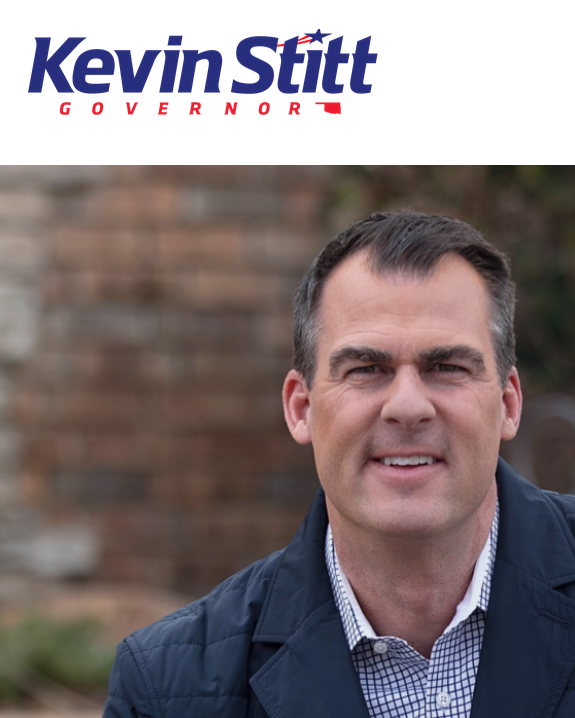
Kevin Stitt promised to sign every pro-life bill that crossed his desk. Stitt kept that promise and earned the endorsement of the National Right to Life Committee. Because Kevin Stitt is in office instead of his Democrat opponent, Oklahoma has the strongest pro-life laws in the nation.
In February 2019, Kevin Stitt signed constitutional carry into law, one of the first bills approved during his term, affirming the right of Oklahomans to keep and bear arms without needing government pre-approval. This would not have happened had his Democrat opponent won the 2018 election. Stitt has been endorsed both by Oklahomans for the 2nd Amendment (OK2A) and the National Rifle Association Political Victory Fund, which gave Gov. Stitt an A+. Hofmeister earned an F.
While many parts of our country were undercutting the efforts of their police forces to protect the law-abiding citizens against criminal predators, Kevin Stitt backed the blue and earned the endorsement of the Oklahoma Fraternal Order of Police. Gov. Stitt signed pay raises for law enforcement officers in the Oklahoma Highway Patrol, Oklahoma Department of Corrections, and other state public safety employees, funded three academies to train new OHP officers, and established a mental wellness program to support all Oklahoma public safety officers and their families.
Gov. Stitt has appointed three excellent jurists to the State Supreme Court: John Kane, Dustin Rowe, and Dana Kuehn. For the first time in history, a majority of the justices were appointed by Republican governors. Five of the nine justices are 70 or older, including one justice, Yvonne Kauger, who has been serving since her appointment in 1984 by Gov. George Nigh. Three justices were appointed by the previous Democrat governor, Brad Henry. There will be vacancies, and recent events in Kansas demonstrate the importance of installing strict constructionist justice in a post-Roe world. Activist justices in our neighbor to the north struck down pro-life legislation on specious constitutional grounds, and an attempt to fix the problem with a constitutional state question went down in flames with the help of a well-funded disinformation campaign. Now that SCOTUS will no longer interfere with state regulation or prohibition of abortion, leftists will use state judiciaries to thwart protections for the unborn. Stitt has shown good judgment in his judicial appointments, and we'd be wise to allow him to continue rather than allow Oklahoma's version of Kathy Hochul to appoint activist leftists.
Stitt has also appointed 4 of the 12 members of the Court of Civil Appeals, which has a majority of judges appointed by Republican governors in only two of the four divisions. One Democrat appointee, W. Keith Rapp, died in August at the age of 88; a Stitt appointment to fill that vacancy would mean one more division with a majority of Republican, strict-constructionist appointees.
Kevin Stitt streamlined state government, signing legislation to consolidate state agencies and making agency leadership accountable to the voters through their elected officials. He modernized the state civil service system, helping state agencies recruit, retain, and reward the most dedicated employees, and he gave public employee retirees, including teachers and firefighters, the first cost-of-living adjustment in more than a decade. Making state agencies a better place to work means better people working on behalf of the people of Oklahoma, and Stitt's efforts won him the endorsement of the Oklahoma Public Employees Association.
Kevin Stitt used the power of the purse -- allocation of new federal COVID relief funds -- to force the University of Oklahoma's Oklahoma Children's Hospital to cease performing surgical "gender confirmation" mutilations on children. The scope of the bill was limited by the stated call for this special session, but if re-elected, Gov. Stitt will sign broader legislation to ban the practice in Oklahoma. Earlier this year, Gov. Stitt signed legislation protecting girls' private spaces from men claiming to be women; SB 615 requires multiple-occupancy restrooms and changing rooms in our public schools to be reserved exclusively for one biological sex or the other.
Kevin Stitt signed HB 1775, which bans specific elements of "woke," racist indoctrination from Oklahoma's public schools and universities. The bill is succeeding in flushing out radical teachers and administrators who see public schools as a missionary endeavor to convert children to their anti-civilizational ideology.
Unlike his counterparts across the country, Gov. Kevin Stitt kept COVID-19 pandemic restrictions to a minimum, resisting calls for a statewide lockdown and mask mandate. Gov. Stitt was the third governor, after Doug Burgum in North Dakota and Mike Dunleavy in Alaska, to end the statewide COVID-19 state of emergency. (Emergency declarations in Wisconsin and Michigan were terminated earlier by court order, over the objections of Democrat governors.) Within a few months of that early reopening, Oklahoma's unemployment rate reached record lows, among the lowest in the nation.
Under Kevin Stitt's leadership, Oklahoma has improved election security, guaranteed patients the right to have a loved one with them in the hospital, protected schoolchildren from obscene materials, prohibited biologically impossible non-binary birth certificates, and reformed the state funding formula to ensure school funds follow students to their new school district. Kevin Stitt has enthusiastically supported school choice. Gov. Stitt has been endorsed for re-election by former President Donald Trump.
As state superintendent, Hofmeister supported ineffective mask mandates. Gov. Stitt moved to reopen Oklahoma as soon as it was safe to do so, while Hofmeister's plan for school closures would have kept Oklahoma's public schools shut for more than half of the time between September 2020 and March 2022.
 Hofmeister said in announcing her candidacy that Stitt's pro-freedom approach to the pandemic is why she switched parties to run against him. Hofmeister wanted to subject Oklahoma to the same sort of never-ending restrictions that Michigan Gov. Christine Whitmer, California Gov. Gavin Newsom, and NY Governors Andrew Cuomo and Cathy Hochul imposed on their states.
If Hofmeister becomes governor, all of the progress we've made under Stitt and his Republican predecessors will come to a screeching halt. Hofmeister opposes parental choice in education. Hofmeister opposes legal protections for the unborn. Hofmeister, indebted to the Democrats who elected her, will veto conservative reforms of state government and will fill her staff, cabinet, state courts, and state boards with her leftist allies.
Jamison Faught at Muskogee Politico has documented Joy Hofmeister's "long con." Hofmeister claims that her values have not changed since her first campaign for office as a Republican, but she has taken positions this year that would have killed her 2014 Republican primary campaign against incumbent State Superintendent Janet Barresi.
Just days after announcing her newfound party, Hofmeister attacked Governor Kevin Stitt over transgender birth certificates. Gov. Stitt recognizes the scientific fact of male and female, while the 'Newly-Improved-and-Woke' Joy Hofmeister apparently feels like pandering to flaming leftists. By the way, she accuses Gov. Stitt of pandering to extremism, which is highly ironic given her apparent disregard for science.In a recent article from TheFrontier, Hofmeister criticized Gov. Stitt for signing pro-life bills, giving the lame excuse that "[abortion] is a decision that is personal and one between a woman, her doctor and her faith." Right. Do you think she would have said this during her campaigns as a Republican? I think not.
Joy Hofmeister was indicted and arrested (that's her mugshot above) for campaign ethics violations, colluding illegally with the dark-money campaign attacking her opponent. Despite overwhelming evidence clearly documenting violations of the law, Oklahoma County Democrat DA David Prater dropped charges shortly before her 2018 re-election. You can read the indictment of Joy Hofmeister and the documentation on which it was based at this link.
Earlier in this article I mentioned the dark-money attacks labeling Stitt "corrupt." They rest on a handful of "scandals" that aren't scandalous at all.
The so-called Swadley's "scandal" was driven by Gov. Stitt's desire to make our state parks a top-10 experience by offering high-quality regional cuisine from an Oklahoma based restaurant chain. The usual government contract process results in boring bistros run by multinational institutional food service conglomerates who fill their menus with the bland and barely edible. Swadley's had built a popular chain of barbecues with 8 locations, starting from their hometown of El Reno. I've eaten at a Swadley's Barbecue a few times and always enjoyed it, and I was looking forward to visiting a state park and eating at a Swadley's Foggy Bottom Cafe. Stitt didn't profit, nor did any of his friends or business associates. At worst, Swadley's put more money into the renovation of these restaurants than was strictly necessary to build a more enjoyable dining experience. But political opportunists labeled this, without justification, as corruption and got it shutdown. One of the negative consequences of this destructive political maneuver by Hofmeister's supporters was the Western Swing Music Society of the Southwest's cancellation of the annual Western Swing Weekend at the Lodge at Sequoyah State Park (formerly known as Western Hills) because the Lodge had no food service available after Swadley's was evicted.
When school doors were shut because of the pandemic, parents who had been reliant on public schools suddenly had to find ways to continue their children's education. The switch to online instruction meant that many low-income families urgently needed to upgrade electronics and internet access and purchase software and books. Federal aid was made available to meet that need, and Gov. Stitt and Secretary of Education Ryan Walters made it their aim to get the money into the hands of Oklahoma families as quickly as possible with as little red tape as possible. Rather than incur the delay involved in competitive bidding, Oklahoma's Chief Information Officer hired ClassWallet, a national company with experience handling educational grants, to manage the funds.
Eligible families had access to a digital wallet that could be used with 36 approved vendors, most of them specializing in classroom materials and supplies, but also including Office Depot and Staples, sources for general office supplies and computing equipment, and Tracfone, a source for high-speed internet hotspots for families without their own high-speed internet access. The digital wallet system meant that families could simply purchase items from the approved vendors, without the red tape of submitting a purchase request and waiting for approval or submitting an expense report and waiting for reimbursement.
As our students face disruptions from COVID-19 and schools turn to distance learning, we must ensure all Oklahoma students have the supplies and materials necessary to meet their individual education needs. By giving families these funds, we are empowering them to choose what materials are most necessary to make their children successful academically.
Some parents took unfair advantage of the streamlined system to buy non-educational equipment for their own enjoyment. They figured out that they could buy anything that Office Depot or Staples had available for sale online, and that includes many items without educational value that are offered online only, never in stores, like Christmas trees and grills. One estimate, compiled by a partisan news outlet, puts the total wasted on such items at about $650,000 out of the program's $18,000,000 total. Their analysis has large amounts in broad categories that are likely to include legitimate educational purchases, but even accepting their numbers, the amount wasted is less than 4%. Any waste is regrettable, but the cost of pre-screening every purchase would have been to delay the 96% of legitimate purchases made by honest parents.
The latest attack involves a privately-funded proposal to build a new governor's mansion at the State Capitol complex. The proposal pre-dates Gov. Stitt's time in office, and the project could not possibly be completed before the end of his second turn. Stitt's family did not move to Oklahoma City until the end of the school year during which his inauguration occurred. A $2 million renovation of the mansion's electrical, plumbing, and HVAC systems was already underway, and when the family moved from Oklahoma City, they moved to the Centennial House at 6500 N. Kelley Ave., owned by the Oklahoma National Guard. The Stitt family was able to move in to the governor's mansion in the spring of 2021, but in an October 2021 interview about the renovations, First Lady Sarah Stitt said, "We have lived here for a while, but we do want to protect our family life, so we are looking for a house probably just for our family." The Stitt family, using their own funds, acquired a home in Edmond about a year ago. None of this has been done in secret, but irresponsible news media outlets have created a false impression of the sequence of events designed to tar the reputation of Gov. Stitt and his family for the sake of helping a leftist Democrat win the governor's office in America's most Republican state.
Hidden special interests, some of them led by nominal Republicans, have spent millions to get rid of Gov. Kevin Stitt. Although much of the dark money is untraceable, Stitt has faced hostility from tribal governments, from the marijuana industry, and from leftist teachers' unions. Leftists in mainstream media have helped to amplify and distort the dark-money accusations.
Kevin Stitt defends the interests of all Oklahomans, which offends tribal officials who want to accumulate power and wealth at the expense of the well-being of their own citizens as well as the non-citizens who live on so-called "sovereign land" -- the former territories that were allotted and sold over a century ago under tribal agreements with the US government. These tribal officials supported a child molester's court appeal in the pursuit of their own power. Stitt understands that lightly-regulated, highly-potent marijuana will produce a generation of schizophrenics, dangerous to themselves and others, and stands in the way of the cannabis industry that wants to warp Oklahomans minds to fill their own pockets. Stitt believes that Oklahoma children should not be stuck in underperforming schools that inflict woke dogma and trans madness in place of true education, frustrating the leftists who see public schools as their publicly funded cathedrals for converting the children of conservative Oklahomans.
Gov. Kevin Stitt is defending Oklahomans, particularly Oklahoma families and children, against the special interests who want their power and money no matter how many Oklahomans it hurts. Oklahomans should enthusiastically re-elect Kevin Stitt as governor.
MORE:
Jamison Faught, the Muskogee Politico, writes that Oklahoma Republicans must not fall asleep on the governor's race, reminding us, "Liberals win when conservatives take things for granted. Brad Henry was governor of Oklahoma for eight years, vetoing important legislation and styming conservative policies - because conservatives took things for granted in 2002."
OK2A's Don Spencer explains why it's crucial for 2nd Amendment rights supporters to turn out to re-elect Kevin Stitt.
On Tuesday, August 23, 2022, Oklahoma Republicans and Democrats have a partisan primary runoff election in a number of statewide, federal, legislative, and county races, and the City of Tulsa will conduct a non-partisan citywide general election, including races in all nine council districts as well as three charter-change propositions. There are a smattering of other school, municipal, and county propositions across Oklahoma. Here is the Oklahoma State Election Board's list of all races and propositions on the August 23, 2022, ballot.
In-person absentee voting will be available on Thursday, August 18, 2022, from 8 a.m. to 6 p.m., on Friday, August 19, 2022, from 8 a.m. to 6 p.m., and (because there are federal races on the ballot) on Saturday, August 20, 2022, from 9 a.m. to 2 p.m. For most counties, in-person absentee voting takes place at the county election board, but there are a few exceptions; click here for the full list of early-voting locations. Osage County will have an extra early voting location at First Baptist Church of Skiatook, W. Rogers campus, and Wagoner County will have an extra location at NSU-BA. Polls will be open Tuesday, August 23, 2022, from 7 a.m. until 7 p.m.
NOTE: Precinct boundaries, voting locations, and district boundaries were changed, in some cases dramatically, earlier this year. Enter your name and date of birth on the Oklahoma State Election Board's online voter portal and you will see where to vote and your sample ballot.
In response to popular demand, I have assembled the guidance detailed below into a downloadable, printable, single-page PDF.
Here are the candidates I'm recommending and (if in the district) voting for in the Oklahoma Republican runoff election and City of Tulsa general election on August 23, 2022. (This entry will change as I decide to add more detail, link previous articles, or discuss additional races between now and election day. The entry is post-dated to keep it at the top.)
As I post this, I'm still unsure about several races, and there are other races I had planned to write about in detail, but time is short, people are voting, and many have asked for a summary of my recommendations. My most enthusiastic choices are in bold; in other races, there may be one or two other candidates that would be acceptable, or I simply don't know the endorsed candidate as well as I would like. There are certain incumbents that I'd like to see defeated, but I don't feel comfortable endorsing an opponent at this point. I'll try to fill in TBDs and NOTs before the start of early voting.
US Senate (unexpired term): TW Shannon
2nd Congressional District: Josh Brecheen
Treasurer: Todd Russ
Superintendent of Public Instruction: Ryan Walters
Labor Commissioner: Sean Roberts
Corporation Commissioner: Todd Thomsen
State Senate 2: Jarrin Jackson
State Senate 26: Brady Butler
State House 66: Clay Staires
For City of Tulsa races, if no candidate receives more than 50% of the vote, there will be a runoff coincident with the state/federal general election in November.
Tulsa City Council District 1: Francetta Mays
Tulsa City Council District 2: Aaron Bisogno
Tulsa City Council District 3: Daniel Grove
Tulsa City Council District 4: Michael Birkes
Tulsa City Council District 5: Ty Walker
Tulsa City Council District 6: Christian Bengel
Tulsa City Council District 7: Ken Reddick
Tulsa City Council District 8: Scott Houston
Tulsa City Council District 9: TBD
Tulsa Proposition 1: YES
Tulsa Proposition 2: NO
Tulsa Proposition 3: NO
Tulsa County Commissioner District 3: Bob Jack
Osage County Commissioner District 1: Everett Piper
District Attorney, District 7 (Oklahoma County): Kevin Calvey
MORE INFORMATION:
OTHER CONSERVATIVE VOICES:
Here are some blogs, endorsement lists, candidate questionnaires, and sources of information for your consideration.
- Muskogee Politico news, questionnaires, and analysis
- Muskogee Politico runoff picks
- Muskogee Politico legislator tax votes, 2016-2018
- Oklahoma Conservative PAC meeting videos, including candidate speeches
- OCPAC 2022 Runoff Voter Guide
- Oklahoma Constitution Index: Scores incumbent legislators on voting record
- iVoterGuide surveys of Oklahoma statewide, federal, and legislative candidates
- City Elders Tulsa speakers' videos, including candidate speeches
- Oklahomans for Life candidate surveys
- Oklahomans for the 2nd Amendment (OK2A) endorsements
- NRA-PVF endorsements
- Oklahomans for Health and Parental Rights (OKHPR) endorsements
- Endorsements from David Van Risseghem at Sooner Politics
ANTI-CONSERVATIVE VOICES:
Here are some endorsement lists that are negative indicators:
- Oklahoma Public Employees Association: State government employees union can be counted on to support bigger, less-efficient government and higher taxes
- Oklahomans for Public Education: OPE advocates for higher taxes, opposes school choice, and opposes efforts to keep leftist advocacy out of the classroom. They work to defeat principled Republicans. A yellow warning mark from OPE is a badge of honor for a conservative candidate. Here is the OPE voter guide for 2022.
- Oklahoma Education Association, state affiliate of the leftist NEA teachers' union, has endorsed nine Republicans in contested primaries. The list was leaked to Corey DeAngelis.
- TulsaBizPac is the political arm of the Tulsa Regional Chamber, a contractor to the City of Tulsa. They have not issued a list of endorsements, but David Harris in District 1, Michael Feamster in District 4, and Jayme Fowler in District 9 have all proudly announced their endorsement, when they really ought to be embarassed. Please read my 2016 article "Chambers of Horrors" to understand why social and fiscal conservatives, opponents of cronyism, and supporters of historic preservation should use TulsaBizPac endorsements as an indication to look for someone else to support.
If you appreciate the many hours of research that went into this guide and into the rest of my election coverage, and if you'd like to help keep this site online, you can contribute to BatesLine's upkeep via PayPal. In addition to keeping me caffeinated, donated funds pay for web hosting, subscriptions, and paid databases I use for research. Many thanks to those generous readers who have already contributed.
There are six candidates on the ballot for Tulsa City Council District 4, an open seat. As was the case two years ago, I'm not enthusiastic about any of them. This is my district, so I've had to make a choice.
A sex survey targeting teenagers was funded by the City of Tulsa using federal COVID relief funding. The survey was one of 70 non-profit projects selected for funding by a working group of four city councilors who are on next Tuesday's ballot -- Phil Lakin (District 8), Jeannie Cue (2), Lori Decter Wright (7), and Vanessa Hall-Harper (1) -- and approved by the full Council and Mayor GT Bynum IV. The survey, which remains online as of August 16, 2022, asks detailed questions of minors and concludes with links promoting websites for "tweens" and teens containing explicit sex ed materials.
Tulsa city officials routed $112,784 in federal American Rescue Plan Act funds to Amplify Youth Health Collective, a group that "coordinate[s] collective efforts within our community to expand access to sex education, promote healthy relationships, and engage the public in this conversation."
Two Oklahoma State University departments cooperated with the survey: The OSU Diversity and Rural Advocacy Group, and the OSU Center for Family Resilience of the OSU College of Education and Human Sciences.
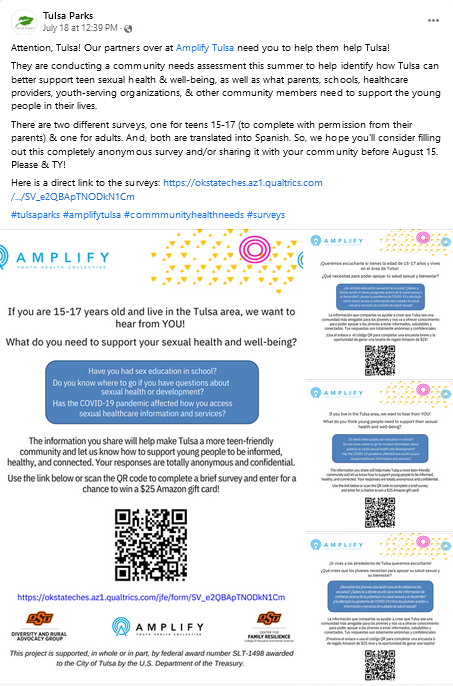
The survey on "teen sexual health & well-being" targets children ages 15-17. A separate survey is aimed at adults, and versions of both teen and adult surveys exist in Spanish. A caption on online posters advertising the survey notes the city's support as a conduit of federal funds: "This project is supported, in whole or in part, by federal award number SLT-1498 awarded to the City of Tulsa by the U. S. Department of the Treasury."
The survey asks teenagers for their sexual orientation, "sex assigned when you were born," and gender identity (with "agender," "non-binary," and "gender fluid" as options), and to rate their current sexual health as outstanding, good, neutral, poor, or terrible, and defined "sexual health" as:
...a state of physical, emotional, mental, and social well-being related to sexuality; it is not merely the absence of disease, dysfunction, or infirmity. Sexual health requires a positive and respectful approach to sexuality and sexual relationships, as well as the possibility of having safe sexual experiences, free of coercion, discrimination, and violence. For sexual health to be attained and maintained, the sexual rights of all persons must be respected, protected, and fulfilled. (World Health Organization, 2002)
The survey later asks these minor children "questions about sexual health access," "about your own access to sexual health care [and] what you think and believe about access to sexual health care for other people," with "sexual health access" defined as:
The ability to get all of the resources you need to stay sexually healthy such as: (a) condoms (b) contraceptives (c) sexually transmitted infection (STI) testing & STI treatment (d) medically-accurate sexual health education (e) identity affirming communities/resources and (f) trusted adults.
A few questions near the end of the survey ask about COVID-19 impact on romantic relationships and access to sexual health services, presumably to justify the use of COVID-19 relief funds. The final page of the survey links to explicit websites with age-inappropriate discussions of sexual matters for pre-pubescent children and teens.
Here is a PDF of screenshots of the Amplify Tulsa / City of Tulsa-funded teen sex survey, including screenshots of the Tulsa Parks and Amplify Tulsa Facebook posts and the home pages of the sex ed websites linked at the end of the survey. These screenshots show the course of the survey after the respondent identifies his/her age as 15.
On Monday, July 18, 2022, the survey was promoted briefly on the Tulsa Parks Facebook page. An update was posted at 12:39PM CDT to the official Facebook account for the City of Tulsa Parks Department urging children as young as 15 years old to fill out an online survey about "teen sexual health & well-being." The post (at this link until sometime the morning of the 20th, when it appears to have been deleted) read as follows:
Attention, Tulsa! Our partners over at Amplify Tulsa need you to help them help Tulsa!They are conducting a community needs assessment this summer to help identify how Tulsa can better support teen sexual health & well-being, as well as what parents, schools, healthcare providers, youth-serving organizations, & other community members need to support the young people in their lives.
There are two different surveys, one for teens 15-17 (to complete with permission from their parents) & one for adults. And, both are translated into Spanish. So, we hope you'll consider filling out this completely anonymous survey and/or sharing it with your community before August 15. Please & TY!
Here is a direct link to the surveys: https://okstateches.az1.qualtrics.com/jfe/form/SV_e2QBApTNODkN1Cm
#tulsaparks #amplifytulsa #communityhealthneeds #surveys
Yesterday, August 15, 2022, at 5 p.m., was the deadline for campaign contribution and expenditure reports for candidates in any August 23 election. This includes the City of Tulsa general election as well as runoff elections for statewide office, county office, and the legislature.
The legislature has created a mess of disparate filing offices and methods. Rather than making it convenient for candidates to file and citizens to search from a single ethics database for every election in the state, county candidates file paperwork at the county election board (at a time when election boards are scrambling to prepare for early voting and election day itself), school board candidates file with the school district clerk (who is hired by the incumbents and might have an incentive to make it very inconvenient for challengers to find out where the incumbents are getting their funds), and municipal candidates file with the city or town clerk. The legislature has just made things worse this session, opening the door to suppression of information and biased enforcement by larger cities.
Meanwhile, legislative, statewide, and judicial candidates file electronically with the Oklahoma Ethics Commission. For a few brief shining years, candidates for large municipalities and counties were also filing electronically through the same system, but apparently some public information can be too public for the comfort of some local officials, and their friends in the legislature reversed course.
The Tulsa County Election Board is always very prompt in responding to email requests for filings, sending scans in reply. The Tulsa Public Schools clerk demands an Open Records request, which she may or may not get around to processing before the election.
Of all the local-government ethics filing repositories I've dealt with, the City of Tulsa clerk's office is the best at making information promptly available to everyone. Here is the City of Tulsa campaign contribution report home page. When a filing comes in, it is physically time-stamped, scanned, and immediately posted to the website, with filings sorted to different webpages by office, and then within each page by candidate. Filings from previous elections are retained at the bottom of the page in an archive section. I appreciate this. There are some improvements that could be made: A standard naming template for PDFs and links, a way to download the entire collection of files, original electronic files (more searchable than scanned and OCRed paper reports).
If you are a candidate on the ballot, and your campaign committee has raised OR spent more than $1,000, you're required to file a Statement of Organization within 10 days and then you're required to file a Contributions and Expenditures report between 14 and 8 days before the election, covering all of your contributions and expenditures through the 15th day before the election. There are also quarterly filing requirements for the rest of the year. PACs who give to municipal campaigns are also required to file quarterly reports.
Based on the scans available on the City Clerk's website, here are the City of Tulsa candidates on the August 23 ballot who have filed timely reports:
- District 1: NONE
- District 2: NONE
- District 3: NONE
- District 4: Laura Bellis, Michael Birkes, Michael Feamster, Matthew Fransein
- District 5: Ty Walker
- District 6: Christian Bengel, Connie Dodson
- District 7: Lori Decter Wright
- District 8: Phil Lakin
- District 9: Lee Ann Crosby*, Chad Hotvedt
Some other candidates kinda-sorta made a half-hearted attempt at complying:
- District 1: Only David Harris has filed a Statement of Organization for the 2022 election cycle, but no candidate has filed any Campaign and Expenditures report for this cycle.
- District 2: Incumbent Jeannie Cue filed a 2022 Statement of Organization and quarterly reports up to and including the period ending June 30, but no candidate has filed the required pre-election report.
- District 3: Crista Patrick filed a 2022 Statement of Organization and filed a supplemental report for the $1,000 she received from the Home Builders Association, but no candidate has filed the required pre-election report.
- District 4: Bobby Dean Orcutt filed a 2022 Statement of Organization and a report for the period ending June 30, but has not filed the required pre-election report. Kathryn Lyons, a 2020 candidate who considered a 2022 race, and incumbent Kara Joy McKee, who made a late decision not to run for re-election, both filed reports earlier in the cycle.
- District 5: Incumbent Mykey Arthrell-Knezek did not file a Statement of Organization for the 2020 cycle, filed a contributions and expenditures report for the period ending June 30, but has not filed the required pre-election report. Adam "Grant" Miller filed a Statement of Organization and a June 30 report but has not filed the required pre-election report.
- District 6: Lewana Harris filed a Statement of Organization and a June 30 report but has not filed the required pre-election report.
- District 7: Jerry Griffin filed a Statement of Organization and a June 30 report but has not filed the required pre-election report. Ken Reddick filed a 2022 Statement of Organization but has not filed any contributions and expenditures reports.
- District 8: Scott Houston filed a Statement of Organization and a June 30 report but has not filed the required pre-election report.
- District 9: Incumbent Jayme Fowler filed a Statement of Organization and a June 30 report but has not filed the required pre-election report. Lee Ann Crosby filed a Statement of Organization, a June 30 report, and a "continuing report of contributions" including late July contributions, which suggests a confused but good-faith effort to comply.
In addition to candidates, two political action committees filed reports with the City Clerk.
Greater Tulsa PAC (GTPAC) had $14,346.35 in the bank as of June 30, but had not spent any money other than for administrative and fundraising costs. The PAC's chairman is Jacob Heisten, treasurer is Toni Garrison of Kellyville. This is presumably the PAC established to help Mayor GT Bynum IV re-elect rubber-stamp councilors.
Tulsa Biz Political Action Committee (TulsaBizPAC), an arm of the Tulsa Regional Chamber, filed a 2022 Statement of Organization, but has not filed the required quarterly report since 2018. TulsaBizPAC helps to ensure the election of councilors who will keep shoveling city tax dollars to the Tulsa Regional Chamber. Three candidates (David Harris in District 1, Michael Feamster in District 4, and Jayme Fowler in District 9) have announced their endorsement by TulsaBizPAC.
Voters in the City of Tulsa will be issued a separate ballot at the Tuesday, August 23, 2022, general election, which is also the runoff election for partisan races for federal and state office. The ballot will include the city council election for that district, plus propositions for three amendments to the Tulsa City Charter. Here is the sample ballot for Tulsa District 4, including the three citywide propositions.
My recommendations in summary:
- Proposition 1 (mayoral salary process clarified): YES
- Proposition 2 (one-year residence requirement for city office): NO
- Proposition 3 (increase auditor's term from 2 to 4 years): NO
Kudos to the council for including the actual language to be inserted in the charter as part of the ballot title, rather than just a summary that may or may not be accurate. That said, it doesn't show you exactly what's changing, so I will do that below, with strikethrough to show you what's being deleted and underscore to show what would be added if the proposition passes.
Proposition No. 1 would change Article III, Section 1.2:
During the first term of office under this amended Charter, tThe Mayor shall receive a salaryof seventy thousand dollars ($70,000.00) per yearpayable as employees of the city are paid.Thereafter, tThe annual salaryto bereceived by the Mayormay be changedshall be as provided by ordinance adopted by a majority vote of the entire membership of the Council; provided, no change in salary shall become effective prior to the commencement of the term of office next succeeding the term in which the change is made and then only in the event such change was approved prior to the general election for the next succeeding term.
It's healthy to be skeptical when something is called a "housekeeping amendment" as substantive changes are often smuggled in under that description, but this seems to be exactly that. It is useful to clarify that the vote to modify the salary involves the passage of an ordinance, as opposed to a Council resolution or some other sort of vote. As an ordinance, it would require not only passage by a majority of the full membership (five affirmative votes, even if some councilors are absent or abstaining) but also the mayor's signature. I will vote YES on Proposition 1. I hate to see the historical information deleted, because it's useful for comparing mayoral compensation to the cost of living increase since the charter came into effect in 1990. The amendment would be even better if it required approval of a salary increase at least 30 days prior to the general election -- enough time for the electorate to hear and consider before casting a ballot.
Proposition No. 2 would affect the residency requirements for city officers in Article VI, Section 7. As this is a wholesale replacement of text, it's going to be clearer to show old and new language side by side, rather than show insertions and deletions. Here's the current language, which includes some transitional language relating to an amendment to Article IV, setting the qualifications for City Auditor.
No person shall be eligible to hold the office of Mayor or City Auditor unless such person shall be a qualified elector and resident of the city at the time of filing for the office. In addition, no person shall be eligible to hold the office of City Auditor unless such person is a Certified Public Accountant or Certified Internal Auditor and maintains such certification during their term of office. The person elected City Auditor in the election held November 10, 2009, shall be eligible to hold that office and perform his or her duties, even if that person does not have the required certification, during the term of office beginning the first Monday in December of 2009. Thereafter, or in the event that person elected in November 2009 does not serve a full term, the person holding the office of City Auditor shall be required to comply with the certification requirements set forth herein. No person shall be eligible to hold the office of Councilor for an election district unless such person shall have been a qualified elector and resident of the election district for more than ninety (90) days at the time of filing for the office of Councilor for that election district. The requirement that a person shall have been a qualified elector of an election district for more than ninety (90) days at the time of filing for the office of Councilor for that election district shall not apply to the election district held immediately following the adoption of an Election District Plan; provided, persons desiring to become a candidate for the office of Councilor for an election district shall be qualified electors of the election district at the time of filing for the office of Councilor for that district.
Here is the proposed new language:
A candidate for Mayor or City Auditor must have been a qualified elector and resident of the City for at least three hundred sixty-five (365) days at the time of filing. A candidate for City Councilor must have been a qualified elector and resident of that election district for at least three hundred sixty-five (365) days at the time of filing. This requirement shall not apply to an adjusted election district which changed a candidate's residency to a different election district; provided, a candidate must have been a qualified elector and resident within their preexisting election district for at least three hundred sixty-five (365) days at the time of filing.
The significant changes here are changing the residency requirement to file for city office from 90 days to a full year -- no parachuting into the district at the last minute to run for office. The term "qualified elector" is defined in Article III, Section 1, of the Oklahoma Constitution:
Subject to such exceptions as the Legislature may prescribe, all citizens of the United States, over the age of eighteen (18) years, who are bona fide residents of this state, are qualified electors of this state.
The only exceptions I can find are in 26 O.S. 4-101, which excludes felons who have not completed their sentence and the incapacitated from registering to vote.
The language dealing with adjustments to election district boundaries could be clearer. "Preexisting" is an odd word to use; "previous" would make more sense. Does "adjustment" apply to decennial redistricting, or does it only apply to the minor adjustments the Council is authorized to make to account for changes in precinct boundaries? I would drop the third sentence entirely and change the second sentence: "A candidate for City Councilor must have been a qualified elector and resident within the boundaries of the election district as defined at the time of filing for at least three hundred sixty-five (365) days at the time of filing." Alternatively, you could make a person in such a situation eligible to run either in his old district or his new district, which would work against a spiteful Mayor or City Council "adjusting" boundaries to forestall a challenge to one of their council buddies. In 2011, for example, such a provision would have allowed John Eagleton to run for re-election to his District 7 seat, even after Dewey Bartlett Jr's allies on the Election District Commission gerrymandered him into District 9.
While I like the longer residency requirement in principle, I'm inclined to vote NO on Proposition 2 and ask the council to try again with more precise language dealing with changes caused by moving district boundaries.
By the way, despite the deletion of City Auditor qualifications in this section, passage would not eliminate those qualifications, as they are also present in Article IV, Section 1.
Proposition 3 changes the term of office for City Auditor in Article VI, Section 1.2.B:
City Auditor.The terms of office of and the City Auditor elected in the year 2009 shall commence on the first Monday in December in the year 2009, and shall expire on the first Monday in December in the year 2011; thereafter, tThe City Auditor shall serve for a term of two (2) years, with the following exception: the term of office of the City Auditor elected in the year 2013 shall commence on the first Monday in December in the year 2013 and shall expire on the first Monday in December in the year 2014. The City Auditor shall serve a term of two (2) yearsuntil the election year 2026.ThereafterCommencing with the election year 2026 and ever after, the City Auditor shall serve for a term oftwo (2) yearsfour (4) years, beginning on the first Monday in December, in the year 2026.
Here's the proposed new text on its own:
City Auditor. The City Auditor shall serve a term of two (2) years until the election year 2026. Commencing with the election year 2026 and ever after, the City Auditor shall serve for a term of four (4) years, beginning on the first Monday in December, in the year 2026.
In a nutshell, the City Auditor's term will double from 2 to 4 years. The current auditor, Cathy Champion Carter, who was just re-elected because no one filed against her, will be up for re-election in 2024. One final two-year term will commence in 2024 and end in 2026, and then every term thereafter will be four years in length, elected in the cycle opposite the mayor. While we have yet to have a City Auditor play the adversarial role expected by the framers of the 1989 charter, and auditors have routinely won re-election with minimal or no opposition, citizens should not relinquish the ability to get rid of a bad city official promptly without having to go through a recall process. I will vote NO on Proposition 3.
Tulsa County Commission District 3 candidate Kelly Dunkerley has been falsely claiming an endorsement from a former Trump campaign official in mailings to voters. Stuart Jolly, who was national field director for the 2016 Trump campaign, denies ever having met Dunkerley and denies endorsing him.
Three mail pieces, sent before the June 28, 2022, primary, falsely tout an endorsement from Jolly. One mailer shows a photo of Jolly and the words "Endorsed by Lt. Col. Stuart Jolly, President Trump's National Field Director, Trump for President 2016 Campaign." Another contains a fabricated quote accompanied by a photo and what purports to be a signature: "Dear Tulsa, Please vote this Tuesday, June 28 for Conservative Businessman Kelly Dunkerley for Tulsa County Commissioner. Like President Trump, Kelly is the real deal!" A fake newspaper called "The Tulsa Times" featured an article that stated, "Jolly, who has endorsed Dunkerley in the GOP primary race for Tulsa County Commissioner is no stranger to political dynamics."
In response to a query from BatesLine, Stuart Jolly stated: "It's unfortunate that Tomahawk Strategies didn't ask or consult with me first. I don't know and have never met Kelly. He may be a great guy, but I never gave my permission to endorse him over Bob Jack. Someone there jumped the gun." Tomahawk Strategies is a paid consultant for Dunkerley's campaign.
Dunkerley (listed in voter rolls as John Kelly Dunkerley) is a graduate of David H. Hickman High School in Columbia, Missouri, and the University of Missouri. He is a former City of Jenks elected official, worked for State Farm in public affairs and government relations, and is currently an agent for Tedford Insurance. The Tulsa County check register shows Tedford Insurance as the only vendor appearing in the register for the Property Insurance account since FY2012, with the county spending $854,479.52 with Tedford in FY2022.
In the August 23, 2022, runoff, Dunkerley faces Bob Jack (in the voter rolls as Robert Ernest Jack), a retired construction executive with Manhattan Construction who has served in volunteer positions in the Tulsa County Republican Party and John 3:16 Mission. Bob Jack has been a Tulsa County resident for 44 years.
According to his LinkedIn profile, Jolly retired as a Lieutenant Colonel after more than two decades in the U. S. Army. He then served as executive state director for Oklahoma of Americans for Prosperity from 2006 to 2012, as executive director of Education Freedom Alliance, national field director for Donald J. Trump for President, Inc., and national political director of Great America PAC (a supporting PAC for the 2016 campaign). Jolly is now based in the Nashville area and is managing director of Cool Springs Financial.
Polls will be open Tuesday, June 28, 2022, from 7 a.m. until 7 p.m.
NOTE: Precinct boundaries, voting locations, and district boundaries have changed, in some cases dramatically. Enter your name and date of birth on the Oklahoma State Election Board's online voter portal and you will see where to vote and your sample ballot.
In response to popular demand, I have assembled the guidance detailed below into a downloadable, printable, single-page PDF.
Here are the candidates I'm recommending and (if in the district) voting for in the Oklahoma Republican primary elections on June 28, 2022. (This entry will change as I decide to add more detail, link previous articles, or discuss additional races between now and election day. The entry is post-dated to keep it at the top.)
As I post this, I'm still unsure about several races, and there are other races I had planned to write about in detail, but time is short, people are voting, and many have asked for a summary of my recommendations. My most enthusiastic choices are in bold; in other races, there may be one or two other candidates that would be acceptable, or I simply don't know the endorsed candidate as well as I would like. There are certain incumbents that I'd like to see defeated, but I don't feel comfortable endorsing an opponent at this point. I'll try to fill in TBDs and NOTs before the start of early voting.
US Senate (unexpired term): Nathan Dahm
US Senate (full term): Joan Farr
1st Congressional District: Kevin Hern renominated without opposition
2nd Congressional District: Josh Brecheen
3rd Congressional District: Wade Burleson
4th Congressional District: James Taylor
5th Congressional District: Subrina Banks
Governor: Kevin Stitt
Lt. Governor: Matt Pinnell renominated without opposition
Auditor and Inspector: Cindy Byrd
Attorney General: John O'Connor
Treasurer: Todd Russ
Superintendent of Public Instruction: Ryan Walters
Labor Commissioner: Sean Roberts
Insurance Commissioner: Glen Mulready re-elected without opposition
Corporation Commissioner: Todd Thomsen
District Attorney, District 14: Steve Kunzweiler was re-elected without opposition
District 14 District Judge, Office 12: Kevin Gray
State Senate 2: Jarrin Jackson
State Senate 10: Emily DeLozier
State Senate 12: Rob Ford
State Senate 22: Jake Merrick
State Senate 26: Brady Butler
State Senate 34: Dana Prieto
State Senate 36: David Dambroso
State House 5: Tamara Bryan
State House 11: Wendi Stearman
State House 13: Brian Jackson
State House 24: Chris Banning
State House 66: Wayne Hill
State House 76: Timothy Brooks
State House 79: Paul Hassink
Tulsa County Assessor: John Wright
Tulsa County Treasurer: John Fothergill re-elected without opposition
Tulsa County Commissioner District 1: Stan Sallee renominated without opposition
Tulsa County Commissioner District 3: Bob Jack
Osage County Commissioner District 1: Everett Piper
District Attorney, District 7 (Oklahoma County): Kevin Calvey
MORE INFORMATION:
POLLING:
Amber Integrated surveyed all of the statewide races June 6-9.
KOTV/KWTV/Sooner Poll survey of the race to replace Inhofe, June 13-21
OTHER CONSERVATIVE VOICES:
Here are some blogs, endorsement lists, candidate questionnaires, and sources of information for your consideration.
- Muskogee Politico news, questionnaires, and analysis
- Muskogee Politico primary picks
- Muskogee Politico legislator tax votes, 2016-2018
- Oklahoma Conservative PAC meeting videos, including candidate speeches
- OCPAC 2022 Primary Voter Guide
- Oklahoma Constitution Index: Scores incumbent legislators on voting record
- iVoterGuide surveys of Oklahoma statewide, federal, and legislative candidates
- City Elders Tulsa speakers' videos, including candidate speeches
- Oklahomans for Life candidate surveys
- Oklahomans for the 2nd Amendment (OK2A) endorsements
- NRA-PVF endorsements
- Oklahomans for Health and Parental Rights (OKHPR) endorsements
- Endorsements from David Van Risseghem at Sooner Politics
ANTI-CONSERVATIVE VOICES:
Here are some endorsement lists that are negative indicators:
- Oklahoma Public Employees Association: State government employees union can be counted on to support bigger, less-efficient government and higher taxes
- Oklahomans for Public Education: OPE advocates for higher taxes, opposes school choice, and opposes efforts to keep leftist advocacy out of the classroom. They work to defeat principled Republicans. A yellow warning mark from OPE is a badge of honor for a conservative candidate. Here is the OPE voter guide for 2022.
- Oklahoma Education Association, state affiliate of the leftist NEA teachers' union, has endorsed nine Republicans in contested primaries. The list was leaked to Corey DeAngelis.
If you appreciate the many hours of research that went into this guide and into the rest of my election coverage, and if you'd like to help keep this site online, you can contribute to BatesLine's upkeep via PayPal. In addition to keeping me caffeinated, donated funds pay for web hosting, subscriptions, and paid databases I use for research. Many thanks to those generous readers who have already contributed.
It's now 7 hours until polls open, but there are a couple of things that came up in the last couple of days worth noting:
In the full-term Senate race, I changed my pick from Jackson Lahmeyer to Joan Farr. My vote for Lahmeyer was a protest against incumbent James Lankford's squishiness and opposition to fixing McGirt, but now I feel we need to protest against Lahmeyer's creepy and misleading ads. The most recent example is Lahmeyer's use of an Associated Press story about a deposition Lankford gave in a 2010 lawsuit in which the family of a 13-year-old girl sued the family of a 15-year-old boy who had had sex with her, presumably at Falls Creek Baptist Assembly, of which Lankford was director prior to winning the 5th Congressional District seat.
The specific question by the attorney is not provided as a direct quote in the story, nor is the case number provided, which would allow independent analysis, but there seems to be a gap between the question the lawyer is asking -- Can a 13-year-old legally consent to sex? -- and the question Lankford appears to be answering -- Is it possible that a 13-year-old would willingly agree to participate in sex? The answer to the latter question is sadly, yes, a 13-year-old could be groomed by an older child or adult or warped by online filth. This is why we have age of consent laws. From the story:
Under additional questioning about whether he would allow his two daughters to consent to sex at the age of 13, Lankford gave a more expansive answer."No, I would not encourage that at all," he said. "Could she make that choice? I hope she would not, but I would not encourage that in any way with my own daughter."
Lahmeyer has turned Lankford's answer into a scandal: "Senator Lankford said under oath in a deposition that a 13 year old is old enough to consent for sex." But that isn't what Lankford said, and Lahmeyer is intelligent enough to know it. Lankford was quite clear that he doesn't approve of teenagers engaging in sexual activity; I suspect he would disapprove of anyone having sex before or outside of marriage. I've never heard anything to the contrary.
So how to teach Lankford a lesson without rewarding Lahmayer's mendacity? A vote for Joan Farr. Farr has managed to put herself on the ballot simultaneously in Oklahoma and Kansas for U. S. Senate seats in both states. She has no chance of prevailing in either state. But a vote for her is one more non-Lankford vote, and if there are more votes for other candidates than for Lankford, there would be a runoff. My hope is that winding up in a runoff as an incumbent would be a wake-up call for Lankford and an occasion for repentance and reform. If forcing Lankford into a runoff happens largely because of Farr, this ought to be a humbling outcome for Lahmeyer.
In the other Senate election, the race for Jim Inhofe's unexpired term, allies of Cushing physician Randy Grellner are claiming that it's Grellner that has a shot at the runoff. One of his followers recently called me a liar for pointing out that the most recent public poll of the race has Grellner at 1% but Nathan Dahm at 8%, within 5 points of passing T. W. Shannon and making a runoff with Mullin if conservatives close ranks behind Dahm. The Amber Integrated survey, also from the month of June, also put Grellner at 1%.
This follower claimed that Grellner got 15% in a recent poll. When I asked for proof, I was sent a screenshot of a push-poll question:
With a field of 13 candidates running for U. S. Senate, the race will go to a runoff. As of today, the frontrunner is Markwayne Mullin, but in a close second are several candidates with a variety of backgrounds. They are: Dr. Randy Grellner, a Republican Businessman who started from humble beginnings working on a ranch; Former Speaker of the House and CEO of Chickasaw Bank TW Shannon; and former EPA Administrator under President Trump, Scott Pruitt. if the election for those three were held today, who would you vote for?
The screenshot did not include results, but it's apparent that this was a push poll ("started from humble beginnings") designed to frame Grellner as the conservative outsider alternative, not a scientific poll, and it does not provide useful information to a conservative voter wanting to vote strategically for the like-minded candidate with the best shot of reaching a runoff. If you can only manage 15% of the vote in a poll that excludes the front runner (Mullin) and two well-funded conservative alternatives (Dahm and Holland), that is not at all impressive. I am suspicious that, because the number of respondents was small, this survey was designed to generate a number that Grellner could report favorably. It was certainly not designed to produce an honest result, and it will mislead Grellner's supporters to a disappointing outcome, one in which their votes could have, but didn't, help boost a conservative into the runoff.
More short takes on races for county offices, Tulsa area legislative seats, and judicial races.
There isn't a primary in two of the Tulsa County races up this year: County Treasurer John Fothergill did not draw an opponent at all, and District 1 County Commissoner Stan Sallee is unopposed for the Republican nomination, but will face Democrat Sean Johnson in the general election. (County Clerk, Court Clerk, Sheriff, and Commissioner District 2 are up in presidential election years.)
Tulsa County Assessor: John Wright. In 2018, John Wright succeeded his boss, Ken Yazel, and has continued to work to improve the office's professionalism and public access. A new assessor's office website is due to come online next week.
Tulsa County Commission District 3: Bob Jack. When he ran for State Senate 6 years ago, I was skeptical of Jack's conservative bona fides because of his past involvement with the Chamber, but I have had occasion over the intervening years to watch his service as a volunteer and elected official in the Tulsa County Republican Party. I have observed Bob Jack's solid commitment and willingness to advocate clearly for conservative principles, even in the face of public flack, as well as his increased wariness of forces that work under the GOP label but against the GOP platform. As a long-time but now retired leader in the construction industry, he is well equipped to scrutinize public works expenditures for waste.
Judicial District 14, Office 12: Kevin Gray. Gray, registered to vote as a Republican, has served as a prosecutor under District Attorney Steve Kunzweiler. Gray led the prosecution of the criminal who shot two Tulsa police officers, killing one. Incumbent Judge Martha Rupp Carter, first elected in 2018, did not seek re-election. The other candidates in the race are Tanya N. Wilson, a Democrat, and Todd Tucker, a Republican. Wilson has the financial backing of Kaiser System lawyer Frederic Dorwart and several other attorneys from his firm. Regardless of the winning percentage, the top two vote-getters in the Tulsa County-only primary will advance to the November general election for voters in both Tulsa and Pawnee Counties.
Only one other judgeship in District 14 was contested this year. There will be a November election for Office 13 between R. Kyle Alderson and David A. Guten. Both candidates are registered Republicans. The office was held by Judge William Musseman, Jr., who has been appointed by Gov. Stitt to the Court of Criminal Appeals.
Legislative seats:
We've seen that we can generally count on Oklahoma Republicans to advance the pro-life cause and laws that carry out the Second Amendment, among other culturally sensitive issues. Where many Republicans have tended to fail those who elected them is in letting themselves be lead around by special-interest lobbyists either directly, or via legislative leadership. Republican legislators who demonstrate independence of mind and determination to eliminate waste and protect taxpayers are routinely targeted for defeat in the primaries by their Republican colleagues. There are too many legislative races to evaluate in detail as I would like to do if I had time, but you can go to the Ethics Commission website to see who gave the candidates money, you can see how incumbents did in the Oklahoma Constitution index, and you can see who is endorsed or condemned by anti-taxpayer groups like OPEA, OPE, and the State Chamber PAC. Notes on a few races that touch Tulsa and surrounding counties:
State Senate 2: Jarrin Jackson was an infantry officer in Afghanistan and Bronze Star recipient. Jackson received Tom Coburn's endorsement when challenging incumbent congressman Markwayne Mullin in 2016 for the seat Coburn once held. Jackson was a frequent guest on KFAQ's Pat Campbell Show, which gave a wide audience opportunity to observe his intelligent analysis and commitment to America's founding principles. Ally Seifried has some endorsements from conservative organizations, but her donors (including the State Chamber PAC and Democrat donor Burt Holmes) and consultants point to her being the last candidate conservatives should want in office.
State Senate 10: Emily DeLozier. Her opponent, incumbent Bill Coleman, has been endorsed by the leftist Oklahoma Education Association and by OPE.
State Senate 12: Rob Ford has served as a town official in Mounds and for many years as a leader in the Creek County Republican Party, which is how I got to know him. Both candidates in the race got an A rating from OKHPR. Anti-taxpayer organization OPE gave a poisoned apple to Ford's opponent.
State Senate 34: Dana Prieto has been endorsed by OKHPR and OCPAC. Prieto is a long-time small business owner who was endorsed by Tom Coburn in his previous run for State Senate. Peixotto also got an A rating on his OKHPR survey. Either Republican would be preferable to incumbent Democrat J. J. Dossett, but from campaign filings Prieto seems to have a better organized campaign.
State Senate 36: David Dambroso is endorsed by OK2A, OKHPR, and OCPAC. Incumbent John Haste got a C from OKHPR for his voting record on matters of health and parental rights, and he has been endorsed by the leftists at OPE and OPEA.
House District 24: Chris Banning, an Air Force veteran who founded Banning Investment Group and Banning Contracting Services, two service-disabled veteran-owned small businesses that provide services to the U. S. Department of Defense and Department of Veteran Affairs. According to his LinkedIn profile, Banning also serves as a director of the Oklahoma Defense Industry Association. Banning has been endorsed by OKHPR, OK2A, and OCPAC. Incumbent Logan Phillips has been endorsed by leftists at OEA, OPE, and OPEA, and his voting record earned a D from OKHPR.
House District 29: No recommendation. Kyle Hilbert, the incumbent, has been endorsed by OCPAC and OK2A, has a B (but not an endorsement) from OKHPR for his voting record, but is also endorsed by OPE and OPEA. Hlibert's rating from the Oklahoma Constitution newspaper is a mere 58 over his career, although he managed an 80 in the 2021 session. His opponent, Rick Parris, ran for the seat as a Democrat in 2016.
House District 66: Wayne Hill, Osage County GOP chairman, OK2A chapter director, and board member of Mend Pregnancy Resource Center, has been endorsed by OK2A, OKHPR, and OCPAC. Gabe Renfrow has the support of OPE and OPEA, plus lots of money from PACs. Clay Staires, brother-in-law of State Insurance Commissioner Glen Mulready and son of the founders of Shepherd's Fold Ranch near Avant, and Sand Springs city councilor Mike Burdge are also running. Incumbent Jadine Nollan is term limited.
House District 76: Timothy Brooks is an agency partner with Flippo Insurance and volunteers as a Trail Life leader. Brooks was endorsed by OCPAC. Incumbent Ross Ford has been endorsed by OKHPR and OK2A, but also endorsed by leftists at OEA, OPE, and OPEA. Brooks's website has a long list of examples by date and bill number of Ross Ford's liberal voting record.
House District 79: Paul Hassink is an electrical engineer with degrees from Georgia Tech and Purdue and has special concern for the security and resilience of Oklahoma's power grid. Hassink was the consensus choice of the Tulsa 9/12 project, Tulsa Area Republican Assembly, and Tulsa County Republican Men's Club. Other Republican candidates are former Tulsa City Councilor Karen Gilbert and former Washington County Treasurer Stan Stevens, who left office in 2008, after pleading guilty to drug felonies involving charges of possession of opioids with intent to distribute. Gilbert is backed by the State Chamber PAC and numerous establishment types, including Democrat donor and Council-suer Burt Holmes. The incumbent is Democrat Melissa Provenzano.
Beyond Tulsa County boundaries:
Nationally renowned conservative commentator Everett Piper is running for the 1st District seat on the Osage County Commission. Piper, who served as president of Oklahoma Wesleyan University, wrote the book Not a Day Care, decrying the trend toward safe spaces and trigger warnings on American college campuses.
Kevin Calvey had a sterling conservative record as state representative. He is running for District Attorney in Oklahoma County and would be excellent in that role.
I was pleased to see that my friend Jason Carini was re-elected Rogers County Treasurer without opposition.
State Sen. Nathan Dahm is within striking distance of making it into the runoff for U. S. Senator Jim Inhofe's unexpired term, according to a new Sooner Poll of the Oklahoma Republican primary. Oklahoma conservatives are beginning to coalesce behind the Broken Arrow legislator.
The poll shows U. S. Rep. Markwayne Mullin with 38.7%, Chickasaw Nation bank CEO T. W. Shannon with 13%, Nathan Dahm with 8.1%, Inhofe chief of staff Luke Holland at 5%, Scott Pruitt at 2.4, Alex Gray at 1.8%, and Dr. Randy Grellner at 1%.
Mullin has protected his lead with the Joe Biden strategy of hiding and avoiding questions. He has skipped two televised debates, claiming congressional business and refusing even to participate remotely from Washington.
Dahm, Pruitt, and Gray have all expressed support for a clear and effective remedy for the legal chaos created by the U. S. Supreme Court's McGirt decision, namely disestablishment of the "reservations" that Justice Neil Gorsuch claims were never abolished. Gray has suspended his campaign, and Pruitt came into the race at the last minute and has struggled to build a following or campaign funds. If supporters of Pruitt, Gray, and Grellner were to back Dahm instead, a supporter of disestablishment would make the runoff. Mullin and Shannon are both publicly committed to endless legal ambiguity to the detriment of ordinary Oklahomans (both tribal members and not) and to the benefit of casino-fueled petty fiefdoms.
(Under disestablishment, tribal governments would return to their role prior to McGirt -- managing revenue generated by casinos and other businesses for the benefit of tribal citizens and overseeing land held in trust. Disestablishment would eliminate the ambiguous sovereignty status created by McGirt, in which the territorial sovereign of a place depends on the ancestry of the people present and the activities in which they are engaged.)
More short takes, this time on the races for Federal office on the June 28, 2022, Oklahoma Republican primary ballot: Both Senate seats, an open race in the 2nd Congressional District, and challenges to incumbents in Districts 3, 4, and 5. If you're on the home page, click the "Continue Reading" link to... continue reading and see the whole post.
U. S. Senate, unexpired term: Nathan Dahm. Dahm is by far the most capable legislator on the ballot. As a state senator, Dahm has been effective in writing and passing legislation that advance conservative priorities. My only reservation has been concern about dividing the conservative vote and winding up with two candidates in the runoff (Mullin and Shannon) who are willing tools of gambling-fueled petty fiefdoms and hostile to the interests of ordinary Oklahomans. While Scott Pruitt, like Dahm, is a supporter of disestablishing the purported reservations created by the McGirt ruling, and while Pruitt has previously won a statewide election, Pruitt's self-destruction as EPA administrator, the result of his arrogant indifference to boundaries and appearances, makes me doubt his ability to prevail in a runoff with Mullin or Shannon. Fundraising and social media impact indicate that Dahm has a larger and more committed following than Pruitt. In the Amber Integrated poll, Dahm and Pruitt were neck and neck, but well behind Mullin and Shannon. If the large proportion of undecided voters are conservatives put off by the front runners, but waiting to see who has a shot at the runoff, Dahm could pass Shannon.
(UPDATE: The latest Sooner Poll shows conservative support beginning to consolidate around Dahm, putting him within reach of passing Shannon for the second slot in the runoff.)
The 2022 Republican primary for Oklahoma Attorney General pits appointed conservative incumbent John O'Connor against 2018 loser Gentner Drummond. The nominee will face a Libertarian in November.
I endorse John O'Connor for Attorney General, a conservative Oklahomans can trust to defend our laws and our rights.
John O'Connor was appointed to the position by Gov. Stitt in early 2021 and is running for a full term. O'Connor has been vigorous in defending Oklahoma citizens and their laws against federal encroachment and assertive in advancing Oklahoma's position as we clean up the mess created by the erroneous McGirt decision. O'Connor has been endorsed by Oklahomans for Health and Parental Responsibility, National Right to Life, Oklahomans for the Second Amendment (OK2A), National Rifle Association PVF, Susan B. Anthony Fund, Oklahoma Farm Bureau, Oklahoma Cattlemen's Association, Parent Voice Tulsa, Oklahoma Conservative Political Action Committee, among other conservative groups.
His opponent, Gentner Drummond, ran and lost in the 2018 Republican primary. As noted at the time, Drummond has been a major donor to Democrat campaigns, such as Brad Carson's run for Senate in 2004 and Dan Boren's campaigns for the U. S. House, at a time when Republican control of both bodies was on the line. In 2018, Drummond was an enthusiastic supporter of and donor to district judge candidate Christopher Uric Brecht-Smith, a homosexual leftist who expressed support for using the law to force adoption agencies to pretend "gay marriage" was no different than genuine marriage. More recently, Drummond donated $1,000 on August 31, 2020, to elect braindead Joe Biden president.
A large number of Drummond's donors are also donors to Democrat Joy Hofmeister's campaign for governor and many are connected to leftist billionaire George Kaiser's network including BOK Financial PAC, Frederic Dorwart and other attorneys from his law firm, Ruth Kaiser Nelson (George's sister, and long-time Planned Parenthood board member), Janet Levit (former TU provost and wife of GKFF executive director Ken Levit), Joey Wignarajah (Kaiser's Argonaut Private Equity).
Drummond has also taken money from tribal government officials. In a recent debate, Drummond echoed tribal bank executive T. W. Shannon's highly dubious and likely disingenuous claim that the McGirt ruling will have no precedential impact beyond criminal prosecution. Drummond also stated that he opposes congressional disestablishment of the purported reservations. Clearly, Oklahomans cannot rely on Drummond to work proactively to protect our rights against encroachment in the name of "tribal sovereignty."
In that same debate, John O'Connor showed clarity about the crisis facing Oklahomans:
"It's not just me who supports that," O'Connor said. "For 113 years, the federal government and the state of Oklahoma all treated this as there were no reservations. In 2016, one of our tribal leaders testified to the Congress that there were no reservations in the state of Oklahoma."O'Connor said statehood effectively ended reservations in Oklahoma before pivoting to the rights of home owners.
"The promise we need to look at is the promise to eastern Oklahomans who bought their homes who have paid 20 years on a 30-year mortgage," he said. "The promise to them is that they can own their land and their homes under the circumstances that they understood when they bought their homes, and that is that the state of Oklahoma is their sovereign."
Somewhat short takes on the races for Oklahoma statewide office on the June 28, 2022, Republican primary ballot. Lt. Governor Matt Pinnell did not draw a primary opponent, and Insurance Commissioner Glen Mulready has been re-elected without opposition. I've endorsed John O'Connor for Attorney General in a separate entry.
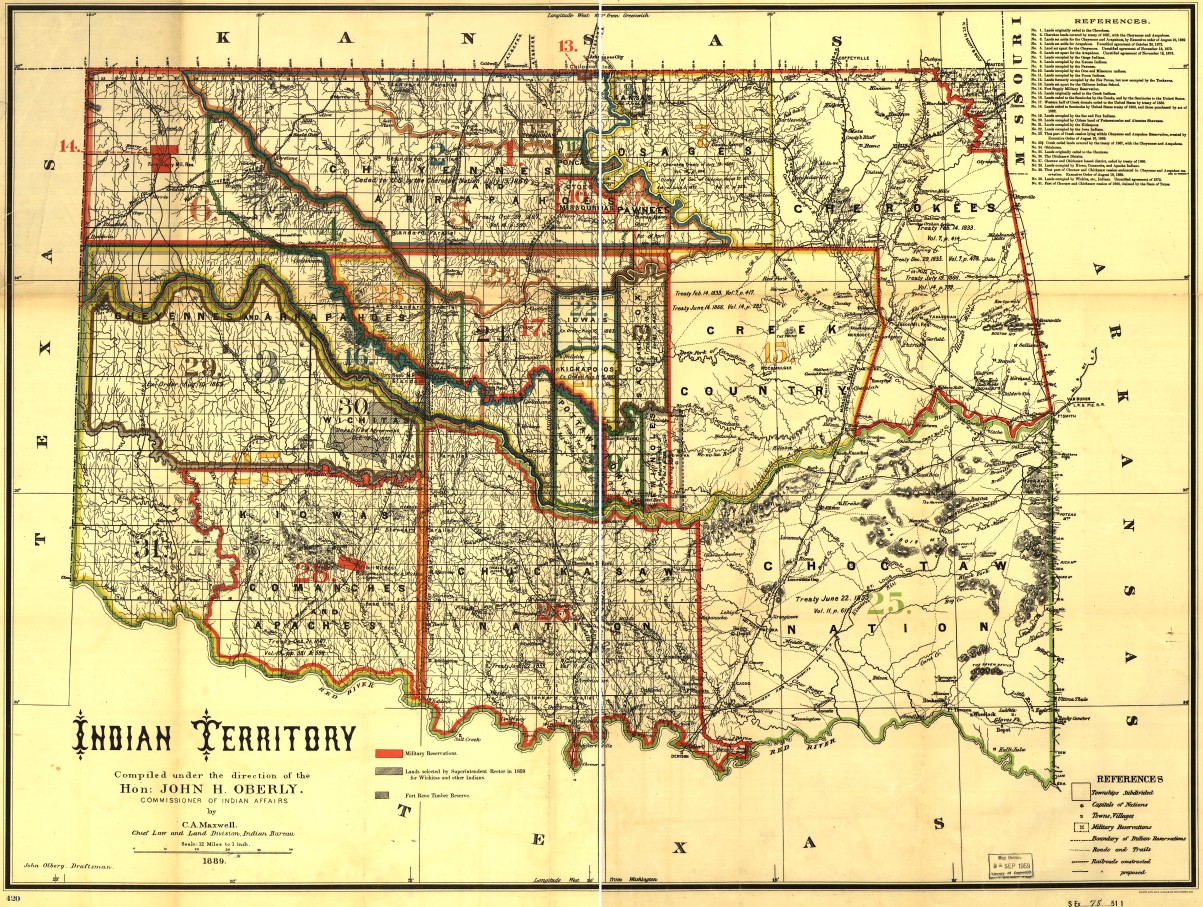
During the recent U. S. Senate debate on KOTV/KWTV, there wasn't much distance between the four participating candidates on economic matters and social issues. There were a few differences on how the U. S. should respond to the Russian invasion of Ukraine and the wisdom of unrestricted aid to the Ukrainian government. Conservatives would find any of the candidates would be preferable to unopposed Democrat nominee Kendra Horn and losing the chance to regain Republican control of the Senate.
There were major differences on what is the most consequential issue for Oklahomans in this election: The response to the U. S. Supreme Court's decision in McGirt v. Oklahoma, the Court's 5-4 declaration, contrary to over a century of settled law, that the Creek "Reservation" was never disestablished and still exists for the purposes of the Federal Major Crimes Act, and therefore a child molester's conviction in state court was invalid. Whether it would serve as a precedent affecting land title, regulation, oil and gas exploration, and taxation is a matter that Justice Neil Gorsuch, writing for the majority, chose to leave unresolved for future litigation.
The implications of a ruling in favor of tribal government territorial sovereignty were serious enough to prompt amicus briefs supporting the State of Oklahoma from the City of Tulsa, the Federal Government, the National Sheriff Association, and several states.
The situation directly created by Gorsuch's McGirt opinion is bad enough: Eastern Oklahoma crime victims who are tribal citizens and non-tribal citizens who are victimized by tribal-citizen criminals must look to a Biden-appointed U. S. Attorney and overcrowded federal courts (and Clinton/Obama/Biden federal judges) for justice, rather than the district attorneys and district judges that are directly accountable to Oklahoma voters.
Candidate Alex Gray, National Security Council chief of staff in the Trump administration, was not invited to the debate, but he has been prominent in calling for the most straightforward solution: Congress must act formally to disestablish the reservations that no one believed or claimed existed until a few years ago. This will not happen, however, unless Oklahoma senators and congressmen lead the way. It is therefore crucial for Oklahoma voters to choose candidates at every level who will actively work for disestablishment of reservations.
Nathan Dahm and Scott Pruitt spoke strongly in favor of disestablishment in the debate. Pruitt called the McGirt decision "an existential threat to the sovereignty of the state of Oklahoma," and said, "Congress has every right and every authority to disestablish reservations in the State of Oklahoma and restore the sovereign boundaries of Oklahoma." Dahm noted the verbal sleight of hand used by Gorsuch to "create" a reservation that Gorsuch admitted was never formally established. Dahm committed to introducing legislation to disestablish reservations in Oklahoma.
(The question was discussed in the KOTV/KWTV debate beginning at about 25:30.)
Luke Holland, Jim Inhofe's former chief of staff, wants to let all those pending cases based on the McGirt precedent work their way through the Federal courts and after that have the state and the Federal government and the tribal governments negotiate a crazy quilt of compacts and agreements to deal with the problems that the court rulings create.
T. W. Shannon, a citizen of the Chickasaw Nation and CEO of the bank owned by the Chickasaw Nation government, tried to minimize the impact of the McGirt ruling, as if the court's manufacture of a reservation would have no impact on other cases. He spoke against any federal action on the matter, attempting to frighten voters that Nancy Pelosi and Chuck Schumer would be in control of Oklahoma's destiny. That's strange thing to say, considering that he's running for Senate in hopes of being part of an expected Republican majority in both houses of Congress with Republican leaders replacing Pelosi as Speaker of the House and Schumer as Senate Majority Leader.
Later in the debate (about 37 minutes in), Shannon was asked about the amicus curiae brief he signed in support of child molester McGirt. In reply, Shannon claimed that McGirt "is now doing more time and serving a longer sentence" after being convicted in Federal court. Shannon's answer is misleading: McGirt's sentence in state court was 500 years; now he's serving life without parole. Either way, McGirt would have spent the remainder of his life in prison, but Shannon's way was to require McGirt's victim, now an adult, to relive the abuse she suffered at Jimcy McGirt's hands so that he could be convicted a second time.
Congressman Markwayne Mullin, a citizen of the Cherokee Nation, skipped the debate, but a statement Mullin made jointly with four tribal governments when the ruling was announced makes clear where he stands, with the "sovereign nations" and against Oklahoma citizens who need legal clarity and stability.
Indeed, any candidate that talks about the importance of respecting the "sovereign nations" (which went out of the sovereignty business after negotiating the sale of their territory in the run-up to statehood) has already demonstrated that he or she isn't going to be working assertively to protect the rights of ordinary Oklahomans.
The quarrel here is not with the hundreds of thousands of Oklahomans who also have citizenship in a tribe and enjoy the benefits that citizenship confers. The argument is with the tribal government leaders who have suddenly become much more important despite the tiny numbers of voters involved in electing them. In a recent column, OCPA President Jonathan Small wrote:
David Hill was elected Muscogee principal chief with 3,399 votes. Kevin Stitt was elected Oklahoma governor with 644,579 votes....Few Cherokees are directly involved in tribal government. The tribe reports over 400,000 individuals are Cherokee citizens, but less than 14,000 voted in the last election for tribal chief. (Similar trends are also notable for the Muscogee Nation, which claims 86,100 citizens.)
Tribal governments, despite the low level of voter accountability, were already gaining influence and power thanks to tribal gambling revenues and special carveouts for tribally owned businesses. Now that court rulings may give them control over land use regulation and oil and gas exploration in half of the state, expect tribal governments to become favor factories, as businesses go through tribal officials to get the favors they want if the decisions of city or state authorities don't go their way.
Pro-abortion forces are already discussing ways to subvert the expected ruling overturning Roe v. Wade, such as a Biden executive order to make military bases sanctuaries for legal abortion, regardless of the laws of the state where a base is located. It's not a stretch to imagine a tribal government being financially induced by Planned Parenthood and abortionists to allow killing centers to open under tribal protection, even if it ran counter to the moral convictions of their tribal citizens.
In that same column, Jonathan Small commented on Cherokee Principal Chief Chuck Hoskin Jr's executive order to ban the Oklahoma flag from flying over Cherokee property. The chief quickly reversed course when a majority of the response from Cherokee citizens opposed the band.
If reservations remain established in SCOTUS's view and courts build on the McGirt precedent, these officials will have substantial and growing control over the everyday lives of Oklahomans, but only a small percentage of Oklahomans will have any say in their election. People can come to Oklahoma from Burma and Cuba and Ghana and Iraq and, in due time, follow the process to become citizens of Oklahoma and the U. S. A. with full rights. But even though my children were born here in Tulsa and have lived here their whole lives, because they don't have the right ancestry, they can never, ever be accepted as citizens of the Muscogee Nation. When South Africa allowed only a small minority ethnic group to participate in the democratic process, there was a global outcry and decades of pressure to overthrow that apartheid regime. We recognize the injustice of the situation in wealthy oil sheikdoms where the vast majority of residents are guest workers with no rights and no say in who rules them and how. Why would we want to replicate those injustices here?
The historical record makes it clear that Congress was intent on fully integrating Indian Territory and its residents into the United States of America as full citizens of a state like all the others. Tribal citizens in Indian Territory were granted U. S. citizenship in 1901. The U. S. reached negotiated settlements with each of the tribes to allot communal lands to individual Indians and to distribute the proceeds of the sale of any surplus lands for the benefit of tribal members. As of 1907, tribal governments no longer had any territory to govern.
The uncertainty and lack of accountability generated by the McGirt ruling is a problem for all Oklahomans, tribal citizens or not. At the 2022 primary, Oklahomans need to reject candidates who want to play footsie with tribal governments and elect candidates who will restore Oklahoma's sovereignty and protect the rights of all Oklahomans, not just the minority with special ancestry.
The three-day filing period for the 2022 City of Tulsa election for City Council and City Auditor has concluded. All nine council seats are contested, but City Auditor Cathy Champion Carter has been reelected without opposition.
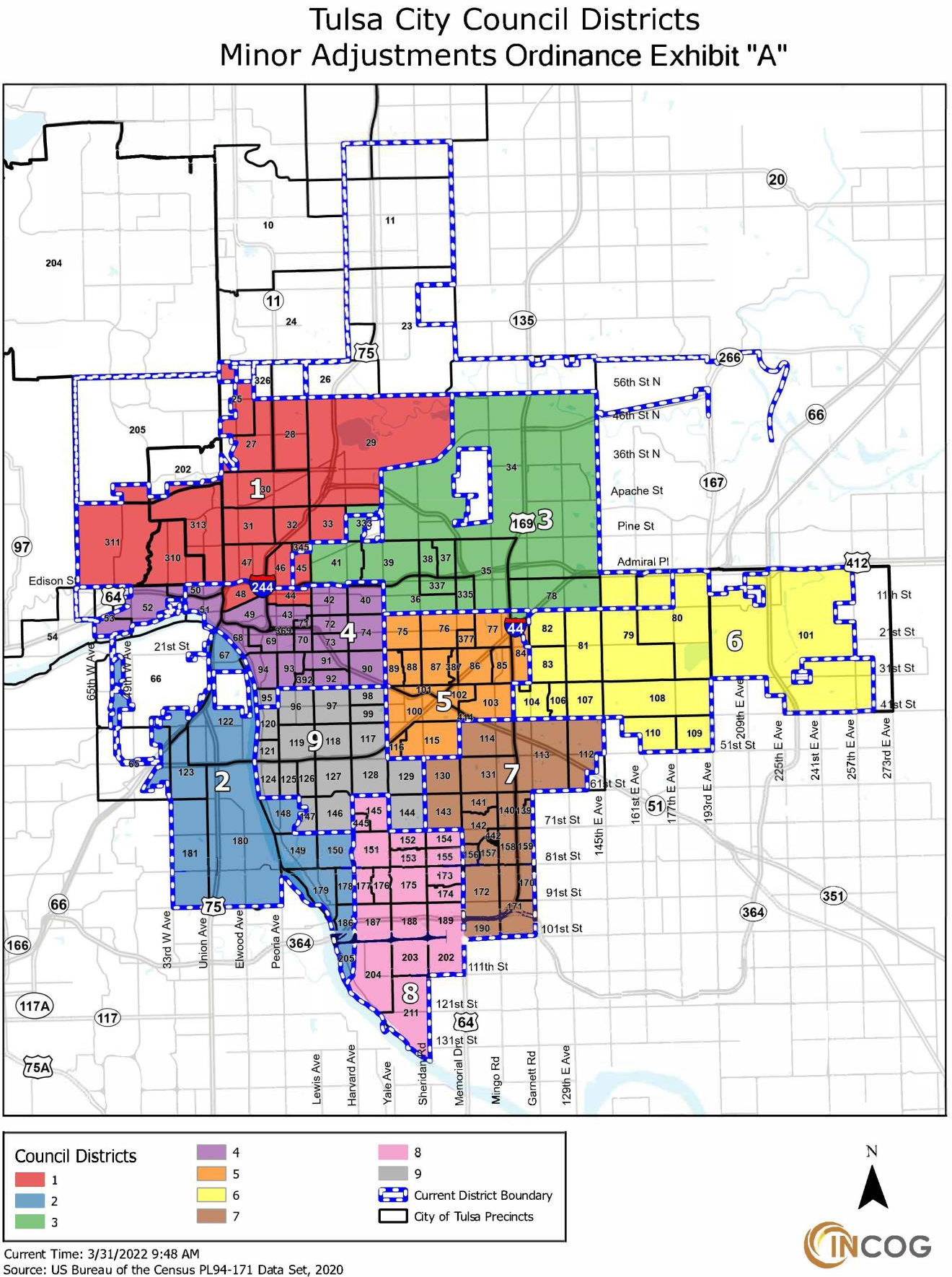
Here is the complete list of candidates who filed. Names, ages, and addresses are from the official county election board filing list, which has not yet been posted to the website. I've added party registration, incumbent status, other affiliations, and the candidate's name in the voter rolls in parentheses where it differs from the name that will be on the ballot. (UPDATE: Here is the official list of City of Tulsa 2022 election filings.)
The 31 candidates by party registration: 17 Democrats, 10 Republicans, 2 Libertarians, 2 independents.
Councilmember - Council District 1
- Vanessa Hall-Harper (Vanessa Dee Hall-Harper), incumbent Dem, 50, 2020 W. Newton St., Tulsa, OK 74127
- David Harris (David Jeremy Harris), Dem, 48, 1780 E 51st St N, Tulsa, OK 74130
- Francetta L. Mays (Francetta Lajuana Mays), Dem, 58, 1740 W. Haskell Pl., Tulsa, OK 74127
Councilmember - Council District 2
- Aaron L Bisogno (Aaron Louis Bisogno), Rep, 35, 7722 South Saint Louis Avenue, Tulsa, OK 74136
- Jeannie Cue, incumbent Rep, 68, 5313 S 32 Pl W, Tulsa, OK 74107
Councilmember - Council District 3
- Daniel Joseph Grove, Lib, 22, 1407 N. Evanston Ave., Tulsa, OK 74110
- Crista Patrick (Crista Caye Patrick), incumbent Dem, 48, 1918 N. Joplin Ave., Tulsa, OK 74115
Councilmember - Council District 4
- Laura Bellis (Laura Simon Bellis), Dem, 33, 224 N. Rosedale Ave., Tulsa, OK 74127
- Michael Birkes (Michael Bruce Birkes), Ind, 72, 1021 E 7th St., Tulsa, OK 74120 (registration address is 702 S Owasso Ave)
Scott Carter (Martin Scott Carter), Dem, 56, 208 East 19th St, Tulsa, OK 74119WITHDRAWN- Michael Feamster (Michael James Feamster), Bynum-Chamber-Rep, 39, 2259 South Rockford Avenue, Tulsa, OK 74114
- Weydan Flax (Weydan Shawn Flax), Dem, 60, 1234 S Birmingham Ave, Tulsa, OK 74104
- Matthew Fransein (Matthew James Fransein), Dem, 34, 727 S. Louisville Ave, Tulsa, OK 74112
- Bobby Dean Orcutt (Robert Dean Orcutt), Dem, 39, 1630 S. St Louis Ave, Tulsa, OK 74120
Councilmember - Council District 5
- Mykey Arthrell (Michael William Arthrell-Knezek), incumbent Dem, 37, 1747 S Erie Pl, Tulsa, OK 74112
- Latasha Jim (Latasha Earlene Jim), Ind, 29, 11035 E 16th St, Tulsa, OK 74128
- Adil Khan (Adil Khalid Khan), Dem, 38, 9815 E. 21st Pl Apt C, Tulsa, OK 74129
- Grant Miller (Adam Grant Miller), Lib, 35, 1139 S. Canton Ave., Tulsa, OK 74112
- Ty Walker (Tyron Vincent Walker), Rep, 56, 8538 E. 24th St., Tulsa, OK 74129
Councilmember - Council District 6
- Christian Bengel (Christian D. Bengel), Rep, 54, 13173 E 29th St., Tulsa, OK 74134
- Connie Dodson (Connie L Dodson), Dem, 55, 13302 E. 28th St., Tulsa, OK 74134
- Lewana Harris (Lewana Michelle Harris), Dem, 45, 1505 S. 117th E. Ave, Tulsa, OK 74128
Councilmember - Council District 7
- Jerry Griffin (Gerald Ray Griffin), Rep, 78, 6552 E. 60th, Tulsa, OK 74145
- Ken Reddick (Kenneth Andrew Reddick), Rep, 39, 5008 S 85th East Ave, Tulsa, OK 74133
- Lori Decter Wright (Lori Marie Decter-Wright), Dem, 47, 8706 East 86th Street, Tulsa, OK 74133
Councilmember - Council District 8
- Scott Houston (Jon Scott Houston), Rep, 66, 8534 S. 70th E Ave, Tulsa, OK 74133
- Phil Lakin (Phillip Lawrence Lakin, Jr.), incumbent GKFF-Rep, 54, 9808 S. Knoxville Ave, Tulsa, OK 74137
Councilmember - Council District 9
- Lee Ann Crosby (Bobbie Leeann Crosby), Dem, 38, 3845 South Madison Ave, Tulsa, OK 74105
- Jayme Fowler (Jayme Don Fowler), incumbent Rep, 63, 5601 S. Gary Ave, Tulsa, OK 74105
- Chad Hotvedt (Chad Edward Hotvedt), Dem, 38, 1515 E 60th St, Tulsa, OK 74105
City Auditor
- Cathy Champion Carter, Dem, 67, 4120 E 22nd Pl, Tulsa, OK 74114
CORRECTION: In an earlier version of this entry, I had erroneously transcribed Ken Reddick's date of birth and the address on his declaration, and I incorrectly identified the full registration name for Christian Bengel in District 6 as Riley Christian Bengel (his son).
UPDATE 2022/06/17: Scott Carter withdrew his candidacy for District 4 by the Friday deadline.
At the end of the second day (June 14, 2022) of the three-day filing period for the 2022 City of Tulsa election for City Council and City Auditor, only two incumbents remain unopposed: District 3 Councilor Crista Patrick (D) and City Auditor Cathy Champion Carter (D).
All nine City Council seats and the City Auditor position will be on the ballot. The filing period continues through 5 p.m. Wednesday. The City of Tulsa filing packet is here. A candidate must turn in a notarized declaration of candidacy to the Tulsa County Election Board at 555 N. Denver, along with a $50 cashier's check as a deposit or a nominating petition signed by at least 300 registered voters in the district in lieu of a deposit.
In Tuesday's filings, incumbent District 8/GKFF Councilor Phil Lakin now has a challenger in Republican Scott Houston, an insurance company VP who is also an author and motivational speaker. On his campaign website, Houston emphasizes conservative values, limiting government overreach (specifically mentioning mask mandates and business shutdowns), and roads and infrastructure. Houston's filing means there are now conservatives running in four of the nine council races.
Incumbents Vanessa Hall-Harper (D, District 1) and Mykey Arthrell (D, District 5) filed for re-election, along with two more candidates in District 5, Latasha Jim (I) and Grant Miller (D). Lee Ann Crosby (D) filed in District 9; incumbent Jayme Fowler has yet to file for re-election.
The race for the open seat in District 4 added two candidates, Scott Carter (D) and Bobby Dean Orcutt (D). Carter is registered to vote as Martin Scott Carter; the publications list on the webpage of Scott Carter, Professor of Economics at the University of Tulsa, has Martin Carter listed as author for most of the articles listed.
Bobby Dean Orcutt is owner of the Mercury Lounge. He was planning a run for District 4, held off with the intention of backing Emeka Nnaka, but now that the district boundary modification in April has moved Nnaka into District 1, Orcutt has evidently decided to jump back in.
Party registration of the 24 candidates who have filed thus far: 14 Democrats, 8 Republicans, 1 Libertarians, and 1 independent.
Here is the complete list of candidates who filed as of Tuesday evening Names, ages, and addresses are from the official county election board filing list. I've added party registration, incumbent status, other affiliations, and the candidate's name in the voter rolls in parentheses where it differs from the name that will be on the ballot.
Today (June 13, 2022) was the first day of the three-day filing period for the 2022 City of Tulsa election for City Council and City Auditor. All nine City Council races will be on the ballot. The filing period continues through 5 p.m. Wednesday. The City of Tulsa filing packet is here. A candidate must turn in a notarized declaration of candidacy to the Tulsa County Election Board at 555 N. Denver, along with a $50 cashier's check as a deposit or a nominating petition signed by at least 300 registered voters in the district in lieu of a deposit.
This will be the first election using the Tulsa city council district lines drawn after the 2020 census. Precinct boundaries and numbers have changed as well. On April 6, 2022, the council adopted significant changes to the final redistricting plan produced by the Election District Commission in December 2021. The map below (click to see the full size version) shows the originally adopted 2021 plan in blue-and-white lines and the current districts as colored areas. A consequence of that change is that Emeka Nnaka, who came to the election board today to file for the open District 4 seat, learned that his Kendall-Whittier home was now in District 1. He left without filing.
As of the end of the first day, incumbents have filed for re-election in the auditor's race and five of the nine council districts. District 4 Councilor Kara Joy McKee announced earlier this year that she would not seek re-election. All other incumbent councilors are reported to be running for re-election, but incumbents in Districts 1, 5, and 9 have yet to file.
So far incumbents Crista Patrick and Phil Lakin (District 8) are unchallenged. Patrick is the latest member of the family dynasty to sit in the District 3 seat. Lakin is chairman of the George Kaiser Family Foundation and CEO of the Tulsa Community Foundation, and as such represents the stranglehold that billionaire George Kaiser has on Tulsa city government and the non-profit sector, pushing the city leftward. Challenging and defeating Lakin would be a good start on making Tulsa where community organizations once again represent the city's diversity.
Conservatives have filed for only three of the seats. Ty Walker, a restaurateur who ran for Mayor in 2020, has filed in District 5, a seat he sought in 2018 when no incumbent was running. In District 7, Tulsa school board member Jerry Griffin has filed to challenge incumbent Democrat Lori Decter Wright. In District 6, Christian Bengel is seeking a rematch with incumbent Democrat Connie Dodson -- two years ago, he advanced to a runoff but lost in November.
The open seat in District 4 has so far drawn only two candidates. Michael Feamster, an executive at Nabholz Construction Corporation, and Laura Bellis, a Planned Parenthood Great Plains advisory board member. Bellis has pronouns in her LinkedIn bio. In April 2020, Bellis made news for urging Gov. Stitt to lock down Oklahoma. Feamster's LinkedIn feed is full of cheerleading for the Chamber and G. T. Bynum, and raised over $28,000 as of March 31, from many of the usual establishment funders, including $5,000 from QuikTrip PAC and a maximum $2,900 donation from the Osage Nation. Michael Junk, Bynum's former deputy mayor and campaign manager, hosted a fundraiser for Feamster last fall, prompting questions about Bynum's support for Feamster's candidacy. Clearly, conservative voters and supporters of midtown neighborhood preservation don't yet have a candidate to vote for in the District 4 race; hopefully one will emerge by Wednesday.
While city elections have been officially non-partisan since 2016, all of the 16 candidates who have filed thus far are registered to vote with a political party: 9 Democrats and 7 Republicans. Republicans are a plurality of registered voters in Tulsa, at 86,796, compared to 84,320 registered Democrats, 43,460 independent voters, and 2,063 registered Libertarians. While party registration doesn't say everything that needs to be said about a candidate's views, particularly on city issues, and while RINOs abound, it is one more piece of information that a voter may find useful.
Here is the complete list of candidates who filed on Monday. Names, ages, and addresses are from the official county election board filing list. I've added party registration, incumbent status, other affiliations, and the candidate's name in the voter rolls in parentheses where it differs from the name that will be on the ballot.
U. S. Senator Jim Inhofe is retiring after a long political career that includes service in the Oklahoma State Senate, 6 years as Mayor of Tulsa, 8 years in the U. S. House, and 28 years in the Senate. 13 Republican candidates have filed for the seat.
This article is an overview of the field, with links to candidate websites, social media profiles, and campaign finance information. The candidate's name will be hyperlinked to his or her campaign website, if it exists. The Wagoner County Republican Party asked each of the candidates to complete a lengthy questionnaire, but only four candidates responded. These are linked in the list below as WCRP.
The winner of the primary (after a likely August runoff) will face former Democrat congresswoman Kendra Horn, Libertarian perennial candidate Robert Murphy, and 86-year-old independent candidate Ray Woods on the general election ballot.
Only five candidates reported receiving campaign contributions to the Federal Election Commission as of March 31, 2022. Former Attorney General and EPA Administrator Scott Pruitt entered the race during the filing period and has presumably raised money. The next FEC filing deadline is June 16, which will cover pre-primary contributions through June 8. Additionally, the final filer in the race, Dr. Randy Grellner, has announced an expenditure of $786,000 to produce and run a TV commercial, so I've included him in the tier of candidates making a serious run.
Because only two candidates can advance to the August runoff, conservative voters will need to consolidate around a single champion in the primary to have any hope of having someone worth voting for in the runoff. Polling and spending will be important factors for casting a strategic vote in June. I've been encouraging absentee voters to hold off voting until we have a clearer picture of the battlefield. The pre-election FEC reports will be telling. Sooner Poll polled this race and other statewide and congressional races, but they only managed a sample of 306 voters over a 17-day period, and 31.4% of voters were undecided.
Nathan Dahm, Broken Arrow, 39, State Senator, District 33. FEC, campaign FB page, personal FB profile, @NathanDahm on Twitter.
Alex Gray, Nichols Hills, 32, former National Security Council Chief of Staff in the Trump administration: FEC, campaign FB page, @AlexGrayForOK on Twitter, LinkedIn, YouTube channel.
Randy J. Grellner, Cushing, 56, family practice physician: FEC, campaign FB page, medical practice website.
Luke Holland, Tulsa, 35, former chief of staff to Sen. Jim Inhofe: FEC, personal FB profile, @LukeHollandOK on Twitter, LinkedIn, YouTube channel.
Markwayne Mullin, Westville, 44, U. S. Representative, 2nd District: FEC, @MarkwayneMullin on Twitter, LinkedIn, YouTube channel.
Scott Pruitt, Tulsa, 54, former Oklahoma Attorney General, former Environmental Protection Agency Administrator: FEC, campaign FB page, @ScottPruitt_OK on Twitter, YouTube channel, WCRP.
T.W. Shannon, Oklahoma City, 44, CEO of Chickasaw Community Bank, former Speaker of the Oklahoma House of Representatives: FEC, campaign FB page, @TWShannon on Twitter, LinkedIn, YouTube channel.
There are six more candidates who filed for the unexpired four-year Senate term:
Michael Coibion, Bartlesville, 67: personal FB profile, WCRP.
Jessica Jean Garrison, Owasso, 47: FEC, personal FB page, campaign FB page, WCRP.
Adam Holley, Bixby, 41: FEC, personal FB page, @adamforoklahoma on Twitter, YouTube channel, WCRP.
Laura Moreno, Edmond, 37, nurse practitioner: personal FB profile, medical practice website.
Paul Royse, Tulsa, 52, : campaign FB page, personal FB profile.
John F. Tompkins, Oklahoma City, 65, orthopedic surgeon: FEC, personal FB profile, book page.
SB962, which would move school board general elections to November, has cleared the Oklahoma House of Representatives Rules Committee and is awaiting action by the whole house.
The bill does not alter terms of office and does not make the elections partisan. The bill does not change the date for school millage elections, which will still fall on the 2nd Tuesday in February, but these elections are rare (if not non-existent) as legislation has made most mill levies permanent.
Currently, the school board filing period begins on the 1st Monday in December, with a primary election on the 2nd Tuesday in February and a general election on the 1st Tuesday in April. As I have often written, the filing period, falling right after Thanksgiving at the beginning of the run-up to Christmas, is easy to overlook, there is worse weather and less daylight available for door-to-door campaigning in the winter months, and it's easy for voters to forget the dates of the school board election when their district only has a chance to vote once every five years (in all but a few school districts). The situation is well-suited for incumbent board members to minimize turnout to those voters likely to vote their way.
Here is the schedule of school board elections proposed by SB962, as approved by the Senate and the House Rules Committee:
In odd-numbered years:
- Three-day filing period begins: April, 2nd Wednesday
- Primary election: September, 2nd Tuesday
- General election: November, 2nd Tuesday
In even-numbered years:
- Three-day filing period begins: April, 2nd Wednesday
- Primary election: August, 4th Tuesday (state/federal runoff)
- General election: November, Tuesday after 1st Monday (state/federal general)
Ray Carter's OCPA story on the bill links to an Annenberg Institute analysis of the demographics of voters in school board elections in Oklahoma, California, Illinois, and Ohio. From the study's conclusion:
America's system of deference to local school boards in making essential educational governance decisions is premised on the assumption that the objectives of voters who elect these boards will be aligned with the educational interests of public school students. Our analysis points to several reasons for doubting the validity of this assumption in many contexts. As we show, most of those who cast ballots in school board elections do not have children enrolled in local schools and these voters do not resemble the students who attend the public schools. The disconnect is especially pronounced on the dimension of race, and the gap is particularly large in majority-nonwhite districts and in places with the most worrying racial achievement gaps.While it is beyond the scope of our research to identify the root causes of these disparities in political participation,16 we should note there is evidence suggesting that institutional reforms have the potential to narrow them considerably. For example, moving school board elections on-cycle, to coincide with higher-turnout national elections, is likely to significantly boost the political representation of households with children and increase the racial diversity of the electorate (Kogan, Lavertu and Peskowitz 2018).
The bill is on the House floor agenda for today with an amendment from Speaker McCall which would shift the filing period to the 1st Monday in April for odd-numbered years, but leave even-numbered year filing period to line up with filing period for federal and state offices. The effective date is also changed -- November 1, 2022, rather than January 1, 2023, which would bring it into effect for the next school board cycle. This also means if the bill passes the House, it will have to go back to the Senate for final approval.
This bill is a step in the right direction, but it is not the ideal end state. At the very least we ought to harmonize election dates between odd- and even-numbered years. Better yet, move all school (and municipal) elections to the fall of odd-numbered years, so that voters are in the habit of going to the polls every year in November. Odd-numbered year elections could be reserved for local offices and issues (municipal and school board), to insure that they aren't overshadowed by who's running for president or governor. Change school board terms to two years (everyone on the ballot every odd-numbered year) or four (roughly half of the members up for election every odd-numbered year). Require school and municipal ballot propositions to be held only on the November election in odd years. It may be, however, if this SB962 goes through, the value of these other reforms will be more apparent and easier for the legislature to contemplate.
UNOFFICIAL RESULTS UPDATE, with all precincts counted: The conservative, pro-parent school board candidates have either won outright (Debbie Taylor in Broken Arrow) or made it into a runoff (conservative Tim Harris against Susan Lamkin, who had the endorsement of the GKFF-connected incumbent and the support of the TPS establishment; conservative Shelley Gwartney against Union incumbent Chris McNeil). The top two candidates in both races were just a tiny margin apart -- 62 votes in Tulsa and 12 votes in Union. So the pro-parent candidates and supporters will have a busy eight weeks between now and the April 5, 2022, runoff. In addition to trying to help Tim Harris in Tulsa district 7 and Shelley Gwartney in Union district 2, there will also be a race in Tulsa district 4 (East Central area) between pro-parent candidate E'Lena Ashley and the Democrat incumbent, as well as two-candidate races for Jenks, Skiatook (2 seats), Owasso, and Sand Springs school boards, and Tulsa Tech Center board seat 3.
Smallest election in the state: 21 voters turned out in the Town of Tushka (just south of Atoka) and all of them voted for renewing their franchise with PSO. The Town of East Duke (in Jackson County near Altus) had 36 unanimous voters on their PSO franchise vote. East Duke appears on maps as just plain Duke, another situation, like New Cordell and Pryor Creek, where there's a mismatch between corporate and common name. In Tulsa, 11,314 turned out to vote for the PSO franchise, which passed by a 76-24 split, but I suspect that number was boosted a bit by the school board and bond issue elections happening in some areas.
 Polls will be open today, Tuesday from 7 a.m. until 7 p.m. The Oklahoma State Election Board's online voter tool will let you know where to vote (and if you have a reason to go to the polls) and will show you a sample of the ballot you'll see. Here's the complete list of elections today across Oklahoma.
Below are my thoughts on some of the races in the Oklahoma school board and municipal primary election on February 8, 2022.
This is last-minute and thrown-together, I am sorry to say. Someone decided to foment a crisis, which landed atop an intense work load, plus the final push of a busy MIT admissions interview season, which ended yesterday.
Serious challengers to the status quo have emerged in several school board races in the Tulsa metro area. These candidates are committed to serving the best interests of students and their parents, rather than the agendas of administrators or unions or overly-influential, control-freakish "philanthropic" organizations. Parent Voice of Tulsa has identified the strongest pro-parent and pro-student candidates in each race, listed below.
Tulsa School Board, Office No. 7: Tim Harris. The retired district attorney, a conservative Republican, is running for an open seat. He has been endorsed by Parent Voice of Tulsa, the Republican Party of Tulsa County, former Congressman Jim Bridenstine, Lt. Gov. Matt Pinnell, retired college president Everett Piper, and many other conservative voices.
His principal competitor is a registered Democrat who has no history of voting in school board elections and has the backing for prominent left-wing institutions and donors, including the outgoing GKFF-connected board member, along with a number of other GKFF-affiliated donors, former Democrat Mayor Kathy Taylor, and the Tulsa County Democratic Party. Voting for her would be to vote for keeping failed Superintendent Deborah Gist, for accepting more strings-attached "grants" from foundations, for keeping kids in masks or out of the classroom, failing to learn via Zoom.
Union School Board Office No. 2: Shelley Gwartney. Gwartney has four children in Union schools and has been very involved as a volunteer in the district and the community. Her website goes into detail on the issues that matter to conservative parents and taxpayers. Gwartney has also been endorsed by the Republican Party of Tulsa County and Parent Voice of Tulsa.
Broken Arrow School Board Office No. 2: Debbie Taylor. Taylor is mother to four BA graduates and grandmother to 9 current students in the Broken Arrow Public Schools. Taylor is also supported by Parent Voice and the Republican Party of Tulsa County in her race for the open seat.
City of Tulsa franchise election for PSO: NO. While most Tulsa voters will not have the opportunity to vote for school board, there is a citywide election. Voters will decide whether to continue to grant PSO a franchise to use its right-of-way -- including the right-of-way along your back fence -- for the next 15 years. Here is the description on the ballot:
Do you approve the City of Tulsa's Ordinance No. 24695, granting an electric franchise to Public Service Company of Oklahoma (PSO), so that PSO may use and occupy the streets, public ways and public places of the City for installing, operating and maintaining poles, wires and other equipment, for the purpose of furnishing electricity to the public? PSO will charge its consumers a reasonable, regulated fee for the electricity furnished. PSO must abide by the terms and conditions set forth in the Franchise Ordinance. PSO will pay fees to the City of Tulsa for the use of the public ways, as calculated in the Ordinance. This franchise will last for fifteen (15) years.
You will not find any reference to this election on the CityOfTulsa.org homepage, but Ordinance No. 24695 can be found on Municode, which hosts the city charter and ordinances. Here is a copy of the proposed City of Tulsa PSO franchise, which was approved by the City Council on November 17, 2021, and signed by Mayor G. T. Bynum IV the following day. Included in that PDF is a "redline" version showing how the new franchise differs from the one that has been in force since 1997, a quarter-century ago. The new franchise has a shorter term, only 15 years; it raises the franchise fee from 2% to 3% of gross receipts, a cost that will undoubtedly be passed on to Tulsa residents and businesses; it does not provide a way to revisit the franchise fee during the 15-year term; and it has a provision that would allow the City to order burying lines below ground, but the City (read: Tulsa taxpayers) would have to cover the extra cost.
As a rule, I think that voters ought to punish attempts by public officials to sneak something past them by putting it on a special ballot, and at the same time incurring the cost of of a special election and the burden on the election board and its volunteers. Whatever the positive or negative aspects, it ought to be on the same general election ballot we use to elect city councilors and the mayor. So I recommend a NO vote on the PSO franchise.
Catoosa Public Schools bond issue: NO. The bond issue would replace the current Cherokee Elementary School building (on the west side of Cherokee Street, built circa 1960 and formerly served as the junior high, middle school, and upper elementary) with a new building, which would also eliminate the district's use of the Helen Paul Learning Center, which was built by the Works Progress Administration in the 1930s and is just about the only historic building left in all of Catoosa. The administration is silent on what will happen to the Helen Paul building. I confess a personal interest: All but one of my classrooms from kindergarten to 8th grade have been demolished. The only one left is the classroom on the southeast corner of the intersection of the main corridor and the original entrance, where I was in Mrs. Helen Paul's 2nd grade class. This is also the only one of my mother's kindergarten classrooms remaining in Oklahoma. New facilities may be nice, but some of us recall the sparkling new J. W. Sam Elementary building from about 25 years ago, which was closed because of shoddy construction. I would vote no and demand some answers about historic preservation and construction quality. There is also an open school board seat on the ballot.
Also on today's ballot across the Tulsa metro area:
- Sand Springs: Two City Council races
- Bixby: $43 million bond issue for a performing arts center
- Coweta: A revote, due to failure to comply with public notice requirements, of last September's one-cent sales tax election
- Sapulpa: Vote to make the "temporary" 2% sales tax permanent
- Bixby Public Schools: Two bond issues, Prop No. 1 for $110 million to include a new high school building; Prop No. 2 for $4.5 million for student transportation
- Jenks Public Schools: Two bond issues totalling $14,025,000.
Remember that voting "no" on a bond issue is a way to send a vote of no confidence in your school's board and administration, even if you don't have the opportunity to vote directly for a board member.
Down the turnpike, Oklahoma City at-large city councilor David Holt (he has the ceremonial title of "mayor"), who has made his living as a professional schmoozer and never had a real job (as far as I can tell), is running for re-election. He is opposed by Carol Hefner, who is running as a conservative, pro-free-market, pro-public-safety candidate; Frank Urbanic, a lawyer who successfully challenged Holt's attempts to shut down city businesses during the pandemic; and Jimmy Lawson, an activist pushing for criminal justice "reform" and "equity." Carol Hefner has the endorsement of the Oklahoma County Republican Party, the Oklahoma Conservative Political Action Committee (OCPAC) and Oklahoma Second Amendment Association (OK2A). If no one gets 50% of the vote, there will be a runoff in April.
Holt refused to debate his challengers.
Unless conservative voters in Oklahoma's cities eject progressive mayors and councilors from office, these progressive mayors will continue to prioritize policies aimed at turning these cities "blue," moving Oklahoma toward a future where, like Michigan, Illinois, Georgia, and many other states, corrupt "progressive" urban centers will control elections for the whole state. We need mayors and councilors in Oklahoma City, Tulsa, and Norman (we already have them in Broken Arrow!) who will make their cities attractive to conservatives who are refugees from other states.
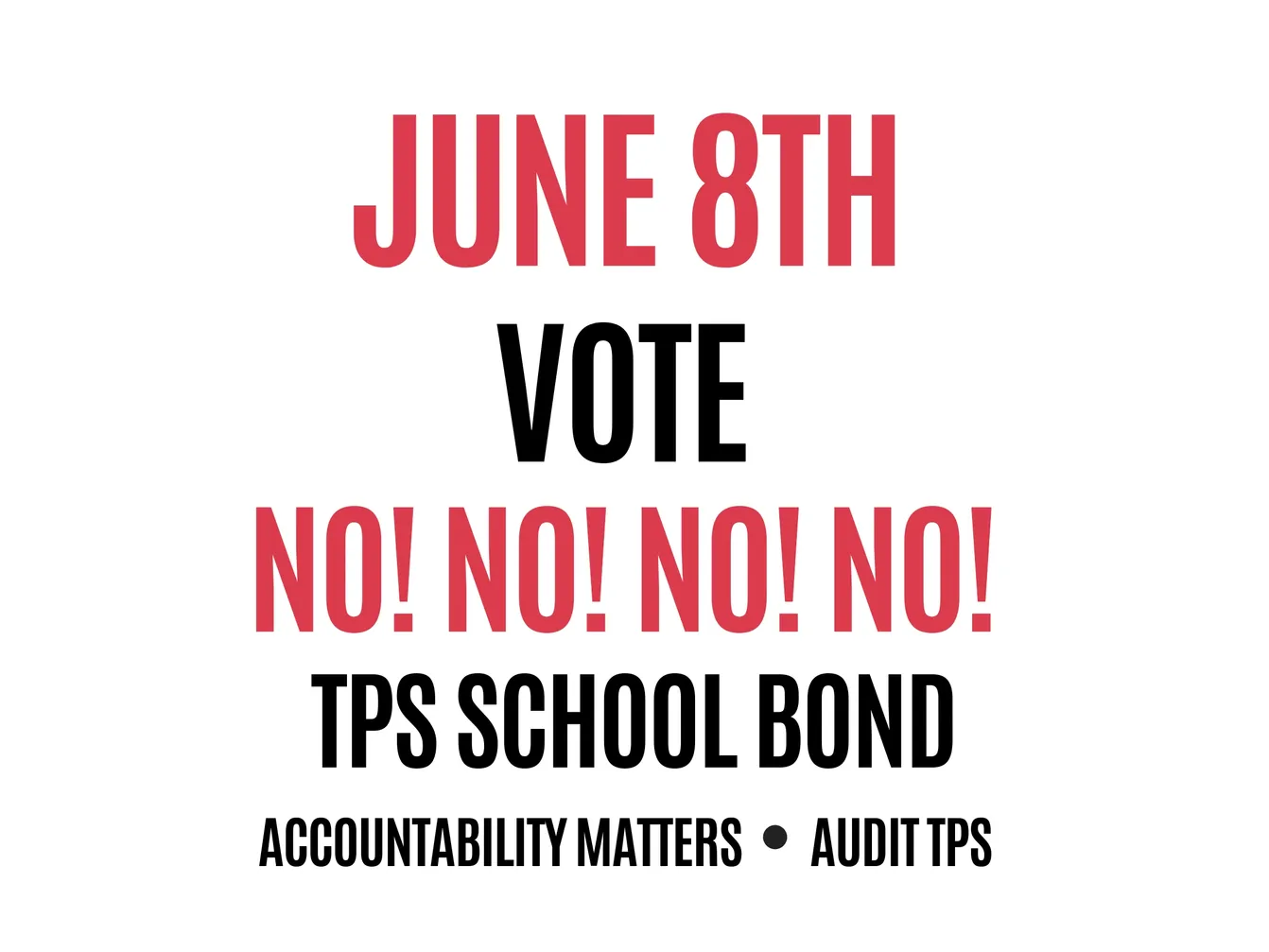
POST-ELECTION UPDATE: While the winning percentage was lower than 2015, it was still 3-to-1 in favor. Turnout was only 17,599, a tiny increase over the 17,125 that voted in March 2015. That's about 11.5%. Most organizations require a quorum of the membership to be present to take any action; why shouldn't we require a quorum of 50% of eligible voters to cast a ballot in order for a proposition to be enacted into law?
The two municipal propositions in Lahoma and Spavinaw were franchise renewals for OG+E and PSO, respectively, and passed unanimously. Navajo Public Schools bond issue passed by 5 votes.
There's yet another election this Tuesday, June 8, 2021. The Tulsa Public School board scheduled a special election for four general obligation bond issue propositions totaling $414 million. TPS residents can express their lack of confidence in the TPS administration's stewardship of our tax dollars and our children's education by voting NO on all four propositions. Opponents of the bond issue will hold an Accountability Matters Rally Opposing TPS School Bond at 5:30 pm, Monday, June 7, 2021, at the Education Service Center, 3027 S. New Haven Ave.
Never mind that we had an annual school general election back on April 6. TPS decided to hold the bond election at a time when nothing else would be on the ballot, when most Oklahomans' minds would be on summer activities. In all of Oklahoma, only four places are having an election on June 8, 2021: The Town of Lahoma (Garfield County), the Town of Spavinaw (Mayes County), Navajo Public Schools (Jackson & Greer Counties), and Tulsa Public Schools, which requires four county election boards (Creek, Osage, Tulsa, Wagoner) to staff precincts.
A school bond issue requires a corresponding increase in property taxes in the district to repay the borrowed money. Even property owners (e.g., senior citizens) who enjoy a valuation freeze will see their taxes go up, because the bond issue increases the millage rate, not the valuation of the property.
Governmental taxing authorities like scheduling special elections, because it offers a great deal of control over who turns out to vote. School officials will be sure to remind teachers and administrative staff that there's an election, and they might target parents with an interest in a particular project slated to be funded by bond money. Otherwise they keep it as quiet as possible. There's unlikely to be an organized campaign against the bonds, because concentrated benefits motivate funding for the "vote yes" side, while diffuse costs mean that opponents don't have as strong a motivation to contribute financially to its defeat. The last bond election in March 2015 drew only 17,125 voters. As of March 29, there were 152,453 eligible voters in the TPS district. Under Oklahoma law, school bond issues require approval of 60% of those voting.
But such an election also is an unusual opportunity for parents and taxpayers to issue a vote of no confidence in TPS leadership. School board elections are seemingly set up to defeat democracy. In most districts, it is only possible to replace one of the five board members every year. As a large district, TPS has a seven-member board and four year terms, but in either situation, there is no way to "throw the bums out," to clean house, to elect a new slate of board members that will take the district in a different direction. Making matters worse, filing period is held in early December when everyone is thinking about Christmas, and the school board elections are often the only item on the ballot during the February primary and April general election.
A school bond issue offers every voter in the district a chance to vote at the same time. It is the perfect opportunity to let the school board know that you're unhappy with the superintendent, the board, curriculum, the COVID-19 response, school closures, and the district's too-cozy relationship with progressive philanthropic organizations.
None of a school district's operational funds come from bond issues, so defeating a bond issue does not jeopardize teachers' salaries or the day-to-day running of the schools. Defeating a bond issue just means that TPS will have to wait a bit longer to build another monstrosity like the new Clinton West Elementary (formerly Clinton Middle School), which was James Howard Kunstler's "Eyesore of the Month" in March of 2010.
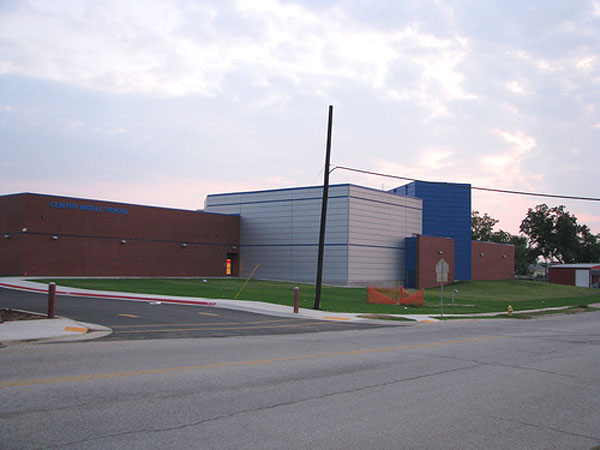 Clinton West Elementary (formerly Middle School), Eyesore of the Month, March 2010.
 James Howard Kunstler described the building as "a building that expresses to perfection our current social consensus about the meaning of education. It stares balefully at the street with the blank-faced demeanor of an autistic child preparing to explode in violent rage. It summarizes our collective aspirations about school as the unidentifiable contents of an inscrutable set of boxes."
This time around, there is an active campaign against the bond issue propositions. Both Tulsa Parent Voice and the Tulsa County Republican Party have announced their opposition to the bonds.
There are plenty of reasons that the administration and board of Tulsa Public Schools deserve a vote of no confidence. Here are just a few that come readily to mind:
1. Scheduling a bond issue election for the summer, when nothing else is on the ballot, is designed to discourage voter participation. A solid defeat of the bonds will discourage such anti-democratic behavior in the future.
2. TPS schools are failing. Out of 73 campuses receiving a State Department of Education report card in 2019, 57 received Ds or Fs (29 and 28, respectively). Only one school, Booker T. Washington High School, managed an A. (You can download grades and stats for every school in Oklahoma here.)
3. TPS is shrinking, but the demand for funds is unchanged. Since the 2015 bond, TPS enrollment has decreased by 6,500 students, but TPS is asking for as much as it did then, including money for new facilities. Ten schools that were promised 2015 bond money were closed instead: Jones, Park, Penn, Remington, Academy Central, Greeley, Grimes, ECDC Porter, Mark Twain & Gilcrease. Gilcrease was closed despite a petition signed by 2,500 residents.
3. The school board's 2020 decision to extend Superintendent Deborah Gist's contract through 2023 was timed to prevent newly elected school board members from participating in the decision, which shows profound disrespect for the voters.
4. TPS pushes progressive politics. Superintendent Gist's May 2021 personal statement about "equity" is filled with leftist jargon from the Critical Race Theory glossary, but the rot is by no means limited to Gist. The district's "Who We Are" page states that "living our values requires working actively to dismantle systems of racial oppression."
5. The information about the bond issue propositions on the TPS website is supportive marketing material, not neutral, just-the-facts information. This is in violation of state law.
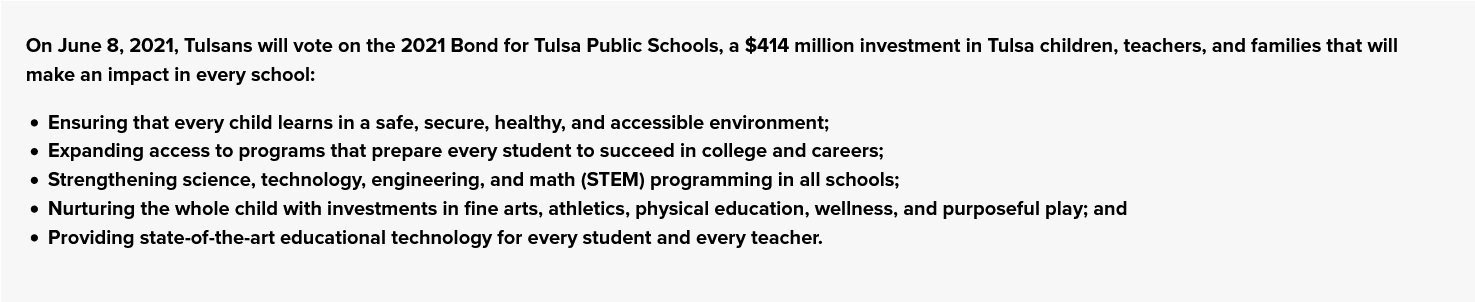
6. TPS requires a formal request under the Open Records Act to release campaign contribution reports that, by state law, must be filed with the school district clerk. TPS does not respond to these requests in a timely fashion -- another anti-democratic policy.
7. TPS has a bloated administrative structure and spends millions on consultants.
8. TPS has continued to force children to wear masks and never returned to full-time in-person learning.
There are plenty of other reasons to revolt against the current TPS administration, many of which you'll see documented on the sos-tps.org website, which also has the specifics on the four propositions. A vote against the bond propositions is the simplest way to express a demand for change at Tulsa Public Schools.
House Bill 1775 (2021), signed into law earlier this week by Gov. Kevin Stitt, takes up a grand total of four sheets of paper. The substance of the bill occupies a mere page and a third, 282 words by my count. So it's frustrating, if not surprising, that the Tulsa Whirled and broadcast media outlets should mischaracterize the bill, when they could easily quote the entire text. (Here's all the info on HB 1775, including earlier versions, amendments, and legislative votes.)
Although HB 1775 targets the infiltration of Critical Race Theory (CRT) into our taxpayer-funded schools and universities, it does not use that phrase. Instead, it prohibits specific racist and sexist ideas from being taught. There are two subsections of what will become 70 O. S. 24-157. Subsection A deals with state universities, requiring the Oklahoma State Regents for Higher Education to promulgate rules, subject to legislative approval, to enforce the following law:
No enrolled student of an institution of higher education within The Oklahoma State System of Higher Education shall be required to engage in any form of mandatory gender or sexual diversity training or counseling; provided, voluntary counseling shall not be prohibited. Any orientation or requirement that presents any form of race or sex stereotyping or a bias on the basis of race or sex shall be prohibited.
Subsection B deals with K-12 schools, and the State Board of Education is assigned to enforce it:
The provisions of this subsection shall not prohibit the teaching of concepts that align to the Oklahoma Academic Standards.1. No teacher, administrator or other employee of a school district, charter school or virtual charter school shall require or make part of a course the following concepts:
- one race or sex is inherently superior to another race or sex,
- an individual, by virtue of his or her race or sex, is inherently racist, sexist or oppressive, whether consciously or unconsciously,
- an individual should be discriminated against or receive adverse treatment solely or partly because of his or her race or sex,
- members of one race or sex cannot and should not attempt to treat others without respect to race or sex,
- an individual's moral character is necessarily determined by his or her race or sex,
- an individual, by virtue of his or her race or sex, bears responsibility for actions committed in the past by other members of the same race or sex,
- any individual should feel discomfort, guilt, anguish or any other form of psychological distress on account of his or her race or sex, or
- meritocracy or traits such as a hard work ethic are racist or sexist or were created by members of a particular race to oppress members of another race.
Who would defend any of the ideas listed above? And yet these very ideas are being incorporated into school curricula (as well as corporate training) across America and throughout the Anglosphere. If we had a mainstream media worthy of our attention, they would be asking critics of HB 1775 to read the above list and indicate which of the ideas they endorse teaching to school children.
(Christopher Rufo has been tireless in documenting the spread of "woke" education and now is turning his attention to "woke" corporate indoctrination with an exposé of Disney's racist diversity and inclusion program. Rufo's coverage of CRT in the Federal Government led to President Trump's executive order banning racist dogma.)
Many critics of HB 1775 selectively quote subparagraph B.1.g. as prohibiting the teaching of any historical event that might make a student feel uncomfortable, for example, the Trail of Tears, the Tulsa Race Massacre, lynching, or Jim Crow laws. A change in wording ("ought to feel" or "is obliged to feel" instead of "should feel") might have avoided the easy distortion, but the language is clear enough to the careful reader. The bill bans teaching that "any individual should feel discomfort, guilt, anguish or any other form of psychological distress on account of his or her race or sex" (emphasis added). That last phrase has been utterly ignored by the mainstream media. A student ought to feel sad or angry when learning that a mob of white people descended on a black community, shot people and looted and burned their homes and businesses, but a person in academic authority over them, funded by Oklahoma taxpayers, should not tell the student that he should feel personally guilty because he has skin color in common with those responsible for these evil deeds.
Note the reference to Oklahoma Academic Standards, which I have hyperlinked above. The current Social Studies standards, last updated in 2019. HB 1775 explicitly allows the topics in these standards to be taught, notwithstanding anything else in the bill. All of the historical subjects that critics have claimed will be suppressed are in fact included, for example:
OKH.1.3 Compare the goals and significance of early Spanish, French, and American interactions with American Indians, including trade,the impact of disease, the arrival of the horse,and new technologies.OKH.1.4 Compare cultural perspectives of American Indians and European Americans regarding land ownership, structure of self-government, religion, and trading practices.
OKH.2.3 Analyze the motivations for removal of American Indians and the passage of the Indian Removal Act of 1830; trace the forced removal of American Indian nations, including the impact on the tribal nations removed to present-day Oklahoma and tribal resistance to the forced relocation
OKH.3.1 Summarize the impact of the Civil War and Reconstruction Treaties on American Indian peoples, territories, and tribal sovereignty including:
- required enrollment of the Freedmen
- Second Indian Removal
- significance of the Massacre at the Washita
- reasons for the reservation system and the controversy regarding the reservation system as opposed to tribal lands.
- establishment of the western military posts including the role of the Buffalo Soldiers
- construction of railroads through Indian Territory
OKH.3.4 Compare multiple points of view to evaluate the impact of the Dawes Act (General Allotment Act) which resulted in the loss of tribal communal lands through a transfer to individual property and the redistribution of lands, including the Unassigned Lands and the Cherokee Outlet, by various means.
OKH.3.5 Explain how American Indian nations lost control over tribal identity and citizenship through congressional action, including the Indian Reorganization Act.
OKH.5.1 Examine the policies of the United States and their effects on American Indian identity, culture, economy, tribal government and sovereignty including:
- passage of the Indian Citizenship Act of 1924
- effects of the federal policy of assimilation including Indian boarding schools (1880s-1940s)
- authority to select tribal leaders as opposed to appointment by the federal government
- exploitation of American Indian resources, lands, trust accounts, head rights, and guardianship as required by the Bureau of Indian Affairs.
OKH.5.2 Examine multiple points of view regarding the evolution of race relations in Oklahoma, including:
- growth of all-black towns (1865-1920)
- passage of Senate Bill 1 establishing Jim Crow Laws
- rise of the Ku Klux Klan
- emergence of "Black Wall Street" in the Greenwood District
- causes of the Tulsa Race Riot and its continued social and economic impact
- the role labels play in understanding historic events, for example "riot" versus "massacre"
Those are just the Oklahoma History standards. The standards for U. S. History demand more depth and nationwide scope on slavery, Reconstruction, Jim Crow, Indian removal, and other topics that don't paint the United States in a positive light. (In fact, the U. S. History standards as a whole seem unbalanced to the negative; the State Board of Education ought to undertake a review.)
The hair-on-fire reactions to HB 1775 from educrats and leftist politicians fail to engage the substance of the bill, setting up strawmen that are easily demolished.
Now Phil Armstrong, the Project Director for the 1921 Tulsa Race Massacre Centennial Commission, has sent a letter to Governor Kevin Stitt claiming that his signing of HB 1775 amounts to submitting his resignation from the commission. (Gov. Mary Fallin was given an ex officio seat when the commission was created, as was Lt. Gov. Todd Lamb; these were handed down to the present incumbents when Fallin and Lamb left office in January 2019.) Despite the official sounding name, I can't find any statute or ordinance creating the commission, which appears, from the cast of characters, to be a cog in what Michael Mason has dubbed "the Kaiser System" -- the network of organizations and initiatives tied to billionaire philanthropist George Kaiser.
The Governor's office responded:
Governor Stitt and the First Lady both strongly support reconciliation, healing and the rebirth of Tulsa's Greenwood District, and have worked with the 1921 Race Massacre Centennial Commission on multiple productive events.While it has become clear that Mr. Armstrong does not speak for the entire Centennial Commission, it is disappointing that some commission members feel that a common-sense law preventing students from being taught that one race or sex is superior to another is contrary to the mission of reconciliation and restoration.
Governor Stitt issued Executive Order 2021-12 as a signing statement to expressly direct that the Tulsa Race Massacre, and all historical events included in the Oklahoma Academic Standards, must still be taught in our schools. The governor believes that any other interpretation of this legislation is misguided and fundamentally inaccurate, and that position was expressed to the Centennial Commission before the bill was signed into law.
America has made great progress over the last century toward an America in which a person's race and sex are no impediment to the full enjoyment of life, liberty, property, and the pursuit of happiness. Whatever racism or sexism may lurk in stony human hearts, laws and regulations enforcing racism and sexism have been swept away. And yet the Left continues to seek access to our children to sow mutual suspicion and division. Despite massive Republican supermajorities in the legislature, Leftists claim the right to run our taxpayer-funded schools and universities. HB 1775 is a welcome first step in ordinary Oklahomans reasserting democratic control of state institutions of cultural formation.
MORE: Don't miss BatesLine's collection of stories, maps, and images on the history of Tulsa's Greenwood District, Black Wall Street, after the 1921 Tulsa Race Massacre.
POST-CONVENTION UPDATE: John Bennett was elected chairman, Shane Jemison was elected vice chairman. The convention reverted to paper ballots, a likelihood that outgoing Tulsa County Chairman Bob Jack, serving as convention credentials committee chairman, had anticipated and had prepared for.
Four candidates have filed to become the next chairman of the Oklahoma Republican Party. Incumbent chairman David McLain of Skiatook is not running for re-election. The candidates on tomorrow's ballot at the Oklahoma State GOP Convention are:
- John Bennett from Sallisaw (personal Facebook profile)
- Christine Leeviraphan from Catoosa (personal Facebook profile)
- Charles Ortega from Altus (personal Facebook profile)
- Jenni White from Luther (personal Facebook profile)
Bennett and Ortega are former state representatives, Leeviraphan is chairman of the Rogers County Republican Party.
 Personal obligations won't permit me to attend tomorrow's Oklahoma Republican State Convention, but if I could be there, I would cast my ballot for Jenni White. Jenni is a principled conservative, an excellent communicator, and someone with a record of getting things done. Her signature accomplishment was as a leader of the successful effort to end Common Core in Oklahoma, in the face of opposition from the state's education and business establishment.
After the Common Core battle ended, White won a seat on her town's board of trustees in 2017 and was immediately chosen by her colleagues to serve as mayor. In that unpaid role, she provided leadership for a number of town improvements and won praise from Luther officials.
Town Manager Scherrie Pidcock wrote, "She is a problem solver and has worked tirelessly on grants, committees and numerous projects as Mayor of Luther. She is decisive, a person of action, and in my experience, always keeps her word." Kasey Wood, chairman of the Luther Parks Commission, said that White's "accomplishments in 4 years changed the trajectory of the Town of Luther" and that she has "been such a pleasure to work with and always willing to do whatever is needed."
Two of the candidates are former state representatives. Charles Ortega was term-limited this last election; he had a 55% lifetime conservative score from the Oklahoma Constitution newspaper. John Bennett decided not to run for re-election in 2018; he had a 69% cumulative conservative score. Some of my conservative friends are backing Bennett rather than White. I don't doubt his conservative credentials, but he didn't have a record of accomplishment at the State Capitol. It's great to make bold conservative statements on policy, but you also have to be able to persuade your colleagues to vote for your ideas. Jenni White has demonstrated the ability to get legislators to vote for her cause, even though she didn't have the access that a legislator would have.
I anticipate three knocks by supporters of Jenni's opponents: She lost her race for re-election as town trustee earlier this week; she wasn't an enthusiastic Trump supporter from the beginning; and she attended the January 6th rally in Washington in support of election integrity.
Tuesday's Luther town election drew only 80 voters, 37 of whom voted to re-elect Jenni White as trustee. (Four years ago, over 200 voters went to the polls.) Four candidates were on the ballot, and voters could cast a vote for up to three. Jenni made her decision to run for state party chairman after it was too late to take her name off the ballot, and she opted to put her resources into running for state chairman rather than her re-election effort. (If she had been re-elected and then elected state chairman, she would have had to resign her seat as a town trustee.)
Some Lutherites professed to have been offended by her attendance at the January 6th rally in Washington. In this column for The Federalist published before the rally, she recounted her years of political involvement, trying to accomplish change by playing by the rules of the game; the lack of response by judges and state officials to clear evidence of fraud and significant irregularities undercut her belief in the system, and she wanted to stand with her fellow Americans to call for Congress to investigate. After the march, she wrote her first-hand account of the day, far from the violent incidents at the Capitol.
White has been criticized from some Trump fanatics because she was a Ted Cruz supporter in 2016. I don't know of any serious, thoughtful conservative activist who did back Trump during the 2016 primary season. There were plenty of other candidates with a track record of conservative action from which to choose, and there was plenty of reason at that point to doubt the sincerity of Trump's commitment to conservatism and his ability to carry out an effective program of conservative action.
Jenni White has the intelligence, organizational skills, and powers of persuasion to be a successful Oklahoma Republican Party chairman, and I ask my friends at the convention to give her their support.
FOR VICE CHAIRMAN:
Shane Jemison from Wapanucka and David Van Risseghem from Tulsa are the two candidates seeking the vice chairman's office. Jemison is currently serving as State GOP Vice Chairman, having been elected last June to fill the vacancy by the Republican State Committee; he was previously elected by county party officials across eastern Oklahoma to serve as 2nd Congressional District Republican Chairman. Van Risseghem has the soonerpolitics.org website and has served in a number of party offices at the county level. I know David personally, and I know he has great familiarity with the nuts and bolts of the party organization.
MORE:
Jamison Faught expresses his concerns about the plan to use all-electronic voting at the state convention, despite the fact that, unlike last year's conventions, delegates must attend and vote in person.
Post-election update: My municipal picks did better than my school board picks. Mask mandates and issues related to the CCP Bat Virus (COVID-19) response had salience with the voters, who turfed out pro-mask candidates in Oklahoma City, Broken Arrow, Jenks, and elsewhere. The outsiders beat the insiders in BA, despite attack mailers and deceptive "Vote Republican!" signs backing Thurmond and Kelly; their victorious opponents are also Republicans.
TPS board member Jennettie Marshall won re-election by 25 votes. Out of 18,152 eligible voters, only 1,027 bothered to vote. In Union seat 1, Joey Reyes won by 24 votes; only 434 of 8,213 eligible voters voted. 35,176 eligible voters in the Owasso Public School district, only 1,766 voters turned out.
Polls will be open today, Tuesday from 7 a.m. until 7 p.m. The Oklahoma State Election Board's online voter tool will let you know where to vote (and if you have a reason to go to the polls) and will show you a sample of the ballot you'll see.
I don't get to vote, which will be the case for large numbers of Oklahomans, perhaps the vast majority. Here's the complete list of elections today across Oklahoma.
Below are my thoughts on some of the races in the Oklahoma school board and municipal general election on April 6, 2021, along with links to candidate websites, social media profiles, and candidate forums for elections and bond issues on Tuesday's ballot in Tulsa County.
I was asked whether it should be reckoned as significant if a candidate is a friend of mine on social media. Short answer: No, don't read anything into that. I got on social media back when it was a fairly new thing and when I was a columnist for an alt-weekly and a frequent guest on the top local talk radio show, and I was more liberal in accepting friend requests than I am today.
How do I evaluate city council and school board candidates? A person's party registration can be a useful clue, but in many of these non-partisan races both candidates are of the same party. I look for some indication of political courage, a willingness to take a public stand and explain a position on a controversial issue. A commitment to accountability and transparency is crucial. A school board full of cheerleaders for the superintendent is superfluous. A city council that rubber-stamps the city manager's recommendations is not doing its job.
Candidates are very careful nowadays to scrub social media of anything controversial -- or even anything interesting. Campaign websites have turned into the online equivalent of the photo that came with the picture frame -- pleasantly generic. Nevertheless, you may yet find clues to a candidate's character and philosophy.
Tulsa School Board, Office No. 3: Jennettie P. Marshall
- Jennettie P. Marshall (D), 62, incumbent. Campaign Facebook page. Personal Facebook profile.
- David J. Harris (D), 46. (Registered to vote as David Jeremy Harris.) Campaign Facebook page. Personal Facebook profile.
Pastor Jennettie Marshall was the lone, brave school board member who voted against extending controversial and unsuccessful Superintendent Deborah Gist's contract last year; the rest of the board pushed through the extension before new school board members might jeopardize the extension. David Harris's campaign contribution report 20210329-David_Harris-Tulsa_School_Board-Campaign_Contributions.pdf is full of Midtown Money Belt types like former Mayor Kathy Taylor, Sharon King Davis, Gary Watts, Burt Holmes, George Krumme, Stacy Schusterman, Educare Director and former school board member Cynthia Decker, and defeated school board member Ruth Ann Fate. All the money is against her, but I'm rooting for Jennettie Marshall.
On February 2, 2021, Tulsa Classroom Teachers' Association held a forum for
candidates for Office 2, which was decided in February, and Office 3, on this Tuesday's ballot.
Union School Board Office No. 1: Kasey Magness
- Joey Reyes (D), 43. (Registered as Joey Gabriel Reyes.) Campaign website. Campaign Facebook page. Personal Facebook page.
- Kasey Magness (R), 35. (Registered as Kasey Beth Magness.) Campaign website. Campaign Facebook page. Personal Facebook profile.
This is an open seat, currently held by Jeff Bennett. Magness is a Union graduate and home-health nurse who has also served as a Trauma ER nurse. She is an officer in her school's PTA and the district-wide PTA and served on the district committee to plan re-entry following the CCP Bat Virus pandemic. In response to the League of Women Voters questionnaire, Reyes uses the term "Latinx," a silly word invented by people who are offended by the fact that there are two sexes, male and female. While 98% of Latino and Latina people reject this ridiculous, unpronounceable term, its use is a reliable marker for the sort of progressive who is eager to signal his or her virtue by adopting the latest politically correct jargon, not someone a reasonable voter would want in charge of the education of children.
Owasso School Board Office No. 1: Rick Lang
- Rick Lang (I), 42. (Registered as Richard Joseph Lang.) Campaign Twitter account. Campaign Facebook page. Personal Facebook page.
- Stephanie Ruttman (D), 42. (Registered as Stephanie Kenkaye Ruttman.) Campaign website. Campaign Facebook page. Personal Facebook profile.
Incumbent school board member Pat Vanatta is not running for re-election. Lang is the outsider candidate, running to bring accountability to the school board; Ruttman appears to be running for Student Council, judging from the vapidity of her Facebook posts. More information on this race from Owasso Chapter of Parent Voice Oklahoma, Compilation of Owasso School Board Candidates, and Owasso Rams Hand in Hand.
Berryhill School Board Office No. 1: Allisha Phillips Craig
- Allisha Phillips Craig (D), 40. (Registered as Allisha Marie Craig.) Campaign Facebook page. Personal Facebook page.
- Jack Lollis (R), 63. (Registered as Jack D. Lollis.) Campaign website. Campaign Facebook page. Personal Facebook profile.
Last year, Craig ran unsuccessfully for the Office 5 seat against an incumbent. At the time, I wrote that Craig, a public school teacher with Epic, with children in the Berryhill system, would bring a critical eye to "the way things have always been done," and experience in remote instruction that may be crucial in the coming years. Her campaign Facebook posts offer constructive ideas about specific problems that the district faces. The incumbent, Jack Lollis, has been a board member for 45 years. Lollis has posted a supportive statement from current, outgoing superintendent Mike Campbell which walks right up to the line of an endorsement. It may not be illegal, but it is surely unethical for a public employee to issue a near-endorsement of one of the people who controls his employment. It suggests a too-cozy relationship between the administration and the board, another good reason to defeat the incumbent and elect an outsider.
Tulsa Technology Center, Board Member, Office No. 6:
- Paul J. Kroutter, Jr. (R), 67. (Registered as Paul Joseph Kroutter, Jr.) Held the seat from 2004-2014. Archived board member page. Personal Facebook profile. Faculty page at University of Arkansas at Fort Smith. LinkedIn profile.
- Sharon A. Whelpley (R), 76. (Registered as Sharon Ann Whelpley.) Incumbent, first elected 2014. Campaign website. Board member page. Personal Facebook profile.
It puzzles me that there should be so little noise about a rematch between the incumbent board member and the previous incumbent, in a board district where 70,000 voters live across eastern Tulsa County and western Wagoner County, for a seat on a board that controls hundreds of millions of dollars in real estate and annual budget (good luck finding the budget or CAFR; here's the most recent audit, from 2018). Perhaps Whelpley (the current incumbent) and Kroutter (the former incumbent) each have their small platoons of voters that they will quietly turn out via phone, without arousing the interest of the rest of the electorate. The term of office is 7 years, which is ridiculous.
City of Broken Arrow
Despite being the fourth largest city in Oklahoma, Broken Arrow still is running on the "statutory charter," a default form of municipal government defined in state statutes. Accordingly, Broken Arrow has five city councilors, all elected at-large (so all BA registered voters can vote for all seats on the ballot), the council hires a city manager to run city government, and the mayor is not an executive position, but rather chairman of the council and figurehead, chosen by the city council, rather than directly by the voters.
Know Your Candidate BA conducted 20-30 minute interviews with all of the BA council candidates.
City of Broken Arrow: Council Ward 1: Debra Wimpee
- Debra Wimpee (R), 48. Incumbent councilor. Campaign Facebook page. Personal Facebook profile. Profile page on BA Buzz.
- Cathy Smythe (D), 66. Campaign Facebook page. Personal Facebook profile.
- Jonathan Kelly (R), 31. (Registered to vote as Jonathon Michael Kelly.) Campaign website. Campaign Facebook page. Personal Facebook profile.
Incumbent Debra Wimpee was a leader in the effort to keep the city from mandating masks on Broken Arrow residents and visitors. She created the website BA Buzz to promote the city and its businesses. Cathy Smythe, a relative newcomer to the city (2012), is running specifically because she supports imposing a mask mandate. A mysterious PAC is sending out attack mailers against Wimpee, presumably to help Kelly, who seems to be attempting to run to Wimpee's right. Wimpee has the endorsement of Congressman Kevin Hern. (I consider it a point in a candidate's favor if she's under attack by a mysterious PAC.)
City of Broken Arrow: Council Ward 2: Lisa Ford
- Craig Thurmond (R), 67. Incumbent. Campaign website. Campaign Facebook page. Personal Facebook profile.
- Lisa Ford (R), 59. Campaign website. Campaign Facebook page. Personal Facebook profile.
Thurmond has been on the city council for 19 years and has served for 8 of those years as mayor. Ford is retired from 20 years as an employee of the Broken Arrow Police Department, who organized a auxiliary organization to provide volunteer support the BAPD. She has also served on the Union school board. Ford, like Wimpee, was also targeted by an attack mailer from a mysterious PAC.
City of Jenks
Jenks has an at-large seat and a ward seat up for election. Incumbent councilor Dawn Dyke, who voted for a citywide mask mandate and to extend it for another 100 days, and Planning Commissioner David Randolph, who led a petition effort in favor of the mask mandate, are running as a ticket, as are Republican challengers Rodney Cline and Kevin Short, who opposed any mask mandate for the city.
City of Jenks: Council Ward 4: Rodney Cline
- Dawn Dyke (R), 49. Incumbent. Campaign website. Campaign Facebook page. Personal Facebook profile.
- Rodney Cline (R), 47. Campaign website. Campaign Facebook page. Personal Facebook profile.
City of Jenks: Council member At-Large: Kevin Short
- Krista Monk (D), 35. Campaign website. Campaign Facebook page. Personal Facebook profile.
- David Randolph (D), 39. Campaign website. Campaign Facebook page. Personal Facebook profile.
- Kevin Short (R), 49. Campaign website. Campaign Facebook page. Personal Facebook profile.
City of Bixby
No council races on the ballot, but Bixby citizens will vote on four general obligation bond issue propositions:
- $8,500,000 for public safety buildings and equipment
- $16,300,000 for streets and bridges
- $1,700,000 for park, cultural, and recreational facilities
- $2,000,000 for stormwater drainage
AT THE FAR END OF THE TURNPIKE: Oklahoma City, Edmond, and Norman have city and school district races on the ballot, and there's a special State Senate election.
The group Unite Norman, which emerged to oppose radical anti-police sentiment on the City Council, has endorsed Kelly Lynn ; incumbent Alison Petrone considers Oklahoma a backwards state.
Oklahoma City Ward 3, the southwestern part of the city, has an open seat, with a race between Barbara Young, who has been endorsed by the Oklahoma 2nd Amendment Association, and Jessica Martinez-Brooks.
Also in the Edmond area, there is a special general election between Republican Jake Merrick and Democrat Molly Ooten to fill the State Senate District 22 seat vacated by U. S. Rep. Stephanie Bice. Merrick, interviewed here, has the backing of my conservative friends in central Oklahoma.
My friend Jenni White, who led the successful fight against Common Core at the State Capitol, is Mayor of Luther and is up for re-election as a town trustee. There are four candidates for three seats; each voter gets to pick three of the four. (She is also running to be Chairman of the Oklahoma Republican Party this Saturday and has my full support.)
TIP JAR: If you appreciate the many hours of research that went into this guide and into the rest of my election coverage, and if you'd like to help keep this site online, you can contribute to BatesLine's upkeep via PayPal. In addition to keeping me caffeinated, donated funds pay for web hosting, subscriptions, and paid databases I use for research. Many thanks to those generous readers who have already contributed.
You can find all of the results from Oklahoma's February 9, 2021, elections here.
Acting Tulsa County Treasurer John Fothergill became treasurer in his own right with a 71%-29% Republican primary victory over Joe Hart. Turnout was 5,294 voters out of 186,076 eligible voters, or 4%.
Only 379 out of 15,770 eligible voters cast a ballot in the Tulsa School Board District 2 race. Judith Barba, who needed a translator to cope with a candidate forum but was able to raise $10,000 from Tulsa big-shots, won the election with 201 votes. If Theresa Hinman and Marsha Francine Campbell had received another 12 votes each, Barba would have been held short of a majority, and there would have been an April runoff.
The 2018 change to 26 O.S. § 13A-103 that moved two-candidate school board elections to April also applied the term General Election to the April vote and labeled the February election as a primary. Since the electorate for a primary is always smaller than a general election -- many voters prefer to wait until the candidates have been filtered down to a manageable number -- there ought to be a general election between the top two candidates, even if one candidate receives more than 50% in the primary. We already do this for some non-partisan district judge elections. The same rule ought to apply to school and municipal races.
By the way, that 2018 law also affected technology center (vo-tech) districts, which would explain why the Tulsa Technology Center Office 6 campaign has been quiet so far -- they won't be on the ballot until April. (I could swear I saw that race on the list for this election on the State Election Board website, but it's not there now.)
Collinsville school board: Pharmacy owner Ryan Flanary defeated incumbent Tim Reed, with 64% of the vote in a three-way race. (432 votes cast out of 9,378 eligible voters.)
Owasso school board: There will be an April runoff between Stephanie Ruttman (30.94%) and Rick Lang (24.30%). Kristin Vivar missed the runoff by 15 votes. This is a good case study for the value of instant runoff voting -- the 397 votes of the 4th and 5th place candidates were more than enough to produce any order of finish among the top three.
Owasso city council: Alvin Fruga defeated Kyle Davis, 63% to 37%, for the open seat:
Norman city council: Among the pro-police-funding Unite Norman candidates, Rarchar Tortorello won outright in Ward 5, Kelly Lynn survived to a runoff in Ward 3; Unite Norman candidates finished a close second in Wards 1 (losing in an open seat), 2 (a special election), and 7 (losing to an incumbent). At least they will have a seat at the table.
Oklahoma City city council: Incumbent Todd Stone was re-elected in Ward 4 with 64%. Stone opposes a mask mandate and lockdowns. Bradley Carter and Shay Varnell will face off in a runoff for Ward 1, receiving 26% and 19% respectively (with 7 candidates in the race, another good case study for instant runoff voting). Varnell is opposed to mask mandates; Carter did not respond to the Oklahoman's survey, but had support from conservatives in the Canadian County part of the far-northwest ward. In Ward 3, Jessica Martinez-Brooks and Barbara Young will advance to a runoff; both support restoring funding for police.
There were 29 school and municipal propositions statewide:
The two Jenks bond issues passed with 78% and 77% of the vote, respectively.
Town of Wapanucka voters approved a question unanimously, 33-0. A proposition in the City of Broken Bow passed 105-1. Crutcho Schools passed an issue by 15-1.
Only four propositions were defeated statewide: Leach Public Schools voters turned down a proposition, 35-64. Gotebo voters rejected two questions, 12-18. A Quinton Schools proposition fell short of the 60% margin; 15 more yes voters would have made the difference.
I wish I could tell you what these propositions were about, but after election day, there is no way to get to the sample ballots. Before election day, you can use a voter's name and date of birth to pull up his or her sample ballot for an upcoming election. There needs to be a more direct way. It would also be useful to have a central repository for election resolutions and public notices related to elections in Oklahoma. I should be able to go online and see the details of what Wapanuckans unanimously approved and what Gotebites (Goteboans?) rejected.
Polls are open today until 7 p.m. The Oklahoma State Election Board's online voter tool will let you know where to vote and will show you a sample of the ballot you'll see.
Below are my thoughts on some of the races in the Oklahoma school board primary election and Tulsa County special election on February 9, 2021. (The entry is post-dated to keep it at the top.) This isn't the usual ballot card, mainly because I don't feel I can make strong recommendations in any of these races. Part of my reluctance stems from the apparent reluctance of most candidates to offer a specific platform or even to offer specific criticisms of the governmental entities they seek to govern.
In an earlier entry, I provided links to candidate websites, social media profiles, and candidate forums for elections and bond issues on the February 9, 2021, ballot in Tulsa County. Candidates are very careful nowadays to scrub social media of anything controversial -- or even anything interesting. Campaign websites have turned into the online equivalent of the photo that came with the picture frame -- pleasantly generic.
At the other end of the turnpike, Oklahoma City, Edmond, and Norman have city council races on the ballot, and there is a special primary (both Democrat and Republican) to fill the State Senate District 22 seat vacated by U. S. Rep. Stephanie Bice. The group Unite Norman, which emerged to oppose radical anti-police sentiment on the City Council, has endorsed a slate of five candidates. The Daily Oklahoman asked the 18 candidates running in 3 Oklahoma City wards about police funding, crisis counselors, and mask mandates. Jake Merrick, interviewed here, has the backing of my conservative friends in central Oklahoma and is part of a "Liberty Ticket" running for legislative, school, and city office in Edmond.
Campaign contributions often tell a story about a candidate's ideological leanings or close ties with local power brokers. Campaign expenditures can be telling, too. Unfortunately, our state legislators have made this harder for us to find than it should be. While statewide, legislative, and judicial candidates file their required ethics reports electronically with the Oklahoma Ethics Commission, school board candidates file their reports with the school district clerk, county candidates file theirs with the county election board, and municipal candidates with the town or city clerk. Ideally, all of the recipients of ethics reports would immediately scan and post them on the website, but usually one has to file an Open Records request, and which may or may not receive an answer between the ethics report due date and the election a week later. The Tulsa County Election Board is always very quick to respond to my email requests. The Tulsa City Clerk's office is usually prompt about posting all reports online shortly after they are received. I submitted an Open Records request through the Tulsa Public Schools website on Thursday -- three days after the reporting deadline. (I was able to obtain a copy of Judith Barba's report from someone who had requested that report only from TPS a few days earlier.)
Tulsa County Treasurer: Three candidates filed for the seat, but the only Democrat dropped out, so the vacancy left by the sudden retirement of long-time County Treasurer Dennis Semler will be filled in today's special Republican primary.
When former County Assessor Ken Yazel retired, he didn't run for re-election, and four Republicans filed to replace him, which made for a vigorous contest and a meaningful choice for the voters. Semler arranged his departure to benefit his handpicked successor.
John Fothergill has been serving as acting treasurer since Semler's resignation in September. Fothergill had been Chief Deputy to Democrat County Commissioner Karen Keith, was hired by Semler as First Deputy (behind the Chief Deputy) on January 1, 2020, then became Chief Deputy on May 1, 2020, when the previous Chief Deputy, Steve Blue retired, then became acting treasurer when Semler retired. During the Tulsa 912 Forum, Fothergill related that he had planned to run for County Commission District 2, but had become burned out on constituent service, and decided to accept Semler's offer to succeed him. (Fothergill discussed this at the Tulsa County Treasurer forum, about 15 minutes in to the recording.)
Fothergill's rise as Semler's chosen heir is worrisome to me. Semler was not a friend of transparency in his role as a member of the county budget board. When then-County Assessor Ken Yazel pushed to account for all county funds, including earmarked funds that were exempt from the budget process, Semler was on the other side of the issue. Based on Fothergill's comments, Semler had plans to retire going back at least into 2019, just a few months after taking office for his seventh term, but Semler kept his plans hidden from the public. A press release announcing Semler's retirement was issued on September 29, 2020, just a day before his resignation was effective. Fothergill filed his statement of organization on September 8.
Joe Hart, on the ballot as Francis Joseph Hart II, has been active in the Tulsa County Republican Men's Club and as a volunteer for Republican candidates. He is an Eagle Scout. Hart seems like a sincere and decent person, motivated in part by the admirable sentiment that no one should run unopposed. But he doesn't appear to have had a plan to fund and run a campaign with a chance of winning.
Last Tuesday, February 2, 2021, the morning after pre-primary campaign finance reports were due, I checked with the Tulsa County Election Board, and only Fothergill's statement of organization had been filed the previous September. I contacted both candidates shortly before 2 p.m.: Hart told me he did not raise or spend enough money to be required to file. Fothergill told me that he "was out of town at a conference as the Treasurer and just got back. I drove straight to the election board and filed the documents." He sent me cell phone pictures of the filings; according to election board timestamps these were filed at 2:58 pm on February 2, 2021.
Here are all of Fothergill's campaign finance reports for the campaign. Fothergill received a $500 contribution from the Bank of Oklahoma Finance (BOKF) PAC; the "vast majority" of Tulsa County deposits, according to Fothergill, are held by Bank of Oklahoma.
Friends who have worked closely with Fothergill when he was on staff at the City Council speak very highly of him. He has plans in mind to increase transparency and efficiency, plans that he thought should wait until he had been elected to the office in his own right, rather than as a caretaker. He supports televising the Tulsa County Budget Board meetings. At the Tulsa County Treasurer forum, Fothergill professed support for competitive bidding for bond issues for county entities, which is routinely waived, although he noted that bond issues are under the control of the Board of County Commissioners; presumably he was referring to their role as the board of the Tulsa County Industrial Authority. As he is almost certain to win, my hope is that Fothergill will use the relationships and good will he has already built at the county courthouse to follow through on his stated commitment to transparency, particularly with regard to the county budget.
Tulsa School Board, Office No. 2: This is an open seat. If no one gets 50% today, there will be a runoff between the top two candidates in April. All three candidates are registered Democrats. None of the candidates are conservative.
Judith Barba, Community Leadership & Mobilization Manager for Growing Together, a non-profit supported by the George Kaiser Family Foundation, has the financial backing of many Tulsa establishment figures, including former Mayor Kathy Taylor ($1,000) and her husband Bill Lobeck ($1,000), former board member and Educare director Cindy Decker, Stacy Schusterman ($1,000) and Lynn Schusterman ($1,000), and GKFF Executive Director Ken Levit ($250), which leads me to believe she will be a rubber stamp for the foundations and Superintendent Gist. Departing board member Jania Wester's campaign account contributed $ 2,304.85. (Here is a PDF of Judith Barba's campaign contributions and expenditures reports.) During last week's TCTA candidate forum, Barba had to have several questions translated for her and was unable to reply in English to several questions, which raises doubts about Barba's ability to participate fully in board meetings.
From her social media posts, it seems that Theresa Hinman and I are far apart on national political issues. Her conversation is full of identity politics lingo, which is worrisome. At the same time, it's apparent that Hinman is a devout Christian, a member of First Baptist Church, and a founder of Circle of Nations, a ministry to Native Americans in Oklahoma. I admire Hinman's willingness to challenge the school administration over the past year for their use (or misuse) of Federal funds earmarked for Indian education. She demonstrates an energetically skeptical mindset and pledges to building a kitchen cabinet of advisors who will help her analyze specific issues; for example, she mentioned a district resident who would help her analyze issues involving district real estate and facilities. She wants to bring accountability measures to bear on the expensive consultants that TPS hires (often with foundation grants). Her drive and initiative would be a welcome addition to the board, and I could imagine her working closely with Jerry Griffin to ask salient questions at board meetings and to develop a strategic plan for the district.
Marsha Francine Campbell is a 17-year veteran teacher in Tulsa Public Schools. She is probably the best equipped of the three to speak to how best to attract, respect, and retain teachers, and her answers seemed reasonable. Campbell would be a better choice than Barba, but Hinman's positive but critically inquisitive attitude is what district taxpayers, parents, and students need most at the moment.
Owasso City Council, Ward 2: There are two candidates for the open seat. Pastor Alvin Fruga is to be commended for his willingness to answer questions on his Facebook page, but it's clear from this Q&A session that Fruga would be a rubber stamp for the current city administration. Fruga offered no criticism of the current councilors and defended the city's long-term subsidy of the Bailey Ranch golf course. Likewise, Kyle Davis, a loan officer for Community Bank, offered only vague replies to some specific questions about his views on city policies and no criticism of the current council or city manager. Owasso used to have a couple of city councilors who would ask tough questions and push for accountability. That no longer appears to be the case and doesn't look to change, no matter who wins this seat.
Owasso School Board Office No. 2: Kristin Vivar has been endorsed by Oklahoma Republican Party Chairman David McLain and by Oklahomans for Health and Parental Rights.
Tulsa Technology Center Board Office No. 6: It puzzles me that there should be so little noise about a rematch between the incumbent board member and the previous incumbent, in a board district where 70,000 voters live across eastern Tulsa County and western Wagoner County, for a seat on a board that controls hundreds of millions of dollars in real estate and annual budget (good luck finding the budget or CAFR; here's the most recent audit, from 2018). Perhaps Whelpley (the current incumbent) and Kroutter (the former incumbent) each have their small platoons of voters that they will quietly turn out via phone, without arousing the interest of the rest of the electorate.
TIP JAR: If you appreciate the many hours of research that went into this guide and into the rest of my election coverage, and if you'd like to help keep this site online, you can contribute to BatesLine's upkeep via PayPal. In addition to keeping me caffeinated, donated funds pay for web hosting, subscriptions, and paid databases I use for research. Many thanks to those generous readers who have already contributed.
This coming Tuesday, February 9, 2021, Oklahoma voters will vote in school board primaries, some municipal primaries, school bond issues, and special elections.
Early voting will be available tomorrow, Thursday, February 4, and Friday, February 5, from 8 a.m. to 6 p.m. Because there are no state or federal offices on the ballot, there won't be any early voting hours on Saturday. Early voting sites are typically at the county election board, which is the case in Tulsa and surrounding counties, but there are a few exceptions.
Tulsa County Republican voters will choose a new County Treasurer to replace Dennis Semler, who retired last fall. (One Democrat filed for the seat, but withdrew, so the winner of the two-man primary will be elected.)
School board seats will only be on this Tuesday's non-partisan primary ballot if three or more candidates filed for the office. Seats that drew only two candidates will be on the April 6 general election ballot, along with any runoffs from this Tuesday. In Tulsa County, there are primaries for Tulsa Schools Office 2, and Collinsville and Owasso Office 1. Tulsa Tech Center Office 6 has a two-candidate election -- Tech Centers weren't included in the legislation that moved two-candidate elections to the general.
Jenks Public Schools patrons will vote on two bond issues, and there is a two-man race for Owasso Ward 2 councilor.
Here are some links and info about the candidates:
Tulsa County Treasurer:
- John M. Fothergill (R), 47, Sand Springs. (Registered to vote as John Marion Fothergill.) Served as Tulsa City Council Director of Constituent Services, chief deputy to Democrat County Commissioner Karen Keith, chief deputy to Republican County Treasurer Dennis Semler. Became acting County Treasurer after Semler's resignation last fall. Website. Campaign Facebook page. Personal Facebook profile. LinkedIn profile.
- Francis Joseph Hart III (R), 39, Broken Arrow. Better known as Joe Hart. Active as a volunteer for Republican candidates and the county GOP. Website. Campaign Facebook page. Personal Facebook profile. Photography business website. Photography business Facebook page. LinkedIn profile.
On February 1, 2021, Tulsa 912 Project held a forum for the candidates for Tulsa County Treasurer.
Tulsa Public Schools, Board Member - Office No. 2:
- Marsha Francine Campbell (D), 65. Campaign Facebook group. Personal Facebook profile. Earlier Facebook profile. Still earlier Facebook profile. LinkedIn profile.
- Theresa Hinman (D), 52. (Registered to vote as Theresa Marie Hinman.) Twitter account. Campaign Facebook page. Personal Facebook profile. Business Facebook page. LinkedIn profile. TalkJive.org intervew
- Judith Barba (D), 30. (Registered to vote as Judith Barba Perez.) Campaign Facebook page. Personal Facebook profile.
On February 2, 2021, Tulsa Classroom Teachers' Association held a forum for
candidates for Office 2, on Tuesday's ballot, and Office 3, which will not be on the ballot until April.
City Of Owasso, Council Member, Ward 2:
- Alvin D. Fruga (R), 58. (Registered as Alvin Darryl Fruga.) Campaign website. Campaign Facebook page. Personal ministry website. Church website. Personal Facebook profile. Personal Twitter account. LinkedIn profile.
- Kyle Davis (R), 39. (Registered as Kyle Andrew Davis.) Campaign Facebook page. Personal Facebook profile. LinkedIn profile.
Incumbent Owasso City Councilor Chris Kelley is not running for re-election.
Collinsville Public Schools, Board Member, Office No. 1:
- James R. Roderick (R), 62. (Registered as James Randall Roderick.) Campaign Facebook page. Personal Facebook profile. LinkedIn profile. Archived business website. Archived consulting website.
- Tim Reed (R), 63. (Registered as Timothy N. Reed.) Incumbent since 2013. Campaign Facebook page. LinkedIn profile.
- Ryan Flanary (R), 40. (Registered as Ryan Dean Flanary.) Personal Facebook profile. Business website.
Owasso Public Schools, Board Member, Office No. 1:
- Rick Lang (I), 42. (Registered as Richard Joseph Lang.) Campaign Twitter account. Campaign Facebook page. Personal Facebook page.
- Kristin Vivar (R), 42. (Registered as Kristin A. Vivar.) Campaign website. Campaign Facebook Page. Personal Facebook profile.
- Lisa M. Anderson (R), 48. (Registered as Lisa Marie Anderson.) Campaign Facebook page. Personal Facebook page.
- Lynn Cagle (D), 70. (Registered as Marguerita Lynn Cagle.) Campaign Facebook page.
- Stephanie Ruttman (D), 42. (Registered as Stephanie Kenkaye Ruttman.) Campaign website. Campaign Facebook page. Personal Facebook profile.
Incumbent school board member Pat Vanatta is not running for re-election. More information on this race from Owasso Chapter of Parent Voice Oklahoma, Compilation of Owasso School Board Candidates, and Owasso Rams Hand in Hand.
Tulsa Technology Center, Board Member, Office No. 6:
- Paul J. Kroutter, Jr. (R), 67. (Registered as Paul Joseph Kroutter, Jr.) Held the seat from 2004-2014. Archived board member page. Personal Facebook profile. Faculty page at University of Arkansas at Fort Smith. LinkedIn profile.
- Sharon A. Whelpley (R), 76. (Registered as Sharon Ann Whelpley.) Incumbent, first elected 2014. Board member page. Personal Facebook profile.
Jenks Public Schools bond issues:
- Proposition No. 1: $15,060,000 general obligation bond issue for school facilities.
- Proposition No. 2: $1,045,000 general obligation bond issue for transportation equipment.
Here is a PDF sample ballot for the Jenks Public Schools bond issues, and the disclosure of currently outstanding Jenks Public Schools bond issues required by the Bond Transparency Act. Jenks currently has five outstanding general obligation bond issues, with $96,885,000 in outstanding principal, and another $97,100,000 in "unissued building bonds authorized at an election held on the 10th day of February 2015." (Original link to BTA disclosure on JPS website.)
This is not what democracy looks like.
Sixteen Oklahoma jurisdictions -- Sapulpa, Pawhuska, other cities and towns, two school districts, a technology (vo-tech) district, and a county -- had propositions on the ballot today. Mostly bond issues, I suspect.
State law allows for 11 election dates in odd-numbered years, and that allows officials a degree of control over turnout by scheduling a vote on an unexpected day and minimizing publicity, notifying only likely Yes voters, so as to sneak a proposition past their constituents.
There ought to be a law to require proposition elections to be held on the corresponding general election day for the political subdivision. Until there is such a law, voters can deter this behavior by turning out en masse to vote against whatever happens to be on the ballot today. Here's the list from the Oklahoma State Election Board:
- Hammon Public Schools (Beckham, Custer & Roger Mills Counties)
- City of Piedmont (Canadian & Kingfisher Counties)
- City of Sapulpa (Creek & Tulsa Counties)
- City of Town of Arapaho (Custer County)
- Town of Fairmont (Garfield County)
- Kremlin-Hillsdale Schools (Garfield & Grant Counties)
- Hughes County
- Town of Terral (Jefferson County)
- Eastern Oklahoma Tech Center (Lincoln, Logan, Oklahoma, Pottawatomie Counties)
- Town of Kingston (Marshall County)
- Town of Webbers Falls (Muskogee County)
- City of Pawhuska (Osage County)
- City of Shawnee (Pottawatomie County)
- City of Wewoka (Seminole County)
- Town of Muldrow (Sequoyah County)
- Town of Burns Flat (Washita County)
And here are the results for the January 12, 2021 special elections. 125 precincts were open for business (about 5% of the statewide total), requiring three precinct officials at each precinct, plus county election board officials in 21 counties. Those 21 counties had to offer early in-person voting, but only 159 voters availed themselves of the opportunity.
Each precinct had exactly one proposition on the ballot. In 20 precincts, no one voted, nor were there any absentee or early votes cast by residents of the tiny sliver of Sapulpa in Tulsa County (two Tulsa County Sapulpans voted in person on election day). A grand total of 4,740 votes were cast.
Kingfisher County Election Board had to open up to support one election (City of Piedmont road tax) in one precinct (370103) in which there were no eligible voters (all voters in the precinct live outside the city limits, which are mainly in Canadian County).
All the propositions passed, except one: Voters in the City of Piedmont turned down a $28/month road tax by 81% to 19%. 1,213 voters turned out, about 25% of the number of eligible voters.
Piedmont's raw vote totals were exceeded only by the Eastern Oklahoma County Technology Center, with 1,228 votes cast, but that was accomplished in a district covering parts of four counties, with about 10 times the number of registered voters.
The smallest turnout was in Webbers Falls: 20 votes for and no votes against the renewal of OG+E's utility franchise.
Hughes County only managed 557 votes on a bond issue for funding $950,000 for the Hughes County Emergency Medical Services District, a cost to the average taxpayer of $1 per month.
It's hard to find out exactly what was being voted on, but so far, none of the issues appear to be emergent, or even urgent. 445 citizens of Sapulpa voted on extending a half-penny sales tax until March 31, 2044, but there's no mention of the election on the city website or Facebook page. In order to find out what was on the ballot, I had to pick a Sapulpa voter from the voter file, go to the Oklahoma voter tool, and then input the name and birthdate so that it would show me a sample ballot.
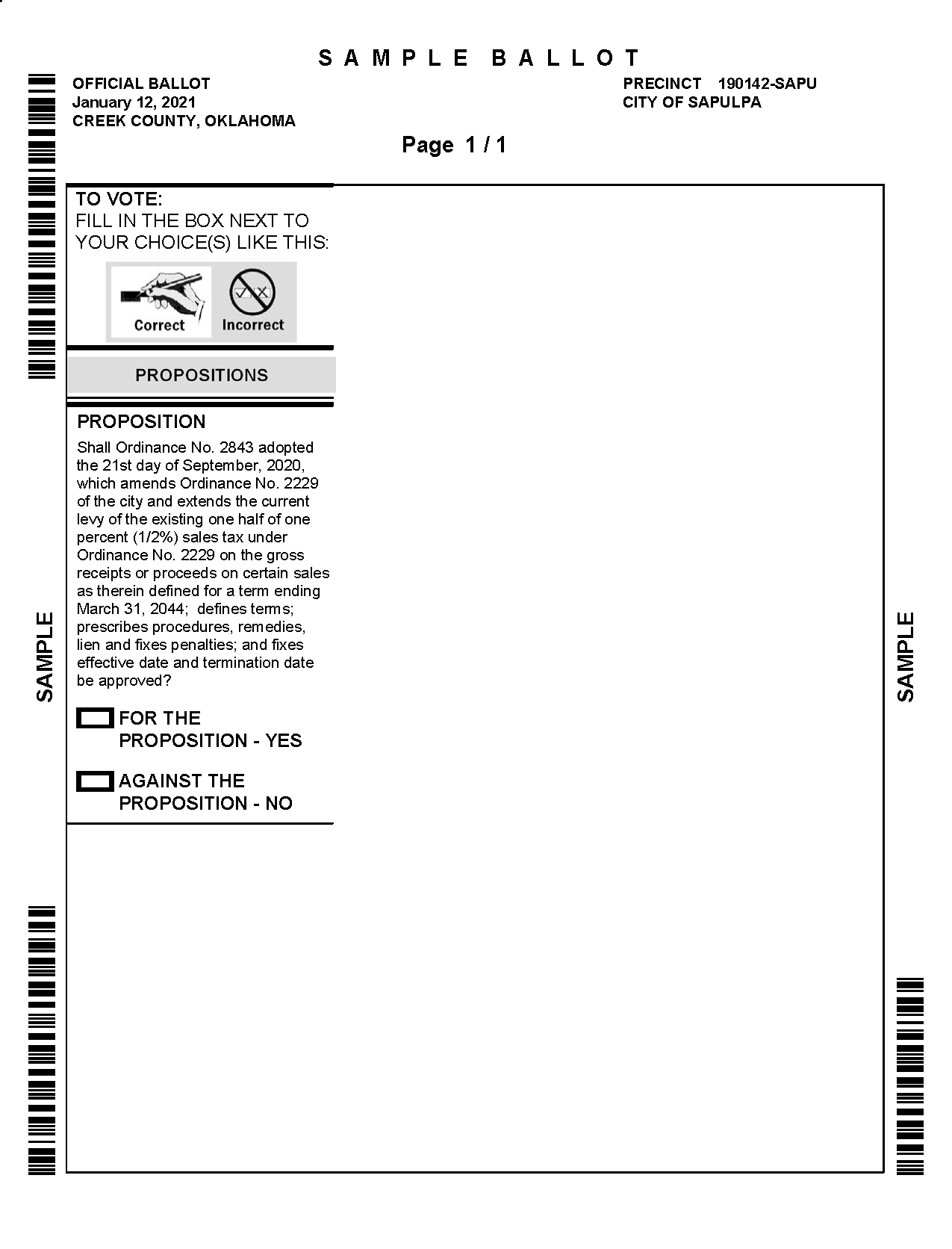
372 voters in the City of Pawhuska approved a 20-year one-cent sales tax to fund the local hospital. No mention of the election on the city's website or Facebook page, but at least the local paper ran a short news story.
No doubt every town published the required legal notices, but they don't seem to have bothered to publish in a way that would attract the notice of all eligible voters.
I return to my proposed schedule for Oklahoma elections: Every year a June primary, August runoff, and November general election. In odd-numbered years, school, municipal, county, and other local elections; in even-numbered years, federal and state elections. Propositions would only be permitted on the November election; if held on another date (because of a genuine emergency) they would require the approval of 50% of registered voters, which would give the locality an incentive to call attention to the election. Whether a shortened election calendar is passed or not, a quorum requirement seems like a reasonable innovation.
I voted in person yesterday at 9:35. The line was out the door, but not very far, and I slid my ballot into the scanner and was finished in 20 minutes. The other, larger precinct that votes at the same church had a line across the parking lot, but I suspect that many of those people were from my precinct but had just joined the first line they saw. When I drove back by mid-afternoon and toward the end of the day, there were no lines at all, and that was true of other precincts I passed.
We opted for a home watch party -- me, my wife, our younger two kids (the oldest is away in grad school). We started out scanning local stations at 6 pm, as states began to report results, but they were all in local-news mode, and only PBS was covering national results. We couldn't tolerate that for long, so we switched the screen to the computer, and pulled up Fox News on one size and DecisionDeskHQ.com on the other. We had carryout chicken tikka masala from Desi Wok and later snacked on some Plymouth East Meadow Cheddar I'd brought back from a recent visit to Calvin Coolidge's home town and the cheese factory founded by his father and revived by his son.
I did go out at about 8:30 to take pictures of posted results from nearby precincts. Our precinct officials posted the tape in the window, as required, but they allowed enough overlap with a notice posted next to it so that the results for the presidential and U. S. Senate races were hidden by the other piece of paper.
What I could see was encouraging. Although the midtown precincts I checked were fairly evenly divided between Democrat and Republican candidates, State Question 805 was losing by a substantial margin.
While driving around I flipped through the radio stations. KRMG's Dan Potter had current Mayor GT Bynum IV and former Mayor Susan Savage. I wondered on Facebook why KRMG didn't include a Republican in their coverage, but Democrat allies on past city tax and zoning battles reminded me that they didn't include a Democrat either. Both mayors are proud members of the Money Belt Uniparty who may have only a vague idea where the three eastside seats on the ballot are located. Bynum and Savage were both gleeful about the defeat of District 5 Councilor Cass Fahler, the strongest council ally for Tulsa police officers and the strongest opponent of mask mandates. Bynum called Fahler's campaign "lazy," contrasting it with Mykey Arthrell's tireless pursuit of votes. They also sounded thrilled about the re-election of Connie Dodson in District 6 and Lori Decter Wright in District 7.
I thought that Republicans had a good chance at taking two of the three City Council races on the ballot; Dodson had forged a moderate path on police and masks and seemed likely to win re-election. Fahler's re-election was killed by another 2-to-1 early vote advantage; he won election day but lost the total by 347 votes. I have heard that neighborhood social media pages in the northwestern part of the district were extremely hostile to Fahler, particularly over his stance on mask mandates. These seem to be popular areas for progressives who want to live near the city center but can't afford to live any nearer than Yale Ave. District 6 wasn't close; challenger Christian Bengel was badly underfunded, and the FOP had endorsed incumbent Dodson very early in the race. Wright's challenger Justin Van Kirk poured a ton of his own money into the race, narrowly won among election day voters, but lost by about 1600 votes because of Decter Wright's 3-1 early voting ratio.
Here is a problem with non-partisan city elections on the same ballot as highly partisan races like President and Senate: Voters mark the straight-party line (as Republicans were encouraging voters to do), but that doesn't cast a vote for allegedly non-partisan council races. On such a long ballot, with as many as 18 items for some voters, a non-partisan race at the very end is easy to ignore, and it's easy to vote for the familiar name.
It's apparent that the Tulsa County Democratic Party has been taking local elections seriously and helping Democrats seeking local non-partisan office. The Tulsa County Republican Party needs to follow suit, to work on local races throughout the election cycle, identifying and recruiting potential candidates who support the GOP's values and policy aims, clearing the path for good candidates (perhaps by conducting an endorsing convention to decide among multiple Republican contenders), and connecting them with money and volunteers. The Tulsa GOP needs to be monitoring the performance of our city, county, and school officials, with reporters at every meeting, recording and highlighting examples of bad judgment and favoritism. It's not enough to get busy in the last few months before an election. The Oklahoma GOP's dominance in the legislature was built by party officials back in the late '90s and early 2000s by men like 1st Congressional District Chairman Don O'Nesky, 2nd District Chairman Bob Hudspeth, 4th District Chairman Steve Fair, and State Chairman Gary Jones, who identified candidates from among local leaders, respected by their communities, not necessarily active in politics, but who had a conservative outlook on public policy. The candidates who will put themselves forward aren't always the best positioned to run a serious race or to govern well; a party's job is to identify good candidates, encourage them to run, and facilitate their efforts with resources.
Back at the house: Fox's reluctance to call states that were obviously in Trump's column and out of reach for Biden (like Texas and Florida) got frustrating after a while, and we switched to Newsmax, then eventually to the Daily Wire for their running commentary.
The four of us were doing our own results reporting, each digging into county-by-county results on DecisionDeskHQ.com on our own computers and sharing interesting finds, while listening for commentary or breaking news. I enjoyed using the map results on the Oklahoma State Election Board results page to drill down to the precinct level to see which precincts were still outstanding and the patterns of support for each candidate. The only big flaw is that it doesn't show different colors in the non-partisan races, so there's no easy way to tell where 805 won and lost or which Tulsa City Council candidates won which precinct.
We stayed up long enough to see Trump apparently about to win Wisconsin, Michigan, Georgia, North Carolina, and Pennsylvania, and suddenly the numbers stopped updating. There were reports that vote counting would stop in Philadelphia and in Atlanta, an obvious move to wait for downstate votes to finish coming in so corrupt big-city machine officials could manufacture enough ballots to tip the states to Biden, the same way Kennedy won Illinois in 1960. We all headed to bed shortly thereafter.
Jamison Faught at Muskogee Politico has a map-filled post on the Oklahoma results. Trump and Inhofe won all 77 counties. This is the fifth presidential election in a row that the Republican nominee has swept the state, although the margin in Oklahoma County was only 3400 votes. Democrats lost their last three rural seats in the State House, plus two in Oklahoma County. Republicans now control the House by 82-19 and the Senate by 39-9, and all of the Democrat seats are in the two biggest cities (OKC and Tulsa) and college towns (Norman and Stillwater). This is almost a complete reversal from the situation in the early 1990s, when rural districts (except northwest Oklahoma's wheat country) were solidly Democrat and nearly all Republican seats were in Tulsa and OKC and their suburbs.
I was disappointed to see the defeat of Republican Cheryl Baber in Senate District 35, a seat that had been held for 32 years by conservative Republicans (Don Rubottom, Jim Williamson, Gary Stanislawski), and before that by long-serving moderate Republican Warren Green. Baber had survived a bruising primary and runoff with establishment-backed Kyden Creekpaum. Although Creekpaum endorsed Baber in the general election (wisely so if he hopes to have a future in Oklahoma Republican politics), the endorsement came late in the game, and Democrat Jo Ann Dossett had racked up a two-to-one advantage in absentee-by-mail ballots, 7402 to 3723. Baber dominated election day voting, but fell short by 638 votes. The same pattern can be seen in the Tulsa County Commission race and in several vulnerable Democrat seats. Republicans are going to have to match and surpass the Democrats efforts in early voting, and to plan for targeting voters soon after the ballot is set.
Massive early voting allows well-funded candidates to target and influence voters and lock in their votes before the candidate with fewer dollars, who delays mailers until closer to election day to make her money stretch as far as possible, has put any information in front of the voters. One of the saddest news items in this election season was a surge of searches on the question "Can I change my vote?" after the second presidential debate.
Polls are open today until 7 p.m. The Oklahoma State Election Board's online voter tool will let you know where to vote and will show you a sample of the ballot you'll see.
Click the link above to download a printable ballot card listing the candidates I'm recommending and (if in the district) voting for in the Oklahoma general election and City of Tulsa runoff on November 3, 2020. Below I'll add more detailed information on issues and candidates. (This entry will change as I decide to add more detail, link previous articles, or discuss additional races between now and election day. The entry is post-dated to keep it at the top.) Please note that the rows on the chart are alternately shaded and unshaded for readability. The presence or absence of shading has no other significance.
This is an unusually early version of the BatesLine ballot card in response to many requests from people who are voting absentee by mail and want to be sure their ballot has plenty of time to arrive. Below is a summary of my recommendations; I will elaborate on them in later entries. I hope to have a formatted printable ballot card in the near future.
Below you'll find some links to websites I found helpful in learning about candidates, their values, backgrounds, and political opinions.
When in doubt, I look at campaign contributions, which often tell a story about a candidate's ideological leanings or close ties with local power brokers. Campaign expenditures can be telling, too: Certain consulting firms have strong associations with the pay-to-play culture that makes our Republican supermajority legislature more crony-infested than conservative. Then there are principled conservative consultants; their presence on a campaign team is always a hopeful indication that the candidate is also a principled conservative.
The presidential election leads the ballot, and Oklahomans have six choices this year -- Democrat, Libertarian, Republican, and three independents -- more than in all the years I've been voting. U. S. Sen. Jim Inhofe is up for re-election against a teleprompter reader, a perennial Libertarian candidate, and two independents. All five congressmen have challengers; the race to watch is District 5, where State Sen. Stephanie Bice hopes to reclaim the traditionally Republican seat from Pelosi Democrat Kendra Horn, the surprise winner in 2018. (Before Horn's win, the seat had been in GOP hands since John Jarman's party switch in 1975.)
The only statewide state office on the ballot in presidential years is a seat on the Oklahoma Corporation Commissioner, which has six year terms. This year, Republican incumbent and former House Speaker Todd Hiett is being challenged by Libertarian Todd Hagopian; no Democrat filed for the seat. All 101 State House seats and the odd-numbered State Senate seats are up for election in presidential years, but many of these races have already been settled in the primary or runoff.
There are two state questions, 805 and 814. SQ 805 is a constitutional amendment that would help career criminals get back to work by reducing the amount of time these repeat offenders could spend in prison and releasing some currently incarcerated career criminals early. SQ 814 is also a constitutional amendment that would divert revenue from the tobacco lawsuit settlement to pay for the unwise Obamacare Medicaid expansion (SQ 802) that was narrowly approved in June.
All 77 counties have four offices up for reelection in presidential years: District 2 County Commissioner, County Clerk, County Court Clerk, County Sheriff. In Tulsa County, Sheriff Vince Regalado and County Clerk Michael Willis were re-elected without opposition. County Court Clerk Don Newberry won a primary rematch in June and has no general election opponent. Republican Josh Turley, Ph.D., is challenging longtime incumbent Democratic County Commissioner Karen Keith.
There are retention votes for three state supreme court justices, two judges on the court of criminal appeals, and three judges on the court of civil appeals. These are yes-no votes, unlike the district judge elections that occur in gubernatorial election years. If "no" prevails -- and it never has -- a vacancy would be created that would be filled by the governor's selection via the judicial nomination process.
The City of Tulsa has runoff elections for three of the nine city council seats. (The auditor and councilors in Districts 2 and 8 won re-election unopposed; the mayor and councilors in Districts 1, 2, 4, and 9 were re-elected by receiving greater than 50% of the vote in the August 25 election, which is a shame.)
MY RECOMMENDATIONS:
As a general rule, I support the Republican candidate, and I'm not aware of any race in which I would counsel otherwise. The nomination of Judge Amy Coney Barrett to the Supreme Court demonstrates one critical reason for retaining Republican control of the White House. In foreign policy, we want to keep an administration that has brought Arab states into normal, peaceful relations with Israel, acknowledged Jerusalem as Israel's capital, brokered peace between Serbia and Kosovo, pushed our NATO partners to shoulder their fair share of the financial burden of protecting Europe, and stood firm for better trade deals between the US and the world.
Re-electing Jim Inhofe and the four GOP congressmen, and taking back the 5th Congressional District are essential for regaining Republican control of the House (and booting Nancy Pelosi from the Speaker's chair) and retaining Republican control of the Senate, which in turn is crucial for ongoing efforts to appoint constitutionalists to the Federal courts.
In the Oklahoma Legislature, notwithstanding my disappointment at the Republican RINO leadership, it still is better, generally, to choose Republicans over Democrats. Electing Democrats only seems to encourage the RINOs to raise our taxes. Here in Tulsa County, all of the Republicans deserve your support, particularly:
Senate 35: Cheryl Baber (R)
Senate 37: Cody Rogers (R)
Senate 39: Dave Rader (R)
House 11: Wendi Stearman (R)
House 30: Mark Lawson (R)
House 71: Mark Masters (R)
House 79: Margie Alfonso (R)
Tulsa County Commission District 2: Josh Turley (R). Turley served as a crime scene investigator for the Tulsa County Sheriff's Office and then creating the first risk management program for TCSO, which succeeded in reducing car accidents involving deputies and tort claim payouts, and independently developed policies and procedures to be used by smaller sheriff's offices and county jails to improve performance and minimize risk. Turley wants Tulsa County to follow an open data policy -- by default, data used and generated by county officials would automatically be made available to the public, without the need for an open records request. Turley would be an advocate for transparency in Tulsa County government. Incumbent Karen Keith's consistent votes to waive competitive bidding on bond issues is bad for Tulsa County taxpayers, as is her neglect of rural county roads. More detail here.
State Questions:
SQ 805: No. This constitutional amendment would make it easier for career criminals, including those currently incarcerated, to get out of prison and resume their careers.
SQ 814: Yes (with hesitation). This would mitigate the narrow, foolish approval of SQ 802 by dedicating tobacco settlement money (currently spent very poorly) to cover the cost of Medicaid expansion. My hesitation is that Sen. Nathan Dahm opposed this when it was before the legislature.
On October 30, 2020, I spoke with Jeremie Poplin, filling in for Pat Campbell on Talk Radio 1170 KFAQ, about both State Questions. Click the link to listen.
Appointing governors and party affiliation are noted in parentheses. An asterisk indicates that trustworthy conservative commentators disagree with me on those judges.
Supreme Court Justice Matthew John Kane IV (Stitt, R, 2019): Yes (enthusiastically)
Supreme Court Justice Tom Colbert (Henry, D, 2004): No
Supreme Court Justice Richard B. Darby (Fallin, R, 2018): Yes (cautiously)
Court of Criminal Appeals Judge Robert L. Hudson (Fallin, R, 2015): No*
Court of Criminal Appeals Judge Gary L. Lumpkin (Bellmon, R, 1989): No*
Court of Civil Appeals Judge Jane P. Wiseman (Henry, D, 2005): No (emphatically)
Court of Civil Appeals Judge Deborah B. Barnes (Henry, D, 2008): No
Court of Civil Appeals Judge Keith Rapp (Nigh, D, 1984): No
UPDATE 2020/10/28: I've moved my detailed analysis of 2020 judicial retention questions to a separate page and expanded it. I've also modified my stance regarding Justice Darby.
Tulsa City Council:
I support replacing all of the City Councilors, except Cass Fahler in District 5. In each race on the November ballot, a registered Republican is running against a registered Democrat.
Tulsa Council District 5: Cass Fahler (R). At a time when law enforcement is under attack, we need a strong advocate for law and order on the council.
Tulsa Council District 6: Christian Bengel (R).
Tulsa Council District 7: Justin Van Kirk (R).
MORE INFORMATION:
Here are some blogs, endorsement lists, candidate questionnaires, and sources of information for your consideration.
- Talk Radio 1170 Pat Campbell podcast archive
- Sheridan Church's Tulsa Town Hall candidate forum (includes several council candidates in the runoff
- iVoterGuide: Candidate responses to a detailed questionnaire written from a conservative Christian point-of-view
- Muskogee Politico news, questionnaires, and analysis
- Steve Fair and Georgia Wiliams, longtime SW Oklahoma conservative activists, weigh in on judicial retention and state questions
- Oklahomans for Life candidate surveys
- Oklahoma Constitution newspaper's Oklahoma State Senate ratings and Oklahoma State House ratings.
- NRA-PVF endorsements and grades
- Oklahomans for Public Education 2020 voter guide: This is a kind of reverse-psychology voter guide. The red apple next to a candidate's name probably means he or she supports higher taxes, no reduction in school administrative bloat, and no meaningful educational choice for our children and their parents. You should treat a yellow warning triangle as a gold medal -- this is likely a candidate who will defend taxpayers' interests and work for school choice and educational efficiency.
TIP JAR: If you appreciate the many hours of research that went into this guide and into the rest of my election coverage, and if you'd like to help keep this site online, you can contribute to BatesLine's upkeep via PayPal. In addition to keeping me caffeinated, donated funds pay for web hosting, subscriptions, and paid databases I use for research. Many thanks.
Published on 2020/10/08, postdated to stay at the top through election day. Printable ballot card published on 2020/10/17. Updated to reflect a change in my views on Supreme Court Justice Richard Darby.
 Pat Campbell with Daryl Simmons and Jarrin Jackson, on Election Day 2020. Photo from TalkRadio1170.com
Introduced by Aerosmith's "Back in the Saddle," Pat Campbell, long-time morning host on Talk Radio 1170 KFAQ, was back on the air this morning after a four-week absence. He was in studio for the full three hours with regular guests Jarrin Jackson and Darryl Simmons, discussing today's election and taking calls.
Pat reported that his absence was the result of voice problems caused by being intubated following a seizure. The intubation left him sounding, he said, like Carol Channing. He went through weeks of physical therapy to restore his vocal performance and allow him to return to the airwaves. He is still clear of cancer; earlier this year, a seizure revealed three cancerous brain tumors, which were surgically removed and followed with a course of chemotherapy and radiation.
Pat expressed his gratitude for the prayers and encouragement of his listeners. He was strongly motivated to come back this morning both to reconnect with his audience and to voice his strong opposition to State Question 805, the pro-career-criminal amendment to the Oklahoma Constitution backed with millions of dollars from out-of-state leftist organizations.
Pat is a great friend of BatesLine, and it was wonderful to be able to speak with him during today's 8 o'clock hour. His voice has been sorely missed, particularly during these critical weeks before the election, but we're blessed to have him back in the saddle again to guide us through whatever its aftermath brings.
Two out-of-state Leftist organizations contributed a total of $6,336,852.36 in support of State Question 805, the proposed constitutional amendment that will allow temporarily inconvenienced career criminals to return more rapidly to their vocation of victimizing their neighbors. The two organizations, the ACLU and FWD.US, combined to provide 87% of the the contribution totals, which include both cash and in-kind contributions; in-kind contributions include both staffing support and direct payments to campaign consultants. Oklahomans for Criminal Justice Reform also provided $54,629.01 in in-kind support. The Yes on 805 Committee raised a total of $7,281,215.29, of which $666,014.52 was in-kind, as of September 30, 2020.
The breakdown by organization:
- ACLU $2,970,044.46
- FWD.US $3,366,807.90
Keep in mind that these numbers are as of September 30, 2020, and have no doubt grown significantly.
The largest individual contribution was $500,000 from Tulsa heiress Stacy Schusterman. (Her last name is misspelled on the report, without the C.)
$200,000 came from a New York City financial exec named Robert Granieri, who lists his employer as a controversial trading company called Jane Street.
Financial activity for this campaign began in October 2019, with FWD.US paying substantial sums to consultant Brian Elderbloom, Oklahoma PR firm Saxum Communications, and Tulsa law firm Crowe & Dunleavy, Cash contributions began in December 2019, but the required reports for the 4th quarter of 2019 and the first two quarters of 2020 do not appear in the Oklahoma Ethics Commission database.
 The grand total raised in the same period by No on 805 is $133,400. That's a 55:1 ratio in favor of the Yes side. The principal donors are Mo Anderson, Robert Funk, and Robert Funk, Jr., each giving $25,000; Mathis Brothers Furniture, the National Police Support Fund, Frank Robson, and RT Development each gave $10,000; and Frank Keating, Kirk Humphreys, and the Oklahoma Farm Bureau gave $5,000 each.
The ACLU's Communist roots in the Stalinist period are well-known. The organization's support for toleration of dissent is typically one-sided, working to facilitate groups hostile to America's founding principles while standing aside when defenders of the American constitutional order are under attack. It's fair to say that the ACLU planted many of the seeds that led to 2020's Antifa riots.
FWD.US is a newer organization founded in 2013 by Silicon Valley tycoons to support amnesty for illegal immigrants, more visas for foreign tech workers, and mass release of criminal predators. (One of the founders of FWD.US, Mark Zuckerberg, has unleashed an additional, massive attack on trust and social cohesion. It's known as Facebook.) The group has a history of "partnerships" with useful, nominally conservative groups like Americans for Tax Reform.
Why are these national organizations so willing to dump millions of dollars into an allegedly grass-roots Oklahoma referendum? I think it's for the same reason that so much has been invested into trying to get Oklahoma to pass the National Popular Vote Interstate Compact: If a solid red state like Oklahoma approves such a radical change, it becomes easier to persuade other conservative states to follow Oklahoma's example. At the state level, the presence of OCPA on the list of supporters gives a veneer of bipartisanship to this leftist constitutional amendment, while the presence of a long-ago police chief (squishy Drew Diamond, renowned for his refusal to deal honestly with the presence of gangs in Tulsa) and a lone district attorney (who won in 2018 with financial backing from many contributors who are now backing 805) allows all that pro-805 money to craft the appearance that law enforcement is ambivalent, despite the opposition of 96% of Oklahoma's district attorneys, the FOP, both candidates for Oklahoma County sheriff, and countless law enforcement officers.
The bulk of the names on the banner ad running on various websites in support of 805 include left-wing names like former Democrat Gov. Brad Henry, disgraced former Democrat Gov. David Walters, former Democrat Tulsa Mayor Kathy Taylor, and liberal ex-judge William Kellough (who lost re-election to a poorly funded challenger because of his egregious record).
On Thursday, October 29, 2020, a large group of state officials, law enforcement leaders, domestic violence survivors, and community leaders gathered for a press conference to urge Oklahomans to vote NO on SQ805. Speakers included Lt. Governor Matt Pinnell, Attorney General Mike Hunter, former First Lady Cathy Keating, Oklahoma FOP president Mark Nelson, Kim Garrett, CEO & Founder, Palomar Domestic Violence Resource Center, criminal justice reformer Tricia Everest, Oklahoma Farm Bureau president Rodd Moesel, Tulsa County Sheriff Vic Regalado, and attorney Marc Nuttle.
Lt. Gov. Pinnell noted the progress that has already been made under existing, legislative reform efforts. "There is an Oklahoma brand of criminal justice reform that takes a common sense approach. We've already reduced the prison population 20% with common sense reforms. 805 is the wrong solution."
Oklahoma FOP president Mark Nelson spoke to the commonplace situation of repeat domestic violence, "You hear the address come across the radio, and you know the offenses that have already been committed in that house.... State Question 805 is about keeping violent career criminals out of jail."
Deb Stanaland, a survivor of domestic violence who now serves as a domestic violence responder, pointed out that the early release of repeat domestic violence offenders would send victims the signal that the wrongs they suffered are unimportant. "Trust is important to Domestic Violence victims. That trust will be broken if you break those promises to victims."
Kim Garrett, the founder and CEO of Palomar Domestic Violence Resource Center in Oklahoma City, spoke of the unanimous opposition to SQ805 among domestic violence victims, and the peace and gratitude that victims feel knowing that their imprisoned abusers cannot get to them. "A victim I've spoken with is grateful for her husband's prison sentence, so that her daughter could turn 18 and be out of the house and not risk being killed by him.... I have no doubt that women and children will be the victims of this sloppy and careless reform.... Victims strongly oppose it, and their very lives may depend you voting against it."
Greg Mashburn, the district attorney for Cleveland, Garvin, and McClain counties in southern central Oklahoma, points out that by reducing sentences, SQ 805 will reduce the incentives repeat offenders have to agree to drug courts and diversion programs that would give them a chance to reform.
The full press conference is available for viewing on Facebook.
The only contested Tulsa County office on the ballot is a rematch for Tulsa County Commissioner, District 2. Republican Josh Turley seeks to defeat 12-year incumbent Democrat Commissioner Karen Keith.
Dr. Turley, whose doctorate is in organizational leadership, had a distinguished 24-year career at the Tulsa County Sheriff's Office, serving as the TCSO's first civilian crime scene investigator and developing the department's first Risk Management program, which succeeded in reducing car accidents involving deputies and tort claim payouts. Turley independently developed policies and procedures to be used by smaller sheriff's offices and county jails to improve performance and minimize risk. Turley has since built a private company, Everything Behind the Badge, which develops custom policy and procedure manuals to help local law enforcement agencies improve their professionalism at an affordable price. Turley has been endorsed by the Tulsa County Deputy Sheriff's local, the Tulsa Police local of the Fraternal Order of Police, the Oklahoma Second Amendment Association (OK2A), and State Sen. Nathan Dahm, among many other endorsements displayed on the Dr. Josh Turley for Commissioner Facebook page.
Turley is an advocate for genuine transparency in Tulsa County government. Turley wants Tulsa County to follow an open data policy -- by default, data used and generated by county officials (except for personal data restricted by law) would automatically be made available to the public, without the need for an open records request.
A county commissioner is responsible for maintenance of all public roads in the district that are not state highways or within city limits. District 2, which covers the western arm of Tulsa County, includes a great deal of unincorporated territory where the only roads are county-maintained roads. Turley has called attention to the terrible state of roads like West 41st Street, the main east-west artery in western Tulsa County south of the Arkansas River, and Old Highway 51, which is popular for cycling and access to fishing on the river below Keystone Dam. He says that incumbent Karen Keith hasn't fulfilled her road responsibilities during her 12 years in office. Rural roads are perhaps out-of-sight and out-of-mind for a midtowner like Keith.
Democrat incumbent Karen Keith, a former television reporter and anchor, was first elected in 2008. She has been very visible this year representing Tulsa County at daily COVID-19 press conferences. She was also very visible in her opposition to President Trump's visit to Tulsa in June, calling for city officials to say no to Trump in order to "preserve our image and save our downtown and arena." Turley ran a strong race against Keith in 2016, but fell short against Keith's name recognition and fundraising advantage.
Keith is unquestionably likeable, and her likeability seems to have tempted many Republicans to consider voting for her as their one gesture toward bipartisanship. That would be a mistake. We need new county commissioners, regardless of party, because the current commissioners aren't being good stewards of taxpayer resources. Electing Josh Turley to District 2, the only seat on the ballot this year, would be a great first step.
Tulsa County Commissioners, acting as the board of the Tulsa County Industrial Authority (TCIA), have authorized hundreds of millions of dollars in bonds. Some of these are revenue bonds, borrowing money now to fund projects, and pledging future sales tax revenues to pay the debt. As of June 30, 2019, according to the TCIA's 2019 annual audit, TCIA had $111,729,421 in outstanding revenue bonds. Counties, like cities and school districts can also issue general obligation bonds which are repaid by higher property tax rates. According to Tulsa County's 2019 CAFR, the county has no general obligation debt.
TCIA also issues bonds known as conduit debt to finance construction projects for businesses (e.g. nursing homes, apartment complexes) and non-profits (e.g. schools, hospitals) that "promote the development of industry and culture and industrial, manufacturing, cultural and educational activities... [to] benefit and strengthen culture and the economy." Tulsa County taxpayers are not on the hook for these bonds; they are repaid by the end user. The end user benefits in that the bonds are typically tax-exempt, making them more attractive for investors. As of June 30, 2019, TCIA had $604,545,944 in outstanding conduit debt, an increase of $73.6 million from the previous year, "the result of a $53.7 million lease revenue note and a $66.9 million revenue bond being issued during the fiscal year, offset by debt repayments."
MunicipalBonds.com has a couple of examples of how conduit bonds can be controversial when they are issued to finance private companies that were rejected by banks. Back in 2003, BatesLine called attention to conduit debt TCIA issued to finance the purchase of apartment complexes for low-income housing by company run by a "dear friend" and bond adviser of one of the county commissioners; TCIA then issued bonds for double the original amount to a non-profit that purchased the complexes from the first company.
2003 was before Karen Keith was a commissioner, but just yesterday I was made aware of a case of securities fraud that involved numerous conduit bond issues from various local authorities, including $5,700,000 in bonds issued by Keith and her fellow TCIA board members on March 21, 2014, to an entity controlled by Atlanta nursing home developer Christopher Brogdon. I am just learning about this, so I don't know all the details, but at the very least it looks like Keith and the TCIA should have done more due diligence before issuing the bonds, given that this deal was the last in a long string of questionable deals cited by the Securities and Exchange Commission. In any event, it's clear that we need analytical, skeptical county commissioners on the TCIA who will carefully scrutinize every entity that seeks to borrow against our county's reputation.
What revenue bonds, general obligation bonds, and conduit bonds have in common is that the three county commissioners (acting as TCIA board members) decide whether to waive competitive bidding in deciding which law firm will serve as bond adviser and which financial institution will issue the bonds. I have yet to find an instance when the TCIA opted for competitive bidding for a bond issue, or even an instance when any one of the three commissioners voted for competitive bidding.
During the 2016 campaign, I called attention to a contemporaneous news item relevant to this topic: Then-state bond adviser Jim Joseph and then-State Auditor and Inspector Gary Jones spoke out against the widespread practice of school districts waiving competitive bids for bond issues.
Oklahoma school districts are spending millions of taxpayers' dollars every year by paying high fees for financial advisers, bond counsel and underwriters, says Jim Joseph, the state's bond adviser.Many school districts continue to do the same thing year after year, while stubbornly refusing to use cost-saving competitive selection measures, he said.
"It's like picking a roofer right after a storm because he's the first guy who came to your door," Joseph said. "You're not going to get a deal, that's for sure."
State Auditor Gary Jones agreed school boards could save Oklahoma taxpayers money by obtaining competitive quotes.
"There could be tens of millions of dollars saved over a short period of time," Jones said.
Joseph went on to compare the massive fees paid by school districts to bond counsel and financial advisers, often a percentage of the bond issue, with the smaller amounts state agencies paid for much larger bond issue. Several were listed; here's one example:
For example, Midwest City-Del City Public Schools did a $72.62 million bond issue in 2012 without competitive bids. It paid the Floyd Law Firm of Norman $363,100 for serving as bond counsel and allowed Stephen H. McDonald & Associates and BOSC Inc., a subsidiary of BOK Financial Corporation, to equally split $508,340 for serving as co-financial advisers, records show.Compare that with a $310.48 million bond issue by the Grand River Dam Authority that was done in 2014 through a competitive process. The state paid a $114,000 bond counsel fee and a $133,448 financial adviser fee.
Although the Grand River Dam Authority bond issue was more than four times as large as the Midwest City-Del City school bond issue, the school district paid more than triple the amount in bond counsel and financial adviser fees, records show.
Joseph pointed out that bond counsel, underwriter, and financial advisers often each take 1% of the bond issue as their fee, which Joseph says "makes no sense at all. It doesn't take any more work to do a $20 million issue than a $10 million issue for the bond counsel and financial adviser, but the fee is twice as high, if payment is on a percentage basis."
What does this have to do with Tulsa County? Joseph noted that the firm of Hilborne & Weidman was frequently listed as bond counsel for these competition-waived bond issues. Hilborne & Weidman was also one of two bond counsel firms selected in 2003 by the Tulsa County commissioners (acting as the Tulsa County Industrial Authority) for the Vision 2025 revenue bonds, a massive bond issue against up to all 13 years of the new sales tax. I urged at the time that Tulsa County put all Vision 2025 bond-related contracts up for competitive bid, as commissioners haggled publicly over which firms would get a piece of the action, but they waived competitive bidding and split the baby, giving each favored firm half of the business.
Over the last 17 years, there's been a complete turnover on the County Commission, but the tradition of waiving competitive bidding has persisted. Here's one example from May 26, 2009, in Karen Keith's first year as a commissioner ($110 million in bonds), another from February 1, 2010, and yet another unanimous vote to waive competitive bidding from this year, from the September 21, 2020, meeting of the Tulsa County Industrial Authority.
On May 23, 2016, the commissioners, including Karen Keith, voted unanimously to waive competitive bidding on indebtedness, but neither the minutes nor the agenda explain the amount or nature of the indebtedness. Given the proximity to the April 2016 Vision Tulsa vote, my guess is that the vote was on the revenue bonds pledged against that new 15-year sales tax stream.
How many more projects might have been built if Vision 2025 bonds had been competitively bid? Could we have had a new juvenile justice facility without being asked for more tax dollars in two separate elections (2005 and 2012)?
Given the size of these bond issues, even a 1% fee would be a huge amount for a small firm. The temptation to corruption would be immense. Think of the money the former Skiatook superintendent got in kickbacks from the janitorial supply company. That would be chump change compared to even a small cut of 1% of a $500 million bond issue.
Oklahoma taxpayers need legislation to require competitive bidding on bonds and to require counties, school districts, and cities -- and their associated Title 60 trusts -- to use the state bond adviser rather than hiring their own favored exclusive firms.
Until we get that legislation, we need county officials who will support transparency and fiscal prudence. We need more than mere niceness; we need intelligence, initiative, and analytical skill. Dr. Josh Turley, a good man with many years' experience as a county employee, can provide that kind of leadership, and I hope Tulsa County District 2 voters elect him as their new county commissioner.
Oklahoma state statute and Oklahoma Ethics Commission rules require campaign committees for city elections to file a campaign contributions and expenditures report with the City Clerk's office 10 days prior to an election (effectively 8 days, since the clerk's office is closed on the weekend, so the report is due that Monday at 4:30 pm), as well as last-minute contribution reports within 24 hours of receiving donations larger than $1,000 within the last two weeks. Reports are also due one month after the end of each quarter.
For the six candidates for Tulsa City Council on the November 3, 2020, ballot, that means their pre-election report was due to the Tulsa City Clerk at 4:30 pm on Monday, October 26. So far District 5 incumbent Cass Fahler (R) and challenger Mikey Arthrell (D), District 6 incumbent Connie Dodson (D), District 7 incumbent Lori Decter-Wright (D) and challenger Justin Van Kirk (R) have filed their reports. District 6 challenger Christian Bengel's (R) pre-election report is the only one of the six that does not appear on the City Clerk website, but he has provided me his report directly, and it is available below.
There are several important omissions from the reports that were available online. This may be an error in the City Clerk's uploading of the reports, rather than an omission by the candidate. Connie Dodson's pre-runoff Schedule A, a list of itemized contributions, is missing; the cover page of the report indicates that it includes $4,250 in PAC contributions which would be quite interesting. Likewise, there is no itemization of Mykey Arthrell's $3,545.83 pre-general election expenditures.
Several PACs are shown on individual candidate reports to have made contributions, but none of them filed reports: Tulsa Biz PAC (affiliated with the Tulsa Regional Chamber), Fraternal Order of Police, International Association of Fire Fighters, International Brotherhood of Electrical Workers.
For the candidates who were on the August 25, 2020, city general election ballot, but not on next Tuesday's runoff ballot either because they won without a runoff or lost, their post-election quarterly report will be officially due Saturday, October 31, will be effectively due Monday, November 2, 2020, at 4:30 pm, but those reports could have been filed at any time since the beginning of this month, since they only cover contributions through September 30. Many of the candidates failed to file reports prior to the August election; we're looking forward to learning how much they raised and spent.
Here are the aggregate totals for the candidates in Tuesday's Tulsa runoff election, with a list of notable contributions. The name of the seat has a link leading to the Tulsa City Clerk's ethics report webpage for the district; the candidate name has a link to a PDF compiling all of the candidate's reports for this election cycle, which I have compiled, bookmarked, and OCRed.
 Putting this together is a very tedious process -- clicking dozens of links, merging PDFs in the right order, then combing through the reports for contributors, double-checking sloppy reporting, and summarizing all of it below -- but BatesLine is the only place you can find organized campaign finance information for the 2020 City of Tulsa runoff. If you appreciate the hours that I've put into this, hit the tip jar and help cover the costs of keeping BatesLine going, which include web hosting, database access, domain registration, and computer equipment. If you'd like to support the site with advertising, contact me at blog@batesline.com.
In the past, when all the records were on paper only, the daily paper would have a City Hall reporter compile the list of contributions (back then $200 and under did not have to be reported). They don't bother nowadays. I find one recent story about campaign finance, focused on an out-of-state organization called the Accountability Project Institute, which is making independent expenditures against Mykey Arthrell and Lori Decter Wright; these candidates support an Office of Independent Monitor for the Tulsa Police Department, which the FOP opposes. No stories at all about the candidate's campaign finance reports. Perhaps they feel that now that the information is online, there's no need to bother. But busy voters need someone to curate the massive amounts of public information now available.
In most cases (every candidate except Cass Fahler), the totals on the most recent report don't match the sum of the amounts reported on each report to date. Candidates (or their treasurers) seem confused on the meaning of the Aggregate Total column. I've put my figures in square brackets. I have not double-checked that the reporting period totals are correct; in some cases this is impossible because key pages are missing from the online records. Most of the mistakes in calculating aggregates for the campaign and for individual contributors would be avoided if candidates were required to use the Oklahoma Ethics Commission system, as they were for a few years in the late 2000s and early 2010s, where individual transactions are uploaded, and the system calculates the totals.
Cass Fahler (R): Carryover, $0.96, individual contributions, $15,785.00; PAC contributions, $9,500; total $25,285.96. Expenditures, $20,491.71. Notable contributions: Tulsa FOP, $5,000; Greater Tulsa Association of Realtors, $2,500; Tulsa Biz PAC; International Association of Fire Fighters, $1,000; Robert Zoellner, $2,700; Kurt Dodd, $2,000; Justin Van Kirk, $1,000; Bobby Van Holt, $1,000; John Stava, $1,000; Martha Blackburn, $750; CeCe Siegfried, $750; Meyer Siegfried, $750; Cord Charvat, $500; Jay Helm, $500; Steve Edwards, $500; Warren Ross, $250; Lou Reynolds, $200; Dewey Bartlett, Jr., $200;
Mykey Arthrell (D): Individual contributions, $13,255.00 [$13,355]; in-kind contributions, $1,000; total $14,255.00 [$14,355.00]. Expenditures, $11,094.38 [$12,094.38]. Notable contributions: Robin Flint Ballenger, $2,800; RE UP Dispensary, $1,000; Justin Schuffert, $1,000; George Krumme, $1,000; Kathy Taylor, $500.
Christian Bengel (R): Individual contributions, $2,086.64 [$2,196.94]; PAC contributions, $1,000; loans (all from self), [$7,573.37]; total $3,086.64 [$10,670.31]. Expenditures, $3,086.64. Notable contributions: IBEW PAC, $1,000.
Connie Dodson (D): Carryover, $1,546.69; Individual contributions, [$10,435.00]; PAC contributions, $9,750 [$13,750]; total $18,561 [$25,731.69]. Expenditures, [$14,525.77]. Officeholder expenses, [$1,158.70]. Notable contributions: FOP 93 PAC, $3,500; IBEW Local 584, $3,000; Realtors PAC, $2,000; Tulsa Firefighters Local 176, $1,000; Lloyd Robson, $2,800; Cindy Robson, $2,800; Joe Robson, $1,000; Joe Chadwick, $1,000; Amulfo Murillo, $1,000; Sharon King Davis, $150; Lou Reynolds, $200.
Justin Van Kirk (R): Individual contributions, $32,885.00 [$25,085.00]; PAC contributions, $7,500; loans (all from self), $10,300.00 [$10,500.00]; total $50,685.00 [$43,085.00]. Expenditures, [$40,135.21]. Notable contributors: FOP PAC, $7,500; Cord Charvat, $3,300; Robert Zoellner, $2,800; Justin Van Kirk, $2,800; Mike Case, $2,700; Albert Reynolds, $2,000; Jim Taylor, $1,105.
Lori Decter Wright (D): Carryover, $148.12; individual contributions, $17,689.50; PAC contributions, $3,500; political party contributions, $550; in-kind contributions, $3,328,49; total, $21,739.50 [$25,216.11]. Expenditures, $20,556.69 [$20,786.08]. Notable contributors: Tulsa Biz PAC [Tulsa Regional Chamber], $1,000; Tulsa Firefighters IAFF PAC, $2,500; Heart of the Party Tulsa County Federation of Democratic Women, $550; Cheryl Roberts, $1,400; Friends of Crista Patrick [District 3 Councilor], $500; Kathy Taylor, $800; Bill Lobeck, $500; Vanessa Hall-Harper [District 1 Councilor], $50; Ken Levit, GKFF executive director, $150; Teresa Burkett, $250; Sharon King Davis, $150.
The 2020 Oklahoma general election ballot has retention votes for three State Supreme Court justices, two judges on the Court of Criminal Appeals, and three judges on the Court of Civil Appeals. These are yes-no votes, unlike the district judge elections that occur in gubernatorial election years. If "no" prevails -- and it never has -- a vacancy would be created that would be filled by the governor's selection via the judicial nomination process.
Oklahoma has a dual-path court system: The Court of Criminal Appeals is the supreme arbiter in criminal cases. Civil cases are appealed to the Court of Civil Appeals, and can then be appealed to the Oklahoma Supreme Court. The Oklahoma Supreme Court does not handle criminal cases.
My recommendation is to retain Justices Kane and Darby and vote no on the rest. I've put an asterisk next to two of my no votes, to note that other conservative political analysts disagree with me.
Here are the judges on the ballot. Appointing governors and party affiliation are noted in parentheses:
Supreme Court Justice Matthew John Kane IV (Stitt, R, 2019): Yes (enthusiastically)
Supreme Court Justice Tom Colbert (Henry, D, 2004): No
Supreme Court Justice Richard B. Darby (Fallin, R, 2018): Yes (cautiously)
Court of Criminal Appeals Judge Robert L. Hudson (Fallin, R, 2015): No*
Court of Criminal Appeals Judge Gary L. Lumpkin (Bellmon, R, 1989): No*
Court of Civil Appeals Judge Jane P. Wiseman (Henry, D, 2005): No (emphatically)
Court of Civil Appeals Judge Deborah B. Barnes (Henry, D, 2008): No
Court of Civil Appeals Judge Keith Rapp (elected, 1984): No
(Judge Rapp first won election in 1984 when civil appeals judges were elected in competitive non-partisan elections. Beginning with the 1988 election, these judges were moved to the retention ballot (SB 22, effective April 20, 1987), which already applied to the State Supreme Court and the Court of Criminal Appeals. As far as I can determine, Rapp and the other judges who had won elections under the old system continued in their elected six-year term and then faced a retention ballot when their term expired, without needing a gubernatorial appointment.)
Other conservative voices, including Georgia Williams and Steve Fair, Jamison Faught at Muskogee Politico, and Charlie Meadows, longtime head of the Oklahoma Conservative Political Action Committee, have published their opinions on the judicial retention questions, and Faught has provided biographical detail on each judge. They would retain a couple of judges that I would reject, for reasons noted briefly below.
Oklahoma Supreme Court:
You can read through this year's Supreme Court decisions here; many of them had to do with pending initiative petitions, and many divided the court.
One key 2020 ruling addressed the requirement to notarize an absentee ballot; the court majority made a novel interpretation of the law, claiming that permission to substitute a signed, but unsworn statement for a notarized, sworn affidavit as evidence in a civil proceeding (Title 12) also eliminated the requirement for notarizing an absentee ballot (Title 26). The Legislature had to act quickly, passing SB210 to close the loophole that the Supreme Court majority created. Gov. Stitt's two appointees were among the three justices (Winchester was the third) to object to the bad judgment of the majority. Stitt has made two excellent, insightful, and independent picks in John Kane (on this ballot) and Dustin Rowe (not on this ballot), and voting "no" on Colbert will give Stitt opportunities to continue his winning streak, while eliminating a justice that has shown poor judgment in this critical case and others.
Kane and Rowe were dissenters on a ruling that forced the Secretary of State's office to count SQ 805 petition signatures, despite the pandemic; Darby voted with the majority. Kane wrote the near-unanimous opinion (Darby concurred, Rowe dissented on one minor point) striking down SQ 809 because the gist, presented to potential petition signers, did not honestly reflect the substance of the proposal.
Our family has known the Kane family for over a decade through our homeschooling community, which turned out in large numbers to attend his 2019 swearing-in. We have first-hand experience of John's integrity, character, and values. While still an Osage County District Judge, John opened his courtroom every spring to preside over a mock trial competition, which gave eighth graders an opportunity to see the inner workings of criminal court. COVID-19 prevented that tradition from continuing this year, but Justice Kane generously hosted a Zoom session with the students to answer their questions about the Oklahoma judicial system and legal careers. (He gracefully praised and sidestepped a question from my son about the implications of the McGirt ruling.)
Georgia Williams and Steve Fair disagree with me on Justice Darby, on the grounds that he is a recent appointment by a Republican governor (Fallin). Faught points to two unspecified cases on abortion as a reason to retain Justice Darby, and notes that his wife is recently retired as the head of Altus Christian School. Meadows says, "Some of [Darby's] opinions/dissents have shown flashes of an originalist and he appears to be pro-life."
I've changed my mind and decided to support Darby, partly on the strength of his dissent in a 2019 case, Oklahoma Coalition for Reproductive Justice v. Cline, a case involving legislation that regulated the off-label use of medications to induce abortion. Darby was the lone justice (Kane and Rowe were not yet on the court) to argue against the majority's ruling that summary judgment was appropriate. His reasoning was straightforward and sensible: There were contested facts in the case, therefore summary judgment is not permitted. The majority in the case cites Roe v. Wade, but they seem anxious to prevent any case from advancing that might open the door to a reversal of Roe v. Wade. This case illustrates why Oklahomans for Life has been focused in recent years on reform of the judicial nominating process.
The ruling on SQ 807, a petition to add a constitutional amendment legalizing marijuana for any purpose, is interesting in that Darby concurred in dissents by Stitt's two appointees, Rowe and Kane, which argued that the Federal Controlled Substances Act and the doctrine of supremacy means that the proposition is preempted by federal law and cannot move forward. The majority disagreed; the deadline for 807 signatures was Monday.
Oklahoma Court of Criminal Appeals:
If you believe the treatment of Oklahoma City Police officer Daniel Holtzclaw is unjust, you will want to vote against both Court of Criminal Appeals judges up for retention, Hudson and Lumpkin; both voted to reject Holtzclaw's appeal. HoltzclawTrial.com and freedanielholtzclaw.com present the case from Holtzclaw's perspective; here is the Court of Criminal Appeals ruling. Holtzclaw appealed the case to the U. S. Supreme Court, but the petition for certiorari was denied.
On the other hand, Faught quotes an acquaintance who worked for Lumpkin as saying that he is "to the right of Scalia," and he notes that Hudson is a Baptist deacon, Sunday School teacher, and a wheat farmer and cattle rancher. Meadows says that Hudson was "appointed by Governor Keating to replace a corrupt Democrat District Attorney out of Stillwater" and served as Chief of Staff to Attorney General Scott Pruitt. Williams and Fair support Hudson as a recent Republican appointee, but recommend a no vote on Lumpkin on the basis of his 31 years of service.
Oklahoma Court of Civil Appeals:
We still haven't forgotten or forgiven Judge Wiseman's 2003 reversal of her 1995 application of the state constitution's logrolling provision, seemingly in order to appease Tulsa elites who could help her career. (She was appointed to the appeals court soon thereafter.)
All of the conservative commentators recommend voting NO on all three Court of Civil Appeals judges, two of whom were appointed by Democrat Governor Brad Henry; the third, Keith Rapp, was elected in a competitive election in 1984, defeating an incumbent.
Oklahoma State Question 805 would insert a new article into the Oklahoma Constitution to ban longer sentences for repeat felony offenders. The question arises from an initiative petition.
(UPDATE: On October 30, 2020, I spoke with Jeremie Poplin, filling in for Pat Campbell on Talk Radio 1170 KFAQ, about both State Questions. Click the link to listen.)
SQ 805 is opposed by the Oklahoma Sheriffs' Association (and by both candidates for Oklahoma County Sheriff), the Oklahoma Farm Bureau, the Oklahoma Association of Chiefs of Police, the Oklahoma District Attorneys Association, and former Governor Frank Keating, who served as a U. S. Attorney and oversaw law enforcement agencies of the Departments of Treasury and Justice.
The principal opposition group, Oklahomans United Against 805 (no805.org), states that "State Question 805 (SQ805) will create a culture where crime is okay in Oklahoma by reducing penalties for career criminals. With SQ805, habitual offenders of serious crimes will spend less time in prison. These crimes range from domestic violence in the presence of a child, home burglary, to child trafficking, soliciting sex from a minor using technology, animal cruelty and more."
Here is the full text that would be inserted into the constitution if 805 were to receive a majority of the vote:
CONSTITUTION OF OKLAHOMA, ARTICLE II-A CRIMINAL HISTORY IN SENTENCINGSECTION 1. Definitions
As used in this Article:
A. "Community supervision" shall be defined as a specified period of supervision with conditions, including but not limited to parole, probation, and post-imprisonment supervision.
B. "Statutorily allowable base range of punishment" shall be defined as the range of punishment prescribed for the offense or offenses for which an individual is convicted, without the application of a statutory sentencing enhancement based on one or more former convictions.
C. "Violent felony" shall be defined as any felony offense specified in Section 571 of Title 57 of the Oklahoma Statutes as of January 1, 2020.
SECTION 2. Exclusions
This Article does not apply to, and nothing in this Article shall be construed as applying to, changing, or affecting sentences for a person who has ever been convicted of a violent felony, no matter when convicted.
SECTION 3. Range of punishment after former felony convictions
Except as provided in section 2 of this Article, a former conviction for one or more felonies shall not be used to enhance the statutorily allowable base range of punishment, including but not limited to minimum and maximum terms, for a person convicted, whether by trial or plea of guilty or nolo contendere, of a felony.
SECTION 4. Sentence modification - eligibility
Except as provided in section 2 of this Article, a person serving a sentence of incarceration or a person incarcerated pending an acceleration or revocation for a felony offense shall be eligible for sentence modification under this Article if the sentence, including any period of community supervision, for which the person is currently incarcerated satisfies the following criteria:
A. Was imposed based on a statutorily allowable base range of punishment that was enhanced based on one or more former felony convictions; and
B. Is greater than the current maximum sentence which may be imposed on a person convicted of the same felony or felonies who has not been formerly convicted of a felony.
SECTION 5. Sentence modification - initiation of proceeding
A. To initiate a proceeding for sentence modification under this Article, a person who believes that they satisfy the criteria in section 4 of this Article, henceforth known as the "petitioner," shall file a verified "application for modification" with the clerk of the court that imposed the sentence of incarceration. The Court of Criminal Appeals may prescribe the format of the application. If the court that imposed the sentence is not available, the presiding judge shall designate another judge or magistrate to rule on the application. Within thirty (30) days of the filing of the application, a period which may be extended if the court has good cause, the court shall dismiss the application pursuant to subsection B of this section or proceed pursuant to subsection C of this section.
B. If the court determines, on the basis of the application, that the petitioner does not satisfy the criteria in section 4 of this Article or has not adhered to the format of the prescribed application, it may deny the application, citing reasons for the denial, or allow the petitioner to file an amended application. Denial of the application due to technical errors shall not abridge the right of the petitioner to file a subsequent application.
C. If the court determines, on the basis of the application, that the petitioner satisfies the criteria in section 4 of this Article, then the court shall conduct a sentence modification hearing and modify the sentence in accordance with section 6 of this Article. In advance of such hearing, the court shall appoint counsel for petitioners who are indigent and notify the state. If the petitioner has a victim registered with the Department of Corrections for the sentence for which the petitioner is applying for modification, the state shall notify the victim of the sentence modification hearing.
D. The Department of Corrections shall provide support as necessary to ensure this section is implemented, including but not limited to posting information in facility common areas regarding the rights set forth under section 4 of this Article and providing timely and adequate assistance for the preparation of applications pursuant to subsection A of this section.
SECTION 6. Sentence modification - hearing
A. The sentencing modification hearing shall be held in open court. The court must accord the state, any registered victim, and the counsel for the petitioner an opportunity to make a statement with respect to any matter relevant to the question of sentence. The petitioner has the right to make a statement on his or her own behalf before the court pronounces a modified sentence.
B. During the sentencing modification hearing, the court shall reconsider the sentence for which the petitioner is currently incarcerated, without any consideration or reference to an enhancement based on one or more former felony convictions, consistent with section 3 of this Article. In reaching this determination, the court shall consider the estimated cost of the petitioner's continued incarceration to the taxpayers of the State of Oklahoma.
C. At the conclusion of the sentencing modification hearing, the court shall be empowered to modify any aspect of the original sentence. At minimum, the court shall modify the sentence to be no greater than the current maximum sentence which may be imposed on a person convicted of the same felony or felonies with no former felony convictions. The court shall not modify the sentence so that the portion of the sentence to be served in prison is greater than the remainder of the original sentence to be served in prison.
SECTION 7. Appeal to the Court of Criminal Appeals
A denial pursuant to subsection B of section 5 or a final order entered under subsection C of section 6 of this Article may be appealed by the petitioner to the Court of Criminal Appeals within sixty (60) days from the entry of the denial or final order. The appeal shall be taken in accordance with procedures implemented by the Oklahoma Court of Criminal Appeals.
SECTION 8. Implementation
This Article shall become effective on the January 1 immediately following its passage.
SECTION 9. Severability
The provisions of this Article are severable, and if any part or provision shall be void, invalid, or unconstitutional, the decision of the court shall not affect or impair any of the remaining parts or provisions of this Article, and the remaining provisions shall continue in full force and effect.
Let's walk through this. The first problem is that this is statutory language that would be enshrined in the constitution. Section 1 has a list of definitions, very common in statutes, but a signal that the text is far too specific for a constitution, which ought to address the basic structure of government, its powers and constraints, and the reserved rights of the people. The only reason this is being added to the state constitution is to prevent the legislature from easily fixing its problems and unintended consequences.
One definition in particular is problematic: "Violent felony" is not spelled out with a specific list of crimes, or left to the legislature to define and adjust as appropriate, but with a reference to a statute at a particular moment in time. The aim is to prevent the legislature from recategorizing heinous "non-violent" felonies as "violent felonies" so as to exempt them from the ban on sentence enhancements.
Here is a link to the version 57 O.S. 571 as of January 1, 2020. This list is Title 57, Prisons and Reformatories, in Chapter 8A, Although this list of crimes has already been superseded with the passage of HB3251 this year, the obsolescent list will be forever enshrined in the constitution if 805 passes.
HB3251 added the following item to the list of violent felonies in 57 O.S. 571:
aaa. domestic abuse by strangulation, domestic assault with a dangerous weapon, domestic assault and battery with a dangerous weapon, or domestic assault and battery with a deadly weapon, as provided for in Section 644 of Title 21 of the Oklahoma Statutes.
The Legislature can add dozens of violent felonies to that section of law over the years, but none of them would ever be considered violent felonies for the purpose of sentence enhancements if SQ 805 passes. Every time a wife-beater commits, for example, domestic abuse by strangulation, his previous convictions for that crime cannot be considered in sentencing him for his latest conviction. The only way to incorporate newly added crimes would be to amend the constitution in a future state question either to update "as of January 1, 2020" to a more recent date or to strike that date phrase from the constitution entirely, which would undermine the intent of SQ 805.
As you'll notice, 57 O. S. 571 is a long list of crimes with cross-references to the title and section where each crime is defined. What happens if the sections of statute mentioned in 57 O.S. 571 as of January 1, 2020 are amended by a future legislature? Are those definitions in these other statutes also frozen in time? What if a future legislature changed the definition of, say, "burglary in the first degree, as provided for in Section 1431 of Title 21 of the Oklahoma Statutes," by removing the phrase "in which there is at the time some human being," so that any act of burglary is considered violent, even if no one is at home? Would that change the definition of violent felony in new Article II-A or not?
That question would end up in the courts, which illustrates the trouble with amending the constitution with statutory language via initiative petition. However imperfect, the legislative process gives an opportunity for structural defects in legislation to be aired and remedied in committee, on the floor, and in conference between the two chambers. An initiative petition is written by the proponents, with no vetting process beyond nods from "yes men," and then it's an up-or-down vote, with no opportunity to fix problems, short of another proposed constitutional amendment.
Another problem with this hard-coded reference to statute: If you scroll down to the bottom of the most recent version of 57 O.S. 571, you'll see a list of citations, which includes court decisions which refer to the section, and it also includes other laws in other titles that refer to this list of violent felonies. I count seven references, dealing with electronic monitoring, appeals of out-of-school suspensions, criminal record expungement, and sentence enhancements. As this section of law is expanded to include additional crimes, a gap will grow between the definition of violent felony used by these other statutes and the definition, frozen in amber, used by SQ 805's new section of the state constitution.
To continue:
Section 2 uses the definition of violent felony in section 1 to exclude someone who has ever been convicted of one of those crimes from all the protections that follow.
Section 3 is the heart of the proposed constitutional change: Previous convictions "shall not be used to enhance the statutorily allowable base range of punishment." That phrase, "statutorily allowable base range of punishment," has a circular definition in Section 1: "the range of punishment prescribed for the offense or offenses for which an individual is convicted, without the application of a statutory sentencing enhancement based on one or more former convictions." This is a mess.
Sections 4 through 7 establish a procedure by which people currently in prison can have any sentence cut to what would be allowed for new convictions of first-time offenders under 805. This is the "get out of jail early" provision which would allow a career criminal to get back to work victimizing the public sooner than he would have under his original sentence.
If the sentence a career criminal is serving is longer than a sentence for a conviction today for a first time offender, the career criminal can apply for a hearing to get that sentence reduced. The judge can modify the sentence, but only downward, so the process bears no risk to the career criminal. The sentence has to be cut at least to the length of sentence for a first-time offender, but could be cut further. The career criminal is entitled to a state-paid attorney. The same court that imposed the original sentence is responsible to hear the sentence-modification request. The prosecutor, the career criminal's attorney, the career criminal himself, and the registered victim, if any, are all entitled to speak.
Once again, this is statutory language being locked into the constitution where it can't be adjusted if the procedure proves impractical. Ordinarily, a constitutional provision would establish a right or an obligation and then would direct the legislature to make laws enforcing the provision. The only nod to practicality is authorizing the Court of Criminal Appeals to design the application form.
In Section 6.B. there is this little bombshell, which hasn't received any attention:
In reaching this determination, the court shall consider the estimated cost of the petitioner's continued incarceration to the taxpayers of the State of Oklahoma.
I assume that courts may consider other factors as well, but the only factor they are mandated to consider is the cost to the taxpayer, and of course a shorter sentence will always cost the taxpayer less than a longer sentence, but there is no mandate to weigh that cost against the cost borne by the future victims of the career criminal as he returns to his life's work.
There are two reasons we lock people up: To punish the criminal and to protect the public. Shoplifting, burglary, car theft -- all these property crimes impose a tax on the public. (There are many more crimes that are affected by 805; see below for a longer list.) This tax manifests itself as higher prices, higher insurance rates, alarm monitoring fees, the cost of stronger locks and higher fences.
A more targeted tax is paid by families and small businesses that are existing on the margins: Families on the edge of poverty can't afford the protections available to wealthier Oklahomans, which makes them targets of opportunity for career criminals to take what little they have. Likewise, small retailers pay a greater price for theft, and are less able than the big chains to afford surveillance or pass on losses to consumers.
There's a social tax, too: The knowledge that career criminals are living among us and that the legal system no longer cares about protecting us from them, will only make Oklahomans more suspicious and less trusting of one another.
The proponents of 805 care nothing about these impacts. They care only that predators are allowed to roam free. In one social media exchange, a vocal proponent of 805 stated that, rather than protect women by imposing long sentences for domestic abusers, women should be taught how to hide money and escape from their abusers. With wild animals, we know we should avoid certain wild areas, should carry repellent sprays if we have to venture into those areas. The mindset behind 805 says that some people are just predatory, and because we live in their habitat, we must expect them to victimize us. It's nature's way, as Steve Irwin used to say about snakes and crocodiles.
Some may object to the term "career criminal," but many of the serious crimes that will be affected by SQ 805 are the sorts of crimes that people pursue as a way to make a dishonest living. 805 would reduce the consequences for their choice of a career.
Section 8 allows a career criminal who didn't to get the sentence reduction he wanted to appeal the decision to the Court of Criminal Appeals, the highest court in Oklahoma that deals with criminal cases. This remedy isn't available to prosecutors acting on behalf of the public or to victims, just to the career criminal.
Section 9 has a severability clause, which anticipates the possibility that the court might strike down part or all of this new constitutional language as unconstitutional, which is through-the-looking-glass weird. Severability is normal in a statute, completely inappropriate in constitutional language. It's particularly inappropriate in this case: If Section 1 or 2 were declared unconstitutional, the remainder of this new constitutional amendment would be meaningless.
I am voting no. There may well be a strong case regarding specific crimes for reducing sentences, or expanding diversion programs, or substituting restitution for incarceration, but the right way to address those questions is through the legislative process, where many voices can weigh in, as proposals are filtered through committees and the floor of each house, with public hearings and amendments, not through a poorly crafted, unvetted bit of legislation embedded permanently in our constitution.
Government's first responsibility is to protect citizens, particularly those who lack the resources to protect themselves, from evildoers who choose to victimize others as a way to make a living.
UPDATE 2020/10/30: I'm told that 805 proponents claim that the legislature could, if they choose, expand the sentence range for crimes not on the list in 57 O. S. 571 and thus impose the same sentences that are currently possible. If that's so, what's the point of 805? This is another example of the sloppy thoughtlessness behind 805, and why criminal justice reform needs to be a legislative process involving consultation with law enforcement, prosecutors, corrections officials, and criminologists. The RESTORE Task Force established by Gov. Stitt needs time to finish its work, but 805 threatens to undo this careful approach.
MORE ON SQ 805:
On Facebook, No805 has been posting the rap sheets of criminals who would get out of jail much sooner if 805 passes.
The Repeal SQ780 Facebook page provides frequent examples of the failures of Oklahoma's previous attempts at "criminal justice reform."
Other advocates provide more detail on the long list of serious crimes that are left off of the "violent felony" list that SQ 805 establishes and the likely effects:
Association of Oklahoma Narcotics Enforcers:
Incredibly, the advocates of State Question 805 would have our citizens believe that those currently sentenced to these crimes actually serve out their sentences despite the fact that every one of these criminals are eligible for parole after serving 25% of their sentence. In fact, habitual criminals know very well that they will only serve a small fraction of their sentence, with even a smaller portion spent behind bars. A significant segment of our "inmates" in Oklahoma are actually living at home attached to a GPS monitor or residing at a halfway house. It is important to note that in the last two years Oklahoma's prison population has actually decreased 17.7 percent and the prison overcrowding narrative is a manufactured crisis not based in reality. Promises of purported savings to fund benevolent programs are of the oldest, and most oft used, propaganda techniques that appear when promoting a questionable legislative effort.What crime we do experience is committed by a small number of individuals. For instance, when a community experiences 100 burglaries, that does not in any way represent 100 separate burglars, but a very small number of thieves stealing over and over again. It is this repetitive and habitual offender that police and prosecutors should focus their efforts and resources, but State Question 805 does nothing more than provide a legal sanctuary for these habitual defendants who cause so much havoc in our communities.
These theories urging the reduction of law enforcement did not originate around here, but are part of spurious intellectual ideas offered by special interest groups with no experience dealing with criminals who victimize citizens. To illustrate the horrendous impact State Question 805 would have, simply pick a city where the law is not being enforced and evaluate just how that city is doing. If police and prosecutors are stripped of their ability to target habitual offenders, Oklahoma would experience the public safety chaos currently seen in America's coasts. Our citizens, our children, and our victims deserve better.
Oklahoma Sheriffs' Association:
With SQ805, habitual offenders of serious crimes will spend less time in prison, and put them back on the streets where they can continue committing crimes like home burglaries, child trafficking, soliciting sex from minors using technology, animal cruelty and domestic violence; just to name a few.While proponents of 805 claim it only applies to non-violent offences, many horrible crimes against people and animals are classified as non-violent, creating a pass for the perpetrators of these heinous crimes, because each crime has the same sentence range as a first time offense....
As Oklahoma's constitutionally duly elected Sheriffs, we urge all Oklahomans to Vote "NO" on SQ 805 and protect Oklahoma children from super predators. We ask citizens to vote "NO" on SQ 805 and keep our homes and private property safe from repeat career criminals who would break into our homes, and steal our property; who would steal our identities and cause us financial hardship, and who would commit acts of Indecent Exposure, hate crimes based on Race, Religion, Sexual Orientation; and those who would commit acts of Negligent Homicide.
SQ 805 would also be retroactive, and would mandate the reduction of sentences of convicted criminals currently serving time in prison, disregarding the decisions of the juries and judges who handed out those sentences.
With longstanding policy that calls for strong penalties on agricultural crimes, OKFB opposes the measure due to concerns over its potential impact in rural communities, specifically with the theft of livestock and farm or ranch equipment."For decades, Farm Bureau members have stood for protecting property rights and promoting public safety," said OKFB President Rodd Moesel. "Unfortunately, those of us in agriculture are all too familiar with cattle theft and other property crimes that can cost our farm families thousands of dollars. A no vote on State Question 805 will protect the safety of our treasured rural communities by ensuring habitual offenders continue to be punished appropriately."
OKFB is joined in the coalition by other statewide agricultural organizations including Oklahoma Cattlemen's Association.
Oklahoma Association of Chiefs of Police:
The OACP believes that SQ805 actually does not do anything to protect our citizens from being victimized of crimes, but gives credit to people who commit those crimes to say that there are no consequences to recommitting multiple crimes. When the proponents of SQ805 talk about non-violent offenses, take time to understand what is meant. Please hear the warning from our membership that treating career criminals as first-time offenders will do nothing but embolden those who seek to take property and safety away from our hardworking and honest citizens. Our members do not profit by having people in jail, but we do see the effects of allowing people to reoffend without fear of serious penalties.We are also very leery of yet another change to the State Constitution. By making changes such as this, we take away the ability of our duly elected representatives to make corrections and to minimize unintended consequences. If the proposition of SQ805 is good and the will of the people, so be it; but leave the option of mitigating damage to our criminal justice system if it is found to be a faulty concept after we have all had time to see the short and long-term effects.
Oklahoma District Attorneys Association:
"Painting longtime criminal offenders as if they are first-time offenders is not only dishonest, it is a disservice to Oklahomans who are trying to decipher just how bad the policy behind SQ 805 is going to be," said Marsee. "Today, we challenge the proponents to release the FULL records of the criminals featured in their ad, so Oklahomans can decide for themselves how many crimes are too many before a judge or jury determines they are a menace to society."
Former Governor Frank Keating, who served as a U. S. Attorney and oversaw law enforcement agencies of the Departments of Treasury and Justice:
Let's look at examples. Repeat drunk drivers who have caused injury. Incest. Trafficking in children. Hate crimes. Stalking and violation of protective orders. Drug distribution.How many times can a criminal do these? As many as they wish. Each time, they will be treated as a first offender.
I have been an FBI agent, a state prosecutor and U.S. attorney in Tulsa. I supervised the federal criminal prosecutions in the U.S. as well as all of the U.S. attorneys and most of the federal law enforcement agencies, including the U.S. prison system. Proposed State Question 805 is a stay-out-of-jail free card.
There is always room for reform but not SQ 805. It will result in more criminal activity and more victims. We must not add to the girth of our constitution with this one-size-fits-all experiment. If 805 passes, it cannot be amended by any Legislature at any time.
State Question 805 is terrible public policy.
Only two state questions are on the ballot in November, which seems like a record low. Of the 12 attempts this year at putting a question on a ballot via initiative petitions, two made it two the ballot (802 and 805), two (involving marijuana) are in process, and the remainder failed for lack of signatures or were stricken by the State Supreme Court. (One more petition, SQ 803, seeking a referendum on HB 2597, also failed for insufficient signatures.)
State Question 814 is a legislative referendum. It began as Senate Joint Resolution 27 and was passed by large majorities (81-17 in the House, 34-11 in the Senate). Because it modifies the State Constitution, final approval requires a vote of the people. Sen. Nathan Dahm appears to have been the only Republican vote against it, but I haven't been able to find his rationale.
(UPDATE: On October 30, 2020, I spoke with Jeremie Poplin, filling in for Pat Campbell on Talk Radio 1170 KFAQ, about both State Questions. Click the link to listen.)
Here is the video of debate on SJR 27 in the State Senate on March 12, 2020, and here is the State House debate on SJR 27 from May 14, 2020.
The proposal would modify Article X, Section 40, repurposing money that currently goes into the Tobacco Settlement Endowment Trust Fund to pay the state's share of the Medicaid expansion that voters foolishly approved with SQ 802 in June.
Article X, Section 40 is a provision that was added to the Oklahoma Constitution by SQ 692 at the November 2000 election, initiated by the legislature, creating a Tobacco Settlement Endowment Trust (TSET) Fund to contain a portion of the settlement payments from the tobacco companies. The percentage of payments dedicated to the fund began at 50% and increased by 5% a year to 75%, where it has remained since 2007. A special trust with separate board of directors and board of investors handles the funds; the remainder is available for appropriation by the legislature as part of the normal budget process. SQ 814 would reduce that percentage to 25%
TSET's spending has been controversial. TSET is supposed to be using the fund (worth $1.4 billion at the end of FY2019, the most recent year that has been audited) to help people quit smoking and to deal with the medical consequences. The Oklahoma Council of Public Affairs (OCPA) documented many examples of poor judgment and management, such as the "Free the Night" program that seems to promote drinking in bars.
Oklahoma has a problem with funding silos. Too many of the dollars received by state and local government are earmarked for one purpose or another, and many of those earmarks are constitutional. No matter how desperate the need may be in one department (say, schools), and no matter how overfunded the agencies receiving earmarked funds may be, there's no legal way to move money to where it's needed most. Legislators would rather raise taxes on all of us regular Oklahomans than risk unleashing the wrath of the lobbyists protecting their earmarks.
SQ 814 would not reallocate any of the money currently in the Tobacco Settlement Endowment Trust Fund; it would only change how new money is allocated as it is received from the tobacco companies. (UPDATE: The TSET 2019 annual report states that the total receipts from the tobacco companies for the four fiscal years from 2016 through 2019 were, respectively, $76,009,297, $77,953,045, $71,663,337, and $69,766,823. Passage of SQ814 would mean that about $35 million that currently gets added each year to the $1.4 billion TSET endowment would instead be set aside for state Medicaid matching funds. TSET would still receive roughly $17.5 to $19.5 million each year, based on the last four years' income.)
SQ 814 doesn't come anywhere near fixing the problem of funding earmarks, but at least it redirects earmarked money where to fill part of what could be a massive fiscal hole. I'm voting yes.
Former Oklahoma Governor Frank Keating has written an op-ed for the Daily Oklahoman opposing State Question 805, a ballot proposition that would add an amendment to the Constitution of Oklahoma forbidding sentence enhancements for repeat offenders for many heinous albeit technically non-violent crime. SQ 805 will be on the November ballot.
Keating also served as an FBI agent, Tulsa County Assistant District Attorney, U. S. Attorney for the Northern District of Oklahoma in the Reagan administration, Assistant Secretary of the Treasury, and Associate Attorney General. In the latter two roles he oversaw law enforcement agencies of the Departments of Treasury and Justice.
After taking a well-deserved swipe at a proposition that would make our ridiculously lengthy state constitution even longer, Keating focuses on the harm SQ 805 would do to crime deterrence:
This constitutional amendment is the ultimate gift to the career criminal and the insect crime wave of the lifetime repeat offender. The language says that if you commit a "violent crime," and there are 52 listed, you can have the book thrown at you. However, if you commit any other of the hundreds of criminal acts, including many that are very serious and dangerous, a second offense remains a first offense for punishment. No matter how many times you offend. There is no "enhancement" permitted. "After Former Conviction of a Felony" will become a useless phrase. A person's selfish and destructive long life of crime will be handled as one first offense after another. The fifteenth offense is the first offense as far as punishment goes.Let's look at examples. Repeat drunk drivers who have caused injury. Incest. Trafficking in children. Hate crimes. Stalking and violation of protective orders. Drug distribution.
How many times can a criminal do these? As many as they wish. Each time, they will be treated as a first offender.
I have been an FBI agent, a state prosecutor and U.S. attorney in Tulsa. I supervised the federal criminal prosecutions in the U.S. as well as all of the U.S. attorneys and most of the federal law enforcement agencies, including the U.S. prison system. Proposed State Question 805 is a stay-out-of-jail free card.
There is always room for reform but not SQ 805. It will result in more criminal activity and more victims. We must not add to the girth of our constitution with this one-size-fits-all experiment. If 805 passes, it cannot be amended by any Legislature at any time.
State Question 805 is terrible public policy.
Tulsa Mayor GT Bynum IV narrowly avoided a November runoff, winning re-election outright with 51.9% in this first round of City of Tulsa voting. 30-year-old Greg Robinson II, running to Bynum's left, garnered 28.8% of the vote. Ken Reddick, running to Bynum's right, finished third with 13.8%, followed by Ty Walker at 2.8% and Craig Immel at 1.9%, the remaining candidates were below 1%. Turnout was 70,745, with 23.0% voting early. Had another 2,637 voters turned out to vote for candidates other than Bynum, he would have faced a November runoff with Robinson.
I'll be on Talk Radio 1170 KFAQ at 7:30 am Wednesday morning to talk about the results with Pat Campbell.
I had an enjoyable time as a member of a panel of commentators for KJRH's election night coverage, talking about the results and their significance. One of the striking things about the conversation was hearing about the Democratic Party's endorsement of Robinson, setting a precedent that Republicans would do well to follow. The Tulsa County Democratic Party chairman said something about flipping a council seat, which was humorously revealing. We all know that political philosophy matters, even in city government, and that people have party affiliations, despite the lack of a partisan primary. About 15 years ago, I proposed an idea I called multi-partisan elections, in which candidates of all parties would run on the same ballot, but with party labels, which might include words and phrases other than the names of national parties. The label next to a candidate's name might be that of a local coalition formed around local issues.
I started playing around with maps. I have QGIS, an open-source graphical information system suite, precinct and municipal boundary shapefiles from OK Maps, and precinct-by-precinct results from the Oklahoma State Election Board. I used Microsoft Access (I know, I know) to process the election board data before linking it to the precinct map. Here's my first, clumsy effort: A map showing the "swing" between Bynum's June 2016 vote and his vote today. The deepest purple shows precincts where Bynum's share of the vote fell by at least 25 percentage points; darkest green shows where Bynum's share of the vote went up by at least 25 points; in precincts with no color, his 2020 share of the vote was within 5% either side of his 2016 share.
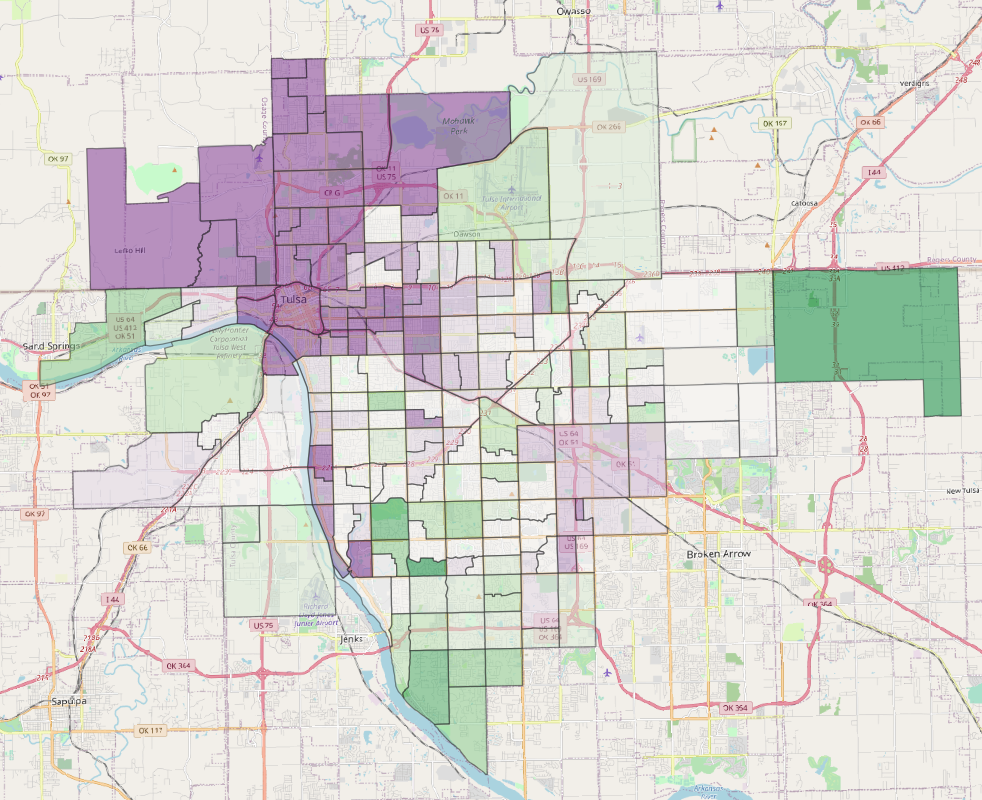
Recall that in 2016, Bynum was effectively the Democratic nominee, the progressive candidate, as no prominent Democrat sought the office. Bynum won with support from Democrats along with those Republicans who were disappointed with Dewey Bartlett Jr's service as mayor. This year, Greg Robinson captured those left-wing voters, while there was no well-funded or well-organized candidate to Bynum's right. Bynum's vote slid most dramatically in north Tulsa and midtown, while his vote improved in south Tulsa.
Now, there are all sorts of problems with the map above. I haven't figured out how to tweak the projection so that a line drawn north through the center of Tulsa points straight up (the shapefiles I'm using are based on Oklahoma as a whole). I haven't figured out how to add a legend, and I didn't bother adding precinct numbers as labels. I haven't done an intersection between the precinct shapefile and the municipal shapefile so that I only show the portions of precincts that are within the city limits. There's no proprietary watermark. All that said, it does give you a picture of how votes shifted, and I hope to put together additional (and more attractive) maps in the near future.
Here's one more: The percentage voting yes or no for Proposition 2, which involved changing a handful of references in the City Charter from he/him to they/them to be "inclusive." Darkest blues are yes > 70%, darkest reds are yes < 30%. Overall, the proposition passed by the narrowest margin of the five on the ballot, with 54.7% support.
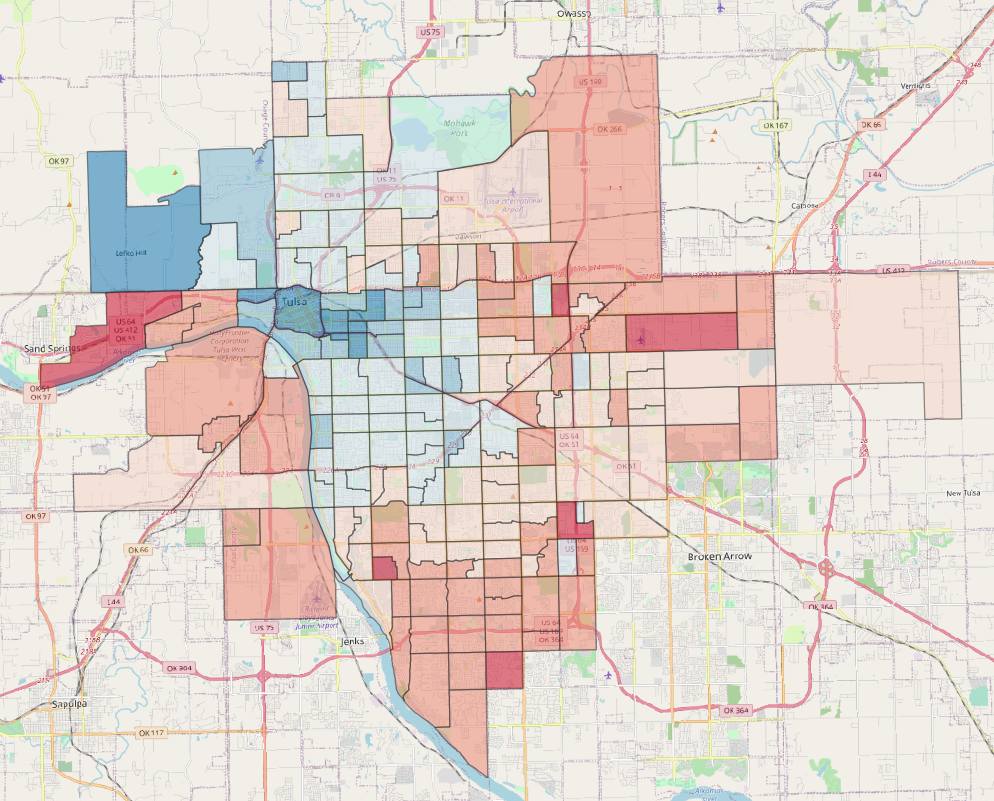
Polls are open today until 7 p.m. The Oklahoma State Election Board's online voter tool will let you know where to vote and will show you a sample of the ballot you'll see.
Click the link above to download a printable ballot card listing the candidates I'm recommending and (if in the district) voting for in the Oklahoma runoff and City of Tulsa general election on August 25, 2020. Below I'll add more detailed information on issues and candidates. (This entry will change as I decide to add more detail, link previous articles, or discuss additional races between now and election day. The entry is post-dated to keep it at the top.) Please note that the rows on the chart are alternately shaded and unshaded for readability. The presence or absence of shading has no other significance.
As I posted this late Thursday night, there were races I had planned to write about in detail, but time was short, people were voting, and many have asked for a summary of my recommendations, so I've started by posting my printable ballot card and will fill in some details as I have opportunity between now and Tuesday.
Below you'll find some links to websites I found helpful in learning about candidates, their values, backgrounds, and political opinions.
When in doubt, I look at campaign contributions, which often tell a story about a candidate's ideological leanings or close ties with local power brokers. Campaign expenditures can be telling, too: Certain consulting firms have strong associations with the pay-to-play culture that makes our Republican supermajority legislature more crony-infested than conservative. Then there are principled conservative consultants; their presence on a campaign team is always a hopeful indication that the candidate is also a principled conservative.
In addition to runoffs in federal, state, and county primary elections, the City of Tulsa has an election for mayor and seven of the nine city councilors. (The auditor and the other two councilors won re-election unopposed.)
State law requires City of Tulsa campaign contributions and expenditures to be submitted to the City Clerk's office; the City Clerk posts them on the City's website. Sadly, many city candidates don't seem to have noticed that their pre-election reports were due on Monday, August 17, 2020, even though that information was included in the election packet that was provided to each city candidate who filed for office and which was also posted on the county election board website.
NOTES ON SPECIFIC BALLOT ITEMS:
U. S. House, District 5: Terry Neese. Winner of this runoff will go on to try to win back the seat taken two years ago by Kendra Horn, Oklahoma's lone congressional Democrat. The other runoff candidate, State Sen. Stephanie Bice, voted to raise taxes on Oklahomans in 2018, bypassing a vote of the people. I should note that there are controversies surrounding Neese's business practices and claims of Native American roots. (My primary pick, David Hill, would have been a much better choice than either Neese or Bice.)
Senate 35: Cheryl Baber. Baber is a known quantity among conservatives in state and local conservative circles. Creekpaum's strong backing from "the Kaiser System" should worry conservatives. Baber is the only candidate in the race who was wise enough to oppose SQ802. Baber has been endorsed by Governor Stitt, Senator Lankford, former Governor Keating, and the current and previous senators for District 35, Gary Stanislawski and Jim Williamson, both solid conservatives. I'm hoping this year will be an echo of Stanislawski's first race in 2008: City Councilor Cason Carter, a favorite of the Money Belt establishment, ran first in the primary, 44.5% to 40.6%, but fell short of a majority and lost the runoff to Stanislawski.
City of Tulsa proposed charter amendments: Yes on 1, 3, 5 (the odds are good), No on 2, 4. Click the link to read the actual charter changes that each proposition would enact, and why I support or oppose each.
Mayor of Tulsa: Ty Walker (R). Walker is a small businessman and a political conservative who deals with Tulsans from all walks of life on a daily basis. As someone who has lived on both sides of the tracks, as he puts it, Walker can be a bridge to link the disparate communities of our city, with a focus on encouraging home-grown businesses. This was a tough call, but I believe that Walker is the better candidate of the two conservatives running. You can read his response to the BatesLine questionnaire here. You can read my comments on each of the candidates in my article endorsing Walker.
The incumbent mayor is blind to the needs of the city beyond his little Midtown Money Belt world, indecisive, two-faced, and in thrall to progressive philanthropy. His disastrous handling of COVID-19 and of the George Floyd protests managed to make everyone angry at him, inspiring seven candidates from across the political spectrum to run against him.
In the council races, I support replacing all of the City Councilors, except Cass Fahler in District 5.
Tulsa Council District 1: Jerry Goodwin (D).
Tulsa Council District 3: Paul Eicher (D).
Tulsa Council District 4: Kathryn Lyons (R). Lyons was the only District 4 candidate to respond to the BatesLine questionnaire, and she gave solid answers. (The incumbent councilor, Kara Joy McKee, allowed constituents' homes to be condemned without investigating the situation, and she made a promise she didn't keep about initiating the revocation condemnation promptly at the beginning of 2020.)
Tulsa Council District 5: Cass Fahler (R). At a time when law enforcement is under attack, we need a strong advocate for law and order on the council.
Tulsa Council District 6: Christian Bengel (R).
Tulsa Council District 7: Justin Van Kirk (R).
Tulsa Council District 9: Jayme Fowler (R).
MORE INFORMATION:
Here are some blogs, endorsement lists, candidate questionnaires, and sources of information for your consideration.
- Talk Radio 1170 Pat Campbell podcast archive
- Sheridan Church's Tulsa Town Hall candidate forum
- 918 Vote / League of Women Voters mayoral forum
- iVoterGuide: Candidate responses to a detailed questionnaire written from a conservative Christian point-of-view
- Muskogee Politico news, questionnaires, and analysis
- Muskogee Politico 2020 runoff election tips and picks
- Charlie Meadows's picks
- Oklahomans for Life candidate surveys
- Oklahoma Constitution newspaper's Oklahoma State Senate ratings and Oklahoma State House ratings.
- Endorsements from Tulsa Area Republican Assembly and other Tulsa conservative groups
- NRA-PVF endorsements and grades
- Oklahomans for Public Education 2020 voter guide: This is a kind of reverse-psychology voter guide. The red apple next to a candidate's name probably means he or she supports higher taxes, no reduction in school administrative bloat, and no meaningful educational choice for our children and their parents. You should treat a yellow triangle as a gold medal -- this is likely a candidate who will defend taxpayers' interests and work for school choice and educational efficiency.
TIP JAR: If you appreciate the many hours of research that went into this guide and into the rest of my election coverage, and if you'd like to help keep this site online, you can contribute to BatesLine's upkeep via PayPal. In addition to keeping me caffeinated, donated funds pay for web hosting, subscriptions, and paid databases I use for research. Many thanks.
UPDATE 2020/08/25, 12:46pm: I have updated the printable sheet to change my recommendation in Senate District 7, based on recent information from Jamison Faught.
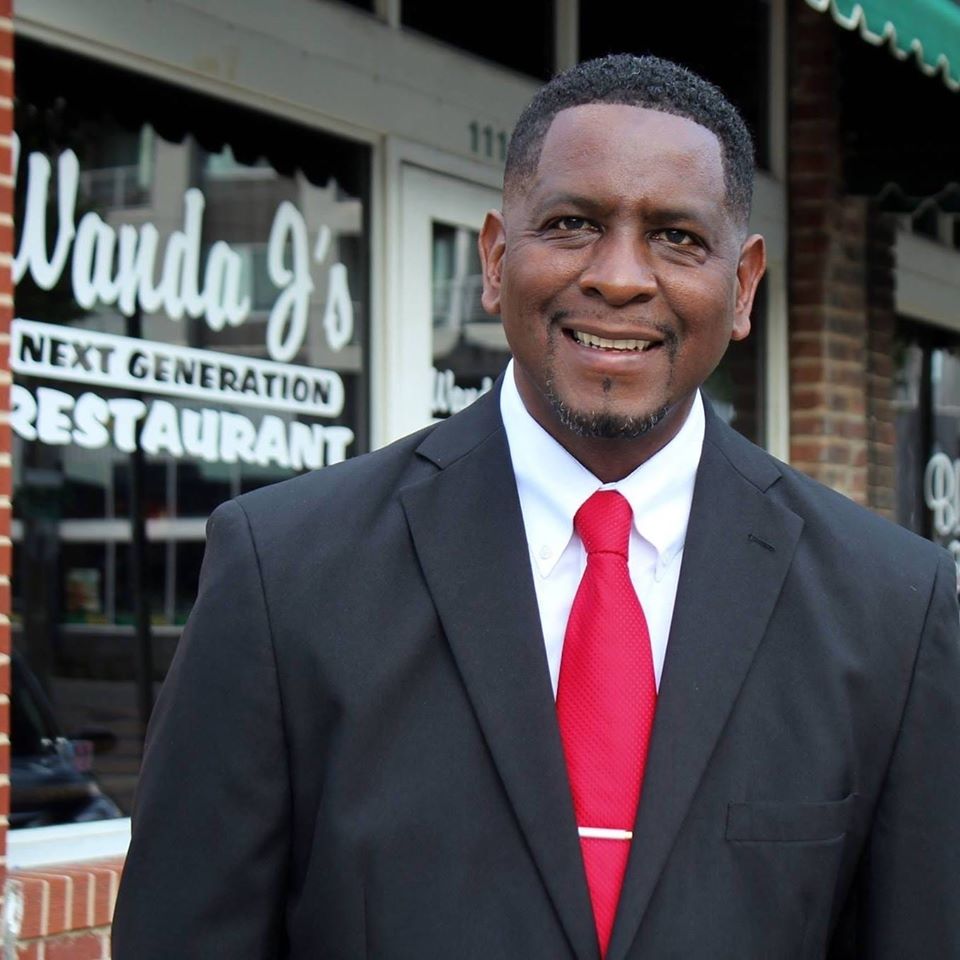
What looked like a sleepy re-election run, for Tulsa Mayor GT Bynum IV as recently as the beginning of May, with one declared opponent and a perennial candidate in jail, turned into a free-for-all. As soon as he had some tough decisions to make, the smiley guy that everyone liked was suddenly the weak-kneed wimp whom everyone despised. COVID-19 (aka the Chinese Communist Bat Virus) and Black Lives Matter protests, and the Trump rally which linked the two, left GT unable to find decisions that would make the vast majority of Tulsans happy. Instead, his vacillation managed to anger Tulsans left, right, and center, and the peak of the first wave of dissatisfaction fell just as filing opened for city office. Seven opponents filed to challenge his re-election.
The Bynum administration has reaffirmed my belief that executive experience in a mayor is not necessary for keeping the city running. (It may be that having a pulse is not necessary for keeping the city's basic functions running.) We've never had a mayor under the current charter with previous experience running a business the size of city government. The various departments that manage basic city functions continue to run regardless of who's mayor. Every mayor since 1990 has had someone either serving as a city manager in all but name (with a title like Chief Administrative Officer or Chief Operating Officer) or with the title City Manager, even though Tulsa's charter calls for a strong mayor, unlike the "weak mayor / council / city manager" government that Oklahoma City has and which is established under the default charter in the state statutes, used by cities like Broken Arrow. Even under a wishy-washy schmoozer like GT Bynum IV, the machinery of city government chugs along. The trash is picked up, clean water flows through our faucets, street projects move forward, police officers and firefighters do their essential work. It's a bit like the body's autonomous nervous system, keeping the heart pumping, the lungs going, and the guts digesting regardless of what is or is not happening in the brain.
What we do need in a mayor is a functioning moral compass, an ability to make sound decisions and stick with them, and a vision that encompasses all of Tulsa. He needs to understand government's proper sphere in the functioning of society alongside families, churches, businesses, voluntary organizations, and other non-governmental mediating institutions, as well as the practical limits on government's ability to fix problems without creating others. We don't have that right now, and I only see one candidate that comes close to meeting that set of criteria: Ty Walker. I have voted for Walker, and I encourage you to do the same.
If you make decisions based on your billionaire backers' priorities or what you see your buddy in Oklahoma City doing, if what you mean by "data-driven" is really just following the conventional wisdom that will make you look smart in the eyes of New York Times reporters or among your homies in the Midtown Money Belt, you're going to have a tough time when difficult dilemmas come your way, and you won't be serving the best interests of the citizens.
A few examples of Bynum IV's bad judgment and lack of vision (from memory, so no links):
- Supporting a tax package (as a councilor and mayoral candidate) that included unnecessary low-water dams, then failing (as mayor) to use the Muscogee Creek Nation lack of interest in funding as an opportunity to repurpose taxpayer dollars in more useful ways.
- Decreeing by executive order that the City of Tulsa will officially pretend that there is no valid distinction to be drawn between real women and autogynephiliacs, thus endangering private spaces for females and separate female athletic competition.
- Allowing the condemnation of a historic neighborhood where young families have been reclaiming old homes in order to protect an office building that was built in a 100-year flood plain, rather than finding a solution that would mitigate stormwater issues while saving the neighborhood.
- Allowing other historic neighborhoods, like Crutchfield and Crosbie Heights, to live under the threat of blight declarations.
- Pushing restriping of city streets to the confusion of the vast majority of street users (drivers).
- Being a tough guy for Pat Campbell's conservative audience, vowing not to cave to protestors, and then a few hours later, caving to protestors, cancelling Tulsa's participation in a show (LivePD) which seemed to offend the protestors because it showed Tulsa Police officers ably handling difficult challenges.
- Waffling on President Trump's appearance in Tulsa -- neither asking him to stay away out of concern for the spread of COVID-19 and civil unrest, nor taking advantage of Trump's visit to show off Tulsa to our nation's leaders or to call the President's attention to opportunities for city/federal cooperation.
- Choosing not to institute a curfew. Other cities used curfews to allow peaceful protests to continue, while halting after-dark gatherings that often led to the smashing of store windows and dangerous obstruction of major streets.
- Shutting down Tulsa's small retailers while allowing big-box stores which sell the same products to stay open during the pandemic. Bynum followed the herd, rather than creatively adapting lessons from places like Hong Kong, which combined moderate closures (schools and large gatherings), voluntary mask wearing, and reduced business capacity to allow businesses to stay open.
- Pushing for an Office of Independent Monitor that would subject police officers to the oversight of a board without any law enforcement experience and without direct accountability to the public.
- Pushing to raise the permanent sales tax level to pay for a basic function of government.
I could go on, but I need to finish this and get some sleep.
Bynum needs to go, but who should replace him? Can a challenger beat an incumbent who has raised over $600,000 for re-election? Let's go through our list of options, starting with a few easy discards.
Ricco Wright is on the ballot but ended his campaign after attempting to handle an accusation of sexual assault by stating his belief in the woman's account (Believe All Women!) but implausibly blaming his actions on being "roofied." (Rohypnol -- "hypno" is in the name -- causes "loss of muscle control, confusion, drowsiness and amnesia," not uninhibited sexual aggression.)
I discussed perennial candidate Paul Tay during the filing period. Someone who filed for office the day he finished a five-month jail sentence for outraging public decency doesn't deserve further consideration.
Zackri Whitlow seems to be running on a whim. He did not show up in the voter registration database in Tulsa prior to filing for office. He has not filed any campaign finance reports with the City Clerk, not even a Statement of Organization, indicating that he has not raised or spent any significant money to reach and persuade voters. He has appeared in a few online forums to promote a few pet ideas.
Craig Immel has impressed me with his willingness to respond to voters' questions on various platforms, including the BatesLine mayoral questionnaire. Even when I can't agree with him, I respect his thoughtfulness. I also admire his willingness to serve as the lead plaintiff against the plan (supported by Bynum) to convert riverfront park land to a basic shopping center. Of all the candidates, he has the best grasp of urban planning and development issues. If it were a head-to-head matchup between Immel and Bynum, I'd vote for Immel. But on other issues, he is left of center. His support for SQ 805 and SQ 780 points to a naive view of crime and its causes that would jeopardize the lives and property of Tulsa citizens. His stated disdain for the State of Oklahoma reflects an unbecoming elitism and sends a signal to small-town and rural Oklahomans who come to the metro area for jobs that they'll feel more at home in the suburbs.
Greg Robinson II has done an impressive job of organizing a substantial last-minute challenge to a well-funded incumbent mayor. His fundraising has unofficially surpassed $200,000 (but his campaign is one of several that has neglected to file the required pre-election report of contributions and expenditures). I've received almost as many mailers from Robinson as I have from Bynum, which points to a well-organized effort to reach and energize voters. In 2016, Bynum was helped by the fact that no Democrat bothered to file; instead, Bynum was effectively the Democrat nominee in the officially non-partisan mayor's race. Now Robinson may scoop up the base of Bynum's 2016 support.
Robinson's rhetoric and resume point to him being a doctrinaire leftist, but there are a couple of facts about him that are intriguing for the conservative voter: First, Robinson's father, Greg Robinson, Sr., was a Republican who came within 900 votes of unseating incumbent Democrat county commissioner Wilbert Collins in 2002. (Milton Goodwin, the Republican nominee in 1998, ran as an independent in 2002 and acted as a spoiler.) Tragically, Greg Sr. died suddenly of a heart attack at the age of 48, just 10 weeks after the election. Greg Jr. was a young teenager at the time. Second, Robinson (Jr.) is a founder of Greenwood Leadership Academy, a charter school, so there may be some openness to school choice that the incumbent (whose parents could afford an educational alternative) doesn't share.
A conservative case could be made for preferring Robinson over Bynum. It would be refreshing to have a mayor, for the first time in almost three decades, with a clue about life outside the Money Belt. And I've noticed that it's easier to mobilize certain Republican officials to oppose bad ideas when they've been proposed by Democrats; if a RINO backs the idea, they fall in line.
To the alarmists out there: No one can win on Tuesday unless they get 50% of the vote. If a majority of voters don't vote for Robinson, he won't win. If a majority of voters don't vote for Bynum, he won't win on Tuesday. A November runoff, even if it's between Bynum and Robinson, the two best-funded candidates, would be a better result than if either candidate succeeded in getting 50% on Tuesday. Both would have to find ways to reach out to the conservatives they've spurned if they want to win. But I'd rather see a conservative in the runoff.
A conservative with political experience was unlikely to risk running against a well-funded, well-heeled incumbent who was (until a few months ago) quite popular and a registered Republican, albeit a RINO. So the two conservative claimants in the race are not well-funded, are still working their day jobs, don't have the background in city policy that you might hope for, and do have some things in their past that aren't very attractive.
Ken Reddick was the first to step up to challenge Bynum. He ran a credible race for City Council District 7 in 2018. But despite the early start, he failed to lay the groundwork necessary for a successful challenge, a task that involves fundraising, garnering endorsements (or at least persuading people not to line up behind the incumbent) Reddick has filed no campaign contribution and expenditure reports at all beyond the Statement of Organization for his campaign committee.
Restaurateur Ty Walker joined the race on the final day of filing. He had been thinking about preparing for a 2024 run, but he was persuaded by some regular customers to go ahead and file this time around. He also ran for City Council in 2018, in the race for the open seat in District 5.
I reached out to both candidates shortly after filing closed and encouraged them to meet and discuss if either of them would be willing to drop out and support the other. As far as I know that never happened. This would have been an ideal situation for state or county Republican leadership to intervene, perhaps by holding an endorsing convention to take the place of the primary that was eliminated by the move to non-partisan elections. But despite my private encouragement, nothing was done.
Because of CCP Bat Virus (which is real, which can kill and maim people, and which spreads through droplets) I have minimized my person-to-person interactions and have been grateful that I can work, for the most part, from home. But I did attend one meet-and-greet each for Reddick and for Walker. At the Reddick meet-and-greet at the Interurban Restaurant, I watched Reddick passively listen to various attendees vent their spleens about their pet issues. I waited around for close to an hour in hopes that the candidate would stand up and talk about his priorities and plans and take questions, but I got tired of waiting and went home.
A few weeks later I attended Ty Walker's meet-and-greet in a supporter's home. Walker had been out knocking doors in neighborhoods around Tulsa. His campaign team seemed sharp and focused (although they failed to get his pre-election contribution filing in as of this time). He held forth for a couple of hours, talking about his priorities and answering questions from the audience. I didn't agree with all of his answers, but his principles and his heart were clearly in the right place. Many of those differences reflect a perspective formed by growing up in Tulsa's North Community. As he points out often, he has lived on both sides of the track and uniquely among the options on our ballot can be a bridge across that track.
A BatesLine reader writes:
I believe that Ty Walker has the skills, temperament, and ethics needed for the job as mayor of Tulsa.
- I believe him to be the most free of political influence. With several activists running for the position, and a mayor with a track record of heavy outside influence, Walker leads the pack.
- I believe he's best equipped to guide the city through the economic recovery necessary from Covid. As a small business owner, specifically in the food service industry, he's well aware of the hardships small businesses face. I believe he's capable of not only seeing the current economic recovery, but he can help underserved communities grow their currently limited economic infrastructure.
- I believe he's an inspiration to everyone on the personal struggles needed to be successful, and I believe that will help him be a positive agent for growth and helping the city mend it's current socio and economic divides.
- I believe he's the most practical candidate, in terms of wanting to achieve practical goals. He's a crawl - walk - run type of candidate who won't be overly fixated with trying to fix everything with one singular action.
Walker isn't beholden to local or national philanthropists or interest groups. As someone actively involved in owning and running a restaurant, he's understands what our small businesses need as we try to recover from the COVID-19 shutdowns. He also understands the specific challenges that exist in the parts of the city where businesses have had difficulty taking root. He understands what it is to try and fail and try again. His vision is practical consisting of modest, incremental steps.
Something I noticed when watching the Sheridan Church Tulsa Town Hall forum (which was very well done) is that Ty Walker was one of the few candidates actually settled and involved in a church. (The question about church involvement is asked at about 58 minutes into the video.) Walker is an associate pastor at New Salem Missionary Baptist Church in Okmulgee. At the beginning of this video from a few weeks ago, Ty Walker is giving some remarks (the video comes in after he has started) prior to the sermon, reminding the congregation that we will all meet death, none of us know when, and that we should all seek to be ready, walking in God's will.
Ty Walker is the candidate for Tulsans who want to bridge the cultural and ethnic divides in our city (without the kind of radical policies that are tearing other American cities apart), who want a conservative mayor who values the free market, economic opportunity, and growing local business (rather than lavishing incentives on billionaires trying to land the big fish).
I voted (at the election board Friday) for Ty Walker for Mayor, and I urge you to do the same. If he wins against all odds, Tulsa would be blessed. If Walker falls short, a large vote for him would signal that the remaining candidates need to reach out to conservatives in the November runoff.
A postscript: A few weeks ago, I was made aware of some accusations about Ken Reddick's marital history. I've been to the county court clerk's archive, looked at his divorce file, asked him some questions. I want to be careful about how I talk about these things for the sake of all involved, and I hope to post something this evening for the many people who are asking about it. Bottom line is that in my opinion there are internal inconsistencies in Ken Reddick's own account of his past and between his account and the official records, and that reinforces my doubts about his qualities as a candidate and a leader.
Back on August 12, I sent the three eligible candidates for City Council District 4 a questionnaire using the email addresses provided in their declarations of candidacy or on their websites. The questionnaire included the 18 questions I asked the mayoral candidates, plus a question about neighborhood conservation districts and a question about the candidates for mayor.
I received only one reply, from Kathryn Lyons.
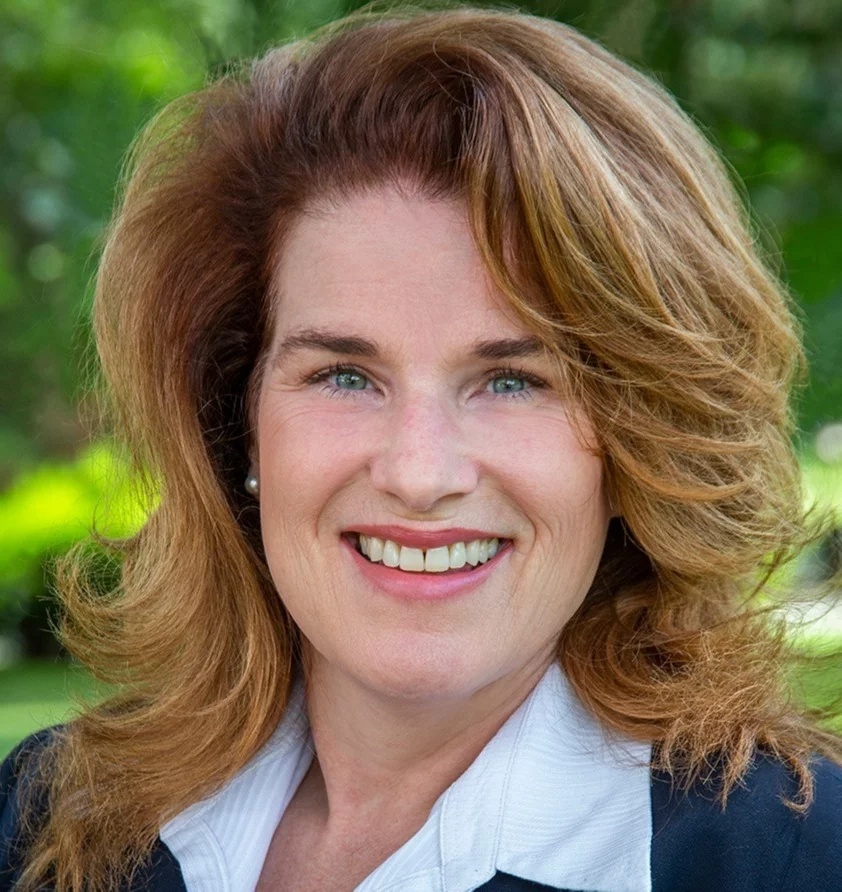
Age: 53
Employment: Community volunteer, former property manager
Neighborhood: Lakewood Heights
Voter registration: Republican
Campaign web page: kathryn4tulsa.com
Campaign Facebook page: Kathryn Lyons for Tulsa City Council
The detailed responses to the questionnaire, if you're viewing this on the home page, are after the jump.
Last Wednesday, BatesLine sent a questionnaire to the six serious candidates for Mayor of Tulsa, using the email addresses provided in their declarations of candidacy or on their websites. We sent two reminders. We received replies from three candidates: Craig Immel, Ken Reddick, and Ty Walker.
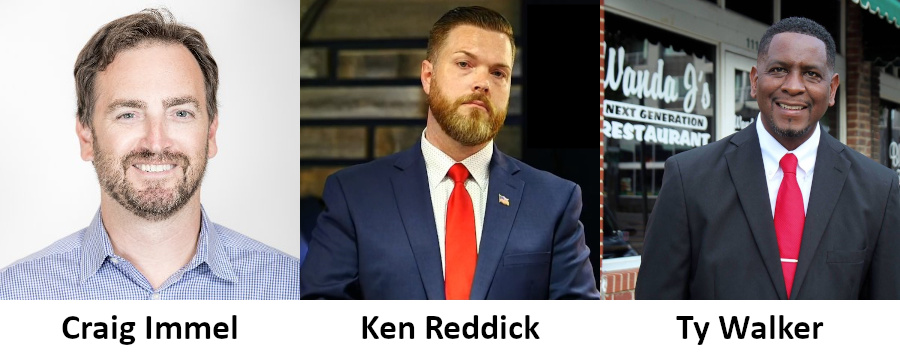
The survey consists of 18 questions, selected and adapted from over 60 questions suggested by BatesLine readers. I tried to cover a wide range of topics while keeping the number of questions at a reasonable level for candidates busy in the final stages of the campaign.
Rather than split the answers up in separate entries by candidate, I'm presenting them side-by-side, which runs the risk of someone reading an answer and connecting it with the wrong candidate. To help you mentally associate the answer with the candidate who gave it, I've added social-media-type icons in front of each response.
Here is a brief overview of the candidates who responded to the questionnaire:
Age: 44
Employment: Construction manager
Neighborhood: near Gilcrease Hills (Council District 1)
Voter registration: independent
Campaign web page: movetulsaforward.com
Campaign Facebook page: Craig Immel - Independent for Tulsa Mayor
Twitter account: @MoveTulsaFwd
Immel hosted a Reddit AMA (Ask Me Anything) session.
Age: 37
Employment: Owner, Clean Slate Contracting LLC and Tulsa Fence & Roofing Company
Neighborhood: Regency Park (Council District 7)
Voter registration: Republican
Campaign web page: kenreddick4mayor.com
Campaign Facebook page: Ken Reddick for Tulsa Mayor 2020
Age: 54
Employment: Owner, Wanda J's Next Generation Restaurant
Neighborhood: Virginia Lee Addition (Council District 5)
Voter registration: Republican
Campaign web page: tywalkerfortulsa.com
Campaign Facebook page: Ty Walker for Tulsa Mayor
The detailed responses to the questionnaire, if you're viewing this on the home page, are after the jump.
Five amendments to Tulsa's city charter -- our city's constitution -- will be on the August 25, 2020, ballot. As usual, the summaries you will see on the ballot paper only tell part of the story.
For the TL;DR folks, here are my recommendations:
Proposition No. 1: Yes
Proposition No. 2: No
Proposition No. 3: Yes
Proposition No. 4: No
Proposition No. 5: Yes
Or to put it even more briefly, vote YES on the ODD numbered propositions, NO on the EVEN numbered propositions. ODD is GOOD, EVEN is BAD.
Now the details, after the jump. Strikethroughs show language that would be deleted if the proposition passes, underlines show language that would be added.
I'm hearing that minions of Mayor Bynum IV are putting the word out that voting for one of his conservative opponents in the August 25, 2020, election will help elect someone further to the Left than the left-of-center Bynum. The rumor is self-serving garbage, preying on ignorance of the confusing new election process that Bynum IV and friends quietly slid into the charter three years ago, the sixth change to the city election process in 11 years.
Here's the truth: Unless one candidate has the support of 50% of the voters on August 25th, there will be a runoff in November with at least two candidates. Putting it another way: If a majority of voters vote against incumbent Bynum IV, and if a majority of voters also vote against Greg Robinson, the leading registered-Democrat candidate, neither will win the election outright on August 25.
The crucial task for conservative Tulsans who want a conservative mayor is to unite on August 25 behind one of the two conservative alternatives to Bynum (Ty Walker or Ken Reddick) so that we have a real conservative to vote for in November and Bynum can retire from being a failed mayor and resume his career as a schmoozer.
2020 is the first Tulsa mayoral election that will use the new election procedure approved by voters in a low-turnout November 2017 special election. (Only charter amendments on the ballot; only 10,425 votes were cast on this ballot item compared to 58,848 in the June 2016 mayoral primary. There ought to be a state law limiting city charter changes to high-turnout elections, or perhaps setting the threshold as 50% of the votes in the previous presidential election.)
Here is a direct link to the current charter language, Article VI, Section 2.2. Here's the key language:
If a candidate for office is unopposed at the election or becomes unopposed by death, disqualification or withdrawal, such candidate shall be deemed elected. If a candidate for an office receives more than fifty percent (50%) of all votes cast for that office at the election, such candidate shall be deemed elected. If more than two (2) candidates file for an office and no candidate receives more than fifty percent (50%) of all votes cast at the election for that office, the names of the several candidates for the office receiving the greatest number of votes totaling fifty percent (50%) at such elections shall be placed on the ballot at a run-off election in November, on the day specified by the laws of Oklahoma, and the candidate receiving the greatest number of votes cast at said run-off election shall be deemed elected. In the event of a tied vote among the said candidates, the election shall be decided by lot.
The same process applies to election for any Tulsa city office, including city councilors and the city auditor.
Note that the runoff may involve only two candidates, but if votes are split evenly enough between the candidates, it may involve more. Here are a few possible scenarios. Note that the numbers are entirely made up -- I have no polling data -- used simply to illustrate how different spreads of votes among candidates will lead to different runoff possibilities.
Scenario 1 is simple: If a majority of the August 25 voters support one candidate, he is elected to a four-year term as mayor. This is what happened in June 2016.
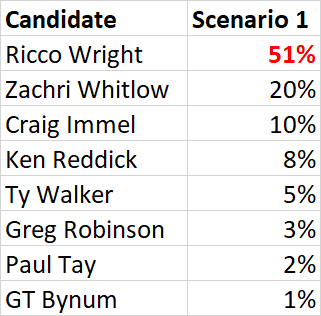
In Scenario 2, no one gets a majority of the votes on August 25, but the total of the top two is greater than 50%. In the illustrated scenario, Robinson and Bynum are the top two ranking candidates, and the sum of their percentage is 60%, so those two candidates advance to the November runoff. Note that in this hypothetical scenario, the two conservative candidates, Walker and Reddick, have enough votes that if they had all coalesced behind one of the two, the conservative candidate would have beaten out Bynum for the 2nd spot in the November runoff.
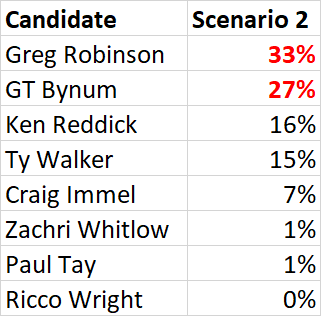
Scenario 3 illustrates what happens if the top two candidates fall short of a combined 50% total. In this case, Robinson and Walker would combine for 49% of the vote, so the third-place candidate, Immel, also would advance to the November runoff. Since those three combine for 68% of the vote, the condition would be satisfied, and no more candidates would advance to the runoff.
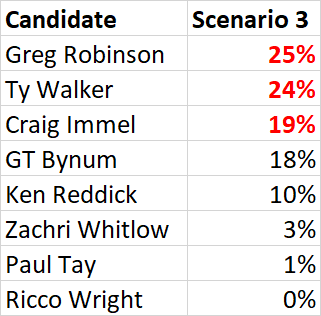
Scenario 4 is an extreme example to illustrate what would happen if the voters were very evenly spread among all seven of the active candidates. The top three candidates combine for only 46%, so one more candidate would have to be added to the November runoff ballot to reach the 50% threshold.
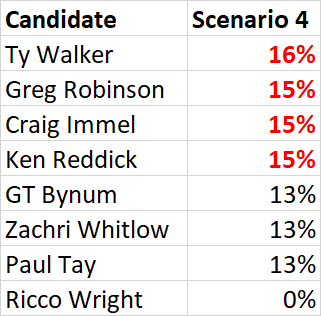
Scenario 5 is the most extreme hypothetical of all. Supposing all eight candidates got exactly the same number of votes -- 12.5% each. In this case, four candidates would advance (because the language says "totaling 50%," not exceeding 50%), and which four candidates advance would be decided by lot.
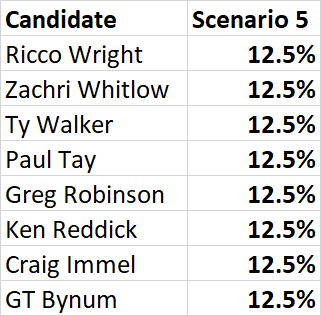
Note that there is no runoff after the November runoff. If more than two candidates advance to the November runoff, the election becomes a first-past-the-post race -- the candidate with the greatest number of votes, even if well short of a majority, is elected.
I'll be on Talk Radio 1170 KFAQ Wednesday morning at 8:35 with Pat Campbell to discuss the primary election results. Tune in on your AM dial, listen live online, or catch up later with the Pat Campbell podcast. UPDATE: Here's a direct link to the podcast.
A few notes, now that all the results are in.
The passage of SQ802 by such a slim margin -- 6,518 votes out of 674,040 cast -- is amazing, given that there was no organized opposition until about a week ago.
In Tulsa County races, Josh Turley will get a second chance against Democrat County Commissioner Karen Keith in November. By winning the GOP primary, Don Newberry was re-elected County Court Clerk in a rematch with Ron Phillips; no Democrat filed. Sheriff Vic Regalado and County Clerk Michael Willis, both Republicans, won reelection with out drawing an opponent.
Two candidates who pledged to replace Tulsa Public Schools Superintendent Deborah Gist won seats on the board: John Croisant won the open Office 5 seat and Jerry Griffin defeated 24-year-incumbent Ruth Ann Fate. Last week, the incumbent board, perhaps knowing this result was likely, voted to give Gist a three-year contract extension, which gives the establishment time to shore up their majority on the board. Accountant Jeromy Burwell defeated incumbent Memory Ostrander in Collinsville. Challengers in Union and Berryhill ran strong races but fell short.
There were several upsets by conservative challengers of Republican incumbents who had accumulated a RINO voting record: In House 11 in Bartlesville, Derrill Fincher was defeated by homeschool mom Wendi Stearman. Lundy Kiger lost to Randy West in House 3. In Senate 3, incumbent Wayne Shaw, who announced support for the idea of social impact bonds, was beaten by Blake "Cowboy" Stephens. Former State Rep. Shane Jett will have a runoff in Senate 17 with incumbent Ron Sharp.
Conservatives had some success in open seats, too. Gerrid Kendrix won House 52 in southwestern Oklahoma, winning the seat. Max Wolfley defeated former Oklahoma County Republican Chairman Daren Ward. 85-year-old Margie Alfonso, a conservative activist since the 1970s, made it into the House 79 runoff with Clay IIams.
Conservative names tarred by the big-money special interests two years ago didn't have any success coming back this year. George Faught was defeated in his rematch with Chris Sneed in House 2014, and Angela Strohm lost her House 69 battle with Sheila Dills, who defeated her husband Chuck Strohm in 2018.
Fair-deal conservatives continue to have an organizational and fundraising disadvantage to wheeler-dealer RINOS. It's the classic problem of concentrated benefit and diffuse costs: Those who want special deals from government have a greater interest in fundraising and organizing than those who simply want good government for all.
August 25th is going to be an interesting day for the Kaiser System. Despite massive fundraising from Tulsa's establishment, Kyden Creekpaum, fell well short of an outright primary win in the open Senate 35 seat. He will have a runoff against conservative grassroots Republican Cheryl Baber. The same day will see former GKFF lobbyist GT Bynum IV trying to hold on as mayor, despite seven challengers from across the political spectrum.
MORE:
Big partisan difference in the use of absentee ballots this year.
In 2018, SQ 788, medical marijuana, was on the primary ballot, along with competitive races for governor in both major parties. 3.28% voted absentee by mail, 5.31% voted early at the election board, 91.41% voted at their precincts. Partisan variation was miniscule: 3.39% of Republicans voted absentee by mail vs. 3.14% of Democrats, while 5.07% of Republicans voted early at the election board vs. 5.71% of Democrats.
In 2020, SQ 802, Obamacare expansion, was on the primary ballot. There were statewide primaries for U. S. Senator, but not competitive for either party. Overall, 13.84% voted absentee by mail, 6.45% voted early at the election board, 79.71% voted in person at their precincts. The partisan breakdown of mail-in ballots is striking: 9.01% of Republicans voted absentee by mail vs. 21.00% of Democrats. There wasn't much difference in early voting at the election board: 4.93% of Republicans vs. 5.47% of Democrats. 86.03% of Republicans voted in person at their precincts, vs. 73.53% of Democrats.
Does this simply represent a partisan difference in fear of CCP Bat Virus? A push by the Oklahoma Democratic Party to get people used to voting by mail? Or a push by the Yes on 802 forces to lock in votes before voters had the chance to hear both sides of the issue?
For what it's worth, John Tidwell of Americans for Prosperity Oklahoma filed a Statement of Organization for the VOTE NO ON 802 ASSOCIATION with the Oklahoma Ethics Commission on June 5, 2020; the organization was incorporated on the same day. OKLAHOMA DECIDES, INC., the "vote yes" organization, filed its paperwork as a PAC on April 20, 2020. It was incorporated on May 22, 2019. The domain YesOn802.org was registered on April 19, 2019, and was online by September 4, 2019. I am not aware of a "vote no" website or social media presence.
Polls are open today until 7 p.m. The Oklahoma State Election Board's online voter tool will let you know where to vote and will show you a sample of the ballot you'll see.
Click the link above to download a printable ballot card listing the candidates I'm recommending and (if in the district) voting for in the Oklahoma primary elections on June 30, 2020. Below I'll add more detailed information on issues and candidates. (This entry will change as I decide to add more detail, link previous articles, or discuss additional races between now and election day. The entry is post-dated to keep it at the top.) The ballot card is now at Revision 2, as I have added recommendations in three suburban school district races and modified my recommendation in Senate 37.
As I posted this late Thursday night, there were races I had planned to write about in detail, but time was short, people were voting, and many have asked for a summary of my recommendations, so I've started by posting my printable ballot card, filling in some details as I have had opportunity.
Below you'll find some links to websites I found helpful in learning about candidates, their values, backgrounds, and political opinions.
When in doubt, I look at campaign contributions, which often tell a story about a candidate's ideological leanings or close ties with local power brokers. Campaign expenditures can be telling, too: Certain consulting firms have strong associations with the pay-to-play culture that makes our Republican supermajority legislature more crony-infested than conservative. Then there are principled conservative consultants; their presence on a campaign team is always a hopeful indication that the candidate is also a principled conservative.
In addition to the usual federal, statewide, legislative, and county races on the ballot, many school districts will hold the general elections for school board that were postponed from April. Two of the seven seats on the Tulsa school board will be filled: I'm supporting Shane Saunders in the open Office 5 seat and challenger Jerry Griffin in Office 6. I'm recommending challengers in the suburban school board races as well (see below).
There are a large number of legislative races this year with Republican primaries. In 2018, lobbyist groups working with the leftist Oklahoma Education Association succeeded in ousting a number of principled conservative legislators. These senators and representatives were guilty only of insisting that the state's voters should have the final say on tax increases, in accordance with Oklahoma's constitution. Many were defeated by RINOs in the primary, a few were defeated by Democrats in the general election.
In 2020 many of those RINOs are being challenged by conservatives in the primary. In districts that were won by Democrats, we have a Republican primary to pick a challenger. A few races are for open seats. All told, 33 of 101 House seats and 11 of the 25 Senate seats up for election this year have a Republican primary, so the outcome will have a massive impact on the character and quality of the Republican supermajority for the next two years. I discuss a few of the Tulsa-area races below.
Oklahoma Democrats also have a primary election on Tuesday, with fewer offices on the ballot. I'm not making any recommendations in those primaries, but I have to give a special mention to Maria Barnes, who is challenging the incumbent Democrat Monroe Nichols in State House District 72. Maria and I served together in the Midtown Coalition of Neighborhood Associations for many years, and she served honorably as a Tulsa City Councilor for District 4. We disagree on many state and national issues, but we found common cause on local matters of neighborhood conservation and public transparency, and I'm proud to call her a friend. One Republican filed in the heavily Democrat district: Ismail A. Shan, on the ballot simply as "Shan," who was not on the voter registration list as of the beginning of this month. He was disqualified, and the Democratic primary will decide the election.
NOTES ON SPECIFIC BALLOT ITEMS:
SQ 802: NO. This would place the Obamacare Medicaid expansion, an unfunded entitlement mandate, permanently into Oklahoma's state constitution. It is a fiscal time bomb and will starve other state responsibilities for funds while squeezing taxpayers tighter every year, while making no real improvement in access to healthcare.
Corporation Commissioner: Todd Hiett. The incumbent, who was the first Republican State House Speaker since the 1920s, is opposed by an 85-year-old perennial candidate.
U. S. Senate: Jim Inhofe. Inhofe's position as Senate Armed Services Committee chairman is important for Oklahoma's four military bases, and he can be counted on to vote as a conservative, even when many of his fellow Republicans stray.
U. S. House, District 2: Markwayne Mullin. Mullin has become a conservative stalwart, to the point that even his erstwhile opponent, Jarrin Jackson, has endorsed him.
U. S. House, District 4: James Taylor. Taylor, a conservative African-American pastor and public school history teacher, is once again challenging longtime incumbent Tom Cole, who was cited as an example of the legal "pay-to-play" system in the "Congressional Favor Factory" report by American Transparency (OpenTheBooks.com).
U. S. House, District 5: David Hill. Winner of this primary will go on to try to win back the seat taken two years ago by Kendra Horn, Oklahoma's lone congressional Democrat. Hill, owner of an auto parts manufacturing company and founder of the Academy of Classical Christian Studies, has been endorsed by the Family Research Council PAC. One of the other leading GOP candidates, State Sen. Stephanie Bice, voted to raise taxes on Oklahomans in 2018, bypassing a vote of the people.
Senate 35: Cheryl Baber. Baber is a known quantity among conservatives in state and local conservative circles. Creekpaum's strong backing from "the Kaiser System" should worry conservatives, and former Judge Morrissey's conversion to conservatism is dubious. Baber is the only candidate in the race who is wise enough to oppose SQ802.
Senate 37: No endorsement. This is a change. I have trustworthy conservative friends supporting each of the candidates. Both candidates have foolishly endorsed SQ802, even though both have indicated it would hurt Oklahoma's budget if it passes. Some of the names on Chris Emerson's list of donors give me pause, as do some of the names on his campaign team, and that's why I initially recommended voting for Cody Rogers. Both campaigns have presented misleading information to voters. (UPDATE: I'm hearing claims that both candidates really oppose 802 but were misquoted. Here's a tip: If the newspaper inaccurately ascribes to you a view on a controversial issue, don't just quietly tell people. Make a public correction on your website and Facebook page and push the paper into issuing a correction. Otherwise it looks like you're trying to have it both ways and can't be trusted.)
House 11: Wendi Stearman, a mom who organized her own homeschool coop in Bartlesville, is a solid conservative challenging an incumbent with a weak voting record.
House 12: Justin Dine. Dine has the universal support of conservative groups and commentators. Charlie Meadows writes that he was blown away by Dine's moral principles, well-developed thought on political principles and communication skills. Incumbent Kevin McDugle has been hanging out with National Popular Vote lobbyists, and his divorce trial hinted at some strange proclivities.
House 14: George Faught is seeking to return to the State House, where his principled refusal to cave to lobbyist pressure put a big target on his back two years ago. We need him back in the Legislature.
House 69: Angela Strohm. Strohm is a conservative challenging the special-interest backed RINO incumbent. Strohm's husband Chuck held the seat previously, but was targeted for his principled opposition to raising taxes without a vote of the people.
House 70: Taylor Woodrum is a conservative, pro-life, pro-2nd-Amendment college student challenging Carol Bush, one of the most liberal members of the Republican House caucus. Woodrum has the support of conservative groups. Bush showed her true colors in an interview with old friend Barry Friedman, then threw him under the bus when her remarks got her in hot water with her Republican colleagues.
House 71: Beverly Atteberry. The candidates in this race to challenge Democrat incumbent Denise Brewer have been very reluctant to share their opinions in candidate surveys, but Atteberry did earn an AQ for her response to the NRA's candidate questionnaire.
House 74: Brad Peixotto. Peixotto owns a medical marijuana dispensary. This is a rematch from two years ago. The incumbent, a Republican, gets poor ratings from conservative groups for his voting record on fiscal issues.
House 79: Margie Alfonso has a long history of conservative activism on behalf of the unborn, serving as president of the Tulsa Eagle Forum and delegate to the Republican National Convention.
Tulsa County Court Clerk: Don Newberry. Newberry is running for re-election four years after defeating the outgoing clerk's preferred successor. He is credited with improving customer service and efficiency in the Court Clerk's office.
Tulsa County Commissioner, District 2: Josh Turley. Turley ran a strong race against incumbent Democrat Karen Keith four years ago, and he had the endorsement of County Assessor Ken Yazel, who saw Turley as someone who could provide much-needed transparency in the county budget process. Turley served as a crime scene investigator for the Tulsa County Sheriff's Office and then creating the first risk management program for TCSO, which succeeded in reducing car accidents involving deputies and tort claim payouts, and independently developed policies and procedures to be used by smaller sheriff's offices and county jails to improve performance and minimize risk. Turley wants Tulsa County to follow an open data policy -- by default, data used and generated by county officials would automatically be made available to the public, without the need for an open records request. Turley's primary opponent, Eddy Barclay, is currently Director of Road Operations for Tulsa County. While either would be preferable to Keith, Turley looks like he would be the most effective at making needed moves toward transparency in Tulsa County government.
Tulsa School Board, Office 5: Shane Saunders. Saunders is a Republican businessman with two daughters in the TPS system, running for an open board seat.
Tulsa School Board, Office 6: Jerry Griffin. Griffin is a professor in higher education with an earned doctorate, a Republican with some ideas for improving the district running against a 24-year Democrat incumbent who is a rubber stamp for the administration.
(Here's the video of the League of Women Voters virtual candidate forum for TPS Offices 5 and 6, held on June 17, 2020.)
Berryhill School Board, Office 5: Allisha Craig, a public school teacher with Epic, with children in the Berryhill system, would bring a critical eye to "the way things have always been done," and experience in remote instruction that may be crucial in the coming years.
Collinsville School Board, Office 5: Jeromy Burwell is a corporate finance controller with children in the upper elementary and middle school and experience in accounting for government contracting.
Union School Board, Office 5: Brandon Swearengin has a master's in accounting and is pursuing a law degree. He wants to stop the undemocratic practice of rushing through important financial and policy decisions on the board's consent agenda without debate. The incumbent, Ken Kinnear, is VP and treasurer of George Kaiser's Kaiser-Francis Oil Company. During a February 10, 2020, board meeting, Kinnear delivered a cringe-inducing speech that was effectively a campaign commercial, which was recorded in the minutes (see page 10).
MORE INFORMATION:
Here are some blogs, endorsement lists, candidate questionnaires, and sources of information for your consideration.
- Talk Radio 1170 Pat Campbell podcast archive
- iVoterGuide: Candidate responses to a detailed questionnaire written from a conservative Christian point-of-view
- Muskogee Politico news, questionnaires, and analysis
- Muskogee Politico 2020 primary election tips and picks
- Charlie Meadows's picks
- Oklahomans for Life candidate surveys
- Oklahoma Constitution newspaper's Oklahoma State Senate ratings and Oklahoma State House ratings.
- Endorsements from Tulsa Area Republican Assembly and other Tulsa conservative groups
- NRA-PVF endorsements and grades
- Oklahomans for Public Education 2020 voter guide: This is a kind of reverse-psychology voter guide. The red apple next to a candidate's name probably means he or she supports higher taxes, no reduction in school administrative bloat, and no meaningful educational choice for our children and their parents. You should treat a yellow triangle as a gold medal -- this is likely a candidate who will defend taxpayers' interests and work for school choice and educational efficiency.
TIP JAR: If you appreciate the many hours of research that went into this guide, and if you'd like to help keep this site online, you can contribute to BatesLine's upkeep via PayPal.
 State Sen. Gary Stanislawski is term-limited, and there are three Republicans and three Democrats who have filed to replace him as District 35 State Senator. Sen. Stanislawski, and his predecessor, former Sen. Jim Williamson, have endorsed Cheryl Baber to be their successor, and I concur.
Cheryl Baber is semi-retired as an attorney, volunteering with Tulsa Lawyers for Children. She served from 1998 to 2009 as a Law Clerk for Federal judges in the U. S. Northern District (based in Tulsa). In 2001, Baber published a law review article on Alternative Dispute Resolution in the Federal courts; at the time she was law clerk to Federal Magistrate Judge Claire Eagan, who was appointed as a Federal District Judge by George W. Bush. She then served about five years as an Assistant U. S. Attorney here in Tulsa; OSCN records show her representing the IRS in many foreclosure cases. She is a graduate of Columbia Law School, has a master's degree in international history and politics from the Graduate Institute of International Studies in Geneva, and her bachelor's degree is from Midwestern State in Wichita Falls, Texas, not far from her hometown of Walters, Oklahoma. She has been in Tulsa since completing her law degree in 1993.
In 2015, Baber was chosen by Republican activists to represent Tulsa County on the Oklahoma Republican State Committee for a two-year term, during which she was also elected as a delegate to the 2016 Republican National Convention. In 2018, she ran for the open House District 71 seat, winning the Republican nomination in a runoff, but lost to former TV personality Denise Brewer in the general election. She has the joint endorsement of several local conservative groups, including the Tulsa Area Republican Assembly.
Baber is active in the First Baptist Church of Tulsa. I encourage you to read Cheryl Baber's eloquent responses to the iVoterGuide survey.
Baber is opposed by retired District Judge Linda Morrissey and attorney Kyden Creekpaum.
Cheryl Baber is the only candidate in the race with the good sense to oppose SQ802, while Morrissey supports embedding Obamacare in the state constitution, and Creekpaum gave a non-committal answer.
Morrissey was a registered independent until re-registering as a Republican sometime in 2011 or 2012 (according to voter registration records available to me), but her husband, John Nicks, was chairman of the Tulsa County Democratic Party and a Democratic canddate for Attorney General and Tulsa County Commissioner. Everyone else registered to vote at her address was registered as a Democrat as of June 9, 2020. In 1992, Morrissey and her husband were listed by the political director of the Oklahoma Democratic Party as expected guests at Bill Clinton's 1993 inaugural gala, an honor typically given to the most fervent supporters of Slick Willie.
As a district judge, Morrissey had a history of being reversed on appeal. Morrissey answered only four questions of the dozens in the iVoterGuide questionnaire. (Their summary rating of "somewhat conservative" is puzzling and without any apparent basis. Should you get credit because you avoided giving a liberal answer by not answering at all?)
Morrissey has the smallest bankroll of the three Republicans, has no history of involvement in the Republican Party or conservative causes, and I suspect she will not survive the primary. Morrissey's major donors include Stuart Price, an unsuccessful Democratic candidate for Congress in the 1990s, and Clark Brewster, a Tulsa attorney who is a generous donor to Democrat candidates and the lawyer for "adult entertainer" Stormy Daniels in her lawsuit against President Trump.
Kyden Creekpaum is an attorney who grew up in Tulsa and moved back to Tulsa in 2017 after eight years in Paris and Washington with Hughes, Hubbard & Reed. His parents were public school teachers; his father Eddie Creekpaum ran for City Council as a Democrat in 2000 and is a prolific writer of letters to the editor.
Kyden Creekpaum has an impressive educational background: Double major in political science and piano at OU, master's in public health from Johns Hopkins, law degree from Georgetown, master's in law from Sciences Po (the Paris Institute of Political Studies).
When I was introduced to Creekpaum at the Tulsa County Republican Convention, I said, "Ah, the Kaiser candidate!" which elicited a sheepish response. Creekpaum is an attorney with the Frederic Dorwart law firm. Dorwart is president of the George Kaiser Family Foundation (GKFF) and, until Tuesday, chairman of the University of Tulsa Board of Trustees. (Dorwart is stepping down as chairman as of June 30, but will remain on the board's executive committee.) The Dorwart firm handles legal matters for many branches of what Michael Mason has labeled "the Kaiser System," including Kaiser-Francis Oil Company, GKFF, the Tulsa Community Foundation (TCF), and the Bank of Oklahoma.
For religious conservatives, the involvement of the Kaiser System in a Republican primary is worrisome, as donations may be used as leverage to get elected officials to devote taxpayer dollars to Kaiser's preferred policy prescriptions. Kaiser's "giving statement" reveals him to be a materialist: Given enough money applied scientifically to education, nutrition, and health care, poverty and misery will vanish. Moral and spiritual aspects are absent from his analysis of the cause of societal problems. However pure his intentions, Kaiser's approach is bound to fail because it fails to address the fundamental problem facing humanity: fallen human nature.
As Mason documents, the Kaiser System's approach to charitable giving is one of control and "strings attached." Mayor G. T. Bynum IV, who posed as a conservative when he first ran for City Council in 2008, and who served as a federal lobbyist for GKFF, began working to impose leftist views of sexuality on Tulsans shortly after his first re-election in 2009 -- right about the time he became a GKFF lobbyist.
Creekpaum has the biggest warchest of any candidate in the race, $145,750.00 in contributions, plus $5,398.48 in in-kind expenditures. He filed his statement of organization with the ethics committee on March 19, 2019, and within 12 days had amassed $50,100. Baber has raised about $35,000, a decent amount for a State Senate campaign, and she has loaned her campaign $100,000 to try to keep up with Creekpaum.
A good chunk of Creekpaum's money has come from people in the George Kaiser orbit, including $1,000 from Kaiser himself, $1,000 from Kaiser-Francis CFO Don Millican, $1,500 from GKFF board member Phil Frohlich, and maximum $2,800 donations from Frederic Dorwart, his wife Nanu Dorwart, and several of the firm's partners. Elizabeth Frame, daughter of former Mayor Kathy Taylor and CEO of the Taylor Lobeck Family Foundation, and former Democratic Congressman Dan Boren, now president of corporate development for the Chickasaw Nation, have each contributed $1,000 to Creekpaum.
Creekpaum has used his money to run television ads attacking Cheryl Baber because her service as an Assistant U. S. Attorney fell during the Obama administration. Baber has responded:
One of my opponents is misleading voters by calling me a hypocrite because I was an Assistant U.S. Attorney during the time that Obama was President and Holder was the Attorney General. EVERY person who works for a federal administrative agency works for whomever is President or Commander-in-Chief at the time! That includes postal workers, park rangers, ALL military, and about 2 million employees throughout the world! There are 94 U.S. Attorney's Offices, employing thousands of people who are from every political party or none. Further, I actually worked as a federal law clerk when President George W. Bush was President! And I chose to leave the U.S. Attorney's Office, in part, because Obama won re-election in 2012.Kyden Creekpaum is the candidate spreading lies, not me. He is the one supported by donors who gave $404,000 to Obama, Biden, and Hillary. He is the one whose current law firm sued to block President Trump's voters from rallying at the BOK Center. Those are documented, verifiable facts which informed voters deserve to know if they do not want a legislator who will likely vote to advance a liberal agenda. I am the one who has been active in, and endorsed by, Tulsa area conservative Republican organizations.
I haven't verified Baber's math, but I do recognize many names on the Creekpaum campaign reports whom I know to be generous donors to Democrats.
Creekpaum claims to be a conservative, pro-life Christian, and he may well regard himself as such. I can't find any indication online that he has ever taken a public stand on any political issue prior to running for office. Creekpaum did not complete the iVoterGuide survey. He did give "yes" answers to all the questions on the Oklahomans for Life survey.
Baber answered four of the 12 Oklahomans for Life survey questions with a "no": She would allow rape and incest exceptions to a ban on abortion, disagrees with Oklahomans for Life's proposal for $1 million in annual funding for a state-funded guardianship system "to advocate for vulnerable persons at risk for denial of life-preserving care," disagrees on assisted suicide, and disagrees with a proposal for a mandatory retirement age for Oklahoma Supreme Court justices. She does however support Oklahoma's existing strong legal protections against the imposition of euthanasia on the elderly and disabled. I disagree with her on those "no" answers, but her answers to the iVoterGuide survey suggest she would be persuadable to a more consistent pro-life position.
It may well be that these wealthy progressives who give consistently to Democrat candidates for President are backing Creekpaum because they think he's a wonderful, smart guy who would serve the State of Oklahoma well, and they don't mind that he will apply his intelligence and energy to advancing a socially conservative, anti-abortion, free-market agenda. I doubt it. To me, he looks like a politically ambitious young man who has come home to start his climb, and he has found the people who can fund that ascent. My bet is that his loyalties, if elected, would incline to the Kaiser System, not to the conservative voters of Senate District 35.
RESEARCH:
I went through the very tedious process of downloading each of the campaign reports filed by each of the Republican candidates from the Oklahoma Ethics Commission's Guardian website, and I have compiled all the reports into a single file for each candidate:
Before Oklahomans foolishly enshrine a new, unfunded and unlimited entitlement into our state constitution (SQ802), we ought to heed the experience of our neighbors to the east.
On May 13, 2020, when the Oklahoma legislature was debating a Medicaid expansion bill, Arkansas State Representative Josh Miller, a Republican, wrote a letter to Oklahoma leaders urging them to reject Medicaid expansion. Arkansas adopted a "private option" program in 2013, using new federal funds to purchase private medical coverage for the newly eligible (able-bodied and below income limits). Arkansas requires recipients in the expansion pool to work if able in order to receive these benefits, but Federal courts have stayed that requirement. Oklahoma SQ802, the Obamacare Medicaid expansion on the ballot next Tuesday, would prohibit the state from requiring that able-bodied recipients work or pursue education and training to receive benefits -- that ban would be written into the state constitution.
Miller writes that Arkansas is worse off because of its decision to expand Medicaid: "Greater costs are being shifted to the remaining Arkansans who pay higher private insurance premiums. More Arkansans are trapped in welfare dependency. And the truly needy--like those with physical and developmental disabilities who require home-based care--face long waiting lists and reduced services while able-bodied, working-age adults move to the front of the line."
Here's the complete letter:
Dear Leader David, Speaker McCall, Leader Echols, and other Republican Members of the Oklahoma Legislature,In light of Oklahoma's consideration of Medicaid expansion, I write to briefly share Arkansas' experience. I will be candid--and hope to convey my sense of urgency. I cannot stress enough my primary takeaway from Arkansas' Medicaid program in recent years: expanding Medicaid to able-bodied adults is a raw deal. Let me explain.
Those who supported Medicaid expansion made lots of promises: increased federal funding to support our state budget, greater access to care for the needy, and relief for rural hospitals. But Arkansas is in a worse position today than before because these grand promises were built on the broken foundation of ObamaCare.
Instead, enrollment and costs shattered projections. Waste and fraud is more difficult to detect. Some of our rural hospitals are still struggling and a few have even closed. Greater costs are being shifted to the remaining Arkansans who pay higher private insurance premiums. More Arkansans are trapped in welfare dependency. And the truly needy--like those with physical and developmental disabilities who require home-based care--face long waiting lists and reduced services while able-bodied, working-age adults move to the front of the line.
In short, expansion was a big mistake for Arkansas.
In times of uncertainty like the COVID-19 pandemic, knowledge is power. And I know the experiences of neighbors, who have had to learn from their mistakes, can provide the most useful knowledge. Arkansas and Oklahoma share more than a border. Our cultures, economies, and enduring public policy challenges have much in common. If you want to avoid the mistakes of our state, I urge you to reject Medicaid expansion.
Sincerely,
Josh Miller
AR State Representative Dist. 66
Hat tip to OCPA President Jonathan Small for Rep. Miller's letter.
MORE: Former Governor Frank Keating urges Oklahomans to vote no on 802. Here's an excerpt:
What about all that "free" federal money? Here's the truth: State taxpayers must also come up with hundreds of millions in extra funding for Medicaid expansion--up to $374 million based on the estimated 628,000 able-bodied who will be made eligible. Not only that, but those able-bodied adults would take priority over the truly needy--such as the elderly and disabled--forcing them onto long waiting lists to get the care they need.Last year Governing Magazine found 13 states had to raise taxes, fees, or cut provider rates to cover the state portion of expansion costs. More are expected to follow suit.
Here's another fact. Medicaid is already diverting resources from areas like education--without expansion. Since 1998, when I was governor, Oklahoma's population has increased 18 percent. But our Medicaid enrollment has increased 126 percent and the taxpayer cost of Oklahoma's Medicaid program has increased 254 percent.
Paying for Medicaid is already a financial challenge for Oklahoma. Expanding Medicaid doesn't solve that financial challenge; it puts it on steroids.
In addition to all the usual federal, statewide, legislative, and county races on the Oklahoma ballot next Tuesday, June 30, 2020, this is also the school board general election, which was postponed from April due to the CCP Bat Virus. Two of Tulsa's seven school board offices are on the ballot -- Office 5 is an open seat, and Office 6 features a challenge to a 24-year-incumbent.
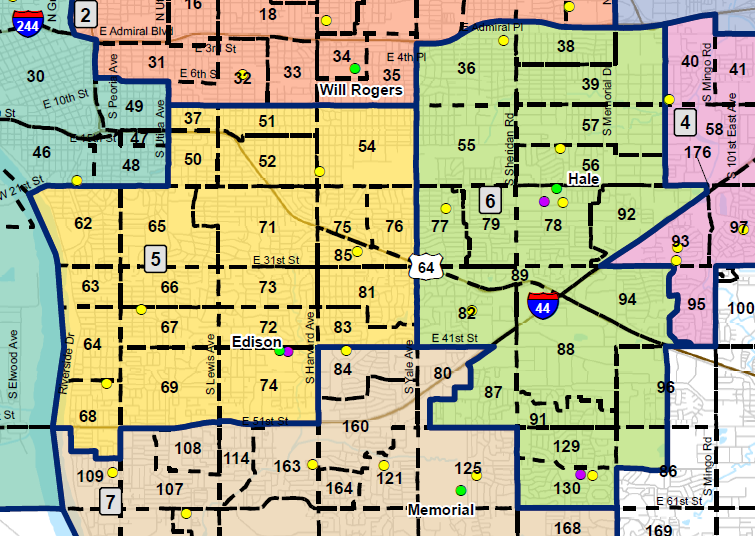
Last time I posted campaign contributions and expenditures for school board races, before the February primary, I had to go to the Education Service Center, to the school district clerk's office, and take photos of the reports. This time, that wasn't going to be possible or advisable, given everyone's desire to minimize contact, so I filed an open records request through the Tulsa Schools website and sent an email directly to district clerk Sarah Bozone. I have yet to receive a reply.
UPDATE 2020/06/29: At 9 a.m. the day before the election, TPS has responded to my open records request. I will not have time to turn these PDFs into a tabulated account of campaign contributions, so you will have to look at them yourselves. I have taken the files provided, given them more meaningful file names, and run them through OCR, but that's it. Each file contains all of the ethics reports filed by the candidate during this campaign.
- District 5: John Croisant
- District 5: Scott Pendleton*
- District 5: Shane Saunders
- District 6: Ruth Ann Fate
- District 6: Jerry Griffin
*Pendleton finished third in the primary. He was the only candidate not advancing to the general who managed to raise and spend enough money to be required to file ethics reports.
I shouldn't even have to ask: When the clerk receives a report, it ought to be immediately scanned in and posted on the district website. Better yet, let's fix the law so that all candidates and campaign committees in the state use the Oklahoma Ethics Commissions's electronic filing system. Currently, county candidates file ethics reports with their county election board, school board candidates file with the district clerk, municipal candidates file with the city clerk. Having one system with a consistent interface and electronic records would serve everyone better -- except perhaps for candidates with something to hide.
Which brings me back to the topic. Knowing that I was unlikely to get a timely reply from the district clerk, I emailed the candidates directly on Tuesday, requesting their ethics reports, asking who had endorsed their campaigns, and asking for their opinion on the plan to extend Superintendent Deborah Gist's contract for an additional three years in a snap vote one week before new school board members would be elected.
All four candidates responded, but only two, Shane Saunders, candidate for Office 5, and Jerry Griffin, the Office 6 challenger, both Republicans, sent me their campaign contribution reports. Office 5 candidate John Croisant and 24-year Office 6 incumbent Ruth Ann Fate, both Democrats, said that they had filed their reports with the district clerks -- a very passive-aggressive response.
Three of the four objected to the school board voting to extend Gist's contract right before the election; Fate, the incumbent, wrote, "I will be making my decision tonight." Only two of the seven school board members, Jennettie Marshall and Stacey Woolley, voted against the contract extension. Next week that vote might have been 4-3 against extension.
Endorsements reported to me by the candidates:
- Tulsa World: Croisant, Fate
- Tulsa Regional Chamber: Saunders, Fate
- Tulsa County Republican Party: Griffin
- American Federation of Teachers: Griffin
Griffin has also been endorsed by John Remington, the third-place candidate in February's primary.
Notable contributors during this reporting period: Shane Saunders received contributions from his erstwhile boss, former Congressman John Sullivan (Saunders served as Sullivan's press secretary), and from former Tulsa Mayor Robert J. LaFortune. Jerry Griffin received a contribution from the Tulsa County Republican Party; parties are allowed to help candidates running in non-partisan elections. Griffin also received a donation from the American Federation of Teachers.
Please read my previous report on the pre-primary contributors to all of the Tulsa School Board candidates, including the two who are refusing to provide BatesLine with copies of their pre-general reports.
Contributors and vendors are from Tulsa unless otherwise noted. If you're reading this on the home page, the lists for each candidate are after the jump.
The only state question on the June 30, 2020, primary ballot is Oklahoma State Question 802. This would create a new Constitutional Amendment, Article XXV-A, requiring the State of Oklahoma to offer Obamacare Medicaid expansion coverage to anyone below a certain income, regardless of the person's work or family status. While expansion brings in some additional federal funds, it also brings in heavy long-term liabilities that the state must meet, which would result in higher taxes, cuts in other state-funded services (e.g. education), or both.
Oklahoma's governor and legislature have rightly rejected Obamacare Medicaid Expansion until now because of the fiscal time bomb it would create. SQ802 was an initiative petition backed by supporters of greater government control and by those who expect to profit from the mandated increases in government payments to healthcare providers. The proposal will drive up medical costs without providing real access to quality care.
OCPA has a Quick Facts on Medicaid Expansion that notes that "Expanding Medicaid in Oklahoma could divert state resources away from Oklahoma's traditional Medicaid population--children, pregnant women, the elderly, and the disabled--and instead favor the newly eligible population of 628,000 able-bodied, working age adults." The second page of the handout offers 10 suggestions for how to expand access to health care without installing a budgetary doomsday machine in Oklahoma's State Constitution.
Oklahomans should also reject SQ802 because a constitutional amendment is not the appropriate vehicle for this type of legislation. A constitution is deliberately difficult to change, and its content ought to be limited to fundamental rules and rights. (I raised this issue in 2016 with regard to SQ792.) This proposed constitutional language is tied to specific sub-sub-subsections of Federal law and regulations, which could change and render this state constitutional amendment a confusing mess. If this language were in state statutes, the legislature could quickly respond to federal changes that might affect Medicaid; SQ802 doesn't permit that flexibility. In all likelihood, courts would step in to reinterpret the amendment, virtually rewriting it to make the mess make some sort of sense. (The severability clause in Section 4 is practically an engraved invitation for judicial interference.)
Currently children, adults with children in the home, the blind and disabled, and senior citizens are eligible for Medicaid in Oklahoma if their income is below a certain level. SQ802 would make anyone below the income threshold eligible for Medicaid, even able-bodied adults who refuse to work. As you'll see below, Section 2(B) doesn't allow Oklahoma to impose more stringent requirements, such as a requirement for able-bodied, young recipients to be working or studying in order to receive this benefit.
Here is the language that would be added to the Constitution of Oklahoma if SQ802 passes.
SECTION 1. DefinitionsAs used in this Article:
A. "Centers for Medicare and Medicaid Services" or "CMS" refers to the agency responsible for administering the Medicaid program at the federal level, including review and approval of State Plan Amendments.
B. "Low Income Adults" refers to those individuals over age 18 and under 65 whose income does not exceed one-hundred thirty-three percent (133%) of the federal poverty level, as described by and using the income methodology provided in the federal Medicaid statute at 42 U.S.C. § 1396a(a)(10)(A)(i)(VIII), and who meet applicable non-financial eligibility conditions for Medicaid under 42 CFR Part 435, Subpart E.
C. "Medical assistance" means payment of part or all of the cost of the care and services, or the care and services themselves, or both, as provided in the federal Medicaid statute, 42 U.S.C. § 1396 et seq.
D. "Oklahoma Health Care Authority" refers to the single State agency responsible for administering the Oklahoma Medicaid program pursuant to 42 U.S.C. § 1396(a)(5).
E. "State Plan Amendment" refers to the document(s) the State submits to the Centers for Medicare and Medicaid Services for review and approval before making a change to the program policies, including setting forth the groups of individuals to be eligible for medical assistance.
Section 2. Medicaid Expansion
A. In addition to those otherwise eligible for medical assistance under Oklahoma's Medicaid program, the State shall provide medical assistance under Oklahoma's Medicaid program to Low Income Adults.
B. No greater or additional burdens or restrictions on eligibility or enrollment shall be imposed on persons eligible for medical assistance pursuant to this Article than on any other population eligible for medical assistance under Oklahoma's Medicaid program.
Section 3. Implementation
A. Within 90 days of approval of this Article, the Oklahoma Health Care Authority shall submit a State Plan Amendment and all other necessary documents to seek required approvals from the Centers for Medicare and Medicaid Services to include Low Income Adults as a coverage group in Oklahoma's Medicaid program beginning no later than July 1, 2021.
B. The Oklahoma Health Care Authority shall take all actions necessary to maximize federal financial particpation in funding medical assistance purusant to this Article.
Section 4. Severability
The provisions of this Article are severable, and if any part or provision hereof shall be void, invalid, unconstitutional, the decision of the court so holding shall not affect or impair any of the remaining parts or provisions hereof, and the remaining provisions hereof shall continue in full force and effect.
The Oklahoma Council of Public Affairs has a great deal of research and analysis on the fiscal hazards of Obamacare Medicaid Expansion. Most recently, OCPA policy research fellow Kaitlyn Finley points to tax increases in 13 other states to fund Medicaid expansion:
According to a tally by Governing Magazine last year, 13 states have had to raise taxes, fees, or cut provider rates to fund their state portion of expansion costs. North Dakota cut payment rates to Medicaid providers. California passed a provider tax on hospitals and cigarette sales. Oregon put another tax on health insurance plans and hospitals. Other states like Kentucky and Arkansas have pursued charging premiums and implementing work requirements to make up for program shortfalls.Although these states' plans to tax hospitals to pay for expansion may seem like an additional financial drain on emergency care providers, in reality, many "nonprofit" hospitals have jumped at the chance to take on this financial "burden" because hospitals may increase their profits thanks to the tax.
Note that while some states have "pursued... implementing work requirements" to reduce the fiscal damage of Obamacare Medicaid Expansion, the authors of SQ802 want to cut off that possibility for Oklahoma.
MORE: State Rep. Mark Lepak sets out the fiscal dangers that Medicaid Expansion would bring, increasing the burden on a budget already strained to its limits by CCP Bat Virus:
Proponents point out that we will bring our federal dollars home with a 9-to-1 federal-to-state match. True statement. However, they also claim the expansion population will be about 200,000 people, costing about $200 million. Actually, up to 628,000 will be eligible, with a price tag over $370 million. When "free health care" is advertised, what should we anticipate from the eligible? And those numbers are just first-year expenses that don't contemplate the rising costs of health care, nor the federal government's habit of shifting costs to the states.Consider our experience with the existing Medicaid program. From 2003 to 2018, Oklahoma's share of Medicaid expenses grew from $715 million to $2.2 billion. At the same time, we went from 649,000 enrollees to more than a million. We're spending three times as much for less than twice the people. Furthermore, in 2003, Oklahoma was responsible for 29.9% of its Medicaid costs. In 2018, that number was 41.8%. With that track record, the 9:1 match from the feds will become 8:2, then 7:3, and so on. With an increasing federal debt and deficit spending, does anyone think they won't continue to shift more and more costs to the states in the future?
MORE: Both Republican candidates for Senate District 37 are saying they'll vote yes, but SQ 802 will damage budgets for both the Federal Government and the State of Oklahoma. Wish they could both lose:
Emerson, who is married with nine children, is voting for State Question 802, Medicaid expansion, which also appears on the June 30 ballot.But he said it is important to note that it will increase the federal deficit.
Rogers, who is married with five children, also is supporting SQ 802, but said he doesn't see how the state will be able to afford it, especially given the current budget situation in which state revenues are on the decline.
RELATED: Ray Carter of the Center for Independent Journalism reports that some voters are receiving mailers with a subtext that the voter will be named and shamed if they don't vote in the upcoming election. I have read comments on social media that so far only Democrats and Independents have received these mailers. I surmise that backers of SQ802 are afraid that, with few interesting Democrat primaries on the June 30 ballot, pro-big-government voters who would be inclined to vote yes on 802 won't bother to go to the polls.
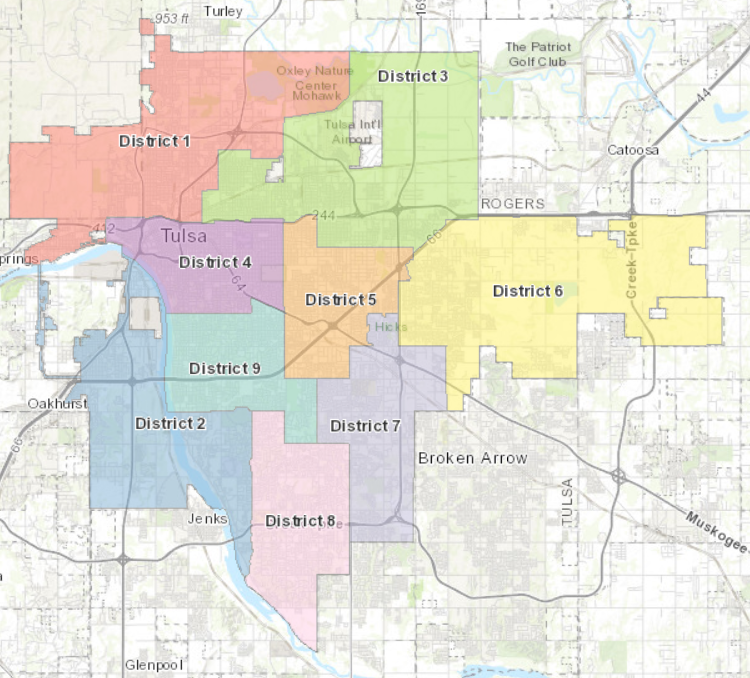
I will be updating this entry as new information becomes available.
MIDDAY UPDATE:
Two more candidates have filed for mayor this morning: Gregory Robinson II, a Democrat, who was introduced at his Election Board press conference by Dr. Tiffany Crutcher, and Craig Immel, an Independent, who was the lead plaintiff in the battle to keep park land on Riverside Drive from being turned into a shopping center that might possibly someday have an REI-type store in it.
As previously announced, incumbent Democrat District 1 City Councilor Vanessa Hall-Harper has filed for re-election. She has one opponent so far, Jerry Goodwin, also a registered Democrat.
Auditor Cathy Champion Carter and City Councilors Jeannie Cue, Crista Patrick, Cass Fahler, and Phil Lakin remain unopposed as of noon Wednesday.
No other new filings as of noon today. Candidates must file a notarized declaration of candidacy along with a $50 cashier's check or 300-signature petition at the Tulsa County Election Board, 555 N. Denver Ave., by 5 pm, today, Wednesday, June 10, 2020.
CLOSE OF FILING:
Two more candidates, Republican Ty Walker and Democrat Ricco Wright, filed for Mayor Wednesday afternoon, bringing the total number of candidates to eight.
City Auditor Cathy Champion Carter and two city councilors, Jeannie Cue (District 2) and Phil Lakin (District 8), failed to draw an opponent and have been reelected to another two-year term.
Two previously unopposed incumbents now have opposition. Paul Eicher, a Democrat, will face District 3 councilor Crista Patrick. Republican District 5 councilor Cass Fahler drew four opponents during the final hours of filing, all of them Democrats in their 30s, including 2018's second-place finisher Michael William Arthrell-Knezek aka Mykey Arthrell.
Kathryn Lyons, a Republican, filed in District 4, and Cheyenna Morgan, a Democrat, filed in District 6. Both districts have Democrat incumbents.
The names, ages, and addresses below are from the Tulsa County Election Board's official list of Monday filings. I've added incumbent status, registered voter name in brackets if it differs from the name used for filing, and party affiliation, which I checked against the current voter registration database.
Mayor
GT Bynum, 42, 3607 S. Florence Ave, Tulsa, OK 74105, incumbent, Republican
Paul Tay, 57, 415 W Archer, Tulsa, OK 74103, Independent
Ken Reddick, 37, 5008 S 85th East Ave, Tulsa, OK 74145, Republican
Zackri Leon Whitlow, 39, 2951 W 66th St, Tulsa, OK 74132, Democrat
Craig Immel, 44, 1739 West Newton Street, Tulsa, OK 74127, Independent
Gregory C. Robinson II, 30, 2307 E 29th Pl N, Tulsa, OK 74110, Democrat
Ty [Tyron Vincent] Walker, 54, 8538 E 24th St, Tulsa, OK 74129, Republican
Ricco Wright, 38, 1913 N Santa Fe Place, Tulsa, OK 74127, Democrat
Council District 1
Jerry [James G] Goodwin, 57, 2406 W. Pine Pl., Tulsa, OK 74127, Democrat
Vanessa Hall-Harper, 48, 2020 West Newton Street, Tulsa, OK 74127, incumbent, Democrat
Council District 2
Jeannie Cue, 5313 S 32 Pl W, Tulsa, OK 74107, incumbent, Republican
Council District 3
Crista Patrick, 46, 1918 N. Joplin Ave., Tulsa, OK 74115, incumbent, Democrat
Paul Eicher, 31, 509 S 76 East Ave, Tulsa, OK 74112, Democrat
Council District 4
Kara Joy McKee, 41, 1119 S Quebec Ave, Tulsa, OK 74112, incumbent, Democrat
Landry Miller, 26, 221 N Union Ave, Tulsa, OK 74127, Democrat
Casey Robinson, 38, 1260 E 29th Pl, Tulsa, OK 74114, Republican
Kathryn Lyons, 53, 2831 E 28th St., Tulsa, OK 74114, Republican
Council District 5
Cass [Cassidy G] Fahler, 47, 7383 E 24th St, Tulsa, OK 74129, incumbent, Republican
Mykey Arthrell [Michael William Arthrell-Knezek], 35, 1747 S Erie Pl, Tulsa, OK 74112, Democrat
Justin Schuffert, 35, 2216 S. 78th E. Ave, Tulsa, OK 74129, Democrat
Rachel Shepherd, 30, 5719 E. 30th St, Tulsa, OK 74114, Democrat
Nat Wachowski-Estes, 34, 1213 S 87th E Ave, Tulsa, OK 74112, Democrat
Council District 6
Christian Bengel, 52, 13173 E. 29th Street, Tulsa, OK 74134, Republican
Connie Dodson, 53, 13302 E. 28th St., Tulsa, OK 74134, incumbent, Democrat
Cheyenna Morgan, 29, 9 South 185th East Avenue, Tulsa, OK 74108, Democrat
Council District 7
Chad Ferguson, 40, 6751 S. 71st East Avenue, Tulsa, OK 74133, Republican
Justin Van Kirk, 29, 10709 E 100 Pl, Tulsa, OK 74133, Republican
Lori Decter Wright, 45, 8706 E 86th St, Tulsa, OK 74133, incumbent, Democrat
Council District 8
Phil [Philip Lawrence] Lakin Jr., 52, 9808 S. Knoxville Avenue, Tulsa, OK 74137, incumbent, Republican
Council District 9
[Bobbie] Leeann Crosby, 36, 3845 South Madison Ave, Tulsa, OK 74105, Democrat
Jayme Fowler, 61, 5601 S Gary Ave, Tulsa, OK 74105, Republican
City Auditor
Cathy Champion Carter, 65, 4120 E 22nd Place, Tulsa, OK 74114, incumbent, Democrat
UPDATED to include Justin Van Kirk and Jayme Fowler, whose names I overlooked when initially composing this report. UPDATED again to include information from Zackri Leon Whitlow and Landry Miller about their voter registration.
I've made this plea repeatedly on social media, on Pat Campbell's show on 1170 KFAQ, and here on this blog. And yet I look at the list of candidates after two of the three days of the filing period, and I am amazed to see so many unopposed candidates. Four of the city councilors do not have opponents, nor does the city auditor.
It's especially surprising after a fortnight that has put the spotlight on the importance of city government. Questions of law and order, police protocols and accountability are at the top of everyone's minds, and these questions are answered by our city council and mayor. Providentially, while we're all thinking about the importance of municipal policy, we have the greatest opportunity to make a difference, because it's filing period for city offices.
We only get to choose a new mayor once every four years, and now is the time to make sure there's someone on the ballot that you'd be happy to vote for. We only get to choose a new auditor and councilors every two years. There seems to be a lot of discontent, from across the political spectrum, with Tulsa City Hall, and I'd have thought that that discontent would burst forth this week in an outpouring of candidates for city office.
Do people still believe in elections? It looks like the protesters that blocked interstates and arterial streets don't. Instead of trying to elect a new mayor and councilors who are in agreement with their aims, to have a real seat at the table, it appears that the protesters' plan is to continue to protest, presumably in hopes that the existing mayor and council, whatever they may personally believe, will be inspired or intimidated by the protests into adopting the protesters' platform.
Perhaps because the news media loves the drama of protest and civil (or uncivil) disobedience more than the slog of legislation and debate, mass protests caught the public imagination as the way to effect change. Even the venerable Atlantic magazine is talking about "toppling" President Trump, as if we didn't have a presidential election in five months. Protesters in the US and the UK are defacing monuments and demolishing statues, as if it were impossible to enact the removal of offensive monuments through the ordinary processes of representative government.
You've heard the marchers' chants: "This is what democracy looks like!" No, this is what ochlocracy looks like. Democracy looks like people knocking doors for candidates, casting ballots, and sitting around committee tables poring over budget books.
In February 2020, the City Council voted 5-3 against putting a charter amendment on the ballot to create an Office of Independent Monitor (OIM) to review use of force cases by the police. Councilors Vanessa Hall-Harper (District 1), Kara Joy McKee (District 4), and Lori Decter Wright (District 7) were the only votes in support of putting Mayor Bynum's proposal on the ballot. All three have drawn opponents.
Councilors Jeannie Cue (District 2), Crista Patrick (District 3), Connie Dodson (District 6), Phil Lakin (District 8), and Ben Kimbro (District 9) voted against the OIM charter change, and Cass Fahler (District 5), who was absent, had voiced opposition to the proposal. Kimbro isn't running again, but only one of the other five (Dodson) has drawn an opponent. Only two candidates have bothered to file for the open District 9 seat.
Marlin Lavanhar, senior pastor of All Souls Unitarian Church, has drawn a couple of scathing cartoons critical of Mayor Bynum's response to the protests. So where is the challenger to Bynum from the left side of the spectrum?
I've checked a few names prominent in the protests and found that some of them are registered to vote in these districts whose councilors are opposed to their goals. If I dug further, I suspect I'd find that there's a leading protester in each one of these council districts. Why aren't they using their youth, enthusiasm, and energy to run for a real seat at the table, instead of being satisfied with scraps?
So who are the candidates who have already filed? Let's start with a look at the mayoral candidates.
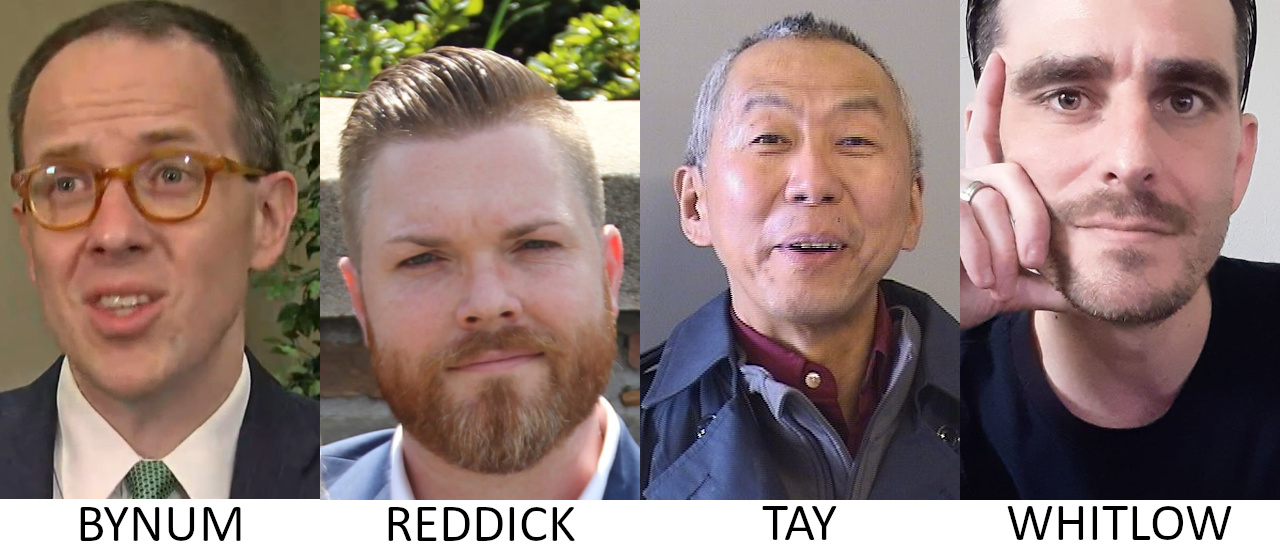
GT Bynum is running for a second term. A professional schmoozer in one form or another for his entire career (Senate staff assistant, public relations, corporate communications, governmental affairs, lobbyist), Bynum IV is clearly in over his head, particularly now that the job demands tough decisions, not just ribbon-cutting and pious virtue signalling. Michael Mason has documented Bynum's deep ties to billionaire George Kaiser. In the words of New York Times writer Cassidy McDonald, "Kaiser has turned Tulsa into 'beta city,' U.S.A," a guinea pig for his social experiments, which are grounded in the materialistic worldview set out in his "Giving Pledge." However noble, Mr. Kaiser's intentions, Tulsans should not give him carte blanche to direct city resources to carry out his private philanthropic aims. Tulsans need elected officials who are not beholden to a billionaire who seems to see us as lab rats.
Ken Reddick is running as a conservative Republican and has already been campaigning for a few months. After many years as a manager for an electrical utility contractor and as an electrician, Reddick now has his own business managing projects for contractors in the utility and electrical fields, helping them to streamline processes and find efficiencies. Reddick ran a credible special election race for District 7 City Councilor in November 2018, but conservative support was divided among several candidates.
Paul Tay, who has run many times for mayor and city council, and made an infamous cameo appearance at the 2016 RSU-TV mayoral debate between incumbent Mayor Dewey Bartlett and challenger GT Bynum, was released Monday after five months in the Tulsa County Jail for outraging public decency. I won't repeat the specifics of his crime, for which he was convicted in a jury trial in January, but the state's witness list and the judge's instructions to the jury will tell you more than you wanted to know. Tay also has felony charges pending for possession of a stolen vehicle and violation of a protective order. When I first met him, way back in 1998, he had some cogent thoughts on urban planning and bicycles, but there's nothing cogent about his increasingly bizarre behavior. On his declaration of candidacy, Tay listed the Day Center for the Homeless as his place of residence, contrary to his voter registration address.
The fourth candidate, Zackri Leon Whitlow, doesn't appear in the voter registration database at all. Whitlow shows up on LinkedIn, Facebook, and IMDb. It appears that he is an insurance agent and broker, and that his agency may have been located in California, in Langley, Oklahoma, and now in Tulsa. It appears that he served as a butler at the Playboy Mansion, credited with an appearance on the reality series based there, "The Girls Next Door." I haven't found anything indicating his views on city issues.
City Auditor Cathy Champion Carter (formerly Cathy Criswell) is still unopposed. She has held the post without a challenger since her first election in 2013, when she defeated appointed incumbent Clift Richards and Josh Lewis. If the listing of internal audit reports on her City Auditor website is complete, Tulsa hasn't had a sensitive payments audit since FY 2017, and the pace of internal audits in general has slowed considerably over the past few years. It was the intention of the framers of our City Charter that the city auditor should be an "anti-mayor," acting as a whistleblower on abuse and corruption. Instead, Carter continues to follow the pattern set by Phil Wood, the first city auditor under the 1989 charter, quietly churning out reports but doing little or nothing to call attention to her team's findings, findings that might uncover inefficiency, waste, or even corruption.
If you're wondering whether or not to file, go for it. Every councilor should have a challenger. After filing closes at 5 pm Wednesday afternoon, you've got two days to investigate and speak with the other candidates who have filed, and if you'd rather back one of the other candidates you can withdraw by 5 pm Friday and take your name on the ballot. But let's at least make sure that every voter has good choices in every office and district.
At the end of the second of three days of candidate filing for the 2020 City of Tulsa elections, the incumbent mayor, auditor, and seven of the nine incumbent city councilors have filed for re-election, with Mayor GT Bynum IV drawing three opponents and incumbent Democratic Councilors Kara Joy McKee (District 4) and Councilor Lori Decter Wright (District 7) each drawing two opponents. Five council seats and the auditor's office have only one candidate each. Incumbent Democrat councilors Connie Dodson (District 6) has also drawn a Republican opponent. Republican District 9 councilor Ben Kimbro is not running for re-election; two candidates have filed thus far for that seat. Democrat District 1 Councilor Vanessa Hall Harper has confirmed to BatesLine that she will file tomorrow; Jerry Goodwin has already filed as a challenger for the seat.
Three candidates may have issues with their voter registrations, or lack thereof. District 4 candidate Landry Miller is not in the current state election board voter registration database as of noon today. Perennial mayoral candidate Paul Tay is registered to vote at 6104 N. Boulder, which does not match the residential or mailing address (both 415 W. Archer St., the Day Center for the Homeless) he supplied on his declaration of candidacy. The voter registration database also does not have a record for mayoral candidate Zackri Leon Whitlow; there is someone with a similar name and age registered to vote at a different address.
(UPDATE 2020/06/10: Zackri Whitlow responded to my inquiry about his voter registration: "I just submitted my Tulsa Voter Registration on Friday. I am an Oklahoma Native but had moved to California back in 2006. I was last registered in Riverside County and that should be in the process of them transitioning my new Voter Registration to Tulsa County." Whitlow says he has registered in Oklahoma as a Democrat. Landry Miller responded to my inquiry: "I am registered in District 4, under my current address. This was only recently changed because I hopped around Tulsa for a while trying to find the perfect spot to live. So therefore my previous registration was in Rogers County, where I waited to update my registration until March, so I could still vote in the presidential primaries (in Rogers County).")
In addition, four candidates -- Jerry Goodwin, Cass Fahler, Phil Lakin, and Leeann Crosby -- have filed under names that do not match their voter registration records. While state law permits a candidate to specify a ballot name that differs from their legal name, both of which are specified on a declaration of candidacy for state office, the Tulsa City Charter does not. In the past, I can recall a number of occasions where a city candidate's full name (including middle name and suffix) appeared on the ballot, even if it differed from the name by which the candidate was popularly known. This 2009 City of Tulsa primary ballot for Mayor and Council District 8 has middle names for almost all of the candidates.
This name-matching requirement seems to have motivated candidates to change their voter registration. For example, the mayor is registered as last name "Bynum," first name "G T," which allows his name to appear as "G T Bynum" on the city ballot, even though that would appear to be in violation of the section of law (26 O.S. 4-112) that requires each voter to register with his full name, in his case, George Theron Bynum IV.
The Tulsa City Charter, Article VI, Section 3.1, requires, "Any person who desires to be a candidate for a City office shall file with the Election Board of Tulsa County or its successor a Declaration of Candidacy which shall contain: A. The name and residence street address of the person as it appears on the voter registration records;...." A candidate who has provided a name and address combination that doesn't match a voter registration record for an address in the City of Tulsa would be in violation of that charter provision.
A candidate with an invalid declaration of candidacy could have his candidacy contested by an opposing candidate or, if no other candidate has filed, by any eligible voter registered to vote for the candidate. Contests must be filed by 5 p.m. Friday with a $250 deposit. Contests are governed by Title 26, Chapter A1, Article V of Oklahoma Statutes, sections 118 to 131. Section 117 states that the relevant election board can reject a Declaration of Candidacy "which on its face shows that the candidate does not meet the qualifications to become a candidate for the office set forth as contained in the Oklahoma Constitution, statutes or resolution calling the election."
Filing continues for one final day, tomorrow, Wednesday, June 10, 2020 at the Tulsa County Election Board, 555 N. Denver Ave., Tulsa, from 8 a.m. to 5 p.m. More about the filing and election process here.
The names, ages, and addresses below are from the Tulsa County Election Board's official list of Monday filings. I've added incumbent status, registered voter name in brackets if it differs from the name used for filing, and party affiliation, which I checked against the current voter registration database.
Mayor
GT Bynum, 42, 3607 S. Florence Ave, Tulsa, OK 74105, incumbent, Republican
Paul Tay, 57, 415 W Archer, Tulsa, OK 74103, Independent
Ken Reddick, 37, 5008 S 85th East Ave, Tulsa, OK 74145, Republican
Zackri Leon Whitlow, 39, 2951 W 66th St, Tulsa, OK 74132, Democrat
Council District 1
Jerry [James G] Goodwin, 57, 2406 W. Pine Pl., Tulsa, OK 74127, Democrat
Council District 2
Jeannie Cue, 5313 S 32 Pl W, Tulsa, OK 74107, incumbent, Republican
Council District 3
Crista Patrick, 46, 1918 N. Joplin Ave., Tulsa, OK 74115, incumbent, Democrat
Council District 4
Kara Joy McKee, 41, 1119 S Quebec Ave, Tulsa, OK 74112, incumbent, Democrat
Landry Miller, 26, 221 N Union Ave, Tulsa, OK 74127, Democrat
Casey Robinson, 38, 1260 E 29th Pl, Tulsa, OK 74114, Republican
Council District 5
Cass [Cassidy G] Fahler, 47, 7383 E 24th St, Tulsa, OK 74129, incumbent, Republican
Council District 6
Christian Bengel, 52, 13173 E. 29th Street, Tulsa, OK 74134, Republican
Connie Dodson, 53, 13302 E. 28th St., Tulsa, OK 74134, incumbent, Democrat
Council District 7
Chad Ferguson, 40, 6751 S. 71st East Avenue, Tulsa, OK 74133, Republican
Justin Van Kirk, 29, 10709 E 100 Pl, Tulsa, OK 74133, Republican
Lori Decter Wright, 45, 8706 E 86th St, Tulsa, OK 74133, incumbent, Democrat
Council District 8
Phil [Philip Lawrence] Lakin Jr., 52, 9808 S. Knoxville Avenue, Tulsa, OK 74137, incumbent, Republican
Council District 9
[Bobbie] Leeann Crosby, 36, 3845 South Madison Ave, Tulsa, OK 74105, Democrat
Jayme Fowler, 61, 5601 S Gary Ave, Tulsa, OK 74105, Republican
City Auditor
Cathy Champion Carter, 65, 4120 E 22nd Place, Tulsa, OK 74114, incumbent, Democrat
UPDATED to include Justin Van Kirk and Jayme Fowler, whose names I overlooked when initially composing this report. UPDATED again to include information from Zackri Leon Whitlow and Landry Miller about their voter registration.
In addition to the high-stakes presidential race, the City of Tulsa has its own high-stakes elections this year. All nine Tulsa City Councilors and the Tulsa City Auditor are on the ballot every two years, but in presidential years, the Mayor's office is also up for grabs. Filing period begins Monday, June 8, 2020, and ends Wednesday, June 10, 2020. Candidates file in-person at the Tulsa County Election Board, 555 N. Denver (in the old Marina-style Safeway building), between the hours of 8 a.m. and 5 p.m. daily.
I'll stick to the nuts and bolts in this item; later I hope to explain why Tulsans should want to run for office and change the personnel running our city government.
Filing involves filling out a declaration of candidacy, getting it notarized, and presenting it at the county election board with a cashier's check for $50 for the filing fee. The filing fee is really a deposit, intended to deter frivolous candidates: If you get more than 15% of the vote when your name first appears on the ballot, or if you're unopposed, you get the cashier's check back. In lieu of the filing fee, you have the option of filing a petition signed by 300 registered voters in your election district if you're running for council, or city-wide if running for Mayor or Auditor. The information packet with all the forms, including the declaration of candidacy and all ethics disclosure forms, is on the Tulsa County Election Board website.
City elections are governed by Article VI of the City Charter. Council races are run by district. Our council districts were gerrymandered in 2012 evidently with the intent of eliminating then-Mayor Dewey Bartlett's harshest critics. The lines will be redrawn next year following the publication of the 2020 census results by a five-person committee appointed by the mayor and confirmed by the City Council. If the next council consists of the mayor's yes men, the mayor will be able to redraw the district lines to benefit his most loyal councilors.
To find your district, consult the Oklahoma Voter Tool, or use the city's interactive map, or consult this set of static maps, showing the precincts contained within each council district.
Tulsa's municipal elections are non-partisan, and the process has changed since the last mayor's election in 2016, going from three stages to two. The August 25, 2020, election is considered a general election. (The same date is used for runoffs for candidates for Federal and State Legislative offices.)
If two candidates are running for an office, the candidate receiving the most votes at the August election wins. If more than two candidates are running, the number of top candidates whose votes total at least 50% advance to a runoff on November 3, 2020, the same date as the general election for U. S. President, Senator, Congressmen, and state legislators.
To give you an idea of how this would work, suppose the top two candidates for Mayor fell short of 50% of the vote combined in a very evenly divided race.
Candidate A 25%
Candidate B 23%
Candidate C 14%
Candidate D 11%
Candidate E 10%
Candidate F 9%
Candidate G 8%
If these were a regular Oklahoma primary, only Candidates A and B would advance to the November runoff, but because their combined total falls short of 50%, one more candidate, C, would advance. Because A, B, and C's vote share exceeds 50% (62%) only those candidates will advance to November. This is a highly unlikely spread, except perhaps in a race for an open seat; in most cases, it will simply be the top two candidates advancing to the November runoff.
If you're unhappy with a mayor who makes concessions without consulting all stakeholders involved in a decision, if you're unhappy with a mayor who refuses to enact a curfew to protect Tulsa residents and businesses, if you're unhappy with a council that fails to hold the mayor accountable, if you're unhappy with councilors who break their promises to constituents who are facing the destruction of their homes by eminent domain, if you're unhappy that most of our elected officials are beholden to a billionaire who sees Tulsa as a lab rat for social experimentation, you ought to consider running for office. We can't have change unless we have different candidates to choose from.
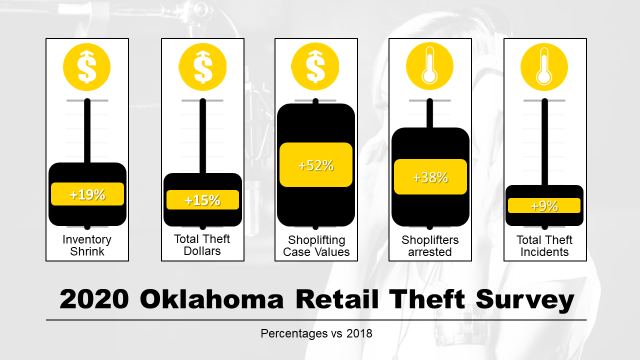
The Oklahoma Retail Crime Association issued its annual retail theft survey today, noting "massive spikes in both the numbers of losses due to theft and the amounts taken" for Oklahoma retailers.
Already hard-hit by the growth of online sales and the (hopefully temporary) impact of coronavirus, retailers don't need the state legislature to add insult to injury by discarding the tools to deter systematic theft.
We aren't talking about Javert relentlessly pursuing Jean Valjean for stealing a crust of bread to feed his starving family. We're talking about organized crime gangs who consider fines and brief imprisonments just the cost of doing business, and who are taking the bread out of the mouths of retail workers and their families.
The Facebook page Repeal SQ780 is a good source for stories on the impact of reducing penalties for so-called "non-violent crimes," such as shoplifting, burglary, and car break-ins. The page recently linked to a infographic showing that the loss amount from the average "pushout" theft -- when someone simply pushes a cart out the door without paying -- for our region doubled last year, from $778 in 2018 to $1544 in 2019. 59.5% of pushout robberies involved organized retail crime, and 10% involved violence against store personnel.
Here is the press release from the OKRCA:
The Oklahoma Retail Crime Association (OKRCA) has completed the 2020 Oklahoma Retail Theft Survey - which draws on retailer's internal theft data, as opposed to just numbers reported to law enforcement.Once again, Oklahoma retailers saw massive spikes in both the numbers of losses due to theft and the amounts taken.
Oklahoma retailers are also reporting increased violence against store personnel.
According to OKRCA President, Norm Smaligo, "Retailers from around the country want to know why their theft rates in Oklahoma are so much higher than other states they operate in. I have to point to our laws and the permissive attitude the courts take towards retail theft."
"Organized Retail Crime (stealing for profit) has exploded here in recent years, because of our loosening of penalties for theft and our failure of our laws to address the people who steal for a living and those that sell it for them."
According to the most recent National Retail Federation (NRF) Organized Retail Crime survey, states that have raised felony theft limits have seen increases in theft activity. [Here is the complete National Retail Federation Organized Retail Crime Survey.]
In Oklahoma this effect is amplified by the fact that Oklahoma law allows cities to prosecute these 'misdemeanor crimes' as a municipal infraction similar to a speeding ticket. This hardly serves as a deterrent to criminal activity.
Smaligo said: "This year's survey just builds on the bad numbers we saw last year. We're seeing increased thefts, increased amounts and increased violence against our people. Retailers are begging for help. Our legislators at some point are going to have to decide: Do they want to help tax producing businesses lose less, or do they want to help criminals steal more?"
Smaligo said there are currently three bills pending before the Oklahoma legislature that they hope will help curtail some of the theft activity: Senate Bill 1587 would allow law enforcement to aggregate multiple larcenies over a one year period as opposed to the current 90 days - which Smaligo said is less time than it takes for an arrest warrant to be issued in many cases.
Senate bills 1689 and 1691 would prohibit Pawn Shops from buying fraudulently obtained gift cards and new-in-box items stolen from stores without some proof of purchase, such as a receipt.
According to Smaligo - the easy cash that criminals receive for selling these items is what is driving most of the theft activity. "They're not stealing four power tool kits for personal use! They're selling them within minutes of stealing them".
Norm Smaligo is the President of the Oklahoma Retail Crime Association - a group of retailers and law enforcement working together to identify and prosecute Organized Retail Crime offenders in this state.
Smaligo can be reached for comment at:
nsmaligo@gmail.com
or
(918)698-2626
After the jump, the text of the report itself.
Mark McBride, a Republican Oklahoma state representative from Moore who touts himself as a "lifelong conservative Republican" and founder and president of a mission organization, has been accused of directing a fusillade of obscene verbal abuse at a think-tank president who was walking through the State Capitol.
In a recent news release promoting the OCPA's new legislative scorecard, Jonathan Small, president of the Oklahoma Council of Public Affairs, reports that McBride "flipped him off" as Small passed by a committee room. Small says that McBride then summoned Small into the committee room and proceeded to unleash a barrage of obscenities at Small in front of several other people.
At the beginning of the 2020 legislative session, the Oklahoma Council of Public Affairs announced that we would produce a legislative scorecard to be updated throughout the session.The OCPA board of trustees and staff came to realize that there wasn't an easy-to-use guide for constituents to understand just how their lawmakers are voting on issues related to free markets, limited government, individual initiative, and personal responsibility. So we decided to change that.
At the beginning of the legislative session, we launched our new Legislative Scorecard, which can be found at scorecard.ocpathink.org. In addition to the scorecard itself, we released a watch list of bills that are eligible to be included on the scorecard. You can view the watch list at ocpa.co/WatchList.
Check out the live scorecard and share it with your family and friends, it even has an easy-to-use locator so anyone can easily find their lawmaker.
The scorecard has already had major impact.Early this session, a horrific bill popped up on the House Calendar, House Bill 1230 (HB1230). In short, while touted as a "transparency bill" it actually commands government bureaucrats to violate the privacy of families and students who use the Lindsey Nicole Henry Scholarship, including students with special needs and disabilities. The bill easily can be interpreted to require students and families to waive rights to privacy, normally afforded to most other students, in order to participate in the program in the future.
OCPA sent repeated notices to lawmakers that HB1230 would be scored negatively.
You need to know about something. Just a little over two weeks ago, the day after the vote on HB1230, I was at the state capitol building. As I was walking on the 4th floor of the Capitol, I passed a committee room. In the room were several people and a lawmaker who was sitting in a chair facing the doorway. The lawmaker was State Representative Mark McBride, author of HB1230.
As I walked by the door, I was surprised when I saw that State Representative Mark McBride slightly raised his hand from his lap and flipped me off.
After being flipped off by State Representative Mark McBride, it appeared State Representative Mark McBride motioned for me to go in the room to talk to him. As I got close to his chair, with others sitting around and in a voice so others could hear, State Representative Mark McBride then began to cuss at me profusely. His words included saying I was the "F..." word at least twice, calling me a piece of "S..." twice, saying I was worthless twice, referring to me as a derogatory word for male genitalia twice, and twice telling me to "scat" like I was some sort of animal. Also included in his personal, verbal, and public attack on me was his criticism of OCPA for opposing HB1230.Our hope is that Oklahomans will utilize the scorecard to remain informed and involved in the legislative process, while also holding politicians accountable.
Thank you,
Jonathan Small
Oklahoma Council of Public Affairs
President
McBride currently has a score of 35 on the OCPA scorecard out of a possible 100. The lowest score for any Republican is 29.
Rep. McBride boasts on his House web page that he is "the Founder and President of Thousand Hills Mission - a non-profit organization dedicated to providing agricultural and veterinary assistance to the people of developing and Third World countries." Guidestar shows the most recent IRS Form 990 as filed for the 2013 tax year, and that the IRS non-profit ruling was issued in 2012. The earliest 990 that Guidestar has is from 2011, and it shows fundraising back to 2007. Here are the annual fundraising totals shown on the 2011-2013 IRS Form 990s.
2007: $24,409
2008: $50,343
2009: $27,019
2010: $24,409
2011: $72,814
2012: $10,730
2013: $8,030
The expenses for the 990s provided seem to cover travel for one or two people and veterinary supplies. The organization reported no paid employees.
I'm reminded of an experience I had back in March 2004, when I took a camcorder to capture the Tulsa City Council "pre-meeting" which was held in the library of the council offices an hour before the official meeting and which dealt with the agenda for the main meeting. My presence there triggered an obscene outburst against me from a City Council staffer.
In the future, I suggest that Mr. Small and his OCPA colleagues wear GoPro cameras when they walk through the Capitol. They may capture some insights into the character of our legislators that aren't fully evident in voting records and campaign websites.
Postdated to remain at the top of the blog until the polls close at 7 p.m.
Today, March 3, 2020, is the Oklahoma presidential preference primary. Oklahoma is one of 14 states (Alabama, Arkansas, California, Colorado, Massachusetts, Maine, Minnesota, North Carolina, Oklahoma, Tennessee, Texas, Utah, Virginia (Democrats only), and Vermont) holding a presidential primary on "Super Tuesday." American Samoa Democrats will also hold a territorial caucus on Tuesday.
Super Tuesday came into existence in 1988, driven by southern Democrats. After a win in the post-Watergate election of 1976, with a ticket headed by former Georgia governor Jimmy Carter, Democrats were wiped out in 1980, as Reagan beat Carter, and again in 1984, as Reagan won 49 states against former VP Walter Mondale. The worry was that the early states (Iowa and New Hampshire) tilted the playing field in the liberal direction, resulting in a liberal nominee.
The Democrats' practice of "superdelegates" was another reform aimed at the electability problem that traces back to the reforms prior to the 1972 convention. The idea was that Democrats who had actually been elected office would help shift the convention and the selected nominee in a more centrist direction than Democrat primary voters left to their own devices.
The hope was that a Southern regional primary early in the process would encourage the nomination of a Southern moderate who could win in November. Oklahoma's Democratic governor and legislative majorities went along with the plan; previously, both major parties used the caucus and convention system to elect national delegates from Oklahoma. As it happened, of the 13 Southern states voting, Jesse Jackson won the four Deep South states (LA, MS, AL, GA) plus Virginia, Al Gore won five border states (OK, AR, TN, KY, NC), Michael Dukakis won Florida and Texas, and Dick Gephardt won his home state of Missouri. Dukakis's wins in the south, plus success in his home region of New England, killed Gore's electability argument.
(Virginia Republicans will not hold a primary but will use the caucus and convention process: County and Independent City Republican parties will elect delegates to the Congressional District and State GOP Conventions, and the CD and State Conventions will elect delegates to the Republican National Convention. All of Virginia's 48 delegates will be pledged to the candidate winning the presidential preference vote of delegates at the Virginia State Republican Convention.)
In Oklahoma, each political party may opt to allow voters not registered with a party to vote in their primary. For 2020 the Oklahoma Democratic Party is allowing independents to vote in their primaries; the Republican and Libertarian party primaries will be open only to voters registered with the respective party.
Oklahoma Democrats will have 15 candidates to choose from, all mainstream enough to earn a spot on a debate stage at some point. They're shown below in the order in which they filed for the primary back in December.
- Tulsi Gabbard
- Amy Klobuchar
- Elizabeth Warren
- Bernie Sanders
- Kamala Harris
- Pete Buttigieg
- Andrew Yang
- Deval Patrick
- Michael R. Bloomberg
- Tom Steyer
- Joseph R. Biden
- Michael Bennet
- Marianne Williamson
- Julián Castro
- Cory Booker
Only five are still actively campaigning: Gabbard, Warren, Sanders, Bloomberg, and Biden. (Klobuchar, Buttigieg, and Steyer dropped out after poor showings in South Carolina last Saturday.) All of the Democratic candidates take an extreme position in support of abortion. They all support greater intrusion of the federal government into every aspect of life. Each of the Democratic candidates wants Christians either to bow down before the gods of the Sexual Revolution, or have the Federal Government destroy their businesses, their professional careers, their schools, their churches, their private organizations. None of them are "moderate." Given the number of conservative rural Oklahomans who are still registered as Democrats, a candidate that, say, supported private spaces and protected athletic opportunities for women, opposed late term abortion, supported robust protections for religious liberty, and sensible policies on immigration and trade -- someone like Louisiana governor John Bel Edwards -- would do very well in the Oklahoma Democratic primary.
Although you can still vote for any of the candidates on the ballot, a candidate needs at least 15% of the vote in a congressional district or statewide to get any delegates at all. In South Carolina, Biden got 49% and Sanders 20%, but split all of the delegates between them because the rest of the candidates split the remaining 31% of the vote, with none of them topping the threshold. Steyer's 11.3% was the best of the rest. Very little polling has been done in Oklahoma. A Sooner Poll taken from 2/17 to 2/21 put Biden at 21.2%, Bloomberg at 19.8%, undecided at 19.3%. Buttigieg and Klobuchar, both now out of the race, combined for 17%.
For Oklahoma Democrats, each congressional district has a different number of delegates: CD 2 and CD 3 have four each, CD 1 and CD 4 have five each, and CD 5, with a Democrat congressman, has six. There are 13 seats pledged based on statewide results: 8 statewide at-large delegate seats and 5 seats belonging to Party Leader and Elected Officials (PLEOs). Five more PLEOs go as superdelegates -- the Oklahoma Democrat chairman and vice-chairman and the national committeeman and national committeewoman, plus Congressman Kendra Horn. The "superdelegates" aren't pledged to any candidate, but they won't be able to vote unless no candidate receives a majority of the delegate vote on the first ballot at the National Convention. (I am still trying to find out who the pledged PLEOs are and why we have five. In other states, the number of unpledged PLEOs is different from the number of pledged.)
Oklahoma will have 43 delegates to the Republican National Convention, three from each congressional district, plus 28 statewide, including the state party chairman, the national committeeman, and the national committeewoman. If a candidate wins more than 50% of the vote in a CD or statewide, he gets all the delegates for that jurisdiction, even if another candidate breaks 15%, which seems unlikely.
Five Republicans are challenging President Trump on the Oklahoma ballot.
Zoltan G. Istvan, 46, of Mill Valley, CA: Istvan is a transhumanist who wants Republicans to embrace the unfettered use of technology to modify humanity. He believes science and technology can solve all problems. He writes, "The fate of fiscally conservative Republicans rests in embracing transhumanism and become more open-minded to cultural and technological change--or the far-left will own the future, just like they already own the environmental movement. The GOP must embrace radical innovation in the human being and be the caretakers of humanity's brave future." Istvan also wants to "improv[e] the Constitution to make it more malleable and ready to adjust every few years to radically changing times and accelerating technology." Call him the "Brave New World" candidate.
Roque "Rocky" De La Fuente, 65, San Diego, CA: He ran as a Democrat on the 2016 Oklahoma ballot, and his son ran as a Democrat in New Hampshire this year, but he's on the GOP ballot in Oklahoma in 2020. In 2016, he was also the presidential nominee of the American Delta Party and the Reform Party, which was founded by Ross Perot. De La Fuente tends toward an open-borders view: "We need comprehensive immigration reform that views undocumented workers as assets rather than liabilities. It is not logical to suggest that we can deport 13 million immigrants in a way that would be deemed fair. It is just as illogical to suggest that we could deport the small percentage of undocumented immigrants who have committed felonies." He wants to raise the retirement age and the contributions cap to keep Social Security solvent.
Matthew John Matern, 54, Manhattan Beach, CA: Matern is an attorney. He wants to solve homelessness by giving people a $10,000 tax credit for taking in a homeless person. He wants to raise the threshold for taxable income to $50,000 for individuals and $100,000 for families. Matern wants to focus on the environment, including a tax credit for reducing carbon footprint and tariffs to penalize goods from major polluters like India and China. He wants a pathway to citizenship for illegal immigrants.
Bob Ely, 61, Vernon Hills, IL: Ely is running as a something of a tongue-in-cheek, satirical candidate, "your least-worst alternative." He calls himself partyfluid, says he has no experience and the charisma of a doorknob. His political pronouncements are the sort of thing your opinionated uncle might shout at the TV while watching the news after a few beers. Ely claims he would be a "better" (and scarier) Trump:
A federal judge I know decried how Trump was subverting the rule of law. I told him I could do much worse. He said that was impossible. How about this, I said:
- In some random speech or tweet I would state: "A human virtue I admire most is loyalty. I am loyal to those who are loyal to me." An unimpeachable statement.
- My sleezy [sic] friends would understand Omertà .
- I would let those who cooperated with Mueller rot in prison; I would pardon those that stayed silent. My smarter sleezy friends would figure out that the easiest strategy would be say nothing; plead guilty; get pardoned.
The judge conceded that would be worse.
On foreign policy, Ely believes that sanctions against international bad guys are ineffective, and that instead, on a case by case basis, America should choose between resigned acceptance and putting a Tomahawk through a dictator's bedroom window, pour encourages les autres. On illegal immigration, Ely supports amnesty and guest worker visas for low-income jobs. Ely doesn't want you to follow him on Twitter or friend him on Facebook.
Joe Walsh, 57, Washington, D.C.: Walsh is a former congressman who suspended his campaign for the Republican nomination after a poor showing in Iowa and is now begging his supporters to vote for Democrats in order to unseat Trump. He won a seat in Congress by a slim margin in 2010, then lost it in 2012, after making light of the war injuries of his Democratic opponent, Tammy Duckworth. He spent much of his presidential campaign apologizing for outrageous things he said as a radio host.
Also on tomorrow's ballot: Seven counties in Oklahoma -- Creek, Cleveland, Kingfisher, Muskogee, Oklahoma, Tulsa, and Washington -- will vote whether to allow liquor stores to open on Sundays. Since supermarkets can now sell strong beer and wine, and they can sell on Sundays, and since people can buy liquor by the drink at bars and restaurants, it seems only fair that liquor stores should be able to compete on a somewhat level playing field. It seems to me that it's safer for everyone if people buy alcohol at the store and take it home to consume, rather than drinking at a bar or restaurant and then having to get home somehow.
Unofficial RESULTS from the Oklahoma State Election Board:
Postdated to remain at the top through the end of the election.
Polls are open in selected precincts across Oklahoma in the February 11, 2020, school board primary election from 7 a.m. to 7 p.m. Some municipalities also have elections today. The Oklahoma State Election Board's new Oklahoma Voter Portal will tell you where to vote and let you view sample ballots before you go to the polls. Here is the complete and official list of elections in Oklahoma today, February 11, 2020, sorted by county.
Yesterday I was on 1170 KFAQ to discuss today's election with Pat Campbell; here's the audio.
School elections
Only school board races with three or more candidates will have a contest today. If no candidate receives more than 50% of the vote today, a runoff will be held on April 7, 2020, between the top two candidates. Races for which only two candidates filed will also be held on April 7.
Four school board seats are on the ballot in Tulsa County:
Bixby Public Schools, Office No. 5
- Tristy Fryer, Republican (Facebook)
- Todd Hagopian, Libertarian (Facebook)
- Jason Prideaux, Republican (Facebook)
Candidate forum for Bixby school board, Office 5
Owasso Public Schools, Office No. 5
- John H. Haning, Republican (no online presence found)
- Beth Medford, Democrat (Facebook)
- Frosty Turpen, Democrat, incumbent since 1995 (Facebook)
Tulsa Public Schools, Office No. 5: BatesLine endorses Scott Pendleton
- Ben Croff (withdrew from race but still on ballot)
- John Croisant, Democrat (questionnaire, website, Facebook)
- Scott Pendleton, Republican (endorsement, questionnaire, website, Facebook)
- Kelsey Royce, Democrat (questionnaire, Facebook)
- Shane Saunders, Republican (questionnaire, website, Facebook)
Tulsa Public Schools, Office No. 6: BatesLine endorses Jerry Griffin.
- Ruth Ann Fate, Democrat, incumbent since 1996 (
questionnaire, website, Facebook) - Jerry Griffin, Republican (endorsement, questionnaire, website, Facebook)
- Stephen Remington, Democrat (
questionnaire, Facebook)
Note: Remington and Fate did not respond to the questionnaire.
Campaign finance reports for Tulsa school board candidates.
Three Tulsa County districts each have two general obligation bond issues on the ballot. These require passage by 60% of the vote. Links go to the official bond disclosures required by the Bond Transparency Act of 2017, for each. Each disclosure provides detailed purposes for each bond proposition and lists all previous bonds that remain outstanding:
- Jenks Public Schools: Proposition 1, $11.4 million for Freshman Academy expansion, textbooks, technology, classroom equipment; Proposition 2, $870,000 for student transportation equipment.
- Liberty Public Schools: Proposition 1, $780,000 for asphalt resurfacing, fencing, and other repairs; Proposition 2, $320,000 for vehicles for pupil transportation.
- Owasso Public Schools: Proposition 1, $9,805,000 for district-wide facility upgrades (air conditioning, roofs, parking lots, paint, lighting, etc.), technology, instructional materials, weight room, fine arts and athletic uniforms and equipment; Proposition 2, $1,570,000 for vehicles for pupil transportation.
Municipal elections
City Of Collinsville, Mayor
- Jerry Garrett, Democrat, former city commissioner (Facebook)
- Larry Shafer, Republican, incumbent city commissioner for Ward 3 (website, Facebook)
City Of Sand Springs, City Councilmember, Ward 3
- Mike Burdge, Republican, incumbent (Facebook)
- Justin Sean Tockey, Independent (no campaign internet presence)
 The Tulsa school district needs drastic reform. Enrollment and attendance are dropping, teachers are fleeing, and more and more schools are closing. In the first quarter of Fiscal Year 2016, the Tulsa district had an Average Daily Membership of 39,167. Four years later, ADM for the first quarter of FY2020 was 35,403. (Here's the State Department of Education page with Average Daily Membership and Average Daily Attendance statistics.)
Parents and taxpayers from across the political spectrum want to see Superintendent Deborah Gist gone. Tulsans were outraged by her handling of the recent round of school closings, which seemed to treat board approval as a mere formality, and the controversial handling of federal funds for Indian Education.
We need board members that will treat the superintendent as a hired hand and who will take seriously their responsibility to set policy and monitor spending. We need board members who see the voting public as their bosses, not the philanthrocapitalists that are pushing for experimental curricula in the schools.
After reviewing the questionnaires from the four active candidates for Office 5 and their campaign contribution reports, my choice is clear. I'll be voting for Scott Pendleton in the Tuesday, February 11, 2020, election.
 For all the reasons described in my previous post, Tulsa's students, parents, teachers, and taxpayers need an upheaval on the Tulsa Public Schools Board of Education. Only two seats, at most, out of seven are up for election in any given year, but good candidates in both races will allow us to begin the process.
Ruth Ann Fate, a Democrat who was first elected in 1996, is seeking her seventh term on the school board. Fate has been an unapologetic cheerleader and rubber-stamp for Superintendent Deborah Gist. If we want accountability and reform in Oklahoma's largest school system, step 1 is to replace Ruth Ann Fate.
Democrat Stephen Remington refused to submit a response to the BatesLine candidate questionnaire, writing in response to my reminder: "I apologize but I am not filling out your questionnaire. Endorsements are fine but I am not looking to get any. My campaign is not asking for donations either. Ruth Ann has not filled one out either which indicates we will not have a fair assessment of this race." So Mr. Remington's views must remain a mystery. He has also not filed any of the campaign finance reports; his wife has stated on Facebook that he has not raised nor spent more than $200. I find it hard to believe that you can run a competitive race for this district without spending at least $500. Printing alone, even if you're taking photocopied flyers door-to-door, is likely to take you over the reporting limit. (CORRECTION: The threshold requiring a candidate committee to file reports is now $1,000, whether in contributions or expenditures. It's somewhat more plausible that a candidate could manage without spending more than $1,000, but it doesn't seem very probable. )
Dr. Jerry Griffin, a registered Republican, was the first candidate in either district to respond to my questionnaire, and he gave detailed and intelligent answers.
Griffin is committed to exercising real oversight over the superintendent and school administration, which he calls the "primary duty of the school board." He notes the lack of public discussion or pushback from the current board on any administration proposal. "Generally, the votes are 7-0 to approve any proposal with little to no discussion or open debate." As a college professor for the past 20 years, he has seen in his students the damage done by a "fad-of-the-year" K-12 curriculum that has left them unprepared for work at the collegiate level; the board needs to take an active role in setting the educational philosophy and curriculum for the district. The board should openly and publicly scrutinize every grant from federal, state, or philanthropic sources, weighing the costs and benefits before accepting and auditing for compliance with the terms of any accepted grants.
In his response to my question about schools and American patriotism, Griffin wrote:
"Give me your tired, your poor, your huddled masses yearning to breathe free, The wretched refuse of your teeming shore. Send these, the homeless, tempest-tost to me; I lift my lamp beside the golden door." These masses came seeking a better life and a country in which they could experience freedom and achieve their dream. Being an American means, it does not matter your race, class, religion or ethnic heritage - you are first and foremost an American. The schools have a definite role in teaching and developing a sense of patriotism in our youth. This does not mean teaching an ideological or party focus but a pure love for America - that is celebrated daily.
Concerning transgender issues at TPS, Griffin details the changes in Federal Title IX guidance between the Obama and Trump administrations, but notes that Secretary of Education Betsy DeVos reaffirmed her department's commitment to a learning environment free from bullying and harassment. Griffin wants TPS to return to the pre-Obama policy of limiting private female spaces to females, while having single-stall facilities available.
Griffin is a graduate of Tulsa's Edison High School, has his bachelor's degree from University of Tulsa, an MBA from Southern Methodist University, and a Doctorate of Education from TU. He is an adjunct professor at a number of universities, including the University of Oklahoma and the University of Phoenix, with a focus on criminal justice. In Fall 2016, for example, he taught an upper-level course for University of Oklahoma, "Comparative Justice Systems," and a graduate-level course, "Mediation and Conflict Resolution in the Criminal Justice System."
If I lived in Election District 6, I would vote for Jerry Griffin to bring fresh perspective and careful oversight to the Tulsa school board.
UPDATE: Jerry Griffin emails with his complete report, which includes itemized expenditures, and which he says he filed. Either the district clerk's copy got lost, or I overlooked it. I've added the information below.
Below are the campaign ethics reports filed with the Tulsa Public Schools district clerk as of this morning for candidates running for Tulsa school board offices 5 and 6. No paperwork was on file for Kelsey Royce or John Remington. (Ben Croff filed for Office 5, but has announced that he is not running an active campaign, although is name is still on the ballot.) No school district political committees filed a report, and none of the candidate reports showed donations by political action committees.
Because Oklahoma state law is designed to make it as difficult as possible to track campaign donations for local candidates, Friday morning I went to the Education Service Center, where newly appointed district clerk Sarah Bozone provided me with a folder of all the campaign filings received to that time. I photographed each page, and then this evening, when most of you were relaxing, I transcribed and organized the reports by candidate, and by donor in decreasing order of contributions. I'm happy to be notified of corrections. If you'd like to thank me, there's a PayPal Donate button on the home page. You're welcome.
Electronic filing would make this process easier for all concerned. A computerized web app would ensure consistency and would prompt candidates to provide all required information. John Croisant provided occupation and employer for his contributors, but not their addresses, which are also required, and yet he provided addresses for his vendors. Shane Saunders provided contributor addresses, but for many of the donors occupation and employer are "Requested," i.e., not provided. Scott Pendleton and Jerry Griffin managed to get addresses and occupations from all of their donors. Ruth Ann Fate's reports are handwritten and have addresses but not occupations or employers. Jerry Griffin was the only candidate who neglected to itemize his expenditures. [CORRECTION: Griffin says he provided itemized expenditures with his report; these are now listed below.]
The totals below are as reported on the forms. I attempted to double-check a few, but gave up, because candidates differed in how things were supposed to be totaled. John Croisant's forms misused the "Aggregate Total" column, using it for the campaign as a whole, rather than for the total for a particular contributor or vendor over the course of the campaign, and he put campaign totals in the "$50 or less boxes" at the top of the page.
Some observations, based on my many years of looking at campaign contributor lists:
John Croisant is clearly the establishment's pick in Office 5. Croisant's contributors include a who's who of Yacht Owners and Yacht Guests: former Tulsa Mayor Kathy Taylor; two former school board members, Cathy Newsome and Cindy Decker (Decker is now executive director of George Kaiser Family Foundation's Educare); former Cherokee Principal Chief Ross Swimmer; former Oklahoma Corporation Commissioner and Tulsa Finance Commissioner Norma Eagleton; former Oklahoma Policy Institute head David Blatt; retired oilman and major Democrat donor George Krumme; developer and Democrat donor Sharon King Davis; QuikTrip spokesman Mike Thornbrugh; donors associated with BOK Financial and with the Frederick Dorwart law firm; former Tulsa County Superintendent of Schools Kara Gae Neal, wife of retired Tulsa World editor Ken Neal; and former City Councilor Gary Watts, who now serves as the attorney for Sand Springs Public Schools.
Former school board member and GKFF Educare executive director Cindy Decker gave $100 each to John Croisant and Shane Saunders.
One small expenditure caught my eye: Croisant paid for the Democratic Party's canvassing app, which, I assume, would give his campaign access to the party's voter database.
Shane Saunders has the biggest war chest, but fewer donors. Two-thirds of his funds came from two couples: Frank and Diane Murphy of Dallas and Charles and Krista Bendana of Tulsa. Mindy Taylor, Saunders's successor as chairman of Iron Gate ministry, is one of his donors.
Scott Pendleton seems to be funded mainly by family and friends around the country, which is a typical pattern for a candidate who is running on their own initiative, rather than as the minion of the local power structure.
Ruth Ann Fate and Jerry Griffin are both the biggest donors to their own campaigns.
Contributors and vendors are from Tulsa unless otherwise noted. If you're reading this on the home page, the lists for each candidate are after the jump.
BatesLine sent a questionnaire to all of the candidates for Tulsa school board in the two seats up for election in the Tulsa Public School district. The eight questions dealt with the board's authority with respect to the administration, curriculum, music, history and patriotism, the role of philanthropists, and the practical implications of transgenderism.
All four candidates running in the open Office 5 seat submitted a response, but only one of the challengers for Office 6 took the time. (Ben Croff filed for Office 5 but has withdrawn from the race, although his name will appear on the ballot.) The election district for Office 5 is shown in the map above in Harvest Gold, while Office 6 appears as Avocado Green -- very '70s colors.
The primary election will be held on February 11, 2020; if no candidate receives more than 50% of the vote, a runoff will be held on April 7, 2020.
Here is a list of the candidates, with age, address, party registration, and links to their responses, if provided. (While school board races are non-partisan, a candidate's party registration is a publicly available piece of information that I consider informative.)
Office No. 5:
- John Croisant, 42, 62 Woodward Blvd., Tulsa, OK, 74114, Democrat
- Scott Pendleton, 64, 2534 E. 45th St., Tulsa, OK, 74105, Republican
- Kelsey Royce, 37, 336 E. 45th Ct., Tulsa, OK, 74105, Democrat
- Shane Saunders, 39, 4117 S. Birmingham Ave., Tulsa, OK, 74105, Republican
Office No. 6:
- Ruth Ann Fate, 83, 7014 E. 60th St., Tulsa, OK, 74145, Democrat (Did not respond)
- Jerry Griffin, 75, 6552 E. 60th St., Tulsa, OK, 74145, Republican
- Stephen Remington, 42, 4909 E. 2nd St., Tulsa, OK, 74112, Democrat (Did not respond)
BatesLine has sent a questionnaire to all of the candidates for school board in the two seats up for election in the Tulsa Public School district. The same questionnaire was provided to all four candidates in the Office No. 5 race, and all four responded.
Tulsa Election District 5 is midtown Tulsa, bounded by Riverside Drive, Yale Avenue, 11th Street, and 51st Street, minus the area NW of 21st and Peoria, minus the area SE of 41st and Harvard, and plus a few streets south of I-44 between Riverside and Peoria. This is an open seat. Brian Hosmer, the appointed incumbent who replaced the winner of the 2016 election, Cindy Decker, is not running for the seat. The primary election will be held on February 11, 2020; if no candidate receives more than 50% of the vote, a runoff will be held on April 7, 2020.
Scott Pendleton sent a detailed response, which (if you're viewing this on the home page) is after the jump. His campaign web page is www.scottpendleton.us and he has a Facebook page.
Pendleton welcomes questions from voters via email at scott@scottpendleton.us or by phone at 918-688-7318.
My questions are in bold and italics; Pendleton's responses are in normal type except where bold and underlining were used in his answer.
 BatesLine has sent a questionnaire to all of the candidates for school board in the two seats up for election in the Tulsa Public School district. The same questionnaire was provided to all four candidates in the Office No. 5 race, and all four responded.
Tulsa Election District 5 is midtown Tulsa, bounded by Riverside Drive, Yale Avenue, 11th Street, and 51st Street, minus the area NW of 21st and Peoria, minus the area SE of 41st and Harvard, and plus a few streets south of I-44 between Riverside and Peoria. This is an open seat. Brian Hosmer, the appointed incumbent who replaced the winner of the 2016 election, Cindy Decker, is not running for the seat. The primary election will be held on February 11, 2020; if no candidate receives more than 50% of the vote, a runoff will be held on April 7, 2020.
Shane Saunders sent a detailed response, which (if you're viewing this on the home page) is after the jump. His campaign web page is shanesaunders.org and he has a Facebook page.
Saunders welcomes questions from voters via email at shane.saunders@gmail.com.
My questions are in bold and italics; Saunders's responses are in normal type except where bold and underlining were used in his answer.
 BatesLine has sent a questionnaire to all of the candidates for school board in the two seats up for election in the Tulsa Public School district. The same questionnaire was provided to all four candidates in the Office No. 5 race, and all four responded.
Tulsa Election District 5 is midtown Tulsa, bounded by Riverside Drive, Yale Avenue, 11th Street, and 51st Street, minus the area NW of 21st and Peoria, minus the area SE of 41st and Harvard, and plus a few streets south of I-44 between Riverside and Peoria. This is an open seat. Brian Hosmer, the appointed incumbent who replaced the winner of the 2016 election, Cindy Decker, is not running for the seat. The primary election will be held on February 11, 2020; if no candidate receives more than 50% of the vote, a runoff will be held on April 7, 2020.
Kelsey Royce sent a detailed response, which (if you're viewing this on the home page) is after the jump. She has a campaign Facebook page.
Royce welcomes questions from voters via email at kelseyroycefordistrict5@gmail.com.
My questions are in bold and italics; Royce's responses are in normal type except where bold and underlining were used in her answer.
 BatesLine has sent a questionnaire to all of the candidates for school board in the two seats up for election in the Tulsa Public School district. The same questionnaire was provided to all four candidates in the Office No. 5 race, and all four responded.
Tulsa Election District 5 is midtown Tulsa, bounded by Riverside Drive, Yale Avenue, 11th Street, and 51st Street, minus the area NW of 21st and Peoria, minus the area SE of 41st and Harvard, and plus a few streets south of I-44 between Riverside and Peoria. This is an open seat. Brian Hosmer, the appointed incumbent who replaced the winner of the 2016 election, Cindy Decker, is not running for the seat. The primary election will be held on February 11, 2020; if no candidate receives more than 50% of the vote, a runoff will be held on April 7, 2020.
John Croisant sent a detailed response, which (if you're viewing this on the home page) is after the jump. His campaign web page is www.johncroisant.com, and he has a Facebook page.
Croisant welcomes questions from voters via email at john@johncroisant.com.
My questions are in bold and italics; Croisant's responses are in normal type except where bold and underlining were used in his answer.
BatesLine has sent a questionnaire to all of the candidates for school board in the two seats up for election in the Tulsa Public School district. Three candidates are running for Office No. 6: The incumbent of 24 years, Ruth Ann Fate, a Democrat, and two challengers, Stephen Remington, a Democrat, and Jerry Griffin, a Republican. The primary election will be held on February 11, 2020; if no candidate receives more than 50% of the vote, a runoff will be held on April 7, 2020.
The same questionnaire was provided to all four candidates in the Office No. 5 race, and all four responded. These will be posted as soon as possible.
Tulsa Election District 6 is bounded roughly by I-244, 61st Street, Yale Avenue, and 89th East Avenue, minus wedges of land NE of I-44 & 31st (around Skelly Elementary) and SW of I-44 and 41st Street (around Promenade Mall), and minus the section SW of 51st and Sheridan.
Mrs. Fate did not respond to attempts to contact her via her district email address, and she did not appear to have a web presence at the time the questionnaire was sent. Mr. Remington acknowledged the questionnaire, but refused to respond: "I apologize but I am not filling out your questionnaire. Endorsements are fine but I am not looking to get any. My campaign is not asking for donations either. Ruth Ann has not filled one out either which indicates we will not have a fair assessment of this race."
Dr. Jerry Griffin sent a detailed response, which (if you're viewing this on the home page) is after the jump. His campaign web page is www.drgriffinforschoolboard.com and he has a Facebook page and a Twitter account.
Griffin welcomes questions from voters via email at drgriffinforschoolboard@gmail.com or by phone at 918-521-2623.
My questions are in bold and italics; Griffin's responses are in normal type except where bold and underlining were used in his answer.
 This Thursday night, January 30, 2020, starting at 6 pm, the Tulsa County Republican Party will hold precinct meetings, the first stage in the process for selecting delegates to the Republican National Convention and developing a party platform. The meetings are open to all registered Republicans.
To simplify the logistics, all but four precincts will gather at twelve regional meetings, mostly at public libraries. Here is the complete list of Tulsa County Republican Party 2020 precinct meeting locations.
The Oklahoma Republican Party hold precinct meetings in every odd-numbered year for the election of precinct party officials and as the first stage in the process for electing county and state party officials, but in presidential years, the focus is on the road to the Republican National Convention.
Precinct meetings have two main orders of business:
(1) Elect delegates to the 2020 Tulsa County Republican Convention. Each precinct is allocated a number of seats to the convention based on the vote for the Republican nominee for governor in the previous election. The county convention will elect delegates to the 1st Congressional District Republican Convention and the Oklahoma State Republican Convention. The Congressional District conventions each elect three delegates and three alternates to the national convention; the remainder of our delegation is elected by the state convention, which also elects a man and a woman to represent Oklahoma for the next four years on the Republican National Committee, the party's permanent governing body.
(2) Debate and approve resolutions for inclusion in the party platform. Interested Republicans can join the Tulsa County platform committee, which takes platform planks proposed by the precincts, crafts them into a county party platform which is then debated and voted on at the county convention. County platforms are used to develop a state platform, and state platforms are used as a basis for the development of the national platform.
A precinct meeting's duration depends on the number of people who show up for a particular precinct and how many issues they want to discuss, but typically you'll be done within an hour or so.
For more information, contact the Tulsa GOP headquarters at 918-627-5702.
Governor Kevin Stitt wants to renegotiate Oklahoma's exclusivity agreement with the state's tribal governments and to increase the state's percentage of gambling revenue from tribal casinos. The original compacts, established starting in 2004, expire at the end of this year. The exclusivity fee starts at 4% for lower levels of income but maxes out at 6%. Originally covering only card games and electronic slot machines (aka one-armed bandits), the compacts were amended to permit ball and dice games, such as roulette and craps.
Here are some links to source material on the topic. I'll be on KFAQ at 8:00 Thursday morning to discuss the issue with Pat Campbell.
- Indian Gaming Regulatory Act (IGRA): This is the Federal law that enables tribal casinos if a state permits the same class of gambling, provided that a compact is agreed between the tribe and the state. Here's the text of the IGRA, Public Law 100-497.
- National Indian Gaming Commission: Federal agency that administers the IGRA.
- State-Tribal Gaming Act (STGA): Oklahoma Statutes, Title 3A, Sections 261 through 282, which was passed in the 2004 Legislative Session as SB 1252 and ratified by referendum in November 2004 as SQ 712. Sections were amended in 2005, 2007, 2008, 2017, and 2018.
- Title 3A, Section 280: This section of the State-Tribal Gaming Act offers the Model Tribal Gaming Compact to all federally recognized Indian tribes and earmarks the state revenues to the general fund (12%), the Educational Reform Revolving Fund (88%), and the Department of Mental Health and Substance Abuse Services for treatment of compulsive gambling ($250,000 per year).
- Title 3A, Section 280.1: Contains the supplement to the Model Tribal Gaming Compact allowing for "non-house-banked table games" that involve a wheel, ball, or dice. This was approved in 2018 as HB 3375.
- Title 3A, Section 281: This section contains the Model Tribal Gaming Compact.
- Gaming Compliance Unit (GCU): Department of the state Office of Management & Enterprise Services (OMES) responsible for enforcing the terms of the STGA
- GCU Oklahoma Indian Gaming FAQ: Useful Q&A summary of the law
- GCU list of compacted tribes: 34 federally recognized tribes currently have compacts with the state
- Oklahoma Gaming Compliance Unit FY 2018 Annual Report: Revenues with breakdowns by tribe and type of game for the year ending June 30, 2018
- data.ok.gov: Tribal Gaming Exclusivity Fees: In the first three months of FY2020, Oklahoma has collected $39,366,737 from the tribes.
The language at issue is in Part 15, Subsection B of the model compact:
B. This Compact shall have a term which will expire on January 1, 2020, and at that time, if organization licensees or others are authorized to conduct electronic gaming in any form other than pari-mutuel wagering on live horse racing pursuant to any governmental action of the state or court order following the effective date of this Compact, the Compact shall automatically renew for successive additional fifteen-year terms; provided that, within one hundred eighty (180) days of the expiration of this Compact or any renewal thereof, either the tribe or the state, acting through its Governor, may request to renegotiate the terms of subsections A and E of Part 11 of this Compact.
Subsection A of Part 11 deals with exclusivity fees to be paid to the state; Subsection E of Part 11 deals with penalties that would apply to the state if the state were to allow operation of gaming machines in excess of those permitted by the STGA.
Organization licensee appears to be defined in Section 262, which refers back to Title 3A, Section 205.2, part of the Oklahoma Horse Racing Act. Here are the current Rules for Racetrack Gaming from the Oklahoma Horse Racing Commission.
MORE:
Pat Campbell discusses the issue with State Sen. Nathan Dahm (starting about 4:15 before the end of the segment).
Pat Campbell discusses tribal casinos with former State Rep. Wayne Pettigrew, who was one of a handful of Republican legislators to break with their party colleagues to put gambling on the ballot in 2004.
I opposed all three gambling measures on the 2004 ballot. Click to find out why.
A 1988 episode of the BBC political sitcom Yes, Prime Minister provides an humor-laden insight into the motivations and methods of the forces that seek to squelch educational reform. Last December, EdChoice CEO Robert Enlow and Director of Policy Jason Bedrick commented on key clips from the episode and how the same motivations and methods are in use today to get between children and educational opportunity.
A full transcript of the podcast, including the Yes, Prime Minister excerpts, is available on the EdChoice website.
One of the treasures I brought home from a recent trip to England was the DVD box set of Yes, Minister and Yes, Prime Minister, and we have been watching the episodes as a family. This show ought to be part of everyone's civics education, and ought to be mandatory viewing for newly elected or appointed public officials.
Antony Jay, who wrote the program with Jonathan Lynn, said that the long production schedule for each episode meant that they couldn't use topical humor as a crutch, so they opted instead for timeless themes of the inner workings of government.
"I'll tell you why it still works," says Jay. "The BBC paid us so little we couldn't afford to take an expanse of time to write the episodes. We had to fit writing in when we weren't too busy. That meant we often had to write months ahead of transmission. If you're doing that, it means you can't put in little topical jokes, like Drop the Dead Donkey did, jokes that will be funny tomorrow but meaningless months later. It meant that all our jokes were about the permanent things rather than the temporary things and they stayed relevant."
The show is centered on the relationship between Minister Jim Hacker, the elected representative of the people and nominally in charge, and Permanent Secretary Sir Humphrey Appleby, the chief bureaucrat, who sees his job as placating the minister while ensuring that the experts in the civil service, insulated from the meddling of the politicians, are really running the show.
Some highlights from the episode as excerpted by EdChoice. In this scene, Prime Minister Hacker, with the help of his political adviser, Dorothy, is pitching the idea of school choice to Sir Humphrey.
Prime Minister: I've realized how to reform the education system.
Humphrey: Excellent, Prime Minister.
Prime Minister: I'm going to let parents take their children away from school, and move them to any school they want.
Humphrey: Well you mean, after application, scrutiny, tribunal hearing and appeals procedures ...
Prime Minister: No, Humphrey, just move them. Whenever they want to.
Humphrey: I'm sorry, I don't quite follow.
Dorothy: This government is going to let parents decide which schools to send their children to.
Humphrey: Prime Minister, you can't be serious.
Dorothy: Why?
Humphrey: Well, you can't expect parents to make these choices. I mean how on earth would parents know which schools are best?
Prime Minister: Which school did you go to Humphrey?
Humphrey: Winchester.
Prime Minister: Was it good?
Humphrey: Oh, excellent, of course.
Prime Minister: Who chose it?
Humphrey: My parents, naturally. Now that's different, Prime Minister. My parents were discerning people. You can't expect ordinary people to know where to send their children.
Dorothy: Why not?
Humphrey: Well, how could they tell?
Dorothy: Well, they could tell if their kids could read, write and do sums, they could tell if their neighbors were happy with the school, and they could tell if the exam results were good.
Humphrey: Exam results aren't everything, Prime Minister.
Dorothy: That's true. And those parents who don't want an academic education for their children can choose progressive schools.
Humphrey: But ... parents have no qualifications to make these choices. I mean, teachers are the professionals. Parents are the worst people to bring up children. They have no qualifications, no training. You don't expect untrained teachers to teach. The same should apply to parents....
Later Sir Humphrey, in a discussion with a fellow high-ranking bureaucrat, concludes that the school choice needs to be blocked, and they discuss the tactics they'll use.
Humphrey: But it's hard to get the Prime Minister to see that it's a bad idea.
Civil Servant: Of course. It's actually a very good idea, it just mustn't happen.
Humphrey: I wonder whether we oughtn't to play along with it. In the interests of the nation's children.
Civil Servant: Nevermind the nation's children. What about our colleagues at the Department of Education?
Humphrey: Yes of course. Sorry.
Civil Servant: Humphrey, let's be clear about this. The only people who will like this idea are the parents and the children. Everyone who counts will be against it.
Humphrey: Teacher's unions ...
Civil Servant: The local authorities ...
Humphrey: Educational press ...
Civil Servant: And of course, the DES [Department of Educational Services]. So ... what's the strategy?
Humphrey: Well the unions can be counted on to disrupt the schools ...
Civil Servant: And go on television saying it's the government who are causing the disruption.
Humphrey: Good, yes ... And the local councils will threaten to turn the constituency parties against the government.
Civil Servant: Fine ... or the Department of Education will delay every stage of the process, and leak anything that embarrasses the government.
Yes, Minister communicates public choice economics in an intuitive way that no op-ed or textbook ever can:
The fallacy that public choice economics took on was the fallacy that government is working entirely for the benefit of the citizen; and this was reflected by showing that in any [episode] in the programme, in Yes Minister, we showed that almost everything that the government has to decide is a conflict between two lots of private interest - that of the politicians and that of the civil servants trying to advance their own careers and improve their own lives. And that's why public choice economics, which explains why all this was going on, was at the root of almost every episode of Yes Minister and Yes, Prime Minister.
MORE:
The Telegraph offers the ten funniest ever Yes, Minister moments.
In 1972, Antony Jay wrote The Householder's Guide to Community Defence Against Bureaucratic Aggression. The Reason Magazine review at that link calls it "a practical well written little handbook which suggests an organizational structure and the tactics to use against planners and their projects.... Jay's brief is studded with sound advice. For example: 'hit first and hit hard,' because, he explains, you have your best chance at the very beginning of a project. Jay states the first rule of protest as: 'know precisely who your true enemies are.' While the organization charts are overly complex, this is a manual for protesters who mean business. Jay suggests 'cells' for grass roots action, funds, legal, influential allies, experts (for the attack on the concept), publicity and campaign headquarters. There is an excellent section called the 'attack on the facts'; inaccurate facts--the author claims--are the weak point of all planners' documents."
Twenty-five years later, Antony Jay updated and rebranded his advice in the book How to Beat Sir Humphrey: Every Citizen's Guide to Fighting Officialdom. The audio book is read by Derek Fowlds, who played Bernard Woolley in the series, the civil servant usually caught in the middle between the minister and Sir Humphrey.
Maybe the Tulsa County Sheriff's Office and the Tulsa Police Department should have a more formal basis for making enforcement decisions than viral news stories.
This September 19, 2019, NBC News story about the City of Fort Collins, Colorado, dropping appeals to a challenge to their public nudity ordinance seems to have prompted legal discussions at Tulsa City Hall and the Tulsa County Sheriff's Office.
On September 25, 2019, KOTV's Lori Fullbright posted a preview of a story that declared that Tulsa officials had decided not to enforce our state and local public nudity laws and that fairgoers could be topless as well.
Tonight, Fullbright had conflicting statements from Tulsa County Sheriff Vic Regalado, who decided that he won't be enforcing Oklahoma's public nudity laws and the City of Tulsa, first announcing that public nudity laws would not be enforced, and then reversing course.
I saw several reports on social media of topless women near the Fairgrounds, and I had a sighting myself, around 7 pm tonight -- a woman in jean shorts and flip flops, and nothing else, walking down Yale Avenue past Memorial Baptist Church.
All of the confusion might have been averted if our city and county officials had bothered to consult the actual court records, which took me a few minutes to locate online. (Tenth Circuit opinions are here. Eighth Circuit opinions are here. Dockets and filings in federal district and appeals court cases can be found at the US Courts PACER website, for which registration is required.) It would also help if our local officials had the courage to recognize and resist federal rulings that amount to legislation from the bench.
No final ruling has been issued by any federal judge on the constitutionality of the Fort Collins city ordinance, and no ruling will be issued. The plaintiffs asked for a preliminary injunction to prevent Fort Collins from enforcing the law while the case was pending, and Federal District Judge R. Brooke Jackson, a Harvard Law grad and Obama appointee, granted it. The City of Fort Collins appealed the injunction, but a bare 2-1 majority of a three-judge 10th Circuit panel upheld the injunction and remanded the case back to the District Court. The City of Fort Collins entered a stipulation that made the District Judge's injunction permanent, and the case was terminated.
Here is the case summary from the panel's majority opinion (emphasis added):
The city of Fort Collins, Colorado, enacted a public-nudity ordinance that imposes no restrictions on male toplessness but prohibits women from baring their breasts below the areola. See Fort Collins, Colo., Mun. Code § 17-142 (2015). In response, Free the Nipple, an unincorporated association, and two individuals, Brittiany Hoagland and Samantha Six (collectively, "the Plaintiffs"), sued the City in federal district court. They alleged (among other things) that the ordinance violated the Equal Protection Clause, U.S. Const. amend. XIV, § 1, and they asked for a preliminary injunction to halt enforcement of the ordinance. The district court agreed. It enjoined the City, pending the resolution of the case's merits, from implementing the ordinance "to the extent that it prohibits women, but not men, from knowingly exposing their breasts in public." Free the Nipple-Fort Collins v. City of Fort Collins, 237 F. Supp. 3d 1126, 1135 (D. Colo. 2017). The City then brought this interlocutory appeal to challenge the injunction.The appeal presents a narrow question: Did the district court reversibly err in issuing the preliminary injunction? We answer no. Exercising interlocutory jurisdiction under 28 U.S.C. § 1292(a)(1), we affirm the district court's judgment and remand the case to that court for further proceedings consistent with this opinion.
The majority opinion was written by Gregory Phillips, an Obama appointee. He was joined in his opinion by a Clinton appointee, Mary Beck Briscoe.
Harris Hartz, a George W. Bush appointee, wrote a dissenting opinion, attacking the plaintiff's objection that the law enshrines culturally-conditioned stereotypes that have no scientific basis.
Further, even if notions of the erotic are purely culturally based, it is unclear why that is relevant to the validity of indecency laws. The purpose of those laws is to reduce antisocial behavior. Such laws must deal with the real world. Legislation itself is rational even if the behavior it attempts to control is irrational (such as sexual assault purportedly caused by objectification of the female body). What would be the state of society if legislation could control only rational behavior? A regulation designed to reduce the antisocial effects of irrational thinking does not constitute an endorsement of that irrational thinking. Are laws regulating pornography and obscenity invalid if the societal harms they are intended to prevent are caused by cultural influences rather than purely biological ones? The only assumption about men and women underlying the Ordinance is that because of the erotic potential of female breasts, their public exposure will induce misconduct.
Earlier today, Oklahoma Attorney General Mike Hunter weighed in on the matter, pointing out that other Federal courts had upheld similar laws:
"The Tenth Circuit's preliminary decision in the Fort Collins case - a case that has now ended without a full adjudication - does not change local and state laws in Oklahoma on the subject," Hunter said in a statement.The city of Fort Collins declined to appeal the ruling to the U.S. Supreme Court....
Hunter said the 10th Circuit's ruling is out of line with most court rulings on the topic.
"The majority of courts around the country that have examined this issue have upheld traditional public decency and public nudity laws," Hunter said. "These courts have recognized that states and political subdivisions have a legitimate interest in prohibiting public nudity as traditionally defined."...
Oklahoma City's public indecency rules ban women from going topless in public.
A spokeswoman for Oklahoma City police said the appellate court's ruling is specific to Fort Collins, Colorado and does not apply in Oklahoma. City police will continue to enforce public indecency laws as outlined by state law and city ordinance, said police Sgt. Megan Morgan.
"Someone in OKC who is in violation of the law could be cited and/or jailed as this is a misdemeanor crime," she said.
One contemporaneous example is a case (Case No. 15-3467-CV-S-B) brought against Springfield, Missouri, by the local chapter of Free the Nipple, with the help of the state chapter of the ACLU. The case was heard by Beth Phillips, Chief Judge of the United States District Court for the Western District of Missouri, an Obama appointee. Springfield tightened its public nudity ordinance in September 2015. FTN filed a suit the following month. Springfield modified its ordinance in March 2016. FTN amended its complaint to challenge the revised ordinance. The 2016 ordinance was upheld by Judge Phillips, then upheld on appeal in July 2019 by a unanimous three-judge panel in the Eighth Circuit Court of Appeals: Chief Judge Lavenski Smith and William Duane Benton, appointed by George W. Bush, and David Stras, appointed by Donald Trump. You can read the appeals court ruling in Free the Nipple v. Springfield here. The court cited Ways v. City of Lincoln, issued in 2003, as precedent and wrote:
Springfield's ordinance is substantially related to its important governmental interests in promoting public decency and proscribing public nudity to protect morals, public order, health, and safety.
The injunction of the 10th Circuit panel is an attack on the right of American communities to govern themselves. It is an effort to impose San Francisco's perverted moral notions on Sallisaw.
I am reminded that this is the sort of outcome that Phyllis Schlafly warned would occur if we ratified the Equal Rights Amendment. ERA opponents warned that ratifying the ERA would abolish the right of the American people, through their elected representatives, to draw distinctions between men and women where appropriate. And so the ERA fell short of the required number of states for ratification, despite Congress extending the original ratification period. Nevertheless, the unaccountable federal courts have chosen to impose their moral vision on the people of the United States, implementing the ERA through the back door of judicial activism.
The Eighth Circuit now has 11 judges appointed by Republicans and only one appointed by a Democrat, Barack Obama. The Tenth Circuit has seven Democrat-appointed judges and five Republican-appointed judges. I can think of two Tenth Circuit judges and a Colorado federal district judge that need to be impeached.
 You'd think they'd give up, at long last, but advocates of the National Popular Vote compact continue to lobby Oklahoma legislators to agree to enslave our electoral vote to that of higher-population states on the coasts.
Jamison Faught, the Muskogee Politico, recently dug through the legislators' financial disclosure statements for 2017 and 2018 and found that the NPV lobbyists continue to fund junkets for Oklahoma legislators to attend "seminars" for the Institute for Research on Presidential Elections (IRPE), a front group for NPV.
All told, since December 2017, IRPE and the National Popular Vote effort have doled out at least $47,017.53 to bring 8 GOP Senators, 7 GOP Representatives, 7 Democratic Senators, 5 Democratic Representatives, and one Democratic legislative staff member to their conferences in Utah, California, Colorado, and Massachusetts, and New York.That's 20% of the Senate GOP caucus, and almost a full third of the entire Senate.
At the link you'll find the full list of legislators and the amounts they received from IRPE/NPV.
Faught also has statements from Greg Treat, President Pro Tempore of the Oklahoma State Senate, and Lieutenant Governor Matt Pinnell, who serves ex officio as President of the State Senate, both expressing firm opposition to NPV. Treat was one of a minority of sensible "no" votes when NPV passed the State Senate in 2014. As State Party Director for the Republican National Committee since 2013, and not long after his stint as OKGOP chairman, Pinnell expressed strong opposition to NPV in this January 2015 piece in The Okie. (Faught is still awaiting comments from Gov. Kevin Stitt and House Speaker Charles McCall.)
From Faught's list, it may be that NPV advocates hope that a near-unanimous vote from Democrats plus a sufficient number of squishy Republicans will put them over the top. If our Republican legislative supermajorities were filled with principled, intelligent legislators, I wouldn't worry. Unfortunately, establishment RINOs teamed with public-sector unions to drive many of our principled, intelligent legislators out of office in last year's elections.
Keep your eye on the Muskogee Politico blog for further developments.
BACKGROUND:
BatesLine has been following NPV for over six years. On February 20, 2013, the Oklahoma State Senate Rules Committee forwarded SB 906 with a "Do Pass" recommendation. The bill sat dormant for a full year, when it was hastily taken up on February 12, 2014, and passed by a 28-18 vote, including 16 Republicans. The subsequent outcry caused several state senators to recant their support. We learned soon after that legislators had been taken on junkets to south Florida, Scottsdale, Arizona, Las Vegas, Puerto Rico, and St. Croix. The bill died in the State House committee, but Gov. Mary Fallin refused to take a firm stand in opposition. That autumn, an NPV lobbyist, Ray Haynes, began meeting with grassroots activists prior to the 2015 legislative session, in order to neutralize opposition prior to the bill's reintroduction in the following session. Perhaps because of public outcry, the 2015 bills never made it out of committee. Although every county in Oklahoma voted for the Republican nominee for the fourth straight election in 2016, NPV pushers have resumed their efforts with Oklahoma legislators, including a 2017 Christmastime junket to New York City.
MORE:
OCPA Executive VP Trent England, director of the Save Our States project, participated in a recent debate over the Electoral College and National Popular Vote at the Cooper Union in New York City. One of his debate opponents is John Koza, the inventor of the lottery scratch-off ticket who has bankrolled much of the NPV push. Here's the video:
UPDATE: Generally a good outcome. David McLain was elected chairman. Former State Rep. Mike Turner was elected vice chairman. All of the rule changes were thrown out because outgoing state chairman Pam Pollard failed to provide the proposals to delegates by the 10-day deadline. Platform was on the agenda and approved without debate prior to the election of chairman and vice chairman. Hat tip to Katrina Crumbacher of the newly launched Oklahoma City Journal for covering the convention on Twitter. The usual GOP convention tweeps (myself and Muskogee Politico Jamison Faught) weren't there this year.
Saturday morning, April 6, 2019, Oklahoma Republicans will assemble in Moore to select a new state chairman and vice chairman and to vote on a platform and changes to the permanent state party rules. Unusually, the rules changes are the most important items on the agenda, as several proposals would further weaken an organization that is already ineffective in promoting a conservative governing agenda at the State Capitol.
I'm a delegate to the 2019 Oklahoma Republican State Convention, but because of a family obligation, I won't be in attendance. Nevertheless, as a few friends have asked for my thoughts about the chairman's election and other issues before the convention, here they are in summary, with details below. In the interest of time, I'm releasing brief recommendations now and will add details as I have time.
- State Chairman: David McLain
- State Vice Chairman: No recommendation
- Rule Change #1: YES. Dec 31 registration requirement for party officers:
- Rule Change #2: NO. Binds RNC members to Oklahoma primary winner at national convention
- Rule Change #3: NO. Allows budget committee to long-term contracts with consultants and other vendors.
- Rule Change #4: NO. Allows state executive committee to hire an executive director.
- Rule Change #5: NO. Makes state executive committee the supreme governing body of the state party, and changes its membership. Changes authority of budget committee.
- Rule Change #6: YES. Requires platform committee report to be taken up as first order of business at the state convention.
- Rule Change #7: Undecided. Blocks defeated platform floor amendments from being considered at subsequent conventions.
- Rule Change #8: YES. No quorum call allowed at convention.
- Rule Change #9: YES. Codifies rule that independents not permitted to vote in Republican primaries.
- Rule Change #10, #11, #12: YES, but amended. Candidates must mark up copy of state platform.
Of the three announced candidates for State Chairman, I would support recent Tulsa County Chairman David McLain. I appreciate his emphasis on shining a light on local, elections and facilitating the efforts of conservative Republicans to win seats on school boards and city councils. In a candidate forum before the Tulsa Area Republican Assembly (click to watch the video on Facebook), McLain was the only candidate to discuss the role of State Chairman as an advocate for the party platform with elected officials. He spoke of going to the State Capitol during last year's tax-increase debate to speak with legislators and remind them of their promises to Republican voters back home. He was able to get a hearing with them, because he had already built relationships with Tulsa County legislators. McLain strikes me as someone who can handle both the practicalities of running a party organization while not forgetting platform and principles, without which there is no motivation to give or get involved in the party.
McLain's opponents are recent Oklahoma County Chairman Daren Ward and Darren Gantz. In the TARA forum, both Ward and Gantz focused solely on electing anyone who happened to have an R after his name on the ballot. Yes, the party leadership needs to win elections, but winning elections should ultimately be in the service of enacting a platform of policies.
Regarding Gantz, I'll repeat what I wrote last year, when he ran for Tulsa County Assessor:
Gantz disappointed me in recent years and lost my trust as he assisted the efforts of the Leftist-founded and Leftist-funded National Popular Vote movement to make inroads among grassroots conservative activists. You may recall that NPV (which would have given Oklahoma's electoral votes to Hillary Clinton, had it passed) passed the State Senate in 2014, but was blocked in the House after an outcry by grassroots activists. Several state senators later recanted their support. Gantz's efforts were aimed at undermining grassroots opposition to this scheme to bypass the Constitution's Electoral College, so that the next time lobbyists tried to push NPV through the Legislature, legislators wouldn't be deterred by constituent backlash. If Oklahoma were to fall to NPV, NPV lobbyists could point to our example to persuade other conservative states to follow suit with this plan to undermine our constitutional method of electing a president. (Click this link for more about why Gantz's efforts were so dangerous.)
I don't have an opinion on the vice chairman's race. I've received mailers from two candidates.
Several changes to the permanent state party rules have been forwarded from the counties for consideration at by the state convention. Three proposals, numbers 3, 4, and 5, are intended to strip
Rule Change #1, from Harmon County: YES.Require party officers and committee members to have been registered as Republicans by December 31 of the year preceding the election or appointment. Currently, you could theoretically be a registered Democrat one day and Republican State Chairman the next. I would vote YES.
Rule Change #2, from Harmon County: NO. Bind the three Republican National Committee members, who serve as ex officio delegates to the Republican National Convention, to vote for the majority-winner in the Oklahoma Presidential Primary, and increase the threshold for allocation from 15 to 20 percent. I would vote NO.
Rule Change #3, from Harmon County: NO. Authorize the Budget Committee of the state party to enter into long-term contracts with vendors, contracts that a later state chairman would be unable to end. This change would also require hiring of an Executive Director. This provision would allow certain connected political consultants to be locked in to state GOP contracts, and grassroots Republicans would be stuck with them, even if they are incompetent or working against Republican interests. I would vote NO.
Rule Change #4, from Noble County: NO. Authorizes the State Executive Committee to hire an Executive Director to run the party day-to-day. This, in combination with proposed Rule Change #5, would effectively sideline the grassroots-elected State Chairman and the State Committee, which is dominated by grassroots-elected county party officials, in favor of an Executive Committee dominated by elected officials.
Rule Change #5, from Noble County: NO. Changes the composition of the State Executive Committee to be more heavily weighted toward elected officials and makes the State Executive Committee the supreme governing body of the party, ousting the State Committee from that role. Again, this rule change sidelines the chairman, vice chairman, and the county party officials who are elected by the ordinary Republican voters who attend precinct caucuses and county conventions. Currently the executive committee serves as an advisory board to the state chairman, and the chairman and vice chairman nominate 10 at-large members. These at-large positions would be given instead to any Republican members of the congressional delegation -- six at the moment -- with the remainder left to the chairman and vice chairman. The two Republican legislative caucus leaders would be added to the Executive Committee; the highest-ranking Republican in each house is already a member. The rule change also changes the powers of the State Budget Committee. This proposed amendment is a move to diminish the influence of grassroots Republicans on the party organization.
Rule Change #6, from Tulsa County: YES. Moves the platform committee report, typically the last item considered at the state convention, to the top of the agenda. This is in response to parliamentary shenanigans by Republican operatives and elected officials who would rather the party didn't have any principles at all. In years past, the platform committee's hard work has been tossed in the trash when a quorum call is made after many delegates start to leave for home at the end of a long day. The hope is that, by making this the first order of business, the platform will receive the attention it deserves.
Rule Change #7, from Oklahoma County: Undecided. Would prohibit a platform amendment from being brought to the floor if it had been considered and defeated at the two immediately previous state conventions. This would not prohibit the resolution from reaching the platform via the platform committee. I was opposed at first blush, but there may be some merit. I would want to hear debate on this issue before deciding.
Rule Change #8, from Tulsa County: YES. This would prohibit the use of a quorum call as a parliamentary maneuver to avoid taking up business on the agenda. Once the convention is convened, the agenda goes forward to completion, even if delegates begin to leave after their agenda items of interest are complete. The motivation is the same as Rule Change #6, to thwart a ploy that has been used in years past to block consideration of the proposed state platform.
Rule Change #9, from Tulsa County: YES. Prohibits independents from voting in Republican primaries, runoffs, or party elections. State law recently changed to allow parties to permit voters registered as independent to vote in their primaries. The Oklahoma Democratic Party now permits independents to vote in Democrat primaries. The Oklahoma Republican Party has not allowed this, and this change would codify that position in state party rules. A party's representative in an election should be chosen by voters who have at least made the very minimal commitment to register as a member of the party.
Rule Changes #10, #11, #12, from Cimarron, Choctaw, and Tulsa Counties: YES, but amended. Three counties passed an identical proposed amendment to the rules:
Rule 19 (i) Disclosure of Agreement of Candidates with Our Platform: For a Republican candidate for elective office to receive the endorsement and support of the Oklahoma Republican Party, he must read and mark up a copy of the current Oklahoma Republican Platform, indicating his agreement or disagreement with each plank with explanation as necessary, and make it available for review at the state Party office.
Legislators hate this idea. It would put them on the record on every issue in the platform, giving campaign fodder to Democratic opponents. Grassroots activists love this idea, because helps them figure out which primary candidates are worthy of their support. In this time when it's politically advantageous to run as a Republican, we need a tool to discern which candidates are committed to the party's philosophy and which are merely opportunists.
In order for this proposal to help weed out the RINOs without hurting good Republican candidates, the platform needs to be much more concise. I would propose amending the proposal with the requirement that the platform be no more than eight letter-size pages, in 10-point font with one-inch margins. This year's proposed platform is 35 pages long! Without a length constraint, the platform committee is susceptible to logrolling: I won't object to a plank on your obscure pet issue if you don't object to mine. The remedy is a page limitation, with page budgets for each section. This gives subcommittees and the committee as a whole an incentive to weed out obscurities and focus on those planks which speak to broad principles and which enjoy broad agreement. When I served as Tulsa County platform chairman in 2003, we used page limitations to reduce a 40+ page document (if I recall correctly) to 8 pages, and everyone in the committee felt that their issues had been heard and were pleased with the outcome. So yes, let's require candidates who want party support to tell us where they stand, but let's give them a more carefully crafted and concise platform to respond to.
Mollie Z. Hemingway asks, regarding the unraveling of the mainstream media narrative about activist Nathan Phillips and his confrontation last weekend with the young men of Covington Catholic School:
The thing I keep thinking about: if many media types are dishonest about reporting contradicted and shown to be dangerously false by hours of extensive video evidence, how astronomically much are they misreporting their claims based on absolutely nothing but anonymous sources?
To which Just Tom replied:
Tom's Test: Pick a subject you absolutely are an expert in. Review the media coverage of that subject. Ask yourself, if the media has that record in something you know about, what is their probable record in subjects you aren't an expert in?
Which is another way of phrasing the Gell-Mann Amnesia Effect, as defined by bestselling author Michael Crichton:
Briefly stated, the Gell-Mann Amnesia effect is as follows. You open the newspaper to an article on some subject you know well. In Murray [Gell-Mann]'s case, physics. In mine, show business. You read the article and see the journalist has absolutely no understanding of either the facts or the issues. Often, the article is so wrong it actually presents the story backward--reversing cause and effect. I call these the "wet streets cause rain" stories. Paper's full of them. In any case, you read with exasperation or amusement the multiple errors in a story, and then turn the page to national or international affairs, and read as if the rest of the newspaper was somehow more accurate about Palestine than the baloney you just read. You turn the page, and forget what you know.
You can extend the Gell-Mann Amnesia Effect beyond one's area of expertise to events one has personally witnessed. Some of us who have attended a public hearing have read or watched news reports of the hearing and wondered whether the reporter was even present. Or perhaps the reporter was just so ignorant of the relevant laws and procedures that he didn't understand which parts of the hearing mattered and why.
But after you've encountered a number of these disconnects between what you know to be true and how it's being reported, you notice a pattern: The "mistakes" always seem to run in one direction. The reporters and editors choose to publish stories and to report only those elements of a story advance a particular narrative. Like any good fiction writer, they choose adjectives and adverbs that will induce a particular emotional reaction to the characters in the story and the issues at stake.
If subject-matter experts and engaged citizens are susceptible to Gell-Mann Amnesia as they read and watch the news, how much more are the bulk of voters who don't have an area of personal knowledge or expertise that might tip them off to the possible inaccuracy of what they see in the news?
The classic example here in Tulsa was the years-long effort to portray Tulsa City Councilors as useless, bickering wretches. Those of us who attended City Hall hearings and townhall meetings knew that in fact the councilors targeted by the Whirled and other outlets were heroically fighting for the interests of homeowners and taxpayers against entrenched special interests. But engaged citizens are always a minority in any election, and the proportion of voters with first-hand knowledge of City Hall and their city councilor was diluted by the 2011 gerrymander and further diluted by the move of city elections to the same date as state and federal elections. The voters without that first-hand knowledge of City Hall knew only the "bickering" narrative promoted by the local media and reinforced by campaign material funded by those same special interests.
When I was researching my article on the brief existence of Swanson County, I was struck by the open partisanship displayed by the newspapers of 1910. The Kiowa County Democrat in Snyder carried lengthy front page articles arguing for the creation of the new county and attacking the arguments of the naysayers. As the Swanson County Democrat, the paper was unabashed in taking Snyder's side in the dispute over the location of the county seat. If you wanted to read anything positive about Mountain Park or about the sheriff (the lone elected official who stayed put in Mountain Park), you weren't going to read it in the Democrat. The reader was better served by the blatant and unabashed bias on display than the veneer of neutrality adopted by modern media outlets to hide the narrative they seek to push; the reader of a century ago would have been under no illusion that the paper would give him both sides of the story and would have known to look to other sources to round out his view of an issue.
The Covington Catholic / Nathan Phillips story is helpful in reminding a broader swath of news consumers to be skeptical of what media outlets are trying to feed them. The existence of multiple video sources, longer than the original viral video, uncut, and from multiple vantage points, shifted the question from "Aren't these MAGA-hat kids horrible?" to "Who you gonna believe, me or your own lying eyes?" Let's hope that the experience overcomes the Gell-Mann Amnesia Effect and inspires a skepticism that extends even to stories for which there is no video and to news outlets of every medium from the global to the local.
RELATED:
In 2017, a former Oklahoman researching a story for the Guardian contacted me, claiming to want an informed conservative perspective on Oklahoma's budget problems. My answers didn't fit his preferred narrative, so he reduced my hundreds of words of analysis, offered in good faith, to a dismissive phrase set in a misleading context. Lesson learned.
Dan Levin from the New York Times got severely "ratioed" when he posted the following Tweet:
I'm a New York Times reporter writing about #exposechristianschools. Are you in your 20s or younger who went to a Christian school? I'd like to hear about your experience and its impact on your life. Please DM me.
Alumni of evangelical and Catholic schools and from the Christian homeschooling movement quickly responded to say positive things about their educational experience and at the same time cast doubt on Levin's good faith, based on his Twitter timeline to that point. The assumption was that he would minimize or exclude positive testimonies in favor of those that could be used to paint Christian education in a negative light, in an attempt to build popular support for legal attacks on Christian education. I paged through Levin's previous retweets from the #exposechristianschools hashtag and all that I found were negative about Christian education. Since the above tweet appeared and received an overwhelmingly negative reaction, Levin has retweeted at least as many positive testimonies of Christian education as negative.
(In Twitter parlance, ratioed refers to the ratio of the number of replies to the number of likes and retweets, with the assumption that replies are generally negative reaction, while likes are positive, as, generally, are retweets, although Twitter users may retweet an item accompanied by a negative comment. In this case, as I write this, there were 9.2K replies to 2,002 likes, and 1,192 retweets, or roughly a 3:1 negative ratio.)
The #ExposeChristianSchools hashtag started to trend after news that Karen Pence, wife of the Vice President, was returning to teach at a Christian school which upholds Biblical views on marriage and sex, something regarded as a scandal by the Left. At 12:39 a.m. on January 20, I noticed that the "Top" 20 tweets for that hashtag had likes and retweets in the single and low-double digits, while responses favorable to Christian schools had been pushed down. The maximum number likes of any tweet in the "Top" 20 was 57, while the tweet ranked 21st had over 17000 likes, followed by more favorable tweets with thousands of likes. It appeared that someone at Twitter was manually tweaking the algorithm to favor opinions condemning Christian schools.
Rod Dreher points out that Levin had been tweeting such articles as an attack on the Home School Legal Defense Alliance. Dreher writes, "The New York Times is trying to gin up anti-Christian hatred," and notes that this sort of thing may push more Trump-hostile or -ambivalent Christians into supporting his re-election in 2020:
A Christian friend who has been a very strong opponent of Trump, but publicly and privately, these past few years, texted to say that the Levin tweet, and what it represents, has forced him to think that he might have to vote for Trump in 2020 simply because the hatred of the Left is so frightening.
MORE:
This recent New Yorker story by Jill Lepore traces the evolution of American journalism from the strongly partisan press of the 19th century, the shift to just-the-facts reporting for a mass audience in the early 20th century, the move to a more adversarial and interpretive role beginning in the 1960s, the failures of newspapers to recognize the business opportunities and dangers of the Internet, and the influence of Facebook, Google, and click-tracking on editorial judgment. She bookends the historical sketch with homey reminiscences of helping with her family's paper route delivering the Worcester Telegraph and Gazette in the 1970s. About the current state of play, Lepore writes:
All kinds of editorial decisions are now outsourced to Facebook's News Feed, Chartbeat, or other forms of editorial automation, while the hands of many flesh-and-blood editors are tied to so many algorithms. For one reason and another, including twenty-first-century journalism's breakneck pace, stories now routinely appear that might not have been published a generation ago, prompting contention within the reportorial ranks....There's plenty of room to argue over these matters of editorial judgment. Reasonable people disagree. Occasionally, those disagreements fall along a generational divide. Younger journalists often chafe against editorial restraint.... Sometimes younger people are courageous and sometimes they are heedless and sometimes those two things are the same....
In the age of Facebook, Chartbeat, and Trump, legacy news organizations, hardly less than startups, have violated or changed their editorial standards in ways that have contributed to political chaos and epistemological mayhem.
At NiemanLab, Brian Moritz warns that the "subscriptionpocalypse" is about to hit, and that's bad news for local newspapers.
Eventually, consumers' subscription budgets hit a wall. We can't assume people are going to subscribe to everything. You can't expect people to subscribe to their local paper (which is vital to democracy, we tell them) AND The New York Times and the Washington Post (because Democracy Dies in the Dark) AND Netflix AND Hulu AND HBO Go AND The Athletic AND ESPN Plus AND their favorite podcast on Patreon AND ...
I found that item from this thread by journalism professor Jeremy Littau, tracing the financial decline of newspapers to the 1970s, as subscription rates year over year began to drop, and as chains began to gobble up local newspapers and take on massive debt in the process. Also discussed: The insane profit margins once enjoyed by local papers, the advent of free online classifieds, hedge funds buying and stripping papers for assets, the demographic time bomb -- newspaper readers are dying off and not being replaced, non-profit journalism as a possible way to sustain local accountability. Littau's conclusion: "The seeds were planted long ago by greedy, short-sighted owners."
Littau linked to the Trusting News project, which is researching why readers don't trust journalists and working with newspapers to develop and test strategies for rebuilding trust.
In his thread, Littau also wrote:
What I'd implore you to do, though, is look for ways to invest in local news because that is where it matters most. Good god, you think Washington is corrupt? Try City Hall. Some of the worst stuff I saw as a reporter happened there.
But if local paper ownership is involved with local corruption, what then? A bit later, KTUL tweeted the stub of an AP piece on a new documentary lionizing New York City columnists Jimmy Breslin and Pete Hamill:
The two men embodied a time when New York was a rollicking and complicated place, and each lived for the streets and stories of the little guys who made the city run. Every city had their own Breslins or Hamills, who made the powerful tremble and shake their fists. Their newspapers were required reading.Yet a string of layoffs at media companies this week illustrates the peril faced by local journalism today that has made "truth to power" newspaper columnists an endangered species.
This may not have been the case in New York with Breslin and Hamill, but how often, in smaller cities, were "truth to power" columnists in the local paper really attack dogs used to tear down activists, reformer elected officials, and whistleblowers who threatened taxpayer-funded gravy trains for the publisher and his cronies?
In the summer of 1983, I was in Manila,and the English language newspapers were filled with op-eds and news analysis pieces about this corrupt murderer named Benigno "Ninoy" Aquino, who was threatening to return to the Philippines. Some columnists treated him as a danger to the republic, some treated him as a laughing stock, but if you had taken them at face value, you wouldn't have known that Ninoy's real problem was that his popularity posed a threat to Ferdinand Marcos's hold on power.
UPDATE:
One of Nick Sandmann's lawyers has assembled a 15 minute video montage showing what happened at the Lincoln Memorial:
Polls are open Tuesday, November 6, 2018, until 7 p.m. The Oklahoma State Election Board's online voter tool will let you know where to vote and will show you a sample of the ballot you'll see. Here is the complete list of offices and issues on Tuesday's ballot across Oklahoma.
Here are the candidates I'm recommending and (if in the district) voting for in the Oklahoma general election on November 6, 2018. Click the hyperlink on the office to see detailed information on that race and its candidates. (This entry will change as I decide to add more detail, link previous articles, or discuss additional races between now and election day. The entry is post-dated to keep it at the top.)
As I post this, there are other races I had planned to write about in detail, but time is short, people are voting, and many have asked for a summary of my recommendations. My most enthusiastic choices are in bold.
1st Congressional District: Kevin Hern. For all my misgivings about Hern and the depth of his conservative convictions, there's no doubt that he's more conservative than his Democrat opponent. I don't want Nancy Pelosi to be Speaker of the House, but that will happen if Republicans can't hang onto Oklahoma's 1st District.
Governor: Kevin Stitt. As a successful business owner, Stitt has had to make decisions, pick a course amidst uncertainty and commit to it. Drew Edmondson abused his power as Attorney General to persecute people who were working to defend the interests of Oklahoma taxpayers and property owners.
Attorney General: Mike Hunter. I'm aware of the concerns about Mike Hunter's performance as acting AG. But in a time when freedom of conscience is under attack, particularly with regard to sexual orientation and gender identity, we need an Attorney General who will stand up for our rights.
Auditor and Inspector: Cindy Byrd. Byrd is a solid professional auditor who has served under and been endorsed by Gary Jones, the most efficient and aggressive State Auditor Oklahoma has ever had.
Lt. Governor: Matt Pinnell
Superintendent of Public Instruction: John Cox
Labor Commissioner: No recommendation
Corporation Commissioner: Bob Anthony
District Attorney, District 14: Steve Kunzweiler
State House 8: Tom Gann
State House 41: Denise Crosswhite Hader
State House 71: Cheryl Baber
State House 79: Dan Hicks
State House 83: Jason Reese
You can read my Oklahoma State Question recommendations here.
Tulsa City Council District 3: Justin Rolph
Tulsa City Council District 7: Ken Reddick
Rolph and Reddick are both conservatives, and conservatism doesn't have a voice at City Hall right now, even though it's the majority political philosophy. Rolph is a journeyman electrician with a vision for seeing District 3's vast reaches of vacant land develop with manufacturing jobs. Reddick is a certified program manager and electrician concerned about inadequate streets in southeast Tulsa and neighborhood crime. Both would be advocates for the needs of their districts, not rubber-stamps for the mayor and the downtown crowd.
I'm not making endorsements in either of the other two Tulsa City Council races. More about the Tulsa City Council 2018 election here.
For District Judge in Judicial District 14 (Tulsa and Pawnee counties), I'm enthusiastically supporting Rick Westcott in the open seat for Office 12.
I reluctantly support Linda Morrissey for re-election to Office 9, despite supporting her replacement in previous elections, because her opponent, Chris Brecht (or Christopher Uric Brecht-Smith, as he calls himself on his Facebook profile), supports the use of government force to compel Christian adoption agencies to pretend that a "gay marriage" is equivalent in every respect to a natural marriage between a man and a woman. Brecht says that SB1140, which protects the rights of adoption agencies to make decisions in the best interests of the child and in accordance with their values, is "hateful, discriminatory and blatantly unconstitutional on its face." I think it's fair to assume that, as a judge, Mr. Brecht would be hateful and discriminatory to people who uphold natural understandings of marriage and sexuality, and that he would twist the federal and state constitutions and statutes to use government power to impose his twisted opinions on those issues on the people of Oklahoma.
When in doubt, I look at campaign contributions, which often tell a story about a candidate's ideological leanings or close ties with local power brokers. That has led me to support the least-funded candidates in two races, more by process of elimination than as a positive endorsement: Tom Sawyer for Office 1 and Brian Crain for Associate District Judge. I wasn't a fan of Crain's service as State Senator, but I know that he is pro-life, and I'm worried by some of the names I see on his opponent's donor list. Tom Sawyer says that he supports Crisis Pregnancy Outreach, which is a hopeful indication of his world view.
One of the judicial races is only on the ballot in part of the county. Incumbent Judge Sharon Holmes is being challenged by downtown resident Blake Shipley, who is running on a platform that seems more appropriate for a candidate for the legislature. Shipley, a young, Caucasian attorney who "spends much of his discretionary income on Lone Wolf sandwiches" would be an odd choice in this district that was drawn to be majority African-American in order to satisfy Federal law and court rulings.
On Supreme Court retention, I'm voting YES for Wyrick and NO on all the others. Here you can find out how each of the Oklahoma appeals court judges is registered to vote and which governor appointed each to office.
MORE INFORMATION:
Tulsa Bible Church pastor Phil Martin has put together a comprehensive collection of links to candidate websites.
OTHER CONSERVATIVE VOICES:
Here are some blogs, endorsement lists, candidate questionnaires, and sources of information for your consideration.
If you live in District 3 (northeast Tulsa) or District 7 (southeast Tulsa), you've got someone on the City Council ballot worth voting for. Otherwise....
Justin Rolph, running in District 3, and Ken Reddick, running in District 7, are both conservative Republicans, newcomers to politics, and they work for a living. They aren't plugged into the development industry, they don't have sinecures at a non-profit, they aren't getting thousand-dollar donations from Kathy Taylor or the Chamber of Commerce. In short, Justin Rolph and Ken Reddick aren't Yacht Guests.
As conservatives, Rolph and Reddick represent a perspective that has been absent from City Hall since 2011, despite the fact that that perspective is held by the majority of Tulsans.
Justin Rolph graduated from Edison High School in 2011 and is a journeyman electrician. His focus for the district is on cleaning up neglected properties and attracting more jobs to the northside.
Ken Reddick, 36, is a married father of two young children, a certified project manager and electrician at the University of Tulsa. His major concerns are roads in his underserved district and neighborhood crime. Click the link to hear Pat Campbell's interview with Ken Reddick.
While the District 3, 4, and 5 seats are general elections between the top two candidates, District 7 is a special election to replace Anna America, who resigned, after the filing period, to take a job at City Hall. Accordingly, the District 7 race is a first-past-the-post special election with seven candidates and no runoff. Someone could easily win the race with 20% of the vote. (One might almost suspect that that was the reason for the timing of America's resignation; her husband, Michael Patton, is running to replace her, but the partisan Democrat would be hard-pressed to win a one-on-one runoff in this Republican District.) If conservatives want to prevail, they need to coalesce around one candidate, and Reddick is the only conservative in the race who has raised enough money to need to file campaign contribution reports.
Campaign contribution reports can be revealing. TulsaBizPac, the political arm of the Tulsa Regional Chamber, has given $2,000 to Crista Patrick in District 3, $1,000 to Daniel Regan in District 4, $1,000 to Cass Fahler in District 5, and $1,000 to Michael Patton in District 7. The Chamber never met a tax it didn't like.
(Here's an article explaining in depth why conservatives should shun candidates endorsed by the Tulsa Regional Chamber.)
Regan also received $1,000 from former Mayor Kathy Taylor and $200 from the leader of a local organization that wants government to force the rest of us to adopt the leftist view of sexuality and marriage.
Before the primary, I submitted a questionnaire to District 4 candidates, but received only one reply, which you can see here. Despite Daniel Regan's courtesy in replying, I can't support him. His contributions from the likes of TulsaBizPac and leftist former mayor Kathy Taylor mark him as a minion of the city's ruling class, not the kind of independent voice we need on the council. His opponent, Kara Joy McKee, rallied support for higher state taxes, working for left-wing policy group that rallied support for higher taxes and that judges morality by how much money government takes from your paycheck.
In District 5, Cass Fahler appears to be the pick of the downtown establishment, another recipient of funds from the Tulsa Regional Chamber's TulsaBizPac. His opponent, Mykey Arthrell, is employed by a non-profit, and while there's very little on his Facebook page to indicate his leanings, news reports make it clear that he takes a left-wing view of government. (His father, Dan Arthrell, was the Democrat nominee for House District 71 in 2012.) Fahler is a Republican, Arthrell a Democrat.
A few notes on the other candidates:
In District 3, Crista Patrick is running to replace her late father, longtime city councilor David Patrick. We extend our condolences to Ms. Patrick, but District 3 would not be well served to have a councilor who follows her late father's approach to the job. Mr. Patrick consistently put the interests of the Chamber, the developers, the city establishment ahead of the interests of the neighborhoods in his district. We remember Kathy Taylor flying Patrick back on her private jet from his ranch in Colorado to vote for her ballpark scheme. And we remember Patrick keeping his constituents in the dark about plans to build a four-story facility for the homeless and chronically mentally ill in the district. This 2011 endorsement of Patrick's longtime District 3 rival, the late great Roscoe Turner, provides an extended discussion of why David Patrick's approach to the job was bad for his district and bad for Tulsa. In 2008, during the controversy over the homeless facility, Bill Kumpe offered this perspective on Patrick and his colleague at the time, District 4 Councilor Eric Gomez:
If you and your friends can't kick in ten or twenty grand each to hire a team of lawyers to take on city hall, you can pretty well forget about your rights in municipal government. And, if you can't afford a Lear Jet to host the meeting and an "expert" to put on the Lear Jet to state your case for you, you might as well forget about even hearing from your city councilor on key issues, much less influencing him.Councilors Gomez and Patrick apparently don't have a hearing problem. They can meet with and even skillfully represent the interests of the people they are willing to listen to. The problem is, the people they are willing to listen to are not their constituents.
In District 7, I admire the fire in candidate Eric Turley's letter to the editor, critiquing the Tulsa Whirled's endorsement of Democrat Michael Patton and honorable mention for the other Democrat in the race, Lori Decter Wright. But because the top vote-getter will be elected regardless of the percentage, it's important not to split the conservative vote; based on campaign activity, Ken Reddick seems best positioned to win the seat.
Oklahoma has two separate appeals systems. Decisions of the Oklahoma Court of Civil Appeals can be appealed to the Oklahoma Supreme Court, while the Court of Criminal Appeals is the apex of Oklahoma's criminal court system. All of the appeals judges are appointed by the governor; the public has the opportunity to oust them at retention elections. Below I list each judge on the ballot, their current party registration (as best as I can determine -- there are many Oklahoma voters named Robert Bell and David Lewis), and the governor who appointed them.
On the Supreme Court ballot, conservatives and pro-life activists support retaining Justice Wyrick, but oppose the other three on the ballot. Edmondson is the brother and former law partner of Drew Edmondson, Democrat nominee for governor. Kauger and Edmondson were also part of the unjust decision to invalidate the Taxpayer Bill of Rights initiative petition.
Oklahoma Supreme Court
| Office | Justice | |
| District 2 | Patrick Wyrick (R, Fallin) | YES |
| District 3 | Noma Gurich (R, Henry) | NO |
| District 4 | Yvonne Kauger (D, Nigh) | NO |
| District 7 | James Edmondson (D, Henry) | NO |
I don't have any negative information about any of the appeals judges on the retention ballot. On the other hand, I don't have any positive information. Some voters will default to NO on all. Others may use the appointing governor as a guide to the judge's ideology.
There are only two appeals judges on the ballot who were appointees of a Democrat governor -- David B. Lewis on the Court of Criminal Appeals and Robert Bobby Bell on the Court of Civil Appeals, both appointed by Brad Henry. The rest were appointed either by Frank Keating or Mary Fallin. All of them, as far as I can determine, are currently registered to vote as Republicans. Judge Kuehn was previously an elected Associate District Judge for Tulsa County.
Court of Criminal Appeals
| Office | Judge |
| District 1 | Dana Kuehn (R, Fallin) |
| District 4 | Scott Rowland (R, Fallin) |
| District 5 | David B. Lewis (R, Henry) |
Court of Civil Appeals
| Office | Judge |
| Dist 4, Off 1 | Barbara Green Swinton (R, Fallin) |
| Dist 5, Off 1 | Kenneth L. Buettner (R, Keating) |
| Dist 5, Off 2 | Robert Bobby Bell (R, Henry) |
| Dist 6, Off 1 | E. Bay Mitchell (R, Keating) |
| Dist 6, Off 2 | Brian Jack Goree (R, Fallin) |
Life hasn't left me with much time to write about politics this year, so I've focused on areas like the State Questions where there's a gap in coverage. Where others have already said what I'm thinking, I'll gladly point you to their words.
Jamison Faught, the Muskogee Politico, explains why it's urgent that Oklahomans elect a conservative governor and lieutenant governor, as the legislature has been roped in by the unions, with GOP legislative leaders targeting principled conservative colleagues for defeat.
As the Oklahoma economy rebounds, state government will be flush with cash. With the legislature lurching leftward, both through Democrat pickups and moderate Republicans purging conservatives from the GOP caucus during the primaries, the pressure to explode government growth and spending will be tremendous.
Faught thinks that Kevin Stitt, a political newcomer, and Matt Pinnell, a political insider, will complement each other quite well:
Kevin Stitt has made government efficiency and accountability a key part of his platform. He has singled-out some major areas of needed reform in the budgeting process and how agencies operate. Stitt can wield a Trumpian hammer to the status quo in Oklahoma City and bring long-needed changes to how our state is run.Matt Pinnell makes a perfect fit with Kevin Stitt. Where Stitt has no previous political experience or relationships with elected officials, Pinnell helped get many of them elected in his former role as OKGOP chair. His built-in relationships with many of the players in the Capitol will go a long way toward helping craft and guide the Stitt agenda through the marble halls of the State Capitol.
There's another reason we need to have a conservative in the governor's mansion, particularly over the next four years: Redistricting after the 2020 census. I realize that the left-wing "mainstream" media doesn't think there was a problem with gerrymandering before Republicans took control of the process, but I was writing about blatant Democrat gerrymandering back in 1991. After the 1980 census, Democrats redrew the congressional map after the 1980 census to put Republican south Tulsa into the then-strongly Democrat 2nd District, in hopes of protecting 1st District Democrat Congressman Jim Jones. The post-1990 Democrat gerrymander, which effectively disenfranchised growing metro suburbs by slicing them up between rural Democrat districts, postponed the Republican takeover of the legislature by a decade.
MORE: AP Fact Check debunks Edmondson's claims about Stitt's mortgage business. And here's more fact-checking from the Stitt campaign about his comments regarding Mary Fallin and vaccinations.
In 2007, Attorney General Drew Edmondson made national headlines -- embarrassing headlines -- when he indicted three leaders of a petition effort to protect taxpayers and property owners against government-backed greed and then had them shackled and perp-walked out of the courtroom.
The spectacle caused publisher and erstwhile presidential candidate Steve Forbes to ask, "Has North Korea Annexed Oklahoma?"
Back in 2005, despite organized harassment from unions and other pro-government forces, Jacob and other activists--with the help of a professional petition-signing firm--managed to collect the required number of names to get the antispending item on the ballot. In a tantrum worthy of an Iranian ayatollah the pro-political class Oklahoma Supreme Court ruled the petitions invalid.Why? Oklahoma has a statute that states petitions can be carried only by Oklahoma residents. What is a resident? According to precedent, residency is determined by an individual's intention to be a resident. When out-of-staters moved to the state to help local people get signatures for the antispending petitions, the State Supreme Court decided that precedent didn't matter and concocted a new interpretation: Petitioners had to make Oklahoma their "permanent home."
That was bad enough. But just to be sure no one ever again tries to restrict free-spending pols, the state's hoodlumesque attorney general, Drew Edmondson (Dem.), has decided to seek to imprison the petition leaders.
The Oklahoma case stands out as an extreme move to restrict the behavior of political activists. But unless this thuggish behavior is firmly punished, other states and municipalities will quickly follow suit. After all, many local pols and their developer friends have been making ample use of the Supreme Court's hideous decision two years ago that allows local authorities to seize private property to help politically connected private developers. Jacob has worked with Oklahomans pushing an initiative that would bar this type of eminent domain abuse, as well as a state term limits initiative. Now he is accused of committing a felony.
 Edmondson charged Rick Carpenter, Paul Jacob, and Susan Johnson -- who became known as the Oklahoma Three -- for violating a never-before-enforced law against hiring out-of-state petition circulators. The two petitions they were pursuing were to enact the Taxpayer Bill of Rights and to protect property owners against the use of eminent domain for private benefit, plugging a loophole created by the U. S. Supreme Court's decision in the Kelo v. New London case.
Their approach to circulating petitions had been used by many other successful Oklahoma initiatives. The definition of eligibility was broad enough that it could include anyone residing in Oklahoma, even if only for the duration of the petition drive.
What was different in this case? It might be the list of wealthy and influential Oklahomans who were trying to block these petitions from the ballot:
...Keith Bailey, Clayton Bennett, G.T. Blankenship, John Brock, Bill W. Burgess, Lynne A. Bussell, Luke R. Corbett, Marlin Glass, Jr., Fred Hall, V. Burns Hargis, Kirk Humphreys, George B. Kaiser, Albert Kel Kelly, Jr., Tom Love, Stanley Lybarger, John Massey, Aubrey McClendon, Melvin Moran, J. Larry Nichols, Joseph L. Parker, Jr., Stuart Price, H.E. Rainbolt, Carl R. Renfro, Stacy S[c]husterman, Sabra Tucker, Steve Turnbo...
Evidently it didn't satisfy Ayatollah Edmondson that the voters would be denied the opportunity to approve these measures. Here's what happened next, as Paul Jacob told Reason:
I appeared in court and they unsealed the indictment and we heard the charges for the first time. We pled not guilty, then several policemen came up and handcuffed the three of us together and led us through a barrage of TV cameras and photographers and reporters....Halfway through processing they had our legs shackled--my right leg shackled to Rick Carpenter's left leg in addition to being handcuffed, and both Susan Johnson's legs shackled together. We never were locked in a cell when going through processing, but it did take hours and we were handcuffed the whole time to a bar across our seat. It's a fairly dehumanizing process.
Jacob notes that, although Edmondson was going after them for hiring people who were illegally gathering signatures, he didn't pursue charges against any of the signature gatherers who were allegedly violating the law.
The charges against the Oklahoma Three were dropped after the law, which had never before been enforced, was nullified by the 10th Circuit Court of Appeals as unconstitutional.
Before you go to the polls on Tuesday, take a few minutes to read Rick Carpenter's compelling account of the petition drive, the indictment, and the aftermath, and share it with your friends, so that they know about Drew Edmondson's contempt for democracy, and his willingness to pervert justice for the sake of his wealthy cronies.
Conservative political consultant Holly Gerard explains why she'll vote to retain State Supreme Court justice Patrick Wyrick:
Patrick Wyrick is my pick to retain - he has been flat-out fantastic. He argued successfully before the Supreme Court in support of the Repeal of Common Core when State School Board Members sued our state to force Common Core to stay in law after thousands of parents and teachers worked with the legislature and with huge bipartisan support in the legislature to repeal it with HB3399. Wyrick did a fantastic job and showed great knowledge in that - proud to vote to keep him on the Supreme Court. The Rest of the Supreme Court justices on the ballot all voted to remove the Ten Commandments from the Capitol grounds, not following other states precedent and now federal court precedent who are ruling that the Ten Commandments has significant historical bearing on our government's foundation and many areas (including our state) will be putting the Ten Commandments back on display - despite the efforts in the state Supreme Court to erase that part of our nation's foundational history.
Kenny Bob Tapp reminds us of the 9-0 decision (prior to Wyrick joining the court) to block an initiative petition to ban abortion. If the thinking of Justices Edmondson, Gurich, and Kauger is allowed to prevail, it would never be possible for Oklahoma to press a challenge to wrongly-decided U. S. Supreme Court decisions like Roe v. Wade. SCOTUS can't overturn a bad precedent unless a case reaches them, prompted by a law that contradicts that bad precedent.
I'm voting yes for Wyrick, no on the other three.
Oklahoma State Question 800 would add a new section to Article 10 of the Oklahoma Constitution. It would siphon off part of the gross production tax into a fund that the State Treasurer could invest in private businesses.
I'm voting NO, AGAINST SQ 800.
Here is the new section that would be added to Article 10 of the Oklahoma Constitution:
Section 44. A. There is hereby created in the State Treasury a trust fund to be designated the "Oklahoma Vision Fund" to support the operation of state government and to provide tax relief.B. The Oklahoma Vision Fund principal shall consist of:
1. Any amounts appropriated by the Legislature;
2. Any other deposits and apportionments from other sources as may be provided by law;
3. For the fiscal year beginning July 1, 2020, and for each fiscal year thereafter, five percent (5%) of total actual revenue from the gross production tax on oil and gas which percentage shall increase in increments of two-tenths percentage points each year thereafter; and
4. Investment and income returns from the fund principal.
C. Four percent (4%) of the average annual amount of the principal of the Oklahoma Vision Fund for the immediately preceding five (5) complete fiscal years, shall be apportioned to the General Revenue Fund not later than September 30 each year. The State Treasurer shall determine the balance of the Oklahoma Vision Fund as of June 30 each year and for the preceding five (5) years in order to apportion the required amount to the General Revenue Fund each fiscal year as required by this subsection. The deposit required by this subsection shall not begin before July 1, 2020.
D. The balance of the Oklahoma Vision Fund shall be invested by the State Treasurer in a manner consistent with the care, skill, prudence and diligence under the circumstances then prevailing that a prudent person acting in a like capacity and familiar with such matters would use in the conduct of an enterprise of a like character and with like aims and by diversifying the investments of the Oklahoma Vision Fund so as to minimize the risk of large losses, unless under the circumstances it is clearly prudent not to do so.
E. The Oklahoma Vision Fund shall not be subject to the restriction of Section 15 of Article X of the Oklahoma Constitution with regard to investment of public funds and the monies in the Oklahoma Vision Fund may be invested in equity of lawful for-profit business enterprises, whether denominated as shares, stock, membership interests or similar equity securities.
F. Not more than five percent (5%) of the monies in the Oklahoma Vision Fund may be used for debt service payments due on bonds or other financing instruments issued by the State of Oklahoma, counties, municipalities, authorities, commissions, political subdivisions or any other governmental entities within the State of Oklahoma, subject to such restrictions as may be provided by law.
Giving this proposal the most generous interpretation, it appears that the intent of SQ 800 is to diversify Oklahoma's economy by investing taxes generated by the energy industry, on which Oklahoma's economy is overly dependent, into new businesses. It sets up what amounts to a venture capital fund. Ideally, it would help new businesses in new industries to survive the startup period and become established, creating jobs and tax revenue that aren't dependent on how much oil the King of Saudi Arabia decides to produce at any given time.
Putting the worst construction on it, it creates a slush fund that the State Treasurer could use to reward his friends and campaign contributors in the business world.
You'll note that the proposed amendment creates an exception to Article 10, Section 15. This is the constitutional provision banning state investment in private companies, except to a very limited extent:
Article 10, Section 15 of the Oklahoma Constitution begins:
A. Except as provided by this section, the credit of the State shall not be given, pledged, or loaned to any individual, company, corporation, or association, municipality, or political subdivision of the State, nor shall the State become an owner or stockholder in, nor make donation by gift, subscription to stock, by tax, or otherwise, to any company, association, or corporation.
In a later paragraph of Article 10, Section 15, an exception is made for the Oklahoma Center for the Advancement of Science and Technology (OCAST), which is authorized to make loans or purchase shares in companies that are "involved with research or patents from projects involving Oklahoma colleges or universities," but this discretion is limited by a requirement for a 2/3rd supermajority vote in the legislature, which also has the mandate to "establish procedures to review and evaluate the extent to which the purposes of any statute authorizing use of public funds by the Oklahoma Center for the Advancement of Science and Technology are achieved." The idea of this exception is to allow the state to help commercialize technologies that are developed at Oklahoma's universities. While you could debate the wisdom of even this much state involvement in private enterprise, it has boundaries and safeguards that SQ 800 lacks.
The office of State Treasurer, with its discretion to steer large amounts of state money to favored banks and investment companies, provides ample opportunity for corrupt dealings. Since Robert Butkin's election in 1994 the state treasury has been managed with professionalism and without any hint of scandal, but there were accusations of corruption involving the three treasurers preceding Butkin:
1974: A federal grand jury indicted state Treasurer Leo Winters, accusing him, among other things, of using his position to extort campaign money from banks. He was acquitted of four counts during a well-publicized trial, and other counts later were dropped. A few weeks after that, he was re-elected. Winters served five terms and was trying for a sixth when his 1986 campaign was doomed by allegations that a Tulsa bank may have written off millions in loans to him.
Bellmon was asked at a news conference about a weekend newspaper report that said Edwards' office participated in more than $2 billion in securities trades with five individuals who contributed to his 1986 election campaign after he was elected to help retire his election debt.
Mrs. Henry has been accused by a former top assistant of covering up a securities trading scheme that led to a $6.7 million lawsuit filed by Oklahoma against brokers in California and New York. The FBI is investigating.
Without safeguards in place, there would be strong incentives for companies hoping for state investment to make campaign contributions to boost a venal and sociopathic self-salesman to the treasurer's office.
Corruption aside, SQ 800 is a bad idea because it creates yet another segregated pot of money that can only be used for one purpose. Oklahoma's budget woes are exacerbated by the proliferation of separate "pots" of taxpayer dollars that have been earmarked for one purpose or another. These laws protect favored agencies during lean economic times from sharing the burden of reduced revenues, and they limit the legislature's ability to direct taxpayer dollars to where they are most urgently needed.
Because of the potential for corruption, because of the dubious wisdom of investing public money in private enterprise, and because it further inhibits budget flexibility, wise Oklahomans will vote NO on SQ 800.
Oklahoma State Question 798 introduces the idea of electing governor and lieutenant governor on a single-ticket, but leaves the details of how that it to be accomplished to some future legislature. While I've been critical of other state questions (e.g. 793) for putting too much detail in the state constitution, the process of electing officers ought to be set out clearly and concretely in a state constitution, something SQ 798 fails to do.
Oklahoma has always elected the two offices separately. The Lieutenant Governor, like the Vice President, has a constitutional role as President of the Senate, with the ability to cast a deciding vote in case of a tie. The framers of the Oklahoma Constitution, suspicious of concentrated power, created a large number of executive offices that would be directly elected by the people, rather than appointed and confirmed. Reforms in the 1970s cut that number somewhat (we no longer elect an Inspector of Mines, for example).
Here is the constitutional language that will be enacted if voters approve SQ 798. It is a new section under Article 6.
Section 3.1. Beginning with the General Election held in 2026 and in each General Election for Governor and Lieutenant Governor held thereafter, one vote shall be cast for the candidates for those positions of the same political party. The Legislature, by law, shall provide the procedure for the joint nomination and election of candidates for Governor and Lieutenant Governor.
Will the primary runner-up automatically become the lieutenant governor nominee?Will the gubernatorial nominee pick his running mate, or will the running mate be chosen by a party executive committee? Or perhaps primary voters will choose the governor and lieutenant governor nominees independently, but they'll appear together on the general election ballot.
The current arrangement has its hazards. We have had, on occasion, a governor and lieutenant governor of opposite parties and the potential for mischief when the governor is out of state and the lieutenant governor becomes acting governor. For example, from 2003-2007, Democrat Governor Brad Henry served alongside Republican Lt. Governor Mary Fallin. Of the four Republican governors in Oklahoma history, only Keating and Fallin have had Republicans serving as Lieutenant Governor. Gov. Henry Bellmon served alongside Leo Winters in the 1960s and Robert S. Kerr III in the 1980s, and longtime Lt. Governor George Nigh served alongside Dewey Bartlett's single term in office.
SQ 798 was placed on the ballot by HJR 1019, which was approved by a vote of 34-9 in the State Senate and 68-22 in the State House.
While I'm open to the idea of having the top two offices run as a ticket, the process needs to be nailed down before we add it to the constitution. I'm voting NO on SQ 798.
Oklahoma State Question 794, on the November 6, 2016, general election ballot, substantially modifies Article 2, Section 34, of the Oklahoma Constitution, which establishes certain rights for the victims of crime. If passed, SQ 794 would replace most of the existing text, narrowing the scope to the victims themselves (currently it includes the family members of a crime victim), and providing for concrete remedies to enforce these rights.
This was initiated by the Oklahoma Legislature in the 2017 regular session, via SJR 46. The resolution was approved by a vote of 43-2 in the State Senate, by a unanimous 9-0 House rules committee vote, and a unanimous 88-0 vote in the State House. The only nay votes came from two urban Democrat state senators: Kay Floyd from Oklahoma City and Kevin Matthews from Tulsa. As a constitutional amendment, it must be ratified by a vote of the people.
One word was changed during the committee process: Sen. Nathan Dahm proposed changing the word "granted" to "guaranteed." The state can't grant us civil rights, but it has a duty to guarantee our God-granted rights.
Here is how the constitution will change if SQ 794 is approved. Additions are underlined, deletions are stricken through.
Section 34.A. To preserve and protect the rights of victims to justice and due process, and ensure that victims are treated with fairness, respect and dignity, and are free from intimidation, harassment, or abuse, throughout the criminal justice process, any victim or family member of a victim of a crime has the right to know the status of the investigation and prosecution of the criminal case, including all proceedings wherein a disposition of a case is likely to occur, and where plea negotiations may occur. The victim or family member of a victim of a crime has the right to know the location of the defendant following an arrest, during a prosecution of the criminal case, during a sentence to probation or confinement, and when there is any release or escape of the defendant from confinement. The victim or family member of a victim of a crime has a right to be present at any proceeding where the defendant has a right to be present, to be heard at any sentencing or parole hearing, to be awarded restitution by the convicted person for damages or losses as determined and ordered by the court, and to be informed by the state of the constitutional rights of the victim.
B. An exercise of any right by a victim or family member of a victim or the failure to provide a victim or family member of a victim any right granted by this section shall not be grounds for dismissing any criminal proceeding or setting aside any conviction or sentence.
C.To secure justice and due process for victims throughout the criminal and juvenile justice systems, a victim of a crime shall have the following rights, which shall be protected by law in a manner no less vigorous than the rights afforded to the accused: to be treated with fairness and respect for the victim's safety, dignity and privacy; upon request, to reasonable and timely notice of and to be present at all proceedings involving the criminal or delinquent conduct; to be heard in any proceeding involving release, plea, sentencing, disposition, parole and any proceeding during which a right of the victim is implicated; to reasonable protection; upon request, to reasonable notice of any release or escape of an accused; to refuse an interview or other request made by the accused or any person acting on behalf of the accused, other than a refusal to appear if subpoenaed by defense counsel; to full and timely restitution; to proceedings free from unreasonable delay and a prompt conclusion of the case; upon request, to confer with the attorney for the state; and to be informed of all rights enumerated in this section.B. The victim, the victim's attorney or other lawful representative, or the attorney for the state upon request of the victim may assert in any trial or appellate court, or before any other authority with jurisdiction over the case, and have enforced the rights enumerated in this section and any other right afforded to the victim by law. The court or other authority with jurisdiction shall act promptly on such a request. This section does not create any cause of action for compensation or damages against the state, any political subdivision of the state, any officer, employee or agent of the state or of any of its political subdivisions, or any officer or employee of the court.
C. As used in this section, a "victim" includes any person against whom the criminal offense or delinquent act is committed or who is directly and proximately harmed by the commission of the offense or act. The term "victim" does not include the accused or a person whom the court finds would not act in the best interests of a deceased, incompetent, minor or incapacitated victim.
D. The Legislature, or the people by initiative or referendum, has the authority to enact substantive and procedural laws to define, implement, preserve and protect the rights guaranteed to victims by this section
, including the authority to extend any of these rights to juvenile proceedings and if enacted by the Legislature, youthful offender proceedings.E. The enumeration in the Constitution of certain rights for victims shall not be construed to deny or disparage other rights
grantedguaranteed by the Legislature or retained by victims.
While I'm leery about creating new "positive rights" that require the state to take certain actions (as opposed to "negative rights" that limit the state's power, such as those enshrined in the Bill of Rights) and putting this level of detail in the State Constitution, since this provision is already in the Oklahoma Constitution, it makes sense to amend it in the same place. The proposed changes appear to fix practical problems created by the original amendment, approved by State Question 674 in 1996, and carefully avoids infringing upon the due-process rights of the accused.
MORE:
Ballotpedia's detailed discussion of Oklahoma SQ 794 includes a side-by-side comparison of the existing section with the proposed replacement.
State Question 793 would add a section to Article 20 of the Oklahoma Constitution. Currently that article of the Constitution contains only two short sections: Section 1 guarantees the right to produce and sell "denaturized alcohol" -- ethyl alcohol adulterated with poison so that it can be used as an industrial solvent, but not consumed; this would have been an important law during Oklahoma's 52 years of prohibition. Section 2 defines the specific gravity of kerosene.
Here is the full text of the proposed amendment to the state constitution. If you vote Yes on SQ 793, this will be added as Article 20, Section 3.
RIGHT OF OPTOMETRISTS AND OPTICIANS TO PRACTICE IN RETAIL MERCANTILE ESTABLISHMENTA. No law shall restrain, abridge or infringe on the ability of optometrists or opticians to practice their respective professions within a retail mercantile establishment.
B. No law shall discriminate against an optometrists or opticians based to the location and setting of their practice.
C. No law shall require an optometric office located within a retail mercantile establishment to have an entrance opening on a public street, hall, lobby, or corridor.
D. No law shall restrain, abridge or infringe on the ability of a retail mercantile establishment to sell, allow the sale, or provide for the sale of optical goods and services, upon prescription, to the general public within the premises of the retail mercantile establishment.
E. Notwithstanding the limitations of this section, the Legislature may, by statute:
1. limit or prohibit optometrists from performing laser or nonlaser surgical procedures within a retail mercantile establishment;
2. limit the number of office locations at which an optometrist may practice;
3. maintain licensing requirements for the practice of optometry, provided those requirements do not impose restrictions on the location where services are provided or otherwise conflict with subsections A-D of this section;
4. require that an optometric office, when located within a retail mercantile establishment, be located within a separate area or room of that establishment, provided that any such requirement must permit direct access to and from the optometric office from inside the retail mercantile establishment; or
5. impose minimum health and safety standards for optical goods and services, provided such standards do not discriminate against any provider of optical goods and services.
F. Nothing in this section or in Article 23, § 8 of this Constitution shall be construed as prohibiting optometrists or opticians from agreeing with a retail mercantile establishment to limit the scope of their practice.
G. This section shall become effective upon adoption, and laws in conflict with this section shall be deemed null and void. After this section is effective, an optometrist, optician, or retail mercantile establishment may bring a declaratory judgment action to determine whether this section affects the validity of a law.
H. As used in this section:
1. "Law" means any state or local law, including statutes, regulations, rules, ordinances, zoning provisions, and judicial decisions, either now in force or hereafter enacted or issued;
2. "Optometrist" means a person licensed in Oklahoma to practice optometry;
3. "Optician" means a person who fills prescriptions for ophthalmic lenses, including but not limited to spectacles and contact lenses, from licensed optometrists or ophthalmologists;
4. "Optical goods and services" means eyewear, including prescription spectacles and contact lenses, and all services associated with providing, modifying, and repairing such eyewear; and
5. "Retail mercantile establishment" means a business establishment selling merchandise to the general public.
While I'm sympathetic with the stated objective of increasing competition and convenience for the purchase of eyeglasses, I can't agree with the idea of enshrining a set of very specific rules and regulations pertaining to one profession in the constitution. This sort of thing ought to be statutory, where rules and regulations can be adjusted as necessary through the normal process of legislation. I had the same objection to the 2016 "alcohol modernization" proposal: While I supported the notion of making strong beer and wine available for sale in grocery stores, I felt that the proposal baked too many special privileges and carveouts into the constitution.
Rather than pushing for profession-specific constitutional amendments, we should consider an amendment that requires a supermajority for the imposition of regulations on commercial activity or the imposition of licensing requirements, along with a constitutional requirement to sunset regulations after a certain number of years. There is a sort of legislative inertia that keeps existing regulations in place, reinforced by the principle of concentrated benefit, diffuse cost -- organizations that have a vested interest in existing legislation will lobby and contribute to keep it from being changed.
Beyond the impropriety of using the constitution to establish the legislative goals of a large corporation, opponents of the measure point out that Oklahoma's proposed constitutional amendment would enshrine a practice that is prohibited in 48 other states, calling attention to subsection F:
F. Nothing in this section or in Article 23, § 8 of this Constitution shall be construed as prohibiting optometrists or opticians from agreeing with a retail mercantile establishment to limit the scope of their practice.
Article 23, Section 8, says you can't sign a contract that gives away your constitutional rights. "Any provision of a contract, express or implied, made by any person, by which any of the benefits of this Constitution is sought to be waived, shall be null and void." Walmart's proposed constitutional amendment would create an exception to that guarantee.
Tulsa optometrist Jacoby Dewald has posted an essay on Facebook stating that "The Texas Optometry Act PROHIBITS commercial retailers of ophthalmic goods from attempting to control the practice of optometry; authorizes the Optometry Board and the Attorney General to sue a violator for a civil penalty; and provides that "[a] person injured as a result of a violation . . . is entitled to the remedies."
He goes on to explain why this provision was included in Oklahoma's proposed law:
Walmart has attempted to control the doctors in other states in which it is illegal and has been sued, resulting in the paying of monetary damages to the doctors. Walmart's way of avoiding this in Oklahoma is to dig deep in their pockets, run a multi-million dollar campaign deceiving voters into thinking this is the same laws as other states, then reap the rewards of an unprecedented CONSTITUTIONAL amendment.
Jacoby also calls attention to subsection G, which makes the nullification of conflicting laws a matter between the retailer and the courts. Rather than spell out which laws are being repealed before the vote is taken, there is this blanket statement: "This section becomes effective immediately, and laws conflicting with this section shall be deemed null and void. After this section becomes effective, the retail mercantile establishment may bring a declaratory judgement action to determine whether this section affects the validity of a law."
I encourage you to vote NO on State Question 793. Let's defeat this, but then encourage our legislators to support sensible modernization of laws to expand consumer choice without enshrining corporate interests in state law.
MORE: Ballotpedia has a comprehensive collection of links and videos, pro and con, for Oklahoma SQ 793.
I'll be on 1170 KFAQ this morning (Monday, October 22, 2018) at 8 a.m. with Pat Campbell to discuss the state questions on Oklahoma's November 2018 general election ballot. Tune into 1170 on your AM dial, or listen live on the internet. (UPDATE: Here is a link to my discussion of the 2018 Oklahoma state questions with Pat Campbell.)
I plan to post a detailed discussion of each of the five questions over the next few weeks, but for starters, here are links to the actual legislative proposal we are voting on.
When we cast a vote on a state question, we are acting as legislators, either enacting a constitutional amendment or approving a statute. True, we only can vote aye or nay, and there's no opportunity to propose an amendment, but we make the final decision on these proposed laws and constitutional provisions.
You wouldn't want a legislator to cast a vote without reading the bill; neither should you vote on a state question without reading the legislation you're being asked to approve. What you will see on your ballot paper -- the ballot title -- is not the legislation. It is a summary of the proposal that may reflect the biases of the people who did the summarizing. Best to think of the words on the ballot as a memory prompt, but nothing more.
Here are links to the Oklahoma Secretary of State website for each of the five state questions:
- SQ 793: Constitutional amendment to prohibit certain legislation about opticians. Would create a loophole to constitutional provision nullifying contracts that waive constitutional rights. This was proposed via initiative petition.
- SQ 794: Constitutional amendment to establish victims' rights. This was proposed by the legislature.
- SQ 798: Constitutional amendment to elect governor and lieutenant governor on a single ticket, by a method to be decided later. This was proposed by the legislature.
- SQ 800: Constitutional amendment to create a "vision fund." This was proposed by the legislature.
- SQ 801: Constitutional amendment to allow school district voters to approve property tax increases to be used for operations as well as buildings. This was proposed by the legislature.
MORE: Here are links to my analysis and recommendation on each of the state questions.
- SQ 793: Optometrists and opticians in retail establishments: NO
- SQ 794: Reforming Victim's Bill of Rights: YES
- SQ 798: Electing Governor and Lt. Governor on the same ballot: NO
- SQ 800: Creating the Oklahoma Slush Vision Fund: NO
- SQ 801: Giving local school districts flexibility in use of bond funds: YES
In-person absentee voting will be available at your County Election Board office on Thursday, August 23, 2018, from 8 a.m. to 6 p.m., on Friday, August 24, 2018, from 8 a.m. to 6 p.m., and on Saturday, August 25, 2018, from 9 a.m. to 2 p.m. Tulsa County will also have in-person absentee voting at Hardesty Regional Library near 91st & Memorial in south Tulsa, during the same hours listed above.
Polls are open Tuesday, August 28, 2018, until 7 p.m. The Oklahoma State Election Board's online voter tool will let you know where to vote and will show you a sample of the ballot you'll see. Here is the complete list of offices and issues on Tuesday's ballot across Oklahoma.
Here are the candidates I'm recommending and (if in the district) voting for in the Oklahoma primary elections on August 28, 2018. Click the hyperlink on the office to see detailed information on that race and its candidates. (This entry will change as I decide to add more detail, link previous articles, or discuss additional races between now and election day. The entry is post-dated to keep it at the top.)
As I post this, I'm still unsure about several races, and there are other races I had planned to write about in detail, but time is short, people are voting, and many have asked for a summary of my recommendations. My most enthusiastic choices are in bold.
1st Congressional District: Tim Harris. Harris served four full four-year, scandal-free terms as District Attorney. He's a known quantity, and we know him to be ethical and conservative. While some have raised concerns about specific decisions made in his office with regard to local government, as my friend John Eagleton says, "While his opponent was pushing 'dog food' to the public, Tim Harris was putting on a kevlar vest every day and putting bad guys away." Kevin Hern's brief time on the political stage has featured conservative-sounding sentiments at odds with his actions. Before the primary, former congressman Jim Bridenstine called attention to Hern's involvement in a plan to unseat Bridenstine in 2016.
Governor: Kevin Stitt. As a successful business owner, Stitt has had to make decisions, pick a course amidst uncertainty and commit to it. Stitt's opponent, Mick Cornett, has demonstrated the same deficiency of political courage and leadership that has plagued us in the governor's mansion over the last eight years. (And no, folks, mayor of OKC is not an executive position. It's an at-large seat on the council, with a figurehead role as chief cheerleader. The City Manager actually runs city government.)
Attorney General: Mike Hunter. I'm aware of the concerns about Mike Hunter's performance as acting AG. But in a time when freedom of conscience is under attack, particularly with regard to sexual orientation and gender identity, we need an Attorney General who will stand up for our rights, and Gentner Drummond is a major backer of a judicial candidate who believes that adoption agencies should be forced by government to violate their beliefs; Drummond himself refused to express an opinion on SB1140, which protects the rights of adoption agencies to make decisions in the best interests of the child and in accordance with their values.
Auditor and Inspector: Cindy Byrd. Byrd is a solid professional auditor who has served under and been endorsed by Gary Jones, the most efficient and aggressive State Auditor Oklahoma has ever had. Her opponent, who has a very messy legal and financial situation, is backed by a collection of his fellow scalawags and scoundrels and has been running a nasty smear campaign.
Lt. Governor: Matt Pinnell
Superintendent of Public Instruction: Linda Murphy
Labor Commissioner: Cathy Costello
Corporation Commissioner: Bob Anthony
District Attorney, District 14: Steve Kunzweiler
State House 10: Travis Dunlap
State House 14: George Faught
State House 20: Bobby Cleveland
State House 30: Kent Glesener
State House 36: Sean Roberts
State House 41: Denise Crosswhite Hader
State House 63: Jeff Coody
State House 68: Nicole Nixon
State House 79: Dan Hicks
State House 80: Mike Ritze
State House 101: Tess Teague
Tulsa County Assessor: John Wright. Wright was one of my first and most emphatic endorsements. Wright has eight years of experience in the Tulsa County Assessor's office, on top of respected service as a state representative for Broken Arrow. His professional skills and demeanor have earned him the endorsements of many current and retired county assessors across Oklahoma, including the retiring incumbent, Ken Yazel.
Tulsa County Commissioner District 1: Tracey J. Wilson. Wilson is running against Stan Sallee in District 1 (north and east Tulsa County) for an open seat. Sallee is backed by the usual chambercrats and special interests. Tracey Wilson's focus on basic county services would be a welcome change from the expensive pursuits of his predecessors, and it's time that rural north Tulsa County had representation at the courthouse.
Tulsa City Council District 3: Justin Rolph
Tulsa City Council District 5: Ty Walker
Rolph and Walker are both conservatives. Rolph is a journeyman electrician with a vision for seeing District 3's vast reaches of vacant land develop with manufacturing jobs. Walker is owner and operator of Wanda J's Next Generation Cafe on Greenwood.
I'm not making endorsements in any of the other four Tulsa City Council races. I submitted a questionnaire to District 4 candidates, but received only one reply, which you can see here.
MORE INFORMATION:
Tulsa Bible Church pastor Phil Martin has put together a comprehensive collection of links to candidate websites.
OTHER CONSERVATIVE VOICES:
Here are some blogs, endorsement lists, candidate questionnaires, and sources of information for your consideration.
 Pat Milton, 1st Deputy and a 10-year veteran of the Tulsa County Assessor's Office, posted a ringing endorsement of John Wright, who finished first in the June primary to succeed Ken Yazel and who is on Tuesday's runoff ballot. I'm reposting it here with Milton's permission.
Milton highlights Wright's experience in the assessor's office, his training and accreditation in the specialized work that assessors do, his integrity, his thoughtfulness, and his role, alongside Yazel, in reforming the Assessor's Office to build an office that passes its audits with flying colors and consistently ranks at or near the top among Oklahoma counties in its performance audit:
If you intend to vote in the runoff election this coming Tuesday, I'm asking for your vote for John Wright. The reason is simple.John has eight years of experience being on Ken Yazel's Executive Staff. John has participated in most of the major reforms Ken has made to the operation, and the taxpayers are better served having a person with experience in that office.
John has an IAM Accreditation and has completed the requirements for an AAS Professional Designation from the International Association of Assessing Officers, the standards setting body for our profession.
In the past 10 years, the Assessor's Office has functioned with an average annual increase in its budget of 1%. The office has received "0" dings from the State Auditor and Inspector. And the office has been at or near the top in every Oklahoma Tax Commission performance audit, receiving a perfect score twice.
John has more personal integrity than anyone I have ever known. He is endorsed by Ken Yazel, Don Newberry, Kirby Lehman, Fred Perry, me, several county assessors, and many more.
John is a thoughtful leader with a lot of experience. That is what the Assessor's Office needs.
Please vote for John Wright on Tuesday.
Thank you...Pat
Grassroots activists who support Kevin Hern for Oklahoma's 1st Congressional Candidate say they've been told by the candidate and his campaign that he never accepted the endorsement of the crony-capitalist, open-borders Republican Main Street Partnership or donations from the organization's affiliated Republican Mainstreet Partnership PAC. (Note the subtle difference -- the 501(c)(4) group has a space between main and street, the PAC does not, at least not in their FEC filings.) Michelle Malkin has described the RMSP as "pro-bailout, pro-debt, pro-amnesty, anti-drilling."
Tulsa 9/12 Project leader Ronda Vuillemont-Smith said this in a public Facebook comment: "I asked the candidate directly if he has accepted any endorsements from this PAC to which he said he has not. He also has stated that he has never received any money from that PAC or through that website."
Despite apparent recent attempts to sweep away the record of this connection as the primary approaches, an abundant trail of evidence remains.
On December 13, 2017, the Republican Mainstreet Partnership PAC gave congressional candidate Kevin Hern a $5,000 donation, transaction ID SB23.16118.
Six months later, on June 11, 2018, the same group reported that the contribution to Hern had been returned to them.
Up until about a week ago, Kevin Hern had his own page on the Republican Main Street Partnership PAC site as one of their new candidate endorsees. That page was taken down recently; Google's cache shows it was there as recently as 14 Aug 2018, 17:35:57 GMT. Bing's cache also has it as of this post. ("View source" to find Hern's name listed among the other RMSP endorsees.) Like many political organizations, mainstreetpac.com blocks archival websites (e.g. the Internet Archive's Wayback Machine) from taking snapshots of its site.
The RMSP endorsement of Hern was widely reported in the spring:
Roll Call, in an April 26, 2018, story, lists Hern among 10 candidates endorsed by Republican Main Street Partnership for the 2018 election:
A Republican PAC that supports lawmakers from the "governing wing of the GOP" is making its first non-incumbent endorsements of the cycle.Republican Main Street Partnership is backing 10 recruits this week, all of whom have received the maximum primary contribution from the PAC. The PAC is also supporting its 75 House members.
"Our members are the majority makers, and this fall Republican control of the House runs right through Main Street," Sarah Chamberlain, the group's president and CEO, said in a statement.
"Main Street is proud to support these candidates who are committed to governing in the Republican tradition," Chamberlain said.
The new candidates Main Street is backing are:...
Kevin Hern (OK-01): The businessman is running in the June 26 primary for the Solid Republican seat vacated by Jim Bridenstine, who was recently sworn in as the administrator of NASA.
The other candidates listed in the April 26 Roll Call story: Shantel Krebs (SD-AL), Young Kim (CA-39), Conrad Lucas (WV-03), Troy Balderson (OH-12), Dino Rossi (WA-08), Anthony Gonzales (OH-16), Mike Miller (FL-07), Luke Malek (ID-01), Cresent Hardy (NV-04).
Oklahoma conservative political blogger Jamison Faught noted the RMSP Hern endorsement on May 2, 2018, with links to the above Roll Call story, to Hern's page on the Republican Mainstreet Partnership PAC's website, and to the Republican Mainstreet Partnership PAC's list of 2018 endorsements on their website.
I called attention to Hern's endorsement by Republican Main Street Partnership and Republican Mainstreet Partnership PAC in a June 15 article that also discussed his contributions to McDonald's Corp PAC, which supports left-wing candidates like Congresswoman Maxine Waters and Chuck Schumer, leader of the Senate Democrats.
A Politico story just before the primary cast the 1st District race as a proxy battle between Andy Coleman, champion of the Freedom Caucus conservatives, and Kevin Hern, representing the moderates of the Republican Main Street Partnership.
Another crowded GOP field could also yield a runoff in the 1st Congressional District, left open since former Rep. Jim Bridenstine was confirmed as the administrator of NASA. A number of House Freedom Caucus members have supported Andy Coleman, a veteran and attorney, but Coleman has tangled with Kevin Hern, a businessman supported by the moderate Republican Main Street Partnership.
It was also just before the primary that former Congressman Bridenstine called attention to Hern's part in a plot to unseat him in 2016. Bridenstine issued this statement a week before the primary:
Kevin Hern has been using my name and image in his campaign ads for Oklahoma's First Congressional District. Voters should know that Kevin Hern initiated a run against me in 2016 and poll tested messages that included terrible lies about me. I learned of this when the pollster called my home. Now he uses my name and image in ads as if we are close. Kevin Hern's later support of me was opportunistic and based on self interest knowing I had limited my terms.
This organization, Republican Main Street Partnership, which has opposed and resisted conservative candidates, congressmen, and ideas in Washington, endorsed Kevin Hern, and Mr. Hern didn't seem worried about this connection until very recently. RMSP issued a press release in April listing Hern among its 10 endorsed candidates. Their affiliated PAC gave him a $5,000 check in December. It was widely reported in the press; Jamison Faught had the story in May with links the April story in Roll Call and to the references to Hern on mainstreetpac.com, which have recently (within the last week) been deleted. And now he appears to be trying to convince his supporters that none of this ever happened.
Tim Harris was my third choice in the primary, and I had my disappointments with the way his office handled issues involving local government, but Kevin Hern has earned my complete distrust with his handling of questions about his ties to this group, as well as questions about his McDonald's PAC contributions, and I'm alarmed at how willing some of my fellow conservative activists are to believe a story that doesn't align with the facts on record.
(P. S. As of this writing I made three attempts to speak to someone at Republican Main Street Partnership about the disappearance of Kevin Hern from the mainstreetpac.com website. On the first try, I reached a receptionist but was told that the executive director and press team had gone home early. On the second and third tries, I got voice mail. A list of emailed questions have not received a reply. I find it hard to believe that a Washington political group would issue an endorsement without the knowledge or consent of the candidate.)
The City Clerk's office of the City of Tulsa has at long last begun publishing campaign contribution reports for City of Tulsa candidates on their website. In years past it was necessary to visit the City Clerk's office for physical copies of the reports; more recently they began providing them via email upon request. This is a great step forward for transparency.
For a few brief, shining years, candidates from large cities and counties had to file with the Oklahoma Ethics Commission, using the same online system as candidates for statewide and legislative office, but then some local officials convinced their cronies in the legislature to stop that aid to transparency. The current patchwork system is unnecessary. With a little more money for system capacity and administration, all political candidates at every level of government could use the Oklahoma Ethics Commission online system to file their reports, which would then be readily accessible for public scrutiny. (The system could use improvements -- direct permalinks to reports, the ability to download complete spreadsheets of contributions and expenditures for a campaign, incorporating all reports.)
What is surprising is how few candidates have bothered to comply with the requirement for pre-election reporting. State law requires a pre-election report to be filed by 5 p.m. on the second Monday before an election, i.e. 8 days prior. That deadline was Monday, August 20, 2018. The report is supposed to cover all contributions and expenditures through the third Monday before the election, i.e. 15 days prior. Supplemental reports have to be filed within 24 hours for any contribution or aggregate of contributions from a single source totalling $1,000 or more.
As of the time of this post, only four candidates have complied with state ethics law by filing a timely pre-election report: Jerry Goodwin (District 1), Kara Joy McKee (District 4), Connie Dodson (District 6), Dezaray Edwards (District 6). Fourteen of the 18 candidates who will be on Tuesday's ballot have not done so. While some of those candidates filed quarterly reports covering the period up through June 30, that leaves six weeks of activity unreported.
(It's also surprising to see that Tulsa's monopoly daily newspaper no longer takes an interest in candidate ethics reports. You can go to tulsaworld.com and learn which candidates classify the hot dog as a sandwich, but you won't be able to find out which candidates the anti-neighborhood, anti-historic preservation developers are backing.)
Happily, although it's difficult to find and a challenge to navigate, voters now have direct, unmediated access to City of Tulsa campaign contribution ethics reports.
What can be gleaned from this very incomplete set of reports?
TulsaBizPAC's sloppy August 1, 2018, report (the dates change from one page to the next, and the report covers a two-year period; it should be reporting quarterly) shows that it could be renamed HelmPAC. Developer Jay Helm of American Residential Group donated $10,000 of the $15,600 that was raised. Toyota dealer Jim Norton also gave $5,000. The remaining $600 came from Jayme Cox of Cimarex ($400), and local Cox Communications VP Roger Ramseyer ($200). On July 27, TulsaBizPAC gave $1,000 each to the following six candidates:
District 1: Jerry Goodwin
District 3: Crista Patrick
District 5: Cass Fahler
District 6: Connie Dodson, Dezeray Edwards
District 9: Ben Kimbro
I regard a donation from TulsaBizPAC (the political arm of the Tulsa Regional Chamber) as a strong counterindication. The Chamber's long-running role as a city contractor and their consistent lobbying for higher taxes suggests that they won't be backing fiscal conservatives.
The small coterie of cranky developers (Joe Westervelt and John Bumgarner are a couple of names to look for in this regard) who have blocked sensible zoning reforms (ideas like form-based codes and neighborhood conservation districts that would customize the rules to meet the needs of individual neighborhoods) are heavily backing Crista Patrick, daughter of longtime, off-and-on Councilor David Patrick. Westervelt and Bumgarner gave her $500 each, as did Art Couch of W. N. Couch Construction, a frequent contractor to the city for street construction. Burt Holmes, who targeted independent-minded, grassroots councilors for defeat in the 2011 election, has given Crista Patrick the maximum, $2,700. Patrick also has backing from George Kaiser's circles: $250 each from Ruth Kaiser Nelson (George's sister) and Frederic Dorwart (president and trustee of GKFF). Former mayor Kathy Taylor gave Patrick $100. For 20 years, Money Belt donors have looked to David Patrick to serve their interests (and not the interests of his District 3 constituents) at City Hall. It looks like those same interests expect Crista Patrick to follow in her father's footsteps.
In District 4, the big developer money is backing Daniel Regan. $2,000 from Jay Helm, $5,000 from Associated General Contractors Oklahoma PAC, $2,700 from Robert Stem, executive director of Association of Oklahoma General Contractors (road building association). In the 2nd Quarter report, Regan got $500 from John Bumgarner and $250 from Kathy Taylor. Bumgarner is the un-developer of the vacant half-block south of the Broken Arrow Expressway between Troost and Utica Avenues.
In District 6, Connie Dodson received $1,000 from the Realtors PAC in Oklahoma City (which should have filed an ethics report of its own with the City Clerk's offce), in addition to the $1,000 from TulsaBizPAC.
Two conservative stalwarts, former Oklahoma U. S. Senator Tom Coburn and Texas Senator Ted Cruz, have both endorsed Kevin Stitt in the runoff for the 2018 Republican nomination for Oklahoma governor.
Coburn's Tuesday statement endorsing Stitt also included some sharp criticism for Mick Cornett's campaign tactics, refuting Cornett's attacks on Stitt's business.
Former U.S. Senator Tom Coburn today announced his endorsement of Kevin Stitt for Governor of Oklahoma."The negative political ads by Mick Cornett and his base are distasteful and a misrepresentation of Kevin Stitt and his business," said Sen. Tom Coburn. "As a U.S. Senator during the subprime mortgage crisis, I can attest first hand that if these fees and fines from many years ago were truly egregious, Kevin Stitt would not be in business today. Furthermore, the accusations that Kevin Stitt took bailout money is a gross misrepresentation of the TARP program. Kevin's company is not a financial institution that could have accepted the bailout money meant to support failing banks. By law, the federal government required mortgage companies to participate in an underlying program to prevent foreclosures, and Gateway followed the letter of the law."
Coburn continued, "While Kevin and I have not always seen eye-to-eye on policy decisions during this election season, I have appreciated his eagerness to listen and apply conservative principles in his decision-making process. Kevin is committed to delivering accountability and transparency to state government, and he is the fresh, new leadership our state Republican party needs. Kevin Stitt is driven by his faith and I applaud his willingness to leave the private sector for a season to serve our state. I urge Oklahomans to join me in electing the only conservative outsider in this race, Kevin Stitt."
"I appreciate Senator Tom Coburn's support for our campaign," Stitt said. "Sen. Coburn and I agree that Oklahoma needs to be delivering core public services effectively and efficiently, and this starts by demanding accountability and transparency in state government. We have a bright future on our horizon with Oklahoma's economy recovering and growth in state revenue. Now is the time to take the bull by the horns to diversify our job market, root out waste in government, and ensure stability in funding core services for the next generation."
Ted Cruz's endorsement was announced on Wednesday:
U.S. Senator and 2016 Oklahoma Republican presidential primary winner Ted Cruz today announced his endorsement of Kevin Stitt for Governor of Oklahoma."Our republic requires an active participation from all of us, and it's encouraging when solid conservatives step forward to run for office. I'm asking Oklahoma voters to carefully consider the choices before them this election cycle, and to stand with those who have proven themselves to be conservatives of conviction. In the race for Governor in Oklahoma, I am proud to endorse Kevin Stitt, and I urge the voters in Oklahoma to join me by supporting him," said Ted Cruz.
"It is an honor to earn the support of Ted Cruz, a conservative, principled leader in the Republican party," Stitt said. "Oklahomans rallied around Sen. Cruz when he courageously led the fight in Washington to repeal and replace ObamaCare. I have admired Cruz's stalwart stance for free-market principles, for individual liberty, and for the Constitution, and I will lead with these conservative values as governor of Oklahoma."
On Super Tuesday in 2016, Oklahomans chose Ted Cruz as their Republican nominee for president.
I'm also voting for Stitt. I've explained at length why Mick Cornett is not a leader, much less the leader we need at this point in Oklahoma history. Kevin Stitt built his business on hard work and tough decisions. If we're going to break the special interest stranglehold on the State Capitol, to break out of the "concentrated benefit, diffuse cost" battle that pulls us further and further from fiscal sanity, we're going to need leaders like Kevin Stitt.
I'll be on with Pat Campbell on 1170 KFAQ at 7 a.m. Wednesday morning to discuss tonight's results.
We are headed for runoffs galore.
As I write this a bit after 11 p.m., Kevin Stitt is leading Todd Lamb for the second spot in the runoff by about 2400 votes. There are 11 precincts yet to report statewide in Tulsa, Cleveland, Canadian, Rogers, and Wagoner counties, where Kevin Stitt leads Todd Lamb among precincts already reporting by about 15,000 votes, so it appears that we will have a Cornett-Stitt runoff. Despite his name recognition and his home field advantage, Cornett failed to break 50% in Oklahoma county. Winner in August will face Ayatollah Drew Edmondson, who will spend the summer watching the Republicans do his opposition research for him.
The result sets up an OKC vs. Tulsa runoff in several races: In the Lt. Governor's race, Dana Murphy's strong showing in metro OKC outweighed Matt Pinnell's dominance in metro Tulsa, for a result of 46% to 36%. In the AG race, Mike Hunter came close to 50% in Oklahoma County; Gentner Drummond beat Hunter in Tulsa County 44%-40%. In the Corporation Commission's race, Bob Anthony won the two largest counties, but by a narrower margin in Tulsa County.
The results in the Republican Governor's and 1st Congressional District primaries demonstrate once again the hazards of top-two runoffs and the need for instant runoff voting (effectively, multiple layers of runoffs) to ensure that the will of the majority is accomplished. In the Governor's primary, about 22% of the vote went to the seven bottom candidates; five of those candidates had more votes than the margin between Lamb and Stitt. In CD 1, had either Andy Coleman or Nathan Dahm dropped out, the other candidate likely would have beaten Kevin Hern into a runoff with Tim Harris. Even last-place Danny Stockstill's votes could have re-arranged the order of finish.
In the absence of instant runoff voting, voting tactically is the wise thing to do, but it is impossible to cast a successful tactical vote without good polling information. You have to know which of your preferred candidates has the best shot at making the runoff. After the polls closed, and only then, I learned that there was polling showing that Coleman had the best chance of beating Hern in a runoff. Tim Harris's first-place finish was a complete surprise, as there seemed to be very little energy behind his campaign, despite the name recognition from his years as DA. I am surprised that neither the Coleman campaign or groups supporting him tried to make a tactical-voting pitch to Dahm supporters.
Likewise, I'm surprised that Todd Lamb's campaign failed to reach out to supporters of Fisher, Jones, and Richardson in the last week. Lamb would have been second choice for many of these voters.
As I write this, State Auditor candidate Cindy Byrd is 2,277 votes shy of an outright primary win.
Platform Caucus members, who voted against the tax increases, had a tough night. Voters in the highly-taxed and expensive Bixby and Jenks school districts voted for candidates promising even higher taxes to fund their plush schools. Looks like the Bixby Education Association's strategic list was successful in turning out the people they wanted to vote, as were the dark-money ads claiming that conservative incumbents were really liberals. Incumbents Scott McEachin and Chuck Strohm lost their primaries by wide margins. Mike Ritze made it to a runoff, but finished second to a challenger. They stood for the taxpayers, but we failed to stand by them. "Grassroots conservatives" is a meaningless phrase unless grassroots "activists" show up to knock doors and help their elected officials rebut slanderous, well-funded accusations from special interest groups.
Shelley Brumbaugh, who narrowly lost the special election primary to succeed her late husband, lost her second try against tax-hiker Ross Ford by a wide margin.
Other pro-taxpayer legislators did better. Mark Dean Allen and Tom Gann won their primaries by a wide margin. Jeff Coody, Travis Dunlap, Sean Roberts, and Tess Teague finished first in their primaries, but barely, and each faces a runoff. George Faught and Bobby Cleveland will also have runoffs, but they have a 16- or 17-point lead on their next nearest opponents.
I was happy to see Dan Hicks make it to his runoff for the open House 79 seat, but he finished second by 169 votes to tax-hiker Karen Gilbert.
I was also pleasantly surprised to see State Superintendent Joy Hofmeister fail to win renomination outright. Linda Murphy has a long road to victory, but it's possible.
Big shock of the night: Osage/Pawnee DA Rex Duncan's 65%-35% defeat to challenger Mike Fisher.
Tulsa County DA Steve Kunzweiler will have to deal with a runoff, but he beat Ben Fu and Tammy Westcott by 13 points. Westcott missed the runoff by only 613 votes, despite Fu's FOP backing.
Each of the judicial races will have a runoff at the general election in November, and all but one of my picks survived:
District 14 Office 1: Caroline Wall vs. Tom Sawyer. Even though Wall topped 50%, the top two in the Tulsa County-only primary go to a runoff in November for both Tulsa County and Pawnee County voters.
District 14 Office 3: Incumbent Jim Caputo made the runoff but finished second to Tracy Priddy, who has a great deal of support from leftist-friendly donors. I expect that Jim Williamson's voters will support Caputo in November's runoff.
District 14, Office 12: Special Judge Martha Rupp Carter and former City Councilor Rick Westcott will be in the November runoff.
Tulsa County Associate District Judge: Special Judge Cliff Smith and former State Sen. Brian Crain won the top two slots in a close three-way race with Adam Weintraub.
Upset of the night goes to Joe Howell's 60-40 win over State Sen. Ervin Yen.
Polls are open today until 7 p.m. The Oklahoma State Election Board's online voter tool will let you know where to vote and will show you a sample of the ballot you'll see. After 7, tune into 1170 KFAQ to listen to election night commentary from Pat Campbell, Dr. Everett Piper, Ronda Vuillemont-Smith, and myself.
Here are the candidates I'm recommending and (if in the district) voting for in the Oklahoma primary elections on June 26, 2018. Click the hyperlink on the office to see detailed information on that race and its candidates. (This entry will change as I decide to add more detail, link previous articles, or discuss additional races between now and election day. The entry is post-dated to keep it at the top.)
As I post this, I'm still unsure about several races, and there are other races I had planned to write about in detail, but time is short, people are voting, and many have asked for a summary of my recommendations. My most enthusiastic choices are in bold; in other races (e.g. 1st Congressional District), there may be one or two other candidates that would be acceptable, or I simply don't know the endorsed candidate as well as I would like. There are certain incumbents that I'd like to see defeated, but I don't feel comfortable endorsing an opponent at this point. I'll try to fill in TBDs and NOTs before Tuesday.
1st Congressional District: Nathan Dahm
2nd Congressional District: Jarrin Jackson
Governor: Dan Fisher
Lt. Governor: Matt Pinnell
Auditor and Inspector: Cindy Byrd
Attorney General: Mike Hunter
Superintendent of Public Instruction: Linda Murphy
Labor Commissioner: Cathy Costello
Insurance Commissioner: Donald Chasteen
Corporation Commissioner: Bob Anthony
District Attorney, District 14: Steve Kunzweiler
State Senate 4: Mark Dean Allen
State Senate 18: Eric Tomlinson
State Senate 20: Aiya Kelley
State Senate 22: Leslie Nessmith
State Senate 36: Dana Prieto
State Senate 40: NOT Erwin Yen
State House 5: NOT Josh West
State House 8: Tom Gann
State House 10: Travis Dunlap
State House 12: NOT Kevin McDugle
State House 14: George Faught
State House 20: Bobby Cleveland
State House 36: Sean Roberts
State House 61: Colton Buckley
State House 63: Jeff Coody
State House 66: Emily DeLozier
State House 67: Scott McEachin
State House 68: Nicole Nixon
State House 69: Chuck Strohm
State House 71: Mark Kosinski
State House 74: Bradley Peixotto
State House 76: Shelley Brumbaugh
State House 79: Dan Hicks
State House 80: Mike Ritze
State House 83: Jason Reese
State House 98: Wesley Pratt
State House 101: Tess Teague
Tulsa County Assessor: John Wright
County Commissioner District 1: Tracey J. Wilson
County Commissioner District 3: Donny Tiemann
Tracey Wilson is running against Stan Sallee in District 1 for an open seat. In District 3, Donny Tiemann and Richie Stewart are running against incumbent Ron Peters. We need reform and transparency at the County Courthouse. Peters and Sallee are backed by the usual chambercrats and special interests. In District 3 Donny Tiemann, a solid social and fiscal conservative and a backer of Ted Cruz's presidential campaign, has been working hard to defeat the incumbent, and he would be a great ally of Tulsa County taxpayers, someone who won't be led astray. Other conservative friends are supporting Bixby City Councilor Richie Stewart, saying that he's shown himself to be a fiscal conservative and a defender of the interests of ordinary taxpayers against special interests.
In District 1 (north and east Tulsa County) Tracey Wilson's focus on basic county services would be a welcome change from the expensive pursuits of his predecessors, and it's time that rural north Tulsa County had representation at the courthouse.
District 14 District Judge, Office 1: Tom Sawyer
District 14 District Judge, Office 3: Jim Williamson
District 14 District Judge, Office 12: Rick Westcott
Tulsa County Associate Judge: Brian Crain
When in doubt, I look at campaign contributions, which often tell a story about a candidate's ideological leanings or close ties with local power brokers. That has led me to support the least-funded candidates in two races, more by process of elimination than as a positive endorsement: Tom Sawyer for Office 1 and Brian Crain for Associate District Judge. I wasn't a fan of Crain's service as State Senator, but I know that he is pro-life, and I'm worried by some of the names I see on his opponents' donor lists. Tom Sawyer says that he supports Crisis Pregnancy Outreach, which is a hopeful indication of his world view.
For Office 3, I supported Jim Williamson's runs for State Senate and Governor, and I supported Jim Caputo in his earlier runs for a judgeship. I consider them both good men, and I wish that Williamson had run against a different incumbent. I'm leaning toward Williamson because I have a clearer sense of his political philosophy and world view.
SQ 788: Just say no to a badly written bill that permits recreational use and protects it as if it were medicinal.
MORE INFORMATION:
Tulsa Bible Church pastor Phil Martin has put together a comprehensive collection of links to candidate websites.
OTHER CONSERVATIVE VOICES:
Here are some blogs, endorsement lists, candidate questionnaires, and sources of information for your consideration.
- 1170 KFAQ Pat Campbell candidate interviews
- Muskogee Politico news, questionnaires, and analysis -- and here are Jamison Faught's endorsements
- Oklahoma Republican Assembly / Tulsa Area Republican Assembly endorsements
- Oklahoma Conservative PAC endorsements
- Oklahomans for Life candidate surveys
- Tulsa 9/12 Project leader Ronda Vuillemont-Smith shares her selections
- Jenni White, one of the leaders of the defeat of Common Core, Mayor of Luther, and a writer for The Federalist, shares her picks
- NRA-PVF endorsements
There are three candidates for the Republican nomination for Oklahoma Attorney General. One of them, Mike Hunter, was appointed Attorney General to fill the unexpired term of Scott Pruitt following his appointment as EPA Administrator. I will be voting to elect him to a full term.
Hunter has had a long and varied career dealing with many aspects of Oklahoma's constitution and statutes. He served as a member of the Oklahoma House of Representatives, Secretary of State, secretary of the Commissioners of the Land Office, general counsel of the Oklahoma Corporation Commission, and Gov. Frank Keating's liaison to the legislature and our congressional delegation. During Keating's tenures heading the American Banking Association and the American Council of Life Insurers, Hunter served as chief operating officer. Hunter has been endorsed by the NRA.
One of the most important roles the AG plays is to defend our state against federal overreach. When the legislature passes a law, we need an AG who will vigorously defend the decisions of our elected representatives in the event of a court challenge. In other states, the AG has effectively exercised a veto by refusing to defend a law enacted by the people or their representatives.
We also need an AG who will push back when federal agencies overreach their statutory bounds. One of the best legacies of Pruitt's tenure was the establishment of a "Federalism Unit" in the AG's office. While the change in control of the White House should reduce the need for state AGs to push back against Washington, the nature of the beast means it will never go away entirely.
While I disagreed with the basis of the Oklahoma State Election Board's ruling on Hunter's eligibility to run -- if years in residence is going to be a meaningful requirement, residence needs to mean where you lay your head at night -- I'm glad Hunter is still on the ballot.
His well-funded opponent, Gentner Drummond, is running as a Republican, but he was a major contributor to Democrat Brad Carson's 2004 run for U. S. Senate and Democrat Dan Boren's campaigns for U. S. House. However "moderate" those two candidates may have been, Drummond's support for their candidacies was support for Democrat majorities in Washington and for leftist Democrats like Harry Reid and Nancy Pelosi to run the committees and set the legislative agenda.
Drummond's unwillingness to be interviewed by Tulsa conservative talk show host Pat Campbell suggests that the veneer of conservatism conjured up by his campaign consultants wouldn't stand up to even 20 minutes of careful questioning.
And what does Drummond's support for a 2018 candidate for district judge say about his ideological leanings? Drummond contributed $1,000 to Chris Brecht, a candidate for District 14 (Tulsa & Pawnee counties) Office 9, and the Drummonds are named as members of Brecht's campaign committee. (The race has only two candidates and will not be on the ballot until November. The linked report shows that DA candidate Ben Fu is a $200 donor to Brecht's campaign.)
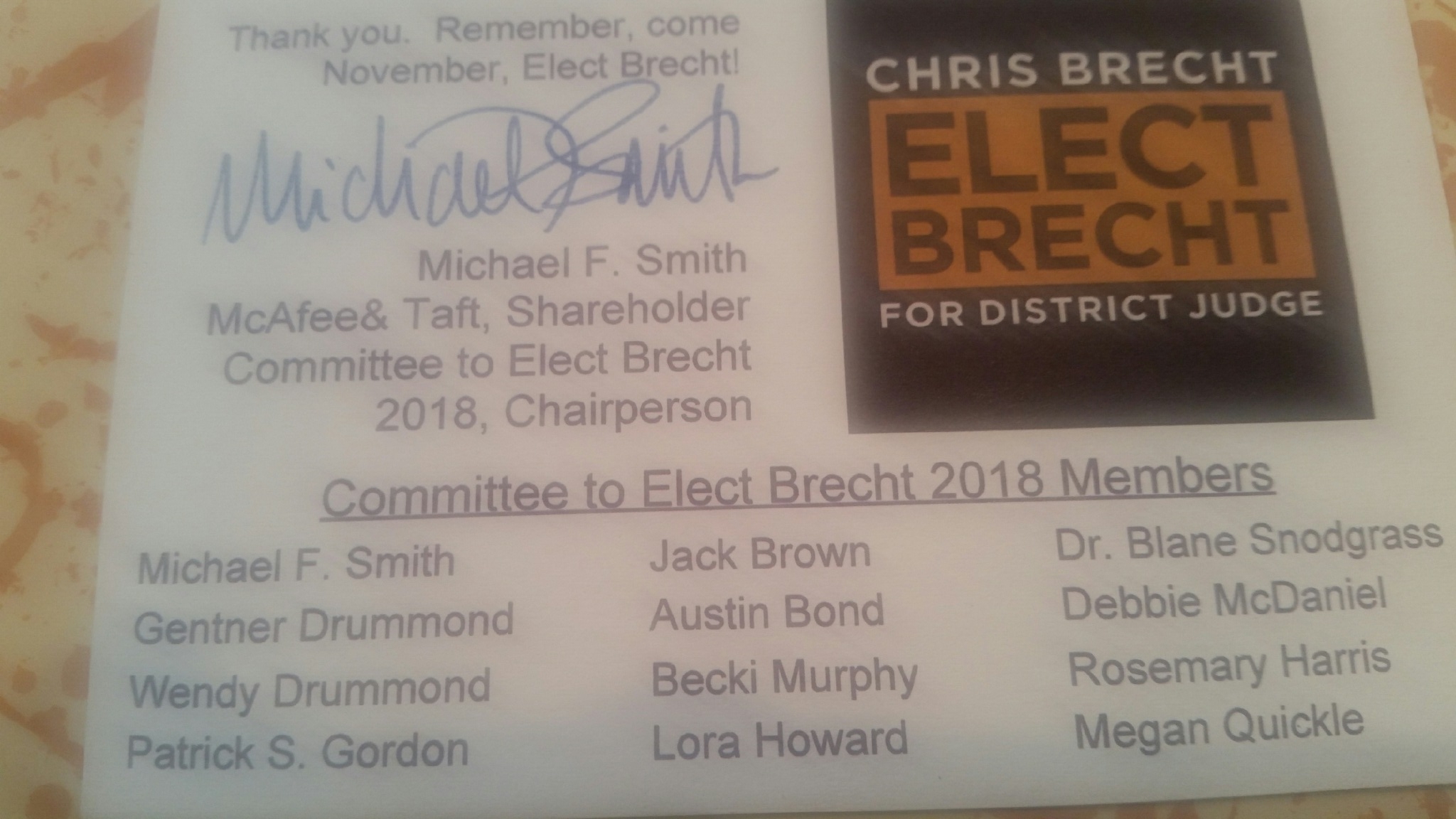
Christopher Uric Brecht-Smith, as he calls himself on his Facebook profile, is "married" to another man, and he supports the use of government force to compel Christian adoption agencies to pretend that a "gay marriage" is equivalent in every respect to a natural marriage between a man and a woman, referring to SB1140, which protects the rights of adoption agencies to make decisions in the best interests of the child and in accordance with their values, as "hateful, discriminatory and blatantly unconstitutional on its face." I think it's fair to assume that, as a judge, Mr. Brecht would be hateful and discriminatory to people who uphold natural understandings of marriage and sexuality and would twist the federal and state constitutions and statutes to use government power to impose his twisted opinions on those issues on the people of Oklahoma.
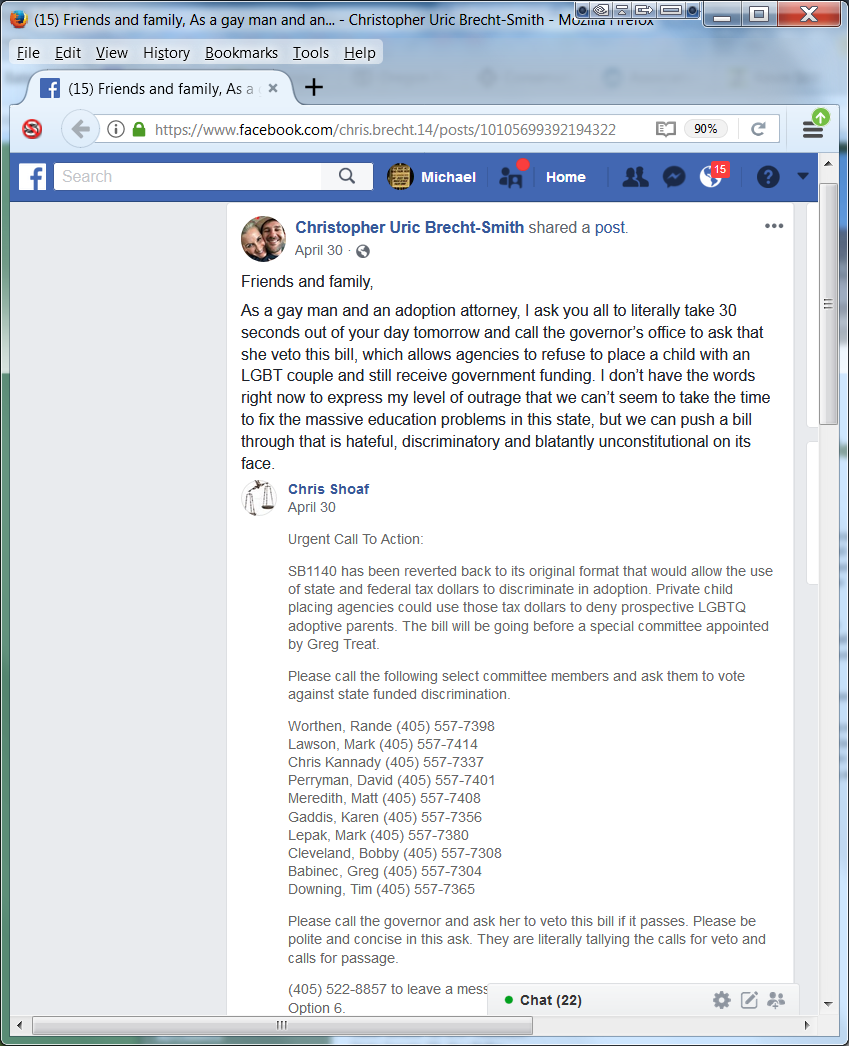
Whether or not Drummond recruited Brecht to run, as he has been accused of doing, Drummond is enthusiastically backing Brecht's campaign, and it says something worrying about Drummond's own judgment. If Gentner Drummond thinks that Brecht would make a good judge, I don't think we can count on Drummond, as AG, to defend vigorously our state's religious liberty protections. When asked by the Enid News for his opinion of SB1140, Drummond used the possibility of future litigation (and any issue could potentially be the subject of litigation) as an excuse not to comment.
One other candidate in the race, Angela Bonilla, is running a low-budget campaign. Bonilla is opposed to capital punishment and SB1140's protections for adoption agencies, which are both show-stoppers for me. Oklahoma's use of the death penalty for murder is under threat from anti-capital-punishment activists who are employing a combination of commercial and legal pressure to accomplish an effective repeal. Attorney General Mike Hunter has already been working to defend Oklahoma's laws against these attacks.
Time is short, but here is a brief explanation of my choice in this race, a reiteration of what I said on KFAQ last week.
I thought at the time that Steve Kunzweiler made the right, but uncomfortable, decision in the Shelby case, and I still feel that way, given the factual questions about the actions of Terence Crutcher and the reactions of Officer Shelby. Many of my legal friends who have both prosecuted and defended criminal cases feel the same way. Kunzweiler defended his decision on KFAQ last year, on June 21, 2017.
Compare that to Ben Fu's decision to drop a client he was defending in a criminal case once his involvement, a matter of public record, came to public attention. This client was Darius Padillow, who, it is alleged, shot at police officers, admitted it, and said it was to "send a message." Notwithstanding the appalling nature of the allegations, every defendant deserves a competent, vigorous defense, and to this layman's mind, it seems weak-kneed and unjust to undertake to provide that defense, but then drop it like a hot potato when the public becomes aware. We need steadiness and resolution from our DA.
I am certain that Tammy Westcott has the intelligence and integrity to serve as DA, but as I listened to her interview with Pat Campbell, I simply found myself disagreeing with the platform she outlined, particularly her focus on reducing incarceration rates.
You can hear all three DA candidates in Monday's debate on the Pat Campbell Show.
Steve Kunzweiler has made some tough calls in his four years as DA, but he has made those calls with fairness and professionalism. I am glad to have endorsed him four years ago, and I am happy to endorse Steve Kunzweiler for re-election as District Attorney.
After sitting through the Tulsa 9/12 congressional candidate forum (my live-tweet thread is here), I came to the conclusion that I would be happy to have either Andy Coleman, former District Attorney Tim Harris, or State Senator Nathan Dahm representing us in Washington. All three appear to be men of principle and character and to have a proper understanding of the limits on the role of the federal government.
(Of the other two: Kevin Hern was a no-show. Danny Stockstill had a few impressive moments, but he seemed vague on the issues and ill-prepared.)
Of the three acceptable possibilities, I've decided to vote for Nathan Dahm. Sen. Dahm is the only candidate with legislative experience -- six years in the Oklahoma State Senate. He is respected by colleagues on both sides of the aisle for his careful study of the rules and process and of the legislation he is asked to vote on. In a high-pressure environment, especially during this past session, Dahm has stuck to his principles. He has also demonstrated a great deal of maturity and self-control in making the case in the media for the policies he has pursued.
Andy Coleman has a very impressive record including both his military service and his work on behalf of Voice of the Martyrs. He has won the support of many members of the House Freedom Caucus and thoughtful conservative voices like Oklahoma Wesleyan University president Everett Piper.
Tim Harris is well-respected for his service as District Attorney, particularly by those who have worked with him in the legal community.
You often see the words "proven" and "tested" in campaign material. Those words are true of Nathan Dahm. He has been tested during his time in the State Senate, and he has proven his mettle in the same sort of role and environment he would encounter in Washington. While Harris and Coleman have been tested in many ways in their careers, the temptations that Dahm has faced as a legislator are less direct but more insidious.
I've heard people say, "I like Nathan, but we need him at the State Capitol." Happily, even if he loses this race, he will remain a state senator, as his seat does not expire until 2020. While we are blessed to have Nathan Dahm in the State Senate, he could make an even greater difference in Washington, and his electoral success would encourage legislators to pursue principled conservatism as the best way to climb the electoral ladder.
Nathan Dahm is the sole candidate to receive an A+ and an endorsement from the NRA. Other candidates received an AQ for giving pro-Second Amendment answers to the questionnaire; Dahm received an A+ because he has had legislative success promoting and protecting our Second Amendment rights at the State Capitol.
RELATED:
Kevin Hern got a public rebuke from former Congressman Jim Bridenstine regarding the use of his name and image. Here's the statement from last week:
Kevin Hern has been using my name and image in his campaign ads for Oklahoma's First Congressional District. Voters should know that Kevin Hern initiated a run against me in 2016 and poll tested messages that included terrible lies about me. I learned of this when the pollster called my home. Now he uses my name and image in ads as if we are close. Kevin Hern's later support of me was opportunistic and based on self interest knowing I had limited my terms.
Given Hern's current relationship with the Republican Main Street Partnership, it's not surprising that he was working to defeat Bridenstine in 2016. Targeting tea partiers, fiscal and social conservatives is what RMSP does. They want malleable squishes who will make good crony capitalist. We're blessed to have three good choices in the congressional race. Kevin Hern is NOT one of those good choices.
Here's the podcast of the 1st Congressional District debate.
Can you tell I'm not excited about the race to succeed Mary Fallin? It's taken a long time to make up my mind, and it's still not as firm a decision as I'd like. As with many of the judical races, my current inclination to vote for Dan Fisher in the Republican primary for Oklahoma governor is more by process of elimination than enthusiasm.
So let me walk you through that process step-by-step, in order of elimination.
A reader emailed to ask why I was not supporting Cornett, since her OKC relatives raved about him and he balanced 14 city budgets. I called her attention to Mick Cornett's evasive interview with Pat Campbell back in January, and the article I wrote about it at the time.
Oklahoma City's government is different than Tulsa's. The Mayor is just a citywide city councilor, one of nine votes. The Chief Executive Officer of OKC's city government is the city manager, hired by the council and responsible for running all the city departments.
By touting OKC's balanced budgets in his ads, Cornett is hoping that voters are ignorant of Oklahoma's constitutional requirement to balance the budget every year, which is binding on the state and on each county and city and school district in the state. So it's nothing special to balance a budget -- it's the law -- and even then, credit belongs to the city manager and the city finance department for making it happen. He's insulting your intelligence by using balanced budgets as a selling point.
Cornett's interview (and his refusal to do any since, or even to answer a simple questionnaire) reveals him to be weak, cowardly, and indecisive. We need leadership from the next governor, something we haven't had since 2002.
Gary Richardson:
Speaking of 2002, that's when Gary Richardson lost my vote. Rather than compete in the Republican primary to succeed his old law partner, he ran as an independent, splitting the right-of-center vote and allowing Democrat Brad Henry to win with a narrow 7,000-vote plurality over Republican nominee Steve Largent. Had the had the courage to run against Largent in the Republican primary, Richardson might well have prevailed; Largent had never faced a tough election, and he won the primary with 87% of the vote. (Mary Fallin also chickened out, running for a third term as Lt. Governor instead.) Even if Largent had prevailed over Richardson in a primary, Largent would have been a better candidate for the challenge and better prepared to defeat Henry. Richardson's decision to run as an independent looked more like a spoiler move than a serious effort to win.
Richardson's run and Henry's victory opened the door for a lottery, which, under federal law, allowed the tribes to offer Class III gaming for the first time. Great for the tribes and their business partners, not so great for Oklahoma families damaged by gambling addictions or the non-tribal businesses that have to compete against the casinos for local entertainment dollars or against tribal enterprises capitalized by casino winnings.
I'm sure Richardson is on to something with his main issue, auditing the Oklahoma Turnpike Authority. But it's too narrow a focus, and he's had 16 years to think of some new issues. All of Oklahoma's quasi-governmental trusts, authorities, boards, and commissions need investigation and to be brought back under public control.
Gary Jones:
At the start of this race, I thought I would end up supporting State Auditor Gary Jones for Governor. I met him during his first run back in 2002, endorsed him in each of his elections, worked with him during his time as GOP state chairman. I knew that he would be able to ferret out state government waste.
I also knew that Jones's blunt manner could be abrasive and off-putting, and he might have trouble making the allies he would need to do something about whatever waste he identified. Governor of Oklahoma is a constitutionally weak office, and he can't accomplish anything without building alliances and support in the legislature and the other executive departments.
During this years' budget hullaballoo, Jones thought he was being politically courageous and innovative in reaching across the aisle, standing with Democrats to announce a plan to increase taxes. There he was, like Charlie Brown lining up to kick the football, thinking he had successfully appeased the teachers and would avert a messy walkout. Then Lucy pulled the ball away, as she always does. Despite the biggest tax increase in state history and a massive salary increase for teachers, they still walked out and demanded more, more, more.
You might think a smart man like Gary Jones would learn his lesson and say never again, but instead he directed his anger at the conservative Republicans who warned that this would happen and who had been trying to find a solution to fund teacher salaries without raising taxes. While the Platform Caucus were thinking outside the box, looking at ways to change the laws to allow money to flow where it is most needed, Jones followed the path of least resistance to tax increases.
Gary Jones's heated discussion with Pat Campbell on the April 11 program encapsulates all that I've written above, all of Jones's flaws in one podcast. He thought he made a brilliant move, but he got played, and he doesn't seem to realize it. Governor Jones would give up tax increases now for reform never. He would inherit the title that was given to moderate Republicans in Congress: "tax collectors for the welfare state." He would be driven by the tax-eaters to continue to dig the state into a deeper fiscal hole, in the interests of "bipartisanship" and "progress." No thanks. Not the leadership we need. Gary Jones shouldn't be governor, but the next governor should hire him as budget director.
Do I sound disappointed? I am.
Kevin Stitt:
A friend recently gave me a strong sales pitch in support of Stitt. He regarded Stitt's lack of experience, or even interest, in state politics as an asset, and thought Stitt would be excellent as a recruiter bringing businesses and jobs to Oklahoma.
I was tired, didn't feel like debating the point, but that is absolutely not what Oklahoma needs. Successful states grow their own businesses. They have laws that allow people with ideas and energy the freedom to build a company and enjoy the fruits of their success. The governor needs to focus inward on simplifying and streamlining state government and eliminating barriers to economic growth, and leave the rest to the private sector.
(That includes protecting our state's educational freedom and promoting Oklahoma as a destination to homeschoolers frustrated with their home states' restrictions; parents who are entrepreneurial and intentional about their children's education are often entrepreneurial in the business sense as well. We could grow our population and our economy.)
Stitt's failure to vote didn't impress me either. In our system, the citizens are the rulers. We exercise that rule by voting for those who will write, execute, and enforce our laws. As sovereign electors, we are responsible before God to exercise our franchise and to do so with wisdom. When you exercise your God-given responsibility and opportunity to cast a prudent vote for a wise official, you love your neighbor. When you neglect that responsibility to pursue your own selfish interests, well....
Stitt sends his kids to a good classical Christian school in Tulsa, Regent, which I applaud, but he ought to have taken the same good sense that led him to enroll his children there and used it to influence his fellow citizens as they (and he) cast their votes for state officials.
(One more thing that indicates Kevin Stitt is not ready for political prime time -- Stitt's nervous giggle fit when Pat Campbell asked him if he would vote to repeal HB1010XX, the tax increase, was followed by a platitude about looking to the future, not the past.)
Watch this space: At this point I'm about to slide off the chair with exhaustion, but I hope to complete this with a discussion of Lamb and Fisher sometime Saturday night. In the meantime, go read the gubernatorial candidate responses to the Muskogee Politico questionnaire. That link will take you to the first response, from Gary Jones, and it has links to the rest, including Mick Cornett's non-answers.
CONTINUING WHERE I LEFT OFF:
Todd Lamb:
From his own description of the times he's shown political courage, it seems like Todd Lamb left his courage at the capitol coat check in January 2011 and only picked it up again when it was time for him to run for governor. (He mentions one tie-breaking vote as Lt. Governor in his role as President of the State Senate, but I don't think it took too much courage to join half of the State Senate in not raising taxes on the oil industry.) Some friends believe that he is the most electable conservative, and his stated preference for growing local small businesses over special tax deals to relocate big businesses is welcome. I'm just wondering where his leadership and initiative was hiding when we needed it these last eight years.
Dan Fisher:
Fisher was a consistent conservative during his four years in the state house. He was quick to state his opposition to the tax increases and his willingness to repeal them. I like nearly all of his answers to Muskogee Politico's questionnaire, and his legislative record suggests that he'll be true to the positions he stakes out. Fisher wants to decentralize education and move back to local control. He understands the problem of funding "silos" -- laws that hinder moving our tax dollars where they're most needed and will work to eliminate them. I especially agree with his answer on economic development:
The state should not hurt our homegrown businesses by using their tax dollars against them to pick winners and losers. I will veto unfair "economic development" schemes in favor of creating a truly free market that will entice investment from all over America. Additionally, I will be an ambassador to herald the news that OK does not penalize businesses with burdensome taxes and regulations.
My main beef with Fisher is his stand on abortion legislation, and this has been my greatest reluctance in supporting him. I agree with his end goal: Abolish abortion except when necessary to save the mother's life. I disagree with the implicit and explicit dismissal coming from Fisher and his supporters of the incremental gains made by the pro-life movement in the quarter century since the Casey decision. I object to the implicit and explicit denigration of pro-life activists and pro-life legislators, whose measures have saved lives. Apart from the substance of the issue, kicking potential allies in the teeth is a bad political move.
Fisher and friends seem to believe that Oklahoma can pretend that Roe v. Wade doesn't exist just like California pretends that Federal immigration laws don't exist and Colorado pretends that Federal marijuana laws don't exist. In the latter cases however, states are declining to cooperate with and assist federal prosecutors. In the case of abortion abolition, however, Oklahoma would be enforcing a law that the feds have said is unconstitutional. Perhaps the Trump Administration would decline to act, but it's easy to imagine a future pro-abortion administration sending in the National Guard, a la Little Rock, to ensure that abortionists and their customers would not be hindered by local law enforcement from killing children.
I understand that the only way to overturn Roe v. Wade is for the Supreme Court to revisit it. I understand that some state will have to pass an abolition law and attempt to enforce it before the Supreme Court will get involved. As things currently stand, our State Supreme Court would invalidate the bill as unconstitutional before it even gets to the U. S. Supreme Court. (Tony Lauinger of Oklahomans for Life understands this problem and is pushing for reforms to the way State Supreme Court justices are chosen.)
Even if we passed a law and got it to the US Supreme Court, do you believe the current bunch, headed by John "Obamacare is a tax" Roberts would use the occasion to overturn the Roe v. Wade precident? Or is it more likely that the socially liberal majority on the court would use the occasion to overturn the gains resulting from Casey?
Despite that, I agree with Fisher much more than I disagree. That and his record of being true to his word makes Dan Fisher my pick.
MORE:
 In 2014, Joy Hofmeister (mugshot below) defeated incumbent Oklahoma State Superintendent of Public Instruction Janet Barresi by a wide margin in the Republican primary. In 2018, she has drawn two primary opponents, newcomer Will Farrell and former State Secretary of Education Linda Murphy.
Linda Murphy is a graduate of Cheyenne High School in western Oklahoma and a Magna Cum Laude graduate of Southwestern Oklahoma State University, with a Bachelor's in Special Education and Elementary Education. From her website, here is a synopsis of her classroom experience:
Linda taught special education in Caddo County in Lookeba-Sickles Public School K-8 grades and in Hinton 6-12 grades. Later she taught in Osage County in Avant Public Schools K-8, where she also served as director of testing. She has taught adults who were illiterate to read and taught braille to students who were legally blind. Linda taught children and adults in all subject areas and with a wide range of exceptional needs including students with Learning Disabilities, Developmental Delay, Autism and Traumatic Brain Injury.Linda received a statewide award from the State Optometric Association for her work in directing a program in a clinic for students with visually related learning problems. She consulted as a specialist for IEP-Individualized Education Plan teams. She provided hundreds of training presentations for teachers and for Vision Therapists to help them identify visual interference to learning and how to help these students.
In addition to directing the clinical program, she spoke across the U.S. as a liaison for the Optometric Extension Program Foundation dedicated to vision therapy and research. Measurable results in student performance were achieved and documented.
After her narrow 1994 loss to incumbent State Superintendent Sandy Garrett, Linda Murphy was appointed by Gov. Frank Keating as Secretary of Education in his cabinet and appointed by him to a number of state boards dealing with education and workforce development.
Murphy was a leader in the fight that led to Oklahoma's repeal of Outcomes Based Education (the Common Core of the 1990s) and more recently was active in the fight to repeal Oklahoma's adoption of Common Core. Murphy understands that it wasn't enough merely to repeal Common Core in name only, but to fight against efforts to dictate local schools policy from Washington and Oklahoma City.
Linda Murphy is a passionate advocate for public schools, grounded in her personal experience of what they meant to the Cheyenne neighbors of her youth and to the rural communities where she served as a teacher. She believes that the school system should help each child to become an educated citizen and to reach his or her full potential, rather than being used by the Left for social engineering and proselytizing or by Big Business to churn out docile drones or by the unions as places to park the unqualified. Over her quarter-century of involvement with the intersection of education and politics, Murphy understands the forces at the State Capitol that are working to bend the public education system to serve their own selfish interests and what it will take to make the system serve the people of Oklahoma.
Murphy is running her campaign on a tight budget. As of Monday, Murphy raised $13,505 to Hofmeister's $278,000.
Hofmeister's heavily-funded campaign has the backing of the teachers' unions and an intriguing number of companies that sell products and services to public schools. Hofmeister was charged by the Oklahoma County District Attorney with several felonies involving the financing of her 2014 campaign: accepting campaign contributions in excess of legal limits, accepting corporate campaign contributions, and conspiring with campaign consultants and lobbyists. The DA later dropped charges "pending further investigation." Click the link and read the indictment, which includes the emails and messages that were exchanged between Hofmeister and the other alleged conspirators leading to the felony indictments.
One other candidate is running on a shoe-string budget: Will Farrell, a 2004 Cascia Hall graduate, Eagle Scout, and legal assistant for the Titus Hillis Reynolds Love law firm in Tulsa, currently working on his bachelor's degree from OSU.
If you want public schools to be the cornerstone of community and the foundation of an educated citizenry as they once were, Linda Murphy is your candidate.
The Bixby Education Association (BEA), local branch of the National Education Association, the left-wing teachers' union, is using Bixby Public Schools facilities, specifically the Media Center at Bixby North Intermediate High School for phone banking to get out the vote for next Tuesday's primary elections.
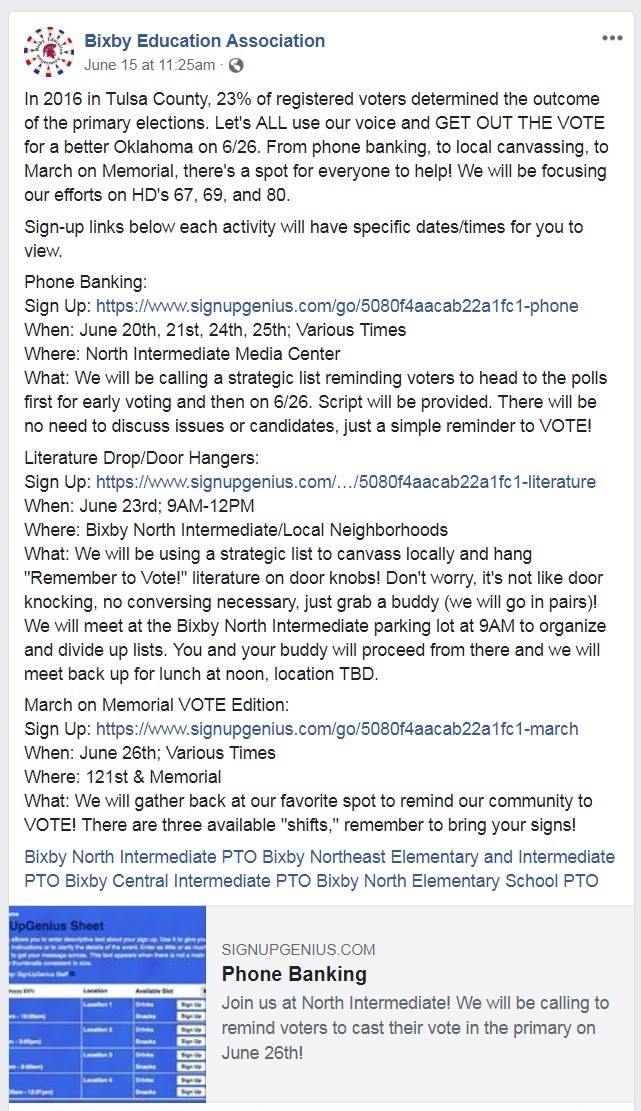
A message announcing the GOTV effort was posted to the BEA's Facebook page on June 15, 2018, at 11:25 am. Here is the original text of the message:
In 2016 in Tulsa County, 23% of registered voters determined the outcome of the primary elections. Let's ALL use our voice and GET OUT THE VOTE for a better Oklahoma on 6/26. From phone banking, to local canvassing, to March on Memorial, there's a spot for everyone to help! We will be focusing our efforts on HD's 67, 69, and 80.Sign-up links below each activity will have specific dates/times for you to view.
Phone Banking:
Sign Up: https://www.signupgenius.com/go/5080f4aacab22a1fc1-phone
When: June 20th, 21st, 24th, 25th; Various Times
Where: North Intermediate Media Center
What: We will be calling a strategic list reminding voters to head to the polls first for early voting and then on 6/26. Script will be provided. There will be no need to discuss issues or candidates, just a simple reminder to VOTE!Literature Drop/Door Hangers:
Sign Up: https://www.signupgenius.com/go/5080f4aacab22a1fc1-literature
When: June 23rd; 9AM-12PM
Where: Bixby North Intermediate/Local Neighborhoods
What: We will be using a strategic list to canvass locally and hang "Remember to Vote!" literature on door knobs! Don't worry, it's not like door knocking, no conversing necessary, just grab a buddy (we will go in pairs)! We will meet at the Bixby North Intermediate parking lot at 9AM to organize and divide up lists. You and your buddy will proceed from there and we will meet back up for lunch at noon, location TBD.March on Memorial VOTE Edition:
Sign Up: https://www.signupgenius.com/go/5080f4aacab22a1fc1-march
When: June 26th; Various Times
Where: 121st & Memorial
What: We will gather back at our favorite spot to remind our community to VOTE! There are three available "shifts," remember to bring your signs!Bixby North Intermediate PTO Bixby Northeast Elementary and Intermediate PTO Bixby Central Intermediate PTO Bixby North Elementary School PTO
The post was edited on June 18 at 5:30 pm to read as shown below. The earlier version can be viewed in Facebook by clicking the three dots at the upper right of the post and
In 2016 in Tulsa County, 23% of registered voters determined the outcome of the primary elections. Let's ALL use our voice and GET OUT THE VOTE for a better Oklahoma on 6/26. From phone banking, to local canvassing, to March on Memorial, there's a spot for everyone to help! We will be focusing our efforts on HD's 67, 69, and 80.Sign-up links below each activity will have specific dates/times for you to view.
Phone Banking:
Sign Up: https://www.signupgenius.com/go/5080f4aacab22a1fc1-phone
When: June 20th, 21st, 24th, 25th; Various Times
Where: North Intermediate Media Center
What: We will be making calls to remind voters to head to the polls first for early voting and then on 6/26. Script will be provided. There will be no need to discuss issues or candidates, just a simple reminder to VOTE!Literature Drop/Door Hangers:
Sign Up: https://www.signupgenius.com/go/5080f4aacab22a1fc1-literature
When: June 23rd; 9AM-12PM
Where: Bixby North Intermediate/Local Neighborhoods
What: We will be canvassing locally and hanging "Remember to Vote!" literature on door knobs! Don't worry, it's not like door knocking, no conversing necessary, just grab a buddy (we will go in pairs)! We will meet at the Bixby North Intermediate parking lot at 9AM to organize and divide up lists. You and your buddy will proceed from there and we will meet back up for lunch at noon, location TBD.March on Memorial VOTE Edition:
Sign Up: https://www.signupgenius.com/go/5080f4aacab22a1fc1-march
When: June 26th; Various Times
Where: 121st & Memorial
What: We will gather back at our favorite spot to remind our community to VOTE! There are three available "shifts," remember to bring your signs!Bixby North Intermediate PTO Bixby Northeast Elementary and Intermediate PTO Bixby Central Intermediate PTO Bixby North Elementary School PTO
I've sent a message through the BEA Facebook page asking some questions:
I'm writing an article about your phone banking effort and have several questions:1. What is the source of your calling list?
2. An earlier version of your post described your list as "strategic." Which voters have been selected to receive a reminder to vote? What is the purpose of the strategy behind the list?
3. Would you provide a copy of your calling script?
4. Would you provide a copy of your calling list (names and addresses would be sufficient -- phone numbers could be redacted) for the purpose of comparison to the full list of voters?
Thank you for your assistance in obtaining the information needed to produce a comprehensive and fair story on your phone banking effort at public school facilities.
I will post any answers I receive as soon as I get them.
ANALYSIS:
Is this legal? Is it ethical? It would depend on the answers to the questions above.
The now-deleted phrase "strategic list" suggests more than a neutral call to all voters to remind everyone to vote. Reading between the lines, the word "strategic" suggests that the aim is to target specific voters who have been identified as supporters of BEA's preferred candidates. Simply by reminding these selected voters to go to the polls, the phone bank can assist their preferred candidates without expressly stating an endorsement.
The Republican incumbents in House Districts 67, 69, and 80, Scott McEachin, Chuck Strohm, and Mike Ritze, respectively all voted for the teachers' pay raise, but all three voted against the union's demand for tax increases to fund it, and all three oppose the Left's assaults on Oklahoma's constitutional protections against tax increases without a vote of the people. All three have been targeted for defeat by the teachers' unions and other groups that want Oklahomans to pay higher taxes.
While state law encourages the use of public school facilities by outside groups, including political organizations, allowing those facilities to be used to advance a particular set of candidates would violate the political neutrality we expect from taxpayer funded institutions.
Screenshots showing the original and final versions of the post, after the jump. Click any screenshot to expand to full size.
The State Auditor's office has made great strides under the current incumbent, Gary Jones; if I could re-elect him to that office, I would, but he's term-limited. The next best thing is to elect his deputy, Cindy Byrd, to build on that solid foundation. Byrd, a CPA for 15 years and part of the auditor's office for 20 years, currently oversees county and local government audits, which make up the bulk of the audits performed (304 of a total of 411 last year). In that position, she cleared a five-year backlog of audits, and her work has led to the indictment and resignation of six elected officials and the uncovering of fraud and waste totalling over $10 million. Jones has endorsed Byrd, as has former Governor Frank Keating, along with many more elected officials and citizens across the state.
Byrd's primary opponents are John Uzzo, who ran as a Democrat for State Senate in 2016, and Charlie Prater, who is involved in a court battle over his default on a business loan and who has engaged in deceptive push-polling attacking Byrd. Pat McGuigan has written an analysis of the auditor's race that goes into some detail about all this.
As we work to direct our tax dollars to where they are most needed, the legislature should give the State Auditor's office an even greater role than it currently has to identify waste, duplication, and inefficiencies in government. More than ever, Oklahoma needs an experienced, aggressive State Auditor. Cindy Byrd is the best prepared to fill that position.
Hang around political circles long enough and eventually you will have friends running against each other. I worked for Dana Murphy's first campaign for Corporation Commissioner in 2002, was thrilled when she won in 2008, and I've supported her for re-election ever since. She also served honorably as vice chairman of the Oklahoma Republican Party from 2003 to 2007. But I was surprised that she decided to run for Lt. Governor. Given her soft-spoken and judicious manner and her expertise in law, geology, and the oil and gas industry, Corporation Commissioner seems to be the perfect place of service for her. Term limits will prevent Commissioner Murphy from running for re-election in 2022.
I've known Matt Pinnell going back to his successful leadership of the Oklahoma GOP's 2008 get-out-the-vote effort. He's intelligent, hard-working, and a principled conservative. He did a great job as Oklahoma GOP chairman during the 2012 campaign cycle, and he went on to serve the GOP at the national level, strengthening state party organizations across the country, laying the ground work for victory in 2016.
Although I'd be pleased with either Dana Murphy or Matt Pinnell as Lieutenant Governor, I'm voting for Pinnell. In addition to the constitutional roles of president of the State Senate and acting governor when the governor is out of state, Oklahoma's Lt. Governor has traditionally been the public face of our tourism and business recruitment efforts, and Matt Pinnell has the kind of personality and energy that best fits that role.
MORE: Jamison Faught at Muskogee Politico analyzes the campaign finance reports and calculates that 84% of donations in Dana Murphy's pre-primary fundraising report came from donors associated with entities that are regulated by the Corporation Commission, which Faught says "doesn't pass the smell test."
Incumbent Oklahoma Insurance Commissioner John Doak has hit his term limit. I will be voting for Donald Chasteen to replace him.
Donald Chasteen is a Shelter Insurance agent based in Inola. He served as a Tulsa firefighter from 1988 to 2002. In 2006, he founded the Inola Wrecker Service, providing towing in an area that had lacked it for many years. In 2008, Chasteen saved the life of an Inola woman with respiratory disease, responding to an emergency dispatch about her situation by donating and personally installing a window unit air conditioner in her overheated home. In 2009, he was honored by the Inola Chamber as Service Entrepreneur of the Year and was commended by the Inola fire chief for donating mechanic and tow services to the town's volunteer fire department. Chasteen has served in recent years as President and on the board of the Inola Area Chamber of Commerce and the Inola Hay Day Association.
Chasteen says that Oklahoma has the 10th highest insurance rates in the nation, and that Oklahomans need more health insurance options. As an agent serving rural Oklahoma, he's seen how decisions at the State Capitol make living life and doing business more expensive for his neighbors because those decisions drive up the cost of insurance.
Chasteen has demonstrated not only understanding but initiative and leadership in solving insurance-related problems for his neighbors. On Chasteen's campaign website, there's a tribute from local business owner Scott Roy:
I first met Donald Chasteen as he was serving as the President of the Inola Chamber of Commerce. During that time, Donald brought to the attention of the Chamber an issue with how insurance databases looked at and scored the Inola Fire Department for serving the Inola town, Inola zip code, Southeast corner of Rogers County and spill over into Mayes and Wagoner counties. The problem, as Donald pointed out, is that the databases were not current or reflected incorrect information as to the capabilities of the Inola fire department and the coverage area that they were willing to serve. These inaccuracies were causing not only higher insurance costs for his direct customers but for the entire Inola and surrounding area. While this information is available, Donald seemed to be the only one with the knowledge and insight to see and understand the impact this was having on the area people.The situation actually was that the insurance databases did not reflect that the Inola Fire Department had upgraded their equipment which should have changed the class or performance capability of the department for serving the area. The improved equipment meant that they could now put out fires faster and could address some fire types that they were not able to properly address previously. The database also said that the Inola Fire Department only served the town of Inola and Inola zip code areas. It did not show that Inola Fire Department would respond to fires in nearby Mayes or Wagoner counties (approximately 5 miles away from the Inola Fire Station). Often the Inola Fire Department was the closest to some fires in Mayes or Wagoner counties and was the fastest to respond to those needs because of proximity.
Donald took it upon himself as the local insurance expert to provide the details of the problem, provide what pieces of information needed update and guided the local fire department on how to address and fix this issue. He pointed out that making these changes to update these insurance databases for the city and fire department would improve the classification of the Inola Fire Department and ultimately lower everyone's insurance rates as a result. Keep in mind that most of these people that would benefit from these changes were not Donald's customers and the action was not publicized to help win new customers.
Now, here is what I want people to understand about this situation and why it helps prove that Donald Chasteen is a great candidate for Oklahoma Insurance Commissioner.
- Donald had insurance and fire department expertise that no one else had to identify this problem.
- Rather than tell or send an email to someone important asking them to fix this, Donald actually took personal ownership of this issue and provided guiding steps and information on how to make these changes. The information does have to be submitted officially from the fire department but Donald provided everything needed to allow them to submit for these changes.
- Donald did not make any money for doing this and it did not help his career as an insurance agent for keeping or winning business. That folks is the definition of a public servant and is winning proof that his heart is in the right place.
There are a lot of insurance experts out there in the state of Oklahoma. There are a lot of politicians who know how the game is played at the state capitol. There are even a number of people who claim they are willing to represent the needs of the Oklahoma voter. However, I do not believe that there is a single person running for Oklahoma State Insurance Commissioner in 2018 that has the insurance expertise, the drive, the grit to face opposition, and the proven history of affecting positive change for insurance for the Oklahoma people as Donald Chasteen. If Donald can do this for the local area, imagine what he can do at the State level. I encourage everyone to vote for him in both the Primary and General Elections for 2018!
The favorite in this race is State House Floor Leader Glen Mulready. Mulready is part of the legislative leadership that failed to use its electoral mandate to pursue the state government reforms needed to avert the school funding crisis, instead pushing the problem off on Oklahoma's taxpayers. Mulready also voted this year to make it easier for the legislature to raise our taxes without putting the proposed increase to a vote of the people. Mulready is a pleasant person and his TV ads are clever, but I don't think his failure to use his leadership to push for the fiscal reform our state needed should be rewarded with higher office.
Instead, Republicans should choose a community leader and insurance professional who is a demonstrated servant leader, not part of Oklahoma's political swamp. Please join me in electing Donald Chasteen as Oklahoma Insurance Commissioner.
MORE: On his Facebook page, Donald Chasteen has a number of audio files and brief articles discussing issues in the campaign.
 Oklahomans should re-elect Bob Anthony to what will be his sixth and final term as a member of the Oklahoma Corporation Commission. Anthony was first elected in 1988. Voters enacted a two-term limit on the office in 2010; this would be his second full term since the limit went into effect.
Back in 2006, I surveyed Anthony's first 18 years as a commissioner and explained the importance of the race. Here's some of what I had to say then, and I stand by it today:
There's one statewide race that ought to matter more than any other to Oklahoma voters. That's the race for a seat on the Oklahoma Corporation Commission. In addition to overseeing Oklahoma's oil and gas industry, the OCC regulates public utilities like PSO, ONG, and AT&T (formerly Southwestern Bell).
Considering the amount of money at stake in the OCC's decisions on utility rates, the commission is ripe for corruption. And indeed, in the late '80s and early '90s, the FBI investigated bribery allegations involving the OCC. Corporation Commissioner Bob Hopkins, a Democrat, was convicted of bribery and sent to jail, as was utility lobbyist Bill Anderson. The culture of corruption at the OCC was cracked open because, in 1989, a newly-elected commissioner went to Feds when Anderson offered him cash.
That commissioner was Bob Anthony, a man of honesty and fairness. In Anthony, Oklahoma's utility ratepayers have someone who is looking out for their interests. Regulated companies, whether large or small, get a fair shake from Bob Anthony.
In 1995, Bob Anthony received an award from the FBI for his involvement in the corruption investigation. (Click that link for the text of his commendation.)
During his campaign, an attorney who practiced before the Commission greeted him with a handshake that contained an envelope with ten $100 bills. Mr. Anthony contacted the United States Attorney's office and agreed to participate and work with the FBI as a cooperative and covert witness. He knew at that time that his role would certainly be revealed at trial, and that the eventual proceedings in court might damage his ability not only to be a public servant, but to work in any public service career in the state of Oklahoma. The investigation which he caused, supported and worked in lasted approximately six years. Evidence which he developed involved illegal payments of $10,000. He made over 150 tape recordings that helped broaden the scope of the case to include another fellow commissioner and a local telephone company. By 1992, word of the investigation and Mr. Anthony's cooperation had reached the news media. Determined to meet his duty as an elected public servant, he publicly commented on the case, explaining his part, but only to the extent required to fulfill his public duties. As a result of his inability to comment fully on the case, because he intended to protect the integrity of the investigation, the press had a field day with respect to him and his own reputation. For over two years he was featured as a "snitch" and a political opportunist, as well as being the subject of several leading cartoonists for the media. It wasn't until the case went to trial in 1994 that the full story was revealed and Mr. Anthony was vindicated when the full facts of his cooperation, dedication and sacrifice were announced in a public forum. In the interim, his campaign for a seat in the United States House of Representatives was defeated and he only narrowly won reelection to the Commission itself.In the end, two subjects were convicted of bribery, and a clear message was sent to the leadership of both the business and political communities of Oklahoma that such conduct would not be tolerated. Mr. Anthony, by this award, joins a very select group of awardees who exemplify the tremendous courage and sacrifice that people have shown--particularly people who have put themselves and their families' welfare at jeopardy to do the right thing to support an investigation. That is a critically important commitment--when one puts his own life and welfare directly on the line. It is only with that premise and support and cooperation that the FBI, or any law enforcement organization, can do the job it is supposed to do, which is protect the people.
Bob Anthony continues to stand up for the ratepayers of Oklahoma, recently advocating that public utilities should be expected to pass the savings from the recent federal tax cut on to their customers in the form of lower rates. As Corporation Commissioner, he's one of three officials responsible for setting those rates.
Anthony has drawn two primary opponents. One of them, former State Sen. President Pro Tempore Brian Bingman, was one of the most powerful officials in the state from 2010 to 2016, with a Republican supermajority in the Senate and a Republican governor. His failure to lead, to use that political capital to reform state government, brought us to this year's fiscal trainwreck. He brought $200,000 from his State Senate campaign account to spend on his run for Corporation Commissioner. Bingman shouldn't be rewarded by the voters for his failure to lead.
I'll be writing about each office in a separate entry, but here are a couple of preliminary notes.
Three of the candidates on the statewide ballot are current or recent members of legislative leadership: Former State Senate President Pro Tempore Brian Bingman, House Majority Floor Leader Glen Mulready, and former House Appropriations and Budget Committee Chairman Leslie Osborn. The failure of our Republican governor and Republican legislative "leaders" to use their supermajority mandate over the last eight years to reform state government led us to this year's education funding crisis, and we would be foolish to entrust them with higher office. Osborn and Mulready both supported the largest tax increase in Oklahoma history this year. Bingman was the most powerful man in the Oklahoma Senate for the first six years of Gov. Fallin's administration.
This election also features two blasts from the past: Mike Hunter and Linda Murphy were among the handful of Republican statewide nominees who lost narrowly in 1994, an otherwise banner year for the GOP both in Oklahoma and nationwide. Hunter lost the open Attorney General's race by 48%-52% to Drew Edmondson. Murphy lost the State Superintendent's race to incumbent Sandy Garrett by 9,239 votes, just 1% of the votes cast. (Republican Bob Keasler also narrowly lost the open State Treasurer's race to Democrat Robert Butkin; State Auditor Clifton Scott, running for his fourth term, was the only statewide Democrat to win by a comfortable margin.)
The Platform Caucus was right. The Platform Caucus, that small group of Oklahoma state representatives and state senators who support the conservative, grassroots-crafted, limited-government platform of the Oklahoma Republican Party, was right to insist that there is and always was enough money coming into the state treasury to fund a raise for teachers without raising taxes. Some rules might have to be changed in order to move the money to where it was most needed, but the State Capitol already had enough of our cash, if only the Legislature and the school boards would work to get that cash to the teachers.
Even the legislative leaders, who refused to work with the Platform Caucus, punished them for not going along with the tax increases, the legislative leaders who teamed with the lobbyists and bureaucrats to insist upon tax increases as the only way to fund teachers' raises, now acknowledge that if the tax increases are overturned by the voters, the money is there even at the old rates. They already have a plan to ensure that the salary increases are funded if the tax increases are repealed. State revenue is at record levels.
Those "pragmatic" legislative leaders got played. They thought if they agreed to tax increases, the teachers would be appeased and would stay in the classroom. But the teachers' groups (if not the individual teachers) always wanted a strike. They wanted chaos, they wanted drama that would focus negative public attention on the legislature, cultivating a "throw the bums out" attitude with the voters that would help elect more leftists, steering Oklahoma into a big left turn -- bigger and more intrusive government generally, hostile to Christianity and traditional values. In Oklahoma, as in Arizona, West Virginia, and many other states that have had teacher walkouts and protests, the Left is using teachers to regain the ground they've lost at the state level across the nation.
In this primary election season, Platform Caucus members are under attack by forces who want to be able to squeeze Oklahoma taxpayers at whim. Beneficiaries of Big Government want to break the constitutional protections that slow down state government's ability to grab more of your money. Well-funded independent expenditure campaigns are targeting these brave, grassroots-backed candidates, depicting them as anti-teacher, even though they all voted for the teacher pay raise.
Platform Caucus members don't play the capitol game. They read legislation before they agree to vote for it. They don't accept meals or game tickets or trinkets from lobbyists. They stand for the ordinary Oklahomans who don't have lobbyists or labor unions or corporate PACs standing for us.
The squishy compromisers hate the Platform Caucus, because the Platform Caucus stalwarts strip away their excuses for capitulating to the lobbyists. The Platform Caucus refusal to play the capitol game exposes the squishes as unprincipled and weak-kneed, and it infuriates them. The lobbyists and the labor unions want more squishes; they want legislators who can be seduced and manipulated.
These are the taxpayers' friends who are on next Tuesday's primary ballot. Some of them are on record as having joined the Platform Caucus; others are perhaps not caucus members, but have consistently the conservative grassroots principles the platform embodies. Every one of them voted in favor of the pay raise for teachers, and every one of them had the guts to vote against unnecessary tax increases. While those are only two votes, they happen to be very representative of the principled strength under pressure that they've displayed on many other issues, and because of that strength, they have been targeted for defeat in the primary by the tax-and-spenders.
House 8: Tom Gann
House 10: Travis Dunlap
House 14: George Faught
House 20: Bobby Cleveland
House 36: Sean Roberts
House 63: Jeff Coody
House 67: Scott McEachin
House 69: Chuck Strohm
House 80: Mike Ritze
House 101: Tess Teague
Senate 4: Mark Dean Allen
I wish I had time to write about each of them individually. They deserve your vote and your support.
As we've often discussed here, public choice theory -- concentrated benefits vs. diffuse costs -- means that there will always be more campaign money coming from the special interests, because they stand to gain a significant return on that investment in the form of tax credits, union dues, contracts, regulatory burdens on potential competitors, etc., and less money available to support those who defend our interests as taxpayers and ordinary citizens.
A legislative district is small enough that grassroots activism can beat big money, but that take volunteers willing to give their time. Even if you don't live in one of their districts, I encourage you to show your appreciation for their courage by volunteering on this final weekend of the campaign -- make calls, knock doors on their behalf. Make contact through the links above and see what you can do to help.
NOTES:
HB 1010XX (tax increases): House votes, Senate votes.
HB1023XX (salary increase for teachers): House votes, Senate votes.
MORE:
George Faught, one of the legislators we should re-elect, is fighting against a last-minute smear campaign regarding his votes on teacher pay and benefits. I've added links to the bills he mentions, all of which passed by near-unanimous majorities.
FACT: George Faught voted for EVERY teacher pay raise since he was elected ( HB1134, 2008; HB1114, 2017; HB1023XX, 2018) FACT: George Faught voted for the budget that included the most money EVER for education (HB3705, 2018; SB1600, 2018) FACT: George Faught fought to make sure that local teachers received bonuses that they rightly deserved (HB1593, 2007) FACT: George Faught voted to stabilize the Teacher Retirement Fund that Democrats had raided and left in peril.
Faught didn't list a specific bill on the last point, but I believe he is referring to HB2132, 2011, the Oklahoma Pension Legislation Actuarial Analysis Act.
It has been interesting to learn that many of my medical friends who are advocates of alternative medicine and of the medical use of CBD oil (cannabidiol) and hemp are also opponents of SQ 788, the initiative petition that would, for all practical purposes, legalize recreational use of marijuana in Oklahoma while protecting recreational users as if they were taking prescribed medicine.
SQ 788 is statutory. It would not amend the state constitution but would instead create new law on Oklahoma's statute books. You can read the official and complete text of the legislation that would be enacted by SQ 788 here.
Many of the organizations opposing SQ 788 are groups that deal in heavy, dangerous machinery, such as the Oklahoma Farm Bureau, Oklahoma Trucking Association, Oklahoma Manufacturing Alliance, Associated Builders and Contractors of Oklahoma, and Oklahoma Railroad Association. Medical associations and law enforcement organizations also stand in opposition. SQ 788 would make it easy for anyone to acquire a two-year license to use marijuana, and then it would prohibit use of marijuana from being considered by employers, landlords, judges in child custody disputes, or government agencies issuing licenses.
SQ 788 is a license to be stoned all the time while being protected against any of the social consequences reasonably accruing to a stoner. From section six of the proposal:
A. No school or landlord may refuse to enroll or lease to and may not otherwise penalize a person solely for his status as a medical marijuana license holder, unless failing to do so would imminently cause the school or landlord to lose a monetary or licensing related benefit under federal law or regulations.B. Unless a failure to do so would cause an employer to imminently lose a monetary or licensing related benefit under federal law or regulations, an employer may not discriminate against a person in hiring, termination or imposing any term or condition of employment or otherwise penalize a person based upon either:
1. The person's status as a medical marijuana license holder; or
2. Employers may take action against a holder of a medical marijuana license holder if the holder uses or possesses marijuana while in the holder's place of employment or during the hours of employment. Employers may not take action against the holder of a medical marijuana license solely based upon the status of an employee as a medical marijuana license holder or the results of a drug test showing positive for marijuana or its components.
C. For the purposes of medical care, including organ transplants, a medical marijuana license holder's authorized use of marijuana must be considered the equivalent of the use of any other medication under the direction of a physician and does not constitute the use of an illicit substance or otherwise disqualify a registered qualifying patient from medical care.
D. No medical marijuana license holder may be denied custody of or visitation or parenting time with a minor, and there is no presumption of neglect or child endangerment for conduct allowed under this law, unless the person's behavior creates an unreasonable danger to the safety of the minor.
E. No person holding a medical marijuana license may unduly be withheld from holding a state issued license by virtue of their being a medical marijuana license holder. This would include such things as a concealed carry permit.
F. No city or local municipality may unduly change or restrict zoning laws to prevent the opening of a retail marijuana establishment.
G. The location of any retail marijuana establishment is specifically prohibited within one thousand (1,000) feet from any public or private school entrance.
H. Research will be provided under this law. A researcher may apply to the Oklahoma Department of Health for a special research license. That license will be granted, provided the applicant meet the criteria listed under Section 421. B. Research license holders will be required to file monthly consumption reports to the Oklahoma Department of Health with amounts of marijuana used for research.
Writing in the Journal Record last month, attorney Aaron Tifft of Tulsa's Hall Estill firm points out that the passage of SQ 788 "could pose more legal risks for employers than the full legalization of the drug."
It would become unlawful for an employer to discriminate in employment based on a person's status as a medical marijuana license holder or penalize a person for testing positive for marijuana. Although its use or possession on the job would be actionable, the law is silent on working under the influence of marijuana.Because the initiative is silent on working under the influence of marijuana, it would be arguable that the person's medical condition should be considered a disability. If the person is disabled, the marijuana could be deemed a necessary medical intervention to treat the disability - much like any number of other powerful prescription drugs -carrying protections under the law....
Alternatively, legalization of marijuana for recreational use might somewhat increase its availability, but would not elevate it to the level and protections of a prescribed medical drug. Cannabis could take its place among the other prevalent recreational drugs in American culture - alcohol, tobacco, and (dare I say it) caffeine. Just as there is no doubt an employer could restrict the use of alcohol, there would be no doubt an employer could restrict the recreational use of marijuana.
With SQ 788, there is doubt. The scope of employers' rights regarding employees with a medical marijuana license is not currently evident. Employers should be aware of this risk if the measure is passed.
Here's another example of a vaguely worded attempt, from Section 1 of the legislation proposed by SQ 788, to eliminate social consequences relating to marijuana.
M. All applications for a medical license must be signed by an Oklahoma Board certified physician. There are no qualifying conditions. A medical marijuana license must be recommended according to the accepted standards a reasonable and prudent physician would follow when recommending or approving any medication. No physician may be unduly stigmatized or harassed for signing a medical marijuana license application.
Nothing in the bill explains what degree of stigmatization is undue, nor is there anything specifying whether stigmatization is a misdemeanor or a felony.
Typically, state laws allow local jurisdictions to be more restrictive, but not more permissive. Not SQ 788. Just in case the statewide allowances (3 oz. on you, 8 oz. at home, plus a Big Texan steak (72 oz.) of edible marijuana, six mature plants, six seedlings, and an ounce of concentrated marijuana) are deemed too stingy, cities and counties can raise those allowances locally without limit:
N. Counties and cities may enact medical marijuana guidelines allowing medical marijuana license holders or caregivers to exceed the state limits set forth in subsection A of this section.
The reality is that medicine from the cannabis plant has been legal in Oklahoma for a couple of years. In 2015, Gov. Fallin signed a law that legalized the use of CBD oil for children with certain medical conditions; in subsequent years legal applications of CBD oil were expanded and industrial (very low concentration of THC) hemp production was legalized. The 2014 federal farm bill authorized states to grow industrial hemp under pilot programs. Senate Majority Leader Mitch McConnell has introduced the Hemp Farming Act of 2018 to simplify rules and allow industrial hemp production on a permanent basis.
While many medicines are derived from plants, making a plant into medicine involves a process. The doctors at M. D. Anderson Center don't give their cancer patients pieces of Pacific yew bark to chew on. The active ingredients have to be isolated and purified so that precise doses can be measured and delivered, so as to maximize impact on the cancer while minimizing side effects on the patient.
Dr. David Asher, a Tulsa osteopathic physician with a focus on pain management, says that all of the health benefits of cannabis are currently available in full-spectrum hemp oil, without the side effects of tetrahydrocannabinol (THC), the psychoactive substance found in marijuana.
Dr. Asher writes that the hemp and marijuana are the same species of plant, but cultivated in a different manner. With hemp, the plant is allowed to pollinate and grow, developing seeds and fiber-rich stalks. Marijuana is protected from pollination and so stays close to the ground, putting its energy into leaves and flowers. Marijuana growers selectively breed for higher concentrations of THC. The higher the concentration of THC, the lower the amount of CBD oil and the fewer the health benefits.
SQ 788 looks like something Cheech and Chong would have written after their van made of pot caught fire. Just say no.
I'll be on AM 1170 KFAQ with Pat Campbell at 8:00 am tomorrow morning, Tuesday, June 19, 2018, to talk about next week's primary. Pat has done a ton of interviews with candidates, and they're online on the Pat Campbell podcast page. Pat asks great questions, and these interviews are one of your best resources for getting a sense of the candidates in a friendly but challenging environment. For your convenience and mine, I thought I'd organize the podcasts by office and candidate, starting with the most recent.
I've included podcasts where the candidate is on to talk about an issue in his current official capacity, such as State Sen. Nathan Dahm discussing the veto of his constitutional carry law, or State Auditor Gary Jones discussing misuse of funds at the Health Department. If there's a candidate you don't see on the list, it's almost certainly because the candidate hasn't agreed to appear on the show.
This list is far from complete, and I will add to it as I come across earlier podcasts of interest. I hope to find at least one podcast for each candidate in the major races.
U. S. House, 1st District
Nathan Dahm, 2018/06/13
Nathan Dahm, 2018/06/04 (Constitutional Carry)
Nathan Dahm, 2018/05/16 (Constitutional Carry veto override)
Nathan Dahm, 2018/05/07 (Constitutional Carry, adoption agency protection bill)
Nathan Dahm, 2018/05/03 (gun license bill)
Nathan Dahm, 2018/05/01 (wind subsidy bill amendment)
Nathan Dahm, 2018/04/23 (legislative session review)
Nathan Dahm, 2018/04/10 (teacher walkout)
Nathan Dahm, 2018/04/06 (GOP disunity)
Nathan Dahm, 2018/03/29 (Senate passes tax increase)
Nathan Dahm (why he's running, SQ 788)
U. S. House, 2nd District
Jarrin Jackson, 2018/06/07
Jarrin Jackson, 2018/04/17
Governor
Dan Fisher, 2018/05/30
David Van Risseghem letter to Dan Fisher
Gary Jones, 2018/06/13
Gary Jones, 2018/05/25 (Tar Creek)
Gary Jones, 2018/05/23 (Health Department)
Gary Jones, 2018/04/11 (support for tax increase, rant against the Republican platform)
Gary Jones, 2018/02/19 (why his tax plan will work)
Gary Jones, 2018/02/01 (defends plan to raise taxes)
Todd Lamb, 2018/05/21 (Will he call special session for constitutional carry veto override?)
Mick Cornett, 2018/01/12: Evasive interview, has not allowed Campbell to interview him since.
Lt. Governor
Attorney General
State Superintendent of Public Instruction
Linda Murphy, 2018/05/29
Linda Murphy, 2018/04/17
Linda Murphy, 2018/04/09 (teacher walkouts)
Linda Murphy, 2018/03/15 (teacher pay raise)
Tulsa County District Attorney
Tulsa County District Attorney debate, 2018/06/25
Ben Fu, 2018/03/19
Tammy Westcott, 2018/04/26
Tulsa County Commissioner, District 1
State Senate District 36
State House DIstrict 8
Tom Gann, 2018/02/19 (plan to raise teacher pay without raising taxes)
State House District 12
FOP letter about McDugle / Mahoney controversy, 2018/05/10
Kevin McDugle, Nick Mahoney controversy, 2018/05/09
Kevin McDugle, 2018/04/18 (ideas for teachers)
State Senate District 80
Mike Ritze, 2018/04/06
Mike Ritze, 2018 (proposal to remove judge in Falls Creek rape case
General:
Michael Bates on upcoming primaries, 2018/06/19
Michael Bates on governor's race, 2018/04/11
Michael Bates on tax proposals for teacher pay, 2018/03/28
Club for Growth Action, a political action committee that promotes tax cuts and reducing government waste and regulation in the interests of economic growth, is making major media buys in opposition to McDonald's franchisee Kevin Hern, a candidate to fill the Oklahoma 1st Congressional District seat held until recently by NASA Administrator Jim Bridenstine.
CfGA is running TV and radio ads claiming that Hern has a "habit of backing Democrats," noting that "Hern gave seventeen thousand dollars to a political committee that supported liberal Democrats . . . including Chuck Schumer, Harry Reid, Maxine Waters, and Sheila Jackson Lee" and that "Hern even wrote personal check to make a campaign contribution to the Democrat Senator who cast the deciding vote for Obamacare."
It's all true, but here's some context:
According to data retrieved from the Federal Election Committee website, in 1998, Hern, then with an address in Maumelle, Arkansas, made two contributions totalling $850 to Nate Coulter, a Democratic candidate for the open U. S. Senate seat. Coulter finished last in the primary. On September 17, 1998, Hern then made a $500 contribution to the Democratic nominee, then-former U. S. Representative Blanche Lambert Lincoln, who went on to win the seat in November 1998, keeping the seat in the Democrat column.
Eleven years later, Sen. Lincoln did indeed vote for the Patient Protection and Affordable Care Act, aka Obamacare. The vote for cloture passed 60-39 on a strict party-line vote, and Lincoln voted in favor, ending the Republican filibuster and allowing Obamacare to be approved by the Democrat majority. Had she voted no or abstained on the cloture vote, Obamacare would have been stopped.
It's reasonable to say that Lincoln cast the deciding vote for Obamacare. Certainly she cast one of the deciding votes: Lincoln was one of several Democrats from conservative states who might have reasonably voted no in accord with her constituents, but instead voted with her party over their wishes. Mary Landrieu of Louisiana and Ben Nelson from Nebraska were another couple of potential no votes who also voted yes. Lincoln was duly punished by the voters the following year, losing her re-election bid by 58-37 to Republican John Boozman.
According to a report generated on OpenSecrets.org (which has some more effective ways to search FEC data), those three 1998 contributions are Kevin Hern's only direct donations to Democratic candidates for federal office. Beginning with his move to Muskogee, Hern began supporting Republican candidates: Andy Ewing ($1,250), the 2000 nominee to succeed Tom Coburn in the U. S. House; Tom Coburn's 2004 and 2010 campaigns for U. S. Senate ($6,800); 2nd District Congressman Markwayne Mullin ($10,200); James Lankford's campaigns for House and Senate ($6,300); Jim Bridenstine ($7,700); Marco Rubio's presidential campaign ($1,000); and Senators John Boozman, Bob Corker, and Pat Toomey, Oklahoma 5th District Congressman Steve Russell, and Florida 19th District Congressman Francis Rooney.
As for his support for PACs, Hern has given $16,055 to Oklahoma Leadership Council (whose major 2016 contributions were to state Republican Party organizations in Florida and Pennsylvania), $2,000 to the National Republican Congressional Committee, $1,000 each to LankPAC (affiliated with James Lankford) and Oklahoma Strong Leadership PAC (associated with Scott Pruitt), and $250 to the Republican National Committee.
But what about this?
Hern has given $17,100 to McDonald's Corp PAC, which gave significantly more to Republicans to Democrats through the 2008 cycle, but since that time has evened things up considerably. In the 2016 cycle, for example, Hern gave $2,500 dollars to McDonald's Corp PAC, and the PAC supported Democrat Sen. Chuck Schumer and Rep. Maxine Waters, but they also supported Republican House members like Bob Goodlatte, Mia Love, Steve Scalise, and Devin Nunes and Senators like Chuck Grassley and Tim Scott. In the 2012 cycle, Hern gave $4,000, and the PAC backed Democrats like Rep. Shiela Jackson-Lee and Sen. Harry Reid, as well as Republicans like John Boehner, Tom Cole, and John Boozman.
Hern's contributions to McDonald's Corp PAC were as follows:
- 11/12/2004, $2,100.00
- 5/8/2006, $2,000.00
- 2/20/2009, $2,000.00
- 1/26/2010, $2,000.00
- 2/16/2011, $2,000.00
- 1/25/2012, $2,000.00
- 2/23/2016, $2,500.00
- 7/11/2017, $2,500.00
In the current election cycle, Hern has gotten most of his money back from McDonald's Corp PAC. Hern is one of two candidates to have received a $10,000 donation from the PAC; the other is House Majority Leader Kevin McCarthy, a leading candidate to succeed Paul Ryan as Speaker of the House.
It's understandable that McDonald's would want to spread money around Washington to protect its interests, but it's hard to understand why a conservative would continue to donate to a PAC that helps congressmen and senators who are working to undermine and overregulate the free market.
I'm not bothered by Kevin Hern's contributions to local Democrats 20 years ago when he was a young businessman in a state where Democrats were still influential. I am bothered by his ongoing contributions to a PAC that works for McDonald's best interests even when they're in conflict with America's best interests by keeping the likes of Chuck Schumer and Maxine Waters in office. If Hern has a reasonable explanation, he needs to provide it.
Instead, Hern has complained of dirty campaigning and demanded that Andy Coleman (who is endorsed by Club for Growth Action) denounce the ad.
As a conservative, free market voter, I'm less concerned that Hern is a liberal and more worried that he's a Chamber of Commerce-type crony capitalist who will sell out American taxpayers and workers for the sake of sweetheart deals, pork barrel, and cheap illegal-immigrant labor. Hern has the endorsement of the Republican Main Street Partnership PAC, an organization that promotes Republicans who will compromise with the left in the name of pragmatism. Among its members, RMSP has Irish-terrorist booster Peter King, Bill Shuster of the central Pennsylvania pork-barrel dynasty, and Fred Upton, who led the charge to ban cheap and reliable light bulbs. Michelle Malkin has described the affilliated Republican Main Street Partnership as "statists in populist clothing... running a Washington incumbency protection racket." This is an organization that works to defend squishy Republican incumbents against principled conservative primary challengers. If they're backing Hern, I have to believe it's because they think Kevin Hern is malleable enough to become part of the Washington swamp, like the other politicians the group supports. Hern's failure to repudiate their endorsement ought to worry 1st District conservative voters.
Hern's ongoing donations to the McDonald's Corp PAC suggests poor judgment, Hern's decision to respond to the Club for Growth Action ads with attacks instead of explanations shows worse judgment, and Hern's endorsement by Republican Main Street Partnership PAC ought to alarm every conservative voter and send them in search of another candidate to support.
The June 2018 issue of Tulsa Lawyer Magazine, published by the Tulsa County Bar Association, is the special 2018-2019 election issue. It devotes seven pages to questionnaire responses from the candidates for District Judge and Associate District Judge who will be on the June 26, 2018, primary election ballot. (Two seats drew only two candidates each and will only be on the November ballot.) The issue is available to read online, but cannot be downloaded.

The questionnaire covers basic background information -- current occupation, law school, years in practice, judicial docket or legal specialization -- and asks about civic involvement and community service, management strengths, changes, and personal strengths that are important to service as a judge. There's a box for stats: Percentage of work devoted to civil litigation, criminal litigation, and arbitration / mediation, number of cases tried to verdict, tried to juries, and for current judges, number of bench trials conducted.
Of course, this is only each candidate's testimony about himself. There is no cross-examination. Keith McArtor doesn't mention that he used to be chairman of the Tulsa County Democratic Party. Martha Rupp Carter briefly mentions her service as City Attorney, but not the circumstances of her resignation from that office. Still the basic information preesented here is useful.
The same issue has profiles of candidates for Tulsa County Bar Association offices for the coming term, including delegates to the American Bar Association and Oklahoma Bar Association. The voting period ended yesterday.
Back on May 31, TCBA also jointly hosted, with the Tulsa Criminal Defense Lawyers Association, a "Judicial Review" featuring 16 of the candidates for district judge and associate district judge. The videos are online here.
Three candidates have filed for Judicial District 14, Office 12, to replace retiring District Judge Doris Fransein. All three will be on the ballot in Tulsa County only on the June 26, 2018, primary, and then the top two will advance to the November 6, 2018, general election ballot in Tulsa and Pawnee counties, even if one candidate receives a majority of the primary vote. The candidates are Rick Westcott (Rick Dalton Westcott, Republican, 64), Martha Rupp Carter (independent, 63), and Stephen Clark (Stephen Robert Clark, Republican, 71)
 I'll be voting for Rick Westcott. I got to know Rick principally through his civic involvement. Westcott served from 2006 to 2011 as a Tulsa City Councilor representing District 2, including a stint as Council Chairman. Prior to being a councilor, Westcott served on the City's Sales Tax Overview Committee, and when the city establishment (aka the Cockroach Caucus) used recall elections to target two city councilors who were not toeing the establishment line, Rick Westcott headed Tulsans for Election Integrity, the organization that successfully defeated the recall elections.
Westcott is a rare case of an attorney who has both a long career in law (nearly 25 years) as well as a breadth of experience in other professions. He served as a Tulsa Police officer, worked 20 years in radio, worked as a loan officer a bank, and taught government and pre-law courses at ORU, his undergraduate alma mater, for 14 years, writing the curriculum for the Pre-Law program, serving as Coordinator of the Government Department, teaching Criminal Procedure, American Constitutional Law, American Jurisprudence, Civil Rights and Civil Liberties, American Government, and American History. He is a private pilot, and he has been actively involved in trying to secure regular passenger rail service between Tulsa and Oklahoma City. He grew up along the Sand Springs Line, west of downtown Tulsa, graduating from Tulsa's Central High School.
On the council, Westcott was a stalwart looking out for the interests of his own often-neglected constituents and neighbors in West Tulsa, and the interests of homeowners and taxpayers generally, and holding the executive branch of city government accountable, through the mayoral terms of both Kathy Taylor and Dewey Bartlett Jr. Most impartial observers regarded Westcott as fair-minded and even-tempered, but no good deed goes unpunished in Tulsa politics, and he and the rest of the council were smeared and sued by allies of the Mayor and the Cockroach Caucus. Westcott would have been drawn out of his district by the 2011 Bartlett-Ahlgren gerrymander, but when he opted not to run for re-election, the old boundaries were restored.
During his council service, Westcott often wrote and published detailed rationales for his decisions. While I didn't always agree with his conclusions, his reasoning was always fact-based, thorough, and careful.
Back when Westcott was first running for office in 2006, I wrote a piece for Urban Tulsa Weekly about the connection between faith and political courage, and asked others to contribute their own thoughts on the subject. Rick Westcott had this to say on the subject:
I also think that a person's faith gives them a sense of identity which helps ground them in times of trouble. Because I know who I am in Christ, who God made me, because I know He has a plan for me, it gives me a sense of identity that isn't shaken by those who might attack me. I don't need the external validation that some seek from others.
A judge who knows his Creator and is secure in his relationship with God will not be swayed by power or money or political clout.
Westcott's two opponents for the open seat are both currently special judges. One of them, Martha Rupp Carter, was City Attorney, appointed by Democrat Mayor Susan Savage and continuing to serve under Republican Mayor Bill LaFortune, before resigning under a cloud of controversy over a number of decisions that were very costly to Tulsa taxpayers.
At the time of Rupp Carter's resignation in 2004, I wrote:
The list of [Martha Rupp Carter] decisions which either got the City sued or could have is a long one: handling of outside legal support in the Black Officers' lawsuit, the 71st & Harvard ruling against the neighborhood's protest petition, allowing ex-Councilor David Patrick to remain in office despite the fact that he had not been lawfully elected to a new term, speaking to the press about election allegations against Councilor Roscoe Turner. The City Attorney's office under her direction always seemed to be working in the interests of some person or persons other than the ordinary citizens of this city.
I also wrote that it would be a mistake to let Rupp Carter leave office quietly without holding her fully accountable for her poor decisions:
So many Tulsans were relieved to see Susan Savage apparently leave public life, only to be appalled by her resurrection as Secretary of State. It would be a shame if, by failing to drive a stake through the career of Savage's jogging buddy, city officials allow her to "fail up" into a more prominent and influential position, after her legal advice cost the city and its taxpayers so much.
Rupp Carter's campaign ethics reports shows support from a large number of left-wing
and powerful Tulsa establishment figures, including former Democrat Mayor Kathy Taylor, former Democrat Corporation Commissioner Norma Eagleton, former Tulsa County Democratic Party Chairman John Nicks (husband of District Judge Linda Morrissey), failed judicial candidate Jill Webb, and George Kaiser Family Foundation president Frederick Dorwart and members of his law firm, which represents GKFF, Bank of Oklahoma and its sister banks, and other branches of the far-reaching Kaiser network. While I've heard positive evaluations of her performance as a special judge, her history as city attorney and the list of her backers are not reassuring.
I have known Rick Westcott for over 15 years, and I've consistently observed his diligence to determine facts, his careful reasoning, his clarity of expression, and his fairness to all. It would be a blessing to have Rick Westcott serving as our District Judge. I urge you to join me in voting for Rick Westcott on June 26.
MORE:
Rick Westcott was profiled in the June 2015 issue of Tulsa People.
The 2018 filing period for Tulsa City Auditor and all nine Tulsa City Council seats has ended.
Thirteen Democrats, nine Republicans, one Libertarian, and one independent filed for the ten positions.
Incumbents Cathy Criswell (Auditor), Jeannie Cue (District 2), Anna America (District 7), and Phil Lakin (District 8) have been re-elected without opposition.
The remaining six city council seats will be on the August 28, 2018, ballot, with a top-two runoff on November 6, 2018, in races where no candidate received 50% of the vote. The new filing and election dates are the result of an ill-advised and whimsical charter change approved last year by the voters.
Three first-term incumbents drew opponents:
- District 1: Incumbent Vanessa Hall-Harper, challengers Lana Turner and Jerry Goodwin
- District 6: Incumbent Connie Dodson, challenger Dezeray Edwards
- District 9: Incumbent Ben Kimbro, challenger Paul Tay
Districts 3, 4, and 5 have open seats, and drew three, four, and four candidates, respectively.
Below is the full list as of the end of filing, complete with party affiliations, which were confirmed today through the Oklahoma State Election Board voter search tool. The first name on the line is the name that will appear on the ballot; the name in parentheses is the name under which the candidate is registered to vote. Order of names is order of filing.
CITY AUDITOR
Cathy Criswell (Cathy Ann Criswell), 4120 E 22nd Pl, Tulsa OK 74114, 07-10-54, Democrat
CITY COUNCILOR OFFICE NO. 1
Lana Turner (Willana Geneva Turner), 2426 West Oklahoma Street, Tulsa OK 74127, 04-02-64, Democrat
Jerry Goodwin (James G Goodwin), 2406 W. Pine Pl., Tulsa OK 74127, 02-10-63, Democrat
Vanessa Hall-Harper (Vanessa Dee Hall-Harper), 2020 W. Newton St., Tulsa OK 74127, 06-28-71, Democrat
CITY COUNCILOR OFFICE NO. 2
Jeannie Cue, 5313 S 32 Pl W, Tulsa OK 74107, 01-22-54, Republican
CITY COUNCILOR OFFICE NO. 3
Crista Patrick (Crista Caye Patrick), 1918 N. Joplin Ave., Tulsa OK 74115, 09-24-73, Democrat
Justin Rolph (Justin David Rolph), 534 S. 101st E Ave, Tulsa OK 74128, 11-28-92, Republican
Charles Wilkes (Charles Lyndon Wilkes Jr.), 1532 N Evanston Pl, Tulsa OK 74110, 05-22-93, Democrat
CITY COUNCILOR OFFICE NO. 4
Barbra Kingsley (Barbra Kristi Kingsley), 1112 E 19th St, Tulsa OK 74120, 02-19-73, Democrat
Kara Joy McKee, 1119 S. Quebec Ave., Tulsa OK 74112, 01-28-79, Democrat
Juan Miret (Juan Jose Miret), 450 W. 7th St. #403, Tulsa, OK 74119, 05-28-75, Democrat
Daniel Regan (Daniel Joseph Regan), 1231 S. Quaker Ave., Tulsa OK 74120, 05-12-83, Independent
CITY COUNCILOR OFFICE NO. 5
Mykey Arthrell (Michael William Arthrell-Knezek), 1747 S Erie PL, Tulsa OK 74112, 08-12-84, Democrat
Eliah Misthaven (Eliah Sage Misthaven), 8314 East 25th Place, Tulsa OK 74112, 12-18-97, Democrat
Cass Fahler (Cassidy G Fahler), 7383 E 24th St, Tulsa OK 74129, 08-03-72, Republican
Ty Walker (Tyron Vincent Walker), 8538 E. 24th St, Tulsa OK 74129, 10-13-65, Republican
CITY COUNCILOR OFFICE NO. 6
Connie Dodson (Connie L Dodson), 13302 E. 28th St., Tulsa OK 74134, 04-29-67, Democrat
Dezeray Edwards (Dezeray Jean Edwards), 4301 S. 134th E. Pl., Tulsa OK 74134, 11-07-85, Democrat
CITY COUNCILOR OFFICE NO. 7
Anna America (Anna Marie America), 6849 E. 56th St., Tulsa OK 74145, 05-22-63, Democrat
CITY COUNCILOR OFFICE NO. 8
Phil Lakin Jr (Phillip Lawrence Lakin Jr), 9808 S. Knoxville Avenue, Tulsa OK 74137, 08-05-67, Republican
CITY COUNCILOR OFFICE NO. 9
Paul Tay (Paul C Tay), 4004 S Toledo, Tulsa OK 74135, 09-01-62, Libertarian
Ben Kimbro (Benjamin Wade Kimbro), 3207 South Evanston Avenue, Tulsa OK 74105, 07-03-72, Republican
My second endorsement this year is another easy call. I have known Dan Hicks for close to 20 years as a tireless volunteer for conservative candidates and causes. This year, Hicks has put his own name on the ballot for State Representative for District 79, an open seat because incumbent Weldon Watson is term-limited.
We need Dan Hicks and many more like him in the Oklahoma Legislature. Mention Dan Hicks and the words that spring to mind are principled, persistent, hard-working, and humble. As a campaign volunteer, he has offered his time only to those candidates who share his commitment to limited and efficient government and the protection of unborn human life. Once committed to a cause, Dan throws himself into it with his whole heart, willing to do whatever job needs to be done, without looking for credit or honor. But plenty of elected officials have honored Dan because of his hard work on their behalf. Former District Attorney Tim Harris, outgoing Tulsa County Assessor Ken Yazel, State Rep. George Faught, former State Rep. John Wright and former State Rep. Pam Peterson, who served in Republican House leadership, have all endorsed Hicks, as did State Rep. David Brumbaugh before his untimely death last year.
Dan and his wife are committed Bible-believing Christians, members of Journey Bible Church, teaching children's classes there as they did previously at Tulsa Bible Church for over 30 years.
Dan Hicks is lead designer at a Tulsa architectural firm. His work includes public school facilities such as the Robson Performing Arts Center at Claremore High School and Broken Arrow's Centennial Middle School, as well as private school and church facilities such as the Monte Cassino Childhood Center and South Tulsa Baptist Church. I'm not aware of anyone else with Hicks's professional background who has served in the Oklahoma Legislature. Given the amount of money spent on buildings by state agencies, colleges, CareerTech centers, and public schools, it would be a great asset to Oklahoma taxpayers to have someone like Dan Hicks in the legislature who understands the tradeoffs between cost, functionality, and appearance, someone who has a sense of how much a building should cost and what tends to drive costs higher.
I've written about how Republican candidates often "go native" when they become legislators. They forget the voters who elected them and begin to identify with the legislators, lobbyists, and staffers at the Capitol. To keep that from happening, we have to elect legislators who understand that dynamic and are prepared to resist it. I know that Dan Hicks has felt disappointment and betrayal in some of the candidates he worked tirelessly to elect. Because of that, I am confident that Dan Hicks will stay true to his principles and faithful to the voters who elected him and that he will arrive at the State Capitol immune to the blandishments of the Capitol crowd.
House District 79 is in southeast Tulsa, entirely within the city limits, extending from 41st Street to 81st Street, Yale Ave to Garnett Rd. Dan has been as hard-working on his own campaign as he has on his friends' campaigns, and you see the evidence in campaign signs supporting him in front of homes and businesses across the district.
Hicks faces two opponents in the June 26, 2018, primary: Tulsa city councilor Karen Gilbert and Matthew Lee. Ethics reports show that Gilbert is backed by the usual chambercrats who want to raise your taxes and boost their cronies at your expense. By contrast, Dan Hicks's campaign funds come from friends and family, as well as his own funds. There will be an August runoff if no one receives 50% of the vote in the primary. The winner will face the Democrat nominee and independent Teresa Marler in November.
I hope all my Republican friends in District 79 will turn out on June 26 to vote for my friend Dan Hicks, a stalwart, hard-working conservative.
Thanks to last year's ill-advised, whimsical change to the Tulsa City Charter, the 2018 City of Tulsa elections are even further out of sync with the rest of the political calendar. Today was the first day of the three-day filing period for City Auditor and all nine City Council seats. Filing requires a $50 deposit, refundable if you are unopposed or receive more than 15% of the vote.
The city "general" election will be held on August 28, 2018, coinciding with the state runoff primary. This year, the state runoff is likely to draw heavy Republican turnout for the governor's race and the First Congressional District race, neither of which are likely to be decided in the June primary, and this could very well skew the city results. If no one receives a majority in a given race in the August "general," the top two candidates in the race will advance to a "runoff" that falls on the November state and federal general election date, with a much higher turnout than the August election.
It's a mess, and it relegates city elections and city issues to the backburner.
On the first day of filing, at least one candidate filed for every seat. Nine Democrats, four Republicans, and one Libertarian filed. Incumbents Cathy Criswell (Auditor), Jeannie Cue (District 2), Connie Dodson (District 6), Anna America (District 7), Phil Lakin (District 8), and Ben Kimbro (District 9) have all filed for re-election. Of this group only Kimbro has drawn an opponent: Paul Tay.
Incumbent Vanessa Hall-Harper (District 1) has not yet filed, but two challengers have: Lana Turner and Jerry Goodwin.
Long-time District 3 councilor David Patrick is not running, but his daughter Cristin Patrick is, as is Justin Rolph. So far, only Barbara Kingsley has filed to replace District 4 councilor Blake Ewing. District 5 councilor Karen Gilbert is running for a seat in the State House; Mykey Arthrell and Eliah Misthaven are running to succeed her.
Below is the full list of the first day's filings, complete with party affiliations, which were confirmed today through the Oklahoma State Election Board voter search tool. The first name on the line is the name that will appear on the ballot; the name in parentheses is the name under which the candidate is registered to vote.
Although City of Tulsa elections are non-partisan, and nothing other than a name will appear on the ballot, party affiliation is at least some indication of governing philosophy, so I note it here. Also, party organizations will often make resources available to candidates of their party running in non-partisan school and municipal elections. Personally, I would love to see a full slate of candidates running on the principles espoused by Strong Towns.
CITY AUDITOR
Cathy Criswell (Cathy Ann Criswell), 4120 E 22nd Pl, Tulsa OK 74114, 07-10-54, Democrat
CITY COUNCILOR OFFICE NO. 1
Lana Turner (Willana Geneva Turner), 2426 West Oklahoma Street, Tulsa OK 74127, 04-02-64, Democrat
Jerry Goodwin (James G Goodwin), 2406 W. Pine Pl., Tulsa OK 74127, 02-10-63, Democrat
CITY COUNCILOR OFFICE NO. 2
Jeannie Cue, 5313 S 32 Pl W, Tulsa OK 74107, 01-22-54, Republican
CITY COUNCILOR OFFICE NO. 3
Crista Patrick (Crista Caye Patrick), 1918 N. Joplin Ave., Tulsa OK 74115, 09-24-73, Democrat
Justin Rolph (Justin David Rolph), 534 S. 101st E Ave, Tulsa OK 74128, 11-28-92, Republican
CITY COUNCILOR OFFICE NO. 4
Barbra Kingsley (Barbra Kristi Kingsley), 1112 E 19th St, Tulsa OK 74120, 02-19-73, Democrat
CITY COUNCILOR OFFICE NO. 5
Mykey Arthrell (Michael William Arthrell-Knezek), 1747 S Erie PL, Tulsa OK 74112, 08-12-84, Democrat
Eliah Misthaven (Eliah Sage Misthaven), 8314 East 25th Place, Tulsa OK 74112, 12-18-97, Democrat
CITY COUNCILOR OFFICE NO. 6
Connie Dodson (Connie L Dodson), 13302 E. 28th St., Tulsa OK 74134, 04-29-67, Democrat
CITY COUNCILOR OFFICE NO. 7
Anna America (Anna Marie America), 6849 E. 56th St., Tulsa OK 74145, 05-22-63, Democrat
CITY COUNCILOR OFFICE NO. 8
Phil Lakin Jr (Phillip Lawrence Lakin Jr), 9808 S. Knoxville Avenue, Tulsa OK 74137, 08-05-67, Republican
CITY COUNCILOR OFFICE NO. 9
Paul Tay (Paul C Tay), 4004 S Toledo, Tulsa OK 74135, 09-01-62, Libertarian
Ben Kimbro (Benjamin Wade Kimbro), 3207 South Evanston Avenue, Tulsa OK 74105, 07-03-72, Republican
This is an update of an entry from 2006 about the judicial offices in Judicial District 14. The structure and offices are the same, but some of the names are different for 2018.
If you appreciate the time and effort that goes into researching and producing articles like this, please consider a donation to keep this site up and running. If you'd like to run an ad on the site, contact me at blog at batesline dot com.
Judicial races are the trickiest part of the ballot. In Oklahoma, only district court races are contested, and all judicial elections are non-partisan. The Oklahoma Code of Judicial Conduct, set by the State Supreme Court, tightly controls what judicial candidates can say and how they can campaign. This code grants a private club, the Oklahoma Bar Association, an official role in policing judicial candidates. Attorneys, who have first-hand experience with the capabilities and character of judicial candidates, are wary of speaking out against a judge before whom they may one day have to stand. If you're lucky, you may get some off-the-record scoop from friends at the courthouse. All this adds up to confusion and frustration for the voter.
In 2004, the Oklahoma Family Policy Council put together a questionnaire for Supreme Court and appellate judges focusing on judicial philosophy. They had their attorneys look at the questionnaire to ensure that judges would not violate Oklahoma's Code of Judicial Conduct by answering the questions. In the end, six of the eight judges sent a letter saying they couldn't respond to the questionnaire, the other two didn't respond at all.
Worldview matters. We are in the midst of a culture war. Like all movements grounded in unreality, the leftist fascist movement seeks totalitarian control of institutions and the destruction of any institution it can't control. Never has it been more important to know whether the men and women who seek to be our judges are in accord with the founding principles of American jurisprudence and Western Civilization or are in sympathy with the destructive forces arrayed against civilization.
While I know many fair-minded and good-hearted liberals, fair-minded enough to rule against their own ideological interests if the law points that way, many on the left have been influenced by the ideas of critical legal theory, which boils everything down to power and the use of any means to the end of establishing left-wing dogma as the state religion.
We need to see the hearts of these candidates. Sometimes we have rulings and written opinions that tell us whether a judge is with civilization or against it. At times we may only have indirect indications of a judge's character and worldview.
In the blog entries that follow, I'll do my best to set out my judgment of the judges and the basis for that judgment.
That's philosophy; here are the nuts and bolts of how we elect judges in Tulsa and Pawnee counties.
Oklahoma has 26 District Courts. Tulsa County and Pawnee County constitute Judicial District No. 14. State law says that District 14 has 14 district judge offices. (Why are Tulsa County and Pawnee County coupled together? Why not Pawnee with, say, Osage, and Tulsa on its own, as Oklahoma County is?)
One judge must reside in and be nominated from Pawnee County, eight must reside in and be nominated from Tulsa County. If there are more than two candidates for any of those nine offices, there is a non-partisan nominating primary in the appropriate county, and the top two vote-getters are on the general election ballot. (Even if one gets more than 50% of the vote, the top two still advance.)
In the general election, all voters in Pawnee and Tulsa Counties vote on those nine seats.
The remaining five district judges are selected by electoral division in Tulsa County. In order to comply with the Voting Rights Act, Tulsa County is divided into five electoral divisions, one of which (Electoral Division 3) has a "minority-majority" population. (The minority-majority district is much smaller than the other four, as it must be in order to guarantee that the electorate is majority African-American.) For each of these five offices, if there are three or more candidates, there is a non-partisan nominating primary. If one candidate gets more than 50% of the vote, he is elected; otherwise, the top two advance to the general election. For each of these five offices, the candidates must reside in the corresponding electoral division, and only voters in that electoral division will vote for that office in the primary and general election. (Oklahoma County, Judicial District No. 7, is the only other county with judges elected by division.)
Despite the three different paths one can take to be elected, a Judge in Judicial District No. 14 can be assigned to try any case within the two counties.
Each county in the state also elects an Associate District Judge, nominated and elected countywide. Tulsa County Associate District Judge Dana Kuehn was appointed to the State Court of Civil Appeals last year, and three men have filed to replace her: Cliff Smith, Adam Weintraub, and Brian Crain. Pawnee County Associate District Judge Patrick Pickerell was re-elected without opposition.
In addition to the elected judges, the District has a certain number of Special Judges, who are appointed by and serve at the pleasure of the District Judges. There is no correspondence between being a district judge, associate district judge, or special judge and the docket you may be assigned to handle.
All this I was able to puzzle out from prior knowledge and browsing through the relevant sections of the Oklahoma Statutes. What I still couldn't quite figure out is which of the 14 offices corresponded with the five electoral divisions, and which one was nominated from Pawnee County. Although electoral division 4 votes for office 4, I was pretty sure the pattern did not apply to the other offices. After a few phone calls, someone from the Tulsa County Election Board found the relevant info in the League of Women Voters handbook. So here it is, for your reference and mine.
| Office | Incumbent | Nominated by | Primary 2018 | Elected by | General 2018 |
| 1 | Wall | Tulsa Co. | Yes | Tulsa and Pawnee Cos. | Yes |
| 2 | Holmes | Tulsa Co. ED 3 | Tulsa Co. ED 3 | Yes | |
| 3 | Caputo | Tulsa Co. | Yes | Tulsa and Pawnee Cos. | Yes |
| 4 | Cantrell | Tulsa Co. ED 4 | Tulsa Co. ED 4 | ||
| 5 | Sellers | Pawnee Co. | Tulsa and Pawnee Cos. | ||
| 6 | Greenough | Tulsa Co. ED 2 | Tulsa Co. ED 2 | ||
| 7 | LaFortune | Tulsa Co. | Tulsa and Pawnee Cos. | ||
| 8 | Drummond | Tulsa Co. ED 5 | Tulsa Co. ED 5 | ||
| 9 | Morrissey | Tulsa Co. | Tulsa and Pawnee Cos. | Yes | |
| 10 | Fitzgerald1 | Tulsa Co. | Tulsa and Pawnee Cos. | ||
| 11 | Nightingale | Tulsa Co. ED 1 | Tulsa Co. ED 1 | ||
| 12 | Fransein1 | Tulsa Co. | Yes | Tulsa and Pawnee Cos. | Yes |
| 13 | Musseman | Tulsa Co. | Tulsa and Pawnee Cos. | ||
| 14 | Glassco | Tulsa Co. | Tulsa and Pawnee Cos. |
Offices elected by Tulsa County Electoral Divisions in red.
Offices nominated by Pawnee County in blue.
1 Not seeking re-election.
Eight of the incumbent district judges were re-elected without opposition.
Two incumbents did not seek re-election. Special Judge Dawn Moody was the sole candidate for the open seat (Office 10) being vacated by Mary Fitzgerald. Retiring judge Doris Fransein left the other vacancy in Office 12, which drew three candidates: former City Councilor Rick Westcott, controversial former city attorney Martha Rupp Carter, and Stephen Clark.
The other four incumbents face challengers in the general election:
Office 1: Caroline Wall v. Keith McArtor and Tom Sawyer
Office 2: Sharon Holmes v. Blake Shipley
Office 3: Jim Caputo v. James Williamson and Tracy Priddy
Office 9: Linda Morrissey v. Chris Brecht
The contested races will be decided by all voters in Tulsa and Pawnee counties, with the exception of Office 2 (decided by voters in Election District 3, mainly the north part of the City of Tulsa). The Tulsa County Election Board hosts a map of the Tulsa County judicial election districts. So everyone in Tulsa County will have four district judge races on the primary ballot -- Offices 1, 3, and 12, plus Tulsa County Associate DIstrict Judge -- while no one in Pawnee County will have a judicial race in the primary. In the general election, everyone in Tulsa and Pawnee counties will vote for Offices 1, 3, 9, and 12. Tulsa County will also have an associate judge race on the general election ballot, and Election District 3 will choose between Holmes and Shipley for Office 2.
Judges on the Court of Civil Appeals, Court of Criminal Appeals, and Oklahoma Supreme Court face retention every six years after their initial retention vote at the general election after their appointment. If there are more votes against retention than for retention, the judge is removed from office and the governor appoints a replacement.
This has been a busy spring, and that's a handy excuse for my lateness in writing about the upcoming 2018 Oklahoma primary, but the real reason has been a general disillusionment with politics and politicians and a dismay at cultural trends beyond politics. I'm having a hard time even wanting to care about elections; this from the guy who, as a 10-year-old, had the Tulsa Tribune's list of candidates for the 1974 Oklahoma elections pinned to his bedroom bulletin board. But as citizens in a republic, we are the sovereigns. We have the power to determine who will write our laws, who will carry them out, who will interpret them, and we have a divine obligation to exercise our sovereignty with wisdom.
To shake my political writer's block, I'm starting my 2018 Oklahoma primary coverage with those candidates whom I wholeheartedly support. First on the list is John Wright.
Tulsa County Assessor Ken Yazel is retiring after 16 years in the office. Tulsa County Republicans should elect John Wright, Yazel's chief deputy, to succeed him. No one is better prepared than John Wright, in both temperament and professional experience, to serve as our County Assessor.
During his 12-year service in the legislature, Wright was a consistent vote for conservative policies across the board. His voting record earned him a lifetime score of 91% on the Oklahoma Constitution Conservative Index. He was a leader in the Oklahoma House, serving as chairman of the Republican caucus and chairman of the House Administrative Rules and Agency Oversight Committee.
For the last seven years, John Wright has served in the Tulsa County Assessor's office on the executive staff. He has personally been involved with interviewing, selecting, and training over 40% of the County Assessor's office staff, is an Accredited Member of the International Association of Assessing Officials, and has over 500 hours of professional development education related to assessment of real property. As Chief Deputy Assessor, Wright has spoken to dozens of groups about property taxes, the assessment process, how to qualify for valuation freezes and homestead exemptions, the property owner's right to appeal an assessment, and other topics related to the County Assessor's office. John Wright is the only candidate with the depth of experience and knowledge to run the County Assessor's office from day one at a high standard of excellence and efficiency.
If by some fluke another candidate were to win the seat, they'd have to hire John Wright to actually run the assessor's office to have any hope of succeeding in the job.
Because of his careful attention to rules and his commitment to fair play and protecting the rights of all participants, John Wright has often been selected to preside over or serve as parliamentarian for state and county Republican conventions. GOP meetings can be emotionally fraught battles of faction against faction, but I've never heard anyone from any faction complain that John Wright played favorites.
And not playing favorites is one of the key responsibilities of the County Assessor. Under Ken Yazel's leadership, the Tulsa County Assessor's Office has led the state in professionalizing and systematizing the process of assigning a market value to every property in the county every four years. The Tulsa County Assessor's Office has consistently been at the top of the statewide table for compliance with the law. Sometimes that commitment to fairness and the law has meant angering powerful individuals and institutions by assessing their properties in accordance with state law. But if some don't pay the taxes they owe under the law, the rest of us have to pay higher property taxes for general obligation bond issues.
I have frequently expressed my appreciation for Ken Yazel's leadership on these pages. Yazel pioneered making his office's records of Tulsa County property accessible 24/7 online. Yazel has been a consistent voice against government waste and was often the lone county official to oppose tax increases. Yazel has been a consistent advocate for budgeting every penny under the control of county officials and agencies, despite the resistance of his fellow county elected officials. Despite their very different demeanors, John Wright and Ken Yazel share a commitment to budget transparency, efficiency, limited government, and public accessibility to public information. With John Wright replacing Ken Yazel, taxpayers will still have a strong and effective advocate on the Tulsa County Budget Board.
John Wright has been endorsed by outgoing Tulsa County Assessor Ken Yazel and by assessors in other counties who worked with Wright in the County Assessor's Association. Retired Woods County Assessor Monica Schmidt writes:
John Wright had just begun working in the Tulsa County Assessor's Office, while I was serving as the President of the County Assessors Association of Oklahoma. He had an immediate impact on our Association. His assistance and willingness to share his expertise, along with his ability to quickly learn the laws and procedures regarding the County Assessor's office, provided the Association and me an invaluable resource. Even though I was an assessor serving and representing a smaller county, I appreciated and benefited from Mr. Wright's wisdom and assistance by his sharing of his expertise.I believe John Wright would make Tulsa County a great and respectable County Assessor.
Current Washington County Assessor Todd Mathes writes:
I met John Wright more than seven years ago and in the time since that first encounter, I have come to know a man who conducts his daily business with the utmost integrity and performs those duties with both humbleness and grace. His unwavering core beliefs guide him on his unparalleled path.John has gone above and beyond the normal protocol to learn the "ins and outs" of the assessment industry, taking hours of advanced instruction to ready himself for this important calling. Since assuming his current role on the executive staff of the outgoing Tulsa County Assessor, John has positioned himself to become the next assessor for Tulsa County.
In my professional opinion, John Wright is the most qualified person to assume the duties of Tulsa County Assessor and will serve the constituents of Tulsa County in a fair and unwavering manner. As the long-time assessor of Tulsa's neighboring county to the north, I am confident that John Wright will uphold and more than fulfill the duties of the office of Tulsa County Assessor!
Wade Patterson, retired Garfield County Assessor who has known Wright since his time in the legislature, says, "I believe that John Wright is an unequaled and clear choice to serve as Tulsa County Assessor."
Only Republicans filed for the seat, so the next Tulsa County Assessor will be chosen in the June Republican primary or, if no one gets a majority in June, the August runoff. John Wright's opponents in the Republican primary are Byron Burke, who served in the county assessor's office under Democrat Assessor Wilson Glass for four years in the mid-1970s, Dominik Ting, a real estate appraiser in the County Assessor's office with a background in Information Technology, and political consultant and insurance salesman Darren Gantz.
Gantz disappointed me in recent years and lost my trust as he assisted the efforts of the Leftist-founded and Leftist-funded National Popular Vote movement to make inroads among grassroots conservative activists. You may recall that NPV (which would have given Oklahoma's electoral votes to Hillary Clinton, had it passed) passed the State Senate in 2014, but was blocked in the House after an outcry by grassroots activists. Several state senators later recanted their support. Gantz's efforts were aimed at undermining grassroots opposition to this scheme to bypass the Constitution's Electoral College, so that the next time lobbyists tried to push NPV through the Legislature, legislators wouldn't be deterred by constituent backlash. Even if he had the requisite expertise to serve as County Assessor, I still wouldn't trust Darren Gantz with the office. (Click this link for more about why Gantz's efforts were so dangerous.)
Thankfully, Tulsa County Republicans don't have to compromise. We can elect a County Assessor who has the experience, integrity, and good judgment to serve us well. That man is John Wright.
State Rep. Jon Echols, floor leader of the Oklahoma House of Representatives, explains in this recent interview why passage of SQ 799 will not impede the teacher salary increases approved this session. In a nutshell, the money for raises is already in the state budget, and the improving economy has brought in enough additional revenue ("we just had the largest collections in the history of the State of Oklahoma last month") to fund the raises, without needing the revenue generated by the taxes in HB1010XX. If the initiative petition for SQ 799 receives sufficient signatures, the House leadership plans to call the Legislature back into special session and make the necessary appropriations to ensure that the teacher.
Note that Echols wants to get SQ 799 on the ballot as soon as possible. He claims that those circulating the petition are OK with a special election, as are the teachers' unions, but I suspect a special election would work in favor of the unions, who could turnout their voters to a low-turnout election, while a high-turnout general election date would benefit the anti-tax cause.
UPDATED: Gov. Fallin signed SB1140 on Friday evening, May 11, 2018.
The Oklahoma legislature has approved (UPDATE: and Gov. Fallin has signed) a bill, SB1140, protecting the rights of an adoption agency to use its own judgment and principles in finding the best home for a child. That seems like a common-sense measure, but common sense is not so common these days.
The bill is on Gov. Fallin's desk. Because the Legislature has adjourned, she must sign the bill before it becomes law. If she opts not to sign within 10 days of adjournment, the bill is effectively vetoes, a "pocket veto." She is under pressure from fascists inside and outside Oklahoma to veto the bill. The belief that children are better off with a mother and father qualifies as hate speech in the minds of the totalitarian vanguard of the Sexual Revolution. The welfare of children is not as important as protecting "sexual minorities" against any hint of any attitude about their habits and lusts that falls short of celebration.
I sent an email through the Governor's website. In addition to emailing, you can phone the governor's office and leave a message 24 hours a day at 405-522-8857 (press 6 to leave a message), or speak to someone during office hours at 405-521-2342. (UPDATE: You can now phone to thank her for her signature.)
I am writing to urge you to sign SB1140 into law. This bill is an important protection for adoption agencies, parents giving up their children for adoption, and of course the children themselves. Agencies should be allowed to use their best judgment, informed by what their faith teaches them about families, parenting, and human nature, to provide the best possible home for children, without second-guessing from outsiders who are more interested in attacking conservative views of family and marriage than helping kids.I've heard there's a great deal of pressure to veto this bill. Please remember that the people complaining the loudest about this bill are the same Leftists who trash-talk Oklahoma continually. They hate Oklahoma's conservatism, and they hate that Oklahomans elect Republicans like yourself to office. They won't suddenly start loving Oklahoma if you veto this bill. The Leftists won't rest until Oklahoma has been turned into another failed leftist state like California.
(When I posted this on Facebook, someone pointed out that California has a massive economy and shouldn't be considered a failed state. I pointed out the massive outward migration from California and massive income inequality. California is increasingly unaffordable for those who are neither a tech or entertainment mogul nor on the government payroll (either as an employee or a dependent) thanks to high taxes for leftist boondoggles and regulations that stifle home construction and business formation and retention. Farmers in the fertile Central Valley suffer from policies that divert water from agriculture for the benefit of cities and environmentalists. If it weren't for California's natural beauty and mild climate, the exodus would be more rapid than it is. It's hardly an example for other states to follow.)
Oklahomans for Life have issued this statement about SB1140:
This vitally important legislation promotes life by encouraging adoption. Adoption is a positive alternative to abortion for a mother who feels unable to raise a child. Senate Bill 1140 will result in more, rather than fewer, groups being able to assist in facilitating adoptions, and that will result in fewer babies being aborted.Many women considering abortion wind up choosing life due to encouragement on religious grounds. Faith-based adoption organizations often provide that added encouragement to choose life. SB 1140 is a conscience-protection law which would protect the religious freedom of non-profit groups to facilitate adoptions consistent with their faith.
Attorney David French, writing for National Review, explains what's at stake:
...the issue is whether religious adoption agencies can be forced to place children in family arrangements that violate the agency's "religious or moral convictions or policies." In other words, if she signs the bill, then Oklahoma can't force a Catholic or Protestant adoption agency to place adopted children with, say, single parents or same-sex families. It does not prohibit or interfere with the right of any other adoption agency to implement contrary policies. It does not ban same-sex adoption in the state. Here's the key language of the statute:To the extent allowed by federal law, no private childplacing agency shall be required to perform, assist, counsel, recommend, consent to, refer, or participate in any placement of a child for foster care or adoption when the proposed placement would violate the agency's written religious or moral convictions or policies.In the real world, this bill would have the effect of increasing child placement options in the state. Many religious adoption agencies would rather shut down than violate their religious purpose. The statute allows them to stay open, and it of course allows different agencies with different policies to place children in the homes of their choice. It's a win/win . . . Unless, of course, you seek to use the power of the state to force religious organizations to join the sexual revolution....
French speaks from experience that religious agencies close if the law won't allow them to operate according to their religious convictions, and he links to a list of places where this has already happened -- Massachusetts, California, Illinois, and the District of Columbia. This is not a phantom menace but a real threat faced by faith-based adoption agencies.
French says that Fallin's action on the bill will have an even greater impact beyond its help for adoption agencies.
Each governor who capitulates grants the [corporate and activist] bullies greater power. Each governor who resists diminishes the threat. As red states one-by-one choose to protect religious freedom, corporations will face a real cost if they choose to prioritize extremist conceptions of "social justice" over genuine tolerance and genuine diversity. In short, the best way to end corporate boycotts is to resist corporate boycotts.
French has confidence that Gov. Fallin will do the right thing. Let's do what we can to encourage her in that direction. (UPDATE: She did the right thing. Let's thank Gov. Fallin for her wise decision.)
RELATED: Them Before Us is an organization advocating for "children's rights before adult desires." (That's their graphic up above in this article.)

"I want my mom and dad to love me, and I want them to love each other." -- Jocie, age 7Josie's statement illustrates the universal human longing to be known and loved by the two people responsible for one's existence. Those longings should inform how we talk about marriage and family because children have the most at stake in these conversations. If children could order their own world, it would be one where their mother and father loved them and loved each other throughout their childhood. Children crave both maternal and paternal love, and they feel secure when they see their parents loving each other. It's what they're made for. It's what they long for. And yet, you will seldom hear Jocie's perspective in discussions on marriage or family. Adults dominate these conversations because they hold all of the power.
Them Before Us is changing that.
We focus the discussion on family structure around those who are hit hardest by non-marital childbearing, who are the casualties of no-fault divorce and the redefinition of marriage, or who are intentionally subjected to motherlessness or fatherlessness through reproductive technologies - the children. Kids can't organize, advocate, or defend their own interests. But we can. Them Before Us is here to advocate for children by focusing on the child's perspective through stories and studies. We'll view questions about family from their perspective through their own words.
Children deserve to be heard. Them Before Us is listening.
In their position statement on adoption, Them Before Us says the process must be about the child's needs, not adult "rights":
Them Before Us supports adoption, when it is properly understood. Adoption must always be viewed as a child-centric institution, not simply as a means for adults to have children.No adult - heterosexual, homosexual, or single- has a "right" to adopt.
Rather, every child has a right to parents.
In adoption, the intended parents are not the clients. The child is the client....
We support adoption agencies who prioritize placing children with married heterosexual couples, especially when those couples also fulfill other needed criteria [detailed in the linked statement]. We therefore reject the assertion that gay couples or singles should have "equal access" to adopted children. Adoption agencies need the freedom to evaluate all factors when placing a child, including the gender and marital status of the adoptive family.
Here is a textbook example of public choice theory, coming from a Norman school teacher, who was complaining that leaders of the Oklahoma Education Association, the state affiliate of the far-left National Educational Association, haven't been listening to teachers and aren't thinking strategically about accomplishing their tax-hike goals.
Norman High School teachers agree that the OEA's demands are not realistic, especially calling for a capital gains tax that could hurt agriculture.They would rather see a repeal of the income tax break.
'They are absolutely being unrealistic, because...agriculture has a great lobbying force,' said Dawn Brockman. 'With income tax, there's not going to be the calls to legislators, so why not go after income tax. It's a cost of an average of $30 per person.'
The concentrated cost to agriculture of a capital gains tax would motivate them to fight effectively, despite the strong motivation of the teachers to secure a concentrated benefit. Why not instead diffuse the cost over the general public? Joe Taxpayer won't feel enough pain to march on the State Capitol. He has no lobbyists; no one at the State Capitol represents his interests.
Legislators are also complaining about the OEA leadership. An OEA handout summarizing the state of play claims that only 95% of the "ask" is funded by tax increases, so more taxes are needed. (Click to enlarge.) OCPA Action's Dave Bond posted this flyer on Facebook, noting that lawmakers "have fully funded teacher pay raises, support staff pay raises, more textbook $, more funding formula $ and more (paid for by raising over $560 million in new revenue)":
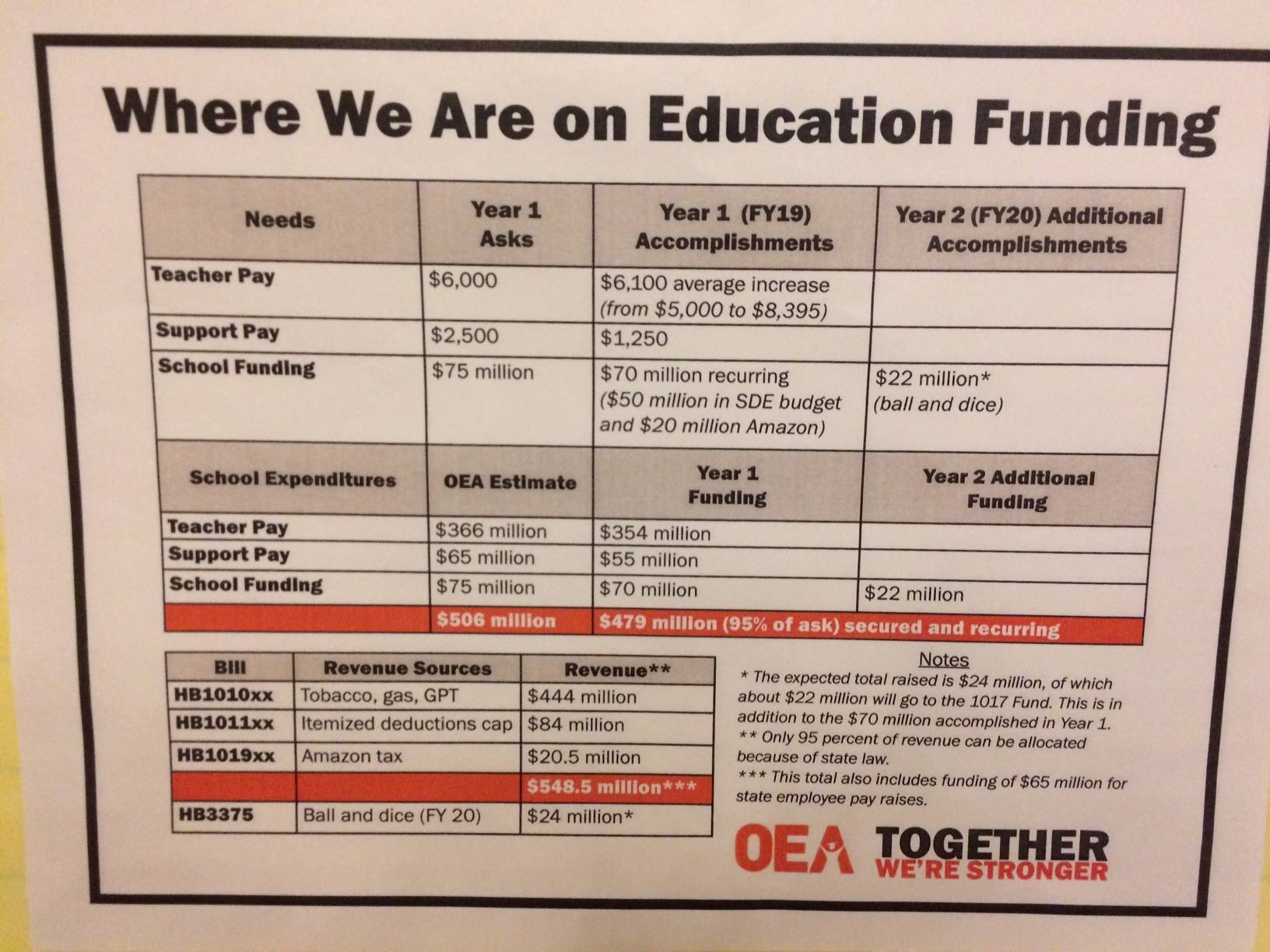
The OEA flyer drew a strong reaction from State Sen. A. J. Gay-Griffin, a strong supporter of the tax increases:
This is such crap. I'm just so tired of the lies. STOP LISTENING TO THE OEA!
Chad Warmington, president of the Oklahoma Oil and Gas Association,
In response to a question, Sen. Gay-Griffin wrote: Having betrayed the taxpayers by voting for a tax increase, these legislators find that they haven't won new friends among the OEA. The legislators passed the pay raise and the tax increase before the strike began, and had the union been negotiating in good faith, there wouldn't have been a walkout at all. The OEA's game, it appears, was all along to have two weeks of disruption and protest at the Capitol leading up to the filing period now underway. No amount of concessions by the Republicans would have sent the teachers home, because the protest was the point. It's all about setting up the Democrats (and RINOs) to win in November, so that taxes can be raised more easily in the future. If only the Republican governor and Republican supermajority in the Legislature had approved performance audits back in 2013 (or earlier), they might have been able to provide raises before now without raising taxes, and the OEA's leverage would have been minimal. MORE: Here is another summary of taxes and allocations that shows $29 million more in new revenue than the "ask": MORE commentary from Oklahoma and elsewhere: Jon Gabriel at Ricochet writes about the teacher strikes across the country: I'm sure that teachers believe they're underpaid; pretty much everyone thinks they're underpaid. But they should remember that the vast majority of taxpayers also are struggling and have been for a long time. These strikes aren't harming politicians, but kids and their parents. And the last thing an angry parent wants to do is to give more money to people making their lives miserable. Meanwhile, all the teachers are showing up at my kids' charter schools here in Arizona. I expect that a lot of new students will be joining them in the fall.
I support the current investment funded by well thought out and vetted policy cussed and discussed for over a year. I don't support the current money grab OEA is pushing and the diminishing of the investment secured for education.
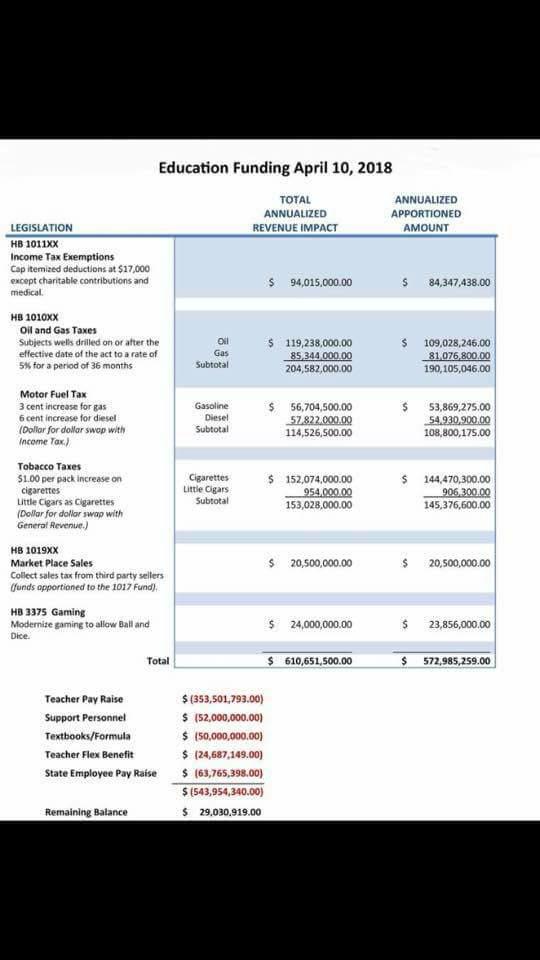
Like most non-government workers, I've gone years at a time without a raise. For the same reason, I have been laid-off due to a bad economy. A pension? As if. Yet I never picketed my various employers, stopped showing up to work, or demanded that my overtaxed neighbors pony up cash.
Dave Ruthenberg writes in the Enid News and Eagle about the well-funded OEA leaders and their far-left causes, and he has his suspicions about the reasons behind the strike:
There is little need to rehash the causes of the work stoppage other than to note teachers continue to march upset they were voted a 16 percent (on average) pay raise. The average worker would be quite thrilled with such a pay hike, but that's not enough to appease the OEA, which has steadfastly managed to move the goalposts (first it was all about pay then it was about textbooks, then it was about classroom overcrowding), making it impossible to reach any resolution.If it appears the OEA's objective all along is the Capitol chaos we are witnessing, it's because that's exactly what it's all about. The OEA has been itching for this fight, damn any reasonable discussions....
According to the most recently available filing of IRS form 990, an annual filing requirement for tax exempt organizations, in 2016 OEA President Alicia Priest was pulling down a cool $92,349 (or about three times the average teacher salary). Its executive director, David Duvall, was really living the life, raking in $152,091, above most school superintendents' pay.
Ruthenberg notes the OEA/NEA's outspoken support for illegal immigration and gun control, and their opposition to measures that would protect students from attackers.
OEA's agenda goes far beyond wages and takes a hard left turn into advocacy of policies that are anathema to common-sense Oklahomans, who, through their taxes -- which are going through a significant hike -- are helping to fund and being told it's not enough.However, each day the walkout continues, the OEA overplays its hand, and the growing sentiment becomes enough is enough, more so when OEA's full agenda is exposed.
I'll be on 1170 KFAQ with Pat Campbell Wednesday morning, April 11, 2018, just after the 8:00 am news to discuss the teachers' strike, the race for governor and other political topics. Listen at 1170 on the AM dial, online, or on the Tune In app.
A collection of notes about the Oklahoma teachers' strike, which has extended over seven school days so far.
The teachers' unions continue to move the goalposts and act like they've gotten nothing. This handout circulated at the capitol on Monday morning, purporting to be the latest set of demands, including repeal of the capital gains tax exemption that was approved in 2004, veto of the reversal of the proposed $5 nightly tax on hotel rooms, taxes on the wind industry, and an increase in the state sales tax rate (offset by a grocery exemption).
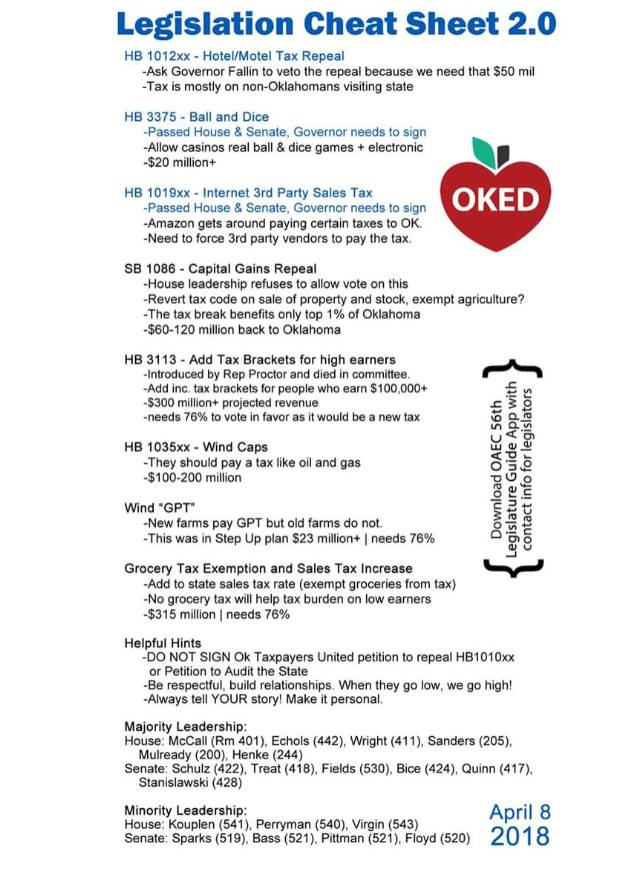
Alicia Priest, head of the Oklahoma affiliate of the far-left National Education Association, emphasized two demands as the strike ended its first week: Taxing long-term capital gains and reinstating the hotel/motel tax that was approved with the original tax package, then repealed by a separate bill. But it didn't seem to matter to her if any of the money went to schools.
Reporter: So, you are asking for 100 percent of the capital gains?Priest: I'm saying that we need the repeal of the hotel/motel repeal and we need to pass capital gains in order for the walkout to end.
Reporter: What portion of capital gains for education?
Priest: I'm not...
Reporter: So, the walkout would end if (the governor) vetoes the hotel/motel tax and capital gains passes, but not another dime goes to the student funding formula?
Priest: I don't think that is it at all. I think we have to get them passed and work on getting funding to public education.
This is a significant overreach. I understand the OEA lobbying for more more money to schools, but why specify the funding mechanism? Why should it matter to the OEA where the money is coming from? The answer, I believe, is that as a state affiliate of the left-wing NEA, they just want more money flowing to government. I have to wonder if this was part of a deal -- funding for strike expenses in exchange for pushing for a tax on capital gains.
It's also a non-starter. Oklahoma business owners and farmers understand how this tax would hurt them. Investors would find it much more attractive to invest their money south of the Red River as Texas has no income tax at all and thus no tax on capital gains. If we want businesses to be able to grow and create jobs and diversify our economy, they must have access to capital investment. In his FY 2005 budget, Gov. Brad Henry, a Democrat, called for a long-term capital gains exemption:
A key to economic growth, and especially wage and income growth, is investment. Accordingly, any practice, policy or law that discourages investment in Oklahoma is not in the state's best interest and should be changed. One such policy is the taxation of gains on investment in Oklahoma. This budget recommends a full exemption from the individual income tax for all capital gains resulting from Oklahoma business interests or property held for five years or more.
The folks at the state and metro chambers of commerce must feel rather used right now. They've been vocal in supporting higher taxes for education and have helped to build the platform of positive publicity that the teachers' unions are now using to call for a tax that would damage their members. The bill passed the Senate but won't be heard by the House. Had the unions succeeded in browbeating passage of the tax, they would have found their erstwhile allies leading and funding the repeal effort. Legislative leaders have said that the capital gains tax came out of the funding package in order to get the votes needed for passage.
The teachers would have been wise to have their one-day show of force at the capitol and then returned to the classroom. They don't have much to show -- ball-and-dice games in casinos and Amazon tax -- for seven days of lobbying.
Someone else who feels hung out to dry is State Rep. Kevin McDugle. His frustrated video complaint about teacher behavior at the capitol, posted the morning of the strike's second day, went viral. McDugle voted for the tax increases and voted to make it easier for the legislature to impose higher taxes, alienating many of the Republican constituents who supported him, supposing him to be a conservative. In his Facebook video, he didn't specify the behavior that got under his skin, but clearly he felt the teachers were not sufficiently appreciative of the political risks he and others took to give them their demands. His video drew brickbats from the union teachers -- and an opponent to his re-election. McDugle now finds himself not only politically homeless and in the midst of what looks like a messy divorce, in his wife, the plaintiff cites adultery as grounds for divorce, a charge McDugle denies.
That aside, it's not smart to alienate the people who have helped you. I'm sure McDugle isn't the only legislator who feels underappreciated right now, and many may wish they could get their vote back. I read somewhere that the reason the $5 hotel tax needed a separate repeal, rather than being taken out during conference committee, is that House leaders were uncertain that they'd be able to get 76 votes for the bill the second time through. By continuing to push, despite the big legislative win that happened before the walkout, teachers are risking the same sort of backlash that followed passage of HB 1017.
In a press release in connection with her signing the repeal of the new $5 hotel tax, Oklahoma Gov. Mary Fallin has said she's done with education funding for the year, and it's time to move on. I'm not a Fallin fan, but she's right about this.
Fallin said today's action should complete funding K-12 public schools for the 2019 fiscal year. She encouraged legislators to turn attention now on other issues, such as criminal justice, and address the financial needs of other core services, such as public safety and health and human services, in finishing work on the 2019 fiscal year budget.
Dave Bond of OCPA tallied all of the new funding for education approved in the last three weeks, most of it before the strike began (bullets added for legibility):
HB 1010xx - signed by Governor BEFORE the teacher's union walkout began:
- cigarette tax increase = $152 million
- little cigars tax increase = $1 million
- gasoline fuel tax increase = $51 million
- diesel fuel tax increase = $53 million
- oil gross production tax raised to 5% = $95 million
- natural gas gross production tax raised to 5% = $71 million
HB 1011xx - signed by Governor BEFORE the teacher's union walkout began:
- itemized deductions capped at $17k = $94 million
HB 3375 - awaits Governor's signature:
- gaming expansion ("ball & dice") to be assessed exclusivity fee = $24 million
HB 1019xx - awaits Governor's signature:
- third-party sales on Amazon now assessed sales tax = $19 million
Total new revenue = $560 million
That represents a 19% increase in state appropriations for public education and moves Oklahoma to 2nd in average regional teacher's pay and 1st in benefits.
Four of the six major Republican candidates for governor have gone on record about the recent tax increases. Lt. Gov. Todd Lamb, Gary Richardson, and Kevin Stitt all said they would have vetoed them, State Auditor Gary Jones would have signed them into law (and took credit for the plan), and outgoing Oklahoma City Mayor Mick Cornett wouldn't say one way or the other. Former State Rep. Dan Fisher was not quoted in the story.
Lamb said the package "gets an 'F' in reform. I'm opposed to tax increases. We continue to kick the reform can down the road ... I'm very frustrated and very disappointed in how this teacher pay raise was signed and how it was passed."
That certainly narrows the field for me. I'd already ruled out Mick Cornett, but now I'm ruling out Gary Jones as well. I appreciate Jones in his role as State Auditor, I respect his integrity, but I have also observed over the years that he has a hard time thinking outside the box. I want a governor that is aggressively looking for ways to deliver state services without growing government and increasing our tax burden. Where Jones sees barriers and hurdles to getting money where it needs to go, a real leader in the governor's office would push to tear those barriers down, even if it means amending the constitution or changing laws. Some people are pushing to change the constitution to make it easier to impose tax increases on the people without their approval; why not instead change the constitution to make it easier to allocate the tax dollars government already receives to the areas where they're most needed?
In hindsight, Jones deserves some of the blame for the current lack of leadership at the State Capitol. Jones was elected Oklahoma Republican Party chairman after the disastrous 2002 election, when Democrats used cockfighting and fears of school consolidation to mobilize rural voters for Brad Henry. Jones's platform focused on building the party in rural areas. He and his team recruited legislative candidates who were not party activists or vocal conservatives but rather were respected leaders in the community who happened to be registered Republican. The strategy was successful in winning seats that Republicans had never before held, ultimately producing Republican supermajorities, but many (perhaps most) of these new legislators did not have the grounding in principle to withstand the blandishments of lobbyists and bureaucrats. As a result, we don't have a principled conservative majority in either chamber, and, consequently, significant cost-saving reforms that might have provoked resistance from vested interests didn't move forward. Thus we found ourselves in a budgetary dilemma that, to Jones's way of thinking, could only be solved by a tax increase. That same lack of political courage meant that the legislature wouldn't override Governor Fallin's veto of a 2013 bill that would have created a joint legislative committee authorized to direct his State Auditor's office to conduct performance audits of state agencies.
Wednesday night the Oklahoma State Senate passed the massive package of tax increases that was approved earlier in the week by the State House, and the bills were signed by Governor Mary Fallin. The largest tax bill, HB1010XX, passed by 36-10, including three Taxpayer Protection Pledge-breakers: State Senators Kim David, David Holt (Oklahoma City's mayor-elect), and AJ Griffin. Gov. Fallin is also a Taxpayer Protection Pledge-breaker.
Most Candidates for Governor have been very quiet about these taxes, but State Auditor Gary Jones expressed his support for the tax hikes on Facebook. Candidate Kevin Stitt denounced the tax increase and signed the seven-point Oklahoma Taxpayer Platform unveiled on Wednesday by Oklahoma Taxpayers Unite.
Here is the Oklahoma Taxpayer Platform:
- Fiscal Responsibility: We demand state and local government that is fiscally responsible, transparent and accountable. Heads of state agencies and local government entities should answer directly to elected officials. State agencies must be subjected to regular, independent fiscal and performance audits by the State Auditor and held accountable for the findings and recommended reforms. The 20 largest agencies should be audited no less than every 4 years. Establish a permanent, full-time Legislative Oversight Committee that is bipartisan, bicameral and has subpoena power. It will oversee each agency's mission and spending, and offer suggested legislation and reform, providing transparency and accountability.
- Limited Government: Focus on priorities. Most Oklahomans agree that state and local government should focus on four basic areas: public safety, transportation and infrastructure, education, and a safety net for the most vulnerable. Encourage and protect self-responsibility and liberty in religious expression, occupation, health care, education, etc. The first instinct of elected officials should be to limit government's reach.
- Structural Reform: We want structural reform to transform and eliminate governmental dysfunction, duplication and corruption. 500+ school districts are too many. Schools are bloated with administration. 500+ Agencies, Authorities, Boards, Trusts and Commissions are too much. Too many unelected officials are making decisions that affect taxpayers. Education and health would be better served by a dramatic downsizing of state bureaucracies, with more decisions made locally. We want fair legislative operating rules that do not abridge the right and responsibility of legislators to represent their constituents. Needed government services should be efficient and user-friendly.
- Fair Taxation: Tax people in the least-burdensome way. Income taxes impose a discouraging penalty on work, productivity, personal responsibility, savings, investment, capital formation and entrepreneurial risk-taking. No income taxes of any kind should be levied by Oklahoma's state and local government. Shift Oklahoma's tax structure to focus on consumption. This will help Oklahoma become a magnet for private-sector both large and small job creators and productive individuals of all incomes. The key is to attract more taxpayers, spreading the cost of state and local services among more people and allowing for a lower tax burden on everyone.
- Free-Market Environment: Preserve the gains made in Oklahoma in the past 20 years toward greater worker freedom and a less-adversarial legal climate. Remove unnecessary barriers set up by state and local government for many occupations. Encourage stronger market forces in health care, education, and other sectors, with less picking of winners and losers by government.
- Criminal Justice System Reform: We need criminal justice reform that keeps citizens safe but doesn't lock people up unnecessarily. Oklahoma can't afford the bankrupting costs and social dysfunction that go with leading the nation in the rate of incarceration.
- State Sovereignty: Provide a barrier between Oklahomans and Federal overreach that limits our Constitutional liberties. We cannot continue to let the Federal government impose restrictions, mandates and costs that infringe on our rights.
Oklahoma Taxpayers Unite reacted to the passage and signing of the tax increases with a news release:
In an era of big spending, big government, big egos and big lies, the passage of HB1010XX is a shameful slap in the face of Taxpayers and for many, a betrayal of their word of honor when they signed pledges NOT to raise taxes. Untrustworthy oath-breakers lead our state.For eight years, Governor Fallin and the GOP have had super majorities in the both the state Senate and House. They've squandered their opportunity to make structural reforms and institute real fiscal responsibility in state government. Now we've been subjected to the obscene applause and joy as they celebrated their abject failure of leadership while violating the very principles of their own Oklahoma GOP Platform.
Governor Fallin and the legislative leaders who pushed this are an embarrassment to their party, bring national shame to our state, and have betrayed Taxpayers who elected them. State Question 640 specifically mandates that ALL new tax increases be sent to the Taxpayers for a vote. The 75% supermajority vote of both Houses was meant to be used only for a real emergency, which this is not. Numerous proposals have shown how the teachers can get a pay raise without raising taxes.
You can watch the complete Oklahoma Taxpayers Unite press conference on the KOKH website. In his remarks, former U. S. Sen. Tom Coburn compared the passage of the tax hikes to the dishonest and cowardly process he witnessed first-hand at the U. S. Capitol:
"It had the suspension of rules, the lack of ability to read the bill, the lack of ability to offer amendments," Coburn said. "And the only leadership you had was to spend more and have less responsibility and less transparency in government."
Just a little bit before the OTU press conference was to begin, State House Rep. Mike Ritze, an opponent of the tax hikes, was headed to the press room when Ritze was confronted loudly by State Rep. Josh West, who voted to raise taxes, according to this report from David Van Risseghem of Sooner Politics:
As Ritze was walking alone on the 4th floor, he says Rep. Josh West, a freshman Republican started yelling at him for participating in the taxpayer advocacy group's meeting. As West (a tall former military vet) got even closer, he screamed; "YOU'RE STARTING A CIVIL WAR!".That outburst, and the encroaching movement caught the eye of a capitol public safety officer and he stepped up to the two house members. The presence of law enforcement evidently had a positive effect and West wisely recovered his senses & backed away.
This incident reminds me of the time a Tulsa City Council staffer went red with rage, shouting at me apparently because I came to the "pre-meeting" to report any action taken, camcorder in hand. Both situations seem to be a case of someone turning the guilt they feel at betraying the taxpayer against those who are exposing it.
Meanwhile, teachers are still going on strike, despite an average salary increase of $6,000 per year -- sorry, walkout. I'm told it isn't illegal because the teachers are only forbidden to strike in arbitration with their school board, to whom they are contracted, but in this case the school boards and administrators are in cahoots with the teachers and happy to send them to the State Capitol to shake the taxpayers down for more funds. Seems like there ought to be a law that restricts school administrators from closing school for political lobbying purposes. Even if the walkout doesn't violate the letter of the law, it surely violates the spirit and provides yet another example of why public-sector unions are a hazard to fiscal sanity and shouldn't be regarded in the same light as labor unions organizing workers in the private sector. Even Pres. Franklin Roosevelt, a friend to private labor unions objected to public-sector unions:
Meticulous attention should be paid to the special relations and obligations of public servants to the public itself and to the Government....The process of collective bargaining, as usually understood, cannot be transplanted into the public service.... A strike of public employees manifests nothing less than an intent on their part to obstruct the operations of government until their demands are satisfied. Such action looking toward the paralysis of government by those who have sworn to support it is unthinkable and intolerable.
Finally, Oklahoma Watch notes that the revenue sources that will produce the biggest share of the tax hike -- gross production tax, tobacco tax, fuel tax -- are highly volatile and may not consistently produce the revenue required for the pay increases that were also approved. That's rather rich, considering that the usual slam against the OCPA's plans for teacher pay raises without tax increases was that they used sources of revenue that weren't guaranteed year after year.
NOTE: I will be on 1170 KFAQ with Pat Campbell at 7:05 am on Wednesday, March 28, 2018 to discuss the tax increases passed by the Oklahoma House of Representatives last night and the path forward. Listen live on 1170kfaq.com or on the Tune In app. Later the interview will be posted on Pat Campbell's podcast page.
I'm disappointed but not surprised that the tax-eaters finally got their three-quarter billion dollar tax increase through the State House, with the largest tax bill, HB1010XX, passing by a vote of 79 to 19, a margin sufficient to bypass the constitutional requirement for ratification by a vote of the people in November. The proposal was introduced late in the afternoon and was passed a few hours later. In order to give the public a look at the bill before the vote, State Rep. Jason Murphey put the bill online, when it wasn't yet available on the official legislature website.
HB1010XX raises taxes on gasoline and diesel fuel (3 and 6 cents per gallon, respectively), on little cigars, cigarettes ($1 a pack), chewing tobacco (10%), and hotel rooms ($5 per day -- the definition of hotel is broad enough to affect campers at church camps and spiritual retreats like Falls Creek, and it looks broad enough to me to affect apartment renters, too; tribal casino hotels are, of course, exempt). The Gross Production Tax will increase from 2% to 5%. Another bill caps itemized deductions, effectively raising income taxes on middle-class Oklahomans.
If the bills pass the Senate, they will go into effect 90 days after the governor signs them into law. The 90-day delay was included in the constitutional process for tax increases to give citizens time to put a repeal of the tax on the ballot through the initiative petition process before the tax goes into effect.
The phenomenon I described in my previous piece, the dynamic that makes it easier for legislators to raise taxes than to root out waste, was in full effect yesterday. After the vote, it was disgusting to watch Republican legislators congratulating themselves on the tremendous achievement of passing a massive tax increase "for the first time in state history since 1990." At the very least, they ought to regard the vote as an admission of failure: After a decade of full Republican control, they had failed to clean up the state's finances and had to resort to a tax increase to fund teachers' raises, capitulating to a tiny Democratic minority's wish list of taxes and spending to get the votes they needed.
Why? Because the Republican legislative leadership and Governor Fallin have refused to work with the principled members of their caucus who insist on following the Republican Party platform and restraining the size and scope of government. Because these Republican elected officials refused to pursue any of the many proposals offered by the Oklahoma Council of Public Affairs (OCPA), the free-market, small-government think-tank, to raise teachers' salaries without raising taxes.
There seems to be genuine resentment and disdain on the part of the legislative leadership and the governor toward these principled organizations and individuals. I hear that legislative leaders refuse to work with OCPA and refuse to work with the Platform Caucus.
Remember when you were a teenager, the way you felt when your mom or dad or some other adult authority figure logically dismantled your carefully crafted excuses for not doing the right thing? I suspect that's the way legislative leaders feel about OCPA. They like the OCPA as much as the emperor liked the little boy who pointed out that his beautiful new clothes were non-existent.
One excuse I've heard is that one of OCPA's proposals last year required repurposing money in the Tobacco Settlement Endowment Trust fund in a way not expressly on the list of spending purposes permitted by Article 10, Section 40, of the state constitution.
Instead of changing the Oklahoma Constitution to make it easier to raise taxes, why not change the constitution and statutes to make it easier for the tax dollars we already send to the State Capitol and the county courthouses to get where they're really needed?
Oklahomans may have the impression (fed by sloppy reporting) that there's one big pot of tax money from which all state and local government expenditures are drawn. In fact, there are hundreds, maybe thousands of pots, large and small, earmarked for a specific purpose. That means that in the same year core governmental functions funded from the general fund are squeezed by revenue shortfalls, agencies with dedicated revenues may have far more money than they need.
The lazy legislator looks at that situation and says, "We have to put more money in the big general fund pot." What we need is for legislators to look at where money is going and where it is needed and then do the hard work of changing laws and constitutional provisions so the tax dollars we're already paying will go where they are needed.
Will that take a long time? Probably. Will it be hard work? Undoubtedly, with a lot of digging into details of budgets and spending and laws. Will it make some people angry? Certainly, especially those agency leaders who will lose their cushy earmarked funds and have to justify all of their spending each year. But hard work and making people angry is not a legitimate reason for legislators to avoid doing something. It's why we elected them.
(We did not, however, elect them so they could experience the Joy of Sex with new people they meet at the State Capitol. Some legislators over the years have been confused on this point. I suspect that confusion has led to moral compromise which has made said legislators more susceptible to compromising on their professed political principles.)
We should also expect our legislators to do the hard work of investigating and auditing state agencies, school districts, colleges, and other taxpayer funded entities and then implementing reforms in response to those audits. It is a difficult task, and it will make certain people feel threatened and angry, but legislators have a moral obligation to ensure that the tax dollars we entrust to them are wisely spent.
Of the 17 State House members who had taken the Taxpayer Protection Pledge for their current term of office, only 6 voted to uphold that pledge. The Taxpayer Protection Pledge for state legislators simply reads: "I, ____, pledge to the taxpayers of the State of Oklahoma, that I will oppose and vote against any and all efforts to increase taxes."
Here is the list of Oklahoma House pledge-breakers on HB1010XX: Earl Sears, Dustin Roberts, Josh Cockroft, Dennis Casey, Leslie Osborn, Charles Ortega, Mike Sanders, Scooter Park, Randy McDaniel, Chris Kannady, Michael Rogers. State Sen. Kim David is the Senate sponsor of the bill; her sponsorship makes her a pledge-breaker as well. I am happy that they took this step before the filing period for state office next month, and I hope challengers are ready to oppose them and the rest of the 51 Republicans who voted in favor of the biggest tax increase in nearly 30 years.
Even though Republican House leaders and their weak-willed followers voted to violate the party platform because of their failure to manage our tax dollars wisely, Oklahoma's affiliate of the leftist National Education Association is still planning an illegal strike on Monday because their entire list of demands were not satisfied. If the strike happens despite this massive tax increase, it will reveal the union as utterly unreasonable and should inspire support for repeal of the tax increases by the voters and defeat of the proposed constitutional amendment that would make it easier for the legislature to raise taxes without a vote of the people.
I'm happy to see conservative activists fired up to fight this tax increase. Steve Fair, a longtime grassroots leader in the Oklahoma Republican Party and former Republican National Committeeman, notes with disgust that no reforms of our tax-funded education system were required in exchange for these new taxes.
The disappointing thing is once again the education lobby won because self-described fiscal conservatives in control of the legislature caved. Education didn't have to agree to consolidate administrative services, school districts, or submit to comprehensive audits of school districts. They just threatened to walk-out and lawmakers caved. No Oklahoman disputes teachers in Oklahoma deserve a raise, but so do the butchers, bakers and candlestick makers. Unfortunately, those people can't afford to stage a walk-out because they can't afford to take the day off. They have to work to pay their taxes.
Former U. S. Senator Tom Coburn, renowned for his fight against government waste in Washington, will keynote the launch of a new organization, Oklahoma Taxpayers Unite!, tomorrow, March 28, 2018, at the State Capitol:
Fiscal hawk and Taxpayers' friend, Senator Tom Coburn, will announce the formation of a new Taxpayers' coalition to take the fight to the legislative tax hogs, oath breakers and Political Class.Oklahoma Taxpayers are fed up with legislative leadership that seeks first to raise taxes and refuses to make the structural, transformational reforms that fiscal responsibility requires. With HB1010XX, passed under duress and rules suspension March 26, the majority of the House of Representatives has chosen the path of more taxation instead of reform.
Oklahoma Taxpayers Unite! is a coalition of Oklahoma Taxpayers -- civic leaders, concerned citizens, grassroots activists, and party leaders, working together, demanding constitutional, ethical, transparent, and fiscally responsible governance for the Oklahoma Taxpayers. Reminiscent of the group known as "Stop New Taxes" which almost repealed HB 1017 28 years ago with a referendum petition, and then Oklahoma Taxpayers' Union, which successfully passed SQ 640, the new coalition reflects the disgust and anger with a Governor and legislature that has refused to lead, opting for new taxes instead.
Of the 79 House members who voted for new taxes, 11 of them previously signed a pledge for their entire term of office with Americans for Tax Reform, "to oppose [and vote against] any efforts to increase taxes." Apparently, their word means nothing. Two of the oath-breakers are running for higher office in 2018. Seven members of the Senate signed the same pledge.
Oklahoma Taxpayers Unite! will offer its 7-point Taxpayers Platform for all incumbents and candidates to pledge to on their Word of Honor.
At a time of life and with a record of accomplishment that would justify a quiet retirement, it's commendable that Tom Coburn would be willing to devote his time and his credibility to fixing waste in Oklahoma state government. May God grace us with more men and women of his integrity to serve in our State Capitol.
Last week the Oklahoma House approved HJR 1050 by a bare majority of 51 votes, pushed by the Chambercrat House Leadership, voting to erode the constitutional protection against tax increases without approval of the voting public. These 51 representatives, including two, Leslie Osborn and Glen Mulready, who are seeking higher office, voted to make it easier for politicians at the State Capitol to pass tax hikes without asking for voter approval. I'm embarrassed to see on the list of traitors to the taxpayers the names of legislators that I have endorsed and defended in the past.
Mainstream news coverage of Oklahoma's budget battle has given many voters the mistaken impression that a 75% legislative super-majority is the only constitutionally permissible way to raise taxes. When I corrected someone who made that assertion, I was told that I was absolutely wrong.
Article 5, Section 33, of the Oklahoma Constitution is best known by the initiative that enacted it: State Question 640. Here is the language:
§ 33. Revenue bills - Origination - Amendment - Limitations on passage - Effective date - Submission to voters.A. All bills for raising revenue shall originate in the House of Representatives. The Senate may propose amendments to revenue bills.
B. No revenue bill shall be passed during the five last days of the session.
C. Any revenue bill originating in the House of Representatives shall not become effective until it has been referred to the people of the state at the next general election held throughout the state and shall become effective and be in force when it has been approved by a majority of the votes cast on the measure at such election and not otherwise, except as otherwise provided in subsection D of this section.
D. Any revenue bill originating in the House of Representatives may become law without being submitted to a vote of the people of the state if such bill receives the approval of three-fourths (3/4) of the membership of the House of Representatives and three-fourths (3/4) of the membership of the Senate and is submitted to the Governor for appropriate action. Any such revenue bill shall not be subject to the emergency measure provision authorized in Section 58 of this Article and shall not become effective and be in force until ninety days after it has been approved by the Legislature, and acted on by the Governor.
Sections A and B apply to all revenue-raising bills. Section A echoes the Federal Constitutional requirement that revenue bills originate in the legislative chamber closest to the people. The normal path for measures raising revenue is described in Section C: Approved through the normal legislative process, then ratified by a vote of the people at the next general election.
Section D is intended for true emergencies, unforeseeable circumstances, like a natural disaster. The threshold is high enough to require agreement from every reasonable legislator, but not so high that a stubborn handful can block the measure in a true emergency.
For those of you more visually inclined, here's a flow chart:
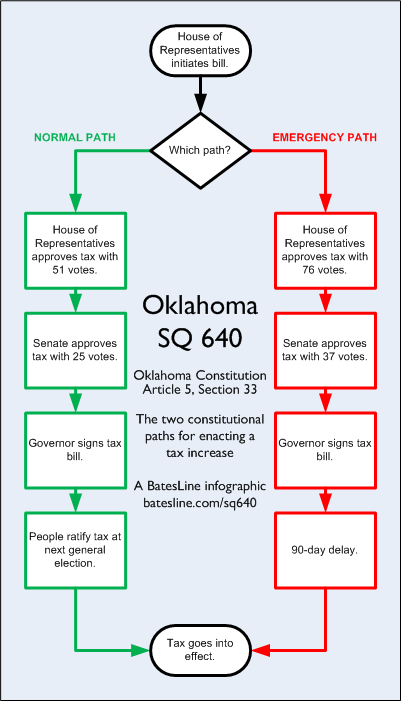
The movement to limit the legislature's power to impose taxes was a reaction to HB 1017, the largest tax increase in Oklahoma history, enacted on April 19, 1990, by the legislature, without a vote of the people. At the time, Democrats had supermajorities in both houses of the legislature.
According to a story in the April 20, 1990, Daily Oklahoman, Corporate tax rates were increased by 20%, sales tax rates by 12.5%, and personal income tax rates by between 1.2% to 16%, depending on income level. Schools were required to meet accreditation standards, teachers' minimum salary scales were increased, maximum class sizes were lowered, and money was allocated to fund voluntary school consolidation for up to 250 of the state's then-604 school districts. (28 years later, Oklahoma still has 522 school districts.) News stories after HB 1017 went into effect report complaints from teachers and administrators that the extra money was appreciated, but the strings attached were making it hard to use the money wisely.
HB 1017 was approved in the wake of a week-long teachers' strike of questionable legality that began on April 16, 1990, called by the Oklahoma Education Association after an education funding bill failed to pass with an emergency clause for immediate effect. The strike was supported by a number of school districts.
Many Oklahomans felt that their elected officials caved to pressure from the teachers' union, ignoring the economic impact of higher taxes on the general public. Dan Brown, leader of Stop New Taxes, the movement opposing HB 1017's tax increases, described the reaction for the April 25, 1990, Daily Oklahoman:
These calls have been from retirees, teachers and administrators, small town newspaper editors and representatives of small and large businesses who feel betrayed by the Legislature and the governor, Brown said."In general, they fear the trend of government decisions being made by mob rule,'' he said. "They have lost their faith in our system and their belief that anyone at the Capitol hears them.''
While some opponents of higher taxes wanted to attempt an immediate repeal, the principal anti-tax organization at the time, Stop New Taxes focused on an initiative petition to restrict the legislature's ability to raise taxes without the direct assent of the taxpayers. In the early stages of the effort, Dan Brown described the intent:
"The taxes we plan to include in this petition include taxes on sales, personal and corporate income, ad valorem, service, etc.,'' Brown said. "We are not planning to include limitations on fees in this amendment.''He said the group is considering adding a provision that would allow the government to obtain money in emergencies, such as a severe prison riot or economic depression.
(An initiative petition to repeal the HB 1017 taxes, but which also added a variety of other reforms, did reach the ballot but not until November 1991, after the bill had already been in effect for a year, fell short, but nevertheless won 45.7% of the vote. Here is a timeline of events leading up to passage of HB 1017 and the attempt to repeal it.)
The heart of what became SQ 640 is this: At the State Capitol, it's easy for a legislator to forget where he came from and who he works for. He is surrounded by special pleaders for special interests. He finds himself becoming assimilated into the capitol subculture, developing an "us vs. them" mentality, where "us" consists of fellow legislators and the lobbyists that pretend to be his friends, and "them" consists of the rowdy, rude, ignorant electorate who got them into office and stupidly expects them to live up to their campaign rhetoric. The bureaucrats and lobbyists and legislative leaders tell him, and he begins to believe, that the Capitol endows its denizens with special knowledge that his constituents lack. His fellow Capitolines speak nicely to him, tell him what a couragous and brilliant man he is, admire him for growing in office, assure him that his betrayal of his campaign promises is just and wise. His betrayed campaign volunteers and constituents speak angrily to him, driving him further into the arms of his new love. The seed of legislative infidelity finds fertile soil.
The phenomenon of concentrated benefit trumping diffuse cost, explained by public choice theory, only compounds the problem: Advocates who are protecting or demanding a concentrated benefit will be better organized, more present, more passionate than the diffuse mass that will bear the cost. To the weak-kneed legislator, the demonstration on the Capitol steps will appear to be a bigger and more important political force than their constituents. Call it the puffer-fish effect: An organization making itself look bigger than it is for the purpose of intimidation. (The Federal Essential Air Service program is one instance of the phenomenon; pollution provides a non-economic example.)
This problem of alienation of legislative affection has been mitigated somewhat by several reforms: Legislative term limits that prevent legislators from making the Capitol a career and limit concentration of power through seniority, limits on the legislative calendar (February through May, Monday through Thursday) that allow a legislator to spend more time back home among his constituents, and SQ 640, which prevents taxes being enacted hastily in response to pressure from those who would benefit from the tax increase. Either there has to be a near-universally acknowledged emergency, or there will be a cooling-off period in which tax advocates have to persuade the general electorate that a tax increase is necessary.
Over 230,000 signatures were gathered on an initiative petition to put SQ 640 on the ballot. While the proponents had wanted the issue on a general election ballot, Democrat Gov. David Walters scheduled it for March 10, 1992, perhaps hoping that special interest groups would be able to turn out their voters to defeat it. Even so, Oklahoma voters approved SQ 640 by a significant margin: 373,143 to 290,978, 56.2% to 43.8%.
Since its passage, a number revenue increases have gone into effect. In a column from earlier this year, OCPA President Jonathan Small listed several within the last decade:
As you might expect, some lawmakers are now looking to wage war against 640. They claim it confines government by making any revenue-raising measures impossible to pass. But that's not true.In 2009, 2010, and 2011, legislators organized bipartisan supermajorities to pass bills that raised some $224 million in new annual state funds and $268 million in annual matching federal dollars.
Press releases from the executive branch, Board of Equalization reports, and legislative budget summaries show that the 2015, 2016, and 2017 legislative sessions combined to annually increase revenue for appropriation by more than $500 million.
Moreover, Oklahoma has raised personal income tax rates, cigarette taxes, gaming taxes, and authorized a state lottery (a tax on the poor) since 640 was adopted by voters.
So mostly during Republican majority control, annually recurring revenues were raised more than $724.7 million.
HB 1017 was something of a pyrrhic victory for public-employee unions and their Democratic allies in the legislature. It provoked a taxpayer revolt that resulted in passage of term limits that fall, followed in 1992 by SQ 640. Democratic supermajorities gave way to Republican supermajorities and a sweep of statewide elective offices. Statewide initiatives to raise taxes for education have been defeated overwhelmingly -- SQ 744 in 2010, 19% to 81%; SQ 779 in 2016, 41% to 59% -- which may explain why our weasely state reps thought they need to make it easier to raise our taxes without asking our permission.
The teachers' union and their allies seem intent on blocking any improvement for teachers that doesn't also kill or cripple SQ 640 and raise taxes permanently. The fact that a decent increase in minimum teachers' salaries could be funded without raising taxes seems to have inspired them to double their demands and expand them beyond the classroom to include state bureaucrats. As in 1990, they may succeed in intimidating a majority in the legislature to do their bidding, but as in 1990, their victory may lead to long-lasting damage to their political clout.
As passionate as many Oklahomans are about their local public schools, particularly in small towns where the school system is about the only thing keeping the town from dying, an increasing number feel alienated from public education. They see a system mired in the latest educational fads, entranced by political correctness, discarding tried-and-true for novel and trendy, and sometimes directly hostile to the values they believe should undergird education. They see problems that no amount of money can fix; accelerating down the wrong track will never get the train to its destination. The good will Oklahomans have toward teachers may not extend to the beneficiaries of the OEA's other demands, and it may not even extend to giving teachers a much greater raise than most Oklahoma taxpayers have received over the last decade.
If you're perplexed by all the wrangling and bickering at the State Capitol over budgets and taxation, here's an opportunity to hear specific facts and numbers from experts and analysts.
It's tomorrow, starting at 9 a.m., but there's still time to register and attend. Registration is $20.
I'm particularly looking forward to the breakout session on the school funding formula. Much of the public conversation about school funding fixates on state aid while ignoring the other taxes that are earmarked for common schools. This session is a chance to look beyond the oversimplified sketch to study a detailed portrait of school revenue in Oklahoma.
AFP Co-Hosts 2018 Growth and Opportunity Summit in Tulsa SaturdayDr. Tom Coburn to headline conference
TULSA, Okla.--The 2018 Growth and Opportunity (GO) Summit is coming to Tulsa this Saturday, Feb. 24 at the DoubleTree Hotel in South Tulsa. The event will be headlined by a keynote address from former U.S. Senator Dr. Tom Coburn.
"We are thrilled to have Dr. Coburn address this year's Growth and Opportunity Summit," said. AFP-OK State Director John Tidwell. "Things are moving quickly at the State Capitol and the GO Summit provides an opportunity for citizens and voters to learn more about what the state legislature is up to and how they can impact lawmakers when they engage on issues."
Among other learning opportunities available at the GO Summit, Oklahoma Council on Public Affairs Executive Vice President Trent England will give a lunch presentation on the Oklahoma Constitution, the longest state constitution in the country, and how the state can follow the law and best serve taxpayers. Rounding out the day will be a legislative roundtable with current members of the state legislature on the state budget "crisis" and what comes next for our state budget after the failure of the Step Up plan.
In between speakers will be breakout sessions that will provide a more detailed picture of issues that are being talked about at our State Capitol. These breakout sessions include:
- Hollywood Handouts: Even in Oklahoma Hollywood is gobbling up tax credits. Where is the money going and what to we do about it?
- Fact or Fiction: The Oklahoma Budget
- Occupational Licensing 101: I need a license to do that?
- Impacting your legislator: How to cut through the clutter and best communicate with your legislator.
- Healthcare and Medicaid Reforms: How we can audit and right size our system through common sense reforms.
- Inside the Oklahoma Education Funding Formula: What goes into the formula, what comes out and all the nonsense in-between.
The 2018 Growth and Opportunity Summit is presented by Americans For Prosperity-OK, Oklahoma Council on Public Affairs and Tulsa 912. For more information or to register for the conference please visit okgrowthsummit.com. Registration will also be available the day of the event.
Oklahoma Gov. Mary Fallin delivered her final State of the State address to the Oklahoma Legislature today. Unfortunately, she did not use the occasion to announce her resignation. Instead she endorsed a series of of tax increases that are being pushed by a group of well-funded tax-consuming entities.
Jonathan Small, president of the Oklahoma Council of Public Affairs, the state's leading free-market think-tank, issued this reaction to Fallin's speech:
Working Oklahomans are clawing out of the economic downturn. The budget gap has dramatically shrunk to less than $200 million. The most important thing for policymakers is to not increase in any form or fashion the personal income tax on Oklahomans. Lawmakers should also be wary of the impact their policy decisions may have on lower-income and middle-income Oklahoma families.This session provides the Governor and lawmakers the opportunity to fulfill their campaign promises: to right-size state government (which is near all-time highs) and reform government structures. Medicaid enrollment audits, TSET reforms, ending Oklahoma's Hollywood and film production boondoggle that paid millions to Harvey Weinstein, ending crony capitalism to out-of-state wind energy companies and tribes selling tobacco, and initiation of performance and process improvement audits at every single state agency-all of these are better than simply raising taxes on Oklahomans. Pursuing these reforms will generate the savings and revenue needed to give every classroom teacher a $5,000 a year raise and protect Oklahomans.
You'll find discussions of many of these issues on the OCPA's blog.
Speaking of blogs, I've joined up with other conservative Oklahoma bloggers to call on our legislators to maintain the protections provided by SQ 640, which requires a vote of the people for most tax increases. We've seen too many examples recently of money wasted, fraudulently handled, spent on duplicative functions, or squandered on ineffective tax credits. Legislators should be putting the squeeze on bad management and bad policy in the state bureaucracy, not on Oklahoma taxpayers. While paid lobbyists will push to protect the tax-eaters at the State Capitol, Bloggers Organized for Oklahoma Taxpayers will be working to amplify the voice of the taxpayer in the ears of our elected officials.
Bloggers Organized for Oklahoma Taxpayers is a grassroots network of bloggers and writers dedicated to defending Oklahoma taxpayers against the onslaught of higher taxes and "reforms" that would strip taxpayer protections from the Oklahoma Constitution.We pledge to be the voice for the working-class majority in Oklahoma who don't have lobbyists at the Capitol to counter the access of the powerful and influential who seek to undermine the consent of the governed.
While the mainstream media in this state pushes oligarchy-style schemes to make it easier for government to take more of Oklahomans' hard earned income, we will fight to stop these economically detrimental plans.
From articulating arguments against these ideas, to publishing important information and supporting elected officials who are defending the People, we plan to answer the call to defend Oklahoma taxpayers.
Stay tuned for more from BOOT as the legislative session unfolds.
On Friday, January 12, 2018, Oklahoma City mayor and candidate for governor Mick Cornett was interviewed by Pat Campbell on 1170 KFAQ. Cornett offered no real answers to Campbell's questions, but spun out a full bogroll of vague platitudes. The impression is that he just wants to be liked and doesn't want to say anything that might make someone not like him. Of course, having that kind of attitude in the Governor's Mansion is why we are where we are as a state.
Campbell asked Cornett about an independent expenditure campaign that is advertising heavily in support of him in the Tulsa area. Jamison Faught at Muskogee Politico has posted about the pro-Cornett super-PAC, whose major donor was Sue Ann Arnall, oilman Harold Hamm's ex-wife. Arnall was a major donor to Hillary Clinton's presidential campaign and has been a generous contributor to other Democrats. Campbell asked Cornett to explain why a Clinton backer would be such an enthusiastic advocate for him; Cornett gave a rambling non-answer.
Asked about what he specifically did as mayor of Oklahoma City, Cornett described himself as a "chief spokesperson," for Oklahoma City, "traveling the world" to talk about the city. Cornett cited no policies or initiatives for which he was responsible. He sounded like a Convention and Visitors Bureau spokesperson, which is probably the job he should be seeking.
In fact, the Mayor of Oklahoma City is merely one councilor among nine, albeit the only one elected city-wide. The CEO of Oklahoma City is the City Manager, who is hired by the City Council.
Campbell asked Cornett about comments he made on an Oklahoma City radio station regarding school district consolidation. Cornett said that if we're going to talk about consolidation, "we ought to start concentrating on Oklahoma City" which has all or parts of 24 school districts within the city limits. Asked what consolidation in Oklahoma City might look like, Cornett dodged again: "I'm not the one that's bringing up consolidation!"
Campbell asked Cornett whether he supported a proposal to reduce the legislative threshold required to pass a tax increase without a vote of the people from 75% to 60%. Cornett began his answer with, "Well, that would have go to a vote of the people, right? And I'm all for a vote of the people if they want look at changing it." He audibly brightened, as if hopeful that the requirement for a referendum on any change to that constitutional provision would excuse him from forming and voicing his own opinion. Cornett used the phrase "revenue idea" as a euphemism for tax increase. Asked specifically how he would vote if the threshold-lowering proposal were on the ballot, Cornett replied, "You'd have to have a much deeper conversation than we could have here." Later in the interview, Cornett wouldn't offer support or opposition to any of the specific taxes that a group called "Step Up, Oklahoma" are proposing, suggesting only that any proposal could be on the table for negotiation.
"What would you do differently than the current incumbent?" is not a strange question to ask, and most politicians would have a ready answer. Cornett wouldn't be drawn out on what he would do differently than Mary Fallin. When asked what he would do as governor, he talked about health and education being his priorities. He would be a "champion" for those issues, "trying to inspire people to do better."
Campbell persisted in his unsuccessful pursuit of specifics about Cornett's platform: "Is there something tangible... something specific you can cite?" "I'll be a champion for jobs. I meet with business leaders, take them around." Cornett appears to see the job of governor as the same as mayor of Oklahoma City -- cheerleader with no actual authority or responsibility to direct and oversee the operations of government.
Thomas Schwartz offered an insightful comment about the interview: "Mr. Cornett wants to do for the State of Oklahoma what he has done exceptionally well for the City of Oklahoma City -- turn it into an even greater crony capitalist paradise for the well-born, well-connected, and well-heeled. That means unending disappointment for Bible-believing Christians who support free enterprise but believe that the greatest challenges we face in the Sooner State are moral and spiritual."
Certainly there's nothing in Cornett's background to suggest that he would focus his attention on streamlining state government, making the tough decisions to enable the state to fulfill its responsibilities within its means. Mick Cornett's weaselly refusal to offer specific answers to Pat Campbell's reasonable questions tells me he either doesn't understand what the job entails or has an agenda that he knows Republican voters won't like. Either way we can't trust him with the state's highest office.
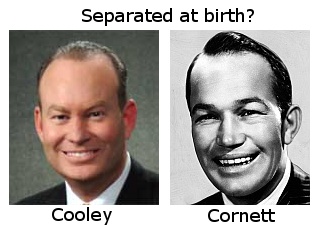
(I can't help but notice the OKC mayor's resemblance to the drug-addled pretender to the throne of Western Swing who tortured his wife to death in a hallucinatory rage and dropped dead on the verge of his release from prison. Of course, the resemblance is only superficial; Cornett simply divorced his high-school-sweetheart wife of 32 years, to her apparent surprise and dismay.)
SOMEWHAT RELATED:
Two years ago, on January 12, 2015, I posted this on Facebook, relating to Sue Ann Arnall's divorce from Harold Hamm. (Link to the relevant Daily Mail story added.)
That has to be the weirdest phone poll I've ever been asked to take. It had the usual sensitivity tests you expect in a political poll -- "If you knew XYZ, would that make you more favorable or less favorable" -- but it was about the Harold Hamm divorce settlement and whether I thought it was fair. The overall tenor of the poll was what could we include in a PR blitz about the soon-to-be-ex-Mrs. Hamm to convince you that she deserves a bigger settlement than the almost $1 billion-with-a-B that she got. This seems like a very expensive way to cultivate the opinions of the potential jury pool.
UPDATE Thursday, December 7, 2017: Filing is closed, and here is the final 2018 school board candidate list from the Tulsa County Election Board. Only three of 17 seats will be contested. Shawna Keller, the incumbent from District 4 in the eastern part of the Tulsa school district, has drawn two opponents: Kyle R. Wagner and Raymon Simpson. Suzanne Schreiber, the other Tulsa incumbent, drew no opposition. Contested elections will occur in Broken Arrow (Theresa Williamson vs. John Cockrell) and Collinsville (Jennifer McElroy vs. Brady Stephens). No one filed for the Bixby seat, which will be filled by appointment by the other school board members -- a missed opportunity to bring some accountability to bear in that district.
Seat 4 in most districts will be up for election in 2019 (with filing a year from now in December 2018). In Tulsa, only the District 1 seat will be on the ballot; District 1 is currently held by Gary Percefull, and covers the portion of the district west of the Arkansas River, downtown Tulsa, Owen Park, Irving/Crosbie Heights, Brady Heights, neighborhoods along the Sand Springs Line, southern part of Gilcrease Hills, and, southeast of downtown, the Riverview, North Maple Ridge, Swan Lake, Tracy Park, Forest Orchard, Village at Central Park, and Pearl District (south of 6th Street) neighborhoods.
A year is a long way off, but now is the time to start thinking and planning to run. I can think of many young parents who have decided to homestead in the traditional neighborhoods around downtown who would bring new perspectives and energy to the Tulsa school board.
This is a reworking of a post from two years ago, but it has been updated with current information about open seats and candidates, and there is some new information below.
 We are in the midst of the annual filing period for public school board positions in Oklahoma, which ends Wednesday, December 6, 2017, at 5 p.m. Most school districts will have a single seat, Position No. 3, up for election to a five-year term. Glenpool also has seat 5 on the ballot to fill an unexpired term. After the first day of filing, many seats have yet to draw a candidate, and no district has more than one candidate.
(Here is the current list of candidates for Tulsa County school board seats. And here's where you'll find maps showing school district and election district boundaries.)
School board filing always comes at a busy and distracted time of year. As I've written before, it's almost as if school board elections were deliberately scheduled to escape the notice of potential candidates and voters.
If you're a conservative, you should give serious consideration to running.
The election will be held on February 13, 2018, with runoffs on April 3, 2018, for those seats where no candidate won a majority of the vote in the February election.
The Tulsa district, largest in the state, has two out of seven seats up for election to a four-year term, Posts No. 4 and 7.
Tulsa Election District 4 is east Tulsa, covering the district roughly east of a line midway between Memorial and Mingo. The current member for District 4 and board vice president, Shawna Keller, is a member of the left-wing Oklahoma Education Association (and, by requirement,
a member of the left-wing National Education Association) according to her bio on the school board website, which describes her as a teacher at Owasso Ram Academy. Shawna Keller is a registered Democrat. (That link goes to information from December 2016, but I was able to confirm current status through the Oklahoma State Election Board's online voter tool.) So far Keller is the only candidate to file in the district
Tulsa Election District 7 covers, roughly, the portion of the district south of 51st St., plus the neighborhoods around Patrick Henry Schools and Promenade Mall. The incumbent is board president Suzanne Schreiber, who was first elected to the seat in 1996. Suzanne Schreiber is also a registered Democrat. So far she is the only candidate to file for the seat.
Looking through the online biographies, I think it's fair to assume that there is not a single conservative on the Tulsa School Board. Six are registered Democrats; one (Amy Shelton in District 2) is registered as an independent.
In addition, Tulsa Technology Center board seat 2 is up for a seven-year term, representing eastern sections of the district roughly bounded by 66th Street North, 31st Street South, and east of Yale Avenue within Tulsa County, plus the part of Rogers County and Wagoner County north of 41st Street within the TTC boundaries. TTC seems to have more money than it knows what to do with; it would be lovely to have a fiscal conservative on the board who could curb their building spree. Incumbent Rick Kibbe, a registered Republican, is the only candidate thus far.
If you're a conservative, you should give serious thought to running, even if you have no school-aged children, even if you have children that are homeschooled or in private school, even if you've never had a child in the public schools. The public school system exists to serve all citizens by educating the children of the community, so every citizen has an interest in the curriculum being used, the way discipline is handled, the condition of the school buildings, and the credentials, skills, and philosophical presuppositions of the teachers, principals, and administrators. Property owners support the school system through ad valorem taxes, and so they have a reasonable interest in the proper and efficient expenditure of those funds. So do all citizens who pay state income and sales taxes, which provide funds to supplement local property taxes.
If you are, like me, a homeschool or private school parent, you will have experience and valuable insights with successful, classical alternatives to the faddish and failing teaching methods, priorities, and content currently in use in the public schools.
I ran some numbers, comparing 2010 census data, broken down by age, with the closest school attendance data I could find, from the 2010-2011 school year. In the Tulsa school district, the average daily attendance was only 67.2% of the number of school-aged children (5-18) who lived in the district on Census Day 2010. That means about a third of school-aged kids were either homeschooled or in private schools, the highest proportion of any district in the metro area. The Tulsa district also had the lowest percentage of residents in the 5-18 bracket -- 17.9%. Compare that to the Sperry district, where 91% of school-aged residents attended the public school, and where 22.6% of the residents were school-aged.
It seems that a substantial number of families move from the Tulsa district to the suburbs when their children reach kindergarten, or, if they stay, many opt for homeschooling or private schools. Those numbers make a strong case for new leaders in the Tulsa district. And if the school board is going to be strictly representative, at least two of the seven members should have children in homeschool or private school, and a majority should be conservative.
Filing is simple: A notarized declaration of candidacy, and a signed copy of the statutory requirements for school board candidates. For this office there is no filing fee. You can view the Oklahoma school board filing packet online. And although school board elections are officially non-partisan, the local and state Republican Party organizations will provide assistance to registered Republicans who are candidates for non-partisan office. (I suspect the same is true of the Democrats.)
There was a time when it was generally agreed that schools existed to transmit knowledge and the values of the community to the rising generation, working alongside parents. At some point, as part of the Gramscian long march through the institutions, the public schools were infiltrated by Leftists who saw them as a venue for missionary work, converting children away from the values of their parents, away from the ideals that made America a prosperous and peaceful nation. The Left has influence over schools of education, textbook publishers, teachers' unions, and continuing education for teachers, administrators, and board members.
If you live in a suburban or small-town district, you might suppose your district is safe from Leftist influence. Think again. Through their college training, their teachers' union newsletter, continuing education courses, peer relationships, and curriculum, your districts' teachers and administrators work in an atmosphere of Leftist presuppositions about the world. It takes strength, conviction, and vigilance for a conservative educator to be conscious of that atmosphere and to resist its influence.
Earlier this fall, Mandy Callihan, a teacher and parent in Jay, Oklahoma, was infuriated to learn that her 12-year-old daughter was being taught in school about mutual masturbation and anal and oral sex, complete with a worksheet she had to fill out. She and other parents went to the school looking for answers and discovered that the curriculum had been approved by the school board and the middle school principal. The superintendent, claiming ignorance, halted the program, but parents were told it would have to be brought back the following year.
In Minnesota, the Center for the American Experiment has just published a detailed 10-page report on slipping standards at the once-successful Edina school district in the suburbs of the Twin Cities. While academic achievement has declined, Leftist indoctrination is on the rise:
Today, for example, K-2 students at Edina Highlands Elementary School are learning--through the "Melanin Project"--to focus on skin color and to think of white skin as cause for guilt. "Equity" is listed as a primary criterion on the district's evaluation for K-5 math curricula. At Edina High School, teachers are haranguing students on "White Privilege," and drilling into them that white males oppress and endanger women. In a U.S. Literature and Composition class, 11th-graders are being taught to "apply marxist [sic], feminist" and "post-colonial" "lenses to literature."In short, in Edina, reading, writing, math and critical thinking skills are taking a backseat to an ideological crusade.
The Leftist bent of the school district came to public attention after the overwrought reaction by students and teachers to the election results, but the roots of the problem went back several years, to the school's decision to try to close the achievement gap between students of different races by focusing on structural racism as the cause:
The All for All plan's fundamental premise is that white racism--not socio-economic factors like family breakdown--is the primary cause of the achievement gap. If minority students' academic performance is to improve, "systems that perpetuate inequities" must be "interrupt[ed]" and "barriers rooted in racial constructs and cultural misunderstandings" must be "eliminate[d]," according to the district's position statement on "Racial Equity and Cultural Competence in Edina Public Schools."
The story mentions one race-conscious elementary school principal who adopted a curriculum provided by the slanderous Leftist group that calls itself the Southern Poverty Law Center. The same principal eliminated flex groups -- opportunities during one period for children of similar ability levels to work together with a teacher, receiving targeted instruction -- because they were perceived as insufficiently diverse. A high school literature class describes a course goal in this way: "By the end of the year, you will have...learned how to apply marxist [sic], feminist, post-colonial [and] psychoanalytic...lenses to literature."
There are, it must be said, many good conservatives, many devout Christians serving in Oklahoma's public schools. But they need support in the form of school board members who will set policy and curriculum and ensure that the paid staff adhere to it. Conservative school board members should not give undue deference to "professionals" who have been trained to see education through a Leftist lens. The subject matter taught, the methods used, and the values undergirding it all should be firmly under the control of our elected representatives on the school board.
Education is necessarily ideological, because it rests on presuppositions about knowledge, truth, goodness, and beauty. The ideology of the public schools should reflect the ideology of the community.
If I were running -- and our district isn't up for election this year -- here are some of the planks that would be in my platform:
- Introduce the classical trivium as the philosophy and method of instruction in schools that are currently failing. That includes a heavy emphasis on memorizing facts in the elementary years, which gives children a sense of mastery and accomplishment and provides a solid foundation for subsequent learning.
- Instill pride in our city, state, and country. America has its flaws, but it is a beacon of liberty and opportunity that inspires hope in hundreds of millions of people around the world who wish they could live and work here. Our children should understand the aspects of our culture and history that have made our country prosperous and peaceful.
- Keep the Land Run re-enactments in our elementary schools. It's a fun and memorable way to introduce students to our state's unique history. There is an activist in Oklahoma City who managed to convince historically ignorant principals and school board members there that the '89 Land Run was an act of genocide. Oklahoma City, founded by the '89 Land Run, no longer has reenactments of that event, because of a zealot who pushed her slanderous revision of history on ignoramuses in charge of the schools.
- Return music to the elementary grades. An early introduction to classical music and learning to make music by singing have tremendous developmental and behavioral benefits.
- Review all federal grants and determine whether the cost of compliance and the loss of independence is worth the money.
- Young people who foolishly believe that swapping sexes will solve their deep unhappiness deserve pity and guidance. It is utter cruelty to humor their misplaced hope that "changing gender identity" will cure their misery. Leadership at each school should craft a way to accommodate these deluded young people with compassion and dignity, while protecting the dignity of everyone else, and while affirming the biologically undeniable reality of the two sexes.
On that last point, doing the wise thing will require resisting Federal pressure. If the U. S. Department of Education refuses funding based on its perverted interpretation of Title IX, the school should sue the DoE.
Our public schools need principled, intelligent conservative leadership. Will you step forward to serve?
RELATED (from 2015):
Stella Morabito writes, "Ask Not Who's Running For President, Ask Who's Running For School Board," and she cites the recent battle in Fairfax County, Virginia, over transgender policy as one among many reasons:
The board voted 10-1 with one abstention to shove the policy down the throats of startled parents. There was no discussion and no consideration given to the concerns expressed. Instead, the parents were in effect smeared as intolerant bigots.The ten board members voting in compliance with this federal harassment behaved like a bunch of cronies who seemed most interested in securing their places of privilege in a coming nomenklatura by regurgitating Orwellian-style talking points about "equality" and "non-discrimination."...
When informed citizens of goodwill vote en masse locally, they can provide an effective check on corruption and force government to be more responsive to its citizens. This kind of citizen activism serves as a buffer that can prevent state and federal governments from absorbing local governments.
As we've seen from the Fairfax County case, our distraction from local elections and neglect of local politics is fertile ground for growing laws under the radar on issues that have not been debated or thought through.
More than ever, we need to push back against the use of local elections as a back door to enforcing agendas established by central, national, or even international agendas.
Walt Heyer, a man who underwent sex-change surgery and then, realizing that the change failed to give him the happiness he had hoped for, changed back, writes that the Obama Administration is using its perverted interpretation of Title IX to force public schools to trample their students in the transgender war against science and reason.
Let's look back and unmask the founders who started the gender madness we see infiltrating into our public schools today. As I detail in "Paper Genders," changing boys into girls started in the perverted minds of three abhorrent pedophile activists from the 1950s who were at the forefront of promoting a movement for sexual and gender experimentation... [Alfred Kinsey, Harry Benjamin, and John Money]....Public schools are becoming centers for gay, lesbian, and gender-pretender activists and only secondarily fulfilling their purpose as institutions for sound academics. The laws are being interpreted far beyond the original intent of non-discrimination based on gender to where they protect gender pretenders at the expense of the rights of non-trans kids. Gender pretenders are assured access to every school facility and program available to the opposite gender, up to and including girls-only dressing rooms and showers.
Every child's rights to privacy and protection from exposure to inappropriate opposite-sex nudity are now in jeopardy. According to these new legal interpretations, if you like your gender and want to keep your gender that's fine, but you cannot keep your freedom, rights, or protections in public-school dressing rooms or restrooms. The current conflict of interest playing out in school locker rooms between girls born as girls and the self-acknowledged gender pretender trans-kids is real and it is not funny. Non-trans students have lost their right to privacy and parents have lost the freedom to parent and protect their children....
Studies show that people with gender issues also have other psychological issues 62.7 percent of the time. When the co-existing illness is treated, often the desire to change gender dissipates. By not treating the co-existing illnesses first and instead putting the patient through gender reassignment--hormones and surgery--the medical community does irrevocable harm to the patient's body and long-lasting harm to his mind.
The harm is deeper for impressionable children and adolescents who experiment with gender-change behaviors and hormones or hormone blockers. Studies have shown that the majority of kids who are gender confused will grow out of it if they are left alone....
Gender pretenders--also known as trans-kids, crossdressers, or transvestites--should get counseling, not encouragement. Social terrorists who use child transvestites to advance an agenda of sexual perversion should be shut down, not be guiding public school policy.
It's time for parents and kids to fight against the social terrorism of gender change. It's time to take schools back from males who wish to expose themselves with impunity in the girls' locker room.
On Friday, the Oklahoma Legislature approved a budget compromise that funded essential services, cut spending in other areas, and avoided raising taxes entirely. Later the same day, Gov. Mary Fallin used her line-item veto to remove all of the bill except for funding for the three agencies that would have been funded by the cigarette tax increase that was approved during regular session and struck down by the State Supreme Court because it lacked the constitutionally required vote of the people.
Legislative leaders were puzzled by Fallin's veto.
When asked what the Oklahoma Legislature might do after Gov. Mary Fallin line-item vetoed the product of its eight-week special session, House Floor Leader Jon Echols struggled to give an answer."I don't think anybody really understands what the intent of this is," said Echols, R-Oklahoma City. "There's a lot of unanswered questions here."
It appears that her veto leaves the state short $110 million this year instead of $215 million, which mostly affected three agencies that have a critical health care mission. She signed enough of the bill to send some money to the Department of Mental Health and Substance Abuse Services, the Oklahoma Health Care Authority and the Department of Human Services.
Fallin said she wants to call the Legislature back into special session to address the shortfall without spending what is considered one-time funding. She didn't say, however, when that might happen.
"Bringing the Legislature back into special session at this point seems like a waste of time and taxpayer dollars," Senate President Pro Tem Mike Schulz said. "The governor's veto doesn't help Oklahoma thrive; it only serves to throw our budget further into chaos."
(This was not the first time Fallin has vetoed bills unexpectedly, seemingly on a whim.)
State Rep. Josh Cockroft says Fallin's veto broke a promise and may have broken the State Constitution:
I am not happy about the veto especially since the Governor had agreed to the plan if it passed both the House and the Senate. Her actions are a complete reversal of her promise. This is unacceptable, and she should and will be held accountable.The Governor's decision gives no stability in a state that desperately needs it.
Questions of the constitutionality of the Governor's decision have been raised since it now leaves our budget unbalanced. These concerns must be explored. The fact of the matter is that right now, the legislature has no idea what exactly she did last night or where any funding is. She only released a statement and no documentation to show exactly what was being done. This is highly concerning for us as legislators and should be for the entire State as well.
Oklahoma's budget crisis reflects eight years of no leadership from Gov. Fallin or legislative leaders. Rather than decisively acting to audit the performance of state departments and consolidate services, rather than enduring the attacks from aggrieved interests that decisive action would have incited, Fallin and a succession of House and Senate Republican leaders kicked the can down the road. The minority of courageous fiscal conservatives in the legislature did not have the clout to push for reform, but, thanks to SQ 640 their numbers were sufficient to block the tax hike, forcing state leaders at last to reckon with the kind of waste and duplication now being exposed at the State Health Department.
Had a tax increase been enacted, it merely would have sent a higher baseline for overspending, temporarily relieving the pressure of financial constraint.
Oklahoma's current dilemma proves that, whether union-label Democrats or crony-capitalist Republicans run the government, public choice theory holds true: In politics, concentrated benefit trumps diffuse cost. Barring a grassroots miracle, a state's governor and legislative leaders will be those politicians most easily swayed by the special interests who come to the State Capitol bearing gifts in exchange for government-given financial advantage, be they public-employee unions looking for a raise, superintendents of tiny school districts hoping to dodge consolidation, or oil barons and wind tycoons looking for targeted tax credits. Pliable legislators get contributions for themselves and their PACs, with which they win the loyalty of their colleagues in the caucus room.With this sort of leadership, if it can be called leadership, state spending will rise to match rising revenues, because the Ado Annies on Capitol Hill just cain't say no. Concentrated benefit trumps diffuse cost. The profligate spending only makes the cuts all the more painful when revenues fall, as they always do. Oklahoma would be in much deeper trouble were it not for the constitutionally mandated "rainy-day fund" that sequesters some of the financial windfall in good years.
Oklahoma needs a new governor and new legislative leaders willing to eliminate the revenue earmarks that keep taxpayer dollars from flowing where they're most needed, to eliminate duplication in our colleges and career technology centers, to eliminate tax credits that do nothing for economic growth, to eliminate administrative bloat and the regulations that create it. Every one of those necessary steps will threaten some group's concentrated benefit. Persisting with necessary reform in the face of the resulting resistance will require principled courage, a quality scarce amongst the crony-capitalists currently running the state or the big-government tax-hikers who want to replace them.
Mary Fallin's non-leadership is what happens when voters choose image over substance. Her unwillingness to lead has been evident throughout her term and even before her first election to the governor's office:
- April 3, 2013: Mary Fallin: What's holding her back from bold leadership?
- July 6, 2010: Fallin plans lobbyist meet, skips grassroots event and forums
- July 20, 2010: Mary Fallin disparages following the Constitution as "the easy way out!"
- July 24, 2010: "Fallin-esque" vs. Brogdon's specific plan
Oklahoma Council of Public Affairs president Jonathan Small praised the Legislature for reaching a budget compromise that balanced the budget without raising taxes:
The Legislature did the right thing by utilizing surplus funds and other available resources rather than raising taxes on working Oklahoma families and small businesses. After the loss of $215 million in expected cigarette tax money, policymakers only needed to address revenue failures for three core agencies during this special session.This special session was a reminder that, even with total state spending at an all-time high, government will always ask for more money. Leading up to and during the special session, well-paid state government agency heads resorted to threatening many of Oklahoma's most vulnerable citizens.
Meanwhile, subsidies remained in place for out-of-state wind companies, Hollywood filmmakers, and other non-essential programs. There's also plenty of misguided, non-critical spending in agencies like TSET. And, given the recent troubles surrounding one of Oklahoma's largest and most powerful regulatory agencies, it is incumbent upon lawmakers to pump the brakes on any more tax increases until performance audits and true reforms can be completed.
Oklahoma families have to live within their means and make tough choices, as do state policymakers. Using so-called one-time funds in state government is not ideal, but it's better than raising taxes on working Oklahomans.
Americans for Prosperity-Oklahoma reacted to the veto:
Oklahoma City, OK - Americans for Prosperity-Oklahoma (AFP-OK) is disappointed in the surprise vetoes issued by Governor Mary Fallin on Friday. Her vetoes will bring the legislature back in to what has already been a costly special session. AFP-OK is a strong advocate of good stewardship of taxpayer dollars and hopes lawmakers push to resolve the threat of a continued budget crisis quickly and without raising taxes on hard working Oklahoma families and businesses.Over the past several months, a steadfast group of legislators have repeatedly rejected the Governor's desire to raise taxes on lower and middle-class families and AFP-OK continues to applaud that effort.
AFP-OK state director, John Tidwell released the following statement:
"I think Will Rogers was right when he said, 'when you find yourself in a hole - quit digging.' This largest tax increase in state history only digs that hole deeper. Governor Fallin's decision to veto large parts of a balanced budget deal and intention to drag out a special session is a raw deal for taxpayers. The governor should have signed the budget deal and accepted the tough budget cuts which would have balanced the budget."
"Her insistence on raising taxes on Oklahoma families is just wrong," Tidwell continued. "What's worse, the Governor seems totally obstinate to truly cutting wasteful spending or reforms of any kind. Oklahomans should support those lawmakers who worked in a bi-partisan way to balance the budget and ask them to continue to stand strong against costly tax increases that will hurt families and small businesses."
MORE: Earlier this month, State Rep. Jason Murphey of Guthrie explained why you should never believe that state government needs more of your money:
Those in the arena of public policy are constantly subjected to the unending refrain of, "Give us more money or all types of armageddon-type scenarios will inevitably occur."Too often, the weak-minded policy maker acquiesces and accepts the overstated demands at face value.
Worse, many times he doesn't just acquiesce, but actually becomes a co-opted agent for the very bureaucracy to which he was commissioned by the people of Oklahoma to be the check and balance.
Those policy makers who take their responsibility seriously and don't accept the claims of the bureaucrats at face value know that many millions of dollars are wasted by government every year.
It seems that significant waste is found almost every time a truly independent authority investigates the actual spending practices of these agencies.
Over the years, I have seen report after report and audit after audit expose this waste and point to potential spendings.
Unfortunately, state government is so large and spending is so great that legislative purview (already quite minimalistic) has only reached a small subset of overall spend.
Even with those reports and audits pointing to the waste, modernization efforts frequently run up against the political power of bureaucrats who have worked the system to the point that they can use taxpayer dollars to finance an army of lobbyists who are extremely effective at protecting those bureaucracies from reforms.
STILL MORE: The failure of the tax hike seems to be giving new impetus to efforts to address waste:
Following revelations of apparent financial mismanagement at the Oklahoma Department of Health, House of Representatives Speaker Charles McCall today said he is empaneling a House Special Investigation Committee to begin conducting an investigation into the agency's use of taxpayer dollars.The committee will focus its investigation into the finances, state appropriations and other financial resources of the Department of Health and how they were managed. The scope of the committee's investigation could expand to other agencies.
"The allegations at the Department of Health are very concerning, and I share the public's frustration with the mismanagement of at least $30 million in taxpayer funds," said Speaker McCall, R-Atoka. "The Legislature has the authority to conduct an investigation, and our members want that to begin as soon as possible. This is a very serious matter, and I would encourage those associated with these allegations to cooperate fully with our investigation."
State Rep. Scott McEachin of Tulsa, one of the votes against the HB1054X tax increases, explains in a statement that HB1054X would not have provided needed revenue for another 90 days, but bills already passed by the State House would provide immediate funding from cash on hand -- if the Senate will pass the bills and if Gov. Fallin will sign them.
In 1943, Winston Churchill gave a speech which has come to be known as "A Sense of Crowd and Urgency." Certainly, today, November 9, 2017, we will have both a crowd and a sense of urgency at the Oklahoma Capitol. I'll explain why I think Churchill's remarks are relevant to today, but first let us focus on what is urgent--why we must have a sense of crowd and urgency.Today, all Oklahomans must focus their attention and their political energy on the fierce urgency of having the Senate pass and the governor sign the measures already passed by the House to fund vital health services now.
I repeat, emphatically, all Oklahomans must focus their attention and their political energy on the fierce urgency of having the Senate pass and the governor sign the measures already passed by the House to fund vital health services now.
Let's look to history, to parliamentary tradition, to Churchill for guidance. First:
'And there should be, on great occasions, a sense of crowd and urgency. There should be a sense of the importance of much that is said; a sense that great matters are being decided, there and then, by the House.'
Eliminating the anxiety - in some cases said to be no less than life-threatening to those who suffer from depression - is the great matter to be decided, here and now.
Now is not the time for analogies about cans and roads; now is the time to act. Revenue derived from the passage of HB1054X will not be available until 90 days after the bill is acted upon by the governor. It will not answer our urgent need.
Again, from Churchill: 'The House of Commons has lifted our affairs above the mechanical sphere into the human sphere. It thrives on criticism, it is perfectly impervious to newspaper abuse or taunts from any quarter.... There is no situation to which it cannot address itself with vigor and ingenuity.'
Therefore, let us conduct our affairs in the Capitol today with vigor and ingenuity, according to the 'Oklahoma standard.' In my opinion, the essential element of the Oklahoma standard is how we express our concern for one another in times of crisis. Historically, Oklahomans are both charitable and frugal, but money extracted by law from Oklahoma's citizens is not charity, and money given carte blanche to government which has admitted to misuse of funds is not frugality. Today is not a day to pass a massive tax increase; today is a day to assure all Oklahomans that its House of Representatives, Senate and governor can see that our most vulnerable are protected.
Muskogee State Rep. George Faught has posted a vigorous defense of his "no" vote on the HB 1054 tax increases. Faught states that the House has already passed bills filling the current budget hole without raising taxes; the Senate can choose to take these bills up and pass them. Faught also questions the wisdom of considering additional spending during the special session; the focus should have been solely on meeting the gap created when the State Supreme Court overturned the cigarette tax increase.
Faught also chides the fearmongers who have caused Oklahoma's most vulnerable citizens to worry unnecessarily. This is a classic move by the tax-consuming elements of society: Hold the most vulnerable hostage until the voters agree to a tax increase. They'll always throw senior citizens out on the street or lay off teachers and police officers, rather than cut fruitless tax credits or pointless agencies.
Notice that the conservatives who voted yesterday are proudly explaining and defending their votes. They are not hiding from what was an unpopular decision. They understand the emotional manipulation being used and the game that the lobbyists and their allies are playing. I admire their courage.
THE TRUTH ABOUT THE CURRENT BUDGET CRISISThere are differing viewpoints on the answer to fixing our state budget woes, but the issue at hand is protecting and funding our core services. While I take my role as State Representative very seriously, I understand that I will never make everybody happy. I tell my constituents what my beliefs and core principles are when I am asking for their vote. Integrity demands that I am true to my word and every decision made as a legislator means that both the benefits and consequences of each measure presented must be weighed before making a decision. Believe me, there are no easy answers!
It is important to note that even if HB1054 had passed with the required 76 votes, the monies generated would not have been appropriated until March 1st, 2018. The immediate crisis facing DHS (specifically the Advantage Waiver program) would not have been averted by passage of this bill. The good news is that in addition to available Rainy Day funds and recent revenue upturns, there is more than enough in numerous state revolving accounts that can be tapped to appropriate the necessary dollars to keep the core services provided to our citizens.
This Special Session should have dealt solely with the current deficit created when the State Supreme Court overturned the Cigarette "fee", ruling it unconstitutional. Digging the financial hole twice as deep and compounding the problem with added spending in a time when sufficient funds are not there and when our state is slowly but surely emerging from a deep national recession is reckless and irresponsible. Raising taxes at this time actually threatens to stall or possibly even reverse the fragile economic recovery we have started to see. In a two-income family, if one wage earner loses their job, the family doesn't decide to buy a new car and go further in debt - state government shouldn't increase spending until we regain a sure financial footing. Recovery is occurring and we are seeing some very encouraging numbers as our revenues are gradually increasing, but unfortunately, it doesn't happen overnight. Raising taxes should always be a last resort.
Oklahomans solidly rejected a tax increase 12 months ago when they voted down the Education Penny Sales Tax at the polls. They had the opportunity, but rejected a one cent permanent increase in sales tax even though it was targeted to Education. This wasn't because they were not in support of our teachers, but because they felt they were taxed enough already. Had HB1054 passed, it would have been the largest tax increase in Oklahoma history.
Over the last few weeks, it has come to light that several state agencies have been lying to legislature and the people of Oklahoma about the monies they have been allocated. Millions of taxpayer dollars which come from hard-working Oklahoma families and small businesses have been squandered and misused. This is totally unacceptable. We should demand audits and oversight on agencies before they misspend another dime of taxpayer money. Continuing to appropriate funds to these agencies without accountability is a dereliction of our duty.
The House already has passed funding to get DHS and the Department of Mental Health and Substance Abuse Services through this current crisis. The Department of Health shortfall will be covered as well. Contrary to what people are hearing from the news, there IS money to address the issue at hand. We can "plug the hole" WITHOUT raising taxes. Agency heads are publicly threatening to make the most dramatic and harmful cuts to create a bigger crisis rather than doing what is necessary to avoid them. Fanning the flames of fear on our most vulnerable citizens in unconscionable and simply "government bullying." An acceptable measure has been passed by the House which fills the budget hole. The Senate and Governor should stop grandstanding and address the issue at hand. Additional spending can be brought up at the appropriate time - during the next regular session.
In order to provide long-awaited pay raises for teachers and state employees, we need to have the funds to sustain those increases year after year. However, missing monies, illegal payments and irregularities in accounting must be addressed before simply passing a higher tax burden on to our citizens. As a side note, these pay raises would not have gone into effect until August of 2018 - another reason to address this issue in the next legislative session.
Oklahoma State Rep. Tom Gann, one of the votes against the proposed tax increase package, analyzes the state budget crisis from his perspective as an auditor.
Oklahoma House of Representatives Communications & Public Affairs Nov. 9, 2017FOR IMMEDIATE RELEASE:
Contact: State Rep. Tom Gann
Office: (405) 557-7364Tone at the Top
By Rep. Tom Gann
When referencing fraud prevention, auditors use the catchphrase tone at the top. It refers to an organization's ethical climate, its integrity - set by its leaders.To set an effective internal control environment, auditors have to assess an organization's tone at the top. Do leaders show a commitment to honesty, integrity and ethical behavior, or do they pursue winning at all costs? Are they transparent, or do they hide what they are doing behind closed doors?
As a former auditor myself, I find myself now in government assessing the tone at the top as I learn more and more each day of the shell game being played with government money.
A perfect example of what I'm talking about is the state Department of Health. A recent news story says that the agency "employed a series of accounting tricks to provide the illusion of a balanced budget," but has in fact spent more than its annual revenues since 2011.
I'm afraid the health department is only the first indicator of a much deeper problem in our state. If this agency could get away with this for six years, how many other agencies are using similar tactics? We won't know until we begin an audit of each recipient of state appropriations.
First, however, we must examine our tone at the top. If the Legislature itself thumbs its nose at the rules it establishes and enacts legislation that is clearly unconstitutional, why would we expect more from our state agencies?
Laws lose effectiveness when people ignore them.
When the Legislature funds pet projects and protects special interests, why would we expect our agencies to perform differently?
On the other hand, if we set a tone of transparency, and we uphold ethical behavior from the top down, then our agencies would be more inclined to do the same. We as legislators need to be above board and set a tone of integrity. We should be able then to expect the same from our agencies.
We must raise the standard for ourselves as lawmakers first. If we're going to point fingers at our agencies, we need to first look at ourselves.
Once we can stop engineering the crisis, we can manage it.
Tom Gann serves Oklahoma House District 8. He can be reached by phone at (405) 557-7364 or by email at tom.gann@okhouse.gov.
In a Facebook post, Sen. Nathan Dahm has explained his reasons for opposing a massive tax increase to meet the current Oklahoma state budget shortfall.
This week I voted no one of the largest tax increases in state history. Why? Because I don't believe the answer to our state's budget woes is raising taxes.Where are the reforms?
Every program that is currently being used as a bargaining chip with claims that the program will be eliminated could be fully funded WITHOUT raising taxes if reforms were made.
The majority of the legislature seems willing to raise almost half a billion dollars in taxes on nearly every single Oklahoman without passing any reforms.
Why is it that they will raise taxes on the oil & gas industry which creates tens of thousands of jobs in our state while at the same time cutting checks for tens of millions of dollars to subsidize the wind industry (and their dozens of jobs) every year?
Why is it that the entire state is forced to subsidize the Amtrak between OKC & Dallas? Why can't people pay the full price of a ticket? Why do people in Tulsa or the panhandle or Enid have to pay for others to take a joy ride to go shopping and spend their money (sales-tax free on certain items!) in Texas?
Why is it that the taxpayers had to subsidize over $4,000,000 to line the pockets of sleaze-ball Harvey Weinstein with his movie that made Oklahomans look backwards?
Why is it that we have to pay sales tax on groceries and necessities but not to buy a newspaper or magazine to read the fake news?
Why is it that state agencies can use taxpayer funds to foment raising taxes to take even more money from the taxpayers?
The reason is because those select few have extra influence at the Capitol. If you go after the newspaper carve out, they'll smear you for trying to eliminate freedom of the press (and they'll endorse your future opponent). If you go after the wind credits, they'll fund your opponent (tens of millions of dollars goes a long way in campaign contributions). And on and on it goes.
So what's the result? The state budget is balanced on the backs of average Oklahomans. Because the average joe doesn't have a huge force of lobbyists and government affairs directors canvassing the Capitol on their behalf. All they have is two people who are supposed to be fighting for them: their Representative and their Senator.
Our focus should not be on the next election, but on the next generation. Elected officials must remember the purpose for government as outlined in our Declaration of Independence: "that to secure these RIGHTS, governments are instituted among men, deriving their JUST powers from the consent of the governed."
Yesterday, a proposal intended to increase taxes on beer, cigarettes, and gasoline and to increase the gross production tax on the oil industry to fill Oklahoma's budget gap failed to get the three-quarters majority in the State House required to put the taxes into effect without a vote of the people.
State Rep. Kevin Calvey, one of the 29 representatives who voted against the plan, yesterday called on his fellow legislators to plug the current spending gap in the Oklahoma budget with available cash and resist the urge to raise taxes. Adding revenue, he says, allows bad actors in state government to hide corruption and mismanagement, and he offers some specific recommendation. (Emphasis added below.)
Tax Increases Just Cover Up CorruptionLast spring, Dr. Terry Cline, Governor Fallin's then-Secretary of Health, berated me for refusing to vote for tax increases. Last week, Dr. Cline was forced to resign when apparent fraud and/or mismanagement was uncovered at the Department of Health.
The heads of two other agencies which support tax increases are also under investigation.
Makes one wonder: if we had passed all the tax increases last year, would this corruption have remained hidden? I suspect so. The additional money would have filled accounts emptied by mismanagement.I suspect we've only seen the tip of the iceberg of exposing corruption in state spending, because state agencies have not been independently audited in years!
State government insiders are lying to those who serve vulnerable Oklahomans, telling them that tax increases are necessary to preserve services, when there is enough available cash to plug the current $214 million gap without any tax increase. These lies cause needless anxiety to the vulnerable, causing them to pressure legislators for tax increases.
Perhaps now we are seeing the real reason for the increasingly desperate attempts by government insiders to raise your taxes. The insiders need tax increases to cover up the corruption.
The insiders have raised taxes by $500 million these last two years. Instead of more tax increases, we should audit state agencies to expose corruption and waste. Even before auditing, we can identify more than enough potential savings to fill the current gap, cover next year's expected shortfall, and raise teacher pay. Here's a sampling:
- Roll back Big Wind subsidies. Over a billion of your tax dollars have subsidized corporate welfare for huge wind companies, often foreign-owned, which provide almost no jobs. (By contrast, the oil and gas industry employs over 150,000 and pays 25% of all Oklahoma taxes).
- Trim university administration costs. Oklahoma's universities have administrative costs 70% higher than the national average. Reducing administration to the national average saves $374 million annually.
- Shift more education dollars to teachers. Who got the money from House Bill 1017 and the lottery that "saved" education? Administrators and other non-teacher costs. Rolling back this noninstructional staffing surge saves $373 million annually, to raise teacher pay by $8000.
- Increase low-income scholarships. A recent OCU study shows every $1 spent on the Opportunity Scholarship Tax Credit leverages private donations to save $1.24 for the state budget, and produces $2.58 for education. Increasing the cap on this credit saves taxpayers millions and helps low-income children.
- Reserve TSET funds for Medicaid. The Tobacco Settlement Endowment Trust (TSET) spends money on ads for smoke-free strip clubs and drag shows, among other waste. Reserving TSET for Medicaid saves at least $85 million annually.
- Criminal justice reform. I'm tough on crime- I prosecuted terrorists for the Army in Iraq. Let's be tough on crime in a cost-efficient way. Too many Oklahomans are jailed for what amounts to debt collection, often for minor offenses.
If we raise taxes now, we will never expose the corruption or cure the state's spending addiction.
MORE: State Rep. Tess Teague, another vote against yesterday's tax bill, but who voted for an increase in the gross production tax last week, explained her vote in a press release:
I voted against it because this was not the right way to fix the problem. Because I knocked doors for a year and half and I know that House District 101 does not want more taxation. Because I believe in standing firm in my principles and 65% of this district sent me to the Capitol because they believed I would do just that....Many people think that this was our last option and that since this failed, several critical services and programs will end. Let me be clear, that is not true. Please do not fall prey to fear-mongering. There are other options and we will get them passed.
​Last week the House passed a series of bills that would use cash on hand to fund DHS, Mental Health and Substance Abuse Services and the Oklahoma Health Care Authority fully until April, giving us more time to work and preventing any cuts. The Senate has refused to hear those bills and instead sent us an unconstitutional, log-rolled bill in the form of a $500 million tax increase package. Does that make sense? Right now we're dealing with state agencies who have committed fraud and mismanagement with tax payer dollars, yet instead of conducting the necessary audits and finding efficiencies in government....we're going to our citizens with our hands out saying "Give us more!!" before addressing those issues. I refuse to punish the citizens of this state by making them pay for a problem they did not create.
Spending is higher than ever, but the lobbyists who represent the beneficiaries of that spending have convinced legislative leaders that consolidation and prioritization of spending are impossible tasks, that there is no more waste or duplication to be found, and the only hope is to raise taxes. Happily, our state constitution provides some pressure in the opposite direction, and a number of conservative leaders are reminding legislators of their promises to control spending .
I'm happy to see Oklahoma RNC committeeman Steve Curry on this list, and I hope the rest of our state and county Republican Party officials will join him soon.
Conservative Leaders Urge Oklahoma Politicians to Protect Taxpayers
September 28, 2017
Dear Governor and State Lawmakers,
We are a coalition of conservative citizens, many of us serving in leadership of state or local organizations, who write to urge you to address the need for more consolidation and other efficiencies in all areas of state government and to resist raising taxes on your constituents.
Many Oklahoma families and businesses are struggling and have been forced to reduce their own spending. Indeed, Oklahomans lost more than $13 billion in taxable income and reduced purchases by $4.1 billion in one year alone when oil prices collapsed.
And yet, Oklahoma's total state government spending is at an all-time high. The state is now on track to spend more money next year--more than $17.9 billion--than at any time in our history. If you believe that certain state services are not adequately funded, we urge you to prioritize spending rather than raise taxes.
"Limited government" and "lower taxes" have been winning campaign messages in Oklahoma over the last decade. Some candidates have even made written promises to oppose and vote against (or veto) "any and all efforts to increase taxes." We encourage you to stay true to these principles and to oppose efforts to increase the burden of government on hard-working Oklahoma families.
Sincerely,
Jonathan Small
Oklahoma Council of Public Affairs (OCPA)John Tidwell
Americans for Prosperity-OklahomaGrover Norquist
Americans for Tax ReformSteve Curry
Republican National Committeeman for OklahomaRonda Vuillemont-Smith
Tulsa 9.12 ProjectTom Newell
Former chairman, General Government Oversight and Accountability Committee, Oklahoma House of RepresentativesMichael Bates
BatesLine.comBrandon Arnold
National Taxpayers UnionJamison Faught
MuskogeePolitico.comAndrew Lopez
Canadian County Republican PartyDaniel Schneider
American Conservative UnionCharles W. Potts
Oklahoma Republican Party executive committee memberJohn Michener
Oklahoma Conservative Political Action CommitteeBunny Chambers
Eagle Forum of OklahomaLisa B. Nelson
American Legislative Exchange Council (ALEC)Ashley N. Varner
ALEC Action
Muskogee Politico Jamison Faught has noticed that Gov. Fallin expressed a desire for "consolidation and other efficiencies" in her call for a special session but has taken that off the table in a more recent statement.
OCPA's Trent England says cost avoidance should be the first priority for the legislature, just as it is for Oklahomans trying to balance their own budgets, and he has some specific suggestions.
OCPA's Curtis Shelton has some Oklahoma state spending facts and a link to his appearance on the Trent England Show.
My comments for an article in the Guardian about the budget crisis (which the Grauniad didn't publish) describes some of things the legislature could do to address duplication in services and to eliminate earmarks that prevent the money we're already paying in taxes from reaching our spending priorities.
MORE:
State Auditor Gary Jones and trial lawyer Gary Richardson, both candidates in next year's governor's race, are having a mini-debate over taxes and spending in response to a Facebook post by Jones.
State Rep. Jason Murphey, a member of the House Appropriations Committee, tells with astonishment how, during regular session, $6.9 billion in appropriations was pushed through, with no chance for anyone to read the bill.
 If you're wondering why people believe the mainstream news media is more interested in pushing a narrative rather than reporting the facts, I've got a story for you. If you want to know why you shouldn't trust a mainstream news outlet to give you multiple reasoned perspectives on a complex public-policy issue, read on.
On Tuesday, August 29, 2017, I was quoted in a story about Oklahoma's recent budget problems which ran on the website of the Guardian, Britain's leading leftist newspaper.
The author, Russell Cobb, a native of Oklahoma and now a professor of modern languages and cultural studies in Canada, had been commissioned to write the piece a few months ago and reached out to me via email in late June for my thoughts on the issue. The article is part of a series funded by The Rockefeller Foundation. Cobb is writing a book with the working title, You Dumb Okie: Race, Class, and Lies in Flyover Country. (Had I known about this, I may not have been inclined to help him out.)
(I do find it amusing that my most recent appearances to talk about politics on the radio and in the press were both for overseas media outlets -- the Australian Broadcasting Corporation and the Guardian, respectively -- and both of them left-of-center, to boot. It reminds me of Tony Hancock's line in the episode "The Radio Ham": "It's opened up completely new horizons for me. Look at this! Friends from all over the world! None in this country, but all over the world." I was on KVWO 94.7 -- the Voice of Welch, Oklahoma -- to talk about Bob Wills on his 112th birthday back in March.)
When Cobb first contacted me, he wrote that he had "many left-of-center voices in the piece blaming tax cuts and the oil and gas industry" and that he "really need[ed] smart conservative voices" for his article. He asked if I'd be willing to talk to him and if there was anyone else he should contact. Here's my reply:
A couple of other sources worth your time:The Oklahoma Council of Public Affairs (ocpathink.org) is an excellent source for the other side of the budget story. For years, they have been proposing solutions to reduce educational administrative bloat, cut unneeded programs in other areas of state government, and focus educational spending on the classroom. For the most part, legislative leaders, fearful of still-powerful lobbyists representing school boards, school administrators, and public employee unions, have failed to act on these ideas. Jonathan Small (OCPA president), Brandon Dutcher, and Trent England would all have some informative things to say on the topic and could point you to specific studies they've done.
State Rep. Jason Murphey is one of the smartest people in state government. His background is in information technology, and he's devoted much of his legislative career to consolidating and streamlining state government's computer systems to help state employees better serve the public. He has a blog at hd31.org, where he has analyzed the budget crisis and this most recent legislative session.
Some topics to explore, off the top of my head:
- Skyrocketing growth in non-classroom personnel
- Large number of small school districts
- Duplication in higher education, too many colleges, too many campuses, too many independent administrations (where ex-politicians find a second career as college presidents), too much overlap between the offerings of universities, community colleges, and vocational-technical schools. We need a College Realignment and Closure Commission -- the sort of process used successfully at the Federal level to close unneeded military bases.
- Tendency of left-wing voices to focus solely on state appropriations and to ignore other significant sources of revenue, such as local property tax, in the complete picture of how Oklahomans fund education. Fixed property tax levies fund operations of K-12 schools, community colleges (e.g. TCC, Rose State), and vocational-technical schools (e.g. Tulsa Technology Center). Additional property tax is levied to repay construction bonds for school facilities.
- Revenue sources that are earmarked by the State Constitution or by statute, which means certain agencies of government are overfunded, but those excess funds cannot be reallocated to agencies in need.
- Internal strife in the Republican legislative caucuses and the influence of the state, Oklahoma City, and Tulsa Chambers of Commerce.
Shoot me some questions if any of these facets interest you.
Cobb wrote back: "Thank you so much. I'll be in touch soon with more specific questions. This is very helpful."
A couple of days later, I heard from Cobb again, saying he'd read "quite a bit of the references" I had sent him and indicated it was helping him to understand the arguments over issues like the gross production tax, which, he gathered from what he'd read, would not fix Oklahoma's budget mess. Then he posed a specific question:
"I'm interested in your take on a provocative thesis someone ran by me: Oklahoma, with its rising social inequalities, reliance on incarceration as a way of dealing with mental health issues, its continuing crisis in dealing with Medicaid and disabilities, plus the education crisis, was becoming a failing state in political science terms. What's your reaction to that thesis?"
Here's what I wrote in reply:
"Failing state" is a hysterical and overwrought label to apply to the State of Oklahoma's current funding dilemmas. This is not Somalia or Venezuela. As you drive through our state, you will not be caught in the crossfire between the armies of rival warlords. A barge hauling wheat from the Port of Catoosa to the Gulf of Mexico is not going to be boarded by pirates as it passes Muskogee. State government employees continue to do their jobs as before. New roads are being built, old roads are being repaired. Tulsa Community College has enough tax money to fund full scholarships for local students with at least a mediocre high school academic record. How bad off can we be if Oklahoma can still afford to give a "Quality Jobs" tax credit to billionaire NBA owners?If you want to find a fiscally failing state, look to Illinois: Two years (and likely a third) without a budget, massive unfunded liabilities, unable to pay its current bills -- the result of decades of the Blue State model of high taxes, high levels of regulation, and purchasing the loyalty of public-employee unions with more jobs and bigger pensions that will never be fully funded. Connecticut and New Jersey face similar crises, and they serve as examples that raising taxes only digs a deeper hole: Government grows to spend the extra revenue; the promised spending cuts never materialize; higher taxes stunt economic growth.
Oklahoma's current dilemma proves that, whether union-label Democrats or crony-capitalist Republicans run the government, public choice theory holds true: In politics, concentrated benefit trumps diffuse cost. Barring a grassroots miracle, a state's governor and legislative leaders will be those politicians most easily swayed by the special interests who come to the State Capitol bearing gifts in exchange for government-given financial advantage, be they public-employee unions looking for a raise, superintendents of tiny school districts hoping to dodge consolidation, or oil barons and wind tycoons looking for targeted tax credits. Pliable legislators get contributions for themselves and their PACs, with which they win the loyalty of their colleagues in the caucus room.
With this sort of leadership, if it can be called leadership, state spending will rise to match rising revenues, because the Ado Annies on Capitol Hill just cain't say no. Concentrated benefit trumps diffuse cost. The profligate spending only makes the cuts all the more painful when revenues fall, as they always do. Oklahoma would be in much deeper trouble were it not for the constitutionally mandated "rainy-day fund" that sequesters some of the financial windfall in good years.
Oklahoma needs a new governor and new legislative leaders willing to eliminate the revenue earmarks that keep taxpayer dollars from flowing where they're most needed, to eliminate duplication in our colleges and career technology centers, to eliminate tax credits that do nothing for economic growth, to eliminate administrative bloat and the regulations that create it. Every one of those necessary steps will threaten some group's concentrated benefit. Persisting with necessary reform in the face of the resulting resistance will require principled courage, a quality scarce amongst the crony-capitalists currently running the state or the big-government tax-hikers who want to replace them.
Happy to answer more questions if you've got them.
Cobb wrote back later that day, thanking me: "This is very compelling." He asked me for a short self-description, which I supplied, thanking him for reaching out.
On Tuesday, Cobb emailed to tell me that the story was up. "Thanks for your time and effort in helping me tell this story. Even if you don't agree with it's conclusions I hope it leads to a productive conversation."
Here's the part of the story that mentions me:
Of course, many would not recognize their state in this description. One of the most respected bloggers in Tulsa, Michael Bates, said the whole idea of Oklahoma as a failing state was "hysterical and overwrought".After all, downtown Tulsa and Oklahoma City are thriving. The cities have been rated by Kiplinger among the "best cities in America to start a business". Tulsa has rolling hills, parks and delicious barbecue: Tulsa People enumerates the city's private schools. Affordable housing prices are the envy of the nation and suburban school districts boast gleaming new facilities. And yes, some conservatives think the four-day week is good for "traditional" families, allowing for more time with the kids. For affluent families, the extra day can be spent on college prep or sports. But for middle- and working- class parents, it means lost wages or added expenses for childcare.
You'll notice that, while my description of the "failing state" label was included, my reasons for that description (which I thought were vividly and cogently expressed and which Cobb described as "very compelling") were excluded in favor of facile, unattributed comments which have no connection to anything I wrote. The introductory phrase of the second paragraph, "After all," could easily lead a reader to assume that it was a continuation and elaboration of my assessment in the previous paragraph.
Beyond these two paragraphs, the story fails to give any ink to what other conservative critics have written about the state's fiscal problems.
I feel like I was stabbed in the back. I believed that Cobb's request for my perspective was in good faith, and I answered in good faith. Not only was my detailed reply whittled down to one short phrase, the phrase was embedded in a context that does not reflect my thinking and may give readers the impression that I am unreflective and uncaring about Oklahoma's budget problems.
Tuesday afternoon, I emailed Russell Cobb and asked him about the way my quote was framed and about the absence in his story of the "smart conservative voices" he said he needed. I had been waiting for his reply before publishing this, but as it's been over 48 hours and I haven't heard from him, I've decided to go ahead and publish this story. I have to assume that it was his editorial decision and not the Guardian's. I will be filing a request for clarification with the Guardian's ombudsman and will let you know if they respond.
MORE:
A Tumblr account called Grauniad Highlights tracks the odd topics that the newspaper chooses to pursue.
The Guardian was tagged with the mocking anagram Grauniad by Private Eye, the satirical British news magazine, because of the paper's frequent spelling mistakes and typographical errors. I rather like the name. It sounds like the name of a failed attempt at epic poetry by one of ancient Greece's lesser poetasters.
Continued from previous entry:
After a delicious catered barbecue lunch, the convention was called back to order at about 1:15 pm. With officer elections out of the way, surely we could get through the remaining order of business -- seven proposed amendments to the state party rules, a resolution, and the platform -- in two or three hours. Not quite.
Proposed rule change 1 (17 (d) 6): Requiring convention rules committee to submit its report to county chairman two weeks before the convention. This was defeated by a voice vote, following a claim that the rules already required 10 days notice, a claim that seems to be based on rule 20 (d) 2, which applies to proposed amendments to permanent state rules.
Proposed rule change 2 (new subsection of 17(d): Requiring convention rules committee to make recommendations on proposed amendments to the permanent rules. The wording and placement generated some confusion, and the proponent wasn't present to explain his intentions. After too much time taken by debate in the guise of questions, the motion was defeated by a voice vote.
Proposed rule changes 3 and 4: Two separate proposals to remove the last vestiges of sex distinction from the state party rules. Previous conventions had revoked the requirement for chairman and vice chairman to be of opposite sexes. This proposal replaced state committeeman and woman and district committeeman and woman from each county with two state committee members and two district committee members. Proposed change 3 was defeated as less comprehensive than change 4. Change 4 passed by voice vote, but some delegates spoke against it, believing that this was not the cultural moment to obliterate all distinctions between the sexes. The Oklahoma GOP move toward eliminating sex distinctions arose in reaction to the Left's push for "affirmative action" and diversity enforced through strict quotas in the Democrat party.
Proposed rule change 5: This rule would have created a new rule, requiring the state chairman to ask Republican candidates for president or for Oklahoma statewide or federal office to identify the planks in the Oklahoma Republican platform with which they agree:
The Oklahoma Republican Party State Chairman, in the interest of informing the voting public during primary elections and special elections, shall request Republican candidates for President of the United States of America and Oklahoma's statewide and federal congressional elected offices to affirm which sections of the Platform of the Oklahoma Republican Party they support. This request shall be made to official candidates within ten (10) business days of the filing deadline for these offices. The deadline for candidate response is ten (10) business days from the date of the Chairman's request. This request and responses to it may be made in written, typed, or electronic form. The Platform shall be made available to the candidates in the request.The State Chairman shall make public the candidates' responses, or failure to respond, on the Oklahoma Republican Party's website and to the press within ten (10) business days of the request deadline. The Oklahoma statewide-elected offices are Governor, Lieutenant Governor, Auditor and Inspector, Attorney General, State Treasurer, Superintendent of Public Instruction, Commissioner of Labor, Commissioner of Insurance, and Corporation Commissioner. The Oklahoma federal congressional elected offices are United States Congressman and United States Senator.
In the event that county parties conduct candidate examinations, the results of such examinations shall be delivered to the State Chairman, and the Chairman shall make public such results on the Oklahoma Republican Party's website within ten (10) business days of receiving the results.
In the event of refusal or failure of the Oklahoma Republican Party State Chairman to adhere to this rule and to discharge the obligations under this rule, any member of the Oklahoma Republican Party State Committee may call the Chairman to act and may call for a meeting of the State Committee to implement appropriate action. Refer to Rule 10.c. of the Rules of the Oklahoma Republican Party for information regarding calling a meeting of the State Committee.
For years, activists have sought to put some teeth in the platform. This is a very mild proposal that imposes no obligations on candidates, nor does it withhold any party resources from candidates who refuse to participate. It simply requires the state chairman to put the platform before the candidates, allowing them to identify those planks with which they agree, and then to publish their replies.
Nevertheless, most of those who do politics as a living -- lobbyists, consultants, staffers -- seem to see any intrusion of principle into politics as a threat to their bosses and thus to their own livelihoods. LePetomane's Imperative applies: "Officia nostra phoney-baloney defendenda sunt!"
Despite the frantic arguments by the politics-as-a-living crowd, the motion appeared to pass in a voice vote, but it was close. A standing vote followed, and once again the ayes appeared to have it. Someone raised the point of order that, because of county vote weighting, counting heads wasn't sufficient to determine the outcome according to the rules. A roll call vote would be necessary.
Cleveland and Oklahoma Counties went narrowly against. Tulsa County was about 2-to-1 in favor. The final weighted tally was 500.733 votes in favor, 502.267 votes against. The result, on the summary page of the spreadsheet, was displayed on the big video screens, along with the result from the chairman's election roll call earlier. Then people noticed something odd: The total number of weighted votes in the result from the chairman's election (677 -- Pollard 468.566, Aery 208.434) was lower than the number in the vote on Rule Change 5 (1003), even though it was obvious that many delegates had left at lunch time and fewer people were voting. Something was wrong, somewhere.
Not long thereafter, the big screens went dark. I went upstairs to where the computer operator was sitting, and where Pam Pollard and a few others had gathered to figure out what was going on. I was going up to suggest that showing the raw and weighted totals and the county vote weights on the screens would either reveal miscalculations or dispel concerns.
I won't get into details at this point -- there are a dozen or more people, including myself, who are independently scrutinizing the spreadsheet and in the near future there will be a report -- but I can tell you that an error was found in the chairman's race spreadsheet which did not change the outcome although it did narrow the result. The correct weighted tally was Pollard 908.604, Aery 631.396. I can also tell you that the Rule Change 5 tally was accurate. The raw vote was 257-256, but some of the "yes" votes had a lighter weight, because those counties had a higher proportion of their authorized delegates present. In one case, a county -- Cimarron -- had more delegates present than authorized votes, so its unanimous four delegates in favor translated to only two yes votes.
Proposed Rule Change 6: Convention Chairman Josh Cockroft ruled that because proposed Rule Change 6 was similar to Rule Change 5, it was now moot. In fact, although both have to do with candidates and the platform, RC6 was a substantively different proposal:
Rule 19.(i) Disclosure of Agreement of Candidates with Our Platform: For a Republican candidate for elective office to receive the endorsement and support of the Oklahoma Republican Party, he must read and mark up a copy of the current Oklahoma Republican Platform, indicating his agreement or disagreement with each plank with explanation as necessary, and make it available for review at the state Party office.
Proposed Rule Change 7: This simplified and clarified the rules for giving a proxy for voting in the State Committee (the governing body of the state party between conventions), passed by a voice vote.
Abortion ban resolution: By a convincing voice vote, the convention approved a resolution that directs an official statement by the state party to the governor, state legislators, and statewide officials calling on these officials to make abortion illegal in Oklahoma and to enforce such a law. The effect would be to set up an opportunity for the U. S. Supreme Court to vacate Roe v. Wade and Doe v. Bolton, recognizing those decisions as unconstitutional forays into legislating from the bench.
Platform: As 5 pm approached, we were ready to consider the platform, but late-arriving lobbyist Seth Rott made a point of order that a quorum was no longer present. A head count turned up 355 delegates, 59 shy of the required 50% of the initial count of 827. (It wouldn't surprise me if his incessant microphone-hogging bore some responsibility for the afternoon's proceedings dragging out to the point where delegates had to leave for other commitments.) While the convention rules prohibited a motion to adjourn prior to consideration of the platform, they didn't prohibit a quorum call, and perhaps in future years the should.
So that was it for the 2017 Oklahoma Republican Convention. As we gathered up to leave, an exhausted and heartbroken platform committee member from Tulsa County told me he had been up for 36 hours straight. He had given up two Saturdays to come to Oklahoma City to work on the platform and had been up all night the night before the convention to deal with news of a brother in another state who had suffered a heart attack, trying to decide if he needed to travel right away. Having decided that he could stay, he came to the convention, despite the lack of sleep, to be sure that all of the committee's hard work would come to fruition. He believed that this platform was a great improvement over the previously adopted document and was beyond disgusted that this selfish lobbyist would throw all of their hard work out the window.
The premature end of the convention also prevented a vote on a party mission statement proposed by Canadian County Chairman Andrew Lopez. More on that in a later entry.
DOCUMENTS:
RESULTS: Tressa Nunley has won the GOP primary with 64% of the vote. Vote totals: Nunley 528, Berg 234, Steele 54, Oatsvall 8. On July 11, Nunley will face the Democrat nominee, Karen Gaddis, who won that primary over Robin Smith by a vote of 289 to 161. In central Oklahoma, the Republican nominee barely held on to House 28, the seat that was vacated by Tom Newell, who quit to go to work for the Foundation for Government Accountability.
Today, May 9, 2017, there is a special primary election in House District 75 to fill the unexpired term of Dan Kirby, who resigned in disgrace.
The turmoil we see in Oklahoma City, the failure to act decisively to cut tax giveaways to special interests and to cut wasteful government spending, is a reflection of the number of unprincipled men and women who won election by paying lip service to conservative principles but who were, in fact, selfishly seeking access to money, power, or sex. If we want to get out of this mess, we need to elect grounded men and women of tested character.
Four candidates are seeking the Republican nomination to fill the House 75 vacancy: Tressa Nunley, Nik Berg, AJ Oatsvall, and former City Councilor Skip Steele.
The basic outlines of House 75: Memorial to 193rd East Ave, 31st to 61st Streets.
If I lived in House 75, I would vote for Tressa Nunley, who has been endorsed by many of the conservative politicians I've seen do the right thing, even under pressure. People like County Assessor Ken Yazel, State Rep. George Faught, State Sen. Dave Rader, former State Rep. Pam Peterson, former DA Tim Harris, former assistant Attorney General Chris Thrutchley, and conservative activist Dan Hicks know Tressa Nunley and have endorsed her because they trust her to stick to her principles and resist the blandishments of lobbyists and bureaucrats.
Nunley also has the endorsement of the Oklahoma Conservative Political Action Committee.
I should mention that Nik Berg also has the support of someone I trust, State Sen. Nathan Dahm. But because there is no runoff in a special primary election, there's a danger that principled conservatives will split the vote between two candidates and neither will advance to the general election. Because Nunley has demonstrated strong support and solid organization, the smart vote for conservatives today is for Tressa Nunley.
Polls are open until 7 p.m.
A report from Saturday's 2017 Oklahoma Republican Party state convention at Firstmoore Baptist Church in Moore in two parts:
Registration went very smoothly. I couldn't arrive until 8:30, a half hour before the end of registration and the call to order, but within 5 minutes I had my badge and was on my way into the convention hall. Kudos to David Byte, who developed and set up the credentialing computer system, and the credentials committee members that got checked everyone in so efficiently. It speaks very highly of Byte's system that there was no change between the preliminary and final credentials reports. (In contrast, at the Tulsa County convention, where paper sign-in sheets were used, many precinct chairmen and delegates had to work with the credentials committee to correct erroneous delegate counts.) 823 delegates signed in before the 9 a.m. deadline.
Another five appeared after the deadline and were given the opportunity to make their case to the convention. One latecomer was annoyed at the requirement to make his excuses to the whole convention and opted to leave. The convention voted to seat the other four, including lobbyist Seth Rott, who, I am told, lives very near the venue, but still managed to arrive 15 minutes late, wearing t-shirt and jeans. I suspect that many delegates came to regret granting Rott an indulgence, as he frequently delayed the proceedings with debate under the guise of questions and points of order, and ultimately ended the convention by making a quorum call at around 5 p.m. which prevented the platform from being approved.
First order of business was a proposed state party rule change, deferred from 2016 convention because time ran out, requiring county executive committee members to be invited to county executive committee meetings, originally proposed in 2016. The rule change was approved by voice vote.
State Chairman Pam Pollard of Oklahoma City was re-elected to a full term over Tulsa challenger Robert Aery by a vote of 908.6 to 631.4, or 59% to 41%. (County votes are weighted based on the ratio of delegates casting a vote and the authorized vote, up to a maximum weight of 2 votes per delegate.) The split was geographical: Aery, formerly with Americans for Prosperity Oklahoma, did best in Tulsa (94-36) and a couple of nearby counties, while Pollard, who has been active in the party for well over a decade, won Oklahoma County (98-52) and Cleveland County (29-25) and unanimous or near-unanimous support from many rural counties. Other than Tulsa, Aery won Alfalfa (2-0), Canadian (13-7), Comanche (8-7), Grady (10-5), Harper (1-0), Kay (6-3), Kingfisher (2-1), Muskogee (9-7), Rogers (11-9), Stephens (16-2), and Washington (13-9). In Tulsa County, Aery had support from members of both the politics-is-a-living and the politics-is-about-principle factions here.
The campaign to replace Pollard focused on a decline in individual donations to the party over the last year, the loss of Senate 34 to a Democrat who was a popular high school coach in the special election to replace Rick Brinkley, the failure to recapture House 85, which had been lost to the Democrats in a September 2015 special election, and EPA Administrator Scott Pruitt's cancellation of his planned speech to the convention's gala dinner, over accusations that speaking would violate the Federal Hatch Act.
On the latter point, Pollard was blamed for a party email that somehow changed the nature of the event to a party fundraiser, making it inappropriate for Pruitt to attend. But the convention gala has always been a party fundraiser, so it was no more or less appropriate for Pruitt to attend before the email went out than after, although Pruitt stated that prior to the email, EPA ethics office had approved the appearance.
The day before the convention, an email attacking Pollard went out to convention delegates from pam at pampollard.com from a group calling itself "Lifelong Republicans Interested in REAL Leadership." The email linked to the pampollard.com website (which went dark sometime after the convention vote), which repeated the attacks. The email claimed as the organization's address as 4020 N Lincoln Blvd #100, OKC, OK 73105, which is the former address of Majority Designs and AH Strategies, the defunct firms founded by indicted political consultant Fount Holland. The thought crossed my mind that while the email and website were probably a straightforward attack intended to hurt Pollard, this plausibly could have been an attempt to hurt Aery by connecting his campaign to unseat Pollard to an anonymous attack and to a disgraced political consultant.
(UPDATE 2017/05/09: Ethics filings by Zack Taylor, the Republican winner in the House 28 special election, indicate that the firm Advocacy Insight LLC used that address at least through March 2, 2017. After that time, the address given is PO Box 54653, OKC 73154 until April 21, 2017, and in the last entry in the report, the address was listed as 401 NE 46th St, OKC, 73105.)
After the chairman vote, Vice Chairman DeWayne McAnally was reelected without opposition.
During the course of the morning session, while waiting for credentials reports or votes being cast, delegates heard from National Committeeman Steve Curry and National Committeewoman Carolyn McLarty. Tribute was paid to the late State Representative David Brumbaugh and Labor Commissioner Mark Costello.
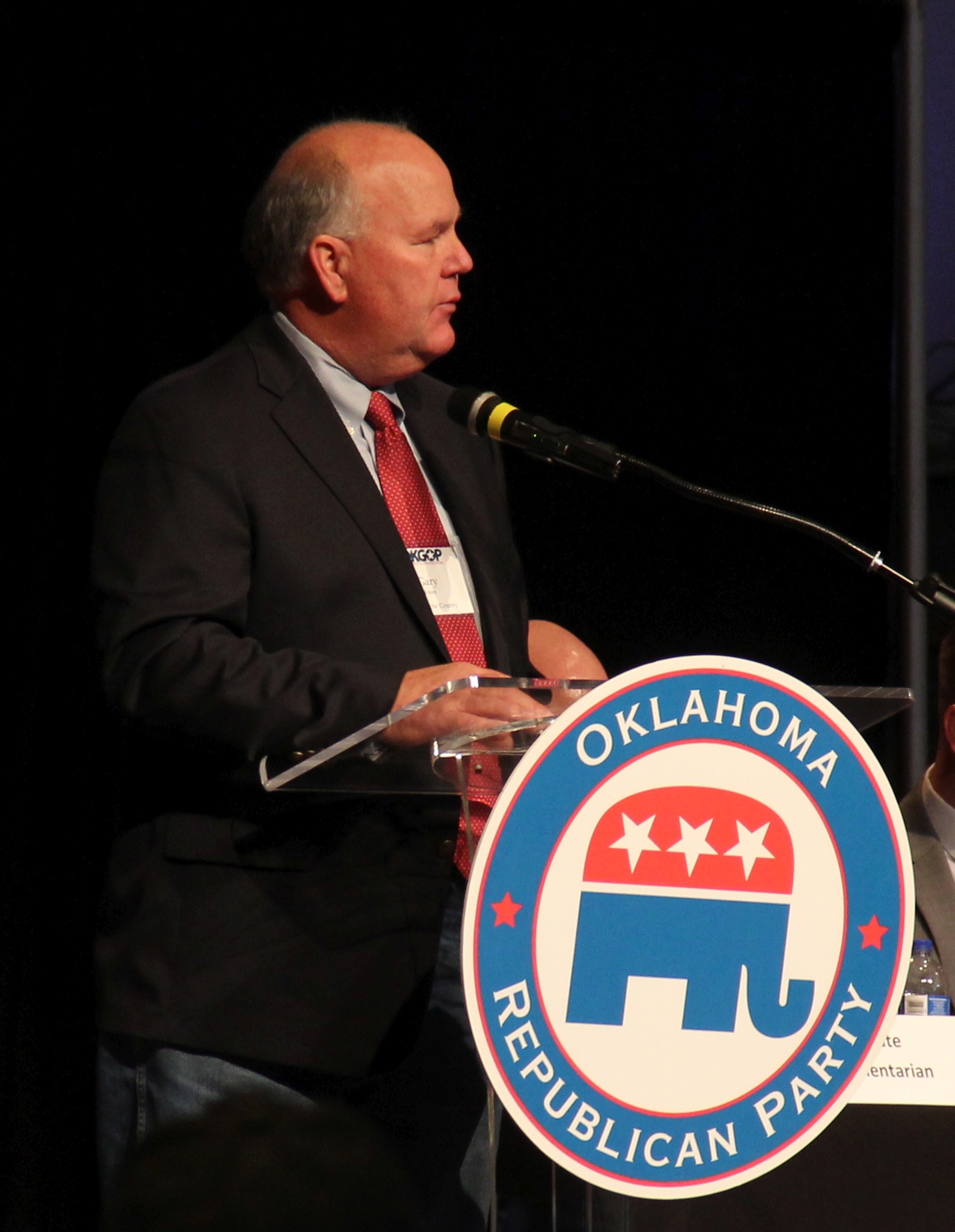
State Auditor Gary Jones and Lt. Gov. Todd Lamb both announced that they are running for governor. Attorney General Mike Hunter, recently appointed to fill Scott Pruitt's unexpired term, will be running for a full term. Several other candidates for 2018 also spoke: Gary Richardson (running for governor), former Republican State Chairman Matt Pinnell (running for lieutenant governor), and Deputy State Auditor Cindy Byrd (running for state auditor).
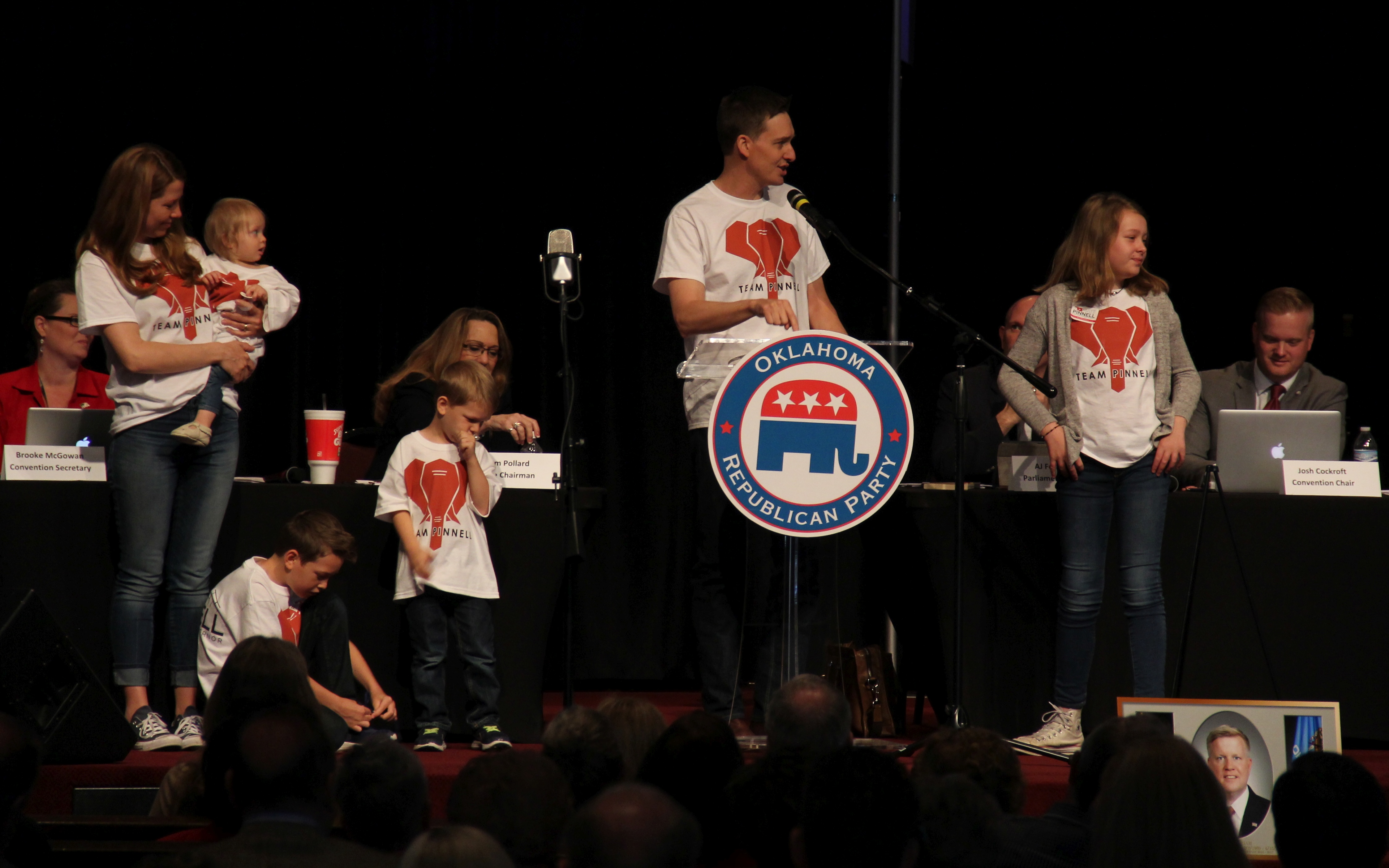
The afternoon session dealt with proposed state party rule changes, a resolution calling for an abortion ban, and the successful attempt to kill the proposed party platform, but I'll cover that in a later entry.
The Oklahoma Bar Association, the leftist monopoly guild that has an effective veto over judicial appointments in our state, will be funneling money to the totalitarian Communist Castro regime with the organization's "President's Cruise" to Cuba this summer. Linda Thomas, mentioned in the flyer, is the current OBA president.

At the bottom of this post are the contents of an email sent to Oklahoma attorneys, urging them to sign up for this cruise -- which includes 6 credit hours of Continuing Legal Education! The OBA, which claims to stand for the rule of law, is planning a luxury trip to a country where law is used as a tool to suppress dissent.
Yesterday was the 100th anniversary of Lenin's arrival in Petrograd and the beginning of the Communist takeover of Russia. Over the subsequent century, Communist regimes have butchered over 100 million people, and even today one of every five people on the planet lives under single-party Communist control in China, Cuba, Laos, North Korea, and Vietnam.
From Freedom House's 2017 report on Cuba:
Cuba is a one-party communist state that outlaws political pluralism, represses dissent, and severely restricts freedoms of the press, assembly, speech, and association. The government of Raúl Castro, who succeeded his brother Fidel as president in 2008, monopolizes the bulk of economic activity within centralized and inefficient state enterprises. Increased engagement with the United States under the administration of President Barack Obama did not result in the lifting of restrictions....Arbitrary detentions reached more than 9,000 during the first 10 months of 2016, the highest level in seven years. Government repression of the island's increasingly dynamic independent digital press also increased....
Political dissent, whether spoken or written, is a punishable offense, and dissidents are systematically harassed, detained, physically assaulted, and frequently sentenced to years of imprisonment for seemingly minor infractions. The regime has called on its neighborhood-watch groups, known as Committees for the Defense of the Revolution, to strengthen vigilance against "antisocial behavior," a euphemism for opposition activity. This has led to the use of "acts of repudiation," or supposedly spontaneous mob attacks, to intimidate and silence political dissidents....
Official obstacles hamper religious freedom in Cuba. Churches may not conduct ordinary educational activities, and many church-based publications are plagued by state as well as self-censorship....
Academic freedom is restricted in Cuba. Teaching materials commonly contain ideological content, and affiliation with PCC structures is generally needed to gain access and advancement in educational institutions. On numerous occasions, university students have been expelled for dissident behavior, a harsh punishment that effectively prevents them from pursuing higher education. ...
The Council of State has total control over the courts and the judiciary. Laws on "public disorder," "contempt," disrespect for authority," "pre-criminal dangerousness," and "aggression" are frequently used to prosecute political opponents.
A report this past week from the Inter-American Commission on Human Rights (an arm of the Organization of American States) has Cuba and Venezuela on the human rights "blacklist."
Regarding Cuba, the report details the high levels of repression, as well as excessive restriction on protests as well as dismissals and threats to government employees if they manifest any opposition to the policies implemented by the ruling party.They also mention that the island remains on the list for "persistent restrictions on political rights, freedom of association, freedom of expression and dissemination of thought, lack of independence of the judiciary and restrictions on freedom of movement," which the report stresses, "continue to systematically limit the human rights of the inhabitants" of Cuba.
A few examples from the most recent report by Human Rights Watch:
Detention is often used preemptively to prevent people from participating in peaceful marches or meetings to discuss politics. Detainees are often beaten, threatened, and held incommunicado for hours or days. Members of the Ladies in White (Damas de Blanco)--a group founded by the wives, mothers, and daughters of political prisoners and which the government considers illegal--are routinely harassed, roughed up, and detained before or after they attend Sunday mass.Lazaro Yuri Valle Roca, a blogger and videographer who often covers the Sunday demonstrations of the Ladies in White, wrote that police arbitrarily detained him on June 7 and drove him 30 miles from Havana, where they took him from the car at gunpoint, made him kneel on the grass, and put the gun to his neck, telling him he was "on notice" to stay away from the demonstrations....
A small number of journalists and bloggers who are independent of government media manage to write articles for websites or blogs, or publish tweets. However, the government routinely blocks access within Cuba to these websites, and those who publish information considered critical of the government are subject to smear campaigns and arbitrary arrests, as are artists and academics who demand greater freedoms....
Despite the release of the 53 political prisoners in conjunction with the agreement to normalize relations with the US, dozens more remain in Cuban prisons, according to local human rights groups. The government prevents independent human rights groups from accessing its prisons, and the groups believe there are additional political prisoners whose cases they cannot document....
The government restricts the movement of citizens within Cuba through a 1997 law known as Decree 217, which is designed to limit migration to Havana. The decree has been used to prevent dissidents from traveling to Havana to attend meetings and to harass dissidents from other parts of Cuba who live there....
In November 2013, Cuba was re-elected to a regional position on the UN Human Rights Council, despite its poor human rights record and consistent efforts to undermine important council work. As a member of the council, Cuba has regularly voted to prevent scrutiny of serious human rights abuses around the world, opposing resolutions spotlighting abuses in North Korea, Syria, Iran, and Ukraine.
Did anyone within the OBA leadership oppose making Cuba this year's vacation destination? If you're an OBA member -- and every practicing attorney in Oklahoma is required to be a member -- and don't publicly express opposition to this decision, it's reasonable to assume that you approve.
MORE:
Last year, Cuban dissident Armando Valladares marked the return of cruise ships to Cuba with a report on ongoing human rights abuses:
Just weeks before Carnival's maiden voyage to Cuba, hundreds of government workers in eastern Cuba surrounded and demolished the Strong Winds Ministry Church of Las Trunas and threatened to throw its pastor, Reverend Mario Jorge Travieso, in jail for seven years if he said a word about it. The church's crime? Failure to register with the government. Strong Winds was the fourth church to be destroyed by the government in 2016.The Cuban government is especially good at violating the human rights of its people, and then labeling the victims as the criminals. I spent 22 years in Castro's gulags for the simple crime of refusing to place a sign on my desk that read: "I'm with Fidel." I lost 22 years of my life, and countless friends and family, for that sin against the regime. I spent eight of those years naked, when I refused to wear the prison uniform of a criminal. Of his treatment at the hands of the Cuban authorities, after they had destroyed his church and the house of worship for many more, Rev. Travieso said he was made to feel "like a common delinquent."
The text of the OBA email (on the jump page):
Oklahoma State Representative David Brumbaugh died Saturday night, April 15, 2017, of a heart attack. Brumbaugh, a Republican who had represented House District 76 in Broken Arrow since his first election in 2010 and chaired the House Republican Caucus, was 56 years old. He is survived by his wife and their two daughters. His funeral will be held Saturday, April 22, 2017, at 1 p.m. at Tulsa Bible Church, where Brumbaugh served as a deacon and Sunday School teacher. His body will lie in repose in the State Capitol on Thursday, April 20, 2017, from 10 a.m. to 2 p.m.
Brumbaugh was a consistent, principled conservative who was respected by his ideological adversaries for his gracious demeanor. I regarded him as a legislator who could be counted on to understand the issues, know which bills were and were not consistent with conservative principles, and then act in accordance with conservative principles. It was a pleasure to get to know him and speak with him about various issues.
Among many other bills signed into law, Brumbaugh was the author of a bill, approved in 2015, to protect the conscience rights of clergy with regard to solemnizing or recognizing a marriage. The same year, he authored a bill to tighten the definition of blight and to require an additional public hearing prior to adoption of an urban renewal plan.
Brumbaugh was a champion of county budget reform. In 2013, he advanced a bill, HB 1230, that would have required earmarked funds and carryover funds to be accounted for in the budget process. Because of pushback from county officials who apparently like the lack of oversight, the bill stalled after passing out of the Government Modernization committee. Shame on GOP legislative leaders for blocking such a simple and straightforward measure for financial accountability. In 2012, he successfully shepherded a bill requiring training for County Excise Board members, so that they would know their powers and responsibilities in considering millage requests from taxing entities.
His 2015 bill to protect electric utility customers from the involuntary imposition of "smart meters" passed unanimously in the Utilities Committee but never got a hearing before the whole house.
Those of you who, like me, despised the illegibly tiny letters on the signs for unnumbered Oklahoma turnpikes owe David Brumbaugh a debt of gratitude for advocating for their designation as state highways (e.g. Creek Turnpike as 364), with nice, big, legible numbers.
In the current legislature, Brumbaugh had introduced legislation further tightening the overbroad definition of "blight," requiring the State Auditor to post raw data sets from county audits to data.ok.gov, and requiring the Oklahoma Tax Commission to provide and the State Equalization Board to use actual revenues from the last five years in estimating revenue for the budget process.
May God bless Oklahoma with more trustworthy, principled, sensible legislators like David Brumbaugh. May God comfort his family as they mourn his homegoing.
MORE: The power-generation industry honors their fallen colleague:
If you never met David Brumbaugh at your plant or office, or at a user-group vendor fair--often with wife Shelley and occasionally daughters Abigail and Hannah--that's unfortunate. The late president of DRB Industries LLC was particularly knowledgeable on gas-turbine inlet and exhaust systems, air filters, and cooling towers, and always willing to share best practices and lessons learned. He was positive-minded and had an engaging personality; many in the electric-power industry benefited from his caring/sharing nature.David died last Saturday evening (April 16) of a heart attack--so unexpected it left even close personal friends in shock. Rick Shackelford, division director, powerplant operations, for NAES Corp, knew Brumbaugh well, both personally and professionally. He told CCJ, "Such a terrible loss for Oklahoma. . .the power industry. . .his family. . .and his friends. David was a true-life world-changer."
Industry people generally are aware that David founded DRB Industries to support powerplant owner/operators in the selection, installation (including design and construction services to the degree necessary), inspection, and maintenance of filtration and cooling products. But that was only the tip of the iceberg for this perpetual-motion machine of a man.
It's the first Tuesday in April, April 4, 2017, and for many municipalities around Oklahoma (mainly those without their own charters), it's the day for electing city councilors or town trustees. Here's the complete list of April 4, 2017, elections in Oklahoma.
(It's great that we can now find info about any election in the State of Oklahoma in one central location. Wouldn't it be nice if all of the campaign finance and ethics reporting information were just as centralized and electronically searchable?)
Jenni White, the teacher and mom who was a leader in the fight to repeal Common Core in Oklahoma, is running for trustee in the town of Luther, in northeastern Oklahoma County.
Here in Tulsa County, there are two council seats each in Broken Arrow and Bixby, four seats in Jenks, and one seat each in Skiatook and Sperry up for election today.
Sperry also has a proposition on the ballot, a 20-year, 0.6% sales tax for capital improvements.
Two longtime Broken Arrow councilors, Craig Thurmond and Richard Carter, have drawn challengers, Rick Thomas and Debra Wimpee, respectively. Even though Broken Arrow is now the fourth most populous city in Oklahoma (only OKC, Tulsa, and Norman are larger), it is still governed by the "statutory charter," the default form of city government specified in the state statutes. This means that every seat on the council is elected at-large by the entire city. Thurmond currently serves as mayor and Carter as vice mayor; they are appointed to those positions by their peers on the council, so if either is defeated, the successful challenger would not automatically inherit the mayor or vice mayor position.
Debra Wimpee has the endorsement of a number of conservative legislators and activists, including State Sens. Nathan Dahm, Dan Newberry, and Joe Newhouse, State Reps. Kevin McDugle, David Brumbaugh, Michael Rogers, and Scott McEachin, Tulsa County Assessor Ken Yazel, and Wagoner County Assessor Sandy Hodges. Tulsa 9/12 Project leader and Broken Arrow resident Ronda Vuillemont-Smith has endorsed Debra Wimpee and Rick Thomas, saying, "It is PAST time for new blood on our city council," and noting that Carter has served on the Council for 24 years and Thurmond for 16.
It's also runoff election day for a handful of school board seats in which no one received a majority of the vote at the primary election in February.
One of those school board seats is here in Tulsa: Incumbent Lana Addison-Turner received 474 votes to 454 for challenger Jennettie P. Marshall. A third candidate received 60 votes, enough to keep either candidate from reaching the required 50% majority.
Here is video of Turner speaking at the "Exploring Equity community conversation" in February. The Oklahoma Eagle has endorsed Marshall for Office 3. Given the school board's insistence on lavishing big paychecks on executives in a time of tight budgets, it's time for a change, and I would vote for Marshall if I lived in District 3. (Here is a map of Tulsa Public Schools board member districts
MORE: The Tulsa County Republican Party has posted information about the party affiliations of council candidates in Broken Arrow, Jenks, Skiatook, and Sperry.
Edmond is electing a mayor and also has two propositions on its 2017 city ballot. The propositions would alter the comprehensive plan and zoning classification to enable a proposed mixed-use development consisting of 260,000 sq. ft. of retail and 350 residential units, to be called the Shops at Spring Creek. I can't think of another example of zoning changes going to a public ballot. If I'm understanding this story correctly, the Edmond City Council voted to approve the changes, but a citizen petition was filed to put the decision before the voters. As a result of SQ 750, which was narrowly approved in 2010, it takes the signatures of 5% of the number of votes cast in the previous race for governor to put an ordinance passed by a legislative body (such as a city council) before the voters for final approval. (CORRECTION: SQ 750 only affected statewide referenda; the threshold for municipal petitions is governed by Article XVIII, Section 4(b), and remains 25% of the "total number of votes cast at the next preceding election," which state courts have interpreted to mean the next preceding election at which all qualified municipal voters, and only they, could vote.
RESULTS: Edmondites voted down the zoning and planning referenda by nearly a 2-to-1 super majority. With this precedent in place, it will be interesting to see if citizens in other Oklahoma cities use this tool to override development-related legislation. The threshold would be easy to reach in Oklahoma City, which tends to have low turnout for its mayoral elections, but hard to reach in Tulsa, which has moved its municipal elections to coincide with state and federal general elections. This could be an interesting tool for citizen activists in metro suburbs. In Edmond, the previous city general election in April 2015 drew 2,808 voters, so the threshold to put this referendum on the ballot was a mere 702 signatures.
Congratulations to Jenni White and Rob Ford, elected to town trustee boards in Luther and Mounds, respectively. In Broken Arrow, Mayor Craig Thurmond was re-elected, but 24-year councilor Richard Carter was defeated by challenger Debra Wimpee. Jeannettie Marshall defeated incumbent Lana Turner for a seat on the Tulsa Public School board. Full results are available on the Oklahoma State Election Board website.
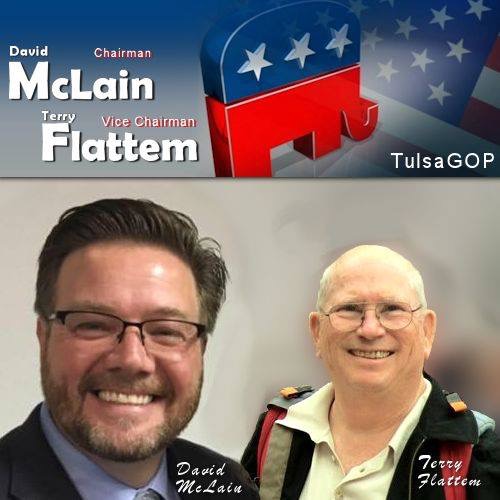
If you haven't already, please read my little essay about the purpose of a political party. Grounded in the view that a political party ought to stand on principle above personality, tomorrow at the 2017 Tulsa County Republican Convention I'll be voting for David McLain for Tulsa County GOP chairman.
David McLain is a Skiatook resident, a small businessman in the construction industry, and a veteran of the U. S. Navy. David and Aleen, his wife of 26 years, have three grown children and two grandchildren. In the fall of 2015, McLain won the GOP nomination for the Senate District 34 special election, a grassroots candidate who defeated a heavily favored establishment candidate backed by Obama funder George Kaiser and the Chambercrats. McLain narrowly lost the January 2016 general special election to a popular Owasso high school coach who downplayed his party affiliation
Prior to his own campaign, McLain volunteered for conservative candidates around Skiatook, helping several to victory in Tulsa County and also in neighboring Osage County, protecting State Rep. Sean Roberts and electing a Republican Sheriff and County Commissioner in the traditionally Democrat county. McLain has emphasized the importance of volunteers to party success. Two announced chairman candidates have quit the race to support McLain, and one of them, Terry Flattem, a frequent volunteer at the county party office, is running for vice chairman on a ticket with McLain.
McLain's only announced opponent for the chairmanship is Monica Deon, a leader of the Trump 2016 campaign in Tulsa. Trump, you will recall, finished third in Tulsa County, behind Ted Cruz and Marco Rubio, despite his notoriety and wall-to-wall TV coverage. In the general election, Trump significantly underperformed Mitt Romney's 2012 effort and John McCain's 2008 performance in Tulsa County.
During a recent gathering of county party activists and leaders, Deon expressed disdain and contempt for the county party platform, agreeing heartily with someone who said that the platform was "asinine" and "hateful," and indirectly expressing disdain for the thoughtful activists who spent their spare time crafting it.
The RyanTrumpSwampCare mess of the past week is what you get when you eschew principle in favor of "just doing something." Trump was willing to embrace all the basic principles behind Obamacare and keep the country on the course to health care catastrophe just to say he got a bill passed. It was stunning to see Trump supporters defending a bill that entrenched many of the worst aspects of Obamacare, simply on the grounds that Trump supports it, and we must trust Trump.
We need party leaders willing to stand against bad ideas, even when they're being pushed by elected officials of our party.
Here is the slate I will be supporting at the 2017 Tulsa County GOP convention. All of these candidates understand the nuts and bolts of winning elections, understand the importance of pulling together various factions in the party, but at the same time have demonstrated by their actions that a party must stand for principle, if it's to have any meaning at all.
Chairman: David McLain
Vice Chairman: Terry Flattem
1st District Committeeman: Donny Tiemann
1st District Committeewoman: Amanda Teegarden
As of this writing, I don't know who all the candidates will be for Tulsa County's two seats on the State Committee, but I will either update this entry or post to my Twitter account once I make a decision on those races.
RESULTS:
Two candidates ran in five of the six races. Amanda Teegarden was unopposed for 1st District Committeewoman. The table below lists the raw vote (number of delegates present and voting for each candidate), the allocated vote (weighted per precinct, this is the vote that determines the winner -- see explanation below), and percentage of allocated vote. Victors are highlighted in bold font.
| Race | Candidate | Raw | Allocated | Allocated % |
| Chairman | David McLain | 163 | 240.9 | 68.82% |
| Chairman | Monica Deon | 77 | 109.1 | 31.18% |
| Vice Chairman | Terry Flattem | 157 | 230.8 | 66.50% |
| Vice Chairman | Mike Ford | 80 | 116.3 | 33.50% |
| StateCommitteeman | Mike McCutchin | 153 | 218.7 | 63.22% |
| StateCommitteeman | Michael Phillips | 88 | 127.3 | 36.78% |
| State Committeewoman | Lydia D'Ross | 122 | 176.6 | 51.04% |
| State Committeewoman | Alivia Rawls | 118 | 169.4 | 48.96% |
| 1st DistrictCommitteeman | Donny Tiemann | 168 | 240.6 | 69.54% |
| 1st DistrictCommitteeman | Dan Miller | 72 | 105.4 | 30.46% |
| 1st District Committeewoman | Amanda Teegarden | 100.00% |
A simplified explanation of allocated votes: Each precinct is allocated a certain number of votes, based on the number of votes cast by that precinct for the top of the ticket at the previous general election (in this case, for president). A precinct can have more delegates present than votes, in which case the votes are weighted proportionately. If a precinct has fewer delegates present than votes, the votes are also weighted proportionately, but only up to a maximum of two votes per delegate. During the precinct roll call, each precinct chairman announces the raw vote totals, a teller types the numbers into a spreadsheet, and the spreadsheet calculates the allocated totals.
Examples: Precinct 222 is allocated 3 votes, based on how well the Republican nominee. If 5 delegates are present, each delegate's vote counts for 3/5 (0.6) of a vote. If 2 delegates are present, each delegate's vote counts for 3/2 (1.5) votes. If only 1 delegate is present, each delegate's vote counts for 2 votes, as 2 is the maximum under state party rules.
Today, I was the teller, typing numbers into Excel and trying to distinguish between the names of the two candidates for state committeewoman, which share an almost identical sequence of vowel sounds and a few consonants, too.
Votes were cast by 103 out of 263 precincts.
In the process of typing in the numbers for each precinct, I picked up on some patterns in the voting.
Although the winning totals were very similar across four of the five competitive races, and although many of the winning candidates had the same group of supporters, there weren't full slates as such.
The vice chairman vote typically tracked with the vote for chairman -- not surprising since each chairman candidate endorsed a vice chairman as a running mate. There were some differences, however, and my guess is that, since one of the vice chairman candidates was the outgoing chairman, tickets were split based on experiences, positive or negative, with Ford himself. In 21 precincts, the two candidates had different totals, with a total magnitude of 25. (This count would not reveal a circumstance where two ticket-splitters in the same precinct cancelled out each other's votes, so the true number of ticket-splitters might be higher..) But the ticket-splitting balanced out overall, so that Ford received only 3 votes more than running mate Deon.
The closest race was for State Committeewoman. Lydia D'Ross has been involved in the local GOP for a number of years; Alivia Rawls is a young newcomer, a former Miss Owasso and Miss Tulsa State Fair. D'Ross had many of the same seconders as the other victorious candidates, yet she had only four more raw votes than Rawls. I had not heard that either candidate would be running prior to today. I suspect that some concern about D'Ross combined with a desire to reach out to a new generation combined to make the race a close one.
Mike McCutchin, who served as chairman 2013-2015, had the next lowest winning total, but was within 15 votes of Donnie Tiemann, who had the highest total. Of the 103 precincts in which votes were cast, 64 of them had different vote totals for McLain and McCutchin, and 61 had different totals for Deon and McCutchin. Both McCutchin and Phillips seem to be well regarded by everyone, but McCutchin also had a record of service focused on applying his process-oriented mind to the needs of the county party.
The 1st District Committeeman's race was more strongly correlated with the chairman's race -- differences in only 20 precincts. Tiemann was the sole incumbent running for re-election, and I've heard no complaints about his performance.
We are at interesting point in Oklahoma's political history. Never before has the Republican Party ever been so dominant, but never before has it been in such danger of betraying the ideals that won it its dominant position. The task of the moment is not merely to win elections, but to protect the Republican brand, and to ensure that our platform, grounded in the timeless truths of human nature and economic behavior, is carried out. All of the hard work of Republican activists can be undone by Republican elected officials who are cowed by institutional resistance, led astray by their own sinful appetites, bedazzled by the blandishments of lobbyists (and the allure of post-politics job prospects), or simply flying a flag of political convenience.
When I began to follow politics in the early 1970s, Oklahoma was very nearly a one-party state, but that one party was the Democrats, which had owned Oklahoma politics since statehood. Birthed in the agrarian populism of William Jennings Bryan and Alfalfa Bill Murray, the attachment of Oklahoma to the Democratic Party was cemented by the New Deal in the crisis of the Great Depression. If you wanted a say in the choice of a legislator or county commissioner, you had to be registered Democrat in most of Oklahoma.
As of Oklahoma's 75th birthday in 1982, only two Republicans had served as Oklahoma governor, for one term each, and Republicans had only managed control of the State House for two years following the Harding landslide of 1921. A handful of Republicans, mainly from the two major cities or the northwestern wheat belt, had served in the U. S. House. The national Democratic Party's weakness against Communist aggression and flirtation with the social theories of the left began to alienate Oklahoma voters, who began choosing Republicans for president and U. S. Senate. But at every level below that, the Democrats still enjoyed an electoral lock. It was another three decades before Republicans replaced Democrats as the dominant party.
We know from history and experience that the principles of limited government, individual liberty and responsibility, sanctity of human life, and the natural family bring peace and prosperity to a society. But rent-seekers want subsidies, bureaucrats want sinecures, sociopaths want power, perverts want affirmation, and everyone wants irresponsibility without consequence (except the victims of that irresponsibility). It takes tenacity to move forward for the values that build and maintain civilization in the face of such a headwind.
To move forward successfully, we need a political organization that not only wins elections by espousing these timeless values, but also carries those values forward in legislation, judgment, and executive action. That is why political parties exist -- to implement a set of principles and policies that its members believe most conducive to the public good. Under such a view, party leaders and activists must not only elect candidates to public office, they must also hold those elected officials accountable.
An elected official who pursues policies contrary to his party's fundamental ideals is damaging his party's brand. If the Republican Party's principles are most conducive to the peace and prosperity of our nation, as we believe, if the contrary policies are pursued by officials carrying the GOP label, our party will be blamed for the inevitable ruin, and we will lose office and the opportunity to carry the right principles into practice. Therefore, when an elected official acts against the purposes of the party, it is appropriate for party leaders to denounce that official and work against his continued service in office.
Unfortunately, there's another perspective on the purpose of a party. I call this the "empty vessel" theory. In this view, the Republican Party is just a vehicle for whoever manages to win a Republican primary. By this definition, any policy promoted by a Republican elected official is a good policy. By this view, a party official's job is to promote and protect anyone in office with an (R) after his name, no matter how damaging his policies. By definition, a Republican elected official beyond criticism. In this view, a platform is not only futile but dangerous, as taking a firm stand on any issue has the potential to alienate a prospective voter.
Without a platform that it seeks to accomplish, a party is little more than a social club, a gang competing with other gangs to see which one gets to loot the public treasury.
Yes, party leaders need to understand the nuts and bolts of campaigns, the art and craft of conveying a persuasive message to the voters. But before any of that matters, you had better have a message worth conveying. As I vote in this year's party elections, I'll be voting for party officials who put principle above personality.
Happy election day! Enjoy your freedom to vote now, before Hillary ships you to a concentration camp or Donald abolishes elections and renames himself Caligula II.
Polls in Oklahoma are open until 7:00 p.m. If you need help finding your polling place, if you'd like to study a sample ballot before you go, the Oklahoma State Election Board has a one-stop-shop online voter tool. Put in your name and date of birth, and they'll look you up in the database, find your polling place and show you a photo of it and a map, will let you see a printable sample ballot, and, if you're voting absentee, it will show you when your ballot arrived at your county election board.
OSEB will have live results available after 7 p.m. Keep in mind that absentee ballots are counted first at the county election board, and then individual precincts bring their scanning ballot boxes to the county election board for processing. Candidates and news outlets who send runners to the precincts to read results posted on the door will have results more quickly than OSEB.
OSEB also has this very handy list of every candidate and every proposition on the 2016 Oklahoma ballot, arranged by county.
Here's my printable cheat sheet for the election.
BatesLine_ballot_card-2016_general.pdf
My thoughts on specific races and questions:
- Summary of Oklahoma 2016 state questions with links to discussion of each specific question
- Oklahoma 2016 judicial retention
- Tulsa County 2016 electionsTulsa City Council 2016 elections
- Oklahoma 2016 presidential electors
- Sen. James Lankford makes the case for SQ 790.
Here's an archive of all of my articles about Election 2016.
Many thanks to the sponsors and supporters of BatesLine who made this year's election coverage possible.
All right, Bob, how 'bout a little music to keep the people happy! Take it away, Leon!
"There'll be cheerin' and hootin' and some friendly shootin' just to keep the spirit of this big occasion."
Bob Wills and His Texas Playboys perform "Election Day" by Cindy Walker in the movie Wyoming Hurricane, starring Russell Hayden. Leon McAuliffe on vocals; Cotton Thompson, Bob Wills, and Jesse Ashlock on fiddle, Junior Barnard on guitar, Luke Wills on bass. And from the same movie, here's Cotton Thompson to deliver Cindy Walker's message for many of our candidates:
I hear you talkin', yes, I do,
But your talk-talk-talkin' don't ring true,
I'm listenin' politely, too,
But I don't b'lieve a word you say.I hear you talkin', tellin' lies,
I can see it in those great big eyes.
I hear you talkin' wise,
But I don't b'lieve a word you say.You say that I'm your honey-love,
That I'm all you're thinkin' of,
I hear you talkin', dove,
But you ain't been foolin' me.
I almost left the top line of my ballot blank.
When I was filling out my absentee ballot, I left the presidential race until the last. Neither Donald Trump nor Hillary Clinton nor Gary Johnson -- our only three choices in Oklahoma -- are fit to serve as president of the United States. Trump says some things that are pleasing to conservative ears, but his livelihood was built on saying one thing to close a deal and then doing another, leaving him sitting pretty and his business partners in the lurch. Clinton is utterly venal and corrupt, selling American foreign policy to the highest bidder, with the money laundered through the family's "foundation," and setting up a private email server, putting American secrets at risk, in order to hide her corruption from the reach of open-records laws. Johnson is a buffoon, a fake libertarian who sees no problem with the State punishing small-business owners who wish to run their businesses in accordance with the understanding of marriage that was near-universal just a decade ago. I'm frightened by how triumphant Trump or victorious Clinton might use their new power to punish their adversaries; both are vengeful and egotistical. I'm disturbed by the willingness of many conservatives to shift their positions and lower their standards in order to justify their support for Trump -- not merely holding their noses and voting for him, which is understandable, but enthusiastically embracing him.
I had pondered voting for Johnson anyway, as a protest vote, but Josh Lewis, writing at SavingElephantsBlog.com, talked me out of it, pointing out that giving the Libertarian Party, particularly in its current state, a permanent foothold in Oklahoma will only cause more problems for electing conservatives:
Suffice it to say for now, I am a conservative and recognize libertarianism as a competing ideology. A vote for Gary Johnson is a vote that will ultimately strengthen the libertarian brand. If you're an ideological libertarian this makes sense. But if you're only casting a "protest vote" it may have dangerous unintended consequences.
So I was going to leave the ballot bank, but as I stared at the space on the ballot, I looked at the three lists of seven names under the names of the presidential and vice presidential nominees:
- Republican: David Oldham, Teresa Turner, Mark Thomas, Bobby Cleveland, Lauree Elizabeth Marshall, Charles W. Potts, George W. Wiland, Jr.
- Libertarian: Erin Adams, Mikel Dillon, Joel Britt Dixon, Rex L Lawhorn, Ephriam Zachary Knight, Craig A. Dawkins, Mark C. DeShazo.
- Democrat: Marq Lewis, Bill John Baker, Mark Hammons, Betty McElderry, W. A. Drew Edmondson, Jeannie McDaniel, Rhonda Walters.
These are the people we're voting for today: One set of seven who will meet in Oklahoma City in December and cast the only votes any Oklahoman will cast for President and Vice President of the United States.
I'm under no illusions: Each of these people were selected by district and state conventions because of their loyalty to their party. Barring some unforeseen catastrophe, they will be voting for the names above theirs on the ballot, which will lead either to a Trump-flavored catastrophe or a Clinton-flavored catastrophe.
But what if no candidate appears to have won a majority of electoral votes? What if Utah goes for Evan McMillan, enough to hold Clinton and Trump short of 270? What if there finally emerges a scandal serious enough to chase Donald or Hillary into exile in Irian Jaya? What if (heaven forbid) one or both of the aged main-party candidates suffers a debilitating accident or health emergency? Would it still make no difference which set of seven electors are chosen by Oklahoma voters?
Under those unlikely circumstances, it would make a great deal of difference. I know many of the people running for elector, and I would trust David Oldham, Bobby Cleveland, and George Wiland to make a decision in the best interest of the nation. I would not trust Craig Dawkins, or Jeannie McDaniel, or Drew Edmondson, the former Ayatollah General.
It's taken me more time to describe my thought process than it took me to come to that conclusion. I had to decide to leave the race blank or mark it, seal up the ballot, get the affidavit notarized, mail it, and get on with trip preparations. I voted for George, David, Bobby, Mark, Teresa, Lauree, and Charles.
There are three contested county offices on the Tulsa County ballot. Republican Josh Turley seeks to defeat incumbent Democrat Commissioner Karen Keith in County Commission District 2. Republican Don Newberry and Democrat John R. Andrew are vying for the Court Clerk position, left open by the retirement of Sally Howe Smith. Republican Sheriff Vic Regalado and Democrat Rex Berry are in a rematch of the April special election to replace Stanley Glanz.
A recent, seemingly unrelated news item raised an issue that should be considered by Tulsa County voters tomorrow. State bond adviser Jim Joseph and State Auditor and Inspector Gary Jones spoke out against the widespread practice of school districts waiving competitive bids for bond issues.
Oklahoma school districts are spending millions of taxpayers' dollars every year by paying high fees for financial advisers, bond counsel and underwriters, says Jim Joseph, the state's bond adviser.Many school districts continue to do the same thing year after year, while stubbornly refusing to use cost-saving competitive selection measures, he said.
"It's like picking a roofer right after a storm because he's the first guy who came to your door," Joseph said. "You're not going to get a deal, that's for sure."
State Auditor Gary Jones agreed school boards could save Oklahoma taxpayers money by obtaining competitive quotes.
"There could be tens of millions of dollars saved over a short period of time," Jones said.
Joseph went on to compare the massive fees paid by school districts to bond counsel and financial advisers, often a percentage of the bond issue, with the smaller amounts state agencies paid for much larger bond issue. Several were listed; here's one example:
For example, Midwest City-Del City Public Schools did a $72.62 million bond issue in 2012 without competitive bids. It paid the Floyd Law Firm of Norman $363,100 for serving as bond counsel and allowed Stephen H. McDonald & Associates and BOSC Inc., a subsidiary of BOK Financial Corporation, to equally split $508,340 for serving as co-financial advisers, records show.Compare that with a $310.48 million bond issue by the Grand River Dam Authority that was done in 2014 through a competitive process. The state paid a $114,000 bond counsel fee and a $133,448 financial adviser fee.
Although the Grand River Dam Authority bond issue was more than four times as large as the Midwest City-Del City school bond issue, the school district paid more than triple the amount in bond counsel and financial adviser fees, records show.
Joseph pointed out that bond counsel, underwriter, and financial advisers often each take 1% of the bond issue as their fee, which Joseph says "makes no sense at all. It doesn't take any more work to do a $20 million issue than a $10 million issue for the bond counsel and financial adviser, but the fee is twice as high, if payment is on a percentage basis."
What does this have to do with Tulsa County? Joseph noted that the firm of Hilborne & Weidman was frequently listed as bond counsel for these competition-waived bond issues. Hilborne & Weidman was also one of two bond counsel firms selected in 2003 by the Tulsa County commissioners (acting as the Tulsa County Industrial Authority) for the Vision 2025 revenue bonds, a massive bond issue against up to all 13 years of the new sales tax. I urged at the time that Tulsa County put all Vision 2025 bond-related contracts up for competitive bid, as commissioners haggled publicly over which firms would get a piece of the action, but they waived competitive bidding and split the baby, giving each favored firm half of the business.
Over the last 13 years, there's been a complete turnover on the County Commission, but the tradition of waiving competitive bidding has persisted. Here's one example from May 26, 2009, in Karen Keith's first year as a commissioner ($110 million in bonds), another from February 1, 2010.
On May 23, 2016, the commissioners, including Karen Keith, voted unanimously to waive competitive bidding on indebtedness, but neither the minutes nor the agenda explain the amount or nature of the indebtedness. Given the proximity to the April 2016 Vision Tulsa vote, my guess is that the vote was on the revenue bonds pledged against that new 15-year sales tax stream.
How many more projects might have been built if Vision 2025 bonds had been competitively bid? Could we have had a new juvenile justice facility without being asked for more tax dollars in two separate elections? (And it still hasn't been built! Karen Keith has been in office eight years, and we're still waiting.)
Given the size of these bond issues, even a 1% fee would be a huge amount for a small firm. The temptation to corruption would be immense. Think of the money the former Skiatook superintendent got in kickbacks from the janitorial supply company. That would be chump change compared to even a small cut of 1% of a $500 million bond issue.
Oklahoma taxpayers need legislation to require competitive bidding on bonds and to require counties, school districts, and cities -- and their associated Title 60 trusts -- to use the state bond adviser rather than hiring their own favored exclusive firms. Until we get that legislation, we need county officials who will support transparency and fiscal prudence. Josh Turley and Don Newberry, both good men with long years' experience as county employees, will provide that kind of leadership, and I hope Tulsa County voters elect them both.
As for the sheriff's race, I've voiced my concern with the pattern of funding Regalado received in the special election primary and even more concern with the way he responded to the charges. He seems to have settled down and done a reasonable job of setting TCSO on a better course, away from last year's scandals. Rex Berry is way out in left field; we don't need someone like him as sheriff. I'm voting for Regalado.
Three Tulsa City Council seats made it to the general election. As the current City Council has been a complete disaster, backing a massive increase in the permanent sales tax, shutting down Riverside Drive for two years, and imposing their radical left-wing theories of gender and sexuality on the property owners of our city, I don't want any of them to be re-elected.
I was sad to see Jack Henderson work against the interests of District 1 by backing the regressive sales tax for dams in the Arkansas River. Burdening Tulsa's poorest neighborhoods with higher taxes so residents of our wealthier neighborhoods can look at water in the river is unjust, and the Jack Henderson I thought I knew used to understand that. Vanessa Hall-Harper does understand that. She stood against the dam sales tax. While I would never expect a conservative to win District 1, we can at least hope for a city councilor who wants to help her constituents to conserve their own hard-earned funds.
Jeannie Cue, the incumbent in District 2, has been a big disappointment for the aforementioned reasons. But the only thing I've been able to find out about her opponent, Aaron Bisogno, is that he really loves Star Wars. No endorsement in District.
In District 9, Ben Kimbro has the endorsement of the Tulsa Regional Chamber and a bunch of current city councilors. Clearly, we need someone different.
Eric McCray owns a small heat and air company, and he wants to see the reopening of Riverside Drive fast-tracked. He also has some sensible thoughts on the blighted sections of District 9:
Shutting down Riverside for 2 years with no end in sight is unacceptable.We can make opening Riverside for commuters a priority and fast track the reopening date.
Tulsa commuters should not have to endure multiple, simultaneous road projects which shut down traffic all over the city. We should not see roads shut down with nobody present working on the projects. Crews should focus on a project 24/7 until it is completed and then move to the next. There is a management issue with the roads in Tulsa, and I aim to fix it.
Government assistance programs tend to fund the crime problem in our District. If you don't have to work for your food or housing, you likely have the time and entitlement mentality to commit crime. We have had one of the highest crime spots in all of Tulsa at 61st and Peoria. It is no coincidence that it is located near the swath of government assistance housing. It is not merely a poverty problem--I will work with law enforcement officials, community leaders, and business owners to determine the best way to deter crime from our District while promoting and bringing business to District 9. Let's change the reputation on this side of town.
Two State Supreme Court justices, two judges on the Court of Criminal Appeals, and three judges on the Court of Civil Appeals are before the voters for retention. If any of the judges get more no votes than yes votes, he or she will be out of office, and a replacement will be appointed by the usual process.
Ordinarily, a third Supreme Court seat would be on the ballot, but Justice Steven Taylor announced his retirement at the end of the year. There's no need to vote on retaining someone who is stepping down.
In going back through some controversial decisions over the last few years, I find a mixed record. Justice Douglas Combs was alone in rightly parsing law and precedent regarding the Ten Commandments monument, understanding that something can be religious without being sectarian, and noting that his colleagues rejected precedent in Meyer v. Oklahoma City (a 50-foot cross on the State Fairgrounds, lit by city-funded lights) without explicitly overturning it.
Justices James Winchester and Taylor were the only ones to see the problem with the State Supreme Court crossing a constitutional boundary to get involved in a criminal matter in the Clayton Lockett botched-execution case. (In Oklahoma's split appellate system, criminal appeals go to the Court of Criminal Appeals, but no further; civil appeals go to a panel of the Court of Civil Appeals, from which a decision may be appealed to the State Supreme Court.) Winchester also joined Taylor in correctly labelling SQ 779 as logrolling in violation of Article XXIV, Section 1, of the Constitution of Oklahoma and in approving the clear ballot titles written by the Attorney General for SQ 780 and 781. Justice Combs was on the wrong side of these decisions. In my browsing through recent decisions, I found that often Winchester stood with Taylor on the right, but minority, side of an issue.
But Justice Winchester was the lone dissenter (without explanation) from a decision that affirmed that a county assessor could hire legal representation of his choosing in the pursuit of his duties.
Tony Lauinger of Oklahomans for Life notes the Supreme Court justices' hostility to pro-life laws, interpreting the "right" to an abortion much more expansively than the federal courts:
Regarding the Retention Ballot for Oklahoma Supreme Court justices, please note that the members of the Oklahoma Supreme Court - including those on the Retention Ballot - have repeatedly, arbitrarily, relentlessly handed down pro-abortion rulings. They even killed a pro-life law which would have promoted ultrasounds, even though a federal appeals court upheld a very similar law from Texas. A mother who sees an ultrasound of her baby is much less likely to have an abortion. Babies are dying every day in Oklahoma because the state Supreme Court struck down this law.Our state Supreme Court is so notoriously pro-abortion that when the abortion industry challenges a pro-life law, they file suit in state court rather than federal court, because our Oklahoma Supreme Court is more pro-abortion than the federal courts.
The unanimous 9-0 decision by the court to block SQ 782, a proposed amendment to the Oklahoma Constitution banning abortion, created a chicken-and-egg problem. The state supremes cited Planned Parenthood v. Casey, saying that the U. S. Supreme Court's ruling is definitive until they overturn it. But SCOTUS won't overturn a ruling until a case reaches it, and that can't happen until a state passes a law in contradiction to it, the state enforces it, someone sues, and the case percolates up the Federal court hierarchy. Burns v. Cline, 2016 OK 99, is another example of the problem. Treating SCOTUS, and not the Constitution itself, sovereign is reason enough to boot out every single state justice.
Among the appellate judges up for retention, Judge Tom Thornbrugh was "called up" on the SQ 779 logrolling case to fill the shoes of a Supreme Court justice who had to recuse. Thornbrugh took the wrong position, voting with the majority that turned a blind eye to the proposition's obvious violation of the single-subject rule.
Of the judges on the retention ballot, Winchester was appointed by Rep. Gov. Frank Keating; Combs, Smith, and Fischer were appointed by Dem. Gov. Brad Henry; Joplin was appointed by Dem. Gov. David Walters; and Thornbrugh and Hudson were appointed by Rep. Gov. Mary Fallin. (See the Oklahoma Supreme Court handbook for 2015 for further biographical information.
Recently on Talk Radio 1170 KFAQ, Pat Campbell hosted a discussion on Oklahoma State Questions 780 and 781 with former State House Speaker Kris Steele, a proponent of the propositions, and Tulsa County District Attorney Steve Kunzweiler, who opposes them.
The more I listened to Steele's arguments in favor, the more confirmed I became in my opposition to Oklahoma State Question 780. To hear Steele talk, you'd think that drug addiction is something you get because the barista at Charbux forgot to wash his hands after sneezing. But common sense says that there's a volitional aspect to drug use and addiction, and penalties for possession may deter people from seeking to self-medicate in ways that are hard to cure.
Kunzweiler pointed out that sometimes drug possession is the only charge for which enough direct evidence exists to convict a suspected drug dealer. Prosecutors are happy to send addicts through drug court to help them deal with their problem instead of going to jail, but they need the statutory tools to go after the pushers. Making every instance of possession of every kind of controlled substance a misdemeanor takes a very effective tool away from prosecutors.
In a November 1, 2016, speech to pastors in Tulsa, U. S. Senator James Lankford likened Article II, Section 5, of the Oklahoma Constitution to a latent computer virus. Lankford warned that unless Oklahomans repeal that section by passing SQ 790, anti-religion litigants will be able to use the provision to block any partnership between state and local government and faith-based organizations in areas like foster care, adoption services, hospitals, and care for the homeless.
While I could take issue with the details of his recounting of the history of the Blaine Amendment and similar provisions in state constitutions, it is true that many of the enabling acts for new states required such provisions to be included in state constitutions, and it's also true that anti-Catholic-immigrant fear motivated the effort.
More importantly, Lankford's warning about the future in Oklahoma is spot on. The language in Article II, Section 5, prohibits even an indirect benefit to a sectarian institution from use of state funds or assets. While there are now a couple of precedents, one very recent -- Murrow Indian Orphans Home v. Childers (1946 OK 187) and Oliver v. Hofmeister (2016 OK 15) -- that seem to allow state payments to a religious institution if the state is being relieved of some financial obligation in return, there were grounds in the plain meaning of the words of Article II, Section 5, to rule the other way.
Oklahoma citizens benefit when organizations, driven by faith in the God who created us for good works, care for the needy. It reduces the burden on taxpayers when staff and clergy funded by church members join with volunteers to meet these needs. But the only way to ensure that this beneficial relationship can survive a future court challenge is to pass SQ 790 to eliminate an overly broad and inconsistently interpreted provision in our State Constitution.
Sen. Lankford is up for re-election, and if you appreciate the foresight and eloquence he applied to this issue, you'll want to join me in voting to send him back to Washington for a full six-year term.
Just a quick note to call your attention to a post at Sooner Politics. David Van Risseghem has gotten hold of an email that was purportedly sent by Oklahoma Democratic Party chairman Mark Hammons to party leaders and staffers, based on meetings with Democratic legislative leaders, about the party's media strategy during this election year. In a nutshell, the party is hoping Oklahoma voters forget how far-out in left field they are:
DO NOT ISSUE RELEASES ON THE FOLLOWING AND REMOVE FACEBOOK POSTS ON THE FOLLOWING:A. Tax credits or tax solutions to the revenue shortfalls or methods to solve educational funding. Our leadership is letting this position evolve. No more comments on sale tax increases at present.
B. Sexual orientation bills, abortion, Planned Parenthood. Similarly, no gun control, 2d Amendment issues. No statements on farm/agricultural bills without House/Senate prior okay. There are a lot of bills on those issues. The Republican strategy is to try to nationalize the local races and our priority must be to focus only on the local issues outlined as 1-8 above. We may (and should) offer private support to opponents of these reactionary bills and access to what resources we can. However we can't fall into the Republic[an*] trap of making this Republican/Democrat issues. These have to be open for the candidates to make their own decisions so No ODP public statements or posts without House/Senate Caucus approval.
C. No Party statements of position on death penalty, marijuana issues. I know Connie supports these and that they are likely part of her campaign. We will not oppose or criticize - just can['t*] make them ODP issues at present.
Read David's story for the full text of the letter, including the eight issues that they think are winners.
Sometimes when a public figure's deviant behavior crosses over into criminal activity, the process of investigation turns up emails that point to a completely unrelated crime.
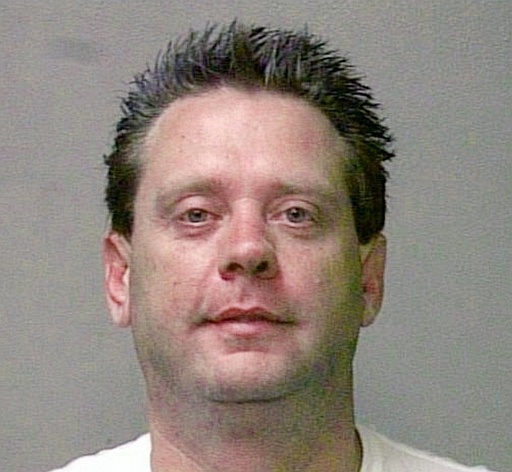 Last week we heard about Anthony Weiner's selfie problem leading to a search of his computer, leading to more of Hillary Clinton's emails, including many that weren't among those she turned over to the FBI. It was enough to prompt the FBI to reopen its investigation into Clinton Foundation corruption.
In May 2014, political consultant and lobbyist Chad Alexander was pulled over for driving erratically. His car was searched, and he was busted for possession of 3.35 grams of cocaine and possession of a controlled substance (oxycodone) without a prescription.
Alexander is aligned with what I call the wheeler-dealer faction in Oklahoma politics (as opposed to the fair-dealers), the bunch that believes that government is about favor trading and politics is about which rival gang will get access to money and power.
Alexander is a consultant for Coalition for Oklahoma's Future, which raised large sums from corporations and individuals in 2012 to help Republican incumbents in the Oklahoma Legislature beat back tea party challengers.
Alexander was also working for Oklahomans for Public School Excellence (OPSE), a 501(c)(4) independent-expenditure group opposing Janet Barresi's reelection as State Superintendent and supporting her opponent, Joy Hofmeister. While there were communications hinting at illegal collusion between the Hofmeister campaign and OPSE, enough for the Oklahoma County DA's office to open an investigation, the affidavit by Chief Investigator Gary Eastridge says that forensic examination of Alexander's cell phones and computer in connection with his drug arrest turned up text messages and emails pertinent to the relationship between the Hofmeister campaign and OPSE.
State Superintendent of Public Instruction Joy Hofmeister has been charged by Oklahoma County District Attorney David Prater with two felony counts -- accepting personal campaign contributions in excess of the law's limits and accepting corporate contributions. Additionally, Hofmeister and four people connected with her campaign -- campaign consultant Fount Holland, campaign consultant Stephanie Milligan, Cooperative Council for Oklahoma School Administration (CCOSA) Executive Director Steven Crawford, and Oklahoma Education Association (OEA) Executive Director Lela Odom -- have been charged with conspiracy to commit the two felonies, which charges are also felonies.
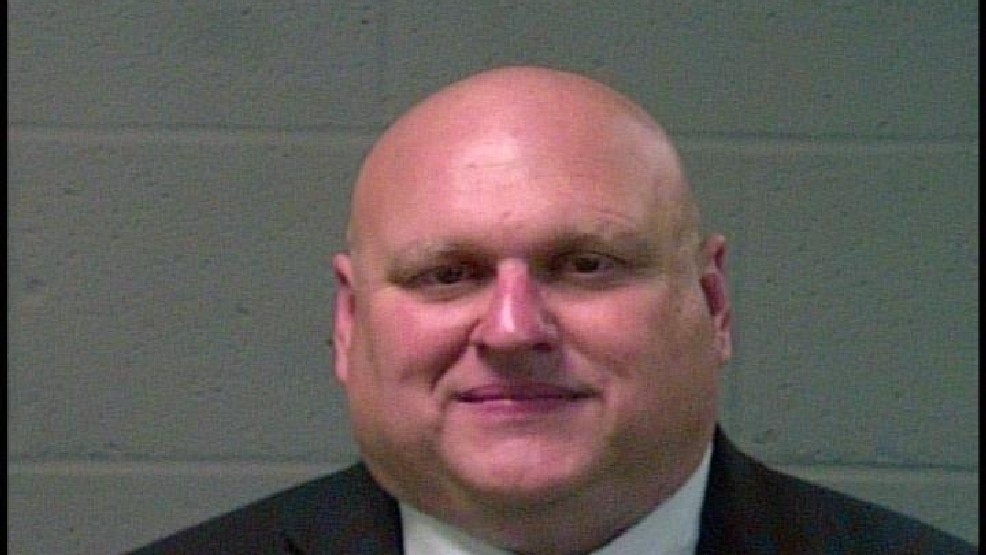 The affidavit includes a timeline of about 20 pages of selected text messages and emails, supplemented with information gathered from interviews with key participants, emphasizing that "these are but a small sampling of the documented communications."
When we set legal limits on how much an individual can give to a campaign and block corporate contributions, and when the outcome of elections often can lead to financial windfalls for connected businesses, money will look for other outlets to influence the election. Under the First Amendment, you have a right to spend your money to voice your opinion, but courts have ruled that government can limit how much of your money you can use in direct support of a candidate.
For those campaign finance limits to be meaningful, there can't be any coordination between a campaign supporting a candidate and independent groups seeking to influence the outcome. The two groups are like bridge partners. You can combine your knowledge of your partner's personality and strategy with the cards he actually plays to guess what else he might have in his hand and what he might play, but if he tells you what he has or you ask him to play a particular card, you've broken the rules.
(The interests of transparency would be better served by unlimited, but fully disclosed contributions.)
The legal process will determine whether all this rises to the level of illegal coordination, but even if no wrongdoing is found, the trail of communications reveals that influential political consultants, who have been involved in the campaigns of many of Oklahoma's top Republican executive and legislative officials, were in cahoots with groups that oppose reform of education in Oklahoma, groups that want lower-income kids to remain trapped in poor-performing schools with no way out. The OEA, state affiliate of the far-left National Education Association, and CCOSA want no change to education in Oklahoma other than more money for our existing system. These emails and texts appear to show that Joy Hofmeister was a Manchurian Candidate, recruited and backed by the teachers' union and the school administrators' lobby, to ensure that nothing threatens their gravy train.
Speaking of gravy train, it was interesting to see American Fidelity Assurance Company mentioned as the source of corporate contributions mentioned in the indictment:
BETWEEN APRIL, 2013 AND NOVEMBER, 2014 THE CRIME OF KNOWINGLY ACCEPTING CORPORATE CONTRIBUTIONS WAS COMMITTED IN OKLAHOMA COUNTY, OKLAHOMA BY JOY LYNN HOFMEISTER, A CANDIDATE FOR SUPERINTENDENT OF PUBLIC INSTRUCTION, WHO THROUGH COORDINATION WITH OKLAHOMANS FOR PUBLIC SCHOOL EXCELLENCE, KNOWINGLY ACCEPTED CORPORATE MONETARY OR IN-KIND CONTRIBUTIONS, SPECIFICALLY MONETARY OR IN KIND CONTRIBUTIONS FROM AMERICAN FIDELITY ASSURANCE COMPANY, IN VIOLATION OF TITLE 21 § 187.2 OF THE OKLAHOMA STATUTES....Lela Odom advised in her interview that OEA and American Fidelity have had a 50 year relationship. OEA has helped AF build their business by endorsing their "salary income protection policy".
Here's how it looks to me: An insurance company has a favorable deal with the teacher's union, and it's in the company's financial interest if the teacher's union continues to be in a favorable situation for maintaining and growing its membership, so the company gives to help elect the teacher's union's preferred candidate. A state that offered meaningful school choice including private schools and charter schools will have fewer unionized teachers, and the favored insurance company will have to find another way to build its customer base. That's my speculative impression of the situation, based on what I read in this file.
I encourage you to read through the 32-page indictment of Joy Hofmeister, Fount Holland, Lela Odom, Stephanie Milligan, and Steven Crawford for yourself. I've taken the scan that KJRH posted with their story and put it through optical character recognition to make it easier to search.
When the state had a revenue failure earlier this year, there was a lot of blame-casting -- "see what happens when you let the conservatives run the state!" Those of us who are conservatives will tell you that we're not in charge here; the state is run by the wheeler-dealers, backed by the Chamber Pots, with campaigns run by the likes of Fount Holland and Chad Alexander. Ask Jason Murphey and Gary Jones about the roadblocks that have been put in the way of their efforts to improve government transparency. Ask the OCPA how much cooperation they got from "conservative" officials for their plan to prioritize spending so that teachers could get a raise without a tax increase. Oklahoma has replaced one set of legal looters with another.
MORE:
David Van Risseghem comments at Sooner Politics:
This narrative has replayed itself over and over. The big money often wins the GOP primary and becomes the nominee. If the liberal lobby groups can buy the GOP nomination, they really don't care if the Democrat loses, because they already own the elective office. ​ The Hofmeister election is exactly what that looks like.
After the jump, excerpts from the indictment.
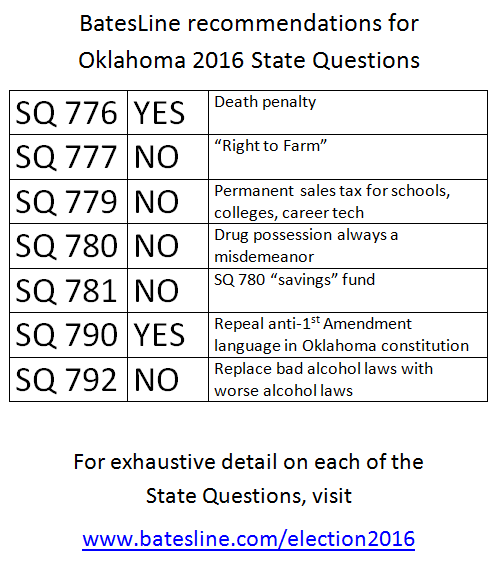
For your convenience, here is a summary of my recommendations for the seven state questions on the 2016 Oklahoma general election ballot. The descriptions are not meant to make my entire argument in three words; they simply serve as a reminder of the topic of the question. The right-hand column contains a couple of words to describe the type of question: Whether the question affects the Constitution or state statutes, and whether it was initiated by the legislature or by initiative petition. Links lead to the article in which I discuss the question at length:
| SQ 776 | YES | Death penalty protection | Constitutional, legislative |
| SQ 777 | NO | "Right to Farm" amendment | Constitutional, legislative |
| SQ 779 | NO | Permanent sales tax for schools, colleges, career tech | Constitutional, initiative |
| SQ 780 | NO | Drug possession always a misdemeanor | Statutory, initiative |
| SQ 781 | NO | SQ 780 "savings" fund | Statutory, initiative |
| SQ 790 | YES | Repeal anti-1st Amendment language in Oklahoma constitution | Constitutional, legislative |
| SQ 792 | NO | Replace bad alcohol laws with worse alcohol laws | Constitutional, legislative |
Oklahoma State Question 792 is a legislative referendum to amend the State Constitution. It would repeal almost all of Article XXVIII (all but the section that repealed article XXVII) and replace it with a new and much longer Article XXVIII A. Click the link to read the complete text of the new amendment. See for yourself how ridiculously complicated it is. It goes into great detail about the permitted relationships between wholesalers and retailers. It writes into the state constitution provisions that properly belong, in statute if anywhere. Some who have analyzed the bill say that it unduly favors out-of-state supermarket chains at the expense of locally-owned businesses and large breweries at the expense of small.
I would love to see our state's liquor laws simplified and made rational. It has never made sense to me that you can buy shots of tequila at a bar at 1:30 a.m. (to be followed by a shaky drive home), but you cannot, at that same hour, buy a bottle of wine to drink safely at home. It doesn't make sense that there has to be a middleman -- a wholesale distributor -- in between the makers of beer, wine, and spirits and the retailer or consumer. I like Fat Tire beer and would love to be able to buy it in Oklahoma. If liquor stores can import beer from Belgium and Japan in Oklahoma, why can't retailers import Yuengling from Pennsylvania?
If you take nothing else from this article, realize that the changes won't go into effect until October 1, 2018. You will have to wait almost two years to buy strong beer and wine at QT.
You may as well wait a few weeks more to get the right kind of change -- a change that would clear away the existing constitutional amendment and replace it with the minimum necessary language to set the extent to which the state, counties, and municipalities can regulate the sale of alcohol. Leave the rest to statute. (Even things like drinking age and hours of operation.) If SQ 792 fails, we can vote on a cleaner question in November of 2018 and have it go into immediate effect. In the meantime, the legislature can cue up any statutory language that we'd want to have in place when the old amendment is cleared away.
I urge you to vote NO -- AGAINST SQ 792.
Oklahoma SQ 781 is a companion to SQ 780, proposed by the same people. It will not go into effect unless SQ 780 is passed. Like SQ 780, SQ 781 is statutory.
The proposal creates new law in Title 57. It establishes a revolving fund called the County Community Safety Investment Fund, directs the Office of Management and Enterprise Services to calculate the money saved by implementation of SQ 780, requires that that amount of money be added to the fund each year, and allows that money to be spent "for the sole purpose of providing funds to counties to provide community rehabilitative programming, including but not limited to mental health and substance abuse services. Funds shall be disbursed in proportion to county population, as reported in the most recent census."
Even if you decide to vote for SQ 780, I urge you to vote NO, AGAINST SQ 781. We already have too many earmarked funds and revenue streams, which means that certain state and local institutions are on the gravy train while others live on bread and water. If SQ 780 passes and manages to save money, the legislature should have the discretion to distribute it as needed. SQ 781 looks suspiciously like a lobbyist-inspired effort to put money in pockets of companies ready to provide the services on which the fund created by SQ 781 must be exclusively expended.
UPDATED 2016/11/02: Having completed my analysis of all 23 sections of the SQ 780 legislation, I have revised the introductory text below to provide a better summary of the effect of passing the state question.
Oklahoma State Question 780 began life as an initiative petition.
Unlike most state questions, its passage will not modify the Constitution. If it passes, SQ 780 will be like the legislature passing a bill. The constitutional power of initiative gives citizens of Oklahoma or any of its political subdivisions the power to legislate in the same way as the corresponding legislative body. City of Tulsa voters could modify the zoning code by putting an initiative petition on the ballot and voting to approve it. State voters can pass state statutes by approving an initiative petition at the polls. I don't know if this has ever happened, but I suppose residents of a school board district could use the initiative power to fire a superintendent or take any other action the school board is empowered to make. The power of initiative exists in recognition that good legislation can at times get clogged up in the politics of the legislature, that legislators can sometimes see themselves (and their lobbyist pals) as an "us" and their constituents as "them." An initiative petition provides a bypass to the obstruction.
In this case, the initiative petition provided a spur to action to the legislature. As you'll see in the section-by-section analysis after the jump, twelve of the 19 sections of statute affected by SQ 780 were modified this year by HB 2751, which passed both houses by wide margins and was signed into law while the SQ 780 petition was being circulated. The bill, like SQ 790, modified the value threshold at which a crime involving theft, fraud, embezzlement, and the like is considered a felony. You can read HB 2751 and see what was added and deleted.
Signature thresholds for statutory initiatives are much lower than for proposed constitutional amendments. Eight percent (8%) of the vote total in the last governor's election (65,987) is enough to put a statutory initiative on the ballot. (15% is required for constitutional initiatives.)
SQ 780 amends 19 different sections in three separate titles of Oklahoma law, affecting penalties and definitions for crimes involving controlled substances, larceny, embezzlement, forgery, and counterfeiting, and affecting penalties for second and subsequent offences. The link, which leads to the Secretary of State's file on SQ 780, shows the text of those sections of the Oklahoma statutes as they would be if SQ 780 passes, and also contains the record of the dispute over the wording of the ballot title for this complex piece of legislation.
When you eliminate the minor differences between HB 2751, which is now in effect, and SQ 780, what's left is one very big, very contentious issue, which hasn't received the attention it deserves -- how should we should deal with drug possession. SQ 780 should have been challenged for violating the single-subject rule -- logrolling popular common-sense ideas like raising the threshold for considering a property crime as a felony with more controversial and divisive issues. When the legislature approved HB 2751, they cleared away the fog and effectively reduced SQ 780 to this question: Should all drug possession crimes be classified as misdemeanors, regardless of the type of drug involve and regardless of the proximity to schools and children?
While there may be a case for lightening penalties, particularly for first offenses, I believe this proposal goes too far. I recommend voting NO -- AGAINST SQ 780.
Now for the details.
Sections 1 and 2 of the proposition sets out the rationale and gives the proposal a name, but it wouldn't be codified into law:
SECTION 1: The people of the state of Oklahoma find the fact that Oklahoma has the second-highest overall incarceration rate in the country, and the highest incarceration rate for women, is inconsistent with Oklahoma values, and drains resources away from investments that can do more to promote public safety. Therefore, the people intend, in enacting this initiative measure, to implement criminal justice reforms that: (l) stop wasting taxpayer money keeping people who commit low-level offenses behind bars for years; and (2) saddle fewer people who commit low-level offenses with felony convictions that will follow them through life and prevent them from getting an education or a job.SECTION 2. This act shall be known and may be cited as the "Oklahoma Smart Justice
Reform Act."
The next 18 sections are amendatory. If you've looked at Oklahoma legislation online, you know that amended law is always shown as a markup -- deleted text stricken through, added text underlined. It makes it easy to see exactly what is changing. It would have been nice for the voters if that had been done by the proponents, but since it wasn't, I will do that here, but after the jump to keep clutter off of the home page. (If you'd like to show your appreciation for my diligent effort, which took me about eight hours to complete, there are a variety of ways you can do so.)
Section 21 repeals 21 O. S. 51.3, which reads:
Every person who, having been convicted of petit larceny, or of an attempt to commit an offense which if perpetrated, would be punishable by imprisonment in the State Penitentiary, commits any crime after such conviction, is punishable as follows:1. If such subsequent offense is such that upon a first conviction the offender would be punishable by imprisonment in the State Penitentiary for life, such person is punishable by imprisonment in such prison for life.
2. If such subsequent offense is such that upon first conviction the offender would be punishable by imprisonment in the State Penitentiary for any term less than for life, such person is punishable by imprisonment in such prison for the longest term prescribed upon a conviction for such first offense.
3. If such subsequent conviction is for petit larceny, or for any attempt to commit an offense, which, if perpetrated, would be punishable by imprisonment in the State Penitentiary, then such person is punishable by imprisonment in such prison for a term not exceeding five (5) years.
Section 22 is a severability clause, allowing the remainder of the legislation to go into effect even if part of it is overturned in court. Section 23 sets an effective date of July 1, 2017.
Details after the jump.
Oklahoma State Question 790 is a legislative referendum which would remove a discriminatory and inconsistently applied provision in the Constitution of Oklahoma that deals with the relationship of religion and government. Its passage would allow the People of Oklahoma through our elected representatives to weigh and balance a variety of public concerns in the development and administration of our laws. Passing SQ 790 would place these questions solely in the context of the well-developed body of Federal jurisprudence concerning the free exercise and establishment clauses of the First Amendment, and would eliminate the added burden of a state provision, the meaning and interpretation of which has shifted over the 109 years since statehood, and which the State Supreme Court has inconsistently applied even within the last two years. Passing SQ 790 would eliminate a provision which discriminates against religious organizations by denying the possibility of even an indirect benefit from an action taken in pursuit of secular state aims.
SQ 790 would delete Article II, Section 5, which reads:
No public money or property shall ever be appropriated, applied, donated, or used, directly or indirectly, for the use, benefit, or support of any sect, church, denomination, or system of religion, or for the use, benefit, or support of any priest, preacher, minister, or other religious teacher or dignitary, or sectarian institution as such.
The proposed amendment was placed on the ballot by Senate Joint Resolution 72, which was approved by a 39-5 vote in the State Senate and a 65-7 vote in the State House. (All five no votes in the Senate and all seven nay votes in the House were from Democrats, as were 2 of the 4 Senate abstentions and 17 of the 24 House abstentions.) The House Rules Committee passed it with a unanimous 9-0 vote. The Senate Rules Committee voted 13-2 in favor.
At the time of its passage, the Oklahoma Constitution was the longest governing document in the world, regulating the price of railroad tickets, regulating who could receive free railroad tickets (and including a special exemption for ministers of religion and YMCA traveling secretaries), decreeing the flash point of kerosene, and defining the term "colored" (although the legal impediments connected with the word were left to legislation -- the "Jim Crow" law passed as the Legislature's first act).
Over its 109-year history, Article II, Section 5, has been cited in about a dozen Oklahoma State Supreme Court cases, involving everything from discounted streetcar fares for parochial school students (OK), to letting private school students ride the public school bus (not OK), to chapel services at a state orphanage (OK), to a cross on the State Fairgrounds (OK), to, most recently, school vouchers for special-needs students (OK) and the Ten Commandments monument on the grounds of the State Capitol (not OK). The rulings have been woefully inconsistent.
The most recent two rulings illustrate the problem:
In Prescott v. Oklahoma Capitol Preservation Commission (2015 OK 54), the State Supreme Court ruled 7-2 that the Ten Commandments monument "operates for the use, benefit or support of a sect or system of religion." Stretching the definition of words to the breaking point, the majority opinion claimed that Judeo-Christianity was a system of religion and that the text of the Ten Commandments was sectarian because it followed the translation that was common to all English-speaking Protestant denominations for over three centuries. (The monument also includes the text of the Ten Commandments in ancient, pre-exilic Hebrew script.) Justice Combs, on this year's retention ballot, wrote a dissent in this case. Justice Winchester, also on the ballot went along with the majority's decision.
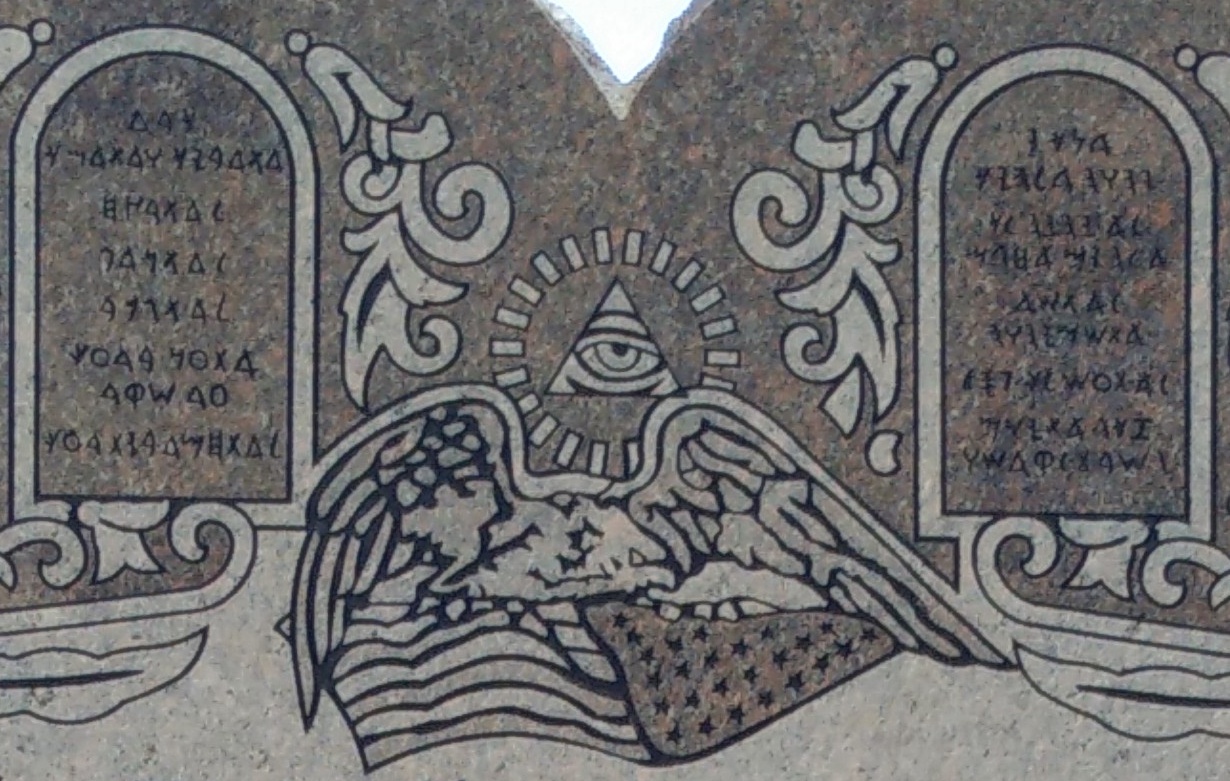
A year later, in Oliver v. Hofmeister (26 OK 15), the Court ruled unanimously that it did not violate Article II, Section 5, for the state to provide funding that parents of special-needs children could use to pay for private school education. The majority argued that the Lindsay Nicole Henry Scholarship is constitutional, because the program is voluntary, because the parents choose the school and may select from religious or non-religious schools, and because the State benefits in that acceptance of the scholarship "relieves the school district of its obligation to the student to provide special education services mandated by the state and federal governments."
It is easy to see how the two decisions might have been reversed: The Ten Commandments are not unique to one Christian denomination or even to Christianity. They are held in respect and reverence by the three great monotheistic religions, so they can hardly be called "sectarian" as understood by the framers of our state's constitution. There is no such thing as a "Judeo-Christian system of religion." It would be more accurate to say that Judeo-Christian is a broad classification that embraces a group of different religions with some common features. The church-affiliated schools that receive state funding in the form of tuition vouchers are benefitting indirectly from state expenditure. The constitutional provision makes no allowance for offsetting state benefit.
The problem comes down to two words, one of which -- "indirectly" -- is overly broad, and the other -- "sectarian" -- has changed meanings since 1907.
Of all the private organizations in Oklahoma, only organizations which are religious in nature must be screened off from even an indirect benefit from government expenditure. Interpreted literally, the provision is absurd. Churches, religious schools, convents, and monasteries benefit indirectly from government spending on law enforcement, street resurfacing, sidewalks, and water and sewer service. A government that is banned from doing anything that might indirectly benefit a sectarian institution will be doing nothing at all.
But what does "sectarian" mean? Is anything religious necessarily sectarian, or did the framers of the Oklahoma Constitution understand a distinction between those two terms?
The same Constitutional Convention that adopted Article II, Section 5, saw no conflict with opening its proceedings with prayer or giving religious ministers a special exemption for free railroad tickets. The Constitution of the proposed State of Sequoyah, which was drafted by many of the same leaders who created the Oklahoma Constitution, had a provision similar to Article II, Section 5, but it also designated Sunday as a "perpetual day of rest" and banned atheists from holding public office.
The Oklahoma public schools that my parents and grandparents attended included prayers and Bible reading. At Catoosa Elementary School in 1970, Mrs. Paul's 2nd grade class opened each day with the Pledge of Allegiance and the Lord's Prayer.
For the first six decades or so of our state's history, the idea that the Ten Commandments were sectarian would have seemed ridiculous. What could be less sectarian than a document held in esteem by all the denominations of Judaism -- orthodox, conservative, and Reform alike -- dozens of Protestant denominations, Roman Catholicism, Greek and Russian and Syrian Orthodoxy, and even modern religions like Mormonism and Christian Science?
What was considered sectarian? Whether infants should be baptized, whether communion was a symbolic memorial or involved the transubstantiation of bread and wine into flesh and blood, whether the church should be governed by bishops, elders, or the membership of the congregation. Promotion by public schools or city governments of a civic religion of generic Protestantism was not seen as a violation of this constitutional provision by the men who put it there.
To the framers of the Oklahoma Constitution, "sectarian" was a code word for Catholic. While Article II, Section 5, is not identical to the unsuccessful Blaine Amendment to the U. S. Constitution, it is in the same vein and shares the same motivation. In the late 19th century, America experienced an influx of immigrants from Ireland and southern Europe. These immigrants were happy to become Americans, but they did not want their children to become Protestants, and they reacted to the public schools' generic Protestantism by setting up their own parochial schools. In reaction to this, politicians who wanted immigrants to assimilate passed provisions like the Blaine Amendment and Article II, Section 5, to ensure that choosing to avoid the prescribed path of religious assimilation would always carry an extra financial burden.
In one case dealing with this constitutional provision, the State Supreme Court noted that a chapel on the grounds of the State's Whitaker Orphanage near Pryor would be used for "non-sectarian, non-denominational religious worship" -- a juxtaposition that would have made perfect sense to the framers of Oklahoma's Constitution but apparently baffles seven of the nine members of our current State Supreme Court.
A few weeks ago I debated in support of SQ 790 against Jim Huff, one of the plaintiffs in the Ten Commandments monument case. Mr. Huff repeatedly made the claim that approval of SQ 790 and repeal of Article II, Section 5, would leave a hole in the law regarding the relationship of religion and government. He claims that its passage will lead to more lawsuits.
On the contrary. The "hole" would be filled by a well-defined body of jurisprudence regarding the First Amendment's "establishment" and "free exercise" clauses. If SQ 790 passes, state, local, and school officials in Oklahoma will have the guidance of dozens of First Amendment cases across the entire country. The two lawsuits mentioned above could have been avoided if Article II, Section 5, were repealed, because precedents in other states already established the constitutionality of the legislature's actions.
If SQ 790 fails, Oklahoma officials will only be able to guess, based on a dozen inconsistent rulings, whether their actions will be regarded as constitutional when the inevitable lawsuit is brought to the State Supreme Court.
Because of the clarity that repeal of Article II, Section 5, will bring to the interaction of government and religion in Oklahoma, I am voting YES, to APPROVE SQ 790.
MORE comments -- a couple of further thoughts I've posted elsewhere that may help summarize the case:
Regarding their Ten Commandments monument, Texas officials could make decisions based on dozens of 1st Amendment establishment and free-exercise precedents from cases across the US. Oklahoma officials are burdened with an overly broad ("indirectly") provision with few precedents (about a dozen) and shifting definitions ("sectarian"). But the existence of Article II, Section 5 is no excuse for our State Supreme Court. The seven justices who ruled against the monument should be blamed for wrongly claiming that there is a "Judeo-Christian system of religion" (Judeo-Christian is a label for a broad grouping of religions with some common elements; if it's a system, where's its hierarchy, where are its rituals set down?) and that the monument is "sectarian" (its text is revered by all denominations or sects of Judaism and Christianity, and is even regarded as holy scripture by Islam).
When Article II, Section 5, was placed in the Oklahoma Constitution, and similar "Blaine Amendment"-type provisions were added to other state constitutions, the framers wanted to encourage children to be indoctrinated in the state religion of the day (generic protestantism) and make it harder for families who wanted to educate their children in their own religion. The motivation for those who want to keep it today hasn't changed, but the state religion has been changed (by the U. S. Supreme Court in the 1960s) to atheism and materialism.
MORE: After the jump, a summary of the Oklahoma State Supreme court cases citing Article II, Section 5.
Oklahoma State Question 779, an initiative petition promoted by University of Oklahoma President (and former Oklahoma governor and senator) David Boren, would amend the Oklahoma Constitution, establishing a permanent 1 cent on the dollar sales tax (a permanent increase in the state sales tax rate from 4.5 cents per dollar to 5.5 -- a 22% increase) to be used for funding K-12 schools, Career Tech, and higher education. Complex language is intended to ensure that this permanent sales tax is in addition to and not in place of existing state funding.
Here is the text of the proposed new Article XIII-C, which would be added to the Oklahoma Constitution if SQ 779 is approved:
CONSTITUTION OF OKLAHOMA, ARTICLE XIII-C - OKLAHOMA EDUCATION IMPROVEMENT FUND§ 1. CREATION OF OKLAHOMA EDUCATION IMPROVEMENT FUND
There is hereby created in the State Treasury a limited purpose fund to be known as the "Oklahoma Education Improvement Fund." The fund shall consist of the proceeds of the sales tax levy and the use tax levy provided in Section 2 of this Article XIII-C, and any monies or assets contributed to the fund from any other source, public or private.
§ 2. LEVY OF ONE CENT SALES TAX AND USE TAX FOR OKLAHOMA EDUCATION IMPROVEMENT FUND
There is hereby levied upon all sales, not otherwise exempted in the Oklahoma Sales Tax Code, an additional excise tax of one percent (1.0%) of the gross receipts or gross proceeds of each sale of tangible personal property, or of other goods and services subject to the sales tax as provided in the Oklahoma Sales Tax Code. Except as otherwise provided herein, this tax shall be collected, reported, and remitted or paid in accordance with the Oklahoma Sales Tax Code. There is hereby levied and there shall be paid by every person storing, using, or otherwise consuming within this state, tangible personal property purchased or brought into this state, an additional excise tax on the storage, use, or other consumption in this state of such property at the rate of one percent (1.0%) of the purchase price of such property. Said tax shall be levied on the storage, use or consumption of personal property as provided in the Oklahoma Use Tax Code. Except as otherwise provided herein, this tax shall be collected, reported, and remitted or paid in accordance with the Oklahoma Use Tax Code. This sales tax levy shall be in addition to, and shall not supplant, the general sales tax levied in the Oklahoma Sales Tax Code or any other sales tax authorized by Oklahoma law and this use tax levy shall be in addition to, and shall not supplant, the general use tax levied in the Oklahoma Use Tax Code or any other use tax authorized by Oklahoma law. All revenue from the sales tax and the use tax levied pursuant to this Article XIII-C, and penalties and interest thereon, collected by the Oklahoma Tax Commission shall be paid to the State Treasurer and deposited into the Oklahoma Education Improvement Fund.
§ 3. ALLOCATION OF MONIES IN OKLAHOMA EDUCATION IMPROVEMENT FUND - PURPOSES - USES - ETC.
A. Monies in the Oklahoma Education Improvement Fund shall be apportioned by the State Treasurer, appropriated by the Legislature, and distributed monthly for the educational purposes established herein, as follows:
1. Common Education: Sixty-nine and one-half percent (69.5%) of said monies shall be apportioned among and between all the several common school districts of the State in proportion to the school population of the several districts, on the basis of the state aid formula for common education then in effect.
(a) Monies from the Oklahoma Education Improvement Fund shall be specifically identified and segregated from other monies appropriated and apportioned among the several common school districts of the State on the basis of said state aid formula.
(b) The common school districts shall use eighty-six and one-third percent (86.33%) of the additional funds provided to them under this Article XIII-C to increase teacher salaries as required by Section 4 of this Article, and to otherwise address and prevent teacher and certified instructional staff shortages in the manner most suited to local district circumstances and needs, including but not limited to differentiated compensation methods or performance pay.
(c) The common school districts shall use thirteen and two-thirds percent (13.67%) of the additional funds provided to them under this Article XIII-C to adopt or to expand programs, opportunities, or reforms to improve reading in the early grades, to improve high school graduation rates, and to increase college and career readiness. The common school districts may use the amount apportioned to them under this Section 3(A)(1)(c) only to adopt or to expand said programs, opportunities or reforms, and may not use the amount apportioned to them under this Section 3(A)(I)(c) to maintain programs, opportunities or reforms established prior to the effective date of this Article XIII-C.
(d) The State Auditor and Inspector shall approve auditors who shall annually audit the use made of the monies distributed to the school districts under this Article XIII-C to ensure that it is used only for the purposes specified in this Article XIII-C..
2. Higher Education: Nineteen and one-quarter percent (19.25%) of said monies shall be paid to the education and general operating budgets of the institutions under the authority of the Oklahoma State Regents for Higher Education, for use in improving college affordability, or otherwise in the improvement of higher education.
3. Career and Technology Education: Three and one-quarter percent (3.25%) of said monies shall be paid to the Oklahoma Department of Career and Technology Education, for use in the improvement of career and technology education.
4. Early Childhood Education: Eight percent (8%) of said monies shall be paid to the State Department of Education, for use in increasing access to and enhancing the quality of voluntary early learning opportunities for low-income and at-risk children prior to entry into the common education system.
B. Monies expended or distributed from the Oklahoma Education Improvement Fund as provided herein shall be used only for the purposes specified in this Article XIII-C, Section 3.c. None of these monies distributed from the Oklahoma Education Improvement Fund to common school districts may be used to add superintendent .positions or increase superintendents' salaries.
§ 4. INCREASE IN TEACHER SALARIES
Each common school district of the State of Oklahoma shall pay each teacher employed by such district a salary at a rate that is at least $5,000 greater than the salary schedule transmitted by such district in the most recent year prior to the adoption of this Article XIII-C.
§ 5. FUNDS NOT TO SUPPLANT OTHER EDUCATION FUNDING
A. Monies expended or distributed from the Oklahoma Education Improvement Fund shall supplement, and shall not be used to supplant or replace, other state funds supporting common education, early childhood education, higher education, or career and technology education, including but not limited to the Permanent School Fund, the Oklahoma Education Lottery Trust Fund, the Education Reform Revolving Fund, the Common Education Technology Revolving Fund, the Higher Education Capital Revolving Fund, the Oklahoma Tuition Scholarship Revolving Fund, the Common School Fund, appropriations from the Legislature as provided in Article XIII, Section 1a of the Constitution, and any other appropriations from the Legislature used for educational purposes.
B. The Legislature shall appropriate the monies from the Oklahoma Education Improvement Fund solely to supplement other funds supporting common education, early childhood education, higher education, or career and technology education. The Legislature shall not appropriate such monies to supplant or replace any other state funds supporting common education, early childhood education, higher educ.ation, or career and technology education.
C. In order to ensure that the monies from the Oklahoma Education Improvement Fund are used to enhance and not supplant funding for education, the State Board of Equalization shall examine and investigate appropriations from the Fund each year. At the meeting of the State Board of Equalization held within five (5) days after the monthly apportionment in February of each year, the State Board of Equalization shall issue a finding and report that shall state whether appropriations from the Oklahoma Education Improvement Fund were .used to enhance or supplant education funding. If the State Board of Equalization finds that education funding was supplanted by monies from the Oklahoma Education Improvement Fund, the State Board of Equalization shall specify the amount by which education funding was supplanted. In this event, the Legislature shall not make any appropriations for the ensuing fiscal year until an appropriation in that amount is made to replenish the Oklahoma Education Improvement Fund.
§ 6. EFFECTIVE DATE, CONSTRUCTION
A. This Article XIII-C shall become effective on July 1 immediately following its passage.
B. Nothing in this Article XIII-C shall be construed as conflicting with Article X, Section 23 of the Constitution.
§ 7. SEVERABILITY
The provisions hereof are severable, and if any part or provision hereof shall be void, invalid, or unconstitutional, the decision of the court so holding shall not affect or impair any of the remaining parts or provisions hereof, and the remaining provisions hereof shall continue in full force and effect.
Article X, Section 23, is the balanced-budget requirement in the Constitution of Oklahoma.
Before you even get to the question of whether common schools should get more state funding or teachers should get raises, there are numerous reasons to defeat this proposition:
1. This is a logrolled proposition, in violation of the Oklahoma Constitution's single-subject rule. The essence of logrolling is to link unpopular provisions, which could not pass on their own, with provisions that enjoy public support. Boren has framed this issue so that you have to give him more money for OU if you want to give more money to K-12 schools. That's selfish and greedy on his part. The lavishly funded Tulsa Technology Center will get more money too, even though they can barely figure out how to spend the money they take in through their dedicated property tax levy. The high priests of the Oklahoma Supreme Court pretended not to see the obvious logrolling, so it's left to the voters to punish logrolling by defeating it at the polls, along with the unjust judges who approved it (including Supreme Court justice Combs and Civil Appeals Court judge Thornbrugh, on the ballot for retention in November).
2. There's no mechanism for reducing the tax rate if the tax generates more revenue than is needed. We will have the same problem we already have with dedicated property tax levies for TCC, Tulsa Technology Center, the library, and the health department. Taxpayers lose, money gets wasted, other needs go unfunded.
3. Our cities and towns will have some of the highest combined sales tax rates in the nation. This will hurt border communities, as shoppers cross the state line to avoid the higher tax rate. This will hurt Oklahoma's poorest citizens, as the regressive tax on food, clothing, and other necessities hits even harder.
4. Sales tax is a highly volatile revenue source. Just ask your city's finance director.
5. The degree of detail, the specificity of the earmarks, and the severability clause all indicate that this is really statutory language, not constitutional language.
Any additional funding for post-secondary education should be tied to a College Realignment and Closure Commission, modeled after the military's successful efforts to cut costs by reducing duplication, consolidating commands, and closing inefficient bases. There is considerable overlap between our comprehensive universities, regional universities, community colleges, and career tech schools. (For example, if you want to learn computer programming, any one of those four types of taxpayer-funded, post-secondary institutions will offer what you need.) Colleges are often located based on political considerations of the turn of the 20th century, rather than the population distribution of the early 21st century. And Oklahoma colleges don't need any more taxpayer money for subsidizing culturally corrosive garbage or persecuting dissenters from the official left-wing ideology.
Funding for common schools needs to go back to a local model -- local funding, raised locally, spent locally, under local control. In FY2016, local and county funds accounted for 28% of school funding, while state sources (including earmarked funds and appropriations) amounted to 61%. That ratio needs to be reversed. Property-rich districts like Union and Tulsa shouldn't be receiving state aid at all, beyond targeted assistance for special needs. District taxpayers should have the option of voting in a higher permanent support levy. Rural county assessors should suffer a penalty for failing to assign true market value to local property, as their sloth results in lower property taxes and lower levels of local support. Under the current system, the state steps in and subsidizes that behavior by supplementing lower property tax collection with state funds. The system hurts well-managed counties that are paying their fare share of taxes in favor of poorly-managed counties that aren't. Making local districts more responsible for their own funding would have the natural consequence of encouraging various types of consolidation and efficiency, including administrative consolidation, campus consolidation, and distance learning. If kids on a Queensland cattle station can learn math over the radio from a teacher 200 miles away, surely rural Oklahoma children can learn math over the internet.
SQ 779 is a rotten apple. I plan to throw it out on November 8 by voting no, against SQ 779.
MORE: Here are the opening paragraphs and a few other key passages from Justice Taylor's dissent, which was joined by Kauger and Winchester:
¶1 I respectfully dissent to the Court's decision finding no constitutional infirmity with Initiative Petition No. 403. The Court is presented with a clear example of logrolling--what Article XXIV, Section 1 of the Oklahoma Constitution intends to prevent. An extremely popular one-time pay raise for a group of state employees paired with other less popular tangentially related questions is repulsive to this constitutional provision. The plain language of Article XXIV, Section 1 requires each proposition in an initiative petition to be of one general subject. This proposed constitutional article to provide a pay raise for a small group of state employees, paired with an increase in funding for common education and higher education, a 1% sales tax, and the enhancement of the Board of Equalization's power is a perfect example of what Article XXIV, Section 1 was written to prevent. Even if logrolling were not the determinative issue, the proposed initiative petition impacts several other constitutional provisions in which allocations for salaries are delegated to the Legislature, and only the Legislature.1¶2 The Respondents admitted during oral argument that amending our founding document to give a pay raise to one group of state employees is unprecedented. Unprecedented may undersell this point. Stop and think about this proposal for a moment--our Constitution will be amended to grant a onetime pay raise to a group of state employees. Is constitutional amendment to become the new vehicle for pay raises for state employees going into the future? It is evident that this unprecedented constitutional pay raise is being proposed because it is the popular subject in this collection of independent and unrelated provisions. Without the pay raise provision, Initiative Petition No. 403 would likely stand no chance with the voters.
¶3 It is the duty of this Court to follow the rule of law and the Oklahoma Constitution. This case is not simply an approval or disapproval of increasing pay for common education teachers of this state. If that were the case, it would sail through these challenges and be adopted by the people. I would send Initiative Petition No. 403 back to the Respondents and require the questions of a public-school-teacher pay raise, an increase in the state sales tax, the marriage of common education and higher education, and an increase in the Board of Equalization's powers to be presented to the voters as separate conditional propositions....
¶18 In a future budget year, where failure of revenue will require the Legislature to make cuts across the board to all agencies, the Legislature will cut common education and higher education at its own peril due to the powers now given to the Board of Equalization. If the Board of Equalization does not approve of the Legislature's decisions on education appropriations, then the Board of Equalization can shut down the entire legislative branch of government until it follows the command of an executive branch entity. We may very well see the Legislature grind to a halt as the Board of Equalization test-drives its new power.
¶19 There is a reason that a state employee pay raise through constitutional amendment has never been utilized before. The Oklahoma Constitution sets forth precise appropriations procedures for the Legislature to utilize, and the Legislature only. This proposed provision thwarts a core function of the Legislature and clashes with other constitutional provisions which control the appropriations process. See Okla. Const. art. 5, §§ 55-56;4 Okla. Const. art. 13A, § 3; 5 Okla. Const. art. 13, § 1A.6 In essence, Initiative Petition No. 403 contains internal logrolling and causes external logrolling of other relevant constitutional provisions...
¶24 Public support for a public-school-teacher pay raise is very high in this state. I could not agree more that it is a noble goal and purpose. Yet this Court has an obligation to follow the rule of law and the Constitution. And when such a well-supported measure is used as a Trojan horse to add provisions into the Constitution which are only tangentially related to public-school-teacher pay raises, the Constitution and the Court become the gatekeepers. The voters should decide these issues, but they should not be forced to support public-school-teacher raises along with an increase in the sales tax, the marriage of common education and higher education, and an increase in the power of the Board of Equalization all in one vote. I respectfully dissent.
Oklahoma State Question 777 proposes an amendment to the Constitution of Oklahoma. It would add a new Section 38 to Article 2, which would read:
Section 38. To protect agriculture as a vital sector of Oklahoma's economy, which provides food, energy, health benefits, and security and is the foundation and stabilizing force of Oklahoma's economy, the rights offarmers and rancherscitizens and lawful residents of Oklahoma to engage in farming and ranching practices shall be forever guaranteed in this state. The Legislature shall pass no law which abridges the right of citizens and lawful residents of Oklahoma to employ agricultural technology and livestock production and ranching practices without a compelling state interest.Nothing in this section shall be construed to modify any provision of common law or statutes relating to trespass, eminent domain, dominance of mineral interests, easements, rights of way or any other property rights. Nothing in this section shall be construed to modify or affect any statute or ordinance enacted by the Legislature or any political subdivision prior to December 31, 2014.
 This proposed amendment began life as HJR 1012 during the 2015 legislative session. The House approved it 90-6; the Senate approved a different version 39-6; then the House adopted the Senate version by an 85-7 vote.
The markup above shows the changes from the original House version to the version finally approved by both Senate and House. The original House version said "farmers and ranchers" instead of "citizens and lawful residents of Oklahoma"; the change was made on the House floor. The Senate version added "dominance of mineral interests, easements, rights of way" before "or any other property rights." The Senate version also added the final sentence grandfathering any laws enacted in 2014 (the session prior to passage of this resolution) or earlier.
There are active, evidently well-funded campaigns on each side of the issue. The "yes" website is http://www.oklahomarighttofarm.com/, the "no" website is http://www.votenoon777.com/.
There seems to be a good deal of propaganda on each side of the issue, aiming to provoke an emotional response rather than argue the pros and cons.
While SQ 776 aims to disarm judicial activists, SQ 777 hands them a loaded howitzer. On the Oklahoma Right to Farm FAQ page, the vote yes folks say, "Oklahoma's courts will ultimately determine the scope of Right to Farm." How about we determine the scope before we approve it?
Two other states have approved a similar constitutional provision. North Dakota passed such a bill by a 2-to-1 margin in 2012; Missouri by a very slim margin in 2014. On the other hand, this year, North Dakota voters reaffirmed the state's ban on corporate farming.
This is a bit of a tangent, but I've seen some people claim that the American Legislative Exchange Council (ALEC) is behind SQ 777. Today I even saw the claim that "ALEC runs Oklahoma." That's like saying Ree Drummond runs my kitchen because we use some of her recipes. ALEC is an organization where limited-government, free-market legislators can exchange ideas and share solutions. (It's analogous to the National Conference of State Legislatures (NCSL), which serves legislators who are looking for solutions involving bigger government. The main difference is that ALEC is privately funded, and NCSL receives tax dollars.) Some of those solutions involve model legislation, providing a starting point which legislators can adapt to their specific goals and the unique circumstances of each state.
In the case of "Right to Farm," SQ 777 shares a name with ALEC's model right-to-farm legislation, but little else. The ALEC model bill is statutory, not constitutional, and it includes specific definitions that SQ 777 lacks. The ALEC model bill provides a process for handling complaints against farmers; SQ 777 has nothing of the sort.
While I appreciate the concerns of groups like the Oklahoma Farm Bureau and the Oklahoma Cattlemen's Association, I don't believe that a constitutional amendment like that proposed in SQ 777 is the right solution. I will be voting NO -- AGAINST SQ 777.
Thanks to the support of generous donors (see the Spotlight sidebar on the home page for a list), here is the first in the BatesLine series on the state questions on the Oklahoma 2016 ballot. We will seek to get behind the ballot titles to the legal substance of the question and try to uncover the history, rationale, and people behind each proposal.
State Question 776 is a legislative referendum that would add a new Section 9A to the Constitution of Oklahoma. This new section would say:
All statutes of this state requiring, authorizing, imposing or relating to the death penalty are in full force and effect, subject to legislative amendment or repeal by statute, initiative or referendum. Any method of execution shall be allowed, unless prohibited by the United States Constitution. Methods of execution may be designated by the Legislature. A sentence of death shall not be reduced on the basis that a method of execution is invalid. In any case in which an execution method is declared invalid, the death sentence shall remain in force until the sentence can be lawfully executed by any valid method. The death penalty provided for under such statutes shall not be deemed to be, or to constitute, the infliction of cruel or unusual punishments, nor shall such punishment be deemed to contravene any other provision of this Constitution.
As Section 9A, it would fall immediately after Section 9, which is identical to the 8th Amendment to the Federal Constitution.
SQ 776 began as Senate Joint Resolution 31, which was was unanimously recommended by Senate and House committees, passed unanimously by the State Senate, and passed by an 80-10 vote in the State House. I have heard people ignorantly claim that the legislature is punting the issue to the voters, but under Article 24, amendments to the Oklahoma Constitution must be ratified by a vote of the people, whether they originate as an initiative petition or as legislation.
Audio of the Senate SJR31 floor presentation and debate is available online. On that page, click the SJR31 link in the left sidebar. This will advance the audio to that point in the session and also bring up the bill summary and history for further exploration. You can also watch video of the House SJR31 floor debate; click the "Agenda" tab and then the SJR31 link. The House Rules Committee discussion is here, which you'll find a more detailed discussion of the rationale behind this proposal.
If you put this amendment in a spray can, the label would read "Judicial Activism Repellent." This is an attempt to defend Oklahoma's use of capital punishment against a number of back-door strategies being employed by death-penalty opponents who know they can't win a direct attempt to delete the death penalty from Oklahoma law.
Activists have been pressuring drug companies to stop making the drugs used for lethal injections. As supplies of drugs needed for reliable and tested combinations have dried up, states have been forced to find new sources and new combinations of drugs in order to carry out the law. Application of these new combinations isn't straightforward, leading to errors as in the case of Clayton Lockett. That in turn leads to public outcry, a positive outcome from the perspective of death-penalty opponents.
During the House Rules committee discussion of the proposal, State Rep. Mike Christian mentioned a concern that the U. S. Supreme Court would ban lethal injection as "cruel and unusual punishment," making it urgent to find an alternative method (nitrogen hypoxia was mentioned as a new possibility in addition to electrocution and firing squad) and clearing a constitutional path to move existing cases to any new method.
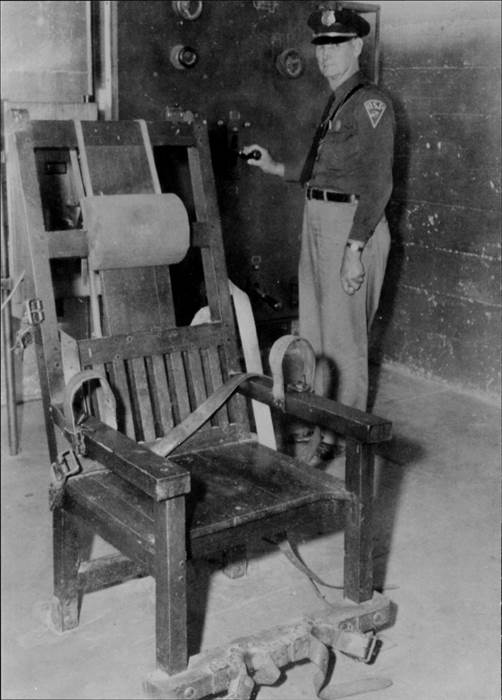 Of course, the only reason we are using lethal injection is because these same death-penalty opponents protested electrocution, hanging, and firing squad as inhumane.
The proposed amendment attempts to address problems raised by this situation. While methods of execution would continue to be limited by the "cruel and unusual" clause of the 8th Amendment of the U. S. Constitution, state judges would be barred from going beyond federal precedent to find additional methods of execution cruel and unusual under the Oklahoma Constitution.
Under the proposed amendment, a person is sentenced to death and not to a specific method of execution, so that a death-row convict will not be spared just because the expected method is unavailable.
"Shall not be deemed" in the final sentence is a restraint on activism by the State Supreme Court: They aren't allowed to comb the State Constitution for some other pretext for halting executions. If SQ 776 passes, the judges can't disingenuously imagine ambiguity or silence on the issue.
It's sad that this sort of amendment is necessary, but our theocratic method of selecting judges and justices means we wind up with a legal priesthood that selects a Sanhedrin of judges whose values are out of sync with the people they rule. Under the principle of self-government, judges should be of the people -- sharing the views and values of the people, but wiser, more consistent, and capable of reconciling conflicting circumstances. (The evolution of modern America makes more sense when seen as a decades-long process of colonization and proselytizing by a worldview alien to that which framed our Constitution, built the nation, and carried us through the Great Depression and World War II.)
I will vote YES, FOR SQ 776.
The League of Women Voters of Tulsa are holding a "Hot Topic Lunch" at the newly remodeled Central Library next Tuesday, October 11, 2016, to discuss SQ 790. I will be arguing in favor of the state question, which repeals Article II, Section 5, the discriminatory "Blaine Amendment" language in the Constitution of Oklahoma. James Huff will be speaking in opposition. The event will be held in the Learning and Creativity Room, and will run from 11:30 a.m. to 1:00 p.m.
While it's too late to order lunch, you're welcome to attend.
RESOURCES:
- Official Oklahoma Secretary of State information about SQ 790
- Becket Fund discussion of Blaine Amendments in state constitutions
- University of Tulsa Law Review article on Blaine Amendment language in state constitutions
- Duke Law Review article on state Blaine language and the effect on school choice proposals
- 2008 Pew Forum interview GWU law professor Ira Lupu about Blaine Amendments and their impact in some then-current Florida controversies
- News report on the recent Oklahoma State Supreme Court case involving the Lindsay Nicole Henry Scholarship and Article II, Section 5
UPDATE 2016/10/14: Oklahoma, Kentucky, Pennsylvania, Maine, and South Carolina have been reclassified as non-compliant and have been granted a grace period only until January 15, 2017. Alaska, California, Oregon, and Virginia have a limited extension until June 6, 2017, and American Samoa, Arkansas, Idaho, Illinois, Louisiana, Massachusetts, Michigan, Northern Marianas, New Hampshire, New Jersey, New Mexico, New York, North Carolina, North Dakota, Puerto Rico, Rhode Island, and Texas have an extension until October 10, 2017. Guam, Montana, and Virgin Islands are under review.
Once again, local media outlets are not reporting that this problem affects anyone besides Oklahoma. My guess is that they're relying on DHS or Oklahoma DPS press releases and that DHS would like to pressure each state by making the citizens of each think they're isolated and alone on this issue. Jim Harper of Cato Institute wrote late last month that "Oklahoma is a current battleground."
A 2014 Cato Institute report notes:
Although REAL ID is moribund, a state-by-state review reveals that some states' legislatures have backtracked on their opposition to the national ID law, and in some states motor vehicle bureaus are quietly moving forward with REAL ID compliance--contrary to state policy. Surprisingly, in some states, motor vehicle bureaucrats are working to undercut state policy opposing REAL ID and the national ID system.
Keep in mind that Oklahoma legislators voted unanimously to reject REAL ID in 2007, with sponsors on both sides of the isle. Then-Gov. Brad Henry, a Democrat, signed the bill into law. Officials were concerned about the cost of fulfilling this unfunded federal mandate, the security of personally identifying information and vulnerability to identity theft, and privacy.
How many states are in full compliance with the REAL ID act? How many states have an exemption that expires on October 10, 2016? How many states are already out of compliance?
If you were just learning about the issue from local news and social media, I can see how you might have come to the conclusion that 49 states and all the territories were already in full compliance and the only holdout was backward, ignorant Oklahoma, led by our Bible-besotted legislators and that awful Mary Fallin who stupidly believe that REAL ID is practically the Mark of the Beast. If you're only reluctantly an Oklahoman, if you already hate our state's religiously-influenced cultural conservatism, the apparent practical consequences of REAL ID non-compliance serve as a hefty cudgel with which to beat your favorite straw man.
For example, this News 9 story received a lot of social media play early this week:
OK Licenses Will No Longer Be Accepted For Access Onto Military Bases By Dana Hertneky, News 9MIDWEST CITY, Oklahoma -
Your Oklahoma driver's license many not get you on military bases after October 10. Oklahoma legislators failed last session to make our Oklahoma Driver's licenses REAL ID compliant, and the current extension expires October 10. Without another extension, visitors to the bases will no longer be able to use their Oklahoma driver's license for identification.
HGL Construction does work on all three military bases in Oklahoma. During a recent site visit they were told that after October 10, an Oklahoma driver's license would no longer be an acceptable identification to get them on base.
"It will require not only HGL, but our subcontractors to secure passports, which most of our subcontractors wouldn't necessarily have," said Patrick Renshaw, the VP and Director of Preconstruction for HGL Construction.
Public Affairs officers at the bases say the new rules will also affect delivery drivers and even family members visiting the base for graduations or ceremonies. At Ft. Sill, they are warning loved ones now about the change, so they have time to get the necessary documentation.
There's some important context that the story doesn't give you. The limits on access to military installations is nothing new. It's been decades since a driver's license was sufficient for unescorted access to a military base. On some bases, a federal Common Access Card (available to some contractors on a strictly controlled basis) is sufficient, but on others, you also need to present a background check to the base pass office to get a separate, base-specific pass, and on still others, you'll need a vehicle pass as well.
The most important context missing from the story is that Oklahoma is not alone in its REAL ID non-compliance. Here is the Department of Homeland Security's list (retrieved today) of the status of driver's licenses from each state and territory:
(A) 23 states and the District of Columbia are considered fully compliant.
(B) 24 states, Guam, Northern Marianas, Puerto Rico, and Virgin Islands "have an extension, allowing Federal agencies to accept driver's licenses from these states until October 10, 2016."
(C) American Samoa, Minnesota, Missouri, and Washington are non-compliant and do not have an extension. Federal agencies may accept Enhanced Driver's Licenses (equipped with an RFID chip and valid for land and sea border crossings) that are available to Minnesota and Washington residents.
Oklahoma is in category B, along with California, Texas, New York, Illinois, Michigan, New Jersey, North Carolina, Virginia, and Massachusetts -- some very big company indeed.
New York State is telling its citizens that, despite the impending expiration of their extension, there's no need to worry for another four years:
Can I board a plane with the driver license I have now?Yes. DMV expects that all licenses and ID cards issued by New York State will remain acceptable for domestic flights and for access to federal buildings until October 1, 2020.
What happens after 2020?
Starting in October 2020,New Yorkers will need a REAL ID compliant license to board a domestic flight or enter a federal building without secondary forms of identification, as per the Department of Homeland Security (DHS).
New York State has been granted an extension to the REAL ID Act only through October 10, 2016. What does that mean?
The extension's 2016 expiration is no cause for concern, as DHS grants extensions only on an annual basis and New York State anticipates having a REAL ID extension until becoming fully compliant with the Act. That means New Yorkers can continue to use their current state-issued driver license or ID card to enter federal buildings or board a domestic flight until October 1, 2020.
...
Do I need to worry about this now?
No. All New York licenses and ID cards are currently acceptable for REAL ID purposes and DMV expects them to be until October 1, 2020.
I have come across a couple of reports (here and here) that a 90-day extension to January 9, 2017, was announced on Thursday but can't find anything reflecting that change on the DHS website.
Since Congress passed REAL ID in 2005 as a rider on a must-pass appropriations bill, there's been a kind of gamesmanship happening. DHS doesn't want to acknowledge widespread rebellion against this Federal overreach. They prefer to pretend that most non-compliant states are moving toward compliance, and as long as a state plays along -- periodically requests an extension, presents some plausible excuses (e.g. fiscal constraints), and professes progress toward compliance -- DHS is happy to grant an extension. The only states tarred with the scarlet non-compliance label are those who are making no pretense to compliance.
Those forces that want Americans to have to obtain what amounts to an internal passport, linked to a central database, use media to activate the herd mentality. They want to convey the impression that each non-compliant state is alone, and it's time to get with the program. But as long as non-compliant states (especially the larger ones) stick together, Federal agencies will have to continue to grant extensions. Enforcement would create enough inconvenience for federal agencies and citizens that have to interact with them to generate calls for repeal.
Why should you care? Civil liberties organizations have raised objections to the REAL ID plan since its inception, citing threats to liberty, privacy, and the security of your identity. The Electronic Privacy Information Center (EPIC), CATO Institute, Electronic Freedom Foundation, the left-leaning ACLU, and the right-leaning ACLJ have all come out in opposition to REAL ID. Here is an excerpt from EPIC's REAL ID page:
EPIC and 24 experts in privacy and technology submitted detailed comments (pdf) in May 2007 on the draft regulations explaining the many privacy and security threats raised by the REAL ID Act. The fundamentally flawed national identification system is unworkable and the REAL ID Act must be repealed. In particular, the group admonishes DHS for its failure to include adequate privacy and security safeguards for this massive national identification database. DHS's own Data Privacy and Integrity Advisory Committee has refused (pdf) to endorse the agency's plan. "The Committee feels it is important that the following comments do not constitute an endorsement of REAL ID or the regulations as workable or appropriate."Department of Homeland Security Secretary Michael Chertoff released the agency's final regulations for REAL ID on January 11, 2008. The Secretary scaled back some of the requirements, reduced the cost, and extended the deadline for state compliance. However, Secretary Chertoff also indicated that the REAL ID card would be used for a wide variety of purposes, unrelated to the law that authorized the system, including employment verification and immigration determination. He also indicated that the agency would not prevent the use of the card by private parties for non-government purposes. As part of the cost-saving effort, Homeland Security has decided not to encrypt the data that will be stored on the card.
In an opinion column written by Secretary Chertoff after the publication of the final rule, he said, "embracing REAL ID" would mean it would be used to "cash a check, hire a baby sitter, board a plane or engage in countless other activities." This is a description of a national identification system, which is illegal in the United States. When it created the Department of Homeland Security, Congress made clear in the enabling legislation that the agency could not create a national ID system. In September 2004, then-DHS Secretary Tom Ridge reiterated, "[t]he legislation that created the Department of Homeland Security was very specific on the question of a national ID card. They said there will be no national ID card."
In a detailed analysis (pdf) of the final rule, EPIC explained that the Department of Homeland Security's REAL ID system includes few protections for individual privacy and security in its massive national identification database. It harms national security by creating yet another "trusted" credential for criminals to exploit. The Department of Homeland Security has faced so many obstacles with the REAL ID system that the agency now plans an implementation deadline of 2017 -- nine years later than the 2008 statutory deadline. It is an unfunded mandate that would cost billions, with the burden ultimately being placed on the individual taxpayer.
Technical experts familiar with the challenges of privacy protection and identification presented the Department of Homeland Security with a variety of recommendations that would have minimized the risks of the REAL ID system. The DHS made some modifications, but left the essential system in place. As REAL ID currently stands, the costs are many and the benefits are few. EPIC also detailed the State rebellion against REAL ID.
EPIC urged the alternative model of a system of decentralized identification. This reduces the risks associated with security breaches and the misuse of personal information. Technological innovation can enable the development of context-dependent identifiers. A decentralized approach to identification is consistent with our commonsense understanding of identification. If you are banking, you should have a bank account number. If go to the library, you should have a library card number. If you rent videos from a store, you should have a video rental store card number. Utility bills, telephone bills, insurance, the list goes on. These context-dependent usernames and passwords enable authentication without the risk of a universal identification system. That way, if one number is compromised, all of the numbers are not spoiled and identity thieves cannot access all of your accounts. All of your accounts can become compartmentalized, enhancing their security. View the full report: Marc Rotenberg & Melissa Ngo, EPIC, REAL ID Implementation Review: Few Benefits, Staggering Costs (pdf) (May 2008).
I suspect that some REAL ID proponents support it mainly because of the perceived benefits for immigration enforcement. Other proponents may have a commercial interest -- providing the enhanced cards and the machines that produce them or the IT systems to manage the data gathered. Law enforcement might find it easier to do their jobs if your life was less compartmentalized. Commercial entities see financial opportunity in linking data among various aspects of your life; you may have noticed, in the move from computers to smart phones, that you have to use a single ID from Apple or Google to access various apps, and you have to give those apps permission to crawl around all the data that other apps have generated. Even if the Federal Government fails to establish a universal ID, Apple and Google may succeed.
Here's what EFF has to say about REAL ID:
Once the IDs and database are in place their uses will inevitably expand to facilitate a wide range of surveillance activities. Remember the Social Security number started innocuously enough but it has become a prerequisite for a host of government services and been coopted by private companies to create massive databases of personal information. A national ID poses similar dangers; for example because "common machine-readable technology" will be required on every ID the government and businesses will be able to easily read your private information off the cards in myriad contexts.Real ID won't just cost you your privacy. The federal government didn't give the states funds to implement the law and overcome its many administrative burdens so the billions of dollars in costs will be passed down to you in the form of increased DMV fees or taxes.
And what will you get in return? Not improved national security because IDs do nothing to stop those who haven't already been identified as threats and wrongdoers will still be able to create fake documents. In fact the IDs and database will simply create an irresistible target for identity thieves.
Kaye Beach is a Norman-based activist fighting against REAL ID and government collection of biometric information. Her Constitutional Alliance website has a helpful FAQ about biometrics. Her chilling summary:
We are being enrolled into a single global biometric identification system that links a person's body using biometrics to their ability to buy, sell, travel and work....It is most important to note that ALL states meet Real ID benchmark #1 "Mandatory facial image capture and retention of such image." No matter whether your state is Real ID compliant or not, if you possess a state driver's license or photo ID card, you have been enrolled. The same is true for other government photo ID's such as a military ID or a US passport. These high resolution digital images are a biometric suitable for use with facial recognition technology and we know that at least 37 states are currently utilizing the facial biometric with facial recognition technology.
It is the capture of the biometric combined with the application of international standards that is at the heart of enrollment into a single global system of identification and control.
Beach writes that mandatory biometric identification shifts the balance of power from people to government, transforms rights into privileges, and destroys the presumption of innocence.
Her Constitutional Alliance co-founder, Mark Lerner, explains how this technology can have a chilling effect on the free exercise of our First Amendment rights:
The good news is now that the Snowden revelations have revealed to a large degree the domestic surveillance taking place, the public knows more about what OUR government is doing. The bad news is the chilling effect creating a surveillance state has on a representative form of government.The chilling effect can be simply defined as the way in which people alter or modify their behavior to conform to political and social norms as a result of knowing or believing they are being observed. The observation can be from physical surveillance, telephone meta data being collected, emails being intercepted and read, search engine requests being maintained, text messages being read and stored, financial transactions being monitored and much more.
David Beaudoin of the Local and Special Elections blog has added last Tuesday's Oklahoma Republican runoff results to his database and has noticed some interesting patterns and a few exceptions to patterns.
The percentage of primary first-place finishers who won the runoff was 78%, a bit higher than the five-cycle average of 73%, while margins of victory, were a bit closer than normal, but only three races were closer than 5%.
The big surprise was the range of variability of the ratio between runoff vote and primary vote. A drop-off is normal, with fewer races on the ballot and less media attention; on average about 70% of primary voters will show up for the runoff.
This year we had the rare event of a runoff with a higher turnout than the primary. 6,864 votes were cast in the three-way Senate District 41 Republican primary between Adam Pugh and Paul Blair; 7,969 votes were cast in the runoff, an increase of 16%. Runoff votes have only exceeded primary votes in one other race in the last decade -- the 2014 Democratic runoff for House District 89 between Mary Sosa and Shane Stone.
The Pugh-Blair SD41 runoff had all the adversarial energy of a general election campaign, and it illustrated the shift of ideological warfare in Oklahoma into the Republican primary. According to the most recent snapshot of campaign funding, Blair raised $61,810.00, received another $1,000.00 in in-kind contributions, and had $5,000.00 in loans, while Pugh raised $92,625.00, had $881.69 in in-kind donations, and $80,000.00 in loans. This is a massive amount of money to spend on 8,000 voters. Blair's funds came mainly from individuals and overwhelmingly from constituents; his only PAC contributions were $2,250 from the Oklahoma Conservative PAC, a grassroots group that holds an endorsement convention and funds candidates who receive a supermajority of support from the membership, and $250 from the National Association of Insurance and Financial Advisors.
Blair's involvement in national social conservative circles brought him endorsements and donations from David Barton of Wallbuilders, Troy Newman of Operation Rescue, and Kelly Shackleford of First Liberty Institute, but it also put a great big target on his back. Pugh's victory may reflect a growing symbiosis between business groups who shun social conservatism because they perceive it as bad for the bottom line and social revolutionaries who rally protests, boycotts, and negative news stories to ensure that standing up for conservative social policy is bad for the bottom line.
I am told that Pugh made a virtue of his lack of outside endorsements, but surely massive contributions and independent expenditures from a variety of PACs ($50,000 in PAC money, by my count) and lobbyists should count as outside support. Pugh was funded to the tune of by PACs connected with the State Chamber, the Tulsa Regional Chamber, Greater Oklahoma City Chamber, Chesapeake, Cox Communications, Farmers Insurance, Oklahoma Academy of Ophthalmology, Oklahoma Association of Insurance Agents, Oklahoma City Business Council, Oklahoma Land Title Association, Oklahoma Medical PAC, Oklahoma Pharmacists Association, Oklahoma Society of Anesthesiologists; Behavioral Health Association; Beer Distributors of Oklahoma; Oklahoma Bankers PAC; GOPAC Oklahoma, Renew Oklahoma PAC; Oil Patch PAC; among others. The State Chamber of Oklahoma spent $15,556 on independent expenditures supporting Pugh.
At the other end of the turnout spectrum, the Senate District 39 Republican runoff between Amanda Teegarden and Dave Rader only drew 44.5% of the voters who turned out for the June primary. Teegarden managed to retain 81% of her primary vote total, but that still left her 400 votes short. Rader was the beneficiary of Tulsa Regional Chamber PAC funding and independent expenditures from the Oklahoma State Chamber to add to his high-name recognition, but despite all those advantages, he managed to get only 60% of his primary vote to the polls for the runoff. Supporters of the other two candidates seemed to disappear.
An even worse turnout ratio wasn't on Beaudoin's chart, because it was a county race. The Tulsa County Court Clerk's runoff between Don Newberry and Ron Phillips to replace retiring clerk Sally Howe Smith, was the only county-wide runoff, and it drew only 33% of the voters who had turned out in June. Newberry polled 55% of his primary support; Phillips polled only 41% of his. Neither candidate went negative, and both could point to experience in the Court Clerk's office and endorsements by county-wide elected officials.
Compare that to Oklahoma County, where the runoff in David Hooten's successful effort to unseat five-term County Clerk Carolyn Caudill drew 75% of the vote total of the June primary. Caudill had finished first in June's four-way primary, but with only 32% of the vote. Hooten beat Caudill 65%-35% in the runoff. While Caudill retained 81% of her primary support, the anti-Caudill vote coalesced behind Hooten.
Rick Warren Jr., who became the incumbent Oklahoma County Court Clerk in an April 2016 special election, won renomination to a full term in a rematch of his March special primary, beating longtime Court Clerk employee Linda Amick Dodson. That race also brought 75% of the June primary vote total back for the August runoff.
MORE: Direct links to results and contribution reports:
- Federal, State, Legislative and Judicial 2016 primary
- Federal, State, Legislative and Judicial 2016 runoff
- Tulsa County 2016 primary
- Tulsa County 2016 runoff
- Oklahoma County 2016 primary
- Oklahoma County 2016 runoff
- Oklahoma Ethics Commission: Candidate Search
- Oklahoma Ethics Commission: Independent Expenditures and Electioneering Communications Search
Originally published on 2016/08/20. Post-dated to remain at the top of the blog through the primary.
These are all open seats in Tulsa County that drew large candidate fields in the primary, and no one candidate received a majority of the vote. Click the links for more detailed information.
Please note that there are NO state questions on today's runoff ballot. All of them will be on the November 8 general election ballot.
State Senate District 39: Amanda Teegarden: On her own dime and her own time, Amanda has been an effective citizen activist, researching issues, understanding the legislative process, informing her fellow citizens and rallying them to get involved, and applying the right amount of pressure at the right time to help good legislation and to block bad legislation. With her children grown and out of the house, she's now available to apply these skills full-time as a citizen legislator. Oklahomans need her intellect and discernment working for us at the State Capitol.
State Senate District 25: Joe Newhouse: I've had the opportunity to work with Joe on several projects, and I've seen his energy and enthusiasm, his diligence and organizational skills at work firsthand. He's personable and builds good working relationships. From our conversations over the years, I know that Joe Newhouse is strongly committed to his Christian faith, to his family, and to conservative, constitutional principles of government. Joe is a local, going to Broken Arrow Public Schools all the way through. Newhouse flew EA-6B Prowlers in the Iraq War, taught fighter tactics as an instructor at NAS Pensacola, earned a master's degree and certification as a Program Management Professional (PMP), served three years as a field representative for Congressman Jim Bridenstine, and is a Commander in the Navy Reserve, working as a military adviser to NATO.
State House District 67: Scott McEachin: I've known Scott McEachin for a few years now and have always known him to be on the knowledgeable about public policy, principled, friendly, easy to work with, and I believe that District 67 and Oklahoma would be blessed to have him as a member of the legislature. Scott has been endorsed by retired U. S. Sen. Tom Coburn (now a resident of the district) and a number of conservative groups. Coburn writes, "Scott McEachin's experience in oil and gas has given him a critical understanding of the industry that is at the heart of our Oklahoma economy. Scott is uniquely qualified because he has a deep understanding of the issues and will prioritize our government operations to make Oklahoma a state that can lead the nation."
Please note that the opponents of these candidates have been endorsed by a union-backed special interest group that opposes parental choice in education, wants to make quality education less accessible to the poor, and wants more taxpayer money with less accountability for results. Rob Miller, who has become something of a celebrity in the teacher-union blogosphere, recently wrote that Joe "Newhouse will be a willing accomplice" to the "pro parent choice agenda." These people think your children are their property, and it's their right to alienate your children from your values and indoctrinate them in theirs. They want to cut off every avenue of escape from families of modest means. If you want the next generation of Oklahomans to be well-educated, discerning, capable citizens, vote for Teegarden, Newhouse, and McEachin, who will indeed be pro-parent-choice.
Tulsa County Court Clerk: Don Newberry: Newberry currently manages the Title Research department in the County Assessor's office and worked previously in the County Court Clerk's office. Newberry has been endorsed by his boss, County Assessor Ken Yazel, and I am hopeful that, in addition to seeing to the Court Clerk's core responsibilities, Newberry will also be an ally of Yazel's on the Budget Board, fighting for budget transparency in county government.
Other endorsements and questionnaires:
Tulsa 9/12 Project leader Ronda Vuillemont-Smith endorsements
Charlie Biggs at the Tulsa Beacon endorsements
Charlie Meadows, former head of Oklahoma Conservative PAC
Oklahoma Constitution Conservative Index
Oklahomans for Life questionnaire
Official information:
Tulsa County Election Board
Oklahoma State Election Board
Oklahoma Ethics Commission (campaign contribution and expenditure reports)
David Beaudoin of the Local and Special Elections blog has analyzed Oklahoma runoff election results beginning with the 2008 election cycle and has made some interesting findings that set Oklahoma apart.
Among other findings, Beaudoin notes that, unlike other states, Oklahoma incumbents rarely find themselves in runoffs -- none this year, and only one since 2008. Conventional wisdom says that if the first place finisher had 40% or better in the primary, he's a shoo-in for the runoff, but Beaudoin finds that this isn't the case in Oklahoma.
Beaudoin, a CPA and financial analyst, backs up his psephological analysis with a chart (linked from his analysis) showing all runoffs in Oklahoma State Election Board records since 2008 (statewide, federal, and legislative races) alongside the primary results for the same races.
Oklahoma's relative turnout rate -- comparing runoff turnout to primary turnout is comparable to that of other runoff states.
You'll find more analysis and detailed data about Oklahoma runoff elections on the Local and Special Elections blog.
Early voting for Tuesday's runoff continues through 6 pm today at the Tulsa County Election Board headquarters and at the Hardesty Regional Library and will be available again on Saturday from 9 am to 2 pm.
State Senate District 25 candidate Lisa Kramer has declined to participate in a head-to-head debate with conservative Joe Newhouse on KFAQ's Pat Campbell show in advance of the Tuesday, August 23, 2016, Republican runoff election. From KFAQ's website:
Lisa Kramer is running for Oklahoma Senate and is facing a runoff Tuesday August 23rd with the Jim Bridenstine endorsed Joe Newhouse in District 25.Kramer was offered a chance to come on The Pat Campbell Show and participate in an on-air debate with Newhouse, but refused saying her schedule was "booked solid."
We have invited Mr. Newhouse to come into the studio anyway and tell District voters why they should choose him on Tuesday, and he has agreed to do so.
Campbell has hosted numerous debates over more than eight years as host of KFAQ's morning drive and has a reputation for even-handedness and giving each candidate a fair chance to convey his or her platform to the listening audience.
Newhouse posted the following comment in response to Kramer's decision:
I believe that Government Transparency begins with candidates being candid and forthright about their positions. This includes maintaining websites that contain plans & positions and not just platitudes. It also means making yourself available to the public, not just hiding behind mailers. I was disappointed to receive an accusational mailer from my opponent, who refused participation in the KFAQ debate despite advanced invitation. I realize that campaigns can be stressful, but overreaction and name-calling only serve to turn people off from the political process and destroy unity. As an officer & a gentleman, I am proud of the clean campaign that I have run, which includes not publishing embarrassing episodes from the other debate. As my opponent offers little content on her website (e.g. how she actually intends to pay for things), I am left only with her public statements and survey results with which to draw my distinctions.
The two SD25 candidates debated at the Tulsa Republican Club meeting last month. You can watch the debate online. The "embarrassing episodes" may refer to Kramer's inability to name any positive achievements of the legislature in response to a debate question; Newhouse mentioned a criminal justice reform bill and eliminating End of Instruction tests among a few other items; Kramer concurred with Newhouse but had nothing to add on her own.
Here is the podcast of the SD 25 KFAQ debate that Joe Newhouse attended and Lisa Kramer declined to attend.
According to official election records, Kramer was a registered Democrat until changing her registration to Republican less than three years ago, on September 5th, 2013. Given the recent dominance of the GOP in Oklahoma politics, there would be an incentive to switch parties to have more of an influence over the ultimate result of the election, or even to have a chance at winning election to office in heavily Republican districts like SD 25.
On the Oklahomans for Life survey, Kramer answered "no" and Newhouse answered "yes" to the question, "Upon reversal of the U.S. Supreme Court's Roe v. Wade decision, will you vote for a law that would protect the lives of unborn children and prohibit abortion except to prevent the death of the mother?" (Kramer and Newhouse both said they would support a law that includes exceptions for legally-reported rape and incest.)
Kramer signed the petition to put the Boren sales tax increase on the November ballot and has defended that decision publicly, although she says she will vote against the tax. Newhouse opposes the tax and opposed putting the tax on the ballot.
Kramer has been enthusiastically endorsed by left-wing bloggers and organizations that support the proposed state sales tax increase for schools and oppose measures that expand parental choice in education. Kramer has received funding from PACs affiliated with the Tulsa Regional Chamber and Oklahoma State Chamber and left-wing public-employee labor unions like the Oklahoma Educational Association and Oklahoma Public Employees Association. (Click the link if you need a refresher on why a Chamber endorsement should scare off conservative voters.)
A shadowy group called Oklahomans for a Prosperous Future has spent $15,838.40 on direct mail in support of Kramer, paying that money to Majority Designs Invoicing. Oddly, a mailer received by SD 25 voters yesterday says it was paid for by "Oklahomans for a Responsible Government" -- a group that doesn't show up in the Oklahoma Ethics Commission database for the current or previous campaign cycles. Is this a typo on the part of the direct mail firm, or a deliberate attempt at confusing voters with a name that sounds like that of a now-defunct conservative watchdog group? A group called Oklahomans for Responsible Government (without the indefinite article) was active from 2008-2010, leading the opposition to the ill-conceived, teachers-union-backed SQ 744, which would have constitutionally tied Oklahoma's spending on education to that of other states.
The disclosure report for Oklahomans for a Prosperous Future, Inc., was filed by Clayton Woodrum, 321 S. Boston Ave, Ste 200, Tulsa OK 74103. The organization's IRS Form 990 for 2014 (the only one available on Guidestar.org) misspells its own name ("Oklahoman's for a Prosperous Future, Inc.") and states its mission as "TO PROMOTE SOCIAL WELFARE CONCERNING PUBLIC POLICY RELATED TO HEALTH, EDUCATION, FISCAL AND BUDGET ISSUES." It received $470,000 in contributions and grants in 2014. In that year it spent $361,085 to "ADVOCATE FOR PUBLIC POLICY", another $43,824 on "VOTER REGISTRATION EXPENSES," and $43,693 on "SUPPORT OR OPPOSE CANDIDATES' CAMPAIGN." Devin L. Hughes is listed as President, Karl Semtner as Secretary, and Clayton Woodrum as Treasurer. In 2014, OPF spent $250,000 with Hulsen Media Services LLC on TV ads. Hughes is co-author of the anti-gun-rights blog ArmedWithReason. Semtner contributed to the 2012 and 2014 campaigns of Democrat District 92 State Rep. Richard Morrissette, Woodrum contributed to Heather Nash, Democrat candidate for SD 11. The group's TV ad attacking tax incentives for horizontal drilling drew the ire of State Sen. Cliff Branan, chairman of the Senate Energy Committee, who said the group was "incorporated by an individual who has given tens of thousands of dollars to the campaigns of Barack Obama." It seems fair to say that the activities of Oklahomans for a Prosperous Future and its identified supporters points in a strongly leftward direction, which makes its intervention on behalf of Lisa Kramer in a Republican primary revealing, particularly if Kramer chooses not to denounce their involvement on her behalf.
1170 KFAQ's Pat Campbell hosted a SD 39 debate between Amanda Teegarden and Dave Rader. Click to listen to the podcast.
The National Rifle Association Political Victory Fund has endorsed Amanda Teegarden in the Republican runoff for Senate District 39. The race will be resolved in a runoff next Tuesday, August 23, 2016. (Early in-person voting began today and continues Friday from 8 am to 6 pm and Saturday from 9 am to 2 pm at the Tulsa County Election Board and Hardesty Regional Library.
The NRA awarded Teegarden an AQ -- an A rating based on her questionnaire, the highest rating available to a candidate who has not yet served in office. Her runoff opponent, Dave Rader, received a B rating.
Meanwhile, this past Monday, August 15, 2016, according to Oklahoma Ethics Committee filings for Friends of Dave Rader 2016, Rader received a $2,000 last-minute contribution from "We Mean Business PAC," an arm of the State Chamber of Oklahoma.
As I wrote back in June, if you're a conservative voting in the Republican primary, a good rule of thumb is to see whom the Chambers are supporting then give your vote to some other candidate.
Let me stipulate that Dave Rader is a good man who ran the University of Tulsa football program with integrity and genuine concern for his players as students. In 2003, he served honorably as Tulsa County GOP vice chairman during a difficult time of transition for the county party. I don't think the State Chamber is backing him as their first choice in the SD 39 race -- Oklahoma BizPAC and BOK Financial PAC backed Alan Staab in the primary, while New Direction Fund PAC backed Rick Poplin, both of whom failed to advance to the runoff. Perhaps it boils down to this: The State Chamber pots know they can't influence Amanda Teegarden, who knows how the legislative process works and has settled principles on the proper role of government, but they hope they might be able to sway Dave Rader, who hasn't been actively involved in public matters for over a decade.
I think it's worth repeating some of the specific reasons why a candidate's funding or endorsement by the State Chamber should be of interest and concern to conservative voters to support a different candidate.
As for the State Chamber of Commerce, they joined with the Tulsa, Oklahoma City chambers and the U. S. Chamber in a lawsuit to block implementation of employment-related provisions of HB 1804, provisions that would have required Oklahoma employers to verify the employment eligibility of the people they hired. In other words, the Chambers at all levels worked to take the teeth out of the law, to disarm the provisions that made it an effective deterrent to illegal immigration.
The State Chamber also pushed hard for Obamacare Medicaid expansion (euphemistically called "rebalancing" this year) and Common Core. The State Chamber targeted a strongly pro-business conservative Republican, State Sen. Josh Brecheen, for defeat because he supported Common Core repeal and opposed a special tax cut for energy producers, preferring instead to give general tax relief to the state's taxpayers.
Back in 2007, economist Stephen Moore wrote:
In Oklahoma the state chamber filed a petition with the state Supreme Court to block eminent domain reform, and vowed to fight a taxpayer-led movement to enact a Colorado-style [taxpayer bill of rights].This transcript of a July 2012 State Chamber meeting in Tahlequah quotes the chamber's lobbyist, Chad Warmington, saying, "the legislature spends a lot of time talking about things that just don't matter - I mean, they want to talk about tax cuts and all that stuff."
Also in 2012, then-State Rep. David Dank bemoaned the role "pro-business" lobbyists played in preserving special interest tax credits at the expense of tax relief for all Oklahomans (hat tip to OCPA's Brandon Dutcher):
Sadly, those same lobbyists who secured sweetheart deals for the beneficiaries of tax credits managed to kill most efforts to reform or repeal them during the 2012 session. We did manage to phase out two of the most abused and wasteful tax credits, but dozens of others are being reinstated in July.In short, the special interests won and the people lost. A primary reason Oklahoma taxpayers will see no income tax relief next year is that a few favored industries will continue to cash in on the public treasury through a still-broken tax credit system.
I would advise any conservative candidate who receives a contribution from a PAC affiliated with the Oklahoma State Chamber, the Oklahoma City Chamber, or the Tulsa Regional Chamber to return the money immediately. You don't want to be tainted.
Oklahomans vote on August 23, 2016, a runoff in a small number of races where no candidate received a majority of the vote in the June primary.
U. S. Representative Jim Bridenstine has made endorsements in two of those Republican runoff primaries for open State Senate seats in Tulsa County.
In Senate District 39, Bridenstine has endorsed Amanda Teegarden, citing her solid base of principle, consistent record of involvement, and her deep understanding of the legislative process:
I am happy to support and endorse Amanda Teegarden in her run to serve the people of State Senate District 39. Amanda Teegarden is a staunch conservative who has worked for Republican causes for many years. Amanda's knowledge of the State Legislature puts her in a unique position that affords Republicans in District 39 the opportunity to elect a member that will have no need for on the job training.
With Amanda Teegarden, we will be electing a conservative that we can trust to get the job done in Oklahoma City. Please join me on August 23rd in supporting Amanda Teegarden for State Senate!
In Senate District 25, Bridenstine has endorsed Joe Newhouse:
It is with great pride that I am announcing my endorsement of fellow Navy pilot and true conservative, Commander Joe Newhouse for State Senate in District 25.
As a combat veteran and successful business owner, he is uniquely qualified to lead in the Oklahoma State Senate.
I know him to be a principled conservative, and I believe he will serve our state with the same honor and courage he has displayed while serving our country as a Navy pilot.
I am proud to endorse Commander Joe Newhouse for State Senate and am asking you to join me in voting for him in the runoff election on August 23rd.
Having known both of these candidates personally for many years, I concur with the congressman's endorsements and rationale. If you're a Republican in either SD 25 or SD 39, I urge you to mark your calendar and go vote on Tuesday, August 23, 2016.
(The Oklahoma state senate gerrymander of Tulsa County districts defies description, so here's a map. And no, the Republicans didn't invent gerrymanders -- Democrats did plenty of it when they controlled the legislature.)
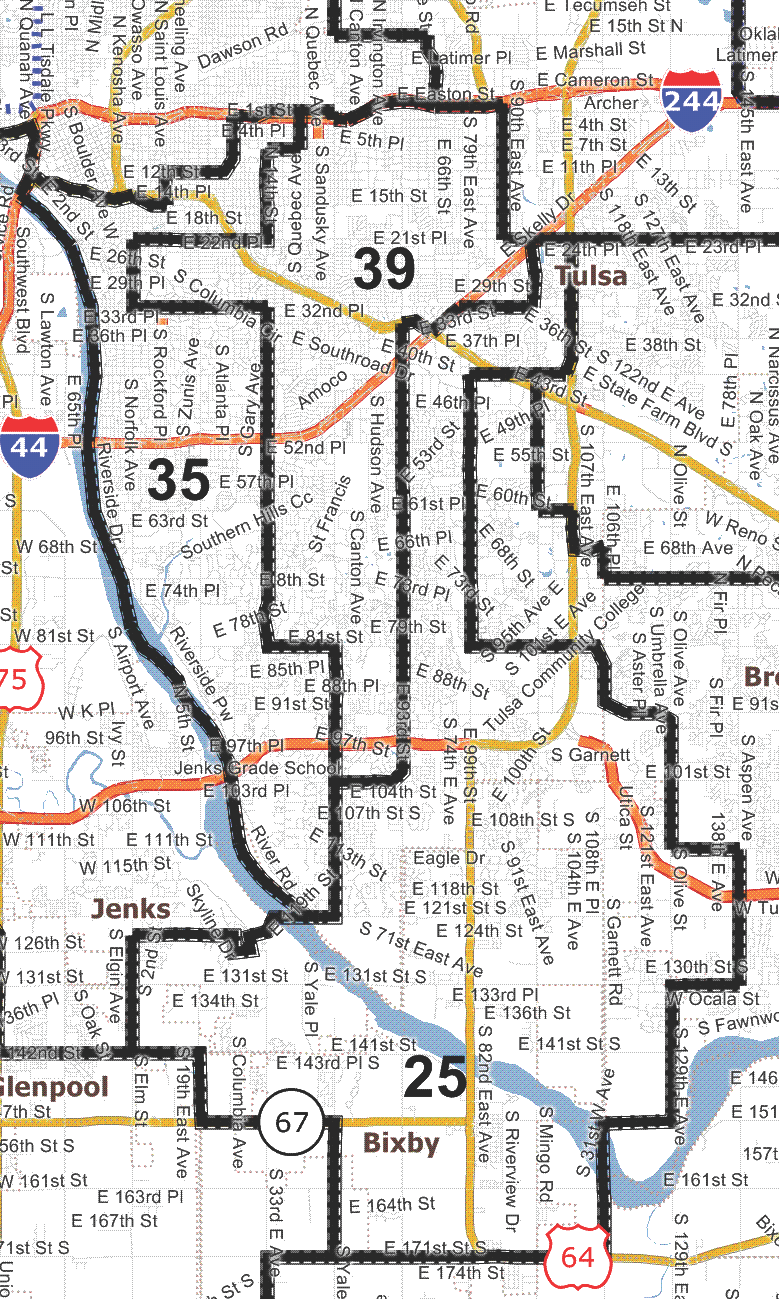
Originally published on 2016/05/25. Post-dated to remain at the top of the blog through the primary.
Most of the time I write a series of individual endorsements and then a summary the night before the election. Often I run short of time to cover every race in as much detail as I'd like. Early voters looking for some guidance have expressed their frustration with this situation.
So this time I'm starting with a list and will fill in with details as I'm able. These endorsements come in two categories: Candidates I am supporting because I know them personally (in the case of challengers or candidates for open seats) or because I've seen their record in office (in the case of incumbents) are highlighted in italics. There are other candidates for whom I would vote, but I don't know them well, and they don't have a track record. These are in normal text.
U. S. House, District 1: Jim Bridenstine
U. S. House, District 2: Jarrin Jackson
U. S. House, District 4: James Taylor
State Senate District 23: Kevin Crow
State Senate District 25: Joe Newhouse
State Senate District 29: Julie Daniels
State Senate District 33: Nathan Dahm
State Senate District 37: Dan Newberry
State Senate District 39: Amanda Teegarden
State Senate District 45: Kyle Loveless
State House District 67: Scott McEachin
State House District 70: Ken Walker
State House District 82: Kevin Calvey
State House District 72: Whitney Cole, the lone GOP candidate, was ordered stricken from the ballot by the State Election Board as ineligible for the seat. The open seat in this north and central Tulsa district, previously held by Darrell Gilbert and Seneca Scott, will be decided in today's Democrat primary. Although I disagree with my friend and former City Councilor Maria Barnes on nearly every state and federal issue, I know from experience that she cares about the concerns of ordinary Tulsans in this district and would recommend her over her rival in the Democrat primary, simply because she's someone I've known and worked with on neighborhood issues for many years. I can't think of a conservative-focused reason to support one Democrat over the other.
Tulsa County Clerk: Michael Willis
Tulsa County Sheriff: Luke Sherman
Tulsa County Court Clerk: Don Newberry
Tulsa County Commissioner, District 2: Josh Turley
Wagoner County Clerk: Lori Hendricks
City of Tulsa races are non-partisan, but I'll add them here for simplicity's sake.
Mayor of Tulsa: A vote for Tom McCay is the only way a conservative can avoid throwing away his vote. A vote for Bartlett Jr or Bynum IV is a vote to reward politicians who have betrayed conservatives on fiscal and social issues.
I'd like to see the entire Tulsa City Council replaced because of their unanimous support for higher taxes and the imposition of leftist views of sexuality on Tulsa's landlords, but conservatives weren't ready with challengers. Still, several races offer a chance to vote for someone new to city government. Several candidates who filed have ceased active campaigning for one reason or another. There are three primaries on Tuesday's ballot: Allen Branch, running in District 6 against the current and previous incumbents, is active in grassroots Republican organizations. In my District 4, Josh Starks is running a vigorous campaign against incumbent Blake Ewing, but I can't support either of them. Two inactive candidates are on the ballot, Michael Haskins and Sam Walker. I like what I've gleaned about Sam Walker, the owner of Over the Top Aerial Productions, from his Facebook page, so I'm going to vote for him as a protest. In District 3, Jim Rice withdrew from the race against incumbent David Patrick, but Araceli Tiger is running an active campaign.
Other endorsements and questionnaires:
Tulsa 9/12 Project leader Ronda Vuillemont-Smith endorsements
Charlie Biggs at the Tulsa Beacon endorsements
Charlie Meadows, former head of Oklahoma Conservative PAC
Oklahoma Constitution Conservative Index
Oklahomans for Life questionnaire
Official information:
Sign in Chinon, France. Photo by Peter Curb. Used under Creative Commons license.
If you're a conservative, the Chamber of Commerce is not your friend. Not the U. S. Chamber of Commerce, not the Oklahoma State Chamber of Commerce, not the Tulsa Regional Chamber. If you're a conservative voting in the Republican primary, look to see whom the Chambers are supporting, then give your vote to some other candidate. If the Chambers are attacking a Republican candidate, she's probably worthy of your enthusiastic backing.
This may seem counter-intuitive. Conservative Republicans know that the free market is the engine of prosperity, and we honor and seek to encourage the entrepreneur who starts and builds a business, creating jobs and providing the products and services we need and want. We oppose taxes and regulations that burden businesses and discourage the creation of jobs. Since Chambers of Commerce claim to be the voice of business, shouldn't conservative Republicans heed their advice?
As with many organizations, the claim to speak for a valued segment of the community doesn't reflect the reality of the situation. Chambers of Commerce came into existence to boost business through business cooperation. But Chambers of Commerce are among the many once-noble American institutions that have been co-opted by self-serving special interests and Leftists who are pursuing social transformation and ever-bigger government. There are plenty of other examples: The American Association of Retired Persons, the National Education Association, the YWCA are just a few that come to mind.
It works like this: An organization offers some valuable service to attract members. The AARP offers discounts and insurance, the NEA's state affiliates offer legal coverage (and require membership in the NEA in order to belong to the state association), the YWCA offers access to swimming pools and exercise classes, the local Chamber offers group insurance coverage for small businesses that might not have enough employees to set up something on their own.
These benefits attract members who will be content as long as the services that induced them to join are provided and who aren't likely to get involved in the governance of the organization. These members get a ballot for board members in the mail, and, after a moment's glance, they toss the ballot in the recycle bin.
The broad-based but uninvolved membership gives the organization a credible claim to be the voice of retirees, of teachers, of women, or of business. The leadership, elected by the much smaller body of involved members, can then use that credibility to push an agenda of which the membership may be completely unaware and which they might reject, were they paying attention.
That agenda may reflect the economic benefit of the most influential members, companies that prefer to profit by means of rent-seeking rather than risk-taking. It may reflect the social agenda of the leftists who pursue careers in the not-for-profit sector. The direct approach to social transformation through elections has had mixed results, but the Left has found considerable success in pushing radical ideas by means of organizations with a history and reputation of being non-ideological, evading the defenses citizens put up against political influence.
The two types of influence can work hand in hand. The non-profit employees at Anycity Metro Chamber, as faithful yacht guests, are happy to push for expensive and useless infrastructure projects that benefit the big construction companies who control Anycity Metro Chamber. The big companies are happy to advance leftist social causes as long as they get their way on economic issues. Sometimes interests coincide: For example, Leftists like illegal immigration because it dilutes the votes of those who support the traditional American approach to society and economics; Big Business likes illegal immigration because it dilutes the cost of labor.
Enough theory. Let's get into some examples of how chambers of commerce from the local to the national level are actively working against the interests of conservatives:
On June 3, 2016, Jeff Dunn, chairman of the board of the Tulsa Regional Chamber, described conservative legislators pursuing legislation on issues like abortion and religious liberty as "nut jobs":
The chairman of the Tulsa Regional Chamber complained Friday that "nut jobs on the periphery" wield too much influence in the Oklahoma Legislature."We value our relationship with legislators," Chairman Jeff Dunn said during the chamber's annual recap of the legislative session. "(But) I would submit we need some counseling."
The "nut jobs," Dunn said, are preventing the rest of the lawmakers from being as productive as they might be.
Dunn, president and CEO of Mill Creek Lumber, was upset by what he called a "disappointing" legislative session, particularly in regard to education and long-term reform of the state's finances.
Earlier, in opening remarks, Dunn said legislators are too prone to "go off on tangents" instead of concentrating on state government's core missions.
"When we go off on tangents, we look like North Carolina," Dunn said. "And when we look like North Carolina, it's bad for business."
"North Carolina" is an allusion to the swift action taken by that state's legislature to protect the rights of citizens and business owners after the City of Charlotte passed a draconian ordinance that would have, among other effects, required gyms to allow men claiming to be women to use the same changing rooms as actual women. To Dunn, legislation that defends individual liberty and personal conscience, because it runs against the leftist norms enforced by the news media and the entertainment industry, makes a state look backwards and hurts its business prospects.
 Evidently, the leadership and membership of the Tulsa Regional Chamber are just fine with Dunn's insulting and intemperate remarks. He's still listed as Chamber chairman. I find no reports of calls for his resignation or removal, no indication of mass resignations over his remarks. While most Chamber members are likely too busy running their own businesses to pay attention to Chamber politics, Chamber board members share Dunn's culpability if they decline to denounce or distance themselves from his remarks.
Longtime BatesLine readers will recall articles about Tulsa Regional Chamber involvement in wasteful, corporate-welfare-laden sales tax hikes and their attacks on City Councilors (especially conservatives) who sought to subject the Chamber to healthy competition for city contracts, who sought to put the interests of city residents ahead of suburban developers, who sought to ensure that federal community development funds actually went to help Tulsa's neediest neighborhoods. What's new is the Chamber's apparent hostility to conservative concerns about the use of government to impose leftist social views.
In an earlier entry, I mentioned the Tulsa Regional Chamber's diversity initiative, with its surveys that convey the message that sexual orientation and gender identity are inborn, immutable characteristics on par with race and ethnicity, despite all scientific evidence to the contrary. These surveys measure a company's commitment to diversity by whether they give domestic partner benefits, sponsor or participate in gay pride parades, and prioritize giving contracts to LGBT-owned businesses. Why would any conservative remain on the board of an organization that funds this kind of propaganda?
Earlier this year, OCPA President Jonathan Small summed up the Tulsa Regional Chamber as a left-wing echo chamber:
Remember the Tulsa Regional Chamber? Its leadership in 2014 participated in a failed attempt to support U.S. Sen. Mary Landrieu, who was trying to prevent Republicans from gaining the majority in the U.S. Senate. Imagine if some of the leadership of the Tulsa Regional Chamber had succeeded. Sen. Harry Reid would still be the Senate majority leader. Majority Leader Reid likely would be using the "nuclear option" to ramrod through an extremely left-of-center Supreme Court justice nomination to replace Justice Antonin Scalia.Once again the Tulsa Regional Chamber is in lock-step with the Obama administration. Obama's administration tried to stifle a very popular school choice program in Louisiana and Washington, D.C. The Tulsa Regional Chamber lobbied against efforts to implement ESAs and is now an accomplice in the death of two bills that would have helped the most vulnerable in Oklahoma.
In fairness, the Tulsa Regional Chamber is consistent. The chamber parrots the funding requests of state agencies, proffers the Medicaid expansion as one of the best economic deals ever offered the state and tries to kill tax relief for all while working for special interest tax breaks. The chamber even tried to cripple the oil and gas industry with exorbitantly high taxes just before the downturn.
Some who have left the Tulsa Regional Chamber or refuse to join will tell you that's because it has become an echo chamber for policies that benefit the growth of big government, with more and more special interests of government involved in the chamber's processes.
Sadly, thousands of Oklahoma's most vulnerable children will lose in part because of the lack of intellectual diversity in the Tulsa Regional Chamber.
In another article, OCPA looked at the presence on the Tulsa and Oklahoma City chamber membership rolls -- and detected a pattern that could explain their support for higher taxes:
In recent years chambers of commerce in this state have done yeoman's work in fighting for important policies such as Right to Work, workers' compensation reform, and lawsuit reform. However, many of these same chambers also lobby strenuously for bigger government, including increased funding for medical welfare programs and for the state's bottomless-pit education monopoly. These chambers lobby against prudent fiscal measures, such as one (not exactly draconian) proposal which would limit the annual growth of state government spending to 9.5 percent. Why is this?Part of the answer can be found by examining the chambers' membership rosters. In addition to scads of nonprofit organizations (which may or may not receive taxpayer money), one discovers more than a few blatant "'tax eater' entities," to borrow Stephen Moore's phrase.
 As for the State Chamber of Commerce, they joined with the Tulsa, Oklahoma City chambers and the U. S. Chamber in a lawsuit to block implementation of employment-related provisions of HB 1804, provisions that would have required Oklahoma employers to verify the employment eligibility of the people they hired. In other words, the Chambers at all levels worked to take the teeth out of the law, to disarm the provisions that made it an effective deterrent to illegal immigration.
The State Chamber also pushed hard for Obamacare Medicaid expansion (euphemistically called "rebalancing" this year) and Common Core. The State Chamber targeted a strongly pro-business conservative Republican, State Sen. Josh Brecheen, for defeat because he supported Common Core repeal and opposed a special tax cut for energy producers, preferring instead to give general tax relief to the state's taxpayers.
Back in 2007, economist Stephen Moore wrote:
In Oklahoma the state chamber filed a petition with the state Supreme Court to block eminent domain reform, and vowed to fight a taxpayer-led movement to enact a Colorado-style [taxpayer bill of rights].
This transcript of a July 2012 State Chamber meeting in Tahlequah quotes the chamber's lobbyist, Chad Warmington, saying, "the legislature spends a lot of time talking about things that just don't matter - I mean, they want to talk about tax cuts and all that stuff."
Also in 2012, then-State Rep. David Dank bemoaned the role "pro-business" lobbyists played in preserving special interest tax credits at the expense of tax relief for all Oklahomans (hat tip to OCPA's Brandon Dutcher):
Sadly, those same lobbyists who secured sweetheart deals for the beneficiaries of tax credits managed to kill most efforts to reform or repeal them during the 2012 session. We did manage to phase out two of the most abused and wasteful tax credits, but dozens of others are being reinstated in July.In short, the special interests won and the people lost. A primary reason Oklahoma taxpayers will see no income tax relief next year is that a few favored industries will continue to cash in on the public treasury through a still-broken tax credit system.
My rule of thumb is to look for the Chamber label -- who has endorsements and money from Chamber-connected PACs and dark-money groups -- and to vote for someone else. Like many other institutions that started out with nobler purposes, Chambers of Commerce have become a partnership of Leftists who have co-opted the organizations in support of their agenda of bigger, more intrusive government and social transformation and businesses who use the Chambers to put the "pro-business, pro-growth" stamp on measures that transfer taxpayer dollars to their pockets.
MORE:
The problem is not limited to Oklahoma. Chambers of Commerce in other states have lobbied against stricter immigration enforcement, for corporate welfare and eminent domain abuse, and against protections for citizens who believe that there are important distinctions to be drawn between a natural, normal marriage and a "same-sex marriage" and between a real woman and a "transwoman." Here's a sampling of news stories and conservative commentary documenting the hostility of Chambers of Commerce to conservative causes:
Tulsa County Assessor Ken Yazel has, in his personal capacity, endorsed Donald Newberry for Tulsa County Court Clerk and Josh Turley for Tulsa County Commissioner District 2.
The Court Clerk manages court records and processes marriage licenses. Sally Howe Smith, the longtime incumbent, is not seeking re-election. Yazel is recommending Donald Newberry to replace her:
Don is the most qualified candidate for Tulsa County Court Clerk. He has worked in the Tulsa Assessor's office for the past six years, serving Tulsa County citizens with loyalty and professionalism. During this time Don successfully completed his MBA then and a Masters in Indian Law at Tulsa University.Don currently manages our Title Research Department and his professionalism has been nothing but exemplary. His ingenuity and business mind combined with his management skills and education is exactly what this County needs in an elected official. While I am sad to lose such a valuable employee, I applaud Don's desire to see local government continue to move towards a system of honesty, transparency and customer service.
The incumbent District 2 County Commissioner is Democrat Karen Keith, who was first elected in 2008 and was re-elected without opposition in 2012. Two candidates are competing for the Republican nomination and the opportunity to run against Keith in November. Yazel has endorsed Josh Turley:
Tulsa County is on the brink of change. As Tulsa County Assessor I am endorsing Josh Turley for Tulsa County Commissioner District 2.We need real change at the county commissioner level. We need a leader who will stand up for what is right. A leader who will address the needs of our citizens. A leader that will open the Tulsa County budget and financials for all citizens to see. A leader who will answer your phone call. It is time for change, it is time for real leadership. It is time to back Josh Turley for Tulsa County Commissioner.
Turley is a 24-year veteran of the Tulsa County Sheriff's Office, serving as a crime scene investigator and then creating the first risk management program for TCSO, which succeeded in reducing car accidents involving deputies and tort claim payouts.
Yazel's mention of the budget is important, and it's why I'm inclined to trust Yazel's guidance in filling these positions. All eight elected county officials (three commissioners, assessor, clerk, court clerk, sheriff, treasurer) serve on the budget board. Yazel has been pushing for years to account for all sources of funding in the county budget process -- not just the revenues generated by the general fund property tax millage, but revenues generated by services, earmarked revenues, and carryover funds. Recognizing that there are different "colors" of money (legal restrictions on how various funds can be spent), if officials and the public have the whole revenue picture, the budget can be more efficiently allocated. If an office or taxing entity already has a significant amount of money from restricted funds and unrestricted carryover to fund its activities, it won't need as much from the general fund, leaving more money to fund projects and programs without asking taxpayers for higher sales taxes or property taxes.
On his website, Turley writes:
I am running for commissioner because I have seen the waste. I have experienced the failures of privatization of the jail. I have seen the dilapidated county buildings. I have watched our overflowing juvenile facility get worse. I have seen our outdated county vehicles. I have watched government fail to address our old levee. I have watched as year after year we struggle to open our pools. I believe we are not spending your money appropriately.
Turley also notes that, despite funding for the juvenile justice center in two separate sales tax packages, the county has yet to break ground on this much-needed facility.
On the strength of Ken Yazel's recommendation, I plan to join him in voting for Donald Newberry and Josh Turley in Tuesday's primary.
MORE:
Conservative activist leader Ronda Vuillemont Smith plans to vote for Newberry but is undecided in the County Commission race:
I am undecided on this race and may just flip a coin to determine who to vote for. I believe either one will serve us well bringing new ideas and vision for Tulsa county. One the one hand, Turley has worked in county government and is familiar with procedure and protocol while having an understanding of the needs of Tulsa County. On the other hand I have known Grable for a number of years and have spent time listening to his thoughts and ideas and I believe he has a future in politics. His experience in having worked at the state capitol would be beneficial to the office of County Commissioner. Full disclosure: I have donated to Grable's campaign.
Americans for Prosperity is encouraging Oklahomans to express their appreciation to legislators that they've named "Champions of Prosperity," including State Rep. Ken Walker (HD 70) and State Sen. Nathan Dahm (SD 33). Here are the accomplishments AfP cites:
- Fought to protect Oklahomans from President Obama's harmful Clean Power Plan.
- Fought to provide greater spending transparency for taxpayers.
- Fought for the rights of Oklahoma students to get the highest quality education to fit their needs.
- Voted to defeat measures that would have funded the expansion of Medicaid through Obamacare in Oklahoma.
- Voted to reduce the income tax burden on hardworking Oklahoma citizens.
- Voted to reform Oklahoma's public employee pension system to make it more competitive and sustainable.
UPDATE 2016/06/24: Bob Jack contacted me this morning, and we spoke a short time ago, taking exception to some of the things I wrote below. I have made some additions based on our conversation which are highlighted below. FURTHER UPDATE 2016/06/25: At my invitation, Bob Jack has sent a reply, which I have appended to the end of this entry.
Oklahoma State Senator Mike Mazzei has reached his term limit. Four Republicans and a Democrat have filed for the open Senate District 25 seat.
Senate District 25 is mainly Bixby and adjacent parts of SE Jenks, western Broken Arrow, and south Tulsa, but there's a periscope that extends north between Sheridan and Memorial to near 31st Street, then veers east and north as far as 21st and US 169. It is part of a blatant gerrymander, divvying up Democrat-trending areas among several districts and transplanting Senate 33 from midtown Tulsa to Broken Arrow. Democrats have no room to complain because they did the exact same thing, if not worse, when they ran the legislature.
Joe Newhouse is my recommendation for Senate 25. I've had the opportunity to work with Joe on several projects, and I've seen his energy and enthusiasm, his diligence and organizational skills at work firsthand. He's personable and builds good working relationships. From our conversations over the years, I know that Joe Newhouse is strongly committed to his Christian faith (he and his family are part of River Oaks Presbyterian Church, part of the conservative Presbyterian Church in America), to his family, and to conservative, constitutional principles of government. Joe is a local, going to Broken Arrow Public Schools all the way through.
Newhouse flew EA-6B Prowlers in the Iraq War, taught fighter tactics as an instructor at NAS Pensacola, earned a master's degree and certification as a Program Management Professional (PMP), served three years as a field representative for Congressman Jim Bridenstine, and is a Commander in the Navy Reserve, working as a military adviser to NATO.
Newhouse served in the private sector as a program manager, working with engineers and customers to bring multi-million dollar contracts to successful and timely completion. If elected, Newhouse would join State Rep. Chuck Strohm as a legislator with experience in flight simulation, an underappreciated but significant and growing industry in Oklahoma with potential to diversify our economy beyond oil and gas.
On his issues page, you can see Newhouse's thoughts on education funding and reform, defending against federal encroachment on our 2nd Amendment rights, rebuilding our roads and bridges, and supporting Oklahomans in the military -- active duty, reserve, and veteran.
The other candidates in the race have their fans. Craig Murray can boast of a maximum contribution from actor/comedian Rodney Carrington.
Lisa Kramer's list of donors include a couple of people who led the elitist effort to replace geographically elected councilors with citywide elected councilors: OSU-Tulsa president Howard Barnett and Ben Latham. The left-leaning "Blue Cereal" blog has written enthusiastically about Kramer; in her answers, she appears to oppose school choice.
Bob Jack, former senior VP and now adviser to Manhattan Construction Company, has the backing of individuals and PACs connected with the Tulsa Regional Chamber (which he served as a board member) and State Chamber of Commerce (where he served on the executive board), and he is a client of AH Strategies and Majority Designs.
UPDATE: Bob Jack has informed me that the information on his website about his service as an adviser to Manhattan is out of date. He cut all ties with the company some time ago.
Friends who know him tell me that Jack is a good man, a solid Christian gentleman. Some of the names on his contributor list are people I know through local church circles, and their willingness to support him financially speaks highly of him.
My concern is that because of his connection with Manhattan and the Chambers, Bob Jack will be inclined to see government-funded heavy construction projects (like the BOK Center) as the path to economic development and to look to the Chambers for guidance on taxation and state priorities. In a later entry, I will explain in some detail why the Chamber label on a candidate should be viewed by conservatives as a warning label.
To name one specific issue: Recall that Chambers of Commerce in many states and cities have lobbied to kill protections for citizens who believe that there are important distinctions to be drawn between a natural, normal marriage and a "same-sex marriage" and between a real woman and a "transwoman." While Bob Jack is likely on the right side of such issues personally, his Chamber allies are demanding that everyone jump on the "diversity" bandwagon, issuing surveys that equate sexual orientation and gender identity with race and ethnicity and measure a company's commitment to diversity by whether they give domestic partner benefits, sponsor or participate in gay pride parades, and prioritize giving contracts to LGBT-owned businesses. When Jack was a board member of the Tulsa Regional Chamber, did he support these "diversity" initiatives? Did he raise any objections? UPDATE: Bob Jack assures me that he is on the right side of those issues, informs me that he did indeed raise objections to these sorts of Chamber programs, and says that his service on the board of the Tulsa Regional Chamber was one of the duties of his job with Manhattan and not a matter of personal choice.
Better that we should have a state senator with experience in both the military and small business and without associations that might pull him away from his conservative principles. In that light, I can confidently commend Joe Newhouse to the Republican voters of Senate District 25 in next Tuesday's election.
This has been out for a few weeks, but I thought it deserved to be noted here. Retired U. S. Sen. Tom Coburn, renowned for his adherence to principle and his often-lonely fight for fiscal sanity in Washington, has endorsed Jarrin Jackson, who is challenging incumbent Markwayne Mullin in Coburn's old 2nd Congressional District, and Jim Bridenstine, who is seeking re-election in the 1st Congressional District.
Here is the press release about Coburn's endorsement of Jarrin Jackson:
May 31, 2016 (Oologah, OK) - Today, former U.S. Sen. Tom Coburn announced his endorsement of combat veteran Jarrin Jackson who is challenging Congressman Markwayne Mullin in Oklahoma's second district.Dr. Coburn, who had endorsed Mullin in 2012, said, "I am proud to endorse Jarrin Jackson, a combat veteran who understands and has fought for our Constitution. He will stand up for us in Washington and not go along to get along. He also will honor a six year self imposed term limit."
Coburn's endorsement comes on the heel of recent comments Rep. Mullin made about a similar term limit pledge he made in 2012. Then, when running as a first-time candidate, Mullin pledged to serve no more than three two year terms in Congress. However, when asked recently if this would be the last time he ran for the office, Mullin said he is seeking the Lord's guidance and will instead do what he thinks is best for his family and District.
"Dr. Coburn's endorsement is important," Jackson said, "because it reinforces his reputation for integrity and courage. He not only served us with honor when he held office, but he continues to serve by insisting that other public officials do the same. It takes courage to speak truth to power, no matter the truth, no matter the power. I welcome his support, his example, and the opportunity to build upon his work."
Here is Coburn's endorsement of Bridenstine:
Jim Bridenstine is a man of his word. He faces unrelenting pressure from the political elite in Washington, yet he has never wavered in his commitment to the First District or our country. His courageous voting record is proof that he cares more about the long term health of our nation than his own political career. That kind of moral courage is rare in Washington today. I am proud of the work he does on our behalf and thankful for the sacrifices that he and his family make to serve. I wholeheartedly endorse Jim Bridenstine.
I agree with Tom Coburn. While I was very skeptical of Jim Bridenstine and his motives when he ran in 2012, he has proven to be as principled as he said he would be, working to remove unprincipled and cowardly leadership, fighting to defund Obamacare, Obama's executive amnesty, and Planned Parenthood, and at the same time building a relationship with his colleagues that has allowed him to advance our interests in the 1st District.
Mullin, elected the same year, has followed the opposite path, refusing to buck leadership, refusing to oppose funding for unconstitutional purposes, and now laying the groundwork to revoke his term-limits promise.
District 39 State Sen. Brian Crain has hit his term limit; four Republicans and a Democrat have filed to replace him. I will be voting for Amanda Teegarden, a conservative who has demonstrated her commitment to her principles through her activism. Teegarden has shown herself to be a careful student of legislation and the legislative process and an effective advocate. It's hard for me to think of someone currently out of the legislature who is better prepared to serve in the legislature than Amanda Teegarden.
(Senate District 39 is sword-shaped, extending from I-244 to 81st Street between Harvard and Sheridan, going all the way to 101st Street between Yale and Sheridan, with a hilt between Peoria and Mingo, 21st and 31st, and a grip between Harvard and 89th East Ave., I-244 to 21st, roughly.)
In 2007, Teegarden founded Oklahomans for Sovereignty and Free Enterprise (OK-SAFE) to raise awareness and fight the extension of the NAFTA SuperCorridor (also known as the Trans-Texas Corridor or NAFTA Superhighway) through Oklahoma, a massive exercise in corporate welfare and eminent domain abuse with the added threat to Oklahoma's sovereignty over its own territory. While many legislators appear not to have read the enabling legislation, Teegarden went to the meetings and presentations by the proponents of the supercorridor, read the bills, dug into the implications, and worked tirelessly to present her findings to citizens and legislators. Her persistence paid off. Since that time, she has continued to research, educate, and advocate on behalf of Oklahoma citizens.
The other Republican candidates seem like decent folks. Back in 2003, Dave Rader, the former University of Tulsa football coach, stepped in to serve as county Republican party vice chairman (serving along side Chairman Pam Peterson) at a critical moment. Alan Staab, owner of an oil and gas company, started his campaign early last year, has the support of many of his colleagues in the energy industry, and has put quite a bit of his own money into the race. He was a client of AH Strategies and Majority Designs, but his last two campaign filings seem to show that he is no longer their client (a fact that speaks well of Staab); they appear now to be working for Rick Poplin, an airline pilot who is also running for the seat. Staab has the financial support of Obama bundler George Kaiser and the BOK Financial Corp. PAC.
Notwithstanding the positive qualities of her opponents, Oklahoma needs Amanda Teegarden in the legislature -- someone who will read the legislation put before her, someone who will demand answers, someone who will reject insider deals and corporate welfare. It will be a pleasure to cast my vote for her next Tuesday.
Amanda Teegarden is an honest and trustworthy conservative. She understands our state's constitution about as well as anyone I know and she has already proven to be a tireless defender of it and the freedoms it promises. My endorsement is unequivocal and without hesitation. Amanda will be an outstanding senator!
Oklahoma Governor Mary Fallin, Senate President Pro Tempore Brian Bingman, and House Speaker Jeff Hickman have announced a budget agreement. Under the plan, total appropriations for the 2016-2017 fiscal year (FY17) will be $6,778,186,009, down about 1% from the revised FY16 appropriation of $6,845,994,842, and down about 5% from the original FY16 appropriation of $7,138,920,573.
The State Department of Education, which supplements local funding for K-12 education, saw a slight increase of 0.62% over last year's revised appropriation. The proposed FY17 appropriation is $2.426 billion.
Many agencies took a 7% cut for FY16, a response to the revenue failure declared mid-year, and many of those took a further 5% cut, for a compounded reduction of 11.65% from the original FY16 appropriation to the proposed FY17 appropriation.
Keep in mind that these numbers represent appropriations out of the general fund and do not include earmarked funds. For example, the Insurance Commissioner's office will have a $0 appropriation for FY17, but it will be funded by earmarked revenues relating to its regulatory responsibilities.
John Tidwell, director of Americans for Prosperity Oklahoma, said that the outcome, though not ideal, met AFP's two principal aims for this session -- no Obamacare Medicaid expansion, no tax rate increases:
OKLAHOMA CITY -- AFP Oklahoma applauded the announcement by state officials today that a budget agreement had been reached to fill the state's $1.3 billion budget hole, with no plans for expansion of Medicaid through investment in Obamacare or through tax rate increases.""We are extremely pleased that the House, Senate, and the Governor were able to come together and reach an agreement to resolve our budget shortfall without raising tax rates and without expanding Medicaid through Obamacare," said AFP State Director John Tidwell. "AFP conducted an outreach initiative to hundreds of thousands of citizens across the state to oppose the OHCA's "Rebalancing" plan to expand Medicaid, through volunteer grassroots efforts, as well radio, digital, and print media. As a result, thousands of Oklahomans reached out to their elected officials through letters, emails, and phone calls, to let them know that they opposed Obamacare's Medicaid expansion and the tax increases proposed to pay for it."
The Oklahoma Health Care Authority proposed a plan earlier this year, the Medicaid Rebalancing Act, to expand Medicaid through the Affordable Care Act. A House bill containing the plan was assigned to a conference committee earlier this month to be weighed by legislators, but was not heard. A cigarette tax increase was proposed to fund the "Rebalancing" plan, but failed on the floor of the state House of Representatives.
"While in a tough budgeting year like this one, it is certain that no one got everything they wanted. But our organization is very satisfied that the agreement achieved our two biggest objectives: no tax rate increases and no Medicaid expansion." said Tidwell. "AFP has led the fight against Medicaid expansion in Oklahoma and in states across the country, since the passage of Obamacare. We are pleased to have stood with a strong coalition of organizations in opposition to Medicaid expansion here in the state and to ultimately get this important policy victory from state legislators."
After the jump, you'll find the press release from the Governor's Office.
RESOURCES:
Oklahoma FY17 budget agreement summary (PDF)
Excel spreadsheet showing the FY17 budget agreement by agency.
This press release from a group of 24 conservative Republican members of the Oklahoma House seems like a common sense solution, so it's hard to understand why all Republicans haven't signed on to it. This group is to be commended for putting taxpayers and teachers ahead of special interests.
Group of lawmakers steps out for a teacher pay raise, while protecting constituents from tax increasesOKLAHOMA CITY - Over 20 members of the Oklahoma House of Representatives, representing all four quadrants of the state, stood together today in support of providing a $5,000 pay raise for all classroom public school teachers statewide and protecting hardworking Oklahomans - including teachers - from tax increases.
The estimated cost to give the 42,027 classroom teachers in Oklahoma a $5,000 raise would be $245 million. The House members want the $5,000 pay raise to take effect this August.
Furthermore, the group of House members are vehemently opposed to the statewide ballot measure proposed by University of Oklahoma President David Boren that raises the sales tax on all Oklahomans. The ballot measure, if passed, wouldn't take effect until school year 2017-18, which is 18 months away.
Additionally, estimates suggest the Boren tax plan would increase tax collections over $600 million, with 20% going into the guarded coffers of Higher Education.
State government is facing a major budget shortfall, in large part because of falling oil prices, but Oklahoma families are facing budget shortfalls in their own homes. Over 20,000 Oklahomans have lost their jobs directly because of forced reductions in the state's energy sector.
"The people in every area of state government, us included, have to make hard decisions and prioritize the dollars available just as thousands of Oklahoma families are being forced to tighten their belts," the group said.
The group did, however, emphasize that core services--including Medicaid and common education--can be fully funded while also providing a $5,000 pay raise for all classroom teachers while also avoiding tax increases on hardworking families. "This requires extraordinary fiscal discipline, but we can do it," the group said.
The group of 24 members of the Oklahoma House of Representatives were:
Rep. Scott Biggs - R, Chickasha
Rep. David Brumbaugh - R, Broken Arrow
Rep. Kevin Calvey - R, Oklahoma City
Rep. Bobby Cleveland - R, Slaughterville
Rep. Josh Cockroft - R, Wanette
Rep. Jeff Coody - R, Grandfield
Rep. David Derby - R, Owasso
Rep. Dan Fisher - R, El Reno
Rep. Randy Grau - R, Edmond
Rep. Elise Hall - R, Oklahoma City
Rep. George Faught - R, Muskogee
Rep. John Paul Jordan - R, Yukon
Rep. James Leewright - R, Bristow
Rep. Sally Kern - R, Oklahoma City
Rep. Lewis Moore - R, Arcadia
Rep. Tom Newell - R, Seminole
Rep. Terry O'Donnell - R, Catoosa
Rep. Scooter Park - R, Devol
Rep. John Pfeiffer - R, Orlando
Rep. Michael Rogers - R, Broken Arrow
Rep. Mike Ritze - R, Broken Arrow
Rep. Mike Sanders - R, Kingfisher
Rep. Chuck Strohm - R, Jenks
Rep. Ken Walker - R, Tulsa
From what I gather, legislative leaders and Gov. Fallin are seeking support for an assortment of fee increases and new taxes to close the budget deficit and give teachers a raise, rather than implement the billions in specific budget saving ideas that OCPA and other groups have recommended for years. It's public choice theory in action: Legislators see it as politically safer to increase the tax burden on everyone (diffuse costs) than to eliminate a vocal group's favorite tax credit or program (concentrated benefits). Conservative Republicans won't cooperate with tax hikes on principle; the tiny Democrat minority won't support the tax hikes because it eliminates a campaign issue for the fall.
State Rep. Jason Murphey, R-Guthrie (may his tribe increase!), writing about one revenue enhancement under consideration, a tax on services, says implementing a new tax is immoral, because it forces Oklahoma families to work longer hours to support the government.
It's an extremely short sighted move. Everyone loses when government creates new taxes and increases the tax burden on the public.It's not hyperbolic to suggest that the federal, state and local governments, and their many related entries are now taking half of your income through ever increasing direct taxation, overpriced services, fees and regulation, and the many hidden costs which are passed on to you in some form.
This cost is wreaking havoc upon society.
The cost of government has become major facet in the decline of families. It places tremendous financial stressors upon families, forces both parents to work full time jobs and takes their focus away from their children.
Society is paying a terrible price; and, so is the government. The cost of the education system, human services, public safety and corrections will only continue to skyrocket as family values continue to come under pressure and government does even more harm to the ability of Oklahomans to focus on their families.
Though the tax increases might provide more money to government in the short term; the long term cost will haunt society.
When politicians approve new taxation they contribute to this great immorality.
As I have thought through these matters, I have determined to never be a party to this immorality.
Instead of supporting tax increases I have been convicted of the importance of eliminating the practices within government that continue to waste million of dollars every year.
The enactment of the tax increases will only serve to protect this waste and inefficiency.
It would do us all good to look back at tax rates and budget levels of the past and ponder why government is taking an increasing share of our income for lower levels of public service. When I was a kid, the state sales tax rate was 2%, same as it had been since 1936. Gas tax was 6.58 cents / gallon, unchanged since 1949.1
In 1983, the Democrats then running state government wanted to fix a massive shortfall (due to a downturn in the oil industry) by doubling the state sales tax rate and increasing the gas tax rate by 67%. 2 Early the following year, they succeeded in passing a temporary hike in the state sales tax rate, increasing it from 2 to 3 cents on the dollar. 3 That hike was made permanent, and in June 1987, the rate increased again, from 3.25% to 4%. 4 In May 1990, the state sales tax rate reached its current level of 4.5%. 5 That last hike was part of House Bill 1017, which also included increases in personal and corporate income taxes, and it was supposed to cure our school funding problem for good.
More than nine months after he called a special legislative session to deal with what he called a crisis in Oklahoma education, [Republican Gov. Henry] Bellmon signed into law a sweeping reform bill and $230 million tax package...."Never again will Oklahoma need to take a back seat in education," Bellmon said to about 300 teachers, lawmakers, parents and students. He called signing the bill "the most pleasurable moment of my political career."
Congratulations and back-slapping preceded and followed the signing, as supporters of the bill celebrated the end of nearly 11 months of battling for reform measures and praised their battle heroes....
Bellmon called the new law a "quantum leap" for Oklahoma education, but said the law itself would not solve the schools' problems without help from educators.
"I challenge our state's educational leaders to use this tool to develop an excellent educational system that will be the envy of our country," he said.6
The "incentives for consolidation" were never effective. Prior to passage of HB 1017, Oklahoma had 609 school districts. 7 This school year, 26 years later, Oklahoma still has 516 districts, including dependent districts like White Oak in Craig County, Gypsy in Creek County, Greasy in Cherokee County, Fanshawe in Le Flore County, Spavinaw in Mayes County, and Straight in Texas County that serve fewer than 10 students per grade.
No legislator should support a tax increase on ordinary Oklahomans as long as the billionaire owners of a basketball team get tax credits for paying millionaire basketball players.
1 Young, Jim. "State's sales tax is lowest among those with levies," The Daily Oklahoman, November 24, 1983, accessed May 19, 2016, http://infoweb.newsbank.com/resources/doc/nb/news/0ED06FAD8CAD0A22?p=NewsBank.
2 "AN EDITORIAL Enough Is Enough," The Daily Oklahoman, November 28, 1983, accessed May 19, 2016, http://infoweb.newsbank.com/resources/doc/nb/news/0ED06FAE5280DA3A?p=NewsBank.
3 Young, Jim. "New Figures Certified By Equalization Board," The Daily Oklahoman, February 16, 1984, accessed May 19, 2016, http://infoweb.newsbank.com/resources/doc/nb/news/0ED06FCE110D964E?p=NewsBank.
4 Legislative Review," The Daily Oklahoman, May 31, 1987, accessed May 19, 2016, http://infoweb.newsbank.com/resources/doc/nb/news/0EB42326298DC5FB?p=NewsBank.
5 Greiner, John. "Oil Prices Show Up in State Tax Collections," The Daily Oklahoman, October 10, 1990: 17, accessed May 19, 2016, http://infoweb.newsbank.com/resources/doc/nb/news/0EB424E01CDBCB1F?p=NewsBank.
6 Johnson, Kay. "Bellmon Signs $230 Million Education Bill," Tulsa World, April 26, 1990: A1, accessed May 19, 2016, http://infoweb.newsbank.com/resources/doc/nb/news/0EB54647A0D717B7?p=NewsBank.
7 STEINERT, GARY. "A major leap for school reform," Tulsa World, November 13, 1990: 7A, accessed May 19, 2016, http://infoweb.newsbank.com/resources/doc/nb/news/0EB5469190277837?p=NewsBank.
MORE:
In an earlier entry, Rep. Murphey explained how to go about getting an accurate picture of state finances.
Here is a fact realized by only a few: most state spending never goes through the Legislature's appropriation process. In reality, the Legislature appropriates just forty percent of the $17.5 billion of state spend.With that in mind, I refer the questioner to the follow resource: Oklahoma Comprehensive Annual Financial Reports, or CAFRs. They provide the most comprehensive resource for understanding all state spending (revenue and debt), because they include the many billions of "non appropriated" state government spend.
Here is a link to the Oklahoma Comprehensive Annual Financial Reports from 1994-2015.
A subdued mood prevailed Saturday as 857 delegates convened at FirstMoore Baptist Church for the 2016 Oklahoma Republican Convention. (The 2012 convention drew approximately 1,400 delegates.)
The state convention in a presidential year has a national focus, electing two members of the Republican National Committee, electing 25 at-large delegates and alternates to the Republican National Convention, nominating two electors (and alternates), considering amendments to permanent state party rules, and voting on a state platform, which will be forwarded to the national convention platform committee for their consideration. Once the state convention adjourns, the newly elected national convention delegates caucus to select a delegation chairman and two members each for the national convention platform, rules, credentials, and permanent organization committees.
The presumptive (and presumptuous) Republican presidential nominee scarcely rated a mention. Donald Trump might as well be called Lord Voldemort -- he who must not be named. In her farewell at the conclusion of the convention, State Chairman Pam Pollard urged the delegates to get involved to help defeat Hillary Clinton, Barack Obama, and Bernie Sanders, but wisely omitted any mention of the candidate who presumably will be the victor if they are defeated.
Trump signs and stickers were not much in evidence. Those displaying support for the egotistical oompa-loompa were few and far between.
My report will necessarily be incomplete. I was part of the check-in team, which processed about 600 delegates in a two-hour period, and then stayed to help with wrap-up as a handful of credentials problems were cleaned up. Tulsa-area software developer David Byte put together a solid, almost fool-proof, credentialing front-end and back-end system. Delegates were never kept waiting for more than 5-10 minutes during rare rush periods. A handful of counties had delegates who were issued badges but hadn't been recorded as checked-in, evidently a user error that could easily be guarded against next time. Because I was working at check-in, I missed all of the political speeches, so I couldn't tell you who spoke or what was said. To be honest, when the check-in system was packed up and loaded, I was tempted to call it a day, hop in my car, and head home. But there was important business to be done. Here's a summary of what happened.
Republican National Committee:
Incumbent Carolyn McLarty was re-elected to a third term as National Committeewoman, defeating Linda Huggard by a 75%-25% vote. McLarty is a leader among conservatives on the RNC, a founding member of the Republican National Conservative Caucus, and serves as chairman of the RNC's Permanent Committee on Resolutions. She was an early and enthusiastic endorser of Ted Cruz.
Steve Curry was elected to succeed retiring National Committeeman Steve Fair, defeating Richard Engle by a 60%-40% vote. Curry is chairman of the Oklahoma State Election Board and a former chairman of the Oklahoma County Republican Party. While Curry could be regarded as more of an establishment type, at least in temperament, than his opponent, many grassroots delegates (including myself) regarded Curry as a more trustworthy guardian of party values during a possible Trumpist dark age. Curry was willing to oppose a Trump nomination for RNC chairman; Engle dismissed the idea. Engle's credibility with party regulars was damaged by his eager participation in the 2012 "parking lot convention" -- an attempt by Ron Paul supporters to delegitimize the state convention that had just adjourned, at which the Paulestinians were defeated by a 60-40 supermajority.
Delegates and alternates:
The slate of 25 at-large delegates and at-large alternates was approved by an overwhelming roll call vote. (Attempts to suspend the rules to approve the slate by acclamation were rebuffed by convention chairman Greg Treat. A roll call vote was not taken in 2012, which Ron Paul supporters used as a pretext to challenge the convention's validity.) For the first time since 2004, no alternative slate was put forward. At the 2008 and 2012 conventions, Ron Paul supporters attempted to defeat the executive committee slate in hopes of electing fellow Paulestinians to the National Convention.
The rules have changed to make alternative slates more difficult to accomplish. The slate must be complete, filled out with people who had submitted paperwork to the state party, and with people who gave their consent to be included. By contrast, North Dakota voted on individual delegates, and the Cruz campaign was able to circulate a slate that included some who were on the executive committee slate and some who were not.
Had the Indiana primary turned out differently, we likely would have seen a concerted effort by the Cruz campaign to nominate a slate of loyalists and to turn out their supporters to defeat the executive committee slate and elect their own. With an open convention no longer seen as a realistic possibility and with the Cruz campaign in shutdown mode, that didn't happen.
The executive committee slate was an assortment of party activists and donors, typical of years past, going to Cleveland to be the studio audience for a week-long infomercial -- except that there did seem to be the sense that the delegates need to be prepared to defend against attempts by the Trump insurgency to water down the platform and the grassroots role in the party. The slate included a few vocal Trump supporters and a few committed Cruz supporters, but many in the delegation had endorsed other candidates in the March 1 primary or were silent.
Party rules:
A number of substantial amendments to the permanent state party rules were considered and were defeated. (A few housekeeping amendments were approved.) Party rule amendments must be proposed by a county convention and then approved by the state committee before going to the state convention for approval. The general sense was that the problems the rules intended to solve were better handled by the judgment of party leaders than additional rules and regulations. (Here are the current Oklahoma Republican Party Rules.)
A couple of the proposed amendments addressed the problems created by Republican popularity. Contested primaries are becoming more frequent, with challengers seeking to unseat incumbent Republicans over policy differences. Should party resources, such as voter databases, be equally available to all candidates seeking the GOP nomination or to none at all until the primary is settled? Former Democrats are changing parties to run for office -- how to distinguish between genuine conversions and conversions for political convenience? Should party officials vet candidates based on their views on the issues, such as commitment to pro-life principles? Here are each of the proposals. Only the housekeeping amendments were approved.
From Cleveland County: Clarifying that state committee meetings may be called for a location other than Oklahoma City.
From Cleveland County: Cleaning up sex-specific language about filling vacancies in party offices. Sex-specific quotas in state party offices were removed several years ago.
From Cleveland County: More cleanup of moot sex-specific language.
From Cleveland County: Removal of sex-specific language regarding executive committee appointments.
From Cleveland County: Clarifying budget committee appointments.
From Cleveland County: Clarifying that the highest-ranking Republican in each house is a member of the executive committee, aligning the rule with actual practice. (The rule previously specified the "floor leader" in each house, which is not the highest-ranking member when the party is in the majority.)
From Muskogee County: Cleaning up sex-specific language in several rules, largely duplicating several of the Cleveland County proposals.
From Tulsa County: Cleaning up sex-specific language in several rules, largely duplicating several of the Cleveland County proposals.
From Wagoner County: Adding several causes for removal specific to the state chairman and vice chairman, relating to involvement in a Republican primary. (Defeated.)
From Cimarron and Kay Counties: Forbidding Oklahoma GOP conventions and meetings from being held in a gun-free zone. (Defeated.)
From Cimarron and Kay Counties: Creating a pro-life committee, made up of one member from each county, to vet candidates for pro-life views prior to providing them with funding or support from the party. (Defeated.)
From Cimarron County: Prohibiting political lobbyists from participating in the Oklahoma Republican Party State Convention Process. (Defeated. It was pointed out that Tony Lauinger, head of Oklahomans for Life and a tireless lobbyist on his own dime for pro-life legislation, would be banned from the convention under the rule.)
Platform:
This year's platform committee was dominated by delegates from Oklahoma County, and it proposed a one-page statement of principles, followed by a handful of specific resolutions. The platform approved in 2015 was 25 pages long, and while many delegates agreed that the platform needs to be cleaned up and pared down, the two-page proposal was a Procrustean solution. A clear statement of principles is a good thing, but grassroots Republicans want to speak as a body on specific issues, as evidenced by the many individual platform planks proposed by precinct caucuses. The 2016 state platform committee seemed to discard all of that passion and hard work. A majority of delegates voted viva voce to postpone the 2016 platform indefinitely, killing the proposal and leaving the 2015 platform in place. The 2015 platform will be forwarded for consideration by the national platform committee.
Delegation meeting:
The at-large and district delegates elected Cruz supporters to both slots on the national platform committee (a job that requires an additional week's stay in Cleveland before the convention), to both slots on the permanent organization committee (which selects the convention chairman, parliamentarian, and secretary and sets the order of business -- normally non-controversial but possibly contentious this year), and to one of the two slots on the rules committee.
In his Tuesday blogpost, Trent England of the Oklahoma Council of Public Affairs answers seven questions about "Medicaid Rebalancing", a proposal currently before the Oklahoma legislature. It is an attempt at passing the Obamacare Medicaid expansion, previously rejected by Oklahoma under a different guise, for a short-term benefit (extra federal money in the short term), while ignoring the long-term costs (increased state spending in the long term as the federal subsidy dries up and more people sign up than expected). Lawmakers pushing this plan say that provider rates will need to be cut unless we swallow the Obamacare Medicaid poison pill.
England points out that we're still waiting for a state budget. If the state follows OCPA's recommendations and adopts the numerous cost-cutting reforms and eliminates lower priority spending, that could be enough to allow the state to maintain provider rates. Even if provider rates need to be cut, the real impact might not be that bad, as Oklahoma's reimbursement rates are well above the national average, 10th overall. Medical companies might lose some revenue, but everyone needs to tighten their belts.
The legislative sleight-of-hand that turns this Medicaid expansion into a rebalancing is moving 175,000 pregnant women and children off of Medicaid and into the Obamacare-subsidized exchange, and this number is the same as the number of newly-eligible Oklahomans expected to sign up for Medicaid. But the change would make over 600,000 Oklahomans eligible, a number that includes able-bodied, childless adults and even some who are on employer-sponsored health insurance. Other states that voted for Medicaid expansion have seen far greater enrollments than expected, leading to budget problems. England's article includes links to reforms that would refocus Medicaid dollars to better meet needs and save money.
England asks and answers a pointed question of our not-for-profit hospitals, who have been lobbying for Medicaid expansion:
3. Hospitals complain about charity care, but isn't that their mission?Many of Oklahoma's largest hospitals describe themselves as religious non-profit corporations. They collect money from the state, from private patients, and from donors, and enjoy preferential treatment by government. Many have wonderfully expensive buildings and large staffs of well-paid managers and middle managers. When these major corporations pay lobbyists to demand more money from the public, it is fair for legislators and taxpayers to ask whether they are really focused on their original mission of service.
Finally, England reminds legislators that many of them "won office campaigning against the overreaching and unconstitutional power of the Obama Administration--speaking out in particular against the hastily passed Obamacare scheme. Those legislators, considering the Medicaid Rebalancing Act, face a simple, personal question: How important is honesty, integrity, and their reputation?"
OCPA has a detailed and footnoted analysis of the Oklahoma Medicaid rebalancing proposal.
Yesterday, I saw a Politico story with this headline:
Cruz, Kasich and Trump team makes pitches as delegates dangle their support.GOP rivals humble themselves before the party's elite
Knowing the three people who represent Oklahoma on the RNC, I can't accept the term "party elite." Oklahoma GOP chairman Pam Pollard, national committeeman Steve Fair, and national committeewoman Carolyn McLarty are long-time conservative grassroots volunteers who won the trust of a lot of other grassroots volunteers in order to be elected to their positions. They aren't wealthy, they aren't funded by special interest groups.
By profession, they're an accountant, a marketing director at a company that makes jellies and jams, and a retired small-town veterinarian, respectively.
Pam Pollard held a variety of low-level positions in the Oklahoma County Republican Party and the Oklahoma Federation of Republican Women, rising to higher levels of leadership on the strength of her faithful service. She was a unifying consensus choice to step in when Randy Brogdon resigned the chairmanship last year. She is known as a stickler for fairness and following the rules. She's also a dynamite networker. Here she is at the 2004 Republican National Convention, with a blazer full of pins that she traded with delegates from other states.
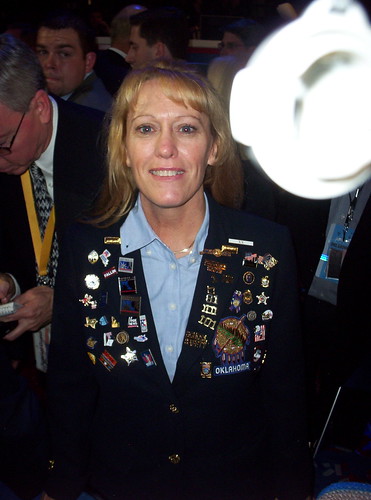
Steve Fair served many years as a lonely advocate for conservatism and the Republican Party in southwestern Oklahoma, a rural region that stubborn in clinging to their long-time Democrat voting patterns. Fair slowly built up a strong Republican infrastructure, nurturing qualified candidates who could run for office, first as a leader in the Stephens County party, then as chairman of the 4th Congressional District organization. For years, Fair has written a weekly newspaper column called "Fair and Biased," making the case for conservative ideas to southwestern Oklahoma voters. Fair is not running for reelection as national committeeman, which disappoints me greatly. (I have qualms about the two candidates seeking to replace him.)
Carolyn McLarty is a long-time leader in our state's Eagle Forum chapter. She is a founding member of the Republican National Conservative Caucus, is Chairman of the RNC Resolutions Committee, and has served as the Chairman of the Conservative Steering Committee -- working to organize conservatives on the RNC to resist moves toward the mushy middle.
These three Oklahomans aren't elite in any way except for the hard work they've exerted on behalf of conservative principles in the Republican Party.
UPDATE 2016/04/30: This blog entry received an approving mention and an extended quote in today's editorial roundup in the Oklahoman:
This election cycle has been dominated by claims that the Republican "elite" are at war with the "grass roots" of the party. In a recent post, conservative Tulsa blogger Michael Bates highlights how ludicrous that characterization is....Indeed, the "elite" label has been applied so broadly one wonders who isn't among that group's alleged members.
Also, I've added links to Steve Fair's blog, and to the profiles of Fair and McLarty on gop.com.
CORRECTION: BatesLine incorrectly identified Robert Ford as Creek County Republican Chairman. He is in fact Creek County 1st District Committeeman.
Supporters of Texas Sen. Ted Cruz swept today's Oklahoma 1st Congressional District Republican Convention, winning all three delegate seats and all three alternate slots by wide margins.
Tulsa 9/12 Project leader Ronda Vuillemont-Smith, State Rep. David Brumbaugh, and Wagoner County Assessor Sandy Hodges were elected as delegates, and State Sen. Nathan Dahm, Creek County District Committeeman Robert Ford, and Oklahomans for Life president Tony Lauinger were elected as alternates.
While there was a visible Trump contingent present, led by Paul Nosak, the vote totals indicate it amounted to only about a quarter of the convention. Cruz campaign staffer Hudson Talley had come up from Houston for the convention and was handing out delegate slates to Cruz supporters. There wasn't really a whip operation at work -- no signals or signs -- which shows in the fact that only one of the six positions was filled without a runoff, and that one was only by a slim margin. Cruz (or at least no-Trump) supporters scattered their votes on each initial ballot, but coalesced in each runoff. Nosak, wearing a large Trump button on his lapel, was the distant runner-up in five of the six elections, but lost handily in each runoff. His best result was 31% in the final vote for the 3rd alternate position, after about a third of the delegates had gone home.
Oklahoma Republican State Chairman Pam Pollard spoke at length about the upcoming state convention, the process of electing the 25 at-large delegates, and the matter of binding delegates at the national convention. Pollard emphasized that OK GOP party rules and state law are in alignment and that delegates are bound until their assigned candidate is no longer an officially nominated candidate, alluding to often-discussed rule 40(B), which requires that a candidate have support of a majority of delegates from at least eight states to have his name entered into nomination at the National Convention. Pollard said that if all three candidates who won delegates in the March 1 primary -- Cruz, Trump, and Rubio -- were officially nominated for the 1st ballot, she would simply announce the result from the primary, without polling the delegates. Only if one or more of those three candidates ceased to have the support for nomination would she poll the delegation.
During the morning session, while the credentials committee was tallying registrations, U. S. Sen. Jim Inhofe and U. S. Rep. Jim Bridenstine addressed the convention. Mayor Dewey Bartlett Jr led the convention in the Pledge of Allegiance but did not deliver a speech.
All Republican candidates who were present were given an opportunity to speak. While votes were being counted, delegates heard from incumbent Republican National Commiteewoman Carolyn McLarty and her challenger, National Committeeman candidates Steve Curry and Richard Engle (incumbent Steve Fair is not seeking re-election), Tulsa County Sheriff Vic Regalado, recently elected to fill the remaining months of Stanley Glanz's unexpired term, and Luke Sherman, who is competing for the nomination for the next full four-year-term, Amanda Teegarden (Senate 39), Scott McEachin (House 67), Richard Grabel (Tulsa County Commission District 2), Michael Willis (Tulsa County Clerk), Allen Branch (City Council District 6).
Term-limited State Sen. Brian Crain and parliamentarian John Wright (former state representative) did a fine job of running the meeting efficiently and without controversy. The convention convened a little after 9 a.m. and adjourned shortly after 3 p.m.
By the numbers:
235 delegates registered at Tulsa's Renaissance Hotel for today's convention out of 419 allocated votes. Allocations are based on number of votes cast for the top-of-ticket Republican nominee in the last general election. Tulsa County had 181 delegates out of 320 votes allocated, Wagoner County had 34 delegates out of 46 votes allocated, Washington County had 18 delegates out of 38 votes allocated, and the portion of Creek County in CD 1 had 2 delegates out of 4 votes allocated. No one was present to represent the portion of Rogers County in CD 1, which had 11 allocated votes.
Fourteen candidates filed for the three delegate slots, which were filled in separate votes. Ballots were counted by county, reported in a roll call, then weighted based on the ratio of allocated votes to delegates voting for each county and summed. (Weighting is in accordance with long-standing state party rules. For example, each Tulsa County delegate's vote was worth 320 allocated / 181 actual or approximately 1.77 votes. Each Creek County delegate's vote was worth 4 allocated / 2 actual or 2 votes.) If no candidate had a majority of the vote, a runoff was held between the top two candidates, based on the weighted vote.
David Oldham was nominated to the Oklahoma Republican presidential elector slate, winning 48% on the first ballot over George Wiland and Peggy Dau. Wiland withdrew from the runoff because of the margin on the first ballot and in the interest of time. Dau was named Elector Alternate, who would replace Oldham on the ballot in the event of his death or ineligibility.
Delegate results:
1st Delegate: Cruz supporter Ronda Vuillemont-Smith finished first with 44% to 11% for Paul Nosak, who supports Donald Trump for president, with remaining votes scattered among the candidates. In the runoff, Vuillemont-Smith won with 76% to 24% of the weighted vote, 162-47 in the raw total.
2nd Delegate: Brumbaugh, state chairman for the Cruz campaign, received 43% on the first ballot to 17% for Nosak. In the runoff, Brumbaugh prevailed by 73% to 27% weighted, with a raw vote of 147-54.
3rd Delegate: Hodges finished first on the initial ballot with 42% to 20% for Nosak. In the runoff, Hodges won by 74% to 26% or a raw total of 153-50.
Alternate results:
1st Alternate: 1st ballot, Dahm 50.35%, Nosak 15.10%, Lauinger 14.99%. No runoff required. Dahm received 98 raw votes to 28 for Nosak and 28 for Lauinger with 36 scattered among other candidates.
2nd Alternate: 1st ballot, Lauinger 32.5%, Ford 26%, Nosak 22%. Raw vote was Lauinger 62, Ford 49, Nosak 41, other candidates 22. Runoff, Ford 50.22%, Lauinger 49.78%, 89-88 raw vote.
3rd Alternate: 1st ballot, Lauinger 48.3%, Nosak 18.8%, Debra Cook, state committeewoman for Washington County, 17.7%. Runoff, Lauinger 68.61%, Nosak 31.39%, 110-50 raw vote.
Tulsa County Republicans will meet in precinct caucuses tonight, Thursday, February 4, 2016, at 6:30 p.m. the first step in the quadrennial process to elect delegates to the Republican National Convention and members of the Republican National Committee, and to determine the party platform.
Groups of Tulsa County precincts will meet at 19 central locations spread around the county. The gathered precincts will go through the preliminaries as a group, then break up into individual precinct caucuses to elect delegates to the March 5, 2016, County Convention (who will in turn choose delegates to Congressional District Convention in April and the May 14, 2016, State Convention) and to vote on resolutions to be forwarded to the county and state conventions for inclusion in the platform. A presidential preference straw poll will be taken -- exactly like the Iowa caucus, non-binding, but a chance to gauge the sentiments of Republican activists less than a month before we make our binding choice in the March 1 primary. The tulsagop.org website has the list of caucus locations and answers to frequently-asked questions about the process.
These central meeting locations were developed as a convenience for precinct officials and delegates. Some precinct chairmen may prefer not to host strangers in their home, and some delegates may feel more at ease in meeting people they don't know in a public place rather than someone's home. Some precincts have no officials currently, and a central meeting place gives interested newcomers a place to go and get things restarted. The central locations also provide an opportunity to meet fellow activists from nearby neighborhoods in a less crowded environment than the county convention.
Over the last couple of years central locations were organized by State House district, but this year, they were grouped more geographically and precinct chairmen were given a choice of locations. At least one precinct has opted out of the central-meeting approach and will meet within the boundaries of their precinct. Whatever the case, your precinct location should be posted on the door of your regular voting location by Thursday evening.
The precinct meeting is the launch pad of the platform process, and the timing couldn't be better for speaking out on some big current local issues. While many platform resolutions passed by the precincts deal with national issues and may percolate to the Republican National Platform, our Tulsa County platform also covers city and county resolutions. I'm hoping that every precinct passes a resolution expressing opposition to the new river sales tax proposal, which will be on the ballot in April.
With a school board election next week and a special primary for sheriff on March 1, I expect candidates will be making the rounds of the meetings. (Please be aware that, in the only contested school board seat in the county, Stan Minor is a Republican and appointed incumbent Cindy Decker is a Democrat.)
I especially want to encourage my skeptical young millennial friends to come to a precinct meeting -- preferably as a delegate, but at least as an observer. It's an often overlooked aspect of our election process, and I think that seeing it may alleviate some of your cynicism.
I've been watching politics for a very long time, going back to my childhood, so it's funny to observe the media's new-found concern about gerrymandering -- the practice of manipulating election district boundaries to benefit one party over another. The media's concern seems to have emerged with the growing dominance of the Republican Party in state legislatures and governor's mansions. (If that chart went further back, into the '70s and '80s, Democrat-dominated state governments would show up in greater numbers.) Suddenly, there are calls to take redistricting away from the politicians and put it in the hands of judges or computers or appointed commissions, or some combination of the three.
But a recently released, comprehensive archive of historical congressional district boundaries reveals that Democrats had no scruples against partisan gerrymanders when they had control of the process. Scholars at the University of California at Los Angeles have developed digital shapefiles of congressional districts going all the way back to 1789 and the 1st Congress. A Github site has the files organized by state and Congress; click on a link and you'll see an interactive map overlaying OpenStreetMap. You can zoom in and see how the old boundaries overlay towns and streets. More readily accessible, but without the interactive capabilities, is a Wikipedia page showing Oklahoma congressional district maps going back to 1972.
I had unsuccessfully been looking for old district maps for ages. I can't tell you how excited I was to find these.
As I said, I've been watching this process for a very long time. I remember 1982, when the Democrats in the Legislature, with Governor Nigh's approval, cut heavily Republican south Tulsa out of the 1st Congressional District, in order to improve incumbent Democrat Congressman Jim Jones's chances of survival, and shifted those voters into the heavily Democrat 2nd District, where their votes would be a tiny GOP drop in a big Democrat ocean. In that same redistricting, the Democrats at the State Capitol had the African-American neighborhoods of northeastern Oklahoma City share a congressman with the Panhandle and the wheat fields and cotton fields of western Oklahoma -- all to protect the Democrat incumbent in that district.
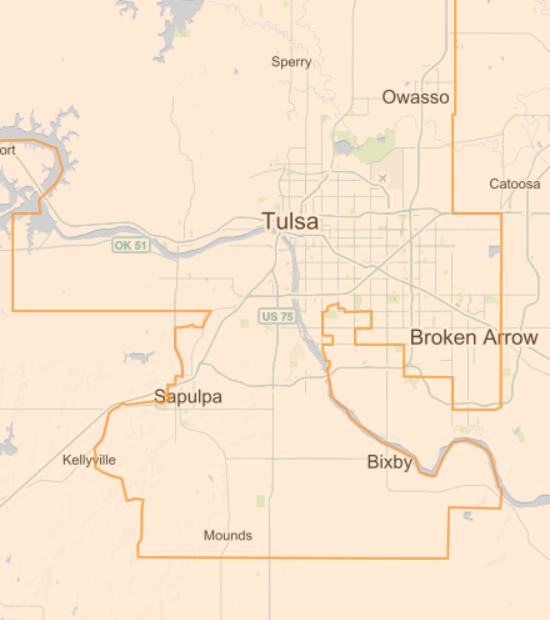
District 5, once compactly encompassing part of Oklahoma County, was stretched for hundreds of miles to take in Republican concentrations around Guthrie and Bartlesville. The Wall Street Journal mocked the District's twisted boundaries as "Mickey's Enchanted Kingdom" in honor of incumbent Republican Mickey Edwards. The new boundaries gave Edwards a very safe seat, while making it harder for Republicans to get elected in other districts.
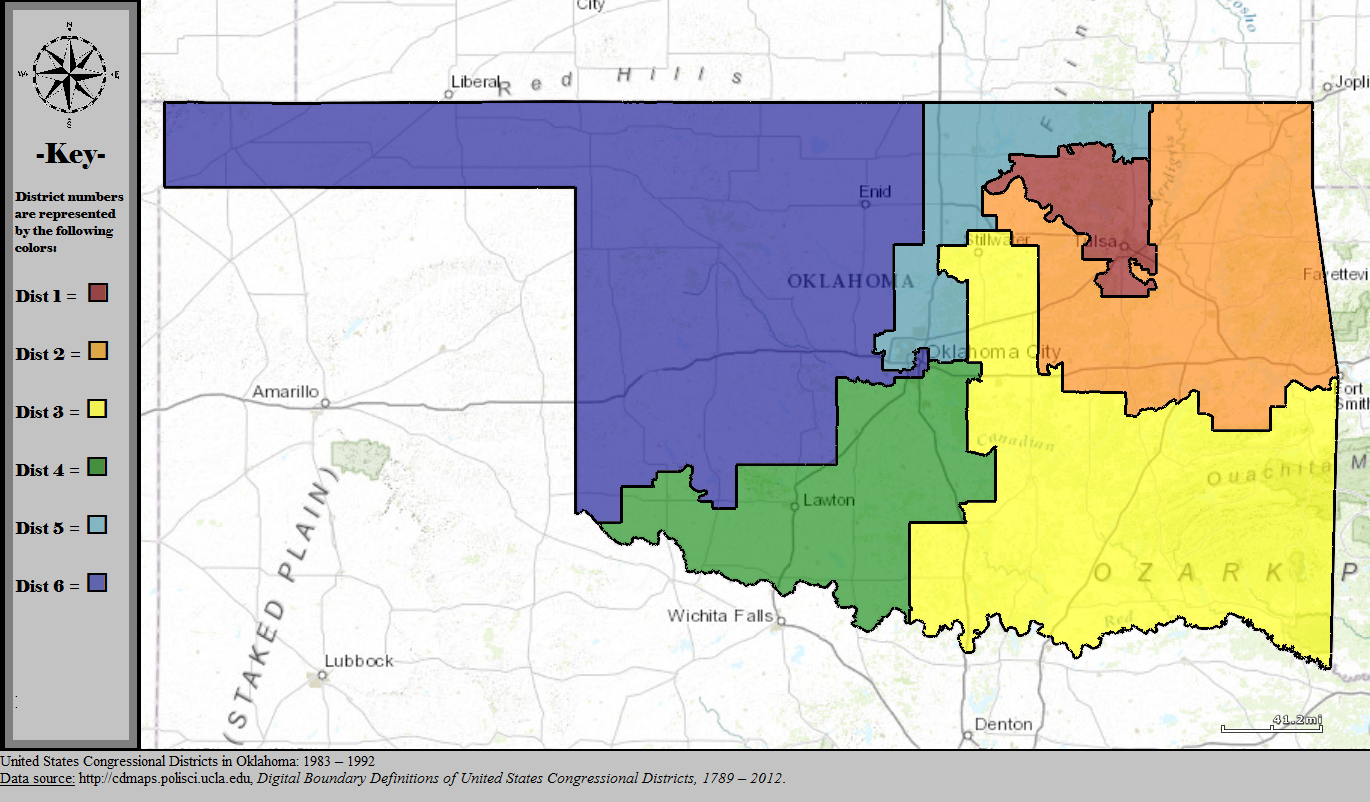
The resulting map contained the impact of growing Republican sentiment in the state, inspired by Ronald Reagan and the leftward shift of the national Democrat party, limiting the GOP to a single seat out of six.
I also remember walking blocks in 1988 for Jerry Riley, who was running for the open Senate 37 seat. That district consisted mainly of the rural and blue collar areas of western Tulsa County, but the boundaries crossed the river to take in a sliver of land between 21st and 56th Streets west of Peoria, including the luxury apartment building at 2300 Riverside. The story I heard was that the Democrat incumbent at the time of redistricting wanted to continue to represent the common people but preferred not to live among them.
These events inspired me to submit an op-ed to the Tulsa Tribune, published on May 31, 1991, opposing the practice of protecting incumbents in redistricting and urging an approach that focused on communities of interest and natural boundaries. I suggested an independent redistricting commission that would include unsuccessful candidates, the use of nested districts to make it harder to draw boundaries favoring an incumbent, and ratification by statewide referendum.
Although Republicans swept control of Oklahoma's congressional delegation in the 1990s, legislative redistricting protected rural Democrat incumbents by adding to each district just enough population from the growing suburbs to keep them viable. That tactic delayed the GOP takeover of the State House until 2004 and the State Senate until 2008. Term limits and the continued shift of the national Democrat Party to the Left ultimately overcame the Democrat advantage built into the maps.
Here's a map showing the State House districts drawn after the 2000 census, but colored to show party status after the 2010 election. Here's the State Senate district map following the 2000 census.
When they had control of the process, Democrats dismissed calls for redistricting reform as so much partisan whining by the GOP. They only seem to have warmed to the idea now that the shoe is on the other foot.
MORE:
Here are direct links to interactive versions of each Oklahoma congressional map since statehood. The dates refer to the election years affected; add 1 year to get the start of the corresponding congressional term. I've added notes after some of the links:
- Oklahoma congressional districts, 1907, 1908, 1910 elections (60th-62nd Congresses): Oklahoma was assigned 5 congressional seats at statehood.
- Oklahoma congressional districts, 1912 election (63rd Congress): Oklahoma was apportioned three additional seats, but these were elected at-large for one term.
- Oklahoma congressional districts, 1914 - 1930 elections (64th-72nd Congresses): The legislature got around to redrawing the district lines in time for the 1914 election. Congress failed to approve reapportionment after the 1920 census, so Oklahoma's lines were not redrawn.
- Oklahoma congressional districts, 1932 - 1940 elections (73rd-77th Congresses): Oklahoma's 1920s oil boom earned the state a 9th seat, but this was elected at-large; district boundaries did not change.
- Oklahoma congressional districts, 1942 - 1950 elections (78th-82nd Congresses): Dust Bowl emigration cost Oklahoma that at-large seat; boundaries of the 8 remaining districts were not changed.
- Oklahoma congressional districts, 1952 - 1966 elections (83rd-90th Congresses): Further outmigration cost Oklahoma two more seats. District lines had to be redrawn for the first time since 1914. Since the number of congressmen did not change in 1960, the legislature left the map alone.
- Oklahoma congressional districts, 1968 - 1970 elections (91st-92nd Congresses): This map reflects judicially-controlled redistricting to equal-population districts, pursuant to the Voting Rights Act
- Oklahoma congressional districts, 1972 - 1980 elections (93rd-97th Congresses): At time of redistricting, Republicans held districts 1 and 6 only. Long-time District 1 Republican incumbent Page Belcher had won the 1970 election by a narrow margin over Democrat Jim Jones, then opted to retire. The new boundaries added Democrats to and removed Republicans from the district; and Jones won the open District 1 seat in 1972, beating former Tulsa mayor Jim Hewgley by 11 percentage points.
- Oklahoma congressional districts, 1982 - 1990 elections (98th-102nd Congresses): At time of redistricting, Mickey Edwards of CD 5 was the only Republican in the Oklahoma delegation, but growing enthusiasm for Ronald Reagan and the Republican Party in Oklahoma forced boundary adjustments to protect vulnerable Democrat incumbents, like Jim Jones in CD 1 and Glenn English in CD 6.
- Oklahoma congressional districts, 1992 - 2000 elections (103rd-107th Congresses): At time of redistricting, Republican Mickey Edwards still held CD 5, and Republican Jim Inhofe had picked up CD 1 in 1986, when Jim Jones chose to challenge Sen. Don Nickles, so lines were drawn to pack as many Republicans as possible into those two districts.
- Oklahoma congressional districts, 2002 - 2010 elections (108th-112nd Congresses): After being on the bubble in the previous census, Oklahoma finally lost its 6th seat. At time of redistricting, five of six seats were held by Republicans; Democrat Brad Carson held the CD 2. 3rd District incumbent Wes Watkins retired prior to redistricting, avoiding the need to assign two incumbents to the same district.
STILL MORE:
thirty-thousand.org makes the case for a larger Congress, closer to the constitutional ideal of 30,000 people per seat. The site recounts the 1929 law that froze the number of House members at 435 and the negative effects of that decision.
UPDATE 2015/11/10: Congratulations to David McLain, who has won the SD 34 GOP primary, with 42% of the vote to John Feary's 39%, a margin of 70 votes out of 2,137 cast. Because there is no runoff, McLain advances to face the Democrat nominee, J. J. Dossett, in the January 12, 2016, special general election. McLain won by holding Feary under 50% on his home field, dominating in his own home base in Skiatook, and sweeping Tulsa precincts, which Feary seems to have ignored. Feary only managed 46% and a 132-vote margin in Owasso. Feary also edged McLain in Collinsville precincts, 40%-36%, 11-vote margin. McLain won Skiatook 82% to 13%, 85-vote margin, and won 60% of the vote in the Tulsa precincts over Feary's 25%, by a 120-vote margin. A bare majority of the 30 Rogers County voters went for Mark Williams. McLain won absentees and early voters by 5 and won Sperry precincts by a single vote.
Congratulations also go to taxpayers in the Northeast Tech Center district, who voted by a 3 to 1 margin against an increase in the property tax rate for funding buildings and against making the levy permanent. What we used to call vo-tech schools have been on a building spree of late. While these schools perform a valuable function, they typically have a permanent levy which produces far more revenue than they need to accomplish their mission, and so they put the money into big, shiny new buildings. If anything, vo-tech schools ought to cut millage so voters can choose to allocated it to other taxing entities more in need of revenue. Or better yet, let's have a College Re-Alignment and Closure commission (CRAC) to reduce duplication among Oklahoma's taxpayer-funded post-secondary institutions.
Tomorrow (November 10, 2015) is a special primary election to fill the Oklahoma State Senate District 34 seat in the wake of Rick Brinkley's resignation. Senate District 34 (click for PDF map) includes all of Tulsa County north of 66th Street North (including the Tulsa County portions of Skiatook, Sperry, Owasso, Collinsville), the City of Tulsa northeast of Pine and Yale, northeast of the Admiral Twin, and northeast of 89th East Ave and 21st Street, and a small, mostly uninhabited section of Rogers County north of the Port Road.
There is a Democrat in the race, but because District 34 is heavily Republican (a Republican has held the seat since the 1994 election), and because in this special election there is no runoff, the winner of tomorrow's GOP primary will almost certainly become a state senator. Although I don't live in District 34, I grew up there, and I join conservative activists and elected officials like State Rep. Chuck Strohm, State Sen. Nathan Dahm, and County Assessor Ken Yazel in urging District 34 Republicans to vote for David McLain.
David McLain is a Skiatook resident, a veteran of the U. S. Navy, and owns a small business in the construction industry. David and Aleen, his wife of 26 years, have three grown children and two grandchildren. McLain has been endorsed by the Oklahoma Conservative PAC, the Oklahoma Second Amendment Association, and the leaders of ROPE, the grassroots group that defeated Common Core. McLain supports the right to life, the sanctity of marriage, parental choice in education, lower taxes, and less-intrusive government.
Here's what public officials have written in endorsing McLain (legislative ratings are from the Oklahoma Constitution newspaper):
State Sen. Nathan Dahm (R-Tulsa, conservative rating 100): "David McLain is a man of good character and faith. He has shown throughout his life to be a servant of the people and I know we can count on that same heart of servitude from David if elected. David's understanding of the principles of liberty is a trait that I believe will serve the people of SD34 well. Currently, I call David my friend, but I hope to also call him my colleague."
Rep. Chuck Strohm (R-Jenks, conservative rating 100): "It is an honor to endorse David McLain for the Oklahoma Senate. David has integrity, and he understands the fact that the principles which gave us the US Constitution are based in the Judeo-Christian belief system. He will join me in standing against Federal and Judicial overreach as we fight to preserve the values that we are seeing deteriorate before our eyes. Please vote for David McLain on November 10th and help elect a true Conservative as your next state Senator."
Tulsa County Assessor Ken Yazel (R): "I believe David McLain is the right man to represent the people of SD 34. As a fellow veteran, I know David has a deep understanding of the Constitution and will take his oath of office seriously. As a fellow conservative, I know that we will be able to trust that David will represent our Republican values well. David McLain is the right man for the job!"
We are at an interesting point in Oklahoma politics. The state is so overwhelmingly Republican that the special interests who had traditionally given to Democrats have discovered that the only avenue to influence legislation is to invest in Republican primary candidates. These special interests want to defeat fair-deal, grassroots Republicans, who want to make government smaller, but they find that they can work with wheeler-dealer Republicans, who are happy to have bigger government and higher taxes, as long as their allies can be the beneficiaries of those higher taxes.
With Republicans in solid control of every executive office, the State House, and the State Senate -- 40 seats out of 48 -- the real battle in Oklahoma politics is over what kind of Republicans will run state government.
I should stipulate at this point that both wheeler-dealer and fair-dealer Republicans are generally united in support of pro-life issues and Second Amendment rights. But wheeler-dealers have put the brakes on reform of taxation, schools, and the judiciary. They tend to like special tax credits for targeted beneficiaries. When the State Chamber says jump, the wheeler-dealers ask "How high?"
A look at endorsements and funding indicates that McLain's chief opponent in the race, John Feary, is aligned with the wheeler-dealers. Feary has the financial backing of leading Obama fundraiser George Kaiser and some of Kaiser's close associates, as well as many statewide political action committees and lobbyists.
Feary has been endorsed by the State Chamber of Commerce. Conservatives have learned that "chambers of commerce" at every level -- federal, state, and metro -- often support cronyism and oppose reforms that empower individuals, families, and entrepreneurs. The State Chamber has targeted solid conservative legislators for defeat, supporting primary opponents and sometimes even Democrats, as they try to reassert control over the legislature. Chambers often block conservatives on social and cultural issues, preferring profits to principle.
Last year, Feary ran a very negative campaign against Tulsa County Assessor Ken Yazel. Yazel has been the taxpayers' best friend at the County Courthouse, and because Yazel has opposed foolish sales tax increases and has called the public's attention to the wasteful allocation of our taxes, he was targeted for defeat by the local wheeler-dealers, who backed Feary. Feary lost in a landslide.
Feary, a City of Owasso employee, was also a vocal defender of City Manager Rodney Ray, who left Owasso under an ethical cloud. Rodney Ray was charged with and ultimately pled "no contest" to passing a bad check and making a false police report (he claimed the bad check had been stolen). Other OSCN entries for Rodney Ray suggest a pattern of financial irresponsibility over several years.
At that time, Feary wrote me defending Ray's performance as City Manager: "I would ask that you keep JB [sic] mind that Mr. Ray is not an elected official and his personal finances and family situations are not the business nor should they be if concern to J.B. Alexander and his group of cronies. The Owasso City Council makes the decisions and sets policy so Mr. Ray's private matters are not indicative or reflective of his job performance."
This election is to replace a state senator who pled guilty to crimes connected with embezzlement from his employer. Does it make sense to replace him with someone who regards the financial misdeeds of the CEO of Oklahoma's fastest growing city as merely private matters, and who regards concerned citizens as a "group of cronies"?
David McLain's financial support has come mainly from small donations; I recognize many of his donors as solid conservative activists. The only PAC to give money to McLain is the Oklahoma Conservative PAC.
There are two other candidates on the Republican primary ballot, Mark Williams and Chuck Daugherty, who do not appear to be running an active campaign. Because there is no runoff election, conservatives need to unite behind one candidate. If the conservative majority splits its votes, the candidate backed by Obama fundraiser George Kaiser will win.
We don't need another state senator who will owe his election to special interest groups, lobbyists, and big Democrat donors. We need a solid conservative who will carry out the conservative reform agenda in Oklahoma City. I urge District 34 Republicans to get to the polls tomorrow and support David McLain for State Senate.
The Oklahoma Corporation Commission (OCC) will hold a hearing today on Public Service Company of Oklahoma's request to impose additional fees on customers who opt-out of PSO's "Smart Meter" program.
The hearing is at 10:30 a.m., August 27, 2015, in Courtroom B at the OCC's offices at 2010 N. Lincoln Blvd. in Oklahoma City. The docket number is 201500109: "Application of Public Service Company of Oklahoma for Commission Review and Potential Approval for Advanced Metering Infrastructure (AMI) Alternatives and for Cost Recovery of Any Approved Alternatives."
I have been unsuccessful so far in finding the detailed application online, but you can read the current PSO tariff, which includes the Smart Meter provisions approved by the OCC that went into effect on April 30, 2015.
Acting on an alert from the Tulsa 9/12 project, I submitted the following comment on the PSO website and the OCC public utility complaints page.
Our family has opted out of the PSO Smart Meter program. I understand that PSO is asking to install a transmitting, data-recording meter everywhere, even on opt-out homes. Please uphold the spirit the opt-out by rejecting this request from PSO, so that opt-out homes can continue to use non-transmitting analog meters.We also object to the penalty PSO wants to impose on smart meter opt-out customers. Our opt-out does nothing to increase the cost of delivering electricity to our home over the current cost. If smart meters are truly a cost-saving measure, ratepayers should get a rate cut for opting in.
Here is the alert from the Tulsa 9/12 Project:
SMART METER UPDATE ACTION NEEDED!!PSO has filed testimony before the OCC (Oklahoma Corporation Commission), claiming only 150 people have refused the Smart Meter "Offer". They also filed testimony asking the OCC to remove all analog meters on the bypass list and replace them with an AMR (a one way wireless transmitting meter instead of the AMI two-way transmitter currently being installed) claiming they will turn the transmitter off and charge the customer to have it read manually.
What they are not saying is, they can turn the meter on remotely at anytime without the customers knowledge or consent. The AMR meter also requires an FCC license and contains a 900 mhz transmitter which pulses every 15 to 20 seconds at or over 220,000 micro-watts, making it very harmful for those who are electro-sensitive (many AMR's have two transmitters). In other words they have applied for the installation of a Smart Meter on every home with no exception to retain an analog meter. This is not the case in other states where they retain their analog, if the OCC accepts their conditions, and if the Attorney General doesn't intervene, it is NO OPT OUT at all.
The scheme continues to unfold:
Utility costs will continue to skyrocket by design, because "the more the customer conserves the more they pay".
Smart Meters do not conserve energy, people do. You do not need a smart meter to program a thermostat.
If you're not fired up yet - this should do it...
The OCC has amended their rules for what they call the "Demand Program" (Title 165 Chapter 35, Subchapter 41 effective Jan. 1, 2016).
The OCC has set up an incentive program (customer provided funds) for the Utilities to re-educate and convince the customers to reduce their consumption (or the Utility can do it remotely through the meter) to the point that the Utility doesn't build another power plant (EPA and DOE requests 4% reduction). The rules also state that the Utility can apply for a "True-Up Recovery Tariff" for the revenue loss caused by the customer reduced consumption, "the more you conserve (save) the more you pay".
This is a win win for the Utility, they were approved to charge the customer base to remove the reliable analog meter (a 30 to 40 year life) and replace it with an unproven digital meter (3 to 10 year life). The capital investment for IT and the infrastructure to switch over to the digital surveillance is to be borne by the customers while the Utility creates a new revenue stream collecting and selling the customers personal data collected by the meter, a revenue projected to exceed the electricity revenue.
It makes one wonder, is in fact the OCC representing the Utilities and regulating the people when they should be regulating the Utilities and representing the people?
Please attend the Oklahoma Corporation Commission "Hearing On The Merits" (to impose a penalty or tax upon those refusing the "Smart Meter Offer"). Numbers count whether you give "public comment" or fill the court with your presence.
Oklahoma Labor Commissioner Mark Costello, 59, was stabbed to death Sunday night.
The fatal attack took place at a Braum's Ice Cream store in northwest Oklahoma City, according to news reports. Christian Costello, the commissioner's son, was arrested.
I join my fellow Oklahomans in mourning the loss of Commissioner Costello. He was an outstanding public servant, admired for improving workplace safety while working with Oklahoma employers as a collaborator, not an adversary. Under his leadership, it became easier for Oklahomans to deal with the Labor Department, as he improved online access to department functions, which made it possible to cut department costs without sacrificing service.
Costello set himself apart by refusing to take campaign contributions from lobbyists, and in 2012, he called attention to the lobbyist effort to curry favor with new Republican officials at the State Capitol, noting the massive shift in contributions by the Oklahoma Public Employees Association -- from 97% to Democrat candidates in 2004 to 64% to Republican candidates in 2010. He reminded his fellow Republican officials that they had taken the legislature despite a tsunami of lobbyist cash supporting their opponents.
Beyond his public service, we remember Mark Costello's sense of whimsy -- campaign ads that spoofed Donovan's psychedelic 1960s tune "Mellow Yellow" ("Vote for Mark Costello"), inviting New York City mayoral candidate Jimmy McMillan (of "The Rent Is Too Damn High" party) to sign autographs at Costello's booth at the 2012 Oklahoma Republican Convention.
May God comfort his family and friends, and may he rest in peace.
MORE:
Oklahoma Council of Public Affairs pays tribute:
It is with great sorrow that we learned of the death of Labor Commissioner Mark Costello. Mark was a longtime friend to the staff, board and members of OCPA. While our prayers and deepest sympathy are concentrated on his family during this unthinkable time, we remember the life of not just a great public servant but also a great man.Mark was everywhere. If someone was trying to make their community better, get involved in the political process, or host a group committed to freedom, Mark was there, fully engaged in mind, body, and spirit. This loss will be felt by all Oklahomans in the days, weeks, and years to come.
We are grateful to have known and been led by Mark Costello and remember him most for his keen sense of and commitment to True North.
A statement from the Costello family:
There are no words to express the shock and sadness that our family has experienced the last number of hours. The outpouring of emotion and support our family feels is tremendous.Our son, Christian Costello, has experienced many difficulties over the past several years. Christian, like thousands of Oklahomans, struggles with a mental health disease and like many families we did our best to support him. Mark was committed to being there for his son and provided whatever help he could as a father.
We ask for your prayers and support as our family tries to cope with and understand this life-changing tragedy.
Mark loved to brag about his kids and their successes, but like many in the public eye, he also viewed his family life as personal.
We ask that you respect our family's privacy as we work through this very difficult time and please understand that our family will struggle with this for years to come as we try and find answers.
Here's one of Costello's 2010 radio ads:
During the 2010 campaign, Costello spoke briefly at a voter education rally in Muskogee, talking about his early working life and how Barack Obama "inspired" him to get into politics. He also deals graciously with a correction from the audience:
In February 2013, Mark Costello spoke to the Oklahoma Conservative Political Action Committee about reforms at the Labor Department:
UPDATE: Jamison Faught reports on Twitter that on the first ballot Brogdon finished first but short of a majority, and incumbent chairman Weston was eliminated -- Brogdon 47.45, Pollard 29.11, Weston 23.43. Brogdon won the second ballot over Pollard, 53.35% to 46.65%. Estela Hernandez was elected vice chairman with 58.12% of the vote.
As with the Tulsa County Republican Convention last month, a very busy period in my personal and professional life makes it impossible for me to attend the 2015 Oklahoma State Republican Convention tomorrow. If I were there, I'd vote for former State Sen. Randy Brogdon for party chairman.
This probably won't surprise anyone. I endorsed and knocked doors for Brogdon for Governor in 2010 and to fill Tom Coburn's Senate seat in 2014. Randy Brogdon is a man of principle who served and led faithfully on the Owasso City Council and the Oklahoma State Senate. As I wrote in 2014:
Brogdon, a small-business owner in the heat and air industry, was elected in 1998 to the Owasso City Council and was elected as Mayor by his fellow city councilors. In 2002 he was elected to the State Senate, serving two terms and earning the highest ratings possible from conservative groups.Brogdon was the leading advocate for the Taxpayer's Bill of Rights (TABOR) initiative, a popular measure that was scuttled by special interest litigation. He led the effort to pull Oklahoma out of the effort to build the eminent domain nightmare known as the NAFTA Superhighway through the state. A champion for privacy rights, he led Oklahoma to opt out of the Real ID Act. In 2010, he authored SQ 756, the Oklahoma Healthcare Freedom Amendment. He was one of the few Republican elected officials with the courage to stand consistently with grassroots Tulsa County Republicans against ill-considered boondoggles funded by sales tax increases.
Two other candidates are actively campaigning for the job: David Weston, the incumbent, and Pam Pollard, head of the Oklahoma Federation of Republican Women.
Pollard is an energetic leader, a hard worker, a networker, and an organizer. I've enjoyed working with her over the years, and there's no question she would be up to the nuts-and-bolts aspects of the chairman's job. But there's another aspect to the job, which I'll address a bit later, where I think Brogdon has the edge in the current climate.
I appreciated Weston's lobbying efforts against the disastrous National Popular Vote bill, although in the aftermath, I wish he'd sought to obtain commitments from Republican candidates to block the proposal in the future.
I was not pleased to hear of Weston's efforts to lobby for a delay in Oklahoma's presidential primary. In 2012, our early primary date brought all the candidates to Oklahoma. My kids got to hear Newt Gingrich and Rick Santorum speak in person at ORU. Although the early date meant that Oklahoma's delegates were allocated proportionately -- and so Santorum's win here didn't translate into an overwhelming number of delegates -- the win gave a boost to a candidate in tune with the values and priorities of Oklahoma Republicans. That helped him stay in the race and keep his issues in the spotlight -- including the need for a strong American presence in the world and the need to .
A later primary date would make Oklahoma winner-take-all, making our state a slightly bigger prize in delegate count (although still awfully small), but it mean that you and I would get to pick from whichever establishment types were left after open primaries in New Hampshire and South Carolina filtered out all the grassroots conservatives.
Weston's case for a later primary date is arguable, but his advocacy riled activists because he spoke on behalf of the state party without consulting the State Committee. The committee, which serves as the party's governing body between conventions, consists of the Chairman and Vice Chairmen and two State Committee members from each county, plus statewide, congressional, and legislative elected officials ex officio. The group is supposed to meet at least once a quarter.
On the National Popular Vote issue, Weston had a strong mandate to speak out on behalf of the party -- clear party platform planks and a unanimous RNC vote to condemn the idea. That mandate was missing from the primary date debate. Although several State Committee meetings had been held recently, Weston never sought the committee's authorization to endorse the later primary date on the party's behalf.
Both Pam Pollard and Randy Brogdon spoke out against the early primary date, with Brogdon addressing the House Elections Committee considering the bill. Brogdon pledges, if elected, to to seek the State Committee's endorsement before speaking out on such issues.
When Brogdon called me a few months ago to talk about the race, I was a bit underwhelmed. His focus was on party building and organization and the need to reach out to groups that aren't typically considered Republican, which is all well and good. I didn't hear any talk from him (or the other two candidates) about my priority for our party leaders: To hold elected officials accountable for carrying out the party's principles and policies and to protect the Republican brand. In Oklahoma, the biggest obstacle to the implementation of Republican policies comes from Republicans who wear the name but don't understand or adhere to the principles the party professes. A party chairman can serve as the grassroots' lobbyist to counteract the presence of special-interest spokesmen at the State Capitol. Although it wasn't a role he identified as a priority, I think Brogdon's experience and temperament would make him the most likely of the three candidates to speak out when elected Republicans betray the principles and policies they ran on.
Because of his years of service in elected office, Randy Brogdon will be sympathetic to the pressures weighing on elected officials. At the same time, he has a record of accomplishment as an elected official that shows you don't have to compromise your principles to get things done. He's in a position to refute the lame excuses of officials who always want to put off courageous decisions until after the next election.
At the County Convention, the race was so close that my unavoidable absence cost my preferred candidate the election. I hope that won't be the case on Saturday.
MORE: Muskogee Politico Jamison Faught has detailed surveys from each of the announced candidates for chairman (Randy Brogdon, Pam Pollard, David Weston) and vice chairman (Estela Hernandez, John T. Lewis, ). And he asked some follow-up questions of the candidates for chairman.
STILL MORE: Dewey Bartlett Jr, who endorsed liberal Democrat Kathy Taylor for re-election as Tulsa's mayor, thinks Dave Weston should be re-elected as OKGOP chairman.
University of Tennessee law professor Glenn Reynolds, writing in USA Today, about OU president David Boren's decision to expel two students and a fraternity for a video containing racist speech:
As a state institution, the University of Oklahoma is constrained by the Constitution. Among other things, that means that it must respect the free speech guarantees contained in the First Amendment, even if that speech is repugnant. Just because the university doesn't like what students say, thinks it's hateful, or worries that it will produce an unpleasant atmosphere on campus, doesn't grant it the authority to punish people for speaking. One would think that Boren -- a former U.S. senator who took an oath to uphold the Constitution when he was sworn into office -- would know better. Apparently not....Boren's behavior was not only illegal -- and clearly so -- it was also a betrayal of the duty of fairness that he, as a university president, owes to every student enrolled in his university. To have acted so hastily, in violation of OU's own student conduct code, bespeaks a dishonorable willingness to throw students to the wolves in order to avoid bad publicity -- accompanied, perhaps, by the sort of generalized hostility to fraternities that seems all too common among university administrations these days. (That hostility, based on a general dislike of fraternities as bastions of "white male privilege," is itself racist and sexist, of course.)
As Reason's Robby Soave notes, OU administered lighter punishment to a football player who punched a girl so hard it broke four bones in her face than it meted out to the SAE fraternity for singing a song. After this assault, caught on camera, Joe Mixon was suspended from playing, but allowed to remain on campus, attending classes with other students as usual. No expulsion there.
In theory, universities are supposed to be the bastions of reasoned thought and fairness. In practice, you will seldom find a place where mob justice is more likely to prevail with the willing participation of the authorities....
The Daily Caller summarizes more incidents where student athletes received light punishment for violent behavior.
Owing to work and family commitments, I haven't had much time or energy lately for blogging. And although I won't be able to attend today's Republican County Convention, I do want to take a moment to endorse Ronda Vuillemont-Smith for County Chairman.
In a state where Republicans are overwhelmingly dominant, Democrats are not the chief threat to the implementation of Republican policies. The biggest threat comes from Republicans who wear the name but don't understand or adhere to the principles the party professes. They may simply be corrupt or self-dealing, or they may be liberals who have realized that registering Republican is their only hope of winning.
From Capitol Hill to City Hall, the actions and inactions of elected Republican officials have made the activists who helped them get elected wonder what, exactly, was the point of their exertions.
In such an environment, the role of party leadership must shift. When a party is a minority or just beginning to dream of majority status, you will gladly take any elected official who will bear the (R) after their name. But in our current environment, we need party leaders who will protect the Republican brand, who will be a voice for the grassroots party activists to counterbalance well-heeled lobbyists,
Ronda Vuillemont-Smith has shown herself willing to confront Republican elected officials when they need it. She's also shown herself to be a skilled and experienced organizer. That's why, if I were at this morning's Tulsa County GOP Convention, Ronda would have my vote.
The attempt to enlist Oklahoma in the National Popular Vote agreement, a left-wing attempt to subvert the constitutional method for electing the president, is back. In 2014, NPV legislation was rushed through the State Senate. Legislators were invited to junkets in tropical locations and other favorite vacation spots to discuss National Popular Vote. Lobbyists found emotionally resonant arguments and were able to get senators to make binding promises . Thus they won the vote on the floor of the State Senate. Within days, several senators had recanted their support, following an outpouring of anger from conservative grassroots activists, Republican party leaders, and conservative think tanks. The State House never took up the bill, which expired with the sine die adjournment of the legislature.
In previous entries, I've explained why NPV is a bad idea -- it undermines our Constitution, allows voter fraud in one state to affect the presidential result everywhere, and disconnects Oklahoma's popular vote result from the allocation of Oklahoma's electors. The Republican National Committee unanimously condemned the proposal. The libertarian Cato Institute and conservative Heritage Foundation and Eagle Forum oppose National Popular Vote, as does the Oklahoma Council on Public Affairs. The Oklahoma Republican Party's platform has opposed the idea for years.
Despite the defeat, the leftists behind NPV continued their campaign. Local GOP consultants and sometime candidates Darren Gantz and David Tackett set up meetings between out-of-state NPV lobbyists and conservative grassroots activists. Legislators were invited on at least one more NPV junket -- Christmas season in New York City.
Lame-duck State Rep. Lee Denney, who also serves as speaker pro tempore, is the sponsor of this session's NPV bill. But what is going to happen on Wednesday is sneaky and underhanded.
HB 1686, the bill Denney filed to have Oklahoma join the NPV agreement, was sent to the Rules Committee. Another bill, HB 1813, was assigned to the Elections and Ethics Committee. Authored by Democrat Rep. Eric Proctor, HB 1813 originally dealt with ballot access for political parties, but the entire text of his bill has now been replaced by text from Denney's HB 1686 committing Oklahoma to the National Popular Vote. On Wednesday morning, February 25, 2015, the Elections and Ethics Committee will consider the bill.
This rush to committee is reminiscent of the speed with which the bill was rushed through the State Senate. NPV supporters seem to be hoping to sneak this through once again, before grassroots activists hear about it.
Here is a list of committee members. I encourage you to contact the members directly to urge their swift defeat of this measure:
Rep. Paul Wesselhoft, chair - paulwesselhoft@okhouse.gov
Rep. Donnie Condit, vice chair - donnie.condit@okhouse.gov
Rep. Gary Banz - garybanz@okhouse.gov
Rep. David Dank - david.dank@okhouse.gov
Rep. Charlie Joyner - charlie.joyner@okhouse.gov
Rep. David Perryman - david.perryman@okhouse.gov
Rep. Michael Rogers - michael.rogers@okhouse.gov
I also urge you to ask your Republican member of the State House to remove Lee Denney from her leadership position as Speaker Pro Tempore. There ought to be consequences for anyone who supports this betrayal of constitutional principles.
UPDATE: At the committee meeting, Rep. Denney laid over her bill, HB 1813. Chairman Wesselhoft expressed sympathy for her tough decision and said that the committee would remain the custodian of the bill, which could be heard next year if she wanted to bring it forward. According to State Rep. Glen Mulready, the committee chairman could not have forced a vote on the bill after the author laid it over. Because this was the last opportunity for a bill originating in the House to move out of committee, this particular bill is dead for this session.
Here is a direct link to the audio for the Elections and Ethics Committee meeting February 25, 2015. The chairman doesn't speak until 7:24 -- it's all background chatter before that.
NPV opponents cannot relax, however. This particular bill could get a committee hearing and a vote on short notice next session, still in time to affect Oklahoma's 2016 electoral votes. The NPV lobbyists are relentless, and I expect that they will continue to look for ways to woo legislators and activists.
There is also the possibility that the language could be inserted into a bill this year through the remainder of the legislative process -- possibly as a committee substitute for a bill that originated in the other house, possibly in a conference committee.
NPV opponents should continue to press legislators to declare their intentions on this proposal, regardless of the bill number to which it gets attached. Because it is an interstate compact (as they called it last year) or (as they're now calling it) an agreement among the states, the states all must adopt the same language. It is what it is. There's no possibility that the bill could be "improved" in the legislative process. So there's no good reason for a legislator to be agnostic about how he or she would vote. The NPV proposal is well-defined and unamendable, and conservative voices in Oklahoma and nationwide are unanimously in opposition. When the State Senate passed the NPV compact bill in 2014, lefty blogs cheered and conservative websites mourned. If a self-described conservative legislator is hesitant to take a stand on this issue, I'd hesitate to trust them on any other issue or for any elective office.
Tulsa County Republicans will meet in precinct caucuses this Saturday, January 31, 2015, at 10:00 a.m. the first step in the biennial process to elect state, county, and precinct party officials and to determine the party platform.
Most Tulsa County precincts will meet at central locations within their State House districts. The gathered precincts will go through certain preliminaries as a group, then break up into individual precinct caucuses to elect leaders and vote on resolutions to be forwarded to the county and state conventions for inclusion in the platform. The tulsagop.org website has the list of caucus locations and answers to frequently-asked questions about the process.
These House district locations were developed as a convenience for precinct officials and delegates. Some precinct chairmen may prefer not to host strangers in their home, and some delegates may feel more at ease in meeting people they don't know in a public place rather than someone's home. Some precincts have no officials currently, and a central meeting place gives interested newcomers a place to go and get things restarted. The central locations also provide an opportunity to meet fellow activists from nearby neighborhoods in a less crowded environment than the county convention.
At least one precinct has opted out of the central-meeting approach, and a few precincts have shifted their meeting place to a central meeting location closer than the designated place for their House district. Whatever the case, your precinct location should be posted on the door of your regular voting location by Saturday morning.
Tonight, Thursday, January 22, 2015, from 6:00 pm to 8:00 pm, the Oklahoma Council of Public Affairs (OCPA) will present the second in a series of programs on the fundamental principles undergirding liberty and the rule of law: "Why States Matter." The program will be held at the Herman and Kate Kaiser branch of the Tulsa Library. The library is in the northeast part of LaFortune Park, on Hudson just south of 51st Street.
The American Founders invented "federalism." Learn what federalism is, how it became part of the Constitution, and what has happened to it over the last century. Also, find out how we can use what is left of federalism to revive this key constitutional structure.This is the second in OCPA's four-part series, The Rule of Law and Liberty. (View our first program online: The Rule of Law and Liberty: Why the Constitution matters.) Our programs in January and February will also feature a briefing on the upcoming Oklahoma legislative session.
For more information or to register by phone, call 405-602-1667.
Trent England, who designed and presents The Rule of Law and Liberty, is OCPA's David and Ann Brown Distinguished Fellow for the Advancement of Liberty. Formerly with the Freedom Foundation in Washington state and The Heritage Foundation in Washington, D.C., Trent has written and spoken across the country on constitutional law and history.
Trent also contributed to the We The People curriculum and is the founder and director of Save Our States, which focuses on defending the Electoral College.
Oklahoma's U. S. Senator Tom Coburn did not suffer from senioritis. He made the most of every minute of the final weeks of his ten years in the Senate.
On December 9, Coburn issued the latest and last in his long-running series of reports on government waste. Tax DecoderTom_Coburn-Tax_Decoder-2014.pdf, an encyclopedic 320-page report covering "more than 165 tax expenditures worth over $900 billion this year and more than $5 trillion over the next five years."
The Tax Decoder report looks at tax breaks both well-known and obscure which complicate the tax code and boost the deficit, often enabling lavish living at taxpayer expense. In true Coburn style, there are no sacred cows -- the report notes the special status of Oklahoma's former tribal territory on p. 213, calls for an end to the parsonage allowance on p. 192, and devotes an entire chapter to non-taxable military compensation -- but the information is provided in a thorough and dispassionate manner. Your mind will boggle at the subsections of 501(c) that you never knew existed, and yes, it's very possible for people to get very wealthy off of a non-profit organization. Here's Coburn's press conference announcing the Tax Decoder report. There's even a 60-second trailer for the report:
Coburn's final foray against fiscal futility was to object to a well-intentioned but wasteful and duplicative bill:
While well-intentioned, H.R. 5059 would do little to change or improve the deplorable situation at the VA, which is providing substandard medical care for the country's military heroes. The bill creates several new programs at the VA and authorizes $22 million in new federal spending. In almost every case, however, the VA already has the tools and authorities it needs to address these serious problems. Further concerns with the legislation can be viewed here."Congress should hold VA bureaucrats accountable for their failing programs and substandard medical care instead of passing legislation that will do little to solve the tragic challenge of veteran suicides." said Senator Coburn. "Our military heroes deserve more than false promises. It is dishonest for Congress to pretend that passing yet another bill will finally solve the challenges plaguing the VA."
As always, Coburn's colleagues found it easier to vote more money at a problem than to do the hard work of oversight of the money they'd already spent. As always, the drive-by media found it easier to snipe at Coburn for "hating veterans" than to pressure Coburn's colleagues to exercise the kind of oversight and reform that would actually help veterans.
Earlier in the year, Coburn produced an exposé of the shameful treatment of veterans at the hands of the Department of Veterans' Affairs.
On his very last day as a senator, Coburn introduced legislation to "improve the integrity of the [Social Security] disability insurance program, support working Americans with disabilities, and protect benefits for current and future generations." The current system makes it too easy for some to game the system while others wait far too long to receive benefits, and it discourages disabled persons who want to work from doing so. From the beginning to the end of his congressional career, Coburn addressed the disconnect between good intentions and the actual effect of government programs.
Coburn's careful documentation of government waste proved to anyone who cared that we could solve the deficit problem. The lack of action in response proved that his colleagues -- and the voters who elected them -- aren't serious about fixing the problem.
Andrew Ferguson, writing in the Weekly Standard, salutes Coburn as "a model senator":
"In any election," Tom Coburn often says, "you should vote for the candidate who will give up the most if they win." All things being equal, we should prefer politicians who have accomplished something in their lives beyond government work--and who are willing to sacrifice it, at least temporarily, to serve the country at a cost to their convenience and comfort. During his 6 years in the House of Representatives and 10 more in the Senate, Coburn has embodied his own principle.......Coburn calls himself a "citizen legislator," and the archaic title fits. Single-handed, he restored the phrase "public service" to good repute in Washington, at least for his admirers.
He's done so by being a pest. This is the kindest word we can come up with, though enemies both in and of out of his party prefer surlier tags like crank and headcase. Coburn commandeered every parliamentary maneuver available to a lone senator and used his mastery to slow the Senate down and draw attention to the untoward details of business-as-usual: absurd expenditures, cheap favors for the well-to-do, presidential appointments for dolts and clowns, and every imaginable accounting trick in service of parochial rather than national interests, all of it undertaken on borrowed money. His endless amendments and points of order became a kind of shaming, directed at people who long ago abandoned shame. Coburn trained an outsider's eye on the work of insiders and delivered the news, usually bad. "If we applied the same standards to Congress that we apply to Enron," he once said of congressional book-juggling, "everybody here would go to jail."
In his farewell speech to the Senate, Coburn paid tribute to congressional staff and the staff of oversight offices in the executive branch who gathered data for his reports and helped him craft reform legislation. He affirmed his faith in our country and our ability to solve our problems if we choose to do so, and he saluted his Democratic committee counterpart, Tom Carper of Delaware, for his willingness to work together to solve problems. He recalled the brilliance of the Founders, their insight into human nature and the causes of failure of the republics that preceded ours, and their understanding of the blessings of limited government.
Coburn called his colleagues' attention to their oath of office and noted that it makes no mention of the Senator's state:
Your State isn't mentioned one time in that oath. Your whole goal is to protect the United States of America, its Constitution and its liberties. It is not to provide benefits for your State. That is where we differ. That is where my conflict with my colleagues has come. It is nice to be able to do things for your State, but that isn't our charge. Our charge is to protect the future of our country by upholding the Constitution and ensuring the liberty that is guaranteed there is protected and preserved.
Coburn pointed out the power of one Senator to advance, change, or stop legislation. The rules involved are not "arcane," as they are often described, but rarely used, even though they exist to protect liberty and to force compromise. He called his colleagues to exercise knowledgeable oversight:
Each Member of the Senate has a unique role to participate and practice oversight, to hold the government accountable, and that is part of our duties, except most often that is the part of our duties that is most ignored.To know how to reach a destination, you must first know where you are, and without oversight -- effective, vigorous oversight -- you will never solve anything. You cannot write a bill to fix an agency unless you have an understanding of the problem, and you can only know this by conducting oversight, asking the tough questions, holding the bureaucrats accountable, find out what works and what doesn't, and know what has already been done.
Effective oversight is an effective tool to expose government overreach and wasteful spending, but it also markedly exposes where we lose our liberty and our essential freedoms....
...quite frankly, we don't make great decisions because we don't have the knowledge. Then what knowledge we do have we transfer to a bureaucracy to make decisions about it when we should have been guiding those things.
You can see video of Tom Coburn's farewell address and read the official transcript after the jump.
The Oklahoma Democratic Party is trying to invalidate the re-election of Republican 2nd District Congressman Markwayne Mullin because the Democratic nominee died two days before the election.
Earl Everett, 81, died Sunday from injuries suffered in a Friday auto collision. Our condolences go to his friends and family. It's an honorable thing to run for public office, perhaps all the more when there is little expectation of success. Everett won the primary against an opponent barely one-third his age. In the general election, Mullin won with 70% to Everett's 25% and 5% for an independent candidate.
In August 1998, Jacquelyn Morrow Lewis Ledgerwood finished second in the Democratic primary to select a challenger to then-three term U. S. Senator Don Nickles. Ledgerwood had died almost six weeks before the primary, but it was too late under Oklahoma law to take her name off of the ballot. In the primary, Ledgerwood had 2197 votes more than third-place candidate Jerry Kobyluk, and so she advanced to the runoff election, notwithstanding her death. The Deceased-American vote isn't as strong in Oklahoma as it is in, say, Chicago, and Ledgerwood lost the runoff to Don Carroll by a 75%-25% vote. According to news reports at the time, had Ledgerwood won the runoff, the Oklahoma Democratic Party organization could have chosen a replacement nominee.
In 1990, District Judge Frank Ogden III, serving Judicial District 1 in the Panhandle, was three months deceased when he won re-election with over 90% of the vote. His opponent demanded to be named the victor, even though 9 out of 10 voters preferred a dead man to him. (This may be the greatest "none of the above" victory in Oklahoma history.) The Oklahoma Supreme Court declared the election valid, resulting in an immediate vacancy to be filled by the incoming governor when the term of the new judge was to begin.
26 O. S. 1-105, which governs this situation, has been changed twice since 1990. Here is the 1990-2009 version, the 2009-2014 version (currently in effect), and the version that takes effect on January 1, 2015.
Section 3 of the current version appears to dictate that a special election must be held:
If said death [of a party's nominee] should occur five (5) days or more following the Runoff Primary Election date, a special General Election shall be called by the Governor and shall be conducted according to the laws governing such elections, Section 12-101 et seq. of this title, except that there shall be no filing period or special Primary Election and the candidates in the special General Election shall be the substitute candidate named by the central committee and the nominee of other political parties elected in the Primary or Runoff Primary, and any previously filed independent candidates.
In the new version of the law, a special election would be held only if the deceased candidate won the election. The party could still (as now) substitute a nominee up until the Friday after the runoff election -- about 60 days before the general. If the nominee snuffs it after that point, his name remains on the ballot.
(For decades, Oklahoma's election season began with filing the second week in July. In recent years, filing was moved back to June and now April, in order to ensure that servicemen serving overseas could fully participate. The current schedule allows at each stage of the process sufficient time between when the candidate list is determined and when the election will be held to print ballots, send them out, and get them back from overseas voters.)
The current, soon-to-be-superseded version of the law is problematic. It actually creates a perverse incentive for a political party to assassinate its own ineffective nominee in order to get a do-over with a better, handpicked nominee. (Please note: I am NOT saying that this has ever happened.) The party could select the best possible replacement nominee from a pool of candidates that might have been unavailable during the normal election process because they were running for re-election or for higher offices. The other party is stuck with its nominee, and no other independents can get into the race.
In a normal election, a potential candidate has to weigh likelihood of success against the cost of not running for re-election or for election to a more winnable seat. In a special election, anyone can run without risking their current position or foregoing a more favorable race. In a special election right after a general election, a candidate could run without risking his current office. Some candidates will have recent experience, a campaign organization, and name recognition to bring to a special election.
Over the last 20 years, the Democrats have only managed to win only one of Oklahoma's congressional seats: Rural eastern Oklahoma's 2nd District. Brad Carson and Dan Boren held the seat for 12 years. They'd like it back, and Earl Everett's untimely demise gives them an opportunity.
Jamison Faught has a list of possible replacement nominees, and he rates them on likelihood of being selected and competitiveness in a special election. I'm surprised that Faught has overlooked what may be the Democrats' best option, an option that seems obvious given the county-by-county election maps Faught has posted.
The Democrats' State Superintendent nominee, John Cox, won 20 of the 26 counties in the 2nd Congressional District, and won the district with 84,726 votes (53.4%) to Joy Hofmeister's 73,803 (46.6%). By comparison, Joe Dorman only won 43.1% of the 2nd District vote. (Dorman barely outperformed Labor Commissioner nominee Mike Workman in the district, 68,835 to 67,276). In fact, Cox is the only statewide Democratic candidate to win in a congressional district, and the 2nd is the only district he won.
A congressional election has an added dynamic -- the partisan balance of power -- that is missing from a statewide race. In this case, however, the balance of power is known. The Republicans will have the majority in the House regardless of the result of this special election. Would it make a difference to 2nd District conservative Democrats to know that they could have a Democrat congressman once again without handing control of the House to wacky liberals from San Francisco or New York City?
A victory in a special election after last Tuesdays shellacking would be a morale boost to state and national Democratic organizations. It's like winning the Bedlam game -- if OU manages to beat OSU, the whipping they took from Baylor on Saturday won't sting as badly. If Democrats were to convince someone like Cox to run, expect Democrat donors to throw everything they can into this race.
It was a good day, a better day that anyone expected, a real wave election.
The reaction of my local liberal friends on Facebook reveal their contempt for the state where they live, their bigoted opinions of conservatives, and their disconnect from political reality. One wrote a very apt "chin-up" post -- the sort of things I've seen conservatives write to console each other after a loss -- but she ended it with this weird attempt at a barb: "And to those of you gleeful over the election results, I just want to remind you that our President is STILL BLACK." I imagine she imagined people like me shaking our fists and gritting our teeth at those words. (Never mind that the first African-American was just elected to the Senate from a Southern state since reconstruction -- and he's a Republican. Never mind that her party never elected an African-American to statewide office or congress during almost a century of dominance in Oklahoma -- but the GOP has.) Now if she'd said "STILL A SOCIALIST" or "STILL A MISERABLE FAILURE AT HOME AND ABROAD" -- that would have spoiled my gloating a bit. But if she thinks the president's ethnic background is the source of conservative dislike, she and her pals are going to continue to lose elections. So much for the soi-disant "reality-based" community.
I spent part of my Tuesday in a library in Hialeah, Florida. I was in the area on business, free during the day but working during the night. The library was in a large city park where I'd hoped to attend a rally with Gov. Rick Scott and former Gov. Jeb Bush that I'd read about online, but I had misread the date. (I think it had been two days before.)
When I arrived and pulled into the parking lot, I found two teams of electioneers, one Democrat and one Republican, handling out pamphlets and ballot cards. An older couple with the Democrat group stopped the car in front of me to chat with the driver and give her some literature. Another Democrat electioneer waved me around the blockade.
Once parked, I walked toward the library and heard an older man calling out to me. He was with a group of a half-dozen volunteers -- both young and old -- holding signs for Republican candidates. He handed me a card for Gov. Scott, a card for the GOP county assessor candidate, and a card listing all the GOP candidates in Miami-Dade County. All three cards were in English on on side and Spanish on the other. The man said to me, "Please vote for Gov. Scott. It's important!" I gave him a thumbs-up and walked on.
This must have been a key precinct, because near the entrance was a reporter in a suit holding a microphone and talking to a camera, occasionally interviewing voters.
Inside the library, I had a view through interior picture windows to the polling station set up in the library's meeting room. I pondered the possibility of pulling a reverse Kathy Taylor -- voting in-person in Florida and absentee in Oklahoma -- but I could see that I'd be thwarted by Florida's racist voter suppression laws. Florida does not have election day registration, and with photo ID required, I couldn't very well pretend to be someone else.
I was pleased to see that Florida, like Oklahoma, uses scanned paper ballots. Voters are given a big green folder to carry their ballots privately from the voting carrels to the ballot box scanners. I watched as several waves of voters came and went. Election workers walked the floor, directing incoming voters to the sign-in desk and helping voters with finished ballots feed them into the machines.
That evening I spent an hour after the polls closed at the Miami-Dade Republican watch party at a Cuban restaurant on the western edge of the city. We ate fried plantain chips, carnitas, empanadas, and tequeños while cheering the results. The crowd of about 60 -- but this only one of many GOP watch parties around Miami, I learned -- were especially pleased that the local Democrat congressman, Joe Garcia, had conceded defeat to Republican school baord member Carlos Curbelos. We all held our breath as Gov. Scott maintained his narrow lead over the oompa-loompa-colored flip-flopping former governor, Charlie Crist.
More analysis will have to wait, but here are a few post-mortems worth your time:
The New York Post's Michael Goodwin called for a repudiation of Obamaism ("a quasi-socialist commitment to a more powerful government at home and an abdication of American leadership around the world") and the voters delivered.
Via Ace, a good Washington Post story on how the GOP national apparatus upped their game to win the Senate this year.
The finger-pointing begins: Chris "Tingle Up My Leg" Matthews says Obama lost the midterms because he's surrounded by yes-men.
Pro-immigration-law-enforcement Democrat Mickey Kaus notes that Democrat supporters of amnesty lost their seats.
Philip Klein notes that almost half of the Democrat Senators who voted for Obamacare are gone -- four more lost on Tuesday and one more is likely to lose in December.
MORE:
Some Republicans are saying that, since this was Pres. Obama's attitude toward Republicans in 2009, this should be our newly elected Republicans' attitude toward the Democrats:
(For the record, I liked the Depp version better than the Wilder version and this scene is one of the reasons why, but it works for the current purpose.)
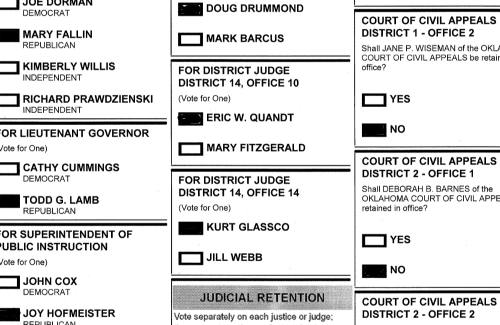 Here are the candidates I'm recommending and voting for (when I can) in the Oklahoma general election on November 4, 2014. Links lead to more detailed information or earlier blog entries. (This entry may change as I decide to add more detail or discuss additional races between now and election day. The entry is post-dated to keep it at the top.)
For your convenience, here's a printable one-page "cheat sheet" version to take along to the polls and pass along to friends, but please read the detail and click the links below.
U. S. Senate: James Lankford (R) (unexpired term) and Jim Inhofe (R) (full term). Both are good men and solid conservatives. If you want a Republican majority in the Senate, we have to do our part in Oklahoma and elect Republicans to the two seats on our ballot.
U. S. House: Vote Republican (R). Jim Bridenstine won re-election without opposition. We need to keep all five of Oklahoma's districts in the GOP column. Steve Russell, running for Lankford's 5th District seat, will be a principled, courageous conservative addition to Congress.
Governor: Mary Fallin (R). While Fallin has failed to lead vigorously during this conservative Republican moment in Oklahoma politics, she has signed the good bills that the legislature sent her (even if reluctantly). Her Democratic opponent is conservative on a couple of important issues but is likely to fill his cabinet, state boards and commissions, and the state bench with Democratic allies who aren't as conservative.
Lt. Governor: Todd Lamb (R). Charlie Meadows of OCPAC calls him "the best Lt. Governor we have ever had." Lamb is focused on making Oklahoma a better state to start and build businesses.
State Superintendent: Joy Hofmeister. Although I have my reservations about Hofmeister, her Democrat opponent wants to take education in the wrong direction -- more administrators (fewer would be better), more state funding (more local funding and parental choice would be better), and social promotion. State Sen. Rick Brinkley writes:
I believe her experience on the State School Board and as a classroom teacher prepares her for this position. I am most impressed that she served on the State Board, didn't like the way she saw education headed in Oklahoma, resigned, took on the incumbent and won. She risked a lot for what she believes in and that I greatly respect. I've met John Cox. He seems very nice. I just can't see a person who manages 16 teachers having the experience to run the [State Department of Education.
Labor Commissioner: Mark Costello (R). The incumbent has been working closely with business owners and workers to make the Oklahoma workplace a safer place. Restore Oklahoma Public Education leader Jenni White writes of Costello, "Mark is one of a very few conservatives I have ever met that just intuitively understands the ideals of conservatism."
State legislature: In general (with one important exception -- House 12) I encourage you to vote for the Republican. Here are some races that deserve special mention.
Senate District 6: Josh Brecheen (R). Representing southeast Oklahoma, Brecheen was a champion in the battle to repeal Common Core. The State Chamber wants him gone because he's not a corporate-welfare fan. He voted the wrong way on National Popular Vote, but publicly recanted his vote and called on the House to block it.
Senate District 18: Kim David (R). One of the sensible senators who opposed National Popular Vote.
House District 12: One of the few exceptions to the general rule to vote for Republicans. The GOP nominee in this race supports National Popular Vote and, if elected, could do more harm to the conservative cause nationally than the term-limited Democrat he wants to replace. I encourage my Republican friends to leave the ballot blank in this race.
House District 14: George Faught (R). Faught left the House two years ago to run for Congress, but, sadly, he didn't win the nomination. It will be good to have this principled, intelligent conservative back in the State House.
House District 76: David Brumbaugh (R). Incumbent Rep. Brumbaugh has been a consistent conservative voice for Broken Arrow. He deserves particular praise for putting forward a bill to to require counties to include all funds in their annual budgets. Brumbaugh was one of eight legislators to receive a 100% on the Oklahoma Constitution's annual conservative index.
House District 87: Jason Nelson (R). The leader in the State House in the fight to repeal Common Core.
District Judge:
Here are some general thoughts on district judge races and how the process works. Here's a podcast of my KFAQ conversation on judicial races with Pat Campbell, Eddie Huff, and Charlie Biggs.
District 10 District Judge, Office 1 (Osage County): John Kane. A good man and a well-respected judge, facing an opponent with a problematic personal history.
District 14 District Judge, Office 1 (Tulsa and Pawnee Counties): Incumbent William Kellough is praised for his temperament and damned for his habit of reducing sentences in heinous crimes. His opponent, Caroline Wall, was ousted in 2006 over similar charges of excessive leniency and concerns about temperament and work ethic. Kellough has a massive financial advantage in the race.
District 14 District Judge, Office 2 (Tulsa County judicial election district 3): Sharon Holmes. Incumbent Jesse Harris did not seek re-election. Holmes is described as a hardworking attorney, effective in the courtroom, and a woman of integrity.
District 14 District Judge, Office 8 (Tulsa County judicial election district 5): Doug Drummond. Drummond, a prosecutor, has amassed broad and substantial support, particularly from conservatives in the legal community, in his race to unseat incumbent Mark Barcus, although the local establishment is still backing Barcus.
District 14 District Judge, Office 10 (Tulsa and Pawnee Counties): Eric Quandt. Quandt, a well-regarded workers compensation judge, has also developed strong support against incumbent Mary Fitzgerald. Fitzgerald has been criticized for frequent reversals. Fitzgerald is described as being "part of the problem at the county courthouse" and a source of frustrations for those dealing with family and domestic cases. Quandt is praised for even-handedness; even attorneys with whom Quandt has had personal differences say that he treated them fairly in his courtroom. The local establishment is backing Fitzgerald. (On a personal note, when I questioned Quandt's candidacy based on a campaign consultant's support for National Popular Vote, Quandt contacted me in a very gracious way, and we had a good conversation. Quandt thinks National Popular Vote is a ridiculous idea, a bad solution for a non-existent problem.)
District 14 District Judge, Office 14 (Tulsa and Pawnee Counties): Kurt Glassco. Despite his background as a Democratic candidate for Congress many years ago, Judge Glassco is well-regarded by conservative Republican attorneys as a fair and skillful arbiter. John Eagleton writes: "Judge Glassco has my respect. I have appeared in his court and observed him handling hundreds of cases. He is a great judge. He follows the law without injecting personalities into the outcome. We need more judges like him." His challenger evidently feels comfortable with the redefinition of terms in the law and the overriding of popular will, not a desirable attribute in a judge.
Supreme Court and Appellate Courts:
These judges don't run against each other, but on an up-or-down retention ballot every six years. The three supremes all deserve to be voted out, as does Civil Appeals Court judge Jane Wiseman. Conservatives are supporting retention of Brian Goree on the Court of Civil Appeals and Gary Lumpkin on the Court of Criminal Appeals. So vote YES on Goree and Lumpkin, NO on everyone else.
On the back of your ballot, all three questions will support those currently serving in the military or those who have served, and all three deserve your YES vote.
Tulsa City Council:
All Tulsa City Council seats and the City Auditor position were up for election this year, but some were unopposed, and other races were settled in the primary. Only Districts 3, 6, 7, and 9 have general elections, and they'll be on a separate ballot from the rest of the races.
As predicted, city issues have been completely overshadowed by other races on the ballot and national and state issues. We were better off when city elections were held in the fall of odd-numbered years. My general rule is to find out which candidate is funded by the Money Belt and to vote the other way.
Tulsa City Council District 3: Virgil Wallace. Having graduated to the choir invisible, Roscoe Turner won't be on the ballot this year, but some of Turner's stalwart supporters have told me they're backing Wallace. The incumbent, David Patrick, is backed by the usual big money crowd, including developers who want to drive all other voices out of the zoning and land use planning process.
Tulsa City Council District 6: I'm not a fan of Skip Steele, who was the establishment-backed candidate used to get rid of reformer Jim Mautino. Connie Dodson, Steele's opponent, has run as a Democrat for State House. Her campaign appears to be funded primarily with her own funds, but she has a $5,000 contribution from Santiago Barraza, the president of ISTI Plant Services, a Tulsa Port of Catoosa-based manufacturer with offices in District 6 on 21st Street west of Lynn Lane Rd. Apparently, Barraza either really likes Dodson, or Steele did something that really hacked him off. Other donors include Democratic super-donor George Krumme, Sharon King Davis, Patty Eaton, and Mariscos El Centenario. (What an unusual first name!)
Tulsa City Council District 7: Arianna Moore. Republican incumbent Moore's leading challenger is liberal Democrat Anna America, Kathy Taylor's campaign manager. America had been a school board member but then resigned when she moved out of the district. Kathy Taylor, Taylor's husband Bill Lobeck, other members of the Lobeck/Taylor family, and other members of their political orbit are major donors to America's campaign.
I've been accused of being motivated by mere partisanship in picking Mrs. Moore over Ms. America, and there's some irony in that accusation. When I ran for City Council in 2002, I was endorsed by just about every neighborhood association leader in District 4, most of whom were Democrats. Anna America, then head of the White City neighborhood association, was one of the few exceptions. She supported Democrat Tom Baker, who was backed by the Chamber and the developer groups and who had demonstrated hostility to neighborhood concerns. (When Renaissance Neighborhood successfully fought the location of a new fire station in the middle of their neighborhood, Baker referred to them on the Fire Department's public-access TV show as CAVE people -- Citizens Against Virtually Everything.)
I always assumed America endorsed Baker because he was the Democratic nominee, and she was being a good party soldier, but maybe it was because she didn't want someone on Council who would work for neighborhood empowerment in zoning and historic preservation.
Tulsa City Council District 9: G. T. Bynum is no conservative, and he seems to be laying the groundwork for another tax increase proposal for river projects. His opponent, Paul Tay, has some interesting ideas on urban planning and transportation, but his personal conduct distracts from those ideas and makes him impossible to endorse.
MORE: The ladies who led the fight to repeal Common Core in Oklahoma have posted their personal endorsements. And they reposted this guide to the judicial retention ballot by Sharon Annesley of the Oklahoma Liberty Tea Party.
The Oklahomans for Life 2014 primary candidate questionnaire is online. There are separate sets of questions for state and federal candidates, and you can read the full text of the questions to which the candidates are responding.
OCPAC head Charlie Meadows has posted his personal picks.
Muskogee Politico Jamison Faught has posted his picks.
Here are the Tulsa Beacon's endorsements.
Earlier this year, I heard a Republican activist talking excitedly about the possibility that the Democrats might have only an also-ran as nominee for governor or perhaps no nominee at all. If the Democratic nominee failed to reach 20% of the vote, the party would be decertified and lose its automatic place on the ballot. It was never a likely scenario, but it illustrates the overconfidence Republicans had at the beginning of 2014.
During the 2014 legislative session, many conservative Republican voters became disenchanted with Gov. Mary Fallin. As I wrote before the June primary: "While Gov. Mary Fallin eventually did the right thing on Obamacare exchanges and Common Core, her dithering on these clear-cut issues makes me worry about her decision-making in a lame-duck term. Fallin failed to establish a good working relationship with her own party's legislative leadership, culminating in her veto snit-fit, in which she killed several good bills, including some she'd requested, to make some sort of point." Her inability to advance the conservative agenda assertively in an ideal political environment speaks poorly of her leadership abilities.
Back in June, many conservatives voted for Dax Ewbank to express their disappointment with Fallin's leadership.
Now Ewbank himself and many of his supporters have come out in support of the Democratic nominee, State Rep. Joe Dorman. Because Dorman has a pro-life and pro-gun-rights voting record, some of the usual obstacles to conservatives voting for the Democratic nominee aren't there.
Republican Sen. Patrick Anderson from Enid is backing Dorman, but that seems to be grounded in a local issue, Fallin's decision to close the Northern Oklahoma Resource Center of Enid, a state institution for the developmentally disabled. Anderson says Fallin froze him out of discussions over the future of that facility:
"Joe and I don't agree on all issues, but I think he'd make a fine governor and he's definitely someone who has always, and who will always be willing to talk about whatever the issues are that are important to our community in northwest Oklahoma," Anderson said. "Unfortunately, Gov. Fallin hasn't been willing to do that."
But is Dorman as conservative as some of his supporters claim? Oklahoma Constitution editor Steve Byas reports that Dorman's votes in the legislature have earned him only a 39% lifetime rating in the Constitution's conservative index, and only a 31% rating in the most recent session. That may be an impressive rating for a Democrat, but it still means far more bad votes than good votes.
Byas also calls attention to the governor's power to appoint judges and board and commission members and to fill Senate vacancies:
As a Democrat, Governor Joe Dorman will fill state government with a whole lot of Democrats. Expecting these Democrats to be conservatives is laughable. I guess you can find a four-leaf clover every now and then, too. Regardless of what many people argue to the contrary, there are many Republicans who are worth appointing to state offices. No, I do not expect Governor Mary Fallin to appoint multitudes of conservatives, but I can guarantee you that she will appoint a whole lot more than Dorman, simply because she will appoint more Republicans than Dorman will appoint.Then, we have the state judicial appointments. If Dorman were to pull the big upset, expect liberal Democrats to take the place of retiring state judges at the appellate court level. While these judges face the voters in retention votes every six years, no appellate judges have ever been denied the additional six years by the voters. Dorman's judges, drawn from the ranks of an increasingly left-wing Democrat Party, will issue liberal decisions for years past the time Dorman is back home in Rush Springs, eating watermelon at the annual festival.
Let's say there is an unexpected vacancy in the U.S. Senate. Do you think Governor Dorman will appoint anyone better than Jim Inhofe to fill that vacancy until the election? Get real. And, guess who will be the candidate of the [Democrat] Party for the U.S. Senate should the great Jim Inhofe have to step down from the Senate? I suspect it will be Joe Dorman. If you cause the election of Dorman for governor, you just might be picking Inhofe's replacement as well.
In September, Oklahoma GOP chairman Dave Weston pointed to Dorman's ambiguous answers in an interview in The Gayly -- a paper that describes itself as "keeping the FABULOUS south-central United States informed on current news and events affecting Lesbians, Homosexuals, Bi-sexuals & Transgenders":
Dorman criticized Gov. Mary Fallin for her moral stance on traditional marriage stating, "When you have a standard set in place, especially like that handed down from the federal government, you have to apply that [marriage rights] equally."He appeared to apologize to The Gayly staff for his vote in support of a House resolution to reaffirm Oklahoma's support of traditional marriage. When asked how he could "support equality" while also voting to uphold traditional marriage Dorman said:
"Different situations. I serve House District 65 and I try to serve my constituents to the best of my ability... They have, I think, a different point of view when it comes to policies like that."
The Gayly adds: "Dorman said he voted the way he felt his district wanted him to vote."
Oklahoma Republican Party Chairman Dave Weston pressed Dorman to tell the people of Oklahoma whether he supports redefining marriage and why.
"It sounds like Joe Dorman meets with voters in Rush Springs and tells them he's a conservative Democrat who opposes reclassifying marriage," said Weston. "Then he tells The Gayly staff in Oklahoma City that's not really what he thinks and proceeds to criticize Governor Fallin for holding the same position that he previously told his constituents he believes."
Weston pointed out other examples where, seemingly under the mere pressure of an interview, Dorman appeared to apologize for and back away from his conservative votes on social issues.
Joe Dorman also has a problem on fiscal issues. Dorman wants to lead Oklahoma into the financial trap known as Medicaid expansion. The state gets a short-term burst of Federal funds, but the price is making more Oklahomans dependent on government-funded healthcare (many of them young and able-bodied), and massive state budget obligations in the out-years, after federal subsidies dry up, obligations that will squeeze out funding for roads and education, among other state priorities. Medicaid expansion increases eligibility, but doesn't improve access, hurting the very people that the program was originally intended to help.
The best a conservative can say about Joe Dorman is that he may be as conservative as Mary Fallin on a couple of issues, but he is well to her left on other important issues, and his party affiliation and ambitions for higher office will pull him further to the left should he be elected. (There is a long list of Democrats who once claimed to be pro-but who abandoned that stance when they began to hanker for the presidency -- Bill Clinton, Al Gore, Jesse Jackson to name just a few.)
Byas says he does not "expect Governor Fallin to lead us to the conservative promised land, but she will probably sign good bills, if the Republican-dominated Legislature passes them. Sure, she waited to the last minute to sign the repeal of Common Core, but she did sign it." Byas says Fallin has the highest conservative rating of any of the six governors who have served since his paper's founding in 1979. While that rating is only 63%, that's far better than Dorman's lifetime 39% rating.
Finally, regarding National Popular Vote: On Thursday, I asked Gov. Fallin's spokesman, Alex Weintz, "Would she be willing to say that she would veto any form of a National Popular Vote proposal that reaches her desk?" He stated by return email, "The position we have previously taken is, 'Governor Fallin is opposed to the National Popular Vote.'" (I would have preferred a more strongly worded stance that fully closes the door on the idea.) Still, the Dorman campaign has not stated a position, but I would expect him to support it, given the unanimous support last session's bill had from Senate Democrats. Pressure from the national GOP against NPV (the RNC voted unanimously to condemn the idea) ought to keep Fallin on the right side of that issue, even if it does reach her desk. While the presidency or vice presidency is out of reach, she may reasonably have hopes of a federal appointment under a Republican president as her time as governor ends. Pressure from national Democrats would pull Dorman toward signing the bill.
While Republicans can safely sacrifice one house seat out of 101 to keep the backer of a dangerous scheme out of the House GOP caucus, we cannot safely sacrifice a position with the power of appointment and the ability to sign or veto legislation.
The other two candidates are not even a blip on the pollsters' radar. Either Mary Fallin or Joe Dorman will be elected governor on Tuesday. Mary Fallin is clearly the more conservative of the two, and I hope you'll join me in voting for her re-election.
House District 12 consists of most of Wagoner County, the part that is not in the Tulsa/Broken Arrow conurbation. The district lies mainly east of 257th East Ave (Midway Road) and south of 51st Street. The incumbent is Wade Rousselot, a Democrat finishing his fifth term, currently serving as the assistant floor leader of that party's dwindling minority in the State House.
The lone Republican to file against him is David Tackett, a Republican political operative with a mixed reputation among the conservatives who have dealt with him.
Multiple reliable sources have informed me that Tackett has been working with National Popular Vote lobbyists to give them opportunities to hoodwink grassroots Republicans into supporting legislation that would pledge Oklahoma's electoral votes to a far-left candidate who won the national popular vote, even if Oklahomans voted overwhelmingly for the conservative candidate.
I sent Tackett a message via Facebook on Tuesday: "David, I have been told that you have been assisting representatives and supporters of National Popular Vote to connect with grassroots conservatives here in Oklahoma. I'd like to know if there's any element of truth to that. What involvement have you had with NPV-related organizations? As a state representative, will you work to advance or to obstruct Oklahoma's entry into the National Popular Vote Compact? Thank you."
Facebook says that Tackett has seen my question, but Tackett has not replied. His non-response tells me that an honest answer is one that I wouldn't like.
(UPDATE: Charlie Meadows confirms Tackett's support for NPV and says that Tackett almost lost the OCPAC endorsement because of it.)
I won't repeat the full critique of NPV here (my first entry on NPV links to several critical articles), but here in a nutshell is why the Left wants it so badly. With NPV, the battle for the presidency will be fought in the populous media markets on the coasts, and Middle America will be ignored. Under the current system, state boundaries form a firewall against voter fraud, so that the Chicago cemetery vote only runs up the score in Illinois, but doesn't affect the result in any other state, but under NPV, fraudulent votes in Illinois would effectively cancel legitimate votes in Oklahoma.
The campaign for NPV is funded by the Left, but they have found a few individuals on the right to carry water for them. They seem to find former legislators who were genuinely conservative while in office, but who made some bad decisions in their personal lives that may also have hurt them financially and politically. Google the person's name and you learn that he or she was once a conservative warrior, and that's enough to persuade a grassroots conservative in Oklahoma to give the person a hearing. But search on the name plus the word "scandal" or "affair" and you understand why he or she didn't rise to higher office and are alerted that his or her political integrity might be as compromised as his or her personal life. NPV can offer these people a paycheck and a taste of the relevance they once enjoyed in exchange for the rental of their conservative credibility.
NPV lobbyists have been offering legislators electoral college "educational seminars" in desirable locations, like Las Vegas, Miami, St. Croix, and Scottsdale, Arizona. I have been told that certain legislators recently sent emails to colleagues, inviting them to an "educational seminar" in New York City, December 15-17, 2014, with "scholarships" to cover air fare and hotel paid by FairVote, a pro-NPV organization.
After the Oklahoma State Senate passed the NPV Compact bill (SB 906) with the support of 12 Republicans, grassroots conservatives mobilized to stop it, and some of the senators who voted for it recanted their support. Now NPV lobbyists, aided and abetted by consultants like David Tackett and Darren Gantz, are trying to bamboozle conservative activists to reduce resistance when the bill is run again.
I say bamboozle because my conversations with recovered NPV supporters remind me of conversations I've had with people who have escaped cults. NPV seems to have hit upon arguments that resonate emotionally with conservatives, so that the listener not only shuts off his own B. S. detector, but he shuts out perspectives from trusted voices before deciding to convert. Solidly conservative state senators like Josh Brecheen and Gary Stanislawski fell into NPV's trap. It took a massive outcry from grassroots conservatives to wake them up from their lobbyist-induced trance.
Look, I'm all for free and open debate, and I believe the truth will prevail, but I'm still not going to encourage my friends to meet with missionaries from the Church of Sighnutology "just to give their ideas a fair hearing."
Conservatives differ on many issues, but this is a matter of strategic importance, not a minor issue on which reasonable conservatives might differ. Oklahoma is the key battleground in a battle to control our nation into the distant future. Oklahoma would be the first conservative state to adopt the NPV compact. If Oklahoma says yes, it will set a precedent that will lower the resistance to the idea in other conservative states, and NPV supporters will be well on their way to victory.
I don't know whether Tackett's support of NPV is borne of venality or naïveté. Either way, he doesn't belong anywhere near the levers of power. His defeat will send the signal that supporting NPV is a career-ending move, and it will keep an NPV supporter out of a position of power.
Rep. Rousselot, the incumbent Democrat, will be term-limited in 2016. If Rousselot wins a final term, the 2016 election will be an open seat, and I would expect a robust contest for the Republican nomination. (Wagoner County Clerk Lori Hendricks, who has been a Paul Revere on the NPV issue, would make a great state rep.) If Tackett wins, an open NPV supporter will have a seat in the majority caucus and the incumbent's advantage for re-election in 2016. I don't know much about Rousselot's politics, but as a member of a tiny legislative minority, he can't do much damage, certainly not as much as Tackett can as a supporter of NPV in the majority caucus.
The current partisan balance in the State House is 72 Republicans to 29 Democrats. By my count of uncontested seats in the 2014 list of candidates, Republicans are guaranteed 46 seats in the new legislature to the Democrats' guaranteed 19. Only a handful of the contested seats are truly competitive, and the partisan composition of the new state house won't be much different from the old.
Conservatives don't need to pad the massive Republican majority with someone who is working, wittingly or unwittingly, for the strategic defeat of conservatism at the national level. I encourage my Republican friends in House District 12 to leave that ballot item blank.
Three justices of the State Supreme Court (Reif, Colbert, Watt), one justice of the Court of Criminal Appeals (Lumpkin), and five justices of the Court of Civil Appeals (Goodman, Wiseman, Barnes, Rapp, Goree) will be on Tuesday's ballot.
Oklahoma has a two-path appellate system: Criminal cases are appealed to the Court of Criminal Appeals, which has the final word. Civil cases are appealed to the State Supreme Court, which may and usually does assign cases to the Court of Civil Appeals. Since 1967, judges in the appellate system have been appointed by the governor from choices presented by a panel dominated by a private club, the Oklahoma Bar Association. A newly appointed justice or appellate judge faces a retention ballot at the next general election and, if retained, every six years thereafter. Voters do not choose between candidates for these offices; each judge or justice faces a YES or NO vote. If the NO votes outnumber the YES votes, that judge is removed from office, creating a vacancy which is filled by the usual process.
I plan to vote YES on only one judicial retention: Court of Civil Appeals Judge Brian Goree, appointed by Gov. Fallin. Conservative blogger and attorney Don Danz wrote a tribute to Judge Goree at his swearing-in:
A former coworker, shooting buddy and good friend was sworn in as a judge today at the Oklahoma Supreme Court. In August, Gov. Mary Fallin appointed Brian Goree to the Oklahoma Court of Civil Appeals. Everyone who knows Brian would attest to the fact that he is the most honest, ethical, moral and hard working person we know. He will be an outstanding and absolutely unbiased addition to the Oklahoma judiciary.
I urge every Oklahoman to vote NO on Court of Civil Appeals Judge Jane Wiseman. As a district judge in 2003, Wiseman demonstrated partiality toward the rich and powerful by approving the unconstitutional logrolling in the Vision 2025 ballot. Her 2003 decision ignored her own reasoning eight years earlier when she rightly discarded a sales tax proposal for the new county jail because it included funds for early intervention programs on the same ballot item as funds for the jail's construction and operation.
Earlier this month, we saw Judge Wiseman officiate over the first "legal" "same-sex wedding" in Oklahoma, showing her solidarity not with the people who voted overwhelmingly to uphold the only definition of marriage that makes sense, but instead with the leftist fascists who seek to impose their morality on every state. Wiseman demonstrated her support for judges legislating from the bench, for seeing the voters of Oklahoma as subjects to be subdued, not a sovereign, self-governing people.
There have been too many examples of judicial overreach and incoherence from Oklahoma's appellate courts.
In July, a majority of the Oklahoma Supreme Court upheld State Rep. Sydney Fred Jordan's eligibility to be elected District Attorney. Their one-paragraph decision failed to address the legal questions raised by the briefs filed on behalf of Jordan and his opponent Steve Kunzweiler. The heart of the matter was when a state representative's term ends and when a district attorney is considered elected. The majority decision didn't speak to the language of the constitutional provision, Article V, Section 23, at question, or address the claim that Gragg v. Dudley applied to the District Attorney's office. Only Justice Taylor, in his dissent, wrestled with the substantive matters of interpretation raised by the case. The five justices who concurred in the seemingly tossed-off decision -- Kauger, Watt (up for retention), Winchester, Edmondson, and Gurich -- should be deeply embarrassed. Reif, who is on this year's retention ballot, recused himself. Colbert and Combs did not participate. On the strength of this decision alone, I will vote NO on Watt.
State Rep. David Derby reports that the Supreme Court's chief justice, Tom Colbert, came to the state capital to lobby against Derby's proposed reforms to the state's DUI laws. Derby was trying to move DUI charges into District Court so that they would be handled in a court of record, rather than municipal court. He cited one example where a driver had around two dozen DUIs, but because they were handled in municipal court, they failed to trigger a driver's license suspension. According to Derby, Colbert personally lobbied against the bill, which failed to advance.
A series of decisions earlier this year clinch the case against the three justices on the ballot. A split Supreme Court voted 5-4 to issue a stay of execution for brutal murderers Clayton Lockett and Charles Warner over disclosure of the drugs to be used in their lethal injection executions, despite our state constitution giving final jurisdiction over such issues to the Court of Criminal Appeals. The three justices up for retention this year -- Colbert, Reif, Watt -- were in the narrow majority along with Kauger and Combs. Taylor, Edmondson, Winchester, and Gurich dissented. In each of six decisions in the case, Taylor chided his colleagues, describing the majority as "crossing the Rubicon" and putting the Supreme Court in a matter where it has no constitutional authority, and thereby producing a "quagmire."
Of the substance of the murderers' appeal, Taylor wrote:
It is my view that from the very beginning this so called "civil" litigation has been frivolous and a complete waste of time and resources of the Supreme Court of Oklahoma. The plaintiffs have no more right to the information they requested than if they were being executed in the electric chair, they would have no right to know whether OG&E or PSO were providing the electricity; if they were being hanged, they would have no right to know whether it be by cotton or nylon rope; or if they were being executed by firing squad, they would have no right to know whether it be by Winchester or Remington ammunition. I hope that this case ends any thought of future journeys down this path that has led this Court to this day. It is also my hope that this Court never again crosses the Rubicon.
If voters get rid of the three justices on the wrong side of this issue, perhaps we can get a few more justices like Steven Taylor. (Taylor is next up for retention in 2016. It should be noted, however, that Taylor was on the wrong side of the TABOR petition, voting to toss it out without a hearing.)
Oklahomans for Life has called for reform of the judicial selection process because our own courts have thwarted legislative and initiative efforts to pass pro-life legislation. Effectively, these judges have blocked Oklahomans from advancing a law that might provide the occasion for the Federal Courts to reconsider and possibly reverse Roe v. Wade.
When in doubt, vote them out. A Fallin appointment is likelier to be committed to judicial restraint than holdover appointees of Democratic governors Brad Henry and David Walters. The removal of an appellate judge by the voters would also send a message to other justices that voters are paying attention to their decisions.
A few hundred years ago, Voltaire commented on the execution of a British admiral, executed on the deck of his own ship for a failure to do his utmost. "Dans ce pays-ci, il est bon de tuer de temps en temps un amiral pour encourager les autres." ("In this country, it is wise to kill an admiral from time to time so to encourage the others.")
In Oklahoma, it is wise to fire an appellate judge from time to time so as to "encourage the others" to do justice and respect the will of the people they are sworn to serve.
Three questions will be on every ballot in Oklahoma next Tuesday. Two have to do with property taxes; one has to do with whether state officials may also serve in the National Guard and Reserves. None of these questions are controversial, but because they involve amendments to the State Constitution, they must be put to the voters for approval. The Oklahoma Secretary of State is the official keeper of information state questions; links below will take you to the Secretary of State's site.
This year's state questions are all legislative referenda. Initiative petitions relating to school storm shelters, marijuana, and fees for connection to the electric utility grid were filed, but petition signatures were filed only for SQ 768, the medical marijuana petition. 155,216 signatures were required (15% of the highest number of votes cast for any office in the previous Oklahoma general election, in 2010), but only 75,384 were submitted and certified.
State Rep. Jason Murphey says that this is the "easiest year to write about these questions because there are only three on the ballot, and they are not controversial." He supported all three proposals.
SQ 769 went through the legislature as Senate Joint Resolution 33, passing the House 82-5 and the Senate 44-0. If SQ 769 is approved, the underlined text will be added to Article II, Section 12 of the Oklahoma Constitution:
Section 12. No member of Congress from this State, or person holding any office of trust or profit under the laws of any other State, or of the United States, shall hold any office of trust or profit under the laws of this State; provided, neither the provisions of this section nor any other provision of this Constitution or state law shall be construed to prohibit the following officeholders from holding at the same time any other office of trust or profit:1. Officers and enlisted members of the National Guard;
2. Officers and enlisted members of the National Guard Reserve;
3. Officers of the Officers Reserve Corps of the United States;
4. Enlisted members of the Organized Reserves of the United States; and
5. Officers and enlisted members of the Oklahoma State Guard and any other active militia or military force organized under state law.
The Legislature shall have the power to enact laws to further implement the provisions of this section.
The intent is to eliminate any question as to whether guard and reserve troops may also serve in public office in Oklahoma.
SQ 770 went through the legislature as HB2621, passing both houses unanimously. If SQ 770 is approved, a new paragraph will be added to Article X, Section 8E, which provides a full homestead exemption for service-disabled veterans and their surviving spouses:
C. If a homestead otherwise eligible for the exemption authorized by this section is transferred on or after January 1 of a calendar year, another homestead property acquired by the qualifying head of household or by the surviving spouse of such qualifying head of household shall be exempt to the same extent as the homestead property previously owned by such person or persons for the year during which the new homestead is acquired and, subject to the requirements of this section, for each year thereafter.
Rep. Murphey writes:
Oklahoma's Constitution currently allows disabled veterans to receive an exemption from most property taxes. State Question 770 allows disabled veterans to sell their home and transfer the exemption to their new home during the same calendar year with no drop off in the exemption.
SQ 771 went through the legislature in the same bill, HB2621. It adds Section 8F to Article X, providing the same sort of homestead exemption to the surviving spouses of troops killed in the line of duty:
Section 8F. A. Despite any provision to the contrary, and except as otherwise provided by subsection D of this section, beginning January 1, 2015, the surviving spouse of the head of household who is determined by the United States Department of Defense or any branch of the United States military to have died while in the line of duty shall be entitled to claim an exemption for the full amount of the fair cash value of the homestead until such surviving spouse remarries.B. In order to be eligible for the exemption authorized by this section, the surviving spouse shall be required to prove residency within the State of Oklahoma and must have previously qualified for the homestead exemption authorized by law or be eligible for the homestead exemption pursuant to law.
C. If a homestead otherwise eligible for the exemption authorized by this section is transferred on or after January 1 of a calendar year, another homestead property acquired by the surviving spouse shall be exempt to the same extent as the homestead property previously owned by such person for the year during which the new homestead is acquired and, subject to the requirements of this section, for each year thereafter.
D. The provisions of this section shall be applicable for the 2014 calendar year with respect to an existing homestead property owned by the surviving spouse of a person previously determined to have died while in the line of duty by the United States Department of Defense or applicable branch of the United States military.
I will vote FOR all three state questions.
Judges are supposed to apply the laws passed by our elected representatives in the legislature. Applying the law faithfully requires faithfully interpreting the words of the law as they are commonly understood. A judicial candidate who uses words in accordance with her own idiosyncratic decisions in an obvious attempt to mislead should be blocked from the bench by voters at the ballot box.
District Judge Kurt Glassco faces a challenge in his bid for re-election to District 14, Office 14, from Jill Webb.
In her campaign materials, Webb described herself as "happily married to a minister." That invokes a certain image based on a common understanding of the meaning of words. The vast majority of Oklahomans stand with civilized societies around the world and throughout history in understanding that marriage, rooted as it is in the realities of human begetting and the best interests of those begotten, necessarily involves one man and one woman, united for a lifetime.
Jill Webb means something different by those words. The minister to whom Webb claims to be married is Tamara Lebak, associate minister of All Souls Unitarian Church. Oklahoma law and civilized tradition doesn't recognize that as a valid marriage, notwithstanding the Leftist Fascist effort to impose its destructive redefinition of marriage through the courts. Someone who redefines words and uses them deceptively cannot be trusted to handle justly the words of the Constitution and statutes of Oklahoma. Additionally, a candidate who supports redefining marriage and is "married" to a Unitarian minister can be presumed to stand with Leftist Fascism and in opposition to civilization in the great ideological struggle over American institutions.
Kurt Glassco, the incumbent, has a reputation as a solid, reliable jurist. Although he was a Democratic candidate for Congress many years ago, the conservative attorneys I know unanimously describe him as trustworthy and fair. Certainly Glassco's re-election would be better than the election of a candidate evidently at ease with verbal deception.
We'll start our review of judicial races with an easy one, albeit one that is just outside Tulsa County, although it covers portions of the cities of Tulsa, Skiatook, and Sand Springs.
Judicial District 10 consists of Osage County, and it has exactly one district judge. Like all 77 counties, Osage County also has its own associate district judge. (District Attorney District 10 includes both Osage and Pawnee Counties. Why Pawnee County was attached to Tulsa County for judicial purposes is a mystery.)
The incumbent is John Kane. An Osage County native and graduate of Pawhuska High School, Kane was appointed to the post in 2005. Kane drew no opposition for re-election in 2006 or 2010, but this year, he is opposed by Skiatook attorney Philip Best.
Judge Kane is well-regarded by his judicial peers, by local law enforcement, and the legal community. In 2013-2014, Kane was president of the Oklahoma Judicial Conference, the statewide association of judges. He is presiding judge-elect of the Northeastern Judicial Administrative District, again elected by his peers in the region. Kane also serves as the Trial Court Chairman of the Oklahoma Supreme Court's e-court subcommittee. Kane has been endorsed by the Osage County Bar Association, the police chiefs of Pawhuska, Fairfax, Barnsdall, Hominy, Wynona, and Skiatook, the sheriff of Osage County, the principal chief of the Osage Nation, and the current and former district attorneys for the county. During his nine-plus years on the bench, he has presided as a judge in over 9,000 cases.
Our family has known the Kane family for seven years through our homeschooling community. Judge Kane's wife, Cyndi Kane, launched a Classical Conversations community in Tulsa in 2007. The Classical Conversations approach to homeschooling seeks "to know God and to make Him known," and to support homeschooling parents "by cultivating the love of learning through a Christian worldview in fellowship with other families."
More recently, we watched Judge Kane in action, presiding over mock trials involving eighth-grade students from several CC communities. For several years, he has opened the Osage County courthouse to student mock trials, as a way to introduce young people to the law and give them an understanding and respect for the process. Judge Kane's good humor, fairness, and insight were on display throughout the process.
The challenger, Philip Best, has a problematic past readily visible through a search of online court cases. Here's how the Bigheart Times, based in Barnsdall, summarized Best's past, in an October 16, 2014, story (links added):
According to court documents, Best was arrested at his Skiatook home for misdemeanor domestic abuse in December 1999. The case was eventually dismissed at the victim's request after he completed anger management courses.Additionally, in 2004, his now ex-wife, Lori Duncan, took out a protective order in Tulsa County on behalf of the couple's underage daughter.
When asked about his record, Best chalked it up to his health and his marriages at the time and emphasized his ability to remain fair and impartial on the bench if elected.
There are long gaps in the list of cases in which Best shows up as attorney of record.
The contrast is clear. John Kane, an accomplished judge with a solid personal life and grounded in a classical Christian worldview, would deserve re-election whoever his opponent might have been, but even more so given the spotty record of his opponent. I urge my Osage County friends to re-elect Judge Kane.
Tomorrow morning, Monday, October 27, 2014, at 8 a.m., I'll be on 1170 KFAQ discussing judicial races on the Pat Campbell Show. (UPDATE: Here is the podcast of my conversation about judicial races with Pat Campbell, Eddie Huff, and Tulsa Beacon publisher Charlie Biggs. Here is a direct link to the MP3 file.)
Judicial races are the trickiest part of the ballot. In Oklahoma, only district court races are contested, and all judicial elections are non-partisan. The Oklahoma Code of Judicial Conduct, set by the State Supreme Court, tightly controls what judicial candidates can say and how they can campaign. This code grants a private club, the Oklahoma Bar Association, an official role in policing judicial candidates. Attorneys, who have first-hand experience with the capabilities and character of judicial candidates, are wary of speaking out against a judge before whom they may one day have to stand. If you're lucky, you may get some off-the-record scoop from friends at the courthouse. All this adds up to confusion and frustration for the voter.
In 2004, the Oklahoma Family Policy Council put together a questionnaire for Supreme Court and appellate judges focusing on judicial philosophy. They had their attorneys look at the questionnaire to ensure that judges would not violate Oklahoma's Code of Judicial Conduct by answering the questions. In the end, six of the eight judges sent a letter saying they couldn't respond to the questionnaire, the other two didn't respond at all.
Worldview matters. We are in the midst of a culture war. Like all movements grounded in unreality, the leftist fascist movement seeks totalitarian control of institutions and the destruction of any institution it can't control. Never has it been more important to know whether the men and women who seek to be our judges are in accord with the founding principles of American jurisprudence and Western Civilization or are in sympathy with the destructive forces arrayed against civilization.
While I know many fair-minded and good-hearted liberals, fair-minded enough to rule against their own ideological interests if the law points that way, many on the left have been influenced by the ideas of critical legal theory, which boils everything down to power and the use of any means to the end of establishing left-wing dogma as the state religion.
We need to see the hearts of these candidates. Sometimes we have rulings and written opinions that tell us whether a judge is with civilization or against it. At times we may only have indirect indications of a judge's character and worldview.
In the blog entries that follow, and in my radio comments tomorrow, I'll do my best to set out my judgment of the judges and the basis for that judgment.
MORE: This is an update of an entry from 2006 about the judicial offices in Judicial District 14. The structure and offices are the same, but some of the names are different for 2014.
It took me a while to puzzle all this out, and I thought others might be interested as well.
Oklahoma has 26 District Courts. Tulsa County and Pawnee County constitute Judicial District No. 14. State law says that District 14 has 14 district judge offices. (Why are Tulsa County and Pawnee County coupled together? Why not Pawnee with, say, Osage, and Tulsa on its own, as Oklahoma County is?)
One judge must reside in and be nominated from Pawnee County, eight must reside in and be nominated from Tulsa County. If there are more than two candidates for any of those nine offices, there is a non-partisan nominating primary in the appropriate county, and the top two vote-getters are on the general election ballot. (Even if one gets more than 50% of the vote, the top two still advance.)
In the general election, all voters in Pawnee and Tulsa Counties vote on those nine seats.
The remaining five district judges are selected by electoral division in Tulsa County. In order to comply with the Voting Rights Act, Tulsa County is divided into five electoral divisions, one of which (Electoral Division 3) has a "minority-majority" population. (The minority-majority district is much smaller than the other four, as it must be in order to guarantee that the electorate is majority African-American.) For each of these five offices, if there are three or more candidates, there is a non-partisan nominating primary. If one candidate gets more than 50% of the vote, he is elected; otherwise, the top two advance to the general election. For each of these five offices, the candidates must reside in the corresponding electoral division, and only voters in that electoral division will vote for that office in the primary and general election. (Oklahoma County, Judicial District No. 7, is the only other county with judges elected by division.)
Despite the three different paths one can take to be elected, a Judge in Judicial District No. 14 can be assigned to try any case within the two counties.
Each county in the state also elects an Associate District Judge, nominated and elected countywide. After two elections in a row in which the incumbent Tulsa County Associate District Judge was ousted, for the second time Dana Kuehn has been reelected without opposition. There is a two-man contest for Pawnee County Associate District Judge, Patrick Pickerell of Cleveland v. Ken Privett of Pawnee.
In addition to the elected judges, the District has a certain number of Special Judges, who are appointed by and serve at the pleasure of the District Judges. There is no correspondence between being a district judge, associate district judge, or special judge and the docket you may be assigned to handle.
All this I was able to puzzle out from prior knowledge and browsing through the relevant sections of the Oklahoma Statutes. What I still couldn't quite figure out is which of the 14 offices corresponded with the five electoral divisions, and which one was nominated from Pawnee County. Although electoral division 4 votes for office 4, I was pretty sure the pattern did not apply to the other offices. After a few phone calls, someone from the Tulsa County Election Board found the relevant info in the League of Women Voters handbook. So here it is, for your reference and mine.
| Office | Incumbent | Nominated by | Primary 2014 | Elected by | General 2014 |
| 1 | Kellough | Tulsa Co. | Tulsa and Pawnee Cos. | Yes | |
| 2 | Harris1 | Tulsa Co. ED 3 | Yes | Tulsa Co. ED 3 | Yes |
| 3 | Caputo | Tulsa Co. | Tulsa and Pawnee Cos. | ||
| 4 | Cantrell | Tulsa Co. ED 4 | Tulsa Co. ED 4 | ||
| 5 | Sellers | Pawnee Co. | Tulsa and Pawnee Cos. | ||
| 6 | Chappelle | Tulsa Co. ED 2 | Tulsa Co. ED 2 | ||
| 7 | Gillert1 | Tulsa Co. | Tulsa and Pawnee Cos. | ||
| 8 | Barcus | Tulsa Co. ED 5 | Tulsa Co. ED 5 | Yes | |
| 9 | Morrissey | Tulsa Co. | Tulsa and Pawnee Cos. | ||
| 10 | Fitzgerald | Tulsa Co. | Tulsa and Pawnee Cos. | Yes | |
| 11 | Nightingale | Tulsa Co. ED 1 | Tulsa Co. ED 1 | ||
| 12 | Fransein | Tulsa Co. | Tulsa and Pawnee Cos. | ||
| 13 | Musseman | Tulsa Co. | Tulsa and Pawnee Cos. | ||
| 14 | Glassco | Tulsa Co. | Yes | Tulsa and Pawnee Cos. | Yes |
Offices elected by Tulsa County Electoral Divisions in red.
Offices nominated by Pawnee County in blue.
1 Not seeking re-election.
Eight of the incumbent district judges were re-elected without opposition.
Two incumbents did not seek re-election. Former Tulsa Mayor and Tulsa County District Attorney Bill LaFortune was the sole candidate for the open seat (Office 7) being vacated by Tom Gillert. Retiring judge Jesse Harris left the other vacancy in Office 2, which drew four candidates; Sharon Holmes and Tanya N. Wilson survived the primary and will face the general election voters in their north Tulsa judicial election district.
The other four incumbents face challengers in the general election:
Office 1: William Kellough v. Caroline Wall
Office 8: Mark Barcus v. Doug Drummond
Office 10: Mary Fitzgerald v. Eric Quandt
Office 14: Kurt Glassco v. Jill Webb
The contested races will be decided by all voters in Tulsa and Pawnee counties, with the exception of Office 2 (decided by voters in Election District 3, mainly the north part of the City of Tulsa) and Office 8 (decided by voters in Election District 5, which covers Tulsa County west of the Arkansas River and north of 141st Street S, plus north of the river and west of downtown Tulsa, plus the east side of the river south of downtown and west of Lewis). The Tulsa County Election Board hosts a map of the Tulsa County judicial election districts. So everyone in Tulsa County will have three district judge races on the ballot, and about half the county will vote on a fourth race. Everyone in Pawnee County will vote on Offices 1, 10, and 14, plus their county's Associate District Judge race.
Judges on the Court of Civil Appeals, Court of Criminal Appeals, and Oklahoma Supreme Court face retention every six years after their initial retention vote at the general election after their appointment. If there are more votes against retention than for retention, the judge is removed from office and the governor appoints a replacement.
A Chamber of Commerce working against the interests of taxpayers and conservative values isn't just a phenomenon local to Tulsa.
Oklahoma State Sen. Josh Brecheen, running for re-election to a second term, is celebrating the State Chamber of Commerce's decision to endorse his Democratic opponent.
"The Chamber is just another special interest group opposing me because I refuse to play ball with them. I'll never be a puppet for any special interests," says Brecheen."The National Federation of Independent Business, Oklahoma's leading small-business association, has endorsed Brecheen based on his 100 percent voting record for small businesses. Brecheen also earned a cumulative score of 90 from the Research Institute for Economic Development which was founded in part by the State Chamber. The average cumulative Senate Democrat RIED score is 57.
"It's ironic that the State Chamber, a group that claims to support small business owners, would oppose me and my four-year, pro-growth record in the Senate," says Brecheen. "Less than two years ago, the State Chamber sent out a mailer thanking me for my role in advancing workers comp reform. Apparently, that historic pro-business accomplishment is not nearly as important to the State Chamber as advancing the Obama vision for educational reform through Common Core. My Senate authorship of the Common Core repeal got rid of third-rate national education standards and will replace them with first-rate Oklahoma led standards."
Earlier this year, Brecheen voted in favor of SB 906, the National Popular Vote Compact, but wisely recanted his support for the leftist bill aimed at undermining America's presidential election system..
 Despite the outcry over the passage of SB 906 in the Oklahoma State Senate, a bill that would have subscribed the Reddest State in the Nation to a plan to undermine the constitutional method of electing presidents, advocates of the National Popular Vote Interstate Compact haven't given up on putting Oklahoma's scalp on their trophy wall.
Earlier this year, an outcry from grassroots activists and Republican party leaders stopped SB 906 from advancing any further, notwithstanding the money NPV spent flying legislators to tropical junkets. A number of senators who voted in favor recanted their support.
The bill died in a State House committee, but it wasn't killed. Ignoring pleas from activists, Gov. Mary Fallin refused to take a stand on the issue.
The out-of-state liberals pushing for NPV now appear to have adopted a new strategy: Meet with conservative activists and, if they can't persuade the activists to change their minds, at least confuse them enough to mute their criticism the next time the bill comes before the legislature.
Earlier this week I received word from some local conservative volunteers that former California Assemblyman and State Senator Ray Haynes is meeting with activists and asking for introductions to others. The twice-divorced Haynes, now a paid consultant for National Popular Vote, met with them at a local chain restaurant. They said he seemed quite sincere and even prayed with them at the beginning of their meeting. Haynes had a conservative voting record in California, which gives him some credibility with conservatives that someone like Saul Anuzis didn't have. NPV backers were smart to hire someone like him, even though internet and newspaper database searches turn up questions about the circumstances under which his marriages ended and the timeliness of child support payments.
Haynes was a candidate for Congress this year in California's 36th District. He finished third in the all-party primary, behind a Democrat and another Republican. He loaned his campaign $14,761 and only raised $3,150 from contributors. The contributions allowed his campaign to repay Haynes $1065.50.
Haynes's top contributor, maxing out at $2,600, was John Koza, the Chairman of National Popular Vote. Koza, a generous political donor and an elector for Al Gore in 2000, normally gives his money to the likes of Barack Obama, Nancy Pelosi, Harry Reid, Barbara Boxer, Al Franken, and Bernie Sanders, the Democratic National Committee, the Democratic Congressional Campaign Committee ($32,400 this cycle), the Democratic Senatorial Campaign Committee ($30,800 this cycle), and "super PACs" supporting Democrats (e.g., $50,000 to the Senate Majority PAC). About a month before his contribution to Haynes, Koza gave $5000 to EMILY's List, the pro-abortion PAC.
In fact, an OpenSecrets.org search seems to show that Haynes is the only Republican federal candidate in over 20 years that Koza has supported with a donation.
Anyone cooperating with NPV or its lobbyists is no friend of the Constitution. The NPV compact takes a backdoor approach to changing the Constitutional method of electing our president.
For the full rundown on what's wrong with National Popular Vote, see my article from February, and follow the links to read critiques of NPV from the OCPA, the Heritage Foundation, the Cato Institute, and others, and learn more about the left-wingers who head up the national effort to ram this idea through. I won't repeat all those points, but I will repeat one argument and expand upon it:
Under the electoral college system, state boundaries serve as firewalls limiting the effect of voter fraud. Right now, it doesn't matter how many cemetery residents vote in Chicago, at worst it means the Democrats win Illinois by a wider margin. NPV would demolish the firewalls between the states, allowing fraudulent votes in liberal states with weak election integrity measures (no voter ID, all-electronic voting) to cancel legitimate votes in conservative states like Oklahoma with strong election integrity measures like voter ID and paper ballots.
Many years ago, Haynes favored an idea that would have created more firewalls against voter fraud: Awarding one of California's electoral votes to the winner of each congressional district, and two to the statewide winner, following the practice of Maine and Nebraska, rather than winner-take-all. That plan would give more of a voice to conservative sections of states dominated by a few big, left-wing cities. (This plan has its own flaws, given the tendency of politicians to gerrymander congressional district boundaries.)
But the NPV plan Haynes now backs would allow a candidate to run up the score in a handful of high-population left-leaning metro areas with the assistance of clueless or possibly corrupt local election officials. Why Haynes would do a 180 on this issue is an interesting question.
Fair warning: Anyone who assists NPV or its lobbyists in making connections so they can sell this diabolical plan to conservative activists is going on a BatesLine-maintained list, and it's not a good one. Naivete is no longer an excuse.
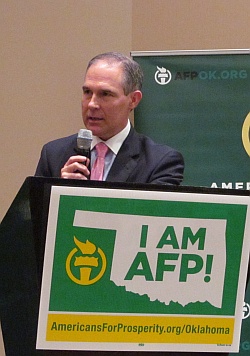 Friday, at Americans for Prosperity's Defending the American Dream Summit in Dallas, Oklahoma Attorney General Scott Pruitt sat down with the BatesLine team for a wide-ranging conversation about the issues that his office is pursuing on behalf of Oklahomans. Pruitt discussed the EPA's proposed expansion of the definition of "waters of the United States" which would put vast new territories under EPA regulation, the role and responsibilities of a state attorney general, and recent events affecting school choice and curriculum in Oklahoma. Pruitt also spoke at a panel discussion on the legal status of Obamacare and addressed a dinner for Oklahoma's 200 conferees, in which he also discussed the IRS's settlement of a lawsuit with the Freedom from Religion Foundation, affecting church tax exemptions and freedom of religion.
This entry is the first in a series. Many thanks to Americans for Prosperity Oklahoma and AFPOK Executive Director John Tidwell for the opportunity to attend and for arranging the interview with Attorney General Pruitt.
Earlier in the day, Pruitt addressed a well-attended panel session on Obamacare, its effects, and its legal status. His fellow panel members included Avik Roy of the Manhattan Institute, Christina Herrera of the Foundation for Government Accountability, and Simon Conway, British refugee and talk show host at WHO in Des Moines, who told us how the UK's National Health Service killed his father.
Pruitt spoke about Oklahoma's lawsuit, Oklahoma v. Burwell and Lew, which George Will has called the most consequential Obamacare case still pending. Oklahoma contends that the Affordable Care Act does not authorize IRS and HHS to grant subsidies or impose mandates in states that have not set up an exchange. Pruitt reviewed the timeline of Obamacare's passage and the importance of the "four little words" in Section 1311 -- "established by the state" -- to corralling the votes necessary to get Obamacare through the U. S. Senate. The four words were intended to give states the incentive to set up exchanges, but 34 states have refused.
Pruitt noted that, because Oklahoma's challenge was still at the District Court level when the Supreme Court handed down its ruling in NFIB v. Sibelius, Oklahoma was able to amend its suit. The focus of Oklahoma's case is not constitutional, but rather that the Federal Government's implementation of the law is in violation of the law passed by Congress and signed by the President.
At the moment, the case sits in the Eastern District of Oklahoma before Judge Ronald A. White. Asked by OCPAC's Charlie Meadows about the delay, Pruitt said it may be because the judge was waiting to see what the District of Columbia Circuit Court would do with Halbig v. Burwell. A panel of three judges in the DC Circuit Court ruled 2-1 that the plain language of the law authorized the subsidies and mandates only in states that established exchanges, in accord with Oklahoma's arguments. The ruling is stayed pending further appeals.
If Oklahoma's case is successful, Pruitt said that the very fines that Hobby Lobby had been facing had it lost its case ($1.2 million a day) would be overturned. The employer mandate is invalid in Oklahoma because Oklahoma has not set up an exchange.
MORE from my notes: During his morning presentation, Pruitt harked back to his service as a policymaker in the State Senate and pointed out that "health insurance does not equate to health care." Politicians like to brag about expanding coverage and eligibility, but "at the end of the day, you have to have a physician... willing to be paid for the service to deliver the care that's needed for that patient." Politicians can expand eligibility, but if reimbursement rates are too low, you have the kind of access problems we see in the UK. "We as conservatives need to remind the left that just by expanding health insurance doesn't mean that you've actually solved health outcomes." Pruitt said we also need to keep in mind that when the payor primarily becomes the government, medical inflation skyrockets.
During our interview, Pruitt elaborated on that point: The more government has become involved as payor, the system has become more bureaucratic, more costly, with a lower quality of care. He recalled Oklahoma's expansion of Medicaid eligibility under the Federal SCHIP program for families up to 200% of the poverty level, but at that time, as he remembers it, only two pediatricians in Tulsa were providing care under that program's reimbursement rates. More kids were eligible, but they couldn't get into see the doctor.
Pruitt asked why, if we had a system covering 85% of the public, we had to remake the system for 100%, rather than find a way that met the needs of the remaining 15%. The Obamacare system is moving us toward a two-tier system like that of the UK where your mandatory taxes and premiums pay for an insufficient service that limits access, but those who can afford to pay more can access higher-quality health care in a timely fashion. I pointed out that that's not unlike our two-tier education system, where parents who want better for their children pay twice -- tuition on top of the taxes they're forced to pay. That led into a discussion of Arne Duncan's revocation of Oklahoma's No Child Left Behind waiver and the court ruling against provisions of the Lindsey Nicole Henry Scholarship Act -- more about that in a future installment.
Happy Election Day! Polls open across Oklahoma at 7 a.m. and close at 7 p.m.
Results should start rolling in soon after 7 p.m. The Oklahoma State Election Board website will update results as they are received from the county election boards. Although results are posted on each precinct door shortly after the polls close, a precinct's results have to be taken to the county election board to be read into the state election computer system. Be aware that the county election boards will not process and transmit the tallies from individual precincts to the State Election Board computers until all absentee ballots (both in-person and by mail) are counted and posted. This was the cause for a significant delay in November 2012. Some media outlets may employ runners to go to the precincts directly in order to post initial results before Election Board numbers are ready.
A few resources as you go to vote:
- Oklahoma State Election Board website
- The OSEB voter tool will find your polling place, will show your sample ballot, your voter registration record, and the status of your absentee ballot. (NOTE: It does not include City of Tulsa races.)
- Tulsa County Election Board
- Tulsa County 2014 Primary sample ballots: If you know your precinct number from the OSEB voter tool, you can see sample ballots, including City of Tulsa races
- County election board locations and phone numbers (PDF)
- The BatesLine ballot card: My choices for the Republican and non-partisan primary. (But see below for specific runoff endorsements.)
- The BatesLine archive on Oklahoma Election 2014
- Oklahomans for Life candidate surveys
Here are my endorsements in GOP runoffs. You will notice that they are consistent with those of other conservative groups and diametrically opposed to the wheeler-dealer chambercrats and the Tulsa Whirled's still lamentably liberal editorial board.
U. S. House, 5th District: Steve Russell
Tulsa County District Attorney: Steve Kunzweiler
State House District 69: Chuck Strohm
State Senate District 40: Steve Kern
Also, the City of Broken Arrow has eight bond issues on the ballot. That's pretty sneaky, given the usual low turnout of a primary runoff election.
Republicans don't have any statewide runoffs, but Democrats have two. Freda Deskin and John Cox are the finalists to be the Democrat nominee for State Superintendent, and either State Sen. Connie Johnson and perennial candidate Jim Rogers will face Congressman James Lankford in November for the remaining two years of Sen. Tom Coburn's unexpired term.
Both parties have runoffs for the 5th Congressional District. Conservative groups across the state are backing State Sen. Steve Russell, a retired U. S. Army Lt. Col. who served in Kosovo, Kuwait, Afghanistan, and Iraq, leading a unit that was involved in the pursuit and capture of Saddam Hussein. As a legislator, Russell has earned Freshman of the Year and Legislator of the Year awards from the Oklahoma Conservative PAC (OCPAC). Russell's opponent, Corporation Commissioner Patrice Douglas, is regarded as aligned with wheeler-dealer chambercrats. Douglas has come under fire for a mail piece that gives the false impression that she has been endorsed by incumbent Congressman James Lankford.
Tulsa County Republicans will pick our new District Attorney today. I'm joining conservatives across the county to support Steve Kunzweiler, the only highly experienced and constitutionally and professionally qualified candidate in the race. As head of the criminal division, Kunzweiler has 24 years of experience as a prosecutor, oversees a team of 35 prosecutors and thousands of criminal cases every year. Kunzweiler works closely with law enforcement and legislators to improve the justice system by reforming laws and procedures. Kunzweiler has the endorsement of most of the Fraternal Order of Police lodges in Tulsa County.
His opponent, Sydney Fred Jordan, Jr., appears to be a legislator close to his term limit and looking for his next gig. Jordan has no experience as a prosecutor or supervisor of prosecutors in Oklahoma's criminal justice system. As an assistant majority leader, Jordan failed to reign in state spending and failed to reprioritize spending to relieve the overburdened budgets of the state's 27 DA offices. Some of us are still puzzled by Fred Jordan's 2006 answer to questions about the legal status of workers on one of his company's job sites.
More recently, in this current session, Fred Jordan was an outspoken leader of the effort to kill a key pro-life bill, a bill that would have reigned in the role currently played in the appointment of judges and justices by the Oklahoma affiliate of a very liberal private organization. The pro-life community believes the Oklahoma Bar Association's involvement skews the bench to toward leftist judicial activists; Jordan is evidently OK with that situation.
Two significant runoffs for legislature:
Here in Tulsa County's House District 69, conservative small businessman Chuck Strohm faces Melissa Abdo. Chuck Strohm opposes Common Core and has been endorsed by all the members of the board of Restore Oklahoma Public Education, the grassroots group that led the effort to repeal Common Core. Strohm has also been endorsed by the Oklahoma Second Amendment Association and County Assessor Ken Yazel. Strohm
Abdo has been endorsed by a pro-Common Core organization. Abdo also has the support of the county courthouse RINO brigade, including County Clerk Pat Key. If you want to evaluate Key's ability to discern character and qualifications of public officials, remember that Pat Key appointed Nancy Rothman as her chief deputy and put her in charge of most aspects of the office's operations. Abdo is also endorsed by former Commissioner Fred Perry, who voted to put the River Tax and Vision2 corporate welfare tax on the ballot and supported their passage.
In Oklahoma County, in Senate District 40, pastor Steve Kern is the conservative pick to replace term-limited Cliff Branan. His opponent, Ervin Yen, contributed $1,250 to liberal Democrat Andrew Rice's 2008 campaign to unseat Sen. Jim Inhofe.
If you run into any difficulty voting or spot any irregularity, contact your county election board. The phone number for the Tulsa County Election Board is 918-596-5780.
Take it away, Leon!
Bob Wills and His Texas Playboys perform "Election Day" by Cindy Walker in the movie Wyoming Hurricane, starring Russell Hayden. Leon McAuliffe on vocals; Cotton Thompson, Bob Wills, and Jesse Ashlock on fiddle, Junior Barnard on guitar, Luke Wills on bass. And from the same movie, here's Cotton Thompson to deliver Cindy Walker's message for many of our candidates:
I hear you talkin', yes, I do,
But your talk-talk-talkin' don't ring true,
I'm listenin' politely, too,
But I don't b'lieve a word you say.I hear you talkin', tellin' lies,
I can see it in those great big eyes.
I hear you talkin' wise,
But I don't b'lieve a word you say.You say that I'm your honey-love,
That I'm all you're thinkin' of,
I hear you talkin', dove,
But you ain't been foolin' me.
Posted in the wee hours of Tuesday, August 26, 2010. Postdated to remain at the top of the blog through poll closing time.
MORE: Paul Blair explains why he will never support any candidate that chooses to partner with AH Strategies or Majority Designs. The AH stands for founding partners Karl Ahlgren and Fount Holland; Ahlgren now serves as chief of staff to Congressman Markwayne Mullin. For similar reasons to Blair's, I pulled my endorsement of Preston Doerflinger for Tulsa auditor although I later relented. While I won't absolutely rule out support for a candidate who affiliates with those firms, it's two strikes against a candidate. Fred Jordan, Patrice Douglas, and Melissa Abdo are all clients of these firms in the current cycle.
In a state as strongly pro-life as Oklahoma, legislation to protect the unborn and pregnant women normally sails through to passage. But sometimes that legislation is stymied by judges. Although appeals court judges and supreme court justices are subject to a periodic retention vote of the people, I can't recall the last time that a judge has been removed by the voters. (District Judges, where candidates can challenge a sitting judge, are sometimes replaced by the voters.) A bill aimed at reducing pro-abortion influence on judicial selection was defeated in this year's session, and one of the candidates for Tulsa County District Attorney led the effort to defeat the pro-life bill.
Here's a press release from Oklahomans for Life:
Tulsa Rep. Fred Jordan Major Opponent of
Crucial Measure Strongly SUPPORTED by
Oklahomans For Life
The most damaging legislative defeat for the pro-life cause this spring occurred when the Oklahoma House of Representatives killed a resolution, SJR 21, which was strongly supported by Oklahomans For Life. Rep. Fred Jordan of Tulsa was a leading opponent of this measure which we strongly supported.
SJR 21 would have diminished the influence of the Oklahoma Bar Association in the selection of judges for Oklahoma's highest courts. The background:
1) The American Bar Association has an official position in support of legal abortion on demand, paid for at taxpayer expense;
2) The Oklahoma Bar Association is a member of the American Bar Association;
3) The Oklahoma Bar Association exercises a heavy influence over who sits on Oklahoma's highest courts;
4) Oklahoma courts have repeatedly struck down pro-life laws, overturning even the most modest, reasonable legislative attempts to regulate abortion;
5) SJR 21 would have diminished the influence of the Oklahoma Bar Association over the selection of nominees for vacancies on Oklahoma's highest courts.
Pro-life laws enacted by the Oklahoma legislature have been consistent with the U.S. and Oklahoma Constitutions, and with U.S. Supreme Court precedents - nonetheless, Oklahoma judges selected for nomination to the bench through the influence of the Bar Association have repeatedly nullified these pro-life laws.
Our efforts to improve this situation by enacting SJR 21 were thwarted, in part, by Rep. Fred Jordan on the floor of the Oklahoma House. Fred Jordan placed himself at the center of the opposition to this much-needed legislation by assuming the role of chief debater against this critically important measure, giving the closing arguments in opposition to SJR 21, and thereby advocating the continuation of the system which has brought such harm to the unborn child.
While the Senate, the Governor, and the House Republican Leadership all supported the effort to establish a better system for filling judicial vacancies with fair-minded, unbiased judges, Rep. Fred Jordan actively engaged in the killing of this vitally essential measure on the House floor. The defeat of SJR 21 was the most damaging pro-life loss of the year.
Tony Lauinger, State Chairman
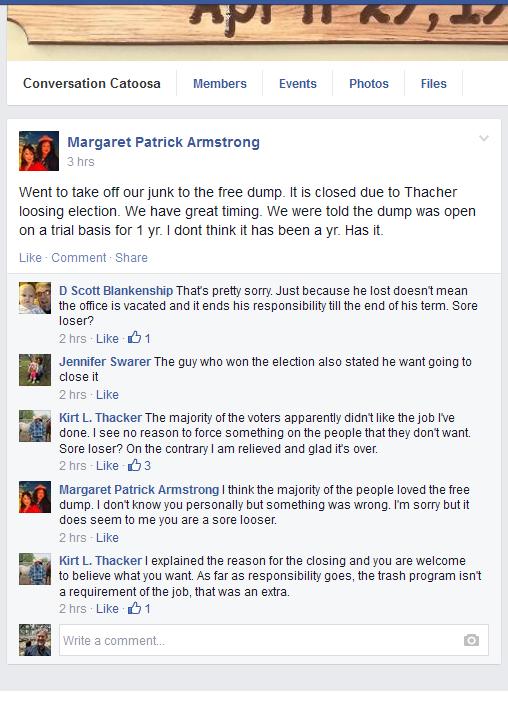
It seems that ousted Rogers County District 3 Commissioner Kirt Thacker is just gonna take his ball and go home. On Tuesday, Thacker lost the Republican primary to Ron Burrows in an election with higher than normal turnout. Burrows goes on to face a Democrat opponent in November.
A member of the Conversation Catoosa Facebook group reported that, on the day after the election, she went to the free dump that Thacker had established and found that it was closed.
Thacker's reply to the report and to comments on the report:
The majority of the voters apparently didn't like the job I've done. I see no reason to force something on the people that they don't want. Sore loser? On the contrary I am relieved and glad it's over....I explained the reason for the closing and you are welcome to believe what you want. As far as responsibility goes, the trash program isn't a requirement of the job, that was an extra.
I hadn't followed Rogers County politics closely until a friend of ours (Treasurer-elect Jason Carini) filed for office. I listened to audio of the May 29, 2014, Catoosa candidate forum (courtesy Oklahoma Constitution reporter Theodore King), including the part of the forum devoted to the Rogers County Commission candidates. Thacker was asked if there were any plans to close the free dump. "I have no plans whatsoever to close it." He said that prior to establishing the dump, he would get a call about a large abandoned item, and he'd have to pull his crews off of their assignments to go pick it up. With the dump, those calls have decreased from three or four times per week to two calls per month. The dump is funded through grants from the Association of County Commissioners, with no local funding required.
20140529-RogersCountyForum-03-Commissioner-Dump.mp3
In his response to the same question, Burrows praised the dump and the reduction in roadside trash. He wants to expand the program by having jail trusties pick up roadside trash in the district.
If Thacker has a grant to operate the dump, doesn't he have an obligation to keep it open or else return the money?
UPDATE 1: Thacker answers the question on Facebook: "The fiscal year ends on June 30. The grant has ran it's course."
OK, but wouldn't he have already applied for a grant for the upcoming fiscal year?
UPDATE 2: On Facebook, Thacker answered that question: "Nope."
I asked, "But at the May 29 forum, you said that you had no plans whatsoever to close it. Most grants take some time to prepare, submit, and process. You hadn't started the grant application process at all?"
Plans change. This grant is easy and fast to prepare thru the Association of County Commissioners. I am a "Lame Duck" so for the remainder of the term we will concentrate on road work. The required part of the job.
What an interesting night!
I had been at the watch party for Randy Brogdon, Ken Yazel, David Brumbaugh, and Chuck Strohm. The mood there was generally upbeat: Yazel had survived another establishment attempt to knock him off, winning re-election to another four-year term as County Assessor and Courthouse Gadfly with 64.8% of the vote. Brumbaugh won renomination to represent House District 76 with almost 75% of the vote. Strohm, running for the open House District 69 seat to replace Sydney Fred Jordan Jr, finished second but made the runoff.
Brogdon delivered an upbeat speech before the results began to come in and was as upbeat even after it was clear that no miracle was in the offing. He mentioned that he would be a grandfather for the first time later this year and urged the audience to continue to fight for liberty and for fiscal sanity for the sake of generations to come. He was, as always, a gracious gentleman. I've never seen him otherwise.
It was a pretty good night for the BatesLine ballot card.
Ken Yazel's re-election and sizeable margin was especially heartening.
My friend Jason Carini will be the new Rogers County Treasurer. He got into the race because no one else would run, and he wound up defeating a six-term incumbent. The incumbent DA and District 1 County Commissioner were both tossed out as well.
Republican DA Brian Kuester (Wagoner, Cherokee, Sequoyah, Adair Counties) won re-election by a wide margin. (No Democrat filed in an area that was once part of solid-Democrat Little Dixie.)
In the Tulsa County DA race, Steve Kunzweiler finished first with 46.8% and received a majority of the votes that were cast for the two actively-campaigning candidates, but State Sen. Brian Crain, who dropped out, got 13%. Jordan could gracefully drop out at this point, as Cathy Keating did in the 2001 special Congressional primary, but if he doesn't, it looks like there will have to be a runoff with the question of Jordan's eligibility still looming. (Could the State Election Board revisit eligibility at this point, as they certify the result of this election? Or must the court intervene? Will the court enjoin the State Election Board from certifying Jordan as a candidate for the runoff?)
For the first time in many years, a statewide incumbent official finished last in the primary. State Superintenden Janet Barresi not only finished behind Joy Hofmeister, who won the GOP nomination without a runoff, but she was beat by Brian Kelly, an also-ran four years ago. Some say that the last time something like this happened was 40 years ago, when scandal-tarred Gov. David Hall finished third to David Boren and Clem McSpadden in the 1974 Democrat primary. With 22% of the vote, Barresi wasn't beat quite as badly as Tulsa County Commissioner Randi Miller in 2008, but it was close.
Congratulations to City Councilors Jack Henderson, Jeannie Cue, and Blake Ewing, all of whom won re-election without a runoff. Ewing's principal opponent, Dewey Bartlett Jr's 2013 campaign manager Dan Patten, who raised $15,000 before the deadline, won 15% of the vote, not do much better than political novice Elissa Kay Harvill, who raised so little she didn't have to file paperwork, but won 6%.
In District 7, Republican incumbent Arianna Moore finished second to Democrat Anna America in the non-partisan primary, but there will be a runoff. Jonathan Turley finished a close third. Moore and America will face off in November, when partisan fervor is likely to energize Republicans and demoralize Democrats, at least here in the Sooner State.
It was not a good night for national Tea Party organizations. Mark McDaniel lost narrowly to decrepit incumbent Thad Cochran in the Mississippi Republican runoff for U. S. Senate. An important political difference between Oklahoma and Mississippi is that Oklahoma has party registration while Mississippi doesn't. In Oklahoma, if you're a Democrat or Independent on April 1, you can't become a Republican until September 1. In Mississippi, you may have voted in every Democrat primary for decades, but as long as you didn't take a Democrat ballot in the primary, you can take a Republican ballot in the runoff. Oklahoma's system is more consistent with the idea of a political organization choosing its own standard-bearer.
I've got a lot to say about the Oklahoma Senate race and why the national Tea Party groups failed to get their choice elected, but I'm too tired tonight.
And now, your moment of zen:
After many enjoyable conversations at the Brogdon/Yazel watch party, I drove into town to a coffeehouse to write this report and get a bite to eat. As I sat down, Paul Tay, candidate for Tulsa City Council District 9, who had been outside, walked in and made a determined beeline for my table. Not far behind him was Mike Workman, local Democrat activist and Labor Commissioner nominee. They had been at the Constance Johnson Tulsa watch party.
Tay, resplendent in a cowboy hat with an NRA sticker on the front, explained to me that his November opponent, Councilor G. T. Bynum, was overqualified for the Council, and what Bynum needs to do is leave the City Council, make a hard-right ideological turn, and prepare to run to replace Jim Inhofe in the U. S. Senate in six years. Why? Because Bynum in the Senate is the only way we'll get a federal earmark to pay for new low-water dams in the Arkansas River. The taxpayers won't pay for it, George Kaiser won't pay for it, so that leaves Uncle Sam.
The idea displays some insight, although Oklahoma conservatives wouldn't be likely to approve a candidate who supports earmarks, and Bynum has already burned several bridges with local conservatives. Local government is more often than not the graveyard of political careers. (Inhofe is a rare exception, but he lost re-election to a fourth two-year term as mayor in 1984 before a successful run for an open seat in Congress in 1986.) After a few minutes, Workman thoughtfully pointed out to Tay that I was probably writing on deadline and the two left.
Results should start rolling in soon after 7 p.m. The Oklahoma State Election Board website will update results as they are received from the county election boards. Although results are posted on each precinct door shortly after the polls close, a precinct's results have to be taken to the county election board to be read into the state election computer system. Be aware that the county election boards will not process and transmit the tallies from individual precincts to the State Election Board computers until all absentee ballots (both in-person and by mail) are counted and posted. This was the cause for a significant delay in November 2012. Some media outlets may employ runners to go to the precincts directly in order to post initial results before Election Board numbers are ready.
A few resources as you go to vote:
- Oklahoma State Election Board website
- The OSEB voter tool will find your polling place, will show your sample ballot, your voter registration record, and the status of your absentee ballot. (NOTE: It does not include City of Tulsa races.)
- Tulsa County Election Board
- Tulsa County 2014 Primary sample ballots: If you know your precinct number from the OSEB voter tool, you can see sample ballots, including City of Tulsa races
- County election board locations and phone numbers (PDF)
- The BatesLine ballot card: My choices for the Republican and non-partisan primary.
- The BatesLine archive on Oklahoma Election 2014
- Oklahomans for Life candidate surveys
Happy Election Day! Polls open across Oklahoma at 7 a.m. and close at 7 p.m.
If you run into any difficulty voting or spot any irregularity, contact your county election board. The phone number for the Tulsa County Election Board is 918-596-5780.
Take it away, Leon!
Bob Wills and His Texas Playboys perform "Election Day" by Cindy Walker in the movie Wyoming Hurricane, starring Russell Hayden. Leon McAuliffe on vocals; Cotton Thompson, Bob Wills, and Jesse Ashlock on fiddle, Junior Barnard on guitar, Luke Wills on bass. And from the same movie, here's Cotton Thompson to deliver Cindy Walker's message for many of our candidates:
I hear you talkin', yes, I do,
But your talk-talk-talkin' don't ring true,
I'm listenin' politely, too,
But I don't b'lieve a word you say.I hear you talkin', tellin' lies,
I can see it in those great big eyes.
I hear you talkin' wise,
But I don't b'lieve a word you say.You say that I'm your honey-love,
That I'm all you're thinkin' of,
I hear you talkin', dove,
But you ain't been foolin' me.
Posted in the wee hours of Tuesday, June 26, 2010. Postdated to remain at the top of the blog through poll closing time.
MORE: For your amusement, the story of when Mary Fallin's first husband proposed to her -- at the Playboy Mansion.
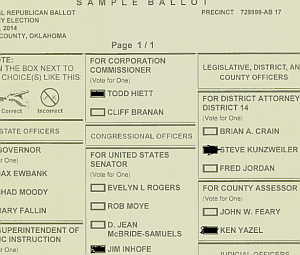 Here are the candidates I'm recommending and voting for (when I can) in the Oklahoma primary elections on June 24, 2014. (This entry will change as I decide to add more detail or discuss additional races between now and election day. The entry is post-dated to keep it at the top.)
For your convenience, here's a printable one-page "cheat sheet" version to take along to the polls and pass along to friends, but please read the detail and click the links below.
U. S. Senate (unexpired term): Randy Brogdon. He's running a low-key campaign, but he has a consistent record of a conservative approach to government as city councilor, mayor, and state senator. There's a runoff, so there's no need to cast a tactical vote for one of the two front-runners. Vote your conscience. Vote for someone we know we can trust to do the right thing.
U. S. Senate (full term): Jim Inhofe. He annoys the left, particularly with his refusal to kneel to climate deniers (i.e., the anthropogenic global warming cultists who deny the Medieval Warm Period and deny the current stability of global temperatures). Good enough for me.
Governor: Dax Ewbank. While Gov. Mary Fallin eventually did the right thing on Obamacare exchanges and Common Core, her dithering on these clear-cut issues makes me worry about her decision-making in a lame-duck term. Fallin failed to establish a good working relationship with her own party's legislative leadership, culminating in her veto snit-fit, in which she killed several good bills, including some she'd requested, to make some sort of point. Fallin never took a stand against the National Popular Vote compact, a left-wing dream that had been slipped through the Oklahoma Senate early in the session. (More about NPV here.)
I don't believe Fallin deserves another term, but I'm not sure the other candidates have the resources to defeat the lone Democrat candidate, Joe Dorman, in November. I will likely cast a protest vote for Dax Ewbank, an IT professional and former pastor who calls for abolishing the state income tax. UPDATE: I'm not even sure Fallin is strong enough to win in November. At the very least she needs a wake-up call, and a guy whose name sounds like a Star Trek character seems to be the person to deliver it.
State Superintendent: Joy Hofmeister. Janet Barresi has made enemies across the political spectrum. Conservatives don't like her support for Common Core. Liberal public school administrators don't want to be held accountable by her school grading system. Those same administrators have heavily funded Joy Hofmeister's campaign, and Hofmeister's emails to some of those administrators at their official school email accounts display considerable hostility to school choice programs, including the Lindsay Nicole Henry Scholarship program that allows children with special needs to receive the education they need. I will likely cast a protest vote for Brian Kelly, the third candidate in the Republican primary. UPDATE: Conservatives I trust, including the ladies who led the fight to kill Common Core in Oklahoma, have convinced me that Barresi is not a friend of conservative, locally-controlled reform of public education and that Hofmeister, thoughtful and principled enough to oppose Common Core despite the alienation of some of her early supporters, is trustworthy. That remains to be seen, but at the moment Hofmeister seems to be the only hope we have.
Insurance Commissioner: John Doak. The incumbent has done a fine job representing Oklahoma's ratepayers in their dealings with insurers.
Corporation Commissioner: Former Speaker Todd Hiett. A good rule of thumb is to vote for the Corporation Commission candidate with the smallest bankroll. As one of my friends put it -- Hiett is a square-dealer, Branan is a wheeler-dealer. Hiett was an honorable and honest Speaker of the House. Hiett has been endorsed by State Auditor Gary Jones, who has worked closely with both candidates over the years. Hiett opposes mandatory smart meters.
The other candidate, State Sen. Cliff Branan, is backed by bajillionaires who might have an interest in regulating certain energy sources out of existence. Branan is one of the doofuses who voted in favor of the National Popular Vote Compact, SB 906 and has never apologized, as far as I am aware. Branan has also been endorsed by Ed Apple, who wanted to replace Bob Anthony, a beacon of courage and integrity at the Corporation Commission, with a Democrat utility company lobbyist. While there are a few good people backing Branan, many more people I trust are endorsing Hiett.
Senate District 12: John Knecht. The incumbent, President Pro Tempore Brian Bingman, voted for the National Popular Vote compact and allowed it to slide through the Senate before the public knew what was happening.
House District 31: Jason Murphey. An IT professional, Murphey has received national recognition for his efforts to modernize and streamline state government's use of computer technology and to make public information more readily available to the public online. He is a principled conservative who doesn't take any gifts from lobbyists.
House District 69: Chuck Strohm This is an open seat that will be decided in the GOP primary. Strohm is a software engineer, a member of the Jenks Planning Commission and school bond oversight committee, and is the grassroots conservative candidate in the race. Strohm authored the county GOP's precinct organization manual. His chief opponent has names on her reports that link her to the Chambercrat wing of the party.
House District 76: David Brumbaugh. Incumbent Rep. Brumbaugh has been a consistent conservative voice for Broken Arrow. He deserves particular praise for putting forward a bill to to require counties to include all funds in their annual budgets. Brumbaugh was one of eight legislators to receive a 100% on the Oklahoma Constitution's annual conservative index.
House District 98: Terri Cleveland. This is an open seat in Wagoner County that includes Broken Arrow and Coweta and will be decided in the GOP primary. I've known Terri through Republican Party politics for over a decade, working together on many campaigns and committees. After working as a campaign and organizational consultant, she went to work for the City of Broken Arrow, representing the concerns of this growing city at the state capitol. Her opponent, Michael Rogers, is heavily funded by special interest PACs, but he has the endorsement of outgoing incumbent John Trebilcock and the Oklahoma Conservative PAC.
Tulsa County District Attorney: Steve Kunzweiler. With 24 years of experience as a prosecutor, Steve Kunzweiler is the Chief of the Criminal Division in the DA's office, mentoring 35 assistant DAs and overseeing the prosecution of thousands of criminal cases every year, over 12,000 in 2013 alone. His opponent is a legislator in search of his next gig and doesn't appear to be eligible to serve.
Tulsa County Assessor: Ken Yazel. In the State Auditor's annual review, Yazel's team has the highest rating of any county assessor office in the state. The only stalwart ally for fiscal conservatives at the county courthouse, Yazel has pushed for full financial transparency, including all county funds in the annual budget (like Oklahoma County does), not just new general fund money. The county officials who back his opponent have resisted that idea, even lobbying against it at the State Capitol.
Tulsa County Commissioner District 1: Brian Pounds. Northern and eastern Tulsa County needs a change in this office. Pounds has county courthouse experience from his work in the assessor's office. The incumbent wasted taxpayer time and money by putting two ill-advised tax packages on the ballot, taxes that were ultimately shot down by the voters. Rather than taking the challenge to fund criminal justice needs without raising taxes, he voted to put a county sales tax hike on the ballot instead. The incumbent is said to have been a ringleader of the resistance to total county budget transparency.
Rogers County Treasurer: Jason Carini. Carini, a successful small-business owner and lifelong conservative Republican, is challenging an incompetent incumbent who hasn't issued tax warrants at any time during her 23 years in office.
District Attorney, Adair, Cherokee, Sequoyah, and Wagoner Counties: Brian Kuester. Kuester is finishing his first term as DA of this district that sprawls from the suburbs of Tulsa to the suburbs of Fort Smith and has achieved a 200% increase in the number of cases tried.
Tulsa City Council District 2: Jeannie Cue. Cue is a voice at City Hall for the neighborhoods of her district, particularly the oft-forgotten west side of the river.
Tulsa City Council District 4: Blake Ewing. Ewing has been a leader on the City Council. He is unafraid to ask the questions that need to be asked of the mayor and department heads. As we approach the adoption of a new zoning code, Tulsa's historic neighborhoods need Blake Ewing at the table. Ewing understands land use and planning issues as a homeowner, as a businessman invested in reviving District 4 neighborhoods, and as a student of what makes a city grow and prosper.
Ewing's chief rival, Dan Patten, was Dewey Bartlett Jr's campaign manager. When the mayor's campaign manager decides to run against the mayor's leading critic, the campaign manager has the burden of proof to show that he's not just running at the behest of his client. At a recent forum, Patten seemed not to have any understanding of the purpose or history of land-use planning.
Ewing's endorsement of Kathy Taylor was disappointing, but the alternative was Bartlett Jr, who had also endorsed Taylor for re-election on the strength of her first-term performance. When Bartlett Jr alienates one set of city councilors, manages to defeat nearly all of them at the polls, and then alienates the new set of city councilors who replaced them, it's apparent where the problem lies. Ewing also points out that it was Bartlett, not Taylor, that pushed for the Vision2 corporate welfare slush fund.
Elissa Harvill, a newcomer to Tulsa politics, displayed admirable enthusiasm and a strong foundation of principle during the TulsaNow forum. What's missing, at this early point in her time in Tulsa, is knowledge of the particulars of Tulsa history and governance. As she gets involved and learns her way around, I expect she'll make many positive contributions to our civic dialogue.
Tulsa City Council District 7: Arianna Moore. Republican incumbent Moore's leading challenger is liberal Democrat Anna America, Kathy Taylor's campaign manager.
District 14 District Judge, Office 14: Kurt Glassco. Despite his background as a Democratic candidate for Congress many years ago, Judge Glassco is well-regarded by conservative Republican attorneys as a fair and skillful arbiter. John Eagleton writes: "Judge Glassco has my respect. I have appeared in his court and observed him handling hundreds of cases. He is a great judge. He follows the law without injecting personalities into the outcome. We need more judges like him."
One of his opponents, Jill Webb, is the "partner" of Unitarian clergyperson Tamara Lebak. Question for the reader: If someone would twist the words of Scripture and disregard the consensus of all civilized societies in order to justify sexual perversion, is it reasonable to expect them to show due regard for our state's laws, constitution, and judicial precedent?
MORE: The ladies who led the fight to repeal Common Core in Oklahoma have posted their personal endorsements. All four like Dax Ewbank for Governor; three of the four support Brogdon for Senate (the fourth supports USAO Professor Kevin Crow); three of the four back Steve Russell in the 5th Congressional District (the fourth supports Harvey Sparks); and all four want Robert Hubbard to unseat incumbent Frank Lucas in the 3rd Congressional District.
The Oklahomans for Life 2014 primary candidate questionnaire is online. There are separate sets of questions for state and federal candidates, and you can read the full text of the questions to which the candidates are responding.
OCPAC head Charlie Meadows has posted his personal picks. He wants to see all three incumbent GOP congressmen who drew challengers -- Mullin, Lucas, and Cole -- replaced by their challengers.
NOTE: Tulsa County Assessor Ken Yazel was on 1170 KFAQ with Pat Campbell and Eddie Huff at 7:35 a.m. Tuesday.
UPDATE 2014/06/25: In an 8-1 decision today (Winchester dissenting), the Oklahoma Supreme Court overturned the Court of Civil Appealsand remanded the property tax appeals to be considered on their merits. The Supreme Court affirmed that the Legislature has given County Assessors the authority to use their general counsel for appeals, rather than being shackled to counsel supplied by the District Attorney's office or the Oklahoma Tax Commission. For Yazel, who won re-election with 65% of the vote, this is icing on the cake.
Tulsa County Assessor Ken Yazel's challenger has made an issue of Yazel's 2012 decision against Montereau's application for a total exemption from ad valorem taxes. The fair market value of the upscale senior residential complex was estimated at $178,990,029. Yazel validated that 40% of the facility was legally qualified for tax exemption as a state-licensed continuum of care facility, based on the proportion of the facility devoted to those 154 licensed beds, but the remainder -- independent living apartments and cottage homes that require an entrance fee ranging from $198,000 to $1.2 million just to get in the door, plus a monthly fee in the thousands -- was taxable under state law, with a tax bill of over $1.5 million.
Montereau protested Yazel's decision, won in district court, and Yazel, as authorized by state law, appealed to the Court of Civil Appeals (COCA).
Yazel's opponent has described Yazel's pursuit of the appeal a "waste of resources." The simple version of his argument as I understand it, is that, because state law specifically grants an exemption for state-licensed continuum of care facilities, the entire property should be exempted from ad valorem taxes. The counterargument is that taxable property shouldn't be exempt because it sits on the same parcel as property that is exempt.
While Montereau and the William K. Warren Medical Research Center (WKWMRC, which owns the land and leases it to Montereau) are both 501(c)(3) non-profits, not every activity of a non-profit is exempt from all taxes under Oklahoma law. Article X, Section 6 of the Oklahoma Constitution exempts "property used exclusively for religious and religious purposes" as well as government-owned property, free museums, and several other specifically enumerated exemptions. State statutes grant other exemptions. As far as I can tell, none of the constitutional or statutory exemptions cover market-rate housing. However much he might want to, the County Assessor can't grant an exemption that isn't authorized by law.
(Yazel's opponent, John Feary, has received a significant amount of his reported campaign funds -- $10,150 out of $36,311 by my count -- from Warren family members, Warren Foundation and Montereau board members, a Montereau executive, and (judging by the addresses) a couple of Montereau residents. Montereau and WKWMRC were created by the William K. Warren Foundation.)
Tulsa County taxpayers have a great deal at stake. If Montereau is right, property owners will have a strong incentive to take otherwise taxable uses off the tax rolls by lumping them in with a relatively minuscule tax-exempt use. That means the burden of paying for property-tax-funded government (schools, libraries, county operations, city and school bond issues, etc.) will fall more heavily on the rest of us.
This is particularly true for the sinking funds that pay back the general obligation bond issues that fund projects like streets and school improvements. The millage rate for sinking funds is calculated by dividing the debt service requirements for the year by the assessed value of property in the jurisdiction. It's basic fractions: If the denominator goes down (by removing property from the tax rolls) while the numerator stays the same, the millage rate goes up on the property still on the tax rolls. This means a tax increase even for seniors who have a valuation freeze. If Montereau gets its exemption, seniors who can afford expensive Montereau accommodations will benefit at the expense of seniors living in their own modest homes and younger property owners decades from retirement.
By fighting this battle, Ken Yazel is fighting to keep our tax rates from going up. With all due appreciation for the Warren Foundation and the institutions spawned by it and affirming their right to pursue their legal remedies vigorously, Oklahoma property taxpayers had better hope that Yazel prevails in this case.
At this point, however, Yazel is blocked from pursuing this fight by COCA's bizarre theory that he can't appeal without using an attorney from the District Attorney's office. Yazel filed his appeal using the general counsel that he is authorized to hire under 19 O.S. 527. The law was passed in 2005, recognizing that certain county offices needed legal expertise in technical areas to carry out their duties, and that such expertise may not reside in the DA's office.
COCA has taken a statute that requires the DA's office to assist the assessor in pursuing an appeal and turned it into an effective veto over the assessor's judgment. Yazel has appealed COCA's ruling to the Oklahoma Supreme Court, which has granted certiorari. (Yazel's petition has a copy of COCA's ruling attached.) In an amicus curiae brief in support of Yazel's position, attorneys for the County Assessors Association of Oklahoma and County Officers and Deputies Association of Oklahoma write:
In effect the COCA's decision would allow the district attorney or the Oklahoma Tax Commission to determine the issues of ad valorem tax law to the exclusion of the judicial branch of government. COCA's decision would eviscerate the power invested in the judicial branch to say what the law is, while closing the courthouse doors and leaving no effective remedy for an assessor to fulfill his or responsibilities absent district attorney approval.
The brief goes on to show that COCA's ruling contradicts numerous precedents.
In its published decision, the COCA effectively held that the failure, unwillingness or inability of a district attorney to fulfill its duty to represent an assessor under § 2880.1(D) somehow extinguishes an assessor's right to appeal under § 2880.1(A), thereby preventing the assessor from fulfilling his or her duties in connection with the assessment and collection of ad valorem tax. There simply is not, nor has there ever been, any language in what is now § 2880.1 suggesting that an assessor's right to appeal is conditioned upon the district attorney's review of a tax case and that district attorney's willingness to appear in such appeals on the assessor's behalf. The COCA's decision is plainly contrary to the decisions of this Court holding that courts are "not free to rewrite the statute" and must "vigorously resist reading words or elements into a statute that do not appear on its face.
In footnotes to the above paragraph, the brief lists "four occasions [in which] this Court has decided appeals under § 2880.1 or its predecessor statutes where no district attorney had entered an appearance." The amicus brief also quotes the court's ruling in a "situation strikingly similar to that in this case" (1980 OK 96, 614 P.2d 45, 06/17/1980, State ex rel. Howard v. Oklahoma Corp. Commission):
The foregoing language of Article IX s 20 does not bar Commission's attorneys from appearing for it. It clearly is implicit from the language of 74 O.S.1971 s 18c that the ... Commission may appoint its own in-house counsel.Likewise, the right to be represented by counsel ordinarily should include the right to make a choice, if timely exercised, of attorneys whose views are consonant with one's own or who at least will present the client's interests....
If then, the Commission may be brought into court . . . , Sections 6 and 7 of Article 2 of our State Constitution, . . . under any concept of affording it any semblance of even-handed justice, must require that it be represented if it so desires, by counsel who can and will ably and conscientiously express its views to the tribunal. . .. Commission may properly be represented in this case by its own in-house counsel (employee-attorneys).
The right to counsel undergirds all our other rights. If someone can force an attorney on me who may work to thwart my aims, I really don't have legal counsel at all. If an elected official is forced to rely on counsel at odds with him, it ultimately thwarts the will of the voters who elected that official.
To me, COCA's ruling looks like the latest example of an attempt to control an elected official's performance of his duties by denying him legal counsel to support the actions he believes he needs to take. This entry is long enough already without delving into the efforts by the Cockroach Caucus to prevent the Tulsa City Council from hiring its own attorney, forcing the Council to rely on the Mayor-appointed City Attorney, even when the Mayor's aims and the Council's aims are at odds.
A candidate runs on a platform and once elected, if he has integrity, he implements that platform. Sometimes he will need legal advice to know how to proceed or to deal with legal challenges from opponents to his policies. This is especially important when the official is a reformer, sent by the voters to change the way government operates; he will encounter resistance from those whose interests are aligned with the status quo.
Just as a besieged army uses trenches, mines, and razor wire as multiple lines of defense against an attacking force, so the defenders of the political status quo have multiple ways to block reform. The first layer is to use campaign money to persuade voters to keep the reformer out of office. If a reformer manages to win an election, they can attempt to co-opt him. If that fails, they can launch a PR campaign attacking the reformer as a petty bickerer or worse. They can attempt to entice and entrap him in wrongdoing. They can exert pressure via friends and family. They can sue him and then deny him access to counsel.
Voters need to realize that the forces denying legal counsel to the elected official are not merely thwarting the elected official but the voters who put him in office.
The precedent set by the Oklahoma Supreme Court, quoted above, is crystal clear. If the Supreme Court is consistent, Yazel will be allowed to pursue his appeal and the original issue -- does a tax exemption rub off on the taxable uses attached to the exempt use? -- will be considered and resolved. If voters are wise today, we'll still have Ken Yazel as Tulsa County Assessor to pursue this fight on behalf of taxpayers and his fellow county officials all across Oklahoma.
MORE: A few more notes regarding the discussion on Monday's Pat Campbell show:
I've looked at all the Budget Board minutes available online, going back to July 2011. Most Budget Board meetings appear to be routine and brief, with votes to approve retroactively a long list of appropriations that have already been made. Ken Yazel has personally attended all Budget Board meetings at which the budget for the upcoming fiscal year's budget was discussed or significant adjustments to the budget were discussed. Like every other Budget Board member has done, Yazel sends his chief deputy to attend when he is unable to be present. Only twice in the last three years, at routine meetings, has no one been present to represent the assessor's office.
According to Yazel, the Tulsa County Assessor's Office headcount is ten below the number recommended for a jurisdiction the size of Tulsa County. While Oklahoma County has more parcels, it has, as the capital city, a much larger number of tax-exempt government-owned parcels, which are not assessed at all. Large swaths of northern and eastern Oklahoma County consist of undeveloped property; bare land requires less effort to assess than real estate with improvements.
Regarding the Vision 2025 surplus funds: The projected grand total revenues, as of September 2013, totaled $730.5 million. That's about $195 million more than the $535 million in projects approved in 2003. This accounting of remaining Vision 2025 obligations, cash on hand, and projected revenue from December 31, 2013, shows a projected surplus of $35.7 million. If you add back in the $45.5 million that was "promised" to the suburbs in exchange for the extra $45.5 million for the BOK Center (a promise whose existence was denied during the 2007 River Tax debate), that's $81.2 million, plenty to have handled our criminal justice needs without a tax hike.
A couple of weeks ago, I discussed Tulsa County's lack of budget transparency -- not illegal, but not in the taxpayers' best interest, and not as good as Oklahoma County. In my endorsement of Yazel, I discussed the different colors of money and how millages and budgets could be adjusted to meet county needs without raising taxes, if the County Commissioners had the political will to do so.
Dear James Lankford, your scaremongering about a runoff to raise money is shameful. Unless the nominee is caught in a Minneapolis airport restroom with a wide stance, there is no way the GOP will lose Tom Coburn's seat. Your November opponent will either be a very liberal pro-abortion state senator who proposed frivolous amendments to a pro-life bill, the perennial candidate who ran against Coburn in 2010 and got only 26% of the vote, or the perennial candidate who listed his occupation as "plasma donor" when he filed for State Senate in 2004. If any of those three potential opponents worries you, you either don't have the guts to represent us in Washington, or you have plans for a Minneapolis restroom rendezvous.
Three of the seven candidates in this race have experience in elective office -- a member of the U. S. House, a former mayor and leader in the State Senate who has run a statewide campaign, and a former Speaker of the State House. It's normal for a primary with three credible candidates to go to a runoff.
P. S. Tom Coburn has not endorsed you to succeed him, although you are trying very hard to give voters that impression. Coburn expressed dismay about the bad things independent groups are saying about you, and Coburn expressed dismay about the bad things your independent-expenditure pals are saying about one of your six opponents.
Dear judicial candidate Jill Webb: A quote from Mary Fallin and a reference to the Constitution on a postcard is not going to fool conservative Tulsa County voters into voting for the female "partner" of a female Unitarian minister, endorsed by the Gay and Lesbian Victory Fund, to be a District Judge. Bill Clinton, Barack Obama, Nancy Pelosi, and Harry Reid have all sworn to uphold and defend the Constitution, but their actions show that they redefine the meaning of that commitment in a way that would be unrecognizable to the Framers of the Constitution. Your Clintonesque account of your personal life ("happily married to a minister") seems plainly intended to create a false impression, and it suggests that you have a rather flexible relationship with "telling the truth, the whole truth, and nothing but the truth."
If you want my vote for Tulsa City Council, one of the worst things you can do is tell me that former Mayor Susan Savage wants you to win. Savage was one of the worst mayors we've had when it comes to neighborhood empowerment and sensible zoning. Yes, she encouraged the registering of neighborhood associations, but she and her team worked against neighborhoods trying to build effective influence at City Hall over zoning issues that affected their property value and quality of life. Ask residents of Maple Ridge Central about how the Savage administration thwarted their efforts to protect their historic neighborhood. Her 1997 "Tulsa Project" plan would have sacrificed the area we now call the East End or Hodge's Bend to become a parking lot of a soccer stadium. That proposed tax increase failed, as did her tax hike proposal in 2000. While she brought speakers to Tulsa to talk about urban design, she didn't expend the political capital to move any ideas forward, not if it risked alienating her Chambercrat and developer backers. Ultimately, it took the neighborhood-friendly Gang of Five City Councilors to fund a new comprehensive plan. The most Savage would do was to fund three pilot small-area plans; fifteen years later we're still fighting resistance to implementing the recommendations of those plans.
Another thing you can do to make me regret my endorsement is to send a letter that refers to the "constant petty bickering" of the 2009-2011 City Council. The reality is that the nine councilors got along very well with one another and worked together across partisan lines. The problem, from Dewey Jr's point of view, is that they were united in their distress with Dewey Jr's actions and his refusal to build a cooperative working relationship. So Dewey Jr and his Chamber and developer buddies promoted the "petty bickering" meme and redrew the district lines to separate these councilors from the citizens who knew and appreciated them. The same people who wanted them gone want you gone, too, and for the same reasons.
There is a repeating pattern: A new reformer comes to the Council and arrogantly thinks, "The reason my bozo predecessors got tossed is they refused to be intelligent and polite in their approach. I'm going to be intelligent and polite and everyone will love me and accept my ideas." Guess what? Your "bozo" predecessors thought the same thing about their predecessors. No, the problem is that their ideas and your ideas are threatening to certain special interests, and they will paint you as a troublemaker and a petty bickerer so that low-information voters can't wait to toss you out of office.
To repeat what I wrote five years ago:
Lakin's critique of some current councilors reminds me of what I've heard from other councilors in the past about their predecessors. The gist of it: "If they'd just be nicer, people would pay more attention to the substance of what they're saying." Many of the councilors who have said that in the past have later learned the hard way that as soon as you challenge the power or the budget of some entrenched interest, everyone will think you aren't nice, no matter how nicely you make your case. The newspaper will run pictures that make you look angry. The mayor will accuse you of bickering. And then some council candidate will come along and tell you that if you'd just be nicer, people would pay more attention to the substance of what you're saying.
Have some respect for the councilors who blazed this trail before you. Because of their willingness to take risks and endure ridicule and defamation, the Overton Window is open a little wider for you.
And finally: If your bulk-mail house doesn't know how to remove duplicates from your address list, you need to get a better bulk-mail house, one who won't waste your mailing and printing budget.
 National Review has a wonderful history of the effort to pull Oklahoma out of the Common Core curriculum and the four women who spearheaded it.
[Jenni] White has spent the past four years telling Parent Teacher Organizations and anyone else who would listen that Oklahoma should not implement Common Core, the education standards that most of the country adopted in 2010.She hasn't been working alone. "Our organization is made up of a board that just consists of four of us moms basically," White says, referring to her cohorts Julia Seay, Lynn Habluetzel, and Joy Collins. "We have bankrolled the whole thing out of our poor husbands' bank accounts."
Ask anyone in Oklahoma politics who they think led the successful fight to repeal Common Core -- Governor Mary Fallin signed the repeal into law on June 5 -- and they'll tell you that the story starts with this foursome. White served as the writer and spokeswoman for the group, which operates under the auspices of their LLC, Restore Oklahoma's Public Education (ROPE). Together, the women have spent the past four years talking to Republican-party leaders, attending conservative conferences, and lobbying state legislators. Most of all, though, they cultivated a grassroots political movement against Common Core that overcame a bipartisan coalition ranging from the Department of Education to the Chamber of Commerce. By May 2014, a poll conducted on behalf of a Republican candidate showed that 57 percent of likely primary voters held an unfavorable view of the standards while only 9 percent had a favorable view.
In short, the four moms fought the proverbial city hall and won. "Look at Eric Cantor, seriously," White suggested. "Some guy who had $300,000 beat him. You don't think that kind of thing is possible when people have had enough?"
To explain how states became willing to surrender control over their own curriculum, State Sen. Josh Brecheen drew an unusual analogy:
A rancher by trade, he compared the states that scrambled for federal funding to the feral hogs he has to bait and trap. "You get them dependent on a free handout long enough, and you can get them in that live trap," Brecheen told NRO. "What's happened to states is the same thing as what you would see in that scenario. We've been baited, and we've surrendered our freedom because of a free handout. And I think Oklahomans became aware of that, and that's why we've had success this session."
The article points out that Common Core wasn't just a danger to local control of public schools, but to private schools and homeschoolers as well:
They met with county Republican groups and tea-party organizations but found especially willing supporters among homeschoolers in the state. That might seem unusual, since homeschooled kids don't attend the public schools that would be governed by Common Core, but their involvement points to one result of combining model national standards with model national tests: The companies that write curricula modify their products to comply with Common Core."The options for homeschoolers have been greatly reduced," Brecheen says. "Ultimately, Common Core is a national market for services in education. It's a national marketplace. . . . When 45 states do one thing, then you no longer have experimentation with anything else."
Other interesting points in the story:
- How massive parental opposition to the Reading Sufficiency Act spilled over into Common Core opposition.
- How the initiative of these Oklahoma moms led to a Republican National Committee resolution against Common Core, through the work of Oklahoma RNC member Carolyn McLarty, and how that helped the lobbying effort at the State Capitol.
- Speaker T. W. Shannon's role: Was his refusal to advance an anti-Common Core bill in 2013 tactical brilliance -- keeping a bill from getting killed before the support was strong enough to pass it -- or craven cowardice? (MORE: Here's Jenni White's account of Shannon's role and Shannon's reaction.)
- Gov. Mary Fallin's refusal to meet with Common Core opponents and her superficial gesture.
- How ROPE mobilized to ensure state senators heard their protests.
- The legislative maneuvers required to get around roadblocks in the State Senate.
MORE:
Jenni White responds to U. S. Secretary of Education Arne Duncan's fulminations against Oklahoma's rejection of Common Core.
It's interesting how quickly the anti-Common Core forces, once vilified as "conspiracy theorists", "fearmongers" and "liars" have become vindicated since -- and by Duncan's own hand no less. Duncan's latest temper tantrum can't help but make it readily apparent to even the passing skeptic that there must be something to the legions of arguments connecting Common Core and federal overreach into public education....Oklahoma -- and the other 49 states -- got along for hundreds of years without education via national standards offered as carrots for federal programming dollars. In fact, it wasn't until 1970 -- after the first real federal intervention into local public education (President Johnson's Elementary and Secondary Education Act) -- that America saw the beginning of the tremendous decline in public education we fight today.
In a personal blog post, Jenni White talks about State Superintendent candidate Joy Hofmeister and contrasts Hofmeister's response to ROPE's efforts against Common Core to that of incumbent Superintendent Janet Barresi:
No, Joy did not come out whaling away against Common Core when she began her campaign for superintendent. This frustrated many of our ROPE friends. I understand their perspective, but it's important to remember what perspective is and that there are frequently multiple views of the same issue. As I talked to Joy about Common Core, it became very clear she was not going to move the way a group wanted, she was going to continue researching until she could make the decision on her own. The implied hypocrisy in the statement "She was for it before she was against it" is completely ridiculous. I was an atheist at one point in my life. Now I am a follower of Jesus Christ. So, I can't grow into a relationship with the Lord? This argument is sound for anyone who considers themselves to be an educable individual on any issue at any level.Our current superintendent has shown she is not educable. She knows what's right and by Hell or high water, she's going to do that/those thing/s.
That is not Joy. Joy will study, deliberate, debate and discuss before she comes to a conclusion. In my experience she's not going to be led around by the nose, or decide she has the only solution, she's going to work to find her true north and move in that direction.
And finally, Jenni White's perspective on State Superintendent Janet Barresi. White worked with her at the charter school Barresi founded, volunteered for the 2010 Barresi campaign, then ran into a brick wall trying to get a hearing from Barresi on Common Core. She explains why ROPE is calling for Barresi's defeat and why Barresi doesn't deserve conservative support.
Here is a playlist of videos from TulsaNow's June 4, 2014, Tulsa City Council District 4 candidate forum. Incumbent Blake Ewing and challengers Danny Patten and Elissa Kay Harvill participated in the forum.
Former Tulsa County Republican Party Chairman J. B. Alexander has announced his endorsement of Brian Pounds, Republican candidate for Tulsa County Commissioner District 1. Pounds is challenging two-term incumbent John Smaligo. The district covers northern and eastern Tulsa County, including Owasso, Skiatook, Sperry, Collinsville, north and east Tulsa.
In his endorsement, Alexander points out that Brian Pounds has been endorsed by the Tulsa County Deputy Sheriff FOP and the Owasso FOP. Alexander reviews Smaligo's record and explains why Smaligo needs replacing and why Pounds should be the one to take his place. I agree.
The state of Oklahoma has the lowest taxes of any of the surrounding states. Yet Tulsa County has the second highest taxes of any county in the surrounding states. That's just not right.Over the past 7 years John Smaligo has a proven track record of wanting to keep our taxes high. In 2012 he led the county commissioner's support of the failed Vision 2 tax increase.
If you will remember Vision 2 was a thirteen year, $748 million tax package (the amount was based on a zero percent growth. Using the past ten year growth rate the amount would have been close to $1 billion).
This tax package included borrowing money FOUR years before the revenues would be coming in. Since we would have been borrowing the money yearly payments would be required. So this package also included borrowing the yearly payments for those four years until the revenues started coming in. That's like charging something on your credit card knowing you couldn't make the monthly payments until next year so you take out a loan to make the monthly payments...paying interest on all of this. Sounds like Washington, DC, tactics.
John Smaligo also is claiming credit for getting 1,000 new jobs with the Macy's warehouse development west of Owasso. What he is not telling you are most of those jobs are part-time, no benefit positions. And taxpayers are paying Macy's to move here at the upfront cost of $2 million.
If Tulsa County is going to work to attract new businesses who are looking for lower taxes we need someone who is not a career politician and understands working class folks.
Brian Pounds is just that person. Brian has worked in the Tulsa County Assessor's office for the past thirteen years and is a reserve deputy for the Tulsa County Sheriff's office. He is married to Judy Pounds who is an 18 year veteran of the Tulsa County Sheriff's office. Brian and Judy live in Owasso and have two daughters, Tabitha Wood and Ashley Pounds. Tabitha is a five year veteran of the Tulsa County Sheriff's office and a Senior Airman with the 138th Fighter Wing of the Oklahoma Air National Guard. Brian is also a veteran of the US Army.
Brian has received the endorsements of the Tulsa County Deputy Sheriffs Fraternal Order of Police and the Owasso Fraternal Order of Police.
Brian is a person who has spent his life serving those in need and will continue that dedication once elected as a Tulsa County Commissioner. He believes that tax dollars should be spent on Public Safety and Infrastructure needs first and would work hard to lower our high tax rate.
If we are going to get Tulsa County recognized as a low tax county that will attract small and large businesses then we need Brian Pounds as our District 1 county commissioner.
Next Tuesday vote for Brian Pounds for County Commissioner.
 I don't often comment on other jurisdictions, but this is a race worthy of note, and the best candidate is someone I've known personally for many years, someone I can endorse with unqualified enthusiasm. I urge my Rogers County readers to vote for Jason Carini as County Treasurer on June 24, 2014. The race will be settled in the Republican primary.
The Carini family has been a part of our church family for many years, and we've seen firsthand the deep roots of Jason Carini's conservative principles, Christian faith, and interest in public policy. Jason has a degree in public policy from Patrick Henry College and played a key role in Tom Coburn's first race for U. S. Senate in 2004. Jason and I have had many after-church chats about politics and government -- not just the latest developments, but also about the bigger picture and the long run.
But Jason Carini also knows there's more to life than politics. About five years ago he established a small business, Green Country Mowing and Landscaping. He and his wife Jessica own a home in Catoosa, where Jason grew up, and they have a two-year-old daughter and a newborn son.
Carini has grown his business to six employees, debt-free and with a high customer retention rate. Carini understands that diligent and courteous service are what bring customers back and keep them from leaving for a competitor. You have to pay attention to detail, and you have to follow through on your commitments. That understanding is often absent from government offices, where the "customer" has nowhere else to go. Rogers County residents need Carini's service-oriented attitude, honed in the private sector, in the County Treasurer's office.
Jason Carini would have been happy to stay in the private sector, but when an incompetent incumbent failed to draw a challenger, Carini answered the call.
At a May 29, 2014, candidate forum, incumbent Rogers County Treasurer Cathy Pinkerton-Baker admitted that, in her 23 years in office, she has never issued warrants to collect delinquent taxes. I'm no fan of high taxes, but the county treasurer's job isn't to decide whether a tax is appropriate or at the right level. The treasurer's job is to collect taxes owed and to take certain legally required steps if taxes are not paid in a timely manner. It hurts law-abiding taxpayers if other taxpayers face no penalties for failure to pay.
A county treasurer also has an obligation to maintain diligent control over funds and data. The State Auditor's annual reports and county audits have called out Pinkerton-Baker for failing to ensure that every financial transaction has proper oversight, for failing to plan for data recovery after a disaster, and for failing to enforce sound data security procedures, and for making personal use of county property.
In her response to deficiencies identified in the just-released audit covering Fiscal Year 2012-2013, Pinkerton-Baker claims that she is addressing each issue, but there's no way to know for sure until the next audit is released next year.
Rogers County is one of Oklahoma's fastest growing counties. Since incumbent Rogers County Treasurer Cathy Pinkerton-Baker was first elected in 1990, the population has grown from 55,170 to an estimated 89,044 last year, from 10th place to 6th place. The population will likely pass 100,000 in this decade. Once mainly populated by residents of small towns and acreages, the county has sprouted suburban subdivisions filled with Tulsa commuters. Citizens have a rightful expectation that government officials will be professional. The sloppy, good-ol'-boy approach to government is no longer acceptable (not that it ever was).
As Rogers County has grown, its voter profile has changed as well. When incumbent Treasurer Cathy Pinkerton-Baker was first elected in 1990, Republicans were a tiny minority. As of January 2014, 51.6% of Rogers County voters are registered Republican. Apparently responding to the shift in the political winds, Pinkerton-Baker, daughter of a former Democratic Wagoner County Commissioner, switched parties from Democrat to Republican about a year ago. (Even liberal newspaper editor John Wylie has switched his registration, so he can have a vote in county races. Unsurprisingly, the recently Democratic editor has endorsed the recently Democratic treasurer for re-election.)
Rogers County has a choice between a principled conservative and a convenient convert, between a small businessman who will diligently follow the law and a career bureaucrat who has carelessly ignored the law for decades. Jason Carini is the right choice for Rogers County Treasurer.
MORE:
Courtesy Oklahoma Constitution reporter Theodore King, here are audio clips of the Rogers County Treasurer candidates at the May 29, 2014, candidate forum. (He did not have audio of the opening statements, but all other answers and statements by the treasurer candidates are linked below.)
"When did you become a Republican?" Pinkerton-Baker said she became a Republican only a year ago. Carini registered Republican when he turned 18.
"What experience outside of your current role will help you fulfill your role as County Treasurer?" Pinkerton-Baker mentioned service on legislative committees and involvement in the Round-Up Club. Carini discussed his five years of experience serving customers as a small-business owner. Carini also pointed out that prior to her 23 years as County Treasurer, Pinkerton-Baker worked in government for an additional 13 years.
"What are your plans for addressing the State Auditor's findings concerning internal controls and segregation of duties?" Carini noted that this is not a one-time finding, but it has been repeated year after year. Rogers County has the size to assign sufficient personnel to properly segregate duties. Pinkerton-Baker excused her county because 74 other counties don't comply.
"What can the treasurer's office do to help increase county funding sources?" Pinkerton-Baker acknowledged that she had not issued tax warrants during her 23 years in office. Carini pointed out that, in previous last seven years alone, uncollected taxes totaled roughly $1.5 million.
Closing statements from Carini and Pinkerton-Baker.
MORE:
State Auditor reports for Fiscal Years 2010 through 2013:
2010 State Auditor's Report on Rogers County Treasurer's Office
2011 State Auditor's Report on Rogers County Treasurer's Office
2012 State Auditor's Report on Rogers County Treasurer's Office
2013 State Auditor's Report on Rogers County Treasurer's Office
FY 2010 Audit of Rogers County
FY 2011 Audit of Rogers County
FY 2012 Audit of Rogers County
FY 2013 Audit of Rogers County
 Terry Simonson was on 1170 KFAQ with Pat Campbell this morning, arguing the case for State Rep. Fred Jordan's eligibility to be elected District Attorney. Simonson's LinkedIn profile indicates that he is the Director of Governmental Affairs for the Tulsa County Sheriff's Office and the President/Owner of Pathways Consulting & Government Relations, LLC.
(MORE: Assistant DA Steve Kunzweiler, who filed the petition to resolve the eligibility issue, called into KFAQ later Tuesday morning. Listen online at the link.)
Simonson assumed, incorrectly, that I looked only at statutory and constitutional language and not at case law in researching my article on the ineligibility of Fred Jordan to be District Attorney. In fact, every page of statute and constitution and court opinion on OSCN has links at the bottom of the page to cases and Attorney General opinions in which the provision is cited, so it's easy to see how courts have interpreted the law over the years. I've also had conversations with attorneys who have brought relevant cases and AG opinions to my attention.
There's no dispute about when Jordan's term expires. It's clearly set out in 14 O.S. 137 as November 19, 2014. The question is when the new DA would be considered elected.
Addressing Simonson's specific points:
1. Had Simonson read Steve Kunzweiler's petition before calling in, he would have seen that it was being brought to the District Court for Oklahoma County. The first paragraph states that venue is proper in Oklahoma County under 12 O.S. 133 and 12 O. S. 1653, as the case involves an official action of the Oklahoma State Election Board, which is situated in Oklahoma County. The State Supreme Court is not involved at this point.
2. This issue couldn't have been settled four weeks ago, because it only became an issue two weeks ago, on June 3, when Gov. Fallin signed HJR 1096, causing the emoluments of the District Attorney to increase. It was only at that point that Jordan and Crain officially became ineligible under Article V, Section 23. (When the measure passed the Senate on May 23, having already passed the House, Crain saw the handwriting on the wall and stepped aside.)
3. This issue doesn't affect State Rep. Joe Dorman, a candidate for Governor, because the bill in question did not increase the Governor's salary. In fact, HJR 1096 Section 3 amends 74 O. S. 250.4 subparagraph 1 to exclude the Governor's salary from increasing as a result of the increase in judicial salaries (the underlined language was added to the law by HJR 1096):
1. The Governor shall receive a salary equal to the salary received by the Chief Justice of the Oklahoma Supreme Court; provided however, the Governor shall not receive any increase in salary as a result of the provisions of Section 1 of this resolution;
The same section of the measure also explicitly excludes all other statewide elected officials from receiving a pay raise. The same sort of language could have been added to exclude District Attorneys from the pay raise, but it was not.
4. Simonson claims that the DA is not elected until the canvassing of votes by the Legislature after the organization of the House in January, after Jordan's term as a State Representative expires. He cited Gragg v. Dudley (1930 OK 280), which cites Article VI, Section 5. Article VI covers the state's executive officers, which are enumerated in
Section 1(A):
A. The Executive authority of the state shall be vested in a Governor, Lieutenant Governor, Secretary of State, State Auditor and Inspector, Attorney General, State Treasurer, Superintendent of Public Instruction, Commissioner of Labor, Commissioner of Insurance and other officers provided by law and this Constitution, each of whom shall keep his office and public records, books and papers at the seat of government, and shall perform such duties as may be designated in this Constitution or prescribed by law.
Nothing in Article VI deals with District Attorneys. Gragg v. Dudley involved a legislator seeking the office of Lieutenant Governor, which is listed by name in the above section as one of the state's executive officers.
Note that each of these officers, both explicitly listed and named by implication, is required by the State Constitution to "keep his office and public records, books and papers at the seat of government." The seat of government is specified in Article V, Section 26, as the place the Legislature is required to meet in regular session. In fact, the Gragg v. Dudley ruling cites that very provision. 73 O.S. 1 declares that "The seat of government and capitol of the State of Oklahoma shall be and is hereby established at Oklahoma City, in the county of Oklahoma, in the said state...."
Clearly, the District Attorney for District 14 (Tulsa County) does not keep his office, public records, books, or papers in Oklahoma City. At the time Gragg v. Dudley was decided, the office of District Attorney did not exist. There were County Attorneys in Oklahoma until 1967, when the district system came into effect, under which most DAs serve multiple counties. Despite that change, District Attorneys still have a significant connection to county government, as the office is created under Title 19 (Counties and County Officers), and the DA must provide legal advice and defense to county officers and employees in the conduct of their duties, while the counties provide the DA's office space, including utilities and maintenance.
The DA's offices are, therefore, in the county courthouses for the counties in his district. In District 14, there is one county, Tulsa, and one DA's office, in the Tulsa County Courthouse, not in Oklahoma City. District Attorney is, therefore, not an office covered by Article VI, and the requirements of Article VI, Section 5, cited in Gragg v. Dudley would not apply.
Note also that on our ballots, the District Attorney's race appears under "Legislative, District, and County Officers," along with the race for County Assessor and County Commissioner, and not under "State Officers."
Also, 26 O.S. 5-102 lists those offices for which candidates are required to file with the State Election Board, and district attorney is listed separately from state officers:
Candidates for United States Senator, United States Representative, state officer, State Senator, State Representative, district judge, associate district judge and district attorney shall file Declarations of Candidacy with the Secretary of the State Election Board.
While "state officer" is sometimes defined differently for the purposes of a specific section of the law, here, in the context of election, it must mean only the statewide elective offices, as legislators, judges, and district attorneys are listed separately.
5. 19 O.S. 215.20 says that the term of the District Attorney's office begins "on the first Monday of January following his election." Article V, Section 26, of the Constitution says (emphasis added)
The Legislature shall also meet in regular session at the seat of government on the First Tuesday after the First Monday in January of each odd numbered year, beginning at twelve o'clock noon for the purposes only of performing the duties as required by Section 5 of Article VI of the Constitution and organizing pursuant to the provisions of this Article and shall recess not later than five o'clock p.m. of that same day until the following first Monday in February of the same year, beginning at twelve o'clock noon.
If a District Attorney is not elected until January 6, 2015, as Simonson claims, his term of office could not begin until January 4, 2016.
6. So when is a District Attorney elected? For every office other than those listed in Article VI, a candidate is given a certificate of election by the appropriate election board -- state election board for legislative and district officers, county election board for county and municipal officers.
26 O.S. 8-103 says:
The county election board shall certify a list of successful candidates for county offices and shall provide Certificates of Election to the same following the General Election, except that Certificates of Election may be issued to unopposed candidates after 5 p.m. on the second day following the close of the filing period. The State Election Board shall certify a list of successful candidates for offices for which the Board accepts filings of Declarations of Candidacy and shall provide Certificates of Election to the same following the General Election, except that Certificates of Election may be issued to unopposed candidates after 5 p.m. on the second day following the close of the filing period.
According to 26 O.S. 8-108, those certificates would be issued at 5 p.m. Friday after the general election, barring any contest that would affect the DA's race. Since the last possible vote in the DA's race will happen on August 26, any recounts and contests will have been resolved long before November 7 at 5:00 pm, when the State Election Board will issue a certificate of election, 12 days before the end of Jordan's term as a member of the State House.
 Seven candidates have filed to complete the final two years of U. S. Senator Tom Coburn's term, but if you were to follow the news coverage you might think there were only two candidates in the race.
Three of the seven have been elected officials: Former State Sen. Randy Brogdon, U. S. Rep. James Lankford, and State Rep. T. W. Shannon, the former Speaker of the Oklahoma House. The other four candidates are each interesting in their own way, and I may write about them in a later entry.
Six of the seven candidates profess to be in line with the conservative views and values of Oklahoma Republicans on all the key issues of the day. Our decision on June 24th comes down to which one we can trust to maintain consistency with those views in the face of heavy pressure, which one will not be coopted by the Inside the Beltway culture of favor-trading and corporate welfare.
One candidate of the seven has a long record of consistency standing for the rights of Oklahoma taxpayers. Whatever the merits of the other candidates, Randy Brogdon has earned our trust.
Brogdon, a small-business owner in the heat and air industry, was elected in 1998 to the Owasso City Council and was elected as Mayor by his fellow city councilors. In 2002 he was elected to the State Senate, serving two terms and earning the highest ratings possible from conservative groups.
Brogdon was the leading advocate for the Taxpayer's Bill of Rights (TABOR) initiative, a popular measure that was scuttled by special interest litigation. He led the effort to pull Oklahoma out of the effort to build the eminent domain nightmare known as the NAFTA Superhighway through the state. A champion for privacy rights, he led Oklahoma to opt out of the Real ID Act. In 2010, he authored SQ 756, the Oklahoma Healthcare Freedom Amendment. He was one of the few Republican elected officials with the courage to stand consistently with grassroots Tulsa County Republicans against ill-considered boondoggles funded by sales tax increases.
In his 2010 run for governor, Brogdon finished strongly in his home base, winning Tulsa County and surrounding counties in his primary race against Mary Fallin, but he failed to break through in the rest of the state.
Some readers will point out that Brogdon is polling in the single digits. He has been outflanked by T. W. Shannon, who has actively pursued endorsements from conservative national groups and politicians. Local Tea Party leaders and conservative activists have objected loudly to the anointing of Shannon as the grassroots candidate, as the outside groups and politicians didn't bother to talk to locals who know these candidates best.
Brogdon seems to have an aversion to asking for endorsements and support. As an example, even though I knocked doors for Brogdon in 2010, I've not received any contact from the campaign asking for my help this year. This is Campaigning 101: Keep a list of supporters from past runs and reach out to them to help again. People are busy, potential volunteers and donors are swamped with requests from candidates, and if a candidate doesn't ask for help, he isn't going to get it.
Nevertheless, Randy Brogdon is the one candidate I know I can trust to do the right thing consistently in Washington, and thanks to our runoff system, I don't have to vote for a lower-ranked choice in this primary. Unlike some elections, this one doesn't require a tactical vote. I don't notice a bandwagon effect for either Lankford or Shannon. The leading candidates are close enough in the polls that it's unlikely that either will win outright, which means that I might have to choose between Lankford and Shannon in the August runoff. But if enough people realize that they don't have to cast a tactical vote, if they take a closer look at the candidates' records, if they are put off by the back and forth of negative ads between Shannon and Lankford and their respective "dark money" allies, Brogdon might make it into the runoff.
No matter who wins the nomination, there is no realistic danger of a Democrat winning this seat, given how out of sync the Democratic field is with Oklahoma's political values. (Liberal Oklahoma City State Sen. Connie Johnson is the leading Democrat in the race.)
Even if Shannon or Lankford won the primary outright, it would hardly be a tragedy for conservatives. Charlie Meadows of the Oklahoma Conservative PAC had kind words for both after his group gave their endorsement to Randy Brogdon. But here's how Meadows summed up OCPAC's support for Brogdon:
When it comes to Randy Brogdon, the bio is conservative, consistent and reliable. He finished 8 years in the legislature with a lifetime Conservative Index Score of 93, a remarkable feat. He was the first Republican SENATOR to score a perfect 100 on the Index in modern times and he did that in his second year in the legislature and in a few more years following.On more than one occasion Brogdon used his reasoning skills to persuade his fellow Republican Senators to at least consider the moral arguments on issues. He was an effective lawmaker and earned the trust of the grassroots activists across the state. In the 3 years he served Insurance Commissioner Doak, he worked hard to make the agency lean and efficient. It is in his bones, Brogdon has always been about reducing the size of government and liberty.
In closing, the down side for Brogdon is that he got started late in this effort, especially after switching from the Governor's race to this Senate race. Though he has raised more money and faster than he has anticipated, his funds come from the grass roots and they can never produce the kind of money the "folks in tall buildings" provide. Often times the wealthy contribute because they want something from government and expect elected officials to ask how high when they tell them to jump. On the other hand, the grass roots contribute because they believe in a cause.
Bottom line, I believe Brogdon got the OCPAC nod because the people TRUST him, his whole time in government has been about limiting government and expanding liberty. The grassroots people know he will not be beholden to what I lovingly call the "Oklahoma Mafia", the rich and powerful who happen to be more into fascist capitalism and central planning rather than free market capitalism.
Next Tuesday I'm voting for a candidate with a long record of consistent conservative governance. I'm voting for someone we can trust to represent Oklahoma values faithfully in Washington. I hope you'll join me in voting for Randy Brogdon to be Oklahoma's next U. S. Senator.
MORE:
Brian Ervin's 2007 profile of Randy Brogdon.
Paul Jacob praises Randy Brogdon during his 2010 run for Governor.
Fivethirtyeight has an analysis of the Oklahoma race that captures the subtleties and appropriately notes Brogdon as a local Tea Party favorite and a factor in the race. They also note SoonerPoll's problems in past Oklahoma Republican primary elections. (Right after the 2010 primary, Oklahoma native and pollster Chris Wilson wrote about polling failures in that election.)
Steve Kunzweiler, the Assistant DA seeking the open Tulsa County District Attorney's seat, has filed a petition in Oklahoma County District Court seeking a ruling on the eligibility of his two opponents in the June 24, 2014, GOP primary. A legislative action taken after the April filing period made the two legislators in the race constitutionally ineligible to be elected or appointed to the job, under Article V, Section 23, of the Oklahoma Constitution. One of the two, State Sen. Brian Crain, has withdrawn from the race, but the other, State Rep. Fred Jordan, refuses to withdraw.
The heart of the question is when the legislative term ends and when the DA is considered elected. Jordan's term does not end until November 19, 2014, but the new DA will be elected prior to that date.
Kunzweiler is asking the court to rule that Crain and Jordan are both ineligible and that neither can be certified as elected. Kunzweiler notes, "The office of District Attorney is too important to public safety to risk a period of disruption and confusion. The election of a constitutionally prohibited candidate to the office could call into question and subject to legal challenge every official act taken by the newly-elected Tulsa County District Attorney."
Here is a press release from the Kunzweiler campaign:
FOR IMMEDIATE RELEASEDA candidate Steve Kunzweiler asks court to declare opponents Fred Jordan and Brian Crain ineligible to be elected DA
TULSA, Okla., June 16, 2014 - Republican Candidate for District Attorney Steve Kunzweiler today filed a petition in Oklahoma County District Court asking the court to declare candidates Fred Jordan and Brian Crain ineligible to be elected Tulsa County District Attorney.
The action claims Kunzweiler is entitled to a declaratory judgment finding:
a. That Crain and Jordan are constitutionally prohibited from being elected to the Office of Tulsa County District Attorney pursuant to Article V, Section 23 of the Oklahoma Constitution; and
b. That the state Board of Election is constitutionally prohibited from certifying either Crain or Jordan as elected to the Office of District Attorney.
Kunzweiler's petition cites the Oklahoma State Constitution's prohibition against Legislators increasing pay of an elected official and then seeking election to that office while they are legislators.
State Representative Fred Jordan and State Sen. Brian Crain are candidates for DA along with Kunzweiler. On May 23, 2014, the Legislature voted to increase the pay of state judges and district attorneys. Sen. Crain then publicly acknowledged that the action prohibits him from seeking the DA office and suspended his campaign, although his name remains on the ballot. Jordan claims that the prohibition does not apply to him and has continued campaigning for the office.
On June 3, 2014 Governor Mary Fallin signed HJR 1096 into law, rendering both Jordan and Crain ineligible for election. The Oklahoma Constitution Article V, Section 23 provides:
No member of the Legislature shall, during the term for which he was elected, be appointed or elected to any office or commission in the State, which shall have been created, or the emoluments of which shall have been increased, during his term of office . . .According to Kunzweiler's petition, the election of a constitutionally prohibited candidate would call into question every official act of the Office of Tulsa County District Attorney.
Kunzweiler, an Assistant District Attorney in Tulsa County and a 24-year prosecutor, said, "I did not ask to be put in this position. Since the governor signed this into law, I have asked many different attorneys to research the law to determine whether Jordan could be considered eligible for election. After consultation with them, it is clear to me that Jordan's candidacy violates both the spirit and the letter of the law. The Oklahoma Constitution clearly states this," Kunzweiler said."The actions of the Oklahoma Legislature - of which Jordan is a Majority leader - put me in this position. I took an oath of office to uphold the Oklahoma and US Constitutions. It is my duty and my obligation under the Constitution of Oklahoma to raise this issue and to resolve it," Kunzweiler said.
"The office of District Attorney is too important to public safety to risk a period of disruption and confusion. The election of a constitutionally prohibited candidate to the office could call into question and subject to legal challenge every official act taken by the newly-elected Tulsa County District Attorney beginning January 1, 2015. Our citizens need to be protected without interruption. Based upon Oklahoma's Constitution, it is apparent that neither Jordan nor Crain can be elected or appointed to the Office of Tulsa County District Attorney come January 1, 2015.
"I honor and respect State Senator Brian Crain, who recognized that he could no longer run for this office based upon the pay increase. He announced that he was withdrawing from the election. That was the correct thing to do because it was required by Oklahoma's Constitution," Kunzweiler said. "Jordan is also subject to the same Constitutional prohibition that Senator Crain faced."
"As I said at the outset - I am a prosecutor - not a politician. As a prosecutor I am obligated to follow the rule of law. I am sworn to uphold our Constitution. I am doing what the law requires me to do."
MORE: Steve Kunzweiler's petition to the Oklahoma County District Court regarding eligibility of candidates for Tulsa County District Attorney.
 After 16 years in office, Tulsa County District Attorney Tim Harris is stepping down. Three Republican candidates filed to replace him, but one candidate quit the race because of a constitutional impediment to his election, and a second candidate should stand down for the same reason, but he refuses to do so, risking a protracted legal battle should he win. Our next district attorney will be chosen by voters in the June 24, 2014, Republican primary.
Happily for Tulsa County citizens, the one candidate in the race who is unquestionably eligible to serve is Assistant District Attorney Steve Kunzweiler, who is the most qualified, by experience and temperament, to serve as District Attorney.
There are three aspects to the District Attorney's job: Prosecuting criminals, mentoring and managing a team of prosecutors, and partnering with public officials and community leaders to advance the cause of justice. Steve Kunzweiler is the only candidate with extensive and current experience in every aspect of the DA's job.
With 24 years of experience as a prosecutor, Steve Kunzweiler is the Chief of the Criminal Division in the DA's office, mentoring 35 assistant DAs and overseeing the prosecution of thousands of criminal cases every year, over 12,000 in 2013 alone. Beyond the courtroom, Kunzweiler works with legislators, police departments, victims, and community leaders to provide training and improve the process so that bad guys receive their just punishment and Tulsa County residents are safer.
One example of Kunzweiler's innovative approach to his job is his advocacy for the use of therapy dogs to accompany child abuse victims when they testify in court. A courtroom can be a frightening place to a child, particularly when arguments get heated and voices are raised. In the past, an adult counselor has sometimes been allowed to sit with a child witness, but that raises concerns that the adult might prompt the child's testimony. That could open the door to exclusion of the child's testimony and the acquittal of an abuser or to the conviction of a wrongly accused defendant.
 Steve Kunzweiler's solution is to have a therapy dog accompany the child in the witness box. The dog can't offer any prompts. These dogs are selected for a calm temperament and trained to remain calm in the midst of commotion. They reassure the child that all is well, even in this strange environment. Kunzweiler writes on his website:
When a child witness is accompanied to court by a dog that he or she has bonded with in pretrial preparations, the effects are immediate and profound. The trust, acceptance, and tactile comfort of a friendly dog changes the physiology of the nervous child. Human heart rate decreases and blood pressure falls in the presence of therapy dogs. The child may simply feel safer to recall past events, even with an audience of strange adults in the courtroom.
During the just-ended legislative session, Steve Kunzweiler worked with State Rep. Pam Peterson to pass a law authorizing the use of therapy dogs statewide. Kunzweiler has also successfully worked with legislators to add many other reforms to criminal law: expanding the statute of limitations for the reporting of child abuse, increasing the range of punishment for drunk driving offenders who seriously injure their victims, allowing the introduction of hearsay evidence for developmentally delayed children, allowing repeat child abusers to be impeached with their prior crimes.
While Kunzweiler works effectively with the legislative process, he is new to electoral politics. He is a Republican and a conservative, but his focus has been his calling as a prosecutor and a leader of prosecutors, rather than partisan politics. Some politicians have sought the DA's office as a platform for running for governor or congress, but Kunzweiler has no ambitions beyond being able to continue to pursue his vocation as a prosecutor. Steve Kunzweiler sees himself as the next DA in a long line of non-politician DAs, like Buddy Fallis, David L. Moss, and Tim Harris.
Steve Kunzweiler's family life underscores his conservative temperament. He has been married for 25 years to Dr. Christine Kunzweiler, a veterinarian. Steve, Christine, and their three daughters are active members of Christ the King Catholic Parish. Steve earned his undergraduate degree at the University of Missouri then came to Tulsa to earn his law degree at the University of Tulsa Law School in 1988. He's been here ever since.
A recent article about Kunzweiler gives you a sense of his heart for his vocation:
He has an old, ragged file in a desk drawer, labeled "This is Why I Do It!" The folder is bursting with pictures of people he's fought for in court - a 10-year-old girl in her cheerleader uniform. An 18-year-old in a baseball uniform with a bat on his shoulder. A proud tuxedo-clad papa walking his daughter down the aisle in a wedding gown.The photos depict happy, smiling people enjoying life, often on some of the most important days of their lives - graduation, weddings, family celebrations. The photos
are reminders to Kunzweiler that the victims had dreams and goals and active lives that were stolen from them and from their families."Too many times, the criminal justice system is all about the defendant. We don't hear much about the victim. I am the victim's voice in court, and I want to know as much as I can about who they were and what was happening in their life," Kunzweiler said.
Steve Kunzweiler has been endorsed by outgoing DA Tim Harris, the Tulsa Area Republican Assembly, and FOP chapters in Owasso and Glenpool.
It's necessary to say a few words about Kunzweiler's opponent. The same constitutional prohibition that caused State Sen. Brian Crain to withdraw applies equally to State Rep. Fred Jordan, but Jordan has invented a rationale to dodge the clear language of the Oklahoma Constitution. It is worrisome that the man who wants to be our county's chief legal officer isn't willing to abide by the plain meaning and spirit of a constitutional provision that has been in place since statehood. Setting that issue aside, there is still the matter of Jordan's lack of preparation for the job he seeks. Jordan's brief experience as a prosecutor is over a decade old, in a very different legal context than Tulsa County.
But I'd rather focus on Steve Kunzweiler, the highly-qualified man of character who has served the people of Oklahoma as a prosecutor for nearly a quarter-century and has the servant's heart and preparation to step up one level from his current job to serve as our District Attorney. I urge you to elect Steve Kunzweiler for Tulsa County District Attorney on June 24 and to encourage your friends to do the same.
 Several important elections will be settled in the June 24, 2014, Republican primary. Between now and then, I will be posting endorsements, starting with an enthusiastic recommendation that I can make without hesitation.
Tulsa County Assessor Ken Yazel is one of those rare elected officials who has remained true to the principles on which he was elected and to the voters who elected him, despite heavy pressure from special interests and their media mouthpieces. At the same time, Yazel has fulfilled his assigned duties diligently, leading the top-rated assessor's office in Oklahoma. Tulsa County taxpayers are blessed to have Ken Yazel in office. Republicans need to vote on June 24 to keep Ken Yazel as our assessor for another four years.
Detractors call Yazel a contrarian, but to Tulsa County taxpayers, Yazel is a trusted ally, friendly, accessible and ready to help. We need more elected officials like him.
When there's a bandwagon pushing toward higher taxes and more difficult access to public information, when the other elected officials take an "us vs. them" attitude, in which their fellow officials are "us" and the taxpayers are "them," we need at least one contrarian at the county courthouse who is pushing in the opposite direction, toward fiscal sense and government transparency. Ken Yazel has been there for Tulsa County taxpayers, standing firm and taking flak on our behalf.
Yazel has done an outstanding job with public access to information and keeping properties fairly and consistently valued, and he's often been the lone voice at the Tulsa County Courthouse speaking on behalf of the taxpayers.
In Oklahoma, a county assessor's primary job is to ensure that properties are fairly valued and that every property is reviewed at least once every four years. The State Auditor's office has given Ken Yazel's office the highest rating of any county assessor's office in Oklahoma -- 265 points out of a maximum score of 275. That means that under Yazel's leadership, the office carefully and consistently follows the rules to ensure a fair valuation for every property -- even if means stepping on the toes of some powerful people.
As one of the eight members of the County Budget Board, Yazel has been pushing to have Tulsa County follow Oklahoma County's good example and account for every penny under county control in the annual budget. Tulsa County's practice has been to budget only new funds that have to be appropriated, but to exclude earmarked money or carryover funds. Sadly, the other county elected officials have opposed him on this point and have even lobbied against legislation that would require full county budget transparency.
Notwithstanding a dubious "transparency" award, most Tulsa County departments make it hard to find the info you want online. I spent some time looking for the 2014-2015 budget that was approved this week. I don't give up easily, and I tried several different approaches, but ultimately did not find what I was looking for. I found plenty of notices, agendas, and minutes, but not even a draft of the new budget book.
Another example of Tulsa County's typical approach to web access: If you want to look at filed deeds, plats, and other land-related records, you have to go to the County Clerk's office during their office hours and go through a metal detector. Just to look at metadata for those records requires you to go to a library during the library's regular hours.
Under Ken Yazel's leadership, Tulsa County assessor records are easily accessible from home any time day or night. You can search by name, by legal description, or by clicking on Google Maps. From your own property's record, a click of a button lets you see recent sales in your subdivision and comparable properties that influence the assessed value of your home. Beyond property information, Yazel's county assessor website has a wealth of detail on ad valorem taxes and how they are calculated and all the information you need to file for exemptions and valuation freezes to which you may be entitled.
Yazel's outreach to the public isn't limited to the web. He speaks to neighborhood associations, civic groups, and other gatherings all over the county to help people understand ad valorem taxes, and he brings his team along to help property owners get their specific questions answered. During the period for filing homestead exemptions and valuation freezes, Yazel sets up "sub-offices," taking the process to where people live all across the county, rather than make taxpayers come down to the courthouse and go through the metal detector. Yazel sets up the assessor's office booth at the Tulsa State Fair, home shows, and local festivals where taxpayers can ask questions and get information on exemptions.
Yazel is a voice, too often the only voice, for the taxpayers at the Tulsa County Courthouse. When other county officials pushed the poorly conceived river tax and Vision2 tax plans, Yazel was the only county official with the courage to speak out in opposition. By doing so, he gave a big boost to the underfunded but ultimately successful campaigns to defeat those corporate welfare and pork barrel boondoggles. Those who benefit from county tax programs and revenue bonds no doubt would like to see Yazel gone, because they want all county elected officials singing the praises of the Vision 2025 replacement tax when it comes to the voters in 2016.
When other county officials proposed increasing taxes to fund criminal justice facilities, Yazel proposed alternatives to pay for the facilities without raising taxes.
You may have noticed, as I have, that certain property taxing entities which receive a fixed millage always have an abundance of funds, some to the point of being able to build a new building without blinking an eye. While it would not be a simple matter, if the political will existed at the county courthouse, a vote could be scheduled to reduce millages for overfunded entities to make room, say, for a bond issue for more critical capital improvements, at no net increase in property taxes or sales taxes. That is the sort of process that Yazel has been advocating and that his detractors have mischaracterized. No one is saying that you could simply take funds from one entity and give it to another.
Other county offices derive a considerable amount of revenue from statutory fees, but these fees are not included in the county budget, although Yazel believes that they should be. Even the carryover funds from the previous year are not included in the county budget, even though they are available for the elected official to spend. In his plan to fund criminal justice needs without raising taxes, Yazel suggested that, because of their considerable cash reserves, the County Clerk and Treasurer's offices could receive less money from the general fund and that the money saved could be used to fund competitive salaries and technology upgrades for the Sheriff's office.
Likewise, if county commissioners were willing to pledge Vision2 funds four years before they would be collected, it was surely possible to allocate funds from the remaining Vision 2025 collections to have paid for the juvenile justice facility and jail expansion. It would not have been a simple matter, and it would have required some combination of public votes to authorize the change in use, but it could have been done if the political will had existed.
Given the choice between (1) a rearrangement of public funding that required some effort and coordination but kept tax levels the same and (2) proposing a tax increase, county commissioners opted for the tax increase, while turning Yazel's plan for public improvements without a tax increase into a straw man and mischaracterizing it as impossible. Even if there had been minor flaws in his proposal, his fellow elected officials could have proposed adjustments and alternatives in keeping with the spirit of the idea. Instead, the other Tulsa County officials refused to cooperate with Yazel's taxpayer-friendly proposal.
Yazel is committed to ensuring that no one pays more property tax than is legally required, but he is also committed to ensuring that everyone is assessed in accordance with state law. State law makes the assessor the gatekeeper for property owners claiming that their property is tax exempt. That includes the responsibility to ensure that a previously granted exemption is still valid under the law. Like many assessors across the US (here's one example), Ken Yazel is finding some properties with exemptions don't meet the strict requirements of the Oklahoma Constitution and statutes. On occasion, a property owner disagrees with the assessor's interpretation of the law, and the matter goes to court.
When a property is undervalued or receives an exemption to which it is not entitled, every other taxpayer has to pay higher property taxes to make up the difference. Much of your property tax burden is used to repay general obligation bonds or court settlements. Each year, the excise board determines how much money each taxing authority (cities, schools, the library system, etc.) needs to cover its obligations. That amount is divided by the assessed value of all properties in the jurisdiction, and the result is the millage rate applied to every property. Your property tax rate is a fraction, and when a large, expensive property is undervalued or unjustly exempted, the denominator shrinks significantly and the millage goes up, raising everyone else's taxes.
It would be easy to give in to the erroneous tax exemption claims of the rich and powerful, just because they have the money to make trouble for you in the next election, but to do so means raising taxes on everyone who can't raise as big a stink. Ken Yazel is doing his duty on behalf of the taxpayers by strictly applying the law and, when necessary, pursuing questions of interpretation through the state court system. (UPDATE: More about a specific case here.)
As they have in previous elections, interests that don't appreciate Ken Yazel's advocacy for the taxpayer are backing an opponent. The race will be decided in the Republican primary.
The daily paper's editorial board endorsed Yazel's opponent, as it has done over the last several elections. The Whirled editorial writers' biggest beef with Yazel seems to be that he wanted to fund new facilities without raising taxes. A commenter on the Whirled editorial noted: "Also notice that the TW makes no mention whatsoever of actual professional qualifications, certifications, etc. [of Yazel's opponent]. The main selling point of [Yazel's opponent] seems to be that he will shut up and do what he is told. Not good qualifications for my vote."
I appreciate Ken Yazel, because he will speak out when taxpayers need a friend at the County Courthouse. I appreciate the high professional standards to which Yazel holds himself and his staff at the assessor's office. I appreciate an elected official who sets the standard for transparency and public access to public records.
I urge you to join me in voting to re-elect Ken Yazel as Tulsa County Assessor on June 24, 2014.
MORE: Former State Rep. John Wright gives ten reasons why Ken Yazel should be re-elected. Prominent in his reasons is that Yazel has built a well-educated professional staff, with very little turnover. Every member of Yazel's staff, even those not engaged in assessment, have gone through certain professional classes on assessment to ensure that anyone speaking to the public has a proper understanding of the property tax system and the role of the assessor's office.
UPDATE: Detailed analysis of some of the criticisms leveled against Ken Yazel
Tulsa County Clerk Pat Key says she is tired of Tulsa County Assessor Ken Yazel's annual push for budget transparency.
Yazel has repeatedly voted against the county's budget, saying it does not provide a complete accounting of all county revenues and expenditures. He made the same argument Monday, and again, other Budget Board members were not buying it."I, for one, am tired of revisiting this same issue over and over again," County Clerk Pat Key said. "I don't know how many more opinions or court cases that we have to give before we don't discuss this same thing over and over again."
While state law only requires the county budget to cover money that must be appropriated (principally property tax revenues that go into the county's general fund), Assessor Ken Yazel believes that taxpayers deserve a full accounting of every penny under the control of county officials, and he points to Oklahoma County as the example to follow.
Oklahoma County's total budget for Fiscal Year 2013-2014 covers $180.7 million: $132,019,665 in revenues, $48,712,216 in beginning fund balance, $149,331,246 in expenditures, and $31,400,635. Tulsa County's budget for the same year was $83.6 million. Why is Oklahoma County's budget twice as big as Tulsa County's budget? Because Oklahoma County budgets all funds, all sources of revenue, and all expenditures, even if they involve earmarked revenue sources.
Tulsa County's budget includes only the bare minimum required by law. Previous year surpluses in non-appropriated funds, some of them under the sole control of an elected official, can be kept off-budget and out of the budget book. (I would link to the newly adopted budget, but I can't find it online.)
State Rep. David Brumbaugh (R-Broken Arrow) filed a bill (HB1986) in the first session of this Legislature to raise the budget transparency standards for county governments. It's my understanding that Tulsa County elected officials (other than Yazel) successfully lobbied the legislature to keep the bill from coming to a vote.
One of the lovely features of Oklahoma County's budget book is that you can see when an elected official spends an unusually big pile of money from a designated fund under her control. Maybe it was for an important upgrade that will benefit taxpayers and other citizens. Or maybe the big expenditure was the result of poor judgment. If taxpayers can easily see all of the county's financial information where they expect to find it -- in the budget -- they can ask questions about these sorts of expenditures. Maybe that's why the non-Yazel elected officials at the Tulsa County Courthouse are fighting this idea.
Maybe it's because they've shown such poor judgment in other respects -- like appointing to the juvenile justice authority a woman who plotted to frame her ex-husband as a child porn collector and molester and then hiring that same person as the County Clerk's chief deputy -- there's some poor financial judgment that they'd like to make as inaccessible to the public as they are legally able.
Counties are required by law (19 O.S. 444) to publish an annual payroll report. Oklahoma County posts its report, as well as a monthly payroll report, on the county clerk's website, and the files are in Excel format -- easy to search and process.
I'm sure Tulsa County complies with the letter of the law, but I have been unable to find the required annual payroll report on any county website. In fact, when I used a search engine to look for it, I find Oklahoma County's report instead. Perhaps I need to go downtown to the courthouse and go through the metal detector to be able to look at the report.
Tulsa County Clerk Pat Key has done an impressive job of hindering public access to public records. If you want to look at a plat of your subdivision -- a drawing that shows the streets and lot lines and easements and sometimes also lists applicable covenants -- you have to drive downtown to the County Courthouse during office hours, pay for parking, and go through a metal detector. If you want to look at a title deed or a lien or some other legal document that has been filed with the County Clerk, it's the same routine -- office hours only, pay for parking, get magnetometered and have your wallet x-rayed. Just to see the metadata for deeds and other documents -- buyer, seller, date, parcel, document number, etc. -- you have to go to a public library during library hours and use a special computer. That's just so you can plan your trip to pay for parking and go through a metal detector to see a digital image of the actual document.
The Oklahoma County Clerk's office makes land records and UCC filings -- including images -- available online, any time day or night, from anywhere on the internet. It's my understanding that the Tulsa County Clerk's system is capable of that, from which I infer that Pat Key chooses not to make these public records available for convenient public review.
So no one should be surprised that Tulsa County Clerk Pat Key would oppose Assessor Ken Yazel's efforts to make complete county revenue and expenditure information readily available to the public in the budget.
By contrast to Pat Key's limited public website, Assessor Ken Yazel's website is well-organized and provides easy access to information on every parcel in Tulsa County, any time day or night, from anywhere on the Internet. You can search by name and address, and if you don't know the address you can click on a Google map.
Ms. Key, if you want to stop revisiting the issue of full budget transparency over and over again, do the right thing. Go above and beyond the letter of the law to provide the public with the information it ought to have. Instead of fighting with the one county elected official who has demonstrated a commitment to governmental transparency and fiscal conservatism, work with him. Follow Ken Yazel's excellent example instead of sniping at him.
MORE:
There is a way to get internet access, of a sort, to County Clerk records. It costs $30 a month, and the Board of County Commissioners has to vote in one of its regular meetings to approve your application for access. So to review: Oklahoma County offers free, anonymous access from anywhere to public land records. Tulsa County, under Pat Key's leadership, offers $30 a month, subscriber-only access and only to those subscribers approved by the County Commissioners.
One more thing: It seems like there was a time when you could access Tulsa County land records metadata at home and could see the images if you went to the library. Anyone else remember when that changed?
MORE on HB1986:
Here is the language that Rep. Brumbaugh's bill would have added to the County Budget Act, 19 O.S. 1408, 1411, 1412, 1414. This is the level of disclosure that Oklahoma County provides and that Assessor Yazel had hoped his fellow Tulsa County elected officials would support, even if the law doesn't require it. Strikethrough is deleted text, underline is added text:
Section 1408. The county budget board shall prepare for each budget year a budget for each fundwhose activities require funding through appropriation from the budget boardfor which there is a reasonably anticipated fund balance or revenues. The county budget shall include each fund for which any department head or elected official has spending authority, irrespective of the fund type or whether or not the fund is, either by law or accredited budgeting standards, subject to appropriation.Section 1411. A. On or before a date set by the county budget board, the county excise board shall provide a tentative estimate of anticipated revenues from all sources, classified by funds, for the succeeding fiscal year. For the purposes of this section, "all sources" means any reasonably anticipated revenue for any fund of any department or elected office within the county. For the purposes of the County Budget Act, fund balances shall be treated as revenue. The county excise board shall arrive at the tentative estimates independently. In furtherance of this requirement and the other requirements of the county excise board, the county excise board is authorized to hire appropriate staffing on either a permanent, full-time, part-time, temporary, or contract basis. The county budget board shall include in its annual budget sufficient funds for these purposes.
Section 1412. The county budget board shall hold a public hearing on the proposed budget no later than fifteen (15) days prior to the beginning of the budget year. Notice of the date, time and place of the hearing, together with the proposed budget summaries, shall be published in a newspaper of general circulation in the county not less than five (5) days before the date of the hearing.... Budget summaries shall be grouped by department or elected office and shall include beginning fund balances for each department or elected office and for the county as a whole.
Section 1414. A. In addition to any other powers and duties granted to the county excise board in this act, the board shall act in an oversight capacity with respect to the county budget. The county excise board shall examine the county budgets.
Good news from the State Capitol this afternoon:
Governor Mary Fallin Signs HB 3399 to Repeal and Replace Common Core StandardsNew Standards will be developed in Oklahoma and Increase Academic Rigor
OKLAHOMA CITY--Governor Mary Fallin today signed HB 3399, a bill that replaces the Common Core State Standards (CCSS) in English and math with academic standards to be designed by the state of Oklahoma.
HB 3399 repeals the adoption of CCSS and directs the State Board of Education to create new, more rigorous standards by August 2016. For the first time in state history, the State Regents for Higher Education, the State Board of Career and Technology Education, and the Oklahoma Department of Commerce will be asked to formally evaluate those standards to determine they are "college and career ready." While those new standards are being written, the state standards for English and math will revert to the Oklahoma Priority Academic Student Skills (PASS) standards used from 2003 to 2010.
HB 3399 passed with overwhelming bipartisan support in both chambers, 71-18 in the House and 31-10 in the Senate.
Fallin signed the bill, stating:
"We are capable of developing our own Oklahoma academic standards that will be better than Common Core. Now is the time for Oklahomans - parents, citizens, educators, employers and elected officials - to unite behind the common goal of improving our schools. That begins with doing the hard work of building new, more rigorous Oklahoma standards.
"All Oklahomans want our children to get a quality education and to live the American Dream. To ensure our children have that opportunity, Oklahoma - and every state--must raise the bar for education standards so that our children can compete worldwide.
"Common Core was created with that well-intentioned goal in mind. It was intended to develop a set of high standards in classrooms across the nation that would ensure children graduated from high school prepared for college and a career in an increasingly competitive workforce. It was originally designed as a state-lead - not federal - initiative that each state could choose to voluntarily adopt.
"Unfortunately, federal overreach has tainted Common Core. President Obama and Washington bureaucrats have usurped Common Core in an attempt to influence state education standards. The results are predictable. What should have been a bipartisan policy is now widely regarded as the president's plan to establish federal control of curricula, testing and teaching strategies.
"We cannot ignore the widespread concern of citizens, parents, educators and legislators who have expressed fear that adopting Common Core gives up local control of Oklahoma's public schools. The words 'Common Core' in Oklahoma are now so divisive that they have become a distraction that interferes with our mission of providing the best education possible for our children. If we are going to improve our standards in the classroom, now is the time to get to work.
"For that reason I am signing HB 3399 to repeal and replace Common Core with Oklahoma designed and implemented education standards. I am committed, now more than ever, to ensuring these standards are rigorous. They must raise the bar - beyond what Common Core offers - on what we expect of our students. Above all, they must be developed with the goal of teaching children to think critically and creatively and to complete high school with the knowledge they need to succeed in college and in the workforce. I also 'get it' that Oklahoma standards must be exceptional, so when businesses and military families move to Oklahoma they can rest assured knowing their children will get a great education.
"The process of developing new, higher standards will not take place overnight, nor will it be easy. It will require hard work and collaboration between parents, educators, employers and lawmakers. Developing these standards is worth the effort; because our children's education is that important to our state. Their futures, as well as Oklahoma's future prosperity, depend on our ability to write and implement education standards that will prepare our children for success. I know Oklahoma is up to that challenge.
"My thanks go out to the educators and schools that have already worked hard to raise expectations and standards for our children. I know they will continue to build on those efforts as we move forward together as a state."
Article 5, Section 23, of the Oklahoma Constitution:
No member of the Legislature shall, during the term for which he was elected, be appointed or elected to any office or commission in the State, which shall have been created, or the emoluments of which shall have been increased, during his term of office, nor shall any member receive any appointment from the Governor, the Governor and Senate, or from the Legislature, during the term for which he shall have been elected, nor shall any member, during the term for which he shall have been elected, or within two years thereafter, be interested, directly or indirectly, in any contract with the State, or any county or other subdivision thereof, authorized by law passed during the term for which he shall have been elected.
State Sen. Brian Crain stepped out of the race for District Attorney in Tulsa County this weekend, citing the above constitutional provision. HJR1096, which was approved by the House on Wednesday and the Senate on Friday, increases salaries for judges by 6% and indirectly increases salaries for district attorneys, which are set as 98% of a district judge's salary.
State Rep. Sydney Fred Jordan Jr., another candidate for DA, claims that he isn't affected by this provision because, as a House member, his term expires this year, while Sen. Crain isn't up for replacement until 2016.
But the term of office doesn't expire until after the November elections. New legislators are sworn in in late November, after their election has been certified. If the Governor were to call a special session between now and that time, Sydney Fred Jordan Jr. would still be the representative for House District 69. Jordan is as ineligible as Crain is.
Jordan appears to have been aware of a potential problem -- he claimed "Constitutional Privilege" when the issue came before the House. Perhaps he thought it would exempt him from the constitutional provision, but Article 5, Section 23, doesn't care whether you voted yes or no, or abstained, just whether the raise was enacted during the legislator's term of office, when the legislator may have had opportunity to exercise influence in support of the raise, whether or not he voted for it.
Joe Dorman, leading Democratic candidate for governor, also claimed Constitutional Privilege, even though the bill expressly excludes the Governor and other statewide elected officials from receiving an indirect raise as a result of the judicial raise, which means Article 5, Section 23, won't affect Dorman's candidacy.
Crain had the decency to recognize the problem and back out of the race, rather than force the public to endure lengthy litigation in the event he had been elected. Jordan should do the same. Steve Kunzweiler, the remaining candidate, is currently the head of the criminal division in the DA's office and is well prepared to move up a step to the top job. Tulsa County residents will be in good hands for the next four years. If, in 2018, Crain or Jordan feels that Kunzweiler needs to be replaced, he can run at that time without any constitutional impediment.
MORE:
The Oklahoma Legislative Manual, available online, explains rules, procedures, terminology, and tradition.
David Van Risseghem at Sooner Politics wonders if Steve Kunzweiler will be declared the winner without an election, and he wonders whether other violations of Article 5, Section 23, are just waiting to be found.
Then there's the issue of former legislators doing business with the state. It happens in some very subtle ways and often the state agency's procurement systems don't always know who owns the company they are awarding contracts to. Will there be a new effort to hunt down violators? It will be very interesting to see how this provision is enforced.
Did Brian Crain already violate the last half of Article 5, Section 23? In 2005, Crain co-sponsored (with Rep. Ron Peters) SB 478, which authorized county treasurers and county assessors to employ their own general counsel. This was a sensible bill -- these officials deal with specialized law involving real estate and finance, matters beyond the usual ambit of the District Attorney's office. In 2007 (within the same term of office in which the bill was approved), according to news reports, Crain was paid, via his law firm, to represent the Tulsa County Treasurer's office in bankruptcy proceedings, and in 2008 (still within the same term of office), the County Treasurer directly contracted with Crain for the same role.
John Hart, Sen. Tom Coburn's communications director, attempts to help the mainstream media understand what's happening with the Tea Party movement, and in the process encourages Tea Partiers to be of good cheer, notwithstanding the renomination of Senate Minority Leader Mitch McConnell:
For those keeping score, it is now roughly the GOP establishment 5 (Kentucky, Texas, North Carolina, Ohio, Georgia) and the Tea Party 1 (Nebraska).But this win-loss story line doesn't reflect reality. The real struggle in 2014 is not between the GOP establishment and the Tea Party but within the Tea Party itself. And, more importantly, in spite of this struggle, the Tea Party continues to ascend.
Primary campaigns in states like Kentucky are merely bringing to the surface long-simmering tensions within the conservative movement. On one side is the grassroots -- the Tea Party. Alongside it is crabgrass -- the Tea Party establishment's sometimes invasive tactics, bad judgment (i.e. the government shutdown) and even worse candidate vetting that draw nutrients away from the grassroots.
(A little slap there at Ted Cruz?)
And what is the Tea Party establishment exactly? Like with the Republican Revolution of 1994, it's the part of the reform movement that went native after acquiring real political power. Today, it's the gilded conservative neighborhood of "This Town," Mark Leibovich's book about D.C.'s culture of self-love. It's the catered lunch that never adjourns; the cabal, the mutual-admiration society of master strategists who have never successfully limited government but know how.In primary campaigns, it's the part of the Tea Party that has the hubris to suggest candidates like Bevin are representative of an organic uprising because it says so, regardless of what the real grassroots may think.
In that light, I wonder what Hart and his boss think about the campaign to replace Coburn. Former State House Speaker T. W. Shannon has rounded up endorsements from out-of-state Tea Party-related individuals and groups: former Alaska Gov. Sarah Palin, Texas Sen. Ted Cruz, Utah Sen. Mike Lee, Citizens United Political Victory Fund, FreedomWorks for America, the Senate Conservatives Fund, and Mark Levin. Club for Growth PAC, which played an important role in Coburn's come-from-behind primary win in 2004, has yet to make an endorsement.
(Most recently, Shannon has been endorsed by Sen. Rob Johnson, the driving force behind the Oklahoma Senate's passage of the National Popular Vote compact. That's an endorsement I wouldn't trumpet too loudly. The same could be said of his endorsement by recent chairmen of the Oklahoma State Chamber of Commerce.)
But leaders of local Tea Party organizations like the Tulsa 9/12 Project and OKforTea have expressed their displeasure with groups from outside Oklahoma issuing endorsements before talking to local grassroots activists or investigating voting records. They aren't pleased with U. S. Rep. James Lankford's record either.
Many local conservative activists are lining up behind former State Sen. Randy Brogdon. The Oklahoma Conservative PAC endorsed Brogdon, and OCPAC chairman Charlie Meadows explained why, in a post that also praised Lankford and Shannon.
They are all good communicators, with Lankford being an exceptional talent. His experience in Washington gives him an edge in knowing the process. His intelligence and hard work there allows him to speak with a certain degree of expertise and gravitas....In my opinion, T.W. Shannon has been the most conservative and finest Speaker of the House in state history. In many cases when Republicans get into leadership, they govern a little more liberal. However, that was not the case with T.W. as he even became a little more conservative than before he became Speaker....
When it comes to Randy Brogdon, the bio is conservative, consistent and reliable. He finished 8 years in the legislature with a lifetime Conservative Index Score of 93, a remarkable feat. He was the first Republican SENATOR to score a perfect 100 on the Index in modern times and he did that in his second year in the legislature and in a few more years following....
Bottom line, I believe Brogdon got the OCPAC nod because the people TRUST him, his whole time in government has been about limiting government and expanding liberty. The grassroots people know he will not be beholden to what I lovingly call the "Oklahoma Mafia", the rich and powerful who happen to be more into fascist capitalism and central planning rather than free market capitalism.
But the candidate embraced by the local Tea Party grassroots is reportedly running third in the polls. Should Tea Partiers be discouraged? That brings us back to John Hart's column. He says we shouldn't focus on who is winning but what has changed about what the winners are saying and doing. The Tea Party is transforming the mainstream:
Second, the transformation of McConnell's campaign from 2008 to 2014 shows the overwhelming persuasive and redemptive power of the Tea Party. In 2008, the Senate minority leader ran a series of ads touting his success at bringing home the bacon. In 2014, his campaign had lost that aroma. McConnell himself helped end earmarks in 2010 and recently said no to Majority Leader Harry Reid's call to restore the disgraced practice. McConnell's evolving message shows how the real Tea Party can co-opt and win over the GOP establishment when it sticks to its principles.In fact, thanks to the Tea Party, the old-style "bring home the bacon" campaigns have largely been wiped off the electoral map. Even Democrats have joined the Tea Party's anti-pork campaign. Mark Udall, Claire McCaskill and Elizabeth Warren have all vocally opposed earmarks, a rare challenge to Reid's rigid party discipline.
The Tea Party's influence, of course, extends well beyond earmarks. In race after race, candidates are embracing its message of less government, less spending, less regulation and more freedom, particularly on Obamacare....
The status quo apologists are so eager to belittle the Tea Party because they know its appeal is mainstream. Ronald Reagan (echoing Richard Nixon) called it the silent majority. Tom Coburn called it the rumble. But our founders called it America. The real Tea Party is just another name for our national aversion to centralized power, a core conviction that inspired our founders and is rooted in a deep understanding of history and human nature.
The good news for Oklahoma Tea Partiers is that the leading candidates for U. S. Senate are all talking about their principles. The question is whether the man who replaces Tom Coburn will conduct himself accordance with those principles.
MORE:
James Lankford was elected in the 2010 "Tea Party wave," but that doesn't make him a "Tea Party" congressman.
Evidently even beating an incumbent with Tea Party support doesn't make you a "Tea Party congressman."
Francis Wilkinson praises the Tea Party for channeling anger into political activism:
To see what radical activism and rage-fueled politics look like without such constraints, just look back at the New Left. Black Panther shootouts. Symbionese Liberation Army shootouts. Kathy Boudin & Friends shootouts. The occasional ROTC building explosion. Reckless politics was a cause of death in those ugly years. To the extent that gun laws encourage suicide, homicide and manslaughter, it still is. But the word "laws" makes all the difference.Unlike the New Left, the Tea Party has worked within the system. It has organized public demonstrations, supported candidates and lobbied legislatures. What it has not done is murder police officers or blow up buildings.
There's one more reason for Oklahomans to celebrate April 22.
 Last Tuesday, on the 125th anniversary of the Oklahoma 1889 Land Run, Gov. Mary Fallin signed HB 2366, the Oklahoma Citizens Participation Act, giving Oklahomans valuable protection in the exercise of their First Amendment rights. From the bill:
The purpose of the Oklahoma Citizens Participation Act is to encourage and safeguard the constitutional rights of persons to petition, speak freely, associate freely and otherwise participate in government to the maximum extent permitted by law and, at the same time, protect the rights of a person to file meritorious lawsuits for demonstrable injury.
HB2366 was authored by State Rep. John Trebilcock (R-Broken Arrow) and is a fitting capstone to his twelve years in the Legislature. State Sen. Rick Brinkley (R-Owasso) shepherded the bill through the Senate. Reps. Mike Turner (R-Edmond), Sally Kern (R-Oklahoma City), and Jadine Nollan (R-Sand Springs) joined as co-authors. The bill was approved unanimously by the House Judiciary Committee (14-0), the whole House (94-0, with 7 excused), the Senate Judiciary Committee (6-0), and the whole Senate (42-0, with 6 excused).
When the bill goes into effect on November 1, Oklahoma will have one of the strongest anti-SLAPP laws in the nation.
Ken White, a California 1st Amendment attorney, ably sums up the case for anti-SLAPP bills like HB2366:
The bottom line -- without an anti-SLAPP statute, a malicious litigant can often inflict substantial expense and hardship upon someone in retaliation for their speech, even if their claim lacks merit, and do so with relative impunity.
Some key points:
1. In a Strategic Lawsuit Against Public Participation, a plaintiff seeks to punish the defendant for expressing his opinion or stating a fact he doesn't like aired publicly by subjecting him to a costly legal process. The SLAPP plaintiff can achieve his objective -- silencing criticism -- even if he ultimately loses his case in court. The cost in time, money, and anxiety of defending the lawsuit will deter the defendant from future criticism and may also deter others from speaking out.
2. SLAPPs not only threaten political bloggers and newspaper reporters, but consumer watchdog groups and reviewers on sites like Yelp and TripAdvisor have been hit with SLAPPs as well.
3. The U. S. Supreme Court has issued many decisions protecting 1st Amendment rights by restricting lawsuits against written and spoken expression. For example, proving libel against a public figure requires that you prove the defendant knew he was lying or had a reckless disregard for the truth. But in practical application these protections come into play only at the end of the process, when the judge makes his ruling, or perhaps not until the case is heard by an appellate court. Even if the defendant prevails in the end, the damage has been done.
4. SLAPPs hit hardest when the SLAPPer has ample resources to sustain the prosecution of a lawsuit but the SLAPPee has to choose between (A) possible bankruptcy to defend the suit all the way to the end or (B) an undesirable settlement, which may include a promise to silence his criticism.
In response to this situation, Oklahoma has now become one of a number of states that have passed strong anti-SLAPP legislation to shift consideration of First Amendment protections to the beginning of the process and to deter malicious lawsuits by imposing costs on the plaintiff if the suit is dismissed. An effective anti-SLAPP law acts as an equalizer to ensure that you don't need a vast financial reserve in order to exercise your First Amendment rights, but it still provides for redress of valid defamation claims.
What the Oklahoma Citizens Participation Act does:
The Oklahoma Citizens Participation Act authorizes a special motion to dismiss to be filed and heard early in the process. The motion must be filed within 60 days after the suit is filed, and discovery is suspended until the court rules on the motion. The hearing on the motion must be held within 60 days of its filing, (The time may be extended to 90 or 120 days under special circumstances, but 120 days is the limit.) After the hearing, the court has 30 days to rule.
The defendant must first establish that the suit is based on, relates to, or is in response to his exercise of his freedom of speech, freedom to petition government, or freedom of association.
In response, the plaintiff must establish "by clear and specific evidence a prima facie case for each essential element of the claim in question." The defendant can obtain dismissal of the case if he can establish "by a preponderance of the evidence each essential element of a valid defense" to the plaintiff's claim.
What makes this different from an ordinary motion to dismiss is that the judge can go beyond "the four corners" of the complaint. The court doesn't have to take the plaintiff's charges at face value.
If the court dismisses the case, the court is required to award court costs, reasonable attorney fees, and legal expenses as well as sanctions "sufficient to deter the party who brought the legal action from bringing similar actions."
If the motion to dismiss is "frivolous or solely intended to delay," the court may award costs to the plaintiff.
Either side can appeal the court's ruling, and the appeal must be expedited; otherwise the benefit of an early motion would be neutralized.
Who is helped by the Oklahoma Citizens Participation Act?
- Newspapers, radio and TV stations, and news bloggers, particularly smaller news outlets which may not have the resources to fight lawsuits.
- Participants in online forums who express their opinions about public issues.
- Consumer protection organizations that rate businesses. The Texas law has been used successfully several times to block SLAPPs brought against such organizations by businesses angry about negative ratings.
- Consumers who register their opinions about experiences with local businesses on sites like Facebook, Twitter, Yelp, Urbanspoon, TripAdvisor, and Angie's List.
- The general public, who enjoy a greater flow of information about matters of public interest because the groups listed above are not intimidated by the threat of SLAPPs.
Some history:
Previously, Oklahoma had a very limited anti-SLAPP provision, covering only libel, but not other causes of action used in SLAPPs (like "tortious interference" or "conspiracy"), and covering only speech related to government proceedings. Oklahoma's law lacked any form of early review that could spare an unjustly charged defendant from a lengthy and costly process. It also lacked any mandatory provision to require the plaintiff in an unwarranted lawsuit to make the defendant whole for the costs of his legal defense. (Laura Long detailed the deficiencies of Oklahoma's statute in the Summer 2007 issue of the Oklahoma Law Review.)
In 1995, two trial lawyers filed suit in Creek County against members of Citizens Against Lawsuit Abuse, a group attempting to launch a tort reform initiative petition. The suit alleged defamation, tortious interference with business relations, intentional infliction of emotional distress, and conspiracy because CALA criticized trial lawyers as a profession in their letter soliciting steering committee members. The lawsuit dragged on for three years and went all the way to the Oklahoma Supreme Court. You can read a summary of the case here and the State Supreme Court decision here
The issue caught my attention way back in 2005 as one of a number of potential legal hazards for political bloggers. In 2006 and 2007, there were news stories about certain Islamic groups using libel suits to silence criticism or investigation of ties to hate groups and terrorist-supporting organizations, and KFAQ had to deal with a defamation suit from a city councilor.
In 2008, neighborhood activists opposed to the 10 N. Yale project faced legal threats from the Mental Health Association of Tulsa and Councilor Jason Eric Gomez. SLAPPs have even been used to target historic preservationists, simply for participating in the public process for approving or denying demolition permits or zoning changes.
In 2009, State Sen. Tom Adelson filed a bill (SB742) to add anti-SLAPP protections modeled after California's law, but the bill died without a hearing in the Judiciary Committee.
In 2012, the Franklin Center for Government and Public Integrity launched the "Protect Your Voice" initiative to push for legislation giving citizen journalists the same protections as traditional journalists in mainstream media.
 Last fall, during the legislature's pre-filing period, Rep. Trebilcock put out a request for suggestions for legislation he should author during his final session in the legislature. I suggested anti-SLAPP legislation, and that was one of the bills he decided to pursue. I passed the research I had done on to Rep. Trebilcock, and he took it from there. Not wanting any animus toward me (particularly over my National Popular Vote coverage earlier in the session) to get in the way of a good idea, I kept a low profile on the bill, although I was happy to have the opportunity to answer questions from a few legislators.
The Oklahoma Citizens Participation Act is not the only landmark legislation Rep. Trebilcock has authored in his final session. HB2372, which protects the privacy of an employee's social media accounts from inspection by an employer, has passed the House and Senate unanimously, but in different versions. The Senate amendments are now pending in the House.
The Internet has created unprecedented opportunities for ordinary Oklahomans to make their voices heard. Thanks to Rep. Trebilcock, Sen. Brinkley, legislators of both houses and parties, the chairmen and members of the House and Senate Judiciary Committees, and Gov. Fallin, they can now make responsible use of those opportunities for the betterment of our cities, counties, school districts, and state, secure in their protection from malicious lawsuits.
Rep. Jason Murphey (R-Guthrie) calls shenanigans on dumping more money in the American Indian Cultural Center and Museum (AICCM) money pit:
Several days ago the State Senate approved Senate Bill 1651 in another attempt to use taxpayer funds to complete the construction of the American Indian Cultural Center and Museum in Oklahoma City. The bill, if approved by the House and Governor, would spend another 40 million taxpayer dollars on the project.The cultural center has already been provided with three allocations of $33M, $25M and $5M. The appropriations were funded with debt part of which still haunts the state budget and will continue to do so for many years....
Murphey went on to summarize a performance audit of the Native American Cultural and Education Authority by State Auditor Gary Jones that found "a number of inconsistencies and deficiencies that can be attributed to improper planning," a failure to implement best budgeting practices, and exploration of alternative plans and less expensive options. He writes, "It's hard to believe that Oklahoma lawmakers are so gullible as to suggest that the fourth time's the charm and this money will not also be wasted, contrary to all previous evidence." He reports that he has received more unprompted email from his constituents on this topic than any other, almost all opposed to putting more money into this failed project.
Oklahoma's tribal heritage is certainly worthy of celebration and promotion, and we have many museums, cultural centers, and historical sites, some run by the tribes, some under our state parks department or the state historical society, some under independent non-profits. Tulsa, in particular, ought to pursue tourists with an interest in American Indian history and culture, selling our city as the logical home base for day trips to Tahlequah, Muskogee, Okmulgee, Pawhuska, and elsewhere, not to mention our own sites of significance, like the Gilcrease Museum, Creek Council Oak, and Perryman Cemetery.
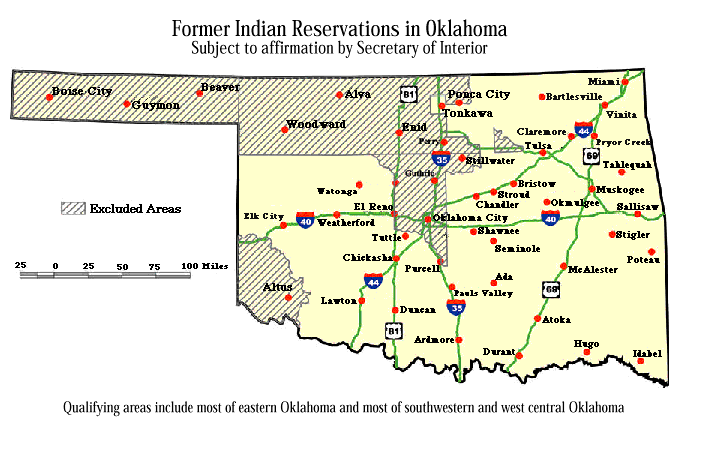
Oklahoma City, on the other hand, is in the Unassigned Lands, opened for settlement by land run 125 years ago next month. It's located in one of the few parts of the state (along with the Cherokee Outlet, No Man's Land, and Old Greer County) that isn't considered Indian Country under Federal Law.
It seems to me that placing a catch-all Indian museum in Oklahoma City is all about Oklahoma City cashing in on tribal tourism at the expense of the rest of the state, drawing tourists away from historic sites and tribal cultural museums in other parts of the state. If anyone should pay for the AICCM, it should be Oklahoma City taxpayers and philanthropists.
Rather than dump another $40 million into a new facility, Oklahoma's focus ought to be on better promotion of the sites that already exist. We should want to entice visitors to venture off of the interstates to our smaller cities and towns, rather than provide them an easy-on, easy-off, fast-food drive-thru version of our state's rich Indian history. The state could fund longer hours at our welcome centers and add small exhibits and brochures to help people find Indian heritage sites. The tourism department could provide an online guide and a mobile app for planning a visit to Indian sites and events.
State funding is for building up the whole state, not for fattening an imperial capital at the expense of the provinces.
MORE:
Don't miss Murphey's insight into the preeminent force behind this kind of spending:
It is never good when a government entity is suddenly empowered with a rapid cash infusion and the spending of millions of dollars of other peoples' money. The officials who oversee that entity all too often give in to the temptation to build an empire and spend the money of future generations at the suggestion of the massive army of vendors who benefit from the excessive spend.
From the NACEA audit:
The Board self-imposed certain challenges; the Legislature requested neither a world-class facility nor one that would draw hundreds of thousands of both international and domestic tourists to the southern side of Bricktown in Oklahoma City. The Board chose "the Vision Plan," the most elaborate and expensive of the options provided by the project architects in 2004. Projects on such a grand scale require substantial funding, however, and at no time has the Board's available funding closely approached its projected expenditures. It is reasonable to expect that funding shortfalls might lead to a reevaluation of the plans by the Board; if an everyday citizen loses his or her job, he or she might eliminate cable service, a gym membership, or weekly pizza night. The Board has taken the opposite approach, and rather than evaluating less costly options that would still allow construction of a world-class facility, has maintained their vision, with an expectation that taxpayers will foot the bill.
The audit's recommendations and six options for moving forward are worth reading.
On Monday, March 24, 2014, the Oklahoma State Senate's Education Committee unanimously passed a committee substitute for HB 3399, a bill initiated in the State House to repeal Oklahoma's adoption of Common Core national standards. (Click the link for the text of the bill, which shows deletions from current law as strikethrough text and additions as underlined text.)
The Senate committee substitute:
- requires Oklahoma to develop its own state subject matter standards and assessments;
- removes explicit references to the Priority Academic Student Skills (PASS) Curriculum, replacing them with references to state-adopted subject-matter standards;
- removes requirements to adhere to K-12 Common Core State Standards, referring instead to "college- and career-ready" standards to be developed in consultation with the State Regents for Higher Education and the State Board of Career and Technology Education;
- gives the Legislature the final say on any standards adopted by the State Board of Education (the Legislature may, by concurrent resolution, amend or return with instructions);
- forbids the State Board of Education from "enter[ing] into any agreement, memorandum of understanding or contract with any federal agency or private entity which in any way cedes or limits state discretion or control over the process of development, adoption or
- revision of subject matter standards and corresponding student assessments in the public school system, including, but not limited to, agreements, memoranda of understanding and contracts in exchange for funding for public schools and programs";
- gives school districts the exclusive right to determine "the instructional materials, curriculum, reading lists and textbooks to be used in meeting the subject matter standards" and the discretion to "adopt additional supplementary student assessments";
- bans standards and assessment questions that are "emotive in nature";
- requires instructional material to be available for inspection by the parents or guardians of students.
"Priority Academic Student Skills (PASS) Curriculum" is the name for Oklahoma's implementation of Common Core standards, as shown by this Oklahoma Common Core adoption timeline on the State Department of Education website.
Restore Oklahoma Public Education ROPE), the bipartisan grassroots group working to repeal Common Core, supports the Senate substitute as a step in the right direction. There were initial indications that the Senate leadership would not allow an anti-Common Core bill to proceed, despite the overwhelming and bipartisan support in the House. Some Common Core opponents are therefore skeptical of any bill that could win the support of the Senate and Governor, but Jenni White, ROPE president, says that it's the first step in a long process which will require Common Core opponents to stay vigilant in this year's elections and in the State Board of Education's development of Oklahoma state subject matter standards.
MORE:
ROPE website
ROPE blog
Stop Common Core in Oklahoma on Facebook
Also, today Indiana Gov. Mike Pence signed a bill to repeal Common Core standards.
A Cato analysis of Oklahoma educational spending and achievement shows that per-pupil spending has nearly doubled in inflation-adjusted terms since 1972, but SAT scores have grown by only 2% in that same period, in raw terms, and have actually dropped by about 2.5% when adjusted for participation and demographics. (The adjustment rationale and methodology are described here.)
And here is Oklahoma Gov. Mary Fallin's rather underwhelming statement on Common Core Legislation from last Friday.
"Since then, I have listened to growing concerns from parents across the state concerning Common Core, the standards currently in the process of being implemented. In light of these concerns, I have worked directly with our legislators to accomplish the goals of increasing classroom rigor and accountability while guaranteeing that Oklahoma public education is protected from federal interference. My hope is that House Bill 3399, which is soon to be heard by the Senate Education Committee, will accomplish these goals. If it does so, without creating unintended consequences that would hamstring educators or invite more federal influence in education, it will have my support."
A tip of the hat to Sean Murphy of the Associated Press for his story about Oklahoma legislators taking junkets to Miami and Las Vegas, sponsored by FairVote, the non-profit that says it "has nurtured and supported the National Popular Vote plan" and "regularly works with advocacy leaders at the National Popular Vote organization to assist in getting to important legislation passed."
Several Oklahoma legislators accepted expenses-paid trips to Miami and Las Vegas from a group that wants to change the way the U.S. elects a president, but because the travel was sponsored by a nonprofit group, rather than traditional lobbyists, there's no requirement for the lawmakers to disclose the trips to the public.FairVote, which wants states to allocate electoral votes to the candidate who receives the most votes nationally, extended invitations to legislators to attend seminars to learn more about the national popular vote proposal. Another one is set for next month in St. Croix in the U.S. Virgin Islands.
According to the story, State Sen. Rob Johnson ($-Yukon) went on a FairVote trip to Las Vegas last fall. Johnson was the Senate author and leading advocate of SB 906. Sen. John Sparks (D-Norman) a co-author of SB 906, and the original author of an earlier attempt to add Oklahoma to the National Popular Vote Interstate Compact, SB 841, filed in 2011, acknowledges going on a FairVote trip to Miami.
Both Johnson and Sparks say that the trips did not influence their position on the bill -- not surprising, since both were already on board with the idea, both having supported SB 841 in the previous legislature and Johnson having filed SB 906 in early 2013.
When asked whether he took any FairVote trips, State Rep. Don Armes ($-Faxon), the House author of SB 906 and the earlier NPV bill, told the AP, "I'm not ready to talk about all of that."
[We'll take that as a "yes."]
Johnson rejects the term "junket":
"To me it's a good way to actually sit down and discuss issues uninterrupted away from the Capitol building," said state Sen. Rob Johnson, R-Yukon, the Senate author of the bill. "I understand some people's concerns, but they're not junkets. We're there to work. We sat there the entire time and discussed the issue."
[BatesLine readers are invited to recommend places to Sen. Johnson in his district or elsewhere in the State of Oklahoma where issues can be discussed uninterrupted away from the Capitol building. BatesLine would humbly suggest that committee hearings are the appropriate place for substantive policy discussions, so that the public can hear the same information being presented to their elected representatives.]
State Rep. Tom Newell (R-Seminole), an opponent of NPV, also acknowledges going on a FairVote trip to Miami.
Oklahoma Ethics Commission director Lee Slater confirmed for the AP what we suspected here on BatesLine, that these trips don't come under Oklahoma's ethics reporting laws:
Because the trips were not funded by lobbyists or the companies that employ them, there is no requirement that the lawmakers disclose the travel and lodging, said Lee Slater, executive director of the Oklahoma Ethics Commission.
State Rep. Jason Murphey (R-Guthrie), who does not accept any gifts from lobbyists, called for the loophole to be closed and for legislators to be required to disclose travel expenses paid on a legislator's behalf or reimbursed.
MORE: OCPA distinguished fellow Andrew Spiropoulos says it's time to kill the National Popular Vote idea for good:
You would think that requiring Oklahoma to cast all of its electoral votes for a candidate who lost every county twice would be enough to kill the proposal. Why would anyone propose such an absurd thing?...One of the supporters of this scheme commented that even a 12-year-old understands the idea of democracy behind this proposal. I agree. Only someone with an immature and historically uninformed understanding of democracy would support this idea. The rest of us, however, know that our Founding Fathers understood we are not a monolithic nation of atomized individuals, but a union of diverse communities. To be both an effective and legitimate leader, a president must be elected, not by a simple majority (or, worse yet, plurality) of individuals, but by a majority of the nation's communities, encompassed by the states.
Spiropoulos concludes: "You would think that the first principle of any conservative legislator would be to actually conserve our institutions."
And if you're wondering what the Left thinks of SB 906, ThinkProgress headlined their story on the Senate's vote: "Oklahoma Senate Endorses Plan To Effectively Abolish The Electoral College."
UPDATE 2021/08/14: Sean Parnell at Save Our States has linked to this article, and notes that Sean Murphy's AP story from 2014 is no longer online. This archived newsletter from the Lewis Law Firm appears to have the full text of the AP story on Oklahoma legislators, National Popular Vote, and exotic junkets.
David Van Risseghem, a long-time Republican activist in Tulsa, has set up a newspaper-style webpage, SoonerPolitics.org, which aggregates the headlines from many of Oklahoma's political blogs and news websites. I'm honored to be included. It's a great way to see all the latest blog entries at a glance.

Several Republican Oklahoma legislators have confirmed to BatesLine that they or their colleagues have been invited to all-expenses-paid "seminars" sponsored by National Popular Vote advocates and held in exotic, warm-weather locations. The legislators have mentioned locations including Scottsdale, Arizona, south Florida, Puerto Rico, Las Vegas, and St. Croix in the U. S. Virgin Islands. State Rep. Jason Murphey, R-Guthrie, has confirmed the latter destination in his latest blog entry, "Spiking the Electoral College with a Free Trip to St. Croix."
One legislator told me about receiving verbal information about the Scottsdale event from Michelle Sutton, a lobbyist at the state capitol who is registered as a representative of National Popular Vote. (Sutton's firm is CRG LLC, and her lobbyist number is L140338.) According to the legislator, the verbal info was followed by an invitation attached to an email from Saul Anuzis, a consultant to the National Popular Vote campaign.
The written invitation comes from FairVote, aka The Center for Voting and Democracy, a 501(c)(3). According to their website (fairvote.org/reforms/national-popular-vote/), FairVote "has nurtured and supported the National Popular Vote plan... Fairvote regularly works with advocacy leaders at the National Popular Vote organization to assist in getting to important legislation passed."
The invitation from FairVote's executive director is to an "all-expenses-paid, invitation-only panel discussion and educational seminar on presidential elections and the Electoral College" at an expensive resort hotel in Scottsdale, Arizona.
February 7, 2014Greetings:
This is Rob Richie, executive director of FairVote. FairVote is a 501(c)(3) nonprofit, nonpartisan organization that researches elections and election law. We are based in Maryland.
I am writing to invite you to participate in an all-expenses-paid, invitation-only panel discussion and educational seminar on presidential elections and the Electoral College, to take place near Phoenix (AZ) on March 1st. We will address three major reform proposals: allocation of electoral votes proportionally and by congressional district and, as the major focus given its enactment in 10 states, the National Popular Vote interstate compact. More and more Americans are concerned about the impact of Electoral College rules, and more states are taking action or considering action to reform their current system. Although the 2016 presidential election may seem distant, it in fact is an ideal time to analyze prospective changes now, rather than closer to the election.
We have sponsored and participated in a number of these roundtables over the years, and have found them an excellent way to delve deeply into this topic. All of us have experienced presidential elections and formed opinions about proposals for reform, but we have found it useful to reexamine assumptions and look at different ideas afresh Doing so has been all the easier and more productive when legislators and civic leaders from a mix of states can convene and have the time to go over these issues. We have developed a six-hour format for such discussions that has worked particularly well with groups of 10 to 15 participants.
We are planning our next roundtable for up to 15 people in Scottsdale, Arizona on February 28th-March 2nd. To allow people to attend from a mix of states, we can cover your costs associated with travel and accommodation at the JW Marriott Camelback Inn® Scottsdale Resort, located outside Phoenix at 5402 East Lincoln Drive in Scottsdale. We can cover guests' accommodations covered for up to three nights, February 28th - March 2nd. (Family members can join attendees, but their travel costs will not be reimbursed.) We also reimburse meals for participants on the evening of February 28th, lunch on March 1st, and breakfast vouchers for each night of your stay. We request that all participants commit to reviewing a collection of reading materials that will be provided by email before the meeting so that all participants can ready to share their insights and questions in panel sessions on March 1st and have the same background information going into the discussion.
If you have any questions about this invitation, please let me know by email (rr@fairvote.org) or phone (cell is 240-393-2420). Because we plan to finalize our list of participants by February 14, I would appreciate hearing from you by February 11th as to whether you can attend our seminar.
Sincerely yours,
Rob Richie
Executive Director
As of this writing, the least expensive room at the JW Marriott Camelback Inn Scottsdale Resort for those dates was $509 / night, not including the daily $25 resort fee, and any state and local sales and lodging taxes. Add in three vouchers for breakfast at the resort plus reimbursement for a dinner and a lunch, and the cost of air transportation, and you have a nice little weekend getaway for over $2,000, interrupted by the political equivalent of a timeshare presentation, which, I suspect, is filled with the same sort of emotional manipulation and selective disclosure for which timeshare presentations are notorious.
Note that the attendees are to include "legislators and civic leaders from a mix of states." That indicates that Oklahoma isn't the only target of this left-wing push to overthrow our presidential election system. It's reasonable to imagine that an Oklahoma Republican attending this event would be grouped with Republican legislators from other states. The "civic leaders" in the group would be already on board with NPV and able to could guide the discussion in a way that would be persuasive to the GOP lawmakers.
As State Rep. Jason Murphey notes, while several states have approved NPV, the NPV campaign can't reach the target of 270 without some Republican-controlled states jumping on the bandwagon:
Here's the problem for these groups: the Washington Post recently opined that if this effort were to be successful, "they'll likely have to branch out into red states, because there are only so many blue states (and so many electoral votes in them) on the map."How could the national popular vote people convince the more sparsely populated red staters to give away their advantage in the Electoral College?
What better way than to put Oklahoma on the list with the liberal states? If the reddest state in the nation signs on, then why wouldn't other red states?
To this end, the national popular vote group invaded Oklahoma with a high powered team of very sophisticated lobbyists. They wisely kept the issue under the radar and away from the eyes of the public while aggressively trying to convince legislators by using a series of convoluted logic for why this proposal would benefit conservatives.
They financed a series of out-of-state junkets to various vacation sites where they explained this logic against an exotic backdrop of recreational events.
Having succeeded in the Senate, they are preparing to go on the offensive in the House. On March 20, they will finance an all-expenses-paid junket to St. Croix. In this exotic venue, far away from the eyes of the public, they will attempt to convince Oklahoma House members to vote for the bill. Just a few days after they return to the mainland, House members will vote on the proposal.
You may wonder, as I do: How is it possible for a legislator to accept a trip worth thousands of dollars, paid for by an organization with an interest in legislation, and not violate our ethics laws? I suspect that the loophole is that the organization is a 501(c)(3) and the "seminar" is framed in the invitation as a neutral exploration of the issue rather than advocacy. There ought to be a law requiring prompt disclosure of these trips.
And if there's not a law already, Oklahoma legislators should take the initiative to disclose out-of-state trips where public policy is discussed, particularly if their expenses are paid or reimbursed. Oklahoma voters deserve to know what influences are shaping their legislators' decisions. Any legislator unwilling to make such a disclosure before the end of March ought to have a primary challenger.
UPDATE 2021/08/14: Sean Parnell at Save Our States has linked to this article, and notes that Sean Murphy's AP story from 2014 about the junkets is no longer online. This archived newsletter from the Lewis Law Firm appears to have the full text of the AP story on Oklahoma legislators, National Popular Vote, and exotic junkets. I've updated the broken link to Jason Murphey's blog entry with a link to the story on the Wayback Machine.
Two more Republican state senators who voted for SB 906, the bill that would have Oklahoma award its seven electoral votes to the winner of the National Popular Vote, have announced their regret and the withdrawal of their support for the idea, joining an earlier announcement from Sen. Gary Stanislawski.
Grace McMillan, executive assistant to Sen. Mark Allen, contacted me via email in response to my questions:
Senator Allen wanted me to respond to you and let you know that he is changing his position on SB 906. He is now better informed -- formerly he had relied on someone else's information.He no longer supports the measure, and will so inform members of the
House of Representatives before the bill comes to a vote there.
Sen. Josh Brecheen has supplied a lengthy statement to Jamison Faught's Muskogee Politico blog, calling the SB 906 decision, "a vote I regret." In the statement, he explains that, while he had several interactions with friends who supported the bill, and on that basis pledged to support the measure, he never sought out the views of those opposed.
A day later, I listened on the floor to some opposing concerns I had not heard before and I was greatly alarmed that I had agreed to vote for it when certain responses were provided. I was not misled by those who were supportive, but given this issue's complexities, it had just never come up. I cast a vote for the bill as I had agreed to do so and given my belief in the biblical concept "a man keeps his word even when it hurts."
Brecheen's reference is to Psalm 15:4, which says that a man "who swears to his own hurt and does not change" is among those who will "dwell upon God's holy hill."
(It could be argued that a state senator's oath before God to uphold the Constitution of the United States and the Constitution of Oklahoma constitutes a promise to his constituents that should take precedence over any promise to a colleague.)
Oklahoma State Senator Gary Stanislawski (R-Tulsa) has issued a statement recanting his support for SB 906, and expressing regret for his vote for the bill that would add Oklahoma to the National Popular Vote Interstate Compact.
The last several years I have always been against the National Popular Vote. This year though two people from the National Popular Vote group visited me and provided me with some information that I had not previously considered. Primarily that because we are a "fly over" state that we do not have a voice in setting national policy. It seems that a lot of national policies are being set by swing states. For instance, we have Ethanol because the farmers in Iowa wanted it. We have Part D Medicare because of the seniors in Florida. There are steel tariffs because of the steel mills in Pennsylvania. In addition, when I arrived at my desk on the Senate floor before the vote the attached letter from Newt Gingrich was there which just confirmed our situation. Out of frustration and anger that our nation is being controlled by only a handful of states I decided to vote for the NPV.
The next day I had a phone call from a friend who questioned my vote, and as we discussed it I realized that voting for the NPV is really giving up our state sovereignty to a group of states and could very well mean that the majority of Oklahoman's recorded vote could go for the opposite candidate. While I knew that the previous day I was just too frustrated in the way Washington really works and just desperately wanted to see a change. The other thing my friend brought up that I had not considered before was the risk of voter fraud in other states. That unregistered or even deceased people could be cancelling out votes from within Oklahoma. That is when I knew I had made a serious error in judgment.
I sincerely apologize for my mistake and can only hope that the bill is defeated in the House. I will try to not be influenced by my emotions in the future, but I will admit that I am still human.
It's tough to admit you made a mistake, and I commend Sen. Stanislawski for making this statement. The other 15 Republicans who voted for SB 906 would be wise to follow suit.
But there's another step that needs to be taken. This bill passed because it was rushed to a vote. It was the only bill to come before the Senate that day for passage. (Here is the Senate Journal for February 12, 2014.) Sen. Rob Johnson's unanimous consent request to suspend Rule 12-4 was granted, allowing a floor amendment to restore the title to the bill. If the rules had not been suspended, if just one senator had objected to the unanimous consent request, the vote would have been delayed to the following day, and there would have been time for the grassroots to know the vote was happening and to remind senators why this is a bad idea.
A conservative's instinct ought to be to conserve America's constitutional arrangements. When presented with a bill to turn change some fundamental aspect of our system of government -- how we elect a president -- a conservative ought either to dismiss it out of hand or at least slow the process down long enough to consult constituents and seek out the other side of the argument. Chesterton's rule of fences and gates ought to apply. And the fact that someone was willing to hire lobbyists to push this ought to have set off alarm bells loud enough to wake the dead. You can understand a regulated company thinking it worth the cost of lobbying for or against legislation that affects their bottom line. But who stands to gain financially if this bill passes? George Soros, maybe?
When I told my two older children, separately, about the National Popular Vote concept, I got about two sentences into the explanation before each exploded with incredulity. We had never discussed the idea before, but they instantly recognized that it would violate the principle of federalism and would be to Oklahoma's disadvantage.
A mistake is forgivable, but when the consequences are this grave, the cause of the mistake needs to be analyzed and corrective action taken to keep it from happening again.
MORE: Lori L. Hendricks has a different view of Sen. Stanislawski's change of heart:
@BatesLine Stanislawski was called before the vote on 906. His recant is due to outcry not remorse.
— Lori Hendricks (@LoriLHendricks) February 16, 2014Hendricks, a Republican, serves as Wagoner County Clerk. She spoke to KFAQ the morning after SB 906 passed the Senate.
And Chris Medlock, a Stanislawski constituent who supported his election, isn't soothed by Stansilawski's mea culpa:
Let's see. He admitted that he made a decision based on emotions, rather than reason. He admitted that he held no principle, one way or the other, on the issue, because he was so easily influenced by lobbyists. Either way, I'm still deeply concerned.As a constituent of Gary's who helped get him elected, I can not promise that when and if a primary occurs in this district, I can give him my support.
I have NEVER had one of my elected representatives cast a vote that so angered me. I was actually screaming, "What was he thinking?"
I thought my wife was going to get a hose out.
MORE conservative voices against NPV:
Morton Blackwell, founder of the Leadership Institute and long-time Republican National Committeeman from Virginia, writing in June 2011. Based on the 2008 results, Blackwell calculated that Oklahoma's influence on the national result would have been cut by over 14% under NPV:
State legislators should consider carefully the disruption NPV would bring to the electoral college system, which was a part of the grand compromise enacted at the 1787 Constitutional Convention to protect states' rights and balance the power of the small states against the larger states.In many ways, the constitutional separation of powers between the states and the federal government is being eroded. The Founders never intended that the states should become merely administrative appendages of the federal government, much less that the United States become a unitary, centralized, plebiscitary democracy. NPV would push America along that dangerous and originally unintended path.
Beyond preserving federalism, there are other powerful reasons to oppose the NPV plan...
For example, NPV would greatly incentivize vote-stealing because big-city political machines would realize that massive numbers of fraudulent votes they could engender could swing the electoral votes beyond their states and be counted toward a national popular vote plurality victory for their presidential candidate.
Phyllis Schlafly, founder of Eagle Forum, writing in December 2011:
The plan to change this system is called the National Popular Vote. It obviously has a lot of money behind it because it is sending highly paid lobbyists around the country to persuade state legislatures to adopt the NPV plan.NPV is an attempt to achieve the longtime liberal goal of getting rid of the Electoral College. Instead of proposing an amendment that would first need to be passed by Congress and then ratified by three-fourths of the states (38), NPV is a scheme to deviously bypass the grand design of our U.S. Constitution....
The NPV campaign lets people believe that NPV will elect presidents who win the majority of popular votes, but that is false. Because of third parties, we've had many elections (including three of the last five) when no presidential candidate received a popular-vote majority. Abraham Lincoln won with less than 40 percent of the popular vote, and only by our Electoral College system was he elected president....
It's a mystery how any Republican could support NPV, and it's no surprise that the Republican National Committee voted unanimously to oppose NPV because members saw it as unconstitutional and unworkable.
Remember our national trauma as we suffered through recounts in Florida where the margin between Bush and Gore was only about 500 votes? If the election is based on the national popular vote and it's close, NPV would induce recounts in many or most of the 50 states.
Mexico uses a national popular vote system, and it's a good illustration of why we don't want it here. In Mexico's last presidential election, the candidate with the "most votes" received 35.89 percent, while his closest rival got 35.31 percent -- a margin of just one-half of one percent. In the months that followed, Mexico was on the verge of civil war as the runner-up held mass rallies attracting millions of his angry supporters.
People who pretend that the Electoral College system is undemocratic are not only ignorant of the history and purposes of the U.S. Constitution, but they probably don't even understand baseball. Basing the election on a plurality of the popular vote while ignoring the states would be like the New York Yankees claiming they won the 1960 World Series because they outscored the Pirates in runs 55-27 and in hits 91-60. Yet, the Pirates fairly won that World Series, 4 games to 3, and no one challenges their victory.
John Ryder, Republican National Committeeman from Tennessee, writing about National Popular Vote in June 2011:
On a practical level, the Constitution requires a successful candidate to assemble a winning coalition across a broad geographic spectrum, embracing both large and small states, rather than a narrow concentration of votes.A popular vote, in contrast, does not require the candidate to have broad appeal. It would make it possible for a candidate to win without any majority but merely a plurality of the popular vote. The compact would require the states to determine the candidate with the "largest national popular vote" - not a majority. Thus, in a multicandidate race, the "largest national popular vote" could be obtained by a regional candidate with just 35 percent or 40 percent of the popular vote.
Under such an arrangement, presidential candidates would have no incentive to campaign anywhere except the major media markets in a few states. The country would, in essence, cede our presidential elections to the largest metropolitan areas, whose concerns are different from those of other areas of the country.
NPV would maximize the rewards of vote fraud in those large metropolitan areas. Under the Electoral College, an illegal vote only affects the outcome in one state; under the popular vote compact, an illegal vote would affect the national outcome.
On the other side of the aisle, leftist blogger Kevin Drum thinks NPV is an excellent idea, referring to it as "a system even less favorable to [Republicans] than the current Electoral College."
The price of liberty is eternal vigilance.
If you thought you could relax because the Republicans are in charge at the State Capitol and Oklahoma Republicans have a conservative party platform, remember that there are lobbyists giving our friends at the Capitol one side of the story. We in the grassroots have to watch every bill and every vote. We have to be in our legislators' faces as much as the lobbyists are.
On Wednesday, the National Popular Vote bill (SB 906) passed the State Senate by a vote of 28-18. All 18 nay votes were Republicans, but another 16 voted with all 12 Democrats in favor of the bill.
The NPV bill, if it is passed by the House and signed by Gov. Fallin, would add Oklahoma to the list of states promising to award all of our electoral votes to the winner of the largest share of the national popular vote, rather than the winner of the popular vote in Oklahoma. Under the terms of the compact, once states with an aggregate of 270 electoral votes approve the compact, it will go into effect and the winner of the national popular vote will be guaranteed enough electoral votes to win the presidency.
I'm told that Saul Anuzis, a consultant for the NPV movement and the former Republican State Chairman in Michigan, was working the corridors for the bill. According to news reports, Anuzis got flack for using the official RNC logo on a letter backing NPV because it hinted that the RNC supported his efforts. Anuzis lost re-election as Michigan's Republican National Committeeman in 2012, and his support for NPV is credited as a major factor in his defeat. Saul Anuzis and his colleagues persuaded some of our friends in the Senate that NPV could improve the Republican Party's chances. Never mind that the NPV movement is funded and run by leftists who are hardly likely to back an idea that would help conservatives win the White House.
Grassroots conservatives know, but our friends in the Senate forgot, that a National Popular Vote would allow the votes of Chicago cemetery inhabitants to cancel the votes of conservative Oklahomans. A presidential election under our current system is essentially 51 separate elections*, and that acts as a firewall against the impact of voter fraud. Under the current system, voter fraud in Chicago, for example, could only run up the score in Illinois; it couldn't undermine results in other states.
 Our friends in the Senate forgot that the National Popular Vote creates an incentive for voting in multiple states in the same election.
Our friends in the Senate forgot that the National Popular Vote undermines the fundamental constitutional principle that the United States is a Union of States. They forgot that NPV and eliminating the electoral college has been a dream of the Left for decades. Getting Oklahoma on board -- the reddest state in the nation, the state where all 77 counties voted for the Republican nominee in 2004, 2008, and 2012 -- will make it easier for the NPV lobbyists to convince other Republican-dominated states to go along. Oklahoma would be the first "red state" to approve NPV.
Our friends in the Senate forgot the conservative Oklahoma voices -- people they know and trust! -- who have been warning them for years about this plan, its constitutional and practical flaws, the danger it poses to the integrity of our election system. Steve Fair, Oklahoma's respected Republican National Committeeman, has been writing against NPV since at least 2011. The Oklahoma Republican Party platform, written by party grassroots activists from across the state and approved by the state convention, has been on record against NPV since at least 2011, renewing their opposition in the most recent platform in 2013. Fellows of the Oklahoma Council for Public Affairs (OCPA) have been writing against NPV for years. I wrote a fairly scathing article about the NPV bill filed in 2013.
Our friends in the Senate forgot the conservative voices beyond Oklahoma warning of the dangers of NPV. In 2004 the Heritage Foundation laid out the advantages of the Electoral College for stable government:
Presidential candidates must build a national base among the states before they can be elected. They cannot target any one interest group or regional minority. Instead, they must achieve a consensus among enough groups, spread out over many states, to create a broad-based following among the voters. Any other course of action will prevent a candidate from gaining the strong base needed to win the election.
In 2006, Pete du Pont, former Republican governor of Delaware and a brilliant public policy analyst, made the case in a Wall Street Journal op-ed that the National Popular Vote would focus presidential campaigns on the major urban agglomerations on the coasts, to the detriment of Oklahoma and the rest of Flyover Country. He pointed out the likelihood of multi-candidate races, "winners" with tiny minorities of the vote, and no provision for a runoff. He reminded that a race as close as a half-million votes (barely three per precinct) could trigger a nationwide recount 50 times as chaotic as Florida in 2000.
Second, in any direct national election there would be significant election-fraud concerns. In the 2000 Bush-Gore race, Mr. Gore's 540,000-vote margin amounted to 3.1 votes in each of the country's 175,000 precincts. "Finding" three votes per precinct in urban areas is not a difficult thing, or as former presidential scholar and Kennedy advisor Theodore White testified before the Congress in 1970, "There is an almost unprecedented chaos that comes in the system where the change of one or two votes per precinct can switch the national election of the United States."Washington state's 2004 governor's race was decided by just 129 votes. A judge found 1,678 illegal votes were cast, and it turned out that 1,200 more votes were counted in Seattle's King County than the number of people recorded as voting. This affected just Washington state, but in a direct national election where everything hangs on a small number of urban districts, such manipulations could easily decide presidencies.
The Cato Institute published a policy analysis of NPV in 2008:
The proposal eliminates states as electoral districts in presidential elections by creating a national electoral district for the presidential election, thereby advancing a national political identity for the United States. States with small populations and states that are competitive may benefit from the electoral college. Few states clearly benefit from direct election of the president. NPV brings about this change without amending the Constitution, thereby undermining the legitimacy of presidential elections. It also weakens federalism by eliminating the role of the states in presidential contests. NPV nationalizes disputed outcomes and cannot offer any certainty that states will not withdraw from the compact when the results of an election become known. NPV will encourage presidential campaigns to focus their efforts in dense media markets where costs per vote are lowest; many states now ignored by candidates will continue to be ignored under NPV. For these reasons, states should not join the National Popular Vote compact.
Our friends in the Oklahoma Senate forgot all that. They need to be reminded, and we need to remind our friends in the Oklahoma House, too.
And one more thing: Isn't there something fundamentally wrong about having an institution enshrined in our constitution, but then using legislation to bypass it and render it as a dead letter?
If you're unhappy with the state senators who supported SB 906, please contact them politely, ask why they voted the way they did, explain the problems with National Popular Vote, and ask them to issue a statement retracting their vote. The Senate vote is a done deal, but statements of regret could influence the House in the right direction. Click the link to see how your senator voted.
Next Friday, February 21, 2014, State Senate President Pro Tempore Brian Bingman will speak at the Tulsa Republican Club's monthly luncheon at the Summit Club on the 30th floor of the Bank of America Building, 15 W. 6th Street in downtown Tulsa. (Buffet lunch is $20; validated parking available in the building's garage.) Bingman voted for the National Popular Vote bill; as head of the Senate, he had the power to stop it. This might be a good opportunity to talk (politely!) with him about his vote.
 I'm puzzled and distressed. What kind of political force would induce this decision on the part of so many Republican state senators? How could they forget what their political allies have been saying in opposition to NPV and instead listen to an out-of-state lobbyist? There aren't any grassroots conservatives agitating for this measure. Why are our legislators treating this as a priority?
Some are suggesting that we need a recall provision in our State Constitution. Term-limited legislators may see potential future employers as the constituency they need to please, rather than the voters who elected them. Or perhaps we could have stronger laws against the revolving door: If you become a lobbyist, you (and anyone married to you) would forfeit your state pension.
MORE: In August 2011, Steve Fair asked and answered Who are the people behind the National Popular Vote Interstate Compact (NPVIC)?:
The Chairman is Dr. John R. Koza, the inventor of the scratch off lottery ticket, and twice a Democrat elector in California. Dr. Kova is a good friend of Al Gore, who won the popular vote in 2000 but lost the electoral vote count to George W. Bush.Barry Faden, a Democrat, is the President of NPVIC. He is a San Francisco attorney who supported John Kerry in 2004. He contributed $2,000 to Kerry according to campaignmoney.com.
Board members for NPVIC are Tom Golisano, the owner of Paychex, an HR company for small business and the owner of the NHL's Buffalo Sabers. In 2008, Golisano, a registered Independent in New York state, gave one million dollars to the Democrats for their national convention. Chris Pearson is State Representative in Vermont. He is a member of the Progressive Party, one of only 6 in the 150 member body. Stephen Siberstein is a California Democrat who contributed $250,000 to the Center for American Progress, a left wing think tank.
NOTES:
*Actually 56 separate elections, taking into account the allocation of electoral votes by congressional district in Nebraska and Maine.
Jamison Faught has posted maps of Oklahoma showing dominant party of voter registration by county and registration change per county, based on Oklahoma State Election Board statistics as of January 15, 2014. Only two small counties -- Harmon County in far southwestern Oklahoma and Coal County in Little Dixie -- showed percentage gains for the Democrats.
I took the state election board's spreadsheet for 1960 to 1995 and added the years since then to create this Oklahoma Voter Registration by Party spreadsheet.
There has been a steady trend for both major parties, with accelerations in the GOP's favor for each presidential election year, and a slight downward bend for both major parties when the Motor Voter act went into effect in the mid-1990s. (Independent is the default affiliation if none is marked on the registration application.) Republicans should be the plurality party in Oklahoma by the next presidential election. The one notable exception to the long term trend is the post-Watergate years -- 1974 to 1979.
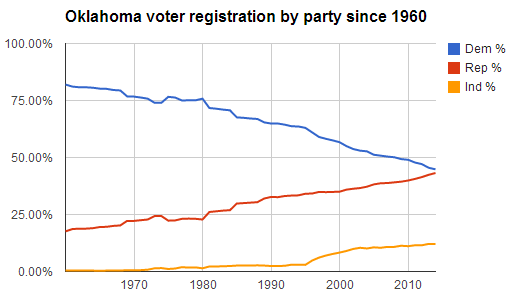
 Arthur E. Rubin, grand old man of the Tulsa County GOP, died Sunday, February 2, 2014, at the age of 93. Visitation is tonight, Friday, February 7, 2014, from 5 - 7 p.m. at Moore Funeral Home Rosewood Chapel at 2570 S. Harvard. Funeral is Saturday, February 8, 2014, at 11:00 a.m. at Christ the Redeemer Lutheran Church, 2550 E. 71st St (south side of the street, east of Lewis Ave.) in Tulsa. In lieu of flowers, the family requests donations in Art's memory to St. Simeon's Episcopal Home, where he spent his final years.
Art was a Republican stalwart when being a Republican in Oklahoma seemed like a lost cause. It's hard to imagine, but there was a time when an overwhelming percentage of Oklahomans were "yellow dog" Democrats, and elections were won or lost in the Democratic primary. In 1960, the earliest year for which statistics are available, only 17.6% of Oklahoma voters were registered Republican, and 82% were registered Democrat. That was about the time Art became active in Republican politics, right after a disastrous 1958 election in which Democratic nominee J. Howard Edmondson won 74% of the vote to Phil Ferguson's 20%.
It took a great deal of courage and perseverance to be a Republican in those days. Art worked to rebuild the party nearly from scratch, recruiting candidates and marshaling volunteers and donors. Art saw his efforts rewarded as Oklahoma elected its first Republican governor in 1962 and began an unbroken streak of voting for Republican presidential candidates in 1968, and as Republicans swept every U. S. Senate and House seat in 1994, gained a majority in the State House in 2000 for the first time since 1920 and took the State Senate in 2008, and had begun to make inroads in once-rock-solid Democratic county courthouses. At his passing, Republicans were nearing a plurality of registered voters (always a lagging indicator), with 43.2% to the Democrats 44.8%
In 1988, Art Rubin served as one of Oklahoma's presidential electors, casting his vote for George H. W. Bush and Dan Quayle. He was a delegate to the 1992 Republican National Convention. He was an early and fervent supporter of John Sullivan's special-election run for Congress in 2001/2002. He was a beloved presence at party conventions and club luncheons, and his advice was often sought out by office holders and party officials. While his wavy hair turned white over time, the determined gaze you see in the photo above never dimmed.
One of the earliest entries on BatesLine was about a May 2003 banquet honoring Art Rubin for his decades of service to the Republican Party.
Art did not mince words. In this story about the 1991 Tulsa County Republican convention, Art said of Vince Orza, a Republican gubernatorial candidate who endorsed Democrat David Walters for governor in 1990, "The guy is a two-faced s.o.b.; you can't trust him. He invited Walters to his house." Of the job of party County Chairman, Rubin remarked, "Nobody else wants that damned job. It's a lousy job. All you do is get criticized and thrown out."
Art was a Ronald Reagan conservative, staunchly pro-life. He preached the importance of party unity, urging that, as Republicans, our differences with the Democrats are more profound than our differences with one another.
Art and his wife Doris lived for many years on Gary Lake, at 2854 S. Gary Avenue, north of 31st Street. He raised endangered trumpeter swans and other waterfowl on the lake, starting in 1969. In 1989, he donated a pair of swans, later given the names Fred and Ginger, to the new pond on the University Center at Tulsa (now OSU-Tulsa) campus. The lake was notable for its flamboyant Christmas displays, and the Rubin home was no exception.
Professionally, Art Rubin was an attorney specializing in family law, a 1950 graduate of OU Law School, an associate of the Gable Gotwals firm.
One of his legal anecdotes was quoted in a 2006 Tulsa World story about divorce court:
Longtime attorney Art Rubin could have died in divorce court when it was revealed that his client, who swore she was a devoted Christian wife, was sleeping with another man.Rubin asked the woman during testimony whether this was true.
"Yes," she said, "but the good Lord has already forgiven me."
An online professional profile lists his credits as follows:
Phi Delta Phi. Associate Editor, Oklahoma Bar Journal, 1978-1984. Author: Property Division in Divorce, 54 Oklahoma Bar Journal 531, February 26, 1983. Assistant Professor of Law, University of Tulsa, 1951-1952. Member, Oklahoma Industrial Finance Authority, 1965-1973; Tulsa River Parks Authority, 1980-1986. Member, Board of Trustees, Oklahoma Public Employees Retirement System, 1989-1991. Member, Federal Judge Selection Committee, Northern District of Oklahoma.
MORE: The Oklahoma Republican Party issued this tribute to Art Rubin:
The Oklahoma Republican Party wishes to express their condolences for the Arthur Rubin family of Tulsa upon the passing of their father, grandfather, and friend. Arthur Rubin's leadership within the Oklahoma Republican Party earned him a reputation as the "grandfather" of the Tulsa County Republican Party, and his advice, energy, dedication, and understanding gained him state and national recognition. Chairman Dave Weston said, "Oklahomans will miss Mr. Rubin and all that he contributed to the Republican Party, but also who he was as an individual."
If you'd like to share your memories of Art Rubin, I'd be honored to add them here. Post a comment or email me at blog@batesline.com
MORE:
At Art Rubin's funeral, he was eulogized by U. S. Sen. Jim Inhofe, law firm colleague Jim Gotwals, and a family friend.
Inhofe told the oft-repeated story of how Art Rubin got him to run for office for the first time. The scene is lunch at the Beacon Grill at 4th and Boston, 1966, shortly after the election of State Sen. Dewey Bartlett (father of Tulsa's current mayor) as Oklahoma's second Republican governor, leaving his legislative seat vacant.
Art never asked you to do anything. He told you. So we sat down on these little round stools that they had at the Beacon Grill, and he says, "I want you to run for the vacancy that's been created because Dewey Bartlett's now the governor." And I said, "Art, I'm not going to do it.... First of all, I've got all these kids at home," and Art said, "It's a part-time job." And he's right, it was. And I said, "I don't have any organization," and he said, "You need an organizer." And he looked up, and there was a lady walking across the Beacon Grill, her name was Millie Thompson.... he said, "Millie, come over here. I want you to head up the 'Volunteers for Inhofe' -- he's going to run for the state legislature."Now I know that there are people -- 'cause I'm kind of extreme and you know that -- there are people in here who don't like me. You won't raise your hand, you won't acknowledge it now, but I know you don't. So -- but if you don't like me, don't blame me, blame Art.
Art Rubin's funeral program was a traditional Lutheran liturgy, including readings from Scripture (Isaiah 61:1-3, Psalm 23, Revelation 21:2-7, John 6:35-40), congregational hymns ("O Day of Rest and Gladness," "In the Garden," and "How Great Thou Art") and a sermon from the Rev. Scott Burmeister, pastor of Christ the Redeemer Lutheran Church.
MORE MEMORIES:
Norman James writes:
Art and I were cousins. We finished school at about the same time, and had rooms in adjacent houses on South Carson. One evening we were walking to dinner (neither of us owned a car), talking about jobs and money. He was earning $150 a month as a law clerk, I was making $225 as a "Laborer". Art said, "I would be SO happy if I knew I could make $500 a month the rest of my life."
FreedomWorks is calling on Oklahomans to attend Sen. Tom Coburn's August townhall meetings to ask him to join conservative Senate Republicans in their fight to defund implementation of the Unaffordable Care Act. Here is a list of Coburn's August 2013 townhalls, which are mainly in rural eastern Oklahoma. Coburn won't be coming to Tulsa or Oklahoma City, so Tulsans and Oklahoma Citians will have to go to him to express their disappointment in his refusal to fight against Obamacare funding.
Wednesday, August 21, 2013, 2:00 pm, Miami, Miami Civic Center
Wednesday, August 21, 2013, 5:00 pm, Muskogee, Muskogee Civic Center, Room D (NOTE VENUE CHANGE)
Thursday, August 22, 2013, 8:00 am, Stigler, The Eaton Hole, 504 E. Main
Thursday, August 22, 2013, 12:00 pm, Hugo, Kiamichi Technology Center North Seminar Room
Thursday, August 22, 2013, 2:30 pm, Atoka, Kiamichi Technology Center Business Center
Monday, August 26, 2013, 5:30 pm, Shawnee, Gordon Cooper Tech Center, John Bruton Seminar Center
Here's the letter from Matt Kibbe, head of FreedomWorks.
Tom Coburn says ObamaCare is not the solution to health care reform. But he hasn't joined with Mike Lee to Defund ObamaCare.Sen. Coburn is having townhall meetings so you can ask him why he isn't doing everything he can to protect Oklahoma from ObamaCare.
Harry Reid called ObamaCare the stepping stone to European-style health care. Now is the time for Tom Coburn to listen to concerned citizens like you and stand with Mike Lee to Defund ObamaCare.
Tom Coburn has been a principled fighter for economic liberty in the Senate. We need him to join with Mike Lee, Ted Cruz, Rand Paul, and Marco Rubio and not give one dime of your tax dollars to pay for ObamaCare.
Sen. Coburn needs to know that patriots like you don't want ObamaCare and that he should do everything he can to stop it.
In Liberty,
Matt Kibbe
President and CEO, FreedomWorks
MORE:
At Townhall, Kate Andrews provides three real-life examples of how Obamacare has driven up costs for the sick, disabled, and poor.
The Heritage Foundation says that Coburn is wrong to claim that Congress can't defund mandatory spending. They do it all the time.
Heritage explains defunding:
Defunding Obamacare means attaching a legislative rider to a "must-pass" spending bill, like the continuing resolution or the debt limit, that:
- Prohibits any funds from being spent on any activities to implement or enforce Obamacare;
- Cancels any unspent balances that have already been appropriated for implementation; and
- Turns off the exchange subsidies and new Medicaid spending that are currently on auto-pilot.
Defunding stops the flow of money to Obamacare, including implementing the law and all of its related activities.
A recent successful example of defunding that comes to mind is the incandescent light bulb ban. In December 2011, the same Republican majority in the House, Democrat majority in the Senate, and Democrat in the White House approved omnibus spending legislation that banned spending any money on enforcement of the ban. As with Obamacare, the ban was unpopular and costly federal overreach, but with Obamacare, businesses, labor unions, state and local governments, and individuals are even more concerned about the costs of compliance.
RELATED:
Mickey Kaus notes that Republican congressmen aren't holding as many townhalls; he believes it's because they're afraid to face their conservative constituents over issues like amnesty for illegal immigrants.
 State Rep. Doug Cox (RINO-Grove) is using the aftermath of a disaster to gain a national platform from which he can heap scorn on his fellow lawmakers and his fellow Oklahomans in order to support Planned Parenthood, the nation's largest abortion provider, from whom he received a national award this year (pictured right) as a "pro-choice" Republican.
Under the guise of mourning the loss of 24 lives in this week's storm, he's promoting an organization responsible for the deaths of 3,316,822 by abortion procedures over a 12-year-period. Over the same period, Planned Parenthood made 25,846 adoption referrals, a ratio of 128 babies killed for every baby saved.
Cox is the member of the Republican caucus most likely to oppose a pro-life bill, and he's been an unreliable vote for the conservative cause on other issues as well. His 2012 conservative rating by the Oklahoma Constitution newspaper was 29%, lower than that of many Democrats. Cox and State Sen. Brian Crain have teamed up in support of Obamacare's Medicaid expansion in Oklahoma. This article ought to be the final straw to prompt the Republican caucus to give him the heave-ho and to take away his chairmanships. If the Oklahoma Republican Party stands for anything, they ought to be recruiting and preparing a primary opponent right now.
Cox attacks "multiple bills [moving through the legislature] with the sole purpose of blocking women's access to preventive health care." Here's the beginning of his Huffington Post op-ed:
The eyes of the entire country have turned to Oklahoma this week in the wake of Monday's devastating tornado. The tornado tore through seventeen miles of ground, destroying homes, schools, and hospitals in its path. Twenty-four lives have been lost, including 10 children.It is these kinds of tragic disasters that bring people together. As a physician, as a parent, as a state legislator who takes my oath to put my constituents interests first, I can't be silent when -- at a time of need for care, empathy, and community -- my colleagues in the Oklahoma state legislature are using the last days of session to further restrict Oklahoma women's access to health care. In these final days of session, my colleagues in the state legislature will consider multiple bills with the sole purpose of blocking women's access to preventive health care.
Cox refers obliquely to two bills but omits the bill number, perhaps so we can't see if he's accurately depicting their content. SB 900, which has emerged from a conference committee, sets priorities for family planning and counseling funding, putting public agencies at the top of the list followed by hospitals and rural clinics, with private clinics at the end of the line, and HB 2226, which requires a prescription for the Plan B abortifacient drug for girls 16 and under, but allows it to be sold over-the-counter for ages 17 and up.
Both bills are common-sense measures. SB 900 has been reported out of conference committee and has passed the Senate. The conference committee report on HB 2226 has passed both houses and is on the governor's desk.
The overwhelming majority of Oklahomans, regardless of political affiliation, oppose abortion. Oklahomans have elected overwhelming majorities of pro-life legislators, pro-life statewide officials, and a 100% pro-life congressional delegation. We don't want our tax dollars going to organizations that perform abortions or lobby for abortion rights. Oklahomans, in overwhelming majorities, believe that sex is for marriage, and we don't want our tax dollars going to organizations that publish websites for children as young as six that encourage teens to experiment sexually. We believe that children should be protected from sexual predators, and we don't want our tax dollars going to organizations that shield statutory rapists from the legal penalties they deserve.
If Planned Parenthood wants Oklahoma taxpayer dollars for their medical clinics, they should stop performing or referring for abortions, stop lobbying for abortion rights, and stop promoting sexual irresponsibility among teenagers in the name of sex education. Money is fungible, and anything PP receives from state government for non-controversial activities frees up funds for controversial activities.
Cox represents an unfortunate phase in the development of a Republican majority in the Oklahoma legislature. Well-known local civic leaders who seemed conservative but who hadn't been active in Republican politics were recruited to run for open seats in Democratic-dominated districts. Unfortunately, we later learned that some of these legislators hadn't been involved in Republican politics because they don't hold Republican views. With massive majorities in both houses, the GOP legislative caucuses should consider taking chairmanships away from those members who consistently work against core Republican principles.
UPDATE 2013/05/24: SB 900 passed today and is on its way to the governor.
UPDATE 2013/05/29: Cox has an op-ed in today's Oklahoman, in which he deliberately blurs the distinction between contraceptives (means of preventing conception) and the Plan B "morning after" chemical abortifacient. From his rhetoric in this piece, it appears he believes that the best protection society can offer 12 - 14 year old girls is condoms and Plan B. If only people like Cox were as serious about protecting the innocence of children as they are about protecting them from smoking and bad nutrition.
At some time in the near future, the Oklahoma State Senate may vote on HB1412, a bill that purports to prohibit governmental entities in Oklahoma from implementing any aspect of Agenda 21 or belonging to any United Nations-related organization. After the jump, you can read the full text of the engrossed bill approved on March 13, 2013, by the Oklahoma House of Representatives. The bill was assigned to the Senate Energy Committee, where it currently sits.
HB1412 is a feel-good bill, a security blanket that does nothing to protect against real threats to private property rights. Meanwhile, the legislature is ignoring practical, effective steps that they could take to protect against those threats, regardless of the inspiration or motivation behind them.
Photomeme from I Can Has Cheezburger
Here are the main problems with HB1421:
- Legislation that is specific to Agenda 21 won't protect against the same threats to private property that are traceable to other influences.
- There are no procedures for identifying and prosecuting violations of the law.
- There are no penalties for violating the law.
- No provision is made to maintain a list of "nongovernmental or intergovernmental organizations accredited or enlisted by the United Nations" with which Oklahoma and its political subdivisions may not interact.
- The misuse of "all" when "any" is meant, and "and" when "or" is meant may allow a court to construe the law as a dead letter.
If a governmental action is abusive, it doesn't matter if that action was inspired by Agenda 21, Heinz 57, or Route 66. Wrong is wrong.
In fact, the bad guys are likely to change the terminology if a label begins to attract negative attention. Activists who track fads in public education are familiar with the cycle: A program comes under negative scrutiny, and there are calls to defund it and forbid its implementation. Supporters of the goals of the program create a new program with the same goals, but with a different name, and different terminology. Opponents have to fight the same battle all over again, trying to convince elected officials that this is the same old garbage in new packaging.
Rather than focus on the label, legislators and activists concerned about Agenda 21 should focus on the effects. What are the dangers against which we're trying to protect Oklahomans? What gaps in the law put Oklahomans at a disadvantage in defending themselves against these impositions? How can the laws be changed to give ordinary Oklahomans a firmer place to stand and more powerful tools to fight against these abuses?
Here are two real-world situations where the legislature could take practical steps to protect Oklahomans against the feared outcomes of Agenda 21 globaloney: Eminent domain and trash policy.
Eminent domain abuses and other impositions on private property rights predate Agenda 21 and occur independently of any connection to Agenda 21 or sustainability. Public trusts and authorities have been known to "lend" their power of eminent domain to benefit politically connected businesses and institutions. (For example, the use of the City of Tulsa's power of eminent domain to facilitate the expansion of the University of Tulsa, a private, sectarian institution.) The Institute for Justice's Castle Coalition tracks this issue nationwide; here's their summary of state constitutional provisions dealing with eminent domain.
Even though our State Constitution requires that eminent domain may only be used to acquire property for public use, not merely public benefit, a property owner confronted with a condemnation threat may not know where to turn for help and may not have the financial means to fight an unconstitutional use of eminent domain.
The legislature could provide that every condemnation would be subject to an early motion to dismiss, with the burden of proof placed on the condemning authority to establish that the proposed use for the condemned property is a public use in accordance with the Oklahoma Constitution and the Muskogee County v. Lowery ruling. If the burden is not met, the condemning authority would have to pay the property owner's legal cost. It's a variation on the highly effective anti-SLAPP statutes in place in California and elsewhere. Here, too, the idea is to shift the financial burden away from the citizen exercising and defending his rights and onto the party seeking to limit or impose upon those rights.
At the same time, the legislature could and should act to tighten up the ridiculouly broad definition of "blight" in the state statutes. Click that link and read what it says. Just about any one's property could be declared blighted. If you're concerned that PLANiTULSA -- the City of Tulsa's recently adopted comprehensive plan -- could be used as a pretext for condemning private property, then remove anything in the law that defines incompatibility with a comprehensive plan as blight.
Many Tulsans are upset about the changes to our trash service. Under the Dewey Bartlett Jr administration, the Tulsa Authority for the Recovery of Energy (TARE) lumbered Tulsans with more expensive, less frequent, and less convenient trash service, all for the sake of financing "green" CNG-powered trash trucks that can track our trash and recycling habits. (Why else do you need RFID-identified trash carts?) The TARE board seemed uninterested in the public's wishes, seemed to be imposing this new policy For Our Own Good whether we liked it or not.
Bartlett Jr refused to replace TARE board members with new members who would be more sympathetic and responsive to public wishes. The City Council explored disbanding TARE and bringing the trash service back under city government, but TARE's status as a Title 60 trust made it impossible to disband TARE without TARE's consent.
So let's see the legislature reform Title 60 so that a city's elected officials can reign in and if necessary disband a rogue trust or authority. Provide a way to deal with an authority's outstanding debts, so they can't be used to prevent the sunsetting of an authority that has outlived its purpose, as TARE has done. (TARE was created to finance the construction of the city's trash-to-energy plant, paying back construction bonds with the trash service revenue. The facility is now privately owned.)
Add a provision to allow a city's governing board to appoint new authority members if the mayor refuses to make an appointment when a member's term expires. (Tulsa has a charter amendment that gives the City Council the authority to make appointments when the mayor refuses, but the City Attorney's office has opined that the TARE board is exempt from the requirement because of the way in which the authority was created. The law I'm suggesting could close this loophole.)
It's simple to author a resolution expressing the sense of the Legislature, an opinion on a subject, which is about all that HB1412 is. Writing effective legislation is not simple, and I would urge the legislators and the activists who support HB1412 to dig deeper and to write laws that protect Oklahomans whether or not Agenda 21 and the United Nations are involved. Pass HB1412 if you like, but it won't have any meaningful effect, and indeed it may lull you into a false sense of security.
 Conservative political pundit Fred Barnes will be the keynote speaker at the Oklahoma Republican Party's pre-convention gala dinner, Friday, April 19, 2013. Gov. Mary Fallin and former Gov. Frank Keating will also speak, and Keating will serve as emcee.
Tickets start at $50 per person, with proceeds going to support the ongoing work of the Oklahoma Republican Party. For $125 per person ($225 per couple), you can attend the reception and have a photo-op with Fred Barnes.
Fred Barnes is executive editor of the Weekly Standard, co-founding the magazine in 1995. He has been a Fox News contributor since 1996. You may have first encountered him along with Mort Kondracke as regular panelists on "The McLaughlin Group" in the 1990s; the two then co-hosted Fox News's "The Beltway Boys."
I predict that Mr. Barnes will be warmly welcomed by Oklahoma Republicans, and not merely as a fellow conservative, but also (for perhaps the majority of us) as a fellow follower of Christ. He lives out his faith in often-hostile territory -- both in the DC metro area and in the realm of mass media. He understands first-hand, in a way that many of his right-of-center media colleagues do not, the aspects of the Christian faith that have motivated so many Oklahoma Christians to be involved politically, but also that one's Christian faith is much, much more than one's political involvement.
Barnes is an evangelical Anglican, a long-time member of The Falls Church, which withdrew from the Episcopal Church USA for the mainline denomination's radical departures from God's Word and which was recently evicted by the mainline denomination and the courts from its historic home. In 2007, Barnes and his wife Barbara left The Falls Church to help launch a new evangelical Anglican church being planted in Alexandria by The Falls Church. Barnes wrote about the experience of being involved in church planting in the Wall Street Journal.
Many thanks to the Oklahoma Republican Party for sponsoring BatesLine.
MORE:
Fred Barnes archive at The Weekly Standard: His latest column asks why the Republican Party gave up our best issue and stopped talking about growth.
And here's Barnes, along with Virginia Attorney General Ken Cuccinelli and others, speaking in support of Birthmothers, a ministry that connects women in unplanned pregnancies with a supportive friend and the emotional and physical resources they need to bring their children into the world.
In 2008, I encountered Fred Barnes in a St. Paul elevator on the way to hear a talk by Fred Thompson.
 Here we are, the reddest state in the nation: Republican governor, overwhelmingly Republican legislature. (36-12 in the Senate, 72-29 in the House.)
But instead of tightening the state's belt, as their constituents have had to do, instead of cutting tax rates significantly so that Oklahomans will be able to keep more of our own money and compensate for Federal tax hikes, and so that Oklahoma can compete with our no-income-tax neighbor to the south and our lower-tax neighbor to the north, our elected officials at the State Capitol are hesitating over a minuscule cut in the top income tax rate. We couldn't get a tax cut last year, and it's looking like we might not get one this year.
OCPA's bold budget plan
There is a bold plan on the table, if our leaders are willing to take it up. The Oklahoma Council of Public Affairs has proposed a state budget for Oklahoma that reduces appropriations for FY 2014 by $132 million as compared to this year's appropriations. That's an actual cut, not a mere reduction in the growth of government.
The OCPA proposal accomplishes these savings with more efficient health care coverage for state employees, gets government out of businesses that ought to be handled by the private sector, reforms agencies, boards, and commissions, and scrutinizes federal grants that often obligate state and local spending. It cuts our top tax rate by 1/2 percentage point, from 5.25% to 4.75% and still brings in $277 million in surplus funds that can be carried over to FY 2015.
The legislature's timidity; Fallin blames lobbyists
But our legislative leaders aren't boldly moving forward with OCPA's thoroughly researched proposal. On Monday the House revenue and taxation subcommittee turned down a Senate proposal to cut tax rates by 0.5%, but not until calendar year 2015, and offset by eliminating or reducing a number of tax credits. Senate President Pro Tempore Brian Bingman has said he would oppose a tax increase that wasn't "revenue neutral," which would rule out the House's proposed 0.25% tax cut. Even if it passed, the House's proposal would leave us with a higher top tax rate than neighboring Kansas, which cut its top rate to 4.9% last year.
Gov. Fallin blamed last year's failure to agree on a tax cut on lobbyists. But shouldn't an effective governor have more pull with legislators than lobbyists? And if not, why not?
Franklin Center boosts bloggers to hold officials accountable
 Sometimes you have to go far from home to learn something about where you're from. A few weeks ago I was in Scottsdale, Arizona, at the ROCblog retreat for bloggers sponsored by the Franklin Center for Government and Public Integrity. ("ROC" stands for raising online community.) The weekend was packed with informative talks and panels, focused on giving bloggers the tools and techniques to hold government officials accountable for their actions. There were bloggers and speakers there from all over the US, but one of the most memorable moments for me involved a mention of Oklahoma Governor Mary Fallin by Wall Street Journal columnist Stephen Moore.
The Franklin Center came into being to address the decline in the traditional news media's coverage of state and local government. The Franklin Center employs investigative reporters and full-time state capitol reporters -- including Pat McGuigan, who covers the Oklahoma capitol for Watchdog Oklahoma. They also seek to support and encourage the citizen journalists who cover government in their spare time. (Read the Franklin Center's vision here.)
In his words of welcome at the beginning of the retreat, Franklin Center President Jason Stverak told us that he ran the North Dakota Republican Party for seven years and that bloggers (like Rob Port, who covers ND politics on his Say Anything blog) made his life hell. He found that bloggers weren't satisfied with press releases and pat answers. The mainstream capital press corps, on the other hand, often knew of information that might hurt their friends in government, but they wouldn't ask the question that would elicit damaging news. Stverak learned that electing Republicans wasn't enough to have the kind of government he wanted; he said that North Dakota's state government, dominated by the GOP, has cronyism and corruption as bad as anything you'd find in a Democrat-dominated state.
Stverak said there wan't enough money in America to put a reporter in front of every public official, but America came into being with ordinary citizens who took on the most powerful professional army in the world.
So it's our job as citizens and grassroots activists to hold our elected officials accountable for keeping their promises and serving the public interest. That's even true -- especially true -- for those officials who are of the same party and who profess to adhere to the same political philosophy. And that brings us back to Oklahoma Gov. Mary Fallin and what Stephen Moore had to say about her.
Red States vs. Blue States: A natural experiment in policy and prosperity
Moore spoke about the growing Red State / Blue State divide, as states pursue vastly different policies on taxation and regulation. Moore has observed in his travels that the United States is divided culturally and politically along regional lines in a way that hasn't been true since the Civil War. While the GOP lost nationally in 2012, it continued to make gains in the South, with Arkansas the latest conquest at the legislative level, a Republican majority for the first time since Reconstruction. Meanwhile, in Massachusetts, Democrats have 37 out of 40 seats in the State Senate.
Red States pursue low taxes and more economic freedom, while Blue States pursue higher taxes and more regulation, setting up a "natural experiment." We can see which policies are successful by watching where the growth occurs. "If [the Blue State] model works so well, why is California in complete collapse, and why is Texas booming like it's never boomed before?" California has lost 850,000 jobs over the last five years; Texas has gained over 500,000 jobs in the same period. "Did that happen by accident? No, policy matters." California has a 13.3% top state income tax rate and has passed cap-and-trade; Texas has no state income tax and no industry-punishing carbon taxes.
The coming income-tax-free region: Will Oklahoma be included?
Moore told us there are several states that have a good chance of eliminating the state income tax in the near future, including Kansas, Oklahoma, and Louisiana, and the possibility of an entire region of the country being income-tax-free. The South will rise again -- economically -- while Blue States raise their taxes and drive economic productivity out of their states for friendlier climes.
Prosperity is like the wind, moving from high pressure to low pressure, and carrying jobs along with it. The problem with an income tax is that it's a tax on productivity, and when you tax something, you get less of it.
Just last week Moore and his fellow economist Arthur Laffer expanded on this theme in an op-ed in the Wall Street Journal, "The Red-State Path to Prosperity"
Among the 10 fastest-growing metro areas last year were Raleigh, Austin, Las Vegas, Orlando, Charlotte, Phoenix, Houston, San Antonio and Dallas. All of these are in low-tax, business-friendly red states. Blue-state areas such as Cleveland, Detroit, Buffalo, Providence and Rochester were among the biggest population losers.This migration isn't accidental. Workers and business owners are responding to clear economic incentives. Red states in the Southeast and Sunbelt are following the Reagan model by reducing tax rates and easing regulations. They also offer right-to-work laws as an enticement for businesses to come and set up shop. Meanwhile, the blue states of the Northeast, joined by California, Minnesota and Illinois, are implementing the Obama model of raising taxes on businesses and the wealthy to fund government "investments" and union power.
The contrast sets up a wonderful natural laboratory to test rival economic ideas.
Oklahoma and Gov. Fallin get a mention in the column. It's one thing to say we could eliminate the state income tax, but should we? Kansas may put us in a position where Oklahoma must move toward income tax elimination in order to attract and retain businesses.
Meanwhile, in the South, watch for a zero-income-tax domino effect. Georgia can hardly sustain a 6% income tax if businesses can skip across the border into neighboring states like Florida, Tennessee or South Carolina. Oklahoma Gov. Mary Fallin has told her legislature that the Sooner State will face high economic hurdles in the future if it is an income-tax sandwich between Texas and Kansas.
Fallin lack of fortitude; Chamber-made betrayal
I raised my hand to ask a question, and as soon as I mentioned that I was from Oklahoma, Moore took off with an observation about eliminating the income tax here: "I don't understand why Oklahoma can't get this done. I've been there six times in the last two years, and I like your governor a lot. I just don't know if she has the fortitude.... Oklahoma's a perfect example of a state that could eliminate its state income tax."
That was in fact what I was going to ask about, and in response, I mentioned that the pressure against income-tax elimination was not coming from the Left, but from the chambers of commerce. "Don't even get me started on State Chambers of Commerce! In most states they're a disaster." The problem, Moore said, with chambers of commerce is that they "represent the incumbent business powers.... What's great about capitalism is that capitalism leads to challenges against the incumbent business powers.... They want to protect their own industries."
Moore told of the recent betrayal perpetrated in Virginia: In 2011, Republicans finally gained control of the legislature and the governor's office. The day before his talk to us, the Republican governor and legislature of Virginia passed a billion-dollar tax increase, which Moore called "a total abomination... a total Benedict Arnold," a slap in the face of those who worked so hard over 30 years to elect Republicans. And it was done, Moore said, at the urging of the chambers of commerce, the construction industry, and other industries that stand to benefit from bigger government.
Brownback's charge; Fallin's retreat
Gov. Fallin announced a bold target in her 2012 State of the State address: a proposed top rate of 3.5%, with a 2.25% bracket for most middle income families, and no income tax at all for those making less than $30,000. She didn't make any progress at all toward that goal last year. This year, she meekly requested a top rate of 5%, which applies (like the current top rate) to anyone making more than $8,700.
I didn't expect bold leadership from Mary Fallin. That's why I endorsed and knocked doors for Randy Brogdon in 2010; you can see my concerns in the links below, concerns that seem to have been borne out.
Like Oklahoma, Kansas has Republican supermajorities in both houses of the legislature. Last year, when Kansas Gov. Sam Brownback faced opposition to his tax cut plan from moderate/Chambercrat Republican legislators, Brownback supported their challengers in the primary, defeating nine incumbent state senators.
Time to hire someone new to do the job?
Gov. Fallin could have done the same thing last year. She could have joined forces with grassroots conservatives to punish legislators who were susceptible to the persuasive lobbyists that Fallin blamed for the defeat of her tax cut initiative. The defeat of a few Chambercrats might have put some fear into those that survived.
Conservatives did manage to exert enough pressure to change Fallin's mind on Obamacare implementation. She's under a lot of pressure from the left and the Chambers to cave on that issue, and we need to encourage her to stand firm. At the same time, we need to let her know we expect the same kind of firm resolve to cut tax rates and the size and scope of government here in Oklahoma.
If a Republican governor can't cut taxes and control spending with super-majorities in both houses, it's time to look for a replacement who can.
FROM THE BatesLine ARCHIVES:
July 6, 2010: Fallin plans lobbyist meet, skips grassroots event and forums
July 20, 2010: Mary Fallin disparages following the Constitution as "the easy way out!"
July 24, 2010: "Fallin-esque" vs. Brogdon's specific plan
Photo of Gov. Fallin from her official website.
MORE elsewhere:
Rob Port reports that North Dakota Governor Jack Dalrymple's leadership is missing in the midst of a crisis in that state's higher education system.
Municipalities across Oklahoma are holding city council elections today. Today is also runoff day for school board seats that weren't settled in February. Below are some of the local races. It's encouraging to see that so many of the elections are contested. In Skiatook, every single seat is on the ballot, giving the voters the chance to clean house if they so choose.
As always, polls are open until 7 p.m.
I've heard of some upset in Jenks over whether incumbent councilors should be held accountable for their decision to put a tax on the ballot that was defeated. Defenders of the incumbents say they didn't raise taxes, they just gave the voters a chance to vote. (Sort of like Aaron in Exodus, "I just put the gold in the fire, and out came this calf!") Putting a tax on the ballot is not a neutral act. Elected officials have a responsibility to listen to their constituents before putting something on the ballot. Officials should only propose projects that will have the support of an overwhelming majority of voters. Too often councilors and commissioners listen only to those with a special, vested interest in the outcome (both inside and outside of government), and develop a proposal that pleases those special interests but will require massive campaign funding to persuade a narrow majority of voters.
Ward maps for Tulsa County municipalities
TULSA COUNTY:
Berryhill school board, Office 3: Sandra Pirtle, Doc Geiger
Glenpool, Ward 1: Timothy Lee Fox (i), David Freeland, Keith Jones
Jenks, Ward 2*: Lonnie Sims(i), Darlene Williams
Jenks, Ward 3: Kevin Rowland(i), Philip Morgans
Jenks, Ward 4: Brian O'Hara, Joshua M. Wedman
Jenks, Ward 6: Greg Bowman(i), Steve Murtha
Jenks, at-large: Paul E. Harris, Kelly Dunkerley(i)
Skiatook, Ward 1: Debbie Cook(I), Connie Clement, Herb Forbes
Skiatook, Ward 2: David Sutherland, Nate Myers, Damon Pace,
Skiatook, Ward 3*: Moe Shoeleh, Joyce Jech (i)
Skiatook, Ward 4*: Skylar Miller, Patrick W. Young
Skiatook, Ward 5: Susan Reed-Hardesty, Richard Barnes, Patty Pippin Ceska, Randy J. Sien (i)
Skiatook, Ward 6*: Steve Kendrick, Shawn Martin, Kevin D. Paslay
Skiatook, at-large*: Leon O'Neal, Eugene Jones, O. L. Bud Ricketts
Sperry, at-large (vote for 2): Marvin Baker, William F. Butler, Robert Morton, Kelly Wensman
An asterisk, *, marks elections to fill an unexpired term.
Oklahoma State Sen. Rick Brinkley is also a pastor as well as the head of the local chapter of the Better Business Bureau. His pastor's heart shines forth in frequent thought-provoking posts on his Facebook account. He was kind enough to allow me to share a post from March 14, 2013, pondering the legislature's deadlines -- and life's deadlines. With the recent passing of my accomplished mother-in-law, I found it particularly resonant.
I'm exhausted. Today was the final deadline for Senate Bills to be passed off the floor & sent to the House.
Unlike the Federal Government, the Oklahoma Legislature is required to work on a strict schedule. Every three weeks is a deadline week. Any Bill not making the deadline is dead. This ensures that things get done. No one can sit idly by while the deadlines pass. It also forces individual legislators to make tough decisions regarding their own Bills. Sometimes you have to let bills which aren't that important to you go in order to get other bills through the process by the deadline. The entire session must be over by the last Friday of May....that day is called "Sine Die"....which means "Without assigning a day for future meeting"....anything not completed by that day is dead. There's also the rule that each "legislature" is actually two years. The rules state that if a bill is killed in committee or on the floor, it cannot be brought up again until the next legislature, which this year means it could not be brought up again until 2015. If a legislator feels his/her Bill may fail when voted upon, he/she will hold the bill until the next year in order to work on it to get the votes to pass it. It causes you to look at the bigger picture of taking risks on a bill that is important to you. I, personally, think these deadlines are great.
Without deadlines, there is rarely a sense of urgency to get things done. I hope I lead my life the same way.
If you do not realize that there is a deadline on your life, you may sit idly by and watch your life unfold before you without even participating in it.
Just like Oklahoma's legislative rules:
*Sometimes you have to prioritize what is important & let things go that keep the really important things from being accomplished.
*Other times you have to place a hold on really important things to make sure you get them right. You never want the important things to fail because you didn't take the time to execute them properly.
*At some point your "Sine Die" will arrive. There will not be another day assigned to you. Everything you have not accomplished will die with you, unless you plant those dreams in the next generation to accomplish in your stead.
Every day you are living, you are one day closer to dying. Let me say that again, at the end of today you will be one day closer to dying. Have you met your deadlines & made the important things the important things?
Your life is also run by a deadline. Make sure you get everything accomplished that you can. But, realize the important things aren't things, they're the people in your life. Your deadline is 24 hours closer to arriving. Get stuff done, but celebrate life with those you love along the way.
RELATED: In March 2011, I wrote about life's intermediate deadlines and the value of having a bucket list for each distinct season of life, with a particular focus on a bucket list for traveling as a family.
(NOTE: As a student of Latin, I was surprised to hear "sine die" pronounced for the first time by a legislator. In school it would be pronounced "SIH-neh DEE-eh," but in the legislature they pronounce it "SIGH-knee DIE.")
Happy Pi Day! This evening at 6:28 Eastern time, applicants to MIT will learn whether or not they've been admitted. For those hopefuls and anyone else in need of worthwhiling away a little time, some links of interest:
Tyson Wynn, who runs local news site WelchOK.com, has been bombarded with complaints from Canadian animal rights activists and their allies about a nearby event that he knew nothing about and has nothing to do with. Among other things, these people have threatened never to vacation in Welch (pop. 619). Tyson offers some advice on how not to advocate for your cause.
Aerogramme Writers' Studio: Pixar's 22 Rules of Storytelling: From some of the most compelling storytellers of our time. Rule 9 begins, "When you're stuck, make a list of what WOULDN'T happen next."
Somewhat related: Ace ponders the Mystification/Revelation Model of Teaching. First you puzzle and frustrate your student, then you relieve his frustration with a solution. You're going to be much more interested in information if it answers a question that's bothering or intriguing you. Ace sees this technique used in good movie storytelling. Seems to me that Jesus' parables fit the same pattern.
My Tulsa friend Erin Patrick gets a mention in a Wall Street Journal article about grown kids who stay on their parents' family plans for phone and digital entertainment. Erin's daughter is on the family phone plan; her 16-year-old son is paying for some of his own subscriptions out of the money he earns.
TiffanyTranscriptions.com: "Ole Buttermilk Sky": A song-by-song description of a British CD collection of mid-1940s recordings by Bob Wills and His Texas Playboys, mainly songs from the Tiffany Transcriptions that were not included in Kaleidoscope's LPs. The article by Tom Diamant includes some interesting info on the Crosley Transcriptions (aka Presto Transcriptions) and how to tell a sloppy re-issue from a careful dubbing.
Did you know that Southern Hills Country Club is in a low-income "food desert"? The U. S. Department of Agriculture has an interactive food desert map. That SHCC is in a low-income food desert is an example of the hazards of aggregation. I guess the number of households in the apartments on the east side of Lewis north of 71st outnumber the households in the massive homes backing up to the golf course, but they're all in the same census tract.
StateImpact has a Google Map of municipal water rates in Oklahoma. It's not close to complete, but interesting nevertheless.
Rex Brown says in-home filters may be the cause of your slow DSL internet and offers a solution -- an outdoor splitter where your phone service comes into the house.
Warren Buffett praises John Maynard Keynes, but his father Howard Buffett was a friend of libertarian economist Murray Rothbard, who sent a copy of his Panic of 1819 to Howard for Warren. Thinking that Warren must have lost that copy, economist Mark Thornton sent him another.
Finally, the Wall Street Journal documents the rising popularity of home-brewing among Christians. One of the churches mentioned appears to be part of the conservative Presbyterian Church in America (although they take pains to hide their affiliation on their website; I deduced it from where their pastoral staff went to college and seminary); there's an elder at our local PCA congregation who makes some very nice beers. (An unanswered question: Why do home brewers and craft brewers feel obligated to go overboard with hops?)
One of my favorite Oklahoma state representatives is Jason Murphey, a Republican from Guthrie. If Rep. Murphey is happy about something at the State Capitol, Oklahoma citizens are likely to be pleased as well. So it was encouraging to see two posts earlier this week on his blog praising the actions of new House Speaker T. W. Shannon and his leadership team.
Murphey is one of the most consistent social and fiscal conservatives in the legislature, but he has also won fans on both sides of the aisle for his commitment to transparency and integrity in government. Prominently displayed on his website is this message:
NOTICERepresentative Murphey
does not accept
items of value
from lobbyist-represented entities.Thank you for understanding.
(Read Jason Murphey's essay on lobbyist influence at the State Capitol.)
Murphey is the sponsor of legislation to subject the legislature to the same Open Records and Open Meetings laws that apply to the rest of state and local government, and he was recently appointed to serve on the board of Freedom of Information Oklahoma.
Murphey is one of the most tech-savvy members of the House, with a background in web development. He has been a driving force behind the effort to modernize and consolidate Oklahoma state government's information technology systems, a tangle of incompatibility that had evolved over decades of procurement of proprietary systems by each agency. Murphey has pushed for the adoption of robust but inexpensive open source software, supported by a skilled team of IT professionals working for all state agencies. (See his blog entry on the progress of IT consolidation at the State Capitol and the scary security holes that have been discovered, putting Oklahomans' personal data at risk.)
All that to explain why I found these two upbeat posts from Murphey so cheering:
In a Sunday, February 10, 2013, blog entry, Murphey hailed new rules eliminating the House Speaker's absolute, unilateral power to kill legislation and establishing a bipartisan "House calendar committee" which holds open meetings with recorded votes to determine which bills will advance for a floor vote and which will not.
The previous week, Murphey applauded a series of bills introduced by one legislator: requiring work or training for work as a condition of eligibility for food stamps, funding maintenance of state-owned real property with the proceeds of the sale of unneeded land and buildings, putting a moratorium on state fee increases, repealing the state franchise tax, limiting state government debt issuance, requiring state agencies to plan for reducing their dependence on federal funding (anticipating federal budget cuts), and limiting frivolous unemployment claims. And now, here's the rest of the story:
Upon reviewing this list, based on their years of experience, most capitol insiders would likely rightly conclude that the bills are the work of a naive newcomer to the Legislature who hasn't had time to become cynical. The author appears to function under the delusion that he can make a difference and does not realize that the special interests and House leadership will likely not even allow these aggressive bills to receive a committee hearing.In making this observation, the insiders would normally be absolutely correct.
There is however one very important mitigating factor. These bills are sponsored by House leadership. Each of these bills has been sponsored by the new Speaker of the House, TW Shannon. Shannon's legislation should send the strong message that times have changed and house members are now prepared to advance an aggressive portfolio of bills designed to fulfill our promise of truly working for limited government.
In my time participating in and observing the Legislature, I have never before observed this type of conservative governance by House leadership and I am very much looking forward to reporting to you on the progress that will be made in this session of the Legislature.
Good news indeed. Stay tuned to Jason Murphey's blog to follow the progress of these and other proposals for making Oklahoma government more efficient, transparent, and responsive to its citizens.
MORE: Oklahoma Watchdog reports on HB 1911, the bill that requires "unemployment benefit applicants to affirm, in an affidavit, that they do not meet criteria that would disqualify them from receiving the benefit." State Rep. Richard Morrissette, an Oklahoma City Democrat, said to Capitol Beat OK, "I will do everything in my power to assure [that HB 1911] dies a slow and unpleasant death."
A new website launched this week that aims "to be your one stop shop for Oklahoma political news." The Okie is a nicely designed website that will provide a home for transcripts, press releases, and video and audio of political speeches, and promises original content like profiles of Oklahoma's movers and shakers.
Who's behind the site? According to an email:
This site is the brainchild of people who love politics -- some you know and some you don't. But don't worry; we're all on the same side, playing for the same teams.John Tidwell will serve as Editor of The Okie. He's responsible for the daily content and overall direction of the site. Matt Pinnell is serving as a consultant on The Okie. We both know what we want this site to become because we've wanted something like this for a long time.
Tidwell served as Congressman John Sullivan's communications director, and Pinnell currently serves as the Chairman of the Oklahoma Republican Party.
Notably, they don't want The Okie to be a gossip website, and they aren't treating the website "as a journalistic endeavor."
The Okie is also on Twitter and Facebook.
Among the first stories on the site: Video of Sen. Tom Coburn's recent speech to the Tulsa Republican Club and the prepared version of Gov. Mary Fallin's State of the State address.
Good luck to John and Matt on their new venture.
RELATED: The AP's Oklahoma bureau has a "just-the-facts" synopsis of the newly convened 54th Oklahoma Legislature.
Color me surprised and impressed.
Newly sworn-in Oklahoma 1st District Congressman Jim Bridenstine was one of 12 Republicans who did not vote to re-elect incumbent Speaker of the House John Boehner. (I exclude Boehner from that number, as the sitting speaker customarily does not vote.) Bridenstine and two other congressmen, Steve Pearce of New Mexico and Ted Yoho of Florida voted for Majority Leader Eric Cantor. Paul Broun of Georgia and Louie Gohmert of Texas voted for former Congressman Allen West. (The Speaker does not have to be a member of the House.) Tim Huelskamp of Kansas voted for Jim Jordan of Ohio. Justin Amash of Michigan voted for Raul Labrador of Idaho. Thomas Massie of Kentucky voted for Amash. Walter Jones of North Carolina voted for David Walker. Steve Stockman of Texas answered "present." Boehner, Labrador, and Mick Mulvaney of South Carolina did not vote.
Bridenstine was the only dissenter from the Oklahoma delegation. Markwayne Mullin, Frank Lucas, Tom Cole, and James Lankford all voted for Boehner.
Boehner had a very slim majority of 220. Had four more Republicans abstained or not voted for Boehner, he would not have had the majority required for election. (I'm assuming Boehner would have cast the winning vote for himself had it been necessary.)
On the Democratic side of the aisle, 192 members voted for former speaker Nancy Pelosi, 5 voted for other candidates (Jim Cooper, John Lewis, John Dingell, Colin Powell), and 3 did not vote.
The consensus among conservative commentators and activists was that Boehner was in over his head in negotiating with President Obama and Senate Majority Leader Harry Reid and needed to be replaced. There were reports that sufficient numbers of Republican House members were prepared to vote to deprive him of another term as speaker. Nevertheless, Boehner successfully whipped the vote, twisting arms according to dissenter Tim Huelskamp:
However, Rep. Tim Huelskamp (R-Kan.) told Human Events after the vote that "arm twisting" on Boehner's behalf was "very intense" with threats that Republicans would lose plum committee assignments or campaign donations from the National Republican Congressional Committee if they opposed the speaker's reelection.Huelskamp is one of four Republican lawmakers who lost key committee assignments recently for reportedly voting against issues that were important to Boehner.
"The intimidation and pressure was intense, there are a lot of people that wanted to vote no and today, the last call, the last twisting of arms, convinced them not to do that," Huelskamp said.
"And certainly my vote was one of no confidence. I want conservative leadership, and that has not been provided by the speaker," Huelskamp said.
Asked specifically who was intimidated to cast their votes for Boehner, Huelskamp declined to name names.
Huelskamp did add that one freshman lawmaker was called prior to the vote and told their committee seat was "probably gone if you vote your conscience."
Bridenstine's vote suggests that his campaign rhetoric was not mere posturing. While it may be costly in the short run -- watch to see if he loses his seat on the House Armed Services Committee -- it may also establish him as a rallying point for dissenters when Boehner stumbles again in negotiations over the debt ceiling and sequestration. The stand of 12 dissenters now may encourage more to join them.
On Monday in Oklahoma City, the Oklahoma Council of Public Affairs, Oklahoma's free-market policy think-tank, hosted a forum on health care, highlighting the value of transparency and direct payment in medical pricing, and the accomplishments of the Surgery Center of Oklahoma in Oklahoma City in providing high-quality health care for reasonable prices.
The Surgery Center, founded in 1997, began posting its prices online a few years ago. The prices only apply to those paying up front (either on their own behalf, or covered by a self-insuring employer), but not to those who have the Surgery Center file an insurance claim for payment. The flat fee covers fees for the surgeon, anaesthesiologist, and facility, initial consultation, and uncomplicated follow-up care. Any hardware and implants needed are quoted in advance and priced at cost -- no markups. The center's website sets out the rationale behind their approach:
It is no secret to anyone that the pricing of surgical services is at the top of the list of problems in our dysfunctional healthcare system. Bureaucracy at the insurance and hospital levels, cost shifting and the absence of free market principles are among the culprits for what has caused surgical care in the United States to be cost prohibitive. As more and more patients find themselves paying more and more out of pocket, it is clear that something must change. We believe that a very different approach is necessary, one involving transparent and direct pricing.Transparent, direct, package pricing means the patient knows exactly what the cost of the service will be upfront. Fees for the surgeon, anesthesiologist and facility are all included in one low price. There are no hidden costs, charges or surprises.
The pricing outlined on this website is not a teaser, nor is it a bait-and-switch ploy. It is the actual price you will pay. We can offer these prices because we are completely physician-owned and managed. We control every aspect of the facility from real estate costs, to the most efficient use of staff, to the elimination of wasteful operating room practices that non-profit hospitals have no incentive to curb. We are truly committed to providing the best quality care at the lowest possible price.
The forum began with a screening of a short Reason.TV story about the Surgery Center.
It's remarkable that the chairman of the ear, nose, and throat department at Integris Baptist Medical Center, but "prefers to do his procedures at the Surgery Center of Oklahoma."
Some companies have found they can provide better employee surgical care more cost effectively by paying places like Surgery Center directly (and in some cases also paying for travel costs and lodging) rather than paying for conventional insurance.
The forum was broadcast on Ustream and is archived for watching at your leisure. The session starts at 4:40 into the video, introduced by OCPA vice president for policy Brandon Dutcher. You can find it embedded on the OCPA blog or directly on the Surgery Center of Oklahoma's Ustream channel.
(Note to the cameraman: Next time don't be so shy -- get up close!)
Pat McGuigan's story on Oklahoma Watchdog about the forum includes a note on how the center deals with people who can't afford the published price (even though it's typically far more affordable than the same procedure at a non-profit hospital).
In dialogue with CapitolBeatOK, [Surgery Center founder] Dr. [Keith] Smith said the center's approach is helping to restore an old-fashioned medical ethic for provision of charity care. Many referrals to the hospital come from churches and other groups helping the poor. Patients are encouraged in those cases to pay what they can, while physicians and anesthesiologists can (and often do) waive their fees for individuals in need.Surgery Center does work with insurance companies, but that triggers a separate pricing structure. Dr. Smith explained, "We take on a lot of risks when we file with insurance companies, so we have to charge for that risk."
MORE: Dr. Smith has a frequently updated Tumblr blog commenting on health costs and policy.
One of the most active social media accounts during the Vision2 campaign was @SayNotoVision2 on Twitter. I don't know who ran the account, but he or she was active on a daily basis, rebutting vague and misleading statements from proponents, and making the argument against Tulsa County's Vision2 sales tax scheme in clear, pithy comments.
@SayNotoVision2 announced on election night that there would be comments about the victory on Twitter at 10 am Wednesday morning. Here they are, in sequence from top to bottom:
I was in the KJRH 2 News studio election night, on a panel with news anchors Russ McCaskey and Karen Larsen and fellow analysts David Blatt of the Oklahoma Policy Institute and State Sen. Rick Brinkley to talk about state questions and other local results as they came in.
Here's our last panel segment, starting at 9:24 pm if I recall correctly, talking about Vision2. The Tulsa County Election Board didn't begin reporting any local results until about 9 p.m., so this is shortly after I got the first load results from about 20 precincts, showing strong swings to the "no" side compared to the 2007 river tax vote.
As we were getting ready to talk and watching live reports from the watch parties, I was delighted to spot my wife and kids at the Citizens for a Better Vision watch party at Tally's Cafe.
(Video after the jump, and you can also find it online: Vision2 fails to pass; supporters considering similar proposals for future ballots.)
I promise, I'll have more to say about all this very soon. As you might expect, all the chores that were deferred during the campaign are demanding attention.
Happy Election Day! Polls open in Oklahoma at 7 a.m. and close at 7 p.m.
Tonight, I'll be on KJRH's election night coverage, part of a panel discussing state and local elections. While the main channel carries NBC's national coverage, KJRH's digital subchannel 2.2 (Cox Cable 222) will focus on state and local elections. It will also be streamed live over the internet.
You can find the your cheat sheet to the 2012 Oklahoma election here: BatesLine 2012 Ballot Card.
Statewide, Oklahoma will elect seven presidential electors, will vote on six state questions, and will vote on the retention of state supreme court justices and appeals court judges. The only statewide office up for election this year is Corporation Commission; Bob Anthony won his fifth six-year term in the Republican primary, and Patrice Douglas, appointed to fill the unexpired term of Jeff Cloud, did not draw an opponent for election to the remainder of the term.
All five congressional districts have a Republican, a Democrat, and at least one independent on the ballot.
Tulsa County races were all decided in the primary or runoff (or not at all in a couple of cases), so, as if to prove that idle hands are the devil's workshop, the County Commissioners decided to put a sales tax on the ballot four years before it goes into effect. The marketing name is Vision2, but on the ballot it's Tulsa county propositions 1 and 2, and you can read all about it here: http://www.batesline.com/vision2.
In the Tulsa area, there are contested State Senate races in District 11, where Democrat State Rep. Jabar Shumate faces Republican Dave Bell and independent Curtis Mullins for an open seat, and District 39, where Republican Sen. Brian Crain is running for his final term, being challenged by Democrat and neighborhood leader Julie Hall.
The main event among the metro area State House races is the rematch in House District 71 between Republican schoolteacher Katie Henke and Democratic social service lobbyist Dan Arthrell. Henke was certified the winner in an April 3 special election, but the discovery of a couple of ballots for Arthrell in a ballot box led a judge to throw the election out and leave the seat vacant until the regular election.
There are also contested elections in Wagoner County's House District 12 (incumbent Democrat Wade Rousselot faces Republican challenger David Tackett), House District 23 (Republican Terry O'Donnell vs. Democrat Shawna Keller for an open seat), House District 66 (incumbent Republican Jadine Nollan vs. Democrat David Phillips), House District 72 (incumbent Democrat Seneca Scott vs. Republican Randall Reese), House District 76 (incumbent Republican David Brumbaugh vs. Democrat Glenda Puett), and House District 78 (incumbent Democrat Jeannie McDaniel vs. Republican Paul Catalano).
Almost lost in the shuffle are two city council races -- non-partisan and for two year terms under the charter amendments passed last year. District 1 incumbent Jack Henderson, a supporter of Vision2, is being challenged by Twan Jones, an opponent of Vision2. In District 7, incumbent Tom Mansur is on the ballot but has taken a job in Ardmore and will resign his seat if elected; his challenger is Arianna Moore. If Mansur wins and resigns as he intends, a special election would be called, as the next election for this seat, under the amendment passed last fall, will be in 2014.
Results should start rolling in soon after 7 p.m. The Oklahoma State Election Board website will update results as they are received from the county election boards. Although results are posted on each precinct door shortly after the polls close, a precinct's results have to be taken to the county election board to be read into the state election computer system.
After some significant difficulties with the outside company that provided election night results earlier this year, the Oklahoma State Election Board has developed its own in-house capability; the templates are already online. Data nuts will be able to download results by precinct for the entire state in one download -- a huge improvement over the previous system.
A few resources as you go to vote:
- Oklahoma State Election Board website
- Find your polling place: Looks up your voter registration info in the state election board database, tells you where to vote and which districts you're in.
- Tulsa County Election Board
- Tulsa County Precinct Locator
- County election board locations and phone numbers (PDF)
- The BatesLine ballot card: My choices for the 2012 general election.
- The BatesLine archive on Oklahoma Election 2012
- The BatesLine archive on the Tulsa County Vision2 tax scheme
- Oklahomans for Life candidate surveys
- Free-market think-tank OCPA's guide to the state questions
- League of Women Voters of Tulsa voter guide
If you run into any difficulty voting or spot any irregularity, contact the your county election board. The phone number for the Tulsa County Election Board is 918-596-5780.
Posted 12:11 a.m. Tuesday, November 6, 2012. Postdated to remain at the top of the blog through poll closing time.
For your convenience, here is a list of the candidates I've endorsed, will be voting for, or otherwise recommend in the November 6, 2012, Oklahoma general election.
As I have time, I'll add links to endorsements I've already made, brief notes about those I haven't previously written about. Here's a link to the archive of BatesLine posts about Oklahoma Election 2012.
President and Vice President: Mitt Romney and Paul Ryan. They have a sensible plan for putting our economy back on track. Just to send the author of Obamacare -- and countless other taxes and regulations into retirement -- will give business owners the confidence to create new jobs. On the world front, the weak response to the attack on our diplomats abroad demands that we fire President Obama.
Congress, 1st District: Jim Bridenstine
Congress, 2nd District: Markwayne Mullin
Although I didn't endorse either of these gentlemen in the primaries, we need as many Republicans in the U. S. House as possible if we're to have any hope of undoing the damage of the Obama years, starting with a repeal of Obamacare.
County questions (aka Vision2):
Proposition 1: NO
Proposition 2: NO
These taxes will not go into effect for more than four years, and will still be in effect until the end of 2029. Please note carefully what the ballot says. It's not what you've been hearing in all the ads.
Judicial retention:
State Supreme Court: NO on all. They think it is their place to stop Oklahoma voters from passing legislation that might be appealed to the Supreme Court. They're wrong.
State questions:
SQ 758: NO
SQ 759: YES
SQ 762: NO
SQ 764: NO
SQ 765: YES
SQ 766: YES
Legislative races in general: Never forget that when you vote for a legislative candidate (U. S. Senate, U. S. House, state rep, or state senator), you're also casting a vote for that candidate's party to control that chamber, to appoint committee chairmen and control the flow of legislation. I urge conservatives to vote Republican in legislative races. For all the disappointments we've had with Republican leadership at the state capitol, remember that it's better than the alternative. On the sanctity of human life, Oklahoma has made significant advances under GOP legislative leadership, passing bills that were routinely killed in committee when Democrats controlled the State Senate.
House District 71: Katie Henke. It's a choice between a smart, conservative Republican and a Democrat whose job has been to push for bigger government. The opposition to Henke has run a nasty and dishonest campaign against this thoughtful schoolteacher.
Senate District 39: If Julie Hall were a pro-life conservative Republican; or if Brian Crain were a staunch supporter of neighborhoods and a staunch opponent of corporate welfare, this would be an easy decision, but they're not, and it isn't. Republican Brian Crain has been a disappointment on issue after issue, and yet he carried the pro-life personhood bill in the legislature. Hall is the more sensible of the two on Vision2, and she knows from personal experience the importance of anti-SLAPP legislation to protect our freedom of speech.
Tulsa City Council District 1: Twan Jones, the challenger, who opposes Vision2. While I've supported the incumbent in many past elections for standing against the Cockroach Caucus, it appears that he has made his peace with the powers that be, supporting a regressive sales tax that does little to help his constituents. Time for a change.
How in the world can you fairly assess the value of intangible property? And if you can't fairly assess it, how in the world can you fairly tax it? That's why Oklahomans should welcome the opportunity to approve SQ 766 and abolish this arbitrary tax which has only been tolerable until now because it has only been applied to a small number of big companies.
SQ 766, proposed to Oklahoma's voters by the State Legislature, would strike nearly all of the very wordy Article X, Section 6A of the Oklahoma Constitution, and replace it with the following simple language:
Beginning January 1, 2013, intangible personal property shall not be subject to ad valorem tax or to any other tax in lieu of ad valorem tax within this State.
Article X, Section 6A, was added to the Constitution by State Question 460 to prohibit the legislature from levying ad valorem tax on specific categories of intangible property. It passed by about a three-to-one margin on the August 27, 1968, state primary ballot.
Once again, here's a quick summary of how I plan to vote on all the questions:
SQ 758: NO
SQ 759: YES
SQ 762: NO
SQ 764: NO
SQ 765: YES
SQ 766: YES
And once again we turn to State Sen. Rick Brinkley, who is graciously allowing me to post his analysis of and explanation of the history of SQ 766 here on BatesLine:
State Question 766 - Ends the Taxation of Intangible PropertyThis is Part 2 of my response to some of you who asked my opinion on the 6 State Questions on the Ballot on Tuesday. Part One dealt with changes in the Department of Human Services. Please look at my Wall if you would like to read that post and a three sentence history on why every year there are state questions on the ballot.
Failure for SQ 766 to pass will result in the largest tax increase in state history.
Please excuse my very elementary explanation of this issue:
Definition: TANGIBLE Property is property that you can wrap your hands around. If you own a McDonald's, Tangible Property is the building, the fryers, tables and Chairs, etc. INTANGIBLE PROPERTY is the "name" McDonald's (what is the "brand" worth?), Client Lists, Software developed by employees (A McDonald's Franchise may not be a good example for that one), and the institutional knowledge your employees possess, etc.
History: For years, counties did not really evaluate or charge tax on Intangible Property. However, the Board of Equalization assessed an Intangible Tax on large entities like Utilities, Railroads, etc. These companies are called "Centrally Assessed" companies, because they were not assessed on a County-by-County basis. It is important to note that even "Centrally Assessed" companies were not actually assessed a tax based on an actual determination of their Intangible Property, but rather it was calculated on a Unit Basis....meaning if your company was assessed at a certain tangible property amount, a certain percentage was calculated to be your Intangible Tax. Several years ago a company challenged its being taxed on intangibles to the State Supreme Court. They claimed it was unfair because other companies were not taxed for intangibles (just the Centrally Assessed Companies). The State Supreme Court ruled that not only was the Intangible Tax Constitutional, it could be assessed against all companies in the state as well as individuals.
Your Decision to Make: The question before you is "Should We Eliminate Taxation on Intangible Property?" My answer to that question is "YES." First, by the mere definition of "Intangible", it is not something that is easily determined and the variance from County to County and Assessor to Assessor could be great. How does the government assess the value of your company's name and then tax you on it? Also, please be reminded that these companies and, especially, small business owners have already paid income tax on the company's income and the salary they have paid themselves. Now, to "double dip" and tax them again on the Intangible Value of what they created seems inherently wrong to me. They will, of course, continue to pay Tangible Property Tax, Income Tax, Unemployment Tax, Payroll Taxes, etc. Plus, the taxes they pay as individuals.
We also should not pick and choose who pays Intangible Taxes. We either all pay them or none of us pay them, but we can't (in my opinion) say we only want certain companies to pay the tax and not others. We have also not addressed the issues related to taxation of Intangibles on individuals.Opposition: The Oklahoma Tax Commission estimated the cost to eliminate the Intangible Tax would be approximately $50 million (meaning it would not collect approximately $50 Million of taxes on companies currently paying the Intangible Tax.) However, it provided no methodology for its calculations. Please remember, those companies which currently pay tax on Intangibles are really paying a "Unit Valuation" that the government uses to determine what they will charge them as their "Intangible Tax". It is not currently based on actual/factual determination of a company's Intangible worth. Those who oppose this state question do not want to see a reduction in the amount of money the state collects. However, many of them freely admit they also do not want this kind of tax to go into effect on individuals, small business owners, farmers, ranchers, etc.
It is impossible for the Tax Commission to estimate the magnitude of the taxes to be collected if Intangibles were to be taxed; however, some estimates put it between a $300 - $400 million tax increase.
My Opinion: State Question 766 needs to pass in order to be fair to Individuals/Businesses in this state, to prevent the largest tax increase in state history, and to help all businesses, especially small business owners, succeed.
Here's OCPA's analysis:
Summary: This measure would exempt all intangible personal property -- e.g. patents, inventions, formulas, designs, trade secrets, licenses, franchise, contracts, land leases, mineral interests, insurance policies, custom computer software, trademarks, trade names and brand names -- from property taxes. Historically the state has not taxed intangible personal property, except for some small instances of centrally assessed property for a small number of businesses. This measure is to respond to a recent Oklahoma Supreme court ruling mandating that all intangible personal property not specifically exempted is subject to property tax.What's at stake: From a free-market, limited-government perspective, preventing property taxes on intangible personal property would serve as an incentive to entrepreneurship and prevent a massive intrusion of government into people's lives. Only ten states assess property taxes on intangible personal property as interpreted by the Oklahoma Supreme court and such an expansion of taxing authority would likely be the largest tax increase in state history. Things such as a person's interest in a public pension, the reputable name of a small family business, intellectual work during college and a host of other "intangibles" would now be subject to "valuation" and taxation by government bureaucrats. Ultimately, this state question is pretty cut and dry, a "Yes" vote ensures that all intangible property is exempt from property tax. A "No" vote subjects all intangible property to property tax.
State Question 765 is a legislative referendum to amend Article XXV of the Oklahoma Constitution by repealing sections 2, 3, and 4 and adding a new section 6. I support this question because it makes the Oklahoma Department of Human Services fully accountable to our elected officials and thus more accountable to the voters.
Those of us with long memories will recall Lloyd Rader's 31-year reign as head of the Department of Public Welfare. He was forced to resign after a series of national exposés revealed rampant neglect, the apparent use of patronage to control legislators who might have attempted to rein him in, and the use of state funds to hire detectives to follow and harass the reporters investigating him. A Tulsa Tribune political cartoon of the period depicted Rader as an octopus with his tentacles wrapped around the State Capitol. (One of Rader's few defenders after the scandal broke? State Sen. Gene Stipe.)
While there have been legislative reforms of the department, the constitutional structure that allowed such concentration of power and lack of accountability remains in place.
If you click that link, you'll see that there was some debate about how best to represent this question on the ballot, because the names currently in use for these agencies and roles don't match their constitutional names.
Here's a quick summary of how I plan to vote on all the questions:
SQ 758: NO
SQ 759: YES
SQ 762: NO
SQ 764: NO
SQ 765: YES
SQ 766: YES
State Sen. Rick Brinkley (R-Collinsville) has written an excellent article on why SQ 765 should be approved, and he prefaces it by explaining briefly why we have so many state questions each year. With his permission, I'm publishing it here at BatesLine.
State Question 765 - The Most Poorly Written of the State Questions on the Ballot.Some of you have asked my opinion on the 6 State Questions on the Ballot on Tuesday. I will attempt to share some light on a few of them over the next several days. But, first, you have to have a bit of history on the reason there are state questions every year for you to consider. The State of Oklahoma has the longest Constitution of any state and ours is far longer than the constitution of the United States and most other Nations from around the world. Everything from the definition of Beer to the Flash Point of Kerosene is in the Constitution. In all practical senses, any change to the Constitution requires a vote of the people.
In the 1930s, what is now called the Department of Human Services was made a Constitutional Agency. This means that it answers to a Commission established in the Constitution and is subject to oversight by neither the Governor nor the Legislature, but strictly the Commission. The Department of Human Services currently employs over 7,000 people.
The State Question is written in such a way that it appears it completely does away with the Department of Human Services. In actuality, it does away with the Commission and makes the Department more accountable to the Governor and the Legislature. The number of children who have died while in DHS Custody and the number of Class Action Lawsuits filed in regard to poor performance are enough for most people to understand that with so little oversight this agency and its leadership have failed to deliver the services it needs to deliver with little fear of repercussion.
This is about policy and structure. There are thousands of DHS workers who are committed to their jobs and those that they serve and this should not be seen as an indictment of every DHS worker. Despite how poorly written the State Question is other laws already in place guarantee the continuation of the Department.
This State Question has wide bipartisan support, including support from former Commission members. In my experience, the only people I have read or heard who are against this state question are former Commission Members and former Top DHS Officials.
Those opposed to Question 765 blame the legislature for not funding the Department to the level they desire. Additional Funding will not correct the lack of Accountability and Bureaucracy that have failed to deliver the services our children and most vulnerable deserve. This enables Governor Fallin and future Governors to respond quickly to necessary changes that must be made in the Department. This places additional responsibilities upon our Governors to react to public outcry and not be forced to idly sit on their hands waiting for a commission to act.
Please vote "YES" on State Question 765.
(As an aside, you currently have approximately 8,000 children in YOUR CUSTODY. These are Children in Foster Care in our State. The people of Oklahoma are responsible for these children who have found themselves in your custody through no action of their own. We have a responsibility to provide for them the best we can and the best they deserve.)
If you're on Facebook, you can subscribe to Sen. Rick Brinkley's public updates, which are consistently thought-provoking and inspirational.
There are six state questions on the November 6, 2012, general election ballot in Oklahoma. All of them are constitutional amendments, requiring a vote of the people, and all of them are legislative referenda -- questions initiated by the legislature, rather than by initiative petition.
The state election board has the language that will appear on the ballot, but to look at the actual language that will go into the Oklahoma Constitution, you have to go to the Oklahoma Secretary of State's website. There's a special page for proposed questions, with PDFs of the relevant legislation and the verbatim proposed changes to the state constitution. (Unlike amendments to the U. S. Constitution which are tacked on at the end, Oklahoma constitutional amendments directly add to, delete from, and modify the text of the constitution.) The links on each state question name will take you directly to the Secretary of State's PDF for that question, so you can read the whole thing for yourself.
A quick summary of how I plan to vote:
SQ 758: NO
SQ 759: YES
SQ 762: NO
SQ 764: NO
SQ 765: YES
SQ 766: YES
SQ 758 takes the existing 5% cap on annual increase in taxable property value and reduces it to 3% for residential homestead and agricultural property. I'm persuaded by Tulsa County Assessor Ken Yazel's argument that this measure would shift some of the tax burden from property owners in rapidly appreciating areas to property owners where values are relatively stable. Putting a cap on valuation doesn't put a cap on tax rates.
Property taxes come in two flavors. There are straight millages that support schools, county government, the library, the health department, the community college, the vo-tech school. As taxable value increases, the amount of property tax increases by the same proportion. For these taxes, a limit on the increase in taxable value also limits the increase in taxes.
Then there are millages that vary to cover bond issues and court judgments and settlements for cities and school districts. A little more than a third of my annual property tax bill falls into this category.
General obligation bond issues and civil settlements and judgments are paid out of a "sinking fund" which then has to be replenished. The county excise board determines how much replenishment is needed each year and the amount is divided among property owners in proportion to taxable value. It's a simple fraction -- the numerator is the demanded amount of tax revenue, as approved by the excise board; the denominator is the taxable value of property in the jurisdiction as determined by the county assessor in accordance with state law, which sets valuation caps and freezes.
If the taxable value grows at a slower pace because of a cap on taxable value increase, it doesn't change the amount that has to be covered by property taxes; it just means a higher millage is required to generate the same amount of revenue. This means that even seniors with a valuation freeze will see their property taxes go up.
And because this cap only applies to homesteads and agricultural properties, SQ 758 would shift the burden of replenishing the sinking fund to residential landlords and commercial property owners. That extra cost will be passed on to shoppers (who will pay the store's higher lease costs or higher taxes), employers (who will have less money for salaries and benefits), and those who live in rental property. Among residential homeowners, the tax burden will shift from those with rapidly appreciating properties to those with frozen or slow-growing valuations.
Assessor Yazel has a chart (p. 10 of this PDF) showing the gap of a little more than 6% between fair market value and taxable value in the 15 years since taxable value caps and freezes were enacted. Looked at another way, taxable value lags fair market value by about two years. That lag, however, is not evenly distributed, although it is narrowing as fair market value has flattened in recent years.
If the goal is to keep property tax levels under control, we need to work on the numerator of that fraction:
- City attorney should aggressively defend against lawsuits, and there should be incentives to encourage that. (As things stand, cities can save general fund sales tax dollars by capitulating to lawsuit demands, which are paid by property tax dollars. That incentive needs to go away. If there's a financial judgment against the city, the responsible elected officials, managers, and employees should bear some of the cost.)
- Keep bonded indebtedness from increasing. Only pass new G.O. bond issues when old ones expire.
- Make excise board members more directly accountable to the people. Put watchdogs in those seats who will not merely rubber-stamp sinking fund requests from the taxing entities.
We should also have a review of fixed millage levels and determine whether they ought to be adjusted. Are they generating too much revenue for the taxing entities or too little?
My opposition to this measure puts me at odds with some frequent allies. Americans for Prosperity Oklahoma has endorsed SQ 758, as have State Rep. Jason Murphey, Gov. Mary Fallin and the Oklahoma Conservative Political Action Committee. OCPA writes positively about the SQ 758, but with a caveat:
From a free-market, limited-government perspective, specifying and limiting potential increases in the fair cash value of a property -- which determines property taxes -- enables property owners to better budget taxes in advance and know how much money they will have left for spending, saving and investing in the private sector -- and that's all a positive. It's important to note, though, that this is not specifically a measure to lower property taxes; again, it's a measure to limit increases to the appraised market value of a property, which determines property taxes.
MORE: Tulsa County Assessor Ken Yazel has some excellent resources on his website explaining how property taxes work, where your money goes, and how to apply for the various types of property tax relief that the legislature has authorized over the years. While the stats are specific to Tulsa County, the rules and concepts apply statewide, controlled as they are by state constitution and statute.
If you're a registered Oklahoma voter and want to vote, but circumstances will have you away from your polling place all day election day, you have two options.
Absentee in person: The easy option is to go to your county election board during "absentee in-person" voting hours:
- Friday, November 2, 2012, 8 AM - 6 PM
- Saturday, November 3, 2012, 8 AM - 1 PM
- Monday, November 5, 2012, 8 AM - 6 PM
The Tulsa County Election Board is at 555 N. Denver Ave, just across I-244/US-412 from downtown Tulsa. It's in a former Safeway supermarket building, a classic "Marina-style" with arched roof and glass front that the chain built in the 1960s.
You must go to the election board for the county in which you're registered to vote. If you live in Gilcrease Hills, for example, or western Skiatook, you have to go to Pawhuska to vote absentee in-person. If you live in the Spunky Creek neighborhood of Catoosa, you'd go to Claremore, but if you're in the Rolling Hills neighborhood, you have to go to Wagoner.
Absentee by mail: If you can't get to your county election board during those hours, you have one last opportunity to vote a traditional absentee ballot by mail. You can submit an application for an absentee ballot to your county election board; the county election board must receive the application by 5 p.m. today, Wednesday, October 31, 2012. You can apply in person or fax your application to the county election board.
Here's a direct link to the Tulsa County Election Board absentee ballot request, which has the fax number and instructions printed on it. Here's a direct link to the generic Oklahoma absentee ballot request.
The county election board will put a ballot in the mail, which, if all goes well, you'll have by Friday. You then need to vote the ballot, put it in the supplied sealed envelope, and then get a notary to witness and seal an affidavit that says it's really you voting the ballot. Get it in the mail ASAP -- in Tulsa a ballot mailed before pick-up time on Friday should be back to the election board by Tuesday. Absentee ballots must be returned by mail and will only be counted if they arrive at the county election board by 7 p.m. on election day.
(There are different rules for physically incapacitated voters, for voters in nursing homes, and for overseas and military voters. See the state election board's page on absentee voting in Oklahoma for details.)
Please note that postmarks don't count -- the application must be in the hands of the county election board by 5 p.m. today, and the ballot must be in the hands of the county election board by 7 p.m. election day.
It's the next to last weekend for the election, and there are plenty of opportunities to help good candidates in close races.
Oklahoma Republican chairman Matt Pinnell's call to the troops from a couple of weeks ago is even more urgent now:
Our nominees' need your help, and in one area in particular, knocking doors.Door to door campaigning is so effective because it accomplishes three important campaign goals, all with minimal cost: First, name ID. It builds positive name identification like direct mail cannot. Second, credibility. It shows that people really are actually supporting the candidate! And finally, turnout. It simply is the most effective method for encouraging people to vote.
Running a door-to-door canvas takes time and hard work, and to be honest, it's becoming harder and harder to find volunteers willing to walk for candidates....
I don't want to sound rude folks, but I really don't care about excuses anymore. If this election cycle won't get you off your backside, I don't know what will.
Look...we have a fantastic slate of candidates from the Courthouse to the State House and Senate that have stepped up to represent US. Please...I need you to help them. You a precinct captain? You have no excuse, it's your job. You a taxpaying citizen? No excuse, it's the future of your state and nation on the line.
Chairman Matt is right -- studies show that face-to-face, personal contact is the most effective way to mobilize voters to turn out for your favorite candidate.
Here's a list of all Republican legislative candidates on the November 6 ballot in Oklahoma, with contact phone numbers and email addresses, so you can contact them directly and see how they can use your help in these last 10 days of the campaign.
Right here in Tulsa's House District 71 (21st to 81st, Lewis to the River), Republican Katie Henke could really use your help. Long-time Tulsans may think this is a solid Republican district, because it's been held by Republicans for all but two years since its creation in 1964, and that Democrat won because the incumbent Republican had some problems that weren't discovered until too late for him to be challenged in a primary. (Warren Green, 1965-1976; Helen Arnold, 1977-1982; Bill Clark, 1983-1988; Rob Johnson, 1989-1994; John Sullivan, 1995-2001; Chad Stites, 2002; Roy McClain (the only D), 2003-2004; Dan Sullivan, 2004-2011.)
But boundaries and demographics have changed; Obama won 45% of the vote in this district in 2008.
House 71 was supposed to have been filled in April, but a special election was ruled "too close to call." Democrat Dan Arthrell appeared to have won by three votes, then Katie Henke won the recount by one vote, and then, suddenly, two votes were found stuck in a ballot box, both for Arthrell. The judge threw the election out, the seat remained vacant, and now we have a rematch between Henke and Arthrell.
You can walk for Katie Henke this morning (Saturday, October 27) at 10:30, gathering at the Tulsa County Republican Victory HQ, 2816 E. 51st St., and again tomorrow afternoon (Sunday, October 28) at the 2300 Riverside Drive condo tower at 1:00 pm.
You can also make phone calls from the Tulsa County Victory HQ on Monday, Tuesday, and Thursday nights for various Republican candidates, including Oklahoma's congressional nominees.
Further afield, the Oklahoma Republican Party still has a few openings for volunteers to knock doors in Colorado for the Romney/Ryan ticket. You have to be willing to work hard -- you'll be out knocking eight hours a day for four days. Contact the state party HQ for more info. The bus leaves Sunday.
There's a competitive Senate race just 100 miles to our northeast. Republican Todd Akin is within 2 percentage points of incumbent Democrat Claire McCaskill. This race could decide overall control of the U. S. Senate and may determine whether Obamacare can be repealed and replaced.
The closest competitive House race is here in eastern Oklahoma, but the next closest is down in southwestern Texas. Republican Quico Canseco beat the incumbent Democrat two years ago, and now a different Democrat is trying to return the favor. The district is highly competitive and covers a huge territory from San Antonio neighborhoods all the way west to the outskirts of El Paso. During my extended time in San Antonio on business in 2010, I volunteered to make calls for Quico and had the joy to be at his victory party on election night.
Even if you can't travel, the Romney/Ryan campaign and many senate and house campaigns are equipped to allow volunteers to phone from home from anywhere in the country. Visit your favorite candidate's website to learn more. And every competitive campaign could use more money. Consider making a contribution -- any amount helps.
Both candidates in the closely contested Oklahoma Senate District 39 race have taken a position on Vision2. Incumbent Brian Crain enthusiastically supports the Tulsa County 13-year, 0.6 cent tax scheme; challenger Julie Hall has expressed skepticism about the plan and the hasty, opaque process that produced it.
Sen. Brian Crain issued a press release in support of Vision2 shortly after the Tulsa County Republican Party County Committee voted to oppose the tax plan and to censure the two Republicans on the Tulsa County Commission for putting it on the ballot.
"Tulsa County has an historic opportunity to secure the future of our area, both economically and in quality of life, by assuring our status as a center of aerospace maintenance. Not since the Spavinaw Lake project of the 1920s has a public investment in Tulsa County's future of this importance been submitted to a vote of the people." Crain continued by stating, "By their action, Commissioners Smaligo and Perry have proven to be strong and far-sighted stewards of our assets and resources."
Julie Hall, Crain's Democratic challenger, wrote the following comment on Facebook in reference to my comment about some Democratic officials support for "corporate welfare funded by a regressive tax":
I don't know that you can call it corporate welfare since we have no guarantees it will keep jobs in Tulsa. It may just be a boondoggle. I also don't believe it is as simple as whether Tulsans want progress - of course, we do. This process has lacked the public involvement and transparency we deserve before authorizing the expenditure of millions of dollars. We have time for a thoughtful, strategic plan. If it is worth doing....
 You'll notice a new ad over in the sidebar announcing that former Alabama Congressman Artur Davis will headline this fall's Liberty Gala, a fundraiser for the Oklahoma Council of Public Affairs, Wednesday, October 10, 2012, at Tulsa's Downtown Doubletree Hotel. Click the ad to read all the details, to register, or to sponsor a table.
Davis served in the U. S. House as a Democrat and seconded Barack Obama's nomination for president at the 2008 Democratic National Convention. But like Ronald Reagan before him, Davis felt that the party had left him, and in May of this year he announced on his blog that, were he to run for office again, it would be as a Republican:
But parties change. As I told a reporter last week, this is not Bill Clinton's Democratic Party (and he knows that even if he can't say it). ...On the specifics, I have regularly criticized an agenda that would punish businesses and job creators with more taxes just as they are trying to thrive again. I have taken issue with an administration that has lapsed into a bloc by bloc appeal to group grievances when the country is already too fractured: frankly, the symbolism of Barack Obama winning has not given us the substance of a united country. You have also seen me write that faith institutions should not be compelled to violate their teachings because faith is a freedom, too. You've read that in my view, the law can't continue to favor one race over another in offering hard-earned slots in colleges: America has changed, and we are now diverse enough that we don't need to accommodate a racial spoils system. And you know from these pages that I still think the way we have gone about mending the flaws in our healthcare system is the wrong way--it goes further than we need and costs more than we can bear.
Taken together, these are hardly the enthusiasms of a Democrat circa 2012, and they wouldn't be defensible in a Democratic primary. But they are the thoughts and values of ten years of learning, and seeing things I once thought were true fall into disarray. ...
On his website, Davis summarizes his perspective on politics:
Politics is rife with orthodoxies and a lack of imagination. This website represents a different point of view that does not belong to the traditional left or right. My perspective is that upward mobility matters, a growing economy beats dividing a shrinking pie, reforming our schools requires radical effort, politics is too dominated by narrow elites and the way we approach race and culture is diminishing our nation by breaking it apart. Above all, I believe civil, informed discourse is the most powerful value in a society that believes it can do better. That is the voice I bring.
Another treat for those at the gala: Davis will be introduced by John Fund, senior editor at The American Spectator.
 Founded in 1993, OCPA is a state policy think-tank, Oklahoma's version of the Heritage Foundation, providing research and analysis in support of individual liberty, free enterprise, and limited government. OCPA is a counterweight against all the forces that pull in the direction of bigger government, more regulation, and less freedom.
OCPA's role has only become more crucial as professed free-market conservatives have won supermajorities in both houses of the legislature and every statewide office. All too often, and at every level of government, conservatives have been co-opted by the status quo when they finally attain power. Big Business and Big Labor both love Big Government. The boldness to cut wasteful spending fades when confronted with the passionate pleas of those who directly benefit from that spending. It's a classic example of public choice theory: the concentrated few who benefit immensely from a big government program have more of an incentive to lobby and spend more than to the diffuse taxpaying public, each of whom bears just a small portion of the cost of any one program. The diffuse mass of citizens and taxpayers needs someone to be our voice at the State Capitol. OCPA is there for us and deserves our support.
OCPA reminds conservative officials of their professed principles, gives them facts to counter the fearmongers, and, when necessary, calls them out when they fail to keep their free-market, small-government promises. OCPA has been relentless in pointing out that Oklahoma is #1 in the growth of state government spending over the first decade of the 21st century. When the governor and legislature were struggling (ultimately failing) to reduce personal income tax rates, OCPA was ready with a list of wasteful and duplicative state programs that could be cut.
OCPA is also leading the charge for school choice in Oklahoma. As school districts sue parents of children with disabilities to prevent them from taking advantage of the Lindsay Nicole Henry Scholarship program, OCPA is helping those parents tell their stories -- how school choice has made a profound difference in the lives of children with disabilities. (Here's OCPA's 24-minute documentary: Lindsay Nicole Henry Scholarship stories.)
OCPA has stepped up to fill the gap in State Capitol news coverage, funding CapitolBeatOK, which provides news and analysis that you can't find anywhere else.
OCPA does great work on behalf of the people of Oklahoma, but OCPA depends upon the support of Oklahomans to make it all happen. If you'll click that link and reserve a seat or sponsor a table you'll be supporting the cause of liberty and prosperity in Oklahoma while enjoying inspiring speakers and good company, right here in Tulsa on October 10.
Retiring State Sen. Judy Eason-McEntyre gave her fellow Democrats an earful at a delegation breakfast Thursday morning, according to a NewsOK story.
With four other black members of the Oklahoma Legislature standing silently behind her in a food tent at the state delegation's hotel, Eason-McIntyre said there was "an invisible ceiling for African-Americans who have been the backbone of the Democratic Party."She said the Oklahoma Democratic Party "has always asked us to be the workhorses," but has not reciprocated in promoting blacks for leadership positions within the party or as candidates for higher office.
Don't miss this contrast at the end of the story:
A black state legislator said later that he agreed with Eason-McIntyre's remarks and pointed to the fact that Oklahoma Republicans had been willing to push J.C. Watts for statewide office and state Rep. T.W. Shannon for Speaker of the House.When Watts went to the Democratic Party to get involved, the legislator said, Democrats wanted him to stuff envelopes. The Republican Party ran him for state Corporation Commission, he said. Watts went on to serve four terms in Congress.
Happy Election Day! Polls open in much of Oklahoma at 7 a.m. and close at 7 p.m.
There are no statewide runoffs, but both major parties have a runoff in the 2nd Congressional District. Republicans have runoffs in four State Senate districts (15, 17, 33, 43), and two State House districts (53, 70) -- two of the runoffs, House 70 and Senate 33, are here in the Tulsa area. Democrats have two State House runoffs (14, 88). Many counties have runoffs, including a Republican runoff for Tulsa County Clerk, and there's a scattering of municipal special elections, and local propositions. About two-thirds of the state's precincts in 60 counties will be open for business.
Results should start rolling in soon after 7 p.m. The Oklahoma State Election Board website will update results as they are received from the county election boards. Although results are posted on each precinct door shortly after the polls close, a precinct's results have to be taken to the county election board to be read into the state election computer system.
After some significant difficulties with the outside company that provided election night results earlier this year, the Oklahoma State Election Board has developed its own in-house capability; the templates are already online. Data nuts will be able to download results by precinct for the entire state in one download -- a huge improvement over the previous system.
A few resources as you go to vote:
- Oklahoma State Election Board website
- Find your polling place: Looks up your voter registration info in the state election board database, tells you where to vote and which districts you're in.
- Tulsa County Election Board
- Tulsa County Precinct Locator
- County election board locations and phone numbers (PDF)
- The BatesLine ballot card: My choices for the Republican runoff.
- The BatesLine archive on Oklahoma Election 2012
- Oklahomans for Life candidate surveys
- League of Women Voters of Tulsa voter guide
If you run into any difficulty voting or spot any irregularity, contact the your county election board. The phone number for the Tulsa County Election Board is 918-596-5780.
Posted 1:00 a.m. Tuesday, August 28, 2010. Postdated to remain at the top of the blog through poll closing time.
In case you missed it, here is the video from last month of the only televised debate between State Rep. George Faught of Muskogee and Markwayne Mullin of Coweta, the two candidates in the runoff for the Republican nomination for the Second Congressional District of Oklahoma. The winner of this race will face the winner of a Democratic runoff between Wayne Herriman of Muskogee and Rob Wallace of Fort Gibson.
Oklahoma District 2 Congressional Runoff Debate 2012, George Faught vs. Markwayne Mullin HD from RSU Public TV on Vimeo.
The hubbub over the U. S. Senate race in Missouri, the "macaca" controversy in the 2006 U. S. Senate race in Virginia, all show the destructive power of a careless, clumsy statement, even when it comes from the mouth of a normally articulate politician. And when a politician isn't normally articulate, he's a bomb waiting to explode, taking his own career and the future of his local party and staffers with him. We don't need that kind of distraction in such a key race.
Because this is an open seat in a district that votes Republican in presidential elections by Democrat (just like great-granddaddy) in state and local elections, both sides consider it winnable. It is a key battle in the war to maintain and expand the Republican House majority and to reverse Obamacare.
George Faught has the conservative values we need in Washington, but also the job experience to implement those values. Of more immediate significance, he has the experience and alertness to avoid the Democrats' snares. We don't have to worry about George Faught embarrassing us as the Republican nominee or ultimately as our congressman.
For your convenience, here is a list of the candidates I've endorsed, will be voting for, or otherwise recommend in the August 28, 2012, Oklahoma Republican runoff. Early voting is already underway; as this is a Federal election, early voting ("in-person absentee") began Friday and will be available at the Tulsa County Election Board at 555 N. Denver Ave in Tulsa on Monday, August 27, 2012, from 8 a.m. to 6 p.m. (All county election boards offer early voting at those times; click this link for your county election board's location.)
As I have time, I'll add links to endorsements I've already made, brief notes about those I haven't previously written about. Here's a link to the archive of BatesLine posts about Oklahoma Election 2012.
2nd Congressional District: George Faught: The only candidate with legislative experience, a track record of conservative leadership, and long-time residence in the district. Endorsed by major conservative groups and icons like Mike Huckabee, Phyllis Schlafly, David Barton of Wall Builders, Mike Farris, founder of the Home School Legal Defense Fund, Conservative Women for America PAC, Family Research Council Action PAC, Gun Owners of America PAC, and State Auditor Gary Jones. Faught's gaffe-prone opponent, Markwayne Mullin, has numerous political liabilities ripe for exploitation by the Democratic nominee. For example, Mullin claims to live in the 2nd district, but still claims a homestead exemption on a home in the 1st Congressional District. There's also the matter of the BATF raid on Mullin's business premises and questions about facilitating gun acquisition by a convicted felon in Mullin's employ. If Republicans are to have any hope of gaining this seat from the Democrats, we need a standard-bearer who won't stick his foot in his mouth, someone who has the knowledge and eloquence to explain to yellow-dog Little Dixie Democrats why the Republican Party best represents their values and concerns. George Faught, elected three times in a majority Democrat State House district, has what it takes.
Tulsa County Clerk: Dean Martin: Martin's central theme is greater transparency in county records. His opponent, the current deputy, seems satisfied with a public records system that requires monthly fees and the permission of the county commission for full online access. The Tulsa County Clerk's office needs new vision and direction, and that won't happen under a member of the current leadership team.
House 70: Shane Saunders: Shane's hands-on experience with the legislative process, his personal involvement with the oil and gas industry, his sharp mind, his devotion to his Christian faith and his family, and his affable nature will all be valuable assets not only to the citizens of House District 70, but to the majority Republican caucus and to the State of Oklahoma. Shane's also a new dad, married with a one-year-old daughter.
Disclosure: I do computer data processing work for the Saunders campaign.
This is pretty clever: A Tulsa County voter noticed that his signs supporting Dean Martin for Tulsa County Clerk kept disappearing from his yard. After losing several, he put a GPS tracker in one. It disappeared, too, but they found out who had the sign and a bunch of others besides:
When they followed the tracker, they were able to catch the campaign manager of Pat Key, Lee Alan Belmonte, on video stealing signs.They called Bixby Police who arrested Belmonte for knowingly concealing stolen property. Officers found more than 30 campaign signs in his vehicle.
 Lee Alan Belmonte, a 59-year-old resident of Bixby, was arrested at 7:57 a.m. this morning by Bixby Police and was booked at 10:37 am at the David L. Moss Correctional Center.
A subsequent report from the Dean Martin campaign says that Belmonte isn't the campaign manager for Key, but he is a Pat Key volunteer and his wife works at the County Clerk's office:
We have received word from sources from the Key campaign that Lee Belmonte isn't the campaign manager. However, we have confirmed he is a volunteer. He claims to have 2 other crews helping him. And his wife works at the County Clerk's office under Pat Key. We know he has been paid in the past for putting up campaign signs. We don't know if he has been paid by Pat Key's campaign to do the same.You may say this isn't reflection of Pat Key. However, people have given her campaign descriptions of the vehicle and the person stealing the signs in the past 2 weeks. And to not shut Lee down immediately, when they had a description of the vehicle and a partial plate number, well that's for the voters to decide if Pat should be held accountable for Lee's criminal actions...
It's worth mentioning that there is no civil service protection for county employees. They serve at the will of the elected official. While I suspect that any newly elected official would retain most of the worker bees from the previous administration, someone in management may reasonably fear being replaced by someone close to the newly elected official -- strong motivation to help your boss get elected.
MORE: Here's video of more than 30 Dean Martin signs being unloaded from Belmonte's van by the Bixby Police:
Another race that will be decided in the August 28, 2012, runoff election is the race for Tulsa County Clerk. No Democrats filed for the open seat, and none of the three candidates received a majority in the June primary, so the runoff between the top two finishers -- Pat Key and Dean Martin -- will decide who will take over this important county post.
 Although many people I respect are supporting Key, and although Key bought an ad on this site, I believe it is time for a change in leadership at the County Clerk's office, so I am endorsing Dean Martin for Tulsa County Clerk.
Key is the current chief deputy, running to succeed her boss, Earlene Wilson. Wilson was first elected in 2000 to succeed her boss, Joan Hastings. The County Clerk's job is keeping and providing access to public records, including deeds, contracts, agendas, and meeting minutes. As I wrote before the primary, the current County Clerk's office administration, in which Pat Key has been chief deputy, has dragged its feet in providing complete access to the public, and thus Tulsa County lags badly behind other jurisdictions:
The inconvenience of driving to the county courthouse to get complete information about property transactions is no accident, sadly. It's part of the philosophy of the incumbent, a philosophy I assume is shared by Key, the current deputy. The incumbent administration seems to see public access as a problem to be managed, not as an opportunity to serve the public interest. There's a stark difference between the openness and ease of access to be found on the Oklahoma County Clerk's website compared to what you find on the Tulsa County Clerk's website....Long-time readers will know that I've long been frustrated by the Earlene Wilson/Pat Key administration's foot-dragging on public disclosure. (Here's a complaint from 2004, a response to a March 2009 Journal Record column by Ted Streuli titled "Tulsa County Clerk Earlene Wilson is picking your pocket," and a concern raised this year when Pat Key might not draw an opponent.) Pat Key was Wilson's deputy throughout Wilson's tenure as County Clerk and never raised a public objection, as far as I've found, to Wilson's access-thwarting policies.
Pat Key seems like a decent person and by all accounts a competent manager. It might be very wise for Dean Martin to keep her on as chief deputy if she were willing to stay. But competent management is not enough when an organization isn't moving in the right direction.
The County Clerk's office needs a new direction, a new guiding vision, a change from the leadership of the last twenty years, which seems stuck in the pre-World Wide Web era. I believe that Dean Martin can bring that kind of leadership to the County Clerk's office.
Dean Martin is a lifelong Tulsan, a graduate of Will Rogers High School and Oklahooma State University. Martin has over 30 years of business experience, including the recruitment, training, and management of personnel. He has been endorsed by County Assessor Ken Yazel, former State Senator Randy Brogdon, and former TU football coach and Tulsa County Republican Vice Chairman Dave Rader.
As Tulsa County Clerk, Dean Martin will also give taxpayers another strong advocate for their interests and public transparency on the Tulsa County Budget Board. The County Clerk is one of eight members of the budget board. Right now, only one member of that budget board believes that all county revenues and expendtitures, including those of authorities and trusts, should be included in the county budget. Dean Martin agrees with County Assessor Ken Yazel that the budget should cover all sources of revenue and all county expenditures. Pat Key's boss didn't support that idea in the budget board meeting this year, and Pat Key hasn't expressed any disagreement with her boss on that point.
I'm also pleased that Dean Martin has come out in opposition to the idiotic Vision2 proposal -- the tax, AA corporate welfare, and pork barrel package put forward by the County Commission for November's ballot. Many elected officials may think Vision2 is poorly thought out, but few will have the courage to speak out against it. Hundreds of thousands of dollars will back the vote yes side, much of it from people and companies who stand to make a pile of money if it passes. It's a big help for the opposition when elected officials are willing to speak out against an ill-considered tax, borrow, and spend plan like Vision2. Pat Key has not taken a public stand on the issue.
Dean Martin's vision for greater access and transparency has already encouraged some positive changes in the county clerk's office. The office used to close over lunch hour, and Dean Martin said that as clerk he would have workers stagger their lunch breaks so that the office could remain open. Since so much information is only available by going to the office in person, it's important to keep the office open when people with regular jobs have the opportunity to visit. Sometime recently, this policy was implemented.
Pat Key's campaign has made much Tulsa County's A+ rating from Sunshine Review. As someone who uses government websites to research what I write here, I've always been baffled by that A+, as so much of the information I seek has not been available online. The website's disclaimer page may explain the gap between perception and reality (emphasis added):
Sunshine Review is an online open-content collaborative encyclopedia, that is, a voluntary association of individuals and groups working to develop a common resource of human knowledge. The structure of the project allows anyone with an Internet connection to alter its content. Please be advised that nothing found here has necessarily been reviewed by people with the expertise required to provide you with complete, accurate or reliable information.That is not to say that you will not find valuable and accurate information in Sunshine Review; much of the time you will. However, Sunshine Review cannot guarantee the validity of the information found here. The content of any given article may recently have been changed, vandalized or altered by someone whose opinion does not correspond with the state of knowledge in the relevant fields.
That means it's entirely possible for a Tulsa County employee to have rated the county's website and given it an A+.
As I look at the criteria by which county records are supposed to be graded, it seems to me the county deserves an "incomplete" in most categories. For example, I don't see a checkbook register or credit card receipts posted online, a requirement listed in the budget category. Minutes of past meetings are there for some boards and authorities, but not all.
Some contracts are posted, but many appear to be missing -- e.g. any contracts for the Tulsa County Industrial Authority (TCIA), the Tulsa County Public Facilities Authority (TCPFA, aka the Fair Board) contract for the Tulsa State Fair midway, the TCPFA lease agreement for Big Splash, the County Treasurer's contract with the office's outside legal counsel -- and others are missing appendices and attachments -- e.g. the Arabian Horse Show contract. Sunshine Review says that a vendor's campaign contributions should be posted with the contract, but I don't see any campaign contribution info on the website at all.
With incompletes in at least five of 10 categories, Tulsa County's website should have a C at best from Sunshine Review. While there have been some recent improvements -- making it easier to find minutes from the agendas, hotlinking agenda items to backup information, both at least partly as a result of my feedback -- it is not an A+ site, and it's a ridiculous boast to claim that it is. There is plenty of room for improvement, as you can see by comparison to the county website that the Sunshine Review criteria list points to as a paragon of transparency: Anderson Co., South Carolina.
It's time for an honest assessment of Tulsa County's efforts to gather, preserve, and make government information public, in an age when "public" means "online." We need an honest grade, not grade inflation, and a concrete plan for improvement. I see no reason to believe that someone from the current administration would depart from the current administration's foot dragging.
The Tulsa County Clerk's office needs new leadership devoted to convenient and complete public access to public information. Dean Martin has that aim as his vision, and that's why I'm voting for Dean Martin for Tulsa County Clerk.
Early voting begins tomorrow (Friday, August 24, 2012), so it's time (past time, really) for my picks in next Tuesday's (August 28, 2012) runoff election. Here's the first in a series:
 House District 70: Shane Saunders: This is an open seat -- incumbent Ron Peters has hit the 12-year limit -- and with no Democrat in the race, Tuesday's winner becomes the next State Representative for this Tulsa district. As I wrote in my primary endorsement, I've known Shane now for over a decade. He is a principled, across-the-board conservative on social and fiscal issues, intelligent, thoughtful, articulate, and personable -- all qualities that are essential to a representative who will be effective in accomplishing the right aims at the State Capitol.
In knocking doors in my neighborhood for Shane Saunders, I've heard a common theme from voters who have met both candidates: Both candidates are nice people, both are conservative, but the other guy seems uncomfortable with people, while Shane is friendly, outgoing, and at ease dealing with people. Like it or not, being an effective state rep has a strong social component. To get anything done, you need 51 votes, and to get those votes, you have to build coalitions, which involves listening, conversing, and persuading. If you're a wallflower, you won't advance the conservative cause.
It's also important to know specifics on the issues. It's well and good to have the right principles, but legislators vote on specific legislation, not broad principles. In candidate surveys and forums, Shane Saunders has demonstrated that he understands the details, the nuts and bolts of public policy, and so he can effectively shape policy in accordance with his conservative principles.
It's Shane Saunders's intelligence and personal qualities that have attracted support from groups and individuals who disagree with him on principle and whose support he has not sought. Although he's a strong school choice advocate, consistently pro-life (Shane has walked in the March for Life since he was a teenager), an opponent of corporate welfare and extravagant contracts with public employee unions, he's received unsolicited money and endorsements from organizations completely at odds with his views. I've been told by Shane that his opponent actively sought a meeting with the OEA to get their support. The OEA met with the opponent, but they also contacted Shane for a meeting, as a courtesy to him. Having heard them both, they seem to have been impressed with Shane's candor and knowledge, despite deep disagreements with him on their core issues.
It's an ideal situation: A conservative state representative who stands firm on principle in the face of opposition, but who nevertheless has the respect of his opponents for having his facts straight and making an intelligent case for his point of view.
I'm proud to be Shane Saunders's friend, to be a part of his campaign team, and to urge you to vote for Shane Saunders for State Representative in House District 70.
U. S. Sen. Tom Coburn will hold a town hall meeting tonight, Monday, August 6, 2012, at 6:00 p.m. at the University of Tulsa in the TUPAC, corner of 5th and Harvard.
Coburn tends to leave as much time as possible in his town hall meetings for answering constituent questions, keeping his own speechifying to a minimum. It's a good opportunity to make your concerns known and to hear Coburn's frank replies. Whether he agrees with you or not, Tom Coburn will tell you what he thinks.
Ken Walker, one of the candidates in the runoff for House District 70, skipped a Tulsa Republican Club forum for runoff candidates last Friday and refuses to participate in any debate or forum hosted by the League of Women Voters. The winner of the August 28 runoff will take the open seat, currently held by Ron Peters, who has hit term limits.
Daniel went to the lion's den, but apparently Ken Walker won't speak to a friendly audience or take questions from the stridently neutral LWV.
Below is a news release from Shane Saunders, Walker's opponent in the HD 70 race. 2012 shows disturbing signs of being the year of the amateur in Oklahoma politics. All you have to do to win a Republican primary is to look appropriately somber and concerned and avoid having any taint of political involvement. Having concrete opinions on issues, wanting to pass legislation to undo bad laws and regulations, voting on a regular basis, showing up and answering questions at a candidate forum -- evidently all of these attributes make you a "typical politician" and not to be trusted.
WALKER TO VOTERS: YOU DON'T MATTERHouse District 70 Candidate rejects public scrutiny
Tulsa, OK- Demonstrating his refusal to support the basic principle that the best government is the one that listens to its people, Candidate Ken Walker is refusing to appear before voters to discuss the issues important to them.
According to Connie Siebold with the League of Women Voters of Metropolitan Tulsa (LWV), Ken Walker today refused to participate in any debate or forum hosted by the LWV, an organization that has sponsored countless debates and candidate forums in Oklahoma.
Walker also insulted the Tulsa Republican Club by failing to appear at a runoff candidate forum last Friday. This long standing conservative Republican club would have been a great opportunity for Walker to explain his views on the issues.
"Clearly Ken Walker has something to hide," said Shane Saunders, a conservative Republican running for the House District 70 seat, "He won't discuss the issues that matter to conservatives and he won't give conservative Republicans the respect they deserve to hear their views."
"If Walker can't explain his own views to a friendly audience," Saunders said, "how can he fight for conservative Republican views in the state legislature?"
"Our campaign has always operated on the principle that, in order to truly be a representative, you have to be open and engaged with the people on the issues that matter," Saunders said. "Our campaign will debate, discuss, visit or otherwise interact with any interested voter or organization anytime, anywhere."
"I know exactly where I stand on the issues and I enjoy sharing my vision to lead Oklahoma," Saunders said, "It is a shame that Ken Walker doesn't think enough of the people to do the same."
It's been a very busy, very productive week for me. It just hasn't been productive at all here on BatesLine. One urgent project at work turned into three, plus some urgent tasks at home. The family stayed plenty busy with Vacation Bible School at church (with the theme of Babylon from the book of Daniel -- the six year old is convinced it should be pronounced "Baby-Lawn").
Despite the busy-ness, I did watch and tweet about the 2nd Congressional District debate, sponsored by Rogers State University and moderated by Lt. Gov Todd Lamb, between Republican runoff candidates George Faught and Markwayne Mullin. I was amazed to hear Mullin respond to a question about the legislation he would introduce by saying we don't need more legislation. I guess he missed the civics class where they explained that you have to pass legislation in order to eliminate bad laws. Maybe someone should give Mullin a copy of the Schoolhouse Rock DVD -- a little remedial education for the carpetbagging would-be federal legislator who doesn't want to legislate.
(Mullin's criticism was funny, too, since we just had a primary campaign in the 1st District was criticized for not introducing lots and lots of legislation and getting it passed.)
Not only did Faught dominate the debate, he had a prime timeslot for a radio interview with Sean Hannity a couple of days later.
Here's a collection of links from the 2nd District campaign this week:
Oklahoma 2nd Congressional District Debate on Vimeo
Sean Hannity interviews George Faught
George Faught press release on the debate and his interview with Sean Hannity
The MullinFacts.com website has some interesting info. Although Markwayne Mullin claims an Adair County address as his residence for the purpose of running for Congress, Mullin claims a house valued at over $500,000 in Wagoner County -- in the 1st Congressional District -- as his homestead for the purpose of a break on his taxes. Here's a direct link to the Wagoner County Assessor's office showing Mullin's ownership and homestead exemption.
Another fascinating piece of info: Mullin set up a campaign committee to run for State Labor Commissioner in 2010, then decided not to make the race. He's hardly the political babe-in-the-woods he appears to be.
Finally, the Democratic Congressional Campaign Committee, which has targeted this race to retain the seat for their party in the battle for a majority in the House, calls both Republican candidates "severely flawed." You can guess what they named as Mullin's flaws -- the ATF raid on his place of business and the FEC controversy over his business advertising.
George Faught's flaws in the eyes of the Democrats? Faught supports the conservative budget plan for cutting the deficit and putting America on the road to cutting its debt, and Faught is endorsed by Mike Huckabee. Those may be severe flaws to a liberal Washington Democrat, but they're positive attributes for conservative eastern Oklahomans of all parties.
A group of 75 U. S. Senators and U. S. House members, led by Sen. Jim DeMint, Rep. Michelle Bachmann, and Rep. Jim Jordan, have written a letter to the National Governors Association urging against the implementation of state health care exchanges. Oklahoma Sen. Tom Coburn and Rep. James Lankford are among the 12 senators and 63 congressmen to sign the letter to the governors, which was released today, July 2, 2012.
The letter provides more backup for the assertion that the ObamaCare employer mandate cannot be enforced in states without a health care exchange. The letter makes a strong case that states with an exchange will spend more tax dollars establishing and running it and will make it more expensive to do business in those states.
The full text of the letter, followed by a list of signatories:
Dear Governors:The Supreme Court has ruled significant parts of the Medicaid expansion of the President's health care law unconstitutional as well as ruling that the individual mandate violated the Commerce Clause and will therefore be implemented as a punitive tax on the middle class. This presents us with a critical choice: Do we allow this reprehensible law to move forward or do we fully repeal it and start over with commonsense solutions? The American people have made it clear that they want us to throw this law out in its entirety.
As members of the U.S. Congress, we are dedicated to the full repeal of this government takeover of healthcare and we ask you to join us to oppose its implementation.
Most importantly, we encourage you to oppose any creation of a state health care exchange mandated under the President's discredited health care law.
These expensive, complex, and intrusive exchanges impose a threat to the financial stability of our already-fragile state economies with no certainty of a limit to total enrollment numbers. Resisting the implementation of exchanges is good for hiring and investment. The law's employer mandate assesses penalties - up to $3,000 per employee - only to businesses who don't satisfy federally-approved health insurance standards and whose employees receive "premium assistance" through the exchanges. The clear language of the statute only permits federal premium assistance to citizens of states who create a state-based exchange. However, the IRS recently finalized a regulation that contradicts the law by allowing the federal government to provide premium assistance to citizens in those states that have not created exchanges. The IRS had no authority to finalize such a regulation. By refusing to create an exchange, you will assist us in Congress to repeal this violation which will help lower the costs of doing business in your state, relative to other states that keep these financially draining exchanges in place.
State-run exchanges are subject to all of the same coverage mandates and rules as the federally-run exchange. Clearing the hurdles of crafting an exchange that complies with the 600 plus pages of federal exchange regulations will only result in wasted state resources and higher premiums for your constituents.
Implementation of this law is not inevitable and without the unconstitutional individual mandate it is improbable. Join us in resisting a centralized government approach to health care reform and instead focus on solutions that make health care more affordable and accessible for every American. Let's work to create a health care system of, for, and by the people, not government or special interests.
Sincerely,
Here is the complete list of signatories:
House
Bachmann, Jordan, Paul, Roe, Wilson, Duncan, Akin, Hensarling, Garrett, Mulvaney, Walsh, Walberg, Stearns, Ross, Gowdy, Emerson, Franks, Buchson, Rokita, Broun, Boustany, Huelskamp, Scalise, Amash, Olson, Canseco, Price, Blackburn, King (IA), Adams, DesJarlais, Landry, Gingrey, Lankford, Miller (FL), Guthrie, Manzullo, Bono Mack, Ellmers, Pitts, Benishek, Calvert, McClintock, Jenkins, Gohmert, Flores, Bilbray, Ryan, Sensenbrenner, Buerkle, Denham, Lungren, Harris, West, Long, Westmoreland, Fleischmann, Aderholt, Poe, Labrador, Neugebauer, Pompeo
Senate
DeMint, Lee, Johnson (WI), Coburn, Graham, Vitter, Paul, Cornyn, Sessions, Rubio, Toomey and Shelby
MEANWHILE: The Daily Disappointment urges immediate implementation of an Oklahoma health-care exchange.
We pulled into the Sullivan HQ parking lot shortly before 9 p.m. on election night.
We were just coming back into Tulsa after five days away. We voted Friday morning at the election board, then headed southwest to hear the magnificent final performances of the choir and orchestra at the Oklahoma Summer Arts Institute at Quartz Mountain Resort and to pick up our oldest son at the end of his two-week stint in the choral program -- it had been literally and figuratively a mountain-top experience for him.
From there, we drove a few hours south into Texas cotton country for a couple of quiet days with my wife's relatives, playing Chinese Checkers and Wahoo and stirring up memories of the '20s, '30s, and '40s -- hard times but good times. By being away from home for election day and the previous weekend, we missed (but not really) the last-minute barrage of robocalls and mailers.
Tuesday started with breakfast with my wife's aunt and uncle (sausage patties, fresh biscuits, apricot preserves, cantaloupe), a game of Chinese Checkers, a lesson by my wife's aunt on how to crochet a potholder. Then a round of goodbyes, a drive by town landmarks, photos by the giant bug sculptures made of car parts, an impromptu visit with a local musician at his studio on the square, lunch at Sonic, a drive by the long-abandoned family homestead, and the long drive north, listening to Johnny Gimble and Riders in the Sky.
We had been listening on the radio, so as we pulled into the parking lot, we knew that the 1st District race was close with the lead changing hands, and we knew that results were very slow arriving at the Tulsa County Election Board. When we walked into HQ, where the watch party was being held, it was clear that they knew more. I walked over to a screen showing a spreadsheet. Runners had picked up results from most of the big precincts, revealing that turnout was incredibly low, and Sullivan trailed Bridenstine in most of them. It was close, and a win was still possible, but it didn't look promising. I ran my tired family home and came back.
I spotted Congressman Sullivan and went to shake his hand. John gave me a hug and thanked me for my help. The mood in the room was somber but calm, a mood that emanated from the candidate himself. No one uttered any angry words; there were no recriminations or second-guessing -- not even the kind of frustrated groan you let out when the Sooners fumble the ball in a bowl game. If voters could have somehow fore-seen the dignity with which John Sullivan would handle his defeat, it would have discredited the demonic caricature painted by his opponents' supporters.
The only frustration was with the slow trickle of official results from Tulsa County. The election board still didn't have air conditioning, we heard, and that seemed to be slowing everything down. John was ready to concede whenever the moment was right, but no one wanted him to take that step while there was still a chance that the race could turn around. The election board delays pushed the moment of certainty further into the night.
At some point in the proceedings, someone brought in a full-sheet chocolate cake with an outline of Oklahoma and the phrase, "I've got the Okie in me," in frosting on the top. I got to meet Conservative Bixby Chick and her husband; they were motivated to help Sullivan after they met his opponent.
At about 11:20, the precinct map begin to fill in more rapidly, and the incumbent fell further behind the challenger, not by much, but by enough to put the result beyond doubt. John Sullivan and family gathered in the back room, John called to congratulate the winner, then John and family walked through the main room to the applause of supporters and the relief of the long-suffering TV news crews.
John's statement was short, self-deprecating, and gracious, expressing appreciation for the privilege of representing the 1st District, congratulating the winner, and reminding everyone that he'd be on a plane the next morning at 8:30, headed back to Washington to do the job that's still his for the next six months.
And then it was over. John and family headed home. John's mom and mother-in-law picked up what was left of the food they'd brought. Rented chairs and tables were folded and stacked and the floor was swept of red, white, and blue confetti. And then I headed home to unpack from the trip, start some laundry, and check email.
 It was a strange feeling. Ten and a half years earlier, I had been part of an insurgent campaign that had come from third place to beat the establishment favorite, the First Lady of the State of Oklahoma. Countless insurgent campaigns since then had fallen short, but now, in 2012, another one had succeeded, with me on the other side from many of my usual friends and allies.
But I don't regret remaining loyal to someone who has been loyal to me and in nearly every case a good representative of my views. (Yes, Sullivan voted for TARP, but so did Coburn, and Heritage and AfP urged its passage. Yes, Sullivan endorsed the River Tax, but Medlock endorsed Vision 2025 -- he and I were even on opposite sides of a debate -- and yet I still supported him through recall, his challenge of LaFortune, and his state house race.)
How does a conservative Republican get beat in a primary in a conservative district? Perhaps his supporters were complacent, couldn't believe he could be beat, and didn't bother to show up. There was no senate or governor's race on the ballot. It was a hot day, and it was the first time the primary had been held in June, the earliest date in state history. Turnout was 15% lower district wide than in 2010, 17% lower in Tulsa County, 20% lower in Washington County, and 8% lower in Wagoner County. We should know in a few days who the missing voters were.
I can't help feel that the Tea Party was hijacked in this election. There have been certain people trying to take out John Sullivan since shortly after his first re-election in 2002, actively looking for candidates to run against him. Their issues with him mainly seemed to be personal, not political. This time they tapped into Tea Party energy and convinced them that the most conservative member of Oklahoma's House delegation was a lazy RINO. They succeeded in replacing a conservative congressman who voted 91% of the time with a conservative (as far as we know) nominee who voted 22% of the time; meanwhile Democrat tax-hikers went unchallenged and Tea Party candidates for the legislature fell well short of defeating the corporate welfare crowd that failed to cut our income tax rates this year. Had all the effort expended on the congressional race been targeted instead on legislative races, it could have changed the State Capitol for the better.
In any event, Jim Bridenstine is the nominee. We have to vote for him in November, because Republicans must keep the House, while gaining the Senate and the White House, to have any hope of repealing ObamaCare and replacing it with a sustainable, free market health care solution, and we can't afford to lose a single seat.
And because of this Bridenstine will likely face an immediate challenge: The NRCC will want to come in, displace the team that won the nomination, and take over the running of the campaign. Sullivan was hit with this after his 2001 special primary win, and he allowed NRCC to advise, but he kept his victorious team in place and in charge.
I'd expect another challenge, too; expect Bridenstine to be wooed by the big local donors, who may want him to ditch some of his campaign team. How he handles such a situation, should it emerge, will tell us much about the kind of congressman he'll be. We'll see very quickly whether his political courage is genuine or just a pose.
MORE:
The TeaPartyCheer website has John Sullivan's bios from his congressional website and his campaign website. There's a lot of positive material there about his work in Congress that didn't seem to have been presented in the campaign.
Happy Election Day! Polls open across Oklahoma at 7 a.m. and close at 7 p.m.
Results should start rolling in soon after 7 p.m. The Oklahoma State Election Board website will update results as they are received from the county election boards. Although results are posted on each precinct door shortly after the polls close, a precinct's results have to be taken to the county election board to be read into the state election computer system.
A few resources as you go to vote:
- Oklahoma State Election Board website
- Find your polling place: Looks up your voter registration info in the state election board database, tells you where to vote and which districts you're in.
- Tulsa County Election Board
- Tulsa County Precinct Locator
- County election board locations and phone numbers (PDF)
- The BatesLine ballot card: My choices for the Republican primary.
- The BatesLine archive on Oklahoma Election 2012
- Oklahomans for Life candidate surveys
- League of Women Voters of Tulsa voter guide
If you run into any difficulty voting or spot any irregularity, contact the your county election board. The phone number for the Tulsa County Election Board is 918-596-5780.
Posted 1:00 a.m. Tuesday, June 26, 2010. Postdated to remain at the top of the blog through poll closing time.
Jerry Sullivan, a retired Lt. Colonel in the US Army Reserve and retired special agent for the U. S. Customs Service, sent along a letter in appreciation of the help his family received from Oklahoma 1st District Congressman John Sullivan in dealing with the federal bureaucracy. (Jerry Sullivan is not related to John Sullivan. His distinguished career in the military and law enforcement was the subject of a 2010 Tulsa World feature story.)
Constituent service is an aspect of a congressman's job that is underappreciated by everyone except those who find themselves unable to navigate a jungle of federal red tape. A congressman and his staff serve as guides, interpreters, and expediters to the constituent in need of help.
Here's Jerry Sullivan's letter, unedited except for formatting:
"TRUE CONGRESSIONAL LEADERS ARE FEW AND FAR BETWEEN" After retiring from the US Customs Service, Office of Investigations where I had served as the Special Agent in Charge, New York, I returned to active duty at the request if the Army due to the shortage of Military Police, Lieutenant Colonel's. Due to the nature and demands of my assignment, I relocated my family to Tulsa to better meet the needs of my visually impaired daughter, Sarah who is presently an honor student at ORU. As a family, we had been used to overseas deployments and CONUS moves with both NCIS and US Customs; however, this particular move was different. I was not around and the responsibility fell squarely on my "new to the military" spouse. While I was serving with our tremendous Military Police men and women, my wife was experiencing what thousands of military family members of all services go thru without their spouses many of which are Guard and Reserve members not living near a military post or base for support .Relocating is much more intense when dealing and coordinating the special needs of a handicapped child. When difficulties arose with the school district and both state and federal agencies due to bureaucratic red tape and overly excessive processing times for essential services for my daughter, my wife turned to Congressman Sullivan and his exceptional staff for assistance. They immediately rose to the occasion and resolved the issues in question and monitored the process till completion. I cannot express the relief and gratitude we felt for their assistance. Presently, Congressman Sullivan is assisting me in resolving several active duty service connected disabilities with the Veterans Affairs Department on a claim that has languished in the bowels of the VA now for over 585 days since my retirement. Congressman Sullivan, no relation, has been a lifesaver for our family.
Congressman Sullivan is a true leader for Oklahoma and our country. He represents us and our interests as individuals within this congressional district. His leadership supporting our service men and women and veterans is strong and unwavering. He is steadfast on immigration law and policies in securing our national borders and in protecting our national security. My view of most congressional representatives is less than favorable. During a four year assignment in Washington DC, I often briefed Members of Congress and their staffers on US Customs Domestic and International law enforcement matters of national security. Most of them cared less regarding the topics at hand and were more concerned about having lunch or dinner at the Dubliner or other watering holes adjacent to Capitol Hill. Somewhere between their home district and traveling inside the Washington beltway most Members of Congress forgot who sent then to Washington in the first place along with the meaning of the words "WE THE PEOPLE".
It took me almost 32 years of a 38 year military and law enforcement career to understand that Congress for the most part doesn't care about anyone but themselves, their inexperienced law school staffers and being re-elected to a system that drastically needs fixing.
I can tell you that Congressman Sullivan is NOT one of the many described above. He takes the road less traveled. He is a strong individual with conviction who will continue to work to place the United States on the road of fiscal recovery and responsibility, lower the unemployment rate, improve our relationships overseas while improving our national security, but, above all represent each and every one of us in a Congress that has lost touch with reality. It begins right here right now and I choose a proven leader, Congressman John Sullivan to help restore this country to a position of prominence where we were once were and bring Congress back to being the representatives of the people.
MORE: A new blogger, Conservative Bixby Chick, explains why she decided to volunteer for John Sullivan rather than his opponent.
People keep sending me stuff. Here's a sampler, with a few thoughts of my own:
Pat McGuigan of CapitolBeatOK has a story about State Rep. George Faught's late surge in the 2nd Congressional District. The story notes the Faught campaign's strong cash position going into the home stretch and his deep grassroots precinct organization:
Terry Allen, a political consultant from Oklahoma who now works in the nation's capital, commented, "The Faught campaign has to be feeling pretty good right now. With 230 precinct captains, it is virtually unheard of in modern political races. This means they've covered the lion's share of where the GOP vote lies in the 2nd district, and that's impressive. The only other campaign to build a precinct walking organization to this degree is James Lankford's 2010 primary race for Congress in the 5th District."To build a legitimate walking and knocking operation to that scale is very difficult. If their precinct captains can indeed follow through on their tasks, then it puts Faught in the driver's seat for the nomination."
I heard from a reader who says he's supporting former State Rep. Wayne Pettigrew in the 2nd District race. (@TeamStipe calls him Poodlegrew in honor of the gentleman's hairstyle.) Pettigrew represented Edmond in the 5th Congressional District through 2004 and was still a registered voter there as of a year ago.
I'm amazed any conservative would support him. Pettigrew was one of six Republicans (Don Armes, Bill Case, Chris Hastings, Terry Ingmire, and Ron Peters were the other five) who broke ranks with the rest of the caucus and supported Brad Henry's lottery bill (HB1278, 2003 session), which in turn opened the door to rampant Class III Indian gaming. Had any two of those six voted with their Republican brethren that would have been sufficient, combined with the seven Democrats who voted no, to block the lottery bill from going to the voters.
CORRECTION: The House Journal record of the vote listed members only by last name and with no indication of party, which led me to think "Cox" in the lottery vote was Doug Cox, when it was in fact Kevin Cox, a Democrat from House District 97. I apologize for the error.
The following year, Pettigrew was forced into a runoff by primary challenger Marian Cooksey; rather than press ahead to the runoff, he withdrew. At the press conference, Pettigrove said of Cooksey and her supporters, "When you go to bed with those people, you get their crabs." (As reported in the July 10, 2004, Tulsa World.)
As I wrote at the time, most people would have gone for the "lie down with dogs, get up with fleas" metaphor, but evidently Mr. Pettigrew's mind runs in different circles.
Associated Press has a story about the 1st District primary race between incumbent John Sullivan and challenger Jim Bridenstine. The story does a good job of outlining the charges and countercharges between the two candidates.
Then there's this KRMG story on Sullivan's mailer attacking Bridenstine for taking accelerated depreciation on his alpacas. Without weighing in on the morality of depreciating domesticated camelids, I thought it was interesting that Bridenstine says he never made any money raising alpacas:
Moreover, he added, he and his wife never owned more than 20 of the animals, and they were more of a hobby than any kind of financial enterprise.Indeed, he says that they never even sold the animals' fleece, but rather gave it away.
Alpaca raising is an interesting hobby, and hobby is an interesting term to use, because the federal tax code doesn't allow you to deduct the expenses of a hobby. What Bridenstine said in that article would lead me to believe (to borrow a favorite phrase from Bridenstine's campaign manager) that one of two things is true: Either Mr. Bridenstine was improperly taking a business tax deduction for a hobby or else his alpaca business was a failure.
Twitter user @burkeanone offered a fairly balanced series of 14 considerations in his evaluation of Bridenstine v. Sullivan; I collected them in a Storify article. The first item: "Maybe I missed it, but I haven't heard any references to what Mr. Bridenstine's civilian job since leaving TASM has been. ????"
Anyone else bugged by the Bridenstine mailer featuring the candidate in his Navy dress whites, making puppy-dog eyes at the camera, with the caption (paraphrased from memory), "Would you sling mud at this man?" While there's plenty of fine print disclaiming any endorsement by the Navy, the gist of the ad seems like he's hiding behind his uniform, even though the criticisms from the Sullivan campaign have nothing to do with Bridenstine's military service. It occurs to me that Bridenstine has Sullivan at a disadvantage when he says he never missed a mission, while sidestepping his poor record of voting (only 22.7% in major elections) and criticizing Sullivan's 91% voting record in Congress. We can easily find Sullivan's record as a congressman, but we can only go by Bridenstine's word on his naval record, unless he were to file a 180 form to allow release of his records.
MORE: In the Senate District 33 Republican primary, Don Little says that rival Nathan Dahm received illegal in-kind campaign contributions from corporations:
Nathan Dahm is a candidate for OK State Senate District 33. He recently held a Social for his campaign and received corporate sponsorship of door prizes and auction items for this official campaign event promoting his candidacy. The corporate sponsors were among this list of businesses which Nathan Dahm thanked for sponsoring his campaign event: Charlestons, The Hub, ABC Nails, Main Street Tavern, The Green Broom, Olive Garden, Sports Clips, Life Chiropractic, B.A. Nails, Chik-fil-A, Los Cabos, On The Corner, Genghis Grill, Daylight Doughnuts, BB Auto Integrity, Main Street Studios, Rumors Salon, Bella Vita, Lazy Days, Rex's Chicken, Broken Arrow Gun Shop, Chili's, Tom Hundley Heating & Cooling, & Applebees It is an Ethics violation to receive In Kind contributions from corporations, and all contributions must be reported on a candidate's Ethics Report.
True enough that he must disclose any contributions, including in-kind, but I would not be surprised to learn that each of these companies is an LLC, which can contribute to state candidates, rather than a corporation, which cannot. (And while national chains Chili's and Applebee's may not be LLCs, the local franchise operator may well be.)
STILL MORE: An interesting report in the Daily Oklahoman about trial lawyer PACs funding support for legislative candidates who are running in the Republican primary against incumbents supported by Coalition for Oklahoma's Future and Chamber of Commerce PACs. This looks more like mutual opportunism on the part of the candidates' consultant and the trial lawyers. The candidates got into the race over issues like ObamaCare implementation, but this alliance with the trial lawyers provides a source of funding that could rival the big business bucks behind their incumbent opponents -- or at least enough to keep them in the game.
MORE to come as I have time today.
For your convenience, here is a list of the candidates I've endorsed, will be voting for, or otherwise recommend in the June 26, 2012, Oklahoma Republican primary. Early voting is already underway; as this is a Federal election, early voting ("in-person absentee") will be available at the Tulsa County Election Board at 555 N. Denver Ave in Tulsa on Friday, June 22, 2012, from 8 a.m. to 6 p.m., Saturday, June 23, 2012, from 8 a.m. to 1 p.m., and Monday, June 25, 2012, from 8 a.m. to 6 p.m. (All county election boards offer early voting at those times; click this link for your county election board's location.)
As I have time, I'll add links to endorsements I've already made, brief notes about those I haven't previously written about. Here's a link to the archive of BatesLine posts about Oklahoma Election 2012.
Corporation Commissioner: Bob Anthony: A long-time advocate for the Oklahoma consumer, he's being challenged by a former OCC staffer. I've read Brooks Mitchell's attacks on Anthony, but I don't think he makes a compelling case for replacing Anthony.
1st Congressional District: John Sullivan: Strongest conservative ratings of any Oklahoma congressman, Sullivan is on the lengthy ladder to leadership on the House Energy and Commerce Committee. His opponent's interest in public policy seems fairly recent, judging by his voting record, and he's vague about substantive policy differences with Sullivan.
2nd Congressional District: George Faught: The only candidate with legislative experience, a track record of conservative leadership, and long-time residence in the district. Endorsed by major conservative groups and icons like Mike Huckabee, Phyllis Schlafly, David Barton of Wall Builders, Mike Farris, founder of the Home School Legal Defense Fund, Conservative Women for America PAC, Family Research Council Action PAC, Gun Owners of America PAC, and State Auditor Gary Jones.
Tulsa County Clerk: Cassidy Tandy: Tandy understands the need to bring the County Clerk's office into the 21st Century by making public records publicly available and easily accessible online. Currently senior appraiser in the County Assessor's office, Tandy would, as County Clerk, join her current boss Ken Yazel on the County Budget Board as an advocate for budget transparency. One of her opponents, the current deputy, seems satisfied with a public records system that requires monthly fees and the permission of the county commission for full online access. A third candidate, Dean Martin, doesn't speak to the County Clerk's duties in his campaign material.
Senate 39: Kevin McDugle: McDugle has been endorsed by national and state conservative organizations, including the Family Research Council Action PAC and Americans for Tax Reform. I appreciate incumbent Brian Crain's support for the personhood act this year, but last year he had the least conservative voting record of any Republican in the State Senate, according to the Oklahoma Constitution's ratng. I found Crain's mailer touting his support for local decision-making ironic, in light of his past sponsorship of legislation to override local control of the zoning process.
Senate 41: Paul Blair: Blair has also been endorsed by the Family Research Council Action PAC. His opponent, incumbent Clark Jolley, was chairman of the Senate redistricting effort and is therefore responsible for the ugliest gerrymander I have ever seen. The map chops up central Tulsa to be represented by suburban-dominated districts.
McDugle and Blair have been under heavy attack from an independent expenditure group called Coalition for Oklahoma's Future. Funders include the Chickasaw Nation, Rooney Holdings Inc, Flintco LLC, Williams Co, Clayton Bennett, Continental Resources, and Chesapeake Inc. Although the group has spent money on four State House races, the bulk of their resources has gone into these two Senate races.
House 23: Jason Carini: The Carini family has been a part of our church family for many years, and we've seen firsthand the deep roots of Jason Carini's conservative principles, Christian faith, and interest in public policy. Jason has years of grassroots conservative involvement and a successful small business, a solid foundation to be the kind of conservative leader Oklahoma needs now and for many years to come. And Jason is a new dad -- his first child arrived Thursday.
House 70: Shane Saunders: Shane's hands-on experience with the legislative process, his personal involvement with the oil and gas industry, his sharp mind, his devotion to his Christian faith and his family, and his affable nature will all be valuable assets not only to the citizens of House District 70, but to the majority Republican caucus and to the State of Oklahoma. Shane's also a new dad, married with a one-year-old daughter.
House 71: Katie Henke: Henke was the GOP nominee in the April special election that ended in a virtual tie after a barrage of mendacious attacks against her. Henke, a school teacher, faces one of her special election primary opponents, perennial candidate Evelyn Rogers. Winner will face Democrat Dan Arthrell in November, and Henke is undoubtedly the best prepared to win that race.
Tulsa Charter Amendment: No. Supposedly a housekeeping amendment to clean up the sloppy mess that Tulsa voters approved last year, it fails to align Tulsa's filing period with Oklahoma's. Read it here. The city's chaotic election calendar needs some careful study and restructuring, not the carefree tinkering that we've seen over the last three years.
Disclosure: I do computer data processing work for the Sullivan, Saunders, and Henke campaigns.
I learn all sorts of interesting things at blogger conferences, and some of the most interesting are incidental to the official program. And sometimes you have to go a thousand miles away to learn about something in your own state.
 Back in April, I was at BlogConCLT, sponsored by FreedomWorks and the Franklin Center for Government and Public Integrity. We were listening to a talk by Dean Clancy, FreedomWorks Legislative Counsel and Vice President for Health Care Policy, on ObamaCare, the possible outcomes of the Supreme Court case (which parts might be overturned, if not the entire mess), and what might happen after the Supreme Court decision. Clancy praised Oklahoma as one of five states that had not established a health insurance exchange.
This caught a blogger sitting the row behind me by surprise. She said had worked for a year and a half with an Oklahoma legislator to develop legislation to set up a healthcare exchange, believing that it was the best safeguard to retain local control in the face of ObamaCare, and yet Tea Party groups were upset with their efforts.
Clancy replied that Tea Party groups were right to be upset. Because of glitches in the ObamaCare law, if a state doesn't set up a health insurance exchange, then ObamaCare can't operate in that state. Clancy acknowledged that there is some controversy over that interpretation.
The former Oklahoma legislative aide said that people from the Cato Institute, a libertarian think tank, said that it was a good thing to set up an exchange and were advising them on it; Clancy said that at this point Cato was solidly against states setting up exchanges.
Someone from another state's think tank spoke up and said that they had been looking at following the Utah model for an exchange in their state, but what caused them to drop the idea was Judge Vincent's opinion in the 11th Circuit ruling, saying that states that move forward with the individual mandate undercut their own legal argument that the mandate is unconstitutional and onerous.
The former Oklahoma legislative aide said that they had looked at Judge Vincent's argument as well, but her legislator's concern was if ObamaCare was not struck down, Oklahoma should have something set up to allow Oklahoma to have some sort of control, rather than ceding all control to the federal government.
Clancy replied that what's happened recently is the discovery of this interpretation regarding exchanges: At one point it was thought that in the absence of a state exchange, the feds would set one up anyway on their terms. Now, this glitch in the law has been discovered that means that even if the federal government does set up an exchange, the premium subsidies and the employer mandate can't operate in your state. Clancy concluded humorously, "I think we can absolve you of any sins; you just didn't know any better."
During the following break, I turned around and introduced myself. The young woman who had been an aide in the Oklahoma State House is Meredith Dake, now an associate editor for Breitbart.com. There is no doubt in my mind about the sincerity of her opposition to ObamaCare, and it's not credible that she would work to advance ObamaCare.
 During her last session in the House, Meredith worked for State Rep. Glen Mulready. She had high praise for Mulready's work ethic, saying that he made a point of reading every piece of legislation headed for the insurance committee, which he chaired. (She also had kind words for Rep. Aaron Stiles, Mulready's office mate, and for Rep. Sally Kern, for whom she worked during her first year as a House staffer.)
The conclusion I drew from Dean Clancy's presentation and Meredith Dake's comments is that there was a point in time, when ObamaCare was first approved, that there seemed to be good reason from a conservative perspective to set up a state exchange. After further study of the sloppy mess that is the ObamaCare bill, many conservative health care policy experts have concluded that rejecting federal ObamaCare funding and not setting up an exchange is the best thing states can do to frustrate the implementation of ObamaCare.
In May, FreedomWorks hosted a live blog event on the topic "How to Stop ObamaCare at the State Level," featuring Dean Clancy, Michael Cannon of the Cato Institute, Christine Herrera of the American Legislative Exchange Council, and Ben Domenech of the Heartland Institute. The summary of the discussion includes this from Cato's Cannon:
"The biggest challenge," Cannon wrote, "in convincing states not to create Exchanges is this. Lots of state officials, including conservative ones, have been sold on the idea that "if we don't create an Exchange, the feds will IMPOSE one on us." Or that states are somehow protecting their sovereignty by creating an Exchange themselves."To be clear, establishing a state-run Exchange does not prevent a government takeover of your state's health insurance markets. That takeover took place on March 23, 2010. That's the date on which states lost their sovereignty over their health insurance markets. Establishing an Exchange makes states complicit in that federal takeover. Heck, by creating Exchanges, states are paying for the privilege of having their sovereignty taken away.
In preparing this story, I contacted Rep. Mulready to ask if, in light of this new perspective, he still supports setting up a state exchange. He characterized a state exchange as "Plan C" -- a defensive move, not the ideal, but a backup plan in case Plan A (Supreme Court declares ObamaCare unconstitutional) and Plan B (Republican President and Congress repeal ObamaCare) fail to come to pass.
Mulready doesn't buy the argument that the glitch in the law will stop the feds from forcing their will on a state without an exchange. He believes that Health and Human Services Secretary Kathleen Sebelius would simply create a rule to require states to comply, notwithstanding the letter of the law. (There's precedent for that concern: When it was learned, shortly after ObamaCare passed, that the pre-existing condition protections weren't as strong in the law as the Obama administration had promised, Sebelius effectively twisted the insurance industry's arm and forced them to comply with non-existent provisions of the law. And as the President's Friday announcement about immigration non-enforcement shows, the Obama Administration doesn't feel constrained by the law.)
Mulready believes that states creating exchanges, even if only in a slow, foot-dragging way, are less likely to attract the attention of the Obama Administration than states that aren't doing anything at all.
At this point, Mulready said that exchanges are on hold. There's now an out: States would be allowed and take back over a federally established exchange, so there isn't the urgency to set one up preemptively. While he still believes it was a good move for Oklahoma to try to do something defensively and that the exchange that was designed is a good plan if it's needed, at this point, it's on pause pending the outcome of the Supreme Court case and the presidential election.
Mulready said that the argument that those working on an Oklahoma health insurance exchange were "trying to implement ObamaCare" is disingenuous. He pointed out that prior to his run for office and prior to ObamaCare becoming law, he was giving a PowerPoint presentation to various groups entitled "ObamaCare Is Wrong for Oklahoma." He said his critics must think he's schizophrenic to believe that he went from denouncing ObamaCare to trying to usher it in.
He compared the situation to someone coming in at the end of a football game and seeing the linebackers lined up 10 yards behind the line of scrimmage. To someone just coming in, it might seem like the team on defense is deliberately trying to lose the game. Instead, it's a prevent defense -- they'd rather give up a first down in order to prevent a game-winning touchdown.
Mulready said that he's been open to alternative approaches to limit ObamaCare's effects on Oklahoma. During a visit to Washington, he took advantage of some time in his schedule to arrange an impromptu and lengthy discussion with the aforementioned Michael Cannon of the Cato Institute. He and State Sen. Gary Stanislawski sat down with U. S. Sen. Tom Coburn to get his perspective. (Coburn initially urged state-funded state-based exchanges, but more recently, in March, Coburn said that there's no point in moving forward with a state exchange until federal rules for state exchanges have been established. "I would think it would be pretty wasteful to spend a ton of money trying to design a system when we don't know what all the components of the system are going to be.") Mulready asked Oklahoma Attorney General Scott Pruitt whether an exchange would undercut Oklahoma's legal position in the ObamaCare lawsuit, but Pruitt's sense was that it would not hinder Oklahoma's position at all.
Mulready and other legislators who worked on a state-based exchange are being targeted for defeat in Tuesday's Republican primary. Mulready's primary opponent, Darren Gantz, has a website called Mulbama.com where he says Mulready is "doing everything he can to further Obama's agenda in Oklahoma." In a video on the site, Gantz claims that "Glen Mulready is pushing for his former employer to monopolize the health insurance market in Oklahoma."
If that's happening, it's not immediately apparent. I've watched the video a couple of times, which includes edited snippets of a 2010 debate on HB 2130, and I don't see the smoking gun that Gantz claims is there. I like Darren Gantz and got to know him a little better through my volunteering for Randy Brogdon's campaign for governor (Gantz was Brogdon's volunteer coordinator), and I believe he is sincerely motivated by a concern that an exchange would have jeopardized health care freedom in Oklahoma. I appreciate Gantz's implicit suspicion that anything backed by the state Chamber of Commerce or the two big metro chambers is likely to be bad for the free market, for taxpayers, and for consumers.
But I also believe that Mulready and his conservative colleagues who worked on establishing an exchange are sincerely opposed to ObamaCare, and that even if the idea of a state exchange is misguided, I believe that it was offered in good faith as a strategy to avert greater federal control. This is a complicated issue, dealing with a complicated, poorly drafted law. I suspect we'll be finding out more about what was in it for years to come, assuming the Supreme Court doesn't do us a favor and sweep it all away in one stroke of the pen.
Of course, there's more to this race and other primary races than this one issue. For example, here's Gantz's reply to a mailer making personal attacks against him. (Mulready's consultants include Majority Designs and AH Strategies, the consulting firms of Fount Holland and Karl Ahlgren.)
It should also be mentioned that a PAC called Coalition for Oklahoma's Future is making independent expenditures in support of Reps. Mulready, Marian Cooksey, Todd Thomsen, and Elise Hall, and State Sens. Brian Crain and Clark Jolley. In SD 39, the group sent a mailer attacking Crain's challenger Kevin McDugle as a conspiracy theorist for claims that Crain's efforts in support of exchanges were ushering in ObamaCare. According to Mulready, the only piece the group sent into HD 68 was a positive piece touting his pro-life views. Does this group have an interest in healthcare, or is it simply pushing the issue that will help their candidate and hurt their opponent the most on a district-by-district basis?
If you've got an opinion on this issue or on the House District 68 race, feel free to submit a comment.
The Republican nomination for Oklahoma's 2nd Congressional District is getting national attention. Kerry Picket of the Washington Times writes that Markwayne Mullin is "under the gun" regarding the 2009 BATFE and BAPD seizure of firearms at his place of business in Broken Arrow (in the 1st CD), weapons owned by one of Mullin's employees, a convicted felon arrested on firearms violations.
Picket reports that the Claremore Daily Progress reporter covering the case says she's being targeted by the Mullin campaign for her stories about the candidate:
According to the writer of the Claremore Daily Progress piece, Salesha Wilken, as a result of shedding light on this story, the Mullin campaign has engaged in a smear campaign of her reputation and attempted to get her fired from her paper."The campaign has tried to get me fired on multiple occasions. They've tried to discredit me with other publications. Obviously, they were trying to intimidate me." According to Wilken, Mullin's campaign said that she "was a target."
However, Wilken says her editors have stood behind her reporting. "Everything I've written, I can document with either audio or court documents," Wilken said. "Markwayne Mullin does not want to answer questions about problems with the campaign," Wilken added pointing out she similarly scrutinized other candidates in the OK-2 GOP primary, but she did not receive the same backlash from those campaigns.
According to FEC filings, Mullin is a client of Majority Designs and AH Strategies, political firms of Karl Ahlgren and Fount Holland.
MORE:
Of the six candidates for the GOP nomination, only three were registered to vote in the district last year, according to voter records obtained on June 30, 2011, from the Oklahoma State Election Board.
State Rep. George Faught, Dustin Rowe, and Dwayne Thompson were all registered to vote at their current addresses in Muskogee, Johnston, and Cherokee Counties, respectively. Two of their three rivals were registered in other congressional districts and one was not registered to vote in Oklahoma at all.
As of June 30, 2011, Markwayne Mullin was registered to vote in Wagoner County Precinct 730379 in the 1st Congressional District, and former State Rep. Wayne Pettigrew was registered in Oklahoma County Precinct 550341 in the 5th Congressional District. Dakota Wood was not registered to vote in Oklahoma, but was a resident of Vienna, Virginia, near Washington, DC. Pettigrew represented Oklahoma County in the State Legislature.
Markwayne Mullin moved his registration from Wagoner County to Adair County on July 11, 2011. Mullin appears to have only voted eight times since 2000, starting with that year's general election.
Wayne Pettigrew moved his registration from Oklahoma County to Pittsburg County on July 14, 2011. He was a frequent voter in Oklahoma County.
Dakota Wood registered to vote in Rogers County on September 2, 2011. He voted in the March 6 presidential primary. Wood was not registered to vote in Oklahoma last July. According to Fairfax County, Va., land records, on April 23, 2012, Wood sold his home at 2247 Loch Lomond Dr in Vienna, Virginia, for $786,000. His declaration of candidacy lists his parents' address on Carefree Drive near Claremore as his address. According to his biography, Wood moved with his family to Claremore in 1978, graduating from high school there in 1981. His wife is a Rogers County native, the sister of former State Rep. Tad Jones.
(UPDATE: Dakota Wood responds in the comments with further background information. "The opportunity to represent my home town/county/district was one I and my family couldn't pass by. I resigned my position last summer as a Senior Fellow with the nation's preeminent non-profit institute for national security and we sold our home for a $120,000 LOSS (after realtor fees and home upgrades needed to sell it in the worst market since the great depression and not counting the 9 months of mortgage as it sat on the market unsold). With no income and no ability to purchase another home given the great sacrifices we'd made, my parents moved out of the home we'd bought in 1978 so that I could rent it to have some place to house my family. We've since moved into town (Claremore) for a more permanent residence.")
The current congressman, Dan Boren, and his predecessor Brad Carson both lived outside the 2nd District until shortly before running for the office -- Boren lived in Seminole in the 5th District and moved to Muskogee, Carson lived in midtown Tulsa in the 1st District and moved to Claremore.
While you don't have to reside in a congressional district in order to run for the office, and in Britain it's normal for a member of London's political class to run in any random constituency, America has a strong tradition of geographical representation. We like the idea of sending our neighbors -- people who shop and work and worship where we do -- to represent us in Washington.
Here are the voter registration records as they were on June 30, 2011, for all candidates for the 2nd District seat. The first line is precinct and name, second line is registration number, party, and status, third line is street address, fourth line is birthdate and registration date; fifth line is mailing address (if different from street address), remaining lines are the 20 most recent elections in which the candidate has voted. First two digits of the precinct number indicate the county sequence number in alphabetical order -- 51 is Muskogee, 16 is Cherokee, 73 is Wagoner, 55 is Oklahoma.
REPUBLICANS:
510038;FAUGHT;GEORGE;E;;
510010465;REP;A;
3220;E;HARRIS;RD;;MUSKOGEE;74403;
19620714;19880806;
;;;;;
20110405;AI;20110111;AI;20101102;IP;20100824;IP;20100727;IP;20100406;AI;
20090609;IP;20090210;AI;20081104;AI;20080729;IP;20080513;AI;20080401;AI;
20080205;AI;20070710;IP;20070213;AI;20061107;IP;20060822;IP;20060725;IP;
20060509;IP;20060404;IP
350004;ROWE;DUSTIN;PRICE;;
350012796;REP;A;
502;E;9;ST;;TISHOMINGO;73460;
19750923;20030908;
;;;;;
20110405;IP;20101102;AI;20100824;AI;20100727;AI;20100406;AI;20090407;IP;
20081209;AI;20081104;IP;20080729;IP;20080401;AI;20080205;AI;20071009;AI;
20070403;AI;20061107;AI;20060822;IP;20060725;AI;20060509;AI;20060404;AI;
20050913;IP;20050405;IP
110019;THOMPSON;DONALD;DWAYNE;;
110058170;REP;A;
11396;W;835;RD;;FT GIBSON;74434;
19581218;20081223;
;;;;;
20101102;IP;20100824;IP;20100727;IP
730379;MULLIN;MARKWAYNE;;;
730053754;REP;A;
33942;;51;HWY;;COWETA;74429;
19770726;20080205;
;;;;;
20101102;IP;20100727;IP;20081104;IP;20061107;IP;20041102;IP;20001107;IP
550341;PETTIGREW;GAYLE;WAYNE;;
550137900;REP;A;
2405;;RIVA;WAY;;ARCADIA;73007;
19620726;00000000;
;;;;;
20110405;IP;20101102;IP;20100824;IP;20100727;IP;20090407;IP;20081104;IP;
20080729;IP;20080205;AB;20070403;IP;20070306;IP;20061107;IP;20060822;IP;
20060725;IP;20050913;IP;20050405;IP;20041102;AB;20040824;IP;20040727;IP;
20040203;IP;20031209;IP
DEMOCRATS:
510041;EVERETT;EARL;E;;
510010278;DEM;A;
342;W;BENGE;RD;;FORT GIBSON;74434;
19330704;19760223;
P.O. BOX 246;;FORT GIBSON;OK;74434;
20110405;IP;20101102;IP;20100727;IP;20081104;IP;20080205;IP;20070403;IP;
20061107;IP;20060725;IP;20050913;IP;20050405;IP;20041102;IP;20040824;IP;
20040727;IP;20030401;IP;20021105;IP;20020917;IP;20020827;IP;20020514;IP;
20020108;IP;20010925;IP
510055;HERRIMAN;PATRICK;WAYNE;;
510081580;DEM;A;
9151;S;CHEROKEE;ST;;MUSKOGEE;74403;
19780220;20041109;
;;;;;
20101102;IP;20100727;AI;20081104;IP
510041;WALLACE;ROBERT;ANTHONY;;
510082017;DEM;A;
208;;HERITAGE;DR;;FORT GIBSON;74434;
19630715;20050111;
P O BOX 24;;FORT GIBSON;OK;74434;
20110405;IP;20101102;AI;20081104;AI;20080729;IP;20080205;IP;20070710;IP;
20061107;IP;20060822;IP;20060725;IP;20051108;IP;20050405;IP
INDEPENDENTS:
400305;FULKS;MICHAEL;G;;
400033392;IND;A;
54562;;US HWY 59;;;HEAVENER;74937;
19561119;19941117;
54562 US HWY 59;;HEAVENER;OK;74937;
20101102;IP;20081104;IP;20061107;IP;20060725;IP;20041102;IP;20001107;IP;
20000822;IP
 To reiterate something I wrote earlier today, it's a pleasure to be able to commend to you a candidate that I've known for years before he decided to throw his hat into the ring. When I tell you that Shane Saunders is a principled across-the-board conservative, thoughtful and well-spoken, it's grounded in countless conversations over the decade that I've known him.
Shane grew up and went to school in District 70, got his bachelor's in politics and classics at Washington & Lee University, then spent three years working in Washington as a staffer for Congressman John Sullivan. He returned to Tulsa in 2005 and founded Trident Energy, an independent oil and gas producer. Shane is married, and he and his wife Taylor have a one-year-old daughter. Shane is a consistent supporter of the sanctity of human life, a cause that has been important to him since he was in high school. As a small businessman, he doesn't support corporate welfare, where government picks winners and losers, but instead believes Oklahoma should provide the kind of business environment in which any entrepreneur could start a business and grow it.
Shane's hands-on experience with the legislative process, his personal involvement with the oil and gas industry, his sharp mind, his devotion to his Christian faith and his family, and his affable nature will all be valuable assets not only to the citizens of House District 70, but to the majority Republican caucus and to the State of Oklahoma.
When I started writing on a regular basis several years ago, I stopped actively pursuing opportunities to do computer work for campaigns, but when Shane, who had worked with me on campaigns in the past, asked me to handle data for his campaign, I was happy to be a part of his team. I know Shane Saunders will be a principled conservative leader in the Oklahoma State House, and I urge you to join me in voting for Shane Saunders on June 26.
 In politics, you tend to get to know candidates just as they decide to run for office, when they're putting their best foot forward, when every statement is carefully weighed for its impact on the campaign. So it's a pleasure this year to commend to you two young men, both running for open seats in the Oklahoma House, whom I've known for many years. We've had frank conversations about politics on a regular basis, and I've seen their personal conduct in a variety of situations. I can recommend them -- Jason Carini in House 23 and Shane Saunders in House 70 -- to you with confidence that they'll be great representatives for their districts and principled leaders for Oklahoma. (More about Shane in a later entry.)
Jason Carini is seeking to succeed the late Sue Tibbs as representative for House District 23. The Carini family has been a part of our church family for many years, and we've seen firsthand the deep roots of Jason Carini's conservative principles, Christian faith, and interest in public policy. Jason has a degree in public policy from Patrick Henry College and played a key role in Tom Coburn's first race for U. S. Senate in 2004. Jason and I have had frequent after-church chats about politics and government -- not just the latest developments, but also about the bigger picture and the long run. He's no laundry-list conservative.
But Jason also knows there's more to life than politics. After a few years after college working on campaigns, Jason decided to step back from politics, and he and his brother founded a small business. Green Country Mowing and Landscaping operates debt-free and has a 95% customer retention rate, and they've done well enough that Jason last year became a homeowner in Catoosa, where he grew up. Jason and his wife Jessica are imminently expecting their first child.
We saw this year at the State Capitol that it's not enough to have elected officials with an "R" after their names. We need principled conservative leaders who won't be swayed or shaken by corporate welfare queens and turf-protecting bureaucrats. Jason Carini has a solid foundation to be the kind of conservative leader Oklahoma needs now and for many years to come.
A week ago Monday, June 4, 2012, KFAQ hosted a congressional debate between incumbent Congressman John Sullivan and challenger Jim Bridenstine, the two Republican candidates for the 1st Congressional District. Host Pat Campbell came out with guns blazing. The first question to Bridenstine was about his departure from the Tulsa Air and Space Museum; the first question to Sullivan was about his 91% congressional voting record, which Sullivan turned into a point about Bridenstine's dismal personal voting percentage. Since registering to vote in Oklahoma for the first time in July of 2010, Jim Bridenstine has voted in only 3 of the 8 or 9 elections in which he could vote. (There is some dispute about whether to count the July 2010 state primary election: Bridenstine's registration was a week after the deadline for that election, but it's arguable that he could have gotten himself around a week earlier to register.)
Bridenstine countered by saying that he "always voted absentee" when he was registered to vote in Florida, that he registered to vote in Escambia County in 1998, and later moved his registration to Orlando (Orange County).
Based on that information, I did some further research, contacting the Supervisors of Elections in both Escambia and Orange Counties. James Frederick Bridenstine is registered to vote in both Orange County, Florida, and Tulsa County, Oklahoma. He is listed as "in-active" on the Orange County voter roll.
Bridenstine registered to vote in Escambia County, Florida, on September 16, 1998. According to the office of the Supervisor of Elections, Bridenstine voted three times in Escambia County: in-person in the November 3, 1998, general election and by absentee ballot in the November 7, 2000, and November 2, 2004, elections.
On November 2, 2007, Bridenstine transferred his registration from Escambia County to Orange County. According to official records, Bridenstine voted twice in Orange County: He cast an early ballot in Florida's January 29, 2008, presidential preference primary, and he voted in person in Florida in the November 4, 2008, presidential election.
Between registering to vote in September 1998 and taking a job in Tulsa in December 2008 (according to news reports at the time), Bridenstine voted in only five of 13 major elections in Florida (38.5%), counting state and federal primaries, state and federal general elections, and presidential primaries. (There was no Republican presidential primary in Florida in 2004.)
Bridenstine's lifetime voting record in major elections (presidential primaries, state/federal primaries, state/federal generals) since becoming eligible to vote at age 18 in June 1993 is five out of 22 opportunities (22.7%). (Over the same period, Sullivan voted in 22 of 23 major election opportunities, 95.7%.)
Bridenstine has not voted in a major election since moving to Oklahoma. He cast his first Oklahoma vote in the September 13, 2011, Tulsa city council primary, the day before announcing that he was running for Congress. Since then he has voted twice: In the November 9, 2011, city council general election and in the February 14, 2012, Jenks school election. Although he started a job in Tulsa in December 2008, Bridenstine did not vote in the 2009 mayoral and city council elections or the 2010 state primary and general elections. He also skipped the 2012 presidential primary, a close, heavily contested three-way race between Rick Santorum, Newt Gingrich, and Mitt Romney.
In the 19 years since he became eligible to vote, Jim Bridenstine has voted eight (8) times. John Sullivan has voted eight times in the last three years.
Here are the two candidates' Oklahoma voter history records from 2006 to the present as of last month. What follows comes straight out of the Oklahoma State Election Board voter file; the only edit I've made is to delete addresses. The first line consists of the following fields: precinct, last name, first name, middle name, suffix, voter registration number, party, active status, date of birth, registration date. The remaining lines are pairs of voter history records -- the date of the election and the method of voting. Voting methods are IP (in-person on election day), AI (absentee in-person, aka early voting), AB (absentee by mail).
720117;SULLIVAN;JOHN;ALFRED;;720259701;REP;A;19650101;19880104;
20120306;AI;20111108;IP;20110913;AI;20110809;IP;20101102;IP;20100824;IP;
20091110;IP;20090908;AI;20081104;IP;20080826;IP;20080729;AI;20080513;IP;
20080401;AI;20080205;IP;20071009;IP;20061107;IP;20060822;IP;20060725;IP;
20060509;AB;20060404;AB
720155;BRIDENSTINE;JAMES;FREDERICK;LT;720749774;REP;A;19750615;20100708;
20120214;IP;20111108;IP;20110913;IP
Going back through my archives to voter files from earlier years, I was able to compile Sullivan's voting record all the way back to the beginning of 1994. Although Sullivan registered to vote in 1988 and almost certainly voted in an additional half-dozen or more elections over those six years, 1994 is a good point of comparison, since Bridenstine first became eligible to vote in 1993. On the right column is Bridenstine's lifetime voting record, with Florida votes converted to the equivalent Oklahoma notation.
| John Sullivan | Jim Bridenstine |
|
|
| 79+ | 8 |
|
20120306 AI |
20120214 IP |
Wednesday afternoon I contacted Chris Medlock of the Bridenstine campaign seeking comment from Bridenstine about his voting record and offering him the opportunity to explain his delay in registering to vote after returning to Oklahoma, his failure to register early enough in 2010 to vote for one of the candidates challenging Sullivan in the primary and to vote in a long list of contested statewide primaries, and his failure to vote in the 2012 presidential primary. Medlock acknowledged receipt of the request, but I have not yet received a response from the candidate.
One further interesting note: According to Tulsa County Election Board records, on April 18, 2011, before ever casting an Oklahoma vote but shortly after announcing his congressional exploratory committee, Bridenstine made one change to his record, adding the letters LT to his name in the suffix field. LT is the abbreviation for the military rank of lieutenant. Typically, a suffix is used to differentiate between generations with the same name (e.g., Sr., Jr., III). Bridenstine is the only registered voter in the 1st Congressional District with the suffix LT, and one of only six voters that I can find with a suffix that could be a military title.
DISCLOSURE: John Sullivan for Congress is an advertiser on BatesLine. I perform computer data processing services for the campaign, as I have done in each campaign since Sullivan's first congressional race in 2001. This investigation was undertaken at my own initiative, at my own expense, and on my own time.
In a web op-ed attacking House GOP leadership (or lack thereof) for thwarting amendments to cut wasteful spending in the Energy and Water Appropriations Bill, Richard Viguerie, a prominent leader in the national conservative movement since before the Reagan administration, singled out votes on eight defeated amendments. These eight amendments to cut spending by over $5 billion were offered by Republicans, but Republican House leadership didn't rally support for the cuts.
So how did Oklahoma's congressional delegation vote? A BatesLine analysis of the eight votes identified by Viguerie shows that John Sullivan (R, 1st District) voted for six of the cuts, leading the delegation, with James Lankford (R, 5th District) close behind with votes for five of the cuts. Republicans Frank Lucas and Tom Cole voted for a single cost-savings measure of the eight -- "prohibiting funding of Davis-Bacon union wage requirements." Democrat Dan Boren didn't vote for any of the cuts.
John Sullivan was the only Oklahoma congressman to vote in favor of California Republican Tom McClintock's amendment to save $514 million by eliminating nuclear energy research subsidies, and the only Oklahoma congressman to support Arizona Republican Jeff Flake's proposal to save $87.5 million by holding spending across the board to FY 2012 levels.
Americans for Prosperity Oklahoma director Stuart Jolly speaks out on the legislative session just past:
UPDATE: Oklahoma's Income Tax Reduction Battle & Budget Agreement: Disappointing!I've racked my brain looking for another word to describe what occurred this legislative session, and sadly, the only word that keeps coming to mind is "disappointing." The Oklahoma House and Senate leaders came to a budget agreement, but for the most part, this budget looked an awful lot like last year's budget, the budget before that, and the previous 8 years' budgets of the previous administration in terms of size and spending. Where were the tax cuts? The consolidations of inefficient agencies? Spending cuts? Disappointing.
Consider this: Every Republican in our state legislature ran on a "lower taxes and limited government" platform, but for the most part still managed to grow government spending and didn't cut taxes. Disappointing.
Now, there are several reasons for the results of this legislative session...and none of them are acceptable. Personality conflicts, lack of leadership, policy distractions, and political expediency are just a few that got in the way.
My recommendations for the 2013 Legislative Session:
- Focus! Focus on what's good for ALL Oklahomans and do the right things for the right reasons.
- Cut income taxes for all Oklahomans, including small businesses. Entrepreneurs and small businesses are the engines behind a great economy, and a broader, fairer tax base works best and stimulates economies.
- Submit and vote on budget issues early in the session - not in the last week of session.
- Better yet, go to a 2-year budget cycle. This would allow more time to truly analyze agency spending and provide real reviews on spending policies implemented two years earlier. Currently, decisions are being made on past spending decisions that are barely implemented before new decisions are made.
- Being a Fiscal Conservative means cutting spending, eliminating waste, and not funding things that are not a government's job to fund. Do we really want the state to fund a TV station when my TV already has 1000 stations? Or spend 2 million taxpayer dollars on horse racing? Winners and losers in the market place should be based off a product or service provided - and not the quality of your lobbyist.
Bottomline: "It's the spending, stupid!" The government's role is simple: Create an environment for businesses to grow and families to prosper. Government's role should not include paying businesses to provide jobs or picking winners and losers in the marketplace by providing tax breaks to special interest groups. A business will hire when there is a reason to hire or profit to be made. If a bad product is produced, it is not the government's job to keep them in business. However, we're not naïve, and of course there are services that still need to be provided such as roads/bridges, safety and security measures and a short-term safety net for those who fall on hard times.
My advice: Focus on what matters most in this state: Passing measures that create an environment where businesses and families can prosper most, and stop wasting our hard-earned tax dollars on wasteful, inefficient, unproductive spending.
I appreciate the role that groups like AfP and OCPA play in holding our elected officials' feet to the fire. Conservative Republicans control both houses of the legislature and all statewide elected offices. They are without excuse. The way is clear to implement the limited government ideals we profess to hold.
How was my Saturday at the Oklahoma Republican State Convention, you ask? It was about like this:
UPDATE: This was meant to be a tongue-in-cheek placeholder for my own detailed account of what happened, but I am still playing catch up with my offline responsibilities. Here are accounts by others of the 2012 Oklahoma Republican State Convention.
David Tackett, a delegate from Wagoner County and the Republican nominee for State House District 12, wrote from the perspective of someone who worked the registration desk and served on the credentials committee and someone who has often been on the outs with the party establishment. Tackett writes that "both sides messed up":
I was one of the volunteers who helped check in people. So I can answer exactly what the problem was.... new software, delegates who pre-registered incorrectly (we had several who registered as guests or typed their name differently than what was provided by their County Chair), and volunteers who entered in data wrong during the check-in (entering people as guests instead of delegates).It was, frankly, insulting to hear people from the RP clan suggest fraud was committed by the credential volunteers. (I.e. badges weren't secured, etc.) I know each and every single one of the volunteers who helped with the process and not one has EVER done anything unethical....
Now let's hit another issue... It was clear from the first test vote that the voting came down 60/40 (about a 500 delegate difference) each and every vote... be it voice vote (hey, let me give the RP people credit for having some MASSIVE lungs!), standing vote, or secret ballot.
It wasn't close, the RP faction was in the minority. And so whether it was standing vote or ballot, the state committee's slate would have been approved. But, I know why all these motions and point of orders were happening... because I was told by several of the RP delegates that this was their plan... to drag out the process until everyone else left then they could redo the vote and get their slate in.
Liam Ferguson is a newcomer to the convention process and he also posted a detailed account:
And, while Paul received about nine percent of the vote in Oklahoma, somewhere between 25 and 30 percent of the voting delegates present were Paul supporters.But, that wasn't enough because it wasn't a majority and what the Paul supporters didn't have was a realistic understanding of politics. They seemed to truly believe that having zeal, having a command of parliamentary procedure and being "right" would carry the day. What they failed to understand is that, while it sometimes takes awhile, a committed majority always wins. Not only because they have the votes, but because any dispute involving the rules always gets referred to the convention where, you guessed it, the majority rules--just as it will at the national convention. Colonel Robert never proposed his rules to guarantee that truth, justice and the American way would prevail. He simply proposed them as a way of expressing the majority will in an orderly fashion. Which is why the "point of order" and "point of information" aren't acting as magical force fields to stop the Romney nomination the way Paul's supporters seemed to be hoping they would.
David Byte, who developed the registration software used at the convention, has written An Open Letter to Ron Paul Supporters.
Where we differ in what we are doing today is this. While you are trying to win on technicalities of rules and disproprtional representation in precinct meetings and conventions, we are out working and winning at the local level. We are hammering away at our candidates trying to ensure that we are getting conservatives into office and hold them accountable for their actions. This is an area where the RP support team has been vastly silent. So silent in fact, that it is a generally accepted idea that we won't see most of you again until 2016 once this convention cycle is over.What this creates is a general lack of acceptance within conservative republican ranks for the RP supporters as it is felt (often rightly so) that you are coming in to hijack a process that we have been working with for months and years to ensure inclusion for conservatives and the spread of the conservative message. Now, I know you will say that not all county parties are like that and I will agree. But if you want to change that, you have to show up and volunteer. Do you know how many RP supporters have been present at the events our county party participates in since the last election cycle (3 festivals per year, multiple parades, and other events)?
What's your guess? Ten?, Six? two? How about zero! That's right, not a single one! ...
By working in the mid-term cycle in conjunction with groups like the Tea Party and 912ers, the RP support team would be able to greatly influence a turn back towards conservative ideals that is necessary for the survival of our Republic. Don't expect to come into the party and win leadership positions, rather come in and volunteer and stay involved and the leaders among you will float to the top and end up in postions where you are able to help direct America towards a brighter future.
And finally, Ron Paul supporter Suriyah Fish, a delegate from Cherokee County, captured some of the real convention and nearly all of the Ron Paul parking lot convention on her Ustream channel.
There's something creepy going on with email in the race to be Oklahoma's next Republican National Committeeman.
If you're a delegate to the 2012 Oklahoma Republican State Convention, you've been getting a barrage of emails from Richard Engle, candidate for Republican National Committeeman, announcing endorsements from a surprising mixture of people, including disgraced former Speaker Lance Cargill.
What's especially odd about these Engle emails is that they have no substantive text. If you have automatic loading of remote images turned off in your email program -- and you should, for your own Internet safety -- you won't see anything in these Engle emails but a blank space where the image would be and a link labeled, "Is this email not displaying correctly? View it in your browser."
Now, it's not unusual for a mailing list to include a remotely hosted image -- a logo perhaps, or a large photo. A link uses less disk space and bandwidth than embedding the image into the message. But good email etiquette and politeness to the blind demand that you put in an alternative text for the image -- e.g., the name of the company in text form as an alternative to the logo. Typically in these cases, the bulk of the message is plain text, readable even if you choose not to load the remote image.
 But Richard Engle's emails are different. He's embedded the text of the message in a big image which is located on a remote server. The image is not attached to the email. You can't read it unless you allow remotely hosted images to load, or unless you click the "View it in your browser" link. Among other things, this means you can't cut and paste the text of the message, you can't make the text bigger, and you can't use text-to-voice software to read it to you aloud (more disadvantage for those with limited vision).
And when you load remote images or click the "view it in your browser" link, the server that hosts the endorsement image logs your Internet Protocol (IP address) with a URL that looks like gibberish but actually is a unique identifier tied to your email address. Engle will be able to know which of the endorsement messages you have looked at and which messages you've ignored. More importantly, he will have the IP address of the computer from which you opened his email, and it would be possible to match it with other internet activity.
For most residential users, your IP address, which changes from time to time, only reveals, for example, that you're a Cox or AT&T customer. This email-based data-gathering system makes it possible for someone to pinpoint that a given address is likely to be yours. With multiple emails, you might open some at home, some at work, some at your favorite coffeehouse. Engle would be able to tie your email address to each of these IP addresses and might have enough information to establish a pattern of internet usage. The internet server logs would also let him know what operating system you're running on each of those computers and what web browser or email client you're using.
As Yakov Smirnoff might say, "In Soviet Russia, email reads you!"
Engle could use this feature to build a database of thousands of Oklahoma Republican activists, matching name to email address to one or more IP addresses. Win or lose the RNC position, Engle would have an asset with economic and political value.
Why would someone want to do this? The person sending the email could use this setup to determine who is posting unfavorable anonymous comments on a message board or sending unfavorable anonymous emails. The mailer could sell the database to website owners, who might use it to track an activist's internet activity for commercial or political advantage.
With this database, one could set up a trap: send an email to the same list from a fake "From" address, advertising some illicit website. The database may be able to pinpoint which individuals clicked that nasty link, and suddenly, "You've got blackmail!"
This odd way of sending email has absolutely no advantages to those receiving the email, but it could be very advantageous to the sender.
Is it possible that Engle is doing this innocently? Sure. But this is such an unnatural way to send an email, I have to believe it was done deliberately by someone (perhaps Engle, perhaps someone else). You have to take some time and care to arrange a huge block of text in an image file, rather than just typing the message into an email. That turtle didn't get on that fencepost all by itself.
For the rest of us: Set your email client not to load remote images automatically. Look at carefully at any link in an email before you click it. If there's a lot of incomprehensible code at the end of a URL, it's likely that the sender's email system can track your click to your email address to your IP address and report that information to the sender.
MORE:
About.com: How Reading an Email Can Compromise Your Privacy: How this privacy attack works and what countermeasures can be used.
Rep. David Derby (R-Owasso) sent me a response to my comments regarding his decision to withdraw his endorsement of his colleague, George Faught, in the race for the Republican nomination for Oklahoma's 2nd Congressional District, in connection with Faught's news release on the failure of SB 1433, the personhood bill, to get a hearing in the Oklahoma House of Representatives. As the response was a series of text messages, I've taken the liberty to expand abbreviations:
I pulled my support from Faught because his press release said he was disappointed with the Republican caucus. I'm part of the Republican caucus, and there is no way I will ever stand for being called pro-choice. I chaired the health committee that personhood came through. I kept the liberal amendments from being added. I voted yes on all the whip counts to hear the bill. So I was disappointed in Faught's press release by not calling out leadership. I will not be called pro-choice, nor will I stand for a press release that implies that I am pro-choice. I have an adopted son, and my wife and I personally have had issues that led us to adopt, and thus my pro-life stance. I hope and pray that this clears up the confusion.
 In response to my question about his absence when Rep. Mike Reynolds was trying to appeal the speaker's ruling and bring SB 1433 to a vote, Derby said that he had left the chamber for a short break while the previous bill was being heard and so was out of the chamber when Reynolds was trying unsuccessfully to get Speaker pro-tem Jeff Hickman (R-Dacoma) to recognize him. Derby pointed out that on the subsequent roll call vote to adjourn, he voted against adjournment, which would have kept the door open for another attempt to have the bill heard. (A vote in favor of adjournment killed the bill, by closing the door on voting on it during this session, as April 26 was the deadline for Deadline for Third Reading of bills and joint resolutions from the Senate. Voting nay, as Derby did, was the right vote from the pro-life perspective.)
Derby did indeed chair the Public Health Committee, and voted yes on the motion to move the bill forward with a "Do Pass" recommendation. The yeas were David Derby, Grau, Holland, Jadine Nollan, Mike Ritze, Roberts (S.), Schwartz. The nays were Ed Cannaday (D-Porum), Doug Cox (R-Grove, one of the most consistent Republican votes against pro-life bills), Jeannie McDaniel (D-Tulsa) one of the most consistent Democrat votes against pro-life bills), and Ron Peters (R-Tulsa, term-limited Republican who often votes to the left of the rest of the caucus).
Last week, on April 26, when State Rep. Mike Reynolds tried in vain to appeal the ruling of the speaker pro tempore, so that the Personhood bill (SB 1433) would be heard, only 15 other state representatives were willing to stand with him. This in spite of the fact that SB 1433 had passed the Senate by a wide margin (34-8) and was given a "do pass" recommendation by the House public health committee (7-4). But House Speaker Kris Steele had killed the bill, claiming that it was in response to a caucus vote not to allow it to move forward.
An appeal of the speaker's ruling requires 15 seconds. The speaker pro tem, Hickman, seemed not to see Reynolds's appeal or the seconders. Here, according to Charlie Meadows of OCPAC, are the 18 that demonstrated a willingness to give this bill a fair hearing and an up-or-down vote:
Mike Reynolds (R) *
Gus Blackwell (R) *
Paul Wesselhoft (R) *
Mike Christian (R)
Aaron Stiles (R)
Lewis Moore (R) *
John Bennett (R) *
Sean Roberts (R)
Charles Key (R)
Jason Murphey (R)
George Faught (R) *
Sally Kern (R) *
John Trebilcock (R)
Mike Ritze (R) *
Randy Terrill (R)
Rebecca Hamilton (D) *
R.C. Pruitt (D)
Richard Morrissette (D)
Those with stars after their names also appeared at a news conference last week in support of SB 1433. In addition to those listed above, Josh Cockroft (R), Ralph Shortey (R), and two candidates, Paul Blair (challenging Sen. Clark Jolley in the Republican primary) and Dan Fisher (running for an open House seat), spoke at the the news conference. Meadows notes that Hamilton is a genuine supporter of the sanctity of human life, but questions whether Morrissette's motive was to "stir controversy among Republicans."
Here is video, posted by Personhood USA, of what took place, as Rep. Reynolds sought to suspend the rule, to bypass the floor leader, so that the bill could be heard over the objection of the Majority Floor Leader (Dale DeWitt, R-Braman). Rep. Randy Terrill (R-Moore) points out that Hickman's ruling creates a Catch-22, where there is no way that even a supermajority of the House could move legislation that the Floor Leader seeks to block. This goes well beyond the pros and cons of this particular bill and raises the question: Is the State House a legislative body, or an elected dictatorship?
As you see the end of that video, Hickman claims that there were not 15 standing seconds. But State Rep. Jason Murphey, R-Guthrie, captured video from his seat showing Hickman improperly ignoring Reynolds' appeal and those who stood with Reynolds.
The video shows the list of representatives who then voted to adjourn. This vote may have appeared nothing more than procedural, but it halted Rep. Reynolds' attempts to be recognized for the purpose of overruling the chair and suspending the rules so that the personhood bill could be heard. April 26 was the last day Senate bills could be heard on the House floor, so anyone voting aye for adjournment voted to pierce the personhood bill's head, vacuum its brains out, and collapse its metaphorical skull for ease of disposal.
I would be very interested in hearing from those avowed pro-life Republicans -- many of whom have moved important pro-life bills in the past, even in this session -- who refused to give their public support to ensure that this bill was brought to a vote, and why they instead supported killing it in utero, as it were, by their silence.
 MORE: I received an pseudonymous email on Thursday (probably from a campaign operative for one of the District 2 carpetbagger candidates -- no way to know for sure, can't prove it, but the motive is there), claiming that George Faught did not speak in support of the personhood bill in caucus, and that Faught's public statement in support of SB 1433 cost him the endorsements of State Reps. Steve Martin and David Derby. I'm not sure how this operative knew what went on behind the caucus's closed doors, but it doesn't matter. Faught spoke in support of SB 1433 publicly and stood for it when it counted. Martin and Derby did not, and that they would withdraw support from Faught because of his statement suggests that they care more for caucus politics than the sanctity of human life. Derby and Martin are welcome to try to convince me that my assessment of their wobble is wrong, but it will take some very solid reasoning and facts to convince me. (UPDATE: David Derby responds, noting that he voted against adjournment and supported the bill on each caucus whip count.)
Here's the key to the 2nd Congressional District: There's the carpet cleaner -- George Faught, long-time resident of Muskogee, who runs a successful carpet cleaning business in addition to his service to the legislature -- and then you have some carpetbaggers, people who recently moved into the district after living outside the district for decades. District 2 has been represented by "newly arrived residents" since Brad Carson moved to Claremore from midtown Tulsa and won the open seat in 2000. Vote for the carpet cleaner and send the carpetbaggers packing.
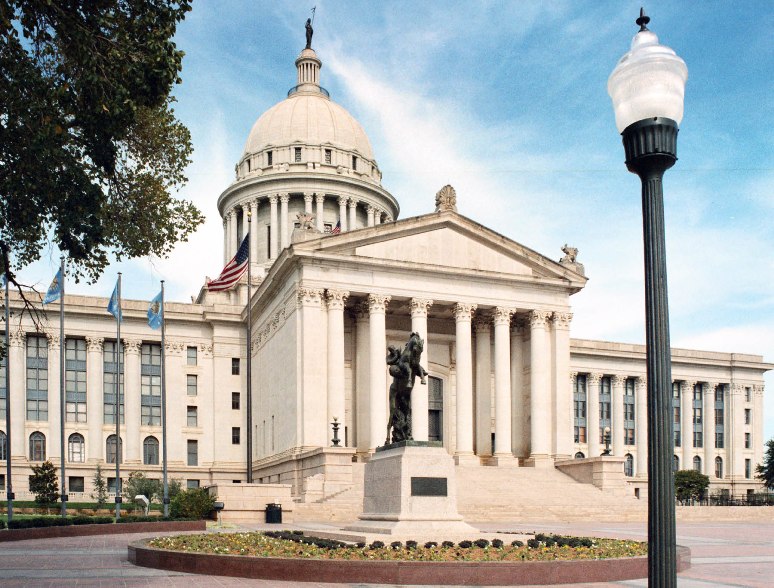 Oklahoma Speaker of the House Kris Steele has pulled a pro-life bill from the House calendar, effectively killing it for the year. SB 1433, which establishes the principle that personhood begins at conception, was, figuratively speaking, poisoned and dismembered by Steele, who claimed the support of a secret vote in the Republican House caucus, according to a story last Thursday by Pat McGuigan of CapitolBeatOK.
Expressing deep disappointment, state Rep. Sally Kern of Oklahoma City, a Republican, said in a statement to CapitolBeatOK, "I am pro-life and do not agree with refusing to grant a floor hearing to any pro-life bill that has gained committee approval."While I will abide by the caucus' decision, I certainly was not among those opposing the bill. And I will continue fighting for the rights of the unborn."
The legislation would have found that the "life of each human being begins at conception" and asserted the "laws of this state shall be interpreted and construed to acknowledge on behalf of the unborn child at every stage of development all the rights, privileges, and immunities available to other persons, citizens, and residents of this state."...
Speaker of the House Kris Steele informed members of the Capitol press of the GOP House caucus decision Thursday afternoon. He stressed the decision was "not made unilaterally."
There may well be a solid, substantive reason for a pro-life legislator to oppose this bill, even though this is a bill strongly supported by Oklahomans for Life, but that debate and vote should have been held openly, not behind closed doors. If I were in charge of the Oklahomans for Life scorecard, I'd have to give a demerit to every Republican member of the House and assume they voted in secret to kill the bill unless they take active, public steps to override Speaker Steele and allow the bill to be heard on the floor of the House.
Killing bills in secret out of fear for political consequences is the sort of garbage the Democrats used to pull when they had the majority. I expect better from my fellow Oklahoma Republicans, particularly in light of our strong history of passing pro-life legislation. Shame, shame, shame on Speaker Steele and his accomplices.
State Sen. Brian Crain, author of SB 1433, says that there may have been confusion about his bill:
Crain, R-Tulsa, said opponents to his bill became confused with his measure and proposals being advanced by a national group on personhood, which is supporting Oklahoma's initiative petition effort."They started mixing up one for the other and thought they were all the same," he said.
"There were some people that knew that this thing was constitutional; they just chose to not be completely open about what they thought this bill truly did."
Crain said the bill is based on a law in Missouri, which was upheld in 1989 by the U.S. Supreme Court.
MORE: State Rep. Paul Wesselhöft pins the blame for stopping the personhood bill on the State Chamber of Commerce. From his April 20, 2012, press release:
State Rep. Paul Wesselhoft said today he is disappointed that the personhood bill will not be given a hearing on the floor of the Oklahoma House of Representatives."When I ran for this office, I promised my constituents that I would be a pro-life voice in the Legislature," Wesselhoft said. "Therefore, my constituents and Republican friends deserve to know that I strongly supported, argued and voted for the Personhood bill to be heard in the Oklahoma House of Representatives.
"Unfortunately, a majority of my Republicans colleagues voted not to hear it. That bill could have sent a vital moral message that human life in the womb is not a blob of tissue but a living person created in the Image of God.
"I don't believe SB1433 presented a substantive problem but an image problem for the State Chamber of Commerce."
House leadership announced this week that Senate Bill 1433 would not be given a floor hearing in the Oklahoma House of Representatives. The legislation simply declares that the "life of each human being begins at conception" and that the "laws of this state shall be interpreted and construed to acknowledge on behalf of the unborn child at every stage of development all the rights, privileges, and immunities available to other persons, citizens, and residents of this state."
Meanwhile, although Steele claimed the bill would have no substantive effect (if not, then why kill it?), leading pro-abortion lobby group Planned Parenthood is celebrating his decision:
YOU DID IT!!!!!!!!!!!!!!!!!!!!!!!!!!!!!!!!!!!!!!!!!!!!!!!!!!!!!!!!!!!!!!!!!!!!!!!House Speaker Kris Steele... fb.me/1NiWXYIMt
— Planned Parenthood (@PPCOK) April 19, 2012
Photo from the okhouse.gov website
 A blockbuster news item in today's Daily Caller by Matthew Boyle: Jay Parmley, former Oklahoma Democratic Party chairman, who resigned last Sunday as executive director of the North Carolina Democratic Party in the midst of allegations that he sexually harassed a male party staffer, has been accused by a long-time former girlfriend of infecting her with HIV.
Rebecca Burgin, a long-time former girlfriend of former North Carolina Democratic Party executive director Jay Parmley, told The Daily Caller that she believes Parmley infected her with HIV.Parmley resigned on April 15 amid sexual harassment allegations from a former young male staffer.
Burgin, a 29-year-old Oklahoman, has shared her story with TheDC, including the revelation that Parmley's lawyer offered her health coverage, paid for by the Democratic National Committee, to manage her illness. She ultimately declined that offer, fearing it would constitute insurance fraud. Parmley, she said, abandoned her a few months later.
Burgin says that she met Parmley when she was a student in a class he taught at Oklahoma City Community College.
According to Burgin, Parmley's HIV status was discovered after he was taken to the hospital because of a debilitating illness. It was shortly thereafter that he allegedly disclosed this to Burgin, who then was tested and learned that she was HIV-positive. This occurred in 2006, during Parmley's stint as DNC liaison in Mississippi.
According to the Daily Caller story, Burgin identfied Parmley's lawyer, who made the offer of DNC-provided health coverage, as Tulsa union lawyer Jim Frasier, who was then and still is (according to his website) a member of the Executive Committee of the Democratic National Committee. According to the bio on his law firm's website, Frasier has been Oklahoma's committeeman on the DNC since 1997, and a member of the DNC Executive Committee since 2002. (This 2004 DNC roster shows Frasier as a DNC Executive Committee member for the term 2004-2008.)
"So, I sat down and wrote a letter," Burgin explained. "I laid it all out and then said I want a life insurance policy, and that I want health insurance coverage, basically, for the rest of my life.""I was not looking for money, I was not looking for some big payoff to keep my mouth shut," Burgin added. "That wasn't my concern. My concern was that my life has gotten completely blown to pieces, and I so needed to kind of figure out how I can move forward and figure this out."
Her attorney sent that letter to Parmley and "took it to a meeting with his [Parmley's] attorney, Jim Frasier."
Frasier, then Parmley's personal attorney, is currently one of 100 delegates to the Democratic National Committee.
"Frasier," Burgin continued, "came back and said, 'what we will provide for her is that she can remain on the DNC's health insurance and the DNC would pay for it' for -- I think that they said -- as long as Jay's employed there."
Keep an eye on the Daily Caller for further developments and the okdemocrat.com message board for further "I told you so"s.
BatesLine is pleased to welcome a new advertiser: John Sullivan for Congress. First elected to replace Steve Largent in a 2002 special election, Congressman Sullivan is seeking re-election to his sixth full term. His ads highlight his consistent conservative record, as evidenced by ratings by conservative watchdog groups like Numbers USA (enforcement of immigration laws), Club for Growth, Citizens against Government Waste, and National Taxpayers Union (fiscal conservative, tax and budget), National Right to Life (sanctity of human life), National Rifle Association (Second Amendment rights), and the American Conservative Union (full range of conservative issues).
I've known John Sullivan since long before I started blogging, before I became any sort of public figure. I first met him sometime in the 1990s, during his time as a state representative, when, as a member of the small Republican minority in the State House, he championed the effort to eliminate the sales tax on groceries. I encouraged him to run for State Senate when the seat opened up in 1996, but for family reasons he opted to stay in the House. When Steve Largent resigned his congressional seat in 2001 to run for governor, John phoned me, a precinct chairman, to let me know that he was running.
At the beginning of that special election, John Sullivan was running a distant third in the polls. First Lady Cathy Keating was the best known candidate and the odds-on favorite. But conservative grassroots activists liked what they saw in Sullivan and rallied around him, and I joined them in putting my name on his hundreds-long list of endorsements. A month or so later, I got a call from one of his campaign volunteers, someone I'd worked with on Sue Tibbs's campaigns, asking if I could pick up the campaign's data processing work. Thanks to the hard work of the candidate, his campaign team, and his team of volunteers knocking doors and making phone calls, John Sullivan came from a distant third to finish first in the primary, close enough to an outright majority that Cathy Keating opted to withdraw rather than continue on to a runoff. Sullivan won the general election handily over his Democratic opponent and hasn't faced a significant primary or general election challenge since then.
When I ran for City Council in 2002, newly elected Congressman Sullivan was the guest of honor at a fundraiser. I'm proud to consider John a friend and to continue to be a part of his team. We have had a small number of disagreements -- it was a mistake for him and Sen. Coburn to vote for the revised version of TARP in 2008 -- but we've been in agreement on nearly every controversial congressional issue, including some issues, like strict immigration enforcement, that put him at odds with Chamber of Commerce types.
His primary opponent has an impressive resume and is a likable person. But it strikes me that it's much easier to oppose something like TARP in hindsight, years after the frightening global financial circumstances that led to its adoption, than to speak out against it at the time. For all the years I've been involved in local politics, I can't recall any occasion when this gentleman has taken a controversial public stand on any issue, prior to his decision to run for Congress. He seems to be the latest victim of a group of Republican political consultants who have been trying unsuccessfully for years to find someone to unseat Sullivan.
Those who have known me for a long time know that I haven't hesitated to drop support for an incumbent Republican and back a primary challenger when circumstances warrant. But in John Sullivan we have a consistent, across-the-board Oklahoma conservative with growing seniority and influence in House leadership. I'm pleased to support his re-election and to have his support as an advertiser on BatesLine.
Some Oklahomans leave the state to become famous elsewhere. Others go on to be infamous in other states.
Jay Parmley, executive director of the North Carolina Democratic Party, has resigned in the face of accusations of sexually harassing a male party employee.
The executive director of the N.C. Democratic Party resigned Sunday as calls for his ouster mounted amid questions regarding a secret agreement to pay a former staffer to keep quiet about sexual harassment allegations.Jay Parmley, who served a year at the helm of the party, denied harassing any employee and blamed right-wing blogs for "spreading a false and misleading story" about the incident.
"Even though I have not done anything wrong, it is clear to me that I need to move on," Parmley wrote in his resignation letter.
A report by the Civitas Review first identified Parmley as the accused party executive mentioned in emails about the harassment settlement. Parmley is the former chairman of the Oklahoma Democratic Party.
North Carolina Democratic Party executive director Jay Parmley was accused of sexual harassment by former male staff member Adriadn Ortega. Ortega left the party after the incident. Ortega has not returned calls and has blocked access to his Linkedin Network site. The Daily Caller published quotes from a chain of emails discussing the situation but didn't name the victim. Ortega was well known and well liked within Republican circles because he attended several GOP events for the Democratic Party. Republican officials saw him as a respectful and good person.As mentioned in the Daily Caller Ortega and the Party reached a financial settlement so Ortega would not pursue an official complaint. The amount has not been disclosed nor has the source of funds for the settlement. Democratic Party Communications Director Walton Robinson also didn't return email or phone contacts with us
Parmley quit his Oklahoma chairmanship after the 2004 elections, which were disastrous for Oklahoma Democrats -- Republicans took control of the State House of Representatives for the first time in 84 years, President George W. Bush won all 77 counties, and former Congressman Tom Coburn beat his successor Brad Carson for an open U. S. Senate seat. Parmley has been blamed by Oklahoma Democrat activists for the party's massive debt following his tenure. From a "where are they now?" story in the McCarville Report in 2006:
When Parmley left the state party, it had a huge debt it is still trying to pay off; some blame Parmley for that, but his defenders say that's unfair. The debt, right at half a million dollars, came because of Congressman Brad Carson's unsuccessful campaign for the U. S. Senate and the resources the party poured into it trying to beat Republican Tom Coburn. After Parmley left, the party dismissed all of its paid staff and operated with volunteers. It now has paid the debt down by a substantial sum and has a paid staff, even if much of it is funded by the national party and the employees are flaming liberals straight out of the Dean school. As for Parmley, Dean named him to the Democratic National Committee as an at-large member in the fall of 2005.
An interesting side issue in the Daily Caller's story on the scandal: The NC Democratic Party is actively involved in the campaign to defeat an anti-gay-marriage constitutional amendment. You'd think that leadership of a state Democratic Party in the South would appreciate the need to remain on good terms with socially conservative Democrats who were once the heart of the party, rather than getting actively involved in an issue likely to motivate these social conservatives to turn out and vote for Republicans. Republicans have been able to win over lifelong yellow-dog Democrats simply by contrasting the parties' positions on social issues and pointing out that "this is not your granddaddy's Democratic Party."
It will be interesting to follow the rumor mill at okdemocrat.com as the Parmley story unfolds. I imagine there will be a lot of justifiable "I told you so"s uttered by the regulars there.
Hat tip to Ace of Spades HQ.
MORE: The story has made it into the British press.
 Oklahoma State Rep. Sue Tibbs, a Republican who had represented District 23 in east Tulsa since her election in 2000, died Friday, the end of a long battle with ovarian cancer. Because of term limits, this had been her final session.
Services will be held at 2 p.m., Wednesday, April 11, 2012, at Grace Church, 9610 S. Garnett. In lieu of flowers, donations in Sue's memory may be made to Free in Christ Ministries or Family & Children's Services Women in Recovery program.
Sue Tibbs was a gracious lady and a fighter.
I had the honor of seeing that grace and fighting spirit first hand, working with Sue Tibbs on several of her elections, including her second attempt at the seat in 1998, one which would set the stage for her election the next time around. Sometime that spring, I got a call from Sue's campaign manager. They had received a CD from the state GOP headquarters containing a database of voters; Rich Gradel, then the county GOP chairman, had told her I might be able to help turn the database into lists Sue could use for knocking doors, sending postcards, and making phone calls to likely voters.
Sue was trying to unseat the incumbent Democrat, Betty Boyd, a legendary and beloved local television personality. I recall gathering in the Tibbs home with Sue, her husband Homer, and a small but dedicated group of volunteers to plan out the campaign.
Sue worked relentlessly, going door-to-door in the hot summer sun to talk to voters. Although 1998 wasn't a particularly good year for Republicans nationally and despite the handicap of running against a household name and an incumbent with massive financial support from special-interest PACs, Sue lost by only 120 votes. The next time around, in 2000, Sue beat Betty by 417 votes.
She was reelected without opposition in 2002. In 2004, Sue beat a primary challenger, and, in the general election, she handily defeated the son of a prominent attorney who had been parachuted into the district by the Democrats to run against her. She was a Democrat target again in 2006 and 2008, winning by solid margins both times. In her final race in 2010, she took 67% of the vote.
One of Sue Tibbs' signature issues was voter fraud, a cause with its roots in what she witnessed in her 1986 campaign for House 23 against then-incumbent Kevin Easley. Each year she proposed a bill to require voters to show a photo ID, but passage had to wait until 2010, going directly to the voters, who overwhelmingly approved this basic fraud prevention measure and protection for the value of their votes. She lived to see the law in effect and the fear-mongering of its detractors disproved by experience.
Sue Tibbs was also a cosponsor of the constitutional amendment banning the use of sharia law in Oklahoma courts, another measure approved overwhelmingly by the voters, but blocked for now by the courts. She was honored last year by Eagle Forum of Oklahoma for her efforts.
A profile of Sue Tibbs last month by CapitolBeatOK highlights her efforts in the field of corrections reform. One of the bills she authored this year would make it easier for ex-cons to get certain state professional licenses, so that only past offenses relevant to the license sought would block an applicant.
She continued with reflections on priority issues, saying she is intensely focused on "the prison reform area. Being able to recognize that some people have made mistakes and wish to have a second chance, giving them that opportunity and truly seeing these programs work, changing lives for whole generations...."I truly believe Oklahoma needs to rewrite our criminal code. Kansas compares in population with Oklahoma and, a few years ago, decided they needed to rewrite their code.
"Their prison population dropped, saving Kansas taxpayers an incredible amount of money. This money was then able to spent on other services, or returned to the taxpayers.
"Oklahoma spends about $500 million a year on Corrections funding, believing we were getting smarter on crime, when in fact we weren't. We live in the Bible Belt where we believe in forgiveness and second chances. We must continue to work toward that end, not re-election."
State Rep. Pam Peterson, who shared an apartment with Tibbs for many years during the legislative session, said:
"She is an amazingly loyal person. When she's with you, she's with you."When she speaks on the floor, everybody listens. She is greatly respected. She's not flashy. She speaks very intentionally. She has power and influence because of who she is.
"The tenacity of the woman is just incredible. She's not the youngest member but she could run circles around many of the others, including younger members."
Our prayers are with Homer and their daughters and grandchildren for comfort in their loss.
MORE:
State Rep. Jason Nelson has details of services for Sue Tibbs and his own remembrance.
I received word from Chris Medlock that Ron Paul supporters won all three national delegate slots and all three alternate slots at the Saturday, March 31, 2012, Oklahoma 5th Congressional District Republican Convention. Medlock reports that turnout was light (only about 200 delegates), and that runoffs for each delegate slot favored the Ron Paul supporter by about a 52% to 48% margin, meaning that higher turnout by the non-Pauls could have meant a complete shutout of the Ron Paul fans.
In the March 6, 2012, Oklahoma primary, Ron Paul finished fourth in the 5th Congressional District with 10.4% of the votes cast.
Although the three delegates are bound by state party rules and the results of the March 6 primary to cast one vote each for Mitt Romney, Rick Santorum, and Newt Gingrich, if no presidential candidate gains a majority of delegates on the 1st or 2nd ballots at the Republican National Convention, or if their candidate releases his delegates, the delegates would then be free to vote their personal preference. It is possible that if enough Ron Paul supporters are elected to go to Tampa, they could pass party rules that would free all delegates from any binding commitments.
I am hoping to get specific numbers -- ballots cast, voting by round -- to analyze what happened. I am told that the 5th CD used a different runoff method than we've used since 2000 here in the 1st CD, and it's possible that their runoff method would allow the will of the majority of delegates to be thwarted, depending on the number of candidates in the race. The 1991 Louisiana governor's election is a classic example of a two-person runoff for a large field resulting in two finalists who are each loathed by a majority of the electorate.
MORE: What happened at the CD 5 convention is a continuation of the Ron Paul campaign strategy I wrote about in 2008
An unknown, untraceable organization called "Protecting Oklahoma Values" has sent three postcards to voters in support of Oklahoma House District 71 Democrat candidate Dan Arthrell and attacking Republican nominee Katie Henke. The District 71 seat is the ballot next Tuesday, April 3, 2012, in a special election to fill the vacancy left by Dan Sullivan.
Apparently unable to find anything negative about Henke personally or poiltically, the shadowy group behind the postcards seek to label the female candidate in the race as the anti-woman candidate by linking her to what is described as a "disgusting pattern of behavior towards women" by "the right-wing Republicans at the State Capitol."
The postcards supporting Arthrell make a series of claims, most of which are accompanied by footnotes with long URLs, which add credibility, but which are too long to tempt a voter to type them in order to compare assertions to reality.
CLAIM: Right-wing Republicans at the State Capitol "tried to cut funding to a Tulsa County program that provides nutrition for women and their children."
FACT: No source material was identified to back up this assertion.
CLAIM: Right-wing Republicans at the State Capitol "passed a law saying that birth is not a qualifying event for health coverage."
FACT: The item linked in the footnote is an emergency rule issued by the Insurance Department, not a law passed by the legislature. The rule deals only with "child-only" medical insurance policies and an adjustment in language to encourage more insurance companies to participate in the next open enrollment period and to write child-only medical policies in Oklahoma:
The lack of participation by insurers in the 2011 open enrollment period necessitates change to the rule in an effort to encourage insurers to participate in the 2012 open enrollment periods. During an open enrollment period, children under the age of nineteen (19) shall be offered coverage on a guaranteed issue basis, without any limitations or riders based on health status.
So the Republican Insurance Commissioner was trying to encourage more options for all children to have medical coverage.
CLAIM: Right-wing Republicans at the State Capitol "passed laws that may restrict women's access to infertility treatments and are forcing women to have invasive ultra sounds."
FACT: The first half of the statement refers to a claim by an infertility doctor that personhood legislation would hurt his business. One personhood bill, SB 1433, passed the Senate and is pending in the House. The other, HJR1067, which would put a constitutional amendment before the voters, appears to be dead for this session.
The second half of the statement refers to the 2010 law requiring that an ultrasound showing the unborn child be done prior to an abortion. The claim that an ultrasound is invasive is ludicrous compared to the invasiveness of the instruments used to scald, poison, and dismember an unborn child in an abortion.
CLAIM: Right-wing Republicans at the State Capitol "required personal information about women's gynecological history be reported to state agencies."
FACT: The footnote refers to the Statistical Abortion Reporting Act, 63 O.S. 1-738, which requires an abortion provider to submit a form to the State Department of Health for each abortion and a separate form for any abortion resulting in medical complications. The forms do not contain personally identifying information about the former mother on whom the abortion was performed. The purpose of the law is to gather accurate and complete statistical information about abortion in Oklahoma.
CLAIM: Right-wing Republicans at the State Capitol "continued to take away local control from our schools, interfering in our decisions about the education of our children."
FACT: The link is to a story about Tulsa Metro Chamber President Mike Neal, complaining about the prospect of the State Department of Education bringing in outside management to fix low-performing Hale High School in Tulsa. If our schools can't meet minimum standards, what does it say about "our decisions about the education of our children?" And what about the Democrats and local school officials who oppose school choice and sued to toss out the Lindsay Nicole Henry Scholarship law? Aren't they interfering in parents' decisions about the best education for their children?
The postcard goes on to try to plant blame on Katie Henke for the vulgar email sent by an insurance department employee (he was fired for his offense) and out-of-context comments by State Rep. Sean Roberts and State Rep. Sally Kern.
The postcards bear a strong resemblance to those sent out by an anonymous group in last year's Tulsa City Council election. Could the postcards be an act of revenge by a Republican political consultant against a Republican candidate that didn't purchase the consultant's services or an attempt to clear the way for a consultant-backed Republican candidate to run against Arthrell, who would, as a Democrat, be vulnerable in the regular general election in November? (NOTE: Consultant Fount Holland phoned to say that his firm had nothing to do with these mailers, and that in fact his firm is involved with independent expenditures in support of Katie Henke, and that he would never be involved with a pro-abortion or anti-pro-life mailer.)
A lifelong Tulsan, Katie Henke is a school teacher and is active in Tulsa civic organizations. As a Republican in an overwhelmingly Republican legislature, Henke would be in a much better position than Arthrell, a Democrat who would be part of a tiny minority, to influence legislation at the State Capitol.
UPDATE: Current speculation among insiders is that this mailer is the work of Democratic consultants, former Democratic operatives within the state party and state legislative apparatus.
MORE 2012/04/05: Ethics filings show that Protecting Oklahoma Values was organized on March 24 (Kimberly Grayson, chairman, Reid Nichols, treasurer), with the purpose of "To run an independent expenditure in HD 71." It was funded by George Krumme ($5,000 on March 26), Anthony Laizure ($1,000 on March 29), and Ed Abel ($2,000 on April 2). The funds were spent with Heartland Media of Oklahoma City: $4,186.16 for mail on March 27 and $1,000.00 for phones on March 30.
The following Statement of Principles was adopted as part of the 2012 Tulsa County Republican Platform at the Tulsa County Republican Convention on Saturday, March 24, 2012. It is identical to the Statement of Principles section in the 2011 platform and is nearly identical to the Statement of Principles in the 2003 platform, differing by only 20 words or so. The 2003 statement is not original to that year, but constitutes a consolidation of the preamble to the platform as a whole and preambles to individual sections as found in the 2001 platform. Much of the text almost certainly predates 2001. It is the work of many people over many years.
STATEMENT OF PRINCIPLES"God who gave us life gave us liberty." - Thomas Jefferson
The United States has attained its position as a world leader and champion of freedom by protecting our God-given liberties.
We believe our rights come from our Creator. We believe in the unalienable rights of the individual. It is a government's first duty to protect these God-given rights: to life; to liberty; to property; to the pursuit of happiness.
Government is but one institution among many that exist to serve the common good. Families, religious communities, businesses, the press, and a host of voluntary societies have their roles to play in meeting the needs of society. As Republicans, we seek to reform government so that it performs its proper role with excellence and efficiency, while leaving room for the other institutions of society to thrive.
We believe that today's government is too large and intrusive, exceeding its proper scope, doing things for which individuals and private organizations are best equipped. We believe families, communities, and institutions of faith can best teach the American values of honesty, responsibility, accountability, hard work, compassion, and mutual respect.
We believe that the functions of government should be handled at the level nearest and most accountable to the people. The Tulsa County Republican Party seeks to apply these time-honored principles at all levels of government:
- Faithful adherence to the U.S. Constitution as originally intended;
- The sanctity of human life, from the moment of conception to its natural end;
- The equality of all people before the Law - that individuals should be judged without regard to race, gender, creed, disability or age;
- Public integrity - enforcing and administering the laws justly, in the fear of God;
- Restoring and preserving Judeo-Christian morality in our culture;
- Respecting the dignity of each individual and the integrity of families;
- Fiscal responsibility and restraint;
- Defense of property rights;
- Promotion of free markets, free trade and freedom throughout the world.
At the Federal level, we call for maintenance of a strong national defense, protection of our freedom of religious expression, and protection of our rights as law-abiding individuals to keep and bear arms.
We support the right of Americans to retain their hard earned wages through the substantial reduction of the federal income tax rate and the establishment of a fair system of taxation.
We believe in personal responsibility and individual accountability. We desire to limit government involvement in the lives of families and individuals. We believe that a sound, traditional family unit is essential to the strength, stability, and success of our nation. We will defend the institution of the family against those who seek to use the levers of government to undermine or redefine it.
We believe inefficient government programs have displaced individual responsibility, compassion, and involvement in our communities. We will work to reform or eliminate impersonal, inefficient and redundant programs, while encouraging individuals, families, and private organizations to exercise their civic responsibilities, act with genuine compassion and offer assistance and care to people in need.
We believe it is the right and responsibility of parents or legal guardians to direct the upbringing and education of their children, without interference, regulation, or penalty from the government.
We therefore support the right of parents or legal guardians to choose the method of schooling for their children, whether public, private, charter, home schooling, or other means of education, without interference from the government at any level.
In our public schools, we seek to restore academic excellence. We believe the primary goal of our educational system should be to teach proficiency in the essential subjects, not to indoctrinate children in a worldview at odds with our nation's heritage.
We believe the best choices are not always the easiest, and that decisions which take commitment, sacrifice and perseverance result in more honorable, longer-lasting solutions. We believe the Republican Party provides the best opportunity to translate these ideals into positive and successful principles of government.
The intent of this section is to set out the timeless principles that motivate our involvement in the political process as Tulsa County Republicans. The remaining pages of the platform consist of detailed platform planks, applying these principles to current concerns.
This year's platform committee approved a draft containing a preamble which replaced the statement of principles. Gone from this preamble were any references to the sanctity of human life, the importance of marriage and the family (as traditionally understood), religious institutions, and other mediating institutions to the health of our society. There were no mentions of public integrity, education, parental rights, or morality.
Eleven members of the Platform Committee, led by Steven Roemerman, signed a minority report, proposing to replace this new preamble with the Statement of Principles from previous years, which you see above. Here is the text of the motion:
Whereas conservative social values such as the sanctity of human life, marriage, and the family and public integrity are core values of Tulsa County Republicans and therefore warrant prominence in our party's platform,Whereas social issues have had prominence in the Statement of Principles for our Tulsa County Republican Platform for many years, but have been omitted from the Preamble submitted in this year's proposed platform,
We, the undersigned members of the Platform Committee to the 2012 Tulsa County Republican Convention, offer this minority report to the Convention, to wit, amending the Platform Committee's report to substitute the Statement of Principles from the 2011 Tulsa County Republican Platform (attached) in place of the committee's proposed Preamble.
After debate, the motion was approved by the convention by an overwhelming margin. The resulting platform consists of the above Statement of Principles and the individual platform planks that had been approved by the 2012 Platform Committee.
During my remarks (which, like Roemerman's, focused on the issue at hand and did not cast aspersions at any individual or question anyone's motives), I quoted Congressman Mike Pence, who was quoted in a recent column by Mark Steyn (well worth reading in full):
To those who say we should simply focus on fiscal issues, I say you would not be able to print enough money in a thousand years to pay for the government you would need if the traditional family collapses.
(In a similar vein, Phyllis Schlafly's latest column is titled "Phony Divide Between Fiscal & Social Issues.")
I will have more to say about this in the next day or two, but for now I wanted to get the substance on the record.
MORE: Here is the Tulsa County platform committee majority report (1 MB PDF), with the Preamble (the section that was replaced) highlighted.
Tulsa County Republican activists gathered today at the Union High School Performing Arts Center to decide on delegates to the congressional district and state Republican conventions and to adopt a platform that will inform the work of platform committees at the state and national conventions. The only dispute in the peaceful and surprisingly brief convention involved restoring the long-time "bold colors" Statement of Principles to lead off the county platform, in place of the watered-down "pale pastels" preamble that had been approved by this year's committee. (I'll detail that dispute in a separate entry, but thanks to Steven Roemerman and several other members of the platform committee for their willingness to present a minority report.)
After the chaos at many Missouri county caucuses last Saturday (see first-time attendee Duane Lester's account of the Nodaway County caucus) and reports of strife at the Oklahoma County convention earlier in the month, there was some nervousness about a conflict in Tulsa between newcomers supporting Ron Paul and long-time conservative activists at our convention.
As it happened, the convention went very smoothly, starting with the final gathering of the rules committee before the gavel this morning. The rules committee, made up of supporters of a variety of presidential candidates, unanimously approved a couple of final tweaks to the rules. And although a SNAFU resulted in an earlier version being printed distributed to delegates, only one delegate, a Ron Paul supporter, got upset by the lack of an accurate printed copy, and the upset didn't last long. The platform dispute I mentioned didn't break along lines of presidential preference, but boiled down to an old-timer who has been trying for years to water down the platform and got farther this time than ever before.
The need to hear and resolve 30 credentials appeals delayed the start of official business by nearly an hour and a half. The appeals panel of five heard from people who tried to attend their caucus, but it wasn't held at the advertised time and place, people who were elected as county delegates but whose name was left off of the precinct's delegate list, and a couple of people who just registered to vote and thought they should be able to participate.
While waiting for the credentials committee to complete their work, we heard from Congressman John Sullivan on his energy-independence efforts, Corporation Commission chairman Dana Murphy and Commissioner Bob Anthony, Oklahoma's longest-serving statewide official, State Auditor and Inspector (and former GOP state chairman) Gary Jones, state chairman Matt Pinnell, Tulsa County Commission chairman John Smaligo, Insurance Commissioner John Doak, and State Senator Rick Brinkley, among others.
The oddest moment of the day: After concluding his speech and starting up the aisle away from the stage, Tulsa Mayor Dewey Bartlett Jr stopped at my row, extended his hand to me for a handshake, waited for me to look up -- I was typing on my laptop and wasn't paying close attention -- and said, "Where'd you get all that gray hair? What happened?" I shook his hand and gave him a puzzled look in return. (I've had all this gray hair for about seven years. I don't dye it.)
But once started, things rolled quickly, with adjournment coming at 2:45 pm, more than an hour before the expected close of business. The reports of the credentials (who's qualified to vote in this convention), rules (how we conduct business in this convention), and delegates (who will we send to the next level of conventions) committees were adopted with near unanimity.
Four proposed changes to the state party rules were approved for recommendation by wide margins -- these will be brought before the state convention in May. The proposed rule changes would:
- eliminate any gender quotas on members of state and district committees,
- remove the right to seats at the county convention for precincts with no voters and for precincts that fail to hold caucuses by the state deadline,
- require that only elected county convention delegates and elected officials can be delegates for their counties at the district and state conventions, and
- require Republican candidates to declare their areas of disagreement with the state party platform.
In their pre-convention session, the rules committee adopted two last-minute changes. One of the changes was to allow candidates wishing to address the convention (including some candidates challenging incumbent Republicans) a few minutes to speak during the lunch break.
The other change simplified the process of determining who would go as Tulsa County's delegation to the state and congressional conventions, where national convention delegates are selected. If the county voted to send an "open" delegation to both higher-level conventions, those delegations would consist of every delegate elected by their precinct to the county convention, rather than requiring delegates to sign up. While it is theoretically possible that a thousand or so delegates would show up to share Tulsa County's 331 votes, the usual situation is that a fraction of the total will show up, particularly to the state convention. This approach to filling the delegate list broadens the possible pool of Tulsa County delegates, improving the likelihood that we'll be able to claim all of our votes. And, at my instigation, we made this form of open delegation the default, in the event that delays or disruptions prevented the convention from electing delegates before adjournment. (This topic deserves an entry of its own for a full explanation.)
County Chairman J. B. Alexander, Vice Chairman Mike McCutchin, convention chairman State Sen. Dan Newberry, convention parliamentarian former State Rep. John Wright, convention secretary Melinda Voss, and credentials committee chairman Ted Darr deserve much credit for the smooth convention. Following state rules strictly and developing and following strict guidelines to cover ambiguities in the state rules may be the difference between a peaceful convention and a contentious convention.
The Obama administration has been blocking the development of the Keystone XL pipeline from the tar sands of Canada to Oklahoma and the development of oil reserves under the Gulf of Mexico and on Federal lands in Alaska. As a candidate, he announced that under his energy plan, electricity prices would necessarily skyrocket.
This morning on TV, CNN prominently displayed the headline "Obama to fast-track Keystone XL pipeline." In fact, Obama's denial of the necessary permit to build the pipeline from Canada to the US still stands. TransCanada decided to go ahead with the pipeline from Cushing to the Gulf (which doesn't require the President's permission), and now it appears that the president wants to stage a photo op to take credit for that.
A spokesman for House Speaker John Boehner balked at the idea that President Obama could claim credit for speeding up the approval process of the southern segment of the pipeline. "This is like a governor personally issuing a fishing license," Brendan Buck said. "There is only a minor, routine permit needed for this leg of the project. Only a desperate administration would inject the President of the United States into this trivial matter. The President's attempt to take credit for a pipeline he blocked and personally lobbied Congress against is staggering in its dis-ingenuousness. This portion of the pipeline is being built in spite of the President, not because of him."
Here is the email blast from Americans for Prosperity about Obama's visit to Oklahoma and tomorrow's rally:
It's not enough that President Obama refused to approve the Keystone XL pipeline, denying thousands of jobs and lower gas prices at the pump. Now he's coming to Cushing, Oklahoma to grandstand credit for a private sector energy success - and he hopes you aren't paying attention.Prove him wrong.
Join Americans for Prosperity tomorrow morning when President Obama visits Cushing.
Click here to register for our rally!
Let's show the President that we are paying attention and we aren't going to let him off the hook. AFP will show up with a simple message: stop playing politics with America's energy.
What: We Can't Wait Rally in Cushing When: Thursday, March 22nd @ 8:30 a.m. Where: Fechner Pump and Supply, 1402 North Little Street in Cushing, OK Who: You and your fellow Americans for Prosperity activists Just a few weeks ago Obama said that oil is a "fuel of the past." Now he's talking out of the other side of his mouth and thinks no one will call him on it.
Economists have found that the Keystone XL pipeline that Obama is halting could create over 100,000 jobs, increase refining capacity by 700,000 barrels, lower prices at the pump, and bring millions in tax revenues to Oklahoma and the surrounding region.
America needs commonsense energy policy - not political grandstanding.
Help AFP call out the President and demand real energy solutions.
Photo credit: Pipeline monument, Cushing OK by roy.luck, on Flickr. Used under Creative Commons license
MORE:
Oklahoma Gov. Mary Fallin didn't cancel her spring break vacation plans to rush back to welcome Pres. Obama to the state, and some are complaining that she's being disrespectful and even racist by not doing so. I used Storify to capture a Twitter conversation between myself, Jennifer James, Steve Lackmeyer of the Oklahoman, Joe Fairbanks, with a few others.
Gov. Fallin issued a statement about the president's visit:
"I am pleased that President Obama is able to make his first visit to the great state of Oklahoma this week and to personally see the good work going on in Cushing. The TransCanada pipeline to be built there will connect Oklahoma to oil markets on the Gulf Coast, resulting in the creation of more than 1,000 Oklahoma jobs. This project will help to bolster our energy industry and security for years to come."I am glad the president supports the construction of the pipeline connecting Cushing to the Gulf. Impeding the progress of something which is so obviously beneficial to both the economy and the energy security of the United States would have been nothing short of irresponsible.
"Unfortunately, President Obama and his administration are practicing exactly this kind of obstructionism on the northern leg of the Keystone XL pipeline, which would have carried oil from the Canadian oil sands and several U.S. markets to Cushing. As a result, the United States must go without the hundreds of thousands of jobs and hundreds of millions of dollars of investment that would have otherwise been available to stimulate our economy. Just as importantly, the administration's decision undermines U.S. energy security and alienates our closest trading partner, Canada.
"I hope that while President Obama is in Oklahoma he takes some time to listen to our citizens, many of whom work for the energy industry which he claims to support. I think they will tell him that - far from supporting the responsible domestic production of American-made energy - his administration has undermined it at every turn. Rather than embracing the truly remarkable technological breakthroughs that have resulted in the discovery of an additional 100-year supply of natural gas, the president and the EPA continue their hostility to basic and time-tested practices like hydraulic fracturing. The president and his party in Washington continue to support an aggressively anti-energy agenda that will severely hamper the American economy and put the United States at a competitive disadvantage to the rest of the world.
"In Oklahoma, we recognize that the energy industry is an important ally in job creation and economic development. We believe that American energy is a resource, not a hazardous waste. My great hope is that some of that attitude will rub off on our president, who has lost his way on energy policy and so many other issues."
MORE: U. S. Rep. John Sullivan talks about the Keystone XL pipeline and Obama's visit on Fox and Friends this morning. Sullivan calls Obama's about-face on part of the pipeline a "con job," comparing it to Al Gore taking credit for inventing the internet. Fox and Friends host Steve Doocy notes that the absence of the northern part of the pipeline would require oil from the Canadian tar sands to be shipped by other means, such as the Warren Buffett / Berkshire Hathaway-owned BNSF railroad.
 The Oklahoma chapter of Americans for Prosperity has posted its list of key bills for the Oklahoma legislature's 2012 session. Groups like AfP use their announced key bills as the basis for rankings of state representatives and state senators. Each bill has information on the sponsor, the purpose of the bill, AfP's support or opposition and their rationale, and the current status of the bill.
AfP opposes requiring out-of-state companies with subsidiaries or affilates in Oklahoma to collect Oklahoma sales tax, supports the various bills to phase out the state income tax, supports elimination of transferable tax credits, supports the establishment of statewide virtual charter schools, supports steps to make state employee pension funds solvent and to prevent fiscally irresponsible changes to pensions, supports workers' compensation reform, opposes creation of the Oklahoma Healthcare Exchange, and supports applying spill-over money from the rainy day fund to reduce Oklahoma's unfunded liabilities. See the AfP website for specific bill numbers and detailed rationale for support or opposition.
The Oklahoma Legislature is considering a constitutional amendment that would give the State Auditor and Inspector the power to initiate and conduct performance audits of state agencies. If approved by the legislature, the amendment will come before voters for final approval in November. It's a good idea, and legislators should send it to Oklahoma voters. If you agree, you need to contact your legislator today -- action is required by Thursday to keep the proposal alive.
While regular audits evaluate compliance with existing procedures, rules, and laws, performance audits look at whether an agency's processes are effective and efficient.
The legislation is authored by government modernization guru State Rep. Jason Murphey (R-Guthrie), who calls the legislation "one of the most important components of this year's House government modernization effort." (Murphey's work on behalf of online and open government is highlighted in my Government 2.0 story in the current issue of This Land.)
It is important for the proposal to be approved as a constitutional amendment to ensure the performance audits remain free from political interference (legislators can not amend the Constitution). Thorough performance audits may make many politicians very uncomfortable as they will tend to shine the light of day on the failure of state government to perform efficiently. I also suspect they will reveal a large number of state government processes that are highly vulnerable to corruption.Currently, the Auditor can conduct these audits at the request of the Governor, the Legislature, or the head of an agency. As you might image, it is highly unlikely agency officials from a poorly performing agency would ever request the Auditor to audit their agency.
Murphey says that, not only would the audits directly identify waste and inefficiencies, saving taxpayers much more than the cost of the audits, but they would generate indirect savings by inspiring agency heads to make improvements in advance of an audit.

The proposal also provides for a dedicated funding mechanism, which also works to ensure the auditor's independence from the good will of agencies and officials he seeks to audit. No one can threaten to withhold his funding.
As you might imagine, there is resistance, and it's coming from those with the most immediate and direct access to legislators' ears.
Duncan blogger and columnist Steve Fair notes:
Giving Jones the authority and the money to do performance audits is not without some opposition. Critics of HJR1075 correctly point out the proposal would expand the powers of the State Auditor's office. While that is true, isn't identifying and eliminating government waste what most taxpayers want from their elected officials, especially the State Auditor?
Fair predicts the amendment would pass by a 3 to 1 margin at the ballot box. "Taxpayers, regardless of party affiliation, want to know how their tax money is being spent." Fair writes:
What could possibly be a valid reason for a state legislator to oppose HJR1075? That is a good question and one I would urge you to ask your legislator. Passage of HJR1075 simply lets the voters decide the issue of accountability in government expenditures. If it is such a bad idea, then it should be soundly defeated. Legislators should not be trying to protect ourselves from ourselves. They should let the process play out in the arena of public ideas. Oklahoma voters get it right an overwhelming majority of the time.
Visit Oklahoma's "Find My Legislator" page to find out who represents you and how to get in touch on this issue.
In the wake of the Michigan Republican presidential primary, in which Rick Santorum and Mitt Romney won an equal number of congressional districts, each worth two delegates, there was a dispute over whether the two at-large delegates should be divided between Romney and Santorum (since no candidate received a majority of the statewide vote) or both given to the candidate who received the plurality. Had the Michigan Republican Party published its delegate allocation rules in advance of the primary, the dispute and the consequent accusations of bad faith could have been avoided.
In doing my own research on delegate allocation in each state, I have noticed that state party websites rarely have updated information about anything, and they're especially bad about not posting rules, resolutions, and other "party business" documents.
In light of that problem, and in order to avoid a repeat of the Michigan mishegoss, I urged Oklahoma Republican Party leadership to publicize Oklahoma's allocation rules in advance of Tuesday's primary. This evening, Oklahoma GOP vice chairman Pam Pollard sent me the official 2012 National Delegate Award Methodology (PDF). This methodology was approved last year by the Oklahoma Republican State Committee, which is the governing body of the state party, consisting of the County Chairman, Vice Chairman, State Committeeman and State Committeewoman from each county, and all Republican state and federal elected officials.
Some key points (my paraphrase of the official rules):
- The three Republican National Committee members (Chairman Matt Pinnell, National Committeeman James Dunn, National Committeewoman Carolyn McLarty) will not be bound by the primary result.
- It takes a majority (50% + one vote) to win all the delegates in each congressional district (3 each) and statewide to win all 25 at-large delegates.
- If no one has a statewide majority, the 25 delegates will be split among all candidates with at least 15% of the statewide vote in proportion to their share of the vote among the candidates with at least 15%. If rounding results in an unallocated delegate, it will go to the top vote-getter.
- In any congressional district, if three or more candidates get 15% of the vote, the top three candidates get one delegate each. If only two get 15% of the vote or more, the top candidate gets two and the second-place candidate gets one. If only one candidate breaks 15% or if a candidate gets 50% or more, he will get all three delegates
After the jump, the full text of the document:
 The March 1, 2012, issue of This Land includes my first foray into print in nearly two years. The story is about Government 2.0 and the Oklahomans who are using web and mobile technologies to work for more responsive and accountable state and local government.
It's a big topic and at one point my working draft was twice as long as what I ultimately submitted. There are so many interesting angles and individual stories, and I just managed to squeeze these into the space available:
- The free mobile app used by Shawnee and Enid to make public info easily available to their citizens, and the former Haskell city councilor who's an evangelist for connecting small cities and towns with inexpensive web technology like this app.
- The volunteer work a local group of web developers are doing to make it easier for Tulsans to get around, whether in their own vehicles or by Tulsa Transit bus.
- The former BBS sysop turned legislative committee chairman trying to modernize state government's use of data and its availability to the public, and the think tank that provides an easy way for the public to search and analyze this newly public state government data.
- The former big city newspaper app developer who used his data journalism skills to learn about the small Texas city to which he was moving.
At the moment the story is only available in print. You can find the latest issue of This Land available for $2 at coffeehouses, restaurants, specialty retailers, and other locations around Tulsa, or you can subscribe -- $40 a year.
 SoonerPoll.com has released a poll of 300 likely Oklahoma Republican presidential primary voters (deemed likely because of voting history). 278 said they planned to vote in the March 6 Super Tuesday primary. Margin of error is +/- 5.66%. The survey occurred over a nine-day period (February 8 - February 16).
The result:Santorum 38.5%, Romney 23.0%, Gingrich 18.0%, and Paul 7.6%, with 12.9% Don't Know / Refused.
Because Oklahoma's primary is in March, the new national Republican rules require allocation to be proportional. 25 delegates will be allocated based on the statewide result, and 3 delegates will be allocated based on the result in each congressional district. You must have at least 15% to get any delegates, and if you break 50% you get all the delegates. Based on the results of this poll (and with the understanding that the congressional district subsamples are so small the margin of error is enormous), Santorum would get 12 statewide delegates, Romney 7, Gingrich 6. Santorum would win all the delegates in the 1st and 2nd CDs and two of three in CDs 3, 4, and 5. Romney would win one delegate each in CD 3 and CD 4; Gingrich would win one delegate in CD 5. The grand total would be Santorum 24, Romney 9, Gingrich 7.
If Santorum could get key endorsements in central and western Oklahoma (paging James Lankford), he would have a shot at sweeping all the delegates.
You may recall that in 2008, Mike Huckabee won the 1st and 2nd CDs, while McCain won the other three plus the statewide vote by a narrow margin.
Question 4 has got to be a typo. I hope the callers didn't read the question like this, but here's how it's presented in the poll result:
4. As you know, the Republican Presidential preferential primary election is February 5, 2008, do you plan to vote in that election?
Peter Rudy of Oklahoma Watchdog has a couple of intriguing items:
Whatever happened to former mayoral chief of staff Terry Simonson? House Speaker Kris Steele appointed him to a municipal sales tax collection task force, and an interesting question came up at today's meeting of the task force:
The former Chief of Staff to Tulsa Mayor Dewey Bartlett says he wasn't suggesting that food stamp purchases should be subject to state and local sales taxes, he just wanted confirmation of a rumor he'd heard that those purchases were not taxed....When asked if he thought food stamp purchases should be taxed, Simonson said, "I don't have any other thoughts at this point other than to kind of, in my own mind, 'is that okay? is that fine?' People on food stamps obviously are on limited income. That's why they have food stamps. So maybe they shouldn't have to pay sales tax. Or should they? I really don't have any opinion because this has just come to my attention." He went on to say that it had never occurred to him that someone on food stamps wasn't paying sales tax.
I have questions, too. Is the City of Tulsa officially represented on this task force? Is Simonson unofficially representing his former employer?
Elsewhere at the capitol, there's a report that two Republican state reps, Mike Reynolds of Oklahoma City and Harold Wright of Weatherford had a confrontation on the House floor Thursday over remarks made by guests to the House floor, remarks that Reynolds felt crossed the line into lobbying for legislation, contrary to House rules. The result, allegedly, was the sort of nose-to-nose confrontation you expect to see between a manager and an umpire on a baseball diamond.
Peter Rudy is a great shoe-leather reporter. If you're on Twitter, be sure to follow @WatchdogOK for the latest from the Oklahoma State Capitol.
 No commentary from me tonight, but I want you to read an excellent post by State Representative Jason Murphey on how lobbyist influence works and how state Labor Commissioner Mark Costello, who refuses to take campaign contributions from lobbyists, has documented their shifting influence.
Here's Costello on the numbers:
"In 2010, when Republicans held a majority in both chambers, the public employees' PAC contributed $102,750 to Republican candidates. This compares to only $57,750 donated to Democrat candidates in the same year."Until we became a majority in the legislature, the public employees' PAC was a long-time political enemy of Republicans; in 2004 the OPEA contributed $86,143 to Democrats in an effort to prevent Republicans from gaining a majority of House seats while contributing $2,500 to a handful of Republicans - a 34 to 1 ratio for Democrats. We won - they lost."
Making the important point that you don't need lobbyist dollars to win an election.
Now here's Murphey:
Since this last legislative week was the first week of the legislative session much of the work was in committees. Lobbyists aggressively work to influence the bills in the committee process because this is the vital first step to passing or defeating a bill. These lobbyists will fill committee meetings, feed questions to the members of the committee who are carrying water for them and will put great pressure on the other members to vote their way. They are professional relationship manipulation experts, and expert strategists and they know the pressure points to push to get a key lawmaker's vote. Their attempts to kill a good bill appear to be rather like a game to them. A team of lobbyist can point to a dead bill much like a trophy and use it as a warning to other legislators who might try to upset their deal. Anyone who believes those big campaign contributions don't factor into the voting consideration of some of the legislators is very much out of touch.
Photo by Flickr user 401K. Visit their site at 401kcalculator.org
Pretty, pretty, pretty, and we get our first look at it tonight. Oklahoma's new election processing system comes with a fancy new election night reporting system, making it possible to see every race in the state -- from town trustee to president -- to see the results for each precinct as soon as it arrives at the county election board, and to know how each precinct and county has voted. It will make it much easier to analyze trends and project results.
Here's a direct link to the Oklahoma election night results website.
From a news release from the Oklahoma State Election Board:
Major features of Oklahoma's new election night results application include:
- Click the "State/Multi-County" button for state office results and aggregated results for multi-county local offices.
- Click the "County/Local" button to access a specific county's results page. (Note: County pages only include results for that county. For multi-county elections, aggregated results from all participating counties can be viewed on the State/Multi-County page.)
- Results are available in graph or tabular formats.
- Results may be viewed by county on the "State/Multi-County" results page, including viewing a map of the counties participating in an election.
- Results may be viewed by precinct on each "County/Local" results page.
- Results may be viewed by "type" - Election Day, Early Voting Absentee, or Mail Absentee.
- Election results reports can be exported in a variety of formats, including XLS and XML.
CORRECTION 2012/02/12: I had erroneously listed Evelyn Rogers as a librarian at ORU. According to her response to the House 71 League of Women Voters candidate questionnaire, she is a librarian at TCC, and I have corrected the text below accordingly.)
UPDATE 2012/02/12: See below regarding an odd complaint about this entry which appeared (briefly) on candidate Lydia d'Ross's website.
In addition to a handful of school board races around Tulsa County, there will be a primary on Tuesday, February 14, 2012, to fill a vacancy in House District 71. The incumbent, Dan Sullivan, resigned to replace Kevin Easley as head of the Grand River Dam Authority. The primary will choose two candidates to compete head to head on April 3.
District 71 covers the area between Lewis and Riverside, 21st and 81st, minus a small section just southwest of 21st and Lewis (part of Precinct 71). The district has almost always voted Republican, but this time there will be a Democratic primary, too. Democrat Roy McClain was the only Democrat ever to represent HD 71, winning the general election in 2002 after a scandal involving Republican incumbent Chad Stites surfaced too late in the process for Stites to draw a Republican challenger. Dan Sullivan defeated McClain for re-election in 2004.
The north end of the district includes some very expensive neighborhoods; the south end includes some middle-class subdivisions and apartment complexes, many of which are subsidized.
Four of the Republican candidates are women; both Democrats and one Republican are men.
Lydia d'Ross is the Oklahoma State Director of the National Hispanic Christian Leadership Conference (NHCLC). She has a Master's in Public Administration from Regent University School of Government. She serves on the Tulsa County Republican Executive Committee and the Greater Tulsa Hispanic Chamber of Commerce
Katie Henke is a native Tulsan, a graduate of the University of Alabama in early childhood development, and formerly a teacher at the Little Light House, Montessori School, and Riverfield Country Day School. She has served on the Tulsa County Republican Executive Committee. Her husband, Frazier Henke, is president of American Bank and Trust and has served as chairman of the City of Tulsa Board of Adjustment and vice chairman of the Tulsa County Republican Party.
Bonnie Huffines is a songwriter of Christian worship music, a former owner and operator (for 16 years) of a state-licensed day care, is a board member of the Brookside Neighborhood Association, and is active in local Republican organizations. She and her husband John Huffines have a Christian ministry called Jesus Praise 24-7, which appears to have as its goal establishing places where worship would take place around the clock.
Gerald Lovoi is an attorney. He ran in the Council District 9 Republican primary in 1998. (I remember appearing at a couple of candidate forums with him.) He does not appear to have a campaign website; the link goes to his law firm website.
TCC librarian Evelyn Rogers is a perennial candidate.for office. It doesn't appear that she has a website this time around.
Among the Democrats, Dan Arthrell is the Community Service Council's Director of Public Policy and Intergovernmental Relations.
Robert Walpole is an attorney and doesn't seem to have a website.
Here's the complete list of candidates, with website links where available.
Republicans:
Lydia M. D'Ross, 48, 7742 S. Victor Ave., Tulsa, OK 74136
Katie Henke, 31, 2300 Riverside Drive Unit 5E, Tulsa, OK 74114
Bonnie Huffines, 60, 256 E. 46 St., Tulsa, OK 74105
Gerald J. Lovoi, 51, 3905 S. Norfolk, Tulsa, OK 74105
Evelyn L. Rogers, 59, 6710 S. Quaker Ave., Tulsa, OK 74136
Democrats:
Dan Arthrell, 65, 1626 E 36 Place, Tulsa, OK 74105-3222
Robert J. Walpole, 57, 1133 E. 36 St, Tulsa, OK 74105
History of HD 71 representatives:
Warren Green (R), 1964-1976
Helen Arnold (R), 1976-1982
Bill Clark (R), 1982-1988
Rob Johnson (R), 1988-1994
John Sullivan (R), 1994-2002
Chad Stites (R), 2002
Roy McClain (D), 2002-2004
Dan Sullivan (R), 2004-2011
MORE: The House District 71 League of Women Voters candidate questionnaire was completed by four of the five Republican candidates and both Democrats. Lydia D'Ross did not return a questionnaire. From the responses, particularly on whether to reduce or eliminate the state income tax, it's apparent that the general election will feature a clear contrast between the Democrat and Republican nominees.
Four of the five Republicans responded to the House District 71 Oklahomans for Life questionnaire. (Neither of the Democrats did, and, once again, D'Ross was the lone Republican not to respond.) Of the four Republicans who answered the questionnaire, three -- Henke, Lovoi, and Rogers -- hold pro-life positions across the board, while Huffines gave pro-life answers to 10 questions and did not answer the remaining two questions which dealt with life-saving medical treatment.
And here is a strange: Sunday morning, February 12, 2012, Lydia d'Ross's website included a special page, headlined "Bateline News" [sic], with a link to this entry and the statement: "Bateline news writes about Lydia without permission." (Click to see full-size, as it appeared on a smartphone screen.)
By the time, I learned about it, the page had vanished, but a remnant still appeared in the Google search results (click for full-size):
The search result excerpt read: "Correction requested for Bateline News to amend statements made without a candidates permission."
There may be some confusion here about freedom of speech and freedom of the press.
And stranger still, it appears that a reference to the Greater Tulsa Hispanic Chamber of Commerce has vanished from her list of involvements on the home page of her website. A Google search for "hispanic chamber" site:lydiadross.net turns up three results, including her home page. The Google screen capture (click to view) shows "Greater Tulsa Hispanic Chamber of Commerce" between "Greater Tulsa Hispanic Affairs, Chair, International Committee" and "Tulsa Hispanic Human Resources Association," but a visit to the site at 10 p.m. Sunday shows that the Hispanic Chamber reference has vanished from her homepage.
UPDATE: Because of expected crowds, the Tulsa event has been moved to the "Baby Mabee", the TV production studio just to the east of the Mabee Center on the ORU campus, and the Oklahoma City event has been moved to the Magnuson Hotel and Meridian Conference Center, just south of I-40 on Meridian (this is several miles west of downtown OKC; Republicans will recognize it as the frequent location for state conventions).
 Republican presidential candidate Rick Santorum will be in Oklahoma this Thursday, February 9, 2012, for Oklahoma Republican Party "Victory 2012" events in Oklahoma City and Tulsa. Here are the details:
Oklahoma City - 9:00 am
Magnuson Hotel and Meridian Conference Center
737 S Meridian Ave
Oklahoma City, OK 73108
Tulsa - 1:30 pm
"Baby Mabee", east of the Mabee Center, Oral Roberts University
7777 S Lewis Avenue
Tulsa, OK 74136
Oklahoma GOP chairman Matt Pinnell writes:
We are thrilled to welcome another Presidential candidate to the Reddest State in the Country! If you can win Oklahoma, you can win the conservative vote nationwide. We welcome our Republican candidates to Oklahoma over the coming weeks as they compete to win our "Reddest State" primary.
The state party hopes to see all the GOP presidential candidates appear at Victory 2012 events in the weeks leading up to the March 6 Oklahoma primary.
The Oklahoma Republican Party is asking for you to RSVP if you plan to attend either event.
Oklahoma has such a strong homeschool community (today is Home Educators' Day at the State Capitol), that I'd hope for a big turnout by homeschooling families for their fellow homeschooling dad.
Mike McCarville has two stories from the State Capitol about dissatisfaction among rank-and-file Republican members of the Oklahoma House of Representatives with the way Speaker Kris Steele is using (or abusing) his power. Steele has one year remaining as speaker. Republicans have already picked T. W. Shannon to succeed Steele in 2013; they rejected Steele's anointed successor, Jeff Hickman.
Back in early November, Steele removed Broken Arrow Rep. John Trebilcock from his chairmanship of the Energy and Utility Regulation Committee. Trebilcock wrote on Facebook on November 4:
Speaker Kirs Steele just removed me as Chairman of the Energy Committee. Clearly, if I had supported his choice in the recent Speaker's race to replace him, I would remain as chairman. This is unacceptable Pay to Play trading of votes and punishing members for voting their conscience. Extremely saddened that someone i once considered a friend has let his office diminish him as a person.
The Republican caucus's retreat in Shawnee this week would have been the opportunity for members to air these sorts of concerns, but instead it's reported that Steele filled the meetings with presentations and position papers, limiting any opportunity for discussion to the tail end of the retreat. Panhandle Rep. Gus Blackwell wrote a scathing email to his colleagues protesting the way the meeting was conducted:
Obviously, our caucus retreat was not intended to be an opportunity for our caucus to discuss, debate, or decide policy. Instead, our caucus meetings have become carefully orchestrated and planned events, with little or no time for the actual discussion of caucus business.The 2011 Republican Caucus Retreat in Shawnee stands as an outstanding example of what I am writing in this email. After a first day of tours and dinner, no caucus business was transacted. The second day had time for a breakfast with a political presentation, a 30-minute museum tour and five and one-half hours of other presentations, before staff was asked to leave and we actually began "caucus business." Our discussions as a caucus lasted less than 45 minutes out of the over 15 hours of scheduled activity.
Blackwell finally had the floor, at the very end of that 45 minutes, to discuss the removal of Trebilcock and Steele's firings of senior House staff, but after 10 minutes he was cut off by a hasty motion to adjourn:
As a senior member, who has been Acting Speaker, Speaker Pro-Tempore, Chair of three different committees, and who has served on every Republican leadership team except the present one, I would think I would be allowed to have more than two responses to speak on a topic I requested be discussed and which strikes to the very core of how we operate as a majority. However, I wasn't, neither was Rep. Trebilcock or any other members of the caucus.
An anonymous blog (caveat lector) called Oklahoma Truth Council has a description of those final minutes of the caucus retreat:
Before Steele could counter the accusation that he punished Trebilcock and in turn lied to the entire Caucus body about it, another Representative stepped in trying to diffuse the controversy. Apparently, Rep. David Dank couldn't stomach the conflict and consternation in the room and attempted to end the meeting. Seeing that the Caucus was obviously still divided by the heated Speaker-elect race, Rep. Weldon Watson, Republican Caucus Chair, agreed with Dank and gaveled the meeting closed.This is where things get even more interesting. House leadership allegedly tried to end the Caucus meeting without a vote, just by fiat. When those wanting to take Steele out for a walk over his mafia style leadership skills raised the point that Caucus can't end without a vote due to a tabling motion, Watson held a vote, but only allowed legislators to vote in the affirmative and then again gaveled the meeting closed while legislators fumed.
Thus the reference to the "half-voted on" adjournment motion and Dank carrying a bucket in Blackwell's email.
(UPDATE: Peter Rudy (@WatchdogOK) tweets to say that bucket of honey also refers to a statement made by Dank in the Tax Credit Task Force hearings: "Dank says the task force isn't anti-business and doesn't think all tax credits are bad. But he went on to compare some tax credits to 'the huckster who took a bucket of manure, put a layer of honey on top and sold it as a bucket of honey' to taxpayers.")
The limited opportunity to debate and discuss led Oklahoma City Rep. Mike Reynolds to call for the Oklahoma Republican Party to set the rules for the caucus:
"The recent caucus was just another example of the abuse of members time for the speakers convenience. Discussion was supposed to occur about the House agenda during the upcoming session. Instead the Speaker chose to present position papers on what were apparently his favorite subjects. While they may have been informative, that is not why most members chose to take the time to participate in this meeting. Had these position papers been presented on the House floor there is no doubt the Speaker would have asked his close associates to 'move the previous question' to cut off debate."There appears to be only one way to eliminate the arrogance that is displayed by this leadership team. The caucus rules of the House Republicans must be drafted by the Oklahoma Republican Party. This will allow for meetings open to the public and honest discussion, rather than intimidation and statements that might not be factual, but can't be discussed outside of caucus because of 'confidentiality rules.'
I didn't like this style of operation when the Democrats had an overwhelming majority in the legislature, and I don't like it any better when Republicans do it. It's bad enough for major policy decisions to be made in caucus, behind closed doors, out of the public eye, with the expectation that party members will uphold the caucus's decisions on the House floor. It's worse when the caucus isn't given opportunity for debate, but are expected to follow the decisions of an even smaller and more closed group, the leadership team, under threat of losing committee chairmanships, being denied a fair hearing for their legislation, or having leadership recruit and finance a primary opponent.
It seems to me that legislative leaders who use these heavy-handed tactics do so because their motives, goals, and actions won't stand up to public scrutiny. It looks like a classic battle between fair-dealers (those Republicans who believe in limited government with everyone playing by the same rules) and wheeler-dealers (those RINOs who would use government power to benefit their cronies, who in turn fund the continuation of their political power).
Every member of the State House represents the same number of people. Every member deserves to have his bills heard and to speak his mind, even if he's a member of the minority party or a member of the majority party on the outs with his own leadership. It's a matter of showing due respect to the citizens who elected him. Legislative leadership ought to be about facilitating the will of the majority while respecting the rights of the minority, not extorting obedience.
Back in May 1989, I recall watching an amazing event on OETA's weekly legislative highlights show. A 30-year-old Democrat State Rep. from Claremore, Dwayne Steidley, had moved to declare the speaker's chair vacant -- a revolt by disaffected Democrats against an increasingly autocratic House leadership under Democratic Speaker Jim Barker and Majority Leader Guy Davis.
What most impressed and appalled me was a speech by Poteau Rep. Jim Hamilton, who urged his fellow Democrats to settle their disagreements with Barker within the privacy of the caucus, not out in front of everyone. I recall Hamilton speaking about his own act of disloyalty to the caucus in the past and how he was rightly punished for it. I described the debate in a lengthy email to a couple of friends and wrote that Hamilton deserved the Li Peng Faithful Party Hack award for his performance.
In 1989, Democrats held a 69-32 advantage in the House. But in the previous election cycle, 12 incumbent Democrats had been beaten by candidates running as reformers, not beholden to Barker. When the vote to oust Barker was taken, only 25 Democrats stuck with him; the rest joined with the Republicans to give him the sack by a vote of 72-25. Of the 26 freshmen in the Legislature, 24 voted to boot Barker. (Freshmen were rarer in those days before term limits.)
Reading news stories at the time, it's clear that tactics like those
being complained about today were at the root of the revolt:
""We didn't expect to be in the speaker's office every week or down with the governor, but we represent a district, and those people are entitled to input,'' said state Rep. Gary Maxey, D-Enid, a former Garfield County special district judge.Maxey, who defeated eight-year incumbent Homer Rieger, said he entered the House hoping to listen and learn.
But it soon became apparent that a large group in the House was not involved in the process, said Maxey, 34.
From an Oklahoman editorial after the ouster:
Standing in the shambles of his once all-powerful leadership team, Barker, the feisty, diminutive Democrat from Muskogee, was unbowed. He accepted his historic ouster with class. But he couldn't resist pointing out the House members never could have pulled if off in a secret, Democratic caucus with no Republicans to help and no recorded votes.Statements by Davis showed even more disregard for the rights of the minority party, or for the majority opinion of the Democrats and Republicans in the House, for that matter. As a member of the leadership team, Davis said, "You have to put pressure on people to do things that they really don't want to do, and then sometimes the leadership makes decisions that the membership don't agree with.''
He told his local newspaper, The Durant Democrat, that "you have to twist arms to get votes ... The role I had called for me to be tough, to do what was necessary to keep the thing moving, to get the votes when it was necessary ... '' After almost six years of playing ball, meekly following the leader like sheep or caving in under the political pressure, most House members finally had enough and staged the successful rebellion.
A story a week before the revolt, about the defeat of a rules change backed by the Speaker, a harbinger of his ultimate defeat, noted that the Speaker had held only one Democratic caucus meeting that year. It also mentions accusations that Speaker Barker had used his power to retaliate against members who had challenged him publicly:
Many of those same members who supported [Cal] Hobson [for a leadership post] -- Reps. Linda Larason of Oklahoma City, Carolyn Thompson of Norman and Don Ross and Don McCorkell of Tulsa -- got together again in March to sign a letter to Barker asking him not to link higher education funding to criticism of the Legislature by a state regent.That incident was also seen as a challenge to Barker and may have set up what happened in the last week.
Most of the people who signed the letter were left off the budget-writing conference committee, perhaps the most important committee at the Capitol.
Barker denied that they were being punished, though some of them thought otherwise and were more than a little upset about it.
The same patterns seem to be at work, now that Republicans have almost as overwhelming a majority as the Democrats did 22 years ago. If voters get the sense that their Republican representatives are sacrificing the best interest of Oklahoma for the sake of favor with the Speaker and his corporate sponsors, they're likely to replace their reps with more independent thinkers, or they may dump the GOP altogether. It happened before, and it could happen again.
I'd like to think that Republicans are smart enough and ethical enough to avoid the same traps that tripped up the Democrats, but we saw in 2006 at the Federal level that that isn't true. But perhaps, if grassroots Republicans put the pressure on their state representatives to work for openness and fair dealing in the caucus, we'll avoid the same fate here in Oklahoma.
NOTE: The links above to Daily Oklahoman stories from 1989 about the Jim Barker ouster are available to Tulsa Library cardholders via NewsBank.
 Dear Sen. Coburn,
Today, Monday, December 5, 2011, marks the opening of the three-day filing period for school board seats in Oklahoma. It's also the filing period for Oklahoma's March 6, 2012, presidential preference primary. I am writing to urge you to file, to put your name on the Oklahoma ballot as a "favorite son" candidate for the Republican presidential nomination.
In 40 years of watching presidential politics, I've never seen so many credible candidates leave the race (Pawlenty, Cain) or rule themselves out (Daniels, Ryan, Christie, Palin, Giuliani, Jindal, Jeb Bush, etc.) so early in the process, before a single real vote has been cast. At the same time, I've never seen Republican activists so reluctant to commit to a candidate. We're wary of investing our time, our money, and our hearts in a candidate that won't stay in the race for long. Here in Oklahoma, we're used to having our choices severely narrowed before our turn to vote; in 2012, Iowa and New Hampshire may know the same experience.
The remaining options are less than attractive. Mitt Romney is not a reliable conservative on any issue. Rick Santorum couldn't win re-election in his own state, and he endorsed RINO Arlen Specter for reelection over a solid fiscal conservative primary challenger, Pat Toomey, in 2004. Rick Perry can't seem to think on his feet, and there are some trouble things in his record as governor, as recent as his obstruction, subtle but effective, of Rep. David Simpson's anti-TSA-groping bill. Michele Bachmann says all the right words but doesn't display much depth of thought. Jon Huntsman seems to be more interested in impressing the mainstream media than connecting with the Republican base.
Ron "Free Bananas!" Paul's foreign policy views are naive and dangerous. In every interview I've heard of Gary Johnson, he seems to have a terminal case of the giggles. As incumbent governor of Louisiana, Buddy Roemer finished third to a crook (Edwin Edwards) and a Klansman (David Duke), and finished fourth in a comeback try four years later. Roemer naively believes that limiting campaign contributions will limit the influence of money in politics, but as long as politics has so much power to influence results in the private sector, money will find a way to flow into politics.
 Newt Gingrich is the leading anti-Romney of the moment. Gingrich has serious character problems, of which his serial polygyny is a mere symptom. (Isn't it ironic that the Mormon in the race, not the Baptist-turned-Cathoic, is the husband of one wife?) As you documented in your book Breach of Trust (and Bob Novak in his autobiography), Gingrich's character flaws extended to his leadership of the House of Representatives. For all his brilliance in the 1994 campaign to retake the House, his failures as speaker turned the Republican caucus from principled reform to careerism for the sake of power, laying the groundwork for the moral collapse of the Republican majority, the Pelosi speakership, the Obama presidency, and our current fiscal crisis.
Beyond his failures as a husband and as a congressional leader, Gingrich is a big-government conservative in an era where government must shrink to make space for private sector can grow. Being a visionary is a fine thing in the private sector, but as a self-proclaimed "Teddy Roosevelt Republican," Newt offers big ideas that depend upon massive government investment and intervention.
Sen. Coburn, you expressed your worries about Gingrich as recently as Sunday morning:
"The thing is there are all type of leaders. Leaders that instill confidence, leaders that are somewhat abrupt and brisk, leaders that have one standard for the people they are leading and different standard for themselves," Coburn said on Fox News Sunday. "I found his leadership lacking."
The best hope for across-the-board (fiscal, social, and defense) conservatives is for another candidate to emerge, but it's too late (believe it or not) for another candidate to enter and compete effectively in the primaries. Filing deadlines have already passed for New Hampshire, South Carolina, Florida, and Missouri. Oklahoma, Ohio, Louisiana, and Michigan close filing this week. By the time we know the result in New Hampshire, even more deadlines will have passed. Although Iowa has no filing deadline (the caucus straw poll is not binding), a win there would require creating a grassroots GOTV organization ex nihilo in less than a month.
 But there is still a way for a "player to be named later" to become the Republican nominee. "Favorite son" candidates could file in each state, giving Republican voters a way to vote for "None of the Above" and to deny a majority of delegates to any of the currently active candidates, none of whom seem to have the right stuff to win the nomination, win the general election, and then steer the country decisively away from the fiscal Niagara Falls just around the next bend in the river.
I'm asking you, Sen. Coburn, to run in Oklahoma's primary as our favorite son.
Sure, any random Republican with the intention of serving as a placeholder for "None of the Above" could cut a check for $2,500 to put his name on the ballot. But Joe Random would have to raise huge amounts of money to publicize his reasons for running and to convince Oklahoma voters that he could be trusted with their votes.
You wouldn't have that problem, Sen. Coburn. The media, both local and national, would give a Coburn favorite son candidacy significant coverage. Oklahoma Republican voters already know and trust you (your TARP vote notwithstanding -- an error, but well-intentioned), and they know you are not driven by a lust for power. And if a win in Oklahoma turned into a national groundswell for a Coburn nomination, the vast majority of Oklahoma Republicans and fiscal conservatives nationwide would be very, very pleased.
If you should win the Oklahoma primary, as I expect you would, Oklahoma's 43 delegates would give you a seat at the table in deciding the outcome of a deadlocked national convention, helping to ensure that the Republican nominee is someone who understands the fiscal crisis that looms over our nation and who is prepared to act decisively to deal with it.
Please think it over, Sen. Coburn. Talk to your wife, your children, your closest advisers. Pray about it. Then get someone to the State Capitol, Room B-6, by Wednesday at 5 with a notarized form and a cashier's check for $2,500 -- for Oklahoma's sake, for America's sake.
Sincerely,
Michael D. Bates
P. S. Cole Hargrave Snodgrass and Associates has a poll (311 Republican primary voters, Nov. 29 - Dec. 1, 2011, margin of error: +/- 4.3%) showing Gingrich with a commanding lead in Oklahoma -- 39% for Gingrich, everyone else in single digits, and 21% undecided. In August, Gingrich was at 5%. If you don't want Gingrich's lacking leadership at the top of the Republican ticket next fall, Sen. Coburn, you need to give voters a better alternative now.
| Newt Gingrich | 39% |
| Undecided (volunteered) | 21% |
| Herman Cain | 9% |
| Mitt Romney | 9% |
| Rick Perry | 8% |
| Ron Paul | 7% |
| Michele Bachmann | 5% |
| Rick Santorum | 2% |
| John Huntsman | 1% |
Photo of Tom Coburn by Flickr user Medill DC, used under Creative Commons license.
BatesLine is pleased to welcome an ad from the Oklahoma Republican Party for the 2012 Oklahoma Straw Poll:
As we recently announced, the Oklahoma Republican Party is holding our inaugural Oklahoma Straw Poll. Many states hold presidential straw polls every four years creating national publicity and financial support for their respective state, but we thought it was about time the reddest state in the country had one of its own!Straw polls are important because many times they serve as the first indicator of the strength of a candidate's organization and message.
We want to give Republicans from all across Oklahoma an opportunity to make their voice heard.
From November 21st until December 5th, donate $5 to the OKGOP to vote in the Oklahoma Straw Poll. Many Straw Poll voters can end up paying hundreds with travel costs, etc in order to vote in their states' poll, but we are making a way for you to support your candidate and do it from the comfort of your own living room!
The deadline for voting in the Oklahoma Straw Poll is Monday, December 5, 2011, at 5:00 pm. Click the ad at the top of the page to vote.
This is a great opportunity for Oklahoma Republicans to have a voice, and the money goes to a good cause. Whatever you may or may not like about the national party, the Oklahoma Republican Party is a low-overhead, grassroots-run organization that has produced amazing results.
There's a reason that the Republican nominee won all 77 counties in 2004 and 2008, that Republicans swept all statewide offices in 2010, and controls supermajorities of both houses of the legislature, after decades in the minority. Yes, Oklahoma voters are conservative, but a voter's views make no difference unless that voter turns out on Election Day. After a disheartening defeat in 2002, Oklahoma Republicans elected Gary Jones (now our State Auditor) as chairman, and Jones instituted a massive turnout effort for 2004, involving hundreds, perhaps, thousands, of local volunteers dropping voter information packets on the doorstep and making calls to remind people to vote. Matt Pinnell ran that successful program, and he's now chairman of the Oklahoma Republican Party.
Beyond turnout efforts, the state party provides training for potential candidates and their helpers and runs the state and district conventions that will elect Oklahoma's delegates to next year's Republican National Convention. You can vote in the Oklahoma Straw Poll and contribute your $5 (or more) knowing that the money will be used effectively.
Vote now!
An article by A. Barton Hinkle, on the website of Reason, the magazine of the libertarian Cato Institute, points to Oklahoma's pseudoephedrine restrictions and their impact on the methamphetamine trade, and not in a good way, in a column about proposed legislation in Virginia:
Second, it almost certainly will not impede the meth trade; it will only increase consumption of meth from Mexican narco-labs. This isn't mere speculation. It's exactly what happened in Oklahoma, which imposed restrictions on the sale of cold and allergy medication several years ago to combat meth trafficking there.Result? "Six and a half pounds of Mexican meth, also known as 'Ice,' has been taken off the street by the Oklahoma Bureau of Narcotics," reported an Oklahoma City TV station last year. "It's the second meth bust in the last week." The story quoted the head of the state narcotics bureau, who said, "The No. 1 threat to the citizens in the state of Oklahoma is the Hispanic sell groups that have infiltrated rural Oklahoma." Oklahoma did not reduce consumption--it outsourced production. Some victory.
Third, the proposal targets the wrong thing. The problem is meth, not meth precursors. Cold and allergy remedies can be used to make meth, but so can soda bottles and coffee filters. Applying the fanatical logic of the nation's drug war, if restricting the sale of allergy medicines does not stop meth use--and it won't--the next step should be to track the sale of 2-liter soda bottles.
The column also compares the logic behind pseudoephedrine restrictions to the thinking behind gun regulation:
That warped reasoning goes like this: Millions of Americans use a lawful product in a lawful manner, but because a minute fraction use it unlawfully, everyone else will have to submit to government monitoring, inconvenience and constraint. Including you, dear citizen. Because while you have given no one any grounds to think you have broken the law, it is theoretically possible that you might do so at some point in the future. You are not to be trusted.
I supported the current pseudoephedrine restrictions when they were first approved, but it seems that the 2004 law only temporarily slowed meth usage for so long as it took addicts and their suppliers to find other sources.
Hinkle's argument does overlook some advantages of imported Mexican meth over local manufacture: Fewer houses blowing up or burning down, fewer kids exposed to the toxic fumes of their parents' meth labs.
Still, someone buying a decongestant for its intended purpose shouldn't have to worry about being eyed with suspicion, and they shouldn't have their medical needs unmet because the state's pseudoephedrine computer tracking system is offline -- or, worse yet, going to jail because they accidentally bought more than their allowed amount:
Consider what happened to Sally Harpold, an Indiana grandmother who was hauled off in handcuffs, booked and embarrassed on the front page of the local paper a couple of years ago. As Reason magazine's Jacob Sullum reported, her crime--if you want to call it that--was "buying a box of Zyrtec-D allergy medicine for her husband, then buying a box of Mucinex-D decongestant for her daughter at another pharmacy less than a week later. That second transaction put Harpold six-tenths of a gram over Indiana's three-gram-per-week limit" for pseudoephedrine.
A RESPONSE (2011/10/15): A reader familiar with Oklahoma's drug situation writes to say that the song and dance you go through to buy Sudafed is worth it, and that Oklahoma's law has been a phenomenal success, eliminating the "horrible boobytrapped biohazard dens" that anyone might encounter -- motel rooms, renthouses, cars. The current pseudoephedrine law has brought that problem to an end, along with the corruption and violence of the meth production industry. No one would wish meth labs on Mexico, but better there than here, and in Mexico meth production is not done in small labs, but in remote, large-scale factories. Pseudoephedrine has been illegal in Mexico since 2008 and has to be smuggled in, adding a layer of expense, complexity, and vulnerability to their operations that law enforcement both inside and outside of Mexico can exploit.
AND A NEW TWIST: Last week the arrest of a man carrying a backpack meth lab in the 81st and Lewis Walmart in Tulsa led to the discovery of a meth lab in a storm sewer nearby:
Roy Teeters who oversees the storm drainage system for the City of Tulsa Public Works Department says there are more than 1,000 miles of storm drains in Tulsa.Sizes range from a basketball to a dump truck.
The tunnels are large enough to attract a meth cook who used one of those tunnels as his kitchen.
Police say a hundred yards back through the tunnel that drains into Fred Creek they found they found an active meth lab, a discarded bottle used to make meth and meth-making materials....
However, it just wasn't the meth cooks down in the tunnels.
Officers say homeless people were living in the tunnels.
They found a couch, a chair, clothes and stolen property.
In 2011, Tulsa has already passed the number of meth lab busts we had in 2010.
 Earlier this week, in my entry about the passing of Twyla Mason Gray, I mentioned the fascinating collection of interviews from 2007 that makes up the OSU Women of the Oklahoma Legislature oral history project.
Cleta Deatherage Mitchell represented Norman in the State House of Representatives as a Democrat from 1976 to 1984, during which time she rose to the chairmanship of the appropriations and budget committee. Nowadays she's a Washington, D. C., attorney, a member of the National Rifle Association board, chairman of the American Conservative Union Foundation, and president of the National Republican Lawyers Association. She began working on national issues with her advocacy and legal defense of term limits. Her law practice focuses on election law and lobbying and ethics laws.
As you can see in the following quotes, Mitchell believes that politics should not be run by a professional class, but by ordinary citizens, taking time out to serve their fellow citizens.
In the interview, Mitchell also explains why smaller districts are a good thing, a timely reminder as some of our legislators are toying with the idea of fewer legislators and as Tulsa voters face a ballot initiative that would add three members elected at-large (citywide) to our City Council. (Emphasis added.)
I recommend everybody run for office. I really think everybody ought to serve. I really think it is a bad thing that we've come to this professionalization of politics because that isn't what this country was founded on. This idea--to have a really representative government, you have to have a system that allows people to take turns and go and spend a tour of duty in a legislative body or a city council or a planning commission or a school board. Those are the people who, in my view, really deserve the credit because those are generally volunteer positions. I decided I didn't want any part of people trying to get me to run for the Norman City Council. I said, "Do I want people calling me in the middle of the night because there's a dead dog in their street? No, I don't think so."Frankly my remedy for the cost of congressional campaigns is that one of the things we ought to do is to triple the size of the U.S. House of Representatives. It's not written in the Constitution that we have 435. They used to increase them. Cut the district sizes by two-thirds so people can get to know and do those grass roots door-to-door campaigns. I mean, that was such an important part of my learning process to become a legislator was the campaign. I would bring home zinnia seeds and watermelons and people would give me money--twenty bucks and, I mean--"Come back and get some of this squash from my garden," and I talked to people. My, campaign staff, my volunteers would say, "You are the slowest canvasser." Well, that's true because I really talked to people, and I really learned from them and listened to them. It's not easy for candidates to do that, running for Congress or the U.S. Senate now because it's all television. It's fundraising and television and they don't re-draw the state boundaries every ten years so Senators actually do have to maintain the boundaries. But for House members I really think that we've lost something in the retail politics that I think we could get back if we changed the system some.
I think everybody ought to do it, and I think people who think they're not qualified--women always say they're not qualified. That's the first thing they always say. They're not qualified. And I say, "Well, if you don't think you're qualified, then you just need to do what I did. Go sit in the gallery. Go listen. Turn on C-SPAN. You know, watch the local access channel. Watch your city council, and if you think you're not qualified, you are just not paying attention."...
Women always think, "Well, I need to go get another degree or I need to get another course." And I always say, "One more piece of paper is not what you need. You just need to know that you know what you know and you bring what you know to the table. And in a representative government, that's what we're supposed to have....
Listen more than you talk. Take care of the home folks. And work, work, work.
As you'll read in the transcript of the interview, Mitchell was instrumental in the Open Meetings Act, the restoration of the State Capitol building, an end to unrecorded votes in the legislature (the "Committee of the Whole"), the computerization of voter records, the redirection of state sales tax receipts from being earmarked for Lloyd Rader's welfare empire to the general fund under the legislature's control, and "displaced homemaker" training programs at the state's VoTech schools.
MORE:
Cleta Mitchell in the Daily Caller: Setting the record straight on voter ID laws
Back in February, RedState's Erick Erickson defended Mitchell for her devotion to the conservative cause, contrasted with her detractors' in GOProud and their support for left-wing groups and causes.
Yesterday, Tulsa Congressman John Sullivan's bill to provide regulatory relief to the American cement industry, HR 2681, passed by a vote of 262-161. According to an email from Sullivan, the bill "puts the brakes on a costly, overbearing EPA rule that threatens to shut 20% of the U.S. cement manufacturing industry. This rule, refered to as the 'Cement MACT' rule could end up costing us nearly 20,000 private sector jobs and would drive up the cost of cement and construction projects around the country."
To underscore the significance of the bill, the free-market grassroots group FreedomWorks made it a "key vote," a vote included in its rating of each congressman's commitment to economic liberty. FreedomWorks president Matt Kibbe explains the impact of the Cement MACT rule and why Sullivan's bill matters:
The EPA itself admits that current cement regulations would raise the price of the most common type of cement. The agency predicts that cement prices would go up by 5.4 percent. The rules require that the producers of Portland cement invest in expensive new equipment to comply with the new standards. The compliance cost of these new cement regulations over the next four years will total $5.4 billion. Increased compliance costs will ultimately be passed onto consumers in the form of higher prices. We will all be paying higher prices for cement as a result of these needless regulations.The cement industry estimates that the rule could destroy as many as 4,000 jobs. It could cut domestic cement manufacturing capacities by 20 percent over the next two years. Portland Cement Association President Aris Papadopoulos says that, "shortages and price volatility will become more common" once these regulations are implemented. In addition to destroying jobs in the cement industry, the regulation is expected to cost 12,000 to 19,000 jobs construction jobs due to higher construction costs. We must prohibit the cement MACT rule to save jobs and prevent the increase of cement prices.
Americans for Prosperity issued a letter of support for Sullivan's bill, noting many of the same points (with links to backup material for the numbers cited):
For weeks the President has lectured us that the government needs to help "put people to work rebuilding America" - destroying jobs and hiking up construction costs through poorly-contrived regulation is no way to start. Your bill provides relief from these rules: giving EPA fifteen months to re-propose and finalize more prudent standards, extending compliance deadlines to give cement plants adequate time to adapt once the rules do take effect, and ensuring that EPA chooses the "least burdensome" and most economical regulatory alternative.
Here's Sullivan's speech on the floor of the House during debate on the bill.
Twyla Mason Gray, an Oklahoma County District Judge and former Oklahoma state representative died Monday. She was 56.
In 1980, as a 25-year-old, Twyla Mason filed for and defeated an incumbent to win District 23 in the Oklahoma House of Representatives. As a House freshman, she met and married Rep. Charles Gray from southwestern Oklahoma, the only time in state history that two sitting legislators married each other. After two terms in the House, Mason Gray left to raise a family and to attend law school.
In 2007, Twyla Mason Gray was interviewed as part of an oral history project documenting the experiences of Oklahoma's female legislators. In part of the interview, she discussed the birth of the University Center of Tulsa, exploiting a mistake made by the legislative leaders seeking to block the bill and the petty revenge that followed (emphasis added). "Triple-assigned" means that a bill would need the approval of three different committees before reaching the House floor:
One of the things that was the most important to those of us from Tulsa County was the University Center of Tulsa. Sometimes everybody plays a small role, but every role is important, and that's kind of what happened in that bill. Jim Williamson, who was a House member then from Tulsa...my husband taught us both how to roll call a bill, and I did the democrats and Jim did the republicans--and what happened on the bill was that with Cleta Deatherage representing OU [University of Oklahoma] and the Speaker of the House, Dan Draper representing OSU [Oklahoma State University], we couldn't get the bills out of committee. They made a mistake in the appropriation process and they did not move the higher education appropriation bill out of the Appropriations Committee by deadline. The next day I was reading the journal and saw that it had not come out. Bob Hopkins, was the older statesman of the Tulsa delegation, and I went running to Bob on the floor and said, "This bill is still in the committee." Well, I had called to check to see if the bill wasn't out of committee. I had called the chief clerk's house to see if it was a mistake and, of course, they went to the chief clerk, who was Richard Huddleston, and said a mistake had been made. He told Draper, and Deatherage got up to ask for unanimous consent that the bill be moved, and Bob Hopkins objected and then the fight was on because we had taken this roll call to keep the bill in committee until we got the University Center of Tulsa.We were able to keep that bill from coming out for four days which was a big deal when you're opposed by the Speaker of the House and the Appropriations chair. They can make a lot of promises and people begin to fall off, but eventually we got it--but it was hand-to-hand combat every day. In fact, one of the things that happened because it was close to the end of session was in the leadership meeting there was a big battle because my husband, who was on the leadership, had helped us roll call the bills and had taught us what to do and had coached us about how to talk to different people. There were folks who were really mad at him and they got into a big fight. The leadership didn't meet the rest of the year. Their weekly luncheons were cancelled. It was an exciting time....
In 1982, when I was re-elected, my husband retired and Dan Draper was still Speaker of the House and I got punished for the University Center of Tulsa and so Dan took my office, and there was a variety of things that went on. All of my bills got triple assigned. I had been able to accomplish the split in the leadership, I had Vernon Dunn and Charley Gray helping me against the Speaker, and it was a big deal and so there was a change in the Speaker of the House. Jim Barker was elected, and then everything changed and kind of went back to normal. That first session I had very little to do because I couldn't get anything done, and so I sort of did what I called guerrilla warfare. I didn't have anything to do other than to read their bills and to ask irritating questions, and so that's pretty much what I did. Then when Jim Barker was elected Speaker things leveled out and I worked on legislation and could get my bills out of committee and...
(Draper represented Stillwater, home of Oklahoma State University in the house. College towns strongly opposed Tulsa having a local state college.)
Gray was first elected judge in 1998.
The Oklahoma Council for Public Affairs (OCPA), a free-market think-tank focused on state policy, will hold its annual gala here in Tulsa, on October 6, 2011, at the Renaissance Hotel. Keynote speaker for the event is Indiana Gov. Mitch Daniels.
Single-seat tickets for the gala begin at $125 (of which $75 is tax-deductible). Proceeds go to support the work of OCPA.
In May, Daniels signed into law a school voucher program with the largest eligibility pool of any such program in the country. In addition to vouchers for students in public school seeking to enroll in private school, the new Indiana law provides for up to $1,000 state tax deduction for private school and homeschooling expenses for those families that had already opted out of the public school system.

Beginning next Monday, August 15, 2011, and continuing through Thursday, August 18, 2011, U. S. Sen. Tom Coburn will be conducting 9 town halls across the state, in Guymon, Woodward, Enid, Tulsa, Claremore, Langley, Pryor, Muskogee, and Oklahoma City.
All the details are in a news release on Sen. Coburn's website.
The Tulsa town hall will be on Tuesday, August 16, 2011, 6 p.m., at the PACE at Tulsa Community College - Southeast Campus, 10300 E. 81st St. (81st Street South and Highway 169), Tulsa, OK 74133.
The Claremore town hall will be on Wednesday, August 17, 2011, 10:00 a.m., Rogers State University Centennial Center Ballroom, 1701 West Will Rogers Blvd, Claremore, OK 74017.
My son and I attended Sen. Coburn's town hall in Bixby a while back, and he spent most of the Town Hall on questions from citizens, not much time on his own opening remarks, and engaged the audience directly. You may not always get an answer you like, but you will get a direct answer from Sen. Coburn.
Oklahoma State Rep. Rusty Farley died Monday, July 4, 2011, of a pulmonary aneurysm. He was 57.
Farley was responsible for one of the most surprising upsets in the 2010 Oklahoma elections, in McCurtain County, the southeastern corner of Oklahoma, deep in Little Dixie, traditionally home the state's staunchest Democrats.
No one remembers House District 1 ever electing a Republican, but in 2010, Rusty Farley of Haworth ran on a shoestring budget and beat incumbent freshman Democrat Dennis Bailey, who had beaten Farley in 2008. According to the Oklahoman:
Although Republicans made tremendous gains last year in statewide and legislative elections, Farley was given little chance of winning. He spent only $70 of about $170 he raised, state Ethics Commission records show.The money was used for an advertisement in a local newspaper.
"I didn't really campaign a whole lot," he said in November. "I can honestly say I don't owe anybody any favors for getting elected."
Farley served on the Haworth School Board for 18 years. He unsuccessfully ran against Bailey in 2008.
Farley won with 50.8 percent of the votes in the 2010 election, receiving 134 votes more than Bailey of the 8,102 cast. About 81 percent of registered voters in the district in November were Democrats.
The Oklahoma Republican Party is plagued with consultants who fancy themselves latter-day Boss Tweeds, intimidating Republican candidates into hiring them, convincing candidates that they can't win without raising (through the consultants' connections) and spending (with the consultant taking a cut of every dollar spent) $100,000 to persuade 10,000 voters.
Rusty Farley was a reminder that you can win without the money if you have a record of community service with integrity. Spending $70 on a newspaper ad, he beat an incumbent who spent about $23,000 and enjoyed the advantage of the same party affiliation as 81% of the electorate. (That $23,000 doesn't include another $8,000 spent in 2009 from Bailey's 2008 campaign funds.)
There are some lovely tributes from friends and neighbors on Rusty Farley's Facebook wall.
MORE: Whirled makes an oopsie (emphasis added):
Farley, who ran unopposed in 2010, raised only $170 for his election campaign and spent $70 of that, according to archives.
From the Oklahoma State Election Board website:
FOR STATE REPRESENTATIVE, DISTRICT NO. 1 31 OF 31
RUSTY FARLEY REP 4,118 50.83%
DENNIS R. BAILEY DEM 3,984 49.17%
State Sen. Judy Eason-McIntyre (D-Tulsa) has come under attack twice in recent days by prominent Tulsans who evidently oppose educational choice and individual liberty, according to two recent stories by CapitolBeatOK.
Last Thursday, lobbyist Margaret Erling harangued the Tulsa senator on the floor of the Senate over Eason-McIntyre's support for the conference report of a bill that will change the cutoff date for school enrollment from September 1 to July 1. (Margaret Erling is the wife of former KRMG morning show host John Erling Frette.) Under HB 1465, "a child would have to be four by July 1 to enter Pre-K programs, and/or five years old by July 1 to enter kindergarten," according to the CapitolBeatOK story.
In the Monday interview, Eason-McIntyre said that at the time of the incident, she had decided to support two Republican bills in the conference, and had approached "my leader," state Sen. Andrew Rice of Oklahoma City to give him a heads up on her decisions. The upper chamber had just recessed for the day. Sen.Rice was working at his desk, according to Eason-McIntyre.She briefly explained to Rice her support for the two measures in the conference process (signing a conference report does not bind a member to support a measure on final passage), including H.B. 1465. She said Sen. Rice told her "not to worry about it."
He had, she recounted, asked members of the minority caucus to remain unified through the redistricting process to assure protection of Democratic interests. She explained that with that issue now headed toward resolution, Rice told her he understood her positions on the two measures.
Just as the two had finished speaking, Erling approached. As Erling confronted her, Eason-McIntyre was so perplexed by Erling's attitude that she was, she confessed, briefly confused over which of the two bills had so angered her.
"She was irate, and ranting. I thought she was going to have a stroke," Eason-McIntyre told CapitolBeatOK. Erling, who has several major clients at the Capitol, including Tulsa Public Schools, claimed to Eason-McIntyre that another client, George Kaiser of Tulsa, opposes H.B. 1465.
(The story also reports that the chief of staff of State Superintendent Janet Barresi has also been lobbying against the legislation.)
Then, on Sunday, Kara Gae Neal, the superintendent of Tulsa Technology Center (formerly known as Tulsa Vo-Tech), sent a scathing email to Eason-McIntyre for signing a conference committee report for HB 1652, which would allow concealed-carry permit holders to keep their guns locked in their vehicles in parking lots on vo-tech campuses and a few other types of public venue. According to Neal's email, Eason-McIntyre had the leverage to kill the bill in committee.
(Kara Gae Neal is the wife of retired Tulsa World editorial page editor Ken Neal.)
"I cannot believe that under the cloak of no public vote, you signed out of committee the only gun bill left alive this year, HB 1652, which will bring guns to Career Tech campuses across the state."I cannot believe that you have said Democrats have no power this year but YOU, single handedly, could have stopped that bill in its tracks. Two others on that committee held firm, one a Democrat and one a Republican and true friend to education, Dr. [James] Halligan. It took 4 votes to secretly slip it through the committee without a recorded public vote and YOURS was the 4th vote...after giving a verbal commitment in advance to Brady McCullough from Tulsa Tech that we could count on your support to kill the bill in committee.
"I cannot believe that YOU, who represents the District with the greatest number of CHILDREN shot in this state every year, did this to them and to us. Our Tulsa Tech facility in your district not only has high school students but a CHILD CARE center on that site.
"I cannot believe that when asked why you did this you said you liked the bill's author, Sen. Russell, and that he had done a lot for you. And what would that be? Surely getting 'Swing Low Sweet Chariot' as the state spiritual/blues song was not it. Maybe they will play that in your memory at the funeral of children shot in your district.
Eason-McIntyre replied:
"For the record you can tell anyone you want that I signed the conference committee report at the request of my friend Sen. Russell. For your information there was no deal made!"I have never hidden behind any excuse for what I decide to do. I do strongly believe that if Republicans believe in guns then openly vote for their gun related bills.
"You mentioned the problem with guns in OUR community, not just my district but I have yet to hear of any effort you have provided to solve Tulsa's gun problem, particularly in my district.
"The catty remark about the State's gospel song being sung at a funeral in my district, I will ignore and assume it had no any racial overtones intended.
"As it relates to our 'friendship' I am sorry always to lose a friend, but you made that choice."
"Judy"
School choice activist Brandon Dutcher, linking to these two stories, writes:
State Sen. Judy Eason McIntyre (D-Tulsa) is a liberal pro-abortion Democrat with whom I have virtually nothing in common. But I've always admired the way she has stood up for giving underprivileged students more school options -- even when doing so has been difficult for her politically. So I must say I felt sorry for her recently when she had abuse heaped upon her in the most inappropriate of ways. ...The good senator will live to fight another day. Here's hoping she comes back next year and helps push another school-choice bill across the finish line.
Technical note: Copying and pasting tweets into this post was a very frustrating and time-consuming process. In the end, I had to paste the HTML into an Emacs buffer, use a series of regex replacements to clean the text up enough so everything would post without messing up everything else on the page. I simply wanted to reproduce the text and links without the avatars and all the Twitter-specific style info. If there's a simpler way to do this, please let me know.
My long-awaited wrap-up of the 2011 Oklahoma Republican Convention, held on May 7 at the Meridian Conference Center in Oklahoma City, is long overdue, so in its stead, here are my tweets (and the things I retweeted from other attendees) through the course of the day. We had a brief "tweetup" of the handful of Twitterers after the convention was adjourned. Next time around there may be a much bigger back-channel conversation happening during the convention.
In general, I came away from the convention feeling encouraged, particularly by the reports from statewide elected officials like State Auditor Gary Jones, State Superintendent of Public Instruction Janet Barresi, State Labor Commissioner Mark Costello, and Corporation Commissioner Bob Anthony.
I was disappointed by the defeat of a return to the caucus system for pledging delegates to presidential candidates. When it appeared that no one was going to rise to speak in support of the idea, I stepped up, pointing out that Oklahoma Republicans haven't had a meaningful say in the selection of the party's presidential nominee since 1980, when we elected national convention delegates based on their pledge to vote for a particular nominee. In every presidential primary, Oklahomans have been left with a choice of the front-runner and a stop-the-front-runner candidate. The front-runner takes the statewide delegates and most of the congressional district delegates, usually with a very small plurality of the vote; the stop-the-front-runner takes one or two congressional districts at best. Given that the last time the caucus system was used was 31 years ago, I imagine only a few people remember that the system worked well and encouraged large turnouts at every level of the process. Some silly things were said in opposition: One delegate objected to caucuses because Barack Obama used them to "steal" the nomination from Hillary Clinton by busing people to the caucuses.
A point concerning the platform: Two amendments were brought to the convention in accordance with the convention rules, which required a certain number of signatures in order for the matter to come before the convention.
Another amendment, striking a plank calling for the 9/11 investigation to be reopened, was moved by a delegate from the floor. The chairman, former Broken Arrow State Rep. John Wright, did an excellent job running the meeting, but I think he erred when ruling that the amendment was in order as it didn't constitute a substantial change. Wright's definition of "substantial" depended on the complexity of the proposed amendment, so striking a plank would be insubstantial. Although I was happy for the opportunity to get rid of that plank, I believe Wright's interpretation of "substantial" was incorrect. Anything that changes the substance, or meaning, of the platform should be considered substantial. Fixing a typo or grammatical error would qualify as insubstantial.
After the jump, my tweets and retweets from the 2011 Oklahoma GOP convention.
The Oklahoma Senate redistricting plan, drawn up by political consultant Karl Ahlgren, will move five incumbent state senators -- two Democrats and three Republicans, including the chairman of the Senate Appropriations Committee -- out of their own districts, according to a BatesLine analysis of the new boundaries.
A BatesLine geocommons map shows the new Oklahoma State Senate boundaries, the 1992-2000 boundaries, the current boundaries, and the locations of current state senators.
By state law (51 O.S. 8), the seats will become vacant as soon as the redistricting plan takes effect.
Generally, a redistricting plan is designed to accomplish one of the following purposes:
(1) Protect incumbents of all parties. This produces a map with odd-looking districts, but exactly one incumbent in each district.
(2) Help the majority party and hurt the minority party. This produces a map with odd-looking districts, but with more than one incumbent in some districts. Often two incumbents of the minority party will be placed in the same district, making it likely that the minority's numbers will dwindle by one. Another approach is to take a small area of a minority incumbent's district and join it to an adjacent district controlled by the majority party, forcing the minority incumbent to compete for reelection at a great disadvantage.
(3) Reflect communities of interest, without regard to party advantage or incumbent protection. This only happens in states that use a combination of a non-partisan commission and some automated method of drawing boundaries.
This plan appears to be something altogether different, as it targets three majority-party incumbents. Is this some effort to punish dissenters? Or is personal animus or vengeance on the part of the mapmaker involved?
The five victims:
SD 3: Jim Wilson (D-Tahlequah). SD 9 (incumbent Earl Garrison, D-Muskogee) has been redrawn to extend a narrow strip along US 62 to encompass Tahlequah, separating the Cherokee County seat from the rest of the county. Wilson is term-limited after the 2012 legislative session.
SD 20: David Myers (R-Ponca City). Myers, chairman of the Appropriations Committee, would be thrown into SD 36 (Eddie Fields, R-Wynona), while SD 20 would be moved to the south, to cover Noble, Pawnee, and Logan Counties and most of Kingfisher County, except for Kingfisher itself. Myers was elected to his third and final term last fall without opposition. He would hit his term limit after the 2014 session, assuming he doesn't lose his seat via this redistricting plan.
SD 22: Rob Johnson (R-Kingfisher). A former state representative for four years, Johnson has been thrown into SD 26 (incumbent Tom Ivester, D-Sayre). SD 22 currently encompasses southern Kingfisher and northern Canadian Counties, with small adjacent segments from Logan and Oklahoma Counties. SD 22 would shift south, to cover western Canadian and northern Grady Counties. The new SD 26 has a narrow strip reaching into Kingfisher County to grab the city of Kingfisher where Johnson lives. Johnson was elected to the State Senate in 2010. He would be eligible to run for reelection in 2014.
SD 33: Tom Adelson (D-Tulsa). The Democrat nominee for Tulsa mayor in 2009 would be in a redrawn SD 39 (Brian Crain, R-Tulsa, incumbent) which would reach west to incorporate Utica Square and surrounding neighborhoods, while SD 33, currently covering midtown and west Tulsa, would be relocated to snake its way through south and east Tulsa County, from 211th St. South & 33rd West Ave., south of Bixby, through Leonard and Broken Arrow, to 41st and Memorial. Adelson is eligible to run for one more term in 2012. The new boundaries for SD 35 and 39 make a detour to include Utica Square; that sort of maneuver has been used in the past to accommodate a legislator who wishes to move to a posher neighborhood outside his current boundaries.
SD 43: Jim Reynolds (R-Oklahoma City). SD 43 is currently in Oklahoma County, mainly east of I-35 and south of I-40. The district would be moved to McClain and parts of Stephens, Grady, and Garvin Counties, while Reynolds would be thrown into SD 45 with Steve Russell (R-Oklahoma City). Reynolds is term-limited after the 2012 election.
Under this plan and the state law that requires a member to live in his district, David Myers would lose his Senate seat as soon as the plan takes effect. Presumably, the vice chairman of the Senate Appropriations Committee would be in line to take the chairmanship. The vice chairman is Clark Jolley who is, coincidentally, the Republican co-chairman of the Senate redistricting committee.
The proposed boundaries for the new Oklahoma State House districts have been online since Friday, but the maps lacked any street detail that could be used as a point of reference. In response to my request, the Speaker's Office sent me the GIS data and a data table assigning each census block to its new House district. While the legislation (HB 2145) is on the House redistricting webpage (all 1,627 pages of it!), they haven't posted the computer-friendly files there, so here they are, in a 3.18MB zip archive.
Oklahoma House Redistricting 2010 GIS shapefile
Paul Monies of The Oklahoman has created an interactive map featuring the proposed State Senate districts. I've taken his work and added (from U. S. Census Bureau data) shapefiles showing the Oklahoma Senate districts created after the 1990 and 2000 censuses. You can turn each layer on or off to see how the districts have evolved over time.
I had really hoped that, having won overwhelming control of the legislature despite the Democrats' gerrymander in 2001, Republican legislative leaders wouldn't feel the need to perpetuate the errors of the past or create monstrosities of their own. It appears that I was mistaken.
A follow-up to the previous entry about State Rep. Mike Reynolds (R-Oklahoma City):
A CapitolBeatOK piece from April 20, 2011, by Pat McGuigan, argues that Mike Reynolds and several Republican colleagues (Mike Ritze, Randy Terrill, Mike Christian, John Bennett) should be more like Sally Kern, who regularly votes in favor of emergency clauses, a separate vote on an approved bill that allows it to go into effect immediately rather than 90 days after the end of the legislative session. During the current session Reynolds, Ritze, Terrill, Christian, and Bennett have frequently voted against emergency clauses.
Here is the usual text of an emergency clause:
It being immediately necessary for the preservation of the public peace, health and safety, an emergency is hereby declared to exist, by reason whereof this act shall take effect and be in full force from and after its passage and approval.
The 90-day waiting period (and the emergency exception) is established in Article V, Section 58, of the Oklahoma Constitution:
No act shall take effect until ninety days after the adjournment of the session at which it was passed, except enactments for carrying into effect provisions relating to the initiative and referendum, or a general appropriation bill, unless, in case of emergency, to be expressed in the act, the Legislature, by a vote of two-thirds of all members elected to each House, so directs. An emergency measure shall include only such measures as are immediately necessary for the preservation of the public peace, health, or safety, and shall not include the granting of franchises or license to a corporation or individual, to extend longer than one year, nor provision for the purchase or sale of real estate, nor the renting or encumbrance of real property for a longer term than one year. Emergency measures may be vetoed by the Governor, but such measures so vetoed may be passed by a three-fourths vote of each House, to be duly entered on the journal.
I can see how a constitutional conservative might have qualms about proclaiming an emergency when no threat to the public peace, health, or safety really exists, in order to bypass a provision of the constitution. I've found a couple of articles by free-market state policy think-tanks complaining about abuse of the emergency clause in the state of Washington, pointing out that the emergency clause doesn't allow time for a referendum to prevent a new law from going into effect.
Perhaps our legislative leaders could restrict the use of the emergency clause to true emergencies and even then spell out exactly how failure to put a law into immediate effect jeopardizes the public peace, health, or safety.
The Oklahoma State Chamber of Commerce has put State Rep. Mike Reynolds (R-OKC) on its "most wanted" list for his opposition to tax credits that seem to be more about rewarding the politically connected than helping Oklahoma's economy grow. The Chamber's website highlights two Reynolds quotes:
That's what [the Quality Jobs Program] does is it's wealth redistribution, and we can talk all day long about how it creates jobs. It doesn't create jobs. It rearranges jobs. It has to do that by artificially incentivizing certain companies with your taxpayer dollars. Where else would they get the money? It didn't grow on trees. It didn't come in a federal grant. We didn't find a gold mine and say "all the gold in this mine is going to quality jobs". Somebody found a gold mine when they passed the Quality Jobs Act, and that's for sure.--Rep. Mike Reynolds debating against SB 154, Updating Quality Jobs Act
"It's not for small business, it's for... very selected, well connected, highly lobbied, huge campaign contribution, big business. We can see very clearly a pattern to where these tax credits exist. ...it's legalized socialism."
--Mike Reynolds debating against HB 1008
To try to marginalize Reynolds, the Chamber placed his quotes next to Democrat legislators calling for more regulations and outright state acquisition of industry for relocation. Reynolds advocates neither position.
On HB 1008, Reynolds joined 22 other Republicans in opposition to removing "the aerospace incentives from the list of credits on moratorium as of July 1 this year." The moratorium was already set to expire on July 1, 2012, one year later.
SB 154 is still working its way through the system. It seems to make the Quality Jobs Act retroactive in some way to include jobs that otherwise would not have qualified, but the language is obscure.
Reynolds is right to be concerned about tax credit abuse in Oklahoma and about the misuse of the state's power to tax to pick economic winners and losers. Well-intentioned programs designed to give businesses an incentive to move to Oklahoma or expand may do genuine good in many cases, but they can also be gamed by the unethical.
Reynolds is not anti-business or anti-growth. He believes that the best way to encourage business and growth is to reduce the burden of government on everyone, not just specially-targeted industries. That's a respectable position, even if you disagree with it. It certainly doesn't warrant his inclusion on the State Chamber's target list.
CORRECTION: An addendum to this piece incorrectly identified the previous positions held by Chamber CEO Fred Morgan, who was a State Rep. and House Minority Leader. My apologies for the error.
Legislative redistricting is still in progress, and congressional redistricting isn't due until next year, but the Oklahoma House already has a plan for altering the congressional lines to rebalance population to fit the 2010 census -- HB 1527. Only a handful of precincts will change hands. This is the least radical redistricting in my lifetime, and it's much less contentious than 10 years ago, when Oklahoma lost a seat, and congressional redistricting became a game of musical chairs. (Wes Watkins, already stepping down, lost that game.)
To avoid a lawsuit under the Voting Rights Act, the lines are drawn so that each congressional district has exactly the same population, plus or minus 1 person. The same thing was done in 2000. That level of precision seems ridiculous, given that between the date of the census snapshot (April 1, 2010) and the drawing of the lines a year later, the actual numbers have already changed. Allowing slightly more deviation would allow congressional districts to follow county boundaries, instead of having to be tweaked one block at a time, and some states are allowed to do that, but Oklahoma is not allowed.
As it is, only four counties will be split, and those same four counties were split in 2000: Creek (mostly 3 and a bit of 1), Rogers (mostly 2 and a bit of 1), Oklahoma (mostly 5 and a bit of 4), and Canadian (mostly 3 and a bit of 4). (The links lead to detailed maps in PDF format.)
The changes shouldn't have any effect on partisan balance, which might be considered a missed opportunity. Republicans could have easily drawn the lines to hurt Dan Boren's reelection chances.
As it is, Tulsa will continue to have two congressmen. And two of Oklahoma's congressmen will each represent two military bases -- thus District 4's incursion into Oklahoma County to lasso Tinker AFB -- and that's supposed to help with any future base realignments.
MORE: I had a question via email about my statement that Tulsa will continue to have two congressmen. The City of Tulsa is mainly in Tulsa County (385,613 people, 176.37 sq. mi.), but it extends into Osage (6,136 people, 10.80 sq. mi.), Wagoner (157 people, 13.68 sq. mi.), and Rogers (0 people, 0.13 sq. mi.) Counties as well. (The Rogers County portion is only a narrow fenceline, extending to the Tulsa Port of Catoosa.) Frank Lucas represents all of Osage County, including the 1.5% of Tulsa's population that lives there. The Osage County section of Tulsa includes Gilcrease Hills, Tulsa Country Club, and Country Club Gardens. In the 1970s, 1980s, and 1990s, the Osage County part of Tulsa was included in the 1st District. It might have been nice had the Legislature moved Tulsa's chunk of Osage County from CD 3 into CD 1 in exchange for the Creek County section of CD 1.
One more thing: The Legislature's early resolution of congressional district boundaries and the minimal changes they made are both huge helps to county election boards. After the 2000 census, the battle between Gov. Keating, a Republican, and the Democrat-controlled legislature over redistricting led to court, delaying official adoption of a plan until June 26, 2002, a mere 12 days before the filing period. County election boards had only two months to redraw precinct boundaries and then sort the state's voters into the new precincts. (By state law, a precinct can't be split by congressional, legislative, or county commission district boundaries.)
This time around, county election boards will have a full year. Maybe the Tulsa County Election Board can use some of that time to match precinct boundaries to city limits and school district boundaries. (I'm thinking in particular of the chunks of west Tulsa in precincts 801 and 802, and a couple of east Tulsa precincts that straddle the Tulsa-BA limit.) Cleanly drawn boundaries prevent confusion at the polling place.
Oklahoma Gov. Mary Fallin has declined to issue the executive order necessary to reauthorize the Governor's Ethnic American Advisory Council, according to a story in the Oklahoman.
Fallin had 90 days after she took office in January to decide whether to extend the life of the councils, which were formed by executive orders issued by two earlier governors; Democrat Brad Henry formed the ethnic-American council and Republican Frank Keating formed councils dealing with Hispanic and Asian-American affairs.
Fallin deserves credit for taking the right step, given the predictable backlash from CAIR and their allies. The misleadingly named group, supported with state funds, was not about all ethnic groups or even all Middle Eastern cultures. Middle Eastern Jews, Christians, Zoroastrians, Baha'i were not given a seat at the table.
GEEAC would have been more accurately called the Governor's Islamic PR Council. In May 2007, the chairman of GEEAC sought an on-air opportunity to respond to the public TV series America at a Crossroads:
The Governor's Ethnic-American Advisory Council requested a chance to set the record straight after previewing the series before it ran on the Oklahoma Educational Television Authority from April 15 through 20."We thought there were a couple of segments that did not put Islam in a positive light," said Marjaneh Seirafi-Pour, the council's chairman.
Later in 2007, GEEAC (an agency of the State of Oklahoma, remember) offered a special centennial edition of the Koran to legislators; legislators who politely refused were publicly excoriated. An story on the Koran controversy by Brian Ervin included quotes from GEEAC chairman that confirmed the group's purpose -- advocating for Islam in Oklahoma.
"The name wasn't of my choosing, but we were happy with it. You'd have to ask the Governor why we're called that," she said.She offered her best guess, though.
"The thing is, Islam is not limited to the Middle East--there are Muslims of West African descent and other nationalities from around the world," said Seirafi-Pour.
"If it had been called the 'Middle Eastern American Advisory Council,' it would have limited membership to Muslims of Middle Eastern descent," she added.
Seirafi-Pour was as clear on the purpose of GEEAC as Governor Henry was deliberately obtuse.
Thanks to Gov. Fallin for disbanding this inappropriate and deceptive use of taxpayer dollars and government imprimatur. Thanks to blogs like zTruth and columnists like Diana West for helping to shine a light and keep the pressure on. Thanks to legislators like State Rep. Mike Reynolds and former State Rep. Rex Duncan helping to shine the light on GEEAC's activities. And thanks to all the BatesLine readers who took action, turning reports on these pages into a positive result at the State Capitol.
CORRECTION: I originally began this entry referring to a Steve Lackmeyer tweet about a Tulsa news story making his head hurt. Because the link he tweeted led to a "Latest News" page on the Tulsa Whirled's mobile website -- at least it did on the browser on my smart phone -- and the Tulsa County GOP convention was the top story at that time, I thought Steve was referring to that story. In fact, he was referring to a Whirled editorial about Tulsa mayor Dewey Bartlett's veto of a Council resolution rescinding the election for a charter amendment. My apologies for the misunderstanding, and here's the rest of the blog entry.
"This" was a web story by Whirled reporter Randy Krehbiel about Saturday's GOP convention. I'd love to give you my own report, but work prevented me from attending. Steven Roemerman was there, and I'm looking forward to a report on his blog at some point, but for now, all he had to say was that the 10-hour-long event gave him a headache.
John Tidwell, communications director for John Sullivan, tweeted the election results in real-time. To summarize (links lead to a tweet about the candidate or race):
Chairman: J. B. Alexander (stepping up from vice-chairman), by acclamation
Vice Chairman: Molly McKay (2010 nominee for HD 78, patent attorney), by acclamation
1st Congressional
District Committeeman: Don Wyatt over incumbent committeeman and former county chairman Jerry Buchanan, 180-145
1st Congressional
District Committeewoman: Donna Mills over Virginia Chrisco, 233-93
State Committeeman: Don Little over former State Committeeman Chris Medlock and Jeff Applekamp. First round was Medlock 113, Little 108, Applekamp 79; final result was Little 126, Medlock 121.
State Committeewoman: Sally Bell (stepping down as chairman) over Darla Williams, 221-79.
Many of the victorious candidates had the endorsement of Sally Bell. Bell's new job responsibilities wouldn't allow her to devote the time necessary to serving as chairman; state committeewoman involves quarterly meetings of the Republican State Committee in Oklahoma City and occasional meetings of the county party Central Committee and Executive Committee. (For what it's worth, I served as State Committeeman from 2003-2007.)
Krehbiel characterized the convention as a "move further to the right" and a defeat for the "moderate old guard." I don't think that's the case. The "moderate old guard" is pro-life (the pro-abortion Republicans left the local party 20 years ago), pro-2nd amendment rights, and (mostly) pro-limited government, and pro-lower taxes.
The real dispute is the role of the party organization with respect to elected Republican officials. The prevailing faction at the county convention believes that the party should hold Republican elected officials accountable for governing in accordance with the core conservative principles that they espoused when running for office.
The other side -- the "moderate old guard" -- takes the "stand by your man" approach. They don't disagree with the party's conservative core values, but in their view the party organization's job is to advocate for (or at least not to oppose) whatever policies a Republican elected official decides to pursue and should never publicly oppose something a Republican elected official or major Republican donor supports. For example, if the Republican members of the County Commission want to raise local taxes for a downtown arena or river development, the Republican Party shouldn't denounce them for promoting a tax increase, in their view, particularly if major donors support the tax increase too.
The dispute boils down to this: Principle vs. partisanship. Should the party organization back anyone with an R after his name, or should "protect the brand" by insisting that the R actually mean something?
Krehbiel's report mentions a resolution, to be presented at the state convention as an amendment to the state party rules, that would provide a means to censure Republican elected officials who deviate from the party's core principles. Here's the actual wording of the proposed state party rules amendment presented by newly elected Tulsa County GOP chairman J. B. Alexander:
Rule 10(n) Party Support of Candidates and Elected Officials
In accordance with the framers original intent of the United States Constitution and in accordance with the Constitution of the state of Oklahoma, the core values of the Oklahoma Republican Party shall consist of:
* Life - Life is the result of an act between one man and one woman and begins at conception and concludes at natural death.
* Second Amendment - The right to keep and bear arms is an inalienable right of the individual citizen and government has no authority to regulate such right.
* Limited/Smaller Government - Government is instituted to oversee the general welfare of the citizens. Local, state and federal governments have reached well beyond that which is needed to carry out the basic functions of a constitutional government.
* Lower Taxes - Taxes and mandatory fees have grown to consume approximately fifty percent of an Oklahoma citizen's income. Drastic tax and fee reductions are needed at all levels of government.
Any member of the Oklahoma Republican Party State Committee shall have the right to present evidence of any elected Republican official who consistently works against and/or votes against these core values or publicly supports a candidate of another party.
After such evidence is presented, and a motion and second are made, the state committee shall take a vote of "NO CONFIDENCE" of said elected Republican official. A two-thirds majority vote of members present shall be required for a passing vote.
I might quibble with the selection of issues, the wording, or the proposed penalties (really should be more specific and concrete, I think), but I commend Alexander for focusing on a few key issues, rather than demanding allegiance by officials to every point of the party platform, as past resolutions have done.
Count me on the side of accountability. I've always believed it was an appropriate role for the party organization to play, but especially now that Republicans have supermajorities in the Oklahoma House and Senate and every statewide office, we've got to make sure our elected officials aren't led astray by lobbyists looking for special favors. Some organization needs to apply the pressure to ensure that GOP campaign rhetoric turns into reality.
Oklahoma City is in the middle of its "non-partisan" elections, and someone is spending big money to influence the outcome:
Two groups directly or indirectly supported incumbents Salyer, ward 6, and Ryan, ward 8, and supported challenger Greenwell against incumbent Walters in ward 5. Sam Bowman not running for re-election in ward 2, Charlie Swinton received those 2 groups' favor in that ward.The two groups were/are the Chesapeake Oklahoma PAC, which made direct contributions to the foregoing candidates' campaigns, and the Committee For Oklahoma City Momentum, a §527 group, which made no direct contributions to candidates but instead ran its own parallel campaigns to support its favored candidates.
Oklahoma City historian Doug Loudenback says that, although his preferences largely coincided with those implicitly backed by Momentum, he's concerned about the lack of transparency:
Instead, this article has to do with public knowledge of (1) who are those who form organizations to influence our votes, (2) how much they contribute, (3) how they decide who to favor, and (4) dirty-trick tactics used during campaigns that leave no footprints in their wake, i.e., public accountability.Right now, we don't know (1) who the contributors to "Momentum" are, (2) how much they contributed, or (3) who made decisions about how the money got spent. There is every reason to believe, and no reason to doubt, that the Committee for Oklahoma City Momentum is largely funded by some or several of the big moneyed interests in our city.
It's obvious enough that there's some project that someone wants pushed through. Perhaps they want to steer funding to a favored developer or general contractor. Control over the Core-to-Shore redevelopment area might be involved. Voters just gave city government a big pot of money to play with, so it would be worth investing money in a campaign to get control of it.
Perhaps they want to clear away urban design and historic preservation obstacles, the sort that slowed down the undevelopment of Sandridge Commons -- tearing down historic structures, like the India Temple building, which once housed the State Legislature, for a 1960s-style open plaza, the sort that has never worked as a public place. Historic preservation has played a key, but underappreciated, role in Oklahoma City's resurgence, while too many people believe that the city's momentum comes from magically transferring money from citizens to contractors and basketball team owners.
The style of the flyers is highly reminiscent of the work of consultants Fount Holland and Karl Ahlgren. The team also handled the Dewey Bartlett Jr for Mayor campaign. They are quite fond of the Impact font seen in the anti-Brian Walters flyer.
What's fascinating is that the Momentum group is using national politics in supposedly non-partisan city council races. We saw this in Tulsa, as Bartlett Jr's main campaign theme was that Democratic nominee Tom Adelson had given money to the Democratic Party and raised money for Barack Obama's presidential campaign. (Never mind that Bartlett Jr had lent his name to the reelection of Democrat Kathy Taylor, before her decision not to run for re-election.)
But in Oklahoma City, as Doug Loudenback points out, the Momentum group is using whichever ideological appeal will work in a given district, with no attempt to maintain consistency. In one district they attack an incumbent for being insufficiently conservative, linking him with Pres. Obama. In another district, they attack a challenger for being too conservative, and they approvingly link their preferred candidate with a liberal, openly homosexual state legislator.
Apparently, Momentum's bottom line solely relates to anticipated results. In ward 5, Momentum waved the ultra-conservative flag and said that Walters wasn't conservative enough, but in ward 6 it waved the moderate flag and knocked ultra-conservatives, a good part of ward 6 being progressive and moderate in its political makeup. Momentum's unprincipled approach is to do whatever it takes to win.
Loudenback notes a push-polling campaign against an opponent of a Momentum candidate for a race yet to be settled in an upcoming runoff.
I think we are likely to see this approach spread, sadly. The only remedy is for voters to bother to inform themselves and for grassroots candidates to work harder to get their message directly to the voters, one voter at a time. At the same time, we need stronger disclosure rules, rules that don't allow a flood of untraceable money to flow into a campaign in the last two weeks, after the pre-election filing deadline. Contributions and expenditures should be electronically reported all the way up until election day.
RELATED, in an odd sort of way: I finally figured out why photos of Oklahoma City Mayor Mick Cornett are a bit unnerving. It's that uncanny resemblance to wife-stomping western swing bandleader (and Oklahoma native) Spade Cooley.
I was not the least bit surprised at last Friday's announcement that Oklahoma Gov. Mary Fallin would not use her power to direct the Attorney General to investigate charges against Tulsa Mayor Dewey Bartlett Jr. Gov. Fallin is the play-it-safe type. (One indication of that during the general election campaign: The campaign's teleconference with conservative bloggers featured Q&A with two press aides, but not the candidate herself.)

In her response to Tulsa City Councilor John Eagleton, Fallin scolded Tulsa leaders about the need to settle their disputes for the sake of economic development, even as she declined to do what is in her power to help them accomplish just that. If this dispute is " an obstacle to attracting new jobs to... the State of Oklahoma," then shouldn't a governor who promised to focus on jobs do what she can to eliminate this obstacle? Eagleton wrote Fallin precisely to ask her to move the problems with Tulsa Mayor Dewey Bartlett Jr toward resolution.
I don't know if Eagleton had this in mind when he wrote his letter to Gov. Fallin outlining Bartlett Jr's actions that warrant an Attorney General investigation, but I know Eagleton is a lifelong Presbyterian, and the idea of appealing disputes to a higher level of authority is deeply rooted in Presbyterianism, which in turn influenced the design of the American judicial system. In the Presbyterian form of government, if there's a dispute between the elders (the lay leadership of the congregation) and the pastor, it can be taken to the next level up -- the presbytery, a body made up of ministers and elders from churches throughout the area.
Taking the Mayor's alleged misdeeds to the Governor and the Attorney General is loosely analogous to appealing to presbytery. Theoretically it puts the dispute in the hands of officials who are somewhat removed from it. (Practically speaking, Bartlett Jr is much better known in statewide Republican circles than Eagleton, and Bartlett Jr was a $5,000 donor to Fallin's 2010 campaign for Governor.)
In her response, Gov. Fallin wrote, "Many, if not all, of your allegations involve violations of the Tulsa City Charter and Ordinances. I have been advised that Title 51 may only address potential state law violations." In fact, 51 O. S. 93 includes in its definition of official misconduct, "Any willful failure or neglect to diligently and faithfully perform any duty enjoined upon such officer by the laws of this state." It could be argued that, as all Oklahoma cities are creatures of the state, with powers defined and circumscribed by the Constitution and statutes of Oklahoma, an officer's failure to perform the duties required by a city's charter and ordinances constitutes a failure to perform the duties enjoined by the state's laws.
MORE: Mike Easterling of Urban Tulsa Weekly spoke to John Eagleton, several of his council colleagues, and GOP state chairman Matt Pinnell about Eagleton's motivations in pursuing the ouster of Bartlett Jr.
Eagleton, a Tulsa native and Oral Roberts University law school graduate, said there shouldn't be any doubt about why he's pursuing this course of action."The motivation is derived exclusively from the oath I took when I was sworn in to be a city councilor," he said. "If I had not taken that oath, I would not be doing this now. But I promised to defend the city charter, the city ordinances, the Constitution of Oklahoma, the statutes of Oklahoma, the Constitution of the U.S., the statutes of the U.S. against all comers. That includes elected officials who are not behaving in accordance with their oath of office. It breaks my heart to be on this evolution."...
"As I evolved in thought to reach the conclusions I've reached, it was really quite painful to realize that I was going to be going out on this and realize that there would be a collateral attack," he said. "Mistreating the messenger is always easier than defending the actions of the mayor. And I knew that I would be piñata-ed someway."...
[Oklahoma Republican Party Chairman Matt] Pinnell was careful to indicate he doesn't blame Eagleton for stirring up trouble.
"He's doing what he thinks is right, whether people agree with him or not," Pinnell said. "I respect him for that."...
"I think he's a good man. I don't have an issue with Councilor Eagleton," said District 4 Democrat Maria Barnes, who got to know Eagleton when they were both elected to the council in 2006. She described Eagleton as a very serious person and said she likes the fact that she always knows where she stands with him -- even if it's on the opposite side of an issue, as has often been the case.
[District 2 Republican Councilor Rick] Westcott shares that assessment.
"There's no guile in John Eagleton," he said. "He is what he is. Like him or not, there's no gray area in John Eagleton's personality, and I mean that as a compliment. He is what you see."...
When he first got to know Eagleton, [District 9 Republican Councilor G.T.] Bynum said, he developed the impression that he was bombastic, very certain of his views and fond of using a flamboyant approach to conveying them.
"What's changed over time is I've developed an appreciation for the kind of thought that goes into those beliefs," Bynum said, though he noted that many people who don't know Eagleton well probably view him inaccurately as a shoot-from-the-hip type.
"I'm a great admirer of Winston Churchill, and I can't help but think that serving on a legislative body with Winston Churchill was a lot like serving with John Eagleton," he said....
I've known John Eagleton for close to 10 years, and my impressions of John line up with those of his colleagues. There is no hidden agenda with John Eagleton. He is pursuing ouster -- a complicated process with a low probability of success -- because he feels it is his duty as a city official.
Congressman John Sullivan was the lone House member from Oklahoma to vote against H.J.Res. 48, the latest short-term continuing resolution, designed to continue funding the government in the absence of an actual budget. Sullivan issued this statement:
Enough is enough, the American people didn't elect us to continue kicking the can down the road with week to week spending bills that pacify Senate Democrats and the White House - they elected us to end the spending spree in Washington. We cannot continue forcing our government to operate on week to week measures, when the problems we face require serious long-term solutions. No one wants to see a government shutdown, but President Obama has been completely absent from the debate, and his lack of leadership in finding common ground ultimately shows his actions don't match his rhetoric, and regaining fiscal sanity is not on the top of his priority list.
The Federal Government is now nearly halfway through the fiscal year without a budget. A budget should have been in place before the fiscal year began on October 1, 2010; at the time both houses of Congress had large Democrat majorities.
Meanwhile on the other side of the Capitol, Oklahoma Senator Tom Coburn has proposed an additional $20 billion in cuts in S. 493, in the form of seven amendments to the small business appropriations bill. Coburn's cuts include duplications identified in the GAO report and subsidies for ethanol (an "alternative energy source" that consumes more energy than it produces and drives up world food prices by diverting corn from guts to gas tanks):
| 1. Eliminate funding for the ethanol subsidy | $6 billion |
| 2. Eliminate funds for leftover earmarks | $7.3 billion |
| 3. Eliminate program duplications identified by GAO | $5 billion |
| 4. Eliminate unemployment payments to millionaires | $20 million |
| 5. Reduce new car purchases by the government | $900 million |
| 6. Eliminate funds for 'covered bridges' program | $8.5 million |
| 7. Eliminate taxpayer subsidies for public broadcasting | $550 million |
Coburn has posted on the web a 31-page, heavily footnoted, and detailed description (PDF) of the cuts Coburn proposes and the rationale behind each. A few selections from the section on ethanol subsidies:
Consumers pay $1.78 per gallon of subsidized ethanol-blended fuel. Meanwhile, U.S. biofuels consumption remains a small share of national transportation fuel use--7.5 percent in 2012 and 7.6 percent in 2030Ethanol burns at two-thirds the efficiency of gasoline (68 percent of the energy content of gasoline), ultimately increasing fuel consumption nationally as drivers and boaters are forced to burn more fuel to travel the same distances.
Increases of corn used for fuel production puts pressure on corn prices, demand for cropland, and the price of animal feed. Those effects, in turn, have raised the price of many farm commodities (such as soybeans, meat, poultry, and dairy products) and, consequently, the retail price of food--USDA estimates 40 percent of last year's corn crop will be used for ethanol production....
According to CBO: The increased use of ethanol accounted for about 10 percent to 15 percent of the rise in food prices between April 2007 and April 2008.
In turn, that increase will boost federal spending for the Supplemental Nutrition Assistance Program (SNAP, formerly known as the Food Stamp program) and other child nutrition programs by an estimated $600 million to $900 million in FY 2009." These domestic nutrition programs comprise over 60 percent of the farm bill....
Emira Woods, Chairperson of Africa Action said, "In the midst of a global food crisis and rising hunger, the ethanol industry expropriates land in Africa and elsewhere to grow food that fuels cars. We applaud Senators Coburn and Cardin for introducing legislation to end this shameless subsidy."...
[According to a 2007 report from the National Academy of Sciences] "Fertilizer and pesticide runoffs from the U.S. Corn Belt are key contributors to 'dead zones' in the Gulf of Mexico and along the Atlantic Coast. A 2008 study by independent researchers, published in the academy's Proceedings journal, calculated that increasing corn production to meet the 2007 renewable fuels target would add to nitrogen pollution in the Gulf of Mexico by 10 to 34 percent."
The redistricting committee of the Oklahoma House of Representatives has set up a redistricting webpage with some interesting summary data that they will use to redraw the lines for their chamber of the State Legislature.
They provide a very helpful link to the U. S. Census Bureau's Redistricting Data Office, where you can download population data (down to the block), maps, and shapefiles for GIS.
The Oklahoma House redistricting page also has spreadsheets summarizing population changes between 2000 and 2010 for each county, State House district, State Senate district, and congressional district, and maps illustrating State House district population change and deviation from the ideal population (state population / 101).
 Five of the 10 districts which are farthest below the ideal are in midtown and north Tulsa: 70, 71, 72, 73, and 78. (Three of the districts have been held throughout the decade by Democrats.) They need to be expanded in area to grow by 4,000 to 6,000 population. Three districts in the top 10 that need to lose people are on the suburban fringe of Tulsa County: 74 (Owasso), 98 (Broken Arrow), and 75 (southeast Tulsa, north Broken Arrow). The area of brown on the Tulsa County map (shrinking districts) corresponds roughly to the Tulsa Public Schools district boundaries.
There are a couple of possible solutions to balance the population of Tulsa area districts. One would be to expand the central districts out further, cutting into areas currently in suburban districts that need to lose some population. The other possibility would be to eliminate one of the central districts -- perhaps 70, since incumbent Ron Peters is term-limited, or the oddly-shaped 78 -- split it up among the other central districts, and then recreate the district somewhere in the suburbs. This is how HD 98 was reborn in 2001 -- transplanted from the western suburbs of Oklahoma City.
Oklahoma Governor Mary Fallin's press office emailed me with the first in a planned series of monthly columns along with her official press portrait, a high-resolution 2400x3000 JPEG image. Her first column is on saving tax dollars by consolidating administrative and IT among state agencies and moving to electronic billing.
The portrait is lovely, and I'd like to share it with my readers, but as my template only allows about 500 pixels in width, I can't share it with you all at once. Taking a page from the Johnny Cash songbook, I'll post it one piece at a time, over the next month or so, left to right and top to bottom in 500x500 pixel chunks. Here's part one:

Here's the Governor's inaugural column:
Headline: "Time to Modernize our Government"By Governor Mary Fallin
Over the course of this prolonged national recession, Oklahomans and Americans everywhere have been called on to make sacrifices. They've balanced their budgets by tightening their belts, and they have found creative, sometimes difficult, ways to live within their means.
Government is not immune to the recession, nor should it be exempt from the kind of sacrifices that Oklahoma's families and businesses have been making for several years.
Going into Fiscal Year 2012, our state government is facing a $500 million shortfall. Balancing the budget will require difficult decisions and budget cuts.
Originally, those budget cuts were estimated to be as high as 8-10 percent for every agency. While not impossible to absorb, those kind of deep reductions would certainly have a real impact on agencies dealing with public safety, health, and education. I am proud to say that, through the use of innovative cost-saving measures, my executive budget has reduced those cuts from 8-10 percent to a much more manageable 3-5 percent. That's an enormous difference, and it's one that allows us to trim government waste and tighten our belts without jeopardizing the quality of our schools, the safety of our streets or the health of our citizens; if, that is, these reforms are adopted by the Legislature.
Many of our proposed reforms are just common sense, like moving the state from paper to electronic billing. Everyone knows that it is wasteful to have one government agency print, write, and mail a check to another government agency rather than transfer that money with a few clicks of the mouse.
Other changes involve consolidating administrative and information technology services, so that multiple agencies can share the same support personnel. The Legislature has already taken strides to implement these consolidations, which have the potential of producing over $100 million in savings annually, and they should be applauded for it.
The budget includes a host of other proposed consolidations and changes, all of which are designed to allow government to perform its vital functions while operating in a more cost-effective manner.
As you might expect, not all of these changes are easy to make or popular among the directors of government boards and agencies. Change can be difficult, and we can expect any challenge to the status quo to be met with resistance.
That resistance will always be headed by individuals who, however well-intentioned, do not want to see a change to business-as-usual and oppose our attempts to make government smaller, smarter and more efficient.
That is their right. But it is our right as citizens to demand that our government make smart, sometimes difficult choices, rather than once again kicking the can down the road and burdening taxpayers with unnecessary expenses.
If the Legislature passes the modernization reforms proposed in my budget, the state of Oklahoma stands to save roughly $286 million annually. That money allows us to close the budget gap without big cuts in vital government services. It brings our government out of a 20th century model and into the digital era and it allows our public employees to better serve our customers, the people of Oklahoma.
In the following weeks, it's my great hope that the Legislature will pass these reforms, get them to my desk, and work with me to deliver the kind of state government the people of Oklahoma deserve.
Most Tulsa County Republican precinct organizations will hold precinct elections tomorrow, Saturday, March 5, 2011, at 10 a.m. (There are a few exceptions.) Any registered Republican voter is eligible to attend and vote in his precinct's election, at which precinct officials for the next two years and delegates to this year's county GOP convention are elected. The precinct meetings will also consider resolutions for inclusion in the county platform. While platform planks are often about national and state issues, it's certainly appropriate to address city and county issues in the platform as well (even if it gives Republican elected officials fits).
Click this link for the list of 2011 Tulsa County Republican precinct elections.
If you don't know your precinct number, visit the Oklahoma State Election Board precinct finder.
Urban Tulsa Weekly gave its cover story spot this week to Oklahoma Observer publisher Arnold Hamilton. It's called "The Hitchhiker's Guide to the Republican Galaxy," but it's all about how poor lefties like radical pro-abortion, anti-religion activist Barbara Santee and homeschool hater Jim Wilson will survive Republican domination of the Sooner State.
Hamilton notes the transformation that has taken place over our state's first 103 years:
Less than a century ago, Oklahoma was known as a hotbed of the populist-progressive movement, embracing politics so radical, so anti-corporate, so anti-establishment, so pro-little guy that it's almost incomprehensible when compared to 2011.
What Oklahomans have figured out, although it took a while, was that progressivism doesn't work. A progressive constitution of the sort Oklahoma was born with is the governmental equivalent of designing a plane without due respect for the laws of gravity and aerodynamics. It's the political version of the old hobo anthem, "The Big Rock Candy Mountain." Oklahoma's progressivism has held us back, as our neighbor to the south as zoomed ahead as one of the most prosperous and fastest growing states in the union
Hamilton seems to forget that the progressivism for which he waxes nostalgic was thoroughly racist. The same solons who framed our "progressive" constitution took up Jim Crow laws as their first legislative priority.
Hamilton says that Oklahoma is now "reliably red, corporatist Republican," but I think he's mistaken to use the adjective corporatist. Oklahoma Republicans are mainly populists, at least at the grass roots level. Corporatists will always flock to and seek to influence the dominant party, whichever it may be, and the newly elected Republicans will have to resist pie-in-the-sky promises of economic development for special tax credits and subsidies held out by their fair-weather friends in the corporate welfare world.
The coping strategies suggested by the lefties that Hamilton interviewed include ignoring local news, watching liberal TV fantasies ("The West Wing") like some lovelorn spinster reading Harlequin paperbacks, drinking heavily, and leaving the state.
State Sen. Jim Wilson says he may retire to Vermont, after drowning his sorrows in tequila (worm included). That's a fine idea, and I hope many of his left-wing compatriots follow his suggestion. If you'd rather not live in a state committed to the free-market principles and traditional mores that made America great, there are plenty of other options out there.
As Tommy Duncan sang, "If you don't like your bunk, pack up your junk."
The Service Employees International Union has sent an email calling members and sympathizers to rally at the Oklahoma State Capitol at noon today (Saturday, February 26, 2011).
Here's the email from SEIU president Mary Kay Henry. Note that the signup links are directed to moveon.org:
SEIU brothers and sisters, Join us at a solidarity rally in your state capitol this SaturdayOver 13,000 people signed up to attend a solidarity action this weekend. We've partnered with dozens of great organizations and it promises to be a day you won't soon forget. Sign-up to join today.
It's been almost two weeks since SEIU members in Wisconsin joined with other public employees, students and allies to fight back against Governor Walker's attempt to take away their rights.
And we're winning.
You've seen the scenes from Madison by now, tens of thousands in the streets and thousands more inside the capitol inspiring a nation that has had enough of attempts to slash public services and hurt workers for the profit of billionaire campaign contributors.
But this weekend we've joined with allies across the country to organize solidarity rallies in major cities - including every state capital - this Saturday at noon.
We'll speak out to demand an end to the attacks on workers' rights and public services across the country. We'll demand investment to create decent jobs. And we'll demand that the rich and powerful pay their fair share.
In short, we'll turn Oklahoma into Wisconsin.
Will you join us Saturday at noon? Sign up to join your local rally here:
http://pol.moveon.org/event/events/index.html?rc=rsad_seiu&action_id=238&search_distance=40
Did you see the big news this week?
The Wisconsin Legislature shut down its comment line after receiving too many calls against the attempt to take away workers' rights.
But when a blogger pretended to be Kansas oil magnate David Koch, Republican Governor Scott Walker took his call and stayed on the line for 20 minutes!
The two talked about how to use tricks to defeat Democratic State Senators, Walker's plans to tell thousands of workers they will lose their jobs, and even talked about the billionaire's "vested interest" in the outcome of this fight.
You may not have a billion dollars like David Koch, but it's time our legislators hear our voice.
Use the tool below to find an event taking place this Saturday at noon and RSVP to join the fight.
http://pol.moveon.org/event/events/index.html?rc=rsad_seiu&action_id=238&search_distance=40
The outpouring of support for our members has been overwhelming.
Over 20,000 people sent in messages supporting them and our website has seen record traffic over the past week.
Workers in Wisconsin are very well aware the nation stands with them and they look forward to hearing the news about our successful events across the country on Saturday.
In solidarity,
Mary Kay Henry
President, SEIU
The leftist meme is that the Koch brothers are pushing budget cuts for their own personal profit. It's hard to see how the Kochs could be harmed or helped by Wisconsin or Oklahoma tax policy. But it's easy to see how a currency trader (moveon.org sponsor and billionaire George Soros is a currency trader) could profit if America's currency collapses under the weight of massive amounts of debt and higher taxes. Someone with a history of betting against currencies and profiting from the economic collapse of other nations' currencies might have a strong motivation to incite pressure against getting America's fiscal house in order.
Voters in Oklahoma and in Wisconsin overwhelmingly elected conservative Republicans to office who promised to rein in spending, maintaining services without raising taxes. These newly elected officials are keeping their promises.
For decades, politicians, particularly Democrats, have bought the support of public employee unions by promising benefits somewhere off in the future (pensions with minimal employee contributions, retirement health coverage), while avoiding the tough fiscal choices to fully fund those promises. These politicians could make these future commitments without raising taxes, without cutting services in other areas, without ensuring that the state would have the means to fulfill IOUs that would conveniently come due long after they left office.
The day of reckoning is here. Massive public debt is devaluing our currency, driving energy prices through the roof, pushing food prices up as well. The higher prices and, if the public sector unions have their way, higher taxes fall on the family, friends, and neighbors of the same SEIU members who will gather on the capitol steps later today.
I hope that the vast majority of Oklahomans who want and need more efficient government services at a lower cost will show up at the Capitol today as well and make their voices heard.
Congratulations to Holly Richardson, aka Holly on the Hill, a conservative Utah political blogger, mom of 20, and political activist who was named by a special Republican convention to fill an unexpected vacancy in the Utah House of Representatives.
The vacancy occurred because the recently re-elected incumbent representative discovered, while using an online "find your legislator" address-lookup tool, that his state rep was someone other than himself.
State Rep. Craig Frank represented the district since 2003. In 2009 he planned to move from Pleasant Grove to Cedar Hills. County maps then showed that the new location was within the 57th. So he moved.Early this month, however, he was fiddling with the House's new website, which has a useful feature. You can type in your address, and it tells you what district you live in. Frank did so, and up popped ... a picture of Rep. John Dougall. Uh-oh. Dougall represents House District 27.
Inquiries indicated that old county maps didn't jibe with the official state map of district boundaries. Frank apparently lived outside his district. To his credit, he immediately reported this. His seat was declared vacant.
The source of the problem: The district boundaries were defined in terms of city limits, which changed about the time the redistricting law was passed.
The law's text says the legislative boundary is the Cedar Hills city limit; but the accompanying map draws the boundary along outdated borders from before the time Frank's property was annexed, thus putting his property outside Cedar Hills.So does "city limit" refer to the actual city boundary, or to the line labeled "city limit" on the map? One could argue either way. The first option puts Frank in District 57; the second seemingly puts him in the 27th.
Oklahoma redistricting is not likely to run afoul of the same problem, as redistricting legislation makes reference to census block numbers, which are defined prior to the decennial census by the U. S. Census Bureau and do not change.
But even Oklahoma's method opens the door to inconsistencies, gaps, and omissions, particularly as the legislative form of the redistricting bills doesn't lend itself to visualization.
That's why it's important, during the redistricting process, for legislators not only to publish the draft redistricting bills and their long lists of census block numbers, but also to publish the in-progress work product, in the form of a table with a record for each census block showing its current district and assigned district under the proposed plan. Members of the public with GIS and database skills will be able to link this information with Census Bureau population numbers and census block geography and detect problems so that they can be corrected before boundaries are set in stone.
The Oklahoma House of Representatives will hold a session of its "Redistricting Listening Tour" in the Career Services Center auditorium of Tulsa Technology Center's Lemley Campus, 3420 S. Memorial, Tuesday, Jan. 25, 2011, at 7 p.m.
I hope to attend. Redistricting is a favorite topic -- it combines maps, math, and politics -- and it deals with fairness in representative government. My first published guest opinion was a May 31, 1991, Tulsa Tribune "Point of View" piece on redistricting: "Those Districts Belong to Us."
Although the population has shifted and the lines have been redrawn once in the subsequent score of years, the problem I described and the principles that should guide redistricting still hold true. I hope the first Oklahoma redistricting with my fellow Republicans fully in control will be the epitome of fairness and common sense. If Republicans could win a supermajority of seats in both houses despite the 2001 district lines drawn by Democrats to preserve their own power, the GOP can certainly hold the legislature with fairly drawn districts that reflect communities of interest rather than incumbent self-interest.
While I may not be able to persuade my friends in the legislature to draw fair lines, I hope at least that I can persuade the House and Senate to use common lines, as much as possible, to avoid some of the absurdities that emerged from the 2001 redistricting.
Meet Precinct 184.
This uninhabited precinct, home of Marshall Brewing Company (which didn't exist when the lines were drawn), is bounded by 6th and 7th Streets, Utica and Wheeling Avenues. In 2000, the Census Bureau defined it as tract 23, blocks 1064 (west of the tracks) and 1047 (east of the tracks).
It exists as a separate precinct because it is the only area that is in both Senate District 11 and House District 72. North of 6th St. is in SD 11 and HD 73. East of Wheeling and south of 7th is SD 33 and HD 72. West of Utica is SD 11 and HD 66.
State law (26 O.S. 3-116 A) requires that "The boundary line of any precinct shall not cross the boundary line of any district court judicial district electoral division or any congressional, legislative or county commissioner district." Had this block been included in the same precinct as one of its neighbors, this law would have been violated. Without this law, you might have voters in a single precinct voting in two different House or Senate districts, sending two different ballot versions into the same ballot scanner.
The lack of collaboration between House and Senate on boundaries forced the Tulsa County Election Board to create this unnecessary precinct and at least four others, two of which are uninhabited.
Precinct 187 (Tulsa County 2000 census tract 46, block 1994) is a triangle bounded by the eastbound and westbound lanes of I-244 between the west bank and the centerline of the Arkansas River. Formerly a part of precinct 801, it is the only sliver of land (sand, more truthfully) in both HD 66 and SD 37.
Precinct 185 is Tulsa County 2000 census tract 76.10, block 1015, bounded by Riverside Drive, the east bank of the Arkansas River, Joe Creek, and a bike path (roughly the continuation of Trenton Ave.) It is the only census block in both SD 37 and HD 69.
Precincts 179 and 180, near 76th St between Yale and Sheridan, have a few voters each. They exist because the House chose the east-west center line of the section as a boundary between HD 67 and HD 79, while the Senate chose a series of streets that cut across the square mile -- 76th St, Erie Ave, and 77th St -- to divide SD 25 from SD 39.
There very nearly were more microprecincts. House and Senate mapmakers differed over whether the westbound or the eastbound lanes of the Broken Arrow expressway between Harvard and Pittsburg should form a district boundary. But it appears that this narrow strip of land, tract 39, block 4001, in HD 71 and SD 33, was attached to precinct 71, just to the west.
Mercifully, Oklahoma law allows the creation of "subprecincts" in such cases. A subprecinct can share precinct judges and a polling place with a neighboring precinct, but it still must have its own ballot box. Depending on which races are contested, it may require its own ballot to cover its unique combination of districts.
How did this happen? Each chamber of the legislature worked separately on its own plan, without reference to the Other Body, defining districts in terms of U. S. Census Bureau census blocks, rather than in terms of boundary lines. Wherever there's a street, a stream, a railroad, or a political boundary, there are separate census blocks on either side. The Census Bureau provides a database with population counts by census blocks, and each house divvies up counties, census tracts, and census blocks in order to produce contiguous districts of roughly equal population.
Rather than repeat the same folly, I urge our legislature to use common boundaries to define House, Senate, and Congressional districts. Since the federal courts tossed aside our constitutional provisions on legislative apportionment back in 1964, the number of legislators in each house has been defined by statute.
So let's add two senators to make 50, subtract one rep to make 100. Define 100 State House districts. Combine them in pairs to make 50 Senate districts. Combine 10 Senate districts into each of our five Congressional districts. Or start with Congressional districts and divide them into 10 Senate districts each, and each Senate district into two House districts.
Either way, it would make it easier for constituents to know who their legislators are, would make it harder to use district boundaries to protect incumbents, and would make it easier for county election boards to draw precinct boundaries.
MORE:
2000 Census maps of Tulsa County, showing census tracts and blocks
Tulsa County Election Board maps of precincts and districts.
Title 14, Congressional and Legislative Districts. For some reason, you can find the detailed definition of 2001 Senate districts here, but not House districts, so here is the rich-text format (Word-compatible) version of HB 1515, the 2001 Oklahoma House redistricting bill as signed by the governor.
Oklahoma 2nd District Congressman Dan Boren proved me wrong.
Rather than vote a fourth time for Nancy Pelosi for Speaker of the House (he voted for her in 2005, 2007, and 2009), the Democrat joined 10 colleagues in voting for North Carolina Democrat Heath Shuler for speaker.
Another eight Democrats also voted for someone other than Pelosi: Two of her fellow California Democrats, Jim Costa and Dennis Cardoza, voted for each other, John Lewis (D-GA) received two votes. Minority whip Steny Hoyer (D-MD), Marcy Kaptur (D-OH), Jim Cooper (D-TN) each received one vote. One Democrat (Bishop of GA) voted present, and one (DeFazio of OR) wasn't even there.
All but one Republican voted for the new speaker, John Boehner. The lone holdout: John Boehner. (Often, speaker candidates abstain from the vote, although Pelosi never has.)
1997 appears to be the last time there were a significant number of dissenters -- 9 center-left Republicans opted not to vote for a second term for Newt Gingrich.
It will be interesting to see if Boren pays any price within his caucus. While the vote for speaker is normally what the British would call a three-line whip -- dissent risks expulsion from the party caucus -- Pelosi had no chance to win. Allowing Boren to vote against Pelosi takes a way a talking point from his 2012 opponent, improving Boren's odds of re-election, so that he can vote for a far-left speaker in 2013, when his vote may matter.
When my daughter and I went door-to-door in Muskogee for Charles Thompson, Boren's 2010 opponent, Boren's previous votes for Pelosi were a real door-opener; it gave us an instant rapport with voters. Had Thompson raised enough money early enough to get that message to most 2nd District voters, Boren's political career might be over.
(Thanks to Steven Roemerman for his tweet today wondering if "this @Batesline post had anything to do with [Boren's] vote today.")
Here are some links, briefly introduced, to blog entries of interest around Oklahoma. A few may be a month or two old, which is a reflection on how far behind I am.
First, some blogs that are not necessarily new, but they're new to me and are worth a visit:
Joy Franklin is a Stephens County-based photographer, and her blog Expedition Oklahoma is filled with beautiful photographs of our great state. A few recent entries: the Glancy Motel on Route 66 in Clinton, an old abandoned family farm, Monument Hill, on the Chisholm Trail near Addington.
If you're on Facebook, you should go and "like" Expedition Oklahoma. As of yesterday, I was the fifth "like-er" and Joy's work deserves far more recognition than that. You can also follow @ExpeditionOK on Twitter. Although I'm only a rank amateur photographer, I can identify with a couple of her tweets from earlier today:
I think I enjoy photography because it takes away the need to have a friend to go places with you. #sadbuttrueI can be a loner without looking like a loser. #photography #cameraismyfriend
Random Dafydd grew up in Tulsa is based in Bartlesville. In addition to his main blog he has blogs devoted to Tulsa Architectural History, medieval art and medievalism, his work as a surgical technologist, and Celtic and British folk music. I liked his latest entry on "The Weekend Scrub":
The surgeon gave me the specimen, said it was ileum. A bit later the circulator asked me what we calling the specimen. I told her ileum, or Troy, her choice. She said "Oh".Nobody gets my jokes.
An entry from May explains why our legislature should encourage the widespread deployment of defibrillators by providing unqualified immunity to owners of the devices, notwithstanding the self-serving objections of the trial lawyers:
If you have a heart attack in public, what is your chance of survival? It depends. If there is not a defibrillator near by, 6%. If there is one, 50%. Modern defribillators are marvels. It takes five minutes of training to learn how to use one. Actually, since they are designed to talk the uninitiated though the process it doesn't even take that....Many states offer some form of immunity to owners of defibrillators. If a local convenience store owner buys one, and has to use it, and the patient dies, then the store owner can't be sued, even if the store owner used the device incorrectly. California offers qualified immunity. The store owner only has immunity if they jump through several hoops, including training employees in the use of the devices and monthly checks of the equipment for good working order, and developing a written plan for their use. Failure to jump through every hoop loses the store owner immunity and exposes them to liability. Of course, standing there and watching the customer die exposes the store owner to no liability at all. Given his legal environment, many business owners rationally choose to not buy defibrillators.
Now for some quick links:
Natasha Ball reviews a kid- and parent-friendly cafe recently opened in Owasso.
Tulsa Food Blog suggests you pick up a cup of coffee from a locally owned coffeehouse on your way to see the spectacular Christmas light display at the Rhema campus in Broken Arrow. In the comments, I pointed out that Stonewood Coffee and Tea Company is just a mile or so from Rhema, on the east side of 161st East Ave (Elm Pl), just north of the Broken Arrow Expressway.
Steven Roemerman says that the T in Bartlett stands for Totally Inept (twice), particularly when it comes to river development in Tulsa, referring to the December 3 open letter from Jerry Gordon, who developed the Jenks Riverwalk and apparently was working on a similar plan for city-owned land in Tulsa. You can see a sketch of Gordon's concept (named "Belt Street River District) at the bottom of his website's Projects page. (The sketch is via Nick Roberts, who was unimpressed.)
Man of the West has an extended quote from Bones of Contention about Rudolf Virchow, a renowned late 19th c. German anthropologist and the father of the science of pathology, and his diagnosis that the first Neanderthal skeleton was that of a victim of rickets.
Preserve Midtown believes that timely code enforcement with meaningful penalties would prevent wasteful demolition of neglected older homes. When an irresponsible owner allows a house to fall to pieces, the city winds up condemning and demolishing it at taxpayer expense and the basis for ad valorem tax drops to the value of the bare ground. If demolition is unavoidable, Preserve Midtown suggests giving an opportunity to salvage architectural elements and materials (e.g. hardwood flooring, bathroom fixtures) that would otherwise go to the landfill. I'm reminded of a suggestion Recycle Michael Patton made some years ago -- charge those seeking a demolition permit for the full cost of disposing of the debris.
Mike McCarville is keeping up with developments as Oklahoma's newly elected officials and new legislative leaders name their teams. A recent entry lists the members of the Senate Redistricting Committee named by Senate President Pro Tempore-designate Brian Bingman. Sen. Dan Newberry (R-Tulsa) will be the point man for northeast Oklahoma, freshman Sen. Kim David (R-Wagoner) will head up the congressional redistricting committee, and Sen. Judy Eason-McIntyre (D-Tulsa) will be one of the co-vice chairmen representing the Democrat minority.
Stan Geiger came across his mother's 1952 tax return and crunches some numbers that illustrate the huge rise in the Social Security tax rate. He says there his mom has more documents from that period that he may analyze; I hope he will. I can't think of anything better than original documents from the past to put the present in proper perspective.
Nick Roberts has posted his wishlist for central Oklahoma City development in the coming year. The blog entry packs some great urban analysis. It's sad to read how OKC is squandering the Core2Shore opportunity with superblocks (which never work) and poor placement of the convention center. He's also worried about development stalling in Bricktown and the city's failure to follow through on plans to promote downtown housing growth. (I don't appreciate his frequent call for OKCers with bad urban planning ideas to be sent to Tulsa. We don't need them here either!)
NewsRealBlog has a piece by David Yerushalmi titled "4 Rebuttals to Critics of Oklahoma's Anti-Sharia Law," a defense of the thinking behind the constitutional amendment adopted by an overwhelming majority of Oklahoma voters on November 2 as State Question 755.
Yerushalmi says that SQ 755 was poorly drafted (and explains why in detail), but the purposes of the amendment are legitimate, and he sets out to rebut four claims by critics: (1) that SQ 755 is a response to an irrational fear of something that poses no realistic threat to Oklahomans; (2) that the amendment was "driven only by a fear-mongering anti-Islamic narrative," a "cottage industry of Islamophobia"; (3) that outlawing sharia endangers other religious courts; (4) that "sharia" has no concrete meaning, making a ban meaningless.
Especially valuable is his explanation of the mechanisms by which sharia can become a real threat to American liberties under existing law:
Specifically, there are at least three ways for sharia to find its way into our courts and legal system in ways which would deprive Oklahomans of their federal and state constitutional liberties: comity, choice of law issues, and choice of forum/venue determinations. We will touch upon each of these in brief.
In dealing with comity, Yerushalmi explains why legislative action against sharia matters:
State courts are asked to recognize and enforce foreign judgments and private arbitral awards all of the time. This procedure for recognizing another juridical body's decision as binding is called granting comity to the foreign judgment. For our purposes, a private arbitral award is like a foreign judgment because it does not arise from a state court action.Granting comity to a foreign judgment is mostly a matter of state law. And, almost all state and federal courts will grant comity unless the recognition of the foreign judgment would violate some important public policy of the state. This doctrine is called the Void As Against Public Policy Rule and has a long and pedigreed history....
Unfortunately, because state legislatures have not been explicit about what their public policy is relative to sharia, the courts and the parties litigating in those courts are left to their own devices to first know what sharia is, and second, to understand that granting a sharia judgment comity is ipso facto offensive to our way of life and the principles underlying our constitutional republic.
And, indeed empirically, we find published judicial opinions which accept comity for sharia-based foreign judgments and arbitral awards. And these published judicial opinions quite obviously only represent the tip of the iceberg since courts render these kinds of judgments all of the time through unpublished orders rather than published opinions.
While there are also published opinions where the courts have rejected the application for comity precisely on the grounds that sharia is offensive to Due Process and Equal Protection, the courts have ended up all over the map precisely because the state legislatures have not taken the time to carefully articulate their respective public policies on the recognition of sharia-based judgments. That the people of Oklahoma have chosen to do so, even if clumsily, is hardly grounds for criticism.
Yerushalmi has drafted a model uniform act called "American Laws for American Courts" and offers a free CLE course (an online, 40-minute, narrated PowerPoint) on the proposal and the problem it seeks to address.
The draft law appears to address the heart of the matter: We don't want the state's police power used to enforce judgments made under any system of law that does not include all the rights, privileges, and liberties guaranteed under our Federal and state constitutions. While waiting for the federal courts to address SQ 755, our Oklahoma legislators should consider passing the American Laws for American Courts act in some form as a substitute if SQ 755 is overturned or a clarification otherwise.
Congratulations to Oklahoma 2nd District Congressman Dan Boren for being named whip of the 54-member Blue Dog Coalition, the congressional caucus for Democrats who claim to hold mainstream values.
Nevertheless, when the new Congress takes its first vote, Boren will, for the fourth time -- which is to say, at every opportunity -- vote for Nancy Pelosi to be Speaker of the House and for her far-left cronies to control key House committees.
Thanks to the defeat of many of his colleagues, Boren's vote for Pelosi will be for naught.
"Zombie," a blogger known for documenting through photographs the nauseating obscenity of festivals and protests in the Bay Area, is documenting a political and geographical form of obscenity: The gerrymander, the deliberate drawing of district lines for political advantage.
The first of two recent posts -- Gerrymandering 101 -- explains what gerrymandering is, why it's done, and the different types of gerrymanders:
This essay explains in no uncertain terms how manipulating district boundaries can lead to a complete subversion of true representative government....You may have wondered how America overall tends to prefer conservative policies (pollsters like to say "We're a center/right country") yet we often have a liberal or at least Democratic majority in the Congress. How can this be? Gerrymandering. It's so powerful that it has at times fundamentally altered the political slant of our government.
Zombie includes some simple but effective illustrations, explains how gerrymandering can backfire (as it did in the 2010 election), and notes an additional factor promoting the practice: the racial "packing" mandated by the Federal Voting Rights Act, which has created some of the most bizarre "map monsters," as Zombie calls them.
In part 2, we're given a look at the ten most gerrymandered U. S. House districts, with evocative names like "rabbit on a skateboard" and "water skier checking email on his Blackberry" plus a bonus set of 20 districts that shouldn't even be legal, as they are not contiguous (they use bizarre over-water boundaries to satisfy -- technically -- the contiguity requirement).
Zombie challenges Republicans, with the upper hand in the upcoming decennial redistricting, to do better than the Democrats in drawing compact, reasonable districts. In a representative government, voters choose their representatives. In gerrymander-land, elected officials choose their constituents. True representation begins with fairly drawn districts.
Oklahoma's congressional districts are pretty good by comparison, probably because they were a compromise between a Republican governor and a Democratic legislature. It's tough because the Oklahoma City and Tulsa's metro areas are each too big to fit in a single district, so some of each metro area has to be joined to more rural areas adjacent. The plan also took into consideration the location of Oklahoma's four principal military installations (Fort Sill, Vance, Tinker, and Altus AFBs) -- districts 3 and 4 each cover two of them. While the lines had to be drawn so that the districts had exactly the same population (+/- 1 person), they managed to stick close to county boundaries, which makes the districts simpler to understand.
What are your nominations for the most gerrymandered Oklahoma legislative districts? Leave a comment below.
Jamison Faught, the Muskogee Politico, has painstakingly put together a series of maps illustrating the county-by-county results of the 2010 Oklahoma general election.
The maps are pretty and telling. The darkest red continues to be wheat country, the northwest quadrant of the state, plus Kay and Washington Counties, a traditionally Republican era even when the Democrats dominated state politics. The lightest red (and sometimes blue) area is Little Dixie, roughly south of a line from West Siloam Springs to Wewoka and east of a line from Wewoka to Durant. As you might guess from the nickname, this is the most traditionally Democrat area of Oklahoma. This is Carl Albert and Gene Stipe country.
But the maps highlight one notable exception to the Little Dixie bloc: McCurtain County, in the southeast corner of the state. Anyone know why that is?
McCurtain County elected a Republican for House District 1: Rusty Farley beat incumbent Democrat Dennis Bailey, a rematch of the 2008 election. Bailey was a cooperative extension service agent for over 30 years. Bailey had raised $21,149 by October 18, plus another $2,000 by the "last-minute" disclosure deadline of October 26. Farley had raised $170 by October 18 and didn't file a last-minute report. Jamison Faught points out that only 12% of voters in the district are registered Republican. How in the world did this happen?
Not only did Farley win in McCurtain County, but the county stands out in red contrast to the rest of Little Dixie in many other races. More McCurtain County voters voted straight party Republican than straight party Democrat.
Jamison's State House and State Senate maps show the gains Republicans made this year, term limit opportunities in the House in 2012, and which Senate seats are up for election in 2012.
Several of the statewide maps show some hometown pride. The only four counties won by Jari Askins were near her home base of Duncan. Kenneth Corn, Democrat candidate for Lt. Governor, managed to win his home county of LeFlore and neighboring Haskell County; meanwhile, his Senate seat went Republican. I'm going to guess that AG candidate Jim Priest has some personal connection to Pontotoc County.
For your next task, Jamison: The Oklahoma State Election Board has posted precinct-level election results for the 2010 general election. Have fun with it!
Federal Judge Vicki Miles-LaGrange, a Clinton appointee to the Western District of Oklahoma and former Democrat legislator from Oklahoma City, blocked the Oklahoma State Election Board from certifying the landslide passage of SQ 755. SQ 755 forbids Oklahoma courts from looking to "the legal precepts of other nations or cultures. Specifically, the courts shall not consider international law or Sharia Law." The injunction is in response to a lawsuit filed by Muneer Awad, the state director of CAIR. (Awad doesn't show up as a registered voter in Oklahoma as recently as August of this year.)
Miles-LaGrange's decision makes no sense. Even if there were a constitutional issue with the new amendment, the proper remedy is to enjoin the law's enforcement. Halting certification of the vote would make sense only if there were alleged constitutional violations in the voting process.
Commentary elsewhere:
Gabriel Malor, at Ace of Spades HQ. Malor, an attorney who is originally from Oklahoma, points out that the amendment plainly does not say what the CAIR complaint
Here's what this ruling means: the people are allowed to play at republican democracy, with their quaint little ballot initiatives. But in the end, we have philosopher kings -- in the person of unelected judges -- who will do the real deciding for us....Whether you like the law or not; or whether you believe it necessary or not; whether you believe it passes the Lemon test or not; what is at stake here is the court's ability to tell you directly that what you've said and meant is not what you've said and meant -- and that what you've voted to establish into law is potentially unconstitutional on the basis that others who know what you meant can make the text show that it means something other than you designed it to mean.
Governor-elect Mary Fallin today announced the selection of the two co-chairs of her transition team, Devon Executive Chairman and former Oklahoma State Chamber Chairman Larry Nichols and Senator Glenn Coffee.
I was disappointed to see that both are from Oklahoma City, so talented Tulsans and other Oklahomans are likely to be overlooked for Fallin administration positions. More than that, I was disappointed not to see a Tom Coburn-style limited-government conservative as one of Fallin's picks.
Now, both are accomplished men, Coffee as a leader in the Oklahoma State Senate and Nichols in the oil and gas business, but the message I received from these appointments is that the Fallin administration is going to follow the wheeler-dealer Republican path, as I had feared.
Republican officials tend to divide into wheeler-dealers and square-dealers. Square-dealers are in earnest about reducing the size and scope of government, simplifying the tax code, and reducing red tape. What rules there are should be fair to all and equally applied. The market, not the government, should be picking winners and losers.
Wheeler-dealers pay only lip service to the professed Republican values of limited but effective government. For wheeler-dealers, big, complicated government is good, because it can be used to reward political supporters and to punish political adversaries. It's a modern version of the Jacksonian spoils system, but instead of rewarding their voters with government jobs, the victorious team rewards its campaign contributors with tax and regulatory changes to give them an advantage in the marketplace. In theory, the campaign dollars will continue to flow from these favored contributors and from those hoping for such favor, as they come to understand that you must pay to play.
Wheeler-Dealer Road leads to scandal, corruption, and ejection from office. That's the path that congressional Republicans went down in the mid 2000s (Enron, Jack Abramoff), and the path that former Oklahoma Speaker Lance Cargill and his consultant buddies started us down. The result: Congressional Republicans lost their credibility and their majority in 2006, and the free-market ideals that Republicans professed (but didn't practice) were discredited. But Oklahoma Republicans of the square-dealer variety rejected Cargill's leadership, corrected course, and continued to grow their majority, producing last Tuesday's breathtaking result.
Fortunately, the Oklahoma legislature has a number of stalwart square-dealers who will call their colleagues to account. One of them is State Rep. David Dank, who has a must-read op-ed in the Monday, November 8, 2010, Oklahoman. A few key points:
To deliver what we promised, we must take at least five clear actions.First, our conduct must be above reproach. Oklahoma has experienced too many sordid scandals throughout its history. Voters are right to demand good character from their elected officials, and anyone who violates that trust should be shunned....
Finally, the new Republican super majority must be worthy custodians of the public's money. It's theirs, not ours, and we must be held accountable for how we spend it. Our model should be Oklahoma's outstanding Sen. Tom Coburn, and that should start with a careful examination of tax credits to assure that only those that actually create jobs are enacted or retained.
I was honored to receive a strong vote of support from my constituents in District 85 on Election Day. But I am also old enough to know that today's approval can become tomorrow's rejection for those who fail to keep their promises.
Republicans have a unique opportunity to remake our state -- but only if we honor that public trust we were handed last week.
MORE: Fallin names economic team: Bob Sullivan, David Rainbolt, Gary Sherrer.
There's an effort in Indiana to "rethink redistricting". Here are the principles they espouse for fair redistricting:
- Keep communities of interest together
- Create more compact and geographically uniform districts
- Reduce voters' confusion about who represents them by following already existing political boundaries such as county and township lines
- Not use any political data including incumbent addresses for partisan reasons
- "Nest" two house districts under the existing lines of a senate district
The five principles are similar to ideas I espoused in a Tulsa Tribune "Point of View" piece on redistricting I wrote way back in 1991, "Those Districts Belong to Us." (A Tribune editorial ten days later marks the only time in history that a local daily newspaper editorial has said I "had it right.")
With the new influx and the scarcity of Democrats in the legislature, it ought to be possible to draw sensible new legislative lines. In 2001, Democrats would take a chunk of suburbia and combine it with a vast rural area. The idea was to maximize the number of rural, presumably Democrat voters and to divide up the presumably Republican suburbs and minimize their ability to elect their own. That's no longer necessary. If you have 70 seats, there's no point in drawing crazy lines to get your yield up to 80 or 90. The new districts ought to be more compact and more uniform. No more 60-mile long, 5 mile-wide gerrymanders (or Marymanders, either).
Take a look at this map of State House districts after the 2001 lines were drawn. Notice how many mostly rural districts extend a finger into the Oklahoma City and Tulsa metro areas -- 22, 25, 27, 28, 41, 47, 51, 55, 56, 57; 13,16, 36.
How Republicans in the legislature handle redistricting will be an early indication of their commitment to doing the right thing for the people of Oklahoma. Taking a fair approach to redistricting means preserving the right of voters to fire their representatives. It's a matter of accountability and fairness to the voters; fairness to the minority party is merely a side effect.
What I am NOT advocating is to create intentionally competitive districts. Nor should they be tweaked to maximize GOP seats. Lines ought to be drawn with regard to communities of interest, without regard to the party registration of the inhabitants.
I've got some thoughts but am too tired to articulate them in any detail right now, so here are a few bullet points:
There's lots of reasons to rejoice, particularly in Oklahoma. Every statewide office in Oklahoma is in Republican hands, and they're all good hands, to boot.
Given that the GOP already had control of both houses of the Oklahoma legislature and was in no danger of losing either, I hadn't been paying close attention, so I was floored to learn that Republicans had a gain of 8 House and 6 Senate seats. Republicans beat 5 House incumbents and won three open seats, including House 66 (Sand Springs to midtown Tulsa).
In the Senate, Josh Brecheen beat an incumbent Democrat in Little Dixie (!), 57-43, and Kim David won Senate 18 -- a seat that has belonged to the Easley family (fils et mère) for eons. Republicans won 7 of the 10 Senate seats on the ballot. There were 4 unchallenged D seats, but 10 unchallenged R seats, making the total GOP take in this election 17-7.
Partisan breakdown in the upcoming 53rd Oklahoma Legislature: 70 R - 31 D in the House, 32 R - 16 D in the Senate.
Republicans won every contested DA election. Having Republican DAs in rural Oklahoma is a very big deal. That, plus the election of Gary Jones as State Auditor, may mean that shenanigans by county and municipal governments, school boards, and various other boards and authorities will get the scrutiny they deserve. Rex Duncan, former State Rep., is now DA for District 10 (Osage, Pawnee), and Brian Kuester won his second attempt for DA in District 27 (Wagoner, Cherokee, Adair, Sequoyah). Alan Gentges, the Democrat nominee for 1st District Congress in 2008, lost his race for DA District 11 (Washington, Nowata) 27%-73%. (Here's a map of the DA districts, which for some reason don't match the judicial districts.)
All the state questions went the way I'd hoped. 744 was deservedly crushed. The NEA blew a lot of money, and we can hope it will deter them from trying anything so foolish in other states.
At the county level, Ken Yazel won re-election as County Assessor (Nancy Bolzle is now officially a perennial candidate), and we kept Wilbert Collins from returning to the County Commission; John Smaligo retained that seat. Republicans need to clean house in 2012.
Nationally, the Republican victory was not as big as I had hoped, but it was still very impressive, with the Dems now below 200 seats in the House. Our Senate success was limited in part because 2004 was a good year for the GOP, so we had fewer opportunities to pick up seats. The distrust earned by the NRSC (endorsing RINOs like Charlie Crist over good conservative candidates like Marco Rubio) left them with fewer dollars to spend on GOTV.
I was in the room Tuesday night, at about 11 pm, when Francisco Canseco gave his victory speech. Returns were slow to come in, the gap was only a few thousand votes, so it took a while before victory was assured. Although I missed being with old friends at watch parties in Tulsa, it was exciting to have had a small part (making phone calls Monday night) in defeating a Democrat and getting Nancy Pelosi fired as speaker and off that Gulfstream jet.
NRO political analyst Jim Geraghty tweeted on Wednesday:
Bizarre feeling this morning. In short, this is the most frustrating overwhelming landslide victory of all time.
Despite all the good news, I felt the same way. More about that in another post.
Corrected: Republicans have 32 seats in the State Senate, not 24 as I first wrote.
Happy Election Day! Polls open across Oklahoma at 7 a.m. and close at 7 p.m.
Results should start rolling in soon after. The state election board website will update results as they are received from the county election boards. These will lag the results from media sources, as TV and radio stations send runners to precincts to read the results, which are posted on each precinct door shortly after the polls close. To be included in the state election board's numbers, a precinct's results have to be taken to the county election board to be read into the state election computer system.
The Tulsa County Election Board promises to have live Tulsa County election results on the web.
A few resources as you go to vote:
- Oklahoma State Election Board website
- Find your polling place: Looks up your voter registration info in the state election board database, tells you where to vote and which districts you're in.
- Tulsa County Election Board
- Tulsa County Precinct Locator
- County election board locations and phone numbers (PDF)
- Who I'm voting for, with links to the endorsements of others.
- The BatesLine archive on Oklahoma Election 2010
If you run into any difficulty voting or spot any irregularity, contact the your county election board (and get some cell phone video or photos if you can). The phone number for the Tulsa County Election Board is 918-596-5780.
You may see petition circulators for Save Our Tulsa outside polling places. By state law they are not allowed any nearer than 300' -- the length of a football field -- of the ballot box. If you see a circulator within this zone, notify the precinct officials and/or call the election board and the sheriff's office. For more on this issue, read the letter by attorney Greg Bledsoe of Tulsans Defending Democracy.
Posted 2:00 a.m. Tuesday, November 2, 2010. Postdated to remain at the top of the blog through poll closing time.
My picks for the final congressional result:
House 276 R - 179 D (Republican net gain of 98.)
Senate 52 R - 48 D (Republican net gain of 11: Arkansas, Colorado, Connecticut, Illinois, Indiana, Nevada, North Dakota, Pennsylvania, Washington, West Virginia, Wisconsin.)
Remember: You can still help be the wave. In Tulsa, you can be a sign waver or make get-out-the-vote (GOTV) phone calls. Call Jed at 580-239-2988 or Jason at 918-261-4309 to volunteer, or just stop by Tulsa County GOP HQ.
FreedomWorks would like your help making GOTV phone calls in key races across the country.
At the very least, you can personally contact 10 of your friends and encourage them to vote. It makes a difference.
Even though I'm in San Antonio on business for a bit, I still found one more thing to do to help. I went to Frederico Canseco HQ, along with about 50 other volunteers, and dialed almost 200 numbers this evening. It was fun, and it's always interesting (to me, at any rate) to learn about new campaign processes and technologies. Canseco is challenging a two-term Democrat incumbent, Ciro Rodriguez. You may remember the YouTube video of Rodriguez swatting a bunch of papers at a constituent. Canseco is favored to win.
City Council Attorney Drew Rees has had an up-close and personal view of John Eagleton since his election to the Tulsa City Council in 2006. The blatant lie in Linda Morrissey's radio ad -- the claim that Eagleton has no significant legal experience -- has motivated Rees to speak up in support of Eagleton:
I have worked with John Eagleton for over four years. I have observed him in very stressful and contentious times. In every instance, he did not fold under pressure, and did what he believed was right. I have seen John in the courtroom, where he beat some of Tulsa's best attorneys. I have seen him be a solitary vote against a proposal and end up being vindicated in the end. He has been tried by fire and sustained his integrity. He is honest, fair, unbiased, and a very good attorney. Things I look for in a judge.This is the first time I have openly supported a City Councilor in any campaign. Ms. Morrissey's radio commercial is why. She knowingly lied about John's legal experience, (she said he has "reportedly insignificant legal experience," when she knows he has over 25 years in as a practicing attorney, including his work as an assistant D.A.).
She also ridicules his public service as a City Councilor. I know the pressures of running for office. It is a crucible which reveals who you are and how you will act under stress. If someone cannot maintain their honesty and integrity during a relatively minor judicial race, how quickly their honesty and integrity will fold under pressures from campaign donors, death penalty decisions, or the other intense pressures which every judge must face during their tenure. She has shown she cannot withstand those pressures. John did withstand those pressures and much stronger ones.
Tulsa needs John Eagleton as a judge. He will do what is right, and treat everyone fairly. That is why I am asking you to vote for John Eagleton for judge.
Drew Rees
On Eagleton's website is a long list of community leaders who endorse him, including State Sen. Randy Brogdon, Tim Harris (the sitting District Attorney, in his individual capacity), former DA Chuck Richardson, current City Councilors Jack Henderson, Rick Westcott, Roscoe Turner, and G. T. Bynum, Sally Bell (current GOP chairman), Jerry Buchanan (former GOP chairman), Reuben Gant (Greenwood Chamber of Commerce), and many more.
While I encourage you to vote straight Republican in Oklahoma -- in every race I've looked at, the Republican is the best choice -- there are a few races where I want to underline, bold, and otherwise call attention to my endorsement, because the stakes are so high and the GOP candidate is far and away the best choice. A prime example: Gary Jones for State Auditor and Inspector.
Our previously elected auditor, Jeff McMahan, is now in prison, thanks in large part to Gary Jones's investigation, performed on his own time and on his own dime.
McMahan's appointed successor, Steve Burrage, appears to have ties to the old Stipe-Phipps-McMahan political corruption machine. From Steve Fair's blog entry about the auditor's race:
Shouldn't voters know that Burrage's bank was the one used by former State Senator Gene Stipe and Steve Phipps to funnel taxpayer dollars to their non-existent dog food plant? In the interest of full disclosure, shouldn't the paper tell voters his brother was Stipe's lawyer?
It is curious that Gov. Henry would reach into Antlers, the tiny seat of Pushmataha County in southeast Oklahoma, to pick a new auditor, when it just happened to have been home to the abstract company owned by Steve Phipps and Gene Stipe and the Rural Development Foundation that was central to the scheme. What are the odds?
Even though he's on the state's time and dime, Burrage hasn't been able to complete the Broken Arrow school district audit as scheduled. According to Jones, Burrage hasn't completed a single county audit.
I believe that we have barely scratched the surface of government corruption in Oklahoma. There are so many ways you could hide the scams and ripoffs: transferable tax credits, no-bid single-source contracts, large contracts structured into smaller ones to stay under the threshold requiring competition.
Here's a great way you could enrich yourself, if you were a county commissioner, at the taxpayer's expense: Form an LLC to handle bond management services, but be sure you aren't listed as a registered agent. As a member of the county's industrial authority, you vote to hire that LLC to handle the county's bond business. The LLC charges higher than customary rates for bond management, and you get the profits. Sure, the taxpayer gets less value for his taxes because too much is going to bond-related expenses, but you deserve it.
Now if you're a taxpayer and want to uncover such shenanigans, you need Gary Jones, CPA, as State Auditor. He has the intellectual firepower to look at a financial statement and to know where to start digging. He has the persistence to keep digging in the face of resistance. In fact, he knows that resistance means you've found the right place to dig. Gary Jones has the courage to step on toes when he needs too, even when those toes belong to fellow Republicans.
I trust Gary Jones to find waste, fraud, and abuse, so that taxpayers can keep more of their money and so that the money we send to our state capitol and our county courthouses is used truly to serve the citizens, not to line someone's pockets.
Read more about Gary Jones and his opponent on the Gary Jones for Auditor website. In this article, Gary rebuts Burrage's mudslinging attacks.
The clubby insiders are doing all they can to oust County Assessor Ken Yazel. It might be because he's the only county official who has opposed county tax increases for frivolities. It might be because he insists on assessing fair market value for everyone, even the very wealthy. It might be because he not only professes to support transparency, he lives it, making county property records, which are public records, available in a convenient way to the public.
I got a mailer Thursday from Nancy Bolzle, the unqualified Democrat running against County Assessor Ken Yazel, and I'm planning to hold onto it for a long time. It contains what may be the definitive list of Money Belt RINOs -- the kind of Republicans for whom money and connections mean more than principle. On this list you will find Republicans (in name, at least) who supported Money Belt Democrats like Susan Savage and Kathy Taylor for Mayor. Some of the list's members backed the recall effort against Republican City Councilors Jim Mautino and Chris Medlock. I see several names that were involved in Tulsans for Better Government -- the first group to push for at-large councilors -- and TBG's successor, Save Our Tulsa, Dahlink. These RINOs like non-partisan elections, because the only party that matters to them is the kind that Danna Sue Walker writes about in the society column monopoly daily newspaper. They aren't the kind of Republicans that support limited government. Big government is dandy as long as it's run by themselves, their associates, and those who are beholden to them.
There are lots of homebuilders and developers on the list. It might be because of social connections, or it might be because, if you own a lot of real estate, you'd like to have some control over the person who controls your property tax level.
It's hard to find comps for a house worth, say, $25 million, so -- hypothetically speaking -- if you own such a house, you might want an assessor who will use her discretion to lowball your assessment, in gratitude for all the exciting parties she'll get to attend in your $25 million house. (The taxes for the little people will have to go up to make up the difference, but that's no skin off your nose.) You probably wouldn't want the assessor to be an old Marine major who insists on fair treatment for the great and lowly alike and who could care less about your fancy parties in your fancy house.
There was a robocall Sunday night smearing Yazel, coming from a shadowy organization called "Tulsans for Truth." The message started with "I'm not Sarah Palin but I AM a Republican." I guess we won't find out until after the election who has funded this group. I have my guesses. I won't be surprised to see a list of Vanguard corporate officials and other business partners of Mr. Kathy Taylor -- the same ones that helped Chris Trail beat Bill Martinson. These Money Belt RINOs (and DINOs) don't want smart people like Bill Martinson and Ken Yazel in government, watching how your money gets spent.
I hope you'll vote for Ken Yazel, and you'll call 10 of your friends and tell them to do the same. It's important for taxpayers to have at least one true friend at the county courthouse.
So the other two volunteers from the Tulsa area had to cancel. The expected number of local Muskogee volunteers didn't materialize. I think there were about 7 by the time all was said and done, including me and my 10-year-old daughter. Only three of us had any of the four pizzas I bought (for the 16 hungry folk that were expected), and we barely cracked the four two-liter bottles of pop. (The awesome homemade peanut butter and chocolate-chip-oatmeal cookies eased the disappointment considerably.)
But it was still a day well worth while. On the ride down, my daughter read through the sample ballot I brought her from the election board. She read through all the state questions and peppered me with questions. We talked about the judicial selection process, the rainy day fund, and sharia law. Along the route I pointed out the TV towers, and we talked about how television signals get from the networks to the local studios to the local stations towers to the cable company to the TV set (and why the Weather Channel doesn't need a tower at all). I pointed out the KTUL tower, still one of the 100 tallest freestanding structures in the world.
At HQ, while waiting for other volunteers to arrive, we heard about the frequent sign vandalism that has plagued the Thompson campaign. Boren's supporters are showing indications of feeling threatened.
(Ever notice how it's always the insurgent, grassroots candidates' signs that get stolen, while the establishment candidates' signs stay put. By the way, someone stole a John Eagleton sign and a Molly McKay sign out of my front yard Thursday night, even though they were well back from the street. A couple of days earlier, I had found that same Eagleton sign flat on the ground.)
I was happy to learn that our efforts were coordinated with the state Republican GOTV effort. We had a "slate card" -- all GOP nominees for the precinct on a door hanger -- and a push card for Charles Thompson, and we had the state party's list of voters to target.
My daughter and I were originally given a sprawling (10 sq mi) suburban precinct to cover. I opted instead for a compact precinct in town, where distances were shorter and the street layout was somewhat Cartesian. Somewhat.
We began by parking and walking two or three blocks in each direction to cover nearby homes. That became irksome to my little girl, whose legs are much shorter and slower than mine. Also, the three pieces of pizza and Pepsi were not sitting well. After a pitstop, we changed methods. I would drive and hop out of the car to deliver flyers; she would mark up the list of houses to visit, advise me of the next place to stop, and hand me the flyers. It sped us up considerably; still, it took us about 4 hours (not counting the break) to cover about 100 households. It would have been quicker if I had known the neighborhood. (I certainly know it now!)
Here's what I learned about navigating the streets of Muskogee.
- Given a house with number n, the house next door may have house number n+2, n+20, or any value in between.
- Given a house with number n, the house directly across the street may have house number n+1, n+101, or any value in between.
- In other words, two house numbers that are numerically near-neighbors may be quite distant.
- House numbers on a street are not guaranteed to increase or decrease monotonically with a given direction of travel.
And regarding the display of house numbers: Folks, do you want to die while the ambulance driver tries to figure out which house is yours? The house number ought to be prominently near the door of your house, on your curb, and on your mailbox if you have one.
Also, if you care about political candidates and really want to help them campaign effectively, you will UPDATE YOUR VOTER REGISTRATION WITH YOUR CURRENT ADDRESS. Do you want your favorite candidate's volunteers dodging chained pitbulls and risking an ankle to the so-called "steps" -- the wood rot and carpenter ant damage has only left rungs, really -- to try to deliver to you a reminder to vote at the house where you haven't lived for 10 years and which has since passed through the hands of a series of rental owners with decreasing standards for upkeep and tenants and at which no likely voter lives because everyone in the house has a rap sheet as long as your arm? Do you, bub?
I generally left literature at the door, without knocking, but if someone had the front door open or was out in the yard, I'd stop to talk. We and our cause were well received. No one greeted me rudely. Many people volunteered that they had already planned to vote for Thompson and a straight ticket. They want Pelosi and posse gone, and they understand that getting rid of Dan Boren gets us one step closer to that goal. At one home, I was speaking to the lady of the house, when the husband came out. "I just wanted to make sure you wasn't no dam Democrat."
We finished a bit before sunset, turned in our leftover materials, then headed to My Place for barbecue before driving back to Tulsa. We played "I went to the beach and took" to pass the time on the ride home. (Each person in turn adds some oddball object to the list, in alphabetical order, after perfectly reciting the list of all previous items.) Our list: "I went to the beach and took an altimeter, a barometer, a chronometer, a denominator, an elevator, a fraction, a gummy bear, helium filled balloons, iodine, jack o' lanterns, a kilometer, a lamb, a microsecond, a nail, an oscilloscope, a porch light, a quadrangle, a rectangle, a square, a tenacious triangle, an umbrella, a volleyball, a w [can't remember w], a xylophone [natch], a yak, and a zebu."
Then we played the alphabet game. Did you know it's pretty easy to find a Q in Tulsa? A phrase in a Mother Nature's Pest Control billboard -- "sleeping with spiders?" -- inspired another alphabetical game: "Abiding with Ants?" "Bathing with Beetles?" "Cooking with Cockroaches?" "Eating with Earwigs?" "Fellowshipping with Fleas?" (We couldn't think of a good D.)
At home, I played Candy Land and the Wiggles Game with the four-year old. Next time I'm taking all the special cards out of the Candy Land deck. Do you know what it's like for a sleepy four year old to be on the verge of victory and then to draw the Plumpy card? And the Wiggles Game is fun, but it may not be the best way to wind down before bed. ("Tickle someone." "Walk like a pirate." "Dance like Dorothy the Dinosaur.")
(Big son was busy getting ready for the middle school musical -- Disney's Aladdin Jr.. He plays the main bad guy. Tickets are still available for next weekend's performances -- November 5, 6, and 7. Come experience a little private school that knows how to put on a big production. Many of the middle school actors are veterans of Spotlight Children's Theater and Encore! Playhouse.)
In addition to our get-out-the-vote effort tomorrow in Muskogee (still time to sign up for that, by the way), there are a lot of opportunities to help Republican candidates get out the vote in the Tulsa area (and elsewhere in the state, too).
The Oklahoma Republican Party needs people to call voters, to walk precincts, delivering campaign material to homes, and to wave signs on street corners.
They especially need walkers. They'll give you materials, a list of houses to visit, and a map. You don't need to knock on doors -- just hang the campaign literature on the door handle. It's easy, it's fun, and tomorrow (Saturday, October 30, 2010) will be a beautiful day for it. The hope is to do as much of the walking on Saturday as possible, continuing Sunday afternoon if necessary.
On Monday evening and Tuesday morning, they need people to stand on the corner and wave signs to remind people to vote on election day.
To volunteer to walk for the GOP's GOTV effort in the Tulsa area, contact Jed Cochran. His number is 580-239-2988, or you can email him at jed@okgop.com.
If you want to help with phone calling or sign waving, you can contact Jed at the number above, and you can also contact Jason Carini with the Coburn for Senate campaign at (918) 261-4309 or jason.carini@coburnforsenate.com
There's also the opportunity to make calls from home -- contact Jason for details.
Phone calls will be going out between 10 am and 9 pm on Saturday, Monday, and Tuesday from the Tulsa County GOP Headquarters. Call shifts will run from 10am-1pm, 1-4pm, 4-7pm, and 7-9pm. They'll have drinks, snacks, and meals for those who come out and make calls
Tulsa County GOP HQ will be staffed from 7 am to 11 pm from now through Election Day.
If you plan to help as a walker, caller, or sign waver, give Jed or Jason a call, so they can be ready for you when you come by.
Early voting for the Oklahoma 2010 general election began today, Friday, October 29, 2010, at your county election board headquarters. The Tulsa County Election Board is at 555 N. Denver Ave., just north of downtown Tulsa.
Here are the dates and times for early voting this year:
| Friday, October 29, 2010 | 8 am - 6 pm |
| Saturday, October 30, 2010 | 8 am - 1 pm |
| Monday, November 1, 2010 | 8 am - 6 pm |
On Election Day, Tuesday, November 2, 2010, polls will be open from 7 am to 7 pm.
For those of you who have asked, here is how I plan to mark my ballot. Follow the links to read an endorsement piece (mainly mine, some from other bloggers) about the candidate mentioned.
| Governor | Mary Fallin |
| Lt. Governor | Todd Lamb |
| State Auditor and Inspector | Gary Jones |
| Attorney General | Scott Pruitt |
| State Treasurer | Ken Miller |
| Superintendent of Public Instruction | Janet Barresi |
| Commissioner of Labor | Mark Costello |
| Insurance Commissioner | John Doak |
| U. S. Senator | Tom Coburn |
| U. S. Representative, District No. 1 | John Sullivan |
| State Representative, District 78 | Molly McKay |
| County Assessor | Ken Yazel |
| District Judge, District No. 14 - Office No. 9 | John Eagleton |
| District Judge, District No. 14 - Office No. 13 | Bill Musseman |
| District Judge, District No. 14 - Office No. 14 | Jon Patton |
As I said in my earlier "cheat-sheet" entry, in all the races I've studied, the Republican candidate is well-qualified and the best choice. I haven't tried to list all of them, just those that I'll get to vote on.
Judicial retention: My default position is no on all of them, unless someone can make the case for voting yes. Jamison Faught has offered some reasons for voting to retain Oklahoma Supreme Court Justice James R. Winchester. (MORE: Steve Fair concurs.)
The Oklahoma Supreme Court justices and Court of Civil Appeals judges on the ballot answered a brief questionnaire for the League of Women Voters.
The State Questions and City of Tulsa propositions: No on the 4s (744, 754), yes on everything else.
| SQ 744 | school funding tied to other states | No |
| SQ 746 | voter ID | Yes |
| SQ 747 | term limits for all statewide officials | Yes |
| SQ 748 | composition of apportionment commission | Yes |
| SQ 750 | consistent signature requirements for initiative petitions | Yes |
| SQ 751 | official state actions in English | Yes |
| SQ 752 | composition of judicial nominating commission | Yes |
| SQ 754 | ban on predetermined formulas for spending | No |
| SQ 755 | courts can't consider sharia, international law in decisions | Yes |
| SQ 756 | ban on Obamacare coercion | Yes |
| SQ 757 | rainy day fund increase | Yes |
| Tulsa Prop 1 | establishing a rainy day fund | Yes |
| Tulsa Prop 2 | establishing a legal date for city primary in even years | Yes |
Endorsements and voter guides elsewhere:
Oklahomans for Life voter guide: Candidate responses to questions about abortion, euthanasia, and embryonic stem cell research.
Jamison Faught (aka the Muskogee Politico) has published a list of his endorsements, with some detail about his rationale in each case.
Mike McCarville has news from Oklahoma campaigns, campaign commercials, and press releases. Great way to get caught up on the "story so far" in this election year.
Steve Fair, a Republican grassroots leader from southwestern Oklahoma, has some great commentary on state questions, judges, Gary Jones for State Auditor (and opponent Steve Burrage's connections with the corrupt Stipe-Phipps-McMahan machine), and Democrat desperation and mudslinging.
NOTE: This is what I get for writing at 2 a.m.; I wrote no when I meant YES -- as in vote YES on SQ 755. Thanks to the observant reader who caught it.
Oklahoma State Question 755 is another fine example of a proposed constitutional amendment that Ayatollah General Drew Edmondson eviscerated on its way to the ballot, misusing his power to rewrite ballot titles, without check or balance. As with SQ 754, Edmondson left out some important points and distorted others in his rewrite of the "gist of the proposition."
(By the way, this sort of thing is why we need Scott Pruitt as our next Attorney General.)
The principle behind SQ 755 is straightforward: In determining cases, Oklahoma judges should stick to the laws approved by the people of Oklahoma and their representatives, not laws in foreign jurisdictions or laws of foreign cultures over which the people of Oklahoma have no control.
Here is the amendment that would be added to the Oklahoma Constitution, as Article 7, Section 1, Subsection C, if SQ 755 is approved by the voters:
C. The Courts provided for in subsection A of this section, when exercising their judicial authority, shall uphold and adhere to the law as provided in the United States Constitution, the Oklahoma Constitution, the United States Code, federal regulations promulgated pursuant thereto, established common law, the Oklahoma Statutes and rules promulgated pursuant thereto, and if necessary the law of another state of the United States provided the law of the other state does not include Sharia Law, in making judicial decisions. The courts shall not look to the legal precepts of other nations or cultures. Specifically, the courts shall not consider international law or Sharia Law. The provisions of this subsection shall apply to all cases before the respective courts including, but not limited to, cases of first impression.
The passage of SQ 755 would make a minor correction to Subsection A of Article 7, Section 1, ("State Industrial Court" replaced with the current name of "Workers Compensation Court"), and would add a new Subsection B, which gives a name to Subsection C.
Click this link for the Oklahoma SQ 755 PDF showing the legislation that contains the proposed constitutional amendment and Edmondson's rewrite of the ballot title.
Edmondson's ballot title fails even to hint at a point that is the key to the whole amendment: "The courts shall not look to the legal precepts of other nations or cultures."
There was a U. S. Supreme Court case in 2003 -- Lawrence v. Texas -- in which the majority decision cited foreign laws and foreign court precedents in deciding to overturn laws duly approved by the elected representatives of the citizens of several states. In his dissent, Justice Antonin Scalia wrote:
In any event, an "emerging awareness" is by definition not "deeply rooted in this Nation's history and tradition[s]," as we have said "fundamental right" status requires. Constitutional entitlements do not spring into existence because some States choose to lessen or eliminate criminal sanctions on certain behavior. Much less do they spring into existence, as the Court seems to believe, because foreign nations decriminalize conduct.
A USA Today article from the same period noted the significance of the citing of a foreign precedent and speculated about future implications:
Never before had the Supreme Court's majority cited a foreign legal precedent in such a big case. Kennedy's opinion in Lawrence vs. Texas, which was signed by four other justices, has ignited a debate among analysts over whether it was a signal that the justices will adopt foreign courts' views of individual liberties.In theory, that could mean the conservative court someday might be influenced by other countries' opposition to the death penalty, their emphasis on foreign prisoners' rights and even their acceptance of same-sex marriages. (Last month, a court in Canada lifted a ban on such unions.)
But it is far from clear that the U.S. high court routinely will turn to foreign law, and the practice has its critics -- notably Justice Antonin Scalia. When the court interprets the Constitution, he has written, U.S. attitudes about what is decent and right -- not foreign ones -- are what should matter....
Last year, Justice John Paul Stevens cited foreign law in a footnote when the majority banned executions of mentally retarded convicts. Stevens noted that "within the world community, the ... death penalty for crimes committed by mentally retarded offenders is overwhelmingly disapproved."
That drew a rebuke from Scalia, who said, "The views of other nations, however enlightened the justices of this court may think them to be, cannot be imposed upon Americans through the Constitution." Chief Justice William Rehnquist and Justice Clarence Thomas joined Scalia in his dissent.
In the Texas case, Scalia -- joined once again by Rehnquist and Thomas -- wrote that "the court's discussion of these foreign views (ignoring, of course, the many countries that have retained criminal prohibitions on sodomy) is ... meaningless dicta. Dangerous dicta, however, since this court should not impose foreign moods, fads, or fashions on Americans." (Justice Sandra Day O'Connor voted with the Kennedy majority in the case but wrote a separate opinion.)
The last phrase in the Scalia quote is actually from Justice Clarence Thomas, in a footnote in his concurring decision denying certiorari in Foster v. Florida (emphasis added, citations removed for readability):
Justice Breyer notes that the Supreme Court of Canada has expressed concern over delays in the administration of the death penalty in the United States.... I daresay that court would be even more alarmed were there, as Blackstone commended, only a 48-hour delay between sentence and execution.... In any event, Justice Breyer has only added another foreign court to his list while still failing to ground support for his theory in any decision by an American court.... While Congress, as a legislature, may wish to consider the actions of other nations on any issue it likes, this Court's Eighth Amendment jurisprudence should not impose foreign moods, fads, or fashions on Americans.
Any American judge or justice that uses foreign law as a basis for a decision ought to be impeached. Americans didn't get to vote for the legislators in France or Sweden or Russia. We didn't get to vote for the officials who chose the justices on the European Court.
Now, to address specifically the question of sharia or Islamic law: Already, courts in Britain and Canada are giving full legal force to decisions made by sharia tribunals. How does this happen? How does this medieval system of law gain a foothold in nations whose legal traditions are rooted in Magna Carta?
For your reference:
Canadian Broadcasting Corporation's backgrounder on how the Ontario Arbitration Act has been used to set up Muslim courts of law, under which matters of divorce, child custody, and inheritance would be decided, in a binding way, according to Islamic law, rather than the laws of the state. The backgrounder explains why many women, especially those who left Islamic countries to live freely in Canada, fear this development:
The proposal ran into opposition from women's groups, legal organizations and the Muslim Canadian Congress, which all warned that the 1,400-year-old Shariah law does not view women as equal to men.In her report, [former Ontario Attorney General Marion] Boyd noted that some "participants in the Review fear that the use of arbitration is the beginning of a process whose end goal is a separate political identity for Muslims in Canada, that has not been the experience of other groups who use arbitration."
In May 2005, the Quebec National Assembly unanimously supported a motion to block the use of Shariah law in Quebec courts. ...
The arbitration process as set out in the Arbitration Act is voluntary. Most of the concerns about the creation of "Shariah" tribunals have focused on the fear that Muslim women may feel they are being forced into taking part in a process of binding arbitration according to Muslim family law instead of resolving their disputes through the court system.
And in Britain, in 2008, the Daily Telegraph reported that Sharia courts had been in operation for some time:
Sheikh Faiz-ul-Aqtab Siddiqi, whose Muslim Arbitration Tribunal runs the courts, said that sharia courts are classified as arbitration tribunals under a clause in the Arbitration Act 1996.The rulings of arbitration tribunals are binding in law, provided that both parties in the dispute agree to give it the power to rule on their case....
Mr Siddiqi said that in a recent inheritance dispute handled by the court in Nuneaton, the estate of a Midlands man was divided between three daughters and two sons.
The judges on the panel gave the sons twice as much as the daughters, in accordance with sharia. Had the family gone to a normal British court, the daughters would have got equal amounts.
In the six cases of domestic violence, Mr Siddiqi said the judges ordered the husbands to take anger management classes and mentoring from community elders. There was no further punishment.
In each case, the women subsequently withdrew the complaints they had lodged with the police and the police stopped their investigations.
Melanie Phillips' Spectator column on the topic is a lengthy rebuttal of the willingness of Rowan Williams, the Archbishop of Canterbury, to yield to the establishment of sharia in Britain:
Either way, his proposal would also mean that Britain would simply abandon its female Muslim citizens whose parlous position in respect of forced marriages, honour killings and all the other horrors that follow from their second-class religious status would be institutionalised by giving sharia law official recognition. Dr Williams says such women should still retain the right of appeal to the English courts if their human rights were breached under sharia. What absurdity is this? It is the cultural assumptions which flow from sharia which lead to the oppression of Muslim women. How is the right of appeal to human rights law going to help women who are beaten and killed by men who do it in the name of religion? In order to protect our female Muslim citizens, we need to remove from them the yoke of sharia law, not institutionalise it with the seal of official approval....The rules of our society have always been entirely clear: one law for all. The only challenge to that has come from those Muslims who want to destroy that foundational precept and along with it British culture and western society. And now the head of the Anglican church has joined them in wanting to tear up the rules governing the position of minorities which have been perfectly clear ever since the Enlightenment. These rules hold that religious minorities can practise their faith and religious precepts but under the over-arching umbrella of the law of the land. That means where there is a conflict between minority precepts and the law, the minority gives way. While minorities should be given the freedom to practise their religion, they must not seek to impose their own laws and customs on the majority. That is how overlapping identities can be accommodated; it is how a majority culture can acknowledge the value of other cultures without destroying itself and a nation's identity; it is the very essence of a tolerant, decent, liberal pluralist society.
Every minority until now has lived perfectly happily under that formulation. What we are now facing is a push by certain British Muslims, backed up by Islamist violence and intimidation, to change the rules of the national cultural game. There is only one proper response to that: to say that not one inch of leeway will be given to sharia law, that British society will not dilute the legal principles which govern all its citizens, and that Muslims must observe the same rules that govern every other minority in this country.
And that is what Oklahomans must say on November 2: Not one inch of leeway to sharia law or to the judicial imposition of any law that has not been duly established under our Constitution and statutes by our elected representatives. Vote YES on SQ 755.
MORE: A good overview of the sharia controversies in Canada and Britain, by Eileen F. Toplansky at American Thinker
Perspective on SQ 755 from ztruth, an Oklahoma blogger who writes about Islamism in America.
I originally had this challenge buried in the bottom of this article, but I want to be sure you see it:
Are any of you volunteering your time for a candidate between now and Tuesday? You can join me in Muskogee on Saturday campaigning for Charles Thompson, volunteer for a Tulsa-area legislative candidate, volunteer (405-528-3501) to phone or distribute literature for the Oklahoma statewide GOP get-out-the-vote effort, or call voters in key districts around the country.
Just do something, and let us know about it in the comments.
One of the delights of this election season has been watching Ace, of Ace of Spades HQ, develop an appreciation for the nuts-and-bolts of political campaigns as he has become personally involved in knocking doors and phoning voters on behalf of candidates.
It's easy to be the cynic on the sidelines, to pronounce anathemas on both parties and all politicians. It's easy, if you don't know what you're talking about, to talk about the Republican Party as if it were one big monolithic machine, rather than a complex system of interactions between party activists, national, state, and county officials, precinct chairmen, elected officials, volunteers, donors, and ordinary voters. It's easy to pooh-pooh corny, old-fashioned get-out-the-vote methods like knocking on doors, phoning voters, and putting out yard signs. (It's also a highly conveeeeeeenient excuse for not getting off your behind and making a difference.)
The average American voter, focused on family, faith, job, home, friends, and hobbies, prefers not to give much thought to politics and government and usually won't until one of those things is threatened. Ideally, a limited government would keep to its constitutionally-assigned tasks and otherwise leave us alone, so we wouldn't need to keep a constant, watchful eye on City Hall, the County Courthouse, the State Capitol, and Washington.
To a political junkie, of the sort that reads this site and Ace's site, it seems strange that a voter wouldn't already know by now who he's voting for or whether he's voting at all. This is not Planet Vulcan, and it may seem highly illogical, but corny campaign techniques effectively connect with the way most voters make their decisions.
(By the way, pollster Chris Wilson and his colleague Bryon Allen of Wilson Research Services has a list of five rules-of-thumb that late-deciding voters use at the precinct. And the two wrote a piece last year on how a given voter may use different heuristics -- cognitive shortcuts to simplify decision-making in the absence of perfect knowledge -- for picking a candidate, depending on the circumstances like the number of candidates or whether it's a primary or a general election. Must reading for candidates and consultants.)
But when you hit the streets and talk to voters one-on-one, as Ace has done, you begin to understand, and Ace does a fine job of explaining why the corny stuff matters. Yard signs, for example:
On signs -- even if you just call the office to pick up a sign and put it in your yard, it's important.Remember, people don't like voting for a name they don't know. When they see the same name up a bunch of times, they become familiar with it. Particularly if their neighbors are endorsing that man. It gives them information -- not much information, but enough. It tells them that even though they haven't done their homework and decided which candidates are worth supporting, people they know have done that homework, and those people have decided that people like Bielat, Hudak, Perry and Golnik are serious guys worth voting for.
"Serious guys worth voting for" is a crucial message. It doesn't matter how bad the incumbent is, if a voter doesn't know that there is an opponent or that he's credible, the voter may stay home or even vote for the loathsome incumbent, who is at least an experienced and credible loathsome incumbent. It's why a loathsome incumbent will spend so much airtime and ink discrediting his challenger; it keeps people from turning out to vote him out.
So, do you have signs in your yard for your favorite candidates? Call your local party HQ and pick some up, or request a sign on the candidate's website. It matters. I'd hate to think a highly qualified candidate like Janet Barresi -- started two successful public charter schools -- would lose the State Superindent's race just because voters didn't know her name.
Referring to his experience campaigning for Sean Bielat in MA-4 (he's challenging Barney Frank), Ace writes:
The minute these people hear that they have a credible candidate, a Marine and engineer, who builds robots to protect our troops in Afghanistan and Iraq, they'll go for him. It's just a question of letting people know. And getting out the vote.
We've got a credible guy running right here in eastern Oklahoma -- an Army veteran, a veterinarian, running against the Pelosi-enabling heir of our own little political dynasty. But people won't vote for Charles Thompson unless they get to know him.
Which is why I'm sponsoring and participating in a get-out-the-vote effort this Saturday in Muskogee, and I'm asking you to join me.
A couple of days ago, Ace linked to a Jim Geraghty piece on four election-night scenarios: the "fading GOP wave" (House stays D, only 3 or 4 Senate seats), the "okay wave" (we take the House, pick up 6 to 8 Senate seats), the "happy times wave" (enough to take both House and Senate), and the "superwave" (60 to 90 House seats or beyond, 3 or 4-seat majority in Senate).
Explaining why door-knocking and phone-calling works, Ace pointed out that as enthused as we (the political junkies) are, an indifferent vote counts as much as an enthusiastic vote, but...
There is one way that one person's high enthusiasm translates into more votes: If he can activate, convince, persuade, or cajole a non-voter or non-enthusiastic potential voter to cast his vote his way.That's the way that high enthusiasm translates into higher vote tallies -- when the enthusiastic share their enthusiasm with the unenthusiastic, and get the unenthusiastic to cast votes, too.
Those votes count just the same as ours, of course. But now we've got more.
I don't know why anyone would say this, but someone objected that GOTV efforts don't matter. [B.S.] That is excuse-making on stilts. GOTV is the entire name of the game. That's how we won in 2004 -- the Democrat who noted that Republican voters just kept pouring into suburban Ohio polling places. "It was like Night of the Living Dead," he said, as the 2004 turn-out effort brought so many unlikely voters to the polls....
This is how it's won. By turning out the vote. By identifying unlikely voters who are likely to vote Republican, if they just get off their asses and go down to the polling place and are confronted with the choice they've been not bothering to think about.
And that's what GOTV is about. It's about lending our enthusiasm to the unenthuiastic, to let them know our candidate's name so that the name isn't completely new and alien to them when they see it on the ballot, but rather familiar and reassuring. Giving them a little bit of bio of the candidate, so they have a quick bullet-point read on him (again, so he seems familiar), and his policy positions.
An indifferent voter will usually not vote for an unknown. It's our job to make the unknowns known to them....
That's what it's all about, especially in midterms. If our marginal voters, our loose-identifying conservatives turn out, and theirs do not, we win. If a lot of our marginal voters turn out, and theirs do not, we win big....
This is what worries me. That we have a once-in-a-lifetime chance to make a truly historic Change but we're going to squander the opportunity for failure of translating our thoughts into actual actions, and thereby, actual votes.
The Democratic base is in fact finally thinking about the election. The fact that they are only thinking about it now doesn't make their votes count less. We've been fired up since summer of 2009 but our votes will count precisely the same.
We need more votes. That simple: We need more votes. We have to turn out everyone who leans Republican to the polls.
If you believe that America is at a crisis point, that we need a return to limited government and fiscal sanity, if you really mean it, then your belief needs to turn into action. You have a chance to make a difference.
Join me in Muskogee on Saturday for Charles Thompson. Volunteer for a Tulsa-area legislative candidate. Call Oklahoma GOP headquarters at 405-528-3501 to volunteer for the massive statewide GOTV effort. Help FreedomWorks make phone calls to voters in key districts around the country.
And if you do volunteer, encourage others to do the same by leaving a comment and letting us know about it.
 I may have been wrong about 754. I made the mistake of believing the ballot title, which appears to be Ayatollah Drew Edmondson's valedictory middle finger to Oklahoma conservative voters.
The retiring attorney general, a Democrat, is notable for having three political consultants involved with the popular Taxpayer Bill of Rights (TABOR) initiative publicly shackled, notable for supporting New Jersey's bid to force the Boy Scouts to have homosexual scoutmasters, notable for enriching a number of law firms by means of the tobacco industry lawsuit (15% contingency fees plus costs and expenses), notable for fighting efforts to open state legal contracts to public disclosure and competitive bidding, notable for refusing to join other states in the suit against Obamacare, and ranked the third-worst attorney general in the nation by the Competitive Enterprise Institute.
As his final gesture of contempt toward the state that foolishly elected him four times, Edmondson has taken it upon himself to editorialize in the ballot titles of several state questions, injecting his personal opinion into what should be a simple factual summary of the legislation and constitutional amendments that are being put before the voters.
SQ 754 is one of the constitutional amendments that Edmondson chose to twist. (The PDF linked contains the original legislation and the correspondence with the Attorney General's office over the ballot language.) Here is the actual language that will be added to Article 5 of the Oklahoma Constitution if SQ 754 is approved:
Section 55A. Notwithstanding any other provision of the Oklahoma Constitution to the contrary, whether such provision is in effect prior to, simultaneously with or after the provisions of this section shall become adopted, the Legislature shall not be required to make expenditures for any function of government using a predetermined formula of any kind or by reference to the expenditure levels of any other state government or any other entity. The provisions of this section shall not be construed to authorize the Legislature to make appropriations In excess of the limits allowed by Section 23 of Article X or any other provision of the Constitution.
The same legislation that proposed the amendment also proposed the language that would appear on the ballot (note that the "gist" is 123 words, 20 words longer than the actual amendment):
This measure amends the Oklahoma Constitution. It would add a new Section 55A to Article 5. It relates to the state budget. It relates to the ability of the Legislature to spend money each year. It would allow the Legislature to make decisions about the state budget. The Legislature would be able to decide how much money to spend each year. The Legislature would not be required to spend a certain amount of money for any one government service or function. If this amendment is adopted, the Oklahoma Constitution could not require the Legislature to do this. If this amendment is adopted, the Oklahoma Constitution could not require the Legislature to make spending decisions based on how much money any other state spent.
Edmondson objected that it wasn't at an 8th grade reading comprehension level and "does not adequately explain the effect of the proposition." So he rewrote it, using his authority under 34 O.S. 9(c):
This measure adds a new section to the Oklahoma Constitution. It adds Section 55A to Article 5. The Legislature designates amounts of money to be used for certain functions. These designations are called appropriations. The measure deals with the appropriation process.The measure limits how the Constitution could control that process. Under the measure the Constitution could not require the Legislature to fund state functions based on:
1. Predetermined constitutional formulas,
2. How much other states spend on a function,
3. How much any entity spends on a function.Under the measure these limits on the Constitution's power to control appropriations would apply even if:
1. A later constitutional amendment changed the Constitution, or
2. A constitutional amendment to the contrary was passed at the same time as this measure.
Thus, under the measure, once adopted, the measure could not be effectively amended. Nor could it be repealed.
We're now up to 148 words. The amendment refers to expenditures. Edmondson uses the word "appropriations." The amendment is limited to whether the Constitution requiring the legislature to make expenditures -- in other words, to spend at least a required amount. Edmondson's title speaks more broadly about "the Constitution's power to control appropriations." Nowhere does the amendment prohibit its own repeal or amendment, but Edmondson falsely claims that it does.
I still am inclined to vote against SQ 754. If we don't want the legislature's hands tied when allocating scarce resources among state agencies, we should vote against propositions like SQ 744 that would tie their hands. And I'm not fond of overcomplicating our already over-complicated Constitution, especially with language that limits the effect of other constitutional provisions. Better to repeal a provision if you want it to go away.
Nevertheless, all Oklahoma voters should be offended that Drew Edmondson used the ballot as a soapbox for his opinions, not for a fair and clear description of the proposition.
A press release from the Tulsa County Bar Association about tonight's judicial candidate forum:
The Tulsa County Bar Association is hosting a forum for the public to meet and hear from the candidates running for Tulsa County District Judge.The forum will take place on
Tuesday October 26, 2010 at 5:30 p.m.
at the Tulsa County Bar Association Center
1446 S. Boston Avenue.
The candidates scheduled to appear are:
John Eagleton Judge Linda Morrissey Judge Carl Funderburk Judge William J. Musseman, Jr. Judge Kurt Glassco Jon Patton Each candidate will make an opening statement followed by a question and answer session.
The Public is invited and encouraged to attend this unique opportunity to meet and hear from the candidates for Tulsa County District Judge.
Coffee, tea and cookies will be served. Free Parking is available.
For additional information, call Chad McLain.
Chad McLain
1437 S Boulder Ave, Ste 1010
Tulsa, OK 74119-3616
Phone: 918-359-6600
Fax: 918 - 359-6605
chad@gravesmclain.com
In the previous entry, I mentioned that there are congressional districts that could be competitive for conservative Republicans, districts which have voted for Republicans in the past, where the GOP challenger is a credible community leader. But they will only be competitive if volunteers show up to get the message to the voters.
One of those districts is right here in Oklahoma: The 2nd District, which covers the eastern third of the state. Although the 2nd District includes the Yellow-Dog Democrat territory known as Little Dixie, this is the district that sent Tom Coburn to Congress in 1994. The Cook Partisan Voting index is R+14.
The incumbent in Oklahoma's 2nd District is Dan Boren. Boren's record on taxation and the budget is abysmal, getting failing and near-failing grades from FreedomWorks, National Taxpayers Union, Club for Growth, Citizens against Government Waste, Americans for Tax Reform, and Americans for Prosperity. Whatever good he has done with centrist votes on social issues, he has undone by voting three times for Nancy Pelosi to be speaker, giving her leftist allies control of the legislative agenda. Boren voted with Nancy Pelosi to adjourn the House without extending the Bush tax cuts, set to expire at the end of the year.
The Republican nominee, Charles Thompson, is a Gulf War Army veteran and a veterinarian. He serves as a school board member in Hulbert Public Schools. He believes in limited government. He won't support bailouts, tax hikes, cap-n-trade, or massive spending binges, nor will he vote for House leadership that does.
RealClearPolitics rates OK 2 as "Likely Democrat" -- in play, but just barely. Boren is a powerful political name in Oklahoma, and young Dan works hard to hide his association with San Fran Nan and her team of far-lefties who run the House.
I believe that if 2nd District voters get to know Charles Thompson andcome to understand that Dan Boren is an enabler for loathsome liberal legislation, they'll turn Boren out of office. Friendly face-to-face conversation is the most effective way to make that happen.
That's why I've chosen Thompson's campaign for the Be the Wave event that I'm sponsoring this coming Saturday. This is the closest opportunity to Tulsa to affect the margin of Republican victory in Congress. We'll gather at noon for a briefing and a bite to eat, pair off and hit the streets for a few hours, then reconvene to swap stories over a dutch-treat dinner.
We can not only help to rid Congress of another Democrat (and terminate an ambitious Democrat's plans for political advancement), we can also turn out conservative voters to support the whole slate of conservative candidates, like Scott Pruitt for Attorney General, Gary Jones for State Auditor, and Janet Barresi for State Superintendent.
If you think Thompson is too much of a dark-horse to be worth your time, by all means find another candidate to help. If you've got an unlimited long distance plan, you can make calls for any candidate in the country.
You can sign up with FreedomWorks PAC to help with their phone-banking effort on behalf of free-market conservative candidates.
RedState's Erick Erickson has a list of 99 candidates who could use your help, and he's highlighted 25 that he'd especially like to see elected.
Three of those districts are close to home: two potential GOP takeovers in central and northeastern Arkansas (Rick Crawford in AR-1 and Tim Griffin in AR-2), and a toss-up seat in southwest Missouri's 4th District, where Vicky Hartzler is working to retire Ike Skelton.
You might want to help Patrick Murray, who grew up in Oklahoma, is an alum of OSU, and recently retired as a colonel in the U. S. Army to try to unseat Jim Moran in Virginia's 8th congressional district. Moran is a nasty piece of work who recently stated that Murray's 24 years of active military duty didn't count as public service, screamed at his parish priest after mass, was accused of abuse by his ex-wife, and doesn't believe in capitalism or property rights.
It's not the battle for Congress, but right here in the Tulsa area, good Republican legislative candidates like Molly McKay, Kim David, and Jadine Nollan have a chance to capture open seats currently held by Democrats or beat a liberal Democrat incumbent. Statewide candidates need your support, too. We should be able to win every statewide office this year, but only if conservative voters turn out.
We've got some conservative candidates for district judge here in Tulsa County that could use your help: John Eagleton, Bill Musseman, and Jon Patton. All three are registered to vote as Republicans; their opponents are not. The bench at the Tulsa County Courthouse ought to reflect Tulsa County values.
I challenge every conservative BatesLine reader to take at least two hours between now and election day to volunteer for a campaign. I'd love to have you join me this weekend, but I'd be pleased to know that you're volunteering for any candidate.
Which candidate will you help during this last week of the campaign? Post a comment and let us know.
That big, beautiful electoral wave we see building may be a mere ripple by the time it reaches shore on November 2. Some of my blogpals are worried, and rightly so.
Tabitha Hale of FreedomWorks issues a challenge:
Here's the thing: Republicans are undoubtedly going to win next Tuesday. We will pick up house seats and some Senate seats.You control how many seats we will win.
Getting people to turn out has never been easy. The ground game is the hardest part of any campaign, which is why the party has just opted to not focus on it this go round. The failure of the party to push GOTV efforts is embarrassing. Ace laments the lack of motivation here. Melissa Clouthier blames the GOP. They're both right....
This election cycle is as much about beating the Republicans as it is about beating the Democrats. For the first time in a long time, we will have a freshman class full of Representatives and Senators that were elected only because the people wanted them there - not because they inherited a seat or were able to buy their way in. The party turned their back on many of them. There is a whole block of elected officials that owe their jobs to the people....
There is no better time to step away from your computer and put up some signs or make some phone calls than right now. November 2nd is it, people. We don't get a redo. What we do over the next eight days will impact our entire country for the next two years and beyond. This is the only shot we have at halting and reversing Obama's agenda. Right now. This week.
Ace now expects November 2 to be little more than a "pretty good night" for Republicans.
And the reason? A lot of people are sitting on their [posteriors] waiting for things to change instead of fulfilling their patriotic duties as American citizens and making the change happen.Based on this analysis I am giving up on my big predictions and scaling back to something like 44 seats or so. We will lose all the close races (we always do), and people like Ruth McClung and Sean Bielat will lose. Only the lock seats will come through for us.
You know what the Democrats call a loss of 44 seats after they've socialized health care and blown up the budget to Greek levels? Acceptable losses. They'll take that, all day and twice on Sundays. Because they've now set the country on an inexorable path to socialism. They're playing the long game, while we're... well we're not playing any game at all.
A gain of 44 would be nice, but it wouldn't be the sound thrashing that sends the surviving Democrats scurrying in fear to make alternative career plans for 2013. A gain of 44 would not deliver the message that Americans repudiate the radical Obama-Reid-Pelosi agenda. It would be treated by the media as a failure to meet expectations.
I was very disappointed in the reaction from Ace's commenters: Effectively they told him to chill out, that the polls all looked great, that Republicans are motivated to vote, that knocking doors is beneath their dignity, and it doesn't do any good anyway.
Baloney.
The only poll that matters is held on November 2. The only people who will vote in that poll are the ones who remember to show up. Those of us who care about the future of the country need to motivate and remind the conservatives who only occasionally vote to show up.
In 2004, about 1.5 million Oklahoma voters showed up to elect Tom Coburn to the Senate and to give George W. Bush the majority in every single county. A massive turnout effort, organized under the leadership of then state GOP chairman Gary Jones, had volunteers contacting hundreds of thousands of conservative voters in the days leading up to the election.
Less than a million voters turned out in 2006. Gov. Brad Henry got about 100,000 votes more than John F. Kerry did in 2004, but his Republican challenger, Congressman Ernest Istook, got less than a third of the vote that George W. Bush received.
One-to-one, face-to-face contact is by far the most effective means of voter persuasion. A 2002 study by a couple of Yale political science professors found "that during a local election, each face-to-face contact with a voter increased his/her chance of voting by seven percent. Furthermore, their results suggest that every 12 face-to-face contacts garner one additional vote, even if that voter had never heard of the candidate beforehand."
It would certainly be more convenient for the candidates if robocalls, sign waving, and literature drops (the political equivalent of ring-and-run) were the most effective methods. Door-to-door campaigning is time-consuming, and it requires a lot of advance work by the campaign staff to prepare lists, maps, and literature and to recruit volunteers to do the work.
But, as Ace has discovered, retail politics is also a lot of fun. It's a chance to socialize with people who share your passion for politics, and you come back from a day knocking doors with stories of interesting encounters.
There is a great deal of dissatisfaction with government. Voters would like an alternative to the party in power, but they have to know there is a realistic hope of change for the better. There are Democratic House seats that should be competitive -- the district has voted for Republican candidates for other offices, the Republican challenger is a credible, articulate community leader -- but they won't be competitive because the challenger doesn't have the money or manpower to introduce himself to the voters.
Your effort can make the difference. Be the wave. I challenge each of you to volunteer at least two hours between now and election day for a conservative candidate. More on how to do that in the next post.
In my previous entry, I wrote about several cases in which District Judge Linda Morrissey had been reversed on appeal for abuse of discretion and errors in law. In just four hours of searching, despite internet connection problems for about half of that period and no easy way to find reversals for a given judge, I found eight such cases, by no means an exhaustive list of Morrissey's reversals.
As I expected, the entry received a lawyerly comment (posted from an IP address associated with the Tulsa law firm of Rosenstein, Fist, and Ringold) pooh-poohing the significance of these errors.
All trial judges err. Unlike some professions, a judge's error is not always indicative of incompetence. Many matters of law are unsettled, and in such cases, a reversal indicates only that the appellate court disagrees, not that the district court should have known better.
I don't buy it, and neither should the voters. In only one of the cases I looked at was there anything unsettled in the law, and in that case Morrissey went entirely in the wrong direction, looking to Michigan law and precedent rather than Oklahoma precedent, and in so doing, she went against the express wish of the decedent to give his IRA to his children. In all the other cases, Morrissey went against clear law and facts. In the civil case where Morrissey abused her discretion, it appears that she was blatantly unfair to one of the parties in the lawsuit. In the two criminal cases, Morrissey set up and followed her own sentencing policy, contrary to law. From the facts of the cases presented in the appeals court rulings, it appears that Morrissey's rulings were also contrary to common sense.
I suppose for a lawyer, a reversible error by a judge may mean more billable hours, but for the normal people involved in the case, fixing the error in appeals court means more expense, more anxiety, more waiting for justice.
Sometimes the party fouled by a judge's negligence, arrogance, or ignorance doesn't have the means to pursue an appeal. The injustice stands.
A few weeks ago, I was contacted by Scott Weisberg, who had spent some time in the Tulsa County courtroom of District Judge Linda Morrissey, in a case involving a severe head injury to his daughter, and he wanted to let the public know about his experience.
What follows is Weisberg's characterization of the case and how Morrissey handled it. In an ideal world, I'd have time to review the case in depth and draw my own conclusions. I've decided to publish Scott Weisberg's perspective on the case because he is willing to attach his name to it.
To summarize Weisberg's grievance against Linda Morrissey: A trust was set up as a result of the settlement over his daughter's injury to provide for her long-term care. His ex-wife (the girl's mother) presented receipts for reimbursement from the trust. Morrissey appointed Deborrah Ludi Leitch as guardian ad litem, ostensibly to look after the daughter's interests and to determine whether reimbursement was appropriate. On Ludi Leitch's recommendation, Morrissey denied reimbursement. According to Weisberg, the money paid to Ludi Leitch out of the trust for her services was almost as much as the amount of the disputed receipts. In Weisberg's opinion, Morrissey could have evaluated the receipts herself, leaving more money in the trust for his daughter's future care.
What follows in the block quote below (after the jump if you're on the home page) are quotes from Weisberg; anything in brackets has been added by me for the sake of clarity.
To err is human. Mistakes will be made. Nobody's perfect.
But when a district judge errs, it's a costly mistake. The wronged party, who has already paid for attorneys in a case, must pay even more for the cost of an appeal. There are additional court costs. If the case goes to the State Supreme Court, Tulsa County residents bear the additional burden and cost of travel to Oklahoma City. Then there's the stress of waiting months or years for the final resolution of the case. If the district judge is reversed, the case will likely be remanded -- sent back to the original judge to fix the mistake and reconsider the decision. More delays, more lawyers' fees, more anxiety.
A search through the Oklahoma Bar Journal reveals District Judge Linda Morrissey, running for re-election, has committed a long list of errors that have been reversed by Oklahoma's higher courts. In at least one case, the appeals court goes so far as to say that Linda Morrissey abused her discretion.
Here are just a few of Linda Morrissey's reversals (all emphasis mine). The summaries and paraphrasing are my own; please click the links to review the original information on which my summaries are based.
Court of Civil Appeals DF - 106739: In a foreclosure case, the defendant's attorney pulls a surprise during preliminary proceedings in Linda Morrissey's chambers: He contested, for the first time, the authenticity of the note and mortgage. The bank requested a continuance, because it wasn't prepared to respond to this previously undisclosed accusation. Linda Morrissey said no. The bank offered to present a copy. Judge Morrissey said no; the bank had to have the original note. The bank said it had the original note, where it normally keeps such documents, just not in the courtroom. Morrissey awarded the defendants -- the people who didn't pay their mortgage -- $55,172.51 in court costs and attorney's fees.
The Court of Civil Appeals unanimously ruled that Linda Morrissey "abused [her] discretion" in the case. Linda Morrissey's abuse of discretion took 17 months to correct.
(Details on the case from the April 24, 2010, issue of the Oklahoma Bar Journal, Vol. 81, No. 12, p. 1106.)
In two criminal cases, State of Oklahoma vs. James Ricky Ezell III and State of Oklahoma vs. Robert Mark Stephens, the Court of Criminal Appeals ruled that Linda Morrissey's "'policy' of running sentences consecutively" constituted "an abuse of discretion as it incumbent upon a trial court to consider all sentencing options available."
2007 OK CIV APP 120: This involved a couple who left a sum of money to their two children, a son and a daughter, in the form of a trust. The son, who was trustee, borrowed $200,000 from the trust for himself and a business partner, with no documentation of the loans, and he concealed his share of the debt.
The son sought to get himself named personal representative of his parents' estates; and his sister, a beneficiary of the trust, objected that he was unfit "due to serious and substantial conflicts of interest, breaches of trust and self-dealing involving the sole asset of the estates," namely the $200,000 loan. He had also delegated check-writing privileges to his wife, who paid "her sister-in-law a large sum of money...." All of this was in the district court record, according to the decision of the Court of Civil Appeals.
Morrissey even denied the daughter "the opportunity to present rebuttal evidence and closing arguments."
Linda Morrissey appointed the son as personal representative, over the daughter's objection, despite "express[ing]... concern about Appellee's obligation to the Trust and his delegation of trust administration duties to his wife." The appeals court ruled: "This was error" on Morrissey's part. The evidence "clearly demonstrated [the son's] lack of integrity as that term is defined" in 58 O.S. 102. The appeals court reversed Morrissey's decision.
In this case, it took nine months to fix Linda Morrissey's mistake, from the date of her erroneous decision to the appeals court's reversal.
2008 OK CIV APP 73: A mother put a child up for adoption and relinquished her parental rights in writing. The father objected to the termination of his parental rights and although his attorney had announced at a hearing that he would agree to give up his rights if he would be allowed visitation, the father withdrew his consent to such an arrangement and never signed a permanent relinquishment. Judge Linda Morrissey went ahead and issued an order terminating the father's parental rights despite the lack of a permanent relinquishment. The appeals court unanimously ruled that Morrissey "erred as a matter of law" in issuing a termination order without the father's signed permanent relinquishment. Morrissey's error took about a year to fix.
2006 OK CIV APP 90: A man designated the adult children from his first marriage as beneficiaries of his IRA. Upon his death, his surviving spouse from a later marriage sought an injunction to keep the money from going to the children, and Linda Morrissey granted the injunction, basing her decision on Michigan law. The Court of Civil Appeals concluded that Morrissey's "grant of the preliminary injunction was erroneous as a matter of law and is VACATED." Fixing Linda Morrissey's mistake took 17 months, from the date of the erroneous injunction to the appeals court's decision.
Court of Civil Appeals DF - 106937: The Court of Civil Appeals ruled that Linda Morrissey "erred when [she] entered judgment in favor of Plaintiff after finding that Defendants' defense of lack of contract was not encompassed within the court's pre-trial conference order listing claims and defenses of the parties."
It took 17 months to correct Linda Morrissey's error.
(Details on the case from the August 21, 2010, issue of the Oklahoma Bar Journal, Vol. 81, No. 22, p. 1832.)
Court of Civil Appeals IN - 100409: The Court of Civil Appeals ruled that Linda Morrissey erroneously granted summary judgment when there were contested issues of material fact to be resolved regarding a revocable trust and will. This Morrissey mistake took 13 months to fix.
(Details on the case from the February 19, 2005, issue of the Oklahoma Bar Journal, Vol. 76, No. 7, p. 567.)
While I'm supporting Republicans across the board, there are a few cases where the GOP candidate has done such a faithful job in serving the taxpayers and/or represents a significant improvement over his Democratic opponent, that I want to underline and emphasize my endorsement a hundred times over. One such public servant is Ken Yazel. I am proud to endorse Ken Yazel, a true friend to the taxpayer, for re-election as County Assessor.
Yazel has at times been the lone voice at the County Courthouse raising concern about wasteful spending and deceptive budget numbers. He has been one of the few elected officials to speak publicly against tax hike initiatives like the River Tax.
Yazel has also defended taxpayer interests by insisting on fair property assessments for everyone, even the very wealthy. If someone builds a $25 million house, they ought to pay property taxes on the full amount; otherwise, property taxes go up for the rest of us to make up the difference. Because Ken Yazel stands up for all taxpayers, the very wealthy have made him a target. We need to stand up for him.
Ken Yazel has also been a great friend to public access to public records. Public means online, and Ken Yazel added to the county assessor website the ability to search the Tulsa County assessor property database online. You no longer have to go to the library to find out who owns a piece of property or how much it's worth. You no longer have to ask the County Commissioners permission and pay a monthly fee to access this public information. My story on where the named members of Save Our Tulsa live and the median value of their homes would not have been possible without this valuable research tool. Oklahoma County has had this sort of tool for many years, while most Tulsa County officials resisted. Yazel's leadership on this issue alone is enough to earn my heartiest endorsement.
Yazel's opponent, Nancy Bolzle, would be dismissed as a perennial, unsuccessful candidate if it weren't for her connection to the Money Belt social network. She's a lobbyist, and the "endorsements" page on her website consists of six lobbying clients -- four of them from other parts of the state -- commending her lobbying skills. She couldn't find anyone to say she'd be a good county assessor. She has no management experience to bring to a job that requires oversight of 90 employees. She has no background in property valuation. It appears that she is running strictly for the purpose of ending Ken Yazel's courageous, faithful service on behalf of the taxpayer.
Her "news" page has two columns, one column devoted to articles about herself, one column for Ken Yazel. Nancy Bolzle's list consists mainly of stories from Danna Sue Walker's society column in the daily paper that tells of parties she's attended. The Ken Yazel list shows him tackling substantial issues, defending the taxpayer's interest.
Bolzle's husband is a developer; it would seem to be a built-in conflict of interest for her to be in a position to set property values for ad valorem tax purposes. Her husband is defendant in a $7.2 million foreclosure action filed by Arvest Bank regarding a development in Glenpool.
This is an easy choice: We need Ken Yazel's experience, his fairness, and his commitment to the best interest of the taxpayer working for us at the County Assessor's office.
The Yazel campaign could use your help in the final 10 days of the election. Contact Ken Yazel through his website to volunteer.
MORE: Back during the primary, Ken Yazel provided a fact-filled response to mudslinging from his primary challenger.
There's an impressive crop of Republican candidates running as challengers or for open State House and State Senate seats in the Tulsa area. Each one is an accomplished individual with a great deal of life experience to bring to the Legislature. They'd also represent Oklahoma's conservative social and fiscal values at the State Capitol. Kim David (SD 18), Jadine Nollan (HD 66), and Glen Mulready (HD 68) are all running in open seats. Randall Reese (HD 72) is challenging incumbent Seneca Scott; Molly McKay (HD 78) is challenging one of the legislature's most liberal members, Jeannie McDaniel. McDaniel. McDaniel is also notable for her work at City Hall and at the State Capitol to undermine local historic preservation protections and local control of zoning.
Senate District 18: Kim David owns and operates a property management company in Wagoner. (Her opponent also lives in Wagoner.) David is married with two kids serving in the military -- a son in the Marines and a daughter in the Air Force. Here's the Tulsa Beacon profile of Kim David. SD 18 is a "Mary-mander" -- stretching from 11th and Memorial to Grand Lake, shaped to allow Mary Easley to move up from her old State House district to the Senate district once held by her son Kevin Easley. Mary Easley is at last term-limited.
House District 66: Jadine Nollan, the Republican nominee, is already an established leader in the community: president of the Sand Springs school board, executive director of the Sand Springs Community Services Council, and serves on the Board of Directors of the Sand Springs Chamber of Commerce. She's a graduate of Charles Page (Sand Springs) High School and OSU. Her Democrat opponent, Eli Potts, seems like an eager young man, but with little life experience (he's 21) and as a member of the minority party, he's not likely to make much of an impact for the district.
House District 68: Glen Mulready has been in the insurance business for 26 years, three years with his own business. He has served as legislative chairman (a volunteer post) for the Oklahoma State Association of Health Underwriters, so he's already had some first-hand experience dealing with the legislative process. The Tulsa Beacon profiled Glen Mulready back in May. His wife's family owns and operates Shepherd's Fold Ranch, a Christian summer camp and retreat center north of Skiatook.
House District 72: Randall Reese is the first Republican to challenge for this seat since 1996 if not earlier. He was the Republican nominee for City Council District 3 in 1996 and 1998, and ran in the free-for-all special election for that post in November 1998. An August 25, 2010, feature story in Urban Tulsa Weekly on the HD 72 race mentions that Reese, 53, is retiring after nearly three decades as active duty and reserve military. He's got an impressive background and comes across well in reporter Mike Easterling's story.
Reese said he's lived in the district most of his life and has seen it decline from a middle-class area that once was home to a number of companies offering good blue-collar jobs to a place where many residents now struggle to make ends meet."I'd like to see it come back," he said. "One day, it will."
Reese served as a linguist in the military, speaking German and Russian, and said he's been comfortable living in a diverse community since he spent three years residing in a Hispanic enclave in East Los Angeles after high school. He said he understands the road to progress is paved with cooperation.
"I don't fight with anybody," he said.
"But I would like to work with people. I believe in working together. I don't believe in fighting with anybody. Politicians always say they'll fight for this or they'll fight for that. Well, I've been in the military, and I know what fighting is. With all this fighting, it's no wonder we're so polarized between Democrats and Republicans."
Reese, who is pursuing his degree in business administration from the University of Phoenix, said he learned from almost three decades in the military that the only way to get most things done is through the team approach.
House District 78: Molly McKay is a patent attorney; her everyday work is with creative and innovative entrepreneurs. McKay has had her own practice since 1994. She earned her law degree in a night program. Before going into law, McKay worked in industry as an analytical chemist. She has served as president of the University of Tulsa Alumni Association and the Florence Park South Neighborhood Association. Here's the Tulsa Beacon's profile of Molly McKay.
I always have grand plans for election years: An entry on each race, setting out at length my reasons for one candidate over another, for voting for or against a ballot proposition. In years past, I've had much more time than I have this year for writing. So here we are two weeks from the election, and I've received a few polite inquiries from readers who have absentee ballots in hand and are unsure about a few of the dozens of votes they have to cast.
While I still hope to crank out some specific stories on specific races, here's the short version, the who and what, not the why.
Federal, state, and county races: Vote for the Republican. I don't always endorse the Republican nominee, but for all the races I've looked at this year, the Republican is by far the better candidate.
Judicial races (Tulsa/Pawnee Counties): Vote for the Republican challenger -- John Eagleton, Bill Musseman, Jon Patton. All three are listed first on the ballot. (If you live in a different judicial district and would like me to look up the candidates' voter registration, post a comment or shoot me an email.)
Judicial retention (Appeals Courts, Supreme Court): Vote no, and let our new conservative Republican governor fill the vacancies. (I always vote no without a compelling reason to vote yes.)
State questions: No on the fours -- 744, 754. Yes on everything else. (By the way, I think the author of the ballot language indulged in a bit of editorializing on some of the questions.)
744 (school funding tied to other states): No.
746 (voter ID): Yes.
747 (term limits for all statewide officials): Yes.
748 (composition of apportionment commission): Yes.
750 (consistent signature requirements for initiative petitions): Yes.
751 (official state actions in English): Yes.
752 (composition of judicial nominating commission): Yes.
754 (unamendable amendment on appropriation formulas ban on predetermined formulas for spending): No.
755 (courts can't consider sharia, international law in decisions): Yes.
756 (ban on Obamacare coercion): Yes.
757 (rainy day fund increase): Yes.
City of Tulsa propositions: Yes on both.
1 (city rainy day fund): Yes.
2 (fix schedule problem created by 3-year staggered council terms): Repeal would be better -- back to 2 year terms and fall, odd-year elections -- but this fix is better than the expense of funding a separate city election infrastructure.
It's highly entertaining to watch the approach of what appears to be the biggest political wave in a generation. It's fun to watch once-safe incumbents blow a gasket, demonstrate general cluelessness, or show their complete insensitivity to the problems and concerns that face their constituents. A political junkie could easily while away the day scouring the blogs for the latest news from more than 100 competitive House and Senate races.
But a political wave isn't a force of nature like a hurricane or a tsunami, a power too great to be affected by human actions. In fact, a political wave is just an aggregate of individual voter responses to the actions of candidates, parties, media, volunteers, and other voters. To push the meteorological analogies a little further: Not every tornado watch turns into a tornado warning. Conditions may be favorable for tornadoes to form, but other factors have to be at work to cause a tornado to appear. In the case of a political wave, the factors that will make the difference between a fizzle and a flood are in our hands.
There are many congressional districts this year where a smart, accomplished Republican is challenging an arrogant incumbent Democrat who is out of sync with his district. Despite a massive generic ballot advantage, Republicans will not win each of those seats. A challenger needs funds and manpower in order to introduce himself to the voters, to establish himself as a credible candidate, and to connect his opponent to the mess in Washington. That means that you and I need to get involved. We need to invest our time and treasure in making the wave happen.
Ace, head ewok at Ace of Spades HQ, wasn't content with merely chronicling the 2010 Demplosion, so he has challenged his fellow bloggers to get out from behind the keyboard and to organize and lead get-out-the-vote (GOTV) efforts across the country. He understands that it's the ground game that makes it possible for an insurgent challenger to beat an incumbent. He's hoping that the social aspect.
To help organize the effort, FreedomWorks has created BeTheWave2010.com. Register (it's free) and you can look over the map for Be the Wave events across the country. Find one close to you, sign up, help a great candidate, and have fun getting to know your fellow activists.
As busy as I am with family, work, and blogging, it would be easy to justify staying behind the keyboard, but from years of volunteering, I know how much person-to-person contact matters. So I've set a date and a time -- Saturday, October 30, 12 noon to 6 pm -- for a BatesLine Be the Wave event. The place is still TBD, but it will be somewhere within a short drive of Tulsa. We'll gather at noon for a bite to eat, we'll get our marching orders and materials and hit the streets. At the end of the day, we'll report back in, then find someplace nearby to swap stories over a dutch-treat dinner.
I've set up an event on Eventbrite. If you're interested and available on October 30, please sign up, so I can get a sense of the level of interest. You'll get updates as details are firmed up.
(Are you already volunteering for a candidate? Tell us all about it in the comments below.)
Marian Opala, associate justice of the Oklahoma Supreme Court, has died at the age of 89. He will be missed.
Opala was born in Poland, fought against Germany in the Polish Army and the Resistance, captured in the Warsaw Uprising, and imprisoned in Flossenburg Concentration Camp. After the camp was liberated, Opala met an Army captain from Oklahoma, who encouraged him to come to the US. He studied law at OCU and NYU, served as administrative director for the Oklahoma State Court system for 9 years, and as a worker's compensation judge for a year. Gov. David Boren appointed him to the State Supreme Court in 1978.
Opala's commitment to freedom, forged in the face of Nazi oppression, expressed itself throughout his years on the Supreme Court. In 2002, Freedom of Information Oklahoma named its annual 1st Amendment award in his honor:
The author of numerous legal papers, Opala is an adjunct professor in three law schools, a frequent lecturer at various national judicial and legal education programs and was recipient of the 1997 Oklahoma Bar Association's Award for Judicial Excellence.
In 2006, the State Supreme Court voted to uphold a referee's decision to toss out the Taxpayer Bill of Rights petition. The case was not heard by the Supreme Court; only Opala raised a protest. At the time I wrote:
In July [2006], the Supreme Court voted to strike down the Taxpayers Bill of Rights (TABOR) petition for an inadequate number of signatures.Although TABOR's backers gathered 80,000 more signatures than were required, the Court's referee claimed that 81,000 signatures were gathered by circulators who were not "qualified electors," a term that refers to any adult residing in the state of Oklahoma, whether registered to vote or not. The Supreme Court affirmed the referee's assertions without hearing oral arguments from the petition's supporters.
Whether a professional circulator living in a motel room should count as a qualified elector is a matter for the Legislature to address. The law doesn't specify a requirement for length of residency or quality of housing. Whether TABOR is a good idea or not, the Supreme Court should have taken up the issue and heard arguments for both sides, rather than letting a referee make the decision.
Only Marian Opala, out of the nine justices, insisted that the proponents of the petition be given their day in court.
The decision is suspicious in light of the fact that the same company, National Voter Outreach, had circulated nearly every successful initiative petition in Oklahoma in recent years, including anti-cockfighting and gasoline tax initiatives. NVO's procedures had never before been invalidated. The Court effectively changed the rules in the middle of the game.
The difference, in this case, is that the same powerful business groups who supported the gas tax hike oppose TABOR. The right to initiative petition was enshrined in our state constitution to allow the voters to bypass a legislature in thrall to entrenched special interests. This ruling sends the message to the 300,000 Oklahoma voters who signed the TABOR petition is that you have that right only as long as the entrenched special interests don't object.
As our only resort against this trampling of the state constitution, Oklahomans should vote to keep Justice Marian Opala and to get rid of the rest.
Opala served a brief term as Chief Justice in the early 1990s. In 2005, when it was his turn in the rotation, the other eight justices changed the rules to allow the then-Chief Justice to continue for an unprecedented second term. Opala filed a federal suit, which was ultimately unsuccessful. At the time, Opala explained to the Journal Record his passion for the law:
"Judges owe their utmost allegiance to the majesty of the law and not to institutional interests," said Opala. "I'm very much committed and in love with this nation's constitutional order. That's what fires me up. - We protect everybody. We protect the government from abuse by individuals, we protect the individual from abuse by the government, and we protect corporations from abuse by both. That's our system: protect everybody, not just some people. And that's the job I love."When I grew up, I was not protected by a constitutional order such as ours," said Opala. "I grew up between Hitler and Stalin, neither of whom cared about the law. That's the reason for my passion for the orderly process of law. Who else but a foreigner would have that passion?"
(Photoshop kindly provided by ExurbanJon of Exurban League, who had created similar images for Arizona's so-called Blue Dog Democrats, who are, in reality, "Pelosi's Poodles.")
The most important vote a congressman casts is the vote for Speaker. That vote determines who will control committee chairmanships, who will control the staff who write legislation, who will control the legislation that reaches the floor. Whatever marginal good Dan Boren has done with votes on individual bills, he has undone a hundred times over by his votes in 2007 and 2009 to make Nancy Pelosi Speaker of the House and to keep her roster of radical leftists in charge of congressional committees. (UPDATE: Boren also voted for Pelosi in 2005.)
Boren says he's for gun rights and claims to be pro-life, but his vote for speaker keeps gun-grabber, radical pro-abortion John Conyers in control of the Judiciary Committee. Dan Boren has voted to keep Barney Frank, who deserves a great share of the blame in the housing bubble and collapse, in charge of the Financial Services committee. Dan Boren says he's for energy independence and against cap and trade, but he votes to keep radical Henry Waxman, who supports cap-and-tax and opposes expanding energy exploration in the US, in control of energy and climate legislation.
Although Oklahoma's 2nd Congressional District has a long history as a Democrat Party stronghold, the overwhelming majority of its residents are conservative. Every county in the district voted for George W. Bush over John Kerry in 2004 and for John McCain over Barack Obama in 2008.
2nd District voters need to understand that Dan Boren is betraying their values by caucusing with the Democrats in Washington and voting to give left-wing leadership control of the House of Representatives.
There's a great alternative on the 2nd District ballot this year: Republican nominee Charles Thompson, a veterinarian and Army veteran from Hulbert. Not only does Thompson support 2nd Amendment rights, domestic energy exploration, and fiscal sanity, if elected he'll vote for congressional leadership that shares those views.
Thompson is not well-funded, and the pundits don't give him much of a chance to win. But if there was ever an election year when a grassroots candidate in tune with a district's values can beat the money and famous name of an out-of-step incumbent, it's this year. To make it happen, Charles Thompson needs your volunteer time and campaign contributions, so that District 2 voters will get the message that a vote for Dan Boren is a vote for San Fran Nan and her leftist pals to continue to control Congress.
 This will come as no surprise to anyone: I endorse John M. Eagleton for District Judge, in the election for Judicial District 14, Office No. 9. John Eagleton has the character, temperament, experience, and commitment to the law to serve us well as a District Judge.
Am I biased? John is a good friend of mine, but if he's elected I gain nothing personally, and I would lose the services of my attorney and an ally on the City Council. But I would benefit along with all the citizens of Pawnee and Tulsa Counties (Judicial District 14) to have John Eagleton on the bench.
John and I have known each other since the 2002 city elections, his first run for City Council and my second. He's done legal work for me, and I've done computer work for him. I've helped out with several of his legendary barbecues. I've had the opportunity to see his response to both happy and trying circumstances. John Eagleton is loyal, generous, principled, good-humored, insightful, and hard-working: Those are the character qualities that stand out in my mind.
Eagleton's extensive courtroom experience sets him apart from many attorneys who have sought a judgeship. For the last twenty years, he has handled hundreds of cases, specializing in criminal defense, family law, and general civil litigation, trying cases not only in the Tulsa County Courthouse, but across northeastern Oklahoma. Before hanging out his own shingle, Eagleton served three years as an Assistant District Attorney, giving him experience as a prosecutor to add to his many years as a defense attorney.
Eagleton's work as a City Councilor is well-known. He has served as City Council chairman, vice chairman, and over numerous council committee meetings, maintaining order in often contentious and emotionally charged circumstances.
Eagleton is arguably the most fiscally conservative member of the council, often standing alone for fiscal restraint. Back in 2006 when the city coffers were flush and no one gave a thought to the financial difficulties that were just around a corner, Eagleton proposed limiting spending growth to the growth in population and inflation.
Eagleton opposed plans like the City Hall move, which has proven to be more expensive and financially risky than its supporters promised, and the stadium assessment, a tax on downtown property owners that may yet be overturned by the courts. He was one of only three Tulsa city councilors to oppose the Tulsa County river sales tax, a stand that took courage given the tax's influential supporters and the massive amount of campaign money backing the proposal.
After years of persistent advocacy, Eagleton succeeded in bringing about the implementation of an electronic ticketing system, designed to help our police officers make better use of their time when issuing a citation. The system reduces errors in the traffic citation process, and it gets officers back on the street patrolling as quickly as possible, helping to prevent the property damage and injuries caused by reckless and unlawful driving.
In 2007, Stephen Williamson, CEO of EMSA, Tulsa's ambulance service commended Eagleton: "EMSA's statistics suggest that your work [Eagleton's 2006 proposal to boost traffic enforcement] has led to a significant reduction in the number of crash-related injuries suffered by Tulsans. Quite possibly, your efforts have saved lives."
In the interest of fair treatment for all business owners who seek city contracts and better value for Tulsa taxpayers, Eagleton pushed for funding for the City of Tulsa Disparity Study. No one is well-served if a qualified contractor is barred in some way from competing to do work for the city.
I have not always agreed with John's actions as a councilor, but when we have disagreed, I have always felt sure that his decisions were grounded in principle, not political expediency or personal advantage.
John Eagleton is also a social conservative, solidly pro-life. A committed Christian, Eagleton and his family attend First Presbyterian Church. He is a graduate of the O. W. Coburn School of Law at Oral Roberts University. He became an Eagle Scout in 1972, and he continues to be active in Boy Scouts of America Troop One. He is also an active member of the Tulsa Downtown Kiwanis Club.
Eagleton has been married for nearly 18 years to Alison Eagleton, a captain in the U. S. Navy Reserve and a Nurse Corps officer. Capt. Eagleton was mobilized for participation in Operations Noble Eagle, Enduring Freedom, and Iraqi Freedom in response to the September 11 attacks on the World Trade Center and the Pentagon. In 2009, she was appointed by the Navy Surgeon General to be the reserve perioperative nursing speciality leader. The Councilor and the Captain have two sons, Alex and Mark, who attend Tulsa Public Schools.
In addition to Alison's service in the Navy Reserve, the family supports the military through John Eagleton donation of his time -- more than $20,000 worth of free legal services -- to American sailors and marines being deployed in the Global War on Terror.
Prior to beginning his race for judge, Eagleton was active in local Republican politics, attending county, state, and district conventions, donating his time and money to smoke barbecue for Republican fundraisers, and filing five times as a Republican for City Council. His opponent, a registered independent, is married to a former Democratic county party chairman and two-time Democratic candidate for public office.
Some readers have objected to my mention of the political affiliation of judicial candidates, protesting that the office is non-partisan. Certainly the administration of justice should not be distorted by associational loyalties, whether political, familial, civic, religious, or social.
But there is an ideological battle in this country over the interpretation and application of the law. The conservative approach takes the law at face value, takes the language of constitution and statute as it would have been understood by those who approved it. A conservative judge respects the acts of the legislature -- even when he disagrees with them -- and does not exceed his bounds by legislating from the bench. The only reason to overturn a legislative act is when it contradicts the higher law of our Federal and state constitutions.
There is also a radical approach to law, judicial activism, in which a judge may take it upon herself to set aside the clear meaning of the law and constitution and the intent of those who ratified it if the judge believes the law fails to serve the cause of social progress (as understood by the judge).
Over the last three decades or so, supporters of the radical approach have tended to sort themselves into the Democratic Party, while supporters of the conservative approach have tended to sort themselves into the Republican Party. So it's reasonable to treat party affiliation as a strong indicator of someone's judicial philosophy, in the absence of evidence to the contrary. (Call it a rebuttable presumption.)
Do you want more strict constructionists like Samuel Alito, Clarence Thomas, and Antonin Scalia on the U. S. Supreme Court? Do you want Federal and state appellate judges who believe in judicial restraint? Are you sick of high court judges who think of themselves as philosopher-kings anointed to propel society in a "progressive" direction over the noisy objections of the majority conservative rabble?
De-radicalizing the judiciary begins at the district court level, even though district judges rarely deal directly with the constitutionality of legislation. District judges are the pool from which state appellate judges and Supreme Court justices are chosen, the pool from which Federal judges are appointed. Deprive a radical of a seat at the county courthouse, and you've cut off her ability to advance to higher courts where there is greater scope for judicial activism. Elect a strict constructionist as district judge, and you've increased the "bench strength" of conservative jurisprudence in America.
John Eagleton's conservative, strict constructionist inclinations are clear. On his website, there is a quote from The Law by Frederic Bastiat: "It is impossible to introduce into society a greater change and a greater evil than this: the conversion of law into an instrument of plunder." His belief in individual liberty and limited government has been evident throughout his years of service as a Republican elected official and his advocacy of fiscal restraint at City Hall.
Eagleton's opponent, Linda Morrissey, is the incumbent in this election. Although Morrissey herself is registered to vote as an independent, her husband, John Nicks, is a former Tulsa County Democratic Party chairman and was a Democratic candidate for Oklahoma Attorney General in 1994 and Tulsa County Commission in 2002. The two younger voters listed at that address, her sons, are also registered Democrats.
In 1992, Morrissey and her husband were listed, along with another judge on this year's ballot, Kurt Glassco, by the political director of the Oklahoma Democratic Party, as expected guests at Bill Clinton's 1993 inaugural gala, an honor typically given to the most fervent supporters of the man who would later become famous for "It depends on what the meaning of the word 'is' is." Her choice not to share the surname of her husband and children may also be regarded as an ideological marker that sets her apart from the traditional views of most of her constituents.
But beyond Morrissey's political and philosophical outlook, a number of Tulsa County residents simply don't consider her a fair or competent judge. Members of courthouseforum.com gave Morrissey an aggregate grade of C, and she has received more votes than any all but one other Tulsa County judge for "Worst Judge of 2010." (CORRECTION: Morrissey is actually in second place in the race for worst.)
Morrissey's rulings have been the subject of a number of significant reversals on appeal, most recently in June 2010; the Court of Civil Appeals ruled that Morrissey's award of $10,000 in attorney fees was not authorized by state law.
At a time when Americans are expecting greater government transparency, Morrissey seems to be moving in the other direction. Earlier this year, Morrissey ordered docket information on two cases -- one involving medical negligence, one involving condemnation -- removed from the Oklahoma State Courts Network website, a move that may well serve as precedent for other judges to block the basic details of cases from public view.
There are more stories to be told, more reversed cases to be reviewed over the next four weeks.
I believe that Linda Morrissey should be turned out of office by Tulsa and Pawnee County voters. I believe that John Eagleton would make an excellent district judge, and I urge you to give him your support and your vote on November 2.
MORE: I've just created a Facebook page for John Eagleton for District Judge -- show your support by clicking that Like button (see above). If you want to show your support in a more traditional way, John Eagleton yard signs are now available.
 Tulsa County is printing up 23 different ballots for the November 2, 2010, general election -- each of them 10" x 19" -- and you can see samples of each on the Tulsa County Election Board website, arranged by precinct. Use the Tulsa County Precinct Locator if you need help finding your precinct number.
Each ballot will be two-sided -- candidates for federal, statewide, legislative, county, and judicial offices on one side, and the 11 Oklahoma state questions on the back side.
I'm happy to see that in all the races on the ballot -- including the district judge elections -- the Republican candidate is listed first.
In addition to the state bedsheet ballot, Tulsa voters will have a separate ballot with two charter amendments: Prop. 1 establishes a "rainy day" fund that will be filled when revenues are pouring in, so that we'll be able to manage city expenses when revenues dry up. Prop. 2 fixes (sort of) a problem created with last year's charter amendment that created three-year staggered council terms with a September primary that conflicted with the even-year state election calendar. The amendment moves the primary in even-numbered years back to August. The better solution would have been to repeal the ill-considered amendment and go back to a two-year schedule, but short of doing that, we need at least to get Tulsa back in sync with the state election calendar to avoid having to develop a separate city election infrastructure. I plan to vote for both.
"Me, I just say look, it's a little minority of some small-minded religious wackos who think they can tell people what kind of T-shirts and what kind of music they can listen to, and the smart, rational, reasonable people of Oklahoma are never going to buy into that." -- Wayne Coyne, April 29, 2009
So yesterday, September 26, 2010, on Twitter, Wayne Coyne, evidently part of some small-minded, wacky, religious minority, told Mary Fallin, frontrunner in the race for Oklahoma governor, what kind of music she should listen to -- namely, his:
Elected official Congress woman @Maryfallin does not like The Flaming Lips or our song"Do you Realize??" http://yfrog.com/jvzwzuj
2:28 PM Sep 26th via Twitter for iPhonePlease tell @maryfallin she should listen again .. We come in peace. http://yfrog.com/mvn0gij
2:47 PM Sep 26th via Twitter for iPhone
Note that Mr. Coyne did not link the story in which Fallin committed the allegedly outrageous dis of his song. He linked photos of himself.
Someone whom I follow retweeted Coyne's comments. I retweeted "Please tell @maryfallin she should listen again...." with the comment: "How needy is this?"
What terrible slam did Congresswoman Fallin inflict on the Oklahoma's "official" state "rock" song? It was in a Q&A, back in July just before the primary, for Oklahoma City satire blog The Lost Ogle:
11. What do you think of "Do You Realize??" being Oklahoma's official rock song?I'm more of a country music gal. It wasn't my first choice.
A pretty mild expression of personal preferences, probably an opinion shared by most of Fallin's prospective constituents, and surely the sort of thing a tolerant, broad-minded artiste like Mr. Coyne should respect, n'est-ce pas?
Instead, he urged his Twitter followers to proselytize Fallin, to convert her to a fan of the Flaming Lips and his song. His followers rose (sunk, more truthfully) to the occasion:
This may be the prize-winner:
ghostkga @waynecoyne how can @maryfallin not like you? she needs to expirence free love and peace! and maybe a joint.
The Flaming Lips seem to have quite the cult following. From concert videos and articles I've seen, it seems to be more about the spectacle of the event and a kind of cult of personality around Coyne rather than the music itself. Someone has described their musical style as psychedelic, which I take to mean "the kind of music that sounds interesting to those who have ingested psychedelic drugs" or perhaps to someone like the "Double Rainbow" guy.
A couple of years ago I was in the library returning books and saw their album, Yoshimi Battles the Pink Robots, on the return shelf, so I checked it out to see what all the fuss was about. "Do You Realize??" is one of the tracks on the album. I gave it a chance, listened to it twice all the way through, but just couldn't get into it. Here I thought that David Gates and Bread were the apotheosis of Oklahoma-based, wimpy, whiny, lethargic pop music, but Wayne Coyne makes David Gates sound like Jerry Lee Lewis by comparison. "Do You Realize??" makes a play for profundity, but it's just banal, condescending lyrics set against a vapid musical backdrop.
It's my belief that a rock 'n' roll song, particularly one worthy of designation as a state rock song, ought to have a beat -- as in "it's got a back beat, you can't lose it, any old time you choose it." If we have to have a state rock song, something by Wanda Jackson, a pioneer of rock 'n' roll, would have been a better choice. ("Let's Have a Party" would have been a great pick, but I also like Charles G. Hill's meteorologically-inspired suggestion of a recently-rediscovered Wanda Jackson track, "Funnel of Love.")
(One of the candidates for first-ever rock record -- "Rag Mop" -- was recorded at the KVOO studios in Tulsa in 1949.)
Whether you like the Flaming Lips or not, surely you'd agree that we should all have the right to like the Flaming Lips or not. No one should be browbeaten to conform to one notion of musical taste. (Unless -- was that Hammer and Sickle t-shirt more than a bit of hipster irony?)
OH, BY THE WAY: Do you realize Mary Fallin has a 26-point lead in the governor's race?
UPDATE 2010/09/27: I managed to offend a couple of folks after I tweeted a link to this piece. I was away from Twitter most of the day, but a friend gave me a heads-up via DM. Photographer Jeremy Charles complained that I failed to include the context of the Wayne Coyne quote at the top of this page:
I did link to the article from which the quote came -- an AP story about Coyne's complaint about Oklahoma legislators who voted against adopting his song as the official state rock song. I assumed readers would recall that, but perhaps it would have been well to spell that out.
The context actually makes Coyne look worse. The legislators who voted against making "Do You Realize??" the state song didn't tell anyone they couldn't or shouldn't listen to the song. The legislators simply said they didn't want to give the song or the band an official state endorsement. On the other hand, Coyne did tell someone -- Mary Fallin -- what kind of music she should listen to -- his.
Someone else (who has since deleted her tweets pertaining to the matter) helpfully pointed out that the song was selected by POPULAR VOTE (caps hers) and asked (paraphrasing) if I had a problem with that. I pointed out in reply that the daily paper's editorial page regularly skewers politicians elected by popular vote -- surely that's OK?
De gustibus non est disputandum: So said the ancient Romans. If you enjoy the music of the Flaming Lips, I would not seek to deprive you of that appreciation. I would simply ask that, in return, you allow folks like me and Mary Fallin at peace in our non-appreciation of the band.
UPDATE: midnight, 2010/08/25. Nearly 120,000 Oklahoma Republicans voted in the runoff, and 70% of them voted for John Doak. Congratulations to Mr. Doak and the Oklahoma GOP. This year's turnout is only slightly lower than the 2006 runoff, which was dominated by the high-profile, expensive and fierce runoff for Lt. Governor between Scott Pruitt and Todd Hiett.
(Turnout was up almost 10% in the 5th Congressional District runoff. About 42,000 voted in the 2006 runoff between Mary Fallin and Mick Cornett, while about 46,000 voted in this year's James Lankford vs. Kevin Calvey bout. Fallin beat Cornett 63-37. Lankford beat Calvey 65-35.)
There's always the danger, in a minor election especially, that people will vote for someone with a familiar name. That's a problem if the name is familiar for the wrong reasons. How else can you explain a first place primary finish for John Crawford, the former Oklahoma Insurance Commissioner who was the subject of a federal corruption investigation.
James L. Harlin (FSA, CLU, ChFC, FLMI, MAAA) was an informant to the FBI during its investigation of John P. Crawford during his term as Oklahoma Insurance Commissioner from 1995 to 1999. Last week, Harlin spoke to the Oklahoma Conservative Political Action Committee (OCPAC). Charlie Meadows, OCPAC chairman, sent Harlin's statement out to his email list. (If you'd like to subscribe to the OCPAC's weekly email newsletter, send a note to Mr. Meadows at charliemeadows7 at gmail dot com.)
Harlin alleges that Crawford, as Mid-Continent Life actuary, created an actuarially unsound insurance product, then, as Insurance Commissioner, interfered with the sale of the company, abused his power to seize the company, destroyed the company and hundreds of Oklahoma jobs, and deterred other investment in Oklahoma by an outside company; Crawford's official actions, according to Harlin, convinced them that Oklahoma was a corrupt backwater of cronyism.
Oklahoma Republicans need to show up at the polls today, August 24, 2010, and vote for John Doak for Insurance Commissioner. Doak has strong industry experience, is a conservative, and has a sterling reputation. He will be a strong standard-bearer in the November election. Crawford's name on the ballot would not only kill our chances of having a pro-life, anti-Obamacare Insurance Commissioner, but it's likely to stain the entire Republican ticket.
Here is Mr. Harlin's statement:
John Crawford & Mid-Continent Life August 18, 2010Purpose
To share my direct experience with John Crawford when he was Insurance Commissioner. To defeat Crawford in the primary runoff August 24 because there is a strong chance that the Republican nominee will become the next commissioner.
Opening
There are numerous examples of John Crawford's incompetence, cronyism and corruption. These include his weak credentials as an actuary, channeling money to his son in a dubious technology scheme, having his chief of staff raise campaign funds while on the payroll of a company he illegally seized, FBI investigations, etc.
MCL
However, I want to focus on Mid-Continent Life Insurance Company. MCL was the oldest insurance company incorporated in the State of Oklahoma and was formed by the Stewart family around the time of Statehood.
MCL operated successfully for over 70 years in the traditional life insurance business.
In the late 70's a group of MCL managers designed a new product called "Extra Life" that tried to take advantage of the hyperinflation and inordinately high interest rates caused by the financial mayhem created by the Carter administration. That mayhem is being repeated today by Obama... but that's a story for another day.
The actuary for MCL at the time this product was created was John Crawford. He certified the financial strength of the company, the integrity of the dividends, and the pricing of the products. He did this certification every single year up until 1986. He did this even though the economic circumstances changed during the Regan years to the point that the dividends and the pricing of the product were no longer sustainable.
In 1987, Florida Power bought MCL. Seeing Florida Power's financial resources, Crawford decided to increase his fees tenfold. At this point Crawford was summarily fired.
In the early 90's Crawford ran as a Democrat for congress (I remember meeting Crawford at the park in Crescent on the fourth of July when he was running) and lost. In 1994 he switched parties and rode in on the coattails of Gov. Keating to become the insurance commissioner.
A new management team arrived at MCL in 1995, 18 years after the "Extra Life" product was launched. Within 3 months this new management team discovered the problem of unsustainable dividends and pricing in the product. The management team laid out a course of action to correct the problems in order to maintain the solvency of the company. In 1996 the point was reached of needing to cut the dividends and raise the rates. This plan was contractually allowed within the provisions of the policy and was later judged by the court to be the proper course of action.
In early 1997, as a standard of protocol, the management team presented the plan to Crawford in a confidential meeting. Four days later MCL's President received a solicitation along with an offer of a bribe from a friend of Crawford's to channel the company to him (the friend) in conjunction with Crawford's support. The MCL President refused and reported the incident to Florida Power officials.
Two months later, Crawford abused his power as commissioner to seize the company. He demanded that Florida Power pay millions of dollars to cover up the financial shortfall that he had mishandled when he was the company actuary. Statements from people at the time of his firing showed this was Crawford's way of getting retribution against Florida Power.
Crawford removed the entire MCL management team and proceeded to try to prosecute them and their lawyers even though none of them designed the product or certified to the financial integrity of the company for the nearly two decades prior to their arrival. That prosecution was ultimately dismissed for lack of evidence.
Each member of the MCL management team went on to establish very successful careers. The President became the Chairman, President & CEO of Chase Insurance, the largest bank insurance enterprise in America. MCL's general Counsel became the General Counsel for the National Association of Insurance Commissioners. He now oversees the legal framework for the entire U.S. insurance industry for every state in the country. The Chief Actuary is now the Chief Actuary of the largest TPA in America. The Chief Financial Officer became the CFO of a large Oklahoma company. The marketing officer became the President of several international insurance companies. This was a superb management team with outstanding credentials and an impeccable record of performance excellence.
Because of John Crawford, MCL no longer exists. Hundreds of Oklahoma jobs were lost. The insurance industry considers Oklahoma a "backwater" for doing business. Florida Power had an opportunity to invest $500 million in a power related industry in Oklahoma. They passed on this investment because of their treatment by Crawford and his cronies. The MCL President had first-hand knowledge that Florida Power shared their dim view of Oklahoma with many of their Fortune 500 friends.
So bottom line, all the headlines of corruption, cronyism and incompetence surrounding John Crawford are vividly real. Oklahoma consumers, the insurance industry, and Oklahoma businesses cannot afford a repeat of Crawford as Insurance Commissioner.
It is imperative to defeat Crawford in this primary runoff on August 24.
Here are Charlie Meadows's comments on the Doak-Crawford runoff:
John Doak has a great deal of experience in a variety of levels in the insurance industry. He is a solid conservative and I believe a man of high moral character and integrity which is a most important qualification for this office. The insurance commissioner has enormous regulatory powers over both small and very large businesses and as such the person must be above reproach. I believe his opponent, John Crawford to be corrupt, a charlatan and an opportunist. He was the first Republican elected to this position on the coat-tails of Frank Keating's election to governor. During his one term in office, before voters sent him packing in 1998, his office was under numerous allegations of fraud, nepotism, mismanagement and corruption.The liberal Democrat Incumbent Kim Holland really wants John Crawford to become the nominee as she will have a field day bringing up all those very serious allegations from the past. She will have a difficult time defeating John Doak, but Crawford is so bad, I will even vote for Holland over Crawford if he is the nominee as the Republican party can not afford to put a suspected crook in office with a "R" by his name.
For all Oklahoma Republicans and for some Democrats around the state, there's a runoff election next Tuesday, August 24, 2010. Early voting at county election boards across the state began on Friday and continues Saturday, August 21, 2010, from 8 a.m. to 1 p.m. and Monday, August 23, 2010, from 8 a.m. to 6 p.m.
The runoff is to decide party nominees following a primary in which no candidate received 50% of the vote. There are only 11 nominations for federal, statewide, and legislative offices to be decided on Tuesday. (Runoffs for non-partisan judicial races will be held in November.)
Republican runoffs:
U. S. House District 2: Daniel Edmonds, Charles Thompson
U. S. House District 5: Kevin Calvey, James Lankford
Insurance Commissioner: John Doak, John Crawford
State Senate District 44: Ralph Shortey, James Davenport
State House District 27: Josh Cockroft, Richard Bennett
State House District 100: Elise Hall, David Looby
Democrat runoffs:
State House District 3: James Lockhart, Matt Webb
State House District 18: Carolyn McNatt Hill, Donnie Condit
State House District 21: Jerry Tomlinson, Nathan W. Williams
State House District 66: Eli Potts, Andrew Thomas Williams
State House District 86: John Auffet, William T. Will Fourkiller
The only runoffs for Tulsa County voters are for the Republican nomination for Insurance Commissioner and the Democrat nomination for HD 66.
I'm supporting John Doak for Insurance Commissioner, and I urge my fellow Republicans to do the same. Doak, a Tulsan, has been an insurance agent and an insurance executive, in the business since graduating from OU in 1988. Doak has been endorsed by many prominent Oklahoma Republicans, including former Sen. Don Nickles, State Sen. Randy Brogdon, Tulsa County Assessor Ken Yazel, and Corporation Commissioner Dana Murphy, who writes:
The office of Insurance Commissioner is extremely important to our state. The Republican Party and the citizens of Oklahoma are best served with John Doak, who is passionately pro-life, as our nominee. He has joined a federal lawsuit against Obama Care and is the insurance commissioner candidate who best represents Oklahoma values. Through John Doak's experience with his daughter, who is the survivor of three open-heart surgeries, as well as his outstanding professional experience in the insurance industry as both an agent and executive, I believe he truly understands consumers' needs as well as the business aspects of the insurance industry.
Here's Doak speaking at the Muskogee Tea Party Voter Education Rally on July 2:
And an ad that aired before the July primary:
I heard Doak speak at the candidate forum sponsored by the USA Patriots. He was a very impressive and dynamic speaker, and he won over the audience.
Doak's opponent is John Crawford. Crawford was elected Insurance Commissioner in 1994 but was narrowly defeated for re-election in 1998 by Carroll Fisher, who left his own personal stain on the office.
Crawford's final year in office was overshadowed by a Federal investigation into whether he misused his office to the benefit of a company connected with his son:
In 1998 the Daily Oklahoman reported Crawford was the target of an FBI investigation into alleged fraud and nepotism regarding computer contracts he awarded on behalf of Enid-based insurance company American Standard Life & Accident Co. The FBI probe focused on allegations Crawford's son, the late John P. Crawford III, profited from the contract.American Standard Life was declared insolvent and placed in receivership in 1991. When Crawford became insurance commissioner in 1995, he became responsible for either the rehabilitation or dissolution of the Enid insurance company. The liquidation of American Standard was ordered in October 1997 in Oklahoma County District Court.
In 1995, while under Crawford's control, American Standard allegedly entered into a $60,000 contract with a Nevada firm, Advanced Computer Technology Inc., a company whose registered agent was "John P. Crawford," the Oklahoman reported.
The investigation was dropped without charges against Crawford. Key Insurance Commission documents regarding the contract had gone missing, and John P. Crawford III committed suicide in January 1998.
Crawford jumped into the 2010 campaign on the last day of filing, apparently with no previous announcement of his intention to run. Crawford reused a 1998 TV ad featuring a general election endorsement from Jim Inhofe. While the ad's run on Cox Cable may have been a mistake, blogger Jamison Faught has his doubts:
While this may be the case, it does not explain why the Crawford campaign knowingly placed the ad on YouTube and on his website. A Cox employee might have mistakenly aired the wrong commercial, but they could not have edited his website. In addition, the ad was re-worked to include a "paid for by" disclaimer reflecting his 2010 account, so some work had to have been done on the ad before running it, and I find it hard to believe that Cox did not ask for approval on the re-worked edition.
Right before the primary, I received a couple of strange form letters in support of Crawford, similar in appearance to one another, one from a gun rights group that I'd never heard of (signed by political consultant Kirk Shelley) and one from an individual I'd never heard of. It made me wonder just who is in the shadows backing Crawford's run.
The person who will most benefit if Crawford wins the runoff: incumbent Insurance Commissioner Kim Holland, a Democrat from Tulsa. Many Republicans would have difficulty backing Crawford because of the questions about his stewardship of the office, and you can expect that Holland's campaign and the media will call attention to Crawford's history.
In John Doak, we have a Republican candidate for Insurance Commissioner with a truly squeaky clean record, a long history in the insurance business, and the energy and message to win the office in Novermber. Please join me in voting for John "Okie" Doak.
That page about Oklahoma's "Blaine Amendment" (linked by Brandon Dutcher, regarding school vouchers vs. tax credits) had an interesting summary of an Attorney General's opinion:
1984 Op. Atty. Gen. No. 227. ("Funds raised by or through a public trust organized under 60 O.S.1981, § 176 that do not come from the public treasury are not 'public money' and not subject to Article II, § 5 of the Oklahoma Constitution.").
Title 60 trusts are everywhere in Oklahoma government. They exist in part as a way to bypass constitutional limits on government contracting.
Although OSCN has Attorney General's opinions online, I wasn't able to find the one mentioned.
This is just a brief note to self to see what I can learn about this.
Attention fellow political geeks and number-crunchers: The Oklahoma State Election Board has posted the complete results of the July 27, 2010 Oklahoma primary election, including results broken out by county (PDF) and by precinct (zipped PDF). The precinct results are available in a human-readable report and in a text file that can be imported to a database. (There's a description of the text file record layout, too.) Thanks to the great staff at the Oklahoma State Election Board for making this data readily available to the public.
The results cover all Federal (U. S. Senate and House), statewide, legislative, and judicial races (district judge, associate district judge, district attorney). (Results for county, municipal, and school elections are handled by the appropriate county election board. Tulsa County has posted summary results for 2010 and 2009 elections. (Here's a direct link to the Tulsa County July 27, 2010, primary results (PDF).)
If you prefer your data in visual form, Jamison Faught, the Muskogee Politico, has been posting a series of maps of the Oklahoma 2010 primary results by county.
A couple of interesting items on our recently concluded Oklahoma governor's primary and the upcoming general election battle -- Dem. Lt. Governor Jari Askins vs. Congresswoman and former Republican Lt. Gov. Mary Fallin.
Political opinion researcher Chris Wilson has some thoughts on why the polls were so far off, predicting a comfortable win for Attorney General Drew Edmondson over Askins and a solid first place finish for Kevin Calvey over James Lankford in the 5th Congressional District Republican primary to replace Fallin.
We are reminded, more than a little, of the discussion in the wake of another major polling failure--the failure of many outlets to correctly model the New Hampshire Democratic primary of 2008.AAPOR, the professional organization of the polling community, conducted a major investigation of the New Hampshire polling and released a multi-hundred page report of findings.
We think that many of those findings apply in a substantial way to the failure of the public polling in Oklahoma to correctly analyze the outcome of this week's primaries. But the biggest one is this, primary elections require very well-crafted likely voter models to find the population of actual primary voters and sample from them.
Although the polls' predicted outcome in the Republican governor's race was correct, they were way off on the margin. Cole Hargrave Snodgrass & Associates's Sooner Survey, taken July 18-20, said that Fallin had a 50-22 lead over Brogdon, beating Brogdon 40-25 even in the Tulsa area. (Brogdon won every county in the Tulsa metro area.) The Tulsa World - SoonerPoll.com poll, taken July 16-21, had Fallin over Brogdon 56-18. The actual result was 55-39.
It's worth noting that at least some of the data in each poll was over a week old by the time election day rolled around. That's bound to make the results look worse than they are, especially for SoonerPoll.com -- the Tulsa World waited until July 25 to publish the results, four days after the poll was concluded. The information about the polling date was there in the story, of course, but readers are apt to assume that a poll released two days before the primary should match the result pretty closely.
It would have been nice to have more polls for comparison. For some odd reason, Rasmussen Reports did two polls comparing each Republican contender with each Democrat in a general election matchup, but never bothered to poll the primaries. I wish Survey USA or WRS had run a poll -- both outfits are good about releasing crosstabs, something that neither SoonerPoll.com or Sooner Survey made available. Given that Oklahoma is an early presidential primary state in 2012, I'd have thought national polling outfits would have wanted to show off their skills at reading Oklahoma Republican voters for prospective clients.
Looking ahead to November, Steve Fair, the 4th Congressional District Republican Party Chairman, saw Mary Fallin and Jari Askins at their first post-primary joint appearance, the Oklahoma Grocers, Wholesale Marketers and Petroleum Marketers convention. He warns, "Askins will not be a pushover!" and draws some comparisons to 2002.
As I entered the hall, I saw Lt. Governor Jari Askins, (D-Duncan). She hugged me and I congratulated her on her upset victory last night. Jari Askins is one of the most gracious people in politics- no matter what your party affiliation is. That demeanor has served her well in Stephens County and across the state. It will get her some 'swing' votes in the upcoming general election. She softens her liberal views with a sweet dispensation. She ain't Nancy Pelosi!...After the press conference, Fallin shook hands with a half dozen people and left. Askins hung around for three hours, getting pictures made with exhibitors in the MIO [Made In Oklahoma] booth and other booths and several retailers....
Fallin should have stayed at the show and met the 'regular folks.' That gets votes, it's fundamental and it's also the right thing to do. Askins interacts with people well! Several "R"s in the MIO booth remarked how much they liked Askins. VIRTUALLY EVERY PERSON IN THE MIO BOOTH HAD THEIR PICTURE MADE WITH HER! She will get consideration from people that Fallin should have locked up. Many Stephens County Republicans will vote for Askins in November, not because of her politics, but because of her gracious nature. Fallin should soften her image, not hurry through campaign stops and discuss more than issues with those she meets on the campaign trail....
[In 2002, I invited [Republican gubernatorial nominee Steve] Largent to come to the show and meet the grocers, exhibitors and manufacturers at the show. Largent came, addressed the crowd and left just like Fallin. He didn't engage anyone and unless I took him around to each booth and introduced him, he just stood around. I remarked to a friend that had Frank Keating been in that room, EVERYONE WOULD HAVE KNOWN HIM. Keating is engaging- he has great interpersonal skills. Fallin is not Largent, but on the first day after her nomination, she made a strategic error reminiscent of Largent's gaffe.
Fair's blog entry is also worth reading for his perspective on the decline of independent grocers in Oklahoma and how government policies "unlevel" the playing field in favor of major chains and big box realtors.
MORE of interest from the same authors:
Chris Wilson: How to Kill Twitter: Charge for It. Wilson notes that the USC/Annenberg report from which this insight came is itself inaccessible unless you pay $500, which means the report is unlikely to have the circulation or influence it would have if available for free on an advertiser-supported website.
Steve Fair, who also serves as Stephens County Republican Party chairman, explains how the county party works, where it gets its funding, and why it needs your support.
Finally, the Oklahoma Republican Party is asking Republicans to donate $20.10 for 2010. Every dollar donated stays in Oklahoma to help Oklahoma candidates.
I'm asking; I don't have an answer, as I wasn't following the 5th Congressional District race. I invite my Oklahoma City readers to share their observations.
In James Lankford you have a political novice who puts together a conservative grassroots campaign to finish ahead of several more heavily financed candidates. Meanwhile, Randy Brogdon, an eight-year state senator and former city councilor, falls short in his quest for the GOP nomination for governor.
Undoubtedly it helped Lankford for two name candidates to be in the race, splitting the vote -- Brogdon had a higher percentage than Lankford -- but he still had to put together over a third of the primary vote, something insurgent congressional candidates in the 1st and 4th districts failed to do. Had a conservative Oklahoma City-area elected official (e.g. Leonard Sullivan, Mike Reynolds) also run for governor, enough votes might have been peeled away from Mary Fallin to force a runoff. As it was, a contentious congressional primary seems to have driven turnout in Fallin's district, entirely to her advantage.
More analysis as I have time, but three more thoughts for now:
* The folks who spent their time and treasure on also-ran congressional candidates in the 1st and 4th Districts would have been wiser to put that effort toward Brogdon's campaign.
* Oklahoma City Republicans don't seem to like voting for Tulsans. In 2006, two viable candidates for governor from Tulsa (Bob Sullivan, Jim Williamson) split a minority of the vote, while Ernest Istook sailed to victory without a runoff. During the late campaign, there was a proprietary vibe from many central Oklahoma conservative commentators: Fallin was their girl, and nothing was going to budge them from their support for her.
* The bloggers who are stomping and whining that Brogdon needs to get aboard the Fallin bandwagon RIGHT THIS MINUTE need to back off. Do you enjoy being pressured publicly? Does public pressure make you more likely to give in, or more likely to dig in your heels? And if he issues an endorsement now after getting peppered with demands from prominent conservative bloggers, are his supporters likely to view it as sincere or perfunctory?
I sense more triumphalism in those demands than genuine concern for party unity. Edmondson's early endorsement of Askins was necessary to rule out a recount or a challenge of the results. The Republican results were clear. These Fallin supporters seem to be paying more attention to Brogdon now than they did before the primary. If he wasn't important enough to be worthy of a debate before the primary, why is his endorsement so important now?
If Randy Brogdon is to provide a credible endorsement that energizes his supporters on Fallin's behalf, he will have to do it on his own terms and in his own time. Give the man some respect and some space.
I made it to three different watch parties last night, starting at Randy Brogdon's, then Judge James Caputo's, then finished the evening at Congressman John Sullivan's, watching the final numbers come in on the incredibly close Democratic nomination for Governor.
I got home late, had family business to attend to, and today there's a heavy load of work-related activity, so I won't have much analysis until later in the week, I suspect. Turnout looked to be quite low in my precinct when I voted at around 1 p.m., but evidently it picked up, as numbers in our part of the state were substantially heavier than four years ago.
While I'm disappointed in Randy Brogdon's defeat, it's important -- for the sake of next year's redistricting if nothing else -- for Republicans to unite behind Mary Fallin. It will be an interesting race; a battle between two former Lieutenant Governors. The Democrat nominee made government regulation of salaries the theme of one of her ads. I am told that Jari Askins is very personable and works very hard at campaigning. She may well be a tougher opponent for Fallin than Edmondson would have been.
I am very happy to see Ayatollah Drew Edmondson's political career come to a halt.
That's all for now. I'm working on a piece about how I'd run a statewide primary race, based on observations in this election. Meanwhile, feel free to chime in in the comments.
Happy Election Day! Polls open across Oklahoma at 7 a.m. and close at 7 p.m.
Results should start rolling in soon after. The state election board website will update results as they are received from the county election boards. These will lag the results from media sources, as TV and radio stations send runners to precincts to read the results, which are posted on each precinct door shortly after the polls close. To be included in the state election board's numbers, a precinct's results have to be taken to the county election board to be read into the state election computer system.
The Tulsa County Election Board promises to have live Tulsa County election results on the web.
A few resources as you go to vote:
- Oklahoma State Election Board website
- Find your polling place: Looks up your voter registration info in the state election board database, tells you where to vote and which districts you're in.
- Tulsa County Election Board
- Tulsa County Precinct Locator
- County election board locations and phone numbers (PDF)
- My guide to statewide and Tulsa County races, with links to candidate websites and Twitter feeds.
- My choices for the Republican primary, with links to the endorsements of others.
- The BatesLine archive on Oklahoma Election 2010
If you run into any difficulty voting or spot any irregularity, contact the your county election board. The phone number for the Tulsa County Election Board is 918-596-5780.
Posted 1:00 a.m. Tuesday, July 27, 2010. Postdated to remain at the top of the blog through poll closing time.
A couple of longtime conservative activists in Tulsa have endorsed Randy Brogdon for Governor and John Wright for Lt. Governor. I received their endorsement via their email list; they gave me permission to reproduce it but not to use their names because it might create the impression of an endorsement by a non-profit with which they are associated. I thought the points they made were worth passing along, even without their names.
Randy Brogdon1. Randy Brogdon is a born-again Christian who readily shares his testimony. His testimony is a video on his website http://www.randybrogdon.com . He and his wife have worshipped at Woodlake Assembly of God Church for 40 years where he and his wife have taught Sunday School classes and Randy has served on the church board.
2. Brogdon has spent the last 30 years building and managing successful businesses.
3. Brogdon was elected Mayor of Owasso and was elected state Senator where he has served for 8 years. As a state Senator, he has supported limited government, lower taxes, free market solutions to economic problems, and the U.S. Constitution. His tax reform plan includes eliminating the income tax on individuals and businesses, adopting an end-user consumption tax on sales and services, and exempting groceries and prescription drugs from state tax.
4. He has a pro-life, pro-family voting record and supports the right to keep and bear arms. He is endorsed by Gun Owners of America for his leadership in protecting our Second Amendment rights. He is the first state Senator in 20 years to receive a 100% mark on the Oklahoma Conservative Vote Index.
5. He is opposed to ObamaCare and is the author of the state question on the November 2010 ballot allowing Oklahomans to opt out of the federal socialized health care plan.
6. He has been married to his high school sweetheart, Donna, for 37 years. They have 2 grown sons and a daughter-in-law. Donna openly shares her Christian testimony, as well as a story about Randy cutting his own salary several times so he would not have to lay off any of the employees of his business.
7. We personally know both of the major Republican candidates running for Governor. In our opinion, Randy Brogdon is one of the most qualified candidates to run for Governor in many years. He loves the Lord, his country, his family, and the people of Oklahoma. Unlike many in political office, he has a backbone of steel, and he expresses the courage of his convictions passionately and articulately. He does not bow to the will of special interest groups.
John Wright
1. John Wright was elected in 1998 to the state House of Representatives. During his 12 years of service in the state House, he has been voted into leadership by his colleagues 4 times. His Cumulative Average is 91% on the Oklahoma Conservative Vote Index.
2. Before he was in the state legislature, he had a successful career in marketing and sales, where he won awards for his achievements.
3. He and his wife Debbie are long-time members of Victory Christian Center, where they have taught Sunday School and Victory Bible Institute classes. In 1991 John went to St. Petersburg, Russia, as a volunteer on a Victory short-term missions trip. He saw first-hand the devastation in Russia brought about by socialism and communism. He has stated many times that the Russia mission motivated him to run for office in order to preserve our liberties.
4. As Lieutenant Governor, John's goals are to develop state infrastructure, encourage tourism, encourage people to pursue higher education, and encourage the traditional, marriage-based family. His website is http://www.movingoklahomaforward.com.
Republican Tulsa County Assessor Ken Yazel has published on his website a detailed response to an attack mailer from his primary opponent, former County Assessor Cheryl Clay. Yazel says that Clay's statements are lies, and he rebuts each point at length.
Some of the points made by Yazel in his rebuttal:
- "There are 7 other county offices that have higher salaries [than the Assessor's Office], and that doesn't include the 'one-time longevity payments' (a.k.a. tax-funded Christmas Bonuses), which amounted to about $785,000 for 909 County employees. None of these were paid to employees within the Assessor's Office. "
- The number of Assessor's Office employees is 16% less than when he took office, but managing a workload that has grown by 12%. 83 of his 84 employees are Certified Appraisers.
- The Assessor's Office has an attorney on staff that specializes in Ad Valorem tax disputes, as allowed by law. Cheryl Clay also had an attorney on staff, as did Jack Gordon, her handpicked successor.
- An outside law firm was used seven years ago, before an attorney was added to the Assessor's Office staff, to defend and win a multi-million dollar valuation case, the "first time in almost a decade a case had been won for the taxpayers."
- The Assessor's Office software system is the same system in use in Oklahoma County [and the Oklahoma County Assessor, Leonard Sullivan, has an awesome website -- MDB], is fully backed up and compatible with county systems. "The only problem for county data was created by the County Clerk when her office ceased to place parcel numbers on recorded documents, contrary to state law. (This has been an ongoing issue in excess of 18 months now, and is finally being fixed at a heavy expense to the County Clerk's budget.)"
- "[Yazel] has persuaded the Budget Board, by vote of 8-0, to pass much needed budget reforms. Most recently, the Board passed an action to place Assessor data on the Internet for all to use without paying the previous required monthly fee to the county.
I'm very pleased to read that last point. Oklahoma County has been well ahead of Tulsa County in making public data truly accessible to the public. Ken Yazel understands that "public = online."
You can read the full rebuttal after the jump. I'm proud to endorse Ken Yazel for reelection as Tulsa County Assessor.
The News on 6 examined congressional candidate Nathan Dahm's rebuttal of Congressman John Sullivan's debunking of false claims about his voting record. The News on 6 story specifically labeled Dahm's claims "misleading" regarding Sullivan's 2008 stimulus vote and his immigration record:
Challenger Nathan Dahm responded with what he calls, "The Actual Truth," where he links to a 2008 Sullivan vote for a stimulus bill, sponsored by Nancy Pelosi, Democratic Speaker of the House.A News On 6 investigation showed the Dahm claim is misleading.
Sullivan voted in 2008 for the George W. Bush Stimulus, which was really $600 income tax breaks for taxpayers....
Dahm's website says Sullivan talks about reform not enforcement. It links to an article that quotes Sullivan talking about the DREAM Act, which would allow young illegal immigrants to earn conditional citizenship by completing college or two years of military service.
Again, this is misleading.
The article Dahm's referring to was published in June on the Hispano de Tulsa website.
A translation of the article quotes Sullivan as saying he hasn't "forgotten" about the DREAM Act, not that he supports it.
And on Sullivan's website it plainly states that the Congressman opposes backdoor amnesty attempts like the DREAM Act.
Yes, it's a little more than 24 hours before the polls open, but there are still things you can do to help your favorite candidates in Tuesday's Oklahoma primary. For example, if you're a Tulsa area supporter of the Randy Brogdon, you can call Billie at 638-9977 to volunteer for such final-day tasks as taking information to voters, providing rides to the polls, and waving signs at intersections.
You can usually contact your favorite candidates through their websites; I've provided links to the Republican statewide and local candidates in my 2010 primary voters' guide.
From the Tulsa Beacon, in support of incumbent County Commissioner Fred Perry:
Commissioner Fred Perry has made some good decisions in his first four years. He is moving toward more openness and he has helped make progress at Expo Square.
From Dan Hicks via email and in the Beacon's letters section, in support of challenger Drew Rees:
I always enjoy the election season, as we see those creative little yard signs pop up like mushrooms throughout the city. This year we have a new winner. The orange and yellow DREW REES sign is without question the best political yard sign I have ever seen. The sign is good, but the candidate is even better. I had the opportunity to sit down with Drew Rees, and found him to be extremely bright and knowledgeable about issues involving Tulsa County. He is honest and sincere, and he passed the conservative test. What's that? Well, that means he is pro-life, he voted against the River Tax, and he intends get the County out of the sales tax business. Drew also shared with me how he came to know the Lord as a student at OSU. I am enthusiastically supporting Drew Rees as the conservative choice for Tulsa County Commissioner.
The Tulsa Beacon published two letters each in support of Perry and Rees in last week's edition. I have yet to see any endorsement of Michael Masters, the third candidate in the race, which will either be decided on Tuesday, if a candidate gets more than 50% in the Republican primary, or else in the August 24 runoff.
MORE:
Fred Perry's endorsements page
Drew Rees's endorsements page
STILL MORE: District 3 resident Steven Roemerman makes a tough call:
Wow, so Fred Perry DID NOT score points with me with his handling of a recent open records request by Ruth Hartje. (Google it)Also I really, really do not like how Perry has attacked Tulsa Council's attorney Drew Rees (his opponent), for his counsel to the council regarding the recent open meeting act controversy. (again...Google it) I may not be voting for Drew Rees, but I have a tremendous amount of respect for him. I've always been extremely impressed with Drew's professionalism and dedication to the law. I've been watching him give good advice to the council for may years now; Rees would never give advice to the council that he thought was illegal. I believe that these attacks are unfair and unfounded. On this basis alone I just almost want to vote for Drew Rees.
However, Drew Rees is using Jim Burdge to run his campaign, and if that wasn't enough he is being endorsed by Randy "You're Toast" Sullivan.This is not good! And then if that weren't enough, I was not impressed with how he answered some of the questions from the OK Safe Voter's guide questions. I felt that he was parsing on some of his answers. And really, I like him where he is. He is doing great work for the City!
Click to read Steven's conclusion and the rest of his voting guide.
Congressman John Sullivan, facing his first significant primary challenge since his first election in 2001, sent out the following email Saturday rebutting false claims about his voting record:
Dear Friends and fellow Republicans:I wanted to take a few minutes of your time to address a couple of issues that have come up in the last minutes of this campaign.
My opponents have sent mail to many of you, making false and baseless attacks on my record of consistent, conservative leadership in Congress.
I wanted to go through a few of the things they've said and tell you the truth.
They say that I "support Planned Parenthood."
Truth is: I have a 100% voting record with National Right to Life. No one is more pro-life and dedicated to the pro-life movement than I am. In fact, I support the Pence Amendment which strips all federal funding from Planned Parenthood.
They say I "voted for the stimulus."
Truth is: I never voted for the stimulus or any stimulus dollars for any federal project. In fact, I have a 91% voting record with the Club for Growth and received the Defender of Economic Freedom Award this year. NO REPUBLICAN IN CONGRESS VOTED FOR THE STIMULUS. PERIOD.
They say I "vote in lock-step with Nancy Pelosi."
Truth is: I have a 100% legislative score with the American Conservative Union. I was honored to earn the Defender of Liberty Award with the A.C.U. this year. That is the highest score in the Oklahoma delegation serving in Washington. I don't support Nancy Pelosi's agenda, I never have, I never will.
They criticize me for checking into the Betty Ford Center last year.
Truth is: I won't apologize for my treatment at Betty Ford. It was the best decision I could make. I appreciate the thousands of you who have reached out in support of me and my family.
They say I "support a national police force" and that I "authored a bill to create a health care bureaucracy."
Truth is: I support small government. I introduced a ground-breaking bill this year to limit the size of the federal government. I don't support nationalization of police forces and I will stand in the way of any efforts to create such systems.
I also voted against the sweeping health care legislation passed by the Democrat controlled House this year. That bill grows the federal government and I believe it goes against the Constitution in its scope and reach.
And lastly, and possibly most ridiculously, they say I "support amnesty for illegal immigrants."
Truth is: You will never find a candidate with a stronger anti-illegal immigration stance than me. I have an A+ rating with NumbersUSA, the foremost advocate on immigration reform in the US. I have worked tirelessly with Tulsa Sheriff Stanley Glanz to establish the 287(g) program which cross-deputizes deputies to rid our communities of the most dangerous criminals on the streets today. This is the most ridiculous and baseless of their lies.
I've never seen the kind of despicable lies told by my opponents as I have seen in this election cycle.
It's disappointing to see members of my own party resort to the politics of personal destruction.
In this campaign, I have never publicly stated a negative word about my opponents. I'm running on my record, they are running on their rhetoric.
The proof will be seen on Tuesday.
Sincerely,
John Sullivan
For more information on my consistent, conservative voting record please visit my website at www.johnsullivanforcongress.com/about/buzz/
Just yesterday I received an email with the subject "JOHN SULLIVAN WANTS TO GIVE OUR CHILDREN AND OUR PROPERTY TO THE GOV.", falsely claiming that he voted for two bills to expand the size and scope of federal government control and power -- the Omnibus Public Land Management Act of 2009 (H.R. 146) and the G.I.V.E. Act (H. R. 1338). In fact, he and all the Republicans in the Oklahoma delegation voted AGAINST both bills, which nevertheless passed and were signed into law. (Dan Boren voted against H.R. 146 but for H. R. 1338.)
Here are links to the details:
Major Congressional Actions on Omnibus Public Land Management Act of 2009 (H.R. 146)
House roll call on Omnibus Public Land Management Act of 2009 (H.R. 146)
Senate roll call on Omnibus Public Land Management Act of 2009 (H.R. 146)
All Oklahoma congressmen and senators also voted against the Senate version of the bill, S. 22, which died in the House.
Major Congressional Actions on Serve America Act (aka the G.I.V.E. Act) (H.R. 1338)
House roll call on Serve America Act (aka the G.I.V.E. Act) (H.R. 1338)
Senate roll call on Serve America Act (aka the G.I.V.E. Act) (H.R. 1338)
The Senate version of the bill died in committee.
As I told my correspondent, "Whoever is feeding you this information is either very sloppy with their research or very dishonest."
MORE:
So now, Sullivan's accusers are saying that because he voted for an earlier version of H.R. 1388, he wants to turn our children into brownshirts. Here's the earlier version of the bill that Sullivan and other Oklahoma Republicans voted to approve. It was a lengthy amendment to existing legislation involving existing service programs like VISTA and Americorps. Here is the version that Sullivan and all other Oklahoma Republicans voted against. A quick comparison of the tables of contents of the two versions reveals sections added and deleted between the version that originally passed the House and the final version that went to the president.
Likewise, the original version of H.R. 146 that passed the House (with the support of the entire Oklahoma House delegation) was called the "Revolutionary War and War of 1812 Battlefield Preservation Act," a six-page bill authorizing Dept. of Interior grants to protect battlefields. The version that came back from the Senate was the 446-page Omnibus Public Land Management Act of 2009, and the entire Oklahoma delegation voted against it.
Sullivan did vote for the Economic Stimulus Act of 2008, but this stimulus involved giving money back to the taxpayers, not spending on pork projects. While making the Bush tax cuts permanent would have been the better path, that wasn't going to happen with the Democrats in the majority. A tax rebate was better relief than nothing at all.
Sullivan voted for the October 2008 TARP bailout, along with 90 other House Republicans. Frank Lucas was the only Oklahoma congressman to vote no, and our two Senators split -- Coburn voted yes and Inhofe voted no. I was disappointed with that vote, it was the wrong decision, and Sullivan, Cole, Fallin, and Coburn should have known better than to be panicked into voting for it. In December 2009, Sullivan called for the Secretary of the Treasury to end TARP and return the funds (including those paid back) to the Treasury for debt reduction, rather than spend surplus funds on a jobs program as the Democrats wanted.
When TARP was enacted, the public debt limit was increased to $11.3 trillion. Since January, the national debt has increased more than $1.4 trillion, and Congress is now set to consider a debt limit increase of up to $13.2 trillion, the fourth debt limit increase since July 2008. Not spending the remaining TARP funds, $246 billion according to the last SIGTARP quarterly report, will reduce the already staggering amount our nation is borrowing.SIGTARP also reported repayments of $72.9 billion, $9.5 billion from dividends and interest and $2.9 billion in proceeds from sale of warrants. All of these TARP receipts and future receipts must be devoted to debt reduction rather than spent on further government interventions or other programs. While estimates vary on the final cost to the taxpayers from TARP, all estimates are that the taxpayers will lose billions of dollars and that there will be no profit from TARP. Ensuring every dime of income goes to debt reduction reduces the taxpayers' ultimate loss.
The first TARP program, the Capital Purchase Program, offered taxpayers the greatest opportunity to recover their investment. Additional programs added to TARP, such as assistance to the automakers and AIG, carry much less assurance for the taxpayers, and the mortgage modification program will result in no recoupment for the taxpayers. The longer the remaining unspent TARP funds and revenue remain on the table, the more money that will be spent and not recovered. The emergency has ended, and TARP must end as well.
No time to write today, but here's a worthwhile piece of writing about GOP gubernatorial candidate Mary Fallin by Richard Engle:
I commented to a candidate for State Senate [at a candidate forum] that his non-committal and non-specific answer to one of the questions on our survey was "Fallin-esque." The assembled roared in laughter as they all immediately recognized the resemblance to the Congresswoman's standard line when questioned on matters of public policy.I didn't intend to coin a new term, it was just so typical of what we hear from her. My experiences with Mary Fallin go back to when she was new to the State House and speaking to the Central Oklahoma Young Republicans (moderated by its Chair of the time - Kevin Calvey) where she spoke in glowing terms of favoring "good things" and being opposed to "bad things." Even then we couldn't get a decisive answer from her. I specifically remember one Young Republican asking her about Senator Don Nickles plan to allow for Medical Savings Accounts. This was during the Clinton Health Care drive. Mary had no difficulty predicting that her audience expected her to oppose the plans of the President and she did so with no reservations. Her reply regarding Senator Nickles' idea was as lacking in resolve as just about everything I have heard from her in the years to come. She told us that she was "looking into it."...
She says what she can predict will please her audience even if it contradicts what is said to another audience. At one point she spoke to a group of how the Obama stimulus created no jobs, then days later spoke glowingly of how the Obama stimulus created jobs in Oklahoma....
Read more at the website of the Oklahoma Constitution
Meanwhile, Mary Fallin is saying on the campaign trail that she won't use tax cuts to improve the economy:
U.S. Rep. Mary Fallin, who is seeking the Republican nomination for Oklahoma governor, said she would not support further cuts to the state's income tax rate until Oklahoma's economy has rebounded from dwindling revenue collections and a national recession."..."At some point in time, hopefully when we grow our economy and we are back on track, then we can look at lowering our taxes so we can be more competitive with states like Texas and other states that have lower or no income taxes," Fallin said.
The response from GOP rival Randy Brogdon: "How does Rep. Fallin plan to improve the economy with tax cuts, if she won't cut taxes until the economy improves?"
The same press release from the Brogdon campaign notes the vagueness of the "plan" announced in Fallin's recent TV commercials:
While her goals are laudable, not enough specifics are offered to be taken seriously.
- Create More Jobs - We thought Rep. Fallin had learned that small businesses create jobs, not government. Perhaps that is her plan, create government jobs.
- Bring Business to Oklahoma - The plan here is for Rep. Fallin to draw business here with her strength of personality?
- Reduce taxes on families and small businesses - If this is the catalyst for creating jobs and attracting business, those goals will have to wait. Because Rep. Fallin has made it clear she wont cut taxes until the economy improves.
The Fallin plan seems to bear some resemblance to the underpants gnomes' plan for economic development:
- Collect underpants
- ???????
- Profit!
By contrast, Randy Brogdon has a specific plan for reform on both the revenue and expense side:
Brogdon's Spending Reform:
- Limit annual spending increases to percent change in inflation and population, so government doesn't grow faster than the economy.
- Double reserve funds, and restrict access to these funds so they can only be used in times of budget shortfall.
- Revenue collected in excess of the limit can only be spent on one time capital improvements. This will help repair roads and bridges without bloating the budget baseline.
Brogdon's Tax Reform
- Phase out the Income Tax on businesses and individuals.
- Adopt an end-user Consumption Tax on sales and services.
- Exempt groceries and prescription drugs from any state tax.
- Eliminate Tax Credits, which favor some businesses at the expense of others.
Brogdon says he wants to address spending first, and proposes a stricter spending limit. Both candidates say they want to create a business friendly environment, Brogdon says he can accomplish that by switching from the income tax to an end user consumption tax (sales tax) and ending tax credits as a economic development crutch. Fallin is not so specific.
Early voting for the Oklahoma 2010 primary begins today, Friday, July 23, 2010, at your county election board headquarters. The Tulsa County Election Board is at 555 N. Denver Ave., just north of downtown Tulsa.
Here are the dates and times for early voting this year:
| Friday, July 23, 2010 | 8 am - 6 pm |
| Saturday, July 24, 2010 | 8 am - 1 pm |
| Monday, July 26, 2010 | 8 am - 6 pm |
On Election Day, Tuesday, July 27, 2010, polls will be open from 7 am to 7 pm.
Every registered voter in the state has a reason to go to the polls. Not only are there Republican and Democrat primaries for statewide offices, but all voters, including independents can vote for District Judge.
I had hoped to give you a detailed rundown of the pros and cons of the candidates in each race and the rationale behind my choice, but I have run out of time. (Spending most of Wednesday in the hospital and most of Thursday recovering from spending most of Wednesday in the hospital did not help.) But for those of you who have asked, here is how I plan to mark my ballot next Tuesday:
| Governor | Randy Brogdon |
| Lt. Governor | John A. Wright |
| State Auditor and Inspector | Gary Jones |
| Attorney General | Scott Pruitt |
| State Treasurer | Owen Laughlin |
| Superintendent of Public Instruction | Janet Barresi |
| Commissioner of Labor | Mark Costello |
| Insurance Commissioner | John Doak |
| Corporation Commissioner | Dana Murphy |
| U. S. Senator | Tom Coburn |
| U. S. Representative, District No. 1 | John Sullivan |
| County Assessor | Ken Yazel |
| County Treasurer | Dennis Semler |
| District Judge, District No. 14 - Office No. 3 | James M. Caputo |
| District Judge, District No. 14 - Office No. 13 | Bill Musseman |
Some of these were close calls, and my choice for one candidate doesn't necessarily mean that the opposing candidate is a bad choice.
Here's my 2010 primary voters' guide, with links to candidate websites and Twitter accounts.
Endorsements elsewhere:
Jamison Faught (aka the Muskogee Politico) has published a list of his endorsements, with some detail about his rationale in each case. I don't agree with all his choices, but it's worth reading.
The Tulsa Beacon endorsements are here. In the Beacon's editorial category, you'll find specifics on specific races.
The Oklahoma Conservative Political Action Committee (OCPAC) made their primary endorsements back in April. OCPAC's Charlie Meadows has just posted his personal picks, which includes most of the contested Republican legislative primaries.
Steven Roemerman has posted his choices in the Republican primary, including the hotly contested Tulsa County District 3 Commission race.
My wife just got polled by CHS, leading off with heard of/favorable/unfavorable questions for the two candidates for Attorney General, followed by preference questions on several of the statewide races (Governor, Lt. Governor, Attorney General, State Superintendent, and Corporation Commissioner), followed by heard of/favorable/unfavorable questions about Janet Barresi and Todd Lamb. Before I handed my wife the phone, I asked who had commissioned the poll and if the results would be published and the answers that came back were ambiguous, which leads me to believe that this is an internal campaign poll for several candidates who are clients of the same consulting firm.
District Attorney Tim Harris and former assistant DA Joy Pittman Mohorovicic have endorsed Special Judge Bill Musseman for District Judge, District 14, Office 13, the open seat being vacated by Judge Deborah Shallcross.
Here is the endorsement letter sent out by Harris:
Dear Friends,I don't often make personal recommendations in political elections, but I feel compelled to tell you about a colleague and outstanding former assistant district attorney who is running for District Judge in the primary election on July 27.
For more than a decade, it has been my privilege to work with Bill Musseman as a prosecutor in the Tulsa County District Attorney's Office.
Beginning in 2005, Bill served as Chief of Homicide and Major Crimes Prosecution and has tried more than 80 felony jury trials, 30 murder trials and ten death penalty trials.
He had tremendous success as a prosecutor and served with integrity, professionalism and compassion for victims of crime. In December of 2009, he was selected to serve as a Special Judge. It was a loss for my office, but Bill Musseman will continue serve the public with honor and distinction as a Judge.
I know Bill's experience and legal knowledge will make him a fine District Judge who will serve our community well. Too often, voters are hard-pressed to find adequate information to make informed decisions in important judicial races.
We need men and women of integrity like Bill Musseman on the bench! Please join me in supporting Bill Musseman for District Judge.
Sincerely,
Tim Harris
Here is the endorsement letter sent out by Mohorovicic, who also served a term as chairman of the Tulsa County Republican Party:
Dear friends,I wanted to send you an email to tell you about my friend, Judge William Musseman. I worked with Judge Musseman at the District Attorney's office for over two years. He was my direct supervisor for over one year. He was a great boss and a great mentor. He is an honorable man and an extremely good attorney. He was the hardest working assistant district attorney at that office. He was chief of major crimes and handled most of the difficult cases that came though the DA's office. The most important thing that I ever observed about him was his fairness. He has a lovely family and is a strong Christian.
Last year, Judge Musseman was appointed to a special judge position in Tulsa County and has quickly become admired for his ability to know, understand and rule correctly on Oklahoma Law.
I wanted to send this email mainly because I know that before I worked at the courthouse, I had no idea who to vote for in judicial races. I can honestly tell each of you that Judge Musseman is one of, if not the best, judge in Tulsa County and I am proud to vote for him.
Please feel free to visit his website at www.billmusseman.com for more information.
Thank you so much for your time.
God Bless,
Joy Mohorovicic,
Former Chairman of the Republican Party of Tulsa County
We don't get much information about judicial candidates, so personal endorsements from people I trust about a candidate's work ethic, integrity, and values are especially helpful.
One more piece of information: Musseman is registered to vote as a Republican.
MORE: My guide to the 2010 Tulsa County district judge election process.
The other day the following post by a Facebook friend who is a former Democrat legislator:
So, we have a repuke who opened 2 private schools running for superintendant of public education. Anyone see something odd about that?
Repuke? Oh, nice, as Onslow says.
The attempted slam (which failed for inaccuracy) was aimed at Janet Barresi, a Republican running for State Superintendent of Public Instruction.
Barresi helped to open two charter schools, which are not private, but public, funded with public funds and under the sponsorship of a public agency, usually the local public school district.
When I pointed this out, the response was that charter schools "can be set up in such a way so that it denies equal opportunity."
How so? At Harding Charter Prep School (one of the schools that Janet Barresi helped to start) 77% of the students are eligible for free or reduced lunch, and nearly half of the student body is African-American (24%), Hispanic (11%), or Native American (6%). The numbers are about the same at Independence Charter Middle School (the other school Barresi helped found, and the first charter school in Oklahoma). And over 90% of the graduating class is headed to college. It looks to me like Janet Barresi has been helping to create opportunity for Oklahoma City students. We should want more of that, shouldn't we?
According to Newsweek, which ranked Harding Charter Prep 69th among the top high schools for 2010: "There are no requirements as to which students can attend; it is a public school. There are no tuition fees. No entry test is required, nor interview or audition."
From a Janet Barresi press release about the Newsweek ranking:
"When we founded Harding, the naysayers claimed low-income students could not handle the rigor of a college preparatory curriculum," said Barresi, a Republican candidate for State Superintendent of Public Instruction. "After seven years of operation, it's clear the critics were wrong and the Newsweek ranking is further proof of that fact. I believe we can now take the lessons learned at Harding and apply them to all Oklahoma schools to benefit every child in the state. My mission is to make every local public school so successful that it is parents' first and best choice for their children."..."Harding's success is not based on cherry picking students, but is the result of successful teaching strategies that can be employed anywhere," Barresi said. "When you set high expectations, children will rise to the challenge - my experience with Harding proves it. I am very proud of Harding's students, but I believe all Oklahoma children are capable of similar achievement. My goal as state superintendent will be to raise the performance of all Oklahoma schools."
(I think it's wonderful that the charter school uses a historic school building and the school's historic name, connecting present-day students with a legacy that spans over 80 years.)
I'm excited about having Janet Barresi's vision, drive, and experience at work to improve education for all Oklahoma children. I hope you'll join me in voting for her for State Superintendent in Tuesday's Republican primary and again in the November general election.
The Tulsa Area Republican Assembly (TARA) is one of several local GOP clubs. They operate independently of the local party organization and hold monthly meetings that often feature elected officials or candidates as speakers. TARA is affiliated with the Oklahoma Republican Assembly (OKRA) and the National Federation of Republican Assemblies (NFRA), a group that calls itself the "GOP Wing of the Republican Party."
Tonight at their monthly meeting, TARA members voted to endorse Tulsa County Assessor Ken Yazel for reelection and David Brumbaugh, who is running for House District 76 in Broken Arrow, an open seat currently held by John Wright. No other endorsements were made, even though there are primaries in two county commission races, the county treasurer's race, State House Districts 66, 68, and 74 and State Senate District 34. Under NFRA rules, two-thirds of the members must vote in favor of an endorsement, and local chapters may only endorse in local races, deferring to the state organization in statewide races.
(I am told that OKRA is somewhat in disarray after the death of former State Rep. Tim Pope, who had been the group's president. In years past OKRA has held an endorsing convention prior to the primaries, but that won't happen this year.)
Following the meeting, I had a cordial chat with State Rep. Ken Miller, candidate for State Treasurer, about whom I wrote yesterday. More about that later.
Although Republican gubernatorial candidate Mary Fallin refuses to do a televised debate with her opponents, there are video and audio clips of joint appearances and candidate forums at which she, Randy Brogdon, and the other two GOP candidates discussed issues. Here's a clip from a Comanche County Republican meeting. The question from the audience was, "Will you be tough enough to deal with what we've got to deal with in Washington?"
In this context, Brogdon brought up Fallin's vote for the bailout (Troubled Assets Relief Program), and Fallin defended her vote in favor: "Until you've been there and you've been in the situation and you understand the details and the facts...." She went on to describe the dire warnings of financial system collapse from Fed chairman Ben Bernanke and Secretary of the Treasury Henry Paulsen that persuaded her to vote for TARP. But then Fallin expressed shock and dismay at the outcome:
Now, did they do what they said they were going to do with the money that was used for TARP, the Troubled Asset Relief Fund? No! And we were all disgusted about that.
But Fallin gave no indication in her response that in the future she'll be more skeptical when business leaders come to her, hat in hand, asking her to use our tax dollars to pay for their poor judgment.
We did the best we could with the information that we had at the time, but we can't help what they did and didn't keep their words after the face.
In his rebuttal, Brogdon brought the issue back to the original question: "Are you going to be tough?" He noted that spoke in opposition to the bailout vote at the time, and he would not have voted for it because it was unconstitutional. Fallin can be heard butting in to say, "That's the easy way out." The audience expressed its disapproval.
It takes toughness to stand firm on the principles of constitutionally limited government and free markets when lobbyists and campaign contributors are either telling you that the sky is falling and the only cure is to give them tax dollars. Fallin may be tough enough, as she claims to be, to resist left-wing lobbyists, but it appears she is not tough enough to resist self-serving panic-mongering from corporate interests who want welfare to cushion them from the consequences of their bad decisions.
I can forgive a vote for TARP, but it would be easier to forgive with an acknowledgment that it was a bad decision, with a promise to exercise greater skepticism, and with a renewed commitment to let the Constitution control her decisions.
MORE: In Part 1, Fallin gave a roundabout (and somewhat patronizing) answer to a question about potential conflicts of interest involving her lobbyist daughter. In response to a question about keeping jobs from leaving Oklahoma for Texas, Brogdon says, "It's time for politicians to stop faking you out that politicians can create jobs." Brogdon called for challenging the status quo and an end to the use of targeted tax credits to stimulate economic development, which he called "corporate welfare... legal plunder... immoral." Subsidies, he said, are bankrupting our nation and our state. Instead, reform should work generally to reduce the costs government imposes on job creation.
In two statewide primary races, the leading Republican contenders were both members of the Oklahoma Legislature in 2008. The top candidates for the GOP nominations for Lieutenant Governor and State Treasurer were on opposite sides of the 2008 expansion of the Oklahoma Quality Jobs Act to include professional sports franchises, part of the effort to "lure" the Oklahoma City residents who owned the Seattle SuperSonics to bring the team to Oklahoma City.
State Rep. John Wright and State Sen. Owen Laughlin were wise and principled enough to vote against the giveaway; State Sen. Todd Lamb and State Rep. Ken Miller voted for it.
(In case you're wondering, State Sen. Randy Brogdon also voted against the NBA giveaway. Anyone remember whether Congresswoman Mary Fallin backed Maps for Millionaires or SB 1819?)
According to a February 2009 press release from the Oklahoma Department of Commerce, the Professional Basketball Club LLC, owners of the Oklahoma City Thunder, qualify for a maximum benefit of over $100 million dollars over 10 years. That's money that the Thunder owners would otherwise be paying into the state treasury.
The idea behind the Oklahoma Quality Jobs Act, passed in the 1990s, is to offset some of the costs that businesses face when adding new employees and to make Oklahoma more attractive for companies to relocate or expand. Certain types of jobs and businesses are targeted -- mainly jobs involving skilled labor or high technology and companies which bring new dollars into the state by selling their products and services out of state. (Here's the Oklahoma Department of Commerce guidebook on the program.)
Expanding this act to subsidize an NBA team completely subverts the original purpose of the act, and I was disgusted that so many Republicans -- particularly Tulsa Republicans -- voted in favor of the expansion (SB 1819, 2008 legislative session). I wrote at the time:
The idea [behind the Quality Jobs Act] is that these companies are bringing dollars and good jobs into the state, and the resulting increase in payroll and consumer spending will bring in more than enough new revenue to the state treasury to compensate for the payroll rebates.An NBA team doesn't fit those criteria, no matter how much it may boost our state's self-esteem. Instead of bringing new revenue in from out of state, a pro basketball team will merely reapportion the way Oklahoma City residents spend their disposable income.
Study after study shows that a major league sports team doesn't grow the local economic pie; it simply competes with other entertainment and leisure businesses for a share of the same pie. The Sonics owners made that very case in a Seattle courtroom, as part of their effort to break the lease on Seattle's Key Arena, arguing that the team had a negligible impact on the local economy.
It gets worse:
A couple of special provisions were added to the Quality Jobs Act to make it an even sweeter deal for the Sonics and a much worse deal for taxpayers. While the tax rebate usually only applies to salaries that are taxable in Oklahoma, the Sonics will still get the rebate "regardless of whether Oklahoma income tax is or will be due on such wages." So we'll be paying the subsidy on a player's salary, even if he maintains residency and gets paid in Washington state, which has no state income tax.And while Quality Jobs rebates are limited to 10 years for all other industries, sports teams get rebates for 15 years. All this for 41 home games a year....
[A press] release [from Speaker Chris Benge] reveals we're paying a high price for [national] exposure: In return for the $60 million subsidy, "[i]t is estimated that local and state tax revenue to the state over a 15 year period will be $11.2 million." That's a revenue loss of $48.8 million.
I've known John Wright for many years and know him to be a consistent, across-the-board conservative and an honorable man, so I was already inclined to support him for Lt. Governor. His vote against SB 1819 confirms my judgment that he will make decisions in the best interest of all Oklahoma taxpayers. He won't be swept away by emotional appeals or lobbyist pressure.
I was undecided in the State Treasurer's race, not knowing either candidate personally. Both claim to be fiscal hawks.
Owen Laughlin voted against SB 1819 and for fiscal sanity. In the current campaign, he offers a plan to improve the state's budget by $100 million a year, without raising taxes.
Ken Miller says he "has never supported a tax increase," but by voting to give money to the Thunder, he certainly made life harder for the vast majority of Oklahomans who will never see any fiscal or cultural benefit from an NBA team. Miller says on his campaign website, "The best thing the state government can do to encourage economic growth is to simply stay out of the way of private citizens," but his vote for SB 1819 undercuts his claim to that creed. Thunder co-owner Clay Bennett's endorsement is prominently featured on Miller's site.
While Miller and Lamb would both represent an improvement over the current Democratic occupants of the offices they seek, they failed a crucial test on an issue that will only grow in importance during these tight financial times -- how should government be involved in encouraging private business expansion.
None of the supporters of SB 1819 are likely to pay come election day -- the benefits are concentrated and the costs are diffuse -- but I will be keeping this vote in mind should any of them seek higher office. How someone voted on SB 1819 is an indication of that legislator's susceptibility to lobbyist pressure and view of the proper role of government in economic development.
BACKGROUND: This BatesLine entry includes an excerpt from a study showing that having a pro sports franchise tends to decrease a community's per capita income. Why does this happen?
First, consumer spending on sports may simply substitute for spending on other types of entertainment--and on other goods and services generally--so there is very little new income or employment generated. Sports fans that attend a game may reduce their visits to the movies or to restaurants to free up finances for game tickets and concessions. Patrons of local restaurants and bars who come to watch the games on television also are likely to cut back on their other entertainment spending.Second, compared to the alternative goods and services that sports fans may purchase, spending related to stadium attendance has a relatively small multiplier effect. This is because spending at the stadium translates into salaries for wealthy athletes, many of whom live outside the city where they play. High-income individuals generally spend a smaller fraction of their income than low- and middle-income people--and much of the spending professional athletes do occurs in a different community than where they earned it. So the money paid to players does not circulate as widely or abundantly as it would were it paid to people with less wealth and more attachment to the city.
MORE: Earlier this year, State Rep. Ben Sharrer (D-Pryor Creek) explained his vote against the NBA giveaway:
Two years ago I represented your interests by fighting against extending the [Quality Jobs] Act to professional basketball franchises. I just didn't think it seemed right that your tax dollars should be sent to wealthy businesspeople for a team in Oklahoma City when most my constituents would never see a game from courtside or a luxury box, much less a seat in the nosebleed section....You don't get credit as being an owner, but I've heard your tax dollars will pay the Thunder owners nearly $6 million this year. Gee, that amount of money would have saved nutrition programs for senior citizens across our state this year.
I'm dealing with blog guilt. I look at my blog and feel guilty for not updating it. Then I start to write a blog post and feel guilty about all the non-blog things I should be doing instead.
I was at a candidate's volunteer event today and someone was surprised to learn that I don't blog for a living. He had assumed that, because of all the content I produce, I must be doing this full-time. (It doesn't seem to me that I produce all that much content these days.) I assured him that that was not the case. I have a full-time, mentally-demanding, private-sector job that pays the bills and doesn't leave me with much energy when I finally have time to sit down and write. The time I spend on this I really ought to be spending (1) asleep, (2) playing with my kids, (3) doing housework, or (4) doing yard work.
I am not a trust-fund baby. No foundation is paying me a stipend so I can research, think, and write full-time. The only income this blog brings in comes from readers hitting the tip jar or people buying ads. It's enough to cover the hosting and domain costs and some research expenses. I'm grateful for and encouraged by the five people who contributed in response to my appeal, but it's clear that I'm not going to be able to feed, clothe, house, and educate a family of five by blogging about local issues. I suppose I should be thankful there wasn't a bigger response; if there had been, I'd feel guilty for not blogging more.
All that said, I don't have anything new for you from my metaphorical pen, but I can offer you some interesting links elsewhere about the 2010 Oklahoma election:
Steven Roemerman lives in Tulsa County Commission District 3, and he's received mailings from two of the three Republican candidates for that seat, incumbent Commissioner Fred Perry and Tulsa City Council attorney Drew Rees, with an interesting contrast in endorsements. Roemerman writes of Rees's piece, "I've never had a piece of campaign lit so thoroughly convince me not to vote for someone before, while at the same time making me hungry for the sweet sweet combination of chocolate and peanut-butter." Click through, read the mailers, and see if you can spot the missed opportunities. Sad when a consultant's connections and preferences are allowed to override his candidate's best interests.
Mike Ford has the scoop on David Hanigar, "Republican" candidate for State Auditor. Hanigar only recently changed his party registration and was a significant donor to several Democratic state officials, including disgraced and convicted former State Auditor Jeff McMahan.
Jamison Faught has been scrolling out his endorsements for statewide candidates in the upcoming Republican primary.
Oklahomans for Life has posted their July 2010 newsletter which contains the responses to their candidate survey.
Mike McCarville has dueling commercials and dueling press releases from the campaigns, including the latest dust-up between Scott Pruitt and Ryan Leonard, Republican candidates for Attorney General.
And finally, Irritated Tulsan offers a "urinalysis" of the dispute between Mayor Dewey Bartlett Jr and the Tulsa City Council.
The Randy Brogdon for Governor campaign is calling on supporters to volunteer their time on Saturday morning, July 10, 2010, to get his message out to voters in Tulsa-area neighborhoods. There are only 17 days left until the July 27 primary election.
Where: Meet at 4444 E. 66th, Suite 100E, Tulsa OK
When: Saturday, July 10, 2010, 7:30 am to 1:00 pm
Stop in any time during the above hours to pick up the materials and information you need. Donuts, coffee, and yard signs will be available from opening until they run out. (Early bird gets the donut.)
There's the information; here's some motivation:
One of the sad realities of political fundraising is that biggest checks are almost always given out of direct financial self-interest. If an elected official has the power to make decisions that will either add or subtract millions from your company's bottom line, a $5,000 check is a worthwhile investment. If a candidate for that post has indicated a willingness to give you a special seat at the table in exchange (it is strongly implied) for campaign funds, writing that check is a no-brainer.
A CEO is not going to be as excited about writing a big check for a candidate who expressly promises to reduce government's power to shape the economy and who rules out making special deals that benefit a favored few at the expense of the general taxpayer. It's a classic case of concentrated benefit, diffuse cost: Those who will receive the concentrated benefit will invest resources to secure it; those who will bear a diffuse share of the cost won't be as strongly motivated to invest resources to oppose it.
In this year's election, that dynamic favors the kind of candidate who holds a special summit for "stakeholders" -- lobbyists and special interest groups -- and it works against a candidate like Randy Brogdon, who has a history of opposing special deals for special interests.
Now, there are more ordinary people who bear a share of the costs of these concentrated benefits than there are those who enjoy them. We can out-give them and out-work them. We can out-vote them, too, but most taxpayers are blissfully unaware of what's being done to them in the name of "economic development" and "public-private partnerships." Most voters don't understand this fundamental difference in philosophy between the two leading contenders for the Republican nomination for Governor.
There's another dynamic that has to be overcome: The bystander effect. When help is needed, the more people available who might help, the less likely it is that any of them (or enough of them) will:
[A] major obstacle to intervention is known as diffusion of responsibility. This occurs when observers all assume that someone else is going to intervene and so each individual feels less responsible and refrains from doing anything.
With the demands of work, home, and family, and the understandable desire to relax and enjoy the summer, it's easy to hope that other people will carry the burden of helping your favorite candidate win the election.
But it's not going to happen. That hope assumes that the campaign is near the point of having enough volunteers and enough money to get their message to the voters. A statewide, grassroots campaign is ALWAYS going to need more volunteers and more money.
If you want to see Randy Brogdon on the ballot in November, you need to give your money and your time now. No one else is going to make up for what you can give.
Randy Brogdon has been a resolute, uncompromising friend of Oklahoma's taxpayers. He's the primary sponsor and advocate for the Taxpayer Bill of Rights. (We'd be so much better off during this tough economy if TABOR had passed, and we had restrained state spending during the good times.) He was one of the few politicians willing to take a stand in opposition to the 2007 Tulsa County sales tax increase for river projects.
Randy Brogdon has been standing up for our interests at the State Capitol. If you appreciate his work, if you want to him to be Oklahoma's Governor, now is the time to stand up for him.
First of all, many thanks to Gene Kaefer and Will Buthod, who responded to my question (Voters' guide? What's it worth to you?) with an affirmative response. Thanks to their generous gifts, I was able to sign up as a premium member of Rasmussen Reports. Their gifts were enough to pay for three months access; one more, and I'll be able to keep the membership through Election Day. A premium membership gives me access to the "crosstabs" of Rasmussen's recently released poll of Oklahoma voters, which show how subgroups of the sample of likely voters responded to each question. There are some interesting details in there that don't show up in the publicly-released "top line" numbers; I hope to have some analysis posted for you in the next couple of days.
Before I begin getting into my thoughts on each race, here's a rundown of the races that every Oklahoma Republican will see on the July 27, 2010, ballot, with the name of each candidate, hometown, age, website, and Twitter account. (The Tulsa County Election Board has sample ballots in PDF format; use the table to find the ballot for your party registration and precinct number.) The order below is the order in which the candidates appear on ballot style 52, which covers much of Tulsa County:
| Governor | Town | Age | Website | |
| Randy Brogdon | Owasso | 56 | randybrogdon.com | @randybrogdon |
| Roger L. Jackson | Oklahoma City | 59 | jacksonforokgov.com | @jacksonforokgov |
| Mary Fallin | Edmond | 55 | maryfallin.com | @maryfallin |
| Robert Hubbard | Yukon | 65 | hubbardokgov2010.com | @HubbardOKGov10 |
| Lieutenant Governor | Town | Age | Website | |
| Bernie Adler | Oklahoma City | 78 | bernieadlerforltgov.net | |
| John A. Wright | Broken Arrow | 55 | movingoklahomaforward.com | @johnwright2010 |
| Todd Lamb | Edmond | 38 | votetoddlamb.com | @VoteToddLamb |
| Paul F. Nosak | Tulsa | 39 | ||
| Bill Crozier | Hinton | 63 |
| State Auditor | Town | Age | Website | |
| Gary Jones | Cache | 55 | jonesauditor.com | @jonesauditor |
| David Hanigar | Edmond | 66 | hanigarforauditor.com |
| Attorney General | Town | Age | Website | |
| Ryan Leonard | Oklahoma City | 38 | ryanleonard2010.com | @Ryanleonard2010 |
| Scott Pruitt | Broken Arrow | 42 | scottpruitt.com | @ScottPruittOK |
| State Treasurer | Town | Age | Website | |
| Ken Miller | Edmond | 43 | kenmillerfortreasurer.com | @ken4treasurer |
| Owen Laughlin | Edmond | 59 | voteowenlaughlin.com | @OwenLaughlin |
| Superintendent of Public Instruction | Town | Age | Website | |
| Janet Barresi | Norman | 58 | janetbarresi.com | @janetbarresi |
| Brian S. Kelly | Edmond | 46 |
| Commissioner of Labor | Town | Age | Website | |
| Mark Costello | Edmond | 54 | markcostelloforlabor.com | @costello4labor |
| Jason Reese | Oklahoma City | 31 | reeseforlabor.com | @ReeseforLabor |
| Insurance Commissioner | Town | Age | Website | |
| John P. Crawford | Oklahoma City | 78 | johncrawford.us | |
| John Doak | Tulsa | 47 | votefordoak.com | |
| Mark Croucher | Jenks | 52 | croucher2010.com |
| Corporation Commissioner | Town | Age | Website | |
| Tod Yeager | Del City | 54 | todyeager.com | |
| Dana Murphy | Edmond | 50 | danamurphy.com | @danamurphy2010 |
| U. S. Senator | Town | Age | Website | |
| Evelyn L. Rogers | Tulsa | 57 | evelyn-rogers.org | |
| Lewis Kelly Spring | Hugo | 62 | springforussenate.com | |
| Tom Coburn | Muskogee | 62 | coburnforsenate.com | @CoburnForSenate |
| U. S. Rep. Dist. 1 | Town | Age | Website | |
| John Sullivan | Tulsa | 45 | johnsullivanforcongress.com | @Team Sullivan |
| Patrick K. Haworth | Tulsa | 41 | haworthforcongress.com | @PatrickHaworth |
| Kenneth Rice | Tulsa | 44 | kennethrice2010.com | @Rice4Congress |
| Fran Moghaddam | Tulsa | 68 | franforfreedom.com | @fran4freedom |
| Nathan Dahm | Tulsa | 27 | nathandahm.com | @NathanDahm2010 |
| Craig Allen | Tulsa | 51 | craigallenforcongress.com |
| Tulsa County Assessor | Town | Age | Website | |
| Cheryl Clay | Bixby | 66 | cherylclay.com | |
| Ken Yazel | Tulsa | 65 | kenyazel.com |
| Tulsa County Treasurer | Town | Age | Website | |
| Ruth Hartje | Bixby | 47 | ruthhartje.com | @ruthhartje |
| Dennis Semler | Tulsa | 53 |
| Tulsa County Commission Dist. 1 | Town | Age | Website | |
| Tracey Wilson | Sperry | 50 | ||
| John Smaligo | Tulsa | 34 |
| Tulsa County Commission, Dist. 3 | Town | Age | Website | |
| Drew Rees | Tulsa | 41 | drew-rees.com | |
| Michael Masters | Bixby | 30 | michaeltmasters.com | @MastersDist3 |
| Fred Perry | Broken Arrow | 70 | reelectfredperry.com |
| Judge, District 14, Office 3 | Town | Age | Website | |
| Mark A. Zannotti | Tulsa | 48 | ||
| James M. Caputo | Owasso | 51 | ||
| Tulsa | 67 |
UPDATE: Earlier this month, Clancy Smith was appointed to the Oklahoma Court of Criminal Appeals. While her name will appear on the ballot, she is no longer a candidate for re-election to the District Court.
| Judge, District 14, Office 13 | Town | Age | Website | |
| Carl Funderburk | Tulsa | 52 | judgecarlfunderburk.com | |
| Bill Musseman | Broken Arrow | 38 | ||
| C. W. Daimon Jacobs | Tulsa | 63 | ||
| Caroline Wall | Tulsa | 46 | wall4judge.com | |
| Theresa Dreiling | Tulsa | 68 | @JudgeDreiling |
UPDATED 2010/07/23 with Tulsa County races.
MORE: Information on early voting and my primary picks are here.
You know a candidate is dodging debates when the mainstream media finally takes notice. From an Associated Press story:
But one of the campaign's front-runners has been conspicuously absent from a series of recent high-profile forums sponsored by The Oklahoma Academy.U.S. Rep. Mary Fallin, the presumptive favorite in the four-candidate race for the Republican nomination for governor, has skipped each of four gubernatorial forums sponsored by the nonpartisan policy group, including one on Wednesday where her absence was noted by one of two Democrats seeking their party's nomination.
"You deserve to have the candidates come before you and answer your questions," Democratic Attorney General Drew Edmondson told a crowd of more than 150 students, voters and campaign workers during the forum at Lawton's Cameron University.
If Mary Fallin can't stand up to questions, if her ideas can't stand up to scrutiny in the primary, how will she manage to prevail in November over a tough Democratic opponent with a legendary political name.
Fallin skipped another event tonight, the Tulsa Tea Party Congress, sponsored by the USA Patriots. By my count, at least 400 people were in the main hall at Tulsa Technology Center's Lemley Campus, with more milling around the candidate booths in the corridor. It was a very well organized event. Although it ran more than two hours, the audience was attentive, and nearly everyone stayed until the very last speaker.
Fallin was one of the few serious statewide candidates not in attendance. U. S. Sen. Tom Coburn was first to speak, followed by U. S. Rep. John Sullivan, along with two of his primary opponents, Patrick Haworth and Fran Moghaddam. Candidates for county office and state legislature spoke -- incumbents and challengers alike. For most of the statewide races, at least two candidates were in attendance: John Wright and Todd Lamb for Lt. Gov., Ryan Leonard and Scott Pruitt for Attorney General, Owen Laughlin and Ken Miller for State Treasurer, Jason Reese and Mark Costello (represented by his daughter) for Labor Commissioner. In other races, the front-runner was in the room: Corporation Commissioner Dana Murphy, Gary Jones for State Auditor, Janet Barresi for State Superintendent, John Doak for Insurance Commissioner
The only candidate for Governor to appear was Randy Brogdon, who received one of two standing ovations of the evening (Coburn received the other).
According to Cris Kurtz, one of the organizers, all candidates (of any party, although only Republicans chose to participate) were invited. A candidate had to register and pay a fee in a timely fashion in order to speak and have a booth; the fees were to cover the cost of renting the facility. I can't imagine why a Republican would stay away from this gathering of engaged, passionate voters.
Actually, I can imagine: Fallin may feel she has to avoid head-to-head comparisons between herself and Brogdon to hold on to her lead and win the primary. Brogdon comes across as knowledgeable, passionate, positive, and personable. Fallin seems distant, detached, almost robotic at times.
What's Fallin doing instead of attending a gathering of grassroots activists? She's preparing for a big meetup tomorrow morning with lobbyists, PACs, and special interest groups. According to a Brogdon campaign press release:
Promising that they "will play a vital role in moving Oklahoma forward next year," Mary Fallin has invited lobbyists, Political Action Committees, special interest groups, and their checkbooks, to an audience before her.Fallin's lobbyist summit will take place 10:00 AM Wednesday, July 7th at the offices of the Oklahoma Dental Association. The invitation, signed by Fallin's Campaign Manager, called lobbyists and PAC's "stakeholders in the process."
Having already collected hundreds of thousands from special interests, the Fallin for Governor Campaign seems to be dropping any pretense. Openly declaring they are the campaign catering to special interests.
No indication was given as to why lobbyists and special interest groups deserve to play so vital a role in Oklahoma's future. Mary Fallin also failed to clarify whether lobbyist's status as "stakeholder" is intrinsic, a right given by God, or if it is conditional, requiring the purchase of a "stake."
The term stakeholder, as traditionally used in the English language in law and notably gambling describes: a third party who temporarily holds money or property while its owner is still being determined.
Does Representative Fallin intend for these invited special interests to hold money or property while state government and its citizens struggle over the right of possession?
Of course, in government the term "stakeholder" refers to: only those who benefit from, or seek influence over, government activities. That certainly describes a lobbyist.
Tomorrow, lobbyists from around the country will descend on Oklahoma City, sit in the presence on the presumptive Governor and find out for themselves - the price of a "stake."
If Mary Fallin is Governor it is pretty clear who will be running the state!
We've had to fight against special interests influencing Republican local officials, trying to raise our taxes and cut special deals. Thanks to his tax problems, we were able to dump Lance Cargill before he could do too much damage to the Republican brand, with accusations of a pay-to-play operation being run out of the Speaker's office.
A state government run by the lobbyists and special interests is no better with Republicans in charge than with Democrats. As a matter of fact, it's worse, because Republicans ought to know better than to sacrifice the general welfare of the people they were elected to serve in favor of the interests of a favored few.
As is usual about three weeks before an election, I've received several requests for a voters' guide. Already voters who plan to be out of town are getting ready to cast an absentee ballot, and there are a lot of competitive races and unfamiliar names on the Republican primary ballot. Even before I had a blog, it was common for friends to ask my opinion in the run-up to election day.
I'm happy to be of service, and I'm honored by the trust BatesLine readers place in my judgment. But it takes time to do the research (although I'd be doing some of it anyway, for my own use in voting) and to turn that research into writing. My family and my employer have dibs on my time, and it seems my free time is quickly eaten up with yard work and laundry, and I'm behind on both. There's money invested, too, in hosting and domain fees, and there's often some expense in doing research.
So before I invest that time in gathering and presenting this information to you, let me ask you, dear reader. What's it worth to you?
If the information you get here on BatesLine, particularly during election season, is valuable to you, there are some tangible ways to show your support:
The first way is to hit the PayPal tip jar over on the right sidebar. You can use your PayPal account or a major credit card to make a contribution to BatesLine. I don't have any totebags to send you in return, but I'll publish your name and donation amount on a list of contributors which will be prominently linked through election season (unless you ask me to withhold either name or amount).
The second way is to buy an ad on BatesLine. BatesLine readership is always at its highest in the run-up to an election, so it's a great time for a candidate (or any business that wants the attention of politically active Oklahomans) to run an ad. Even if you're not a candidate, you could still run an ad in support of your favorite candidate. (You're responsible for reporting it as an in-kind donation to the campaign.) Ads start as low as $30 a week for a text-only spot, $50 a week for a small ad with text and an image. There are discounts for multiple weeks.
Finally, if you need a good webhosting company, click the ad for bluehost. I get a small commission for new clients who sign up via my link. I've used bluehost for years, and I highly recommend their service.
It's tempting to pull a Gene Scott here and threaten to withhold my opinions until you people GIT ONNA PHONES and demonstrate the value of the teaching.
But I won't. I'll be forming my own opinions one way or the other, and you can be sure I'll share them with you between now and the primary. If you're smart, you, your company, or your candidate will be taking the opportunity to gain visibility with the thousands of Oklahoma voters who'll be dropping by.
(NOTE: I reserve the right to reject ads or contributions. Reasons for rejection may be arbitrary or capricious but more likely will be so I can avoid posting something on my blog that advocates for a cause or a candidate that's anathema to me.)
UPDATE: Rally for Randy Brogdon in Tulsa tonight, Monday, June 28, 2010, 6:00 - 8:30 p.m. at 4343 S. Memorial, Suite I. (Follow the Brogdon signs behind Big Red Sports at 44th & Memorial.) Meet Sen. and Mrs. Brogdon, pick up yard signs and bumper stickers are available, buy t-shirts, and pick up materials to walk your precinct for Randy Brogdon. For more information, call the Brogdon campaign at 888-800-7365.
On Saturday, the Oklahoma Republican State Committee met to choose a replacement for Gary Jones, who stepped down as party chairman to run for State Auditor and Inspector. Matt Pinnell was elected chairman by acclamation. As I wrote shortly after he announced his run for the post, he brings a great deal of nuts-and-bolts campaign experience to the job, just the sort of thing the Oklahoma GOP needs down the homestretch in this important state election year.
The State Committee is the governing body of the party in between state conventions. It's made up of the chairman and vice chairman of each county party, an elected committeeman and committeewoman from each county party, plus all Republican elected officials at the state and federal level (legislators, U. S. congressmen and senators, corporation commissioners, etc.). I served as Tulsa County's state committeeman from 2003 to 2007.
It's worth noting that party rules result in near-equal representation of men and women on the state committee. The chairman and vice-chairman of each county party must be of opposite sexes. It was my experience that women had a higher turnout percentage for these meetings than men. I mention that to dispel any mental picture that the state committee is an old-boys club meeting in a smoke-filled room. If anything, state committee meetings are more like a garden club get-together, only probably not as contentious.
The county party officials make up the bulk of the state committee. These officials are elected by the grassroots Republicans who attend precinct meetings and county conventions. They tend to be folks who have been involved in party activities for many years and have had first-hand dealings with the Republican candidates for statewide office. They know that the right candidate at the top of the ticket is crucial to motivate Republican voters to go to the polls and vote for downticket candidates for legislature and county office. So the insight represented by the results of Saturday's straw poll are worth your attention.
Each of the Republican candidates for governor had a turn addressing the committee on Saturday. 222 votes were cast in a straw poll of the committee. The results (reported by Mike McCarville):
Randy Brogdon: 119
Mary Fallin: 93
Robert Hubbard: 7
Roger Jackson: 3
So despite celebrity endorsements of Fallin, despite polls showing Fallin with a substantial lead, the men and women leading the party at the local level, the people who know these candidates better than just about anyone else, think State Sen. Randy Brogdon is the best choice to carry the Republican banner in November.
CORRECTION: 2010/06/14: Judge Linda Morrissey is registered to vote as an Independent, not a Democrat as I previously reported. I regret the error. Her husband, John Nicks, is a former Tulsa County Democratic Party chairman and was a Democratic candidate for Oklahoma Attorney General in 1994 and Tulsa County Commission District 2 in 2002. The two younger voters registered at the same address are also Democrats. A 1992 Tulsa World story reported that Morrissey was among a group of "[m]ore than 100 Oklahomans... expected to attend various inaugural galas, balls and ceremonies Jan. 20 in Washington, D.C." in honor of Bill Clinton, according to Rosemary Addy, cited by the story as political director of the Oklahoma Democratic Party.
This is an update of an entry from four years ago. The structure and offices are the same, but some of the names are different for 2010.
It took me a while to puzzle all this out, and I thought others might be interested as well.
Oklahoma has 26 District Courts. Tulsa County and Pawnee County constitute Judicial District No. 14. State law says that District 14 has 14 district judge offices. (Why are Tulsa County and Pawnee County coupled together? Why not Pawnee with, say, Osage, and Tulsa on its own, as Oklahoma County is?)
One judge must reside in and be nominated from Pawnee County, eight must reside in and be nominated from Tulsa County. If there are more than two candidates for any of those nine offices, there is a non-partisan nominating primary in the appropriate county, and the top two vote-getters are on the general election ballot. (Even if one gets more than 50% of the vote, the top two still advance.)
In the general election, all voters in Pawnee and Tulsa Counties vote on those nine seats.
The remaining five district judges are selected by electoral division in Tulsa County. In order to comply with the Voting Rights Act, Tulsa County is divided into five electoral divisions, one of which (Electoral Division 3) has a "minority-majority" population. (The minority-majority district is much smaller than the other four, as it must be in order to guarantee that the electorate is majority African-American.) For each of these five offices, if there are three or more candidates, there is a non-partisan nominating primary. If one candidate gets more than 50% of the vote, he is elected; otherwise, the top two advance to the general election. For each of these five offices, the candidates must reside in the corresponding electoral division, and only voters in that electoral division will vote for that office in the primary and general election. (Oklahoma County, Judicial District No. 7, is the only other county with judges elected by division.)
Despite the three different paths one can take to be elected, a Judge in Judicial District No. 14 can be assigned to try any case within the two counties.
Each county in the state also elects an Associate District Judge, nominated and elected countywide. After two elections in a row in which the incumbent Tulsa County Associate District Judge was ousted, this time around incumbent Dana Kuehn has been reelected without opposition. Former Tulsa County Associate District Judge Caroline Wall has opted to run for the open seat being vacated by Deborah Shallcross. Pawnee County Associate District Judge Matthew Henry was again re-elected without opposition. (He was probably helped by all that free publicity from his Bible commentary.)
In addition to the elected judges, the District has a certain number of Special Judges, who are appointed by and serve at the pleasure of the District Judges. Three of the candidates for District Judge Office 13 (the open seat) currently serve as Special Judges.
All this I was able to puzzle out from prior knowledge and browsing through the relevant sections of the Oklahoma Statutes. What I still couldn't quite figure out is which of the 14 offices corresponded with the five electoral divisions, and which one was nominated from Pawnee County. Although electoral division 4 votes for office 4, I was pretty sure the pattern did not apply to the other offices. After a few phone calls, someone from the Tulsa County Election Board found the relevant info in the League of Women Voters handbook. So here it is, for your reference and mine, with the party registration of each judge noted in parentheses. (Yes, I know Oklahoma judicial races are non-partisan and judicial candidates are supposed to refrain from mentioning party affiliation, but I'm not subject to that restriction, and party registration is a matter of public record. Party affiliation may be some indication of a candidate's judicial philosophy.)
| Office | Incumbent | Nominated by | Primary 2010 | Elected by | General 2010 |
| 1 | Kellough (D) | Tulsa Co. | Tulsa and Pawnee Cos. | ||
| 2 | Harris (D) | Tulsa Co. ED 3 | Tulsa Co. ED 3 | ||
| 3 | Smith (D) | Tulsa Co. | Yes | Tulsa and Pawnee Cos. | Yes |
| 4 | Cantrell (I) | Tulsa Co. ED 4 | Tulsa Co. ED 4 | ||
| 5 | Sellers | Pawnee Co. | Tulsa and Pawnee Cos. | ||
| 6 | Chappelle (R)2 | Tulsa Co. ED 2 | Tulsa Co. ED 2 | ||
| 7 | Gillert (D) | Tulsa Co. | Tulsa and Pawnee Cos. | ||
| 8 | Thornbrugh (R) | Tulsa Co. ED 5 | Tulsa Co. ED 5 | ||
| 9 | Morrissey (I) | Tulsa Co. | Tulsa and Pawnee Cos. | Yes | |
| 10 | Fitzgerald (D) | Tulsa Co. | Tulsa and Pawnee Cos. | ||
| 11 | Nightingale (D) | Tulsa Co. ED 1 | Tulsa Co. ED 1 | ||
| 12 | Fransein (R) | Tulsa Co. | Tulsa and Pawnee Cos. | ||
| 13 | Shallcross (D)1 | Tulsa Co. | Yes | Tulsa and Pawnee Cos. | Yes |
| 14 | Glassco (D)2 | Tulsa Co. | Tulsa and Pawnee Cos. | Yes |
Offices elected by Tulsa County Electoral Divisions in red.
Offices nominated by Pawnee County in blue.
1 Not seeking re-election.
2 Appointed by Gov. Henry to fill unexpired terms of McAllister and Gassett, respectively.
Although all 14 offices are up for election this year, only four offices are contested, and only two of those will be on the primary ballot.
Three incumbent judges have drawn opponents: Smith, Morrissey, and Glassco. Tulsa City Councilor John Eagleton, a registered Republican, is challenging, Linda Morrissey, a registered independent (CORRECTED: see above). Judge Clancy Smith (Democrat) will face Mark Zannotti (independent) and James Caputo (Republican). Caputo was a candidate in 2006 for Office 4. Kurt Glassco, Democrat nominee for Congress in 1988 and 1990, was appointed to replace Judge Michael Gassett. He'll be opposed in his first attempt at re-election by Jon Patton (Republican).
The only open seat, Office 13, currently held by Deborah Shallcross (D), has drawn special judges Carl Funderburk (D), Bill Musseman (R), Theresa Dreiling (I), former Associate District Judge Caroline Wall (R), and private practice attorney C W Daimon Jacobs (D).
None of the five offices elected by electoral division are being contested this year. Should you want to know which electoral division you live in, use the precinct locator at the Tulsa County Election Board website or consult this Tulsa County judicial electoral division map. Click here for the full collection of Tulsa County district and precinct maps.
Last week, Oklahoma Republican state party chairman Gary Jones resigned his post last week to jump into the race for State Auditor and Inspector. Jones had run twice before, in 2002 and 2006, coming close each time to defeating Democrat Jeff McMahan. No viable Republican candidate emerged to challenge McMahan's appointed replacement, Democrat Steve Burrage, so once again Jones, a CPA and former Comanche County Commissioner, stepped into the 2010 race. Whatever Burrage's accomplishments since taking over from his felonious predecessor, Jones gets the lion's share of the credit for bringing the corrupt activities of McMahan and his cronies to light. There can hardly be a better qualification for State Auditor.
 With Jones out, the Oklahoma Republican State Committee will meet later this month to elect a replacement. The only announced candidate so far is Matt Pinnell.
Pinnell would bring a great deal of nuts-and-bolts campaign experience to the job, exactly what the party organization needs going into this crucial statewide election. Pinnell served as Director of Operations for the Oklahoma Republican Party under two state chairmen, Tom Daxon and Gary Jones, working with county chairs across the state and helping to.raise unprecedented levels of contributions.
In 2008, Pinnell served as director for Oklahoma Victory, the state party effort to get out the vote for Republicans up and down the ticket. The result: The highest victory percentage in the nation for John McCain and Sarah Palin -- 65.4% -- and a sweep of every county in the state, plus a big win for U. S. Sen. Jim Inhofe and a Republican majority in the Oklahoma Senate for the first time ever. Previously, Pinnell had served as a campaign aide to Steve Largent, Scott Pruitt, and Tom Coburn. More recently, Pinnell served as executive director of American Majority-Oklahoma, training thousands of potential candidates and activists in the basics of effective political action.
In these roles, Matt Pinnell has dealt with Republican officials, local party officials, candidates, consultants, and grassroots activists across the state. Because he has experience in all the diverse domains of party operations, and because he knows all the players in state Republican politics, he won't let campaign consultants drive the state party machinery. (If you want to know what happens when consultants are allowed to run the show, see South Carolina. Or closer to home, see the mess involving former Speaker Lance Cargill and the Oklahoma State House Committee.)
I've had the pleasure of working with Matt on a number of Republican Party efforts, and although I've stepped down from any official party responsibilities and won't have a vote, I'm happy to urge State Committee members to cast their vote for Matt Pinnell for Oklahoma Republican Party chairman.
MORE: Matt Pinnell's letter to the Oklahoma Republican State Committee.
Today at 5 pm (barring any challenges or withdrawals), we will know the line-up for the Oklahoma 2010 elections. So far a lot of incumbents are getting a free pass.
You can view the filings as they happen on the Oklahoma State Election Board website. New this year: You can also download the filing info as an Excel spreadsheet or XML, which means I'm not going to have to write a Perl script to parse the list this year. (Looking forward to past election results in Excel, one of these days.)
The Tulsa County filings aren't updated in real-time, but a PDF with the complete list will be posted shortly after filing closes.
A few quick notes:
U. S. Senate: Tom Coburn has not drawn any major opposition, but has two Republican opponents (including perennial Evelyn Rogers, carrying in the footsteps of her mother, Tennie Rogers), two Democrat opponents, and one independent rival. Coburn won't have a hard race, but he will be at the top of the ballot in November, which should be good for downticket Republicans.
U. S. House: CD 5, being vacated by Mary Fallin, has drawn nine candidates so far, five of them from the likely victorious GOP. Dan Boren, Oklahoma's lone Democrat (some would want me to put that in quotes) has an Obamacare fan challenging from the left (homeschooling nemesis Jim Wilson, a state senator from Tahlequah), and four Republican opponents.
Frank Lucas (Tulsa's other congressman -- he represents Osage County along with the northwestern third of Oklahoma), has drawn no opposition. John Sullivan in CD 1 and Tom Cole in CD 4 have Ron Paul supporters as primary opponents.
Statewide: The expected candidates have filed for governor: Brogdon, Fallin, Askins, and Edmondson. There are competitive races shaping up for Lt. Governor, State Superintendent, Attorney General, Labor Commissioner, and State Treasurer. No one has filed against Dana Murphy, seeking her first full term as Corporation Commissioner. Two Republicans have filed for Insurance Commissioner; incumbent Kim Holland has announced plans to run for re-election but has yet to file. Steve Burrage, appointed to replace Jeff McMahan, felon, as State Auditor, has yet to draw an opponent. (Gary Jones, who came very close to winning in 2002 and 2006 and is currently serving as Chairman of the Oklahoma Republican Party, is not expected to file.)
Judicial: Incumbents in District 14 (Tulsa and Pawnee Counties) have drawn a free pass so far. Two men already serving as special judges, Republican Bill Musseman and Democrat Carl Funderburk, and Republican former associate judge Caroline Wall (defeated for reelection to that post in 2006, having beaten the previous appointed incumbent in 2002) have filed for Office 13, being vacated by Democrat Deborah Shallcross.
State House: No one has filed in House 66, and Democrat incumbent Lucky Lamons has announced he will not run for re-election. Jay Ramey, the 2008 Republican nominee and an advocate for marijuana legalization, plans to file. Liz Hunt, who began campaigning for the Senate 33 seat last summer in anticipation of Tom Adelson's departure (had he been elected mayor or received a Federal appointment), lives in House 66.
House 68, being vacated by Speaker Chris Benge, has drawn a full field of candidates.
Most Tulsa incumbents are unopposed. Democrat Jeannie McDaniel has a Republican opponent, Molly McKay, for House 78. Republican Dan Sullivan has drawn a Democratic rival for House 71. Kevin Matthews will once again challenge incumbent Jabar Shumate in the Democratic primary for House 73; no Republican has filed. Someone named Joe Kelley (not the radio host) is challenging Owasso Rep. David Derby in House 74.
State Senate: Senate 34, being vacated by Randy Brogdon, has two Republican hopefuls, Rick Brinkley and Tim Coager. Senate 18, mainly in Wagoner and Mayes County, but Mary-mandered into Tulsa County to help the Easley family hold onto Kevin Easley's seat, has one candidate in each party; Mary Easley has hit her term limit. Bill Brown, making his first re-election bid for Senate 36, is so far unopposed.
Tulsa County: DA Tim Harris looks to get a free ride this year after a brutal primary campaign four years ago. County Assessor Ken Yazel has drawn two opponents, former assessor Cheryl Clay, a Republican, and Nancy Bolzle, a Democrat who has run unsuccessfully for state senate in the past. Clay was a supporter of Jack Gordon, her former deputy, whom Yazel defeated in 2002. District 1 Commissioner John Smaligo faces a rematch with former commissioner Wilbert Collins. District 3's Fred Perry has drawn two primary opponents, Tulsa City Council attorney Drew Rees and Michael Masters. County Treasurer Dennis Semler has his first competitive reelection since his first run in 1994 against Ruth Hartje in the Republican primary.
If you're thinking about filing for office this week but aren't sure you know what to do once you've filed, fear not. American Majority is hosting four candidate and activist training sessions in the Tulsa metro area this week to coincide with the conclusion of the filing period for state and county offices in Oklahoma. Here's a list of the sessions, with dates, times, locations, and registration fees; click the links to learn more:
- Thursday, June 10, 2010, 6:30 pm - 8:30 pm, activist training, Claremore, $15 (includes refreshments).
- Saturday, June 12, 2010, 8:30 am - noon, candidate training, Tulsa, $30.
- Monday, June 14, 2010, 6:30 pm - 8:30 pm, Patriots 2.0 training, Bixby, free (refreshments available for purchase).
- Tuesday, June 15, 2010, 6:00 pm - 8:30 pm, Patriots 2.0 training, Muskogee, $10 (includes refreshments).
Discounts are available for advance registration. Space is limited.
The Patriots 2.0 class is a hands-on session in the use of social media in political activism.
Some of the event topics that will be covered include:
- Holding Your Elected Officials Accountable through New Media and Social Networking.
- The Power of Blogs and Wikis.
- Social Networking with a Cause: Facebook, Twitter, LinkedIn and Other Social Networking Tools.
- Building Coalitions Online
 Writing at Townhall.com, columnist Paul Jacob says that Oklahoma's race for governor could be the most important in the nation in 2010. The reason for that, he writes, is one of the candidates for the Republican nomination, State Sen. Randy Brogdon. "It may be that Randy Brogdon can do more to set our political culture straight than any other candidate running for any office in the entire country.... [S]hould Randy Brogdon win the Republican nomination on July 27 and be elected governor this November, not only will Oklahomans have cause to celebrate, Americans everywhere will."
In support for this sweeping assertion, Jacob cites Brogdon's principled stands in support of government transparency, fiscal restraint, individual liberty and privacy, and his10th Amendment-based resistance to federal overreach. Because of the positive precedent a Brogdon victory would set for the rest of the country, Jacob urges conservatives across America to donate to the Brogdon campaign.
Jacob says that despite Brogdon's years of public service, "he's nothing like a run-of-the-mill politician. He's a freedom fighter."
Sure, Brogdon has been a state senator in Oklahoma for two terms and before that he was on the city council and later mayor of Owasso, Oklahoma, a Tulsa suburb. And now Sen. Brogdon is running for Governor of Oklahoma.Still, he doesn't think or act like a politician. One notices this obvious reality within about eight seconds of meeting him. He's thoughtful, knowledgeable about how the private, productive sector of the economy works (having started several successful small businesses), and he has something not found in the DNA of politicians: The courage of his convictions.
Jacob says there may not be an equal in the country to Randy Brogdon "when it comes to standing up for what's right and what's constitutional." Here are a few of Brogdon's legislative achievements Jacob cites:
- Senator Brogdon championed the Taxpayer Bill of Rights, which would put state government on a reasonable budget and not allow politicians to overspend it without a vote of the people.
- He's been a leader in requiring greater government transparency.
- The Senator also championed the initiative and referendum rights of state voters, working to open up the initiative petition process in the state, including sponsoring a constitutional amendment to lower the signature requirement that will also be on the ballot this November.
- Randy stood up for privacy rights and constitutional governance, successfully leading Oklahoma to be the first state to opt out of the federal Real ID Act.
- Brogdon is working to do the same thing right now concerning Obamacare, the unconstitutional federal takeover of 16 percent of the economy. In fact, this Thursday, June 10, Randy's gubernatorial campaign is sponsoring an "Oklahoma Opt-Out of Obamacare Moneybomb."
Jacob also has some interesting comments regarding Brogdon's main rival for the Republican nomination, Congresswoman Mary Fallin.
In my years of involvement in conservative and Republican politics, I've noticed that there are those politicians who profess support for the laundry list of conservative positions on the current list of hot issues and then there are those who understand the issues of the day in terms of the bigger picture -- a coherent philosophy of government, society, and human nature and a view of the long-term consequences of today's decisions. Elected officials in the latter group seem less likely to be led astray; when a new issue comes along, they have a philosophical compass to guide their decisions, while members of the former group are susceptible to lobbyist suasion.
I'd rather have a laundry-list conservative in office than the left-wing equivalent, but I'd much rather have a leader who sees today's issues in terms of our future liberty and prosperity, guided by a coherent conservative philosophy. In the Oklahoma governor's race, that candidate is Randy Brogdon.
(Thanks to BatesLine reader S. Lee for the link to the column.)
MORE: The Randy Brogdon campaign is asking potential donors to pledge for a June 10 "money bomb" as a way to show support for Oklahoma's effort to opt-out of Obamacare.
STILL MORE: In a February 2009 blog entry well worth reading, Man of the West defined "laundry-list conservative." I strongly suspect that this is where I picked up the phrase.
UPDATED 2022/02/10 to remove embedded pledge form for a long defunct website.
Tom Blumer, writing for Pajamas Media, points to statistics connecting Oklahoma's relatively good unemployment situation to implementation of HB 1804, the strict immigration enforcement bill approved in May 2007
Given the economic damage inflicted on us by the current administration and many state governments, most readers of this column would probably be quite happy to live in a state where:Unless you live in Oklahoma, you're not in that state.
- The official unemployment rate in March was 6.6%.
- The average unemployment rate in 2009 using the most comprehensive definition was 10.5%, the fourth-lowest in the nation (behind three much smaller states), and far lower than the national average of 16.2%.
- The number of people either working or looking for work has actually grown during the past twelve months (in most states, the labor force has contracted significantly).
- The economy grew in 2008, and probably did so again in 2009.
Blumer goes on to cite statistics showing that, from 2008 to 2009, unemployment among black Oklahomans grew much more slowly (8.7% to 11.1%) than it did for white Oklahomans (almost doubled, 2.9% to 5%). Among Hispanic OKlahomans, unemployment dropped over that same period, from 9% to 7.4%.
In 2008, Oklahoma's economic growth outpaced the national economy, and its welfare and food stamp caseload fell as it was growing in the rest of the country.
Since 1804 passed, Oklahoma has not suffered nearly as much economically as most of the rest of the U.S. In fact, the state can fairly be described, especially on a relative basis, as prosperous. Even before considering the reductions in crime the citizens of Arizona are so desperately seeking in their state's new immigration enforcement measure, what the Sooner State has done seems well worth imitating elsewhere for pocketbook-related reasons alone.
RELATED: Mark Krikorian, posting on National Review's The Corner, links to a study showing the effects of immigration on summer jobs for teenagers:
Long before the current recession, the share of U.S.-born teenagers in the summer labor market had been declining, from 64 percent in 1994 to 48 percent in 2007 (and 45 percent last summer). Immigration is only one cause, but a significant one; in the top ten immigration states, only 45 percent of teens were in the summer labor force in 2007, as opposed to 58 percent in the bottom ten immigration states. What's more, a 10 percentage-point increase in the immigrant share of a state's work force from 1994 to 2007 reduced the labor force participation rate of U.S.-born teenagers by 7.9 percentage points.The reasons are obvious -- immigrants do the jobs teenagers used to do, like cutting grass, flipping burgers, etc., and since they're almost all adults, employers prefer them to inexperienced teenagers.
Krikorian goes on quote a section pointing out that the teens who aren't working aren't learning the kind of work ethic that they'll need to succeed later in life:
Holding a job as a teenager seems to instill the habits and values that are helpful in finding or retaining gainful employment later in life. This may include showing up on time, following a supervisor's directions, completing tasks, dealing politely with customers, and working hard. Learning good work habits and values seems to become much less likely without holding a job at a young age. Once a person who has little or no work experience reaches full adulthood, learning these skills seems to become more difficult.
But not to worry, says Nancy Pelosi -- thanks to Obamacare, a good work ethic is optional. You can be an artiste and sponge off the rest of us. (Follow the link for video.) Ed Morrissey comments:
Pelosi tells an audience in DC that ObamaCare is an "entrepreneurial bill," because it will let people quit being productive and allow them to leech off of ... entrepreneurs:We see it as an entrepreneurial bill, a bill that says to someone, if you want to be creative and be a musician or whatever, you can leave your work, focus on your talent, your skill, your passion, your aspirations because you will have health care.In other words, we should all just join the circus and let Mom and Dad pick up the bill. That's not entrepreneurial; it's a welfare state. If anyone wants to see just what kind of innovation that produces, we only need to see the economies of the Western European nanny states.
While it's a good thing to move away from health insurance locking people to their jobs (which is why employer-funded health insurance was created in the first place -- to attract and retain employees while a government imposed wage freeze was in effect), there was a much simpler way, promoted by Republicans like Tom Coburn, that would have made delinked one's health coverage from one's job, preserved individual liberty and responsibility in health care choices, and helped to control costs.
My friend Tyson Wynn has an editorial on WelchOK.com about tomorrow's special election in Craig County to extend a sales tax that currently expires in 2023 to 2040 in order to pay for a new community center.
You read that right: They intend to borrow against assumed revenues far into the future in order to build a building at the county fairgrounds, a building with no likely economic impact.
Further, the plan to build the "community center" is just downright bad planning. To fund this disaster, we're being asked to extend a tax that's not even set to expire until 2023. And the extension goes until 2040. And these people are bringing this to us with straight faces? The only thing crazier than this is all those credit cards Discover gives kids in college so they can be paying for tacos for 20 years. If the tax extension passes, they sell the bonds now, get the funding now, and build the facility now. Without paying a dime for it. And they won't pay a dime until 2024. Seriously? Is it really good economics to borrow $2.8 million that we won't even begin paying on for 14 years? Can you fathom what kind of interest $2.8 million accrues over 14 years? And it won't be fully paid off until 2040.And why are we extending the courthouse sales tax instead of a voting on a new tax? Because, as a county, we're maxed out. We can't vote new tax; we can only extend an existing tax. Sometimes, you just have to stop spending money and get caught up before you buy a luxury item, which this "community center" certainly is.
Wynn goes on to ask what Craig County will do if, having maxed out its bonding capacity and committed sales tax funds far into the future, it is faced with a real emergency needing immediate funding. I'd add that there's no guarantee bond buyers will want municipal bonds backed with revenues decades into the future. They're likely to want premium interest for that level of risk.
I don't have a vote, but it seems like Craig County voters would be pretty foolish to vote yes on Tuesday.
In the Republican primary race for State Superintendent of Public Instruction, Shawn Hime, a former assistant to incumbent Democratic Superintendent Sandy Garrett, has attacked Janet Barresi in a fundraising letter for having contributed in the past to Democratic candidates. Barresi responded tonight with a press release, which you can read in full on Jamison Faught's Musings of a Muskogee Politico. Here are some key excerpts:
Contrary to his mudslinging, I am a lifelong conservative Republican and have been a staunch supporter of pro-life organizations and conservative Republicans - 86 percent of all my political contributions have been to Republicans and GOP organizations.I have contributed to a handful of Democrats who (at least at the time) were supportive of education reform, particularly school choice. I have always been upfront about those contributions because I wanted to work within the system. When I saw that wasn't possible, I announced that I was running against Sandy Garrett - before she dropped out.
Hime also claimed in the letter that Barresi lacked experience working in education. In fact, Barresi helped start two very successful charter schools:
One of those schools, Harding Charter Preparatory High School, was named to Newsweek magazine's list of the best high schools in the country after only six years of operation. Last year Harding saw its first National Merit Finalist, another student named to the Academic All-State team and Harding students received $1.65 million in college scholarships. One hundred percent of our students graduated last year and 96 percent went on to college.Their accomplishments came in spite of the fact that the majority of Harding students are from poverty level backgrounds. Twenty two percent of last year's class were the first in their family to graduate high school, and 65 percent were the first in their families to go to college.
As you can see, I don't believe in excuses. I achieve results. And I have no problem putting my record on education against the Garrett/Hime record anytime, anywhere.
DISCLOSURE: Given the huge banner ad on the sidebar, it's probably superfluous to point out that the Janet Barresi campaign is a sponsor of BatesLine.
Below a news release from the Randy Brogdon for Governor campaign. I have to say I've been disappointed at the readiness by some of his erstwhile allies to assume the worst about Sen. Brogdon and to take distortions of his statements as gospel truth. I've been disappointed to see this both from his fellow conservative Republicans and from the populist Democrats who were his allies in the fight to stop the Tulsa County sales tax for river development.
Randy Brogdon is as self-effacing, cheerful, and positive a politician as I have ever met, while remaining true to his well-considered principles. He doesn't deserve to be characterized as a wild-eyed radical, particularly by those who know better because they've dealt with him personally.
Oklahoma needs a governor who will face facts, who will deal straightforwardly with the problems we face, yet will do so in a gracious way. We need someone who knows state government, knows the laws and the constitution, and can do more than recite conservative catchphrases. Randy Brogdon can be that kind of governor.
A Statement from Senator Randy BrogdonThere Already is an Oklahoma Militia
Brogdon says historical context represented as personal opinion in news reports
Contact:
James Parsons
Communication Director
888-800-7365Recent statements of mine regarding an Oklahoma militia have been misrepresented, taken out of context and are badly misunderstood. I have stated that the formation of and participation in, an Oklahoma militia is legal based on both federal and state law.
However, remarks I made in historical context were inaccurately reported as my personal opinion. Specifically, historical speculation about the frame of mind of the Founding Fathers as they wrote the Constitution was reported as if it were my deeply held belief. Then these misrepresentations were used to distort my true beliefs, while implying that I have violent intentions.
So let me set the facts straight about my beliefs on dealing with the federal government, the role of a militia in Oklahoma, and how best to effect change in government.
Both the First and Second Amendments of the U.S. Constitution protect individual participation in a militia. Membership in such a group is a form of self-expression, so our right to free speech comes into focus. The Second Amendment states, "A well regulated militia being necessary to the security of a free State, the right of the people to keep and bear arms shall not be infringed." Our Founding Fathers were suspicious of big, centralized government. However, nobody can mistake this statement as some sort of right to insurrection.
The fact is that Oklahoma state law already establishes and provides for, an "unorganized militia" as an officially recognized part of Oklahoma military forces.
§44-41. Composition of Militia - Classes.
The Militia of the State of Oklahoma shall be divided into three (3) classes: The National Guard, the Oklahoma State Guard, and the Unorganized Militia.
23. "State military forces" means the National Guard of the state, as defined in Title 32, United States Code, the organized naval militia of the state, and any other military force organized under the Constitution and laws of the state to include the unorganized militia (the state defense force when not in a status subjecting them to exclusive jurisdiction under Chapter 47 of Title 10, United States Code).
These statutes are not part of overlooked or arcane law. The legislature has rewritten this section numerous times over decades, most recently in 2007.
So undeniably, a militia in Oklahoma is not only legal - it already exists as a matter of fact.
No, Oklahoma does not need to activate the unorganized militia. If we ever do, it certainly won't be to invade Washington, D.C. In fact, Oklahoma's unorganized militia is prohibited from operating outside the state.
I do plan to fight what I consider to be an over-reaching federal government, but I will do it with the Constitutional tools provided by the framers. For years, I have advocated adherence to the 10 th Amendment as a weapon against big government.
As a legislator for much of the last decade I have routinely proposed new law. When enough of my Senate colleagues agree with me laws are changed or enacted, peacefully. Yet, this week, some people seem convinced that I would abandon the democratic process to wage actual war on the federal government which is simply bizarre.
I was saddened that some in the anti-militia crowd can be as irrational and violent as those they condemn. As this story developed over the week, I received as many as a half-dozen death threats, not only directed at me but at my family as well. One unpleasant person said they would only be satisfied when I am swinging from a tree. Hopefully, the thought was fleeting. The threats were forwarded to the OSBI for investigation.
Thanks to Ron Denton for the heads-up. The State House Appropriations and Budget Committee will vote tomorrow, April 8, 2010, on SB 1284, the Oklahoma Quality Events Incentive Act. The Tulsa Metro Chamber wants people to send emails to the committee members urging passage.
(To read the legislation, go here, type in SB1284, click retrieve, and then click Engrossed. That's the version that passed the Senate.)
I rewrote the Chamber's email:
I urge you to vote against Senate Bill 1284, the Oklahoma Quality Events Incentive Act tomorrow in the House Appropriations and Budget Committee.This bill will is a giveaway to out-of-state businesses that compete with local entrepreneurs for the entertainment dollars of Oklahomans. The companies that will benefit from this act have no long-term or even short-term investment in our state. They are literally here today and gone tomorrow.
The Oklahoma economy is currently facing tremendous financial challenges. The best thing we can do to help our economy is provide a level playing field with lower tax rates and a more efficient government, thus creating a stable economic environment that encourages people to start and grow businesses. The road to prosperity is not paved with special deals for special people.
On the February 9, 2010, edition of CNBC's Mad Money with Jim Kramer, Oklahoma 1st District Congressman John Sullivan discussed the regulatory obstacles to using America's reserves of natural gas to move toward energy independence. Kramer called Sullivan one of the "good guys in Washington when it comes to the need to adopt natural gas" and mentioned Sullivan's authorship of HR 1622, funding for natural gas vehicle research, development, and demonstration projects -- the bill passed the House last year and is awaiting action by the Senate Energy Committee. Kramer also mentioned that Sullivan is one of the original cosponsors on HR 1835, the NAT GAS act (New Alternative Transportation to Give Americans Solutions), which would give tax credits to auto manufacturers for building natural gas-powered vehicles and to consumers for buying them. HR 1835 and companion bill S 1408 are both stuck in committee.
In the interview, Kramer and Sullivan discussed the possibility that the EPA could ban the principal method for reaching and extracting natural gas from rock formations, in the name of protecting drinking water. Sullivan said that there's never been a case of the hydraulic fracturing technique contaminating an aquifer.
Congressman Sullivan will hold a town hall meeting tonight, Thursday, February 18, 2010, at 5 pm, at the Central Center at Centennial Park, on 6th Street west of Peoria in Tulsa.
MORE: T. Boone Pickens (whom I may eventually forgive for his hostile takeover attempt on Cities Service back in the early '80s) comments on the Kramer/Sullivan interview:
When it comes to investing, natural gas is a "long-term theme," says Mad Money host Jim Cramer, who describes it as an energy source that's 40 percent cleaner than coal, 30 percent cleaner than oil, and much more realistic as a bridge fuel than wind or solar when it comes to combating climate change or ending America's addiction to foreign oil.So what's Cramer's problem with natural gas? He thinks Washington doesn't get the picture, that's what. Cramer invited Rep. John Sullivan (OK-1) on his show Monday night to discuss the prospects for enhancing America's energy security with this inexpensive, clean-burning domestic fuel.
He couldn't have picked a better guest. For decades, Oklahoma's First Congressional District, which Sullivan represents, has been been a national leader in energy production. Sullivan is continuing this tradition as the lead Republican sponsor of the bipartisan NAT GAS Act in the House, which now has 130 cosponsors from both sides of the aisle.
Sullivan's take on natural gas is simple and straightforward. It is "the bridge fuel as we look at an all-of-the-above strategy," he told Cramer. Later, he added that "alternative energy sources aren't going to happen for a long time. We have 120 years' reserves of natural gas here in America."
I'm pleased and proud to welcome a new BatesLine sponsor: Janet Barresi, a candidate for State Superintendent of Public Instruction.
Barresi has an impressive background in K-12 education, including direct experience in dealing with the challenges of urban education as a founder of two successful charter schools in Oklahoma City.
I believe our schools should be as great as our state, but that goal cannot be achieved without solid leadership in the Department of Education, which is why I have chosen to run for State Superintendent of Public Instruction.
My platform is very simple. I want to ensure that parents are always encouraged to be involved in the education of their children and that they have the ability to choose the correct education for their child. I want to create a State Department of Education that is a resource for local districts, and I want to ensure that our testing of students is a byproduct of good teaching that enables us to truly understand how effective we are being, while empowering teachers to do what they do best: teach.
I know we can do better than we are today. Through my experiences in launching what is now Independence Charter Middle School, as well as Harding Charter Preparatory High School (which was recently recognized as one of the top high schools in America by Newsweek), I have seen that high expectations, a rigorous curriculum and an involved staff can be successful, regardless of the socio-economic background of the students.
Beyond her volunteer work in the schools, Janet Barresi was a speech pathologist and then a dentist for 24 years before retiring.
Tulsa Chigger, who is our local watchdog on charter school issues, had this to say:
I whole-heartedly endorse Dr. Janet Barresi and her campaign for the office of Oklahoma State Superintendent of Schools. She is an experienced reformer with the right set of priorities. I have personally worked with her on some charter school issues in years past.
I urge you to learn about Dr. Barresi by clicking that ad in the sidebar and visiting her website. I think you'll be impressed.
(A click-through is also a nice way to tell her thanks for sponsoring BatesLine.)
American Majority's Tulsa candidate training seminar, originally scheduled for just before Christmas, will be held in two Saturdays, on February 20, 2010, from 8:30 to 4:00. It will be at the Tulsa Technology Center Lemley Campus, in the Career Services Center, at 3638 S Memorial. There is a registration fee (see below).
There will also be an American Majority activist training seminar in Tulsa this Tuesday night, February 9, 2010, 6:30 - 9 p.m., at St. James Methodist, 111th & Yale. This event is free of charge.
Here are the details for the activist training event:
American Majority Oklahoma together with OK for Tea is pleased to announce that an Activist Training will be held on Tuesday, February 9th in Tulsa, OK for citizens looking to make a difference in their community, state and nation.The seminar will be held at St. James United Methodist Church located at 5050 E. 111th Street in Tulsa. Registration for the event will begin at 6:15 pm, with the first session beginning at 6:30 pm. The seminar will end at approximately 9:00 pm. This cost for this training is FREE and open to the public.
American Majority Activist Trainings are designed specifically to educate and unite liberty-minded activists from around the state by giving them practical ideas for successful activism and equipping them with creative ways to be more effective in their communities.
Topics for the seminars include: "Building Coalitions and Organizing Events", "Hitting the Campaign Trail", and "Holding Elected Officials Accountable through Effective Communication"
Upon completion of the seminar, participants will receive complimentary continuing education materials, communications curriculum, and a list of recommended reading materials to become better equipped and stronger activists in their communities.
To RSVP for the event or for more information, contact Trait Thompson with American Majority Oklahoma at 918-289-0159 (e-mail: trait@americanmajority.org).
Here are the details for the candidate training event:
Every elected official, from school board member to state legislator to the President of the United States plays a vital role in shaping the policies and direction of our communities, states, and nation. These offices deserve men and women who are grounded in the principles of liberty and individual freedom.American Majority Oklahoma is hosting a Candidate Training on Saturday, February 20 at Tulsa Technology Center (Business and Career Development Training Center) located at 3638 S. Memorial in Tulsa. The training will run from 8:30am to 4:00pm with registration beginning at 8:00am.
Regardless of campaign experience, American Majority's Candidate Training Program makes running for office easier! American Majority Candidate Training Seminars are designed specifically to educate candidates on every level how to run effective and victorious campaigns and prepare them to become successful elected officials.
The Candidate Training Program includes:
- Lectures* from campaign veterans, including:
- "Your Campaign Plan to Win: Planning for the Time, People and Money to Win."
- "Dollars and Sense: Fundraising for What You Need, Not What You Can Get."
- "New Media Engagement: The New Ways to Talk to Voters and Engage Supporters."
- "Grassroots Action: How Ordinary People can get Extraordinary Results."
- "American Majority's Core Principles."
- Personalized communications training.
- Interaction with individuals thoroughly involved with the issues confronting your state.
- The opportunity to network with other liberty-minded candidates.
- A complimentary resource guidebook full of material designed to further assist candidates.
Upon completion of the seminar, candidates will receive continuing education materials, access to podcasts and other presentations, communications curriculum, and suggestions to help them utilize think-tank resources.
The cost is $50 per candidate/first attendee in advance or $75 per candidate/first attendee at the door, and $25 for each additional attendee (spouse, campaign staff, campaign volunteers, etc.) in advance or $40 for each additional attendee (spouse, campaign staff, campaign volunteers, etc.) at the door. Space is limited.
Please click here to use our online reservation system and secure your place now! If you have any questions, please contact Trait Thompson at Trait@americanmajority.org or call (918)-289-0159.
American Majority is a non-profit and non-partisan organization whose mission is to train and equip a national network of leaders committed to individual freedom through limited government and the free market.
*Lectures are subject to change
(Sorry to be so late in posting this.)
The Tulsa County Republican Party is holding an open county-wide meeting at the Tulsa Technology Center Lemley Campus, Saturday, Feb. 6, 2010, 9 a.m. Party officials will give an update on local party activities, and many candidates running in 2010 will be there. Speechifying, I am told, will be kept to a minimum. Here are the details:
The Tulsa County Republican Party will hold a county wide meeting and rally this Saturday, February 6, 2010 beginning at 9:00 am. There will be numerous GOP primary candidates in attendance allowing voters time to meet and speak with the candidates. This event will be held at the Tulsa Technology Center; Lemley Campus located at 3420 S. Memorial in Tulsa and should be completed by 11:00 am. A short survey will be conduced asking GOP voters what they think about national, state and local issues involving government and the Republican Party in general. Included in the survey will be a straw poll involving open seats in 2010 at the national, state and local levels. The meeting will include information on the progress of the Tulsa County Republican Party over the past year and on plans for the remainder of 2010. 2010 is a BIG year for Republicans and we encourage everyone to attend this important meeting.
Mike Ford has a timely word:
ATTN: CONSERVATIVES
The email FWDs won't change policy.
Talk radio is not community participation.
The GOP cannot be blamed for ignoring our values if we do not show up and promote them.
Time to get plugged in and active.
Save the Party, Save the Nation.
The Citizens in Charge Foundation has issued its 2010 report card on voter initiative rights in each of the states. (The full state-by-state report is an 8.2 MB PDF. The flag pictures are pretty -- I always like to see the old-fashioned font, with the arched A, used for OKLAHOMA, instead of the Star Trek original series font -- but they make the document much bigger than necessary.)
Oklahoma was given a C+: Oklahoma gets high marks constitutional guarantee of the right to propose constitutional amendments and ordinary statutes by petition, and to petition for a referendum to repeal a statute, and for including all political subdivisions under its constitutional provisions.
But Oklahoma loses points for an insufficient period for gathering signatures (only 90 days -- second shortest) and a high signature requirement (15% of the last general election for constitutional amendments -- the nation's highest requirement); both provisions make it difficult for grassroots initiatives to make it to the ballot. The report card recommends increasing the signature-gathering period to at least 9 months, reducing the signature requirements to 8% for constitutional amendments and 5% for simple statutes, and tying the signature requirement to the last election for governor, rather than the last general election.
Oklahoma ranks among the toughest states to qualify an initiative for the ballot, with the nation's highest signature requirement and second shortest circulation period. A proposed expansion of the petition period overwhelmingly passed the state legislature in 2009, but was vetoed by the governor. That same year a bill passed that moves the process for challenging the ballot title for an initiative to before signatures are collected, instead of afterward. Additionally, legislators placed a constitutional amendment on the ballot in 2010 allowing voters to decide whether to tie the number of signatures needed to the last election for Governor. Currently the number is tied to the highest office in the preceding elections, which resulted in a 37 percent increase in the number of signatures needed after the 2008 presidential election.
I'm surprised the report didn't mention the controversy over TABOR and the Oklahoma Three, which had to do with the use of out-of-state petition circulators for the Taxpayers' Bill of Rights proposal. The issue of out-of-state circulators is mentioned in several other states' report cards. The need for paid circulators would diminish if a longer signature period and lower signature requirements were adopted.
I'm happy to see that the opportunity to challenge an initiative's ballot title has been moved earlier in the process. It would be frustrating to go through the trouble of collecting hundreds of thousands of signatures, only to have the measure struck down by a court.
(Hat tip to Bob Weeks at WichitaLiberty.org, who reports that Kansas received low marks -- Kansas has local initiative and referendum, but not at the state level.)
UPDATE: Jason Carini informs us in the comments that there is a state question on the ballot that will improve matters some what. It doesn't change the percentages, but it does eliminate presidential election turnout as a basis for the number of required signatures. If SQ 750 passes, only turnout in the last governor's election will be used to determine signature requirements. This PDF shows the amendment to Article V, Section 2 of the Oklahoma Constitution proposed by SQ 750. Here is the approved ballot language for SQ 750:
This measure amends a section of the State Constitution. The section deals with initiative petitions. It also deals with referendum petitions. It deals with how many signatures are required on such petitions. It changes that requirement."Initiative" is the right to propose laws and constitutional amendments.
"Referendum" is the right to reject a law passed by the Legislature.The following voter signature requirements apply.
8% must sign to propose law
15% must sign to propose to change the State Constitution.
5% must sign to order a referendum.These percentages are based upon the State office receiving the most total votes at the last General Election. The measure changes this basis. The measure's basis uses every other General Election. General Elections are held every two years. The Governor is on the ballot every four years. The measure's basis only uses General Elections with the Governor on the ballot.
The President is on the ballot in intervening General Elections. The measure's basis does not use General Elections with the President on the ballot.
More votes are usually cast at Presidential General Elections. Thus, the measure would generally have a lowering effect on the number of required signatures.
You can read all the state questions on the Oklahoma Secretary of State's website.
Jamison Faught has caught the Muskogee Phoenix newspaper in an interesting omission. It's in an Associated Press story (originating in the Oklahoman) on two Democratic Oklahoma state senators, Earl Garrison and Kenneth Corn, intervening on behalf of a Muskogee highway contractor named Craig Glover. Glover had been rejected by the pre-qualification committee of the Oklahoma Department of Transportation (ODOT). According to a Dec. 7, 2009, story in the Oklahoman, a company owned by Glover's father had been banned from ODOT work. Glover's father, George Paul Glover, "pleaded no contest in early 2007 to conspiring to use prohibited road material and intimidating a state grand jury witness." After the senators' intervention, ODOT approved the younger Glover's company to bid on ODOT projects, and the company has been awarded $35 million in state highway work.
The curious omission? Only one of the two state senators is mentioned by name in the Phoenix's version of the story, and the one that isn't mentioned is the local legislator, Earl Garrison.
Read the whole story at Musings of a Muskogee Politico.
Via NewsFifty's Oklahoma news page: State Rep. Jason Murphey (R-Guthrie) is considering proposing legislation to reform the structure of county government in Oklahoma. In an Edmond Sun op-ed, Murphey sets forth his concerns. At the heart, the lack of adequate separation of powers when it comes to spending taxpayer dollars:
In the past, I have expressed that I feel it is important for a governing board which approves a budget to not have the ability to specifically direct where that money goes. The chances for politicians to engage in corruption and self-serving political pork appropriations are greatly enhanced when the board's ability to set policy and to specifically direct that spending are combined. In past updates, I have written about how Oklahoma legislators are becoming experts at getting around the constitutional prohibition of this type of conduct.During the course of my years as a public official, I have observed that county government is a significant area in Oklahoma governance where these two responsibilities are not sufficiently separated. This blurring of the policy and expenditure power results in county governments that are extremely susceptible to "good old boy" politics where county officials can exert strong political influence over employees and vendors in order to create a small political empire funded by taxpayer dollars.
His solution:
County government should operate much like the governance model used in city government. A largely uncompensated board of elected citizen county commissioners should have oversight over a professional county manager who has the same education and qualifications as a city manager. This person would be responsible for hiring the county department heads, thus providing for employees a level of protection from political pressure. Much like a city council, the Board of Commissioners would set policy and budget, but have no ability to direct specific expenditure of funds outside of a competitive bid process.
I approve the idea of limiting the ability of public officials to handpick contractors, but I'll need to be convinced that Murphey's proposal is appropriate for every one of Oklahoma's 77 counties. In fact, the one-size-fits-all structure of Oklahoma county government is a problem that reform should address. In some counties, most of the territory is unincorporated and the few municipalities are small and not in a position to offer a complete slate of basic municipal services. In such places, county government may be the only effective way to deliver those services to residents. In Tulsa and Oklahoma Counties, only a few small areas are unincorporated, and many of those are within the fenceline of a municipality.
During the debates over county home rule in the late '80s and early '90s, there were calls for consolidation of less populous counties. But the relative stability of Oklahoma's county boundaries -- only two new counties since statehood and a handful of boundary adjustments -- is a boon to record keeping and comparisons over time. By contrast, Britain has been tinkering with its local government boundaries for over a century with two major overhauls over the last 35 years. Now there are historic counties and ceremonial counties and administrative counties, which may or may not coincide.
Any county activity that has to do with land records and court records -- county clerk, county assessor, county treasurer, court clerk -- should remain with the 77 counties. But we may want to consider another, more flexible approach to providing municipal services.
One possibility: Create a special class of municipalities incorporating the remaining unincorporated territory in each county. These new entities would be responsible for law enforcement, roads, parks, and other municipal services. They would be governed by some adaptation of the existing "statutory charter" -- the default form of government established by state statute for cities and towns that have yet to adopt a charter of their own. For some services, they may wish to enter into compacts with incorporated cities and towns. Some thought would need to be given to unincorporated areas within an existing municipality's fenceline. i suspect we would want to make it easy for areas within these special county-municipalities to attach themselves to a city or town or to form a new town.
Oklahoma's laws makes it difficult to create new municipalities, particularly anywhere near an existing city or town. Perhaps we should make it easier, so that rural residents could incorporate to protect themselves against annexation, so they can protect their ability to raise livestock, shoot off fireworks, and generally live without the constraints of city ordinances. Berryhill residents might jump at the opportunity.
Whatever the solution, the discussion is worth having, and Rep. Murphey is to be commended afor raising the issue.
New York Times reporter Mark Leibovich traveled to Sen. Tom Coburn's Muskogee farm for a profile which appears in today's edition:
As the health care overhaul heads to the Senate floor, Mr. Coburn is preparing for what he considers a career pinnacle of havoc. Enacting the proposal, he says, would be catastrophic, and so if precedent holds, he will try to hinder it with every annoying tool in his arsenal: filing amendments (he has done that 508 times since joining the Senate, second only to John McCain's 542 in that period), undertaking filibusters and objecting strenuously."When it comes to obstructing bills, he is part of a very tiny pantheon in the history of the Senate," said Ross Baker, a Senate historian at Rutgers University.
To Mr. Coburn, charges of obstructionism are a mark of honor he will wear as proudly as ever in the coming weeks.
"My mission is to frame this health care debate in terms of the fiscal ruin of this country," said the 61-year-old Mr. Coburn, who recently railed on the Senate floor that the federal debt was "waterboarding" his five grandchildren. "I have instructed my staff to clear my schedule for every minute that bill is on the floor."
After inflicting migraines in Washington, Mr. Coburn goes home on weekends to Muskogee, where he treats patients on Mondays. He says he does his best thinking aboard his John Deere mower, which can run 20 miles an hour and slash through pretty much anything on his seven-acre meadow. Mr. Coburn dons earplugs, stares straight ahead and cuts a determined swath, just as he does in the Senate.
And now for the story behind the story, from Politico:
While in Muskogee, Oklahoma, Leibovich was gamely listening to Coburn coo over how much he loves mowing his fields with his beloved John Deere tractor. At the end of the interview, we hear, Coburn bravely attempted to teach the scribe just how to use his John Deere. (Apparently, it's quite the machine, with different protruding levers and what not. For clarification, please imagine the chicken scene in "Footloose.")Leibovich, a city kid at heart hailing from the Boston suburbs, became instantly overwhelmed and in front of a photographer and the fine senator, wound up driving the tractor straight into Coburn's barn....
Coburn's office shared some more info on the whole ordeal. Spokesman John Hart explained, "In act of heroism, a New York Times reporter on a high performance John Deere tractor narrowly avoided colliding with Senator Coburn who was decapitating a water moccasin that was slithering toward his barn. The reporter instead grazed the Senator's barn, missing the Senator with room to spare. An armadillo meandering through the field was not so lucky, however."
RELATED: A vivid illustration of the rate of growth of the national debt over the last 100 years:
You have likely heard about the lawsuit by abortion advocates seeking to halt implementation of Oklahoma's newly enacted abortion reporting legislation, due to go into effect on November 1, 2009. Here is a news release from Oklahomans for Life debunking a number of claims made in the lawsuit:
NEW OKLAHOMA ABORTION-REPORTING LAW DESIGNED TO HELP WOMEN Abortion advocates, news accounts misrepresent lawTULSA - Abortion advocates, aided by several recent news accounts, continue to misrepresent a new Oklahoma law strengthening abortion reporting in the state. The Statistical Reporting of Abortions Act, set to go into effect on November 1, 2009, was passed by large majorities in the Oklahoma House and Senate and signed into law by Governor Brad Henry in May. It is being challenged in a lawsuit filed by the Center for Reproductive Rights.
"Abortion advocates either don't understand - or else are intentionally misrepresenting - Oklahoma's new abortion-reporting law," said Tony Lauinger, state chairman of Oklahomans For Life. "It is not true, as alleged, that reports about individual women's abortions will be posted online, nor will reports about individual abortions contain personal identifying information: no name, no address, no hometown, no county of residence, no patient ID number. To say otherwise is clearly false and misleads the public."
The Center for Reproductive Rights has persistently misrepresented the Oklahoma law, claiming that it requires doctors to provide information about where women live. These assertions are absolutely false.
As written, the new law requires that a report for each abortion be sent to the Oklahoma State Department of Health. The questionnaire gathers demographic information including age, race, marital status and educational level and gathers information on the method of abortion used. Numerous states have similar reporting requirements, and the abortion industry collects and publishes similar information through annual surveys by the Guttmacher Institute (formerly the research arm of the Planned Parenthood Federation of America).
The new reporting form also asks for the reason the abortion is being sought. The reasons for the abortion listed on the questionnaire are adapted from the September 2005 report, "Reasons U.S. Women Have Abortions: Quantitative and Qualitative Perspectives" published in Perspectives on Sexual and Reproductive Health by the Guttmacher Institute.
Contrary to claims of abortion activists, the new law actually protects a woman's privacy more extensively than current Oklahoma law. The current reporting form asks for the woman's county of residence. The new law, however, repeals the existing law and any identifying residential information has been eliminated in the new reporting form.
Reports gathered in Oklahoma's three abortion facilities would be submitted on a monthly basis to the Department of Health which will "ensure the security" of the reports. Further, reports may be "accessed only by specially authorized departmental personnel" who will not be able to identify the woman or know in which of Oklahoma's 77 counties she lives. The Department of Health will then produce an annual statistical analysis of the demographic information. Individual abortion reports will not be published.
"It is hoped that the information gathered will make it possible in the future to address some of the underlying societal problems, such as absence of child support or lack of childcare, which lead some women to seek abortions." Lauinger noted.
Abortion complications will also be reported under the new law. Abortion advocates frequently refer to abortion as being "safe, legal, and rare." However, very little data exist regarding abortion complications. When a lawsuit is filed over a botched abortion, there is typically an out-of-court settlement, so there is very little statistical data about the extent of the damage that abortion inflicts on women.
"Abortion is the most under-regulated, under-investigated, and under-researched procedure done on American women today, yet it is the most common and most potentially dangerous to their health and well-being," noted National Right to Life Director of State Legislation Mary Spaulding Balch, J.D., in a September 29 release. "If a state can get a handle on the reasons women have abortions, it can lead to better programs that will make it easier for women to have their children rather than resort to abortion."
"Reducing the number of abortions is a goal that even abortion advocates claim to support. This legislation could help achieve that objective by identifying the problems that lead Oklahoma women to seek abortions. Important public-health benefits will be achieved by Oklahoma's Statistical Reporting of Abortions Act," Lauinger added.
The text of the law is available here: http://webserver1.lsb.state.ok.us/2009-10bills/HB/HB1595_ENR.RTF.
The case is Davis v. W.A. Drew Edmondson.
Oklahomans For Life is the state affiliate of the National Right to Life Committee. The National Right to Life Committee, the nation's largest pro-life group, is a federation of affiliates in all 50 states and 3,000 local chapters nationwide.
# # #
A computer abandoned in ACORN's Oklahoma City office contains files that indicate a close working relationship between the leftist community organization and the Oklahoma Democratic party, according to State Rep. Mike Reynolds, R-Oklahoma City. ACORN's former landlord gave the computer and files to Reynolds after the office was abandoned by ACORN last fall. A file on the computer plans to target two State Senate districts and three State House districts.
According to a story on the McCarville Report Online, the computer also contained a letter apparently from State Sen. Andrew Rice -- or at least written for his signature -- urging the U. S. Customs and Immigration Service to expedite the processing of citizenship applications.
MORE: BigGovernment.com, home to the hidden camera investigation of ACORN offices around the country, is watching the Oklahoma City ACORN story. Here is BigGovernment.com's full ACORN archive. And Andrew Griffin has more detail at Oklahoma Watchdog.
Anita MonCrief shows how ACORN's tactics look suspiciously like a protection racket.
PLANiTULSA's draft vision, developed by Fregonese Associates in response to the PLANiTULSA scenario survey, will be available after 2 p.m. today, September 15, 2009, at PLANiTULSA.org. City of Tulsa planners are seeking feedback on the draft, which is not a detailed comprehensive plan, but a first step in that direction, defining in broad terms what kind of development is desired and where. An open house on the vision and small area concepts will be held at the Greenwood Cultural Center a week from Wednesday, September 23, 2009, from 4:30 to 8 p.m., with formal presentations at 5:30 and 7.
It will be interesting to see if the draft vision emerges as an issue in the ongoing City of Tulsa elections.
Also, tonight (September 15, 2009), the Oklahoma Department of Transportation will hold a public meeting about Tulsa's place on a high-speed rail corridor tonight at 6 p.m., at the Aaronson Auditorium at Central Library in downtown Tulsa. Meanwhile, last week, ODOT began demolishing the platforms and rail yard of Oklahoma City's Union Station. Oklahoma rail activist Tom Elmore comments:
If "High Speed Rail" and an Oklahoma hub are important enough to ODOT that it would seriously apply for "2 billion federal dollars," then why isn't saving the OKC Union Station rail hub at 300 SW 7th an even greater priority? (ODOT contractors started destroying the rail yard there last week -- the "week of 9-11-09.")ODOT's clear message? If Oklahomans are going to have advanced surface transportation, they're going to have to pay ODOT's favored contractors for it "at least twice..." (We're being forced to pay those contractors to destroy magnificent, 8-block-long OKC Union Station yard -- and we'll be forced to pay to build a new one, of predictably lower quality, if they ever actually get around to that!) ... or are they just using an "alleged interest" in High Speed Rail to cover their crimes at OKC Union Station?
Time for Oklahomans to demand answers!
If you're a candidate for city office or a staffer or volunteer for said candidate, you probably shouldn't sacrifice one of your last three Saturdays before the primary for this, but if you're looking at running in a future election or helping someone who will be running....
American Majority will hold a Candidate Training Seminar at the Tulsa Select Hotel (the old Hilton/Holiday Inn Select) at I-44 and Yale this Saturday, August 22, 2009, in the Navajo Room. Registration begins at 9 a.m., and the seminar will conclude at 5:15 p.m. The price is $40 per candidate and $20 for each additional staff or family member.
The seminar will include 1-on-1 media training and lectures by Chris Faulkner of Faulkner Strategies, a nationally renowned political consulting firm that works with candidates and organizations here in the United States and globally in such places as Indonesia, Venezuela, and Canada.
To RSVP, phone 405-605-6338 or follow this link to register online.
Monday evening I attended a reception welcoming Congressman John Sullivan back from his month at the Betty Ford Center. Sullivan checked himself into the center for rehabilitation for alcoholism. Since his return, he has made himself widely available for interviews with print and broadcast media about the impact of alcohol on his life and his reasons for dealing with the problem proactively. (See below for links.)
Sullivan has said that he sought treatment because of the effect alcohol was having on his relationships with his family, and in particular that he wanted to set a better example for his oldest son, who is now a teenager.
The event was attended by his three Oklahoma Republican colleagues in the U. S. House -- Frank Lucas, Tom Cole, and Mary Fallin, each of whom spoke briefly in appreciation of Sullivan's work in Congress.
I've heard negative comments from a number of Republicans, in person and via e-mail, suggesting that it's time for Sullivan to step aside or expressing an intention to support a primary challenge against him.
If someone has a beef with Sullivan over his vote on the bailout last fall, I can understand. It was a significant lapse for him and for Sen. Tom Coburn, and I think that time has shown that the bailout was the wrong move for our economy. But I have to weigh that against Sullivan's consistent record as the most fiscally conservative of Oklahoma's House delegation, as a solid social conservative, and as someone willing to take a stand in support of genuine and effective enforcement of laws against illegal immigration, a position that puts him at odds with the Chamber of Commerce types. While I think his record is overwhelmingly positive on balance from the conservative perspective, it's certainly a conservative voter's right to decide use the bailout vote as a litmus test, although I think that's short-sighted.
But it would be wrong to push John Sullivan out the door because he sought rehabilitation for alcoholism. If Sullivan is punished at the polls for seeking treatment, it will encourage others in public life who are dealing with a personal problem like substance dependency or marital strife to keep hiding, instead of seeking help, until the problem blows up into a huge career-ending, family-wrecking scandal. Sullivan has been open about his decision to seek help for his problem with alcohol in hopes that others who need help will find the strength to seek it out.
It's telling that, of all John Sullivan's most vocal political enemies, on the left and on the right, not one has come forward with a damaging rumor alleging scandalous behavior on his part. If something were out there, it would have surfaced on one web forum or another. As I wrote in late May, when he announced that he had admitted himself to the Betty Ford Center, "I had never seen anything in his behavior even hinting at a problem and had never even heard rumors of a problem."
Some have complained about Sullivan's being on leave during the House's vote on the "Cap and Trade" bill. The margin was wide enough that Sullivan's lone vote would not have made the difference. The Democratic leadership's last-minute substitute bill made it obvious that they would keep rewriting the bill until they persuaded enough of their own members to vote yes for something. What passed was a 300-page substitute that isn't even complete. An entire section -- the heart of the plan -- hasn't even been written, much less approved. The Senate will pass a different version (maybe -- Sen. Jim Inhofe says it's dead in the water), there will be a conference committee, all sorts of unholy, corrupt provisions will be quietly inserted into the bill by the conferees and their staffers, and then it will go back to the House and Senate for approval. There are plenty of opportunities yet to kill this thing, and once the teeth are in the bill, there will be some substance that Sullivan and others can use to convert yes voters to no voters. Sullivan will be there when it matters.
Congratulations to John on seeking help when he needed it and on his successful completion of rehab. I'm happy to have Congressman Sullivan back in Washington representing Oklahoma's 1st District.
MORE:
KTUL: Sullivan Got Sober for Family
Sullivan will tell you drinking did not hurt him that much. Even when he was drinking, he said he worked-out regularly and got his job done. It was his loved ones who paid a price."They wanted to do things, and I wouldn't the next day when I'm hung over or don't feel too good. I wasn't there for them either, and might be snappy with them, and tell them, 'Get outta here.' I'd argue with my wife, and I feel terrible about that. It's not the way I want to be." explained Sullivan.
For Sullivan failing his kids started with drinking when he was a teenager. He began by sharing some Coors Light with his high school buddies. He would drink on and off, binging and then giving it up for years. But abstinence was never permanent, so after breaking promises to quit he said he finally decided he had to put his family first.
KTUL: Sullivan: "People Or Things Didn't Make Me Drink"
"People or things didn't make me drink," he says. "That's not what it was. It wasn't like things were stressful. I just did. I'm an alcoholic ya know? And if I start drinking I want to drink more, not every time but eventually that does happen."Sullivan says over time, the occasional binge evolved from light beer to vodka and a strain at home. He says he wants to make it up to his family and his constituents by turning it all into a positive.
"I'm sure some people are disappointed with me," he says. "But it's hard to apologize because I needed to get help and I did. And I wanted to come forward and do this in a way that was public because I want to help other people."
KOTV: Congressman Sullivan Discusses Time In Rehab
Sullivan said during his month long treatment he learned that he will face a long recovery, but that he can overcome it."I can't drink. When I drink, it goes in and I react differently than a normal person. The choice I have is to work hard, and do what I need to do, but also to not to drink the first one. It's not the tenth drink that gets me drunk. It's the first one that starts the process," said Oklahoma Congressman John Sullivan.
KOTV: Experts Say Sullivan's Battle Could Help Others
Sullivan says he appreciates all the support he's received, and pledges to remain honest about his treatment in hopes that others will choose to take the same steps he did."That's the reason I'm being so public about it, too. If it can help someone come forward to know that you need to get help, and you can get it. Don't be scared to do it, and you won't be judged or punished. But, come forward and do it," said Congressman John Sullivan.
(Photo above by John Tidwell, taken April 2006.)
This morning an off-duty Tulsa city planner tweeted a link to a "memorial" -- a petition seeking the impeachment of State Rep. Sally Kern. A number of the 150 or so signers commented that they consider Kern, who is, like Pres. Obama, Gov. Henry, and nearly every member of Congress and the State Legislature, an avowed opponent of same-sex marriage, an embarrassment to the state of Oklahoma.
Here's the text of the petition, which is intended to reverse the damage that the petition alleges has been caused by Kern to the state's image and reputation (emphasis added, but spelling and punctuation left as is -- consider the whole thing [sic]):
To the Honorable House of Representatives of the great State of OklahomaThe petition of _____________________, a citizen of the State of Oklahoma, and of the United States, respectfully showeth:
That, Article III, Section 1, of the Constitution of the State of Oklahoma, sets forth the article for impeachment and that in such article it states "The Governor and other elective state officers, including the
Justices of the Supreme Court, shall be liable and subject to
impeachment for wilful neglect of duty, corruption in office,
habitual drunkenness, incompetency, or any offense involving
moral turpitude committed while in office."That, Jefferson's Manual section LIII, 603, states that impeachment may be set in motion by charges preferred by a memorial, which is usually referred to a committee for examination; and
The memorial goes on to set forth that, Sally Kern has displayed to the citizens of her district and of the great State of Oklahoma incompetency while holding the office of State Representative; and
The memorial goes on to set forth that, the actions, public address, legislation, views of Sally Kern have had a negative impact on recruiting and retaining businesses to the State of Oklahoma; and
The memorial goes on to set forth that, Sally Kern has committed acts of moral turpitude while in office; and
The memorial goes on to set forth that, Sally Kern's primary agenda is insight hate and rage towards the citizens of the State of Oklahoma; and
The memorial goes on to set forth that, Sally Kern has violated the convent of the seperation between Church and State; and
The memorial goes on to set forth that, Sally Kern has wasted taxpayer dollars pening legilsation that has added no value to the great State of Oklahoma; and
The memorial goes on to set forth that, Sally Kern has shown support to repress the freedoms, rights, and privliges afforded to the citizens of the great State of Oklahoma by states constitution and the constitution of the Unites States of America.; and
The memorial goes on to set forth that, In all of this Sally Kern has acted in a manner contrary to her trust as State Representative, subversive of constitutional government to the great prejudice of the cause of law and justice, and to the manifest injury and oppresion of the people of the State of Oklahoma.
In conclusion the memoralist says:
Having thus submitted to your honorable body the facts of his case, your petitioner begs leave to observe that it appears from those facts:First. That said Sally Kern is no longer viewed as a representative of the people of the great State of Oklahoma.
Second. That said Sally Kern has in the view of these people displayed incompetency in her ability to perform, enact, and carry out the duties of a Representative for the State of Oklahoma.
Third. That said Sally Kern has displayed poor judgement and moral turptitude in the her actions thus far as a Representative for the State of Oklahoma.
Wherefore, and inasmuch as the said Sally Kern has violated the most sacred and undoubted rights of the inhabitants of the State of Oklahoma, your petitioner prays that the conduct and proceedings in this behalf, of said Sally Kern, may be inquired into by your honorable body, and such decision made therein to impeach, to appoint managers to conduct the impeachment trial in the Senate, and to inform the Senate of these facts by resolution (Manual Sec. 607; Deschler Ch 14 Sec. 9) for trial and removal from office and disqualification to hold and enjoy any office of honor, trust or profit under the State of Oklahoma;
And your petitioner, as in duty bound, will pray.
Sincerely, We The Undersigned;
As serious as the allegations against Kern are -- violating "convents," moral "turptitude," "insights" of hate and rage, and "pening legilsation" (an act that looks awfully turptitudinous) -- someone needs to hold the authors and signers of this petition accountable for an assault on the English language. All y'all are making us look like a bunch of ignorant hicks.
BREAKING NEWS: Gov. Brad Henry has vetoed HB 2246, the initiative petition reform bill to which Rick Carpenter alludes in the essay below, despite near unanimous support from the legislature. According to an e-mail press release from Oklahomans for Responsible Government late last night, "[Henry] claims that the provision that protects petition circulators from harassment is a violation of free speech."
Rick Carpenter was one of three people indicted and handcuffed for their involvement in circulating the Taxpayer Bill of Rights initiative petition.
Rick and I were primary- and middle-school classmates, and his passion for politics was evident at an early age. (There are a couple of stories I could tell....) That early passion has endured.
After the legislature failed to approve Taxpayer Bill of Rights legislation, Rick led the effort to pass it by means of initiative petition. The number of required signatures combined with the short window of time to gather them makes it difficult to get a petition circulated without the help of paid circulators, particularly if your volunteer circulators are subject to harassment from members of groups that feel threatened by the petition. TABOR supporters hired a firm with previous success circulating petitions in Oklahoma. They brought in circulators from out of state, just as supporters of the ban on cockfighting had done in 2002.
But TABOR and a companion petition against eminent domain abuse were unpopular with those groups and businesses dependent on government funding and with the government officials who enjoy the power of doling that funding out. TABOR petitions were disqualified on the grounds that some of the circulators were not bona fide residents of Oklahoma. The State Supreme Court ruled against the petition but refused to hear oral arguments, and the TABOR initiative was thrown off the ballot. That would be enough of a setback, but officials went further and sought indictments of Rick Carpenter, Susan Johnson, head of the petition circulating firm, and Paul Jacob, a consultant on initiative campaigns.
The Oklahoma 3 were indicted and handcuffed in court, just for the cameras. At length, the Federal 10th Circuit Court of Appeals ruled that the 1969 law, under which the Oklahoma 3 were the first to be indicted, violated the 1st and 14th amendments to the Constitution. After first announcing plans to pursue the case to the U.S. Supreme Court, Edmondson dropped the charges on January 22, 2009, the day after the 10th Circuit refused Edmondson's appeal.
Rick has written a powerful essay on his experience and its significance for democracy in Oklahoma, and with his permission, it's appearing here on BatesLine. An excerpt:
The Attorney General, his political cronies, bigwig CEOs and labor unions, the Oklahoma axis of evil, were not content to defeat these two petitions. They wanted to make people fearful to participate in the petitions process. They knew the issues were popular among voters and it was just a matter of time before another petition got on the ballot. Clearly, the opposing long-term strategy was to make examples of us so Oklahomans would think twice before asserting their free speech. They want to intimidate citizens, like me, from sponsoring future petitions and out-of-state consultants, like Paul and Susan, from daring to do business in Oklahoma.While they would never be able to remove initiative petition rights from the Constitution, they can use the law to make life very difficult on anyone who chooses to circulate a petition that the power structure does not like. I found myself the target of an angry and vengeful government, determined to tell the people of Oklahoma, "Don't you dare come between the government and your money or property".
By filing charges and threatening us with 10 years in prison, the Attorney General knew he would cause a chilling effect on petitioning in Oklahoma. All petitions face validity questions: some people sign more than once, some people sign who are not eligible, some people sign up under a name like "Clark Kent". The verification and challenge process is supposed to weed out those occurrences. If petition proponents fear facing criminal charges at each instance, nobody will be willing to sponsor a petition. Edmondson, the corporate CEOs funding his governor's campaign and labor unions endorsing him, would maintain control of ever-increasing amounts of taxpayer money and unfettered ability to seize private property.
Following our arraignment we were all three curiously handcuffed together, I suppose to keep us all in camera frame, and "perp walked", Rudy Giuliani style, out of the courtroom before a crush of cameras and reporters. The message was clear; this is what happens to you if you dare to circulate a petition that challenges the status quo.
By now you've seen the statement, released Friday afternoon by Oklahoma 1st District Congressman John Sullivan, that on Thursday he checked himself into the Betty Ford Center for treatment to deal with his addiction to alcohol. The announcement was a surprise, as I had never seen anything in his behavior even hinting at a problem and had never even heard rumors of a problem.
I don't know what stresses are underlying his problem with alcohol, but there's a reason they call it the Betty Ford Center. Being in the public eye as an elected official or an elected official's spouse makes it much harder to deal with the trials of life. John has had two significant personal setbacks since his first run for congress: The death of his infant daughter and the loss of sight in one eye, the result of a security barrier striking a car in which he was a passenger. As hard as it is to bear up under such circumstances, it's harder when all eyes are on you, and when half of those eyes belong to people who would love to see you humiliated and driven from office.
I admire his proactive decision, and he and his family will be in our prayers.
There's been a lot of discussion about the vote in the Oklahoma House of Representatives on whether to ratify "Do You Realize??" as the official rock song of Oklahoma. The resolution received only 48 votes in favor, three short of the required majority. Gov. Brad Henry signed an executive order making the choice of the Flaming Lips tune official.
An online poll last fall picked "Do You Realize??" over nine other finalists, getting about 51% of 22,000 cast. I can't find a reference, but I seem to recall some suggestion at the time that Flaming Lips fans were stuffing the virtual ballot box. As an active band with a devoted, tech-savvy following, they're more likely to generate that kind of support than a musician prominent in an earlier era, like Hoyt Axton, Leon Russell, Wanda Jackson, or The Ventures. In my opinion, the Lips tune rocks least of the 10 songs. (The full list of finalists is here, along with a player that lets you listen to all of them.)
In March, the Flaming Lips were invited to appear at a legislative session. On that occasion, bassist Michael Ivins (any relation to Molly?) wore a red T-shirt emblazoned with a large yellow hammer and sickle, the symbol of international communism, a source of offense to many of the legislators who voted no on Thursday's resolution. It should have been a source of offense to every legislator.
Lead singer Wayne Coyne seems to think that only "small-minded" people should be offended by a hammer-and-sickle T-shirt:
"Me, I just say look, it's a little minority of some small-minded religious wackos who think they can tell people what kind of T-shirts and what kind of music they can listen to, and the smart, rational, reasonable people of Oklahoma are never going to buy into that," frontman Wayne Coyne told Tulsa World in an interview Friday.
State Rep. Corey Holland, R-Marlow, voted against the resolution. His reply to Coyne:
The great thing about this country is he has the right to make whatever statement he wants to make.... I have the right to be offended by that.
Gabriel Malor, a former Oklahoman who blogs regularly at Ace of Spades HQ, headlined his post on the controversy, "I'm Not Entirely Convinced We Shouldn't Just Lock Them In and Set the Building on Fire," referring to the legislators who voted against the resolution.
Steve Lackmeyer, writer and blogger for the Oklahoman, likens the State House vote to county government corruption. (UPDATE: Steve's comment has prompted me to look again at how I summarized his entry, and I think I oversimplified in my haste. It would be more accurate to say, "For Steve Lackmeyer, the State House vote brought to mind legislative resistance to county government reform after the corruption scandals of the 1980s." But just read his entry for yourself.)
Oklahoman editor Ed Kelley slams the legislature in a catchall video condemnation that is ignorant in multiple dimensions, and I don't say that lightly. He claims that the legislature wants to punish hardworking immigrants, implying the word illegal by his reference to "their children who are American citizens," but not using the word. (The legislature, and an overwhelming majority of Oklahoma citizens, welcome legal immigrants, but support sanctions against employers who use illegal labor and support cooperation between local law enforcement and Federal immigration authorities.) He refers to Ivins's T-shirt as bearing a "symbol of the old Communist Party, which went out of business with the old Soviet Union almost two decades ago." Hey, Ed, tell the oppressed people of China, Cuba, North Korea, and Vietnam that the Communist Party "went out of business." Tell that to Chinese civil rights attorney Gao Zhisheng, still missing after being taken from his home by Chinese security forces on Feb. 4.
For that matter, Ed, does the fact that the Nazi Party has been "out of business" for over 60 years mean that no one should be offended by it any more? Had Ivins shown up in a red T-shirt with a white circle and a foot-wide black swastika, we wouldn't be talking about the legislature's vote. We'd be reading about venues canceling Flaming Lips tour dates, about their record sales plummeting, about denunciations by civil rights groups. It would have been a career-ending move, and rightly so.
Hey, Ed: Timothy McVeigh has been permanently out of business for about eight years now. Would it have been OK by you for Ivins to show up at the State Capitol with a McVeigh T-shirt? God help us if there's ever a day when that would be considered the latest in ironic hipster wear.
Tens of millions have been killed and billions have been enslaved in the name of Communism over the last century. Billions still suffer under its yoke.
The most disturbing aspect of this fuss is the realization of how little Americans realize the inherent inhumanity of Communism. It can be summed up in a single image, from George Orwell's Nineteen Eighty-Four: "a boot, stamping on a human face -- forever."
With May Day coming up -- the traditional holiday for the international Communist movement -- it's as good a time as any to refresh our memories and educate the younger folks about those who suffered and died as a result of Communist policies -- not torture and imprisonment simply employed in the name of Communism but inherent to the Communist worldview. Look for several posts on the topic here at BatesLine this week. I hope other bloggers will join me in raising awareness of how deeply evil Communism was and still is.
MORE: Brandon Dutcher weighs in:
Now, I know nothing about Mr. Ivins. It appears that at the very least he needs some education on the matter, and indeed I suspect it goes deeper than that. My guess is that (to borrow from another band) he still hasn't found what he's looking for. In any case, for now I think it would be useful simply to juxtapose Mr. Ivins' silliness with the seriousness of the great man himself:
Click through to hear Ronald Reagan calling on the Communists to stop treating their citizens as prisoners.
Brandon also links to The Black Book of Communism, the definitive catalog of the devastation wrought by this evil philosophy:
The authors, all distinguished scholars based in Europe, document Communist crimes against humanity, but also crimes against national and universal culture, from Stalin's destruction of hundreds of churches in Moscow to Ceausescu's leveling of the historic heart of Bucharest to the widescale devastation visited on Chinese culture by Mao's Red Guards.As the death toll mounts--as many as 25 million in the former Soviet Union, 65 million in China, 1.7 million in Cambodia, and on and on--the authors systematically show how and why, wherever the millenarian ideology of Communism was established, it quickly led to crime, terror, and repression. An extraordinary accounting, this book amply documents the unparalleled position and significance of Communism in the hierarchy of violence that is the history of the twentieth century.
When BC Lee (whom I met at the Oklahoma Republican State Convention on Saturday) said he looked forward my opining about the weekend, this is what I posted on Facebook in reply:
My opining in a nutshell: Very happy about Gary Jones winning re-election, unhappy at the defeat of the caucus proposal, even more unhappy at the tone of the debate on both sides of the issue, and perplexed that I had an easier time bending the ear of a Democratic legislator at a coffeehouse on Friday than in having a substantive conversation with any Republican legislator at the Republican convention on Saturday.
The caucus proposal was sound and well-thought-out, but it wasn't promoted well. I was very annoyed by the speech that one opponent gave -- a tall thin man with white hair, didn't catch his name or his county. His speech was filled with mischaracterizations of the proposal, and his tone communicated disrespect toward caucus supporters. But then I was so embarrassed by caucus supporter Tom Roach's overly emotional rebuttal that I walked out of the hall.
I wish in hindsight that I'd spent some time setting out the case for returning to the caucus here, but I was most concerned about getting Gary Jones reelected, and I hadn't seen all the specifics of the rules amendments.
There was another proposed rule change, coming from the Woodward County convention. The proposal seemed to add a convention in 2010 and a standing rules committee to propose changes that would be considered at that convention. The proposal did not specify which state rules were being amended or provide the new language that would go into the state rules. (The caucus proposal was very thorough in that regard.)
There were some issues (specifically State Sen. Tom Adelson's anti-SLAPP legislation) that I'd hoped to discuss with my friends in the legislature, but I didn't get the chance. The convention was an intense event, not quite as high stakes as last year, but there were a couple of big decisions to be made and a governor's race to get launched, and that may explain why people spent more time in the convention hall and less time schmoozing in the lobby, which in turn would explain why I didn't have much contact with legislators beyond a quick handshake. It didn't help that I got there at 9:10 and spent the next 40 minutes in line to register. I would have had more time to talk with people if I'd gotten there earlier. Unlike years past, I opted not to drive down the night before. The ticket price for the gala plus the cost of a hotel room was more than I wanted to pay.
Earlier I posted my Twitter feed during the convention. This link leads to my photos from the convention.
 Here's Michelle Byte's commentary on the convention. She has a good summary of the caucus debate. She also reveals why she banned John Wiliams, husband of state chairman candidate and former vice chairman Cheryl Williams, from the GetRightOK forum. John Williams was engaged in a bit of sockpuppetry on the forum and inadvertently gave himself away. (I can't look at that photo without thinking, "How about a nice Hawaiian Punch?")
I wholeheartedly agree with these comments:
There is one elected official, however, that stands above the rest. One who is willing to pitch in and help, and doesn't think of herself as above doing work. That person is Corporation Commissioner Dana Murphy. What a wonderful lady! She worked with us in registration getting people's name badges for them on Friday night, and then on Saturday helping to control the line and again fetching name badges. I don't think you would see many any other elected officials serving others in that way. In fact, I didn't. So, Dana Murphy is awesome....I wasn't able to see any of the speakers in the morning, but I did see Randy Brogdon's speech on youtube. It was excellent!...
I LOVED John Wright. He was a great convention chair and he made it fun.
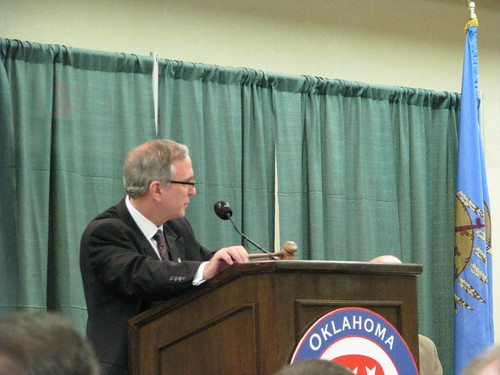
The Oklahoma House voted Tuesday to prohibit state government funding for the destruction of embryos for the purpose of stem cell research in the state. (The legislation does nothing to hinder the many other forms of stem cell research -- marrow, cord blood, various forms of adult tissue -- which do not require the destruction of a human life.)
SB 315 passed by a wide bipartisan majority of 85-13. The version passed by the House now goes back to the Senate for final approval. If a business is involved in "nontherapeutic research that destroys a human embryo or subjects a human embryo to substantial risk of injury or death," that business does not qualify for any Oklahoma income tax credits or incentive payments. The bill prevents tax dollars from directly or indirectly funding the destruction of human life.
The 13 naysayers were Auffet, Brown, Cox, Hoskin, Kiesel, McAffrey, McDaniel (Jeannie), Nations, Renegar, Roan, Scott, Shelton, and Smithson. Christian, McPeak, and Morrissette were excused from the vote. Everyone else voted yes.
The Tulsa Metro Chamber and the Oklahoma City Chamber of Commerce have been lobbying Gov. Brad Henry to veto any such legislation when it reaches him. In response, pro-life legislators boycotted a legislative event hosted by the two chambers.
State Rep. Pam Peterson (R-Tulsa) said today, "The idea that Oklahoma should condone the destruction of innocent human life in the name of 'economic development' is indefensible. Our law clearly states that human life begins at conception. Now the chambers are advocating the destruction of a legally recognized life in exchange for research dollars, saying the state should determine the best use of a person's life for the state's purposes. That's a huge paradigm shift that runs contrary to the basic values of our nation."
I'm happy that pro-life legislators are voicing their objections to the Chambers' crass and callous stand on this issue.
But if you're a Chamber member, and you oppose the destruction of innocent human life for the sake of economic development, you need to take a stand, too. You need to e-mail Gov. Henry, tell him to sign the bill, and tell him that your Chamber of Commerce doesn't speak for you on this issue.
Then you need to make some calls and do some legwork to find out who authorized your Chamber to speak on this issue. Find out when the board voted on it, which board members voted which way, then make your displeasure known to the executive director (Mike Neal here in Tulsa) and the pro-killing members of the board.
Finally, the pro-life majority on the Tulsa City Council should refuse to continue to give millions in city tax dollars to an organization that advocates using tax dollars to kill people for profit. The Council has the power to end the City's exclusive deal with the Tulsa Metro Chamber for economic development and convention and tourism promotion. Put the contract up for bids in a full and open competition and use our City hotel tax dollars to hire a more competent outfit -- that needed to happen anyway.
Here is the full statement from Rep. Pam Peterson (R-Tulsa):
OKLAHOMA CITY - The Oklahoma City and Tulsa chambers of commerce support for embryonic stem cell research, which requires the killing of human embryos, will damage Oklahoma 's reputation as a state that values life, state Rep. Pam Peterson said today."The chambers' support of embryonic stem cell research as an 'economic growth' tool is a shocking violation of the public trust and basic moral values," said Peterson, R-Tulsa. "The chamber is effectively advocating the worst kind of discrimination based on age, size and place of residence."
In the past week, both chambers have urged Gov. Brad Henry to veto legislation that would make embryonic stem cell research illegal in Oklahoma . Both groups argue the ban will hinder economic development, be an embarrassment for the state and make it hard to attract "researchers."
"The idea that Oklahoma should condone the destruction of innocent human life in the name of 'economic development' is indefensible," Peterson said. "Our law clearly states that human life begins at conception. Now the chambers are advocating the destruction of a legally recognized life in exchange for research dollars, saying the state should determine the best use of a person's life for the state's purposes. That's a huge paradigm shift that runs contrary to the basic values of our nation."
The ban was supported by an overwhelming bipartisan majority in both the state House and Senate.
Even as they have worked to outlaw embryonic stem cell research, state lawmakers have also voted to provide millions for adult stem cell research. Unlike embryonic stem cell research, adult stem cell research does not require the destruction of human embryos.
Adult stem cell research also has a proven track record of results - there are more than 70 research treatments that use adult stem cells. Embryonic stem cell research has been plagued with failure.
"If the chambers were serious about economic development and growing Oklahoma 's biotech industries, they would only support research with a proven track record requiring no moral compromise - our adult stem cell plan," Peterson said. "It's clear that these organizations care more about catering favor from radical groups than improving our economy."
As a result of the chamber's call for vetoing the embryonic stem cell ban, Peterson and other pro-life lawmakers will not attend a legislative event tonight jointly hosted by the Oklahoma City and Tulsa chambers.
MORE: HB 1326, which has similar language, was passed by large majorities in both houses last week (82-6 in the House, 38-9 in the Senate) and is on the governor's desk. This morning, State Sen. Randy Brogdon (R-Owasso) called on pro-life business owners to express their support of this legislation:
State Senator Randy Brogdon called on the Pro-Life members of the Tulsa and Oklahoma City Chamber of Commerce to join with him in support of HB 1326, which outlaws embryonic stem cell research."It's simple," said Brogdon. "HB 1326 says that we won't let Oklahoma businesses profit from the destruction of human life."
Brogdon, a co-author of HB 1326, continued, "And it's a travesty that the Oklahoma City and Tulsa Chamber leadership are more concerned about profit than the protection of human life."
"And I'm sure if the Pro-Life members of the Tulsa and Oklahoma City Chamber knew what HB 1326 entailed, they would not be happy knowing that their leadership was lobbying for Governor Henry to veto this bill," said Brogdon.
"That's why I am calling on the Pro-Life business owners of the Tulsa and Oklahoma City Chamber of Commerce to join with me in support of this bill and call on their leadership to halt their lobbying against this Pro-Life legislation," said Brogdon.
Tomorrow is the 2009 Oklahoma Republican Convention in Oklahoma City. It should be an exciting day. We'll be voting on whether to re-elect as chairman a proven servant-leader, Gary Jones, and we'll be hearing from some of the folks who want to carry the GOP banner for governor next year, including State Sen. Randy Brogdon, who is expected to make his formal announcement tomorrow.
While I don't plan to tote my laptop around, I will be able to post brief updates to the BatesLine Twitter account. You can also see my latest five tweets near the top of the right-hand column on the BatesLine homepage. Several other folks plan to Twitter about the convention as well, and the consensus is that we'll tag tweets about the convention with #okgop. Follow that link, and you'll see the latest bulletins from the Oklahoma Republican Convention.
UPDATE: My #okgop tweets:
(To clarify one of the entries below -- not all anti-caucus speakers were rabble-rousers, but a couple -- people I didn't recognize -- were, and their tone was unhelpful to the debate. Chairman Gary Jones spoke against the caucus, but he did so respectfully, although I disagree with his position. I didn't hear Tom Coburn's speech, in which he opposed the caucus, but I assume he too was respectful in opposition.)
- Greg Hill: Caucus gives voters incentive to participate in caucus & convention process #okgop
- Disappointed in anti-caucus rabblerousers - disingenuous and insulting #okgop
- Excellent point from Tom Roach - pres cmpgns will drive people to caucuses, build grssrts rolls #okgop
- LaPlante vice chair by acclamation #okgop
- Williams did not submit nomination for vice chair - ruled out of order #okgop
- Anthony Platt, Tulsa Co Ron Paul backer, wants Williams to stay as vice chairman #okgop
- Jones 1282.4 Williams 461.6 #okgop
- Alfalfa Coal Roger Mills Kiowa Choctaw Johnston Okmulgee Ottawa Pushmataha not here #okgop
- Corrected Tulsa Co Jones 104-59 #okgop
- Split leaning Jones Canadian 32-27 Wagoner 11-7 #okgop
- Logan Cty Jones 14-11 #okgop
- Split delegations Creek Rogers Cherokee #okgop
- Okla Cty Jones 141-64 #okgop
- Cleveland co Jones 66-40 #okgop
- Williams best counties LeFlore Texas Hughes
- Jones winning rural counties almost unanimously #okgop
- Tulsa Co prelim count Jones 103 Williams 59 #okgop
- Fran Moghaddam loves Cheryl Williams! #okgop
- Jones big standing O - Williams maybe 20% #okgop
- Corrected total 1208 delegates. #okgop
- Official count: 1197 delegates! #okgop
- Reese for Labor Comm: priority to open up Labor Dept for public scrutiny - well received #okgop
- Brogdon 2/3 standing O on finishing + loud chanting & cheering #okgop
- Brogdon intro stdg O from about 1/3 of crowd. #okgop
- Coffee gets warm standing O #okgop
- Anthony: We're supposed to follow the law and listen to the evidence. #okgop
- Anthony: I've been opposed by metro dailies - we're not supposed to listen to the bosses. #okgop
- Bob Anthony cites Dana as example of what grass roots can do. #okgop
- Dana Murphy - thx to delegates for helping her overcome money and millionaires in Corp Comm race #okgop
- finally in the convention hall - fallin speaking #okgop
- Had to park 3 blocks away #okgop
- Headed to #okgop - last outpost of civilization #QT in rear view mirror
I didn't make it to any of the Tulsa Tea Parties. I had a quick lunch so I could get home in time to have a nice dinner out with my wife on her birthday -- just the two of us. (We went to Bangkok at 33rd and Harvard. It's a Thai buffet. Wonderful, spicy, tasty food and a wide variety of choices. No MSG, everything is clearly labeled, they put small portions of each dish out at a time so it stays fresh.)
Here are reports from the various Tea Parties around Oklahoma, Tulsa first and in chronological order:
Chris Medlock on the 11-1 downtown event with talk radio host John Gibson (with photos):
Reasonable estimates for the event place the peak attendance at between 750 to 1000.
Chris has also posted a Washington Post graphic that explains at a glance why Obama's budget has engendered so much more grassroots unrest than Bush's budgets.
KFAQ's website has photos of the downtown event. Bland Bridenstine has more photos here, including photos of the 5 - 7 pm event at Veterans Park.
The Tulsa Tea Party blog has a thorough report with photos.
Joe Kelley on the 12-2 LaFortune Park event with Congressman John Sullivan (with video):
The Tulsa Police put the crowd size at 3200 and a petition that was passed gathered in excess of 3000 signatures.
Joe Kelley has also posted some helpful links about the Tea Party movement and resources for taking further constructive action, including the After the Tea Party website.
Here's Jenn Sierra's report and photos of the Veterans' Park event.
Muskogee Politico says there were 220 at that city's event (video and photos to come).
Tyson Wynn has audio of the Claremore rally (and explains the cool way he was able to post it live using his iPhone).
The Red Dirt Reporter was at the State Capitol for the Oklahoma City event:
Well over 5,000 people crowded onto the south plaza of the Oklahoma State Capitol Wednesday, taking part in the Tax Day Tea Party movement that has swept America, with 2,500 Tea Parties reportedly taking place nationwide.This grassroots gathering was amazing in that it drew people from all walks of life and political backgrounds. All agreed that the federal government has taken things too far in regards to taxing the American people and bailing out Wall Street and the banks.
NewsOK.com has video and photos and quotes an Oklahoma Highway Patrol estimate of between 4,000 and 5,000. (Via dustbury.com.)
Kick the Anthill has more photos of the Oklahoma City event. Videos are here on the OKC Tea Party website.
RELATED: Randy Brogdon, who may have been the only prospective candidate for Governor at any of the Tea Parties, succeeded in raising $15,000 in a single day today for his exploratory committee.
MORE: CNN reporter Susan Roesgen drops any pretense of objectivity in her coverage of the Chicago Tea Party. Michelle Malkin compares Roesgen's reporting today to Roesgen's coverage of an anti-Bush rally.
And to those who claim that Tea Party-goers are just out to attack Democrats, Michelle Malkin reports that the Sacramento Tea Party organizer acknowledged the California GOP chairman, who was present at the event, then denounced him for "waffling on massive tax hike ballot measures."
Will this make the MSM coverage? It doesn't fit the narrative. But it's yet another demonstration that this movement is not partisan and equal opportunity when it comes to holding politicians' feet to the fire for fiscal irresponsibility and fecklessness.
Of recent note in local blogs:
At Choice Remarks, Brandon Dutcher salutes State Rep. Jabar Shumate (D-Tulsa) for his efforts to expand school choice with a bill that will allow tribal governments to sponsor charter schools.
Tulsa Chigger has posted a 1934 Chicago Tribune cartoon lampooning the New Deal, headlined "Planned Economy or Planned Destruction." In the corner of the cartoon, a Trotsky-esque fellow writes a placard: "Spend! Spend! Spend under the guise of recovery -- bust the government -- blame the capitalists for the failure -- junk the constitution and declare a dictatorship." Chigger writes, "Strangely similar to our situation now, isn't it?"
Chris Medlock writes about State Sen. Randy Brogdon's upcoming announcement as a candidate for governor and the impact of a Scott Pruitt candidacy on the race.
Owasso blogger James Parsons wonders about the conservative credentials of another GOP gubernatorial possibility, former Congressman J. C. Watts, who has spent the last seven years as a corporate lobbyist.
Yogi gets quote of the week honors: "I love little 'creases' in time and space." Me, too. He's referring to unexpected places like an Italian mining community in southeastern Oklahoma named Krebs that boasts legendary Italian food. Yogi recounts a recent visit to Pete's Place -- it's been too long since my last meal there.
OKDad is working on a mystery: A statue of a farmer, erected for the American Bicentennial in 1976 and currently under restoration, turns out not to be a bronze after all, but "some sort of hardened concrete-plaster hybrid." "He was planned as a bronze. Molds of him were made in preparation for a bronze. Funds were apparently raised for him to be cast in bronze. The papers from July 4, 1976 (the day he was dedicated and unveiled) clearly state he is a statue of bronze stature. So, where's the bronze?" The mystery is still unsolved, but here's the latest development.
Rod Dreher has posted an 1999 article by Russell Hittinger about how a Benedictine monastery came to be established in Cherokee County. (Driving directions on the monastery website include prayers to St. Jude and St. Benedict in the event of high water. Irritated Tulsan might advise prayers if you decide to follow the restaurant recommendation on the same page -- I've eaten at said restaurant three times and never had a problem.)
Irritated Tulsan's Tulsa Tuesday post last week on The Lost Ogle: Tulsa's Worst Remodels, including a Pizza Hut turned adult novelty and lingerie shop, a Wal-Mart-to-church conversion and a KFC (complete with bucket on the sign) turned chiropractor's office. (I wonder if you can still get a chicken wing there -- either the food kind or the wrestling kind.)
Down the turnpike:
Steve Lackmeyer has posted a series of videos featuring urban planner Jeff Speck's comments on downtown Oklahoma City. The latest segment hits a harsh reality in Speck's comments: When you optimize a street for moving cars at high speeds, you inherently make it hazardous for pedestrians. Here are the three earlier entries in the series:
Jeff Speck Video No. 1 on urban parking
Jeff Speck Video No. 2 on giving people what they want
Jeff Speck Video No. 3 -- outlook for downtown
JenX67 has a gorgeous photo of nightfall in OKC's Plaza District.
Nick Roberts has an interesting chart showing Oklahoma City's population by decade since its founding. Noting the massive growth the city experienced in the 1920s and 1950s, he wonders whether, despite great rankings in a variety of categories, OKC will ever again be a place to which people flock.
Finally, congrats to Blair Humphreys and the MIT design team for their victory in the 2009 Urban Land Institute design competition. The design is for a transit-oriented development to replace big-box and strip-mall retail in Denver.
No time to analyze or comment, but you need to be aware of Red Dirt Report's series on Adair County and a discord on the county commission, centering on Republican newcomer Russell Turner and his efforts to ensure that the county fulfills its functions in accordance with state law. So far three stories have been published. They involve allegations of arson and intimidation, questionable handling of road funds, and county paving of non-governmental roads.
RDR: Adair County Blues - Part 1 in a series
RDR: Adair County Blues - Part 2 in a series
RDR: Rep. Auffet says folks are frustrated by dispute in Adair County
Andrew Griffin is doing some very thorough reporting. Keep an eye on Red Dirt Report for future installments.
Last September, the Oklahoma City Chamber of Commerce won approval under that city's downtown design guidelines for a new headquarters building at 4th and Gaylord, where Gaylord jogs left to connect to Broadway. Approval was controversial, because of the suburban site plan -- the building sits back from the street, and a good deal of the site is devoted to surface parking. An opportunity was missed to reverse an urban design mistake from the '60s and restore a street grid that would make pedestrian movement through the area easier than it is today: Six-lane Gaylord acts as a barrier between the downtown core and the Flatiron District.
The project is not yet under construction, and one quiet critic of the plan, Blair Humphreys, is now speaking up in hopes of urging a rethink of the plan. Back before the project came before the Downtown Design Review Board, Humphreys wrote a critique of the plan, but decided to keep it under wraps:
At the time, the proposal was still weeks away from initial urban design review and I hoped to contribute to the dialogue, or more accurately, initiate a dialogue about the proposal and the constraints placed on the project by the flawed planning of the I.M. Pei Plan. But then, after receiving advice that it would damage my future job prospects in OKC, I chose to stay silent.
Humphreys is studying urban planning at MIT. I started to write that it's stunning to think that someone with his name and education could hurt his job prospects by uttering some constructive criticism, but it really isn't. Although OKC has been more forward-thinking in its urban policy than Tulsa, its social structure is not that different from Tulsa's. Telling the emperor that his clothes are somewhat transparent, even if it's said in the most polite way, is never appreciated by the emperor.
His decision to remain silent gnawed at him:
It is a tough deal because I love Oklahoma City. I have always dreamed of helping to shape the future of the city and want to make it great - that is why I left development to pursue a career in planning. As a student of history I appreciate and respect the vital role the Chamber has played - and continues to play - in Oklahoma City's rise from train depot, to State Capitol, to Big League City. However, I have never felt right about the way I stayed quiet on this issue. From now on, I will not back down from contributing my thoughts on contentious issues, but I will try to do so in the most respectful manner possible.
In a later entry, he posts his critique of the Chamber's proposal.
One of my frustrations over the last decade or so of active involvement in local issues is how many Tulsans, active in community affairs, will tell me their concerns or objections to some public plan privately but don't dare speak out publicly. To speak up might alienate a potential compliant, might cost their non-profit a major donation, might get them ostracized from their social circle. (I wrote about this frustration at length last June.)
I can understand their reluctance. Criticizing the plans of the powerful doesn't earn you praise, position, or riches.
But being willing to speak has its rewards as well as its costs. You give others who share your opinion the reassurance that they aren't alone, which may give them the courage to speak up, too. If you're a well-trained urbanist like Blair Humphreys, your words can give laypeople a vocabulary for expressing their gut feelings about neighborhoods and buildings and places. Eventually, you may have the satisfaction of seeing your ideas become the conventional wisdom.
You can't shape the public debate unless you're willing to debate publicly.
Because of the road conditions, Tulsa County Republican Chairman Joy Mohorovicic has waived the requirement for Republicans to attend their precinct meeting tonight in order to become delegates to the county convention. Tulsa County registered Republican voters will be able to sign up for the county convention online at tulsagop.org.
Precinct chairmen have the option of holding the precinct meeting tonight as planned, meeting on another night, or participating in a central precinct meeting next Tuesday night, February 3, at 7 pm, at the county HQ, 5840 South Memorial, Suite 333.
The GOP HQ is likely to be closed today. Any queries should go by e-mail to chairman AT tulsagop DOT org.
As if the pride of Oklahoma weren't sufficiently wounded:
Oklahoma's junior senator in Washington soon will be belting out a rendition of the Elton John hit "Rocket Man" after losing a bet with a colleague from Florida.Sen. Tom Coburn and Florida Sen. Bill Nelson placed a wager on Thursday's night's BCS National Championship game between the Oklahoma Sooners and Florida Gators.
Since Florida won, Coburn agreed to sing the song during Nelson's next constituent coffee, a traditional weekly meeting between a senator and residents of his home state.
Had Oklahoma won, Nelson would have had to sing "Oklahoma!" during Coburn's next constituent meeting.
"Rocket Man" was selected because Nelson was an astronaut who traveled into space in 1986 aboard the shuttle Columbia.
Although Coburn's daughter, Sarah, is a well-known opera soprano, Coburn himself "doesn't profess to have a tremendous singing gift," his spokesman, John Hart, said Friday.
Hart said no date has been set for Coburn to make good on his bet.
"He's a man of his word," Hart said. "And I'm sure Senator Nelson won't let him forget."
You don't have to be a singer to perform "Rocket Man," as William Shatner proved in this unforgettable performance at the 1978 Science Fiction Film Awards (introduced by Bernie Taupin, the song's co-writer):
Maybe Dr. No should have just bet some Oklahoma steaks against some Florida oranges.
Earlier today Sen. Tom Coburn spoke to a blogger conference call in connection with the release of his 2008: Worst Waste of the Year" report. It was a wide-ranging, on-the-record discussion. Ed Morrissey at Hot Air has a good synopsis.
Toward the end of the call, Dan Riehl asked about getting Coburn more allies for his efforts. Coburn said that, "We need a different farm team, and I'm working hard on that." He didn't offer any specifics, but he said that we need to "recruit people who get it, not just people who say they get it." He said that we need to elect officials who will be willing to sacrifice position for principle and asked, "How do you call people to service?"
I'm happy to see that Coburn is focusing on this challenge. Our primary safeguard against excessive and unconstitutional spending are the people who make the decisions about spending. But I wonder if it's possible for us to create the kind of "farm team" Coburn wants. To elect a principled fiscal conservative to office, you have to fight against two powerful forces -- entrenched special interests that want access to public money, aided by their allies who run the mainstream media, and a voting public with a low level of understanding about economics, the proper role of government in general and the proper roles of each level of government.
There is this idea that every problem is one that government can fix. Voters want to believe it because it relieves them of personal responsibility. Politicians are happy to promote the idea because they then get credit for doling out the goodies to favored groups and businesses, and that translates to longevity in office and a golden parachute in the form of a lobbying job with the favored groups and businesses they helped while in office.
Here in Oklahoma, at least, we have enough voters who don't buy into that idea that we can elect principled officials like Tom Coburn, Randy Brogdon, Dana Murphy, Pam Peterson, and John Eagleton (to name just a few among many). But even here, good men and women get blocked from climbing the political ladder by a hostile media and a well-financed opposition.
Recruiting good men and women is only half the battle. You need to give them the financial and logistical support they need to get elected and to advance their legislative agenda once in office.
Catching up with links -- I had two pieces in last week's Urban Tulsa Weekly.
My Cityscope column dealt with E-Tickets -- why the Tulsa Police Department needs the electronic citation system advocated by Councilor John Eagleton, and what's the hold up to getting it funded.
Here are some earlier stories about E-Tickets:
- August 1, 2007: Councilor Crusade by Brian Ervin
- September 26, 2007: Safer Streets with E-Tickets? by Brian Ervin
- January 16, 2008: Somebody Should Be Cited by Brian Ervin (on the mysterious cancellation of the bid request for the system
- November 5, 2008: News Updates, which mentions the Council's October 30 decision not to fund E-Tickets from the 2006 Third Penny fund.
Also in last week's issue was a feature story with my post-election analysis, covering the Tulsa County Commission District 2 race, the Republican successes in the State Legislature and Corporation Commission, and the re-election of Sen. Jim Inhofe (while noting the strange undervote in the U. S. Senate race) and Congressman John Sullivan. I took a look at the swath of counties, stretching from Pennsylvania to Oklahoma, that gave more votes to the Republican presidential nominee this year than in 2004, and noted the connection to the lands of Ulster-Americans, aka the Scotch-Irish. I closed by suggesting that Republicans may want to adapt the British Conservative Party's Campaign North, their successful effort to rebuild their party in the north of England, where they had been nearly wiped out by the Labour Party.
A few links related to that last point:
- January 2007 memo from Francis Maude to Conservative MPs describing the creation of Campaign North
- Guardian story on the formation of Campaign North
- Videos about the campaign centers in the North East, the North West, and Yorkshire.
People ask me how they should vote tomorrow. Here's the short version:
Vote for all the REPUBLICANS.
Vote FOR all the State Questions.
Vote AGAINST all the judges.
On the street tax, I plan to vote FOR the sales tax extension (Prop. 1) and AGAINST the general obligation bond issue (Prop. 2). The sales tax extension includes money (not as much as I'd like) for paving, and the sales tax allows some flexibility, so that the City Council could (via the Brown Ordinance process) move some non-street projects to a later time while moving paving earlier. This approach also avoids raising overall tax rates and leaves the door open to implement the Yazel plan to reduce the dedicated property taxes for overfunded agencies and make that money available for more immediate public purposes.
Some links to my columns on the candidates and ballot items:
My debate with Elaine Dodd, in which we discuss the races for President, U. S. Senate, the 1st Congressional District, the County Commission race, and the Senate District 27 race (I'm supporting McCain, Inhofe, Sullivan, Bell, and Newberry, respectively.)
Dana Murphy for Corporation Commissioner.
Sally Bell for Tulsa County Commissioner, District 2.
State questions and judicial retention ballot
Street tax (October 15)
Street tax (October 29)
Scroll down the home page for more commentary on the election.
Here's some information about voting, with links to the Tulsa County Election Board website, a precinct locator, sample ballots, and how to do early voting (you have until 6 p.m. Monday for that).
Here's the League of Women Voters Tulsa website, with links to voting information and (in PDF format) their voter's guide to the candidates and ballot issues.
Here's the Oklahomans for Life website and their compilation of candidate responses to their survey.
Here's the Oklahoma Family Policy Council website and their compilation of candidate responses to their survey.
All you folks who have been asking me about the state questions and the judicial retention ballot -- here you go. My extra piece in this week's Urban Tulsa Weekly is about Oklahoma's four state questions and retention votes for some of our supreme court and appeals court judges. In a nutshell, vote yes on all the state questions, and vote no on all the judges, particularly Civil Appeals Court Judge Jane Wiseman.
The Cityscope column proper is about the City of Tulsa street tax again, with a summary of the responses I received from the Tulsa Public Works Department, a summary of the case the Papa Bear proponents are making against the Mama Bear plan, and how County Assessor Ken Yazel's proposal fits in with all this.
New city reporter Brandon Honig debuts in the current issue, with a solid story about the Tulsa Development Authority and its problems with the federal Department of Housing and Urban Development. And Natasha Ball has a lovely story about the Remingtons, a couple who adopted a family of five siblings early this year.
Later, I'll add links to this entry to background info on the judges and state questions. But this'll have to do for now.
This week in Urban Tulsa Weekly, I return to the topic of the November 4 City of Tulsa street sales tax and bond issue vote, raising some questions I hope can be convincingly answered between now and election day.
In an extra op-ed, I explain why voters of all political orientations should choose the eminently qualified Dana Murphy for the two-year term seat on the Corporation Commission over appointed incumbent Jim Roth, whose personal connections and campaign finances indicate a far-too-cozy relationship with Chesapeake Energy, one of the businesses he regulates. For good measure, here's my editorial endorsing Dana Murphy in the Republican primary.
Until recently, Democratic 1st District Congressional nominee Georgianna Oliver proudly boasted the endorsement of ACORN, the left-wing organization in the news recently in connection with fraudulent voter registration activities in numerous swing states. It was the top of her "professional endorsements" page. Mad Okie noticed that that endorsement had vanished for some reason, but he was able to capture a screenshot from Google's cache. He was also able to capture the PDF directly from the website before it was removed from the oliverforcongress.com website, a brief, unsigned and undated memo on ACORN VOTES letterhead from Patricia Walker, "North Tulsa Chapter Chairperson, ACORN Votes." The PDF file has a creation date of September 16.
Left hurriedly and in a shambles, the small office, coated in a layer of plaster dust, still housed computers, documents, registration forms, I-9 employment info and boxes with an IRS return address and others with a return address for an ACORN office in New Orleans.The person working at this office, Adam Carter, had reportedly skipped town in June, according to the landlord. and in August, an ACORN representative from Tulsa came down and took more items, leaving behind what was found by Red Dirt Report. ACORN never fulfilled it's year lease for the property and never paid a dime in rent. The landlord told Red Dirt Report that the ACORN workers seemed to attract trouble and that there was something not quite right about what they were doing. The landlord also said that the aforementioned Tulsa ACORN worker, named "Brittany," said ACORN didn't have any money to pay for the rent and that Carter had depleted the South Oklahoma City ACORN account....
In fact, the evidence discovered in the abandoned office on South Robinson revealed maps of Oklahoma City broken down in House districts. Districts where a Republican won, but just barely, were highlighted. Papers related to the 2006 election results for Oklahoma were also noted.
Oklahoma City radio station KTOK reported Thursday on ACORN's brief tenure in Oklahoma City, where they attempted to get taxpayer funding for their activities:
The city received a request for the HUD money from a Matthew Eaton who represented ACORN. Internet searches reveal a Matt Eaton is the South West Development Coordinator for ACORN who described himself as an experienced grant writer and resource development coordinator. He also claimed to be 'well versed in various forms of fund raising. "I aspire to help raise enough money so ACORN offices in the Southwest will be able to establish Tax Access and Benefit Centers in each of its neighborhood locations and to register 300,000 new voters," wrote Eaton in a website description of himself and his goals.But less than a year after asking for the HUD money,Eaton and the ACORN office in Oklahoma City were history. The city denied the funding request and other neighborhood agencies indicated they too had similar 'empty' relationships with ACORN. A spokeswoman of one such group said when they asked an ACORN official about the group's funding, they were told it could not be discussed.
(Via Green Country Values.)
MORE: In 2007, ACORN was found to have submitted more than 1,700 fraudulent voter registrations in King Co., Washington.
RottenACORN.com has a list and map of fraud prosecutions involving ACORN. They seem to be fond of swing states.
Jim Hoft of Gateway Pundit provides a "complete guide to ACORN voter fraud" on Pajamas Media.
At a campaign stop in Ohio, Alaska Gov. Sarah Palin called for the Obama-Biden campaign to disclose all communications between that campaign and ACORN. Hoft notes:
Barack Obama worked as a former trainer with the scandal-plagued ACORN organization. He also has a long history with the Far Left group and the group has canvassed for him this year. He represented ACORN in court. And, Obama donated $800,000 to the radical group just this year for their get out the vote efforts.Earlier this week Palin told Obama to rein in this group of radical supporters.
In response, the Obama campaign is trying to pressure the FBI into dropping its investigation into voter fraud. The McCain campaign has fired back:
After a week of shifting stories and clumsy corrections regarding Barack Obama's connections to ACORN, the Obama campaign resorted to their now-customary heavy handed tactic of attempting to criminalize political discourse. Today's outrageous letter to Attorney General Mukasey and Special Prosecutor Dannehy at the Justice Department asking for a special prosecutor to investigate Senator McCain and Governor Palin's public statements about ACORN's record of fraudulent voter registrations (including in this week's Presidential debate) is absurd. It is a typical time-worn Washington attempt to criminalize political differences. For someone who promises 'change,' it is certainly only more of the same.The letter's request that the Department of Justice investigate 'recent partisan Republican activities throughout the country' is almost a parody of the Obama campaign's attempt to intimidate their political opponents. In case Sen. Obama's lawyer did not notice, we are in the midst of a political campaign, not a coronation, and the alleged criminal activity he calls 'recent partisan Republican activities' are what the rest of us call campaign speeches and debates. All of this is unfortunately reminiscent of the Obama campaign's recent creation of a 'truth squad' of Missouri prosecutors and sheriffs to 'target' people who criticize Sen. Obama. Rest assured that, despite these threats, the McCain-Palin campaign will continue to address the serious issue of voter registration fraud by ACORN and other partisan groups, and compliance by states with the Help America Vote Act's requirement of matching new voter registrations with state data bases to prevent voter fraud.
Today at 5 p.m. is the deadline for Oklahoma residents to register to vote for the November 4 general election. While the election board will accept registration forms by mail that have been postmarked by today, the safest way to be sure that you will get to vote on November 4 is to go to your county election board and register in person before 5 p.m.
The Tulsa County Election Board is located at 555 N. Denver Ave., Tulsa, OK 74103. The phone number is 918-596-5780.
The Oklahoma State Election Board website has a complete list of county election boards, with the phone number, address, and hours of operation for each. Please note that election boards in some rural counties close as early as 1:30 p.m.
UPDATE: Tulsa County Election Board will stay open until midnight tonight to accept last-minute registrations.
Here's the video of KJRH's debate between U. S. Sen. Jim Inhofe and his challenger State Sen. Andrew Rice, from last night. Russ McCaskey moderated with Joe Kelley of KRMG, Wayne Greene of the Tulsa World, and Karen Larsen of KJRH on the panel.
Oklahomans for Life, the organization that advocates at the State Capitol for the sanctity of human life, has published the responses to its survey of candidates for the November 4 general election in the October 2008 issue of its newsletter. There are separate surveys for federal and state candidates; both surveys ask about concrete policies and bills that are likely to come before Congress and the Oklahoma Legislature. Topics include abortion and abortion funding, cloning, embryonic stem cell research, and euthanasia. The federal survey includes a couple of questions about rationing of federally-funded medical care:
10) Some hospitals have implemented formal policies authorizing denial of lifesaving medical treatment against the will of a patient or the patient's family if an ethics committee thinks the patient's quality of life is unacceptable, even though the patient and family disagree. The federal Patient Self-Determination Act currently requires health care facilities receiving Medicare or Medicaid to ask patients on admission whether they have an advance directive indicating their desire to receive or refuse lifesaving treatment under certain circumstances. Would you support preventing involuntary denial of lifesaving medical treatment by amending the Patient Self-Determination Act to provide that if failure to comply with a patient's or surrogate's choice for life-saving treatment would in reasonable medical judgment be likely to result in or hasten the patient's death, a health care provider unwilling to respect the choice for life-saving treatment must allow the patient to be transferred to a willing provider and must provide the treatment pending transfer?11) Would you vote against any bill that imposes price controls or otherwise limits the right of older Americans who choose to do so to add their own funds on top of the government contribution in order to obtain Medicare health insurance that is less likely to ration medical treatment and prescription drugs?
The same issue of the newsletter includes a response by OfL director Tony Lauinger to Jerry Riley, husband of State Sen. Nancy Riley (D-SD37), who took exception to OfL's characterization of Sen. Riley's voting record. Lauinger points out that the votes a legislator casts trumps the position a legislator claims, and Nancy Riley's two no votes on SB 714 in 2007 made the difference in the legislature's attempt to override Gov . Brad Henry's veto. Lauinger reminds that Sen. Riley's votes on SB 714 contradicted her responses to the Oklahomans for Life survey in 2000 and 2004 (as a Republican candidate for State Senate) and in 2006 (as a Republican candidate for Lt. Governor).
Lauinger's letter addresses the matter of the rape and incest exception, and why the consistent pro-life position permits abortion only when the life of the mother is in jeopardy. (Riley cited the lack of a rape and incest exception as the reason for her opposition to SB 714, but she failed to offer such an exception as an amendment, either in her committee or in the Senate as a whole.)
Ethel Waters, the revered African-American vocalist of blues and spirituals, had occasion near the end of her life to recount its beginning: "My father raped my mother when she was twelve years old, and today they've named a park for me in Chester, Pennsylvania." Recounted in her autobiography, His Eye is on the Sparrow, her life is but one of many of children conceived in rape who went on to make great contributions to this world.She might wonder how it makes sense, in logic or in law, to execute a child for the crime of his or her father? Abortion does not erase the trauma of a rape. Abortion compounds the first tragedy with a second tragedy - one for which the woman herself is responsible.
It is not valid to assume the best thing for a victim of rape or incest is to abort her baby. For society, abortion might seem to "solve the problem." But for the woman herself, it does not. Abortion often leads to psychological anguish and emotional devastation. Britain's Royal College of Psychiatry issued a warning in March that women may be at risk of mental health breakdowns if they have abortions. They advised that women should not have an abortion until they are counseled about the possible risk to their mental health.
There are more than one million unborn babies being killed by abortion in our country every year. One could rely on the absence of a rape exception as an excuse for opposing all manner of bills that seek to reduce abortions and save the babies we can. Or one could support these reasonable, modest regulations which, while not making abortion illegal, at least give some unborn children - and their mothers - a chance to avoid catastrophe.
That's why Nancy's votes against SB 714 were so disappointing. When the opportunity to help these babies came, she didn't give the benefit of the doubt to life.
Sen. Tom Coburn was on with 1170 KFAQ's Pat Campbell this morning explaining his decision to vote for the $700 billion bailout. It was strange to hear Coburn acknowledge that this bill might not work, that this bill didn't address the underlying causes, but that we had to do something. He compared it to using a defibrillator on a heart attack patient; you deal with his high cholesterol levels after you've saved his life.
But how did Tom Coburn become persuaded that the current situation is a financial heart attack and that the bailout is a financial defibrillator?
Coburn mentioned that he heard from the heads of all the biggest banks in Oklahoma. He specifically mentioned, by title but not by name, the chairman of the Bank of Oklahoma. (That's George Kaiser, if you didn't know.) He heard that banks won't lend to each other, that people with 650 credit scores couldn't get car loans, that businesses were having their loans called by banks who needed the money on their books.
A couple of days ago, while folding laundry, I was struck by similarities between the mortgage bailout and the BOk / Great Plains Airlines bailout. In both cases, I have the sense that the bailout is not to stave off dire consequences for the general public, but dire consequences for big shots who made bad decisions.
Recall that in the Great Plains situation, BOK made a bad loan after two initial refusals, based on private assurances from then-Mayor Susan Savage that the City of would make the bank whole if the loan went bad. That's according to former Councilor Jim Mautino:
In another video on that same entry, Jim Mautino mentions being called to the office of Stan Lybarger, president of BOk. Mautino took city attorneys Larry Simmons and Drew Rees with him to the meeting. Lybarger told them that he had twice turned down the Great Plains loan, but relented because then Mayor Susan Savage gave him "assurances." This would be the same Savage who gave "assurances" to the City Council at the time that transfering AFP3 to the Tulsa Industrial Authority would not expose the City to any liability in the Great Plains financing deal.
Tulsa city councilors were warned that the city's credit rating would suffer if the city didn't pay back the loan. I suspect that the real worry was that some BOk executives would suffer legal consequences if this bad debt hadn't been paid off before a certain deadline. A federally-insured bank isn't allowed to make risky loans for political reasons.
In the current "crisis," we're hearing from a lot of Wall Street types of impending doom, but we're not seeing an unreasonable tightening of credit on Main Street. My suspicion is that this bailout is really about protecting fat cats from the consequences of their bad decisions, and the fat cats are doing a fine job of spooking Congress into a stampede.
I think Coburn was sincere in stating the rationale for his vote. It may be that the bank officials were shooting straight with him. Then again, he was taking his cues from someone who supports bigger government and higher taxes and is a bundler for Barack Obama.
MORE: Whom did Coburn convince? (Emphasis added.)
Just talked to a Republican leadership aide. Here's what he had to say about the big margin today. He cited three factors:1) Up to the point of the Monday vote, members were only hearing from people adamantly opposed to the bill. After the vote, that changed. They began to hear from employers, bankers, and opinion leaders back in their districts who told them how much it would hurt the local economy if they didn't act to try to calm the credit markets; 2) The strong Senate vote helped. Members could say to themselves, "Well, both my state's senators voted for it." And Sen. Tom Coburn's strong support for the measure carried a lot of weight with House conservatives; 3) The inclusion of the FDIC increase gave members something positive and easy to understand to talk about in explaining the bill. The purchase of illiquid assets isn't easy to explain, and if you can explain it, doesn't sound very appealing to anyone. The FDIC provision was easier to portray as a proposal to help "Main Street," with local bankers complaining and worrying about large withdrawals.
This coming Saturday, October 4, the Tulsa County Republican Party will hold its annual fall fundraiser out at the old barn on the McGraw place, 10900 S. Louisville Ave.
It's a great opportunity to meet fellow Republican activists and elected officials. Councilor John Eagleton will be providing the barbecue: chopped beef, pulled pork, ribs, chicken, seasoned with a dry rub and smoked for hours. It's always delicious.
The entertainment is a band called the Rockin' Acoustic Circus, a group of talented young string musicians who play a mix of bluegrass, swing, and country.
It should be a beautiful fall day, and the McGraws' place is a delightful slice of country in the city. The festivities begin at 11:30. The cost is $10 per person, but just $20 for an entire family. There will also be a silent auction, and McCain-Palin T-shirts and buttons will be for sale.
Hope to see you there!
By now you've heard about the KFOR-SurveyUSA poll of 652 likely Oklahoma voters from September 5-7. The poll shows Republicans with substantial leads in statewide races:
President: McCain/Palin over Obama/Biden, 65% to 32%.
Senator: Jim Inhofe over Andrew Rice and Stephen Wallace, 56% to 34% to 6%.
Corporation Commissioner (long term): Jeff Cloud over Charles Gray, 52% to 34%.
Corporation Commissioner (short term): Dana Murphy over Jim Roth, 54% to 36%.
The links above will take you to the crosstabs for each poll, showing how the candidates when the sample is broken down by race, gender, party affiliation, age, education, ideology, church attendance, income, and abortion views.
Keeping in mind that the smaller the subsample, the bigger the margin of error, it's still striking that McCain has the support of 42% of Oklahoma Democrats.
I'm happy to see my friend Dana Murphy doing so well. She is the most qualified candidate for Corporation Commissioner that I have ever seen on the ballot. If Oklahoma voters can look beyond party affiliation, she ought to win by a landslide.
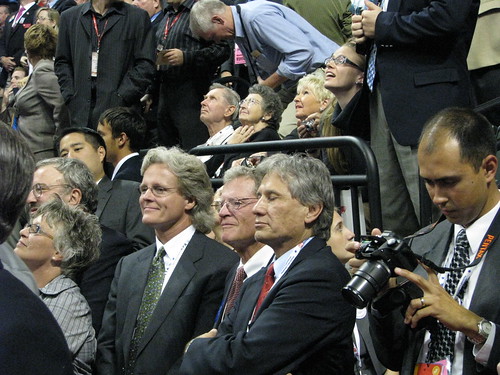
I had been hearing about this famous/infamous ad-man for years, a native Tulsan and the nephew of Sen. Jim Inhofe, but I had never met him and had no idea what he looked like until I was on the convention floor Wednesday night and spotted Neil Munro of the National Journal next to the Oklahoma delegation. (Neil, Stephen Spruiell of National Review, Kate Hunter of Congressional Quarterly, and I comprised the entire press corps covering the Committee on Rules and Order of Business last Friday.)
I went over to say hello, and Neil called my attention to someone with luxuriantly flowing blond hair standing behind the delegation, next to Inhofe. He told me it was Fred Davis, McCain's attack ad man.
Neil had a profile of Davis in Tuesday's convention edition of National Journal:
Television ads are the background rhythm of a presidential campaign, and Republican Sen. John McCain's drummer -- ad man Fred Davis -- is already accelerating the beat and playing his signature riffs.He has in the works a television ad that contrasts Democratic nominee Barack Obama's life as a politician in Chicago with that of his half-brother in Kenya, who lives in a shack on an unpaved street. Davis, chairman of Strategic Perception, McCain's advertising firm, said that the images are meant as a sharp-edged counterpoint to a theme in Obama's acceptance speech last week, in which he declared, "I am my brother's keeper; I am my sister's keeper."...
Davis sketched out his advertising strategy for a breakfast at the Minneapolis Hyatt Hotel recently, revving up the crowd with a selection of his past spots and an anti-Obama ad that was pulled before it could be run. The ad portrayed an Obama supporter in Texas being asked to cite an Obama accomplishment; he remains open-mouthed and silent for several seconds -- as if to suggest that he could think of nothing Obama had ever done.
Ultimately, the ad was discarded because it also showed a similarly nonplussed Democratic legislator who has since died. "There's plenty more in the can, soon to come," Davis promised.
MORE: Here's a 2006 National Journal Q&A with Davis, in which he talks about his first major race, his uncle's 1994 run for Senate. I don't recall Inhofe being as much of an underdog as Davis suggests, but I could be misremembering. That was a big year for Republicans across the board and a near sweep of statewide offices in Oklahoma.
And a couple of weeks ago, Townhall's Matt Lewis had this:
I'm hearing that tensions were high recently when veteran actor Robert Duvall was taping a voice-over for a video to be played during the Republican National Convention. Apparently, the veteran actor objected to the direction he was receiving from Republican media guru Fred Davis. According to my sources, Duvall said something along the lines of: "F-you Fred! If Scorsese couldn't give me direction, what the hell makes you think you can?" Though this blow-up is actually recorded on tape, my guess is it's in everyone's best interest for this to not leak out ...
If memory serves, Davis was responsible for Bob Sullivan's attack ads in his 2006 Republican Governor's campaign against Ernest Istook. Here's the one featuring Gailard Sartain:
In a 5 min. interview with BatesLine, Muskogee Mayor John Tyler Hammons, a delegate to the Republican National Convention and at 19 years, 364 days old America's youngest mayor, talks about trying to meet Rudy Giuliani, how he became interested in politics, the challenges of serving as mayor, and the amount of worldwide media attention focused on him this week.
(The embed doesn't seem to be working, so here's a link to the video's page.)
UPDATING this post continually.
A proposal has been brought to amend Rule 10. It would set up a commission that would report back to the RNC at some later date, and then the RNC would have to approve any changes proposed by a 2/3rds vote.
Morton Blackwell is speaking in opposition. Democrats, he says, have bitter struggles over rule changes by the DNC between conventions. Those fights are set in terms of principle, but they are always to advantage one candidate over another. He doesn't believe the decision should be entrusted to the RNC, even by a supermajority. "RNC meetings are, almost without exception, entirely scripted.... It is not a deliberative body."
A speaker from Rhode Island points out that it's the fear of the shadow of disagreement at the convention that has pushed the issue of reform further and further back.
The Arkansas committeeman points out that the RNC chairman would appoint nine of the 15 members of this committee. The RNC would not be able to amend the recommendation of the committee -- just an up-or-down vote to adopt by a 2/3rds majority.
Maine committeeman -- the Democrats will make their decisions "confident that we have tied our own hands and are unable to respond strategically."
Nebraska committeeman -- We don't need another committee to tell us we need to make a change. We've had changes proposed over and over again, only to arrive at the convention to have the nominee's representatives kill it. [That last happened in 2000.]
[There's a simple solution: Rules committee members could have the backbone to tell the nominee/president to get lost.]
This sets up a supercommittee that transfers the authority that you have been given by your states to make recommendations to the entire convention. Let's not follow the flip-flopping Democrats who tinker with the rules between meetings.
Clark Reed, Mississippi: "Thank God we don't have the flexibility the Democrats have."
Ohio committeeman: Has been an opponent of "flexibility" but supports this proposal. Commission would expire summer of 2010. Gives Republicans the flexibility to negotiate with the Democrats [whose commission runs through calendar year 2009]. 38 states have indicated they'll move to the first permitted primary date. The commission could bring all the stakeholders to the table.
Helen Blackwell, Virginia: "They didn't elect me to come here and pass off my authority to some other commission that hasn't even been appointed yet.... We need to roll up our sleeves and do our work."
Utah committeeman: In support. "We should not be afraid" to allow the duly elected RNC to conduct the affairs of the party.
[The problem with leaving this to the RNC is that the RNC is weighted toward weak Republican parties in small states, since every state has three members, regardless of the size of the state or the strength of the party.]
The motion passed by a show of hands, although the hands were not counted. One southern committeewoman indicated that there would be a minority report to the convention on this issue. McCain's operatives aren't likely to be happy with that outcome, as it means substantive debate during the convention. The signature of 28 members of the rules committee is required to move a minority report forward to the convention as a whole, where it will be debated alongside the majority report.
With that, the first section, Rules 1-11, is complete.
The next item would delete Rule 13(A)(2), the closest thing Republicans have to superdelegates. Morton Blackwell -- who reminds that he was Goldwater's youngest elected delegate in 1964 -- says his aim has always been to ensure the flow of power in the party remains from the bottom up, so he wants "all the national convention delegates to be elected contemporaneous to the presidential campaign."
The Indiana committeewoman reminds that the reason for this rule is to free up delegate seats for people other than RNC members. This is especially important for small delegations. The committeewoman from the Virgin Islands spoke in opposition for that reason. They have only six delegates other than the three
South Dakota committeeman says he felt uncomfortable being an automatic delegate, and received criticism in his state for qualifying automatically rather than going through the process like everyone else.
Missouri committeeman was the original proponent of the amendment in 2000. "The idea was to open up the opportunity for other grassroots workers to have the privilege and have the experience to come as delegates to the Republican National Convention."
Washington committeewoman points out that these are not "superdelegates" but are in fact bound by the rules of their respective states.
Mississippi committeeman Clark Reed reminds that the RNC committee members are elected four years before the convention. He says this is a slippery slope toward elected officials and other party officials being made automatic delegates.
Chairman stepped down from the chair to speak against the amendment. There hasn't been a slippery slope. By having RNC members as delegates, it frees up 168 seats for grassroots Republicans.
Blackwell's motion failed, but he's making another motion -- delete 13(A)(2) but increase the number of at-large delegates from 10 to 13. Chair ruled it out of order.
Now back to rule 15: A minor amendment passes to allow N.H. and S.C. to go on or after 3rd Tuesday in January rather than just "after."
Another amendment: Any delegate selection prior to the first Tuesday in March must be allocated proportionally.
Blackwell considers proportional representation a "pernicious" practice, considers imposing PR on early states an imposition. Rep. Backus agrees that we shouldn't dictate to the states.
Ryder of Tennessee: Purpose of proportionality amendment is to "extend the primary calendar by making it impossible for any state to be determinative of the outcome prior to March 1."
Rule defeated overwhelmingly.
Florida proposal would penalize early states by losing voting delegates but not delegates. Seconded by Michigan. Looks like it will fail.
There's a Maryland motion to allow states to use alternates to fill convention committee slots if no delegate of the proper sex is available. For example, suppose only two women delegates from a state are available to come to the convention city a week early to serve as committee members. Under current rules, the state's female seat third committee would go vacant. Under the proposed amendment, a female alternate could fill that spot. The motion passed, 45-33. The chairman noted that this might have the unintended consequence of reducing the pressure to elect women as delegates.
A proposal to amend rule 41 from Ron Kaufman of Massachusetts passed overwhelmingly. It went by very quickly, but it had something to do with when the rules committee could be consider constituted.
2:50 pm: Just had the final vote on the full committee report.
The committee will reconvene on September 1, River Center Ballroom A, during the opening session of the convention, roughly about 2:30 pm. Once the convention approves the permanent organization of the convention, the rules committee will be officially elected by the convention, and can officially vote to approve this rules recommendation.
Two Tulsa area legislative seats are up for grabs today. Term limits have ended the legislative careers of State Sen. Jim Williamson (R) and State Rep. Darrell Gilbert (D). The two seats are heavily partisan -- the winner of the runoff is guaranteed the Senate 35 seat and all but guaranteed the House 72 seat. (Lawrence Kirkpatrick, a perennial candidate, will be on the general election ballot as an independent.)
In Senate 35, former Tulsa City Councilor Cason Carter received 45% of the primary vote to 41% for Tulsa resident and Jenks school board member Gary Stanislawski. Three other candidates finished in single digits. Stanislawski has been endorsed by Sen. Jim Williamson and the Tulsa Area Republican Assembly. Carter has outraised and outspent Stanislawski, but both candidates have had ads on radio, something of a novelty for a state legislative race. As I said before the primary, I'm voting for Gary Stanislawski. (Having already decided to support him, I had the opportunity to do some computer work for him early in the campaign.)
Stanislawski's campaign manager Josh McFarland was on the Chris Medlock show on 1170 KFAQ yesterday, answering the negative ads being mailed out by Cason Carter. Medlock, like me, lives in Senate 35. He says this is a race between a candidate driven by principle (Stanislawski) and one driven by the bottom line (Carter), which would explain why the grassroots are lining up behind Stanislawski and the Chamber / Money Belt types are backing Carter.
In House 72, Seneca Scott finished first in the primary with 42% of the vote; Christie Breedlove finished second with 28%. That's a tough gap to overcome in a runoff, but Breedlove has the advantage of being not only a lifelong resident of the district, she lives in a more typical part of the district. (Scott, a Jenks High School graduate, lives near TU, in the small section of the district south of TU.) She has been endorsed by State Sen. Judy Eason-McEntyre and City Councilor Jack Henderson and former Councilor Roscoe Turner.
Runoffs often have rotten turnouts. If you live in either of those districts, please be sure to turn out to vote.
Scroll down for an update to this entry.
Robert N. Going likes what he sees in Oklahoma's junior senator:
I think I have a new hero, a United States Senator who believes in requiring politicians to justify their spending of your tax dollars, who kept his term limit pledge when he went to Congress, who intends to do the same in the Senate, doesn't ask for or get earmarks, is beholden to no one and votes his conscience, Senator Doctor Tom Coburn of Oklahoma.The man has tied the Senate in knots by following their rules. He's put holds on every questionable bill he can get his hands on. See David Keene's background piece in The Hill.
At the time Keene wrote, he fully expected that the good old boys of both parties would squash Coburn like a bug when the "Coburn Omnibus Bill" (designed to logroll enough pet projects to guarantee 60 votes) came to the floor. Lo and behold, the Republicans stuck together and only 52 Senators voted "Aye".
What Going and other limited-government conservatives love about Dr. Tom are the very qualities that frustrate his colleagues:
Tom Coburn's Senate colleagues don't know quite what to make of the doctor from Oklahoma. Many of them find him personally likable, but they can't understand why he seems to want to change the way the exclusive club to which they all belong has been doing business for so long.And what's worse, they have no way of controlling the man. Coburn (R) left the House in 2000 after three terms there because he had voluntarily term-limited himself, and he says that he'll retire from the Senate after two terms there to go back to practicing medicine in Oklahoma. What that means, of course, is that he won't be around quite long enough to chair an important committee even if the GOP should retake the Senate at some point -- and that, therefore, he doesn't have to watch his manners lest party leaders squelch his ambitions.
Moreover, since he finds earmarks morally objectionable, his colleagues can't control him by cutting off funds for a library or parking garage back home and instead have to either confront his arguments or find a way around him. That was a lot easier in the House because there isn't all that much a lone congressman can do to derail spending programs there, but the Senate actually empowers folks like Coburn, who are willing to forsake the comity of the club and rely on the body's rules to get their way.
We need more people like Coburn in government, people who aren't bound by ambition or fear or social ties from doing what's right. If District 2 voters have the good sense to elect Sally Bell to the County Commission, we'll be closer to that goal here in Tulsa County.
Watch Sen. Coburn's blog to follow his crusade against indefensible federal spending.
MORE: Via Jill Stanek, The Hill reports that the Senate Ethics committee is pressuring Coburn over continuing to deliver babies pro bono. The pretext is that, now that the formerly public Muskogee Regional Medical Center is a private institution, Coburn delivering babies there constitutes an endorsement of that particular hospital.
Coburn spokesman John Hart agreed to discuss the issue only after The Hill contacted his office several times over the past two weeks. He called the Ethics panel's logic "absurd" and its argument "inane.""Just as parents don't choose him hoping to sway his vote, parents don't choose to receive his services at a particular hospital because Dr. Coburn has somehow endorsed that hospital because he is a senator," Hart said in a statement e-mailed to The Hill. "The committee has shown us zero empirical evidence to back up its flimsy claim.
"Has Sen. Leahy provided an improper endorsement to Warner Brothers for appearing in Batman?" Hart asked. "Will millions of Americans now see Batman not because it features stars like Christian Bale or the late Heath Ledger, but because Patrick Leahy, a distinguished United States senator, has offered his illustrious endorsement to this motion picture?
"If Sen. Coburn can only deliver babies for free at a public hospital, shouldn't Sen. Leahy only be allowed to donate his notable thespian skills to a public entity like PBS?"...
Hart estimates that Coburn has delivered dozens of babies since last receiving an ultimatum from the Ethics panel in 2005. Coburn has received no compensation for his work and paid "tens of thousands of dollars" out of his own pocket for medical malpractice insurance and other costs related to his medical practice, Hart said.
Other physicians in the Senate, such as former Majority Leader Bill Frist (R-Tenn.), a heart surgeon, voluntarily gave up their medical practices when they joined the Senate.
Coburn, however, wants to remain a true citizen-legislator and has long argued that the Senate should allow him to keep serving his patients because he plans to return to the practice when he leaves the Senate in 2016, consistent with his pledge to serve only two terms. He would like to keep up his medical skills if he is going to continue being able to earn a living in his chosen profession.
Frist, by contrast, had no plans to return to his practice when he retired from the Senate. ...
"The parents of babies Dr. Coburn delivers don't choose him hoping to sway his vote, and they never have," Hart said. "In the 10 years Dr. Coburn has provided free healthcare to his neighbors while serving in Congress, the Ethics Committee has never pointed to a single conflict of interest. No lobbyist or any individual has ever attempted to infiltrate his medical office under the guise of an invasive medical exam to discuss Senate business."
Coburn's work as an obstetrician was controversial during his House career, but the House allowed him to continue to practice and make enough money to cover his medical bills. When he joined the Senate, the Ethics Committee issued him a letter prohibiting him from practicing medicine.
Hart also made note of the timing of the press's interest in this story. The Ethics Committee sent a memo to Coburn in May, but it has only become public in the past two weeks during the battle over the Tomnibus bill.
Stanek writes, "Were Tom Coburn aborting babies free instead of delivering them free, there would be no investigation; there would be an awards ceremony. This is ridiculous on so many levels, not the least of which is the Democrats' disregard for the poor, unless they control the dole so as to get the credit."
Most elections I'm used to a mixed bag of results -- some encouraging, some discouraging. Once in a great while -- 1980, 1994 come to mind -- everything goes the way I hope.
This comes close to being one of those nights.
82% of Republican voters said yes to Sally Bell and "enough already" to County Commissioner Randi Miller. While I expected a win, my guess was 57%. There's a certain constituency who will vote for the incumbent no matter what. Bell's win is certainly due to disgust with Miller, but the size of the win demonstrates that voters see Bell as a credible prospect for County Commission. That ought to help her raise money and volunteers for the November general election, which will be tough, but it's looking more and more feasible.
We're nearly at 100% of the vote, and it looks like Dana Murphy has won a close Republican primary against State Rep. Rob Johnson for the right to challenge appointed Corporation Commissioner Jim Roth, a Democrat. Dana is a wonderful person, she is extremely qualified for this job, and she has the integrity to do the right thing regardless of the pressure from special interests. A cynic would say that combination is political poison, but it's nice to see a good guy finish first for once. Again, it'll be tough to beat an incumbent, but Murphy is more qualified than Roth for the job (she worked for the OCC for five years, he's been there less than one), and she has been in three statewide elections. Roth has never run statewide.
In District 35, we're headed for a runoff, as expected, between Cason Carter and Gary Stanislawski. There's only a 268 vote gap between the two -- Carter 44%, Stanislawski 40%. It's likely that Jeff Applekamp and Janet Sullivan took more support from Stanislawski than from Carter -- Applekamp comes from the southern end of the district, and Sullivan, like Stanislawski, attends Victory Christian Center.
No surprises in the Republican primaries for U. S. Senate and the First Congressional District: Jim Inhofe and John Sullivan prevailed easily over perennial candidates.
I was surprised that the anointed Democratic challengers to Inhofe and Sullivan won by relatively slim margins over very underfunded opponents. Georgianna Oliver beat Mark Manley by only 55% to 45%, and Democratic turnout in the 1st District was half of the Republican turnout, which reveals a lack of enthusiasm for the recently relocated Mrs. Oliver. State Sen. Andrew Rice managed less than 60% against a perennial candidate.
I was pleased, but not at all surprised, to see Dan Newberry win his Senate District 37 primary by such a large margin. He's been walking the district for a year or more. He's got a good headstart on reclaiming the district for the Republican Party.
John Trebilcock won over his primary challenger by a two-to-one margin. I'm told the over-the-top attacks by his opponent turned off a lot of voters.
Elsewhere in Oklahoma, the Chambers of Commerce and the old Cargill machine attempted to defeat State Reps. Randy Terrill and Mike Reynolds. Terrill won renomination with 75% of the vote. Reynolds's race was closer -- 55-45. Disgraced former Speaker Lance Cargill was a consultant to his opponent's campaign.
In Oklahoma County, District 2 County Commissioner Brent Rinehart got a bigger percentage of the vote than Randi Miller -- all of 21%, and that in the face of financial scandal and national notoriety for his amateurish cartoon campaign piece. But he still lost big, and Brian Maughan came close to winning outright with 47% of the vote. Maughan will face J. D. Johnston in a runoff. I know Brian through state Republican Party events, and I'm happy to see him well on his way to a seat on the County Commission.
My take on the two Northside Democratic House primaries: All of the candidates are pretty far to my left on state issues, none of them are pro-life, and none of them will have a Republican opponent in the fall, so in a sense, it doesn't matter who wins. But Christie Breedlove, running in HD 72, has been a tireless worker for Roscoe Turner, one of the good guys on the City Council, and we're often on the same side of local issues, so I'm happy to see her move forward to a runoff.
I was also happy to see Jabar Shumate prevail in a tough primary against Kevin Matthews in HD 73. Nothing against Matthews, but I appreciated Shumate and Sen. Judy Eason-McIntyre taking the political risk to support the New Hope Scholarship program, which would have given partial tax credits for donations to scholarship funds to pay for at-risk students to attend private schools. It was a modest school choice bill, but one opposed by a core Democrat constituency -- the teacher's union and other elements of the education establishment -- so Shumate and Eason-McIntyre deserve praise for putting their constituents' best interests above political expedience.
It's just really nice to know that I don't have to take down any yard signs tomorrow, because all my candidates made it to the next round.
MORE:
I thought I heard a big flushing sound yesterday.
Irritated Tulsan has a career possibility for the soon to be former commissioner.
740 KRMG's Joe Kelley has video of the real reason Randi lost in a landslide.
Michelle is OK with low voter turnout, and she has some advice for John Trebilcock's opponent:
John Newhouse found out tonight that you should run on something besides a mistake your opponent made over a year ago, and has asked forgiveness for. Trebilcock won with about 65%.
This post will remain at the top of the blog until the polls close.
I'll have five choices on my ballot in the 2008 Oklahoma primary election; here's how I plan to mark it:
U. S. Senator: Sen. Jim Inhofe
U. S. Representative, District 1: Rep. John Sullivan
Corporation Commissioner, Short Term: Dana Murphy
State Senator, District 35: Gary Stanislawski
Tulsa County Commissioner, District 2: Sally Bell
If you're a Republican in Senate District 37, I encourage you to vote for Dan Newberry, a solid conservative and a hard-working campaigner. I think he has the best shot at recapturing the seat for the GOP in November.
If I lived in House District 98, I'd be voting for John Trebilcock. John has hit a few bumps in the road, but he's been a solid legislator, and I appreciate his courage in standing up to the Cargill machine at the Capitol.
Here are some links that may be helpful as you go to vote:
Oklahoma State Election Board website
Complete list of candidates for state and federal office
Unofficial election results
Oklahoma Ethics Commission
OEC public disclosure system
Federal Election Commission campaign finance reports and data
Tulsa County Election Board website
Complete list of Tulsa County candidates
Precinct locator
Sample ballots by party and precinct
League of Women Voters Tulsa 2008 election information and voters' guide
Oklahomans for Life candidate survey
MORE: Irritated Tulsan has a motivational poster for voters in County Commission District 2. (Also, he reports that Yaw Eno has been cut down in its prime.)
Gary Stanislawski is not at all bothered that his principal rival in the SD 35 Senate race received a certain endorsement:
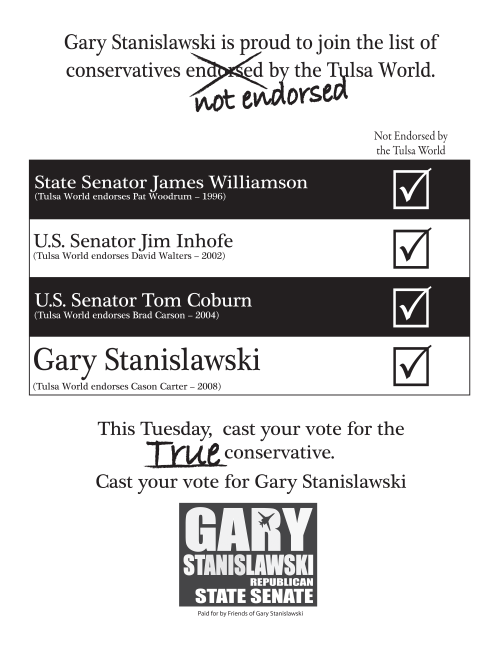
The Whirled editorial board endorsed former City Councilor Cason Carter.
Stanislawski, a financial planner and Jenks school board member, has been endorsed by incumbent Sen. Jim Williamson, who is leaving the legislature because of term limits, and by the Tulsa Area Republican Assembly. Stanislawski is an ORU alumnus, an active member and sometime Sunday School teacher and officer at Victory Christian Church, and served 8 years in the US Air Force.
Here's what I had to say about Mr. Carter about a year ago, right after the vote on buying One Technology Center as a new City Hall:
Taylor's over-the-top speech should have been greeted with howls of derision. Some councilor should have told her, "Madame Mayor, come back to talk to us when you can do so without insulting our intelligence."Taylor claimed that the consolidation of city government offices at OTC would be the "key that will unlock the revitalization of downtown."
Four years ago, we were told that the new downtown sports arena was going to be the key to revitalizing downtown. Before that, we were told that the key was the Inner Dispersal Loop, the Williams Center, the Civic Center, putting the pedestrian mall in, and taking the pedestrian mall out.
It's as if we have a junk drawer full of house keys, skeleton keys, car keys, diary keys, piano keys, and plastic baby toy keys, and our civic leaders are trying them at random until they find one that works.
Taylor also told the Council that the OTC purchase would accomplish "transformation for our souls." I kid you not -- she really said that. Maybe it's because OTC looks like a crystal. Or perhaps Taylor has been reading The Secret.
Our current City Hall is ugly, and moving to OTC would give a boost to the Blue Dome District, but the deal isn't all that. Only the very gullible would buy the fake-it-'til-you-make-it hucksterism in Taylor's claim that going into debt to buy OTC would "change the trajectory" of our city.
And speaking of Cason Carter, he too professed faith in the transformational power of One Technology Center. I'm not sure whether he said that because he truly believes it or because he was trying to please Mayor Mommy by echoing her words.
Carter plans to run for State Senate District 35 next year, but anyone who spouts such nonsense doesn't have any business handling taxpayer dollars at City Hall, much less the bigger bucks at the State Capitol.
Cason is intelligent, a likable guy, and conservative on social issues. Many people I respect are supporting him. But he played it safe during his two years on the Council, taking care never to offend people who might be able to finance his next step up the political ladder. If someone isn't willing to take political risks and offend powerful special interests at City Hall, it's hard to believe he'll suddenly develop that level of courage at a higher level of government.
DISCLOSURE: Early in the campaign, having already decided by process of elimination that I would not be supporting Mr. Carter or Mr. Applekamp, I did some paid computer work for the Stanislawski campaign. This blog entry is at my own initiative, prompted only by a mention of the flyer on Chris Medlock's show. (Medlock was endorsed by the Whirled in his first State House run in 1994, which he lost to Fred Perry, another conservative who was proud not to be endorsed by the Whirled.)
MORE: This endorsement won't help Cason in Brookside:
"As a private developer looking to invest in Tulsa, Cason Carter was extremely helpful. He put me in contact with neighborhood leaders and was able to help facilitate a project that will be a great benefit for Tulsa."John Gilbert
Senior Vice President Bomasada Group, Inc.
This post is a reminder to me to write a check to the ethics commission and get it mailed.
When the Oklahoma Ethics Commission called me back about my request for scans of the Tulsa County District 2 Commissioner race contributions and expenditures reports, I was told to mail a check for $1 for each page requested, and when they received the check, they would mail me the copies. I pointed out to Merlyn Rios, the clerk who handles these requests, that the purpose of filing these forms was to inform the public of the contributors to a candidate and to do so early enough to provide the media and the voters time to analyze the list and take it into consideration come election day. Waiting on the US Mail would slow the process down considerably and might mean voters wouldn't get the information in time to make use of it.
I asked to speak to Merlyn's boss about a waiver of fees or e-mailing the information to me. She transferred me to Patti Bryant. Patti agreed to authorize Merlyn to fax the information to me on the promise that I would mail a check. The fact that I am in media did not entitle me to a fee waiver. The fee is set by the Ethics Commission.
Given the history of county courthouse corruption in Oklahoma, I understand why the ethics law doesn't make a county official the repository of ethics filings, although it would be easier for voters to access the information if they could see it at the county election board.
But it seems to me that the purpose of the law is defeated by the way the commission is handling these documents. They should simply scan these documents upon receipt and post the resulting PDF on their website. Better yet, they should include county candidates in the same searchable database used for state candidates. I could see charging a fee for dredging out and copying old filings, but not for filings in current races.
So far, BatesLine is the only Tulsa media outlet to publish the contributions and expenditures reports for the District 2 County Commission Republican primary. (Here is Sally Bell's report and my analysis. Here is Randi Miller's report and my analysis. Tomorrow I should be able to scan and post Karen Keith's report.) The daily paper doesn't seem interested, and the report filing deadline comes too late for Urban Tulsa Weekly's last issue before the election.
If you appreciate having this information, why not say thanks by helping to defray the cost of acquiring it? In the right sidebar you'll find three ways to become a financial supporter of BatesLine.
- You can post an ad through BlogAds and get your cause or business in front of the eyes of thousands of politically-aware and active Tulsans. Ads start at $30.
- You can click the Donate button and contribute using your PayPal account or credit card.
- Or if you're looking for somewhere to host your website, you can click the Bluehost button. You get a great and reasonably priced web hosting service, and I get a referral bonus.
This week's column in Urban Tulsa Weekly is mainly devoted to an endorsement of Edmond attorney/geologist Dana Murphy for the two-year term on the Oklahoma Corporation Commission. Murphy is running against State Rep. Rob Johnson in the Republican primary, and the primary winner will face Jim Roth, who was appointed by Gov. Brad Henry to fill the vacancy left by Denise Bode's resignation.
Dana Murphy (danamurphy.com) served for five years as an administrative law judge for the OCC, presiding over more than 5,000 cases, weighing evidence and testimony and making judgments, and acting as a gatekeeper over the issues that would be decided by the three commissioners. If elected, Murphy would have no need for on-the-job training.In addition to her time at the OCC, Murphy has worked as a petroleum geologist and an oil and gas attorney. She did her undergraduate work in geology at OSU then went on to get a law degree at Oklahoma City University....
I first got to know Dana Murphy during the 2002 campaign. Impressed by her credentials, I was glad to have the chance to serve in a very minor role on her team. I became even more impressed by her character, as I saw how graciously she dealt with slimy attack ads and a slim runoff defeat.
I'm proud to call Dana a friend, and in the intervening years, I've come to have an even greater appreciation for her character....
It's just under two weeks until the state primary election, and a number of organizations are out to help you make up your mind by asking candidates for their positions on key issues.
Oklahomans for Life has responses from state and federal candidates to a 12-question survey dealing with the issues of abortion and euthanasia, and in ways that are likely to come before Congress and the State Legislature.
It's disappointing that so few Democratic candidates bothered to respond to Oklahomans for Life. The usual excuse is that the survey responses will be used against them by Republican opponents, but that doesn't explain why Democrats don't respond even when no Republicans are running -- e.g. House Districts 72 and 73.
Via Green Country Values, I learned that the Oklahoma Publishing Company, which publishes the Oklahoman, has launched a website with information on elections for federal and state offices called ElectOK.com. Enter your address, and get a list of federal and state races on your ballot, with a page for each candidate to outline a platform, and post blog entries, photos, and video. As far as I can tell, it's a free opportunity for candidates to reach the voters.
At the bottom of the "about" page is an informative disclaimer that spells out OPUBCO's wide reach:
ElectOK is a product of OPUBCO Communications Group, a division of The Oklahoma Publishing Company, a 104-year-old privately held corporation based in Oklahoma City, with current interests in media, hospitality, minerals, communications, technology, securities and real estate development, among other ventures. OPUBCO Communications Group publishes a statewide daily newspaper, The Oklahoman, with distribution in all 77 Oklahoma counties. In addition to The Oklahoman, and the state's most trafficked local websites, including NewsOK.com, Wimgo.com, JobsOK.com, HomesOK.com, CarsOK.com and BedlamNation.com, OPUBCO Communications Group owns and operates The Oklahoman Direct, the largest full-scale standard direct mail provider in Oklahoma. OPUBCO Communications Group is also the publisher of many free distribution publications and magazines including: LOOKatOKC, a young reader tabloid; Viva Oklahoma!, a Spanish-language news tabloid; Make and Model, a car buyers guide; Central Oklahoma Homes Magazine, an upscale homebuilders magazine; HomesOK Extra, a real estate tabloid; JobsOK Extra, a recruitment tabloid; and most recently Recreational Rides, a monthly niche product that focuses on outdoor recreation.
(Wouldn't it be interesting to know details on, e.g., OPUBCO's involvement in real estate development? And whether that affects the Oklahoman's coverage of, e.g., zoning issues?)
Mike McCarville helpfully reminds us of convicted felon Lori McMahan's defense of her husband, convicted felon and disgraced former State Auditor Jeff McMahan, during McMahan's re-election campaign against Republican nominee Gary Jones:
"But I'm not going to sit by and let Jones drag a courageous, honest public servant through the mud with appalling lies and outlandish innuendoes. It would be almost impossible for me to respond to them all, but here are Gary's five most shameful lies, along with the truth."
McCarville notes that those shameful lies "formed the basis of the federal charges against her and her husband, and their convictions on conspiracy and bribery counts."
McCarville also has a poll on his homepage, asking whom Gov. Brad Henry should appoint to replace McMahan. Jones is leading the pack with 50%, followed by Robert Butkin with 17%.
Butkin, a former State Treasurer and a Democrat, left to head up the University of Tulsa's law school, then resigned from that post last year to help out with his family's oil and gas business. Butkin cleaned up an extremely tarnished State Treasurer's office and built a reputation for competence and integrity. He would be an excellent choice to finish out the Auditor's term. But Butkin and his wife have three small daughters, and it's unlikely he'd be willing to go back to commuting between Tulsa and Oklahoma City, even if only for two years.
If the Governor is set on appointing a Democrat, another possibility for a caretaker to finish out the term would be Tulsa's own City Auditor, Phil Wood. Wood set a standard for openness, taking the initiative to launch the first website for city government documents and information on his own dime and doing his own web programming. Although he's a loyal Democrat, he operates his office in a non-partisan fashion. As with Butkin, the big question is whether he'd be willing to commute to Oklahoma City.
Jones remains the best choice to complete McMahan's term -- he has demonstrated strong popular support in two elections and is willing and able to do the job.
McCarville reports rumors that Antlers banker Steve Burrage is a leading candidate for appointment as Auditor. I know nothing about Mr. Burrage, but my first thought was, Didn't Gene Stipe and Steve Phipps have an abstract company in Antlers?
Michelle Byte has started a blog to track the auditor appointment: appointgaryjones.blogspot.com.
In 2002, Gary Jones, a Certified Public Accountant, ran for State Auditor. He received 48.5% of the vote, losing to Jeff McMahan, a man with no education in accounting, by about 30,000 votes. We now know that Jeff McMahan won that election in part because of massive amounts of illegal campaign money, including $157,882 from Steve Phipps, a business partner with Gene Stipe in abstract companies regulated by the State Auditor's office.
In 2006, Jones ran again, receiving almost exactly the same share of the vote. In the weeks leading up to the election, Jones not only called into question McMahan's competence, but he began to sketch out the connections between McMahan, Steve Phipps, Gene Stipe, Francis Stipe, a dog food factory, and grants and loans orchestrated by certain Democratic legislators. It was a complicated story, too complicated to convey to the voters in a way that had impact. (As in 2002, Jones didn't have any coattails from the top of the Republican ticket.)
Jones continued to follow the money, and eventually the Feds did, too. McMahan and his wife, Lori, were convicted in federal court for bribe-taking and conspiracy. The shady dealings that Jones had uncovered were confirmed by Phipps's testimony and affirmed by the jury.
Jones's tenacity in pursuing corruption in state government, at the risk of being accused of sour grapes or obsession, is just the quality we need in a State Auditor.
I've read comments here and there that Jones is a party hack, because he's served for several years as chairman of the Oklahoma Republican Party. Chairing a political party is a tough, thankless job, and it's unfair to dismiss someone who has been willing to serve in that role as a "hack."
I remember when Jones first decided to run for chairman. Chad Alexander had resigned following the disappointing 2002 results. As a statewide candidate, Jones, from rural Comanche County, saw how the city-oriented Republican Party had failed to connect with rural voters, despite the conservative values that they share with the GOP. His motivation for seeking the chairmanship was to fix that, and the increasing success of the party in electing legislative and county officials in once-solid-Democrat districts is testimony to his success.
After winning election to a full term as chairman in 2003 and then re-election in 2005, Jones stepped aside to again pursue the State Auditor's Office. Many Republicans, disappointed with the performance of his successor, Tom Daxon, urged him to seek the chairmanship again, and he defeated Daxon at the 2007 state convention.
Gary's bluntness, persistence, and analytical skills have been a great help to the GOP, but those qualities would be put to even better use in the pursuit of waste and fraud in state government. By appointing Gary Jones to fill the vacancy left by McMahan, Gov. Brad Henry would be proclaiming that the era of insider dealing, bribery, and corruption is over in Oklahoma.
The Oklahoma State Election Board yesterday voted 3-0 to deny a challenge to the candidacy of Dana Murphy for Corporation Commissioner. The challenge had been filed by Rob Johnson, Murphy's Republican opponent, on the grounds that Murphy's filing papers were invalid. At the direction of the State Election Board Secretary, Murphy had signed her name as she wished it to appear on the ballot. (She had signed her name the way she normally would on legal papers, with her middle initial.)
Johnson did not appear at the hearing.
In her press release, Murphy addresses another attack launched against her by Johnson:
Republican Corporation Commission candidate Dana Murphy was vindicated by the State Election Board's ruling on Monday morning striking down opponent Rob Johnson's challenge to keep her name from appearing on the ballot."This is a victory for common sense government and the people of Oklahoma," said Murphy. "This challenge over such a trivial issue as amending my name to appear on ballot as Dana Murphy instead of Dana L. Murphy is an example of wasting taxpayer money and the Election Board's time. It is disappointing that my opponent would stoop to such political pettiness."
"I trust Oklahoma voters not to be tricked by such political gamesmanship and that they will look at a person's true qualifications and commitment for the job. Instead of touting any meaningful qualifications of his own for this office, he seems to spend his time trying to smear me in the press."
While Murphy has been traveling around the state talking about her exemplary qualifications for a seat on the Corporation Commission and her vision for Oklahoma, opponent Johnson and his campaign aide Trebor Worthen, have resorted to the slimiest of tactics, bringing up Murphy's 1993 divorce.
"They have attempted to use divorce filings from one of the saddest times in my life to contend I'm unethical or worse. I have never been convicted of any of the crimes or unethical acts Worthen and Johnson claim. There is nothing in my divorce decree or any other court decisions that proves their claims," said Murphy.
"As anyone impacted by a difficult divorce or lawsuit understands, what is alleged in various pleadings and what is ultimately ruled on by a judge in a final order are often worlds apart. If Johnson cannot tell the difference between allegations made in a case and evidence needed to prove a case, he clearly didn't learn much in law school nor is he prepared to deal with the complex decisions on utility rate cases or oil and gas cases or other Commission cases."
Murphy challenges Johnson to stop hiding behind his consultants' statements and campaign propaganda and debate the issue at hand--serving on the Corporation Commission.
"In the legislature, laws are passed by a large group, but a Corporation Commissioner stands out as one among three for every decision made. Voters and reporters should be asking him, and any other candidates, what qualifications, experience and attributes make them the candidate best prepared to serve all Oklahomans," she said.
"I will debate Rob Johnson any time and place on the important issues at the Oklahoma Corporation Commission affecting Oklahomans," said Murphy. "I look forward to public opportunities to allow the voters to directly compare our credentials and experience for this very important job."
"My record speaks for itself. I've spent my entire adult life getting the education, developing the skills and gaining the experience and knowledge needed to serve as your Corporation Commissioner. I am the best qualified candidate, Democrat or Republican."
In addition to hearing over 5,000 cases as an administrative law judge at the Commission, Murphy has also testified as a geological witness and presented cases as an attorney before the Commission. Murphy is a fifth generation Oklahoman and currently runs a successful oil and gas law practice in Edmond.
The same attack regarding her divorce filings was attempted by her Republican opponents when she ran for Corporation Commissioner in 2002. There was nothing to it then, and there still isn't.
This week in Urban Tulsa Weekly I considered Oklahoma's just-concluded legislative filing period and the decline in number of candidates filing, explaining the deterrents to running for state legislature.
Steve Fair, a Republican Party official in southwestern Oklahoma, wondered about a related topic, the early departure of many House Republicans:
Why are so many Oklahoma GOP House members leaving office before they are termed out? There are a variety of reasons, but here is my "spin" on why a record number of Republican members are bailing in 2008.Some Oklahoma House Republican members are leaving because they are young and ambitious. They are chasing the dollar or the next rung on the political ladder. Those members have never been dedicated to helping Oklahoma move forward and their departure will not leave a ripple in the political pond. Their selfishness and "me first" attitudes have not endeared them to the GOP grassroots or to Oklahoma voters as a whole. That may partially account for their early departures, but a more likely factor will be their own selfish interests. Twenty years from now their impact in the legislature will be little more than a notation in the Oklahoma Political Almanac. They ran for office because it looks good on their resume. They could care less about the issues or the average Oklahoman- it's all about them.
Other members are leaving because they have become disgusted with the process. After serving in the minority for the early part of their tenure in the House, optimism was high in 2004 when the GOP gained a majority. These "gray hairs" thought they would be called upon for advice and counsel, but instead many were passed over for newly elected, younger, more aggressive members. The new leadership rebuffed their experience and ability to work across the aisle with their Democrat counterparts in a gracious manner.
The situational ethics practiced by the new "principled" leadership was inconsistent with what was being press released to the public. The older members concerns on how business was being conducted was ignored and berated. The new GOP mandate was not working for the benefit of Oklahoma, but staying in power and increasing the number of "R"s. Any and all campaign methods- right or wrong- was on the table, if it won elections. Seeing no real difference in the policies and actions of the new GOP leadership and the old Democrat leadership, these members opted to leave early. Their departure is not a positive one and their experience will be missed.
He doesn't use the name "Lance Cargill," but the former Speaker and his posse fit the description of the young, aggressive, and ambitious. The Republican caucus and the House as a whole are better off without them.
At the end of my column, I wrote, "Even if we don't raise their pay, we ought to pay our respects to those who are willing to serve us in the legislature. When a candidate comes knocking on your door this summer and fall, give him or her a few minutes of your time, listen, ask questions, and treat the candidate with kindness and respect. It's the least you can do for someone willing to make personal sacrifices for the sake of serving you at the state Capitol."
Fair says that in exchange for their hard work, candidates should be able to expect from the voters engagement in the process, attention to the issues, civility, and the absence of vandalism, harassment, and dirty tricks. Fair points the finger at inattentive voters for the influence of money in politics (emphasis added):
Money and media have always driven politics but in the past twenty-five years that has escalated to new heights. It's not uncommon to see Oklahoma state legislative candidates now raise and spend six figures to run for an office that pays $38,500 annually. Some blame the big donors, the Political Action Committees, the lobbyists, and special interest groups for the infusion of money into the process, but are they really to blame? The real culprit is the average citizen and/or voter who for a variety of reasons have stopped taking equity in his government. Indifference or only causal knowledge of what is going on in your government leads to "defining" by candidates- both of themselves and their opponents. Elections are now won on popularity and not on issues.In a survey conducted by Harvard University, one candidate describes campaigning in the 21st century like this. "I've been actively involved in politics for over 19 years now. I've even run for public office. Getting voters to even pay attention to government for 5 minutes is a struggle. Most citizens get their information from either sound bites from the propaganda machine that some people still naively refer to as the media and others get it twisted from others without checking the facts. Dealing with the average voter is like dealing with a dyslexic hyperactive kid on drugs." In the same survey, a voter says the greatest cause for voter apathy is people feel politicians promise the world and then forget their promises once elected to office. That's why it's important to know the facts and not just base your vote on a clever jingle, logo or commercial.
I've added three more blogs by and about Oklahoma to my blogroll. You'll see new entries from these blogs pop up on the powered-by-NewsGator blogroll headlines page. (I'm thinking it may be time to break out the Okie blogs to a separate page. What do you think?)
Random Dafydd (that's the Welsh version of David) grew up in Tulsa but now lives in Bartlesville. His blog covers Tulsa history, ancient manuscripts, and many other topics. Here are a couple of his recent historical entries: Tulsa before the railroad: Taylor Postoak Home and Tulsa Architecture, Hooper Brothers Coffee. The latter entry includes photos of the historic building on the edge of downtown at Admiral and Iroquois.
Green Country Values, which covers politics and regional events. Here's an entry about a trip last Saturday to the Lavender Festival and Stone Bluff Cellars. Blogger Jenn also has the scoop on U. S. Rep. John Sullivan's Private Property Rights Protection and Government Accountability Act, which addresses eminent domain abuse in the wake of the Kelo v. New London decision.
Finally, Save ORU chronicles the rebuilding of Oral Roberts University's finances and credibility. reacts to the AP report of declining enrollment:
It's something that should have happened long ago, after years of struggling with a crushing debt and a corporate culture of fear, Oral Roberts University has another major hurdle to overcome. Since its beginnings, ORU has taken on the role of a "surrogate parent/guardian" for its students. Whether you were 18 or 40 -if you lived in the dorms -you had a curfew and an RA telling you to clean your room. Adding insult to injury, it cost you a pretty penny too, and up until 2001, you had to wear business attire to attend classes.With tuition costs soaring and more students footing the bill for their own education, they want to be in control of their college experience. ORU has improved over the years with the adoption of more customer-service oriented approaches, but the recent scandal has made many of the most forgiving students and parents take a step back and ask "what am I really getting for my money?"
(I found that last blog via Club Fritch, the blog of two ORU graduates, Ryan and Gillian (Rowe) Fritzsche, who are now in the film industry. They have a category called ORUgate.)
If you have a blog that you think would be of interest here at BatesLine, drop me a line at blog at batesline d0t com.
Speaking of mocking climate change alarmists, Oklahoma voters couldn't do better than to re-elect global warming skeptic Jim Inhofe to the U. S. Senate. His first TV commercial doesn't deal with the issue, except indirectly by celebrating Inhofe's renowned stubbornness and how that quality has served the interests of Oklahoma taxpayers:
I don't know for sure, but I suspect the road he's walking down at the end of the ad is the abandoned, two-mile-long section at the western end of the Will Rogers Turnpike, which was rerouted several years ago to connect with the Creek Turnpike.
Just received this press release from Dana Murphy, candidate for the unexpired term on the Oklahoma Corporation Commission. Murphy is by far the most qualified candidate in the race, by virtue of her service as an administrative law judge at the OCC and her training as a petroleum geologist and an attorney working on oil and gas matters. Her primary opponent is challenging her filing on some very slender grounds.
Note the reference in the next to last paragraph to campaign consultant Fount Holland. We've noted Holland's unfair political attacks on Tulsa County District Attorney Tim Harris; Holland was the consultant for Harris's opponent Brett Swab. I am sad to see Holland again using his considerable skills against a solid conservative and highly qualified Republican candidate for office.
(Oklahoma City, OK) Oklahoma Corporation Commission candidate Dana Murphy says the attempt by Rob Johnson and his campaign consultants to challenge her filing for office is nothing more than a desperate attempt to create something out of nothing."Rob Johnson and his consultants are grasping at straws because he can't challenge my qualifications. If you watch the video of my filing, you will clearly hear the Election Board clerk ask me if I wanted to be listed as 'Dana L. Murphy' or 'Dana Murphy'. I advised him 'Dana Murphy', he requested that I sign 'Dana Murphy' and I did. The Election Board clerk then scratched out the 'Dana L. Murphy' signature."
Murphy also stated that "In addition to this clarification, he also requested that I add either short or long term with the Commission office to the form and I added short term."
Murphy believes this ploy is just more evidence of the lackluster campaign on the part of Rob Johnson. "He has no hands-on, working experience at the Commission and little, if any, knowledge and background in matters regularly decided by the Commission affecting Oklahomans every day."
Conversely, Murphy possesses the best qualifications of any candidate for this office. She spent almost six years as an Administrative Law Judge at the Commission hearing over 5,000 cases; she owns her own energy law practice and she worked as a geologist in the oil patch for ten years. Murphy has also represented clients before the Commission and testified as an expert geological witness in cases at the Commission.
"Johnson's only apparent claim to fame is that he is a two term state legislator and worked as a congressional aide/gopher. His campaign is already stalling. This is his feeble attempt to cloud the fact that he has no qualifications for this office."
Murphy believes this to be a diversionary tactic used by Johnson's consultants before and currently in use in other races. Johnson, his consultant Fount Holland and former Representative Trebor Worthen, who is working on his campaign, are no strangers to controversy and the use of old guard politician "smoke and mirrors" tactics.
"For me, it's about serving my fellow Oklahomans. They deserve the very best," added Murphy. "What our state doesn't need is more self serving politicians who are more interested in serving themselves than serving our state."
For what it's worth: While we lost massive tree limbs during last Sunday's hurricane-force winds, our Dana Murphy yard sign stayed in place. I've known Dana for six years, and that's an apt metaphor for her character.
UPDATE 2008/06/09: The press release mentions video of the filing. This 12 minute report shows each of the three candidates filing and then speaking to reporters -- first Rob Johnson, then appointed incumbent Jim Roth, then (about eight minutes in) Dana Murphy, showing the interaction with the election board clerk that the press release mentions.
We're now five hours away from the close of Oklahoma's filing period for the 2008 elections, and I'm still seeing way too many seats with unchallenged Democrats; for example, 2nd District Congressman Dan Boren, and Tulsa-area State Reps. Jeannie McDaniel (HD 78) and Eric Proctor (HD 77).
A couple of months ago, as youthful and not-so-youthful Ron Paul supporters were seeking to become delegates to the Republican National Convention, they asserted that they were engaged with the Republican Party for the long haul, and some expressed interest in seeking state and local office. I heard rumors that one young Ron Paul supporter planned to challenge Lucky Lamons in HD 66, but I haven't seen his name on the list of candidates yet.
So far, I've only noticed two RP backers who have filed for office, and both of them have been engaged in the political process for many years. Dr. Mike Ritze, a Broken Arrow physician whose "US out of UN! UN out of US!" sign graced 101st Street for many years, is running for HD 80, a seat being vacated by Ron Peterson. Ritze was chairman of the Tulsa County Republican Party from (if memory serves) 1991 to 1993. And Sally Bell is challenging Randi Miller in the primary for the Tulsa County Commission District 2 seat.
So where are all the young activists who were energized by Ron Paul's presidential run? Challenging a Democratic incumbent would give them a platform to air their issues and an opportunity to build valuable campaign experience, name recognition for future campaigns, and credibility with Republican old-timers. And there's always the possibility that, catching a secure incumbent off-guard, they might win.
Rather than composing a 1000-word comment complaining about this blog entry, why not spend the hour and a half to drive to the State Capitol to throw your hat in the ring?
UPDATE: Gary Casey, 32, has filed to challenge Democratic State Sen. Tom Adelson (SD 33). Casey sought to be a delegate at the 1st District Republican Convention and through the State Executive Committee. Of the Ron Paul supporters seeking to be a delegate, he was one of the most well-received by the non-Ron Paul supporters. I'm happy to see Gary taking up this tough challenge.
UPDATE 2: No RP connection, as far as I know, but Jay Matlock, who sought the Republican nomination for Tulsa City Council District 4, has filed to run against Democratic State Rep. Jeannie McDaniel (HD 78). This would be a better fit for Matlock; his motivating issue was education, and he can do more about that in the State House than he could have in the City Council.
UPDATE 3: Nathan Dahm, 25, a Ron Paul supporter who has commented here on occasion (and at length), has filed for the open HD 75 seat. And Les White, 34, a leading Paul organizer in Oklahoma, has filed for the HD 45 seat in Norman. And "Orat" has posted a 170-word complaint about this blog entry.
Found on the OKDemocrat message board:

RELATED: The official list of Oklahoma's delegation to the 2008 Democratic National Convention, listing each delegate and the candidate to whom each is pledged.
Senator Tom Coburn will hold three hour-long "town hall" meetings today, May 27, in Tulsa:
10:00 a.m., Rudisill North Regional Library, 1520 N. Hartford Ave.
12:00 noon, Tulsa Community College, Metro Campus, 909 S. Boston Ave.
4:30 p.m., Hardesty South Regional Library, 8316 E. 93rd St.
Coburn will be holding town hall meetings in Midwest City and Edmond tomorrow.
From far-off Hoboken, N.J., Mister Snitch! celebrates the landslide election victory of 19-year-old John Tyler Hammons as Mayor of Muskogee with the lyrics from the famous Merle Haggard song, linked to a wide variety of photos -- sweet, nostalgic, and funny, and almost all connected in some way with Muskogee, Oklahoma, USA.
Some of the photos are from the annual Renaissance Festival at The Castle on the north edge of Muskogee. Here are photos from our family's visit to this year's Oklahoma Renaissance Festival.
Congratulations to Tulsa County voters: KTUL is reporting that the TCC bond issue failed 45-55 and the TCC permanent property tax increase failed 43-57.
And congratulations to John Tyler Hammons. The 19-year-old OU freshman poli-sci major won a runoff tonight to become Mayor of Muskogee, defeating the incumbent a former mayor in a landslide. (Hammons said he would transfer from OU to nearby NSU if elected.) Hammons will also be a delegate to the Republican National Convention; he was on the slate approved at the May 3 state convention.
A reaction from "Kiah" to the TCC tax defeat at TulsaNow's public forum:
Can we now officially retire the Chamber/World's cynical approach to local governance (i.e. hide the ball; the fewer voters the better, and the less they know, the better -- in short, don't worry your pretty little head about it, let the grown-ups handle the details . . . .)
UPDATE: Thanks to Jamison Faught for the correct description of Hammons's opponent -- the incumbent, Wren Stratton, didn't seek another term; Hammons defeated a three-term former mayor, Herschel McBride. The final vote total was Hammons 3,703, McBride 1,616.
The Club for Growth's 2007 congressional ratings are out, and Oklahoma Senators Tom Coburn and Jim Inhofe and 1st District Congressman John Sullivan were named as Defenders of Economic Freedom for scoring above 90%.
Coburn had a 97, just behind S.C. Sen. Jim DeMint, who had the only 100. Coburn was tied for second with N.C. Sen. Richard Burr. Inhofe's 91 had him ranked fifth in the Senate. Arizona's John Kyl and Nevada's John Ensign were the other two Senate Defenders, Republicans all.
In the House, Sullivan scored a 95, putting him in a three-way tie for 20th with Randy Neugebauer of Texas and Eric Cantor of Virginia. 49 House members scored 90 or better, all of them Republicans.
The highest ranking Democrats were Rep. Nick Lampson of Texas, ranked 193rd with 26%, and Sen. Mary Landrieu of Louisiana, ranked 47th with 21%.
The lowest ranking Republicans were Rep. John McHugh of N.Y., close to the median score with 15%, ranked 217th, and Sen. Olympia Snowe of Maine, ranked 66th with 12%.
Barack Obama and Hillary Clinton flunked out -- goose eggs for both of them. Ron Paul scored 80. John McCain scored a 94, but isn't ranked because he didn't cast enough votes on the specified issues.
The scorecards list the specific votes that were counted. Here is the Club for Growth House Scorecard and the Club for Growth Senate Scorecard. This entry explains how the rankings were calculated.
In the midst of a number of positive developments at the State Capitol over the last two weeks, there's been one grand disappointment, the sort of special deal for special interests that shouldn't happen when Republicans are in control, but all too often does.
So here's the good:
The Oklahoma Legislature overturned the governor's veto to enact an omnibus pro-life bill, SB 1878. The bill includes a provision to ensure that women seeking an abortion have a chance to learn the truth about the life growing within them while there's still time to make a better choice, rather than encountering the truth years later when the only choice is whether or not to feel remorse.
The House Education Committee and House Appropriations and Budget Committee passed SB 2093, which creates the New Hope Scholarship Credit, a tax credit for contributions to funds which give private-school scholarships to economically disadvantaged students in non-performing schools. Speaker Chris Benge and Speaker Pro Tempore Gus Blackwell personally intervened to keep the bill alive, using their position as ex officio members of all House committees to cast the deciding votes in the Appropriations Committee. Their intervention was required because one of the Republicans on the committee, Shane Jett, joined the Democrats in voting against the bill. (Jett is a past recipient of the Oklahoma Conservative PAC's RINO award.) The bill will come to the floor of the House for a vote on Tuesday.
The Legislature passed a constitutional amendment, SB 1987, limiting terms on all statewide officials. Governors have always been term-limited -- Dewey Bartlett was the first governor eligible for re-election in 1970 when governors were first allowed to serve two consecutive terms. Legislators have been term-limited since 1988, finally kicking in with the first forced retirements in 2004. The other statewide officials -- e.g. Attorney General, State Auditor and Inspector, State Treasurer, Corporation Commissioner -- are not currently subject to any limit. SB 1987 would subject them all to a 12-year lifetime limit and would change the Governor's limit to eight years total, not just eight consecutive years. Partial terms served by election or appointment to fill a vacancy wouldn't count against the total.
A voter ID bill, SB 1150, coauthored by Rep. Sue Tibbs and Sen. John Ford, was passed by the House and will come back to the Senate this week. (This link goes to an RTF file of the House amended version.) The bill requires voters to show proof of identity to the precinct judge:
The voter's valid voter identification card, driver license, passport, state identification card, a photocopy of a current utility bill, bank statement, government check, paycheck, or other government or tribal document that shows the voter's name and address may be used as proof of identity.
So that's all good and positive. Here's the bad:
The Legislature approved and the Governor signed SB 1819, which extends the Quality Jobs Act to apply to a particular industry: "those activities defined or classified NAICS Manual under U.S. Industry No. 711211 (2007 version)." That means "Sports Teams and Clubs." This is a special deal to pay $60 million in tax rebates to the multi-millionaires and billionaires who own the Sonics.
Usually, if Quality Jobs Act incentives are being paid out, a greater amount of income tax revenues are being paid in, thanks to the salaries being paid to those "quality jobs." But a special provision that applies only to "Sports Teams and Clubs" means the team gets the rebate for salaries even if the salaries aren't subject to Oklahoma income tax.
This wasn't a bill passed by Democrats with a few RINO supporters. This bill had the enthusiastic support of Speaker Benge and Senate Co-President Pro Tempore Glenn Coffee, the Republican leaders of the Legislature. Coffee's support is understandable: He represents Oklahoma City, which will enjoy any economic benefit from the Sonics' move. But Benge is a Tulsa representative, and it's hard to figure why he wants to tax his constituents in Tulsa for something that won't benefit them at all. It's hard to figure why any Tulsa representatives voted yes for this bill.
Benge spoke about how, with an NBA team, Oklahoma's name would be heard each game night as the sports scores are read on TV. Maybe he missed this, but that's been going on for years, as we always have a team in the college football Top 25 and almost always have a team in the college basketball Top 25. A mention on ESPN seems like a poor return on investment for $60 million. Even if it raises Oklahoma City's profile, it's hard to see how that benefits Tulsa or the rural parts of the state.
David Glover, at his Reverse Robin Hood website, has a list of the seven lobbyists who were hired by The Professional Basketball Club LLC (the group that owns the Sonics). Most of them are with CMA Strategies, a Republican firm that grew out of Cole Hargrave Snodgrass, U. S. Rep. Tom Cole's political consulting firm. Former State Rep. John Bryant (R-Tulsa) was also on the list. Sad to see consultants and politicians who once fought for fiscal sanity now lobbying for special deals for special interests.
Here's the final roll call vote in the House, and here's the Senate roll call (PDF).
Some of the same legislators who sponsored and supported the good legislation I list above were also supporters of this wasteful example of welfare for millionaires.
So we take the good with the bad with Republican control of the House and shared control of the Senate. Some of the Republicans who voted for the NBA subsidy are friends of mine and candidates that I've helped in elections past. Most of them are good legislators on balance and deserve re-election.
None of the supporters of SB 1819 are likely to pay come election day -- the benefits are concentrated and the costs are diffuse -- but I will be keeping this vote in mind should any of them seek higher office. How someone voted on SB 1819 is an indication of that legislator's susceptibility to lobbyist pressure and view of the proper role of government in economic development.
Another step forward for the protection of unborn children in Oklahoma, thanks to Republican control of the State House and solid pro-life legislators like my friend Tulsa State Rep. Pam Peterson. Here's the press release from the Office of Speaker Chris Benge.
Omnibus Pro-Life Bill Passes House CommitteeOKLAHOMA CITY (March 26, 2008) -Legislation further defending the unborn child passed the House Judiciary and Public Safety Committee today.
Senate Bill 1878, by Rep. Pam Peterson, combines several previously-passed pro-life measures into one bill. The legislation:
- Protects health care professionals' freedom of conscience by affirming their right to refuse to participate in the taking of a human life.
- Expands on pro-life legislation passed in 2006 that required abortion doctors to tell a woman she had a right to a free ultrasound at an off-site location. This legislation would provide an ultrasound at the clinic where the abortion would be performed.
- Bans wrongful-life lawsuits that claim a baby would have been better off being aborted.
- Ensures that a mother's consent to an abortion be truly voluntary and safeguards against coerced abortions. It requires posters to be placed in abortion clinics informing mothers of their rights and requires abortion clinics to verbally tell minors that having an abortion is their decision alone.
- Regulates the use of the chemical abortion pill RU-486, which is used when the unborn child is about two months old.
This omnibus pro-life legislation will have the indirect effect of saving the lives of innocent children, Peterson said.
"This legislation is about giving mothers as much information as possible in advance about this irrevocable, life-altering decision. We must do all we can to ensure every woman has all the facts so she can make the most informed decision possible," said Peterson, R-Tulsa. "The bill also protects the integrity of medical professionals who do not wish to participate in performing abortions."
The bill passed the House committee today and will next be heard on the House floor.
The Republican head of the Oklahoma State Senate is planning a bill that would shovel statewide taxpayer dollars at the billionaire owners of the Seattle Supersonics, but don't expect to read about this in the Oklahoman or the Whirled.
Oklahoma State Senate Co-President Pro Tem Glenn Coffee, R-Oklahoma City, said he'll sponsor a bill offering tax breaks if the team moves."I don't have the language yet, but we're working on it," Coffee said. "In general, there are some costs to relocating the Sonics to Oklahoma City."
Coffee said the incentive would likely resemble the state's Quality Jobs Act, which gives rebates to companies for creating jobs, and the cost would be recovered when the Sonics and their opponents pay income taxes for games played in Oklahoma.
Democratic Senate leader Mike Morgan of Stillwater and House Speaker Chris Benge, R-Tulsa, have also been involved in discussions with Coffee. The lawmakers said the Sonics approached them about enacting the tax breaks.
Oklahoma City voters last month approved a temporary 1 cent sales tax to raise $121 million for upgrades to the Ford Center and construction of an NBA practice facility.
[Clay] Bennett's ownership group has not been asked to contribute any money toward that project. The team would receive most of the cash generated by the renovated arena under lease terms spelled out by Bennett in a 16-page letter of intent to Oklahoma City Mayor Mick Cornett. The city would pay the arena's operating expenses.
The Sonics would pay annual rent of $1.6 million for the arena, and $100,000 for the practice facility, increasing the payment with inflation. The city also would receive more than $400,000 a year for arena naming rights, with the team getting any cash above that when an expected new naming-rights deal is struck.
The Sonics could break the agreement after six years if ticket sales fall below certain benchmarks.
As an Oklahoma Republican who hoped that a Republican majority in the legislature would mean an end to a century of insider dealing at taxpayers expense, I'm embarrassed. First, there was Lance Cargill, and thankfully the House caucus forced him to resign as Speaker. Then there was Sen. Harry Coates (R-Seminole), opposing HB 1804 because of certain industries that depend on cheap illegal labor. Thankfully, he's in the minority on the issue. Now, Glenn Coffee, the man who would be the second-most influential politician in Oklahoma if the Republicans take over the State Senate for the first time ever, is saying that taxpayers all over Oklahoma need to foot the bill for massively wealthy Oklahomans to bring an NBA team to a market that serves less than a third of the state's population.
I found this story in the Seattle Times, and I learned about it by reading Field of Schemes, a blog about pro sports teams and how they manipulate local governments to fork over government money for private benefit.
I wonder why we aren't seeing coverage about this in Oklahoma. You don't suppose it's because the ownership group's head is married to a Gaylord, the family that owns the Oklahoman?
Jeff Shaw of Bounded Rationality called my attention to this: The Oklahoma Supreme Court has handed down decree yesterday that, effective immediately, will restrict online access to court records. The stated motive is to limit access to sensitive information that could be used in identity theft.
The decree forbids attorneys to cite certain personal identifiers in pleadings filed with the state court system -- e.g., addresses, SSNs, dates of birth. If this kind of information is essential to a pleading, it's to be provided separately and will be kept under seal. This part of the decree doesn't take effect for three months.
Section IV of the decree deals with online access. It takes immediate effect:
The Clerk of the Oklahoma Supreme Court, each district court clerk, and the Project Manager of the Oklahoma Court Information System are directed to immediately limit internet public access to court dockets only. The individual pleadings and other recorded documents filed of record in state court actions shall not be publicly displayed on the internet. Court documents may be viewed at the courthouse unless otherwise prohibited by law. This policy may be reviewed by this Court in the future.
This appears to mean that you will still be able to call up the docket for a case on OSCN and read through the case history -- when hearings were held, when documents were filed, the resolution of a case. For most of OSCN's history, that's all you would find on a district court case.
More recently, some filings were made available within a case's web page. For example, in researching my most recent UTW column, I was able to read a judge's ruling in a case by clicking a document link on the case's OSCN page. With this ruling, you will only be able to read those documents by going to the County Courthouse and requesting to read the file.
This decree doesn't really protect anyone's privacy. It simply allows convenient access to court records only to the attorneys who practice at a given courthouse; attorneys from other parts of the state or the country and members of the general public won't easily be able to access case information.
One of the other rationales for the change, mentioned in the dissent but not in the decree itself, is that until such information is available for all counties in Oklahoma, it shouldn't be available for any of them.
Open access to court records is essential to a fair and impartial justice system. Justice Yvonne Kauger wrote in her partial dissent:
The Court is obligated to provide the public with access to court records. The judiciary has long recognized that case file documents, unless sealed or otherwise restricted by statute or court rule, are available at the courthouse for public inspection.The common law right and the presumption of public access to court records relate to the public's right to monitor the functioning of our courts, thereby insuring quality, honesty, and respect for our legal system.
The dissent also notes the importance of electronic access to records to blogs and other forms of new media:
With the invention of each new method of conveying information, it becomes more difficult for the courts to seal and protect information without the individual cooperation of litigants and members of the Bar. Whether it is a development we welcome, the simple fact is that the tide of new media may not be ignored or dodged. Instead, we should make policy that contemplates this new reality. Given the public's increasing expectation of governmental transparency and its acclimation to the variety of new media, a strong philosophical distinction between documents available to the public at the courthouse and documents available to the public online becomes harder and harder to maintain. A blanket ban on posting copies of pleadings online, without consultation with the bench, the Bar, or the Legislature is a step too far, especially when in all likelihood we will lift this ban in the near future when we begin operating under a new case management system. If it is intellectually acceptable to post these documents for all counties, how can it be unacceptable to post them for some counties? The ban will not protect the court any further than the new redaction policy and its existing immunity. In fact, this temporary ban will do little more than have the undesirable effect of limiting the public's access to public information to which it has become accustomed ---- and creating a stir.
The worst thing about this policy is that it was handed down unilaterally, without opportunity for comment from members of the Bar, the Legislature, media (old or new), or the general public:
The Court made this decision with input only from the court clerks, others directly affected by the decision -- the bar, the bench, the legislature and the public were not consulted.... This public information which was previously available to the bench, bar, and litigants has been removed from viewing without any consideration for, or consultation with, lawyers and judges who use the information on a daily basis to do their jobs more efficiently or from public litigants attempting to seek legal redress.
I hope there will be enough outcry to reverse this decree, whether the Supreme Court does it or the Legislature does it for them.
UPDATE: Tyson Wynn has more:
In a day and age when we're moving to more and better online access to our government institutions, this step is unnecessary and unwise. Further, if the personal data has been ordered redacted, what is the harm in allowing court documents to be accessible online? Documents in the federal courts are almost all accessible online. Not all of Oklahoma's district courts post actual documents online, but they were advancing toward that end.
Oklahoma is internationally renowned! Here's a comment about the Eliot Spitzer scandal on Samizdata, a libertarian blog based in Britain (emphasis added):
Eliot Spitzer, one of the most nasty power crazed politicos in US politics today, perhaps second only to Oklahoma Attorney General Drew Edmondson in authoritarian thuggishness, has just shown that he who lives by the judicial sword, can oh so easily die by the judicial sword.
We're number one! We're number one!
The authoritarian thuggishness to which the writer refers? The threat of imprisonment hanging over the Oklahoma Three: Paul Jacob, Rick Carpenter, and Susan Johnson. From an earlier Samizdata entry by Dale Amon in Belfast:
I was rather surprised to discover that Oklahoma, of all places, is using State power not to just silence critics, but to send them to prison for up to ten years!I simply never expected this sort of political repression to take hold in America. The Oklahoma government should simply be ashamed of the way they are sullying the American ideal.
The Oklahoma Bar Association is in the process of considering changes to the our state's Canons of Judicial Conduct. Although the subject is challenging for us laymen, the impartiality and independence of our judges is at the heart of the rule of law and the security of our life, liberty, and property.
The OBA committee conducting the review of the judicial conduct standards are being guided by the American Bar Association's model standards. Many Oklahoma attorneys are concerned that the new standards go too far in questioning a judge's outside involvements and associations.
Among many other problems, if adopted the revised canons would, without being reviewed or approved by our elected representatives, create a new protected class in Oklahoma -- sexual orientation -- which is not a protected class under Oklahoma law. Under the new canons, it's conceivable that a judge could be required to recuse himself from a case involving a homosexual litigant merely because the judge attends a church that takes a traditional Christian view of sexuality.
Saturday afternoon on 1170 KFAQ, during the 4 p.m. hour, constitutional attorney Leah Farish will be talking with host Bruce Delay about this issue, why it matters, and what we ordinary citizens need to do about it. Be sure to tune in.
Farish knows the ugly reality of judicial bias and has actually had a case reversed in her client's favor on grounds of the judge's bias. She believes that current remedies for bias are sufficient and that the new canons would cause scrupulous judges to withdraw from outside organizations and involvements, the kinds of interactions that keep a judge connected with the people they serve and grounded in the reality of the world shaped by their decisions.
UPDATE: Added a link to the proposed revision of the canons, provided in the comments by attorney Greg Bledsoe.
MORE: Here's the podcast from Bruce Delay's interview with Leah Farish.
You know that uneasy feeling when you've got a stomach virus? When your stomach is churning and you hope if you lie quietly it'll go away and be spared a disgusting and messy situation?
You know that feeling of relief when you finally expel what's been troubling you? That's the way many Oklahoma Republican insiders feel today at the news that State Rep. Lance Cargill has resigned as Speaker of the Oklahoma House of Representatives. Better out than in.
The direct cause of the resignation was revelations this week about Cargill's failure to file income taxes and pay property taxes in a timely fashion. This latest scandal was on top of alleged "pay for play" practices that began during his tenure as House Majority Leader, an investigation into the apparent movement of money between campaign funds to skirt fundraising limits, and rumors of immoral behavior at the State Capitol.
While many in the House Republican caucus have long had the desire to oust Cargill, it took a tax violation, just as it did with Al Capone, to force him out.
The honorable Republicans who went to Oklahoma City to change our political culture and help our state move forward saw Cargill endangering that project with his fundraising practices, which served his ambitions more than state government reform.
Last fall we learned that Cargill had raised $250,000 for his re-election campaign in the first six months of 2007. Here's how he did it, an example of the pay-for-play process at work:
Last legislative session, Cargill sponsored an ethics bill to outlaw campaign money from being given to lawmakers inside the state Capitol.At the same time Cargill was proposing reforms, he was calling lobbyists at 15- minute intervals to the Oklahoma City office of Fount Holland, who conducts numerous Republican political campaigns. Cargill was asking lobbyists how much they would contribute to the House PAC, his own campaign and two other GOP-related entities.
The speaker said at the time that the meetings involved "potential contributors who we meet with all the time to try and raise financial support for our political efforts."
Something I wrote after the 2006 election, about the struggle in the Republican Party between fair-dealers and wheeler-dealers is worth revisiting today:
But there are worrisome signs that Republicans in the Oklahoma legislature are about to travel the same perilous path as their congressional counterparts.Last Thursday the newly-elected House Republican Caucus reaffirmed Lance Cargill of Harrah as their nominee for Speaker of the House, choosing Cargill over Oklahoma City Rep. Mike Reynolds. Some Republican capitol insiders are worried about the result, seeing the potential for an Oklahoma version of the corrupt "favor factory" that brought down the Republican majority in Congress.
A series of articles in our sister publication, the Oklahoma Gazette, Ok City's alternative newsweekly, earlier this year explored lobbyist complaints that Cargill was running a "pay for play" system via his leadership PAC, Republican PAC to the Future.
Cargill, as House majority leader, controlled the flow of legislation, and the message came through loud and clear that if a lobbyist wanted his client's bill heard, he'd have to bring in some contributions to Cargill's PAC.
Cargill was dumped as majority leader in March. Behind the scenes, it's said that his abrasive leadership style and fundraising tactics were the reasons for the ouster.
Once freed from leadership responsibilities, Cargill, I am told, worked on using his accumulated PAC cash to win friends in the caucus. In June he won an election for speaker-designate, an election marked by irregularities and arm-twisting. Legislators feared losing important committee assignments or drawing a primary opponent in the next election if they openly opposed Cargill.
Already in the last legislature we saw questionable bills--special deals for special people, not sound policy--find their way through the process. There was the attempt to craft tax credits like those used for Great Plains Airlines to benefit someone who wants to redevelop Shangri-La resort. There were attempts by developers to use state law to override local zoning and planning ordinances.
These dodgy bills made it through most of the legislative process before they were discovered by citizens and stopped. They got as far as they did, winning cosponsors and floor votes, because legislators believed their colleagues, who told them, "Don't worry, this is nothing controversial."
It took a last-minute bipartisan public outcry to stop the bills.
Good riddance to Lance Cargill. Let's hope the Republican Caucus chooses a replacement with no ties to Cargill's machine.
MORE: Stay tuned to the McCarville Report for more developments from the State Capitol.
The Oklahoman is reporting that State Auditor and Inspector Jeff McMahan and his wife Lori McMahan have been indicted by a federal grand jury on charges which include racketeering, conspiracy, and fraud.
The nine-count indictment alleges Jeff and Lori McMahan received jewelry, trips and excessive contributions to Jeff McMahan's first campaign in 2002.In return, the auditor granted special favors to former abstract company owner Steve Phipps, according to the indictment.
McMahan's office regulated the abstract industry until Jan. 1. The Legislature last year created a separate agency for that purpose amid reports of McMahan's ties to Phipps.
It's interesting: The Oklahoman story notes that McMahan is the second statewide official to be indicted on corruption charges in recent years -- Insurance Commissioner Carroll Fisher was indicted in 2004 and is now doing time. I find it strange that the Oklahoman doesn't also mention that both of these officials are Democrats.
UPDATE: The Tulsa Whirled didn't name that party either.
While doing some research for my next column, I came across links to the platforms adopted by the Oklahoma Democratic and Republican parties at their 2007 state conventions. Both are in PDF format.
Oklahoma Republican Party Grassroots Platform 2007
Resolutions Committee Report to the 2007 Oklahoma Democratic Party State Convention
The Republican platform is almost twice as long as the Democratic document. Republicans will consider a new platform at their 2008 state convention in Tulsa. Democrats will not act on a platform again until 2009.
Thursday, it was reported that employees at Southwestern Oklahoma State University (SWOSU) were banned from using the word Christmas. Here's the latest statement from SWOSU president John Hays on the matter:
Update: No Ban on Christmas December 21, 2007After the stories about Christmas were published stating that Southwestern Oklahoma State University banned the word 'Christmas' or Christmas decorations, I made inquiries to discover if there was any basis to the reports. The university does not have a policy that bans the word 'Christmas' or Christmas decorations. However, some supervisors or department leaders within the university who meant well may have suggested to employees that caution should be taken with respect to Christmas decorations. One thing led to another and the result was that some mistakenly assumed that Christmas decorations were being prohibited. I have met with various staff members to get to the bottom of the matter and have also had a pleasant discussion with Mathew Staver, Founder of Liberty Counsel.
The university will continue to follow the law and to respect the right of all its staff members. Thus, the university will follow the general principles set forth by the courts regarding the display of religious symbols and/or Nativity scenes. A publicly sponsored Nativity scene on public property is constitutional so long as it is displayed in the context of other secular symbols of the holiday, like Santa Claus or a Christmas tree, so as not to appear to be endorsing a particular religion. A privately sponsored religious symbol or Nativity on public property where members of the public are permitted to display such symbols does not need an accompanying secular symbol to be constitutional.
In applying this general rule to the university, if a Nativity or other religious symbol of the holiday is displayed in a place open to the general public (like a lobby), the university will include secular symbols of the holiday in the nearby context. However, employees in their cubicles or offices may personally display a Nativity or other religious symbol of the holiday. In such setting, the employee need not include secular symbols of the holiday. Employees have always been and continue to be permitted to greet one another with the greeting 'Merry Christmas' or 'Happy Holidays.' The decision is up to each employee.
I trust that these guiding principles will clarify the matter regarding Christmas for the staff and the general public.
John Hays
SWOSU President
Am I wrong in noticing a bit of a contradiction with his earlier statement?
No Ban on Christmas December 20, 2007An attempt to be respectful of the diverse religious population at Southwestern Oklahoma State University has been misinterpreted as an attempt to ban Christmas on the Weatherford campus.
The rumor of this ban is not true.
The university attempted to prevent the appearance as a state agency of endorsing any particular religion.
John Hays
SWOSU President
On December 20, he refers to an official university action: "The university attempted to prevent the appearance as a state agency of endorsing any particular religion."
On December 21, he denies that official university action was involved: "The university does not have a policy that bans the word 'Christmas' or Christmas decorations. However, some supervisors or department leaders within the university who meant well may have suggested to employees that caution should be taken with respect to Christmas decorations. One thing led to another and the result was that some mistakenly assumed that Christmas decorations were being prohibited."
I'm happy that they've come around in support of freedom of expression, but it still looks like someone is playing a game of CYA.
Liberty Counsel, the national group which first called attention to the issue, is very pleased with the outcome:
Mr. Hays deserves a big "Thank You and Merry Christmas." His leadership in resolving the controversy over Christmas and the general guidelines he has set forth regarding the appropriate way a state school and its employees may acknowledge and celebrate Christmas serves as an example for others to follow. Christmas is a wonderful time of the year and it can and should be enjoyed by all.
The Oklahoman story adds a detail from the SWOSU spokesman:
Spokesman Brian Adler said employees were asked to keep public areas of the campus free of religious decor because not all students celebrate Christmas as a religious holiday.
Mark Tapscott, who brought the story into the blogosphere, spoke with John Hays by phone:
"We don't have any written guidelines now, but Matt [Staver of Liberty Counsel] tells me the court cases are pretty clear that when you do have something like a nativity scene on public property, like on City Hall, you also have to have some secular items with it," said John Hayes, SWOSU's president. Staver promised to provide Hayes with materials on court cases on the issue that would be useful in writing guidelines for the school's existing policy, the SWOSU official said.Hayes said his university doesn't have "a new policy, there has just been a big mis-understanding. One of the offices told somebody they couldn't do something and it was over-emphasized." An employee had placed a snowman in a public area of an office that said "Merry Christmas," according to Hayes. The snowman was then moved to a different area, he said.
It has been reported that Southwest Oklahoma State University officials banned SWOSU employees from using the word Christmas on the advice of Oklahoma Attorney General Drew Edmondson. The story has appeared on a number of websites and blogs around the country today, along with reports of denials from spokespeople for SWOSU and Edmondson. The original story has since been confirmed by other sources, but many of the blogs that picked up the denials missed the later confirmations and additional details.
Confused? I was, too. Let's try to sort it all out, but here's the bottom line: SWOSU officials did ban their employees from using the word Christmas in emails, memos, or decorations. What's not clear is whether the AG's office had anything to do with that decision.
I received an email about this late this morning from Erick Erickson, editor of RedState.com, but didn't have a chance to post anything about it because of a lunchtime meeting. I'm glad I had to wait.
Here's the original alert from Erickson (highlights his):
Dear RedState Reader,
Drew Edmondson is the Oklahoma Attorney General. Recently he rounded up conservative activists and threw them in jail for circulating petitions to get conservatives on the ballot.
Now, however, Oklahoma Atty Gen. Drew Edmondson has done something even nuttier. He has issued an advisory opinion from the Attorney General's Office directing universities and public employees in Oklahoma to refrain from using or writing the word "Christmas."
Mark Tapscott with the Washington Examiner has the details. Mark notes, "Edmondson issued an advisory opinion to officials at Southwestern Oklahoma State University in Weatherford advising them that the word "Christmas" should not be spoken by any employee of the state school, not written in any official holiday decorations."
Attorney General Edmondson can be reached at 405-521-3921. Please call and wish him a Merry Christmas and ask why he banned Christmas.
All the best and
Merry Christmas to you,
Erick Erickson
Editor, RedState.com

This alert was sent to a number of bloggers who posted the story, including Ace of Spades HQ, Hot Air, and Captain's Quarters.
Mark Tapscott, an Oklahoman who writes for the Washington Examiner, has updated his original post several times, reporting both the denials from Edmondson's office and the university, and an on-the-record confirmation from a university employee, admissions coordinator Connie Phillips:
A veteran administrative employee of SWOSU confirmed that she and her colleagues in her department were told by their boss "to take the word 'Christmas' off of our email signatures and not to use that word in any official correspondence."The story appears to have originated with a group called Liberty Counsel, which focuses on defending the free exercise of religion enshrined in the First Amendment. Here is Liberty Counsel's initial press release:
Connie Phillips, SWOSU's admissions coordinator, said she refused to comply. "I told them they could write me up but I was not going to take it off my signature."
Other SWOSU employees were resisting the orders as well. "The people in the business office had a decoration up with the word 'Christ' in it and they were told to cover it over. They did but then they took it off. It's been on and off about three times now, I think."
Phillips said others in her office agreed and that a number of SWOSU employees came to work today wearing buttons saying "Merry Christmas" as a protest. "We just can't believe this is happening, this is supposed to be America."
Asked if she was concerned about reprisals, Phillips said "I don't know, I guess we'll see. I've been here 24 years and I've got just four more years to retirement, so I hope not."
Weatherford, OK - Southwestern Oklahoma State University (SWOSU), has issued a disturbing policy which requires all employees to refrain from using the word "Christmas" in oral or written form. This directive was given by the university upon legal advice of the Oklahoma Attorney General, W.A. Drew Edmondson. Liberty Counsel sent a demand letter to SWOSU following a complaint from a university affiliate.
David Misak, the Director of Human Resources, recently visited various university departments and employee groups and informed everyone that any decorations featuring the words "Christ" or "Christmas" in any work or public areas of the university must be immediately removed. He also instructed everyone to discontinue the use of the term "Christmas" in their speech while on the job. This censorship specifically includes exchanging email greetings of "Merry Christmas" among employees or with nonemployees, whether initiated by a nonuniversity employee or not. Christmas remains a legal holiday for state employees, including those at SWOSU. The directive does not include any other legal holidays such as Thanksgiving or New Year's.
The announcements made by Misak are in direct violation of the United States Constitution and other federal law. The First Amendment prohibits government from being hostile to religion. Selecting one legal holiday for negative treatment and special restrictions solely because it has religious aspects clearly demonstrates hostility toward religion. Moreover, the free speech rights of employees at the university are infringed when their speech is censored solely because of a religious viewpoint or perceived religious viewpoint. A public employer like SWOSU also violates the Civil Rights Act when it prohibits its employees from using the words "Merry Christmas."
Liberty Counsel's demand letter requests an immediate reversal of the university's unconstitutional policy. Liberty Counsel's Friend or Foe Christmas Campaign educates and, if necessary, litigates to insure that Christmas is not censored.
Mathew D. Staver, Founder and Chairman of Liberty Counsel and Dean of Liberty University School of Law, commented: "Of all places, a public university should foster free expression. How can public university officials honestly believe that the state can prohibit its employees from wishing each other 'Merry Christmas?' After all, Christmas is a state and federal legal holiday."
After the rash of denials, Liberty Counsel issued a second release explaining how the story came to them:
Earlier today we informed you in a Liberty Alert about a ban on the word "Christmas" by Southwestern Oklahoma State University in Weatherford.
We believe that your emails and phone calls are making an impact. We are hearing more details from our sources including some within the university.When public officials start to feel the heat of public scrutiny, they often try to make excuses or deny that events took place. Some staff members who are answering the phone are even telling people that the incidents we are reporting never happened!
We decided to go on the offense and release some additional details on this situation.
After Weatherford City Commissioner Warren Goldmann heard from a constituent that the word "Christmas" was banned by the university, Goldmann contacted the Provost of the university, Dr. Blake Sonove. Dr. Sonove confirmed the "Christmas" ban policy and indicated that the university was relying on an opinion from Attorney General Drew Edmonson. Commissioner Goldmann then reported the information to Liberty Counsel.
Connie Phillips, an Admissions Coordinator, reported that David Misak, Director of Human Resources, entered the registrar's office with Tom Fagan, Vice President of Finance. They ordered the words "Christ" and "Christmas" covered up in decorations and instructed that there could be no use of "Merry Christmas" in emails!
A records coordinator verified that her department was told they could not use "Christmas" in email or voice mail.
The same action occurred in the business office where someone asked for the directive in writing and was told that the written policy is still being drafted. Another person provided Misak with written information showing that using "Christmas" is constitutional, but Misak would not change his stance.
Additionally, the ITS department was told to change the introduction page of the university's campus-wide database. The page has been edited since yesterday to remove a statement that said: "Have a very Happy Holiday ... Merry Christmas ... Happy New Year."
This censorship of Christmas is a trend that must be changed!
Now that you have these specific details, don't let the university play games with you on the phone!
The university president, John Hays, has the authority to change university policy. Call or email him and urge him to reverse the ban on the word "Christmas."
His contact information is: Telephone (580) 774-3766, Fax (580) 774-7101, email president@swosu.edu.
Thank you for your help. If you are aware of similar situation, let us know. You can also download a copy of our Legal Memo on Christmas in the Workplace at www.LC.org. If you cannot open the document from our web site, contact us and we will mail you a copy.
SWOSU president John Hays has a non-denial denial on the school's website:
An attempt to be respectful of the diverse religious population at Southwestern Oklahoma State University has been misinterpreted as an attempt to ban Christmas on the Weatherford campus.
The rumor of this ban is not true.
The university attempted to prevent the appearance as a state agency of endorsing any particular religion.
John Hays
SWOSU President
No one was saying that Christmas was banned at SWOSU, only that employees were banned from using the word "Christmas." Hays's mention of "an attempt to be respectful of the diverse religious population" at SWOSU and that the "university attempted to prevent the appearance as a state agency of endorsing any particular religion" acknowledges that an official action was taken. Hays's statement is entirely consistent with the alert from RedState, the story by Mark Tapscott, and the press release by Liberty Counsel.
What remains a mystery is the involvement, if any, of Attorney General Drew Edmondson. Given his support for New Jersey's lawsuit trying to force the Boy Scouts to allow homosexual men to be scoutmasters and his handcuffing of three leaders of the Taxpayer Bill of Rights petition drive, it wouldn't surprise me if he had weighed in on the side of the anti-Christmas Grinches. He has three years until the next election, and his soft-spoken and folksy manner seems to erase any memory Oklahoma voters have of his leftish antics.
Edmondson's name came up because SWOSU provost Blake Sonove told Weatherford City Commissioner Warren Goldmann that the policy was based on an opinion by Edmondson. There's the possibility that Sonove was mistaken or that Goldmann misunderstood what Sonove said. Perhaps the opinion came from an attorney for the university or an attorney for the Oklahoma State Regents for Higher Education (OSRHE), the governing body for colleges like SWOSU.
There's also the possibility that SWOSU was relying on an opinion that Edmondson issued to another state agency under different circumstances. Many AG opinions are archived on the Oklahoma State Courts Network. My searches on "Christmas," "religious," and "sectarian" didn't turn up anything applicable, but there may be opinions that have been issued but not yet posted online.
We'll keep you posted about any developments.
UPDATE: Mark Tapscott reviews the events of the day and comes to a complementary conclusion:
Second, it's clear somebody at SWOSU got the idea that employees there should be told to stop using such terms as "Christmas" and "Christ." I have no doubt that Edmondson personally didn't provide SWOSU "legal advice" in a formal advisory opinion. The man isn't dumb. But AGs and their staff provide informal advice every day, sometimes in person, sometimes in email, sometimes on the telephone. Sometimes even to journalists!
Maybe that somebody mis-understood something that was said to them by the AG or his staff. Or maybe that somebody simply took it upon themselves and informally advised SWOSU managers to spread the word among the troops. That somebody ought to come forward and clear up the confusion.
If they do and it turns out Edmondson had absolutely nothing to do with anything here, I will promptly retract the assertion in my original post that he was "banning Christmas" or had "issued an advisory opinion" to that effect.
But "Okie Napoleon" stays. Even if he's not the Grinch who banned Christmas, he's more than earned the sobriquet.
Tapscott says he tried to call SWOSU Provost Blake Sonove, but the call was returned by a spokesman instead. Seems like Dr. Sonove is the person who can solve the mystery of where school administrators got the idea they needed to have employees stop saying "Christmas."
Did you know there was a property tax election northeast of Tulsa on Tuesday? Neither did the voters involved, the county officials, or the area's leading property taxpayer, according to a story in the Oologah Lake Leader.
Northeast Technology Center, an Oklahoma vo-tech school district with campuses in Pryor, Afton, Kansas (the town, not the state), and Claremore, is holding a special property tax election on December 11, and according to the Oologah Lake Leader, they've been trying to keep it below the public radar. A legal notice was filed, but only in the smaller of the two papers that serve the city of Pryor, and nowhere else in the far-flung district, which covers most of Ottawa, Craig, Delaware, Mayes, and Rogers Counties, plus parts of Wagoner, Nowata, and Cherokee Counties.
One of the two ballot items would increase the building levy from 1 mill to 5 mills and the other item would make the new levy permanent. The district's overall levy, which includes 10 mills for operations, would increase from 11 to 15 mills. The increase would raise $4.4 million per year.
Via Tyson Wynn, who has more to say on the matter.
UPDATE: Tyson Wynn reports this morning that his IP was blocked by the Northeast Technology Center website:
Get this. I visited the NTC website via your link last night. I went back to look at the press release this morning and it says I don't have permission.
Tyson had no trouble accessing the site via another IP address. He said he'd then called NTC and was told they had no way to block an IP address, which is baloney. They're running Apache 1.3.34, and it's a simple matter of adding a line to the webserver configuration file. Amazingly, he was able to access the site again shortly after he spoke to them.
Why don't they want anyone to know about this election?
MORE: MeeCiteeWurkor has some thoughts on the NTC's stealth tax:
If you live in one of the counties listed above, be sure and hit the polls on Dec. 11th and shut down these people trying to take your money. Before you go, email this guy: garyfox@netechcenters.com Let him know exactly how you feel about his press release. He's the NTC marketing and communications director. I'm sure as a communications director, he'd love to communicate with you about this. Perhaps he could also explain his involvement with this sneaky little scheme.
On November 1, Survey USA conducted a poll of 500 Oklahoma voters for KFOR in Oklahoma City regarding the issues behind HB 1804. Here is a summary of the poll, and here are the full crosstabs, showing how the responses varied according to ethnicity, sex, age, and other factors.
(I really appreciate Survey USA's willingness to share the crosstabs and the exact wording of their survey questions. You can find many more interesting surveys on their blog-like homepage.
When given a description of the major provisions of HB 1804, 76% of those surveyed said they support the law, and 19% oppose it. Support was about equal between men and women, greatest in the 35-54 age group.
The survey shows an almost equal amount of support for the bill among Hispanics as among whites, but it should be kept in mind that Hispanics made up only 4% of the sample, or about 20 respondents. The margin of error (at a 95% confidence level) for such a small sample is nearly 22%.
RELATED: HB 1804 author State Rep. Randy Terrill spoke to Gwen Freeman and Chris Medlock on Monday giving a simple, brief, and straightforward explanation of what HB 1804 does and doesn't do, with particular attention to the exemptions that address most of the fears I hear. Terrill explains what business owners, landlords, social services provider, educators, and law enforcement officials need to do to comply with HB 1804. You can download the MP3 of Terrill's interview here.
Brandon Dutcher has hit the nail on the head:
Conservatives favor low taxes, fiscal restraint, minimal regulation, and serious respect for private property rights.Business leaders and chambers of commerce, on the other hand, often want higher taxes, lavish government spending (to pay for pet corporate-welfare projects), extensive regulation (to thwart competitors), and the ability to take other people's property (for purposes of development).
And that's why Chambers of Commerce, like the one in Tulsa and the one in Oklahoma City, often oppose tax cuts.
But, you say, the overwhelming number of Chamber of Commerce members are small businesses who wouldn't benefit from that lavish government spending, extensive regulation, or eminent domain abuse. These small businesses would benefit as the rest of us do from lower taxes, property rights, and reasonable regulation. So why do Chambers of Commerce wind up working against policies that would benefit all of their members, as well as the public at large?
It's public choice theory in action -- concentrated benefits and diffuse costs. While each small business pays for government overreach, the incremental cost of each piece of pork or new regulation isn't overwhelming enough for a small business owner to distract him from his focus -- getting his own business off the ground.
The bigger businesses in industries that would benefit from a larger, wealthier, and more powerful government have a financial incentive to use their resources to work for those ends. They use those resources to contribute to election campaigns and hire lobbyists. They can also afford to try to dominate Chamber internal politics. They can justify allowing staffers to use paid time to volunteer for Chamber activities or to run for Chamber office.
Gaining influence over the Chamber would have a couple of benefits -- access to millions in city hotel-motel tax funds and the ability to have a neutral-sounding, pro-business-sounding organization advocating (as an uninterested third party) for the program or policy that would make one's own business very prosperous.
Meanwhile, Mr. Small Business Owner writes his Chamber membership check each year, but otherwise doesn't pay much attention to what the organization is saying or doing in his name.
Not much time or energy to write, as I'm getting ready for my speech Friday to Saint Augustine Academy's fall banquet.
I did want to note something that has received little notice in the uproar over State Rep. Rex Duncan's decision to refuse a "Centennial Quran." Most of the conversation has been about Duncan's letter of refusal.
Few people seem to have noticed that these Korans were being offered by an official Oklahoma governmental body, the Governor's Ethnic-American Advisory Council (GEAAC), established by executive order of Gov. Brad Henry in 2004. That link will take you an earlier item I wrote about this group.
Officially the GEAAC "is to be made up of from five to 15 representatives of Ethnic Americans of the Middle East/Near East community of the state of Oklahoma." You may be tempted to take that at face value, to assume that GEAAC exists to serve Oklahomans of any religion and any ethnicity with roots in the "Middle East/Near East."
But every public action this council has taken so far has concerned the Islamic faith -- encouraging schools to grant excused absences for Muslim holy days, asking for rebuttal time on OETA to the PBS series "America at a Crossroads" because, according to the council's chairman, "we thought there were a couple of segments that did not put Islam in a positive light," and now passing out Qurans at the state legislature. While those actions would be reasonable for a private organization representing Oklahoma Muslims, they don't suggest a government-sponsored council seeking to represent the diversity of religions in the Middle East.
Here is an excerpt from the minutes of the GEAAC's February 16, 2007, meeting, held in the Jim Thorpe Building, part of the State Capitol complex:
H. PLANNING GOALS AND OBJECTIVES FOR 2007.Chair Seirafi-Pour opened the floor for submission and discussion of goals and objectives. Dr. Hashmi recommended that education be the council's primary focus and priority for this year. He stated that it would be a great achievement if we (the council) could educate our fellow Oklahomans about the Muslim community as well as the immigrant community. He also stated that the council has a great opportunity through the MCOP [Muslim Community Outreach Program] established by the law enforcement community. This should also be an ongoing process in the future.
In order to reach an even broader audience and increase their visibility, it was decided that the council would try to find an avenue through public television to provide community education and visibility.
Chair Seirafi-Pour recommended that the council implement a program that recognizes the outstanding accomplishments of the women and youth in the Muslim community. Dr. Ahmad volunteered to prepare a draft of criteria to be used in a selection process.
Dr. Rana suggested that the council find some means of reporting council activities back to the community. She added that one possible method could be a newsletter sent electronically to all council members. If some members wished to have hard copies to distribute, they could produce those copies individually as needed. Mr. Farzaneh further suggested that the council submit articles to OPM [Office of Personnel Management for the State of Oklahoma], which Ms. Thornton advised could be published in OPM's "HR Exchange" also available electronically on OPM's website.
Ms. Thornton is Brenda C. Thornton, director of the Office of Personnel Management's Office of Equal Opportunity and Workforce Diversity, a public employee assigned to support the efforts of the GEAAC as part of her taxpayer-funded duties.
Earlier this year, legislators were given centennial commemorative Bibles, but these were donated and distributed by the Baptist General Convention of Oklahoma, a private, non-governmental organization.
Imagine the fuss if the Bibles were being handed out by the Governor's Teetotal Southern-American Advisory Council, a group ostensibly constituted to represent the concerns of the rich tapestry of Southern-American culture, but in fact inordinately focused on the special concerns of Southern Baptists.
MORE: A number of left-leaning types have accused Rep. Duncan of deliberately publicizing his refusal to accept a Quran. Not so, says Chris Medlock:
I just got off the phone with Rep. Rex Duncan and asked him a very simple question. Did you call a press conference or directly contact the press with regard to this story?His answer?
"No, Mick Hinton [Tulsa World reporter] called me."
In fact, I learned through my conversation with Rep. Duncan, Mr. Hinton called him within just a few hours after Duncan had sent an e-mail to Ms. Marjaneh Seirafi-Pour stating his desire not to receive the Koran....
Rep. Duncan had placed a phone call to Ms. Seirafi-Pour on Monday to "opt out" of the gift, as requested by Ms. Seirafi-Pour, and to also inquire as to whether or not tax payer dollars were used to purchase the Korans. She assured Duncan that they were bought with private funds, but asked Duncan if he would send her an e-mail stating he didn't want the Koran "for their records."
This he did. Hours later, he was called by Hinton for the story that ran in the next days' newspaper.
So what did the GEAAC hope to accomplish by publicizing Duncan's attempt to refuse their Quran?
In my reading about public-private partnerships, I had heard about non-compete clauses for privatized toll roads in Texas, where government was forbidden by its contract with the private toll road operators from making any improvements to public roads that might draw traffic -- and revenue -- away from the toll road.
But there's a public-private toll road partnership with a non-compete clause that required local government to make a parallel road more congested. The toll road is E-470 and the state is Colorado:
When E-470 opened in 2002, some people thought it was a strange coincidence that, about the same time, the speed limit on nearby Tower Road, a paved, 2-lane, rural highway, dropped from 55 MPH to 40 MPH. Several apparently unnecessary traffic signals also appeared. This, in spite of the fact that after the toll road opened, Tower Road would have even less traffic than it did before.Well, it was no coincidence.
The lower speed limit and extra traffic signals, which make Tower Road slower and less convenient to use, are required by a "non-compete" clause in an agreement between the E-470 Public Highway Authority and nearby Commerce City.
The goal is to impede traffic on Tower Road so drivers will decide they are better off using the toll road. This protects the revenue stream from the tolls, thereby protecting the interests of the toll road's investors.
The non-compete clause between the highway authority and Commerce City provides that the speed limit on Tower Road be lowered from 55 MPH to 40 MPH, and that stop lights be installed on Tower Road at 96th, 104th, and 112th Avenues. Also, the City must limit future improvements on Tower Road to shoulder work, turning lanes at intersections, development-specific widening, and normal maintenance. These requirements must remain in effect until January 1, 2008. After that, the speed limit can be raised, the stop lights can be removed, and the City is again free to make improvements to Tower Road.
The other non-compete clause is in an agreement with the Cities of Aurora, Brighton, and Thornton, the Town of Parker, and Adams and Douglas Counties. It provides that, for at least fifteen years, these entities will not construct or improve any road (with certain pre-approved exceptions) that competes with E-470 "in a way that the amount of toll revenues projected by the Approved Plan of Finance to be collected from the users of E-470 would be materially impaired or reduced."
Can we all agree that this kind of practice is just plain wrong? But it's exactly the sort of stipulation that these PPP contracts will have in order to make them profitable and attractive to investors.
Imagine if the City of Tulsa's arena management contract with SMG included a requirement on the city to, say, levy a $10 a ticket tax on movies and concerts at smaller venues, so as to channel pent-up demand for entertainment to arena events and ensure that SMG met its performance targets.
(I found this story in a list of examples of blogs from across the political spectrum doing original reporting, covering stories that the traditional media had missed.)
This, posted at the American Spectator website, seems familiar:
TOM COBURN RECALLS a confrontation on Capitol Hill shortly after last November's GOP bloodbath. He ran into his fellow Republican Senator Ted Stevens of Alaska, the then powerful chairman of the Senate Appropriations Committee and chief Senate sponsor of the Alaska Bridge to Nowhere. "He strolled up to me and said: 'Well, Tom, I hope you're satisfied for helping us lose the election.'" Stevens was evidently still infuriated by Coburn's nationally publicized crusade against runaway pork-barrel spending over the past two years. To that, Coburn, never the shrinking violet, replied: "No, Ted, you lost us the election."The story speaks volumes about the sad state of affairs inside the Republican Party and the Gulf of Mexico-sized disconnect between the party powerbrokers in Washington and a thoroughly disgusted conservative base. The party regulars still blame the November defeat on the fiscal whistleblowers like Coburn, not the fake Republicans who grew a $1.9 trillion budget by an additional trillion dollars in five years.
Coburn and his pork-fighting colleagues are making a difference:
In January, Coburn strong-armed the new Democratic majority into passing the leanest federal budget in five years, and, more remarkably, one that withholds funding for thousands of Teapot museums and Wild Turkey Federations. Coburn and his constant but lower-profile senatorial sidekick, Jim DeMint of South Carolina, teamed up to save the nation about $15 to $20 billion. "We actually shamed them into ending the pork," Coburn tells me.
But Coburn isn't satisfied:
His latest fiscal crusade is called "Good Government A to Z, "a plan to rewrite the entire budget act. Why? "Half the federal agencies don't even report on improper payments. FEMA claims none. They can't pass a basic audit. Twenty-five percent of government programs don't even have a goal," he complains. He is so miserly when it comes to spending taxpayer dollars that last year he returned $200,000 of unspent money from his personal Senate office expense account to the government. Yet, Coburn, with virtually the smallest budget of any senator, is arguably the most effective legislator on Capitol Hill. Jeff Flake, who is Coburn's anti-spending pit bull in the House, says that he and the small band of small government conservatives in the House often say: "Thank God for Tom, he makes our life at least tolerable over here in the House, where earmarking is an even bigger problem."
Can we please have more people like Tom Coburn, Randy Brogdon, and John Eagleton in public office?
... why someone who represents a district of roughly 35,000 people needs to raise a quarter of a million dollars to run for re-election? And why he needs to spend $20,000 a month in an off-year?
House Speaker Lance Cargill, raised almost $250,000 in the first six months of 2007, including more than $190,000 from April 1 through June 30, according to state Ethics Commission reports. Cargill's campaign fund spent more than $120,000 during the first half of 2007.
MORE: Maybe this is a clue?
Oklahoma House Speaker Republican Lance Cargill, the founder of a group known as The 100 Ideas Initiative, has invited Poole to give a June 13 luncheon speech at Spirit Bank in Tulsa.Oklahoma activists opposed to the construction of NAFTA superhighway toll roads have objected that bringing a "heavy hitter" like Poole to Oklahoma signals that state politicians are already lining up with investment bankers in a PPP plan designed to bring the Texas Department of Transportation's Trans-Texas Corridor into their state.
Poole's luncheon speech will be introduced by opening remarks from Cargill.
I want to call your attention to three relatively new links on the sidebar:
TPD Blog, the blog of the Tulsa Police Department, has had a lot of interesting content lately. They link to articles in local media about TPD, and provide regular updates on the progress of the latest academy class. In one recent entry, Off. Will Dalsing expresses his opinion of the personnel and financial challenges faced by the TPD:
So here is the problem: while it is true that we are back to being at, or slightly above, our "authorized strength," that number is terribly low. The Tulsa Police Department has been at that number for over twenty years. True, the population has not significantly changed in numbers, but the calls for service (the amount of calls that the officers must respond to) yearly has gone up in the tens of thousands....Imagine that you are having a bit of a problem in the neighborhood. Kids are out at all hours of the night being loud and tearing stuff up. Maybe there are some houses with what appears to be a lot of traffic…. maybe someone is selling drugs there. Or maybe there are some scary looking people whom you are pretty sure are calling themselves a gang. You would call the police right?
So the Police Captain at the local division assigns a whole squad of seven or eight cops to your street. The Captain tells them "saturate that neighborhood for a few days….I don’t want anyone to so much as spit on the sidewalk without having to talk to an officer because of it."
Is that a dream? It is in Tulsa. See we don’t actually have enough staff to take the calls for service. We "hire-over" nearly every shift at every division. It’s hard to be pro-active when you are always back "on your heels." So even thought we do have a squad at some divisions for "Directed Patrol," it may be still at the expense of our response to calls in the field.
Or let’s say you are building a new structure in your downtown that will likely bring tens of thousands of people to the area several nights a week. The area is in the process of revitalization. Foot traffic is going up. The bars and restaurants are popping up. For tourism, safety, and the well being of everyone involved, more cops are needed. In fact, the business owners are so decisive on the matter that they are willing to give their own money to help equip officers to work in the area. Can we give them a squad of officers? Not currently.
We know we must be pro-active for Tulsa’s new arena and for the downtown district as a whole. A part-time bike squad is in the works but how will we have the manpower to staff the area full time?
The second link is Stop the Chop, a website about protecting Woodward Park's trees from indiscriminate removal. You can read the history of the controversy, view relevant documents, and learn what you can do to help.
The final link is not Tulsa-specific. It's a web community for conservative activists throughout the State of Oklahoma, and it's called GetRightOK.com. The site includes a blog, a forum, an events calendar, and other community networking tools. It's intended not just to be a place to chat and trade insults but to network for the purpose of taking constructive political action. I've written a guest piece for them, yet again about the Oklahoma Republican state convention, but with a focus on the state chairman and vice chairman's races, with some historical background.
Fairgrounds annexation: Still no action from the Mayor, who has until the end of this week to sign or veto. The scrivener's error that reset the 15-day clock was a failure to specify to which council district the newly annexed territory would be assigned. I supposed everyone thought that was obvious, as it's surrounded by Council District 4 on all four sides.
City budget: The Mayor will submit her proposed budget for Fiscal Year 2007-08 to the Council at the 10:00 a.m. urban development committee meeting, with a full presentation to follow at the regular meeting on Thursday night. With the fire district tax dead (a fact the Whirled didn't get around to reporting until Saturday), there will have to be some creative juggling to get the books to balance. Rumors are that proposed spending will grow faster than the rate of inflation and that the arena operating costs will be worse than previously acknowledged.
Also on the council committee agendas: During the 8:00 a.m. meeting, a presentation on the FY '08 operating budget for the BOk Center. During the 10:00 a.m. meeting, Councilor Turner's proposal to require the public display of sales tax permits, the rezoning of the SE corner of 11th Street and 161st East Ave. for residential and commercial use (currently the Brashear Stables; the TMAPC voted 4-4 on the rezoning in a rare tie), a discussion of the 2006 Police Department Manpower Report, and a property tax increase.
Yeah, you read that right. City of Tulsa property owners will have their millage go up enough to cover the latest $6.125 million installment of the city's $14.5 million settlement with Arvin McGee, who spent 12 years in prison for crimes he didn't commit because of what a jury ruled was Tulsa police misconduct. The Council has no choice but to commit the money to pay the settlement.
Brad Henry veto watch: The first attempt to override Henry's veto of pro-life SB 714 failed, because of a switcheroo by Shawnee Sen. Charlie Laster and a longer term flip-flop by Sand Springs Sen. Nancy Riley, who promised in her first race in 2000, "absolutely NO STATE FUNDING FOR ABORTION." Henry protected the interests of his trial lawyer buddies by vetoing SB 507, a comprehensive lawsuit reform bill that incorporated most of the provisions he had previously championed. Brandon Dutcher says there's a link: Laster insisted on the tort reform veto in exchange for his SB 714 flip-flop.
The National Association of Manufacturers is watching Oklahoma's progress on lawsuit reform very closely. And here's a fact sheet from the State Chamber outlining the key points of SB 507. (Hat tip: Point of Law.)
And after returning tanned and rested from Spring Break, missing the successful conclusion of budget negotiations, Henry has now vetoed not only the legislature's budget, but five agency bills that matched his own budget proposal.
Today should see passage of Oklahoma's landmark immigration enforcement bill, HB 1804. If it passes, it will be headed to the governor's desk.
UPDATE: Where was I this morning? Oversleeping. I thought I had two alarms set, but somehow neither one went off. We'll try again tomorrow morning at 6:10.
As you've heard by now, SB 714, which would have gotten Oklahoma taxpayers out of the abortion business, was vetoed by Gov. Brad Henry. Although the bill passed with a veto-proof majority in both houses, it was close enough that the defection of one senator, Shawnee Democrat Charlie Laster (405-521-5539), was enough to cause the override attempt to fail. Tulsa Republican Sen. James Williamson promises to try again, as is possible under the Legislature's rules, so it is still worthwhile to call state senators to thank them for their vote for SB 714 or to ask them to change and support overriding the Governor's veto.
There were three other Democrats in the Senate who voted for SB 714 in committee before voting against it last week and again during the override vote. They are:
Nancy Riley (Tulsa), 405-521-5600
Joe Sweeden (Pawhuska), 405-521-5581
Charles Wyrick (Fairland, Miami, Grove), 405-521-5561
Nancy Riley represents western Tulsa County and was elected as a Republican in 2000 (by a narrow margin) and 2004 (by a two-thirds) vote. In 2006, after finishing third in the Republican Lt. Governor's primary behind two very well-funded candidates, she crossed the aisle and became a Democrat. (My disappointment with that decision was as much personal as political.)
Not only has she changed parties, apparently she has changed sides on the issue of public funding for abortion. Brandon Dutcher has unearthed a flyer from Nancy Riley's first run for State Senate in 2000, in which she proclaims her pro-life bona fides. He notes that there are only five words in the piece that she deems important enough for ALL CAPS:
I will also fight for:** Tough parental consent laws;
** Enforcement of a mandatory “cooling off†period before anyone can receive an abortion;
** And, absolutely NO STATE FUNDING FOR ABORTION.
You can read the whole thing at Brandon Dutcher's blog. According to this piece of campaign literature, this issue was not just one among many to her, but was "one of the reasons why [she] decided to run for the State Senate."
With a margin of only 265 votes, and given the socially conservative makeup of her district, I have to believe that she would have lost the seat had she not taken a strong, uncompromising pro-life stance.
I said last year that the honorable course for Sen. Riley was to follow in Phil Gramm's footsteps and resign her seat, then run again as a Democrat and let the voters decide whether having her as a state senator is more or less important to them than being represented by a Republican.
That's not likely to happen, but at the very least, she can keep the promise she made to the voters: "NO STATE FUNDING FOR ABORTION."
A bill that would have enabled cities to establish fire districts and levy property taxes in those districts was narrowly defeated in the Oklahoma House, killing it for two years.
A floor version of SB 605 (link opens Rich Text Format file) which omitted the most objectionable features of the bill, but it was assumed that these would be readded by a conference committee before final approval.
The debate against the bill was led by Oklahoma City Reps. Mike Reynolds and Randy Terrill and Tulsa Reps. Pam Peterson and John Wright. The Tulsa Metro Chamber was lobbying heavily in favor of the bill.
It will be interesting to see how Tulsa Mayor Kathy Taylor responds to the failure of this bill. She had been planning to go after this source of revenue. For example, now that it's off the table, will she be more likely to sign the fairgrounds annexation ordinance, because it would mean additional revenue for the City.
One of my favorite state senators, Randy Brogdon of Owasso, is profiled in the current issue of Urban Tulsa Weekly. One of the many things I appreciate about him is that, unlike some Republicans, he believes that being pro-business means reducing government's burdens on all business, not providing special subsidies to politically favored businesses. When asked for examples of government waste, here's what he told UTW reporter Brian Ervin:
So, where is the government spending irresponsibly?"Corporate welfare," answered Brogdon as an immediate example.
The governor's Opportunity Fund and EDGE Fund were specific examples he cited.
"It's not right for the state government to spend money to handpick which companies are going to prosper," he said. "If was governor and I was going to make that decision, I would set a level playing field and set up a free market."
Senator, are you announcing your candidacy for governor in 2010?
"Not today," answered Brogdon in mid-laugh.
I hope he will.
Elsewhere in the issue, sports columnist Dwayne Davis reviews a Tulsa and Muskogee-based sports talk station called the Sports Animal. This paragraph caught my eye:
[Host Geoff Haxton] is joined by local sports broadcasting legend Bob Carpenter and/or Channel 6's John Holcomb depending on the day of the week. It is refreshing to hear Tulsa talk from guys who understand the town.Interesting note about Carpenter. For years he could be found on sports talk rival AM 1430 The Buzz. The 'Carpenter Call' was a staple of the afternoon show with Pop and Plank.
Dwayne is probably too young to remember this, but Bob Carpenter was a pioneer of local sports talk back in the late '70s, with his nightly hour of Sportsline on KRMG. (Sportsline was 6-7, Nightline with David Stanford was 7-8, then Johnny Martin came on with big band music until one o'clock in the morning.)
I missed this when it first ran two weeks ago, but Katharine Kelly gave a very good review to a Filipino restaurant called Phil-Asia, near 36th & Sheridan. We'll have to give it a try.
My Urban Tulsa Weekly column this week is on two very different events: last Saturday's Oklahoma Republican State Convention and last Friday's inaugural gala for the National Fiddler Hall of Fame. The convention story covers the race for state party chairman and a brief description of what delegates were saying about next year's presidential race. (More about the NFHOF gala in a separate entry.)
In plugging my own column, I shamefully neglected to call attention to Brian Ervin's excellent piece on Gov. Brad Henry, and his pique at the Republicans and Democrats in the Legislature for coming up with a budget agreement -- a bill that passed the Senate unanimously -- while he was away on a spring break vacation in the sun. Ervin has a quote from Henry supporter Frosty Troy:
"Brad Henry is the single laziest governor we've ever had," said Frosty Troy, founding editor of the Oklahoma Observer, Pulitzer nominee and long-time fixture within the Capitol press corps.Troy, who's covered seven governors during his nearly 50 years of reporting on the state Capitol, said Henry's typical pattern during his five years in office is to keep a low profile during session, if he's present at all, and then show up at the end to take credit for many of the more popular pieces of legislation.
"He shows up late at the Capitol and keeps pretty much a social calendar," said Troy.
If for no other reason, you need to click through to Brian Ervin's article to see the wonderful caricature of Henry that adorns the story.
Missed linking to this earlier:
See-Dubya's earlier entry about the Prince of Darkness, former State Sen. Gene Stipe, attracted a celebrity commenter. Mark Singer, who wrote the 1979 New Yorker profile of Stipe, responded to See-Dubya, who comments on Singer's comments.
It's interesting that Singer says he has "refrained from reprinting it in any of [his] books," because it's a terrific piece. He doesn't come right out and say he regrets writing the story, but he seems awfully apologetic about it, and even denies that the article is what it manifestly is -- a profile of Stipe.
Also on the Stipe beat, Jeff Shaw has an interesting theory about why Stipe would make illegal straw donations when he's already doing time for making illegal straw contributions. That same entry reviews an editorial by a Pottawatomie County paper on the straw contributor scandal, which involves the campaigns of three politicians from that part of the state.
The McCarville Report is the place to watch for further developments. McCarville links to today's Oklahoman story (free registration required) reporting that State Auditor Jeff McMahan went on three trips with Stipe business partner Steve Phipps, despite claims by McMahan that he barely knew the man. Phipps and Stipe were partners in abstracting companies, which are regulated by McMahan's office.
Last week, the Oklahoma House of Representatives passed, by a vote of 82-14, HB 2595 (link opens a Microsoft Word-compatible Rich Text Format file), which would move Oklahoma's 2008 presidential preference primary from the first Tuesday in February to the last Tuesday in January. The bill was authored by State Rep. Trebor Worthen and State Sen. Todd Lamb, both Oklahoma City Republicans. The bill has been assigned to the Senate Rules Committee.
Oklahoma is already in a strategic position with its current primary date, which it shares with California, Alabama, Arizona, Arkansas, Delaware, Missouri, and Utah. (West Virginia has a state convention for delegate selection that day, and North Dakota has caucuses.) Although California will attract a lot of attention, it doesn't have the majority of delegates up for grabs that day. In fact, Missouri, Arkansas, and Oklahoma have a combined total of 125 delegates. Add in Alabama's 45, and you have what amounts to a south central regional primary offering 170 delegates. (The numbers exclude the three uncommitted superdelegate seats allocated to each state's RNC representatives.)
Despite a much greater population, California has the same number of delegates, a consequence of the party's overall lack of success in statewide races there. California gets one bonus delegate (for winning the Governor's Mansion); Alabama, Arkansas, Missouri, and Oklahoma have a total of 55 bonus delegates.
(Arizona and Utah are inconsequential -- likely locks for McCain and Romney, respectively.)
While California was a winner-take-all state in years past, in 2008, there will be 54 separate elections. Three delegates will be allocated in each congressional district to the candidate with a plurality. The winner of the statewide tally will get an additional 11 seats. There's an incentive for an underfunded candidate to focus on winning in just one of California's media markets, while spending more time and money in the less expensive, more compact south central states.
So there are already plenty of strategic reasons for presidential hopefuls to spend plenty of time in Oklahoma. If HB 2095 passes the State Senate, Oklahoma would become even more important, leaping ahead of South Carolina by four days to become the second primary on the calendar, just a week after New Hampshire.
Of course, any other state might move its date, too, if there is still time for its legislature to act. In some states, legislatures have authorized the governor or the state's chief election official to move the date in response to the actions of other states, whether or not the legislature is in session.
LINKS: The Green Papers has a wealth of information about the 2008 primary process, including a chronological calendar of primaries, caucuses, and conventions, which in turn has links to details on each state's rules, delegate allocations for the Republicans and Democrats, showing the allocation formula used by each party. There is also a table showing who is eligible to participate in delegate selection and what allocation method is used for each state for both Republicans and Democrats. Each state page includes notes on legislation affecting the date of the primary.
The fact that the Green Papers got Oklahoma's legislative information wrong makes me wonder about the reliability of their other information, however. They have this:
Oklahoma HB 1790 was amended on 7 February 2007 to change the Presidentail Primary date from the first Tuesday in February (5 February 2008) to the first Saturday in February (2 February 2008).
HB 1790 is actually Rep. John Trebilcock's very sensible bill to reduce the number of permitted special election dates from 21 to 14 in every two-year cycle. Unfortunately HB 1790 didn't make it out of committee. I can't find any legislation that would move the primary to a Saturday.
The Daily Oklahoman has been covering the latest developments in the investigation of illegal campaign contributions involving former State Sen. Gene Stipe of McAlester and other powerful Democrats in state government. I don't have time to try to sort through the tangled mess tonight, but here are links to the Oklahoman's series. (Free registration is required:
March 7: "FBI agents Wednesday searched the offices of former state Sen. Gene Stipe and his accountant, apparently looking for evidence linking Stipe to a pet food plant that is under grand jury investigation." Computers from Stipe's offices were loaded into an FBI van. McAlester's National Pet Food Plant belonged to Stipe's business partner Steve Phipps. Phipps and Stipe were partners in an abstracting company in Antlers in southeastern Oklahoma.
March 8: A more detailed version of the initial report, including more of an explanation about the activities of Phipps that are under investigation:
An FBI agent's affidavit used to obtain that search warrant alleged Phipps made three ex-legislators -- Mike Mass, Randall Erwin and Jerry Hefner -- partners in a gambling machine company, Indian Nation Entertainment. The FBI claims that partnership was in return for the legislators' help in obtaining state money for Phipps' other interests, including a not-for-profit foundation called Rural Development Foundation.The dog food plant ultimately got $1.1 million of money earmarked for Rural Development Foundation, in addition to $419,000 in state money that Mass directed through the quasi-private McAlester Foundation, records show.
The Oklahoman previously reported Stipe profited from the sale of property on which the plant was built.
Records show Oklahoma taxpayer money was used in 2002 to buy property from Stipe, which allowed him to repay a $50,000 loan that had been illegally funneled into the congressional campaign of Walt Roberts.
The property in question was essentially a warehouse that Stipe and Roberts bought in 2001 for about $75,000 as a possible auction house for Roberts. A year later, the McAlester Foundation, using city and state tax money, bought the property from Stipe for $190,000, records show.
The article goes on to remind readers that Mass, who is also a former chairman of the Oklahoma Democratic Party, admitted to being a straw donor for Stipe, passing along money contributed by Stipe in a way that avoided public scrutiny and campaign contribution limits.
Looks like everyone got their back scratched with the help of taxpayer funds.
March 9: "Former state Sen. Gene Stipe continued to illegally fund congressional campaigns through straw donors as recently as 2004, even while on house arrest for the same thing in a 1998 campaign, an FBI agent said in an affidavit that was unsealed Thursday in Muskogee." One of the recipients of straw donations was Congressman Dan Boren. Another was State Auditor and Inspector Jeff McMahan. This article features quotes from some of the straw donors used to hide illegal contributions from Stipe.
March 9: State Reps. Mass, Hefner, and Erwin earmarked nearly $2.3 million in Rural Development Foundation money for Steve Phipps for construction of the National Pet Foods Plant. Looks an awful lot like a quid pro quo -- they get government money for Phipps; Phipps sets them up to make a living when they are term-limited out of office.
March 10: Straw donors also funneled money from Stipe to Gov. Brad Henry, State Rep. Mike Mass, and McMahan.
Some state employees served as straw donors to Boren's campaign, including the head of the department in the State Auditor's office that oversees abstracting companies (recall that Stipe and Phipps were partners in an abstracting company) and an employee of the Oklahoma Water Resources Board.
March 12: State Republican Chairman Tom Daxon, himself a former State Auditor and Inspector, called on State Auditor Jeff McMahan and his deputy, Tim Arbaugh, to resign. McMahan was the beneficiary of illegal contributions from Stipe, and Arbaugh was used to pass illegal Stipe contributions to Congressman Boren.
Keep an eye on the Daily Oklahoman's local news page and Mike McCarville's blog for further developments. (Here's McCarville's article on the "smoking gun" affidavit tying Stipe and Phipps to Boren and McMahan.) Jeff Shaw of Bounded Rationality has some commentary here.
UPDATE: See-Dubya, a native son of Stipeland, has a terrific description of Gene Stipe:
If you could see the guy and hear him speak for a minute--taking in the flapping jowls, the sanctimonious drone, the Yosemite Sam diction--you couldn't help but size up former Oklahoma State Senator Gene Stipe accurately. He's Boss Hogg and Kingfish and every caricatured stereotypical Southern machine politician you've seen rolled up into one smarmy package. And despite retiring from Oklahoma's State Senate and a subsequent campaign finance conviction, Stipe's still making himself felt in Oklahoma politics.
He's also got a quote from Mark Singer, who wrote the definitive profile of Stipe in the April 2, 1979, edition of the New Yorker.
Singer continues, "'Let's say I pick up a Smith & Wesson double-action .22-calibre revolver on a .32 frame with a four-inch barrel and plant one right between your eyes,' a man in Latimer County once said to me, in what I decided to regard as an utterly speculative and friendly tone of voice. 'Now, if I've got a brain in my head, all I need to do is drop the gun and borrow a dime and call Gene Stipe. And I'm pretty sure he can find me a jury of my peers that believes in the good old "Judge not, that ye be not judged." ' "
If that can be believed, Gene Stipe, like his fellow Oklahoma lawyer Moman Pruiett did decades earlier, "made it safe to murder."
UPDATE 2021/05/25: Replaced a dead link to a Junkyard Blog weekly archive with a Wayback Machine link to the specific entry. Mark Singer, author of the New Yorker story on the 1978 Oklahoma Senate race that focused on Stipe, responded to See Dubya in the comments, and See Dubya posted a follow-up.
MORE: Since I mentioned Pruiett, you really need to read William Bryk's 2002 New York Press story about Oklahoma defense lawyer Moman Pruiett.
Mike McCarville has discovered something interesting about State Sen. Mary Easley from an amendment to her mileage reimbursement claims:
Tuesday's Senate Journal lists mileage reimbursement for Easley and it shows "Tulsa 230 (miles)" and "$111.55" reimbursement. The "230" and "$111.55" are marked out, however, and replaced with "336" (miles) and "$162.96."
McCarville points out that 230 miles is the right distance for a round trip from the Capitol to Owasso -- where the phone book lists her as living, even though it's in Randy Brogdon's district -- but too far for the round trip between the Capitol and east Tulsa, where Easley was registered to vote last summer. 336 is what Google Maps gives for a round trip between the State Capitol and Grand Lake Towne, where Easley and her husband Truman registered to vote on October 2. (Records show that neither of them actually voted in that precinct, 490031. They are no longer registered to vote in Tulsa County, so it's not clear where they voted. I can't imagine that they wouldn't vote when her name was on the ballot.)
I doubt she changed the mileage for the sake of $50, but she might have changed it in order to keep her stories straight.
In the February issue of Gentleman's Quarterly there's a lengthy and generally positive profile of Oklahoma Sen. Tom Coburn, focusing on his campaign against wasteful spending.
This early paragraph in the piece illustrates the myopia of many in Washington:
But for many of Coburn’s colleagues, what is most surprising is not that he has become a thorn in the party’s side; it’s the issue with which he has made his mark. Back in 2004, when Coburn was first running for Senate, fiscal prudence wasn’t supposed to be his issue. In fact, the last thing anybody expected him to become was a voice of restraint in a body of excess. If anything, Coburn was the one known for his excesses, for making pronouncements so outrageous, so far from the mainstream, that at times he seemed like a cartoon of the fanatical right—declaring his own Senate race “the battle of good versus evil,†calling for “the death penalty for abortionists,†and suggesting that the country was under attack by a secret gay conspiracy that had “infiltrated the very centers of power in every area across this country.†Back in 2004, Tom Coburn was the last man anybody expected to rise above politics and try to lead us back to common sense.
Anybody, that is, except the voters of Oklahoma. Yes, his most enthusiastic supporters shared his concerns on social issues, but it was his determination to fight against waste and corruption that differentiated him from his nearest Republican rival, Oklahoma City Mayor Kirk Humphreys. Anyone who paid attention to his service in the U. S. House, anyone who bothered to read his no-punches-pulled book Breach of Trust would have known that his willingness to stand firm and, if necessary, alone, on fiscal issues are at the heart of why Oklahoma Republicans urged him to run and why he decided to get in the race.
The article covers his medical practice, growing up helping with his dad's business, his living arrangements in Washington, and this about the connection between his social positions and his fiscal stubborness:
Having entered the public spotlight for his social positions, far from the mainstream and widely condemned for his views on abortion and gay rights, he had long since adjusted to the outrage and indignation he aroused. If anything, his social views had bolstered him for the fiscal fight. In a world as upside down as Congress, where waste is the norm and prudence on the fringe, where a man fighting pork and fraud can be ostracized by his peers, maybe it takes someone who is comfortable with that, and has spent most of his adult life on the fringe already, to speak out in spite of the risks.
(Via Mike McCarville.)
Here is the latest news on precinct elections for the Tulsa County Republican Party, which are scheduled for tonight, from Tulsa County Republican Chairman Jerry Buchanan:
The bi-annual Republican Party Precinct Caucuses will still be held Tuesday night at 7:00 p.m. in Tulsa County. However, some Precinct Chairmen of the 262 precincts in Tulsa County will have the opportunity to hold their bi-annual Caucus through next Tuesday, Jan. 23rd due to the road conditions from the weather.Republicans should contact their Precinct Chairman or the Republican Headquarters for further information Tuesday from 1:00 until 4:00 for more information if they are unsure of the time and date of their Precinct Caucus.
Due to the many calls and email to the Republican Headquarters with concerns to icy conditions, Jerry Buchanan, Chairman of the Tulsa County Republican Party, has asked Precinct Chairmen to evaluate the situation in their own Precincts and contact those in their Precincts if they wish to change their meeting dates and times.
The Republican Headquarters can be reached by phone at 627-5702 or email at chairman@tulsagop.org.
If you are a registered Republican voter in Oklahoma, you're entitled to participate in precinct elections. If you're a Republican who cares about the direction of the party, about its strategies and tactics, about its principles and positions, you need to participate in precinct elections.
Republican precinct elections occur three of every four years and are the first stage in a multiple-stage process for electing party leaders and establishing a party platform. Precinct officers are elected and resolutions are considered for inclusion in the party platform. The precinct also elects delegates to attend the county convention, although typically a precinct will vote to be an "open delegation," so that anyone who wishes may be a delegate to the county convention.
The next step in the process is a county convention. In odd-numbered years the county convention elects a chairman and vice-chairman, along with the county's two representatives on the state Republican committee (the governing body of the Oklahoma Republican Party), and the county's two representatives on the 1st Congressional District committee. The county convention also votes on a platform which deals with local, state, and national issues.
The final step in odd-numbered years is a state convention, at which a state chairman and vice-chairman are elected and a state party platform is approved.
(In presidential years, there is also a congressional district convention which elects delegates and alternates to the national convention, and the state convention elects the state's two representatives on the Republican National Committee and chooses at-large delegates and alternates.)
Precinct elections are usually held in the home of the precinct chairman. Typically they last an hour or so, and most of that time is spent considering resolutions for inclusion in the party platform. All resolutions approved by a precinct election are forwarded to the county convention's platform committee, which assembles the planks supplied by the precincts into a coherent platform.
I particularly want to emphasize the opportunity to influence the platform. It can be a tool for holding our elected Republican officials accountable, for expressing the collective opinion of the Republican grassroots. Historically, the local section of the platform has been rather brief as Republican activists have tended to focus on social, economic, and defense issues at the state and federal levels. If you feel we shouldn't raise taxes for river development, for example, this is a way to make that opinion heard.
To find out where your precinct election is being held, contact the Tulsa County Republican HQ at 627-5702.
Even if you can't attend a precinct election, you can still participate in the later stages of the process by signing up as a county delegate through the end of the week, by contacting your precinct chairman or Republican Party HQ at the above number. (This is assuming your precinct votes to send an open delegation to the county convention, which is almost always the case.)
Why exactly should the state subsidize the construction of half-million dollar luxury lakeside condominiums?
An enterprising participant in the tulsatime LiveJournal group worried when she saw a Request for Proposals on the Oklahoma State Election Board website for a "Telecommunications-based Statewide Voting System." Would this mean a switch from our reliable optical-scan ballot system to a touchscreen system? The link to the RFP was broken, so she wrote OSEB and asked what this was all about. The reply is reassuring:
Identical mark-sense optical scan voting devices manufactured by the Business Records Corporation (now Election Systems & Software) have been used in every precinct in the State of Oklahoma since 1992. As you know, these devices read paper ballots marked in the voter's own hand and preserve a complete and perfect paper audit trail. We do not have any plans to replace our optical scanners with direct recording electronic (touchscreen) devices, or with voting devices of any other type.
So what's this about a "telecommunications-based" voting system? It will allow a vision-impaired voter to go to his polling place, listen to an audio ballot on a telephone and vote by pressing buttons on a keypad. But the vote doesn't get recorded electronically:
The voting system then produces a marked paper ballot, which is scanned and read back to the voter, allowing the voter to confirm whether the paper ballot has been marked according to the way he or she voted. After the voter confirms that the ballot is correct, his or her vote is cast, and a paper ballot is tabulated by the same mark-sense optical scanning voting device used by all other voters statewide.
Here's the really clever bit (emphasis added):
Oklahoma's telephone voting system features a fundamental and innovative improvement over direct recording electronic (touchscreen) voting systems, including even those that provide accommodative telephone keypad input devices and voter verifiable receipts. Typically, a touchscreen voting device in audio mode will read back a voter's marked ballot, but the information read back to the voter is merely that which exists in the device's memory. The readback may confirm the voter's selections, but there is no way to say that the vote eventually cast is the same as that voted by the voter or read back by the voting device. But with Oklahoma's system, it is the paper ballot generated by the system that is scanned and read back to the voter, and it is the paper ballot that is tabulated by our mark-sense optical scanners, preserving the complete and perfect paper audit trail that most Oklahoma voters seem to prefer.
Hats off to the Oklahoma State Election Board for recognizing what makes our system so good and extending that principle in accommodating the right of vision-impaired voters to cast a secret ballot. That kind of perspicacity is a rare thing in government.
(Nevertheless, I'm still hoping for a scanner upgrade that will accommodate a preferential ballot. And for OSEB to put precinct-by-precinct results on their website.)
There was a point Tuesday evening, with about 95% of the precincts reporting, when Ernest Istook still had fewer votes than Don Carroll received in 1998. Carroll, a small businessman who won a runoff against a dead woman, received 268,898 votes, 31.28% against Sen. Don Nickles, who was running for his fourth term and was Senate Majority Whip. The total vote against Nickles, including two independents, was 289,031 or 33.62% of the vote. Istook finished the night with 310,273, which amounted to 33.50%. Ponder this: A credible, respected congressman representing Oklahoma's largest city almost loses as badly against a lackluster governor as an air conditioner repairman from Tahlequah did against a high-ranking and well-liked senator.
A race like the Nickles-Carroll race gives you a good idea of how many hard-core party voters there are, the people who will vote the party line no matter how great the disparity in experience and credibility between the candidates.
This year, Istook had the lowest number of votes of any statewide candidate, a very unusual circumstance for a candidate at the top of the ticket. And yet there wasn't a wide disparity in experience and credibility between Istook and Henry. Istook had acceptable credentials for serving as governor, with service in the state legislature and in Congress. He made no gaffes during the campaign, said nothing outrageous, made no major stumbles. Henry has no charisma, no plan. And yet Istook's share of the vote is on par with some fringe candidate challenging a wildly popular incumbent. How could that have happened?
The Wall Street Journal editorializes:
In the sixth year of a two-term Presidency, Americans rebuked Republicans on Capitol Hill who had forgotten their principles and a President who hasn't won the Iraq war he started. While a thumping defeat for the GOP, the vote was about competence, not ideological change.This is not to minimize the Democrats' victory, which they deserve to savor after several frustrating election nights. Credit in particular goes to Rahm Emanuel and Chuck Schumer, who led the House and Senate efforts to pick candidates who could win in GOP-leaning states. Their leaders, notably Speaker-in-waiting Nancy Pelosi, also kept in check their ideological ambitions to make Tuesday a referendum on Republican governance. It was a shrewd strategy.
All the more so because the GOP gave them so much ammunition. By our count, at least eight GOP House seats fell largely due to scandal; campaign-finance ties to disgraced lobbyist Jack Abramoff probably cost Conrad Burns his Senate seat in Montana. These columns have spent several years warning Republicans that their overspending, corrupt "earmarks" and policy drift would undermine their claim as the party of reform. On Tuesday they did.
Former House Majority Leader Dick Armey, architect of the 1994 revolution, points to the Republican caucus' shift from principle to powermongering:
For most Republican candidates, fiscal responsibility is our political bread and butter. No matter how voters view other, more divisive issues from abortion to stem-cell research, Republicans have traditionally enjoyed a clear advantage with a majority of Americans on basic pocketbook issues. "We will spend your money carefully and we will keep your taxes low." That was our commitment. This year, no incumbent Republican (even those who fought for restraint) could credibly make that claim. The national vision--less government and lower taxes--was replaced with what Jack Abramoff infamously called his "favor factory." One Republican leader actually defended a questionable appropriation of taxpayer dollars, saying it was a reasonable price to pay for holding a Republican seat. What was most remarkable was not even the admission itself, but that it was acknowledged so openly. Wasn't that the attitude we were fighting against in 1994?
Armey chides Republicans in Washington for a loss of nerve in pursuing important reforms, such as allowing individuals to own their retirement accounts. He points to welfare reform as a model:
They missed the opportunity of a lifetime by failing to embrace retirement security based on personal ownership. Instead, from both parties we heard about "saving Social Security"--to the extent we heard anything at all. Republicans should be for reforms that free individuals and their families from failed government programs. We should not be for "saving" failed government programs. When we took on welfare reform in 1995, we knew we were taking on a Goliath. Once we threw the first rock, we knew we had to finish the job. Otherwise, the worst claims of our opponents would have stuck with us in future elections. With legislative success, the horrible accusations of our opponents were replaced with reduced welfare roles, and the individual dignity and self-sufficiency that naturally followed....We need to remember Ronald Reagan's legacy and again stand for positive, big ideas that get power and money out of politics and government bureaucracy and back into the hands of individuals. We also need again to demonstrate an ability to be good stewards of the taxpayers' hard-earned money. If Republicans do these things, they will also restore the public's faith in our standards of personal conduct. Personal responsibility in public life follows naturally if your goal is good public policy.
Marvin Olasky wonders about the long-term success of the Democrat outreach to evangelicals:
Will Democratic leaders take seriously evangelical concerns, or will they be like those who last year held a seminar at the University of California, Berkeley entitled, "I Don't Believe in God, But I Know America Needs a Spiritual Left"?It will be fascinating to watch Democrats trying to make their tent bigger without alienating their Christophobic base. I hope they succeed, because America could use two parties that respect Biblical belief, so that evangelicals aren't captive to one.
Ace of Spades reacts to Sen. Tom Coburn's statement:
Half of this election was lost due to Republicans not being more proactive in preventing and rooting out corruption. The other half was lost due Republicans spending like drunken Democrats in a misguided attempt to buy the public's support.Don't get into a spending contest with Democrats; you'll always lose.
A commenter at JunkYardBlog compares the Republican Party with the Contemporary Christian Music industry: And See Dubya responds to accusations that the Republicans lost because Evangelicals stayed home.
Club for Growth's Andrew Roth links to a clip from Sunday's 60 Minutes about Rep. Jeff Flake's battle against earmarks.
Roth also reports that Indiana Rep. Mike Pence, a budget hawk, will seek the leadership of the House Republican Caucus. In his announcement, Pence wrote:
Our opponents will say that the American people rejected our Republican vision. I say the American people didn't quit on the Contract with America, we did. And in so doing, we severed the bonds of trust between our party and millions of our most ardent supporters.
NYC radio host Kevin McCullough has a six-part series on the election aftermath, including a review of damage done by initiatives passed around the country. He argues that we should be happy that the pivotal figure in the U. S. Senate is no longer Jim Jeffords but Joe Lieberman. And he says it was a mistake for the RNC to run this as a national campaign -- seats could have been saved if local issues had been made the focus. I think he has a point, and it reveals how power has corrupted the congressional Republican message. In the '80s, Democrats delayed the impact of the Reagan Revolution on the Congress by means of gerrymandering and by playing local politics better than the GOP. The nationalization of a congressional election worked in '94 because Republicans in Congress had a coherent vision and the Democrats in Congress didn't. This time neither congressional party had a coherent vision to sell.
A news release from Sen. Tom Coburn's office, followed by some mentions of Coburn in the blog world which I found on my own.
Dr. Coburn Statement on Mid-Term ElectionsSays election shows “total failure of big government Republicanism†and a hunger for “honor and dignity†in Congress
(WASHINGTON, D.C.) – U.S. Senator Tom Coburn, M.D. (R-OK) released the following statement tonight regarding the outcome of the mid-term elections:
“Although this election represents a short-term setback for Republicans, it could be an important turning point for the Republican Party and, more importantly, the country. Every incumbent was reminded that the American people, not party establishments, hold the reins of government. Throughout our history, when the American people rise up and force change our country benefits. In our system, the wisdom of many individual voters still outweighs the wisdom of a few,†Dr. Coburn said.
“Many factors contributed to these election results. The American people obviously are concerned about the conduct of the war in Iraq. Members of both parties have an obligation to work together to offer creative and constructive solutions that will help our troops accomplish their mission.
“The overriding theme of this election, however, is that voters are more interested in changing the culture in Washington than changing course in Washington, D.C. This election was not a rejection of conservative principles per se, but a rejection of corrupt, complacent and incompetent government.
“A recent CNN poll found that 54 percent of Americans believe government is doing too much while only 37 percent want government to do more. The results of this election reflect that attitude. Among the Republicans who lost their re-election bids a surprising number were political moderates who advocated a more activist government. Several Republican members of the appropriations committees, which have been on a spending binge, also were not re-elected. On the other hand, the two Republican senators who pulled off the most impressive victories were unapologetic conservatives, Jon Kyl (R-AZ) and John Ensign (R-NV). It is also notable that the Democrats who won or who ran competitive races sounded more like Ronald Reagan than Lyndon Johnson.
“This election does not show that voters have abandoned their belief in limited government; it shows that the Republican Party has abandoned them. In fact, these results represent the total failure of big government Republicanism.
“The Republican Party now has an opportunity to rediscover its identity as a party for limited government, free enterprise and individual responsibility. Most Americans still believe in these ideals, which reflect not merely the spirit of 1994 or the Reagan Revolution, but the vision of our founders. If Republicans present real ideas and solutions based on these principles we will do well in the future.
“What Republicans cannot continue to do, however, is more of the same. Our short-term, politically-expedient, bread and circus governing philosophy has failed. Iraq is an important issue in the minds of voters but it is not the only issue. Our majority was severely weakened by a long series of decisions that pre-date the public’s current concern about Iraq.
“Republicans oversaw a seven-fold increase in pork projects since 1998. Republicans increased domestic spending by nearly 50 percent since 2001, increased the national debt to $9 trillion, passed a reckless Medicare expansion bill and neglected our oversight responsibilities. While some of these decisions may have helped secure specific seats in the short-term the totality of our excess did not secure our majority, but destroy it.
“There should now be less doubt about whether overspending and pork projects are bad policy and bad politics. This year, in particular, pork did not save our vulnerable incumbents but helped drag them down. The challenges facing our country are too great and complex for members of Congress and their staff to continue to be distracted by endless earmarking.
“Some have said that Republicans and Democrats now need to govern from the middle. I disagree. We do not need to govern from the center as much as we need to govern from conscience. When politicians have the courage to argue their convictions and lose their political lives in an honest battle of ideas the best policies will prevail.
“The American people do want civility but they also want real debate. Civility does not mean an absence of conflict, but a return of honor and dignity in our politics. The great debates in American history like the Lincoln-Douglas debates or the debates about the Constitution were intensely confrontational, but no one feels soiled after reading them. That same quality of debate is possible today if politicians put their country first and party second. The problems facing our country are too great to not have these debates. Voters are bored and tired of partisan role playing in Washington. The answers to securing Iraq, winning the War on Terror, and preventing the impending bankruptcies of Medicare and Social Security will not be discovered by portraying the other party as the focus of evil and corruption. If we don’t debate these issues with honor and agree on solutions we will be the first generation of leaders that left the next generation worse off, and we will see our relative power in the world diminish.
“One of the great paradoxes in politics is that governing to maintain power is the surest way to lose it. Republicans have the ideas to solve our greatest challenges. If we focus on ideas, our majority status will take care of itself,†Dr. Coburn said.
In his analysis of the election, Ed Morrissey writes:
Republicans have traditionally stood for fiscal discipline and a strong defense above all other issues. The GOP needs to return to those values first and keep them foremost when creating their strategies for 2008. They need to elect clean leadership, and Tom Coburn's phone should be ringing off the hook this morning if Republicans want to get serious about rehabilitation.
Ennuipundit mentions Coburn in a note to the GOP:
Easy, find likable, personable, articulate, smart candidates. You know whose those people are. They are our donors. They are our thinkers and writers. They are the folks who keep the party humming. They are the grass root folks. And some of them don’t want to trade their current jobs for Government work. Their jobs pay more. Their careers matter to them. They do not want to disrupt their family life. And these are really valid reasons. But the ones who are persuadable need to be approached to consider a run for public office. We need to get away from career politicians and find guys with lengthy resumes in the private sector or in service to our nation in other roles. People like Tom Coburn.
There actually is a bit of suspense left this evening. The Oklahoma State Election Board, which would normally be at 100% by now, is showing 309 precincts out of 2244 yet to report. 72 of these are in Tulsa County and 75 are in Oklahoma County.
The biggest Republican precinct in Tulsa County, 720174, which votes at the ORU Mabee Center, had ballot scanner problems and had to accept marked ballots in a sealed emergency ballot box. When this happens, even if they get the scanner back up and running, they have to zero the machine and scan all the ballots through. I suspect that those numbers are not yet in the online totals.
Here's a telling fact: House District 69, which includes precinct 720174, is showing only 7 of 17 precincts reporting. It's a strongly Republican district.
Here's where it gets interesting. Republicans appear to have gained two seats in the State Senate, regaining Senate 24 in Stephens County and winning Senate 12 in Creek County, bringing that body to a 24-24 tie. (Would have been a 25-23 Republican majority if not for Nancy Riley's defection.)
So it all comes down to the Lt. Governor's seat. Although Democrat Jeri Askins is leading, it's close enough that Todd Hiett could win with a strong finish in the traditionally Republican precincts that haven't yet been counted. The remaining votes could also switch the lead in the Labor Commissioner's race, but there probably aren't enough of them to make a difference in the Auditor's or Insurance Commissioner's race, which are not quite as close
UPDATE 11:50 p.m.: Evidently not. We're now at 2214 precincts out of 2244, and Hiett is still lagging by 29,000 votes. But 28 of the remaining 30 precincts are in Tulsa County.
In the Tulsa County Associate District Judge race, challenger Dana Kuehn leads incumbent Caroline Wall by about 250 votes.
Sometime last year, Sacha Baron Cohen, as Borat Sagdiyev, his Kazakh news reporter persona, visited the offices of the Oklahoma Republican Party and spoke to then Oklahoma Republican Party chairman Gary Jones about the art of speechmaking:
I think Gary handled himself with a lot of grace, particularly with the awkward situation that Borat put him in at the end of the clip.
Funny, but the music is all wrong. It should start with ominous minor-key strings and change to something bouncy and upbeat when the good guy comes on screen.
I will add to this as developments warrant.
Steve Roemerman has an item about a last-minute, anonymous, and badly produced flyer denouncing HD 23 candidate Steve Gallo, which is being put into mailboxes. A response call from Steve Gallo went out later the same day. The incumbent, Sue Tibbs, knows better and has no reason to do it, as she is expected to win and has plenty of campaign money to put out quality print pieces. There are two theories about the flyer: (1) Gallo put it out himself to garner sympathy and allow him to tar Tibbs as a practitioner of dirty campaigning; (2) someone who supported Gallo's opponent in the bitterly fought Democratic primary put out the flyer hoping to harm Gallo's chances.
Fred Jordan, Republican nominee for House District 69, will go to the Capitol a free man. His wife Kyndra Brooke Littrell Jordan filed for divorce in September, shortly after Jordan won the Republican runoff, and the divorce was final in late October. The filing was done in a way to make it had to tell that the candidate was involved. Jordan's website still refers to him as married and features his wedding photo and other photos with his now-ex-wife. The speed and timing of the divorce makes one wonder if this had been in the works for some time, with an agreement to wait until after Jordan's election was secure before making it official.
UPDATE: 2:18 PM. Some Democrats sure don't like Cody Graves. Or Jeff McMahan.
For my own reference (and yours as well, if you like), a little cheat sheet to help me keep all the races straight.
The front side of the ballot varies from precinct to precinct. If you live in Tulsa County, this page has links to an image of each precinct's ballot. Here's the front side of my precinct's ballot. After each category name, you'll find a link to an earlier entry where I wrote about the race in detail:
State Officers (details and rationale):
Governor: Ernest Istook, Republican
Lieutenant Governor: Todd Hiett, Republican
State Auditor and Inspector: Gary Jones, Republican
Attorney General: James Dunn, Republican
State Treasurer: Howard Barnett, Republican
Superintendent of Public Instruction: Bill Crozier, Republican
Commissioner of Labor: Brenda Reneau, Republican
Insurance Commissioner: Bill Case, Republican
Corporation Commissioner: Bob Anthony, Republican (details here)
Congressional Officers (details and rationale):
U.S. Representative, District 1: John Sullivan, Republican
Judicial Officers (details and rationale, links to candidate websites):
District Judge, District 14, Office No. 1: Cliff Smith
District Judge, District 14, Office No. 10: Deirdre Dexter
District Judge, District 14, Office No. 13: Jonathan M. Sutton
Associate District Judge, Tulsa County: Dana Kuehn
(Although I won't get to vote for them, I would vote, if I could, for P. Thomas Thornbrugh and James M. Caputo.)
Legislative, District, & County Officers (details and rationale):
State Representative District No. 78: Jesse Guardiola, Republican
County Assessor: Ken Yazel, Republican
If I lived in County Commission District 1, I would vote for John Smaligo.
Because control of the State House and State Senate is so important, I recommend voting Republican wherever you live, but I especially urge the re-election of Mark Liotta (HD 77), Sue Tibbs (HD 23), John Trebilcock (HD 98), and Randy Brogdon (SD 34). I also urge you to elect Mark Wofford (SD 18) over his opponent, who prefers her much nicer house outside the district to the company of the people she claims to represent.
The back side of the ballot is the same everywhere in the state. Here's a PDF sample ballot.
Read my UTW column for my rationale for voting against retention for several judges. Following each name, I list the party shown on the judge's voter registration record as of the filing period, age as of election day, city of residence according to the voter record, appointing governor, and, where I can find it, year of appointment.
Justices of the Oklahoma Supreme Court:
Steven W. Taylor (D, 57, McAlester, Henry, 2004): NO
Marian P. Opala (D, 85, Oklahoma City, Boren, 1978): YES
Yvonne Kauger (D, 69, Colony, Nigh, 1984): NO
Tom Colbert (D, 57, Tulsa, Henry, 2004): NO
James E. Edmondson (D, Muskogee, Henry, 2003): NO
Judges of the Court of Criminal Appeals:
Arlene Johnson (R, 71, Norman, Henry, 2005): NO
David B. Lewis (R, 48, Lawton, Henry, 2005): ?
Judges of the Court of Civil Appeals:
Jane P. Wiseman (D, 59, Tulsa, Henry): NO
Doug Gabbard II (D, 54, Atoka, Henry): ?
Kenneth L. Buettner (R, 56, Edmond, Walters): ?
Robert Dick Bell (D, 39, Oklahoma City, Henry): ?
E. Bay Mitchell III (R, 53, Enid, Keating): YES (He's not for sale to the highest bidder!)
Carol Hansen (D, 77, Oklahoma City, Nigh): ?
State Questions (click here for details and rationale):
SQ 724: YES
SQ 725: NO
SQ 733: YES
SQ 734: YES
The Oklahoma Republican Assembly and the Tulsa Area Republican Assembly, both affiliates of the National Federation of Republican Assemblies, which calls itself the "Republican wing of the GOP," has issued endorsements in a number of contested races, but, interestingly, not all. A certain percentage (2/3rds I think) of the membership must vote to endorse in order for the group to make an endorsement.
OKLAHOMA REPUBLICAN ASSEMBLY ENDORSEMENTS
FOR STATEWIDE AND CONGRESSIONAL OFFICE 2006James Dunn, Attorney General
Gary Jones, Auditor & Inspector
Brenda Reneau, Labor Commissioner
Bill Crozier, Superintendent of Public Instruction
Bob Anthony, Corporation Commissioner
John Sullivan, Congressional District 1
Mary Fallin, Congressional District 5TULSA AREA CHAPTER OF THE OKLAHOMA REPUBLICAN ASSEMBLY ENDORSEMENTS
FOR LOCAL AND STATE OFFICE 2006NOTE: Judicial races are NON-PARTISAN
James Caputo, District Judge Dist. 14, Office 4
P. Thomas Thornbrugh, District Judge Dist. 14, Office 8
Deirdre Dexter, District Judge, Dist. 14, Office 10
Jonathan Sutton, District Judge, District 14, Office 13
Dana Kuehn, Associate District Judge (Tulsa County)
Kevin Buchanan, Associate District Judge (Washington County)
Brian Kuester, District Attorney (Wagoner, Adair, Cherokee & Sequoyah Counties)
Ken Yazel, Tulsa County Assessor
John Smaligo, Tulsa County Commissioner, Dist.1
Sandy Hodges, Wagoner County Commissioner, Dist. 3
Jamie Sears, State Senate Dist. 10
Mark Wofford, State Senate Dist. 18
Randy Brogdon, State Senate Dist. 34
Wayland Smalley, State House Dist. 6
Steve Martin, State House Dist. 10
Sue Tibbs, State House Dist. 23
Skye McNiel, State House Dist. 29
Rex Duncan, State House Dist. 35
Eddie Fields, State House Dist. 36
David Derby, State House Dist. 74
Jesse Guardiola, State House Dist. 78
Ron Peterson, State House Dist. 80
John Trebilcock, State House Dist. 98
MeeCiteeWurkor went to the Tulsa County Election Board website, printed out the ballot for his precinct, and is circling his picks, which he shares with us.
(And I agree with Mee that the Barnett ad jingle is cheesy.
There's a man we trust in Oklahoma. Howard (beat) Barneh-ett. B-A-R-N-E-T-T Howard (beat) Barneh-ett.
It sounds like a generic ad designed to fit just about any name and any state. If, e.g., Julie Neidlinger were running for governor of her home state, it would be easy to fit "North Dakota" in place of "Oklahoma," and "Julie Neidlinger" has the same number of syllables as notes they use to sing "Howard Barnett." You'd be pressed to spell out her last name in the time available, though.)
Steve Roemerman challenges the claim that his state rep, Sue Tibbs, is a do-nothing, listing important legislation that she helped write and pass. He also challenges her opponent's claim that he's not a politician:
The dictionary defines a politician asA. One who is actively involved in politics, especially party politics.
B. One who holds or seeks a political office.A. Steve Gallo is the Vice Chairman of the Tulsa County Democrat Party. I think that qualifies as actively involved in politics...especially party politics.
B. Steve is actively seeking a political office.
Dan Paden responds to those who say the Republicans don't deserve to win this election:
The problem I have is that the only realistically electable opposition is the Democratic Party, and those who fail to go vote Republican this year are saying, in practical terms, that Democrats deserve to win. Ah, no. I don't think so.As disappointed as I am in some Republicans, I can't turn a blind eye to the complete and utter disaster that is today's Democratic Party....
Of course, some of my Democrat acquaintances will be saying, "Isn't it sad that the best you can say about your party is that they're not Democrats?" Well, yeah, it would be. As it happens, I don't think that that's the best thing you can say about Republicans. But even if it was, it's sadder by far that the Democratic Party is so bad these days--so dedicated to butchering infants, just for starters--that that is actually reason enough to vote Republican.
Jeff Shaw looks at the purported benefits and the damage done by Brad Henry's lottery. Not only has it taken in less than half of the revenues Henry promised, the impact on the public school classroom is minimal:
So start at $205 million. Then, transfer the statutory amount of $68 Million. Then take 45% of $68 million - that's $31 million. Wow! Where'd all that money go?To see what kind of direct impact this might have on each student and teacher, take that $31 million dollars and distribute that over the population of K-12 pupils and teachers. According to the Heritage Foundation there are around 664,728 K-12 public school students and teachers combined. I added the pupils and teachers together because that is how it's distributed above in the rules.
This comes to the ANNUAL grand total per student and teacher benefit in the area of $47.00.
That's compared to $6,176.00 in per pupil spending in 2004. Less than a 1% increase, funded on the backs of "the poor and disillusioned."
The Tulsa Whirled put out its list of endorsements. It's instructive to see the whole list in one place.
Here are the Tulsa Beacon's endorsements.
A reader writes to say that State Rep. Jeannie McDaniel (D-HD78) is telling tall tales:
We received two flyers the other day. One was from Jeannie McDaniel and the other from Jesse Guardiola. [My husband] noticed on Jesse's flyer that McDaniel had voted "against gov. Brad Henry's Achieving Classroom Excellence initiative." On Jeannie's flyer is stated the opposite, "helped pass SB 1792". I looked on her voting record and sure enough, she had voted NO to SB 1792. We just thought that was interesting. I looked up her voting record on www.vote-smart.org.
Another politically-active friend sends along his take on judgeships, advising the defeat of the two members of the Court of Criminal Appeals who are on this year's retention ballot:
I am voting "no" on both that are up because in my opinion they have overturned the unanimous opinion of 12 jurors too often. I think sending them some "no" votes might send a message that we want jurors' opinions to prevail except in unusual circumstances. Some also say that the two that are up (Henry appointees) are too liberal.
He also includes this disclaimer, which applies to my judicial recommendations as well:
I would not presume to tell anyone how to vote but in order to pass on what my decision is, to anyone interested, as a result of talking to attorneys and victim advocates that I respect, I am putting out this email. In no way does this mean that the candidate that I am not voting for is not qualified. The opposite choice may make a good judge. I am simply passing on the consensus from those people I respect.
That's all for now. Tune into 1170 KFAQ this morning -- I'll be on all morning for a special election preview.
Here is a half-hour video about Oklahoma Attorney General Drew Edmondon's Federal lawsuit attempting to classify animal waste as hazardous material.
The video includes interviews with Arkansas Governor Mike Huckabee, Republican AG candidate James Dunn, and Rick Stubblefield, a member of the Oklahoma Scenic Rivers Commission. If you've wondered, as I have, why Dunn would oppose Edmondson's suit against the poultry producers, this sets out his rationale. According to the video, 42 state attorneys general oppose Edmondson's lawsuit because of the implications it would have for farmers. The video also says that cooperative efforts involving Oklahoma and Arkansas are having positive effects, that the lawsuit is interfering with implementation of the existing efforts to clean up the Illinois River watershed, and that this lawsuit may be more beneficial to Oklahoma trial lawyers than our scenic rivers.
I had great plans of producing a post every evening this week, each one highlighting a different race in detail. But the rest of life intruded on those plans, so now I am hurriedly composing a short post, so that tomorrow at church, when friends ask me, "Who should I vote for?" I can point them to the website.
It will come as no surprise that, as an elected official in the Tulsa County Republican Party, I am urging you to vote for Republicans in every race. While I am not equally enthusiastic about all Republican candidates, nevertheless, I think there are good reasons in each race to pick the Republican.
As a supplement to this entry, read my debate with former Tulsa County Democratic Chairman Elaine Dodd in this week's UTW, in which we talk about some statewide and legislative races.
Governor: Ernest Istook. Brad Henry has led Oklahoma in the wrong direction. Instead of helping to provide a solid foundation of laws on which businesses can build, he has made gambling the centerpiece of his plan, creating problems that will plague the state for generations. While he has not stood in the way of the Republicans' most popular initiatives, he isn't providing positive leadership for the reforms Oklahoma needs most. Ernest Istook, for all his flaws, understands what Oklahoma needs to do to become a more congenial place to start and grow businesses and create jobs. And Ernest Istook is in line with Oklahoma's views on social issues. When you consider the questionable decisions made by state courts elsewhere, it matters who is appointing state judges.
Treasurer: Howard Barnett. I don't like how Barnett treated Dan Keating in the primary. I don't like Barnett's support for at-large councilors here in Tulsa. But I do believe that Barnett would be honest and intelligent in managing the state's funds, and all the reasons to get rid of Brad Henry apply doubly to Scott Meacham, the brains behind Brad Henry's gaming-centered economic plan. Meacham was appointed by Henry to fill Robert Butkin's unexpired term when Butkin left to head the TU law school.
Lt. Governor: Todd Hiett. It's essential, in what may be a closely divided State Senate, to have a Republican as Lt. Governor who can cast the tie-breaking vote. If Henry is reelected, we need a conservative Republican as Lt. Governor to act as a foil and to get in position for a run for governor in four years. As speaker, Todd Hiett did a fine job overseeing the transition of the State House to Republican control and had some significant legislative accomplishments.
Corporation Commissioner: Bob Anthony. See my earlier, lengthy entry about Bob Anthony. Now more than ever, we need him representing our interests as utility ratepayers.
Attorney General: James Dunn. I'm still amazed that the incumbent, Drew Edmondson, joined in an amicus curiae brief opposing the Boy Scouts exercise of their 1st Amendment right of freedom of association. I'm even more amazed that Edmondson hasn't paid a political price for putting the state's name and resources behind this suit that would have forced the Scouts to hire homosexual scoutmasters. More recently, Edmondson initiated an amicus and sought the support of other Attorneys General in support of Judith Miller, the reporter who went to jail for refusing to testify to a grand jury. Edmondson seems to think the Oklahoma AG's office is his personal law firm, at his disposal to get involved in any national interest that strikes his fancy. On the other hand, he wouldn't defend Haskell County, which sought to keep the Ten Commandments on the courthouse lawn. There's reason to believe he wouldn't defend the state's own laws, passed by our elected representatives, should they come under constitutional scrutiny. Last year Capital Research Center, a national non-profit watchdog group, called Edmondson an aggressive activist. That report, a PDF file, goes into detail about Edmondson's career as AG, including his participation in the tobacco lawsuit that brought home the bacon for his lawyer pals:
The tobacco settlement for Oklahoma alone generated $250 million in private attorneys’ fees. Edmondson hired two out-of-state firms (that got $150 million), which then selected four Oklahoma firms from a list he gave them (they split the other $100 million). Earlier Edmondson had gotten Oklahoma law changed to permit him to file lawsuits independently of the request of a state agency.
One of those favored firms is Tulsa's Riggs, Abney, Neal, Turpen, Orbison & Lewis, which was paid $30 million. Lawyers at the firm contributed heavily to Edmondson's reelection campaign.
James Dunn is an experienced attorney who will stick with the constitutional responsibilities of the Attorney General's office. Dunn will defend our laws, will defend Oklahoma land owners against eminent domain abuse, and will act in accordance with our state's values when asked to weigh in on Federal court cases.
I should also say that, having met and observed Dunn and his family, they seem much more normal and well-adjusted than a typical political family. I sometimes get the impression that a candidate spouse is smiling through her pain, miserable, but putting on a good show. I don't get that vibe from Regina Dunn.
Auditor and Inspector: Gary Jones. Here you have an honest, credentialed challenger (Jones) who refuses to take campaign money from people connected with companies regulated by the State Auditor facing an incumbent (McMahan) who doesn't have the necessary education to be an auditor, much less run the State Auditor's office, is connected with all sorts of questionable characters in southeast Oklahoma, and has filled his campaign coffers with money from the firms he regulates. McMahan even fired the head of his Tulsa office, despite commending her on her work, because she didn't campaign for him in the 2002 election. (There's audio of that conversation, and I've heard it.)
McMahan has had performance problems as well. For his eight years in office, McMahan's predecessor, Clifton Scott, issued audited end-of-year financial statements by December 31, six months after the end of the previous fiscal year, in accordance with generally accepted accounting practices. Under McMahan, those same audited statements haven't been completed until February 20, May 20, and February 24 of the following year.
Jones is a CPA, served honorably as a Comanche County Commissioner, winning bipartisan praise.
Labor Commissioner: Brenda Reneau. The labor unions are still mad that they don't own this office like they used to, and they're trying again with Lloyd Fields to get it back. Reneau's focus has been on helping workers and businesses cooperate to make the workplace safer. Her "Safety Pays" program helps businesses identify and correct hazardous work conditions before they get hit with Federal sanctions, resulting in fewer injuries for workers and lower workers' compensation insurance premiums for businesses. The program won an award this year from the U. S. Department of Labor as the best of its kind in the nation.
Insurance Commissioner: Bill Case. Case is a longtime veteran of the insurance industry and a term-limited legislator from Oklahoma City. While I'm not crazy about him, his opponent is Kim Holland, who was appointed to fill the term of the disgraced incumbent, Carroll Fisher. Holland also worked in the insurance industry, but her most important qualification seems to be that she is close with Oklahoma Secretary of State Susan Savage. Holland's husband is Jim East, who was on Savage's staff when Savage was mayor. While Case has a college degree, Holland does not.
Holland has the distinction of being the first mayoral appointee to be rejected by the City Council. Savage had reappointed her as a member of the EMSA board. I was in the audience that night, and I remember her defiant and ungracious response to the Council's decision.
In the State Legislative races, I can't emphasize how important it is for Republicans to gain control of the State Senate and retain control of the State House. Control of one house made possible a tax cut, a doubling of road funding without raising taxes, and landmark pro-life legislation. With GOP control of both houses, the State Senate will no longer be the place that good bills go to die.
I'd like to single out several Republican legislators who are in contested races and are worthy of your support: Mark Liotta in HD 77, John Trebilcock in HD 98, Sue Tibbs in HD 23, Randy Brogdon in SD 34. I personally know and respect all of these people. They have demonstrated themselves to be honest and courageous. They understand the temptations faced by the Republican caucus now that it is in the majority, and they have been working to keep the party true to its principles and promises.
Jesse Guardiola, running against an incumbent in HD 78, is cut from the same good cloth. He would be a vast improvement over the incumbent, Jeannie McDaniel, whom Oklahomans for Life called the biggest disappointment in the legislature for her consistent voting against pro-life legislation.
Three more races: One federal, two county.
US Congress: John Sullivan. Sullivan has been a consistent conservative, even when that puts him at odds with House leadership and the White House. He was one of about 60 congressmen to vote in support of amendments to pull specific pork-barrel items out of appropriations bills. On illegal immigration, he's pushed for a tougher response to the problem. Because the GOP House majority is so slim, a vote for either of his opponents is a vote to put liberals from the coasts in charge of the House and all of its committees. We need the Republicans to keep control, and we need real conservatives like Sullivan there to move the Republican caucus back on track.
County Commission: John Smaligo. While I wish he would come right out and say that he thinks asking taxpayers to fork over $600 million to build islands in the river is ridiculous, he has said in the past that county government needs to use its funds for needs, like roads, bridges, and flood control, not frills. He's bound to be better than Wilbert Collins, who has simply gone along with everything Bob Dick wanted him to do.
County Assessor: Ken Yazel. I like and respect former assessor Jack Gordon -- I especially appreciated the way he went after out-of-state non-profits who were violating the terms of the property tax exemption on the Tulsa apartment complexes they owned, and I appreciated his willingness to oppose Vision 2025 publicly. But overall, I think Ken Yazel has done even more for fiscal responsibility in county government by reducing his own department's budget and, as budget board head, finding ways to cut costs and improve accountability. I also appreciate Yazel's willingness to assess all homes at their fair, full value, even the sort of enormous homes are owned by powerful folks like the Lortons and Mayor Kathy Taylor. While I wish there were a place for both men in county government, I have to choose, and I think Yazel is the better choice.
For my comments on state questions and judicial races, click those links for previous entries.
Since my column came out on Wednesday, I've had several phone calls and e-mails from friends and even from a sitting judge politely taking issue with my picks in the district judge races.
It's interesting that I have yet to hear any dissent to my call to vote against retention of all the Supreme Court justices except Marian Opala and against Civil Appeals Court judge Jane Wiseman, on grounds of partiality. I certainly felt more confident in making that case, and that's why it formed the bulk of my column. In Wiseman's case, I had read the court documents from the 1995 jail election case and the 2003 Vision 2025 election case, and it was apparent that in the latter case, Wiseman deliberately ignored the law. The TABOR petition case was simple -- the proponents were simply not given the chance to argue their case to the Supreme Court.
In the district judge cases, I've had to rely on the testimony of attorneys I know and trust who have worked with, argued against, or argued in front of the candidates. I've also taken note of the endorsers in each race. In some races, there are people I know and trust on both sides of a race. Because of my involvement in the local Republican Party, the anti-recall and anti-at-large councilor campaigns, Tulsa Now, and urban planning and zoning issues, I have a pretty diverse group of friends and allies who have my phone number and wouldn't (and shouldn't) hesitate to share an opinion with me.
It's worth noting, then, that no one has called to argue against my support for Deirdre Dexter for Office 10, my support for incumbent Tom Thornbrugh for Office 8, or my support for Cliff Smith for Office 1.
While I am supporting Jim Caputo for Office 4, I see a number of friends on the endorsement list for his opponent, Daman Cantrell. Office 4 is one of five judgeships elected by district, rather than at-large in Tulsa and Pawnee Counties. Whatever Cantrell's good points, he rented an apartment in the district the week of filing in order to get on the ballot. There was a protest of his candidacy on the grounds that he hadn't lived in the district long enough to qualify to run, but to my amazement the State Election Board let him stay on the ballot. Even if he is within the letter of the law, Cantrell's actions violate the spirit of the law, which is intended to promote geographical diversity on the bench.
A friend e-mailed to express disappointment with my decision to vote for Jonathan Sutton over incumbent Judge Deborah Shallcross. He had been on the opposite side of several cases with Sutton and thinks he would be "a disaster." I don't believe my friend's concerns are sour grapes. Those who support Sutton speak of him as a hard worker, borne out by the way he put himself through law school:
A week into law school, Jonathan had the opportunity to switch shifts at UPS from that of driver supervisor to supervising loading and started working from 2:00 am until noon. During law school Jonathan's usual schedule was to work at UPS from 2:00 A.M. till noon. He later started a part-time job working at the office of the Tulsa County District Attorney from 1:00 P.M. to 5:00 P. M. After working 12 hours, he would attend law classes from 5:30 P.M. to 9:00 P.M. During the last two years of law school, Jonathan worked at the UPS airport operation, running one of two shifts. Jonathan kept that grueling schedule Monday through Friday. On the weekends, he would read, study and prepare for the week ahead.
On the other hand, the case that has been made to me against Shallcross is that she has been frequently absent from the bench, that her recent docket reassignment was a censure in all but name for that absenteeism, and that, in her oversight of the family and domestic docket, she has promoted judges who take what I'll call a Lifetime Network view of men.
This may be some indication of Shallcross' ideological leanings. Through a web search, I learned that in 1991 Shallcross won a Newsmaker Award from the Tulsa Chapter of the Association of Women in Communications. While there are plenty of women on that list who have contributed positively to the Tulsa community, you will search in vain for an identifiable conservative Republican, although there are plenty of Democratic officeholders and activists listed. Anita Hill, famous for her public trashing of Supreme Court Clarence Thomas' reputation, was one of the award winners for 1992. Winners must be "philosophically compatible with the goals of AWC."
Yesterday I got a call from Associate District Judge Caroline Wall, who told me she had stopped by the Urban Tulsa Weekly offices hoping to talk with me about what I wrote about her in my column. She objected that I didn't interview her before writing the column. (I didn't interview her opponent, Dana Kuehn, either.) She had specific things to say about the Tulsa World articles, displayed on Kuehn's website, about controversial cases handled by Wall. I hesitate to convey what Wall said, as I wasn't able to take notes, and I don't want to misrepresent what she said. What she should do is post an explanation/rebuttal to each of those cases on her own website.
Ideally, attorneys would be willing to identify in public specific examples of good or bad judgment on the part of each candidate, and we could dig out the case files and argue the pros and cons. But there's a fear of violating the canons of judicial conduct (despite the U. S. Supreme Court ruling that invalidated similar rules in Minnesota), and attorneys reasonably worry about offending a candidate before whom they may one day argue a case.
Some may argue that the lack of solid information is why we need to go to an appointive system for all judges. I'm grateful that Oklahoma's constitution gives the voters the opportunity to hold judges accountable. If nothing else, the election process requires judges to knock on doors and march in parades, reacquainting them with the people they are sworn to serve. All elected officials need an occasional booster shot of humility, an inoculation against arrogance; a judge, who is the king of his courtroom, has an even greater need to get knocked down a peg or two from time to time.
If we no longer had judicial elections, the politics would not go away, they would just go further behind closed doors.

The most important thing in next Tuesday's election is turnout. There are many close races at every level of government. Because the presidency isn't on the ballot, a lot of people don't bother to vote, or forget to vote. They don't understand that state policy affects their lives as much or more than federal policy. They don't understand that the composition of Congress will determine what the President can and can't accomplish these last two years in office.
So they need reminders. And the Republican National Committee is asking people like you to do the reminding.
Just click this link, fill in a few blanks to sign up, and you'll be given a script and a list of phone numbers to call, about 10 at a time. Call as many or as few as you have time for. You can get through about a call a minute. The phone lists are targeted in states with close races affecting the control of Congress.
This approach is one of the luxuries of mobile phones with free long distance included. I did calls like this for Pat Toomey when he challenged Arlen Specter in the Pennsylvania Senate primary in 2004.
In the words of Dr. Gene Scott, "Git onna phones!"
The Oklahoma Family Policy Council has its complete voter's guide online, with background information and questionnaire responses. In addition to the yes/no answers you find in the printed version, the online version has the scanned questionnaires submitted by the candidates, which allows you to read any qualifications or elaborations on their answers.
The section on the statewide judicial retention ballot tells you which governor appointed each judge. It's interesting that, despite eight years of service not that long ago, Frank Keating has only one appointee on the list. (That's E. Bay Mitchell, III, whose ideal campaign slogan should be: "E. Bay: Justice isn't for sale to the highest bidder.") Don't believe that your vote for Governor makes a difference? Look at the number of judges that Brad Henry has elevated to the Supreme Court and the appeals courts in just four years.
Oklahomans for Life also asked candidates to complete a questionnaire, and the results are in their October newsletter. The newsletter also explains the impact of overall control of the State Legislature on pro-life legislation. An individual candidate may be pro-life, but will that candidate vote to give control of the chamber, control of the committees, and control of the agenda to pro-life leaders or pro-abortion leaders? There are a number of pro-life Democrats in the legislature, but the Democratic leadership, particularly in the State Senate, has worked to block pro-life legislation.
The Oklahomans for Life newsletter also singles out Tulsa State Rep. Jeannie McDaniel as a disappointment:
The discredit of having had the most disappointing record of abandoning the unborn child in the Oklahoma legislature this session goes to Democrat Rep. Jeannie McDaniel of House District 78 in Tulsa. Of nine abortion-related votes on the House floor this year, she cast seven pro-abortion votes. A year ago, all six of her votes on the House floor were pro-life. She is opposed in the Nov. 7 general election by pro-life Republican Jesse Guardiola.
This year, McDaniel was one of five state representatives to oppose landmark informed consent and parental notification legislation, bills that had overwhelming bipartisan support in both houses of the Legislature.
Mary Easley, who moved out of her State Senate district, SD 18, to Owasso in SD 34, has a new TV ad, now claiming that she lives in a house somewhere in northeastern Mayes County, at the opposite end of the district from her old house in east Tulsa. The ad never mentions the name of the town, but it refers to Cherokee Lane, shows a house that appears to have the house number 106 on it, and then shows a map with an arrow pointing somewhere east of Langley. The only Cherokee Lane I find in the area is in Grand Lake Towne, a tiny municipality just south of Ketchum, just south of the Craig / Mayes County line.
There is someone registered to vote at 106 Cherokee Lane: Lucille K. Howard, a 68 year old Republican.
But this is silly, I thought to myself. Surely, Sen. Easley listed her true address on her declaration of candidacy. But she listed a P.O. Box in Tulsa -- 690027 -- no way to tell if that's in the district. And where is she registered to vote? As of July 1, just a few weeks after filing for office, she was still registered at 9909 E 12th St, Tulsa, as was her husband Truman. That was their home in the handful of precincts where her old House District, HD 78, overlaps SD 18. (Truman's record lists the P.O. Box as his mailing address, although Mary's does not.) Between November '05 and July 1, 2006, Mary didn't vote, while Truman voted by absentee ballot in the Tulsa city primary, city general, and the 3rd Penny sales tax renewal.
But when you do a phone search on AT&T's Anywho service, Mary and Truman Easley still show up in Owasso at 19009 E Knightsbridge Rd. There aren't any listed phone numbers for an Easley near Langley, Ketchum, Disney, or Grand Lake Towne, or indeed on a street named Cherokee anywhere in Oklahoma.
Here's my guess: Easley thought she could get away with moving outside her district, got caught based on land records and phone records, and made some hasty arrangement to find a place to live in the district.
In this week's Urban Tulsa Weekly column, I explain why four state Supreme Court justices and state civil appeals court judge Jane Wiseman should be voted out of office next Tuesday. I also pass along recommendations in three races. Space didn't permit covering all the Tulsa County judicial races, but here is the list of candidates for whom I intend to vote (or would if I could -- two of the races are only for portions of Tulsa County):
Office 1: Cliff Smith
Office 4: Jim Caputo
Office 8: Tom Thornbrugh
Office 10: Deirdre Dexter
Office 13: Jonathan Sutton
Tulsa County Associate District Judge: Dana Kuehn
Feel free to chime in on the judicial races over at Voices of Tulsa.
This morning on KFAQ, in between reports about the host's gastrointestinal health, Sen. Randy Brogdon (a man with the patience of Job) provided an informative overview of the four legislative referenda on next Tuesday's ballot. (Here is a PDF with the language you will see on the ballot.)
My brief take on each, plus a link to a Rich Text Format (Microsoft Word compatible) version of the constitutional amendments that would be enacted if the question is passed:
SQ 724: Would restrict state pay to incarcerated or convicted legislators. (SJR 5, passed in 2005.) Adds the underlined text below to Article V, Section 21, of the Oklahoma Constitution:
Members of the Legislature shall receive such compensation as shall be fixed by the Board on Legislative Compensation; provided, any member of the Legislature who is incarcerated for any period of time during his or her term of office shall not receive any compensation from the state or be eligible to participate in any compensation programs funded in whole or in part with state revenues during the period of such incarceration. In the event a member of the Legislature is incarcerated due to being charged with a criminal offense and is subsequently acquitted or the charges are dismissed, any compensation withheld from such member shall be paid to such member.
I'll be voting FOR this question, although it should be broadened to include any legislative compensation paid to former members of the legislature (e.g., Gene Stipe).
SQ 725: This would allow the Governor, Speaker of the House, and President Pro Tempore of the Senate to plunder the Constitutional Reserve ("Rainy Day") Fund to bail out inefficient but politically influential industries. (SB 755, passed in 2005.) Despite the safeguards, this is bad business. The purpose of the rainy day fund is to pay for state services when the economy tanks and revenues drop. (Remember the mid-'80s? 2002?) I'd reproduce the full text, but it's two pages long, further beefing up what was once the World's Longest Constitution. Polls are showing this thing passing 60-40. I'm hoping Oklahomans will wise up and vote AGAINST SQ725.
SQ 733: Allows package stores to sell liquor on election day. (HJR 1066, passed in 2006.) The Constitution still bans package liquor sales on Sundays, Memorial Day, Independence Day, Labor Day, Thanksgiving, and Christmas. Regardless of how you feel about alcohol as a beverage, it's hardly fair to allow bars and restaurants to serve alcoholic drinks while package stores can't sell alcohol for consumption at home. Also, a politically-active friend reminds me that the current law means you can't stock up for election night watch parties (champagne for the victors, champipple for the vanquished). Vote FOR SQ 733.
SQ 734: Provides for the administration of a freeport exemption from personal property tax for inventory that stays in the state for less than 90 days. (SJR 37.) I heard a news story this week about Amazon.com looking for workers for their Coffeyville, Kansas, distribution center -- paying $10/hour for locals, $12/hour for those willing to ride a company bus from Tulsa. I imagine this sort of exemption would make a big difference to a company like Amazon, and I wonder if that's why they're located just north of the Oklahoma border, instead of in Oklahoma. As I read it, the exemption is already authorized in the Constitution, and this amendment only deals with authorizing the Legislature to legislate how the exemption is to be applied for:
The Legislature shall enact laws governing the procedures for making application to the county assessor for purposes of the exemption authorized by this section, including the time as of which the application must be filed and information to be included with the application.
This is a housekeeping amendment and deserves a vote FOR.
An edited version of this column was published in the November 2-8, 2006, issue of Urban Tulsa Weekly. The published version is available on the Internet Archive's Wayback Machine. Here's my blog entry linking to the article. Posted October 25, 2022.
Judicious voting
By Michael D. Bates
Ye shall not respect persons in judgment; but ye shall hear the small as well as the great; ye shall not be afraid of the face of man; for the judgment is God's. - Deuteronomy 1:17
Justice is often depicted in art as a blindfolded figure, symbolizing the commitment carved above the entrance to the U. S. Supreme Court: "Equal Justice under Law." From ancient Israel to the present day, civilization has honored the ideal that the Law should not be a respecter of persons - perhaps more often in the breach than the observance.
The impartial administration of justice is what separates civilized societies, where disputes are settled in courtrooms and at the ballot box, from those lands where might makes right. The security of life, liberty, and property under law is an essential element of American prosperity. Human and economic capital flees lands where one's home, business, and very existence can be taken at the whim of a tyrant. (Zimbabwe under Robert Mugabe is only the latest example.)
Whether partiality is motivated by bribery or fear of retribution, when a judge bends the law to please the wealthy or powerful, that judge needs to go. Thankfully, Oklahomans have an opportunity every four years to review a judge's performance and to remove or replace him. District judges face competitive elections; voters choose whether to retain or dismiss appellate judges and justices of the Oklahoma Supreme Court.
Next Tuesday, Oklahoma voters should dismiss Court of Civil Appeals Judge Jane Wiseman and Supreme Court Justices Steven W. Taylor, Tom Colbert, James E. Edmondson, and Yvonne Kauger on the grounds of partiality in judgment.
In 2005, Tulsa County District Judge Jane Wiseman was appointed by Governor Brad Henry to the Court of Civil Appeals. During her tenure at the local court, she issued two contradictory rulings on high-profile cases involving sales tax elections and the Oklahoma Constitution's "single subject" rule.
Article 5, Section 57 of the state constitution bans logrolling, the practice of lumping together a number of unrelated items in the same piece of legislation or the same ballot initiative. Logrolling forces voters to accept the unacceptable in order to obtain the desirable. The aim of the logrolling prohibition is to give voters a clear choice. Earlier this year, the State Supreme Court used this provision to disqualify an initiative petition restricting the use of eminent domain, because it also provided for compensation to landowners adversely affected by zoning changes.
In the summer of 1995, Tulsa County's Commissioners sent to the voters a proposal for a ½-cent temporary sales tax to pay for construction of a new jail and to pay for early intervention and delinquency programs. A citizen sued to stop the election, and Judge Wiseman ruled that the combination of the two items, although somewhat related under the broad topic of crime prevention, was nevertheless unconstitutional logrolling.
The County Commissioners regrouped and within a few days approved a restructured tax proposal, this time with the early intervention programs as a separate ballot item. The jail construction tax passed in September 1995, but the 1/12th of a cent for early intervention failed. (By the way, that missing 1/12th is why we have such a strange sales tax rate.) The voters were allowed to express clear preferences for one item and not the other.
Fast-forward to 2003. Tulsa County's Commissioners sent a four-part sales tax ballot to the voters. Proposition 3 included funding for university facilities, a medical clinic, Expo Square improvements, public school teaching materials, convention center upgrades, and a downtown sports arena, lumped together under the vague heading of "economic development."
As recently as 2000, voters had approved a sales tax measure with Expo Square funding and at the same election turned down a sales tax to fund a new arena, so there was reason to believe that, given a free choice, voters would approve some of those items but not others.
The 1995 precedent raised the possibility that the County Commissioners might once again be forced to go back to the drawing board and give voters a clear choice. But an attorney friend warned me that it would all depend on who brought the lawsuit. If the plaintiff were a senator or congressman, someone who could further or frustrate a judge's career ambitions, the suit would have a chance, but otherwise the logrolled ballot would go forward. There was too much social and financial pressure on the other side. A $200 million construction project was much higher stakes than $5 million a year for social programs.
The plaintiff was Todd Huston, a controversial one-term City Councilor who had been targeted for defeat by the Tulsa World. Mr. Huston had exactly zero clout over federal and state judicial appointments.
When I learned that Jane Wiseman had been assigned the case, I was hopeful. If Wiseman applied the same principles that she used in the logrolled jail vote, the voters would have to be given a standalone vote on the arena. Surely Wiseman wouldn't contradict her earlier ruling.
But she did. The day of the hearing, the courtroom was packed with the Great and the Good, many of whom had a financial interest in the arena project going forward. Wiseman ruled that the collection of disparate projects did not violate the single-subject rule, because they could all be justified as related to "economic development." Wiseman's ruling nullified the constitutional protection against logrolling.
Why did Jane Wiseman contradict herself? Perhaps she feared ostracism - her name turns up from time to time in the society column. Perhaps she feared a well-funded challenger at her next re-election, or that she'd be passed over for a higher judicial appointment. Whatever the motive, she demonstrated unacceptable partiality. Two years later she was elevated by the Governor to the Court of Civil Appeals. Next Tuesday is our first opportunity as voters to retire Jane Wiseman and her partiality for the powerful and wealthy.
Four of the five Supreme Court justices on Tuesday's ballot - everyone but Marian Opala - need to be sent off as well, for nullifying the right of Oklahomans to initiative and referendum. In July, the Supreme Court voted to strike down the Taxpayers Bill of Rights (TABOR) petition for an inadequate number of signatures.
Although TABOR's backers gathered 80,000 more signatures than were required, the Court's referee claimed that 81,000 signatures were gathered by circulators who were not "qualified electors," a term that refers to any adult residing in the state of Oklahoma, whether registered to vote or not. The Supreme Court affirmed the referee's assertions without hearing oral arguments from the petition's supporters.
Whether a professional circulator living in a motel room should count as a qualified elector is a matter for the Legislature to address. The law doesn't specify a requirement for length of residency or quality of housing. Whether TABOR is a good idea or not, the Supreme Court should have taken up the issue and heard arguments for both sides, rather than letting a referee make the decision. Only Marian Opala, out of the nine justices, insisted that the proponents of the petition be given their day in court.
The decision is suspicious in light of the fact that the same company, National Voter Outreach, had circulated nearly every successful initiative petition in Oklahoma in recent years, including anti-cockfighting and gasoline tax initiatives. NVO's procedures had never before been invalidated. The Court effectively changed the rules in the middle of the game.
The difference, in this case, is that the same powerful business groups who supported the gas tax hike oppose TABOR. The right to initiative petition was enshrined in our state constitution to allow the voters to bypass a legislature in thrall to entrenched special interests. This ruling sends the message to the 300,000 Oklahoma voters who signed the TABOR petition is that you have that right only as long as the entrenched special interests don't object.
As our only resort against this trampling of the state constitution, Oklahomans should vote to keep Justice Marian Opala and to get rid of the rest.
District Judges:
Tulsa County voters will decide five contested District Court seats and choose an Associate District Judge. Space doesn't permit a detailed treatment of each race; three deserve special mention.
Deirdre Dexter (dexterforjudge.com) is widely praised for her term as Associate District Judge and has been endorsed by ten former county bar association presidents, state legislators and city councilors of both parties, former district attorneys of both parties, and the immediate past chairmen of the local Republican and Democratic parties. As I wrote before the primary, "I have yet to encounter someone who speaks ill of [Dexter's] character, work ethic, or tenure as judge." Dexter skillfully handled some very challenging felony cases, and she ought to be returned to service.
In contrast, the performance of Caroline Wall (judgecarolinewall.com), the judge who replaced her, elicits widespread dismay. Attorneys say Wall doesn't keep up with her docket. Wall's leniency is another cause for concern - there's a long list of cases in which Wall reduced or completely suspended jail terms for convicted murderers and sexual predators. Her opponent, Dana Kuehn (danaforjudge.com), resigned a position as assistant DA to run for the seat, and has support across the political spectrum.
Voters in north Tulsa County and east Tulsa will choose between Collinsville municipal judge James Caputo (judgecaputo.com) and special district judge Daman Cantrell (cantrellforjudge.org) to fill David Peterson's vacant bench. Caputo was a Tulsa County sheriff's deputy prior to getting his law degree, has been Collinsville's municipal judge since 2001, and attorneys I know praise him as intelligent, efficient, and someone who will rule according to the law, not try to legislate from the bench.
Elsewhere in this issue, you'll find my tête-à-tête with former Democratic chairman Elaine Dodd on statewide, legislative, and county races. For more analysis and late-breaking news between now and Election Day, visit batesline.com.
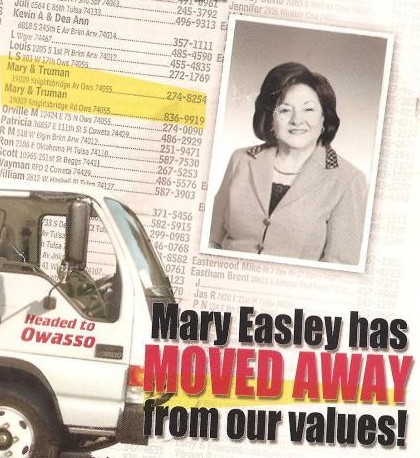
Following in former City Councilor Randy Sullivan's footsteps, Oklahoma State Sen. Mary Easley, a Democrat representing District 18 , which stretches from east Tulsa to the western shores of Grand Lake (PDF map), no longer lives in her district. She lives in District 34, represented in the State Senate by Randy Brogdon. Senate Republican leader Glenn Coffee issued the following press release today:
MARY EASLEY NOW LIVES IN SENATOR RANDY BROGDON'S DISTRICTOWASSO - State Senator Mary Easley no longer lives in her Senate District and now resides at 19009 Knightsbridge in Owasso, which is located in Senate District 34.
Senate Republican Leader Glenn Coffee said Easley is skirting state election laws by living in another Senate district while running for reelection in District 18.
"Mary Easley now resides at an Owasso address in Senate District 34. She is clearly skirting state election laws by living at her new address while running for office and voting using an old address," Coffee said.
Coffee said State Senator Randy Brogdon, who represents Owasso in the Oklahoma Senate, has sighted Easley on numerous occasions while he has campaigned in Owasso this year.
"Senator Brogdon was understandably surprised to learn that Mary Easley is now one of his constiuents," said Coffee.
State law requires legislative candidates to reside in the districts in which they run for office. But Easley and her husband now live at their Owasso home, even though Easley is running for reelection using an old address in east Tulsa.
"Mary Easley has left her district behind. How can she represent the people of District 18 when she doesn't even want to live there?" Coffee stated.
BACKGROUND:
Sources:
Southwestern Bell Yellow-Pages
Rogers County Property Taxes
The funny thing about this is that the existing district lines were drawn in 2001 to the specifications of Mary Easley and her son Kevin Easley, whom she succeeded as State Senator. Mary had represented House District 78 since 1996, and with Kevin approaching term limits, Mary had the HD 78 lines redrawn to overlap SD 18, to allow her to replace him. Surely she could have had the lines for SD 18 drawn to include the location of her dream home in Owasso, too.
There is a state law (51 O. S. 8) that causes a seat to become vacant if an elected official moves out of the district that elected her. It isn't clear who has the power to make that determination.
But the voters of SD 18 could make that determination themselves, and deny Mary Easley another term in office.
(The campaign flyer scan you see above was found at oksenatedemocrats.com, which has scans of all the mail pieces that both campaigns have sent out, flavored with Democratic spin, of course. Very interesting if you like the nuts and bolts of campaigns.)
Here are links to the websites for candidates for District Judge and Associate District Judge on the ballot in Tulsa County.
(Added on November 4: Party registration, as of the date of filing. Although judicial races are non-partisan, voter registration is a matter of public record, and I believe the public has a right to know it, as one more piece of information to weigh. At a national level, Republicans and Democrats have different ideological approaches to the role of the judiciary, and party registration may be an indication of a judge's ideology.)
Office 1 (elected from Tulsa and Pawnee Counties, replacing retiring Judge Ronald Shaffer):
Cliff Smith (D)
Bill Kellough (D)
Office 4 (elected from electoral district 4 in Tulsa County, replacing retiring Judge David Peterson):
Jim Caputo (R)
Daman Cantrell (D)
Office 8 (elected from electoral district 5 in Tulsa County; Thornbrugh is the incumbent):
Tom Thornbrugh (R)
Gregg Graves (D)
Office 10 (elected from Tulsa and Pawnee Counties, replacing Judge Gregory Frizzell, who has been nominated to be a Federal judge):
Deirdre Dexter (R)
Mary Fitzgerald (R)
Office 13 (elected from Tulsa and Pawnee Counties; Shallcross is the incumbent):
Jonathan Sutton (R)
Deborah Shallcross (D) (warning: obnoxious Flash video and sound plays automatically)
Tulsa County Associate District Judge (Wall is the incumbent):
Dana Kuehn (R)
Caroline Wall (R)
And here's my attempt at explaining the various ways we elect the 14 District Judges that serve Tulsa and Pawnee Counties.
This page, on the website of the Tulsa County Democratic Party's website, features endorsements by individual Democrats -- elected officials, former candidates, party officials, and other activists -- of candidates for District Judge. I'm not aware of an equivalent page featuring Republican opinions, although you will find lists of endorsers on most of the judicial candidate websites.
There is this disclaimer at the top of the page:
The following are endorsements for judicial candidates in Tulsa County by Democrats registered in Tulsa County. Judicial candidates stand for election on a non-partisan basis. Party affiliation should not be a factor in these races. We have included the endorsements for those who are not familiar with the judicial candidates, so you can learn about them by reading the opinions of Democrats that you do know. The Tulsa County Democratic Party is not endorsing any of the following candidates.
In several races, there are endorsers for both candidates, and it's interesting to read the reasons given for supporting a candidate. Most candidates seem to get bipartisan support, so if you're a conservative Republican like me, don't assume that a judicial candidate backed by a liberal Democrat would be unacceptable to you.
A friend with a worried expression on her face stopped me at church today to ask the above question. I told her -- and those of you with the same question -- to stay tuned to batesline.com. Starting tomorrow night, I'll be writing about statewide, legislative, and Tulsa County races, state questions. My Urban Tulsa Weekly column, out this Wednesday, will deal with the judicial retention ballot and the local district court races. I've got plenty of material to share, and this week will be devoted to putting that information in your hands.
There's one statewide race that ought to matter more than any other to Oklahoma voters. That's the race for a seat on the Oklahoma Corporation Commission. In addition to overseeing Oklahoma's oil and gas industry, the OCC regulates public utilities like PSO, ONG, and AT&T (formerly Southwestern Bell).
Considering the amount of money at stake in the OCC's decisions on utility rates, the commission is ripe for corruption. And indeed, in the late '80s and early '90s, the FBI investigated bribery allegations involving the OCC. Corporation Commissioner Bob Hopkins, a Democrat, was convicted of bribery and sent to jail, as was utility lobbyist Bill Anderson. The culture of corruption at the OCC was cracked open because, in 1989, a newly-elected commissioner went to Feds when Anderson offered him cash.
That commissioner was Bob Anthony, a man of honesty and fairness. In Anthony, Oklahoma's utility ratepayers have someone who is looking out for their interests. Regulated companies, whether large or small, get a fair shake from Bob Anthony.
In 1995, Bob Anthony received an award from the FBI for his involvement in the corruption investigation. (Click that link for the text of his commendation.)
During his campaign, an attorney who practiced before the Commission greeted him with a handshake that contained an envelope with ten $100 bills. Mr. Anthony contacted the United States Attorney's office and agreed to participate and work with the FBI as a cooperative and covert witness. He knew at that time that his role would certainly be revealed at trial, and that the eventual proceedings in court might damage his ability not only to be a public servant, but to work in any public service career in the state of Oklahoma. The investigation which he caused, supported and worked in lasted approximately six years. Evidence which he developed involved illegal payments of $10,000. He made over 150 tape recordings that helped broaden the scope of the case to include another fellow commissioner and a local telephone company.By 1992, word of the investigation and Mr. Anthony's cooperation had reached the news media. Determined to meet his duty as an elected public servant, he publicly commented on the case, explaining his part, but only to the extent required to fulfill his public duties. As a result of his inability to comment fully on the case, because he intended to protect the integrity of the investigation, the press had a field day with respect to him and his own reputation. For over two years he was featured as a "snitch" and a political opportunist, as well as being the subject of several leading cartoonists for the media. It wasn't until the case went to trial in 1994 that the full story was revealed and Mr. Anthony was vindicated when the full facts of his cooperation, dedication and sacrifice were announced in a public forum. In the interim, his campaign for a seat in the United States House of Representatives was defeated and he only narrowly won reelection to the Commission itself.
In the end, two subjects were convicted of bribery, and a clear message was sent to the leadership of both the business and political communities of Oklahoma that such conduct would not be tolerated. Mr. Anthony, by this award, joins a very select group of awardees who exemplify the tremendous courage and sacrifice that people have shown--particularly people who have put themselves and their families' welfare at jeopardy to do the right thing to support an investigation. That is a critically important commitment--when one puts his own life and welfare directly on the line. It is only with that premise and support and cooperation that the FBI, or any law enforcement organization, can do the job it is supposed to do, which is protect the people.
In 2000, Anthony was elected to a third term with the highest number of votes in Oklahoma history. This year, he's being challenged by former Corporation Commissioner Cody Graves.
Cody Graves is a big baby. In January 1995, a pay raise approved by the Legislature for elected officials went into effect, but under the Oklahoma Constitution, a pay raise isn't allowed to go into effect in the middle of an executive officer's term. Corporation Commissioner's terms are six years, staggered so only one is up for election every two years. Anthony asked for and received an Attorney General's opinion clarifying that the Legislature could not nullify that provision of the Constitution. The ruling meant that Graves would not get the raise until January 1999. (Anthony would not be eligible until January 2001.)
Graves was so angry at the ruling he quit. Graves then became a lobbyist for the very companies he had been regulating.
So what do you think, Oklahoma? Shall we replace a man of principle and courage with someone who is evidently motivated by money above all else?
I was disgusted, but not surprised, to learn today that Graves has been endorsed by former Corporation Commissioners J. C. Watts and Ed Apple, both Republicans, along with all other living former commissioners, all Democrats. (Presumably Commissioner Hopkins, the convicted felon, is dead and could not be reached for comment.) Given that Democrat former commissioners were in office when the culture of corruption was in full swing, it's no wonder that they'd want Anthony out of office, since his courage put a stop to the walking-around money. During Apple's time in office, he was a consistent vote for whatever the utilities and the big energy companies wanted.
As for J. C. Watts, a web search turned up this about Watts' election to and tenure on the Corporation Commission. On March 1, 1991, the FBI recorded a phone conversation between Watts and Bill Anderson, then representing the interests of independent telephone companies. This was at a time when Bob Anthony was pushing for 35-mile toll-free calling zones in each of Oklahoma's metro areas, a move opposed by these small-town phone companies who derived a lot of revenue from town-to-town tolls. In the conversation, Anderson discusses arrangements for delivering $1,500 to Watts, in advance of a March 6 cutoff for campaign contributions to his 1990 campaign account. Anderson had a practice of bundling cash contributions with a long enough list of names that it could be claimed that each name had given $200, the threshold for public reporting of a campaign contribution.
Watts was with State Rep. Kevin Cox that day:
Anderson said "And hell, I'll just, if he's with you, you just come to the door and I'll just hand you the cash. Kevin needn't know. You, just tell him you need to come by and get a message from me or something."
Later that day, FBI agents observed Watts coming to Anderson's house. Watts told the FBI that he didn't recall picking up a contribution from Anderson. Perhaps he was borrowing a cup of sugar.
The good ol' boys, Republicans and Democrats alike, aren't happy that there's someone on the Corporation Commission who has this as his mission statement:
On January 9, 1989 I accepted a position of public trust and took a constitutional oath to enforce the law, supervise rates, correct abuses, and prevent extortion and discrimination by regulated companies.
The rest of us, Republicans and Democrats alike, need to give Bob Anthony another six-year term to look out for our best interests.
MORE:
Here is a PBS Frontline interview with Bob Anthony about his cooperation with the FBI in the Corporation Commission bribery investigation.
(Anthony makes reference in the interview to a case before the commission involving Nora and Eugene Lum, associates of Bill Clinton, and the main subjects of the Frontline episode. Here are statements from Nolanda Butler Hill and Stephen Dresch about the case, which connects to late Commerce Secretary and DNC chairman Ron Brown, Clinton adviser Mack McLarty, and one-time Democratic 1st District congressional candidate Stuart Price.)
Here is a table showing the membership of the OCC since statehood.
(I have to take issue with the comparison of Anthony to Henry Bellmon. Anthony is beloved by grassroots Republicans, while Bellmon earned their distrust on issues like the Panama Canal and higher taxes. Anthony gets standing ovations, not boos or hisses, at Republican conventions.)
Anthony's website includes a sweet trip down memory lane, recalling his first campaign in 1988, traveling Oklahoma accompanied by his wife and four school-aged daughters.
OU poli-sci professor Keith Gaddie has done a statewide poll for TVPoll.com and Oklahoma City's News 9. The sample size was 921, which gives a margin of error of +/-3.23%.
You've probably already heard a summary of the results, but you can also download the details of the poll, including extensive crosstabs, which break the results down by sex, congressional district, political party registration, ideology, and support for President Bush (who has, by the way, a 57% approval rating in Oklahoma). There's also a thorough disclosure of the methodology used.
Some notes:
- Brad Henry has a 65% approval rating, Istook has a 50% favorability rating statewide. Henry leads Istook, 59.5 to 33.2, with a tiny 7.3% undecided.
- Attorney General Drew Edmondson is the only other candidate with more than 50% in this poll.
- There's a strong partisan split on all the races except for governor, attorney general, and corporation commission -- Henry and Edmondson have the support of 28% and 25% of Republicans respectively, while Bob Anthony has the support of 25% of the Democrats.
- 43% of the sample identified as very or somewhat conservative -- almost evenly divided between the two choices, 22% as very or somewhat liberal, 33% as moderate.
- 61% said they attend church at least once a week.
- In the strongly Republican 1st Congressional District, Henry leads Istook 55-36, Askins leads Hiett 49-41, and Edmondson leads Dunn 54-33. Treasurer Scott Meacham and his challenger Howard Barnett are in a dead heat in CD 1.
- Even among very conservative voters, Henry has a 48% approval rating.
I'm proud to call John Trebilcock a friend and proud to have been a part of his campaign team in 2002, when he won a come-from-behind runoff victory in House District 98. (His district includes the area where I grew up and where my parents still live.) He is one of the most intelligent and honorable people I know in Oklahoma politics, and I am glad he is seeking a third term.
The Tulsa Beacon is glad, too -- from the July 14, 2006, issue:
Vote for Rep. John TrebilcockState Rep. John Trebilcock is a young man with excellent experience, a solid Christian faith and a record of service in government.
Trebilcock, an assistant majority floor leader, serves on several key committees, including Appropriations and Budget Subcommittee - Public Safety & Judiciary.
Trebilcock was born and raised in Oklahoma. After graduating from Oklahoma State University with a degree in education, he taught in public schools before earning a law degree from The University of Tulsa.
When he is not doing legislative work, he works in business development for Oklahoma National Bank.
Trebilcock has been right in the middle of the conservative revolution in the House of Representatives for the last two sessions. After an 80-year-lapse, the Republicans took control of the House and the process changed.
Bills that would never get past liberal Democrat committee chairman before are now coming up for a floor vote and passing. Conservative Democrats, frustrated by their own party for years, are finding new allies with the Republicans.
The beneficiaries of this new openness in government are the citizens of Oklahoma.
Trebilcock has a rare blend of experience in education, law and business. Oklahoma needs him and his expertise to continue the conservative momentum and as a balance to the decades-old control of the Oklahoma Senate by liberal Democrat leaders.
With Brad Henry as governor, the Legislature needs all the conservatives it can get. If Republicans can gain control of the Senate in November, it will be the first time in history for the GOP to control the House and the Senate.
Trebilcock is doing a great job and deserves another term.
The Tulsa Beacon endorses John Trebilcock in House District 98.
I agree wholeheartedly. I'll add that John, like most of our Tulsa Republican delegation, is one of the fair dealers, not the wheeler-dealers, in the legislature. We need him back, and we need more like him.
...if I'm going to comment on the election results, the answer is yes, but I'm too tired to think right now. Had a short night last night, and spent this evening playing "Sorry" and otherwise hanging out with the family.
In the meantime, the other Tulsa Bloggers have a lot of new stuff out. Be sure to check out meeciteewurkor's local headlines page.
What does it tell you when a Republican candidate for State House, a first-time candidate with no public track record, refuses to expose himself to direct public scrutiny?
Fred Jordan refused to fill out the Oklahoma Republican Assembly questionnaire.
Over the weekend, KRMG invited Fred Jordan and Chris Medlock to appear separately on Joe Kelley's Monday morning show. Chris Medlock accepted and appeared. Fred Jordan refused. Not only did Jordan refuse, when he was told that Medlock would be on the air whether or not Jordan accepted the opportunity, Jordan complained that that was unfair.
Fred Jordan had set up an interview with the Tulsa Beacon, but cancelled it.
Fred Jordan refused an opportunity to debate Chris Medlock on Charlie Biggs' talk show on KCFO.
What does it tell you?
Several people have e-mailed asking for my picks in this Republican runoff election. Fortunately, in all the races that have runoffs, my primary pick made it, so that makes matters simple. The links below will lead you to the candidate's website.
Now that the Republican Party is nearing total control of the Oklahoma legislature, two factions are emerging: the fair-dealers and the wheeler-dealers. The fair-dealers believe that government should focus on basic infrastructure and services and to provide the legal framework for the free market to work. The wheeler-dealers want to use government's power to benefit their own businesses and to put their competition at a disadvantage. Some of the fierce primary contests are representative of the struggle between those two factions.
Lt. Governor: Scott Pruitt has a sharp mind and firm conservative convictions. I'm impressed by his vision for making the most of the Lt. Governor's powers to advance a conservative agenda. While I appreciate the way Todd Hiett led the Republican Party to the majority in the State House, I share the disappointment of many Republican legislators in the huge budget increase and the relatively paltry tax cut achieved under his leadership.
House District 69: Chris Medlock. Medlock would strengthen the ranks of the fair-dealers in the Legislature, not only by replacing one who's there now (Fred Perry), but by helping to stiffen the spines of his colleagues who may be wilting under the pressure of the wheeler-dealers. As a councilor Medlock demonstrated the ability to build support to advance the agenda by increments, reaching across partisan and ideological boundaries to get important legislation like the ethics ordinance and the eminent domain moratorium passed. His opponent can't seem to take the heat and is hiding behind an expensive radio and direct mail campaign.
County Commission District 1: Anna Falling. While John Smaligo would also be a vast improvement over the incumbent, Wilbert Collins, I think Anna Falling would be the better choice. She has been tried by fire and would be willing to take the heat that is bound to come if county government is reformed the way it needs to be. Her proactive approach to government is what we need at this time in the County's history. That said, I'm impressed with some of the things Smaligo has said about the bridge deal (that the County was leasing its power of eminent domain to a private business) and about Vision 2025 (the extra $45 million for the arena will really cost taxpayers $56 million, because of bond interest).
County Commission District 3: Fred Perry is a solid conservative, as honest as the day is long and has a long list of legislative achievements during his years in the State House, not least of which is a transportation bill (an effort led by Mark Liotta) that doubles spending on roads and bridges without raising taxes.
Here are links to the Urban Tulsa Weekly columns I've written on these races:
August 17 issue: Tulsa County Commission
July 13 issue: House races (including District 69)
July 6 issue: Statewide races (including the Lt. Governor's race
The Tulsa County Election Board has links to the sample ballots for each precinct. If you don't know your precinct number, you can look it up using the Election Board's precinct locator.
The most powerful way you can help your favorite candidates is to go through your address book and call friends who live in the district, making a personal recommendation.
Every Republican and Democrat in Oklahoma will be able to vote on Tuesday in the Lt. Governor's race.
County Commission District 1 includes Skiatook, Sperry, Turley, Owasso, and Collinsville, plus north Tulsa, east Tulsa, and a bit of north Broken Arrow.
County Commission District 3 includes Bixby, Broken Arrow, far south Tulsa and midtown Tulsa roughly between Lewis and Yale.
House District 69 includes all of Jenks, most of Glenpool, a small part of Bixby southeast of 111th and Sheridan, and part of the Tulsa zip codes 74136 and 74137. The ORU campus is also in this district, and the students are back on campus just in time for this runoff.
From the cutting-room floor: In putting together last week's Urban Tulsa Weekly column, I decided to concentrate on the two County Commission runoffs, races that only got a brief mention in my pre-primary columns. For the sake of space, I cut my original intro, which included a look at interesting runoffs elsewhere in Oklahoma. Here it is.
Both parties have a statewide runoff for lieutenant governor: State Rep. Jari Askins vs. Pete Regan for the Democratic nomination, Speaker of the House Todd Hiett vs. State Sen. Scott Pruitt on the Republican ballot.
Based on Gaddie’s 40+5 rule, Pruitt and Regan have steep hills to climb. According to Keith Gaddie, a poli-sci prof at OU and the proprietor of soonerpolitics.com, when the leading candidate pulls at least 40% in the runoff and leads the second place candidate by at least 5%, he wins the runoff 95% of the time.
Still, Pruitt has garnered the endorsements of 18 of his 21 Republican Senate colleagues, who have pledged to campaign on his behalf in their home districts. And Regan has Barry Switzer on his side. Switzer’s support was enough to get a bland unknown elected Governor four years ago, so who knows?
And Brad Henry’s 2002 runoff win was one of those one-in-twenty exceptions: He lost the primary to Vince Orza by a 44% to 28% margin.
At the other end of the turnpike, one runoff involves two close relatives of elected officials: Former Governor Frank Keating’s son Chip finished the House District 85 Republican primary just behind David Dank in the race to succeed Dank’s wife Odilia, who is leaving office because of term limits.
In the House 90 race, former State Rep. Charles Key, who lost his seat because of his intense focus on the Oklahoma City bombing grand jury, is trying to get it back, now that his replacement is stepping aside.
Here in Tulsa County, there are runoffs for two open State House seats: Democrats Wayne Guevara and Carl Weston have a runoff in House District 74 (Owasso and Catoosa), and Republicans Chris Medlock and Fred Jordan will face off for House District 69 (south Tulsa and Jenks). It’s an interesting coincidence that the incumbents for those two seats, John Smaligo and Fred Perry, will both be on the ballot the same day, in runoffs for the GOP nominations for Tulsa County Commission Districts 1 and 3, respectively.
Ken Neal in today's Whirled, arguing for forcing the parties to allow independents to vote in their primaries:
Although independents make up 11 percent of registered voters, they account for 20 percent of inactive voters, says Gene Pace, Tulsa County election board secretary.
That's probably because they seldom have a candidate who inspires them. In the July 25 primary election fewer than one half of 1 percent of Tulsa County independents bothered to vote. They could vote only in some of the non-partisan judicial races.
No, Ken, to be an inactive voter you have to have not bothered to vote in over four years. Even if you only turn out to vote for president, you will be on the books as an active voter. The reason for all the inactive independents is Bill Clinton's Motor Voter law, which has resulted in a lot of people being registered to vote who have no interest in voting. Unless these apathetic folks indicate a party preference on the registration form, they are automatically registered as independents.
House District 69 candidate Fred Jordan is still trying to tap-dance his way around the photos taken by Steven Roemerman of a work crew site. On KRMG Friday morning, Jordan was interviewed by Joe Kelley about Jordan's claim that the pictures were "doctored and false."
(Here's an MP3 of Joe Kelley's interview with Fred Jordan. It's about 700 KB, about six minutes in length. Hat tip to David Schuttler.)
Jordan's recorded phone message, sent on Thursday to households in District 69, used Clintonesque phrase-shaping to give the impression that Jordan has no ownership interest in Caprock Homes, the general contractor that is building the home in the picture, and whose sign is visible in the photo. On Roemerman's blog, you can see that the mobile phone number on the Caprock sign at the house matches the phone number on Fred Jordan's business card. It also matches the phone number on Jordan's campaign page on OkInsider.com.
In the KRMG interview, Jordan acknowledged, "Yes, I am one of the owners of Caprock Homes."
When Kelley asked Jordan, in several different ways, "How is that picture doctored?" Jordan never gave a direct answer. On a later attempt, when Kelley said, "But the picture is not doctored." Jordan replied, "Well, the picture does show some Hispanic gentleman sitting in front of a house, but they're not hired by Caprock." He would not give a direct response.
Jordan said that he didn't know who these people were at his worksite. "They might be actors; we don't know who they are."
Jordan's real complaint is that the photos give an impression that he'd rather avoid -- that he hires illegals.
His company Caprock doesn't hire any construction workers at all. Caprock is a general contractor, and they subcontract out all the construction work to other companies. That means that Jordan's company could be benefitting from illegal labor while not being directly responsible for hiring the illegal workers.
If Jordan hires subcontractors without verifying that they hire only legal workers, he is helping to put honest, law-abiding subcontractors out of business.
In the Kelley interview, Jordan mentioned paperwork that he gets from the subcontractors: Proof that the subcontractor carries workers' comp and liability insurance, and the information needed to report payments to the subcontractor to the IRS for tax purposes. None of the documentation he mentions has to do with whether the subcontractor's employees are eligible to work legally in the United States.
A couple of times Jordan said that the Federal government needs to take action to address this problem, but in fact the Federal Government has provided a way for Jordan and his subcontractors to avoid hiring illegal labor. The Basic Employment Verification program is a web-based system, offered by the U. S. Citizenship and Immigration Services (an agency of the Department of Homeland Security) that provides rapid confirmation of an employee's eligibility to work. Although it is a pilot program and voluntary, it is available in all 50 states, free of charge to employers.
Michelle reports that the smears have already begun against Chris Medlock in the House District 69 race, and Fred Jordan is not only calling Medlock a liar, he's impugning the honesty of fellow Tulsa blogger Steven Roemerman:
I got my mail at about 1:30 today and in it there was a mailer from Chris Medlock. It had a picture on it of six Mexican men who appear to be illegals sitting in front of a "Caprock" home. Caprock is owned at least partially by Mr. Fred Jordan, who is running against Mr. Medlock for State House. At almost 3:30, I got a prerecorded phone call from Mr. Jordan claiming this photo was a fauxto. He said it was a fake. Well, so sorry, Mr. Jordan, but it isn’t fake, and I first saw the picture several days ago. It was taken by an honest citizen.
Steve Roemerman has posted the entire sequence of 14 photos that he shot as he drove past this home in south Jenks which is being built by Caprock, Fred Jordan's homebuilding company. Although there were no doubt some contrast adjustments and cropping done for the sake of presenting a clear image on the printed material, every key element in the picture -- the workers, the house under construction, and the Caprock sign -- appear in several if not all of the photos, taken as Steve drove past the house.
Here's what Jordan said in his recorded phone call:
In fact, I am amazed that my opponent has sent you a doctored and false picture showing Hispanics hired by a company that I have absolutely no ownership in.
Jordan gives a very lawyerly, nay, Clintonian response. You could take that sentence a couple of different ways.
Possibility 1: Jordan is claiming that he has no ownership in Caprock. I don't know the financial arrangement he has with Kevin Jordan or the other partners in the company, but the phone number on the sign in the photo is identical to the phone number on his campaign's page on okinsider.com.
Possibility 2: Jordan is really saying that the workers in the photo were hired by a subcontractor, a company he hired to do part of the work on the house. The implication is that he can't be considered responsible for these workers if they are illegal.
 This is the defense that was often employed by a fictional man in uniform, Sgt. Hans Schultz of Luftstalag 13: "I see no-THING! I know no-THING!" While Jordan may be able to truthfully say that he doesn't have ownership in the subcontractor, that doesn't absolve him of ethical responsibility for whether his subcontractors' employees are legally allowed to work in the United States.
If a general contractor like Fred Jordan simply takes the low bidder everytime he invites bids on part of a homebuilding job (e.g., bricklaying, framing, roofing, landscaping) without ensuring that the low bidder is only hiring legal labor, he gives an insurmountable advantage to subcontractors who break the law. That willful ignorance on the part of the general contractor puts law-abiding subcontractors out of business.
In a May 1, 2006, Tulsa Whirled story, Randy Sissom, who owns a bricklaying business, talked about his struggles trying to operate as a subcontractor who plays by the rules:
Hargrove said when he bids a brick job he can't compete with the price of an all-immigrant crew. Sissom faces the same problem. He usually charges builders about $245 per thousand bricks installed. Immigrant competitors charge about $200 per thousand, he said. Sissom says immigrants, mainly from Mexico, stop by his job site almost on a daily basis looking for work. "They say, 'You pay cash?' " he said.When they find out he takes out money from their checks to pay taxes they often lose interest, he said. But if they still want the job, Sissom says he makes a copy of any documentation they provide like a Green Card and Social Security card.
Guys like Sissom suffer when general contractors like Jordan turn a blind eye to their subcontractors' illegal hiring practices. A law that fines general contractors for indirectly employing illegal workers would help level the playing field for law-abiding subcontractors. Do you think that, as a state rep, homebuilder Fred Jordan would vote for a law like that? Do you think the developers who have financed his campaign would want him to vote for such a law?
(The title of this post relates to this earlier one, about the misleading last minute tactics used against District Attorney Tim Harris by political consultant Fount Holland, who is the consultant for the Fred Jordan campaign.)
Remember the late, unlamented election for Tulsa County District Attorney? In my Urban Tulsa Weekly column on the race, I examined and refuted the misleading claims being made by challenger Brett Swab about DA Tim Harris's prosecution record.
Swab's negative campaign also included claims about DA office spending on remodeling and furnishings and on a rap song. Here is a large postcard mailer that the Swab campaign sent to Tulsa County voters very close to the primary election:
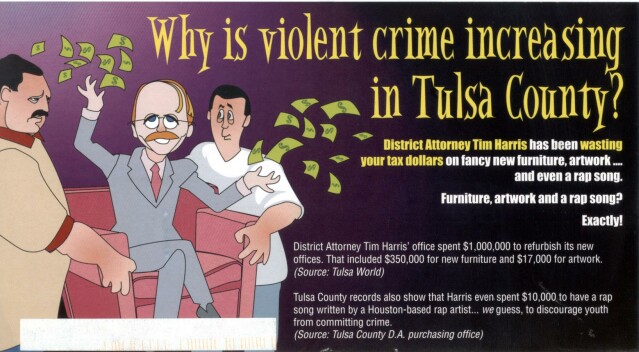
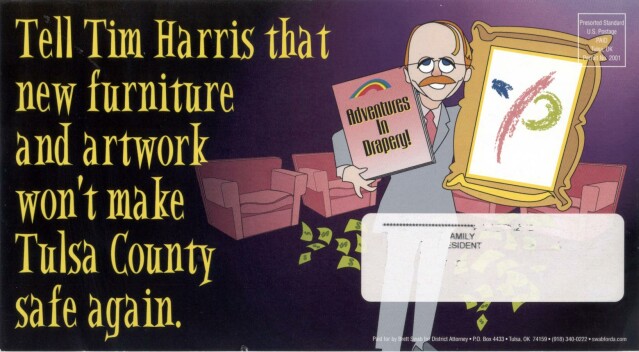
To say this is misleading is an understatement. Here's the truth regarding the "redecorating" claim:
The truth is that when the new jail was built away from the courthouse, County officials reclaimed the old jail space in the courthouse to build offices for the D.A. This in turn freed up old D.A. offices so that more courtrooms could be built. This was a Tulsa County Commission construction project supervised and financed by County officials - not Tim Harris. This construction project was planned when David Moss was the D.A.
Near the end of the project when resources were stretched, Harris contributed $50,000 from the D.A. budget to the County to finish the construction. This paid for items including sound batting for walls, ceiling work, library bookshelves and fixtures for the bathrooms.
It was Tim Harris’ responsibility to furnish and equip the space after it was constructed. Over a number of years, Harris saved $450,000 in fees recovered by his bogus check program to invest in office equipment for 100 employees which included workstations, desks, chairs, computers, and a filing system for 30,000 cases.
Tim Harris also used money from his budget to furnish the Victim-Witness Center, which is a respite area where more than 10,000 victims and witnesses come each year. Harris created separate and safe, pleasant spaces for adults, children and police officers to wait before testifying in court. Framed posters were put in the Victim-Witness Center and in the common waiting areas, conference rooms and hallways of the D.A.’s Office. Despite what the opponent says, framed posters for two separate floors covering 35,000 square feet cost less than $8,500.
The Truth is Tim Harris budgeted funds responsibly in order to furnish a professional law office for the people of Tulsa County.
And the rap song? The DA's office, on behalf of Project Safe Neighborhoods, received a $10,000 grant from the Federal Government earmarked for community outreach to prevent gun violence. The DA's office used the funds to bring Marcus Nelson, Ph. D., a motivational speaker, the keynote speaker at the U. S. Department of Justice-sponsored National Youth Gang Conference. Nelson came to Tulsa spoke to the students of Central High School and Tulsa School of Science and Technology, and met with school staff.
In addition, Dr. Nelson’s performance was videotaped so that his anti-violence message can be shown to every student in Tulsa area schools. Dr. Nelson also produced two versions of an original anti-violence song “T-Town.” He provided an instrumental version that can be used in the fall as part of an anti-violence contest for Tulsa students to write their own anti-violence lyrics.
Why am I bringing all this up again, a month later? Because the same political consultant who orchestrated this unfair and misleading attack on Tim Harris is involved in at least one other race on this Tuesday's runoff ballot. His name is Fount Holland, and he is the consultant for the Fred Jordan campaign for House District 69, and if you live in that district, you shouldn't be surprised to see the same sort of misleading cartoon postcard show up in your mailbox this weekend, attacking Chris Medlock.
Fount Holland was City Hall reporter for the Tulsa Whirled from 1990 to 1995, when he left to become press secretary for newly-elected Congressman Tom Coburn. In 1997, he left to become a political consultant, heading up the Oklahoma Values Coalition, a PAC formed by Coburn and his congressional colleague Steve Largent to help elect conservative candidates to the state legislature.
Holland deserves credit for some significant accomplishments. He is a gifted communicator and his ability to get a message across to the voters has played an important role in helping Republicans win control of the State House.
First with the Oklahoma Values Coalition and then as the exclusive political consultant for the Republican State House Committee, Holland helped Republicans win marginal seats all across Oklahoma. His partner in A. H. Strategies, Karl Ahlgren, Coburn's chief of staff during his tenure in the U. S. House, has had a similar role with the corresponding Senate PAC.
But in recent years, I've noticed a departure from Holland and Ahlgren's roots in Tom Coburn's office.
In 2003, they were consultants to the vote yes campaign for the Vision 2025 sales tax. Bill LaFortune singled them out for praise in his post-election "State of the City Address" that year. I remember how shocked I was at the time that these two, still strongly associated in my mind with Coburn, would be using their skills and connections to sell Republicans on a tax increase to pay for a package of pork projects.
As a lobbyist for Utica Partners, Ahlgren pushed for legislation this year which would have undermined historic preservation and local control of zoning.
Where Holland and Ahlgren were at one time mainly focused on helping Republicans defeat Democrats at the polls, they have increasingly been getting involved in Republican primaries. As noted above, Holland was the consultant for Swab's ugly and deceptive campaign against Tim Harris. Any Republican insider in Oklahoma would recognize Fount Holland's style in the layout of the mailer above.
And increasingly in those primary races, when their candidate is losing ground, they will strike back with some last-minute nastiness. Tim Harris experienced it this year. State Rep. John Trebilcock was hit by it in his runoff with Melissa Mahan in 2002. Expect to see the same sort of thing from the Fred Jordan campaign, attacking Chris Medlock, this weekend.
I'm disappointed that Ahlgren and Holland are using their considerable talents to defeat candidates like Harris, Trebilcock, and Medlock, candidates who resemble their old boss Tom Coburn in political courage and commitment to conservative principles.
But don't get me wrong -- Holland is no Jim Burdge, and I hope he'll turn around before he adopts a do-anything-to-win, work-for-the-highest-bidder ethos.
(Which reminds me: Keep an eye out for a last-minute slime attack against Fred Perry in the County Commission District 3 race this weekend. Perry's opponent, Bill Christiansen, is Jim Burdge's boy in the runoff.)
The Jenks Journal has a story in its latest edition about the impact of the south Tulsa toll bridge as an issue in the House District 69 and Tulsa County Commission District 3 races. In the House 69 race, Chris Medlock opposes the bridge as proposed and has signed the South Tulsa Citizens' Coalition representation letter. His runoff opponent, developer Fred Jordan, did not sign the STCC representation letter. Accordingly, the STCC has endorsed Medlock for House 69:
Mr. Medlock is against the South Tulsa bridge as it is currently proposed and has signed one of STCC’s representation letters. You can learn more about Mr. Medlock’s campaign at www.chrismedlock.com.STCC does realize that the South Tulsa bridge issue is only one of many issues facing our city, county and state. However, given the candidates’ responses and to ensure that your voice continues to be heard with regard to the South Tulsa bridge issue, STCC encourages you to vote for... candidate Medlock in the Oklahoma House District 69 race.
[The elided text refers to the County Commission District 3 election. Click the link above to read the full text.]
Click here to see a screen capture of the STCC's endorsement of Medlock.
In the Jenks Journal, Medlock points out that despite Jordan's protestations, the legislature will be involved in the issues surrounding the proposed toll bridge. As an example, there was a bill before the legislature this year that would have required toll agreements with private companies and similar arrangements to be handled under the Oklahoma Competitive Bidding Act, to prevent insider deals like that between Infrastructure Ventures, Inc. (IVI) and Tulsa County. HB 2740 passed in the House and Senate by a large margin, but a parliamentary maneuver by Sen. Nancy Riley killed the deal.
Here's something I wrote before the primary about the range of issues that the Legislature could and should take up, in order to resolve some of the many legal questions surrounding this bridge scheme.
UPDATE: More hi-Jenks! I received a report from an STCC member who attended the Jenks City Council meeting earlier this week:
The 3 items that came up this evening where Jenks is relying on Tulsa are:Water Supply: Jenks water pressure has been low recently and thinks the problem is Tulsa’s inadequacy at the Turkey Mountain Tank. They are trying to work towards having Tulsa upgrade the pumping system to solve their problem (Once again...Tulsa cost, Jenks benefit).
Centennial Celebration: Jenks anticipates Tulsa picking up the tab for the fireworks that will be shot off at the 96th street bridge in mid November for the celebration.
Public Transportation Service: Jenks contracts with Tulsa to provide bus service into Jenks. Service also includes handicap transportation needs.
It seems like time and time again the city of Jenks wants to take advantage of Tulsa....and we are just letting them.
Real regionalism is a two-way street, but Tulsa's suburbs seem to expect Tulsa to do all the work and carry all the costs while they reap the benefit, in the form of sales tax growth at Tulsa's expense.
(Unfortunately, Tulsa's previous mayor has made it possible for suburban officials to claim that they've given Tulsa what it wanted by backing the downtown arena as a part of Vision 2025. It may be what the people pressuring Bill LaFortune wanted, but it certainly isn't what Tulsa needed, and it won't offset sweetheart long-term water deals and the like.)
State Sen. Nancy Riley, who represents District 37, announced yesterday that she is leaving the Republican Party and becoming a Democrat. Her stated reasons, according to the Daily Oklahoman:
Riley, who finished third in the Republican primary for lieutenant governor but received enough votes to force a runoff election, said she received little respect from the Senate Republican Caucus and felt her concerns about the party were met with a "pat on the head." ...She said she received no support from the party during her campaign for lieutenant governor. She was not invited to a debate of Republican candidates for lieutenant governor, she said.
In 1988, I was living in Brookside, which was then in SD 37. The State Senate seat was open -- David Riggs was stepping down -- and no Republican had announced. I actually considered filing, but was I relieved to learn that a former pastor and insurance broker named Jerry Riley had decided to enter the race. I called him and volunteered my help, and he named me the precinct coordinator. I knocked doors for Jerry in Maple Ridge, in Brookside, and on the west side.
It was during that campaign that I got to know Nancy. Nancy and Jerry had just been married a couple of years -- the second marriage for both of them. Nancy had been widowed at a young age. At the time of the campaign, she was not even 30. Jerry ran a good race, but lost to Democrat Lewis Long of Glenpool.
The Rileys and I had limited contact over the next few years -- although I remember visiting their church, then Sandusky Ave. Christian Church in '89 or '90 when my wife and I were looking for a new church home. (Doctrinal differences aside, I couldn't forgive that church for tearing down the Will Rogers Theater for a parking lot.)
In 2000 Nancy Riley decided to run for the same seat against Lewis Long, still firmly ensconced in what was still a majority Democrat seat, although it was swinging to the GOP. (Long had won re-election against Tim Plinsky in 1996 with 54% of the vote.) Jerry managed the campaign. I was happy to be a part of the campaign team. Despite Long's incumbency and deep pockets, Nancy won by 265 votes. After district lines were redrawn, she won re-election in 2004 with 65% of the vote.
In 2002, I hired Jerry to be campaign manager for my second run for City Council. He did a great job, and we got very close, but lost by 700 votes. Nancy helped stamp a last minute mailer, and she knocked doors for me in the area around Hoover Elementary School, where she had been a teacher.
All that history is to explain why Nancy's decision to leave the Republican Party saddens and surprises me for more than merely partisan political reasons.
Still, the political implications can't be ignored. Nancy's defection means the Senate is split 26-22 in the Democrats' favor, undoing the Republican gain in the southwest Oklahoma special election earlier this year. This raises the bar for a Republican takeover, which would be the first time in state history for the GOP to control the Senate and to hold one of the most powerful offices in the state: Senate President Pro Tempore. Nancy's defection makes it more likely that key committees will continue to be controlled by liberal Democratic committee chairman. In the most recent legislature, key leaders and committee heads like Cal Hobson and Bernest Cain were well to the left of even most Democratic legislators and they blocked conservative and moderate legislation that had majority support in both houses. If the Ds keep their hold on the Senate, we can expect more of the same.
It's usual in situations like this that the potential defector is offered a committee chairmanship or some other plum as an inducement to convert. Both parties have done this, especially when gaining or losing a majority is at stake.
Nancy's reasons for switching seem petty and prideful to me, and that's a side of her I hadn't seen before. She seems to think that just because she was female and Republican, female Republican activists owed her their support in her race for Lt. Governor. That's not the way it works. A politician doesn't even have the right to presume that those who backed her for a lower office will support her when she seeks to move up the ladder.
In seeking to be the Republican nominee for Lt. Governor, Nancy Riley put herself up against two formidable, credible opponents. It was her job to persuade individual Republican volunteers and donors to help her make phone calls and raise money. These people are not owned by a party organization, and the party can't parcel them out to ensure that every candidate gets a fair share. If she failed to persuade these grassroots volunteers to help her, she has only herself to blame.
One more thing that surprised me was Nancy's description of herself as a moderate. I had always assumed she was conservative, but now that I look back at her campaign website, I notice that the word isn't present. If she was known not to be a conservative, it's no wonder that Republican activists weren't enthusiastic about helping her, as most of the ones I know get the greatest motivation in helping principled and consistent conservative candidates like Tom Coburn.
The Daily Oklahoman mentioned one issue-based reason for Riley's conversion:
She said there is a movement in the Republican Party to undermine public education with such things as blaming teachers for school problems and pushing for charter schools and vouchers.
I don't hear a lot of blaming of teachers from Republican critics of public education. Most of the blame goes to the curriculum experts, the teacher training process, and the school administrators.
I do hear talk about offering parents real choice in education (and there needs to be less talk and more action). For Riley to complain about charter schools and vouchers means she's more interested in protecting school administrative bureaucracies and less interested in meeting the needs of the students.
Regarding her complaint about debates: She was a full participant in the only Lt. Governor's debate I saw, the one sponsored by the Tulsa County Republican Men's Club.
The Oklahoman item quotes Senate Democratic Leader Mike Morgan as saying Riley approached him in June about switching. So she was campaigning for the Republican nomination for Lt. Governor under false pretenses. At the very least, she should have suspended her campaign.
And she owes her constituents an apology as well. She can't know how many of them voted for her in 2004 because she was the Republican nominee and how many voted for her regardless of party. The honorable thing to do would be to follow Phil Gramm's example:
In 1978 and 1980, he had been elected as a Democrat to Congress. In 1981, he decided to change parties, so he resigned his seat, then ran as a Republican in the special election, letting the people decide whether they wanted him back in Congress as a member of the GOP caucus.
Phil Gramm didn't have to take that step, but it was the honest thing to do. Nancy Riley should give the voters of south and west Tulsa County the right to decide whether they want her back as a Democrat more than they want to help the Republicans win the State Senate.
In the race to replace Judge David Peterson, candidate David Blades chose not to seek a recount. He finished third of three-candidates by only 51 votes out of 11,000 cast. Collinsville Municipal Judge Jim Caputo finished second, making the runoff with Special District Judge Daman Cantrell. Because this is a non-partisan race, the "runoff" will be at the November general election. This is also one of five district judgeships elected by a portion of Tulsa County -- the electoral division for this seat covers the north Tulsa County suburbs and the City of Tulsa roughly east of Sheridan.
There will be a recount in the Republican primary for House District 6, an open seat that covers Craig County and parts of Mayes and Rogers Counties. Wayland Smalley, the Republican nominee for the 2nd Congressional District in 2004, won his primary by five votes out of about 1,500 cast. Whoever prevails will have an uphill battle -- 4,700 Democrats voted in their primary for the seat.
Oklahoma has a history of voting for candidates with famous names, but I doubt that Owasso and Catoosa Democrats had Ché in mind when they voted for Wayne Guevara, who finished first in the Democratic House District 74 primary. Guevara is an Owasso City Councilor, works for the Palmer Drug Abuse Program, and is a paralegal specialist with the National Guard. The Owasso Reporter reports that Guevara will be out of the state for the runoff with Carl Weston of Catoosa; he's being deployed for three weeks with his National Guard unit to New Mexico.
There were a number of primary races where the outcome might have been different if Instant Runoff Voting were in use. Oklahoma's runoff system, rematching the top two candidates if no one gets a majority, works well with only three candidates, but it can break down when there are four or more candidates. If the fourth- or fifth-place candidate hadn't been in the race, it might have changed the order of finish between the first three candidates, and a different pair of candidates would have made the runoff. The 1991 Louisiana governor's race is a classic example of the problem -- incumbent Buddy Roemer might have made the runoff instead of ex-Klansman David Duke or ex-con Edwin Edwards.
Ideally, you'd have a series of runoffs, each round eliminating one candidate until a candidate has a majority of the vote. IRV does that with a single election, by having voters rank the candidates in order of preference, rather than mark a single candidate.
Instant Runoff Voting might have produced a different result in Democratic primaries for Lt. Governor, House District 15, and DA District 17. The primary for House 99 had five candidates and will be going to an August runoff, but IRV wouldn't have changed the outcome, because the combined votes of the third-, fourth-, and fifth-place candidates were less than the second-place candidate.
On the Republican side, the race most likely to have been affected by IRV was in House District 41, where only 101 votes separated the second- and third-place finishers, and fourth and fifth place had 700 votes between them. Theoretically, IRV might have changed the result in the race for the 5th Congressional District and in House District 69, but in both cases there was a much bigger gap between second and third places.
Three judicial races might have had a different outcome with IRV, Judicial District 14 Office 10 (the six-candidate Tulsa County race to replace Gregory Frizzell), and the elections for Associate District Judge in McClain and Choctaw Counties.
An advantage of IRV is that you don't have to have a separate runoff election. The disadvantage of IRV to a candidate is that you wouldn't get that extra month to make your case to the voters, who would no longer be distracted by the large number of candidates in your race and the large number of races on the ballot.
Logrolling is a time-honored technique for funding projects that couldn't stand up to focused scrutiny. You lump a project of questionable importance in with essential appropriations, so that no one dare vote against it. That setup makes it very hard for a voter to hold his own legislator accountable for wasteful spending.
Here in Oklahoma, the most notable TV ad of the governor's race was from the Bob Sullivan campaign. It featured Gailard Sartain, and it targeted Ernest Istook for supporting federal money for a California tattoo removal program and for bringing gorillas to Kentucky. The ad was successful in bringing attention to the campaign and in raising a question about Istook's record.
Istook was able to rebut the ad by saying that those two votes were part of massive spending packages which included essential projects. He was also able to say that the rest of the Republicans in the Oklahoma delegation voted for the same bills. Every congressman who voted for those bills can use the same excuse. The only congressman who can be definitively tied to the specific pork project is the guy representing the district that's getting the money.
Arizona Republican Congressman Jeff Flake has found a way to put his colleagues on record in support or opposition to wasteful spending. He proposed 19 amendments to appropriations bills, each one of which would have removed funding for a pork project. None of his amendments passed. In fact, 280 congressmen did not vote in favor of a single amendment.
Club for Growth has helpfully collected in one place a summary of how every House member voted on the 19 appropriations amendments Flake offered in late May and June.
Only one Oklahoma congressman gets a passing grade. John Sullivan, representing the 1st District, supported Flake on 16 of 19 votes -- 84% -- which puts him in the top 10 percent of the House.
Ernest Istook voted to cut only six of the 19 pork projects -- 32%, but still better than 82% of his colleagues. Istook's record is just a bit better than the Republican average of 5.1 anti-pork yes votes. (Democrats averaged 0.55 yes votes out of 19.)
The remaining three -- Dan Boren (D-2nd District), Frank Lucas (R-3rd District), Tom Cole (R-4th District) -- voted against all 19 pork-slicing amendments.
The projects that Flake targeted include a half-million-dollar swimming pool in Banning, California, a theater in Plattsburgh, New York, and a science museum in Virginia. They all sound like worthwhile projects, but not matters of national importance. Any funding for these projects should come from local government or the private sector.
First (and probably briefest) in a series:
Tulsa County DA Tim Harris prevailed over a tough challenge, but a few other incumbent District Attorneys didn't make it.
Tim Kuykendall, 12-year DA in Cleveland, McClain, and Garvin counties, lost to challenger Greg Mashburn, 63% to 37%. While Tim Harris was criticized for having too high a conviction rate (supposedly an indication that he was cherry-picking cases and wasn't filing charges he should have), Kuykendall was criticized by Mashburn for "winning only 34% of jury trials." Like Brett Swab in Tulsa County, Mashburn made an issue of FOP endorsements.
Richard Gray, one-term incumbent DA for Wagoner, Sequoyah, Cherokee, and Adair Counties, finished first in his Democratic primary, but barely. Gray was hurt by the legal problems of one of his aides Vyrl Keeter (who had also been an aide to former Congressman Brad Carson). Keeter pled guilty to perjury and has some other charges pending. 170 votes separate Gray from second-place finisher Jerry Moore, and the runoff's winner will face Republican Brian Kuester.
John David Luton has been Muskogee County DA since 1992, but this was the first time he ever had to run for office. He was appointed by Governor David Walters and never faced an opponent until this year. He lost by a two-to-one margin to Larry Moore, a former assistant DA from Fort Gibson.
Tim Harris's re-election win is all the more impressive in light of successful challenges in these other DA districts.
Ordinarily, a public official would be happy to be re-elected without opposition, but it can be a bad thing. A campaign is a time to reconnect with the voters, to explain to them what you're doing, and to hear their concerns. Without the need to campaign, an official can be so focused on just getting the job done that he fails to explain to his bosses -- the people who elected him -- what he's been accomplishing on their behalf.
Starting in late August, former Mayor Bill LaFortune and former Tulsa County Democratic Chairman Elaine Dodd will be doing a weekly show on OETA called "He Said, She Said." J. Hayes posted the following on the okdemocrat.com message board:
After former Tulsa Mayor Bill Lafortune and former Tulsa County Democratic Chairman Elaine Dodd gave respective analysis of both the repub and the Democrat primary results tonight on OETA’s campaign coverage, an idea for a new show was spawned. The new show will cover the local Tulsa political scene and is sure to be a big hit with activists of both parties. The weekly show will be called 'He Said She Said' and is set to premier in August just after the state runoff elections. More details to follow as they become available.
Elaine Dodd replied on the same thread:
Mayor Bill and I "tape" our first show on August 23 (his birthday) and mine follows five days thereafter so I think I'll bake a cake--he may want to check for any surprises inside!If you have any suggestions for political topics, please email me. All politics is local afterall.
Elaine
patriotic1970@yahoo.com
It's an interesting choice of hosts. I have the impression that Elaine Dodd is still very plugged in to local Democratic Party politics and would have a lot of insider info to draw upon, but as far as I know LaFortune hasn't been seen at a Republican event since the mayoral election.
So what has the former mayor been doing? A little bit of this and that, it appears. A Whirled story last Wednesday says that he is building a private civil law practice, with zoning and real estate among his specialties, working as an administrative law judge, and consulting for OU-Tulsa and Pinnacle Packaging.
In the battle for the 1st Congressional District Republican nomination, ORU librarian Evelyn Rogers defeated Fran Mo-Ghaddam by 5,824 to 1,894, despite Mo-Ghaddam's automated phone call to Republican voters and her last-minute yardsign blitz. Mo-Ghaddam didn't got 'em mo-mentum.
Incumbent John Sullivan squeaked past both of them with 38,274 votes.
For more results in the statewide, legislative, and judicial races, visit the Oklahoma State Election Board's 2006 primary results page.
KOTV has the best county results. Here is the County Commission District 1 primary. Here is the County Commission District 3 primary. (District Attorney and District Judge races are on the state election board website.)
UPDATE: The Tulsa County Election Board has Tulsa County results for all the races on the ballot. I'm fascinated by the number of undervotes in each race -- the number of voters who didn't mark a name in that race. 7,150 voters didn't vote in the countywide District Judge primary (Office 10). Oddly, 40 voters overvoted -- marked two or more names in that race.
I'll be on 1170 KFAQ with Michael DelGiorno and Gwen Freeman starting at 6:10 a.m. this morning for a special primary election preview.
For your voting convenience, here are the endorsements I've made in statewide and local Republican races and the non-partisan judicial races, starting with the top of the ballot:
Governor: State Sen. James Williamson is the most experienced and knowledgable candidate in the race, the best qualified to be Governor of Oklahoma -- incumbent Brad Henry included. Williamson has been a leader in the legislature for fiscal restraint, meaningful lawsuit reform, and the protection of the sanctity of human life.
Lt. Governor: Can't really go wrong in this primary -- all three candidates are good people, and it grieves me to see the mud flying back and forth. State Sen. Scott Pruitt has the biggest vision for the office, taking full advantage of the powers of the office to advance a conservative vision for Oklahoma.
State Treasurer: Dan Keating has already demonstrated that he'll be a watchdog for the taxpayers' interests by calling attention to the problems created by the Henry-Meacham tribal tobacco compacts. Howard Barnett's vocal support for the anti-democratic at-large city councilor proposal shows an appreciation for clubby insider politics, an attitude that we don't need in the office that invests our state's financial assets.
State Insurance Commissioner: I'm not bowled over by either candidate, but Tahl Willard seems to have more relevant experience, including a stint as the Insurance Department's Regional Director for Eastern Oklahoma and manager of the Tulsa office, along with an impressive set of insurance certifications. His opponent, Bill Case, is a term-limited State Rep. who was nominated for the Oklahoma Conservative PAC's RINO (Republican in Name Only) award every year for the last five, winning once.
U. S. Representative, District 1: On fiscal and social issues, on border security and national security, Congressman John Sullivan has been as consistent a conservative as you could want on the full range of congressional issues.
State Senate, District 36: There's more to Joe Lester than a catchy jingle. His newspaper articles reveal an intelligent, principled conservatism, and he would bring almost 40 years of law enforcement experience (U. S. Army MP, City of Tulsa, University of Oklahoma) to the Legislature.
State House, District 68: Incumbent Chris Benge is the best choice for another term.
State House, District 69: Former City Councilor Chris Medlock would bring a needed perspective to the Legislature. He's a conservative who understands the impact that state government has on Oklahoma's largest cities. As I wrote a couple of months ago: "I think Chris would make an excellent legislator. The Republican caucus needs more members who will keep it committed to conservative and free-market principles. Chris Medlock understands that being pro-business means providing an environment in which all businesses can thrive, not making special deals for special interests."
State House, District 76: John Wright is another incumbent with a strong conservative record who deserves re-election.
District Attorney, District No. 14 (Tulsa County): Despite declining arrests, eight-year incumbent Tim Harris has put away a record number of bad guys, focusing his department's resources on the cases that matter most. Challenger Brett Swab's campaign is grounded in misleading presentation of facts. One attorney asked me, rhetorically, if Swab will twist the facts to win his "case" against Harris, will he twist the facts to win in court?
Tulsa County Commission, District 1: Former City Councilor Anna Falling hasn't lost any of her enthusiasm and drive, but her leadership of a faith-based outreach to Tulsa's needy has smoothed off some of the rough edges. Tulsa County government needs someone willing to move beyond the way things have always been done and someone who will look out for the taxpayers' interests first.
Tulsa County Commission, District 3: State Rep. Fred Perry is the most consistent conservative in this race, and his rapport with grassroots Republicans and legislative leaders will serve Tulsa County well. Any of the other three candidates would likely mean a continuation of good ol' business as usual at the County Courthouse.
District Judge, District 14, Office 4:: Collinsville Municipal Judge Jim Caputo is my pick for this office, which is on the ballot only in northern and eastern Tulsa County.
District Judge, District 14, Office 10:: There are a number of good candidates in this race, but I've known J. Anthony Miller for over a decade as an elder in our church. I am confident that Miller has the experience, temperament, and prudence to be an excellent district judge.
Tulsa County Election Board has posted sample ballots for every precinct.
In addition to the above elections, Berryhill Fire Protection District has a vote on whether to expand its territory, and the Town of Skiatook is voting on a 10-year extension to a one-cent sales tax.
Here are links to my election preview columns from Urban Tulsa Weekly:
The Tulsa County judicial races
The statewide races
The Tulsa County legislative races
The Tulsa County DA and Commission races
Every election season, Oklahomans for Life asks candidates to go on record with their views on the sanctity of human life. Here's a link to a PDF file of the July 2006 Oklahomans for Life newsletter with all the candidate responses. It's interesting to see who responded and who didn't bother.
Even if an elective office won't have direct involvement in issues like abortion and euthanasia, it's useful to know where a candidate stands, because it gives you a clue about his worldview, his philosophical basis for making decisions.
This week's column in Urban Tulsa Weekly is about Tulsa-area legislative primaries, particularly about the most hotly contested race, the Republican primary to replace Fred Perry in House District 69, which includes far south Tulsa, Jenks, a bit of Bixby, and the northern part of Glenpool.
One of the emerging issues in that race involves the proposed toll bridge across the Arkansas River that would connect south Tulsa near 121st Street to Jenks and Bixby. Although Fred Jordan got a tremendous headstart in the campaign, helped by $100,000 in contributions, largely from the development industry, Jordan is losing ground as south Tulsa voters learn that he is in favor of the toll bridge as proposed by Infrastructure Ventures Inc.
The South Tulsa Citizens' Coalition asked all five Republican candidates to sign a representation opposing the bridge. The representation states that the candidate will not support a bridge until certain intersections and streets connecting to the bridge have been widened, will oppose any heavy truck traffic on Yale between 121st and the Creek Turnpike, and won't support the north end of the bridge connecting to or near Yale Avenue. Chris Medlock, Lisa DeBolt, and Jeff Applekamp have all signed these letters, and Medlock was a leader while on the City Council in getting city officials on record in opposition to the bridge. (Here is a PDF of Medlock's representation letter.)
Fred Jordan and Darrell Gwartney have refused to sign the representation, which Jordan calls, "a highly restrictive and legalistic 'pledge' committing [his opponents] to oppose the bridge under any reasonable circumstances." (Here is a PDF of Fred Jordan's statement to the STCC.) I'm sure STCC members would object to the characterization of the preconditions, which I summarized above, as unreasonable.
Jordan, who has been vague on the issue until now, has started to lose supporters to Chris Medlock. (Although there are two other candidates who oppose the bridge, they are trailing far behind Jordan and Medlock. Neither DeBolt nor Applekamp are likely to make the runoff.) A couple of days ago I spoke to Kari Romoser, who lives near 111th and Yale, an area that would feel the traffic impact if the bridge is connected to Yale. She had Fred Jordan's sign in her yard, but she recently pulled it up and replaced it with a Chris Medlock sign.
Jordan's position on the bridge issue wasn't the only reason for Kari's change, but it was an important reason. Her family has invested a lot to be in this part of Tulsa so that they can send their children to Jenks Southeast Elementary School. Anything that would hurt the value of their home or affect safe access to the school is important to her.
Jordan's company, Caprock Resources, is developing three residential areas along Elm (Peoria) in south Jenks. Two of them, Wakefield Pond and Wakefield Village, are along 121st St., in an area that would benefit from the proposed bridge without bearing a significant traffic impact. (For he folks north of the bridge in south Tulsa along Yale, the traffic impact would far outweigh any convenience benefit.)
So far, the toll bridge has been a local issue, involving Tulsa County and the cities of Jenks and Tulsa, so why does it matter what a state representative thinks about the issue? In his statement, Jordan says that, "to my knowledge, there is no pending or proposed action in the legislature relating to the bridge."
In fact, there was a measure in the Legislature this session which passed the House but was killed in the Senate that would have had an effect on the toll bridge deal. The process has raised all kinds of issues that the Legislature may address at some point: Should counties and cities be able to enter into private toll bridge deals of this sort? Who has ownership and jurisdiction over the Arkansas River bed? Whose approval is needed to build a private toll bridge? Should private toll roads and toll bridges be legal? Should the jurisdiction responsible for connecting infrastructure have a say in whether a toll bridge is built? When a city and the county, or two adjacent cities, are at odds over a bridge, who makes the final decision?
As we learned with the Board of Adjustment legislation (SB 1324, HB 2559) this session, it won't be enough to have the Tulsa City Council on our side, because the Legislature could take away the City's say on this contentious issue. It will be important for south Tulsa residents to have someone in the Legislature who will represent their interests on this matter, someone with the savvy to detect and block any attempt to bypass Tulsa's city government.
Cal Hobson, Democratic Lt. Gov. candidate and former President Pro Tempore of the State Senate, angrily denounced the tax cuts passed by the Oklahoma Legislature in a speech on the Senate floor the final day of the special session:
You’re eroding your tax base for no good purpose and you’re giving it to people that don’t need it, won’t remember it, and – I assure you Democrats – they will take their money and they will use it to beat you and help them....You don’t want to hear this, and you think it’s just a blowhard on the last day.... But unless you just hate schools, and hate good roads, and hate the fact that 600,000 of our people walk around without health insurance, and 700,000 are on Medicaid, unless you like that ... you can’t be for this kind of crap. You can’t be for the kind of giveaways of last year and again this year, and a total of $615 million.... We are pooping off the largesse given to us, just like last year.
I just happen to feel passionately, having had the joy and pleasure of raising taxes a number of times (to keep the lights on in Oklahoma), I don’t take this stuff lightly.... In the long term, maybe not next week, but in the long term you will regret what you’re doing to this tax base.
The Senator doesn't seem to understand the meaning of the term "tax base." The hope, Mr. Hobson, is that by reducing the tax rate, there will be incentives for businesses to start in, stay in, grow in, or move to Oklahoma -- an increase in economic activity that means a larger economic base upon which taxes can be levied to pay for public needs.
It's sort of refreshing to see a politician openly embrace his lust for higher taxes.
Getting caught up with links to my Urban Tulsa Weekly columns: This most recent issue has my picks on the four contested Republican primaries for statewide races -- Governor (Jim Williamson), Lt. Governor (Scott Pruitt), Treasurer (Daniel Keating), and Insurance Commissioner (Tahl Willard).
Also, in her latest column, Jamie Pierson ponders the plans for new upscale housing downtown and wonders if there will be places to live that are affordable for baristas, small businessfolk, and struggling artists.
This week's column takes a look at the four Republican primaries for statewide offices and the local 1st Congressional District race.
(Added on September 30, 2006, to fill in the gaps in my Urban Tulsa Weekly column archive.)
NOTE: The information below is for the 2006 election. The details for the 2010 Tulsa County and Pawnee County judicial elections may be found by following this link.
It took me a while to puzzle all this out, and I thought others might be interested as well.
Oklahoma has 26 District Courts. Tulsa County and Pawnee County constitute Judicial District No. 14. State law says that District 14 has 14 district judge offices.
One judge must reside in and be nominated from Pawnee County, eight must reside in and be nominated from Tulsa County. If there are more than two candidates for any of those nine offices, there is a non-partisan nominating primary in the appropriate county, and the top two vote-getters are on the general election ballot. (Even if one gets more than 50% of the vote, the top two still advance.)
In the general election, all voters in Pawnee and Tulsa Counties vote on those nine seats.
The remaining five district judges are selected by electoral division in Tulsa County. In order to comply with the Voting Rights Act, Tulsa County is divided into five electoral divisions of equal population, one of which (Electoral Division 3) has a "minority-majority" population. For each of these five offices, if there are three or more candidates, there is a non-partisan nominating primary. If one candidate gets more than 50% of the vote, he is elected; otherwise, the top two advance to the general election. For each of these five offices, the candidates must reside in the corresponding electoral division, and only voters in that electoral division will vote for that office in the primary and general election. (Oklahoma County, Judicial District No. 7, is the only other county with judges elected by division.)
(CORRECTION: I'm told that the electoral division are not in fact of equal population. The minority-majority district is much smaller than the other four, as it must be in order to guarantee that the electorate is majority African-American.)
Despite the three different paths one can take to be elected, a Judge in Judicial District No. 14 can be assigned to try any case within the two counties.
Each county in the state also elects an Associate District Judge, nominated and elected countywide. There will be a general election contest for Tulsa County Associate District Judge between Caroline Wall and Dana Kuehn. Pawnee County Associate District Judge Matthew Henry was re-elected without opposition. (He was probably helped by all that free publicity from his Bible commentary.)
In addition to the elected judges, the District has a certain number of Special Judges, who are appointed by and serve at the pleasure of the District Judges. Several candidates for District Judge currently serve as Special Judges.
All this I was able to puzzle out from prior knowledge and browsing through the relevant sections of the Oklahoma Statutes. What I still couldn't quite figure out is which of the 14 offices corresponded with the five electoral divisions, and which one was nominated from Pawnee County. Although electoral division 4 votes for office 4, I was pretty sure the pattern did not apply to the other offices. After a few phone calls, someone from the Tulsa County Election Board found the relevant info in the League of Women Voters handbook. So here it is, for your reference and mine:
| Office | Incumbent | Nominated by | Primary 2006 | Elected by | General 2006 |
| 1 | Shaffer1 | Tulsa Co. | Tulsa and Pawnee Cos. | Yes | |
| 2 | Harris | Tulsa Co. ED 3 | Tulsa Co. ED 3 | ||
| 3 | Smith | Tulsa Co. | Tulsa and Pawnee Cos. | ||
| 4 | Peterson1 | Tulsa Co. ED 4 | Yes | Tulsa Co. ED 4 | ? 2 |
| 5 | Sellers | Pawnee Co. | Tulsa and Pawnee Cos. | ||
| 6 | McAllister | Tulsa Co. ED 2 | Tulsa Co. ED 2 | ||
| 7 | Gillert | Tulsa Co. | Tulsa and Pawnee Cos. | ||
| 8 | Thornbrugh | Tulsa Co. ED 5 | Tulsa Co. ED 5 | Yes | |
| 9 | Morrissey | Tulsa Co. | Tulsa and Pawnee Cos. | ||
| 10 | Frizzell3 | Tulsa Co. | Yes | Tulsa and Pawnee Cos. | Yes |
| 11 | Nightingale | Tulsa Co. ED 1 | Tulsa Co. ED 1 | ||
| 12 | Fransein | Tulsa Co. | Tulsa and Pawnee Cos. | ||
| 13 | Shallcross | Tulsa Co. | Tulsa and Pawnee Cos. | Yes | |
| 14 | Gassett | Tulsa Co. | Tulsa and Pawnee Cos. |
Offices elected by Tulsa County Electoral Divisions in red.
Offices nominated by Pawnee County in blue.
1 Not seeking re-election.
2 Three candidates in this race; if none of them receive more than 50% in the primary, there will be a runoff.
3 Judge Frizzell was nominated by President Bush to the Federal District Court and withdrew his candidacy for re-election.
Although all 14 offices are up for election this year, only five offices are contested, and only two of those will be on the primary ballot.
Only one of the five offices elected by electoral division is contested this year. Jim Caputo, the municipal judge for Collinsville, Special Judge Damon Cantrell, and David Blades are seeking the post being vacated by David Peterson. The approximate boundaries of the district are all of Tulsa County north of 66th St. N.; east of Sheridan between Admiral and 66th St. N.; Memorial to 193rd East Ave. between Admiral and 31st; Memorial to 129th East Ave., between 31st and 61st. To know for sure which electoral division you live in, use the precinct locator at the Tulsa County Election Board website.
I'm working on a column about our local slate of judicial candidates. Most sitting district judges drew no opposition, but there are five contested district judgeships in District 14 (Tulsa and Pawnee counties) and a race for Tulsa County associate district judge.
Only two of the races have more than two candidates. These will be on the primary ballot, with the top two candidates going on to the general election.
DISTRICT JUDGE, DISTRICT 14, OFFICE 4
(replacing David L. Peterson)
David Blades, 44, 4740 S. 90th E. Ave., Tulsa
James M. Caputo, 47, 9304 E 126 St. North, Collinsville 74021
Daman H. Cantrell, 46, 8757 N. 97th E. Ave., #1117, Owasso 74055
DISTRICT JUDGE, DISTRICT 14, OFFICE 10
(replacing Gregory K. Frizzell)
Deirdre Dexter, 50, 620 Valley Drive, Sand Springs 74063
James W. Dunham, 53, 7640 S. Oswego Place, Tulsa 74136
David C Youll, 43, 2404 West C Street, Jenks 74037
J. Anthony Miller, 49, 1709 S. Carson Avenue, Tulsa 74119
Mary Fitzgerald, 54, 2729 E. 22nd St., Tulsa 74114
Steven E. Hjelm, Sr., 42, 9010 S. Darlington Ave, Tulsa 74137
Frizzell had filed for a new term, but on Wednesday of the filing period he got the word that President Bush was nominating him to the Federal District Court, replacing Clinton appointee Sven Erik Holmes, who retired to go to work for KPMG.
Most voters don't feel like they have enough information when they vote for judge. There are restrictions on the way a judicial candidate can campaign. Judicial candidates can't talk about anything that might come before them as a case.
I do think it's fair game, however, to ask about the influences that shape the thinking of the candidates, their judicial philosophy, and their character.
So I'd like to know what you know about these men and women -- their ideological leanings; personal, political, and religious associations; anecdotes that reveal something of their character and temperament. Some of these people have already served as special district judges or municipal judges -- perhaps you've witnessed them in that role.
In a departure from my usual policy, I will assume you want to remain anonymous unless you specifically authorize me to quote you by name. Send any info to blog AT batesline DOT com. Although I will keep you anonymous in my column, it's important that I know who you are, so please provide your real name. If you'd prefer to speak to me by phone, please provide your phone number to me by e-mail along with the best times to call. Thanks.
By the way, you'll notice that two of the campaigns for Office 10, J. Anthony Miller and Dierdre Dexter, have placed ads on BatesLine, as has Lt. Governor candidate Scott Pruitt. I'll take the opportunity to say that my allowing an ad to run doesn't constitute an endorsement from me. While I wouldn't accept every political ad that is placed (forget it, Hillary!), if a candidate is in generally in line with my views, I would let it run.
The Oklahoma Republican Assembly, affiliated with the National Federation of Republican Assemblies, held an endorsing convention last Saturday at the State Capitol. Here is a link to the list of OKRA's 2006 nominees.
Notable endorsements in contested Republican primaries: John Sullivan for re-election in the 1st Congressional District, Kevin Calvey for the 5th Congressional District seat, Bob Sullivan for Governor, Scott Pruitt for Lt. Governor, Dan Keating for Treasurer, Tahl Willard for Insurance Commissioner, Joe Lester in Senate 36, Chris Medlock in House 69, Tim Harris for Tulsa DA, Brian Kuester for DA of Wagoner, Cherokee, Sequoyah, and Adair Counties, Anna Falling for County Commission District 1, and Fred Perry for County Commission District 3.
They also made endorsements in District Court races. In District 14 (Tulsa and Pawnee Counties), they endorsed Tom Thornbrugh for re-election to office 8, Dierdre Dexter for office 10 (held by Gregory Frizzell, who has been nominated to the Federal bench), Jonathan Sutton to office 13, and Dana Kuehn for Tulsa County Associate District Judge.
I was told by someone who participated in the convention that Instant Runoff Voting was used in the process. Local Republicans started using that method for the selection of national convention delegates and alternates at the 1st District Republican Convention in 2000 and again in 2004; it's nice to see the practice spread.
At a time when you get the impression that all the talk about fiscal restraint is only lip service, this should help restore your faith that some of these politicians really mean it. State Rep. Mark Liotta set out two years ago to find a way to boost state spending on roads and bridges without raising taxes. At long last Liotta's plan is expected to pass as part of the budget plan on the agenda for this week's special legislative session:
Two Years of GOP Road Work More Than Doubles Investment to Fix Crumbling Infrastructure OKLAHOMA CITY (June 19, 2006) – A state budget framework agreed to last week will invest more than $3 billion additional dollars to fix Oklahoma’s crumbling roads and bridges over the next decade – a top priority for House GOP leaders this year.“This is the most significant improvement in road funding in state history,” said Rep. Mark Liotta (R-Tulsa), the House GOP leader who crafted the Oklahoma’s Road to the Future plan. “Over the last quarter century, our state’s investment in roads has remained flat and our roads have suffered. But in just two short years, the new Republican majority in the House has made roads and bridges a top priority.”
Without a tax increase, the state budget agreement announced last week will expand the state’s annual roads budget from $200 million to $470 million each year when fully implemented. County road money will also double, from $85 million to $170 million every year.
“The most significant aspect to this plan is that we did not tie the money to a list of political projects,” said Liotta. “No specific projects are named. We leave those decisions to our state road professionals who know the needs of the system. We have significantly eliminated the politics in road building.”
The funds accelerate a Republican program to improve Oklahoma’s roads first passed last year. And earlier this year, Republican leaders achieved $125 million for emergency bridge repairs across the state. The new money will come on top of an extra $111.8 million provided for road maintenance and bridge repair during the 2005 legislative session.
Under the Republican plan that is part of the state budget accord, the total amount of new road money guaranteed over the next several years will increase from $170 million to at least $270 million. The plan also includes a $70 million annualization of the debt service on bonds that the Department of Transportation has been forced to pay in the past out of maintenance funds.
All fuel tax dollars from gas and diesel currently funneled into the state’s general revenue will be redirected into a new high priority state bridge fund to address critical bridge projects.
“The taxpayers want to know that their fuel tax dollars are being applied to critical road needs. With this plan we are well on our way to achieving that goal,” Liotta concluded.
Fuel taxes going to pay for roads and bridges; no earmarking or "demonstration projects" (aka pork barrel); more money for maintenance; all without a tax increase. Good news all the way around.
How will the Whirled editorial board, a fervent backer of the failed plan to increase the fuel tax, spin this? Look for the following thought in an upcoming editorial: "That's good, but just think what we could accomplish if only we raised taxes."
UPDATE: I sent a question to Rep. Liotta: Doesn't this just
mean less money in the general fund for tax cuts or other spending priorities?
Here's his response:
Of Course! Road funding has been flat for over 25 years. It has literally remained at around $200 million over that period, which means road funding has been cut every single year. Nearly every other area of state spending has received massive increases over the same period. Concrete, rebar and right-of-way all cost more every year. We have not built a road in Oklahoma with appropriated state dollars in years. They have been built either with federal funds matched with toll road credits, or bond issues (a very expensive method). This has endangered our ability to receive federal matching funds and left critical maintenance undone (again, an expensive way to operate). In fact, if we had not increased road funding last year in my sub-committee, we would no longer be eligible for federal matching by 2009. So yes, I am re-establishing roads as a high priority because they have been neglected for so long, and yes, that means less money to waste on nonsense. It's time somebody stood up for roads and bridges. I know it sounds simplistic but, what good are the best schools, hospitals, and businesses if you can't get there?
On Friday, I went to the Tulsa County Republican Men's Club luncheon to hear various county, legislative, and judicial candidates introduce themselves. (I attended, but didn't buy lunch, because the meeting is still at the Radisson, which is run by Jon Davidson, who chaired the recall effort against Republican City Councilors Jim Mautino and Chris Medlock.)
Each candidate had two minutes to speak. We heard from most of the candidates for Judicial District 14 (Tulsa and Pawnee Counties), Offices 4 (north Tulsa County and a bit of the City of Tulsa) and 10 (the whole district). We heard from candidates to replace Sen. Scott Pruitt in Senate District 36 and Rep. Fred Perry in House District 69. Nearly all of the candidates for County Commission Districts 1 and 3 were there.
Most of the candidates made the most basic political mistake: They forgot to say who they were and what they were running for. The MC briefly mentioned each candidate by name to call him or her up to the podium, but by the time the candidate had finished speaking, I had forgotten who it was. The judicial candidates were especially bad about this. Lots of pronouns -- I did this, my career, my family -- but no names. The political candidates usually remembered to work in their name and office at least once at the beginning and once at the end of their two minutes.
Another curious omission came from House District 69 candidate Darrell Gwartney. Gwartney mentioned spending most of his career in public school administration, mentioning being an administrator in the Broken Arrow school system, but he never mentioned his lengthy and most recent assignment as superintendent of Catoosa Public Schools, from 1992 to 2003. He was assistant superintendent at Catoosa from 1990 to 1992.
The following statewide and Tulsa-area Democratic candidates are currently without a challenger. The filing deadline is 5 p.m. today.
- Sandy Garrett, State Superintendent of Public Instruction
- Mary Easley, State Senate District 18
- Lucky Lamons, State House District 66
- Darrell Gilbert, State House District 72
- Jabar Shumate, State House District 73
Additionally, Doris Fransein, the District Judge who bizarrely reversed herself on the Tulsa City Council District 5 voting irregularities case, has yet to draw an opponent for her re-election. Unlike appeals court and supreme court judges, who face a yes-or-no retention ballot, district judges face contested elections, so in order to get rid of a district judge, someone has to run against her or him.
Also yet to draw an opponent: Ron Peters, from State House District 70, one of a handful of renegade Republicans who supported the lottery and the expansion of casino gambling, and the sponsor of a number of developer-backed bills intruding on local control of zoning and land use regulation. He hasn't had a challenger since 2000.
Greg Peters, son of Ron, is running for the open District 74 house seat, which covers Owasso and Catoosa, but Greg Peters has drawn a primary opponent, David Derby, and there are three Democrats and an independent in the race.
To my surprise, only one candidate, Weldon Watson, has entered the State House District 79 race, an open seat now held by Chris Hastings, who is leaving because of term limits. That's a very Republican district, so I'm surprised more candidates haven't seized that opportunity. (UPDATE: Deborah Davis, also a Republican, has now filed for that seat.)
Caroline Wall, one of the candidates for Tulsa County Associate District Judge lists, 500 S. Denver Rm 633, as her place of residence. I guess she loves her job -- that is a room in the Tulsa County Courthouse. Seems to me another candidate could contest that declaration of candidacy.
Here, from the Oklahoma State Election Board, is the list of candidates who have filed for statewide office, Congress, state legislature, district judges, and district attorneys, updated in near-real-time.
An edited version of this piece was published on May 31, 2006, in Urban Tulsa Weekly. The archived version is no longer online. Posted on the web, with hyperlinks to related articles, on August 18, 2010.
"No man's property is safe while the legislature is in session." So goes the old saying, and it very nearly held true this year, as two bills at the State Capitol, SB 1324 and HB 2559, threatened property values by trying to undermine local control of zoning and historic preservation.
But HB 2559 died in conference committee, and SB 1324 emerged last Tuesday only to be blown out of the water by a humiliating vote of 42 to 3 in the full State Senate.
We've been following these bills for about six weeks, ever since historic preservation groups sounded the alarm. We've learned several lessons in the process.
The first lesson is that if you care about your city, the State Legislature deserves every bit as much scrutiny as City Hall. In Oklahoma, municipalities are creatures of the state, limited to the authority granted them by the Oklahoma Constitution and Statutes. A lot of good work locally could be undone at the state level.
Lesson two: It's very hard to get a clear idea of where a bill stands. Striking the title, shell bills, committee substitutes, riders -- there are so many different ways to derail or completely change a piece of legislation. We've only begun to get an education in the legislative process as it is practiced in Oklahoma City. Don't assume that you get it just because you watch C-SPAN as your daily soap opera; Oklahoma's procedures and traditions are very different from those of Congress.
Lesson three: Legislators are forced to consider an incredible amount of legislation each year - thousands of bills and resolutions are introduced, and hundreds make it to the floor for debate and a vote. They can't possibly give each bill the attention it deserves.
Consequently, they put a lot of trust in their colleagues and in lobbyists to decide whether a bill deserves scrutiny. In the case of HB 2559 and SB 1324, the bill's sponsors - Sen. Brian Crain and Reps. Ron Peters and Jeannie McDaniel, all from Tulsa - told their colleagues that the provisions weren't controversial at all.
The same message was carried by lobbyists Karl Ahlgren and Russ Roach, representing the interests of "Utica Partners". Roach used to live in Swan Lake, a zoned historic preservation neighborhood in midtown Tulsa. Nowadays Roach lives south of Southern Hills Country Club, living large and milking his connections to his former colleagues for all their worth. He seems to have forgotten the challenges faced by homeowners in older parts of Tulsa.
Until preservationists got wind of the bill, and word spread to neighborhood associations, city councilors, and others concerned about urban planning and zoning policy, legislators weren't hearing any message to the contrary. SB 1324 passed unanimously the first time through in both houses.
How did ordinary Oklahomans turn a unanimous vote in favor to a nearly unanimous vote against? We became aware of the legislation and understood its implications, and then we expressed our concerns to our representatives. Once we educated the members of the House and Senate about the problems with the bill, that tipped the balance in the right direction.
While I'd hope that our legislators would be inclined to vote against any measure they haven't had time to study, it's our job to keep an eye on the bills that are introduced and to lobby just as hard as hired guns like Russ Roach.
One more lesson to learn: There are elected officials that desperately need to be replaced, but it's likely that most of them will get free rides to re-election when the filing period closes on June 7.
Ron Peters, who represents House District 70 in midtown, is one of those who need to go. Off the record, his Republican colleagues will tell you that he is one of the least cooperative, least trustworthy, least principled members of their caucus. They'd be happy to see him go.
Peters was one of a half-dozen Republicans who broke with the party to support the lottery and the introduction of full-fledged casino gambling, with all their accompanying social ills.
SB 1324 and HB 2559 are not his first assaults on homeowners' rights and local control of land use issues. In 2005, Peters and Crain co-authored HB 1911.
In addition to the Board of Adjustment provisions that made their way into SB 1324, the earlier bill would have removed notice requirements for property owners within a redevelopment (i.e., urban renewal) district. Owners would not have had to be notified about public hearings regarding redevelopment plans affecting their property. It also would have removed a requirement for redevelopment plans to be approved by the City Council.
Peters hasn't had a challenger since he first won the seat in the 2000 Republican primary. A conservative Republican challenger could unseat him, if only one would step forward.
It must have surprised some of her constituents that Jeannie McDaniel, a Democrat who represents House District 78 in the northern part of midtown, would have supported a bill undermining historic preservation zoning. After all, she was head of the Mayor's Office for Neighborhoods under Mayor Susan Savage, and she did a great deal to help neighborhood associations organize and help them deal with City Hall bureaucracy.
But residents of central Maple Ridge will remember how, in 1999 and 2000, McDaniel and the Savage administration worked to undermine their efforts to get historic preservation zoning for their neighborhood, which is arguably Tulsa's most historic neighborhood without that protection.
McDaniel was not only out of step with this land use bill, she was one of only five state reps to oppose SB 1742, the pro-life legislation which makes crucial information available to women in crisis pregnancies. The bill takes concrete actions toward the stated goal of making abortion rare (as in Bill Clinton's phrase "safe, legal, and rare"), by giving women solid alternatives to killing their unborn children.
McDaniel represents quite a turn to the left from her predecessor, pro-life Democrat Mary Easley, who voted for SB 1742 in the State Senate.
McDaniel won by only 24 votes over Republican David Schaffer, and she faces a tough challenger in Tulsa police officer and Republican Jesse Guardiola. Guardiola has been campaigning hard for over six months.
The only other Tulsa state representative to oppose this year's landmark pro-life legislation was Democrat Darrell Gilbert, who represents District 72 in north-central Tulsa. Gilbert, a former Republican, hasn't had a general election opponent since his first race in 1996, and hasn't had a primary election opponent since 1998.
Our list of elected officials who deserve a strong challenge would not be complete without mentioning Tulsa County Commissioners Bob Dick and Wilbert Collins, both up for re-election this year. In previous columns, we've documented their aversion to competitive bidding and their disdain for the concerns of Tulsa homeowners.
Collins has a challenger, Owasso State Rep. John Smaligo. Both of Democrat Collins's previous wins have been very narrow, and his district, which includes north Tulsa County and east Tulsa, is becoming increasingly Republican.
Bob Dick got a free ride four years ago, and so far he has not drawn a challenger. City Councilor Bill Christiansen has been rumored as a candidate, but it hasn't been clear whether he would oppose Dick or whether Dick would retire and anoint him as his successor. Christiansen would be better on the south Tulsa bridge issue, but otherwise he wouldn't be much of an improvement.
Christiansen may be waiting to see how much damage there is from the FAA investigation into allegations of anti-competitive practices at Jones Riverside Airport, practices that are alleged to have helped his Christiansen Aviation at the expense of competing fixed-base operator Roadhouse Aviation. The FAA report was due out at press time.
Whatever Christiansen decides to do, Tulsa County needs someone to run for Commission District 3 who will work to make county government more open and efficient, someone who will give deference to city government, rather than engaging in empire-building at the County Courthouse.
You may be used to waiting until Election Day to pay attention to these races. But if you want a real choice to available to you on the ballot, you need to do some homework between now and June 7.
If you're reading this, you're obviously intelligent and concerned about good government. Take a close look at your elected representatives, and consider whether you should step forward and challenge them. Or perhaps someone you know would be the perfect candidate.
Competition is a good thing. It gives us a chance to replace those officials who need replacing and helps those who survive a challenge to get back on the straight and narrow.
Someone needs to provide that competition. That someone could be you.
MORE ON SB 1324 and HB 2559:
- BatesLine, April 25, 2006: HB 2559: Attacking local control of zoning
- Urban Tulsa Weekly, April 26, 2006: Scary Bypass
- Dustbury, April 26, 2006: Local zoning be damned
- BatesLine, April 28, 2006: Legislature interferes in local control of land use -- HB 2559 and SB 1324
- BatesLine, May 1, 2006: Call your State Senators today -- kill SB 1324
- Urban Tulsa Weekly, May 10, 2006: City Hall Update
- BatesLine, May 10, 2006: SB 1324, HB 2559, Susan Neal, and non-partisan elections
- BatesLine, May 12, 2006: SB 1324 is still lurking
- BatesLine, May 23, 2006: SB 1324 is out of conference committee -- final vote may be tomorrow
- BatesLine, May 24, 2006: SB 1324 defeated in Senate
- Dustbury, May 25, 2006: Some people are just so zoned out
This practice seems to be on the rise: When a seat in the state legislature is about to open up, potential candidates move into the district. They don't have any particular attachment to the area. They just have aspirations of serving in the legislature, and they will move wherever they need to move to have a shot at winning.
In Britain, there's no requirement for a Member of Parliament to live in the constituency he represents, but in America there is a strong tradition of geographical representation. We want our representatives to be "one of us" -- someone who has lived among us, shops where we shop, drives the same streets, and knows how the laws he considers affect our neighborhoods.
While Oklahoma law only requires six-month residency before filing for state legislature, most voters would prefer to see a longer commitment to the district before entrusting someone with representing them in Oklahoma City.
It's been clear since June 2004, when District 69 State Rep. Fred Perry drew no opposition for re-election, that District 69 would be an open seat in 2006. Perry would reach his term limit and would be ineligible to run for re-election.
Bobby at Tulsa Topics did some research at the Tulsa County Election Board and discovered that of the five declared candidates to succeed Perry, three of them have moved into the district since that time.
Going back through my voter registration CDs from the state election board, I was able to find a few more specifics.
Sydney Fred Jordan, Jr., first registered to vote in Tulsa County on June 17, 2004. His wife, Kyndra Brooke Jordan, registered to vote in Tulsa County on the same day. Prior to that he was registered to vote in Osage County, at the same address as his father. Records from March 2004 show him registered Republican, but "inactive", which means he had not voted in the previous four years.
Jordan had registered to vote in Osage County in February 1992, shortly after his 18th birthday. Some time between September 1999 and April 2000, he changed parties from Democrat to Republican. I have voter history records going back to May 1994, and he is not credited with having voted at all from that time through his move to Tulsa County. Since registering in Tulsa County, Jordan has been a fairly regular voter.
Darrell Lee Gwartney first registered to vote in Tulsa County on July 15, 2005. His wife, Deborah Lanelle Gwartney, registered to vote in Tulsa County on the same day. Prior to that they had been registered to vote in Rogers County, east of Owasso, since August 1994.
Jeff A. Applekamp has been registered to vote in Tulsa County since 2000, but he changed his registration to 7402 S. Lewis Ave. in November 2005. That address appears to be an apartment complex. Prior to that he was registered (as Jeffrey A. Applekamp) at 2712 W. 66th Pl., which is in House District 68. His wife, Laurie Renee Applekamp, was still registered at 2712 W. 66th Pl. as of May 8.
Bobby also checked land records and noticed that Applekamp closed on property in the Wind River subdivision near 121st and Riverside on January 27, 2006. He still owns the home at 2712 W. 66th Pl. Bobby didn't mention whether that home still has a homestead exemption.
It would appear that Applekamp rented an apartment in the District just in time to make the six-months deadline, but that he and his wife still live in District 68.
The other two candidates? The earliest registration records I have go back to May 1998. Christopher Scott Medlock was already resident and registered at his current address. Lisa Renee DeBolt was registered at 121st Street in Jenks at that time.
(Added retroactively on June 3, 2006, to complete the column archive.)
This week's Urban Tulsa Weekly column is about corporate welfare, connecting the dots between news that the Great Plains Airlines tax credits are being repaid with money that should be repairing roads and bridges, an effort to extend similar tax credits for the restoration of Shangri-La resort on Grand Lake, former Mayor Bill LaFortune's favorable concessions deals for the Tulsa Talons and Tulsa Oilers, and the biggest example of corporate welfare around -- the $200 million BOk Center.
Good news! Oklahoma Gov. Brad Henry has signed SB 1742, a pro-life bill which passed the legislature overwhelmingly. Here is the way Oklahomans for Life describes the bill:
The bill contains funding for alternatives to abortion, provides information about where a woman could get a free ultrasound, tells her about the pain a baby 20 weeks or older might feel during an abortion, provides for the consent of a parent before a minor’s abortion, and makes it a crime to kill an unborn child in contexts other than legal abortion.
According to the Tulsa Whirled's website, Gov. Henry said, "Senate Bill 1742 includes measured restrictions on abortion.... This legislation strikes a reasonable balance on a contentious issue."
The bill does nothing to hinder women who want to get an abortion, but it does ensure that they get information about what is going to be done to them and their unborn child when it can still make a difference. The time to face the ugly realities of abortion is before the irrevocable choice is made, not years later, when nothing can be done but weep over what was destroyed.
The bill passed overwhelmingly in both houses of the legislature: 84-5 in the State House, 38-8 in the State Senate. Nearly all of Tulsa County’s legislative delegation voted for the bill, Democrats and Republicans alike. The only exceptions: Democratic State Sens. Judy Eason-McIntyre and Tom Adelson, and Democratic State Reps. Jeannie McDaniel and Darrell Gilbert.
Eason-McIntyre and Adelson won’t face the voters until 2008.
McDaniel, who represents House District 78, is the successor to Mary Easley, a staunchly pro-life Democrat who moved up to the State Senate. In 2004, McDaniel won her first term in the closely-divided district by 24 votes.
Police officer Jesse Guardiola, a Republican, is challenging McDaniel this year. Not only will he be helped by McDaniel’s out-of-step vote on SB 1742, but also by her co-authorship of HB 2559, one of the bills that would have interfered with local control of zoning. Guardiola has been actively campaigning for about six months; he came by our house during this last weekend's unseasonably hot weather.
Gilbert hasn’t faced a Republican challenger since his first election in 1996 and hasn’t been on the ballot at all since the 1998 Democratic primary.
Here's a link to the Senate vote. In addition to Adelson and Eason-McIntyre, Bernest Cain, J. Berry Harrison, Cal Hobson, Mike Morgan, Jeff Rabon, and Jim Wilson, all Democrats, voted no. Connie Johnson (D) and Stratton Taylor (D) were not present. Everyone else voted yes.
Here's a link to the House vote. In addition to McDaniel and Gilbert, Debbie Blackburn, Mike Shelton, and Barbara Staggs, all Democrats, voted no. Absent were Bill Case (R), Ryan Kiesel (D), Ray Miller (D), Paul Roan (D), Joe Eddins (D), Al Lindley (D), Bill Nations (D), Opio Toure (D), Chris Hastings (R), Mike Mass (D), Greg Piatt (R), and Ray Young (R). Everyone else voted yes.
More thoughts on this tomorrow.
Some sad news from Sooner psephologist R. Keith Gaddie:
SoonerPolitics.com ShutdownI’ve been having service provider problems with SoonerPolitics.com, and have decided to shut down the website. Professional demands at the University and in my other research and consulting leave insufficient time to maintain the site.
I’ll still be writing from time to time for SouthernPoliticalReport.com and the Oklahoma Gazette, and bugging the activists on their discussion boards, but the time has come to commit to the "next project," which means another book.
My thanks to the 150,000 people who made almost two million visits to the site in two years. For the reporters and consultants who used the site, you can still reach me through the university (405-325-2061 or rkgaddie at ou dot edu). Everyone else, keep working hard for a politically transparent, informed Sooner Politics.
Keith Gaddie
Webmaster, SoonerPolitics.com
Professor, Department of Political Science
The University of Oklahoma
Keith's site was a great resource for news during the 2004 campaign, and it will be greatly missed. As he comments elsewhere on the web about Oklahoma politics, I'll be sure to let you know.
Former City Councilor Chris Medlock announced today that he will be a candidate for State House District 69, a seat currently held by Fred Perry, who has reached his term limit. The district overlaps with the eastern portion of the City Council district he represented, and extends west of the river to include Jenks and Glenpool.
Lest you think this is a whim, Chris has aspired to serve in the legislature for a long time. His first run for public office was for this very seat, in a special election in 1994. This is the first time the seat has been open since that time. When he first ran for City Council in 2003, he had in mind serving the remainder of that term, one additional term, and then running for House 69 when Fred Perry hit his term limit.
His plans took a detour last year. He successfully turned back the recall attempt, then was urged to challenge Bill LaFortune for Mayor.
After four elections in a little over three years, it would be understandable if he and his family chose to take a break from electoral politics. But it's likely that whoever wins the primary in this heavily Republican district will go one to win the seat and serve 12 years. That's a long time to wait for another chance.
I think Chris would make an excellent legislator. The Republican caucus needs more members who will keep it committed to conservative and free-market principles.
Chris Medlock understands that being pro-business means providing an environment in which all businesses can thrive, not making special deals for special interests. The fact that Republican leaders haven't declared the plan to give $30 million in tax credits to redevelop a lakefront resort (Shangri-La) dead on arrival tells you that we need more Republican legislators who can recognize, expose, and block deals like that.
The fact that SB 1324 and HB 2559 have gone as far as they have is an indication that we need legislators with city government experience, who will protect cities from the impositions of state government. And even during his mayoral campaign, Chris was talking about the importance of Tulsa and Oklahoma City legislators working together to develop an urban policy for the state, to better serve the needs of our largest cities.
Chris Medlock would be a great choice, and he has my support.
An edited version of this piece was published on May 10, 2006, in Urban Tulsa Weekly. The archived version is no longer online. Posted on the web, with hyperlinks to related articles, on August 18, 2010.
We're now a month past the city election, and it's time to follow up on a few stories that we've been watching.
First, let's look to the State Legislature, where Tulsa's development lobby has taken its battle to regain total control of zoning and land use planning. HB 2559 has been sent to conference committee. The bill, sponsored by three Tulsa legislators (State Reps. Ron Peters and Jeannie McDaniel, and State Sen. Brian Crain), would interfere with local control of the zoning process, requiring appeals to Board of Adjustment (BoA) decisions to go directly to District Court and making it easier to remove lots from historic preservation districts (and ensuring the eventual erosion of these districts to non-existence).
The companion Senate bill, SB 1324, is awaiting the Senate's consideration of House amendments, but it appears to be on hold while HB 2559 is in conference. SB 1324 includes a section that would give the BoA oversight of design guidelines, which would affect historic preservation districts and Oklahoma City's neighborhood conservation districts. Combined with the BoA appeal requirement, it would make it tougher to enforce these zoning provisions which aim to preserve the character of a neighborhood. It's likely that this provision will be included in the conference negotiations over HB 2559.
Legislators have gotten an earful about these bills from neighborhood association leaders and historic preservation activists over the last two weeks. We'll see if the voice of the people is enough to overcome the loud voice of campaign contributions from builders' PACs and individual developers. One encouraging sign: State Sen. Randy Brogdon, a former Mayor of Owasso, and one of the most principled members of the State Legislature, has come out in opposition to the bill.
The local monopoly daily weighed in with an editorial on the bill, predictably siding against local control of land use decisions. The editorial set forth a false alternative: Do you want zoning decisions made by professionals or by politicians?
In fact, the BoA is not made up of professionals. It consists of five private citizens, nominated to the board by the Mayor for three-year terms and confirmed by the City Council.
And although much of what the Board does is cut-and-dried, there is a strong subjective element to the approval of special exceptions, where the Board's role is more legislative, rather than "quasi-judicial." Neighborhood compatibility is involved in special exceptions, and it would be reasonable to provide a level of review that doesn't require the expense of hiring an attorney.
Whatever the merits of changing the BoA appeals process or changing historic preservation rules, the issue should be debated and decided locally - a point the World's editorial avoids. The bottom line is that the World and the development lobby don't want land-use decisions made by a body that they don't control.
Keep calling the State Capitol. Our legislators need to get the message - keep local issues under local control.
Mayor Kathy Taylor is being lauded for reaching across partisan lines to hire former City Councilor Susan Neal, a Republican, to serve on her staff as a legislative and education liaison. Neal and former Council colleague Tom Baker were Taylor's first two permanent hires.
The reality is that, when it comes to local political factions, Neal's hiring doesn't cross any ideological boundaries at all. Neal is very much a part of the Midtown Money Belt faction that crosses national party lines and includes Taylor, Baker, and former Mayor Susan Savage. She and Baker were the Tulsa World editorial board's favorite councilors. The pair was nicknamed Bakerneal by their colleagues for voting in lockstep.
Although she worked for a Republican congressman a decade and a half ago, Neal is considered a RINO (Republican In Name Only) by most local activists. As a councilor, she would show up at the annual Tulsa County Republican Convention just long enough to wave when the elected officials were introduced.
I'm only aware of one occasion where Neal took a discernibly Republican position on an issue: She voted twice against allowing more city employees to unionize. Then again, that's a position many Money Belt Democrats share, including Mayor Taylor and former Mayor Savage.
Her appointment as a legislative liaison is ironic. In choosing a liaison, you want someone who has the respect of those you're going to be lobbying.
Neal's ties to Tulsa's mostly-Republican legislative delegation are rather tenuous. When Republican elected officials gathered in late 2004 to announce their opposition to the recall of two Republican city councilors, Neal was nowhere in sight. Of the local delegation, she's known to have a good rapport with only Ron Peters and Jeannie McDaniel, both of whom sponsored the aforementioned HB 2559, working to keep a reform-minded City Council from exercising local control over zoning.
Neal isn't Taylor's worst choice for a liaison to the City Council - that would have been Baker - but she comes close. She wasn't highly regarded by the reformers on the Council, a perspective that now holds a solid majority on that body. During Council debates, Neal would try her colleagues' patience with her lengthy soliloquies on the agony of decision-making, complete with sighs and anguished facial expressions. Her wilderness wanderings invariably led her to whatever position the Tulsa World editorial board favored.
I received a good deal of flack for endorsing Bill LaFortune against Taylor in the general, after working for his defeat in the Republican primary. I was accused (ironically, by someone married to a member of Taylor's campaign staff and transition team) of selling out for a chance at an unpaid appointment to the Tulsa Metropolitan Area Planning Commission (TMAPC); others said I was acting out of pure Republican partisanship.
I wrote at the time that a chastened LaFortune was Tulsa's best chance for City Hall reform. The primary result opened LaFortune's eyes. The voices he had dismissed as a fringe group turned out to represent a broad, bipartisan, and geographically diverse coalition that prevailed in most of the contested council seats and, if it hadn't been for Randi Miller's spoiler role, would have taken him out in the primary.
Taylor obviously hasn't had that wake-up call yet. Taylor's choice of Baker and Neal confirms my suspicion that she will do nothing to challenge the City Hall status quo. If you were a Medlock or McCorkell voter, if you're from north, east, or west Tulsa, she won't be listening to you. She appears to be encasing herself in a Money Belt bubble, where she can remain uncontaminated by the concerns and opinions of the rest of Tulsa.
I'd be happy to be proven wrong. Taylor's appointments to expired terms on the TMAPC, the BoA, and Tulsa Airport Authority will be very telling.
Speaking of partisanship and city government, this Friday I will be speaking about non-partisan municipal elections to the Citizens' Commission on City Government, a body appointed by former Mayor LaFortune to study changing the City Charter. I'll be presenting the alternative of multi-partisan elections, which I described in this space back in April, and advocating for instant runoff voting, which I wrote about in March.
The Commission is meeting at the TCC West Campus (a strange venue - it's not within Tulsa's City Limits) on Friday at 1:30pm.
I've been hearing that the two recommendations most likely to emerge from the commission are non-partisan elections and appointment of the City Auditor. The commission has been told in no uncertain terms that the addition of any number of at-large or supercouncilor seats would provoke a Federal Voting Rights Act case because of the diluting effect such a move would have on minority representation. (Attorney Greg Bledsoe, representing the group opposing at-large councilors, set out the legal issues in great detail. You can read his testimony in detail at tulsansdefendingdemocracy.com.)
Non-partisan elections would deprive voters of useful information in the voting booth. My alternative, spelled out in full in my April 6th column, would put all candidates on a single ballot, giving every voter a choice of every candidate. But rather than concealing the reality of factions and interest groups by stripping the ballot of any partisan labels, my idea would allow both national party labels and the names of locally-based political action committees to appear on the ballot, so that voters would know how the candidates line up on local issues.
Instead of pretending that these divisions don't exist, let's make them apparent.
One issue the commission should examine, but hasn't: Moving city elections to the fall of odd-numbered years. It would give candidates more daylight hours and better campaigning weather, and it would give new officials a full six months to find their way around City Hall before the next budget cycle begins.
The City Auditor's post has worked well for decades as an elected post. If it must be changed to an appointed position, let the Council make the appointment, not the Mayor. Above all, the Auditor should act as a check and a watchdog over the executive branch of government, which the Mayor heads. Many Tulsans were uneasy enough with the idea of a mayoral staffer running for City Auditor this year; imagine if Bill LaFortune had been able to appoint Michael Willis directly to the post.
The commission will wrap up work and issue their recommendations in June. I doubt the new Council will do anything with them right away, given the other issues on their plate. At the earliest, the commission's ideas may be given a hearing as part of the usual charter review cycle which will begin in the summer of 2007.
An edited version of this piece was published on April 26, 2006, in Urban Tulsa Weekly. The archived version is no longer online. Posted on the web on August 18, 2010.
It appears that Tulsa's development lobby, discouraged by the results of the Tulsa City Council elections, has decided to take its fight to the next level. Three Tulsa legislators have sponsored a bill that would interfere with local control of Board of Adjustment (BoA) appeals.
The bill, HB 2559, would require all appeals of Board of Adjustment decisions, whether variances or special exceptions, to go to District Court, with the attendant expenses of attorneys and court costs. The BoA can grant a variance to zoning ordinances if a hardship exists. The BoA can grant a special exception to allow certain uses that aren't allowed by right by the zoning of a piece of property.
In the past, Councilor Roscoe Turner and then-Councilor Jim Mautino have argued that certain BoA decisions should be first appealed to the City Council. While the BoA acts as a quasi-judicial body in many cases, in special exception cases it has the discretion to consider subjective matters like neighborhood compatibility. A special exception can have the impact of a zoning change, and neighborhood advocates argue that the City Council should have the opportunity to review such decisions before the courts are involved.
Under current law, Tulsa's City Council could modify our ordinances to tailor the BoA appeals process to balance the concerns of developers and neighboring property owners. HB 2559, sponsored by State Reps. Ron Peters and Jeannie McDaniel and Sen. Brian Crain, would take away this local discretion over the process and would dictate a one-size-fits-all solution for the entire state.
HB 2559 passed the House on March 8 and passed the Senate on April 19. Because the House "struck the title," the bill must go back to the House for one more vote before it can go to the Governor's desk. All of Tulsa's state representatives and all but two of our state senators supported the measure. (Republican Senators Randy Brogdon and Scott Pruitt voted against.)
An amendment to the bill that would have interfered with local control over historic preservation (HP) overlay zoning was also considered by the State Senate on April 19, but it failed by a 21-24 vote. Of Tulsa's senators, only Judy Eason-McEntyre voted yes.
Five historic Tulsa neighborhoods (and the park around the Council Oak) have special protection under Tulsa's zoning code. Exterior modifications and new construction within an HP zoning district need a certificate of appropriateness from the Tulsa Preservation Commission (TPC) before proceeding, to ensure that the historic character of the neighborhood is maintained. Demolition permits can be delayed for up to 60 days.
HP protection serves the same value-protecting purpose that deed restrictions serve in newer subdivisions. If you buy a home in an HP neighborhood, you can invest in maintaining your home to historic standards with the assurance that your neighbors are subject to the same rules.
But the protection is undermined if someone can easily buy a property in an HP-zoned neighborhood and have it removed from the district. The failed amendment to HB 2559 would have cut the TPC and the Tulsa Metropolitan Area Planning Commission (TMAPC) completely out of the process of removing lots from an HP district.
In contrast, the process of creating an HP district or expanding its boundaries requires a great deal of time, historical research, and public input. As a rule of thumb, HP districts need the support of 80% of property owners in the district to move forward through three separate levels of review. Removing a property from the district ought to require a similar high standard of review.
Tulsa's development lobby is used to getting its way 100%. Rather than sitting down with other Tulsans to develop a land-use system that will serve the needs of everyone, they have tried and failed to recall two councilors from office, tried and failed to dismember three City Council districts and replace them with citywide supercouncilor seats, and tried and failed to pack the Council with people they can control. In a move akin to plugging your ears with your fingers and singing "The Star-Spangled Banner," they excluded then-Councilor Chris Medlock from their mayoral candidate forum.
I was hopeful when I learned of the departure earlier this year of Josh Fowler from his post as the Home Builders Association of Greater Tulsa's executive director. I was hopeful that the development lobby had finally recognized that the pit bull tactics he epitomized were no longer working. I was hopeful that the developers were ready to take a more conciliatory approach to public policy. This legislative end-around shows that my hopes weren't well-founded.
Frustrated by the fact that ordinary Tulsans are paying attention to City Hall, Tulsa's development lobby is now trying to dictate local land-use policy from Oklahoma City. Whatever the merits of BoA appeals or of moving parcels in and out of HP districts, those are local matters that should be settled locally.
We need to let our state legislators know that HB 2559 is unacceptable. Homeowners and other property owners should object to local decisions being made a hundred miles away, where it's harder to keep an eye on things. Our City Council and municipal officials across the state ought to object loudly to this infringement on their prerogatives.
In his 2000 campaign book, A Charge to Keep, George W. Bush wrote that he is a conservative because he believes that government closest to the people governs best. I expect to see my fellow Republicans at the State Capitol uphold this fundamental Republican principle, and I expect them to defeat HB 2559 when it comes back to the State House of Representatives for a final vote.
In other City Hall news:
Last Friday the latest round of bids on subcontracts for the construction of the BOk Center were opened.
This was after a two-week delay to give bidders "more preparation time," according a report to the Tulsa World. Despite reassurances that all was well, there was good reason to assume that the delay was because of concerns that bids were coming in way over budget.
As it turned out, the lowest bids on each item exceeded budget by $32 million, about a 50% overage. The total of all five bid packages, plus the cost of land acquisition, plus the amount paid for architectural, project management, and other professional services comes to just shy of $150 million. The remaining bid packages are budgeted at around $30 million, which would bring the total for the arena alone to $180 million.
Remember that the Vision 2025 package allocated $183 million of that sales tax to pay for both the construction of an arena and improvements to the Convention Center, including the conversion of the existing arena into ballroom space. It looks like we won't have anything left to fix the facility that, we have been told again and again, is crucial to bringing outside dollars into the local economy.
When Councilor Chris Medlock raised concerns last fall about money being shifted from the Convention Center to the arena, he was shouted down by the monopoly daily paper and even by members of the overview committee who are supposedly keeping an eye on project finances on behalf of us taxpayers.
Back during the mayoral campaign, Democratic candidate Don McCorkell said he would stop work on the arena in order to get a handle on how much the facility would cost to complete and how much it would cost to operate and maintain. If the cost is going to exceed the budget by a wide margin, Tulsa's voters ought to decide whether or not it's worth proceeding. McCorkell's idea looks better all the time.
The fact that we've already put tens of millions into the arena doesn't mean it makes sense to throw good money after bad. (See "sunk costs, fallacy of.")
Meanwhile, County Commissioner Randi Miller, who had been mum about potential overages, not wanting to jeopardize renewal of the County's 4-to-Fix-Tax, now seems to be trying to recast herself as a taxpayer watchdog.
Some of us can remember when she was asked by Republican leaders, back in 2003, to make the arena a separate item on the Vision 2025 ballot, to give the voters a clear opportunity to vote against the arena without having to vote against the higher education improvements that were tied with it.
Miller stood by and did nothing at the time. She continued to go along to get along, voting with the other commissioners to sole-source the Vision 2025 financial contracts to favored vendors. After Vision 2025 was approved, when Medlock raised concerns about oversight and governance, Miller was silent.
On the other hand, Miller was more than happy, back on March 20, to grant a Murphy Brothers a 10-year exclusive contract to operate the Tulsa State Fair midway, despite complaints about rising prices and declining quality of the Murphy Brothers operation. The midway contract was not put out for competitive bids. Miller's support for the sweetheart deal with Murphy Brothers came after her mayoral campaign received a $5,000 contribution from Loretta Murphy, wife of Murphy Brothers owner Jerry Murphy.
Medlock, a genuine taxpayer watchdog, is continuing to keep an eye on arena expenditures at his blog, medblogged.blogspot.com.
The above title differs only slightly from that of a song by Mark Russell, circa 1978. In one of his, at the time, fresh and original PBS specials, he lampooned President Jimmy Carter's $50 rebate, intended to stimulate our stagflated economy.
Now in 2005, just about anyone who filed an Oklahoma tax return for 2004 have received rebate checks in the mail: $45 for individual taxpayers, $90 for joint filers. The money's being sent back because the state had more money than it needed this year, enough to pay the bills and top up the "Rainy Day Fund."
A friend e-mailed to complain about the inequity of the rebate:
The $45 I received yesterday is exactly the amount my assistant got the same day, yet I paid ten times the state tax she paid. This is a form of communism (what appears to be mine is actually "ours", so we're here to take it). If this were a true refund and not a redistribution of wealth, I would have received ($45+$45)x(10)/(10+1) or $82 and my assistant would have received $8, but instead, Gov Henry has taken some of my money and given it to my assistant.It ain't right, Mike, yet no one I've spoken with about this had realized they'd just had their farm collectivized. Had you even realized it?
Hadn't even occurred to me, but he has a point. At least it wasn't the whole farm. And no kulaks were harmed in this redistribution process, which is nice.
Why are projected revenues from Oklahoma's new tobacco tax so much lower than projected? An e-mail from Daniel Keating has the explanation:
I was recently asked how things are going with the tobacco compact issue since I serve as chairman of the Cigarette and Tobacco Tax Advisory Committee and there seems to be tobacco related stories each day in the newspaper.Our committee has held two meetings with another scheduled on December 12. What we have been asked to do is make recommendations to the Tax Commission and the legislature on issues relating to enforcement of the levy, collections and remittances of taxes on cigarette and tobacco products in the state. As you are aware, Oklahoma passed state question 713 last year.
This question was intended to raise taxes on cigarettes and use the proceeds to fund a number of worthy health programs. Most people also thought and were told, it would eliminate the tribal tax advantage over non-tribal stores, which had been 42 cents a pack, to 17 cents a pack.
And how are things going today? Well today, the state is nearly $ 70 million behind on the projected collections, a large portion of Oklahoma's convience store industry is facing financial ruin and layoffs, and a number of major Indian nations and tribes are accused of being "cheaters" as they try to compete with other tribes who have been given compact preferences.
The fact is in 2003, a full year before passage of state question 713, Governor Henry and then Finance Director Scott Meacham negotiated and approved a great number of new tobacco compacts that gave certain tribes a tax advantage of 97 cents a pack, a 130% increase over what had been clearly out of line.
As the administration tries to square this raw deal, we were told it only affects shops located on the border. This is not true. Tribes near Stillwater, Seminole and Norman operate at the 6 cent exception rate. Those tribes not so fortunate pay 87 cents and non-tribal retailers pay $ 1.03. The Governor's compacts cannot be overturned and run until June 30, 2013. The Tax Commission, in my opinion, has little or no jurisdiction. It is not an enforcement body.
Against this background, the committee hopes to bring parity back to the convience store industry and make sure this anti-small business tactic is never used again.
Effectively, Oklahoma now has, at six cents per pack, the second-lowest cigarette tax in the nation. Not exactly what voters were sold, is it?
Last week Speaker of the House Todd Hiett announced that he is running for Lieutenant Governor of Oklahoma. This morning at 10 at the Renaissance Hotel in Tulsa, State Sen. Scott Pruitt will be announcing his run; and State Sen. Nancy Riley will announce her candidacy on Monday at noon, at the triangle in downtown Sand Springs. All three are good folks. It's amazing that no candidates have emerged from the OKC metro area yet.
The incumbent, Mary Fallin, is running for U. S. House District 5, trying to succeed Ernest Istook, whose decision to run for governor set the dominoes in motion.
Today's Tulsa Whirled reports Oklahoma Gov. Brad Henry's response to an initiative petition that would limit the use of eminent domain for private benefit, in response to the U. S. Supreme Court's ruling in Kelo v. New London:
"I have great concerns with government using eminent domain powers to take property from private citizens to be used for private development," he said. "I don't think I would ever propose that, and I have great concerns with the impact of that Supreme Court decision."Henry does not think there is any danger of state or local government relying on the decision to take property for private development.
He said he is open to ideas to prevent that, including looking into the petition being circulated.
"It sounds like it's something we need to be talking about," Henry said.
Our Governor needs to open his eyes. Oklahoma cities have been using eminent domain for private development for a long time. This week's Urban Tulsa Weekly features a current example. The University of Tulsa wants a grand entrance on 11th Street. With the Tulsa Development Authority poised to condemn the property, the owner of the building that houses Starship Records and Tapes has sold it to the University of Tulsa. Holding on to the land was not an option. If the owner refused to sell, the city would have condemned the property and sold it to TU at cost. Condemnation, or the threat of condemnation, has been used to clear homes and businesses to make way for TU's Reynolds Center and the athletic complex between Columbia and Delaware Avenues.
Starship Records isn't blighted. Neither is Wendy's or Metro Diner. Nor were the homes east of Skelly Stadium. There's no public purpose at work here -- just a private institution that wants to use its political clout to expand at the expense of those who lack that clout.
Property owners nationwide had hoped that the Supreme Court would defend our 5th Amendment rights in the Kelo v. New London decision. Since that didn't happen, it's time for action at the state and local level to stop eminent domain abuse.
Oklahoma State Sen. Tom Adelson is a freshman Democrat who represents District 33, which covers midtown and west Tulsa, and he serves on the General Government Committee. That's the committee where State Rep. Sue Tibbs' bill, requiring voters to show photo ID, is being held up.
David Sims, a BatesLine reader and a constituent of Adelson's, e-mailed the senator to encourage him to allow the full senate to vote on the bill. David posted the e-mail exchange as a comment on my entry on the bill, but to make sure no one misses it, I'm reposting it here, with a few formatting adjustments to make it easier to follow. David's introductions to each e-mail are in bold.
After reading your blog yesterday about this Voter ID bill, I decided to contact my senator (Tom Adelson, midtown Tulsa) to see what he thought of it. While looking for his email address, I found out that he is on the General Government Committee. The following has been our discussion on the matter:September 20, 2005Dear Senator Tom Adelson:
I am writing this email to you to ask you a question regarding the Voter ID Bill. It is my understanding that it currently “lies dormant” in the General Government Committee. Being a member of this committee, I would think that you would have a good grasp on the intention of the bill as well as why it is currently being held in your committee from a vote by the full Senate.
It is also my understanding that critics of the bill say that having to present a valid ID at the polling booths would cause long lines and additional delays for the voters. I am sorry, but I don’t think that that is a valid enough reason not to assure the validity of a person’s vote.
It is my opinion that voting is a civic responsibility that should not be taken lightly. Elections are set way in advance, so people hould be able to make plans to use their time wisely.
I understand that problems may arise that changes a person’s timetable. However, there are laws in place to give people the time that they need to go vote. Under Oklahoma Statutes §26-7-01, “Every corporation, firm, association or individual hereinafter referred to as "employer" who, on election day, has a registered voter employed or in his service, shall grant the employee two (2) hours of time during the period when the election is open in which to vote…”.
While I am not a fan of allowing people off of work with pay for personal matters, the law affords people that opportunity.
Surely, this bill makes sense in a reasonable and understandable fashion. I would like to know your position on this matter and any reasons that you have for your position. Also, please see what you can do to get this to a vote of the full Senate.
Finally, I have copied Senator Earl Garrison, Chairman of the General Government Committee, and Senator Kenneth Corn, Vice Chairman of the General Government Committee, on this email, so that they too may be allowed to state their position on this matter as well.
Thank you all, and I look forward to hearing back from you on this matter.
John “David” Sims
[address omitted]P.S. Unless I hear otherwise from you, I would like to send this to the Tulsa World, Muskogee Phoenix, and Poteau Daily News so that we can inform the rest of your constituents on this matter.
Here is Senator Adelson's reply (via one of his staffers):
David -- I thinking voting integrity is of vital importance. Oklahoma is fortunate to have an accurate electronic system unlike many other states. In a closely divided race, that's a very important difference. For example, without the debacle in Florida in '00, we'd have a different President; we would have avoided the Iraq War and thousands of American casualities; we would not be in dire financial straits with record financial deficits (Remember when Republicans used to market themselves as the party of fiscal responsiblity); we would not have a President who favors amnesty, open borders, and the illegal competition from undocumented workers which lower American wages. (should I also mention fuel prices, cronyism, political corruption, graft and nepotism or is this enough)So, I agree with you that voting matters. At this point in time, however, I don't see the need to show an I.D. Perhaps we should first investigate whether there is widespread fraud that would necessitate a slight increase in the inconvenience you mention, but I much prefer to keep voting as easy as possible.
If you feel it is important to share my response to others, please share this in its entirety.
I wasn't quite satisfied with his response, so I wrote back (replying to the staffer):
Ms. Curry:Could you forward my thanks to Senator Adelson for taking the time to respond to my letter?
Also, could you forward my reply to his reply?
Senator Adelson:
I would prefer if we could remain on the topic of my original email. Instead of dwelling on the past, let's focus on how we can work toward the future and ensure that "debacles" (as you call them) don't happen in the future. Why not take a proactive stance on this matter and make sure that the potential for fraud is stopped before it happens?
Even if we took the time to determine whether there was fraud in the voting, other options for fraud can circumvent those determinations. Expecting someone to show their ID when voting can only help prevent the "potential" for fraud to occur.
When I voted in the 2004 general election for several positions (including your seat if I remember correctly), I waited in line and voted for all of the items at hand (almost two pages of voting) in under fifteen minutes. The funny thing was that I had my ID in hand ready to give to the person helping at the polls. I was a little shocked when I was not asked.
I really don't see what kind of delay that omeone looking at your ID can take. If someone "has to" (because it is the law) ID me because I look 25 (which has come and gone several years ago) for a beer at the convenience store, surely it would not be out of the realm of reason to expect someone to show their ID when voting. If you set the expectation that you show your ID to vote, people will understand.
In your reply, you said that you would rather keep the voting process easy. I say we take it one step further. As I have shown and explained, would it not be just as simple to keep the process easy AND valid by requiring that a voter show their ID? I think so.
You did not address my question as to whether this would be voted on in the full Senate. While both you and I are entitled to our opinion, why not allow you and your fellow senators the opportunity to make a decision that the people of Oklahoma voted for each and every senator to make for their constituents? Will there be a full vote before the full Senate?
Again, I am going to copy Senator Garrison and Senator Corn on this email and ask them for their reply in this matter.
Again, thank you for taking the time to discuss this matter with me, and I look forward to hearing from everyone and seeing a vote of the full Senate on this matter.
David Sims
Late last night I got this reply from a Yahoo Account with the screen name Tom Adelson, but a different actual address:
David -- Committee chairs hear bills at their discretion. There are over 2,000 bills filed in the Senate. Obviously, it's an important housekeeping matter to limit the number of bills heard on the Senate Floor. Senator Garrison can decide not to hear a bill for a number of reasons. I haven't visited with him about this one but will ask. In any event, I doubt he would hear the bill without first determining the extent of alleged voter fraud. You cannot show up and vote at any precinct. You may only vote in the precinct coordinated with the address listed on your registration. So, if one wanted to "cheat," you would show up and pretend to be someone else. You'd have to know who that someone else is. You'd have to know whether that voter is a likely voter or a dormant voter. You could not show up that many times at the same precinct to vote without being caught. It would take a number of people to carry out widespread fraud. If you want to commit fraud, there are more effective ways to do it. For example, absentee voting is an area perhaps worthy of attention. I haven't seen any evidence of problems with "voter identity theft" and so I don't see the need to require ID cards. With regard to your own voting experience, it's unusual. 72% of Republicans and 70% of Democrats (rough estimates both) vote straight ticket. Regards, TomI wonder if I need to hold my breath for replies from Senator Garrison and Senator Corn?
It's strange that Adelson took the occasion of the e-mail to indulge in a little Bush-bashing, and I'm puzzled by the reference to straight-party voting, which I don't see mentioned in David's messages.
Setting that aside, the voter fraud scenario which Adelson sets out and dismisses is precisely what many political observers believe has happened. For $35 you can buy a diskette from the state election board listing every registered voter in a State Senate district. For $150 you can buy a CD-ROM with voter data for the entire state. That data includes the list of elections over the last four years in which the voter has voted, and for each election, it shows whether the vote was cast in person, by absentee ballot, in early voting at the election board, or by some other method. With that information you could easily determine who would be unlikely to appear at a given precinct. A special-interest group could take a team of 30 people and assign each one a name to vote under in each of the 30 or so precincts in a state senate district -- that's 900 fraudulent votes for the group's chosen candidate, or about 3% of the total vote, enough to make the difference in a closely-divided district. In a smaller district, in a special election, or in a primary, the numbers required to make a difference would be even smaller.
Of all the potential avenues for voter fraud, this is one that would be easy and inexpensive to block. Why not?
State Rep. Sue Tibbs is trying to get her voter ID bill heard in the Democrat-controlled Oklahoma Senate, where it has been allowed to languish in the General Government Committee. The bill would require voters to show a driver's license or some other state-issued photo ID. Isn't this an obvious and sensible measure? Don't we want to make sure that only people who are eligible -- those who live in the appropriate district, city, or state -- cast a vote, and that they only vote once? Why do Democrats have such a problem with this?
UPDATE: McGehee comments on a federal lawsuit targeting Georgia's voter identification law. The plaintiffs are claiming the photo ID requirement amounts to an illegal poll tax and is unfair to black, elderly, and rural voters. McGehee says the cost of a Georgia driver's license or photo ID works out to about $3 an election, not counting runoffs and special elections, and ignoring the fact that photo ID is needed for plenty of other occasions. (Via Charles G. Hill.)
With about half of the precincts reporting, the fuel tax increase is failing by a 6 to 1 margin.
In the race to replace State Sen. Angela Monson (District 48, Oklahoma City), Connie Johnson leads with 31%, while Mike Shelton and Willa Johnson are separated by only 11 votes with about 27% each. This looks like one of those races where a two-candidate runoff could fail to produce the candidate that would be preferred by a majority in a head-to-head vote. With the top three candidates so close together, and a sizeable number voting for the 4th and 5th place candidates, it is not even possible to know which two of the top three would finish first and second if only those three were in the race. (This is a primary, but because no Republicans filed for the seat, the Democrat nominee will be elected.)
Oklahomans go to the polls today for SQ 723, the proposed fuel tax hike. Don't forget to vote!
Just in case you have any doubts, on Tuesday, I will be voting against an increase in the state gasoline tax (SQ 723). The maintenance of roads and bridges basic necessities is a basic function of state government, and it ought to be one of the first functions to be funded out of the money our state government already receives.
Bobby at Tulsa Topics has been keeping a close watch on this issue. In response to the question, "If not SQ 723, then what?" Bobby has posted recommendations from Tom Elmore. The trucking industry won't care much for his ideas, because he doesn't think commercial freight trucks are paying their fair share for the damage they inflict on our infrastructure.
Joe Kelley caught the tax backers in a bit of spin a while back. You can read his entries on the topic here and here.
The group Oklahomans for Safe Roads and Bridges is using misleading language in its ads to urge voters to pass a gas tax increase on September 13 (State Question 723):
”Every eight days, fourteen Oklahomans die in part because of Oklahoma’s crumbling bridges and bad roads. One of them will be a child.”
Can you find the clinton clause? The words "in part" allow them to use the total annual number of fatalities on Oklahoma's highways and bridges. Joe Kelley spotted this and has the details on his blog, The Sake of Argument.
Got a comment wondering if I'd be writing about the decision of former Congressman J. C. Watts, Jr., not to run for Governor of Oklahoma. I heard Watts on KFAQ this morning. He cited family as the main reason for his decision, wanting to be a part of his kids' lives. He's also discovered that there's a life beyond politics. He seems to be keeping plenty busy.
I am an Oklahoma Republican, I think Brad Henry is leading the state in the wrong direction (to the extent that he is leading at all), and I would dearly love to see him defeated in the 2006 election. I'm sure many Republican activists were very sad to hear J. C.'s announcement, believing that he was the only possible Republican candidate with the name recognition and charisma to defeat Brad Henry.
Of course, in 2002 the Republicans had a candidate with great name recognition and charisma, in the person of Steve Largent -- although you could argue that a QB for the Sooners (during the Barry Switzer glory days, no less) is better known statewide than a Golden Hurrican wide receiver, even if the latter is a member of the Pro Football Hall of Fame. (Barry endorsed Brad Henry in 2002. Would he have stayed on the sidelines if Brad's opponent had been one of his former players?) (Watts is listed as one of the legends of the Canadian Football League.)
So who's in the race? Oklahoma Republicans have a deep bench -- plenty of sharp, intelligent, articulate elected officials -- but who wants to challenge an incumbent with such a high approval rating?
My state senator, Jim Williamson, announced his candidacy back in the spring. Williamson, an attorney, served as Senate Minority Leader during the previous legislature. He's been a leader for the pro-life cause and was instrumental in getting this year's landmark legislation passed. He's not yet well known, but those who know him hold him in high regard. (His campaign website is under construction.)
The only other announced candidate is Bob Sullivan, Jr., who was appointed Oklahoma Secretary of Energy by Gov. Frank Keating in 2002. I saw him, but didn't have the chance to talk to him, at this month's Tulsa County Republican Men's Club luncheon. He has a few things on his campaign website, which is actually a Blogger-hosted blog with a domain name redirect. Give him points for ingenuity and frugality -- that's a quick and cheap way to get content up on the web. Bob Sullivan is, as far as I know, no relation to John, Dan, Randy, Ed, Andrew, or Gilbert O', none of whom are related to each other, as far as I know.
House Speaker Todd Hiett is in his last term in the legislature and running for statewide office would be a natural next step. He's been doing plenty of fundraising and working to raise his profile among Republican activists. Being a rural Republican -- he's a dairy farmer -- is a great combination for a statewide race. Theoretically, he'd run as well as Republicans normally do in the cities, but do better in the small towns than a city Republican would. He is awfully young. (I.e., he is younger than I am.) He may choose to aim for a downticket office and wait his turn for a shot at the Governor's mansion.
There's talk about Gary Richardson, the spoiler in the 2002 race, getting in again, this time as a Republican. He shouldn't waste his time or money. You don't spend all your time tearing down the Republican nominee and then come back for years later and get to be the nominee. We haven't forgotten.
Politics1's Oklahoma page also lists Broken Arrow Sen. Scott Pruitt as a potential candidate. He ran a respectable race but finished third in the 2001/2 special primary to replace Steve Largent in Congress. Pruitt would have a strong supporter on Tulsa radio: KFAQ morning host Michael DelGiorno was on Pruitt's campaign team in 2001, and the two are good friends.
Will Lt. Gov. Mary Fallin get back in the governor's race? As in 2002, she looked ready to jump in, but backed out as a presumptive favorite appeared ready to run. She could probably outlast Good Guy George Nigh if she stays in her current office. She's had some high-profile moments as President of the Senate, forcing some issues to the floor that the Democrat majority would rather not confront. Her decision to back out of the 2002 race created the political equivalent of what KRMG traffic reporter Doc Nelson used to call a "three-car Rocky," as Labor Commissioner Brenda Reneau-Wynn backed out of running for Lt. Gov. to run for re-election, facing former State Rep. Tim Pope, who got in the Labor Commissioner race thinking it was an open seat.
Anyone else come to mind for governor? For downticket offices? Post your ideas in the comments.
Terry, blogging at Wild Ramblings, has a good summary of the pros and cons for the August 9 vote in Collinsville, a small town / suburb north of Tulsa. The city, which provides water and electricity to its citizens, wants to buy the natural gas franchise back from Oklahoma Natural Gas. Terry's still undecided. (Hat tip: Roemerman on Record.)
I have heard that the City of Collinsville hopes that the revenues from running the gas franchise will provide the revenue needed to provide city services. Most Collinsville residents do their shopping in Owasso, just a few miles to the south, taking their sales tax dollars with them. Eventually Owasso will reach its growth limits and Collinsville will grow enough to support retail within its boundaries, but until then, someone still has to pay the policemen and fire fighters.
Which reminds me: Matt Galloway of The Basement has more from his dad, Bethany City Manager Dan Galloway, about the inequities of Oklahoma's sales-tax-dependent municipal finance system and a proposal for fixing the problem with numbers estimating the impact of the change on 17 cities, including Tulsa.
This morning the Tulsa Whirled scolded Oklahoma House Speaker Todd Hiett for not expediting the passage of HB 1617, a bill that would impose a nearly $100 million tax increase on specialty hospitals to provide additional funding for Oklahoma's Medicaid system and gain nearly $200 million in federal matching funds.
If HB 1617 had passed, there likely would have been a constitutional challenge over whether the funding was a tax increase or a fee, which affects whether a statewide vote is required.
This afternoon, Speaker Hiett announced a plan -- HB 1088 -- that would appropriate the needed $63 million from existing gas recertification revenues and gain the federal match, without raising taxes or fees. The plan would also direct the Oklahoma Health Care Authority to identify $100 million in "excessive administrative costs, waste, overhead, and program abuses," which Hiett calls an "achievable goal."
You can read Speaker Hiett's press release here.
Senate President Pro Tempore Mike Morgan, a Democrat, was present at the press conference, enthusiastically supporting the GOP proposal. (His remarks begin about 7 minutes into the press conference; you'll find links to audio by following the link to the press release.)
House Republicans have again demonstrated that it does matter who holds the majority in the state legislature. While they've had support from Democrats on key issues -- and Democrat leaders like Mike Morgan deserve credit for not being obstructionists -- the difference this year is the determination of the Republican House leadership and caucus to find a way to solve the problems without abandoning Republican principles. Their brethren in Washington could learn some lessons from our Oklahoma legislators.
Bunny Chambers, Oklahoma's Republican National Committeewoman, closed her remarks with this quote from Edward Everett Hale:
I am only one, but I am one. I cannot do everything, but I can do something. And because I cannot do everything, I will not refuse to do the something that I can do. What I can do, I should do. And what I should do, by the grace of God, I will do.
Some odds and ends from this weekend:
Gary Jones and Dana Murphy were reelected without opposition to another two year term as chairman and vice chairman of the Oklahoma Republican Party. They've both done a great job, demonstrated by electoral success, another well-run convention, and money in the state party's bank. There was some buzz around the convention about Dana running for statewide office next year. Dana came close to winning the Republican nomination for Corporation Commission in 2002, enduring some nasty attacks from fellow Republicans with a Christ-like spirit of forgiveness. Oklahoma would be greatly blessed to have Dana Murphy as an elected official.
The two-year-old Reed Center is a lovely facility for a smaller convention, but it's inexcusable that such a new venue would lack wireless Internet capability. That's going to become a competitive disadvantage, and I hope the folks planning renovation of Tulsa's convention center include WiFi in their plans. It doesn't add that much to the cost, and it's a way to tell tech-savvy exhibitors and convention-goers that you understand their needs.
Arizona Congressman J. D. Hayworth used about half of his Friday night speech to focus on immigration. He said that we embrace legal immigration, but border security is a national security issue. He will object to attaching any sort of illegal immigrant amnesty to the emergency supplemental defense appropriations bill, even if it means voting against the bill.
Tom Coburn focused on fiscal responsibility during his convention speech. He plans to offer amendments to the upcoming $81 billion emergency supplemental appropriation. The supplemental won't go against the spending caps, and $19 billion of that $81 billion is not to be spent until 2008. Must not be much of an emergency, but by including money in the out years, it will allow appropriators to go back later and grab the money for spending this year, without violating any spending caps, since the money has already been authorized. Neat trick! Coburn also said communication about personal retirement accounts has been terrible. Americans aren't being told that this money is still within Social Security, completely voluntary, and a no-risk proposition. He said that Social Security reform was "intended to protect our children from us." Medicare is an even bigger problem, with an unfunded liability equial to the private net worth of the United States.
Tom Cole surprised me with a thoughtful and relatively brief speech. When I think of the Norman congressman, I think of his years as a tough, competitive political operative. It's easy for me to forget that he is, after all, a fellow social and economic conservative. Cole mentioned that he was a student of British history before entering politics, specializing in the Victorians. He said that the Victorians made the modern world, ending slavery, ending aristocracy as a governing principle, and making countless technological and scientific advances. He called Winston Churchill the last great Victorian -- born and first elected to Parliament during her reign. Alluding to Churchill's famously brief "Never give up" speech, he reviewed the history of the Republican Party, saying after the electoral disasters of 1964, 1974, and 1992, people like the delegates never, never gave up. Cole was (as far as I heard) the only speaker to mention Terri Schiavo, saying how proud he was of Tom DeLay and congressional Republicans for showing leadership by addressing her situation, without anything to gain politically by taking it up. Cole noted that not a single Senate Democrat was willing to take to the floor to defend their efforts to block legislation to help Terri.
Corporation Commissioner Bob Anthony reviewed the long history of Oklahoma Republicans standing up for public integrity and for open and honest government -- against the good ol' boy system, against the bribery of Supreme Court justices in the '50s and '60s, against bribery in the 1980s County Commission scandal, against stolen elections, against special deals for special people, against decisions made in smoke-filled rooms. Regarding stolen elections, he mentioned a 1960 congressional race in northwestern Oklahoma, when strange doings in a recount led to a Republican defeat. Unfortunately, Tulsans know that not all elected officials who call themselves Republicans share Commissioner Anthony's commitment to openness and serving the public interest rather than special interests. After the speech, someone reminded me of the attacks Commissioner Anthony suffered when he was first elected to the body that regulates public utilities -- slashed tires and death threats. In light of that no one should be surprised at the heat being thrown at the reformers in Tulsa.
The convention ended about 3:40 p.m., the earliest in my memory. The afternoon speakers had mercy on the audience, which began to drift away after the vote to reelect the chairman and vice chairman.
As I wrote earlier, Virginia Sen. George Allen delivered this morning's keynote speech at the Oklahoma Republican Convention at the Reed Center in Midwest City. During the speech, he praised Oklahoma's Republican leaders, looked back at what was achieved during his term as Governor of Virginia, reviewed the 2004 successes of the National Republican Senatorial Committee, which he headed, looked at what's been accomplished since the election, and looked ahead to some of the legislative challenges yet to be addressed. Except for the skillful way he worked in his gubernatorial accomplishments, it was the sort of speech you'd expect from a U. S. Senator, and didn't strike me as an effort to position himself as a presidential contender. (It's a bit early for that, anyway. He is likely to face a tough re-election challenge from Gov. Mark Warner in 2006.)
Allen was introduced by Oklahoma's senior U. S. Senator, Jim Inhofe. Allen began his speech by saluting many of Oklahoma's elected officials by name, a daring move -- he bobbled only a few (Congressman "Lewis" instead of Lucas). He spoke about Oklahoma's athletic accomplishments. He said that Oklahoma has produced more astronauts than any other state. (Per capita or raw numbers?) He dropped the names of famous Oklahomans in entertainment, past and present, praised our congressional delegation, spoke of Inhofe as "an unflinching leader," celebrated Tom Coburn's successful defense of Don Nickles' senate seat, and congratulated us on gaining the majority in the State House of Representatives. Remembering Tuesday's 10th anniversary of the Murrah Building bombing, he praised Frank and Cathy Keating for their "poised leadership" at that time.
Allen called the armed forces our "most valuable players." He said called the current death gratuity of $12,000 a "paltry, miserly, insulting amount" and said he introduced legislation to increase that amount to $100,000 retroactive to October 2001.
Blogging will continue to be light for the next couple of days, as my wife and I head to Midwest City's Reed Center for the Oklahoma Republican Convention and some kid-free relaxation. I'm hoping to be able to live-blog some of the proceedings. Tonight Arizona Rep. J. D. Hayworth will be speaking at a banquet honoring J. C. Watts, and the keynote speaker tomorrow will be Sen. George Allen of Virginia. A political blog from his homestate (named Sic Semper Tyrannis after the Commonwealth's motto) has contacted me, asking me to report on his speech. He's a potential presidential candidate in 2008, and it will be interesting to see how he's received by grass-roots Oklahoma Republicans. Oklahoma will hold is presidential primary the first Tuesday in February, so we should be receiving a lot of attention from the contenders.
The Oklahoma Republican Party still has its struggles, but we've rescued the State House, held on to both U. S. Senate seats and four of five congressional seats, won every county in the state for George W. Bush, and have hopes of capturing the State Senate and Governor's Mansion in 2006. I give thanks for our situation every time I read something about the New York Republican Party on Slant Point like this or on Alarming News like this. Actually, there's a sign of hope in that Slant Point entry, and I hope to write more about that later.
"Doverspa" of RedState.org commented on my earlier post about voter fraud that fellow RedState.org contributor Erick Erickson has helped draft a tough voter ID bill currently working its way through the Georgia legislature. Here's the Macon Telegraph story and Erick's entry on the bill.
The Republican-controlled Oklahoma House has passed several important pro-life bills, but they're being held up by a Democrat Senate committee chairman, according to Rep. Kevin Calvey's "Capitol Update":
House Republicans Move forward with Pro-Life Legislation, despite Senate ManeuversJoined by a woman who shared her personal story about abortion, House Republican leaders said today they would continue to press for pro-life legislation during the 2005 session.
"These issues surpass party lines," said Rep. Kevin Calvey (R-Del City), author of House Bill 1543, the Women's Right to Know and the Family Protection Act. "Unfortunately, Senate leadership today attempted to brush off these issues entirely by passing a watered-down bill at the eleventh hour.
"Senate Democrats apparently do not realize the widespread support across the state for these measures. They've garnered bi-partisan support here in the House, and it's time for the will of the people to be respected."
Three pro-life measures have bogged down in the Senate after receiving overwhelming support in the House weeks ago. Earlier today, a Senate committee passed a watered-down measure, in an attempt to distract attention from core reforms.
The bills that have failed to receive a hearing in the Senate are:
* HB 1257 - The Oklahoma Unborn Victim of Violence Act, a "Laci & Conner Peterson" law.
* HB 1258 - Establishes a criminal punishment for anyone other than a physician who distributes a pill to induce an abortion.
* HB 1543 - Women's Right to Know and the Family Protection Act.
Valeska Littlefield, an outspoken pro-woman advocate and Tulsa resident, today joined lawmakers as she shared her story about having an abortion. HB 1543 would require more thorough counseling for women considering an abortion, a common-sense measure Littlefield said would have changed her decision.
"I regret having had an abortion," said Littlefield. "It is a decision that has affected my entire life. If I had known more at the time, I would have decided to see my pregnancy through."
Other pro-life advocates also spoke in support of Calvey's measure. "The legislation proposed by Representative Calvey is very modest, but badly needed," said Tony Lauinger, state chair of Oklahomans for Life. "The substitute passed this morning in a Senate committee fails to address the urgent need for a woman to be given comprehensive information about the development of her unborn child."
"These measures represent the culture of life in our state, the core values of hardworking Oklahomans," said Rep. Pam Peterson (R-Tulsa), the author of HB 1257, a measure to institute a "Laci & Conner Peterson" law in Oklahoma. "And we're not going to relent just because a powerful Senator has decided to ignore the concerns of voters."
HB 1543, the Women's Right to Know and the Family Protection Act, passed the House overwhelmingly in early March. Calvey says the informed consent law would require that a woman considering an abortion would be told by a physician about the medical risks involved with specific procedures, as well as developmental information about the unborn child.
HB 1543 also requires the knowledge of a parent before a minor can receive an abortion. Currently more than half the states in the nation have informed consent laws.
"Oklahomans don't want to see these pro-family issues put on the backburner," said Rep. Lance Cargill (R-Harrah), the House Majority Floor Leader and a strong advocate for pro-life legislation. "These measures offer common-sense solutions to problems, and they should be passed quickly."
Representative Thad Balkman (R-Norman), chair of the House Republican Caucus agreed: "Every Oklahoman understands that criminals should be held accountable for their acts, and that parents should have the right to know about a child's decision. It's time to act on these issues for the betterment of our state."
The powerful senator to whom Rep. Peterson refers is Bernest Cain, Democrat chairman of the Senate Human Services Committee, who infamously compared pro-life Christians to Nazis and called them "the right wing of the Taliban."
Here's a conversation Don Danz had at his polling place last Tuesday:
Me: Hi. (smiling)Poll Worker 1: Last name? (smiling)
Me: Danz...Don Danz. (now with dead serious expression and tone) But, I'm not really him. And, you can't do anything about it because you can't ask for my ID. (I sign my name…or at least my alias for that precinct)
Poll Worker 2: We don’t care. (hands me my ballots)
Poll Worker 3: The state of Oklahoma doesn't care. (everyone exchanges knowing smiles and small chuckles as it's obvious I'm making a point with which the workers agree)
Me: (after having voted) We'll I'm off to go vote in a few more precincts.
Poll Worker 2: Good luck.
Oklahoma has no way to prevent voter fraud and no practical way to detect it if it occurs. Requiring photo ID to vote would not be foolproof, but it would prevent someone walking in and voting under someone else's name. Republican legislators have tried to pass such a requirement, but the Democrats have always blocked it, claiming it would intimidate minority and elderly voters. Don says that's hogwash:
This is not only untrue but, also, incredibly insulting to blacks and the elderly. I guess blacks and old people don’t use checks or credit cards either because they are too scared someone will want to see some ID. What a load of crap.The only real reason to oppose checking identification is that in some places Democrats rely on widespread voter fraud in order to be elected. There simply is no other reason to oppose mandatory photo identification before voting.
Oklahoma election officials are justly proud of our optical ballot readers, which gives us the ability to obtain quick and accurate results while still having a paper record of each vote, preserving the option of a manual count. But a ballot reader is like any other computer -- Garbage In, Garbage Out -- and it can't detect a ballot cast fraudulently. We've had too many close elections that could have been swayed by even a tiny amount of fraud: House District 78 in 2004 was decided by less than 30 votes; the 2002 Governor's race was decided by less than three votes per precinct.
In a voting system that is truly one person, one vote, only an eligible voter would cast a ballot, each voter would vote only once and would vote only in the district in which he currently lives. Oklahoma has no requirement to ensure that any of those conditions are met. For the sake of democracy, it's time we fixed that.
Mike of Okiedoke links to a fascinating article by Brad Carson about why he lost to Tom Coburn. If I read it correcly, Carson is saying he had to tell different stories to different crowds, while Coburn could campaign with the same message everywhere. I swear I thought the clip Mike posted was a parody at first.
Mike's comments and advice to the Democrats are well worth reading. I may comment after I get some sleep.
The highlight of the morning session was a 35 minute speech by Tulsa Mayor Bill LaFortune. It was a defense of his record as a reformer and a strong mayor. The recurring catchphrase was, "You should know the facts." Throughout LaFortune referred to himself in the third person as "your mayor." You can download audio of the whole speech from this page.
I'm sure we'll be going over the speech in detail on KFAQ Monday morning. The Mayor defended his trip to Israel, defended his record of action to clean up the airport, defended his appointments to boards dealing with land use (planning commission and Board of Adjustment), reaffirmed his opposition to recall, spoke about positive economic developments, talked up his reactivation of the Economic Development Commission, talked about plans for the river, and laid out the stats showing that Tulsa is on track to be at the ideal number of police officers in a year.
The Mayor said that recall gives the city a black eye, and went on to say that recall "will deter and halt progress worse than any statement or any vote by any city councilor." Someone told me that as he spoke those words, Councilor Susan Neal nodded her head in agreement. I will look forward to Councilor Neal's vote to put off the recall vote on Tuesday, and I will look forward to her public statement in opposition to recall. Councilor Neal stuck around long enough to be introduced with the other elected officials just before lunch, then she skedaddled. I'll give her credit -- Councilors Bill Christiansen and Randy Sullivan didn't even bother showing up.
The Mayor also announced that he will be appointing Mike Bernard, a Vice President of Oral Roberts University, to replace Joe Westervelt on the TMAPC. The Mayor said that Bernard was over the management of ORU's CityPlex Towers (the old City of Faith), which means that we have yet another planning commissioner who is professionally involved in real estate. Where's the balance?
There was a fascinating, sympathetic profile of Senator-elect Tom Coburn in today's Washington Post. (Hat tip: Redstate.org)
Some highlights:
When the "Marvelous Seven" new Republican senators are introduced to the media, reporters ignore the others and swarm around Coburn like bees to soda pop, waiting for him to fizz. But he is prepared. Dr. Coburn, what about partial birth abortion? they ask the senator-elect from Oklahoma. Dr. Coburn, what about gay marriage? What about values, Dr. Coburn?But he resists unleashing one of his prophetic warnings from the campaign about "rampant lesbianism" or abortion doctors getting the death penalty or the venality of your average Washington politician. Instead, he says he'll be cautious, observant, collegial: "I promise you I'll be sleeping every night with that rule book," he says, meaning "Riddick's Senate Procedure," a 1,500-page manual. ...
The subject that truly obsesses Coburn, the one he comes back to over and over, is not homosexuality or abortion, but fiscal responsibility -- spending, the deficit, entitlements. To Coburn, fiscal issues are moral ones. "It is evil to spend your kids' money, spend away their future," he says about the ballooning deficit. "It is good to be frugal. This is good and evil, black and white. Stealing from your kids is wrong. I don't care who you are."
In his book, Coburn reserves his greatest contempt for Rep. Bud Shuster (R-Pa.), then chairman of the House Transportation Committee and a "grandmaster of pork." During his last year in Congress, Coburn nearly shut down the House by threatening to attach 130 amendments to an agriculture appropriations bill he thought was too larded up.
The headlines called the budget passed by Congress last month the stingiest in years on domestic spending. But Coburn views it as business as usual, stuffed with pet projects. "Everyone's tickled," he says. "But they just added 2,000 bucks to everyone's debt, not including Social Security. We're proud of that? We ought to be disgusted."
There's a good deal of biographical info in the story as well. Worth reading.
Just got word that the House District 78 hand recount is complete, and Democrat Jeannie McDaniel remains the winner, by 24 votes. That represents a narrowing of the original margin of 34 votes. The changes resulted from ballots where too light a mark was missed by the scanners (particularly a problem with absentee ballots, which are marked with pencil rather than black ink), or where a stray mark was registered as an overvote. Condolences to Republican nominee David Schaffer, who ran a great race against a tough opponent -- I hope he'll give it another shot. To win reelection in two years McDaniel will have to demonstrate to this swing district that she can be effective despite being in the minority party. In this campaign she was able to soft-pedal her views on the issues, but in two years she'll have a voting record, and District 78 voters will be able to decide if her views reflect their own.
Republican nominee David Schaffer has requested a hand recount in the Oklahoma House District 78 race. Initial returns show him losing by 34 votes to Democrat nominee Jeannie McDaniel -- only a couple of votes per precinct. There were ballot scanner problems in precinct 157 -- the ballots in that precinct were rerun through the machine on election night and produced an increase in votes for Schaffer.
The recount happens today in the Tulsa County Courthouse in Judge Tom Gillert's courtroom at 9:30 am.
The fact that we can have this recount and cope with a voting machine problem is an indication of the superiority of Oklahoma's approach to counting votes. We fall short in voter authentication, but there is a tangible, persistent record of those votes which are cast, unlike the touchscreen systems and the old-fashioned mechanical tallying systems which leave no records, at least none which can be verified by the voter and which are human-readable.
A friend in the New York City metro area writes to congratulate me on Oklahoma's 66% support for President Bush. My correspondent expresses interest in relocating to such a solidly conservative state.
Well, look before you leap. You'll still find some angry, cranky folks in that remaining 34%. Sure, most Kerry-Okies will calmly resign themselves to this reminder of their minority status in a place where most folks are misguided but are nevertheless friendly. Oklahoma and its people may be weird, but Oklahoma is home.
But you have a minority of that minority who are stuck here against their will. NPR on the FM dial, home delivery of the New York Times, Borders, Utica Square, the museums, the opera, the ballet, and the coffee bars (local indies and national chains alike) all help to insulate these folks from the indignity of living in Oklahoma. And just like the most abrasive of the liberal majority in Manhattan, these beleagured Tulsa lefties assume that anyone who is intelligent, anyone who is hip, anyone who shares their love of high culture, good writing, and an expensive cup of coffee must be a liberal, too, like this woman my friend Richard Spears encountered in Starbucks the day after the election. Richard writes:
I met Charlie, our 15 year old, at the bus stop and wisked him to Starbucks for a spontaneous and way-too-infrequent hour of just talking: School, girls, the campaign, faith. Just as I launched into a quick description of a provisional ballot, the gal sitting 5 feet away from us leaned over a asked, "What are you, some sort of politician?" She was a 30 year old wife in a pullover sweatshirt who had been intensely studying her biology notes during the 40 minutes we chatted. I said no, my son and I just try to be informed voters with an open mind.(As you know, Mike, I would define the right side of the political spectrum were it not for my very real interest in NPR, which drags me half a notch left.)
Then, with hardly a pause to breathe, this stranger, assuming we were fellow left-leaning Democrats (she heard the word "informed" and assumed we were Liberals, no doubt), launched into a diatribe that touched upon:
Warning: Heavy number-crunching follows.
Republicans won 9 (possibly 10, pending a recount) out of the 23 open Oklahoma House seats previously held by Democrats, plus they replaced incumbent Democrat Roy McClain with Dan Sullivan in House 71 (a 13 point margin). Republicans lost one incumbent -- Stuart Ericson (HD 13) was swamped by a Brad Carson turnout push in the Carson's 2nd Congressional District and lost to Jerry McPeek by 347 votes (3%). A net pickup of 8 gives Republicans 57 seats to 44 for the Democrats. If David Schaffer (HD 78) prevails in a recount, the score would go to 58-43, just nine votes short of a two-thirds majority.
SoonerPoll.com made their State House picks last week and even polled 17 key races -- 13 open Democrat seats, two incumbent Democrat seats, and two open Republican seats. Let's compare their picks to the results in open Democrat seats (SoonerPoll rating in parentheses after the seat number, and poll result where available, MOE +/- 4.4%).
SoonerPoll.com came very near the result (within MOE) in Districts 10, 12, 55, 59, 64, 78, and 92. They didn't poll a couple of races that turned out to be upsets -- Districts 5 and 42, which were rated likely D but went Republican, and District 13, a likely R seat held by an incumbent that went D. In some cases, they got the winner right but were way off on the margin -- like HD 30, and HD 33, supposedly a 1.5% leaner, which ended up a 28 point landslide.
Other "leaning D" seats went heavily for the Republican: In HD 27, they polled it as leaning D by 2.7 but it was won by the Republican by 12 points. The two open Republican seats they had as leaners, but the Republicans won by double-digits.
I give a lot of credit to SoonerPoll.com for making the effort to poll these races and making the result public. There are some improvements to be made, either in their likely voter screen or their random selection method. The Republican GOTV effort probably accounts for the bigger-than-expected margins.
Race-by-race info after the jump.
State Question 707 takes several creative financial manuevers that local governments are already permitted to do, and allows them to commit to doing them over several years.
Already, a local government can set up a Tax Increment Finance district to capture increased tax revenue in a redeveloping area and use that incremental revenue to make improvements within the district. The district around Home Depot in downtown Tulsa generated the revenue to pay for the streets and utilities for the Village at Central Park.
Already, a local government can pledge its own revenues to other governmental bodies. Oklahoma City did this with "MAPS for Kids", raising the sales tax and directing the proceeds to the many, many school districts that overlap with OKC's municipal boundaries.
But these arrangements have to be renewed on a year-to-year basis. This means that governments can't issue revenue bonds borrow against anticipated future receipts from these sources, as they can do with sales taxes, use taxes, and property taxes.
As I understand it, 707 would allow these sorts of revenues to be committed for multiple years, and rather than be limited by pay-as-you-go, local governments could issue revenue bonds against those anticipated revenues. This would make it possible to undertake larger projects that would take too long to complete if it had to be done pay-as-you-go.
On the one hand, nearly every other revenue source available to local government can be pledged against revenue bonds. This puts these special sources of revenue on par with garden variety property tax and sales tax.
On the other hand, these sources of income aren't necessarily as reliable as more traditional sources, and it's possible that a city could get in over its head.
I'm also concerned about giving local governments the ability to fund bigger projects before the Supreme Court rules on the propriety of using eminent domain to transfer land from the current private owner to another private owner. If the Court affirms that such a practice is unconstitutional, I'd be less concerned about eminent domain abuse being facilitated by the ability to issue long-term debt for such purposes.
At the moment I'm leaning in favor.
The trend among Democrat campaigns this year is to blur distinctions, to pose the Democrat as a conservative, and to pretend that the Republican is not really a good conservative. We've seen this in the presidential race, and in the U. S. Senate race in Oklahoma, where Democrats have tried to find some pretext for laying claim to the pro-life mantle, while trying to paint their Republican opponents as insufficiently pro-life.
In one sense, this is an encouraging trend, inasmuch as it demonstrates that conservatives are on many issues setting the terms of the debate. The question is whether the voters will understand how Democrat candidates are trying to trick them into believing that up is down and left is right.
That technique has been filtering down into state legislative races. A friend who lives in House District 23 received a hit piece by Democrat David Mitchell Garrett, Jr., attacking Republican incumbent Sue Tibbs. I haven't seen the ad, but it shook up my friend, a good conservative, enough to make him wonder whether he should vote for Sue Tibbs. A flyer saying "she's too conservative" would not have fazed my friend, so I'm guessing the ad said she wasn't conservative enough. I assured him that Sue Tibbs is the conservative candidate in the race and is a great state legislator.
In Senate District 33, a seat made open by term limits, Republican former Tulsa City Councilor Dewey Bartlett Jr. is making a strong run in a long-time Democrat seat against Democrat Tom Adelson. Adelson is responding to the challenge by distorting Dewey Bartlett's record.
Last night I received photocopies of four mail pieces sent out by the Adelson campaign. One has a picture of a senior with his head in his hands and the caption "Taxes too high?" On the reverse, you see a kind of split screen -- Bartlett on the left against a dark background, photoshopped to look like he's holding a big bag of money; Adelson on the right against a light background with a kind of smirk on his face. The text on Bartlett's side says that as a city councilor, "Dewey raised city sales taxes by $230 million." On Adelson's side it says, "Tom Adelson says NO to tax hikes without a vote of the people." (The piece doesn't have the word Bartlett anywhere on it, apparently to avoid triggering positive memories of Dewey Bartlett Sr., the popular Republican governor and senator.
The vote in question was to put a renewal of the City of Tulsa's "third penny" sales tax for capital improvements before a vote of the people. As far as I remember, all nine councilors voted in favor of putting the proposition before the people. The vote didn't and couldn't raise the sales tax -- only the citizens could do that -- and it was a renewal of a tax, not a tax increase. Did Tom Adelson oppose the 1991 third penny renewal?
Surely Adelson knows better. His leading supporters, among whom is at least one member of Savage's staff during her time as mayor, know better. It's a shame to see someone who could have run and honest and honorable campaign put out a blatantly dishonest piece. This ought to make even partisan Democrats think twice about voting for Tom Adelson.
I'm sure the Democrats' cognitive dissonance approach to campaigning will work with some voters, but I'm hopeful that most Oklahomans can recognize it when a campaign is distorting reality to this extent.
(You can read an Urban Tulsa interview with Bartlett and Adelson on Dewey Bartlett's campaign website.)
One more thing: Have a look at the questionnaires and voter guides linked above. It's striking in how many cases the Democrat candidate refused even to return a questionnaire, much less respond. For example, in House District 78, Democrat Jeannie McDaniel failed to respond to the questionnaires of the Oklahoma Family Policy Council, Oklahomans for Life, and the Oklahoma Prosperity Project. (Republican David Schaffer replied to all of them.) That can only mean that the candidate is out of accord with the aims of the organization issuing the questionnaire but is unwilling to say so on the record.
Michelle Malkin has her eye on the Oklahoma Senate race between Tom Coburn, "one of [her] all -time favorite conservatives," and Brad Carson, of whom she says:
Carson is a slimy campaigner. And a punk.
Read it all here. She provides links refuting Carson's attempts to muddy the water over Tom Coburn's pro-life credentials.
I'm intrigued by her reference to "another slimy Rhodes Scholar politician." I guess she's thinking of Bill Clinton, but I wonder if she has others in mind as well. I have heard that the skills required to win a Rhodes Scholarship are useful for engaging in slimy politics.
Tom Coburn's campaign for Senate will roll into Woodward Park in Tulsa, 21st & Peoria, for a rally at 12:30 pm today. Senator Don Nickles, Senator Jim Inhofe, Congressman John Sullivan, and Lt. Gov. Mary Fallin will all be speaking. If you haven't made it to a rally this campaign season, this is your last chance!
Two Supreme Court justices, a member of the Court of Criminal Appeals, and five members of the Court of Civil Appeals are up for retention -- yes or no for another term.
It is difficult to get information on Oklahoma judges. The Oklahoma Family Policy Council put together a questionnaire focusing on judicial philosophy. They had their attorneys look at the questionnaire to ensure that judges would not violate Oklahoma's Code of Judicial Conduct by answering the questions. In the end, six of the eight judges sent a letter saying they couldn't respond to the questionnaire, the other two didn't respond at all.
Someone knowledgable and trustworthy tells me that Supreme Court Justice James R. Winchester (a Keating appointee and registered Republican) deserves retention, while Charles Chapel on the Court of Criminal Appeals (a Democrat and a Walters appointee) does not.
The only indicator I have as to the philosophy of these judges (short of analyzing individual decisions) is their voter registration and which governor appointed them. In addition to Justice Winchester, E. Bay Mitchell (his slogan should be -- "E. Bay is not for sale to the highest bidder) on the Court of Civil Appeals is the only other Republican and Keating appointee up for retention. I'll vote for Winchester and Mitchell and against the rest of them. If anyone wants to persuade me otherwise, e-mail me at blog -at- batesline.com.
This one sounds like a good deal -- tax the smokers to pay for indigent health care. But there's more to it than that.
Passing 713 would end the sales tax on tobacco products. This means that cities and counties would no longer get any revenue when a tobacco product is purchased. This would be devastating at a time when city budgets are especially tight. It's estimated that Tulsa would lose $13 million a year in sales tax revenues, Oklahoma City would lose $26 million a year. (Numbers cited in this online debate at soonerpolitics.com) While the state would reimburse cities and counties for lost revenue for the first two years, after those two years, cities and counties are on their own to scrounge up the difference in funds. Where is Tulsa going to find an extra $13 million to pay for basic city services?
I'm voting NO on SQ 713.
Some people say that State Question 711 is a ban on same-sex "marriage". It's not. Some say it's an attack on personal freedoms and personal choices. Wrong again.
SQ 711 would prevent the government from forcing citizens to recognize homosexual relationships as if they were real marriages. That's why I'm supporting it.
Under SQ 711, if a minister wants to perform a religious ceremony involving two men; two women; two men, a woman, and a pinata; a man, a goat, a toothbrush and no suitcase; or any other combination and to call the result a marriage, they will still have the freedom to do that. 711 simply ensures that the rest of us -- employers, landlords, small businesses, churches -- won't be forced to treat these various combinations as if they were real marriages.
Some people say a constitutional amendment is unnecessary, but the Oklahoma Constitution has an "equal protection" clause similar to the one in Massachusetts which was used by the State Supreme Court there to force the legislature to pass a bill providing legal recognition for same-sex "marriage". It's only a matter of time until some overweening judge tries the same thing in Oklahoma.
Live and let live, but don't coerce me into giving you my approval and support.
You can read more at the site of Oklahomans for the Protection of Marriage. And MarriageDebate.com takes a broader national and cultural perspective on the debate about what marriage means and how it should be protected.
SQ 708 would reduce the amount of the rainy day fund that the Legislature can spend during revenue shortfalls and emergencies. This is a good thing. The Legislature has declared emergencies at the drop of a hat and spent reserve funds when it was merely "partly sunny" leaving nothing in the bank for the really rainy days of the recent recession. This amendment would impose some needed restraint. I'm voting YES.
A lot of people have been asking me about the state questions. Here are three more -- the gambling questions. I'm voting NO on all three. Gambling won't grow the economy, and won't provide any significant money for education. In fact, gambling will take money out of the local economy and it preys on the mathematically challenged.
SQ 705: OCPA has an extensive analysis here comparing the promises made for Oklahoma's lottery to the experience of other states. Lotteries don't bring in the money promised, and all too often the money is diverted for purposes other than that which was promised. Lottery fatigue sets in after a couple of years, and states have to resort to ever more advertising and new games to keep the money flowing. A lottery diverts discretionary spending from restaurants and movies and other small businesses. Most important, SQ 705 does not create an untouchable lockbox for educational funds. It is a statute, not a constitutional amendment. Passing SQ 705 is the same as if the legislature passed a law -- the legislature can amend it without a vote of the people. In particular, the legislature could change the percentage of lottery proceeds going to education.
SQ 706: This is a constitutional amendment that creates a public trust to hold funds from the lottery, but it does not specify how much (if any) of the lottery money will actually end up in the fund. That's in the statute passed by SQ 705, which is subject to change by the legislature without a vote of the people. This trust is only a lockbox for whatever funds the legislature decides to put into it.
SQ 712: This is also a statutory measure, not a constitutional amendment. If we're going to have casinos in Oklahoma, anyone ought to be able to open one. This bill only allows Indian governments and horse tracks to offer gambling, and then only certain machines are permitted. The evils of gambling aside for a moment, this has all the marks of a stitch up -- a special deal for well-connected people. If you aren't in on this deal, evidently you didn't give enough to Brad Henry's campaign for governor.
The National Gambling Impact Study Commission, which was created by Congress in 1996 and completed its work in 1999, has a website here. its final report online here, and a summary of the report's recommendations here. It appears that, if Oklahoma approves these three measures, we will be going directly against the advice of this commission.
You can find more information on the website for the opposition, Oklahomans for Good Goverment.
There are only two Tulsa County races on the ballot tomorrow -- the other officials whose terms are expiring (District Attorney, Sheriff, Court Clerk) were re-elected without opposition.
Republican Earlene Wilson is running for re-election as County Clerk, winning her first term in 2000 upon the retirement of Joan Hastings. Wilson has a solid record of accomplishment, continuing the long-range project of computerizing all county land records. I support Earlene Wilson's re-election. My only knock against her is that she is opposed to making land records available over the Internet, citing cost and security concerns. Many jurisdictions provide wonderful online land record browsing capabilities -- I've written about systems provided by Savannah, Georgia (developed with OU's help) and Wichita, Kansas. So for now, records will only be available at libraries, or if you're willing to pay a hefty subscription fee.
Wilson's Democrat opponent is David Donnell, who seems like a nice guy, but admits to running just as a way to get started in politics. At a candidate forum, he was more interested in talking about global and national issues than what he would do differently as County Clerk.
Residents of County Commission District 2 -- mostly Tulsa County west of the river, plus midtown Tulsa (map here) -- will vote to give a full term on the commission to one of the candidates. Incumbent Republican Randi Miller, currently the commission chairman, was elected in a special election in 2002 (after the resignation of predecessor John Selph). Patty J. Dixon finished just ahead of Miller in the 2002 Republican primary and just behind Miller in the runoff -- she's running again this year, but as an Independent. Max Givens is the Democrat nominee.
I've had my disagreements with Miller, particularly over Vision 2025 and the reappointment of Baker Horner to the TMAPC, but she's taken some important steps to improve openness and accountability at the County Courthouse. For example, the Tulsa County Public Facilities Authority (aka the Fair Board) now does all its purchasing through the county's central purchasing office. Miller has played a key role in straightening out the County's budget mess and in trying to find cost savings in the operation of the County Jail. While I like Patty Dixon and appreciate her passion for county government, I do not want to see her split off enough of the Republican vote to bring about a Max Givens victory. Max Givens does not seem knowledgable about county government and would not push for needed reforms. At a candidate forum, he seemed to blame Miller for the fact that the County's budget problems didn't come to light until she became a commissioner. Miller deserves credit for putting the focus on the County's budget process and addressing the problems, rather than pretending that they aren't there. I'm voting for Randi Miller for County Commission District 2.
 I've volunteered to report on Oklahoma's election results for The Command Post 2004 Presidential Election blog. Bloggers from all 50 states and around the world will be posting as results come in on election night. Unlike many blogs, the content on The Command Post is intended to be "just the facts" -- no commentary. While the mainstream media is just talking about the Presidential race, you'll find a lot of depth on The Command Post -- congressional races, battles for control of state legislatures, important referenda. Expect to read not just who is leading in Florida and Ohio, but which counties the results are coming from and which counties haven't been heard from yet.
I'm planning to focus on the Senate race, the battle for the State Legislature, and the State Questions. You'll find my first entry right here.
SoonerPoll.com has Coburn up by 9 points in their latest poll, with big gains in the metro areas.
SoonerPoll.com also conducted polls in 17 competitive State House districts, surveying 300 voters in each for a margin of error of +/- 4.4%. The 17 seats are currently held by 15 Democrats and 2 Republicans. Republicans are leading in 8 seats, Democrats in 9, for a gain of 6 and a majority of 54.
Of the 17, only two show a lead outside the margin of error -- incumbent Democrat Al Lindley in District 93 in Oklahoma City leads by 4.5%, and in Tulsa's District 71 Dan Sullivan leads incumbent Democrat Roy McClain by 6.2%.
The other Tulsa-area seats polled were District 10, where Steve Martin (R) is leading the wife of the incumbent by 2.1%, District 30, where Brian Bingman (R) leads with 2.8%, District 12, where Mark Wofford (R) trails by 1.2%, and District 78, where David Schaffer (R) trails by 2.1%.
Keith Gaddie has some comments on the pollsters who poll Oklahoma over at SoonerPolitics.com.
A live televised forum about Oklahoma's state questions will be aired on KOKI Fox 23 (Tulsa Cable channel 5) tonight from 8 p.m. to 9 p.m. Don't know if it will be aired anywhere in Oklahoma City. If you'd like to attend in person, doors open at 7 p.m. at the Fox 23 studios at 26th and Memorial (where Oertle's used to be, if you're old enough to remember, or where Burlington Coat Factory used to be, if you're not).
Here's how I'm voting:
705: NO
706: NO
707: Still undecided
708: YES
711: YES
712: NO
713: NO
714: YES
715: YES
Syndicated columnist Terence Jeffrey writes today about the efforts of House Republicans, led by Tulsa Congressman John Sullivan, to increase immigration enforcement in parts of the country that are far from the nation's borders. Why does it matter? Here's Jeffrey's lead paragraph:
Were terrorists to sneak across our border today and need a place to hide, a rational analysis of U.S. immigration enforcement would point them toward Tulsa, Okla. There is little chance the Bureau of Immigration and Customs Enforcement (ICE) would look for them there.The U.S. government rarely enforces immigration laws in Tulsa -- even though the government says there are tens of thousands of illegal aliens in Oklahoma. This could begin changing, however, if House Republicans get their way in ongoing negotiations with the Senate over the final language of the intelligence reform bill being crafted in response to the 9/11 Commission report.
The bill would double the number of Border Patrol agents from 10,000 to 20,000, triple the number of ICE investigations officers from 2,000 to 6,000, guarantee at least three new ICE agents in every state, and give the Department of Homeland Security more authority to quickly deport illegals from countries other than Mexico.
Sullivan is pushing specifically for agents for Tulsa, following two incidents in which van loads of illegal aliens had to be released because no ICE agents were available and there was nowhere that the suspected illegals could be detained while waiting for the agents. Although Sullivan had succeeded in tripling the number of ICE agents in Oklahoma from two to six, there still wasn't coverage in Tulsa when the latest incident occurred last month:
Just before midnight on Sept. 21, police from the Tulsa suburb of Catoosa stopped a truck for speeding on Interstate 44. There were 18 people on board, including teen-agers. Only two had valid identification. The others were suspected of being illegal aliens. One was arrested for possessing a substance thought to be cocaine. ICE told the police to let the rest go.The Tulsa World reported: "Because no holding facility was available, [ICE regional spokesman Carl] Rusnok said, the individuals would have had to stay out on the road for several more hours before an agent could arrive at the scene. 'That's just geography,' he said."
More than three years after Sept. 11, 2001, Tulsa, Okla. -- in the heart of the heartland -- remains beyond the perimeter of U.S. immigration enforcement.
So John Sullivan has a bill that specifically requires the stationing of ICE agents in Tulsa. The ability to control our borders is crucial to our national security. If illegals get beyond our borders -- not tough, given the length of our borders -- we've got to be able to deal with them anywhere in the country we may find them. It's good to know that we have a Congressman in Tulsa who understands the importance of the issue.
To no one's surprise, Little Boy Brad Carson has already broken his pledge to stop his negative attack ads. He's again trying to muddy the waters on the abortion issue with a radio ad saying that Tom Coburn's trying to hide his record on abortion. This ad is a clear desperation move as Carson's campaign slips downward. It is part of what appears to be a nationwide effort to confuse pro-life voters as to who really stands with them on their motivating issue. (See my earlier entries here and here on Chris Matthews' wild claim on "Hardball" that President Bush isn't really pro-life.)
Carson's radio ad has a heartbeat sound in the background, and features a very familiar voice telling a series of what are probably half-truths at best, worded to make it sound like Tom Coburn is out taking a machete to every pregnant woman in Oklahoma. The heartbeat stops after this line: "Tom Coburn is the only person in this race who has personally committed abortions."
The ad is not from an independent organization. It's paid for by Carson for Senate, Inc., and is tagged with Brad Carson's personal approval.
This is low-down and dirty. Brad Carson has a legislative record and a personal commitment to legal abortion. Tom Coburn is an eloquent defender of the unborn and has the legislative record to back up his words. Here is the factsheet from National Right to Life comparing the records of Carson and Coburn on the sanctity of human life. As an obstetrician, Coburn has twice had to perform surgeries to save a pregnant woman's life due to an ectopic pregnancy.
Here's what the Coburn campaign says about the radio ad:
Radio ads with the "approved by Brad Carson" tagline have been running across the state calling Dr. Coburn an abortionist, despite Carson's pledge that voters would hear no more negative attacks from his campaign. Senator Don Nickles has said that Brad Carson is running a campaign of "character assassination" that is "a new low in Oklahoma politics" - and this confirms it."Does Brad Carson have any shame at all?" asked Coburn spokesman John Hart. "He lied to all of Oklahoma by saying repeatedly - both in the debate last night and in television ads - that he would end his negative personal attacks. Instead he has found a new low, smearing a family physician with a 100 percent pro-life record in Congress."
Dr. Tom Coburn has been endorsed by Oklahoma Right to Life and National Right to Life in the Senate race, because of his strong pro-life record. He has been a family doctor, helping women and children in Oklahoma, for almost 20 years. In the course of those many years, it was twice necessary to end a pregnancy. In those cases, the mother's heart and lungs had failed, and both mother and child were about to die. So, Dr. Coburn did what he had to do to save the life of the mother.
Dr. Coburn grieved for those lost children, and agonized over their deaths. "Those were heartbreaking, heartbreaking decisions," said Dr. Coburn. "But I think if you asked those women today, they would tell you that they are happy to be alive."
soonerpolitics.com has the ad linked on the right side of the home page. soonerpolitics.com proprietor Keith Gaddie had this to say when a Carson push-poll tried to get the same message out in August:
To equate the termination of an ectopic pregnancy with an elective abortion is at best ignorant, at worst politics at its most-mean-spirited and guttural.So Dr. Tom Coburn did not perform abortions. He terminated two nonviable pregnancies of the sort that constitute a grave threat to the life of the expectant mother.
Here's a link to my entry at that time, and here's a link to soonerpolitics.com August content which includes the above quote.
Carson's radio ad cites the Republican National Committee for Life as if they opposed Tom Coburn or considered him not pro-life. In fact, their political action committee endorsed Coburn in the primary and describes Coburn as "unconditionally pro-life".
Brad Carson is a lying weasel. Even if you are pro-choice, do you really want a lying weasel representing you in the U.S. Senate?
(By the way, if anyone knows the name of the voice talent on the Carson ad, please drop me a line at blog at batesline.com -- replace the "at" with the @ sign. Someone who would prostitute his God-given vocal talents in the service of lies deserves to be named and shamed.)
The Tulsa County Republican Party is sponsoring a showing of the documentary "Stolen Honor" tonight at 6:00 pm and 9:00 pm. Each showing will last an hour -- only 100 seats will be available at each showing, so come early. The documentary is about John Kerry's slanderous testimony before the U. S. Senate Foreign Relations Committee in 1971, and its impact on the veterans whose honor he besmirched.
The film will be shown at the Circle 2, on Lewis Avenue, between Admiral Blvd and 2nd St. Admission is free; donations to the Tulsa County Republican Party are requested.
By the way, the Circle 2 is the first phase of the restoration of the Circle Cinema, the last pre-1960s theatre still standing in Tulsa. The Circle 2 has already begun showing a schedule of independent and classic films, continuing in the tradition of the Westby Cinema (and the Williams Center Cinema before it).
Whether or not your name is Hamp, if you're a supporter of Tom Coburn, your help is requested to put stamps on a mailing, if you have any time available until midnight tonight and from 9 to midnight tomorrow. This is the perfect political activity for shy persons. This is a task that older children and teenagers can do, too. Report for duty at Creative Printing and Mailing, 7041 East 15th Street -- between Memorial and Sheridan. (For you Tulsa old-timers, that's in Burtek's old facility.)
UPDATE: Even a four-year old can help: Katherine is very proud to say that she put on 101 stamps to "help President Bush."
A childish misunderstanding? No. Sending Tom Coburn to the Senate will help President Bush accomplish his agenda. Voting for liberal Democrat Brad Carson would deliver control of the Senate to the Democrats and hurt the President's ability to pursue his policies.
So go by Creative Printing and stamp mail, go by Coburn HQ at 61st & Memorial to make calls, or go by the GOP's campaign center at 52nd & Harvard (in front of Mardel's) to make calls. No need to call ahead -- just drop in. Let's help the President by turning out the vote for Tom Coburn.
Leadership Tulsa is sponsoring this event. Ken Neal of the Whirled's editorial page will be one of the panelists, which ought to be unintentionally entertaining. It looks like LT has done a good job of acheiving balance -- Forrest Claunch is the leader of the opposition on the gaming issues, and Mike Thornbrugh has been outspoken in opposition to the tobacco tax hike. Here's the press release:
Leadership Tulsa Hosts State Questions Forum on Lottery, Gaming and Tobacco TaxLeadership Tulsa will host an informational forum focusing on three of the nine state questions scheduled to appear on the November 2 general election ballot – SQ 705/706 on the education lottery, SQ 712 on the State Tribal Gaming Act and SQ 713 on the tobacco tax. The event will be held Tuesday, October 26 from 5:30pm to 7pm at the Tulsa Technology Center Lemley Campus at 35th and Memorial. It is free and open to the public.
Panelists include David Blatt, the Director of Public Policy for the Community Action Project, Mike Thornbrugh of the QuikTrip Corporation, David Stewart of the Cherokee Nation Enterprises, Ken Neal of the Tulsa World, Forrest Claunch of Oklahomans for Good Government and Pat Hall with the educational lottery campaign. Leadership Tulsa member and business consultant, Gary Richetto, will moderate the event.
“We had a tremendous turn out for the gubernatorial forum we hosted a couple of years ago,” explained Isabell Estes, current chair for the Leadership Tulsa board. “This forum, like all our programs, provides information on trends and issues that affect our community in an environment that encourages questions and thoughtful discussion.”
For more information, contact the Leadership Tulsa office at (918) 477-7079. The event is free and open to the public. Reservations are not necessary.
Wendy Thomas
Executive Director
Leadership Tulsa
wendy@leadershiptulsa.org
918-477-7080
Now on the home page, SoonerPolitics.com has links to the latest Wilson Research poll of Oklahoma voters on the presidential and senate races and the most controversial state questions. Coburn is still up by three, but Coburn and Carson each lost a point to voice-hearing Independent Shiela Bilyeu. Follow that link to SoonerPolitics.com to see what Dr. Stones has to say about the poll.
And then follow this link to read Clayton Cramer on what the plus or minus margin of error is all about; and he's got a link to a poll "explainer" on CNN's website that he found helpful. The explainer doesn't mention the 95% confidence level, which means there's a one-in-twenty chance that the Wilson poll is wrong beyond the margin of error.
Coburn needs your help -- Tulsans call 627-5702 to find out what you can do.
On SoonerPolitics.com, OU PoliSci professor Keith Gaddie reviews the Tulsa Whirled's latest poll in the Oklahoma US Senate race (which shows Democrat Brad Carson up by 6%) and calls attention to the poll's lack of any screening for likely voters:
Registered voter surveys always favor Democratic candidates, but they are not reflective of turnout. Consumer Logic has not used any sort of likely voter screen (which have been discussed on this site before), not even a screening question that asks about the certainty with which a respondent will vote. A similar survey, taken more recently by SurveyUSA and using such a screening question, illustrates the problem inherent in the World’s poll: Tom Coburn has a seven-point lead among “certain” voters, while Brad Carson leads among voters who are only “probably” going to vote. And SUSA had weeded out the unlikely voters, who are still included in the World poll of registered voters.We are in an uncertain political environment with regard to turnout. But, Consumer Logic and the Tulsa media who sponsored this poll owe it to their readers to address these issues, because they do not create an accurate picture of the polling environment, nor do they communicate the greater predictive error inherent in their unscreened, registered voter survey.
Gaddie also comments on the Oklahoman's endorsement of Tom Coburn:
Should Dr. Coburn prevail, his incumbency is impeded by a divisive, negative campaign waged by his opponent and his supporters. His trademark forthrightness and consistency has been called into question. His independence and lack of beholding to other interests are diminished. He will have won in no small part because other conservatives– most notably the NRSC and the Club for Growth, the Oklahoma City GOP organization (most notably Ernest Istook’s people), the GOP congressional delegation, and the Bush family – carried water for his campaign financially, politically, and organizationally at the grassroots. Left to his own devices, Tom Coburn would probably be outspent and losing right now. He is in this race due to an exceptional conservative effort on his behalf.Senator Tom Coburn, like other politicians, will find he is beholden to the interests and organizations who contributed to his success. And, this will likely lead to demands that he change his political style, as the Oklahoman astutely suggests when its editorial board observes that “If elected, it's imperative that Coburn adopt a spirit of collaboration, particularly with fellow Sen. Jim Inhofe, that sometimes eluded him during his six years in the House.”
To the extent that Coburn is beholden to these groups, it will serve to reinforce his strength of character and independence. The people who have lined up to help Tom Coburn win this election did so because of who he is, not because they believe they could mold him into something different. The reason Club for Growth made his election its number one priority is because he has a record of standing firm on the Club's issues of economic freedom and smaller government. Any supporter who believes he's going to call in some favors once Coburn is in the Senate hasn't bothered to read his book or study his record.
Although his consistency and forthrightness have been questioned, the "questions" against him have been shown to be bogus. There are encouraging signs that Oklahomans are finally seeing through the distortions coming from Brad Carson's campaign. It only helps Coburn that a major donor to Carson's campaign -- the attorney who defended Coburn in that sterilization lawsuit -- is coming forward to challenge the half-truths and outright lies coming from Carson and his supporters. From a recent e-mail from Tom Coburn:
Let me close by mentioning a hero. Walter Haskins is the lawyer who represented me thirteen years ago when I was the defendant in a frivolous lawsuit based on untruthful claims. He does not agree with me politically; in fact, he and his wife contributed the maximum amount allowed by law to Brad Carson's campaign. When he saw me attacked in the media in early September about that very lawsuit, he told Brad Carson the facts that I had done nothing wrong and that the case had been quite properly thrown out of court. But when Mr. Carson went ahead and put a million dollars of his campaign funds behind television advertisements intended to destroy my character with those same false charges, Mr. Haskins stepped forward publicly to tell reporters that the claims in those commercials are false and that Brad Carson knew it. Now Mr. Haskins has made a commercial for us that you will probably be seeing over the next few days. Walt Haskins has come to my defense on his own initiative, at his own expense, and against his own political preferences, because truth matters to him. I am overwhelmed by the courage and integrity of this good man, and I will remember it the rest of my life.
You can see the ad here.
And to help the Coburn campaign in this final week, call them in Tulsa at 294-8352 or call the Tulsa County Republican Party at 627-5702.
I've been meaning for a while to write about the numerous state questions on the ballot in Oklahoma this November. The state election board has the complete text (PDF) that will appear on the ballot.
(You can see a brief analysis of all the state questions by the Oklahoma Council for Public Affairs here on their website.)
Let's warm up with a couple of the simple ones, having to do with property tax.
There are many, many opportunities over the next 10 days to help your favorite candidates connect with the voters. With all due respect to my readers in other parties, my hope is to see the reelection of George W. Bush, the election of Tom Coburn, and the Republican rescue of our State House and Senate from nearly 100 years of continuous misrule by the other party. There's a great opportunity today to help, right here in Tulsa.
This afternoon at 1:00, come to 52nd & Harvard, to the little office building in front of Mardel's. Food will be provided, and you'll be helping to deliver campaign literature supporting all Republican candidates to every Republican house in Tulsa County. The morning shift, which started at 9, is already out on the streets.
Then between now and through election day, there are plenty of opportunities to help, almost 24/7, whenever you can, for as long as you are able, and doing whatever you feel comfortable doing. Call Republican headquarters at 627-5702 and tell them you're reporting for duty.
The new KWTV Wilson Research poll is out, and it shows that the Presidential race in Oklahoma has narrowed from 30 points to 12 in just one week, while in the Senate race, Carson's lead over Coburn remains at 2 points.
18 points is a lot of movement for one week and that got me to dig a little further. There's a question asking what political label the respondent would give to himself -- liberal, moderate, or conservative, and if liberal or conserative, whether very or somewhat. The previous two weeks, the liberal number was at 12%; this week it's at 17%. The previous two weeks, the conservative percentage was 48% then 50%; this week it's 44%. What's more, the very conservative number had been at 23% and 24%, then dropped this week to 18%. (Moderate numbers stayed about the same all three weeks -- 34, 33, 31.)
Either we had a seismic shift in Oklahoma politics, with the whole political spectrum shifting six points to the left, or more likely, this poll is an outlier. When you take a random sample, the results most of the time will be representative of the larger population, within the margin of error, but there's always a chance (about 1 in 20) that you will get unlucky and pick an utterly unrepresentative sample. If that is the case with this week's Wilson poll, and in fact the real presidential numbers are closer to last week's, it makes you wonder what the real Coburn-Carson numbers are, if a liberal-skewed sample has them nearly tied.
The Tulsa Whirled editorial board apparently will do and say anything to make sure that Little Boy Brad Carson is elected to the Senate so that the Senate will be controlled again by the liberal Democrats.
The latest lie is in today's lead editorial:
Carson has received an A-plus rating from Americans For Better Immigration, a strong immigration watchdog lobby....Coburn, on the other hand, voted against or worked against measures that would have made it harder to hire illegal immigrants. He received a D-plus rating from Americans for Better Immigration.
So I visited the website of Americans for Better Immigration (ABI) to see who this group is. Just because the Whirled says this group is a strong immigration watchdog lobby doesn't mean that's necessarily so.
I was surprised to see that they were completely wrong about the ratings Coburn and Carson received. While it's technically true that Carson received "an A+" and Coburn received "a D+" among the nine individual category grades, the editorial creates the impression that those are the candidates' overall scores. In fact, they both got B+ overall. The ABI gave Democrat Brad Carson a B+ overall, with an F- in one category for his support for amnesty for illegal aliens. The ABI also gave Republican Tom Coburn a career B+, including an A+ for opposing amnesty. You can visit each page and there's a link for more details about what each one supported and opposed. Both Carson and Coburn received six A+s in various categories.
ABI appears to oppose all immigration, including the immigration of the sort of bright, skilled, and energetic people that have helped fuel our nation's high tech sector. That's an area where Tom Coburn disagrees with the ABI, and I think Coburn is right. I know that our company has benefited from the expertise and innovation of highly-talented foreign-born engineers.
But the main thing to notice is that the Whirledlings took a press release from Brad Carson's campaign and ran it as their editorial opinion without doing their own factchecking. This appears to be a common practice for them -- at least one of the editorial writers has won an award from an organization for doing nothing more than rewriting their press releases into editorials.
UPDATE: Charles G. Hill has read the editorial and expresses his amazement.
It's interesting to see a familiar political race through someone else's eyes. Dawn Summers takes a commendable interest in politics beyond the Hudson. She watched Sunday's "Meet the Press" debate between Tom Coburn and Little Boy Brad Carson and has a few interesting observations (hat tip to Karol for alerting me to this):
This weekend I watched Tim Russert moderate a debate between the Senate candidates from Oklahoma. Evidently, farming and roads are all the rage. Interestingly enough, the Democrat wanted to let viewers know that he supported the the Patriot Act, the prescription drug bill and the President's tax cuts.While the Republican criticized the prescription drug bill because it would provide benefits to the wealthiest members of society who didn't need it, remained concerned about the Patriot Act because he didn't like sacrificing liberty for security and regarded the ballooning budget deficit as no less than stealing from our grandchildren.
Huh.
So, in Oklahoma, Republicans are called Democrats -- sort of middle-America's "le Big Mac," as it were.
Well, not exactly. In Little Boy Brad, you've got a liberal Democrat who knows he must pretend to be a conservative if he's going to get elected in this very conservative state. He's going as far as he can to distance himself from the Democratic ticket without technically lying about his stands on the issues.
In Dr. Coburn you've got a conservative who supports the Patriot Act but shares conservative and libertarian concerns about potential abuses, a conservative who supports government help for those who need it, but opposes fiscal irresponsibility for the burden it places on generations to come. That position, during his six years in Congress, sometimes put him at odds with Republican appropriators, who wanted to continue the time honored Democrat practice of trying to bribe the voters with their own tax dollars. Before he decided to run for Senate, Coburn wrote a no-holds-barred book about the budget battles of the last half of the 1990s, and how congressional careerism works against fiscal restraint.
Dawn continues:
Just got a push-poll from the Carson campaign -- officially it was from "WC Research" and the guy claimed to be calling from Oklahoma City, Oklahoma, but caller ID showed all zeroes. The two push-poll claims, which were only read if you said you were a Coburn voter and might possibly change your mind, were that Tom Coburn voted to cut Meals on Wheels and voted to cut pay for the military and to cut veterans benefits. I asked for the roll call numbers for these despicable votes, and the guy claimed to have no idea what I was talking about. I asked him if he was a Christian, and he said no. Then I asked him if he had a conscience, and told him if his superiors couldn't give him the date and roll call numbers of those votes, then they were asking him to lie and slander. He said he was only doing what he was told. I said that's what the Germans in Nazi Germany said -- we were just following orders.
I saw Brad Carson on "Meet the Press" this morning. Tim Russert called him on several of the outlandish lies and half-truths that he has been telling about Tom Coburn. Little Boy Brad just brazened it out, demonstrating a Clintonian ability to persist shamelessly in a lie. Carson even tried to peddle the old lie that Coburn called the people of Oklahoma City "crapheads". (Coburn called the legislative leadership "crapheads" for policies that hurt Oklahoma businesses. He referred to Oklahoma City as you might refer to Washington, as a figure of speech for the government in that place. Carson, who claims to be an intelligent little boy, willfully chooses to misunderstand.)
Whether it's the Cockroach Caucus here in Tulsa, or the likes of Brad Carson, these liars smear dedicated public servants, using their echo chamber in publications like the Tulsa Whirled, which has its own hidden agenda.
The only way to stop it is to make sure they lose.
I've heard some complaints from people who have called an office of the Coburn for Senate campaign to volunteer, and instead of being plugged in immediately with something to do, they either found the office closed, left a message and never got a return call, or were told there wasn't anything for them to do.
If that was ever the case, it is no longer.
The Coburn campaign needs your help over the next week and a half on the phones. Specifically:
Tonight and for the next 7 days at Coburn's Tulsa HQ in Eton Square (8321 E. 61st, between Jason's Deli and Atlantic Sea Grill), from 6 p.m. to 9 p.m. to make phone calls to voters. You'll be told who to call and what to say, so it's easy. You'll be getting an inside look at the campaign and how Oklahoma voters are responding to it. Most of all you'll be helping elect a great man who will be a leader and an agent of positive change in the U. S. Senate.
RSVP to the Coburn office by phone at 294-8352.
Having been a candidate, I know how hard it can be to organize and make the best use of people who volunteer for the campaign, so that the campaign gets the most benefit for their efforts and the volunteers have a satisfying experience and a desire to do even more. In my 2002 City Council race, Jerry Riley was my campaign manager, and he did a great job of volunteer coordination -- in fact, I met someone Wednesday night, someone I had never met in person, but who had volunteered for my campaign, who told me how impressed he was with Jerry's professionalism and organization. Terri Cleveland and Susan Hill are another couple of experienced campaign managers here in Tulsa who do a great job of lining up volunteers and putting them to work, allowing the candidates to focus on meeting the voters. This aspect of the campaign is often overlooked by campaign consultants focused on mailers and ad buys, but it's often the difference between victory and defeat.
The third week results of the Wilson Research Strategies / KWTV poll are online here. Key results:
- Bush gains 5%, Kerry drops 5% -- now a 64% - 24% race
- In the Senate race, Sheila Bilyeu drops from 6% to 2%, which probably reflects the fact that she was in the news this week. Undecided drops from 19 to 17. Coburn is up 3% from last week, Carson up 2%. The race is now at 40% for Coburn, 41% for Carson. Margin of error is +/- 4.4%.
A quick glance at the internals shows Carson leading or tied in every congressional district except District 1. More analysis later.
All documented at bradcarsonisaliberal.com. The site's mission statement:
This website is dedicated to outlining Brad’s real record in Congress. So while Brad may run as fast and furious as he can to the right, hoping the dust he leaves behind will cover over his liberal past, this website will clear the air so you, the voters, know Brad’s real record, rather than his rhetoric.
Hat tip to former Tulsan Adam Doverspike, who runs the excellent unofficial blog covering Tom Coburn's campaign for Senate and contributes to group political blog redstate.org.
A few more notes, scribbled on paper (got tired of writing on my PDA):
On the UN -- Dodd said the US should pay its dues.
Sullivan said that the UN is nothing more than a debating society. The UN passed plenty of resolutions dealing with Saddam Hussein but never enforced them. The US should withhold its dues. Sullivan pointed to the oil-for-food scandal -- money intended for humanitarian relief was skimmed off the top to build palaces for Saddam. Sullivan mentioned seeing a report that someone connected with the UN was burning documents dealing with Saddam's WMD program.
On gun control -- Dodd said he got 100% on the NRA questionnaire. He said we don't need new laws but need to enforce laws on the books, although he went on to ridicule the expiration of the assault weapon ban, which suggests he would favor a new federal law to reinstate the ban.
Closing statements -- Dodd advised voters: "Vote your own interests. Look out for you." (So much for "ask not what your country can do for you.")
This is necessarily sketchy -- hard to listen and compose at the same time, but I thought you'd enjoy seeing the notes as I took them tonight. Overall impressions:
- The new Jewish Community Center is a beautiful facility.
- The crowd was rather small -- maybe 150 -- and mostly partisans for one candidate or the other. One observer thought that there were only a handful of audience members who were there as members of the Jewish community, but he expected much more interest in the Senate forum coming up in a few weeks.
- John Sullivan's debating skills have improved markedly since his first race for Congress. He spoke with confidence and passion. The passion was particularly in evidence in his discussion of American policy towards Israel, which reflects his voting record.
- Doug Dodd was his usual polished broadcast-professional self, for the most part, although he seemed unusually incoherent and inarticulate at a few points, particularly in discussing the Jewish people and the issue of abortion. On abortion, he at first said the the government shouldn't interfere in the decision, but then he hinted that there was nothing that could be done anyway with Roe v. Wade in effect, so no point in Congress debating it except to pass a constitutional amendment. There was something too about revisiting the definition of viability based on scientific advances.
- Dodd was more open in his embrace of left-wing ideas -- opposing a ban on partial-birth abortion, opposing the defense of marriage against activist judges, treating Israel's elected government and Palestinian terrorists as morally equivalent (the code phrase for this is "being an honest broker"). His use of the phrase "our so-called coalition partners," referring to our allies in the Iraq war, speaks volumes about his view of foreign policy. I guess Britain and Spain and Poland don't count to Doug Dodd -- only the opinions of France and Germany matter.
In the words of Kris Kristofferson, "Freedom's just another word for nothing left to lose." Having already lost twice to John Sullivan, and with the national Democratic committees unwilling to put money into his race, Doug Dodd no longer feels compelled to campaign as a centrist, as he did in his first two races. He's letting his colors fly.
Raw notes:
This is turning into the Doug Dodd show: Given a chance to ask one question of Congressman Sullivan, Dodd went on to ask two follow-ups without any objection from the moderator. Sullivan handled it well, did a fine job defending Medical Savings Accounts and the Medicare prescription drug benefit.
Dodd on Israel: "part of our book is the book that Judaism uses" - unusually inarticulate. No reference to or condemnation of Palestinian terrorism.
Sullivan points to a record of support in Congress for Israel. The US shouldn't tell Israel what to do in peace negotiations. Until Arafat is dead nothing is going to happen. He's a thug and a terrorist. The Palestinian leaders don't want peace. They were given 95% of what they wanted and rejected it.
Social issues:
Dodd: "I am pro-choice." Would have voted against a ban of partial-birth abortion. "My church tells me" that marriage is between a man and a woman, but that should not affect the state's view of marriage. Opposes marriage amendment, both state and federal.
Sullivan: Prolife - life begins at conception. Supported ban on partial birth abortion. Supports federal marriage amendment.
Dodd accuses Sullivan of not listening and not quoting him accurately. Dodd gives mixed messages on Roe v. Wade - stuck with it - no point in discussing it short of a constitutional amendment, could adjust trimester in light of scientific advances in viability.
Dodd said if there were no charitable deduction, there'd be no incentive for giving.
Sullivan: Every taxpayer deserves tax relief. Tax relief is driving the GDP.
It's the 1st Congressional District debate between incumbent John Sullivan & three-time challenger Democrat Doug Dodd.
In opening statements, Sullivan emphasized his role in obtaining early funding for advanced airport security equipment and for increasing the depth of the McClellan-Kerr Navigation Channel, which connects Tulsa's port to the Mississippi.
Dodd appears to be trying to tag Sullivan with Tulsa's job losses.
First question: What can we learn from Israel about dealing with terrorism? Sullivan answered the question, Dodd used the question to launch into the Israeli-Palestinian situation, stating that in recent years
America hasn't been an "honest broker."
Dodd on Iraq -- It's a mess. Don't have enough international support. Slighting reference to our "so called coalition partners."
Sullivan focused on Saddam's mass graves and use of WMDs on his own people, and the progress made -- schools open, free elections on the way. A free and stable Iraq is good for the Middle East and good for the United States.
Dodd referred to our troops in Iraq as occupiers, not liberators.
More to come....
Many political observers were surprised at Shiela Bilyeu's filing for the Oklahoma U. S. Senate being vacated by Sen. Don Nickles. Ms. Bilyeu gave a home address in Virginia, which would seem to make her ineligible to run for the office -- even Hillary Clinton and Alan Keyes bothered to get an address in their new home states before filing for office. But no one challenged her candidacy, so she is on the ballot as an Independent. She has consistently attracted around 5 or 6 percent in the polls, apparently as a placeholder for the "None of the Above" voter.
In the process of writing that previous entry, I came across her name at the top of a list of former candidates for the Green Party nomination for president. Here's what Politics1 has to say about Shiela:
Sheila Bilyeu was one of only two candidates who qualified for the Statehood-Green Party Presidential primary ballot in the District of Columbia. However, it appears she is only running as a "favorite son" candidate. In the DC primary, she lost of David Cobb by a 2-1 margin. Bilyeu was previously a 1986 candidate in the Democratic primary for Texas Governor against incumbent Mark White (but she captured only 4% of the vote). Bilyeu's 2004 candidacy was limited only to the DC contest. She placed 11th (last place) at the Green convention with 2 delegates on the first ballot.
Oklahoma blogger Awe Contraire considered supporting Sheila, but learned a bit more about her:
Well, sure glad I held off recommending independent Sheila Bilyeu for Senate. I was reflexively turning to her because, basically, she is not Coburn, who is a rabid neo-con, or Carson, who is a DINO (Democrat in name only), and is against the war in Iraq and thinks we need better funding for human services. Unfortunately, she also thinks she has a radio in her head implanted by the feds who send her derogatory messages via satellite.
Bilyeu herself replies in the comments:
Before you write me off you should search for the truth and if you did you would find that I do have a radio type device in my head. An xray could confirm it for you. If I was crazy there are plenty of people who would have been glad to put me away. JUST PLEASE SEARCH FOR THE TRUTH AND CARE ABOUT JUSTICE FOR ALL. THANKS.
It's not every candidate who offers to have her head examined.
Here's a link to the Oklahoman article that Awe Contraire links to -- free registration required.
Updated dead links on 2015/11/23, with the help of the Internet Archive Wayback Machine. (Support historic preservation of online content with a tax-deductible donation.) Ms. Bilyeu contacted me via Facebook last week with the following request: "Would you please delete anything in the past regarding my political envolvement." I thanked her for her polite request, but I don't delete information from my website without a very good reason, particularly if it pertains to a current candidate for public office. There is a website for a Shiela Bilyeu campaign for U. S. Senate in Arizona. The copyright date on the site is 2015, and the home page states, "Please help me raise money to run against John Mc Cain in Arizona."
The latest poll numbers from Wilson Research in the Oklahoma U.S. Senate race shows conservative Republican Tom Coburn 2 points behind liberal Democrat Brad Carson. It appears that Carson's ad campaign trying to redefine himself as a conservative has had some impact. All the cross-tabs are available in this PDF file.
The overall numbers: Coburn at 37%, Carson at 39%, Bilyeu at 6%, and 19% undecided. Margin of error is +/- 4.4%. From last week, that's a 5% drop for Coburn, a 3% gain for Carson, a 2% gain for Undecided, and a 1% gain for Bilyeu.
Some interesting internals:
- The more educated, the more likely to support Coburn -- Coburn leads 45-36 among those with a post-graduate education, 43-34 among college graduates, 39-37 among those with some college, but trails 28-45 among those with a high school graduation or less.
- Coburn only leads 49-26 among self-described conservatives.
- Coburn only leads 55-24 among Bush supporters, 56-23 among Republicans.
- Coburn leads in four of the five congressional districts -- the exception is CD 2, where he trails 25-58.
- Coburn leads in only one age group -- 25-34, where he leads 55-27.
- Marriage amendment supporters are almost evenly split, favoring Coburn 42-38.
The poll also covers the presidential race (Bush leads 59-29) and five of the state questions.
UPDATE: Charles of Dustbury teases a few more interesting details from the data.
Keith Gaddie of soonerpolitics.com is shedding light on a deceptive push-poll designed to alienate pro-life supporters of Dr. Tom Coburn:
The newest dirty campaign in Oklahoma is the person or persons who are calling around the state, performing a push-poll and asking the respondents if they would vote for Dr. Tom Coburn if they knew he had performed abortions. There are two reprehensible acts here, and I intend to lay both to rest right here and now. The first is the portrayal of Tom Coburn as an abortionist. The second is the use of the push-polling technique.First, with regard to Dr. Tom Coburn and abortions: Tom Coburn freely admits that, on two occasions, he terminated pregnancies in order to save the life of the mother. He also stated in a debate last month that, definitely, if he had to end a pregnancy to save the life of a mother, he would do so.
Let us talk about the pregnancies Tom Coburn terminated. As I understand it from people who should know (people who spoke to Coburn about this matter), both of the pregnancies he terminated were what are called ectopic pregnancies....
This type of pregnancy is non-viable. In other words, there is no chance of the safe and normal development of the baby, no prospect for carrying an ectopic pregnancy to term and delivering a baby....
To equate the termination of an ectopic pregnancy with an elective abortion is at best ignorant, at worst politics at its most-mean-spirited and guttural.
So Dr. Tom Coburn did not perform abortions. He terminated two nonviable pregnancies of the sort that constitute a grave threat to the life of the expectant mother.
Second, about push-polling: A push-poll is a telephone campaigning technique disguised as an opinion poll. Push polls are used to spread disinformation about candidates by couching questions into a context, such as asking the question “would you vote for John McCain for president if you knew he had fathered an illegitimate black child?” Whether or not there is any basis in fact for the assertion is secondary to the effect of spreading the disinformation. Bush political guru Karl Rove has been termed “the Prince of Push Polls” for his effective use of this questionable campaign technique.
soonerpolitics.com has more details, with links, about both ectopic pregnancy and push-polling. Right now the item is at the top of the page, but be aware that it will move down the page in days to come.
State Rep. Wayne Pettigrew surprised a lot of people when he dropped out of a runoff in his race for re-election. Marian Cooksey, formerly an aide to Lt. Gov. Mary Fallin, finished less than 100 votes behind the incumbent, taking 44% to his 46% with the balance going to a third candidate. Pettigrew had frustrated leaders in his own caucus in recent years, splitting from most other Republicans with his support for the expansion of gambling. He also stirred up controversy with his support for flying the battle flag of a Confederate Cherokee regiment to replace the Confederate flag as one of Oklahoma's 14 flags on display at the State Capitol, with his attempt to regulate tribal membership, and his push to raise fuel taxes.
I'm writing all this just to give me an excuse to quote the following from the Whirled's story, which made me laugh out loud.
In stepping down, Pettigrew cited the demands of his growing business and his family, and the "sinister" campaign waged by his opponent, or at least by his opponent's supporters:
The lawmaker said Cooksey may not have known everything door-knocking backers were telling constituents, but criticized her for aligning with those "violently opposed" to him."When you go to bed with those people, you get their crabs," Pettigrew said at a state Capitol news conference.
Most people would have gone for the "lie down with dogs, get up with fleas" metaphor, but evidently Mr. Pettigrew's mind runs in different circles.
UPDATE 8/15/2005: Welcome, Buzzflash readers. This blog is mainly about local politics in Tulsa, Oklahoma. Particularly if you're from this neck of the woods, I invite you to visit the home page for the latest entries. To learn more about the author of this blog, read the profile published last month by our local alternative weekly paper, Urban Tulsa Weekly.
A friend who supported Kirk Humphreys expressed disappointment in a couple of things I wrote in my election night report. He felt I was suggesting that Kirk Humphreys's supporters (including him) were only backing him out of a desire not to miss the bandwagon, and he took great exception to my use of the phrase "purveyor of filth laid low" in my description of the reaction of supporters at Coburn's watch party to the surprisingly low numbers posted by Humphreys. He felt that the comment showed bad judgment and that it was beneath me to write so about a godly man who had a lot of supporters.
Regarding the bandwagon comment: Certainly there were many people who truly believed that Kirk Humphreys was the best man for the job. But there's no question that a bandwagon effect was in force, and although there was a long way to go until the primary, a lot of political folks seemed to feel a lot of pressure to get on board. When Coburn entered the race, I'm sure a lot of Humphreys' backers continued to believe Humphreys was the best man for the job, but others who had committed publicly to Humphreys felt regrets for their early commitment, but stuck with it nevertheless. I'm sure that a lot more Humphreys supporters felt regrets over the last week -- Ron Howell even said as much on KFAQ Monday morning.
As to the "purveyor of filth" comment, the ads from the Humphreys campaign over the last week were filth. They were a distortion of Tom Coburn's record by taking votes out of context -- the sort of dirty pool I expect from Democrats, as when they attack a Republican for voting against a bill falsely labeled with the term "civil rights". It's one thing to say, as Humphreys had been doing throughout the campaign, that Tom Coburn doesn't play the Washington game and doesn't bring home the bacon to Oklahoma. That's a fair criticism, although it didn't appear to resonate with the voters. It's another thing to say, as Humphreys' ads did, that "we can't trust Tom Coburn in time of war." And as we were reminded at the beginning or end of each commercial, Kirk Humphreys approved each one of those ads.
Then there's the push poll that attempted to paint Coburn as a hypocrite on the abortion issue, because he twice performed surgery to save the life of pregnant women, resulting unavoidably in the death of the unborn children. Suggesting that somehow that makes Coburn an abortionist is filth.
There were plenty of comments at the Coburn watch party expressing some pleasure that Humphreys' attacks backfired on him so strongly, although the sentiment was far outweighed by pride at the resounding vote of confidence in their man. And so I wrote what I did.
Through the campaign, I resisted any urge to trash Humphreys (or Anthony or Murphy, even). When I learned about kirkisajerk.com, I considered mentioning it in the blog, with appropriate disclaimers, simply because it was out there and, as a new phenomenon, of interest to people who follow Oklahoma politics, but in the end I decided I didn't want to be associated with the site in any way. I did write about my disagreement with Humphreys on the Bass Pro Shops subsidy, but that was as negative as I got, until last weekend, when I had had my fill of Humphreys' attack ads. Until last week, I felt I could support Humphreys wholeheartedly if he won the nomination, and I said so.
Like you I had the impression that Kirk Humphreys is a godly man, and I was impressed with his personal involvement in missions and his support of the Billy Graham crusade. I don't know the man's heart; I can only gauge his character by his actions. None of us will achieve perfection in this life, and we progress in sanctification at different rates and in different phases. Whatever part of his character told him it was OK to launch last week's attacks in order to prevent an outright Coburn win is a part that obviously needs further refining. An apology for those ads would be a good start (and it might blunt any effort by Carson to use the same attacks). I can't accept the notion that he is not ultimately responsible for the ads. If he caved in to pressure from his advisers to run the ads, it doesn't speak well for the strength of his backbone.
Two years ago, I watched the same team of consultants, in support of former Humphreys aide Jeff Cloud's candidacy for Corporation Commissioner, trash the reputation of Dana Murphy, in order to stop her from winning the primary outright, and then to defeat her in the runoff. Dana is one of the most Christ-like people I have ever encountered in politics, not to mention the most qualified candidate for the job, and they savaged her for the sake of winning, for the sake of ensuring that every statewide elected Republican official was one of "their people". Humphreys was close enough to that race -- he endorsed Cloud -- and engaged enough in Oklahoma politics that he should have anticipated pressure to slam Coburn unfairly and should have been ready to resist it.
Politics does indeed happen, and it can get nasty. As a card-carrying Calvinist I believe in the reality and persistence of the sin nature. Politics were bound to get nasty in the Republican party, notwithstanding the strong Christian element present, because we're all human and subject to pride, envy, sloth, lechery, gluttony, and the other two deadly sins I can't remember right now. Still, I had hoped we wouldn't have the depth of nastiness we saw from the Humphreys campaign these last two weeks, from Wortman's campaign, and two years ago in many of the statewide primaries. It is a shame, a blight on the party.
To all the disappointed Humphreys supporters: You have my sympathy. I know how bad it hurts to lose, and it's bound to hurt worse with your candidate finishing the way he did. I appreciate Kirk Humphreys making an endorsement first thing this morning, and I hope you will follow his lead and help Tom Coburn defeat Brad "Son of Synar" Carson in November.
Wow! No one predicted such a big win, but there it is -- 61% for Tom Coburn and clear sailing into the general election. I'll look forward to seeing the county-by-county breakdown. The heavily Republican midtown precincts I checked tonight -- including four within walking distance of Humphreys' Tulsa HQ -- gave Coburn three times as many votes as Humphreys.
I stopped by the Coburn watch party, just missing the candidate as he headed off to Muskogee to finish the evening. The mood among Coburn supporters was one of pride in such a big win, but with an undercurrent of satisfaction to see the purveyor of filth brought low.
There was a lot of amused comment when Humphreys praised Coburn in his concession speech -- tonight he says Tom Coburn is a good man, 24 hours ago he said we can't trust Tom Coburn. Humphreys is through, politically, not because of how badly he lost, but because of his decision to distort Tom Coburn's record in order to win. As I said Monday morning on KFAQ, Humphreys not only shot himself in the foot, he blew his foot clean off.
There's a lesson here about not jumping on the bandwagon. The reason so many Republican politicians endorsed Kirk Humphreys so early in the campaign was fear of being the last to join the Humphreys team. If he's going to be the Senator, you want to be able to remind him that you were with him from the beginning. But inevitability isn't what it's cracked up to be, and the people who held off on endorsements until the full field of candidates was in place are looking foresighted right now. It would be nice if the lesson would take hold and persist through the 2006 governor's race and the 2008 presidential primaries.
It was interesting to see in the SurveyUSA poll that Coburn did nearly as well among voters who describe themselves as "pro-choice" as voters who take the label of pro-life. Coburn is known for his principled stance on social issues, but clearly his principled stance on fiscal policy has won him admirers who disagree with him on other points.
I was amazed at Mike Mazzei's strong win in Senate 25. I really had the impression that Loudermilk, Gorman, and Hastings had all run strong races as well -- they were impressive in the candidate forums I attended. Mazzei began knocking on doors in his district about a year ago, with the aim of reaching every Republican household twice before the primary. Those who spent time in the south Tulsa neighborhoods in that district were not surprised -- you saw Mazzei signs in yards, everyone else's signs on the right of way.
Dan Sullivan had a very strong showing in House 71, although a 100 votes shy of an outright win. There's some talk that Misti Rice, who finished a distant second, may follow Cathy Keating's classy example and step aside to prevent a runoff, giving Dan a running start at Democratic incumbent Roy McClain.
Very happy to see John Wright returned to office and Sue Tibbs with a big primary victory. They're both solid and articulate conservatives and we need them as leaders as the House transitions to Republican leadership.
I was pleased to see David Schaffer's solid win in House 78. I've gotten to know David over the last few months, and he will make a great legislator. He's a solid social and fiscal conservative, with some ideas for making Oklahoma a better place to do business. He'll be up against Jeannie McDaniel, a close associate of former Mayor Susan Savage, and still on the City of Tulsa payroll in the Public Works department. Jeannie served up Jeff Platter on a platter. Platter had a clever slogan ("let a Platter serve you"), but it was impossible to read on his eyewatering yard signs. This district is evenly split in terms of voter registration, so this will be a closely-watched race.
Belated note to Tim Gilpin -- consultants say a mustache loses you about 6% of the vote. (A beard only costs you 4%.) That's about the margin of victory for Tom Adelson. My gut tells me that Gilpin did better in the blue collar part of the district, while Adelson prevailed in the blue-blood precincts. It will be interesting to see if the results validate the gut feeling. The result is probably a disappointment for Dewey Bartlett, who probably would have picked up a lot of Adelson's support had he lost. Still, Dewey won big and he's got a great shot at winning in November. Nancy Rothman seems to have spent a lot of money on yardsigns at the last minute. I wonder how many candidates get into the race thinking all they need to do is show up at candidate forums and put out yard signs.
I could write more, but I'm tired.
SurveyUSA released its final tracking poll for the GOP Senate race, and it's pretty surprising. Dr. Stones has commentary.
After the dust settles, I want to look deeper at all this talk about the "GOP establishment". But here's a taste: The GOP "establishment" isn't in control of the official GOP machinery. The state chairman and vice chairman are independent of this establishment, and the same is true of the Tulsa County elected party leadership. So that should send us on a hunt for some center of power beyond the visible and obvious.
The only poll that matters is happening now. Go vote.
On our visit to Miami (My-am-uhhh, that is) back in June to see HMS Pinafore at the Coleman Theatre Beautiful, it was fun to see campaign signs out for Gerald Dyer, a candidate for the Republican nomination for State Senate District 1. Mr. Dyer was pastor of our church when my family moved to the Tulsa area in 1969, and it was he who baptized me in 1972. He went on to serve as a pastor in Baxter Springs, Kansas, and Miami, and then as the head of the area's association of Southern Baptist churches.
As you will see on his website, he is a solid conservative who knows, and is known by his district. He'll be a great state senator, and if you live up in the northeast corner of our state, I hope you'll give him your vote on Tuesday.
One of Kirk Humphreys' many underhanded attacks on Tom Coburn is that Coburn is a hypocrite on campaign finance reform because he took money from the Club for Growth, which also ran ads in support of Coburn. Either Humphreys doesn't have the intellectual powers to draw careful distinctions or else he's deliberately distorting the truth in hopes of stopping Coburn from winning an outright majority on Tuesday.
Club for Growth is not a PAC that was started to promote the interests of a certain industry or labor union or foreign country. Club for Growth has this to say about itself:
Our members help elect candidates who support the Reagan vision of economic growth through limited government and lower taxes.Here's how the Club works for you to make your political contributions count:
1. Join now -- it's free!
2. Get our MEMBERS ONLY recommendations on the best candidates in the most important House and Senate races in the country.
3. Contribute to the candidates you like best through the Club for Growth -- and 100% of the money goes to the candidate's campaign. You can contribute to several candidates online or off without having to go to the mailbox, find addresses for candidates, or write multiple checks.
4. Your contribution is combined with thousands of other Club members for maximum impact!
In other words, they find principled candidates committed to sound fiscal policy, endorse them, then encourage their members to donate to their campaigns. Club for Growth has encouraged challengers to Republican office-holders who truly are RINOs (Republicans in name only) when it comes to federal spending and tax policy. Tom Coburn should be proud to have the support and recognition of Club for Growth.
And Kirk Humphreys should be ashamed of trying to paint such a distorted picture of Tom Coburn. He knows better. Someone suggested he was a good man receiving some bad advice, which suggests that he's easily manipulated by the unscrupulous and too weak to control his own campaign. I don't have a problem with negative campaigning that paints an honest picture. I object to campaign ads which take the facts out of context.
I guess it was easy to promise a positive campaign when he felt sure he was going to win. If Kirk Humphreys had been willing to lose gracefully, he would have had a future in Oklahoma politics, maybe as a candidate for governor, maybe as a congressman or even a senator. Not now. He's dead politically. What a shame.
Dr. Stones the psephologist (aka Keith Gaddie) has reliable word that former OKC Mayor Kirk Humphreys is losing ground in his home turf -- the heavy GOP precincts in northern OKC and Edmond. Surveys of likely voters show Humphreys at 37%, Coburn at 35% and Anthony at 8% with 20% undecided. The same poll by the same group in the same precincts had Humphreys at 53% three weeks ago.
The good doctor concludes:
In the end, the problem for Kirk Humphreys may be that, while he was a great mayor and is considered by the people I speak with to be a great guy, he is not coming across to Oklahoma Republicans as the type of senator they want to have in Washington.
As I wrote before, Republican voters may like Humphreys, but they admire Tom Coburn. And I think there is something of the wheeler-dealer in his visage and voice that may, at a subconscious level, make the land deal issues raised by Anthony seem credible. He can't help the way he looks and sounds, but it's just the way he comes across.
By the way I misspelled Kirk Humphreys' last name in an earlier post. My apologies to both Mr. Humphreys and Mr. Humphries. And the other Mr. Humphries, too.
I really shouldn't point out when the opposition is making big mistakes, but I will anyway. Tom Adelson, Brad Henry's Secretary of Health, and a Democrat candidate for Senate District 33, seems like a thoughtful guy, even if he is to the left of most Oklahomans. He has some lovely glossy campaign brochures. But it's been interesting to watch his well-financed campaign mess up a couple of fundamentals.
The first was the yard signs. The most important thing on a yard sign is the candidate's last name. You want to emblazon it in the visual memory of every voter, so he'll remember it when he goes to vote. Tom Adelson's signs are elegant, green and gold on white (two colors is pricey), with a capital dome dominating the sign. But his last name is tiny, especially on the standard sized yard signs. You could be forgiven for thinking that these signs were advertising yet another roofing company.
The second slip is the campaign's contact list of likely primary voters. We've received two calls from the campaign asking for our support. Not only do we not have any Democrats in our house, we don't even live in Senate District 33. Our phone number has been ours for over 10 years, so it's unlikely they called us thinking they were reaching a Democrat in the district who recently had that number. As people move (often without re-registering at the new address) and change phone numbers, a certain amount of errors are to be expected, but I can't think how this one would have been made unless something was really messed up, which could mean that a lot of Adelson's huge pot of money has been spent getting his message to people who can't vote for him.
The Wilson Research poll commissioned by Congressman Ernest Istook is out, and it confirms what many have thought -- Tom Coburn is the Republican Party's best shot at holding the Senate seat being vacated by Don Nickles. The poll has Coburn in a statistical dead heat with Brad Carson, while in head-to-head matchups Carson beats Bob Anthony and Kirk Humphreys handily. The three Republicans all do about equally as well in the 3rd, 4th, and 5th congressional districts, but it's in the 1st and 2nd districts that Coburn outclasses the other two. OU Professor Keith Gaddie notes in his analysis:
Dr. Coburn runs slightly stronger than the other Republicans. His major impact, though, is in weakening the core support for Rep. Carson. The net effect is a nine-point improvement over the Anthony/Humphreys matchups against the likely Democratic nominee. ...The Coburn candidacy has the peculiar effect of both emboldening base Republicans while also competing for swing voters. This is intriguing, given the strong preference for Coburn first among conservatives.
All over northeastern Oklahoma there are people who were helped in some way by Tom Coburn or his staff during his six years in Congress. A lot of those people are Democrats. My grandfather, a lifelong Democrat, was appointed by Coburn to a veterans advisory committee, and he became one of Coburn's supporters. Voters that would be a slam dunk for Carson against Humphreys or Anthony will have to at least think about their choice if Coburn is on the ballot.
Add to that the fact that conservative Republicans are excited about the chance to send Coburn back to Washington. They may like Humphreys and Anthony, but they admire Tom Coburn. Many Tulsa area Republicans have followed his career, and the constant criticism he endured from the Tulsa Whirled, but they will get their first chance to vote for him this month.
Congressman Istook promised to make the results public, and he has. You can read the questions, see the summary results, and the crosstabs, which break down the sample and compare answers from different questions -- it's all on soonerpolitics.com. Plenty to pore over. Thanks to Congressman Istook, Wilson Research, and Professor Gaddie for this important contribution to the Republican decision-making process.
I received an e-mail about one of the two new Republican bulletin boards that has sprung up in recent days. I don't have much use for forums where people post under pseudonyms, particularly when politics is the topic. There's an old Internet proverb: "On the Internet, nobody knows you're a dog." Is that message really from a Smith campaign insider? Is that Smith himself posting this nonsense, or is it an opponent's supporter posting under his name? These message boards provide an opportunity to spread disinformation, to trash reputations, to try to squelch the morale of your opponents' supporters. And by opponents I mean primary opponents. These boards tend to be circular firing squads. At best, there is some entertainment value in all the trash talk, but mostly I find it a depressing glimpse at the nastier aspects of politics. Having peeked in on a couple of the Oklahoma Democrat message boards, I was not pleased to learn of plans to set up similar boards for Republicans. I appreciated the good intentions of those who set them up, but I saw nothing good coming of it, and while the Republican boards don't seem to be as vicious yet as the Democrat boards, I see some disturbing trends, and the primary is still a month away.
But the first message linked in this e-mail I received was to a well-written and thought-provoking essay by Paul Hollrah contrasting President Reagan's funeral with that of another political figure a couple of years ago. Here's how it starts:
Michael Reagan, the late president’s oldest son, stepped to the podium, retrieved a folded page from his breast pocket, and after a few obligatory remarks in which he described the deep love and affection he felt for his departed father, he launched into a vicious attack on those in the Democratic Party and the liberal media who’d made his father’s life a living hell during his days in the Oval Office.
Not the way you remember the event? To say much more would give the plot away -- just go read it.
Paul Hollrah has been a Republican Party official in Mayes County (may still be) and has run for the legislature. Interesting that the best thing on a message board dominated by pseudonymity is something written under a real person's real name.
"Parachuting" is a political manuever in which a candidate moves into a district just in time to be eligible file for office in that district. This technique involves removing a potential candidate from a district where he doesn't stand a chance into a district where his party lacks a viable candidate. There seems to be an emerging pattern involving parachuting and the children of wealthy Democrat trial lawyers.
Mitchell Garrett (actually David Mitchell Garrett Jr), son of wealthy Democrat trial lawyer David Garrett has been parachuted into House District 23 to run against State Rep. Sue Tibbs. Tibbs came within 120 votes beating incumbent and beloved TV personality Betty Boyd in 1998, beat Boyd in 2000, and then drew no opponent two years ago.
Junior Garrett registered to vote in Muskogee County on December 6, 1996 (age 25), and was still registered to vote at his dad's address in Muskogee (2601 W Broadway St) as recently as March 2004, even though he had also registered to vote in Tulsa County on October 24, 2003. He has not, to date, attempted to vote in both counties.
David M Garrett Sr's attorney in his felony sexual battery case is Clark Brewster, whose daughter Cassie Mae Brewster was parachuted into House District 77 in 2000 for an unsuccessful attempt to unseat Mark Liotta, a Republican who has built a strong personal rapport with voters in his majority-Democrat northeast Tulsa seat. In September 1999, she was registered to vote at 1316 S Jamestown Ave in House District 78. Sometime between then and April 2000, she registered at an apartment in the district at 8024 E 4th Pl, and then later that year at 449 S Allegheny. I'm told she moved out of the district shortly after losing the election, although she didn't move her registration for a couple of years.
Another recent example of parachuting is Brad Carson. He registered to vote in Rogers County, in the 2nd District, on January 7, 1999, and began his run to replace Tom Coburn later that same year. Prior to that he was registered to vote at 3042 S. Detroit Ave, Tulsa, in Tulsa County, where he registered on August 12, 1994. In May of 1998, there were in addition to Carson two Republican men registered to vote at the same address, possibly housemates, possibly previous renters who never bothered to change their registration after moving. I am not aware of any evidence that Carson lived in the 2nd District prior to 1999, and I don't believe he ever claimed to live there. He was born in Arizona and is a graduate of Jenks High School. His ads, if I recall correctly, referred to his family's deep roots in the 2nd District, but never to his personal roots.
And yes, Republicans do this too, although it doesn't seem to be as frequent among Republicans.
Everything I've described here is legal (except perhaps for being simultaneously registered to vote in two counties). With respect to Congress, there is only the requirement to reside in the state, although people don't usually like to vote for someone who lives elsewhere. In the UK, this sort of thing is unremarkable -- traditionally most of the politicians lived in the London area and might have no connection to the districts they represented, although this has begun to change.
Speaking of ballot access, the first day of filing for the 2004 Oklahoma general election is over. With so many open seats, thanks to term limits, filing has been heavy.
There are two more days for filing, so I wouldn't read too much into the absence of a name on the list, particularly if the candidate has filed ethics paperwork and has a formal campaign organization. It may just be more convenient to coordinate filing with some other appointment in Oklahoma City. Over the next two days, we'll see the rest of the previously announced candidates sign up. The party organizations know where they're covered and where they're not, so you will see some arm-twisting and cajoling to limit the number of races where a candidate goes unopposed. There will also be a few self-starters who decide "what the heck" at the last minute.
A few interesting notes:
Virginia Blue Jeans Jenner has filed for the Democrat primary in House District 12.
So far, Tulsa County incumbents are mostly without opposition. The exceptions are Nancy Riley (SD 37), Sue Tibbs (HD 23), John Smaligo (HD 74), and Roy McClain (HD 71). Roy is known at the Capitol as "Dead Man Walking" since his win in 2002 over former State Rep. Chad Stites in an ordinarily Republican district. It's assumed that the GOP will retake the district with a solid, scandal-free candidate like Dan Sullivan, who filed today.
Wanda Cruson of Kingston is at 75 the oldest candidate for State House so far. She and her husband were honored at the 2003 Oklahoma Republican Convention for their many years of service in various areas, including candidate recruitment. And now she's a candidate herself, the sole Republican in a Democrat-held open seat in south central Oklahoma.
The Oklahoma Libertarian Party reports that their request for an injunction in their ballot access case will come before a district court judge this Friday. Even though I'm a Republican, I've always thought there was something unfair about giving two parties official status and requiring other parties to recertify themselves after each election. While Libertarians are able to file for office, in Oklahoma they may only file as Independents, and that is how they will appear on the ballot. A third party has to file a petition to attain official status, which allows people to register under that banner and allows the party name to appear on state ballots.
The fairest thing would be to have a separation of party and state. Leave it to each party to decide how to select its nominees. If a party wishes to hold a primary, it can pay the state to cover the cost of the election and to manage its membership list. Instead, a party could choose to certify its own members and conduct its nominating process by mail, online, through in-person voting that it staffs and manages itself, or through a system of caucuses and conventions.
For the general election, the ballot could completely omit party information, making it each party's responsibility to publicize the candidates it endorses. Alternatively, the state could set some minimal standards for party certification, and the ballot could list each endorsement each candidate receives from a registered party. As in New York State, a candidate might be endorsed by multiple parties.
But my pragmatic side doesn't want to see the door opened to general elections with large numbers of candidates as long as we have a system of voting that malfunctions when more than two candidates are on the ballot. A system like Instant Runoff Voting is the only way to allow voters a wide range of choices while ensuring that the majority rules in the outcome of the election. Instant Runoff Voting is "spoiler-proof," eliminating one of the traditional arguments against easy ballot access, and freeing voters from any worries about wasting votes.
Congressman Tom Cole is pushing for $8 million in federal funds to build an interchange on I-35 just north of the Red River to provide more direct access to the Chickasaw casino. There is an exit a mile south, and there isn't anything else near the casino requiring an interchange. Seems to me the Chickasaws should have bought land nearer an existing interchange if they wanted better access.
OkieDoke has a few thoughts on the matter, and here's a link to the Daily Oklahoman story (free registration required). Cole sees no problem with asking the government to fund this, and doesn't consider this a question of promoting gambling:
The congressman said he understands many Oklahomans might have qualms about using federal money to benefit a casino. He said he doesn't know of any similar, federally funded project in Oklahoma, but said there are precedents in other states."I look at it as not taking a stand on gaming ... and in the past I've not been particularly supporting of gaming, but I look at the economic factor," Cole said. "There's no question that when we legalized horse racing in Oklahoma, we became a Class II (gambling) state."
Now, pay close attention to this line:
Cole said he was comfortable securing the money because "we build roads for industries all the time" and because "it isn't costing the taxpayers of Oklahoma a dime."
Yep, Tom, money just grows on trees in Washington. They harvest it from the slopes of the Big Rock Candy Mountain.
That kind of sentiment is why so many conservatives were rooting for Marc Nuttle to prevail in the 2002 4th District primary, and why many of us were disappointed with J. C. Watts' last minute announcement that he would not be running. The conventional wisdom is that Watts had tipped off Cole to his plans long before he made them publicly known, giving Cole, who ran Watts' campaigns, a huge headstart over any other candidate.
Cole's attitude is all too prevalent in Washington, as Tom Coburn illustrates in his book Breach of Trust. Coburn recounts the budget battles of his years in Congress, fighting against members in his own party who put their own reelection prospects ahead of the best interests of the country. It's why we never had a real budget surplus, and why discretionary spending continues to climb, despite the Republicans' ten years in the majority. Even if you don't care for Coburn's positions on social issues, you should read his book to understand how the budget game is played.
I'm supporting Tom Coburn in the Republican primary for Senate. I trust him to do the right thing, and to help stiffen the spines of his brother Republicans to do the right thing, too. My sense is that Kirk Humphreys is cut from the same cloth as Tom Cole. Without a doubt, Humphreys is a better choice than Brad Carson, and if Humphreys is the Republican nominee he'll have my full support. And I'm much happier to have Tom Cole in Congress than a Democrat alternative. But our nation needs more people like Tom Coburn in Congress.
Wednesday night I stopped by an open house at Tom Coburn's Tulsa campaign headquarters in Eton Square at 61st & Memorial. The candidate himself was there, mingling and chatting with us.
I was impressed by the folks who turned out. It wasn't a huge crowd -- I don't think they gave the event a lot of publicity -- but the people in attendance were the sort of grassroots Republican activists who provided the manpower and commitment for past upset victories over "anointed" candidates. Many of those present worked for John Sullivan in his special election win, and some were involved back in 1980 when a little-known State Senator from Ponca City came from nowhere to become a U. S. Senator.
The crowd even included some staffers who work for Republican elected officials who have endorsed Kirk Humphreys (and now may be wishing they hadn't).
At Saturday's Republican state convention, Don Nickles acknowledged the three main candidates to replace him, and the effect was like an applause-o-meter, with Coburn getting the loudest, most enthusiastic response, followed by Anthony, with Humphreys getting a subdued cheer.
There is no doubt that the grassroots activists are passionate about Tom Coburn. The question will be whether Coburn's campaign can effectively organize and mobilize these people to win over the vast majority of non-activists who will show up in large numbers for the July primary. Humphreys had a lot of young people working for him at the state convention, stationed at nearly every door, handing out stickers, bottled water, and "Candy from Kirk". (I had the sense, though, that a lot of these attractive young folk were involved in the Humphreys campaign because of all the other attractive young folk who are involved. Kind of like a teenage boy joining a church because the girls in the youth group are cuter than the church his folks go to.) Bob Anthony's daughters appeared to be everywhere as well. Coburn's people seemed to be fewer in number and mostly stayed close to their table.
The Coburn campaign is looking for Tulsa volunteers, and they'll be having a volunteer training seminar this Saturday, May 15, from 10 am to noon in the East Atrium of Cityplex Towers, 81st & Lewis. Call Regional Director Derek Sparks at 918-294-8352 for info or visit www.coburnforsenate.com
This has been in the works for a while, but I hadn't wanted to say anything until it was official. On Saturday, I was elected by the Oklahoma Republican Convention as one of 23 at-large delegates to this year's Republican National Convention. The at-large slate, which was nominated by the state party's Executive Committee, includes Corporation Commissioner Denise Bode, Tulsa Mayor Bill LaFortune, State Representatives Odilia Dank and Fred Perry, and a few other officials, but most of the delegates are grass-roots volunteers.
In addition to the 23 at-large delegates, each of the five congressional district conventions elected three delegates. The state chairman and Oklahoma's two representatives on the Republican National Committee round out the delegation. Except for those three officials, there's an alternate for each delegate. Councilor Chris Medlock will be serving as an alternate.
Republicans seeking a place on the Executive Committee's slate had to send in an application listing our involvement in the party. A couple of Saturdays ago, the Executive Committee conducted brief interviews of the 49 people who applied to serve as delegates or alternates. There were three more applicants than places, so a few folks were disappointed.
One of those who didn't make the cut sought to be elected by the full convention. Richard Engle, who had served as a delegate and alternate to previous conventions, was nominated "from the floor" for alternate. He circulated a nominating petition and received 100 signatures to qualify, and so his name appeared on the ballot along with the 23 people nominated by the Executive Committee. The state convention delegates could mark up to 23 names on the ballot, and it took a while to count the votes, although most people voted for the Executive Committee's slate. Engle lost and declared it a defeat for the grass-roots, but the reality is that the party leadership -- coming out of the grass-roots and elected by the grass-roots -- and a majority of the 772 state convention delegates didn't vote for him. (In most counties, the only qualification to be a state convention delegate is to be a registered Republican and to sign up and be willing to spend a beautiful May Saturday indoors listening to political speeches. A few small counties sent "closed" delegations, meaning the county convention elected a fixed number of delegates to represent the county at the state convention.
This will be my first time to a national convention. Even though my mind has already been made up for me on the most important vote -- I'm bound to vote for the winner of Oklahoma's presidential preference primary -- we'll also be considering the party's platform and the rules by which the 2008 presidential nominating process will be conducted. I expect to be writing a lot about this as the summer unfolds.
Mary Easley got a bit of a scare. She should have won handily in her son's old district, but she won by only 350 votes over Jeff Johnson, a political novice. Congratulations to Jeff on running a strong race against big odds.
So the Republicans have not gained any ground in the State Senate, but the vacancy in Mary Easley's House seat presents an opportunity to Republicans. The GOP's Frank Pitezel held the seat for many years. Pitezel was beaten by Bruce Niemi in 1990. The district was redrawn in 1991, and Flint Breckenridge beat Niemi to take back the seat for the GOP in 1992. In '96, Mary Easley outworked and outhustled Breckenridge to win by only 2% (300 votes). No one has come close to beating her since then, even though Republicans and Democrats are nearly even in registration and turnout.
Because the vacancy in House 78 comes so late in the year, the vacancy will not be filled with a special election -- it will be decided through the normal election process. I'll be following this one with interest, since I live in the district. With the right candidate, this could be one of the seats that puts the Republicans in the majority in one house of the legislature, for the first time since the election of 1920.
The Oklahoma Council of Public Affairs, a free-market think-tank, has published a "piglet" book for Oklahoma, listing examples of questionable expenditures and opportunities for improving efficiency in state government. The book is modeled after the one produced annually by Citizens Against Government Waste.
OCPA will square off against representatives from the Oklahoma Public Employees Association (OPEA) in a debate to be televised this Sunday, March 28, at 1:30 pm, on OETA (channel 11 in Tulsa).
From the Piglet Book:
While state's problems are not unique, government waste, inefficiency and mismanagement are marbled throughout the Oklahoma state budget.
That recalls the following quote, from Don Mele, VP for Government Affairs for the New York City Partnership and Chamber of Commerce:
"Fat in the government is not like fat on a chicken; it's like fat in a steak. It's marbled through."
And accordingly difficult to eliminate. This debate should be enlightening.
A professor at the University of Akron, of all places, has a list of current Oklahoma Representatives and Senators and when they will be term-limited, sorted by year when their time is up, and by party.
State Rep. Pam Peterson was on KFAQ this morning explaining the problems with SB 553, the bill that would legalize real casino gambling at Indian casinos and allow horse tracks to offer more limited gambling of the sort currently on offer at Indian bingo halls. Beyond the negative impact on the state, the the compact would run for 15 years, leaving no opportunity before that time for the state legislature to fix any unintended consequences. It still leaves the horse tracks at a competitive disadvantage to the Indian casinos. The state will only be paid by the Indians on a percentage of revenues from new games. Education will not see much money from this, and the legislature is likely to reduce school funding from the general fund to compensate for any gains they make from casino revenues. Because Oklahoma is not a tourist destination, it's estimated that 70% of the revenues will come from our own citizens.
I hear that the OEA is lobbying for this bill. It's a shame that an organization that claims to be devoted to education is pushing an industry dependent on mathematical ignorance.
Beyond the morality and the social effects of gambling, this looks like the usual Oklahoma legislative stitch-up, like the legalization of pari-mutuel betting, which placed restrictions on who could open a track and when they could race, all for the benefit of the DeBartolo family, who owned Remington Park in OKC.
If you're going to open the state up to casino gambling, just repeal the prohibitions against games of chance, and let anyone who wants to open a casino do so. Regulate the industry only to the extent necessary to ensure that the rules of the game are followed -- no loaded dice or stacked decks. SB 553 will only allow certain favored groups and individuals to get in on the act, and since the legislative leaders are in control of who will get in on the act, you can bet they will be richly rewarded by these favored few once they leave office.
That photo of Larry Adair in the Whirled has him wearing the expression of the cat who ate the canary, as if he's figured out how to cash in on this legislative racket, how to convert power to money, and there's nothing you can do to stop him.
There's a key vote on casino gambling (SB 553) in the State House of Representatives this morning. The Whirled is reporting a survey of Tulsa area representatives. Below are the names and addresses of those who said they were undecided or didn't respond to the survey. All but Lucky Lamons are Republicans.
UPDATE: A reader forwards a response from Sue Tibbs that she is voting no. I suspect that Adkins and Liotta are also "no" votes as well. As for Lucky Lamons, I don't have a sense one way or the other, but if you hear anything definite from him or the others, let me know (blog at batesline dot com) and I will make the appropriate adjustments.
By the way, please note that Rep. Ron Peterson (as opposed to Ron Peters) of Broken Arrow is listed in the Whirled as a "no" vote, as is Rep. Pam Peterson (no relation to Ron).
Undecided:
Chris Hastings (undecided), hastingsch@lsb.state.ok.us
Ron Peters (undecided), petersro@lsb.state.ok.us
Did not respond to survey
Dennis Adkins (did not respond to survey), adkinsda@lsb.state.ok.us
Lucky Lamons (did not respond to survey), lamonslu@lsb.state.ok.us
Mark Liotta (did not respond to survey), liottama@lsb.state.ok.us
In general, to find your state representative, click here. This page includes links to district maps.
Here's the page with an alphabetical list of state representatives, with each rep's e-mail address, direct phone number, and a link to his or her personal information page.
The toll-free number for the State House of Representatives (not the State Senate) is 1-800-522-8502.
For the State Senate: The State Senate homepage is here.
From this page, you can get to a pictorial directory, an alphabetical directory, a directory by district, and maps of districts. From any of those pages, if you click on a senator's name, you'll get his or her direct line, e-mail address, and name of the administrative assistant. The State Senate doesn't have a toll-free phone number.
In general, a State Representative's e-mail is:
<lastname><first-two-letters-of-lastname>@lsb.state.ok.us
So Rep. John Q. Public would be publicjo@lsb.state.ok.us
In general, a State Senator's e-mail is:
<lastname>@lsb.state.ok.us
So Senator Public's e-mail would be public@lsb.state.ok.us
I'm not aware of any exceptions to these rules, but they may exist, so double-check at the above links.
Here it is, courtesy of a kind reader of this site. Click here for the letter itself, or follow the link below for a text version.
Thank you, Senator Taylor, for bringing frivolous lawsuit reform front and center in the political debate.
Something that amuses me about this letter -- the helpful note that Taylor's firm has an office just across the border from Texas in Durant. As you drive across the border into Arkansas, you find tattoo parlors, a service illegal in our state. Drive north into Kansas and border convenience stores sell lottery tickets to Oklahomans, unattainable in their hometown. And the first thing to greet your eyes as you cross the Red River into Texas on I-35 is a shop that appears to be designed to attract Oklahomans in search of literature and paraphernalia not legally available in the Sooner State. So now lawyers will set up "hot tort" shops in Oklahoma border towns, luring Texans across the Red River with promises of big settlements, the kind they can't get in Texas anymore.
Enough of that -- here's the letter.
(Note: A "bleg" is a blog entry that involves begging for something. "blog" + "beg" = "bleg".)
My searching has been in vain. I would like to read the letter to trial lawyers from Oklahoma Sen. Stratton Taylor (D-Claremore), which brought a response from the Wall Street Journal editorial page (reprinted in Sunday's Whirled). Having read responses from the Tulsa Whirled, Brad Henry, Boy Governor, and the Claremore Daily Progress (which writes that Taylor has nothing for which to apologize and his critics are hypocrites), I wanted to read Taylor's letter for myself. If anyone can assist me with this, e-mail me at blog at batesline dot com. Also, let me know if you have a better link to the WSJ editorial. I'd prefer to link directly to their site, but cannot find the editorial there. [UPDATE: An Alert Reader has provided the requested link to the WSJ article. Thanks. Still looking for Taylor's letter.]
I noticed something strange about the Whirled's Monday editorial, linked above. They have this to say about the former leader of the State Senate:
State Sen. Stratton Taylor has written a shameful, self-serving letter to national trial lawyers inviting them to bring lawsuits in "friendly" Oklahoma.It's not the first time the longtime senator has used his position of public trust to feather his own nest. He ought, at the very least, to resign his position in the Senate.
They say it's not the first time, but I scanned the Whirled's archives and could find no previous occasion on which the Whirled criticized Taylor for using his position of public trust to feather his own nest. The Whirled reported Taylor's legal work for the chicken industry's defense against the City of Tulsa's lawsuit, but there was no editorial denunciation or call for resignation. Strange too that the Whirled editorial board criticizes Taylor for taking campaign funds from the hog industry -- I'm not aware that the Whirled has condemned the hog industry or its practices. They certainly don't have a problem with business interests giving campaign dollars to influence public policy: They've never said an unkind word about the contributions of F&M Bank officers to city council candidates in the 2002 elections, or the heavy giving by development interests in city races.
But for real amusement, click on the links to read the Claremore paper's defense of their hometown boy. Here's a sample, from the newspaper that touts its connections with Will Rogers:
When Wall Street, Republican legislators, state chamber of commerce and the Daily Oklahoman all jump on Claremore's Sen. Stratton Taylor at once, be assured Taylor is probably protecting the best interests of the average citizen.Taylor was hotly attacked by this coalition of partisan forces for offering his law firm s service to Texas trial lawyers who face new, severe and untested limits on the amount of money they can recover for injured clients.
While Oklahoma has clamped down on torts, the workers compensation rates north of the Red River are markedly less than those in Texas. This happened under Senator Taylor's legislative leadership.
In a letter to Texas attorneys, Taylor simply outlined the advantages of his highly successful law firm and suggested that Oklahoma law was more open to equity and fairness than Lone Star justice....
In another editorial they absolve the Whirled from involvement in the conspiracy against Taylor. They must not have read Monday's paper.
For more amusement, search the Daily Progress' site for the word Stipe, and read as they fall all over themselves mourning for the loss of this great humanitarian.
 Subscribe to this blog's feed: