Tulsa Education Category
Originally posted 2024/03/20. Post-dated to stay at the top of the blog through election day
UPDATE 2024/03/26: Tulsa County Election Board has moved Thursday and Friday early voting back to their headquarters at 555 N. Denver. (Earlier information on the state election board website reported that Fair Meadows would be used again, as it had been for the March 5 presidential preference primary.)
If you live in central Tulsa, between Pine and 51st Street, between the river and Memorial Drive, there's a good chance you have the opportunity to change the direction of Tulsa Public Schools in the April 2, 2024, election. There are three contested seats on the ballot, a regular election where a veteran teacher is challenging an incumbent school board member, a regular election for an open seat, and a special election to fill a vacancy.
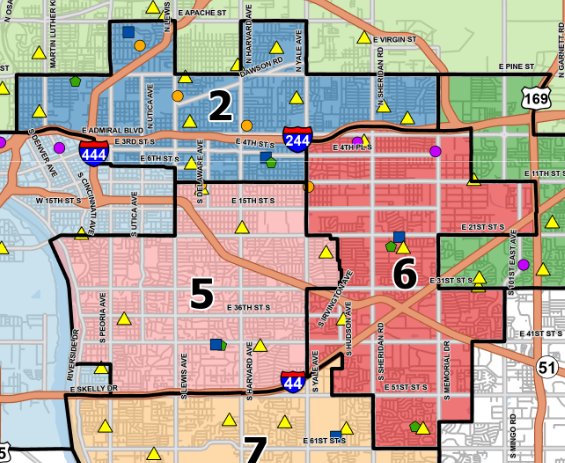
Over 68,000 people in a wide swath of central Tulsa (districts 2, 5, 6 in the map below) are eligible to vote. Incumbent John Croisant in District 5 hopes to be re-elected and joined by Calvin Moniz (District 2) and Sarah Smith (District 6) to continue to rubber-stamp an administration that has failed to educate our city's children and to continue to turn a blind eye to administrative incompetence, corruption, and bloat. Campaign ethics filings show that all three are backed by major Democrat donors, "progressive" Democrat elected officials, and an official Democrat party organization, and all three use Democrat campaign vendors. Some of their big donors are connected with the big foundations who treat TPS school children as their experimental lab rats.
Their opponents are KanDee Washington (District 2), involved in the schools for many years as a TPS parent, Teresa Pena (District 5), a veteran TPS teacher, and Maria Seidler (District 6), an attorney who represents parents in their dealings with the public schools. These three women represent a diversity of life experience, but all three are united in support of genuine education and an end to excuses for incompetence, corruption, and bloat.
Recent news stories about failing schools and illegal payments to TPS administrators underscore the imperative that Tulsa school district voters step up and elect board members who will right the ship.
The TPS Rescue Coalition has rated candidates in each of the three races based on an Independence Scorecard: Is the candidate beholden to special interests -- the same ones that have run TPS into the ground, to the benefit of consultants and philanthropocrats who see Tulsa as their personal social experiment -- or independent and focused on the best for students, teachers, and parents? Based on that information, and based on the responses 4 of the 6 candidates provided in the NorthStar questionnaire, I'm making the following recommendations:
District 2: KanDee Washington
District 5: Teresa Pena
District 6: Maria Seidler
I hope to say more about each race in the next few days.
All three election districts are fully within Tulsa County. Early voting will be held at the Tulsa County Election Board Headquarters at 555 N. Denver, but only on Thursday, March 28, 2024, and Friday, March 29, 2024, from 8:00 a.m. to 6:00 p.m. (No Saturday early voting because this is not a federal election.)
To confirm which district you're in and where your polling place is, use the Oklahoma Voter Portal at okvoterportal.okelections.us
MORE:
Here is the full map of TPS board election districts, as of the post-2020-census redistricting.
Tulsa Parents Voice Facebook page is a great place to keep up with the developing story of illegal payments to TPS administrators.
Monday, March 25, 2024, was the deadline for candidates for school board in the April 2 election to file their pre-election contributions and expenditures report with the clerk of Tulsa Public Schools. While the Tulsa City Clerk automatically posts received ethics reports, the school board clerk does not do this. One must file an Open Records Request through the tulsaschools.org website and then hope for a timely response. My request was filed on Monday, March 25, 2024, at 11:43 a.m.:
Records requestedAll campaign ethics reports filed by Candidate Committees from March 31, 2023, to the present, to include:
* Statements of Organization
* Contributions and Expenditures Quarterly Reports
* Contributions and Expenditures Pre-Election Reports
* Continuing Reports of ContributionsAll campaign ethics reports filed by Political Committees from March 31, 2023, to the present, to include:
* Statements of Organization
* Contributions and Expenditures Quarterly Reports
* Electioneering Communications and Independent Expenditures ReportReason for the request
For a published report to voters and the general public in advance of the April 2 election. Because early voting begins on March 28, it is essential to have these records no later than close of business March 26. PDFs by email are preferred.
I received an automated acknowledgement but no further communication. I sent a follow up email to TPS Clerk Sarah Bozone on Thursday, March 28, at 3:28 p.m.
Dear Ms. Bozone:I have yet to receive a reply to a time-sensitive open records request for pre-election campaign filings. Attached below is the automated acknowledgement of my request from Monday.
State law establishes a deadline of 8 days before an election for filing reports of campaign contributions and expenditures. This deadline exists so that voters inform themselves about the people and organizations seeking to influence an election. Failure to make these filings readily available to public scrutiny may be interpreted as bad faith on the part of TPS administration. Early voting is already underway.
Thank you,
Michael Bates
BatesLine.com
I received a reply with the requested information later that day at 8:24 p.m., with an 18.7 MB zip file attached.
The zip file contained one PDF for each candidate in Tuesday's election. There were no reports for Political Committees. I ran each PDF through optical character recognition and optimization. John Croisant's filing is large, because it was filled in sloppily in almost illegible handwriting. Below you will find the original zip file, unmodified, followed by the OCRed and optimized PDFs:
- Original zip file of campaign reports for 2024 Tulsa Public Schools board candidates in response to open records request
- District 2: Calvin Moniz (I) campaign contribution and expenditure reports
- District 2: KanDee Washington (I) campaign committee statement of organization. (She did not file a contribution and expenditure report, possibly an indication of not raising or spending more than the minimum threshold.)
- District 5: John Croisant (D, incumbent) campaign contribution and expenditure reports
- District 5: Teresa Peña (R) campaign contribution and expenditure reports
- District 6: Maria Seidler (R) campaign contribution and expenditure reports
- District 6: Sarah Smith (D) campaign contribution and expenditure reports
I have not had the opportunity, and I don't have time right now, to do a full analysis. I did notice that the insider candidates -- Croisant, Moniz, Smith -- are much better funded than the grassroots candidates, that each are using Democrat fundraising systems (ActBlue), Democrat consultants (Little Giant), and have received hefty donations from big Democrat donors. If someone feels like transcribing Croisant's reports or organizing the contributions in descending order of amount, or if you just notice something interesting, you can email your findings to blog at batesline dot com. I may post some of that here and will give you credit (unless you would prefer to be anonymous).
Major and noteworthy donors:
Calvin Moniz, District 2, establishment: major donor to Democrats George Krumme, $3,300; philanthropocrat Lynn Schusterman, $2,900; Carolyn Wheeler, $1,000; major donor to Democrats and polo player Reed Oppenheimer, $1,000; developer John Bumgarner, $250; former Democrat mayor Kathy Taylor, $250; Chapter of the Oklahoma Federation of Democratic Women, $250. (Moniz filed only the schedules, but not the required reports which summarize receipts and expenditures.)
John Croisant, District 5, establishment: Major donor to Democrats Burt Holmes, $3,300; major donor to Democrats George Krumme, $3,300; philanthropocrat Lynn Schusterman, $2,900; Steve Mitchell, CEO of Argonaut Private Equity (George Kaiser's private equity firm), $1,000; former Tulsa World publisher Robert and Roxana Lorton, $1,000; former Democrat mayor Susan Savage, $750; former Democrat State Rep. Judy Eason McIntire, $600; American Federation of Teachers Oklahoma (union), $500; Tulsa Chapter of the Oklahoma Federation of Democratic Women (Heart of the Party), $250; developer Bruce Bolzle, $250; former Democrat county chairman and congressional candidate Tim Gilpin, $250; Educare executive director Cindy Decker, $250; Democrat state representative John Waldron, $100.
Teresa Peña, District 5, reform: Alan Staab, $3,300; Fran Fleming, $3,300; Republican state representative Mark Tedford, $500; former Republican Oklahoma Attorney General John O'Connor, $250; former Republican state representative Carol Bush, $100;
Sarah Smith, District 6, establishment: Major donor to Democrats Burt Holmes, $3,300; Ross Swimmer, $3,300; major donor to Democrats George Krumme, $3,300; philanthropocrat Lynn Schusterman, $2,900; George Kaiser-affiliated attorney Frederic Dorwart, $1,000; major donor to Democrats and polo player Reed Oppenheimer, $1,000; former Democrat county chairman Keith McArtor, $500; former Democrat State Rep. Judy Eason McIntire, $500; Tulsa Forward PAC, $250; Democrat state representative Suzanne Schreiber, $250; former Democrat mayor Kathy Taylor, $250; developer John Bumgarner, $250; Tulsa Chapter of the Oklahoma Federation of Democratic Women (Heart of the Party), $250; Schusterman Interests program officer Randee Charney, $250; former Democrat congressional candidate Doug Dodd, $250.
Maria Seidler, District 6, reform: Christie Glesener, $3,250; Dan Hicks, $1,365. (Both of these were in-kind contributions of campaign mailers.)
Significant expenditures:
Calvin Moniz, District 2, establishment: Little Giant Consulting, $6,000; DemLaunch (campaign lists), $76.37; Gibson Universal LLC (campaign mailings), Henrico VA, $2,745.13; ActBlue (fundraising platform), $131.03.
John Croisant, District 5, establishment: Camelot Consulting (retainer, mail, digital ads) $26,110.24; Little Giant Consulting; Hardesty Press.
Teresa Peña, District 5, reform: Marcus & Company (campaign consulting), $5,620; Phame Marketing (billboard), $4,200; Tulsa Direct Mail, $3,836.41; Edge One Signs (yard signs), $1,115.31.
Sarah Smith, District 6, establishment: Calculated Strategies (campaign services compliance reporting), Bethany, OK, $4,450; Little Giant Consulting (fundraising service), $4,000; A. R. Clinton (campaign management), $1,500; Signs on the Cheap, Austin TX, $1,450.21; ActBlue (fundraising platform), $659.14.
Previous items on the 2024 Tulsa school board election:
- Links to 2024 Tulsa school board candidate websites and social media profiles
- Overview of 2024 Tulsa school board election with map of districts and recommendations
- ACTION Tulsa, the Alinskyite-leftist organization seeking to influence the election under a non-partisan guise
On Twitter (X), a random reply from a "Progressive Democrat, native born Oklahoman. ELCA Lutheran" condemned my endorsement of KanDee Washington in the Tulsa Public Schools District 2 election, because she didn't attend ACTION Tulsa's "Accountability Session":
KanDee Washington is the only candidate not to accept ACTION Tulsa's invitation to it's Accountability Session. What does she have to hide. The other two candidates you support showed at the session that they are wrong for TPS.
Who is ACTION Tulsa and why is it a good thing for a school board candidate to disagree with them?
ACTION stands for Allied Communities of Tulsa Inspiring Our Neighborhoods. The website lists the following member institutions, most of which are left-wing "churches," which long ago abandoned a Biblical worldview and Biblical standards of morality.
- All Souls Unitarian Church
- Church of the Restoration Unitarian Universalist
- Church of St. Mary - Outreach Program
- Dan Allen Center for Social Justice
- Fellowship Congregational United Church of Christ
- Hope Unitarian Church
- Kansas Oklahoma Conference - United Church of Christ
- Saint Aidan's Episcopal Church
- St. Francis Xavier Catholic Church
- Together Oklahoma
- Tulsa Lutherans in Action
- ACTION United Tenants of Tulsa
Together Oklahoma is another innocuously named left-wing group, a branch of Oklahoma Policy Institute, a big-government and higher-taxes think tank. Tulsa Lutherans in Action is connected with Fellowship Lutheran Church, a congregation of the liberal ELCA, another shrinking mainline denomination that has abandoned its commitment to Biblical truth.
ACTION Tulsa is an affiliate of the Industrial Areas Foundation (IAF), which was founded in 1940 by Saul Alinsky, notorious for his book Rules for Radicals, which was formative in the community organizing career of Barack Obama.
Shamefully, mainstream media reports on the "Accountability Session" held on January 27 ignored these radical leftist connections and took at face value ACTION Tulsa's claims to be "non-partisan" and just concerned about good schools. The Facebook event posting says that the group "will ask candidates to make public commitments to work with us on specific, actionable requests" but that list of requests does not appear anywhere on their website or Facebook page. ACTION Tulsa wants pledges of obedience but doesn't want public scrutiny of its agenda.
Groups like ACTION Tulsa hide behind neutral language because they know their true aims and values would be rejected by the voters. It's a badge of honor that KanDee Washington had the sense not to show up to their accountability session and that Teresa Pena and Maria Seidler were willing to voice their dissent from ACTION Tulsa's agenda.
UPDATE: I was sent a copy of ACTION Tulsa's demands (ACTION TPS Acountability Session Candidate Packet FINAL.pdf). It's a nice touch to misspell accountability.
As we have indicated previously, ACTION leaders will ask you to respond to the ACTION Agenda of Issues which we have developed through meetings in the community. We organize within institutions to develop an agenda of issues and work to ensure political capacity is marshaled to successfully resolve community concerns. At this session the organization will launch its nonpartisan GOTV efforts....
There were 5 questions, and candidates were told to give only Yes or No answers. They were limited to 3 minutes and 15 seconds total to cover all five answers. This was not an invitation to discuss weigh one priority against another, to discuss the costs and benefits of any particular policy. ACTION Tulsa was asking one question of each candidate: Will you be our female dog? Croisant, Moniz, and Smith all answered, "Yes!"
Conservative candidates would be wise to refuse any involvement with this group.
Here's a brief introduction to the six candidates running for three seats Tulsa Public Schools Board of Education, drawing on public information, including filing information, voter registration records, and social media accounts. All addresses are in the City of Tulsa. Because there are only two candidates in each race, each seat will be decided on Tuesday, April 2, 2024. I will add links to this page as more social media accounts are discovered and campaign websites are stood up, and this page will have a link to detailed candidate profiles later in the campaign season.
A brief panic during the filing period suggests nervousness by Tulsa's educational establishment about the outcome of these elections, in the form of letters from Tulsa Mayor G. T. Bynum IV, City Councilors Vanessa Hall Harper and Lori Decter Wright, State Rep. Monroe Nichols, and others urging the school board to waive board policy requiring a national search and public input in hiring a replacement for ex-Superintendent Deborah Gist and to hire Interim Superintendent Ebony Johnson to fill the permanent position immediately. The letters claimed to be concerned about local control, which appears to mean foundation control, as opposed to control by a board where three members had been recently endorsed by the voting public.
Following the process set out in board policy would have placed the hiring of a new superintendent after the seating of two or three new board members, resulting in a board that could well have a majority of four or five members who are independent of the private foundations that steered TPS policy during Gist's tenure. As Tulsa Parents Voice has documented, nearly all of the alumni of the Broad (rhymes with "road") Center for the Management of School Systems that populated the upper levels of the TPS org chart have departed this year. (The Broad Center involvement in public education has received criticism across the political spectrum; see these two 2018 articles by Betty Casey in Tulsa Kids. Eli Broad's controlling approach to "venture philanthropy" strongly resembles that taken by certain Tulsa philanthropists.)
Those executive vacancies would have been filled by a new superintendent under a new board majority, but now they can be filled by a long-time TPS administrator with a board majority of four favorable to Gist's failed policies and private foundation direction. Letters from community leaders allowed the current board majority to pretend to be responding to public demand in discarding board policy, bypassing public input and a thorough search for a new district leader. The two elected African-American women on the board, Rev. Jennettie Marshall and E'lena Ashley, voted against making Johnson permanent superintendent. Ms. Ashley commented after the vote on Facebook:
As I commend and congratulate our Dr. Ebony Johnson for her new 'permanent role' as TPS Superintendent, I am conflicted. I consider Dr. Ebony an excellent communicator and she certainly appears to have what it takes to make change.It also saddens me that we now as the Tulsa Public Schools board have...
- set precedent for Tulsa Public Schools by throwing away the rules in which the board established to ensure we performed our due diligence and ensured we in fact did all in our powers to find the best, most qualified person to lead TPS as Superintendent.
- set precedent to 'Circumvent the Rights' of the very students we are promising to Teach and Protect.
What we're teaching our young children is that when the rules don't fit our needs or agenda, we simply ignore them or find the best most expedient solution to get around them.
That's not how our students should expect their life's decisions to be made and they most certainly shouldn't see the leaders of their schools acting in such nefarious ways.
Here are brief profiles of each of the TPS school board candidates:
TPS Office No. 2:
This is a special election to fill the seat for the remaining year of an unexpired four-year term. Judith Barba Perez was elected to this seat in 2021, winning a three-way primary with 201 votes out of 379 cast. Barba Perez resigned in 2023 after she moved out of Oklahoma, and Diamond Marshall was appointed by the board to replace her until a special election could be held. Diamond Marshall declined to file for election.
Calvin Michael Moniz, 38, 2607 E. 6th St., Independent, Voter ID 720718072. Voted 11 times in the last four years. Did not vote in the February 2021 school board election. Social media: Campaign website, LinkedIn, personal Facebook profile, campaign Facebook page, campaign Instagram, personal Instagram (private, with 1,850 followers and 2,382 posts), campaign Twitter. A personal Twitter account @CalvinMoniz is no longer online. Moniz supported bypassing board policy to make Ebony Johnson permanent superintendent without the required nationwide search and public input.
KanDee N. Washington, 56, 2211 N. Xanthus Ave., Independent, Voter ID 720570162. Voted 5 times in the last four years. Did not vote in the February 2021 school board election. Social media: Campaign Facebook page.
TPS Office No. 5:
This is a regular election. John Croisant won the open seat in 2020, finishing first in the February primary with 44% in a field of five, then narrowly winning the postponed general election in June, 52% to 48% over Shane Saunders, thanks to an 834-vote advantage in absentee ballots and early voting.
John Thomas Croisant, 62 E. Woodward Blvd., Democrat, Voter ID 720699462. Voted 12 times in the last 4 years. Voted in the 2020 primary and general school board elections. Social media: Campaign website, LinkedIn profile, campaign Facebook page, personal Facebook profile, business Facebook page. Croisant voted to bypass board policy and make Ebony Johnson permanent superintendent without the required nationwide search and public input.
Teresa Ann Peña, 1127 S. College Ave., Republican, Voter ID 720206476. Voted 4 times in the last 4 years. Voted in the 2020 general school board election. Social media: Campaign website, LinkedIn profile, campaign Facebook page, personal Facebook profile.
TPS Office No. 6:
This race is for a full four-year term for the open seat currently held by Jerry Griffin, who is not running for re-election. He defeated long-time establishment incumbent Ruth Ann Fate in 2020.
Maria Mercedes Seidler, 7057 E. 52nd St., Republican, Voter ID 801571311. Voted 10 times in the last 4 years, including the 2020 general school board election. Social media: LinkedIn profile, personal Facebook profile, personal Twitter account. Seidler spoke at the December 11 TPS board meeting in favor of following board policy and conducting a nationwide search with public input for a new permanent superintendent.
Sarah Adrianne Smith, 5431 S. 67th East Pl., Democrat, Voter ID 720429536. Voted 9 times in the last 4 years, including the 2020 general school board election. Social media: Campaign website, LinkedIn profile, campaign Facebook page, personal Facebook profile, campaign Twitter account. Smith applauded the school board's decision to bypass board policy to make Ebony Johnson permanent superintendent without the required nationwide search and public input.
UPDATE: At the close of the filing period, we have three contested races for Tulsa school board, and contests for single seats in Berryhill, Owasso, and Union. The remaining 13 seats (including two each in Keystone and Liberty and the Tulsa Tech Center seat), are uncontested. Maria Mercedes Seidler filed for TPS Office No. 6, making that a two-woman contest for the open seat. Alan Staab filed but withdrew for TPS Office No. 5, so there are no Tulsa County contests with more than two candidates, and there will be no February 13 primary; all of these races will be settled on April 2, 2024. (Backup copy of candidate filings.candidatefilings_12082023.pdf)
Today, Wednesday, December 6, 2023, is the final day of filing for school board races in every public school district across Oklahoma. Candidates may file at the county election board until 5 p.m. today.
K-12 school districts will have a single seat, Office No. 4, up for election to a five-year term. K-8 dependent districts (Keystone is the only one in Tulsa County) have three seats that rotate through three-year terms, and also have a single seat on the ballot. Each year one of 7 Technology Center seats is on the ballot for a 7-year term; this year that is Office No. 1.
Tulsa, with 7 board members, has two seats up for a four-year term (No. 5 and No. 6) and the one-year unexpired term of Office No. 2.
After the second day of filing in Tulsa County, 13 seats have drawn only one candidate, 2 seats (Berryhill and Owasso) have drawn two candidates, and in Tulsa Office No. 5, incumbent John Croisant has drawn two challengers. No one has filed for Liberty Office No. 4.
Nor has any candidate filed for the Tulsa Technology Center Office No. 1, not even incumbent Rev. Dr. Ray Owens, pastor of Metropolitan Baptist Church and a board member of several non-profit organizations. This district mainly covers North Tulsa, from 11th Street South to 86th Street North, mainly west of Yale, plus Gilcrease Hills and neighborhoods just west of downtown.
Filing is also open for a number of municipalities; candidates have filed for city office in Collinsville, Owasso, and Sand Springs.
(Here is the a link to the latest list of candidates for Tulsa County school board and city council seats.)
School board filing always comes at a busy and distracted time of year. As I've written before, it's almost as if school board elections were deliberately scheduled to escape the notice of potential candidates and voters.
The school board primary election will be held on February 13, 2024, for those seats where there are three or more candidates. If no one wins a majority of the vote in the February election, a runoff will be held on April 2, 2024. If a seat draws only two candidates, the election will be held on April 2, 2024.
The Tulsa district, largest in the state, has two out of seven seats up for election to a four-year term, Offices No. 5 and 6, plus the remaining one-year term of Office No. 2, previously held by Judith Barba-Perez, who resigned earlier this year. As mentioned, incumbent John Croisant, first elected in 2020, is being challenged by retired TPS teacher Theresa Pena and Alan Staab. The Board appointed Diamond Marshall to serve District 2 until this year's school elections; the winner of this election will serve just one year. Marshall has not filed for election, but Calvin Michael Moniz has, and Candee Washington is expected to file as well.
Jerry Griffin, the incumbent in District 6, is not expected to run for re-election; he upset 24-year incumbent Ruth Ann Fate in 2020. So far Sarah Smith is the only candidate for that seat. Based on the age (45) listed on the filing, this is Democrat Sarah Adrienne Smith, registered to vote at 5431 S 67 E PL. (I don't know why the filing list omits addresses, which help to disambiguate names. There are 21 Sarah Smiths in Tulsa County, 9 in the Tulsa Public School District, 2 in Election District 6.) Her campaign kickoff was co-hosted by former Tulsa County Democratic Party chairman Keith McArtor. Here is Sarah Smith's personal Facebook profile. She is using the left-wing ActBlue platform for campaign donations.
You'll find a map of Tulsa Public Schools board districts here. District 2 is mainly between Admiral and Pine, with a bit of territory south to 11th Street around TU and Will Rogers High School. Booker T. Washington High School is also within District 2's boundaries. District 5 is mainly midtown west of Yale, around Edison High School, and District 6 is midtown from roughly Yale to Mingo.
Back during the 2019 filing period, I wrote at length about why school board races are so important, why they deserve much more attention than they receive, and why it's a shame that so few candidates run and so few voters turn out. During the pandemic school closures of 2020, parents and the general public began to learn more about what their children were being taught (and often how little they were being taught). More people are alert to what's at stake, and Tulsa has had some very contentious elections in recent years. We're hoping that trend will continue, but with more victories for school board members who will ask tough questions of the administration, who will represent the community's values and priorities, and who will stop the use of schools as missionary outposts for the Gramscian Left.

An appropriations amendment by Oklahoma 1st District Congressman Kevin Hern to prevent federal funding for Confucius Classrooms in K-12 was approved by voice vote by the U. S. House of Representatives on November 14, 2023. The one-sentence provision would amend H.R. 5894, the Departments of Labor, Health and Human Services, and Education, and Related Agencies Appropriations Act, 2024: "None of the funds made available by this Act may be used to fund a Confucius Classroom."
Tulsa Public Schools is one of seven school districts in the US that hosts a Confucius Classrooms. At the July 10, 2023, board meeting, the TPS board approved the contract for what the agenda said was Booker T. Washington High School's 14th year of participation in the Confucius Classroom program. The 2022 renewal of the Confucius Classroom was one of several items pulled from the board's consent agenda for additional scrutiny thanks to the absence of a board member.
Here are Mr. Hern's remarks on the floor of the House:
Madam Chair, through the Belt and Road Initiative, the BRI, the Chinese Communist Party has been spreading its malign influence over the last decade. This initiative has one goal: to increase China's economic and political dominance over the United States and the world.Disguised as harmless global infrastructure, transportation, and production networks, the Belt and Road Initiative, or the BRI, is anything but harmless.
Education is one of the primary targets of the BRI. They are succeeding in their mission to indoctrinate American students with their Communist ideals. Chinese state media even brags about the success of Confucius Institutes and other educational initiatives in spreading the CCP's influence.
This doesn't stop on our college campuses. Right now, China is invading our K-12 schools through Confucius Classrooms. Over the last decade or more, the CCP has infiltrated our public school system, setting up Chinese language and cultural programs in primary and secondary schools.
These Confucius Classrooms are funded by the Chinese Government, both directly and through Confucius Institutes and other third parties. Make no mistake, this is not through the kindness of their hearts. The CCP is not interested at all in helping American students learn Mandarin. They want to brainwash our children, plain and simple.
Since 2013, the authoritarian Government of the People's Republic of China has sent curriculum and PRC-trained teachers into hundreds of K- 12 schools across America as an unofficial component of its global influence campaign.
The CCP has committed countless violations of human rights, and its authoritarian agenda is antithetical to the democratic principles our country was founded on. Chinese propaganda has no place in our education system.
We have taken important steps toward mitigating Chinese influence at American universities by cracking down on Confucius Institutes. Now that the Chinese Government has directed its attention toward elementary and secondary schools, it is time we do the same and protect our children from the malign influence of the CCP.
My amendment would prevent Federal funding for these Confucius Classrooms.
Madam Chair, I urge my colleagues to support this amendment, and I reserve the balance of my time.
Blue-haired Connecticut Democrat Rosa DeLauro gave a weak speech in opposition, claiming that the proposal would create fear and would cause harm and violence to Asian-American teachers and students. DeLauro claimed the amendment was not being offered in good faith because the numbers of Confucius Institutes (Communist China's initiative on college campuses) had plummeted.
Hern offered a second amendment to fund enforcement of a provision of the No Surprises Act which requires a cost estimate for medical services to be provided to patients prior to treatment. The provision was passed nearly three years ago, but the Biden Administration has not enforced it. This Hern amendment also was approved by voice vote, but Rep. DeLauro demanded a recorded vote, which means that the vote on this amendment will be postponed under clause 6 of rule XVIII. It's curious that DeLauro did not use the same method to block the Confucius Classroom amendment.
While I appreciate Congressman Hern's attention to this issue, I do wonder how enforceable his proposal is. It appears not to prohibit schools from taking funding from other sources, such as a Chinese Communist Party-backed non-profit, for a Confucius Classroom, and it does not prohibit the idea from returning under another name.
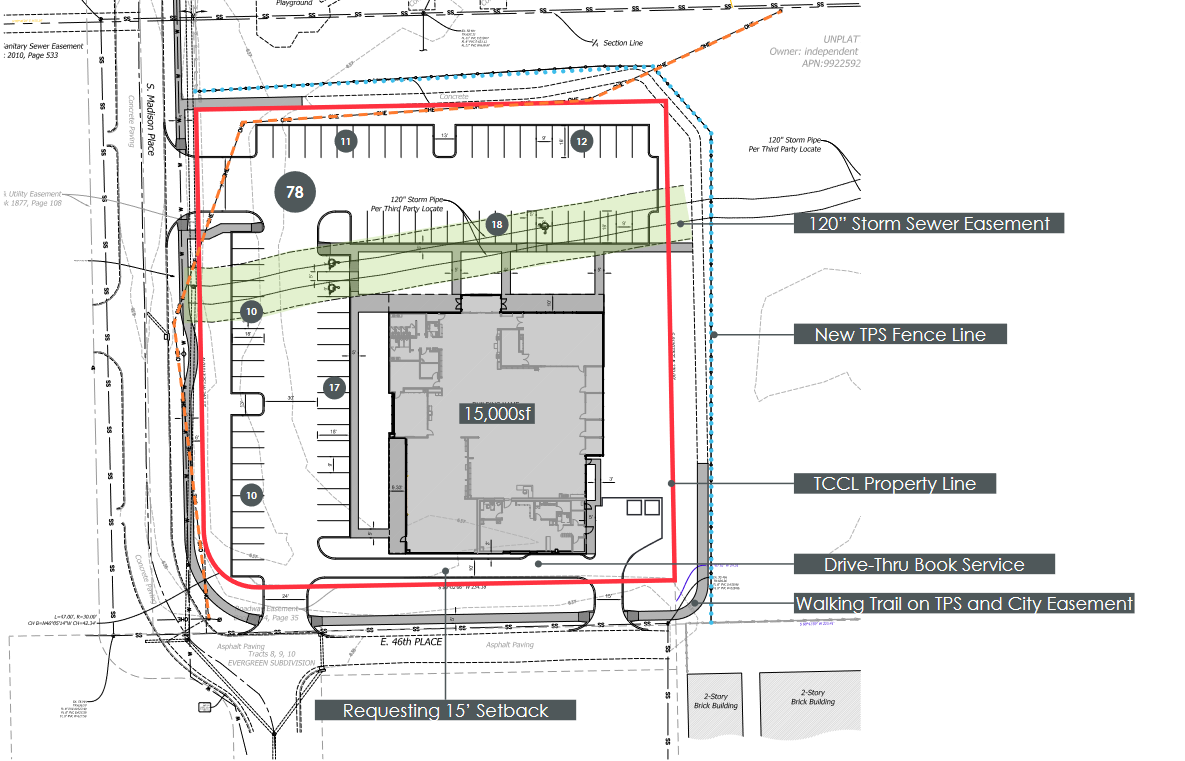
The City of Tulsa Board of Adjustment (BOA) has granted a special exception and a variance to allow the new Brookside Library to be built on the playing fields of the former Wright Junior High School, on the northeast corner of Madison Place and 46th Place South. A group of citizens have filed a lawsuit in Tulsa County District Court to halt the zoning permission, alleging conflicts of interest on the BOA. Under state law and local ordinance, the only appeal from a BOA decision is a lawsuit in district court.
The BOA case is BOA-23557. Tulsa's zoning code allows libraries within an RS-3 residential single-family zoning district, but only by special exception. In order to grant a special exception, the BOA must find (Title 42, 70.120.F.):
1. That the special exception will be in harmony with the spirit and intent of this zoning code; and2. That the special exception will not be injurious to the neighborhood or otherwise detrimental to the public welfare.
Paragraph B of the same section says that, "Applications for special exception approval may be filed only by the owner of the subject property or by the property owner's authorized agent." In this case, the applicant is Lou Reynolds of Eller and Dietrich representing the Tulsa City-County Library Commission (TCCLC), according to a letter to neighbors included in the BOA hearing packet; the current owner is Tulsa Public School (Independent School District No. 1). The same requirement applies to variances (70.130.C). This violation is one of the allegations in the lawsuit.
The application also requested a variance to allow a 15 foot setback for the library building on 46th Place instead of the 25 feet required for the RS3 zoning district. The zoning code explains the purpose of a variance in Section 70.130.A.
A variance is a grant of relief to a property owner from strict compliance with the regulations of this zoning code. The intent of a variance is not to simply remove an inconvenience or financial burden that may result from compliance with applicable zoning requirements. Variances are intended to help alleviate an unnecessary hardship or practical difficulty that would be caused by strict enforcement of the subject zoning code requirements. They are intended to provide relief when the requirements of this zoning code render property very difficult or impossible to put to reasonable use because of some unique or special characteristics of the property itself.
Variances are not a wild card. For example, you can't use a variance to allow a use that is forbidden for that zoning district. In this case, the building cannot be shifted further north because of a 120" storm sewer pipe that runs under the property; there is a required storm sewer easement that must be kept clear. This area would be used for parking. Of course, the proposed building could be built with a smaller footprint, possibly by building a second story, that would honor both the utility easement and the required setback.
The heart of the lawsuit, CV-2023-1809, is that Whitney Stauffer, one of the members of the Board of Adjustment who participated in the hearing and the vote, is also on the board of the Foundation for Tulsa Schools (FTS), which exists to support Tulsa Public Schools. The lawsuit also points out that Moises Echeverria-Ashworth is both the President and CEO of the Foundation for Tulsa Schools and a member of the Tulsa City-County Library Commission (TCCLC), and that Stauffer and Ellen Duecker, another member of the TCCLC, served together on the 2021 Bond Committee for Tulsa Public Schools. The special exception and variance received only 3 votes, the required majority for the 5-member body, but one of those three votes came from a member who, the suit asserts, should have recused herself.
The lawsuit states: "The interests of FTS have become so confused with the operations of Independent School District No. 1, Tulsa, Tulsa County, that it is inconceivable that Whitney Stauffer in her role as BOA Member and simultaneously chair of FTS could make an unbiased decision when it comes to BOA-23557." The complaint uses minutes from FTS and TCCLC meetings to illustrate the interconnections of these bodies.
You might well wonder why, in a city of 413,066 people, in a county of 669,279 people, the same few dozen people occupy the boards of all the public authorities, boards, and commissions, and interlock with many non-profits and foundations.
Orville Wright Junior High School opened to students in fall 1959, alongside Nathan Hale and Raymond S. McLain Senior High Schools in Tulsa's growing eastern and northern subdivisions, and the new Education Service Center, headquarters to Tulsa Public Schools, at 31st and New Haven. Wright was Tulsa's first circular school building, designed by Leon Senter and Associates. The large block between 45th Place, 46th Place, Madison Place, and Peoria Avenue was all owned by TPS and shared between Wright and Oliver Wendell Holmes Elementary School. Holmes was built in 1950, but closed in 1981, one of the earlier victims of falling TPS enrollment. It was placed on the TPS surplus property list in 1983, became the Brookside Center retail complex in 1988, and was purchased by Tulsa Ballet in 1991. When Holmes closed as a school, Wright became an elementary school. Collegiate Hall charter school opened in 2015 at Marshall Elementary School at 56th and Peoria, then, after TPS closed Wright Elementary in 2020, Collegiate Hall moved into the building. Collegiate Hall lost its charter at the end of last school year. College Bound Academy, another charter school, now has a campus in the Wright building.
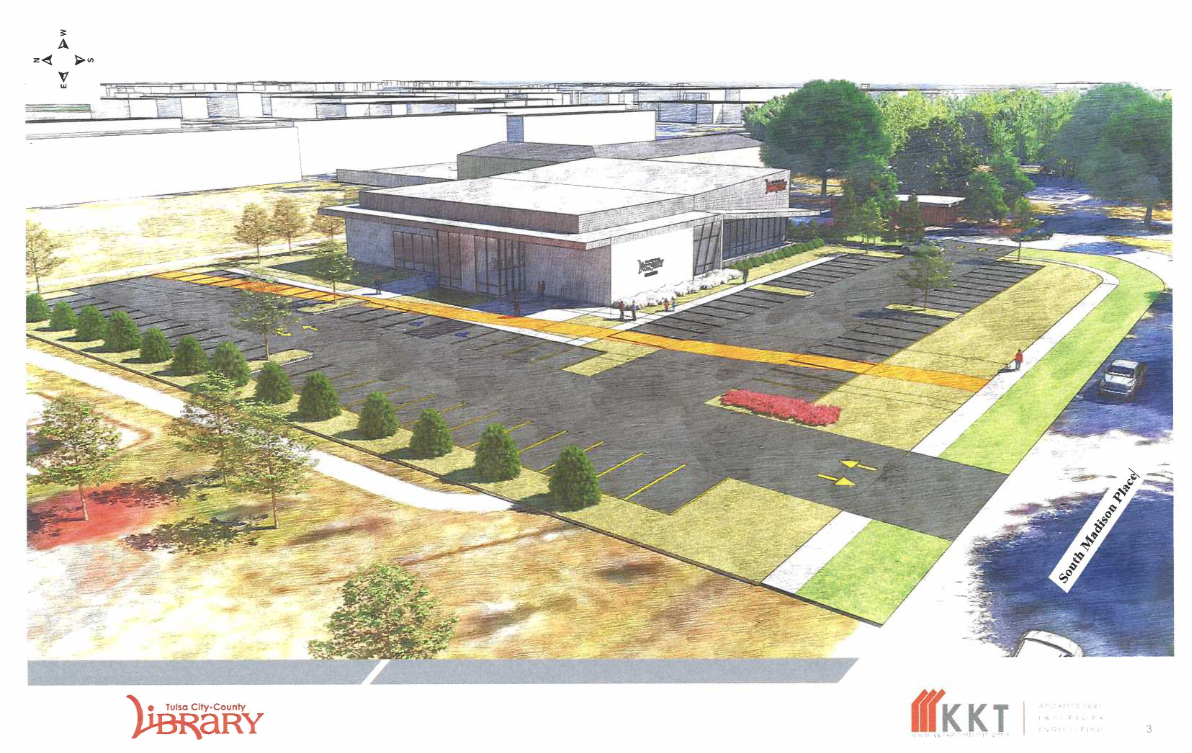
The Brookside branch library opened in the former Guy Scroggs's Brookside Drug Store, 3516 S. Peoria, in January 1951, then moved in January 1962 to 1311 E. 35th Street, the old southside post office building. The South Brookside Library opened at 1207 E. 45th Street in 1966, replacing the Brookside branch. It was expanded in 1999, doubling from 3,360 to 7,120 sq. ft. The proposed replacement would have 15,000 sq. ft. and 78 parking spaces.
While there has been a library "in the neighborhood" for over 50 years, the current location is surrounded by commercial development and just a short distance from an arterial street on a residential collector street. The new location is deep in the neighborhood and larger. Just to the west of the current location there is a seldom-used side parking lot for the Walmart Neighborhood Market. If it weren't for Tulsa's ridiculous parking minimums that space could be repurposed as parking for an expansion of the existing library into its current parking lot.
MORE:
Backup copies:
 Happy news late this afternoon that Deborah Gist has resigned as superintendent of Tulsa Public Schools. Gist resigns as the state's largest school district faces a hearing on Thursday at the State Board of Education on the loss of its accreditation.
The threat to pull accreditation stems from poor academic performance and lack of financial controls. Alleged embezzlement of nearly $500,000 by Chief Talent and Equity Officer Devin Fletcher and alleged kickbacks to other unnamed employees point to a lack of financial controls and oversight by the Gist administration and the school board majority who have propped her up. Despite the district experiencing year after year of dismal test scores during Gist's tenure, the Tulsa school board majority continued to renew her contract well in advance of its expiration, with some renewals timed such that newly elected board members could not have a vote in the matter.
In a public statement, Gist stated that her handpicked successor would be chosen by the board to continue her work:
There will be a special board meeting on Wednesday evening where the board will consider my separation and the appointment of Dr. Ebony Johnson as interim superintendent. I am enthusiastic about the board's plan to act upon the appointment of our colleague as interim superintendent. As you know, Dr. Johnson is a lifelong Tulsan, a stellar educator, a strong leader, and a remarkable human being. With the leadership of Dr. Johnson, our team will keep the work of our plan on track and will reach even higher.
"The board's plan to act" suggests that a violation of the Oklahoma Open Meeting Act has occurred. Any discussion should occur in a public meeting with adequate public notice. The use of serial private meetings with fewer than a quorum at each in order to avoid an open meeting has itself been found to be a violation of the Open Meeting Act. Board member Jerry Griffin, a critic of Gist, said that he had been kept in the dark:
In light of recent reports surrounding the resignation of Dr. Gist, Superintendent of Tulsa Public Schools, I find it crucial to clarify my position and understanding of the matter. The news surrounding the resignation of Dr. Gist has taken many by surprise, and I wish to expressly state that I too was unaware of the decision until it emerged in the media. Various statements have indicated that this was a decision made by the Tulsa School Board, of which I am a part. However, I was neither consulted nor informed about this decision at any point in time. I must stress that I have not been privy to any discussions regarding the resignation, nor have I been involved in decisions about the interim Superintendent's appointment. These developments have been made without my knowledge or consent.
The Tulsa school board will meet tomorrow, Wednesday, August 23, 2023, at 5:30 p.m., in the Cheryl Selman Room, ground floor, at the Education Service Center, 3027 S. New Haven Ave. From the agenda it appears that the useless board majority intends to give Gist a golden parachute (note item D):
C. Motion, second, discussion and vote on motion to approve a mutual separation agreement with Dr. Deborah Gist as Superintendent of Schools, effective September 15, 2023, at 11:59 p.m.D. Motion, second, discussion and vote on motion to approve amending the district's 403(b) annuity plan to allow nonelective post-employment employer contributions, and authorize the attorneys for the district to prepare/approve the appropriate plan amendment document(s) and the proper officers of the Board of Education to execute the document(s) on behalf of the district.
E. Approve an emergency waiver of the policy suspension procedures in Board Policy 1201 and immediately suspend all requirements under board policies for posting and advertising the position of interim Superintendent of Schools....
G. Motion, second, discussion and vote on motion to appoint Dr. Ebony Johnson as the interim Superintendent of Schools and approve an employment contract with Dr. Johnson to serve as interim superintendent of schools effective September 16, 2023.
The board will go into executive session regarding Gist and Johnson before items C and G, respectively.
For email notifications of new content on BatesLine, subscribe via Substack:
Gist herself indicates that her resignation is meant to appease the State Department of Education and forestall loss of accreditation:
I am confident that my departure will help to keep our democratically-elected leadership and our team in charge of our schools-this week and in the future.
The Oklahoma state school board should not be satisfied that only one head of the hydra has been severed. Gist's departure is happy news, but it's only the beginning of the cleanup effort. All of Gist's cronies, all of the strings-attached foundation grants, the ties to Tulsa's control-freak philanthropocracy, the useless board majority that kept extending her contract and failed to exercise oversight -- they all need to go. State Superintendent Ryan Walters and the State Board of Education should not relent until the cleanup is complete.
It's ridiculous to suggest that we have effective, democratic local control of schools. Oklahoma's school election laws are ideal for thwarting voter involvement -- filing period in early December as families are focused on the end of the fall semester and Christmas, campaigning through the darkest and coldest months of the year so no door-knocking after work during the week, and staggered terms (four years in Tulsa, five years most other places) so voters cannot throw all the bums out in one revolt. Reform of school elections -- I suggest two-year terms and November elections in odd numbered years -- will improve democratic accountability in the long run. In the meantime, when our "local control" has failed to maintain financial control and academic performance, the state has a responsibility to clean house. This happened in 2021 during the administration of State Superintendent Joy Hofmeister, when Western Heights School District in Oklahoma City lost its accreditation after a period of probation.
Only 26 districts in the state scored lower than Tulsa Public Schools in composite academic achievement in 2021-2022, the most recent year for which results have been published. 32 of TPS's 46 elementary schools had 0 students scoring at a proficient or advanced level in the 2021 assessments. Defenders of the TPS status quo claimed that 49 districts have worse performance than TPS, and State Superintendent Ryan Walters should focus his attention elsewhere. But TPS is the largest district in the state, and there are 490 districts that have better performance. The percentage of TPS students at proficient or advanced levels is only 8.86%. Tulsa ranks 18th worst district in percentage of students "below basic" achievement levels at 64.4% -- nearly two-thirds. (Data exported from the SDE interactive data browser is the source of these statistics.)
Earlier this month, Democrat State Rep. Jacob Rosecrants urged that "we need to look past standardized test scores as a way to determine if a school district is failing or not." He claimed that inner-city "student trauma" gets in the way of test performance and the state should respond with "more resources." (Thread captured here.)
If students can't read, they can't read. One-room-schoolhouse teachers -- my great-grandfather was one -- managed to teach poor farm kids -- like my grandfather -- how to read in between fall harvest and spring planting. Public schools in the Depression managed to teach reading, despite plenty of trauma. Self-styled "public education advocates" need to stop making excuses for failed educational philosophies that no amount of money can rescue.
I find it interesting that City of Tulsa and Tulsa Regional Chamber officials continue to speak about TPS as if it were the sole school district of importance. I haven't run the numbers, but I feel certain that there are far more school children living in the City of Tulsa who attend Jenks, Union, Broken Arrow, Bixby, and other public school districts, charter schools, and private schools, or are homeschooled than attend TPS. That's definitely the case for the Tulsa metropolitan region. City officials should tout the wide range of educational options the city has to offer, while treating TPS as a problem to be solved; instead, they defend the fellow insiders who have driven TPS into the ground. If they really are worried about workforce development as they claim, city and chamber officials should demand strong action to clean up TPS.
State Superintendent Walters and the state school board should not be placated by Gist's resignation. I hope that they will act boldly on Thursday to clean up TPS, for the sake of the children who are stuck there and for the district's once-proud legacy. I expect that the System is hoping that sacrificing Gist will allow them to retain control of TPS. (No doubt a very nice sinecure in a non-profit has been set aside for her.) I hope they are mistaken.
Concluding this blog post by switching movie villainesses: Remember, the squashing of the Wicked Witch of the East was at the beginning of The Wizard of Oz. The final defeat of the Wicked Witch of the West and her flying monkeys didn't happen until the end.
Special congratulations go to Tulsa Parents Voice for their research and persistence in documenting Gist's failures, pressing for an audit of TPS finances, and continuing the battle for reform.
MORE: LibsOfTikTok has posted a video by Union Public Schools elementary school librarian Kirby MacKenzie. MacKenzie superimposed this text atop video of herself strutting with an armload of books: "POV: teachers in your state are dropping like flies, but you are *still* just not quite finished pushing your woke agenda at the public school." MacKenzie is also an assistant director at Gaining Ground. KTUL reported that Union Public Schools spokesperson Chris Payne claimed, without evidence, that the video had been "doctored up."
Payne denied, however, that Mackenzie made the video, despite it appearing on her own TikTok page under her name. The video, they said, was edited by a third party and was not Mackenzie's creation."That is the doctored-up version of a video that [Mackenzie] made," Payne told CITC via phone. "They have made changes to her video. What we're talking about isn't even her video, it's one that has been doctored up. Obviously, they have an agenda."
CITC could not identify any differences between the video originally published by Mackenzie on TikTok and the version circulating social media on Tuesday.
When asked for clarification, Payne was unable to identify the "original" video or describe who had allegedly edited it. He also could not explain how the allegedly edited video had been posted to Mackenzie's page without her knowledge or consent.
After a series of emails from CITC attempting to verify the district's claim, Payne said "we are done" and implied CITC was pushing an agenda.
CITC is Crisis in the Classroom, the national education reporting arm of Sinclair Broadcast Group, parent company of KTUL. Their Twitter account, @CITClassroom, provides a feed of stories reported by Sinclair stations across the country on educational failures, predatory teachers, teachers' union activity, pornographic books in school libraries, and the rise of school choice. Recent Oklahoma stories covered a grandparent's claim that Oologah Middle School ran out of cafeteria food and the new school choice tax credit law. Several times they've called attention to their analysis questioning Joe Biden's demand for teacher raises, noting a 43-year long increase in teacher pay (except for the effects of Bidenflation) and plummeting student performance.
This is an encouraging development: A major media chain has noticed widespread parental concerns about public schools and is wisely making it a focus of their local news coverage.
Tulsa Public Schools made the Mail Online on July 30, 2023, as one of 7 school districts in the US with active contracts for Confucius Classrooms, a propaganda outreach of the Chinese Communist Party.
China is funding America's public schools to the tune of $17 million dollars, it has been revealed, with Republicans now probing the disturbing donations.The report by Parents Defending Education states that the close coordination between the Chinese Communist Party (CCP) and U.S. schools to establish Confucius Classrooms has historically included 143 school districts in 34 states and Washington, D.C.
In addition, at least seven contracts are still active in Texas, Kentucky, Minnesota, Oklahoma, Oregon and Washington.
A year ago, July 2022, BatesLine reported on the Tulsa Public Schools board vote on accepting a Confucius Classroom grant for Booker T. Washington High School, the ninth year of the program. The grant had been hidden in a "consent agenda," a long list of items to be approved en masse without discussion or debate, but because three of the six board members present voted against the agenda, several items were brought back individually for consideration at a later meeting. Only one board member, newly elected District 4 member E'Lena Ashley, had the courage and wisdom to vote against accepting the grant and contract "with International Leadership of Texas, in partnership with Confucius Classroom Coordination Offices."
This map ran with the Daily Mail's story:
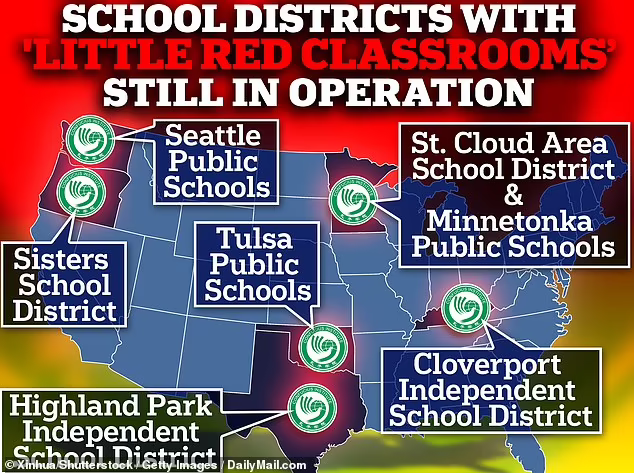
The story cites PDE's recent report, "Little Red Classrooms," and quotes several Members of Congress concerned by the findings:
Rep. Jim Banks is demanding the Education Department take action with 'urgency' in in order to terminate these 'disturbing' partnerships, he says in a letter to Sec. Miguel Cardona on Wednesday obtained by DailyMail.com.'The Chinese Communist Party is not a trustworthy partner. Accepting funding and influence from our greatest adversary is a threat to America's children and national security,' Banks told DailyMail.com.
He wrote in the letter that the U.S. must 'take every measure' to strengthen its defenses against China including by 'blocking their ability to propagandize in America's K-12 schools.'...
PDE's "Little Red Classrooms" report also mentions Tulsa's "Carver Middle School... which became a "Confucius School" through Hanban&emdash;the subdivision of the Chinese Ministry of Education that, until 2021, operated Confucius Institutes and Classrooms. (This is mentioned on the Carver website under the Global Awareness tab and has beencaptured by the Internet Archive's Wayback Machine.)
PDE discusses the use of third-party organizations to mask the funding ties to the Chinese Communist Party:
Other districts mask Chinese government funding through third-party nonprofit entities. Such is the case in schools in Oklahoma, Texas, and North Carolina.Take the International Leadership of Texas Global, for example--a nonprofit organization that has taken on being an administration apparatus and passthrough for the continuation of the Confucius Classroom programming. Tulsa Public Schools' Board of Education has a contract with the Confucius Classroom Coordination Offices through the International Leadership of Texas Global. Highland Park Independent School District in Texas also received funding from the International Leadership of Texas Global to facilitate its "Chinese core curriculum."
As BatesLine reported last year, International Leadership of Texas operates a network of 22 charter schools, with four more campuses currently in development, plus 4 affiliated private high schools. Recent news items on their website indicate that alignment with China and its Communist government is a high priority for the organization, and also reinforce concerns raised by PDE about Chinese Communist influence over Junior Reserve Officer Training Corps Programs at Confucius Classroom schools:
- First and Only ILTexas Student Thrives in Chinese Flagship Program: A student ILTexas Katy-Westpark High School is the "first and only ILTexas student to attend the university's Flagship Program within its Intensive Chinese Program in the Summer Language Institute. Her accomplishments are so impressive, Ole Miss has offered to pay for the dual credit opportunity this Fall."
- ILTexas Opens New State-of-the-Art Marine Corps JROTC Facility: "ILTexas has the highest Marine Corps JROTC enrollment percentage of any high school in the country where MCJROTC enrollment is optional. An ILTexas cadet spoke at the ceremony, stating the new facility 'will be the center of gravity for cadets to learn leadership, develop their character, and become the best versions of themselves.'"
- Ole Miss Sees Record Number of Students for Chinese Program, Most from ILTexas: "The University of Mississippi (Ole Miss) welcomed 74 high school students for its Summer Language Institute, and reports in a University news article that the Intensive Chinese Program drew a record number of rising juniors and seniors. 69 of the 74 students who attended the summer program are ILTexas students.... International Leadership of Texas' mission is to prepare students for exceptional leadership roles in the international community. The United States declares Chinese as a critical language, recognizing it as a National Security Language. Therefore, all ILTexas students master Mandarin Chinese as part of the core curriculum."
- Summer Camp Highlights Cybersecurity, Language and Leadership for ILTexas Students: "In addition to Cybersecurity and Leadership, students also practiced their Mandarin Chinese during the summer camp, as it's a National Security Language. All ILTexas students take Chinese language classes during the regular school year with the goal of mastering the language by graduation."
- "This is the closest thing to actually going to China:" ILTexas Students Dive Into the Chinese Culture at the University of Mississippi : "ILTexas is proud to partner with the University of Mississippi (Ole Miss) to allow our students to take part in a complete Chinese cultural immersion experience.... Chinese is recognized as a National Security Language, and is a pillar of the ILTexas core curriculum. "
- Chinese Ambassador Qin Gang Visits ILTexas : "International Leadership of Texas teachers and staff filled the gym of ILTexas Garland High School on Tuesday, May 31, to welcome the Chinese Ambassador to the United States Qin Gang. A special luncheon was held in the school library for the Ambassador and ILTexas leadership. The luncheon was followed by a ceremony where ILTexas teachers, students, and headquarter staff honored the Ambassador's visit. Senator Royce West and his wife, Carol West were also in attendance."
At the July 10, 2023, Tulsa school board meeting, renewal of the Confucius Classroom agreement was once again included in the "Consent Agenda," a list of 33 items to be approved as a group by the school board without debate, as item E.7.:
RECOMMENDATION: Renew the agreement for the Confucius Classroom Coordination Offices through the International Leadership of Texas, a 501c3 organization, an international partnership dedicated to building the field of Chinese language teachers and Chinese language learning in American schools for the 2023-2024 school year.FURTHER RECOMMEND:
The attorneys for the school district approve the appropriate contract document(s) and the proper officers of the Board of Education be authorized to execute the document(s) on behalf of the district.COST: No cost to the district
FUND NAME/ACCOUNT: Confucius Classroom 81-2273-1000-000000-000-07-735
RATIONALE:
This will be Booker T. Washington's fourteenth year to participate in a Confucius Classroom program. International Leadership Texas, in partnership with the CCCO, offers a quality program which will allow our students to continue in the study of the Chinese language.
Note that last year's agenda claimed that 2022-2023 would be the ninth year, but this year's agenda claims that 2023-2024 is the 14th year of the program at Booker T. Washington High School. Once again, E'Lena Ashley was the only board member to vote against the contract.
Meanwhile, only 27.9% of economically disadvantaged TPS K-5 students and only 25% of Grade 6-8 students are reading at or above the national median student, but TPS administrators feel great about it -- by 2027 they hope that only two-thirds of disadvantaged TPS students will be worse readers than the national median.
MORE: Stream of the July 10, 2023, Tulsa Public Schools Board of Education meeting.

April 4, 2023, is general election day across Oklahoma for school board races and for municipalities that use the default forms of municipal government established by state statute. Many cities with city charters that define a customized government structure still use the default dates for city elections. As is all too typical for local elections, many races failed to draw more than one candidate.
Polls are open from 7 a.m. to 7 p.m. To find your polling place and take a look at sample ballots, visit the Oklahoma State Election Board's voter portal.
Four Tulsa County school districts have school board races on the ballot. For Tulsa Office No. 1, incumbent Democrat Stacey Woolley faces Republican challenger Jared Buswell. For Berryhill Office No. 3, Danny Bean vs. Doc Geiger. For Bixby Office No. 3, Julie Bentley vs. Matt Dotson. For Sand Springs Office No. 3, Tracy Hanlon vs. Rusty Gunn.
Three Broken Arrow city council seats are on the ballot: Mike Lester v. Christie Gillespie in District 3, Scott Eudey vs. Joe Franco in DIstrict 4, and four candidates for the at-large council seat: George Ghesquire, Sonjia J. Potter, William Vaughn, Johnnie D. Parks. One Bixby city council seat, Monica Rios v. Ken Hirshey. One Skiatook seat: Joyce Jech vs. Jerald Freeman.
Below is a list of candidates running in Tulsa County school board and municipal elections. The name as it appears on the ballot is followed by the name under which the candidate is registered to vote, the party of voter registration, age as of election day, and then a list of web pages and social media profiles related to each candidate:
School Board seats
Except in the Tulsa school district, voters anywhere in a school district can vote in the election for any school board seat, regardless of election district. In the Tulsa school district, only voters in Election District No. 1 may vote.
Tulsa Public Schools, Office No. 1:
- Jared Buswell (Jared David Buswell), R, 39, 1860 W. 58th St.: campaign website, personal FB, campaign FB.
- Stacey Woolley (Stacey Ryan Woolley), D, 47, 1110 E. 20th St., incumbent: campaign website, personal FB, campaign FB.
- Danny Bean (Daniel Earle Bean), R, 42: personal FB
- Doc Geiger (James Conrad Geiger), R, 73, incumbent: personal FB
- Julie Bentley (Julie Lynn Bentley), R, 52: personal FB, campaign FB.
- Matt Dotson (Matthew Ray Dotson), R, 42, incumbent: personal FB.
- Tracy Hanlon (Tracy Anne Hanlon), R, 42: personal FB
- Rusty Gunn (Rusty Don Gunn), R, 45, incumbent since 2013: personal FB
City Council seats
Three Broken Arrow city council seats are on the ballot. Under the statutory charter, registered voters from anywhere in the city can vote in all races. In Bixby, only residents of Council District 3 may vote; incumbent councilor Paul Blair is not seeking re-election. Under Skiatook's city charter, registered voters from anywhere in the city can vote in all races.
Broken Arrow City Council Ward 3:
- Christi Gillespie, (Christi D. Gillespie), R, 53, incumbent, vice mayor: personal FB, campaign FB.
- Mike Lester (Michael Edward Lester), R, 75, former incumbent: personal FB, campaign FB
Broken Arrow City Council Ward 4:
- Scott Eudey (Scott Riley Eudey), R, 49, incumbent: personal FB, campaign FB
- Joe Franco (Joseph Dale Franco), R, 45: personal FB, campaign FB
Broken Arrow City Council At-Large:
- George Ghesquire (George Camiel Ghesquire III), R, 54: personal FB, campaign FB
- Johnnie D. Parks, R, 75, incumbent: personal FB, campaign FB
- Sonjia J. Potter (Sonjia Juanita Potter), R, 76: No social media or website found
- William Vaughn (William Daniel Vaughn), R, 49: personal FB, campaign FB
- Ken Hirshey (Kenneth Loyd Hirshey, Jr.), R, 63: Oklahoma Environmental Quality Board website, company website
- Monica Rios (Monica Joi Rios), R, 48: personal FB, campaign FB
- Jerald Freeman, R, 85: personal FB
- Joyce Jech (Joyce May Jech), R, 77, incumbent: campaign FB
Endorsements:
If I could vote in the TPS Office 1 race, I would vote for Republican challenger Jared Buswell. Buswell, a member of Asbury Church, serves as chairman of the board of Favor International, a Christian ministry working in war-affected areas of Africa -- specifically northern Uganda and South Sudan -- to relieve suffering, proclaim the gospel, build churches and Christian leadership, educate, build community infrastructure, and train to empower economic development. Buswell has been involved with Favor since 2012 and has helped to build Favor's donor base from $300,000 to $6 million per year. Buswell also has a business called Look Inside Tulsa, which uses 360-degree spherical photography to provide VR views of home and building interiors. Originally from Milwaukee, Wisconsin, he came to Tulsa in 2001 to attend Oral Roberts University and has lived in west Tulsa since 2007.
His opponent, incumbent Democrat Stacey Woolley, has presided over the continued decline of Tulsa Public Schools, which badly underperforms the rest of the state by every measure. The Whirled's endorsement is inadvertently damning. The Whirled says that, "Among her top accomplishments is refocusing school meetings to student achievement and simplifying operational votes to a consent agenda." This was a move against public transparency and accountability: Last July, the consent agenda was used to hide the board's acceptance of a grant from a non-profit funded by the Chinese Communist Party; it was only exposed because board members E'Lena Ashley, Jerry Griffin, and Jennettie Marshall voted against the consent agenda as a whole.
The Whirled also applauds Woolley for "help[ing to] update the superintendent's evaluation, making it among the nation's few based almost entirely on student outcomes." If that's so, why does Deborah Gist still have a job, when student outcomes continue to be abysmal? And yet Woolley has repeatedly voted to extend Gist's contract.
Election District 1 includes all of the Tulsa school district west of the Arkansas River, plus downtown Tulsa, the neighborhoods along Charles Page Blvd west of downtown, the southern portion of Gilcrease Hills, Brady Heights, Pearl District south of 6th Street, Tracy Park, Swan Lake, North Maple Ridge, and Riverview. Like most of his prospective constituents, Buswell lives west of the river, in a modest home valued by the county assessor at $119,221, located in Woodview Heights near 61st and Union. Woolley lives in the wealthiest neighborhood in the ward, North Maple Ridge, in the extreme eastern extent of the district, in a home valued by the county assessor at $585,301. It is a sadly frequent redistricting technique to gerrymander a few exclusive neighborhoods into an otherwise working-class, middle-class district, so as to maximize the number of the connected and wealthy on an elected board or council.
In the Bixby school board race, I would vote for challenger Julie Bentley over incumbent Matt Dotson. Bentley is a certified teacher who has taught 13 years in the Bixby district and is the mom of a current Bixby High School student. Dotson appears to be a subservient rubber stamp for superintendent Rob Miller, who has expressed his contempt for concerned citizens who speak at board meetings. Dotson refused to take a firm stand against inappropriate books in the curriculum and the library, preferring to invest total confidence in the district employee he's supposed to be holding accountable. (Miller's blog View from the Edge, which he ended in 2017, shortly before he was hired as Bixby superintendent, reveals his hostility to public accountability for the performance of public schools.)
Endorsements from conservative groups:
- Tulsa County Republican Party: Jared Buswell (Tulsa schools, Office 1), Julie Bentley (Bixby schools, Office 3).
- Bixby Parents Voice: Julie Bentley (Bixby schools, Office 3).
- Moms for Liberty: Jared Buswell (Tulsa schools, Office 1), Julie Bentley (Bixby schools, Office 3).
- Oklahomans for the Second Amendment (OK2A): Jared Buswell (Tulsa schools, Office 1), Julie Bentley (Bixby schools, Office 3); Christie Gillespie (Broken Arrow Council 3), Joe Franco (Broken Arrow Council 4), George Ghesquire (Broken Arrow Council At-Large). William Vaughn (Broken Arrow Council At-Large) also had an A-rated survey.
- Oklahomans for Health and Parental Rights: Jared Buswell (Tulsa schools, Office 1), Julie Bentley (Bixby schools, Office 3); Christie Gillespie (Broken Arrow Council 3), Joe Franco (Broken Arrow Council 4). George Ghesquire and William Vaughn in the Broken Arrow Council At-Large election each had an A-rated survey, but OKHPR did not endorse in that race.
The incumbent and challenger in the Tulsa School Board District 1 race have each raised over $50,000 according to campaign contribution and expenditures reports filed with the Tulsa Public Schools district clerk.
As of the March 20, 2023, close of the pre-election reporting period, Democrat incumbent Stacey Woolley had raised $51,798, while Republican challenger Jared Buswell had raised $58,643.
Woolley's donor list includes contributors connected with the foundations whose influence has propelled Tulsa Public Schools toward its abysmal academic performance. Maximum $2,900 donors include the Lynn Schusterman Revocable Trust, the Stacy Schusterman Revocable Trust, Frederic Dorwart (attorney for the George Kaiser Family Foundation and related entities), and Philip Kaiser (son of George Kaiser). George Kaiser made a personal donation of $500. Big Democrat donors George Krumme and Burt Holmes also gave maximum donations. Attorney Robert A. Curry gave $1,500 in aggregate, and Joseph Parker Jr. and Robert Thomas each gave $1,000. Employees of the Charles and Lynn Schusterman Family Foundation, the George Kaiser Family Foundation, Tulsa Community Foundation, Zarrow Family Foundations also appear on Woolley's list of contributors. Other notable names include left-wing Democrat Tulsa City Councilors Laura Bellis and Lori Decter Wright, former Democrat Mayor M. Susan Savage and her ex-husband Grant Hall, Democrat State Reps. Melodye Blancett and Suzanne Schreiber (also a former school board member), and Democrat former school board member Cindy Decker, head of GKFF-backed Tulsa Educare. "Friends of Shawna Keller," the campaign committee of the east Tulsa school board incumbent defeated a year ago by E'Lena Ashley, gave $1,000 to Woolley.
Republican challenger Jared Buswell raised $57,643.55, including $6,573.55 in in-kind contributions. Buswell received maximum $2,900 contributions from H. Michael Krimbill, L. Avery Krimbill, Christie Glesener, Tom Culver, and Vivienne Culver. The latter two contributions were in-kind as office rent reductions. Buswell received several large PAC contributions: Oklahoma Conservative Political Action Committee (OCPAC), $2,350; Women Working for Oklahoma PAC, $2,000; Oklahoma Realtors PAC, $1,000. Other lare donors include Brian & Pauline Robinson, $2,500; Kent Glesener, $2,500; Rob Prulhiere, $2,000; Julia Sublett, $2,000; Suzanne Behr, $1,500; Frances Fleming, $1,500; Michael Phillips, $1,500 (including $250 in-kind for yard signs); Jody Tell, $1,200; Matthew Watson, $1,000; Ken Sellers, $1,000; Thomas Carruth, $1,000; Michael Ross, $1,000; Reed Downey Jr, $1,000; Alvin Loeffler, $1,000. Former District Attorney Tim Harris, who ran unsuccessfully for the District 7 board seat last year, contributed $250 to Buswell. Buswell reports giving $2,750 to his own campaign, plus another $349.48 in in-kind contributions, purchasing push cards, yard signs, and other printing for the campaign.
The initial set of documents sent by inquiries@tulsaschools.org in response to my Open Records request did not include the full list of Woolley's contributors. Melissa Remington of Tulsa Parents Voice observed that the sum of itemized contributions in Schedule A was over $30,000 less than the reported contribution total. Remington also noticed that the list of contributions abruptly ended on January 17, 2023, despite a well-publicized fundraiser hosted by Democrat former Mayor Kathy Taylor and Democrat State Rep. Monroe Nichols on February 16. Remington called the discrepancies to the attention of Woolley, the school board clerk, the Oklahoma Ethics Commission, and others.
Remington and I subsequently received an update to our separate open records requests from Emma Garrett-Nelson, whose email signature gives "pronouns" "(she/her/hers)" and describes herself as Executive Director of Communications & Strategy, with the following statement: "We uncovered a glitch in our Adobe PDF reader that we've since addressed, so please use these rather than the files we sent you on March 28. This is everything responsive to your request." The attachment was an oddly-formatted report of contributions only, in which the page header appeared at different places on the page and contribution amounts appeared in a variety of font sizes, including unnecessarily small. The original version was clearly a scan of the filed hardcopy report, complete with the Tulsa Public Schools "RECEIVED" date stamp. The new contributions-only report has no scanning artifacts -- text is selectable and there are no date stamps.
The explanation of "a glitch in our Adobe PDF reader" doesn't fit the evidence. In the original version there are no indications that the reverse sides of pages were not scanned or that consecutive pages were missed by a scanner. An explanation more consistent with the evidence is that the Woolley campaign failed to submit a complete report by the deadline, whether or not accidentally.
This raises a concern with the current process. The "Executive Director of Communications & Strategy" is likely to depend on the goodwill of her boss, Superintendent Deborah Gist, for her continued employment. She would have some incentive to help cover over the mistakes of an incumbent candidate who has been an unquestioning supporter of her boss. It would be best for all concerned if all campaign ethics reporting, for every office and proposition in every political subdivision at every level, were through the Oklahoma Ethics Commission's Guardian system, rather than forcing citizens to make open records requests to access campaign filings that should be accessible to the public the instant they are submitted.
To its credit, for the first time in a long time the Tulsa Whirled reported on the pre-election ethics filings, but reporter Lenzy Krehbiel-Burton failed to notice the discrepancy in contributions and didn't find any significance in the maximum donations to Woolley. The Whirled reporter found it interesting that current school board member E'Lena Ashley contributed to Jared Buswell's campaign, but not that former board members Suzanne Schreiber, Cindy Decker, and Shawna Keller (via her campaign fund) did.
FILES: The following are the files provided by the Tulsa Public Schools district clerk in response to my open records request. I have run each through optical character recognition and changed file names to improve consistency and searchability.
- Ethics-Tulsa-School-D1-Jared_Buswell-2022Q4.pdf
- Ethics-Tulsa-School-D1-Jared_Buswell-2023-PreElection.pdf
- Ethics-Tulsa-School-D1-Stacey_Woolley-2022Q4.pdf
- Ethics-Tulsa-School-D1-Stacey_Woolley-2023-PreElection-Original.pdf
- Ethics-Tulsa-School-D1-Stacey_Woolley-2023-PreElection-Contributions-Revised.pdf
Augustine Christian Academy, Tulsa's pioneering classical Christian college preparatory school, is holding an open house for grades K-12 tomorrow, Friday, March 3, 2023, from 4 pm to 7 pm. The school is located at 6310 E. 30th Street, just west of Sheridan.
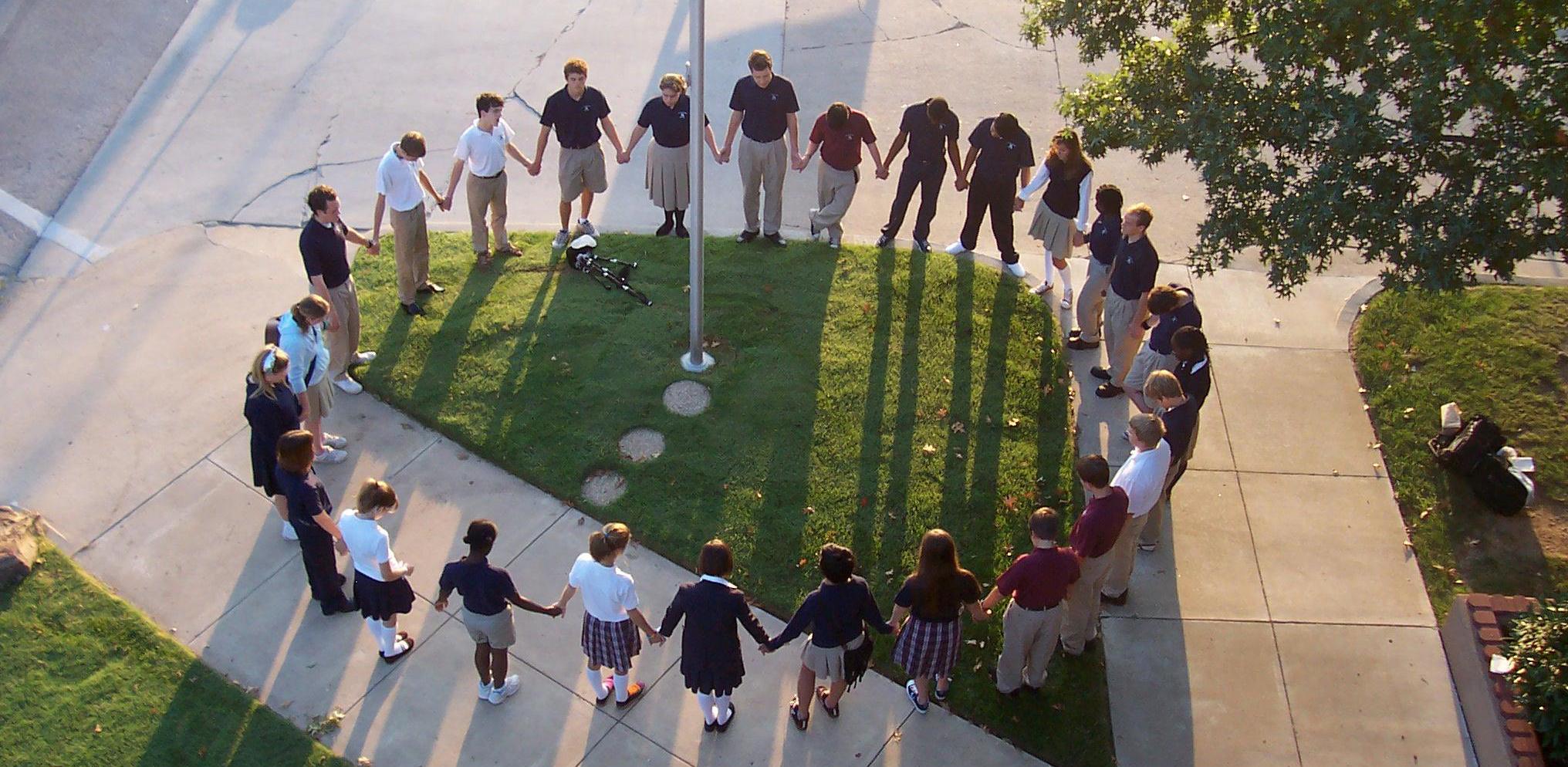
ACA was founded as St. Augustine Academy in 1997 and has been a member of the Association of Classical Christian Schools (ACCS) since 2005. ACA is interdenominational, not affiliated with any particular church or denomination, but holds to a broadly evangelical statement of faith, in accord with the historical creeds of Christianity.
Augustine Christian Academy exists to:
- To assist Christian parents in fulfilling the Biblical mandate to educate their children for the glory of God.
- To train young minds to learn, reason, and persuade from a distinctively Christian perspective.
- To examine the world and all human endeavors in the light of Holy Scripture.
- To provide for the development of all staff members for the purpose of achieving our educational goals.
- To be used of God to reclaim our culture for His Kingdom and Glory.
ACA's open house will be followed at 7 p.m. by the school's "Little Theater," a series of short performances by the show choir and the Intro to Theater, Advanced Acting, and Pre-Professional Acting classes. The main event of the evening will be a one-act play, The Diary of Anne Frank, presented by the Advanced Acting and Pre-Professional Acting students. ACA has a strong performing arts department, founded by the late Gale Post and headed by professional stage veteran Dawn Redden. This 15-minute interview with Mrs. Redden captures the standard of excellence that characterizes ACA academics as well as performances and also the love and Christian faith that ACA teachers bring to the classroom.
All three of our children have been ACA students and have been blessed and challenged by the experience.
There are a number of distinctives that set ACA apart from its peer schools. To name just a few:
A house system brings students across the schools of Dialectic (6-8) and Rhetoric (9-12) into four houses for service opportunities and intramural competition, including ACA's unique sport, Grailball.
Weekly chapel services bring the school together for praise and worship, and monthly "Salt and Light" chapels introduce students to Christians living out their faith in a variety of vocations.
For homeschool families seeking enrichment opportunities, ACA offers part-time status for grades 6-12. A homeschooler can take one or more classes and also participate in the school's theatrical and musical productions, house competitions, and special events alongside full-time students.
ACA's after-care program accommodates the needs of working parents who can't be available for pickup right as the school day ends.
ACA sponsors tours for juniors and seniors in alternating years to the East Coast to visit important places in American history and to Israel to see the places where the events of the Bible happened and the sweep of 4,000 years of successive cultures and empires.
Augustine Christian Academy is enrolling students for the 2023-2024 school year. You can learn about the admissions process, see the student and parent handbook, and look at this year's class schedule on the ACA Admissions page.
ACA is also hiring teachers who want to teach in a classical and Christian environment. Interested applicants are encouraged to send a cover letter and resume to John Ahrens, Headmaster, by April 1, 2023.
 Tulsa Classical Academy, Oklahoma's first classical charter school, will open its doors to students from kindergarten to 8th grade this August for the 2023-2024 school year. TCA will add a grade a year in subsequent school years, becoming a full K-12 school with our first graduating class in 2028. Tulsa Classical Academy is a member school of the Barney Charter Schools Initiative, Hillsdale College's effort to develop public charter schools with a classical curriculum and teaching philosophy.
After a lot of ups and downs, TCA has a piece of land at 98th and Sheridan, has a building under construction, has a head of school (Mr. Jason Poarch), and a temporary office with a couple of staffers. Open enrollment ended in mid-January, followed in February by the state-mandated enrollment lottery, offers of admission, and acceptances. In a few months, the building will be finished and filled with furniture. Now all we need is teachers who share our passion for classical education.
TCA is hiring teachers for K-6 who will teach in self-contained classrooms, specialized teachers in Math & Science, Literature & History, and Latin for grades 7 and 8, and PE, Art, Music, and Special Education teachers for K-8. You can find job descriptions and instructions for applying on the tulsaclassical.org careers page. TCA teachers will participate in a two-week summer training program at Hillsdale College in Michigan and a two-week-long in-service in Tulsa just before the start of the school year.

While nearly all of the student seats have been filled for the coming year, TCA is taking applications on a rolling basis for the waiting list. Visit the TCA enrollment page for detailed information about the process and how to sign up. Information meetings for prospective parents are being held each month.
Last week I received the sad news that Ron Palma, my high school Latin teacher, passed away on Monday, September 19, 2022, at the age of 75. He is survived by Fay, his college sweetheart and wife of 55 years, two daughters, and three grandchildren. His 38-year career at Holland Hall School placed him among the half-dozen longest serving teachers in the school's 100-year history.
Mr. Palma was not my first Latin teacher. I took Latin I in 8th grade, taught by Bill Bippus, who is an Episcopal priest these days, and Ruth Kaiser Nelson filled in for Mr. Bippus during his leave of absence the first semester. Mr. Bippus and Mrs. Nelson were memorable, enjoyable, and excellent teachers and gave me a great foundation in the Latin language. The three years I spent as Mr. Palma's student built in me a love for the language that remains to this day and which I've tried (and succeeded to varying degrees) to pass along to my children. The value I found in Latin learning was part of what led me to find a way to study Latin while a student at MIT, to embrace classical education for my own children and to seek, as a board member of the nascent Tulsa Classical Academy (opening 2023), to make this kind of education available to the wider Tulsa community.
My classmates and I first encountered Ron Palma in Latin II, in 1977, just four years into his 38-year career at Holland Hall School. He was in a doctoral program at the University of Cincinnati, a "Ph.D.A.B.D." (all but dissertation), when he was hired by Holland Hall in 1973. Above, that's his yearbook photo from his very first year of teaching.
Mr. Palma had a hearty and infectious laugh and a great deal of tolerance for the hijinks of high school boys. We called him Magister, merely the Latin word for teacher, but it became a term of endearment long after our time at school. His office during my freshman year was just off of the Barnard Commons (the eastern cluster of offices, first door on the right) and was a favorite hangout. When Mr. Palma's office moved to the mezzanine overlooking the commons, it became a target for excessive decoration, particularly around Christmas time. He was good-natured about the ribbing we gave him for supporting independent candidate John Anderson (10% in the 1980 presidential election).
And we learned Latin and learned to love it. In Latin II we completed our study of grammar; in Latin III we delved into prose and poetry; and in Latin IV we read the first six books of the Aeneid in Latin, following pius Aeneas from the burning ruins of Troy to the palace of Queen Dido of Carthage to the shores of Latium and the future site of Rome. Mr. Palma taught us dactylic hexameter, hendecasyllablic verse, and the rules of vowel quantity and elision, and he had us memorize the first seven lines of the Aeneid (of which I can remember the first two): "Arma virumque cano, Troiae qui primus ab oris Italiam, fato profugus, Laviniaque venit...." One assignment involved writing epigrams, after the fashion of Martial; one of mine began, "O Boren bos bifrons...."
The fact that many students continued Latin into years 3 and 4 is a tribute to Mr. Palma's love of the language, his skill as a teacher, and his connection with students.
In addition to classroom duties, during his early Holland Hall career Mr. Palma also served as coach of the cross-country running team, Chess Club sponsor, and faculty advisor to Hallway, the school newspaper.
Shortly after my time at Holland Hall, Ron Palma was co-author of a very popular series of Latin textbooks, Ecce Romani, which teaches the language through a narrative about a Roman family. The series introduces an increasing number of authentic Roman texts as the student progresses. This review has a description of the Ecce Romani approach to Latin instruction.
In 1991, the College Board honored Mr. Palma for instructional excellence as an Advanced Placement Latin teacher, beginning in 1976. At the time of this Special Recognition Award, he estimated that 150 Holland Hall students had taken the AP Latin exam. (I was foolishly not among them, having opted to take a geology class as a senior that I didn't need for graduation instead of AP Latin.)
Mr. Palma loved travel, particularly to lands once part of the Roman empire, and enjoyed photographing the places he visited. I recall a stunning photo of red-tiled roofs against the caerulean Mediterranean sky which won a Tulsa Tribune photography contest.
After retirement in 2011, Palma spent the next three years writing a comprehensive history of Holland Hall School, in two volumes; Holland Hall: Since 1922 was published in 2016 by Grandin Hood, Nashville. It's a sad coincidence that he died just two days short of the centennial of the school he served, celebrated, and loved. I last saw him in April at the memorial service for his HH colleague, Carlos Tuttle.
A memorial service will be held at a later date. It was Mr. Palma's wish that gifts in his memory be made to the Holland Hall scholarship fund.
Third-year Latin is traditionally Caesar and Cicero. We read some of Caesar's Gallic Wars as well as The Millionaire's Dinner Party (Maurice Balme's adaptation for Latin students of the Cena Trimalchionis by Petronius). But in place of Cicero, Mr. Palma substituted the poetry of Catullus. Catullus was a contemporary of Caesar, a well-to-do young man from the provinces who had come to Rome, who lived fast and died young, around the age of 30. Some of Catullus's famous topics include his envy of the attention paid by his girlfriend to her pet sparrow (2) and his lament on the sparrow's death (3), a dinner invitation in which he asks his guest to bring food and drink, because his cupboard is bare (13), an appeal to his lover for thousands of kisses (5: "Vivamus, mea Lesbia, atque amemus... da mi basia mille"), a tribute to the boat which carried him home from Bithynia (4), and his joy at returning to his home in Sirmio after a long absence (31). Carmen 85 ("Odi et amo," "I hate and I love") captures in two lines the conflicted emotions of the disappointed suitor. There was a youthful vigor and clarity to Catullus's poetry that appeals to teen-aged Latin scholars in a way that the lengthy and allusive periodic sentences of a Ciceronian speech do not. (Be advised that some of Catullus's poetry, which, I hasten to add, we did not study in Mr. Palma's class, was a bit too vigorous and clear.)
Perhaps the most quoted and beloved Catullus poem is Carmen 101, his lament on arriving after a long journey at the grave of his brother, who died far from home. It seems a fitting way to end this tribute.
Multas per gentes et multa per aequora vectus
advenio has miseras, frater, ad inferias,
ut te postremo donarem munere mortis
et mutam nequiquam adloquerer cinerem,
quandoquidem fortuna mihi tete abstulit ipsum,
heu miser indigne frater adempte mihi.
nunc tamen interea haec, prisco quae more parentum
tradita sunt tristi munere ad inferias,
accipe fraterno multum manantia fletu
atque in perpetuum, frater, ave atque vale.Through many nations and through many seas borne,
I come, brother, for these sad funeral rites,
that I may give the last gifts to the dead,
and may vainly speak to your silent ashes, since fortune
has taken yourself away from me.
Ah, poor brother, undeservedly snatched from me.
But now receive these gifts, which have been handed down
in the ancient manner of ancestors, the sad gifts to the grave,
drenched with a brother's tears,
and for ever, brother, hail and farewell.
P.S. I would be happy to augment this entry with tributes from students and other friends of Ron Palma. Please email me at blog at batesline dot com.
P.P.S. P.S. stands for post scriptum, which is your actual Latin for "written after." The translation of Catullus 101 is from the 1894 translation by Leonard C. Smithers.
MORE: I reached out to Gilbert Lawall, professor emeritus of Classics at the University of Massachusetts at Amherst, to ask about Mr. Palma's involvement with Ecce Romani. Prof. Lawall replied:
In addition to being an inspiring and influential teacher of Latin language and literature, Mr. Palma helped Professor Gilbert Lawall of the University of Massachusetts at Amherst revise the Scottish Classics Group's Ecce Romani into an American version. Along with other consultants, Mr. Palma helped Professor Lawall change much of the vocabulary, many pictures, and some of the essays in the Scottish version. Mr. Palma co-authored the 212 page Teacher's Guide for Ecce Romani III with David J. Perry of the Rye Country Day School, Rye, New York.Mr. Palma frequently contributed articles to the Longman Latin Newsletter and to the Ecce Romani Newsletter, which contained lesson plans, teaching tips, exercises, work sheets, and sample quizzes and exams.
Triste dictu, Prof. Lawall advises that he no longer has copies of the print archive of newsletters that he mentions.
The Tulsa Public Schools Board of Education, at a special meeting tomorrow, Thursday, July 14, 2022, at 1 p.m., will consider accepting a grant from a non-profit funded and controlled by the Chinese Communist Party for a Chinese language learning program at Booker T. Washington High School.
Here is the item on the Tulsa school board agenda for July 14, 2022:
C.4. RECOMMENDATION:Enter into an agreement with the Confucius Classroom Coordination Offices through the International Leadership of Texas, a 501(c)(3) organization, an international partnership dedicated to building the field of Chinese language teachers and learning in American schools for the 2022-2023 school year.
FURTHER RECOMMEND:
The attorneys for the school district prepare/approve the appropriate contract document(s) and the proper officers of the Board of Education be authorized to execute the document(s) on behalf of the district.
COST: No cost to the district. The Chinese International Education Foundation will provide funding for operating expenses.
FUND NAME/ACCOUNT:
Confucius Classroom
81-2273-1000-000000-000-07-735RATIONALE:
This will be Booker T. Washington's ninth year to participate in a Confucius Classroom program. International Leadership of Texas, in partnership with Confucius Classroom Coordination Offices offers a quality program which will allow our students to continue the study of the Chinese language and culture. This item aligns with our high school experience strategy as outlined in Pathways to Opportunity.
This was one of 29 items on the "consent agenda" on the regular Monday, July 11, 2022, school board meeting agenda. The consent agenda is meant to be a list of non-controversial items that are approved en masse and without debate but only if there is unanimous consent from the board. Any items that don't enjoy unanimous support should be removed from the consent agenda for consideration under regular order with public comment and debate.
You may have heard of the Confucius Institute, which established centers for study of Chinese language and culture, funded by the Chinese Communist Party, on dozens of American college campuses, including the University of Oklahoma. Confucius Classroom is the K-12 arm of the same initiative: To plant Chinese Communist agents in schools across America to propagandize on behalf of the butchers of Beijing and shape the rising generation's perspective of the totalitarians that crush political dissent in Tienanmen Square and Hong Kong, enslave Uyghur Muslims, persecute Christians and other religions, and unleashed a deadly virus that shut down the world's economy. A bipartisan chorus of critics said that these "free" programs encouraged recipient schools to refrain from addressing Communist China's human rights abuses and discouraged them from welcoming Chinese dissidents to speak on campus. From a May 2021 column by Lee Edwards:
Meanwhile Confucius Institutes, financed by the Chinese government and supervised by the Chinese Communist Party, are molding attitudes about China, painting an idyllic portrait in which Mao Zedong is a revolutionary hero and the Tiananmen Square massacre never happened. That the Confucius Institutes are instruments of propaganda was confirmed by Li Changchun, the head of propaganda for the CCP, who boasted that the Institutes were "an important part of China's overseas propaganda setup."...China's dissemination of what amounts to communist propaganda on American campuses has attracted the attention of U.S. senators and congressmen across the political spectrum. Sen. Robert Menendez (D-NJ) referred to China's "tentacles of influence," such as the Confucius Institutes, the setting up of CCP cells in U.S. businesses, and espionage targeted at high-tech research. Sen. Marco Rubio (R-FL) expressed concern about the Chinese government's aggressive attempts to use Confucius Institutes to influence critical analysis of "China's past history and present policies."
A bipartisan group of Senators ranging from Elizabeth Warren (D-MA) to Ted Cruz (R-TX) called out "those that seek to suppress information and undermine democratic institutions and internationally accepted human rights." Sens. Rob Portman (R-OH) and Tom Carper (D-DE) asserted that absent full transparency of operations in the U.S. and full reciprocity for U.S. college in China, "Confucius Institutes should not continue in the United States."
U.S. intelligence agencies joined the chorus of concern, led by FBI Director Christopher Wray, who revealed that the Bureau was monitoring the activities of the institutes closely. As of this April, there were 47 Confucius Institutes in the U.S., down from a high of just over 100, led by Columbia, Stanford, UCLA, Rutgers, and George Washington University. There were also Confucius Classrooms in seven K-12 school districts. Many of the CI closures occurred in 2018 when Congress passed legislation forbidding schools with Confucius Institutes from receiving language funding from the Defense Department. Almost immediately, 22 schools closed their Confucius Institutes.
The University of Chicago shut down its institute after 100 professors signed a petition citing the "dubious practice of allowing an external institution to staff academic courses within the University." A University of Chicago professor called the Confucius Institutes "academic malware" injected into the university system. In response, Hanban attempted American-style rebranding, changing its name from Hanban to the Ministry of Education Center for Language Exchange and Cooperation. It created a separate organization--the Chinese International Education Foundation--which will fund and oversee Confucius Institutes.
But the raison d'etre remained the same--to present a carefully sanitized story of a powerful aggressive China. The 90 million members of the CCP are dedicated practitioners of Marxist-Leninist-Maoist-Xi thought as set forth in a recent document of the CCP's Central Committee. It warns officials across the country, including those who manage the Confucius Institutes, to be fully alert to the threat of certain Western ideas, known as the "Seven Don't Speaks": universal ideas; freedom of speech; civil society; civil rights; historical errors of the CCP; official bourgeoise universal ideas; and judicial independence.
As of June 2022, only 18 Confucius Institutes remain on American college campuses, but others have reopened under new names. According to a June 2022 report by the National Association of Scholars (NAS), the University of Oklahoma closed their Confucius Institute in October 2020, but "Maintained relationship with Beijing Normal University, having in 2006 signed agreement with BNU that established not only the CI, but also a number of other partnerships that survive the CI. The university also continues to publish Chinese Literature Today, a journal that originated in a 2016 agreement the university signed with Hanban and Beijing Normal University."
Confucius Classroom programs are not as high-profile as their higher-ed counterparts. According to the CIEF website, "As of the end of 2019, there were 550 Confucius Institutes and 1,172 Confucius Classrooms in 162 countries and regions." 560 Confucius Classrooms were in North America. A press release reported the May 2022 opening of the first Confucius Classroom in Dominica, a small Caribbean island nation.
The University of Oklahoma had a Confucius Institute on campus starting in 2006. In addition to its work at the university level, the OU Confucius Institute provided "teaching materials, funding to support teaching staff, and tools for Chinese language and culture programs" in K-12 schools around the state, including in the Oklahoma City, Tulsa, Edmond, Norman, Putnam City, Enid, Jenks, Bixby, Union, Owasso, Muskogee, Fort Gibson, Crescent, Lawton, and Comanche school districts.Many K-12 schools still have Confucius Classrooms--effectively K-12 versions of Confucius Institutes--embedded in those districts, but Peterson said it is not known how many K-12 schools are doing so.
"Nobody has a list of Confucius Classrooms in the country," Peterson said. "We don't know how many there are or where they are."
Mentioned in the agenda item, International Leadership of Texas (ILTexas) is a network of 22 charter schools located in and around Dallas, Fort Worth, Houston, and College Station. ILTexas Facebook pages touted the 2021 "Chinese Bridge" Chinese Proficiency Competition sponsored by the Confucius Classroom Coordination Office (CCCO); the event poster encourages students to use the Chinese Communist surveillance app WeChat to contact Confucius Classroom director Helen He.
A February 2022 news release about a Lunar New Year celebration describes the connection between ILTexas and CCCO:
ILTexas rang in the Lunar New Year with a big virtual celebration on Saturday, February 12, as part of their partnership with the Confucius Classroom Coordination Office (CCCO), an organization that helps promote Chinese culture and language in K-12 education. The event featured performances from 19 Dallas-Fort Worth area schools including nine from ILTexas.According to Helen He, director of the Confucius Classroom at ILTexas Global, the CCCO, "serves to provide resources to Confucius Classrooms for Chinese language teaching, offer professional development opportunities to Chinese teachers, organize cultural events and competitions, and more." The organization supports 17 Confucius Classrooms in the DFW area, six of which are in ILTexas.
On May 31, 2022, the Chinese Communist ambassador to the United States, Qin Gang, visited ILTexas Garland High School. In his speech, Gang said, "Language learning is critical and fundamental to the mutual understanding and the trust between our two countries. We will do our best to support Chinese language education in America." Gang presented a certificate recognizing ILTexas founder Eddie Conger for his "great contribution and accomplishment to the Chinese learning and teaching in Texas." The event received enthusiastic coverage in Communist Chinese-controlled media outlets, including Xinhua news agency and China Daily's YouTube channel.
According to the TPS agenda item, Confucius Classroom has been in Tulsa Public Schools for the last eight years. The rubber-stamp board members apparently thought it was uncontroversial to allow a program in our schools funded by a hostile Communist government, uncontroversial enough to include on a "consent agenda." Now that there are three board members (Jennettie Marshall, E'lena Ashley, Jerry Griffin) who are not rubber stamps for the superintendent and the foundations, they have objected to the placement of controversial items on the consent agenda. Rubber-stampers John Croisant and Susan Lamkin moved and seconded approval of the July 11 consent agenda, but in the absence of fellow rubber-stamp Judith Barba-Perez, they did not have the majority needed for approval. You can watch the discussion of the consent agenda, which begins about 15 minutes into the July 11, 2022, Tulsa school board meeting video. The vote happens at about 1 hr, 3 minutes, into the video. Croisant, Lamkin, and chairman Stacey Woolley voted yes on all items; Marshall and Ashley voted no on all. Griffin voted for a subset of the items; those he supported passed by a 4-2 vote, those he opposed fell short by a 3-3 vote.
Communist propaganda poster from the Flickr account of James Vaughan; used under Creative Commons license
UPDATE: Newly elected conservative school board member E'Lena Ashley raised concern about the source of the money, Gist gave a non-answer, and the final vote was 6-1 to accept Red China's blood money, with only E'Lena Ashley voting against. You can watch the full July 14, 2022, Tulsa school board meeting here.
MORE: In March 2021, Dan Currell and Mick Zais, who both served in the U. S. Department of Education in the Trump Administration, wrote a column for Newsweek addressing the problems with Confucius Classrooms:
China's authoritarian government works hard to dampen any criticism of the CCP, and reaching children with colorful, positive messages about China is a well-worn propaganda tactic. Preventing criticism and promoting praise for China is especially important to the CCP right now in light of its violent, anti-democratic actions in Hong Kong, intensified ethnic repression in Tibet, militarization of the South China Sea and actions in Xinjiang that the Canadian Parliament recently voted unanimously to declare a genocide....First and most obviously, the programs lack reciprocity. The CCP does not allow other countries, and certainly not free democracies, to establish anything like Confucius Classrooms in China. The asymmetry is telling: the CCP jealously guards the thoughts of Chinese children. As it turns out, they care what American kids think, too.
A primary goal of the Confucius Classrooms program is to normalize the CCP. It does this by creating positive feelings about China and then equating China with the CCP. It's an effective tactic. China is an amazing place, so encouraging children's positive feelings about it is pretty easy to do, and never distinguishing between party and country is a core dogma for the CCP. Those positive feelings should rub off on the party--at least enough to dampen the worst criticisms.
But there are still many critics of China. Confucius Classrooms are intended to silence or, at least, distract from them. Teachers are trained to steer classroom discussions away from an ever-expanding list of issues: Taiwan, Tibet, Tiananmen Square, Hong Kong, Xinjiang, Inner Mongolia, the South China Sea and more. The problem isn't what is being said in Confucius lessons; the problem is what is not being said. Especially in U.S. high schools, this silence accomplishes important "thought work" for the CCP.
Beijing's most effective critics are Chinese dissidents, many of whom have settled in other countries to get away from the CCP. When the party plants its flag in a U.S. school, most Americans likely see it as an exotic international artifact. To a Chinese dissident, however, it is a message: do not criticize the party. Recent protests at Tufts University--which,
to its credit, closed its Confucius Institute last week--express exactly this concern.
The authors encourage Chinese language and culture programs, but independent of the CCP. Thanks to Neil Mavis for alerting me to this article.
This morning I spoke to the weekly meeting of City Elders about the recent school board elections, the Democratic candidates who won despite higher Republican turnout, and the connections of the donors who made their campaigns possible. Here are some links to further reading on the ideas and people I mentioned in my talk, plus some related information worth your time.
Elsewhere:
- The Kaiser System, by Michael Mason: If you read nothing else, read this. Mason approaches the topic with empathy and care as he exposes the groupthink, fear, and divisiveness created as a small group of people use immense wealth as leverage to control our community's civic direction.
- Election results from the April 5, 2022, school elections
- Tulsa Public Schools academic achievement indicator (school report card) from the Oklahoma State Department of Education. I showed the data from 2018-2019, pre-pandemic.
- Tulsa Public Schools: Oklahoma State Testing Report, October 2018. Shows significant decline in proficiency from 2017 to 2018 results.
- Controversial Owasso teacher 'is no longer in the classroom'
- George Krumme OpenSecrets.org donor report
- Burt Holmes OpenSecrets.org donor report
- George Kaiser OpenSecrets.org donor report
- Stacy Schusterman OpenSecrets.org donor report
- George Kaiser's Giving Pledge
- Lynn Schusterman's Giving Pledge
- George Kaiser 2005 Chicago speech on early childhood education
- GKFF Board of Directors
- Schusterman Family Philanthropies statement on "gender and reproductive equity"
At BatesLine:
- Tulsa's Yacht-Guest Subculture: The sycophants who keep the billionaires' boats afloat
- The Anthropomorphization of the GOP: Why it's a mistake to think of the Republican Party as having volition and direction. As Rand Paul has said, "The Republican Party is an empty vessel unless we embue it with values.
- Chambers of Horrors: If you're a conservative, the Chamber of Commerce is not your friend
- "Down with the gummint!" Tulsa's bullies and their willing toadies
- Clueless SOTs and their enablers: Tulsa's insiders refuse to criticize the bad ideas of their peers
- "Any society has to privilege some ethical viewpoint": Why conservatives shouldn't be shy about working to recapture the culture for the worldview and values that built a peaceful and prosperous civilzation
- 2022 Tulsa School Board campaign contributions: Keller, Lamkin backed by leftist establishment donors
- 2022 Union School Board campaign contributions: Democrat donors back McNeil
- The Usual Suspects: Tulsa Economic Recovery Advisory Committee
- Even billionaires deserve scrutiny and skepticism from the media
- Introducing the Tulsa Complacent Council
- Tulsa Election 2011: Pre-general ethics filings; Kaiser, Schusterman lead funders of "Working Tulsans"
- George Kaiser, GKFF, and Solyndra
- Council-suer, SOT member announce picks for City Council (UPDATED)
- Who convinced Tom Coburn to back the bank bailout?
- Great Plains Airlines article archive
- The Build PAC Boys: Post-election City Council contribution reports
Here's the recording of my City Elders talk. There is a bit missing from when the memory card filled up and had to be switched, about the time I was talking about the disappearance of local talk radio, which was a crucial element of media bypass and the modest success we had electing grassroots outsiders to city office in the decade of the 2000s.
Published April 3, 2022, postdated to remain at the top of the page until the polls close on Tuesday, April 5, 2022.
Tuesday, April 5, 2022, is general election day for K-12 school board seats in Oklahoma. Polls are open from 7 a.m. to 7 p.m. Seats on technology center boards (what we used to call vocational-technical, or vo-tech, schools) are also on the ballot. Some cities (Sand Springs and Sapulpa among them) have city council runoffs, and there are some municipal and school district propositions up for a vote as well. The Oklahoma State Election Board's online voter tool will let you know where to vote and will show you a sample of the ballot you'll see. Not everyone will have a reason to go to the polls, but the Tulsa Tech district covers a large area , so double-check, just to be sure.
As of a recent change to election law (HB 2082 in 2018), any contested school board seat will be settled on the first Tuesday in April, except that an election with three or more candidates can be won outright in the February primary if a candidate receives more than 50% of the vote. This happened this year in Broken Arrow Office No. 2: Conservative candidate Debbie Taylor received 51% of the vote in a three-way race for an open seat. While this was a happy result, because a smaller electorate turns out for a primary than for the general, it would be good to change the law so that every contested race has a two-candidate election on the April general election date. Some voters prefer not to turn up to vote until more informed voters have narrowed the choices for them.
While school elections in Oklahoma appear without party labels on the ballot, political parties and partisan political figures are free to support and endorse candidates. But schools have drifted from their original purpose of educating students according to their own community's values and priorities. Leftist ideologues have successfully gained a foothold through school boards and college-level schools of education to use public schools as part of a strategy of cultural transformation, the Gramscian "Long March through the Institutions." Pedagogy based on Critical Race Theory and Queer Theory (even if it doesn't use those names) has found its way even into rural public schools, as teachers and administrators come under the influence of organizations like leftist national teacher's unions and their state affiliates (the Oklahoma Education Association).
A second dimension driving the politicization of school elections centers on accountability: School boards are too often filled with rubber stamps who blindly approve whatever the superintendent puts in front of them. The result is administrative bloat, feather-bedding, insider deals, and, worst of all, educational failure. Taxpayer money doesn't find its way into the classroom to serve the needs of students. In the Tulsa Public Schools, this situation is exacerbated by the board and administration's entanglement with foundations which use their "grants" as chains to drag the district in the foundations' desired ideological direction. Parents, students, and taxpayers need board members who will operate the district in accordance with their needs, values, and priorities, rather than turning over these public institutions to the whims of private philanthropists.
State proficiency tests show Tulsa Public Schools performance lagging well behind the rest of the state in every subject at every grade level, by anywhere from 8 to 21 percentage points. 10% of TPS 7th graders were proficient in math, the district's best grade-level math score, but only 3% of TPS 8th graders were. Meanwhile, the majority on the TPS board keep voting early contract extensions for Superintendent Deborah "Cruella" Gist so that board members newly elected by the voters will not have the option of replacing here. This level of failure cannot be fixed by more funds; regime change is essential. At the moment, TPS has two board members who are not rubber stamps -- Jeannettie Marshall and Jerry Griffin. Electing E'Lena Ashley and Tim Harris would result in a majority of the 7 TPS board members committed to accountability.
The third political dimension affecting schools is the response to the COVID-19 pandemic. On the one hand, you have parents and taxpayers who supported prudent precautions when the pandemic was new and its severity was unknown. The early response was driven by the since-disproven fear that the virus could be spread easily by people who showed no symptoms of illness. Now that the virus has become endemic, now that early variants have been supplanted by more infectious but far less severe variants, now that we know that children are at low risk of acquiring or transmitting the virus, now that we see the educational, developmental, and emotional damage that schoolchildren have suffered from mandatory mask-wearing and school closures, parents and taxpayers want to see schools back to their pre-pandemic practices, with in-person instruction, student athletics, music, and activities as before, and no mask or vaccine mandates.
The Democrat Party (but by no means all Democratic voters) has aligned itself with the agendas of cultural transformation, unaccountable insider dealing, irrational risk-aversion, and authoritarian health mandates. Although voters across the political spectrum oppose the Democrat Party's positions on these issues, the Republican Party and conservative organizations have emerged as a resource for Oklahomans of all political affiliations who wish to take the schools back from the Leftist ideologues and grifters and to restore the original purpose of the schools -- to teach children the knowledge and skills they need to be independent, free Americans, participating knowledgeably as in free citizens in a free republic, living effectively as free economic agents in a free market, and exercising personal freedom as they weigh risks and benefits.
Independent advocacy groups like Tulsa Parents Voice and Oklahomans for Health and Parental Rights and local Republican organizations are making endorsements and rallying volunteer support for candidates who will work for accountability, parental involvement, and parental rights.

Here in the Tulsa metro area, pro-parent and pro-accountability forces are supporting the following school board candidates. Footnotes indicate which groups have endorsed each. Links are to each candidate's primary web presence.
Tulsa Public Schools, Office No. 4: E'Lena Ashley 1 2 3
Tulsa Public Schools, Office No. 7: Tim Harris 1 2 3
Jenks Public Schools, Office No. 2: Ashley Cross 1 2 3
Sand Springs Public Schools, Office No. 2: MaRanda Trimble-Kerley 1 2 3
Union Public Schools, Office No. 2: Shelley Gwartney 1 2 3
Tulsa Technology District, Office No. 3: Mark Griffin 2 3
Owasso Public Schools, Office No. 2: Joshua Stanton 1
Bixby Public Schools, Office No. 2: Jake Rowland
Bartlesville Public Schools, Office No. 2: Jonathan Bolding 1 2
Olive Public Schools, Office No. 2: Lori Bates 1
1 Endorsed by Oklahomans for Health and Parental Rights
2 Supported by Tulsa Parents Voice
3 Supported by Tulsa County Republican Party
All of the above candidates are registered Republican voters. All of the K-12 board candidates listed received an "A" survey rating and an endorsement from Oklahomans for Health and Parental Rights, except for Bixby candidate Jake Rowland, who was given a "B" grade for his survey responses, and OKHPR did not make an endorsement in that race, nor has OKHPR weighed in on the Tulsa Tech board race. Note that since Bartlesville and Olive are in other counties, the Tulsa County GOP would not be involved in those races. While Bixby Parents Voice has not endorsed Rowland, they have expressed alarm at incumbent candidate Amanda Stephens's vote to keep sexually explicit books in the high school library.
MORE:
May 17, 2021 TPS board meeting: Starting about 19:30, TPS Board Member Jeannettie Marshall protests the payment of a check to the Tulsa Community Foundation for a contract made with a non-existent organization called "The Opportunity Project" and the fact that two TCF-affiliated board members (Schrieber and Barba Perez) voted on the matter without recusing themselves. Only Marshall and Griffin expressed concern about the lack of transparency; Office 4 incumbent Shawna Keller remained silent and voted to write a check to an organization which had not been awarded a contract. The board rubber stamps tried to slide this through on the "consent agenda." (Note that IT Director Joe Jennings and Chief Equity Officer Devin Fletcher have "their pronouns" listed on their Zoom IDs.)
Tulsa Classroom Teachers Association TPS District 4 candidate forum: Note that incumbent Shawna Keller (D) is still wearing a mask; challenger E'Lena Ashley (R) is not.
Tulsa Classroom Teachers Association TPS District 7 candidate forum: Tim Harris voices his priorities for parent involvement, teaching basic skills (a task which TPS is failing to perform), a forensic, line-by-line audit of TPS finances, and protecting children from inappropriate classroom content.
TYPROS TPS District 7 candidate forum: Former District Attorney Tim Harris (R) is running against Susan Lamkin (D). Lamkin is backed by the same donors and leaders who back the other rubber stamps on the board. Harris's experience managing the personnel, mission, and budget of a large government department -- the Tulsa County District Attorney's office -- will be a great asset to the board, as he will know from experience where to look for wasted money and mission creep.
Tulsa Tech Candidate Forum: Mark Griffin, the incumbent Republican, is being challenged by Democrat Jim Provenzano, husband of leftist Democrat State Rep. Melissa Provenzano.
Union Public Schools candidate forum: Incumbent Chris McNeil (D) vs. challenger and PTA leader Shelley Gwartney (R).
Campaign contribution reports show that the two registered Democrats running for Tulsa school board, District 4 incumbent Shawna Keller and Susan Lamkin, running for the open District 7 seat, are heavily backed by Tulsa's leftist establishment -- the band of philanthropists, politicians, and their hangers-on who hate Oklahoma's conservative values and seek to use their financial power to make Oklahoma "progressive."
Here are the complete campaign reports for the two candidates, as provided in response to an Open Records Act request to the Tulsa Public School district clerk. These PDFs have been run through OCR and renamed for improved search results.
Shawna Keller, Tulsa Public Schools District 4, 2022 campaign contribution and ethics reports
Susan Lamkin, Tulsa Public Schools District 7, 2022 campaign contribution and ethics reports
As of the March 21, 2022, pre-election reporting period deadline, Keller, running for re-election, had raised $14,130.20 in cash contributions, but had only spent $2,125.42 at that point, two weeks before election day. Lamkin, running in an open seat against a well-known opponent, had raised $35,805.00 and spent $16,523.28.
Familiar names connected with Democrat Party politics and influential local philanthropies appear on both candidates' donor lists. Many of the same names were donors to the effort to unseat Pastor Jennettie Marshall in her 2021 race for re-election to the school board. (But she persisted.) In general, these campaign donors have opposed grassroots candidates and supported current members of the rubber-stamp school board, which is failing to educate Tulsa children effectively.
Stacy Schusterman ($1,000 to Keller, $1,500 to Lamkin): Chairman of Samson Energy and Schusterman Family Philanthropies, whose agenda includes "gender and reproductive equity:
We support our partners in building an equitable world in which all women-including Black women, women of color, indigenous women, cisgender and transgender women-and non-binary people have access to reproductive health knowledge and care, to greater political and economic power and leadership, and to safety in all aspects of their lives.
George Krumme (max donations of $2,900 each to Keller and Lamkin): Retired head of Krumme Oil and major donor to Democratic candidates and causes.
Kathy Taylor ($2,000 to Keller, $500 to Lamkin): Democrat former mayor of Tulsa.
Philip Kaiser ($250 each to Keller and Lamkin): Son of George Kaiser, member of the George Kaiser Family Foundation (GKFF) board of directors, owner of Laffa restaurant and defunct Cosmo Cafe.
Nancy McDonald ($100 to Keller, $500 to Lamkin): Founder of Tulsa chapter of Parents and Friends of Lesbians and Gays.
Tim Gilpin ($250 to Keller, $750 to Lamkin): Former Tulsa County Democrat Party chairman, Democrat nominee for Congress in 2018.
James Frasier and Sally Frasier ($200 combined to Keller, $300 combined to Lamkin): Husband and wife influential in national, state, and local Democrat Party politics. Jim Frasier has served as a member of the Democratic National Committee and as a superdelegate to the Democratic National Convention. Sally Frasier has been honored as Democratic Woman of the Year and has served on the board of the local Planned Parenthood chapter.
Dennis Neill ($125 to Keller, $75 to Lamkin): Gay rights activist, Namesake of the Dennis R. Neill "Equality" Center, and connected with the Schusterman family as an executive at Samson and the Schusterman foundation.
Cynthia (Cindy) Decker ($100 to Keller, $150 to Lamkin): Former TPS board member and Executive Director of Tulsa Educare, a major initiative of GKFF.
Annie Van Hanken ($100 to Keller, $250 to Lamkin): Program Officer, GKFF, "oversees GKFF's early childhood education and common education initiatives."
Heart of the Party ($100 each to Keller and Lamkin): "As the 1st Congressional District chapter of the Oklahoma Federation of Democratic Women we promotes [sic] progressive political activism and the election of Democrats through local, statewide and federal elections."
Kara Gae Neal ($100 each to Keller and Lamkin): Former Tulsa County Superintendent of Schools (as Kara Gae Wilson), wife of former Tulsa World editorial hack Ken Neal.
While departing TPS Office No. 7 board member Suzanne Schreiber has not personally contributed to any campaigns, her husband, Tony Rittenberry, gave $1,250 to Lamkin, and her sister Sara Schreiber, executive director of America Votes (which calls itself the "coordination hub of the progressive community"), gave $250 to Lamkin. Her father, New Mexico rancher and anti-natural-gas activist Don Schreiber, gave $100 to Lamkin; his wife, Jane Schreiber, gave $200 to Keller. Schreiber is running as a Democrat for the House District 70 seat being vacated by Carol Bush. (Schreiber's mother is Democratic former New Mexico Lt. Gov. Diane Denish; Suzanne Schreiber worked on her mother's unsuccessful 2010 campaign for governor. Both of Suzanne Schreiber's parents signed a 2021 letter urging the University of New Mexico to divest from fossil-fuel energy investments.)
Other notable donors to Susan Lamkin's campaign:
Attorney Fred Dorwart, $2,000: The Frederic Dorwart Law Firm provides legal services to the network that Michael Mason has labeled "the Kaiser System."
Steve Mitchell, $1000: CEO of Argonaut, George Kaiser's private equity firm.
Ken Levit, GKFF executive director, $250. (Oddly, Levit is listed merely as "attorney" with no mention of his employer.)
Burt Holmes, $2,900: Maximum donor to Barack Obama, Great Plains Airlines board member, and litigant against city councilors who dared to represent their constituents. Holmes was at the forefront of "Save Our Tulsa", a partially successful effort to change the city charter. He sought to add three at-large members to the city council, to move city elections to Federal election dates, and to make city elections non-partisan, all of which give the advantage to the best funded campaign and make it harder for grassroots-supported candidates to win and have influence at city all. He also spearheaded a 2011 effort to replace independent-minded city councilors with rubber stamps.
 Two Tuesdays from now, February 8, 2022, will be the first round of school board elections in Oklahoma for those races with at least three candidates. (Races with only two competitors will happen on April 5, along with any runoffs from the February 8 election. The Tulsa Public Schools Office No. 4 race between incumbent Democrat Shawna Keller and Republican challenger E'Lena Ashley will be on the April 5 ballot.)
On February 8 in the Tulsa metro area, there will be school board elections in Broken Arrow, Catoosa, Union; school bond issues in Bixby and Jenks; two city council seats in Sand Springs and one in Sapulpa; a PSO franchise renewal vote in the City of Tulsa; and city propositions in Bixby, Coweta, and Sapulpa.
This past two pandemic years, a growing number of parents and citizens have become aware of how bureaucrats and unions have taken control of our public schools and appear to be running them for their own convenience and in support of their own ideologies of social transformation. School board members are too often rubber stamps for administrators, when they should be holding the administration accountable to run a school district in accordance with the community's values and priorities. Tulsa's school board majority has been quick to insulate the superintendent from any consequences of her mismanagement by extending her contract beyond the reach of newly elected board members.
Groups like Parent Voice Oklahoma and their Tulsa chapter are organizing to elect better board members. It's all well and good for the legislature to ban indoctrination in accord with Critical Race Theory/Intersectionality and to ban mask mandates in schools (most countries didn't impose masks on school children), but we need good school board members to ensure that district administrators not only comply but cooperate with these democratic expressions of community values. If every district had a majority of good school board members who reflect community values, we might not need state laws to keep the public school administrators from going off the rails.
This year voters in the Tulsa school district could reclaim community control over our schools. In 2020, District 6 voters unseated a 24-year seat-warmer and elected Dr. Jerry Griffin, an experienced educator who is not shy about asking challenging questions politely and proposing ideas for improvement. In 2021, Pastor Jeannettie Marshall was re-elected in District 3, despite the massive funding advantage enjoyed by her opponent, who was backed by donors connected with the foundations that exert considerable control over TPS. Marshall had been a lone voice on the school board, the only member willing to vote against the 2020 scheme to extend controversial and unsuccessful Superintendent Deborah Gist's contract before newly elected board members could have a say in the matter. Two more seats could cinch a majority of board members committed to accountability and genuine educational excellence.
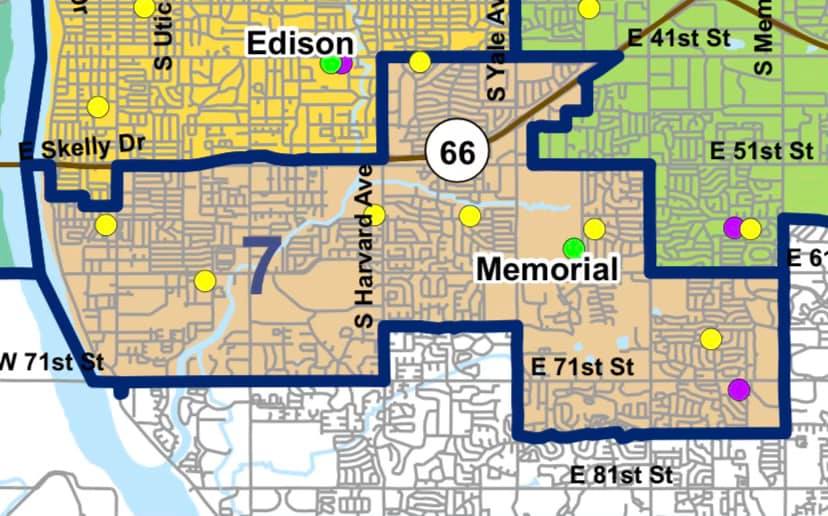
Longtime Tulsa County District Attorney Tim Harris is running for the open seat in Tulsa School Board Office No. 7, currently held by Suzanne Schrieber. Harris served 16 years as District Attorney for Tulsa County, retiring at the end of his term in 2014. Harris then taught constitutional law and criminal procedure at ORU for five semesters. After finishing first in the 2018 Republican primary to replace Congressman Jim Bridenstine, Harris fell short in an expensive runoff race with Kevin Hern.
In 2017, Harris served as chairman of the Tulsa County Sheriff's Foundation, raising money for body cameras for patrol deputies. Sheriff Vic Regalado hired Harris in 2019 as general counsel for the Tulsa County Sheriff's Office, where his responsibilities include civil rights and compliance issues at the county jail, covering issues as wide-ranging as keeping rival gangs separate, religious requirements for food and clergy, and access to health care, education, and a law library.
Harris was an advocate for children throughout his career in the District Attorney's office. As First Assistant DA under David Moss, Harris was part of a three-man team that developed a better way to care for children who came into contact with the criminal justice system as victims or witnesses. During Bill LaFortune's time as DA, Harris created a dedicated prosecution team for crimes against children with specialists in every courtroom, with Harris serving as the first Director of the Crimes Against Children Division.
Tim and his wife Tiari met as students at ORU and have been married for 37 years. They have two adult children and, as of a couple of months ago, a grandchild.
Harris had been praying about an opportunity to return to public service in some form or fashion, and on the second day of the filing period he heard a news report on the radio about an open seat on the TPS. After learning that it was for the district where he lives, he consulted with his wife, looked up the filing requirements, and put his name in.
As he delves into the details of curriculum and operations at TPS, Harris sees that this conservative city in the heart of the Bible Belt is being hit by the same wave of corrosive ideology, educational fads, and mismanagement that is sweeping over the rest of the nation. Curricula shaped by critical race theory and Marxist economics are taking the place of the skills and knowledge Tulsa students need to succeed. Harris told me about curriculum aimed at K-12 students that decries "environmental racism" and the "oppressive nature of standard English."
Meanwhile in many classrooms, teachers are reduced to proctoring students as they do lessons on screens. The result: 60% of 4th graders not reading at a 4th grade level. In 2019, state assessments showed that only 18% of TPS students were "proficient" or "advanced." And yet we have a highly paid superintendent that continues to be granted contract extensions by a weak, pliable school board. During his time in the DA's office, Tim Harris noticed that many of the criminals who came through Tulsa's courtrooms had passed through Tulsa Public Schools without being educated beyond an elementary level. While a lack of knowledge doesn't excuse crime, it makes it much more difficult to obtain honest employment, and a school system that fails to teach self-control along with basic knowledge further damages its graduates' chances to succeed.
As a prosecutor who has seen the tragic results of failed public schools, as a long-time volunteer serving young people, as an administrator with responsibility over a complex organization, and as a devout Christian husband, father, and grandfather, Tim Harris has the values and experience we need on the Tulsa school board. I urge you to vote for him on Tuesday, February 8, 2022, and to volunteer your time to help get him elected.
This is a reworking of a post from two years ago, but it has been updated with current information about open seats and candidates, and there is some new information below.
END OF FILING UPDATE, 2021/12/08: 5 of the 17 seats in Tulsa County had only one candidate (Berryhill, Collinsville, Glenpool, Liberty, Sperry), and one seat (Keystone) had no candidates file. The two Tulsa Public Schools seats drew two and four candidates, respectively. Former District Attorney Tim Harris and three other candidates will run for the open Office No. 7 seat being vacated by Suzanne Schreiber, and E'Lena Ashley will challenge incumbent Shawna Keller for Office No. 4.
In city races, two council seats and the mayor's office in Collinsville each drew only one candidate; likewise a single Owasso council seat drew a single candidate. Sand Springs Office No. 1 drew 3 candidates, and Office No. 2 drew 2.
We are in the midst of the annual filing period for public school board positions in Oklahoma, which ends Wednesday, December 8, 2021, at 5 p.m. Most K-12 school districts will have a single seat, Office No. 2, up for election to a five-year term. Dependent districts (Keystone is the only one in Tulsa County) have three seats that rotate through three-year terms. Skiatook, in far-north Tulsa County, also has Office No. 5 on the ballot. Tulsa Tech has Office No. 3 up for election, and the incumbent has drawn a challenger.
After two days of filing in Tulsa County, out of 17 seats up for election, 11 seats have drawn one candidate, only 5 have drawn two or more candidates. No one has filed in Keystone school district.
Filing is also open for a number of municipalities; candidates have filed for city office in Collinsville, Owasso, and Sand Springs.
(Here is the current list of candidates for Tulsa County school board seats. And here's where you'll find maps showing school district and election district boundaries.)
School board filing always comes at a busy and distracted time of year. As I've written before, it's almost as if school board elections were deliberately scheduled to escape the notice of potential candidates and voters.
The school board primary election will be held on February 8, 2022, for those seats where there are three or more candidates. If no one wins a majority of the vote in the February election, a runoff will be held on April 5, 2022. If a seat draws only two candidates, the election will be held on April 5, 2022.
The Tulsa district, largest in the state, has two out of seven seats up for election to a four-year term, Offices No. 4 and 7.
Tulsa Election District 4 is the east portion of the Tulsa school district, roughly south of Admiral and east of 89th East Ave. The current member for District 4 is Shawna Keller, a Democrat. She has filed for re-election and has not yet drawn an opponent.
Tulsa Election District 7 is the southern edge of the Tulsa school district, east of the river and south of 51st Street, plus the Patrick Henry neighborhood between 41st, Harvard, Yale, and I-44. Suzanne Schreiber, an employee of the George Kaiser Family Foundation, is the incumbent and is registered as a Democrat, but she has not yet filed for re-election. Susan Bryant Lamkin, an independent, has filed for the seat.
If you're a conservative, you should give serious thought to running for school board, even if you have no school-aged children, even if you have children that are homeschooled or in private school, even if you've never had a child in the public schools. The public school system exists to serve all citizens by educating the children of the community, so every citizen has an interest in the curriculum being used, the way discipline is handled, the condition of the school buildings, and the credentials, skills, and philosophical presuppositions of the teachers, principals, and administrators. Property owners support the school system through ad valorem taxes, and so they have a reasonable interest in the proper and efficient expenditure of those funds. So do all citizens who pay state income and sales taxes, which provide funds to supplement local property taxes.
If you are, like me, a homeschool or private school parent, you will have experience and valuable insights with successful, classical alternatives to the faddish and failing teaching methods, priorities, and content currently in use in the public schools.
The pandemic period has been an apocalypse -- an unveiling -- with remote learning and work-from-home giving parents a clear picture of how little their children are being taught, and how corrosive to society and civilization are the ideas that are being taught in our public schools. Parents began to ask pointed questions at school board meetings across the country, most notably in Loudoun County, Virginia, where parents launched a recall effort against board members. The National School Boards Association wrote Democrat U. S. Attorney General Merrick Garland a letter comparing protesting parents to "domestic terrorists" and asking for the Justice Department to invoke the Patriot Act, and Garland echoed the NSBA's language in a memo directing the FBI to investigate protesting parents, triggering a nationwide outcry and leading 17 state school board associations to cancel their membership in the NSBA.
Here in Oklahoma, Reclaim Oklahoma Parental Empowerment and Parent Voice Oklahoma, with local chapters like Parent Voice Tulsa, are among the groups supporting parents and taxpayers as they seek to reassert civilian control over our taxpayer-funded schools. Although school board ballots don't list party affiliations, the Tulsa County Republican Party is ready to help school board candidates who are registered Republican and who seek to bring conservative principles to public education.
Tulsa Public Schools daily attendance is plummeting. In the 2015-2016 school year, Tulsa ADA was 36,415.56. In 2020-2021, it was 26735.36. Even before COVID, TPS was losing students: ADA was 33,043.90 in 2018-2019, a 10% drop in three years. By comparison, Jenks ADA was 10,787.50 in 2015-2016. 11,768.39 in 2018-2019, and 11495.86 in 2020-2021. (Average Daily Attendance and Average Daily Membership data by district can be downloaded at the State Department of Education website.)
It seems that a substantial number of families move from the Tulsa district to the suburbs when their children reach kindergarten, or, if they stay, many opt for homeschooling or private schools. Those numbers make a strong case for new leaders in the Tulsa district. And if the school board is going to be strictly representative, at least two of the seven members should have children in homeschool or private school, and a majority should be conservative.
Filing is simple: A notarized declaration of candidacy, and a signed copy of the statutory requirements for school board candidates. For this office there is no filing fee. You can view the Oklahoma school board filing packet online. And although school board elections are officially non-partisan, the local and state Republican Party organizations will provide assistance to registered Republicans who are candidates for non-partisan office. (I suspect the same is true of the Democrats.)
There was a time when it was generally agreed that schools existed to transmit knowledge and the values of the community to the rising generation, working alongside parents. At some point, as part of the Gramscian long march through the institutions, the public schools were infiltrated by Leftists who saw them as a venue for missionary work, converting children away from the values of their parents, away from the ideals that made America a prosperous and peaceful nation. The Left has influence over schools of education, textbook publishers, teachers' unions, and continuing education for teachers, administrators, and board members.
If you live in a suburban or small-town district, you might suppose your district is safe from Leftist influence. Think again. Through their college training, their teachers' union newsletter, continuing education courses, peer relationships, and curriculum, your districts' teachers and administrators work in an atmosphere of Leftist presuppositions about the world. It takes strength, conviction, and vigilance for a conservative educator to be conscious of that atmosphere and to resist its influence.
There are, it must be said, many good conservatives, many devout Christians serving in Oklahoma's public schools. But they need support in the form of school board members who will set policy and curriculum and ensure that the paid staff adhere to it. Conservative school board members should not give undue deference to "professionals" who have been trained to see education through a Leftist lens. The subject matter taught, the methods used, and the values undergirding it all should be firmly under the control of our elected representatives on the school board.
Education is necessarily ideological, because it rests on presuppositions about knowledge, truth, goodness, and beauty. The ideology of the public schools should reflect the ideology of the community.
If I were running, here are some of the planks that would be in my platform:
- Introduce the classical trivium as the philosophy and method of instruction in schools that are currently failing. That includes a heavy emphasis on memorizing facts in the elementary years, which gives children a sense of mastery and accomplishment and provides a solid foundation for subsequent learning.
- Instill pride in our city, state, and country. America has its flaws, but it is a beacon of liberty and opportunity that inspires hope in hundreds of millions of people around the world who wish they could live and work here. Our children should understand the aspects of our culture and history that have made our country prosperous and peaceful. The "black armband" view of history should have no place in our schools. We would uphold the state's ban, passed this year as HB 1775, on teaching the racist ideas that collectively come under the heading of critical race theory and praxis.
- Keep the Land Run re-enactments in our elementary schools. It's a fun and memorable way to introduce students to our state's unique history. There is an activist in Oklahoma City who managed to convince historically ignorant principals and school board members there that the '89 Land Run was an act of genocide. Oklahoma City, founded by the '89 Land Run, no longer has reenactments of that event, because of a zealot who pushed her slanderous revision of history on ignoramuses in charge of the schools.
- Return music to the elementary grades. An early introduction to classical music and learning to make music by singing have tremendous developmental and behavioral benefits.
- Review all federal grants and determine whether the cost of compliance and the loss of independence is worth the money.
- Young people who foolishly believe that swapping sexes will solve their deep unhappiness deserve pity and guidance. It is utter cruelty to humor their misplaced hope that "changing gender identity" will cure their misery. Leadership at each school should craft a way to accommodate these deluded young people with compassion and dignity, while protecting the dignity of everyone else, and while affirming the biologically undeniable reality of the two sexes.
Our public schools need principled, intelligent conservative leadership. Will you step forward to serve?
FROM THE ARCHIVES: My 2015 post on school board filing included links to two important articles about the leftist direction of your local public school board, particularly on sexual morality and gender identity.
Stella Morabito wrote, "Ask Not Who's Running For President, Ask Who's Running For School Board," citing the recent battle in Fairfax County, Virginia, over transgender policy as one among many reasons.
Walt Heyer, a man who underwent sex-change surgery and then, realizing that the change failed to give him the happiness he had hoped for, changed back, wrote about the Obama Administration using its perverted interpretation of Title IX to force public schools to trample their students in the transgender war against science and reason.
My 2019 post included several then-current examples of leftist ideology on sexuality and race running amok in public schools.
POST-ELECTION UPDATE: While the winning percentage was lower than 2015, it was still 3-to-1 in favor. Turnout was only 17,599, a tiny increase over the 17,125 that voted in March 2015. That's about 11.5%. Most organizations require a quorum of the membership to be present to take any action; why shouldn't we require a quorum of 50% of eligible voters to cast a ballot in order for a proposition to be enacted into law?
The two municipal propositions in Lahoma and Spavinaw were franchise renewals for OG+E and PSO, respectively, and passed unanimously. Navajo Public Schools bond issue passed by 5 votes.
There's yet another election this Tuesday, June 8, 2021. The Tulsa Public School board scheduled a special election for four general obligation bond issue propositions totaling $414 million. TPS residents can express their lack of confidence in the TPS administration's stewardship of our tax dollars and our children's education by voting NO on all four propositions. Opponents of the bond issue will hold an Accountability Matters Rally Opposing TPS School Bond at 5:30 pm, Monday, June 7, 2021, at the Education Service Center, 3027 S. New Haven Ave.
Never mind that we had an annual school general election back on April 6. TPS decided to hold the bond election at a time when nothing else would be on the ballot, when most Oklahomans' minds would be on summer activities. In all of Oklahoma, only four places are having an election on June 8, 2021: The Town of Lahoma (Garfield County), the Town of Spavinaw (Mayes County), Navajo Public Schools (Jackson & Greer Counties), and Tulsa Public Schools, which requires four county election boards (Creek, Osage, Tulsa, Wagoner) to staff precincts.
A school bond issue requires a corresponding increase in property taxes in the district to repay the borrowed money. Even property owners (e.g., senior citizens) who enjoy a valuation freeze will see their taxes go up, because the bond issue increases the millage rate, not the valuation of the property.
Governmental taxing authorities like scheduling special elections, because it offers a great deal of control over who turns out to vote. School officials will be sure to remind teachers and administrative staff that there's an election, and they might target parents with an interest in a particular project slated to be funded by bond money. Otherwise they keep it as quiet as possible. There's unlikely to be an organized campaign against the bonds, because concentrated benefits motivate funding for the "vote yes" side, while diffuse costs mean that opponents don't have as strong a motivation to contribute financially to its defeat. The last bond election in March 2015 drew only 17,125 voters. As of March 29, there were 152,453 eligible voters in the TPS district. Under Oklahoma law, school bond issues require approval of 60% of those voting.
But such an election also is an unusual opportunity for parents and taxpayers to issue a vote of no confidence in TPS leadership. School board elections are seemingly set up to defeat democracy. In most districts, it is only possible to replace one of the five board members every year. As a large district, TPS has a seven-member board and four year terms, but in either situation, there is no way to "throw the bums out," to clean house, to elect a new slate of board members that will take the district in a different direction. Making matters worse, filing period is held in early December when everyone is thinking about Christmas, and the school board elections are often the only item on the ballot during the February primary and April general election.
A school bond issue offers every voter in the district a chance to vote at the same time. It is the perfect opportunity to let the school board know that you're unhappy with the superintendent, the board, curriculum, the COVID-19 response, school closures, and the district's too-cozy relationship with progressive philanthropic organizations.
None of a school district's operational funds come from bond issues, so defeating a bond issue does not jeopardize teachers' salaries or the day-to-day running of the schools. Defeating a bond issue just means that TPS will have to wait a bit longer to build another monstrosity like the new Clinton West Elementary (formerly Clinton Middle School), which was James Howard Kunstler's "Eyesore of the Month" in March of 2010.
 Clinton West Elementary (formerly Middle School), Eyesore of the Month, March 2010.
 James Howard Kunstler described the building as "a building that expresses to perfection our current social consensus about the meaning of education. It stares balefully at the street with the blank-faced demeanor of an autistic child preparing to explode in violent rage. It summarizes our collective aspirations about school as the unidentifiable contents of an inscrutable set of boxes."
This time around, there is an active campaign against the bond issue propositions. Both Tulsa Parent Voice and the Tulsa County Republican Party have announced their opposition to the bonds.
There are plenty of reasons that the administration and board of Tulsa Public Schools deserve a vote of no confidence. Here are just a few that come readily to mind:
1. Scheduling a bond issue election for the summer, when nothing else is on the ballot, is designed to discourage voter participation. A solid defeat of the bonds will discourage such anti-democratic behavior in the future.
2. TPS schools are failing. Out of 73 campuses receiving a State Department of Education report card in 2019, 57 received Ds or Fs (29 and 28, respectively). Only one school, Booker T. Washington High School, managed an A. (You can download grades and stats for every school in Oklahoma here.)
3. TPS is shrinking, but the demand for funds is unchanged. Since the 2015 bond, TPS enrollment has decreased by 6,500 students, but TPS is asking for as much as it did then, including money for new facilities. Ten schools that were promised 2015 bond money were closed instead: Jones, Park, Penn, Remington, Academy Central, Greeley, Grimes, ECDC Porter, Mark Twain & Gilcrease. Gilcrease was closed despite a petition signed by 2,500 residents.
3. The school board's 2020 decision to extend Superintendent Deborah Gist's contract through 2023 was timed to prevent newly elected school board members from participating in the decision, which shows profound disrespect for the voters.
4. TPS pushes progressive politics. Superintendent Gist's May 2021 personal statement about "equity" is filled with leftist jargon from the Critical Race Theory glossary, but the rot is by no means limited to Gist. The district's "Who We Are" page states that "living our values requires working actively to dismantle systems of racial oppression."
5. The information about the bond issue propositions on the TPS website is supportive marketing material, not neutral, just-the-facts information. This is in violation of state law.
6. TPS requires a formal request under the Open Records Act to release campaign contribution reports that, by state law, must be filed with the school district clerk. TPS does not respond to these requests in a timely fashion -- another anti-democratic policy.
7. TPS has a bloated administrative structure and spends millions on consultants.
8. TPS has continued to force children to wear masks and never returned to full-time in-person learning.
There are plenty of other reasons to revolt against the current TPS administration, many of which you'll see documented on the sos-tps.org website, which also has the specifics on the four propositions. A vote against the bond propositions is the simplest way to express a demand for change at Tulsa Public Schools.
 Polls are open today until 7 p.m. The Oklahoma State Election Board's online voter tool will let you know where to vote and will show you a sample of the ballot you'll see.
Below are my thoughts on some of the races in the Oklahoma school board primary election and Tulsa County special election on February 9, 2021. (The entry is post-dated to keep it at the top.) This isn't the usual ballot card, mainly because I don't feel I can make strong recommendations in any of these races. Part of my reluctance stems from the apparent reluctance of most candidates to offer a specific platform or even to offer specific criticisms of the governmental entities they seek to govern.
In an earlier entry, I provided links to candidate websites, social media profiles, and candidate forums for elections and bond issues on the February 9, 2021, ballot in Tulsa County. Candidates are very careful nowadays to scrub social media of anything controversial -- or even anything interesting. Campaign websites have turned into the online equivalent of the photo that came with the picture frame -- pleasantly generic.
At the other end of the turnpike, Oklahoma City, Edmond, and Norman have city council races on the ballot, and there is a special primary (both Democrat and Republican) to fill the State Senate District 22 seat vacated by U. S. Rep. Stephanie Bice. The group Unite Norman, which emerged to oppose radical anti-police sentiment on the City Council, has endorsed a slate of five candidates. The Daily Oklahoman asked the 18 candidates running in 3 Oklahoma City wards about police funding, crisis counselors, and mask mandates. Jake Merrick, interviewed here, has the backing of my conservative friends in central Oklahoma and is part of a "Liberty Ticket" running for legislative, school, and city office in Edmond.
Campaign contributions often tell a story about a candidate's ideological leanings or close ties with local power brokers. Campaign expenditures can be telling, too. Unfortunately, our state legislators have made this harder for us to find than it should be. While statewide, legislative, and judicial candidates file their required ethics reports electronically with the Oklahoma Ethics Commission, school board candidates file their reports with the school district clerk, county candidates file theirs with the county election board, and municipal candidates with the town or city clerk. Ideally, all of the recipients of ethics reports would immediately scan and post them on the website, but usually one has to file an Open Records request, and which may or may not receive an answer between the ethics report due date and the election a week later. The Tulsa County Election Board is always very quick to respond to my email requests. The Tulsa City Clerk's office is usually prompt about posting all reports online shortly after they are received. I submitted an Open Records request through the Tulsa Public Schools website on Thursday -- three days after the reporting deadline. (I was able to obtain a copy of Judith Barba's report from someone who had requested that report only from TPS a few days earlier.)
Tulsa County Treasurer: Three candidates filed for the seat, but the only Democrat dropped out, so the vacancy left by the sudden retirement of long-time County Treasurer Dennis Semler will be filled in today's special Republican primary.
When former County Assessor Ken Yazel retired, he didn't run for re-election, and four Republicans filed to replace him, which made for a vigorous contest and a meaningful choice for the voters. Semler arranged his departure to benefit his handpicked successor.
John Fothergill has been serving as acting treasurer since Semler's resignation in September. Fothergill had been Chief Deputy to Democrat County Commissioner Karen Keith, was hired by Semler as First Deputy (behind the Chief Deputy) on January 1, 2020, then became Chief Deputy on May 1, 2020, when the previous Chief Deputy, Steve Blue retired, then became acting treasurer when Semler retired. During the Tulsa 912 Forum, Fothergill related that he had planned to run for County Commission District 2, but had become burned out on constituent service, and decided to accept Semler's offer to succeed him. (Fothergill discussed this at the Tulsa County Treasurer forum, about 15 minutes in to the recording.)
Fothergill's rise as Semler's chosen heir is worrisome to me. Semler was not a friend of transparency in his role as a member of the county budget board. When then-County Assessor Ken Yazel pushed to account for all county funds, including earmarked funds that were exempt from the budget process, Semler was on the other side of the issue. Based on Fothergill's comments, Semler had plans to retire going back at least into 2019, just a few months after taking office for his seventh term, but Semler kept his plans hidden from the public. A press release announcing Semler's retirement was issued on September 29, 2020, just a day before his resignation was effective. Fothergill filed his statement of organization on September 8.
Joe Hart, on the ballot as Francis Joseph Hart II, has been active in the Tulsa County Republican Men's Club and as a volunteer for Republican candidates. He is an Eagle Scout. Hart seems like a sincere and decent person, motivated in part by the admirable sentiment that no one should run unopposed. But he doesn't appear to have had a plan to fund and run a campaign with a chance of winning.
Last Tuesday, February 2, 2021, the morning after pre-primary campaign finance reports were due, I checked with the Tulsa County Election Board, and only Fothergill's statement of organization had been filed the previous September. I contacted both candidates shortly before 2 p.m.: Hart told me he did not raise or spend enough money to be required to file. Fothergill told me that he "was out of town at a conference as the Treasurer and just got back. I drove straight to the election board and filed the documents." He sent me cell phone pictures of the filings; according to election board timestamps these were filed at 2:58 pm on February 2, 2021.
Here are all of Fothergill's campaign finance reports for the campaign. Fothergill received a $500 contribution from the Bank of Oklahoma Finance (BOKF) PAC; the "vast majority" of Tulsa County deposits, according to Fothergill, are held by Bank of Oklahoma.
Friends who have worked closely with Fothergill when he was on staff at the City Council speak very highly of him. He has plans in mind to increase transparency and efficiency, plans that he thought should wait until he had been elected to the office in his own right, rather than as a caretaker. He supports televising the Tulsa County Budget Board meetings. At the Tulsa County Treasurer forum, Fothergill professed support for competitive bidding for bond issues for county entities, which is routinely waived, although he noted that bond issues are under the control of the Board of County Commissioners; presumably he was referring to their role as the board of the Tulsa County Industrial Authority. As he is almost certain to win, my hope is that Fothergill will use the relationships and good will he has already built at the county courthouse to follow through on his stated commitment to transparency, particularly with regard to the county budget.
Tulsa School Board, Office No. 2: This is an open seat. If no one gets 50% today, there will be a runoff between the top two candidates in April. All three candidates are registered Democrats. None of the candidates are conservative.
Judith Barba, Community Leadership & Mobilization Manager for Growing Together, a non-profit supported by the George Kaiser Family Foundation, has the financial backing of many Tulsa establishment figures, including former Mayor Kathy Taylor ($1,000) and her husband Bill Lobeck ($1,000), former board member and Educare director Cindy Decker, Stacy Schusterman ($1,000) and Lynn Schusterman ($1,000), and GKFF Executive Director Ken Levit ($250), which leads me to believe she will be a rubber stamp for the foundations and Superintendent Gist. Departing board member Jania Wester's campaign account contributed $ 2,304.85. (Here is a PDF of Judith Barba's campaign contributions and expenditures reports.) During last week's TCTA candidate forum, Barba had to have several questions translated for her and was unable to reply in English to several questions, which raises doubts about Barba's ability to participate fully in board meetings.
From her social media posts, it seems that Theresa Hinman and I are far apart on national political issues. Her conversation is full of identity politics lingo, which is worrisome. At the same time, it's apparent that Hinman is a devout Christian, a member of First Baptist Church, and a founder of Circle of Nations, a ministry to Native Americans in Oklahoma. I admire Hinman's willingness to challenge the school administration over the past year for their use (or misuse) of Federal funds earmarked for Indian education. She demonstrates an energetically skeptical mindset and pledges to building a kitchen cabinet of advisors who will help her analyze specific issues; for example, she mentioned a district resident who would help her analyze issues involving district real estate and facilities. She wants to bring accountability measures to bear on the expensive consultants that TPS hires (often with foundation grants). Her drive and initiative would be a welcome addition to the board, and I could imagine her working closely with Jerry Griffin to ask salient questions at board meetings and to develop a strategic plan for the district.
Marsha Francine Campbell is a 17-year veteran teacher in Tulsa Public Schools. She is probably the best equipped of the three to speak to how best to attract, respect, and retain teachers, and her answers seemed reasonable. Campbell would be a better choice than Barba, but Hinman's positive but critically inquisitive attitude is what district taxpayers, parents, and students need most at the moment.
Owasso City Council, Ward 2: There are two candidates for the open seat. Pastor Alvin Fruga is to be commended for his willingness to answer questions on his Facebook page, but it's clear from this Q&A session that Fruga would be a rubber stamp for the current city administration. Fruga offered no criticism of the current councilors and defended the city's long-term subsidy of the Bailey Ranch golf course. Likewise, Kyle Davis, a loan officer for Community Bank, offered only vague replies to some specific questions about his views on city policies and no criticism of the current council or city manager. Owasso used to have a couple of city councilors who would ask tough questions and push for accountability. That no longer appears to be the case and doesn't look to change, no matter who wins this seat.
Owasso School Board Office No. 2: Kristin Vivar has been endorsed by Oklahoma Republican Party Chairman David McLain and by Oklahomans for Health and Parental Rights.
Tulsa Technology Center Board Office No. 6: It puzzles me that there should be so little noise about a rematch between the incumbent board member and the previous incumbent, in a board district where 70,000 voters live across eastern Tulsa County and western Wagoner County, for a seat on a board that controls hundreds of millions of dollars in real estate and annual budget (good luck finding the budget or CAFR; here's the most recent audit, from 2018). Perhaps Whelpley (the current incumbent) and Kroutter (the former incumbent) each have their small platoons of voters that they will quietly turn out via phone, without arousing the interest of the rest of the electorate.
TIP JAR: If you appreciate the many hours of research that went into this guide and into the rest of my election coverage, and if you'd like to help keep this site online, you can contribute to BatesLine's upkeep via PayPal. In addition to keeping me caffeinated, donated funds pay for web hosting, subscriptions, and paid databases I use for research. Many thanks to those generous readers who have already contributed.
This coming Tuesday, February 9, 2021, Oklahoma voters will vote in school board primaries, some municipal primaries, school bond issues, and special elections.
Early voting will be available tomorrow, Thursday, February 4, and Friday, February 5, from 8 a.m. to 6 p.m. Because there are no state or federal offices on the ballot, there won't be any early voting hours on Saturday. Early voting sites are typically at the county election board, which is the case in Tulsa and surrounding counties, but there are a few exceptions.
Tulsa County Republican voters will choose a new County Treasurer to replace Dennis Semler, who retired last fall. (One Democrat filed for the seat, but withdrew, so the winner of the two-man primary will be elected.)
School board seats will only be on this Tuesday's non-partisan primary ballot if three or more candidates filed for the office. Seats that drew only two candidates will be on the April 6 general election ballot, along with any runoffs from this Tuesday. In Tulsa County, there are primaries for Tulsa Schools Office 2, and Collinsville and Owasso Office 1. Tulsa Tech Center Office 6 has a two-candidate election -- Tech Centers weren't included in the legislation that moved two-candidate elections to the general.
Jenks Public Schools patrons will vote on two bond issues, and there is a two-man race for Owasso Ward 2 councilor.
Here are some links and info about the candidates:
Tulsa County Treasurer:
- John M. Fothergill (R), 47, Sand Springs. (Registered to vote as John Marion Fothergill.) Served as Tulsa City Council Director of Constituent Services, chief deputy to Democrat County Commissioner Karen Keith, chief deputy to Republican County Treasurer Dennis Semler. Became acting County Treasurer after Semler's resignation last fall. Website. Campaign Facebook page. Personal Facebook profile. LinkedIn profile.
- Francis Joseph Hart III (R), 39, Broken Arrow. Better known as Joe Hart. Active as a volunteer for Republican candidates and the county GOP. Website. Campaign Facebook page. Personal Facebook profile. Photography business website. Photography business Facebook page. LinkedIn profile.
On February 1, 2021, Tulsa 912 Project held a forum for the candidates for Tulsa County Treasurer.
Tulsa Public Schools, Board Member - Office No. 2:
- Marsha Francine Campbell (D), 65. Campaign Facebook group. Personal Facebook profile. Earlier Facebook profile. Still earlier Facebook profile. LinkedIn profile.
- Theresa Hinman (D), 52. (Registered to vote as Theresa Marie Hinman.) Twitter account. Campaign Facebook page. Personal Facebook profile. Business Facebook page. LinkedIn profile. TalkJive.org intervew
- Judith Barba (D), 30. (Registered to vote as Judith Barba Perez.) Campaign Facebook page. Personal Facebook profile.
On February 2, 2021, Tulsa Classroom Teachers' Association held a forum for
candidates for Office 2, on Tuesday's ballot, and Office 3, which will not be on the ballot until April.
City Of Owasso, Council Member, Ward 2:
- Alvin D. Fruga (R), 58. (Registered as Alvin Darryl Fruga.) Campaign website. Campaign Facebook page. Personal ministry website. Church website. Personal Facebook profile. Personal Twitter account. LinkedIn profile.
- Kyle Davis (R), 39. (Registered as Kyle Andrew Davis.) Campaign Facebook page. Personal Facebook profile. LinkedIn profile.
Incumbent Owasso City Councilor Chris Kelley is not running for re-election.
Collinsville Public Schools, Board Member, Office No. 1:
- James R. Roderick (R), 62. (Registered as James Randall Roderick.) Campaign Facebook page. Personal Facebook profile. LinkedIn profile. Archived business website. Archived consulting website.
- Tim Reed (R), 63. (Registered as Timothy N. Reed.) Incumbent since 2013. Campaign Facebook page. LinkedIn profile.
- Ryan Flanary (R), 40. (Registered as Ryan Dean Flanary.) Personal Facebook profile. Business website.
Owasso Public Schools, Board Member, Office No. 1:
- Rick Lang (I), 42. (Registered as Richard Joseph Lang.) Campaign Twitter account. Campaign Facebook page. Personal Facebook page.
- Kristin Vivar (R), 42. (Registered as Kristin A. Vivar.) Campaign website. Campaign Facebook Page. Personal Facebook profile.
- Lisa M. Anderson (R), 48. (Registered as Lisa Marie Anderson.) Campaign Facebook page. Personal Facebook page.
- Lynn Cagle (D), 70. (Registered as Marguerita Lynn Cagle.) Campaign Facebook page.
- Stephanie Ruttman (D), 42. (Registered as Stephanie Kenkaye Ruttman.) Campaign website. Campaign Facebook page. Personal Facebook profile.
Incumbent school board member Pat Vanatta is not running for re-election. More information on this race from Owasso Chapter of Parent Voice Oklahoma, Compilation of Owasso School Board Candidates, and Owasso Rams Hand in Hand.
Tulsa Technology Center, Board Member, Office No. 6:
- Paul J. Kroutter, Jr. (R), 67. (Registered as Paul Joseph Kroutter, Jr.) Held the seat from 2004-2014. Archived board member page. Personal Facebook profile. Faculty page at University of Arkansas at Fort Smith. LinkedIn profile.
- Sharon A. Whelpley (R), 76. (Registered as Sharon Ann Whelpley.) Incumbent, first elected 2014. Board member page. Personal Facebook profile.
Jenks Public Schools bond issues:
- Proposition No. 1: $15,060,000 general obligation bond issue for school facilities.
- Proposition No. 2: $1,045,000 general obligation bond issue for transportation equipment.
Here is a PDF sample ballot for the Jenks Public Schools bond issues, and the disclosure of currently outstanding Jenks Public Schools bond issues required by the Bond Transparency Act. Jenks currently has five outstanding general obligation bond issues, with $96,885,000 in outstanding principal, and another $97,100,000 in "unissued building bonds authorized at an election held on the 10th day of February 2015." (Original link to BTA disclosure on JPS website.)

Remember when we voted on the Vision Tulsa package in 2016? Did you know you were voting to demolish Gilcrease Museum and build a smaller one in its place? Me, neither. But it was announced last month that demolition is what we're getting for our money. The historic 134,000-square-foot facility will be torn down and replaced with an 89,000-square-foot building that will, we are promised, have better storage conditions for artifacts and more display space.
In 2016, City of Tulsa residents voted for a package that included $65 million for renovation of the main building of the Thomas Gilcrease Institute of American History and Art, to better house the priceless collection of artwork and artifacts of the American West, a collection that the citizens of Tulsa purchased from oilman Thomas Gilcrease using a bond issue in 1954. Gilcrease bequeathed additional collections to the city upon his death. Tulsa citizens have continued to support the museum with taxpayer dollars.
According to the Gilcrease web page about Vision Tulsa, there are $73.6 million in public funds available for the rebuilding project, plus a $10 million donation from the A.R. and Marylouise Tandy Foundation. But another web page states that "Gilcrease Museum's managing partner, The University of Tulsa, is committed to raising an additional $50 million in private funds for an endowment to ensure the long-term sustainability of museum operations." You can well imagine the strings that will come attached to funds raised by GKU.
It was chilling to learn that the museum's executive director is former city councilor Susan Neal, an ardent opponent of historic preservation during her time as an elected official and as an aide to Mayor Kathy Taylor. In 2006, Neal pushed for watering down the CORE recommendations for downtown historic preservation, recommendations which were ultimately shelved. You can read my overview of Neal's political career in my report on the 2014 opening of Gilcrease's Helmerich Center for American Research.
Not only do I distrust Neal for her previous political behavior, it's worrisome that she serves in dual roles as Gilcrease executive director and as Vice President for Public Affairs at the University of Tulsa. In 2017, Neal was named as executive director not by the governing body of the owners of Gilcrease Museum and collection, but by then-University of Tulsa president Gerry Clancy, part of the public-private partnership deal enacted when Kathy Taylor was mayor in 2008 and extended for another decade by Dewey Bartlett Jr. in 2014.
In other words, Tulsa's priceless art collection is at the mercy of a failing university that has just undergone a hostile takeover and whose faculty is still in revolt.
The claimed reason for the City of Tulsa taking on TU as "managing partner" is the university's "nationally recognized academic expertise in western American history, art history, anthropology, and archaeology." Under TU's "True Commitment" plan, it will not be possible to earn a Master's in history, a Ph.D. in anthropology or archaeology, or to major in art history.
It's easy to imagine TU and its major donors using the leverage of the management partnership and the proposed $50 million to relocate the museum (to the Gathering Place, perhaps, or the TU campus), or to eliminate politically incorrect artwork (anything by white people depicting Native Americans, for example) and artifacts (e.g., the 1777 copy of the racist Declaration of Independence and Articles of Confederation), to so entangle the collection with TU and their management and donors that the citizens of Tulsa will never be able to reassert control over the museum and the collection.
Maybe everything will work out wonderfully, but my anxiety for Gilcrease comes from experience: Our city government has a terrible record when it comes to caring for our heritage and history, and for those of us who have been around for a while, it's chilling to see the likes of Susan Neal, an opponent of historic preservation during her time on the City Council, in a position of authority over this priceless collection. TU's role in Gilcrease is another source of concern, particularly with the recent conquest of TU's board. The Gilcrease collection was purchased by the City of Tulsa for the citizens of Tulsa; I am wary of the involvement of third parties who are unaccountable to the voters.
Tulsa's elected officials need to reassert the citizens' control over our priceless treasure and cut all ties with TU. If the current mayor and councilors won't do it, we need to elect new officials who will.
Back on February 4, 2020, Jacob Howland, University of Tulsa professor of philosophy, and a leader in the fight against the corporate takeover of the university, spoke at Hillsdale College on TU's restructuring, on the influence of the George Kaiser Family Foundation, on GKFF's view of Tulsa as "beta city" -- a place to engage in social experimentation -- and the bigger connections to the surveillance state. Howland walks the listener through his process as he began to ask questions about the radical restructuring of the University, and began to find connections in ever-widening circles.
I spoke about this when I was last on with Pat Campbell, but neglected to publish the link. Unfortunately, there's no way to embed this video. Here is the video of Jacob Howland's speech at Hillsdale College.
Here is the report of Howland's talk in the Hillsdale Collegian student newspaper:
Corporate interests are taking over the University of Tulsa with the goal of turning its students into meek, interchangeable cogs to serve the new knowledge economy, said Jacob A. Howland, professor of philosophy at the University of Tulsa. He gave his lecture "The Crisis of Liberal Education in America: Does it Have a Future?" on Feb. 4.According to Howland, leaders at TU have one thing in common -- a connection to billionaire George Kaiser, the controlling shareholder of the Bank of Oklahoma. Interestingly, the Bank of Oklahoma controls half of TU's 1.2 billion endowment.
Howland said that this corporate takeover "was designed to extract value from TU for Kaiser, his trustees and administrators, and to promote Kaiser's progressivist causes."...
No matter what training they choose, however, the greater goal is to turn students into a new kind of human capital.
"Education is, in many ways, the new oil," Howland said. "The monetization and commodification of human capital requires a standardized product that will be pumped out in large quantities."
Essentially, the goal behind the restructuring of TU is to transform students into this standardized product. According to Howland, the ideal future TU students will be "individuals ground down smooth into workers and managers who will fit interchangeably into a globalized and digitalized system of production. This endeavor requires new levels of behavioral conditioning, which is quite adequately supplied by the imperatives of progressive ideology."
If this sounds dystopian, perhaps that's because Gerard Clancy, former president of TU and a close associate of Kaiser, sought to emulate the University of Beijing's branch campus in the city of Karamay, China. According to Howland, Clancy was particularly impressed by Karamay's heavy investing in the "knowledge sector"-- namely, technology information systems and information service industries from all over the world.
The city of Karamay has served as a testing ground for the newest security systems in China, including drones, wearable computing facial recognition, and predictive video that Clancy praises as "helping law enforcement fight crime and maintain public safety."
One of the intriguing facts Howland relayed dealt with a TU plan to turn parts of the Pearl District and Kendall Whittier neighborhood into a Cyber District. He managed to download a copy of the prospectus for the Tulsa Enterprise for Cyber Innovation,
Talent and Entrepreneurship (TECITE) Cyber District, which has since been removed from the web:
This proposal asks for the creation of a Tulsa Enterprise for Cyber Innovation, Talent and Entrepreneurship (TECITE.) The backbone of this enterprise is a set of co-located cyber centers of excellence that link industry, federal agencies and The University of Tulsa in a united effort in defense of our information systems. The proposal takes advantage of Tulsa's low cost of living, ability to recruit and retain young talent and the near downtown Tulsa Opportunity Zone along 6th Street. The proposal leverages The University of Tulsa's 20-year history as the lead supplier of Top Secret Security Clearance talent to federal agencies and as a national center of excellence in cyberdefense education and research. All of this is an effort to significantly grow additional cyber workforce and innovations in Tulsa.Specifically, we propose four co-located Centers of Excellence; an Engineering Research Center at The University of Tulsa focused on cybersecurity, a Multi-Federal Agency Cybersecurity Center of Excellence, a Cybersecurity Insurance Institute to gather and analyze data on cyber risks, and a Consortium of Business Sectors in banking, energy, retail, health and transportation focused on cyber defense research and innovation. We propose the co-location of these centers of excellence along the 6th Street Opportunity Zone Corridor, linking downtown Tulsa with The University of Tulsa.
One wonders how this might dovetail with Tulsa Development Authority's redevelopment plans for these neighborhoods.
UPDATE 2024/02/19: Howland's speech is now also available on the Internet Archive and thus embeddable.
Unofficial RESULTS from the Oklahoma State Election Board:
Postdated to remain at the top through the end of the election.
Polls are open in selected precincts across Oklahoma in the February 11, 2020, school board primary election from 7 a.m. to 7 p.m. Some municipalities also have elections today. The Oklahoma State Election Board's new Oklahoma Voter Portal will tell you where to vote and let you view sample ballots before you go to the polls. Here is the complete and official list of elections in Oklahoma today, February 11, 2020, sorted by county.
Yesterday I was on 1170 KFAQ to discuss today's election with Pat Campbell; here's the audio.
School elections
Only school board races with three or more candidates will have a contest today. If no candidate receives more than 50% of the vote today, a runoff will be held on April 7, 2020, between the top two candidates. Races for which only two candidates filed will also be held on April 7.
Four school board seats are on the ballot in Tulsa County:
Bixby Public Schools, Office No. 5
- Tristy Fryer, Republican (Facebook)
- Todd Hagopian, Libertarian (Facebook)
- Jason Prideaux, Republican (Facebook)
Candidate forum for Bixby school board, Office 5
Owasso Public Schools, Office No. 5
- John H. Haning, Republican (no online presence found)
- Beth Medford, Democrat (Facebook)
- Frosty Turpen, Democrat, incumbent since 1995 (Facebook)
Tulsa Public Schools, Office No. 5: BatesLine endorses Scott Pendleton
- Ben Croff (withdrew from race but still on ballot)
- John Croisant, Democrat (questionnaire, website, Facebook)
- Scott Pendleton, Republican (endorsement, questionnaire, website, Facebook)
- Kelsey Royce, Democrat (questionnaire, Facebook)
- Shane Saunders, Republican (questionnaire, website, Facebook)
Tulsa Public Schools, Office No. 6: BatesLine endorses Jerry Griffin.
- Ruth Ann Fate, Democrat, incumbent since 1996 (
questionnaire, website, Facebook) - Jerry Griffin, Republican (endorsement, questionnaire, website, Facebook)
- Stephen Remington, Democrat (
questionnaire, Facebook)
Note: Remington and Fate did not respond to the questionnaire.
Campaign finance reports for Tulsa school board candidates.
Three Tulsa County districts each have two general obligation bond issues on the ballot. These require passage by 60% of the vote. Links go to the official bond disclosures required by the Bond Transparency Act of 2017, for each. Each disclosure provides detailed purposes for each bond proposition and lists all previous bonds that remain outstanding:
- Jenks Public Schools: Proposition 1, $11.4 million for Freshman Academy expansion, textbooks, technology, classroom equipment; Proposition 2, $870,000 for student transportation equipment.
- Liberty Public Schools: Proposition 1, $780,000 for asphalt resurfacing, fencing, and other repairs; Proposition 2, $320,000 for vehicles for pupil transportation.
- Owasso Public Schools: Proposition 1, $9,805,000 for district-wide facility upgrades (air conditioning, roofs, parking lots, paint, lighting, etc.), technology, instructional materials, weight room, fine arts and athletic uniforms and equipment; Proposition 2, $1,570,000 for vehicles for pupil transportation.
Municipal elections
City Of Collinsville, Mayor
- Jerry Garrett, Democrat, former city commissioner (Facebook)
- Larry Shafer, Republican, incumbent city commissioner for Ward 3 (website, Facebook)
City Of Sand Springs, City Councilmember, Ward 3
- Mike Burdge, Republican, incumbent (Facebook)
- Justin Sean Tockey, Independent (no campaign internet presence)
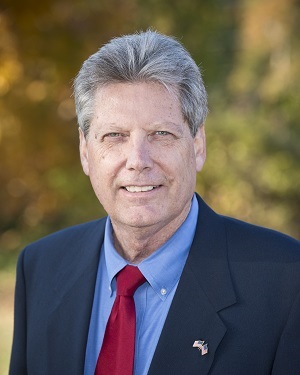 The Tulsa school district needs drastic reform. Enrollment and attendance are dropping, teachers are fleeing, and more and more schools are closing. In the first quarter of Fiscal Year 2016, the Tulsa district had an Average Daily Membership of 39,167. Four years later, ADM for the first quarter of FY2020 was 35,403. (Here's the State Department of Education page with Average Daily Membership and Average Daily Attendance statistics.)
Parents and taxpayers from across the political spectrum want to see Superintendent Deborah Gist gone. Tulsans were outraged by her handling of the recent round of school closings, which seemed to treat board approval as a mere formality, and the controversial handling of federal funds for Indian Education.
We need board members that will treat the superintendent as a hired hand and who will take seriously their responsibility to set policy and monitor spending. We need board members who see the voting public as their bosses, not the philanthrocapitalists that are pushing for experimental curricula in the schools.
After reviewing the questionnaires from the four active candidates for Office 5 and their campaign contribution reports, my choice is clear. I'll be voting for Scott Pendleton in the Tuesday, February 11, 2020, election.
 For all the reasons described in my previous post, Tulsa's students, parents, teachers, and taxpayers need an upheaval on the Tulsa Public Schools Board of Education. Only two seats, at most, out of seven are up for election in any given year, but good candidates in both races will allow us to begin the process.
Ruth Ann Fate, a Democrat who was first elected in 1996, is seeking her seventh term on the school board. Fate has been an unapologetic cheerleader and rubber-stamp for Superintendent Deborah Gist. If we want accountability and reform in Oklahoma's largest school system, step 1 is to replace Ruth Ann Fate.
Democrat Stephen Remington refused to submit a response to the BatesLine candidate questionnaire, writing in response to my reminder: "I apologize but I am not filling out your questionnaire. Endorsements are fine but I am not looking to get any. My campaign is not asking for donations either. Ruth Ann has not filled one out either which indicates we will not have a fair assessment of this race." So Mr. Remington's views must remain a mystery. He has also not filed any of the campaign finance reports; his wife has stated on Facebook that he has not raised nor spent more than $200. I find it hard to believe that you can run a competitive race for this district without spending at least $500. Printing alone, even if you're taking photocopied flyers door-to-door, is likely to take you over the reporting limit. (CORRECTION: The threshold requiring a candidate committee to file reports is now $1,000, whether in contributions or expenditures. It's somewhat more plausible that a candidate could manage without spending more than $1,000, but it doesn't seem very probable. )
Dr. Jerry Griffin, a registered Republican, was the first candidate in either district to respond to my questionnaire, and he gave detailed and intelligent answers.
Griffin is committed to exercising real oversight over the superintendent and school administration, which he calls the "primary duty of the school board." He notes the lack of public discussion or pushback from the current board on any administration proposal. "Generally, the votes are 7-0 to approve any proposal with little to no discussion or open debate." As a college professor for the past 20 years, he has seen in his students the damage done by a "fad-of-the-year" K-12 curriculum that has left them unprepared for work at the collegiate level; the board needs to take an active role in setting the educational philosophy and curriculum for the district. The board should openly and publicly scrutinize every grant from federal, state, or philanthropic sources, weighing the costs and benefits before accepting and auditing for compliance with the terms of any accepted grants.
In his response to my question about schools and American patriotism, Griffin wrote:
"Give me your tired, your poor, your huddled masses yearning to breathe free, The wretched refuse of your teeming shore. Send these, the homeless, tempest-tost to me; I lift my lamp beside the golden door." These masses came seeking a better life and a country in which they could experience freedom and achieve their dream. Being an American means, it does not matter your race, class, religion or ethnic heritage - you are first and foremost an American. The schools have a definite role in teaching and developing a sense of patriotism in our youth. This does not mean teaching an ideological or party focus but a pure love for America - that is celebrated daily.
Concerning transgender issues at TPS, Griffin details the changes in Federal Title IX guidance between the Obama and Trump administrations, but notes that Secretary of Education Betsy DeVos reaffirmed her department's commitment to a learning environment free from bullying and harassment. Griffin wants TPS to return to the pre-Obama policy of limiting private female spaces to females, while having single-stall facilities available.
Griffin is a graduate of Tulsa's Edison High School, has his bachelor's degree from University of Tulsa, an MBA from Southern Methodist University, and a Doctorate of Education from TU. He is an adjunct professor at a number of universities, including the University of Oklahoma and the University of Phoenix, with a focus on criminal justice. In Fall 2016, for example, he taught an upper-level course for University of Oklahoma, "Comparative Justice Systems," and a graduate-level course, "Mediation and Conflict Resolution in the Criminal Justice System."
If I lived in Election District 6, I would vote for Jerry Griffin to bring fresh perspective and careful oversight to the Tulsa school board.
UPDATE: Jerry Griffin emails with his complete report, which includes itemized expenditures, and which he says he filed. Either the district clerk's copy got lost, or I overlooked it. I've added the information below.
Below are the campaign ethics reports filed with the Tulsa Public Schools district clerk as of this morning for candidates running for Tulsa school board offices 5 and 6. No paperwork was on file for Kelsey Royce or John Remington. (Ben Croff filed for Office 5, but has announced that he is not running an active campaign, although is name is still on the ballot.) No school district political committees filed a report, and none of the candidate reports showed donations by political action committees.
Because Oklahoma state law is designed to make it as difficult as possible to track campaign donations for local candidates, Friday morning I went to the Education Service Center, where newly appointed district clerk Sarah Bozone provided me with a folder of all the campaign filings received to that time. I photographed each page, and then this evening, when most of you were relaxing, I transcribed and organized the reports by candidate, and by donor in decreasing order of contributions. I'm happy to be notified of corrections. If you'd like to thank me, there's a PayPal Donate button on the home page. You're welcome.
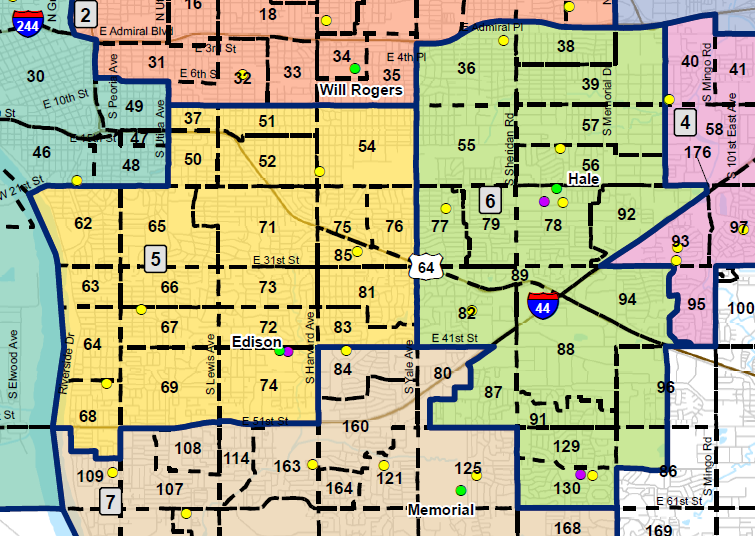
Electronic filing would make this process easier for all concerned. A computerized web app would ensure consistency and would prompt candidates to provide all required information. John Croisant provided occupation and employer for his contributors, but not their addresses, which are also required, and yet he provided addresses for his vendors. Shane Saunders provided contributor addresses, but for many of the donors occupation and employer are "Requested," i.e., not provided. Scott Pendleton and Jerry Griffin managed to get addresses and occupations from all of their donors. Ruth Ann Fate's reports are handwritten and have addresses but not occupations or employers. Jerry Griffin was the only candidate who neglected to itemize his expenditures. [CORRECTION: Griffin says he provided itemized expenditures with his report; these are now listed below.]
The totals below are as reported on the forms. I attempted to double-check a few, but gave up, because candidates differed in how things were supposed to be totaled. John Croisant's forms misused the "Aggregate Total" column, using it for the campaign as a whole, rather than for the total for a particular contributor or vendor over the course of the campaign, and he put campaign totals in the "$50 or less boxes" at the top of the page.
Some observations, based on my many years of looking at campaign contributor lists:
John Croisant is clearly the establishment's pick in Office 5. Croisant's contributors include a who's who of Yacht Owners and Yacht Guests: former Tulsa Mayor Kathy Taylor; two former school board members, Cathy Newsome and Cindy Decker (Decker is now executive director of George Kaiser Family Foundation's Educare); former Cherokee Principal Chief Ross Swimmer; former Oklahoma Corporation Commissioner and Tulsa Finance Commissioner Norma Eagleton; former Oklahoma Policy Institute head David Blatt; retired oilman and major Democrat donor George Krumme; developer and Democrat donor Sharon King Davis; QuikTrip spokesman Mike Thornbrugh; donors associated with BOK Financial and with the Frederick Dorwart law firm; former Tulsa County Superintendent of Schools Kara Gae Neal, wife of retired Tulsa World editor Ken Neal; and former City Councilor Gary Watts, who now serves as the attorney for Sand Springs Public Schools.
Former school board member and GKFF Educare executive director Cindy Decker gave $100 each to John Croisant and Shane Saunders.
One small expenditure caught my eye: Croisant paid for the Democratic Party's canvassing app, which, I assume, would give his campaign access to the party's voter database.
Shane Saunders has the biggest war chest, but fewer donors. Two-thirds of his funds came from two couples: Frank and Diane Murphy of Dallas and Charles and Krista Bendana of Tulsa. Mindy Taylor, Saunders's successor as chairman of Iron Gate ministry, is one of his donors.
Scott Pendleton seems to be funded mainly by family and friends around the country, which is a typical pattern for a candidate who is running on their own initiative, rather than as the minion of the local power structure.
Ruth Ann Fate and Jerry Griffin are both the biggest donors to their own campaigns.
Contributors and vendors are from Tulsa unless otherwise noted. If you're reading this on the home page, the lists for each candidate are after the jump.
BatesLine sent a questionnaire to all of the candidates for Tulsa school board in the two seats up for election in the Tulsa Public School district. The eight questions dealt with the board's authority with respect to the administration, curriculum, music, history and patriotism, the role of philanthropists, and the practical implications of transgenderism.
All four candidates running in the open Office 5 seat submitted a response, but only one of the challengers for Office 6 took the time. (Ben Croff filed for Office 5 but has withdrawn from the race, although his name will appear on the ballot.) The election district for Office 5 is shown in the map above in Harvest Gold, while Office 6 appears as Avocado Green -- very '70s colors.
The primary election will be held on February 11, 2020; if no candidate receives more than 50% of the vote, a runoff will be held on April 7, 2020.
Here is a list of the candidates, with age, address, party registration, and links to their responses, if provided. (While school board races are non-partisan, a candidate's party registration is a publicly available piece of information that I consider informative.)
Office No. 5:
- John Croisant, 42, 62 Woodward Blvd., Tulsa, OK, 74114, Democrat
- Scott Pendleton, 64, 2534 E. 45th St., Tulsa, OK, 74105, Republican
- Kelsey Royce, 37, 336 E. 45th Ct., Tulsa, OK, 74105, Democrat
- Shane Saunders, 39, 4117 S. Birmingham Ave., Tulsa, OK, 74105, Republican
Office No. 6:
- Ruth Ann Fate, 83, 7014 E. 60th St., Tulsa, OK, 74145, Democrat (Did not respond)
- Jerry Griffin, 75, 6552 E. 60th St., Tulsa, OK, 74145, Republican
- Stephen Remington, 42, 4909 E. 2nd St., Tulsa, OK, 74112, Democrat (Did not respond)
BatesLine has sent a questionnaire to all of the candidates for school board in the two seats up for election in the Tulsa Public School district. The same questionnaire was provided to all four candidates in the Office No. 5 race, and all four responded.
Tulsa Election District 5 is midtown Tulsa, bounded by Riverside Drive, Yale Avenue, 11th Street, and 51st Street, minus the area NW of 21st and Peoria, minus the area SE of 41st and Harvard, and plus a few streets south of I-44 between Riverside and Peoria. This is an open seat. Brian Hosmer, the appointed incumbent who replaced the winner of the 2016 election, Cindy Decker, is not running for the seat. The primary election will be held on February 11, 2020; if no candidate receives more than 50% of the vote, a runoff will be held on April 7, 2020.
Scott Pendleton sent a detailed response, which (if you're viewing this on the home page) is after the jump. His campaign web page is www.scottpendleton.us and he has a Facebook page.
Pendleton welcomes questions from voters via email at scott@scottpendleton.us or by phone at 918-688-7318.
My questions are in bold and italics; Pendleton's responses are in normal type except where bold and underlining were used in his answer.
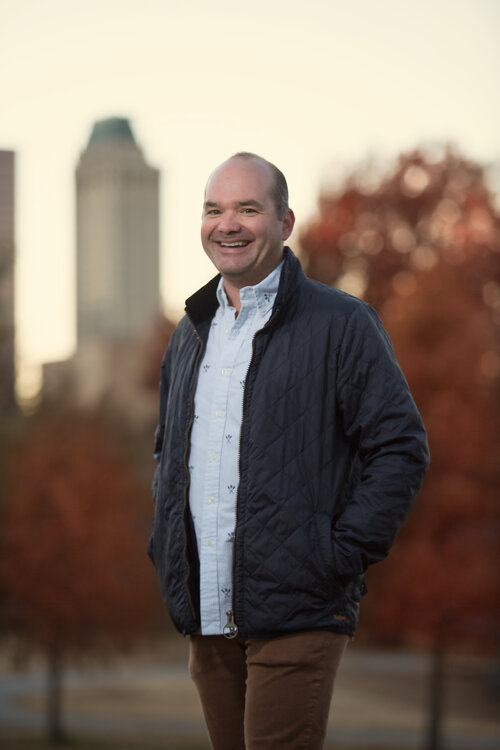 BatesLine has sent a questionnaire to all of the candidates for school board in the two seats up for election in the Tulsa Public School district. The same questionnaire was provided to all four candidates in the Office No. 5 race, and all four responded.
Tulsa Election District 5 is midtown Tulsa, bounded by Riverside Drive, Yale Avenue, 11th Street, and 51st Street, minus the area NW of 21st and Peoria, minus the area SE of 41st and Harvard, and plus a few streets south of I-44 between Riverside and Peoria. This is an open seat. Brian Hosmer, the appointed incumbent who replaced the winner of the 2016 election, Cindy Decker, is not running for the seat. The primary election will be held on February 11, 2020; if no candidate receives more than 50% of the vote, a runoff will be held on April 7, 2020.
Shane Saunders sent a detailed response, which (if you're viewing this on the home page) is after the jump. His campaign web page is shanesaunders.org and he has a Facebook page.
Saunders welcomes questions from voters via email at shane.saunders@gmail.com.
My questions are in bold and italics; Saunders's responses are in normal type except where bold and underlining were used in his answer.
 BatesLine has sent a questionnaire to all of the candidates for school board in the two seats up for election in the Tulsa Public School district. The same questionnaire was provided to all four candidates in the Office No. 5 race, and all four responded.
Tulsa Election District 5 is midtown Tulsa, bounded by Riverside Drive, Yale Avenue, 11th Street, and 51st Street, minus the area NW of 21st and Peoria, minus the area SE of 41st and Harvard, and plus a few streets south of I-44 between Riverside and Peoria. This is an open seat. Brian Hosmer, the appointed incumbent who replaced the winner of the 2016 election, Cindy Decker, is not running for the seat. The primary election will be held on February 11, 2020; if no candidate receives more than 50% of the vote, a runoff will be held on April 7, 2020.
Kelsey Royce sent a detailed response, which (if you're viewing this on the home page) is after the jump. She has a campaign Facebook page.
Royce welcomes questions from voters via email at kelseyroycefordistrict5@gmail.com.
My questions are in bold and italics; Royce's responses are in normal type except where bold and underlining were used in her answer.
 BatesLine has sent a questionnaire to all of the candidates for school board in the two seats up for election in the Tulsa Public School district. The same questionnaire was provided to all four candidates in the Office No. 5 race, and all four responded.
Tulsa Election District 5 is midtown Tulsa, bounded by Riverside Drive, Yale Avenue, 11th Street, and 51st Street, minus the area NW of 21st and Peoria, minus the area SE of 41st and Harvard, and plus a few streets south of I-44 between Riverside and Peoria. This is an open seat. Brian Hosmer, the appointed incumbent who replaced the winner of the 2016 election, Cindy Decker, is not running for the seat. The primary election will be held on February 11, 2020; if no candidate receives more than 50% of the vote, a runoff will be held on April 7, 2020.
John Croisant sent a detailed response, which (if you're viewing this on the home page) is after the jump. His campaign web page is www.johncroisant.com, and he has a Facebook page.
Croisant welcomes questions from voters via email at john@johncroisant.com.
My questions are in bold and italics; Croisant's responses are in normal type except where bold and underlining were used in his answer.
BatesLine has sent a questionnaire to all of the candidates for school board in the two seats up for election in the Tulsa Public School district. Three candidates are running for Office No. 6: The incumbent of 24 years, Ruth Ann Fate, a Democrat, and two challengers, Stephen Remington, a Democrat, and Jerry Griffin, a Republican. The primary election will be held on February 11, 2020; if no candidate receives more than 50% of the vote, a runoff will be held on April 7, 2020.
The same questionnaire was provided to all four candidates in the Office No. 5 race, and all four responded. These will be posted as soon as possible.
Tulsa Election District 6 is bounded roughly by I-244, 61st Street, Yale Avenue, and 89th East Avenue, minus wedges of land NE of I-44 & 31st (around Skelly Elementary) and SW of I-44 and 41st Street (around Promenade Mall), and minus the section SW of 51st and Sheridan.
Mrs. Fate did not respond to attempts to contact her via her district email address, and she did not appear to have a web presence at the time the questionnaire was sent. Mr. Remington acknowledged the questionnaire, but refused to respond: "I apologize but I am not filling out your questionnaire. Endorsements are fine but I am not looking to get any. My campaign is not asking for donations either. Ruth Ann has not filled one out either which indicates we will not have a fair assessment of this race."
Dr. Jerry Griffin sent a detailed response, which (if you're viewing this on the home page) is after the jump. His campaign web page is www.drgriffinforschoolboard.com and he has a Facebook page and a Twitter account.
Griffin welcomes questions from voters via email at drgriffinforschoolboard@gmail.com or by phone at 918-521-2623.
My questions are in bold and italics; Griffin's responses are in normal type except where bold and underlining were used in his answer.
UPDATE 2019/12/03: Here is the final list of candidates who filed for the February / April 2020 school board and municipal elections in Tulsa County. The following school board seats had only a single candidate file (Office No. 5, unless otherwise noted):
Broken Arrow: Jerry Denton
Glenpool: James Fuller
Jenks: Chuck Forbes
Keystone (Office No. 3): Sandra K. Thompson
Liberty (Office No. 4): Mark Cottom
Liberty (Office No. 5): Michaela Eaton
Sand Springs: Jackie Wagnon
Skiatook: Olivia Goodwin
Sperry: Gary Juby
Tulsa Tech Center (Office No. 4): David Charney
The following school board races drew two candidates and will have an election on April 7, 2020:
Berryhill: Allisha Craig vs. Patty Lawson
Collinsville: Jeromy Burwell vs. Memory Ostrander
Union: Ken Kinnear vs. Brandon Swearengin
The following school board races drew three or more candidates and will have a primary on February 11, 2020, and, if necessary, a runoff on April 7, 2020:
Bixby: Tristy Fryer, Todd Hagopian, Jason Prideaux
Owasso: John H. Haning, Beth Medford, Frosty Turpen
Tulsa (Office No. 5): Ben Croff, John Croisant, Scott Pendleton, Kelsey Royce, Shane Saunders
Tulsa (Office No. 6): Ruth Ann Fate, Jerry R. Griffin, Stephen Remington
Of the municipal offices in Collinsville, Owasso, and Sand Springs, there is a race for Mayor of Collinsville, between Jerry Garrett and Larry Shaefer, and for Sand Springs Ward 3, between Mike Burdge and Justin Sean Tockey.
This is a reworking of a post from four years ago, but it has been updated with current information about open seats and candidates, and there is some new information below.
 We are in the midst of the annual filing period for public school board positions in Oklahoma, which ends Wednesday, December 4, 2019, at 5 p.m. K-12 school districts will have a single seat, Office No. 5, up for election to a five-year term. K-8 dependent districts (Keystone is the only one in Tulsa County) have three seats that rotate through three-year terms. Liberty, in far-south Tulsa County, also has Office No. 4 on the ballot. After the first day of filing in Tulsa County, 9 seats have drawn one candidate, but only 4 have drawn two candidates. No one has filed in Skiatook, Broken Arrow, or Keystone school districts, or the Tulsa Technology Center board.
Filing is also open for a number of municipalities; candidates have filed for city office in Collinsville, Owasso, and Sand Springs.
(Here is the current list of candidates for Tulsa County school board seats. And here's where you'll find maps showing school district and election district boundaries.)
School board filing always comes at a busy and distracted time of year. As I've written before, it's almost as if school board elections were deliberately scheduled to escape the notice of potential candidates and voters.
The school board primary election will be held on February 11, 2020, for those seats where there are three or more candidates. If no one wins a majority of the vote in the February election, a runoff will be held on April 7, 2020. If a seat draws only two candidates, the election will be held on April 7, 2020.
The Tulsa district, largest in the state, has two out of seven seats up for election to a four-year term, Offices No. 5 and 6.
Tulsa Election District 5 is midtown Tulsa, bounded by Riverside Drive, Yale Avenue, 11th Street, and 51st Street, minus the area NW of 21st and Peoria, minus the area SE of 41st and Harvard, and plus a few streets south of I-44 between Riverside and Peoria.
The current member for District 5 is Brian Hosmer, a professor of Western American History at the University of Tulsa. He was appointed in February to replace Cindy Decker, who was elected in 2016 and resigned to serve as director of Educare, a project of the George Kaiser Family Foundation.
As of Monday night, Hosmer has not filed for re-election, but Kelsey Royce and Shane Saunders have filed for the seat. Royce, a registered Democrat, wrote a strongly critical analysis of Tulsa Public School finances published in Tulsa Kids in September 2019. Saunders, a conservative Republican, is current vice chairman and former chairman of Iron Gate, head of Trident Energy, and served as press secretary and legislative assistant to Congressman John Sullivan. He applied to fill the vacant seat when Decker resigned. It looks like either candidate that has filed so far would be an improvement and would hold the administration accountable on fiscal issues, but it remains to be seen where they stand on educational and social issues affecting the schools.
Tulsa Election District 6 is just to the east of District 5 bounded roughly by I-244, 61st Street, Yale Avenue, and 89th East Avenue, minus wedges of land NE of I-44 & 31st (around Skelly Elementary) and SW of I-44 and 41st Street (around Promenade Mall), and minus the section SW of 51st and Sheridan. The incumbent is Ruth Ann Fate, a registered Democrat who was first elected to the seat in 1996. She has one opponent so far, Jerry R. Griffin, a registered Republican.
Two candidates have filed for Bixby Office 5: Tristy Fryer (Republican) and Todd Hagopian (Libertarian).
Two candidates have filed for Union Office 5: Ken Kinnear (Republican) and Brad Swearengin (Democrat).
In addition, Tulsa Technology Center board seat 4 is up for a seven-year term, representing the City of Tulsa west of the river, plus midtown Tulsa from 21st to 81st, Riverside to Yale, plus a square mile from 71st to 81st, 49th West Ave to 33rd West Ave in Creek County, and the half-section from Yale to Hudson, 21st to 31st in Tulsa. TTC seems to have more money than it knows what to do with; it would be lovely to have a fiscal conservative on the board who could curb their building spree. Incumbent David Charney, a real-estate developer and a registered Democrat, has not yet filed for re-election and no one has yet filed to challenge him.
Looking through the online biographies, I think it's fair to assume that there is not a single conservative on the Tulsa School Board. Five (Stacey Woolley, Jennettie Marshall, Shawna Keller, Ruth Ann Fate, and Suzanne Schreiber) are registered Democrats; two (Jania Wester in District 2 and Brian Hosmer in District 5) are registered as independents.
TPS has received increasing criticism from across the political spectrum for fiscal irresponsibility and educational failure:
Black Wall Street Times, 11/26/2016: Anonymous teacher writes, "I literally feel like at TPS, we are set up for failure," cites disastrous educational results, teacher resignations. The same article includes achievement statistics for African-American students; Deborah Brown charter school leads the way with 45% meeting proficiency, while numbers at all but a few schools are in the single digits.
Tulsa World, 11/26/2016: The number of Tulsa schools receiving an F on the Oklahoma School Report card increased from 21 to 28. Only Booker T. Washington High School received an A in academic achievement; Edison HS has a B, Webster, Memorial, and Will Rogers have Ds; the rest of the high schools have Fs. Only 18% of TPS students who were assessed were at or above grade level.
If you're a conservative, you should give serious thought to running for school board, even if you have no school-aged children, even if you have children that are homeschooled or in private school, even if you've never had a child in the public schools. The public school system exists to serve all citizens by educating the children of the community, so every citizen has an interest in the curriculum being used, the way discipline is handled, the condition of the school buildings, and the credentials, skills, and philosophical presuppositions of the teachers, principals, and administrators. Property owners support the school system through ad valorem taxes, and so they have a reasonable interest in the proper and efficient expenditure of those funds. So do all citizens who pay state income and sales taxes, which provide funds to supplement local property taxes.
If you are, like me, a homeschool or private school parent, you will have experience and valuable insights with successful, classical alternatives to the faddish and failing teaching methods, priorities, and content currently in use in the public schools.
I ran some numbers, comparing 2010 census data, broken down by age, with the closest school attendance data I could find, from the 2010-2011 school year. In the Tulsa school district, the average daily attendance was only 67.2% of the number of school-aged children (5-18) who lived in the district on Census Day 2010. That means about a third of school-aged kids were either homeschooled or in private schools, the highest proportion of any district in the metro area. The Tulsa district also had the lowest percentage of residents in the 5-18 bracket -- 17.9%. Compare that to the Sperry district, where 91% of school-aged residents attended the public school, and where 22.6% of the residents were school-aged.
It seems that a substantial number of families move from the Tulsa district to the suburbs when their children reach kindergarten, or, if they stay, many opt for homeschooling or private schools. Those numbers make a strong case for new leaders in the Tulsa district. And if the school board is going to be strictly representative, at least two of the seven members should have children in homeschool or private school, and a majority should be conservative.
Filing is simple: A notarized declaration of candidacy, and a signed copy of the statutory requirements for school board candidates. For this office there is no filing fee. You can view the Oklahoma school board filing packet online. And although school board elections are officially non-partisan, the local and state Republican Party organizations will provide assistance to registered Republicans who are candidates for non-partisan office. (I suspect the same is true of the Democrats.)
There was a time when it was generally agreed that schools existed to transmit knowledge and the values of the community to the rising generation, working alongside parents. At some point, as part of the Gramscian long march through the institutions, the public schools were infiltrated by Leftists who saw them as a venue for missionary work, converting children away from the values of their parents, away from the ideals that made America a prosperous and peaceful nation. The Left has influence over schools of education, textbook publishers, teachers' unions, and continuing education for teachers, administrators, and board members.
Shortly after President Trump was sworn in, Tulsa Schools Superintendent Deborah Gist issued a statement to assure everyone that leftist policies on immigration and transgenderism would continue to be followed in Tulsa Public Schools:
We do not ask for immigration status when families enroll their children. We would not share information about immigration status with the United States Citizenship and Immigration Services. The Supreme Court's 1982 decision in Plyler vs. Doe found that every child has a constitutional right to equal access to education regardless of their immigration status, and we welcome immigrant and refugee families at Tulsa Public Schools.We honor the dignity and equality of our transgender and gender non-conforming students. These students have the right to present themselves in a way that is consistent with their gender identity so long as rules are followed for appropriate dress that apply to all students. They also have the right to use restrooms, locker rooms, and other facilities that are consistent with their gender identity. This may include the use of gender neutral restrooms. We recognize the privacy of students in transition and would not disclose information about gender identity or expression without their consent.
Also in 2017, TPS sponsored a series of meetings called "Exploring Equity," featuring one-sided panels pushing intersectionality.
The next step in the LGBTQ fight for equality lies in increased representation and intersectionality, panelists said Thursday during the latest talk in a Tulsa Public Schools series meant to foster equity.About 150 people sat with each other at 19 rectangular tables to hear a panel on LGBTQ issues and then discuss ideas that struck them during the talk.
The panel included Moises Echeverria, with the Oklahoma Center for Community and Justice; Toby Jenkins, with Oklahomans for Equality; Abril Marshall, with Camp Fire Green Country; Tulsa attorney Alyssa Bryant; and longtime local advocate Nancy McDonald.
If you live in a suburban or small-town district, you might suppose your district is safe from Leftist influence. Think again. Through their college training, their teachers' union newsletter, continuing education courses, peer relationships, and curriculum, your districts' teachers and administrators work in an atmosphere of Leftist presuppositions about the world. It takes strength, conviction, and vigilance for a conservative educator to be conscious of that atmosphere and to resist its influence.
Back in fall 2017, Mandy Callihan, a teacher and parent in Jay, Oklahoma, was infuriated to learn that her 12-year-old daughter was being taught in school about mutual masturbation and anal and oral sex, complete with a worksheet she had to fill out. She and other parents went to the school looking for answers and discovered that the curriculum had been approved by the school board and the middle school principal. The superintendent, claiming ignorance, halted the program, but parents were told it would have to be brought back the following year.
In Minnesota in 2017, the Center for the American Experiment has published a detailed 10-page report on slipping standards at the once-successful Edina school district in the suburbs of the Twin Cities. While academic achievement has declined, Leftist indoctrination is on the rise:
Today, for example, K-2 students at Edina Highlands Elementary School are learning--through the "Melanin Project"--to focus on skin color and to think of white skin as cause for guilt. "Equity" is listed as a primary criterion on the district's evaluation for K-5 math curricula. At Edina High School, teachers are haranguing students on "White Privilege," and drilling into them that white males oppress and endanger women. In a U.S. Literature and Composition class, 11th-graders are being taught to "apply marxist [sic], feminist" and "post-colonial" "lenses to literature."In short, in Edina, reading, writing, math and critical thinking skills are taking a backseat to an ideological crusade.
The Leftist bent of the school district came to public attention after the overwrought reaction by students and teachers to the election results, but the roots of the problem went back several years, to the school's decision to try to close the achievement gap between students of different races by focusing on structural racism as the cause:
The All for All plan's fundamental premise is that white racism--not socio-economic factors like family breakdown--is the primary cause of the achievement gap. If minority students' academic performance is to improve, "systems that perpetuate inequities" must be "interrupt[ed]" and "barriers rooted in racial constructs and cultural misunderstandings" must be "eliminate[d]," according to the district's position statement on "Racial Equity and Cultural Competence in Edina Public Schools."
The story mentions one race-conscious elementary school principal who adopted a curriculum provided by the slanderous Leftist group that calls itself the Southern Poverty Law Center. The same principal eliminated flex groups -- opportunities during one period for children of similar ability levels to work together with a teacher, receiving targeted instruction -- because they were perceived as insufficiently diverse. A high school literature class describes a course goal in this way: "By the end of the year, you will have... learned how to apply marxist [sic], feminist, post-colonial [and] psychoanalytic... lenses to literature."
There are, it must be said, many good conservatives, many devout Christians serving in Oklahoma's public schools. But they need support in the form of school board members who will set policy and curriculum and ensure that the paid staff adhere to it. Conservative school board members should not give undue deference to "professionals" who have been trained to see education through a Leftist lens. The subject matter taught, the methods used, and the values undergirding it all should be firmly under the control of our elected representatives on the school board.
Education is necessarily ideological, because it rests on presuppositions about knowledge, truth, goodness, and beauty. The ideology of the public schools should reflect the ideology of the community.
If I were running, here are some of the planks that would be in my platform:
- Introduce the classical trivium as the philosophy and method of instruction in schools that are currently failing. That includes a heavy emphasis on memorizing facts in the elementary years, which gives children a sense of mastery and accomplishment and provides a solid foundation for subsequent learning.
- Instill pride in our city, state, and country. America has its flaws, but it is a beacon of liberty and opportunity that inspires hope in hundreds of millions of people around the world who wish they could live and work here. Our children should understand the aspects of our culture and history that have made our country prosperous and peaceful. The "black armband" view of history should have no place in our schools.
- Keep the Land Run re-enactments in our elementary schools. It's a fun and memorable way to introduce students to our state's unique history. There is an activist in Oklahoma City who managed to convince historically ignorant principals and school board members there that the '89 Land Run was an act of genocide. Oklahoma City, founded by the '89 Land Run, no longer has reenactments of that event, because of a zealot who pushed her slanderous revision of history on ignoramuses in charge of the schools.
- Return music to the elementary grades. An early introduction to classical music and learning to make music by singing have tremendous developmental and behavioral benefits.
- Review all federal grants and determine whether the cost of compliance and the loss of independence is worth the money.
- Young people who foolishly believe that swapping sexes will solve their deep unhappiness deserve pity and guidance. It is utter cruelty to humor their misplaced hope that "changing gender identity" will cure their misery. Leadership at each school should craft a way to accommodate these deluded young people with compassion and dignity, while protecting the dignity of everyone else, and while affirming the biologically undeniable reality of the two sexes.
Thankfully, doing the right thing on that last point will no longer require resisting Federal pressure, because the Trump administration halted the Obama administration policy that denied funding based on a perverted interpretation of Title IX. But as shown above, Tulsa's school administration is fully on board with radical gender theory, and it's likely that your school administration has been thoroughly indoctrinated in the same way.
Our public schools need principled, intelligent conservative leadership. Will you step forward to serve?
FROM THE ARCHIVES: My 2015 post on school board filing included links to two important articles about the leftist direction of your local public school board, particularly on sexual morality and gender identity.
Stella Morabito wrote, "Ask Not Who's Running For President, Ask Who's Running For School Board," citing the recent battle in Fairfax County, Virginia, over transgender policy as one among many reasons.
Walt Heyer, a man who underwent sex-change surgery and then, realizing that the change failed to give him the happiness he had hoped for, changed back, wrote about the Obama Administration using its perverted interpretation of Title IX to force public schools to trample their students in the transgender war against science and reason.
An August 13, 2019, story about homeschooling in Tulsa by KJRH reporter Gitzel Puente features Bibliomania, an east Tulsa bookstore. According to Bibliomania's website, "BiblioMania was established in 1992 as a Christian bookstore and gradually transitioned to specializing in gently used homeschooling materials on consignment."
Homeschoolers are getting ready for back to school in Oklahoma.There are between 4,000 to 5,000 families in the Tulsa metro area, according to the owner of Bibliomania Homeschooling Materials .
"This is the season when everybody is hitting the ground running, getting enrolled for co-ops, getting signed up for their sports teams," says Susan Stenberg.
Her consignment store is filled with books and learning tools for homeschooling parents. It's the only shop of its kind in Tulsa.
"It is very, very busy. Most of our homeschool moms begin school year in August, some wait after September," says Stenberg.
She says the homeschooling community keeps growing every year in the metro area from only a few hundred in the 1990s.
Stenberg attributes the growth to many factors, including lifestyle changes, kids' health issues, special needs, philosophical differences and school environment.
"With homeschooling, you have the flexibility to teach the way the child can learn, and be able to do it and switch gears if something's not working," says Stenberg.
In the televised story, Sue Stenberg mentions that bullying at school is a reason for homeschooling frequently cited by new customers at her store.
I've known Sue for about 20 years. As a homeschooling mom herself, she was a frequent customer of Bibliomania, and when the previous owner decided to retire, Sue stepped up to take over the store rather than lose a resource that was so valuable to her and her friends.
Bibliomania has been a valuable resource for our family, too, not only as an affordable source of textbooks, workbooks, teacher's guides, chapter books, and manipulables, but as a resource for networking and information about homeschooling. There are many different approaches to homeschooling, and if you're new to the idea and not sure how to start, a conversation with Sue and her team will likely get you connected with people and organizations who can help you realize your vision of the education you want your children to have. Even if you aren't in the market for anything at the moment, it's a place to meet fellow homeschooling families, swap stories, and share ideas.
Even if you aren't homeschooling, your kids will enjoy browsing Bibliomania's selection of classic books for all ages and educational books from publishers like Usborne and Dorling Kindersley.
The Tulsa metro area is a great place to homeschool. (It's an aspect of our region's character that the Chamber and local officials ought to be promoting to lure talent.) That's partly because Oklahoma's laws don't get in the way, but it's mostly because there's a broad and deep homeschooling network here and plenty of enrichment resources to complement parental expertise. Bibliomania is one of the hubs of that network.
Bibliomania is in the Plaza Shopping Center, 12929 E 21st St Suite I, Tulsa, Oklahoma 74134, northeast corner of 21st Street and 129th East Ave. Open Tuesday through Friday, 10 am - 6 pm, and Saturday 10 am - 3 pm, until Labor Day weekend. After Labor Day, hours are Tuesday through Friday, 1 pm - 6 pm, and Saturday 10 am - 3 pm. Consignments are accepted on Tuesdays and Fridays. Bibliomania is on Facebook as well, and there's a Bibliomania Homeschooling Materials storefront on Amazon.
MORE: Sue Stenberg posted this bit of sage advice from experience back in April:
Just thinking out loud. Did you know that your curriculum choices are your TOOLS, not your MASTERS? I used to stress over not being "on track" or not "keeping up with the schedule". I actually used to do my lesson planning for each of my four homeschoolers for the entire year in a separate planner for each one (still would do that), IN INK!!!! (would NEVER do that one again!)Did you know that your kids will race through some subjects and get stuck in others? And that is OK!!! When we did the A Beka Old World History/Geography, they had a few paragraphs on Vikings. Our family heritage is Scandinavian on my hubby's side...we set the book aside and did Vikings for an entire MONTH! Loved it!! When my kids got stuck on a topic in math, we set the text aside and pulled out a Key To Math booklet or another resource and worked until they got it, then went back to the regular book until the next brick wall.
The joy of homeschooling is being able to stop and focus on a need or an interest as you journey through the year. We can "wallow" in a time period, or savor several books by one author if we fell in love with the one on the booklist. We can even switch midstream if our original choice just is NOT working. (Did 4 spelling programs one year until we found one that worked!)
When the day is done, ask yourself if you made some progress, if they are "getting it", and if you are still hugging each other at bedtime. There were days that attention spans simply were absent. There were days when one or more of us were ill. That's when you do a DEAR day (Drop Everything And Read). We had a selection of books that they could choose from - just read while I die here on the couch, kids!
At the end of your journey, you want to have your children following God's plan for their lives (not the curriculum publishers'), have them be able to function well, and have the tools under their belts to be good Godly people with the ability to follow their dreams. The roof will NOT cave in if you only do three lessons of math this week instead of five! You can do this...and you can love the adventure!!! Blessings!
Four Tulsa County K-12 school board seats in Tulsa, Keystone, Broken Arrow, and Union districts are on the ballot today, Tuesday, April 2, 2019, along with a seat on the Tulsa Technology Center board, and City Council or Town Trustee seats in Broken Arrow, Bixby, Catoosa, Glenpool, Jenks, Skiatook, and Sperry.
The full list of contests for the April 2, 2019, election is on the Oklahoma State Election Board website. You can check to see if you have a reason to go to the polls by going to the online voter tool, entering your name and date of birth, and see if it shows you a sample ballot for today's election. (I don't have one.) Those polling places with elections will, as usual, be open from 7 a.m. to 7 p.m.
For the first time, school board races that drew only two candidates are on the April ballot, to be decided at the same time as two-candidate runoffs for races in which no one reached a majority during the February primary election.
In the Tulsa school district, Office No. 1, which covers west of the Arkansas River, the Sand Springs Line, downtown Tulsa, and most of the neighborhoods surrounding downtown, is open after long-time incumbent and Democrat operative Gary Percefull opted not to run for re-election. Two candidates emerged from a field of eight in February:
Nicole Nixon is the mom of two children who attend TPS's Clinton Middle School, where she serves as a parent volunteer. "I don't have 10 years for Tulsa Public Schools to get its act together." Nixon is a conservative Republican who ran in last year's race for the open House 68 seat. Nixon lives west of the river in Mountain Manor neighborhood. Nixon's top concern is the current administration and board's decision to close schools on the west side; she describes the west side as being blindsided by the decision. Nixon would like to see Tulsa school budget tax dollars stay local, rather than getting spent on out-of-state consultants. Nixon is an advocate for local control of educational decisions by teachers and parents, rather than top-down control from district HQ. If elected, she would be the only self-identified conservative on the seven member Tulsa school board. I'd hope that a political perspective that has a majority in the district would have at least some representation on the board. KFAQ's Pat Campbell interviewed Nicole Nixon last Friday.
Nixon's opponent is Stacey Woolley, a registered Democrat who lives in the North Maple Ridge historic district. In one Facebook post, Woolley applauded leftist Senator Kamala Harris's call for more Federal involvement in local schools. Another post shows one of her sons in a T-shirt reading "Boys will be boys."; the photo is cropped at the bottom, but it appears to be this shirt, with the full text reading, "Boys will be boys. Good Humans!" which suggests a belief on behalf of whoever bought the shirt that there's something inherently evil in being male. How Woolley raises her own children is her business, but at a time when boys are conspicuously lagging behind girls at every level of education, when teachers bias grades in girls' favor, I'd want to be sure that our school board member celebrates boys' unique qualities, rather than regarding boys as defective girls.
 In 2014, Joy Hofmeister (mugshot below) defeated incumbent Oklahoma State Superintendent of Public Instruction Janet Barresi by a wide margin in the Republican primary. In 2018, she has drawn two primary opponents, newcomer Will Farrell and former State Secretary of Education Linda Murphy.
Linda Murphy is a graduate of Cheyenne High School in western Oklahoma and a Magna Cum Laude graduate of Southwestern Oklahoma State University, with a Bachelor's in Special Education and Elementary Education. From her website, here is a synopsis of her classroom experience:
Linda taught special education in Caddo County in Lookeba-Sickles Public School K-8 grades and in Hinton 6-12 grades. Later she taught in Osage County in Avant Public Schools K-8, where she also served as director of testing. She has taught adults who were illiterate to read and taught braille to students who were legally blind. Linda taught children and adults in all subject areas and with a wide range of exceptional needs including students with Learning Disabilities, Developmental Delay, Autism and Traumatic Brain Injury.Linda received a statewide award from the State Optometric Association for her work in directing a program in a clinic for students with visually related learning problems. She consulted as a specialist for IEP-Individualized Education Plan teams. She provided hundreds of training presentations for teachers and for Vision Therapists to help them identify visual interference to learning and how to help these students.
In addition to directing the clinical program, she spoke across the U.S. as a liaison for the Optometric Extension Program Foundation dedicated to vision therapy and research. Measurable results in student performance were achieved and documented.
After her narrow 1994 loss to incumbent State Superintendent Sandy Garrett, Linda Murphy was appointed by Gov. Frank Keating as Secretary of Education in his cabinet and appointed by him to a number of state boards dealing with education and workforce development.
Murphy was a leader in the fight that led to Oklahoma's repeal of Outcomes Based Education (the Common Core of the 1990s) and more recently was active in the fight to repeal Oklahoma's adoption of Common Core. Murphy understands that it wasn't enough merely to repeal Common Core in name only, but to fight against efforts to dictate local schools policy from Washington and Oklahoma City.
Linda Murphy is a passionate advocate for public schools, grounded in her personal experience of what they meant to the Cheyenne neighbors of her youth and to the rural communities where she served as a teacher. She believes that the school system should help each child to become an educated citizen and to reach his or her full potential, rather than being used by the Left for social engineering and proselytizing or by Big Business to churn out docile drones or by the unions as places to park the unqualified. Over her quarter-century of involvement with the intersection of education and politics, Murphy understands the forces at the State Capitol that are working to bend the public education system to serve their own selfish interests and what it will take to make the system serve the people of Oklahoma.
Murphy is running her campaign on a tight budget. As of Monday, Murphy raised $13,505 to Hofmeister's $278,000.
Hofmeister's heavily-funded campaign has the backing of the teachers' unions and an intriguing number of companies that sell products and services to public schools. Hofmeister was charged by the Oklahoma County District Attorney with several felonies involving the financing of her 2014 campaign: accepting campaign contributions in excess of legal limits, accepting corporate campaign contributions, and conspiring with campaign consultants and lobbyists. The DA later dropped charges "pending further investigation." Click the link and read the indictment, which includes the emails and messages that were exchanged between Hofmeister and the other alleged conspirators leading to the felony indictments.
One other candidate is running on a shoe-string budget: Will Farrell, a 2004 Cascia Hall graduate, Eagle Scout, and legal assistant for the Titus Hillis Reynolds Love law firm in Tulsa, currently working on his bachelor's degree from OSU.
If you want public schools to be the cornerstone of community and the foundation of an educated citizenry as they once were, Linda Murphy is your candidate.
The Bixby Education Association (BEA), local branch of the National Education Association, the left-wing teachers' union, is using Bixby Public Schools facilities, specifically the Media Center at Bixby North Intermediate High School for phone banking to get out the vote for next Tuesday's primary elections.
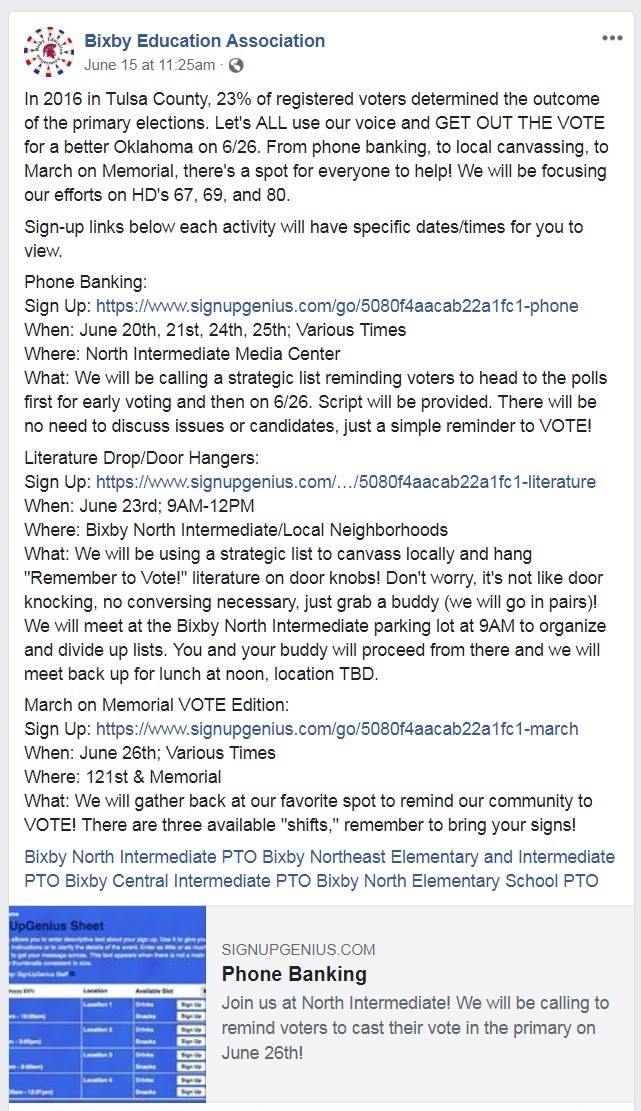
A message announcing the GOTV effort was posted to the BEA's Facebook page on June 15, 2018, at 11:25 am. Here is the original text of the message:
In 2016 in Tulsa County, 23% of registered voters determined the outcome of the primary elections. Let's ALL use our voice and GET OUT THE VOTE for a better Oklahoma on 6/26. From phone banking, to local canvassing, to March on Memorial, there's a spot for everyone to help! We will be focusing our efforts on HD's 67, 69, and 80.Sign-up links below each activity will have specific dates/times for you to view.
Phone Banking:
Sign Up: https://www.signupgenius.com/go/5080f4aacab22a1fc1-phone
When: June 20th, 21st, 24th, 25th; Various Times
Where: North Intermediate Media Center
What: We will be calling a strategic list reminding voters to head to the polls first for early voting and then on 6/26. Script will be provided. There will be no need to discuss issues or candidates, just a simple reminder to VOTE!Literature Drop/Door Hangers:
Sign Up: https://www.signupgenius.com/go/5080f4aacab22a1fc1-literature
When: June 23rd; 9AM-12PM
Where: Bixby North Intermediate/Local Neighborhoods
What: We will be using a strategic list to canvass locally and hang "Remember to Vote!" literature on door knobs! Don't worry, it's not like door knocking, no conversing necessary, just grab a buddy (we will go in pairs)! We will meet at the Bixby North Intermediate parking lot at 9AM to organize and divide up lists. You and your buddy will proceed from there and we will meet back up for lunch at noon, location TBD.March on Memorial VOTE Edition:
Sign Up: https://www.signupgenius.com/go/5080f4aacab22a1fc1-march
When: June 26th; Various Times
Where: 121st & Memorial
What: We will gather back at our favorite spot to remind our community to VOTE! There are three available "shifts," remember to bring your signs!Bixby North Intermediate PTO Bixby Northeast Elementary and Intermediate PTO Bixby Central Intermediate PTO Bixby North Elementary School PTO
The post was edited on June 18 at 5:30 pm to read as shown below. The earlier version can be viewed in Facebook by clicking the three dots at the upper right of the post and
In 2016 in Tulsa County, 23% of registered voters determined the outcome of the primary elections. Let's ALL use our voice and GET OUT THE VOTE for a better Oklahoma on 6/26. From phone banking, to local canvassing, to March on Memorial, there's a spot for everyone to help! We will be focusing our efforts on HD's 67, 69, and 80.Sign-up links below each activity will have specific dates/times for you to view.
Phone Banking:
Sign Up: https://www.signupgenius.com/go/5080f4aacab22a1fc1-phone
When: June 20th, 21st, 24th, 25th; Various Times
Where: North Intermediate Media Center
What: We will be making calls to remind voters to head to the polls first for early voting and then on 6/26. Script will be provided. There will be no need to discuss issues or candidates, just a simple reminder to VOTE!Literature Drop/Door Hangers:
Sign Up: https://www.signupgenius.com/go/5080f4aacab22a1fc1-literature
When: June 23rd; 9AM-12PM
Where: Bixby North Intermediate/Local Neighborhoods
What: We will be canvassing locally and hanging "Remember to Vote!" literature on door knobs! Don't worry, it's not like door knocking, no conversing necessary, just grab a buddy (we will go in pairs)! We will meet at the Bixby North Intermediate parking lot at 9AM to organize and divide up lists. You and your buddy will proceed from there and we will meet back up for lunch at noon, location TBD.March on Memorial VOTE Edition:
Sign Up: https://www.signupgenius.com/go/5080f4aacab22a1fc1-march
When: June 26th; Various Times
Where: 121st & Memorial
What: We will gather back at our favorite spot to remind our community to VOTE! There are three available "shifts," remember to bring your signs!Bixby North Intermediate PTO Bixby Northeast Elementary and Intermediate PTO Bixby Central Intermediate PTO Bixby North Elementary School PTO
I've sent a message through the BEA Facebook page asking some questions:
I'm writing an article about your phone banking effort and have several questions:1. What is the source of your calling list?
2. An earlier version of your post described your list as "strategic." Which voters have been selected to receive a reminder to vote? What is the purpose of the strategy behind the list?
3. Would you provide a copy of your calling script?
4. Would you provide a copy of your calling list (names and addresses would be sufficient -- phone numbers could be redacted) for the purpose of comparison to the full list of voters?
Thank you for your assistance in obtaining the information needed to produce a comprehensive and fair story on your phone banking effort at public school facilities.
I will post any answers I receive as soon as I get them.
ANALYSIS:
Is this legal? Is it ethical? It would depend on the answers to the questions above.
The now-deleted phrase "strategic list" suggests more than a neutral call to all voters to remind everyone to vote. Reading between the lines, the word "strategic" suggests that the aim is to target specific voters who have been identified as supporters of BEA's preferred candidates. Simply by reminding these selected voters to go to the polls, the phone bank can assist their preferred candidates without expressly stating an endorsement.
The Republican incumbents in House Districts 67, 69, and 80, Scott McEachin, Chuck Strohm, and Mike Ritze, respectively all voted for the teachers' pay raise, but all three voted against the union's demand for tax increases to fund it, and all three oppose the Left's assaults on Oklahoma's constitutional protections against tax increases without a vote of the people. All three have been targeted for defeat by the teachers' unions and other groups that want Oklahomans to pay higher taxes.
While state law encourages the use of public school facilities by outside groups, including political organizations, allowing those facilities to be used to advance a particular set of candidates would violate the political neutrality we expect from taxpayer funded institutions.
Screenshots showing the original and final versions of the post, after the jump. Click any screenshot to expand to full size.
A significant number of the 35% of Tulsa Public Schools who left the district in the last two years did not head to greener pastures out-of-state, but to other Oklahoma school districts with comparable pay, according to an investigation led by Tulsa World education reporter Andrea Eger. Teachers interviewed for the story cited poor leadership and lack of respect from administrators at district and school level as the main reason for seeking a new place of employment.
I encourage you to read the article at the World's website, but here's a summary to give you a sense:
Teachers mentioned overly prescriptive curricula that had them reading from a script or coordinating laptop-based instruction, reducing the teacher from a creative instructor to a mere "computer lab attendant" and making it impossible for teachers to learn and respond to the individual struggles of their students.
One veteran foreign language teacher quit to take a lower-paying gig as a freelance photographer: ""It was 100 percent the awful administration and the district showing us they didn't care."
Discipline, or the mandatory lack thereof, seems to have significantly damaged teacher morale and inspired departures and early retirements. Robert Dumas, a former Memorial Jr. High teacher criticized the all-positive, all-the-time news from district headquarters, saying, "Our suspensions are down because they stopped suspending kids for the same things." Mike McGuire, now retired from East Central High, suggested that the state aid formula, which is based on average daily attendance, might be a motivation for reducing the number of suspensions.
Mr. McGuire then dropped this bombshell, which (I hope) will get an investigation of its own (emphasis added):
McGuire said his tipping point was being formally reprimanded for how he responded to students concerned about two of their classmates being allowed to return to school after 10 days in jail on human trafficking complaints."I told my students, especially the girls, 'If you're concerned, you need to tell your parents so they can express their concern to their school board representative,' " McGuire said. "If my daughters were going to school in a place with pimps running around it, I would want to know."
Apparently the paramount value for Tulsa Public Schools administration is making the administration look good. It's not a problem to have pimps in school; it is a problem to let parents know so they can take action to protect their children.
(This reminds me of the time, in 2000, that I got scolded by Jeannie McDaniel, then head of the Mayor's Office for Neighborhoods for Susan Savage, for alerting Crosbie Heights neighborhood leaders to a plan to demolish half of it for an amusement park. McDaniel didn't seem to be bothered that influential people intended to destroy the neighborhood, but that neighborhood leaders were panicked because they'd been told about it.)
Hats off to the Tulsa World reporters who produced this investigation and to the editors who gave it the green light. At a time when it's common wisdom to blame every school problem on the amount of state aid (and Superintendent Deborah Gist tried that gambit in this story), it would have been easy to bury the story for the sake of maintaining that narrative or out of fear that the story would provide fodder for the "wrong" people.
Meanwhile Deborah Gist is focused like a laser on the important issue of schools wrongly named after honorable and heroic men of history like Christopher Columbus and Robert E. Lee.
Just remember, folks: The TPS preliminary expenditure budget for 2017-2018 was $561,241,887 for an average daily membership for the first nine weeks of the year of 37054.40. That's $15,146.43 per student.
MORE: One of the teachers interviewed for the story mentioned a "student behavior management system" called "No-Nonsense Nurturing," which, combined with very scripted curriculum, became "too much to bear." On Twitter, Abigail Prescott links to an essay by a teacher explaining the No-Nonsense Nurturing system, which evidently involves coaches in the back of the classroom giving commands to the teacher through an earpiece, which she is supposed to carry out in a monotone. The World story quotes Superintendent Gist as saying that "TPS is committed to the philosophy that suspending students isn't a real solution to underlying behavior issues and noted that it offered the new behavior management strategy called 'No Nonsense Nurturing' only in response to personal concerns expressed to her by teachers when she first arrived in summer 2015."
 Among the many flaws in the Vision Tulsa dam tax proposal (on the April 5, 2016, ballot) are what I've decided to call the Payola Projects -- projects that involve giving a chunk of money to various institutions in hopes of winning their constituents' votes for the dam tax.
A Payola Project typically involves a suspiciously round sum of money which the city will transfer to another governmental entity (which often has its own source of funding). The amount of money may or may not be enough to pay for a specific construction project. They may not even have even a specific project in mind, or the project might be contingent on a string of approvals yet to be obtained. The important thing is for the target constituency of the Payola Project to think that the small amount of money they're getting is worth wasting $128 million on dams in the Arkansas River.
A Payola Project is all about symbolism over substance: "We haven't allocated enough money to do anything meaningful about this issue that matters to you, dear voter, but we want you to think that we care, so you'll vote for our Dam Tax."
On four separate occasions, voters have rejected taxpayer-funded low-water dams in the Arkansas River, but city mis-leaders like G. T. Bynum and Dewey Bartlett Jr. insist that they'll be a game-changer, so they're back on the ballot for a fifth time, surrounded by a collection of Payola Projects. Think of a Payola Project as an electoral flotation device for the big, expensive dam project, which would otherwise sink at the ballot box as fast as Luca Brasi in concrete overshoes sank in the East River.
The Payola Project for voters concerned about public education is listed this way in Title 43-K, the ordinance that (vaguely) regulates how money in Vision Tulsa Proposition No. 3 for "Economic Development" must be spent:
Public Schools - Partnership with Union, Jenks & Tulsa Public Schools in Teacher Retention, Recruitment, and Training Efforts: $10,000,000
(I wonder why they didn't include the rest of the public school districts that serve the City of Tulsa: the Broken Arrow School District, which serves growing new Tulsa subdivisions southeast of 31st and 145th East Ave, or Catoosa School District, which serves recently annexed areas in Wagoner County.)
Here's how Tulsa City Councilor and former Tulsa school board member Anna America answered a question about the project on March 24 -- a mere 12 days before the election, showing the vague and unsettled state of the proposal
Jeff, we are still working on the final details. The original proposal was for $50 million for two pieces -- housing incentives that could be used for homebuyers or renters, and stipends for continuous learning in the summer. It was scaled back to $10 million, so we are discussing exactly how that would look -- my hope that we do it in the way that has the most impact with the most teacher. There has been some discussion of using the housing part in conjunction with some property the city owns to create a "teacher town" but there are a lot of moving pieces on that., so it may not work out. This was the document submitted as part of the orignal proposal (although it looks to me like they issed a page in the scanning) and we will bascially be doing a scaled back version, although we purposefully took out language specific to housing and made it "attraction and rettention" so we have more flexibility on allowing the district use the money for other kinds of incentives for teachers.. https://www.cityoftulsa.org/media/432235/Teach-Live-T-Town-Presentation.pdf
According to State Department of Education reports the Tulsa district had, in school year 2014-2015, 3,118 teachers, Jenks had 819, and Union had 1,109. That's a total of 5,046 teachers. If you divided that "attraction and rettention[sic]" bonus among those teachers for the 15 years of the tax, it would amount to $132.11 per teacher per year, or about 73¢ per instructional day. It's better than a poke in the eye with a sharp stick, as my grandma used to say, but it wouldn't buy a decent cup of coffee, and it's hard to see how that will succeed in attracting or retaining anyone who isn't otherwise determined to be here.
Voters who care about funding for public education ought to lobby the legislature or petition to raise the cap on the local property tax levies for schools or to find some other local basis for increasing funding if local voters want to do so. Voters who care about attracting and retaining teachers should lobby their school boards to reduce the administrative burden so that funds already available to the school will go to the classroom instead.
Keep in mind that you have the option of voting yes or no on four different propositions on April 5. Keep in mind that the current Vision tax doesn't expire until December 31, 2016. There's plenty of time for the City Council to develop a sound plan, and three more opportunities this year to put it before the voters.
If you care about funding for public education, you should vote down Proposition 3, which includes this insulting attempt at a bribe, and tell the City Council to put together a better plan.

It's apparent that our public schools are headed in the wrong direction, and money won't fix what's wrong. If a train is going the wrong way on the track, shoveling more coal in the firebox only takes you further away from your goal faster. We must first elect board members who see that we're headed in the wrong direction.
At a recent school board candidate forum, one of the candidates rattled off a list of things that every child needs in order to learn -- a good night's sleep, three meals a day, appropriate clothing for the weather, "a parent that will make you go to bed at night, even if you don't want to." The candidate went on to indicate that the schools "have to educate the parents about the importance of sleep and routines" and then listed all the non-educational support that Tulsa Public Schools offers to students: breakfast, lunch, food to take home for the weekend, clothes. So this is the fruit of the Great Society and a half-century of Federal interference in local schools, by way of the carrot of federal funding and the stick of judicial activism -- two generations of parents who don't know how to manage their time and money to keep their children fed, clothed, and ready for school. What we're doing isn't working.
Although every school district in the state has at least one vacancy each year, most of them go unchallenged. In all of Tulsa County, only one board seat will be on the ballot this coming Tuesday, February 9, 2016. In election district 5, Republican challenger Stan Minor will face Democrat incumbent Cindy Decker. I live in the district, and I plan to vote for Stan Minor. Minor would bring to the job a deep love for the Tulsa school system, an understanding that TPS's current direction hasn't been working, and a businessman's perspective on the school budget. He understands that TPS cannot survive, much less thrive, if it continues to drain enrollment to suburban districts and other educational options.
Stan Minor is a petroleum landman. He attended Tulsa Public Schools all the way through, spending some time at Nathan Hale High School before graduating at Memorial High School. He has been involved for several years in an alumni fundraising committee for Nathan Hale.
Stan Minor wants to shake things up -- to "say no to the status quo" -- but in the nicest possible way. As a person, he is affable and positive, but he's saddened to see the decline in the Tulsa school system from his day, when everyone wanted their kids to a TPS school, to today, with declining enrollments and parents moving to the suburbs, enrolling their children in private schools, or educating them at home. Minor points out that enrollment matters in the state funding formula, and it wastes money to have so many school buildings, many of them renovated or with added features thanks to the generosity of taxpayers, running so far below capacity. Minor notes that enrollment is now near the level of 1952, about half the size of the system at its peak, and it's continuing to shrink.
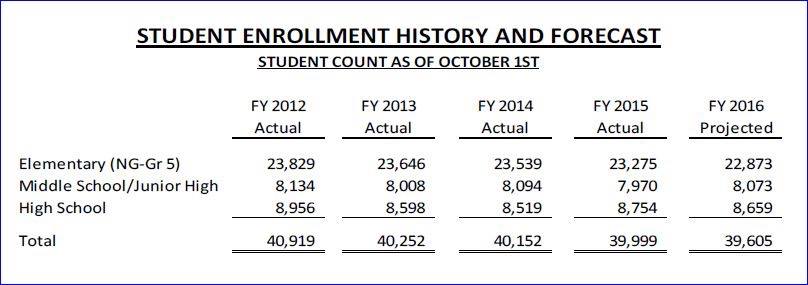
Minor, who played football in junior high and high school, remembers how school sports helped create a sense of community within the school and connected a school with its surrounding neighborhood. All that added up to an emotional investment by students, parents, and patrons in their schools -- something that doesn't seem to exist any more.
Minor sees football as having a particularly important role in knitting together the school community at the beginning of each academic year, A competitive team can bring the whole school together -- players, marching band members, cheerleaders, parents, faculty, alumni, and neighbors, sharing the experience of cheering on the team. That school spirit carries on to other sports, music, drama, and other activities as the year rolls on. For neighbors and alumni, school spirit translates into volunteer involvement. For younger kids, it translates into an attachment to their future high school. All of that can
Community spirit is nothing without educational excellence. Minor opposes Common Core, with its extreme focus on high-stakes testing and the straitjacket it places on teachers. (His opponent is backed by pro-Common Core pressure groups like Stand with Children.)
Stan Minor supports fairness in magnet school admissions. He argues that admission to academically competitive magnet schools (Carver MS, Washington HS, Edison MS and HS) should be by lottery among all applicants that meet the academic qualifications. The current system opens the door to favoritism.
Stan Minor is married and has a son and a daughter. While I've only recently gotten to know Stan, I met his son when he was a high school senior applying to MIT. His son has gone on to graduate from MIT and to a successful career in computer science.
The other candidate in the race, Cindy Decker, was appointed to the post a few months ago by the other members of the board. While she has an impressive resume, it seems fair to assume that they didn't pick her to shake things up. (There's a regrettable practice, for those offices where replacements are appointed, for the office holder to quit early and allow a like-minded successor to be appointed, giving the replacement the advantage of incumbency and depriving voters of an open election.)
Decker proudly wears her endorsement from Stand for Children, the group that lobbied the legislature to keep Common Core ("a wonderful group," she said), and Tulsa Regional Chamber, which endorsed Common Core in its OneVoice legislative platform and lobbied for Common Core at the Capitol.
When asked about the strengths of the Tulsa Public Schools, Decker could only point to the new superintendent, Deborah Gist, citing her resume, credentials, and the number of work. That's a common problem for leftists: measuring success by inputs, not outcomes.
Tulsa Public Schools desperately needs new leadership. If you live in Election District 5 (the yellow area in the map below), please go to your polling place on Tuesday and join me in voting for Stan Minor.
If you have questions for Stan Minor or would like a yard sign, call or text him at 918-605-8006 or email him at vote.4.stanminor@gmail.com
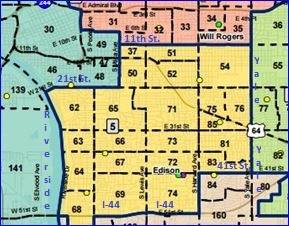
Election District 5 stretches from the river to Harvard, 21st to 51st, plus 11th to 21st, Utica to Yale, and 11th to 41st, Harvard to Yale, and the part of precinct 68 south of I-44.
Next Monday through Wednesday, December 7 - 9, 2015, is the filing period for public school board positions in Oklahoma. Most school districts will have a single seat, Position No. 1 up for election to a five-year term. Skiatook will have one additional seat on the ballot to fill an unexpired term, and Glenpool will have two additional seats. (Here is the Tulsa County Election Board press release listing the school board offices up for election. And here's where you'll find maps showing school district and election district boundaries.)
School board filing always comes at a busy and distracted time of year. As I wrote last year, it's almost as if school board elections were deliberately scheduled to escape the notice of potential candidates and voters.
If you're a conservative, you should give serious consideration to running.
The Tulsa district, largest in the state, has two out of seven seats up for election to a four-year term, Posts No. 5 and 6. The election will be held on February 9, 2016, with runoffs on April 5, 2016, for those seats where no candidate won a majority of the vote in the February election.
Tulsa Election District 5 covers Riverside to Yale from 21st to 41st, plus Riverside to Harvard between 41st and I-44, plus Utica to Yale from 11th to 21st, plus a small section just south of I-44 between Peoria and Riverside. The current member, Cindy Decker, was appointed to the post in May 2015. Her bio suggests that she's part of the problem with American education, tied in with the social services non-profit and educational consulting world. "Decker has been an education researcher since 2002. She is passionate about ensuring all children have a quality education. She works as Director of Research and Accountability at CAP Tulsa while also consulting for various groups including the U.S. Department of Education and Howard County Public School System in Maryland. She is Chair of the Board of Moto, Inc., a family-owned business based in Illinois. Formerly, she was a Senior Economist working with the education team at the U.S. Government Accountability Office." Cynthia Gustafson Decker is a registered Democrat.
Tulsa Election District 6 covers, roughly, I-244 to 51st Street from Yale to Mingo, plus 51st to 61st, Sheridan to Memorial, plus (oddly) Memorial Park Cemetery. The incumbent is Ruth Ann Fate, who was first elected to the seat in 1996. Ruth Ann Fate is also a registered Democrat.
Looking through the online biographies, I think it's fair to assume that there is not a single conservative on the Tulsa School Board. One member is a Democrat political consultant. Another is a former Democrat County Commissioner. One of the members is a teacher in a different school district and a member of the OEA, the far-left teachers union.
In addition, Tulsa Technology Center board seat 5 is up for a seven-year term, representing northern and western Tulsa County beyond the Tulsa city limits, plus those parts of Creek, Pawnee, Osage, and Washington Counties within the TTC boundaries. TTC seems to have more money than it knows what to do with; it would be lovely to have a fiscal conservative on the board who could curb their building spree.
If you're a conservative, you should give serious thought to running, even if you have no school-aged children, even if you have children that are homeschooled or in private school, even if you've never had a child in the public schools. The public school system exists to serve all citizens by educating the children of the community, so every citizen has an interest in the curriculum being used, the way discipline is handled, the condition of the school buildings, and the credentials, skills, and philosophical presuppositions of the teachers, principals, and administrators. Property owners support the school system through ad valorem taxes, and so they have a reasonable interest in the proper and efficient expenditure of those funds. So do all citizens who pay state income and sales taxes, which provide funds to supplement local property taxes.
If you are, like me, a homeschool or private school parent, you will have experience and valuable insights with successful, classical alternatives to the faddish and failing teaching methods, priorities, and content currently in use in the public schools.
I ran some numbers, comparing 2010 census data, broken down by age, with the closest school attendance data I could find, from the 2010-2011 school year. In the Tulsa school district, the average daily attendance was only 67.2% of the number of school-aged children (5-18) who lived in the district on Census Day 2010. That means about a third of school-aged kids were either homeschooled or in private schools, the highest proportion of any district in the metro area. The Tulsa district also had the lowest percentage of residents in the 5-18 bracket -- 17.9%. Compare that to the Sperry district, where 91% of school-aged residents attended the public school, and where 22.6% of the residents were school-aged.
It seems that a substantial number of families move from the Tulsa district to the suburbs when their children reach kindergarten, or, if they stay, many opt for homeschooling or private schools. Those numbers make a strong case for new leaders in the Tulsa district. And if the school board is going to be strictly representative, at least two of the seven members should have children in homeschool or private school, and a majority should be conservative.
Filing is simple: A notarized declaration of candidacy, and a signed copy of the statutory requirements for school board candidates. For this office there is no filing fee. You can view the Oklahoma school board filing packet online. And although school board elections are officially non-partisan, the local and state Republican Party organizations will provide assistance to registered Republicans who are candidates for non-partisan office. (I suspect the same is true of the Democrats.)
There was a time when it was generally agreed that schools existed to transmit knowledge and the values of the community to the rising generation, working alongside parents. At some point, as part of the Gramscian long march through the institutions, the public schools were infiltrated by Leftists who saw them as a venue for missionary work, converting children away from the values of their parents, away from the ideals that made America a prosperous and peaceful nation. The Left has influence over schools of education, textbook publishers, teachers' unions, and continuing education for teachers, administrators, and board members.
There are, it must be said, many good conservatives, many devout Christians serving in Oklahoma's public schools. But they need support in the form of school board members who will set policy and curriculum and ensure that the paid staff adhere to it. Conservative school board members should not give undue deference to "professionals" who have been trained to see education through a Leftist lens. The subject matter taught, the methods used, and the values undergirding it all should be firmly under the control of our elected representatives on the school board.
Education is necessarily ideological, because it rests on presuppositions about knowledge, truth, goodness, and beauty. The ideology of the public schools should reflect the ideology of the community.
If I were running -- and for family and business reasons I can't -- here are some of the planks that would be in my platform:
- Introduce the classical trivium as the philosophy and method of instruction in schools that are currently failing. That includes a heavy emphasis on memorizing facts in the elementary years, which gives children a sense of mastery and accomplishment and provides a solid foundation for subsequent learning.
- Instill pride in our city, state, and country. America has its flaws, but it is a beacon of liberty and opportunity that inspires hope in hundreds of millions of people around the world who wish they could live and work here. Our children should understand the aspects of our culture and history that have made our country prosperous and peaceful.
- Keep the Land Run re-enactments in our elementary schools. It's a fun and memorable way to introduce students to our state's unique history. There is an activist in Oklahoma City who managed to convince historically ignorant principals and school board members there that the '89 Land Run was an act of genocide. Oklahoma City, founded by the '89 Land Run, no longer has reenactments of that event, because of a zealot who pushed her slanderous revision of history on ignoramuses in charge of the schools.
- Return music to the elementary grades. An early introduction to classical music and learning to make music by singing have tremendous developmental and behavioral benefits.
- Review all federal grants and determine whether the cost of compliance and the loss of independence is worth the money.
- Young people who foolishly believe that swapping sexes will solve their deep unhappiness deserve pity and guidance. It is utter cruelty to humor their misplaced hope that "changing gender identity" will cure their misery. Leadership at each school should craft a way to accommodate these deluded young people with compassion and dignity, while protecting the dignity of everyone else, and while affirming the biologically undeniable reality of the two sexes.
On that last point, doing the wise thing will require resisting Federal pressure. If the U. S. Department of Education refuses funding based on its perverted interpretation of Title IX, the school should sue the DoE.
Our public schools need principled, intelligent conservative leadership. Will you step forward to serve?
RELATED:
Stella Morabito writes, "Ask Not Who's Running For President, Ask Who's Running For School Board," and she cites the recent battle in Fairfax County, Virginia, over transgender policy as one among many reasons:
The board voted 10-1 with one abstention to shove the policy down the throats of startled parents. There was no discussion and no consideration given to the concerns expressed. Instead, the parents were in effect smeared as intolerant bigots.The ten board members voting in compliance with this federal harassment behaved like a bunch of cronies who seemed most interested in securing their places of privilege in a coming nomenklatura by regurgitating Orwellian-style talking points about "equality" and "non-discrimination."...
When informed citizens of goodwill vote en masse locally, they can provide an effective check on corruption and force government to be more responsive to its citizens. This kind of citizen activism serves as a buffer that can prevent state and federal governments from absorbing local governments.
As we've seen from the Fairfax County case, our distraction from local elections and neglect of local politics is fertile ground for growing laws under the radar on issues that have not been debated or thought through.
More than ever, we need to push back against the use of local elections as a back door to enforcing agendas established by central, national, or even international agendas.
Walt Heyer, a man who underwent sex-change surgery and then, realizing that the change failed to give him the happiness he had hoped for, changed back, writes that the Obama Administration is using its perverted interpretation of Title IX to force public schools to trample their students in the transgender war against science and reason.
Let's look back and unmask the founders who started the gender madness we see infiltrating into our public schools today. As I detail in "Paper Genders," changing boys into girls started in the perverted minds of three abhorrent pedophile activists from the 1950s who were at the forefront of promoting a movement for sexual and gender experimentation... [Alfred Kinsey, Harry Benjamin, and John Money]....Public schools are becoming centers for gay, lesbian, and gender-pretender activists and only secondarily fulfilling their purpose as institutions for sound academics. The laws are being interpreted far beyond the original intent of non-discrimination based on gender to where they protect gender pretenders at the expense of the rights of non-trans kids. Gender pretenders are assured access to every school facility and program available to the opposite gender, up to and including girls-only dressing rooms and showers.
Every child's rights to privacy and protection from exposure to inappropriate opposite-sex nudity are now in jeopardy. According to these new legal interpretations, if you like your gender and want to keep your gender that's fine, but you cannot keep your freedom, rights, or protections in public-school dressing rooms or restrooms. The current conflict of interest playing out in school locker rooms between girls born as girls and the self-acknowledged gender pretender trans-kids is real and it is not funny. Non-trans students have lost their right to privacy and parents have lost the freedom to parent and protect their children....
Studies show that people with gender issues also have other psychological issues 62.7 percent of the time. When the co-existing illness is treated, often the desire to change gender dissipates. By not treating the co-existing illnesses first and instead putting the patient through gender reassignment--hormones and surgery--the medical community does irrevocable harm to the patient's body and long-lasting harm to his mind.
The harm is deeper for impressionable children and adolescents who experiment with gender-change behaviors and hormones or hormone blockers. Studies have shown that the majority of kids who are gender confused will grow out of it if they are left alone....
Gender pretenders--also known as trans-kids, crossdressers, or transvestites--should get counseling, not encouragement. Social terrorists who use child transvestites to advance an agenda of sexual perversion should be shut down, not be guiding public school policy.
It's time for parents and kids to fight against the social terrorism of gender change. It's time to take schools back from males who wish to expose themselves with impunity in the girls' locker room.
Tulsa Library CEO Gary Shaffer is an overpaid, left-wing twit.
This is admittedly a snap judgement, but when I saw Shaffer's rationale for a change to the summer reading program that halved participation over the previous year (33,194 down to 16,013) I felt confident in making it.
The summer reading program has been a fun way to encourage children to keep reading and to get to know the Tulsa Library system over the three-month school break. Kids and parents keep track of the books they've read, then turn in their reading card at the end of the summer to receive toys and coupons, donated by sponsors, as rewards for completing the specified number of books.
Here's the apparent cause of the drastic drop, which cut participation to its lowest level since 1985, according to Kelly Jennings, the former coordinator of the program:
Jennings said a change of requiring a library card for each child resulted in children's groups turning away from the program, as did parents of multiple children not wanting to keep up with a lot of cards.She said the larger groups usually opted for one card for easy tracking of the books checked out.
Shaffer's response:
Shaffer said the change was made to encourage children to get a library card, which he called a "social justice issue."
With the quoted phrase, Shaffer brands himself as a left-wing twit. "Social justice issue" is a Duckspeak phrase. It is designed not to stimulate thought and discussion but to bypass the brain and halt discussion. A public agency's policy could be debated as to its prudence and effectiveness, but as soon as it is labeled a "social justice issue," all discussion must cease. To oppose the policy is to oppose "social justice," and if you oppose social justice, you're a bad person. By using the phrase, Shaffer outs himself as a left-winger, and by using it to stop a discussion about a failure under his leadership, Shaffer outs himself as a twit.
As for overpaid:
Shaffer is an at-will employee who will now earn $171,966 annually. The raise reflects the same cost-of-living increase given to employees earlier this year. He will continue to be paid while finishing his degree.Shaffer will take a sabbatical starting Sept. 15 and ending in mid-December. He will be paid the equivalent of two months of his salary and will also receive $1,000 for payroll deductions such as health and life insurance for the period between July 1 and Dec. 31.
Other benefits include a $450 monthly car allowance for his private vehicle and three electronic devices (cellphone, home computer and iPad) for work use....
Shaffer was hired in January 2011 at a salary of about $140,000, which was increased to $145,596 in September 2012. Three months later, he was given a raise, bringing his salary to $154,475. A year later, the commission approved a 7 percent bump in pay to $165,288.
The story mentions that he would be one of only four library CEOs in the nation with a doctorate.
We have a great, well-funded library system, with some terrific employees. I particularly appreciate the researchers who have helped me over the years. They, and the taxpayers, deserve better leadership.
A commenter on one of the Tulsa World stories described the move to individual library cards as "nothing but a membership drive. He wanted to make it look like he had increased readership big time and all it did was drive people away." Does this overpaid, left-wing twit have a bonus clause for increasing the number of active library cards?
It sneaks up on us every year -- the filing period for next spring's school board elections across Oklahoma. It's the first Monday in December and the two days following, at the start of the Christmas season as popularly defined. This year the timing of the filing period is the worst possible as it comes right on the heels of the long Thanksgiving weekend. The elections themselves will be the second Tuesday next February, followed by a runoff, if necessary, the first Tuesday in April. It's almost as if school board elections were deliberately scheduled to escape the notice of potential candidates and voters.
The filing period for the 2015 school board elections will close on Wednesday, December 3, 2014, at 5:00 p.m. So far no seat in Tulsa County has drawn more than one candidate, and seats in Skiatook, Liberty, and Keystone have no candidates at all so far.
Conservatives shouldn't overlook these races. Oklahoma's tax-funded schools can and should be reformed to reflect the priorities and values of Oklahoma's conservative majority.
When public schools were founded by local communities, they were designed to prepare students to function capably as free and equal adult citizens in the community and to assist the parents of the community in propagating their ideals and values to the next generation. Schools had high expectations of their students, regardless of their wealth or ethnic backgrounds, and students graduated ready to make their own way in the world and contribute to the betterment of the community.
As part of the Left's Gramscian Long March through the nation's institutions, the Left has come to claim public schools as its own mission stations among the benighted and savage conservatives of Flyover Country. Since, in the Left's view, the American civilization established by our Founders is utterly corrupt and in need of fundamental transformation, the political, social, and moral values that built American civilization and American liberty must be junked. The schools can be used to alienate children from their parents and their community's values and to prepare children to accept the Left's political and moral indoctrination. Court decisions divorcing schools from community values have abetted the transformation, as have the public's neglect of the school board as a tool for accountability. Too often, a school board can see itself as enablers and servants of the "professionals" in the administration, rather than as the public's proxy as bosses of the paid staff.
There are many good teachers, administrators, and board members in the public schools who are not on the side of the Left. They are attempting to carry on the traditional purpose of the public schools. They deserve our appreciation and our help in obtaining reinforcements.
Gifted teachers are often frustrated by the bureaucratic tendency for the mediocre to rise to the top. Testing, often imposed out of a well-intentioned desire to hold schools accountable for results, instead inhibits creativity and pushes curriculum toward centralized conformity -- providing another channel for Leftist suppression of local values.
Adding to the corrupt mess, curriculum decisions are driven by textbook publishers and test makers who are pushing new products, trying to make a buck at the expense of school children who would benefit from time-tested teaching methods instead of the latest fad.
Grants are another source of distortion. Grant money comes with strings, and schools may divert other funds to meet the conditions required to receive a grant. Our Oklahoma legislators and governor had the courage to reject a short-term boost of Obamacare funds because of the long-term harm the program would do and the long-term costs the deal would incur. Wouldn't it be wonderful if we had public school boards filled with men and women who had the courage to reject federal, state, or private grants that would distract from the school's mission or compromise the school's support for the community's values?
Every school district in Oklahoma has at least one seat up for election every year. All but the very largest independent districts are on a five-year cycle -- five board members, each serving a five-year term. This time the Office 5 seat is up for election. In Tulsa County, that affects every school district except Tulsa and Keystone.
Dependent (K-8) districts have three members each serving a three-year term; Office 1 is up this year.
The Tulsa district is a special case; its board has seven members, elected by district to four-year terms. Most years, Tulsa elects two members, but this year only one seat is up: District 1, currently held by Democrat incumbent Gary Percefull, who is so far the only candidate to file. The election district covers the part of the Tulsa school district southwest of the Arkansas River, plus downtown Tulsa and precincts to the north, west, south, and southeast, and the precincts along the Sand Springs Line.
Some districts may also have an additional seat on the ballot to fill an unexpired term.
One seat on the Tulsa Technology Center board, Zone 3, is also on the ballot. This board has seven members, serving rotating seven-year terms. Zone 3 consists of 31st to 81st Street, Yale to 129th East Ave, plus 81st to 101st, Memorial to 129th East Ave, plus 31st to 41st, 129th to 145th East Ave, plus a triangular area bounded by 129th, 71st, and the railroad. Tim Bradley is the incumbent, but only one candidate, Guy Mark Griffin, has filed. (Mark your calendar: Kathy Taylor's daughter, the Zone 4 incumbent, will be up for re-election in the 2015-2016 cycle.)
Tulsa Technology Center has been in a massive expansion mode for many years. Since 2011, TTC has opened new campuses in Owasso and Sand Springs and renovated its Broken Arrow campus. It would be nice if at least one board member was willing to look at long-range financial sustainability of all the new facilities and whether TTC could let the voters decide to reduce its millage rate, allowing voters to decide whether to add that millage to meet more pressing needs via another taxing entity or to put it back in property taxpayers' pockets.
Please take a few minutes to look at the maps of school districts and board zones and the list of offices to be filled and candidate filings to see whether your district, ward, or zone has an election this year. If you don't live in a district up for election, think about good men and women you know who do. Take a look at the official school board candidate filing packet and fill it out, then get yourself or someone else down to the county election board by 5:00 p.m.
These are winnable races. School elections have low turnout, and, although the races are non-partisan, the Oklahoma Republican Party and county GOP organizations make their resources available and help mobilize volunteers and donors for registered Republicans running for school and municipal offices. Some good organization and hard work could be enough to win, but the first step is to file.
The Oklahoma Council for Public Affairs (OCPA) and Americans for Prosperity Foundation are celebrating the 102nd birthday of Nobel Laureate and educational-choice champion Milton Friedman with snowcones at Tulsa's Mohawk Park Pavilion 2, tomorrow, Thursday, July 31, 2014, from 4 pm to 6 pm. It's a come-and-go event for the whole family, and door prizes will be awarded.

Friedman, with his wife Rose, wrote the best-selling book Free to Choose and hosted a PBS TV series of the same name, showing the essential connection between personal liberty and prosperity. Throughout his career, Friedman argued that meaningful parental choice in education would produce better schools better suited to students. Some quotes on the topic (links to original sources and context at the link):
"It is only the tyranny of the status quo that leads us to take it for granted that in schooling, government monopoly is the best way for the government to achieve its objective."-- "The School Choice Advocate," January 2004"Our goal is to have a system in which every family in the U.S. will be able to choose for itself the school to which its children go. We are far from that ultimate result. If we had that -- a system of free choice -- we would also have a system of competition, innovation, which would change the character of education."
-- CNBC Interview Transcript, March 2003"Improved education is offering a hope of narrowing the gap between the less and more skilled workers, of fending off the prior prospect of a society divided between the "haves" and "have nots," of a class society in which an educated elite provided welfare for a permanent class of unemployables."
-- "The School Choice Advocate," July 1998
Interesting coincidence:
Keith Ballard is the Superintendent of Tulsa Public Schools. He was appointed to the post in 2008.
Tulsa Public Schools is a client of the law firm of Rosenstein, Fist, and Ringold. According to the firm's website, that relationship began in 1932. In 2011, questions were asked about the amount of money -- over a half million a year -- the district spends with the firm each year.
Matt Ballard is an attorney with Rosenstein, Fist, and Ringold. He joined the firm in 2008 and was made a member in 2011. He is the Republican nominee for District Attorney in Rogers, Mayes, and Craig counties.
Over on Conversation Catoosa on Facebook, there's a rumor about moving the City of Tulsa's Rolling Hills subdivisions from the Tulsa school district to the Catoosa school district.
This is an area southwest of Admiral and 193rd East Avenue that has been in the City of Tulsa since the massive 1966 annexation and has been in the Tulsa school district since the independent East Central school district was annexed into the Tulsa district in 1964. It is bordered by the City of Catoosa and the Catoosa School District on the north (across I-44 in Rogers County) and east (across 193rd East Ave. in Wagoner County).
Such a transfer would benefit the neighborhood, both school districts, and the City of Tulsa. The neighborhood once had Carl Sandburg Elementary School in the TPS system, but Sandburg closed in 2011. The "neighborhood" school is Kerr Elementary, over five miles away. I'm told that many students in the neighborhood transfer to Catoosa schools, where the furthest building is about three miles away, and the middle and high schools are barely a mile away. The neighborhood has always had strong cultural and economic ties to Catoosa.
Beyond this one half-section, it would make sense to move everything east of 145th East Ave. out of the Tulsa School District. The area was also home to Lynn Lane School and several never-developed TPS sites. East of 145th East Ave and south of 31st is already in the Broken Arrow School District, and that area has seen many new subdivisions in recent years. Transferring the area north of 31st and east of 145th to Catoosa would encourage new residential development within the Tulsa city limits and would increase the value of existing homes, and that increase in value would benefit all Tulsa taxpayers, by spreading the property tax sinking fund burden across a higher assessed value. City of Tulsa leaders would be smart to encourage the move.
Part of the City of Tulsa is already in the Catoosa district: part of the area in Wagoner County annexed in 2001 and the fenceline in Rogers County that extends to the Tulsa Port of Catoosa.
TPS would benefit, too, by no longer having to run bus service to the isolated subdivisions and acreages of east Tulsa. TPS might even be able to sell the Sandburg building and proposed school locations to Catoosa schools for their future expansion.
If I'm reading 70 O.S. 7-101 correctly, voters in the affected area could submit a petition requesting an election, and it wouldn't take many of them. Subsection B reads:
B. An annexation election shall be called by the State Superintendent of Public Instruction without the concurrence of the board of education of the school district which is proposed to be annexed, upon the filing of a petition with the State Superintendent of Public Instruction for annexation that is signed by a majority of the school district electors in the territory proposed to be annexed, hereinafter referred to as the area affected, said majority being applied to the highest number of voters voting in a regular school district election in the district in the preceding five (5) years as determined by the secretary of the county election board, who shall certify the adequacy of the number of signatures on the petition. The petition shall contain such information as the State Superintendent of Public Instruction may require.
The TPS board could choose to limit the election to the affected area or, if they wanted to give the petitioners a bigger hill to climb, could have the entire school district vote. I'd hope that TPS would see the benefit of ceding this sprawling territory with its attendant expenses.
Once upon a time, developers wanted to move rural school territory into the Tulsa district to attract suburban homebuyers. In the early 1950s, voters transferred a large section of the Union district into the Tulsa district -- everything now in the Tulsa district southeast of 21st and Yale.
But for several decades now, smaller suburban and rural districts have been more attractive to househunting parents than Oklahoma's largest single school district. Parents feel that suburban board members and administrators are more accessible and responsive, and a district with one high school is more of a cohesive community than a district with nine where the boundaries seem to be constantly changing. Parts of the City of Tulsa in suburban districts have thrived, while I suspect it's been over 30 years since a new middle-income housing development has been built within TPS boundaries.
MORE: A November 21, 2010 Tulsa World story lists earlier waves of school closings in the Tulsa district.
Emerson Elementary School, north of downtown Tulsa at 909 N. Boston Ave, will celebrate its centennial this Friday night, May 2, 2014, from 6 to 8 pm. Dinner will be provided by Elote and music by Muskogee's Wild Card Band. There will be a silent auction to benefit the school's Science, Technology, Engineering, and Math (STEM) initiative. Tickets are $10 for adults, $5 for children 11-17. Visit Emerson's "purchases and donations" page to buy tickets and centennial T-shirts.
In researching a story about the neighborhood south of Emerson, I've enjoyed talking to a number of alumni who attended the school in the '40s and '50s and getting to know the school's long and fascinating history.
Emerson School dates its birth from its authorization in Tulsa's 1913 school bond issue. A April 14, 1915, story, headlined "BUILD NEW SCHOOL ON THE NORTH SIDE: Buy Block In Kirkpatrick Heights for a Unit Building," reported:
Amicably settling the slight dissention [sic] which recently arose between the North Side Improvement association and the city school board, it was decided at the meeting of the school board last night to purchase a block of ground in the Kirkpatrick Heights addition for a new school site and build an entirely new unit school at that place. In view of the unsafe condition of the Sequoyah school, for a large number of children, it was decided to diminish the attendance there as well as repair the building and render it safe as far as possible.It is thought probable that the Osage school, which is a grade school, would never likely grow very much, shall be made the location for the manual training and domestic science departments for the more advanced students of the north side. This will prevent their having to go as far south as the central high school or as far east as Washington school to take that course of study. Members of the North Side Improvement association present expressed themselves before the board and privately as being entirely satisfied with the arrangement.
(On the same page, a box score and news story announced that the Tulsa World-Democrat newsboys baseball team, the Newsies, had defeated Bellview (Lincoln) elementary school 7-6 and Horace Mann elementary 10-2 in a Sunday afternoon double header. For more information about the concerns of this period for school building soundness and safety, see "'JITNEY' SCHOOLS ARE 'ALL BLOWED UP'" in the September 8, 1915, Tulsa World.)
A month later, on May 19, 1915, the school board approved, with one member dissenting, the purchase of a block in Kirkpatrick Heights and rejecting the Mary Davis site. (That may be a reference to the Davis-Wilson Heights Addition, on the east side of Cincinnati at the top of Sunset Hill. The same page discusses work on the Detention Home and has an ad from the Tulsa Theatre Managers Association about a wildcat strike by union musicians, stagehands and operators.)
A Sunday, September 19, 1915, news story about the reopening of the school year the following day announces that enrollment for the new school in Kirkpatrick Heights would be held at Osage (Fairview west of Denver) and Sequoyah Schools (Boston and Easton) "A separation of the district will be made, as soon as the building is completed." A January 4, 1916, story reports that Emerson school "will be occupied tomorrow," with only one further school from the last bond issue to be completed (Riverview).
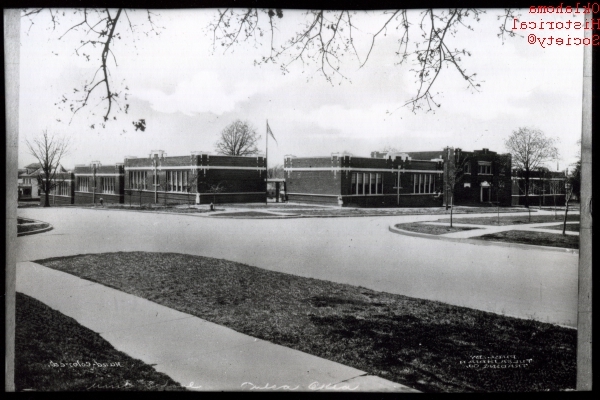
NOTE: It appears that the Oklahoma Historical Society had the photo backwards. Based on aerial photos, the auditorium was on King Street, second building east of Boston. When reversed, the photo matches the slope of the land.
Emerson has had two incarnations. Its first was as a campus on the east side of Boston between King and Latimer Streets, occupying about half a block and built according to the "unit plan" devised by school board member H. O. McClure, namesake of a Tulsa park and school. Each unit consisted of two classrooms with its own restrooms and cloakrooms. As enrollment grew, additional units would be built, gradually enclosing an inner courtyard. One two-story building housed the auditorium and school offices. The plan was innovative and received national attention. While many unit plan schools, including Emerson, have been demolished, a few remain, and most have been put to other purposes: Lee School at 21st and Cincinnati, Irving School at 1st and Nogales, Pershing School in Owen Park neighborhood, and Lincoln School at 15th and Peoria. In some cases, like Lincoln and Irving, units were constructed around multistory school buildings.
The courtyard wasn't big enough for baseball; little league games were played several blocks north at Cheyenne Playground.

Prior to school desegregation, Emerson was a school for whites only. After Brown v. Board of Education, starting in 1955, a few African-American children enrolled in the school. Bill Leighty, who was an Emerson student at the time, remembers that the change was uneventful and the new students were welcomed. Over the next 20 years, changing school boundaries and changing residential patterns (influenced in part by the urban renewal demolition of Greenwood and the displacement of its residents) resulted in Emerson becoming a majority African-American school; 87.4% in the 1975-1976 school year.
The second, modern incarnation of Emerson began in 1975, as part of a plan to desegregate schools without forced busing. Tulsa proposed, and the Federal judge accepted, a plan to build a new Emerson School as a magnet, to complement new magnet schools at Carver Middle School and Washington High School. Charles Johnson Elementary, located in the old Washington building in the Greenwood district, and which had been one of the segregated "separate" schools for African-Americans, would be closed and merged into Emerson. Longfellow, at 6th and Peoria, had been closed and merged into Johnson for the 1972-1973, to try to create a balanced student body.
Building this superschool involved the creation of a superblock, demolishing the original buildings and the houses on the rest of its block, the block to the south, and two blocks to the west. Forty-six single-family homes, three duplexes, seven apartment buildings, and a small retail building at 14 E. Latimer (home in in 1957 to Tulsa Nozzle and Valve, in 1967 to the Edge of Night beer joint) were removed. King Street was closed between Cincinnati Ave (now MLKJr Blvd) and Main, and Boston Ave was closed between Jasper Street and Latimer Street.
The new Emerson, which opened its doors in 1976, had a brand new, modern building, innovative curriculum offerings, and highly-credentialed teachers. From a 1977 report to the U. S. Commission on Civil Rights about the desegregation of Tulsa schools:
On April 24, 1975, District Judge Frederick Daugherty issued an order with regard to Emerson Elementary School. The order approved the school districts request to build a new elementary school based on an expansion of the existing Emerson campus. Student assignment changes were made by consolidating the enrollments of Emerson and Johnson Elementary Schools. The court stipulated that the new Emerson must maintain a black enrollment of not more than 50 percent. The school district, expanding on its previous successes at Burroughs Little School, Carver Middle School, and Washington High School, sought voluntary white student enrollment. The court had made it quite clear that, if the voluntary approach did not work, the district would have to take other action to maintain the prescribed racial enrollment in the new school.The new Emerson Elementary, which opened in September 1976, formed the final link in a complete K-12 alternative school program where students can experience individualized, continuous-progress learning in a racially desegregated environment. The total enrollment of 700, with a 50-50 black-white ratio, consists of approximately 500 neighborhood children and an additional 200 white student volunteers. Children in grades K-3 are located in a special area with ready access to other activity areas. The curriculum emphasizes communication skills and mathematics taught by a team of teachers. Enrichment experiences include music, drama, and creative arts at this level.
Children in grades three through six have three time blocks of 110 minutes each allotted to communication skills, math-science, physical education, and humanities. Additional instruction in music is available on the violin, guitar, and piano beginning at the third-grade level.Although the main emphasis is on basic skills geared for individualized instruction, the curriculum stresses a humanities program. Children at Emerson have access to a piano laboratory, a potter's wheel, instruction in dance and drama, and a miniature television studio where they can produce their own shows. The curriculum features a creative learning center where children may engage in enrichment experiences in the arts, crafts, plant growing, and creative writing. This component of the curriculum is closely articulated with the exploratory curriculum at Carver Middle School so that Emerson students can continue their entire public school education through similar programs at Carver Middle School and Washington High School.
Today, Emerson is the neighborhood school for a three-square mile area that includes all of downtown within the Inner Dispersal Loop plus an area bounded by the L. L. Tisdale Expressway, Peoria Avenue, Pine Street and 11th Street. It feeds into Central Junior and Senior high schools. At the start of this academic year, Emerson had 311 students and 23 teachers. 95% of students qualify for free or reduced lunch. 70% of the students are African-American. Student attendance rate last year was 94%.
TulsaNow is hosting a forum for candidates for the upcoming Tulsa School Board election. The forum will be at Foolish Things Coffee, 1001 S Main Street in downtown Tulsa, at 5:30 pm on Wednesday, February 5, 2014.
The League of Women Voters has posted its 2014 Tulsa area school board candidate questionnaire with responses for candidates for Tulsa offices 4 and 7, Bixby office 4, and Tulsa Technology Center Office 6. The voter guide also includes the ballot titles for bond issues in Jenks and Union districts.
As usual, most school board positions in Tulsa County drew only a single candidate during the December filing period. Filing was held the first week in December, when most people are focused on the end of the school semester and the upcoming Christmas holiday.
Bixby Office 4: Helen Bolton, Lisa Owens
Tulsa Office 4: Bobbie Gray-Elliott (incumbent), Shawna Keller, William D. Bickerstaff
Tulsa Office 7: Gene Beach, Suzanne Schreiber
Tulsa Technology Center Offce 6: Sharon A. Whelpley, Paul J. Kroutter
The primary and bond issue election will be held on Tuesday, February 11, 2014. In races with three or more candidates in which no candidate receives a majority of the primary vote, a runoff will be held on the April 1, 2014.
MORE: Here is the Tulsa County Election Board election calendar for 2014. Note that the first half of next week, February 3-5, 2014, is the filing period for city elections in Bixby, Collinsville, and Owasso. Those cities have a primary on March 4 and a runoff on April 1. April 9-11, 2014, is the filing period for state and county posts; April 13-15 is the filing period for City of Tulsa council (all nine) and auditor positions. 2014 will be the first year for City of Tulsa elections to coincide with state elections.
STILL MORE: The Oklahoma Republican Party will be holding a day-long campaign training school for candidates and volunteers in Tulsa on February 22, 2014. Contact the state party HQ for details and registration.
Deborah Brown Community School, a elementary school in downtown Tulsa chartered under the aegis of Langston University (a historically black state university), has come under attack as a result of a misleading Fox 23 report about a parent's decision to remove his daughter from the school because the school prohibited his daughter's preferred hairstyle.
The Fox 23 story and descriptions linking the story on their Facebook page state that the girl was sent home because of hairstyle and that the girl was told directly by school officials that her hairstyle was unacceptable. The Fox 23 story had the girl on camera, sobbing, "They don't like my dreads." Facebook commenters reacted with outrage: How dare they make a little girl cry! How dare these racist school officials ban a natural, culturally significant hairstyle!
What actually happened is that the school reminded the girl's parent that the hairstyle was expressly against the school rules, and the parent chose to move the girl to a different school. This is according to a statement from the school sent in response to a question from the Huffington Post.
So the school did NOT kick the student out, did NOT send the student home, did NOT confront the little girl about her hair.
The point of a school uniform and dress code is that an elementary school is not a place to make a fashion statement or express your personal style. Elementary school is a place to be taught the basics -- reading, writing, arithmetic, geography, history (names and dates) -- the grammar of learning, the foundation for further education in every subject. The overarching theme of the school's policy on hair is that hairstyles should be plain and simple.
Here is the Deborah Brown Community School parent/student handbook. And here is the entire section on the dress code:
Our philosophy and program aspires to raise the level of academic excellence through respect for learning. The students, therefore, dress in a uniform to encourage respect and seriousness of school. Students attending DBCS are required to wear black or brown shoes and the appropriate uniform as designated by the Executive Director. BLACK OR BROWN TENNIS SHOES ARE NOT ACCEPTABLE. It is suggested that each child have a minimum of four complete sets of uniforms. Any student not wearing the proper uniform Monday through Friday will be sent home for non-compliance to the school dress code. Hairstyles such as dreadlocks, afros and other faddish styles are unacceptable. For safety reasons, girls weaved hair should be no longer than shoulder length. Boy's hair is to be short and neatly trimmed. Boys are not allowed to wear earrings.If it is necessary to wear non-uniform clothing not only for emergency reasons, but Free Dress Day, students will not be allowed to wear letters, numbers or pictures on their garments. This rule applies to all students. Student dress should be conservative and modest. Free Dress Day will always be announced in writing.
Some online commenters declared that the school must be racist, because they are discriminating against "natural" ethnic hairstyles like dreadlocks and afros. When I pointed out to someone on Twitter that the founder/director of the school, the entire board and administration, and most of the faculty are African-American, the response was, "Phyllis Schlafly is female. Self-loathing is a terrible thing. Worse when it's projected onto members of one's own demographic."
Anyone who knows Phyllis Schlafly knows that there isn't an ounce of self-loathing in her.
She disagrees with leftists about what policies are in the best interests of American women, and she believes that women (and men) are best served by traditional family structures and values. It's a typical and ridiculous leftist tactic to strip an opponent of her worth and humanity and to discount her views by labeling her as self-loathing.
By the way, there's nothing natural about dreadlocks, afros, or mohawks for any hair type or ethnicity. Dreadlocks -- consisting of deliberately matted hair -- require a great deal of work to create and maintain, as do bushy afros and mohawks. Dreadlocks have cultural meaning to Rastafarians, who reject cutting and combing hair, but not to those of African descent generally. I was amused to find this September 1970 Los Angeles Times wire service story about fashionable Tanzanian women adopting the Afro fad in imitation of Americans, to the dismay of local nationalist leaders who considered it an example of Western cultural imperialism.
So here we have a group of African-Americans, led by a woman, who had a vision of doing a better job than the public schools at educating African-American children. A part of that vision is structure and discipline, an emphasis reflected in the school's dress code.
By all accounts, the Deborah Brown Community School is succeeding: DBCS received a "B" grade for 2011-2012. Of the Tulsa Public School district's 53 elementary schools, only 8 did as well or better.
The point of a charter school is to encourage innovation in education and to provide parents with tuition-free options so they can find the best educational approach for their children.
From a Tulsa World story on the Deborah Brown Community School and its plans to expand to include middle school grades:
The Deborah Brown school is sponsored by Langston University. About 250 students are enrolled, and 110 are on a waiting list.By virtue of its location, 95 percent of its students are black, Mikel said. ...
The Deborah Brown school has high academic and behavioral expectations for its students.
As students walk down the hallways to wash their hands before lunch, they are quiet and well-mannered. Teachers place graded papers along the hallway for all to see. Most received A's.
The school uses an instructional method developed by its founder and namesake, and the curriculum is focused on reading, writing and math.
It also has a mandatory uniform policy and strict discipline policy and requires a strong commitment from parents to help their children reach their potential.
Mikel said that when he first came to the school, he heard children reciting something but wasn't sure what it was. It turns out, students were reciting the chemical elements from memory.
"I thought they were speaking a foreign language," he said with a laugh.
Shame on Fox 23 for damaging the reputation of a successful school serving African-American children by presenting this story in such a slanted and emotionally manipulative fashion.
MORE: Here's a more specific reference to the Tanzanian writer who dissed the American-style afro, from the February 1973 issue of Ebony, in an article entitled, "Is the Afro on Its Way Out?"
Surprisingly, one of the most vitriolic denouncements has come from an East African writer, Kadji Konde, who sees little resemblance between the big bush and the short styles worn by many African women. Rejecting it as a symbol of imperialist American decadence as purveyed by Westernized blacks, Konde wrote in a Tanzanian newspaper: "How natural these nests are is a mystery to me. In the United States, where this hairdo comes from, it is called an Afro style. This implies a link with Africa, although I fail to see how this keeping of wild oiled bush on the skull has anything to do with dear mother Africa." The attack as published was accompanied by a picture of Angela Davis.Other common complaints are limitations on the types of hairstyles one might attempt with a 'fro, the difficulty of wearing a hat over a very large one in winter which means a whole recombing process each time the hat is removed and the gripes of both 'fro and non-'fro wearers who have found themselves seated in theaters or concert halls behind those whose towering bushes obscured any view of the stage.
And a story in the October 25, 1971, edition of Time, began:
From the time that it first appeared on the scene five years ago, the "natural" or Afro hair style closely paralleled the growth of black pride. Becoming a political statement and a symbol of racial identity as much as a popular hair style, it gradually billowed from close-cropped cuts into dramatic, spherical clouds that framed the heads of both women and men. Now that blacks feel more secure about their identity and are achieving some of their political goals, the popularity of the Afro has begun to wane.
If you're asking if a recently popular hairstyle is "on its way out" -- that's pretty much the definition of "faddish," isn't it?
STILL MORE:
Here is a playlist of videos about DBCS: A promotional video aimed at potential donors, a couple of news stories, and a couple of home videos. I don't get the impression that these students are being steeped in self-loathing.
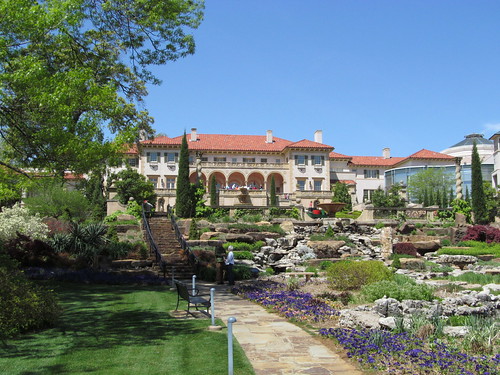
Tulsa's Philbrook Museum of Art is holding a reception for homeschooling parents on Saturday, June 29, 2013, from 2 to 4 pm. The event is free.
Learn all about the growing Philbrook Homeschool Art program. Enjoy light refreshments, guided tours, and the announcement of the Fall 2013 curriculum.For questions call 918.748.5352
Philbrook has had a homeschool art program since Fall 2011. An article about the program notes, "According to the National Home Education Research Institute, there are over 2 million home-educated school age children in the United States."
Tulsa has a strong homeschooling community, with an infrastructure that includes cooperatives and communities, conferences, and even a textbook and curriculum consignment store. There's a great deal of diversity in methods and motivations among Tulsa homeschoolers, but homeschooling parents are always on the lookout for activities and classes that complement their children's studies at home. Really, it ought to be called tailor-made education -- it's all about finding the right combination of materials and teaching methods to suit your child's gifts and abilities. It's smart for Philbrook to reach out and offer an enrichment opportunity to Tulsa area homeschool families and in the process build a new generation of museum patrons.
Philbrook would not only be valuable to a homeschool family as a place to study art, but the works on display would complement the study of European history (ancient Greece, ancient Rome, the Middle Ages, the Renaissance), American history, Native American peoples, and the Bible, among other subjects.
This Land Press has posted photos of every page of the Booker T. Washington High School Yearbook from 1921, the year of the race riot that destroyed the community which Washington High served.
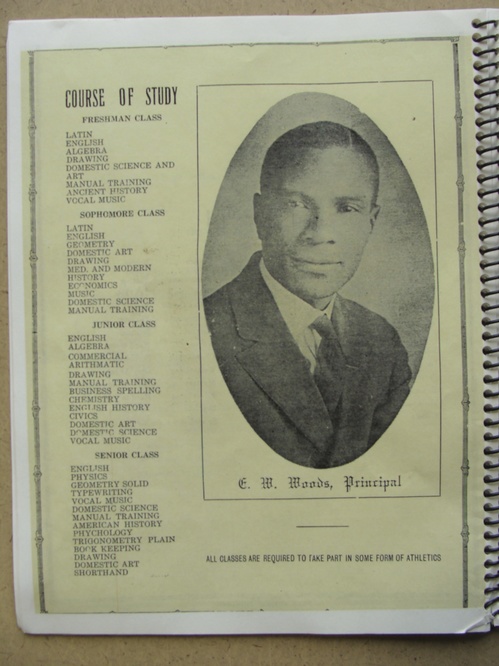
Faculty: Nine men, six women, and all appear to be African-American.
Freshman Class
Latin
English
Algebra
Drawing
Domestic Science and Art
Manual Training
Ancient History
Vocal Music
Sophomore Class
Latin
English
Geometry
Domestic Art
Drawing
Medieval and Modern History
Economics
Music
Domestic Science
Manual Training
Junior Class
English
Algebra
Commercial Arithmetic
Drawing
Manual Training
Business Spelling
Chemistry
English History
Civics
Domestic Art
Domestic Science
Vocal Music
Senior Class
English
Physics
Geometry Solid
Typewriting
Vocal Music
Domestic Science
Manual Training
American History
Psychology
Trigonometry Plain
Book Keeping
Drawing
Domestic Art
Shorthand
"All classes are required to take part in some form of Athletics."
 As we near the midpoint of the second semester, it's a good time to consider whether your current schooling arrangement best suits your children's needs. Never before have there been so many options. If you want an academically rigorous but caring environment, grounded in the Christian worldview, taught in accordance with the classical approach to education, you need to consider Augustine Christian Academy. Two open houses in the next few weeks and a banquet this Friday evening are ways to get acquainted with ACA.
Augustine Christian Academy is a non-denominational classical Christian school. The distinctives page on the website gives you a good sense of what the school is all about. A few excerpts:
Whereas public schools are prohibited from presenting a Christian emphasis in any subject and most Christian schools present only a single sectarian doctrine, ACA exposes its students to a variety of viewpoints training them through logic to question the truth and validity of each.Rather than limiting the expression of their Christianity to traditional religious activity, ACA seeks to train students to expand their expression of faith through an integrated Biblical worldview. Students are taught to bring Biblical principles to every sphere of life and learning in order to completely reflect the glory of God in their life and culture.
Augustine Christian Academy has two upcoming open houses on Tuesday evening, February 26, 2013, 6:30 pm - 7:30 pm, and Wednesday afternoon, March 6, 2013, 2:00 - 3:30 pm. It's an opportunity to tour the school, ask questions, and meet teachers. The school is at 6310 E. 30th St., just west of Sheridan.
Prospective students are also encouraged to shadow a student for a day, and school tours can be arranged at other times. Call the ACA office at 918-832-4600 to schedule a visit.
The ACA annual banquet, this Friday night, February 22, 2013, at 6:30 p.m. at the Tulsa Renaissance Hotel, is another fine way to get to know the school. The speaker for the event is Arthur Greeno, author of Dysfunctional Inspiration.
ACA not only offers an excellent academic environment, but we've also found it to be a warm, welcoming community. Beyond the classroom, there's a strong performing arts program and a "house" system that builds community across the grades through service projects and intramural competition.
One of ACA's notable characteristics is its flexibility in working with the circumstances of a student and his family. Homeschool students in grades 6 through 12 can enroll part-time to supplement their homeschool curriculum and to participate in school activities. Younger homeschoolers can enroll in extracurricular programs at ACA. Some financial aid is available. After-care is available at the school (for a fee) to accommodate parental work schedules.
Our family has been part of the ACA community for the last six years, and this year I'm also teaching first-year Ancient Greek at the school. The more I've gotten to know this school, its leadership, its teachers, and its students, the more impressed I am, not just by the commitment to academic excellence, but by the spirit of community.
Back in early January, I participated in an in-service day for the faculty, which included a discussion of Anthony Esolen's ironically-titled Ten Ways to Destroy the Imagination of Your Child. The comments of the teachers revealed a desire to impart a lifelong love of learning and a sense of imagination and possibility that will produce leaders, not mere cogs in a machine.
If you have school-aged children, you owe it to them and yourself to get acquainted with all that Augustine Christian Academy has to offer.
Here's a brief video introduction:
MORE: The performing arts are a particular strength at ACA, and if your children enjoy music and theater, they'll find kindred spirits here. Annual high school and junior high musicals are major productions, and students can take courses in drama, stagecraft, Shakespeare, and vocal music. Here's a clip from last year's production of Hello, Dolly, followed by a montage of scenes from the dress rehearsal:
This Saturday is the first of four informational meetings in the Tulsa area for the Classical Conversations homeschool community and curriculum:
Saturday, February 16, 2013, 1:00-3:00 pm: Mardels, 71st & Mingo
Tuesday, February 19, 2013, 7:00-8:30 pm: Panera, 71st & Lewis
Monday, February 25, 2013, 6:30-8:00 pm: Mardels, 71st & Mingo
Thursday, February 28, 2013, 1:00-2:30 pm: First United Methodist Church Tulsa, Youth and Family Center
Classical Conversations is a national homeschooling organization that develops curriculum and structure for organizing local communities of homeschooling families with a commitment to the classical approach to education and the Christian faith. CC families school at home but gather one day a week for instruction from tutors and review of that week's work, plus special group activities.
(Dorothy L. Sayers's essay, "The Lost Tools of Learning," is a foundational text in the modern resurgence of the classical model of education, describing the three stages of the classical Trivium -- grammar, dialectic, and rhetoric -- and their suitability to the stages of a child's intellectual development.)
Tulsa's first CC community was organized at Reed Park in 2007-2008 and moved to Asbury United Methodist Church the following year. The Tulsa metro area now has 10 communities, in downtown Tulsa, south central Tulsa (2), southeast Tulsa, Bartlesville (2), Broken Arrow, Collinsville, Owasso, and Mannford, with one more being organized in Broken Arrow. CC is also in Oklahoma City, Edmond, Lawton, Enid, Kingfisher, Arcadia, Elk City, Shawnee, and Ponca City, with a new community being organized in Stillwater.
Our family is now in our sixth year in a Classical Conversations community. CC has given all of our kids a strong academic grounding. They have a temporal and geographical framework for understanding world history and current events. They've learned how to organize their thoughts into coherent and articulate essays. They've learned to read and enjoy classic fiction and to analyze and respond to what they're reading. My wife particularly enjoys the fellowship with other homeschooling families and the accountability and pacing of the weekly gatherings.
Click here to find a complete calendar of Classical Conversations informational meetings in Oklahoma.
Click the poster to view it full-sized.

Last night I received an email from Gretchen Bohnert of Houston in reply to my recent blog entry about the mysterious and sudden dismissal of University of Tulsa President Geoffrey Orsak after only 74 days in office. Mrs. Bohnert is the mother of Orsak's wife Cate, and she wrote to thank me for noting the impact of Orsak's firing on his wife, a psychiatrist who left behind a successful career in Dallas so that her husband could serve as TU's president and who now is uprooted once again.
Mrs. Bohnert wanted me to know more about her daughter and son-in-law, about the solid character and accomplishments of these two people who have had their lives turned upside down, "the people that TU so precipitously fired," as she put it. With her permission, I'm sharing Mrs. Bohnert's thoughts with you.
She offered only one brief remark about the firing itself. As a retired employment lawyer and a former Director of the Dispute Resolution Center of Houston, she writes that she is "appalled" at how TU dealt with the firing. "A committee of first-year law students could have handled this matter more equitably and sensitively."
Mrs. Bohnert concluded the note with praise for those connected with Holland Hall (where the Orsaks' young children were starting school) and the University of Tulsa who showed special kindness and consideration to the Orsak family during this tough time.
Here is her email in full:
I am Cate Bohnert Orsak's mother and I want to thank you for mentioning that Geoff's firing uprooted a professional spouse. I would like to tell you more about Cate and Geoff.Cate graduated first in her class at The Kinkaid School in Houston. While at Kinkaid she was president of KOCI, a club formed to offer Kinkaidians the opportunity to work with disadvantaged kids. She spent her Sat. mornings playing softball with blind kids and others similarly situated. She was the first freshman girl to make the varsity in tennis. She went on to Yale where she was an active volunteer at the Yale-New Haven Hospital, working with college students who were admitted to the psych unit. After Yale, she went to Baylor Med School here in Houston. She took her psychiatric residency at George Washington U. in D.C., where she was chief resident. She then was employed full time as an asst. professor in psychiatry at Georgetown Med School. When Geoff was hired at SMU, she was employed as an asst. professor at Southwestern Med School, eventually becoming a full professor. She was Chief of Mental Services for north Texas with the V.A. One year she was named "Professor of the Year." She resigned this position to go to Tulsa.
Geoff is the kindest man on the planet, in addition to being so brilliant. While a student at Rice, he rescued a cat who was hit by a car in front of his garage apartment. Though he was subsisting on grants and loans, he paid over $800 to get the cat surgery, and then adopted her. During his time at SMU, one of his staff members died. He went to the trustees and persuaded them to give the children full scholarships to SMU. While a Dean at SMU, he found time to spearhead a building drive for the DaVinci pre-school where his son Peter was a student. DaVinci now has a handsome new facility. When Peter went on to St. Mark's, Geoff took his turn behind the steam table at lunch, making sure the boys took a spoonful of veggies.
Cate and Geoff's daughter Mary was a student at Hockaday. Geoff co-coached her basketball team for several years. They eventually were league champions. Cate organized and coached Mary's volleyball team for several years, also to a winning season. Cate taught Sunday school for several years in Dallas.
These are the people that the TU trustees so precipitously fired. As a former Director of the Dispute Resolution Center of Houston and an employment lawyer, I am appalled. A committee of first-year law students could have handled this matter more equitably and sensitively. As a grandparent, I am heartsick.
There were many kind people in Tulsa, particularly the teachers and coaches at Holland Hall. Parents expressed their regrets when the Orsaks left. An art restorer at TU helped repair a painting damaged in the move to Tulsa. A tennis coach at TU helped Cate and the children with their tennis strokes. Most importantly, "Miss Camey", the housekeeper at the Skelly House, who was unfailingly cheerful and professional, even as she went about washing every window in that very large residence.
Thank you for your time.
Very sincerely,
Gretchen Bohnert
Many thanks to Mrs. Bohnert for taking the time to write and allowing me to share her thoughts with BatesLine readers.
On Wednesday, September 12, 2012, the University of Tulsa suddenly fired President Geoffrey Orsak just 74 days after he took the post. The former SMU Dean of Engineering had been granted a leave of absence the day before to be with his father, reported to be in hospice care in Dallas. A story in the Huffington Post quotes Orsak:
My family and I made significant professional and personal sacrifices when we uprooted from Dallas so that I would have the special opportunity to lead the University of Tulsa. In my time here, I was truly excited to be doing the very hard work of transforming the university into a nationally recognized force that would bring pride to the TU community and city. I am very disappointed given the lengthy due diligence process for the position that within such a short period of time the board has decided to go in a different direction.
It's the second sudden and mysterious departure for a Tulsa educational leader this year. In March, John D. Marshall, the Head of School at my alma mater, Holland Hall, suddenly resigned in this middle of his first year in the role. In his resignation notice, Marshall wrote, "I have come to recognize that this has not been the best fit, and a change in head leadership at this time would be best for all concerned." Marshall's appointment had been announced in October 2010, and he began his service on July 1, 2011.
In both cases, there had been a lengthy, nationwide search process involving national consultants. In both cases, the new leaders had uprooted a professional spouse (Mrs. Marshall, Ph.D., a neuropsychologist; Mrs. Orsak, Chief of Mental Health for the Veterans Affairs North Texas Health Care System and Professor of Psychiatry at The University of Texas Southwestern Medical Center, Dallas) and young children to move from other states (Marshall from Georgia, Orsak from Texas) to Tulsa.
Both Holland Hall and the University of Tulsa have boards filled with accomplished business and civic leaders who have undoubtedly had to deal with the executive search process and succession planning in their own businesses and non-profit involvements. There's even some overlap between the two boards. How could two prominent institutions manage to pick leaders that had to be dumped so quickly and so mysteriously? How could the executive search process have failed so spectacularly twice in the same year in the same city?
Some background on Orsak and his selection as TU president:
Steadman Upham announced on April 12, 2011, that he would retire as TU president at the end of June 2012, and the chairman of the Board of Trustees said that the board would hire an outside firm to conduct a nationwide search for a replacement. Upham was subsequently inducted into the Tulsa Historical Society and University of Tulsa Halls of Fame.
In September 2011, the university announced the leadership of the search committee and the consulting firm that would facilitate the search process:
The university's Board of Trustees has appointed L. Duane Wilson (BS '62) to head the search committee, which will be working with the national search firm of R. William Funk & Associates of Dallas, Texas, to identify top candidates who would help build upon the momentum developed during Upham's administration.
On May 2, 2012, the Board of Trustees named Orsak the 18th president of the University of Tulsa, and the press release heralded a match made in heaven:
"Geoffrey Orsak shares our vision for the next stage in the advancement of The University of Tulsa," said Duane Wilson (BS '62), chairman-elect of the TU Board of Trustees and chairman of the presidential search committee. "His strategic insight and proven leadership will be tremendous assets, helping to drive TU to new levels of national distinction."Orsak has been called one of this nation's key leaders in engineering research and education, with a keen grasp of their impact on economic development and global competitiveness. In his role as dean, Orsak has led the Lyle School of Engineering to national prominence built on achievement at all levels, including growth in faculty and physical facilities, some of the nation's highest levels of research funding per faculty member, and the development of innovative engineering education outreach for children in grades K-12.
A visionary administrator and concise communicator, Orsak supports higher education's role in applying scholarship to social needs both locally and globally - goals that mesh perfectly with TU initiatives such as True Blue Neighbors and Make A Difference Engineering (MADE at TU)....
"Geoffrey Orsak has been a creative and energetic leader at every stage of his professional life. He is an accomplished engineer and respected academic executive," said Steadman Upham. "Peggy and I warmly welcome Geoffrey, Catherine, and their children to the City of Tulsa and The University of Tulsa family. We look forward to their leadership."
There were positive stories galore about Orsak as he was welcomed into the community. Just a week ago, Urban Tulsa Weekly ran a profile, featuring Orsak and his son on the cover, throwing out the first pitch at a Tulsa Drillers game:
Summer was over for Orsak and the students toting belongings into dorm rooms all over the TU campus. By late afternoon, when Orsak sat down to visit with a reporter inside his well-appointed office, he had already met with a visiting Gov. Mary Fallin and attended a luncheon for the football team downtown.A busy day, to be sure, but also a continuation of a frenetic several weeks for Orsak since being announced as school president. He had travelled literally coast to coast to visit with alumni and others, attending events in Washington, D.C. and the Los Angeles area.
In the UTW story, Orsak spoke at length and in depth about his ambitions for TU to increase in national prominence and in impact on the problems that challenge Oklahoma.
So now, without even giving him a full year to live up to the high hopes that led the trustees to hire him, they've shown Geoffrey Orsak the door.
There's a ridiculous rumor circulating in the comment section on the mainstream media websites about the reason for Orsak's dismissal. It doesn't seem the least bit plausible that a leader with Orsak's resume and record would become so publicly drunk that he would relieve himself in the middle of Utica Square and would do so just two months after starting a new job in a new town.
I could imagine a politician who had been in office for many years becoming complacent and abandoning his morals for the pleasures of the flesh (e.g., King David, Bill Clinton), but I can't imagine an engineer -- an engineer, for Planck's sake -- climbing to a brand new level of opportunity and professional accomplishment and throwing it all away for want of a convenient port-a-potty. Asparagus or no asparagus, it doesn't pass the smell test.
And suppose it were true? If the Board of Trustees wanted to keep him, don't you suppose they would be able to squelch the story, discredit it, or at least tamp down any public outrage? An apology, an excuse (overwhelmed by my father's illness, I overindulged and made a serious error in judgment) would have been enough to smooth things over, don't you think? It's not as if he were alleged to have tweeted a picture of Anthony Weiner to the entire world.
I have absolutely no inside info about the TU/Orsak situation (or the HH/Marshall situation, for that matter), but it just seems very strange that a prominent, stable institution would invest months and hundreds of thousands or even millions of dollars in finding and hiring a new president, then cut him loose before he's had a chance to prove himself. Perhaps the search process was deeply flawed. Perhaps someone powerful was offended by the newcomer. Perhaps some sacred cows felt threatened.
Some will say that what happens at TU is none of our business. I will point out that TU has been the beneficiary of the City of Tulsa's power of eminent domain in expanding its campus over the last 20 years. Just 7 years ago, there were businesses along the northside of 11th Street, where now a "grand entrance" is surrounded by new but tacky apartment buildings. Property owners were given the choice of selling to TU or being condemned by the city in the name of "urban renewal." Whole chunks of the Kendall-Whittier neighborhood have disappeared. If you went to Roughnecks games in the late '70s and early '80s you'll remember the neighborhood of attractive Tudor Revival houses where the Reynolds Center now stands.
Like the Tulsa Metro Chamber, TU seems to have this dual nature: Virtually a public utility when it wants something out of city government, but strictly private when it comes to scrutiny of its internal affairs. That might have been a justifiable position when TU was the only higher ed game in town, but that hasn't been true for nearly a half century. I'd be happy to ignore TU's internal affairs if they never again ask for more land to be added to the urban renewal plan and otherwise get the university's fingers out of local government. I'm sure I'm not the only Tulsan somewhat nervous that the City of Tulsa's priceless Gilcrease collection of art and artifacts is now in the hands of an institution with no public accountability.
It's worth remembering that some of the same people who picked this now-ousted leader -- some of them deeply involved in promoting and running the spectacular disaster that was Great Plains Airlines -- will soon be urging us to pass Vision2.
MORE:
G. W. Schulz's 2005 UTW story on Starship Records being forced by TU-driven urban renewal to relocate
Jamie Pierson's 2007 UTW column on TU as The Thing That Ate 11th Street, and how TU's expanding campus isolates students from the community.
Statement by the chairman of the University of Tulsa Board of Trustees:
Dear TU Family and Friends,The news of the university's decision to release Dr. Geoffrey Orsak from his duties as president has occasioned intense interest and many questions from members of the TU family and the general public. On behalf of the Board of Trustees, I want to tell you as much as I am permitted and to assure you that The University of Tulsa has the governance and administration in place to ensure a smooth course forward.
As already announced, the board has authorized Executive Vice President Kevan Buck to handle the day-to-day administrative affairs of the university. Kevan has a wealth of experience overseeing the university's business functions and core operating units. We are moving forward with business as usual and foresee no problems with our interim arrangement.
The board is discussing next steps as we work toward identifying TU's 19th president. We will keep you informed as this process moves forward.
Discretion and university policy dictate that I not discuss the specific circumstances surrounding the decision, except to underscore my confidence in the collective wisdom of The University of Tulsa Board of Trustees. Our board comprises some of the most experienced leaders of our community, who have successfully managed through a wide range of challenges. I appreciate and applaud the serious and thoughtful insight that each trustee brought to these deliberations, and I am confident that the board reached the conclusion that best serves our students, faculty, staff, alumni, donors and many partners.
Although unavoidable, the timing of this decision was particularly unfortunate, given the additional challenges that the Orsak family faces with the care of Dr. Orsak's ailing father. We wish all of them well during this difficult time and in their future endeavors.
We recognize the public's significant interest in this development, but in accordance with our personnel policies and status as a private institution, we will not discuss the details behind the board's decision.
Finally, on behalf of the board, I thank each of you for the part you play in the success of The University of Tulsa. Our shared dedication to the power of learning and the duty of service will continue to keep us moving forward.
Sincerely,
Duane Wilson
Chairman, Board of Trustees
STILL MORE:
DR. THORNDYKE (Mel Brooks): Yes, as I was saying, it came to my attention that... just before Dr. Ashley's untimely death...he was planning to make some very big changes here at the Institute. Do any of you know specifically what those changes might be?DR. WENTWORTH (Dick Van Patten): Well, for one thing he wanted to change...
NURSE DIESEL (Cloris Leachman): The drapes.
PROF. THORNDYKE: The drapes?
NURSE DIESEL: The drapes. He wanted to change the drapes in the psychotic game room.
PROF. THORNDYKE: That was the extent of the big change? The drapes?
NURSE DIESEL: Yes, Dr. Ashley felt that color... has a lot to do with the well-being of the emotionally disturbed.
UPDATE 2012/10/05: Blogger Christopher B. King wonders (tongue in cheek?) if the Urban Tulsa Weekly cover the previous week was the trigger for the dismissal. The cover (follow the link to see it) was an oddly cropped photo of Orsak throwing out the first pitch at the Drillers game. I say oddly cropped because it showed another photographer standing behind the pitcher's mound and, off to the side, Orsak's young son, who is grabbing at something about waist-high under a too-big Drillers jersey. (I thought he might be holding up baggy shorts or just holding onto his shirt because it kept him from sticking his hands in his pockets.) The photo could have been cropped to show only Geoff Orsak. When the issue was published, a former UTW colleague complained that it was tacky for UTW to show a kid seeming to grope himself in public and to put his name right there. Just a day or two later Orsak was fired. Perhaps the "kid gropes himself in public" interpretation of the photo morphed into the "president exposes himself in public" rumor.
King also mentions TU's use/abuse of eminent domain for campus expansion. I'd only correct him in one point -- TU's eminent domain-fueled expansion pre-dates the Kelo v. New London case, and it should be unconstitutional under Oklahoma's stricter "public use" standard, notwithstanding the U. S. Supreme Court's decision in Kelo.
A serendipitous find: LIFE magazine's April 13, 1942, issue included a six-page story about high school education in Tulsa, with photos by Alfred Eisenstaedt. The story, "Tulsa High Schools: They Are Making Progressive Education Work," highlighted non-traditional classes and teaching techniques at three of Tulsa's four high schools -- Central, Daniel Webster, and Will Rogers:
- Central's rhythmic dance class for girls and water safety class
- Student custodians washing Central's front steps for 25 cents per hour (attn: Newt Gingrich)
- Central's cooperative education program: Students split time between a job and school, where they study work related subjects. The two examples given are Raymond Stout, who works as a machinist for W. C. Norris, a maker of oilfield equipment, and Ida Bess Giboney, who sells lingerie at Vandever's department store.
- A "block period" at Central: Three teachers of different subjects work with a group of students on different aspects their assignments, using magazines and newspapers instead of textbooks. "Artificial barriers between subject areas [are] abolished."
- Webster's Family Life class: Students provide full-day daycare for three- and four-year-olds.
- Webster's sewing class
- Will Rogers's commercial art class
- An odd-looking flag salute at a Will Rogers High assembly
- Central students lobbying the Tulsa Parks Commissioner
And, according to the caption, Central student Charlene Houston had a figure problem and had to do exercises with her pelvis in a vise to fix it.

There are many more photos from Eisenstaedt's visit in Google's image archive, above and beyond those that made it to print. Unfortunately and surprisingly, Google doesn't make it easy to search by the photographer and location tags attached to each image, and there's no way to get to a complete set of related photos. Best thing to do is to click on Miss Houston and then click on thumbnails of related photos. Where I could find them, I've linked my description (above) of photos that appeared in the story to the online image.
The story itself hints that as early as 70 years ago, the Tulsa school district was beginning to abandon basics for "progressive" fads. Which is not to say that these students were poorly educated. I suspect that, by the end of 8th grade, these students would have received as much education in the basics of math, grammar, and history as today's students get by the time they graduate.
The U. S. Census Bureau has just released 2010 Public Elementary-Secondary Education Finance Data: attendance, revenue, and expenditure data from each public school district in the country. You can download the data in Excel along with a key to each field. Revenue is broken down by federal, state, and local source and by subcategories for each source. Spending is broken down by instructional and administrative costs, among many other categories.
It's back-to-school time for the Bates family. In years past, that applied to our three kids and Mom, who homeschools the youngest two. This year it applies to Dad, too.
This morning I taught my first session of Ancient Greek I at Augustine Christian Academy (ACA) as part-time teacher. There was a need, and with clearance from my employer, I offered to teach the class.
We began today with the basics: The alphabet, accents, breathings, consonant categories, vowels and diphthongs, punctuation and capitalization. Homework included some worksheets for practicing Greek handwriting.
There's room for a few more in the class, and this is an opportunity for homeschooled students who want to learn ancient Greek. ACA allows homeschooled students in grades 6-12 to sign up for individual classes.
Becoming a part-time student at ACA also opens the door for optional participation in other aspects of school life: chapel and Bible studies, membership in one of the school's four houses, school musicals, school trips, the school's annual formal banquet, and more. To learn more about ACA's options for homeschool families, contact the school office at 918-832-4600.
The Greek I course I teach is offered two days a week at the beginning of the school day, a great way to get your homeschooler off to a good start. ACA also offers Latin and Hebrew, art, music, theater, logic, philosophy, economics, Biblical exegesis, history, literature, and the full range of math and science. Here's the full list of ACA classes for 2012-2013.
 The Parthenon by Konstantinos Dafalias on Flickr, Creative Commons attribution license.
 A bit about my background in this subject: I studied Greek at MIT, part of my self-designed dual major in classics and computer science. During my time there, MIT offered a few modern languages (French, German, Russian, Spanish, and Japanese), but Greek was the only ancient language offered. (For Latin, you had to cross-register up the street at Harvard.)The Greek courses were taught by MIT's only classics professor, Harald Anton Thrap Olsen Reiche. Prof. Reiche served on the MIT faculty from 1955 until his retirement in 1991. In addition to formal courses, I was in a small group -- myself, one other student, and a literature professor -- reading through Plato's Apology in Greek, and I took an IAP course in New Testament Greek taught by an engineering grad student who insisted on using modern Greek pronunciation, very different from the classical pronunciation I'd learned.
 Although two Tulsa school board seats are expiring, only one has a contested election next Tuesday, February 14, 2012. That's in School Board Office 5, where former State Rep. Bruce Niemi faces Leigh Goodson in a contest to replace incumbent Brian Hunt, who chose not to run for re-election.
Election DIstrict 5 can be described as 11th to I-44, Yale to the Arkansas River, minus everything northwest of 21st and Utica, and minus everything southeast of 41st and Harvard, plus a bit south of I-44 between Riverside and Peoria. (Here's a map showing all of Tulsa School's election districts.)
I wish I could tell you that a conservative Republican reformer is on the ballot, but both candidates are registered Democrats. One, Niemi, is an outsider running an issue-driven campaign fueled by a lifetime of involvement in education; the other, Goodson, is an insider running a personality-driven campaign -- pretty four-color pictures and glib generalities.
Without a doubt, Bruce Niemi is a liberal, and he and I disagree not only on national issues, but on some local and school issues as well.
But Niemi is not afraid to deviate from the party line. He was a vocal and visible supporter of the Taxpayer Bill of Rights, pointing out that state spending had doubled between 1992, his last year in office, and 2005, when the TABOR initiative petition was being circulated. Niemi also supports limits on eminent domain, backing a state proposal that would have expressly prohibited government from using eminent domain to transfer property to a private entity.
Often, on matters of government transparency, accountability, and openness, conservatives and liberals can be allies, working together to defeat the insiders who nominally belong to the left or the right, but whose real driving interest is working the system for their own benefit.
Bruce Niemi believes that the school board should act as the governing body of the school system, overseeing and holding the administration accountable. That seems obvious, but too often a school board serves as a rubber stamp for the current superintendent and administration. (That's when you wind up with a mess like the Skiatook school scandal.)
Niemi appreciates the importance of schools to the fabric of a neighborhood, and I trust him to ensure that whatever is done with our closed schools, like Barnard and Wilson, is respectful of the neighborhood and of the school's history.
Niemi supports the expansion of charter schools, opposes the district's wasteful lawsuits against state school choice laws, and supports the idea of the "Tim Tebow" law, which would give homeschooled children equal access to extracurriculars at their local public schools.
Last Saturday morning, Republicans gathered at precinct caucuses across Tulsa County. Precincts in House District 70 had a joint meeting at the Herman & Kate Kaiser Library in LaFortune Park. Niemi took the time to come by and to introduce himself briefly. As an active grassroots Democrat, he could appreciate the importance of these little meetings. (Goodson didn't come by, nor did she send a surrogate.)
If you live in Election District 5, I encourage you to join me in voting for Bruce Niemi next Tuesday.
MORE: Tulsa Kids profiled Bruce Niemi and Leigh Goodson in the February issue.
The Augustine Christian Academy Show Choir will be delivering singing valentines next Tuesday, February 14, 2012.
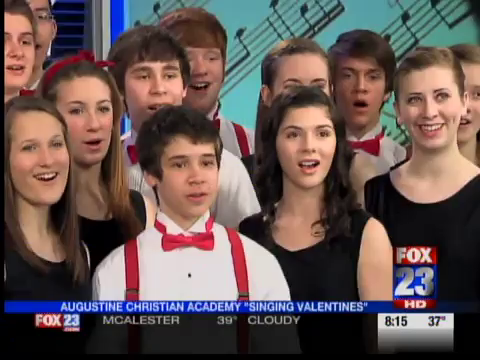
Are you looking for something unique and extra special for the ones you love this Valentine's Day? Let them be serenaded by a group of very talented singers from Augustine Christian Academy's Show Choir. Prices range from $25 - $40. We'll deliver a song, a personalized card, chocolates, and a special dedication to a location of your choice within the Tulsa area. Deliveries will be offered from 9:00 AM - 8:00 PM on February 14th. Order early to get your preferred delivery time! All orders must be received by February 13th! Get your Singing Valentine order form by CLICKING HERE, or pick one up in the school office. Please call Mrs. Gale Post at 918-852-2040 for more information.
Here's the group singing "Unforgettable" this morning on Fox 23 Daybreak:
The more you pay, the more precise you can be with the delivery time. Proceeds support the ACA performing arts program, which is producing Hello, Dolly, April 19 through 22, 2012.
State of the Union Address notwithstanding, hundreds of Oklahomans turned out for tonight's National School Choice Week event at UCO. We heard remarks by State Superintendent Janet Barresi, former Congressman J. C. Watts, State Sen. Gary Stanislawski, Jeff Reed of the Friedman Institute, and political reporter John Fund (on book leave from the Wall Street Journal).
Photos and a detailed report will have to wait, as I need to eat something and get home before too late, but here are a few notes:
Fund said he'd been covering school choice issues for 25 years, but he believes we are on the verge of a breakthrough. The internal contradictions on the anti-choice are becoming impossible to ignore, even for honest liberals.
Fund quoted the late president of the American Federation of Teachers, Al Shanker, as saying, "When children start paying union dues, that's when I'll start representing the interests of children."
Watts told advocates for school choice to be prepared for a battle, as the left defends its judiciary and education turf more vigorously than any other.
Stanislawski focused on opportunities in the field of online education. Oklahoma already has several online charter schools, and there's proposed legislation that would expand those opportunities to make it possible, for example, for children to use online schools to supplement what their own school offers.
In mentioning her involvement as a parent, Barresi said she could have afforded to write a check for private school tuition or hired a moving van to go to a different district, but instead she and her husband opted to stay and fight, working to establish the state's first charter school.
I spoke to Oklahoma State Rep. Elise Hall, a homeschool and TeenPact alumna, who told me she's working on a "Tim Tebow" bill, that would make it possible for homeschooled children to take advantage of extracurricular offerings at their local public school. That's especially important outside the metro areas, where there may not be the critical mass of homeschoolers needed to offer sports, band, drama, and other extracurriculars that need a large group of students.
It was an upbeat, positive event, and I'll have more to share about it when it's not so late, and I don't have a two hour drive in the rain ahead of me. Thanks to Americans for Prosperity Foundation and OCPA for putting together a great event.
A reminder that tonight, Tuesday, January 24, 2012, is Oklahoma's National School Choice Week event, "Restoring American Exceptionalism, an Oklahoma Town Hall," at UCO in Edmond, tonight at 7 p.m.
Speakers include John Fund from the Wall Street Journal, State Superintendent Janet Barresi, former Congressman J. C. Watts, and Tulsa State Sen. Gary Stanislawski.
John Fund is always a provocative and entertaining speaker, and J. C. Watts is always inspirational, but it will be especially wonderful to hear those, like Superintendent Barresi and State Sen. Gary Stanislawski, who are directly involved in reforming Oklahoma education. It's wonderful at long last to have a State Superintendent who understands that the focus of government support for education should be teaching children effectively, not propping up and making excuses for ineffective institutions.
American 15-year-olds rank 35th out of 57 countries in math and literacy! America shouldn't be 35th in anything. It's time to Restore American Exceptionalism!Rather than protecting and promoting failure, let's put our kids first. Let's do even more to support the teachers and the schools that are succeeding, but let's hold those that are failing firmly accountable. Whether it's a private school, a charter school, or a traditional public school, parents should have the right to choose the school that will do the best job educating my children. Every child deserves the best education we can give them - and every family has a right to choose the education that's best for their child.
Restoring American exceptionalism to our schools and putting kids first isn't a Republican issue or a Democrat issue. It's an American issue. Join the conversation today!

Click the ad or this link for event details and free registration.
What: Restoring American Exceptionalism -- An Oklahoma Townhall
Who: Former Congressman J. C. Watts, Wall Street Journal columnist John Fund, State Superintendent Janet Barresi, State Sen. Gary Stanislawski, and Jeff Reed of the Friedman Foundation.
When: Tuesday, January 24, 2012, 7 p.m.
BatesLine is proud to welcome a new advertiser about a topic near and dear to our hearts: school choice. John Fund from the Wall Street Journal, State Superintendent Janet Barresi, and former Congressman J. C. Watts will be speaking later this month, at Restoring American Exceptionalism, Oklahoma's National School Choice Week event, at UCO in Edmond on Tuesday, January 24, 2012, 7 p.m.
John Fund is always a provocative and entertaining speaker, and J. C. Watts is always inspirational, but it will be especially wonderful to hear those, like Superintendent Barresi and State Sen. Gary Stanislawski, who are directly involved in reforming Oklahoma education. It's wonderful at long last to have a State Superintendent who understands that the focus of government support for education should be teaching children effectively, not propping up and making excuses for ineffective institutions.
American 15-year-olds rank 35th out of 57 countries in math and literacy! America shouldn't be 35th in anything. It's time to Restore American Exceptionalism!Rather than protecting and promoting failure, let's put our kids first. Let's do even more to support the teachers and the schools that are succeeding, but let's hold those that are failing firmly accountable. Whether it's a private school, a charter school, or a traditional public school, parents should have the right to choose the school that will do the best job educating my children. Every child deserves the best education we can give them - and every family has a right to choose the education that's best for their child.
Restoring American exceptionalism to our schools and putting kids first isn't a Republican issue or a Democrat issue. It's an American issue. Join the conversation today!
Click the ad or this link for event details and free registration.
What: Restoring American Exceptionalism -- An Oklahoma Townhall
Who: Former Congressman J. C. Watts, Wall Street Journal columnist John Fund, State Superintendent Janet Barresi, State Sen. Gary Stanislawski, and Jeff Reed of the Friedman Foundation.
When: Tuesday, January 24, 2012, 7 p.m.
Three recent documentaries critical of K-12 education in America are now available for online viewing. Each film dramatizes the failures of public education, the efforts by lower-income parents to secure a better education for their children, and the ways that bureaucracy and entrenched interest groups work to thwart those efforts. (Hat tip to Ace of Spades HQ.)
The Cartel (92 minutes) is available for free streaming on Hulu and is also available for instant streaming to Netflix subscribers.
Teachers punished for speaking out. Principals fired for trying to do the right thing. Union leaders defending the indefensible. Bureaucrats blocking new charter schools. These are just some of the people we meet in The Cartel. The film also introduces us to teens who can't read, parents desperate for change, and teachers struggling to launch stable alternative schools for inner city kids who want to learn. We witness the tears of a little girl denied a coveted charter school spot, and we share the triumph of a Camden homeschool's first graduating class.Together, these people and their stories offer an unforgettable look at how a widespread national crisis manifests itself in the educational failures and frustrations of individual communities. They also underscore what happens when our schools don't do their job. "These are real children whose lives are being destroyed," director Bob Bowdon explains.
The Lottery (80 minutes) is also available for free streaming on Hulu and for instant streaming to Netflix subscribers.
In a country where 58% of African American 4th graders are functionally illiterate, The Lottery uncovers the failures of the traditional public school system and reveals that hundreds of thousands of parents attempt to flee the system every year. The Lottery follows four of these families from Harlem and the Bronx who have entered their children in a charter school lottery. Out of thousands of hopefuls, only a small minority will win the chance of a better future.Directed by Madeleine Sackler and shot by award-winning cinematographer Wolfgang Held, The Lottery uncovers a ferocious debate surrounding the education reform movement. Interviews with politicians and educators explain not only the crisis in public education, but also why it is fixable. A call to action to avert a catastrophe in the education of American children, The Lottery makes the case that any child can succeed.
Waiting for "Superman" is not available on Hulu, but is available for instant streaming to Netflix subscribers. It's notable as a critique of the public school system from the left side of the political spectrum.
It was a morning like any other -- as Academy Award winning filmmaker Davis Guggenheim was taking his young children to school -- that he was moved to act. Like many parents in America who are lucky enough to have the means, Guggenheim's children were headed that morning to an expensive private school, where he was assured they would find themselves in an invigorating environment with talented teachers devoted to bringing out the best in them.But as he drove past the teeming, troubled, poorly performing public schools his family was able to bypass, Guggenheim was struck with questions he could not shake: What about the kids who had no other choice? What kind of education were they getting? Where were the assurances that they would have the chance to live out their dreams, to fulfill their vast potential? How heartsick and worried did their parents feel as they dropped their kids off this morning? And how could this be right in 21st Century America?
I would hope that anyone seeking a position on a school board will have seen these films and be prepared to talk about how they and the school system they seek to serve. Here in Tulsa County that should mean to encourage and facilitate the creation of new charter schools and to stop trying to use lawsuits to obstruct voucher programs like the Lindsey Nicole Henry Scholarship program.
Leigh Goodson is a candidate for Tulsa Public Schools Election District 5, a seat currently held by Brian Hunt, who has opted not to run for re-election.
Goodson is involved in what looks very much like an arm of Tulsa's Cockroach Caucus. She's a member of the board of the Center for Legislative Excellence. She and her husband Mark R. Goodson have given a total of $2,500 to CLE, their largest state political contribution.
Here's the full list of CLE board members. While the CLE's goals are laudable -- lobby effectively at the State Capitol for Tulsa's share of state funding for roads, hospitals, and higher education -- you may recognize on this list the names of several who have been actively involved in the effort to reshape (I'd say mutilate) Tulsa's city government over the last several years:
Robert C. Poe, Co-Chairman
Larry Mocha, Co-Chairman
Connie McFarland, Membership Chair
Jay Helm, Contributions Co-Chair
Pete Regan, Contributions Co-Chair
Richard Riddle, Treasurer
Howard Barnett
Guy Berry, III
John Brock
Joe Cappy
Len Eaton
Patty Eaton
Leigh Goodson
Heather Griffin
Kell Kelly
Kris Langholz
Robert Lorton
Jim Orbison
Jody Parker, Emeritus Board Member
Leigh Goodson, a registered Democrat as of this July, has also contributed to Grow Oklahoma PAC, Prosperity PAC, and Oklahoma Rising, as well as individual candidates Lucky Lamons, Brian Crain, Mark McCullough, Dan Newberry, Eddie Fields, and Mary Fallin. Neither she nor her husband, Mark R. Goodson, show up in the opensecrets.org database of donors to Federal campaigns.
She is currently serving on the Sixth Grade Task Force. She is listed as "Leigh Goodson, Ph.D., OSU Center for Health Sciences and Chair of the Teacher Leader Effective Committee, The Foundation for Tulsa Schools." (Here is a list of the board of the Foundation for Tulsa Schools.)
In 2006, the Journal Record profiled Leigh Goodson as an "Achiever under 40," listing her as vice president for enrollment management and marketing at Oklahoma State University Center For Health Sciences:
Goodson started her career as an admissions counselor, moving up the ladder to academic adviser, director of medical school admissions and dean of students before being named to her current position as vice president of enrollment management and marketing for the Oklahoma State University Center for Health Sciences (OSU- CHS).Each position in higher education has allowed me to help others overcome obstacles to their educational goals, she said....
Goodson earned a bachelor's degree in political science from OSU in Stillwater; a master's in organizational communication from Fort Hays State University in Hays, Kansas; and a doctorate of philosophy in educational research and evaluation from OSU....
Her community involvement includes serving on the board of the YMCA of Greater Tulsa. She also led in the development and remains a member of the Camp Takatoka Advisory Board. Goodson volunteers with Riverfield Country Day School and Eliot Elementary School, and is a member of the Boston Avenue United Methodist Church.
The Journal Record profile mentions two children who were 7 and 4 in 2006.
According to news reports, Goodson was in Leadership Oklahoma Class 23.
My gut feeling, from looking at the above information, is that Leigh Goodson is an insider, likely to be a supporter of the status quo. I could be wrong, and she might be a true reformer who supports charter schools, vouchers, classical curriculum, and traditional teaching methods. Still, I'd feel better about this election knowing I'll have at least one other choice on my ballot come February.
You want to make a difference, Tulsa Tea Partiers? Here's your chance. Run for this open seat, Election District 5, or run in Election District 6 against a 16-year incumbent (Ruth Ann Fate) who has been an obstacle to expanded school choice for Tulsa children. Remember: The filing deadline is today (Wednesday, December 7, 2011) at 5, and you need to allow time to fill out paperwork and get it notarized.
Not many more people filed for school board in Tulsa County on the second day of the three-day filing period. Three seats (in Skiatook, Sperry, and Broken Arrow) that had no candidates after the first day now have one candidate, and one seat (and only one) in Skiatook has a contested race. That leaves seats in Collinsville, Owasso, Glenpool, and Keystone with no candidates whatsoever.
Wednesday is the last day of filing. Deadline is 5 p.m. Our public schools matter. If nothing else, they should matter to you because your property taxes are paying for them, and you drive by the resulting capital improvements every single day. You have a rotten school board, you get architectural monstrosities like the new Clinton Middle School, which earned national recognition as James Howard Kunstler's Eyesore of the Month for March 2010.
Every school board seat should have a competitive race.
Here are the four seats that have changed since yesterday:
ISD #3 BROKEN ARROW SCHOOL DISTRICT
(Click for JPEG map of Broken Arrow board districts.)
Broken Arrow Office 2 - Five year term
Steven R. Majors
3000 S. Ash Ave
Broken Arrow, OK 74012
ISD #7 SKIATOOK SCHOOL DISTRICT
Skiatook Office 1 - Four-year unexpired term
Patricia Pippin Ceska
14421 N. 50th W. Ave.
Skiatook, OK 74070
Susan Ridenour (appointed incumbent)
9543 W. Rogers Blvd.
Skiatook, OK 74070
Skiatook Office 2 - Five-year term
Tim Allen (incumbent)
426 W Cherokee Pl
Skiatook, OK 74070
ISD #8 SPERRY SCHOOL DISTRICT
Sperry Office 2 - Five-year term
Mechelle Beats
11505 North Lewis Ave
Skiatook, OK 74070
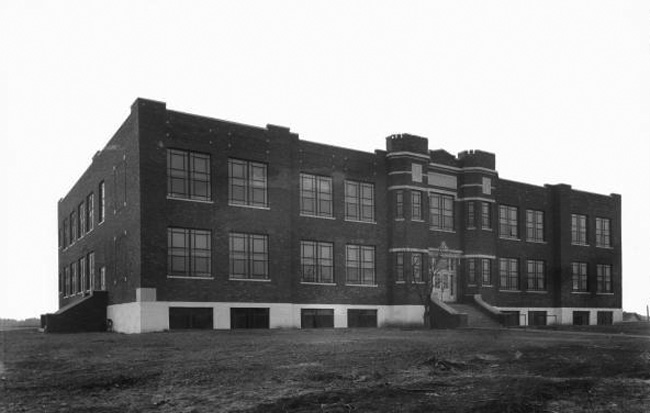 Not only is this the filing period for Oklahoma's presidential preference primary, but it's also the school board filing period, and every school district in the state has at least one seat up for election in 2012. Filing for a school board seat takes place at the election board for the county in which the school district is headquartered. Filing closes at 5 p.m. on Wednesday, December 7, 2011.
In most independent (K-12) districts, this is the year for Seat 2 in the five-year rotation. In dependent (K-8) districts like Keystone, Seat 1 is up for election to a three-year term.
School districts with more than 10,000 average daily membership (Tulsa, Broken Arrow, Jenks, Union, Oklahoma City, Putnam City, Edmond, Lawton, Mid-Del, Norman, Moore), vote on board members by board district. In smaller districts, members must live in the designated board district, but they are elected by the entire school district. School districts with fewer than 1,800 ADM may opt to elect all members at-large.
The state's two largest districts, Tulsa and Oklahoma City, each have seven districts, each of which elects a board member to a four year term. This year, Seats 5 and 6 are up for election in Tulsa.
Oklahoma City is on a slightly different schedule (Seats 3 and 4), and they have one extra member, a board chairman elected at-large, former State Sen. Angela Monson. Tulsa is the only other district in the state eligible to have an elected chairman (must have at least 30,000 average daily membership) but so far the school board has not opted to activate that position.
Tulsa Technology Center (aka the Vo-Tech) has one of seven board seats up for election to a seven-year term.
School board elections have very low turnout, an order of magnitude smaller than a city council election for a district of roughly the same size. An organized campaign could easily unseat an incumbent or win an open seat. At the beginning of 2011, both Tulsa incumbents were unseated by newcomers.
(OCPA's Brandon Dutcher, writing at Choice Remarks, calls for moving school board elections to November and cites five examples of bad public policy resulting from our current low-turnout school elections, which can easily be dominated by special interests like teachers' unions.)
Here in the Tulsa district, it's vital that our two seats are filled by strong advocates for school choice. Ruth Ann Fate has been hostile to the expansion of charter schools in the Tulsa district, and Tulsa is far behind Oklahoma City in offering a range of choices to parents. If we want families to stay in central, west, north, and east Tulsa, rather than flocking to the suburbs, we need to offer superior educational choices.
Don't forget that school boards in Jenks and Union voted to sue the state in order to strike down a law, the Nicole Lindsay Henry Scholarships for Students with Disabilities Act, that helps students with disabilities get the kind of education they need. Jenks, Union, Tulsa, and Broken Arrow had been sued by parents of special-needs kids for refusing to carry out the law.
The Sand Springs board voted unanimously to express support for Jenks and Union's countersuit. Every incumbent on the Jenks, Union, and Sand Springs boards should retired by the voters for their lawless and selfish attitude.
Here's who filed on the first day in Tulsa County (reformatted from the candidate list on the Tulsa County Election Board website). Note that so far, no seat has drawn more than one candidate, most of those filing are incumbents, and for seven of the 19 seats there are no candidates whatsoever.
ISD #1 TULSA SCHOOL DISTRICT
(Click for PDF map of Tulsa board districts.)
Tulsa Election District 5 - Four-year term
(open seat; Brian Hunt is not seeking re-election)
Leigh Goodson
2845 E. 32nd Pl.
Tulsa, OK 74105
Tulsa Election District 6 - Four-year term
Ruth Ann Fate (16-year incumbent)
7014 E 60
Tulsa, OK 74145
ISD #2 SAND SPRINGS SCHOOL DISTRICT
(Click for PDF map of Sand Springs board districts.)
Sand Springs Office 2 - Five-year term
Mike Mullins (incumbent)
3309 Maple
Sand Springs, OK 74063
Sand Springs Office 4 - Two-year unexpired term
R. Bo Naugle (appointed incumbent)
19310 West Highway 51
Sand Springs, OK 74063
Sand Springs Office 5 - Three-year unexpired term
Jackie Wagnon (appointed incumbent)
713 East 11th Street
Sand Springs, OK 74063
ISD #3 BROKEN ARROW SCHOOL DISTRICT
(Click for JPEG map of Broken Arrow board districts.)
Broken Arrow Office 2 - Five year term
NO CANDIDATES
ISD #4 BIXBY SCHOOL DISTRICT
(Click for PDF map of Bixby board districts.)
Bixby Office 2 - Five-year term
Wendell Nolan (incumbent)
17967 S. 71st E. Ave
Bixby, OK 74008
ISD #5 JENKS SCHOOL DISTRICT
Jenks Election District 2 - Five-year term
(Click for PDF map of Jenks board districts.)
Jon Phillips (incumbent)
10808 S. Erie Ave.
Tulsa, OK 74137
ISD #6 COLLINSVILLE SCHOOL DISTRICT
Collinsville Office 2 - Five-year term
NO CANDIDATES
ISD #7 SKIATOOK SCHOOL DISTRICT
Skiatook Office 1 - Four-year unexpired term
NO CANDIDATES
Skiatook Office 2 - Five-year term
NO CANDIDATES
ISD #8 SPERRY SCHOOL DISTRICT
Sperry Office 2 - Five-year term
NO CANDIDATES
ISD #9 UNION SCHOOL DISTRICT
Union Election District 2 - Five-year term
(Click for PDF map of Union board districts.)
Patrick Coyle (incumbent)
3817 S. Yellow Pine Ave
Broken Arrow, OK 74011
ISD #10 BERRYHILL SCHOOL DISTRICT
Berryhill Office 2 - Five-year term
Jeff Blair
6240 W 39 St.
Tulsa, OK 74107
ISD #11 OWASSO SCHOOL DISTRICT
(Click for text description of Owasso board district boundaries.)
Owasso Office 2 - Five-year term
NO CANDIDATES
ISD #13 GLENPOOL SCHOOL DISTRICT
Glenpool Office 2 - Five-year term
NO CANDIDATES
ISD #14 LIBERTY SCHOOL DISTRICT
Liberty Office 2 - Five-year term
Craig Crystal
20704 S Braden Ave
Mounds, OK 74047
KEYSTONE SCHOOL DISTRICT NO. C-15
Keystone Office 1 - Three-year term
NO CANDIDATES
TULSA TECHNOLOGY CENTER SCHOOL DISTRICT NO. 18
(Click for PDF map of Tulsa Tech board districts.)
Tulsa Technology Center Board District No. 7 (Zone 7) - Seven-year term
Jim W. Baker (24-year incumbent)
11938 S. Ash St
Jenks, OK 74037
Photo of Clinton Middle School from the Beryl Ford Collection.
Yet another Tulsa-area school board has voiced support for the lawsuit by Jenks and Union school districts to strike down the law that provides for adequate education for Oklahoma children with special needs. The Lindsey Nicole Henry Scholarship Act allows parents of a special-needs child to transfer some of the money that has been allocated for their child's public education to pay for special education at a private school. The Sand Springs school board voted unanimously in favor of a resolution condemning the scholarship act in solidarity with Jenks and Union.
Brandon Dutcher at Choice Remarks noted the Sand Springs superintendent's claim that "education hasn't failed, except maybe in a few overcrowded, underfunded urban districts."
But on a global scale, Sand Springs students would get mediocre grades at best. According to globalreportcard.com, the average Sand Springs student would perform only as well or better in math than 16% of students in Finland and as well or better in reading than 39% of Finnish students. Comparisons to other developed countries are similarly dismal, particularly for math proficiency. (Jenks and Union numbers aren't that hot, either.)
If our public school districts are unable to provide an adequate education for children without learning challenges, how badly must they be failing children with special needs? Shame on Jenks, shame on Union, shame on Sand Springs, and on every other school board spending tax dollars to try to block this very modest legislation, rather than trying to do better at accommodating special-needs kids.
Attention, Sand Springs residents (and residents of any district seeking to block the Lindsey Nicole Henry Scholarship Act): Filing period for school board across Oklahoma is December 5, 6, and 7. Please consider running. It's apparent that the current school board members are more devoted to preserving their power than to providing the best education possible so these special-needs kids can reach their full potential.
The Oklahoma Council for Public Affairs (OCPA), a free-market think-tank focused on state policy, will hold its annual gala here in Tulsa, on October 6, 2011, at the Renaissance Hotel. Keynote speaker for the event is Indiana Gov. Mitch Daniels.
Single-seat tickets for the gala begin at $125 (of which $75 is tax-deductible). Proceeds go to support the work of OCPA.
In May, Daniels signed into law a school voucher program with the largest eligibility pool of any such program in the country. In addition to vouchers for students in public school seeking to enroll in private school, the new Indiana law provides for up to $1,000 state tax deduction for private school and homeschooling expenses for those families that had already opted out of the public school system.

I've received a couple of emails regarding Tulsa Public Schools policy 4401, regarding employees running for public office. The policy allows for employees to be granted a leave of absence to run for and serve in elective office. The question posed is whether District 5 candidate Karen Gilbert is required by the policy to have resigned in order to run for office, or if she will be forced to resign if she's elected.
Here's the text from the Tulsa Public Schools policy handbook:
TULSA PUBLIC SCHOOLS Policy 4401EMPLOYEE PARTICIPATION IN POLITICAL ACTIVITIES
PURPOSE: To establish guidelines for employee political candidacy and office.
Any employee may be granted an unpaid leave of absence by the Superintendent or
designee for up to one year in order to become a candidate for public political office. The
grant or denial of the leave of absence to be a candidate will be made on a case-by-case
basis as the best interests of the District may dictate. If the employee candidate is
unsuccessful in the election, then the employee candidate must return to work within 30
days of the election or will be deemed to have resigned on that date.If elected, the employee may return to employment after the initial term of office has expired.
If the employee elected to office does not return to work within 30 days of the expiration of
the initial term of office, then the employee will be deemed to have resigned on that date.The employee will be reinstated at the entitled salary step/grade at the time the leave was
granted. The employee will be returned to a comparable position when a position becomes
available.A leave of absence for the purpose of seeking political office, or for holding office, will be
arranged between the individual and the District administration within the framework of
District regulations and law.Employee candidates engaging in political activity will make it clear their statements and
actions are their own as individuals and they in no manner represent the views of the
District.Employee candidates will not engage in campaign activity on District premises during
instructional hours or at any time that is disruptive to an educational activity.Any employee seeking a leave of absence under this policy will apply for such leave in
writing in the usual manner and will receive a reply in writing.
As I read this, it doesn't seem to require a leave of absence, but it allows for one. An employee seeking a post as a state legislator would have to take leave in order to serve in Oklahoma City. Serving as a city councilor and working full time for the school district would be challenging, but wouldn't necessarily involve giving up the day job. Gilbert would have to skip all the Tuesday morning committee meetings in order to keep her job, but it would be up to District 5 voters to decide if it's acceptable for their councilor only to show up on Thursday nights.
That said, there may be a state law forbidding a public employee to serve as an elected official, but if so, I would have expected the policy to cite the legislation.
Either way, there is yet another conflict of interest for Karen Gilbert if she wins and keeps her school district job. It's often overlooked, particularly by midtowners, that the City of Tulsa is bigger than TPS -- the city limits include portions of Jenks, Union, Broken Arrow, and Catoosa school districts. Nearly 30% (29.4% to be precise) of the city's under-18 population live outside the TPS boundaries. There's great potential for new residential growth in the Broken Arrow and Catoosa school district portions of Tulsa, allowing families to choose both City of Tulsa amenities and suburban schools.
An example of this blind spot: The education plank of the Tulsa Metro Chamber's election manifesto mentions only Tulsa Public Schools and makes no mention of the important role played by the other public school districts, private schools, and Tulsa's robust and growing homeschool community.
Encouraging families to remain in or return to central Tulsa would be easier with greater charter school capacity and vouchers for school choice, measures that the Tulsa Public School board has historically opposed, to the point of suing the state over the charter school law. Within the TPS boundaries, the ratio of enrollment to the under-18 population is 60%, the lowest of any school district overlapping or bordering Tulsa. (Sperry is highest at 86%, followed by Sand Springs and Collinsville at 80%, Union, Catoosa, and Owasso at 70%, Jenks at 65%, and Broken Arrow at 63%.)
Children outside of the TPS system, whether in charter schools, suburban public schools, private school, or homeschool, matter a great deal to the City of Tulsa's future growth.
Back in April, I told you about Chuck Stophel, a fellow parent and booster of Augustine Christian Academy, and the benefit being held to help his family meet a serious and expensive medical challenge, non-Hodgkins lymphoma. (Mr. Stophel has had an honored place in my five-year-old son's nightly prayers these past few months.)
Chuck is now a cancer survivor for a second time; as a young adult, he also received a heart transplant. For all that, Chuck is one of the most positive people you'll ever meet.
Now Chuck is back on his feet, and has a message worth hearing about making the most of life:
Tulsa Public Schools is holding a public forum on Tuesday, July 12, 2011, 6 to 7 pm, regarding the sale of Wilson Middle School, one of 14 school buildings closed at the end of the last school year as part of the district's cost-cutting plan. The forum will be held at Kendall-Whittier Elementary School, 2601 E. 5 Pl. Here's the news release with the details:
FOR IMMEDIATE RELEASE
PRESS RELEASE: Tuesday, July 5, 2011
What: TPS to host 'Neighborhood Connection' forum to discuss sale of Wilson building
When: Tuesday, July 12, 2011, 6-7 p.m.
Where: Kendall-Whittier Elementary School, 2601 E. 5 Pl.
Contact: Chris Payne at 918-858-4680 or cpayne@saxum.comTULSA, Okla. - Tulsa Public Schools has announced it will host a Neighborhood Connection meeting to open dialogue with the community regarding the sale of the former Wilson Middle School property located at 1127 S. Columbia Ave. The meeting is open to TPS parents, students and the community at large and will take place Tuesday, July 12, from 6-7 p.m., in the media center of Kendall-Whittier Elementary School, 2601 E. 5 Pl. in Tulsa.
Wilson is among the 14 properties that have been or will be closed as a result of Project Schoolhouse. Proceeds from the sale of these closed properties will add to the projected $5.6 million in savings from Project Schoolhouse and will help the district weather recent cuts to educational funding by the state legislature.
"As we look at the potential sale of some of these school buildings, we want to have a dialogue with the community to ensure we are protective of these neighborhoods," said Dr. Keith Ballard, superintendent of TPS. "It's important that we get feedback and input regarding potential uses from TPS parents and homeowners at the Neighborhood Connection forums. We look forward to hearing what the community has to say, as we investigate the possibilities regarding the sale of Wilson."
Trish Williams, TPS chief financial officer, and Millard House, deputy superintendent, will represent TPS at the July 12 forum. They will explain the bidding process as mandated by state law and the general category of prospective buyers that are participating in the bid process for the Wilson property. They will learn the public's wishes through the discussion and will answer questions. Consultant Chuck Jackson will serve as facilitator of the forum.
The other properties that have been or will be closed as part of Project Schoolhouse include Addams, Alcott, Bunche, Cherokee, Chouteau, Barnard, Franklin, Fulton Learning Academy, Grimes, Lombard, Roosevelt and Sandburg elementary schools, and Cleveland Middle School.
For additional information about Tulsa Public Schools, please visit the TPS website, www.tulsaschools.org.
(Photo retrieved from the Wilson Middle School website.)
Although I didn't go to school there, the building holds fond memories for me, as the cafeteria was where I participated in my first forum as a candidate for City Council in 1998, hosted by the Renaissance Neighborhood Association. I returned for other neighborhood association and coalition meetings and candidate forums there over the next several years.
As you can see from the photo above, Wilson is an impressive building. While its playgrounds border an arterial (11th Street, historic Route 66) and a neighborhood collector (Delaware Ave), the main entrance is on Columbia Ave, in the heart of Renaissance Neighborhood.
It is my hope that TPS would make preservation and adaptive reuse of the main building a condition of sale, along with an insistence (perhaps in the form of a covenant that runs with the land) that the future use would be compatible with its location in the heart of a single-family residential neighborhood. It would be a wonderful location for a charter school, a great new home for a private school, or a permanent home for some newly planted church. With the passage of the Oklahoma Opportunity Scholarship program, there's an opportunity to fill attractive, historic buildings like Wilson, Barnard, Roosevelt, and Franklin with excellent and affordable private schools that will help draw families back to Midtown, an area that, despite its revival in many regards, has lost population over the last decade as Midtown families have moved to suburban school districts.
While it would be nice to keep the property in one piece, It might be appropriate to allow mixed-use or neighborhood commercial development (think Cherry Street) on the fields that face Delaware. Here again, TPS could insist on design guidelines to ensure neighborhood compatibility.
I hope TPS board members will keep in mind that the neighboring property owners bought with the expectation that this land was a school and would remain so into the distant future. Replacing Wilson Middle School with another big parking lot or warehouse for Bama or TU would add insult to the injury neighbors have suffered with the school's closing.
State Sen. Judy Eason-McIntyre (D-Tulsa) has come under attack twice in recent days by prominent Tulsans who evidently oppose educational choice and individual liberty, according to two recent stories by CapitolBeatOK.
Last Thursday, lobbyist Margaret Erling harangued the Tulsa senator on the floor of the Senate over Eason-McIntyre's support for the conference report of a bill that will change the cutoff date for school enrollment from September 1 to July 1. (Margaret Erling is the wife of former KRMG morning show host John Erling Frette.) Under HB 1465, "a child would have to be four by July 1 to enter Pre-K programs, and/or five years old by July 1 to enter kindergarten," according to the CapitolBeatOK story.
In the Monday interview, Eason-McIntyre said that at the time of the incident, she had decided to support two Republican bills in the conference, and had approached "my leader," state Sen. Andrew Rice of Oklahoma City to give him a heads up on her decisions. The upper chamber had just recessed for the day. Sen.Rice was working at his desk, according to Eason-McIntyre.She briefly explained to Rice her support for the two measures in the conference process (signing a conference report does not bind a member to support a measure on final passage), including H.B. 1465. She said Sen. Rice told her "not to worry about it."
He had, she recounted, asked members of the minority caucus to remain unified through the redistricting process to assure protection of Democratic interests. She explained that with that issue now headed toward resolution, Rice told her he understood her positions on the two measures.
Just as the two had finished speaking, Erling approached. As Erling confronted her, Eason-McIntyre was so perplexed by Erling's attitude that she was, she confessed, briefly confused over which of the two bills had so angered her.
"She was irate, and ranting. I thought she was going to have a stroke," Eason-McIntyre told CapitolBeatOK. Erling, who has several major clients at the Capitol, including Tulsa Public Schools, claimed to Eason-McIntyre that another client, George Kaiser of Tulsa, opposes H.B. 1465.
(The story also reports that the chief of staff of State Superintendent Janet Barresi has also been lobbying against the legislation.)
Then, on Sunday, Kara Gae Neal, the superintendent of Tulsa Technology Center (formerly known as Tulsa Vo-Tech), sent a scathing email to Eason-McIntyre for signing a conference committee report for HB 1652, which would allow concealed-carry permit holders to keep their guns locked in their vehicles in parking lots on vo-tech campuses and a few other types of public venue. According to Neal's email, Eason-McIntyre had the leverage to kill the bill in committee.
(Kara Gae Neal is the wife of retired Tulsa World editorial page editor Ken Neal.)
"I cannot believe that under the cloak of no public vote, you signed out of committee the only gun bill left alive this year, HB 1652, which will bring guns to Career Tech campuses across the state."I cannot believe that you have said Democrats have no power this year but YOU, single handedly, could have stopped that bill in its tracks. Two others on that committee held firm, one a Democrat and one a Republican and true friend to education, Dr. [James] Halligan. It took 4 votes to secretly slip it through the committee without a recorded public vote and YOURS was the 4th vote...after giving a verbal commitment in advance to Brady McCullough from Tulsa Tech that we could count on your support to kill the bill in committee.
"I cannot believe that YOU, who represents the District with the greatest number of CHILDREN shot in this state every year, did this to them and to us. Our Tulsa Tech facility in your district not only has high school students but a CHILD CARE center on that site.
"I cannot believe that when asked why you did this you said you liked the bill's author, Sen. Russell, and that he had done a lot for you. And what would that be? Surely getting 'Swing Low Sweet Chariot' as the state spiritual/blues song was not it. Maybe they will play that in your memory at the funeral of children shot in your district.
Eason-McIntyre replied:
"For the record you can tell anyone you want that I signed the conference committee report at the request of my friend Sen. Russell. For your information there was no deal made!"I have never hidden behind any excuse for what I decide to do. I do strongly believe that if Republicans believe in guns then openly vote for their gun related bills.
"You mentioned the problem with guns in OUR community, not just my district but I have yet to hear of any effort you have provided to solve Tulsa's gun problem, particularly in my district.
"The catty remark about the State's gospel song being sung at a funeral in my district, I will ignore and assume it had no any racial overtones intended.
"As it relates to our 'friendship' I am sorry always to lose a friend, but you made that choice."
"Judy"
School choice activist Brandon Dutcher, linking to these two stories, writes:
State Sen. Judy Eason McIntyre (D-Tulsa) is a liberal pro-abortion Democrat with whom I have virtually nothing in common. But I've always admired the way she has stood up for giving underprivileged students more school options -- even when doing so has been difficult for her politically. So I must say I felt sorry for her recently when she had abuse heaped upon her in the most inappropriate of ways. ...The good senator will live to fight another day. Here's hoping she comes back next year and helps push another school-choice bill across the finish line.
 My wife and I know Chuck Stophel as a fellow parent of students at Augustine Christian Academy. Chuck is also one of the school's biggest boosters, and he's invested a lot of time and energy into making classical Christian education at ACA an ongoing reality.
Now Chuck is dealing with a serious and expensive medical challenge, and he and his family need our help. Friends have organized a special event this Saturday evening, April 30, 2011 -- ChuckFest -- at Augustine Christian Academy, 6310 E. 30th Street (just west of Sheridan, a block north of 31st), from 4 to 7 pm. From the ChuckFest Facebook page:
This is a come-and-go fundraiser for Chuck and Sara Stophel to raise money for Chuck's medical expenses and other needs. Tasty heavy hors d'oeuvres, desserts and drinks, fabulous music and entertainment emceed by LEANNE TAYLOR of News on 6, activities for children and a wonderful silent auction will be held. Chuck has given to so many over the years! Please mark your calendars for this wonderful way to show Chuck and his famly how much we love and support them! Invite your friends!WE HAVE BEEN GENEROUSLY GIVEN 2 TICKETS TO JOSH GROBAN, JEWELRY AND OTHER INCREDIBLE AUCTION ITEMS!!!!
If you are unable to attend, but would like to contribute to Chuck's medical expenses, a fund has been established at MidFirst Bank in Tulsa. Please make donations in the name of "Charles D. and Sara Stophel Support Trust" and mail to: MidFirst Bank, 7050 South Yale, Suite 100, Tulsa, OK 74136. Thank you and God bless you!
Last night, my 14-year-old son decided to spend some of his savings on a set of the Harvard Classics -- a 50-volume treasury of the best of Western Civilization. If you like the idea of a school that can inspire that sort of love of learning, you ought to appreciate and support a volunteer like Chuck who has done so much to make it possible.
Oklahoma towns and cities with a statutory charter (which is to say, no charter at all; they are governed by the default provisions of Oklahoma Statutes Title 11) and some charter cities have elections today, Tuesday, April 5, 2011. Some school board seats will have a runoff, if none of the candidates received 50% of the vote back on February 8.
Here in Tulsa County, Broken Arrow, Glenpool, Jenks, Sand Springs, and Skiatook each have city council or town trustee races on the ballot. It's encouraging to see that nearly every seat up for re-election has been contested.
Broken Arrow and Bixby electorates will each decide four municipal bond issues. Broken Arrow's bond issues cover streets, public safety, parks, and stormwater. Bixby votes on streets, public safety, and parks, and an amendment to a street project approved in a 2006 tax vote.
Tulsa Technology District (vo-tech) Zone 2 has a runoff between former Tulsa Police Chief Drew Diamond and Catoosa school superintended Rick Kibbe (both registered Democrats). The two candidates each received less than 100 votes in the snowbound February primary. Skiatook has a runoff between Linda Loftis (registered as a Republican) and Mike Mullins (registered as a Democrat) to fill an unexpired term for seat 3.
Oklahoma City has a high-profile council runoff, too, between a candidate backed by the shadowy Momentum committee and physician Ed Shadid. Shadid seems to be drawing support from a wide range of Oklahoma City bloggers; the list of endorsers includes Charles G. Hill of Dustbury, Oklahoma City historian Doug Loudenback, young urbanist Nick Roberts, and slightly older urbanist Blair Humphreys.
Augustine Christian Academy in Tulsa will hold two open houses in the near future for parents interested in enrolling their children in the classical Christian school as full-time or part-time students for the 2011-2012 school year.
Monday, February 28th, 5:30 - 7:00 p.m.
Tuesday, March 8th, 5:30 - 7:00 p.m.
It's an opportunity to tour the school, ask questions, and meet teachers. The school is at 6310 E. 30th St., just west of Sheridan.
Prospective students are also encouraged to shadow a student for a day. Call the ACA office at 918-832-4600 to schedule a visit.
ACA not only offers an excellent academic environment, but we've also found it to be a warm, welcoming community. Beyond the classroom, there's a strong performing arts program and a "house" system that builds community across the grades through service projects and intramural competition.
One of ACA's notable characteristics is its flexibility in working with the circumstances of a student and his family. Homeschool students in grades 6 through 12 can enroll part-time to supplement their homeschool curriculum and to participate in school activities. Younger homeschoolers can enroll in extracurricular programs at ACA. Some financial aid is available. After-care is available at the school (for a fee) to accommodate parental work schedules.
If you have school-aged children, you owe it to them and yourself to get acquainted with all that Augustine Christian Academy has to offer.
The usual dismal turnout. Why don't school board candidates run organized campaigns? Here are the unofficial totals from the Tulsa County Election Board. I'm not sure whether the results for districts overlapping into other counties (Broken Arrow, Skiatook, Tulsa Technology Center) are complete results or only for those precincts in Tulsa County. According to the election board, only 228 people voted in the Tulsa Technology Center Zone 2 race, and none of the candidates broke into triple digits.
Voters across Oklahoma will elect school board members and vote on school bond issues tomorrow, Tuesday, February 8, 2011.
Snow from the February 1 record storm plus the extra snowfall since then continues to make streets hazardous. Many Tulsa polling locations are still very hard to reach by car. To minimize the risk to poll workers, the Tulsa County Election Board is consolidating polling places for tomorrow's election:
Due to hazardous conditions with many parking and sidewalk areas at many of our regular polling places, the Tulsa County Election Board is consolidating many Polling Place locations for Tuesday, February 8, 2011, into larger locations which are continuing to be snowplowed.While Tulsa Public Schools originally thought they would be able to assist with clearing parking areas and sidewalk areas at the regular polling places, with the continued precipitation falling, it was decided late Friday, February 4, that it would be best to allow the Tulsa County Election Board to consolidate precincts into larger multi-purpose facilities, as is being done in the Union School District and the Tulsa Technology School District.
Click the link for details, and here is a precinct-by-precinct list (PDF) showing which precincts will be voting (many areas of the county have no election), where each precinct will vote tomorrow, and, for reference, where the precinct usually votes.
Here is a link to the League of Women Voters of Tulsa 2011 school election voter guide (PDF).
All voters in the Union School District will vote at UMAC, the high school arena on Mingo Rd north of 71st St. Union has a $21.6 million bond issue and one contested board seat -- Office No. 1, Jeff Bennett vs. Bobbie Jo Eversole.
Tulsa Public Schools has one board seat -- Office No. 1, west of the river and northwest of downtown -- a rematch from four years ago between incumbent Gary Percefull and retired Booker T. Washington High School teacher Brenda Barre, both Democrats. Neither candidate appears to be active online. Here's the column I wrote endorsing Brenda Barre in the 2007 Tulsa School Board race. Polling places will be open at Reed Park recreation center for voters who live southwest of the river and the Tulsa County Election Board for voters who live northeast of the river.
East Tulsa and Catoosa area voters have a three-way race for Tulsa Technology Center (vo-tech) board, Zone 2. Candidates are Catoosa Public Schools superintendent Rick Kibbe, former Tulsa police chief Drew Diamond, and retired DEA agent DuWayne Barnett. Tulsa County voters in Zone 2 will vote at the Fair Meadows Exhibit Hall at Expo Square (Tulsa County Fairgrounds).
Conservative Republican activist Mike Ford, a leader in the Mike Huckabee's Oklahoma campaign in 2008, has endorsed three candidates in south Tulsa school districts on his "Vote for Conservatives for School Board" Facebook page.
Bobbie Jo Eversole, Union (opposing incumbent Jeff Bennett)
Harold Vermillion, Broken Arrow (open seat -- opposing Richard Parker)
Jeromy Walsh, Bixby (opposing incumbent Brian Wiesman)
Between the snow and the different precinct locations, turnout is likely to be lower than the usually abysmal levels. Gary Percefull beat Brenda Barre by just 32 votes out of 856 cast. Your one vote could make a huge difference. And if you have a four-wheel drive vehicle and are confident driving on snow-packed roads, consider volunteering to help the candidate of your choice get voters to the polls.
Even though it happens every year, it always seems to sneak up on me, coming as it does between Thankgsiving and Christmas. The filing period for the Oklahoma 2011 public school board elections is underway. It began today and will continue through 5 p.m., Wednesday, December 8. Filing takes place at your county's election board.
Most independent school districts have five board members with five-year terms, with one up for election each year. In 2011, Office Number 1 is on the ballot. While candidates must live in the election district for the particular office they seek, the whole school district votes on the candidates.
For dependent districts (K-8) with three board members, it's Office Number 3's turn. In Tulsa County, that means Keystone School, the last remnant of the drowned town for which the reservoir was named.
As a large independent district, Tulsa has 7 members with four-year terms. This is the year that only one district is on the ballot: Office 1. Candidates must live in the district, and they are elected only by district residents. Election District 1 covers all of the Tulsa school district west of the river, the area west of downtown along the Sand Springs Line, downtown (within the inner dispersal loop), Brady Heights, Crowell Heights, Owen Park, Country Club Heights, Gilcrease Hills south of Newton St., Riverview, North Maple Ridge, Swan Lake, and Forest Orchard neighborhoods. (Here's the Tulsa County Election Board map of Tulsa Public School election districts.)
The technology school districts (vo-tech for us old-timers) also elect a board member: Tulsa Technology Center Zone 2 will be on the ballot in 2011, and 9-year member, former legislator, and Tulsa TV legend Betty Boyd is not running for re-election. Three candidates have filed as of 5 p.m. Monday: DuWayne N. Barnett Sr., former Tulsa Police chief Drew Diamond, and Rick Kibbe. Barnett is a registered independent; Diamond and Kibbe are registered Democrats. Zone 2 is roughly between 46th St N. and 31st St. S, east of Yale. (Here's the Tulsa County Election Board map of Tulsa Technology Center election districts.)
After the first day of filing, there are only two contested races for K-12 school board in Tulsa County. Tulsa Office 1 member Gary Percefull is being challenged again by former Booker T. Washington school teacher Brenda Barre, both Democrats. A vacancy in Skiatook Office 3 has drawn Mike Mullins (a Democrat) and Linda Loftis (a Republican) to compete for a two-year unexpired term.
I am amazed that seats in two schools notable for financial and administrative scandals -- Skiatook and Broken Arrow -- did not draw any candidates at all on the first day of filing. Neither did the Office 1 seat in Liberty district.
The rest of the seats in Tulsa County have so far drawn only one candidate. That's a shame. Our public schools need careful scrutiny (Skiatook and Broken Arrow are exhibits A and B). The school board election is the best way to influence a school's operation.
If you are concerned about the kind of fiscal mismanagement evident in the Skiatook case, if you are worried that political correctness and educational fads are pushing aside tried-and-true methods of instruction, you should consider running.
It would not be difficult for a hard-working campaigner with a few dedicated volunteers to win a school board seat. If you could identify 500 people to vote for you and pester them on election day until they go to the polls, you would win in a landslide. This last February, challengers beat both Tulsa school board incumbents. Fewer than 600 voters cast ballots in each race. Lois Jacobs beat long-time incumbent Matt Livingood by a mere 6 votes. (February 2010 Tulsa County school board election results.) Four years ago, Percefull beat Barre by 37 votes -- about two votes per precinct. Less than 900 voters turned out in that race.
(School board turnout is a great example of the depressive effect of non-partisan elections.)
Tulsa Election District 1 includes several neighborhoods that are attracting young urbanophiles, the kind of civic-minded folks who are restoring historic homes, tending community gardens, and trying to resurrect the notion of the corner grocery. A combination of good public schools and school choice (and public schools that make themselves better as a result of school choice) are vital to keeping these young adults in the central city when they begin raising children.
Perhaps one of those young urbanophiles will file for this seat. While I endorsed Barre four years ago and still consider her a far better alternative to Percefull, it wouldn't hurt to have more candidates in the race. In particular, I'd like to see a conservative run, maybe someone with the skills to bring strong financial oversight to the board. If there are more than two candidates, and no one gets a majority in the February election, a runoff will be held on the 1st Tuesday in April.
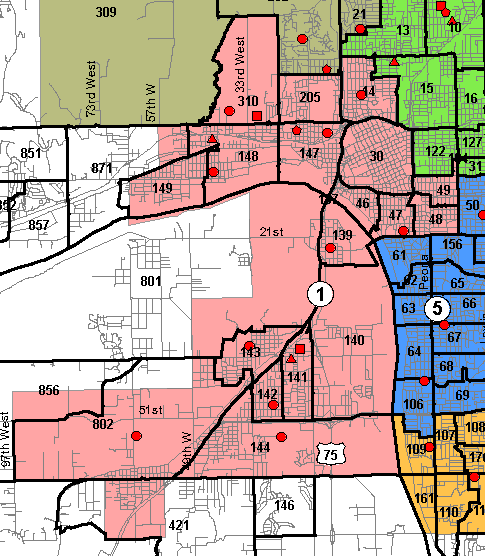
Clearing out my browser tabs and clearing my conscience of failing to write a blog post about each one:
Gabriel Malor, co-blogger at Ace of Spades HQ, will be on 1170 KFAQ with Pat Campbell at about 6:30 to discuss the CAIR lawsuit to stop Oklahoma's anti-sharia amendment.
Joe Miller is just a hat shy of looking like Bogart as Fred C. Dobbs in Treasure of the Sierra Madre (or the parody of the character in a Bugs Bunny cartoon): "Say, pardon me, but could you help out a fellow American who's down on his luck?" The stubble probably cost him the election. Either shave it off or grow it out to a respectable length. "Miami Vice" has been off the air for 20 years.
Tulsa Public Schools to consider eliminating schools: KRMG news story says the Tulsa district has 90 schools, same as the 1960s, but we have only half the students today that we did 40 years ago. The student population stat sounds right, but the school count can't possibly be the same: TPS has closed plenty of schools since peak baby-boomer enrollment, including more than a dozen I can think of off the top of my head: Mason High School; Bates, Lynn Lane, Lincoln, Lowell, Longfellow, Pershing, Revere, Franklin, Riley, Ross, Whittier (or Kendall -- they merged) Elementary Schools; Horace Mann Jr. High, Wright Jr. High (repurposed as an elementary). Did I miss any? I can't think of the name of the old elementary school near 45th and Peoria that now serves as home of the Tulsa Ballet.
Brandon Dutcher at Choice Remarks links to a HuffPo entry by John Thompson about the projected low number of graduates for African-American males in Oklahoma City Public Schools neighborhood high schools. Thompson calls this a crisis, but he uses too many qualifiers to exclude too many students who are being educated successfully in OKC public schools (e.g. students at charters like Harding High School, magnet school students, students in inner-suburban districts), and he fails to give us numbers as bases of comparison (how many total African American male students in neighborhood high schools are there?). Oh, and he's wrong to equate neighborhood schools with non-selective schools. Charter schools can't select their students, either. There's probably a story here, and it may be jaw-dropping, but it needs a teller who'll be more careful handling the numbers.
Thompson links to this interesting map of the OKC metro area showing population as color-coded dots - whites are red, African-Americans are blue, Asians are green, and Hispanics are orange. Each dot represents 25 people. Thompson says it shows racial segregation, and while it's true that there's a predominantly African-American area between the Santa Fe tracks and I-35 as well as a rural African-American area in NE Oklahoma County, and undoubtedly this reflects the official and unofficial segregation of earlier decades. But a look at the big version of the map shows blue dots scattered through out, alongside red, green, and orange.
Here's the Tulsa race and ethnicity map from the same set. Note how colorful the ORU campus is.
Cassy Fiano writes that feminist blogger Jessica Valenti is a big ol' chicken for refusing to participate in a panel discussion that includes just one conservative woman.
Sarah Palin to freshman Republican congressmen-elect:
Remember that some in the media will love you when you stray from the time-tested truths that built America into the most exceptional nation on earth. When the Left in the media pat you on the back, quickly reassess where you are and readjust, for the liberals' praise is a warning bell you must heed. Trust me on that.
Ed Morrissey recounts a Clarence Thomas anecdote about justices reacting to social pressures and remarks:
With that in mind, the freshman class should steel themselves that getting the job done right will mean few plaudits in the media in the short run, even fewer speaking invitations, and no medals or plaques from lobbyists and Academia. Their reward will be a more secure, less indebted, and fiscally restored United States of America, and the gratitude of a nation in the long run for restoring sanity and accountability. And frankly, that should be enough.Warner Todd Huston reports that mainstream media's coverage of a crooked Maryland county politician has (once again) neglected to identify the crook's party affiliation.
Muslim extremists protest Armistice Day in London. And J. E. Dyer comments on the shifting of Britain's place in the world as the U. S. under Obama has distanced itself from the Special Relationship the two countries long enjoyed.
Tim Bayly writes about the new NIV's further slide away from scripture and toward political correctness.
Next Media Animation is a Taiwanese media company that is making a name for itself with video-game-style retellings, often hilarious, of American news stories, narrated in Chinese. You may have seen their version of the Al Gore "crazed poodle" allegations or their take on the 2010 midterm elections.
Here's NMA's take on Waiting for "Superman", the new documentary on the failings of the American education system. Even if you don't speak Chinese, the two-minute clip sets out the key points of the school choice debate in memorable images.
For the real trailer (in English!) for Waiting for "Superman", for updates on school districts refusing to comply with the new law providing scholarships for disabled students, and for all the latest developments, click the banner above to visit SchoolChoiceOk.com, a valued BatesLine sponsor.
On Friday, Oklahoma Superintendent of Public Instruction Sandy Garrett spoke to CapitolBeatOK regarding the decision by several Tulsa-area school boards not to obey House Bill 3393, the Lindsey Nicole Henry Scholarships for Students with Disabilities Program Act.
"When I took office as Superintendent of Public Instruction, I swore an oath to obey federal and state laws. I have sought every day to uphold that promise. Whether or not I like a particular law is not material. It is my job to obey the law and to implement it."The way I look at it, the local officials on these boards of education who have acted not to comply, or to prevent implementation of this program in their districts, are not fulfilling their duties.
"I believe they are in violation of their oaths of office. This law was passed, and implemented in a timely manner by the state.
"To be clear, in my work every day there are laws I don't necessarily agree with but which I am required to carry out."
Garrett concluded, "I think these school board members have been ill-advised."
Garrett is retiring at the end of this year after more than 20 years as State Superintendent.
An October 6, 2010, CapitolBeatOK story has some interesting details about the scholarship program and the number of students involved:
The Oklahoma program is similar to laws in Florida and Georgia that have easily withstood legal challenges. The Florida program has been in place since 1999 and now serves approximately 20,000 students with special needs. The scholarship program was designed not to require new spending, but to redirect existing state funds that are currently spent on the student.School officials claimed the transfers authorized by the scholarship program would somehow harm their financial standing, but only seven students have applied for the scholarships at Jenks and eight at Broken Arrow, according to the Tulsa World. Both schools are among the largest in the state.
Somehow I don't think it will take the law firm of Rosenstein, Fist, and Ringold much time to burn through the amount of money that would cover such a small number of scholarships.
Tonight the board of Tulsa Public Schools will discuss whether to join Jenks, Union, Bixby, Broken Arrow and other area school districts in disobeying a new state law, HB 3393, the Lindsey Nicole Henry Scholarships for Students with Disabilities Program Act, which provides scholarships to meet the special educational needs of students with autism, Down syndrome, cerebral palsy, and other disabilites. From the text of HB 3393, as signed by the governor:
The Lindsey Nicole Henry Scholarships for Students with Disabilities Program is established to provide a scholarship to a private school of choice for students with disabilities for whom an individualized education program (IEP) in accordance with the Individuals with Disabilities Education Act (IDEA) has been developed. Scholarships shall be awarded beginning with the 2010-2011 school year.The parent or legal guardian of a public school student with a disability may exercise their parental option and request to have a Lindsey Nicole Henry Scholarship awarded for the child to enroll in and attend a private school in accordance with this section....
School districts are required to award the scholarship if the applying student was at a public school the previous year, and the student has been accepted at an eligible private school. The amount of the scholarship is the private school tuition or the amount of state aid and local revenue allocated for that student, which ever is lower. The school district can retain 5% of the scholarship amount to cover the cost of administering the program.
On his blog, the House author of the bill, Rep. Jason Nelson (R-Oklahoma City), rebuts the claims made by the school districts:
The cost of the scholarships is covered in the law. The Tulsa area districts act as if the funding for the student stops when they transfer on a scholarship and that the district must find the money to pay the scholarship on their own. That is not the case.The BALedger.com reports that Doug Mann, the school board attorney for Broken Arrow, claims that HB 3393 "can get very expensive very quickly." The story goes on to quote Mann, "The fact of the matter is that the program that that child was in still has to be funded but it now has less funding for that program."
What districts are not mentioning is that the money for the scholarship is fully funded. The district keeps 5% of the scholarship amount to cover administrative costs. In addition to that, the district can continue to count the transferring student for funding purposes for up to two years after the transfer to allow them to absorb their fixed costs. Added to all this money comes less expense because they have one less student.
The reality here is that school districts lose the funding for each student that transfers out of their district after two years even if the student transfers to another school district or to a private or home school setting. However, under HB 3393 the districts retains 5% of the scholarship amount that they would not receive for any other transfer.
House Bill 3393 is a win-win. School districts are protected financially and will have smaller class room sizes with each student that transfers with a scholarship. Most importantly the children benefit because they have more options so they can find and receive the very best education services for their particular special need.
Rep. Nelson has been blogging up a storm on this issue, publishing emails from parents of special-needs kids who tell of their struggles with these very school districts; for example, this email from a Jenks parent:
Jenks is currently being audited by the Office of Civil Rights for violating ADA laws and a list of Special Education Laws that they are in noncompliance. ...Jenks also has a reputation for interpreting the law so that they don't have to offer services and/or water the services down so it is very minimal. They also are in violation of offering the same services to all students rather than individualized as required by law.
Jenks spends a unbelievable amount of money to keep the law firm on retainer because Jenks does not follow the law. I wonder what the public would say if they knew how much of our schools tax dollars went to pay the law firm? If the tax payers had a say in whether that money went to the law firm or the general education fund I know they would say the money should go to our kids! It is disgusting how much money the law firm gets.
It is ridiculous that Jenks insists that they educate and care about their special education kids. Since we [have been in Jenks] my [child] has regressed two years. They have such low expectations and do very little to increase their intelligence and more to teach the kids "life skills".
One law firm, Rosenstein Fist Ringold, provides legal services to Tulsa, Jenks, Broken Arrow, Union, Bixby, and, until Monday, Skiatook. The Skiatook board voted 3-2 to dismiss the firm and seek new representation, following a grand jury recommendation. The firm has represented the Tulsa district going back at least as far as the 1970 Federal racial desegregation lawsuit. An attorney for the firm, Doug Mann, has said that he is "expecting -- almost hoping" that lawsuits will be filed against the school districts over the scholarship issue, according to a Fox 23 report.
One of the attorneys at RFR is Matthew Ballard. Keith Ballard is superintendent of the Tulsa district, and his bio mentions a son named Matthew who is an attorney in Tulsa.
The Tulsa school board meets tonight, Wednesday, October 13, 2010, at 5:30 pm, at the Education Service Center, north of 31st St. on New Haven Ave. (New Haven is the traffic light between Harvard and Yale.) If you care about giving children with disabilities the education they need, or if you just care about the school district spending money on education instead of lawyers, show up and let the school board know how you feel.
MORE: The State Department of Education's page on the Lindsey Nicole Henry Scholarship for Students with Disabilities Program, with a list of participating schools.
Kohl's is running a contest via Facebook, the Kohl's Cares for Kids $10M Giveback Contest. From now until Friday, September 3, 2010, you can vote up to five times each for your favorite school. (You have 20 votes total.) The top twenty schools nationwide will be awarded $500,000 each.
I spent 10 of my votes on two schools that already do great work and could do even more with a half-million dollars. One of them, the Little Light House, here in Tulsa, is currently ranked 29th, the only Oklahoma school in the top 100.
The Little Light House has been around since 1972, working with "children, from Birth to the chronological age of six, with a wide range of physically and mentally challenging conditions," helping them to get the best possible start to reaching their full potential. The school was an early recipient of Pres. George H. W. Bush's "Points of Light" award.
The Little Light House uses a trans-disciplinary team approach to provide highly individualized services to each student. Parents, teachers and therapists from the various arenas make up this important team which establishes each child's individual measurable goals and objectives for the year. Volunteers assist the professional staff to provide the highest degree of individual attention to each child possible.
Right now the school has a long waiting list. $500,000 could be a big boost to their ability to expand.
If you're a Facebook member, please take a minute to cast five votes for the Little Light House.
And while you're at it, I'd appreciate it if you'd cast some of your remaining 15 votes for a school near and dear to my heart, a school with a challenging classical curriculum, a strong drama program, and great school spirit, Tulsa's Augustine Christian Academy:
It's rare that you will find me quoting, with approval, a lesbian, atheist, leftist East Coast professor, but Camille Paglia's love of Western Civilization and her critique of what passes for education in America warms my heart. Paglia's recent interview with Margaret Wente in the Globe and Mail reads like a commercial for the classical education movement. A few choice quotes:
I've always felt that the obligation of teachers is to have a huge, broad overview and to provide a foundation course to the students. The long view of history is absolutely crucial. There are long patterns of history. Civilizations rose and fell, and guess what! It's not a fiction. I believe in chronology and I believe it's our obligation to teach it. I've met fundamentalist Protestants who've just come out of high school and read the Bible. They have a longer view of history than most students who come out of Harvard. The problem today is that professors feel they are far too sophisticated and important to do something as mundane as teach a foundation course. So what the heck are parents paying all this money for?...I want world culture taught. I believe in Hollywood and jazz. Those are America's great contributions to the world. But I don't want this ideology that the West is the great rapist of the world. The Western art tradition is incredible. Then feminism came along and decided greatness was a conspiracy foisted on us by men. People would criticize me by saying, "She's writing about Michelangelo when the really important person was this woman...." But wait. There's no way she came up to Michelangelo's ankle. So what we're getting now is people who never heard of Michelangelo or Leonardo because they are dead white males. They think it's better to read minor works by African-American or Caribbean writers than the great literature of the world....
The kids are totally in the computer age. There's a whole new brain operation that's being moulded by the computer. But educators shouldn't be following what the students are doing. Educators need to analyze the culture and figure out what's missing in the culture and then supply it. Students find books onerous. But I still believe that the great compendium of knowledge is contained in books....
Wente asked Paglia: "But in education today - even in primary-school education - all we hear about is 'critical thinking.' All the facts are available on the Web, and everybody has a calculator. So why make kids memorize the times tables or the names of the biggest rivers in Canada?" Paglia's reply (emphasis added):
"Critical thinking" sounds great. But it's a Marxist approach to culture. It's just slapping a liberal leftist ideology on everything you do. You just find all the ways that power has defrauded or defamed or destroyed. It's a pat formula that's very thin. At the primary level, what kids need is facts. They need geography, chronology, geology. I'm a huge believer in geology - it's all about engagement in physical materials and the history of the world.But instead of that, the kids get ideology.
There are an increasing number of options for parents who want their children to get a foundation in western culture, to learn chronology and geography and times tables and how to diagram a sentence. In Tulsa you have schools like Augustine Christian Academy and Regent Preparatory School and homeschool communities like Classical Conversations, which now has groups meeting in southeast Tulsa, at Victory Christian Center, in Owasso, Jenks, and, starting next year, in Skiatook.
My oldest son has been a part of the Tulsa Classical Conversations community for three years, and it has given him a great grounding in such diverse subjects as historical chronology, essay writing, anatomy, Latin, and geography. His geography final assignment this year involved a large poster-sized world map drawn freehand with countries and capitals labeled. He has a framework for understanding news stories and novels.
Unfortunately, the idea that kids need facts doesn't have much support in our public education system, and I'm not sure that it's possible to get anything like a classical education in Oklahoma without turning to a private school or homeschooling.
MORE:
"The Lost Tools of Learning," an essay by Dorothy L. Sayers and a foundational text of the classical education revival. Sayers makes the case for memorization in the early years of schooling and explains how it lays a foundation for developing the skills of sound argument and persuasive speech in the later years.
Ten myths about classical education busted.
RELATED:
In a New York Times oped, Charles Murray explains why test score comparisons aren't the most compelling argument for school choice, and in the process sings the praises of classical education (thanks to reader and commenter Stephen Lee for the link):
If my fellow supporters of charter schools and vouchers can finally be pushed off their obsession with test scores, maybe we can focus on the real reason that school choice is a good idea. Schools differ in what they teach and how they teach it, and parents care deeply about both, regardless of whether test scores rise.Here's an illustration. The day after the Milwaukee results were released, I learned that parents in the Maryland county where I live are trying to start a charter school that will offer a highly traditional curriculum long on history, science, foreign languages, classic literature, mathematics and English composition, taught with structure and discipline. This would give parents a choice radically different from the progressive curriculum used in the county's other public schools.
I suppose that test scores might prove that such a charter school is "better" than ordinary public schools, if the test were filled with questions about things like gerunds and subjunctive clauses, the three most important events of 1776, and what Occam's razor means. But those subjects aren't covered by standardized reading and math tests. For this reason, I fully expect that students at such a charter school would do little better on Maryland's standardized tests than comparably smart students in the ordinary public schools.
And yet, knowing that, I would still send my own children to that charter school in a heartbeat. They would be taught the content that I think they need to learn, in a manner that I consider appropriate.
This personal calculation is familiar to just about every parent reading these words. Our children's education is extremely important to us, and the greater good doesn't much enter into it -- hence all the politicians who oppose vouchers but send their own children to private schools. The supporters of school choice need to make their case on the basis of that shared parental calculation, not on the red herring of test scores.
There are millions of parents out there who don't have enough money for private school but who have thought just as sensibly and care just as much about their children's education as affluent people do. Let's use the money we are already spending on education in a way that gives those parents the same kind of choice that wealthy people, liberal and conservative alike, exercise right now. That should be the beginning and the end of the argument for school choice.
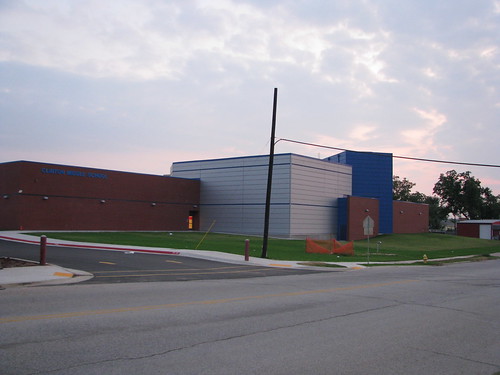
James Howard Kunstler, the author of provocative books on urban design, architecture, and the economy (The Geography of Nowhere, The Long Emergency, World Made by Hand), has named the new building for Clinton Middle School, on W. 41st St. in Tulsa's Red Fork neighborhood, as his "Eyesore of the Month":
Presenting the new Clinton Middle School, Tulsa, Oklahoma -- a building that expresses to perfection our current social consensus about the meaning of education.
Read for yourself his description of the new building, accompanied by photos, and scroll to the bottom of the page to click through his list of previous Eyesores of the Month. It's harsh but fair.
(Be aware that, although he doesn't have any rude words on that particular page, Kunstler is fairly free with expletives on other pages on the site.)
On his Historic Tulsa blog, Bill Miller has photos of the old Clinton Middle School as the demolition process was underway. Even in its final hours, the old school retained its dignity. There's a pre-demolition close-up picture of the main entry on the Webster High School class of '76 website. A Facebook group called "I went to the ORIGINAL Clinton Middle School" has a collection of photos from the final tour of the old Clinton Middle School.
UPDATED 2022/07/13 to replace broken links with Internet Archive Wayback Machine links. Unfortunately, the Webster Class of '76 website used Photobucket to host their pictures, and the Wayback Machine doesn't have them. The Facebook photos are still there; FB changed the URL. Also added the photo that I submitted to Kunstler along with my nomination of the new Clinton as Eyesore of the Month.
As I noted when I first reported on the Clinton demolition in June 2009, when driving down 41st Street in Red Fork, I always enjoyed seeing the old Clinton building, with its two stories with a basement, a flight of steps from the street to the forecourt and then another set of steps up to the main doors, crenellated turrets to either side. The school combined with the street-fronting Christian Church just to the east (still standing, now a United Pentecostal Church), the Baptist Church to the west (demolished for the new school), and down the hill at the intersection with Union Pleasant Porter School, set in the middle of Reed Park, and Trinity Baptist Church, 41st Street had the look of the main street of a proper small town in its own right (as Red Fork was until annexation in 1927), not just another subdivision of Tulsa. Clinton had been the town's high school until Daniel Webster High School was built in 1938.
Note: Reader Mike comments, "FYI, Ballots are out of sync with the school board's proposal PDF explanation. Side 2 (ballot back side) lists Question/Proposition #3 as Transportation and Question/Proposition #4 as Textbooks, Materials & Technology." I've corrected the order below to reflect the ballot proposition numbers.
This Tuesday, Tulsa Public Schools taxpayers will vote on a massive $354 million bond issue (click for an unwieldy PDF of the proposal), organized into four questions:
- Building Facilities Construction and Repairs: $261,415,000
- Library Books, Learning Materials and Building Additions: $19,600,000
- Transportation: $11,695,000
- Textbooks, Classroom Learning Materials and Technology: $61,290,000
I plan to vote against proposition 1 (facilities) and for the other three (libraries, classroom, transportation).
Although passage of the bond issue won't raise the overall millage, TPS still has an obligation to focus any bond issue on necessities. But a full fifth of Proposition 1 ($52,460,000) is devoted to athletic facilities -- stadium press box upgrades, all weather tracks and track re-surfacing, locker and weight room improvements, artificial turf, and a whopping $30 million for new field houses for Washington, Edison, and Memorial High School. Spending this kind of money on athletic facilities in this bond issue means deferring repairs, renovations, and expansions that serve the core function of the school system. Most of the proposed athletic facility improvements are the sort of thing that used to be funded by alumni, local businesses, and booster clubs.
Another reason to vote no -- a reason that applies to the entire bond package -- is the enormous percentage of the package designated for "Professional Services/Bond Management Fee" -- a grand total of $11,071,000, more than 3% of the total bond package. I have this sneaking suspicion (although I can't verify it) that the professional services and bond management that will be funded with this $11 million won't be competitively bid.
The bond package includes materials and projects that look like operating expenses to me, not capital equipment, and many of the numbers seem randomly selected -- e.g. $15,000 per high school for PE and health education equipment. Why not $10,000 or $20,000? It doesn't seem to be based on specific needs.
The following line item is almost enough to make me vote against the classroom materials proposition:
21st Century Classroom Teaching Equipment $6,661,800Funds will be used to provide equitable access to quality learning tools, technologies, and resources to create learning environments and teaching practices that will equip all students with 21st Century skils. To meet the diverse learning needs of today's students, classrooms will be equipped with technological tools that include electronic whiteboards, sound enhancement, video systems, and other technologies to create interactive learning environments, enabling students to learn in a relevant, real world context. These new technologies will support an expanded community and global involvement in learning, both face-to-face with classroom teachers, as well as online with learning communities, preparing our students for a highly competitive and collaborative world.
I see every week what Augustine Christian Academy manages to accomplish with plain ol' whiteboards, donated, slightly out-of-date computer equipment, and per-pupil expenditures less than half that of the state public school system. ACA doesn't have much in the way of classroom technology, but they do have caring teachers, orderly classrooms, and a focus on the essentials of knowledge. Electronic whiteboards may be fun to play with, may have some marginal instructional value, but they aren't going to "prepar[e] our students for a highly competitive and collaborative world." With all this technology and no change in TPS's educational philosophy, TPS will continue to turn out graduating seniors who are less prepared for success in the world than my tenant farmer grandpa was when he finished 8th grade in 1931.
There are signs of bloat all over this bond package. It's telling that you never see a breakdown of each category of spending to the level of items that one could buy at retail. As we've seen with the State Auditor's investigation of the Skiatook school district, it's easy to hide big commissions and markups in an aggregate number. It's only when you look at specific items -- computers, light bulbs, trashcans -- that you can tell whether the district is getting good value for money.
There's one final reason I'm voting against the school's facilities bond: I've seen what they did with facilities funds in previous bond issues. A few months ago I was over on the west side and stopped in at Crow's Drive-In for a bite to eat. Just across the street to the south is the architectural abortion known as the new Clinton Middle School. TPS tore down a dignified civic building, originally built as Red Fork's own high school, and erected a really hideous building in its place.
Before:
After:
I'm pleased and proud to welcome a new BatesLine sponsor: Janet Barresi, a candidate for State Superintendent of Public Instruction.
Barresi has an impressive background in K-12 education, including direct experience in dealing with the challenges of urban education as a founder of two successful charter schools in Oklahoma City.
I believe our schools should be as great as our state, but that goal cannot be achieved without solid leadership in the Department of Education, which is why I have chosen to run for State Superintendent of Public Instruction.
My platform is very simple. I want to ensure that parents are always encouraged to be involved in the education of their children and that they have the ability to choose the correct education for their child. I want to create a State Department of Education that is a resource for local districts, and I want to ensure that our testing of students is a byproduct of good teaching that enables us to truly understand how effective we are being, while empowering teachers to do what they do best: teach.
I know we can do better than we are today. Through my experiences in launching what is now Independence Charter Middle School, as well as Harding Charter Preparatory High School (which was recently recognized as one of the top high schools in America by Newsweek), I have seen that high expectations, a rigorous curriculum and an involved staff can be successful, regardless of the socio-economic background of the students.
Beyond her volunteer work in the schools, Janet Barresi was a speech pathologist and then a dentist for 24 years before retiring.
Tulsa Chigger, who is our local watchdog on charter school issues, had this to say:
I whole-heartedly endorse Dr. Janet Barresi and her campaign for the office of Oklahoma State Superintendent of Schools. She is an experienced reformer with the right set of priorities. I have personally worked with her on some charter school issues in years past.
I urge you to learn about Dr. Barresi by clicking that ad in the sidebar and visiting her website. I think you'll be impressed.
(A click-through is also a nice way to tell her thanks for sponsoring BatesLine.)
Oklahoma's statewide school board elections are today, February 9, 2010. Polls are open from 7 a.m. to 7 p.m.
Two Tulsa school board seats are being contested: Here is a PDF map of Tulsa School Board District 7 and here's a PDF map of Tulsa School Board District 4. District 4 is mainly east of Memorial and north of 31st (not including Layman Van Acres). District 7 is the southern edge of the Tulsa schools territory -- most everything south of 51st St, plus the Patrick Henry subdivision. You can read my comments on the 2010 Tulsa school board election here.
Steven Roemerman has the scoop on the Union School District bond issue.
This is encouraging news: Both Tulsa school board incumbents have drawn opponents for re-election. All too often school board members are returned to office with little if any scrutiny of their service. The election is this Tuesday, February 9, 2010. Because both seats drew only two candidates, there's no need to hold a runoff in April.
There's a clear choice in the District 7 election, where Lois Jacobs is challenging incumbent Matt Livingood.
Matt Livingood, 58, a Democrat and an attorney, was the ringleader pushing for the board's lawsuit against the state's charter school law, a fruitless and expensive attack on expanded educational opportunities for Tulsa's schoolchildren. For that reason alone, Livingood should be turned out of office.
Lois Jacobs, 58, a Republican and a dentist, supports expanding charter schools -- publicly funded, but independently operated schools -- in the Tulsa district. Jacobs advocates a focus on classroom performance and reductions in the district's administrative overhead. Jacobs supports cutting administrator pay, saying that "no one in education should be making more than the governor." She also supports cutting travel by administrators. She opposes a school bond issue that would raise property taxes.
During the 2008 campaign cycle, Jacobs contributed to Republican presidential candidates Duncan Hunter and Tom Tancredo. Federal donor records for Livingood shows a small contribution to Doug Dodd for Congress in 2002. (Neither Anna America nor Bobbie Gray show up in the opensecrets.org database of contributions to federal candidates.)
The lawsuit cost Tulsa Public Schools over $100,000 in legal fees alone. When the board voted not to appeal a court ruling against their suit, Superintendent Keith Ballard hinted that the Tulsa district's apparent hostility to charter schools could cost TPS both private and federal grant money:
Superintendent Keith Ballard said: "The only thing I've ever said is that we are involved in several exciting ventures -- including (a new partnership with) Teach for America and (being selected as a grant finalist by the) Bill and Melinda Gates Foundation, and traditionally these organizations have been supportive of charters."Also, President Obama and (U.S. Secretary of Education) Arne Duncan have made it clear that they support charter schools, and they control a lot of (stimulus package) money, and we are involved in a race for the top money. I've said that this could enter into it, and I think that's an accurate statement."
When the Oklahoma Legislature passed a law in 2007 allowing universities to sponsor charter schools, they tried to address the constitutional concerns that lawsuit backers claimed as motivation for the suit, but the legislature's effort was greeted with more lawsuit threats:
"I'm extremely disappointed in the Tulsa school board for challenging this bill, especially since it helps address the constitutional concerns that they raised last year," said Rep. Tad Jones, R-Claremore, who chairs the House Education Committee.Jones said HB 1589 was written in response to constitutional questions that were raised by the Tulsa school board about the state's original charter school law. The bill reduced the number of counties where new charter schools could open to just Oklahoma and Tulsa counties, but added universities to the list of entities that could sponsor charter schools.
Rep. Jabar Shumate, who represents portions of north Tulsa, echoed Jones' sentiments, saying, "A lawsuit on an issue like this would be a colossal waste of money. Instead of money going toward helping our failing north Tulsa schools, they want to put the money in the pockets of attorneys. Once again, it's our students who lose out."
Shumate believes that the new charter schools law seems to be constitutional. "There are many laws on the books with population restrictions, and that's all were talking about with this charter schools law," he said. "And those laws have been upheld by the state Supreme Court."
Bobbie Gray, 58, a Republican, is the other incumbent on Tuesday's ballot. Gray also supported the lawsuit attacking charter schools. Her vote to end the suit was reluctant:
During Monday's meeting, board member Bobbie Gray said she believed in the principles behind the lawsuit and was disappointed that the board had to end it."I believe that by continuing with this lawsuit, that not only are we jeopardizing any future relationships that we have with our Legislature -- because they don't understand what this is -- but any opportunities that may be coming to the children of this district," Gray said.
Thanks in part to Gray and Livingood, Tulsa lags far behind Oklahoma City in offering educational choices. Oklahoma City has 14 charter schools; Tulsa has 4.
Gray was previously a member of the Tulsa Metropolitan Area Planning Commission, where she was a predictable vote on the wrong side of controversial issues. Bobbie Gray also signed the recall petition to oust District 6 City Councilor Jim Mautino. (Her full name is Roberta A. Gray.)
There are good reasons to retire Bobbie Gray after 14 years on the school board. But don't think that a vote for Anna America (46, a Democrat) is a vote for the kind of reform that the Tulsa district needs.
Now, I like Anna America and her husband, Metropolitan Environmental Trust director Michael Patton. I've interacted with them in the civic sphere over the last 10 years. Anna would bring a perspective to the school board, that (as far as I know) is currently lacking -- she has children currently enrolled in TPS, both at Eisenhower International School. She expresses support for charter schools.
But in the years I've known her, I've never seen Anna America take a stand against the status quo and the local establishment. And for all the commentary on her campaign website, she has nothing to say about the heart of TPS's problems -- curriculum, educational philosophy, and classroom discipline.
Tulsa's children need a structured learning environment and a solid foundation at the elementary level in basic knowledge and skills. Decades of dabbling in educational fads (often driven by curriculum vendors looking to boost sales) have made TPS a district where smart kids with involved parents do OK, but kids without those advantages get left behind. There was a time in our nation's history when public schools provided every student, even those from rotten home situations, with a solid, basic education in an orderly atmosphere. To find that kind of environment today, you have to go to charter schools or private schools. No amount of money or technology can compensate for a defective educational philosophy.
Steven Roemerman received an e-mail last week from Susan Harris of the Tulsa Metro Chamber, noting that former Mayor Kathy Taylor was trying to raise last-minute funds for Anna America. The e-mail also provided brief details of how to give to Matt Livingood and Bobbie Gray, but nothing was said about Lois Jacobs. The clear focus of the e-mail was getting Anna America elected.
MORE:
The Tulsa World, generally supportive of the "throw more money at the problem" approach to educational improvement, has endorsed Livingood and America.
The Tulsa Beacon has endorsed Lois Jacobs, but made no endorsement in the America/Gray race. Here is the Beacon's story on the two school board races.
The Tulsa Classroom Teachers Association, the union local affiliate of the left-wing National Educational Association and Oklahoma Educational Association, endorsed Livingood but made no endorsement in the Gray/America race, saying "we were very impressed with both" candidates.
OK-SAFE sent a questionnaire to all the candidates. Jacobs and Livingood responded; America and Gray did not.
FROM THE ARCHIVES: In January 2007, Jamie Pierson, a graduate of the Tulsa School of Arts and Sciences (a charter high school), responded in her Urban Tulsa Weekly column to the Tulsa School Board vote to place a moratorium on the creation of new charter schools or the expansion of existing charter schools.
Augustine Christian Academy is blessed to have among its alumni a talented young videographer named Kenneth V. Jones. Kenneth produced several wonderful videos in connection with the ACA Junior Performing Arts Company's presentation of the Nutcracker. He does an amazing job of capturing the event. Here is a montage of scenes from dress rehearsal:
Nutcracker Dress Rehearsal Montage from ACA on Vimeo.
And a montage from the opening night performance.
Nutcracker Montage - Augustine Christian Academy from ACA on Vimeo.
Previous entries:
The school has posted some photos from Augustine Christian Academy's production of "The Nutcracker".
Here are my three kids: The Prince, the Candy Flute, and their little brother.

And here she is with one of her classmates and best friends:

The Prince as the Nutcracker, with Herr Drosselmaier:

The Prince and Marie, with the Chinese dragon and dancers

At the cast party after the final performance, "Marie's" mom (who had two younger daughters in the performance as well) remarked that it was wonderful that Augustine Christian Academy provided a God-honoring context in which her daughters could develop their God-given talents.
ACA is not a wealthy school, but teachers, parents, and students take what they have and add a lot of sweat equity and a lot of heart. The result is consistently one of beauty and excellence. If you want a school where your children will be challenged to excel in a loving and creative environment, check out Augustine Christian Academy.
 Augustine Christian Academy's Junior Performing Arts Company presents "The Nutcracker" this weekend, December 11-13, 2009. I attended last night's dress rehearsal, and it's a wonderful story told through dance, colorful costumes and sets, and the music of Tchaikovsky -- the party, the wind-up dolls, the snowflakes, the battle with the Mouse King and his minions, the Spanish, Arabian, Chinese, and Russian dancers, the gingerbread clowns, and the Sugar-Plum Fairy.
What: The Nutcracker
Where: Augustine Christian Academy, 30th St., just west of Sheridan Rd.
When:
- Friday, December 11, 2009, 7 p.m.
- Saturday, December 12, 2009, 7 p.m.
- Sunday, December 13, 2009, 2 p.m.
Admission: $8.50 for adults; $6 for students.
Tickets are available at the school office. I'm told that Friday and Sunday are almost sold out.
Saturday, before the performance, there's a special "Land of the Sweets" extravaganza -- a light dinner, desserts, and priority seating for the show -- $20 for adults; $15 for students.
What's especially impressive about this production is that the performers range in age from the 7th and 8th grade leads down to the 1st grade gingerbread men. That they have put together such a well-executed performance is a tribute to the dedication and energy of the young actors and dancers. It's also a tribute to the creative team of teachers and parents who spent the semester directing and teaching choreography, designing costumes and sets, and to the parents (including my wife) and grandparents (including my mother-in-law) who spent the semester sewing those costumes (almost 100). (And a special thanks to another grandparent -- my mom -- whose babysitting made it possible for my wife to help as much as she has.)
Performing arts are an ACA specialty, and every year the high school puts on a full-scale Broadway musical. This year is the first for a major production involving the grammar and junior high grades. I wasn't sure what to expect, but the result is amazing.

I may be biased. My 13-year-old son is the Nutcracker Prince and my nine-year-old daughter is a dancer in several scenes. I am as proud as can be of both of them.

ACA's "Nutcracker" is a wonderful evening's entertainment. It's also an opportunity to get acquainted with a school that seeks to glorify God through excellence in all its pursuits, including the performing arts.
Low-quality cellphone pix by Michael Bates
MORE: After the jump, video from a segment on Fox 23 Daybreak from last Tuesday, featuring directors Gail Post and Dawn Redden, and five of the students performing the Russian Dance (in a smaller space than usual).
The filing period for the February 2010 school board elections opens today, December 7, 2009, and closes on Wednesday, December 9. Filing takes place at the election board in the county where the school district is headquartered.
There are two seats up for election in the Tulsa district, for board districts 4 and 7, and the incumbents, Bobbie Gray and Matt Livingood, respectively, have both been hostile to charter schools, with Livingood leading the charge for the Tulsa district's expensive and ultimately futile lawsuit against the state's charter school law.
District 4 is roughly north and east of 31st and Memorial (except for Layman Van Acres), while District 7 is mainly south of 51st east of the river, although it includes the Patrick Henry neighborhood (41st to 51st, Harvard to Yale) and excludes Sungate (51st to 61st, Sheridan to Memorial).
Here are links to some maps (PDF format):
- Map showing all Tulsa school board election districts
- Map showing Tulsa school board district 4
- Map showing Tulsa school board district 7
- Links to maps for each board district
For districts with five members, seat no. 5 will be up for grabs in 2010.
In addition, a seven-year term in Seat 1 on the Tulsa Technology Center board will be on the ballot. Lena Bennett is the incumbent, first elected in 1992. Here is a map of the seven board zones in the Tulsa Tech district.
Here's the press release about the school board filing period from Tulsa County Election Board Secretary Patty Bryant:
Candidates for the Board of Education in 14 Tulsa County School Districts will file Declarations of Candidacy beginning at 8 a.m. Monday, December 7, 2009. Patty Bryant, Secretary of the Tulsa County Election Board said the filing period will end at 5 p.m. Wednesday, December 9, 2009.Candidates for the Board of Education in Tulsa Technology Center District No. 18 also will file their Declarations of Candidacy during this same time period.
Board of Education positions at stake will be filled at the Annual School Election scheduled February 9, 2010. If no candidate in the Annual School Election receives more than 50% of the total votes cast, the two candidates receiving the highest number of votes will meet in a second school election on Tuesday, April 6.
I'm reluctant to post this, because it could be read as conspiracy-mongering, but I was just fascinated by all the interconnections evident in a single Tulsa World story about a new professorship at the University of Tulsa College of Law.
The new chair in energy law is being endowed by the George Kaiser Family Foundation in honor of Frederic Dorwart, described in the story as the president of GKFF and its longtime attorney. Dorwart is the attorney for Bank of Oklahoma, of which George Kaiser is chairman.
(Dorwart represented the Tulsa Industrial Authority in its suit against the Tulsa Airport Improvement Trust, dealing with TAIT's commitment to buy land owned by TIA in the event of a default by Great Plains Airlines on a loan from BOk, guaranteed by TIA. Great Plains went bust, the FAA said TAIT couldn't use passenger service fees to buy the land, leaving TIA with no way to pay back the money that Great Plains owed. So TIA sued TAIT. The suit was expanded in June 2008 to include the City of Tulsa. City Attorney Deirdre Dexter, a former Dorwart firm lawyer, agreed to settle within a day or so of the city's addition to the suit.)
The story quotes the dean of the law school, Janet Levit. Janet's husband Ken Levit is executive director of GKFF. The story goes on to note:
In May, the Kaiser Foundation donated nearly $40 million to TU. The gift included a low-interest loan to help the university begin construction on the Roxana Rozsa and Robert Eugene Lorton Performance Center, as well as money for the Energy Policy Institute and a student volunteer center.
So Kaiser's generosity made it possible to move ahead with a building named in honor of the former publisher of the Tulsa World (and the father of the current publisher) and his wife. (It appears from this Collegian story that construction of the center had been postponed because of the economy.) The story continues:
Dorwart is president of the advisory board of the TU Undergraduate Research Challenge and is an organizer of the Tulsa Stadium Trust Improvement District.He was an organizing trustee of the Tulsa Community Foundation and a co-founder of the International Society of Energy Advocates.
Just to be clear, this new endowed chair in energy law is a very good thing, both for TU and for Tulsa. Energy law is an important field, and it's a natural fit for a university with a world-renowned petroleum engineering department.
But the interconnections evident in this one news story are fascinating.
Via Jeff Lindsay on Twitter, I learned about Classical School in Appleton, Wisconsin, a charter Pre-K - 8 school of 450 students that follows a classical curriculum. The school follows E. D. Hirsch's Core Knowledge curriculum. Hirsch is the author of Cultural Literacy: What Every American Needs to Know. From the Core Knowledge FAQ:
The "Core Knowledge" movement is an educational reform based on the premise that a grade-by-grade core of common learning is necessary to ensure a sound and fair elementary education.... Professor Hirsch has argued that, for the sake of academic excellence, greater fairness, and higher literacy, early schooling should provide a solid, specific, shared core curriculum in order to help children establish strong foundations of knowledge.
The FAQ is worth reading for their responses to questions like:
Without coming right out and saying it, the Core Knowledge approach rebuffs the philosophies and fads of modern public education while embracing the classical Trivium, which begins with "Grammar." The Grammar of the Trivium is not merely how you put words together, but it encompasses the facts and rules of a range of disciplines, including math, history, music, the visual arts, and science, as well as language.
Here's part of the Core Knowledge response to the "learn how to learn" concept:
...Children learn new knowledge by building upon what they already know. It's important to begin building foundations of knowledge in the early grades because that's when children are most receptive, and because academic deficiencies in the first six grades can permanently impair the quality of later schooling. The most powerful tool for later learning is not an abstract set of procedures (such as "problem solving") but a broad base of knowledge in many fields.......The basic principles of science and constitutional government, the important events of world history, the essential elements of mathematics and of oral and written expression -- all of these are part of a solid core that does not change rapidly, but instead forms the basis for true lifelong learning.
And in response to the criticism of rote memorization and the idea that children need critical thinking skills, not just a bunch of facts:
No one wants schools to think of curriculum solely in terms of facts. We also want -- and students need -- opportunities to use the facts, to apply them, question them, discuss them, doubt them, connect them, analyze them, verify or deny them, solve problems with them. All these activities, however, rely upon having some facts to work with. Without factual knowledge about an issue or problem, you can't think critically about it -- you can only have an uninformed opinion.
Oklahoma has three officially certified Core Knowledge schools -- schools that have implemented at least 80% of the curriculum with a goal of full implementation: Cleveland and Sequoyah Elementary Schools in Oklahoma City, and Clegern Elementary School in Edmond.
Clegern Elementary is certified as a Core Knowledge visitation site, a model school where the curriculum has been fully implemented. Clegern is also a "parent choice school" -- any family in the Edmond district may apply to attend; students are chosen by lottery. It's telling that much of the school's FAQ page has to do with who does or doesn't get an edge in the selection process.
Another 13 schools in Oklahoma City and one in Anadarko are "Friends of Core Knowledge," which means that the schools are implementing the curriculum at some level.
The curriculum of Classical Charter School in Appleton reminds me in many respects of the curriculum at Regent Preparatory School in Tulsa -- for example, both use Saxon Math and Shurley Grammar. I like the fact that instead of the vague "social studies," they have history, geography, and literature.
Now that the Tulsa Public Schools board has dropped its senseless and expensive lawsuit against the state's charter school law. An editorial in the Oklahoman noted a report that the Tulsa school board spent $103,000 on attorney's fees to pursue the suit; appealing to the State Supreme Court would have cost another $125,000. The Oklahoman's advice:
This lawsuit was a bad idea from the start. Money that could have been spent for the benefit of teachers and students went to lawyers instead. That was the only guaranteed outcome, and by no logic could that be considered good for children or taxpayers.What's good for children -- and by extension taxpayers -- is for Tulsa to not just accept but embrace quality charter schools. Those schools exist to serve Tulsa's children. Their success doesn't reflect poorly on the district; rather, it says that the district cares enough about its students to step outside its comfort zone.
Oklahoma City has 12 charter schools. Tulsa has three. Perhaps now the Tulsa district will be open to new charters, or perhaps one of the universities would sponsor a Core Knowledge charter school here.
Yesterday afternoon, the five of us thoroughly enjoyed Augustine Christian Academy's performance of Disney's Beauty and the Beast. Every year the sets and costumes are more elaborate, and the acting, singing, and dancing more skillful. ACA's annual musical embodies the school's pursuit of excellence and exuberant creativity, and we're blessed to be a part of the ACA community.
This coming Tuesday night is an open house focused on the school's lower grades, an opportunity for you to learn more about what ACA has to offer.
Be Our Guest!
Elementary Open House
Tuesday, April 21, 2009 6:00 - 8:00 PM
- New Home School Program
- New Electives, including Performing Arts
- Come meet Belle, the Beast, and the other Enchanted Characters
- Free Refreshments
Augustine Christian Academy
6310 E. 30th Street
Tulsa, OK
(918) 832-4600
www.acatulsa.org
From the school website:
Augustine Christian Academy is a small, independent, Christian classical school dedicated to training students to take the lead in their personal lives, in their educations, and in their communities. Augustine Christian boasts a climate that is truly conducive to the free exchange and development of ideas.
A few words about the school from my wife:
ACA offers both a full time curriculum from K-4 through 12th grade, and part time options for homeschool students. Most core curriculum classes are offered to homeschoolers for the sixth grade and above. This year, elementary homeschoolers will be offered the chance to participate in some of the school's Fine Arts Curriculum. Please come and Be Our Guest! - THIS Tuesday night. We are all still singing from this weekend's amazing production of the Beauty and the Beast. Come visit with a few of our stars as well!If you want to get the flavor of our school, please visit the website at www.acatulsa.org. There are two links below with short video clips as well.
ACA senior Haden Brewer won this year's Tulsa Rotary's 4-Way Test Speech Contest. This speech will give you a glimpse into student life at ACA. (Click here to watch the speech.) An excerpt:
I attend a small private school of just over 150 students. We are not a wealthy school, and this fact produces much of what I love most about it. Because of our financial status, there are certain privileges we don't have that other schools see as a common necessity; for example, a janitor. Yes, there are parents who have volunteered to clean the restroom and kitchen facilities, but the rest is accomplished by other means. Each student is assigned a task to work on 20 minutes after lunch that involves cleaning the building. By cleaning our classrooms ourselves, we build a sense of respect for the school. Now we put away our chairs, clean the tables, and sweep the floors after eating lunch without thinking twice about it.
Here's a six-minute promotional video for Augustine Christian Academy:
ACA Promotional Video from ACA on Vimeo.
I posted this question on Twitter
Question to young midtown Tulsa hipsters: What are your plans when you have school-age kids? TPS, private, homeschool, or move to burbs?
and got several quick replies; thought I'd post it here, too, in expanded form:
If you're young and have moved into an older core neighborhood in midtown Tulsa, or any of the neighborhoods within a mile or so of downtown, what will you do when your children (if/when you have them) are old enough for school? Will you stay put and send your kids to Tulsa Public Schools or a private school or homeschool them? Or will you move to a suburban school district?
If your answer is TPS, is that contingent on getting your children into magnet programs like Eisenhower or Zarrow or transferring them into a highly regarded neighborhood school, or will you be content with the assigned school for your neighborhood?
Whatever your answer, I'm curious to know your reasons as well.
Back in 1998, I first ran for City Council and got involved in the Midtown Coalition. At the time, I met a number of younger couples who either didn't have children yet or had children who weren't old enough for school. They lived in cute 1200 sq. ft. cottages and bungalows, but they all seemed to move as soon as the first child approached the age of five. I'm wondering how many of the young adults from the current cohort who are attracted to traditional neighborhoods and urban living will stick around when the babies start coming.
Feel free to post a comment below or e-mail me at blog at batesline dot com. This is for an upcoming column on the connection between schools and urban revitalization. If you'd prefer I didn't quote you at all, or if I can quote you but not by name, please mention it when you write, otherwise I'll assume I have permission to quote you by name.
Over the last 9 days, I:
- Wrote two regular columns for Urban Tulsa Weekly
- Wrote two extra thousand-word pieces, which will appear in UTW's Spring Thing, one of the paper's two annual full-color special inserts
- Edited and cross-checked a 75-page technical proposal, writing or re-writing sections of it, working 10-12 hour days, including weekends
On Sunday arrived at the office about 1 p.m., lunch in hand. I broke for dinner about 7:30, writing a first draft of my column, returned to the office about 9, and went back to work on the proposal, incorporating last minute corrections and making sure we hadn't left anything out. At 3 a.m., five of us -- the executive VP, the engineering director, the program manager, the tech writer, and me -- gathered in the conference room to cut and streamline to get the proposal under the page limit. We finished about 4, and I went back to work on the column -- sent it in at 5:49, drove home, set out the trash, and was in bed about 6:10. Slept five hours and went back to the office to give the printed proposal a final review.
This evening, my 12-year-old son and I went to Will Rogers High School for their "Second Monday" architectural tour which runs from 6:30 - 8:00. The monthly tour is free, but they hope you'll buy popcorn, soda, and special calendars to help support the theatrical program. The next major production is the 45th edition of the Will Rogers Roundup, a variety show that will run in mid-April in the school's beautiful 1500-seat auditorium. The school, which opened in 1939, is beautiful inside and out.
(Here's Joseph Koberling's commentary on the architecture of the school he designed with Leon Senter.)
The WRHS alumnus who gave a historical lecture in the auditorium at the start of the tour (didn't catch his name, but he did a fine job) related a conversation he had at the National Preservation Conference last fall. The preservationist came to the WRHS booth in the exhibit hall and wanted to know what the school was used for now and when it was renovated. The preservationist was certain that, like many historic buildings, WRHS had been badly remodeled or neglected at some point in its history, and that it had been deemed obsolete and repurposed in some way. The remarkable thing about Will Rogers High School is that they've simply done a great job of preserving it, continuing to use it for its original purpose and never "wreckovating" it.
Back home, I still had laundry to do and a three-year-old to bathe.
But now I'm beat. There's some interesting new stuff over in the linkblog. I'm off to get some sleep.
Brandon Dutcher, whose wife homeschools their four children, reacts to State Sen. Mary Easley's plan to regulate homeschooling by requiring families to register with the local school district and provide progress reports. He tells Sen. Easley he'd like to see progress reports from the public schools so he can know, for example, just how far behind his children are from the public-schooled kids:
For example, when my oldest son was in 8th grade, all he was really able to learn that year was Algebra II, Henle Latin I, intermediate logic, physical science, grammar, and composition. Well, plus he read and discussed The Epic of Gilgamesh; The Code of Hammurabi; The Odyssey; The Histories; The Oresteia Trilogy; Plutarch's Lives; The Theban Trilogy; The Last Days of Socrates; The Early History of Rome; The Aeneid; The Twelve Caesars; Till We Have Faces; The Unaborted Socrates; Genesis; Exodus; I and II Samuel; I and II Kings; Isaiah; Jeremiah; Chosen by God; and Socrates Meets Jesus, among others.Now, I'm not naïve. I realize that 8th graders in Oklahoma's world-class public school system are learning all this and more. Who among us didn't have an 8th-grade history teacher/football coach wax eloquent on the influence of Stoic philosophy on Gaius Gracchus? Heck, as a retired teacher you know better than anyone that the 8th graders in your hometown of Tulsa (or Owasso, or Grand Lake Towne, whatever) are learning all this and more.
Later, he points out that his family has saved Oklahoma taxpayers over $200,000 by homeschooling their children.
Oklahoma's freedom to homeschool has encouraged the growth of a diverse homeschooling community, with all sorts of co-op groups, special classes, sports, field trips, clubs, and other school activities to provide learning opportunities beyond what parent-teachers can easily provide at home. Instead of breaking something that works well, we ought to promote the state to attract homeschoolers from across the country to move here. Who knows -- we might grow enough to get back that 6th congressman we lost 10 years ago.
In a Friday editorial, the Oklahoman took the Tulsa school board to task for continuing its lawsuit against the state's charter school law. The TPS board claims the law is unconstitutional because it limits charter schools to certain parts of the state based on population and district size.
Charter schools exist because many parents and educators aren't happy with what they see at traditional schools. Some are in direct competition with traditional public schools; others have programs that serve students who have struggled in a traditional education setting. That's not to say all charter schools are perfect and a great fit for every student. But we believe the marketplace will sort the good from the bad, and parents ultimately will vote with their children's feet.Charter schools were designed to be incubators for new ideas that could be replicated. Instead, we tend to hear excuses on why some of their innovations won't work in regular schools. Even Oklahoma City, which has been a more welcoming environment for charter schools than Tulsa, has had tense and sometimes hostile relationships with charter schools.
We said when the lawsuit was filed that it was a waste of money. It still is. Schools -- and school boards -- would do better to embrace the competition as an opportunity for students to receive a better education and a challenge to do better. That's not too much to ask.
The editorial refers to a December 15 attempt by TPS board members Brian Hunt and Lana Turner-Addison to drop the lawsuit. The motion failed by a 4-2 vote.
(Crossposted at Choice Remarks.)
Strategic Vision polled 1200 Oklahoma voters for the Friedman Foundation for Educational Choice. Here is the executive summary:
This scientifically representative poll of 1,200 likely Oklahoma voters measures public opinion on a wide range of K-12 education issues. The underlying theme of the Friedman Foundation's Survey in the State series is to measure voter attitudes toward their public institutions, leaders, innovative ideas, and the current K-12 power and priority structure.In particular, Oklahomans have shared with us their views about "school choice" in the forms of taxcredit scholarships, school vouchers, charter schools and virtual schools. Results imply that voters like the idea of customizing the school selection process in a way that best meets the needs of a child and his or her family. So how high is the support for school choice reforms? Percentages favoring tax-credit scholarships, school vouchers, and charter schools are consistently in the 50s--generally and across nearly all subgroups.
In some cases, favorability to a particular school choice reform reaches the 60s. For example, 60 percent of African-Americans favor a scholarship granting system funded through business tax credits; 63 percent of African-Americans like charter schools; and 63 percent of Hispanics favor "allowing students and parents to choose any school, public or private, to attend using public funds."
School choice is not a partisan issue among voters in Oklahoma. Favorability spans political parties and political self-identification. Democrats, Independents, and Republicans favor publicly funded scholarship granting systems (through business or individual tax credits), school vouchers, and charter schools.
Proportions are very similar across these subgroups on school choice-related questions. In some cases, support is extraordinarily high: 61 percent of Democrats favor tax-credit scholarship legislation; 60 percent of Republicans and 58 percent of Independents favor a scholarship granting system funded through individual tax credits; and all three political groups are more likely to vote for rather than against a candidate who supports a tax-credit scholarship policy.
A total of 1,200 phone interviews were conducted by Strategic Vision, between April 25 and April 27, 2008. The margin of error for the full sample of likely voters is ± 3 percentage points; the margin of error is higher when considering the response percentages for a given demographic subgroup.
Key findings include:
- About two-fifths of Oklahoma voters are not satisfied with the state's current public school system--41 percent rate Oklahoma's public school system as "poor" or "fair." Excluding the one of five voters who are undecided, this proportion rises to 51 percent.
- Nearly two out of three Oklahomans are content with current levels of public school funding. A large majority of voters (64 percent) say Oklahoma's level of public school funding is either "too high" or "about right." At least 67 percent of the poll's respondents underestimate the state's actual per-pupil funding, which suggests that the funding satisfaction level is probably a conservative figure.
- More than four out of five Oklahomans would prefer to send their child to a school other than a regular public school--only 17 percent say a regular public school is their top choice. This low figure is consistent with what we have learned from previous state polls asking the same question, most recently in Idaho (12 percent), Tennessee (15 percent), Nevada (11 percent), and Illinois (19 percent).
- Oklahoma voters value private schools--they are more than twice as likely to prefer sending their child to a private school over any other school type. When asked "what type of school would you select in order to obtain the best education for your child?" 41 percent of respondents selected private schools. This finding is consistent with other recent state polls asking the same question: Idaho (39 percent), Tennessee (37 percent), Nevada (48 percent), and Illinois (39 percent).
- Oklahomans like having a range of schooling options. Majorities express support for school vouchers (53 percent) and charter schools (54 percent), with many also open to virtual schools (40 percent), even though nearly a third of respondents stated they "have never heard of virtual, cyber, or online schools." School choice is not a partisan issue among likely voters. There is solid potential for building bridges between Democrats (D), Republicans (R), and Independents (I). Voters who identify themselves differently in terms of political affiliation are likely to have common views on various school choice reforms and policies spanning charter schools (D: 52 percent | R: 56 percent | I: 55 percent), virtual schools (D: 38 percent | R: 40 percent | I: 42 percent), school vouchers (D: 53 percent | R: 54 percent | I: 53 percent), or a generic public-funded school choice system (D: 55 percent | R: 53 percent | I: 56 percent).
- More than half of voters are favorable to a tax-credit scholarship system. When asked "if a proposal were made in Oklahoma to create a tax-credit scholarship system," 54 percent say they favor a scholarship system funded by business charitable donations. A slightly higher figure (57 percent) say they favor a scholarship system funded by individual charitable donations.
- Likely voters view recent tax-credit scholarship legislation positively--58 percent say they are favorable to such school choice legislation. Majorities cut across Democrats (61 percent), Republicans (55 percent), and Independents (53 percent).
- Oklahomans are more likely to vote for a state representative, state senator or governor who supports a taxcredit scholarship system. Nearly twice as many voters say they are "more likely" (21 percent) rather than "less likely" (11 percent) to vote for such a candidate. Independents are nearly five times more likely to vote for a person supporting tax-credit scholarships (23 percent vs. 5 percent).
- Knowledge about school vouchers is at a low baseline in Oklahoma--there is an information deficit about this type of system reform. Although a majority of Oklahoma's likely voters (55 percent) said they were either "very familiar" or "somewhat familiar" with school vouchers, there is still a lot of potential for educating citizens on the issue. This figure is comparable to what has been measured in other states such as Idaho (59 percent), Tennessee (45 percent), Nevada (55 percent), and Illinois (51 percent).
Read more about the battle for school in Oklahoma at the Choice Remarks blog.
Congratulations to Tulsa County voters: KTUL is reporting that the TCC bond issue failed 45-55 and the TCC permanent property tax increase failed 43-57.
And congratulations to John Tyler Hammons. The 19-year-old OU freshman poli-sci major won a runoff tonight to become Mayor of Muskogee, defeating the incumbent a former mayor in a landslide. (Hammons said he would transfer from OU to nearby NSU if elected.) Hammons will also be a delegate to the Republican National Convention; he was on the slate approved at the May 3 state convention.
A reaction from "Kiah" to the TCC tax defeat at TulsaNow's public forum:
Can we now officially retire the Chamber/World's cynical approach to local governance (i.e. hide the ball; the fewer voters the better, and the less they know, the better -- in short, don't worry your pretty little head about it, let the grown-ups handle the details . . . .)
UPDATE: Thanks to Jamison Faught for the correct description of Hammons's opponent -- the incumbent, Wren Stratton, didn't seek another term; Hammons defeated a three-term former mayor, Herschel McBride. The final vote total was Hammons 3,703, McBride 1,616.
Tulsa County voters will decide today whether to grant Tulsa Community College a permanent property tax increase of 1.7 mills for operations and maintenance (a 23% increase over the current level of 7.21 mills) and, in a separate proposition, a temporary seven-year property tax increase of about 3.1 mills to fund a $76 million bond issue for construction and remodeling.
My column in this week's Urban Tulsa Weekly urges a vote against the two propositions. In short, TCC is in good shape and has plenty of money to accomplish its mission. Our priority ought to be fixing what needs the most improvement: Our city's grade "D" streets. We can't afford to let other taxing entities use up the public's limited tax tolerance. There isn't an overall local budget authority that oversees the City, the schools, the County, TCC, and other local government entities. It's up to us as taxpayers and voters to set funding priorities among these various agencies and governments.
You'll find more links about the proposed TCC tax hike in this earlier blog entry. To read the other side of the issue, you'll find a pro-tax-increase website at tccworks.com. You'll find much more about TCC and the tax vote at Stan Geiger's website, including this recitation of all the tax increases we've been asked to approve over the last 8 years.
All Tulsa County polling places will be open from 7 a.m. to 7 p.m.
MORE: No surprise: The Tulsa Whirled never met a tax it didn't endorse. I love the way they minimize the tax increase by putting it in terms of dollars per month. They don't tell you that it means a 67% increase in TCC's take from he taxpayers. Hardly "modest property tax increases." Of course, the Whirled would never concede that the other side might have a point:
They are anti-tax, antigrowth, anti-prosperity and anti-community. They don't care what they tear down, so long as they don't have to pay for the conveniences of living in a civilized society. They've already got theirs and could care less about the other guy.
Who's tearing down? Most "antis" on this tax are generally pleased with TCC; they just think TCC has enough money to do its job, and there are better places to allocate that additional millage.
The Whirled can't defend the tax increase on the merits, so they have to resort to propaganda techniques. Their argument boils down to: "You don't want to be like one of those nasty, angry anti-taxers. You want to be progressive and foresighted, like us."
The Whirled would have more credibility if they at least conceded that there are valid concerns on the other side of the issue. If once in a while, they called a proposed tax increase "ill-timed" or "larger than necessary," they might make more of an impact when they endorse a tax.
Can anyone think of a tax increase the Whirled has opposed?
BY WAY OF CONTRAST: Oklahoma County is voting on five bond issues today, covering courthouse renovation, a new building for the cooperative extension program, improved record retention facilities, and flood control. The big ticket item is to purchase the old GM plant in Midwest City so that it can be leased and perhaps sold at some future date to the Air Force for Tinker AFB expansion. Room for expansion is a factor weighed by the DoD's Base Realignment and Closure commission. The total property tax increase will be 1.521 mills over 15 years. (Via Dustbury.
Tulsa County has been using sales tax for these kinds of projects; it's interesting that Oklahoma County has no county sales tax, leaving sales tax for the cities to use as they see fit.
Stan Geiger has a few blog entries up about next Tuesday's vote on Tulsa Community College's proposed property tax increases. (See my previous entry for links to my column on the topic and sources for additional information.) Here are some excerpts from Stan's latest -- click the links to read the whole thing:
TCC is pushing the tired notion that more tax money for higher education equals a stronger local economy. Man, if only that were true.The Tulsa area is up to its butt in public-subsidized higher education. TCC has 4 campuses---plus an office building for executives. We have an OU-Tulsa, an OSU-Tulsa and a Langston-Tulsa. We have a Northeastern State campus in Broken Arrow. And what was once a junior college in Claremore is now a 4-year school called Rogers State University under the auspices of the OU Board of Regents.
If pouring tax money into higher education resulted in economic prosperity, Tulsa would be a freakin' boomtown.
Well, 50 bucks a year might not be a big deal to educators. But to an average working person that has a real job out in the real world and is facing wolves at the door, 50 bucks is a lot of money.
Property Tax: The Ever Growing Tax, referring to an earlier comment by XonOFF, who notes that TCC currently gets almost as much property tax in a year as the City of Tulsa, and if the tax increase and bond issue pass, TCC will receive more property tax annually than Tulsa County government. Stan relates some budget research he did 10 years ago:
In 1997, TCC's budget figures showed property tax revenue of $15.3 million. Reports say the last permanent millage increase voted to TCC came in 1994. So in a 10-year span of time, in the absence of any increase in the tax rate, the amount of property tax revenue flowing into TCC doubled.The property tax is not a static tax. It grows. If you vote an increase today, whatever it is, 50 bucks, a hundred bucks or whatever, it will be a bigger tax increase next year, and the year after that and the year after that.
Tulsa Chiggers has some TCC facts for voters to weigh:
Did you know that space is available, especially at the Northeast Campus? ...Did you know that TCC has been operating with a surplus for years?
TulsaNow's public forum has a thread about the TCC tax hike, and it's interesting to see that many regulars there who usually support tax increases are balking at this one.
Commenter "waterboy" writes:
I received one of their calls last night. For the first time in my life I am voting against an education proposal.TCC is a poor administrator of tax dollars [in my opinion].
I believe they practice age discrimination.
Their human resources dept. is inept. and unresponsive. (I know this has become common throughout the business world but this is tax dollars)
They cannibalized the areas surrounding the downtown facility for asphalt lots.
Wage disparity is embarrassingly out of balance. Read their classified ads.
I told the caller that at some point TCC will have its attitude with the public reflected back towards them. For me, this is that point.
Commenter "swake" replies:
I also am voting no for the first time.TCC is a poor downtown citizen, works to block 1st and 2nd year classes from being offered by OSU and OU Tulsa and isn't the higher education entity that we need to work to grow.
This week in Urban Tulsa Weekly, I preview next Tuesday's special election for a permanent property tax increase and a temporary property tax increase tied to a $76 million general obligation bond issue for Tulsa Community College. All of Tulsa County will go to the polls. If approved, the permanent millage rate would increase from 7.21 mills to 8.91 mills, with a temporary seven-year boost to about 12.2 mills while the bonds are being repaid. In the column, I make the case that, in the absence of a body with authority over all the different local taxing entities, it's up to us, the voters of Tulsa County, to set priorities among the requests from these various agencies.
Here are links to some of my research helps:
TCC page about the May 13 proposals. (Here are direct links to their fact sheet, publicity piece, and newsletter.)
Sample ballot for the May 13 TCC election
Property tax apportionment in Tulsa County
An explanation of the color-of-money problem from the Defense Department perspective
The following reports cover all the schools in the Oklahoma higher ed system -- research universities, regional universities, and community colleges, among other institutions:
Incredible: The Republican-controlled State House of Representatives voted today to kill SB 2093, the New Hope Scholarship Act, by a vote of 40 to 57.
Fred Jordan, who represents Jenks, Glenpool, and south Tulsa, and Weldon Watson were the only Republican s representing Tulsa who voted no. (Earl Sears, who represents a small piece of north Tulsa County along with much of Washington County, and Skye McNiel, who represents Creek County, plus a small piece of southwest Tulsa County, also voted no.) I can only speculate about the motivation of Fred Jordan, a suburban homebuilder. The lack of adequate educational options in the Tulsa Public Schools district creates outward pressure that would help him sell new homes in far south Tulsa County.
A glance at the names of other naysaying Republicans reveals a number from rural and suburban areas. Perhaps they have the attitude, "What's in it for the schools in my district?" Perhaps their school board members and superintendents pressured them into voting no.
North Tulsa Democrat Jabar Shumate was a leading advocate for the bill, which would have been a great benefit to students in his district, which is plagued with underperforming public schools, but his Democratic colleagues in neighboring districts -- Lucky Lamons, Jeannie McDaniel, Darrell Gilbert, and Scott BigHorse -- abandoned him. It's hard to understand why the first three, who represent parts of the Tulsa Public School district, would oppose a measure that would provide educational choice and thus incentive for families with children to remain in the older parts of central and north Tulsa. I suppose pressure from the OEA, the most influential interest group in the Democratic Party, was a factor. Their votes may have been good for their political careers, but they were bad for their districts.
David Derby (R-Owasso) and Eric Proctor (D-northeast Tulsa) did not vote -- they are listed under "Constitutional Privilege."
This was a very modest bill that would have created a tax credit for donations to scholarship funds. These scholarship funds would be designated for students in underperforming schools. It was too limited -- capped at a certain dollar amount each year -- but it would have provided more school choice than we currently have for the students who need it most. Shame, shame on the House members, particularly the Republicans and those who represent inner-city districts, who voted against this bill.
Meanwhile, Oklahoma continues to languish at the bottom of the school choice charts with a failing grade.
Oklahoma is lagging behind the rest of the nation in offering a variety of affordable K-12 educational options to our children and their parents. In hopes of improving the situation, there's now an organization called Oklahomans for School Choice, with an official blog called Choice Remarks, headed up by Brandon Dutcher, vice president for policy for the Oklahoma Center of Public Affairs.
The blog's sidebar offers a synopsis of the issue:
School choice refers to any education policy which allows parents to choose the safest and best schools for their children, whether those schools are public or private. As state school Superintendent Sandy Garrett has correctly noted, "We have a lot of choice already in Oklahoma." Oklahoma is fortunate to have interdistrict choice, intradistrict choice, charter schools, magnet and specialty schools, privately funded K-12 vouchers, a thriving homeschool sector, and more. Unfortunately, we don't yet have what many other states have--vouchers or tax credits which allow thousands of students to choose private schools.
I've been invited to contribute to the blog, so as I come across news items relating to charter schools, tuition vouchers, scholarship fund tax credits, and other means of expanding parental choice in K-12 education, I'll be posting them at Choice Remarks.
A friend asked me about the candidates for Office 3 on the Tulsa Technology Center board and for Union Public Schools, specifically about their party registration and background. School board races are non-partisan, but party registration is a piece of information that some voters like to have.
You may also want to look over the complete questionnaire responses submitted to the Tulsa World and the League of Women Voters (400 KB PDF).
Bea Cramer, the incumbent, is the only Republican running for the Tulsa Tech seat. Tim Bradley and Mitchell Garrett are Democrats. Garrett, son of Muskogee trial lawyer David Garrett, parachuted into House District 23 to run against State Rep. Sue Tibbs in 2004. During that election campaign Mitchell Garrett was simultaneously registered as a voter in both Tulsa and Muskogee Counties.
The incumbent for Union Public Schools Office 3 filed for re-election, but Jim Williams announced on January 24 that he was withdrawing his candidacy. His name will still appear on the ballot. The only other candidate is Albert Shults, a Republican. The choice for voters in the Union district is to elect Shults or to let the other board members pick a replacement for Williams. If Williams is re-elected, he would presumably resign, with the vacancy to be filled by the board.
In Broken Arrow, both Keven Rondot (the incumbent, appointed to an unexpired term about a year ago) and Shari Wilkins are registered Republicans.
In Glenpool, the incumbent, Michael J. Thompson is a Democrat; Kenneth Ball is a Republican.
In Jenks, Joseph Hidy, the incumbent, and Kanna Adams, are both Republicans.
In Liberty, Richard L. Moore, Jr., the incumbent, is a Republican, and Billie Blackburn is a Democrat.
In Sperry, Tim Teel, the incumbent, and Derrell Morrow are both Republicans.
In Tulsa, Radious Y. Guess and Brian T. Hunt are both Republicans. (No incumbent -- it's an open seat.)
PonderInc considers the choices in tomorrow's Tulsa Public Schools board election:
The Tulsa World endorsed Guess, citing her extensive educational experience and training.On one hand, I want to believe that an education background is a good thing; but on the other hand, I think that many of the problems with our school system (inept teachers, principals, and administrators) are caused by people with education degrees.
My skepticism increased after taking education classes 10 years ago when I was considering teaching. I thought: this is the dumbest stuff I've ever heard, who invents this crap? It led me to believe that the school system would be much improved if everyone had a degree in the subject they teach...instead of a goofy education degree.
So...can an "insider" reform from the inside? Or is it better to support an "outsider" who might just bring some common sense to the table?
At the same time, I disagree with the pragmatists who think all schools should do is prepare students for the business world. Education is different from training. And those who would limit art, music, and theater programs for the sake of more "hard skills" don't realize the importance of creativity, experimentation and imagination.
I don't really know where each of these candidates stands on these topics. And I'm not sure who to vote for tomorrow. Looks like I've got homework to do!
That point about schools of education is the crucial issue in school reform, but it's overlooked amidst discussions of funding, testing, discipline, etc. One of the advantages that charter and private schools have over public schools is that it's easier for a charter or private school to hire a teacher who has a degree in the subject area he or she will be teaching. Public schools can hire teachers outside the usual ed-school track, but there are many more hoops to jump through with alternative certification, and many school officials can't be bothered, especially if there is no shortage of ed-school graduates, who won't require the extra effort to get them into the classroom.
Courses in an education degree program tend to be all about process, rather than content. If you love math or English lit or history and dream of imparting your love of the subject to young skulls full of mush, the process of gaining certification -- whether by traditional or alternative methods -- may very well drain you of your enthusiasm.
A friend of mine with an MBA and many years in the corporate world had the urge about a decade ago to go into teaching. He had gained some classroom time as a Junior Achievement sponsor and enjoyed the experience immensely. He thought he might teach math or business at the junior high or high school level, so he began working for his alternative certification. Texas, where he lived, had pioneered the process, but he wasn't able to get the time of day from two of the major school districts in the DFW Metroplex. (Thinking back on it, he might have had more cooperation from a smaller district.) He gave up on the idea.
It may be that schools of education, with their focus on process and theory and their ideological attacks on practices that work (e.g. phonics, math fact drills, and high expectations), are the heart of what's wrong with public schools in America. They deter many with the gift of teaching from getting into the profession, and they provide a bad foundation for those who do pursue teaching.
Sadly, people don't become aware of the problem until they encounter it directly as my friend and PonderInc did. PonderInc gets it now. I wish she were running for school board.
In last week's Urban Tulsa Weekly column, I wrote about how school choice could be used, as it has been in Milwaukee, to attract and retain families with children in the older parts of Tulsa, specifically the area served by Tulsa Public Schools. (I also posted a blog entry earlier in the week about charter schools having the same impact in Cleveland.) I didn't specifically address the Tulsa school board election, except to say this:
The candidate who can credibly promise to support new and expanded charter schools, to oppose the district's suit against the charter school law, and to work against nonsense like the Tulsa Model for School Improvement will have my vote.
In this week's issue of UTW, I go into specifics about the two candidates for TPS Board District 5, the race between Radious Guess and Brian Hunt:
From their websites and their responses to various questionnaires, neither one appears to be driven to fix what's broken with TPS. Do they see the shortcomings of the system's curriculum and teaching methods? If they do, they aren't saying.Do Guess and Hunt disagree with the school board's misguided effort to get the charter school law declared unconstitutional? They aren't saying anything about that either.
Since I wrote that, Hunt has made some public statements, at a forum and on his website, regarding charter schools and the TPS lawsuit to kill the law. Here is a statement from Hunt's Q&A page:
What is your position on Charter Schools?From across the country charter schools have had mixed results but have provided some innovative ideas. TPS already sponsors three charter schools and I believe there is a valid place within the public school system for them, recognizing their role as a laboratory for new ideas that can be shared with all schools regarding what works and what does not. I have toured 2 charter schools because I wanted to see them first hand and the people I met with indicated that in the 2 years they had been at each of their schools no one from the board or service center had ever visited or inquired about lessons learned and or best practices in their deregulated environment.
I do not know all the specifics or motivations of why TPS decided to pursue a lawsuit, but as a business person I believe it is not the most productive use of resources to challenge a law that is being implemented by other Oklahoma school districts, like Oklahoma City.
If Ms. Guess has something further to say on the topic of charter schools and wishes to e-mail or phone me, I'll add that information to this entry.
Today through Wednesday at 5 is the annual filing period for the February 5th school board elections in Oklahoma, as well as for the presidential primary to be held the same day. As of 1 p.m., only Barack Obama has filed for the Democrats. John McCain was the first Republican to file, followed by Tom Tancredo, Duncan Hunter, Ron Paul, Rudy Giuliani, and Jerry Curry of Haymarket, Va. The state election board will be updating this PDF file with the complete list of those who have filed for the Oklahoma presidential preference primary.
In all of Tulsa County's independent school districts except Tulsa, Office No. 3 is up for election to a five-year term, elected at large by the entire district. The two dependent districts (Keystone and Leonard) will elect a member for Office No. 3 to a three-year term.
In the Tulsa District, board members are elected by election district to four-year terms. Board members for District 5 and District 6 -- Cathy Newsome and Ruth Ann Fate, respectively -- are up for re-election. If for no other reason, they both deserve to be defeated for their hostility to charter schools and to expanded options for Tulsa's school children. It was the Tulsa school board's stonewalling that led to bipartisan state legislation this year providing for a way for charter school organizers to bypass the board.
Even if you don't have school-aged children, if you care about the vitality of the City of Tulsa's central core, you should want to see more opportunities for charter schools. We need to offer families better educational choices if we want them to stay in the city instead of moving to the 'burbs.
Click here for a PDF map of Tulsa County's school districts, also showing the boundaries of Tulsa Schools' seven election districts.
District 5 (Newsome) covers Utica to Yale, 11th to 41st, plus Utica to Harvard between 41st and 51st, Riverside to Utica between 21st and 51st, plus the remainder of precinct 106 south of I-44. District 6 (Fate) is roughly I-244 to 51st, Yale to Memorial, plus 51st to 61st, Sheridan to Memorial, plus the bit of the Tulsa district south and east of 31st & Memorial, with minor adjustments for precinct 56 (in the district) and 92 (out of the district).
Also on the ballot is the Zone 3 seat on the board of Tulsa Technology Center, for a seven year term. Bea Cramer, a retired Tulsa Tech staffer first elected in 1990, is the incumbent. Zone 3 is most of the City of Tulsa southeast of 31st & Yale, plus a bit of Broken Arrow northwest of 101st St and 145th East Ave. Click here for a map of the Tulsa Technology Center board election zones. Tulsa Technology Center serves all of Tulsa County plus a portion of each neighboring county.
If you don't like the school system, throw your hat into the ring.
UPDATE: As of 3:30, Mitt Romney and Hillary Clinton have also filed for the presidential primary. Also, Brian Hunt, vice president of CB Richard Ellis/Oklahoma, has announced that he is running for Cathy Newsome's Tulsa school board seat. You may remember him as chairman of the Tulsa Real Estate Coalition, the political wing of the local development industry, during last year's city elections, when TREC excluded mayoral candidate Chris Medlock from a debate. I've e-mailed him some questions and will let you know the answers I receive. Brian has two children in Tulsa Public Schools -- one at Eliot Elementary and one at Zarrow International Elementary.
PR consultant Gary Percefull won re-election to the Tulsa School Board, defeating retired teacher Brenda Barre by a vote of 449 to 412.
It's a very difficult thing to beat an incumbent school board member, and Barre is to be congratulated for coming so close. It means that she and her campaign team (led by Christie Breedlove) were able to raise awareness that a change is needed. Still, it's heartbreaking to come so close -- less than two votes per precinct. You can think of a hundred things that you didn't do, thinking they wouldn't make much of a difference in the outcome; all of those things together might have made all the difference.
Turnout was abysmal, as usual -- less than 5%, I would guess. It's hard to get the media excited about the school board election because only a small portion of the district votes each year. Any given year isn't likely to produce much change -- at most two of Tulsa's seven board members would turn over.
If our Republican legislators really want to increase voter involvement in the public schools and improve the schools' responsiveness to their taxpayers and parents, they should change the school board election laws, so that every seat is up for election every two years statewide.
This week's Urban Tulsa Weekly column is about the race for a seat on the Tulsa school board. Incumbent Gary Percefull, a PR consultant, is being challenged by Brenda Barre, a retired teacher with nearly 30 years of service at Tulsa's Booker T. Washington High School. The election is next Tuesday, and every voter in Tulsa school board district 1 should make plans to turnout and vote for Brenda Barre.
Blogger Jeff Shaw adds his own testimonial as a comment on the column:
Ms. Barre would make an excellent school board member. I'm confessing, she was my homeroom teacher at BTW, so I am a bit biased. She was a tough as nails educator with a soft heart for what's best for the kids. Since she taught at BTW, she knows all about excellence, which is what TPS needs; not a pack of legal eagles.
(By the way, Jeff's got a lot of new and interesting items on his blog, including an update on the proposed "East End" development. Be sure to click that link. And here's his blog entry endorsing Barre.)
Also in this week's edition, a cover story about Clifton Taulbert, author of Once upon a Time When We Were Colored, The Last Train North, and Eight Habits of the Heart. He'll be speaking on those eight habits this coming Tuesday at Holy Family Cathedral School, 8th and Boulder downtown.
There's some in depth local news coverage as well: A story on the management mess at Gilcrease Museum, interim City Attorney Deirdre Dexter (also cleaning up a mess in that office), and Senator Jim Inhofe and his stance on global warming.
Interesting point from the story about Dexter:
While Dexter was asked to serve as the interim city attorney for up to six months, she's currently in the middle of a process that city officials hope will make the legal department more effective for the people they represent. The first step in the search process for a new city attorney is to have all city department chiefs and city councilmen participate in a client survey."We want to know how they think the city attorney's office is doing, what can be done better and their ideas to fix problems," Dexter said. "We also want to be sure that our clients, who are the council and any city department, understand their relationship with the city attorney's office."
Some of the surveys, which were due back in Dexter's office last Friday, have shown a disconnect between the legal department and other city offices, she said.
"We've received good information that confirms some areas where we can better serve our clients," she said. "This survey information will also be helpful for whoever is hired to fill this position and it allows me to take some steps that would make their transition even easier."
It's seemed to me that the City Attorney's office long ago forgot who its client was, so I'm encouraged that this process is underway. (There are some very good individual attorneys in that office, I hasten to add, but I don't want to shorten their careers by praising them.) I was surprised when Mayor Taylor named Deirdre Dexter to this position, but she's an excellent choice.
One of the seven seats on the Tulsa Public Schools Board of Education is up for election on February 13. Incumbent Gary Percefull, a marketing consultant, is opposed by Brenda Barre, a retired Tulsa school teacher.
This Thursday at 7 p.m., there will be a candidate forum sponsored by the Southwest Tulsa Chamber of Commerce and Webster High School, in the Webster school auditorium. The address is 1919 W. 40th St.
This is an important race, a truly competitive election, and this is the last forum currently on the schedule. If you want to know where these candidates stand on educational philosophy, redrawing school boundaries, support for charter schools, you should make plans to attend.
The Whirled has endorsed Percefull.
MORE: If you want to understand why charter schools are an important issue in this election, read last week's column by Jamie Pierson, herself a graduate of Tulsa School of Arts and Sciences.
There's a nice story in Saturday's Edmond Sun about Providence Hall, a Christian classical school serving the Oklahoma City area. The story does a nice job of summarizing the trivium, the central concept of the classical Christian school curriculum:
The Trivium refers to three stages of learning, each of which coincide with the natural learning abilities of children.“Children in the first phase of learning, from the ages of (about) 4 through 11, have a tremendous ability for observation and memory,†Shipma said.
This stage is called the grammar stage, where students are taught the parts of speech, basics of math including multiplication tables, historical events, science, passages of Scripture from the Bible, and more by means of recitations and drills in addition to songs and chants.
“These are all activities that come naturally and are enjoyable at this age and build a framework of knowledge,†Shipma added....
Children in the second phase of learning, roughly the ages of 12 through 14, start to think abstractly and students begin to judge and critique the things they have learned.
“Quite frankly, they like to argue,†Shipma said.
This stage is called the dialectic or logic stage and fits with this phase of the students’ lives because it emphasizes formal logic, debates and putting together persuasive reports.
“The thinking is if the students are beginning to think abstractly and debate and argue, then let’s teach them to do that correctly and with an eye to the truth,†Shipma added.
Students in the last phase of learning, covering ages 15 through 18, have the desire to express themselves in interesting and creative ways. This stage is called the rhetoric stage.
It emphasizes the preparation and presentation of eloquent and persuasive arguments.
“Students at this point deal with more in-depth world view issues as they synthesize ideas, bringing together all they have learned and presenting it intelligently, coherently and biblically,†Shipma said.
If, after reading the story, you'd like to know where you can find an education like that in the Tulsa area, mark your calendar for February 8th, when Regent Preparatory School will be holding an open house. Call Regent at 663-1002 for details.
(The story from the Sun is via Brandon Dutcher, who serves on the Providence Hall board.)
My Tulsa World was at Monday's Tulsa Public School Board meeting and has video of the debate over the resolution that would stop the approval of new charter schools and the growth of existing charter schools.
Matt Livingood, school board president, brought the resolution to the board. If I understood him correctly, he was arguing that the Charter School Act might be unconstitutional, TPS won't fully implement the terms of the act, but because it might be constitutional after all, TPS won't shut down the existing charter schools either. Barbara Gamble, dean of Dove Science Academy, pointed out the damage to teacher and parent morale that would be caused by passage of Livingood's resolution. Perhaps that was his real intent -- cast more FUD (fear, uncertainty, doubt) over the future of charter schools, so as to dissuade parents from applying. If he could stimulate a decline in enrollment, it would be easier to shut the school down.
If the school board really wanted to support charter schools, they could pass a resolution assuring the teachers, parents, and students that the TPS board will do everything in its power to keep the charter schools running, regardless of what the courts do with the Charter Schools Act. Harold Roberts, director of development at the Deborah Brown Community School, noted that TPS could seek an opinion from the Attorney General. If the AG were to find constitutional defects with the law, the legislature would step in to cure those defects. TPS could help expedite this process, eliminate the uncertainty, and put charter schools on a firm footing for the future.
Jamie Pierson, my fellow UTW columnist and a graduate of Tulsa School of Arts and Sciences, urged the board to do as much as possible to support charter schools as an asset to the students and to the community, to be proud of what these schools have accomplished.
Instead it was clear that at least four of the seven board members are hostile to charter schools: Livingood and the other three white women -- Cathy Newsome, Ruth Ann Fate, and Bobbie Gray. Oma Jean Copeland and Lana Turner-Addison, the two African-American women on the board, spoke against the resolution. Copeland said that the matter should be left to the legislators and the Supreme Court, that Tulsa's charter schools are excelling, and that it is important to offer parents and students choice. Copeland also called for lifting the moratorium on new charter schools. Turner-Addison called the resolution a "renegade approach," ignoring the existing Charter School Act.
The supporters of the resolution were careful to avoid saying they opposed charter schools, but Cathy Newsome let the mask slip when she said that the Charter School Act discriminates against large districts because only large districts can have charter schools.
Gary Percefull, the only board member who is up for re-election next month, avoided giving his opinions by serving as chairman in lieu of Livingood while the board considered Livingood's proposal. In the end, he did vote against the resolution, but as the last voter he knew that his vote would not have an impact on the outcome, as four members had already voted yes.
The videos are short, well organized into segments, and small, so they won't suck up all your bandwidth. If you've never seen your school board at work, you need to watch these. And don't miss Steve Roemerman's coverage -- he was there too and has summaries and quotes from some of the speakers and the board members.
The Tulsa public school district is fond of calling itself the "District of Choice," but the board and school administration has always been hostile to giving parents in the district the choice of charter schools -- schools that are publicly-funded and tuition-free, but are independently governed. Other than home schooling or private schooling, it's the only opportunity to choose for your child a different educational philosophy than the one-size-fits-all plan crafted by the educrats at 31st and New Haven.
Tomorrow (Monday) night, the Tulsa School Board will consider a resolution protesting the fact that Tulsa is one of only 20 districts in the state allowed by law to have charter schools. More than protesting, the resolution sets out policy for dealing with the existing three charter schools in the district (Deborah Brown Elementary, Dove Science Middle School, and Tulsa School of Arts and Sciences), policy that would stop any further growth and endanger their ongoing viability.
The school board meeting is at 7:00 p.m. on the first floor of the Educational Service Center, just north of 31st Street on New Haven Ave. (between Harvard and Yale).
The author of the resolution believes the law establishing charter schools is an unconstitutional "special law," in much the same way as the early '90s county home rule bill, which allowed only counties between a certain minimum and maximum size to establish its own form of government. The numbers in the county home rule bill were deliberately set so that only Tulsa County qualified, and the Oklahoma Supreme Court ultimately ruled the law unconstitutional for that reason.
The charter school act is not so narrowly drawn as the county home rule law was, but whatever its flaws with regard to being a special law, it's telling that some board member or perhaps the administration is not seeking to mend it to allow charter schools to continue and expand the service they offer to Tulsa's students, but is using the constitutional issue as an excuse to throttle the three existing charter schools.
The proposed resolution, which you can read in full at Tulsa Chigger's blog, would set the following policies toward charter schools:
- Renewals of charters with existing schools will be for at most three years, with a provision that funding from the school district will end the minute that the charter schools law is found unconstitutional.
- Charter renewals won't be considered if the request includes plans to expand the number of students served.
- No new charter applications will be considered.
This will probably pass overwhelmingly, since our school board members see themselves as there to prop up the administration, not to hold the administration accountable on behalf of parents and taxpayers. It shouldn't pass, and people who care about Tulsa, even if you don't care about public education, should be there to protest tomorrow night.
If you're a student or the parent of a student in one of the charter schools, or an alumnus or alumna, you should be there to talk about how you've benefitted from that educational opportunity and to urge the board to allow more children to have that opportunity.
If you're concerned about the City of Tulsa's competitiveness with its suburbs, you should be there to explain how important the existence and expansion of charter schools are to keeping young families in the district. Charter schools allow parents and students to experience the same kind of administrative responsiveness and parental participation in school policy that they would enjoy in the suburbs.
If you're concerned about the vitality of inner city neighborhoods, you should be there for the same reason. I know many couples who started out in midtown, but as their first child approached school age, they stayed in the city of Tulsa, but moved into the Jenks or Union school district and left midtown behind. They hate to leave behind the shaded streets and the classic homes, but their children's education comes first.
For that matter, school board members and administrators and teachers should realize that the regular schools benefit from charter schools. Charter schools -- and more of them -- will keep people from moving out of the district, which means the homes are more valuable, which means higher property tax collections from homes. It also means that businesses catering to these families stay in the district, and that helps property tax collections as well. Then, too, more parents and grandparents who are happy with the school district will be more likely to help the passage of future bond issues. Not every parent wants their child in a school where, for example, the French class, by design, avoids actual instruction in French.
Voters in Board District 1 should pay special attention to how your board member, Gary Percefull, votes on this proposal. Percefull's term expires this year, and he has drawn an opponent in the February 13 election, and his position on charter schools ought to be an issue in this race. (Here's a PDF map showing election district boundaries. And here's a page listing the names of the board members. There's an email link for each one.)
For the area within the Tulsa Public School district to thrive, it needs to become truly the District of Choice. The proposed resolution would turn it into the District of Hobson's Choice.
Just when you thought elections were over.... The filing period for Oklahoma K-12 school boards and vo-tech school boards runs from Monday, December 4, through Wednesday, December 6. School board seats in Oklahoma run for three, four, or five years, depending on the size of the district, with different seats coming up for election each year.
Here's the official press release from the Tulsa County Election Board (with the list of offices reformatted for the web):
Candidates for the Board of Education in 15 Tulsa County School Districts will file Declarations of Candidacy beginning at 8 a.m. Monday, December 4. Gene Pace, Secretary of the Tulsa County Election Board, said the filing period will end at 5 p.m. Wednesday, December 6.Candidates for the Board of Education in Tulsa Technology Center District No. 18 also will file their Declarations of Candidacy during this same time period.
Board of Education positions at stake will be filled at the Annual School Election scheduled February 13, 2007. If no candidate receives more than 50% of the total votes cast in this election, the two candidates receiving the highest number of votes will meet in a second election on Tuesday, April 3.
Offices for which Declarations of Candidacy will be accepted at the Tulsa County Election Board office include the following:
ISD-1 Tulsa District Election District 1 4 yr term ISD-2 Sand Springs District Office No. 2 5 yr term ISD-3 Broken Arrow District Office No. 2 5 yr term ISD-4 Bixby District Office No. 2 5 yr term ISD-5 Jenks District Office No. 2 5 yr term ISD-6 Collinsville District Office No. 2 5 yr term ISD-7 Skiatook District Office No. 2 5 yr term ISD-8 Sperry District Office No. 2 5 yr term ISD-9 Union District Office No. 2 5 yr term ISD-10 Berryhill District Office No. 2 5 yr term ISD-11 Owasso District Office No. 2 5 yr term ISD-13 Glenpool District Office No. 2 5 yr term ISD-14 Liberty District Office No. 2 5 yr term C-15 Keystone Elementary District Office No. 2 3 yr term C-18 Leonard Elementary District Office No. 2 3 yr term Tulsa Technology Center District No.18 Zone 6 7 yr term - 30 -
Gary Percefull is the incumbent board member for Tulsa District 1. According to the school board's website, "schools in Mr. Percefull's election district include Addams, Chouteau, Emerson, Eugene Field, Lee, Park, Remington, Robertson, Roosevelt and Mark Twain elementary schools; Clinton and Madison middle schools; and Central and Webster high schools." That's Tulsa west of the river and west of downtown, plus downtown, Brady Heights, and the area between 11th and 21st, Utica and the Arkansas River. (Here's a PDF map showing the election district boundaries.)
Percefull was elected to an open seat in 2003, defeating Loyce Manning by 930 to 310 votes. Think about that -- if you're a credible candidate and run an organized campaign, it doesn't take much to win.
In 2005, turnout in Election District 2 was only 723 of the 17,884 registered voters -- 4 percent. Also in 2005, Election District 3 drew 887 voters in the primary for an open seat, and 2,106 in the April runoff.
The participation is a little better in the suburbs, but not by much. In 2005, a highly publicized Union School Board open-seat race drew 1,131 voters in the primary and less than 1,600 runoff voters.
(Notice that the Tulsa Whirled never questions the legitimacy of school board elections, even though the turnout is many times smaller than that for a similarly-sized City Council district?)
School board elections are governed by 70 O. S. 5-107A.
Local political activists Gregory and Susan Hill keep close track of elections, and they say that "in 2006, 17 school board elections were scheduled [in Tulsa County], but only 5 elections actually were conducted.... In 2005, 17 elections were scheduled, but only 7 elections actually were conducted." The other elections didn't happen because only one candidate filed.
Some might say these elections don't draw candidates because residents are content with the public school system. I think it's more likely that the filing period catches potential candidates by surprise, coming as it does during the busy run-up to Christmas.
We need to take school board elections as seriously as races for City Council or state legislature. In particular, the Tulsa board needs at least one member who is a staunch supporter of charter schools. Right now, Tulsa has only three charter schools -- one elementary, one middle, and one high school -- and the current board is hostile to allowing any more to open. Oklahoma City has more than 10. Charter schools make educational choice accessible to families who cannot afford private school tuition. Tulsa also needs board members who see their role as accountability, not cheerleading for the administration.
Wherever you live in Oklahoma, find out who your school board member is and think about whether you or someone you know could do a better job than the incumbent. If you're a reformer who decides to run, there are plenty of knowledgable and experienced campaign volunteers who would be glad to help you.
Bruce Niemi is one of three candidates for the board of Tulsa Technology Center. He wrote to respond to my comments about Tulsa's forgotten election -- this Tuesday's school board elections and Tulsa Tech board election. I promised that if school board candidates had some information they wanted to get to the voters, I'd post it here. Here's the question I asked:
For Tulsa Technology Center candidates: Tulsa County has a community college with four campuses, campuses for state universities (OSU, NSU, OU, and Langston), two major private universities, satellite campuses for at least three other private colleges (St. Gregory, Oklahoma Wesleyan, Southern Nazarene), and a plethora of private technical schools, such as Spartan School of Aeronautics. In the midst of all these opportunities for post-high-school education, what should Tulsa Technology Center's mission be? What is TTC's niche?
Here is Bruce Niemi's response, in full:
Michael,Thank you for your coverage of the TTC school boad election and for the opportunity to comment on the questions you raised concerning TTC role in education. Career and technical education is a hybrid system in Oklahoma. Our state is unique because of a “dual” system that places TTC and other area technical institutes under separate governance from other public educational institutions.
Academic high schools are a part of the K-12 common schools system, while public higher education is overseen by the chancellor and Oklahoma State Board of Regents for Higher Education. This dual system was established in 1966 with the passage of an amendment to the Oklahoma Constitution authorizing joint cooperation between common school districts for careertech education. The Oklahoma measure was a part of a federal vocational education initiative to fund training for scientific technicians in the wake of Sputnik and efforts to reduce chronic unemployment due to automation and rural poverty. Today, TTC serves over 5,000 full-time high school and post-secondary students in a variety of programs ranging from culinary arts to CISCO networking.
When I turn on daytime television, however, I am amazed by the number of commercial spots for private vocational schools. I have also followed the trend by universities such as Phoenix, Southern Nazarene, OCU, and St. Gregory’s moving into this market. If TTC is doing its job then why all of the competition?
Like many government agencies, TTC has not been telling its story to the public. Why isn’t TTC doing as effective a job at marketing its programs? Why is it when my daughter wanted to become a licensed massage therapist did she have to attend a private school to get this training at three times the tuition? TTC has a Business and Career Development Division that is geared to offer short courses, serving over 155,000 enrollees per year. This BCD division should receive greater emphasis to provide flexible, anytime/anyplace career education.
My reason for entering the TTC School Board Election is to improve access to career and technical training for the Tulsa County workforce. The voters of Tulsa County need accountability, transparency, and accountability for the people in the governance of our technical school system. Tulsa Technology Center spends $65 million per year received from federal and state sources, plus local property tax funds paid by Tulsa County taxpayers, which constitutes about 80 percent of the District’s revenues. These revenues should be used to help our young people find real opportunities for gainful employment in our community by the time they graduate from TTC.
Immediately north of Lemley Tech campus at the Broken Arrow Expressway & Memorial is a bus transfer station. The bus station is set back from Memorial Drive behind an abandoned car dealership. Between the bus station and the campus is a 15-foot chain link fence with no gate. So if a student must rely on public transit and disembarks at the station, he, or more likely she, has to walk all the way around the abandoned car lot and down Memorial to get to class. That fence is a symbol of the difficult access our kids, our veterans, and our underprivileged have to our tech school system and its programs and to do something about it is why I am running.
We can begin to accomplish improved academic accommodation through career counseling in cooperation with area public school districts to connect with children beginning in elementary school. I advocate a Tech Prep and Career Clusters program beginning in elementary school and continuing through high school, linking academic subjects to occupational training programs that include not only introductions to technical subjects, such as the sciences, engineering and information technology, but also the arts, business and the professions, as well as studies on the critical impact technological developments have on our society. I support a Tulsa Technology Center District Plan for establishing a technical high school and operating it in conjunction with the Tulsa Public Schools.
I support Tulsa Tech leading an economic development initiative for incorporating entrepreneurship skills training in all its trade and technical curriculum. So many students graduate from programs that are well suited to pursuing meaningful careers in small business enterprises that, armed with fundamental business skills, Tulsa Tech graduates can go out and create their own enterprises and significantly add to Tulsa’s economy. Why continue to crucify our youth on a Cross of Aimlessness? Tulsa Tech must also create a facilities-based, small business incubator program - as a number of other technical schools in Oklahoma have already done - on its campuses to assist both its graduates and other local entrepreneurs in getting a “head start” in business.
We must work to make Tulsa Tech a more active player in providing a seamless transition for students going from academic high schools through the tech school system and into degree-granting higher education institutions.
Tulsa Tech must do its part to support our Iraq Troops. I propose an immediate program of career and technical training provided free of charge to veterans of the Persian Gulf War II. We have an obligation to help our returning servicemen and servicewomen to readjust to civilian life after serving In Harm’s Way. An investment in veterans’ education can only reap dividends for the next generation.
Finally, we can pay for these new technical and vocational education programs without raising taxes by keeping a watchful eye on current expenditures and getting funds from the innovative sources that are out there for the asking.
I hope that this answers some of your concerns
Bruce Niemi
Thanks to Bruce Niemi for such a thoughtful answer. If any of the other candidates wish to respond to my question, e-mail me at blog AT batesline DOT com.
All the attention is going to the city elections, but several area districts have an election for school board coming up on Tuesday, February 14. One of those seats is on the Tulsa School Board: Incumbent Matthew Livingood faces challenger Frances Skonicki. There's a three-way race for seat 4 on the Tulsa Technology Center board: John Bernardine, Bruce Niemi, and Robert Price. (You old-timers know it as Vo-Tech.) And there are board races in Skiatook, Sperry, and Owasso.
If you need help understanding why school board elections are important, read Tulsa Chigger's report on this Monday's Tulsa school board meeting, dealing with charter schools. The attorney for Tulsa Public Schools (TPS) argued that the charter school's act is unconstitutional. In Oklahoma, charter schools -- schools that are governed by a board of parents but funded by the state -- are under contract to the local school district. TPS has been very uncooperative with charter schools, and on Monday the board nearly made life even more difficult for Tulsa's three charters by reducing the contract renewal period from three years to one year. TPS, which calls itself the "District of Choice," offers parents a choice between eight non-performing high schools (the ninth has a selective admission process), and is doing its best to eliminate the option of a charter school. Tulsa Chigger notes that the Oklahoma City school district has been much more accommodating, and they have 10 charter schools in operation.
Operation: Information asked candidates to respond to 17 questions and they've posted the responses. That questionnaire page also has a contact phone number for each candidate. Feel free to call those numbers; when I ran for office, I was excited to get calls from voters who wanted to ask me about the issues.
As in the past, if you're running for school board and have some info you'd like to get out to the voters, e-mail me at blog at batesline dot com, and I'll publish it.
There are a couple of questions I wish had been on the survey.
For Tulsa school board candidates: Do you pledge to be as accommodating and supportive as possible to existing and new charter schools?
For Tulsa Technology Center candidates: Tulsa County has a community college with four campuses, campuses for state universities (OSU, NSU, OU, and Langston), two major private universities, satellite campuses for at least three other private colleges (St. Gregory, Oklahoma Wesleyan, Southern Nazarene), and a plethora of private technical schools, such as Spartan School of Aeronautics. In the midst of all these opportunities for post-high-school education, what should Tulsa Technology Center's mission be? What is TTC's niche?
Even if you don't have kids in school, even if your focus is on the city elections, you should care and you should vote in the school board election. Tulsa's school board needs a complete housecleaning. The board members seem to regard themselves as boosters serving the administration, not as watchdogs serving the taxpayers and parents and holding the administration accountable. Although there are good teachers in the system, the district's fad-driven approach to education isn't working. Parents perceive the school system bureaucracy as unresponsive to their concerns, and it's driving young families out to the suburbs. If we want to retain and attract families to the City of Tulsa, the Tulsa school district needs to be the District of Good Choices, not the District of Hobson's Choice.
To find out which school district and board election district you live in, here's the Tulsa County Election Board's precinct locator. (Unfortunately, it doesn't report Tulsa Technology Center board district.)
Mike Mansur, who blogs at meanderingaphorisms.blogspot.com, writes regarding tomorrow's school bond election:
I got into an argument this past weekend with a gentleman who was furious that I would vote against the proposed school bond election that is being held tomorrow. He said I was dooming those children to a life of poverty.
You can read his response here.
I just had a look at the Tulsa Public Schools bond issue, which will be on the ballot this Tuesday.
There will be four propositions on the ballot, with names that suggest coherent groupings: building improvements ($116.4 million); library books, library materials, and building additions ($9.7 million); textbooks, classroom learning materials, and technology ($29.6 million); transportation ($6.5 million). That's a grand total of $162.2 million, or about $1,000 per student per year over the next four years. That money is over and above the operating budget of approximately $6,000 per year per regular student and $13,000 per year per special education student.
When you look at the details, they've made it very difficult for taxpayers to prioritize one kind of spending over another. Included in the building improvements package is money for artificial turf and other stadium improvements and money for renovating all middle school pools. The library and classroom packages combine one-time expenditures for capital improvements -- building additional library space -- with money for recurring operating expenses, like licenses for online research services.
Once upon a time, school bond issues were for building new school buildings or major renovations on existing buildings -- things with lifespans measured in decades. For the last 10 years or so, schools have been allowed to use bond money to fund textbooks, software, computers, and other equipment with a short lifespan, things that really belong to the operating budget.
It is important to maintain what we have and to expand facilities where it's needed, but it would be considerate of the school board to distinguish between absolute necessities and "nice to haves" when they come to us for funding.
Tulsa Chiggers has some analysis of the report that dozens of schools in Tulsa have made the federal "needs improvement" list. 38 schools within the Tulsa district are on the list, including seven of Tulsa Public Schools' nine high schools made the list, and an eighth high school (Memorial) is likely to make the list next year. If your child's school is on the "needs improvement" list, the school district is required to offer you the choice to transfer your child to any other school in the district, but that isn't much of a choice if nearly every other school in the district is on the same list.
The entry on Tulsa Chiggers has links to the report for Tulsa Public Schools. The gateway to reports for every district in Oklahoma is here.
"Red Bug" writes that it's time to drain the swamp at Tulsa Public Schools. It's my impression that TPS, still the largest single district in the state, is bound up in bureaucracy and too ready to adopt the latest educratic fad. The board seems to believe that its job is to act as cheerleaders for the administration, rather than as watchdogs. The students of the district would benefit from more charter school opportunities, but the district administration and board have resisted charter schools every step of the way.
To get a flavor for TPS's current educational philosophy, read this entry from October 2003, in which a TPS French teacher explains to a parent why, a month into the school year, the class has not yet learned any actual French. Of the teacher's email, I wrote: "This isn't the raving of some rogue teacher, imposing her own nutty ideas on her defenseless pupils, but a teacher trying to do what her school district has trained and instructed her to do. This is the 'Tulsa Model for School Improvement.'"
TPS is a significant obstacle to new development in north, west, and east Tulsa, and it's an obstacle to keeping families with children in midtown. If our city leaders are concerned about maintaining and growing the tax base in the City of Tulsa, they should work with our state legislators to expand school choice for children in the Tulsa district. The rest of us, the voters in the Tulsa district, need to start recruiting and preparing candidates to run for school board, candidates who will advocate for charter schools and for traditional, successful approaches to teaching. The filing period is in December.
In the meantime, keep an eye on Tulsa Chiggers for coverage of Tulsa Public Schools.
The recall campaign is over but yard signs are still sprouting up around midtown Tulsa. The campaign is not aimed at the general electorate, but at the board of Tulsa Public Schools (TPS) and the committee putting together the next school bond issue, slated for the November ballot.
A group of parents of Edison High School students are pushing for the inclusion in that bond issue of a $1.3 million "lightweight" football stadium for the Edison campus. Currently, Edison uses LaFortune Stadium on the Memorial High School campus as its home field. Memorial, Washington, East Central, Webster, and TSSC (formerly McLain) each have a football stadium on campus, and all but TSSC share the field with one other high school. In the past, TPS also used Skelly Stadium as a home field, and played home games on both Thursday and Friday nights. (Perhaps they still do, but I couldn't find a schedule from last fall to verify that.)
Proponents of a stadium for Edison have put together a detail-rich website, advertised on the yard signs. (I commend them for making the signs' type big enough to read while passing at 35 MPH.) They argue that the stadium can be funded without raising taxes by reallocating funds targeted for upgrading existing stadiums.
As impressed as I am by the website (which focuses on detail rather than flash), I am unmoved by their arguments. This is a telling passage:
An interesting fact is that TPS and the bond development committee have not once argued that this stadium is unnecessary because it would not benefit the students. They must clearly understand the benefits, but choose not to act on behalf of Edison students by funding this project. Instead they continue to channel much needed funding away from schools in need, toward schools which already have established championship athletic programs.
Notice that they contrast "need" with "already have established championship athletic programs." I have a hard time seeing the creation of a championship athletic program as a need.
Another page presents Google satellite images of the existing high school sports complexes. The writer observes that other sports facilities at schools with football stadiums are of higher quality and better maintained than equivalent facilities at the "have not" schools and implies that the presence of a football stadium would improve the general athletic situation at Edison.
I'm not inclined to put any of the upcoming bond issue towards athletics. Repairing or renovating academic facilities ought to be the highest priority. My mother was a kindergarten teacher at Catoosa Elementary School for 28 years, and I can remember her frustration when the school board put a lighted baseball field and a new high school gym ahead of fixing the roof and installing air conditioning for the WPA-era elementary school.
If you're going to spend bond money on athletics, it would make more sense to fund modernization and improvements to existing stadiums rather than build another facility that will require maintenance and, eventually, modernization and improvements.
The bond development committee should keep this in mind as it considers including an Edison stadium in the bond package: Tulsa's taxpayers sent a strong signal last December, when they rejected the library bond issue, that they aren't interested in paying for "wants" right now. If a stadium is included, it could cause the defeat of that part of the package. The bond issue will be split into several different ballot items, and the committee should be careful to separate academic projects from athletic projects, and perhaps put an Edison stadium on its own ballot item.
And before someone complains that East Central got a stadium in the last bond package, it should be remembered that the residents of the old East Central school district were promised a stadium decades ago (1960s?) when the district was annexed into the Tulsa district.
Even if the stadium is included in the bond package, building a stadium on the proposed site may require a zoning change, a special exception, or a variance to permit the stadium and to meet parking requirements, and there's no guarantee that the school district will get the necessary approvals.
 Subscribe to this blog's feed: