September 2025 Archives
I have the rare privilege of a friendship that has lasted for 54 years and counting. We met in 3rd grade, bonded over maps, math, politics, and comedy, went through the rest of school together, stayed in touch through college and beyond, and we still meet up regularly over lunch to catch up and laugh. Before marriage and parenthood took priority, we had some travel adventures, many involving baseball, both major and minor league. Someday I may write about the 1987 Cardinals season, the Rust Belt and Dust Bowl Tours of 1988, getting thrown out of Comiskey Park, or walking up to the Driller Stadium press box in our high school graduation tuxedos.
My friend reminded me that 40 years ago this weekend we made a single-day round-trip from Boston to Montreal to see the St. Louis Cardinals. It's about a six-hour drive each way. While I had seen my first major league game at Yankee Stadium in 1980 and had gone to several Red Sox games at Fenway Park during my college years, this was my first National League game ever.
He had graduated that May and had moved to Boston to work for a consulting firm; I was working at Draper Lab full time and taking a single class that fall to resynchronize with the courses I needed after losing a semester to pericarditis, on track to graduate the following May.
Although Tulsa had been the minor league home of the Texas Rangers for nearly a decade at this point, Tulsa was still St. Louis Cardinals country, and through the 1976 season the Tulsa Oilers were the Cardinals' AAA affiliate. Many of the Cardinals stars of the late 1970s and the 1982 World Series championship team had been Tulsa Oilers. We noticed on the schedule that the Cardinals would be in Montreal near the end of the regular season, likely to be an important series in determining the champion of the National League East division, so we made plans for a trip.
We had planned to drive up to Montreal Friday afternoon, see the Friday night game, do some sightseeing Saturday morning, go to the Saturday day game, then drive back to Boston on Saturday. But nature intervened in the form of the first hurricane to reach New England in decades.
Hurricane Gloria began near the Cape Verde Islands, and by the early morning hours of Wednesday, September 25, 1985, it was east of the Bahamas and had strengthened to Category 5 before dropping to 3. Some called it "the storm of the century." Forecasts showed it turning north and moving quickly. Landfall might be in the Carolinas, the Mid-Atlantic states, or possibly New England.
Thursday, September 26, 1985, was a day of preparation and anticipation. If you couldn't get plywood to cover your windows, the next best thing was to tape Xes across your window panes. This was supposed to minimize the possibility that you'd be impaled by shards of glass as hundred-mile-an-hour winds drove tree limbs through the windows. There was a run on packing tape and masking tape. (I don't remember duct tape being commonly available back then.)
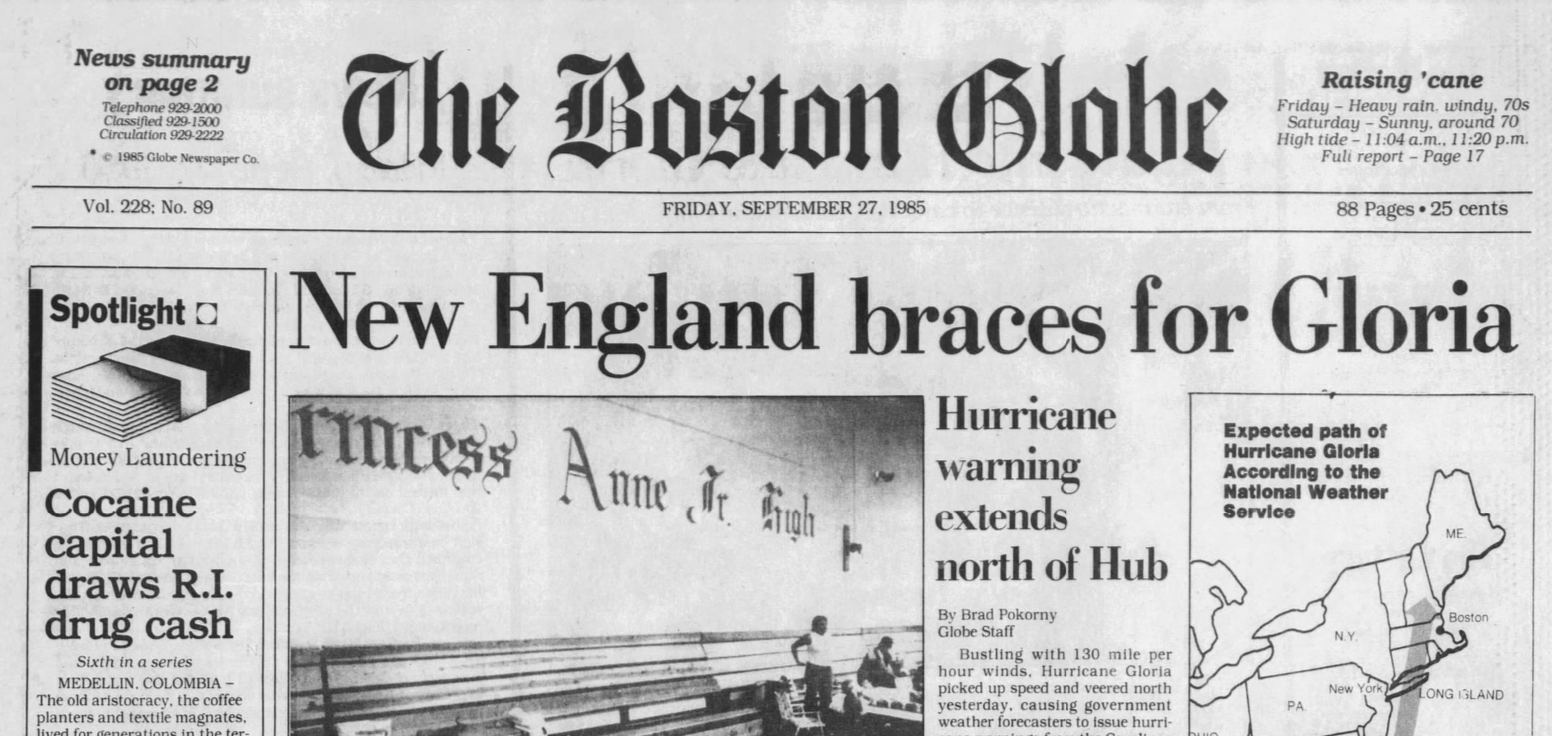
The eye of Gloria brushed Cape Hatteras Friday morning, dumping heavy rain on eastern North Carolina. Massachusetts Gov. Michael Dukakis declared a state of emergency. Classes were cancelled, businesses closed. Aircraft evacuated Logan Airport for Burlington, Vermont. The Expos postponed that night's game with the Cardinals. No one knew how soon or where Gloria would hit New England, how strong she would be when she arrived, or the path she'd take after landfall. Van Morrison's song got a lot of airplay on WBCN and WCOZ.
Gloria made landfall in New England about midday and marched on north across Connecticut and into New Hampshire, where it weakened into a tropical storm. Cool water and low tide at landfall minimized the damage. High winds took down power lines around Boston. Adrenaline junkies went to the John Hancock Tower and let themselves be blown around by the strong wind currents. (The tallest building in New England, the glass-and-steel John Hancock Tower was infamous in its early days for a wind tunnel effect that caused glass panels to be be hoovered off the building by differential air pressure. The tower was called the Plywood Palace as missing windows were boarded up.) Winds peaked around 3 pm at 53 MPH sustained with gusts to 71 MPH.
In Brookline, the wind uprooted a tree behind our building, destroying the fence. Leaves and small branches had fallen in our street. Power was out when I went to bed Friday night and still out Saturday morning when I woke up early for our drive to Montreal. He came by to pick me up, and before we left town we tried a couple of ATM machines. I had forgotten to get cash before the storm, but I needed it for our trip to Montreal. (I had an ATM card, but debit cards weren't a thing just yet, much less ones you could use internationally.) We drove to a couple of ATMs, found one that had power, but it had lost its link to the network. We started north on I-93 to I-89, bowed (as one must) as we passed Bow, New Hampshire, found a working ATM somewhere in Vermont, and then crossed into Quebec. Back then you only needed a driver's license to go between the US and Canada. The sun was shining and the leaves were beautiful, but we had to get to the ballgame.
The postponed game from Friday night turned Saturday's day game into a double-header. Olympic Stadium was not designed for baseball. It was dim and gloomy inside. We sat in the right field bleachers. Youppi, one of the first major league baseball mascots, made an appearance on the field in his dune buggy.
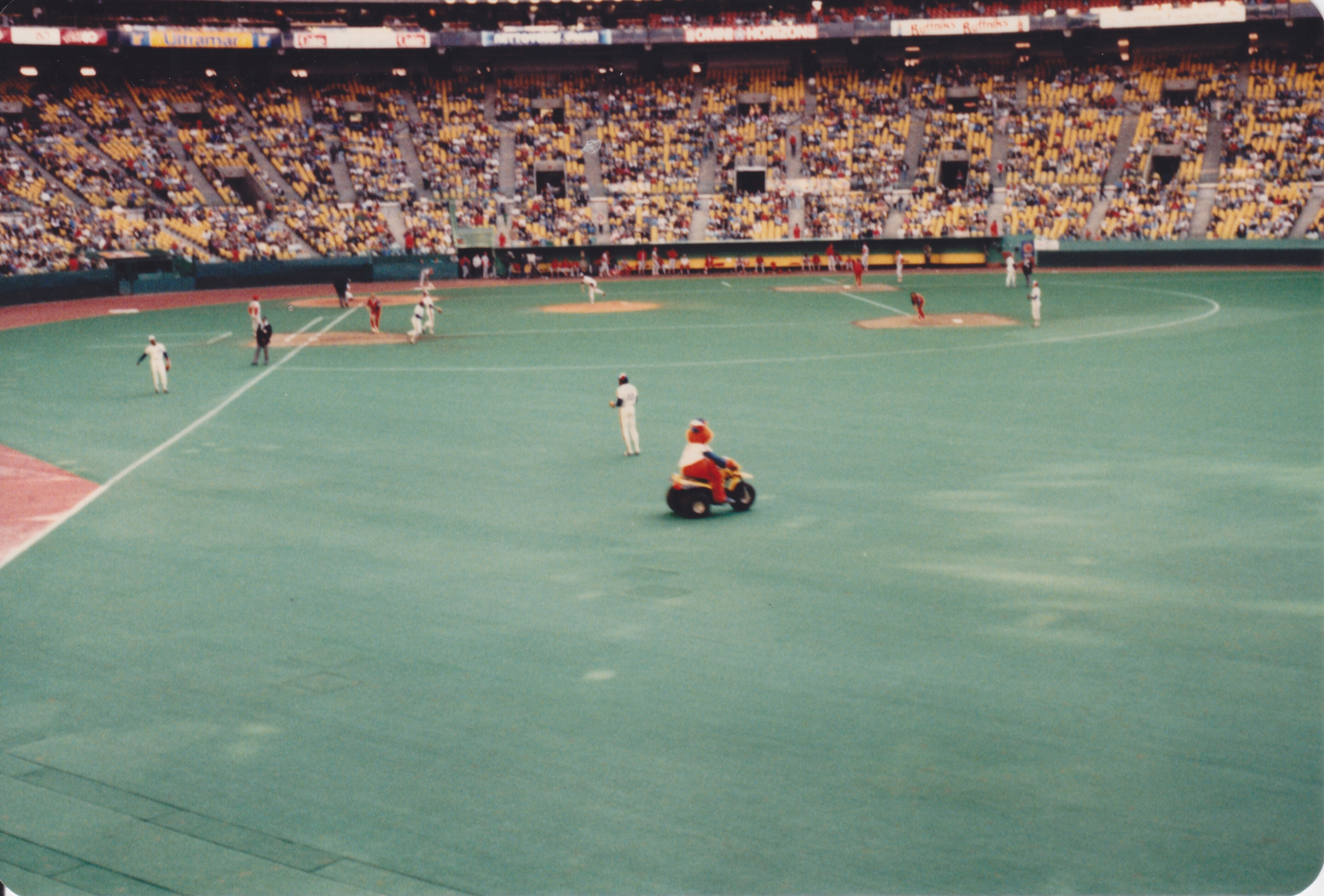
Going into Saturday, the Cardinals had a 4.5 game lead over the Mets in the NL East. The Cardinals lost the first game, 2-0. I don't recall when we left, but my friend says we didn't stick around through the second game, which the Cardinals won 4-2 in the 11th inning. Lunch and dinner were from the concession stands.
It was late enough when we left that little was open, but we found a corner store near the stadium to buy pop and snacks for the drive back. This time we stayed on Autoroute 10 east toward Magog and Sherbrooke, before turning south to I-91 in Vermont. It was late enough that we couldn't find an open gas station as the tank dwindled to empty, but we came across a truck stop near St. Johnsbury just in time. We got back to Boston well after midnight.
Years later I made a couple of trips to Montreal for business and discovered what we missed because Gloria cut our trip from two days to one. Here are photos and commentary from my 2004 visit to Montreal.
I have to think a bit to remember how we managed to travel in the days before the World Wide Web, cell phones, and Google Maps. We would have learned about the game from pocket calendars that you could pick up at local stores (like The Sports Buff on 51st east of Harvard) or possibly a spring issue of The Sporting News with all the team schedules. We'd have coordinated plans by phone. I'm sure I brought along my trusty Rand McNally Road Atlas for navigation. Had we stayed the night as our original plan called for, we'd probably have looked for a line of motels along stretch of highway on the outskirts of town and picked one that looked somewhat OK. Sightseeing would have been driven by the points of interest marked on the city inset map in the road atlas. Any phone calls on the road -- we didn't make any -- would have involved a payphone and possibly a Sprint FON card (manually punching in the membership number) for long-distance calls.
MORE:
Dr. Voddie Baucham Jr., a Baptist pastor, academic, and Christian apologist, died this week at the too-young age of 56 after a medical emergency.
Baucham is survived by his wife of 36 years, 7 sons, 2 daughters, and 3 grandchildren. Baucham served as a pastor in Houston before moving to Lusaka, Zambia, to become the founding Dean of the School of Theology at African Christian University. He spent 10 years in ministry there, returning to the US earlier this year. In June, Founders Ministries, an organization which promotes Reformed doctrine in the Southern Baptist Convention, announced Baucham as the founding president of Founders Seminary in Cape Coral, Florida.
Baucham was well known and beloved in the broader Reformed (Calvinist) Christian community for his bold clarity whether teaching through a passage of scripture or applying God's Word to contemporary issues. As he would sometimes say, "If you can't say 'Amen!' say 'Ouch!'"
The Bauchams homeschooled their children, and he summarized the case for Christian parents withdrawing their children from public schools: "We cannot continue to send our children to Caesar for their education and be surprised when they come home as Romans."
In this July 2020 interview with Allie Beth Stuckey, Baucham spoke of his upbringing in Los Angeles by a single, Black, Buddhist mom, how he came to faith in Christ at Rice University, his call to ministry and the course of his theological studies and ministry. Baucham's post-graduate studies at Oxford led to an early understanding of the threat posed by critical theory, social justice, and post-modernism, and he connects that philosophical foundation to critical race theory, DEI, and the cultural reaction to the death of George Floyd and the riots of the summer of 2020.
I have enjoyed and benefitted from Baucham's preaching, speaking, and writing. You'll find many of his sermons and lectures online, but, sad to say, I was never able to meet him. In April 2021, my wife, daughter, and I had been looking forward to hearing Baucham speak at the Credo Conference on Social Justice in Conway, Arkansas, not long after the release of Baucham's book Fault Lines: The Social Justice Movement and Evangelicalism's Looming Catastrophe, but a near-death episode of heart failure, followed by quadruple bypass surgery, brought an early end to his speaking engagements that spring.
Samuel Sey, a Ghanaian-Canadian-American Christian writer, describes Baucham as a mentor and encourager:
In 2020, six years after his article on Michael Brown and Ferguson made me realize that I wasn't alone and going crazy, after all, Voddie Baucham sent me an email that said:"I wanted to drop you a line and offer a word of encouragement. I know how hard it is to be a lone voice during these trying times. Just want you to know that you are not alone."
I am not ashamed to say that it made me cry a lot. It still makes me cry.
But, somehow, that isn't even the kindest thing he has done for me. To my shock, the following year, in 2021, when Fault Lines was close to its release, he asked me to write an endorsement for his book.
However, I was going through a very painful process at the time. I didn't want that to hurt his ministry, so we talked on the phone, and I told him things that I thought would make him distance himself from me.
Instead, my hero became a friend. He encouraged me with his wisdom, and I have followed his words ever since. He told me he still wanted me to write an endorsement for Fault Lines, and on top of that, he said he wanted me to join him on some of his speaking tours.
After his return from Zambia at the beginning of this year, Baucham continued a full schedule of speaking and preaching. At the 2025 Stand Firm Conferences in Melbourne and Brisbane, Australia, Baucham spoke on "Preaching the Word," "The Rise of LGBT & CRT in the Church," "Christian Nationalism," "The Doctrine of Regeneration," and "The Reformation." He then hopped the Tasman Sea and spoke at the Grace Conference in Auckland, New Zealand on the Mind of Christ in the Believer, in the Church, in the Family, and in the World.
Tom Ascol of Founders Ministries has established a GiveSendGo to care for the needs of Baucham's widow and their seven children still at home. It's reasonable to guess that, following the cardiac episodes of 2021, he would have been unable to get life insurance.
As a writer, I appreciate Baucham's refusal to join the "hot take" community, as expressed in this essay on the 2014 Ferguson, Missouri, riots, published three months after they happened:
My first response to Ferguson was to say nothing. I was on the outside looking in. I didn't know what happened. I didn't know the communities or the issues surrounding the tensions. Second, I chose to remain silent because people were demanding that I speak--even condemning me for my silence. In this age of "I sure would love to hear your thoughts on" I get tired of the sense of entitlement with which people approach those whom they deem to be popular or high-profile Christians. No one is "entitled" to my opinion. Nor is my faithfulness to God determined by how quickly I respond to "relevant" issues.As a pastor, I have a responsibility to my flock. If those for whose souls I care (Heb. 13:17) want help thinking through these issues, I am obligated to them. I have a duty to walk them through issues like these to the best of my ability, and with sensitivity to their particular needs. What worries me is that Christians in the age of social media care more what "popular" preachers have to say on issues like this (and whether or not they agree with other "popular" preachers) than they are about taking advantage of an opportunity to work through challenges in the context of Christian community. More importantly, it worries me that so many Christians view themselves primarily as members of this or that ethnic community more than they see themselves as members of the body of Christ.
Governor Kevin Stitt has sent the Oklahoma Highway Patrol to Tulsa to clear campsites state-owned property, including highway underpasses and rights-of-way. Tulsa Mayor Monroe Nichols, echoing the complaints of Washington city officials who object to President Trump calling in the National Guard to deal with public safety in the nation's capital, issued a whiny rebuttal to the governor.
Here's Stitt's press release:
Governor Kevin Stitt today announced the launch of Operation SAFE (Swift Action for Families Everywhere) to restore order and safety to Tulsa by clearing homeless encampments, trash, and criminal activity from state-owned property inside the city.The Oklahoma Highway Patrol (OHP) has the legal authority to target state-owned property including underpasses, highways, state buildings, and other state-controlled land. Governor Stitt made clear that while the state is stepping up to fulfill its duty, the long-term responsibility for city property rests with the City of Tulsa's elected leadership. Governor Stitt has had numerous conversations with Mayor Nichols in recent weeks urging the city to gain control of the situation, but progress has fallen short of Tulsa residents' expectations.
"Tulsa is a beautiful city. I lived there for years. But today, everybody can see the disaster it's turning into-- homeless people on every corner, trash piling up, and Oklahoma families are being forced to live in fear," said Governor Stitt. "This is the city's job, but Mayor Nichols and Tulsa leadership haven't met the level of action needed to keep neighborhoods safe. Oklahoma is going to step in to do our part and clean it up. Once we've done so, it'll be on the City to keep Tulsa clean and safe. If they refuse, then we'll be forced to take further action to protect Tulsans."
Within the last 24 hours, OHP began issuing warnings to homeless individuals and the Oklahoma Department of Transportation (ODOT) began posting notices at encampments on state property to vacate and cease occupation, in accordance with 64 O.S. § 1097. These camps are often located along highway rights-of-way or beneath overpasses, creating severe hazard for the public and homeless individuals alike. ODOT will also lead remediation, clearing, and clean-up efforts.
OHP and ODOT are working with various agencies who are committed to helping individuals transition to safer, alternative living arrangements. If OHP encounters illegal immigrants during the operation, they will be turned over to Immigration and Customs Enforcement (ICE) for deportation proceedings. Under the Governor's direction, State Troopers are offering homeless individuals two clear options:
- A ride to a treatment or housing facility.
- A ride to jail and face prosecution if they refuse help and continue breaking the law.
Chair of the Tulsa Regional Chamber of Commerce, Bill Knight voiced support for the Governor's action: "Tulsa's business community supports leadership that prioritizes the safety of those who live and work within our city and region. We appreciate the governor's actions to enforce the laws and bolster Tulsa's pursuit to enhance quality of life. This initiative complements the ongoing efforts by various Tulsa entities, reinforcing our collective commitment to addressing complex issues like homelessness and public safety."
Interesting that the Chamber is backing Stitt on this. A friend notes that this may indicate the start of a fracture in the city establishment, here at the start of Kathy Taylor's fourth term as de facto mayor.
Nichols's response came as an email from CommunicationDept@CityOfTulsa.org:
Please attribute the following statement to Tulsa Mayor Monroe Nichols."First of all, Kevin Stitt has shown himself again to be an unserious person. When I took office, I inherited a homelessness crisis largely unaddressed by anyone in public office, including our two-term governor, who disbanded the interagency council on homelessness, which had a crippling impact on service providers, leading to what we have today. Instead of spending my time engaging in activities that won't reduce homelessness, I have created the Safe Move Initiative, which aims to get hundreds of people off the streets for good, rather than simply shifting the problem elsewhere. We have a goal to end homelessness by 2030, and we're on the pathway to doing that. I'm going to continue doing the job I was elected to do, and I am not interested in being lectured by someone who has proven time and time again that he only cares to intervene to score political points.
"As background on two separate areas, crime is down in all categories, and homelessness, which grew by over 20% the year before I took office, grew by only 4% this year. We have a long way to go, but we are making progress and will continue to do so. I will not be distracted or deterred from doing what we know is necessary to end this crisis in Tulsa."
So homelessness is still increasing in Tulsa, just at a slower rate than under the 2nd and 3rd Kathy Taylor terms (aka the GT Bynum administration). Just a month ago, the City of Tulsa engaged in its own right-of-way clearance effort, placing large boulders on level areas around the MTTA Tulsa Transit MetroLink bus station to discourage loitering and camping. The official City of Tulsa press release describes the boulders as the first phase of a "community art project," as well as a measure to prevent predators from "using the space to take advantage of individuals experiencing homelessness" (e.g. by selling them drugs). The prevention measure is to prevent the homeless from being there.
Several weeks ago, the City of Tulsa announced a new project near the sidewalk along 4th St. between S. Denver Ave. and S. Cheyenne, which is located near the Denver Avenue Bus Station. Boulders were placed at the site this week and the project will be progressing with an expected community art project in the coming weeks....With public safety in mind and due to extreme heat, at the inception of this project, the City of Tulsa partnered with BeHeard, a nonprofit organization offering daytime shelter, shower facilities, and food accommodations. Shuttle services to and from BeHeard are offered to those who would like a safe space during the day and receive supportive services.
The BeHeard facility is at Admiral and 73rd East Avenue, in the parking lot of what used to be Calvary Baptist Church. (Calvary was taken over by First Baptist Owasso and turned into a satellite campus in 2017, then "relaunched" as Mesa Church in 2022.) This marks an ongoing effort by city agencies and the non-profit community, dating back at least to 2008's Building Tulsa Building Lives initiative, the closure of the downtown YMCA residence, and the controversy over the construction of the Yale Apartments, to encourage vagrants to leave downtown and disperse among low- to moderate-income neighborhoods around the city. I've heard anecdotal reports of increasing property crime in the vicinity of BeHeard.
It's a bit rich for Nichols to authorize clearance of city right-of-way and then complain about the state doing the same thing but on a larger scale.
We can't address the "homeless problem" until we can start being honest about the difference between vagrants, panhandlers, and hobos on the one hand and the economically displaced and temporarily alienated on the other. Compassionate measures intended to help the latter group can too easily become enabling of the chosen lifestyle of the former group.
MORE:
Griffin Media has quotes from Steve Whitaker of John 3:16 Mission, QuikTrip (which, as the biggest 24-hour convenience store chain in the region, is plagued with panhandlers, shoplifters, and vagrants), and the head of the Mental Health Association of Tulsa.
Z. B. Reeves satirizes the "community art project" boulders for The Pickup.
Tulsans were promised water in the river if we would only raise our taxes, but they neglected to tell us what would be in the water. Charles Pratt has been watching the City of Tulsa's water quality monitors and says that E. Coli levels at the end of August set a record. KTUL reported the story today.
When he crunched all the numbers from May to May, three out of four times, at least one gauge was in the red."During that time period, if you took all of the data, it was unsafe 72% of the time," he said.
At the time, the highest single test result was 6,100, but by the end of August, a new test result had taken the crown for the most E. coli.
"29,000," he said.
There are four gauges on the city's water quality dashboard: the I-244 bridge, the west bank boat ramp, the pedestrian bridge, and the kayak gate. The unit of measure is Most Probable Number (MPN) of organisms per 100 ml. The green, yellow, and red sections of the gauges appear to correspond to the levels described on this Wisconsin State Hygiene Laboratory webpage:
Various tests are used to investigate recreational water, stream or lake pollution, and wastewater treatment systems. The following are tests available for surface water testing:E. coli: The only natural habitat of E. coli is the intestinal tract of warm-blooded animals.
- The recreational water guideline is less than 126 MPN/100 ml, averaged from 5 samples during a 30-day period.
- The single sample guideline is less than 235 MPN/100 mL.
- An advisory is recommended between and 235 MPN/100 mL and 1000 MPN/100 mL.
- A closure is recommended at greater than 1000 MPN/100 mL.
Enterococci: This refers to a subgroup of the fecal enterococci that includes Enterococcus faecalis, Enterococcus faecium, Enterococcus gallinarum and Enterococcus avium. The enterococci are used to indicate water quality.
- The recreational water guideline is 33 MPN/100 ml, averaged from 5 samples during a 30-day period.
- The single sample guideline is less than 61 MPN/100 mL.
Tulsa measures E. Coli but does not measure Enterococci. 100 mL is about 3 oz. That's the maximum size of a bottle of liquids you're allowed to carry on board an aircraft, so imagine 29,000 E. Coli bacteria floating around in a travel-sized bottle of shampoo.
Pratt says that a web search revealed that levels in raw sewage can range from 1,000 to 100,000 MPN/100 mL, so 29,000 would be 29 times the low end of that range, but I haven't been able to find the source that Pratt found. 29,000 would be 100 times the safe single sample level.
Page 20 of this EPA document has the Oklahoma water quality standards for Primary Body Contact Recreation, which correlate with the numbers shown above.
As I write this, the levels are 236 (red zone) at the boat ramp, 308 (red zone) at the I-244 bridge, but 30.5 at the kayak gate and 26.9 at the pedestrian bridge. All of the 30-day geometric mean values are in the green zone. 96.4 at I-244, 105.4 at boat ramp, 58.8 at kayak gate, 26.9 at pedestrian bridge.
E. Coli levels are measured twice a week, on Tuesdays and Thursdays. The city does not appear to provide historical data tables, but Mr. Pratt has been compiling the numbers. A KTUL story from May 3, 2025, has a year's worth of E. Coli data tabulated by Pratt. Here is the PDF of that year's worth of measurements. 92% of the time during the primary recreational months (May 1 through September 30), at least one of the monitors was in the red. Quality was better in the winter months when the river isn't used for recreation.
Interesting slide deck (PDF) on how E. Coli levels are measured and why E. Coli is used as an indicator species for the presence of fecal bacteria in water. Slide 8 states that it is "[i]mpossible to test for ALL pathogenic microorganisms, so test for easily detectable indicator organisms." Slide 10 states that "E. coli is the ideal indicator organism for testing water for fecal contamination" because of its "[a]bility to survive for extended period of time outside of the body ( especially in water: >120 days)," and it is a reliable indicator of fecal contamination, without other possible causes to rule out. E. Coli has both pathogenic and non-pathogenic strains, but "their presence indicates a pathway for human pathogens" such as giardia, cryptosporidium, hepatitis, and other waterborne viruses, bacteria, and protozoa.
MORE: Molly Bullock has been covering pollution in the Arkansas River in an ongoing series of articles starting in August 2023 at her Substack site Watershed. One of Bullock's focuses has been on industrial pollution, the legacy of over a century of oil exploration and refining and other industrial activity along the Arkansas River. Take a look at this article on plumes of apparent hydrocarbon pollution emerging near containment caps, and this follow-up on the hostile, passive-aggressive response from city officials to questions from citizens.
STILL MORE: Still bothered by statements made at the re-opening of Zink Lake last year that "Tulsans seeing water in Zink Lake for first time." Zink Lake was built in 1982, funded by Mayor Jim Inhofe's creative financing after voters rejected funding in the first attempt to pass a Third Penny sales tax for capital improvements in 1979. The dam was replaced, but the lake isn't new.
 Subscribe to this blog's feed: