Oklahoma History: July 2026 Archives
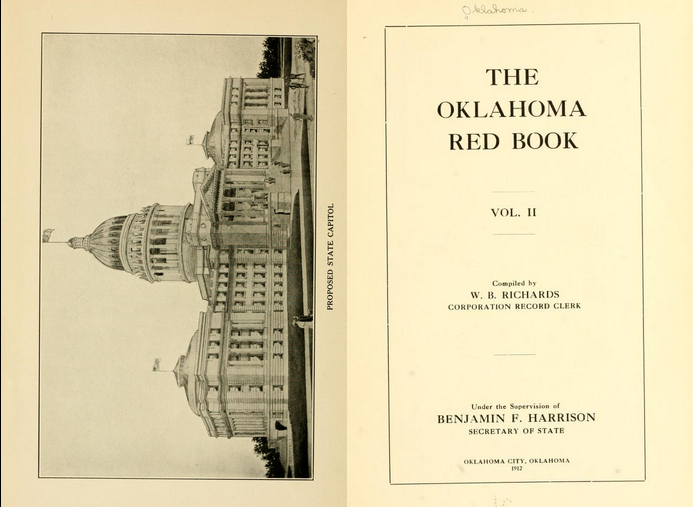
The Oklahoma Red Book was a two-volume publication containing an encyclopedic collection of information about state government. The 1912 edition is available online at the Internet Archive.
The table of contents of the first volume begins with this word of explanation:
This work was not compiled to be used as a book for ready reference, but rather to keep in a durable and compact form the full test of papers of state dealing with the creation and foundation of the commonwealth, the basic laws of the Indian government and all treaties, federal laws, rulings and Acts of Congress affecting Indian and Territorial Affairs, more to be used by the Student and State, hence the compilers think it only necessary to index in a general way. Papers of Indian affairs are indexed chronologically. Other papers in the order of their historical value.
1912 Oklahoma Red Book, Volume 1, contains the Declaration of Independence, Articles of Confederation, and Constitution, with laws regarding citizenship and presidential succession; the Oklahoma Constitution, the Prohibition provision (voted on separately), the 1st Amendment (making literacy a requirement for voting, but with a "grandfather clause"), and the election ordinance for the new state constitution, which defined the townships within each county by which voting was organized. (Tulsa County had 12 municipal townships, two of which were the cities of Tulsa and Broken Arrow.) Following that, there were the constitutions of the Cherokee, Muscogee, Chickasaw, Choctaw, and Osage. The remainder of the book contains "Indian Treaties, Patents, Agreements, etc." beginning with the Cherokee Treaty of 1817 and continuing through to the Constitution for the proposed State of Sequoyah in 1905.
1912 Oklahoma Red Book, Volume 2, begins with lists and photographs of the elected and appointed officials of the State of Oklahoma, our federal representatives, employees and salaries of the various state departments, officers of the Oklahoma National Guard, members, committees, and rules of the Legislature, and historical officials (state and territorial). There is a description of all of the state institutions of higher education, as well as state charitable and penal institutions (e.g. the school for the deaf in Sulphur, the State Reformatory in Granite, the State Penitentiary in McAlester).
In the midst of statistical tables, there is a speech, "Original Sources of Oklahoma Titles, with Special Reference to Indian Titles," by Kirby Fitzpatrick, Chief Examiner of Titles for State School Land Department), delivered before the American Association of Title Men, at Little Rock, Ark., November 18, 1911. It is an interesting glimpse into the contemporary understanding of land title and conveyance in the immediate aftermath of allotment and statehood. Mr. Fitzpatrick has some strong opinions, so it is interesting that this speech was included in an otherwise dry recitation of facts and statistics.
Volume 2 becomes something like an almanac. There is a section with platforms and governing officials of state and national political parties, lists of elected officials from the other states, Oklahoma state and territorial election results, lists of Federal department heads, members of Congress, and Federal judges. There's a list of Washington addresses for almost every Senator and Representative. There is Federal census data from 1890, 1900, 1907, and 1910 for every county, incorporated municipality, and minor civil division. County and municipal officials are listed. The book closes with tables of assessed valuations by county and of each railroad, electric, and telephone company in the state.
Unfortunately, Volume 1 is a monochrome scan and is missing all the illustrations. Volume 2 is a photographic scan, which is fortunate because of all the portraits and photographs it contains.
MORE: Volume 1 includes boundaries of the civil townships of each county, which were defined by the Election Ordinance passed by the Constitutional Convention for the purpose of conducting the vote to approve the State Constitution. (Counties already established in Oklahoma Territory used their existing county governments and townships.) Townships are minor civil divisions which cover every square inch of land in every county, like town government in New England. Townships were used initially for local government in rural areas, but township government in Oklahoma was abolished not long after statehood. Townships continued to be used as a basis for voting precincts into the 1970s in some counties, and they still appear on county general highway maps issued by the Oklahoma Department of Transportation. At statehood, Tulsa County had 12 municipal townships: Skiatook, Owasso, Dawson, Linlane (Lynn Lane), Bowles (Boles), Fry, Bixby, Jenks, Red Fork, Wekiwa, Tulsa, and Broken Arrow. Tulsa and Broken Arrow townships consisted of the municipal limits of the two cities, but the other townships include large rural areas as well as their namesake towns. Three townships were later added, as this undated map shows. Two townships were later added when territory was annexed from other Wagoner County in 1909 and Rogers County in 1918: Of the area gained from Wagoner County (everything southeast of 121st and Mingo), the area north of the Arkansas River became Willow Springs township and the rest was added to Bixby township. Collinsville township consists of the area northeast of 126th Street N and Mingo which was moved from Rogers County to Tulsa County. Glenpool township (everything southwest of 121st and Harvard) was created out of Bixby township in 1912.
 Subscribe to this blog's feed: