Robert Franklin's contempt for conservatives
One of the benefits of social media for voters is that it paints, over time, a detailed self-portrait of a person's interests, political inclinations, and philosophical commitments. This self-portrait is composed one tweet, one retweet at a time, over years, and in an un-self-conscious way, which gives a social media profile an authenticity that the official campaign website and the full-color giant postcards and the TV commercials lack. Yes, it's possible for an adversary to cherry-pick a post and use it to create a distorted depiction, but if the entire record is there to be perused, voters can quickly determine whether the selected tweet is a fair representation.
When a candidate takes his social media account offline, it's possible that he's just pusillanimous and compliant with his risk-averse consultants. But a candidate who had recently converted from Democrat to Republican and then deleted his social media history is pretty obviously trying to pull a fast one on the voters. It's an indication that the candidate knows he is out of sync with the people whose votes he needs to win and that he doesn't credit them with enough intelligence to detect the scam he's trying to run. It suggests a strong degree of contempt for the people whose votes he seeks.
Robert Franklin had an active X (Twitter account) which still shows up in search results as https://x.com/franklinmph. The first part of the description shows up on a Brave search:
August 13, 2011 - robert franklin · 6,927 posts · robert franklin · @franklinMPH · school admin. committed to life long learning & advocate for individuals with special needs. Co-founder of
Franklin's X account was still active until sometime in June after the primary. A search on Bing turns up a June 19 reply to Lane Brown. Ben Burnsed posted on Facebook on June 23 that Franklin had scrubbed his account. Burnsed attached screenshots that showed Franklin praising Democrat governor nominee Cyndi Munson, calling for a federal registry of gun ownership, and hoping that John Kasich would be "Trump's kryptonite," praising Kasich for his fiscally irresponsible embrace of Medicaid expansion. Rick Thomas posted an Instagram reel containing screenshots of Franklin's praise for Texas Democrat Senate candidate James Talarico, another liberal "Christian" who attacks Biblical beliefs on abortion and sexuality.
UPDATE 2026/08/25: The Internet Archive captured 1,189 of Franklin's nearly 7,000 tweets. In aggregate, they suggest that Franklin followed and retweeted liberal accounts (e.g., acyn, atrupar, aintscarylarry) that attack Republicans and never find anything wrong with Democrats, with occasional tweets about education.
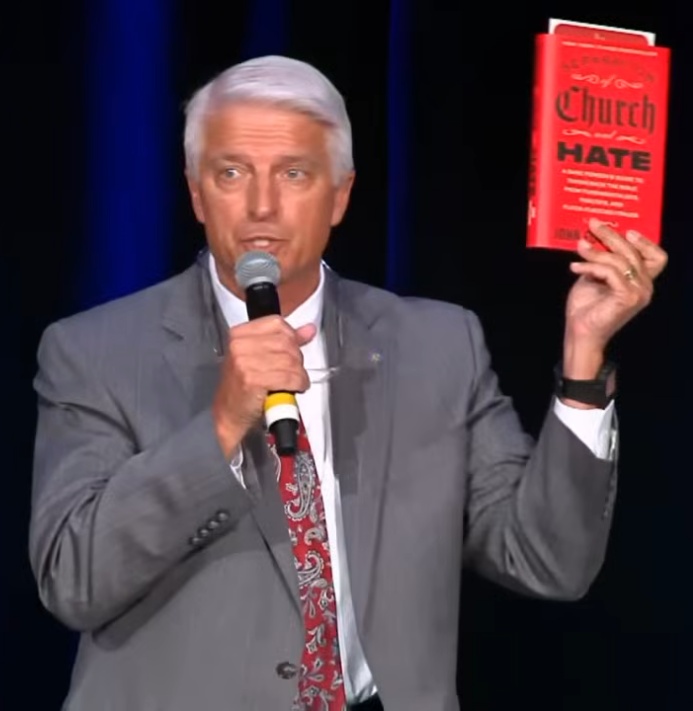
At the NonDoc forum before the June 16 primary, candidates were asked to recommend books. The book Robert Franklin recommended "for my college-age students" was Separation of Church and Hate: A Sane Person's Guide to Taking Back the Bible from Fundamentalists, Fascists, and Flock-Fleecing Frauds by John Fugelsang. What's the "hate" Fugelsang (and, presumably, Franklin) want to separate from the church? From the book's blurb on the publisher's website:
For more than two centuries, the United States Constitution has given us the right to a society where church and state exist independently. But Christianity has been hijacked by far-right groups and politicians who seek to impose their narrow views on government, often to justify oppressive and unequal policies. The extremists who weaponize the Bible for earthly power aren't actually on the side of Jesus--and historically they never have been. How do we fight back against those acting--literally--in bad faith?Comedian and broadcaster John Fugelsang finally offers the answers. In this informative, perspective-shifting book, Fugelsang takes readers through common fundamentalist arguments on abortion, immigration, LGBTQ rights, and more--exposing their hypocrisy and inaccuracy through scripture, common sense, and deeply inappropriate humor. It offers practical tips on how to debate your loved one, coworker, or neighbor on the issues that divide us using that Bible they claim to follow.
Evidently, Robert Franklin thinks that we're haters, we conservative Christians who believe in the sanctity of human life from the moment of conception, who uphold the normal, Biblical views of sex and sexuality, who insist that immigration policy should put the interests of American citizens ahead of the billions who would like to live here. These "hateful" views are those of a majority of Oklahomans and of the vast majority of Oklahoma Republican runoff voters, and yet Robert Franklin apparently considers these people hateful.
That perspective aligns with J. Gresham Machen's characterization of theological liberalism as a different religion than Christianity that uses Christian terminology and tropes to preach a different gospel. H. Richard Niebuhr characterized the liberal gospel in 1937: "A God without wrath brought men without sin into a kingdom without judgment through the ministrations of a Christ without a Cross."
Sherrie F. Conley wrote on Facebook:
Franklin's decision to recommend The Separation Between Church and Hate matters because the use of this book as a recommendation serves to reveal something about the ideas that he regards as valuable.He could have selected a work on literacy, classical literature, American history, school leadership, constitutional government or educational excellence.
Instead, he selected a book written to challenge conservative Christian theology and politics. A book written to be persuasive and provocative, and seeks to convince readers that one side is right and another side is wrong.
Franklin has said very little publicly about the book beyond recommending it. But the act of recommending it was itself consequential.
This was a Republican education debate, and he selected a book whose explicit mission is to rebut the religious and political beliefs held by a large portion of conservative Republican voters.
We've written many times that many in the public education establishment regard the public schools as missionary endeavors, whose primary job is to convert children away from the "benighted" values of their parents and toward a more "enlightened" perpective. Franklin's prominent book endorsement suggests that he agrees with that mission.
Franklin's supporters echo Michael Dukakis's 1988 campaign claim: "This election is not about ideology; it's about competence." The claim is that Franklin's many years as an administrator in public schools (29 at Sand Springs, 16 at Tulsa Tech) should outweigh any concern about his liberal political or theological views. Oklahoma voters weren't taken in by Dukakis and they won't be taken in by Franklin. There are a number of problems with that perspective; here are three:
1. Franklin's experience has been in the front office, not the classroom, and for the last 16 years, he's been an administrator at Tulsa Tech, an exceedingly well funded system thanks to an earmarked property tax millage, and a school that has students who are there intentionally. The conservative candidate in the runoff, James Taylor, has been in the classroom, teaching government and history in a small public school and dealing with the constraints and hardships that Oklahoma's public school teachers face, trying to inspire and educate students who are there because they have to be.
2. Franklin's experience is as an administrator in an educational world that has destroyed academic achievement. This is the public school "blob" (as William Bennett called it in the 1980s) that changes teaching methods every few years so schools have to buy expensive new curriculum. Franklin's milieu is the world of "whole-word literacy" and "balanced literacy" that fails to teach children to read. His world is the world of social promotion, pushing kids along from grade to grade even if they haven't mastered the basics. I've found no evidence that Franklin has ever offered any resistance to the latest fads from the college education departments, the teacher's unions, and the curriculum publishers.
3. Education is unavoidably ideological: What should children learn, what should they be taught about history, what they are taught about human nature, what books and ideas and people are held up as exemplary. Is the USA a good country, worthy of our love and allegiance, or an evil country? I know that James Taylor believes America is a great country; does Robert Franklin?
Some of the Left, in places where they don't have to practice taqiyya, are honest enough to say, as the Guardian did in 2015, "Any society has to privilege some ethical viewpoint." I wrote then about how the Left uses the camouflage of credentials to pretend that pushing their perspective is an exercise in neutral expertise, while conservative resistance is "politicization."
Conservative efforts to retake control of our public schools and universities will be characterized as "politicizing" supposedly neutral institutions, and naive folks who are themselves conservative will be led to resist. The fight over AP US History was a preview of coming attractions. I was amazed to see friends who are politically and religiously conservative join in the outcry against the legislative bill to offer an alternative, in response to the Leftist changes to the AP US History curriculum. They believed the line that legislators were politicizing the course, but not the Leftists who were remaking the course to serve their political ends, because the College Board was seen as some neutral authority -- a neutral authority with the power to withhold a desired credential.
Franklin's run reminds me a lot of Joy Hofmeister's 2014 win. In 2014, however, Hofmeister ran a stealth campaign, convincing anti-Common Core conservative reformers like Jenni White that Hofmeister was on our side (and Jenni and others convinced me) and that school-choice advocate Janet Barresi needed to go. We saw Hofmeister's true colors once she was safely in office, and especially when she switched parties to run against Gov. Kevin Stitt. At least Joy Hofmeister was honest enough to run for Governor as a Democrat.
Looking back at that 2014 race, public school administrator support for Hofmeister and Hofmeister's hostility to school choice should have been a great big clue. My hesitation then was overcome by a friend I thought was conservative, a homeschooling parent and pseudonymous blogger whose spouse was also a conservative pseudonymous blogger and a public school administrator. I see now that this "friend" had already gone over to "the dark side" and misused our friendship to shift my endorsement.
This year, the public education insiders, teachers' unions, and anti-school-choice zealots are all lining up behind Franklin. They're portraying him as the nice guy in the race, the anti-Ryan Walters. He has such a lovely Charlie Crist tan (and, it seems, Charlie Crist values, too).
By trying to hide who he is, by hiding his social media archive, Robert Franklin has shown us who he is. By endorsing Separation of Church and Hate, Robert Franklin has shown us that he thinks people like you and me are hateful because we agree with the Bible.
Conservative Republicans aren't going to fall for a stealth candidate again, especially not for such a crucial position. Robert Franklin has tried to hide his opinions, but the mask has slipped enough for us to see the contempt in which he evidently holds conservative Oklahomans.
MORE: Robert Franklin's campaign contributions follow a pattern of giving to Democrats to help them win general elections against Republicans, and trying to help candidates in Republican primaries who were evidently out of step with GOP primary voters. Specifics after the jump:
An OpenSecrets search shows these donations from educator Robert Franklin of Sand Springs, OK:
- $500 to Lloyd Snow (D), 5/5/2016. Snow was running for State Senate, SD 37. Snow won the Democrat primary with 77% of the vote and faced incumbent Republican State Senator Dan Newberry in the general.
- $150 to Rick Kibbe (R), 6/12/2016. Kibbe, Superintendent at Catoosa Public Schools, was running for State Representative, HD 8. This was a donation for the primary. Kibbe finished in last place; Tom Gann was elected to his first term.
- $200 to Mike Burdge (R), 4/7/2022. Burdge was running for State Representative, HD 66. This was a donation for the primary. Burdge, a Sand Springs city councilor, finished a distant third.
- $250 to Joy Hofmeister (D), 8/1/2022. At the time of the donation, Hofmeister had won her Democrat primary for Governor against Connie Johnson and was in the general election against Gov. Kevin Stitt.
0 TrackBacks
Listed below are links to blogs that reference this entry: Robert Franklin's contempt for conservatives.
TrackBack URL for this entry: https://www.batesline.com/cgi-bin/mt/mt-tb.cgi/9509
 Subscribe to this blog's feed: