September 2026 Archives
A friend recently posted a photo showing a large and longstanding pothole, aka chuckhole, aka chughole, that had been declared Lake DOT, with waterfront property for sale:
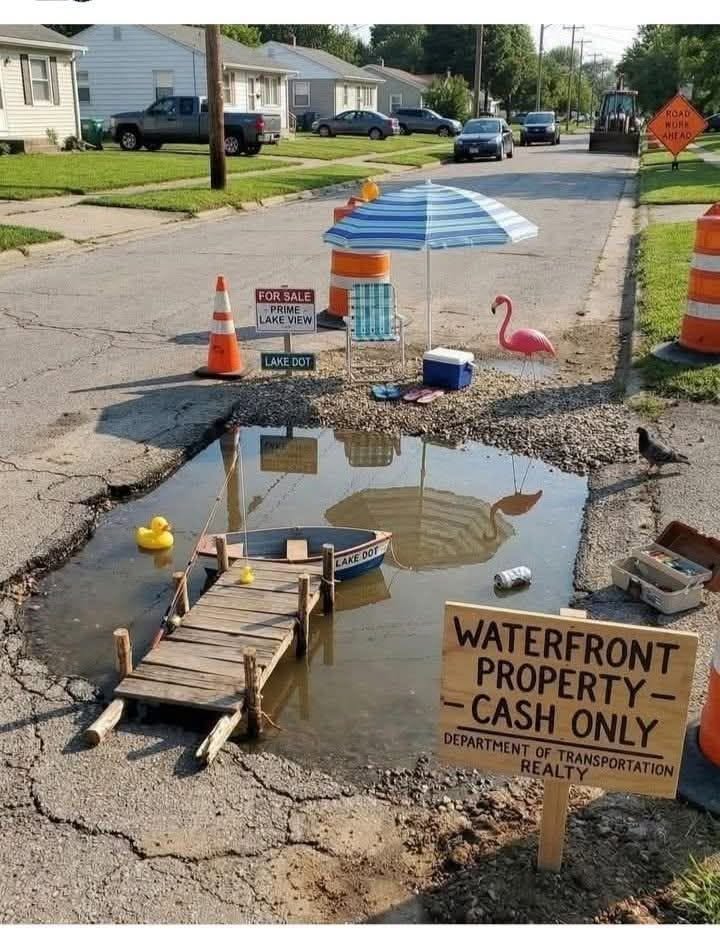
It's almost certainly an AI-enhanced photo, but it's funny, and it reminded me of the real-world, light-hearted things KOTV (Tulsa channel 6) would put in and around chugholes in the 1970s to dramatize the terrible state of Tulsa streets.
Back in 2012, when KOTV was moving from the 3rd and Frankfort farm equipment showroom it had been occupying since 1949 to the new Griffin Media HQ, the station posted a lot of video from their video archives.
This web article features 13 different examples of KOTV's long-running "Chughole of the Week" series, a regular feature on mid-1970s Friday night news broadcasts:
Time to take a peek into the video vault, back to the mid 1970s. Back then, viewers consistently called and complained about the condition of the streets, so we developed a Friday feature called "Chughole of the Week.Viewers nominated them, then one was selected to be featured on Friday. Reporters could be as creative as they wanted to be, so they took the opportunity to relax a bit, and have a little fun....
There was another chughole in April of 1975 they called the Academy-award winning chughole. They awarded a trophy - actually a basketball trophy, but you get the idea.
From Christmas Day of 1975, the Chughole of the Week came complete with wrapped gifts for "driving through a chughole wonderland." Told you reporters could let their creative imaginations run free.
Rex Daugherty was the face of chughole of the week lots of times. One week he interviewed a guy they called the "chughole watcher."...
In 1979, Daugherty likened a street full of chugholes to a football defense beating up on the neighborhood kids. He even had cheerleaders cheering the city on to chughole repair.
Over the years, many KOTV veterans wrote about the Chughole of the Week on TulsaTVMemories.com. In May 1999, John Hillis wrote:
Somebody asked about "The Chughole of the Week," a feature that was well-established by the time I arrived at KOTV, but was one of those things born out of desparation to fill that 60 minute newscast. You found a large hole in the street, and figured out a set-up to feature it.One gem that was before my time (which Doug Dodd told me about when I was there for my job interview) involved having the T-U men's chorus in full tuxes standing in a pothole on S. Yale, singing "The Whiffenpoof Song." Yale...get it?
Another was to use commercial spokesmen to do chughole pitches. I can still hear John F. Lawhon saying, "If you're looking for the best chughole buy in Oklahoma..." We also did holes with (I think) the Guy Henshall Shadetree Mechanic and the jeweler whose name escapes me, but we filled the hole with rhinestones for his thing and shot it with a star filter. It was in retrospect a kinda dumb feature, and we probably milked the situations too many times before we all finally ran out of ideas and variations (in short, a lot like TV today!), but it was uniquely Tulsa. I remember the consultants from McHugh and Hoffman visiting, watching it, and being puzzled, like it was in French or something. Like a lot of the back half of the 6 newscast, it was both deadpan, and ironic, (and a little weird) all at once. The deadpan and irony had a lot to do with Clayton, and obviously, the "Letters" segment he closed with was the primary example.
Clayton Vaughn let me do absolutely ANYTHING for a chughole of the week. Being a big goof, I thought it was great --- a chance to be silly in front of 100-thousand people every week.One week I got little toy wind up Godzillas and let them churn around in a chug hole -- I got some neighborhood girls to stand way down the street and run around screaming .... it was, how you say, "forced perspective."...
Once Clayton let me spend a hundred bucks to haul the KOTV grand piano out to a street off Admiral and Sheridan ... I hired a TU pianist, rented a tuxedo and bought "Mendelson's Spring Song" from Saied's music company. However, first -- and I never told Clayton this ... I wasted half a day seeing I could figure out how to play the song myself -- finally I called this guy I knew at TU to come do the deal.
It worked. The piano was kind of cockeyed in the chug - chuck hole ... and Dave played away. Clayton loved it.
The public disgust with the state of Tulsa streets led to the failure of a street-improvement bond issue in December 1975 and the decision of Sid Patterson, Commissioner of Streets and Public Property, not to seek a third two-year term in 1976:
Patterson said he has been ambivalent in recent weeks about whether to seek election to his third consecutive term as street commissioner, a post he called Monday a "no-win job." "I want to get out from under this 'chughole joke," Patterson said. "I think there's been a character assassination that's made my image a joke in the community."His official announcement mentioned frustrations and gratifications of the past four years. Patterson said he's pleased to have been part of the start of programs such as a systematic street maintenance program, a tree-planting effort, and the upsurge in efforts to solve flooding and drainage problems....
Patterson showed disappointment with the recent defeat of his second proposed street bond issue. He said he is "discouraged with the rumors ... the old myths and the old lies such as 'I'm against voting money for new streets until they fix the old ones.'
Shortly after Patterson was elected in 1972, an administrative reorganization of the street commissioner's departments placed virtually all units under control of City Engineer Harold Miller. A strain between Patterson and Miller has been openly discussed at City Hall since.
Chugholes were also a topic of contention during the 1976 mayoral debate, in which incumbent Mayor Bob LaFortune took flack from his primary opponent Mary "Sunshine" Watson and Democrat challenger Betsy Horowitz:
Both feminine candidates got some licks in at the mayor before he arrived. LaFortune explained he thought the meeting, which began at 10 a.m., was scheduled for 10:30.Mrs. Horowitz leveled her guns at chugholes and flood control programs as well as the city's crime problem.
"Where has your money gone?" she asked. "Why has our administration spent money on studies and statues in front of fire stations when there was not enough to repair the city's streets? I warned of floods in 1970, but in 1974, people were sitting on their roofs while the city was spending money on Riverpark and $26 million to build a 200.
"I like animals and pretty parks as well as anyone, but I think our priorities are out of order. I have made bureaucracy work from the outside. Think what I could do from the inside." Mrs. Horowitz said she would publish city financial reports quarterly, install a suggestion box for citizens and operate one day a week from a mobile office "that would go where the people are."
Looking back, the dire state of the streets in the mid-1970s might reflect the costs the city imposed on itself after the massive 1966 annexation, which tripled Tulsa's area overnight. Tulsa leaders continued to push for expressway construction, River Parks, and a new 71st Street bridge over the Arkansas River, instead of focusing on basic needs.
EDITOR'S NOTE 2026/09/20: Four nights ago, as I was nearly done editing this entry, my hosting provider decided it was time to upgrade the server, including a new version of the language on which the content management system for this blog depends. Features that had been deprecated but legal were suddenly illegal. While the site itself remained in operation (thanks to my stubborn insistence on static pages and a minimum of dynamic content), I could neither add new content or edit existing content. There wasn't a coherent list of problematic syntax, so there was a lot of trial and error. Four days later (amidst many other responsiblities and problems), as of a few minutes ago (approximately 11:15 pm, 2026/09/20), I managed to fix the last of the newly-illegal syntax, and the login prompt has returned. Praise the Lord!
Today was the 25th anniversary of the Islamic attacks on America. We pause to remember the husbands and wives, sons and daughters who died that day and in the years since in the pursuit of the evil ideology that inspired and motivated the attacks.
Tonight over dinner, I shared my memories of 9/11 with my younger two children, who are among the third of the American population today who are not old enough to have any memory of the events. I brought to the table a commemorative model of the World Trade Center that was given to our family as a memorial and a token of appreciation from the family of Jayesh Shah. Jay Shah was a Memorial High School and University of Tulsa alumnus who had only earlier that year moved from Houston to New York City to take the post as vice president for technology for Cantor Fitzgerald's eSpeed division in the upper floors of the North Tower of the World Trade Center.
Please take a moment to say a prayer for Jay's family, who still deeply miss their brother, son, husband, and father. About 30 members of the Shah family returned to the National 9/11 Memorial, participating once again in the reading of the names of the dead. In 2022, Jay's daughter Nikita told the Associated Press that the family comes back for the annual commemorations to be "around people who kind of experienced the same type of grief and the same feelings after 9/11." The town of Edgewater, New Jersey, where the Shah family lived in 2001, was to hold a 25th anniversary commemoration in memory of Jay and two other Edgewater residents who perished in the attack.
This 2002 story from the Houston Chronicle tells about Jay's family and their desperate search through the streets of New York for hopeful news that never came. In 2006, the Shah family presented a memorial flag, made up of the names of those who died, to the children's elementary school in Katy, Texas. In 2016, Jay's daughter Sonia, then a senior at Baylor University, spoke to the Associated Press about how the death of her father has motivated her to serve refugees.
I've come across many thoughtful essays and remembrances this past week:
Julie Neidlinger boarded a westbound train on September 10, 2001, and she ponders the contrast between all the good of the day before and the day of the disaster.
The tenth is always good. It is the day before. The day before someone you loved died. The day before you lost your job. The day before the accident. The day before the assault. The day before you get the diagnosis. The day before the bad news, the truth revealed, the hopes crushed. The day before your entire life collapses.The tenth was good, but I didn't know it at the time. I didn't know the eleventh was coming, so I wasted the value of the tenth. The tenth is worth more than all the gold in the world once you find yourself in the eleventh.
But, Julie notes, the eleventh is not the end of the story, just as Good Friday was not the end of that story.
Mary Katherine Ham remembers the children on the planes who died on 9/11, including preschoolers heading to Disneyland and three eleven-year-olds who had won a trip with National Geographic to the National Marine Sanctuary near Santa Barbara. She writes:
The hijackers of both planes would have seen these children in the waiting area and in their seats. Neither flight was full and it would have been obvious. But to them, the sacrifice of toddlers was part of a pious religious observance, by which they would go to paradise for the punch they landed against Western Civilization by blowing up children going to Disneyland. In a final act of anti-Western, anti-Semitic, Islamist fanaticism, they bathed ritually, read the Qur'an, prayed together, and murdered these babies.
She also calls attention to comments made by Ramzi Kassem, blaming American foreign policy for the attack less than a week after it happened. Today Kassem is chief counsel to New York City Mayor Zohran Mamdani. Ham comments:
The intellectual father of radical Islam and [Al-Qaeda] was inspired by what he considered the grotesque green lawns, attractive women, and "tapping feet, enticing legs, arms wrapped around waists" of the scandalous sock hops of Greeley, CO in 1949, but go on, counselor.
She quotes Sayyid Qutb, the Egyptian who called for violent jihad against modernity and the West. Qutb was a graduate student in the United States in the 1940s. He was scandalized by a sock hop at a church in Greeley, Colorado:
The dance floor was lit with red and yellow and blue lights, and with a few white lamps. And they danced to the tunes of the gramophone, and the dance floor was replete with tapping feet, enticing legs, arms wrapped around waists, lips pressed to lips, and chests pressed to chests. The atmosphere was full of desire.
Gerald Posner, author of Why America Slept, has published a "9/11 Conspiracy Debunker's Guide," in which he summarizes the evidence rebutting the various claims that 9/11 was a false flag attack, that the World Trade Center was felled by a controlled demolition, that the Pentagon wasn't hit by an aircraft, that Jews were warned to stay away from the World Trade Center, among other claims.
So here is the short pocket guide I wish someone had handed me twenty years ago. It would have saved me a lot of time. It is not a comprehensive long-form refutation of each theory and nuance raised in the past quarter century but is instead a primer that will hopefully serve as a starting point for rational debate about what happened on 9/11. Also, it is not a defense of the government's account. I have spent a career criticizing that, and I'll get to where it fails later. First, however, I want to provide a method for sorting the claims.
If you'd prefer a video version, Posner was interviewed last week on PragerU's The Brief.
Posner also delves into the open questions concerning the involvement of Saudi royals in supporting the attacks.
There is a real, documented, evidentiary case about foreign government involvement in 9/11. It is not on YouTube. It is in a federal courthouse in Manhattan....In Why America Slept, the final chapter is about the interrogation of Abu Zubaydah, then believed to be one of al-Qaeda's most senior figures. He was captured wounded in Faisalabad in March 2002, and I broke the story in my book about his questioning under a false-flag operation in which American personnel posed as Saudi security officers. Instead of being afraid of being in "Saudi" custody, he was relieved and asked his interrogators to call a senior member of the Saudi royal family. He gave them a private home number and a cell number from memory. That was Prince Ahmed bin Salman bin Abdulaziz, King Fahd's nephew and the head of the Kingdom's largest media company. The telephone numbers were real. Pressed further, Zubaydah named two more Saudi princes and the chief of Pakistan's air force as his high-level contacts. He again gave their telephone numbers from memory and said that two of the men had known that a major operation was coming against America. One investigator told me that Zubaydah's monologue was the Rosetta Stone of 9/11.
Within roughly a year all four were dead....
Posner posted a clip from today's reading of the names of the dead. 9/11 widow Terry Strada "called out Saudi Arabia's role, the broken promises, and a string of administrations that protected the Kingdom instead of helping to deliver justice for the families."
Somewhat related, Steve Sailer posted excerpts from articles he wrote during the 2000 presidential election about pledges both George W. Bush and Al Gore made to eliminate ethnic profiling of air travelers, a gesture to appease Arab Americans who were, at that time, majority Christian. At 3 pm on 9/11/2001, President Bush was due to meet at the White House with representatives of Arab-American and Muslim organizations to discuss this and related policies involving deportation. Waller, who was working in an office sublet from Grover Norquist's Americans for Tax Reform, gives his eyewitness account that the meeting went ahead without Bush, who had taken refuge at Barksdale AFB. The meeting was moved to Grover Norquist's conference room, and attendees included members of the Muslim Brotherhood and Sami al-Arian of the Palestinian Islamic Jihad, who "was later tried and convicted of terrorism-related charges, served some prison time, and was deported." Waller says that Norquist credited al-Arian for turning out the votes in Tampa's Muslim community to give Bush a narrow win in Florida.
The staff of Legal Insurrection remembers where they were on 9/11. Jane Coleman recalls a visit to the World Trade Center with her husband Ron Coleman and their sons just two months earlier, where she was haunted by fears of a recurrence of the 1993 attack.
Ron Coleman has re-posted on X his memories of being in midtown Manhattan during the attack, the confusion of the day, the parade of refugees walking north from the zone of destruction, and the journey to get back to his car, across the river in New Jersey, and atop the Palisades.
(Ten years ago Ron published his memories in five parts on his blog, Likelihood of Success. Part 1: When the planes hit; Part 2: The confusion of the day; Part 3: Starting the journey home; Part 4: The walk to the river and Part 5: The ferry, the stairs, and home.)
Some items from past anniversaries worth revisiting:
Jennifer Senior published a moving feature story in the September 2021 issue of The Atlantic: "What Bobby McIlvaine Left Behind." McIlvaine was her brother's roommate in college and apartment-mate on September 11, 2001. She traces the way his mother, father, brother, and fiancee have each dealt with their grief and with the notes and ephemera he left behind.
Tom Junod's story in Esquire from 2016 is worth re-reading: "The Falling Man: An unforgettable story." It is the story of the famous photograph of a man who has jumped or fallen from the World Trade Center, plunging headlong, vertically through the air, paralleling the vertical lines of the two towers. Junod pursues the photographer (who also photographed the dying Robert F. Kennedy, the photographs, and the mystery of the identity of the man in the photograph.
...the only certainty we have is the certainty we had at the start: At fifteen seconds after 9:41 a.m., on September 11, 2001, a photographer named Richard Drew took a picture of a man falling through the sky--falling through time as well as through space. The picture went all around the world, and then disappeared, as if we willed it away. One of the most famous photographs in human history became an unmarked grave, and the man buried inside its frame--the Falling Man--became the Unknown Soldier in a war whose end we have not yet seen. Richard Drew's photograph is all we know of him, and yet all we know of him becomes a measure of what we know of ourselves. The picture is his cenotaph, and like the monuments dedicated to the memory of unknown soldiers everywhere, it asks that we look at it, and make one simple acknowledgment.That we have known who the Falling Man is all along.
Bookworm Room remembers Rick Rescorla, head of security of Morgan Stanley Dean Witter, who anticipated another attack after the 1993 bombing, relentlessly drilled employees in evacuation procedures, and on the day, guided the 2,700 workers to safety, losing only six, including himself and two members of his team, who went back in the building one last time to make sure they had everyone out. Powerline has a tribute to Rick Rescorla, with more about his earlier life as a soldier in Vietnam and links to other tributes. I learned today from Parker Thune that Rescorla, originally from Cornwall, earned his bachelor's and master's degrees from the University of Oklahoma. A commenter said that Rescorla was in the Oklahoma National Guard and was a tough TAC officer when the commenter's father attended Officer Candidate School there. Does OU have any memorial honoring Rescorla?
In 2017, Yahya Cholil Staquf, the head of the largest Muslim organization in Indonesia, the country with the largest population of Muslims, told an interviewer that the West needs to acknowledge the connection between orthodox Islam and violence:
Western politicians should stop pretending that extremism and terrorism have nothing to do with Islam. There is a clear relationship between fundamentalism, terrorism, and the basic assumptions of Islamic orthodoxy. So long as we lack consensus regarding this matter, we cannot gain victory over fundamentalist violence within Islam.Radical Islamic movements are nothing new. They've appeared again and again throughout our own history in Indonesia. The West must stop ascribing any and all discussion of these issues to "Islamophobia." Or do people want to accuse me -- an Islamic scholar -- of being an Islamophobe too?...
Too many Muslims view civilization, and the peaceful co-existence of people of different faiths, as something they must combat. Many Europeans can sense this attitude among Muslims.
There's a growing dissatisfaction in the West with respect to Muslim minorities, a growing fear of Islam. In this sense, some Western friends of mine are "Islamophobic." They're afraid of Islam. To be honest, I understand their fear ... The West cannot force Muslims to adopt a moderate interpretation of Islam. But Western politicians should stop telling us that fundamentalism and violence have nothing to do with traditional Islam. That is simply wrong.

Article XXIV, Section 2, of the Oklahoma Constitution states (emphasis added):
No convention shall be called by the Legislature to propose alterations, revisions, or amendments to this Constitution, or to propose a new Constitution, unless the law providing for such convention shall first be approved by the people on a referendum vote at a regular or special election, and any amendments, alterations, revisions, or new Constitution, proposed by such convention, shall be submitted to the electors of the State at a general or special election and be approved by a majority of the electors voting thereon, before the same shall become effective: Provided, That the question of such proposed convention shall be submitted to the people at least once in every twenty years.
This language has not changed since the Constitution was approved in 1907.
Oklahoma Gov. Kevin Stitt has issued an executive order calling for a referendum on April 6, 2027, to ask the voters, for the first time since 1970, whether or not a Constitutional Convention should be called:
Oklahoma City (August 26, 2026) - Governor Stitt yesterday took action to comply with the Oklahoma Constitution and send to a vote of the people the question of whether the legislature shall call a constitutional convention, as required by Article XXIV, Section 2 of the Oklahoma Constitution.Article XXIV, Section 2 requires that the people of Oklahoma be given the opportunity at least once every twenty years to decide whether or not to move forward with a constitutional convention. The question was last presented to Oklahomans in 1970, depriving Oklahomans of this constitutional right.
"The Oklahoma Constitution is clear. At least every 20 years, Oklahomans have the right to decide whether it's time to call a constitutional convention," said Governor Stitt. "It's been 56 years since the question was sent to the people. This action puts the question to the people and ensures Oklahomans finally get the opportunity their Constitution guarantees."
The Executive Proclamation sets a special election for April 6, 2027, and was accompanied by Executive Order 2026-30, which instructs the Secretary of State to take any action necessary to submit the question to the people and creates the Oklahoma Constitutional Convention Commission. The Commission is tasked with studying the Oklahoma Constitution and other state constitutional conventions, then making recommendations about the procedures and rules that would govern a state constitutional convention, should the state question be approved. The Commission will also consider necessary safeguards and proposed legislation needed to implement a convention.
The report will be due no later than December 31, 2026.
"Oklahomans have the right to review our Constitution and determine whether it's time to consider changes," continued Gov. Stitt. "It is time to honor that right and give Oklahomans the choice our state founding fathers guaranteed to them."
The executive proclamation setting the special election can be found here: https://www.sos.ok.gov/documents/filelog/98225.pdf [NOTE: There was a typo in the URL in the press release, which I have corrected.]
Here is the question that would be put before the voters, as State Question 848:
Shall the Legislature call a Constitutional Convention which shall be authorized to propose alterations, revisions, or amendments to the Constitution, or to propose a new Constitution for the State of Oklahoma?
In his executive order, Gov. Stitt quotes Robert L. Williams, the first Chief Justice of Oklahoma and a delegate to the Oklahoma Constitutional Convention, who wrote in his commentary on the Oklahoma Constitution regarding Article XXIV, Section 2: "Being self-executing, it is the duty of the Secretary of State, without any additional legislation, to submit this question every 20 years to the electors of the state." Williams says, "This section was patterned after Oregon (1857) 17, 1 and 2, as amended," and also makes reference to "Md. (1867) 14, 2; Mich. (1850) 20, 2 [now in Article XII, Section 3]; N. Y. (1894) 14, 2 [now in Article XIX, Section 2]; Ohio (1851) 16, 3; S. C. (1895) 16, 3; and Utah (1895) 23, 2 and 3."
Michigan, New York, Ohio, and South Carolina have a requirement to put the question of a constitutional convention before the voters at regular intervals. New York has held six constitutional conventions, with the 1938 convention producing a new constitution that was ratified by the voters, while the propositions submitted by the 1967 convention were rejected by the voters.
 Subscribe to this blog's feed: