October 2026 Archives
Just when you think you've seen everything in the realm of political advertising....
A few days ago, a Tulsa voter received a postcard with a photo of a relative, a meth addict named Matthew who lives on the street. The card was from a group called Oklahoma Decides. I've blurred the recipient's address and Matthew's face, but left the name to bear witness to the customization of this voter outreach effort.
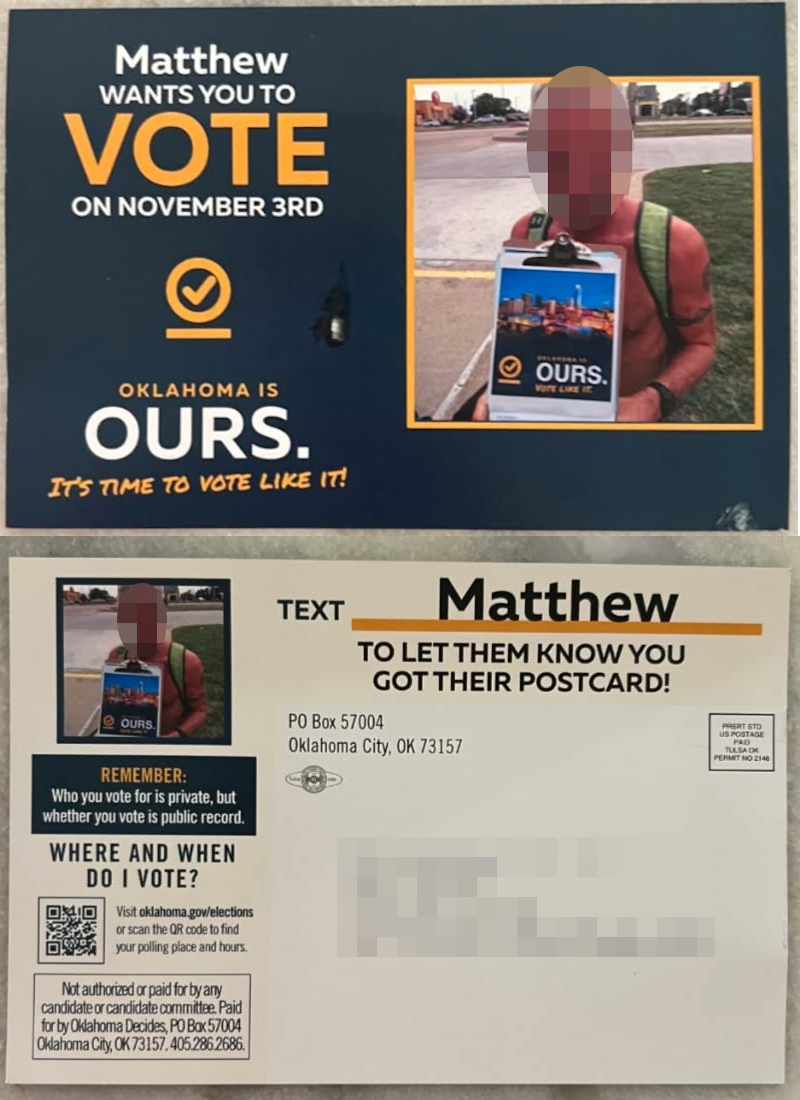
Let's notice a few things about this unusual postcard.
The front of the card reads:
Matthew
WANTS YOU TO
VOTE
ON NOVEMBER 3RD
OKLAHOMA IS
OURS.
IT'S TIME TO VOTE LIKE IT!
Matthew, tanned and tattooed, with short gray hair and stubble, is shirtless except for the straps of a backpack. He has a downcast expression, not looking at the camera. He is holding a clipboard with a poster that reads, "OKLAHOMA IS OURS. VOTE LIKE IT!" and appears to show the Oklahoma City skyline, with the Devon Tower in the background.
The back says, "TEXT Matthew TO LET THEM KNOW YOU GOT THEIR POSTCARD!" There's a smaller version of the photo of Matthew holding the clipboard, and beneath it, this admonition:
REMEMBER:
Who you vote for is private, but
whether you vote is public record.
WHERE AND WHEN
DO I VOTE?
Visit oklahoma.gov/elections
or scan the QR code to find
your polling place and hours.
The QR code leads to oklahoma.gov/elections.
Who sent the card?
Not authorized or paid for by any
candidate or candidate committee. Paid
for by Oklahoma Decides, PO Box 57004
Oklahoma City OK 73157. 405.286.2686.
The same address appears as the return address, and below it, a union print bug, indicating the piece was produced by a unionized print shop. This is de rigeur for Democrat candidates. The bulk mail is from Permit No. 2146; a search turns this up this permit on mailers from IBEW, Fraiser, Fraiser, and Hickman (Jim Fraiser, the firm's founder, served as a Democratic National Committeeman), and Trinity Woods senior living community. This may just be a local direct-mail company that sends mail on behalf of a variety of commercial and political clients.
I've seen mailers in the past that "warn" voters that it's public record whether or not they vote in an election, using fear or guilt to motivate infrequent voters to go to the polls. The recipient of this postcard is a middle-aged registered independent who has only voted in presidential elections. Oklahoma Decides seems to be hoping to amplify the guilt by combining the warning with a photo of a homeless person related to the voter.
This was passed on to me by another relative of the person who received the card. I was told that the family hasn't seen Matthew in weeks, often aren't sure if he's still alive, and the family was broken-hearted to see this post card. My source said, "I do believe that's one of the most insensitive and demented things I've seen a political group do."
How many families across Oklahoma have been sent one of these custom postcards?
It looks like someone from Oklahoma Decides is going around to homeless people, asking (or paying?) them to pose with one of their campaign posters on a clipboard, getting names and addresses of relatives, and then sending personalized postcards to motivate the relatives to vote, perhaps with the hope that low-propensity independent voters will be more likely to vote for Democrats. Bizarre and cynical.
If you've received a postcard like this, please send a photograph of both sides to blog at batesline dot com.
I've started doing some digging on Oklahoma Decides, Inc. More later.
As I write this, there are six more hours for early voting today, Saturday, October 31, 2026, 8 a.m. to 2 p.m. There were reports of long waits at Tulsa County's east and southeast locations (Election Board HQ at 11th and I-44 east of Garnett, Tulsa Tech SE Campus in Broken Arrow), but no wait at all at O'Brien Park in north Tulsa and Chandler Park near Berryhill.
I've updated the BatesLine ballot card with Tulsa-area county races and local races, including the Verdigris Fire District Board and the Oak Grove Fire District millage.
I have seen a few comments online about not voting, casting a protest vote for an independent, or voting for the Democrat in certain statewide races. Some talk of "playing the long game," rejecting an undesirable Republican in hopes that future party primaries will produce better candidates. Pastor Michael Clary's perspective on the Ohio governor's race can be applied to Oklahoma as well:
I believe playing the "long game" is a luxury we cannot afford. We aren't playing with action figures here. Whoever is governor will actually govern and enact policies that affect people's lives. And I believe Acton's policies will be worse than Vivek's. I'd rather oppose a Hindu who wants to appeal to conservatives than a liberal Democrat who despises my existence.And don't believe the line that a Republican statehouse will keep Acton in check. We've seen what she did with executive power when she had it. The lockdowns didn't come from the legislature. A governor appoints the people who run state agencies, sets their priorities, and holds the veto pen. Hamstrung is not the same as harmless.
The days of peace-time elections are over. Every election is now a war-time election. The results of elections are not mere matters of policy, but matters of survival. Amy Acton is a leftist, and the left has increasingly demonstrated their willingness to crush anything that stands in their way. Democrats have gotten increasingly unhinged, irrational, and draconian. The Democratic Party is running open socialists and Islamists around the country. They cannot be reasoned with, only defeated.
This certainly applies to our governor's race, where we have a solid pro-life Christian conservative in Mike Mazzei who wants to cut our taxes and streamline government, even if you don't like his opinion on an aluminum processing plant (not a smelter) in Inola, a matter now under the authority of local officials and state and federal environmental regulators, not the governor. His opponent is a paradigmatic AWFL -- affluent, white, female leftist -- a transplant to Oklahoma, never married, no children, pro-abortion, pro-trans. Imagine the sort of people leftist Cyndi Munson will appoint to the State Board of Education, the state Supreme Court and appellate courts, as regents for our colleges and universities, to state boards and agencies. Many of these appointees will be her fellow transplants installed in Oklahoma non-profits by our leftist philanthropocrats.
It applies in a big way to the Attorney General race. Jon Echols was not my choice, but at least he's a pro-life, pro-capitalism, pro-gun conservative Christian. AG is very much an ideological office, who defends our state's conservative laws in Federal court, who protects Oklahoma's sovereignty during hostile presidential administrations, who guides state and local officials in the interpretation and application of laws. We've seen enough damage done by an alleged conservative AG who used his platform to attack the governor and other Republican elected officials. Imagine having an AG like Nick Coffey, who would not defend our conservative laws but would gladly surrender to left-wing sue-and-settle schemes, whether brought by local non-profits or by a future Gavin Newsom or Kamala Harris administration.
In the State Superintendent race, the calculus runs the other way. If phony Republican Robert Franklin wins, he will owe his election to the unions and other leftist activists, and that's how he'll staff the State Department of Education. If Jennettie Marshall wins, she will owe nothing to the official Democrat Party, which has ignored her and whose activists have worked against her in both the primary and general elections. She will owe more to Republicans who have helped her in the general election campaign. Watch her presentation after the release of the Tulsa Public Schools audit, as I did again recently, and I think you'll agree: We want someone with Jennettie Marshall's mastery of detail and insistence on accountability riding herd on Oklahoma's public school system. It would be even better if she were a conservative, but that is not an option on the ballot.
In the other statewide and federal races:
Lt. Governor: T. W. Shannon (R) was a good Speaker of the Oklahoma House, one of the few Republican Speakers who treated the Republican caucus fairly and used the office to advance conservative governance. His amicus brief in support of Jimcy McGirt still gives me heartburn.
Opponent Kelly Forbes (D) is a man "married" to a man, with a doctorate in "administration and leadership." His hairstyle is... interesting.
Attorney General: Regarding Jon Echols (R), see above. Opponent Nick Coffey (D) is a former federal prosecutor and defense attorney representing energy companies who was a generous donor to Democrats Kamala Harris for President ($600) and Kendra Horn for Congress ($1,500). There's no indication that he has a wife or children.
Treasurer: Cindy Byrd (R). Byrd has been an excellent State Auditor and will be an excellent State Treasurer. Tulsa taxpayers should be especially grateful for her work to expose fraud and waste at Tulsa Public Schools.
Byrd's only opponent is Kiefer Perry, Libertarian state vice-chairman. A fan of Austrian economics (a good thing!), Perry works at Lowe's. He seems to be the Libertarian Party's best hope of meeting the 2.5% vote threshold to keep official recognition.
Commissioner of Labor: Kevin West (R) spent his career as a cabinet maker and the owner of a cabinet-making small business. He has a stalwart conservative voting record with high rankings on all the conservative scorecards. Encouraging the skilled trades and working with small, locally owned businesses will be his focus.
There are two other candidates: Kevin Dawson (D) from Norman is a retired railroad locomotive engineer and, unusually for Democrat nominees this year, has a 43-year marriage and children and grandchildren. Dawson has been a generous donor to the Oklahoma Democratic Party and Democrat Federal candidates, including Joe Biden, Jeff Pixley, and Madison Horn. Libertarian Mike Horn is a program manager with a construction materials company.
Insurance Commissioner: Bob Sullivan (R) prevailed in the runoff over former State Rep. Marty Quinn. This was the only one of the four runoffs where both candidates were certified Republicans -- pro-life, pro-2nd Amendment, no recent party switching, no recent donations to Democrats. Before the primary, the Oklahoma Autobody Association interviewed all the candidates for Insurance Commissioner and has posted audio and transcripts. I've skimmed the transcripts for Bob Sullivan and his Democrat opponent, Craig MacIntyre. Both seem to be plausible candidates, with significant experience in the insurance industry. Sullivan has raised a considerable amount of money from insurance agents, including the Oklahoma Association of Insurance Agents and Mark Tedford, head of Tedford Insurance and also a candidate for Congress.
Corporation Commissioner: Brad Boles (R) has been a State Representative since 2018, served as CEO of Wilco Machine & Fab in Marlow, winning awards and tripling its size before selling the business, then co-founded and serves as president of Philtek Services, which "provides quality, skilled, ASME certified employees for industrial fabrication and manufacturing facilities throughout the United States." His Democrat opponent, Rhonda Eastman, is an opponent of data centers and nuclear power. She mentions working for the state in some unspecified adjudicative capacity then returning to the private sector as a construction project manager.
Federal races
As I've written, nothing is more important this year than maintaining Republican control of both houses of Congress, however disappointing some of our individual congressmen are. A Democrat majority means the likes of Alexandria Ocasio-Cortez, Chuck Schumer, Hakeem Jeffries, and Ilhan Omar in charge of congressional committees and lots of impeachment trials. Republican majorities protect the conservative, pro-America agenda of the Executive Branch and the confirmation of more constitutionalists as Federal judges. As it happens, Oklahomans have good Republican candidates to support.
U. S. Senate: Kevin Hern (R) has been a faithfully conservative congressman for the 1st District who quickly became a leader in the House Republican caucus. He will be an effective conservative voice for Oklahoma in the U. S. Senate, and I expect he will rise in leadership there as well. The unspellable Democrat nominee is a meme candidate.
U. S. House, District 1: Mark Tedford (R), whom I supported in the primary, should have no trouble defeating John "Flaky" Croisant, who bears a great deal of blame for waste and fraud at Tulsa Public Schools as a rubber-stamping board member. I mentioned before the primary how impressed I was to hear Mark Tedford's thoughtful extemporaneous discussion of the Christian doctrine of vocation; that link will take you to the video.
U. S. House, District 2: Josh Brecheen (R) is the conservative star of the Oklahoma delegation. His Democrat opponent Brandon Wade affirms all the standard leftist dogmas: "I will stand firm in defending the rights of women, LGBTQ+ individuals, immigrants, and minorities--rejecting discrimination, hate, and attacks on equality."
U. S. House, District 3: Frank Lucas (R) is the dean of the delegation. I wish he were tougher on spending, but I have to respect the fact that his election in 1993 was the harbinger of the Republican congressional sweep in 1994.
U. S. House, District 4: Tom Cole (R) is my least favorite Oklahoma congressman, although I've always enjoyed listening to him speak about Oklahoma's political history. Democrat opponent Mitchell Jacob wants to abolish ICE.
U. S. House, District 5: Stephanie Bice (R) is running for her fourth term in Congress. In her first term she was elected president of that year's class of freshman congressmen. She is now Vice Chair of the Transportation, Housing, and Urban Development Subcommittee of the House Appropriations Committee.
MORE: Former State Rep. Jason Murphey explains the dangers of a liberal Democrat in the Governor's Mansion, even with a Republican supermajority in the legislature.
[Former State Rep. and lobbyist Gary] Mize seems to suggest it might be acceptable to elect Munson because Republican legislators can pass a budget over the governor's objection.Those of us who have long observed Oklahoma government will know the flaw in Mize's analysis; it's his failure to account for the most powerful of forces in Oklahoma government: the deep state.
These are the bureaucrats--the ones whose knowledge of and direct control of the massive machinery of government give them tremendous power. Often, their values match Munson's, not the average Oklahoman's. With Munson in charge of the executive branch, notwithstanding any attempt by the legislature to constrain them, even if it wanted to in the first place, they would easily leverage the power of government to govern in a way completely unacceptable to most voting Oklahomans. From the woke child welfare machinery at the Department of Human Services to grant programs that funnel money to the left-wing social causes and programs, to arranged "legal settlements" with leftist groups, to the unchecked proliferation of fraud and waste, the machinery of state government would come into alignment with left-wing causes.
Murphey provides a couple of illustrations: Gov. Stitt suppressed a sue-and-settle agreement that created non-binary birth certificates, and Stitt replaced a National Guard commander who instituted a COVID vaccine mandate for guardsmen.
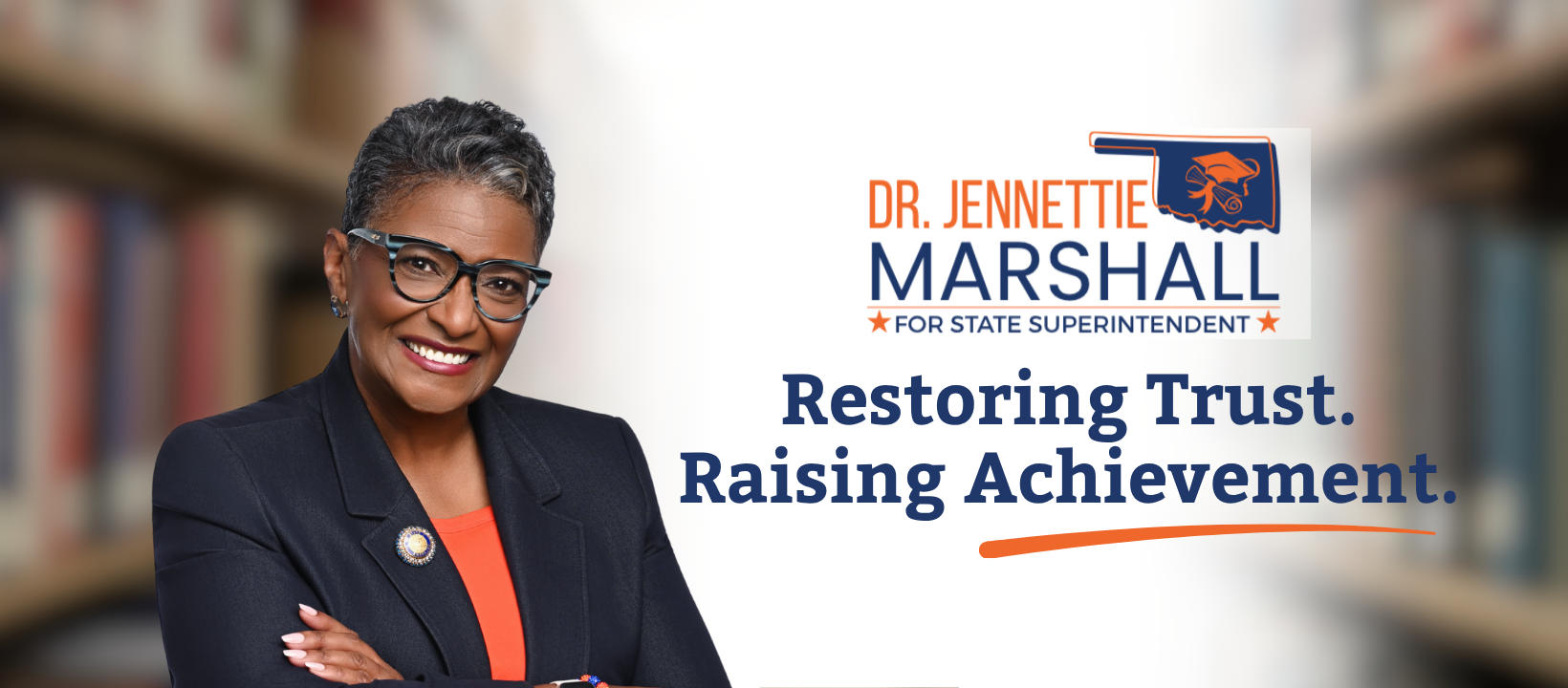
While any given RINO is usually better than any given Democrat, the race for State Superintendent of Public Instruction this year is a different matter. I'm crossing party lines to vote for the principled and more conservative candidate in the race, the Rev. Dr. Jennettie Marshall.
Marshall served two four-year terms representing District 3 (north Tulsa) on the Board of Education for Tulsa Public Schools. As a Tulsa school board member, Jennettie Marshall began calling for an audit of TPS shortly after she was elected in 2016. When Republican District 4 board member E'Lena Ashley joined her on the board in 2020, the two courageously pushed for a state audit of TPS finances, which uncovered criminal wrongdoing. Meanwhile, most of her fellow board members (including Democrat congressional nominee John "Flaky" Croisant) turned a blind eye and enabled the fraud and waste that has led to the current round of school closings.
Marshall was a critic of then-Superintendent Deborah Gist and opposed the board majority's annual votes to extend Gist's contract. When Gist resigned, and the board majority decided to bypass the process for hiring a new Superintendent set out in board policy, Marshall and Ashley joined in a lawsuit to hold the district accountable for apparent violations of the Oklahoma Open Meeting Act.
When the audit was released in 2025, Marshall and Ashley held a press conference to review the findings. Jennettie Marshall's wise words about accountability and transparency are worth repeating:
It is incumbent upon us, now that the truth is out, that we help you understand how we got to this point....What has happened, and it has been consistent in the eight years that I've been on the board, is that we had a culture of doing what we want to do regardless of what the law states or our own policy insists that we do and that was echoed in the report of our state auditor.
Some would ask, "Well, how did you know" -- and I've heard that question -- "how did you know things weren't right?" From day one, when a school district declares that it's having to do a reorganization, which means means that many people lost their jobs behind the financial improprieties and the mismanagement of the district, and the criminal malfeasance of the board, who refuse to do their job.
Most of you have heard me say: "Friendships and kinships sink ships," meaning when we make our decisions based on our friendships and those that we're related to, those that we play golf with, those that we sat down and have a Jack Daniels and Coke with, those are bad decisions, because they are not informed decisions and the board has been guilty of making those decisions, even in the midst of being called out....
We like to use that word, "governance." The board's job is to govern. We're governance. Well, why is it that we go through the fact that we hire people, we do things, and to govern, you have to know and have information? To govern without information, being informed, what that is is a rubber stamp, and that is the problem that has existed over and over again with the district.
I encourage you to listen to Jennettie Marshall's comments, to hear not only the strong message she delivers, but the heart with which she delivers it.
James Taylor, the conservative who lost the Republican runoff to Franklin, writes of Marshall:
I have met with Dr. Marshall and her campaign manager three times, and I genuinely like her. She is a pastor, she is pro-life, she opposes gender-transition procedures for minors, and she is a fighter. In many ways, she is more conservative than Franklin.Unfortunately, her own party has not stood behind her. The Democratic Party has encouraged voters to support Franklin instead, she is missing from some county party websites, and she has not received financial support from the party. I asked her why she would remain loyal to a party that has not been loyal to her, and I encouraged her to consider becoming a Republican. I believe she would move our state in the right direction.
It's too late, of course, to change parties for this election cycle. Despite the best efforts of the liberal public ed establishment to nominate a white liberal, Marshall prevailed in the Democrat primary.
The same failed educational establishment opposes Marshall in the general, preferring Robert Franklin, the liberal pretend-Republican who considers conservative Christians hateful.
Everything about Robert Franklin's campaign has been phony. When asked why Franklin switched parties to Republican, "a party that had already shown its character or lack of," campaign consultant Fount Holland, who was indicted for his actions in the 2014 Superintendent campaign of Joy Hofmeister (another phony Republican), replied, "To win! It's been two decades since a Dem won statewide and won't happen again in my lifetime."
Note that Holland, who has made piles of money tearing down conservative candidates in Republican primaries for decades, didn't justify Franklin's change of party based on the superiority of Republican principles or the crazy ideas that have become mainstream in the Democrat Party. Instead, he applauded Franklin's move as cynical politics over principle.
Over the years, I've noticed that it's easier for Republican elected officials and Republican Party officials to oppose bad ideas from a Democrat elected official than the same bad ideas coming from a Republican. While Marshall does not profess to be a conservative, she has a record of holding public school officials accountable for their use of public funds and for educational results. Marshall would object and has objected to misdirection of school funds for useless (at best) and fraudulent (at worst) consultants. That's a big part of what's wrong with public schools in Oklahoma.
Another big part has to do with educational philosophy, and the public ed establishment's insistence on buying new curriculum and adopting new teaching methods for novelty's sake, with a veneer of irreproducible social "science" research to justify the cost. Oklahoma needs to recover the lost tools of learning, the methods and techniques that taught generations of Americans who were, on the whole, better educated after 8th grade than present-day students are after 13 years in school. Marshall seems more open to the tried-and-true than Franklin.
The State Superintendent does not have plenary power over Oklahoma schools. The Superintendent serves as chairman of the State Board of Education, but the governor appoints five members of that board, who serve at his pleasure. Whoever is elected Superintendent, Gov. Mazzei needs to appoint board members who are solidly conservative and well-versed in educational matters. (Nathan Phelps, the founding father of Tulsa Classical Academy, ought to be the top name on his list.) Jennettie Marshall has demonstrated that she can collaborate with conservatives for positive outcomes. Robert Franklin has made clear his contempt for Bible-believing Christian conservatives.
Many of my Republican friends have said they plan to leave the State Superintendent race blank on their ballots, because they can't bring themselves to vote for anyone with the label Democrat. James Taylor wrote, "However, a vote for a Democratic candidate is, in my view, a vote for the Democratic platform, and that is not something I can support." I understand that sentiment, but in this case a vote for Marshall is a vote for Marshall's platform, history, and character, which is better than Franklin's in every respect. Marshall has been rejected by leftist Democrats who love Franklin. Which candidate is more likely to staff the State Department of Education with leftist, anti-Christian zealots? Marshall is unlikely to hire the same people who tried to block her election. Taylor's concern would be valid if the State Superintendent had broader powers, or if her election would shift the balance of political power in the state in some way, but that's not the case.
I believe that as good stewards of our precious right to vote, we have an obligation to vote for the candidate who will do the most good and the least harm. I urge conservatives to join me in voting for Jennettie Marshall.
The City of Tulsa is asking voters to approve doubling the hotel tax rate in order to pay for deferred maintenance for the BOK Center and the Arvest Convention Center. At the same time, the voters, unwittingly, would be giving a massive and undeserved pay raise to the Tulsa Regional Chamber. Tulsa voters should give a big thumbs-down to the Chamberpots and insist that the City make better use of the money it already has.
If Tulsa voters say yes on November 3, the hotel tax rate will increase permanently from 5% to 9.9% on January 1, 2027, and the allocation of funds will shift temporarily toward facilities and away from marketing and tourism. The percentage for the general fund and economic development (GF and ED in the list below) will stay constant, but the percentage for marketing & tourism (M&T) will drop for four years before returning to its previous level, with Facilities getting the extra proportion. The facilities share will be pledged to cover revenue bonds to pay for arena and convention center updates, so some bankers and bond advisors will make money, too.
Funds for the BOK Center were approved by Tulsa County voters in 2003. It opened its doors in 2008. The presentation pushing for the tax increase has photos of worn seats and old-fashioned lockers. The presentation claims that $128 million in updates are needed, but only $48 million is available.
The summary of the proposal says that the current 5% generated $10.4 million in 2026. Collected at 9.9% and assuming no erosion of hotel stays, that would be $20.6 million.
- Current: 2% GF, 4.5% ED, 45% M&T, 48.5% Facilities
- 2027: 2% GF, 4.5% ED, 40% M&T, 53.5% Facilities
- 2031: 2% GF, 4.5% ED, 45% M&T, 48.5% Facilities
- After revenue bonds: 2% GF, 4.5% ED, 50% M&T, 43.5% Facilities
In constant-dollar terms, the current tax would raise $20.1 million for facilities over the next four calendar years. The proposed increase and the new proportions would turn that into $44.1 million. If $128 million is needed, that means we're looking at 12 years to retire the revenue bonds. Over 12 years the current tax and proportions would raise $60.5 million for facilities; the new tax and proportions would raise $124 million.
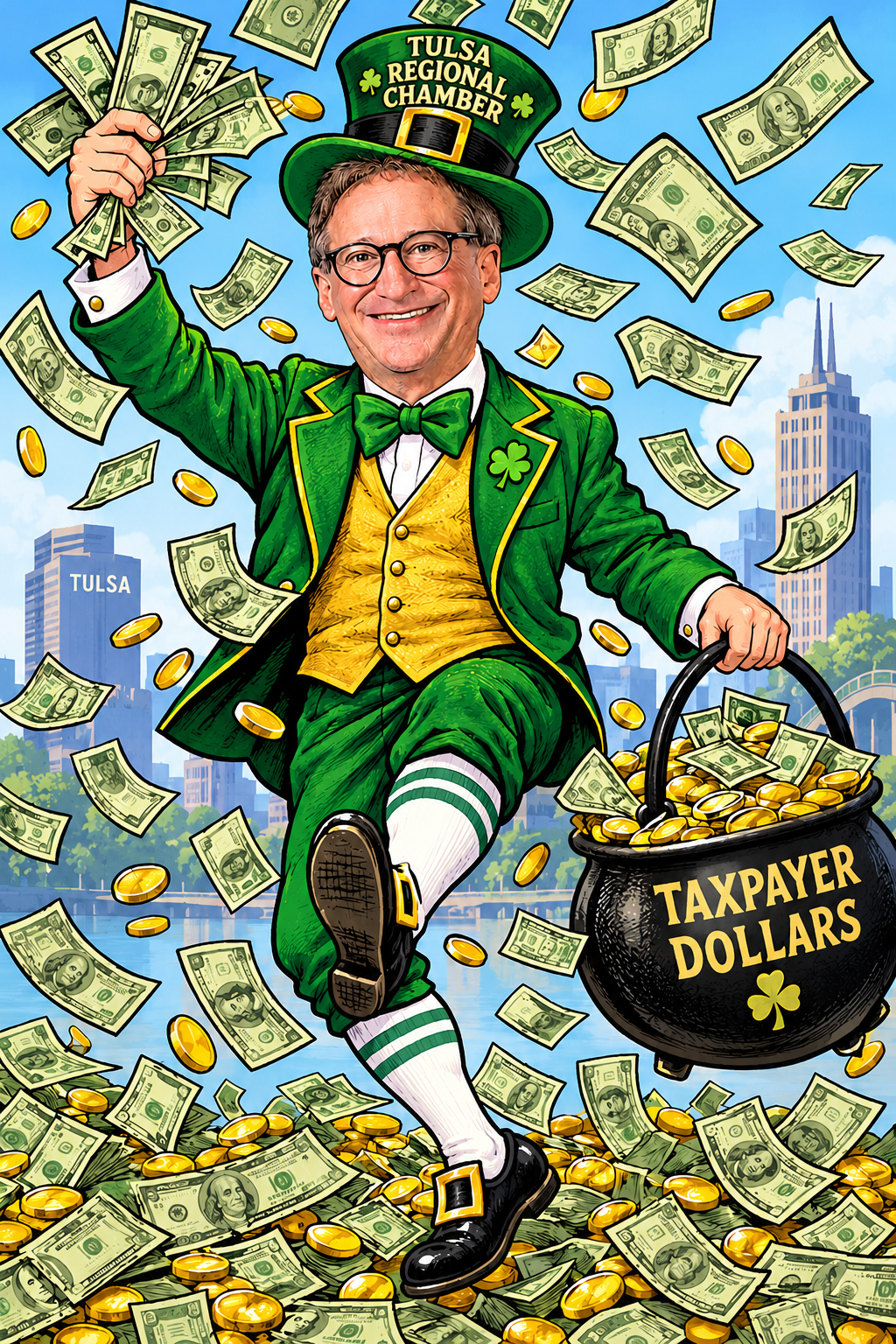 Notice how the tax increase will boost revenues for marketing and tourism and economic development, money that mostly goes to the Tulsa Regional Chamber and its subsidiaries under service contracts. Money for marketing and tourism, all of which goes to the Chamber, would rise from $4.68 million annually under the current rate and proportion to $8.24 million. Funds for economic development, of which the Chamber receives more than half, would grow from $468 thousand annually to $927 thousand. One might ask, if facility needs are so dire, why not raise the tax rate but alter the proportions so that all the increase goes to facilities?
The fund summaries in the 2026-2027 City of Tulsa budget tell the tale.
Fund 131, Convention and Visitors, is funded by 45% of the hotel tax. "The fund shall be used to market and promote tourism and the use of convention facilities within the City of Tulsa." "The City of Tulsa contracts with the Tulsa Regional Chamber of Commerce for these marketing activities." In FY27, an estimated $4,554,000 came in through the hotel tax, and all of that is budgeted to go to "Managed Entities," namely, the Tulsa Regional Chamber.
Fund 130, Economic Development, is funded by 4.5% of the hotel tax. "The funds will be used by the City for economic development activities. The City contracts with the Tulsa Authority for Economic Opportunity (TAEO) and Tulsa Regional Chamber of Commerce for economic and community development services to the City of Tulsa." Each year, $250,000 of that amount goes to "Managed Entities," namely, the Tulsa Regional Chamber.
When I think of Tulsans whose efforts have brought visitors to Tulsa, Danny Boy O'Connor is one of the first names that comes to mind. For love of the book The Outsiders and the movie based on it, he bought the old Crutchfield house used as the Curtis home in the movie and turned it into a museum and a place of pilgrimage for his fellow Outsiders fans. I think, too, of William Franklin, who built Decopolis on Route 66 and added the new Decopolis Tulsarama last year. I think of Linda Collier and her devoted care for the Cave House. What has the Chamber done to make these attractions possible?
And yet you'll see minuscule Chamber CEO Mike Neal showing up to ribbon-cuttings and grand openings as if he or the Chamber had anything to do with the hard work and creativity being celebrated. It's infuriating.
When Mike Neal and G. T. Bynum led a group of 150 Tulsans to New York for the Broadway premiere of "The Outsiders" musical, how much of the cost of that junket came from hotel/motel tax dollars? How much of that tax goes to help Neal and his staff rack up frequent-flier miles and hotel points, while doing nothing significant to build Tulsa's economy?
This hotel tax increase would be a huge gift to this entity that considers itself private when it comes to public accountability but practically a branch of government when it comes to entitlement to government revenues. Unfortunately, we don't have any city councilors with the courage to examine whether dollars sent to the Chamber are effective in increasing tourism and tourist spending. The diminutive mediocrity who specializes in gripping, grinning, and cutting ribbons will be very pleased if voters approve a near-doubling of his annual budget. Back when we had courageous city councilors, they pushed for competitive bidding and other reforms for convention and tourism promotion and economic development, but the reform ordinance they passed was vetoed by then-Mayor Bill LaFortune.
The City had a fair amount of extra money to play with recently. The Vision Tulsa sales tax ran a $103 million surplus. That money was intended for economic development and capital improvements, but the Council and Mayor Monroe Nichols repurposed $23 million of it for the Homeless Industrial Complex. More money for the Philanthropocrats.
In the real world, owners of theaters, restaurants, nightclubs, and other venues hold back some of their profits to pay for repairs, renovations, and updates needed to continue to attract customers. A hotel that fails to replace wallpaper and bed linens and to keep the mechanical systems in good working order will find itself losing its franchise agreement and sliding down the hierarchy of hotel chains, cutting rates and losing desirable customers on the way: Hilton becomes Clarion becomes OYO becomes burned-out squatter nest. But in government world, operating contractors and tenants keep all the ticket profits, and the taxpayers have to pay for updates.
Proponents claim that this is the only tax that you don't pay, except that you pay this tax in other cities, and an increase in one city enables increases in other cities. Tulsans may wind up paying part of the this tax by one degree of separation: Out-of-town contractors who come to Tulsa to do work and provide services for Tulsa businesses and residents will pay the higher hotel tax and pass the extra expense on to the locals who hired them.
Rather than put the burden of convention and sports facilities on travelers, most of whom are just passing through or perhaps in town to visit family, why not directly tax those who attend events at the BOK Center and the Convention Center to fund updates?
Tulsans should say NO to any hotel tax increase until the City puts convention, tourism, and economic development services up for competitive bid and until the City gets its budget priorities in order.
Here is the gist that will appear on the November 3, 2026, ballot:
Do you approve Ordinance No. 25830, which increases the levy of an excise tax from five percent (5%) to nine and nine-tenths percent (9.9%) upon the gross proceeds or gross receipts derived from the rent from every occupancy of a room or rooms in a hotel in this City and establishes an effective date of January 1, 2027?
Ordinance No. 25830 was approved by the Tulsa City Council on July 22, 2026. It was approved unanimously by the seven councilors present (Hall-Harper and Bush were absent) It modifies paragraph A of Title 44, Section 101 as follows (deletions are shown with strikethroughs, additions with underlines:
There is hereby levied an excise tax of
five percent (5%)nine and nine-tenths percent (9.9%) upon the gross proceeds or gross receipts derived from the rent from every occupancy of a room or rooms in a hotel in this City, except that the tax shall not be imposed where the rent is less than at the rate of Ten Dollars ($10.00) per day.
There are no other changes to the rest of Section 101, which defines other exemptions (e.g., for veterans and government agencies), and Section 100, which defines what a hotel is. The council tweaked the definition of taxable rent in 2024 and 2025 to exclude taxes, parking fees, food and beverage, late checkout fees, rollaway crib charges, and other add-ons.
If voters approve the tax increase, another ordinance, also approved unanimously on July 22,will go into effect on January. Section 118 of Title 44, which defines how the hotel tax money is to be spent, will be changed as follows:
 Two district judgeships will be on all of Tulsa and Pawnee Counties' November 3, 2026, ballots. Voters in the eastern Tulsa County portion of the City of Tulsa and Tulsa County north of the City of Tulsa (Skiatook, Collinsville, Sperry, Owasso) will have a third judicial choice to make.
Just north of us, Washington County will elect a new Associate District Judge to replace Russel Vaclaw, who won a District Judgeship in District 11 without opposition.
Here are my recommendations, and my friends in the legal community appear to be unanimous in agreement:
- District 14, Office 1 (Tulsa, Pawnee Counties): Caroline Wall (R)(i)
- District 14, Office 4 (Tulsa County Judicial Election District 4 only): Dustin Allen (R)
- District 14, Office 12 (Tulsa, Pawnee Counties): Kevin Gray (R)(i)
- Washington County Associate DJ: Todd Cone (R)
Oklahoma is divided into 26 judicial districts. Tulsa County shares its 14 district judges with Pawnee County in Judicial District 14. Additionally, each county elects one associate district judge, who serves along side the district judges. The only real distinction is the geography of the constituency. Since the passage of HB 1504 in June 1993, District 14 has five judges nominated and elected by a district within Tulsa County, a judge nominated in Pawnee Couty and elected at-large, and the remainder of judges nominated in Tulsa County and elected at-large. District judges run in competitive non-partisan elections for four year terms.
For Office 1, incumbent District Judge Caroline Wall faces Tom Sawyer. Wall served a term as Associate District Judge for Tulsa County from 2002 to 2006. She was defeated for re-election in 2006 by then-Associate District Attorney Dana Kuehn (who is on this year's ballot as a Supreme Court justice seeking retention). (Wall was not happy about my endorsement of Kuehn.) In 2014, Wall defeated incumbent soft-on-crime judge William Kellough to return to the Tulsa County bench, and by all accounts is a solid judge, vastly improved over her first term of office.
In 2023, Wall dismissed a lawsuit for reparations for the Tulsa Race Massacre for failure "to state a justiciable public nuisance claim" and "to allege a cognizable legal abatement remedy." In her order dismissing the case, Wall wrote, "This court declines to engage in the management of public policy matters that should be dealt with by the legislative and executive branches." She was attacked for her decision by the Black Wall Street Times, who reported that she had ties to far-right wing characters and followed Donald Trump on Twitter. The dismissal was upheld in 2024 by the Oklahoma Supreme Court (OSCN docket here) by an 8-1 majority: "We affirm the District Court's July 12, 2023 Final Order of Dismissal with Prejudice. With respect to their public nuisance claim, though Plaintiffs' grievances are legitimate, they do not fall within the scope of our State's public nuisance statute. We further hold that Plaintiffs' allegations do not sufficiently support a claim for unjust enrichment, nor do the allegations sufficiently support a claim for the unauthorized use of name and likeness under 12 O.S. § 1449."
Wall was challenged by Tom Sawyer (full legal name, Scott Thomas Sawyer) in 2018, and Sawyer is running again this year. Sawyer earned his law degree at Loyola in Los Angeles and has been working in Oklahoma since 2013, serving stints as an Assistant DA in a variety of counties, including Tulsa, Creek, Choctaw, and Mayes. Sawyer ran for the Rogers County associate district judge post in 2022. Sawyer does not appear to be actively campaigning, and he has not filed with the Oklahoma Ethics Commission for this campaign. In 2018, he received $500 donations from Gentner Drummond and Daniel Smolen.
Both Wall and Sawyer are registered Republicans.
In Office 12, District Judge Kevin Gray, a former assistant district attorney first elected judge in 2022, has been challenged by Christopher Camp. Camp, a lawyer in private practice, is not running an active campaign and has not filed with the Oklahoma Ethics Commission. Gray and Camp are both registered Republicans, but Camp only ever votes in November general elections.
Office 4 was the only open competitive seat this year, replacing retiring judge Daman Cantrell. Three candidates filed, Phillip Peak was eliminated in the June primary, and now assistant DA Dustin Allen and special judge Loretta Radford are on the November ballot. The election will take place only within Tulsa County Judicial Election District No. 4, which can be roughly described as north Tulsa County and east City of Tulsa. Here is the official map of Tulsa County judicial election districts.
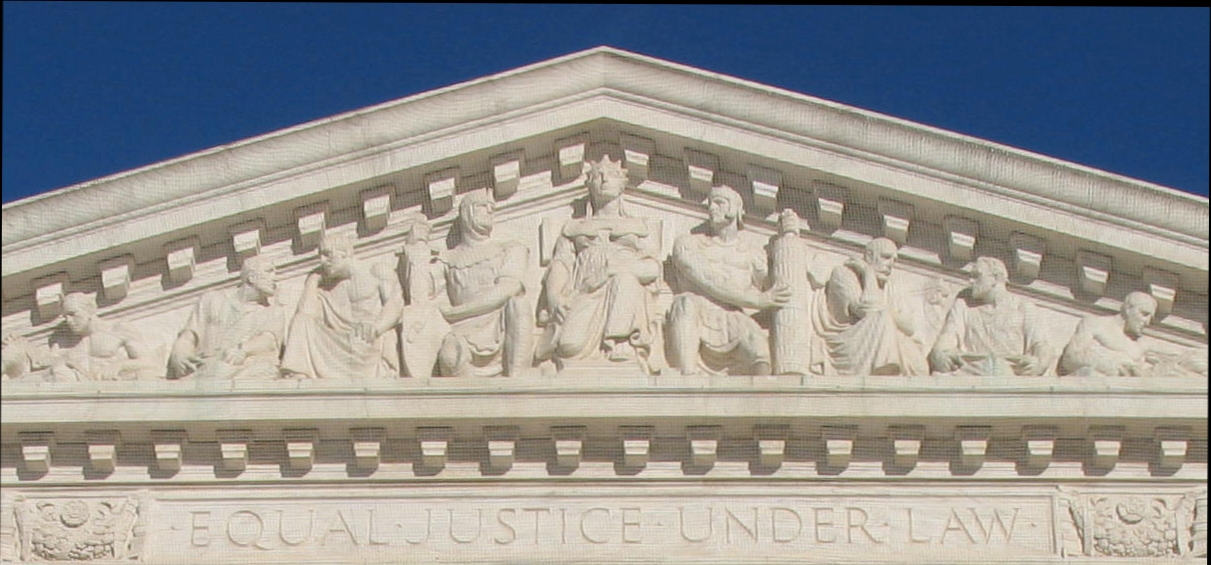
If you want judges who believe in Equal Justice Under Law, Dustin Allen is the only choice for Office 4.
Dustin Allen is private practice attorney. Allen has been endorsed by State Rep. (and likely future Congressman) Mark Tedford, Tulsa County Sheriff Vic Regalado and a long list of area FOP chapters. His LinkedIn profile says that Allen worked as an ADA in Tulsa County for 9 months, as a Tulsa County Assistant Public Defender for 3 years and 1 month, and as an ADA in Wagoner County for 6 months, covering the period from June 2011 to July 2015, when he began private practice. According to voter and land records, Allen lived near 91st and Memorial before purchasing a home in Owasso, in Election District 4, in 2025. Allen is an alumnus of Bishop Kelley High School and got his law degree from Hofstra. You can get a sense of Allen's demeanor, philosophy, and values from his YouTube channel.
Radford has been endorsed by Judge Cantrell and has among her donors local Democrat figures like Tim Gilpin, Jim Frasier, and John Nicks, as well as former judge William Kellough, who was ousted for being soft on crime in 2014 (see above). According to voter and land records, Radford has had a home in Owasso since 2004.
Looking back a few years, in June 2022 Radford was a Democrat registered to vote in Owasso, while Allen was a Republican registered to vote in south Tulsa. The same was true in November 2018. In the 2024 presidential election, District 4 votes supported Donald Trump over Kamala Harris by 63.4% to 34.5%, so the election ought to be a slam dunk for Allen as long as voters get the word that Allen is a conservative and Radford supports race preferences in our legal system, as detailed below.
What follows regarding Radford's record is largely a repeat from before the June primary, but it's worth repeating for those just now tuning in.
All Oklahoma voters will have 9 judicial retention questions on the November 3, 2026, ballot. Unlike district judges, where competitors run in non-partisan elections, justices of the Oklahoma Supreme Court and judges on the Oklahoma Court of Criminal Appeals and Oklahoma Court of Civil Appeals are appointed, but face a yes-or-no retention ballot every six years. (I think unopposed district judges should also face a retention ballot.)
Oklahoma has two separate appeals systems. Civil cases go through the Oklahoma Court of Civil Appeals and can be appealed from there to the Oklahoma Supreme Court, while the Court of Criminal Appeals is the apex of Oklahoma's criminal court system. (Here is a flowchart showing how these appellate courts are related to one another and to district and municipal courts.)
Every appeals judge or justice is appointed by the governor from a list of three provided by the Judicial Nominating Commission, a panel of 15 consisting of six attorneys selected by the Communist-enabling Oklahoma Bar Association, six non-attorneys appointed by the Governor (of which only three can be Republican), and three further non-lawyer members appointed by those twelve.
Passage of SQ 845 would give a conservative governor a more conservative Judicial Nominating Commission and should result in a more conservative list of candidates from which Governor Mazzei can choose as he fills court vacancies.
A newly appointed Supreme Court justice or appellate judge faces a retention ballot at the next general election, and once again at the general election when the term for his seat expires (which may be two, four, or six years later), then voters have the opportunity to oust him every six years thereafter. The next retention elections, in the absence of a resignation, death, or new appointment:
2026 (cycle 1): Supreme Court 1, 6, 9; Civil Appeals Districts 1, 2; Criminal Appeals District 2, 3
2028 (cycle 2): Supreme Court 2, 5, 8; Civil Appeals Districts 3, 4; Criminal Appeals District 1
2030 (cycle 3): Supreme Court 3, 4, 7; Civil Appeals Districts 5, 6; Criminal Appeals District 4, 5
Cycle = ( (Election Year - 1910) / 2 ) modulo 3
An office will be on the ballot off-cycle when a vacancy occurs and a replacement is appointed, as with Supreme Court District 4 Justice Travis Jett, appointed in 2025 to replace ousted Justice Yvonne Kauger. If retained, Jett will face the voters again in 2030.
Less frequently, an office will not be on the ballot when its term expires because a judge has decided not to file for retention. That's the case this year with Court of Criminal Appeals District 3 Judge Gary Lumpkin; instead, the governor will appoint a replacement this year who will be on the ballot at the next general election in 2028 and then, if retained, will be on the ballot again when the District 3 term expires in 2032.
I was puzzled that Civil Appeals Judge Jim Huber, who was appointed to the court in 2023 and on the 2024 retention ballot would be on the ballot again just two years later. That puzzlement led me to dig deeper, to notice that the law establishing the retention ballot for this court, 20 O. S. 30.18, like the constitutional changes instituting the retention ballot for the Supreme Court and Court of Criminal Appeals, continued the existing fixed, staggered six-year terms for each office. From past election results and this helpful list of past Criminal Appeals judges showing each year that a judge was re-elected, a pattern emerged, which you see above.
In the 58-year history of Oklahoma's judicial retention elections, only one judge or justice has ever been turned out of office by the voters: Supreme Court Justice Yvonne Kauger in 2024.
Here is the list of appellate judges on the 2026 retention ballot. In parentheses, I list age on election day, county of residence, appointing governor, year of appointment, and party of voter registration, followed by my recommendation at this point.
Supreme Court
- District 1: M. John Kane (64, Osage, Stitt, 2019, R): YES
- District 4: Travis V. Jett (42, Woodward, Stitt, 2025, R): YES
- District 6: Dana Kuehn (55, Tulsa, Stitt, 2021, R): YES
- District 9: Richard B. Darby (68, Jackson, Fallin, 2018, R): NO
Court of Criminal Appeals
- District 2: Robert L. Hudson (69, Logan, Fallin, 2015, R): YES
Court of Civil Appeals
- District 1, Office 1: Stacie L. Hixon (52, Tulsa, Stitt, 2020, R): YES
- District 1, Office 2: Jane P. Wiseman (79, Tulsa, Henry, 2005, D): NO
- District 2, Office 1: Deborah B. Barnes (72, Osage, Henry, 2008, D): NO
- District 2, Office 2: James R. Huber (58, Tulsa, Stitt, R): YES
(Recommendations for the competitive, non-partisan elections for District Judge in the Tulsa area will be in a separate entry.)
Jamison Faught, the Muskogee Politico, has published his judicial retention picks for 2026. We differ only on Justice Darby, but neither of us consider Darby's retention a clear-cut choice.
I haven't yet seen a column about this year's retention ballot from former State Rep. Jason Murphey, but his 2024 column provides helpful perspective on the damage to our courts perpetrated by Brad Henry's eight years as governor. A lefty-lawyer Democrat in the governor's office being fed nominees by a lefty-driven JNC is a bad combination for justice.
After the jump, the basis of the recommendations.
Tulsa's Mean Girls clique, the group of four city councilwomen who text each other during meetings to mock citizens and fellow councilors, were the only four yes votes on Wednesday to create an independent commission to pass judgment on Tulsa's police officers. The proposed ordinance failed by a vote of 4-4-1:
- Yes: Vanessa Hall Harper (District 1), Jackie Dutton (District 3), Laura Bellis (District 4), Lori Decter-Wright (District 7)
- No: Karen Gilbert (District 5), Christian Bengel (District 6), Phil Lakin (District 8), Carol Bush (District 9)
- Abstain: Anthony Archie (District 2)
Independent oversight commissions have become a popular fad in liberal cities, particularly since the Black Lives Matter movement and the George Floyd incident of 2020. The concept behind these commissions is that All Cops Are Bastards (if you've seen the acronym ACAB, that's what it means) and therefore we need people with no clue about standard police practice to second-guess, in leisurely hindsight, the split-second decisions made by police officers dealing with crisis situations involving unstable and dangerous people. Proponents hope that awareness of this second-guessing will cause police officers to hesitate to enforce the law, particularly if the apparent perpetrator is from a protected ethnic group. An axiom of the theory behind these commissions is that arrest numbers vary across socioeconomic and demographic groups only because cops are racist; it couldn't possibly be because of variations in the frequency of criminal behavior across groups. These commissions are part of the standard kit for converting your city from an orderly, clean, and prosperous place to a chaotic and dangerous hell-hole. (A pro-criminal district attorney is also a component in the kit; we narrowly escaped that fate in June.)
The proposal was ridiculously complex. For all the claims that this would promote transparency and accountability, the director of the Office of Independent Review and Oversight of Public Safety (OIROPS) would be in the "classified service" -- protected from public accountability by civil service rules. The seven members of the OIROPS Advisory Board would be handpicked by the Mayor, as would the eleven members of the Citizens Oversight Board, which would oversee the Advisory Board.
The City Council, directly accountable to the voters, has power under the Tulsa City Charter to oversee any aspect of city government. From Article II:
Section 16. - Review of administrative actions.The Council shall provide by ordinance for the grant, issuance, modification, amendment, or revocation of orders, licenses, permits, certificates, and approvals by the divisions, departments, and agencies of the city. Except when otherwise provided by the laws of Oklahoma, the grant, issuance, modification, amendment, or revocation of orders, licenses, permits, certificates, and approvals shall be subject to review by the Council, upon petition by an aggrieved person, in accord with procedures which the Council shall establish by ordinance. The Council may not abrogate any right of review by a court of competent jurisdiction.
The Council may investigate the conduct of the city government and may make appraisals, comments, and recommendations to the Mayor on the efficiency, economy, and effectiveness of administrative practices, methods, systems, and controls. The Council shall hear complaints made by citizens concerning the administration of the city government. The Council may subpoena witnesses, administer oaths, and compel testimony, the production of books, papers, or other evidence necessary for the discharge of the duties of the Council. The Mayor shall designate police officers to serve orders and subpoenas issued by the Council. The Council shall provide by ordinance the penalties for the contempt by any person who refuses to obey a Council order or subpoena.
But that's too much hard work for this Council.
For the record, here is item 7.c. on the Tulsa City Council's October 14, 2026, 5 pm regular meeting agenda:
c. Consideration and possible approval, adoption, denial, amendment or revision of an Ordinance adopting a new Title 16, Tulsa Revised Ordinances, titled "Independent Review and Oversight of Public Safety"; creating the Office of Independent Review and Oversight of Public Safety and the position of Director; establishing the powers, duties, responsibilities, qualifications, and reporting requirements of the Office and Director; providing for the review and oversight of certain Public Safety investigations; providing for confidentiality of certain information and records; creating a civilian oversight board and establishing its membership, qualifications, terms, powers, duties, meetings, and reporting requirements. (Hall-Harper, Decter Wright) [PW 9/16/26; CC 9/16/26; BUD/SP 9/23/26; CC 9/23/26; UED 9/30/26; UED 10/14/26; CC 10/14/26] 26-734-6
Vanessa Hall-Harper and Lori Decter Wright are the authors of the ordinance. The list at the end indicates the committee meetings and council meetings at which the ordinance was heard. PW is Public Works, BUD is budget, UED is urban and economic development. There is a set of supporting documentation:
- the September 14, 2026, version of the proposed ordinance
- a presentation on the proposal
- a comparison of the structure and powers of Oklahoma City's Community Public Safety Advisory Board with the proposed Tulsa Office of Independent Review and Oversight of Public Safety
- a half-million dollar budget for the new Office
- City of Tulsa salary and benefits by department and pay grade for FY 2026-27 and FY 2027-28
- the May 2022 presentation report from the Council Trust & Accountability Working Group
That last item includes the 2019 proposal for an Office of Independent Monitor (OIM), which specifically targeted the Tulsa Police Department, and includes a 2022 report by the working group describing the TPD "reforms" that they were considering. The working group consisted of Hall-Harper, Decter Wright, and the District 5 Councilor Mykey Arthrell-Knezek -- apparently a hyphenated or double-barrelled last name was a requirement for participation. The report is useful documentation that this idea of an OIM came from then-Mayor G. T. Bynum, who pretended to be a conservative Republican when first running for council (parading his brief period of service in Tom Coburn's Senate office as evidence of his conservative bona fides), but showed his true rainbow-flag colors once in office.
That 2022 report and presentation is proof that bad ideas never completely die, and we can expect to see this one return unless we clean out the City Council. Unfortunately, the 2026 City of Tulsa general election happened on August 25, in which three councilors were re-elected without opposition, four councilors won re-election with an absolute majority, and one new councilor won an open seat with an absolute majority (Pete Regan in District 9, the 2004 Democrat Lt. Gov. nominee).
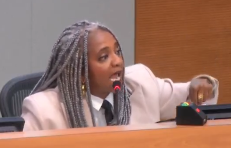 The lone opportunity to replace one of the malign influences on the City Council falls to District 1. Corinice Wilson finished second in the August 25 election to incumbent Vanessa Hall-Harper and the two have advanced to a November 3 runoff. Hall-Harper reacted badly to the defeat of her proposal with a rant. Reality Snark on X has the clip and a transcription:
"...but, then you got to understand.. from an historical perspective in this country that's intentional...That's why only historically who can engage and participate in government, WHITE MEN WITH LAND" That is the history...cause I'm a history teacher... That is the history...You obviously haven't read a book (to audience member who disagreed). History bears that out, and it still is apropos today---thats just the reality of it and we are still reeling from it today."
Hall Harper claims to be "unbought and unbossed," but unhinged would be a more appropriate term, given this performance and earlier outbursts like her use of a racist slur to denounce U. S. Sen. Tim Scott or her rant condemning the Tulsa city flag as racist.
And what about that abstention from professed Republican Anthony Archie, who represents Tulsa west of the river and the western part of south Tulsa? During his first run for office in 2024, I wrote:
...Archie was a registered independent as recently as April 2023, changing his registration sometime between then and last December, and his wife is a registered Democrat. Archie has a lot of endorsements that are negative indicators -- Tulsa World, Karen Keith, the Tulsa Chamber's TulsaBizPAC -- and he seems poised to fall in line with Phil Lakin and the rest of the establishment uniparty at City Hall. In March 2023, Archie called for passage of the George Floyd Justice in Policing Act, a Federal bill, backed by the Democrats, that would have nationalized Blue city policies that make police officers hesitant to be pro-active, resulting in an explosion of crime and disorder.
District 2 is one of the more conservative sections of Tulsa. There needs to be an active effort by conservatives, starting today, to find a reliable conservative to replace Archie on the Council in 2028. Ideally, that would be part of a broader city-wide effort to recruit and elect conservatives to the Council. It would be awesome if the Tulsa County Republican Party would take the lead in that effort, but they'd have to develop a selection process by which the party would evaluate and back one candidate in each race, even if more than one registered Republican is running.
The county party established a candidate evaluation committee for the 2024 election, and I was appointed to serve on it. Strangely, after Anthony Archie appeared before the committee, the committee was never reconvened to make endorsements, and county party leaders failed to endorse Brent Van Norman for mayor until a week before the election, feeling that the rules did not permit them to make a recommendation in a race with multiple registered Republicans. (They waited for other registered Republican candidates to give their permission for the Tulsa County GOP to endorse Van Norman.) In the UK, Australia, New Zealand, and many other countries that don't have party primaries, parties have an internal process for interviewing, screening, and selecting candidates. The Oklahoma GOP or the Tulsa County GOP could look to those processes for ideas in establishing rules established to create a process for party selection of candidates for "non-partisan" offices, in which there are no party primaries.
Once again, Oklahoma voters are being asked to place a lengthy and detailed piece of legislation in our State Constitution which properly belongs in a more easily amendable statute. The Constitution withholds the authority to regulate and adjust exemptions, valuations, and tax rates except as very specifically provided in bloated Article X. Nevertheless, State Question 847 would grant all Oklahomans additional protection against tax increases by inflation and would expand the universe of senior citizens granted additional relief. For that reason, I'm voting YES on SQ 847.
Your property tax bill is the product of two numbers: The assessed value times the total millage rate (in mills per dollar, i.e., dollars per thousand dollars) that you've authorized your local taxing authorities to take. The assessed value is the fair cash value times an assessment rate (11% in Tulsa County), minus the homestead exemption ($1,000), if the property is a homestead.
where
- FCV = fair cash value
- AR = assessment ratio (a constant in Tulsa County = 11%)
- HE = homestead exemption (a constant = $1,000; low-income homeowners qualify for an additional $1,000 homestead exemption)
- TM = total millage (the sum of property tax rates affecting the property -- school, city, county, library, health department, community college, technology center, etc.)
AR and HE have been constant for a long time and are unlikely to change. Practically speaking, your taxes will go up or (rarely) down depending on changes in fair cash value and total millage. Total millage will go up if there's a new school bond issue or if your city or county government has to pay a lawsuit settlement. Fair cash value depends on the market, as interpreted by the County Assessor. When demand causes local home prices to skyrocket, you become liable for higher taxes based on gains you can't realize without selling your home.
To protect taxpayers from tax hikes caused by housing inflation, in 1996 Oklahoma voters approved a 5% cap on the annual increase in fair cash value and a valuation freeze for senior citizens with gross incomes below $25,000 (SQ 677). This was the origin of the two sections (8B and 8C) of Article X that would be changed by SQ 847. In 2005, voters increased the income limit for the senior citizen valuation freeze to the estimated median income for the county or metro area, as reported by the US Department of Housing and Urban Development (HUD) (SQ 714). In 2012, voters reduced the cap on the annual increase in fair cash value for homestead properties to 3% (SQ 758).
SQ 847 would cut the general cap on fair cash value increase from from 5% to 4%, the homestead cap from 3% to 1.75%. It would also graduate the phase-out of the senior valuation freeze: Instead of a hard cutoff at the median income, there would be four brackets based on estimated median income (EMI), reducing the increase cap to zero as income goes down:
- 100%-120% of EMI: 0.35% cap on annual FCV increase
- 120%-140% of EMI: 0.70% cap
- 140%-160% of EMI: 1.05% cap
- 160%-180% of EMI: 1.40% cap
HUD doesn't quite use the same terminology as the Oklahoma Constitution. Median Family Income in the Tulsa Metropolitan Statistical Area (MSA), as issued by HUD for Fiscal Year 2026, is $95,000. Here is the page for 2026 data, and here is a direct link to the spreadsheet. Assuming that number is being used, senior households with gross incomes below $171,000 would get some additional relief beyond that which would apply to all homeowners.
That was the gist of the gist. Here is the 304-word "gist" of SQ 847, as it will appear on your November 3, 2026, ballot.
STATE QUESTION NO. 847 LEGISLATIVE REFERENDUM NO. 381This measure amends article 10, sections 8B and 8C of the Oklahoma Constitution.
Currently, section 8B limits annual growth in fair cash value to 5% for most real property or 3% for homesteads and agricultural land. If approved, the measure would limit annual growth in fair cash value for tax year 2027 and after to 4% for most real property or 1.75% for homesteads and agricultural land. Currently, section 8C prohibits any increase in fair cash value of homestead property for persons age sixty-five (65) or older whose income does not exceed certain limits, sometimes referred to as the senior freeze. Instead of prohibiting any increase in fair cash value for these homesteads, there would be an annual limit of 1.75%. The measure eliminates the income cap on gross household income to qualify for the senior freeze. If approved, the annual limit on an increase in fair cash value would be tied to how much gross household income the homestead owner had in the preceding year. If a homeowner's gross household income from the previous year was at or below the median income for their county or area (as determined by the U.S. Department of Housing and Urban Development's estimated median income amount for the county or metropolitan statistical area), a homeowner's homestead fair cash value cannot be increased. If the income amount was in excess of certain thresholds, the limit on increases in fair cash value for homesteads owned by persons age 65 or older could be 0.35% (income over 100% up to 120%); 0.7% (income over 120% up to 140%); 1.05% (income over 140% up to 160%); 1.4% (income over 160% up to 180%); or 1.75% (income over 180%). If passed, this measure would have a fiscal impact on the state, but the exact impact is unknown.
Shall the proposal be approved?
Although I hate including this kind of statutory detail in the State Constitution, a recent Oklahoma Supreme Court decision (read below regarding SQ 843 for the details) means any property tax relief will require spelling it out in the Constitution, at least until we end the activist majority on the court.
Because we're all about the details here at BatesLine, here is the text of Article X, Sections 8B and 8C as they would be modified by passage of SQ 847, with deleted text struck through, added text underlined, and everything else unchanged:
SQ 845 is a half-measure, but this half-measure is better than none. The Oklahoma Constitution grants a formal role to the Oklahoma Bar Association, a left-leaning private cartel, in filtering appellate court nominees in Oklahoma, unelected and unaccountable figures restricting the choices available to the duly elected governor. State Question 845, one of two statewide referenda on the Oklahoma November 3, 2026, general election ballot, doesn't eliminate that filter or the cartel's involvement, but it does make it possible for conservative lawyers to be involved in the nomination process, something effectively impossible under current law.
SQ 845 would make minor changes to the membership of the board that provides the governor with his options for filling judicial vacancies. It would not correct two very big problems with the judicial nominating process and the private, left-wing organization embedded in that process. SQ 845 was proposed by the legislature as HJR 1024. (I discussed the problems with the current judicial nomination process in this 2024 article in support of reform.)
On July 11, 1967, Oklahoma voters narrowly approved SQ 447, which added a new Article 7B to the Oklahoma Constitution, completely revamping the method of selecting appellate judges, creating a Judicial Nominating Commission (JNC) to nominate appointees for the Court of Civil Appeals, the Court of Criminal Appeals, and the Oklahoma Supreme Court and to fill vacancies in District Courts between elections. (The vote was Yes 86,183, 52.1%; No 79,280, 47.9%) This was a reaction to the 1965 revelation that multiple Oklahoma Supreme Court justices had received bribes over more than two decades. In 2010, voters approved SQ 752 (Yes 606,805, 62.8%; No 358,925, 37.2%), which tweaked the composition of the JNC to include two additional non-lawyer, at-large members and to ban relatives of attorneys from serving in the "lay member" seats on the JNC.
The "professionalization" of the judiciary replaced partisan direct election of appellate judges and justices with appointments made through a complex process involving the Oklahoma Bar Association, even though none of the reforms directly addressed the causes of the scandal. A commission, composed of non-lawyers appointed by the Governor and lawyers appointed by the Oklahoma Bar Association, chooses three nominees to place before the Governor, who may appoint one of those three. The voters don't get to weigh in on the new appellate judge or justice until the next general election, when they have an up-or-down vote to retain or dismiss the new judge. (District and Associate District Judge appointees serve until the next judicial election, when they file and run as normal and may face opponents.) Voters have voted against retention only once, dismissing Supreme Court Justice Yvonne Kauger in the 2024 election.
Here is the text of Article VII-B, Section 3, as it would be amended by SQ 845, with additions shown as underlined text and deletions as strikethrough:
Section 3. (a) There is established as a part of the Judicial Department a Judicial Nominating Commission of fifteen (15) members, to consist of:(1) six members to be appointed by the Governor, which shall include at least one from each congressional district
established by the Statutes of Oklahoma and existing at the date of the adoption of this Article, none of whom shall be admitted to practice law in the State of Oklahoma or have any immediate family member who has been admitted to the practice of law in the State of Oklahoma or any other stateas such congressional districts exist as of the date of the appointment. Each member appointed pursuant to the provisions of this paragraph shall serve a term of six (6) years;(2) six members, which shall include at least one from each congressional district
established by the Statutes of Oklahoma and existing at the date of the adoption of this Articleas such congressional districts exist as of the date of the selection who are, however, members of the Oklahoma Bar Association and who have been elected by the other active members of their district under procedures adopted by the Board of Governors of the Oklahoma Bar Association, until changed by statute. Each member appointed pursuant to the provisions of this paragraph shall serve a term of six (6) years; and(3) three members at large
who shall not have been admitted to the practice of law in the State of Oklahoma or any other state or have any immediate family member who has been admitted to the practice of law in the State of Oklahoma or any other state but whoeach of whom shall be a resident of the State of Oklahoma, one to be selected by not less than eight members of the Nominating Commission. In the event eight members of the Commission cannot agree upon the member at large within thirty (30) days of the initial organization of the Commission or within thirty (30) days of a vacancy in the member at large position, the Governor shall make the appointment of the member at large; one to be selected by the President Pro Tempore of the Senate; and one to be selected by the Speaker of the House of Representatives.No more than two members at large shall belong to any one political party.Each member appointed pursuant to the provisions of this paragraph shall serve a term of two (2) years.(b) The Commission shall elect one of its members to serve as chair for a term of one (1) year.
(c)
The six lay members of the Commission who are appointed by the Governor shall be appointed within ninety (90) days from the date that this Article becomes effective. Two members shall be appointed for a term of two (2) years, two members for a term of four (4) years, and two members for a term of six (6) years. The Oklahoma Bar Association shall hold its election and certify to the Secretary of State its members within ninety (90) days from the effective date of this Article, two of whom shall be elected for a term of two (2) years, two for a term of four (4) years, and two for a term of six (6) years. Thereafter allAll of the members of the Commission, whether elected or appointed, shall serve for a term of six (6) years, except that the member at large shall serve for a term of two (2) years.
(b)(d) Vacancies arising during the term of anylaycommissioner, other than the member at large, shall be filled by appointment by the Governor for the remainder of his or her term. Vacanciesof any lawyer commissionerin positions elected pursuant to the procedures established by the Oklahoma Bar Association shall be filled by the Board of Governors of the Oklahoma Bar Association for the remainder ofhis or herthe applicable term.
(c)(e) In the event of vacancy in any of the member at largepositionpositions, the said vacancy shall be filled in the same manner as the original selection.
(d) Of those Commissioners named by the Governor, not more than three shall belong to any one political party.
(e)(f) The concurrence of the majority of Commissioners in office at the time shall be sufficient to decide any question, unless otherwise provided herein. The Commission shall have jurisdiction to determine whether the qualifications of nominees to hold Judicial Office have been met and to determine the existence of vacancies on the Commission.
(f)(g) No Commissioner, while a member of the Commission, shall hold any other public office by election or appointment or any official position in a political party and he or she shall not be eligible, while a member of the Commission and for five (5) years thereafter, for nomination as a Judicial Officer.
(g)(h) Commissioners shall serve without compensation but the Legislature shall provide funds to reimburse them for their necessary travel and lodging expenses while performing their duties as such Commissioners.
(h)No Commissioner shallbe permitted to succeed himself or herselfserve more than twelve (12) consecutive years, whether elected or appointed.(i) As used herein, the words "Oklahoma Bar Association" shall include any successor thereof and any future form of the organized Bar of this state.
(j) The modifications to the provisions of this section pursuant to Enrolled House Joint Resolution No. 1024 of the 2nd Session of the 60th Oklahoma Legislature shall be applicable to any position on the Judicial Nominating Commission that ends by expiration of the term of office or by vacancy.
The gist that will appear on the ballot:
This measure amends Section 3 of Article 7-B of the Oklahoma Constitution. It changes provisions related to the Judicial Nominating Commission. It updates references so appointments made by certain persons based on the congressional districts would be made using the current congressional districts instead of the districts as the districts were constituted when this section of the Constitution was originally adopted in 1967. It removes a prohibition on certain members of the Commission so that the person could be a licensed attorney. It allows a person to serve on the Commission even if they have a member of their family who is a licensed attorney. It changes the terms so that with the exception of at-large members, the term would be for six (6) years. The at-large members would serve a two-year term. It removes restrictions based on political party membership. It removes a provision that prohibits a Commission member from succeeding himself or herself on the Commission. It provides that the changes in the way people are appointed or selected for membership on the Judicial Nominating Commission will apply to positions as they become vacant because an existing term of office expires or because of a vacancy.
The big win here is that our conservative governor will be able to appoint six conservative attorneys to serve on the JNC. Currently, the Governor has to split his precious appointments between Republicans and non-Republicans, and they all have to be non-attorneys and unrelated to any attorneys. If you assume that the liberal OBA membership will choose liberals for their six slots, and that the consensus choices for the at-large seats are unlikely to be conservatives, the best we can hope for are 3 conservatives amongst 15 JNC members. Although only six of the 15 members of the JNC are lawyers, it's easy to imagine that they would dominate the deliberations over the lay members of the commission.
You may argue that law and the courts shouldn't be ideological, and I wish that could be so, but the leftist Long March through the Institutions has infected the legal profession and the judiciary in the form of Critical Legal Studies and judicial activism.
To illustrate the absurdity of the situation: Former Attorney General John O'Connor would be someone I would trust to vet nominees from both a conservative legal perspective and the perspective of good judgment and judicial temperament. (I had the privilege of working closely with John during my six years of service, now concluded, on the Tulsa Classical Academy board, where John serves as the school's counsel.) Under current laws, John O'Connor would never be appointed to the JNC: The left-leaning OBA would not appoint a conservative, and the governor's nominees are not allowed to be attorneys.
One more win in SQ 845 is that the process will no longer use 1967 congressional district boundaries to ensure geographical balance. Oklahoma hasn't had six congressional districts since the 2000 census, and the population has shifted substantially toward the metro areas in the intervening 59 years.
Two years ago, there was a better approach to judicial nomination reform up for debate. SJR 34 (2024) would have replaced the JNC with an analogue of the system we use at the Federal level: Nomination by the Governor with the advice and consent of the State Senate and State House. That would put the process entirely in the hands of people who are directly accountable to the voters. Sadly, House RINOs linked arms with House Democrats to defeat SJR 34 by a vote of 36-60.
Ultimately, conservative Oklahomans need to remove liberal private cartels like the Oklahoma Bar Association from any role as gatekeepers to the legal profession. We need JNC removal, but for now, the best we can do is JNC reform, this minor improvement to the commission's composition which should allow for stronger conservative voices in the room when the qualifications of judicial candidates are being debated. SQ 845 is worth a YES vote.
MORE:
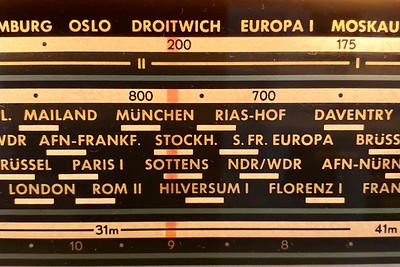
BBC Radio 4's long wave (LW) service, which reaches the British Isles and much of northern Europe from a 500,000 Watt transmitter on 198 kHz (and two supplemental 50 kW transmitters in Scotland), was discontinued earlier this year, on June 27, 2026. Radio 4 is the BBC's spoken-word service, which features news, literature, drama, and comedy. It may be the only station in the world that still produces content for the Theater of the Mind.
The end of LW radio had been anticipated for many years. The massive vacuum tubes (called glass valves in the UK) required for broadcasting at this power and frequency have not been manufactured for decades; only a few remain. The difficulty and cost of manufacturing new tubes or building a new transmitter from scratch coupled with a shift of listeners to other mediums combine to make the case for switching off.
A handful of specially crafted glass valves each measuring one metre high are all that is stopping the historic home of Test Match Special, Yesterday in Parliament and the Daily Service going suddenly and permanently off air.BBC Radio 4 long wave, which transmits on the 198 kilohertz frequency, relies on ageing transmitter equipment that uses a pair of the valves - no longer manufactured - to function.
The valves, at Droitwich in Worcestershire, are so rare that engineers say there are fewer than 10 in the world, and the BBC has been forced to buy up the entire global supply. Each lasts anywhere between one and 10 years, and when one of the last two blows the service will go quiet.
When they say long wave, they mean it. The wave length of a 198 kHz signal is 1515 meters, or just shy of a mile. By comparison, the signal of KRMG's FM signal at 96.5 MHz is 3.1 meters. (Divide the speed of light in meters per second -- about 300,000,000 -- by frequency in Hertz to get wavelength in meters.)
Most UK listeners hear Radio 4 these days on FM or on Digital Audio Broadcasting (DAB), both of which use frequencies in the VHF band and are therefore line-of-sight. There are 443 DAB transmitters across Britain. BBC multiplexes its national radio stations on 225.648 MHz. Rather than tuning a frequency, the listener chooses a station from a menu. A significant audience now listens via the BBC Sounds app, receiving the signal as mobile phone data.
Nevertheless, the long-wave transmitter reached audiences well beyond the reach of mobile phone towers and VHF signals. Oil platforms, freighters, and fishermen in the North Sea could hear the Shipping Forecast loud and clear over long wave from Droitwich. British expats and English-language learners across Europe could pick up the signal as well. In 2019, Richard Mudhar wrote of the value of AM radio during his hikes in remote parts of Wales, near Mt. Snowdon:
Since longwave and medium-wave coverage is almost universal in the UK, it can be heard by anyone anywhere. There are still regions where other types of radio broadcast cannot reach, making it an important lifeline. AM radio doesn't require an internet connection or 'phone signal, both of which can be unreliable. It can even be used by fisherman across the waters surrounding the British Isles to get all-important updates via the Shipping Forecast. In times of local power cuts, national crises and internet outages, AM radio remains resolute where other options fail. It is therefore a vital lifeline to bring news during crises.
198 kHz served other purposes. Millions of home electric meters listened for the daily signals to switch between low and high tariff rates, and appliances could listen to switch on and off to take advantage of the lower raes. Nuclear submarines could receive the signal without surfacing and thus could confirm that the UK had not been destroyed by a Soviet first-strike:
Because long-wave signals can penetrate seawater to a depth of several meters, Vanguard-class submarine commanders would regularly tune into the Today program on Radio 4 to make sure the country was still there. If the BBC and regular military channels went dead for more than 48 hours, the sub commander was authorized to open their sealed "Letters of Last Resort" from the Prime Minister.
Longwave's unique feature is its ability to travel large distances, owing to the size of the radio waves that it broadcasts. That means that a single transmitter can be used to serve an entire country and beyond - a remarkably efficient way to broadcast. This makes it the medium of choice for a climate-conscious age. Medium-wave cannot travel so far, and so requires more transmitters, but is still much more efficient than FM and DAB in this regard. To get the same coverage requires 100s of digital radio (DAB) or FM transmitters, which means a much greater cost of materials and energy required to make those broadcasts. AM (LW and MW) receivers use a fraction of the energy used by smartphones, computers, smart speakers and many DAB radios to receive the same programme.Since longwave and medium-wave coverage is almost universal in the UK, it can be heard by anyone anywhere. There are still regions where other types of radio broadcast cannot reach, making it an important lifeline. AM radio doesn't require an internet connection or 'phone signal, both of which can be unreliable. It can even be used by fisherman across the waters surrounding the British Isles to get all-important updates via the Shipping Forecast. In times of local power cuts, national crises and internet outages, AM radio remains resolute where other options fail. It is therefore a vital lifeline to bring news during crises.
The same groups are pushing to keep the BBC's remaining medium-wave (MW) transmitters on the air. 693 and 909 kHz broadcast BBC 5 Live, a talk-format station.
The magic of analog radio is that it doesn't require CPUs or specialized software or chips to encode, multiplex, demultiplex, and decode the signal. A simple, unpowered, crystal radio could pick up the long-wave signal and convert it back to sound waves. This is another example of Bates's Law of Creeping Technoslavery: A simple and robust technology is displaced by a more convenient but also more fragile system, to the point that it is no longer deemed cost-efficient to maintain the hardier fallback. The handful of users and use cases who aren't served by the new technology are lost in the transition.
Hillwalker Richard Mudhar expresses the problem concisely -- "driv[ing] innovation forward [while] driv[ing] resilience out":
More widely, market forces drive innovation forward but they also drive resilience out, concentrating things towards using the Internet for information delivery. I do wonder how well we would recover from a modern-day Carrington event, needing to black start a damaged Internet with a lot of satellite communications fried and limited power.
In the face of ridicule from know-nothings, the US House of Representatives did the right thing in passing the AM Radio in Every Vehicle Act last month. (Mandating NOAA weather radio would be another step forward.) The ubiquity of receivers makes it more reasonable for AM broadcasts to continue. Congress could do even better if they ensured that disused signals are available for members of the public to acquire for use. Clearing the former clear-channel frequencies for high-powered regional signals would be another favor to listeners in remote areas.
MORE: Some good comments on Richard Mudhar's essay and on Digital Spy about AM radio generally and LW in particular. One commenter mentions listening to NFL games in the UK over US Armed Forces Radio, broadcast on AM transmitters in West Germany during the Cold War. Those stations were taken off air in 2013 and the antenna masts demolished in 2015. Another commenter worries: "lf the internet were to go down due to war or other catastrophic events, we'd all be in the dark. No option to turn on a radio and keep in touch."
 Subscribe to this blog's feed: