BBC long-wave radio service goes dark after 102 years
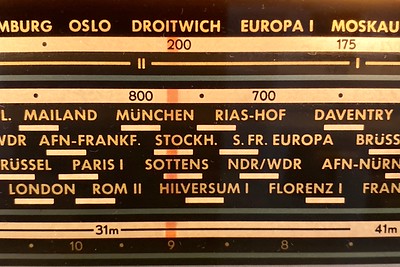
BBC Radio 4's long wave (LW) service, which reaches the British Isles and much of northern Europe from a 500,000 Watt transmitter on 198 kHz (and two supplemental 50 kW transmitters in Scotland), was discontinued earlier this year, on June 27, 2026. Radio 4 is the BBC's spoken-word service, which features news, literature, drama, and comedy. It may be the only station in the world that still produces content for the Theater of the Mind.
The end of LW radio had been anticipated for many years. The massive vacuum tubes (called glass valves in the UK) required for broadcasting at this power and frequency have not been manufactured for decades; only a few remain. The difficulty and cost of manufacturing new tubes or building a new transmitter from scratch coupled with a shift of listeners to other mediums combine to make the case for switching off.
A handful of specially crafted glass valves each measuring one metre high are all that is stopping the historic home of Test Match Special, Yesterday in Parliament and the Daily Service going suddenly and permanently off air.BBC Radio 4 long wave, which transmits on the 198 kilohertz frequency, relies on ageing transmitter equipment that uses a pair of the valves - no longer manufactured - to function.
The valves, at Droitwich in Worcestershire, are so rare that engineers say there are fewer than 10 in the world, and the BBC has been forced to buy up the entire global supply. Each lasts anywhere between one and 10 years, and when one of the last two blows the service will go quiet.
When they say long wave, they mean it. The wave length of a 198 kHz signal is 1515 meters, or just shy of a mile. By comparison, the signal of KRMG's FM signal at 96.5 MHz is 3.1 meters. (Divide the speed of light in meters per second -- about 300,000,000 -- by frequency in Hertz to get wavelength in meters.)
Most UK listeners hear Radio 4 these days on FM or on Digital Audio Broadcasting (DAB), both of which use frequencies in the VHF band and are therefore line-of-sight. There are 443 DAB transmitters across Britain. BBC multiplexes its national radio stations on 225.648 MHz. Rather than tuning a frequency, the listener chooses a station from a menu. A significant audience now listens via the BBC Sounds app, receiving the signal as mobile phone data.
Nevertheless, the long-wave transmitter reached audiences well beyond the reach of mobile phone towers and VHF signals. Oil platforms, freighters, and fishermen in the North Sea could hear the Shipping Forecast loud and clear over long wave from Droitwich. British expats and English-language learners across Europe could pick up the signal as well. In 2019, Richard Mudhar wrote of the value of AM radio during his hikes in remote parts of Wales, near Mt. Snowdon:
Since longwave and medium-wave coverage is almost universal in the UK, it can be heard by anyone anywhere. There are still regions where other types of radio broadcast cannot reach, making it an important lifeline. AM radio doesn't require an internet connection or 'phone signal, both of which can be unreliable. It can even be used by fisherman across the waters surrounding the British Isles to get all-important updates via the Shipping Forecast. In times of local power cuts, national crises and internet outages, AM radio remains resolute where other options fail. It is therefore a vital lifeline to bring news during crises.
198 kHz served other purposes. Millions of home electric meters listened for the daily signals to switch between low and high tariff rates, and appliances could listen to switch on and off to take advantage of the lower raes. Nuclear submarines could receive the signal without surfacing and thus could confirm that the UK had not been destroyed by a Soviet first-strike:
Because long-wave signals can penetrate seawater to a depth of several meters, Vanguard-class submarine commanders would regularly tune into the Today program on Radio 4 to make sure the country was still there. If the BBC and regular military channels went dead for more than 48 hours, the sub commander was authorized to open their sealed "Letters of Last Resort" from the Prime Minister.
Longwave's unique feature is its ability to travel large distances, owing to the size of the radio waves that it broadcasts. That means that a single transmitter can be used to serve an entire country and beyond - a remarkably efficient way to broadcast. This makes it the medium of choice for a climate-conscious age. Medium-wave cannot travel so far, and so requires more transmitters, but is still much more efficient than FM and DAB in this regard. To get the same coverage requires 100s of digital radio (DAB) or FM transmitters, which means a much greater cost of materials and energy required to make those broadcasts. AM (LW and MW) receivers use a fraction of the energy used by smartphones, computers, smart speakers and many DAB radios to receive the same programme.Since longwave and medium-wave coverage is almost universal in the UK, it can be heard by anyone anywhere. There are still regions where other types of radio broadcast cannot reach, making it an important lifeline. AM radio doesn't require an internet connection or 'phone signal, both of which can be unreliable. It can even be used by fisherman across the waters surrounding the British Isles to get all-important updates via the Shipping Forecast. In times of local power cuts, national crises and internet outages, AM radio remains resolute where other options fail. It is therefore a vital lifeline to bring news during crises.
The same groups are pushing to keep the BBC's remaining medium-wave (MW) transmitters on the air. 693 and 909 kHz broadcast BBC 5 Live, a talk-format station.
The magic of analog radio is that it doesn't require CPUs or specialized software or chips to encode, multiplex, demultiplex, and decode the signal. A simple, unpowered, crystal radio could pick up the long-wave signal and convert it back to sound waves. This is another example of Bates's Law of Creeping Technoslavery: A simple and robust technology is displaced by a more convenient but also more fragile system, to the point that it is no longer deemed cost-efficient to maintain the hardier fallback. The handful of users and use cases who aren't served by the new technology are lost in the transition.
Hillwalker Richard Mudhar expresses the problem concisely -- "driv[ing] innovation forward [while] driv[ing] resilience out":
More widely, market forces drive innovation forward but they also drive resilience out, concentrating things towards using the Internet for information delivery. I do wonder how well we would recover from a modern-day Carrington event, needing to black start a damaged Internet with a lot of satellite communications fried and limited power.
In the face of ridicule from know-nothings, the US House of Representatives did the right thing in passing the AM Radio in Every Vehicle Act last month. (Mandating NOAA weather radio would be another step forward.) The ubiquity of receivers makes it more reasonable for AM broadcasts to continue. Congress could do even better if they ensured that disused signals are available for members of the public to acquire for use. Clearing the former clear-channel frequencies for high-powered regional signals would be another favor to listeners in remote areas.
MORE: Some good comments on Richard Mudhar's essay and on Digital Spy about AM radio generally and LW in particular. One commenter mentions listening to NFL games in the UK over US Armed Forces Radio, broadcast on AM transmitters in West Germany during the Cold War. Those stations were taken off air in 2013 and the antenna masts demolished in 2015. Another commenter worries: "lf the internet were to go down due to war or other catastrophic events, we'd all be in the dark. No option to turn on a radio and keep in touch."
0 TrackBacks
Listed below are links to blogs that reference this entry: BBC long-wave radio service goes dark after 102 years.
TrackBack URL for this entry: https://www.batesline.com/cgi-bin/mt/mt-tb.cgi/9448
 Subscribe to this blog's feed: