Oklahoma Election 2026: March 2026 Archives
Tulsa Public Schools is asking voters to approve four bond issue propositions, totalling $609 million, on the April 7, 2026, ballot. Every voter registered within the boundaries of Tulsa Public Schools is eligible to vote, regardless of party registration, whether or not you have children in TPS, whether or not you directly pay property taxes. The breakdown and ballot language is here.
Proposition No. 1: $200,985,000, due in 5 years, "to provide funds for the purpose of purchasing or acquiring textbooks, library books, electronic media content, computer software, perpetual or continuous district software license agreements and web-based software subscriptions, along with programs and facilities for early childhood, Montessori, stem labs, post-secondary readiness, fine arts, and athletics including the construction, equipping, repairing and remodeling of those facilities, acquiring and improving school sites, and purchasing or acquiring school furniture, fixtures, and equipment...."
Proposition No. 2: $276,000,000, due in 15 years, for "repairing, remodeling, constructing and equipping school buildings, purchasing or acquiring school furniture, fixtures and equipment and acquiring and improving school sites...."
Proposition No. 3: $104,785,000, due in 5 years, for "purchasing or acquiring technology equipment including computer hardware and software and web-based software subscriptions along with repairing and remodeling school buildings to accommodate technology equipment...."
Proposition No. 4: 27,230,000, due in 5 years, for "purchasing or acquiring transportation equipment...."
There's a further "breakdown" of each proposition into "specific projects" at the link, but it doesn't get into specifics as to which school sites will receive the specified improvements. The term "district wide" gets used a lot. The grouping is puzzling, and there seems to be overlap between Prop 1 and Prop 3 when it comes to computer equipment. The phrase "including but not limited to" applies to each list of spending line items. There really isn't a way for a voter to choose traditional bond issue items like building repairs, without also voting for computer software. It's a violation, in spirit, of the single-subject rule in the Oklahoma Constitution.
The biggest line items in the breakdown, everything over $10 million, in descending order:
- $119,095,000 in Prop 2: Remodeling of various school facilities district wide; furniture purchase or acquisition for school facilities district wide; painting flooring service contracts for school facilities district wide; window repair and replacement for school facilities district wide; foundation and paving repairs for school facilities district wide; and LED lighting replacement for school facilities district wide.
- $68,324,000 in Prop 3: Student & Teaching Technology
- $67,760,000 in Prop 2: HVAC repair and replacement for school facilities district wide
- $61,292,000 in Prop 1: Instructional learning materials; textbooks; instructional electronic media content and software; exceptional and special needs equipment and curriculum
- $42,192,000 in Prop 2: Safety and Security, Entries, Fencing and Radios including secure entry and security improvement for school facilities district wide; fencing at school facilities district wide; radios district wide and alarm panels and sensor replacements for school facilities district wide
- $40,900,000 in Prop 1: Post-secondary readiness and career academies district wide
- $40,567,000 in Prop 1: Wellness and physical education equipment purchase or acquisition; and constructing, equipping, repairing and remodeling school facilities district wide including sports fields, turf, and facilities
- $33,730,000 in Prop 3: Cybersecurity, data storage, and network systems and software
- $22,000,000 in Prop 2: Roof replacement or repair for school facilities district wide
- $14,020,000 in Prop 4: Buses
- $12,804,000 in Prop 1: Fine arts facilities district wide including improvements to auditorium stage, sound, and lighting; fine arts uniforms, equipment, and instruments
- $12,250,000 in Prop 2: Dining, kitchen improvements and kitchen equipment purchase or acquisition for school facilities district wide
- $11,550,000 in Prop 1: Site project funding for repairing, remodeling, constructing, and equipping school facilities district wide along with the purchase or acquisition of equipment
- $10,860,000 in Prop 1: Early childhood and Montessori programs district wide
The money for "post-secondary readiness and career academies" and "early childhood and Montessori programs" looks like mission creep. Is this money for new buildings? It can't be used to pay salaries. Will it be used to pay consultants? Are these projects that the philanthropocrats are pushing for?
Former Tulsa City Councilor and financial analyst Jayme Fowler urges a no vote on all four propositions. He points out that the TPS cost per student is 25% more than the cost of private school and has increased 56% since 2018, with a 73% increase in non-instructional costs and a 21% drop in student achievement in that same time frame. Fowler notes that TPS had about 80,000 students and 9 high schools in 1969. 57 years later, TPS still has 9 high schools but only about 34,000 students. (Granted, TPS opened a high school, Mason, and closed it a few years later in the 1970s.) Fowler wants TPS to consolidate programs to fewer campuses and sell off surplus properties.
TPS Per Pupil Expenditure is $14,415.28. That's twice the amount per student spent by Tulsa Classical Academy ($7,115.67) and higher than the state average of $11,962.54.
Fowler writes:
This $609 Million bond package is business as usual on auto-pilot. The bonds continue the long history of zero accountability and the inevitable waste of tax-payer money. But far worse, they rob our children of the future they deserve and reward the system and the people responsible for that theft. The proposals are entirely out of sync with the TPS 5-year plan. The Pathways to Opportunity plan is a commitment made to students and families that TPS must keep.
Fowler reminds us that TPS was audited on a small portion of their spending, and the audit found massive fraud:
[The State Auditor] Investigated $37.7 million in spending, 2015 - 2023. Only included 90 vendors and 900 invoices. That's less than 1% of the $4.1 Billion spent by TPS in that timeframe. [The audit] Uncovered wire fraud, misappropriation of funds, illegal no-bid contracts & payments, and coordinated attempts to hide spending related communications in violation of the open records act. A single person, Devin Fletcher was charged for misappropriating $824,000. TPS Illegally paid over $500,000 in bonuses to 35 administrators and 5 other employees through a third-party, Foundation for Tulsa Schools. It's time to audit the other 99% of TPS spending!
Not all conservatives are opposed to the bond issues. Bob Jack, former Tulsa County Republican Party chairman, served on the TPS Bond Development Committee and urges voters to support it. He claims that concerns of lack of financial control are outdated. "...[U]nder the leadership of a new CFO and the addition of internal auditor, patrons of TPS can be assured that the problems of the past are no longer an excuse."
Oklahoma's use of long and rotating board terms, with elections happening at an odd time of year, mean that our public school boards don't have much in the way of effective accountability from the voters. Unfortunately, at most two Tulsa board members are up for election every year, and it takes four years for each seat to come up in turn. Voting down bond issues are an excellent way for voters to get the attention of the board and the administration.
I could make an argument for voting for Propositions 2 and 4, which are more in line with traditional bond issues for facilities and transportation, but against 1 and 3, which includes new programs and more money for non-facility items. Even so, TPS's record of financial irresponsibility makes me wonder about how much fluff and padding is in the numbers for those "non-controversial" line items. It would be reasonable to expect the board to commit to truly specific projects, naming the schools that will receive new roofs or the specific sports and fine arts facilities that will be upgraded. That would also be a way for the voters to ensure that there isn't favoritism in the allocation of improvement money to schools. Without those specifics, there's nothing to hold TPS to.
I encourage TPS residents to vote no on April 7, 2026, on all four Tulsa Public School bond issues.
MORE:
The Bond Transparency Act of 2017 requires public school districts to report annually on their outstanding bond issues -- how much was approved, how much has been bonded, how much has been spent and on what specific items. These reports do delve into which specific school buildings received which upgrades and at what cost.
 Conservative author and journalist Ted King is running for the Office 1 school board seat in the Justus-Tiawah School District in Rogers County, east of Claremore. Justus-Tiawah is a PK-8 district, with no high school. It serves 460 students from two campuses, Pre-Kindergarten to 2nd Grade in Tiawah and 3rd through 8th Grades on Highway 20 near Will Rogers Downs. Like all elementary districts, Justus-Tiawah has only three school board members. The election will be held on Tuesday, April 7, 2026. Early voting at the Rogers County Election Board, 415 W. 1st St., Claremore, will be held on Thursday and Friday, April 2-3, from 8 a.m. to 6 p.m.
King is the author of Cowboy Bethlehem: The Story of Our Lady of Clear Creek Abbey, published in 2025, and The War on Smokers and the Rise of the Nanny State, published in 2009.
I've known Ted King for many years and am proud to call him a friend. When the United Kingdom officially "Brexit-ed" the European Union, Ted and I met at the White Lion pub to toast the happy event with a celebratory pint. He and I both had the opportunity to meet the head of the Reform UK Party, Nigel Farage, before his 2021 Tulsa speech; Farage is on track to be elected Prime Minister in 2029 or sooner.
Ted King was urged to run by Mary Alice Nelson, a fellow rural Rogers County resident, Cal-Berkeley graduate, horse trainer, and frequent caller to the Pat Campbell Show on KFAQ. Mary Alice, who passed away last November at the age of 91, believed that more people should step up and take leadership in their communities. Ted shares Mary Alice's commitment to a "back to basics" approach to education that celebrates the founding principles of America and provides our young people with a solid foundation of truth.
While the Justus-Tiawah District administration is proud of being above the state average, there's plenty of room for improvement. Only 31% of its students tested as proficient or better in English Language Arts and only 38% tested as proficient or better in math.
The district has about 3,100 voters, 70% of whom are, like Ted King, registered Republican. Incumbent Pamela Chandler is registered as an independent. Neither appear to have a campaign website, but here are their Facebook profiles: Pamela Chandler, Ted King. In last year's election, only 181 votes were cast.
All voters in the school district are eligible to cast a ballot in this election. I hope you'll vote for my friend Ted King and put a thoughtful conservative Christian, committed to educational excellence, on the Justus-Tiawah school board.
 There are two Tulsa school board seats up for election on April 7, 2026. Voters on the southern edge of the Tulsa Public Schools district have the opportunity to elect an experienced educator to become the second conservative Republican on the board to push for accountability, transparency, and real education.
Michael Phillips, running for Tulsa Public Schools Office 7, is retired from twenty-two years as a high school math teacher in Tulsa Public Schools. Phillips's assignments included Central and Edison High Schools. He is also a founder of and leader in the Tulsa County Republican Men's Club.
On his website, Phillips explains his reasons for running and his goals for his work as a board member.
Michael and his wife have attended virtually every school board meeting in person starting the summer of 2022. Michael observed that the vast majority of the agenda items (including spending hundreds of millions of dollars) were passed with little or no public discussion. Thus, the public remained unaware of the pluses and minuses of how the money was being used. It looked like the board was simply rubber stamping what the administration had already decided to do. That worried Michael. The worry grew and he decided to run for a seat at the table.If elected he pledges to press for:
(1) options the board can openly discuss
(2) agenda items that allow the board to fulfill its duty of setting the vision for the district
(3) the ability to temporarily postpone portions of the agenda to a date certain so that the board can investigate the usefulness of the items for educating children
He pledges to serve his constituents by soliciting and reporting their input, making the successful education of children the primary concern, and using his judgment when voting.
On his campaign Facebook page, Michael Phillips addresses a number of issues in short videos, including the importance of respect for teachers from administration and students as a factor in teacher retention and why the board needs to direct more money to the classroom and less to administrative overhead. Phillips has been walking his district since before the new year, through all kinds of weather, and with the help of supporters like State Sen. and legendary TU football coach Dave Rader. Congressman Kevin Hern has endorsed Michael Phillips's run for school board.
Phillips is running to unseat Democrat incumbent Susan Lamkin, who has been a rubber stamp for the TPS administration and TPS's rampant and wasteful spending on consultants at the behest of the local philanthroparchy, who use strings-attached "donations" to dictate school policy. Lamkin has received three reported donations: $3,500 from Lynn Schusterman; $1,000 from Steve Mitchell, CEO of Argonaut, George Kaiser's private equity fund (remember Solyndra?); and $500 from Fred Dorwart, attorney for George Kaiser's network of businesses and organizations. The same bunch funded her very pricey 2022 campaign. A vote for Lamkin is a vote to let these left-wing philanthropocrats continue to use Tulsa Public Schools as a guinea pig for their social experiments. (Campaign contribution and expenditure reports can be found by searching on the Oklahoma Ethics Commission local campaign filings page. Sorry, no permalinks.)
I'm grateful to have had E'Lena Ashley on the school board these past four years, and I'm hopeful that she will be re-elected. If we also get Michael Phillips elected, we'll have two conservative Republicans on the board who can collaborate and support one another as they seek to hold the TPS administration accountable and begin to align the district with sound fiscal and educational policy.
 We have exactly one conservative Republican on the school board of one of the largest school districts in Oklahoma. Her name is E'Lena Ashley. In 2022, she defeated the incumbent to win Office 4 to represent east Tulsa on the Tulsa Public School board, where she has been a constant and often lone voice for wisdom and accountability. E'Lena Ashley is up for re-election on April 7, 2026, and TPS taxpayers and parents need her back on the board.
Since taking office, E'Lena Ashley has held monthly community meetings where she has communicated news from the school district, listened to the concerns of the community, and invited speakers on a variety of topics related to TPS, including Superintendent Dr. Ebony Johnson. On the board, she has been a constructive critic of the administration and the board majority. In 2025, Ashley and then-board member Dr. Jennettie Marshall held a press conference to spotlight the findings of the State Auditor's report on TPS financial mismanagement, complaining that, although the leadership at the top had changed, the administration was still not providing board members with the information they requested.
Ashley and Marshall also joined forces in a lawsuit challenging the board majority's lack of transparency and move to hire interim Superintendent Ebony Johnson without following the board's written policy requiring a nationwide search. Ashley has been blamed for the money the district spent to defend against the lawsuit, but surely the expense could have been avoided by the board following its policies and striving for transparency. Although the lawsuit was unsuccessful, I admire Ashley's willingness to take a stand for transparency on behalf of the taxpayers and parents of the district.
Four years ago, we briefly had some hope of a majority of Tulsa school board members committed to financial responsibility and accountability. Jennettie Marshall and Jerry Griffin had been advocates for transparency on the board, and E'Lena Ashley was running to defeat an incumbent while former District Attorney Tim Harris was running for the open seat in Office 7. Harris was narrowly defeated in a very expensive campaign, but with Ashley's election there was a substantial minority of three reformers on the board. With a rubber-stamp member missing from a July 2022 board meeting, Ashley, Griffin, and Marshall were able to block a consent agenda packed with controversial items, including accepting Chinese Communist funding for "Confucius Classroom" at Booker T. Washington High School. In the end, Ashley was the only vote against accepting the Confucius Classroom grant.
And now, with Griffin and Marshall deciding not to run for re-election out of frustration with administration stonewalling, Ashley is the lone voice for transparency and fiscal sanity. The administration continues to waste money on consultants and outside vendors, continues to be driven by unaccountable philanthropocrats. When the administration tries to smuggle questionable spending and controversial proposals into the consent agenda, E'Lena Ashley uses her seat at the table to pull those items aside for scrutiny. Despite her willingness to stand alone on many issues, E'Lena manages to remain gracious in her questions and her interactions with the administration. If we lose her, we lose that lone voice. We need E'Lena Ashley back for another four years, and we need to elect conservative Republican Michael Phillips, who is running against incumbent Democrat Susan Lamkin for Office 7.
Ashley's opponent is former Tulsa City Councilor Connie Dodson. Dodson was defeated for re-election in 2022 by Christian Bengel. As a councilor, during the COVID-19 pandemic, Dodson advocated for drive-thru private dances to keep strip-club dancers employed:
An enterprising owner of a Tulsa "gentlemen's club" wants to go all Las Vegas and offer drive-thru service.So City Councilor Connie Dodson -- ever responsive to the needs of her constituents -- has asked city legal the question everyone is wondering but no one will say out loud: In these grave times of economic peril, deadly disease and social distancing, can we do the same thing here in Tulsa?
"When the owner reached out to me, I said, 'I applaud your efforts to be creative,'?" Dodson said. "I mean, that is what everybody is trying to do now ... be creative so that they can stay in business and keep people employed."...
"Set up one of those large white tents that you can drive through, so the patron would literally drive into the tent, pay their money, get a private show or a private dance, and not get out of their car," she said....
Dodson said what she's heard is that the economic downturn caused by the COVID-19 outbreak has hit dancers particularly hard.
"So they are trying to be real creative in keeping their businesses running, and this was something that came up, and I thought, I'll reach out," she said.
After I endorsed Bengel over Dodson, I received an irate and bizarre Facebook message from D. Richard Dodson, who appears to be Connie Dodson's husband. Mr. Dodson accused me of being full of "donkey bullsh[**]." This person's Facebook "likes" revealed a great deal of interest in strip clubs, sex toy shops, BDSM, and barbecue, which might explain Councilor Dodson's legislative concerns. The profile has since been taken over by a Vietnamese spammer, but those "likes" are still there. (I have screenshots of the state of the profile as it was at the time of Mr. Dodson's unhinged complaint.)
My suspicion is that Dodson was asked to run because she can be counted on to be a rubber-stamp and not to ask uncomfortable questions. Having just one board member who asks questions is too many for the people pulling the strings, because it exposes their plans to public scrutiny.
I'm proud to endorse E'Lena Ashley for re-election and urge east Tulsans to vote for her on Tuesday, April 7, 2026.
 Tulsa Technology Center is a wonderful asset for the Tulsa metro area. On a relatively small millage (13.33 mills) and no bond issues, the district built and maintains six modern campuses and offers training for an extensive range of careers. The district suffered a significant setback with extensive tornado damage to the North Peoria campus on March 6, 2026.
Republican incumbent Jim W. Baker is running for re-election to a 7-year term to the board of the Tulsa Technology Center. Baker serves Office 7, which covers the southern part of Tulsa County, including Bixby, Glenpool, Jenks, and most of Tulsa south of 81st Street, and the portions of Okmulgee and Wagoner counties in the Tulsa Tech district. Baker has been the board member for District 7 since 1988. The election is April 7, 2026. There are two candidates; Baker is being challenged by school teacher Matthew McAfee.
Scott Gaspar offered this tribute to Jim Baker on his Facebook profile:
Over 40 years ago, I met Dr. Jim Baker in high school through his DECA class (Distributive Education Clubs of America)--a student organization designed to prepare young people for careers in marketing, finance, hospitality, and management. I signed up mostly because it sounded like an easy class that let me leave school early every day.Classic teenage thinking.
What I actually found--and what thousands of others who crossed paths with Dr. Baker discovered--was something far more powerful: a life-changing experience that still shapes how I approach life and business today.
Dr. Baker's class had a completely different culture, so different that many other teachers openly criticized it. We weren't just taught to think about things; we were taught to do them. When a topic came up, we didn't stop at classroom theory. Dr. Baker brought in real-world examples and connected us directly with the professionals involved. The level of engagement was unlike anything I had ever experienced in school.
Assignments required us to call or meet with actual business owners, bankers, and entrepreneurs. We developed real business plans, financial forecasts, and marketing strategies. We learned the genuine work ethic needed for success after graduation. We used technology and research tools to explore business processes, accounting, and marketing far beyond any textbook.
Dr. Baker introduced us to an entirely new culture of education--and we embraced it. We worked hard on presentations and built meaningful, lifelong relationships with business leaders. For the first time, we truly understood the realities of work, the challenges of building a business, and the sacrifices successful people make. In the 1980s, Dr. Baker was already teaching Career and Technical Education (CTE) before the term even existed.
I've followed his career ever since. He carries that same culture of responsibility, accountability, and real-world focus wherever he goes. He's not a polished politician--he has zero tolerance for nonsense--but his record is extraordinary. His credentials are outstanding, his experience vast, and most importantly, he has produced thousands of living success stories: professionals and business owners across Oklahoma and the United States who credit him with changing their trajectories.
Dr. Baker played a pivotal role in transforming what we kids of the '70s and '80s jokingly called "the high school with ashtrays" (Tulsa Vo-Tech) into one of the premier Career Technology institutions in the country. Today, Tulsa Tech offers cutting-edge programs in cybersecurity, radiology, aviation, biotechnology, and much more.
He has led the modernization and expansion of outdated 1960s- and '70s-era facilities without relying on the large, burdensome bond measures common in other public school districts. (Tulsa Tech is a public school district.) The entire community has benefited.
Dr. Jim Baker is running for re-election on April 7th.
These school board elections are poorly publicized and typically see very low turnout. In District 7, only about 2,000 votes are usually cast out of more than 96,000 eligible voters. Dr. Baker faces a well-funded opponent in [Matthew] McAfee, whose background includes teaching at Edison and a short-lived bookstore venture in Mother Road Market that closed after a couple of years. McAfee left teaching in 2019, with no subsequent public employment record listed, yet he presents this as qualification to manage Tulsa Tech's $335 million+ budget. His campaign has been active, with events and a strong volunteer team.
If you live in the Tulsa area, Dr. Baker has almost certainly touched your life--through the skilled nurse who cared for you in the ER, the IT professional who keeps your systems secure, the aircraft technician who maintains the plane you fly on, the firefighter who protects your community, or the entrepreneur who runs your favorite restaurant. Countless graduates credit their success to the education they received at Tulsa Tech under his leadership.
I encourage everyone to vote in school board elections, even if you don't have children in the system. The graduates of Tulsa Tech become the professionals we all rely on every day. While these races have become increasingly political, experience, results, and vision should still matter most.
Please do your own research and vote based on track record. If you've ever visited a Tulsa Tech campus, hired one of its excellent graduates, or benefited from its programs, I hope you'll support Dr. Baker on April 7th so this proven culture of excellence can continue.
Whether you're in District 7 or not, please share this. Dr. Baker has given more than 40 years of selfless service to our community and proven leadership at scale.
Chances are, someone you know has been positively impacted by his work. Let's make sure it continues. If you would like to learn more about Jim, visit his website: https://drjimbaker.com/
Here are some additional details:
- Holds a Doctorate from OSU in Occupational Adult Education
- Expanded Tulsa Tech to multiple campuses
- Added dozens of new career paths to the Tulsa Tech offering
- Embedded career tech programs into Tulsa high schools
- Helped build state of the art facilities
- Attracted industry-leading instructors
- Vision of Excellence Award
- Tulsa Tech Hall of Fame
- Oklahoma All-State School Board Member
- Former Jenks Teacher of The Year
- Former Oklahoma Marketing Teacher of The Year
- Former Oklahoma Career Tech Teacher of The Year
- Former Region IV Career Tech Teacher of The Year
- 40 Years of law enforcement service as a reserve officer
- FEMA certified
If you would like to research his opponent, [Matthew] McAfee, here is his website: https://sites.google.com/view/mcafee-for-tulsa-tech/home
Please share, comment, and most importantly participate in this election.
Baker is a registered Republican voter. 21 years ago, when he was running for his third full term, I published a statement from his campaign, with the note that his campaign advisor, whom I met at Republican county headquarters where we were both volunteering to get out the vote for the 2004 election, called Baker the conservative in the race.
You can find Baker's campaign contribution and expenditures filings at the new Oklahoma Ethics Commission Local Campaign Finance Transparency Portal. Unfortunately, the Ethics Commission is still allergic to permalinks for individual candidates or reports, but if you'll go to the portal, you can search the name Baker and find his filings to date. Baker has raised $8,130 and spent $6,300.
Matthew McAfee is also a registered Republican, although his wife is a registered independent. Matthew McAfee was registered as an independent when the couple lived in the Yorktown neighborhood in Midtown, prior to their move to south Tulsa and Tulsa Tech District 7 in February 2023. McAfee served as Yorktown Neighborhood Association's representative on the Tulsa Preservation Commission and as president. The couple owned Eleanor's Bookshop in the Shops at Mother Road Market at 11th and Lewis from the Shops' opening in September 2020 until December 2022, when they opted to close the store after the birth of their first child earlier in the year. They wrote at the time that "there weren't enough hours in the day" for parenthood, small business ownership, and full-time jobs as public school teachers.
On his campaign website, McAfee writes that he attended Jenks Public Schools and Victory Christian School, is a deacon at First Presbyterian Church, and moved south so that their children could attend Jenks Southeast Elementary where he went to school. His website does not list his current employment, but a Facebook post indicates he is a Community School Coordinator for the Union Public Schools 6th Grade Center, which is confirmed on the Union district website and the 6th Grade Center website. His wife Kelsey is a Career Connect advisor for Union High School.
McAfee's bookshop began as a pop-up at Mother Road Market, won a competition to get one of the spaces in the Shops at Mother Road Market, then received funding from a Kiva loan under the trusteeship of the Lobeck Taylor Family Foundation. According to this Tulsa Kids article, Eleanor's Bookshop was named to honor Eleanor Roosevelt. McAfee has yet to file a contribution and expenditures report, but I have a suspicion that former Democrat Mayor Kathy Taylor's name will be on it. The bookshop's Facebook feed often highlighted children's books written from a progressive perspective, such as this Election Day 2020 post advertising Jill Biden's children's book about Joe Biden and Kamala Harris's Superheroes Are Everywhere and a post promoting a book featuring the poem read at Biden's inauguration. Does this represent McAfee's personal politics, or was it a facade to ingratiate himself with his landlord and benefactor?
Based on Scott Gaspar's testimonial and Dr. Baker's many years of experience in vocational education, and in light of indications of his opponent's leftward leanings, I'd vote to re-elect Dr. Jim W. Baker to the Tulsa Tech board.
Posted a few minutes ago on Facebook by Lieutenant Governor Matt Pinnell:
Lisa and I decided to not run for Governor because we were ready for a new chapter outside politics. While the announced developments in our congressional delegation opened up that conversation again the past few days, it has not changed how we feel about pursuing something new outside of politics. I will not be a candidate for any elected public office this year. Serving the state as Lieutenant Governor has been an incredible honor, and we're excited about a new season in our family's life when my term is finished.
Pinnell is one of those rare politicians that has managed not to diminish his popularity after eight years in office. The usual way to exercise stewardship of political capital is to use it to gain higher office, where greater impact is possible, but there are other ways, and it will be interesting to see what that looks like for Pinnell.
Oklahoma State Question 836 will not appear on the Oklahoma ballot. The initiative petition fell short of the required number of signatures.
From the Oklahoma Secretary of State website:
Initiative petition 448 filed January 3, 2025; SC order 2025 OK 56 - Laws in effect as of 11/2024 will apply-SB1027 (2025) will not be applied to SQ836; 42 boxes of signed petition pamphlets timely filed 01/26/2026 on behalf of IP448; SOS Petition verification process concluded March 3, 2026; SOS filed the required signature verification report with the Supreme Court March 5, 2026; The total number of signatures verified, with unique matches to the Oklahoma Public Voter Registration file for Initiative Petition 448, is 142,567.
The signature threshold for initiative petitions for a constitutional amendment, defined in Article V, Section 2 of the Oklahoma Constitution, is 15% of the number of votes cast in the last regular general election for Governor. That's 1,153,284 * 15% = 172,993. According to the report filed yesterday by Oklahoma Secretary of State Benjamin Lepak with the Oklahoma Supreme Court, the petitions filed contained only 142,567 validated signatures. (The verification report is page 98 of the SQ 836 file.)
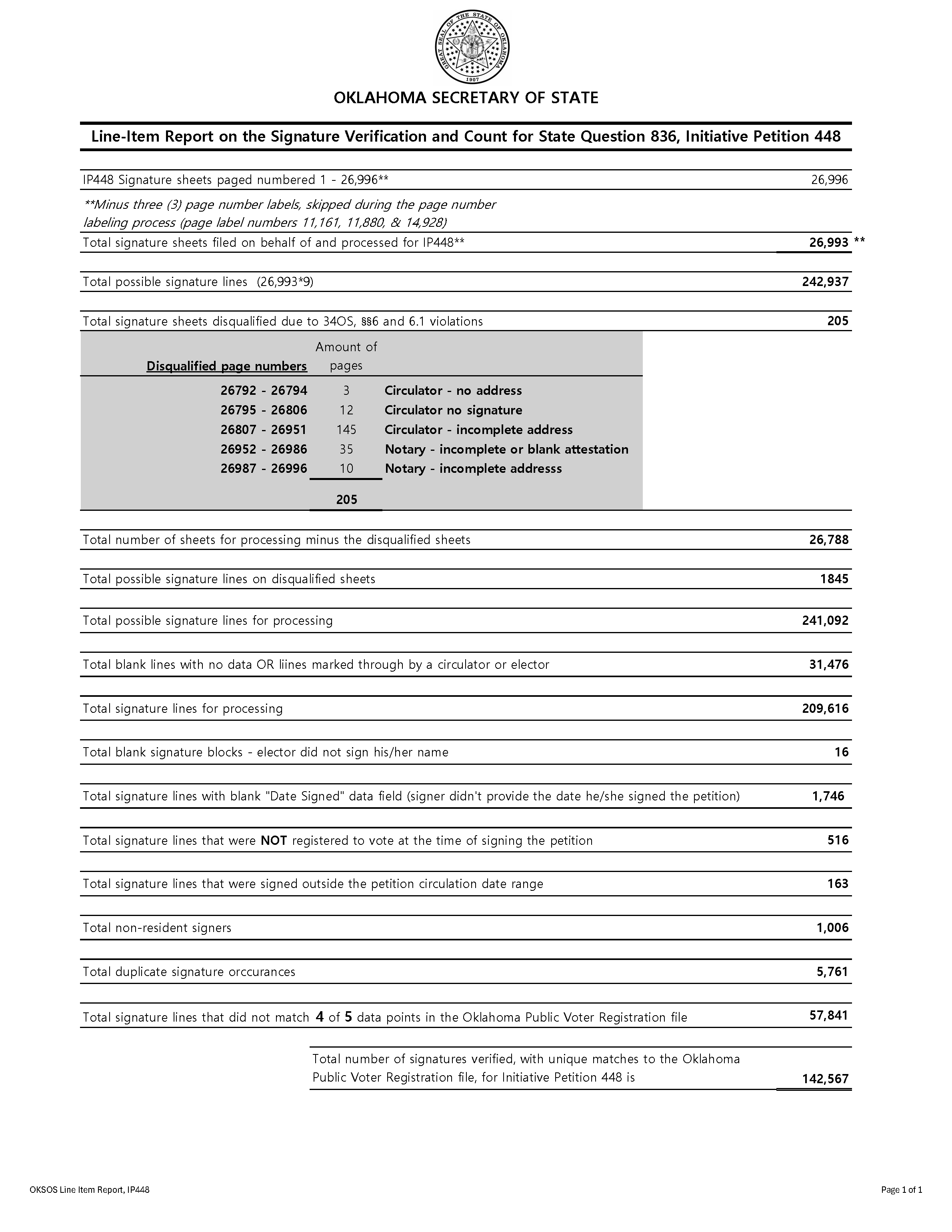
The vast bulk of disqualified signatures were the 57,841 signature lines which "did not match 4 of 5 data points in the Oklahoma Public Voter Registration file." 27.6% of the 209,616 signatures that were submitted failed to meet this simple test. HB 3826 (2020 Regular Session) added a verification requirement to 34 O.S. 2: "The following five data points shall be included on the form: the voter's legal first name, legal last name, zip code, house number and numerical month and day of my birth.... In order for the signature to be approved by the Secretary of State, three or more data points described in subsection A of this section must be matched to the voter registration file." SB 518 (2024 Regular Session) increased the threshold to four data points out of five. So if a registered voter who signed the petition managed to correctly write down his legal first and last name, birthday, and house number, but got the zip code wrong, the signature would be considered valid. The process does not appear to require that the signature itself matches the signature on your voter registration form.
Another 9,208 signatures (4.4%) were (in decreasing order) duplicates (5,761), undated (1,746), non-residents (1,006), not registered to vote (516), signed outside of the petition-gathering period (163), or unsigned (16). Another 205 pages, containing a potential 1,845 names, were discarded because the circulator didn't provide a complete address or any address at all or didn't sign the sheet or because the notary information was incomplete.
If a similar proportion of signatures had been disqualified, it may be that some of our most nefarious initiative petitions would have never made the ballot. If just 3% of SQ 788 (Medical Marijuana) signatures had been invalidated, it would have fallen short of the lower threshold required for a statutory initiative. The file for SQ 832 (escalating minimum wage) does not indicate that the signatures were cross-checked in the manner required by HB 3826 and if so, how many were disqualified. SQ 832 was filed before SB 518 went into effect, so only the threshold would have been only three of five data points matching the voter file. SQ 832 was also not required to meet the geographical distribution requirements of SB 1027 (2025) which limits the proportion of signatures that can be collected from large counties.
An organization called Oklahoma United was behind the push for SQ 836. Its founder and CEO, Margaret Kobos, was an attorney with Frederic Dorwart Lawyers and before that was an executive at the Bank of Oklahoma, two key nodes of George Kaiser's philanthropocratic network.
I won't be surprised if there is a legal challenge to this outcome. I would expect future petition efforts to scrutinize their own petitions and conduct their own matching process in order to have an accurate running count of valid signatures.
Rick Carpenter, who led the Taxpayer Bill of Rights petition effort, commented that "the new petition rules have made the initiative petition a quaint remembrance of the past." SB 1027 (2025), which sets geographical limits to require a proportion of signatures to come from outside metro areas, did not apply to SQ 836, but that will be an added burden on future petition efforts. Carpenter is very glad that we won't get 836's proposed jungle primaries, but he mourns the practical end of the people's ability to bypass the legislature. He thinks the tight timeline, the high threshold, and the geographical limits make it impractical to get a proposition on the ballot through an initiative petition.
I think with the new petition circulation laws, the initiative petition is dead. Actually making law has been stripped from the hands of the people and is completely the purview of the legislature now.You have to pay the circulators, there is no way to collect a couple hundred thousand signatures in the 90 days allowed with people doing it in their spare time.
I think the new law also prevents you from paying circulators by the signature. That will definitely result in an extremely inefficient allocation of resources.
In 90 days, you don't have time to run around the state. Limiting access to the state's largest population centers is prohibitive.
20 years ago I ran the Taxpayer Bill of Rights petition. We had to collect 220,000 signatures and we managed to get a little over 300,000. We would not have gotten half that number had access to the largest population centers of the state been limited.
The Secretary of State disallowed 85,000 signatures to leave us just under the number needed. Not because the signatures were bad, but by disqualifying the circulators. This state is very hostile toward the initiative petition process. The legislature doesn't like to share their lawmaking prerogative.
If you're gonna make people run around the state to collect signatures, they need more like six months.
Rick Carpenter's essay from 2009 is worth reading if you want to understand the practicalities of an initiative petition and all the legal obstacles to succeeding.
I will note that SQ 832, as terrible as it is, is a statutory proposal -- that is, it would only change a statute, which could later be changed by the legislature -- and so only had to meet the 8% threshold, about half the signatures required for a constitutional amendment, which it did by a wide margin.
We're blessed to have been spared a dangerous but facially benign, and badly structured, constitutional amendment from appearing on the ballot, where dark money spending could have pushed it across the line. As I explained in my earlier article, the proposed constitutional amendment illustrated the hazards of legislation that hasn't gone through the polishing process of committee hearings. It wasn't customized to speak to the specifics of the language in the Oklahoma Constitution and statutes, and it had a severability clause, which has no business in the State Constitution. It would have spawned dozens of court cases over conflicts with other laws that were not specifically repealed.
But there still needs to be a way for citizens to bypass the legislature. Perhaps a better approach would be to require constitutional amendments to pass by a super-majority, or to receive a majority of the vote in a super-majority of State House or State Senate districts -- the kind of geographical distribution needed for a legislative amendment to move forward.
 Subscribe to this blog's feed: