SQ 836 signatures fall short
Oklahoma State Question 836 will not appear on the Oklahoma ballot. The initiative petition fell short of the required number of signatures.
From the Oklahoma Secretary of State website:
Initiative petition 448 filed January 3, 2025; SC order 2025 OK 56 - Laws in effect as of 11/2024 will apply-SB1027 (2025) will not be applied to SQ836; 42 boxes of signed petition pamphlets timely filed 01/26/2026 on behalf of IP448; SOS Petition verification process concluded March 3, 2026; SOS filed the required signature verification report with the Supreme Court March 5, 2026; The total number of signatures verified, with unique matches to the Oklahoma Public Voter Registration file for Initiative Petition 448, is 142,567.
The signature threshold for initiative petitions for a constitutional amendment, defined in Article V, Section 2 of the Oklahoma Constitution, is 15% of the number of votes cast in the last regular general election for Governor. That's 1,153,284 * 15% = 172,993. According to the report filed yesterday by Oklahoma Secretary of State Benjamin Lepak with the Oklahoma Supreme Court, the petitions filed contained only 142,567 validated signatures. (The verification report is page 98 of the SQ 836 file.)
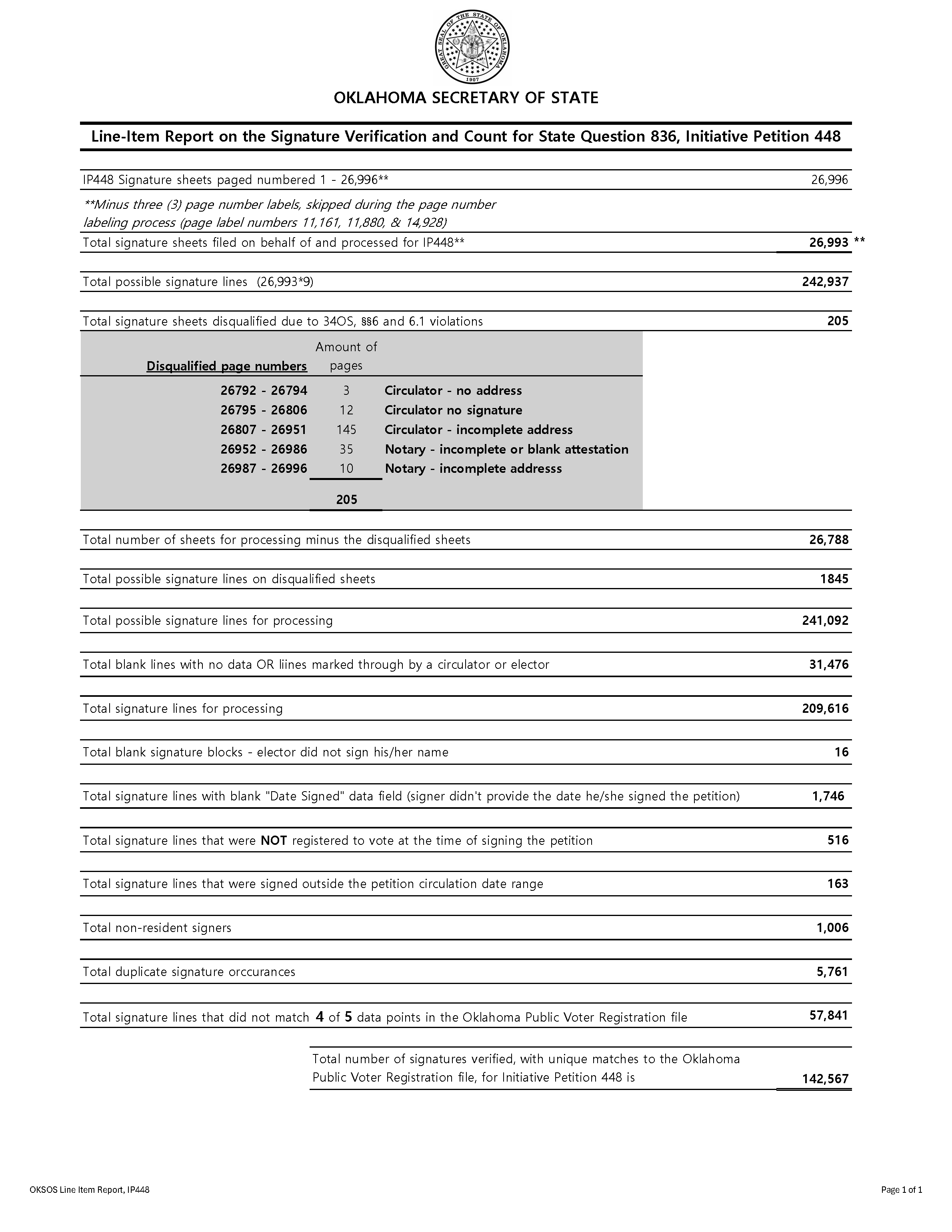
The vast bulk of disqualified signatures were the 57,841 signature lines which "did not match 4 of 5 data points in the Oklahoma Public Voter Registration file." 27.6% of the 209,616 signatures that were submitted failed to meet this simple test. HB 3826 (2020 Regular Session) added a verification requirement to 34 O.S. 2: "The following five data points shall be included on the form: the voter's legal first name, legal last name, zip code, house number and numerical month and day of my birth.... In order for the signature to be approved by the Secretary of State, three or more data points described in subsection A of this section must be matched to the voter registration file." SB 518 (2024 Regular Session) increased the threshold to four data points out of five. So if a registered voter who signed the petition managed to correctly write down his legal first and last name, birthday, and house number, but got the zip code wrong, the signature would be considered valid. The process does not appear to require that the signature itself matches the signature on your voter registration form.
Another 9,208 signatures (4.4%) were (in decreasing order) duplicates (5,761), undated (1,746), non-residents (1,006), not registered to vote (516), signed outside of the petition-gathering period (163), or unsigned (16). Another 205 pages, containing a potential 1,845 names, were discarded because the circulator didn't provide a complete address or any address at all or didn't sign the sheet or because the notary information was incomplete.
If a similar proportion of signatures had been disqualified, it may be that some of our most nefarious initiative petitions would have never made the ballot. If just 3% of SQ 788 (Medical Marijuana) signatures had been invalidated, it would have fallen short of the lower threshold required for a statutory initiative. The file for SQ 832 (escalating minimum wage) does not indicate that the signatures were cross-checked in the manner required by HB 3826 and if so, how many were disqualified. SQ 832 was filed before SB 518 went into effect, so only the threshold would have been only three of five data points matching the voter file. SQ 832 was also not required to meet the geographical distribution requirements of SB 1027 (2025) which limits the proportion of signatures that can be collected from large counties.
An organization called Oklahoma United was behind the push for SQ 836. Its founder and CEO, Margaret Kobos, was an attorney with Frederic Dorwart Lawyers and before that was an executive at the Bank of Oklahoma, two key nodes of George Kaiser's philanthropocratic network.
I won't be surprised if there is a legal challenge to this outcome. I would expect future petition efforts to scrutinize their own petitions and conduct their own matching process in order to have an accurate running count of valid signatures.
Rick Carpenter, who led the Taxpayer Bill of Rights petition effort, commented that "the new petition rules have made the initiative petition a quaint remembrance of the past." SB 1027 (2025), which sets geographical limits to require a proportion of signatures to come from outside metro areas, did not apply to SQ 836, but that will be an added burden on future petition efforts. Carpenter is very glad that we won't get 836's proposed jungle primaries, but he mourns the practical end of the people's ability to bypass the legislature. He thinks the tight timeline, the high threshold, and the geographical limits make it impractical to get a proposition on the ballot through an initiative petition.
I think with the new petition circulation laws, the initiative petition is dead. Actually making law has been stripped from the hands of the people and is completely the purview of the legislature now.You have to pay the circulators, there is no way to collect a couple hundred thousand signatures in the 90 days allowed with people doing it in their spare time.
I think the new law also prevents you from paying circulators by the signature. That will definitely result in an extremely inefficient allocation of resources.
In 90 days, you don't have time to run around the state. Limiting access to the state's largest population centers is prohibitive.
20 years ago I ran the Taxpayer Bill of Rights petition. We had to collect 220,000 signatures and we managed to get a little over 300,000. We would not have gotten half that number had access to the largest population centers of the state been limited.
The Secretary of State disallowed 85,000 signatures to leave us just under the number needed. Not because the signatures were bad, but by disqualifying the circulators. This state is very hostile toward the initiative petition process. The legislature doesn't like to share their lawmaking prerogative.
If you're gonna make people run around the state to collect signatures, they need more like six months.
Rick Carpenter's essay from 2009 is worth reading if you want to understand the practicalities of an initiative petition and all the legal obstacles to succeeding.
I will note that SQ 832, as terrible as it is, is a statutory proposal -- that is, it would only change a statute, which could later be changed by the legislature -- and so only had to meet the 8% threshold, about half the signatures required for a constitutional amendment, which it did by a wide margin.
We're blessed to have been spared a dangerous but facially benign, and badly structured, constitutional amendment from appearing on the ballot, where dark money spending could have pushed it across the line. As I explained in my earlier article, the proposed constitutional amendment illustrated the hazards of legislation that hasn't gone through the polishing process of committee hearings. It wasn't customized to speak to the specifics of the language in the Oklahoma Constitution and statutes, and it had a severability clause, which has no business in the State Constitution. It would have spawned dozens of court cases over conflicts with other laws that were not specifically repealed.
But there still needs to be a way for citizens to bypass the legislature. Perhaps a better approach would be to require constitutional amendments to pass by a super-majority, or to receive a majority of the vote in a super-majority of State House or State Senate districts -- the kind of geographical distribution needed for a legislative amendment to move forward.
0 TrackBacks
Listed below are links to blogs that reference this entry: SQ 836 signatures fall short.
TrackBack URL for this entry: https://www.batesline.com/cgi-bin/mt/mt-tb.cgi/9429
 Subscribe to this blog's feed: