Oklahoma Election 2026 Category
All Oklahoma voters will have 9 judicial retention questions on the November 3, 2026, ballot. Unlike district judges, where competitors run in non-partisan elections, justices of the Oklahoma Supreme Court and judges on the Oklahoma Court of Criminal Appeals and Oklahoma Court of Civil Appeals are appointed, but face a yes-or-no retention ballot every six years. (I think unopposed district judges should also face a retention ballot.)
Oklahoma has two separate appeals systems. Civil cases go through the Oklahoma Court of Civil Appeals and can be appealed from there to the Oklahoma Supreme Court, while the Court of Criminal Appeals is the apex of Oklahoma's criminal court system. (Here is a flowchart showing how these appellate courts are related to one another and to district and municipal courts.)
Every appeals judge or justice is appointed by the governor from a list of three provided by the Judicial Nominating Commission, a panel of 15 consisting of six attorneys selected by the Communist-enabling Oklahoma Bar Association, six non-attorneys appointed by the Governor (of which only three can be Republican), and three further non-lawyer members appointed by those twelve.
Passage of SQ 845 would give a conservative governor a more conservative Judicial Nominating Commission and should result in a more conservative list of candidates from which Governor Mazzei can choose as he fills court vacancies.
A newly appointed Supreme Court justice or appellate judge faces a retention ballot at the next general election, and once again at the general election when the term for his seat expires (which may be two, four, or six years later), then voters have the opportunity to oust him every six years thereafter. The next retention elections, in the absence of a resignation, death, or new appointment:
2026 (cycle 1): Supreme Court 1, 6, 9; Civil Appeals Districts 1, 2; Criminal Appeals District 2, 3
2028 (cycle 2): Supreme Court 2, 5, 8; Civil Appeals Districts 3, 4; Criminal Appeals District 1
2030 (cycle 3): Supreme Court 3, 4, 7; Civil Appeals Districts 5, 6; Criminal Appeals District 4, 5
Cycle = ( (Election Year - 1910) / 2 ) modulo 3
An office will be on the ballot off-cycle when a vacancy occurs and a replacement is appointed, as with Supreme Court District 4 Justice Travis Jett, appointed in 2025 to replace ousted Justice Yvonne Kauger. If retained, Jett will face the voters again in 2030.
Less frequently, an office will not be on the ballot when its term expires because a judge has decided not to file for retention. That's the case this year with Court of Criminal Appeals District 3 Judge Gary Lumpkin; instead, the governor will appoint a replacement this year who will be on the ballot at the next general election in 2028 and then, if retained, will be on the ballot again when the District 3 term expires in 2032.
I was puzzled that Civil Appeals Judge Jim Huber, who was appointed to the court in 2023 and on the 2024 retention ballot would be on the ballot again just two years later. That puzzlement led me to dig deeper, to notice that the law establishing the retention ballot for this court, 20 O. S. 30.18, like the constitutional changes instituting the retention ballot for the Supreme Court and Court of Criminal Appeals, continued the existing fixed, staggered six-year terms for each office. From past election results and this helpful list of past Criminal Appeals judges showing each year that a judge was re-elected, a pattern emerged, which you see above.
In the 58-year history of Oklahoma's judicial retention elections, only one judge or justice has ever been turned out of office by the voters: Supreme Court Justice Yvonne Kauger in 2024.
Here is the list of appellate judges on the 2026 retention ballot. In parentheses, I list age on election day, county of residence, appointing governor, year of appointment, and party of voter registration, followed by my recommendation at this point.
Supreme Court
- District 1: M. John Kane (64, Osage, Stitt, 2019, R): YES
- District 4: Travis V. Jett (42, Woodward, Stitt, 2025, R): YES
- District 6: Dana Kuehn (55, Tulsa, Stitt, 2021, R): YES
- District 9: Richard B. Darby (68, Jackson, Fallin, 2018, R): NO
Court of Criminal Appeals
- District 2: Robert L. Hudson (69, Logan, Fallin, 2015, R): YES
Court of Civil Appeals
- District 1, Office 1: Stacie L. Hixon (52, Tulsa, Stitt, 2020, R): YES
- District 1, Office 2: Jane P. Wiseman (79, Tulsa, Henry, 2005, D): NO
- District 2, Office 1: Deborah B. Barnes (72, Osage, Henry, 2008, D): NO
- District 2, Office 2: James R. Huber (58, Tulsa, Stitt, R): YES
(Recommendations for the competitive, non-partisan elections for District Judge in the Tulsa area will be in a separate entry.)
Jamison Faught, the Muskogee Politico, has published his judicial retention picks for 2026. We differ only on Justice Darby, but neither of us consider Darby's retention a clear-cut choice.
I haven't yet seen a column about this year's retention ballot from former State Rep. Jason Murphey, but his 2024 column provides helpful perspective on the damage to our courts perpetrated by Brad Henry's eight years as governor. A lefty-lawyer Democrat in the governor's office being fed nominees by a lefty-driven JNC is a bad combination for justice.
After the jump, the basis of the recommendations.
Once again, Oklahoma voters are being asked to place a lengthy and detailed piece of legislation in our State Constitution which properly belongs in a more easily amendable statute. The Constitution withholds the authority to regulate and adjust exemptions, valuations, and tax rates except as very specifically provided in bloated Article X. Nevertheless, State Question 847 would grant all Oklahomans additional protection against tax increases by inflation and would expand the universe of senior citizens granted additional relief. For that reason, I'm voting YES on SQ 847.
Your property tax bill is the product of two numbers: The assessed value times the total millage rate (in mills per dollar, i.e., dollars per thousand dollars) that you've authorized your local taxing authorities to take. The assessed value is the fair cash value times an assessment rate (11% in Tulsa County), minus the homestead exemption ($1,000), if the property is a homestead.
where
- FCV = fair cash value
- AR = assessment ratio (a constant in Tulsa County = 11%)
- HE = homestead exemption (a constant = $1,000; low-income homeowners qualify for an additional $1,000 homestead exemption)
- TM = total millage (the sum of property tax rates affecting the property -- school, city, county, library, health department, community college, technology center, etc.)
AR and HE have been constant for a long time and are unlikely to change. Practically speaking, your taxes will go up or (rarely) down depending on changes in fair cash value and total millage. Total millage will go up if there's a new school bond issue or if your city or county government has to pay a lawsuit settlement. Fair cash value depends on the market, as interpreted by the County Assessor. When demand causes local home prices to skyrocket, you become liable for higher taxes based on gains you can't realize without selling your home.
To protect taxpayers from tax hikes caused by housing inflation, in 1996 Oklahoma voters approved a 5% cap on the annual increase in fair cash value and a valuation freeze for senior citizens with gross incomes below $25,000 (SQ 677). This was the origin of the two sections (8B and 8C) of Article X that would be changed by SQ 847. In 2005, voters increased the income limit for the senior citizen valuation freeze to the estimated median income for the county or metro area, as reported by the US Department of Housing and Urban Development (HUD) (SQ 714). In 2012, voters reduced the cap on the annual increase in fair cash value for homestead properties to 3% (SQ 758).
SQ 847 would cut the general cap on fair cash value increase from from 5% to 4%, the homestead cap from 3% to 1.75%. It would also graduate the phase-out of the senior valuation freeze: Instead of a hard cutoff at the median income, there would be four brackets based on estimated median income (EMI), reducing the increase cap to zero as income goes down:
- 100%-120% of EMI: 0.35% cap on annual FCV increase
- 120%-140% of EMI: 0.70% cap
- 140%-160% of EMI: 1.05% cap
- 160%-180% of EMI: 1.40% cap
HUD doesn't quite use the same terminology as the Oklahoma Constitution. Median Family Income in the Tulsa Metropolitan Statistical Area (MSA), as issued by HUD for Fiscal Year 2026, is $95,000. Here is the page for 2026 data, and here is a direct link to the spreadsheet. Assuming that number is being used, senior households with gross incomes below $171,000 would get some additional relief beyond that which would apply to all homeowners.
That was the gist of the gist. Here is the 304-word "gist" of SQ 847, as it will appear on your November 3, 2026, ballot.
STATE QUESTION NO. 847 LEGISLATIVE REFERENDUM NO. 381This measure amends article 10, sections 8B and 8C of the Oklahoma Constitution.
Currently, section 8B limits annual growth in fair cash value to 5% for most real property or 3% for homesteads and agricultural land. If approved, the measure would limit annual growth in fair cash value for tax year 2027 and after to 4% for most real property or 1.75% for homesteads and agricultural land. Currently, section 8C prohibits any increase in fair cash value of homestead property for persons age sixty-five (65) or older whose income does not exceed certain limits, sometimes referred to as the senior freeze. Instead of prohibiting any increase in fair cash value for these homesteads, there would be an annual limit of 1.75%. The measure eliminates the income cap on gross household income to qualify for the senior freeze. If approved, the annual limit on an increase in fair cash value would be tied to how much gross household income the homestead owner had in the preceding year. If a homeowner's gross household income from the previous year was at or below the median income for their county or area (as determined by the U.S. Department of Housing and Urban Development's estimated median income amount for the county or metropolitan statistical area), a homeowner's homestead fair cash value cannot be increased. If the income amount was in excess of certain thresholds, the limit on increases in fair cash value for homesteads owned by persons age 65 or older could be 0.35% (income over 100% up to 120%); 0.7% (income over 120% up to 140%); 1.05% (income over 140% up to 160%); 1.4% (income over 160% up to 180%); or 1.75% (income over 180%). If passed, this measure would have a fiscal impact on the state, but the exact impact is unknown.
Shall the proposal be approved?
Although I hate including this kind of statutory detail in the State Constitution, a recent Oklahoma Supreme Court decision (read below regarding SQ 843 for the details) means any property tax relief will require spelling it out in the Constitution, at least until we end the activist majority on the court.
Because we're all about the details here at BatesLine, here is the text of Article X, Sections 8B and 8C as they would be modified by passage of SQ 847, with deleted text struck through, added text underlined, and everything else unchanged:
SQ 845 is a half-measure, but this half-measure is better than none. The Oklahoma Constitution grants a formal role to the Oklahoma Bar Association, a left-leaning private cartel, in filtering appellate court nominees in Oklahoma, unelected and unaccountable figures restricting the choices available to the duly elected governor. State Question 845, one of two statewide referenda on the Oklahoma November 3, 2026, general election ballot, doesn't eliminate that filter or the cartel's involvement, but it does make it possible for conservative lawyers to be involved in the nomination process, something effectively impossible under current law.
SQ 845 would make minor changes to the membership of the board that provides the governor with his options for filling judicial vacancies. It would not correct two very big problems with the judicial nominating process and the private, left-wing organization embedded in that process. SQ 845 was proposed by the legislature as HJR 1024. (I discussed the problems with the current judicial nomination process in this 2024 article in support of reform.)
On July 11, 1967, Oklahoma voters narrowly approved SQ 447, which added a new Article 7B to the Oklahoma Constitution, completely revamping the method of selecting appellate judges, creating a Judicial Nominating Commission (JNC) to nominate appointees for the Court of Civil Appeals, the Court of Criminal Appeals, and the Oklahoma Supreme Court and to fill vacancies in District Courts between elections. (The vote was Yes 86,183, 52.1%; No 79,280, 47.9%) This was a reaction to the 1965 revelation that multiple Oklahoma Supreme Court justices had received bribes over more than two decades. In 2010, voters approved SQ 752 (Yes 606,805, 62.8%; No 358,925, 37.2%), which tweaked the composition of the JNC to include two additional non-lawyer, at-large members and to ban relatives of attorneys from serving in the "lay member" seats on the JNC.
The "professionalization" of the judiciary replaced partisan direct election of appellate judges and justices with appointments made through a complex process involving the Oklahoma Bar Association, even though none of the reforms directly addressed the causes of the scandal. A commission, composed of non-lawyers appointed by the Governor and lawyers appointed by the Oklahoma Bar Association, chooses three nominees to place before the Governor, who may appoint one of those three. The voters don't get to weigh in on the new appellate judge or justice until the next general election, when they have an up-or-down vote to retain or dismiss the new judge. (District and Associate District Judge appointees serve until the next judicial election, when they file and run as normal and may face opponents.) Voters have voted against retention only once, dismissing Supreme Court Justice Yvonne Kauger in the 2024 election.
Here is the text of Article VII-B, Section 3, as it would be amended by SQ 845, with additions shown as underlined text and deletions as strikethrough:
Section 3. (a) There is established as a part of the Judicial Department a Judicial Nominating Commission of fifteen (15) members, to consist of:(1) six members to be appointed by the Governor, which shall include at least one from each congressional district
established by the Statutes of Oklahoma and existing at the date of the adoption of this Article, none of whom shall be admitted to practice law in the State of Oklahoma or have any immediate family member who has been admitted to the practice of law in the State of Oklahoma or any other stateas such congressional districts exist as of the date of the appointment. Each member appointed pursuant to the provisions of this paragraph shall serve a term of six (6) years;(2) six members, which shall include at least one from each congressional district
established by the Statutes of Oklahoma and existing at the date of the adoption of this Articleas such congressional districts exist as of the date of the selection who are, however, members of the Oklahoma Bar Association and who have been elected by the other active members of their district under procedures adopted by the Board of Governors of the Oklahoma Bar Association, until changed by statute. Each member appointed pursuant to the provisions of this paragraph shall serve a term of six (6) years; and(3) three members at large
who shall not have been admitted to the practice of law in the State of Oklahoma or any other state or have any immediate family member who has been admitted to the practice of law in the State of Oklahoma or any other state but whoeach of whom shall be a resident of the State of Oklahoma, one to be selected by not less than eight members of the Nominating Commission. In the event eight members of the Commission cannot agree upon the member at large within thirty (30) days of the initial organization of the Commission or within thirty (30) days of a vacancy in the member at large position, the Governor shall make the appointment of the member at large; one to be selected by the President Pro Tempore of the Senate; and one to be selected by the Speaker of the House of Representatives.No more than two members at large shall belong to any one political party.Each member appointed pursuant to the provisions of this paragraph shall serve a term of two (2) years.(b) The Commission shall elect one of its members to serve as chair for a term of one (1) year.
(c)
The six lay members of the Commission who are appointed by the Governor shall be appointed within ninety (90) days from the date that this Article becomes effective. Two members shall be appointed for a term of two (2) years, two members for a term of four (4) years, and two members for a term of six (6) years. The Oklahoma Bar Association shall hold its election and certify to the Secretary of State its members within ninety (90) days from the effective date of this Article, two of whom shall be elected for a term of two (2) years, two for a term of four (4) years, and two for a term of six (6) years. Thereafter allAll of the members of the Commission, whether elected or appointed, shall serve for a term of six (6) years, except that the member at large shall serve for a term of two (2) years.
(b)(d) Vacancies arising during the term of anylaycommissioner, other than the member at large, shall be filled by appointment by the Governor for the remainder of his or her term. Vacanciesof any lawyer commissionerin positions elected pursuant to the procedures established by the Oklahoma Bar Association shall be filled by the Board of Governors of the Oklahoma Bar Association for the remainder ofhis or herthe applicable term.
(c)(e) In the event of vacancy in any of the member at largepositionpositions, the said vacancy shall be filled in the same manner as the original selection.
(d) Of those Commissioners named by the Governor, not more than three shall belong to any one political party.
(e)(f) The concurrence of the majority of Commissioners in office at the time shall be sufficient to decide any question, unless otherwise provided herein. The Commission shall have jurisdiction to determine whether the qualifications of nominees to hold Judicial Office have been met and to determine the existence of vacancies on the Commission.
(f)(g) No Commissioner, while a member of the Commission, shall hold any other public office by election or appointment or any official position in a political party and he or she shall not be eligible, while a member of the Commission and for five (5) years thereafter, for nomination as a Judicial Officer.
(g)(h) Commissioners shall serve without compensation but the Legislature shall provide funds to reimburse them for their necessary travel and lodging expenses while performing their duties as such Commissioners.
(h)No Commissioner shallbe permitted to succeed himself or herselfserve more than twelve (12) consecutive years, whether elected or appointed.(i) As used herein, the words "Oklahoma Bar Association" shall include any successor thereof and any future form of the organized Bar of this state.
(j) The modifications to the provisions of this section pursuant to Enrolled House Joint Resolution No. 1024 of the 2nd Session of the 60th Oklahoma Legislature shall be applicable to any position on the Judicial Nominating Commission that ends by expiration of the term of office or by vacancy.
The gist that will appear on the ballot:
This measure amends Section 3 of Article 7-B of the Oklahoma Constitution. It changes provisions related to the Judicial Nominating Commission. It updates references so appointments made by certain persons based on the congressional districts would be made using the current congressional districts instead of the districts as the districts were constituted when this section of the Constitution was originally adopted in 1967. It removes a prohibition on certain members of the Commission so that the person could be a licensed attorney. It allows a person to serve on the Commission even if they have a member of their family who is a licensed attorney. It changes the terms so that with the exception of at-large members, the term would be for six (6) years. The at-large members would serve a two-year term. It removes restrictions based on political party membership. It removes a provision that prohibits a Commission member from succeeding himself or herself on the Commission. It provides that the changes in the way people are appointed or selected for membership on the Judicial Nominating Commission will apply to positions as they become vacant because an existing term of office expires or because of a vacancy.
The big win here is that our conservative governor will be able to appoint six conservative attorneys to serve on the JNC. Currently, the Governor has to split his precious appointments between Republicans and non-Republicans, and they all have to be non-attorneys and unrelated to any attorneys. If you assume that the liberal OBA membership will choose liberals for their six slots, and that the consensus choices for the at-large seats are unlikely to be conservatives, the best we can hope for are 3 conservatives amongst 15 JNC members. Although only six of the 15 members of the JNC are lawyers, it's easy to imagine that they would dominate the deliberations over the lay members of the commission.
You may argue that law and the courts shouldn't be ideological, and I wish that could be so, but the leftist Long March through the Institutions has infected the legal profession and the judiciary in the form of Critical Legal Studies and judicial activism.
To illustrate the absurdity of the situation: Former Attorney General John O'Connor would be someone I would trust to vet nominees from both a conservative legal perspective and the perspective of good judgment and judicial temperament. (I had the privilege of working closely with John during my six years of service, now concluded, on the Tulsa Classical Academy board, where John serves as the school's counsel.) Under current laws, John O'Connor would never be appointed to the JNC: The left-leaning OBA would not appoint a conservative, and the governor's nominees are not allowed to be attorneys.
One more win in SQ 845 is that the process will no longer use 1967 congressional district boundaries to ensure geographical balance. Oklahoma hasn't had six congressional districts since the 2000 census, and the population has shifted substantially toward the metro areas in the intervening 59 years.
Two years ago, there was a better approach to judicial nomination reform up for debate. SJR 34 (2024) would have replaced the JNC with an analogue of the system we use at the Federal level: Nomination by the Governor with the advice and consent of the State Senate and State House. That would put the process entirely in the hands of people who are directly accountable to the voters. Sadly, House RINOs linked arms with House Democrats to defeat SJR 34 by a vote of 36-60.
Ultimately, conservative Oklahomans need to remove liberal private cartels like the Oklahoma Bar Association from any role as gatekeepers to the legal profession. We need JNC removal, but for now, the best we can do is JNC reform, this minor improvement to the commission's composition which should allow for stronger conservative voices in the room when the qualifications of judicial candidates are being debated. SQ 845 is worth a YES vote.
MORE:

Article XXIV, Section 2, of the Oklahoma Constitution states (emphasis added):
No convention shall be called by the Legislature to propose alterations, revisions, or amendments to this Constitution, or to propose a new Constitution, unless the law providing for such convention shall first be approved by the people on a referendum vote at a regular or special election, and any amendments, alterations, revisions, or new Constitution, proposed by such convention, shall be submitted to the electors of the State at a general or special election and be approved by a majority of the electors voting thereon, before the same shall become effective: Provided, That the question of such proposed convention shall be submitted to the people at least once in every twenty years.
This language has not changed since the Constitution was approved in 1907.
Oklahoma Gov. Kevin Stitt has issued an executive order calling for a referendum on April 6, 2027, to ask the voters, for the first time since 1970, whether or not a Constitutional Convention should be called:
Oklahoma City (August 26, 2026) - Governor Stitt yesterday took action to comply with the Oklahoma Constitution and send to a vote of the people the question of whether the legislature shall call a constitutional convention, as required by Article XXIV, Section 2 of the Oklahoma Constitution.Article XXIV, Section 2 requires that the people of Oklahoma be given the opportunity at least once every twenty years to decide whether or not to move forward with a constitutional convention. The question was last presented to Oklahomans in 1970, depriving Oklahomans of this constitutional right.
"The Oklahoma Constitution is clear. At least every 20 years, Oklahomans have the right to decide whether it's time to call a constitutional convention," said Governor Stitt. "It's been 56 years since the question was sent to the people. This action puts the question to the people and ensures Oklahomans finally get the opportunity their Constitution guarantees."
The Executive Proclamation sets a special election for April 6, 2027, and was accompanied by Executive Order 2026-30, which instructs the Secretary of State to take any action necessary to submit the question to the people and creates the Oklahoma Constitutional Convention Commission. The Commission is tasked with studying the Oklahoma Constitution and other state constitutional conventions, then making recommendations about the procedures and rules that would govern a state constitutional convention, should the state question be approved. The Commission will also consider necessary safeguards and proposed legislation needed to implement a convention.
The report will be due no later than December 31, 2026.
"Oklahomans have the right to review our Constitution and determine whether it's time to consider changes," continued Gov. Stitt. "It is time to honor that right and give Oklahomans the choice our state founding fathers guaranteed to them."
The executive proclamation setting the special election can be found here: https://www.sos.ok.gov/documents/filelog/98225.pdf [NOTE: There was a typo in the URL in the press release, which I have corrected.]
Here is the question that would be put before the voters, as State Question 848:
Shall the Legislature call a Constitutional Convention which shall be authorized to propose alterations, revisions, or amendments to the Constitution, or to propose a new Constitution for the State of Oklahoma?
In his executive order, Gov. Stitt quotes Robert L. Williams, the first Chief Justice of Oklahoma and a delegate to the Oklahoma Constitutional Convention, who wrote in his commentary on the Oklahoma Constitution regarding Article XXIV, Section 2: "Being self-executing, it is the duty of the Secretary of State, without any additional legislation, to submit this question every 20 years to the electors of the state." Williams says, "This section was patterned after Oregon (1857) 17, 1 and 2, as amended," and also makes reference to "Md. (1867) 14, 2; Mich. (1850) 20, 2 [now in Article XII, Section 3]; N. Y. (1894) 14, 2 [now in Article XIX, Section 2]; Ohio (1851) 16, 3; S. C. (1895) 16, 3; and Utah (1895) 23, 2 and 3."
Michigan, New York, Ohio, and South Carolina have a requirement to put the question of a constitutional convention before the voters at regular intervals. New York has held six constitutional conventions, with the 1938 convention producing a new constitution that was ratified by the voters, while the propositions submitted by the 1967 convention were rejected by the voters.
That was a nail-biter! The margin of victory for Mike Mazzei was just over 2000 votes.
At the Mazzei watch party at the Renaissance Hotel, the screens alternated between the official state election board results and Jason Murphey's spectacular statewide precinct map, which displayed the official results as they arrived.
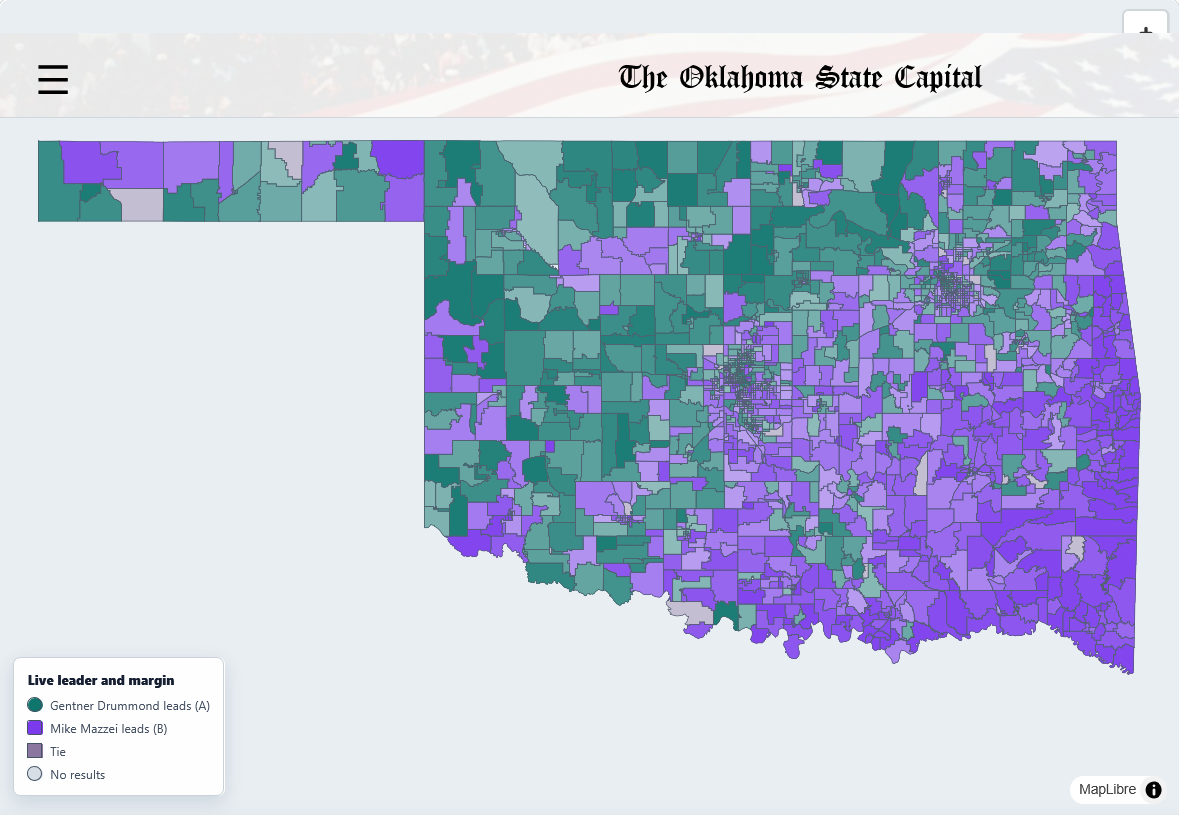
Isn't that division interesting? Indian Territory, eastern and south central Oklahoma, the part of the state affected by the McGirt ruling, went for Mazzei, old Oklahoma Territory went for Drummond, with the exception of the counties around Inola.
Years ago, local TV stations would have offered continuous coverage of an election this significant, and watch parties would have had one or more TVs tuned to their coverage. TV stations used to send out runners to get the results posted on precinct doors to tabulate results ahead of the official tally. When I worked out of KOTV's newsroom on election night 2008, doing cut-ins on KRMG, runners brought in tally sheets from the precincts, which I added into a database to give me an early picture of key local races, like the County Commission race between Sally Bell and Karen Keith.
The media was there, standing on risers in the middle of the room, waiting for Mazzei to speak, but they seemed to be a sideshow. We were getting unmediated access to results displayed geographically.
Another cool feature of the Oklahoma State Capital Runoff Election Command Center was the Arrival Log, capturing the order in which precinct results appeared in the State Election Board results. The very last precinct reporting was in Adair County (010018), detected by the Oklahoma State Capital at 9:56 pm, but the rest of the last 100 precincts in were from Oklahoma and Tulsa counties. The last Tulsa County precinct to report was 720125, 51st to 61st, Peoria to Utica, which was in the tranche of precincts OSC grabbed at 9:46 pm. The first three precincts reporting were from Grady, Harmon, and Texas counties at 7:21 pm. The first Tulsa County precinct came in at 7:36, precinct 720113 with 15 votes, 169 to 129th East Ave, 41st to 61st. Keep in mind that all absentee ballots must be counted before precincts are processed, to avoid the sorts of shenanigans that occur in other states, and this takes longer in big counties. There are a lot more precincts in big counties that have to be processed as well.
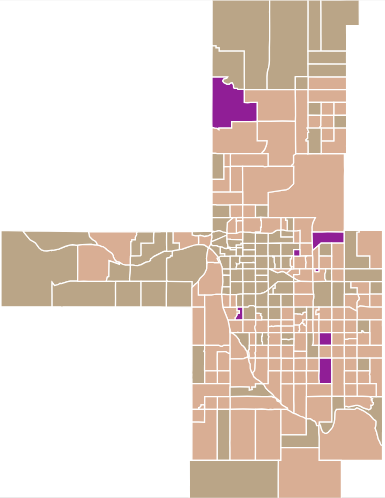
We watched as the number of precincts reporting approached 100%. With only a few dozen remaining, you could zoom in on Tulsa County in Murphey's map and see that about the same number of outstanding precincts in Drummond territory -- midtown Tulsa -- as in Mazzei territory -- south Tulsa and the suburbs, and it seemed likely that Mazzei's narrow margin would hold. (This map is from the Oklahoma State Election Board website. Drummond's precincts are olive, Mazzei's are beige. Not exactly a high contrast. Drummond's strength was in the Money Belt and Midtown, I-244 to 71st, the Arkansas River to Memorial.)
The Mazzei watch party was different than most I've attended: The lights stayed on. The music was kept quiet enough for conversation, but the level of conversation sometimes made it hard to hear. I had a great time catching up with old friends from my decades around Republican politics -- legislators past and present, activists, party leaders -- and making some new acquaintances.
Sometime after Mazzei's victory speech, after an hour or so of Mazzei taking photos with well-wishers, after the nominee had retreated to the campaign's private meeting room, a new group showed up, freshly arrived from Oklahoma City. I was told they flew up after the result was confirmed. At the time, I happened to be speaking to term-limited Sen. Shane Jett, leader of the Oklahoma Freedom Caucus and nemesis of the Capitol lobbyist claque, who pointed them out to me: Speaker Kyle Hilbert, the executive director of the State Chamber, the Hilliary brothers, various and sundry lobbyists. All these men, who had either openly or quietly opposed Mike Mazzei's candidacy, who were waiting in Oklahoma City to hail Gentner Drummond's triumph, now came to Tulsa to pay their respects to the victor. It didn't look like they got their hoped for audience. Vae victis!
It was not a great night down-ballot. Conservative James Taylor's $7,000, seat-of-the-pants solo primary campaign was enough to get a ticket to the runoff in an evenly split field, but Franklin's allies defined Taylor as Walters 2.0 while portraying liberal, recently-Democrat Franklin as a competent, experienced, and moderate administrator. To counter that message with the truth, you need enough money and you need to use it strategically to reach persuadable voters. (Note to Jake Merrick fans: Merrick would have run into the same buzzsaw if he had managed to get into the runoff.) Trial lawyer-backed Bob Sullivan beat former State Sen. Marty Quinn by 10 points; a friend who knows the Insurance Commission says that permanent staff there dread the thought of working for Sullivan.
The strongest statewide win of the night, however, belonged to Kevin West, the conservative candidate in the Labor Commissioner race, with 58% of the vote over his CAMP opponent.
The Freedom Caucus lost a stalwart in District 34 State Sen. Dana Prieto. He was targeted by heavy "independent expenditures" (dark money). Overall, my picks won 3 of 6 State Senate seats, 7 of 8 State House seats.
SQ 844 (property tax exemption reimbursement) went down in flames, with three No votes for every Yes. SQ 846 (constitutional voter ID) won with 55%, passing in every county except Tulsa, Oklahoma, Payne (home to OSU), and Cleveland (home to OU).
Dennis McCollough has been elected Wagoner County Commissioner in District 3. He won the runoff with 65% of the vote, and no Democrat filed for either Wagoner County Commission seat.
The Tulsa City Council races were an expected disappointment, although one of the Mean Girls, District 1's Vanessa Hall-Harper, winning 46% of the vote, has been forced into a November runoff against Corinice Wilson, who got 37%. Supporters of Reggie Williams and Mareo Johnson seem to be coalescing behind Wilson; they just want Vanessa out.
In District 2, Anthony Archie won his rematch with Aaron Bisogno by a 3-to-1 margin. Mean Girl Jackie Dutton survived in District 3, 56%-44%. Incumbent Karen Gilbert won another term in District 5, 58%-42%. Pete Regan's $180,000 in campaign cash bought him 6,337 votes, 69% of the total in District 9.
District 7's result makes me wonder what might have been had Dave Perry gotten started sooner with his campaign. Mean Girl Lori Decter Wright was re-elected with 57% of the vote. Dave Perry got 36%, having only started to campaign in earnest about a week before the election. I saw yard signs for Perry around several neighborhood entrances on election day.
District 6 Councilor Christian Bengel held a fundraiser for his "campaign" on August 20 at El Patron. Josh McFarland and Casey Robinson hosted the event, with State Rep. and Republican nominee for Congress Mark Tedford as honorary guest. The weird thing about that is that Bengel doesn't have an election this year. He won two years ago with 70% of the vote.
The City of Tulsa ONG 20-year franchise renewal passed 63%-37%, but it failed in nearly all precincts north of I-244. 49,762 votes were cast for or against that proposition, but the total number of votes for the six council races added up only to 28,969. Bartlesville approved its ONG franchise renewal. Bixby approved all four bond issues, but Prop 1 ($16,650,000 for public safety buildings) and Prop 3 ($850,000 for parks) were close, with a less than 200 vote margin.
Many school bond issues failed: Dale (Pottawatomie County), Hulbert (Cherokee County), Little Axe (Cleveland County), Newcastle (McClain County), Sallisaw (Sequoyah County), Savanna (Pittsburg County), South Coffeyville (Nowata County). In Westville (Adair County), one bond issue barely cleared the 60% threshold and the other fell short.
The tiny turnout award goes to the Town of St. Louis in Pottawatomie County, which voted 7 to 3 to extend OG+E's electric franchise for another 25 years.
The bedsheet ballot award goes to City of The Village, an enclave surrounded by Oklahoma City and Nichols Hills, who voted on 13 propositions: 9% hotel/motel tax (failed), ONG franchise renewal (passed), and 11 charter amendments (8 passed, 3 failed). The three failed charter amendments would have allowed the city manager to live outside the city limits (failed 33% to 67%), would have increased the dollar threshold requiring a public vote to sell high-value city property from $25,000 to $300,000, and would have made it quicker to pass an ordinance and have it go into effect.
Democrats had only two runoffs: Socialist N'Kiyla Jasmine Thomas won the U. S. Senate nomination over attorney Jim Priest, and Herschel Brown won the nomination in House 99 in Oklahoma City. Kevin Hern should have no problem holding the Senate seat for the GOP in November.
 In-person absentee voting will be available at your county's early voting locations on Thursday, August 20, 2026, from 8 a.m. to 6 p.m., on Friday, August 21, 2026, from 8 a.m. to 6 p.m., and on Saturday, August 22, 2026, from 8 a.m. to 2 p.m. Tulsa County will have in-person absentee voting at the new Tulsa County Election Board location at 12000 E. Skelly Drive and at Tulsa Tech Broken Arrow Campus near 111th Street S & 129th East Ave (aka Florence and Olive). Polls in each precinct will be open Tuesday, August 25, 2026, from 7 a.m. until 7 p.m.
NOTE: Precinct boundaries, voting locations, and district boundaries have changed, in some cases dramatically. Enter your name and date of birth on the Oklahoma State Election Board's online voter portal and you will see where to vote and your sample ballot.
In response to popular demand, I have assembled the guidance detailed below into a downloadable, printable, single-page PDF.
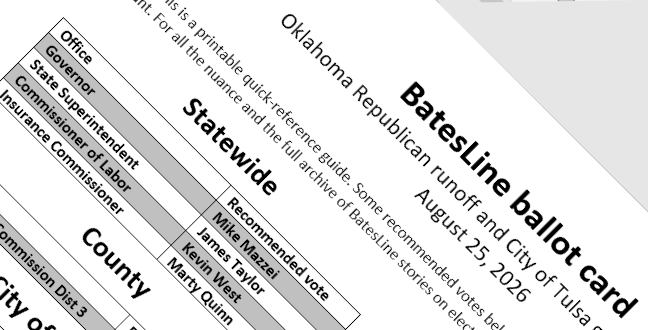
Originally posted on August 11, 2026, and postdated to remain at the top until the polls close on Election Day. I will be adding more links and detail between now and the election.
Here are the candidates I'm recommending and (if in the district) voting for in the Oklahoma Republican primary elections on August 25, 2026. Click the hyperlink on the office to see detailed information on that race and its candidates. (This entry will change as I decide to add more detail, link previous articles, or discuss additional races between now and election day. The entry is post-dated to keep it at the top.)
As I post this, I'm still unsure about several races, and there are other races I had planned to write about in detail, but time is short, people are voting, and many have asked for a summary of my recommendations. My most enthusiastic choices are in bold; in other races, there may be one or two other candidates that would be acceptable, or I simply don't know the endorsed candidate as well as I would like. There are certain incumbents that I'd like to see defeated, but I don't feel comfortable endorsing an opponent at this point. I'll try to fill in TBDs and NOTs before the start of early voting.
- SQ 844 (reimbursement flexibility for property tax exemptions): YES
- SQ 846 (Constitutional voter ID): YES
- Governor: Mike Mazzei
- Superintendent of Public Instruction: James Taylor
- Labor Commissioner: Kevin West
- Insurance Commissioner: Marty Quinn
There are a number of legislative seats statewide with runoffs, but these two are the only ones in the Tulsa area. State Sen. Dana Prieto is a leader in the Oklahoma Freedom Caucus; his runoff opponent ran as a Democrat in the House 72 primary in 2018. House District 9 is an open seat.
- Senate 34: Dana Prieto (i)
- House 9: Scotty Stokes
For legislative races elsewhere, see my ballot card. I took Charlie Meadows's picks as a starting point, then looked at campaign contributions and expenditures. Certain donors and consultants are red flags and indicate a likelihood that the candidate will be a tool (wittingly or unwittingly) of special interests once in office. In a few races, I've gone against a less than enthusiastic pick from Charlie because of the preponderance of red flags on one side.
There are six contested Tulsa City Council seats and one proposition. My picks are based in part on a desire to replace every incumbent possible, especially the Mean Girls Clique, based in part on what campaign contributions filings have revealed about each candidate's alignments and affiliations. You can read my detailed discussion of the six City Council races in the full article, but here are my picks.
- District 1: Reggie Williams Jr (D) (Anyone but incumbent Vanessa Hall-Harper)
- District 2: Aaron Bisogno (R)
- District 3: No recommendation
- District 5: Karen Gilbert (R)
- District 7: Dave Perry (R) (Anyone but incumbent Lori Decter Wright)
- District 9: Shawn Tiemann (D)
- City of Tulsa ONG franchise renewal: YES
I was waiting for the campaign contribution reports due on August 17 to see who the philanthropocrats and the Chamber are backing, but even before I had that information in hand, I mainly wanted to get rid of the Mean Girl Caucus on the City Council. At a recent City Council meeting, while a citizen spoke about the need for independent ethics oversight of the Council, Hall Harper, Dutton, Decter Wright, Laura Bellis, and one redacted non-councilor engaged in ridicule of the speaker over a group chat, giggling and trading looks. Their behavior appalls former councilors across the political spectrum. This isn't the first time they've been caught in this childish behavior. They're on the record labeling conservative Tulsans as "actual fascists," but Bellis, Hall Harper, and Decter Wright teamed up with GT Bynum to keep one of their council colleagues from working for a living because he dared to oppose a tax increase. That seems pretty fascistic to me. If Hall Harper, Dutton, Decter Wright, and Bellis lack the impulse control to wait until after the meeting to share their snarky comments, they don't belong on the City Council. Bellis, alas, is unopposed, but defeating the other three would be a good start.
The only hesitation in District 3 is that Dutton's opponent, Tanisha Bowen, is backed by Mayor Nichols's Tulsa Forward PAC. Sadly, we don't have a third choice.
UPDATE 2026/08/23: After finally connecting with Dave Perry by phone, I was impressed with his knowledge of issues before the council and his key concerns. Although he is recently back in Tulsa, returning to care for aging parents during the pandemic, he attended Union schools in the '70s and '80s and thus has the longest history in Tulsa of any of the three candidates.
In the suburbs:
- Wagoner County Commission District 3: Dennis McCollough
- Bixby Proposition No. 1 ($16,650,000 public safety bond issue): NO
- Bixby Proposition No. 2 ($35,000,000 streets bond issue): NO
- Bixby Proposition No. 3 ($850,000 parks bond issue): NO
- Bixby Proposition No. 4 ($25,000,000 sanitary sewer bond issue): NO
Wagoner County friends tell me that Dennis McCollough is a solid guy who spent his career at the Oklahoma Department of Wildlife Conservation and understands budgets and management. He has been endorsed by the two candidates who did not advance to the runoff. His opponent, Patrick Sampson, makes a lot of conservative noises on social media but his public statements involving his residency and eligibility for the seat may have him in legal trouble.
The projects proposed for the four Bixby bond issue propositions all sound reasonable, but given the issues with city officials of late, voters may want to take this opportunity to cast a vote of no confidence and see some turnover on the council before entrusting city government with more cash.
MORE INFORMATION:
POLLING:
- Pulse Decision Science poll released August 7 has Mazzei leading Drummond 44-38
- CHS poll has Mazzei and Drummond tied, 44 each
- CHS poll on down-ballot races had Sullivan leading Quinn (30%-26%), West leading Pfeiffer (27%-25%), and Franklin leading Taylor (27%-26%), with large numbers of undecided in each race. [This link added for completeness on September 9]
OTHER CONSERVATIVE VOICES:
Here are some blogs, endorsement lists, candidate questionnaires, and sources of information for your consideration.
- Muskogee Politico news, questionnaires, and analysis
- Muskogee Politico legislator tax votes, 2016-2018
- Muskogee Politico primary picks
- Jason Murphey Primary Voter Guide
- Charlie Meadows's picks
- Oklahoma Constitution Index: Scores incumbent legislators on voting record
- iVoterGuide surveys of Oklahoma statewide, federal, and legislative candidates
- Tulsa County Republican Party candidate guide, with links to social media, GOP questionnaires, and GOP candidate interview transcripts
- Make Oklahoma Healthy Again (MOHA) endorsements -- formerly Oklahomans for Health and Parental Rights (OKHPR)
- Oklahomans for Life candidate surveys: Oklahomans for the 2nd Amendment (OK2A)
- NRA-PVF survey grades and endorsements
- Tulsa Beacon endorsements
- OCPAC Action endorsements
ANTI-CONSERVATIVE VOICES:
Historically there have been some endorsement lists that are generally negative indicators, including public employees and teacher's unions (and front groups like Oklahomans for Public Education), but these groups have become careful to conceal their support, which backfires in a Republican primary.
The State Chamber of Oklahoma puts out a voter guide that lists State Chamber PAC endorsements, and it's been updated for the runoff. Being pro-business is great, but please read my 2016 article "Chambers of Horrors" to understand why social and fiscal conservatives, opponents of cronyism, and supporters of historic preservation should find Chamber endorsements problematic.
There are some self-styled "conservative influencers" who have shown themselves confused, inconsistent, or downright treacherous. Caveat lector. Anyone who would work to replace the only conservative on the Tulsa school board with a progressive or promote RINO Gentner Drummond for Governor, or anyone who promotes an inexperienced left-winger for District Attorney, is not someone conservatives should look to for endorsements.
If you appreciate the many hours of research that went into this guide and into the rest of my election coverage, and if you'd like to help keep this site online, you can contribute to BatesLine's upkeep via PayPal. You can also support BatesLine through a paid Substack subscription. In addition to keeping me caffeinated, donated funds pay for web hosting, subscriptions, and paid databases I use for research. Many thanks to those generous readers who have already contributed.
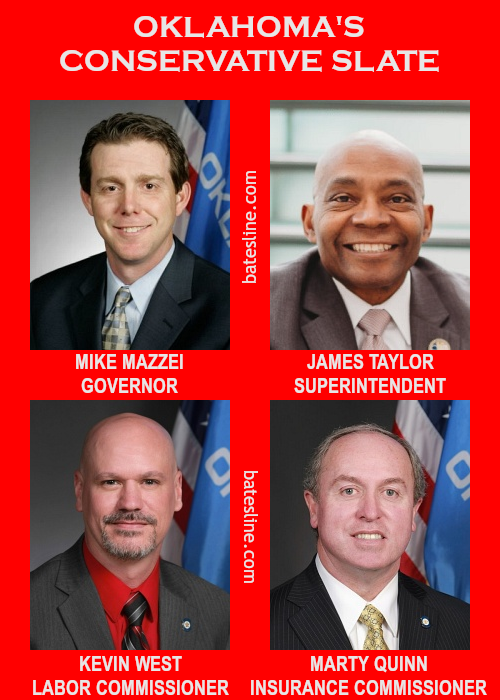
The primary preferences of Oklahoma conservatives were scattered among numerous candidates in the long list of open-seat statewide offices, but in the runoff Oklahoma conservatives have united around a single slate for the four offices remaining on the ballot: Mike Mazzei for Governor, James Taylor for State Superintendent, Kevin West for Commissioner of Labor, Marty Quinn for Insurance Commissioner.
The conservative slate has been endorsed by OCPAC founder Charlie Meadows, Jamison Faught of Muskogee Politico, former State Sen. Jake Merrick, former State Rep. Jason Murphey, Make Oklahoma Healthy Again, Oklahoma Second Amendment Association (OK2A), and many more conservative leaders.
The opposing slate, consisting of Gentner Drummond, Robert Franklin, John Pfeiffer, and Bob Sullivan, are all clients of CAMP, a political consulting firm known for attacking real conservatives and backing big-government, high-tax RINOs in Republican primaries. CAMP's founder, Fount Holland, was charged with illegal collusion in the 2014 campaign to win the Republican nomination for State Superintendent for stealth Democrat Joy Hofmeister. In the most recent Tulsa mayor's race, CAMP worked to elect Democrat County Commissioner Karen Keith. If there's a vote in Oklahoma to raise your taxes, CAMP is likely to be running the Vote Yes campaign. The CAMP slate's contribution reports include lots of typically Democrat donors, lobbyists, special interest PACs, people who want to misuse state government's power and money for their own benefit, not for the general good of the people of Oklahoma.
For the first time in my memory, the State Committee of the Oklahoma Republican Party has endorsed candidates in a statewide runoff, endorsing Mazzei for Governor, James Taylor for State Superintendent, and Kevin West for Labor Commissioner. The State Committee serves as the governing body of the Oklahoma Republican Party in between conventions, and it consists of four committee members from each county, who were elected by grassroots delegates at their local county conventions in odd-numbered years.
The state GOP endorsements are an outgrowth of the OKGOP Certified program. Candidates could apply for the list if they met five simple criteria:
- Has not been registered with any other party for the last five years.
- Has not donated to a Democratic candidate in the last five years.
- Has not supported abortion
- Protected Second Amendment Rights (and has not participated in efforts to infringe on them)
- Agrees with at least 80% of the OKGOP Platform
Now that liberals have figured out they can't win as Democrats in Oklahoma, they're trying to win in GOP primaries. This is precisely the kind of gatekeeping a party ought to be doing. It wasn't a high bar. Five of the eight statewide runoff candidates -- Mazzei, Taylor, West, Quinn, and Sullivan -- met the standard; Drummond, Franklin, and Pfeiffer did not. The OKGOP is right to alert GOP voters to fake Republican candidates. The state party endorsed only in races where only one of the candidates was OKGOP Certified; both candidates for Insurance Commissioner are OKGOP Certified, so neither was endorsed.
Here are a few quick notes on the reasons behind each of my picks:
Earlier this month, I was a guest on David McLain's Truth in Focus Media podcast (TIFMedia on Rumble) to discuss the August 25, 2026, runoff, state questions, and a few other articles here on BatesLine. The episode was recorded on August 6, before many of the developments in the last weeks of the campaign.
 This Saturday I was on Tulsa Beacon Weekend on KCFO AM 970 with Jeff Brucculeri to preview the August 25, 2026, runoff and City of Tulsa general election. In addition to the four statewide Republican runoff elections and the six Tulsa City Council seats, we covered the two state questions, SQ 844 and SQ 846, and the Senate 34 runoff.
The hour-long interview show, sponsored by the weekly Tulsa Beacon newspaper, airs live each week at noon Saturday on AM 970 and streaming online.
You can always find the latest episode of Tulsa Beacon Weekend at this link. I've made a Wayback Machine capture of this week's episode at this permalink.
The Tulsa Beacon newspaper is available by mail subscription, at Wild Birds Unlimited at 61st and Yale, and at the Minute Stop at 131st Street and Aspen in Broken Arrow.

It's disheartening just to watch what's been happening at Tulsa City Hall, and even more disheartening to write about it.
There was a time when I relished digging into the latest issue before the Council, but that was back when we managed to get some good councilors elected on a regular basis, people with integrity and a backbone. It felt possible to make a difference. It hasn't felt like that since the big changes to the election system before 2016.
I appreciate those who continue to post about Tulsa politics on social media, people like RealitySnark (formerly Snarkio) on X, RobertDInTulsa, who monitors the scanner and covers local crime news on X, and This Is Tulsa Too on Facebook. Restaurant reviewer and restaurateur Steve Pisonero recently launched a Facebook group about the homeless blight in Tulsa; all the politically correct folks are appalled, but the people who participate in the discussion are genuinely trying to grapple with real causes and real solutions, not the expensive and unrealistic approaches that keep gender-studies majors employed at non-profits in the Homeless-Industrial Complex.
Tuesday, August 25, 2026, is the City of Tulsa general election. Six of the nine City Council seats are contested; City Auditor Nathan Pickard and Councilors Laura Bellis (District 4), Christian Bengel (District 6), and Phil Lakin (District 8) were re-elected without opposition. A candidate receiving more than 50% of the vote on August 25 has been elected. If no candidate gets more than 50%, there will be a runoff on November 3 between the top candidates whose votes total more than 50%. This is slightly different from a traditional two-candidate runoff in that, if there are more than four candidates and the vote is evenly split (e.g. 24%, 23%, 20%, 18%, 15%), there may be a three-candidate runoff. Unlikely, but possible this year in District 1.
I am not thrilled with our choices. I can only surmise that fewer and fewer Tulsans think the city is worth fighting for, that anything can be done to stop the slide. Many of the challengers look like they jumped in last minute, which is honorable -- I filed for my first council race at 4 p.m. the last day of filing -- and think campaigning consists of nothing more than a website and forum appearances, which is ineffective.
The lack of enthusiasm is evident as you drive around Tulsa. In Council Districts 3 and 7, I saw no indication that a campaign was underway. There were a few yard signs for candidates in the Republican runoff, a few for statewide Democrat candidates, but there were no signs for either the incumbent councilor or challengers. I saw exactly one sign in District 5, supporting incumbent Karen Gilbert. All three candidates are active in District 9, an open seat. Things have been just as quiet on social media.
The most energy and enthusiasm has been in District 1 where four candidates are challenging the incumbent. I saw signs around the district for all but one of the five candidates in roughly equal numbers.
If we're to have any hope of returning Tulsa city government to sanity, the first step is to break up the Mean Girl Clique on the City Council.
At a recent City Council meeting, while a citizen spoke about the need for independent ethics oversight of the Council, Councilors Vanessa Hall Harper, Jackie Dutton, Lori Decter Wright, Laura Bellis, and one redacted non-councilor engaged in ridicule of the speaker over a group chat, giggling and trading looks.
Their behavior appalls former councilors across the political spectrum. This isn't the first time they've been caught in this childish behavior. They're on the record labeling conservative Tulsans as "actual fascists," but Bellis, Hall Harper, and Decter Wright teamed up with GT Bynum to keep one of their council colleagues from working for a living because he dared to oppose a tax increase. That seems pretty fascistic to me. If Hall Harper, Dutton, Decter Wright, and Bellis lack the impulse control to wait until after the meeting to share their snarky comments, they don't belong on the City Council. Bellis, alas, is unopposed, but defeating the other three would be a good start.
The second priority -- and this aligns with the first one -- is to replace as many philanthropocrats and non-profiteers as possible with people who work for a living.
If it seems like I'm grasping at straws in these recommendations, it's because I am. There's not a single candidate running this year that ticks all the boxes -- or even most of the boxes.
If we want high-quality candidates to run for council there needs to be a high-quality organization recruiting them a year ahead of time, preparing them to run, marshalling resources to support their campaigns, and continuing to provide support once they're elected.
With those qualifications in mind, let's look at each race in turn:
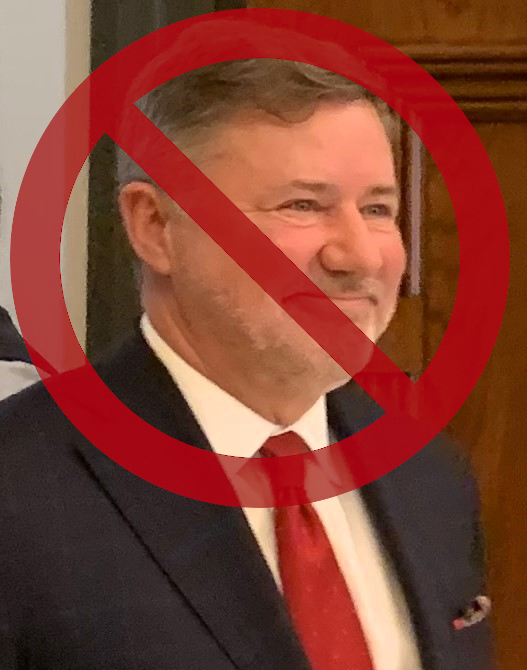 Gentner Drummond wants Oklahoma's children to be in government-subsidized daycare from birth to kindergarten so they won't be "feral."
That's what Drummond told attendees at the Oklahoma Association of Career and Technology Education Summit on August 3, 2026, according to audio obtained by former State Rep. Jason Murphey. The conference is mandatory for all CareerTech teachers in Oklahoma. Both Drummond and State Superintendent candidate Robert Franklin spoke to the conference. Murphey has full audio of each candidate's remarks. On X, Murphey also posted a two-minute clip focused on Drummond's remarks about the state questions and about state-funded childcare. (UPDATE: Murphey has posted a detailed discussion of Drummond's push for universal daycare and points out that Oklahoma's 1998 adoption of universal Pre-K, first in the nation, hasn't produced the promised improvements in educational performance.)
Here are Drummond's remarks to the CareerTech teachers about state-funded childcare:
We got to start with the zero-year-old, that little newborn to the five-year-old. We know that 60% of the brain is developed in the first five years. And yet 60% of our children, households, where they are not being stimulated, properly fed, and not disciplined. And so what's happening to our kindergarten teachers, they're getting feral children in the classroom, right, where they're spending a good bit of their time on four or five kids at the sacrifice of all. So there's a plan. In Oklahoma, if you make less than the federal poverty level, you are eligible for daycare subsidy. That's $15,800. New Mexico, about five years ago, said we're going to raise it to four times. So $58,000 means you and your spouse can work at a fast food store and still get supplemental help to put your child in daycare. They like it so much this year, New Mexico took the lid off, but Oklahoma needs to start with four times. If we do that, we let these children get into a quality daycare center where they are fed, where their minds are stimulated, and where they are taught the essence of discipline to sit in the classroom. If we do that, after five years, we've got children showing up in kindergarten ready to learn and disciplined.
When Murphey posted the highlights clip to X, there were accusations that the audio was manipulated or AI generated. The full 27 minutes makes it clear that these are Drummond's words, and to confirm matters further, Drummond repeated the idea in an interview with Chad Warmington, executive director of the Oklahoma State Chamber.
Warmington: So tell me this. So from if that's the biggest issue for businesses, what's the governor's responsibility for ensuring that Oklahoma develops the workforce that our employers need over the next decade? How can the governor lead on that?Drummond: No state has improved its position in education without the governor owning it.
I'm in a in a in a educ -- it's a keen hunt institute. It's a cohort of governors and those that they that they deem will be governor, and I've been a member of that for a year, and it's remarkable to see lessons learned across the states. For instance -- and you can go to my website drummondok.com -- and it's been there for 18 months but the education policy of mine is is being tweaked constantly but it starts with that one-year-old.
We are thinking, you know, our job starts at as kindergarten at kindergarten. But what's happening, folks, about 60% of our children are in households where they're not getting adequate daycare. They're with a elderly family member. They're sitting in front of a screen. We know that 60% of that brain's developed by five. And these kids are sitting in front of a screen. So their brains are not being developed. They're not being properly nutrition given proper nutrition. And they're feral. They're not being disciplined. So they hit kindergarten as wild banshees. The kindergarten teacher's distracted trying to manage that before she gets to teach.
New Mexico 5 years ago increased the subsidy for daycare from federal poverty level, which is where Oklahoma is today at 15,800, four times that. So mom and dad can work at a convenience store or in hospitality and still get a subsidy from the state. They liked it so much after 5 years they've lift the cap. their children. They have now five years. That one-year-old is now in kindergarten and they're sitting in the classroom and their brains are developed and they're nutri properly nutri nutriented and they're able to learn, right? They're ready to learn.
I'm sure it's no coincidence that early childhood education is a major focus of the George Kaiser Family Foundation.
Drummond makes a garbled reference to the Hunt-Kean Leadership Fellows, a program of the Hunt Institute an affiliate of Duke University.
Oh, look! The George Kaiser Family Foundation is listed as a funder of the Hunt Institute.
Here's how the Hunt-Kean Leadership Fellows program describes itself (emphasis added):
The Hunt-Kean Leadership Fellows program partners with senior-level political leaders who have the knowledge, skill, and will to be effective, equity-minded education policymakers at the state level. Named for renowned education governors Jim Hunt (D-NC | 1977-1985; 1993- 2001) and Tom Kean (R-NJ | 1982-1990), the national, nonpartisan Fellowship launched in the fall of 2014.The Fellows are part of an elite group of high-ranking, elected state officials who have committed themselves to a nine-month immersion in the full education continuum.
Drummond is one of 29 fellows in Cohort 12, the current group of fellows, along with Oklahoma State Rep. Trey Caldwell, Chairman of the House Appropriations and Budget Committee. The cohorts include politicians across the political spectrum, but they seem to focus on politicians either in an influential position or with the potential to climb that ladder. Previous Oklahoma fellows include State Rep. Jon Echols, the Republican nominee for Attorney General; State Rep. Rhonda Baker, who chaired the House Common Education Committee; State Senator Jessica Garvin, who lost her re-election primary to grassroots conservative Kendal Sacchieri; State Superintendent Joy Hofmeister; State Rep. Toni Hasenbeck, who ran unsuccessfully for State Superintendent this year; and Lt. Gov. Todd Lamb, who was in the very first cohort of 15. Former Gov. Brad Henry is the only Oklahoman on the advisory board.
Here's the press release announcing Cohort 12 (emphasis in the original):
Cary, NC. - At a time when education policy has become increasingly polarized, a new class of 29 senior state officials is stepping forward to collaborate on a different path forward. The Hunt Institute today announced its twelfth cohort of Hunt-Kean Leadership Fellows--a bipartisan program that has become the nation's premier training ground for education policymakers, with alumni now including 11 sitting governors, 2 former governors, and leaders from all 50 states.The Fellowship brings together lawmakers, governors, attorneys general, and other state leaders who share a common goal: moving beyond partisan divisions to develop education policies that work for students. Since its inception, the program has equipped 292 elected officials with the research, strategy, and collaborative networks needed to drive meaningful reform in their home states.
By investing in America's political leaders, we're cultivating informed, motivated change agents with the influence to strengthen state education systems and improve outcomes for students. The bipartisan Hunt-Kean Leadership Fellows program:
- Engages Fellows with the latest research and insights on effective, forward-thinking education policies and practices;
- Creates space for open, respectful dialogue that welcomes diverse perspectives and fosters thoughtful debate on complex education challenges; and
- Connects leaders with peers and innovators across the nation who are driving meaningful reform in their states and communities....
"I'm honored to join the next cohort of Hunt-Kean Leadership Fellows," said Attorney General Gentner Drummond (R-OK). "I look forward to learning from my peers across the country and bringing back proven strategies that give Oklahoma families and students the tools and opportunities they need to succeed."...
From December through August, Fellows engage in a rigorous curriculum facilitated by The Hunt Institute's policy teams. Activities include policy discussions, strategy breakouts, site visits and classroom perspective sessions, monthly webinars, and two in-person convenings to share experiences and gain insights from fellow cohort members.
This twelfth cohort continues the Fellowship's mission of building bipartisan leadership that advances innovative education solutions, ensuring that students nationwide have the resources and support they need to succeed.
The Hunt Institute has just started the Hunt-Lee Mayors Leadership Fellows program.
The Hunt-Lee Mayors Leadership Fellows program:
- Develops strategies for expanding pre-K access and childcare infrastructure
- Strengthens partnerships between school districts and city government
- Creates pathways connecting high schools to community colleges and employers
- Builds cross-sector coalitions to address teacher recruitment and retention
- Implements data-driven approaches to improving student outcomes in urban education systems
By investing in education leaders and aspiring local and state policymakers, we are creating a pipeline of informed education leaders, beginning at the municipal and county levels and on to state and national elected office.
Guess who's in the inaugural cohort of 15? Mayor Monroe Nichols of Tulsa.
And the Hunt Institute holds legislators' retreats, too, including five in Oklahoma, beginning in 2022. Here is the policy agenda the Hunt Institute was pushing at their most recent retreat last December.
While these programs present themselves as neutral opportunities to study data and discuss strategies, the sponsors have a set of policy goals that they're promoting, and all of them involve bigger, more intrusive government. (A look at the Hunt Institute's blog posts and policy papers makes this evident.)
They use the flattery of a fellowship to lure in officials, create an us-vs.-them (politicians vs. public) mentality that builds on a politician's need to be liked to create a bond between him and his peers of both parties in other states. When he "brings back" the big-government policies he learned during the fellowship and tries to impose them on his state, he can persist despite opposition because he cares more about impressing his peer officials in other states than persuading his own voters. He can imagine himself as courageously bucking public opinion and following the experts and the data, but he's just a conformist who has found a more prestigious group to conform to.
This was the same sort of dynamic at work in the Broad Institute, whose alumni filled the ranks of Tulsa Public Schools upper administration under Deborah Gist. Once you see the pattern, you see it everywhere: National Governors Association, U. S. Conference of Mayors, National Conference of State Legislatures, all the way down to Leadership Oklahoma and Leadership Tulsa. They're all programs of enculturation and assimilation.
Gentner Drummond has been programmed to believe that it's more important to tax Oklahomans so that our children can be in daycare from birth than to let Oklahomans keep more of our own money so that more families have the option of Mom staying home with the kids. He evidently believes daycares can do a better job of raising children than parents or extended family.
MORE: Drummond tells government employees not to expect zero income tax anytime soon -- anytime ever:
But on zero income tax, is there a path for us to, in the future, ultimately have zero income tax? Sure. After we are top of the nation in education, health care, mental health, that we've created workforce, that we've partnered with our tribes, that we've built our economy, that people are coming into Oklahoma because we're, one, the best people in the nation, two, the most beautiful land, three, the best educators, and a place that people should be attracted. Then we have a path to reducing taxes. But between now and then, we are going to feed the hungry, educate our children, and take care of our elders, because that's the way we are raised.
So, basically, never.
Only three of 17 active candidates for Tulsa City Council have filed the required pre-election contributions and expenditures report with the Oklahoma Ethics Commission. Tanisha Bowen (District 3), Adam Burnett (District 5), and Ben Johnson (District 9), all Democrats, filed their ethics reports by today's 5:00 pm deadline. All three have received donations from Tulsa Forward PAC, the political action committee established by Mayor Monroe Nichols and headed by his chief of staff, Dana Walton. Bowen received $1,000 from Tulsa Forward PAC, Burnett received $1,000, and Johnson received $750. (UPDATE: Pete Regan also received $1,000 from Tulsa Forward PAC.)
Attorney Adam Burnett, who is challenging incumbent District 5 Republican councilor Karen Gilbert, also received donations from Oklahoma Democrat Party chairman Erin Brewer, Democrat Congressional nominee John "Flaky" Croisant, Kalyn Free, Linda Jordan, Margaret Kobos, former Attorney General Steve Lewis, Vince Lovoi, American Theater Company president Bob Odle, Don Smolen. Burnett is a partner in Frasier, Frasier, and Hickman, a personal injury law firm, and he received donations from the name partners, Jim Frasier, Frank Frasier, and Steven Hickman. Jim Frasier is a former Democrat National Committeeman and a former member of the Democrat National Committee. Burnett has raised $15,520.00.
One additional candidate, Pete Regan (District 9) has been filing Continuing Reports of Contributions, but has not filed the required Report of Contributions and Expenditures. Continuing Reports of Contributions are intended for reporting large contributions that arrive after the close of the pre-election reporting period two weeks before the election. Collectively, the Continuing Reports of Contributions total $29,583.96, including $3,000 from incumbent District 9 Councilor and former State Representative Carol Bush, and $3,500 from Cherokee Composites founder Lisa Surritte of Claremore, $3,500 each from FC Tulsa executive director Ryan Craft and Lauren Craft, $3,500 each from Association of Oklahoma General Contractors executive director Bobby Stem and Tiffany Stem of Edmond, $3,500 each from William and Linda Price of Price Family Properties, $1,000 from OSU Center for Health Systems Innovation executive director William Paiva, $1,000 from Tulsa attorney Robert Blakemore. UPDATE 2026/08/19: Regan filed his Report of Contributions and Expenditures after the deadline on Monday. He has raised $179,649.41 -- an insane amount for a City Council election -- and it includes contributions from George Kaiser, former Mayors Kathy Taylor and G. T. Bynum, Tulsa Bizpac (the Chamber's PAC), Tulsa Forward PAC, and the FOP and Firefighters PAC. CAMP is his campaign consultant.
Three more candidates filed Statements of Organization but did not file the Report of Contributions and Expenditures that was due today: Mareo Johnson and Corinice Wilson in District 1, Shawn Tiemann in District 9. Johnson and Tiemann filed their Statements of Organization today, Wilson filed hers on August 4.
UPDATE 2026/08/18: Corinice Wilson (District 1) filed her Report of Contributions and Expenditures at 11:53 pm on August 17.
Effective November 1, 2025, municipal candidates in large cities (population of 10,000 or more as of the last Federal decennial census and a general revenue fund expenditure budget in excess of $10,000,000) are now required to file electronically with the Oklahoma Ethics Commission instead of with their local city clerk.
While the mechanics of filing have changed, the basics of filing are the same as they were over 20 years ago. Reports of Contributions and Expenditures are due at 5:00 pm Monday eight days before the election, to cover all contributions and spending (as well as loans and other transfers) through the Tuesday two weeks before the election. Anyone who has raised or spent at least $1,000 must file reports.
Here are direct links to each of the candidates on the Oklahoma Ethics Commission's Guardian website, with the amounts each has reported raised.
- Mareo Donnell Johnson, District 1, no report
- Corinice Wilson, District 1, $19,318.00 (late report)
- Tanisha Bowen, District 3, $4,300.00
- Adam Burnett, District 5, $15,520.00
- Ben Johnson, District 9, $6,495.00
- Peter Regan, District 9, $179,649.41
- Shawn Christopher Tiemann, District 9, no report
Several candidates, including most of the City Council incumbents, had filed earlier statements of organization and quarterly reports through the temporary local campaign filings portal. Click that link and type "Tulsa" or the name of the candidate into the search box to pull up all filings for a candidate. Click a filing to see the individual summaries and schedules that constitute a filing. As awkward as the old Guardian system is, this is even worse. As of June 1, 2026, the Guardian system has been expanded to cover county, municipal, and school board candidates, and all future filings must be through Guardian.
The following city candidates showed up on the Ethics Commission's temporary portal. The candidate's most recent filing on record, plus the amount raised by that date, plus any carryover from the previous campaign committee, is listed with each name:
- Vanessa Hall-Harper, District 1, 2026 2nd Quarter, $473.76 + $8,370.07 carryover
- Anthony Archie, District 2, 2026 1st Quarter, $100.00 + $6,954.80 carryover
- Jackie Dutton, District 3, 2026 2nd Quarter, $500.00 + $3,679.68 carryover
- Laura Bellis, District 4, 2026 1st Quarter, $12,272.00 + $15,773.95 carryover
- Karen Gilbert, District 5, 2026 2nd Quarter, $525.00 + $12,041.71 carryover
- Christian Bengel, District 6, 2026 2nd Quarter, no activity reported
- Lori Decter Wright, District 7, 2026 2nd Quarter, $1,695.00 + $8,762.67 carryover
Of interest from those reports:
Decter Wright received $500 each from billionaire George Kaiser and his son Philip Kaiser. UPDATE 2026/08/19: Decter Wright appears to have resubmitted the summary of her 2nd quarter report to the temporary local campaign filings portal. No schedules were attached showing contributions or spending.
Bellis's summary shows $12,272.00 raised during the 2026 1st Quarter, including $1,250 from Susan Nichols, manager at Main Square Properties, $1,000 from Aaron Bean, Managing Director of Asemio, $750 from Grant Bumgarner, affiliated with various GKFF initiatives, $500 from former Mayor Kathy Taylor, $250 from Lynn Schusterman, $250 from George Kaiser Family Foundation employee Annie Van Hanken, $250 from Maxine and Jack Zarrow Family Foundation executive director Monica Basu.
Asemio is a company that facilitates data sharing between government agencies and non-profits. From one of the case studies on their website:
In 2019, Asemio teamed up with the Birth Through Eight Strategy for Tulsa (BEST), supported by George Kaiser Family Foundation (GKFF) and Blue Meridian Partners, to support community outcomes improvement initiatives by making data sharing easier...."The health department is committed to the health and well-being of all of Tulsa county. This particular project has helped us expand into serving all of Tulsa county--people who may or may not have ever interacted with the Health Department." -- Monica Rogers[, Division Chief of Data & Technology, Tulsa Health Department]
The report doesn't describe any positive outcomes benefiting the public, but the quotes indicate how delighted all the stakeholders are with being able to share data.
The overarching impression is that left-wing interests -- philanthropists and their non-profit minions -- are funding Tulsa's city candidates, while traditional Republican donors and groups are simply not involved. Here's a theory: Republicans are spending all their money and attention on highly contested statewide races, while Democrats, with few primaries and runoffs and little chance of winning statewide, are directing their funds and focus to "non-partisan" municipal and school board races.
MORE: One PAC related to Tulsa has filed with the Oklahoma Ethics Commission. North Tulsa for Change PAC filed a statement of organization on August 4, 2026, the same day that Corinice Wilson's statement of organization was filed. Sharmien Watkins is listed as the chairperson of both the Wilson campaign and the North Tulsa for Change PAC, and both list the same address, 2250 N. Main Street. The following statement was posted on Wilson's campaign page on Facebook the evening of August 17, 2026:
Good evening, District 1,We want to provide the full facts about the newly registered North Tulsa For Change PAC and its relationship to the Corinice Wilson campaign.
Public records show that individuals working with the campaign are also registered with the PAC. We are not attempting to obscure that relationship. However, the PAC has received no contributions, made no expenditures, purchased no advertising, and funded no campaign activity.
The PAC was established as a long-term vehicle to support principled local leaders and policies that strengthen North Tulsa. It was registered in advance so the proper reporting structure would exist before any money was accepted or spent. The PAC and Dr. Wilson's campaign remain separately registered committees, and all financial activity will be publicly reported as required.
We also want to clarify Dr. Wilson's initial response reported by The Black Wall Street Times. She returned a call from an unfamiliar number. During the approximately one-minute conversation, the caller did not initially identify himself as a journalist, name the publication, or specify the PAC. Once he identified the PAC, Dr. Wilson explained that she was entering class and needed time to "research," meaning she needed to verify its filing and financial information before responding accurately. A campaign representative was later contacted only an hour before the reporter's deadline.
Scrutiny of political money is fair and important, but context also matters. We have provided these facts to The Black Wall Street Times and formally requested an update.
The facts are straightforward: the PAC exists, there is personnel overlap, and it has received no contributions and made no expenditures.In community,
C3
The Black Wall Street Times article is here.
Looking at other PACs active in Tulsa:
Tulsa Forward PAC 2nd quarter report includes $5,000 each from the Cherokee Nation, Muscogee Creek Nation, and Osage Nation, $5,000 from Anne and Henry Zarrow Foundation president Judith Kishner, $5,000 from Steve Mitchell, who heads George Kaiser's private equity company Argonaut, $5,000 from former Omni Air head Rob Coretz (misspelled as Cortez in the report), $5,000 from William Price of Price Family Properties, $1,000 from trial lawyer Clark Brewster, $1,000 from Emily Kaiser, $1,000 from former Democrat Mayor Kathy Taylor, and $2,500 from Groundwork Project PAC (see below). Tulsa Forward PAC has donated to Nick Coffey for Attorney General, Jason Lowe for Oklahoma County Commissioner, Ronald Stewart for State House, and Monroe for Mayor. Tulsa Council contributions that have been reported by the candidates should show up in the Q3 Tulsa Forward report.
Groundwork Project PAC, a Massachusetts based organization that also gave $2,500 to Democrat Cyndi Munson for Governor.
Groundwork Project PAC lists as its purpose:
To help communities win political power and representation, supporting candidates who will fight to deliver justice, equity and democracy to states and regions too often ignored.
Groundwork Project PAC sent this email after the defeat of SQ 832, the infinitely escalating minimum wage constitutional amendment, claiming the vote was rigged against them:
This is what happens when Democrats write states off and leave the field. They give the GOP control of every lever of power, so they can engineer the outcome they want - even when voters are on our side. Heroic local organizers worked their hearts out and did all they could to bring resources into the fight, facing big conservative money at every turn.
In another recent email, Cyndi Munson encourages donors to give to her and to Groundwork Project PAC. The associated non-profit, Groundwork Project, was founded by former Congressman Joe Kennedy III. Last fall, Kennedy identified Oklahoma as one of his four target states, along with Alabama, Mississippi, and West Virginia.
In these states, anti-democratic forces have spent decades building a base to challenge abortion access, voting rights, LGBTQ+ rights, fair representation, and more. We're fighting back by equipping local organizers with the resources they need to win.
All that to say: If you see or hear Monroe Nichols, Cyndi Munson, John Croisant, and other Oklahoma Democrats trying to distance themselves from national "progressive" politicians, they're lying to you.
Links to the Tulsa public safety union PACs. Be warned that their contributions reports are very long, as they consist mainly of small regular donations from individual members. Neither group has reported contributions to city candidates.
- Tulsa FOP Lodge 93 PAC: $10,000 given in 2nd Quarter to Tulsa County District Attorney Steve Kunzweiler, Senate 34 candidate Aaron Forst, and House 86 candidate David Hardin
- Tulsa Firefighters PAC: $16,000 given in 2nd Quarter to legislative candidates Ally Seifried (Senate 2), Randy Cornelius (Senate 17), Brent Driskill (Senate 34), Scotty Stokes (House 9), Sheila Dills (House 69), to Lt. Gov. candidate T. W. Shannon, to Tulsa County Treasurer John Fothergill and District 1 County Commissioner Stan Sallee.
Former State Senator Jake Merrick, the underfunded gubernatorial candidate who managed to finish ahead of well-funded former Speaker Charles McCall in June's primary, has endorsed Mike Mazzei in the Republican runoff for Governor.
When I step back and I look at the whole picture, I see two different approaches to governing. There are areas where Gentner Drummond and I agree. There are areas where I believe he's been right like on illegal marijuana grows. But there are also significant areas particularly involving the proper role of government and institutional accountability where I have serious disagreements.With Mike Mazzei, I find greater alignment around a philosophy of fiscal restraint, parental authority, protection of life, and questioning the size and scope of the state itself. And on DHS reform, I'm not just hearing rhetoric. I'm seeing Mike begin the work of asking questions, bringing people together, and developing potential solutions before he ever takes office. And these things matter to me.
But my own philosophy comes back to an even more fundamental question. It's one I asked earlier.
Before we ask whether Government is doing something effectively or efficiently, let's ask whether government should be doing it at all. And that's the lens through which I evaluate government and candidates. So when I put all that together: life, liberty, limited government, parental authority, property rights, government accountability, DHS reform, and Oklahoma sovereignty.
I find myself aligning more closely with Mike Mazzei, so I'll be supporting him for governor. Not because someone told me to, not because the President endorsed him, and not because I dislike Gentner Drummond. And it's not because I expect Mike Mazzei and I to agree on everything. I am supporting him because when I take the personalities away, take the endorsements away, take the campaign politics away, and compare these candidates against the principles I believe should govern Oklahoma, Mike is just closer to where I believe Oklahoma needs to go.
State Rep. Jim Shaw defeated an insider candidate with grassroots funds and efforts in 2024 and is beloved by grassroots Republicans for refusing to accept PAC and lobbyist campaign contributions and gifts. Shaw is a stalwart in the legislature for protecting rural Oklahoma's farms and ranches against threats like wind farms, humanure, and data centers. Here is Shaw's endorsement of Mazzei:
Chandler, OK -- State Representative Jim Shaw, R-Chandler, endorses Mike Mazzei for Governor, saying Mazzei is the conservative ally Oklahoma needs to advance freedom, protect Oklahoma families, secure Oklahoma land, and hold government accountable."Mike Mazzei has shown that he will fight for Oklahoma workers, taxpayers, landowners and families," Shaw said. "Gentner Drummond wants Republican voters to believe he is a conservative, but voters should judge his record, not his campaign rhetoric. Oklahoma needs a committed conservative, not a slick talking trial attorney."
Shaw, author of the seven-point Save Oklahoma Plan which Mazzei supports, pointed to several clear contrasts in the race.
On foreign ownership of Oklahoma land, Mazzei supports criminalizing hostile foreign ownership of Oklahoma land. Drummond has defended a narrower interpretation of existing law. Drummond is also responsible for the loophole introduced on the affidavit form allowing foreign nationals to continue purchasing new property in Oklahoma, perpetuating illicit activity endangering our communities.
On E-Verify, Mazzei supports requiring employers to verify that new workers are legally authorized to work. "Mike Mazzei stands with Oklahoma workers and the rule of law," Shaw said. "Gentner Drummond is on record saying we don't have the resources to pursue all illegals and has previously mentioned he has no concern with illegal aliens who are obeying the law. What an oxymoron."
On government spending and Green New Deal-style subsidies, Mazzei has a record of fighting wasteful government programs and helped stop a $1.5 billion transferable tax-credit program for wind energy. Drummond offers conservative rhetoric; Mazzei has delivered conservative results.
"The Save Oklahoma Plan is about protecting Oklahoma land, jobs, taxpayers and individual freedom while making government smaller and more accountable. It's an agenda that's popular with the grassroots of this party and should be easy for any conservative candidate to support," Shaw said. "Mike Mazzei is willing to fight for that agenda. Gentner Drummond is not."
"I'm proud to endorse Mike Mazzei for Governor," Shaw concluded."Oklahoma conservatives must choose a candidate who has committed to change the way business is done in Oklahoma City. Mike Mazzei is that candidate."
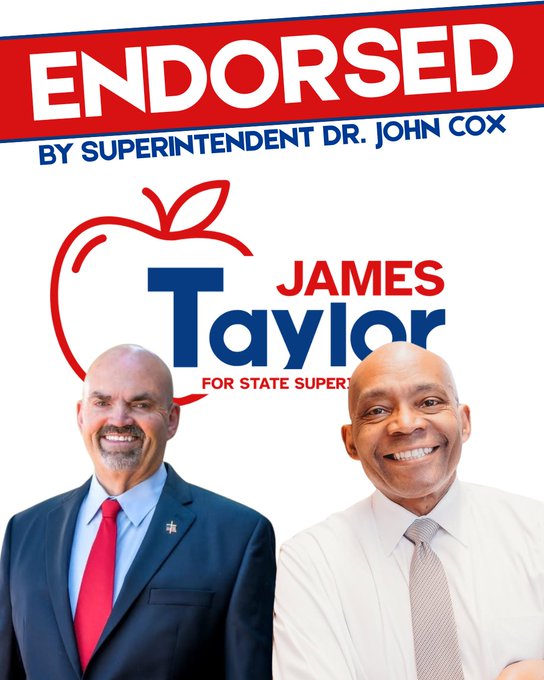 Dr. John Cox, Republican candidate for State Superintendent of Public Instruction, and long-time Superintendent of Peggs Public Schools, has endorsed high school history and government teacher James Taylor in the State Superintendent runoff. Cox finished third in a close seven-candidate primary with 18.4% of the vote.
Congressman Josh Brecheen has endorsed Marty Quinn for Oklahoma Insurance Commissioner. Brecheen served in the State Senate while Quinn served in the State House:
And why Marty Quinn? Because I've watched him for approximately a decade. He's honorable. He's honest. And when you look at people who serve in elected office, there's really one thing I think that separates, more so than anything else, and that is: Are they honest? And do they do what they do because they really believe in it, led by conscience, not political calculation?And I was working on some things that were really important to me, trying to make sure that the tax law was just in the way it was applied to Oklahomans years ago. And there was one person of the entire state legislature that I chose to take over the authorship that I had and hand it over to somebody who I knew was respected in the building, and who I knew would do the right thing and pick the fight because he's ferocious, but he does it with gentleness. And you need somebody who's going to do what they do in the Insurance Commissioner's office because it's really within them to do the right thing when nobody's watching.
Brecheen has also endorsed James Taylor for State Superintendent and Mike Mazzei for Governor:
"Mike Mazzei is the leader Oklahoma needs. No one understands state finance reform better than Mike--his expertise will transform Oklahoma into an economic powerhouse," Brecheen said. "A man of strong character and principled conservatism, Mike Mazzei takes on tough issues with truth and tact, making a lasting impact without division."Brecheen also highlighted Mazzei's role in securing the future of the state's teacher retirement system.
"During our time in state government, I witnessed him spearhead some of the most transformational reforms, including pension reform, ensuring the solvency of the teacher retirement system."
State Rep. Jim Shaw has also endorsed James Taylor for State Superintendent:
I am proud to endorse Dr. James Taylor for Oklahoma State Superintendent of Public Instruction.Oklahoma parents deserve a Superintendent who will put their children first, not special interests in Oklahoma City. Dr. Taylor has the courage to stand up for Oklahoma families and lead meaningful reform.
I encourage every Oklahoma voter to join me in supporting Dr. James Taylor for State Superintendent.
Charlie Meadows, long-time chairman of the Oklahoma Conservative Political Action Committee, has released his runoff picks. He agrees with me on statewide officials (Mazzei, Taylor, West, Quinn) and the state questions (Yes on both), and he's got helpful information on several legislative races mainly in central Oklahoma. Here's what Meadows says about the State Superintendent race:
Taylor has developed and proven over several years a method to inspire teachers and parents to inspire students to want to learn. He also has a plan to reduce the number of emergency certified teachers in such a way it would actually save tax dollars for the citizens of Oklahoma. Dr. Franklin is a highly certified educator and administrator that represents everything that the education establishment has done over the past 40 to 50 year which has driven up the cost of education only to see the academic performance of students decline. If Dr. Taylor doesn't win, the teacher union bosses will have put forth a Republican or Democrat candidate to choose from. What a bad idea for the children of Oklahoma.
A correction to Charlie's statement: Former Tulsa school board member Dr. Jennettie Marshall, the Democrat nominee for Superintendent, was not the teacher's union choice. They hate Marshall because she was a critic of Deborah Gist and the expensive consultantocracy at TPS, because she pushed for the audit that exposed fiscal wrongdoing.
Former State Rep. Jason Murphey has also posted his runoff endorsements:
I've been fielding requests for my views on the state questions, though not so much my picks for the statewide candidates. That's likely because the grassroots ticket is fairly obvious to anyone even slightly engaged: Mike Mazzei for governor, James Taylor for state school superintendent, and Kevin West for state labor commissioner.I am not sure I've ever seen such a distinctly defined ticket of runoff candidates, almost as distinct as the partisan divide itself.
Murphey offers no insight on the Insurance Commissioner race.
Murphey provides some helpful historical context on SQ 846 (constitutional voter ID requirement) and puts SQ 844 in a different light. The problem 844 is trying to address, he says, is specific to Google and Mayes County and could be solved a better way:
And now the Legislature finds itself in a position where the state is picking up a tab for nearly $88 million each year, with--get this--$34 million of that going to Google to cover the tab for their property taxes at their Pryor, Oklahoma data center.Yes, at some point in the past, probably in the 1990s, the Legislature decided that data centers should qualify for this treatment, what is known as the five-year manufacturing entity exemption from the property tax, even though a data center isn't a manufacturing entity, strictly defined. It's pure, corrupt, politics.
By 2021, due to the Google project, that date center subsidy became so pricey that the Legislature cut off that part of the program: no more welfare for data centers; except, by then Google was clearly too politically powerful, and the local Pryor, Oklahoma schools so dependent on the subsidy, that the legislators, in what is an epic special-law-benefit territory--which, in my view, is an abhorrent, corrupt practice prohibited by the state constitution--received a special extension through 2036....
[Speaker Kyle] Hilbert's explanation suggests that this is a problem of the local county assessor, presumably in Mayes county, where he seems to suggest that the county assessor is over assessing that facility, knowing that the state will pay the bill, and Google, receiving a free benefit, won't protest the assessment because they are not paying for it.
Now, the fix for this is easy. If this is an abuse, the legislature would direct the state's Tax Commission, which both oversees the giveaway program and has a role in auditing assessors, to tweak its rules as needed to update the assessor auditing criteria and thus mitigate the harm.
He's got me rethinking my vote on 844.
MORE:
Jamison Faught, the Muskogee Politico, has endorsed Marty Quinn and condemned the slimy attacks targeting Quinn:
Marty Quinn, candidate for Insurance Commissioner, has responded to shameful smears by his opponent, attacking Quinn for being born in Arkansas (I wish that was just a joke... as if one can do anything about where you are born!) and for moving to Arkansas to care for aging parents in their final days.Yes, Bob Sullivan and his supporters are attacking Marty Quinn for prioritizing ailing family a few years back. That's a real jerk move.
I have known Quinn for over fifteen years. He is a man of sincere character and real integrity, the kind of man who would give the shirt off his back if you needed it. He's devoted to his church and his family. This man believes in service and putting others first. He's not the kind of man to malign and besmirch his opposition, because he believes in a positive vision for Oklahoma and setting an example for others.
He's got loads of experience - 40 years as a local insurance agent, and 12 years as a legislator. He knows how insurance works, as an industry veteran and as a consumer, and how the legislative process works and can be leveraged to bring about solutions to problems that consumers face.
Faught adds this useful observation:
This election cycle has been a doozy, with some wild, outrageous, and shameful attacks by candidates (many of whom share the same family of political consulting firms, namely CAMP and affiliates). Don't reward sleazy campaigns with your vote. Don't encourage dirty consultants to continue the same tactics.
BatesLine has been tracking the sleazy smears of CAMP and its predecessors for 20 years.

Have you ever thought about how utility companies get the right to run pipes and cables over or under your back fence or under city streets? When a subdivision is laid out (platted), easements are dedicated by the developer to the city. Some of these are for streets and are owned by the city, while the easements along your back fence (typically five feet from the fence) remain in your ownership, but the City has limited rights to run sewer lines and other utilities through the easement and to grant franchises to utility companies to run their own overhead lines and underground cables and pipes. These franchises are long-term but not permanent and must be renewed when they expire, which opens up an opportunity for city and utility to renegotiate terms. Under Article VIII, Section 4, of the Tulsa City Charter, each franchise must be approved by a vote of the people.
On August 25, 2026, all Tulsans, whether or not there is a City Council race on the ballot, can vote on whether to renew the franchise for Oklahoma Natural Gas for the next 20 years.
The last vote on ONG's franchise was on August 9, 2011, and codified as Title 15, Chapter 3. That 15-year franchise replaced a 25-year franchise approved in 1986.
There are several major differences between the existing franchise and the new franchise the voters are asked to approve:
- The new franchise is longer, 20 years instead of 15. (Section 301)
- ONG will be required to build temporary sidewalks when the sidewalk needs to be reopened before the permanent sidewalk repair can be completed. (Section 307 C.4.)
- The new franchise fee increases from 3.10% to 4.00% of gross receipts, but the additional 0.90% will be deposited in a "special revenue fund for the maintenance, repair, and improvement of Public Ways, including but not limited to right-of-way and median maintenance and enhancement; streetscaping; landscaping; street and highway lighting maintenance, repair, and replacement; sidewalks; and corridor enhancement and beautification." (Section 312)
- ONG will not be charged "any permit fees, lane closure fees and similar fees or charges for construction, installation, maintenance or restoration work on the Distribution System within the rights-of-way." (Section 312)
- The process and timing of changes to ONG's lines due to city requirements to accommodate other utilities in the right-of-way is set out in greater detail. (Section 308)
The current franchise ordinance, No. 22415, is here. The proposed franchise ordinance, No. 25782, is here. Here is a Draftable comparison of the two, highlighting the differences.
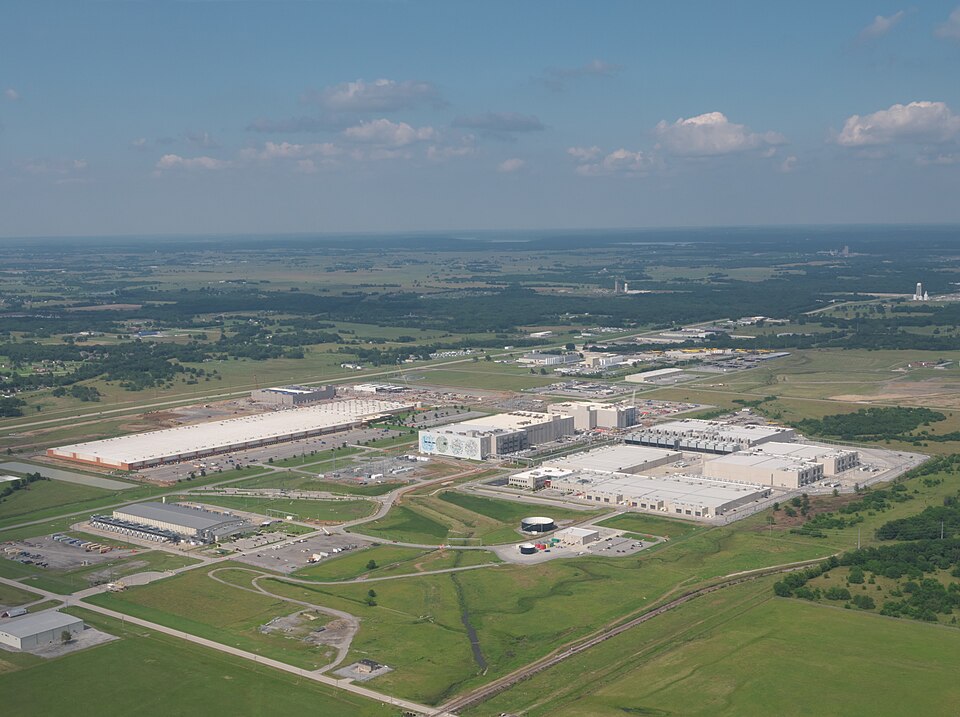
When a statutory matter gets written into the State Constitution, amending it is a pain in the ballot.
On August 25, 2026, at the runoff primary election (also the City of Tulsa general election), Oklahoma voters will decide State Question 844, which would change some clauses in Article X, Section 6B of the Oklahoma Constitution. The Constitution grants a five-year property tax exemption for new or expanded manufacturing facilities and mandates the State to reimburse local government for the property tax revenue they would otherwise receive. If SQ 844 passes, the Legislature would decide how much to reimburse and how to divide the reimbursement up among taxing entities.
Here is the gist of SQ844 that will appear on the August 25 ballot:
This measure amends article 10, section 6B of the Oklahoma Constitution. Section 6B incentivizes manufacturers to locate, expand, or acquire manufacturing facilities in Oklahoma through an ad valorem taxation exemption for five (5) years. Currently, the State must reimburse common schools, county governments, cities and towns, emergency medical services districts, vocational technical schools, junior colleges, county health departments and libraries for revenues lost as a result of each exemption provided. This measure authorizes the Legislature to enact laws establishing the levels and methodologies of reimbursement for the previously mentioned local governmental entities resulting from the manufacturing exemption. The laws are meant to ensure that no individual county receives reimbursement in an amount detrimental to other Oklahoma counties. The levels and methodologies will replace the current statutory framework for reimbursement. For the purpose of calculating the limit on indebtedness for political subdivisions, the measure requires such amount be equal to the amount of reimbursement applicable to such property under laws enacted by the Legislature. This measure will have a fiscal impact on the state that will depend on the application of the levels and methodologies adopted by the Legislature.
Here is what will actually change in Oklahoma Constitution Article X, Section 6B, Paragraphs E & F:
E.TheFor the purpose of ensuring that no individual county shall receive reimbursement in amounts that result in a detriment to the other counties of the state, the Legislature shall enact laws to carry out the provisions of this section and to provide forthelevels and methodologies of reimbursement to common schools, county governments, cities and towns, emergency medical services districts, vocational-technical schools, junior colleges, county health departments and libraries for revenues lost to such entities as a result oftheeach exemption provided by this section.F. The assessed valuation of property exempt from taxation by virtue of this section shall be added to the assessed valuation of taxable property in computing the limit on indebtedness of political subdivisions contained in Section 26 of this article, in an amount equal to the level of reimbursement applicable to such property under the laws enacted by the Legislature.
There will be no change to paragraphs A through D, which establish the exemption and eligibility, and paragraph G, which establishes a county option to apportion up to 25% of the county 10-mill property tax on previously exempt manufacturing facilities to economic development.
Proponents in the Legislature want the flexibility to ensure that reimbursements are not as concentrated to particular counties and that they can be scaled to avoid harming the rest of the state budget. Opponents, mainly from the Left, want to see the school districts where these manufacturing facilities are located continue to get the reimbursements they currently enjoy, and they point out that these reimbursements reduce the amount of money they receive in the state school funding formula.
Reimbursements are funded by an earmarked 1% of state income tax collections, but that hasn't been enough to cover the required amount, and the Legislature has had to appropriate additional funds. From FY 2019 through FY 2024, that 1% only covered 30.5% of the reimbursements.
I'd love to see these exemptions go away entirely, along with other taxpayer-funded inducements to private business, but that option isn't on the ballot. For now, Oklahomans need to vote yes to give the Legislature the flexibility to balance the various interests involved without overburdening the taxpayers.
According to the 2026 annual report from the Oklahoma Tax Commission's Ad Valorem Division, 2026 reimbursements for tax year 2025 total $88,635,421, a significant drop from the 2019 tax year peak of $161 million. The 2024 quinquennial analysis of the exemption by the Oklahoma Incentive Evaluation Commission notes that the legislature removed wind farms from the exemption list in 2015, effective for the 2018 tax year, and the previously granted exemptions have been expiring since then.
$35.6 million (40%) of this year's $88.6 million reimbursement went to Mayes County. Nearly all of that amount, $34,187,160, is for the exemption to Google LLC - Myall LLC for the data center complex at the Mid-America Industrial Park. That's 38.6% of the statewide total.
(A simple way to reduce the number of data centers being proposed for Oklahoma would be for the Legislature to remove data centers from the list of exempt industries, just as wind power generation was removed in 2015. This could also be accomplished by an initiative petition to amend 68 O.S. 2902, the section of law that defines which types of businesses are eligible for the exemption.)
Tulsa County is the only other county into 8 digits in reimbursements, receiving $16,949,307 for the 2025 tax year. Holly Sinclair (east & west refineries combined) receives the largest benefit at $3.4 million, followed by Kimberly Clark ($2.1 million), Amazon ($1.7 million), Macy's Corporate Services ($1.7 million), Whirlpool Corporation ($1.6 million), Green Bay Packaging ($1.3 million), and AAON Corp ($1.1 million). The remaining exemptions are mainly in five figures.
School districts are the largest recipients of property taxes and are also receiving the bulk of these reimbursements, money they likely would not have received in the absence of the ad valorem tax exemption and other incentives for these industrial developments. The complaints that reimbursements are unfairly concentrated in a few school districts remind me of complaints in the 1970s about districts where large electric power plants were located. On our way to visit my grandparents in Nowata, we would pass the new and growing Oologah Schools complex. Mom (a teacher at Catoosa) would remark on Oologah's new indoor pool and higher teacher salaries, funded by the coal-fired PSO generating plant in the district southeast of the town. At some point, the Legislature changed the law so that public utilities are subject to a higher assessment rate and pay their ad valorem taxes to the state rather than the county, spreading the revenues from regulated public utilities across the state.
Whether these exemptions are funding real job growth or just enable financial gamesmanship is hard to tell. The Macy's distribution center in Tulsa's Cherokee Industrial Park, one of the top beneficiaries, closed this past spring.
Why are property tax exemptions a constitutional matter at all? After the jump, we'll take a look at the history of Article X, Section 6B.
Oklahoma has a relatively strong voter ID law, which was approved as SQ 746 at the November 2, 2010, general election, with 74% of the vote. SQ 746 enacted several amendments to Title 26 (Elections) of Oklahoma Statutes. The law specifies the attributes of an ID card that would be considered acceptable (unexpired, government-issued with a photograph and matching name) and makes allowance for provisional ballots for someone who seeks to vote without a valid ID. The sole exception to the photograph requirement is the paper voter ID card that is sent to each voter by the County Election Board to the registration mailing address. (Here's the Oklahoma State Election Board's FAQ on voter ID.)
State Question 846 (746+100!) doesn't change any of that, but it would make it a constitutional requirement to present proof of identity to vote in Oklahoma. Currently, the legislature could abolish voter ID without voter approval; SQ 846 would make that impossible without a vote of the people. The question will be on the August 25, 2026, runoff election ballot. In April 2026, the Legislature approved SJR 47 to send the issue to the voters. SJR 47 passed 78-15 in the House and 39-8 in the Senate along party lines. If passed, it would add the following new section to Article III (Suffrage) of the Oklahoma Constitution:
Section 6. Each voter shall present proof of identity to the appropriate election official when voting at any election authorized by law and conducted by a county election board or the State Election Board. Proof of identity shall be required for any method of voting authorized by law. The Legislature shall enact laws necessary to specify the requirements for proof of identity for voting as required by this section.
The current form of Article III was approved in SQ 531 in November 1978, with a slight amendment to Section 1 in SQ 834 at the November 2024 election, clarifying that only US citizens may vote.
This is an easy YES vote.
Truth in Focus Media in Tulsa has launched a podcast covering a variety of issues, including state and local politics. Truth in Focus is headed by and the podcast is hosted by David McLain, pastor of Heartland Church. McLain has also served as chairman of the Tulsa County Republican Party and the Oklahoma Republican Party. McLain took up the work begun by the late Bruce DeLay, who hosted the weekly Heartland Nation broadcast on KFAQ 1170.
The TIFMedia podcast and channel is quite new; McLain has also interviewed State Superintendent candidate James Taylor, who made it into the August runoff.
Recently I sat down with David to talk about my background, the history and focus of BatesLine, and why citizen journalism matters. We also talked about:
- the impact of data centers,
- corporate welfare and economic development,
- the implosion of the Jackson Lahmeyer campaign and Mark Tedford's win in the open 1st Congressional District primary,
- Craig Hagin's downfall and whether a ministry and calling is heritable,
- massive campaign spending in the Republican primary for governor,
- bait and switch in the legislative process,
- dark money in the Tulsa County District Attorney's race,
- George Soros's efforts to elect district attorneys across America,
- what happened in the 2024 Tulsa Mayor's race and how the local Republican Party could have made a difference,
- Tulsa's homeless crisis and the mistaken view of humanity that shapes Tulsa's philanthropists.
Here's the talk that I mentioned which Mark Tedford gave to Patriot Pastors before the primary. Tedford spoke about his background and his spiritual journey, his decision to get a master's in Christian apologetics and the Christian view of vocation and work.
I didn't mention this in the conversation, but the logo on my shirt is from my 40-year college reunion, which I attended at the beginning of June. The logo features MIT's Great Dome, with three raindrops to recall the steady drizzle that fell on us as we listened to the world's most boring commencement speaker and waited to receive our diplomas.
BONUS: In looking for my Truth in Focus episode, I came across a short interview that Pete Ingemi, DaTechGuy, did with me at the US Capitol back in 2010, the first BlogCon sponsored by FreedomWorks.
Inola and Oklahoma are blessed to have District 8 State Representative Tom Gann back for his sixth and final two-year term before term limits. Gann is one of the handful of legislators who refuses all gifts and meals from lobbyists and all contributions from PACs. As you'll see from the letter below, he's intelligent, well-spoken, thoughtful, and respectful, not a grandstander. All this explains why the House leadership has done its best to freeze him out, and the lobbyists really wanted him gone. Gann won the Republican primary over challenger Todd Rice by a 54% to 46% vote. No candidates filed as independents, Democrats, or Libertarians, so Gann has been re-elected.
Gann raised $23,388.95 (nothing from PACs, all from individual contributors) and lent his campaign $5,000. His opponent, Todd Rice, raised $36,674.31 ($500 from United Community Banker PAC, $600 in-kind), and lent his campaign $3,500. But that's not the whole story.
Gann was targeted by $20,000 from American Energy Action (which was involved in many races statewide); $2,912.10 from Oklahoma Conservative Coalition (based in Lawton and spending money with Managed Strategic Services, 529 Telephone Park, Lawton, OK, 73507, which happens to be the address of Hilliary Communications); and $146,500 from the Oklahoma State Medical Association (one eight State House races targeted with a buy, along with the Insurance Commissioner race, spent with Civil Poltix, 3000 W Memorial, Oklahoma City, OK, 73120).
Gann has written a respectful open letter to President Donald Trump, expressing his concerns about the impact of the proposed aluminum smelter and related development on the character and environmental conditions of his rural, agricultural district and about the degree of foreign ownership in the facility.
President Donald J. Trump,
I write to you as a strong supporter of your America First agenda and as a State
Representative from Oklahoma who endorsed you in November 2023. I fully support your effort to strengthen America's national security, rebuild domestic manufacturing, and ensure that our military has reliable access to military-grade aluminum. That mission is vital. My concern is not with the goal, but with the chosen location and ownership structure of the proposed aluminum smelter in Inola, Oklahoma.Inola is a rural community built around farms, families, cattle operations, churches, schools, and a way of life that has existed for generations. The people here are not opposed to American industry or national strength. They are deeply concerned about being asked to absorb a massive industrial project that appears incompatible with their land, water, air, agriculture, and community character. The scale of this smelter would permanently alter the identity of the area and impose significant risks on local citizens whose homes, livelihoods, and rural way of life deserve careful protection.
I am concerned that the full local impact of the proposed site may not yet be fully understood. I am also concerned by reports that the project could allow majority ownership by foreign interests tied to the United Arab Emirates. If the purpose is American national security, then control of such a strategic industry should remain firmly in American hands. We should not trade dependency on one foreign supply chain for dependence on another foreign-controlled entity operating on Oklahoma soil.
Mr. President, I support your effort to restore American strength. But Inola is the wrong fit for this smelter. I respectfully ask that you pause this project for a thorough review of the site selection, ownership structure, and impact on local citizens, including whether a more appropriate location can serve the national security mission without placing an unfair burden on this rural community.
America First must also mean Oklahoma families first.
Tom Gann
State Representative House District 8
Inola, Oklahoma
Facebook reminded me that Porter Davis's birthday would have been this week. Porter was a long-time activist in the Oklahoma Republican Party. He was on the libertarian, Ron Paul, wing of the GOP, and in fact had been the chairman of the Oklahoma Libertarian Party in the 1970s, but he seemed to get along with everyone. He served one term from 1982-1984 representing House District 85 as a Republican when it was a predominantly Democrat district. Porter died in November 2023.
Porter Davis's heart was with organizing the grassroots at the precinct level. He had a website called The Precinct Leader with his thoughts and counsel on local community organizing to effect change. The website is now offline. He had started to revive it in 2022 after a few years hiatus.
In December 2015, Davis wrote about the recent special election in House District 85 which had followed the death of State Rep. David Dank. Chip Carter, backed by PAC money and establishment consultants, won the Republican primary with 37% against Ralph Crawford and two other candidates. There was no runoff in this special election. There were nasty dark-money attacks against Crawford. Cyndi Munson had been the Democrat nominee in 2014 and had lost to Dank 44% to 56%, but she beat Carter in the 2015 special by 54% to 46%.
Davis ran the numbers and learned that the district still had a bare majority of registered Republican voters, and more Republicans than Democrats turned out to vote in the special general election, but more Republicans had turned out for the primary than voted in the general. At least 402 of the registered Republicans who turned out voted for Democrat Munson.
How did she win? Davis blames GOP division:
Munson is apparently a personable, hard worker. She was able to concentrate her efforts on converting Republican and Independent votes, while doing the basics to secure her Democrat base. She received almost 44% of the vote just six months prior to filing. But that doesn't explain the crossover. In normal times, Carter should have been able to secure the Republican base and concentrate on winning over conservative Democrats and Independents, as all previous Republican candidates have done. But that didn't happen. Why?The truth is that the Republican crossover vote was less a vote FOR Munson and more a vote AGAINST Carter, and what he represented in the minds of the crossover voters. It was a vote against politics as usual by the Republicans.....
What turned the tide against Carter was the negative campaigning in the last ten days before the primary. Post cards, flyers, robo-calls and whispers on the doorstep slandered Ralph Crawford and tried to portray him as an Obama-supporting, budget-busting union goon. This was a deliberate misrepresentation of who Ralph Crawford is. At least one negative postcard came from the Carter campaign, while several others came from dark money groups. Indications were that Carter was trailing Crawford before his campaign went to the gutter, creating fear and doubt in the minds of enough voters to get some Crawford voters to switch or stay home.
We also heard reports of a whisper campaign slandering Crawford's wife, Laura, a two-time Teacher of the Year, in two different school districts. The slander was that she received that prestigious recognition because she was in the teachers' union. The truth is that she had never been a union member, contrary to most Oklahoma teachers.
While "going negative" is politics as usual, in this case, hundreds of people who knew, trusted and voted for Ralph Crawford, took it personally and supported Munson as a protest vote. I've heard many stories of people who were so offended, they chased Carter off their door steps while he campaigned. Many even had Munson signs in their yards, replacing the Crawford signs that were there just weeks before. Munson took full advantage of Carter's negative campaigning. (Crawford did nothing to add fuel to the fire. He didn't have to.)
My speculation is that protest votes were also fueled by a combination of disgust with politics as usual and disappointment with the GOP at both the state and local levels. At home, we have a GOP-dominated legislature whose results seem little different from the Democrats who controlled the state so long. Nationally, 62% of Republicans are upset with their own party, helping to account for the Trump phenomenon. Voting for a Democrat is a good way for a Republican to cast a protest vote.
It is worth noting that the reason many qualified men and women choose NOT to run for public office is the treatment that Ralph and Laura Crawford got. Most people are reluctant to subject themselves to the rigors of campaigning, especially when they can expect members of their own party to tear them down rather than run on their own merits. As a result, people more inclined to be politicians rather than principled statesmen run and are elected. Special interests contribute tens of thousands of dollars and expect a return on their investment.
I think back to a bruising primary campaign for Lieutenant Governor in 2006. Incumbent Mary Fallin ran for the open 5th Congressional District seat vacated by Ernest Istook, who ran for Governor. House Speaker Todd Hiett (before he became a gropey Corporation Commissioner), State Senator Scott Pruitt (later Attorney General and EPA Administrator in Trump's first term), and State Senator Nancy Riley were the Republican primary candidates. Hiett and Pruitt attacked each other relentlessly in the runoff, which Hiett won narrowly by 2 percentage points.
Hiett lost in November to House Minority Leader Jari Askins, who barely topped 50%. Independent E. Z. Million grabbed Republican voters who didn't like Hiett, receiving 2.4% of the vote. It was a terrible year for Oklahoma Republicans anyway -- Bob Anthony was the only Republican to win statewide that year -- but the bitterness of the Lieutenant Governor's primary led to the loss of a winnable seat, and a Democrat had the tie-breaking vote in a Senate tied 24-24.
Porter Davis never wrote the promised follow-up on how the Oklahoma GOP could fix the problem. The current state party organization has alienated many conservative activists and donors, so I don't see the official OKGOP encouraging comity and caution in the runoff campaign or uniting the party when the runoff is over, not after state party leaders squandered their credibility and burned so many bridges backing a creep for Congress and backing a progressive RINO for Tulsa County DA against a conservative incumbent. Claiming to have "prophetic insights," they have proven themselves to be "blind guides who strain at a gnat and swallow a camel."
2026 does not look like a good year for Republicans nationally -- midterms of a president's second term never are good for the president's party, and there are extra special challenges this year with the Iran war and high energy prices damaging the Trump brand. Both candidates in the runoff for governor will have the resources and dark-money backing to go scorched earth on each other. Republicans on the losing side of the primary may be tempted to think it would be better to have a Democrat governor checked by a Republican legislative supermajority than to have the other Republican in the governor's mansion.
Meanwhile, likeable, hardworking Cyndi Munson went on to win a full term in 2016 and every subsequent election for House 85. She just won the Democrat nomination for Governor with 75% of the vote. Munson received over 20,000 more votes (129,152) than any of the Republican candidates for governor. She can sit on the sidelines, raise money, and watch Mazzei and Drummond tear each other apart for the next two months.
Over the weekend, I hope to write about the primary election results and their fallout. I was having too much fun Tuesday night to stop to write, and I've been playing catch-up with the rest of my life since then.
 In-person absentee voting will be available at your county's early voting locations on Thursday, June 10, 2026, from 8 a.m. to 6 p.m., on Friday, June 11, 2026, from 8 a.m. to 6 p.m., and on Saturday, June 12, 2026, from 8 a.m. to 2 p.m. Tulsa County will have in-person absentee voting at the new Tulsa County Election Board location at 12000 E. Skelly Drive and at Tulsa Tech Broken Arrow Campus near 111th Street S & 129th East Ave (aka Florence and Olive). Polls in each precinct will be open Tuesday, June 16, 2026, from 7 a.m. until 7 p.m.
NOTE: Precinct boundaries, voting locations, and district boundaries have changed, in some cases dramatically. Enter your name and date of birth on the Oklahoma State Election Board's online voter portal and you will see where to vote and your sample ballot.
In response to popular demand, I have assembled the guidance detailed below into a downloadable, printable, single-page PDF.
Here are the candidates I'm recommending and (if in the district) voting for in the Oklahoma Republican primary elections on June 16, 2026. (This entry will change as I decide to add more detail, link previous articles, or discuss additional races between now and election day. The entry is post-dated to keep it at the top.)
As I post this, I'm still unsure about several races, and there are other races I had planned to write about in detail, but time is short, people are voting, and many have asked for a summary of my recommendations. My most enthusiastic choices are in bold; in other races, there may be one or two other candidates that would be acceptable, or I simply don't know the endorsed candidate as well as I would like. There are certain incumbents that I'd like to see defeated, but I don't feel comfortable endorsing an opponent at this point. I'll try to fill in TBDs and NOTs before the start of early voting.
US Senate: Kevin Hern
1st Congressional District: Mark Tedford
2nd Congressional District: Josh Brecheen
3rd Congressional District: Wade Burleson
4th Congressional District: Marcie Everhart
5th Congressional District: No primary
SQ 832 (eternal minimum wage escalator): NO
Governor: Mike Mazzei
Lt. Governor: David Ostrowe
Auditor and Inspector: Melissa Capps elected without opposition
Attorney General: Jeff Starling
Treasurer: Todd Russ
Superintendent of Public Instruction: John Cox
Labor Commissioner: Kevin West
Insurance Commissioner: Marty Quinn
Corporation Commissioner: Justin Hornback
The Treasurer's race was a tough call. I admire Cindy Byrd's work in eight years as State Auditor. She had been running for Lt. Governor but switched races at filing time. Todd Russ has gotten great investment results for Oklahoma's public funds, has improved the state's credit rating, and has divested from funds that discriminate against the oil and gas industry. But Jason Murphey, whom I greatly respect, sees "danger signs" in Russ's handling of the Invest in Oklahoma Board and his hiring of a lobbyist. On the other, other hand, reporting from OCPA's Ray Carter makes it clear that Russ bent over backwards, extending the deadline, so that taxpayers had multiple bidders from which to choose. The winning bidder was the low bidder, and the various state pension fund boards will independently choose whether or not to opt-in to invest with the fund.
District Attorney, District 14: Steve Kunzweiler.
This is the most important race on the Tulsa County ballot. Kunzweiler is an honest, hardworking leader who has done a great job for us, despite limited resources and obstacles like McGirt and SQ 780 that make it much harder for a DA to put bad guys behind bars. I've looked into the accusations against him, amplified by dark money from Delaware, and they reflect a failure to understand the law and the facts.
His opponent, Colleen McCarty, has never tried a case before a jury but has spent her entire, 5-year legal career leading non-profits that advocate for bad ideas from the Left: lighter sentencing for career criminals, "social justice," trans rights and woke history in schools, and California-style jungle primaries. She has been dishonest about her 17-year history as a Democrat and deceptive in the way she tells conservative audiences about her left-wing non-profit work, describing letting criminals out of jail early as "fiscally conservative." She protested against a bill that would have acknowledged unborn children as persons with unalienable rights.
District 14 District Judge, Office 4: Dustin Allen. Either Allen or Phillip Peak would be preferable to DEI supporter Loretta Radford, but Allen has law enforcement backing and a longer history as a Republican.
In the State House and Senate, we need to re-elect Freedom Caucus members and elect challengers who will join them in resisting lobbyists and corporate welfare and who will stand for the taxpayers of Oklahoma. If you want to see the Capitol Swamp's hostility toward Oklahomans, watch Senate Majority Whip Bill Coleman's angry rant about the Freedom Caucus. Jaden Terrazas, his challenger for District 10, offers a dignified response.
Senate 2: Payton Pepin
Senate 4: Kenny Smith
Senate 10: Jaden A. Terrazas
Senate 12: Todd Gollihare
Senate 20: Mark LeMarr
Senate 26: Brady Butler
Senate 28: Robert Trimble
Senate 34: Dana Prieto (i)
Senate 42: Malana Bracht
House 3: Rick West (i)
House 8: Tom Gann (i)
House 9: Debbie Long
House 10: Jake Bair
House 11: Wendi Stearman
House 12: Sandy Hodges
House 14: Roy Timmons
House 24: Chris Banning (i)
House 32: Jim Shaw (i)
House 33: Molly Jenkins
House 36: Jenni White
House 69: Angela Strohm
House 74: Kevin Norwood (i)
House 98: Gabe Woolley (i)
Tulsa County Assessor: John Wright re-elected without opposition
Tulsa County Treasurer: John Fothergill
Tulsa County Commissioner District 1:
Tulsa County Commissioner District 3: Kelly Dunkerly re-elected without opposition
Osage County Treasurer: Shawna Myers
Wagoner County Commissioner District 1: Josh Stenros
City of Bixby Charter Amendment Propositions: NO
MORE INFORMATION:
POLLING:
May 21-25 NonDoc poll of Governor and State Superintendent races: This poll was used to decide which candidates qualified for the NonDoc debates
June 2-3 JMC Analytics poll of Governor, Senate: JMC Analytics is a Louisiana-based polling company
OTHER CONSERVATIVE VOICES:
Here are some blogs, endorsement lists, candidate questionnaires, and sources of information for your consideration.
- Muskogee Politico news, questionnaires, and analysis
- Muskogee Politico primary picks
- Muskogee Politico legislator tax votes, 2016-2018
- Oklahoma Conservative PAC meeting videos, including candidate speeches
- Tulsa Beacon endorsements
- Jason Murphey Primary Voter Guide
- Oklahoma Constitution Index: Scores incumbent legislators on voting record
- iVoterGuide surveys of Oklahoma statewide, federal, and legislative candidates
- Tulsa County Republican Party candidate guide, with links to social media, GOP questionnaires, and GOP candidate interview transcripts
- City Elders Tulsa speakers' videos, including candidate speeches
- Oklahomans for Life candidate surveys: 2026 primary survey
- Oklahomans for the 2nd Amendment (OK2A)
- NRA-PVF endorsements
- Make Oklahoma Healthy Again (MOHA) endorsements -- formerly Oklahomans for Health and Parental Rights (OKHPR)
- Charlie Meadows's picks
ANTI-CONSERVATIVE VOICES:
Historically there have been some endorsement lists that are generally negative indicators, including public employees and teacher's unions (and front groups like Oklahomans for Public Education), but these groups have become careful to conceal their support, which backfires in a Republican primary.
The State Chamber of Oklahoma puts out a voter guide that lists State Chamber PAC endorsements. Being pro-business is great, but please read my 2016 article "Chambers of Horrors" to understand why social and fiscal conservatives, opponents of cronyism, and supporters of historic preservation should find Chamber endorsements problematic.
There are some self-styled "conservative influencers" who have shown themselves confused, inconsistent, or downright treacherous. Caveat lector. Anyone who promotes an inexperienced left-winger for District Attorney is not someone conservatives should look to for endorsements.
If you appreciate the many hours of research that went into this guide and into the rest of my election coverage, and if you'd like to help keep this site online, you can contribute to BatesLine's upkeep via PayPal. You can also support BatesLine through a paid Substack subscription. In addition to keeping me caffeinated, donated funds pay for web hosting, subscriptions, and paid databases I use for research. Many thanks to those generous readers who have already contributed.
UPDATE 2026/06/13: I've added recommendations for the open seat in House District 9 (Rogers County), the rematch in House District 74, Wagoner County Commissioner 1st District, and Osage County Treasurer.
UPDATE 2026/06/15: Serious and credible accusations of sexual misconduct with minors have emerged today against Senate 12 challenger Craig Stump. Because of incumbent Todd Gollihare's connection with the late-session Senate obstruction of House bills, I had joined other conservatives in calling for Gollihare's replacement, but Stump is clearly the wrong choice.
There's always more to say than time to write, so here are some final loosely organized notes and thoughts on the 2026 Oklahoma Republican primary.
A politically involved friend texted to ask, "Have you ever in your time in Tulsa seen political campaigns so dark and nasty?" It's been a bad year, and a lot of factors are making it worse: All the statewide races are strongly contested, and all but one (State Treasurer) is an open seat. There's been a massive amount of dark-money spending. The closeness of the Governor's race and the 1st CD race means that a campaign will seize on anything that might add a few voters to the candidate's column or demoralize the other candidate's voters into staying home. Of course, there are so many things to vote on, that demoralization about one candidate wouldn't necessarily cause a voter to give up voting on anything.
Oklahoma Grassroots Conservatives LLC, a Delaware-registered dark-money group, has reported spending $677,828.65 opposing Steve Kunzweiler and supporting Colleen McCarty for Tulsa County District Attorney in the Republican primary. Dustin McIntyre is named as the group's treasurer; the address is a private mailbox facility at 4th and Yale. That astronomical amount does not include any spending in the last two weeks of the campaign.
Dark-money groups, like Oklahoma Grassroots Conservatives, LLC, offer a way for corporations to influence an election; it's illegal for corporations to donate directly to candidates for public office. Dark-money groups also provide an avenue for secret support from donors whose gifts might be embarrassing to a candidate and a way for donors to exceed the $3,500 maximum allowed by law.
It's interesting that we haven't seen many contributions to either candidate from people connected with Tulsa's progressive philanthropocrats. Names that are often on campaign contribution lists just aren't there. It may be that, because their names are poison in GOP primaries, these people are giving instead to the dark-money group to help McCarty.
There are a couple of exceptions. Former Democrat mayor Kathy Taylor gave $1,000 to McCarty, and so did Rachel Zarrow, a San Francisco teacher and freelance writer who serves on the board of the Maxine and Jack Zarrow Family Foundation, which was a 2023 donor to Oklahoma Appleseed Project.
George Kaiser and his associates have not yet given to Colleen McCarty's campaign, but the George Kaiser Family Foundation gave $50,000 in 2023 and $50,000 in 2024 to McCarty's Oklahoma Appleseed Project. (The 990 for 2025 is not yet due to be filed.)
 By World Economic Forum - Flickr: George Soros - World Economic Forum Annual Meeting 2011, CC BY-SA 2.0, Link
Billionaire leftist George Soros has been involved in a long-term effort to take over District Attorney's offices across America. According to a 2022 report from the Foundation for Government Accountability, Kim Foxx in Chicago, George Gascon in LA, Alvin Bragg in Manhattan, and DAs in Portland, Dallas, Houston, Austin, San Antonio, Philadelphia, St. Louis, and New Orleans won office with support from Soros's organizations.
In 2022, there has been a rise in violent crime across the United States. But many cities and counties run by Soros-backed district attorneys have seen a disproportionally sharp increase in violent crime. Delaware County, Pennsylvania, saw a 127-percent increase in homicides once a Soros district attorney took over the top prosecutor job. Nearby Philadelphia had the highest murder rate of the 10 largest cities in the country. Cook County, Illinois, saw the largest spike in Chicago homicides in more than 30 years while the progressive district attorney backed by $2 million from Soros dropped charges against 30 percent of felony defendants. In Dallas County, Texas, after District Attorney John Creuzot decriminalized theft under $750, criminal trespass, and drug possession, crime increased 15 percent, while convictions dropped 30 percent.Soros-backed district attorneys in California witnessed crimes in their districts that would seem more at home in movies. Shocking videos emerged of organized flash mob robberies at places like San Francisco's Union Square, Nordstrom, and Louis Vuitton. In Los Angeles, a flash mob ransacked a convenience store and the rest of the country got to learn what exactly rail theft entails.
This is to be expected when prosecutors who promise no prosecution are elected. Parts of the nation can begin to look like a third-world country because people will always push boundaries when there are no consequences....
Funding the campaign of a district attorney is much cheaper than that of a presidential, senatorial, congressional, or gubernatorial candidate. Soros spent $40 million to help elect district attorneys that represent more than 70 million Americans. The most expensive Senate race was Georgia's in 2020 with more than $500 million spent and the most expensive House race that cycle was a special election in California with more than $38 million spent. With the same amount of money as one House race, Soros was able to elect district attorneys representing more than a fifth of all Americans. Money really does go further in these races, which are arguably much more consequential for the day-to-day lives of Americans....
Soros's efforts to turn a largely nonpartisan position into an ideological one is in full swing. These progressive district attorneys have turned criminal law on its head, protecting the criminals and leaving the citizenry exposed. This has predictably led to an increase in crime and a feeling of unease for law-abiding citizens when in the streets of large cities.
After several Soros-backed DAs were ousted by voters in 2022, because of the chaos they caused, Soros wrote in the Wall Street Journal that he would continue to fund "reform prosecutors" in District Attorney elections. Soros echoes the same themes we've seen in McCarty's work at Oklahoma Appleseed and Oklahomans for Criminal Justice Reform: The criminal justice system is biased against African-Americans, and too many people are going to prison.
Oklahoma Grassroots Conservatives, LLC, has spent nearly a million dollars attacking DA Steve Kunzweiler and supporting Colleen McCarty. There isn't a corresponding dark-money group fighting on the other side. There's a world-renowned billionaire who has publicly stated he funds "reform" DA candidates who align with the "criminal justice reform" policies for which Colleen McCarty has advocated her entire, short, legal career. There's a local billionaire whose foundation made significant grants to Colleen McCarty's organization for the most recent two years for which 990s have been filed, 2023 and 2024. If any names traceable to either billionaire turned up in McCarty's campaign disclosures, it would destroy her viability as a Republican primary candidate. But there's a Delaware-registered dark-money organization right there, making it possible for donors to spend hundreds of thousands of dollars helping their preferred candidate without hurting her by association.
It may take years to find out who's behind it, but if it looks like Soros, and it smells like Soros, you have to wonder.
Amy Dickens is a prosecutor now, working in the Crimes Against Children unit, but many years ago she was our kids' babysitter and part of our church family. Dickens received the Pillar of Hope award last fall from the Child Advocacy Network for her work prosecuting cases involving child abuse. She has some words about tomorrow's election for Tulsa County District Attorney that are worth your attention.
Tomorrow is the day to vote for Steve Kunzweiler to remain the Tulsa County DA.Colleen McCarty has lied about a lot of things during her campaign but one particular lie so offends me, both personally and professionally, that I feel I have to address it.
Anyone who claims that our office does not prosecute cases involving sexual abuse of children under age 12 is LYING. I've spent seven years prosecuting those crimes.
Someone who has never tried a single case may have the naive luxury of believing that, to quote her directly, "you would be hard pressed to find 12 people in Tulsa county who would NOT convict a child molester and sentence them to 25 years." If only that were true.
The reality is this: IT IS HARD to secure convictions in those cases. It is hard to watch attorneys deliberately confuse small children, twist their words, make them cry, then tell a jury the reason they "can't keep their story straight" is that they are lying. It is hard to explain to a jury why so many times children don't disclose right away, or how frustratingly quickly DNA evidence disappears. It is hard to get jurors to understand that someone who abuses a child for a period of months deserves that 25 year minimum just as much as someone who abuses a child for a period of years. And it is hard to get jurors to tune out the little but loud "reform groups" who work tirelessly to shift society's focus to criminals who want to paint themselves as victims rather than keeping the focus on the actual victims - groups like those McCarty has spent her entire career working for, advocating for criminals.
That doesn't mean we don't file those cases. We do. And we secure convictions in a lot of them because experienced prosecutors handle them. But anyone who thinks that prosecutors can just snap our fingers and get a jury to convict every single time because we say so is frighteningly naive. It simply does not work that way, which McCarty doesn't understand because she's never actually done this job. And claiming that we do not prosecute those cases because the 25 year minimum makes them too hard is an outright lie.
When you're a prosecutor you don't get to lie. You don't get to spin, or twist people's words, or provide incomplete context, or actively work to deceive people to get them on your side. Every single thing Colleen McCarty is doing in her campaign is the very opposite of what it means to be a prosecutor.
On June 16th vote Steve Kunzweiler for DA.
Well said, Amy. Steve Kunzweiler has put together and kept together a great team at the Tulsa County DA's office, despite budget restrictions and the heartbreak of working with victims. Amy is one of several ADAs that our family got to know before their time working at the DAs office, so we have a good sense of the kind of dedicated, hardworking, and intelligent attorneys that Kunzweiler has recruited and retained. None of the attorneys I know want to see Kunzweiler replaced.
(Dickens mentioned separately that, although the legislature recently reduced the minimum sentence from 25 to 10 years, crimes that were committed prior to the change must still be tried under the previous sentencing minimums.)
Here are a few of my thoughts as we reach the end of this campaign:
In previous entries, I explained why it was important not to have a Gentner Drummond vs. Charles McCall runoff for the Republican nomination for Governor. I explained why I don't see Jake Merrick as a viable alternative, and why I worry he may draw enough conservative votes from Mike Mazzei and Chip Keating to give Drummond/McCall the two slots in the August runoff.
I've also expressed my extreme displeasure with Mazzei's explanation of his 2014 State Senate vote in favor of SB 906, which would have signed Oklahoma up to the National Popular Vote Interstate Compact, agreeing to give Oklahoma's seven electors not to the candidate that won Oklahoma but to the winner of the sum of popular votes from the 50 states and DC, numbers that are easily manipulated by states with, shall we say, very porous election integrity laws, such as California and Illinois. No, he didn't vote to abolish the electoral college, he just voted to repurpose it in a way that would have effectively disenfranchised Oklahomans and removed firewalls against voter fraud in presidential elections.
So why Mike Mazzei over Chip Keating?
1. I like Mazzei's plan. He's going to eliminate Oklahoma's income tax and start the process of eliminating property taxes on homes of seniors and veterans. He's right in pointing out that foreign ownership of land is a constitutional issue in Oklahoma, but the prohibition has to be enforced.
2. Mazzei built his own business and his own fortune from a very small beginning in the 1990s by helping his clients build wealth. Keating's resume gives the impression that he worked real jobs for about 10 years, then has spent the last 16 years clipping coupons and sitting on boards because of his name.
Two businesses listed in Keating's old University Health Authority and Trust board bio are Energy 11, LP and Energy Resources 12, LP. This article, by a securities law firm, suggests that these were not successful ventures, at least not at that point in time, although they appear to be ongoing.
3. Mazzei seems to be the best of the four front-runners on defending Oklahoma sovereignty. For comparison, here are the answers Mazzei and Keating gave during the Oklahoma Freedom Caucus debate back in March, which included McCall and Merrick -- Drummond was represented by an empty suit:
Congressional candidate Jackson Lahmeyer canceled his sermon this morning at Sheridan.Church. Hours later, the London-based Daily Mail published an expose of Lahmeyer's flirtatious texts with a former Miss Oklahoma USA. Although the texts indicate no sexual involvement had yet occurred, the reaction from Lahmeyer's wife shows that she saw her husband moving toward the exits with Caitlin Simmons Key, a single mom who worked as a fundraiser for the campaign.
Jackson Lahmeyer, 34, the Tulsa megachurch pastor whom Donald Trump anointed a 'MAGA Warrior' last month, faces a torrent of his own text messages obtained by the Daily Mail ahead of Oklahoma's 1st District Republican primary on Tuesday.In them he professes his love for the former pageant queen, invites her to his hotel room, and recounts leaving Mar-a-Lago to visit a strip club at 1am after being offered cocaine, which he declined.
Her reply now reads as prophecy: 'Jackson if u become congressman & if ever got caught u would be headlines.' Then, one word: 'Pastor.'
Caitlin Simmons Key, a 40-year-old single mom who worked as a fundraiser for Lahmeyer's campaign, tells the Daily Mail they shared inappropriate texts before his wife learned of the relationship on the eve of Mother's Day.
'You are a home wrecking whore. Did you enjoy ruining our family?' Lahmeyer's wife Kendra wrote to Key on May 9: 'He has 5 kids.'...
Key first met Lahmeyer in 2022, when he was a political newcomer mounting a long-shot Republican primary challenge to incumbent US Senator James Lankford.
She was active on the Oklahoma conservative scene; he was the pastor who had refused to shut his church during Covid. She signed on to raise money for the campaign.
Lahmeyer lost to Lankford in a landslide. But the two stayed in touch, and, Key said, grew closer as she went through a bruising divorce. She said he would call to check in. It became an intense friendship that went too far, she says.
'Eventually the conversations crossed the line of probably what most people would consider appropriate for a married man and a single woman,' she said.
Through that period Lahmeyer's national profile climbed. He founded Pastors for Trump and was brought into the president's new White House Faith Office. Key worked as a media contact for Lahmeyer's organization. He was in Washington constantly, she says, and repeatedly encouraged her to join him: 'You gotta come to DC.' She declined every time.
Key posting about Trump's endorsement started the ball rolling toward exposure:
On May 6, the president endorsed Lahmeyer on Truth Social telling Oklahoma's 1st Congressional District: 'HE WILL NEVER LET YOU DOWN!'The next day, Key shared the endorsement on Facebook with a header vouching for the candidate: she wrote that she knew him well, knew his family, and was ready to 'get to DC.'
It was that public revelation, she says, that undid them. The morning after the post, she got a call from campaign manager Killian. 'She's pissed,' Key said he told her, meaning Kendra Lahmeyer. 'She got into Jackson's messages.'
That led to Mrs. Lahmeyer's "home wrecking whore" message quoted above.
Here's the May 7 Facebook post that reportedly triggered Mrs. Lahmeyer:
A couple months ago people kept asking me, "Why would Jackson even run for this?""Do you realize how many people are in this race?"
"That's impossible."
"That's going to be HARD."
And honestly? They weren't wrong. Politics is brutal. Crowded races are brutal. Public opinion changes by the hour and everyone with a Facebook account and a WiFi signal suddenly becomes an expert. America's favorite Olympic sport: confidently yelling from the comments section.
But impossible and difficult are not the same thing.
Today, Jackson Lahmeyer received President Donald Trump's endorsement, and regardless of where anyone lands politically, that is a huge moment in this race.
I support Jackson because I actually KNOW him. I know his family. I see the conversations people don't see, the work people don't see, and the heart behind all of it.
If there's one thing I've learned over the years working around politics, it's this: politics can be ugly... but not every person in politics is.There are good people trying to do good things, and Jackson is one of them.
And also... let this be your reminder that people will always tell you something can't be done right before it starts happening.
Later, Jackson Lahmeyer texted Key:
Kendra wanted to recover all of our messages. I deleted them. I told her I got way too close to you and became emotionally attached. She lost it on me. [...]I've been very clear with her that I got way to close to you and shared too much about myself... but we were not romantic. I deleted all her texts and she thinks there is way more going on. She is flipping on me because I will not share more. [...]
I did not see this coming. She came home and wanted to read our texts and I had deleted them and then she lost it. Saying I had something to hide. And so I have shared with her that you and I have gotten close and that I crossed the line and etc... but was very clear we had nothing romantic or etc... but she doesn't believe me.
The morning after Mother's Day, he then instructed Key to delete messages:
Ok send me a screenshot of our last several texts and I'll show which ones to remove.Kendra has really shifted now. I think the hurt and wine caused yesterday
MORE: Key's public political posts on Facebook since May 7 have been in support of Chris Merideth for Insurance Commissioner.
Jackson Lahmeyer posted the following response on Facebook at 9:07 pm Sunday evening, June 14:
Today, a distorted story from a British Tabloid was released just two days before my election.This matter was already dealt with privately between me and my wife, Kendra, through counsel and prayer with God and spiritual advisors. I own crossing a boundary line through text messaging. I also ended all communication. The British Tabloid tried to paint me out in a way which is not the case.
At the same time, we must ask the question if this story was paid for and why our communications were carefully cherry-picked to create an impression that is not accurate.
I am beyond grateful to have Kendra's support. I am fully committed to my family, church and Oklahoma's 1st Congressional District.
I have little doubt that those in the political establishment who oppose my America First Candidacy will attempt to make more of this than it is. My wife Kendra may have more to say on this subject in the coming days.
If the messages were cherry-picked to create a misleading impression, Lahmeyer would be in a position to provide the context he says is lacking, assuming he didn't delete those messages.
THE OTHER SHOE HAS DROPPED: After the initial story, Lahmeyer's limited-hangout response, and Trump's reaffirmation of his endorsement, the Daily Mail has a second story, in which Key claims that the two kissed several times, and a text from Lahmeyer seems to corroborate the claim. (Archive link.)
THE THIRD AND FINAL SHOE: In a story published by the Daily Mail on June 17, Lahmeyer admitted that he had had an alcohol-fueled sexual encounter with Key during his 2022 Senate campaign:
He denied any physical relationship ahead of Tuesday's primary.Key then went on the record, describing multiple kisses throughout the spring and warning the pastor to stop lying as she hinted there was more to the story.
Pressed by the Daily Mail on the gap between his account and hers, Lahmeyer finally cracked.
Asked directly whether Key was lying, he said: 'No, she is not lying.'
Asked if the two ever had sex, he replied: 'We kissed and in 2022 I had an affair on my wife and I've owned that. But Caitlin Key and I did not have sex during this election. There's plenty of text messages to prove that.'
Pushed on whether he was admitting that in 2022 it crossed the line into sex, he said simply: 'In 2022 I cheated on my wife.'
He cast his withdrawal from the race as a moral reckoning, telling the Daily Mail he was 'heading down a very, very bad path' and that the implosion of his campaign 'may have spared my life and my family.'
This is conjecture, but if Kendra Lahmeyer was already aware of the 2022 affair, it would explain why she was triggered by Key's social media post about the Trump endorsement, and why she texted Key to ask her to change it. It would also explain why Kendra demanded to see Jackson's text messages shortly thereafter.
Shortly after this revelation, Lahmeyer suspended his campaign, and Trump switched his endorsement to Mike Tedford.
Lahmeyer filed papers by the deadline to withdraw from the runoff, making Tedford the nominee. This also happened in 2001, when John Sullivan finished first in a December 11, 2001, special election to fill the vacancy in the 1st Congressional District after Steve Largent resigned to run for Governor. First Lady Cathy Keating finished second with 30.5% well behind Sullivan at 45.5%, and she opted to withdraw from a runoff she was highly unlikely to win. That allowed the general election to occur on the scheduled runoff date, on January 8, 2002.
Jackson Lahmeyer has responded on Facebook to a last-minute mailer from the Mark Tedford campaign. The two are front-runners in the battle for the Republican nomination in Oklahoma's 1st Congressional District.
I wish I didn't have to do this, but unfortunately my opponent, Mark Tedford, has revealed his lack of character by running a false TV ad & mailer about me just 3 days before the election.Mark can't win on the issues so he's resorting to false personal attacks. That's what career politicians do.
He claims over a decade ago that my wages were garnished by Sheridan Church. That's false.
I had a medical bill I was unaware of go to collections. Once I was notified of this, I paid the medical bill and have the Satisfactory Statement from the collector.
This is simply dirty politics.
We are the ONLY candidate endorsed by President Trump. The Swamp in DC is scared of our movement because they know we're not going to bend the knee to the establishment.
On Tuesday, June 16 take action and vote Jackson Lahmeyer. I will never let you down!
Here's the court case. If I'm reading the docket report correctly, it took Lahmeyer six months after he was served with the lawsuit, five months after the court ruled against him, to get around to paying, and that did not happen until a garnishment was filed and served to the church.
Typically a creditor doesn't file a suit until they've sent months of notices, followed by notices from the collection agency. Saying, "Once I was notified of this, I paid the medical bill," is dishonest spin.
It may be that Sheridan Church never paid a garnishment, but the church was served with a garnishment notice. Here's the timeline of key events from the docket report:
- 11-10-2016: Small claims initial filing for $1066.82
- 11-15-2016: Summons served on Jackson R. Lahmeyer
- 12-13-2016: Judgment against Lahmeyer for $866.82, plus $86 attorneys' fees and $93 court costs
- 05-02-2017: Garnishment affidavit with summons filed for $1,024.78
- 05-10-2017: Garnishment discharge filed
- 05-30-2017: Release from judgment
It's worth pointing out that this was shortly after Lahmeyer's divorce from his first wife, and it appears that he had sole custody of their child.
Tedford also had two similar small claims cases in which a medical bill went to collections. The first case, from 2011, appears to have been disputed, as Tedford's attorney entered appearance in the case shortly after the suit was served, and the plaintiff dismissed the case. In the second case, from 2017, the summons was served on July 8, 2017, and the case was dismissed on August 25, 2017, with no intervening entries on the docket, suggesting the bill was paid soon after the summons was received.
Medical bills do sometimes slip through the cracks, but taking six months to deal with the matter after being served with a lawsuit, rather than setting up a payment plan right away, to let things get to the point of garnishment, that seems irresponsible. Whether it ought to matter in a congressional race 9 years later is up for debate, but increasingly character matters as much as a candidate's platform. How are we going to trust you to fulfill your platform if you're not honest with us?
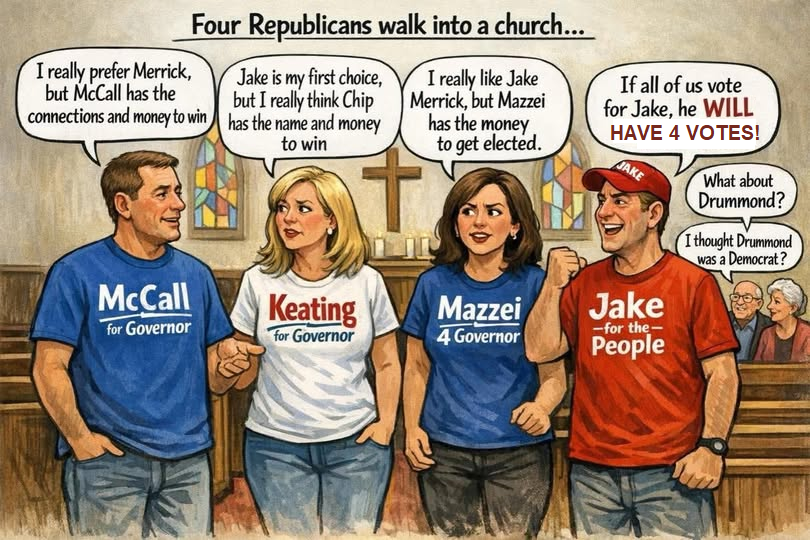 After posting my ballot card for the June 16, 2026, Oklahoma primary, I got questions, as I usually do, about why I chose one candidate over another.
A friend messaged to ask: "Mazzei and not Jake Merrick? Everybody else I know has been on the Merrick train for months."
The short answer: Merrick has no shot at making the runoff. He's also got personal financial problems that mirror the poor financial and organizational skills on display in his campaign. I have my issues with Mazzei, but he's the best of the four who are running an organized campaign.
Merrick has enjoyed a lot of support online, regularly winning social-media polls, but that hasn't been reflected in the real world. He had 5% support in the February poll, a distant 5th place. When NonDoc took a poll to determine if any of the minor candidates had built enough support to have a realistic shot at the runoff, Merrick was still a distant 5th, with 7%, well behind the top 3 candidates (Mazzei, Drummond, Keating) who were clustered around 21-22% and McCall at 18%. There is a more recent poll, from JMC Analytics, a Louisiana pollster, showing Mazzei 29, Drummond 21, and Keating and Merrick tied at 12, with McCall fading to 8%, but the pollster doesn't have much history of polling Oklahoma.
So are people who vote for Merrick "throwing away their vote"?
 Jimcy McGirt, child molester, the Founding Father of tribal sovereignty
I've been asked why I support Jeff Starling to be Oklahoma's next attorney general, rather than Jon Echols. Echols's involvement in the imperial speakership of Charles McCall is compelling enough, but the clincher was the answer the two candidates gave at the recent News 9 / NonDoc debate on a question about ongoing litigation relating to the McGirt decision.
Here was the question posed to the candidates:
In July 2020, the US Supreme Court ruled...five to four that Congress never disestablished the Muscogee Nation Reservation. Several Oklahoma Criminal Court of Appeals decisions then affirmed the reservations for the Cherokee, Chickasaw, Choctaw, and Seminole Nations, as well as some of the nine tribes in Ottawa County. The McGirt and Castro-Huerta rulings of course mean that only the federal government and tribal nations can prosecute Indians in Indian country. Governor Kevin Stitt has advocated for the McGirt decision to be overturned either by Congress disablishing reservations or through litigation seeking concurrent state jurisdiction over tribal citizens accused of major crimes in eastern Oklahoma.... Do you believe the state should seek concurrent jurisdiction over tribal citizens in eastern Oklahoma even though it could mean costly and controversial legal battles or can better cooperation and compacting let the federal justice system and tribal courts handle all prosecutorial decisions and adjudications of Indians in eastern Oklahoma?
Starling answered:
Here's another example of the dirty politics emerging out the State Capitol swamp. A political ally of Attorney General candidate Jon Echols requested an Attorney General's opinion that seems aimed at creating an embarrassing headline for his announced opponent, and the current Attorney General, Governor candidate Gentner Drummond quickly turned the request around, releasing the opinion just before the filing period and the official start of the campaign.
Jon Echols and State Rep. Chris Kannady were both part of Charles McCall's machine during McCall's imperial reign as "Speaker Maximus" of the State House. Echols was McCall's enforcer as Majority Floor Leader, while Kannady, chairman of the Judiciary Committee, led and helped fund the effort to purge principled conservatives from the House in 2018, using an out-of-state PAC to fuel primary challenges. Kannady called the defeated conservatives a "cancer" that had to be removed. Echols hit his term limit in 2022; Kannady is term-limited this year.
Jeff Starling, running for the open Attorney General's seat against Echols, serves as Oklahoma's Secretary of Energy and the Environment and as Oklahoma's representative on the Interstate Oil Compact Commission. He is paid for the latter role as an agency head, but not for the former role as a cabinet member. Here's the version of events from the Starling campaign:
On February 20, 2026 -- six weeks before Jeff Starling's filing deadline -- Echols ally Rep. Chris Kannady fired off a request to Attorney General Gentner Drummond asking, in effect, whether the Secretary of Energy and Environment, the role Starling currently serves, was being paid an illegal salary. AG Opinion 2026-4 dropped on March 31, 2026. Starling filed for AG two days later, on April 2....Question: Are Echols and Kannady Willfully Dishonest, Or Are They Just Bad Lawyers?
Pick one. Because the opinion they engineered doesn't do what they think it does.
AG Opinion 2026-4 says cabinet secretaries can't be paid more than the statutory cap in 74 O.S. § 10.5 -- between $65,000 and $90,000, depending on the position -- for their service as cabinet secretary. That's it. That's what the opinion holds.
Both Echols and Kannady know that the leaders of state agencies are authorized to also serve as cabinet secretaries. The Oklahoma Supreme Court has spoken definitely on this. But Echols and Kannady tried to back door the same issue, to relitigate the same dispute, hoping no reporter would notice. Neither of them should be allowed to use the Attorney General's office as a political weapon.
By Executive Order 2023-08, Secretary Starling is responsible for the Interstate Oil Compact Commission (Oklahoma agency # 307), commonly referred to as Oklahoma's Department of Energy. Former Oklahoma Attorney General John O'Connor independently reviewed relevant case law, statutes and the facts, and lays bare the false accusation that Starling's employment is somehow improper. "Starling wears two hats: (1) he is the head of a state agency and (2) he serves as the Secretary of Energy and Environment, which is entirely proper under Oklahoma law," said former Attorney General John O'Connor.
Jeff Starling is not paid by the Office of the Governor for his cabinet service. He is compensated through the agency he leads -- a structure that has existed across Oklahoma government for decades and that the Oklahoma Supreme Court explicitly blessed six months ago.
On November 12, 2025, the Oklahoma Supreme Court ruled 7-2 in Stitt v. Drummond that an agency head may serve concurrently as a cabinet secretary. The Court reversed the district court and overturned Drummond's 2024 opinion, which had argued the same dual-office theory Echols' allies are now repackaging in salary form. Vice Chief Justice Dana Kuehn wrote for the majority. The vote wasn't close.
"Since the 1930s, Oklahoma statutes have permitted the Governor to appoint the representative of the Interstate Oil Compact Commission (Oklahoma agency # 307), and for years, the Oklahoma legislature has specifically created and designated a special fund from the Oklahoma petroleum severance tax to pay for the activities of the commission, including the salary of its representative," said O'Connor. "Starling's salary is paid exclusively by that fund, and he receives no compensation by the Governor's office as a cabinet secretary. This arrangement is entirely proper and has been a longstanding practice in Oklahoma."
So either Echols and Kannady didn't read the statutes that they helped write or the Supreme Court's 7-2 rebuke of the AG's office six months ago -- or they read them and tried to relitigate the same dispute through a different statutory door, hoping to fool Oklahoma voters long enough to retain power. Neither option recommends them for higher office. One of them isn't qualified to be Attorney General. Neither of them should be allowed to use the Attorney General's office a political weapon.
Starling's campaign points out that the average AG opinion takes about 150 days from request to publication. It takes time to research not only the relevant laws but any relevant court precedents that shape the interpretation of the law. From the AG's website: "Generally, public officials are required to act in accordance with an Attorney General opinion unless or until the opinion is set aside by a court." So these opinions carry a great deal of weight and aren't to be issued lightly. AG opinions are logged on OSCN and available there for public review. Drummond issued this opinion rather speedily, in just 39 days, and conveniently right as the campaign for AG began. The Starling campaign says, "This isn't the rule of law. This is a political operation on state letterhead."
Here's the timeline:
- November 12, 2025: Oklahoma Supreme Court rules 7-2 against Drummond that agency heads can serve as cabinet secretaries. Drummond's prior opinion, on which the Echols-Kannady theory leans, was overturned.
- February 20, 2026: Rep. Chris Kannady, a close friend and ally of Echols, requests an AG opinion specifically targeting the salary structure of the Secretary of Energy and Environment. Starling is the only sitting cabinet secretary running against Echols.
- March 31, 2026: The day before filing opens for statewide office, Drummond's office issues AG Opinion 2026-4, applying the §10.5 salary cap to cabinet secretary service. The opinion conflicts with the November 2025 Supreme Court ruling.
- April 2, 2026: Jeff Starling files for Attorney General.
I can't help but notice that both Echols and Drummond are on Team Surrender, pledging not to defend Oklahoma's sovereignty in Federal Court, instead making side-deals with tribal governments that will institutionalize two systems of justice and law. Jeff Starling has my support because, while he'll work cooperatively with tribal governments, he will win court victories that protect the interests of all Oklahomans and the fundamental American principle of Equal Justice Under Law.
Markwayne Mullin's appointment as Secretary of Homeland Security set off a series of electoral dominoes. As Congressman Kevin Hern opted to seek Mullin's Senate seat, a dozen candidates filed to succeed Hern in the 1st District. Dan Rooney dropped out after President Trump endorsed another candidate, leaving 11.
If you're trying to take off from a short runway, you'd better have a lot of thrust. Some elected officials who have run credible campaigns in the past didn't step up this time, perhaps because they knew they couldn't get off the ground quickly enough.
In an earlier entry, we saw how important it was for a candidate to have ready cash to lend his campaign; three months is not enough time for fundraising. A half-dozen have managed either to raise or borrow six figures or more: Nathaniel "Nathan" Butterfield, Jed Cochran, Kim David, Jackson Lahmeyer, Mark Tedford, Todd Woods.
After the second and penultimate day of the filing period for the 2026 City of Tulsa elections, two more races have become competitive, but six remain uncontested. The last chance to file is tomorrow, Wednesday, June 10, 2026, from 8 a.m. to 5 p.m. at the Tulsa County Election Board, 12000 E. Skelly Drive.
The only other jurisdiction in Oklahoma with the same filing dates is the Town of Tecumseh in Pottawatomie County. (Oklahoma should have standard municipal election dates, along with school board elections, in the fall of odd-numbered years.)
The Oklahoma State Election Board tracks candidate filings on their website, and the Tulsa County Election Board has posted a list of filings to date.
Candidates have the option of listing websites, email addresses, and phone numbers on their declaration of candidacy. I've linked those candidates who specified a website.
District 1 City Councilor Vanessa Hall-Harper drew two opponents, Reggie Williams and Corinice Wilson. That sets up a possible November runoff should none of the candidates get a majority of the vote in August. All three candidates are registered Democrats.
District 9 now has two candidates, as Pete Regan, a registered Republican, joins Ben Johnson, a registered Democrat, in the race for the only open Council seat this year. Incumbent Carol Bush announced yesterday that she would not seek re-election.
The other contested seats:
District 2: Incumbent Anthony Archie, challenger Aaron Bisogno. Both candidates are registered Republicans.
District 5: Incumbent Karen Gilbert, a registered Republican, challenger Adam Burnett, a registered Democrat.
Tulsa needs some city councilors who actually know something about creating wealth. What we mainly have now are NGO employees who only know about spending other people's money. Take a look at the district map, see where you live, and think about friends and neighbors you know who have intelligence and backbone.
To file for any City of Tulsa office, you'll need a $50 cashier's check, you'll need to complete and notarize a declaration of candidacy, and you'll need to read, sign, and date the qualifications for office, then file the paperwork with the Tulsa County Election Board at its new location at 12000 E. Skelly Drive, on the southeast service road of I-44 just north of 11th Street. The City of Tulsa 2026 election packet is available on the TCEB website.
Only one of the 14 elective District Judge seats in Judicial District 14 (Tulsa and Pawnee Counties) is on the June 16, 2026, primary ballot. Judge Daman Cantrell is not running for re-election. Three candidates, Phillip Peak, Dustin Allen, and Loretta Radford, are seeking to replace him. The election will take place only within Tulsa County Judicial Election District No. 4, which can be roughly described as north Tulsa County and east City of Tulsa.
The Tulsa County Bar Association hosted a forum with the candidates and posted the video (most of it anyway; the beginning seems to be missing).
Loretta Radford has been a Tulsa County special judge since 2022. Special judges are appointed and serve at the pleasure of the elected District Judges. She retired from the US Attorney's Office for the Northern District of Oklahoma in 2019 after 26 years of service. This speaker's bio from 2021 has more about her time in Federal service and her prior job as an Assistant Public Defender in Tulsa County.
Before being hired as a special judge, Loretta Radford was Legal Director for the Oklahoma City University School of Law Center for Criminal Justice. In 2021, while in that role, Radford wrote that diversifying the bench was the "single most important goal" for the law profession in Oklahoma, and she called for "implicit bias" testing and training, imposing this DEI notion upon anyone who seeks to be a lawyer or a judge in Oklahoma (emphasis added):
The single most important goal for the future of the practice of law in the State of Oklahoma is to diversify the bench, the legal clerical support, the district court benches and the appellate courts of this state with people of color. Law Schools need to stress this fact in their recruitment efforts; lawyers need to stress this fact in the courtrooms when they are picking juries and arguing cases, and in carrying out their pro bono or public service duties; Bar Associations need to recognize the historical disadvantage that people of color experience in just trying to compete with the majority; and current judges need to support the addition of people of color to the bench. To have true diversity we must change the culture. The majority has to quit the mindset that they are somehow diminished professionally by giving a taller foot stool to a person of color in order to give that person of color just a minimal opportunity to compete at the same vantage point. When we realize that true diversity and inclusion is a not a handout but a hand up, we can change the culture and improve the efficiency of the legal system for all of the citizens of the State of Oklahoma.I recommend that lawyers, law students, and law school Bar Associations learn to identify the areas of implicit bias that stifle their thoughts and ultimately their work in the legal profession. The Harvard Implicit Bias test is designed to measure the attitudes and implicit biases people may be unwilling or unable to report. Lawyers, students, judges and Directors of Bar Associations should include this test in their training and curriculums. Then, training should be implemented to teach individuals how to combat the bias. It can be instituted for lawyers as a part of the curriculum requirements for admission to the bar; administered to students in first year law school in much the same way that legal research and writing is required; provided in the success training templates as a part of the professional conduct guidelines for every Bar Association; and administered to judges both at the district court level and the appellate level as a part of their oath of office. When all aspects of the legal profession become serious about diversity, we will lose the fear of discussing race and the implicit bias that affects our professional lives. We will lose the unconscious bias that continues to influence the actions and decisions of those we hire, those we promote, who we appoint as judges, how we interact with people of a certain group, and even how we evaluate the work performance of employees. Diversity training, beginning with identifying implicit bias, is the single most effective way to encourage young people to get involved in diversity issues. They will do what they see us do.
In 2022, Radford was very pleased by the confirmation of Ketanji Brown-Jackson to the US Supreme Court:
"She has shown all of America the leadership qualities that she has. And she's given hope, quite frankly, to other people of color, to other people."..."The revelation by today's confirmation is that America's ready for the highest court in the nation to reflect the population and the citizenry of the United States," Radford added.
Here's Radford in 2019, at a forum on "criminal justice reform":
Radford said the lives of countless Oklahomans have been derailed even as necessities for reform have been obvious. According to census counts, 1,047 people are incarcerated for every 100,000 Oklahoma residents. About 10% of children in Oklahoma have had a parent incarcerated at one time or another, and those children become six to seven times more likely than other children to end up in prison themselves.Radford said goals at OCU's Center for Criminal Justice include gathering and studying data to reveal strategies for reducing disparities in the system that affect especially minorities and people in poverty. Worthy of special attention, she said, would be the state's cash bail system. Many people charged with crimes who lack resources end up being jailed for lengthy periods without being convicted of anything. She said there should be more focus, too, on helping people who have made mistakes, like Strahorne-White when she was in her 20s, to avoid incarceration.
In October 2022, just before taking up her appointment as a special judge, Loretta Radford moderated a panel discussion for the "2023 Policy Reveal" for Oklahomans for Criminal Justice Reform (OCJR). That's where Colleen McCarty worked as Policy Counsel and Deputy Director, advocating against sentence enhancements for repeat offenders and arguing that multiple misdemeanor thefts in a six-month period should not add up to a felony. It's a progressive non-profit that puts the interests of the criminal first, and Radford seems delighted to be helping them.
Then there's this story of a case in Judge Radford's courtroom involving the Oklahoma enforcement of a California child support order. I can't vouch for the website, and it's only one side of the story, but there are a lot of links and details provided.
Radford has been endorsed by Judge Cantrell and a number of other retired judges. According to voter and land records, Radford has had a home in Owasso since 2004.
Dustin Allen is private practice attorney. Allen has been endorsed by Tulsa County Sheriff Vic Regalado and a long list of area FOP chapters. His LinkedIn profile has his pronouns (He/Him) and says that Allen worked as an ADA in Tulsa County for 9 months, as a Tulsa County Assistant Public Defender for 3 years and 1 month, and as an ADA in Wagoner County for 6 months, covering the period from June 2011 to July 2015, when he began private practice. According to voter and land records, Allen lived near 91st and Memorial before purchasing a home in Owasso, in Election District 4, in 2025. Allen's less-than-a-year stints at two different DA offices make me wonder.
Phillip Peak has served for the last three years as an Associate District Attorney in Rogers County. According to Peak's LinkedIn profile (which does not have pronouns listed), he worked as an ADA in Tulsa County right out of law school for 4 years, 7 months, then worked for a couple of years at law firms before operating his own private practice for 7 years, 5 months. His website states that he has tried over 40 jury trials to verdict. (That's 40 more than a certain candidate for District Attorney.) Peak is a native of Collinsville and has lived his entire time in Judicial Election District 4, except for his undergraduate degree and one year during law school.
Looking back a few years, in June 2022 Radford was a Democrat registered to vote in Owasso, Allen was a Republican registered to vote in south Tulsa, and Peak was a Democrat registered to vote in Collinsville. The same was true in November 2018.
The consensus from friends who have worked with these three candidates is NOT Radford. Temperament and organization have been mentioned as areas of concern, along with the progressive ideological alignment that was on display during her time at OCU, when she was free to be a policy advocate for DEI in the legal profession.
I have heard positive things about both Peak and Allen. Peak gets compliments for his work ethic and character.
For this campaign, Allen got out of the blocks early and has far outraised his opponents, and because of this, it's been suggested that Allen would be better positioned to defeat Radford in a November runoff.
As long as you don't vote for Radford, we're likely to end up with a reasonable outcome: Either Peak or Allen win outright on June 16, or they meet each other in a November runoff, or one or the other faces Radford in November with a strong likelihood of winning in a strongly conservative section of Tulsa County.
 Oklahoma primaries with more than two candidates often result in a runoff. If candidate gets more than 50% of the vote at the June primary election, the top two candidates will advance to an August runoff. It doesn't matter how close 3rd place is behind 2nd place, it wouldn't matter if the votes were nearly evenly spread among a dozen candidates with 8% to 9% each, the top two advance. That's better than no runoff at all, but in our current environment, conservatives may be stuck with no good choice in the runoff.
For most of this campaign, the two leading Republican candidates for Governor of Oklahoma, the candidates seen as likeliest to advance to a runoff, were Oklahoma Attorney General Gentner Drummond and former Oklahoma House Speaker Charles McCall. New polling shows four candidates within four percent of each other, with former State Sen. Mike Mazzei and Chip Keating joining Drummond and McCall at the top of the nine-candidate field. At this point, any two of the four could advance to the runoff, and moving just a few hundred or thousand voters would be enough to change the order of finish.
I explained in a previous article why Drummond is an unacceptable choice. Here's why conservatives can't back Charles McCall, and why we have to unite behind a conservative that has a shot at making the runoff and being competitive in the runoff.
The story is of the failure of the Oklahoma Republican legislative supermajorities to produce conservative reform, and Charles McCall's role in stopping that reform. The bottom line:
McCall, who called himself Speaker Maximus, used his power to centralize control, abolish term limits on the Speakership, marginalize conservative members, and enable lobbyists and corporate welfare. In 2018, he pushed through one of the largest tax increases in Oklahoma history and pushed to have it pass by a big enough margin that the voters of Oklahoma wouldn't be allowed to vote on it. The handful of principled Republicans who resisted found themselves with well-financed primary opponents with support from the teacher's unions.
McCall would be slightly less bad than Drummond.
Outside observers often wonder how the "reddest state in the nation," the state where every county has voted for the Republican nominee for the last six presidential elections, lags so far behind other Republican-run states in government reform. Mississippi has led the way in literacy, Florida in school choice and higher-ed reform. Although Oklahoma has a mechanism to reach 0% income tax at some point in the future, other states are ahead of us, and we continue to lose business as a result.
When I began BatesLine in 2003, Republicans were nearing a majority in the State House for the first time in 80 years and only the second time in Oklahoma history. Republicans captured the House in 2004, tied the Senate in 2006, captured the Senate in 2008, and in the ensuing years have gone from narrow majorities to supermajorities, with over 80% of each House.
There have been plenty of improvements, to be sure. But we haven't seen the bold government streamlining that we were expecting. School choice was slow to arrive. We've seen many intelligent and creative legislators sidelined and blocked by House and Senate leaders who seem to prefer rubber stamps.
Just one term after the Republicans took the majority in the House, the favor factory was up and running at the State Capitol, headed by Speaker Lance Cargill. It seems like the same special interests that ran the Legislature under the Democrats still run the show today.
Former State Rep. Jason Murphey has been doing tremendous work documenting the decadent culture that has taken hold at the State Capitol. I won't attempt to summarize his thorough analyses, but I will pull a couple of quotes from a piece earlier this week in which Murphey contrasts Charles McCall unfavorably with the principled, effective conservative that McCall sidelined, Inola State Rep. Tom Gann, in whose district the much-debated aluminum smelter would reside:
City of Bixby voters have two charter amendments on the June 16, 2026, ballot. Proposition No. 1 modifies the qualifications for the City Manager. Proposition No. 2 moves any financial responsibilities from the City Clerk to the City Treasurer.
The Bixby City Council voted unanimously on March 23, 2026, to advance these two charter amendments to the ballot.
Proposition No. 1 is the charter amendment in Ordinance No. 2550:
Section 3.2 Minimum Qualifications
The city manager shall
have a bachelor's degree in public administration or related field from an accredited universitybe appointed by the city council solely on the basis of education and experience and without regard for political affiliation. Actual experience as a city manager or as an assistant city manager is preferred.
Proposition No. 2 is the charter amendment in Ordinance No. 2551:
Section 4.1 - Department of City Clerk: City Clerk(a) There shall be a department of the city clerk, the head of which shall be the city clerk. The city clerk shall
maintain an accounting system for the city government; and shall sign all checks and be responsible for the disbursement of all money; shall determine the regularity and correctness of all bills, invoices, payrolls, and other evidences of claims, demands or charges against the city government and audit and approve them before paymentattend all meetings of the City Council, shall keep the journal of its proceedings, and shall enroll in a book kept for such purpose all ordinances and resolutions passed by the City Council. The city clerk shall be custodian of such documents, records, and archives as may be provided by applicable law. The city clerk shall be the custodian of the seal of the City and shall attest, and affix the seal to, documents when required by applicable law.(b) The city clerk, as such, does not collect revenue for the city except as may be incidental to his duties as city clerk; in all cases where the law or ordinances provide that money shall be paid to the city clerk, it shall be paid instead to the city treasurer as city treasurer. The city clerk shall have no authority over collecting, custody, accounting, auditing, or disbursement of any city funds. All such authority is vested in the city treasurer.
(c) The city clerk shall perform other duties as described in this charter or as the City Council or the city manager may assign.
Section 4.3 - Department Of Finance: City Treasurer
There shall be a department of finance, the head of which shall be the city treasurer. The city manager shall interview and make recommendation to the council for its approval. Subject to and in accordance with this charter, applicable law and such ordinances and other policies as the council may adopt, the city treasurer or personnel under his supervision and control shall collect or receive all revenue and other money for the city; shall be responsible for its custody, safekeeping, deposit, and disbursement; shall maintain a general accounting system for the city government; shall determine the regularity and correctness of all bills, invoices, payrolls, and other evidences of claims, demands or charges against the city government and audit and approve them before payment, and shall have such other powers and duties consistent with this charter as may be prescribed by ordinance or applicable law or as the City Council or the city manager may assign. Reference to city treasurer shall be deemed to mean the director of finance unless the council by ordinance creates a separate office of city treasurer within the department of finance.
Bixby has been in the news lately. City Manager Joey Wiedel was arrested on May 25 and charged with aggravated DUI. According to Fox23, he had previously pled guilty and received a one-year suspended sentence after an August 2025 arrest. He has been suspended from his duties, with Police Chief Todd Blish serving as acting City Manager. A few days later Mayor Brad Girard resigned as both mayor and city councilor.
Wiedel's charges don't show up in OSCN because he was charged by the Muscogee (Creek) Nation. The lack of unified court records for Oklahoma is just more damage done by the two systems of justice created by the McGirt ruling. KJRH has Joey Wiedel's most recent arrest affidavit.
Proposition No. 1 seems to be doing two things at once. It eliminates a Bachelor's degree in Public Administration as a requirement to serve as City Manager while restricting the discretion of the City Council to include "political affiliation" as a consideration in their decision to hire a City Manager. Wiedel, who previously served as City of Bixby fire chief, does not list a college degree in the "Education" section of his LinkedIn profile, which lists only "National Fire Academy/ OSU/ CLEET." I have no inside information, but I wonder if this proposed charter amendment was tailored to allow Wiedel to continue to serve as City Manager and to insulate him from removal should the composition of the City Council change. "Political affiliation" isn't necessarily limited to political party registration and could be stretched to include alignment with a local political faction.
Proposition No. 2 makes some sense as a way of mitigating financial risk. It's possible that having the City Clerk oversee disbursements was identified by an auditor as a source of potential loss of control. Or perhaps there was an incident. (If you know more, please email me at blog at batesline dot com.)
Still, with the current turmoil at Bixby City Hall which has come to light since the propositions were approved for the ballot, my inclination, were I a Bixby voter, would be to say NO now, elect an outsider to the City Council and revisit these proposals with a full public discussion.
It's notable that the City of Bixby's website conspicuously advertises a General Obligation Bond Issue (property tax increase) vote scheduled for August 25, but there's no mention anywhere on the home page or on the news page.
THE SAGA CONTINUES, 2026/06/08:
Acting Mayor Bobby Schultz shared the following statement at the Bixby City Council meeting on June 8:"The City Council acknowledges the City Manager Joey Wiedel was arrested on aggravated DUI charges on August 22 2025, and again on May 25, 2026.
"The Council also acknowledges that there was at least one law enforcement response to Mr. Wiedel's residence regarding a reported domestic disturbance. That incident occurred outside the City of Bixby and was overseen by the Tulsa County Sheriff's Office, with Bixby Police Officers responding only in a mutual-aid support capacity.
"The Council has confirmed that then-Mayor Brad Girard was informed of these incidents soon after they occurred and did not share this information with the other members of this Council or the City Attorney.
"Former Mayor Girard has publicly acknowledged that he mishandled these matters and subsequently made the decision to resign from City Council.
"As these incidents are now a matter of public record in public discussion, the Council believes it is important to clarify that no member of the current City Council or the City Attorney was ever informed of these incidents or charges at the time they occurred or anytime afterward until the incidents during the council meeting on May 26th of this year.
"The City Council remains committed to moving forward in a matter that is honest, transparent, and accountable the citizens of Bixby. As the Council evaluate all relevant facts and circumstances surrounding these matter matters, it will continue to act in the best interest of the community and the organization.
"While recognizing the seriousness of these events, the council remains focused on maintaining public trust and ensuring that the Bixby, with the help of the Oklahoma Municipal League, continues it's positive growth, progress, and success. The City Attorney is working on policies to ensure this does not happen again.
"Joey Wiedel is represented by legal counsel therefore we cannot answer specific questions about these incidents, except to affirm that he remains on administrative leave.
"Moreover the City of Bixby has placed Assistant City Manager Kim Coody on Administrative Leave effective immediately to allow the city time to conduct a deeper internal inquiry into the notification of the City Council members regarding events surrounding Joey Wiedel that took place several weeks ago in an prior incident."
Under the Bixby city charter, the remaining four councilors will appoint a replacement for Girard, and then will elect one of the five councilors to serve as mayor.
Mark Tedford leads fundraising, self-lending, and cash-on-hand in the short-fuse scramble for the Republican nomination for Oklahoma's 1st Congressional District, as of the end of the Federal pre-primary reporting period on May 27, 2026. Nathan Butterfield has a slight lead in spending, fueled by his million-dollar loan to his campaign.
The starting gun for the three-month sprint was triggered by Congressman Kevin Hern's announcement on March 11 that he would run for the US Senate seat vacated by Markwayne Mullin, newly appointed as U. S. Secretary of Homeland Security. The primary election is on June 16, 2026.
Thursday, June 4, 2026, was the deadline for candidates for Federal office in Oklahoma to submit their pre-primary contributions and expenditures reports to the Federal Election Commission. While the data is still being ingested into the FEC database, the raw submissions are available through a search. This is the first reporting period to give us a good look at the race, as the previous reporting period ended only 20 days after Hern's announcement; several campaigns had yet to launch by then.
As of the pre-primary report Mark Tedford had over a half-million in cash on hand, almost triple his nearest rival, Jackson Lahmeyer. They were the only candidates with cash on hand in six figures.
Tedford and Lahmeyer led net contributions, followed by Kim David and Jed Cochran, also in six-figure territory.
Because of the short time frame for fundraising, heavy spenders are also heavy borrowers. Tedford has loaned $1.1 million to his campaign, while Nathan Butterfield has loaned his campaign $1 million. Butterfield narrowly leads Tedford in spending, nearing the million mark, both spending five times as much as Lahmeyer. Todd Woods is a surprising fourth in spending, helped by the $150,000 he loaned his campaign. Lahmeyer has loaned himself $105,000.
Cochran is the only candidate listing a tribal government, the Osage Nation, as a contributor, with a maximum $3,500 contribution. Charles McCall of Atoka gave Cochran $1,000; this appears to be the former State House speaker and gubernatorial candidate.
Several people named Mazzei are large donors to Lahmeyer, although none of them are Mike Mazzei, Lahmeyer's fellow Trump endorsee.
Corporation Commissioner David's report is notable for the number of donors connected to public utilities and the oil and gas industry, entities which are regulated by the Corporation Commission. CAMP Political is listed as a significant recipient of David's campaign spending.
Among the minor candidates, donations appear to be coming from friends and family and spending is mainly on printing and online ads.
Since the end of the pre-primary reporting period, a few candidates have filed 48-hour notices of additional contributions: Lahmeyer, $16,587.12; Cochran, $14,859.58; Tedford, $11,001; David, $9,082.03; . Butterfield reports lending himself another $170,000.
Eight of the 11 candidates who filed for the First District GOP primary filed a pre-primary FEC report. Dan Rooney, who dropped out of the race, filed paperwork to register his committee but did not file any other reports. Paul Royce and Nancy Dyson have not registered campaign committees with the FEC. The link on the candidate's name will take you directly to the report:
| Name | 6(c) Net Contributions | 7(c) Net Operating Expenditures | 8 Cash on Hand | 10 Debts & Obligations |
| Mark Tedford | $347,885.00 | $932,530.94 | $515,722.74 | $1,100,368.68 |
| Jackson Lahmeyer | $289,786.25 | $163,347.58 | $186,438.67 | $105,500.00 |
| Kim David | $179,886.67 | $108,715.17 | $71,171.50 | $4,000.00 |
| Jed Cochran | $148,714.56 | $114,135.92 | $34,578.64 | $19,655.70 |
| Nathan Butterfield | $17,978.60 | $962,432.28 | $55,546.32 | $1,000,000.00 |
| Courtney Gill | $8,606.00 | $7,105.38 | $4,415.45 | $4,000.00 |
| Todd Woods | $2,500.00 | $123,225.25 | $29,274.75 | $150,000.00 |
| Kelly Walsh | $0.00 | $1,493.62 | $284.23 | $2,902.60 |
The lone Democrat running, Tulsa school board member John Croisant, has raised $124,067.81 and spent $83,608.19. He won't be on the ballot until November, while the Republican nominee will have not only a primary but also an almost certain runoff before facing Croisant in the general. No one filed for the seat as a Libertarian or independent.

It's pretty cowardly to attack someone on social media with false claims, block the target from seeing or responding to the attack, and include a misleading half-quote from a post without linking to it. But that's Colleen McCarty, who wants to Republican voters to elect her as Tulsa County District Attorney.
Here's what I wrote, the final paragraph of my article about her participation in a protest against a personhood bill. She quoted the last clause (in bold), without the conditional clause, and accused me of attacking her child and thus violating a principle of campaign decency.
But note that Colleen McCarty's signs say nothing about IVF. They exalt her desires above the interests of her unborn child: "WHAT'S BEST FOR ME IS WHAT'S BEST FOR MY BABY." Her T-shirt declares that she should have life-and-death authority over her unborn child, who is merely "A CHOICE": If McCarty chooses one way, that belly bump is a baby, but if McCarty chooses the other way, her unborn child is just biohazard waste to be dismembered, extracted, and either incinerated or sold for parts.
The point, clear enough when quoted in full, is that McCarty's daughter was made in the image of God and endowed by her Creator with certain unalienable rights, and those rights aren't dependent on Colleen McCarty's decision. She was always a child, never just "A CHOICE." The personhood bill was designed to acknowledge and protect the unalienable rights of the unborn; Colleen McCarty's protest sign said "NO TO PERSONHOOD."
(I would link to the attack, but I'm blocked from her Facebook campaign page, so I can't get to it.)

She also claims, falsely, that I paid for an ad in Urban Tulsa Weekly to print a retraction because I couldn't afford an ad in the Tulsa World. The only newspaper ad I ever bought was a Whirled ad when I ran for City Council in 1998; the ad was a waste of money. (Or maybe I just thought about it and decided it would be a waste of money.)
In my 23 years of writing, I've been sued once, over a newspaper column. I posted a retraction (for free) on my website, and the suit was dismissed. I am told that McCarty claims I was utterly disgraced by this one lawsuit in 23 years of writing.
Prior to passage of the Oklahoma Citizens Participation Act in 2014, defending against a SLAPP lawsuit was a costly battle where "the process is the punishment." A defendant, even in the right, would be inclined to settle rather than risk months or years of costly litigation, particularly against a deep-pocketed corporate plaintiff. The Oklahoma Citizens Participation Act, our anti-SLAPP law, was passed unanimously and signed into law in 2014. State Rep. John Trebilcock authored the bill on my suggestion, modeling it after a robust Texas statute.
If you've read this website for any length of time, you know how careful I am to provide links and backup for everything. One of the benefits of a website over print and over many social media platforms is the ability to use as many hyperlinks as needed to provide references for a story. I do my best to be fair and accurate, but readers can click the links and judge for themselves whether or not I've fairly characterized the information. You can be Bereans and "see whether these things are so."
I've gotten grief over the years for being too wordy, too nuanced, and for taking too long to get something published. I see other writers happy to dash something off without doing the research and send it to their mailing lists, only to have to backtrack. I see people using sensationalistic and misleading language, putting quotation marks around paraphrases. That's not my way.
When I began writing this series on Colleen McCarty, documenting aspects of her past that should alarm a conservative Republican primary voter, the initial response, mainly through her supporters online, was post-hoc rationalization. If you're a parent, you'll be familiar with this strategy: When Mom and Dad finds out you did something unacceptable, the kid comes up with a plausible explanation that makes the facts seem less outrageous. Ideally, it's an explanation that isn't easy to disprove, one with no paper trail that might contradict it.
So we were told that her law journal papers and Twitter threads and press releases and commercials weren't really her opinion; she was just a worker bee (with titles like Founding Executive Director, Policy Counsel, and Deputy Director) following the Board of Directors' orders. We were told that she only donated to Socialist Senator Bernie Sanders's presidential campaign to try to stop corrupt Hillary Clinton, not because she liked his radical policies. Why, she wasn't even a Democrat in 2016, we were told. (In fact, she was a registered Democrat from 2007 to 2024.) She didn't attend the anti-personhood rally, it's claimed, because she's pro-choice (even though "A CHOICE" was written on a T-shirt covering her unborn child) but because of IVF (even though it wasn't mentioned on her T-shirt or the poster she was carrying).
I was told that if I would only meet with her, she could convince me of her alibis, but I find a candidate's documented and public statements more credible than what he or she may tell me privately in pursuit of my vote.
It appears that the alibis and rationalizations have fallen flat with the voters, so now she's trying to shoot one of the messengers. It won't work. The evidence is all there for anyone to read -- links to articles and videos still available on the live web and captured by the Internet Archive's Wayback Machine.
Many other Tulsans have been independently digging through McCarty's record and posting their finds, X users like attorney Kevin Adams, Joan Lee Pettimore, Snarkio, and OklaHombre. They've covered things I haven't gotten to (yet), like McCarty's name on an Oklahoma Appleseed Center / Oklahoma Equality Law Center lawsuit against Ryan Walters and the State Board of Education, attacking rules that require schools to use a child's name and birth sex in school records, instead of trans-name and trans-gender. Kevin Adams found this quote from McCarty in an Oklahoma Appleseed Center press release about the suit:
"Walters and the State Board have repeatedly denied the existence of transgender students, insisting their genders are merely a fabrication of the 'woke left'," said McCarty. "This signaling from the board makes it clear their intent is gender discrimination against our client under Title IX which is supposed to prevent schools and educational bodies from discriminating on the basis of gender."
There's plenty of other material out there, and you can do your part in helping to educate your neighbors and friends. Instead of linking to me when you post on social media, link directly to the original material and make your own comments. Instead of standing behind one person that she can isolate and attack, Rules for Radicals-style, stand together as a swarm of truth-tellers that she can't stop.
Colleen McCarty's entire campaign is built on deceptive language and misleading words. We can't put someone like that in control of local prosecution.
PREVIOUS ARTICLES on Colleen McCarty:
Don't urinate on my leg and tell me it's raining.
I like Mike Mazzei. He seems to have the best platform and the most credible conservative credentials of the four candidates actually working* to win the governorship. He seems to be the only one of the four who won't roll over for tribal apartheid and who will fight for one system of justice for all Oklahomans.
But there's a problem with what he's saying about his vote for the National Popular Vote Compact in 2014. He really did vote for SB 906, and SB 906 was a law that would commit Oklahoma to the National Popular Vote Compact, giving Oklahoma's electoral votes to whomever was deemed the presidential candidate with a plurality of popular votes nationwide. It wasn't a vote to conduct a study. It was signing Oklahoma up to be the first Red State to join a long list of liberal states to be an NPV state. NPV would go into effect as soon as states with at least 270 electoral votes had agreed to the compact, and while Oklahoma's 7 votes wouldn't have been the tipping point, the precedent would have helped NPV lobbyists convince other conservative states to follow suit. That's why John Koza, Saul Anuzis, and their allies targeted Oklahoma.
The bill Mike Mazzei voted for would have gone into effect in November 2014. It would have been in effect in 2016. Oklahoma would have given its electoral votes to Hillary Clinton even though Donald Trump won every county.
18 Republicans had the good sense to vote against SB 906. 16 Republicans, including Mazzei, made the wrong vote, along with all the Democrats. (That should have been a clue.) After the outcry following the vote, some conservative State Senators, including Gary Stanislawski, Josh Brecheen, and Mark Allen, publicly recanted their vote for NPV and apologized to their constituents, although some conservative activists said that these senators had been warned and should have known better.
The general tone of the excuses from Republicans who voted for the NPV Compact is that lobbyists made legislators angry thinking about how presidential candidates take solid-red states Oklahoma for granted while wooing swing states. Some of them got so angry that they'd pledged to vote for the bill and did out of a sense of moral obligation, even after they realized it was a bad idea.
This is what Mike Mazzei is saying online about his vote for SB 906, with my comments in brackets:
Let's put this issue to rest once and for all. [Being straightforward and honest about voting the wrong way is the only way that will happen.]I do not support the national popular vote and I never have. [You voted for Oklahoma to participate in it, to allocate our electoral votes to the national popular vote winner.]
I will always back the electoral college because the Founding Fathers had it right. [In 2014, you voted to bypass the electoral college.]
The electoral college gives smaller, less populated states - like Oklahoma - a more balanced representation in the federal government. [This is true, one of many important reasons not to vote to join the NPV Compact.]
As far as that bill from 15 years ago that went nowhere, it's a silly non-issue. [The bill was only 12 years ago, and it passed the Senate.]
They tried pulling this stunt against Congressman Josh Brecheen a few years ago. Voters saw through it then, and they see through it now. [Brecheen had the good sense to recant and apologize shortly after the vote. He seems to have learned his lesson.]
First of all, there was nothing in the bill about abolishing the electoral college. [Technically true -- that would require a constitutional amendment -- but misleading. The bill was about working around the electoral college to elect presidents by popular vote without technically abolishing the electoral college.]
Second, our understanding of the bill at the time was that it was a study to determine the best ways to drive out the Christian conservative vote. [This makes no sense. Here is the text of the bill, the "Engrossed" version as approved by the State Senate. The word "study" occurs nowhere. The full text of the bill, only six pages of double-spaced type, is appended at the end of this entry. It's like he didn't even read it before agreeing to vote for it.]
Once we realized it was a bit more than that, we quickly and effectively quashed it before it even got to the House. [It was grassroots conservatives who raised a stink and convinced the House not to touch SB 906. I don't recall Mike Mazzei speaking out, and I can't find any record that he did.]
If this non-issue is the best attack my opponents can come up with, good luck to them. [Voting for NPV is an issue. They don't need luck with this kind of own-goal.]
Oklahomans want the income tax eliminated, no property taxes for seniors and veterans, and students reading at grade level. [We also want the electoral vote system protected, not bypassed.]
We all want a prosperous future for our kids and grandkids. [Electing Hillary Clinton in 2016 would not have helped.]
NOTE: *If Jake Merrick were actually working to win the governorship, instead of being on a lark, he'd have been able to build a big enough number of grassroots supporters who would give him enough in small donations to reach potential primary voters.
Former State Sen. Mike Mazzei narrowly leads the race for the Republican nomination for Governor of Oklahoma in a new poll commissioned by NonDoc. The top three candidates, Mike Mazzei, Gentner Drummond, and Chip Keating, are within one percentage point of each other. Charles McCall in 4th place is less than 3 points behind 1st place.
- Mike Mazzei, 22.10%
- Gentner Drummond, 21.66%
- Chip Keating, 21.44%
- Charles McCall, 18.38%
- Jake Merrick, 7.21%
- Kenneth Sturgell, 3.06%
- Jennifer Domenico, 2.63%
- Leisa Mitchell Haynes, 2.41%
- Callup Anthony Taylor, 1.09%
The last previous public poll of the GOP Governor primary was released by CHS in early February, and it showed Drummond with more than double the support of his nearest challenger at 35% and McCall at 14%, Mazzei at 13%, and Keating at 13%, within a percentage point of each other. Merrick had 5% in that poll.
The poll will be used to determine who will qualify to participate in NonDoc's gubernatorial debate on Thursday, May 28, 2026. A 12% threshold is required to participate.
NonDoc wrote that they spent their own money on the poll in order to give them a fair basis to decide who made the cut, rather than basing the decision of four-month old polling numbers. "With no public gubernatorial polling since January, how would we know whether Merrick, Leisa Mitchell Haynes, Kenneth Sturgell, Jennifer Domenico or Callup Anthony Taylor had closed their gap with the top four candidates?" Merrick has intense and vocal support online, but that hasn't translated to a realistic chance of advancing to the runoff.
The debate will be held at Cameron University in Lawton and will be broadcast live on KSWO and C-SPAN and will be streamed on KSWO.com and CSPAN.org, starting at 5:45 p.m. on Thursday, May 28, 2026.
The poll also asked about the Republican primary for State Superintendent. Nearly half of those polled were undecided, but John Cox leads with 12.25%, followed by State Sen. Adam Pugh with 7.66%, but other candidates are not far behind. CHS also recently polled this race and found 61% undecided and all candidates in single digits, with John Cox at 9% and Adam Pugh at 8%. Six of the seven candidates will participate in the June 2 NonDoc debate.
RELATED: The 2026 1Q campaign contributions and expenditures reports showed the leading four candidates had raised over $4 million each. Jake Merrick had raised only $34,092.49. That's barely more than the $30,066.34 Merrick raised before the primary in his 2022 quest for a full term in the State Senate, a primary that he lost. (Merrick's campaign for Governor also reported another $13,873.83, in in-kind contributions, such as a month's use of an RV.)
For comparison, in 2018, grassroots favorite Dan Fisher had raised $223,885.68 by the end of the first quarter, $198,885.68 from individual contributions, and nearly half of that in Q1. Between the end of Q1 and the primary, Fisher raised another $95,425. Fisher's fundraising arguably showed momentum, but nevertheless Fisher finished 4th in the Republican primary with 8% of the vote. The 2nd and 3rd place candidates, Kevin Stitt and Todd Lamb, were so close in votes that either might have made the runoff had Fisher or a couple of other candidates with devoted followings (Gary Jones, Gary Richardson) dropped out.
For all of Fisher's fundraising and devoted online support, he managed only a poor fourth. What can Merrick expect with far worse fundraising, with barely more money than he had for a losing State Senate race?
This is a year of open seats in Oklahoma. Statewide incumbents are either term-limited or seeking higher offices. Some races have drawn nearly a dozen candidates. The likelihood is that most of these races will result in a two-candidate runoff. The question is whether conservatives will have someone worth voting for in that runoff.
I've written before about the hazards of a two-candidate runoff. In the 1991 Louisiana governor's race, several reasonable candidates split the reasonable vote, and the runoff was between corrupt former Governor Edwin Edwards and former KKK leader David Duke -- crook vs. klansman. A candidate receiving 5.3% of the vote drew well enough to keep incumbent Buddy Roemer from making the runoff. There was a popular bumper sticker that said, "Vote for the Crook. It's important." If reasonable voters had rallied behind Roemer, Louisiana could have avoided that dilemma.
We had the same problem in the Tulsa Mayor's race in 2024: There were several Republican candidates, plus a Democrat with a moderate image who downplayed her party affiliation. With no party labels on the ballot to provide a frame of reference, Republican voters were split, and two Democrats advanced to the runoff, leaving Republicans with no good option.
There are also no labels next to candidate names on the Republican primary ballot, nothing to separate real conservatives from phony conservatives, real Republicans from RINOs. Without guidance, without some sort of conservative "primary" before the primary, it's likely that conservative voters will vote for phonies or split their votes between real conservatives, allowing the phonies to advance to the runoff, leaving conservatives with no good option.
Out of the nine Republican candidates for Governor of Oklahoma, the two that got the earliest start and have been at or near the top of the fundraising race are the two I'd least want to see win the office. I was asked a couple of months ago by a phone pollster what I'd do if there were a runoff between Attorney General Gentner Drummond and former Oklahoma House Speaker Charles McCall. My response was one of despair.
Before we get to the question of which candidate conservatives should unite behind, I need to explain why a Drummond/McCall runoff would be such a tragic result, why we need to unite behind one conservative candidate, why we can't just vote for our favorite in the primary and hope for good choices in the runoff. There is a bad outcome for the Governor's primary, and right now it looks like the most likely outcome.
So to begin, here's an attempt to gather into one place some of the many reasons why conservatives don't want Gentner Drummond to be Governor. Drummond has been trying to pose as a conservative for years, and with the help of massive dark money spending aimed to help him, he succeeded in fooling just enough 2022 Republican primary voters to defeat incumbent Attorney General John O'Connor (an actual conservative). Gentner Drummond has repeatedly displayed his true colors in his political contributions to support liberal Democrats and Democrat control of Congress, in his support for the dual system of justice and legal confusion created by the McGirt ruling, in his antagonism toward religious liberty and religious expression, and in his frequent hostile actions toward Gov. Stitt and other conservative elected officials.
I have to start by giving a tip of the hat and the strongest possible recommendation to read the work of Jamison Faught, the Muskogee Politico, who has been keeping a consistent eye on Drummond since his first statewide campaign. Last summer, as the Governor's race started heating up, he recapped his coverage in "Who is the real Gentner Drummond?"
Gentner Drummond has a long history of giving to Democrats, even in crucial elections when one seat could determine control of the U. S. Senate and the U. S. House. Drummond was a major contributor ($1,000) to Democrat Brad Carson's 2004 run for U. S. Senate (he lost to Tom Coburn) and Democrat Dan Boren's campaigns ($2,500) for U. S. House. However "moderate" those two candidates may have been, Drummond's support for their candidacies was support for Democrat majorities in Washington and for leftist Democrats like Harry Reid and Nancy Pelosi to run the committees and set the legislative agenda.
On August 31, 2020, Gentner Drummond gave $1,000 to Joe Biden's general election campaign for President against Donald Trump. During the 2022 AG race, Drummond claimed that his wife Wendy "got mad" and used a joint credit card to give the $1,000 to Biden, but that she "immediately asked for a refund and got the money back."
Steve Kunzweiler, the incumbent Tulsa County District Attorney, has been recognized as a Certified Republican by the Oklahoma Republican Party. This means he's been a registered Republican voter for at least five years, has not contributed to a Democrat candidate within five years, and is in agreement with at least 80% of the Oklahoma Republican platform, does not support abortion, and is pro-Second Amendment. The designation is offered by the state party to help voters discern between candidates who genuinely share their values and politicians who have opportunistically adopted the GOP label in order to get elected in this very Republican state.
His opponent, the newly registered Republican Colleen McCarty, has said that the five-year voter registration requirement is the only one keeping her for being a certified Republican (despite her history of participating in a pro-abortion rally). She says that she'll meet that requirement if she's elected DA by the time she runs for re-election in 2030. She's even claimed that by that time she'll have been a Republican for as long as she was ever a Democrat.
That's not true, Colleen.
According to official information from the Tulsa County Election Board, here are Colleen Lilah McCarty's party affiliations over time:
- February 4, 2004: registered as an independent (1,343 days)
- October 9, 2007: changed to Democrat (6,192 days)
- September 21, 2024: changed to Republican (609 days)
So as of today, Colleen McCarty has been a Democrat 10 times longer than she's been a Republican. She was a Democrat for 16.964 years; she's been a Republican for 20 months. If she stays Republican, it won't be until September 4, 2041, that she'll have been a Republican as long as she was a Democrat. That's 15 years from now.
Maybe Colleen McCarty forgot. Or maybe she just thought that no one would be able to fact-check her on something that happened so long ago.
UPDATE 2026/06/09: We now have access to Colleen McCarty's responses to the Tulsa County Republican Party questionnaire and a transcript of her candidate interview. In both the interview and questionnaire, she set out the claim that she was an independent until 2018 and only changed parties to Democrat to be able to vote for her husband, Rusty Rowe, who was a candidate that year in the Democrat primary for House District 66. As the official record shows, she changed parties to Democrat in 2007. Here is her version of events in the interview:
I changed parties to Democrat. I was an independent my whole life, all the way up to 2018, when my husband ran for office, so I could vote for him in the primary and so I could support him, because his consultant said that his wife needed to be a Democrat. At that time I was in law school and I didn't think it really mattered, so I changed.
But even if she had been an independent in 2018, she would not have needed to change parties to vote for her husband, as the Democrat Party opted to allow independents to vote in their primaries for the 2018-2019 election cycle. From an Oklahoma State Election Board press release from March 29, 2018 about the deadline for party changes:
Oklahoma has a modified closed primary system, meaning registered voters of a political party may only vote in their party's primary and runoff primary elections.However, the law allows the parties to notify the State Election Board every two years if they would like to let Independents vote in their primaries. The Democratic Party is allowing Independent voters to participate in its primaries and runoffs in 2018 and 2019.
The official election record shows that McCarty voted in-person in presidential preference primaries in 2008, 2012, 2016, and 2020, and you'd think that someone who was a frequent voter and a repeat donor to Bernie Sanders might remember that she showed up to the polls when Bernie was on the ballot in 2016, whether she voted for Hillary Clinton or Barack Obama in 2008, and whether she backed Biden in 2020 or one of his rivals. She also voted in-person in state primaries in 2014 and 2016. When you go to the polls on a primary election day, the first question you're asked is which party, and then you sign the book for your party, and are handed a ballot for your party. It's hard to believe that she had forgotten within two years after the 2016 primary that she was a Democrat, and her husband's campaign consultant certainly would have been able to look up her party registration.
The claim that McCarty thought she changed parties in 2018 but misremembered is just not plausible. As with so much about the McCarty campaign, this story appears to be a lie designed to reassure Republican voters, calculated to stretch somewhat plausibly around the only facts she thought might come to light.
Other interesting finds from the questionnaire:
Question 5, titled "Pro-Life," reads: "God is the Author and Creator of life. All human life, both born and in the womb, must be protected. Do you oppose abortion? Please, explain." McCarty did not check either the YES or NO box, but wrote:
As the executive branch, the DA takes an oath to uphold the Constitution and current law. Currently in Oklahoma, abortion is legal only in circumstances of rape, incest, or to protect the life of the mother. I would uphold current law, as sworn to do, as your next DA.
Question 7, titled "Traditional Marriage," reads: "Marriage is the union of one man and one
woman. PERIOD." Again, McCarty did not check either the YES or NO box, but wrote:
As the executive branch, the DA takes oath to uphold the current law. Currently in Oklahoma non-traditional marriage is legal. I would uphold the law as your next DA.
The last question is titled, "Have You Been Actively Involved In The Republican Party?" It reads: "Please, provide names of a few Candidates you have supported with donations or
volunteer work in their campaigns and list any Republican Clubs with which you have been
involved." McCarty checked yes, apparently claiming the campaign contributions of her mother, Paula Marshall, as her own:
My family has supported numerous candidates throughout my life including Donald Trump, MarkWayne Mullin, Kevin Stitt, Jon Echols, Dave Rader, Chip Keating, and T.W. Shannon.
She then characterizes her lobbying activity on behalf of Oklahomans for Criminal Justice Reform and Oklahoma Appleseed Project as "work[ing] with numerous republicans [sic]":
I personally have worked with numerous republicans in the Oklahoma House and Senate on bills that keep Oklahomans safer and are responsible with our tax dollars. Those include: Pro Tem Greg Treat, Sen. Dave Rader, Rep. Toni Hasenbeck, Rep. JJ Humphrey, Rep. Danny Williams, Rep. Jon Echols, Rep. Judd Strom, Sen. Aaron Reinhardt, and Sen. Julie Daniels
Colleen McCarty, the Democrat-turned-Republican candidate for Tulsa County District Attorney, was a prominent participant in a 2012 rally organized by pro-abortion forces. McCarty appears front-and-center wearing a pink T-shirt with the words "A CHOICE" printed in large letters across her belly. McCarty is holding a sign that reads "WHAT'S BEST FOR ME IS WHAT'S BEST FOR MY BABY. NO TO PERSONHOOD!"
The Daily Oklahoman covered the rally with a news story (current link here) and a video story.
The Oklahoman's news story featured a grinning Sen. Judy Eason McIntyre carrying a sign reading "IF I WANTED THE GOVERNMENT IN MY WOMB I'D F[***] A SENATOR."
Other signs at the rally: "Keep abortion safe and legal." "Keep your laws out of my womb." "If the fetus you safe is gay will you still fight for its rights?" "Forcing your agenda between my legs." "My body my choice."
McCarty appears in an Associated Press photograph, available on the Deseret News website, with the caption: "Colleen McCarty, Tulsa, Okla., cheers at an anti-personhood rally at the state Capitol in Oklahoma City, Tuesday, Feb. 28, 2012. The rally is in opposition to the state Senate's passage of a bill that grants the rights of personhood to fertilized human [eggs]. Susan Ogrocki, [Associated Press]."
She is quoted in the AP story:
Colleen McCarty, 26, a consultant and restaurant owner from Tulsa, said she would strongly consider taking her two businesses out of the state if the bill moves forward.Six months pregnant and wearing a T-shirt with the words "a choice" printed over her belly, McCarty said she would not raise her daughter in a state where she would not have control over her medical decisions.
Some context: This was before the Dobbs decision. Roe v. Wade had not yet been overturned, but in the Casey decision the U. S. Supreme Court gave states leeway to place some restrictions on abortion, and pro-life legislators worked around the margins, short of a direct challenge to Roe, to gain ground for unborn children. The Personhood bill was one such effort. SB 1433, authored by Sen. Brian Crain, made the following legislative findings: "1. The life of each human being begins at conception; 2. Unborn children have protectable interests in life, health, and well-being; and 3. The natural parents of unborn children have protectable interests in the life, health, and well-being of their unborn child." The bill would have "The laws of this state shall be interpreted and construed to acknowledge on behalf of the unborn child at every stage of development all the rights, privileges, and immunities available to other persons, citizens, and residents of this state." The bill passed the State Senate by a wide margin, was favorably voted out of the House Committee, but it did not get a floor vote in the House. (Kris Steele, who later led the anti-prison group Oklahomans for Criminal Justice Reform, was Speaker of the House at that time. McCarty was later Deputy Director of OCJR, working for Steele.)
Pro-abortion forces rightly saw this as a threat to their ability to kill unborn children and rallied to stop it. If an unborn child has the same rights as any other human, is considered a person under law, then it's as illegal to kill that child as it is to kill a toddler or a teenager. They attempted to get support from people outside the pro-abortion movement by claiming the bill was a threat to women who miscarried and a threat to in-vitro fertilization, but the bill had language addressing those concerns. McCarty is now claiming, through her social media apologists, like Broken Arrow Mayor Debra Wimpee and State Sen. Dana Prieto, that the bill was only about IVF or that IVF was why she was at the protest. (How McCarty has managed to hoodwink a number of conservatives is a subject for a later article.)
But note that Colleen McCarty's signs say nothing about IVF. They exalt her desires above the interests of her unborn child: "WHAT'S BEST FOR ME IS WHAT'S BEST FOR MY BABY." Her T-shirt declares that she should have life-and-death authority over her unborn child, who is merely "A CHOICE": If McCarty chooses one way, that belly bump is a baby, but if McCarty chooses the other way, her unborn child is just biohazard waste to be dismembered, extracted, and either incinerated or sold for parts.
PREVIOUS ARTICLES on Colleen McCarty:
Colleen McCarty's short, progressive, soft-on-crime resume
Colleen McCarty's kind of justice: Putting the criminal first
Colleen McCarty: Multiple thefts shouldn't be a felony
This is an update of an entry from 16 years ago. The structure and offices are the same, but the names are different for 2026.
It took me a while to puzzle all this out, and I thought others might be interested as well.
Oklahoma has 26 District Courts. Tulsa County and Pawnee County constitute Judicial District No. 14. State law says that District 14 has 14 district judge offices. (Why are Tulsa County and Pawnee County coupled together? Why not Pawnee with, say, Osage, and Tulsa on its own, as Oklahoma County is? Why doesn't the Judicial District line up with the District Attorney District?)
One judge must reside in and be nominated from Pawnee County, eight must reside in and be nominated from Tulsa County. If there are more than two candidates for any of those nine offices, there is a non-partisan nominating primary in the appropriate county, and the top two vote-getters are on the general election ballot. (Even if one gets more than 50% of the vote, the top two still advance.)
In the general election, all voters in Pawnee and Tulsa Counties vote on those nine seats.
The remaining five district judges are selected by electoral division in Tulsa County. In order to comply with the Voting Rights Act, Tulsa County is divided into five electoral divisions, one of which (Electoral Division 3) has a "minority-majority" population. (The minority-majority district is much smaller than the other four, as it must be in order to guarantee that the electorate is majority African-American.) For each of these five offices, if there are three or more candidates, there is a non-partisan nominating primary. If one candidate gets more than 50% of the vote, he is elected; otherwise, the top two advance to the general election. For each of these five offices, the candidates must reside in the corresponding electoral division, and only voters in that electoral division will vote for that office in the primary and general election. (Oklahoma County, Judicial District No. 7, is the only other county with judges elected by division.)
Despite the three different paths one can take to be elected, a Judge in Judicial District No. 14 can be assigned to try any case within the two counties.
Each county in the state also elects an Associate District Judge, nominated and elected countywide. Incumbent Tulsa County Associate District Judge Todd Chesbro has been re-elected without opposition. Pawnee County Associate District Judge Patrick Pickerill was re-elected without opposition.
In addition to the elected judges, the District has a certain number of Special Judges, who are appointed by and serve at the pleasure of the District Judges.
All this I was able to puzzle out from prior knowledge and browsing through the relevant sections of the Oklahoma Statutes. What I still couldn't quite figure out is which of the 14 offices corresponded with the five electoral divisions, and which one was nominated from Pawnee County. Although electoral division 4 votes for office 4, I was pretty sure the pattern did not apply to the other offices. Back in 2006, after a few phone calls, someone from the Tulsa County Election Board found the relevant info in the League of Women Voters handbook.
So here it is, for your reference and mine, with the party registration of each judge noted in parentheses. (Yes, I know Oklahoma judicial races are non-partisan and judicial candidates are supposed to refrain from mentioning party affiliation, but I'm not subject to that restriction, and party registration is a matter of public record. Party affiliation may be some indication of a candidate's judicial philosophy. Judges now have the option to have their voter registration "unlisted" for their personal security, and many have availed themselves of that option; I have question marks for those judges, which I will replace with better information if it becomes available.)
| Office | Incumbent | Nominated by | Primary 2026 | Elected by | General 2026 |
| 1 | Wall (R) | Tulsa Co. | Tulsa and Pawnee Cos. | Yes | |
| 2 | Holmes (D) | Tulsa Co. ED 3 | Tulsa Co. ED 3 | ||
| 3 | Priddy (R) | Tulsa Co. | Tulsa and Pawnee Cos. | ||
| 4 | Cantrell1 (I) | Tulsa Co. ED 4 | Yes | Tulsa Co. ED 4 | Possibly |
| 5 | Keely (R) | Pawnee Co. | Tulsa and Pawnee Cos. | ||
| 6 | Greenough (R) | Tulsa Co. ED 2 | Tulsa Co. ED 2 | ||
| 7 | LaFortune (R) | Tulsa Co. | Tulsa and Pawnee Cos. | ||
| 8 | Drummond (R) | Tulsa Co. ED 5 | Tulsa Co. ED 5 | ||
| 9 | Hathcoat2 (I) | Tulsa Co. | Tulsa and Pawnee Cos. | ||
| 10 | Moody (?) | Tulsa Co. | Tulsa and Pawnee Cos. | ||
| 11 | Nightingale1 (?) | Tulsa Co. ED 1 | Tulsa Co. ED 1 | ||
| 12 | Gray (R) | Tulsa Co. | Tulsa and Pawnee Cos. | Yes | |
| 13 | Guten (?) | Tulsa Co. | Tulsa and Pawnee Cos. | ||
| 14 | Glassco (D) | Tulsa Co. | Tulsa and Pawnee Cos. |
Offices elected by Tulsa County Electoral Divisions in red.
Offices nominated by Pawnee County in blue.
1 Not seeking re-election.
2 Appointed by Gov. Stitt to fill unexpired term of Jim Huber, who was appointed to the Court of Civil Appeals.
Although all 14 offices are up for election this year, only three offices are contested, and only one of those will be on the primary ballot.
Two incumbent judges have drawn opponents: Caroline Wall in Office 1 and Kevin Gray in Office 12. Wall is a registered Republican, being challenged by Tom Sawyer, a rematch of their 2018 contest. Gray is being challenged by Christopher Camp, also a registered Republican.
One of the two open seats, Office 4, currently held by Daman Cantrell (I), has drawn three candidates, Special Judge Loretta Radford, former prosecutor Dustin Allen, and Rogers County Assistant District Attorney Phillip Peak. This is the only one of the five offices elected by electoral division that is being contested this year. If any one candidate gets 50% or more of the primary vote, that candidate is elected, and there will not be a runoff in November.
The other open seat, Office 11, is currently held by Rebecca Brett Nightingale. Special Judge April Siebert was the only candidate to file for the seat, so she has been elected.
Judicial Election District 4 voters will be the only ones to have a judicial race on the ballot on June 16, 2026. In rough terms, the district includes all of Tulsa County north of 66th Street North (including Sperry, Skiatook, Collinsville, Owasso), nearly all of the the City of Tulsa in Tulsa County east of Memorial Drive and north of 61st Street.
The best way to know which electoral division you live in is to consult the Tulsa County judicial electoral division map. Click here for the full collection of Tulsa County district and precinct maps.
This past Saturday I was on Tulsa Beacon Weekend on KCFO AM 970 with Jeff Brucculeri mainly to talk about the upcoming June 16, 2026, primary election. We took a couple of digressions to talk about air travel (particularly the demise of Spirit Air) and AM radio's importance to the traveler. The Tulsa County DA's race was the main focus of the conversation. Next week, Jeff's guest is incumbent DA Steve Kunzweiler; Kunzweiler makes a couple of appearances on the show each year, and this appearance was scheduled months ago.
The hour-long interview show, sponsored by the weekly Tulsa Beacon newspaper, airs live each week at noon Saturday.
You can always find the latest episode of Tulsa Beacon Weekend at this link. I've made a Wayback Machine capture of last Saturday's episode at this permalink.
 Until she started trying to convince Republican voters that she's a tough-on-crime conservative, Colleen McCarty frequently spoke out to protect career criminals from tougher laws.
In 2021, State Sen. Lonnie Paxton proposed SB 334. The bill would allow courts to aggregate multiple misdemeanor larcenies within a six-month period. The effect would be that if the total amount stolen within those six months reached a felony level, the perp could be charged with a felony, with the potential of felony penalties, instead of multiple misdemeanors. It would make it harder for someone to make a career of thefts just below the felony threshold.
In March 2021, Oklahomans for Criminal Justice Reform produced a one-minute video opposing SB 334.
When OCJR produced this video, this is the entirety of the change that would have been made to existing law:
B. When three or more separate offenses under this section are committed within aninety-dayone hundred eighty-day period, the value of the goods, edible meat or other corporeal property involved in each larceny offense may be aggregated to determine the total value for purposes of determining the appropriate punishment under this section.
Here is the text of the video:
Text on screen: WHY IS SENATE BILL 334 BAD FOR OKLAHOMA?Colleen McCarty, OCJR Policy Counsel: If you think about where you were 6 months ago versus right now, totally different things were probably happening in your lives, different stressors, different uh considerations, different risks that you're assessing every day. In the context of SB 334, that's important to think about.
Text on screen: OKLAHOMA SENATE BILL 334 COMBINES AN OFFENDER'S MISDEMEANOR THEFT CHARGES OVER A SIX-MONTH PERIOD AND TURNS THEM INTO A FELONY
Colleen McCarty, OCJR Policy Counsel: It's important to remember that in America when you commit a crime, you get charged with that crime.
Text on screen: THE LEGISLATION SETS A DANGEROUS PRECEDENT FOR OKLAHOMANS AND DEFIES VOTERS BY ROLLING BACK REFORM
Colleen McCarty, OCJR Policy Counsel: The collateral consequences of of this are massive.
Text on screen, over a man in an orange suit in a jail cell: THE LAW WILL UNNECESSARILY CREATE MORE FELONS WHO RELY ON TAXPAYER DOLLARS AND BECOME DEPENDENT ON THE SYSTEM
Kris Steele, OCJR Executive Director: It makes no sense to spend literally $20,000 a year to incarcerate somebody who steals $1,000 worth of merchandise uh to either meet their basic needs or to feed an addiction.
While SB 334 passed both House and Senate with nearly identical language, some legislative technicalities kept it from going to the Governor's desk in 2021. The 180-day language was eventually passed and is current law: 21 O.S. § 1731
I am still scratching my head over what McCarty is trying to imply with her strange words. Is she saying it's understandable that you might just accidentally find yourself stealing again within a six-month window because of "different stressors, different considerations"? Note that the video mutes her during the second statement, and you have to assume that the muted words were even more incoherent. Consider that what you hear was the best of the material they had to work with. Terrifying.
I am befuddled even more by the postcard I received today of a handful of alleged conservatives endorsing McCarty. Watch the video three or four times and ask yourself, Do I want this inarticulate, ill-prepared, soft-headed liberal leading the fight against crime in Tulsa County?
Colleen McCarty, the long-time Democrat advocate for "criminal justice reform" and "alternatives to incarceration" who is running for Tulsa County District Attorney as a "Republican," used to have a fairly well-followed Twitter (now X) account. While she has deleted her Twitter account, a couple of threads of her tweets have survived thanks to ThreadReaderApp.
In reaction to my article on McCarty's short, progressive, soft-on-crime resume, her supporters have claimed that she can't be blamed for the initiatives she led and the position papers she wrote as Policy Counsel and Deputy Director of Oklahomans for Criminal Justice Reform and as the Founding Executive Director at Oklahoma Appleseed Project for Law and Justice. They claim, implausibly, that these were just jobs, that she might not necessarily agree with the work of those organizations, that she was just following orders from the board.
What a ludicrous apologetic! As a law student, McCarty could have published articles on any number of legal subjects, but she chose to publish articles supporting SQ 780 and 781 and opposing the efforts of District Attorneys to mitigate the damage those sentence-reducing "criminal justice reform" initiatives did to law enforcement in Oklahoma. As a newly minted attorney, a wide range of fields of practice were open to her; she chose to work exclusively for organizations pushing to reduce incarceration rates -- to help criminals avoid the consequences of their crimes.
Any claims that these were merely jobs evaporate in light of what survives of her well-scrubbed social-media history. One of the surviving threads, McCarty's pitch in support of State Question 805, is clearly a heartfelt explanation of her personal motives driving her career and her personal philosophy of crime and punishment.
Below is a Colleen McCarty Twitter thread dated October 17, 2020. SQ 805 was on the November 2020 ballot. It was a constitutional amendment to eliminate sentence enhancements for a convicted criminal's prior crimes. In other words, prosecutors would not be able to seek, and judges and juries would not be able to impose, tougher sentences on repeat offenders. Happily, Oklahoma voters defeated SQ 805, with 61% voting no.
SQ 805 was heavily backed by national left-wing groups like FWD.us and the ACLU, who contributed a combined $6.3 million to its passage, and by local liberal Democrat leaders like former Tulsa Mayor Kathy Taylor, former Governor Brad Henry, and disgraced former Governor David Walters. Conservative leaders like Lt. Gov. Matt Pinnell, victims of violence, law enforcement, and prosecutors united to oppose SQ 805.
Former Gov. Frank Keating, writing in opposition to SQ 805, called it "the ultimate gift to the career criminal and the insect crime wave of the lifetime repeat offender." Keating noted that under SQ 805, if you repeatedly commit one of many "very serious and dangerous" criminal acts, such as drunk driving and causing injury, child trafficking, incest, hate crimes, stalking and violation of protective orders, and drug distribution, "a second offense remains a first offense for punishment. No matter how many times you offend. There is no 'enhancement' permitted. 'After Former Conviction of a Felony' will become a useless phrase. A person's selfish and destructive long life of crime will be handled as one first offense after another. The fifteenth offense is the first offense as far as punishment goes.... How many times can a criminal do these? As many as they wish. Each time, they will be treated as a first offender."
In this thread, Colleen McCarty calls for passage of SQ 805, implying, in a statement with racist overtones, that "citizens of color" are more likely to be repeat offenders:
Voting Yes on 805 means doing justice. We are eliminating enhancements on nonviolent crimes which reflects the enhancements systems in other states and brings OK's sentencing into the modern age. To continue to participate and architect a system that perpetuates cycles of harm on citizens of color and low income communities is not doing justice. It is immoral and cruel.
Colleen McCarty reveals what drove her career choices in the thread. Her initial desire to be a prosecutor was "inspired by @adamjohnfoss and his work around restorative justice" and cites an example of putting a thief "on a plan" instead of taking him to trial. "This type of justice was what I was interested in as a legal intern in the DA's office." [According to her LinkedIn profile, McCarty's DA office internships lasted two months in Tulsa County and one month in Wagoner County.]
McCarty's use of the term "justice" is typical of the left. She confuses justice with mercy when she writes, "Sometimes it means convicting, sometimes [i]t means dismissing." Neither convicting, the prerogative of a jury, nor dismissing, the prerogative of a judge, is in the hands of the prosecutor. Justice for a thief is to be convicted and penalized for his crime. She is calling for mercy, to spare a young man from the punishment he deserves for the crime he has committed. Undergirding this whole approach to justice is a failure to understand human nature. It doesn't work -- not even in schools -- because some people have decided to pursue evil.
Let's learn more about Colleen McCarty's inspiration: Adam Foss served 7 years and 9 months as an Assistant District Attorney (ADA) in the Suffolk County, Massachusetts, DA's office -- that's in Boston. He gave a TED talk in 2016, "A Prosecutor's Vision for a Better Justice System," that gave him a national profile. In 2017, he founded Prosecutor Impact, described on the University of Oregon's Diversity and Inclusion page as "a non-profit developing training and curriculum for prosecutors to reframe their role in the criminal justice system." (Emphasis added.) A left-wing foundation that gave a $250,000 grant to Prosecutor Impact described the organization:
Adam Foss's experience as an Assistant District Attorney (ADA) in Boston convinced him that prosecutors are the most influential actors in the criminal justice system. One ADA's discretion and decisions can make the difference between a young person being charged with multiple felonies and beginning their adulthood in prison, or being diverted from the system without a criminal record and giving them second chance. By providing ADAs with the training and resources to approach their jobs with compassion, knowledge and creativity, he believes he can make a substantial impact on thousands, if not millions, of lives. Foss founded Prosecutor Impact in 2016 and began to seek partners who would be willing to test a radical new way to prepare ADAs for work. PI's model is very new, but grounded in experience and research and tested on a small scale in other cities. This proposal would support an unprecedented partnership in Philadelphia's District Attorney's office that will allow them to credibly test their eight-week program for incoming prosecutors.
Prosecutor Impact went out of business circa 2020, but its website was captured by the Wayback Machine.
A page called "The Role of the Prosecutor" sets out the strategy of Prosecutor Impact: Expose new ADAs to "those most in contact with the criminal justice system" in order to "inform prosecutors' decision-making at all points in the life of case [sic]". Foss wanted to groom ADAs to resist "pressures from judges, veteran police officers, court clerks, seasoned defense attorneys, and senior colleagues... [that] can wear down the resolve of new prosecutors and leave them feeling unsupported to make the tough decisions we want them to." "Prosecutors are the most powerful actors in the criminal justice system. Because they choose who to charge, what to charge them with, and the number and severity of the charges, prosecutors heavily influence the short and long-term outcomes of the people impacted by the system."
In a nutshell, the vision of criminal justice that inspired Colleen McCarty to go to law school is one in which progressive lawyers infiltrate DA's offices to become prosecutors who choose not to prosecute crimes. It's a vision of criminal justice that puts the criminal's future first. Protecting the public from predators is an afterthought.
McCarty says that her brief exposure to prosecution as a law student intern in the Tulsa County and Wagoner County DA's offices (two months and one month, respectively) convinced her that "it's impossible to 'do justice' in OKs justice system. The system has been written and architected to be unjust and to foster unjust results. One of the main reasons for this is sentence enhancements for any prior felony."
Seeing the Oklahoma District Attorney's Association (ODAA) successfully advocate against banning these prosecutorial tools against career criminals enraged McCarty and turned her against prosecution as a career.
When a task force in 2016 recommended restricting the use of sentence enhancements they put a bill forward to accomplish this. This is essentially the policy in State Question 805. The ODAA fought it and killed it in committee. FOUR TIMES.... Seeing how our elected DAs actively thwart the creation of a just system ultimately [p]ushed me out of choosing prosecution as a profession.
I'm going to guess that Colleen McCarty's publication and advocacy record by that point, her work for Oklahomans for Criminal Justice Reform to commute sentences and here law review articles arguing that DAs should stop finding workarounds to jail repeat offenders and drug pushers, would have made her a less-than-attractive applicant for an ADA position in any Oklahoma DA's office.
Instead, she went to work as an attorney and then Deputy Director for Oklahomans for Criminal Justice Reform and then founded the Oklahoma Appleseed Project, two organizations funded by leftist foundations and actively agitating to make it easier for career criminals to avoid jail or get out of jail earlier than they should, where they can go back to their career of hurting Oklahomans.
If your goal is to radically redefine the work of prosecuting crime, and you can't get hired as an ADA to infiltrate the system, running for DA as a stealth candidate would be the only path to your goal.
Colleen McCarty has been telling us for years exactly what kind of DA she wants to be. Colleen McCarty has been telling us for years that her vision of justice puts the criminal's best interests first. Here's hoping that Tulsa County's Republican voters will have the discernment to see that.
If you're on the home page, click "Continue reading" to see the original Twitter thread cited above, plus the other thread that survived her pre-campaign social media purge, plus a personal statement on the occasion of her promotion to Deputy Director of Oklahomans for Criminal Justice Reform.
You can learn a lot about a candidate from her LinkedIn profile. Hazy, gauzy work references on campaign mailers ("Small business owner!" "Entrepreneur!" "Community leader!") come into sharp focus, with organization names, dates of service, and job titles.

Colleen McCarty's LinkedIn profile reveals some things about her that ought to worry any Tulsa County resident who cares about public safety, anyone who has seen the damage done in cities across the nation by progressive DAs of the sort elected with the help of George Soros's money. Every job Colleen McCarty has had since becoming a lawyer has had turning criminals loose (euphemistically described as reducing incarceration rates) as a primary aim.
A friend who has seen McCarty speak a few times tells me that "she's an open book." Well, I've been reading that book, looking at the organizations she's led and the position papers she's written. The public speeches and private conversations on the campaign trail are just a new cover designed to market the leftist, soft-on-crime contents of the book to naïve conservatives. You should never judge a book by its cover.
Although she was a registered Democrat voter until a couple of years ago, and although she's only been an attorney for five and a half years, with only a few law-school internships as prosecutorial experience, McCarty is running as a Republican against incumbent District Attorney Steve Kunzweiler. The primary will be held on June 16, 2026.
 So let's take a tour of Colleen McCarty's LinkedIn. Starting at the top, we see that she has her pronouns listed: "She/Her." Not a typical feature of a conservative's profile.
The preview of recent posts includes her claim to have "out raised [her] opponent by 3 times." In fact, Steve Kunzweiler raised $49,555.01, while McCarty raised $58,511.00. That's more, but not three times more. McCarty appears to be counting the $100,000.00 she loaned to the campaign. We've seen this move before: A loan to your own campaign can be a way to hide donors that might be politically inconvenient; these donors give after the election and the post-election contributions then are used to reimburse the candidate. This can be coordinated in advance, but the voters won't know until it's too late.
There's a lot to discuss in her LinkedIn profile, so if you're on the home page, click the "Continue reading" link as we delve into Colleen McCarty's work experience.
 In addition to a lengthy primary ballot, Oklahoma voters will decide on June 16, 2026, whether to approve or reject a permanent and annually escalating increase in the minimum wage in Oklahoma. Oklahomans should reject this job-killer that is being pushed by socialists and other economic ignoramuses.
As economist Thomas Sowell says, the real minimum wage is always zero. If the economic benefit of a job is less than a mandated minimum wage, that job simply won't exist. The passage of higher state and local minimum wages has led to an increase in automation and elimination of jobs that provide young people a first step into the job market. From Sowell's Basic Economics:
Making it illegal to pay less than a given amount does not make a worker's productivity worth that amount -- and if it is not, that worker is unlikely to be employed. Yet minimum wage laws are almost always discussed politically in terms of the benefits on workers who receive those wages. Unfortunately, the real minimum wage is always zero, regardless of the laws, and that is the wage that many workers receive in the wake of the creation or escalation of a government-mandated minimum wage, because they lose their jobs or fail to find jobs when they enter the labor force.
Pay for entry-level jobs has already been on the rise, above the statutory minimum wage, as employers face a shrinking labor pool.
And an entry-level job is not meant to support a family. It's meant to be a place where you learn the basic habits needed to work with other people and for other people, and to begin to learn and improve skills so that your labor can become valuable enough to support a family.
Oklahomans should vote no but probably won't, because a lot of money has been and will be spent to put sob-stories on TV commercials. Raising the minimum wage sounds like the "nice" thing to do, as long as you don't think about the people who will spend more time with no job at all, because employers (particularly the many small businesses that give young people their first shot at a job) will have to cut costs to stay in business, and because many small businesses just won't make it. If you actually want to understand the harm SQ 832 will do, read OCPA's articles on the topic or visit their website dedicated to the issue, www.sq832killsjobs.com.
We don't have to guess about this effect. The State of Washington's youth labor participation rate dropped as its minimum wage was on the same kind of inflation-indexed escalator created by 832. A targeted increase for fast-food workers in California killed jobs in that industry and stressed related industries.
Now to the details you won't see in the ads or on the ballot. Here is what voting yes on SQ 832 means in legal terms.
SQ 832 is a statutory initiative petition. Because a statute can be amended without a vote of the people, the number of signatures required to qualify for the ballot is lower than for a constitutional amendment.
If SQ 832 passes, it will amend Oklahoma's existing minimum wage law, originally passed in 1965, 40 O.S. 197.1-197.17. Specifically, passage would amend section 197.2, which currently sets the Oklahoma minimum wage equal to the Federal minimum wage, and section 197.4, which defines who is and is not covered under the law. SQ 832 would also repeal 197.5. After the jump, you can see exactly what language will be added and what will be deleted.
You might wonder why Oklahoma has a minimum wage law at all, given the existence of a federal minimum wage. The federal minimum wage only applies to businesses engaged in interstate commerce, under the constitutional power to regulate interstate commerce, the definition of which has been stretched to include just about every possible activity. The Oklahoma law acts as a backstop, covering any business that is outside the Federal Government's vast reach. There is currently a provision exempting employers who are covered under federal law, so that there is no potential conflict; that provision would be eliminated under 832.
There are exemptions under the existing law, many of which would be eliminated under 832. If SQ 832 passes, farm workers and feed-store employees, domestic servants (e.g. nannies, housekeepers), paperboys, part-time employees (less than 25 hours per week), high school students under 18 and college students under 22 would no longer be exempt from the state minimum wage. Exemptions would remain for federal employees, volunteers for charitable, religious, and non-profit organizations, truck drivers (regulated by the Interstate Commerce Commission), reserve deputy sheriffs, anyone in an executive, managerial, or professional job, and outside salesmen. There will remain an existing exemption for businesses who have 10 or fewer full-time-equivalent employees at any one location and generate gross revenues of $100,000 or less, but that exemption level will not be indexed to inflation.
Under SQ 832 the Oklahoma minimum wage would immediately increase from $7.25 to $10.50 per hour, then to $12 in 2027, $13.50 in 2028, and $15 in 2029. From that point forward, it would be indexed to CPI-W, the Consumer Price Index for Urban Wage Earners and Clerical Workers, a measure that, according to the US Department of Labor, reflects the spending of about 30% of the US population.
The proponents could have chosen an inflation index that better reflects Oklahoma's economy. They chose the option that increases the fastest. A broader measure, CPI-U, reflects about 90% of the US population. Here's an article from 2014 explaining the distinction between CPI-W and CPI-U and why both measures are maintained. CPI-U is also calculated for Census Bureau regions. CPI-U for the West South Central region (Oklahoma, Texas, Arkansas, and Louisiana) has been tracked since 2017. Over the last 8 years, CPI-U West South Central has increased by 27.470%, while CPI-W has increased by 31.800%.
But any indexing strategy risks an inflationary doom loop: Increasing prices trigger increased wages which increase business costs which increase prices. There's no provision to stop the escalator in response to a local recession.
After the link, the changes to the law that will be enacted if 832 passes.
Postdated to remain at the top of the page until the polls close on Tuesday, April 7, 2026.
Tuesday, April 7, 2026, is general election day for K-12 school board seats in Oklahoma. Polls are open from 7 a.m. to 7 p.m. Seats on technology center boards (what we used to call vocational-technical, or vo-tech, schools) are also on the ballot. Some cities (Sapulpa among them) have city council runoffs, and there are some municipal and school district propositions up for a vote as well, including four school bond propositions in Tulsa and seven general obligation bond issues and a sales tax increase in Broken Arrow. The Oklahoma State Election Board's online voter tool will let you know where to vote and will show you a sample of the ballot you'll see.
Here is the complete list of offices and propositions up for election today statewide.
Not everyone will have a reason to go to the polls today, but TPS, Broken Arrow, and Tulsa Tech District 7 cover a lot of area and a lot of voters between them, so double-check, just to be sure.
The following are my recommendations in the April 7, 2026, election, for races and propositions in the Tulsa and nearby cities and school districts. The name of the office links to the article I wrote on that race or proposition; the candidate's name leads to the candidate's website. Although party affiliation doesn't appear on the ballot for school and most municipal elections in Oklahoma, I've noted it below for those candidates I'm recommending.
School board elections:
Tulsa Public Schools, Office No. 4: E'Lena Ashley (R)(i)
Tulsa Public Schools, Office No. 7: Michael Phillips (R)
Tulsa Technology District, Office No. 7: Jim W. Baker (R) (i)
Justus-Tiawah Public Schools, Office No. 1: Ted King (R)
Liberty Public Schools, Office No. 1: Timothy Brown (R)
Mannford Public Schools, Office No. 1: Clayton Paslay (R)
Verdigris Public Schools, Office No. 1: Alicia Nees (R)
School propositions:
Tulsa Public Schools, Propositions 1 through 4 (Bond Issues): No
Inola Public Schools, Propositions 1 & 2 (Bond Issues): No
Central Tech, Proposition (2 mill permanent increase): Yes
Municipal elections:
Bixby, City of, Ward 4: Brad Girard (R) (i)
Sapulpa, City of, Ward 1, Seat 1: Mike Harris (R)
Sapulpa, City of, Ward 3, Seat 1: Alexander Hamilton (R) (i)
Sapulpa, City of, Ward 5, Seat 1: Davood Mortazavi (R) (i)
Municipal propositions:
Broken Arrow, City of, Propositions 1 through 7 (Bond Issues): Yes
Broken Arrow, City of, Proposition 8 (0.5%, five-year sales tax increase): No
Oologah, Town of, Proposition (5% hotel tax increase): No
Three municipalities in the Tulsa metropolitan area have council seats and a proposition on the April 7, 2026, ballot. Here is a brief account of each with my recommendations.
Oologah, Town of, Proposition (5% hotel tax increase): No. There is nothing about this election on the town's website or Facebook page, which suggests an intent to slide this past the voters unawares. The town has an existing lodging tax, but no hotels or motels. Taxes shouldn't be on an April ballot where voters have no other reason to go to the polls, and for that reason alone it should be defeated.
City of Bixby, Ward 4: Brad Girard (R) (i). I haven't found any complaints about eight-year incumbent Girard, currently the councilor serving as mayor. His opponent is Jake Rowland, also a registered Republican, who has filed for state representative and school board in the past. Rowland has posted about running for office, but hasn't posted anything about his reasons for running.
Sapulpa City Council:
Sapulpa has elections for three seats on its City Council. In Ward 1, appointed incumbent Democrat Elizabeth Reeder-Nicolas is challenged by Republican Mike Harris, pastor of Beams of Light Church in Sapulpa. There was a third candidate, Brandon Mull, owner of Water Street Tattoo, but he was eliminated in the February primary, just 10 votes behind the second-place candidate. (Nicolas got 74 votes, Harris 71, Mull 61.) Mull has endorsed Nicolas.
In Ward 3, Republican incumbent Alexander Hamilton faces Republican challenger Charlie Leroy Harrison, owner of Beverly Fine Jewelry. In Ward 5, Republican incumbent Davood Mortazavi, owner of Steak & Eggs restaurant, has a Republican challenger in Kent Glesener, a professional engineer, owner of Paradigm Construction and Engineering and co-founder of Shofar International Foundation.
Sapulpa Firefighters IAFF Local 194 has endorsed Nicolas and Mortazavi. The Sapulpa FOP has also endorsed Nicolas and Mortazavi. They did not make any endorsements in Ward 3.
There has been a huge ruckus in the Ward 5 race. A troublemaker printed off copies of an article about sharia law by Christie Glesener, co-founder of Shofar International Foundation, and then stapled a slip of paper to it calling attention to Mortazavi's exotic name, implying that there was a danger that he might impose Islamic law on Sapulpa.
(Here is a four-page, text-only version of Christie Glesener's article on sharia law from 2011.)
Mortazavi came to America from Iran as a child in 1983, one of many Iranian families that came to the United States after the 1979 Islamic Revolution to take refuge from the tyrannical regime of the Ayatollah Khomeini. Steak and Eggs restaurant, owned by Davood and his brother Jerry, features Veterans Hall, a separate dining room decorated with portraits of local veterans and available for free as a meeting place for local civic groups.
Christie and Kent Glesener have denounced the distribution of the article and insist that they were not involved in any way. Christie Glesener directly denied involvement in response to a Facebook post by a relative of Mortazavi.
Micah Choquette of the Sapulpa Times reported on the controversy in the Monday episode of the newspaper's podcast, but also reported on the recent final determination in a U. S. Department of Labor case against Paradigm Construction and Engineering, the firm owned by the Gleseners. The company has been debarred from federal contracts for three years because of violations of the Davis-Bacon prevailing wage act, misclassification of employees, and failure to pay overtime. The Gleseners made a final appeal to refer the case to the Secretary of Labor for review, but that appeal was denied on March 6, 2026. The DOL Wage and Hour Division (WHD) case number is 16-01093/94, and the Office of Administrative Law Judge case number is 2017-DBA-00010, and the Administrative Review Board case number is 2023-0054. Running a case search with any of those numbers will turn up a docket report tracing the case's history from 2017 to 2026. Here are links to the Administrative Law Judge's denial of summary judgment from August 27, 2020, the Administrative Law Judge's Decision and Order from August 28, 2023, Administrator's Response Brief from May 10, 2024, and the Decision and Order from January 30, 2026. However much one may disagree with the Davis-Bacon Act, if you're going to be a federal contractor, you had better obey the law and adhere to all the federal regulations that apply and are spelled out in your contract. If you screw up, best to admit fault and bring your practices into compliance.
Sapulpa Times has a playlist of interviews with candidates for Ward 1 and Ward 5. (Ward 3 candidates declined to be interviewed.) Included in the playlist is an interview with Central Tech Superintendent Kent Burris discussing the proposed permanent millage increase for the Career Tech district, which also appears on the April 7 ballot.
Here is a map of Sapulpa council districts. Ward 1 is the oldest section of Sapulpa, mainly between Main and Mission. Ward 3 is the southernmost district. Ward 5 covers mainly newly annexed areas east of Polecat Creek or north of Hilton Road.
I can appreciate the frustration that many Sapulpans have, particularly Sapulpans with businesses on Dewey Avenue (Route 66), with city decisions that have blocked access to their businesses, and the feeling that city government cares more about a few blocks of downtown while neglecting the rest of the city.
My recommendations:
Sapulpa, City of, Ward 1: Mike Harris (R)
Sapulpa, City of, Ward 3: Alexander Hamilton (R) (i)
Sapulpa, City of, Ward 5: Davood Mortazavi (R) (i)
Broken Arrow voters will face eight propositions on the Tuesday, April 7, 2026, ballot. The first seven are 20-year general obligation bond issues which will be repaid by higher property taxes. Proposition No. 8 is a half-cent, five-year sales tax for sports facilities.
Here is the sample ballot.
All seven bond issues are for 20-year terms. Below are the amounts and purposes listed in the gist for each proposition as listed on the ballot, stripped of the bond issue boilerplate:
Prop 1, Transportation Projects, $205,000,000: constructing, reconstructing, repairing, improving, and rehabilitating streets, roads, bridges, and intersections in the City (including lighting, sidewalks/bikepaths, landscaping, related drainage improvements, driveway reconstruction, and other related improvements).
Prop 2, Public Safety Projects, $65,000,000: acquiring, constructing, expanding, renovating, repairing, and/or equipping public safety buildings, facilities, and equipment, all to be owned exclusively by the City.
Prop 3, Quality of Life Projects, $74,000,000: constructing, expanding, repairing, which may also include improving, renovating, acquiring and equipping parks and recreational facilities, all to be owned exclusively by the City, or in the alternative to acquire all or a distinct portion of such property pursuant to a lease purchase arrangement.
Prop 4, Public Facilities Projects, $65,000,000: acquiring, constructing, expanding, renovating, repairing, and equipping municipal buildings, facilities, and equipment, all to be owned exclusively by the City.
Prop 5, Stormwater Projects, $6,000,000: constructing, expanding, repairing, which may also include improving, renovating, acquiring and equipping stormwater facilities on property owned exclusively or in part by the City.
Prop 6, Drainage Projects, $5,000,000: drainage improvements to property owned exclusively or in part by the City.
Prop 7, Library Project, $4,000,000: economic and community development including a new South Broken Arrow library. According to Broken Arrow officials, the current library has outgrown its space. Some of the funding for the new building will be provided by the Tulsa City-County Library system from the property tax revenues from its existing millage.
Prop 8, Sports Facilities Sales Tax, 0.5% for 5 years: sports facilities benefitting the City, including but not limited to Indian Springs Sports Complex, Arrowhead Softball Complex, Nienhuis Sports Complex, and Challenger Sports Complex.
The Bond Transparency Act of 2017 (God bless State Rep. John Paul Jordan and State Sen. Nathan Dahm for getting this in the statute book) disclosure lists the specific projects for each bond proposal, along with an estimated cost for each. Unlike the "district wide" fudge in the Tulsa Public Schools' list of bond projects, Broken Arrow names specific intersections and subdivisions. For example:
Widen and/or improve Tucson Street (121st Street) from Aspen Avenue (145th E. Avenue) to Olive Avenue (129th E. Avenue) including, but not limited to, design, construction of required appurtenances, and acquisition of easements and right-of-way. $15,600,000
The biggest single item in the seven bond propositions is $42 million for a new community center at Elam Park, near Aspen and Florence behind Aspen Creek Elementary, plus an additional $4 million for outdoor facilities at the park. That money is in Proposition 3.
Proposition 4 for Public Facilities includes renovation and expansion of the Senior Center, Rose District Plaza, the BA History Museum, and Arts@302, and moving the Military History Museum to near Veterans Park.
The Bond Transparency Act disclosure goes all the way back to the 2004 Bond Issue, listing projects funded with past bonds, percent complete, and which bonds are still outstanding.
The bond issue vote-yes website states that bonds will be sold over an 11-year period as current bonds expire to keep the overall millage rate from rising. If the bond issues fail, property taxes on a home worth the median value in Broken Arrow of $229,300 will drop gradually, reaching a savings of $110.98 per year by 2030 and $324.37 per year for 2038 and thereafter (if no other bond issue is approved).
So well done to Broken Arrow officials for listing specific projects and grouping them according to subject matter, unlike Tulsa Public Schools and Inola Public Schools. That earns them some trust. If I lived in Broken Arrow, I would be inclined to vote for most or all of the first seven propositions.
Still, it's worth asking whether a new, bigger South BA library (Prop 7) is a better idea than an additional branch to serve the growing neighborhoods south of the Creek Turnpike, or whether the Military History Museum needs to move into a new facility (Prop 4).
Even infrastructure projects like streets and drainage deserve scrutiny: One BA reader wrote to question the length of time it takes to make the improvements and whether some of them make enough of a difference to be worth the cost and disruption. He notes how often these projects seem to fall massively behind schedule.
And putting the propositions on the ballot in April, when there is nothing else on the ballot for most Broken Arrow residents, is a bad-faith move. It indicates an intention to minimize turnout in order to allow those who have a direct interest in passage to dominate the electorate.
Even worse is putting a significant sales tax increase for questionable sports facilities expenditures on the same ballot as far less controversial bond issue proposals that won't raise tax rates over current levels. Proponents have been careful to avoid mentioning that Proposition 8 raises the sales tax rate, and in the Wagoner County part of the city, the total rate (state, county, city) will be over 10%. You have to be tuned in to the fact that they don't give the usual reassurance that your sales tax rate won't go up, as when one temporary tax replaces another. It looks like they're hoping that voters won't distinguish between the propositions, and they'll keep voting yes out of momentum.
The package of propositions has generated some opposition. Fox 23 (or 8.2 or whatever it actually is now) covered Thursday night's protest by Taxed Enough Already (TEA), and Brent Watson has posted his reasons for opposing Proposition 8:
Why TEA opposes the Broken Arrow 2026 Sales Tax Increase
EXTREME
- If passed this increase will place us in the top 1% of sales tax rates imposed on citizens. The combined tax rate for Broken Arrow citizens living in Wagoner County would be 10.1%. There is something very wrong with a double-digit sales tax rate! This is higher that most folks tithe to their churches.
- The ONLY major ***cities in the US with higher rates are Chicago at 10.25% and Seattle at 10.35%. Citizens of BA do not want to live in Chicago, and we don't want to be taxed like that! Don't Chicago our Broken Arrow! ***Population >500,000
- For those living in Tulsa County, the combined rate will be nearly 9% - 8.917% This is far above the average US sales tax rate of 7.53.
EXPENSIVE
- For a family of four, this tax will cost over $1,760. This regressive, anti-family tax would cost approximately $441 per person over the 5-year life. Styling this as a "half-penny" is disingenuous.
UNNECESSARY
- This is an unnecessary tax to replace sports facilities. This is not for necessary provisions like roads, police, or fire protection. The City should live within its budget. Alternate funding, including raising user fees, redirecting other spending or obtaining private donations can be used to make improvements.
ENDURING
- This will probably become a permanent tax. Despite the City's assurance that this is a 5-year tax, history shows that most temporary taxes are rolled over into other permanent taxes - as was the Vision 2025 tax. Also, all 7 bond proposals are rollovers of previously imposed property taxes - just now designated for other usages. This is how temporary taxes become permanent taxes.
IMPROPERLY PURSUED
- City leaders scheduled this as a special election instead of placing it with a primary or general election. Special elections are often decided by less than 20% (sometimes less than 5%) of registered voters. Officials know that they can count on those with vested interests to vote for these taxes. This is how our taxes continue to be raised incrementally to very high rates. Additionally, the City has spent a huge amount of money on billboards and expensive mailers promoting this tax increase. They have omitted disclosing the true cost per person and family and that this would raise part of Broken Arrow to a sales tax rate over 10%. This would mean that every time someone spends $100 at WalMart, they would pay over $10 in tax.
SUMMARY:
We are taxed enough already. In the spirit of the Boston Tea Party, we are rising to oppose oppressive taxes. Please vote for family and common sense values and vote NO April 7 to this tax grab. We need to tell our city leaders: "Don't Chicago my Broken Arrow!"
NOTES:
As of early 2026, the nationwide population-weighted average combined state and local sales tax rate in the United States is approximately 7.53%. Tax Foundation
Calculation of cost per capita: The City states collections will total about $53M, divided by current population of 120,000 = $441.67/person.
If I lived in BA, I would vote Yes on Propositions 1 through 7 (bond issues), NO on Proposition 8 (sales tax).
Some information on other school board races and school propositions in the Tulsa area.
Keep in mind that I don't live in these communities, and so my information is limited, but what I've found, I present below, and hopefully you'll find it helpful. I'd welcome any additional information readers could offer. I will tell you how I would vote based on what I've presented, but treat it as a very tentative recommendation, particularly in the school board races.

Inola school bond issue:
Inola Public Schools has two propositions, each for $29,900,000, over 18 years, with very similar lists of specific projects on each. The Bond 2026 page has a pretty detailed explanation and a response to Frequently Asked Questions, such as the impact of the expansion Sofidel facility on the Net Assessed Value of property in the district, which is the basis for calculating property tax increases to repay the bonds. They acknowledge that property taxes will increase if either or both propositions pass, while a more recent 2023 bond issue will expire in 2028. The Sofidel plant expansion will not benefit the school district for 7 years because it is in a Tax Increment Finance (TIF) district and any taxes resulting from the increase in property value will be captured for TIF district improvements. Proponents state that the taxes are necessary to address overcrowding in schools, as new housing developments are being built and modular buildings are already being used to house the 1st Grade. The expansion would also allow 5th graders to move out of the middle/high school campus and back to elementary school.
The Inola Bond Transparency Act statement lists the spending on the much smaller 2023 bond issue propositions, $2,075,000.00 for building improvements and materials, and $510,000.00 for vehicles for pupil transportation.
As in Tulsa, the Inola bond propositions are a hodgepodge of different types of projects. There's no way to vote for air conditioning for the secondary gym or additional elementary classrooms without also voting for giving out Chromebooks to all the students. Districts and municipalities consistently violate the state constitution's single-subject rule, and they get away with it, because someone would have to pay for the lawsuit to enforce it, with no guarantee that a judge would handle the suit fairly.
I noticed a few Vote No signs around Inola, including the two planted at the intersection of Broadway and Commercial next to two Vote Yes signs (photo above). One of the signs claims that 37% of the money raised by the property tax increase will leave the district to pay banks and investors. Given the amount being raised and the long term of the bonds, that is not surprising.
My inclination would be to vote no and then ask the board to try again, with different propositions to allow voters to pick and choose which spending they deem necessary (more classrooms, air conditioning for the old gym) and which (Chromebooks) they deem harmful. Whittling the propositions down to the most essential would also make it easier and less expensive to finance the projects.
Central Tech 2-mill property tax increase:
Central Tech is the Career Tech district covering nearly all of Creek County, plus parts of Osage, Pawnee, Payne, and Lincoln Counties. The district is seeking a permanent tax increase of 2 mills, to be added to the current levy of 10 mills for general fund and 3 mills for the building fund. The district has no bonded indebtedness. The website for the tax increase says, "Many long-term career programs are at capacity, and there are more than 400 students currently on wait lists." The district's Estimate of Needs lays out Central Tech's revenues and expenditures from 2024-2025 and the forecast numbers for 2025-2026. The additional 2 mills would generate an estimated $3.3 million per year in addition to the roughly $22 million in taxes currently generated. An extra 2 mills is an extra $20 per year on a $100,000 house with a homestead exemption. That would be 15 mills total; compare that with 13.33 mills for Tulsa Technology Center.
A yes or no vote would depend on how confident I was in the stewardship of the Central Tech board and administration. I could see where a district with a lower net valuation would need a higher millage than Tulsa Tech to generate sufficient revenue to meet program demand. You can read the most recent two years' audits on the State Auditor's website: 2023-2024, 2022-2023. I don't see any adverse findings. I'd lean towards voting yes.
After the jump, a look at school board races in Liberty, Verdigris, and Mannford.
Tulsa Public Schools is asking voters to approve four bond issue propositions, totalling $609 million, on the April 7, 2026, ballot. Every voter registered within the boundaries of Tulsa Public Schools is eligible to vote, regardless of party registration, whether or not you have children in TPS, whether or not you directly pay property taxes. The breakdown and ballot language is here.
Proposition No. 1: $200,985,000, due in 5 years, "to provide funds for the purpose of purchasing or acquiring textbooks, library books, electronic media content, computer software, perpetual or continuous district software license agreements and web-based software subscriptions, along with programs and facilities for early childhood, Montessori, stem labs, post-secondary readiness, fine arts, and athletics including the construction, equipping, repairing and remodeling of those facilities, acquiring and improving school sites, and purchasing or acquiring school furniture, fixtures, and equipment...."
Proposition No. 2: $276,000,000, due in 15 years, for "repairing, remodeling, constructing and equipping school buildings, purchasing or acquiring school furniture, fixtures and equipment and acquiring and improving school sites...."
Proposition No. 3: $104,785,000, due in 5 years, for "purchasing or acquiring technology equipment including computer hardware and software and web-based software subscriptions along with repairing and remodeling school buildings to accommodate technology equipment...."
Proposition No. 4: 27,230,000, due in 5 years, for "purchasing or acquiring transportation equipment...."
There's a further "breakdown" of each proposition into "specific projects" at the link, but it doesn't get into specifics as to which school sites will receive the specified improvements. The term "district wide" gets used a lot. The grouping is puzzling, and there seems to be overlap between Prop 1 and Prop 3 when it comes to computer equipment. The phrase "including but not limited to" applies to each list of spending line items. There really isn't a way for a voter to choose traditional bond issue items like building repairs, without also voting for computer software. It's a violation, in spirit, of the single-subject rule in the Oklahoma Constitution.
The biggest line items in the breakdown, everything over $10 million, in descending order:
- $119,095,000 in Prop 2: Remodeling of various school facilities district wide; furniture purchase or acquisition for school facilities district wide; painting flooring service contracts for school facilities district wide; window repair and replacement for school facilities district wide; foundation and paving repairs for school facilities district wide; and LED lighting replacement for school facilities district wide.
- $68,324,000 in Prop 3: Student & Teaching Technology
- $67,760,000 in Prop 2: HVAC repair and replacement for school facilities district wide
- $61,292,000 in Prop 1: Instructional learning materials; textbooks; instructional electronic media content and software; exceptional and special needs equipment and curriculum
- $42,192,000 in Prop 2: Safety and Security, Entries, Fencing and Radios including secure entry and security improvement for school facilities district wide; fencing at school facilities district wide; radios district wide and alarm panels and sensor replacements for school facilities district wide
- $40,900,000 in Prop 1: Post-secondary readiness and career academies district wide
- $40,567,000 in Prop 1: Wellness and physical education equipment purchase or acquisition; and constructing, equipping, repairing and remodeling school facilities district wide including sports fields, turf, and facilities
- $33,730,000 in Prop 3: Cybersecurity, data storage, and network systems and software
- $22,000,000 in Prop 2: Roof replacement or repair for school facilities district wide
- $14,020,000 in Prop 4: Buses
- $12,804,000 in Prop 1: Fine arts facilities district wide including improvements to auditorium stage, sound, and lighting; fine arts uniforms, equipment, and instruments
- $12,250,000 in Prop 2: Dining, kitchen improvements and kitchen equipment purchase or acquisition for school facilities district wide
- $11,550,000 in Prop 1: Site project funding for repairing, remodeling, constructing, and equipping school facilities district wide along with the purchase or acquisition of equipment
- $10,860,000 in Prop 1: Early childhood and Montessori programs district wide
The money for "post-secondary readiness and career academies" and "early childhood and Montessori programs" looks like mission creep. Is this money for new buildings? It can't be used to pay salaries. Will it be used to pay consultants? Are these projects that the philanthropocrats are pushing for?
Former Tulsa City Councilor and financial analyst Jayme Fowler urges a no vote on all four propositions. He points out that the TPS cost per student is 25% more than the cost of private school and has increased 56% since 2018, with a 73% increase in non-instructional costs and a 21% drop in student achievement in that same time frame. Fowler notes that TPS had about 80,000 students and 9 high schools in 1969. 57 years later, TPS still has 9 high schools but only about 34,000 students. (Granted, TPS opened a high school, Mason, and closed it a few years later in the 1970s.) Fowler wants TPS to consolidate programs to fewer campuses and sell off surplus properties.
TPS Per Pupil Expenditure is $14,415.28. That's twice the amount per student spent by Tulsa Classical Academy ($7,115.67) and higher than the state average of $11,962.54.
Fowler writes:
This $609 Million bond package is business as usual on auto-pilot. The bonds continue the long history of zero accountability and the inevitable waste of tax-payer money. But far worse, they rob our children of the future they deserve and reward the system and the people responsible for that theft. The proposals are entirely out of sync with the TPS 5-year plan. The Pathways to Opportunity plan is a commitment made to students and families that TPS must keep.
Fowler reminds us that TPS was audited on a small portion of their spending, and the audit found massive fraud:
[The State Auditor] Investigated $37.7 million in spending, 2015 - 2023. Only included 90 vendors and 900 invoices. That's less than 1% of the $4.1 Billion spent by TPS in that timeframe. [The audit] Uncovered wire fraud, misappropriation of funds, illegal no-bid contracts & payments, and coordinated attempts to hide spending related communications in violation of the open records act. A single person, Devin Fletcher was charged for misappropriating $824,000. TPS Illegally paid over $500,000 in bonuses to 35 administrators and 5 other employees through a third-party, Foundation for Tulsa Schools. It's time to audit the other 99% of TPS spending!
Not all conservatives are opposed to the bond issues. Bob Jack, former Tulsa County Republican Party chairman, served on the TPS Bond Development Committee and urges voters to support it. He claims that concerns of lack of financial control are outdated. "...[U]nder the leadership of a new CFO and the addition of internal auditor, patrons of TPS can be assured that the problems of the past are no longer an excuse."
Oklahoma's use of long and rotating board terms, with elections happening at an odd time of year, mean that our public school boards don't have much in the way of effective accountability from the voters. Unfortunately, at most two Tulsa board members are up for election every year, and it takes four years for each seat to come up in turn. Voting down bond issues are an excellent way for voters to get the attention of the board and the administration.
I could make an argument for voting for Propositions 2 and 4, which are more in line with traditional bond issues for facilities and transportation, but against 1 and 3, which includes new programs and more money for non-facility items. Even so, TPS's record of financial irresponsibility makes me wonder about how much fluff and padding is in the numbers for those "non-controversial" line items. It would be reasonable to expect the board to commit to truly specific projects, naming the schools that will receive new roofs or the specific sports and fine arts facilities that will be upgraded. That would also be a way for the voters to ensure that there isn't favoritism in the allocation of improvement money to schools. Without those specifics, there's nothing to hold TPS to.
I encourage TPS residents to vote no on April 7, 2026, on all four Tulsa Public School bond issues.
MORE:
The Bond Transparency Act of 2017 requires public school districts to report annually on their outstanding bond issues -- how much was approved, how much has been bonded, how much has been spent and on what specific items. These reports do delve into which specific school buildings received which upgrades and at what cost.
 Conservative author and journalist Ted King is running for the Office 1 school board seat in the Justus-Tiawah School District in Rogers County, east of Claremore. Justus-Tiawah is a PK-8 district, with no high school. It serves 460 students from two campuses, Pre-Kindergarten to 2nd Grade in Tiawah and 3rd through 8th Grades on Highway 20 near Will Rogers Downs. Like all elementary districts, Justus-Tiawah has only three school board members. The election will be held on Tuesday, April 7, 2026. Early voting at the Rogers County Election Board, 415 W. 1st St., Claremore, will be held on Thursday and Friday, April 2-3, from 8 a.m. to 6 p.m.
King is the author of Cowboy Bethlehem: The Story of Our Lady of Clear Creek Abbey, published in 2025, and The War on Smokers and the Rise of the Nanny State, published in 2009.
I've known Ted King for many years and am proud to call him a friend. When the United Kingdom officially "Brexit-ed" the European Union, Ted and I met at the White Lion pub to toast the happy event with a celebratory pint. He and I both had the opportunity to meet the head of the Reform UK Party, Nigel Farage, before his 2021 Tulsa speech; Farage is on track to be elected Prime Minister in 2029 or sooner.
Ted King was urged to run by Mary Alice Nelson, a fellow rural Rogers County resident, Cal-Berkeley graduate, horse trainer, and frequent caller to the Pat Campbell Show on KFAQ. Mary Alice, who passed away last November at the age of 91, believed that more people should step up and take leadership in their communities. Ted shares Mary Alice's commitment to a "back to basics" approach to education that celebrates the founding principles of America and provides our young people with a solid foundation of truth.
While the Justus-Tiawah District administration is proud of being above the state average, there's plenty of room for improvement. Only 31% of its students tested as proficient or better in English Language Arts and only 38% tested as proficient or better in math.
The district has about 3,100 voters, 70% of whom are, like Ted King, registered Republican. Incumbent Pamela Chandler is registered as an independent. Neither appear to have a campaign website, but here are their Facebook profiles: Pamela Chandler, Ted King. In last year's election, only 181 votes were cast.
All voters in the school district are eligible to cast a ballot in this election. I hope you'll vote for my friend Ted King and put a thoughtful conservative Christian, committed to educational excellence, on the Justus-Tiawah school board.
 There are two Tulsa school board seats up for election on April 7, 2026. Voters on the southern edge of the Tulsa Public Schools district have the opportunity to elect an experienced educator to become the second conservative Republican on the board to push for accountability, transparency, and real education.
Michael Phillips, running for Tulsa Public Schools Office 7, is retired from twenty-two years as a high school math teacher in Tulsa Public Schools. Phillips's assignments included Central and Edison High Schools. He is also a founder of and leader in the Tulsa County Republican Men's Club.
On his website, Phillips explains his reasons for running and his goals for his work as a board member.
Michael and his wife have attended virtually every school board meeting in person starting the summer of 2022. Michael observed that the vast majority of the agenda items (including spending hundreds of millions of dollars) were passed with little or no public discussion. Thus, the public remained unaware of the pluses and minuses of how the money was being used. It looked like the board was simply rubber stamping what the administration had already decided to do. That worried Michael. The worry grew and he decided to run for a seat at the table.If elected he pledges to press for:
(1) options the board can openly discuss
(2) agenda items that allow the board to fulfill its duty of setting the vision for the district
(3) the ability to temporarily postpone portions of the agenda to a date certain so that the board can investigate the usefulness of the items for educating children
He pledges to serve his constituents by soliciting and reporting their input, making the successful education of children the primary concern, and using his judgment when voting.
On his campaign Facebook page, Michael Phillips addresses a number of issues in short videos, including the importance of respect for teachers from administration and students as a factor in teacher retention and why the board needs to direct more money to the classroom and less to administrative overhead. Phillips has been walking his district since before the new year, through all kinds of weather, and with the help of supporters like State Sen. and legendary TU football coach Dave Rader. Congressman Kevin Hern has endorsed Michael Phillips's run for school board.
Phillips is running to unseat Democrat incumbent Susan Lamkin, who has been a rubber stamp for the TPS administration and TPS's rampant and wasteful spending on consultants at the behest of the local philanthroparchy, who use strings-attached "donations" to dictate school policy. Lamkin has received three reported donations: $3,500 from Lynn Schusterman; $1,000 from Steve Mitchell, CEO of Argonaut, George Kaiser's private equity fund (remember Solyndra?); and $500 from Fred Dorwart, attorney for George Kaiser's network of businesses and organizations. The same bunch funded her very pricey 2022 campaign. A vote for Lamkin is a vote to let these left-wing philanthropocrats continue to use Tulsa Public Schools as a guinea pig for their social experiments. (Campaign contribution and expenditure reports can be found by searching on the Oklahoma Ethics Commission local campaign filings page. Sorry, no permalinks.)
I'm grateful to have had E'Lena Ashley on the school board these past four years, and I'm hopeful that she will be re-elected. If we also get Michael Phillips elected, we'll have two conservative Republicans on the board who can collaborate and support one another as they seek to hold the TPS administration accountable and begin to align the district with sound fiscal and educational policy.
 We have exactly one conservative Republican on the school board of one of the largest school districts in Oklahoma. Her name is E'Lena Ashley. In 2022, she defeated the incumbent to win Office 4 to represent east Tulsa on the Tulsa Public School board, where she has been a constant and often lone voice for wisdom and accountability. E'Lena Ashley is up for re-election on April 7, 2026, and TPS taxpayers and parents need her back on the board.
Since taking office, E'Lena Ashley has held monthly community meetings where she has communicated news from the school district, listened to the concerns of the community, and invited speakers on a variety of topics related to TPS, including Superintendent Dr. Ebony Johnson. On the board, she has been a constructive critic of the administration and the board majority. In 2025, Ashley and then-board member Dr. Jennettie Marshall held a press conference to spotlight the findings of the State Auditor's report on TPS financial mismanagement, complaining that, although the leadership at the top had changed, the administration was still not providing board members with the information they requested.
Ashley and Marshall also joined forces in a lawsuit challenging the board majority's lack of transparency and move to hire interim Superintendent Ebony Johnson without following the board's written policy requiring a nationwide search. Ashley has been blamed for the money the district spent to defend against the lawsuit, but surely the expense could have been avoided by the board following its policies and striving for transparency. Although the lawsuit was unsuccessful, I admire Ashley's willingness to take a stand for transparency on behalf of the taxpayers and parents of the district.
Four years ago, we briefly had some hope of a majority of Tulsa school board members committed to financial responsibility and accountability. Jennettie Marshall and Jerry Griffin had been advocates for transparency on the board, and E'Lena Ashley was running to defeat an incumbent while former District Attorney Tim Harris was running for the open seat in Office 7. Harris was narrowly defeated in a very expensive campaign, but with Ashley's election there was a substantial minority of three reformers on the board. With a rubber-stamp member missing from a July 2022 board meeting, Ashley, Griffin, and Marshall were able to block a consent agenda packed with controversial items, including accepting Chinese Communist funding for "Confucius Classroom" at Booker T. Washington High School. In the end, Ashley was the only vote against accepting the Confucius Classroom grant.
And now, with Griffin and Marshall deciding not to run for re-election out of frustration with administration stonewalling, Ashley is the lone voice for transparency and fiscal sanity. The administration continues to waste money on consultants and outside vendors, continues to be driven by unaccountable philanthropocrats. When the administration tries to smuggle questionable spending and controversial proposals into the consent agenda, E'Lena Ashley uses her seat at the table to pull those items aside for scrutiny. Despite her willingness to stand alone on many issues, E'Lena manages to remain gracious in her questions and her interactions with the administration. If we lose her, we lose that lone voice. We need E'Lena Ashley back for another four years, and we need to elect conservative Republican Michael Phillips, who is running against incumbent Democrat Susan Lamkin for Office 7.
Ashley's opponent is former Tulsa City Councilor Connie Dodson. Dodson was defeated for re-election in 2022 by Christian Bengel. As a councilor, during the COVID-19 pandemic, Dodson advocated for drive-thru private dances to keep strip-club dancers employed:
An enterprising owner of a Tulsa "gentlemen's club" wants to go all Las Vegas and offer drive-thru service.So City Councilor Connie Dodson -- ever responsive to the needs of her constituents -- has asked city legal the question everyone is wondering but no one will say out loud: In these grave times of economic peril, deadly disease and social distancing, can we do the same thing here in Tulsa?
"When the owner reached out to me, I said, 'I applaud your efforts to be creative,'?" Dodson said. "I mean, that is what everybody is trying to do now ... be creative so that they can stay in business and keep people employed."...
"Set up one of those large white tents that you can drive through, so the patron would literally drive into the tent, pay their money, get a private show or a private dance, and not get out of their car," she said....
Dodson said what she's heard is that the economic downturn caused by the COVID-19 outbreak has hit dancers particularly hard.
"So they are trying to be real creative in keeping their businesses running, and this was something that came up, and I thought, I'll reach out," she said.
After I endorsed Bengel over Dodson, I received an irate and bizarre Facebook message from D. Richard Dodson, who appears to be Connie Dodson's husband. Mr. Dodson accused me of being full of "donkey bullsh[**]." This person's Facebook "likes" revealed a great deal of interest in strip clubs, sex toy shops, BDSM, and barbecue, which might explain Councilor Dodson's legislative concerns. The profile has since been taken over by a Vietnamese spammer, but those "likes" are still there. (I have screenshots of the state of the profile as it was at the time of Mr. Dodson's unhinged complaint.)
My suspicion is that Dodson was asked to run because she can be counted on to be a rubber-stamp and not to ask uncomfortable questions. Having just one board member who asks questions is too many for the people pulling the strings, because it exposes their plans to public scrutiny.
I'm proud to endorse E'Lena Ashley for re-election and urge east Tulsans to vote for her on Tuesday, April 7, 2026.
 Tulsa Technology Center is a wonderful asset for the Tulsa metro area. On a relatively small millage (13.33 mills) and no bond issues, the district built and maintains six modern campuses and offers training for an extensive range of careers. The district suffered a significant setback with extensive tornado damage to the North Peoria campus on March 6, 2026.
Republican incumbent Jim W. Baker is running for re-election to a 7-year term to the board of the Tulsa Technology Center. Baker serves Office 7, which covers the southern part of Tulsa County, including Bixby, Glenpool, Jenks, and most of Tulsa south of 81st Street, and the portions of Okmulgee and Wagoner counties in the Tulsa Tech district. Baker has been the board member for District 7 since 1988. The election is April 7, 2026. There are two candidates; Baker is being challenged by school teacher Matthew McAfee.
Scott Gaspar offered this tribute to Jim Baker on his Facebook profile:
Over 40 years ago, I met Dr. Jim Baker in high school through his DECA class (Distributive Education Clubs of America)--a student organization designed to prepare young people for careers in marketing, finance, hospitality, and management. I signed up mostly because it sounded like an easy class that let me leave school early every day.Classic teenage thinking.
What I actually found--and what thousands of others who crossed paths with Dr. Baker discovered--was something far more powerful: a life-changing experience that still shapes how I approach life and business today.
Dr. Baker's class had a completely different culture, so different that many other teachers openly criticized it. We weren't just taught to think about things; we were taught to do them. When a topic came up, we didn't stop at classroom theory. Dr. Baker brought in real-world examples and connected us directly with the professionals involved. The level of engagement was unlike anything I had ever experienced in school.
Assignments required us to call or meet with actual business owners, bankers, and entrepreneurs. We developed real business plans, financial forecasts, and marketing strategies. We learned the genuine work ethic needed for success after graduation. We used technology and research tools to explore business processes, accounting, and marketing far beyond any textbook.
Dr. Baker introduced us to an entirely new culture of education--and we embraced it. We worked hard on presentations and built meaningful, lifelong relationships with business leaders. For the first time, we truly understood the realities of work, the challenges of building a business, and the sacrifices successful people make. In the 1980s, Dr. Baker was already teaching Career and Technical Education (CTE) before the term even existed.
I've followed his career ever since. He carries that same culture of responsibility, accountability, and real-world focus wherever he goes. He's not a polished politician--he has zero tolerance for nonsense--but his record is extraordinary. His credentials are outstanding, his experience vast, and most importantly, he has produced thousands of living success stories: professionals and business owners across Oklahoma and the United States who credit him with changing their trajectories.
Dr. Baker played a pivotal role in transforming what we kids of the '70s and '80s jokingly called "the high school with ashtrays" (Tulsa Vo-Tech) into one of the premier Career Technology institutions in the country. Today, Tulsa Tech offers cutting-edge programs in cybersecurity, radiology, aviation, biotechnology, and much more.
He has led the modernization and expansion of outdated 1960s- and '70s-era facilities without relying on the large, burdensome bond measures common in other public school districts. (Tulsa Tech is a public school district.) The entire community has benefited.
Dr. Jim Baker is running for re-election on April 7th.
These school board elections are poorly publicized and typically see very low turnout. In District 7, only about 2,000 votes are usually cast out of more than 96,000 eligible voters. Dr. Baker faces a well-funded opponent in [Matthew] McAfee, whose background includes teaching at Edison and a short-lived bookstore venture in Mother Road Market that closed after a couple of years. McAfee left teaching in 2019, with no subsequent public employment record listed, yet he presents this as qualification to manage Tulsa Tech's $335 million+ budget. His campaign has been active, with events and a strong volunteer team.
If you live in the Tulsa area, Dr. Baker has almost certainly touched your life--through the skilled nurse who cared for you in the ER, the IT professional who keeps your systems secure, the aircraft technician who maintains the plane you fly on, the firefighter who protects your community, or the entrepreneur who runs your favorite restaurant. Countless graduates credit their success to the education they received at Tulsa Tech under his leadership.
I encourage everyone to vote in school board elections, even if you don't have children in the system. The graduates of Tulsa Tech become the professionals we all rely on every day. While these races have become increasingly political, experience, results, and vision should still matter most.
Please do your own research and vote based on track record. If you've ever visited a Tulsa Tech campus, hired one of its excellent graduates, or benefited from its programs, I hope you'll support Dr. Baker on April 7th so this proven culture of excellence can continue.
Whether you're in District 7 or not, please share this. Dr. Baker has given more than 40 years of selfless service to our community and proven leadership at scale.
Chances are, someone you know has been positively impacted by his work. Let's make sure it continues. If you would like to learn more about Jim, visit his website: https://drjimbaker.com/
Here are some additional details:
- Holds a Doctorate from OSU in Occupational Adult Education
- Expanded Tulsa Tech to multiple campuses
- Added dozens of new career paths to the Tulsa Tech offering
- Embedded career tech programs into Tulsa high schools
- Helped build state of the art facilities
- Attracted industry-leading instructors
- Vision of Excellence Award
- Tulsa Tech Hall of Fame
- Oklahoma All-State School Board Member
- Former Jenks Teacher of The Year
- Former Oklahoma Marketing Teacher of The Year
- Former Oklahoma Career Tech Teacher of The Year
- Former Region IV Career Tech Teacher of The Year
- 40 Years of law enforcement service as a reserve officer
- FEMA certified
If you would like to research his opponent, [Matthew] McAfee, here is his website: https://sites.google.com/view/mcafee-for-tulsa-tech/home
Please share, comment, and most importantly participate in this election.
Baker is a registered Republican voter. 21 years ago, when he was running for his third full term, I published a statement from his campaign, with the note that his campaign advisor, whom I met at Republican county headquarters where we were both volunteering to get out the vote for the 2004 election, called Baker the conservative in the race.
You can find Baker's campaign contribution and expenditures filings at the new Oklahoma Ethics Commission Local Campaign Finance Transparency Portal. Unfortunately, the Ethics Commission is still allergic to permalinks for individual candidates or reports, but if you'll go to the portal, you can search the name Baker and find his filings to date. Baker has raised $8,130 and spent $6,300.
Matthew McAfee is also a registered Republican, although his wife is a registered independent. Matthew McAfee was registered as an independent when the couple lived in the Yorktown neighborhood in Midtown, prior to their move to south Tulsa and Tulsa Tech District 7 in February 2023. McAfee served as Yorktown Neighborhood Association's representative on the Tulsa Preservation Commission and as president. The couple owned Eleanor's Bookshop in the Shops at Mother Road Market at 11th and Lewis from the Shops' opening in September 2020 until December 2022, when they opted to close the store after the birth of their first child earlier in the year. They wrote at the time that "there weren't enough hours in the day" for parenthood, small business ownership, and full-time jobs as public school teachers.
On his campaign website, McAfee writes that he attended Jenks Public Schools and Victory Christian School, is a deacon at First Presbyterian Church, and moved south so that their children could attend Jenks Southeast Elementary where he went to school. His website does not list his current employment, but a Facebook post indicates he is a Community School Coordinator for the Union Public Schools 6th Grade Center, which is confirmed on the Union district website and the 6th Grade Center website. His wife Kelsey is a Career Connect advisor for Union High School.
McAfee's bookshop began as a pop-up at Mother Road Market, won a competition to get one of the spaces in the Shops at Mother Road Market, then received funding from a Kiva loan under the trusteeship of the Lobeck Taylor Family Foundation. According to this Tulsa Kids article, Eleanor's Bookshop was named to honor Eleanor Roosevelt. McAfee has yet to file a contribution and expenditures report, but I have a suspicion that former Democrat Mayor Kathy Taylor's name will be on it. The bookshop's Facebook feed often highlighted children's books written from a progressive perspective, such as this Election Day 2020 post advertising Jill Biden's children's book about Joe Biden and Kamala Harris's Superheroes Are Everywhere and a post promoting a book featuring the poem read at Biden's inauguration. Does this represent McAfee's personal politics, or was it a facade to ingratiate himself with his landlord and benefactor?
Based on Scott Gaspar's testimonial and Dr. Baker's many years of experience in vocational education, and in light of indications of his opponent's leftward leanings, I'd vote to re-elect Dr. Jim W. Baker to the Tulsa Tech board.
Posted a few minutes ago on Facebook by Lieutenant Governor Matt Pinnell:
Lisa and I decided to not run for Governor because we were ready for a new chapter outside politics. While the announced developments in our congressional delegation opened up that conversation again the past few days, it has not changed how we feel about pursuing something new outside of politics. I will not be a candidate for any elected public office this year. Serving the state as Lieutenant Governor has been an incredible honor, and we're excited about a new season in our family's life when my term is finished.
Pinnell is one of those rare politicians that has managed not to diminish his popularity after eight years in office. The usual way to exercise stewardship of political capital is to use it to gain higher office, where greater impact is possible, but there are other ways, and it will be interesting to see what that looks like for Pinnell.
Oklahoma State Question 836 will not appear on the Oklahoma ballot. The initiative petition fell short of the required number of signatures.
From the Oklahoma Secretary of State website:
Initiative petition 448 filed January 3, 2025; SC order 2025 OK 56 - Laws in effect as of 11/2024 will apply-SB1027 (2025) will not be applied to SQ836; 42 boxes of signed petition pamphlets timely filed 01/26/2026 on behalf of IP448; SOS Petition verification process concluded March 3, 2026; SOS filed the required signature verification report with the Supreme Court March 5, 2026; The total number of signatures verified, with unique matches to the Oklahoma Public Voter Registration file for Initiative Petition 448, is 142,567.
The signature threshold for initiative petitions for a constitutional amendment, defined in Article V, Section 2 of the Oklahoma Constitution, is 15% of the number of votes cast in the last regular general election for Governor. That's 1,153,284 * 15% = 172,993. According to the report filed yesterday by Oklahoma Secretary of State Benjamin Lepak with the Oklahoma Supreme Court, the petitions filed contained only 142,567 validated signatures. (The verification report is page 98 of the SQ 836 file.)
The vast bulk of disqualified signatures were the 57,841 signature lines which "did not match 4 of 5 data points in the Oklahoma Public Voter Registration file." 27.6% of the 209,616 signatures that were submitted failed to meet this simple test. HB 3826 (2020 Regular Session) added a verification requirement to 34 O.S. 2: "The following five data points shall be included on the form: the voter's legal first name, legal last name, zip code, house number and numerical month and day of my birth.... In order for the signature to be approved by the Secretary of State, three or more data points described in subsection A of this section must be matched to the voter registration file." SB 518 (2024 Regular Session) increased the threshold to four data points out of five. So if a registered voter who signed the petition managed to correctly write down his legal first and last name, birthday, and house number, but got the zip code wrong, the signature would be considered valid. The process does not appear to require that the signature itself matches the signature on your voter registration form.
Another 9,208 signatures (4.4%) were (in decreasing order) duplicates (5,761), undated (1,746), non-residents (1,006), not registered to vote (516), signed outside of the petition-gathering period (163), or unsigned (16). Another 205 pages, containing a potential 1,845 names, were discarded because the circulator didn't provide a complete address or any address at all or didn't sign the sheet or because the notary information was incomplete.
If a similar proportion of signatures had been disqualified, it may be that some of our most nefarious initiative petitions would have never made the ballot. If just 3% of SQ 788 (Medical Marijuana) signatures had been invalidated, it would have fallen short of the lower threshold required for a statutory initiative. The file for SQ 832 (escalating minimum wage) does not indicate that the signatures were cross-checked in the manner required by HB 3826 and if so, how many were disqualified. SQ 832 was filed before SB 518 went into effect, so only the threshold would have been only three of five data points matching the voter file. SQ 832 was also not required to meet the geographical distribution requirements of SB 1027 (2025) which limits the proportion of signatures that can be collected from large counties.
An organization called Oklahoma United was behind the push for SQ 836. Its founder and CEO, Margaret Kobos, was an attorney with Frederic Dorwart Lawyers and before that was an executive at the Bank of Oklahoma, two key nodes of George Kaiser's philanthropocratic network.
I won't be surprised if there is a legal challenge to this outcome. I would expect future petition efforts to scrutinize their own petitions and conduct their own matching process in order to have an accurate running count of valid signatures.
Rick Carpenter, who led the Taxpayer Bill of Rights petition effort, commented that "the new petition rules have made the initiative petition a quaint remembrance of the past." SB 1027 (2025), which sets geographical limits to require a proportion of signatures to come from outside metro areas, did not apply to SQ 836, but that will be an added burden on future petition efforts. Carpenter is very glad that we won't get 836's proposed jungle primaries, but he mourns the practical end of the people's ability to bypass the legislature. He thinks the tight timeline, the high threshold, and the geographical limits make it impractical to get a proposition on the ballot through an initiative petition.
I think with the new petition circulation laws, the initiative petition is dead. Actually making law has been stripped from the hands of the people and is completely the purview of the legislature now.You have to pay the circulators, there is no way to collect a couple hundred thousand signatures in the 90 days allowed with people doing it in their spare time.
I think the new law also prevents you from paying circulators by the signature. That will definitely result in an extremely inefficient allocation of resources.
In 90 days, you don't have time to run around the state. Limiting access to the state's largest population centers is prohibitive.
20 years ago I ran the Taxpayer Bill of Rights petition. We had to collect 220,000 signatures and we managed to get a little over 300,000. We would not have gotten half that number had access to the largest population centers of the state been limited.
The Secretary of State disallowed 85,000 signatures to leave us just under the number needed. Not because the signatures were bad, but by disqualifying the circulators. This state is very hostile toward the initiative petition process. The legislature doesn't like to share their lawmaking prerogative.
If you're gonna make people run around the state to collect signatures, they need more like six months.
Rick Carpenter's essay from 2009 is worth reading if you want to understand the practicalities of an initiative petition and all the legal obstacles to succeeding.
I will note that SQ 832, as terrible as it is, is a statutory proposal -- that is, it would only change a statute, which could later be changed by the legislature -- and so only had to meet the 8% threshold, about half the signatures required for a constitutional amendment, which it did by a wide margin.
We're blessed to have been spared a dangerous but facially benign, and badly structured, constitutional amendment from appearing on the ballot, where dark money spending could have pushed it across the line. As I explained in my earlier article, the proposed constitutional amendment illustrated the hazards of legislation that hasn't gone through the polishing process of committee hearings. It wasn't customized to speak to the specifics of the language in the Oklahoma Constitution and statutes, and it had a severability clause, which has no business in the State Constitution. It would have spawned dozens of court cases over conflicts with other laws that were not specifically repealed.
But there still needs to be a way for citizens to bypass the legislature. Perhaps a better approach would be to require constitutional amendments to pass by a super-majority, or to receive a majority of the vote in a super-majority of State House or State Senate districts -- the kind of geographical distribution needed for a legislative amendment to move forward.
 Tuesday, February 10, 2026, is the primary election date for any Oklahoma school board elections with three or more candidates. (Two-candidate elections, like the Tulsa Public School District 4 and District 7 races, have a bye and will appear on the April 7, 2026, school general election ballot.)
The complete list of elections is here. You can use the Oklahoma Voter Portal to see if you are voting tomorrow, check your polling place, and look at a sample ballot.
There are 415 independent (K-12) school districts in Oklahoma, 91 elementary (K-8) districts, and 29 technology center (CareerTech) districts, and every one of those 535 districts has a school board term expiring this year, but only 13 of those elections drew three or more candidates.
- Asher (McClain, Pontotoc, Pottawatomie)
- Chouteau-Mazie (Mayes, Rogers, Wagoner)
- Drumright (Creek, Payne)
- Grandfield (Cotton, Tillman)
- Hobart (Kiowa)
- Keys (Cherokee)
- Moffett (Sequoyah)
- Moss (Hughes)
- Okay (Wagoner)
- Rush Springs (Grady)
- Seiling (Dewey, Major, Woodward)
- Silo (Bryan)
- South Coffeyville (Nowata)
- Wilson (Carter, Love)
Two more seats have elections to fill unexpired terms:
- Central (Sequoyah)
- Metro Tech Center (Oklahoma)
It's pretty funny for advocates of top-two jungle primaries (SQ 836) to complain about turnout and participation in legislative and statewide elections while saying nothing about school board elections, which have exactly the system they want to impose on the entire state with even lower turnout and few candidates.
In these primaries, a candidate receiving more than 50% of the vote is elected; otherwise, the top two candidates advance to the April 7, 2026, general election.
There are more school bond issues than school board seats up for a vote: 28 districts (only one in Tulsa County) have at least one bond issue proposition on the ballot.
Jenks school district has two bond issue propositions totalling $20,300,000. According to the Bond Disclosure, Jenks Public Schools Proposition No. 1 asks for $19,640,000.00 for buildings and equipment, while Proposition No. 2 seeks $660,000.00 for student transportation equipment. Proponents claim that property taxes will not increase if the propositions are approved, but taxes would certainly decrease if the propositions are defeated. The biggest items on the list are $5.9 million for "Tennis Facility Upgrades," $3.71 million for "technology equipment district wide," and $2.6 million for "Frank Herald Fieldhouse Expansion and Renovation."
There are other matters up for a vote tomorrow.
House District 35 voters will choose between Democrat college teacher Luke Kruse and Republican rancher Dillon Travis to fill the seat vacated by Ty Burns (R-Pawnee).
Burns resigned effective October 1. Burns pleaded guilty to three misdemeanors for incidents of domestic abuse and assault involving family members in November 2024 and April 2025. He received a one-year suspended sentence and must complete a 52-week Batterer's Intervention Program. Rep. Burns was one of the more moderate Republicans in the Legislature, earning a 67% cumulative average on the Oklahoma Conservative Index for the five years he served.
House 35 is centered on Pawnee County, with sections of bordering counties (Payne, Creek, Noble, Osage). Sadly, the Republican nominee is the CAMP candidate (as was Ty Burns) and is attracting significant PAC money. (CAMP is the RINO campaign consultancy that supported Democrat Karen Keith's 2024 campaign for Tulsa mayor.) The seat will be up for election again this fall. Were the Democrat to win this special election by some fluke, Republican voters could nominate a grassroots conservative in June without having to defeat a well-funded PAC-backed incumbent in the primary.
Oklahoma City Council chairman David Holt, who wants to Californicate Oklahoma, is up for re-election, with one challenger, Matthew Pallares. The part-time at-large seat on the council, also known as "mayor," has no executive authority under OKC's council-manager form of government; the City Manager, hired by the whole Council, is the CEO of city government. If elected, Pallares hopes to direct more attention and support toward neglected areas of the city.
Several other cities and towns have municipal elections including Collinsville, Pawhuska, Sapulpa, Norman, Midwest City, Muskogee, Okmulgee, Pryor Creek, Ponca City, Hugo, Ada, Krebs, Seminole, Sallisaw, Wewoka, Alva, Durant, Yukon, Purcell, Walters, and Mangum.
Bartlesville has five propositions on the ballot: Propositions 1 through 3 are general obligation bond issues, which would increase property tax rates. Here is a list of all the bond issue projects. Proposition 4 extends the 1/4-cent economic development sales tax for five years. Proposition 5 extends the 1/2-cent capital improvement program sales tax for five years. If the propositions are defeated, the sales taxes would expire on June 30, 2026; if passed they will be extended until June 30, 2031.
- PROPOSITION NO. 1, FIRE FIGHTING APPARATUS PROJECT
- PROPOSITION NO. 2, STREET AND BRIDGE PROJECTS
- PROPOSITION NO. 3, PARKS AND RECREATIONAL FACILITIES PROJECTS
- PROPOSITION NO. 4, ECONOMIC DEVELOPMENT PROGRAM SALES TAX EXTENSION (ordinance with list of projects)
- PROPOSITION NO. 5, CAPITAL IMPROVEMENT PROGRAM (CIP) SALES TAX EXTENSION (ordinance)
The City of Cushing is re-voting on five city charter amendments:
Voters will consider five propositions addressing updates to the Charter. These topics were previously approved by voters in 2024; however, due to a technical issue with notification procedures, those results were invalidated. To honor the will of the voters, the topics are being presented again.The proposed amendments will modernize the City Charter and eliminate inconsistencies with State Law.
Three counties are voting on sales taxes. Johnston County is voting on a five-year extension to its 1-cent sales tax, 63% of which goes to general county government.
Shall the resolution of the Board of County Commissioners of Johnston County relating to:Levying an excise (sales) tax of one percent (1%) upon the gross proceeds from all sales to any person taxable under the sales tax law of Oklahoma, providing for administration and collection of tax; requiring filing of returns; providing for interest and penalties for failure to pay tax when due; providing for refund of erroneous payments; requiring taxpayer to keep records, vendors to collect tax from purchaser at the time of sale, and establishing liens; making tax cumulative; defining items, providing severability or provisions; pledging the monthly income of the revenue of said tax to the General Fund for a period of five (5) years, beginning January 1, 2027 & ending December 31, 2031 as follows:
Emergency Services: City & Rural Fire Protection 6%, Ambulance Service 8%, Civil Defense 4%, Sheriff's Reserves 1%, General to Emergency Services 1%; Community Services: OSU Extension & 4-H 8%, Counseling, Inc. 1%, County Free Fair 2%, Senior Citizens 4%, General to Community Services 2%; General County Government: Courthouse Maintenance & Operation 16%, Support of County Offices 40%, General to County Government 7%
Be approved by the electors of Johnston County?
Latimer County will vote on a permanent 1/4-cent sales tax:
Shall a 1/4 cent sales tax in Latimer County by the Latimer County Government continue perpetually for the establishment, maintenance and operation of County Government, Latimer County Solid Waste and Latimer County 911 be approved by the people and divided as follows: 1/8 to Latimer County General Fund; 1/16 to Latimer County Solid Waste Trust Authority; 1/16 to Latimer County 911
Woodward County has a single sales-tax proposition that looks like it should be two separate issues, making a 1/10th-cent tax permanent and extending a 3/10th-cent tax for 15 years. Some civic-minded county resident ought to challenge this in court, because it blatantly violates the single-subject rule in the Oklahoma Constitution.
Shall a proposition of Woodward County, Oklahoma, making permanent, with no tax increase, one-tenth (1/10) of one (1) percent of the existing County sales tax for general government purposes, including, but not limited to, jail operations and maintenance, courthouse operations, public safety, and all other lawful functions for the benefit of the County; and extending three-tenths (3/10) of one (1) percent of the existing sales tax for a period of fifteen (15) years, with no tax increase, for qualified economic development and community facilities purposes including, but not limited to, matching funds for state and federal grants, electrical, water and sewer upgrades, road and bridge improvements, fire and EMS service support, promotion, retention, and expansion of business and industry, and all other projects that promote economic growth for the benefit of the County; providing for all revenues to be administered by the Board of County Commissioners and subject to annual budgeting, audit, and public reporting, as authorized by Title 68 O.S. §1370; and authorizing the pledging of sales tax revenues for the payment of principal and interest on any indebtedness incurred by or on behalf of the County, if applicable, be approved?
UPDATE with RESULTS: The lowest turnout election across the state was in the Town of Kendrick in Lincoln County. All 8 voters (out of about 60 registered) voted in favor of granting ONG a 25-year franchise to provide natural gas.
Most school bond issues passed. Jenks's passed with about 83% for each proposition, but turnout was just under 4% of registered voters. Democracy!
School bond issues in Bridge Creek (Grady County), Canton (Blaine), and Locust Grove (Mayes) managed a majority but fell short of the 60% threshold for passage. One of the two school bond issues Hulbert (Cherokee County) ended in a tie vote; the other broke 50% but fell short of the 60% threshold.
School bond issues in Marietta (Love), McAlester (Pittsburg), Meeker (Lincoln), Merritt (Beckham), and Weatherford (Custer) districts didn't even get 50% of the vote, with some failing by 40%-60% or worse.
McAlester Public Schools was seeking $4.7 million for a 12,000 sq. ft. STEM building, to house robotics and aerospace programs and also serve as a safe room. To their credit, they published a detailed cost estimate prepared by Crossland Construction. But the bond issue would have increased property taxes by 9%, which is substantial and probably explains the defeat. From the Bond Transparency disclosure, it looks like voters approved a $27,430,000 bond issue in 2021 for a new classroom and multipurpose building (Activities Center), but those bonds have not actually been issued, and additional bond elections in 2024 and 2025 approved a total of $3,090,000 for "windows, glass, glazing and storefronts" and "drywall" for the same building; those bonds were issued. Seems odd -- will have to dig further.
Weatherford was asking voters for an eye-popping $201 million to pay for a brand-new high school campus, plus converting the existing high school into the middle school. This would have amounted to a 10% property tax increase. The bond would have been repaid over 24 years, and the majority of the bond issue revenue would go to interest and fees. The actual project cost was only $82 million.
Ryan Michael Lowe won the Muskogee mayor's race by 11 votes over James Robert Gulley. 86% of Oklahoma City voters decided to let David Holt pretend to be important for another 4 years, but turnout was only just over 10%, despite using an election method that Holt swears will be more democratic and improve voter turnout.
All of Bartlesville's tax propositions passed with 70% or better. All three county taxes passed by wide margins.
A flock of very aggressive petition circulators have been accosting shoppers in parking lots over the last month or so, trying to meet the signature requirement to put State Question 836 on the Oklahoma ballot. The deadline for signature collection is in the next few days.
They call SQ 836 an initiative petition for open primaries, but that isn't accurate. Texas and other states have open primaries by virtue of the fact that they don't have party registration for voters. In Texas, each election year you decide before the primary date in March whether you will take the Republican, Democrat, or some other party ballot, and that limits you to that party for the rest of the year, but you could choose to take a different party's ballot the following year.
SQ 836 would set up a jungle primary, in which all voters (all who bother to show up) would choose from all candidates of all parties in a single primary. If no candidate gets a majority of the vote, the top two candidates, regardless of party, would advance to a runoff. The only difference between this and the City of Tulsa's non-partisan elections is that party labels could appear on the ballot.
Under the SQ 836 system, the general election (really a runoff) would only offer the voters two choices. There would be no third-party candidates, no independent candidates, no option even for a protest vote against the top two.
It's a bad idea that sounds very small-d democratic. An example of how it goes wrong is the governor's race in Louisiana in 1991: Several reasonable candidates (including incumbent governor Buddy Roemer) split the majority of the vote in the primary, so that the top two to advance to the general were Edwin Edwards, a crooked former governor who had lost the 1987 election, who had already been tried for corruption, and who would later serve time in prison for racketeering, extortion, money laundering, mail fraud, and wire fraud, and David Duke, a former Klan Grand Wizard. There was a popular bumper sticker at the time that read, "Vote for the Crook. It's important." Because it was a top-two runoff, voters had no other options, no independent or third-party candidates to choose from, no way to cast a protest vote.

Wikipedia's description of that election:
The first round primary gubernatorial contest included Roemer, Edwin Edwards, David Duke, and Eighth District Congressman Holloway who all ran in Louisiana's open primary. Roemer was wounded by his mistakes as governor, while Edwards and Duke each had a passionate core group of supporters. Roemer placed third in the primary. One of the contributing factors to his defeat was a last-minute advertising barrage by Marine Shale owner Jack Kent; Marine Shale had been targeted by the Roemer administration as a polluter, and Kent spent $500,000 of his own money in the closing days of the campaign to purchase anti-Roemer commercials.
Had Holloway not run, Roemer likely would have finished second and given voters a sensible choice in the runoff. The SQ 836 system is very sensitive to spoiler candidates, who, with some dark-money backing, could win enough support to take out all the reasonable choices in the race.
Average voters who have been seduced by SQ 836 believe that they'll have as many choices as they do today. But nothing is static, and these changes will push parties to return to the proverbial "smoke-filled rooms." As a strategic matter, parties would develop private processes to select a party-backed nominee to represent the party on the ballot, in order to avoid splitting the majority party's vote among several candidates and allowing the other party to win with a tiny minority. To enforce this unity, parties would have to impose penalties on any party member who files for office without the party's endorsement. This is the system used in the UK; the nomination process is entirely private.
SQ 836 is a massive, two-page-long constitutional amendment, an awkward add-on that would be called "Article 3A." That link will take you to the actual language that the petition-backers wants to stick into the Oklahoma Constitution. The details of Oklahoma's election processes are currently set out in statute, where they can be adjusted by legislation over time. SQ 836 would write processes in stone. Even if you wanted something like SQ 836's system, but saw some minor changes you'd want to make, you wouldn't have the power.
This massive constitutional amendment is generic, developed by its out-of-state promoters, and it doesn't plug in neatly to the language used elsewhere in Oklahoma's constitution. It even has a severability clause, for pete's sake, which means the authors of SQ 836 expect that some aspects of it will be thrown out by courts; who knows what will survive? Voters and candidates will have to live with uncertainty while challenges move through the courts, and whatever does survive court challenges will be extremely hard to change however mutilated it may be.
Backers say we need this because there are too many elections decided in Republican primaries because no Democrats, Libertarians, or independents bother to file for office. There's an obvious remedy that doesn't require a constitutional amendment: File for office, and be sane enough to appeal to voters.
Back in the 1970s, when my family lived in Wagoner County, there were many county offices that were decided without any input from my parents, who were rare registered Republicans in that heavily Democrat county. That was the norm all over Oklahoma as recently as the 1970s, but the situation has completely flipped, without the help of constitutional amendments that change the election system. Republicans started running for those offices, and voters, who were already voting for Republicans over the loony leftist Democrats at the Federal level, started voting for Republicans at the county and local level. 1964 was the last time that Oklahoma gave its electoral votes to a Democrat, but it wasn't until the 2000s that Republicans gained majorities in the legislature, and it was the 2010s before the GOP became dominant in county government.
There's a lot more that could and has been said. OCPA has a lot of material on SQ 836 on their website. OCPA has also set up a website to urge Oklahomans NOT to sign the 836 petition: DeclineToSign.com
If you signed the petition for SQ 836 and have come to regret it, there is a way to rescind your signature. There is a form from the Secretary of State's office that you will need to fill out, then sign in front of a notary public (UPS Stores and banks usually have a notary), then submit in person or by mail to the Secretary of State's office in Oklahoma City. Withdraw of Signature Affidavit - Statewide Petitions - oksos2025.pdf. Here are the instructions:
- Please provide your name, address and county information, as it appears on your voter registration record.
- Must identify and state the petition number and state question number for signature removal [Petition Number 448, State Question 836]
- Along with the date the petition was signed
- Execute/Sign your affidavit, in witness of an Oklahoma Notary Public (only handwritten, original signatures are accepted).
- Notary public must fully execute their witness statement accordingly.
- Then, please mail or deliver in person your original (copies are not accepted), fully executed affidavit to:
Oklahoma Secretary of State
Exec/Leg Division - Statewide Petitions
Oklahoma State Capitol Bldg.
2300 N. Lincoln Blvd., Ste. 122
Oklahoma City, Oklahoma 73105
No Republican elected official has come out in support of SQ 836. David Holt, a former Republican state senator who now serves a part-time non-partisan position as chairman of the Oklahoma City Council, is its most prominent supporter.
The filing period for the 2026 Oklahoma school board elections begins Monday, December 1, 2025, and ends Wednesday, December 3, 2025. Candidates file at the election board of the county which contains the district; for districts that extend into neighboring counties, candidates file in the county in which the school district headquarters is located. Across Oklahoma, every geographical K-12 (independent) school district, K-8 (elementary) school district, and technology center district has at least one seat up for election every year. Filing is open each day from 8 a.m. to 5 p.m.
The school primary election will be held on February 10, 2026, and the general election on April 7, 2026. If only two candidates file for an office, no primary will be held. If three or more candidates file, a primary will be held, and if one candidate receives more than 50% of ballots cast, that candidate is elected; otherwise, a general election will occur with the two candidates receiving the highest number of ballots in the primary.
Elementary school districts have three board members elected at-large and also elect one member every year to a three-year term. Technology Center districts have seven members with rotating seven-year terms. Independent school districts in Oklahoma (except for three) have five board members who serve five-year terms, and Ward 1 will be up for election this time around. Oklahoma City, Enid, and Tulsa districts each have seven election districts, each with a board member elected to a four-year term, and Oklahoma City also has a board chairman, elected by the entire OKCPS district to a four-year term.
I should point out for those new to our state that in Oklahoma school district government is completely disconnected from county or municipal government. Although school districts often take the name of the city or town where they're headquartered, their boundaries do not align with municipal boundaries, and the City of [Place] has no involvement in the management and operation of [Place] Public Schools.
In the Tulsa Technology Center district, the term of District 7 board member Dr. Jim Baker is expiring. District 7 covers the southernmost part of the Tulsa Tech district, including all of Liberty, Glenpool, and Bixby school districts, the bulk of the Jenks school district, and portions of Union and Broken Arrow districts.
This year, two Tulsa Public School board seats are up for election: District 4, held by conservative Republican E'Lena Ashley, and District 7, held by progressive Democrat Susan Lamkin, the current board president. In 2022, Ashley conducted a door-to-door, grassroots campaign to defeat the incumbent, while Lamkin prevailed in a high-dollar battle against former District Attorney Tim Harris, a conservative Republican. District 4 is the eastern part of the TPS district (basically anything between Pine and 31st Street east of Memorial), while District 7 is the southernmost strip (roughly south of 51st between the Arkansas River and Memorial).
In most years, the vast majority of school board seats draw only one candidate. That's not surprising when the filing period falls at the beginning of the Christmas season when our energy and attention is focused elsewhere. Even if there is an election, it typically draws very low turnout. The two-month-long campaign period features short days, cold temperatures, bad weather, and holidays, all of which hinder door-to-door campaigning and volunteer availability. BatesLine has long promoted the idea of holding municipal, school district, and county elections in the fall of odd-numbered years, with two-year terms for every school board seat. This creates a regular rhythm of election season, with statewide and federal elections alternating Novembers with local elections.
We won't know for sure who's running until the close of filing. In state elections, you could often get advance notice by seeing which candidates for a given race had filed a Statement of Organization form with the State Ethics Commission, required within 10 days of your campaign spending or receiving in excess of $1,000.
Soon, we'll be able to do that for school and municipal races as well. SB 890, authored by Sen. Julie Daniels and passed unanimously in both houses this past session, moves reporting for county, municipal, independent school district boards, and technology center boards to the State Ethics Commission. The changes in the law went into effect on November 1. (Daniels, a Republican, represents Senate District 39, covering Washington & Nowata Counties and northern Rogers County.)
That's good news for the public, as we'll no longer have to file an open records request with the school board clerk and pray for a timely response. Eventually, we'll be able to search for all reports on a given school board race on the web, with no gatekeeper. Rather than request filings from various county election boards, city and town clerks, and school district clerks, rather than having to decipher and digitize handwritten reports, we'll be able to search online through electronically filed reports for nearly every elected office in the state.
But not quite yet. The State Ethics Commission has been rolling out a desperately needed update to their online filing and search website, known as Guardian. Guardian 2.0 is in beta-test, and the Ethics Commission has prioritized the tools needed for campaign committees, lobbyists, and elected officials to file required reports, but the public search functions are not yet operational. The Ethics Commission website advises: "Campaign finance information remains available by request until public reporting tools are fully enabled [by emailing] ethics@ethics.ok.gov." Keep in mind that some school board candidates may have filed Statements of Organization for this election with the district clerk prior to the new law taking effect.
For now, we'll have to look to public announcements and the daily report from the election board to track who has filed for next year's school board races.
 Subscribe to this blog's feed: