Oklahoma Election 2026: May 2026 Archives
Don't urinate on my leg and tell me it's raining.
I like Mike Mazzei. He seems to have the best platform and the most credible conservative credentials of the four candidates actually working* to win the governorship. He seems to be the only one of the four who won't roll over for tribal apartheid and who will fight for one system of justice for all Oklahomans.
But there's a problem with what he's saying about his vote for the National Popular Vote Compact in 2014. He really did vote for SB 906, and SB 906 was a law that would commit Oklahoma to the National Popular Vote Compact, giving Oklahoma's electoral votes to whomever was deemed the presidential candidate with a plurality of popular votes nationwide. It wasn't a vote to conduct a study. It was signing Oklahoma up to be the first Red State to join a long list of liberal states to be an NPV state. NPV would go into effect as soon as states with at least 270 electoral votes had agreed to the compact, and while Oklahoma's 7 votes wouldn't have been the tipping point, the precedent would have helped NPV lobbyists convince other conservative states to follow suit. That's why John Koza, Saul Anuzis, and their allies targeted Oklahoma.
The bill Mike Mazzei voted for would have gone into effect in November 2014. It would have been in effect in 2016. Oklahoma would have given its electoral votes to Hillary Clinton even though Donald Trump won every county.
18 Republicans had the good sense to vote against SB 906. 16 Republicans, including Mazzei, made the wrong vote, along with all the Democrats. (That should have been a clue.) After the outcry following the vote, some conservative State Senators, including Gary Stanislawski, Josh Brecheen, and Mark Allen, publicly recanted their vote for NPV and apologized to their constituents, although some conservative activists said that these senators had been warned and should have known better.
The general tone of the excuses from Republicans who voted for the NPV Compact is that lobbyists made legislators angry thinking about how presidential candidates take solid-red states Oklahoma for granted while wooing swing states. Some of them got so angry that they'd pledged to vote for the bill and did out of a sense of moral obligation, even after they realized it was a bad idea.
This is what Mike Mazzei is saying online about his vote for SB 906, with my comments in brackets:
Let's put this issue to rest once and for all. [Being straightforward and honest about voting the wrong way is the only way that will happen.]I do not support the national popular vote and I never have. [You voted for Oklahoma to participate in it, to allocate our electoral votes to the national popular vote winner.]
I will always back the electoral college because the Founding Fathers had it right. [In 2014, you voted to bypass the electoral college.]
The electoral college gives smaller, less populated states - like Oklahoma - a more balanced representation in the federal government. [This is true, one of many important reasons not to vote to join the NPV Compact.]
As far as that bill from 15 years ago that went nowhere, it's a silly non-issue. [The bill was only 12 years ago, and it passed the Senate.]
They tried pulling this stunt against Congressman Josh Brecheen a few years ago. Voters saw through it then, and they see through it now. [Brecheen had the good sense to recant and apologize shortly after the vote. He seems to have learned his lesson.]
First of all, there was nothing in the bill about abolishing the electoral college. [Technically true -- that would require a constitutional amendment -- but misleading. The bill was about working around the electoral college to elect presidents by popular vote without technically abolishing the electoral college.]
Second, our understanding of the bill at the time was that it was a study to determine the best ways to drive out the Christian conservative vote. [This makes no sense. Here is the text of the bill, the "Engrossed" version as approved by the State Senate. The word "study" occurs nowhere. The full text of the bill, only six pages of double-spaced type, is appended at the end of this entry. It's like he didn't even read it before agreeing to vote for it.]
Once we realized it was a bit more than that, we quickly and effectively quashed it before it even got to the House. [It was grassroots conservatives who raised a stink and convinced the House not to touch SB 906. I don't recall Mike Mazzei speaking out, and I can't find any record that he did.]
If this non-issue is the best attack my opponents can come up with, good luck to them. [Voting for NPV is an issue. They don't need luck with this kind of own-goal.]
Oklahomans want the income tax eliminated, no property taxes for seniors and veterans, and students reading at grade level. [We also want the electoral vote system protected, not bypassed.]
We all want a prosperous future for our kids and grandkids. [Electing Hillary Clinton in 2016 would not have helped.]
NOTE: *If Jake Merrick were actually working to win the governorship, instead of being on a lark, he'd have been able to build a big enough number of grassroots supporters who would give him enough in small donations to reach potential primary voters.
Former State Sen. Mike Mazzei narrowly leads the race for the Republican nomination for Governor of Oklahoma in a new poll commissioned by NonDoc. The top three candidates, Mike Mazzei, Gentner Drummond, and Chip Keating, are within one percentage point of each other. Charles McCall in 4th place is less than 3 points behind 1st place.
- Mike Mazzei, 22.10%
- Gentner Drummond, 21.66%
- Chip Keating, 21.44%
- Charles McCall, 18.38%
- Jake Merrick, 7.21%
- Kenneth Sturgell, 3.06%
- Jennifer Domenico, 2.63%
- Leisa Mitchell Haynes, 2.41%
- Callup Anthony Taylor, 1.09%
The last previous public poll of the GOP Governor primary was released by CHS in early February, and it showed Drummond with more than double the support of his nearest challenger at 35% and McCall at 14%, Mazzei at 13%, and Keating at 13%, within a percentage point of each other. Merrick had 5% in that poll.
The poll will be used to determine who will qualify to participate in NonDoc's gubernatorial debate on Thursday, May 28, 2026. A 12% threshold is required to participate.
NonDoc wrote that they spent their own money on the poll in order to give them a fair basis to decide who made the cut, rather than basing the decision of four-month old polling numbers. "With no public gubernatorial polling since January, how would we know whether Merrick, Leisa Mitchell Haynes, Kenneth Sturgell, Jennifer Domenico or Callup Anthony Taylor had closed their gap with the top four candidates?" Merrick has intense and vocal support online, but that hasn't translated to a realistic chance of advancing to the runoff.
The debate will be held at Cameron University in Lawton and will be broadcast live on KSWO and C-SPAN and will be streamed on KSWO.com and CSPAN.org, starting at 5:45 p.m. on Thursday, May 28, 2026.
The poll also asked about the Republican primary for State Superintendent. Nearly half of those polled were undecided, but John Cox leads with 12.25%, followed by State Sen. Adam Pugh with 7.66%, but other candidates are not far behind. CHS also recently polled this race and found 61% undecided and all candidates in single digits, with John Cox at 9% and Adam Pugh at 8%. Six of the seven candidates will participate in the June 2 NonDoc debate.
RELATED: The 2026 1Q campaign contributions and expenditures reports showed the leading four candidates had raised over $4 million each. Jake Merrick had raised only $34,092.49. That's barely more than the $30,066.34 Merrick raised before the primary in his 2022 quest for a full term in the State Senate, a primary that he lost. (Merrick's campaign for Governor also reported another $13,873.83, in in-kind contributions, such as a month's use of an RV.)
For comparison, in 2018, grassroots favorite Dan Fisher had raised $223,885.68 by the end of the first quarter, $198,885.68 from individual contributions, and nearly half of that in Q1. Between the end of Q1 and the primary, Fisher raised another $95,425. Fisher's fundraising arguably showed momentum, but nevertheless Fisher finished 4th in the Republican primary with 8% of the vote. The 2nd and 3rd place candidates, Kevin Stitt and Todd Lamb, were so close in votes that either might have made the runoff had Fisher or a couple of other candidates with devoted followings (Gary Jones, Gary Richardson) dropped out.
For all of Fisher's fundraising and devoted online support, he managed only a poor fourth. What can Merrick expect with far worse fundraising, with barely more money than he had for a losing State Senate race?
This is a year of open seats in Oklahoma. Statewide incumbents are either term-limited or seeking higher offices. Some races have drawn nearly a dozen candidates. The likelihood is that most of these races will result in a two-candidate runoff. The question is whether conservatives will have someone worth voting for in that runoff.
I've written before about the hazards of a two-candidate runoff. In the 1991 Louisiana governor's race, several reasonable candidates split the reasonable vote, and the runoff was between corrupt former Governor Edwin Edwards and former KKK leader David Duke -- crook vs. klansman. A candidate receiving 5.3% of the vote drew well enough to keep incumbent Buddy Roemer from making the runoff. There was a popular bumper sticker that said, "Vote for the Crook. It's important." If reasonable voters had rallied behind Roemer, Louisiana could have avoided that dilemma.
We had the same problem in the Tulsa Mayor's race in 2024: There were several Republican candidates, plus a Democrat with a moderate image who downplayed her party affiliation. With no party labels on the ballot to provide a frame of reference, Republican voters were split, and two Democrats advanced to the runoff, leaving Republicans with no good option.
There are also no labels next to candidate names on the Republican primary ballot, nothing to separate real conservatives from phony conservatives, real Republicans from RINOs. Without guidance, without some sort of conservative "primary" before the primary, it's likely that conservative voters will vote for phonies or split their votes between real conservatives, allowing the phonies to advance to the runoff, leaving conservatives with no good option.
Out of the nine Republican candidates for Governor of Oklahoma, the two that got the earliest start and have been at or near the top of the fundraising race are the two I'd least want to see win the office. I was asked a couple of months ago by a phone pollster what I'd do if there were a runoff between Attorney General Gentner Drummond and former Oklahoma House Speaker Charles McCall. My response was one of despair.
Before we get to the question of which candidate conservatives should unite behind, I need to explain why a Drummond/McCall runoff would be such a tragic result, why we need to unite behind one conservative candidate, why we can't just vote for our favorite in the primary and hope for good choices in the runoff. There is a bad outcome for the Governor's primary, and right now it looks like the most likely outcome.
 So to begin, here's an attempt to gather into one place some of the many reasons why conservatives don't want Gentner Drummond to be Governor. Drummond has been trying to pose as a conservative for years, and with the help of massive dark money spending aimed to help him, he succeeded in fooling just enough 2022 Republican primary voters to defeat incumbent Attorney General John O'Connor (an actual conservative). Gentner Drummond has repeatedly displayed his true colors in his political contributions to support liberal Democrats and Democrat control of Congress, in his support for the dual system of justice and legal confusion created by the McGirt ruling, in his antagonism toward religious liberty and religious expression, and in his frequent hostile actions toward Gov. Stitt and other conservative elected officials.
I have to start by giving a tip of the hat and the strongest possible recommendation to read the work of Jamison Faught, the Muskogee Politico, who has been keeping a consistent eye on Drummond since his first statewide campaign. Last summer, as the Governor's race started heating up, he recapped his coverage in "Who is the real Gentner Drummond?"
Gentner Drummond has a long history of giving to Democrats, even in crucial elections when one seat could determine control of the U. S. Senate and the U. S. House. Drummond was a major contributor ($1,000) to Democrat Brad Carson's 2004 run for U. S. Senate (he lost to Tom Coburn) and Democrat Dan Boren's campaigns ($2,500) for U. S. House. However "moderate" those two candidates may have been, Drummond's support for their candidacies was support for Democrat majorities in Washington and for leftist Democrats like Harry Reid and Nancy Pelosi to run the committees and set the legislative agenda.
On August 31, 2020, Gentner Drummond gave $1,000 to Joe Biden's general election campaign for President against Donald Trump. During the 2022 AG race, Drummond claimed that his wife Wendy "got mad" and used a joint credit card to give the $1,000 to Biden, but that she "immediately asked for a refund and got the money back."
Steve Kunzweiler, the incumbent Tulsa County District Attorney, has been recognized as a Certified Republican by the Oklahoma Republican Party. This means he's been a registered Republican voter for at least five years, has not contributed to a Democrat candidate within five years, and is in agreement with at least 80% of the Oklahoma Republican platform, does not support abortion, and is pro-Second Amendment. The designation is offered by the state party to help voters discern between candidates who genuinely share their values and politicians who have opportunistically adopted the GOP label in order to get elected in this very Republican state.
His opponent, the newly registered Republican Colleen McCarty, has said that the five-year voter registration requirement is the only one keeping her for being a certified Republican (despite her history of participating in a pro-abortion rally). She says that she'll meet that requirement if she's elected DA by the time she runs for re-election in 2030. She's even claimed that by that time she'll have been a Republican for as long as she was ever a Democrat.
That's not true, Colleen.
According to official information from the Tulsa County Election Board, here are Colleen Lilah McCarty's party affiliations over time:
- February 4, 2004: registered as an independent (1,343 days)
- October 9, 2007: changed to Democrat (6,192 days)
- September 21, 2024: changed to Republican (609 days)
So as of today, Colleen McCarty has been a Democrat 10 times longer than she's been a Republican. She was a Democrat for 16.964 years; she's been a Republican for 20 months. If she stays Republican, it won't be until September 4, 2041, that she'll have been a Republican as long as she was a Democrat. That's 15 years from now.
Maybe Colleen McCarty forgot. Or maybe she just thought that no one would be able to fact-check her on something that happened so long ago.
UPDATE 2026/06/09: We now have access to Colleen McCarty's responses to the Tulsa County Republican Party questionnaire and a transcript of her candidate interview. In both the interview and questionnaire, she set out the claim that she was an independent until 2018 and only changed parties to Democrat to be able to vote for her husband, Rusty Rowe, who was a candidate that year in the Democrat primary for House District 66. As the official record shows, she changed parties to Democrat in 2007. Here is her version of events in the interview:
I changed parties to Democrat. I was an independent my whole life, all the way up to 2018, when my husband ran for office, so I could vote for him in the primary and so I could support him, because his consultant said that his wife needed to be a Democrat. At that time I was in law school and I didn't think it really mattered, so I changed.
But even if she had been an independent in 2018, she would not have needed to change parties to vote for her husband, as the Democrat Party opted to allow independents to vote in their primaries for the 2018-2019 election cycle. From an Oklahoma State Election Board press release from March 29, 2018 about the deadline for party changes:
Oklahoma has a modified closed primary system, meaning registered voters of a political party may only vote in their party's primary and runoff primary elections.However, the law allows the parties to notify the State Election Board every two years if they would like to let Independents vote in their primaries. The Democratic Party is allowing Independent voters to participate in its primaries and runoffs in 2018 and 2019.
The official election record shows that McCarty voted in-person in presidential preference primaries in 2008, 2012, 2016, and 2020, and you'd think that someone who was a frequent voter and a repeat donor to Bernie Sanders might remember that she showed up to the polls when Bernie was on the ballot in 2016, whether she voted for Hillary Clinton or Barack Obama in 2008, and whether she backed Biden in 2020 or one of his rivals. She also voted in-person in state primaries in 2014 and 2016. When you go to the polls on a primary election day, the first question you're asked is which party, and then you sign the book for your party, and are handed a ballot for your party. It's hard to believe that she had forgotten within two years after the 2016 primary that she was a Democrat, and her husband's campaign consultant certainly would have been able to look up her party registration.
The claim that McCarty thought she changed parties in 2018 but misremembered is just not plausible. As with so much about the McCarty campaign, this story appears to be a lie designed to reassure Republican voters, calculated to stretch somewhat plausibly around the only facts she thought might come to light.
Other interesting finds from the questionnaire:
Question 5, titled "Pro-Life," reads: "God is the Author and Creator of life. All human life, both born and in the womb, must be protected. Do you oppose abortion? Please, explain." McCarty did not check either the YES or NO box, but wrote:
As the executive branch, the DA takes an oath to uphold the Constitution and current law. Currently in Oklahoma, abortion is legal only in circumstances of rape, incest, or to protect the life of the mother. I would uphold current law, as sworn to do, as your next DA.
Question 7, titled "Traditional Marriage," reads: "Marriage is the union of one man and one
woman. PERIOD." Again, McCarty did not check either the YES or NO box, but wrote:
As the executive branch, the DA takes oath to uphold the current law. Currently in Oklahoma non-traditional marriage is legal. I would uphold the law as your next DA.
The last question is titled, "Have You Been Actively Involved In The Republican Party?" It reads: "Please, provide names of a few Candidates you have supported with donations or
volunteer work in their campaigns and list any Republican Clubs with which you have been
involved." McCarty checked yes, apparently claiming the campaign contributions of her mother, Paula Marshall, as her own:
My family has supported numerous candidates throughout my life including Donald Trump, MarkWayne Mullin, Kevin Stitt, Jon Echols, Dave Rader, Chip Keating, and T.W. Shannon.
She then characterizes her lobbying activity on behalf of Oklahomans for Criminal Justice Reform and Oklahoma Appleseed Project as "work[ing] with numerous republicans [sic]":
I personally have worked with numerous republicans in the Oklahoma House and Senate on bills that keep Oklahomans safer and are responsible with our tax dollars. Those include: Pro Tem Greg Treat, Sen. Dave Rader, Rep. Toni Hasenbeck, Rep. JJ Humphrey, Rep. Danny Williams, Rep. Jon Echols, Rep. Judd Strom, Sen. Aaron Reinhardt, and Sen. Julie Daniels

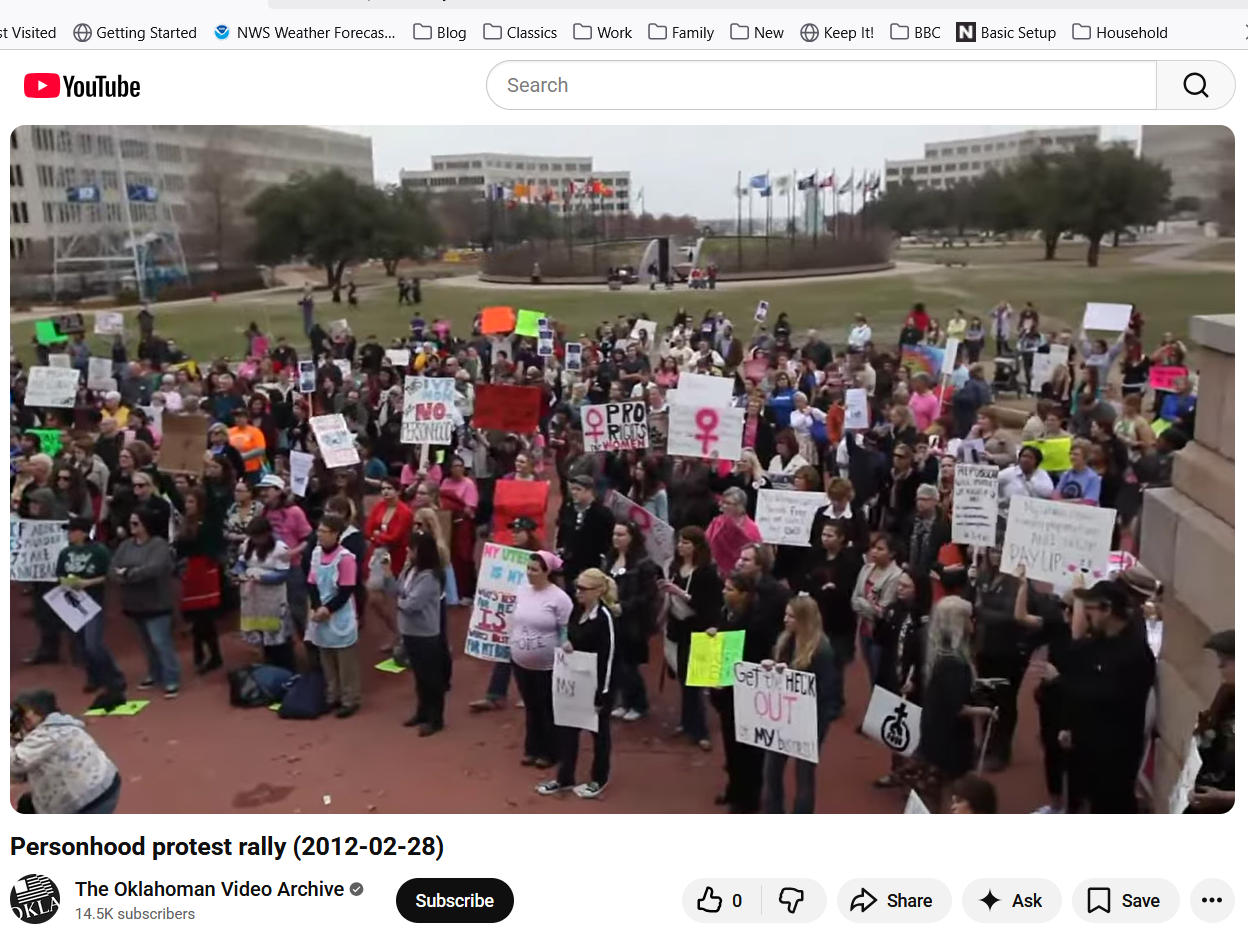
Colleen McCarty, the Democrat-turned-Republican candidate for Tulsa County District Attorney, was a prominent participant in a 2012 rally organized by pro-abortion forces. McCarty appears front-and-center wearing a pink T-shirt with the words "A CHOICE" printed in large letters across her belly. McCarty is holding a sign that reads "WHAT'S BEST FOR ME IS WHAT'S BEST FOR MY BABY. NO TO PERSONHOOD!"
The Daily Oklahoman covered the rally with a news story (current link here) and a video story.
The Oklahoman's news story featured a grinning Sen. Judy Eason McIntyre carrying a sign reading "IF I WANTED THE GOVERNMENT IN MY WOMB I'D F[***] A SENATOR."
Other signs at the rally: "Keep abortion safe and legal." "Keep your laws out of my womb." "If the fetus you safe is gay will you still fight for its rights?" "Forcing your agenda between my legs." "My body my choice."
McCarty appears in an Associated Press photograph, available on the Deseret News website, with the caption: "Colleen McCarty, Tulsa, Okla., cheers at an anti-personhood rally at the state Capitol in Oklahoma City, Tuesday, Feb. 28, 2012. The rally is in opposition to the state Senate's passage of a bill that grants the rights of personhood to fertilized human [eggs]. Susan Ogrocki, [Associated Press]."
She is quoted in the AP story:
Colleen McCarty, 26, a consultant and restaurant owner from Tulsa, said she would strongly consider taking her two businesses out of the state if the bill moves forward.Six months pregnant and wearing a T-shirt with the words "a choice" printed over her belly, McCarty said she would not raise her daughter in a state where she would not have control over her medical decisions.
Some context: This was before the Dobbs decision. Roe v. Wade had not yet been overturned, but in the Casey decision the U. S. Supreme Court gave states leeway to place some restrictions on abortion, and pro-life legislators worked around the margins, short of a direct challenge to Roe, to gain ground for unborn children. The Personhood bill was one such effort. SB 1433, authored by Sen. Brian Crain, made the following legislative findings: "1. The life of each human being begins at conception; 2. Unborn children have protectable interests in life, health, and well-being; and 3. The natural parents of unborn children have protectable interests in the life, health, and well-being of their unborn child." The bill would have "The laws of this state shall be interpreted and construed to acknowledge on behalf of the unborn child at every stage of development all the rights, privileges, and immunities available to other persons, citizens, and residents of this state." The bill passed the State Senate by a wide margin, was favorably voted out of the House Committee, but it did not get a floor vote in the House. (Kris Steele, who later led the anti-prison group Oklahomans for Criminal Justice Reform, was Speaker of the House at that time. McCarty was later Deputy Director of OCJR, working for Steele.)
Pro-abortion forces rightly saw this as a threat to their ability to kill unborn children and rallied to stop it. If an unborn child has the same rights as any other human, is considered a person under law, then it's as illegal to kill that child as it is to kill a toddler or a teenager. They attempted to get support from people outside the pro-abortion movement by claiming the bill was a threat to women who miscarried and a threat to in-vitro fertilization, but the bill had language addressing those concerns. McCarty is now claiming, through her social media apologists, like Broken Arrow Mayor Debra Wimpee and State Sen. Dana Prieto, that the bill was only about IVF or that IVF was why she was at the protest. (How McCarty has managed to hoodwink a number of conservatives is a subject for a later article.)
But note that Colleen McCarty's signs say nothing about IVF. They exalt her desires above the interests of her unborn child: "WHAT'S BEST FOR ME IS WHAT'S BEST FOR MY BABY." Her T-shirt declares that she should have life-and-death authority over her unborn child, who is merely "A CHOICE": If McCarty chooses one way, that belly bump is a baby, but if McCarty chooses the other way, her unborn child is just biohazard waste to be dismembered, extracted, and either incinerated or sold for parts.
PREVIOUS ARTICLES on Colleen McCarty:
Colleen McCarty's short, progressive, soft-on-crime resume
Colleen McCarty's kind of justice: Putting the criminal first
Colleen McCarty: Multiple thefts shouldn't be a felony
This is an update of an entry from 16 years ago. The structure and offices are the same, but the names are different for 2026.
It took me a while to puzzle all this out, and I thought others might be interested as well.
Oklahoma has 26 District Courts. Tulsa County and Pawnee County constitute Judicial District No. 14. State law says that District 14 has 14 district judge offices. (Why are Tulsa County and Pawnee County coupled together? Why not Pawnee with, say, Osage, and Tulsa on its own, as Oklahoma County is? Why doesn't the Judicial District line up with the District Attorney District?)
One judge must reside in and be nominated from Pawnee County, eight must reside in and be nominated from Tulsa County. If there are more than two candidates for any of those nine offices, there is a non-partisan nominating primary in the appropriate county, and the top two vote-getters are on the general election ballot. (Even if one gets more than 50% of the vote, the top two still advance.)
In the general election, all voters in Pawnee and Tulsa Counties vote on those nine seats.
The remaining five district judges are selected by electoral division in Tulsa County. In order to comply with the Voting Rights Act, Tulsa County is divided into five electoral divisions, one of which (Electoral Division 3) has a "minority-majority" population. (The minority-majority district is much smaller than the other four, as it must be in order to guarantee that the electorate is majority African-American.) For each of these five offices, if there are three or more candidates, there is a non-partisan nominating primary. If one candidate gets more than 50% of the vote, he is elected; otherwise, the top two advance to the general election. For each of these five offices, the candidates must reside in the corresponding electoral division, and only voters in that electoral division will vote for that office in the primary and general election. (Oklahoma County, Judicial District No. 7, is the only other county with judges elected by division.)
Despite the three different paths one can take to be elected, a Judge in Judicial District No. 14 can be assigned to try any case within the two counties.
Each county in the state also elects an Associate District Judge, nominated and elected countywide. Incumbent Tulsa County Associate District Judge Todd Chesbro has been re-elected without opposition. Pawnee County Associate District Judge Patrick Pickerill was re-elected without opposition.
In addition to the elected judges, the District has a certain number of Special Judges, who are appointed by and serve at the pleasure of the District Judges.
All this I was able to puzzle out from prior knowledge and browsing through the relevant sections of the Oklahoma Statutes. What I still couldn't quite figure out is which of the 14 offices corresponded with the five electoral divisions, and which one was nominated from Pawnee County. Although electoral division 4 votes for office 4, I was pretty sure the pattern did not apply to the other offices. Back in 2006, after a few phone calls, someone from the Tulsa County Election Board found the relevant info in the League of Women Voters handbook.
So here it is, for your reference and mine, with the party registration of each judge noted in parentheses. (Yes, I know Oklahoma judicial races are non-partisan and judicial candidates are supposed to refrain from mentioning party affiliation, but I'm not subject to that restriction, and party registration is a matter of public record. Party affiliation may be some indication of a candidate's judicial philosophy. Judges now have the option to have their voter registration "unlisted" for their personal security, and many have availed themselves of that option; I have question marks for those judges, which I will replace with better information if it becomes available.)
| Office | Incumbent | Nominated by | Primary 2026 | Elected by | General 2026 |
| 1 | Wall (R) | Tulsa Co. | Tulsa and Pawnee Cos. | Yes | |
| 2 | Holmes (D) | Tulsa Co. ED 3 | Tulsa Co. ED 3 | ||
| 3 | Priddy (R) | Tulsa Co. | Tulsa and Pawnee Cos. | ||
| 4 | Cantrell1 (I) | Tulsa Co. ED 4 | Yes | Tulsa Co. ED 4 | Possibly |
| 5 | Keely (R) | Pawnee Co. | Tulsa and Pawnee Cos. | ||
| 6 | Greenough (R) | Tulsa Co. ED 2 | Tulsa Co. ED 2 | ||
| 7 | LaFortune (R) | Tulsa Co. | Tulsa and Pawnee Cos. | ||
| 8 | Drummond (R) | Tulsa Co. ED 5 | Tulsa Co. ED 5 | ||
| 9 | Hathcoat2 (I) | Tulsa Co. | Tulsa and Pawnee Cos. | ||
| 10 | Moody (?) | Tulsa Co. | Tulsa and Pawnee Cos. | ||
| 11 | Nightingale1 (?) | Tulsa Co. ED 1 | Tulsa Co. ED 1 | ||
| 12 | Gray (R) | Tulsa Co. | Tulsa and Pawnee Cos. | Yes | |
| 13 | Guten (?) | Tulsa Co. | Tulsa and Pawnee Cos. | ||
| 14 | Glassco (D) | Tulsa Co. | Tulsa and Pawnee Cos. |
Offices elected by Tulsa County Electoral Divisions in red.
Offices nominated by Pawnee County in blue.
1 Not seeking re-election.
2 Appointed by Gov. Stitt to fill unexpired term of Jim Huber, who was appointed to the Court of Civil Appeals.
Although all 14 offices are up for election this year, only three offices are contested, and only one of those will be on the primary ballot.
Two incumbent judges have drawn opponents: Caroline Wall in Office 1 and Kevin Gray in Office 12. Wall is a registered Republican, being challenged by Tom Sawyer, a rematch of their 2018 contest. Gray is being challenged by Christopher Camp, also a registered Republican.
One of the two open seats, Office 4, currently held by Daman Cantrell (I), has drawn three candidates, Special Judge Loretta Radford, former prosecutor Dustin Allen, and Rogers County Assistant District Attorney Phillip Peak. This is the only one of the five offices elected by electoral division that is being contested this year. If any one candidate gets 50% or more of the primary vote, that candidate is elected, and there will not be a runoff in November.
The other open seat, Office 11, is currently held by Rebecca Brett Nightingale. Special Judge April Siebert was the only candidate to file for the seat, so she has been elected.
Judicial Election District 4 voters will be the only ones to have a judicial race on the ballot on June 16, 2026. In rough terms, the district includes all of Tulsa County north of 66th Street North (including Sperry, Skiatook, Collinsville, Owasso), nearly all of the the City of Tulsa in Tulsa County east of Memorial Drive and north of 61st Street.
The best way to know which electoral division you live in is to consult the Tulsa County judicial electoral division map. Click here for the full collection of Tulsa County district and precinct maps.
This past Saturday I was on Tulsa Beacon Weekend on KCFO AM 970 with Jeff Brucculeri mainly to talk about the upcoming June 16, 2026, primary election. We took a couple of digressions to talk about air travel (particularly the demise of Spirit Air) and AM radio's importance to the traveler. The Tulsa County DA's race was the main focus of the conversation. Next week, Jeff's guest is incumbent DA Steve Kunzweiler; Kunzweiler makes a couple of appearances on the show each year, and this appearance was scheduled months ago.
The hour-long interview show, sponsored by the weekly Tulsa Beacon newspaper, airs live each week at noon Saturday.
You can always find the latest episode of Tulsa Beacon Weekend at this link. I've made a Wayback Machine capture of last Saturday's episode at this permalink.
 Until she started trying to convince Republican voters that she's a tough-on-crime conservative, Colleen McCarty frequently spoke out to protect career criminals from tougher laws.
In 2021, State Sen. Lonnie Paxton proposed SB 334. The bill would allow courts to aggregate multiple misdemeanor larcenies within a six-month period. The effect would be that if the total amount stolen within those six months reached a felony level, the perp could be charged with a felony, with the potential of felony penalties, instead of multiple misdemeanors. It would make it harder for someone to make a career of thefts just below the felony threshold.
In March 2021, Oklahomans for Criminal Justice Reform produced a one-minute video opposing SB 334.
When OCJR produced this video, this is the entirety of the change that would have been made to existing law:
B. When three or more separate offenses under this section are committed within aninety-dayone hundred eighty-day period, the value of the goods, edible meat or other corporeal property involved in each larceny offense may be aggregated to determine the total value for purposes of determining the appropriate punishment under this section.
Here is the text of the video:
Text on screen: WHY IS SENATE BILL 334 BAD FOR OKLAHOMA?Colleen McCarty, OCJR Policy Counsel: If you think about where you were 6 months ago versus right now, totally different things were probably happening in your lives, different stressors, different uh considerations, different risks that you're assessing every day. In the context of SB 334, that's important to think about.
Text on screen: OKLAHOMA SENATE BILL 334 COMBINES AN OFFENDER'S MISDEMEANOR THEFT CHARGES OVER A SIX-MONTH PERIOD AND TURNS THEM INTO A FELONY
Colleen McCarty, OCJR Policy Counsel: It's important to remember that in America when you commit a crime, you get charged with that crime.
Text on screen: THE LEGISLATION SETS A DANGEROUS PRECEDENT FOR OKLAHOMANS AND DEFIES VOTERS BY ROLLING BACK REFORM
Colleen McCarty, OCJR Policy Counsel: The collateral consequences of of this are massive.
Text on screen, over a man in an orange suit in a jail cell: THE LAW WILL UNNECESSARILY CREATE MORE FELONS WHO RELY ON TAXPAYER DOLLARS AND BECOME DEPENDENT ON THE SYSTEM
Kris Steele, OCJR Executive Director: It makes no sense to spend literally $20,000 a year to incarcerate somebody who steals $1,000 worth of merchandise uh to either meet their basic needs or to feed an addiction.
While SB 334 passed both House and Senate with nearly identical language, some legislative technicalities kept it from going to the Governor's desk in 2021. The 180-day language was eventually passed and is current law: 21 O.S. § 1731
I am still scratching my head over what McCarty is trying to imply with her strange words. Is she saying it's understandable that you might just accidentally find yourself stealing again within a six-month window because of "different stressors, different considerations"? Note that the video mutes her during the second statement, and you have to assume that the muted words were even more incoherent. Consider that what you hear was the best of the material they had to work with. Terrifying.
I am befuddled even more by the postcard I received today of a handful of alleged conservatives endorsing McCarty. Watch the video three or four times and ask yourself, Do I want this inarticulate, ill-prepared, soft-headed liberal leading the fight against crime in Tulsa County?
Colleen McCarty, the long-time Democrat advocate for "criminal justice reform" and "alternatives to incarceration" who is running for Tulsa County District Attorney as a "Republican," used to have a fairly well-followed Twitter (now X) account. While she has deleted her Twitter account, a couple of threads of her tweets have survived thanks to ThreadReaderApp.
In reaction to my article on McCarty's short, progressive, soft-on-crime resume, her supporters have claimed that she can't be blamed for the initiatives she led and the position papers she wrote as Policy Counsel and Deputy Director of Oklahomans for Criminal Justice Reform and as the Founding Executive Director at Oklahoma Appleseed Project for Law and Justice. They claim, implausibly, that these were just jobs, that she might not necessarily agree with the work of those organizations, that she was just following orders from the board.
What a ludicrous apologetic! As a law student, McCarty could have published articles on any number of legal subjects, but she chose to publish articles supporting SQ 780 and 781 and opposing the efforts of District Attorneys to mitigate the damage those sentence-reducing "criminal justice reform" initiatives did to law enforcement in Oklahoma. As a newly minted attorney, a wide range of fields of practice were open to her; she chose to work exclusively for organizations pushing to reduce incarceration rates -- to help criminals avoid the consequences of their crimes.
Any claims that these were merely jobs evaporate in light of what survives of her well-scrubbed social-media history. One of the surviving threads, McCarty's pitch in support of State Question 805, is clearly a heartfelt explanation of her personal motives driving her career and her personal philosophy of crime and punishment.
Below is a Colleen McCarty Twitter thread dated October 17, 2020. SQ 805 was on the November 2020 ballot. It was a constitutional amendment to eliminate sentence enhancements for a convicted criminal's prior crimes. In other words, prosecutors would not be able to seek, and judges and juries would not be able to impose, tougher sentences on repeat offenders. Happily, Oklahoma voters defeated SQ 805, with 61% voting no.
SQ 805 was heavily backed by national left-wing groups like FWD.us and the ACLU, who contributed a combined $6.3 million to its passage, and by local liberal Democrat leaders like former Tulsa Mayor Kathy Taylor, former Governor Brad Henry, and disgraced former Governor David Walters. Conservative leaders like Lt. Gov. Matt Pinnell, victims of violence, law enforcement, and prosecutors united to oppose SQ 805.
Former Gov. Frank Keating, writing in opposition to SQ 805, called it "the ultimate gift to the career criminal and the insect crime wave of the lifetime repeat offender." Keating noted that under SQ 805, if you repeatedly commit one of many "very serious and dangerous" criminal acts, such as drunk driving and causing injury, child trafficking, incest, hate crimes, stalking and violation of protective orders, and drug distribution, "a second offense remains a first offense for punishment. No matter how many times you offend. There is no 'enhancement' permitted. 'After Former Conviction of a Felony' will become a useless phrase. A person's selfish and destructive long life of crime will be handled as one first offense after another. The fifteenth offense is the first offense as far as punishment goes.... How many times can a criminal do these? As many as they wish. Each time, they will be treated as a first offender."
In this thread, Colleen McCarty calls for passage of SQ 805, implying, in a statement with racist overtones, that "citizens of color" are more likely to be repeat offenders:
Voting Yes on 805 means doing justice. We are eliminating enhancements on nonviolent crimes which reflects the enhancements systems in other states and brings OK's sentencing into the modern age. To continue to participate and architect a system that perpetuates cycles of harm on citizens of color and low income communities is not doing justice. It is immoral and cruel.
Colleen McCarty reveals what drove her career choices in the thread. Her initial desire to be a prosecutor was "inspired by @adamjohnfoss and his work around restorative justice" and cites an example of putting a thief "on a plan" instead of taking him to trial. "This type of justice was what I was interested in as a legal intern in the DA's office." [According to her LinkedIn profile, McCarty's DA office internships lasted two months in Tulsa County and one month in Wagoner County.]
McCarty's use of the term "justice" is typical of the left. She confuses justice with mercy when she writes, "Sometimes it means convicting, sometimes [i]t means dismissing." Neither convicting, the prerogative of a jury, nor dismissing, the prerogative of a judge, is in the hands of the prosecutor. Justice for a thief is to be convicted and penalized for his crime. She is calling for mercy, to spare a young man from the punishment he deserves for the crime he has committed. Undergirding this whole approach to justice is a failure to understand human nature. It doesn't work -- not even in schools -- because some people have decided to pursue evil.
Let's learn more about Colleen McCarty's inspiration: Adam Foss served 7 years and 9 months as an Assistant District Attorney (ADA) in the Suffolk County, Massachusetts, DA's office -- that's in Boston. He gave a TED talk in 2016, "A Prosecutor's Vision for a Better Justice System," that gave him a national profile. In 2017, he founded Prosecutor Impact, described on the University of Oregon's Diversity and Inclusion page as "a non-profit developing training and curriculum for prosecutors to reframe their role in the criminal justice system." (Emphasis added.) A left-wing foundation that gave a $250,000 grant to Prosecutor Impact described the organization:
Adam Foss's experience as an Assistant District Attorney (ADA) in Boston convinced him that prosecutors are the most influential actors in the criminal justice system. One ADA's discretion and decisions can make the difference between a young person being charged with multiple felonies and beginning their adulthood in prison, or being diverted from the system without a criminal record and giving them second chance. By providing ADAs with the training and resources to approach their jobs with compassion, knowledge and creativity, he believes he can make a substantial impact on thousands, if not millions, of lives. Foss founded Prosecutor Impact in 2016 and began to seek partners who would be willing to test a radical new way to prepare ADAs for work. PI's model is very new, but grounded in experience and research and tested on a small scale in other cities. This proposal would support an unprecedented partnership in Philadelphia's District Attorney's office that will allow them to credibly test their eight-week program for incoming prosecutors.
Prosecutor Impact went out of business circa 2020, but its website was captured by the Wayback Machine.
A page called "The Role of the Prosecutor" sets out the strategy of Prosecutor Impact: Expose new ADAs to "those most in contact with the criminal justice system" in order to "inform prosecutors' decision-making at all points in the life of case [sic]". Foss wanted to groom ADAs to resist "pressures from judges, veteran police officers, court clerks, seasoned defense attorneys, and senior colleagues... [that] can wear down the resolve of new prosecutors and leave them feeling unsupported to make the tough decisions we want them to." "Prosecutors are the most powerful actors in the criminal justice system. Because they choose who to charge, what to charge them with, and the number and severity of the charges, prosecutors heavily influence the short and long-term outcomes of the people impacted by the system."
In a nutshell, the vision of criminal justice that inspired Colleen McCarty to go to law school is one in which progressive lawyers infiltrate DA's offices to become prosecutors who choose not to prosecute crimes. It's a vision of criminal justice that puts the criminal's future first. Protecting the public from predators is an afterthought.
McCarty says that her brief exposure to prosecution as a law student intern in the Tulsa County and Wagoner County DA's offices (two months and one month, respectively) convinced her that "it's impossible to 'do justice' in OKs justice system. The system has been written and architected to be unjust and to foster unjust results. One of the main reasons for this is sentence enhancements for any prior felony."
Seeing the Oklahoma District Attorney's Association (ODAA) successfully advocate against banning these prosecutorial tools against career criminals enraged McCarty and turned her against prosecution as a career.
When a task force in 2016 recommended restricting the use of sentence enhancements they put a bill forward to accomplish this. This is essentially the policy in State Question 805. The ODAA fought it and killed it in committee. FOUR TIMES.... Seeing how our elected DAs actively thwart the creation of a just system ultimately [p]ushed me out of choosing prosecution as a profession.
I'm going to guess that Colleen McCarty's publication and advocacy record by that point, her work for Oklahomans for Criminal Justice Reform to commute sentences and here law review articles arguing that DAs should stop finding workarounds to jail repeat offenders and drug pushers, would have made her a less-than-attractive applicant for an ADA position in any Oklahoma DA's office.
Instead, she went to work as an attorney and then Deputy Director for Oklahomans for Criminal Justice Reform and then founded the Oklahoma Appleseed Project, two organizations funded by leftist foundations and actively agitating to make it easier for career criminals to avoid jail or get out of jail earlier than they should, where they can go back to their career of hurting Oklahomans.
If your goal is to radically redefine the work of prosecuting crime, and you can't get hired as an ADA to infiltrate the system, running for DA as a stealth candidate would be the only path to your goal.
Colleen McCarty has been telling us for years exactly what kind of DA she wants to be. Colleen McCarty has been telling us for years that her vision of justice puts the criminal's best interests first. Here's hoping that Tulsa County's Republican voters will have the discernment to see that.
If you're on the home page, click "Continue reading" to see the original Twitter thread cited above, plus the other thread that survived her pre-campaign social media purge, plus a personal statement on the occasion of her promotion to Deputy Director of Oklahomans for Criminal Justice Reform.
You can learn a lot about a candidate from her LinkedIn profile. Hazy, gauzy work references on campaign mailers ("Small business owner!" "Entrepreneur!" "Community leader!") come into sharp focus, with organization names, dates of service, and job titles.

Colleen McCarty's LinkedIn profile reveals some things about her that ought to worry any Tulsa County resident who cares about public safety, anyone who has seen the damage done in cities across the nation by progressive DAs of the sort elected with the help of George Soros's money. Every job Colleen McCarty has had since becoming a lawyer has had turning criminals loose (euphemistically described as reducing incarceration rates) as a primary aim.
A friend who has seen McCarty speak a few times tells me that "she's an open book." Well, I've been reading that book, looking at the organizations she's led and the position papers she's written. The public speeches and private conversations on the campaign trail are just a new cover designed to market the leftist, soft-on-crime contents of the book to naïve conservatives. You should never judge a book by its cover.
Although she was a registered Democrat voter until a couple of years ago, and although she's only been an attorney for five and a half years, with only a few law-school internships as prosecutorial experience, McCarty is running as a Republican against incumbent District Attorney Steve Kunzweiler. The primary will be held on June 16, 2026.
 So let's take a tour of Colleen McCarty's LinkedIn. Starting at the top, we see that she has her pronouns listed: "She/Her." Not a typical feature of a conservative's profile.
The preview of recent posts includes her claim to have "out raised [her] opponent by 3 times." In fact, Steve Kunzweiler raised $49,555.01, while McCarty raised $58,511.00. That's more, but not three times more. McCarty appears to be counting the $100,000.00 she loaned to the campaign. We've seen this move before: A loan to your own campaign can be a way to hide donors that might be politically inconvenient; these donors give after the election and the post-election contributions then are used to reimburse the candidate. This can be coordinated in advance, but the voters won't know until it's too late.
There's a lot to discuss in her LinkedIn profile, so if you're on the home page, click the "Continue reading" link as we delve into Colleen McCarty's work experience.
 Subscribe to this blog's feed: