The case against Charles McCall
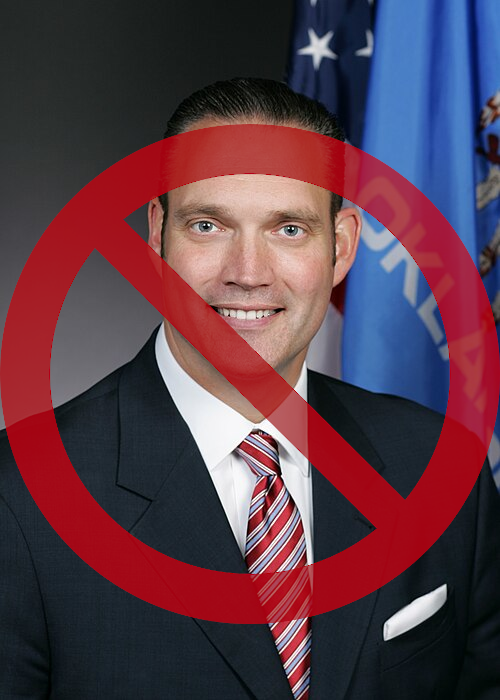 Oklahoma primaries with more than two candidates often result in a runoff. If candidate gets more than 50% of the vote at the June primary election, the top two candidates will advance to an August runoff. It doesn't matter how close 3rd place is behind 2nd place, it wouldn't matter if the votes were nearly evenly spread among a dozen candidates with 8% to 9% each, the top two advance. That's better than no runoff at all, but in our current environment, conservatives may be stuck with no good choice in the runoff.
For most of this campaign, the two leading Republican candidates for Governor of Oklahoma, the candidates seen as likeliest to advance to a runoff, were Oklahoma Attorney General Gentner Drummond and former Oklahoma House Speaker Charles McCall. New polling shows four candidates within four percent of each other, with former State Sen. Mike Mazzei and Chip Keating joining Drummond and McCall at the top of the nine-candidate field. At this point, any two of the four could advance to the runoff, and moving just a few hundred or thousand voters would be enough to change the order of finish.
I explained in a previous article why Drummond is an unacceptable choice. Here's why conservatives can't back Charles McCall, and why we have to unite behind a conservative that has a shot at making the runoff and being competitive in the runoff.
The story is of the failure of the Oklahoma Republican legislative supermajorities to produce conservative reform, and Charles McCall's role in stopping that reform. The bottom line:
McCall, who called himself Speaker Maximus, used his power to centralize control, abolish term limits on the Speakership, marginalize conservative members, and enable lobbyists and corporate welfare. In 2018, he pushed through one of the largest tax increases in Oklahoma history and pushed to have it pass by a big enough margin that the voters of Oklahoma wouldn't be allowed to vote on it. The handful of principled Republicans who resisted found themselves with well-financed primary opponents with support from the teacher's unions.
McCall would be slightly less bad than Drummond.
Outside observers often wonder how the "reddest state in the nation," the state where every county has voted for the Republican nominee for the last six presidential elections, lags so far behind other Republican-run states in government reform. Mississippi has led the way in literacy, Florida in school choice and higher-ed reform. Although Oklahoma has a mechanism to reach 0% income tax at some point in the future, other states are ahead of us, and we continue to lose business as a result.
When I began BatesLine in 2003, Republicans were nearing a majority in the State House for the first time in 80 years and only the second time in Oklahoma history. Republicans captured the House in 2004, tied the Senate in 2006, captured the Senate in 2008, and in the ensuing years have gone from narrow majorities to supermajorities, with over 80% of each House.
There have been plenty of improvements, to be sure. But we haven't seen the bold government streamlining that we were expecting. School choice was slow to arrive. We've seen many intelligent and creative legislators sidelined and blocked by House and Senate leaders who seem to prefer rubber stamps.
Just one term after the Republicans took the majority in the House, the favor factory was up and running at the State Capitol, headed by Speaker Lance Cargill. It seems like the same special interests that ran the Legislature under the Democrats still run the show today.
Former State Rep. Jason Murphey has been doing tremendous work documenting the decadent culture that has taken hold at the State Capitol. I won't attempt to summarize his thorough analyses, but I will pull a couple of quotes from a piece earlier this week in which Murphey contrasts Charles McCall unfavorably with the principled, effective conservative that McCall sidelined, Inola State Rep. Tom Gann, in whose district the much-debated aluminum smelter would reside:
And as for McCall, we must always remember: He was the House Speaker who brought the era of corporate welfare on steroids to the House of Representatives.So if the reader believes that McCall, had he been in the Speaker's Chair instead of Kyle Hilbert in 2025, would have stopped the UAE giveaway bill then the reader also knows the old saying: There is a bridge in Arizona just waiting for your check to clear....
Yes, it's the one person whose endorsement could make all of the difference in swinging that 1 to 2 percent of the vote that could very well determine the second-place finisher in the June 16 primary and put either Drummond or McCall into the runoff with Mazzei.
Of course, it's the leader whose never-wavering commitment to constitutional principle made him such a target of the imperial speakership of Charles McCall; who continued to provide that small voice of opposition, as best he could, which was a challenge, as demonstrated when McCall's team snuck through a rule change that allowed them to ignore any member rising to make a motion, or when McCall and his appropriations chairman endeavored to give away millions to the Volkswagen corporation, and that appropriations chairman "advanced the question," cutting off Gann's very ability to debate and to speak to the underlying constitutional principles.
I would make the case that, had McCall done the wise thing -- had he put Gann in the leadership room, allowed his voice to be heard, and permitted constitutional principle to slow down, restrain, or even stop some of those massive corporate welfare giveaways -- perhaps Gann would now be in a position to give McCall what he needs most.
There's much more I could quote from Murphey on McCall's imperial speakership. McCall's immediate move as Speaker-elect to remove the two-term limit on the Speaker created a consolidation of power that was the "foremost reason why the culture of the House has so dramatically devolved." In another essay, Murphey explains how that rules change created a culture of conformity in the House:
With concentrated power, McCall ensured that he would never have to give up the corner office and never need to fear the day when he would return to the House floor with the mostly powerless, peasant legislators.This created a powerful disincentive for the legislators to ever step out of line. Many legislators had seniority over McCall; they would term out of office before, or even long before, McCall did. This meant McCall would hold incredible power over them for the entirety of their tenures.
Now facing limited opportunities for future advancement and knowing that the pendulum would probably never swing back in their direction, these members were disincentivized from having strong opinions or taking any action to inform the new emperor when he, in fact, had no clothes. Throughout the eight years, this eventually rendered the House into little more than an echo chamber, a void in which dissent and strong opinions risked placing the legislator on ice, unable to wield any significant influence for years into the future.
And that, my reader, is exactly what, in my view, happened. McCall's decision to accept power for himself, for such a long period of time, in conjunction with the 2018 purge of the chamber's conservative members, more on that upcoming, caused the House to lose its magic--the ability to be a debating society where disparate views and even dissenting voices could be expressed, even slightly, without fear of retribution. If there was no hope that the pendulum would swing again, that a new Speaker would take office and restore dissident legislators' ability to have a voice and make a difference, then why should a legislator take the risk of providing a dissenting voice?
In 2019, McCall pushed another rule change to silence and marginalize individual House members, and Attorney General Candidate Jon Echols was one of McCall's enforcers:
With this one small change, McCall had just taken away the right of a state representative to, on their own authority, lodge a motion--instead requiring that representative to first get permission from McCall's designee, the Majority Floor Leader, who at that time was Jon Echols. Previously, Echols was required to allow the motion to be lodged, only empowered with scheduling the time of day in which the motion would be entered--but in no way, shape, or form could Echols deny that right of the member to make that motion.
That same article mentions a May 2025 move by Rep. John Pfeiffer, currently a candidate for Commissioner of Labor, to suspend the rule requiring the text of a bill to be available the day before the bill is voted on. When Tom Gann attempted a motion to restore the rule, the presiding officer would not recognize the motion because the Floor Leader Josh West had not granted his permission.
Murphey has his older articles paywalled, but it's well worth the expense of a Substack subscription to get an understanding of why the Reddest State in the Nation hasn't become an exemplar of conservative small-government efficiency. There's much, much more. This item about McCall's genuflection to the woke mob over the term "cross-dresser" is a doozy.
No conservative voter who knows how McCall wielded power as Speaker could want him to reside in the Governor's Mansion.
0 TrackBacks
Listed below are links to blogs that reference this entry: The case against Charles McCall.
TrackBack URL for this entry: https://www.batesline.com/cgi-bin/mt/mt-tb.cgi/9467
 Subscribe to this blog's feed: