Why not Merrick?
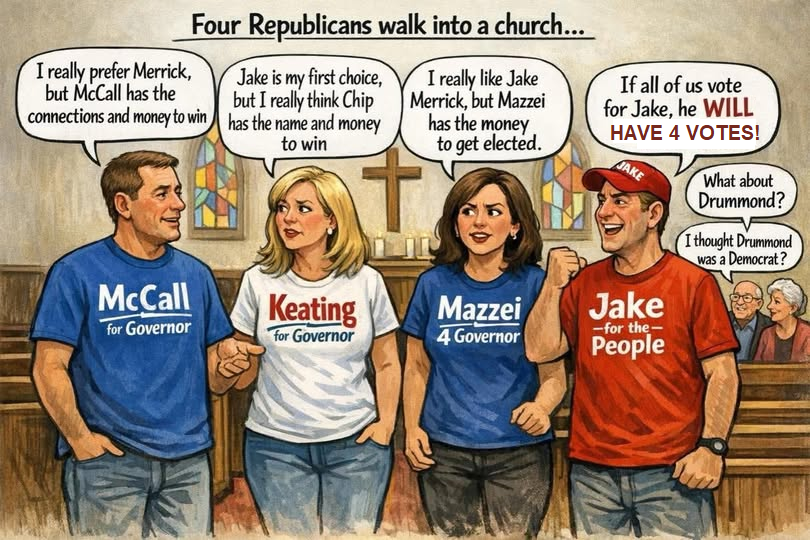 After posting my ballot card for the June 16, 2026, Oklahoma primary, I got questions, as I usually do, about why I chose one candidate over another.
A friend messaged to ask: "Mazzei and not Jake Merrick? Everybody else I know has been on the Merrick train for months."
The short answer: Merrick has no shot at making the runoff. He's also got personal financial problems that mirror the poor financial and organizational skills on display in his campaign. I have my issues with Mazzei, but he's the best of the four who are running an organized campaign.
Merrick has enjoyed a lot of support online, regularly winning social-media polls, but that hasn't been reflected in the real world. He had 5% support in the February poll, a distant 5th place. When NonDoc took a poll to determine if any of the minor candidates had built enough support to have a realistic shot at the runoff, Merrick was still a distant 5th, with 7%, well behind the top 3 candidates (Mazzei, Drummond, Keating) who were clustered around 21-22% and McCall at 18%. There is a more recent poll, from JMC Analytics, a Louisiana pollster, showing Mazzei 29, Drummond 21, and Keating and Merrick tied at 12, with McCall fading to 8%, but the pollster doesn't have much history of polling Oklahoma.
So are people who vote for Merrick "throwing away their vote"?
Worse than throwing away their vote, by not voting for the most conservative of the viable candidates, Merrick voters may be setting up a runoff between the worst of the front-runners, Drummond & McCall. There are only two slots in the runoff, and if the May 25 poll is correct, a shift of just a few percentage points could determine which of the top four advance.
Let's suppose Merrick grows his following by 8% at the expense of Mazzei and Keating. The result would look like this:
- Gentner Drummond, 21.66%
- Charles McCall, 18.38%
- Mike Mazzei, 18.10%
- Chip Keating, 17.44%
- Jake Merrick, 15.21%
Merrick would still finish fifth, albeit a closer fifth, but now Drummond and McCall are in the runoff. Merrick supporters claim that the attacks on their candidate from the front-runners are a sign that they're afraid of him because he has a shot at making the runoff. What the conservative front runners are really afraid of is that Jake will draw enough votes away from them to block them from the runoff while still falling well short himself.
Merrick's army of online supporters believe that if all the people who love Merrick's values voted for him instead of whoever else is pretending to have his values, he'd win. The original version of the AI-generated cartoon above has the Jake supporter saying, "If all of us vote for Jake, HE WILL WIN!" I edited it (in Microsoft Paint!) to reflect reality. The politically-plugged-in, terminally-online are a small segment of the electorate. You could sweep that constituency, win every online poll, and still lose badly.
For the original cartoon's scenario to work, enough people to win or finish second in a primary have to have heard of Merrick to know what his values are, and the only way for that to happen is money. You don't necessarily need as much as Drummond and Mazzei have, but you need to be able to reach and persuade enough normal voters to make the runoff. There aren't enough activist voters who know Jake. He has to be able to reach normie voters who only see TV ads & postcards.
People in the activist and online bubble forget what a small proportion of voters they are. Most voters are passive. That's hard for activists to understand, but it's reality. Most people who vote will see ads on TV and dark-money postcards and feel like they're educated enough to make a choice. They don't seek out information about the candidates, they don't read this website, they aren't on political FB groups, they don't have friends who are activists, they don't watch debates. They might listen to national talk radio, but there aren't many local talk shows left. (Merrick had one, but he gave it up to run for governor.) Normal voters most likely to be affected by a TV ad in the middle of the evening news or a paid blurb as they're scrolling social media.
Eight years ago, I backed Dan Fisher, the 2018 version of Merrick, the principled legislator with all the grassroots support. Fisher raised three times as much as Merrick has and still finished a poor fourth with 8%. The result was a runoff between a RINO mayor of OKC and a rich guy who never voted in primaries. Lt. Gov. Todd Lamb, who would have been a better choice than either Cornett or Stitt, finished just 2,494 votes behind Stitt in 2nd place. None of the candidates broke 30%. Had Fisher not been in the race, the order of top-three finish might have been very different. Gary Richardson and State Auditor Gary Jones also each received enough votes to change who made the runoff.
If Fisher couldn't reach normal voters, how will Merrick on a third of the money?
In 2018, Stitt needed 110,479 votes to make the runoff. As of two weeks before election day, Merrick had raised $102,123.30 and had $2,466.30 cash on hand. Merrick's online fans insist that they don't need money to reach voters, but when I asked how many doors they had knocked and how many Merrick voters they had identified in their outreach efforts, there was no response.
Merrick instead claims that money does not matter:
My goal has not been to raise money. I see that as a major part of the problem. We all agree that something has to change, but we keep repeating the same mistakes. I've decided to focus entirely on the people, and then encouraging those same people to focus on people. For instance, I would encourage you to pick the candidate would is most principally aligned with the constitution, and then you go out and promote him/her. In doing so, people become activated again instead of watching a political campaign play out like a pro football game. We must get away from the money narrative. The people themselves must be the goal.
Winning an election, like any other big task, requires working backward from the goal. You figure out how many votes you need, and then you go try to persuade them. You identify voters as they commit to your campaign, and then you make sure they turn out to vote on election day. You can do some of that with volunteers instead of money, but you still need a plan and a way to track how effective your efforts have been. The Merrick campaign seems to be flying by the seat of its pants.
The longer I've been around politics, the more I've noticed that campaigns are a good test of a candidate's leadership skills. In a campaign, you have to build a team, gather resources, make a plan, execute a plan, and adjust to changing conditions, always keeping your eye on the goal. Gimmicks like jogging down Route 66 get you a little free media, but they're no substitute for a plan.
I understand wanting to vote for your favorite candidate, and hang the consequences, but a wise steward has to consider the consequences of his actions. There are only two slots in the runoff, and you have to determine whether you will be content to have a Republican runoff between an absolute RINO and the tool of special interests in the State House.
ANOTHER VIEW: Jason Murphey believes that McCall is fading fast, and there is no longer a risk of a Drummond-McCall runoff, so he will vote for Merrick.
And with Trump's endorsement of Mazzei and the collapse of McCall's poll numbers, the only reason for not voting for Merrick -- avoiding a Drummond v. McCall runoff -- has seemingly been removed from the objection docket.So, absent a late surge by McCall in the next few days, the vote for Merrick is a true constitutionalist conservative's mandate.
OH, BY THE WAY: If we had instant runoff voting, you wouldn't have to vote tactically. You could give your first preference to your favorite candidate and give your second choice to your next favorite, and so on. If your favorite is eliminated in the first round, your vote helps your second favorite. The process continues through runoff rounds until someone has 50% of the vote. There's no danger of someone with obnoxious views winning with 25% because the majority sentiment is split between multiple candidates.
MORE: Here's the foreclosure case filed against Jake Merrick and his wife, Nicole Merrick, by Great Plains National Bank. As of filing, the Merricks had not paid property taxes for 2025, and it appears from the report attached to the complaint that the last mortgage payment made, as of the time of filing in March 2026, was the payment due in September 2025, paid in November 2025.
AND ABOUT THAT CARTOON: Why are these Republicans wearing jeans and T-shirts in church and having a political conversation in the sanctuary? The Jake supporter needs to take his hat off.
0 TrackBacks
Listed below are links to blogs that reference this entry: Why not Merrick?.
TrackBack URL for this entry: https://www.batesline.com/cgi-bin/mt/mt-tb.cgi/9483
 Subscribe to this blog's feed: