Yes on SQ 844: Give Legislature flexibility on reimbursements to local governments for property tax exemptions
When a statutory matter gets written into the State Constitution, amending it is a pain in the ballot.
On August 25, 2026, at the runoff primary election (also the City of Tulsa general election), Oklahoma voters will decide State Question 844, which would change some clauses in Article X, Section 6B of the Oklahoma Constitution. The Constitution grants a five-year property tax exemption for new or expanded manufacturing facilities and mandates the State to reimburse local government for the property tax revenue they would otherwise receive. If SQ 844 passes, the Legislature would decide how much to reimburse and how to divide the reimbursement up among taxing entities.
Here is the gist of SQ844 that will appear on the August 25 ballot:
This measure amends article 10, section 6B of the Oklahoma Constitution. Section 6B incentivizes manufacturers to locate, expand, or acquire manufacturing facilities in Oklahoma through an ad valorem taxation exemption for five (5) years. Currently, the State must reimburse common schools, county governments, cities and towns, emergency medical services districts, vocational technical schools, junior colleges, county health departments and libraries for revenues lost as a result of each exemption provided. This measure authorizes the Legislature to enact laws establishing the levels and methodologies of reimbursement for the previously mentioned local governmental entities resulting from the manufacturing exemption. The laws are meant to ensure that no individual county receives reimbursement in an amount detrimental to other Oklahoma counties. The levels and methodologies will replace the current statutory framework for reimbursement. For the purpose of calculating the limit on indebtedness for political subdivisions, the measure requires such amount be equal to the amount of reimbursement applicable to such property under laws enacted by the Legislature. This measure will have a fiscal impact on the state that will depend on the application of the levels and methodologies adopted by the Legislature.
Here is what will actually change in Oklahoma Constitution Article X, Section 6B, Paragraphs E & F:
E.TheFor the purpose of ensuring that no individual county shall receive reimbursement in amounts that result in a detriment to the other counties of the state, the Legislature shall enact laws to carry out the provisions of this section and to provide forthelevels and methodologies of reimbursement to common schools, county governments, cities and towns, emergency medical services districts, vocational-technical schools, junior colleges, county health departments and libraries for revenues lost to such entities as a result oftheeach exemption provided by this section.F. The assessed valuation of property exempt from taxation by virtue of this section shall be added to the assessed valuation of taxable property in computing the limit on indebtedness of political subdivisions contained in Section 26 of this article, in an amount equal to the level of reimbursement applicable to such property under the laws enacted by the Legislature.
There will be no change to paragraphs A through D, which establish the exemption and eligibility, and paragraph G, which establishes a county option to apportion up to 25% of the county 10-mill property tax on previously exempt manufacturing facilities to economic development.
Proponents in the Legislature want the flexibility to ensure that reimbursements are not as concentrated to particular counties and that they can be scaled to avoid harming the rest of the state budget. Opponents, mainly from the Left, want to see the school districts where these manufacturing facilities are located continue to get the reimbursements they currently enjoy, and they point out that these reimbursements reduce the amount of money they receive in the state school funding formula.
Reimbursements are funded by an earmarked 1% of state income tax collections, but that hasn't been enough to cover the required amount, and the Legislature has had to appropriate additional funds. From FY 2019 through FY 2024, that 1% only covered 30.5% of the reimbursements.
I'd love to see these exemptions go away entirely, along with other taxpayer-funded inducements to private business, but that option isn't on the ballot. For now, Oklahomans need to vote yes to give the Legislature the flexibility to balance the various interests involved without overburdening the taxpayers.
According to the 2026 annual report from the Oklahoma Tax Commission's Ad Valorem Division, 2026 reimbursements for tax year 2025 total $88,635,421, a significant drop from the 2019 tax year peak of $161 million. The 2024 quinquennial analysis of the exemption by the Oklahoma Incentive Evaluation Commission notes that the legislature removed wind farms from the exemption list in 2015, effective for the 2018 tax year, and the previously granted exemptions have been expiring since then.
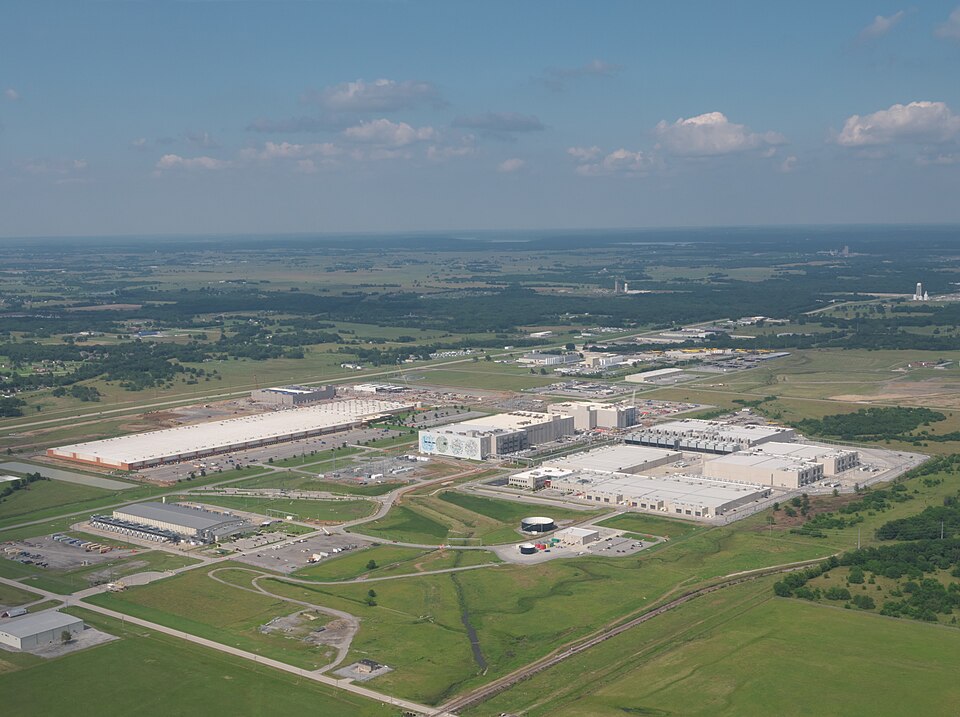
$35.6 million (40%) of this year's $88.6 million reimbursement went to Mayes County. Nearly all of that amount, $34,187,160, is for the exemption to Google LLC - Myall LLC for the data center complex at the Mid-America Industrial Park. That's 38.6% of the statewide total.
(A simple way to reduce the number of data centers being proposed for Oklahoma would be for the Legislature to remove data centers from the list of exempt industries, just as wind power generation was removed in 2015. This could also be accomplished by an initiative petition to amend 68 O.S. 2902, the section of law that defines which types of businesses are eligible for the exemption.)
Tulsa County is the only other county into 8 digits in reimbursements, receiving $16,949,307 for the 2025 tax year. Holly Sinclair (east & west refineries combined) receives the largest benefit at $3.4 million, followed by Kimberly Clark ($2.1 million), Amazon ($1.7 million), Macy's Corporate Services ($1.7 million), Whirlpool Corporation ($1.6 million), Green Bay Packaging ($1.3 million), and AAON Corp ($1.1 million). The remaining exemptions are mainly in five figures.
School districts are the largest recipients of property taxes and are also receiving the bulk of these reimbursements, money they likely would not have received in the absence of the ad valorem tax exemption and other incentives for these industrial developments. The complaints that reimbursements are unfairly concentrated in a few school districts remind me of complaints in the 1970s about districts where large electric power plants were located. On our way to visit my grandparents in Nowata, we would pass the new and growing Oologah Schools complex. Mom (a teacher at Catoosa) would remark on Oologah's new indoor pool and higher teacher salaries, funded by the coal-fired PSO generating plant in the district southeast of the town. At some point, the Legislature changed the law so that public utilities are subject to a higher assessment rate and pay their ad valorem taxes to the state rather than the county, spreading the revenues from regulated public utilities across the state.
Whether these exemptions are funding real job growth or just enable financial gamesmanship is hard to tell. The Macy's distribution center in Tulsa's Cherokee Industrial Park, one of the top beneficiaries, closed this past spring.
Why are property tax exemptions a constitutional matter at all? After the jump, we'll take a look at the history of Article X, Section 6B.
Historically, local governments would provide ad valorem exemptions by means of public trusts. A tax-exempt public trust (e.g., a county industrial authority) would own the land and lease it to a corporation. Because the property's owner was a tax-exempt public entity, the for-profit lessee didn't have to pay property taxes.
Attorney General Jan Eric Cartwright (D) turned all this on its head in a July 1979 opinion that declared such an exemption unconstitutional. The Legislature can't create exemptions that aren't explicitly set out in the Oklahoma Constitution. (Article V, Section 50, states, "The Legislature shall pass no law exempting any property within this State from taxation, except as otherwise provided in this Constitution.") This UPI story from August 2, 1979, describes the impact:
Private industries leasing from public trusts have been exempt from property taxes under a previous attorney general's opinion issued in 1969. Cartwright ordered that opinion withdrawn. The exemption was granted in the past on grounds that a public trust owned the property and the user merely leased it. The opinion, signed by Cartwright, and written by his assistant John F. Percival, said the tax test depends on the property's use.Cartwright said the opinion would affect such industries as the $200 million General Motors plant in Oklahoma county, the American Airlines overhaul depot in Tulsa and many others. He said beneficiaries from General Motors taxes would include the Midwest City school district, Oklahoma City and Oklahoma county. Percival said more than 35 industrial trusts are operating in Oklahoma. The largest is Oklahoma Industries Inc., which holds property used by such entities as Fred Jones (Ford) Manufacturing Co., Dayton Tire and Rubber, Sheplers, Inc., Seven-Up Bottling Co., dozens of other industries and department stores and several hospitals, including Baptist Memorial, Presbyterian and St. Anthony.
Percival said if a hospital located on public trust property operated strictly for charitable purposes it would continue to be tax-exempt. "I think it would be hard for General Motors to argue it operates for charitable purposes," Percival said. Cartwright said the opinion will be a boon to competitive free enterprise. "Those who use public trust property will be on the same footing as those who have been competing and paying ad valorem taxes," Cartwright said. "It is just fair and equal treatment."
On April 30, 1985, Oklahoma voters overwhelmingly approved State Question 588 (as Tulsa County and 21 other counties approved liquor-by-the-drink and ballots were flown out of flood-isolated Skiatook by helicopter). SQ 588 was a legislative referendum to create a new Section 6B in Article X (Revenue and Taxation) in the Oklahoma Constitution. This new section created a five-year ad valorem (property tax) exemption for a "qualifying manufacturing concern" -- a new factory, a factory reopened after being closed for at least one year, or an expanded factory. The State Government was required to reimburse school districts, municipalities, counties, junior colleges, library districts, health departments, and any other local political subdivision that receives property tax revenue. The Legislature was empowered to make laws to administer the exemption and to allocate state funds to reimburse taxing entities for lost revenues.
SQ 588 was backed by Gov. George Nigh (D), who traveled the state to push for its passage along with SQ 586 (limits on wrongful-death lawsuits, which threatened the finances of local governments after a 1983 State Supreme Court ruling striking down sovereign immunity) and SQ 587 (changing the state budget estimating formula). SQ 588 also had the support of U. S. Rep. James R. Jones (D-Tulsa), legislative leaders of both the Democrat majority and Republican minority, mayors, chambers of commerce, and newspapers across the state. It hit at a time of a severe downturn in Oklahoma's oil-centered economy, and leaders were desperate to develop new sources of jobs. There was no organized opposition to SQ 588, which passed with 69.7% of the vote.
Just three years later, the Legislature asked voters to tweak Section 6B to authorize the Legislature to define "manufacturing facility"; originally it had been defined by Standard Industrial Classification (SIC) codes. Voters approved SQ 618 with 62.3% of the vote at the August 23, 1988, state primary election.
This change is implemented in 68 O.S. 2902; originally enacted in 1988, this section of law has been amended 51 times in 38 years. You can imagine the State Chamber and local chambers and corporate representatives lobbying for change after change to authorize the incentive for businesses considering a move to or expansion in Oklahoma, including businesses that aren't engaged in manufacturing. The most recent amendment was to repeal the 2025 amendment to require corporations receiving an exemption to submit an annual "report detailing the number of new jobs created and the payroll data for new jobs created since the exemption was provided," for the purpose of evaluating the effectiveness of the incentive.
In 2001, the Legislature sent SQ 697 to the voters. SQ 697 gave letters to Section 6B's paragraphs and added a paragraph that would allow county commissions to ask citizens to vote to allocate a share of the county's 10-mill levy on previously exempt manufacturing facilities toward economic development. Voters passed SQ 697 at the November 5, 2002, state general elections, but with only 54.6%. That's the most recent change to Article X, Section 6B.
MORE from Oklahoma history: Attorney General Jan Eric Cartwright's July 1979 opinion regarding property tax exemptions was just one of several actions taken in his first year as AG that aggravated special interests in Oklahoma:
He singlehandedly has raised the corporate bloodpressure in Oklahoma to the "stroke imminent" level.Public utility executives get ulcers just thinking about him.
State Chamber of Commerce officials would like to boil him in oil.
Insurance executives rank him right up there with hailstorms, tornadoes, floods and other disasters.
Trust authority officers rate him just behind Attila the Hun and Joe Stalin as a booster of economic progress.
The man at whom all the ire is directed is Oklahoma's attorney general Jan Eric Cartwright - rapidly on his way to becoming one of the most controversial officials in state history.
The soft-spoken Cartwright, who usually responds to criticism with a shrug and a smile, seems at first glance to be an unlikely target for such harsh feelings.
BUT IN JUST OVER SIX months in office, he has issued some of the most momentous attorney general's opinions in years and taken action that has shaken powerful interests to their foundations.
His latest ruling - of the most far-reaching legal opinions in state history - removed property tax exemption for businesses and industries financed through public trusts. It would result in tens of millions of new tax dollars for schools and local government, but many industrial boosters cried foul.
Later that year, the Daily Oklahoman attacked "Cartwright's Damaging Rampage" in its lead editorial:
IN less than a year in office, Attorney General Jan Eric Cartwright has managed to demonstrate conclusively that he is against economic growth and progress in Oklahoma.Cartwright is rampaging like a demented bull through the murky thicket of our state's archaic constitution in search of roadblocks to erect in the path of the new industry and investment Oklahoma must have to maintain employment opportunities for our expanding population.
First came his bombshell opinion removing the ad valorem tax exemption for business enterprises established on public trust-financed properties. That has now been followed by an equally damaging and disruptive opinion that alien corporations cannot legally own property in Oklahoma.
A RELATED and unanimous Oklahoma Supreme Court decision in January 1980, State ex rel. Cartwright v. Dunbar, 1980 OK 15, 618 P.2d 900, provides more of the history of ad valorem exemptions for industry via public trusts. Justice John B. Doolin concurred specially, writing:
¶3 I am not deaf to the strong arguments and excellent briefs of the respondent and intervenors, nor am I blind to the application of trust financing in existence throughout the state. Suffice to say I am impressed and persuaded Oklahoma's Constitution and its legislative enactments create no exemptions to entities not enumerated therein.¶4 It is manifestly true that granting exemption from taxation results in increasing the burden upon less favored taxpayers; a state cannot and should not govern in this manner.
MORE:
OCPA, the conservative state think-tank, offers brief description and analysis of SQ 844 and SQ 846.
Andrea Eger of Oklahoma Watch talks to public school superintendents opposing SQ844.
The leftist Oklahoma Policy Institute had a short explainer on the Ad Valorem Manufacturing Exemption from earlier this year but the live link is returning a 403.
April 14, 1985: Tulsa World editorial pages editor Alex Adwan writes that passing SQ 588 "would tell prospective new employers that Oklahoma wants new jobs and is friendly to industry."
A separate provision of state law, 68 OS 2902.5, allows businesses to delay taking their five-year exemption.
This Oklahoma Supreme Court case from 1965, Sublett v. City of Tulsa, dealing with Tulsa's condemnation of land for the Tulsa Port of Catoosa, has some interesting history of the development of the port and of city and state government economic development.
0 TrackBacks
Listed below are links to blogs that reference this entry: Yes on SQ 844: Give Legislature flexibility on reimbursements to local governments for property tax exemptions.
TrackBack URL for this entry: https://www.batesline.com/cgi-bin/mt/mt-tb.cgi/9505
 Subscribe to this blog's feed: