Tulsa Election 2026: October 2026 Archives
The City of Tulsa is asking voters to approve doubling the hotel tax rate in order to pay for deferred maintenance for the BOK Center and the Arvest Convention Center. At the same time, the voters, unwittingly, would be giving a massive and undeserved pay raise to the Tulsa Regional Chamber. Tulsa voters should give a big thumbs-down to the Chamberpots and insist that the City make better use of the money it already has.
If Tulsa voters say yes on November 3, the hotel tax rate will increase permanently from 5% to 9.9% on January 1, 2027, and the allocation of funds will shift temporarily toward facilities and away from marketing and tourism. The percentage for the general fund and economic development (GF and ED in the list below) will stay constant, but the percentage for marketing & tourism (M&T) will drop for four years before returning to its previous level, with Facilities getting the extra proportion. The facilities share will be pledged to cover revenue bonds to pay for arena and convention center updates, so some bankers and bond advisors will make money, too.
Funds for the BOK Center were approved by Tulsa County voters in 2003. It opened its doors in 2008. The presentation pushing for the tax increase has photos of worn seats and old-fashioned lockers. The presentation claims that $128 million in updates are needed, but only $48 million is available.
The summary of the proposal says that the current 5% generated $10.4 million in 2026. Collected at 9.9% and assuming no erosion of hotel stays, that would be $20.6 million.
- Current: 2% GF, 4.5% ED, 45% M&T, 48.5% Facilities
- 2027: 2% GF, 4.5% ED, 40% M&T, 53.5% Facilities
- 2031: 2% GF, 4.5% ED, 45% M&T, 48.5% Facilities
- After revenue bonds: 2% GF, 4.5% ED, 50% M&T, 43.5% Facilities
In constant-dollar terms, the current tax would raise $20.1 million for facilities over the next four calendar years. The proposed increase and the new proportions would turn that into $44.1 million. If $128 million is needed, that means we're looking at 12 years to retire the revenue bonds. Over 12 years the current tax and proportions would raise $60.5 million for facilities; the new tax and proportions would raise $124 million.
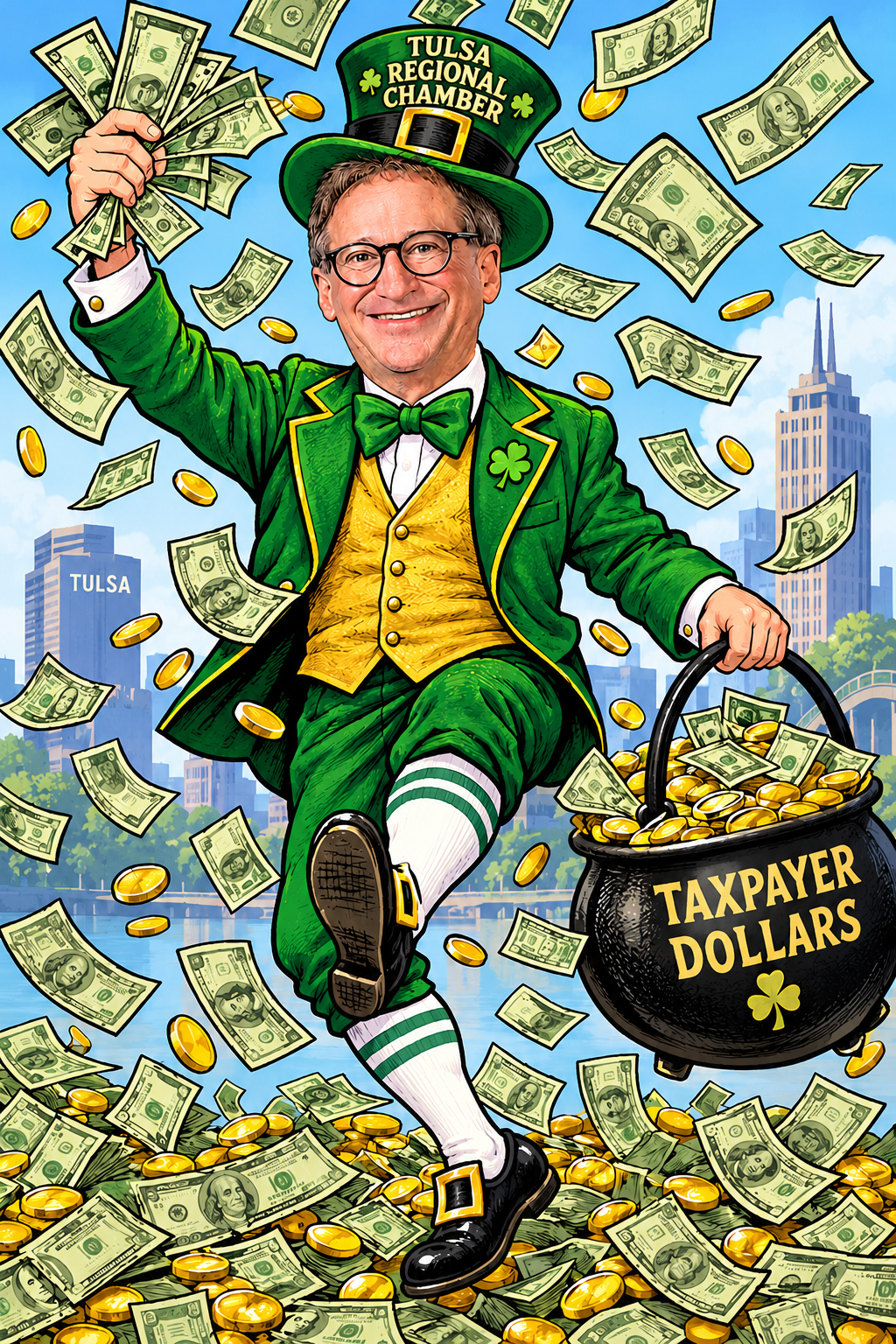 Notice how the tax increase will boost revenues for marketing and tourism and economic development, money that mostly goes to the Tulsa Regional Chamber and its subsidiaries under service contracts. Money for marketing and tourism, all of which goes to the Chamber, would rise from $4.68 million annually under the current rate and proportion to $8.24 million. Funds for economic development, of which the Chamber receives more than half, would grow from $468 thousand annually to $927 thousand. One might ask, if facility needs are so dire, why not raise the tax rate but alter the proportions so that all the increase goes to facilities?
The fund summaries in the 2026-2027 City of Tulsa budget tell the tale.
Fund 131, Convention and Visitors, is funded by 45% of the hotel tax. "The fund shall be used to market and promote tourism and the use of convention facilities within the City of Tulsa." "The City of Tulsa contracts with the Tulsa Regional Chamber of Commerce for these marketing activities." In FY27, an estimated $4,554,000 came in through the hotel tax, and all of that is budgeted to go to "Managed Entities," namely, the Tulsa Regional Chamber.
Fund 130, Economic Development, is funded by 4.5% of the hotel tax. "The funds will be used by the City for economic development activities. The City contracts with the Tulsa Authority for Economic Opportunity (TAEO) and Tulsa Regional Chamber of Commerce for economic and community development services to the City of Tulsa." Each year, $250,000 of that amount goes to "Managed Entities," namely, the Tulsa Regional Chamber.
When I think of Tulsans whose efforts have brought visitors to Tulsa, Danny Boy O'Connor is one of the first names that comes to mind. For love of the book The Outsiders and the movie based on it, he bought the old Crutchfield house used as the Curtis home in the movie and turned it into a museum and a place of pilgrimage for his fellow Outsiders fans. I think, too, of William Franklin, who built Decopolis on Route 66 and added the new Decopolis Tulsarama last year. I think of Linda Collier and her devoted care for the Cave House. What has the Chamber done to make these attractions possible?
And yet you'll see minuscule Chamber CEO Mike Neal showing up to ribbon-cuttings and grand openings as if he or the Chamber had anything to do with the hard work and creativity being celebrated. It's infuriating.
When Mike Neal and G. T. Bynum led a group of 150 Tulsans to New York for the Broadway premiere of "The Outsiders" musical, how much of the cost of that junket came from hotel/motel tax dollars? How much of that tax goes to help Neal and his staff rack up frequent-flier miles and hotel points, while doing nothing significant to build Tulsa's economy?
This hotel tax increase would be a huge gift to this entity that considers itself private when it comes to public accountability but practically a branch of government when it comes to entitlement to government revenues. Unfortunately, we don't have any city councilors with the courage to examine whether dollars sent to the Chamber are effective in increasing tourism and tourist spending. The diminutive mediocrity who specializes in gripping, grinning, and cutting ribbons will be very pleased if voters approve a near-doubling of his annual budget. Back when we had courageous city councilors, they pushed for competitive bidding and other reforms for convention and tourism promotion and economic development, but the reform ordinance they passed was vetoed by then-Mayor Bill LaFortune.
The City had a fair amount of extra money to play with recently. The Vision Tulsa sales tax ran a $103 million surplus. That money was intended for economic development and capital improvements, but the Council and Mayor Monroe Nichols repurposed $23 million of it for the Homeless Industrial Complex. More money for the Philanthropocrats.
In the real world, owners of theaters, restaurants, nightclubs, and other venues hold back some of their profits to pay for repairs, renovations, and updates needed to continue to attract customers. A hotel that fails to replace wallpaper and bed linens and to keep the mechanical systems in good working order will find itself losing its franchise agreement and sliding down the hierarchy of hotel chains, cutting rates and losing desirable customers on the way: Hilton becomes Clarion becomes OYO becomes burned-out squatter nest. But in government world, operating contractors and tenants keep all the ticket profits, and the taxpayers have to pay for updates.
Proponents claim that this is the only tax that you don't pay, except that you pay this tax in other cities, and an increase in one city enables increases in other cities. Tulsans may wind up paying part of the this tax by one degree of separation: Out-of-town contractors who come to Tulsa to do work and provide services for Tulsa businesses and residents will pay the higher hotel tax and pass the extra expense on to the locals who hired them.
Rather than put the burden of convention and sports facilities on travelers, most of whom are just passing through or perhaps in town to visit family, why not directly tax those who attend events at the BOK Center and the Convention Center to fund updates?
Tulsans should say NO to any hotel tax increase until the City puts convention, tourism, and economic development services up for competitive bid and until the City gets its budget priorities in order.
Here is the gist that will appear on the November 3, 2026, ballot:
Do you approve Ordinance No. 25830, which increases the levy of an excise tax from five percent (5%) to nine and nine-tenths percent (9.9%) upon the gross proceeds or gross receipts derived from the rent from every occupancy of a room or rooms in a hotel in this City and establishes an effective date of January 1, 2027?
Ordinance No. 25830 was approved by the Tulsa City Council on July 22, 2026. It was approved unanimously by the seven councilors present (Hall-Harper and Bush were absent) It modifies paragraph A of Title 44, Section 101 as follows (deletions are shown with strikethroughs, additions with underlines:
There is hereby levied an excise tax of
five percent (5%)nine and nine-tenths percent (9.9%) upon the gross proceeds or gross receipts derived from the rent from every occupancy of a room or rooms in a hotel in this City, except that the tax shall not be imposed where the rent is less than at the rate of Ten Dollars ($10.00) per day.
There are no other changes to the rest of Section 101, which defines other exemptions (e.g., for veterans and government agencies), and Section 100, which defines what a hotel is. The council tweaked the definition of taxable rent in 2024 and 2025 to exclude taxes, parking fees, food and beverage, late checkout fees, rollaway crib charges, and other add-ons.
If voters approve the tax increase, another ordinance, also approved unanimously on July 22,will go into effect on January. Section 118 of Title 44, which defines how the hotel tax money is to be spent, will be changed as follows:
 Two district judgeships will be on all of Tulsa and Pawnee Counties' November 3, 2026, ballots. Voters in the eastern Tulsa County portion of the City of Tulsa and Tulsa County north of the City of Tulsa (Skiatook, Collinsville, Sperry, Owasso) will have a third judicial choice to make.
Just north of us, Washington County will elect a new Associate District Judge to replace Russel Vaclaw, who won a District Judgeship in District 11 without opposition.
Here are my recommendations, and my friends in the legal community appear to be unanimous in agreement:
- District 14, Office 1 (Tulsa, Pawnee Counties): Caroline Wall (R)(i)
- District 14, Office 4 (Tulsa County Judicial Election District 4 only): Dustin Allen (R)
- District 14, Office 12 (Tulsa, Pawnee Counties): Kevin Gray (R)(i)
- Washington County Associate DJ: Todd Cone (R)
Oklahoma is divided into 26 judicial districts. Tulsa County shares its 14 district judges with Pawnee County in Judicial District 14. Additionally, each county elects one associate district judge, who serves along side the district judges. The only real distinction is the geography of the constituency. Since the passage of HB 1504 in June 1993, District 14 has five judges nominated and elected by a district within Tulsa County, a judge nominated in Pawnee Couty and elected at-large, and the remainder of judges nominated in Tulsa County and elected at-large. District judges run in competitive non-partisan elections for four year terms.
For Office 1, incumbent District Judge Caroline Wall faces Tom Sawyer. Wall served a term as Associate District Judge for Tulsa County from 2002 to 2006. She was defeated for re-election in 2006 by then-Associate District Attorney Dana Kuehn (who is on this year's ballot as a Supreme Court justice seeking retention). (Wall was not happy about my endorsement of Kuehn.) In 2014, Wall defeated incumbent soft-on-crime judge William Kellough to return to the Tulsa County bench, and by all accounts is a solid judge, vastly improved over her first term of office.
In 2023, Wall dismissed a lawsuit for reparations for the Tulsa Race Massacre for failure "to state a justiciable public nuisance claim" and "to allege a cognizable legal abatement remedy." In her order dismissing the case, Wall wrote, "This court declines to engage in the management of public policy matters that should be dealt with by the legislative and executive branches." She was attacked for her decision by the Black Wall Street Times, who reported that she had ties to far-right wing characters and followed Donald Trump on Twitter. The dismissal was upheld in 2024 by the Oklahoma Supreme Court (OSCN docket here) by an 8-1 majority: "We affirm the District Court's July 12, 2023 Final Order of Dismissal with Prejudice. With respect to their public nuisance claim, though Plaintiffs' grievances are legitimate, they do not fall within the scope of our State's public nuisance statute. We further hold that Plaintiffs' allegations do not sufficiently support a claim for unjust enrichment, nor do the allegations sufficiently support a claim for the unauthorized use of name and likeness under 12 O.S. § 1449."
Wall was challenged by Tom Sawyer (full legal name, Scott Thomas Sawyer) in 2018, and Sawyer is running again this year. Sawyer earned his law degree at Loyola in Los Angeles and has been working in Oklahoma since 2013, serving stints as an Assistant DA in a variety of counties, including Tulsa, Creek, Choctaw, and Mayes. Sawyer ran for the Rogers County associate district judge post in 2022. Sawyer does not appear to be actively campaigning, and he has not filed with the Oklahoma Ethics Commission for this campaign. In 2018, he received $500 donations from Gentner Drummond and Daniel Smolen.
Both Wall and Sawyer are registered Republicans.
In Office 12, District Judge Kevin Gray, a former assistant district attorney first elected judge in 2022, has been challenged by Christopher Camp. Camp, a lawyer in private practice, is not running an active campaign and has not filed with the Oklahoma Ethics Commission. Gray and Camp are both registered Republicans, but Camp only ever votes in November general elections.
Office 4 was the only open competitive seat this year, replacing retiring judge Daman Cantrell. Three candidates filed, Phillip Peak was eliminated in the June primary, and now assistant DA Dustin Allen and special judge Loretta Radford are on the November ballot. The election will take place only within Tulsa County Judicial Election District No. 4, which can be roughly described as north Tulsa County and east City of Tulsa. Here is the official map of Tulsa County judicial election districts.
If you want judges who believe in Equal Justice Under Law, Dustin Allen is the only choice for Office 4.
Dustin Allen is private practice attorney. Allen has been endorsed by State Rep. (and likely future Congressman) Mark Tedford, Tulsa County Sheriff Vic Regalado and a long list of area FOP chapters. His LinkedIn profile says that Allen worked as an ADA in Tulsa County for 9 months, as a Tulsa County Assistant Public Defender for 3 years and 1 month, and as an ADA in Wagoner County for 6 months, covering the period from June 2011 to July 2015, when he began private practice. According to voter and land records, Allen lived near 91st and Memorial before purchasing a home in Owasso, in Election District 4, in 2025. Allen is an alumnus of Bishop Kelley High School and got his law degree from Hofstra. You can get a sense of Allen's demeanor, philosophy, and values from his YouTube channel.
Radford has been endorsed by Judge Cantrell and has among her donors local Democrat figures like Tim Gilpin, Jim Frasier, and John Nicks, as well as former judge William Kellough, who was ousted for being soft on crime in 2014 (see above). According to voter and land records, Radford has had a home in Owasso since 2004.
Looking back a few years, in June 2022 Radford was a Democrat registered to vote in Owasso, while Allen was a Republican registered to vote in south Tulsa. The same was true in November 2018. In the 2024 presidential election, District 4 votes supported Donald Trump over Kamala Harris by 63.4% to 34.5%, so the election ought to be a slam dunk for Allen as long as voters get the word that Allen is a conservative and Radford supports race preferences in our legal system, as detailed below.
What follows regarding Radford's record is largely a repeat from before the June primary, but it's worth repeating for those just now tuning in.
 Subscribe to this blog's feed: