Tulsa suburbs Category
City of Bixby voters have two charter amendments on the June 16, 2026, ballot. Proposition No. 1 modifies the qualifications for the City Manager. Proposition No. 2 moves any financial responsibilities from the City Clerk to the City Treasurer.
The Bixby City Council voted unanimously on March 23, 2026, to advance these two charter amendments to the ballot.
Proposition No. 1 is the charter amendment in Ordinance No. 2550:
Section 3.2 Minimum Qualifications
The city manager shall
have a bachelor's degree in public administration or related field from an accredited universitybe appointed by the city council solely on the basis of education and experience and without regard for political affiliation. Actual experience as a city manager or as an assistant city manager is preferred.
Proposition No. 2 is the charter amendment in Ordinance No. 2551:
Section 4.1 - Department of City Clerk: City Clerk(a) There shall be a department of the city clerk, the head of which shall be the city clerk. The city clerk shall
maintain an accounting system for the city government; and shall sign all checks and be responsible for the disbursement of all money; shall determine the regularity and correctness of all bills, invoices, payrolls, and other evidences of claims, demands or charges against the city government and audit and approve them before paymentattend all meetings of the City Council, shall keep the journal of its proceedings, and shall enroll in a book kept for such purpose all ordinances and resolutions passed by the City Council. The city clerk shall be custodian of such documents, records, and archives as may be provided by applicable law. The city clerk shall be the custodian of the seal of the City and shall attest, and affix the seal to, documents when required by applicable law.(b) The city clerk, as such, does not collect revenue for the city except as may be incidental to his duties as city clerk; in all cases where the law or ordinances provide that money shall be paid to the city clerk, it shall be paid instead to the city treasurer as city treasurer. The city clerk shall have no authority over collecting, custody, accounting, auditing, or disbursement of any city funds. All such authority is vested in the city treasurer.
(c) The city clerk shall perform other duties as described in this charter or as the City Council or the city manager may assign.
Section 4.3 - Department Of Finance: City Treasurer
There shall be a department of finance, the head of which shall be the city treasurer. The city manager shall interview and make recommendation to the council for its approval. Subject to and in accordance with this charter, applicable law and such ordinances and other policies as the council may adopt, the city treasurer or personnel under his supervision and control shall collect or receive all revenue and other money for the city; shall be responsible for its custody, safekeeping, deposit, and disbursement; shall maintain a general accounting system for the city government; shall determine the regularity and correctness of all bills, invoices, payrolls, and other evidences of claims, demands or charges against the city government and audit and approve them before payment, and shall have such other powers and duties consistent with this charter as may be prescribed by ordinance or applicable law or as the City Council or the city manager may assign. Reference to city treasurer shall be deemed to mean the director of finance unless the council by ordinance creates a separate office of city treasurer within the department of finance.
Bixby has been in the news lately. City Manager Joey Wiedel was arrested on May 25 and charged with aggravated DUI. According to Fox23, he had previously pled guilty and received a one-year suspended sentence after an August 2025 arrest. He has been suspended from his duties, with Police Chief Todd Blish serving as acting City Manager. A few days later Mayor Brad Girard resigned as both mayor and city councilor.
Wiedel's charges don't show up in OSCN because he was charged by the Muscogee (Creek) Nation. The lack of unified court records for Oklahoma is just more damage done by the two systems of justice created by the McGirt ruling. KJRH has Joey Wiedel's most recent arrest affidavit.
Proposition No. 1 seems to be doing two things at once. It eliminates a Bachelor's degree in Public Administration as a requirement to serve as City Manager while restricting the discretion of the City Council to include "political affiliation" as a consideration in their decision to hire a City Manager. Wiedel, who previously served as City of Bixby fire chief, does not list a college degree in the "Education" section of his LinkedIn profile, which lists only "National Fire Academy/ OSU/ CLEET." I have no inside information, but I wonder if this proposed charter amendment was tailored to allow Wiedel to continue to serve as City Manager and to insulate him from removal should the composition of the City Council change. "Political affiliation" isn't necessarily limited to political party registration and could be stretched to include alignment with a local political faction.
Proposition No. 2 makes some sense as a way of mitigating financial risk. It's possible that having the City Clerk oversee disbursements was identified by an auditor as a source of potential loss of control. Or perhaps there was an incident. (If you know more, please email me at blog at batesline dot com.)
Still, with the current turmoil at Bixby City Hall which has come to light since the propositions were approved for the ballot, my inclination, were I a Bixby voter, would be to say NO now, elect an outsider to the City Council and revisit these proposals with a full public discussion.
It's notable that the City of Bixby's website conspicuously advertises a General Obligation Bond Issue (property tax increase) vote scheduled for August 25, but there's no mention anywhere on the home page or on the news page.
THE SAGA CONTINUES, 2026/06/08:
Acting Mayor Bobby Schultz shared the following statement at the Bixby City Council meeting on June 8:"The City Council acknowledges the City Manager Joey Wiedel was arrested on aggravated DUI charges on August 22 2025, and again on May 25, 2026.
"The Council also acknowledges that there was at least one law enforcement response to Mr. Wiedel's residence regarding a reported domestic disturbance. That incident occurred outside the City of Bixby and was overseen by the Tulsa County Sheriff's Office, with Bixby Police Officers responding only in a mutual-aid support capacity.
"The Council has confirmed that then-Mayor Brad Girard was informed of these incidents soon after they occurred and did not share this information with the other members of this Council or the City Attorney.
"Former Mayor Girard has publicly acknowledged that he mishandled these matters and subsequently made the decision to resign from City Council.
"As these incidents are now a matter of public record in public discussion, the Council believes it is important to clarify that no member of the current City Council or the City Attorney was ever informed of these incidents or charges at the time they occurred or anytime afterward until the incidents during the council meeting on May 26th of this year.
"The City Council remains committed to moving forward in a matter that is honest, transparent, and accountable the citizens of Bixby. As the Council evaluate all relevant facts and circumstances surrounding these matter matters, it will continue to act in the best interest of the community and the organization.
"While recognizing the seriousness of these events, the council remains focused on maintaining public trust and ensuring that the Bixby, with the help of the Oklahoma Municipal League, continues it's positive growth, progress, and success. The City Attorney is working on policies to ensure this does not happen again.
"Joey Wiedel is represented by legal counsel therefore we cannot answer specific questions about these incidents, except to affirm that he remains on administrative leave.
"Moreover the City of Bixby has placed Assistant City Manager Kim Coody on Administrative Leave effective immediately to allow the city time to conduct a deeper internal inquiry into the notification of the City Council members regarding events surrounding Joey Wiedel that took place several weeks ago in an prior incident."
Under the Bixby city charter, the remaining four councilors will appoint a replacement for Girard, and then will elect one of the five councilors to serve as mayor.
Postdated to remain at the top of the page until the polls close on Tuesday, April 7, 2026.
Tuesday, April 7, 2026, is general election day for K-12 school board seats in Oklahoma. Polls are open from 7 a.m. to 7 p.m. Seats on technology center boards (what we used to call vocational-technical, or vo-tech, schools) are also on the ballot. Some cities (Sapulpa among them) have city council runoffs, and there are some municipal and school district propositions up for a vote as well, including four school bond propositions in Tulsa and seven general obligation bond issues and a sales tax increase in Broken Arrow. The Oklahoma State Election Board's online voter tool will let you know where to vote and will show you a sample of the ballot you'll see.
Here is the complete list of offices and propositions up for election today statewide.
Not everyone will have a reason to go to the polls today, but TPS, Broken Arrow, and Tulsa Tech District 7 cover a lot of area and a lot of voters between them, so double-check, just to be sure.
The following are my recommendations in the April 7, 2026, election, for races and propositions in the Tulsa and nearby cities and school districts. The name of the office links to the article I wrote on that race or proposition; the candidate's name leads to the candidate's website. Although party affiliation doesn't appear on the ballot for school and most municipal elections in Oklahoma, I've noted it below for those candidates I'm recommending.
School board elections:
Tulsa Public Schools, Office No. 4: E'Lena Ashley (R)(i)
Tulsa Public Schools, Office No. 7: Michael Phillips (R)
Tulsa Technology District, Office No. 7: Jim W. Baker (R) (i)
Justus-Tiawah Public Schools, Office No. 1: Ted King (R)
Liberty Public Schools, Office No. 1: Timothy Brown (R)
Mannford Public Schools, Office No. 1: Clayton Paslay (R)
Verdigris Public Schools, Office No. 1: Alicia Nees (R)
School propositions:
Tulsa Public Schools, Propositions 1 through 4 (Bond Issues): No
Inola Public Schools, Propositions 1 & 2 (Bond Issues): No
Central Tech, Proposition (2 mill permanent increase): Yes
Municipal elections:
Bixby, City of, Ward 4: Brad Girard (R) (i)
Sapulpa, City of, Ward 1, Seat 1: Mike Harris (R)
Sapulpa, City of, Ward 3, Seat 1: Alexander Hamilton (R) (i)
Sapulpa, City of, Ward 5, Seat 1: Davood Mortazavi (R) (i)
Municipal propositions:
Broken Arrow, City of, Propositions 1 through 7 (Bond Issues): Yes
Broken Arrow, City of, Proposition 8 (0.5%, five-year sales tax increase): No
Oologah, Town of, Proposition (5% hotel tax increase): No
Three municipalities in the Tulsa metropolitan area have council seats and a proposition on the April 7, 2026, ballot. Here is a brief account of each with my recommendations.
Oologah, Town of, Proposition (5% hotel tax increase): No. There is nothing about this election on the town's website or Facebook page, which suggests an intent to slide this past the voters unawares. The town has an existing lodging tax, but no hotels or motels. Taxes shouldn't be on an April ballot where voters have no other reason to go to the polls, and for that reason alone it should be defeated.
City of Bixby, Ward 4: Brad Girard (R) (i). I haven't found any complaints about eight-year incumbent Girard, currently the councilor serving as mayor. His opponent is Jake Rowland, also a registered Republican, who has filed for state representative and school board in the past. Rowland has posted about running for office, but hasn't posted anything about his reasons for running.
Sapulpa City Council:
Sapulpa has elections for three seats on its City Council. In Ward 1, appointed incumbent Democrat Elizabeth Reeder-Nicolas is challenged by Republican Mike Harris, pastor of Beams of Light Church in Sapulpa. There was a third candidate, Brandon Mull, owner of Water Street Tattoo, but he was eliminated in the February primary, just 10 votes behind the second-place candidate. (Nicolas got 74 votes, Harris 71, Mull 61.) Mull has endorsed Nicolas.
In Ward 3, Republican incumbent Alexander Hamilton faces Republican challenger Charlie Leroy Harrison, owner of Beverly Fine Jewelry. In Ward 5, Republican incumbent Davood Mortazavi, owner of Steak & Eggs restaurant, has a Republican challenger in Kent Glesener, a professional engineer, owner of Paradigm Construction and Engineering and co-founder of Shofar International Foundation.
Sapulpa Firefighters IAFF Local 194 has endorsed Nicolas and Mortazavi. The Sapulpa FOP has also endorsed Nicolas and Mortazavi. They did not make any endorsements in Ward 3.
There has been a huge ruckus in the Ward 5 race. A troublemaker printed off copies of an article about sharia law by Christie Glesener, co-founder of Shofar International Foundation, and then stapled a slip of paper to it calling attention to Mortazavi's exotic name, implying that there was a danger that he might impose Islamic law on Sapulpa.
(Here is a four-page, text-only version of Christie Glesener's article on sharia law from 2011.)
Mortazavi came to America from Iran as a child in 1983, one of many Iranian families that came to the United States after the 1979 Islamic Revolution to take refuge from the tyrannical regime of the Ayatollah Khomeini. Steak and Eggs restaurant, owned by Davood and his brother Jerry, features Veterans Hall, a separate dining room decorated with portraits of local veterans and available for free as a meeting place for local civic groups.
Christie and Kent Glesener have denounced the distribution of the article and insist that they were not involved in any way. Christie Glesener directly denied involvement in response to a Facebook post by a relative of Mortazavi.
Micah Choquette of the Sapulpa Times reported on the controversy in the Monday episode of the newspaper's podcast, but also reported on the recent final determination in a U. S. Department of Labor case against Paradigm Construction and Engineering, the firm owned by the Gleseners. The company has been debarred from federal contracts for three years because of violations of the Davis-Bacon prevailing wage act, misclassification of employees, and failure to pay overtime. The Gleseners made a final appeal to refer the case to the Secretary of Labor for review, but that appeal was denied on March 6, 2026. The DOL Wage and Hour Division (WHD) case number is 16-01093/94, and the Office of Administrative Law Judge case number is 2017-DBA-00010, and the Administrative Review Board case number is 2023-0054. Running a case search with any of those numbers will turn up a docket report tracing the case's history from 2017 to 2026. Here are links to the Administrative Law Judge's denial of summary judgment from August 27, 2020, the Administrative Law Judge's Decision and Order from August 28, 2023, Administrator's Response Brief from May 10, 2024, and the Decision and Order from January 30, 2026. However much one may disagree with the Davis-Bacon Act, if you're going to be a federal contractor, you had better obey the law and adhere to all the federal regulations that apply and are spelled out in your contract. If you screw up, best to admit fault and bring your practices into compliance.
Sapulpa Times has a playlist of interviews with candidates for Ward 1 and Ward 5. (Ward 3 candidates declined to be interviewed.) Included in the playlist is an interview with Central Tech Superintendent Kent Burris discussing the proposed permanent millage increase for the Career Tech district, which also appears on the April 7 ballot.
Here is a map of Sapulpa council districts. Ward 1 is the oldest section of Sapulpa, mainly between Main and Mission. Ward 3 is the southernmost district. Ward 5 covers mainly newly annexed areas east of Polecat Creek or north of Hilton Road.
I can appreciate the frustration that many Sapulpans have, particularly Sapulpans with businesses on Dewey Avenue (Route 66), with city decisions that have blocked access to their businesses, and the feeling that city government cares more about a few blocks of downtown while neglecting the rest of the city.
My recommendations:
Sapulpa, City of, Ward 1: Mike Harris (R)
Sapulpa, City of, Ward 3: Alexander Hamilton (R) (i)
Sapulpa, City of, Ward 5: Davood Mortazavi (R) (i)
Broken Arrow voters will face eight propositions on the Tuesday, April 7, 2026, ballot. The first seven are 20-year general obligation bond issues which will be repaid by higher property taxes. Proposition No. 8 is a half-cent, five-year sales tax for sports facilities.
Here is the sample ballot.
All seven bond issues are for 20-year terms. Below are the amounts and purposes listed in the gist for each proposition as listed on the ballot, stripped of the bond issue boilerplate:
Prop 1, Transportation Projects, $205,000,000: constructing, reconstructing, repairing, improving, and rehabilitating streets, roads, bridges, and intersections in the City (including lighting, sidewalks/bikepaths, landscaping, related drainage improvements, driveway reconstruction, and other related improvements).
Prop 2, Public Safety Projects, $65,000,000: acquiring, constructing, expanding, renovating, repairing, and/or equipping public safety buildings, facilities, and equipment, all to be owned exclusively by the City.
Prop 3, Quality of Life Projects, $74,000,000: constructing, expanding, repairing, which may also include improving, renovating, acquiring and equipping parks and recreational facilities, all to be owned exclusively by the City, or in the alternative to acquire all or a distinct portion of such property pursuant to a lease purchase arrangement.
Prop 4, Public Facilities Projects, $65,000,000: acquiring, constructing, expanding, renovating, repairing, and equipping municipal buildings, facilities, and equipment, all to be owned exclusively by the City.
Prop 5, Stormwater Projects, $6,000,000: constructing, expanding, repairing, which may also include improving, renovating, acquiring and equipping stormwater facilities on property owned exclusively or in part by the City.
Prop 6, Drainage Projects, $5,000,000: drainage improvements to property owned exclusively or in part by the City.
Prop 7, Library Project, $4,000,000: economic and community development including a new South Broken Arrow library. According to Broken Arrow officials, the current library has outgrown its space. Some of the funding for the new building will be provided by the Tulsa City-County Library system from the property tax revenues from its existing millage.
Prop 8, Sports Facilities Sales Tax, 0.5% for 5 years: sports facilities benefitting the City, including but not limited to Indian Springs Sports Complex, Arrowhead Softball Complex, Nienhuis Sports Complex, and Challenger Sports Complex.
The Bond Transparency Act of 2017 (God bless State Rep. John Paul Jordan and State Sen. Nathan Dahm for getting this in the statute book) disclosure lists the specific projects for each bond proposal, along with an estimated cost for each. Unlike the "district wide" fudge in the Tulsa Public Schools' list of bond projects, Broken Arrow names specific intersections and subdivisions. For example:
Widen and/or improve Tucson Street (121st Street) from Aspen Avenue (145th E. Avenue) to Olive Avenue (129th E. Avenue) including, but not limited to, design, construction of required appurtenances, and acquisition of easements and right-of-way. $15,600,000
The biggest single item in the seven bond propositions is $42 million for a new community center at Elam Park, near Aspen and Florence behind Aspen Creek Elementary, plus an additional $4 million for outdoor facilities at the park. That money is in Proposition 3.
Proposition 4 for Public Facilities includes renovation and expansion of the Senior Center, Rose District Plaza, the BA History Museum, and Arts@302, and moving the Military History Museum to near Veterans Park.
The Bond Transparency Act disclosure goes all the way back to the 2004 Bond Issue, listing projects funded with past bonds, percent complete, and which bonds are still outstanding.
The bond issue vote-yes website states that bonds will be sold over an 11-year period as current bonds expire to keep the overall millage rate from rising. If the bond issues fail, property taxes on a home worth the median value in Broken Arrow of $229,300 will drop gradually, reaching a savings of $110.98 per year by 2030 and $324.37 per year for 2038 and thereafter (if no other bond issue is approved).
So well done to Broken Arrow officials for listing specific projects and grouping them according to subject matter, unlike Tulsa Public Schools and Inola Public Schools. That earns them some trust. If I lived in Broken Arrow, I would be inclined to vote for most or all of the first seven propositions.
Still, it's worth asking whether a new, bigger South BA library (Prop 7) is a better idea than an additional branch to serve the growing neighborhoods south of the Creek Turnpike, or whether the Military History Museum needs to move into a new facility (Prop 4).
Even infrastructure projects like streets and drainage deserve scrutiny: One BA reader wrote to question the length of time it takes to make the improvements and whether some of them make enough of a difference to be worth the cost and disruption. He notes how often these projects seem to fall massively behind schedule.
And putting the propositions on the ballot in April, when there is nothing else on the ballot for most Broken Arrow residents, is a bad-faith move. It indicates an intention to minimize turnout in order to allow those who have a direct interest in passage to dominate the electorate.
Even worse is putting a significant sales tax increase for questionable sports facilities expenditures on the same ballot as far less controversial bond issue proposals that won't raise tax rates over current levels. Proponents have been careful to avoid mentioning that Proposition 8 raises the sales tax rate, and in the Wagoner County part of the city, the total rate (state, county, city) will be over 10%. You have to be tuned in to the fact that they don't give the usual reassurance that your sales tax rate won't go up, as when one temporary tax replaces another. It looks like they're hoping that voters won't distinguish between the propositions, and they'll keep voting yes out of momentum.
The package of propositions has generated some opposition. Fox 23 (or 8.2 or whatever it actually is now) covered Thursday night's protest by Taxed Enough Already (TEA), and Brent Watson has posted his reasons for opposing Proposition 8:
Why TEA opposes the Broken Arrow 2026 Sales Tax Increase
EXTREME
- If passed this increase will place us in the top 1% of sales tax rates imposed on citizens. The combined tax rate for Broken Arrow citizens living in Wagoner County would be 10.1%. There is something very wrong with a double-digit sales tax rate! This is higher that most folks tithe to their churches.
- The ONLY major ***cities in the US with higher rates are Chicago at 10.25% and Seattle at 10.35%. Citizens of BA do not want to live in Chicago, and we don't want to be taxed like that! Don't Chicago our Broken Arrow! ***Population >500,000
- For those living in Tulsa County, the combined rate will be nearly 9% - 8.917% This is far above the average US sales tax rate of 7.53.
EXPENSIVE
- For a family of four, this tax will cost over $1,760. This regressive, anti-family tax would cost approximately $441 per person over the 5-year life. Styling this as a "half-penny" is disingenuous.
UNNECESSARY
- This is an unnecessary tax to replace sports facilities. This is not for necessary provisions like roads, police, or fire protection. The City should live within its budget. Alternate funding, including raising user fees, redirecting other spending or obtaining private donations can be used to make improvements.
ENDURING
- This will probably become a permanent tax. Despite the City's assurance that this is a 5-year tax, history shows that most temporary taxes are rolled over into other permanent taxes - as was the Vision 2025 tax. Also, all 7 bond proposals are rollovers of previously imposed property taxes - just now designated for other usages. This is how temporary taxes become permanent taxes.
IMPROPERLY PURSUED
- City leaders scheduled this as a special election instead of placing it with a primary or general election. Special elections are often decided by less than 20% (sometimes less than 5%) of registered voters. Officials know that they can count on those with vested interests to vote for these taxes. This is how our taxes continue to be raised incrementally to very high rates. Additionally, the City has spent a huge amount of money on billboards and expensive mailers promoting this tax increase. They have omitted disclosing the true cost per person and family and that this would raise part of Broken Arrow to a sales tax rate over 10%. This would mean that every time someone spends $100 at WalMart, they would pay over $10 in tax.
SUMMARY:
We are taxed enough already. In the spirit of the Boston Tea Party, we are rising to oppose oppressive taxes. Please vote for family and common sense values and vote NO April 7 to this tax grab. We need to tell our city leaders: "Don't Chicago my Broken Arrow!"
NOTES:
As of early 2026, the nationwide population-weighted average combined state and local sales tax rate in the United States is approximately 7.53%. Tax Foundation
Calculation of cost per capita: The City states collections will total about $53M, divided by current population of 120,000 = $441.67/person.
If I lived in BA, I would vote Yes on Propositions 1 through 7 (bond issues), NO on Proposition 8 (sales tax).
By now you've heard that the application to rezone a parcel for a mosque from Agricultural to Commercial General was denied by the Broken Arrow City Council by a vote of 4-1. Broken Arrow city councilor Justin Green moved to deny the mosque rezoning, seconded by Lisa Ford, supported by Mayor Debra Wimpee and David Pickel. Vice Mayor Johnnie Parks was the lone vote for the mosque rezoning. @Snarkio_ on X has a clip of the vote.
Here is the 4-hour livestream of the Broken Arrow City Council meeting. This link is cued to the applicant's rebuttal following public comment, which is followed by council discussion and the vote. Councilor Lisa Ford asked to cut off the public hearing and proceed to council discussion and a vote. At Ford's request to stop public comments, there were shouts about freedom of speech from the audience. I'm not sure which side these people were on. Based on many years of attending zoning hearings, I'm amazed that the council allowed comments to go on for hours. Typically there are not only time limits for individual speakers but an overall cap on comments on either side of an issue. Thirty minutes each side would be generous.
At that point, the applicant's representative explained why the mosque has joined NAIT, but also stated (to my surprise) the mosque would not hesitate to disengage from NAIT if the federal or state government required that. He said that Islamic Society of Tulsa is also part of NAIT, with a local board that runs the programs, raises funds for operating the mosque, but "NAIT's role is custodial, very minimal role," that he characterized as asset protection, continuity -- the property can't be sold, the mosque remains a place of worship, "because that's what the donors have funded this for," and legal stability: "When the founders pass away, there's no dispute on where the mosque goes.... But so far it is the only nationally-established support org [for mosques] that is similar to any church structure."
As I mentioned in the post about NAIT's ownership of the proposed mosque site, national control of the property of local religious congregations is a problem for Christian churches, too. What happens when the national organization is taken over and taken in a completely hostile direction? Do local leaders have the freedom to leave and keep the property? I started writing more about this, but it belongs in a separate post.
The applicant's representative defended the changes that were made after the planning commission hearing, in response to public concerns. He also stated that the architect recommended getting the zoning approval before proceeding with costly engineering work on stormwater, sewage, and site preparation. This is the typical sequence; no point in spending money on engineers if you won't be able to build there.
At 3:56:15, She made a few comments, followed by Councilor Justin Green, who offered a few thoughts and put forward the motion to deny the application.
Here's what Councilor Ford had to say on Facebook after the meeting:
Tonight I cast a vote that I knew would not make everyone happy, and I want to be clear about why.My decision was not about religion, hate, or disagreement with anyone's beliefs or way of life. I know and respect many good people on all sides who call Broken Arrow home.
As a City Councilor, my responsibility in development cases is to evaluate the proposal itself. This was a rezoning request, and the questions are always the same:
Does it meet city requirements?
Is the infrastructure adequate?
Does it align with our comprehensive plan and ordinances?
In this case, it did not. Because of that, the only responsible vote was no. That decision would have been the same regardless of who brought the proposal forward or what type of project was proposed for that property.
Broken Arrow should always be a place where all citizens can enjoy their families, freedoms, and quality of life. This vote was based solely on zoning, infrastructure, and long-term planning--not on people or religion.
I also want to thank everyone who reached out. I personally responded to every email, phone call, and message. Your civic engagement matters, and your voices are valued.
Lastly, thank you to law enforcement, the fire department, and city staff who put in extra time and effort to ensure this special City Council meeting ran smoothly. Your professionalism and dedication to our community do not go unnoticed.
Special thanks to OFFICER Gibson and OFFICER Keech for taking care of me tonight.
From Mayor Debra Wimpee, commenting on Councilor Ford's remarks:
I couldn't have said it better. Thank you Lisa Ford for BA City Council Ward 2. Broken Arrow is--and should always be--a community where all citizens can enjoy their families, freedoms, and quality of life. This vote was based solely on the facts and feasibility of the proposed project, not on people, religion, or any particular way of life. I'll also add I have dear friends who are Muslim, so again this vote was not about the particular place of assembly as many tried to make it on both sides.I will add a reminder our municipalities run on sales tax revenue, we are unlike any other state in that aspect. So my first desire would be to have commercial on any piece of property that available. However, even straight commercial development on this site would not be appropriate at this time, as the surrounding infrastructure--particularly directly in front of the property--is not sufficient to support any project currently.
Logistics of last night's meeting...I could not be more proud of our city team and public safety departments for your incredible efforts to accommodate our citizens and to keep everyone safe. The behind the scenes efforts were most impressive!
Finally thank you to NSU for hosting last night! Your partnership in all things BA is truly appreciated.
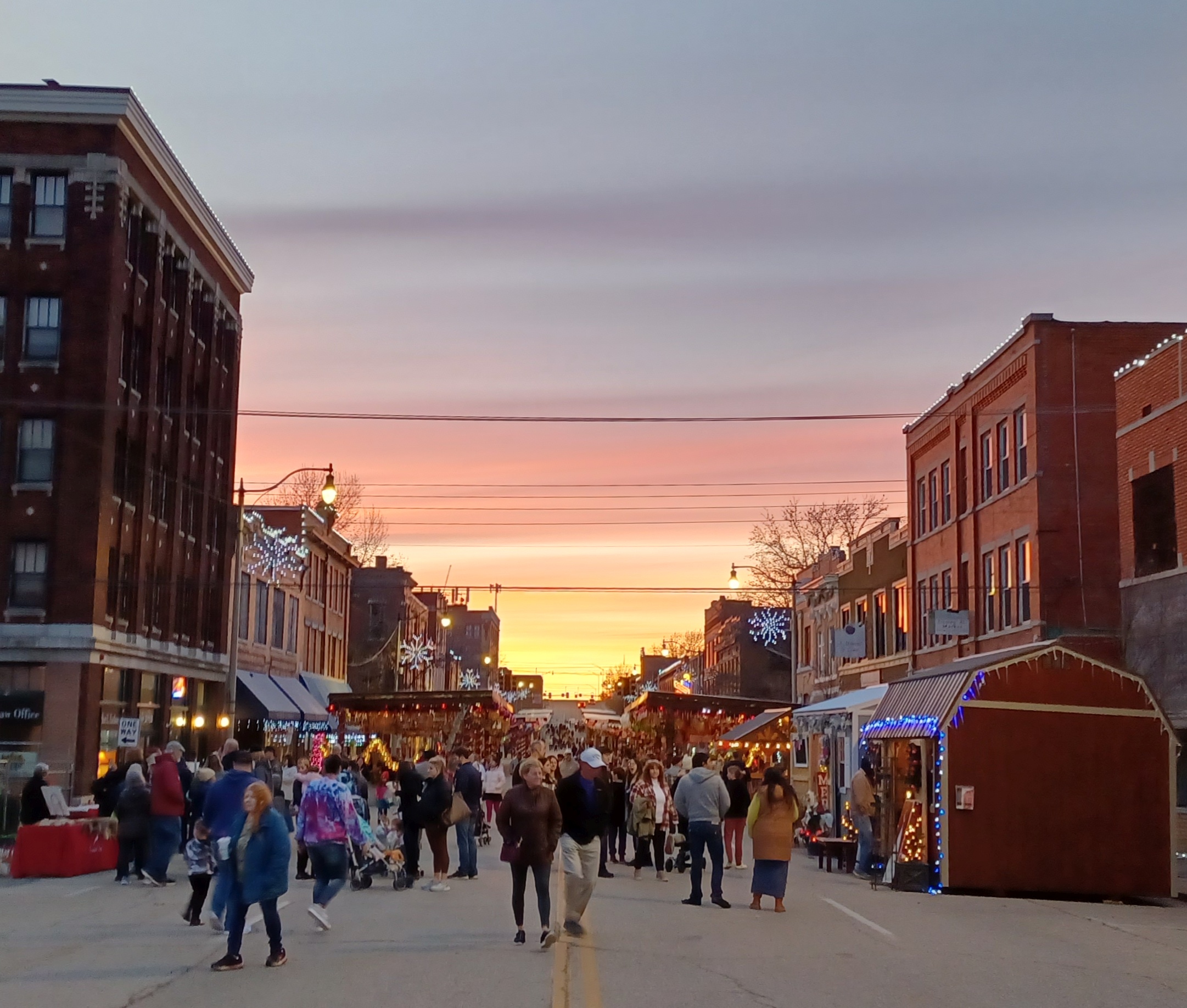
The Route 66 Christmas Chute on Dewey Avenue in downtown Sapulpa, Oklahoma, has just two more nights to run, but it continues to be a popular attraction two months after its opening on November 3, 2022. Ten overhanging steel structures decorated with a variety of themes stand in the street where the parking would normally be, and the shops on Dewey and side streets are open for business into the evenings. Admission is free. A Sapulpa Herald article about a preview in September provides a good description of the event. The Christmas Chute's Facebook page is frequently updated.
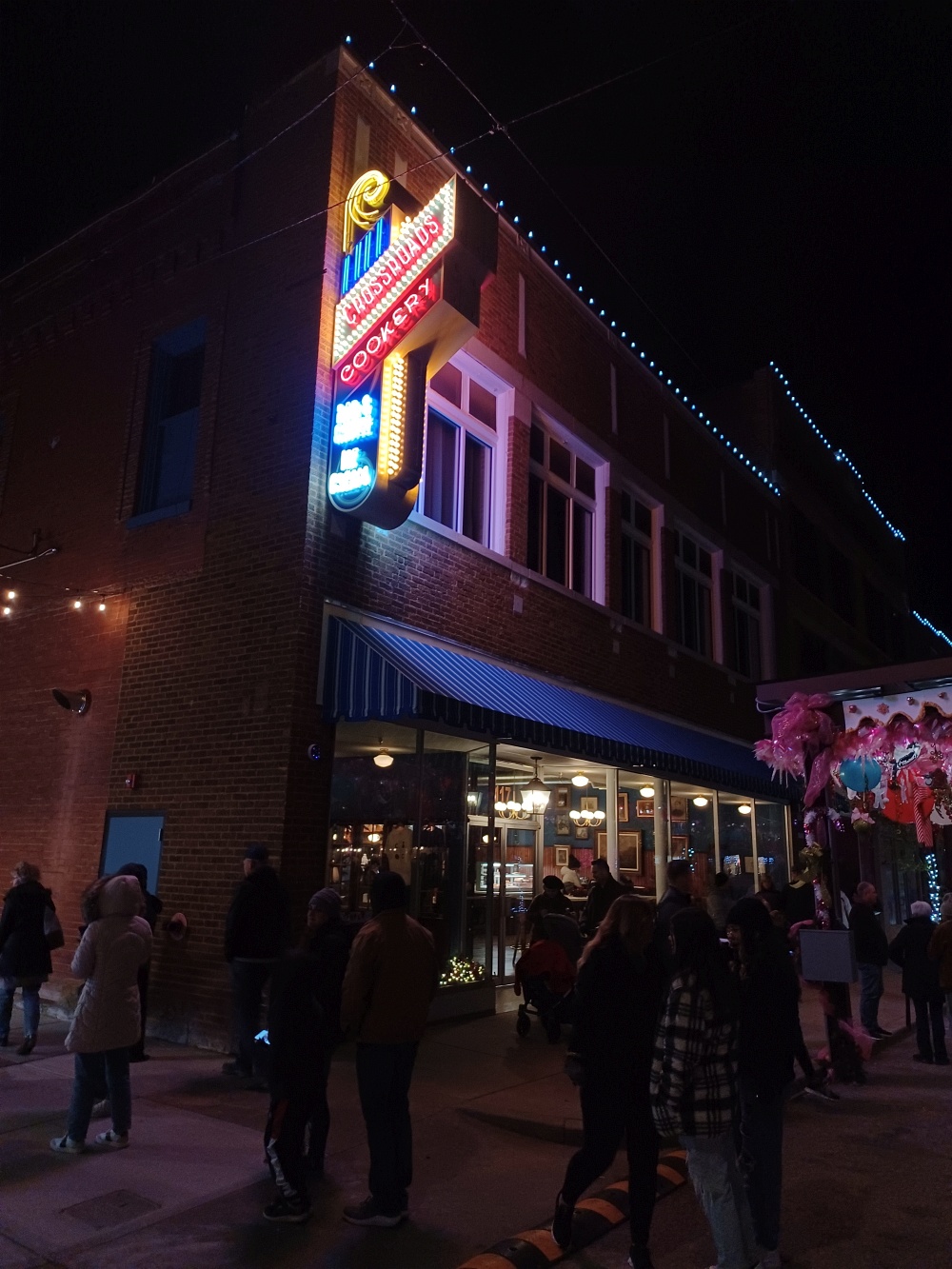
My wife and I visited back on November 12. We stopped in at Gigi's Gourmet Popcorn and bought some praline pecans to share, had dinner at the brand new Crossroads Cookery, walked through one of the downtown antique malls, and got a coffee at CTX Coffee. It was fun to look at the decorations and cheery to see so many people out and enjoying themselves.
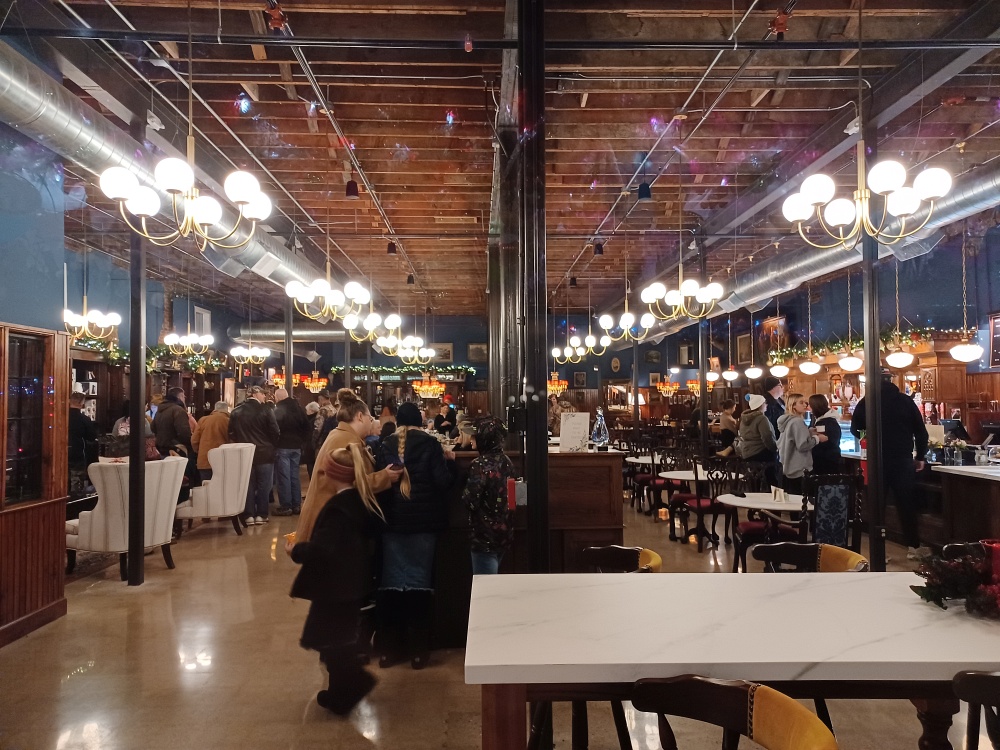
Crossroads Cookery was dealing with a few startup hiccups, but we enjoyed our meal, especially the crispy brussels sprouts. It's four things in one big space, decorated after the fashion of an early 1900s soda fountain -- a sit-down restaurant, a coffeehouse that roasts its own beans, an ice cream parlor (with baked treats, too), and a bar (that has Cabin Boys Brewery's Bearded Theologian on tap).
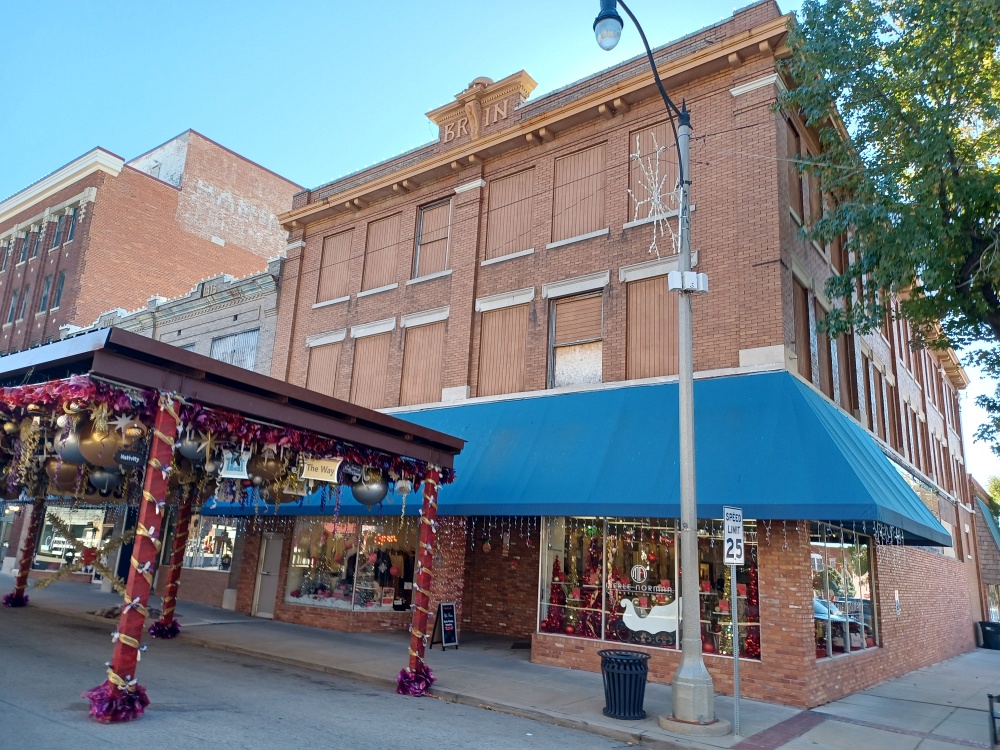
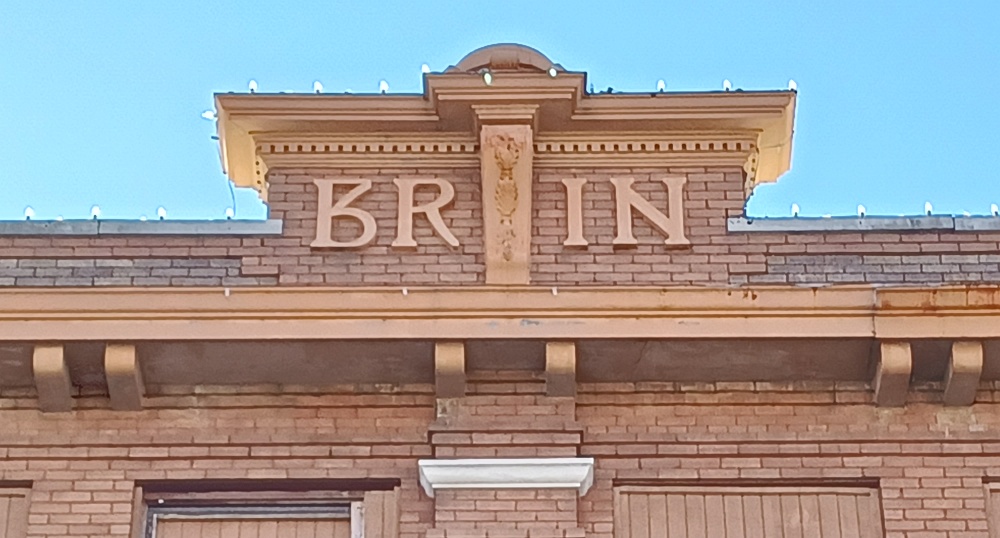
As we were walking back to the car, I happened to look up and notice the name "BRIN" on the cornice of the three-story building on the SE corner of Dewey and Park. I recognized this as the name of Tulsa bookseller Lewis Meyer's maternal grandparents. A peek through some old Sapulpa newspapers showed that the land was purchased from the city in 1909 by men's clothier Max Meyer (immortalized in Lewis Meyer's 1959 bestseller, Preposterous Papa) and his father-in-law and brother-in-law, Philip Brin and Ed Brin, respectively, of Terrill, Texas. The property had previously been occupied by a fire station and the city jail. The Brin Building opened in July 1910, and its first major tenant was Katz Department Store, based in Louisville, Ky. The building also housed a chiropractor and an ophthalmologist. Reading contemporaneous accounts of Max Meyer and seeing his display ads in old Sapulpa papers led me to the conclusion that nothing in Preposterous Papa was exaggerated. Max was simply larger than life.
Last week, NBC's Today Show featured the Christmas Chute on the final installment of its "Merriest Main Street" series. Crowds showed up to be on live TV despite the single-digit temperatures, and CTX and Crossroads Cookery were open to provide food, drink, and warmth while the crowds were waiting for airtime.
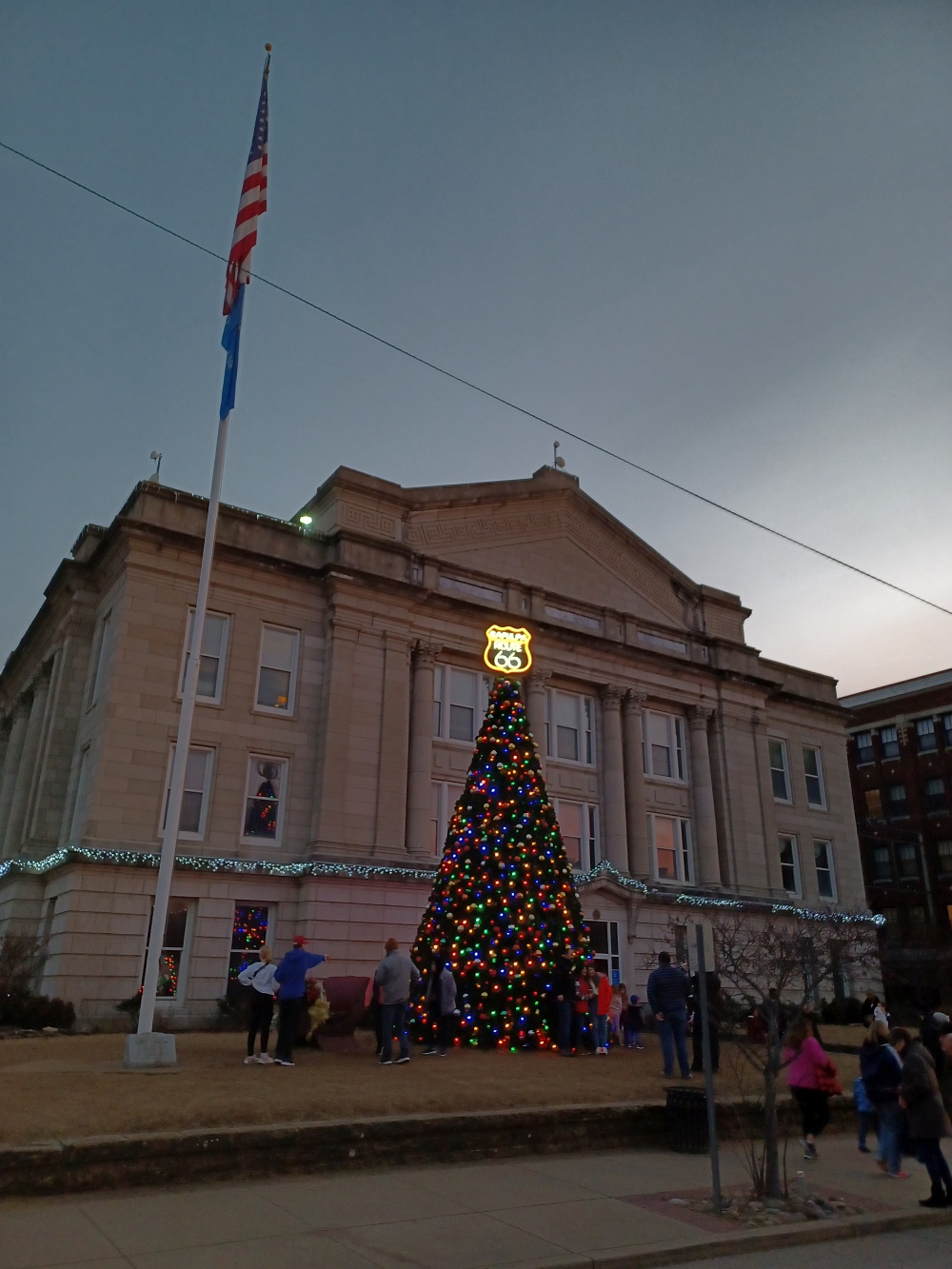
Last night, December 30, I had to drop off my son at an event west of Tulsa and afterwards decided to pay a return visit to the Chute to see if it was still running. It was a warm evening, in the 50s, and there were a lot of people out on the street and visiting shops and restaurants. Crossroads Cookery was packed. Rose the Reindeer was in front of the courthouse; for $20 you can sit in a sleigh and get a picture with Rose.
I walked the length of Dewey, and then a block south and back on Park and Water Streets. On Water Street, I came across a hot dog cart under a pop-up canopy in front of Chuck-It Axe Throwing Co. The food cart was launched as a way to draw attention to the axe throwing venue, but I was told that it has taken on a life of its own. I paid $7 for an excellent four-cheese grilled cheese sandwich, served in quarters with a little sauce cup of tomato bisque for dipping, perfect for eating and walking.
Dewey Avenue was closed to traffic on October 1 as the month-long construction process began. I am not sure how long it will take to dismantle the structures and reopen Dewey to traffic. It's not clear from the website or Facebook page when the final night is occurring, but there's a mention in the entry on Rose the Reindeer, suggesting that New Year's Day 2023 is the end of it: "Rose the reindeer will be at the Route 66 Christmas Chute from 5:00 - 8:00pm on Friday, Saturday, and Sunday! Feed and get photos with Rose for $20! What a great way to close down the first year of the Route 66 Christmas Chute--just as it began! See you there!"
This could be seen as an interesting experiment in pedestrianization. Pedestrianizing Main Street in downtown Tulsa in the 1970s killed the handful of retail businesses still there, although the Main Mall and Bartlett Square at 5th and Main provided a gathering place for the community, such as the First Night New Year's Eve celebrations in the early 1980s and Mayfest.
Sapulpa's businesses have received a lot of attention these past two months, and retailers were nervously optimistic after a big opening night. Business during the day, however, seemed to be pretty quiet when I stopped at CTX Coffee in mid-November for a coffee and a teleconference en route to Oklahoma City. My Table, a restaurant on the east end of the chute across the street from the courthouse and Christmas tree, "a location that has become notorious for short-lived eateries," closed permanently this past week, with staffing difficulties fueling unpredictable hours of operation. New restaurants have enough challenges that the street closure didn't necessarily hinder My Table's success, but it appears that they didn't have the personnel support to take full advantage of the crowds drawn to the Chute.
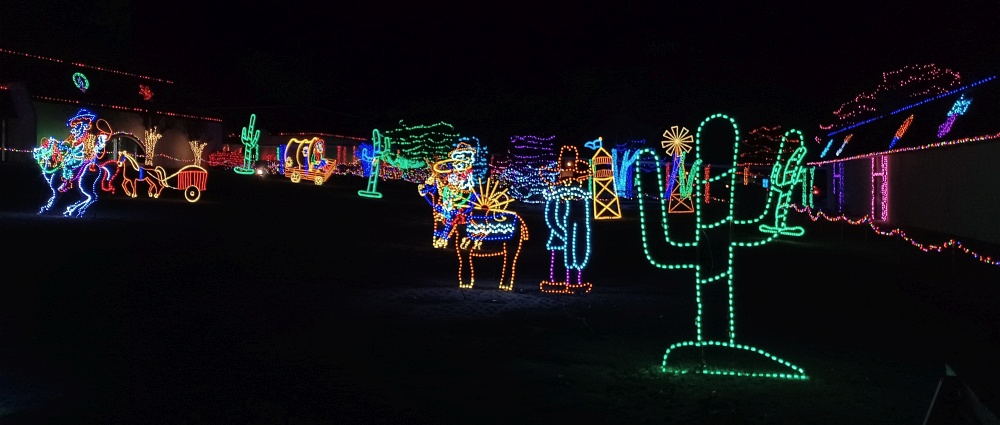
Meanwhile in Broken Arrow, Rhema Bible Training College's spectacular annual Christmas light display is also in its final two nights, with New Year's Day 2023 as the last night. We stopped by Thursday evening on a whim, as we were heading home from bowling with family at Broken Arrow Lanes. It looks bigger and better than ever. Admission is free, but you can purchase hot chocolate, hot cider, cappuccino, popcorn, and other treats from concession stands around the campus, and horse-drawn carriage rides are available for $10 per person.

And The Oklahoma Swing Syndicate has their traditional New Year's Eve dance at Southminster Presbyterian Church Community Center. Dancing lessons at 8 pm, with the dance proper running from 8:30 to half-past midnight. Admission is $7 for adults, $5 for students, with discounts for members.
MORE: We made one last visit, this time with two of our children, after church New Year's Day. We had brunch at Crossroads Cookery, and my daughter was interested in browsing the Purple Rabbit Emporium and Art. While waiting on her to browse I was standing near the front door, and a woman came in from the street, seeming a bit agitated, holding a pen and paper. "Could you help me, please?" (Still in coat and tie from church, I guess I looked official.) She was looking for Route 66, heading to Oklahoma City. (She just called it "Oklahoma" at first.) She was from County Clare, Ireland. I walked westward with her, explained that the blocked-off street was Route 66, closed for a two-month street festival. At Main and Dewey, I pointed to West Dewey Ave. as the direction she needed to go and listed the other towns she would pass on the way to OKC, just to confirm that was the way she intended to go. I motioned back to the east and said that that was the way to Tulsa. "Oh, we've been to Tulsa. We got lost there. It was a nightmare. We wound up on the motorway." When Sapulpa does this again next year, they need better Route 66 detour signs for through-travelers, and it sounds like Tulsa does as well.
From the Oklahoma Taxpayer Alliance, news on the vindication of the late Owasso City Councilor Patrick Ross in his fight to release a report investigating alleged wrongdoing by City Manager Rodney Ray, whose 20-year tenure ended in 2013 under an ethical cloud but with a hefty severance package from the City Council. Posted here with their permission:
THE OKLAHOMA STATE SUPREME COURT RULED...PATRICK ROSS WAS RIGHT
In August 2013 then city councilor Patrick Ross filled a lawsuit against the City of Owasso for refusing to release the "Fortney Report" which was an investigation into the alleged criminal actions of former city manager Rodney Ray. In 2017 District Court of Tulsa County ruled in the city's favor. Mr. Ross then appealed this decision to the Court of Civil Appeals.
On April 30, 2020, a three-judge panel from the Court of Civil Appeals unanimously ruled that the "Fortney Report" concerning the investigation of former city manager Rodney Ray shall be released and made public.
The judges who sat for this hearing were Judge Thomas Thornbrough (Presiding Judge), Special Judge John Reif and Judge Jane Wiseman. Special Judge Reif served on the Oklahoma State Supreme Court from 2007-2019 and was the Chief Justice for the Supreme Court from 2015-2016.
In their fourteen-page ruling the judges not only explained why the report was not an internal personnel matter protected from being made public by the Open Records Act (ORA) but they also spent time reviewing why Mr. Ray was paid a severance package in violation of his employment contract.
WE FLATLY DISAGREE
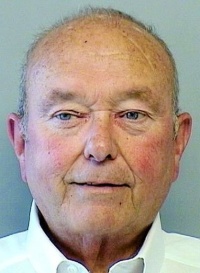
Rodney Ray
Owasso City Manager
1985-1998, 2001-2013
THE LEGITIMACY OF THE MAYOR AND CITY COUNCIL
In closing the judges stated "The balance of this case clearly favors disclosure. The ORA request is evidently not one motivated by mere curiosity into a personnel matter, or some general desire to broadly monitor the workings of government. It involves a high profile employee in an official position, not routine day-to-day personnel employment matters. It involves specific questions of why the City Manager, who was accused of misconduct, was granted a substantial severance package, paid for by the taxpayers of Owasso, instead of being fired. In short it is a 'core' Open Records matter going directly to the questions of the legitimacy of the Mayor and City Council's good governance and use of funds, and the citizens' inherent political power to inquire into these matters. City identifies no valid privacy, state, or public interest in withholding the Report. As such, we find that it should be disclosed pursuant to the ORA."
Following the Appeals Court ruling the city appealed the verdict to the Oklahoma State Supreme Court. On November 17, 2020 after reviewing the Court of Civil Appeals ruling the Oklahoma State Supreme Court choose to allow the Court of Civil Appeals ruling to stand.

Patrick Ross
Owasso City Councilor
2011-2014
Many folks over the years have voiced their opposition to Mr. Ross's actions with his lawsuit and he was dragged through the social media mud for doing so. His character and reputation were attacked and he was labeled with numerous slanderous names.
He and his wife spent thousands of their own dollars in attorney fees in order for this fight to continue. Mr. Ross believed in what he was doing and he knew he was on the right side of the law.
If you care anything at all about your government, at any level you should be very thankful for this ruling. It stands at the very foundation of any government agency being transparent about how they spend YOUR tax dollars. Without this type of ruling any government agency could have a free ride at spending taxpayer dollar without any citizen oversight.
We live in a nation where everyone has the right to their own opinion and to be able to state that opinion. And if you feel your rights have been violated, you have the ability to take your case to court to air your grievances and seek justice. Mr. Ross did just that and the courts agreed with him.
Our founding fathers fought with their lives and fortunes in order to bring about this great nation. They left us with a constitution that allows "We the People" to hold government accountable. At a young age Mr. Ross fought for this nation in the US Navy in Vietnam. He continued fighting for his community as a city councilor. And after he was no longer on the city council he continued to use his own money to fight for honest and transparent government.
Makes you wonder what kind of city, state or nation we would have if more people were like Patrick Ross and felt strong enough about honest and transparent government to make a stand and fight...no matter if no one else was fighting with them.
Patrick Ross was a true American warrior and patriot. We could use more people like him.
Court docket files:
- Tulsa County CV-2013-898: Ross v. City of Owasso, the initial suit brought by Councilor Ross to make the Fortney Report available to the public under the Open Records Act.
- SD-115210: Three-judge appellate panel determined that the case would not yet be ripe until the City Council, not just a city employee, rejected Ross's Open Records Act request. Here is the decision in that appeal.
- MA-117599: Appeal to the Oklahoma Supreme Court by one of the defendants
- SD-117321: Appeal by Patrick Ross following the Owasso City Council's action to deny Ross's Open Records Act request.
This is big, but justice delayed is justice denied. It's ridiculous that the process took over seven years to reach a conclusion, during which time the voters of the City of Owasso have been denied an opportunity to evaluate the way their elected representatives handled the accusations of wrongdoing on the part of the longtime City Manager.
(In 2013, Freedom of Information Oklahoma head Joey Senat described Ross's original lawsuit and the abuse of the Open Records and Open Meetings Acts by the pro-Ray majority on the Council alleged in the complaint.)
It took seven years through the courts to reach a fairly tentative decision on whether citizens should know about possible malfeasance by the City Manager and to decide whether the the City Council majority's decision to give him a fat severance package was justifiable or a travesty of justice. In the meantime there have been two full cycles of City Council elections. Owasso Taxpayer Alliance points out that two members of the Council that denied Ross's Open Records request still sit on the Owasso City Council: Doug Bonebrake and Chris Kelley. Ray's internal memo ordering the deletion of video of a police traffic stop of Chris Kelley for suspected DUI was one of the actions that led to his departure as City Manager.
The exemptions in the Open Records and Open Meetings Act for personnel matters are there to protect the clerk who processes your water bill and the worker who fills potholes, the same sort of people who are under Civil Service protections. They exercise little discretion in the conduct of their jobs, and they set no policies.
The Oklahoma Supreme Court voted 6-2 to deny certiorari, and although I'm glad for Carole Ross, the widow of Patrick Ross, that the case is over, I wish the Supreme Court had heard the case. The two dissenting justices, John Kane and Dustin Rowe, questioned the balancing test that was applied by the Court of Civil Appeals panel. Without a Supreme Court ruling on when municipalities must disclose personnel records involving executive city officers, there isn't a precedent on which citizens and municipal governments can rely in the future. The opinion of the Civil Appeals Court has not been published, although the ruling is available through the case docket.
There is a clear distinction to be made between public employees who have limited or no discretion and those who serve in an executive capacity, setting policy and direction for a public body. For officials in the latter category -- city managers, school superintendents, library directors, city attorneys, directors of city departments, and others with executive responsibilities -- their administration (or maladministration) of their duties are matters of clear public interest, and the Legislature should amend the Open Records Act and the Open Meetings Act to reflect this fact, by mandating that personnel records for these officials must be made public and discussions concerning their performance must be held in open session of the relevant council or board.
A clue to the level of executive discretion enjoyed by Rodney Ray: This 2008 snapshot of his page on the City of Owasso website included his State of the City address and the City Manager's vision for Owasso government. That's the sort of thing a Head of State puts out, not a menial functionary.
When I was in college, I worked on a research project for MIT's Urban Planning department. We were investigating the impact of a Massachusetts initiative (Proposition 2 1/2) to limit property tax on municipal government, traveling to different cities and towns to interview local officials about how they were coping. On one of our visits, we had a brief meeting with the uncrowned king of Worcester, Mass., Francis J. McGrath, who was nearing the end of his 34 years as City Manager of the second largest municipality in the Commonwealth. When we were allowed to enter, it was like walking into a throne room. McGrath's longevity seems linked to the public works projects he shepherded, the typical post-war redevelopment that scraped historic neighborhoods and replaced them with highways and new brutalist public facilities, and to his carefully cultivated relationship with the monopoly local newspaper. In the minds of some who served with him, McGrath's successors as city manager have been more openly autocratic and dismissive of the elected city councilors, who appear to have become complacent and passive during McGrath's tenure.
The most powerful man in New York City from the 1930s through the 1960s, Robert Moses, never held an elective office. He was City Parks Commissioner and Chairman of the Triborough Bridge and Tunnel Authority, among many other roles, all of them appointed. Surely personnel actions involving someone able to decide the routes of expressways and to clear neighborhoods for public housing are a legitimate matter of public interest and ought to be in the public record.
City managers typically serve at the pleasure of the city council. That can make the role vulnerable to scapegoating by elected officials. If something goes wrong, it's easy for councilors to lay the blame on the city manager and "send him out of the camp." But a canny city manager can find ways to protect his position. It's easy to imagine a corrupt arrangement could occur in which the city manager uses his authority over the city bureaucracy to protect his allies on the council from embarrassment or perhaps to benefit them or their businesses in some other way and at the same time to punish his council detractors. Meanwhile the city manager's council allies continue to keep him employed or, in the event of scandal, provide him with a golden parachute.
The courts have found the City of Owasso liable for court costs and reasonable attorney fees; a hearing to determine that amount has been scheduled for February 11, 2021, in Judge Bill LaFortune's courtroom. Owasso Taxpayer Union estimates the City's liability at $250,000. The City Council is now under a court mandate to release the Fortney Report on the investigation into Rodney Ray's actions.
 Municipalities across Oklahoma are holding city council elections today. Today is also runoff day for school board seats that weren't settled in February. Below are some of the local races. It's encouraging to see that so many of the elections are contested. In Skiatook, every single seat is on the ballot, giving the voters the chance to clean house if they so choose.
As always, polls are open until 7 p.m.
I've heard of some upset in Jenks over whether incumbent councilors should be held accountable for their decision to put a tax on the ballot that was defeated. Defenders of the incumbents say they didn't raise taxes, they just gave the voters a chance to vote. (Sort of like Aaron in Exodus, "I just put the gold in the fire, and out came this calf!") Putting a tax on the ballot is not a neutral act. Elected officials have a responsibility to listen to their constituents before putting something on the ballot. Officials should only propose projects that will have the support of an overwhelming majority of voters. Too often councilors and commissioners listen only to those with a special, vested interest in the outcome (both inside and outside of government), and develop a proposal that pleases those special interests but will require massive campaign funding to persuade a narrow majority of voters.
Ward maps for Tulsa County municipalities
TULSA COUNTY:
Berryhill school board, Office 3: Sandra Pirtle, Doc Geiger
Glenpool, Ward 1: Timothy Lee Fox (i), David Freeland, Keith Jones
Jenks, Ward 2*: Lonnie Sims(i), Darlene Williams
Jenks, Ward 3: Kevin Rowland(i), Philip Morgans
Jenks, Ward 4: Brian O'Hara, Joshua M. Wedman
Jenks, Ward 6: Greg Bowman(i), Steve Murtha
Jenks, at-large: Paul E. Harris, Kelly Dunkerley(i)
Skiatook, Ward 1: Debbie Cook(I), Connie Clement, Herb Forbes
Skiatook, Ward 2: David Sutherland, Nate Myers, Damon Pace,
Skiatook, Ward 3*: Moe Shoeleh, Joyce Jech (i)
Skiatook, Ward 4*: Skylar Miller, Patrick W. Young
Skiatook, Ward 5: Susan Reed-Hardesty, Richard Barnes, Patty Pippin Ceska, Randy J. Sien (i)
Skiatook, Ward 6*: Steve Kendrick, Shawn Martin, Kevin D. Paslay
Skiatook, at-large*: Leon O'Neal, Eugene Jones, O. L. Bud Ricketts
Sperry, at-large (vote for 2): Marvin Baker, William F. Butler, Robert Morton, Kelly Wensman
An asterisk, *, marks elections to fill an unexpired term.
Incumbent Owasso Mayor Doug Bonebrake is being challenged for his City Council Ward 5 seat by J. B. Alexander, the outgoing Tulsa County Republican Party chairman and a leader of the Owasso Taxpayers Alliance, which has successfully elected two members to the five-member council. The non-partisan election will be held next Tuesday, March 5, 2013. Because only two candidates filed for the seat, the race will be decided on Tuesday.
In October 2011, the Owasso Taxpayers Alliance (OTA) led the record turnout that inflicted a landslide defeat of three Owasso bond issue propositions. Two of the propositions failed to get 20% of the vote; the proposition for roads fared little better with only 22.5%.
The latest edition of the Owasso Reporter has a color ad in which five county officials, a state senator, and a state representative have endorsed Bonebrake. Five of the officials are Republicans, two are Democrats, but none of them live in the City of Owasso. The ad also attacks Alexander.
Six of the seven endorsers live in the City of Tulsa and the other lives in Broken Arrow. Sheriff Stanley Glanz lives in east Tulsa, County Commissioner Karen Keith, State Rep. Eric Proctor, and State Sen. Brian Crain live in midtown Tulsa, County Treasurer Dennis Semler lives in far southeast Tulsa, County Commissioner Fred Perry lives in Broken Arrow, and County Commissioner John Smaligo lives in Tulsa's Brady Heights neighborhood, a short walk from downtown Tulsa.
Another thing most of them have in common with each other and with Bonebrake: They endorsed Vision2. Bonebrake endorsed corporate welfare proposition 1, but did not declare a position on pork barrel proposition 2. Smaligo, Keith, Perry, Semler, and Crain endorsed the entire package. Glanz was reported to have appeared in uniform in a pro-Vision2 ad with Karen Keith. (I am unable to find a record of Proctor taking a stand one way or another on the issue.)
An Evite online invitation seems to show that a fundraiser for Doug Bonebrake was held at the Summit Club in downtown Tulsa on Thursday, February 21, 2013, from 5:30 p.m. to 7:30 p.m. The "Message from Host" stated "Please join us in showing support for Owasso Mayor Doug Bonebrake's re-election and to keep Owasso a strong regional partner for continued success and growth throughout Tulsa County" and was signed "Tulsa County Republicans." Because of the timing of the event and Oklahoma's antiquated ethics reporting laws, contributions from the fundraiser won't have to be reported until after the election. (Click to see a screenshot of the Doug Bonebrake for Mayor Summit Club fundraiser invitation.)
The two Vision2 propositions received just under 40% of the vote in the Owasso area precincts (750 through 760), which may explain why the ad was silent about that issue. J. B. Alexander, as an outspoken leader in the opposition to Vision2, is more in line with the views of his Owasso neighbors than his opponent is.
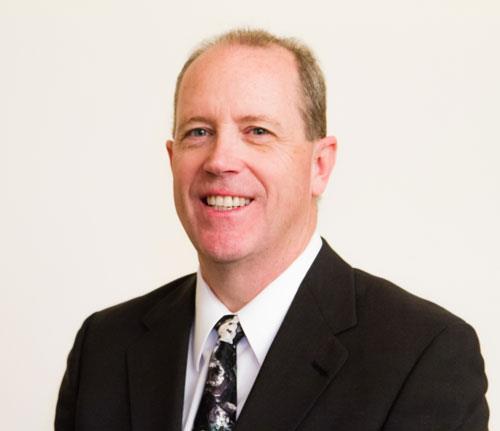 J. B. Alexander showed a great deal of courage in personally opposing Vision2 and allowing the Republican County Committee to vote to take a stand on Vision2, when he was undoubtedly under a great deal of pressure to at least remain silent for the sake of the Republican officials who voted to put the misbegotten corporate welfare and pork barrel plan on the ballot. I imagine those officials might feel some resentment toward Alexander for his role in their plan's defeat, and that might motivate support for his opponent.
I've only known J. B. for about four years, from when he was first elected as GOP county vice chairman in 2009. What I've seen is that he is a hard worker, a committed conservative, and he has bent over backwards to be fair to everyone, notwithstanding the vocal complaints of the Big Government minority in the party. His day job involves ensuring that taxpayers get their money's worth on government construction contracts; he inspects the work to ensure that it was completed to specifications, without skimping on material or workmanship. Sometimes that means a contractor gets upset when he's told to redo work in order to fix a deficiency. It's not surprising that someone devoted to the best interest of taxpayers would be on the receiving end of darts from the political class.
MORE: J. B. Alexander's Facebook page, where he discusses specific issues and answers voters' questions.
More commentary on Owasso City Hall politics at Owasso Matters and Rossviews.
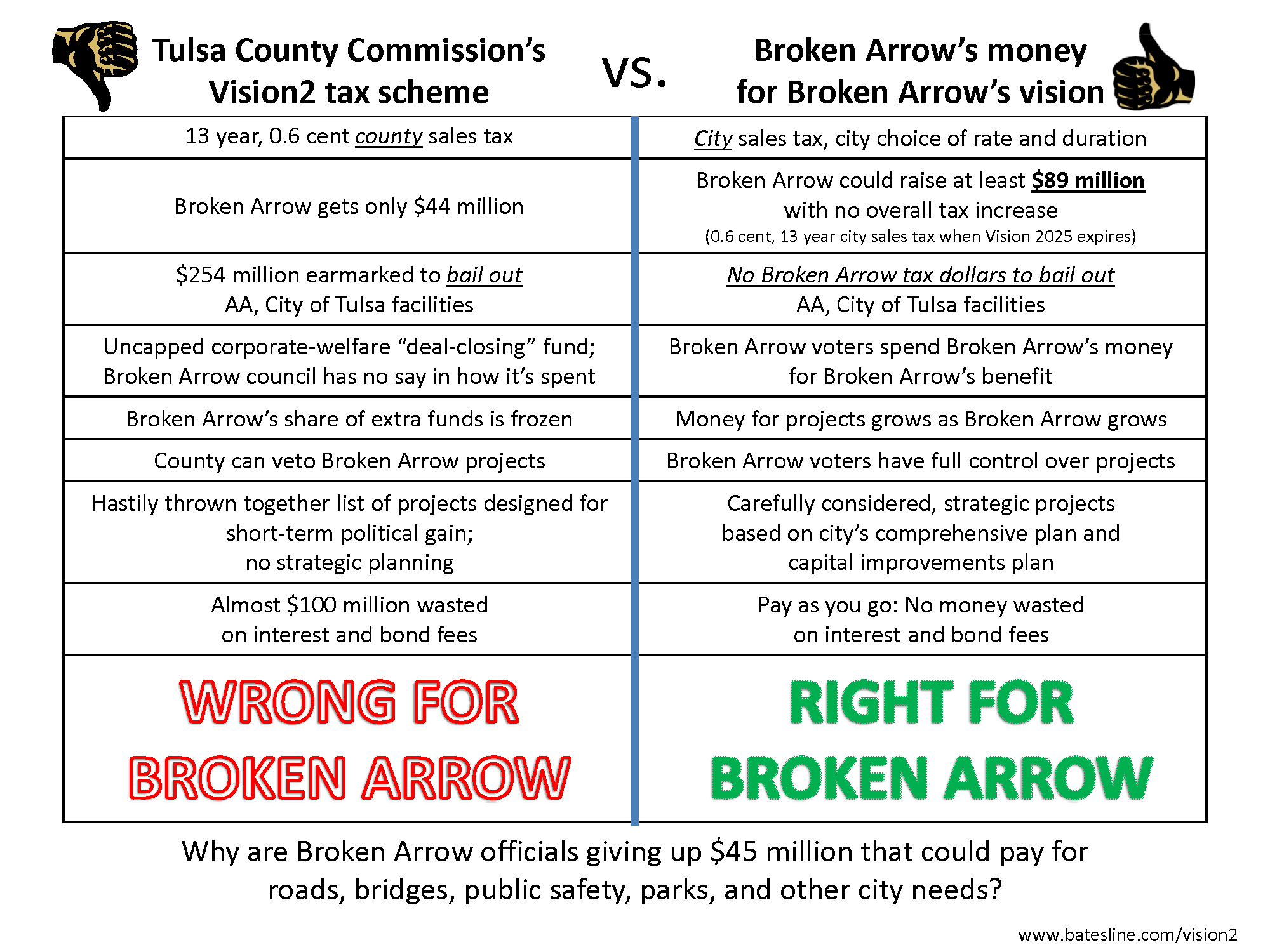
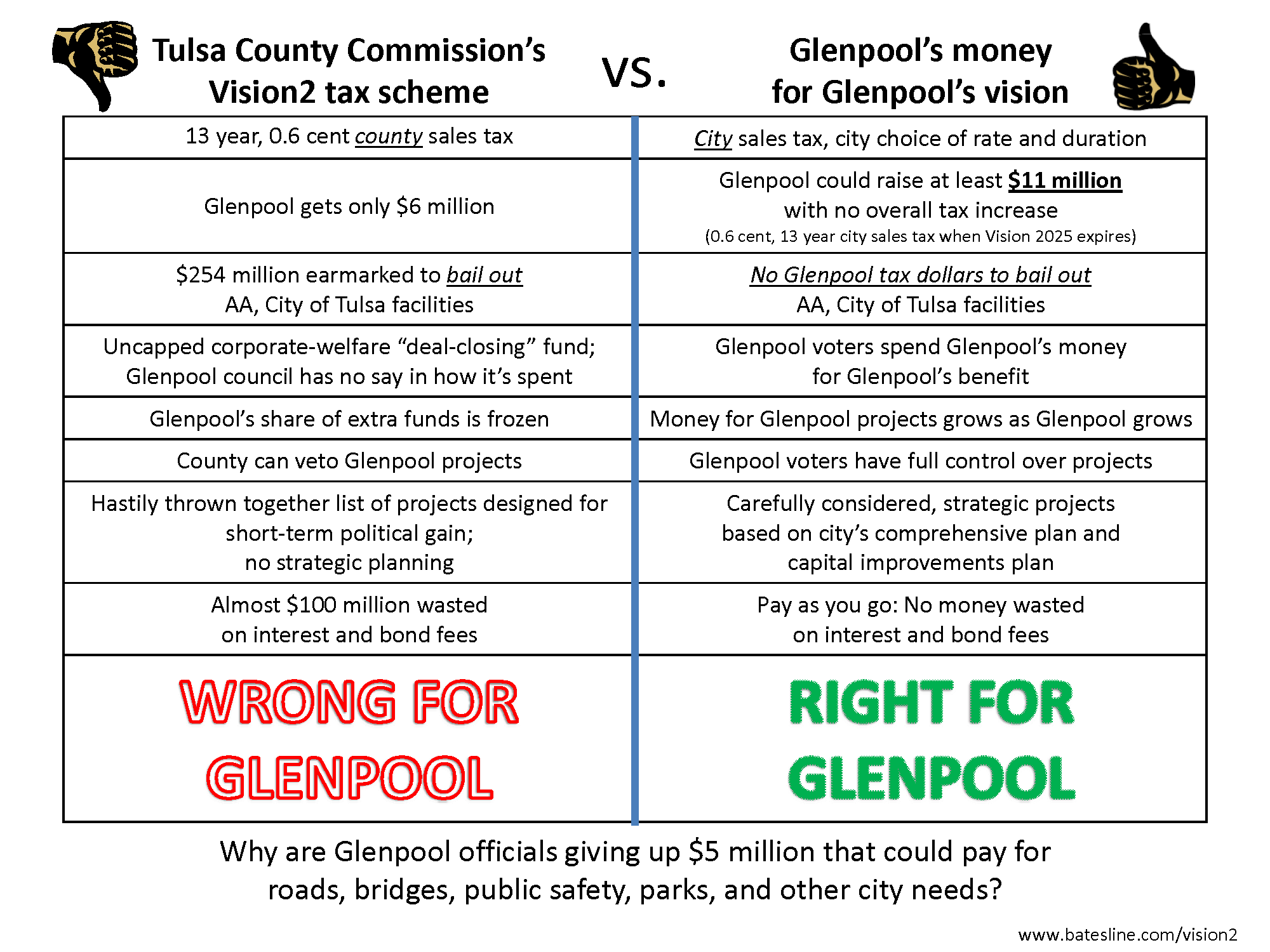
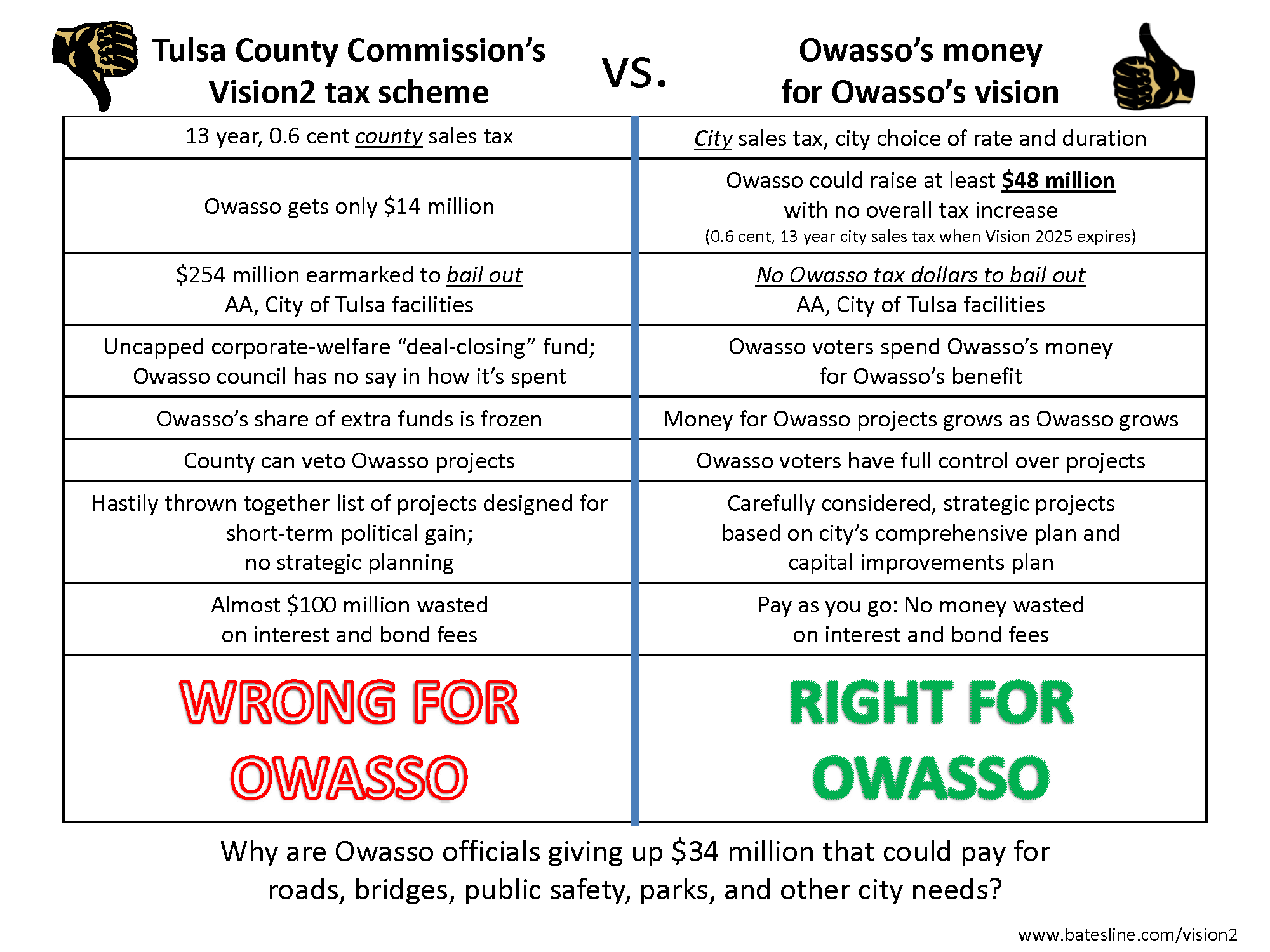
I've started to put together a series of fliers explaining why Vision2 hurts Tulsa County's municipalities and how these cities would be better off enacting a city sales tax to replace the Vision 2025 county sales tax when it expires on the last day of 2016. Here are the first three, for Broken Arrow, Glenpool, and Owasso.
You'll notice that most of the reasons are the same from city to city. The key difference is in the money each city would get from Vision2 vs. how much they would get from a city tax of the same rate and duration. This tax would go into effect as soon as Vision 2025 expires, so that the overall sales tax rate wouldn't change.
The Vision2 amounts for each city are those that the proponents have publicized. The estimate of money that could be raised by a city sales tax of the same rate and duration is based on each city's sales tax receipts for the 12 months from October 2011 through September 2012. (One year's sales tax receipts / sales tax rate * 0.6% * 13 years.) I've rounded all numbers to the nearest million.
One of the big drawbacks of Vision2 for a growing suburb is that its percentage of the Vision2 Prop 2 tax receipts is frozen in time, based on its share of county population in 2010, no matter how much they grow in population and retail sales. By contrast, a city sales tax would grow as the city grows.
Click each image to download a corresponding ready-for-printing PDF. Opponents of Vision2 are welcome to copy and hand these out as long as you don't change it at all.
All images Copyright 2012 by Michael D. Bates. Limited license granted to opponents of Vision2 to copy and distribute without alteration prior to November 7, 2012.
Jenks and Owasso voters turned down property tax increases (general obligation bond issues) by overwhelming margins on Tuesday, while Broken Arrow school district voters approved a reallocation of an existing bond issue that involved no tax increase at all.
According to KRMG News, the Owasso tax increase would have amounted to about $170 annually on a $100,000 home, while the Jenks increase would have been about $25 per $100,000.
Complete but unofficial results from the Tulsa County Election Board:
ÂCity of Jenks
Fire equipment, police headquarters
Yes 288 32.99%
No 585 67.01%
 Â
City of OwassoProposition 1: Youth sports facilities
Yes 676 14.02%
No 4146 85.98%Proposition 2: Streets
Yes 1,088 22.53%
No 3,742 77.47%Proposition 3: Parks and aquatic center
Yes 779 16.21%
No 4,026 83.79%ISD-3 (Broken Arrow)
Yes 2,671 78.19%
No 745 21.81%
It appears that voters want their elected officials to focus on the basics and even then they want to see good stewardship of existing revenue streams rather than higher rates.
This is the make-do era. We are paying down debt, delaying major purchases, taking few risks, making the most of what we already have. In the current environment, transferring money from homeowners to heavy construction companies for the sake of some nice-to-haves doesn't make much sense.
Tulsa's establishment and elected officials will probably take the wrong lesson from the result and assume a marketing failure. Hire the right PR firm, the right political consultants, and any tax hike will pass. It worked in 2003. It almost worked in 2007.
But not now, not for a long time to come.
Oklahoma towns and cities with a statutory charter (which is to say, no charter at all; they are governed by the default provisions of Oklahoma Statutes Title 11) and some charter cities have elections today, Tuesday, April 5, 2011. Some school board seats will have a runoff, if none of the candidates received 50% of the vote back on February 8.
Here in Tulsa County, Broken Arrow, Glenpool, Jenks, Sand Springs, and Skiatook each have city council or town trustee races on the ballot. It's encouraging to see that nearly every seat up for re-election has been contested.
Broken Arrow and Bixby electorates will each decide four municipal bond issues. Broken Arrow's bond issues cover streets, public safety, parks, and stormwater. Bixby votes on streets, public safety, and parks, and an amendment to a street project approved in a 2006 tax vote.
Tulsa Technology District (vo-tech) Zone 2 has a runoff between former Tulsa Police Chief Drew Diamond and Catoosa school superintended Rick Kibbe (both registered Democrats). The two candidates each received less than 100 votes in the snowbound February primary. Skiatook has a runoff between Linda Loftis (registered as a Republican) and Mike Mullins (registered as a Democrat) to fill an unexpired term for seat 3.
Oklahoma City has a high-profile council runoff, too, between a candidate backed by the shadowy Momentum committee and physician Ed Shadid. Shadid seems to be drawing support from a wide range of Oklahoma City bloggers; the list of endorsers includes Charles G. Hill of Dustbury, Oklahoma City historian Doug Loudenback, young urbanist Nick Roberts, and slightly older urbanist Blair Humphreys.
An edited version of this piece was published in the March 21, 2007, issue of Urban Tulsa Weekly. The published version is no longer online. Posted here May 25, 2026. Astoundingly, Lance Cargill's 100 Ideas website is still online. A couple of weeks earlier I wrote here about HB 1648 passing out of committee.
Caucus-blocked
By Michael D. Bates
It's a no-brainer, right? Public-private partnerships for the construction of public infrastructure ought to be subject to the same competitive bidding rules as every other government contract. We have laws designed to make sure that Oklahoma taxpayers get the most value for money when state, county, or municipal governments pay private companies to build roads and bridges. Why should there be any loopholes or exceptions?
The idea is so self-evidently right that in 2006 the Oklahoma House of Representatives voted 94 to 3 in favor of the same language, under the number HB 2470. The Oklahoma Senate passed it by a vote of 43 to 2. It would have become law if it hadn't been for a parliamentary maneuver by Sand Springs Sen. Nancy Riley which killed the bill.
The bill was brought back for another try this session. The House General Government and Transportation Committee approved it earlier this month with only four dissenting votes, and it seemed to be on its way to the floor of the House for easy approval there and in the Senate.
It was scheduled for a vote, but then was pulled by the House Republican leadership on the improbable grounds that a bill which passed 94 to 3 last year and passed committee with flying colors this year didn't have enough Republican support.
The legislation wasn't different, but what was different this year was a tremendous surge of pressure brought by the road-building industry, in the guise of a public-interest group called TRUST (Transportation Revenues Used Strictly for Transportation).
TRUST's board is a who's who of interests that stand to profit handsomely from massive public spending on roads: the Oklahoma Asphalt Pavement Association, the American Concrete Pavement Association, the Oklahoma Aggregates Association, the Oklahoma chapter of the American Council of Engineering Companies, Bob Poe of Poe Engineering (the firm that made its fortune as the exclusive engineering firm for Oklahoma's turnpike system).
Tulsans will remember Mr. Poe's farewell speech as Tulsa Metro Chamber president, a red-faced rant attacking reformers on the City Council as jack-booted Nazis. In Mr. Poe's world, anything that stands between him and making a pile of money at public expense is fascism in action.
The odd thing is that TRUST's main complaint is not against the substance or effect of the bill, but that the existence of the bill implies that sleazy, insider deals have been done in the past. (Their real complaint is another matter. More about that below.)
Well, sleazy, insider deals have been done - right here in Tulsa County. County Commissioner Randi Miller and her two former colleagues approved a very sweet deal for Infrastructure Ventures, Inc. IVI had never built a bridge before. IVI's main qualifications for building a bridge across the Arkansas River: the firm's principals (Bill Bacon, Bob Parmele, Howard Kelsey) were pals of then-Commissioner Bob Dick.
For the moment let's set aside the question of the need for a bridge in south Tulsa County, and focus on how such a facility should be financed. The sensible thing would have been for the county to issue a request for proposals and solicit competitive bids from several companies, accepting the proposal that offered the best value to the taxpayers.
A competitive acquisition might have resulted in a higher percentage of tolls to the county, a more reasonable franchise period (say, shorter than the expected lifespan of the bridge), and more favorable terms on bridge maintenance and repair.
Opponents of HB 1648 argued that this bill was only about the IVI bridge, and state legislation shouldn't be used to address such a parochial concern. (But if it is only about the IVI bridge, why the disproportionately fierce reaction from the road-building industry?)
But the existing IVI bridge contract wouldn't be affected by new legislation. The deal (no longer with Tulsa County, but now with a trust formed by the cities of Jenks and Bixby) has run afoul of several laws already on the books. A district court ruling on the legality of IVI's arrangement with Jenks and Bixby is expected in the near future.
The IVI bridge deal did expose a significant loophole in Oklahoma's competitive bidding law. Because a public body isn't paying money up front for a road or bridge, it could be argued that the contract is for less than $50,000 and therefore exempt from the law.
Such a reading ignores the future liability that a public-private deal imposes on the government entity, not to mention the likely revenues to the private firm. IVI's deal with Tulsa County was projected to bring the company over $600 million. It's a pretty big loophole that can accommodate a number like that.
HB 1648 is a very simple piece of legislation. It adds 88 words to the existing law, to expand the definition of "public construction contract" in 61 O. S. 2001, section 102 to include contracts in which "other forms of consideration" - such as the right to collect tolls that would be due to a public agency - are used instead of money to pay for a bridge or road.
The competitive bidding rules themselves, which have been around for over 30 years, would not be changed. They would simply apply to all major public works contracts.
It's such a straightforward and sensible idea, it would have been difficult for any state legislator to vote against it. And that's why the bill's opponents worked so hard to keep it from coming to a vote.
The road-building industry's motives are easy to understand. What's harder to understand is why Republican House leadership, committed to fiscal responsibility and cleaning up state government, wouldn't exert some pressure of its own in support of a bill that advances those ideals. Speaker Lance Cargill is promoting his 100 Ideas initiative for improving Oklahoma government. It seems like competitive bidding on all major public projects ought to be one of them.
So what's the real reason Big Construction put on a full court press to kill the bill? There's a hint in TRUST's flyer attacking HB 1648:
"HB 1648 creates two problems for future P3 [public-private partnership] legislation. First, if it passes, a future P3 authorizing bill that contains its own transportation specific safeguards to ensure competitive selection, it will have to repeal the conflicting language in HB 1648. Voting for P3 will be tough enough for some legislators, but voting for repeal of HB 1648 might be even more difficult for many."
Allow me to translate: "We don't want you to approve this bill because we're going to come forward with 'competitive bidding lite' next year."
If HB 1648 had been enacted, it would be more apparent that the "safeguards" in Big Construction's bill are really a weakening of Oklahoma's policies, a special deal that would allow their industry to win billions of dollars in business not through offering the best deal to the taxpayers but by working their political connections.
What else could be in this future P3 legislation? There's reason to think that the road-building industry wants Oklahoma to adopt Texas's Comprehensive Development Agreement (CDA) legislation. The Texas Department of Transportation (TxDOT) has granted CDAs to a consortium led by Cintra, a company based in Spain, to build Toll Road 121 to connect US 75 and I-35 north of Dallas, and Toll Road 130 to bypass Austin on the east.
Cintra would build the roads and operate them for 50 years, collecting all the tolls, and paying some of the money to TxDOT. State government's power of eminent domain would be used to acquire right-of-way for these private, for-profit roads. There's a non-compete clause - if state or local government uses tax dollars to build a road that might draw traffic away from the toll road, Cintra is entitled to compensation for lost revenue.
These deals have been highly controversial in Texas, and they deserve a closer look in a future column.
We also need to watch closely to see which legislators are pushing P3 legislation and where their campaign money is coming from. As a Republican, I'd like to think that a Republican-controlled State House will be looking out for the taxpayers' interests, standing firm against greedy special interest groups. Given the apparent lack of Republican House leadership support for a common-sense piece of legislation like HB 1648, it seems I can't take that for granted.
 Subscribe to this blog's feed: