Cities Category
From the BatesLine Bookshelf, a very occasional feature on authors and books that have influenced me:
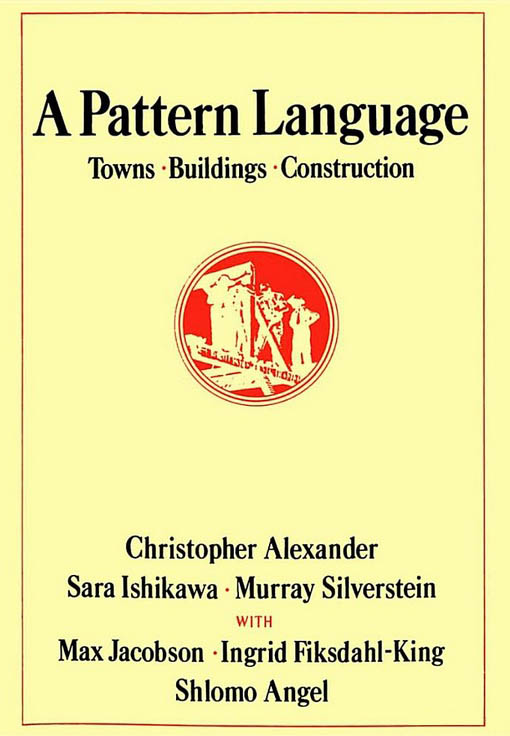 Christopher Alexander was an architect, but he might more appropriately have been called a philosopher of the built environment. He spent his career trying to describe and name the qualities that make a place -- a city, a neighborhood, a public square, a home, a room -- feel alive or dead.
Alexander influenced urban planning, but he thought central planning was useless, counterproductive. He believed in generative patterns that, if followed by individuals at a small scale, will produce living places at a large scale. He believed that these patterns flow out of the nature of order. Ultimately, that nature of order flows from God.
Beginning in the 1970s, Christopher Alexander and his colleagues the Center for Environmental Structure at the University of California at Berkeley identified patterns of design at every scale from regions to cities to neighborhoods to homes that they believed to be universal in generating lively places.
Eight books were published by the Center for Environmental Structure over a 20 year period from 1975 to 1995. Book 1, The Timeless Way of Building, explains the theory and application of patterns and how it relates to human nature. Book 2, A Pattern Language, identifies 253 specific patterns -- e.g., Promenade, Arcade, Small Public Square, Four-Story Limit, City-Country Fingers, 9% Parking -- shows examples, and discusses their interrelationships. The book was converted to hypertext, allowing easy navigation from one pattern to related patterns, and is available in that form to members of the PatternLanguage.com website. The website has a great deal of free content discussing Christopher Alexander's work, including a list and summary of the 253 patterns.
I wrote about Alexander's pattern language and the timeless way of design in a 2008 Urban Tulsa Weekly column:
Every building, neighborhood, town, and city is constructed from a collection of patterns. Alexander observed that some patterns are living and some are dead. The ones that are living are those that connect in some way with human nature--they attract people, making them feel at home and alive.Dead patterns repel people, making them feel ill at ease and restless. A place shaped by dead patterns becomes neglected and uncared for and attracts trash, decay, and crime.
Most of the remaining books in that CES series get into specific examples of the application of this approach. I have not yet read A New Theory of Urban Design, but it looks interesting. All of these volumes are available for free hourly checkout on the Internet Archive, by following the link on each title.
- The Timeless Way of Building
- A Pattern Language: Towns, Buildings, Construction
- The Oregon Experiment: Applying a new planning paradigm for the University of Oregon campus.
- The Linz Cafe: The design of a single building in Linz, Austria.
- The Production of Houses: Building of a group of houses built in northern Mexico, seven principles which apply to any system of production.
- A New Theory of Urban Design
- A Foreshadowing of 21st Century Art: The Colour and Geometry of Very Early Turkish Carpets
- The Mary Rose Museum: A museum in Portsmouth, England, devoted to Henry VIII's ship
From the publisher's blurb for A Pattern Language:
At the core of these books is the idea that people should design for themselves their own houses, streets, and communities. This idea may be radical (it implies a radical transformation of the architectural profession) but it comes simply from the observation that most of the wonderful places of the world were not made by architects but by the people.At the core of the books, too, is the point that in designing their environments people always rely on certain "languages," which, like the languages we speak, allow them to articulate and communicate an infinite variety of designs within a formal system which gives them coherence. This book provides a language of this kind. It will enable a person to make a design for almost any kind of building, or any part of the built environment.
"Patterns," the units of this language, are answers to design problems (How high should a window sill be? How many stories should a building have? How much space in a neighborhood should be devoted to grass and trees?). More than 250 of the patterns in this pattern language are given: each consists of a problem statement, a discussion of the problem with an illustration, and a solution. As the authors say in their introduction, many of the patterns are archetypal, so deeply rooted in the nature of things that it seemly likely that they will be a part of human nature, and human action, as much in five hundred years as they are today.
In The Timeless Way of Building, in chapter 2, "The Quality without a Name", Alexander describes the challenges of making a place come alive. It applies to people as well as blackbirds. It makes me think of the plazas that urban planners designed in the 1960s and 1970s, with artist's renderings that showed the plazas thronged with people; the reality is that the plazas were unpleasant and uncomfortable and became hangouts only for those who had nowhere else to be.
Suppose that I am trying to make a table for the blackbirds in my garden. In winter, when the snow is on the ground, and the blackbirds are short of food, I will put food out for them on the table. So I build the table; and dream about the clusters of blackbirds which will come flocking to the table in the snow.But it is not so easy to build a table that will really work. The birds follow their own laws; and if I don't understand them, they just won't come. If I put the table too low, the birds won't fly down to it, because they don't like to swoop too close to the ground. If it is too high in the air, or too exposed, the wind won't let them settle on it. If it is near a laundry line, blowing in the wind, they will be frightened by the moving line. Most of the places where I put the table actually don't work.
I slowly learn that blackbirds have a million subtle forces guiding them in their behavior. If I don't understand these forces, there is simply nothing I can do to make the table come to life. So long as the placing of the table is inexact, my image of the blackbirds flocked around the table eating, is just wishful thinking. To make the table live, I must take these forces seriously, and place the table in a position which is perfectly exact.
In the 1990s, his ideas about patterns captured the imagination of computer scientists. I first saw his books for sale (to my surprise) at the 1996 OOPSLA (Object-Oriented Programming, Systems, Languages & Applications) conference in San Jose, where he was the keynote speaker. You can watch his talk here and read it here. His work inspired popular software engineering textbooks like Design Patterns: Elements of Reusable Object-Oriented Software and AntiPatterns: Refactoring Software, Architectures, and Projects in Crisis.
Tulsa is the focus of another recent article from a UK newspaper website: A story in the Guardian Online about the impact of expressway construction on Tulsa's Greenwood neighborhood, and the possibility of reviving the neighborhood by removing the north leg of the Inner Dispersal Loop.
Twenty-five years before Don Shaw was born in Greenwood, a white mob invaded the Tulsa neighborhood and killed more than 300 people. Much of the tight-knit community was burned to the ground, including his grandfather's pharmacy.But when Shaw was growing up in the 1950s and 60s, few people wanted to talk about the massacre - perhaps in part because much of the damage was no longer visible.
He remembers walking the streets of Greenwood in his youth and seeing Black-owned businesses up and down its blocks: a hotel, dry cleaner, soul food restaurants, churches, a ballroom, dentists, pharmacies, hardware store, photo studio, the 750-seat Dreamland Theatre. It was an oasis of Black economic self-sufficiency, inside an Oklahoma city flush with oil industry wealth where the Klu [sic] Klux Klan once publicly operated.
"There was a lot of parties," recalled 76-year-old Shaw, who has lived in Greenwood his whole life. "Dances and stuff like that, concerts, lots of stuff going on."...
By December 1921, more than half of the homes that were destroyed had been rebuilt, despite city leaders rewriting zoning and fire codes to prevent the Black neighborhood from surviving. (Some Greenwood locals worked on their homes at night to avoid policemen.) When I-244 came decades later, resistance to the highway was undermined by a lack of Black representation in city government.
The Guardian story was apparently inspired in part by a graphic depiction of the effects of I-244 on the neighborhoods north, northeast, and northwest of downtown Tulsa, produced by New York City architect Adam Paul Susaneck for his @Segregation_by_Design Twitter account. Susaneck got in touch with me back in early June, looking for aerial photos and other information that would help him with a then-and-now visualization of the sort that he has done for many other cities, part of a long-term project (segregationbydesign.com) to depict vividly the destruction wrought by Federal highway and urban renewal funding.
Using historic aerial photography, this ongoing project aims to document the destruction of communities of color due to red-lining, "urban renewal," and freeway construction. Through a series of stark aerial before-and-after comparisons, figure-ground diagrams, and demographic data, this project will reveal the extent to which the American city was methodically hollowed out based on race. The project will cover the roughly 180 municipalities which received federal funding from the 1956 Federal Highway Act, which created the interstate highway system.Since the creation of the Interstate, freeway planning has been an integral tool in the systematic, government-led segregation of American cities. Used not only as a direct means to destroy the communities in their paths, freeways have also been used to cement racial segregation and ensure its endurance. Working synergistically with the legacy of redlining, freeway planning became the ultimate enforcement mechanism: literal walls of concrete and smog that separated black communities from white. In the name of the thinly veiled racist policies of "urban renewal," the freeways took the red lines off the map and built them in the physical world.
Here is the minute-and-a-half video on Tulsa, Greenwood, and I-244:
Greenwood, Tulsa--the famous "Black Wall Street"--before and after highway construction and "urban renewal."
— Segregation_by_Design (@SegByDesign) July 19, 2023
"Decades after the Tulsa Race Massacre [in 1921], urban 'renewal' [in the 1960s] sparked Black Wall Street's second destruction," writes @SmithsonianMag. pic.twitter.com/Qz099Ww1nt
After a street scene from circa 1949, looking north on Greenwood from just north of Vernon AME Church, the video shows the same location today, with homes and shops replaced by today's empty OSU-Tulsa parking lots. The view shifts to a 1951 aerial, zooming in to Admiral Blvd and 1st Street, just west of Utica Ave. The view pans west, as a modern aerial photo replaces the 1951 aerial, showing not only the destruction in the immediate path of the expressway, but the erosion of neighborhoods bordering the expressway, with homes and churches and schools replaced by parking lots and industrial buildings.
At about 27 seconds in, we see an outline showing the boundary of the Greenwood District, and we see I-244 take out two-thirds of what had been a densely-developed business block between Greenwood, Hartford, Archer, and Cameron, and then another business block between Brady, Cameron, Greenwood, and Frankfort. Continuing west, the highway took out more homes and businesses in Greenwood and in the adjacent neighborhood west of Detroit Ave that I've called the Near Northside. A wider swath was cut to build the Cincinnati-Detroit interchange with I-244, and Cincinnati, which had stopped north of Standpipe Hill, now cut through it.
At 41 seconds, I-244 crosses Main Street, sparing Cain's Ballroom. A few seconds later, the massive northwest IDL interchange, connecting the Tisdale Expressway, the Keystone Expressway, and the west leg of the IDL (I-244) wipes out a working-class white neighborhood and cuts downtown off from Owen Park and Crosbie Heights. Edison Junior High gets cleared for the Keystone Expressway at 54 seconds, and then more destruction along the southern edge of the Owen Park neighborhood. When the expressway reaches Yukon Ave, the view zooms out to show a modern aerial view, with the expressways that ring downtown highlighted in yellow, and then the same view from 1951.
The devastation caused by the expressway was significant, particularly to the area known as Deep Greenwood, the commercial district centered on Archer and Greenwood. A May 4, 1967, Tulsa Tribune story, republished here on BatesLine, An Old Tulsa Street Is Slowly Dying, had a photo of the demolition of the Dreamland Theater (at the time, an Elks Lodge) and comments from merchants who were being displaced by the expressway.
The Guardian article discusses the $1.6 million FY22 Reconnecting Communities grant received by the North Peoria Church of Christ, for "I-244 Partial Removal Study." They hope to place the reclaimed land in a trust, to reconnect the street grid, and to avoid gentrification.
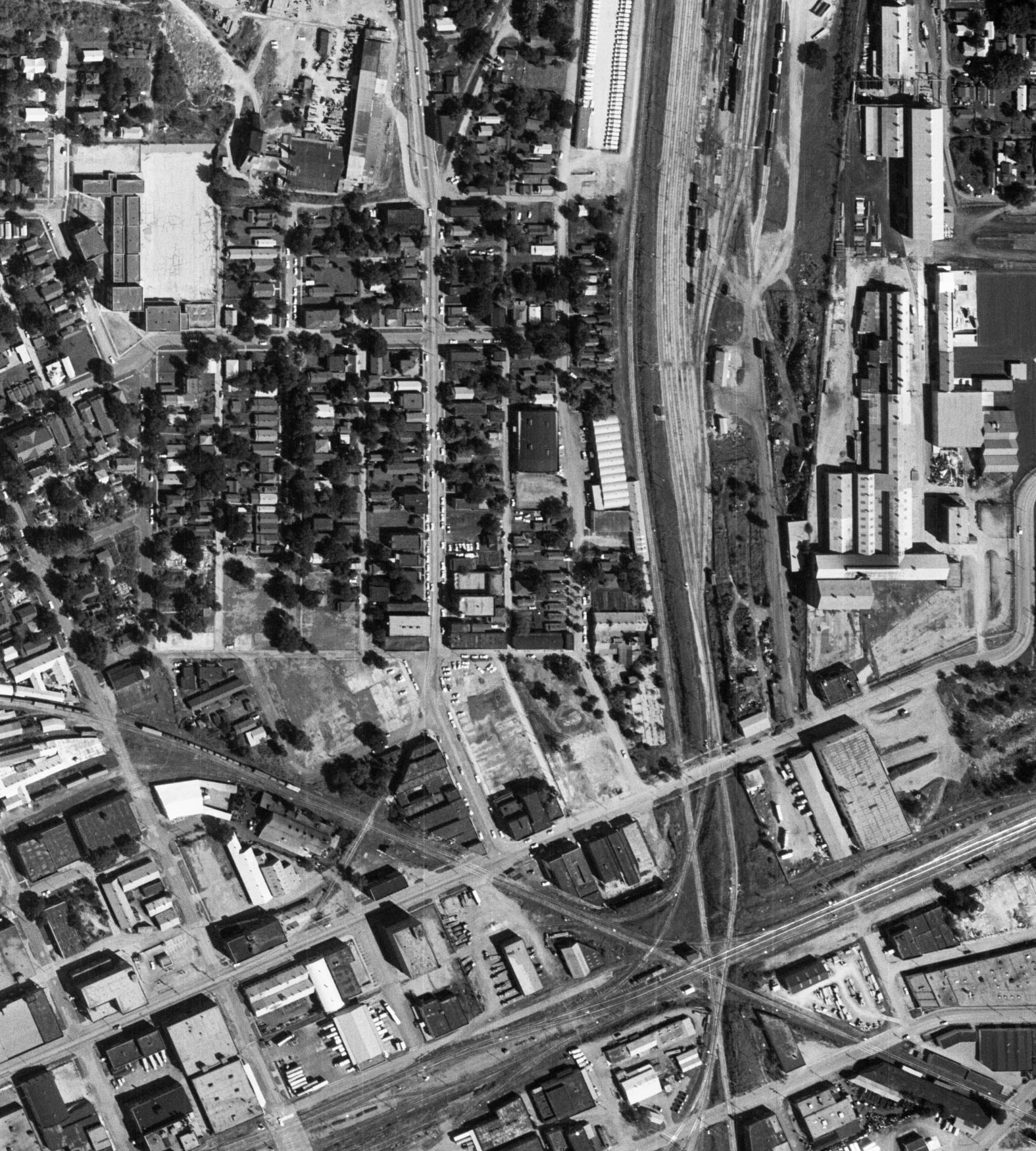
But the Grauniad story and the I-244 removal effort misses an important factor in the second demise of Greenwood. The damage done by the expressway was compounded by the "Model Cities" program, the new, Federally funded and allegedly humane approach to urban renewal. It, too, was adopted in 1967, the same year that the path of the expressway was cleared through the neighborhood. The aerial photo from September 10, 1967, suggests that had the expressway been the only insult suffered by the Greenwood District, it might have survived, but Model Cities cleared out everything except the churches and the little remnant of the commercial district south of I-244. Even the original Booker T. Washington High School building, which had survived the 1921 massacre (the L-shaped complex in the upper left of the photo below) was demolished in 1983 in the name of "renewal."
A friend posted an item on Facebook celebrating 14 years of Oklahoma City being a "big league city," praising those who voted to tax the Oklahoma City citizens on the necessities of life for the benefit of billionaire team owners and their millionaire employees.
It was so nice of the voters to help out so that the millionaires and billionaires didn't have to cut into their profit margin to have a place for their entertainment business.
The friend who posted this is a conservative and someone I agree with on 90%+ of issues. He likened the subsidy for Oklahoma City's basketball arena ("infrastructure investments") to tax cuts as having positive, trickle-down economic impact.
Emotions seem to overwhelm logic, data, and common sense when it comes to professional sports subsidies. I believe in limited government that does what government only can do. Tax cuts let people keep the money they've earned and use it for their own priorities. Subsidized sports facilities take money away from people (using a regressive sales tax) to funnel it into a small number of already stuffed pockets in the name of civic pride. It's the sort of subsidy conservatives condemn were it going to any other industry.
The original big-league cities became big-league by having a sufficiently large and prosperous population to provide a market for team owners to hire the most talented players and coaches and to build great places to watch an entertaining spectacle. Ballgames were just another entertainment option alongside amusement parks, dances, concerts, plays, and movies, and the promoters in all of those entertainment fields were responsible for the cost of building and operating their facilities.
Private businessmen built magnificent stadia and arenas for their sports entertainment businesses -- Fenway Park, old Yankee Stadium, Ebbets Field, the Forum in Inglewood, Wrigley Field, Tiger Stadium, to name just a few -- until cities showed a willingness to throw money at them for the ego boost of having a team. That launched an taxpayer-funded, ever-escalating spiral where teams play off sucker cities against each other, threatening to move as a way of extorting more taxpayer subsidies rather than reinvesting their own profits into their entertainment businesses.
Sports-team owners and the consultants they hire argue that the taxpayer funds invested in sports venues produce a return on investment by economic development and resulting growth in tax revenues. But economic analyses have shown again and again that taxpayers never recoup their "investment." The teams don't generate enough new economic activity to generate additional tax revenue to match the tax dollars that were spent to build, renovated, and operate the venue. If cities want to increase the amount of money available to pave streets and fight crime, they'd do better to put their tax dollars directly to those purposes rather than spend it on sports venues.
The Field of Schemes website maintains a chronicle of the intercity arms race over stadium subsidies and regularly highlights retrospective studies of actual economic impact vs. forecasts. Neil deMause, the site's publisher and author of a book by the same title, recently called attention to a study of the economic impact of the new Atlanta Braves stadium in Cobb County, Georgia.
J.C. Bradbury, the Kennesaw State University sports economist who was appointed to the Cobb County Development Authority in 2019, has written several studies of the Atlanta Braves stadium that have been noted here, including one on how commercial property values around the stadium went down relative to nearby areas, one on how sales-tax receipts for Cobb County went up less after the stadium opened than did sales-tax receipts in neighboring counties, and one on how property values overall in Cobb County did not rise relative to neighboring counties following the stadium's opening. Now, for the fifth anniversary of the stadium's opening, Bradbury has done a comprehensive study of the development history of the Braves stadium and its costs and benefits, and let's cut to the big takeaway:The fiscal benefits of Cobb funding Truist Park fall well short of its cost to taxpayers, who are left to fund an annual revenue shortfall of nearly $15 million, which translates to approximately $50 per Cobb household per year.
I didn't copy the many links that are embedded in that text -- click through to the article and you'll find links to data backing up each of those statements. Here's a direct link to the latest study by Kennesaw State.
Another recent article shows that the absence of Major League Baseball spring training doesn't seem to harm spring training cities in Arizona and Florida. Spring training in 1995, affected by the ongoing 1994 baseball strike, saw dramatic declines in attendance but no corresponding effect on sales tax and hotel tax revenues. It seems that plenty of people want to go to Arizona and Florida in late February and March, baseball or no baseball -- something to do with the weather.
Oklahoma Sen. James Lankford has twice filed a bill, co-sponsored by Democrat New Jersey Sen. Cory Booker, in 2017 and 2019, to close the loophole that provides a federal tax break for government bonds that finance sports venues, and another bill on the same subject (but with different sponsors) was filed last month. DeMause notes that closing the bonds loophole would have an impact, but it still wouldn't end the sports subsidy arms race. The best way to kill that, he says, is to make all subsidies benefiting private corporations taxable income, an idea that was proposed in Congress in 1999:
SUMMARY: Distorting Subsidies Limitation Act of 1999 - Amends the Internal Revenue Code to impose an excise tax on any person engaged in a trade or business who derives any benefit from any targeted subsidy provided by a State or local government. Defines such a subsidy as one which is designed to encourage a business to locate or remain in a particular jurisdiction. Denies a tax exemption for any interest earned on bonds which provide such subsidies. Prohibits the use of Federal funds to provide such a subsidy.
This goes well beyond sports, and it would benefit all cities and states if they no longer felt compelled to provide direct subsidies -- rather than good infrastructure, public safety, competent and efficient government, and low taxes -- to lure businesses to relocate.
It also seems strange for conservatives to celebrate subsidizing a team in the NBA -- a league that couldn't back away fast enough from a mild criticism by a team general manager of the Chinese Communist Party's repression of Hong Kong. The NBA's online store wouldn't allow fans to order custom gear with the phrase Free Hong Kong on it, classifying it as a "hateful message." Megan Kelly's interview with NBA owner Marc Cuban laid bare the league's callous and unprincipled pursuit of CCP cash. ESPN exposed abuse occurring in the NBA's Chinese training camps. The NBA also uses its cultural clout to promote sexual confusion and perversion and other destructive leftist causes. Why would any Oklahoma conservative want to put more money in the NBA's pockets?
I guess OKC got an ego boost out of having a team in one major league sport, but the rest of the world looks at the Thunder as an odd case of a major league team ending up in a minor league city, sort of like the Green Bay Packers.
 A young friend of mine was incensed at the attitude of older folks about the incident on the North Detroit overpass of Interstate 244. "The point of a protest is this: How does it feel to be powerless?" So it was fine, in the eyes of this homeschooled, Christian young adult, for people to wander off of the planned demonstration route (on Detroit under the I-244 overpass), block traffic on a busy, elevated motorway, box in a driver towing a horse trailer, so that they could make the drivers feel powerless, too. And this is supposed to advance constructive change?
But people aren't powerless. Next week -- Monday, Tuesday, and Wednesday, June 8-10, 2020 -- is the filing period for City of Tulsa offices. Every office is on the ballot: Mayor, Auditor, and all nine City Councilors. If you don't like the way the police department is run, if you think laws are unjust or unjustly enforced, run for office. Pour your energy into finding candidates, organizing, and knocking on doors. This year, more than ever, leading up to the 100th anniversary of the Tulsa Race Massacre, the message that motivated the peaceful protest late Sunday afternoon in Greenwood is going to be enthusiastically amplified by local broadcast and print media. (Here's the City of Tulsa 2020 election packet.)
Nicole Gelinas, a New York-based columnist and analyst on urban issues, tweeted to a 20-year-old who lamented that she couldn't attend the protests because she cares for an elderly grandparent:
Most responsible thing to do is stay home, plan long-term strategy for constructive, deliberate change. Throwing bodies on street to pandemic solves nothing, endangers people, actually creates huge anti-progressive backlash. (permalink)When politicians see massive street protests, all they see is people who can't organize themselves into targeted, deliberate coalitions for *specific* action items. Rich white pols at home, vulnerable minorities on street risking COVID-19 death ... to maintain power structure. (permalink)
The other part of this is that massive, well-meaning, but naive and COVID-deadly street protests provide cover for well-organized anarchists with a *real* agenda. (permalink)
After tuning in at 10 to watch the news (with my shiny new, roof-mounted aerial antenna -- we've recently cut the cord), I stayed up late Sunday night, watching coverage and tweeting about it, for as long as the local stations were on the air. Fox 23 (KOKI) and News on 6 (KOTV) did a good job of covering the confrontations in Brookside, on Peorial between 36th Street and I-44. Amazingly, 2 Works for You (KJRH) was AWOL, even though the protest parked itself right in front of the station's studios for a long time. KJRH was busy covering a candlelight vigil at Archer and Greenwood during their 10 o'clock news, then ran their scheduled paid programming from Joel Osteen. KOTV packed it in shortly after midnight, after KOTV caught video of vandals breaking into Cash America pawnshop and Round the House consignment mall in the Bellaire shopping center (just north of I-44 on the east side of Peoria), shortly after which the thugs bashed in KOTV reporter Emory Bryan's car windows. KOKI called it a night a few minutes later. If we ever have actual news after midnight in this town, will anyone from our TV and radio stations be listening to the scanner to cover it? Who's got the night watch?
The two big confrontations on Sunday were on I-244 at Detroit, during the Black Lives Matter Rally in the afternoon, and on Brookside Sunday night. The organizer of the rally, Tykebrean Natrail Cheshier, has said publicly that these two protests were not part of her rally.
Friday night, May 29, Cheshier posted a description of the rally:
Sunday May 31, 2020
5pm
( show up @ 4pm to help set up)
Canned food donations go to the Vernon AME Church ( please put them on the front steps) !!
Also they have food drives all the time as well ( support that)
Water stations will be set up ( will need donated waters )
Snacks stations will be set up ( will need donated snacks)
Poster board station as well! Bring your own and extras as well! ( markers are welcomed)
Trash cans will be set up as well!Speakers will start @ 5pm in the field by the church on Black Wall Street !
After the speakers we will March to the John Hope Franklin Park around 630 and that's where it will end!I still have room for a couple more speakers!
If your wanting for speak you have to be on the list! ( please message me )I will also need tables & chairs for the volunteers!!
This will be downtown on green wood!
Please park @ OSU Tulsa and walk to greenwood!!
SUPPORT BLACK OWNED BUSINESS!!
T shirts will be for sell from those businesses!
Please take time to look @ all of the plaques on the ground and walls as we walk around greenwood !!
THIS WILL BE THE 99 Year Anniversary of Black Wall Street being burnt down!
THIS IS A PEACEFUL RALLY AND IT WILL STAY THAT WAY!!
I hope this answers more questions!!!
At 5:24 am Monday, Cheshier posted a map of the intended route -- from the field next to Vernon AME Church, south on Greenwood, west on Archer, north on Detroit, east on Reconciliation Way (formerly Brady, north on Elgin to Reconciliation Park, stating:
Here was the route from yesterday but once I passed out in front a couple other "activist " Decided to leave me and take over. This route is what the cops wanted for us. No highway . I do apologize again. I didn't stay hydrated and got over heated ..
At 10:10 pm Sunday, Cheshier posted:
My rally was over around 7.. Whatever else happens tonight has nothing to do with my rally. Mine was peaceful up til I passed out and someone took over and went on the highway.... ( the people that were hit are ok( so I've heard)) other then that the rally was peaceful and I'm thankful .. I'm going to rest now.. thank y'all
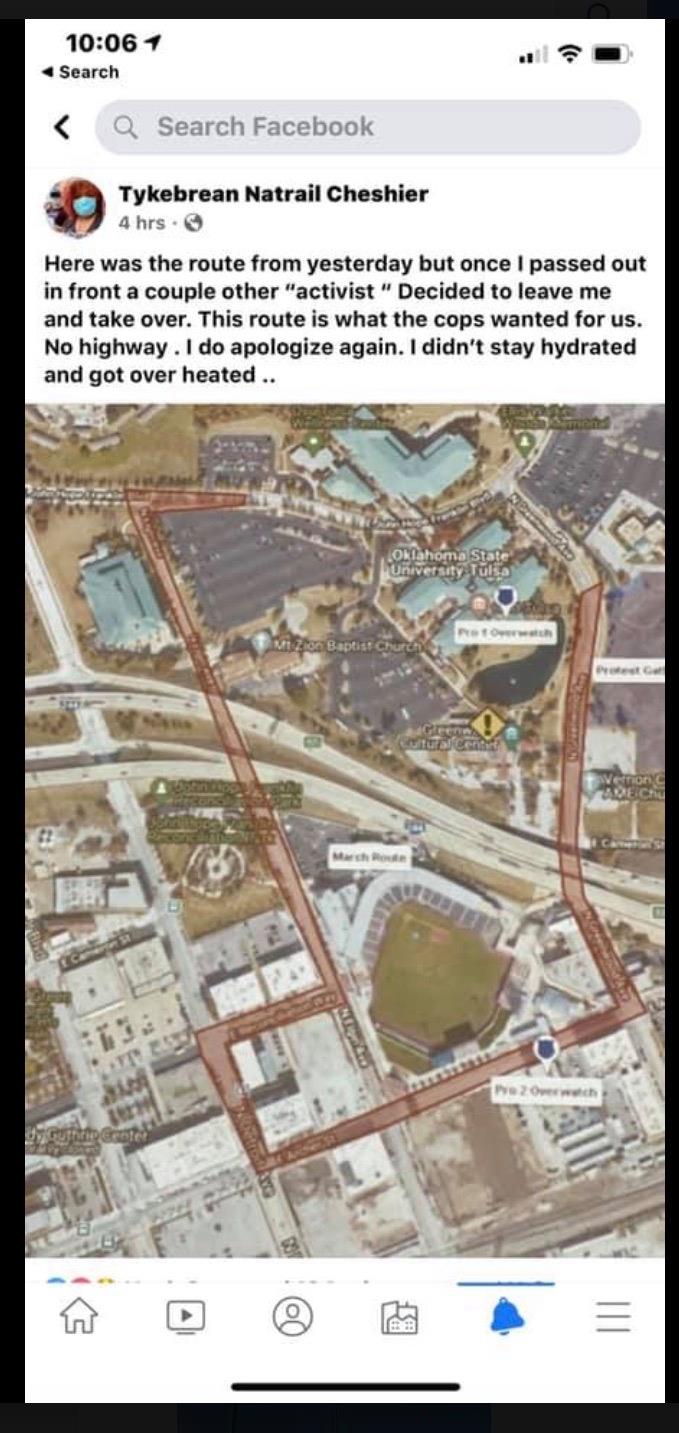
Going back through her Facebook feed and the event page for the rally, the rally seems like an earnest but hastily organized response to the killing of George Floyd by Minneapolis police officers, tying the protest into the 99th anniversary of the 1921 Tulsa Race Massacre, and it's clear that Cheshier and her fellow organizers had nothing to do with the foolhardy stroll on the interstate or the street blockade and vandalism on Peoria.
In Brookside on late Sunday night, Tulsa police officers with shields maintained a distance from the crowds and responded to objects thrown at them with pepper balls and, after things got completely out of hand, tear gas canisters. TPD officers handled themselves well, but were constrained by the presence of non-violent protesters and members of the general public from dealing with the violent characters present in the crowd.
As I write this early Tuesday morning, all of the Tulsa TV stations have ceased live coverage -- KTUL News 8 and Fox 23 were the only stations on the scene when I tuned in around 11:30 pm. The action was north of the intersection of 71st and Memorial, the heart of south Tulsa's retail corridor, some people were breaking store windows, some were standing in the middle of the street. The Oklahoma National Guard were present to back up the Tulsa Police Department. Again, pepper balls and tear gas were used to respond to violent provocation.
At Monday's news conference, Tulsa Mayor G. T. Bynum IV declined to issue a curfew or to take any other action that would make it easier for law enforcement to separate peaceful protesters from those intending to cause mayhem or do damage.
The situation would seem to fit Title 21, Chapter 55, Sections 1311 through 1321.10, of Oklahoma Statutes, which defines what a riot is, what constitutes participation in a riot, and the penalties that apply. The Governor can declare a state of emergency. The Governor can ban people from the streets, impose a curfew, ban the sale of fuel that might be used by rioters, ban other normally lawful activities. Municipalities are authorized "authorized to enact ordinances in general conformity with the provisions of this act," and if state and local laws differ, the stricter provision applies.
Title 8 of Tulsa Revised Ordinances authorizes the mayor to declare an emergency, order a general curfew, and close businesses that might fuel the rioters. Title 29, Section 105, declares (emphasis added):
It shall be the duty of the Chief of Police to preserve the public peace, to prevent the commission of crime, to arrest offenders, to protect the rights of persons and property, to provide police officers at fires to protect the firefighters and property, to suppress riots and insurrections and disperse unlawful and dangerous assemblies, to preserve order at all elections and all public meetings and assemblies, to prevent and regulate the movement of vehicles in the streets and to prevent the violation of all laws and ordinances.
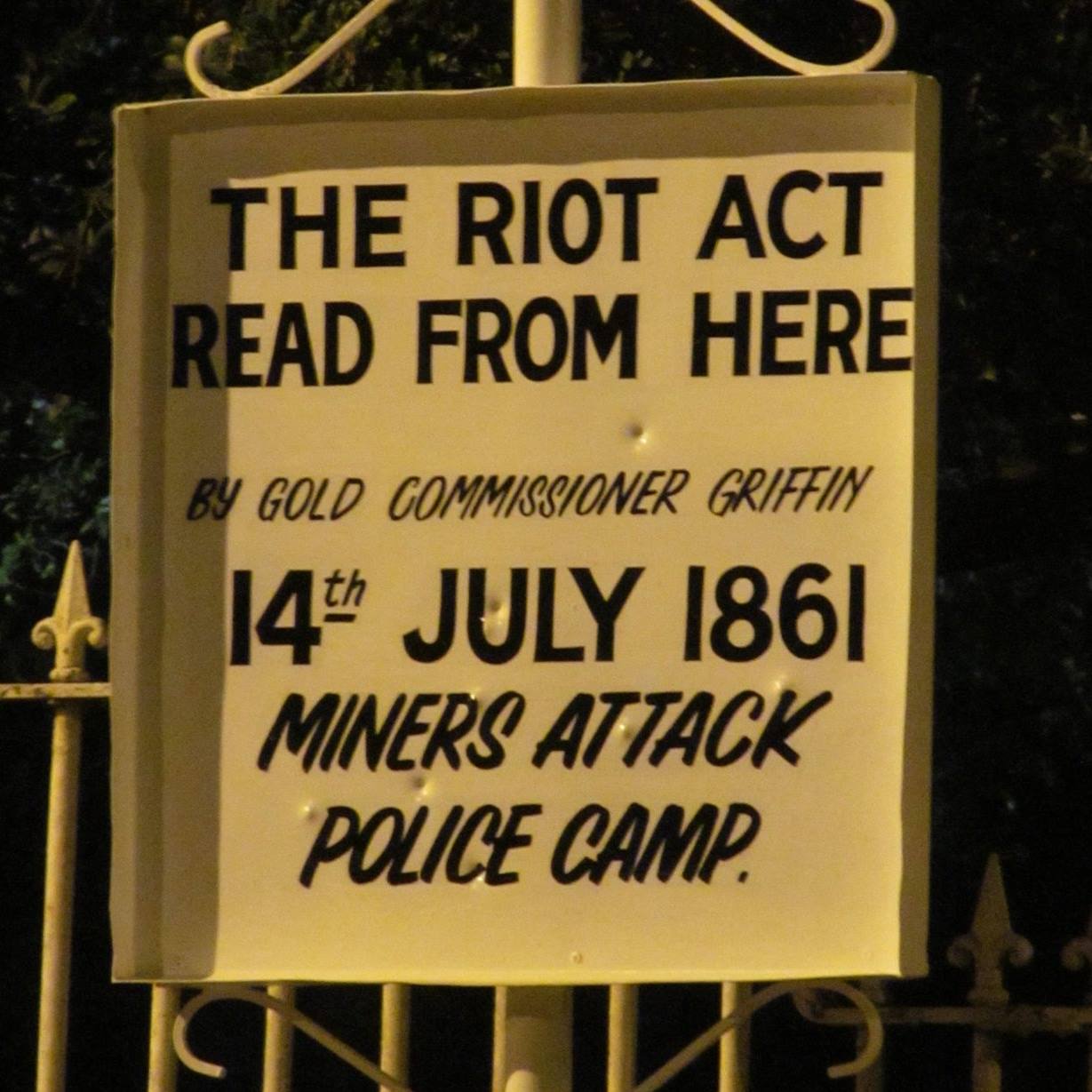
For years I had heard and used phrases like "she read him the riot act" without knowing the historical basis for the cliché. Then a few years ago I was driving through the town of Young, New South Wales, Australia, on my way from Wagga Wagga to Cowra, and the sign above caught my eye.
THE RIOT ACT
READ FROM HERE
BY GOLD COMMISSIONER GRIFFIN
14th JULY 1861
MINERS ATTACK POLICE CAMP.
Young was the site of the Lambing Flat riot. Australian gold miners, envious of the organization and success of immigrant Chinese miners, attacked the Chinese miners and drove them away, destroying their camps and looting their belongings. When the police arrived to restore order and to arrest the riot ringleaders, the rioters responded with an attack on the police camp. The Gold Commissioner read the proclamation prescribed in the 1714 Riot Act, which declared the mob to be an unlawful assembly, ordered everyone to disperse, and made anyone remaining guilty of a felony, and the authorities will not be liable if any of the rioters are injured as the authorities attempt to arrest or disperse them.
What follows is the short version; you can read the full 1714 Riot Act here.
If any persons to the number of 12 or more unlawfully, riotously, and tumultuously assemble together to the disturbance of the public peace and being required by any Justice by proclamation in the King's name in the exact form of the Riot Act, I George I, Sess. 2, c. 5 s. 2, to disperse themselves and peaceably depart, shall to the number of 12 or more unlawfully, riotously and tumultuously remain or continue together for an hour after such proclamation shall be guilty of a felony.Our sovereign lord the King chargeth and commandeth all persons, being assembled, immediately to disperse themselves, and peaceably to depart to their habitations, or to their lawful business, upon the pains contained in the act made in the first year of King George, for preventing tumults and riotous assemblies. God save the King.
It's past time that Gov. Stitt or Mayor Bynum IV read the local equivalent of the Riot Act, and put everyone on notice that every law-abiding Tulsan should be off the streets after a reasonable hour Tuesday night, and anyone gathering in traffic or in the company of those damaging local businesses will be presumed to be a rioter and dealt with accordingly.
MORE: This KJRH drone video provides context for the I-244 confrontation, showing the crowds diverting up the Detroit eastbound on-ramp and the concrete embankment and gathering on the eastbound lanes. You can see that cars are still arriving from the west, unaware of what is ahead. You can see the red pickup with large horse trailer, and in front of it, a silver car that the crowd allowed to pass through. A couple of police cruisers appear briefly on the edge of the frame, parked on the shoulder at the Elgin overpass, possibly as a vantage point for watching the march below.
MORE VIDEO:
Fox 23: Tulsa protest organizer Tykebrean Cheshier, speaks out against violent demonstrations. As on her Facebook posts, she disavowed and denounced those who went up onto I-244, and those who participated in unlawful street-blocking and vandalism over several nights.
Another video of the I-244 confrontation, provided to local news outlets, taken from the right side of the pickup, show an older man waving the truck ahead and urging his fellow demonstrators to clear the path. After the truck began moving, protestors moved into block his progress. I saw it first on Fox 23, but this looks like the same video, minus Clay Loney standing in front, so it's clearer to see that the truck's initial movement was into a cleared space, that the mob moved back in to obstruct the truck, and that the mob began beating on the truck before the truck began to move forward again.
It's a commonplace sentiment among fans of streetcars that a cabal of car and tire manufacturers bought out city streetcar systems one by one and shut them down, replacing the wonderful old PCC trolley cars with diesel-belching buses. In reality, there were many factors undermining the popularity and financial feasibility of streetcars: Municipal governments fixed the fares too low for franchisees to make a profit; jitneys competed with streetcars for passengers, offering faster and more comfortable service; the automobile became more affordable, fueling urban growth beyond the reach of the trolley systems. This last factor was the nail in the coffin: More and more people were driving automobiles, the streetcars were blocking traffic, and the tracks were damaging autos.
For example, in the May 26, 1922, edition of the Tulsa World, reader A. E. Stephens complains in a letter to the editor about the decrepit state of the roads leading into Tulsa. Stephens' bitterest complaint is reserved for North Peoria Avenue:
Entering from the north we have for the welcome of out-of-town visitors, the Avenue of Horrors, or our North Peoria street sinkhole, with the only spot where driving is possible, taken up by our antedeluvian relic, the Tulsa Street railway, with rails protruding 4 to 12 inches above the other part of the street. The Avenue of Horrors also takes visitors through the Plunge of Death, or the Peoria Street viaduct under the Frisco railway.
Maps show the TSR tracks extending along Peoria from King Street to 1st Street, where it joined the Kendall branch on the way into downtown. Stephens also complained about the Third Street viaduct over the Frisco tracks, the main route into Tulsa from Sand Springs, "which is a very narrow, roughly paved street and also infested with our old eyesore, the decrepit Tulsa Street railway."
Gil Propp grew up in Brookline, Mass., between the B and C line of the MBTA Green Line streetcar network. His curiosity about some oddities -- the lack of an A line, discrepancies between old and new maps about the E line -- led him to research the history and evolution of the MBTA's streetcar system. A few years ago he turned his research into a short film called "Streetcar Tracks: A Reconstruction of Boston's Lost Streetcar Empire." The film and its script are available for viewing on bostonstreetcars.com, and you can view "Streetcar Tracks" directly on YouTube.
Propp has also posted many detailed articles on the site about the individual lines in the Boston fixed-rail transit system and the slow consolidation of the network and elimination of streetcar lines to the system we see today. The article "Why Are There Still Streetcars in Boston?" offers a compelling explanation for the survival of a handful of lines -- and why so many others disappeared: "The answer is simple: they have private right-of-ways that lead to subways."
The extension of subway tunnels prior to World War II allowed three streetcar lines (B, C, and E) to avoid busy intersections like Kenmore Square. After surfacing, the three lines also had reserved right-of-ways down the middle of Commonwealth Ave., Beacon Street, and Huntington Ave., respectively. Only the E line did not have a reserved right-of-way for its full length, and at the end of 1985, service was cut back to the end of the reserved right-of-way at Heath St. The fourth currently operating branch, the D line to Riverside, is on a former steam railway line that was linked into the subway tunnels. While the A line to Watertown also connected to the subway tunnels, it was street-running all the way, impeding car traffic. In Cambridge, there had been street-running trolleys that fed into the subway via an incline at Harvard Square. These were replaced with trackless trolley buses that used the same overhead wires but could pull to the curb for loading passengers, while the underground tracks were converted from overhead trolley wires to third-rail operation.
One other Boston streetcar line has survived: The Mattapan High Speed line, which runs in a private right-of-way, not parallel to any street and thus not easily bustituted, and provides a connection to the Ashmont branch of the Red Line. This is the last line of the MBTA that runs the old PCC cars -- when I was in college they also ran on the C and E branches of the Green Line.
I have often wondered how Tulsa's streetcar system might have evolved had it and the city begun 20 years earlier. I suspect there would have been at least two cut-and-cover subways through downtown -- one along Main Street and another along 3rd Street, with other east-west streetcar lines being rerouted to take advantage. That might have kept the Oklahoma Union Traction interurban to Sapulpa (now the Tulsa Sapulpa Union Railway) and the Sand Springs Railway interurban, both of which had dedicated right-of-ways outside of downtown. Perhaps a dedicated right-of-way along 3rd or 11th Streets would have been built to maintain service to the east.
Strong Towns is once again using Black Friday to call attention to parking minimums, zoning laws that require a ridiculous amount of land to be set aside for off-street parking.
#BlackFridayParking is a nationwide event drawing attention to the harmful nature of minimum parking requirements.Parking minimums create a barrier for new local businesses and fill up our cities with empty parking spaces that don't add value to our places.
Each year on Black Friday, one of the biggest shopping days of the year, people all across North America will snap photos of the (hardly full) parking lots in their communities to demonstrate how unnecessary these massive lots are. Participants upload those photos to social media with the hashtag #blackfridayparking.
You can follow the #BlackFridayParking hashtag on Twitter, Facebook, and Instagram to see examples of empty parking spaces on the busiest retail shopping day of the year.
RELATED: Back in 2013, Tulsa won a national competition for worst "parking crater" -- the expanse of uninterrupted asphalt in the southern part of downtown. A brief effort to pass an ordinance that would require a review process prior to demolition of buildings in the IDL was killed by developers. I have updated a blog entry about that 2013 anti-demolition effort with details of the TMAPC and City Council meetings and links to agendas, comments, minutes, and meeting video.
NOTE: I will be on KFAQ 1170 with Pat Campbell at 8:05 am on Wednesday, October 8, 2019, to discuss this issue, which was mentioned by Minneapolis police union president Lt. Bob Kroll in his interview with Pat Campbell this morning, as well as the City of Tulsa's plan to scrape Paul Harvey's childhood neighborhood to build a stormwater detention pond.
In December 2018, the Minneapolis city council (consisting of 12 Democrats and a Green) adopted a comprehensive land-use plan that called for eliminating single-family residential zones and allowing triplex homes to be built on any residential lot. Stories about the change claimed that this measure was necessary not for the usual zoning reasons -- making more efficient use of public infrastructure, improving the quality of life, ensuring new development is orderly, protecting residents and business owners from sudden disruption of the character of their neighborhoods -- but in order to combat systemic racism.
Slate's Henry Grabar wrote in December 2018:
Single-family home zoning was devised as a legal way to keep black Americans and other minorities from moving into certain neighborhoods, and it still functions as an effective barrier today. Abolishing restrictive zoning, [Minneapolis Mayor Jacob Frey] said, was part of a general consensus that the city ought to begin to mend the damage wrought in pursuit of segregation.
The idea that Minneapolis, which has welcomed large numbers of Somali refugees in recent years, is systematically racist is ridiculous. Perhaps this was the only way urban planners could convince homeowners to embrace high-density urban development, after years of warnings about peak oil and climate change failed to persuade voters to approve the radical transformation they sought.
CityLab interviewed Minneapolis Mayor Jacob Frey in December 2018:
I believe strongly that housing is a right. I believe that everyone should have a safe place to go home to at the end of the night, to rest their heads on a pillow and rejuvenate for the next day. Clearly that right is not afforded to everyone.Moreover, I believe that affordable housing should be in every neighborhood. There's a right to live in a great city. We should have a beautiful diversity of people, of socioeconomic background, in every neighborhood.
Last week in Architectural Record, architect James S. Russell summarized the plan adopted by Minneapolis and its progress toward implementation:
The Minneapolis 2040 plan intends to enhance housing supply by allowing denser development in much of the city. It will permit duplexes, triplexes, and small backyard houses (accessory dwelling units, or ADUs) in once exclusively single-family zones, and it promotes large residential buildings and towers near the downtown core, as well as a variety of smaller-scaled apartment buildings along arterials and transit routes.Though the city council approved the plan last December, it can go into effect as soon as this November, having received an OK from the regional Metro Planning Council in late September with a final city council vote scheduled for this month.
Russell notes that good design can mitigate higher density, but MInneapolis's change doesn't account for design.
In fact, Minneapolis already has "neighborhoods that mix single-family, duplexes, triplexes, and small apartments," points out David Graham, a founding principal of ESG Architecture and Design, "and they work." The key to reducing resistance to greater density in single-family areas, he adds, "is design that's sensitive to neighborhood fabric, context, and materiality." Yet while the plan limits the number of units in such neighborhoods, it does not include design guidelines.
Russell doesn't expect the change to accomplish what proponents desire.
While developers are already eyeing single-family houses to convert to duplexes and triplexes, many experts believe there is little evidence that adding market-rate units will have a trickle-down effect in thriving cities. After upzoning led to the construction of tens of thousands of new units, at market-rate and higher, in New York and Seattle, for example, there has been some price softening for luxury housing, but low-rent units continue to vanish.
Neighborhood planner Rick Harrison says Minneapolis land is too valuable to be feasible for low-rise multi-family development:
Minneapolis' problem is not that there are too many single family homes - it's that the real estate prices are too high to justify low density redevelopment. Allow me to explain. If a developer wanted to re-develop a 10 acre area in Detroit, they would pay almost nothing for the land. Not so in Minneapolis. Because there is no such blight, even the land under the worst existing homes would cost at least $100,000 to buyout each existing home - possibly more. Assuming that the 10 acres in Detroit or Minneapolis would be in a tight 'urban grid' layout, about 40% of that 10 acres would be in the form of street and right-of-ways as well as easements. Assuming that in both cases, the right-of-ways and easements could be abandoned - much of that area could in theory be recaptured to create a more cohesive 'neighborhood'. e can also assume the city grid would be at a density about 5 homes to the acre. So, 10 acres X 5 = 50 homes x $100,000 = 5 million dollars for the Minneapolis site vs. $5 for the blighted Detroit land....In Minneapolis the $5 million land cost is increased by demolition of the existing structures, all passed onto the next buyers or renters. So, at 5 homes per acre, that acre of land at best will be somewhere north of ½ million dollars per acre. Put another way, to maintain single family validity, if you are buying a $100,000 home (that would be in the worst neighborhoods), and 1/4th of a new home is typically a finished lot, at minimum you would need to replace that home with a $400,000 home. That would make no sense - not in downtrodden areas at least. These Minneapolis lots are small to begin with, so replacing single family with duplex won't make much of a dent financially. Building code in Minneapolis won't allow attached housing of the past where a thin common wall separated the adjacent unit. Today, the builder must construct what is essentially two exterior walls with airspace between adjacent units for duplex and townhomes, so why not separate the units and build somewhat high density single family instead? The only way to economically justify redevelopment in an area of high raw land cost would be high density vertical growth.
Back in January, urban analyst Joel Kotkin noted that just as Democrats are beginning to win the suburban vote, they're out to destroy suburbia:
The assault on single-family homes grows, at least in part, out of the identity politics that now dominate progressive politics. From Roosevelt through Clinton, progressives had pushed programs and incentives that made it possible for more working- and middle-class people to purchase a home. "A nation of homeowners," President Franklin D. Roosevelt believed, "of people who own a real share in their land, is unconquerable." Homeownership, he saw, was critical, not only to the economy but to democracy and the very idea of self-government.This focus began to shift under President Obama, whose HUD Secretary, Julian Castro, sought to socially reengineer suburbs deemed insufficiently diverse--even without any proof of discrimination. In California, San Francisco State Sen. Scott Wiener, backed by the tech oligarchs and operating on the notion that more high-rise projects would dramatically reduce car usership and lower real-estate prices, has sought to strip zoning authority from local jurisdictions that protect their existing single-family houses.
A few quick notes about Tulsa's situation. I don't have time to footnote everything.
As of the 2010 census, there wasn't a single "lily-white" census block group in the City of Tulsa; every block group had some African-American residents. A census block group is a subdivision of a census tract, typically containing about a thousand people. In central Tulsa, there are typically three or four census block groups in each square mile. That said, the square mile that includes Utica Square, Woodward Park, and Cascia Hall only had two black residents in 2010.
The highest concentration of African Americans in Tulsa is found in single-family neighborhoods in north Tulsa. The highest concentration of Hispanic residents is found in single-family neighborhoods in east Tulsa.
Tulsa has a few neighborhoods that developed with a mixture of uses and housing types. For example, Swan Lake neighborhood has small bungalows, big mansions, and numerous three- or four-story walk-up apartment buildings, all coexisting nicely with pedestrian-friendly commercial development along its northern and eastern edges.
Tulsa also has experience with upzoning an established single-family neighborhood. In the 1960s, city leaders thought it would be a good idea to upzone the area west of the TU campus to provide for more student housing. Perhaps they imagined that developers would put up handsome brick apartment buildings of the sort that were built in the 1920s. Instead, opportunists tore down craftsman bungalows and built ugly, single-story, four-plex apartment buildings that fit in a single house lot. A few ugly '60s apartment complexes were built. As these apartments deteriorated, they weren't deemed worthy of renovation, and they gave the city an excuse to condemn the neighborhood as blighted and use eminent domain to acquire much of the neighborhood and flip the land to TU. Upzoning to multi-family, commercial high-intensity, and industrial damaged residential neighborhoods south and east of downtown.
INTERACTIVE MAP RESOURCES:
- Tulsa zoning map (INCOG)
- Justice Map: Interactive map that plots 2010 population by race and income for census blocks, block groups, tracts, and counties.
- The Racial Dot Map displays each individual in the 2010 census as a dot on the map, color-coded by race, a different way to visualize distribution of population.
- US Census Bureau TIGERweb interactive map shows boundaries of 2010 census divisions, but does not display demographic information.
Lecture 24 from Doug Allen's History of Urban Form course describes Savannah's unique plan of wards, squares, blocks, and lots, originally developed for a small British outpost not far from Spanish territory, but replicated to enlarge the historic city. Allen shows how the dimensions and arrangement of streets and lots has facilitated adaptation and reuse in ways that the Gen. Oglethorpe could not have foreseen.

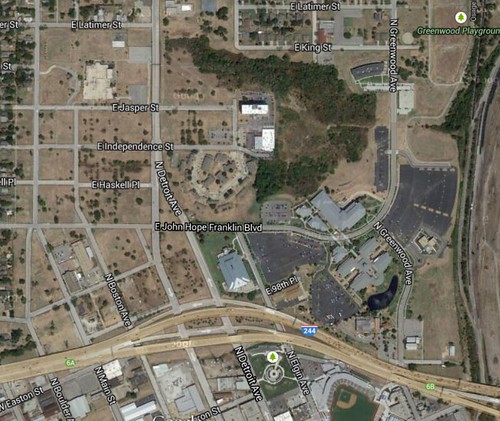
Tulsa's Near Northside neighborhood, whose rise and demise I documented in a 2014 story for This Land Press ("Steps to Nowhere"), is part of an area that will be the subject of the Unity Heritage Neighborhoods Design Workshop, next week, September 11-15, 2017, led by urban design students from Notre Dame:
The University of Notre Dame Graduate Urban Design Studio will be traveling to Tulsa to work with our community to provide positive visions for future development. The studio will be conducting a 3-month design study focused on the Unity Heritage Neighborhoods located immediately north of downtown. The study broadly encompasses areas such as the Brady Heights Historic District, Emerson Elementary, Greenwood, and the Evans-Fintube site. To kick-off this effort, the studio will be conducting a week-long design workshop from September 11th - 15th to meet with the local community, to hear our thoughts for the area, and to begin envisioning the possibilities with us through a series of visual urban and architectural designs. Come on out and imagine the future together!
The workshop includes three events for public input and feedback. All are free and open to the public, but RSVPs would be appreciated. The links below will take you to the registration page for each event.
Workshop Introduction & Initial Community Input: Monday, September 11th, 2017, 6-8pm, at 36 Degrees North, 36 E. Cameron St. (That's just east of Main on Cameron in the Brady Bob Wills Arts District.)
Meet the team. Hear about the components necessary for making vibrant, walkable, mixed-use, diverse, and inclusive cities, towns, and neighborhoods. Share your vision and desires for the area.
Mid-Week Design Presentation & Initial Feedback: Wednesday, September 13th, 2017, 6-8pm, at the Greenwood Cultural Center:
Check out the in-process urban and architectural designs and provide feedback for the students to work on to further shape the vision.
End-of-Workshop Design Presentation & Feedback: Friday, September 15th, 6-8pm, at Central Library:
See the final designs from the week and provide your thoughts and feedback for the students to continue to work on during the remainder of their study. The studio will return to Tulsa in December to present their final designs and findings for the community to use as an ongoing resource.
MORE: Here's my Flickr set of images of Tulsa's lost Near Northside.
Tulsan Sarah Kobos has another insightful essay up at the Strong Towns website, illustrated with her own photos of lousy urban design right here in our hometown. While she's willing to forgive the urban design errors of the post-World War II decades, she politely asks cities to stop making them already:
Fine. We'll add the suburban development pattern to the long list of humanity's mistakes that occurred during the latter half of the 20th century. Like feathered bangs, the Ford Pinto, or any tattoo you got before the age of 35, sometimes we err, not because of malice, but from an understandable combination of ignorance and exuberance.The thing that really drives me crazy is the present. Now, we know better. We recognize the economic, human health, and environmental benefits of traditional building patterns. And yet, there is so much inertia built into the system, we just keep building car-centric crap like it was 1985.
While there are walkable sections of the city that benefitted from neglect when we were busy tearing down downtown and building suburban neighborhoods, they are now endangered by their own success:
In older parts of the city, walkable neighborhoods are being rediscovered and revitalized because they're interesting, human-scaled, and pleasant. People are drawn to them because they have character, and because it's nice to be able to walk to dinner or bike to meet friends for coffee. Understandably, the moment a particular neighborhood becomes popular--thanks to its historic buildings and traditional building pattern--it will attract new development. But if you're not prepared with zoning laws to enhance and support walkability, you'll get what everyone knows how to build, which is crap for cars.
If you've wondered why urban advocates are so concerned about demolition and redevelopment in downtown and midtown neighborhoods, Sarah offers a clear and simple explanation: It's easier to preserve walkability in neighborhoods that were optimized for people getting around on foot -- with smaller blocks and buildings oriented to the sidewalk -- than to try to create it in neighborhoods that were optimized for getting around in a car. Because of Tulsa's relatively young age, we never had that many walkable neighborhoods to begin with, and too many of those we had have fallen victim to urban renewal, expressway construction, and inappropriate infill development approved by our city officials.
That's why many of us have long believed we should follow in the footsteps of nearly all of our peer regional cities and institute special design-focused land-use rules in our walkable, historic commercial districts. Oklahoma City, Wichita, Little Rock, Dallas, Fort Worth, Kansas City all have design rules customized to protect walkable neighborhoods. Tulsa doesn't, in part because of the idea that chain stores and restaurants will insist on building their standard design everywhere. But anyone who has traveled around the country or around the world has seen examples of standard chains -- McDonald's, 7-Eleven, Walgreens, to name a few -- who have adapted designs to local requirements in order to have a store where there are customers they want to reach.
While our new zoning code allows for this kind of district, certain developers have fought against it tooth-and-nail, and we haven't seen any leadership in the right direction from any of our mayors. Instead, rules that were written for auto-oriented suburban commercial development govern these walkable commercial districts:
Since that time, we have gradually added requirements to our ordinances governing commercial lots: parking per square foot of building space; percent of landscaping area; maximum floor area ratios; building setbacks, prohibitions against residential uses, and many more. But every one of these requirements was created with car-oriented, suburban-style development in mind. The zoning code didn't support the old places built for people on foot, and in far too many cities, ordinances and zoning maps have still not been updated to protect these incredibly valuable assets.
While I've been pleased to see some street-oriented infill development along Cherry Street replacing auto-oriented development -- Roosevelt's (where the car wash used to be), Chipotle, CVS (replacing a convenience store) -- the requirement for a ridiculously large minimum number of parking spaces has required the removal of many homes and small apartment buildings, reducing the number of people who can live affordably within walking distance of all these amenities. The massive parking lots reduce the area's density, which also reduces its economic productivity. Generally speaking, the higher the population density (up to a point far more dense than Tulsa will ever be), the less you have to spend on infrastructure to serve a given population.
I've been hoping for some leadership at City Hall on this issue for many years, but I've long since given up holding my breath. I appreciate the efforts of Tulsans like Sarah Kobos to educate citizens with vivid examples and lively language. Maybe, someday, we'll reach critical mass and see things change.
MORE: A collection of links to past BatesLine articles on zoning generally and in support of overlay districts such as neighborhood conservation districts, urban conservation districts, and historic preservation districts.
A friend asked me recently where I stood on the issue of design guidelines in zoning, particularly as it affects property rights and a proposed overlay district for downtown Tulsa. I referred him to a sampling relevant articles from the BatesLine archive, in which I discuss zoning generally and defend the idea of overlay districts such as neighborhood conservation districts, urban conservation districts, and historic preservation districts. I thought the links might be of broader interest:
- October 2004: The Three Rules of City Comfort: A review of David Sucher's book City Comforts and his three simple design guidelines that produce "city-ness"
- January 2005: Historic non-preservation: On the erosion of Tulsa's historic preservation districts for adjacent commercial development.
- April 2006: A free-market approach to redevelopment: Anaheim set design rules and removed use restrictions in a district, allowing piecemeal redevelopment, a more robust and sustainable approach than the usual approach of condemning property through eminent domain and contracting with a developer for one big, new development.
- April 2006: If I were the Zoning Czar: An overview of my philosophy on land-use regulation and its interaction with free-market economic principles.
- August 2006: Property owners owe Tulsans downtown preservation: An article supporting the CORE recommendations for downtown historic preservation. Tulsa taxpayers didn't invest billions in downtown Tulsa "to accelerate the conversion of downtown to an enormous surface parking lot." OKC leaders thought ordinances to protect downtown historic resources and a walkable urban fabric were a reasonable imposition on developers in light of MAPS public investment.
- March 2008: "The screams of the tyrannical minority": A rebuttal to then-City Council candidate Eric Gomez's op-ed on neighborhood conservation districts.
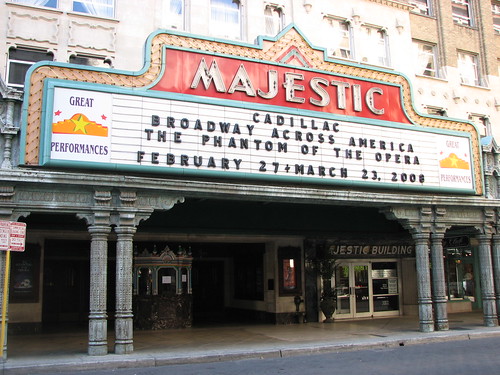
- March 2008: San Antonio Streetscapes: Photos from a visit to San Antonio, illustrating the principles of walkable urbanism, and details of the zoning ordinances that protect the city's walkable and historic core. (See above for an example.)
- May 2011: Historic preservation amendment deserves Tulsa Council support: Support for closing a loophole in the zoning code which would have enabled the erosion of HP districts.
- March 2016: Vision Tulsa, Helmerich Park, and strip malls along the Arkansas River: Defending the idea of an overlay district for the Arkansas River corridor and describing similar districts in Oklahoma City.
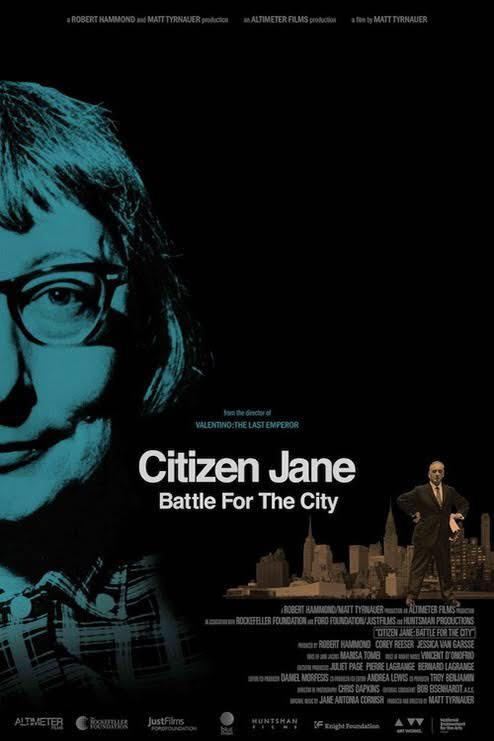 Citizen Jane, a film documenting the struggle to preserve Lower Manhattan from being destroyed by expressway construction in the 1960s, is currently showing at Tulsa's Circle Cinema. A special event at the 2:00 pm showing on Sunday, May 21, 2017, will pay tribute to Tulsa activist Betsy Horowitz, who led the successful fight to preserve Maple Ridge and River Parks from a planned expressway.
Jane Jacobs, a journalist by training and a Greenwich Village resident, turned her lessons learned fighting the city planners into a number of books that have stood the test of time, the most famous of which is The Death and Life of Great American Cities. It is a must-read for anyone who wants to understand what makes a neighborhood or district thrive and what makes it fail.
Citizen Jane is a timely tale of what can happen when engaged citizens fight the power for the sake of a better world. Arguably no one did more to shape our understanding of the modern American city than Jane Jacobs, the visionary activist and writer who fought to preserve urban communities in the face of destructive development projects. Director Matt Tyranuer (Valentino: The Last Emperor) vividly brings to life Jacobs' 1960s showdown with ruthless construction kingpin Robert Moses over his plan to raze lower Manhattan to make way for a highway, a dramatic struggle over the very soul of the neighborhood. The highway would have eliminated much of Washington Square Park and other Manhattan landmarks. Because of organized community opposition led by Jacobs, the project was dropped in 1969.In Tulsa in the late 1960s, an outspoken Maple Ridge resident, Betsy Horowitz (1929-2009), similarly led the successful grassroots effort to oppose the Riverside Expressway that would have taken out historic Maple Ridge homes and Lee Elementary School, prevented the establishment of the Tulsa's River Parks and eliminated the opportunity for the current development of the much anticipated A Gathering Place. The Oklahoma Highway Department officially cancelled the expressway project in 1972. Betsy once stated that "to save Maple Ridge and Lee School was not just a dream of mine; it was a passion that became an obsession."
Circle Cinema has invited Andrew Horowitz, Betsy's son, to speak about his mother's efforts and passion after a screening of the film on Sunday, May 21, at 2pm. The Tulsa Historical Society will have a display of materials in the Circle lobby reflecting the events that unfolded during the battle over the proposed Riverside Expressway.
MORE:
Here's my tribute to Betsy Horowitz following her death in 2009. Unfortunately, the Goodbye Tulsa podcast interview (dead link) with Betsy's son Andrew Horowitz has vanished from the web; it wasn't captured by Internet Archive. (If someone has it, send it to me and I'll host it here.)
Here's my tribute to Jane Jacobs from 2006, which highlights three of her big ideas about cities and neighborhoods.
From 2005, my urban design reading list, which includes Jacobs's Death and Life of Great American Cities.
In 2011, Roberta Brandes Gratz, author of The Battle for Gotham, posted a thoughtful review of Jane Jacobs' legacy, in light of claims that she was responsible for NIMBYism.
In the midst of an entertaining rant about supply and demand and journalism (which includes an even-more entertaining anecdote by Hunter S. Thompson about a period in which Thompson "was a sports columnist for one paper in the morning, sports editor for another in the afternoon, and at night [he] worked for a pro wrestling promoter, writing incredibly twisted 'press releases' that [he] would plant, the next day, in both papers"), R. Stacy McCain tells the story of the responsible journalist who briefly served as managing editor of the Atlanta Journal and Constitution:
Kovach spent two years as editor and damned near ruined the Atlanta papers with his pretentious (but Pulitzer Prize-winning) ideas about publishing broccoli journalism. During his tenure, Kovach not only alienated many readers, he also lost sight of the fact that in Atlanta, the business community expects the local newspaper to act as a publicity agent. Atlanta was famous during the Civil Rights era as "The City Too Busy to Hate," because civic leaders recognized that racial conflict was bad for business. Cynics observed that, in truth, Atlanta was The City Too Greedy to Care. If Jim Crow was good for business, Atlanta would be segregated, and if Jim Crow proved to be a net liability, Atlanta would integrate peaceably, but either way, what the Chamber of Commerce wanted, the Chamber of Commerce got. Labels like "liberal"and "conservative" didn't have a damned thing to do with these entirely pragmatic and self-interested calculations. It doesn't matter if you're black or white, the only color that really matters in Atlanta is green.Well, Mr. Kovach didn't quite understand this worldview, and he managed to p[---] off the Chamber of Commerce, and in November 1988, he "resigned," officially, but everyone knew it was more like he got pushed out the door, and there ensued all kinds of hand-wringing and moaning from the Good for Democracy types.
Things are the same all over. I suspect the Chamber of Commerce's pull over the local paper is worse in cities where, as in Atlanta, the paper is locally owned, and the business people who control the Chamber of Commerce are part of the same social circle as the newspaper owner.
Way back in 1978, National Lampoon published their Sunday Newspaper Parody, an edition of the Dacron (Ohio) Republican-Democrat. As you read the news stories, photos, and ads a three-dimensional picture of the town and its social structure began to emerge: an oligarchy of city cronies (including the owner of the newspaper) and their irresponsible scions; neighborhood destruction in the name of "urban renewal"; and an editorial board that believed its highest duty was promoting the business interests of the owner and his pals. I remember wondering at the time if the writers who created this brilliant piece of satire had worked for the Daily Oklahoman. (Tulsa was still a competitive two-newspaper town in those days. The Oklahoman's rival, the Oklahoma Journal, was on its last legs.) I realize now that the satire resonated because Dacron's social structure was representative of small and mid-sized cities across the fruited plain.
Spaghetti Warehouse, one of the catalysts for transforming a neglected neighborhood of warehouses into Oklahoma City's Bricktown entertainment district, closed its doors today after 26 years of business, a victim of the surrounding district's success. The restaurant opened for business, with space for 425 diners, on November 12, 1989, at 101 E. Sheridan Ave.
Of all today's news, this story may seem minor, but it touches on the hidden history of the revival of America's downtowns through adaptive reuse of older buildings. In the urban renewal orgy of the 1950s and 1960s, main streets took a beating. Downtown promoters, facing competition from new car-friendly shopping in the suburbs, thought the solution was to mimic the suburbs: demolish older commercial buildings and close streets, replacing them with modern shopping malls and acres of parking.
As Jane Jacobs wrote in The Death and Life of Great American Cities, "Old ideas can sometimes use new buildings. New ideas must use old buildings." (Click the quote to read more of the context.) Warehouses and industrial buildings, at the periphery of the central business district, were often overlooked by the urban renewal wreckers, and so they became the raw material for the visionaries of urban revival.
The first Spaghetti Warehouse opened in a forgotten corner of downtown Dallas in 1972. Eclectic decor (including a dining room inside a restored streetcar) in an unusual setting drew diners, and a patented steam-cooking method for pasta fed them quickly and kept them coming back. Over the next decade, the restaurant's success inspired other entrepreneurs to renovate nearby buildings for clubs and eateries. The result was Dallas's West End entertainment district.
The concept expanded to 14 locations when it opened in Oklahoma City. That same month the Bricktown Association was formed and city planners began looking at how to manage increased interest in the area. Piggy's BBQ and the Pyramid Club had already been operating in the area, and another nightclub opened that December.
Renovation and promotion of Bricktown as an entertainment district had begun in 1982. The opening of the OKC Spaghetti Warehouse in 1989 pre-dated the MAPS vote by four years and the completion of Bricktown's canal, ballpark, and arena by almost a decade.
I reached out to BLD Brands Director of Marketing Kathy Wan with a few questions about the Oklahoma City closing and the fate of the Tulsa store in the Bob Wills District, which opened in July 1992. She assured me, "We are definitely not closing Tulsa!"
So what was the problem in Oklahoma City? Ms. Wan explained:
We are closing due to two main reasons - business at this location not doing as well as before and we want to introduce a new look of Spaghetti Warehouse. Parking is definitely an issue at OKC because we have a lot of families and large groups as patrons. Economic and demographic dynamics of downtown warehouse districts have changed over the years so we need to update our branding and strategic plans. We are working on plans to reopen in the OKC market. We do not know yet if this particular location still makes sense for the new SWRI brand so this is something we are evaluating very closely in the next several months.
Tulsa's location has its own off-street lot. There are off-street lots near the OKC location, but not immediately adjacent, and these lots serve dozens of nearby restaurants and clubs. That makes the location less than desirable for the kinds of large groups that a restaurant of that size needs to attract.
Here is the press release from the parent company, as posted by KFOR:
After more than 30 years in the community, we have made the difficult business decision to suspend operations and announce the closure of the Spaghetti Warehouse Restaurant in Oklahoma City.The closure is effective on Tuesday, February 2nd. We are working closely with everyone on our staff, whose hard work and dedication is appreciated and we thank them for their many contributions.
To our many guests, we say thank you. We enjoyed serving you, your family and friends. And, it was our pleasure to share in the celebrations that took place over countless lunches and dinners, not to mention birthdays, anniversaries and other special occasions.
Spaghetti Warehouse was one of the first businesses involved in the Bricktown revitalization and we thank everyone in the Oklahoma City community who we've served and who supported us. For anyone who has a question about our restaurant in Oklahoma City, we invite you to send us an email at: info@meatballs.com.
As we continue to work on a new look for our brand, we are hopeful that in the near future we can reopen Spaghetti Warehouse within the Oklahoma City market.
MORE: Steve Lackmayer of the Oklahoman has more about Bricktown's history and recent attempts to make a deal to develop the unused upper floors of the Spaghetti Warehouse building.
SOMEWHAT RELATED: Excerpts from an insightful article by the late Jane Jacobs on how cities can enlist time and change as allies in the struggle to keep neighborhoods vital. She deals with the particular challenges of immigrant-dominated neighborhoods, the need for "community hearths," and the problems wrought by gentrification. This epitomizes so much of what is lovely in her urban criticism -- carefully observing reality and then finding and encouraging patterns that work because they are aligned with human nature. Too much of 20th century urban development was using bulldozers and billions of dollars to extinguish urban life where it naturally sprang up and then to try to recreate it artificially somewhere else. Urban Husbandry (a term coined by Roberta Brandes Gratz to describe a non-hubristic approach to city planning) finds naturally occurring signs of city life and, like a farmer, prunes, weeds, waters, and fertilizes to help the natural growth along -- a less expensive and more effective approach to Big Project Planning.
Adventures in "water in the river," from this week's Dallas Observer:
This has to do with one of the stupidest, zaniest, least necessary and most mentally challenged projects the city has ever undertaken -- and that's saying something -- a so-called "white water feature," or fake rapids, in the Trinity River downstream from downtown. Opened to recreational paddlers on May 7, 2011, the white water feature was closed to navigation the same day when the first few paddlers complained they had almost been killed.City attorneys told the council in an emergency executive session Wednesday that the U.S. Army Corps of Engineers was only hours away from shutting down almost the entire drinking water system for Dallas if the council didn't immediately cough up $3 to $5 million to fix or (better idea) demolish the stupid white water feature. Some on the council didn't believe the lawyers, so thank goodness they balked at signing the check.
Council members Philip Kingston and Scott Griggs say now that some element of the threat was a bluff and that the most the Corps probably would have shut down was any additional goofy construction projects in the river bottom. "That would have been doing us a favor," Kingston said....
Some years ago the park portion of the Trinity River project, an ambitious plan to rebuild the entire riverfront through downtown Dallas, was turned over to Dallas socialites. Apparently the socialites glimpsed a man-made whitewater park over the rims of their martini glasses while semi-reclined on a canopied deck somewhere in Colorado and decided they wanted to bring one home. But they thought it would be better for the taxpayers to pay for it, because ... money.
The article goes on to note that the "fake rapids" cost $5 million, more than triple the original estimate, and that the supposedly family-friendly, gentle side of the rapids was so turbulent "under certain conditions that it acts more like an in-sink DisposAll in your kitchen," sending boats and people to the bottom and not letting them up. The water feature also created an obstacle to existing recreational uses -- canoeing and fishing.
Why would a botched set of fake rapids endanger Dallas's water supply? It may be because the of an upstream Corps of Engineers dam that desperately needs repair. River guide and Corps-watcher Charles Allen thinks that the Corps is concerned about the water feature interfering with conveyance, because it "is piling up tons of silt on its upriver side." That would limit how much water the Corps can release from upstream lakes to repair their dams without jeopardizing the levees downstream.
What does all this have to do with the water supply? It's the Corps leverage over the city, as the water feature was covered under a broad "recreational permit," which did not require any sort of environmental study.
The big permits that the Corps does hold over the city's head, called 404 permits, could theoretically be construed to govern virtually the entire water supply of the city. And that's the type of saber they are rattling. They don't have a pea-shooter to aim at the white water feature alone, so they are bringing out bigger guns by threatening to yank the 404 permits, or so the lawyers told the council last Wednesday.
Maybe cities are smarter when they let the river alone to act like a river.
On his HBO show Last Week Tonight, John Oliver provides an entertaining and enlightening encapsulation of America's ridiculous habit of taxpayer subsidies for sports stadiums.
MORE: The new Major League Baseball commissioner, perhaps inspired by the NFL holding LA relocation over the heads of existing NFL cities, sees the value in developing hungry potential new markets that can be used as a threat to get existing cities to pony up for new stadiums (emphasis added):
Manfred said MLB has compiled a list of cities that might be viable options through expansion or possible relocation from existing markets. Tampa Bay and Oakland have been mentioned as markets that could eventually risk losing their teams if their ongoing stadium issues are not resolved.Manfred said the league remains hopeful that the Rays and Oakland Athletics will be able to obtain new ballparks without relocating, yet will examine other markets in case a team needs to move or the sport decides to expand.
The sport intends to "examine their viability, think about what we can do to make them more viable, so that we have business alternatives that are available to us," Manfred said.
Montreal, Charlotte, North Carolina, San Antonio, Portland, Oregon, Las Vegas, Oklahoma City, northern New Jersey, Mexico City or Monterrey, Mexico, are among the markets that could eventually land on baseball's radar as potential locations for new or relocated franchises.
Some interesting observations about the people of Oklahoma City and the memorial they created and maintain, from NYU media, culture, and communication professor Marita Sturken in her 2007 Duke University Press book Tourists of History: Memory, Kitsch, and Consumerism from Oklahoma City to Ground Zero.
One of the primary ways that individuals are encouraged to interact at the memorial is through the fence that is now placed on an outside wall at its entrance. This was the same fence where people initially left objects. The designers had envisioned three small sections of fence in the children's area that would encourage a similar activity, arguing that the fence itself was not as important as "what the fence allows to happen." Yet several family members were concerned that this fence, which had been so important to them in those first years, would be lost, even though a few felt it was an "immature" form of memorial. When the memorial was completed, the fence was transported by volunteers to an outside wall, where it is both separate from and part of an entry into the memorial. The material on the fence is only a fraction of the massive inventory of objects that the memorial has acquired and which are part of its archive.In its incorporation into the memorial design, the fence remains a primary site where people come to leave objects and messages. There are much-considered rules concerning this activity and these objects, which reflect the overall thoughtfulness and intensity of the memorial's intended rituals. Objects that are left on the fence are allowed to stay for a maximum of thirty days. The memorial staff then removes them if they are not related to a particular victim or agency and according to issues of space and durability. The memorial staff will not place something at the fence if someone sends it in; it must be placed there in person. Rules are different for the chairs, where items are left for seventy-two hours after an anniversary ceremony and otherwise removed and discarded after twenty-four hours (though the staff will, on request, move an object then to the fence). This policy was the result of an extended debate among families, survivors, and rescue workers because many survivors and rescuers thought that it would look tacky to have objects left on the chairs.
The Memorial Center, which opened In February 2001, now houses a massive and growing collection of materials in its archive. According to the archivist Jane Thomas, once people realized that their collection was "more than 3,000 teddy bears," they began to send in other materials: photographs, documents, artwork, and personal material from families; trial materials; and documents, such as surveys, from the process of writing the mission statement of the memorial. The archive has six areas of collection: the history of the site; the incident itself, including rescue and recovery; responses to the event, including media coverage; the investigation and trial; spinoffs, such as new regulations and laws that resulted; and memorialization. It now houses over eight hundred thousand pieces, including documents related to the McVeigh and Nichols trials, seventy thousand photographs, newspaper articles, and over one hundred thousand objects, such as cards, letters, quilts, art objects, uniforms, memorial designs, the personal effects of some victims, reporters' notes, shattered glass from the building, and items from the building such as the playhouse from the day care center's play yard....
The memorial design thus encourages many different kinds of responses, encompassing as it does a broad range of spaces, each with particular intent. Visitors are encouraged to be active in responding to the memorial, by leaving objects on the fence or drawing things in the children's area. People often depart from the proscribed codes in interacting with the memorial, for instance, dipping their hands into the water in order to leave handprints on the bronze gates. The memorial is open all the time and is a place that people often wander through at night. It is staffed constantly by volunteers, many of whom are survivors. Many family members and survivors work as docents for the Memorial Center and are frequent visitors to it. It has what is often referred to as a fervent volunteer culture, with seventy-five volunteers working every week.
The memorial is thus integrated into the community of Oklahoma City in complex ways that are about integrating a difficult past into the everyday. This intense community involvement is a factor in the relationship of the memorial to the National Park Service, which is in charge of the rangers and brochures at the site. According to the memorial's executive director, Kari Watkins, the Memorial Foundation restructured its relationship to the NPS in 2005. The NPS, says Watkins. expected the local community to recede as it has at other, similar sites, but the community in Oklahoma City is too invested to fully hand over the site. Thus, as in the design of the memorial, the local community has consistently made clear, both emotionally and financially, its ownership of this memorial site. This incorporation of the memorial into the city has been facilitated by the sense of community and local pride that is a part of the memorial, and its pedagogical mission, one that is fervently expressed and dedicatedly carried out, and that centers in many ways on an embrace of citizenship and civic life.
Here's a blog entry unlikely to make anyone happy, but here's the information I'm working with as I consider the race for District Court, District 14, Office 1.
There have been several notorious cases involving particularly heinous crimes in which Tulsa County District Judge William Kellough has lightened a sentence imposed by a jury or reduced his own sentence substantially. In one case, the reduction was grievous enough to inspire two Oklahoma State Representatives to pursue legislation to make it easier to remove judges who imposed light sentences for heinous crimes.
While Oklahoma voters have the opportunity to remove district judges at four-year intervals, that opportunity depends upon the presence of a viable opposition candidate. In a retention ballot, you can vote to oust the incumbent and allow the governor to appoint a replacement. District court races are contested and the only way to remove an incumbent is to elect his opponent.
Kellough won a contested election over Cliff Smith in 2006 for an open seat, was unopposed in 2010, and now faces former Associate District Judge Caroline Wall on next Tuesday's ballot. Kellough's endorsers include Kathy Taylor, George Kaiser, Howard Barnett, and Sharon King Davis, and Kellough has raised $77,008.00 for this campaign. Wall has raised $3,400.
Wall had been elected Associate District Judge in 2002 winning by a 60-40 margin over incumbent Deirdre Dexter. In 2006, Wall was defeated for re-election by Dana Kuehn, by the narrow margin of 1024 votes. In 2010, Wall finished fourth of five in a race for an open seat, missing the runoff by about 2000 votes.
In that 2006 race, I joined many other voices, including the Tulsa Area Republican Assembly and Oklahoma Republican Assembly, in supporting Kuehn to replace Wall. In my UTW pre-election column, I wrote, "In contrast, the performance of Caroline Wall (judgecarolinewall.com), the judge who replaced [Dexter], elicits widespread dismay. Attorneys say Wall doesn't keep up with her docket. Wall's leniency is another cause for concern -- there's a long list of cases in which Wall reduced or completely suspended jail terms for convicted murderers and sexual predators."
Below are some of the cases cited by Kellough's critics. Is Kellough too soft-headed and soft-hearted to be an effective judge? Is he allowing his own bleeding heart to overcome the demands of justice? Or is he being a good steward of the state's corrections budget by reducing sentences for remorseful felons? Would Caroline Wall be any better?
State of Oklahoma v. Larry Martin Neeley, First-Degree Murder
Neeley was charged with and convicted by a jury of the first-degree murder of a toddler. The jury had the option of finding guilt on a lesser charge, but instead found Neeley guilty of first-degree murder and sentenced him to life with the possibility of parole. Judge Kellough suspended all but 12 years of the sentence and gave Neeley credit for the year already served because the defendant showed remorse. The prosecutor in the case, Assistant DA Jake Cain, said that Neeley changed his story in the course of the investigation. From the DA's office Fall 2009 newsletter
J.J. Hall weighed only 28 pounds in August 2008 when he died of a lacerated liver and blunt trauma to his abdomen after his mother left him in the care of Larry Martin Neeley at her home.Assistant District Attorney Jake Cain maintained Neeley inflicted the blow that led to the toddler's death. Neeley said the child had been told not to climb on the bunk bed and admitted he jerked the child from a bunk bed ladder and said the child struck a dresser and the floor.
A Tulsa County jury in October convicted Neeley of FIRST-DEGREE MURDER in J.J.'s death and sentenced him to LIFE IN PRISON. The jury had the option to convict him of a lesser charge of manslaughter, but opted to find him guilty of murder and sentenced
him as the law instructed for first-degree murder: LIFE in prison.In December, Judge William Kellough suspended all but 12 YEARS of the LIFE prison term, and gave Neeley credit for the year he spent in jail awaiting trial. The judge said he reduced the term because he believed Neeley was remorseful.
Cain and District Attorney Tim Harris asked the judge to follow the jury's sentence. Cain noted that Neeley changed his story as the investigation unfolded.
'As adults, we owe it to these children to protect them, because they are not able to
defend themselves," Cain said."J. J. wasn't doing anything other than acting like a 19-month old child that morning," Cain said.
He said he is troubled that the judge did not follow the sentence of the jury. When we take a case to a jury trial, we are bound by that verdict," Cain said.
The news report describing Swyden's crimes:
Prosecutors say the two sisters were ages 12 and 14. Police say Swyden chatted with the 12-year-old online on a social networking site. They say the girl snuck out to meet him and that she says he forced her to perform a sex act. Later, police say, her 14-year-old sister met Swyden and had sex with him.
Swyden, 21 at the time of the offenses, pled guilty and in February 2011 was sentenced to 15 years on each charge, to run concurrently. In December 2011, Judge Kellough reduced the sentence to 10 years in prison, five years probation. The Tulsa World reported that "Kellough indicated Monday that Swyden has made progress with the aid of counseling and through the defendant's efforts to correct his own behavior."
Swyden was arrested on the Tulsa County charges while out on bond for a 2009 arrest in Creek County, in which he was charged with two counts of second-degree rape, two counts of forcible sodomy, and one count of distribution of obscene material. According to news reports, Swyden met his 13-year-old victim on Myspace. In February 2011, earlier in the same month as the Tulsa County conviction, the Creek County court sentenced him to eight years in prison, seven years probation. Unlike Kellough, Judge Douglas Golden denied a September 2011 request to review Swyden's sentence.
From the DA's office Winter 2013 newsletter:
The crime occurred in March 2011. Jurors sentenced Anderson to a total of 50 YEARS IN PRISON - 15 YEARS on each of three counts of Rape, 5 YEARS on Kidnapping and 6 MONTHS for assault and battery. At formal sentencing, District Judge William Kellough ordered the three 15-YEAR TERMS RUN CONCURRENTLY, reducing the sentence to a total of 20 YEARS IN PRISON.
State of Oklahoma v. Meredith Allison Howard, Child Abuse by Injury
State of Oklahoma v. Meredith Allison Howard, Child Abuse by Injury
Howard was a worker at two church-based child-care centers. She was found guilty on two charges of child abuse by injury, and was sentenced by Kellough in February 2013 to twelve years in prison followed by three years probation. Less than a year later, in December 2013, after her attorney requested a review of the sentence, Kellough reduced her sentence to a suspended sentence and released her from custody. From the DA's office Winter 2013 newsletter:
Howard was accused of inserting her finger into the vagina of a 19-MONTH OLD GIRL in November 2012 at John Knox Child Development Center. Howard claimed it was an accident while changing a diaper. The child needed surgery to repair the injury. In 2008, an 8-MONTH-OLD BOY under Howard's care received a spiral leg fracture at Kirk of the Hills Mother's Day Out program.
Hill, who later changed his name to Tyler Woodson Basset, struck and killed a bicyclist with his pickup in April 2010 and was sentenced to 15 years in prison in August 2011. Judge Kellough reduced his sentence to eight years in prison plus seven years probation. According to news reports:
Tulsa County prosecutors asserted that Hill was impaired by alcohol when he was driving a pickup that struck Vernon Worley, who was riding a bicycle in the 3100 block of North Cincinnati Avenue on April 16, 2010.Worley, 56, of Owasso, was fatally injured. The pickup did not stop at the scene, police said.
State of Oklahoma v. Preston M. Plum, First-Degree Manslaughter
Plum killed a friend with a handgun and was sentenced in December 2008 to fifteen years in prison. In November 2009, Kellough modified the sentence to ten years in prison, five years probation. From the news story on the sentence reduction:
A Tulsa family pleaded with a judge not to reduce a killer's sentence, but the judge knocked five years off the man's 15-year sentence. The judge says the age of the suspect - 16 at the time - was a big reason why.However, the victim was also 16 when she was shot in the face, and now her family is devastated the judge went against the jury's sentence.
Heather Garoutte was 16 years old and visiting a former boyfriend, Preston Plum, on June 30th, 2007. Records show he was smoking pot and messing with a gun that went off, shooting Heather in the face.
He says it was an accident.
"He's claiming he had the gun in his hand when the hammer got stuck so he released it," said Nicole Hicks, Heather's sister.
Plum didn't do anything to help Heather. Instead, he took off to Okmulgee County where he emptied the gun and ditched the bullets in the trash, threw the gun in a pond and got rid of his bloody clothes in a third location....
Tulsa County Judge William Kellough said this was a unique case and the first one he's modified in nearly 50 jury trials. He said the ages and the circumstances of this crime were seared into his memory, and he believed shortening the sentence was in the best interest of justice.
State of Oklahoma v. Israel Shalom Castillo
Castillo, 23 and a janitor at Victory Christian Church at the time, was charged with making a lewd or indecent proposal to a minor child. News reports say the indecent proposal was made via Facebook and that the victim was a 14-year-old girl that Castillo had met at church. Castillo pled guilty. Kellough dismissed a second charge of the use of a computer to facilitate a sex crime. The DA's office recommended a sentence of ten years in prison followed by five years on probation. Kellough instead imposed a much lighter sentence of 1.5 years in prison and 4.5 years on probation.
State of Oklahoma v. Lori June Canady, Second-Degree Rape
A 35-year-old teacher's aide pled guilty in July 2008 to second-degree rape of a 15-year-old student. Kellough imposed an eight-year suspended sentence, with no prison time.
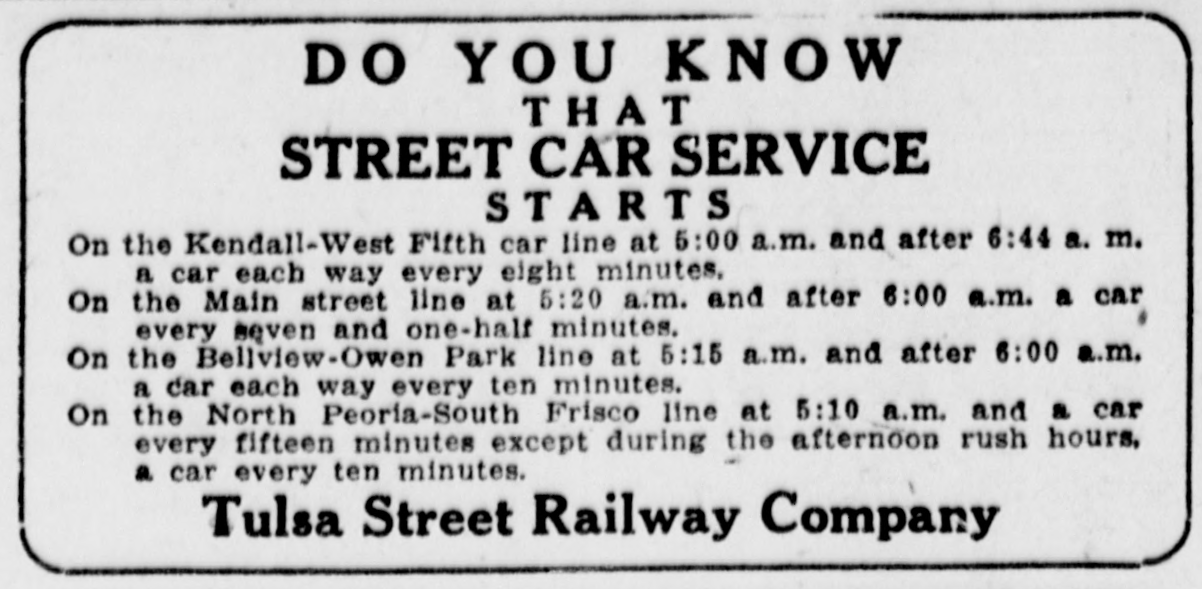
Many of my hipster urbanist friends are very fond of food trucks. Food trucks today offer a wide variety of cuisines and a wide range of sophistication and price. The mobility of the kitchen allows the restaurant to go where the customer is. Better food can be offered for a lower price because the truck avoids some of the costs that attend a brick-and-mortar eatery. There are no restrooms to clean and stock, no dining room to manage, no tables to clear, no dishes to wash. Cashier and sous-chef duties can be handled by family members; no need to deal with the complexities of being an employer.
The owner/chef can take his skills to where the customers are, and when the customers aren't there, he can park the truck at home and pursue other work. When demand is high, he can run his truck seven days a week. When it's slow, he can shut down for a while without the ticking of the rent clock. Food-truck fans are rightly concerned to protect this innovative approach to food delivery from regulations that seek to eliminate the food truck's competitive advantages under the guise of protecting the public health.
Many of these hipster urbanists are also very concerned about funding cuts for Tulsa Transit, the regional bus service. The system is almost unusable. Every year or so, I take a trip by bus. I'm always frustrated by the long headways (period between buses on a route), long layover times, and limited hours. Only those who have more time than money choose to ride Tulsa Transit. For many, the only alternative is to pay for an expensive taxi ride on the occasions when time matters and friends aren't available to provide a ride.
The solution most frequently proposed is to implement a tax to provide the bus system with a consistent stream of revenue which can pay for more buses, more drivers, and more frequent service. The problem with that approach is that you're going to wind up with excess capacity most of the time, just to ensure that someone can catch a bus on short notice.
What's the most efficient mechanism for allocating supply to demand? The free market, as long as barriers to entry and the allocation of supply are kept to a minimum. Which reminds me of this joke from the Unix fortunes file:
On his first day as a bus driver, Maxey Eckstein handed in receipts of $65. The next day his take was $67. The third day's income was $62. But on the fourth day, Eckstein emptied no less than $283 on the desk before the cashier."Eckstein!" exclaimed the cashier. "This is fantastic. That route never brought in money like this! What happened?"
"Well, after three days on that cockamamie route, I figured business would never improve, so I drove over to Fourteenth Street and worked there. I tell you, that street is a gold mine!"
The absurd element that makes this funny is that everyone knows buses are supposed to follow a fixed route, even though, unlike streetcars, they could be moved to meet demand, even though they never are.
The debate over the regulation of food trucks reminds me of a similar debate 100 years ago. Streetcar companies had been granted franchises by cities to lay track and hang wire on certain streets. The companies made massive capital investments, but they were hamstrung by city regulations and, sometimes, union contracts setting maximum fares and minimum staff levels.
To give you a sense of the struggle between streetcar company and city government, in 1922, the Oklahoma Union Traction company decided to stop running its St. Louis Ave. line to Orcutt Park. The popular amusement park had given way to private development around what we now call Swan Lake. Demand along the line had dropped. OUT wanted to stop running the line but didn't want their competitor, Tulsa Street Railway, to take it over. Presumably the rails and wire had reuse or scrap value as well, so OUT began pulling its infrastructure out of St. Louis Ave., over the objections of the City of Tulsa. The state Corporation Commission, regulator of intrastate rail, was drawn into the dispute.
Early adopters of the private automobile figured out that they could make money toward gas and car payments by driving along streetcar routes ahead of the next trolley and picking up passengers for a nickel (or "jit") each. Passengers liked jitneys because they got where they were going faster and more comfortably than if they waited for the next streetcar. Streetcar companies hated jitneys, because they stole the fares the companies needed to cover their capital investment and fixed costs.
Streetcar companies fought back with political muscle, persuading city councils to pass restrictions and bans on jitneys, bans that persist to this day. The Institute for Justice, which provides pro-bono support for economic liberty cases, worked to overturn Houston's anti-jitney law in 1994:
Santos v. City of Houston. Like Ego Brown, Houston entrepreneur Alfredo Santos discovered an untapped market. A cab driver, Santos discerned a need for a third transportation alternative beyond expensive taxicabs and highly subsidized public buses. He discovered the solution in Mexico City: the "pesero," or in English, the "jitney."Jitneys are a transportation mainstay in large cities around the globe. They run fixed routes and charge a flat fee, like buses. But they pick up and discharge passengers anywhere along the route, like taxis. They are smaller and more efficient than buses and less-expensive than taxis. They also are ideally suited to low-capital entrepreneurship.
Santos began using his cab during off-duty hours as a jitney, operating in low-income Houston neighborhoods. The business was successful, quickly attracting other jitney operators. But the city quickly shut the industry down, invoking its "Anti-Jitney Law of 1924."
In the 1920s, jitneys were the main source of competition to subsidized streetcars. The streetcar companies lobbied in city halls across the country, all but exterminating jitneys. Seventy years later the streetcars are nearly all gone, but the anti-jitney laws remain. Today they are supported by the public transportation monopolies that replaced the streetcars.
Santos challenged the law in federal court, which struck it down as a violation of equal protection and federal antitrust laws. The city did not appeal the ruling, thereby allowing another favorable economic liberty precedent to stand.
(You can read the Santos v. City of Houston jitneydecision online. And here's an article from half a year later about Santos's vision for jitneys, the taxi industry's push for regulation, and support from Houston's transit authority.)
Santos argues that entrepreneurs and the marketplace, not the government, should decide whether there is a demand for jitneys. Santos, 41, has spent more than ten years fighting for jitneys. A cab driver for ten years, Santos had seen jitneys working in Mexico City, where they are called peseros. Wearing a cowboy hat so potential passengers could easily spot him, he would drive East End streets holding out fingers for the number of places available in his cab. Yellow Cab found out about the practice and threatened him with the loss of his cabby's lease if he didn't go back to running his meter as required by law....Santos says jitneys will attract poor people and immigrants who don't own automobiles and are reluctant to call cabs because of the high cost and poor service. Chernow, however, says that about a third of Yellow Cab's trips originate in low-income, minority neighborhoods.
The secret to operating a jitney, Santos says, is to run the route religiously, make lots of quick trips, and develop new customers. Perhaps a driver will occasionally deviate to take a passenger home in a pouring rain, he concedes, or help someone get their groceries to the doorstep. But the driver will need to return quickly to the route to maintain the quality of the service.
Fast-forward 13 years, and a Houston blogger calling himself The Mighty Wizard wonders why jitneys, now legal in Houston, aren't effective in meeting the transit needs of the subject of a news story whose six-mile commute takes 83 minutes by bus.
So why aren't jitneys more widely used in Houston? Well, whenever something is legal but rarely used, the Wizard immediately starts suspecting government interference and sure enough, if one decides to pay a visit to the City of Houston ordinances governing the operation of jitneys (Chapter 46, Article VI), one immediately notices some very serious regulatory barriers to entry that would be jitney operators face in entering the competitive field for transportation.
He spots three barriers to entry and to meeting the needs of customers: The vehicle can't be more than five years old (a standard never used for public transit vehicles or cabs), the driver can't deviate from the route or negotiate price with potential customers (reducing fares might make sense when demand is slack), and a jitney owner must maintain bonding and insurance from which a government operator is exempt.
There are more, but no doubt that the usual rationale would be offered as to why these regulations are in place and that is that we need to protect the public. It should be equally obvious to everyone that this ordinance doesn't protect the public from anything, but was instead written to protect Yellow Cab and Metro from market competition, not to help the citizens of Houston get around more quickly or conveniently.Jitneys also present another problem, this one in the political marketplace. Jitneys don't allow politicians to spend billions of dollars in cost overruns on big transportation make work projects, they don't allow for photo opportunities or to put their names into the history books, nor do they help politicians obtain millions in campaign contributions. They also would drive lovers of government transit berserk. However by lifting lifting the regulatory barriers to entry to jitney operations, the City just might allow a solution to come forward which could allow Mrs. Jenkins to get to her job in 10 minutes and to succeed where taxpayer funded public transit fails.
Way back in 2002, when Tulsa County's "Dialog" process was underway, they sought public input for projects to improve Tulsa County. I offered two proposals: Deregulate jitneys and enable neighborhood conservation districts. Neither idea involved massive construction contracts or revenue bonds, so neither idea went anywhere in the process, which was all about finding popular local projects that could be wrapped around a new arena to get it past the voters.
Before we plow more money into Tulsa Transit and a route model ill-suited to Tulsa's urban layout, why not give private operators a chance to meet the need? They might choose to run a fixed-route without deviation. They may choose a starting point, but the destination and route would be determined by the needs of the current batch of passengers. They might take reservations, like Super Shuttle does with hotels, picking up a series of passengers to deliver them to a common destination.
You may object that the free market may not provide the quality of service needed at an affordable cost. I could imagine churches using their buses and vans as jitneys during the week, with fares reduced to whatever was necessary to cover fuel, if that. Merchants in a shopping center might pool funds to ferry shoppers from home to the store and back. There may be some benefit in a publicly funded "backbone" service -- frequent service along a small number of corridors, to which jitneys would connect.
Transit regulations, like food regulations, should protect the public's health and safety, but otherwise leave the market free for innovation. My hipster friends are excited about taxi alternatives like Uber and don't want to see them entangled in government regulations designed to protect the taxi monopoly. They should be just as excited to unleash a lower-tech, lower-cost means of transportation for the benefit of their less affluent fellow Tulsans.
MORE: An article from the January 2000 issue of The Freeman explains how illegal-but-tolerated jitneys operate in Detroit.
The National Trust for Historic Preservation's Preservation Blog has put its spotlight on the efforts of the City of Independence, Kansas, and the Friends of Riverside Park and Zoo (FORPAZ) to preserve the park's historic playground equipment while meeting modern safety requirements:
When Riverside Park's insurance company told park staff that they needed to remove two playground slides dating from the early 1900s for safety reasons, Barbara Beurskens, director of the Independence, Kan. park, knew that she and her team had to find a solution that would keep the metal playscapes in place."These are so important to the community," says park staffer Rachel Lyon of the tall slides manufactured by the now-defunct FUN-FUL company.
The solution involved installing tons of rubber mulch under the slides, improving guardrails, and undergirding ladders to prevent slip-throughs.
So often the difference between demolition and preservation is affection. City officials confronted with an insurance company's warning often respond with a helpless shrug, followed by an order to send the bulldozers. That's easier to do if you have no emotional connection to what's about to be torn down.
But the city officials here understood that generations of former children from Independence and the region have rich memories tied to these slides and see-saws, memories of overcoming their fears, memories of games of imagination.
I note from a websearch that Park Director Beurskens has worked for the City of Independence in one capacity or another for over 30 years -- clearly, she's been around long enough to understand that "This Place Matters" (to borrow an NTHP slogan). Perhaps she had children of her own who grew up playing on the big slides.
NTHP's Katherine Flynn has included (with my permission) some of my photos of Riverside Park's historic playground equipment from 2007. After an earlier visit in 2003, I described the equipment and wrote about my amazement that the playground equipment I remembered from my childhood visits was still there and in use, and I alluded to the liability concerns that have caused classic equipment to vanish from playgrounds and parks across the country.
A spinning circle -- the kind with the raised elongated bumps at right angles for traction, and bars radiating and rising from the center, then forking out and connecting to the edge. [My son] Joe was riding it, having me spin him faster and faster. As he was spinning, and as I was pondering whether, out of appreciation for the City of Independence having the guts to keep this classic play equipment available, I would refrain from filing suit if one of my kids were injured -- as if he could read my mind, Joe launched himself off the circle. His foot was caught by one of the handholds and it seemed he might be dragged around, but the circle stopped quickly. Joe was fine, grinning. He got up, brushed off the sand (that's what they use around all the play equipment -- not hard, splintery wood chips, but nice soft sand). "I intended to do that. I thought it would be cool to jump off!"
We passed through Independence in May, and we spent a couple of hours there walking through part of the zoo, riding the train and the carousel, and playing on the playground. It was a gray and damp day, so the slides didn't move very fast. Here are a few pictures which show some of the safety improvements:
MORE:
Visiting Riverside Park: The park is open 6 a.m. to midnight daily. The train, carousel, and mini-golf are open weekends from 1 p.m. to 8:30 p.m. and weekdays from 5:30 p.m. to 8:30 p.m. between Memorial Day and Labor Day, and weekends from 1:30 to 5:30 p.m. in spring and early fall. (October 20 is the last day in 2013 for the rides and mini-golf.) The zoo is open 9 a.m. to 7 p.m., April through October, then 9 a.m. to 5 p.m., November through March.
City of Independence Riverside Park and Ralph Mitchell Zoo webpage
Riverside Park and Ralph Mitchell Zoo on Facebook
Friends of Riverside Park and Zoo (FORPAZ) website
Friends of Riverside Park and Zoo (FORPAZ) on Facebook
BONUS: Playground swings sound like trumpeting elephants:
Steve Lackmeyer has a story in today's Oklahoman about the dilemma facing Oklahoma City as surface parking downtown is being replaced with new development.
Now, [Stage Center] is set to be torn down to make way for a tower rising at least 20 stories into the skyline. And if one is to consider carefully the comments made Thursday by Mayor Mick Cornett, this won't be the last demolition sought to make way for a new tower....The old home of Carpenter Square theater on the southwest corner of Main and Hudson features a beautiful colored mosaic tile facade. Originally the home of Bishop's Department Store decades ago, one can dream up the restoration of the building's jewel box glass storefront displays where the plywood now stands.
That building, a vintage mid-rise "auto hotel" garage and other early to mid-20th century buildings on the block may be next on the list of buildings to be torn down to make way for yet another tower.
Oklahoma City, which recoiled after the Urban Renewal demolition spree in the 1970s, has had relatively few downtown preservation battles since the MAPS-fueled revival began in 1993.
Empty land, scars remaining from unfulfilled dreams of the earlier Urban Renewal era, was plentiful 20 years ago. But that surplus of land has been depleted thanks to hundreds of millions of dollars invested downtown this past decade.
The skyline wants to grow. Oklahoma City must now decide what older buildings must go to accommodate that demand.
It's a nice problem to have, for land to be more valuable to develop than to use as surface parking, but Oklahoma City should think carefully before sacrificing more of he remnant of its early 20th century downtown urban fabric to make way for new steel and glass erections.
Some points to consider:
The pre-World War II buildings that may be sacrificed for new skyscrapers were built to pedestrian scale. Even pre-war high-rises tended to be built with a retail-friendly first floor. (Even the Empire State Building, tallest in the world when it was built, has ground floor retail.) New skyscrapers tend to be monotonous, with first floors that are undifferentiated from the rest of the building on the exterior and little more than elevator lobbies on the inside. At the very least, design guidelines could require a retail-friendly, pedestrian-friendly ground floor in new buildings.
Skyscrapers will increase downtown employment, which will increase demand for parking, which could lead to the sacrifice of still more low-rise, pre-war buildings for surface parking. Tulsa saw this happen in our 1970s building boom. Combined with and enabled by urban renewal, it turned our downtown from a mixture of uses into little more than an office park, dead after dark. The daytime employees will want places to eat lunch, but they won't be around to keep retailers open in the evening, and the skyscrapers and their attendant parking will eliminate older buildings that could house uses to generate 24/7 activity. While skyscrapers may draw new residents into the center city, plenty of those new downtown workers are quite happy with their single-family suburban homes, and they'll want a place to park. Planners should do the math for proposed new skyscrapers: Number of new workers minus number of workers likely to live within walking distance (or to commute via mass transit) equals the number of parking spaces that should be required to be incorporated into the building.
There's a real danger of replacing diverse building stock with the equivalent of a monoculture, which is as vulnerable to disease and disaster in the built environment as it is in the natural environment. Development is somewhat at the mercy of investment fads. If everyone sees office space as a good investment, they're going to build, build, build until office space is overbuilt, driving out buildings suitable for other uses in the process.
Historic preservation played a key role in Oklahoma City's urban revival. MAPS investments had impact because they were placed in and near areas like Bricktown, Civic Plaza, and West Main that had been untouched by urban renewal, and, in the case of Bricktown, already had pioneer investors working to redevelop them.
In the 1980s, Oklahoma City, perhaps in reaction to the orgy of demolition in the previous two decades, adopted urban design guidelines, neighborhood conservation districts, and historic preservation districts for both commercial and residential areas. When the boom began in the 1990s, many protections were already in place, and others were added, no doubt with less friction because precedents for such protections had already been set. Then-Mayor Kirk Humphreys told a Tulsa Now tour group in 2002 that design guidelines were the city's way of protecting the taxpayers' massive investment in downtown. Tulsa's developers and their allies have blocked adoption of similar measures here.
In the comments to Lackmeyer's story, I pointed to Paris for a way to give the skyscraper builders some room to play while protecting the remaining diversity and history of the downtown core.
Paris made the decision to protect its historic core from high-rise redevelopment. Skyscraper development was diverted to an industrial area called La Défense, about three miles west of the Arc de Triomphe, along the same axis that connects that monument to the Louvre via the Champs Elysée. The official website for La Défense describes the area before the transformation:
Apart from its strategic location on the historical axis extending from the Champs-Elysées, there was little indication that the La Défense Roundabout would one day be home to the future business district. Dilapidated houses and small factories for the engineering and automotive industries were bordered by shantytowns and the occasional farm.
The name of the place comes from an 1883 monument at the center of that roundabout, commemorating the defense of Paris during the 1870 Franco-Prussian War. The area was identified as a location for new urban development in 1931, and major construction (delayed by depression and war) began in 1958 with CNIT, a large exhibition center, followed by several waves of high-rise development.
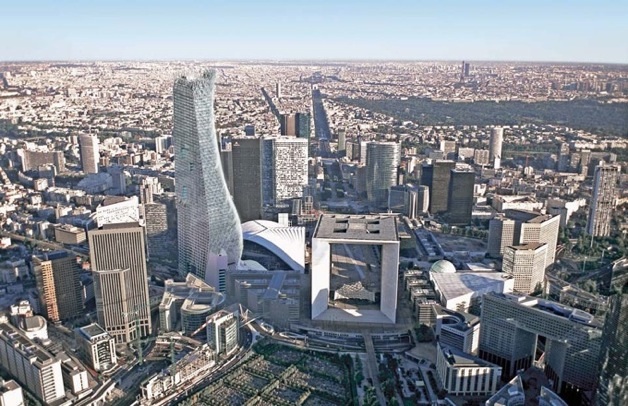
La D&efense, looking east along Paris's historic axis toward the Arc de Triomphe
The 400-acre district now accommodates 38 million square feet of office space, 150,000 employees, 20,000 residents, and 2.3 million sq. ft. of retail (including continental Europe's largest mall, at 1.3 million sq. ft.). Beginning in 1970, it was connected to the rest of Paris by express rapid transit (RER line A) and since 1992 also by Métro Line 1. (Note that even in urban, densely developed Paris, this district still experiences a daily influx of at least 130,000 commuters and can only house about 13% of its workers.)
Oklahoma City could choose to do something similar: Encourage new skyscraper development in an underused area without historic significance near downtown and link it to the core by transit. To my outsider's eye, the industrial area along Reno between Western and Penn, west of downtown, and along Reno between I-235 and I-35, east of downtown, both look like good possibilities for this sort of place. Oklahoma City could improve on Paris's example by ensuring that such a skyscraper district is pedestrian-friendly and has a cohesive urban fabric, not a mere collection of isolated starchitect sculptures.
MORE:
Habitats for Humans: A Skyscraper Is Not a Sculpture: An essay contrasting the way earlier skyscrapers were designed to fit into the urban context and newer skyscrapers are designed as standalone monuments to their architects. The essayist points to New York's early 20th century rules for skyscrapers as the antidote:
We inherited some pretty wonderful skyscrapers from the years before previous global economic disasters: the Metropolitan Life Building (1909) The Empire State Building (1931), The Chrysler Building (1930). These older towers left an incredible urban legacy and it is easy to agrue that they represent the perfection of the urban skyscraper. They are successful at every scale: from a distance they are soaring and beautiful landmarks, global icons of the city and symbols of success and possibility. As part of a street their bases widened to fill their blocks, responding to the height and rhythms of neighbouring buildings, creating a real urban density. Up close, their frontages are richly detailed and animated by shops and entrances, just like those of any generous and lively urban building....The majority of recent towers are very different and their form follows from a very different function: To be seductive CGI sculptures in promotional material, to distance occupants from the 'dangers' of the city, and to compete with other tall neighbours. The city context of many skyscrapers has become irrelevant with the consequence that new skyscrapers, as opposed to being a crescendo of urbanity, are now actively destructive to their urban contexts.
Skyscrapers are no longer designed to contribute to the creation of the great human habitat - the city....
On a recent trip to Madrid I visited the Cuatro Torres development. This was the city's prime new office district consisting of four, starchitect designed towers in vast open spaces. The city stopped at the edge of the development; human activity died away, street life disappeared, the wind whipped up and the towers loomed large as in the architect's dream. If we are trusting architects and developers to build our cities then we should expect more like this.
The answer to this problem is to once again consider the skyscraper as part of its urban context; the habitat of the person on foot.
We need to insist that the form of new skyscrapers follow an additional urban function: to enliven the city at every scale, particularly the one that is currently ignored - the scale of the person walking on the street. The Architect's vanity, and developer ignorance that demands that their sculptural artwork should be realised, uncompromised by such restriction, must be challenged....
Our skyscraper designers could do worse than look again at the rules that led to some of the best urban skyscrapers ever built - The 1916 New York Zoning Resolution. It aimed to ensure that these great urban crescendos were as generous as possible to the pedestrian environment below, and the city as a whole.
Looking at the successful results, a series of rules of thumb can be distilled: At ground level, a more urban result is achieved when the tower's base fills its plot. Here, vibrant, streets are more likely when sides of this of the base animate their surroundings with shop units or entrances to apartments above. The height of this section should create a good enclosure of the street without creating a dark chasm. Above this level the building steps back to the tower - this prevents downdraughts and allows light to the street. The tower element will generally rise above, creating a dramatic form on the skyline (complementing rather than clashing with neighbours). Simple.
The 1920 Robelin map of Paris shows La Défense as a mere suburban roundabout.
La Défense official website (English version)
Jillian Haswell's brief history of La Défense, with photos and a description of new development planned for the near future.
La Défense: From Axial Hierarchy to Field Condition, a 2011 essay by Nick Roberts of Woodbury University on the urban design history of the district. The abstract:
Paris La Défense, the largest dedicated business center in Europe, originated in utopian schemes of the early 20th century, and developed rapidly in the immediate post-war years. As corporate structures and the needs of office design shifted, however, the monumentality and utopian formalism of the 1950's master plan failed to accommodate the needs of capital. As the project developed in the 1970's, it shifted into an open and flexible field condition supported by intense networks of transportation, energy and information.Using the writings of Shadrach Woods and Alison Smithson as references, the essay discusses the shift in design thinking that took place in the late 1960's, as the project evolved from a Beaux-Arts inspired sculptural composition to the open and flexible infrastructure that has allowed La Défense to continue its steady growth despite the recent economic downturn.
ABOVE: Bob Wills and his wife Betty hang out the washing to dry at the Triple B Ranch in Fresno, California
The Triple B Ranch in Fresno, California, Bob Wills's home in the last half of the 1940s, is to be demolished and replaced with a housing subdivision, despite a unanimous vote by the city's Preservation Commission to place the home on the city's historic register:
Granville wants to raze the house and remove nearby olive trees as part of a proposed housing project in the area. Roberts told the city's Historic Preservation Commission on Monday that the house is falling apart. He said the place is full of bees, asbestos and lead paint. He said Granville would sell the house for $1 if the buyer moves it at no expense to the builder.The commission voted 4-0 to place the house on the city's Register of Historic Resources. This almost certainly would have made it impossible for Granville to tear down the house.
(Aren't most houses over a certain age full of asbestos and lead paint? And doesn't demolition make them much more hazardous then leaving them intact?)
Because the register placement is not official until the city council votes, it appears that the developer was able to obtain a demolition permit without the extra process required for a designated historic resource.
There is a slim possibility for a reprieve, if someone is willing to raise the money to buy the lots on which the house stands or to move the house to another location within 30 days.
The view from the street (the side of the house) isn't that impressive, but the video below shows the front, with a broad, high porch spanning the east face of the home.
An April 27, 2013, article in the Fresno Bee explains the house's connection with Bob Wills:
Bob Wills bought the one-story wood-frame house at 6410 E. Clinton Ave. and the surrounding 80 acres near Armstrong Avenue in 1945. The name Triple B stands for Bob, his wife Betty and their son Little Bob, according to daughter Carolyn Wills of Texas.In a June 1945 letter to an aunt, Betty Wills wrote, "We're living in Fresno now. It's almost the size of Tulsa. It's in the San Joaquin Valley. That's where they raise all California fruit and vegetables. ... I like it real well. A lot more than I ever did Los Angeles."
Carolyn Wills said she was "accidentally" born at the ranch house in 1946 because her parents couldn't get to a hospital in time.
Wills built barns and fences for the seven stallions and 40 brood mares he bought for the ranch, his daughter said. "My father was always the happiest he'd ever been" on the ranch, she said.
EXTRA: Here's Bob Wills and His Texas Playboys from 1963, performing "Ida Red." Joe Andrews on vocals, Gene Crownover on steel guitar, Gene Gasaway on fiddle, Benny Johnson on piano. Not sure about the second fiddler -- maybe George Clayborn. Note the sponsor: Mathis Brothers.
Preserve Midtown has posted a note from Theron Warlick, City of Tulsa urban planner, on the status of Tulsa's zoning code update:
I'm the lead planner on the zoning code update and I think I can shine some light on the process. For about nine months, I've been working with the consultant, Kirk Bishop of Duncan Associates, as well as with City Staff and a citizen's advisory team. We're building up to a review draft that will be available this summer. At this point, we're still not done with our first pass through the code.In short, there are two major thrusts of the code. First, we are focusing on reorganizing and cleaning up the code we have...there should be few changes here. If you are RS-3 today, you will still be RS-3 when the code is adopted and the rules will be the same.
There may be some minor tweaks to some of the office and commercial districts, but this is mainly for modernization and clarity, and to eliminate internal conflicts within the code, if any. The only substantive change that I can recall is that we're looking at reducing on-site parking requirements in commercial districts to line up with industry norms and requirements in other communities. Reducing this requirement should alleviate some of the pressure to create on-site and off-site parking in neighborhoods. I think there's clear support for this in PLANiTULSA, as well as from the citizen's team and staff. We should not be requiring more parking than Tulsans actually NEED.
The second work item is to create some new mixed use districts that can be applied IN THE FUTURE; these were districts that were recommended in PLANiTULSA and they will provide a predictable alternative to PUDs. I should stress that these districts will not be applied anywhere immediately upon adoption, but will be available for use in the future.
The process so far has been very slow and painstaking, and not very earth-shaking or controversial. Kirk's charge is to a) clean up a messy, thirty-year-old zoning code and b) find ways to implement PLANiTULSA through the zoning code; he's taking that very seriously. Fact is, writing code is an arduous and nerdy process. I'm a city planner with decades of experience and it takes everything I've got to follow every detail. Just getting together a working draft is taking a very long time.
The way this process is designed, we will ultimately produce a public review draft that will have a clear explanation of every substantive change, why it is needed, and what the implications of the change will be. When we have this ready for you, we will take all the time we need to walk anyone and everyone who is interested through the draft and help them understand every detail.
In the meantime, if you want to attend some of the citizen team meetings (about one every six weeks) just let me know and I'll share the date, time, and location.
Meanwhile, in Austin, developers have won repeal of the city's project duration regulation: A project's building permit used to expire after three or five years (depending on the zoning category). It prevented a developer from getting a permit and sitting on it, perhaps not building until conditions around the project had changed significantly. There are concerns that the repeal will re-enable building permits granted decades ago, long before current policy was put in place.
Here in Tulsa we have a similar issue: The possibility of zombie zoning, where a developer convinces the City Council to approve a planned unit development (PUD) or straight rezoning based on his pretty pictures and plans, but despite zoning approval, the project never moves forward. This happened with land northwest of 91st Street and S Delaware Ave. The land had been rezoned at some point to Industrial Low Intensity (IL), but it was never developed. In the intervening years, the surrounding area changed from agricultural to high-end residential, with gated communities and nice townhouse developments. When The Home Depot decided to build a store there c. 2003, they could do it under this existing zombie IL zoning that had been granted for an ancient project that was never built. Further north, the big empty lot at 14th and Utica, rezoned OM (Office Medium Intensity), could easily become a zombie lot.
The moral of the story is for the City Council to be exceedingly cautions about straight rezonings, and perhaps there should be a provision to sunset and revert a project-driven zoning change of any sort (whether straight rezoning, PUD, or other mechanism) when the project hasn't been pursued.
Some other tabs in the browser about cities and urban policy:
OU's Institute of Quality Communities has a photographic catalog of walkability challenges on Oklahoma City's Western Ave., a relatively walkable and popular neighborhood, but still with obstacles to navigating on foot (or by wheelchair): dead-end and blocked sidewalks, large curb cuts (which make it difficult for pedestrians to predict the movements of vehicles), mismatches between stop-lines and crosswalks, and elevation changes.
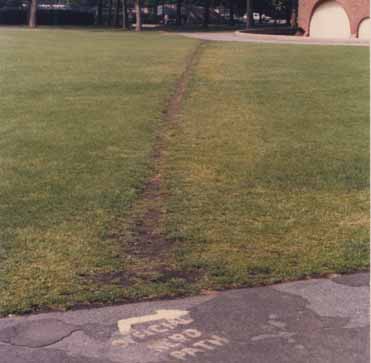 The article taught me a new phrase: "desire lines" -- the worn paths in the grass that indicate where people would like to have a sidewalk. Voting with their feet, as it were. We had one of these that cut across Kresge Oval, saving all of 70' over the alternate route. It was dubbed the "Nerd Path." One spring someone planted it with flowers to force the nerds to take a less efficient route.
Last week in Dallas, the former head of Trammell Crow delivered a scathing speech to his fellow developers, noting the unequal treatment between the city's affluent northside and poorer southside. He noted the much greater amount of government money spent on downtown and northside amenities, and the care taken in the north to mitigate the effects of expressways; the southside was not given the same courtesy:
He contrasted the interstates that bisected and destroyed southern Dallas neighborhoods with the less obtrusive Dallas North Tollway."We're right here in Highland Park. It didn't happen here. It didn't happen in Bluffview where I live. It didn't happen over in Preston Hollow," he said. "People in the southern half of our city did not have the power to stop these kinds of things from happening to their own neighborhoods."...
"You always have to follow the money trail in Dallas," Williams said. "We spend money on the Arts District. We spend money on big name bridges like the Calatrava bridges. We spend money on a two-city-block downtown park."
"Those area all good things, but the truth is we live in a world of limited resources. We are going to have to have a public conversation about how resources get prioritized," he said.
Something similar happened in Tulsa with the expressways -- professional white families were able to block the Riverside Expressway from coming through Maple Ridge; Greenwood, the heart of Tulsa's African-American community, met a different fate.
Finally, this article on Takoma Park, Maryland, is about open data in local government, but note the fact that Takoma Park's city hall is open to the public for activities other than basic governmental functions. Wouldn't it be nice to be on your way to an exercise class at City Hall and accidentally bump into the Director of Public Works on his way to a meeting and to have the chance to buttonhole him about some overdue sewer project?
Time to tame the tabs. Here are a few articles worth your notice:
Natasha Ball has compiled This Land's list of 50 Best Spring Break Things to Do in Oklahoma. For all my years and all my travels, I see plenty of items that I have yet to accomplish and many more that I have yet to share with my kids.
 Something not on her list because it's not in Oklahoma, but worth a visit, and only about 2 hours east of Tulsa: Crystal Bridges Museum of American Art in Bentonville, Arkansas. Beautiful setting in a wooded ravine. Architecture that looks like the lair of a Bond villain. And for the next two months, through May 27, 2013, a wonderful exhibit of the art of Norman Rockwell -- full-sized paintings, many of them covers he did for the Saturday Evening Post.
General admission to the museum is free, sponsored by Walmart. Admission to the Rockwell exhibit is $12 for adults; children 18 and under and museum members are admitted at no charge. There's an audio tour of the Rockwell exhibit at no extra charge -- well worth taking. It's an iPod Touch; you key in the number of the painting you're viewing for narration, sometimes including Norman Rockwell himself, a member of his family, or one of the models for the painting. We were there about a week ago and really enjoyed it. We needed two hours just to see the Rockwell exhibit.
Promoting your hometown for tourism is a tricky business. It may be a nice place to live, but why would anyone want to visit there? The Oklahoma-based blog Small Biz Survival has notes from a talk by Roger Brooks of Destination Development International on how to market a community, listing the common pitfalls of small-town marketing, most of which apply to places like Tulsa, too:
The first fact he mentioned is about how we search when we're looking for somewhere to go. We search on activity first, then location second. So we'll search "mountain biking western Oklahoma" or "sailing southern Ontario." Brooks' examples showed people searching on an activity and then a town name."Have you ever gone anywhere because they 'have something for everyone' or they are the 'gateway to' someplace else?" Brooks asked.
Brooks urged asking these questions:
- What do you have that the people you are hoping to attract can't get or do closer to home?
- What makes you worth a special trip?
- What sets you apart from everyone else?
It's long been a frustration to me that the tourist materials produced for Tulsa by a branch of the Tulsa Regional Chamber focus on Tulsa's sophistication and the kind of amenities you'd expect to find in any large American city. These brochures and booklets might reassure people who are thinking about relocating to Tulsa, but they won't attract visitors from around the country or around the world. On the other hand, Tulsa's truly unique features and history get downplayed. Brooks addresses the psychology that produces a generic and ineffective marketing message, and includes a list of phrases that should be banned from your tourism brochure, including so much to do, center of it all, best kept secret, outdoor recreation, and playground.
Streetsblog looks at why enclosed malls are dying even in small cities, like Effingham, Illinois.
Steve Lackmeyer at The Oklahoman covers what looks like defiance from Oklahoma City's public works department over the implementation of Project 180, the program to make downtown streets safer and easier to navigate for pedestrians, cyclists, and drivers alike.
At the Washington Free Beacon, there's a review of Detroit: An American Autopsy, a combination of investigative reporting and personal narrative on the decline and fall of a once-great metropolis. "An American Autopsy often reads like an old detective novel. There are mustachioed homicide detectives, hit men, con men, grifts and drugs, greed, and corruption."
Next American City reports on a Brookings Institution study of Amtrak ridership: Shorter trips (under 400 miles) have more riders and make more money than long-distance runs.
A few news items of interest, while you wait for me to publish some sort of analysis of last Tuesday's results:
Reuters: Special Report: How a vicious circle of self-interest sank a California city -- long, but a must-read:
Yet on close examination, the city's decades-long journey from prosperous, middle-class community to bankrupt, crime-ridden, foreclosure-blighted basket case is straightforward -- and alarmingly similar to the path traveled by many municipalities around America's largest state. San Bernardino succumbed to a vicious circle of self-interests among city workers, local politicians and state pension overseers.Little by little, over many years, the salaries and retirement benefits of San Bernardino's city workers -- and especially its police and firemen -- grew richer and richer, even as the city lost its major employers and gradually got poorer and poorer.
Unions poured money into city council elections, and the city council poured money into union pay and pensions. The California Public Employees' Retirement System (Calpers), which manages pension plans for San Bernardino and many other cities, encouraged ever-sweeter benefits. Investment bankers sold clever bond deals to pay for them. Meanwhile, state law made it impossible to raise local property taxes and difficult to boost any other kind....
Almost 75 percent of the city's general fund is now spent solely on the police and fire departments, according to a Reuters analysis of city bankruptcy documents - most of that on wages and pension costs.
California Gov. Jerry Brown is bringing in a retired Marine Corps major general to take over the state parks department, filling a vacancy left by financial scandal.
Jackson replaces Ruth Coleman, an economist and lobbyist who led the parks department for a decade. She resigned in July amid revelations that the department had hidden $54 million in two special funds, even as it was planning to close 70 state parks to achieve state budget cuts.Numerous other staff members at parks headquarters were fired or reassigned in the wake of the discovery. About two-thirds of the hidden money remains in limbo and two investigations are ongoing....
Many state parks operate with help from small nonprofit groups. Amid the state budget crisis, many of these groups took on fundraising campaigns to avoid park closures, and some signed contracts to operate parks themselves.
The discovery of hidden funds came as a betrayal.
I've heard stories and perhaps you have, too, that this sort of thing happens routinely in government: Tuck some money away to spend on little luxuries and non-essentials that would never get legislative approval, then go crying to the public that you'll have to cut essential public services unless they give your department more money. I don't have my collection of Jim Boren's books on bureaucracy handy, but I wouldn't be surprised if he gave a name to this phenomenon.
And a general has lost a star for using government resources for personal pleasure:
A report by the Defense Department inspector general found that Ward used military vehicles to shuttle his wife on shopping trips and to a spa and billed the government for a refueling stop overnight in Bermuda, where the couple stayed in a $750 suite. The report detailed lengthy stays at lavish hotels for Ward, his wife and his staff members, and the use of five-vehicle motorcades when he traveled to Washington.
The Summer Olympics are over and host city London goes back to life as usual. What physical and emotional legacy will the 30th Olympiad leave behind?
Photographer Joe Pack and filmmaker Gary Hustwit has been traveling to former Olympic host cities to explore that very question, in preparation for a book to be published in limited edition next year:
The Olympic City project on Facebook
The Olympic City: project homepage
In The Olympic City, we're documenting the successes and failures, the forgotten remnants and ghosts of the Olympic spectacle. Some former Olympic sites are retrofitted and used in ways that belie their grand beginnings; turned into prisons, housing, malls, gyms, churches. Others sit unused for decades and become tragic time capsules, examples of misguided planning and broken promises of the benefits that the Games would bring. We're interested in these disparate ideas -- decay and rebirth -- and how each site seems to have gone one way or the other, either by choice or circumstance. We're equally interested in the lives of the people whose neighborhoods have been transformed by Olympic development.
Articles on the Reason and Atlantic Cities websites have a few photos from the project:
Reason: The Sad Wasteful Afterlife of Olympic Venues
The Atlantic Cities: Sarajevo: Post-Olympic City and Post-War City
The Toronto Star has a related story about the extravagance and waste of Athens' Olympic infrastructure: Why Athens has lived to regret hosting the Olympic Games
The 6,500-capacity table tennis and rhythmic gymnastics hall, which a developer has long planned to turn into a shopping mall, is still closed. The 8,100-capacity taekwondo arena, which officials talked of turning into a convention centre, is rented a few days per year for political conventions, concerts and Disney on Ice. The badminton hall was turned into a theatre -- but a court has ruled the building illegal and ordered it demolished.
Why London Is Yawning Over the Olympics
Have Western countries finally outgrown the sports socialism of the Olympic Games? (emphasis added):
The Olympics are a giant exercise in sports socialism--or crony capitalism, if you prefer--where the profits are privatized and the costs socialized. The games never pay for themselves because they are designed not to. That's because the International Olympic Committee (an opaque "nongovernmental" bureaucracy made up of fat cats from various countries) pockets most of the revenue from sponsorships and media rights (allegedly to promote global sports), requiring the host country to pay the bulk of the costs. Among the very few times the games haven't left a city swimming in red ink was after the 1984 Los Angeles Olympics, when voters, having learned from Montreal's experience, barred the use of public funds, forcing the IOC to use existing facilities and pick up most of the tab for new ones.
The Atlantic Cities: For Montreal, Memories of the Olympics Boondoggle Remain
But the Montreal games also had to contend with financial disaster. Their price tag swelled from an original estimate of about $360 million to $1.6 billion, when the final bill for construction came in. Bonds to finance the overage were only paid off in 2006, three decades after the Olympic torch was extinguished.
You still have to wonder: If the games had gone to Paris instead, is there any reason London still couldn't give itself a new park, a new stadium, and handicap-accessible facilities? If publicly financed "regeneration" is such a great thing, why does it require a sports event to unleash it? Boosters love to call the Olympics an "opportunity"--but how are they an opportunity to do something the government could do anytime?They're an opportunity because they come with their own momentum. A city tapped to host the Olympics is like a nation-state operating under wartime conditions: It has a license to do things that might otherwise be blocked. While the U.K. was still campaigning to host the event, Martin Samuel of the London Times observed that the London Development Agency was dithering on a plan to fully compensate the small businesses that would be displaced by the new facilities. (Such problems eventually led the Marshgate Lane Business Group to formally oppose London's bid for the games.) "Right now," Samuel wrote, "there remains a battle for hearts and minds, but if London wins, the hoopla will begin and the LDA will be able compulsorily to purchase land without respect for local sensibilities." Industrial policy always has winners and losers. The Olympics are an "opportunity" for the victors to claim their winnings.
Back in 1972, the scheduled host state for the 1976 Winter Games decided the expense and the environmental impact wasn't worth it. Colorado voters passed a constitutional amendment prohibiting the expenditure of public funds for the Olympic Games. The games were moved to Innsbruck, which had hosted the games in 1964.
NBC News: The Olympics that weren't: How Colorado won, and lost, the '76 Winter Games
Boulder Daily Camera: Denver said 'no thanks' to 1976 Olympics
Mental Floss: No Thanks: Why Denver Turned Down the 1976 Olympics
Rocky Mountain News: Colorado only state ever to turn down Olympics
UPDATE 2012/04/03: The City of Tulsa Planning Department has issued a "policy analysis" of the Pearl District regulating plan, "a supplemental review of adopted plans of the City intended to provide the Planning Commission with a full understanding of the issues and policies created to address them." Attached at the end of the document is a three-page memo describing concerns raised at the public meetings on the plan and how they can be addressed.
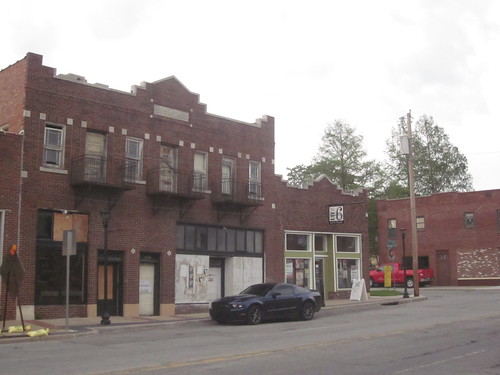
On Wednesday, April 4, 2012, at 1:30 pm in the City Council chambers at City Hall, 2nd & Cincinnati, the Tulsa Metropolitan Area Planning Commission (TMAPC) will hold a public hearing regarding the proposal to expand the Pearl District land-use regulations from its current pilot area to the entire 300 acres of the neighborhood. The Pearl District plan, developed over a 10-year period by area residents and business owners, faces opposition fueled by disinformation from the Build Anything Anywhere (BAA) Bunch, even though it actually expands the development options available to property owners in the district. Supporters of positive, growth-oriented, neighborhood-driven development policy need to email the TMAPC (bhuntsinger@incog.org) and, if possible, show up on Wednesday to support the Pearl District plan.
The proposed land use regulations implement an infill development plan that has been a part of the City's comprehensive plan since 2005, a plan that was the culmination of a grassroots-driven planning process that began in 1991. The proposed area -- bounded by I-244, the east leg of the Inner Dispersal Loop, 11th Street, and Utica Ave. including the lots facing the south side of 11th and the east side of Utica -- is identical to the area covered by the 2005 6th Street Infill Plan. The opponents who claim that this was a complete surprise and hasn't received sufficient scrutiny are, to be blunt, full of manure. Some of those opposing the current proposal noisily protested the infill plan's adoption seven years ago.
For the BAA Bunch, it's not enough to be able to throw up cookie-cutter suburban development on the other 99.75% of Tulsa's land area. They want to impose that same style of development on one of the few pedestrian-oriented neighborhoods in Tulsa that hasn't been wrecked by urban renewal, expressway construction, or institutional hypertrophy.
Contrary to rumor, the proposal grandfathers existing buildings, allows buildings to be rebuilt as-is in the event of a fire or other disaster, allows for some expansion of an existing building without requiring conformance to the new code, and was developed in public with the involvement of homeowners, developers, business owners, and other community leaders from around the neighborhood.
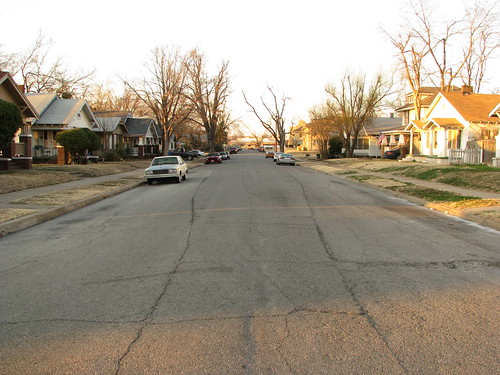
Although our regional peer cities -- Oklahoma City, Dallas, Fort Worth, Austin, Wichita, San Antonio, Kansas City, Little Rock, Denver, among many others -- have had form-based requirements in their zoning codes for decades, Tulsa's BAA bunch bleat like sheep at the slaughterhouse any time the most modest design guidelines are suggested. This is merely the latest example of their obstructionism.
Meanwhile, planning staff at INCOG seem as if they're trying to sabotage the plan. The backup material connected to Wednesday's agenda consists of two illegible maps and a few letters of protest from people who don't appear to have read the proposal. There is no "request for action," no legal document defining exactly what is proposed to be adopted, no explanatory material of any kind. Although the City of Tulsa pays INCOG handsomely to analyze zoning proposals and make recommendations in accordance with the City's comprehensive plan, INCOG has not made public any analysis or recommendations on this proposal. If INCOG development staff were willing, they could, as part of their analysis, dispel the inaccurate rumors about the effects of the proposal.
While the lack of complete online posting is not technically a violation of Oklahoma's Open Meetings law, it certainly violates the spirit of the law. Wednesday's hearing should be continued or postponed until all relevant material has been posted online for at least two weeks.
(It's overdue for Tulsa to fire INCOG as its land-use planning agency. The city would continue to work with INCOG on transportation planning and dialogue with other city, county, and tribal governments in the region, while bringing land-use planning in-house. Wayne Alberty's impending retirement as head of INCOG's development services department would be an excellent time to make the move. We could save INCOG the trouble of hiring a replacement.)
Approving the Pearl District regulatory plan for the entire district is an important step in fulfilling the promises made by city leaders to area residents and business owners for more than two decades, beginning with the 11th Street Corridor Task Force in the early '90s, the Oaklawn redevelopment committee in the late '90s, the 6th Street (Pearl District) Task Force in the 2000s, the 6th Street Plan approved in 2005, and Tulsa's new comprehensive plan (PLANiTULSA) approved in 2010.
The existing use-based land use regulations date back to the '70s and '80s, a typical post-World-War-Two zoning code focused on new development on undeveloped suburban land. Neighborhoods like the Pearl District, which developed just after World War One, were treated almost as an afterthought in the zoning code and comprehensive plan, a dumping ground for whatever activities weren't desired in the nice new parts of the city. It didn't occur to planners of the period that some people might prefer to live, work, and play in a neighborhood convenient to downtown that was built around people rather than cars.
The subdivisions that make up the Pearl District were platted by 1915, and were fully developed by the early '20s. From the beginning there were industrial uses along the MK&T mainline (including a cotton mill and a glass factory) and mixed in with residences and commercial uses. Three streetcar lines served the neighborhood -- a Tulsa Street Railway branch on 1st street, another on 5th Place (Fostoria), turning onto Quincy Ave., and an Oklahoma Union Traction branch along 11th Street. Route 66's original alignment traveled 2nd Street through the neighborhood from 1926 to 1932; US 66 was rerouted to 11th St. in 1932. Broadcaster Paul Harvey grew up in the neighborhood on 5th Place, attending Longfellow School, which was once located on the northwest corner of 6th and Peoria.
The neighborhood was still regarded as a pleasant place to live in the late 1970s, according to newspaper accounts quoting Pearl District leader Dave Strader, who moved into the neighborhood circa 1979. But in the last half of the '80s, prostitution, drug use, and gang activity moved into the area.
A determined group of local residents and business owners were persistent in getting the city to take action to clean up the area, facing death threats from the criminals who were abusing their neighborhood. An 11th Street Corridor Task Force was created in 1991, resulting in a plan that was adopted by the city in 1993. A TIF district was established, and some of the increased property tax revenues generated by The Home Depot became available for implementing the 11th Street Corridor plan.
One of the plan's recommendations involved redeveloping Oaklawn, a small subdivision wedged between Central (now Centennial) Park and Oaklawn Cemetery. In 1999, the Tulsa Development Authority issued a Request for Proposals and formed a task force to evaluate and recommend one proposal for adoption. I served on the task force along with Strader, Paul Wilson of Twenty-First Properties, Dwain Midget from the Mayor's office, and City Councilor Anna Falling, among others. The Village Builders, a team led by developer Jamie Jamieson, was the unanimous selection. Unlike some of the proposals, the Village at Central Park proposal was designed to connect with and encourage improvements in the surrounding area. In the decade since, the area has seen a new Family and Children's Services building, refurbishment of an existing building into a boutique hotel, a facelift for the VFW in the old armory building, the reopening of the historic Church Studios, with many more projects currently in the works.
(One of the unsuccessful proposals came from a leading detractor of the current Pearl District plan. He wanted to build a gated community walled off from the surrounding neighborhood.)
Jamieson immediately joined forces with the Central Park Neighborhood Association. They succeeded in becoming one of three target areas for pilot small-area infill plans as recommended by the 1998-9 Infill Task Force. The new 6th Street Task Force began meeting on a monthly basis sometime around 1999 or 2000. The group eventually adopted the name "Pearl District," inspired by the original name of Peoria Avenue in the area.
One of the challenges faced by the Pearl District group was stormwater control. The Elm Creek basin was the last watershed in the city where no stormwater improvements had been made, and the potential for flooding was a deterrent to redevelopment. The stormwater plan in place would have obliterated Centennial Park to create a giant, treeless detention pond. The Pearl District task force proposed and won acceptance of an alternate plan, with a smaller, landscaped pond in Centennial Park, a new recreation center, and two additional small ponds in other parts of the district. The result is one of the city's most beautiful vistas, looking west across the Centennial Park pond to the downtown skyline.
The 6th Street task force report was issued and adopted by the City in 2005, covering the exact same area now covered by the proposed form-based land use code.
The Pearl District was originally developed under land use regulations that were much less stringent than those currently in force. The new Pearl District form-based code would restore a great deal of flexibility for landowners, while preserving its pedestrian-friendly character, and repairing the urban fabric where it's been compromised by the careless planning decisions of the past. Under the new Pearl District code, you can use more of your land area for your building, because there are smaller, more reasonable requirements for parking, landscaping, and setbacks. You have more options for what uses are allowed on your property, without needing to seek special permission from the city.
Under the current zoning code, any new development in this district requires some combination of rezoning, special exceptions, and zoning variances. It adds expense and uncertainty, hindering redevelopment. The proposed new land-use code is clear and specific, and its aim is to reduce drastically the need to spend money on lawyers and paperwork to move forward with a new development.
If you want to support efforts to revitalize a key inner city neighborhood, one that links downtown, Cherry Street, and the TU campus, if you want the City of Tulsa to keep its promise to a group of long-suffering property owners who have been working on this for two decades, please email (bhuntsinger@incog.org) or attend in person to show your support for the Pearl District plan.

MORE:
The Pearl District Association website.
The 6th Street Task Force Infill Plan, adopted as part of the City's comprehensive plan in 2005. There is a very informative and comprehensive section on the history of the Pearl District's development and the history of the city's revitalization plans and efforts.
My UTW column from November 2007 on teardowns and infill development, in which I mention that the Pearl District was seeking to become a pilot area for a form-based land-use code. That's almost five years ago.
My UTW column from February 2009 on the Pearl District's creative approach to stormwater mitigation, related links, and then-UTW reporter Mike Easterling's July 2011 story on the same topic.
From 2006, a modest suggestion that the private foundation wanting to spend $100 million of its own money (plus $600 million from taxpayers) to build a pedestrian-friendly district on new islands in the Arkansas River could instead implement the Pearl District plan and revive a pedestrian-friendly district for a fraction of the cost.
My very first UTW column in September 2005 dealt with the the need to have at least one truly walkable neighborhood in Tulsa for the sake of Tulsans with disabilities. Although I didn't mention the Pearl District by name, it's a prime location for a walkable neighborhood to serve disabled Tulsans by virtue of being near the Ailene Murdock Villa and the Center for Individuals with Physical Challenges.
Duane Lester, the All-American Blogger, links to an article in Der Spiegel about a photographer, Stefan Koppelkamm, who toured former East Germany in 1990 and 1991, shortly after the fall of the Berlin Wall, and returned a dozen years later, re-photographing the buildings he captured twenty years ago. These buildings had survived World War II and more than 40 years of Communist urban renewal, and they looked as if nothing had been done to repair or renovate them since the war. The photo gallery is stunning. Within 10 years after the end of Communist rule and reunification of the West, private owners had turned ruins into beautifully restored, useful buildings.
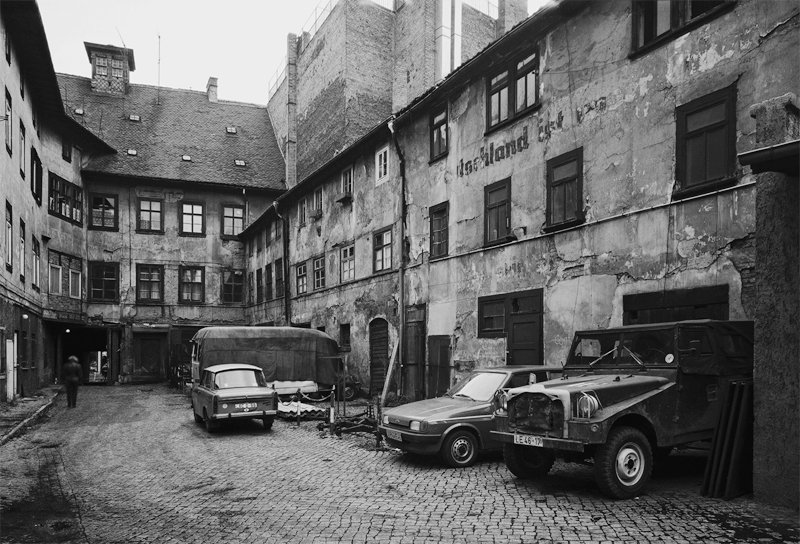
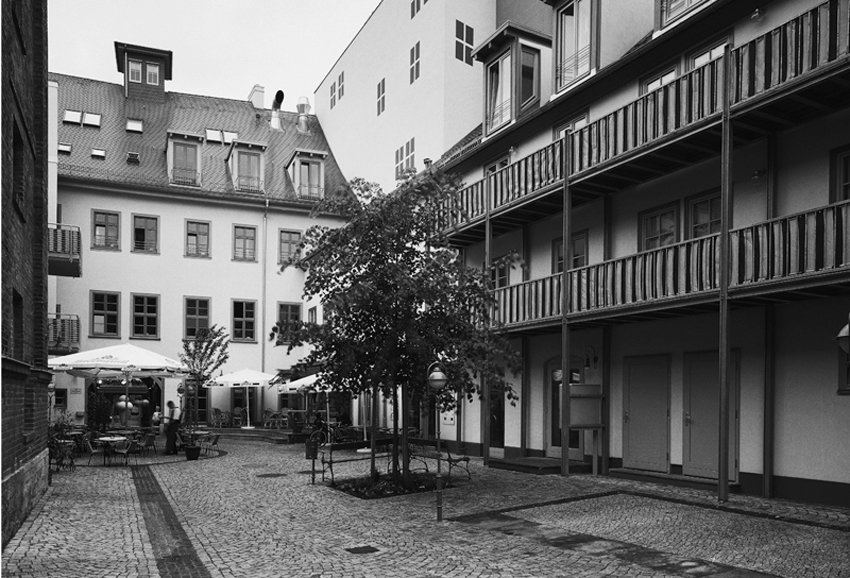
Duane Lester is right to say that these photos "tell an economic story leftists either can't comprehend or simply refuse to believe." 45 years of Communism did little to restore East Germany's cities. The economic incentives weren't there: Rent control kept a building owner's income too low to fund renovations. From Der Spiegel's story:
Neither housing associations nor private owners had the money to renovate the older buildings. From the end of the war onwards the government had fixed rents in the GDR and in practical terms they remained constant -- at between 0.40 and 1.20 East German Marks per square meter. On average the estimated cost of restoring an old building in East Berlin was 75,000 Marks, the equivalent of 80 years' rent for a GDR citizen. Many owners preferred to pass their dilapidated buildings onto the state to avoid the cost of the repairs. But the state wasn't in a position to save the buildings either.
Within 10 years, private capitalists had done what a Communist government couldn't do in over 40 years.
The photographer lamented that the renovations had spoiled many of the buildings. For example, a massive former stables in Zittau with exposed exterior masonry had been renovated, including plastering and painting the exterior. Perhaps the result was less romantic than a dilapidated building, but it's surely closer to the original condition of the building when it was being carefully maintained. In Germany, they plaster over brick and stone and whitewash or paint it.
It gave me a sense of hope that came to mind again as I took a walk downtown last night. and looked up to see the Tulsa Club at 5th and Cincinnati, a lovely Art Deco building, but long-abandoned with broken windows, tattooed with graffiti and smoke. I thought of the old Temple Israel synagogue building at 14th and Cheyenne, just a burned out shell. If these dilapidated East German buildings could be restored and returned to profitable use, surely Tulsa's abandoned historic buildings can be restored, too.
Julie R. Neidlinger has written a moving account of her final farewell to the Patisserie on Fourth, a bakery in downtown Bismarck, North Dakota, where she worked as a baker for a couple of years. The Patisserie on Fourth closed permanently on Tuesday.
As she helped the owner clear out the store, Julie remembered the good and the bad of working there:
I think of my co-workers and feel sad. Elizabeth, and the funny moments with her. Kristin, who was quick to laugh at my stupid jokes. Courtney's delicious Italian wedding soup. Nathan's spotless sink. The jokes, the Disney music and crazy dancing when no one was around. The dough pets and bagel fights and my imitation of a shrieking monkey. We had some fun sometimes.She locks the door as the man walks away, and we return to packing and cleaning.
I think of the angry emails, the cruel comments, and the critiques people left online, and I wonder what place these last two years will have in my life once I put in some distance from them.
We are almost finished.
I think of the regular customers I grew to enjoy -- Beverly, Connie, David, Peter, Emily, the Raspberry Scone guy, the Molasses Cookie Guy, the Roast Beef Provolone Guy, Mr. Coffee and Caramel Roll, and Quiche Grandma -- so many, and so many more. I realize how I will miss those regulars who were so kind and so patient with three very tired and very broke workers who didn't always come with their game face.
In May 2009, a local TV station ran a story about the Patisserie adding a lunch menu to its breads and desserts, in response to popular demand:
But then, another downtown business pointed out that the area could use another place with a lunch menu, and they decided."Yeah, we can throw some sandwiches together, one thing led to another and then we have a full lunch menu," Dockendorf says.
Nearly every day of the week, a line forms in front of the counter.
"Usually whoever comes in for pastries end up with lunch, and those who come in for lunch get dessert," says Dockendorf....
The owners say both the lunches and the pastries have been wildly successful, and the whole business has been a lot of fun.
The owners say they plan to rearrange the dining area so it can seat more customers and hope to be able to expand, add more display shelves, and have more room to work.
Small businesses have high failure rates. You can make an excellent product, build a supportive clientele, and it still may not be enough. You may not be able to make a living at it.
For all the chamber of commerce focus on convention centers and arenas, it's a place like the Patisserie that can sell outsiders on the value of a city.
Recently I attended a presentation by a couple of urban planners from out of town. A short while after the presentation ended, I bumped into them again at the Coffee House on Cherry Street. They said they had discovered the Coffee House on a previous visit to Tulsa and regard it as their office away from home. Their affection for CHoCS was apparent, and it wouldn't surprise me if, when they tell people about Tulsa, they mention that "there's this wonderful coffee house...," just as I mention my favorite coffee houses when I talk about my work visits to Wichita a couple of years ago.
Someone visits a city for the first time and finds a cozy place for coffee and dessert --particularly one right next to a historic neighborhood like Swan Lake -- and suddenly they see the whole city in a positive light. They could imagine living there and liking it, knowing that there's a place with great coffee and food where they could hang out with neighbors and friends. If banks and lawyers and assorted Chamber of Commerce big shots would use locally-owned cafes instead of chains to cater their meetings and lunches and events, it would help boost the city's uniqueness and appeal to newcomers.
The next time you start to order sandwiches from McAllisters or coffee for the office from Starbucks or a birthday cake from Sam's Club, stop and ask yourself: Can I help a great locally owned business stay in business by giving them my business today?
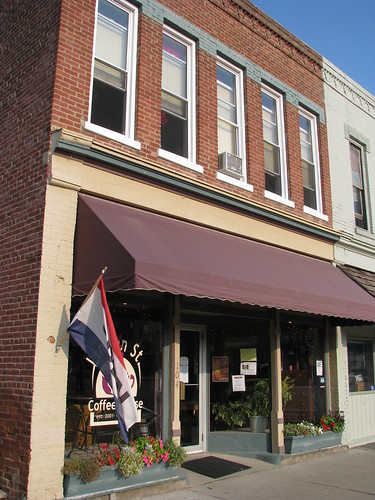
Above: Linden Street Coffeehouse, Lamoni, Iowa, a great place for breakfast, coffee, and wifi that left me with a great impression of the town.
As a point of comparison, Tulsa Transit bus service doesn't run evenings (except for a few special night lines), and typical headways are 30 minutes or longer between buses.
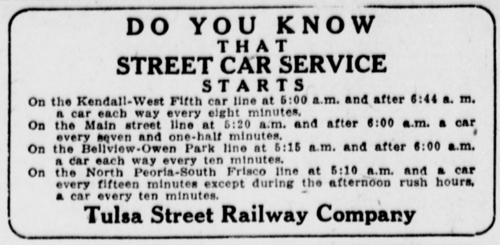
DO YOU KNOW
THAT
STREET CAR SERVICE
STARTSOn the Kendall-West Fifth car line at 5:00 a.m. and after 6:44 a. m. a car each way every eight minutes.
On the Main street line at 5:20 a.m. and after 6:00 a.m. every seven and one-half minutes.
On the Bellview-Owen Park line at 5:15 a.m. and after 6:00 a.m. a car each way every 10 minutes.
On the North Peoria-South Frisco line at 5:10 a.m. and a car every fifteen minutes except during the afternoon rush hours, a car every ten minutes.
Tulsa Street Railway Company
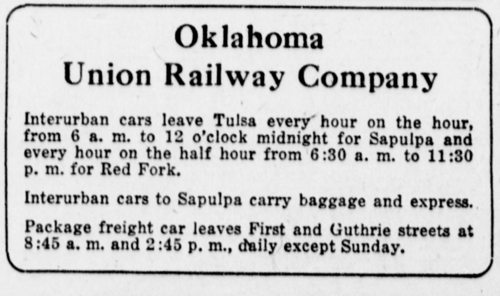
Oklahoma
Union Railway CompanyInterurban cars leave Tulsa every hour on the hour from 6 a. m. to 12 o'clock midnight for Sapulpa and every hour on the half hour from 6:30 a. m. to 11:30 p. m. for Red Fork.
Interurban cars to Sapulpa carry baggage and express.
Package freight car leaves First and Guthrie streets 8:45 a. m. and 2:45 p. m., daily except Sunday.
(From p. 12, Monday, May 15, 1922, Tulsa Daily World, Weekly Business Review, a weekly page of small ads from local businesses, ads for two of Tulsa's three streetcar companies, the strictly local Tulsa Street Railway and the interurban Oklahoma Union Railway, which connected Tulsa, West Tulsa, Red Fork, and Sapulpa, as well as providing local service in Tulsa and Sapulpa. The third company, Charles Page's Sand Springs Railway, connected downtown Sand Springs with Archer Street in downtown Tulsa. A half-page ad in the Sunday, October 16, 1921, Tulsa Daily World, says that the TSR runs from 6 a.m. to 11 p.m.)
One of the pleasures of reading the New York Press online, back when it was one of the earliest alt-weeklies on the web, was William Bryk's weekly historical column, "Old Smoke." Bryk later wrote a column for the too-short-lived New York Sun. Each week Bryk took the reader on a fascinating journey into some obscure piece of New York history with a present-day connection.
Bryk's columns, at least selected pieces from 1998 to 2003, are now back online at a new website, City of Smoke. A few examples to whet your appetite:
Judge Crater: "The Missingest Man in New York." I can remember when Judge Crater was right up there with Amelia Earhart as a synonym for "missing person." (He got shoved aside by Jimmy Hoffa.)
The Brooklyn Dodgers: "Dem Brooklyn Bums Go West." The story behind the Dodgers' departure for Los Angeles, a rare defeat for Robert Moses, the uncrowned king of New York.
Dr. John R. Brinkley: "The Unsubtle Knife." Brinkley, a promoter of quack surgery, promoted his businesses with his million-watt border radio station XER, just across the Rio Grande from Del Rio, Texas.
Alas, perhaps my favorite edition of Old Smoke, from 2002, is not yet on the new site, although it is still available on the New York Press website: The story of early Oklahoma defense lawyer Moman Pruiett, the subject of a book titled He Made It Safe to Murder. (The New York connection? A revival of Oklahoma! was opening on Broadway that week.)
MORE: If you enjoy Bryk's writing on New York City history, you're sure to enjoy Kevin Walsh's Forgotten New York, which documents with words and photos physical remnants of the New York of the past throughout the Five Boroughs and beyond. His most recent essay is a tour of Calvary Cemetery in Queens.
UPDATED 2014/05/04 with changed New York Press URL.
 If you look in the AP Stylebook to find out whether to capitalize city manager*, you find his name as the example, the paradigm: "City Manager Francis McGrath." When people ask me what I think about Tulsa changing to a council-manager form of government, I think of Francis McGrath.
For 34 years, from 1951 to 1985, Francis McGrath served as the city manager of Worcester, Mass., the Bay State's second largest city. At the time of his retirement, he was the longest-serving city manager in America. When Worcester converted to a council-city manager form of government in 1950 (approved by voters in 1947), McGrath, a school principal, was hired as assistant to the first city manager, Everett Merrill, and then was promoted to city manager the following year after Merrill his planned short-term stint to launch the city's new form of government.
In the spring of 1983, at the end of my sophomore year, I found a short term job to help pay the bills. It involved a research project for MIT's Urban Studies Department, surveying municipal government officials about the impact of Proposition 2½, a 1982 referendum that limited the ability of a city or town to raise property taxes without a vote of the people. After a training run to New Bedford with a professor and another student, I was on my own to contact and interview officials in the City of Worcester and the Town of Amesbury.
The final interview of the day in Worcester was with McGrath. I don't remember what we discussed, but I remember him sitting behind a massive and ornate desk. What I saw confirmed what I'd heard: This was (or at least had been) the seat of power in Worcester city government. McGrath was no mere administrative functionary. That said, by 1983, he was feeble, in his mid-70s, and just two years from retirement.
What follows is a collection of quotes about McGrath's career, which were hard to find.
John B. Anderson: Who Was This Francis J. McGrath?: An appreciation of the City Manager upon his retirement in 1985, from "In Honor and In Celebration". This quote stood out: "Turmoil showed in the council as well, as turnover was substantial in the elections of 1973 and 1975, working to the advantage of the manager."
After Worcester's voters approved a change to a new municipal charter, Plan E with council manager government, in 1947, the major task facing the council elected in the city elections of 1949 was to select a manager for the city. The council, chaired by Mayor Andrew B. Holmstrom, was aware of the importance of their choice, yet they were alert also to the need to act with some speed. Government had to be in place at the beginning of 1950. They turned to a local businessman, Everett F. Merrill, as the fIrst city manager. Merrill, head of a local steel company, in turn, needed to organize an executive administration. As his chief assistant he picked Francis J. McGrath, who, when Merrill resigned early in 1951, would be elected to succeed him.Who was this Francis J. McGrath?
He was, like many of his contemporaries, a veteran of World War II, in which he served in the Navy, rising to the rank of Lieutenant Commander in charge of naval radio stations in the Caribbean. He had returned from the war to his position as a school principal, moving from Union Hill School to Elizabeth Street School.
McGrath had been an educator since the early 1930's, teaching at Bartlett High School in Webster before joining the Worcester system in 1939. In that same year he had married Mary Wickham. Teaching was not a surprising career for Francis McGrath: his three sisters were all teachers and his father had been a custodian at North High School. Indeed, looking at Francis McGrath growing up on Blanche Street on Vernon Hill, one sees a man being shaped by values of family and faith and heritage. He grew up in an Irish-American family in which the idea and often the ideal of public service was a major stimulus.
In a family such as his, Francis McGrath followed the traditional road, first to Saint John's High School, then on Temple Street, not far from the foot of Vernon Hill and then on to Holy Cross from which he graduated in 1930. As Francis McGrath walked from home to high school and later to college, it is likely that he thought of the world in fairly conventional terms: be faithful, work hard, respect public service, guard your integrity. With a Master's Degree from Boston College in hand, he started his career.
Clearly, though, something more was at work. There was ambition: the move from Webster to Worcester, the appointment to principalships and the rise in rank in the Navy show that. In the thirties, Francis McGrath had done more than teach. He had been an announcer at the Mechanics Hall wrestling matches. After the war, he directed the city's Summer recreation program in 1946 and 1947, and, far more important, he was coordinator of the city's Centennial celebration in 1948. That was a golden year-the sadness of the world war behind people, the economy reviving and consumer goods in adequate supply, the darkness of the Cold War and the bloodshed of the Korean War still to be felt. Worcester could celebrate its hundred years as a city with enthusiasm and excitement. Francis McGrath later estimated that the centennial sponsored 126 events. Their success and the success of the Centennial celebration drew attention to this forty-year-old Worcesterite. Interestingly, among the vice chairmen of the centennial were Everett Merrill, the future City Manager and two men, Ralph Duffy and James D. O'Brien, who would be members of the first Plan E council. Emile Rousseau who would also serve on the fIrst Plan E Council was the director of the Centennial's Industrial Exposition. Two more members of the future council were on other centennial committees.
The centennial's success and what must have been McGrath's organizational skills apparently recommended him to Merrill as Merrill assumed office in January 1950. On leave from the School Department, McGrath turned his energies to establishing the new administration.
As he had promised when selected, Merrill stayed on as manager for a little more than a year; on March 20, 1951 he submitted his resignation to be effective on April 15, 1951. In his letter of resignation, Merrill wrote, "Especially do I commend the seemingly untiring work of my executive assistant, Mr. Francis J. McGrath, who has had a large part in whatever success has attended my administration." He went on to express his "gratitude" for McGrath's "loyalty and friendship."
McGrath must have been pleased at Merrill's commendation as he prepared his candidacy to succeed him. McGrath, of course, was not alone in seeking the manager's job. Applicants from across the country submitted letters, were subject to private investigator inquiries, and were interviewed by the council. With Merrill's support, McGrath had an inside track and soon the newspapers were reporting that despite the calls of the League of Women Voters and the Citizens Plan E Association to move slowly, that Councillors Burrows, Duffy, O'Brien, Rousseau and Mayor Holmstrom were leaning toward his selection.
In his interview with the Council, McGrath offered as references a number of prominent local businessmen, naval officers and Merrill. The Council seemed unimpressed with the nonWorcester applicants, and despite some final pressures to consider others, the Council voted to elect McGrath manager in a decision which one councillor said answered the question "why let it drag on?"
Following an executive session, the council voted unanimously in public session to name Francis McGrath as Worcester's second city manager. He was sworn in on April 24, 1951, beginning one of the longest tenures of any chief executive of an American city; by the time he left office on February 1, 1985, Francis McGrath had served nearly thirty-four years.
The Worcester McGrath came to manage in 1951 was bustling. Its population reached an all time high in the 1950 federal census (203,000), its industries were strong, sharing in the post war boom, its role as a retail center was unchallenged. Yet Worcester, like its region and the nation, was on the edge of significant change. Population would shift to the suburbs, old industries would die and the car would transform the shopping habits of all Americans. When McGrath retired, Worcester had changed: it had fewer people, its economic base was in services and its retail role had diminished.
But, before the changes, there were extraordinary demands to be met. The depression and war had left a legacy of needs: schools for a growing population, services better tailored to the community's needs, facilities for municipal services. Later, as change was apparent, there came the need to rebuild and revitalize the city, the goal of reversing decline.
The 1950's saw major work on the city's school plant which would ultimately lead to the construction of 24 new schools and additions to nine others. Beyond that, the record of public facility construction was extraordinary: seven new fire stations, including a new headquarters, a new police headquarters, a new main library, 3,000 units of elderly and public housing, parking garages and parking lots, three major redevelopment projects, and the Centrum. There was little that this builder's hand did not touch.
Construction was only one side of Francis McGrath's work for Worcester. In his second winter in office, he introduced the winter parking ban to aid in snow plowing. In 1953, the city's police department was reorganized, adapting it to the needs of a highly mobile society. Later, other city departments would be reorganized as well.
Change and action of the magnitude under way in Worcester during the McGrath years could not occur without a base of public support, and Francis McGrath knew this. His relations with the council were secure until the mid 1970's, and he had a deft hand in dealing with the public at large. As astute a politician as any of his contemporaries, McGrath understood the need for public support of his actions. In the 1950's he participated in a series of little town meetings to deal with neighborhood issues and for almost his entire term as manager he broadcast a radio program, Meet Your City Manager, which gave him an opportunity to talk directly to the public. He accepted invitations to all kinds of events, he answered thousands of letters, never relying on form answers, and his door was open to one and all. Until the revaluation controversy led to harassing phone calls, his home phone number was listed in the Worcester directory.
Court ordered revaluation in the early 1970's posed one of McGrath's most difficult challenges. For years Worcester, and other Massachusetts cities, had allowed valuations to depart from the market value of property, generally very much to the benefit of home owners. Owners of businesses and newer homes found themselves at a disadvantage and following a law suit which concluded that Worcester's assessments violated the state constitution, the city was ordered to revalue property; the process was long and slow. The city manager found himself bearing the brunt of council and citizen complaints, asserting that there was an effort to "make the manager the scapegoat for revaluation." For the first time he was subject to a motion of confidence, winning it 8 to 1, although not without some suggestion that the road was not so easy as it had been before. Turmoil showed in the council as well, as turnover was substantial in the elections of 1973 and 1975, working to the advantage of the manager.
The building of the Centrum made life difficult for the manager in the late 1970's. Like the revaluation issue, McGrath saw himself taking blame unfairly, but also, like revaluation, the completion of the project eased tensions for the manager. By 1984 he was willing to contemplate retirement, announcing in June of that year that he would retire by year's end. In fact, of course, that date was extended a month to the end of January 1985.
Although there was talk from time to time of Francis McGrath going to another city as its manager, the only serious possibility of his leaving the position seems to have been in the mid 1960's when he considered the position of Superintendent of Schools. In the end he stayed with the job he loved so much. One of his few excursions outside of city affairs came when he served as head of Governor John Volpe's effort to secure a sales tax, but here he probably saw himself serving his city as much as his state. Worcester could not have had a more loyal son.
When news of Francis McGrath's retirement became known, there was an outpouring of praise of his tenure: "exceptional," "far sighted," and "outstanding" were the typical adjectives used by civic leaders to describe him. A survey commissioned by the Charter Commission, which had been elected in 1983, concluded "few municipal officials would be disappointed by the impressive favorability ratings garnered by McGrath at the conclusion of such a long term of service." Sixtyfour percent of the survey respondents had characterized McGrath's work as good or excellent.
As the retirement day neared, McGrath announced, lest there be any doubt, that he would remain, "a strong executive until the day I walk out the door." No doubt that was one of the reasons for his success: a firm hand eager to remain at the helm. But there were other reasons.
Francis McGrath remained true to himself; he had been elected to do a job and he had done it. The virtues he learned as a child and a young man remained with him: hard work, loyalty, devotion, faith in God. He had begun his career as manager asking for God's help and he ended it saying "God's been good to me." He advised his successor that he would need "a lot of prayers, a lot of tolerance, a lot of understanding and a good sense of humor." These were the things which had kept Francis McGrath going and successful. There was a commonplace quality to concepts like integrity and cooperation, but as Worcester learned they were not commonplace in Francis McGrath; this mixture of values and personality produced an extraordinary figure, a man whose mark on the city has no equal.
The Albert B. Southwick, Worcester Telegram & Gazette, 2010: McGrath paved the way
In 1950, Worcester was just starting a new chapter in city affairs: Plan E government. It replaced the old system that had been in place for more than 50 years. In that era, partisan politics ruled the day. The mayor, the board of aldermen and the City Council were all elected as Republicans or Democrats. Although Worcester was probably not any worse off than most cities at the time, City Hall, under either Republican or Democrat mayors, was shot through with politics and log rolling. Rumors of corruption were widespread.The Plan E movement was part of a reform wave that swept the nation, especially after World War II. Nonpartisan council-manager governments were installed in hundreds of towns and cities across the land. In Worcester, the campaign was led by a group of academics allied with local business interests, including this newspaper....
Mr. McGrath, former principal of Elizabeth Street School, was not the first choice for the new post of city manager. Business interests settled on Everett Merrill. But Mr. Merrill was diagnosed with cancer in late 1950 and had to bow out. Mr. McGrath was his assistant. His chief accomplishment had been in 1948, when he supervised the celebration of Worcester's centennial as a city. He seemed to know something about administration. He was a political unknown and had no enemies. The City Council selected him, probably expecting a short tenure.
Within a few years, he was running the city as it had never been run before. He became politically impregnable. The old pols didn't like it and mounted two referendum campaigns in 1959 and 1967 to get rid of Plan E and change the charter back to a "strong mayor" system. But those drives were seen as attacks on Mr. McGrath and his popularity guaranteed that both would fail. ...
The council-manager system stipulates that the City Council sets policies that the manager carries out. Mr. McGrath followed that to the letter. He never openly intruded his own ideas into council discussions. But after the first few years there was no doubt as to who was calling the shots at City Hall. He became one of the most powerful city managers in the country and the most dominant chief executive that Worcester has ever had.
Yet it never went to his head. He never, as far as I remember, ever held a grudge, even against those pols who hated Plan E and everything about it. He was a crackerjack administrator and also a keen student of local politics. He understood Worcester and its people better than anyone else ever did. In fact, he enjoyed politics mightily and played it to the hilt, always being careful not to overstep the Plan E rules. He went to an endless number of funerals, wakes, local organization meetings and neighborhood gatherings.
He was noted for his skill in preparing and manipulating city budgets. In years when funds were short, the city sometimes seemed to be headed for financial disaster when, in the nick of time, Mr. McGrath always somehow discovered extra funds just sufficient to cover the gap....
In my opinion, the most important part of the McGrath legacy was his integrity. He became noted across the state for his incorruptibility. Politicians in Boston marveled at each new example of Mr. McGrath's refusal to play the old patronage wheeling-and-dealing games. That made a huge difference here in Worcester, especially as his tenure stretched from years to decades. In the '20s and '30s, this city suffered years of political logrolling and downright corruption. Under Mr. McGrath, that gradually ended. The horse parlors on Front Street, the City Hall link to Shrewsbury Street racketeers, the dubious public works contracts all faded away. Worcester gradually got used to the idea that honesty at City Hall was the norm and would be in the future.
Whither Worcester? (Commonwealth Magazine, Fall 2004
If and when Worcester converts its municipal government from city manager to "strong mayor" rule--a change some hope will take place as early as next year--it will be easy to pinpoint the moment when the move got its start. It was March 16, the day the Worcester City Council unceremoniously dumped City Manager Thomas Hoover, who had served in his post since 1994. Earlier in the day, Hoover received a letter signed by eight of the 11 city councilors demanding his resignation. At the weekly council meeting that evening, Hoover gave it to them. A few weeks later, a group calling itself Voters in Charge launched a petition drive, demanding for a change from manager to mayor. "Worcester needs a leader, especially now," declared Marianne Bergenholtz, chair of Voters in Charge, in a May 25 announcement. "And our history of the past 20 years shows that managers manage, they don't lead."It was not the first time the city's legislative body had fired its CEO. If anything, the dismissal of Hoover's predecessor, William "Jeff" Mulford, was more dramatic and bitter, the climax of years of quarreling between the manager and the council. And it was not the first time city manager government has been called into question. Worcester has long been obsessed with its method of municipal organization, with all manner of civic complaints--about representation, leadership, accountability, and especially economic development--channeled into one question: Mayor or manager?...
A switch to strong-mayor governance is something that Worcester has considered on three other occasions over the 55-year history of city-manager government--known here as Plan E, after the alphabetized options for city government allowed under state statute. But now, a shrinking business tax base and a longing for a kind of entrepreneurial leadership that has been lacking under the Plan E system have the conversation about charter change once again picking up steam, with even some longtime defenders of professional--i.e., nonpolitical--city management now giving up the ghost.
But questions remain: Does Worcester really need a strong mayor? Or does the city need a strong leader? And if it's the latter, will changing the form of government make any difference?...
Plan E was supposed to take party politics out of City Hall.
In 1947, the Republican power structure joined forces with academic and good-government reformers--including the heads of Clark University, Worcester Polytechnic Institute, and the T&G--to push for a new form of municipal government, one that had been added to the options available under state law in 1938. Plan E consisted of an elected city council (nine members, all of whom would be elected at large) and an appointed city manager, who would actually run municipal operations. That November, Worcester voters approved the binding ballot question by a vote of 42,000 to 22,000--a margin of nearly two to one....
McGrath was not well known at the time (the backing of Merrill was crucial to his selection), but he would become a legendary figure in Worcester politics, serving for 34 years, the longest tenure of a city manager in US history. While Plan E was supposed to remove party politics from City Hall, McGrath was anything but apolitical. "The number of wakes and weddings he attended must have numbered in the thousands," Southwick wrote about McGrath in a T&G column last year. "Local celebrations and large public events alike usually found him on hand. Wherever he went, he was greeted by name by persons of all walks of life, as the saying used to go. He was scrupulously honest and, for all his prominence, unassuming. It never went to his head."...
For supporters of Plan E, McGrath proved the virtue of council-manager government, but that didn't mean the system went unchallenged during the McGrath reign. In 1959, voters rejected a binding ballot question to dump Plan E by a margin of just 4,000 votes--35,000 to 31,000. Three years later, a similar proposal for mayoral rule went down to defeat by a 12,000-vote margin--42,000 to 30,000. Each time, the proposed shift drew ferocious opposition from the nonpartisan Citizens Plan E Association, a good-government group that defended the council-manager system for a quarter-century.
It was when McGrath retired that Plan E began to unravel in Worcester, though it has not done so completely. Back in the early '80s, Worcester Fair Share, a citizen-action group, held public forums to highlight the fact that the vast majority of the members of the city council, the school committee, and other city boards and commissions lived on the city's affluent West Side. Fair Share's political-education campaign led the city council to appoint a charter commission.
In 1985, the charter commission produced a compromise that seemed inherently unstable: keep a "strong" city manager but allow voters to directly elect the mayor--a post that, as simply chairman of the city council, was previously little more than ceremonial. To become mayor, a candidate would have to win office as a city councilor, then in a separate mayoral tally, outpoll any other city councilors who also declared themselves candidates for mayor. The voters approved the binding ballot question--which also called for 11 city councilors, five to be elected from districts rather than at large--by a nearly two-to-one margin that November.
The two-headed government often leads to gridlock.
In a sense, Worcester's hybrid form of government is the weakest possible "weak mayor" system, since the mayor has no true authority beyond wielding the gavel at the Tuesday night council meetings, but it also weakened the city manager. The mayor is actually a "super-councilor," empowered by voter mandate as the titular head of Worcester municipal government. The appointed city manager has the legal power, but the elected mayor has the political power. The result is a two-headed government, with ample--and frequently realized--opportunity for confrontation and gridlock....
By 1999, in fact, the governmental meltdown that was occurring under the hybrid Plan E--Worcester is the only city in the Commonwealth with such an arrangement, as Cambridge and Lowell maintain traditional council-manager governments--led to yet another push for a switch to a "strong" mayor with the power to run city government. This time, the campaign was driven by not only much of the city's political establishment--with the assistance of University of Massachusetts pollster and veteran political consultant Lou DiNatale--but also some prominent business leaders, including John Nelson, former chief executive of Norton Co. and Wyman-Gordon Co. Nelson was the kind of establishment figure that used to make up the Citizens Plan E Committee, which disbanded about 25 years ago. But run by power brokers more used to operating behind the scenes than in the spotlight, this campaign for strong-mayor government was over before it started....
Oddly enough, Condron traces the decline of city-manager government to the days of Francis McGrath. "He kept ceding power to the council to be able to continue in his role," Condron observes. "As the council developed that power, they didn't want to give it up--and they haven't given it up." The result, he says, is gridlock.
"There should be only one [steering] wheel on a bus, and then somebody drives the bus," says Condron. "Here we have 12 drivers, including the [city] manager, with 12 different agendas." Because of that, Condron notes, City Hall stumbles over its own feet when it comes to new commercial/industrial business and development. Businesses and developers looking to invest in Worcester "find it difficult because of that multi-headed monster," he says....
Even for some who are now longing for a mayoral strongman, the ideal municipal leader seems to be more an empowered city manager than a glad-handing pol from the neighborhoods. City Manager Mike O'Brien, says industrialist Morgan, "is off to a great start, and maybe he could be your mayor." Condron says much the same thing about the new city manager. "I think he's a great, energetic young person who would make a terrific strong mayor of the city," says Condron. "And I felt Tom Hoover would have made a great strong mayor of the city."
Or is it really Francis McGrath they're all pining for?
"Some people claimed he really was the mayor," recalls Demitrios Moschos, a Worcester attorney who served as McGrath's right-hand man from 1968 to 1980. "He envisioned his role in a political context--not as an administrator and not in simply seeing that things were accomplished, but also in developing support for things to be accomplished."
In Worcester political lore, a "rabbit" is a sum of money unexpectedly liberated from the deep recesses of the city's financial basement. The deep recesses are where they store what is called the "hat."The magician who pulls the rabbit from the hat is known as the "city manager." Each time it happens, City Hall veterans tell their stories about the master magician, Francis J. McGrath, who served as city manager for more than 30 years.
This generation of rabbit aficionados has its opportunity in the wake of City Manager Michael V. O'Brien's announcement that there will, after all, be no need to raise property taxes to cover the last $1.9 million in the city's spending plans for fiscal 2008.
The city manager does not like this rabbit language, because it suggests that he has been less than candid with the councilors, holding back on information that would, when it is released, redound to the credit of the manager. Some councilors don't like it either, because it gives the impression that they got snookered. So, without using the "r" word, I would like to offer a critical examination of the sudden resolution of the city's budget problems. I begin with a Sept. 25 observation by the T&G's City Hall reporter and columnist Nick Kotsopoulos: "Unless some new revenues make their way to the city coffers in the next few months, the council may end up having to find a way to balance this year's municipal budget, which is almost $2 million out of whack."
Wormtown Taxi on foresight and politicians
There's an interesting article in today's T&G that's a followup to the annual town - gown noise that's made on College Hill. This noise occurs every autumn at City Hall.Today's article, though, brushes up against what I consider to be the funniest part of any town - gown relations, ie- the vast abyss between those who run the city and those who run the colleges. One key difference is that those who run the city typically can't see much further than the next election cycle. Usually, they can't see much beyond next week's meeting agenda.
Those who run the colleges, on the other hand, look at how their policies and plans will work over the course of years, decades, lifetimes, and beyond.
I mean, even someone who lasted as long as former City Manager Francis J. McGrath won't be thinking on a time scale that can successfully subsume an entire neighborhood.
Heh... if politicians could see that far ahead... well, then they wouldn't be politicians, now, would they?
Update(8:45am): But then again, there's always the immediacy of the moment.
Bob Achorn: Worcester Telegram & Gazette, April 22, 1989:
For more than 30 years, Francis J. McGrath was city manager here, and a powerful one. From the beginning, McGrath was shrewd enough to build a strong political base. He knew great numbers of Worcester people. He seldom missed a wake. He went to every ceremony and was normally called on to speak - sometimes when the "ceremonial" mayor sat silent and steaming in the front row. At his best, and for many years, McGrath was on top of every city issue, including those in the School Department where his writ supposedly did not run. He did a great job, and the public knew.Unfortunately, that upset a number of ambitious councilors. They were determined that McGrath's successor, Mulford, would not build the same kind of political strength. Essentially, he must stick to his knitting, and not try to be all things to all people.
Stephen Maher, InCity Times, October 8, 2008: Francis J. McGrath versus the Worcester mafia:
In 1949 the council compromised and picked Everett F. Merrill, "..a popular local businessman. He had a genial personality, had many friends all over Worcester and committed himself to clean, businesslike government but would not guaranty to stay on the job very long."Merrill in 1950 issued a general order to clean up illegal gambling. Nothing happened. Under pressure from the Telegram, taxpayer groups and honest politicians like Sweeney, Merrill "loudly and publicly ordered the police to crack down. They did. The horse parlors were shut. That part of the illegal operations was torpedoed, or at least further driven underground."
"Merrill was a broad-brush type, not one to fret over City Hall trivia," says Achorn. "He hired Francis J. McGrath as his assistant and detail man. Fifteen months later, McGrath took over and served 35 years as city manager. To the end, he was privately proud of his endless efforts to keep the city government out of the clutches of the mob."
[Newspaper Publisher Robert] Achorn's 1999 memoir is an extraordinary historical document. The picture of McGrath as a bulwark against the Mafia goes a long way towards explaining an enduring mystery of Worcester politics: why the Worcester Telegram gave such strong support to both McGrath and Plan E. Stoddard's support of Plan E was so vehement that in 1959 the Citizens for Plan E Association (CEA) President "told a National Municipal League Conference at Springfield, Mass. that the one-sided support of the Telegram and Gazette had helped crystallize opposition to CEA. This statement of course disturbed Stoddard."
But McGrath's vision pleased Stoddard: a streamlined city government that invested heavily in infrastructure. During McGrath's 33 years in office Worcester built 42 new schools, including an entire secondary school system. McGrath was able to do this because of Stoddard's strong editorial backing. As Binstock noted: "[W]hen the city manager [McGrath] commits himself to a project, the press is usually behind him solidly."
McGrath understood the newspaper's power. "It would be tough if they did hammer me," he admitted.McGrath treated the Telegram as another political constituency, perhaps his most valuable one. Like an old-fashioned Irish ward boss visiting a neighborhood saloon, McGrath would saunter across the street from City Hall to the Worcester Telegram editorial offices, where he would regale the staff with jokes both raunchy and ethnic.
If Stoddard got a City Manager uninfluenced by the Mafia and dedicated to improving Worcester's infrastructure, the Irish politicians got from McGrath city jobs for their relatives and campaign workers. As the McGrath era progressed, two power elites evolved in Worcester. One consisted of White Anglo Saxon Protestants who controlled the newspapers, most banks, and industries. The second were Irish Catholic politicians, who controlled city government and the city's labor movement. But if McGrath is remembered today, it is primarily for the longevity of his 33-year reign.
McGrath died on November 14, 1993, at the age of 85. For library subscribers, here is his obituary in the Worcester Telegram and Gazette.
This post was created on September 30, 2011, but languished in draft limbo until May 12, 2021. I suspect I was waiting for an opportunity to tidy it up and add a photo. As it's not timely, I'm leaving it dated as originally drafted. An observation to conclude: Cities with a council-city manager form of government seem either to treat the city manager as a scapegoat, cycling through city managers once every two or three years, or else the city manager becomes dominant and entrenched, using his position to make councilors who support him look good and to embarrass those who oppose him.
Tulsa Metropolitan Area Planning Commission chairman Bill Leighty has an excellent op-ed in the latest issue of Urban Tulsa Weekly about the importance of historical preservation to Tulsa's future.
I'm tempted to quote the whole thing. The heart of the article is an account of a recent Preservation Leadership Training workshop put on by the City of Tulsa Planning Department.
In a nutshell, the training included an examination of the financial incentives and other economic considerations in redeveloping historic structures. It also explored how historic preservation as an intervention strategy and policy impacts local economic development. Participants followed the progress of prototype projects and applied this knowledge to demonstration projects located here in Tulsa.
In the course of the article, Leighty addresses the lack of support for historic preservation from Tulsa's political and business leaders and the personal impact of then-and-now photos of downtown Tulsa:
At one point in the slide show, a photo taken in mid 1970's looking north on Boston Avenue from high up in the tower of Boston Avenue United Methodist Church was featured. When it transitioned into the next photo, taken from exactly the same perspective about 35 to 40 years later, the entire audience let out a collective gasp at the dramatically changed landscape.The first photo documented a vibrant, densely populated urban core that had been reduced to a barren sea of asphalt only a few decades later. The loss of so many historic structures obviously stunned everyone, even the locals. It was a pretty dramatic moment for everyone and it left me with a lump in my throat. I can honestly say it was a turning point for me. I get it now, I so get it.
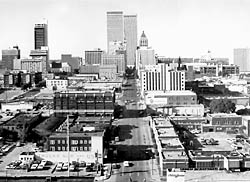
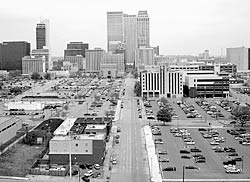
Photos of Tulsa's Boston Avenue, looking north toward the BOK Tower, in 1978 (left) and 2005 (right); from the Tulsa Preservation Commission's article about endangered downtown Tulsa.
Leighty goes on to catalog the documented economic and quality-of-life benefits of historic preservation, including the value of old buildings to new businesses:
The creative and adaptive reuse of historic buildings has proven to be remarkably versatile in meeting the demands of a wide range of uses. These buildings often provide affordable rent, thereby serving as incubators for entrepreneurs and growing small businesses which account for 85 percent of all the new jobs created in America. Properly executed historic preservation efforts are great examples of the physical sustainability of the built environment, and the functional sustainability of public infrastructure.
The fun, interesting places to be in Tulsa on a weekend night -- Brookside, Blue Dome, Bob Wills District, 18th & Boston, Cherry Street -- are all significant clusters of older buildings that were overlooked by urban renewal and spared from expressway construction. Blue Dome and the Bob Wills District owe a great deal to people like David Sharp, who started buying up buildings to keep them from being torn down for parking. These thriving districts were not developed with public funds.
Leighty points out that, while there are Tulsans actively engaged in adaptive reuse of historic buildings and advocacy for historic preservation, we need elected officials and business leaders to "buy into and support these initiatives" in order for historic preservation to gain traction.
When you look at successful historic preservation in other cities, you will find their efforts began with a group of influential people (often the wives of business tycoons) who were outraged by the demolition of a local landmark. San Antonio and Savannah are two such examples.
Here in Tulsa, business leaders have actively opposed historic preservation and tarred preservation advocates as naysayers enemies of growth, working to keep them off of the City Council, TMAPC, Board of Adjustment, even the Tulsa Preservation Commission.
The tide may be beginning to turn. It was encouraging to see a positive mention of preservation in the Tulsa Metro Chamber's 2011 city election manifesto:
While preservation of Tulsa's historic neighborhoods and structures is paramount, this also requires a transition from residence-only neighborhoods to multi-purpose building that intentionally preserves the character of the area.The Tulsa Metro Chamber is willing to work toward a model of shared use which accommodates both the need for safe neighborhoods and the preservation of historic areas; while also providing its residents with retail possibilities, increasing walkability, and creating distinct centers of urban density.
The second half of Leighty's essay covers the demonstration project his team undertook as part of the workshop -- taking an underutilized building, examining possibilities for adaptive reuse, and proposing an economically feasible approach to reuse. His team of three proposed an indoor farmer's market for the old International Harvester Building on the southeast corner of 2nd and Frankfort:
The building is rather unassuming with minimum architectural details. I had driven by many times without so much as a second look. That changed the minute I walked into the building, which is basically divided into two sections, the former showroom in the front and the warehouse like space which formerly housed the service and parts department in the back. There are concrete floors, a barrel roof supported by intricate steel joists and super structure, and broad open expanses with skylights....Our proposal includes financial projections indicating both relatively low total development costs and a healthy cash flow. In other words, it is not just a sound idea for a great addition to downtown Tulsa, but a very viable business opportunity.
As I said, read the whole thing, and say a prayer of thanks that a man of Bill Leighty's insight heads up our city's planning commission.
I emailed FOP political consultant Victor Ajlouny and requested a copy of the FOP's press releases on their poll and their endorsements. The eight-page Tulsa FOP poll release featured a question about the impact that an endorsement from the Tulsa Metro Chamber's political action committee (TulsaBizPac) would have on a voter's decision -- would it make a voter inclined to support or oppose a candidate, or have no impact?
| Support |
5% |
| Oppose |
51% |
| No impact |
38% |
| Unsure/refused |
6% |
The poll by Strategy Research Institute was of 500 high or moderate propensity Tulsa voters, distributed across the city (at least 50 from each council district). No word on the partisan breakdown. A sample of 500 yields a margin of error of 4.4% at a 95% confidence level.
As a reminder, here are the endorsements and contributions announced a week ago by the Tulsa Metro Chamber's PAC, TulsaBizPac:
Endorsement in both primary/general elections and financial support
Jack Henderson (D), District 1 ($2,500)
David Patrick (D), District 3 ($2,500)
Phil Lakin (R), District 8 ($2,500)
G.T. Bynum (R), District 9 ($2,500)Endorsement and contribution primary only
Jeannie Cue (R), District 2 ($2,500)
Ken Brune (D), District ($1,000)
Tom Mansur (R), District 7 ($2,500)Financial support ONLY
Blake Ewing (R), District 4 ($1,000)
Liz Hunt (R), District 4 ($1,000)
Chris Trail (R), District 5 ($2,500)
Karen Gilbert (R), District 5 ($2,500
Byron "Skip" Steele (R), District 6 ($2,500)
The full text of the FOP poll question about the Chamber PAC:
Question 14.0 Similar to what took place earlier this year in Oklahoma City's Chamber of Commerce...the newly created Tulsa Metro Chamber of Commerce, Political Action Committee, has built a HUGE War Chest intended to influence, indeed CONTROL, the outcome of the 2011 election cycle in Tulsa. Part of this effort involves the Chamber's Political Action Committee donating large sums of money to candidates, as well as funding their own campaigns in support of, or opposing, candidates of choice through independent expenditures. Would learning this through a trusted source make you inclined to: Support a candidate who is endorsed by the Tulsa Chamber of Commerce and/or who accepted large amounts of funding from the Chamber's Political Action Committee, or; Oppose a candidate who is endorsed by the Tulsa Chamber of Commerce and/or who accepted large amounts of funding from the Chamber's Political Action Committee, or; Would this knowledge have NO IMPACT on your decision to SUPPORT or OPPOSE?
While this might be considered a "push poll" question, it demonstrates how voters will respond if the issue is framed for them in this way, using an accurate description of what happened earlier this year in the Oklahoma City elections and the apparent similarity of the Tulsa Metro Chamber's involvement in the Tulsa city elections. This is very bad news for the Tulsa Metro Chamber's future as a preferred vendor to the City of Tulsa and for the political future of the candidates their PAC endorsed or funded (an endorsement in all but name).
It's noteworthy that the story in the Tulsa World covering this poll did not report this result. They also omitted the results that showed 62% preferring four year council terms (staggered to every two years) to the current 3, 74% preferring 12-year term limits for all city officials, and 70% giving Mayor Dewey Bartlett Jr mediocre to failing grade. (32% gave him a mediocre C, 23% a D, and 15% an F; 2% refused to answer the question. 6% gave him an A, 22% a B.)
To see all eight poll results that the FOP released to the media, click this link (354 KB PDF file).
A year or so ago, the blog "How to Be a Retronaut" posted a movie short from 1959 about London's coffeehouse scene. The film was part of the "Look at Life" series of short documentaries screened in British theaters between 1959 and 1968.
This amusing eight-minute color film depicts the rise of the coffeehouse fad in the 1950s (traced to the arrival of the first Italian espresso machine in London in 1952), the varieties of coffeehouse, and the challenges faced by coffeehouse owners. Many themes will be familiar to modern day coffeehouse owners and patrons -- customers that hang around all day and buy only a single cup of coffee (if that), the need to offer food to make enough money to keep the place open, the use of coffeehouse walls as gallery space for local artists, the coffeehouse as a place for serendipitous meetings.
Lesson 1: Overheads are high. They reckon that if a character sits for half an hour over one cup of coffee, his share of the rent heat light and service amount to the point where the management is paying him.
The most noticeable differences between then and now: The absence of laptops and the presence of vast, billowy clouds of cigarette smoke.
MORE:
In a separate entry, How to Be a Retronaut posted stills of the London coffeehouses featured in the film.
Tulsans know Whitey Bulger as the man allegedly behind the 1981 murder of Roger Wheeler at Southern Hills Country Club. In the traditional Irish neighborhood of South Boston, the Bulger family is well known, but Whitey's reputation is not as black-and-white. Whitey's younger brother Billy Bulger (dubbed the Corrupt Midget by columnist Howie Carr) served many years as the President of the Massachusetts Senate and, after retiring from the legislature, as President of the University of Massachusetts. Check out this fascinating Boston Globe video report getting reactions to Whitey Bulger's arrest from his erstwhile neighbors.
"He was a mobstah, but so what? Everybody's got a occupation.... He nevah bothahed me 'n' my family, so...."
MORE: Howie Carr interviewed by Boston TV about Whitey's capture and Carr's column on Whitey's capture, in which he connects the dots between Whitey's successful (allegedly) criminal career and the government officials who enabled him (including his brother, who, according to Carr, got him a no show government job and used connections to help Whitey become an FBI informant). Howie Carr has written a book on the Boston underworld, called Boston Hitman, and the book's website has a catalog of key figures -- Whitey's associates, protectors, victims, and rivals.
If you're on the home page, click the link to see the video:
Here's an idea that's been on my mind for a while, and it's time to begin to flesh it out. As you read, keep in mind that this is a first draft. Your thoughts are welcome.
This insight seems obvious to me, so obvious that I searched to find the place where I must have read it, but I've never found it. I wrote about it at length in a UTW column in the aftermath of the December 2007 ice storm, which I had titled "The Amish Are Laughing at Us."
So I am going to stake my claim to this insight and give it a label:
Any useful technology passes through three phases:
luxury, convenience, necessity.
It begins as a "can't have," but ultimately becomes a "can't live without."
The transition from luxury to convenience happens when the cost of the technology declines and the availability increases to allow it to be in general use.
During the convenience phase, the superseded technology is still available as a fallback. When the fallback disappears, we enter the necessity phase. We are completely dependent on the new technology.
The convenience phase is the sweet spot -- we have the technology, we can use it, but we can live without it (albeit not as well), because we still have the fallback. But we are pushed inexorably to the necessity phase.
In the necessity phase, we have reorganized our lives around the assumption that the technology will continue to exist, at the same cost or cheaper.
A fallback technology disappears when the cost of maintaining it exceeds the benefit.
Eventually, the knowledge to recreate the fallback becomes rare, limited to a handful of old-timers and the occasional retro-tech enthusiast.
By "superseded technology," I don't necessarily mean a device, but a combination of tools or devices and ways of using them.
Think about how you'd live your life if you suddenly had to do it without your own car. Or had to manage without motorized vehicles at all. Tulsa, like most younger cities, grew around the persistent availability of cheap personal transport.
Think about your home's comfort in the event of a lengthy power outage. If it's a newer home, it probably wasn't built to take advantage of passing breezes for ventilation, and the fireplace, if you have one, was designed for looks, not for keeping the place warm.
Another short example: Think about a trip to a large amusement park in the 1970s or earlier, with your family or, say, a church youth group. At some point in the day, the group you're with breaks up to do different things. Miraculously you're all back together at the end of the day for the drive home. We managed that without cell phones, and yet as I remember trips like that, it's hard to remember the methods we used to make it work. Or how we managed to convoy multiple cars over a long road trip without anything more than turn signals and hand signals to communicate.
A longer example: The library card catalog. For years, this was the means for maintaining an index of the library's ever-changing collections. The technology had significant limitations: It was available only in one place, adding, sorting, and deleting was error prone and subject to tampering. But it provided a way to maintain a complete, ordered listing without retyping the whole thing every time you added or removed a book.
When electronic library catalog systems came along, they were expensive and ran on expensive computers. Big libraries with big budgets could afford them, so it was still important for an aspiring librarian to know how to manage a card catalog. Even in libraries with an electronic catalog, a card catalog would have been maintained in parallel for a few years as a backup and to serve customers uncomfortable with the green glowing letters on the black screen of a dumb terminal.
Eventually the cost of hardware and software came down enough so that nearly every library could afford an electronic catalog. Patrons, used to working with computers at home, had no problem using a computer at the library to locate a book. Almost no one used the card catalog, and it wasn't worth the time of a librarian to type and sort cards in order to maintain it. The huge cases of tiny drawers went away, and the cards became scratch paper on which to jot down call numbers from the computer screen.
Ink, paper, and drawers aren't obsolete, but the application of these items as a card catalog is. And all is well, as long as the power stays on and nothing happens to the computer. If there's no power, there's no longer a backup. You could have an enormous library full of books to read, undiminished in their ability to entertain and enlighten by the lack of electricity, but you'd have no way to find the book you want. An older librarian might be able to point you to the general vicinity based on the subject and the likely Dewey Decimal number. Or you could just browse.
MORE: An excerpt from Eric Brende's 2004 book, Better Off: Flipping the Switch on Technology, with an anecdote about the confusion at a fast-food drive-through window when the cash register doesn't work. Brende, with a degree from Yale and a master's from MIT, now lives a low-tech life with his family in St. Louis, working as a rickshaw driver and soapmaker, inspired by his interaction with the Amish.
UPDATE 2023/08/16:
An industrial/strategic example of the problem: Precision machining and weapons manufacture in Russia, from Kamil Galeev:
- Complex weapons such as the WMD/delivery systems include precise parts
- Production of precise parts relies on subtractive processes
- Which had overwhelmingly relied on the manual control even in 1991
- But have been radically computerized since then
- As the production of precise parts switched from the manual to computer control, the labor capable of producing precise parts (-> weaponry) manually was lost
- The tactic knowledge has been lost, too
- Which cements transition and makes it absolutely and 100% irreversible...
He goes on to say that Russia's dependence on precision machining equipment from the West and on parts to keep the machines they currently have going makes them vulnerable to western sanctions targeting the Russian machine tool industry -- no new machines, no replacement parts, no software and hardware maintenance support. You can read the entire Twitter thread here.
Steve Lackmeyer of The Oklahoman reports that an Oklahoma City citizens' committee (featuring heavy hitters like Larry Nichols of Devon Energy and immediate past Mayor Kirk Humphreys) has recommended a site other than Mayor Mick Cornett's preferred site for the new convention center, funded by the MAPS 3 sales tax. It appears that the original cost analysis, favoring Cornett's preferred site just south of the Arena Formerly Known as Ford, was badly skewed by using "cost premium" factors and by ignoring the $30 million cost of relocating an electric substation.
- The MAPS 3 Program Manager was caught out on several claims that the City Council had instructed him to reallocate money from the $280 million convention center budget to pay for substation relocation and to prioritize completion of the core-to-shore park; no such votes were ever taken.
- I wonder whether there is any connection between the Momentum attempt to stack the council and this dispute over the convention center and core-to-shore development. (Core-to-shore involves redevelopment of the area between the current I-40 alignment on the southern edge of downtown and the North Canadian River.)
- When Tulsans suggested alternatives to the BOK Center location after the Vision 2025 vote, Mayor Bill LaFortune said it was set in stone. In Oklahoma City, not only has there been a public debate about the best location for the new convention center, the big shots are not afraid to disagree publicly with one another.
- Not only are locations not set in stone, but Kirk Humphreys is urging that the need for the proposed regional park for the Core-to-Shore area be revisited, in light of changing conditions downtown since the plan was drawn up five years ago.
MORE: Nick Roberts doesn't like the decision:
Too weary to go into all of the reasons why this is a horrible site, for OKC that is, I mean it's great for the conventions... well actually, first we're going to have a big vacant lot between the two parks for ten years until we break ground on the CC. Unless they get to move the site up, in which case, we won't get as much mileage of streetcar track because of this decision. Or something else would be impacted.There might be some interesting solutions that can alleviate the negative convention center impact we're about to add downtown. I'm more interested in pursuing that public debate than attempting to oppose yet another high-profile decision that was already made mostly behind closed doors.
I've got a long post in progress about my visit last Saturday to the Delaware Republican Convention, but I'm not close to done yet. So here is a smattering of links to tide you over. (You'll find more links on the BatesLine Twitter stream).
Jane Jacobs: Libertarian Outsider, by Jeff Riggenbach of the Mises Institute (via @MarketUrbanism) -- a good overview of Jacobs life, education, and career.
Now that she had mastered her new beat, she was reassigned to a different and more challenging one: the city-planning beat. As always before, she set systematically about the business of educating herself. What were the goals of city planners, she asked herself. How did they attempt to achieve these goals? How successful had their attempts been in the past? If they had failed, why had they failed?To get a handle on these questions, she began walking around Manhattan and riding around it on her bicycle. She observed. She asked herself how the city worked, what kept it orderly, what made it a place people could live happily, benefiting from the neighborhoods in which they lived.
The conclusions she reached, as I have indicated, were remarkably similar to those Ludwig von Mises and Friedrich Hayek had reached earlier by different routes. A city is, at base, a marketplace. It is a spontaneous order. It cannot be planned. The people who try to plan cities have failed above all because they have not comprehended the way the spontaneous order of cities works.
Todd Seavey's book selections of the month last December included The Battle for Gotham by Roberta Brandes Gratz. Faithful BatesLine readers may recognize the name. I've often cited Gratz's idea of "Urban Husbandry" as an alternative approach to city revitalization that actually works. (Gratz writes in the intro to The Battle for Gotham: "'Urban Husbandry' was the term I coined... to describe a regeneration approach that reinvigorates and builds on assets already in place, adding to instead of replacing long-evolving strengths.")
Seavey saw Gratz at a panel discussion (emphasis added):
Given that, as Brandes Gratz made clear, Moses displaced some 1 million people from their homes in the name of his brutal and car-obsessed urban projects throughout New York City, it was reassuring that both panelists -- and nearly all the audience members -- seemed as though they have come to regard Moses as a monster. Brandes Gratz noted that she's pleased to have some conservative and libertarian fans, but even on the socialist left, Moses' callous destruction of functioning black neighborhoods -- and the brazenly racist way he did things like place a frieze of frolicking monkeys on one of his Harlem projects -- should raise questions about letting any one man run roughshod over the life patterns and social networks of so many people so needlessly (Brandes Gratz herself sees her work as a sort of sequel to the Moses bio The Power Broker, showing how many businesses and homes that had no Jane Jacobs to speak up for them were crushed under Moses' bulldozers, sometimes by the deceitful means of leaving existing businesses out of planners' stats, the more easily to declare areas blighted, as still goes on in places like the Brooklyn Naval Yards and the condemned areas adjacent to Columbia, tragic legacies of Moses-style thinking).
It makes me wonder whether the myth that Tulsa's Greenwood district never recovered from the 1921 Race Riot was deliberately fostered as a pretext for clearing the area permanently in the late 1960s as part of the Federal "Model Cities" urban renewal program. I wonder, too, whether the studies relating to that program provided an accurate count of business activity in Greenwood.
Note, too: New York City has its "condemned areas adjacent to Columbia [University]," as Tulsa has its Kendall-Whittier, where the city used the public power of eminent domain (or the threat of using it) to clear land for the expansion of a private university.
I look forward to reading Brandes Gratz's latest book.
Finally this: World's Ten Creepiest Abandoned Cities via Linkiest.
A fascinating conference/workshop on technology and government is returning to Oklahoma City for its second annual edition in just over a week: Gov 2.0a.
Gov 2.0 stands for Government 2.0, the application of increased connectivity and new technologies to better help government achieve its goals by being transparent, participatory and collaborative. The benefits of this approach include increased efficiency, improved services, greater accessibility of public services, as well as more accountability.
The Friday program includes speakers to talk about progress in other states, but it also features many Oklahoma leaders: State Rep. Jason Murphey, Oklahoma County Commissioner Brian Maughan, Governor Mary Fallin, Joey Senat of Freedom of Information Oklahoma, urban blogger/activist Sid Burgess, John Butler of Oklahoma Crisis Mapping (also pastor of Beal Heights PCA in Lawton and an early Oklahoma blogger and podcaster). Oklahoma Crisis Mapping is responsible for @okicemap, which combines official government information and crowd-sourced news to depict the extend of ice damage and closures across the state.
Two all-day workshops are scheduled for Saturday: City Camp and Mash-IT-up Camp:
City Camp is an unconference focused on innovation for municipal governments and community organizations. As an unconference, content for City Camp is not programmed for a passive audience. Instead, content is created and organized by participants and coordinated by facilitators. Participants are expected to play active roles in sessions. This provides an excellent format for creative, open exchange geared toward action....Mash-IT-up Camp is a day long event for software developers, web designers, and online entrepreneurs. The event begins with a half day of short talks that cover various APIs for using online services and accessing online datasets. After a lunch, the second half of the day is allocated to teams of developers working together to 'Mash up' APIs to create new interesting applications. The goal of this event is to by the end of the day have deployed a handful of innovative Gov 2.0 application prototypes....
I'm supposed to go to the Oklahoma Republican Convention that day, but this is awfully tempting, particularly Mash-IT-up.
Registration for the conference and networking receptions is $99. A pass that includes the Friday banquet is $149. The two camps are free, but advance registration is required. Higher last-minute fees go into effect after Saturday, April 30, 2011.
I'm going to be on a blogger panel in a couple of hours, at an American Majority training session for citizen activists. I have several points to communicate about the role blogging can play in local activism; this recent post by my blogpal Tania Gail about the Philadelphia city elections illustrates several of them.
She attended a Tea Party-sponsored forum for Republican candidates for mayor and at-large city council. She took video with her iPhone and posted a couple of excerpts, but she also provided a text summary of the event, along with some context for understanding why these elections matter and why the GOP is in such bad shape in Philadelphia.
If you're going to a candidate forum or a board meeting of a municipal authority, why not take some video and share it with those who couldn't be there? If you're smart about the use of descriptive text, tags, titles, labels, and categories, your blog entry can help those using a search engine to learn about a specific candidate or election.
(I was interested to learn how their partisan at-large system works. Parties nominate up to five candidates; the top seven vote-getters in the general election are seated, except that a maximum of five seats can go to any party. That system would seem to benefit the mushiest, go-along-to-get-along Republicans and hurt those who would challenge business as usual. The best hope for reformers would be to ensure that all five GOP nominees for the at-large council seats are, as Tania puts it, pitbulls.)
The new issue of the Oklahoma Gazette covers the recently concluded Oklahoma City city council elections, in which candidates backed by a shadowy special interest group won all but one contested race.
The story notes (as was speculated on BatesLine last month) that Majority Designs, the same campaign team that produced the mailers for Dewey Bartlett Jr's campaign for Mayor of Tulsa in 2009, produced the campaign materials for the Committee for OKC Momentum. Majority Designs is an affiliate of AH Strategies, Karl Ahlgren and Fount Holland. Here are four of the Bartlett Jr mailers I received during the general election campaign, connecting Democrat nominee Tom Adelson to national liberals, tagging Adelson as soft on child molesters, making questionable use of a couple of Disney characters to call Adelson a liar, and a piece listing endorsements from Tom Coburn, Jim Inhofe, and John Sullivan.



So many people have a blog nowadays that you may stumble across a friend's blog before they let you know that they have one. Here are a few blogs of friends and associates that I've come across recently. They're worth reading, and I'm adding to the blogroll, so you'll see their latest posts show up over on the BatesLine blogroll headlines page and (as appropriate) the BatesLine Oklahoma headlines and BatesLine Tulsa headlines pages.
I've gotten to know Tulsa visionary and restaurateur Blake Ewing through his involvement in organizations like TulsaNow. He doesn't post on his blog often, but when he does post it's usually a blockbuster essay on our city's challenges and possible futures. There's been a lot of talk about his latest: "Grow up, Tulsa." (I disagree with him on a few points and may elaborate in coming days.)
English with Rae is a blog aimed at helping those learning English as a second language go beyond "This is a pen," providing examples of conversational English and American culture in context and presented in a way that makes them interesting even if English is your first language. Rae, a college friend of my wife's, spent many years in Japan and writes from her experience as a second-language learner of Japanese and with Japanese learners of English. A news item about a Honolulu restaurant adding a tip to the bills of non-English speaking guests is the starting point for her most visited article, Tipping Cows and Everyone Else, which covers three different kinds of tipping (restaurant, cow, and advice), introduces customary tipping practices, and provides examples of the Present Real Conditional form, all neatly interwoven.
Gina Conroy is an author based here in Tulsa. We know her through school, and she was my daughter's creative writing teacher. Her blog, Defying Gravity, is devoted to striking the balance in life as a wife and mom and in pursuit of her dream of novel writing. She is under contract to contribute a novella to an anthology, and a recent entry is devoted to the process and pain of cutting a 50,000-word work in progress down to 20,000. She often interviews other writing moms and dads. Many recent entries have been devoted to dreams and ambitions -- rekindling them, thwarting dream-killers, and balancing your dreams.
Urban Garden Goddess is a Philadelphia-based blogger just getting into home organic gardening. As a rookie gardener last year, Tania (a friend through blogging circles) won third prize in the individual vegetable garden category in the Philadelphia Horticultural Society's City Gardens Contest. She's also a runner, and a recent entry is about "solid eating for a solid race performance."
San Francisco architect Christine Boles and I were both active in Campus Crusade for Christ at MIT back when. Her blog illustrates some of the creative solutions she and her husband, partners in Beausoleil Architects, have devised to meet the needs of clients while respecting history and the environment. Her latest entry shows how they turned a ground floor room into a garage while preserving the bay window that makes up the historic facade. In an earlier post, she advocates for "deconstruction" and recycling of building materials over demolition and landfill. This was interesting, too: The importance of the oft-overlooked V in HVAC -- ventilation.
Texas State Representative David Simpson (R-Longview) is married to a high school classmate of mine. Last year he defeated an incumbent Republican in the primary and went on to election in November. His blog has only a few entries, but they provide some insight into the 2011 Texas legislative session and the budding conflict between fair-dealer and wheeler-dealer Republicans. He is an author of HB 1937, which would prohibit TSA groping in the absence of probable cause. His article -- Dividing the Apple -- about the tough budget decisions facing the legislature, is worth reading. An excerpt:
Civil government has nothing except that which it takes from We the People. Unlike God, the government cannot create value or substance out of nothing.When the Federal Reserve with Congress' approval "prints more money," it simply increases the number of federal reserve notes ("dollars") that are being exchanged in our economy for goods and services. The increase in the number of federal reserve notes in circulation does not represent more wealth. It merely divides the same value of goods and services in the economy into smaller parts. If you divide an apple into 4 parts or 8 parts, it is still just one apple.
The Texas legislature cannot create wealth either. It has no money except that which it takes from We the People. It can divide the apple of wealth we enjoy and redistribute it, but it cannot create more apples.
Even so, we are running out of apple. Even after adjusting for inflation and population growth, the portion of the apple that our state government consumes has grown by 45% over the last decade (that number is 87% without any adjustments). As the state's portion has grown, Texas families and businesses have had to settle for a smaller portion to feed themselves.
As first steps to budget cutting, Simpson has called for cutting all corporate welfare from the budget and reducing administrative overhead in the common and higher educational systems. His name popped up in a recent AP story:
Rep. David Simpson, R-Longview, put together an odd-couple coalition of Democrats and Republicans to approve an amendment zeroing out funding for the Texas Commission on the Arts and redirecting it to services for the elderly and disabled.Channeling tea-party-like, populist anger right back at his own leaders, Simpson also has railed against hundreds of millions of dollars in what he calls "corporate welfare." It happens to include Perry's job-luring initiatives, the Texas Enterprise Fund and Emerging Technology Fund.
"These parts of the budget are more protected than schools and the weak among us," Simpson said. He failed to redirect the money, but not before raising a stink among Republicans.
Oklahoma towns and cities with a statutory charter (which is to say, no charter at all; they are governed by the default provisions of Oklahoma Statutes Title 11) and some charter cities have elections today, Tuesday, April 5, 2011. Some school board seats will have a runoff, if none of the candidates received 50% of the vote back on February 8.
Here in Tulsa County, Broken Arrow, Glenpool, Jenks, Sand Springs, and Skiatook each have city council or town trustee races on the ballot. It's encouraging to see that nearly every seat up for re-election has been contested.
Broken Arrow and Bixby electorates will each decide four municipal bond issues. Broken Arrow's bond issues cover streets, public safety, parks, and stormwater. Bixby votes on streets, public safety, and parks, and an amendment to a street project approved in a 2006 tax vote.
Tulsa Technology District (vo-tech) Zone 2 has a runoff between former Tulsa Police Chief Drew Diamond and Catoosa school superintended Rick Kibbe (both registered Democrats). The two candidates each received less than 100 votes in the snowbound February primary. Skiatook has a runoff between Linda Loftis (registered as a Republican) and Mike Mullins (registered as a Democrat) to fill an unexpired term for seat 3.
Oklahoma City has a high-profile council runoff, too, between a candidate backed by the shadowy Momentum committee and physician Ed Shadid. Shadid seems to be drawing support from a wide range of Oklahoma City bloggers; the list of endorsers includes Charles G. Hill of Dustbury, Oklahoma City historian Doug Loudenback, young urbanist Nick Roberts, and slightly older urbanist Blair Humphreys.
Oklahoma City is in the middle of its "non-partisan" elections, and someone is spending big money to influence the outcome:
Two groups directly or indirectly supported incumbents Salyer, ward 6, and Ryan, ward 8, and supported challenger Greenwell against incumbent Walters in ward 5. Sam Bowman not running for re-election in ward 2, Charlie Swinton received those 2 groups' favor in that ward.The two groups were/are the Chesapeake Oklahoma PAC, which made direct contributions to the foregoing candidates' campaigns, and the Committee For Oklahoma City Momentum, a §527 group, which made no direct contributions to candidates but instead ran its own parallel campaigns to support its favored candidates.
Oklahoma City historian Doug Loudenback says that, although his preferences largely coincided with those implicitly backed by Momentum, he's concerned about the lack of transparency:
Instead, this article has to do with public knowledge of (1) who are those who form organizations to influence our votes, (2) how much they contribute, (3) how they decide who to favor, and (4) dirty-trick tactics used during campaigns that leave no footprints in their wake, i.e., public accountability.Right now, we don't know (1) who the contributors to "Momentum" are, (2) how much they contributed, or (3) who made decisions about how the money got spent. There is every reason to believe, and no reason to doubt, that the Committee for Oklahoma City Momentum is largely funded by some or several of the big moneyed interests in our city.
It's obvious enough that there's some project that someone wants pushed through. Perhaps they want to steer funding to a favored developer or general contractor. Control over the Core-to-Shore redevelopment area might be involved. Voters just gave city government a big pot of money to play with, so it would be worth investing money in a campaign to get control of it.
Perhaps they want to clear away urban design and historic preservation obstacles, the sort that slowed down the undevelopment of Sandridge Commons -- tearing down historic structures, like the India Temple building, which once housed the State Legislature, for a 1960s-style open plaza, the sort that has never worked as a public place. Historic preservation has played a key, but underappreciated, role in Oklahoma City's resurgence, while too many people believe that the city's momentum comes from magically transferring money from citizens to contractors and basketball team owners.
The style of the flyers is highly reminiscent of the work of consultants Fount Holland and Karl Ahlgren. The team also handled the Dewey Bartlett Jr for Mayor campaign. They are quite fond of the Impact font seen in the anti-Brian Walters flyer.
What's fascinating is that the Momentum group is using national politics in supposedly non-partisan city council races. We saw this in Tulsa, as Bartlett Jr's main campaign theme was that Democratic nominee Tom Adelson had given money to the Democratic Party and raised money for Barack Obama's presidential campaign. (Never mind that Bartlett Jr had lent his name to the reelection of Democrat Kathy Taylor, before her decision not to run for re-election.)
But in Oklahoma City, as Doug Loudenback points out, the Momentum group is using whichever ideological appeal will work in a given district, with no attempt to maintain consistency. In one district they attack an incumbent for being insufficiently conservative, linking him with Pres. Obama. In another district, they attack a challenger for being too conservative, and they approvingly link their preferred candidate with a liberal, openly homosexual state legislator.
Apparently, Momentum's bottom line solely relates to anticipated results. In ward 5, Momentum waved the ultra-conservative flag and said that Walters wasn't conservative enough, but in ward 6 it waved the moderate flag and knocked ultra-conservatives, a good part of ward 6 being progressive and moderate in its political makeup. Momentum's unprincipled approach is to do whatever it takes to win.
Loudenback notes a push-polling campaign against an opponent of a Momentum candidate for a race yet to be settled in an upcoming runoff.
I think we are likely to see this approach spread, sadly. The only remedy is for voters to bother to inform themselves and for grassroots candidates to work harder to get their message directly to the voters, one voter at a time. At the same time, we need stronger disclosure rules, rules that don't allow a flood of untraceable money to flow into a campaign in the last two weeks, after the pre-election filing deadline. Contributions and expenditures should be electronically reported all the way up until election day.
RELATED, in an odd sort of way: I finally figured out why photos of Oklahoma City Mayor Mick Cornett are a bit unnerving. It's that uncanny resemblance to wife-stomping western swing bandleader (and Oklahoma native) Spade Cooley.
A friend's posting on Facebook about yesterday's Dallas County Commission meeting led me to a 1991 Texas Monthly article about the history of race relations in Dallas, and it included this interesting tidbit about the group that dominated Dallas politics for most of the 20th century and how they accomplished that domination (emphasis added):
Much has been written about the Dallas Citizens Council, the white businesmen's junta that controlled the city from the thirties throughthe seventies The bankers, insurance men, and land developers in the DCC laid the foundation for modern Dallas: They attracted commerce and industry, they built freeways, they modernized the airport, they beautified North Dallas They made sure there was plenty of water in the reservoirs. But they also ignored West and South Dallas, where blacks lived. The DCC retained its grip through the at-large city council system, in which councilmembers were elected by the residents of the entire city, rather than by wards or districts. That guaranteed that the members of the DCC, with access to money and connections, could handpick the city council. And they did, effectively keeping blacks and other minorities out.
It seems like every city in this region had a clique or regime of this sort, a private organization that could operate without public oversight but which had control, overt or covert, over the actions of local government.
In St. Louis, they call it Civic Progress, which led the effort to demolish or divide much of St. Louis' downtown and inner city in the name of urban renewal and efficient roads; as recently as 2004 Civic Progress was pushing a plan to reorganize the city's government to their liking.
It's understandable that groups like Save Our Tulsa would be nostalgic for such an arrangement. The beauty of this sort of group is that it can Get Things Done in the name of Progress. You can formulate your plans out of the public eye and get the necessary governmental approvals as quietly as possible. No need to compromise your bold vision to appease the concerns of those who might be hurt by your plan. By the time opposition can form, it's too late. With the local newspaper publisher as part of the group, you can frame public opinion and characterize opponents as obstructionists of questionable sanity. Only with such bold leadership can you run expressways through neighborhoods and bulldoze "blighted" communities, in the name of building a modern and progressive city.
But such a group, made up of likeminded people of similar backgrounds will have its blind spots. Disrespectful of the perspective of outsiders, the clique isn't open to any correction for those blind spots. The result is that even the regime's best laid plans go wrong in ways they never expected. (That's far from the only problem created for a city by this way of doing business.)
You know of similar groups in other cities or our own? Leave a comment.
I can hardly believe I'm done. I can hardly believe I won't be back again soon.
I've spent most of the last three months working 60+ plus hours per week on a project in San Antonio. That's on top of another month early last fall and a few weeks last winter and summer on a related project.
On Saturday, the last remaining discrepancy was resolved. This morning, I checked out of the hotel that was my home-away-from-home. (I went from 0 nights to gold status with this particular chain in the course of the project.) It was strange to tell the desk clerk that, no, I wouldn't need to be making another reservation right now.
I don't enjoy being away from my family, but I do enjoy getting to spend enough time in a city to get to know it well. I've got plenty of observations from my own perambulations about the Alamo City and its environs and from a couple of books I picked up: Saving San Antonio, about the course of historic preservation there since the late 19th century, and HemisFair '68 and the Transformation of San Antonio, a collection of brief essays by civic leaders from the 1960s to the present, which so far seems to be more about how the '68 World's Fair failed to transform the city, and what had to happen to produce the economic growth and tourism we see today. San Antonio went through the same transition from at-large city government to a district-based city council about 20 years before Tulsa. I hope to share some of my observations here, but I make no promises. There's more hard work ahead.
Long hours working on the challenging task of getting software from the Reagan years to cooperate with a new computer didn't leave much energy for writing, particularly not for heavy research and careful word-craft.
When I was at home, it was time to play with the kids, sleep, catch up on chores and errands, and prepare for the next trip -- not to get hip-deep in local politics. (Do you have any idea how hard it is to schedule a dental checkup when you're out of town 3/4 of the time and don't know for sure when you'll next be home?)
When I did have free time, I had a "bucket list" of San Antonio events, attractions, and eateries I wanted to try when the opportunity arose. I got through a lot of them, but missed a few. I did most of the in-city things I'd hoped to do (still haven't been on a river cruise), but weekend day trips to the Gulf Coast or Houston didn't happen, and I only made it to Austin a couple of times.
While there have been periods on the past when I've been away from home frequently, my weekly spots on KFAQ with Michael Del Giorno and Gwen Freeman and my weekly column in UTW forced me to stay in touch with the latest developments back home, to sit in front of a computer screen keeping up with Tulsa news instead of exploring a new city. Without the responsibility to talk or write every week on local politics, I've been able to read for fun, work through my "bucket list," surf the web, or spend an hour on the elliptical while watching back-to-back episodes of "The Office."
There's a long post in my head about the temptation to spin a cocoon -- play Wii, watch Netflix, do yardwork, and just be a homebody -- to stop spending my time and taking risks for causes that don't directly benefit my family's welfare.
On the other hand, it seems selfish to collect all this information and all these experiences and do nothing with them.
More about that, perhaps, another time. See you soon, Tulsa. I'll be home in just a few.
Links, on parenting and other topics, hither and yon:
La Shawn Barber marks the 400th anniversary of the King James Version of the Bible with a review of God's Secretaries, Adam Nicolson's book on how this unparalleled influence on the English language and Anglophone culture came into being.
Al Mohler calls attention to a New York Times report that 40% of pregnancies in New York City end in abortion; in the African-American community in New York, the number is 60%. Nationally, 22% of American children are murdered in the womb.
In the pages of the Wall Street Journal, Amy Chua, the author of Battle Hymn of the Tiger Mother evangelizes for her rather stern approach to motherhood; Ayelet Waldman answers with a defense of more lenient parenting. (Via Tim Bayly, who also offers the Taiwanese animated version of the dispute.)
Paul Tripp writes that we should never treat opportunities to parent our kids as an interruption. Among other things, this means not treating our kids' foolish behavior as a personal affront.
Our new Miss America, 17-year-old Teresa Scanlan was "home schooled until her junior year because she needed to grow out of being shy as a child." (Via Brandon Dutcher.) Why damage a sensitive girl's love of learning by insisting it be coupled with the relentless cruelty of her peers?
Free Range Kids author Lenore Skenazy writes that the tendency to assume all men are predators puts kids in danger.
Rick Harrison raises questions about the accuracy of GIS databases that indiscriminately aggregate data from a variety of sources; no substitute for a real survey, he says.
Tulsa photographer Emmett Lollis shares his experience of converting his website from HTML to PHP, with all the glorious, gory details.
Good in-depth story by LAWeekly: Zoning changes advertised as innocuous housekeeping are discovered instead to create a presumption against neighborhood protections in Los Angeles:
When he pored over the fine print in the Core Findings Ordinance itself, Brazeman was stunned to discover that rather than the policy-neutral word changes throughout the zoning code that were advertised as the ordinance's purpose, the new phrasing chipped away at community protections in favor of developers.Within days, Brazeman spent an undisclosed sum to purchase full-page ads in the Los Angeles Times and Los Angeles Daily News, issuing a warning to residents that zoning code protections were being undone citywide. His cell phone was soon jammed by callers ready to join his effort to publicly call out the Core Findings Ordinance.
(Via Mickey Kaus on Twitter.)
Finally, Skip Oliva calls attention to "eight crazy constitutional scenarios" including the 25th Amendment loophole that could allow the president to be recalled under congressional authorization. (Via Tim Carney on Twitter.)
Following a link to a critical article about Glenn Beck, I came across a blog called Architecture + Morality. The blog's tagline: "Musings on Architecture, Urbanism, Politics, Economics and Religion." The two co-bloggers are "relieved debtor" -- a Lutheran pastor -- and "corbusier" -- an architect, both based in the DFW metro area.
The mix of topics is fascinating to me, and the directness and depth of thought represented by each entry makes for satisfying reading. Here are a few of their recent entries:
Distillation in Desert Climate: Some observations about Albuquerque and the impact of climate on the built environment.
Are House Churches the Future of American Protestantism? The entry begins, "If you can get everything you spiritually need from a small group, why would you ever attend an established congregation?" But then this question is asked and answered, "So if house churches solve so many problems, why were large congregations ever allowed to exist in the first place?"
Glenn Beck: An Ego in Search of a Message: "Not only does he presume to be a political expert, he is now some sort of preacher of an ambiguous gospel. And why has he adopted this new religious tone?"
"Imagine": Theme Song for the Morally Vague: "The song really is an imagining of a world without human beings that are what they are. Why don't we instead work with the problems of man and aim to fix them? I suppose a song that offered that proposition would not be nearly as appreciated."
Designing for the Apocalypse: why many architects love a crisis: "The issue's inherent demand for greater control over the environment in the hands of an enlightened elite complements well with architects' own (and as yet, unrealized) ambitions of becoming the major shapers of the built environment. Idealistic architects ultimately want to transcend the rough-and-tumble, at times crass, reality of the free market, and if the global warming issue makes this possible they will quickly jump on the bandwagon." This is a sweeping piece that covers the history, from Vitruvius to the present, of what is an architect's mission.
Why Conservatism is So Counterintuitive and Ideologues are Lazy, Part 2
Why do people relinquish control over their own money, their own property, or even their own way of life? The only answer that makes sense to me is that when conservatism is explained in policy terms, when its shortcomings are highlighted, a bleak picture of it can be, and is, painted. A system without the proper controls, a system with loopholes, a system that leaves the most vulnerable without guarantees...these are the results of the free market. To support such a system, then, could hardly be considered moral. Every time something goes wrong in a free society, the lack of central control is an easy explanation, even if inaccurate. It's an easy solution to a complex problem. It's intuitive, even if false.People need to know, it seems, that someone is at the switch. Someone needs to be in charge of providing housing, someone needs to be in charge of food, someone needs to be in charge of jobs and healthcare. And when the natural business cycle (and/or government regulation) results in high prices or inavailability, the market is the scapegoat. There aren't enough controls and we need someone who can guarantee me what I need. That need for control is so intuitive, its practically biological. So when conservatism refuses to answer the question of who will provide food/shelter/healthcare/etc. with anything more than a shrug, it is considered morally delinquent. In truth, it trusts that someone will provide the service needed. That service may be provided imperfectly, but it always does so more perfectly than a central planner.
The most recent entry is about a music video from Tulsa's own Church on the Move, called "Dad Life," and what it says about the megachurch movement.
... the celebration and appreciation of the middle class lifestyle has to be one of the primary reasons the megachurch appeals to suburban middle class.They should think twice about this approach. The entire gospel is on the line when this kind of pandering takes place in the Church. It delegitimizes those of us that hold fast to transcendent traditions and it forces the church into a marketplace it has no business being in. It openly creates competition between congregations because they take credit for being the Church when they are not.
Perhaps nothing epitomizes this more than the above viral video. The video is a simple celebration of suburban fatherhood, seen by about 5 million people on YouTube and a product of the Church on the Move in Tulsa, OK. I can relate to it. I have a daughter. I have an SUV. I spent lots of time doing yardwork. I don't buy gas station sunglasses, however; I find the far better deal is the dollar store.
But what is missing? The gospel! There is no mention of God, Jesus, the cross, or even a shameless plug for their own congregation. (Isn't Sunday worship, even at a megachurch, part of "the dad life"? I guess not.) Why should this video kick off a sermon series at a church? Wouldn't it be more appropriate at a PTA meeting or sports team parents get together?
The video and the blogger's comments bring to mind why (20 years ago) we left a non-denominational Bible church that seemed too focused on the lifestyles of the upwardly mobile middle class and went searching for (and found) a church focused on sound doctrine, missionary outreach (in Tulsa and abroad), and God-centered worship.
Architecture + Morality is not often updated, but every entry is worth pondering.
Natasha Ball (Tasha Does Tulsa) has posted the notes from her presentation last week at Ignite Tulsa 3 -- 19 Ways to Get to Know Your Town (Even If It's Not Tulsa). All the suggestions are good (except maybe 17 -- if I ever do Foursquare it'll be under a pseudonym). I particularly approve of the advice to see a city on foot and to get involved in church, clubs, and causes, particularly if you plan to be around for a while. (On a recent trip to Wichita, I attended the unveiling of their new downtown plan; very interesting to compare it to the PLANiTULSA process.)
Over the last couple of years, I've had the opportunity to spend some extended time in other cities. Here are five things I do to get to know a new city.
1. Study a map: Google Maps and Tom-Toms are all well and good, but there's no substitute for poring over a street map on paper to get a handle on where things are, how they relate to one another, and what might be of interest. A map gives you opportunities for serendipitous discoveries that you might never make on the web: A point of interest with an obscure or intriguing label, a street that deviates from the grid, the names of neighborhoods and districts. If you're a AAA member, you can stop by the office on 15th St. between Utica and Lewis to get a street map for a city you're planning to visit -- it's included in your membership.
2. Peruse the WPA Guide for the state: Back during the Great Depression, the Federal Government set writers and photographers to work documenting each of the states -- history, culture, economy, cities, and highways -- as they were in the late 1930s. Each book features a series of driving tours with descriptions of landmarks and historic sites. Some of the places are long gone, but many are still there, if perhaps overlooked. You'll find these books in the library (and on Google Books) under a number of names: Federal Writers' Project, American Guide Series, WPA Guide. Often the book will have a map showing the paths that U. S. and state highways took through town in the days before freeways and interstates, and that leads me to my next point.
(Oklahoma: A Guide to the Sooner State ought to be on the bookshelf of every Oklahoman. If you can find the University of Kansas reissue, The WPA Guide to 1930s Oklahoma, it contains an essay by historian Angie Debo that was cut from the original edition.)
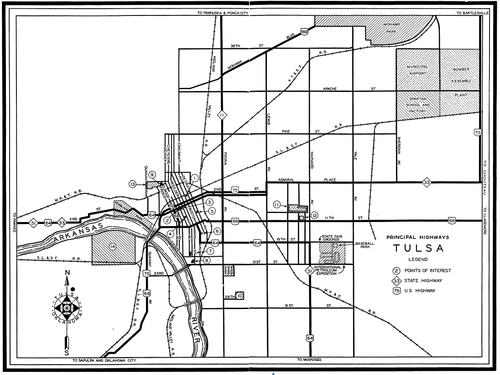
3. Follow the old highway routes through town: Look for a map from the 1950s or earlier showing the streets that were designated as US or state highways, and then drive the road between downtown and the outskirts of town. On the edge of the city, you'll find commercial architecture from the heyday of the family road trip: old motels and tourist courts, diners, gas stations, tourist traps, and curio shops. This is where you're likely to find flamboyant neon signage designed to catch the eye of a weary dad behind the wheel of his station wagon. While roadside architecture along the interstates looks the same from one end of the country to the other, back before the interstates roadside buildings bore the imprint of local character and local imagination. Here you may still find cafes that once catered to tourists and truckers but now mainly serve the locals.
Closer to town, the old highways are likely to take you past the kind of neighborhood commercial districts which are often incubators for urban revitalization. Tulsa's Cherry Street developed along what was once U. S. 64, the main road between Tulsa and Muskogee and Ft. Smith. This is where you might find an interesting antique shop or a hip coffee house.
You might be able to find this sort of map in the state's WPA Guide. Many state highway departments have posted scans of old official highway maps online: e.g. Oklahoma, Kansas, Missouri.
4. Hang out in an indie coffeehouse: You don't have to answer all your email from your lonely hotel room. Find a friendly locally-owned coffeehouse with wifi. These places often serve as de facto community centers, and the bulletin board and the barista can tip you off to live music, gallery exhibits, festivals, lectures, and other types of local flavor. I always check IndieCoffeeShops.com, a crowd-sourced database that uses Google Maps to help you locate coffeehouses. When I find one that isn't listed, I give back by adding it to the IndieCoffeeShops.com database. You can filter the search for wifi, food (more than just pastries), beer and wine, and whether or not smoking is allowed and outdoor seating is available. UrbanSpoon is another way to search for cafes, pubs, and restaurants with free wifi.
5. Check out the local alt-weekly: Many alt-weeklies publish an annual "Best of" edition that will clue you in to the locals' favorite places to shop, eat, drink, and play. You can usually find the most recent "Best of" on the paper's website. The latest edition (likely available at the aforementioned indie coffeehouse) will give you a calendar of events and often interesting feature stories spotlighting local issues, performers, artists, and eateries.
Back in the 1990s, companies spent billions correcting the Y2K bug, and many worried that mass chaos would ensue when buggy software failed on 1/1/2000, disrupting banking systems, financial markets, power grids, and food distribution. Many believed the best way to ride out the impending crisis was rural self-sufficiency: enough land to grow your own food, in a defensible location far from rioting city-dwellers.
As it happened, Y2K had no significant effect, beyond boosting income for software engineers and freeze-dried food suppliers. We never got a chance to find out whether the city or country would have fared better in the complete breakdown of Western Civilization.
Dmitri Orlov, who lived through the collapse of the old Soviet Union, believes that the same factors are in place for the collapse of his adopted homeland, the USA:
The theory states that the United States and the Soviet Union will have collapsed for the same reasons, namely: a severe and chronic shortfall in the production of crude oil (that magic addictive elixir of industrial economies), a severe and worsening foreign trade deficit, a runaway military budget, and ballooning foreign debt. I call this particular list of ingredients "The Superpower Collapse Soup." Other factors, such as the inability to provide an acceptable quality of life for its citizens, or a systemically corrupt political system incapable of reform, are certainly not helpful, but they do not automatically lead to collapse, because they do not put the country on a collision course with reality.
That link is to the text of a speech by Orlov, "Social Collapse Best Practices," and it's thought-provoking. (It's also filled with that peculiarly Russian gallows humor.) If our current societal arrangement is a house of cards, how can I prepare now for the transition to a new, more stable, more sustainable arrangement?
In one section, Orlov describes the advantages of overcrowded Soviet cities over sprawling American suburbia for dealing with social collapse:
These all seem like negatives, but consider the flip side of all this: the high population density made this living arrangement quite affordable. With several generations living together, families were on hand to help each other. Grandparents provided day care, freeing up their children's time to do other things. The apartment buildings were always built near public transportation, so they did not have to rely on private cars to get around. Apartment buildings are relatively cheap to heat, and municipal services easy to provide and maintain because of the short runs of pipe and cable.... Also, because it was so difficult to relocate, people generally stayed in one place for generations, and so they tended to know all the people around them. After the economic collapse, there was a large spike in the crime rate, which made it very helpful to be surrounded by people who weren't strangers, and who could keep an eye on things....But there is no reason at all to think that a suburban single-family house is in any sense a requirement. It is little more than a cultural preference, and a very shortsighted one at that. Most suburban houses are expensive to heat and cool, inaccessible by public transportation, expensive to hook up to public utilities because of the long runs of pipe and cable, and require a great deal of additional public expenditure on road, bridge and highway maintenance, school buses, traffic enforcement, and other nonsense. They often take up what was once valuable agricultural land. They promote a car-centric culture that is destructive of urban environments, causing a proliferation of dead downtowns. Many families that live in suburban houses can no longer afford to live in them, and expect others to bail them out.
As this living arrangement becomes unaffordable for all concerned, it will also become unlivable. Municipalities and public utilities will not have the funds to lavish on sewer, water, electricity, road and bridge repair, and police. Without cheap and plentiful gasoline, natural gas, and heating oil, many suburban dwellings will become both inaccessible and unlivable. The inevitable result will be a mass migration of suburban refugees toward the more survivable, more densely settled towns and cities. The luckier ones will find friends or family to stay with; for the rest, it would be very helpful to improvise some solution.
One obvious answer is to repurpose the ever-plentiful vacant office buildings for residential use. Converting offices to dormitories is quite straightforward. Many of them already have kitchens and bathrooms, plenty of partitions and other furniture, and all they are really missing is beds. Putting in beds is just not that difficult. The new, subsistence economy is unlikely to generate the large surpluses that are necessary for sustaining the current large population of office plankton. The businesses that once occupied these offices are not coming back, so we might as well find new and better uses for them.
Another potential home for suburban refugees: The college campus, once the higher-ed bubble has popped:
College campuses make perfect community centers: there are dormitories for newcomers, fraternities and sororities for the more settled residents, and plenty of grand public buildings that can be put to a variety of uses. A college campus normally contains the usual wasteland of mowed turf that can be repurposed to grow food, or, at the very least, hay, and to graze cattle. Perhaps some enlightened administrators, trustees and faculty members will fall upon this idea once they see admissions flat-lining and endowments dropping to zero, without any need for government involvement. So here we have a ray of hope, don't we.
Self-sufficiency in the countryside sounds plausible, but in the event of a new Dark Ages, people will need to develop new ways to feed, clothe, protect, and move themselves. To do that efficiently requires cooperation, organization, and division of labor, and that means having lots of people at hand with variety of skills and knowledge.
The hopeful note in Orlov's talk is that human beings are resilient, even those who have been beaten down by totalitarianism for eighty years. I'd like to think that the USA, with its long history of voluntary organizations (Burke's "little platoons"), would fare even better than the resilient Russians.
Hat tip to Little Miss Attila for the link to Orlov's talk.
Recent articles of interest on urban policy, both in Tulsa and elsewhere:

Daniel Jeffries posts a map of the present-day University of Tulsa campus, comparing it to a map from the 1960s, showing the removal of the street grid over the last half century, and adding this comment:
TU continues to degrade the surrounding urban neighborhoods by destroying access points to the campus, reducing the number of streets within the campus itself, built an 8-foot-tall fence around the entire campus, tearing down homes and forcing traffic onto just a few streets.This mindless policy of destruction serves no good and shows a huge lack of forethought, planning, and is extremely reckless.
It should be noted that the expansion of TU, a private university, has been greatly facilitated by the City's use of eminent domain.
Along the same topic of street connectivity: Redsneakz commented here a while back on my link to an op-ed about transit-oriented development around Tysons Corner in Fairfax County, Va. He's written two posts: The Problem with Tysons Corner and More on Tysons and central Fairfax. The Metro extension, he writes, won't fix what's wrong:
What we don't have in our "fair city" is cross streets. What we do have are large loop roads circling the area. They're almost all four lane roads, with relatively few traffic signals, all of which leads to traffic traveling at fairly dangerous (to pedestrians) speeds. The office buildings are all "campus style," which means that the developers made large buildings with extensive above-ground parking areas and largely uncontrolled egress onto these surface roads, with some amount of greenspace thrown in for aesthetic reasons. The greatest number of these office buildings is north of Route 7.Part one of the redesign plan is to extend Metro out as far as Dulles Airport, with an initial phase having four stops within Tysons. This seems like a pretty good idea, because you can basically eliminate a couple of thousand cars per day entering the traffic sink that is Tysons, and people can actually walk to their jobs... uh, hold on. Walking around the area is incovenient at best, and dangerous at worst.
In the second piece, he notes that NoVa's traffic problems are out of proportion to the area's population:
For sheer number of traffic jams, neither LA nor New York can really be beat, at least here in the US.... But here's the thing; the New York Metro Area has something on the order of 19 million people living there; Los Angeles Metropolitan area, 17 million....Metropolitan DC, by contrast, has a population of 4 million or so, yet the traffic here is infamously bad. Every workday, without exception, the western and northern quadrants of I-495 are pretty much rock solid bad traffic. Unsurprisingly, the focus of the bad traffic, on this section of highway, is Tysons Corner....
Poor planning is a big part of the problem. One possible relief route across the Potomac was eliminated by default:
Policy decisions, though, allowed subdivisions to be created on the Virginia side nearly up to the 100 year flood mark, and a golf course on the Maryland side, right at the optimal crossing point. That bridge could have been the anchor of a long dreamed of Outer Beltway, linking Maryland Route 28 to the Fairfax County Parkway.Oops.
Speaking of planning, Oklahoma City's Blair Humphreys has a piece in the Oklahoma Gazette about the launch of Oklahoma City's comprehensive plan update, called planOKC.
The most recent plan, created in 1977 and last updated in 2000, set out to preserve and revitalize existing neighborhoods and improve the efficiency of the continued outward suburban growth. And the most recent update in 2000, perhaps following the lessons learned from MAPS, added a commitment to revitalizing the city's central core.While these plans have certainly had an impact on Oklahoma City's growth and development, there is a significant difference between what we have planned to do, and what we have actually done.
For instance, although the 1977 plan focused on preservation and called for efficient growth, the development that has occurred over the past 33 years ostensibly runs counter to those objectives. Since 1977, our population has increased by 40 percent, but land development has occurred at approximately two-and-a-half times the rate of population growth. And in order to provide "convenient" access to this scattered development, we have expanded our street network at a frenetic pace, increasing the amount of paved right-of-way by 275 percent during the same period.
Brian J. Noggle starts with wayfinding signs in Springfield, Mo., and winds up with a comment on the propagation of urban improvement fads and the irony that proponents of local exceptionalism are often advocates of copycat solutions:
I can't be the only one to notice that candidates for office often stress that they've lived in an area all their lives and know the solutions the region needs, and then they go on a junket-I mean fact-finding mission or conference trip-to some fabulous location and come back with a bunch of imported ways to spend money to make this city look like thatcity.
Charles G. Hill links to Noggle's item and notes:
We have no shortage of would-be hipster urbanists who want this town to look exactly like [fill in name of municipal role model] -- only completely different.
Amy Alkon features a video about an unattended, automated parking garage in Budapest. Very cool, and something similar was built in Hoboken, New Jersey, some years ago; local blogger Mister Snitch covered at length the political complications affecting the project. And here's a story on NJ.com about a 2009 malfunction at the garage.
There's a tube station on the 3rd floor of a London office building, part of a training center for London Underground.
Oklahoma City has a new museum. Retro Metro OKC was launched recently, an online archive of Oklahoma City history, devoted to making artifacts and images of the city's past more readily accessible to the public via the Internet. Its mission statement:
Retro Metro OKC is dedicated to educating the community and its visitors about local history by collecting, preserving, displaying and interpreting materials reflecting the heritage of Oklahoma City.
RetroMetroOKC was started in September, 2009 by a group of history enthusiasts wishing to better promote and tell the history of the greater Oklahoma City metro and to support and work with like-minded organizations whenever possible. We are dedicated to making history fun and accessible to all. The founding group consists of historians, authors, urban planners, attorneys, real estate professionals, videographers and designers with ages ranging from 17 to 70.
I see some familiar names on the founders' roster: Oklahoman reporter and blogger Steve Lackmeyer (president of the organization), Jack Money (reporter and co-author with Lackmeyer of two books on Oklahoma City history, and co-founder of okchistory.com), Doug Loudenback (who has singlehandedly created a great web resource on Oklahoma City history), urban planner Blair Humphreys.
A Retro Metro OKC press release (via Dustbury) explains how the collection will be built:
Retro Metro OKC operates differently from other organizations in that we have no museum, we have no physical collections, and in most instances the materials we display remain in private ownership. In a typical situation our volunteer crews go to a home or business to scan an owner's collection and the owner participates in the project by sharing information about the photos and documents as they are being scanned. The materials never have to leave an owner's possession -- the owner is simply asked to sign a release that allows for the materials to be displayed online.The owner of such materials is given a disc of the digitized images and documents -- and copies also will be given to the Oklahoma Historical Society and the Metropolitan Library System to ensure they will be preserved for future generations.
This is exciting. It's a great way to collect and display historical information, and I look forward to seeing the collection grow. I'd love to be a part of such an effort here in Tulsa. So much material is already in the possession of the Tulsa Historical Society (photographs, ephemera, and artifacts, including the massive Beryl Ford Collect), the Tulsa Library system (vertical files, old government documents), INCOG (historical aerial photos and maps), the City of Tulsa (permits, ordinances, maps) -- but it needs to be digitized, categorized, and organized online in some form. The Retro Metro OKC folks were wise enough to realize that no one person, no one organization could tackle the job alone.
Nevertheless, I'm thankful for the all the local Tulsa history that is already available online. Tulsa Gal has been posting photos and ads from the Official Book of Tulsa in Pictures, a special publication for the 1927 International Petroleum Exposition and Tulsa State Fair. Her July archive contains all six parts of her Tulsa 1927 series.
Some of the most interesting aspects of these photos are the incidental details that are captured, details that would have been routine at the time, not noteworthy, but which are fascinating today. James Lileks calls this phenomenon "inadvertent documentary." For example: Go through the Tulsa 1927 posts and count how many times you see streetcar tracks, streetcar wires, or an actual streetcar.
Tulsa Gal also posts a regular photo trivia question on the Tulsa Historical Society Facebook page.
Man of the West looks at the Leftist track record and wonders why America's leftists "champion the same policies that have brought whole nations to their knees and criticize their opponents for their alleged insensitivity to the poor--the poor that leftist policies indisputably create in massive numbers!" He also offers the short and painful truth about taekwon-do.
Mikhail Gorbachev was just as callous a despot as his less-polished predecessors, according to once-secret Soviet documents. There's a treasure trove of documents about the USSR from the last years of the Cold War, smuggled out at great risk, but they've yet to find an English translator or publisher.
Ever read about a head of state's snub of Jesse Owens after his triumph at the 1936 Olympic Games? Owens said the snub wasn't from Hitler but FDR. (Via Kathy Shaidle.)
It's like Mystery Science Theater 3000 for the funny pages: The Comics Curmudgeon. (I had no idea how depressing Funky Winkerbean had become.)
C. Michael Patton (the theologian from Edmond, not the recycler from Tulsa) writes about the day he quit believing in God.
Brandon Dutcher offers a Father's Day anecdote from a recent Weekly Standard cover story about Indiana Gov. Mitch Daniels.
Lori Bongiorno, the Conscious Consumer, says it's wasteful to rinse your dishes before putting them in the dishwasher.
Brace Books -- a great independent bookstore in Ponca City (with a coffee bar, too) -- passes along a parent's recommendation of John Grisham's book for pre-teens: Theodore Boone: Kid Lawyer.
I just visited with a customer, who is the mom of a 10-year-old son, about this book. She and her son have read it......and she said it's a good read, a page-turner like Grisham's courtroom books, and very appropriate for kids.
Barbara Hollingsworth, local opinion editor of the Washington Examiner, critiques plans for high-density, transit-oriented development in Tysons Corner, Virginia:
It will cost billions of dollars to transform Tysons Corner, but the fact is that the county simply doesn't have the money. Instead of asking the landowners to pick up the slack, county leaders are proposing a series of general countywide tax increases -- on meals, real estate sales, vehicle registration, rental cars, hotel rooms and car repairs.This means that average Fairfax County residents and businesses, whose property taxes have doubled during the past decade, will be taxed even more to pay for redevelopment in Tysons Corner --over and above the estimated $100 million a year they will be charged for the Silver Line's operating costs. In the current economic climate, there's no guarantee taxpayers will get a return on their forced investment.
Gene Healy examines the structural damage done to federalism by the passage of the 17th Amendment:
"Let the state legislatures appoint the Senate," Virginia's George Mason urged at the Philadelphia Convention of 1787, lest a newly empowered federal government "swallow up the state legislatures." The motion carried unanimously after Mason's remarks.So it's probably fitting that it's a George Mason University law professor, Todd Zywicki, who has done the best work on the 17th Amendment's pernicious effects.
Zywicki shows that selection by state legislatures was a key pillar of the Constitution's architecture, ensuring that the Senate would be a bulwark for decentralized government. It's "inconceivable," Zywicki writes, "that a Senator during the pre-17th Amendment era would vote for an 'unfunded federal mandate.' "
And finally, Mark Merrill offers a simple set of Rules of the House.
Nick Roberts has dusted off the Downtown Oklahoma City Strategic Action Plan 2010, published in 2003 by the OKC Planning Department, and has graded his city's performance against its plan. For the most part, Roberts is not judging outcomes, but inputs -- whether city government has taken the steps it intended to take over the seven-year period. Even by that more lenient standard, Roberts finds that OKC has only accomplished a fifth of what was intended.
Because they recognized that infill development would not just magically happen on its own, they laid out a comprehensive short and medium term plan of action that was to be completed by 2010 that would ensure infill development go forward and be feasible."By 2010, downtown Oklahoma City is a vibrant and active urban place, a 24-hour destination for entertainment, arts and culture, an active and profitable center of business, with a variety of urban housing."
WRONG. So despite doing so well, for the most part, on achieving the neighborhood objectives, how did the city make so little progress on fundamentally changing the level of activity and availability of urban housing in downtown?
To seek the reason why downtown Oklahoma City got only a quarter of the targeted 2250 new housing units, he goes point-by-point through the plan and gives the city a grade for each. Roberts concludes:
I think we need to go back and accomplish all of these things, and I believe these will go a looooong ways towards getting Downtown back on track to where it needs to be in terms of mixed-use offerings and 24-hour activity. All of these recommendation of the Planning Department made in this study are completely spot-on. We only accomplished 20% of these goals, and time is up. It is for this reason that we have seen the addition of downtown housing in the hundreds, and not the thousands.
It's too easy to let plans sit on a shelf, never to be revisited. Making those plans available on the web makes it easier for interested citizens to compare promises to performance. But you still need someone like Nick Roberts to take the time to study the document, collect the data on actual performance, and analyze the information that was gathered. Well done, Nick.
This sort of thing never happens, right? Never, ever would a secretive group of private business leaders direct the redevelopment decisions of public agencies from behind the scenes. And if they did, well, we just have to trust that these business leaders know far more about urban development than the unwashed masses, as is readily apparent by the wealth they accumulated in completely unrelated fields of endeavor, right? We just have to trust that they have the best interests of the city at heart.
The OKC History Blog has an entry about a group of Oklahoma City business executives called Metro Action Planners and their efforts (of questionable legality) in the late 1970s to implement architect I. M. Pei's plan for downtown redevelopment. The story begins with Pei's return visit in 1976:
His summons to appear came from a new, informal group of downtown Oklahoma City business leaders assembled by the Chamber of Commerce to expedite implementation of his plans for the area.The group - Metro Action Planners - was led by Southwestern Bell President John Parsons. The group had no office, no phone number, and no mailing list. And no vice presidents or directors were allowed.
Its membership was limited to CEOs, presidents and downtown property owners, and those who belonged included Charles Vose, president of First National Bank and Edward L. Gaylord, publisher of The Daily Oklahoman.
Behind the scenes, the group picked which retail developer would get a shot at building a planned indoor shopping mall:
In April [1977], the Urban Renewal Authority sought new proposals and got them from a local man, Bill Peterson, Dallas-based developer Vincent Carrozza, who estimated he could get the project done in six to 10 years, another outside developer, Starrett-Landmark, and Cadillac Fairview. (5)While Carrozza, in particular, had no doubts about his project's future success, Cadillac Fairview's proposal was much more reserved in that regard.
The latter's proposal cautioned that there was "absolutely no certainty at this time that sufficient department store interest can be committed to ensure that the major Galleria retail can proceed in the near future."
But, Carrozza enchanted Metro Action Planners. The group, in fact, committed itself to raise $1.6 million needed to create a limited partnership with the developer to get the project going.
Before the end of April, 1978, Carrozza had his deal with local leaders.
Then everything unraveled when the developer asked for a favor from an official who, evidently, wasn't part of the in-crowd:
Oklahoma's attorney general launched a probe in August of 1980 to determine whether Carrozza, urban renewal and Metro Action Planners had restrained trade by creating an informal building moratorium downtown to enhance possibilities that the Galleria project would be successful.The Metro Action Planners, it had turned out, had approved a moratorium on downtown building in October 1978. The following year, Carrozza had contacted an Urban Renewal commissioner, asking him to seek a second moratorium from the group. At the time, Carrozza was finding it difficult to find financing for a second office tower he was building on the Galleria site.
The commissioner - Stanton L. Young - declined to carry out Carrozza's request, and was not implicated of any wrong-doing.
Neither, curiously, was anyone else.
But while the attorney general's investigation went nowhere, the damage to this super-powerful group of downtown leaders had been done.
Metro Action Planners abruptly disappeared from the downtown redevelopment scene.
So much for corporate commitment to the free market. This shadowy group choked off downtown development to clear the path for their favored developer, who (by the way) never completed his project. The land -- most of a 2 x 2 superblock -- continues to sit mostly empty. The new downtown library was built on the northwest corner of the site.
But I'm sure this situation was peculiar to Oklahoma City, and powerful, private groups have never steered the actions of Tulsa's urban renewal agency, and if they did, I'm sure it was for our own good.
The daily paper has an appalling story about tenants in several Tulsa apartment complexes going without central air conditioning because of the complexes' owner's bankruptcy, which is tied to the previous owner's default on mortgages and alleged non-disclosure of said default:
In a subsequent lawsuit in the same court, RC Sooner Holdings alleges that the bankruptcy was filed because the previous owners of the apartments, the development family behind the SpiritBank Event Center in Bixby, sold eight apartment complexes to RC Sooner Holdings without telling the buyer that the properties' mortgages were in default."We were duped," said Gorguin Shaikoli, vice president of Delaware-based RC Realty, which previously managed the properties for RC Sooner Holdings. "We thought we did all the due diligence."
Lawsuits, defaulted loansAdditionally, RC Sooner Holdings alleges that RemyCo, The Remy Cos., Home Realty Ventures and six members of the associated Remy family acknowledged that they were in default on their loans to Fannie Mae, a government-sponsored enterprise that buys mortgages from primary lenders, and agreed to pay $1.8 million in forbearance -- meaning to hold off on collection of the debt -- one month after selling the properties and transferring the loans to RC Sooner Holdings.
The lawsuit notes that Fannie Mae did not become aware of the transfer in ownership until January.
Fannie Mae, alleging that the sale of the apartments without its knowledge was a breach of the loan contracts, has also filed eight lawsuits in Tulsa County District Court against the Remys and the legal entities they created to own the apartments.
The lawsuits seek full repayment of the $28.58 million remaining balance on the eight loans.
As the story notes, the Remy family was behind the development of Regal Plaza and the Spirit Bank Event Center in northern Bixby. Regal Plaza was developed with the help of a sales tax rebate -- the city would pay the developer 1% of retail sales from the complex over the first 10 years. Tim Remy was also involved in a proposal for a retail development on the south bank of the Arkansas River in Bixby, called South Village, which likewise would have been assisted by a sales tax rebate. If the development didn't happen (and so far, it hasn't) or failed to bring in city sales tax revenue, the developer wouldn't get any of the money.
Bixby wisely chose incentives that didn't put the taxpayers at risk. Other cities have foolishly fronted money for developers and found themselves stuck and out of luck when the development flopped for one reason or another.
The Remy family of companies seemed to be the image of a healthy, progressive, successful real estate development and investment company. (For example, see this Journal Record feature story on the Remy Companies from 2006.) Regal Plaza was innovative for a suburban retail development (although it doesn't work as well as a pedestrian-friendly environment as it could have). It now appears that much of that success was built on a foundation of sand.
Whether their financial problems are rooted in dishonesty, hubris, the national economy, or some combination of the three, the Remy situation should be taken as a warning to local governments contemplating public-private partnerships. No matter how solid the private partner appears to be, structure the deal to put all the risk on the private partner. Don't stick the taxpayer with the bill.
It's a story from February 1, 2010, but I just saw it this week, via Troy Sappington on Facebook: a story in the London (Ontario) Free Press that prominently featured comments from Tulsa Mayor Dewey Bartlett Jr on police salaries and layoffs. The story was part of a series entitled "Protection at What Cost?: An occasional series examining the soaring cost of emergency services.
Three years after they're sworn in on the force, in some cases with little more than the minimum high school diploma and 12 weeks' training, London police officers get a base salary that tops $80,000.That wouldn't surprise other police and firefighters in Ontario, whose salaries are closely tethered by unions that demand it and police boards that often give in.
But south of the border, jaws drop.
In U.S. cities where there are more murders in a month than London has in a year, police are surprised when told how much police are paid here and how that has changed so quickly over time.
"It's really a death spiral," said Dewey Bartlett Jr., mayor of Tulsa, Okla., where senior officers max out at $62,783 US.
Bartlett, too, deals with police unions and did so last week without an arms-length police board or provincial arbitrator to get in his way.
With Tulsa facing a budget crisis and needing to cut $7 million from its police budget, Bartlett gave cops a choice: Agree to a 5% wage cut and rollbacks or he'd lay off 155 officers -- nearly 20% of the force.
The police association said no.
Last Friday, police administrators were preparing pink slips.
"In this part of the country, unions aren't a way of life. (The police association) was selfish and greedy, rather than what people expect of a police officer," Bartlett said.
What wasn't said in the story was that similar cuts were required from other city departments. The Firefighters Union made a different choice than the FOP, picking pay cuts over layoffs.
The story goes on to look at the pros and cons of high police salaries in London, where a "three-year officer is paid nearly 2 1/2 times more than a typical London adult," and the disconnect in Ontario between those who set police salaries and those responsible for setting municipal budget priorities.
MORE: Stephen Malanga in the Spring 2010 City Journal on the role of government employee unions (teachers', public safety, and SEIU) in California's budget crisis.
On my recent business trips to Wichita, I've been staying at a hotel that provides a free copy of the local paper (75 cent newsstand price), which I've been reading over breakfast each morning. It's fascinating to see the parallels and differences between Tulsa and Wichita. Over the next few days I'll be going through my stack of clippings and sharing some items that you, too, may find interesting.
From the April 25, 2010, Wichita Eagle -- Wrestling takes loss on tourney at arena:
Intrust Bank Arena made a profit, but the Kansas State High School Activities Association took a loss on the state wrestling championship in February, officials say.The association's leader said recently that the Class 6A and 5A tournaments would not return because the venue is too expensive. But Friday, he said talks with arena operator SMG remain open....
Arena general manager Chris Presson confirmed Friday that the arena made a profit on the tournament but would not say how much.
[KSHSAA executive director Gary] Musselman said arena rent and expenses cost the association $75,767. He said the association ended up with a net loss of $44,980....
Last year's event at the Kansas Coliseum brought in $23,852 for the association.
The tournament drew 6,693 people -- including premium seat holders whose tickets did not count toward the association's paid attendance, according to arena officials. Gross ticket sales were $50,500.
Paid attendance at the Coliseum last year was 6,348. Gross ticket sales were $56,985....
Records from SMG to the county show that two sporting events in February -- the wrestling tournament and a Gravity Slashers freestyle motorcross show -- brought in $142,890 in gross building income.
SMG did not make a breakdown available.
While it raised the money for the arena through a 30-month 1 percent sales tax, the county says it cannot share some financial details with the public. Its contract with SMG includes a confidentiality agreement.
SMG does share with the public such information as number of performances and event days; net direct event income for categories of events; net food, beverage and merchandise income; other net income and gross building income.It does not share net profits or losses for individual events.
Assistant County Manager Ron Holt said he went to the arena to view SMG's full financial reports for January and February, the reports it sends to its home office. But because he was not allowed to take notes or make copies, he was not able to provide the figures.
A few things to note:
Premium seat licenses means more money for the arena owner and operator, but for the event promoter it means less revenue from the same number of spectators. At Tulsa's BOK Center, what events are included in the premium seat price?
A 17,500 seat capacity may be wonderful for the rare event that requires it, but it's a financial burden for an event likely to draw a smaller crowd, and for a city the size of Wichita or Tulsa, that's going to mean most events.
Despite the novelty of the facility (Intrust Bank Arena has only been open since the first of the year), the event drew about the same number of fans as last year.
SMG runs arenas in Wichita, Tulsa, and Oklahoma City. At what point do they start tweaking event bookings among the three cities to maximize their bottom line, without regard to the interests of the individual cities they serve? Should we expect to see a less impressive lineup in Tulsa just before their contract is up for renewal in Wichita?
SMG's contract with Wichita limits the amount of financial information available to decision makers and the public at large, information that was previously available for publicly owned, publicly operated facilities. Does Tulsa have the same deal?
MORE: Here is Tulsa's contract with SMG for the BOK Center and the Tulsa Convention Center (3 MB PDF). That's a searchable and smaller version of this original scan on the Tulsa City Council website (12 MB PDF).
Wichita has a downtown grocery store.
I came across it while out for a walk in the eastern part of downtown, near the recently opened Intrust Arena. (Some people go to the Y or the hotel exercise room. I walk through downtowns and historic neighborhoods.)
The store would be easy to miss. It's in an old two-story building, a block off of Douglas, the main east-west thoroughfare through downtown, across the street from the city bus terminal. It's also close to the newly opened Intrust Arena, and as a result it came close to not being there at all.
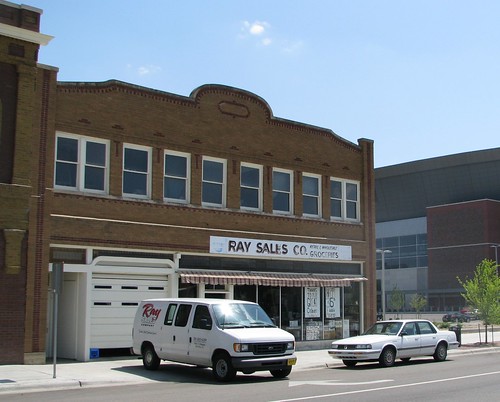
Ray Sales Co.'s sign announces retail and wholesale groceries. The retail part is a small storefront (maybe 20x20) that offers a selection of basic food and home necessities, more variety than you'd find in a convenience store. It's just a block away from the historic Eaton Hotel, which has been restored and converted to residential use, and just a few blocks more from the lofts in the warehouses of Old Town and downtown office buildings that city officials hope to redevelop as residences.
 I stopped in for a bottle of Diet Coke and spoke briefly to the lady behind the counter. In response to my comment about the arena being nearby, she told me that the county had wanted the land for the arena development, but preservationists had identified the building as historic, which prevented the building from being knocked down and the store from being displaced from its home for 36 years.
While I was in the store, I witnessed the kind of personal service that small, family-owned businesses are renowned for. Customers from all walks of life were treated with kindness and respect, with extra assistance for those who needed it.
 Had it not been for the historical status of the Ray Sales building and the Eagle Hall Building next door, the county would have bought and demolished the buildings, and it likely would have been the end of the line for the small business, at least as a downtown grocery. It would have been hard for the grocery to find another affordable location nearby. Its customers -- downtown residents and workers, bus riders passing through the station -- would have lost a valuable resource. You're not going to find a box of marble cake mix or a 55 cent can of pop at the Intrust Arena concession stand, which isn't even open most days.
Tulsa saw this happen with the Denver Grill, one of Tulsa's oldest restaurants, and the Children's Day Nursery, founded in 1916, which were both demolished to make way for the BOk Center, even though the arena could have been situated to leave those two buildings, at opposite corners of the site, in place. The Denver Grill relocated to the once-and-future Holiday Inn at 7th and Boulder, but the move from a corner diner to the second-floor of a hotel cost it visibility and customers, and it's no longer in business. The Children's Day Nursery, providing convenient day care near the civic center and the city bus terminal, no longer appears to be in business anywhere.
It amazed me that historic preservation laws in Kansas were sturdy enough to stop a local government from taking land for a publicly owned facility, so I did some research.
In 1977, while Tulsa leaders were still busily demolishing historic buildings and neighborhoods in the name of progress, the Kansas Preservation Act became law, declaring that "the historical, architectural, archeological and cultural heritage of Kansas is an important asset of the state and that its preservation and maintenance should be among the highest priorities of government."
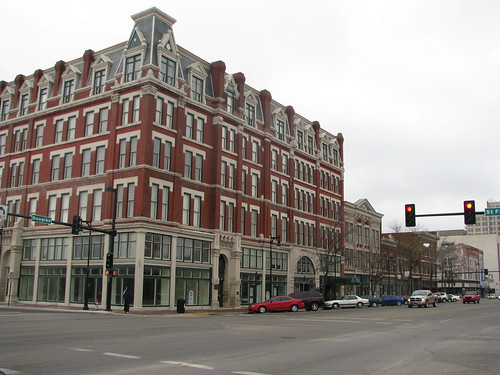
Every government action involving land -- whether a city or county's own project, or government approval for a private project (e.g. building permit, zoning change) -- within 500 feet of a place on the National or Kansas Register of Historic Places is subject to review by the State Historic Preservation Office (SHPO). If the SHPO finds that the project will encroach upon or damage historic property, the project can't go forward unless the local government determines, "based on a consideration of all relevant factors, that there is no feasible and prudent alternative to the proposal and that the program includes all possible planning to minimize harm to such property resulting from such use." Kansas courts have construed this requirement strictly: A city council can't just say, "we determine," and the project moves ahead. "Alternatives may not be rejected unless they present 'unique problems' or 'cost or community disruption' of 'extraordinary magnitudes.'"
The results are evident all over Wichita and on small town Main Streets across Kansas. While Wichita joined the urban renewal orgy of the '60s -- the scars are most apparent a few blocks north of Douglas and between Main and the Arkansas River -- the bleeding was largely stopped when the bill passed, and the kind of urban fabric that Tulsa lost long ago is still present in Wichita.
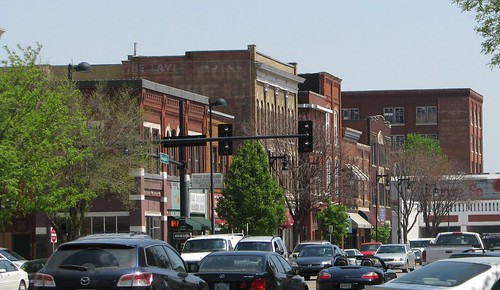
But the difference is not just one of laws. Kansas could pass a strict historic preservation law because Kansas leaders see the value of preservation. There is a presumption in Kansas in favor of preservation, a presumption that isn't widely held among Tulsa leaders. I wouldn't expect to see the sentiments expressed by the Wichita Eagle editorial board, in a November 15, 2006, editorial, expressed in our daily paper:
Some destruction of the old is unavoidable if Wichita wants to make way for new growth. But public officials also must make sure that these buildings - and their owners - get a fair hearing....Board members properly start from an assumption that old buildings are worth preserving....
Two buildings on the site stand out as worthy of preservation: The Ray Sales building at 206 S. Emporia and the Dancers Building at 200 S. Emporia. The county should try to find a way to incorporate them into the master plan. They're not directly in the arena footprint. And they have architectural character and charm that would help provide a visual link to the brick-and-gaslight feel of Old Town.
As this process goes forward, arena stakeholders must work to find the right balance between preservation and growth.
There will be tough decisions.Wherever possible, though, let's preserve downtown's history and character.
In city after city, state after state, preservation only caught on once local leaders with wealth and social influence (often, as in Savannah and San Antonio, the wives of prominent businessmen) adopted it as a cause. For whatever reason, that still hasn't happened in Tulsa.
MORE: Here's the section of the Kansas State Historical Society's website on the Kansas Preservation Act. Their guide to the Preservation Act has a good summary of the history of the law and how it is applied.
A 1977 documentary on historic preservation in Oklahoma has been posted online at the I. M. Pei Project website. The half-hour film, entitled "Born Again: Historic Preservation in Oklahoma," is narrated by Norman architect Arn Henderson.
It opens with a sequence of demolitions of beautiful and historic office blocks in downtown Oklahoma City. Cynthia Emrick of the National Trust for Historic Preservation notes the conflict set up by the Federal Government in 1949, chartering the National Trust to "preserve the nation's heritage as expressed in the built environment" and at the same time green-lighting federal funding for "urban renewal."
Next up is James B. White, head of OKC's Urban Renewal Authority. White expresses the hope that by entering the program at a later date than most cities, OKC will learn some lessons avoid some of the mistakes other cities made. Oops.
White's comments embody the attitude of apathy towards preservation that ruled Oklahoma in the 1970s:
We are a new country. We are a new state. When you're talking about one generation almost from its beginning, I get my self a little lost with the terminology of being historical. I may be right, I may be wrong. I think most of what we have revolves around the terminology of nostalgia. I don't think that we can really call it historical at this particular time in our particular programs in the buildings that we have encountered....I think our eastern states have more things that are historical. Certainly things like Mt. Vernon, the buildings in our capital that go back a couple of hundred years. But we haven't even reached the century mark in our state yet, so I just don't know what is historical and what is not. I don't put myself up as an authority.
Emrick provides the obvious rebuttal:
If you're going to create something with age and glory, then you have to give it a chance to age.
The film moves next to Oklahoma City's Heritage Hills neighborhood in the late 1960s and the effort to protect it with a historic preservation ordinance. Howard Meredith, State Director of Historic Preservation, argues that a historical survey, a preservation ordinance, and a review commission are essential to effective preservation.
Mr. and Mrs. L. G. Ashley talk about the historic landmark designation of Boley, one of Oklahoma's distinctive black-founded towns, established just before statehood by Creek freedmen.
A segment on Tulsa mentions the preservation of old City Hall at 4th and Cincinnati by private owners and has brief glimpses of three Bruce Goff masterpieces: The Page Warehouse on 13th St (now demolished), the Riverside Studio (Spotlight Theater), and Boston Avenue Methodist Church, whose members invested hundreds of thousands of dollars in restoration and in an addition that harmonizes with the original building's architecture.
The last segment of the program focuses on Guthrie, Oklahoma's, territorial and original State Capital. In 1977, city leaders were only beginning to appreciate the economic benefits of historic preservation:
We have two choices, one is just let it rot, another choice is to tear it down and start building back, and I don't think that's going to happen.... I think we're going to recognize the heritage that we're stewards of here.... We absolutely must have some sort of zoning for this district that will help us preserve the buildings.
The film is itself a type of historic preservation, capturing attitudes, fashions, and hairstyles from the mid '70s.
Here's a direct link to Part 1 of Born Again: Historic Preservation in Oklahoma on YouTube.
The I. M. Pei OKC project is an interesting exercise in preservation itself, devoted to presenting artifacts relating to the master plan that demolished hundreds of historic buildings in downtown Oklahoma City. MIT-trained architect I. M. Pei was commissioned in 1964 by the Urban Action Foundation to develop a plan to modernize downtown. You can see the results in the Myriad Convention Center (Cox Business Center), the Myriad Gardens, Stage Center (Mummers Theater), and numerous parking garages and plazas. A 10' x 12' scale model of downtown as it would look after the plan's completion in 1989 (the city's centennial) was prepared to help inspire citizens to approve the plan. That model has been restored and will be unveiled on Monday at the Cox Business Center.
The website includes maps of the Pei Plan, images of downtown before urban renewal, and video resources, including a film called "A Tale of Two Cities" which was used to promote public acceptance of urban renewal by Oklahoma Citians. There's an excellent synopsis of urban renewal in Oklahoma and how it was used not only in the big cities, but also in places like McAlester, Edmond, and Tahlequah. (It neglects to mention, however, the use of urban renewal to clear most of the Greenwood District.)
A well-written comment on the website by Scott Bryon Williams is worth repeating here:
Unfortunate that even OKC was not spared the utopian, yet disastrous hand of modern city planning of the sixties, robbing countless American cities of their hard-earned history and identity. What a true loss of visual design variety in the built environment.Urban renewal and the Eisenhower highway program have been the most devastating events to established residential neighborhoods, commercial districts, and urban cores leading to the growth of an unsustainable suburbia and barren, depopulated city streets.
I.M. Pei's OKC urban planning concept model is truly a time capsule demonstrating the short-sighted and ill-conceived visions for America's cities' futures. In the historical photo archive, compare the richness and wealth of the former downtown with the fractured, patchwork of today.
Subsequent generations have and are recognizing the mistake of large scale demolition and investing trillions of dollars to rebuild and recreate vibrant, healthy urban environments. It is unfortunate that America lost so much of its wonderful history within such a short period to euphoric ignorance. Equally unfortunate is that this attitude still exists among most of the public with the irrevocable destruction of historic structures and neighborhoods.
Let the I.M. Pei model be a learning tool of our mistakes of the past.
Cato Institute senior fellow Randal O'Toole will speak in Tulsa on Saturday, April 24, 2010, 1:30 p.m., on the topic of comprehensive planning. The talk is sponsored by Oklahomans for Sovereignty and Free Enterprise (OK-SAFE) and will be held at the Hardesty Library, 8316 E. 93rd St. The event is free and open to the public. Here's their blurb about the event:
Heard a Lot Lately About:A Tulsa Without Cars...A Light Rail System...
New Urbanism...MAPS 3 and PlaniTulsa...Wondered What it's All About?
Randal O'Toole, senior fellow with the Cato Institute and author of The Best-Laid Plans: How Government Planning Harms Your Quality of Life, Your Pocketbook, and Your Future and Gridlock: Why We're Stuck in Traffic and What to Do About It, discusses how government attempts to do long-range, comprehensive planning inevitably do more harm than good by choking American cities with congestion, making housing markets more unaffordable, and sending the cost of government infrastructure skyrocketing. Does this effect how, and whether, churches are built?
O'Toole will also speak in Oklahoma City on Monday, April 26, 2010, at 6:30 pm at the Character First Center, 520 W. Main.
While I disagree with OK-SAFE's opposition to PLANiTULSA, I respect the fact that it is grounded in principle. (That's in contrast to groups who are trying to derail or mutilate Tulsa's first comprehensive plan in a generation in order to serve their own institutional and commercial self-interests.) It's certainly reasonable to be skeptical about large scale, long-range government planning. A good deal of the sprawl and urban destruction of the past fifty years was the product of a previous generation of government planning. And the places that urbanophiles hold most dear were built before zoning and planning took hold of our cities.
It should be said, however, that developers of that era had a sense of self-restraint -- think of the long-standing gentleman's agreement that no building in Philadelphia would be taller than the William Penn statue atop City Hall. And the way development was financed in that earlier era encouraged permanence. Typically, you were building for yourself, not building something to flip as quickly as possible. At some point construction shifted from being a craft performed as a service and turned into a commodity-producing industry.
As Paul Harvey used to say, self-government won't work without self-discipline.
I would urge OK-SAFE members to look at the PLANiTULSA documents, what they actually say, as opposed to what someone calling himself a new urbanist said on a website somewhere. What they'll find, I think, is something very different from the large-scale, overly-prescriptive comprehensive plans of the '50s and '60s. They won't find anything calling for a "Tulsa Without Cars." Existing single-family residential developments are labeled as Areas of Stability (much to the chagrin of the development industry). If implemented, PLANiTULSA would allow for types of development that are currently very hard to do under our existing zoning code. Parking requirements would be reduced, so you wouldn't need to buy as much land to put up a commercial building.
As long as you have people living in close proximity, you're going to need rules, since what I do with my property affects my neighbor's enjoyment of his. As long as local government is involved in building and maintaining streets, water lines, and sewer lines and providing police and fire protection, local government is going to need to be involved in urban planning. The question then becomes whether your planning process and philosophy reflects your city's values and an accurate understanding of how people interact with the built environment.
I wasn't able to attend the March 23, 2010, TMAPC hearing in person, but I watched the last hour or so of the hearing on TGOVonline.org. The on-demand version should be posted in a couple of days.
I submitted an email comment in response to an impassioned speech that seemed to be suggesting we could have a unanimously shared comprehensive plan if only we jettisoned the particulars that might upset one faction or another. Here's what I said:
"It is not possible to draft a plan with meaning and substance that will satisfy everyone. Surely [the speaker] would not want to delete all language in PLANiTULSA about sustainability and mixed-use development to satisfy conspiracy theorists who believe these terms mean Tulsa would be enslaved to the whims of an oppressive, UN-led one-world government. Likewise, we shouldn't begin jettisoning key components of this plan or severely limiting other components just to calm the irrational fears of some excitable members of Tulsa's development community.
"As a planning commission adopting a master plan for Tulsa's future development, you would be failing Tulsa if you allow this long-term vision and plan to be held hostage by a few voices motivated mainly by their own short-term gain.
"I agree strongly with homebuilder Will Wilkins' comments that Tulsa's development community can work successfully within this new plan, just as they have worked successfully under our existing comprehensive plan. There isn't any planning or land use concept in PLANiTULSA that hasn't already been successfully implemented in many other cities in the US."
Further arguments against jettisoning parts of the plan in hopes of unanimous consensus:
At this point in the process, anything TMAPC changes to make one faction happy is likely to make another faction upset.
There is an interconnectedness to elements of the plan, an internal consistency and cohesion. If key elements of the plan are removed, that cohesion begins to unravel.
I truly believe that, despite the fears of the homebuilders, the plan as released is a win-win for developers along with the rest of Tulsa. It opens the door to types of development not currently possible, and it reduces burdensome process and regulation.
I thought back to a comment by a developer during the 1998-9 infill task force. It may have been Joe Westervelt, who was at the time one of Susan Savage's appointees to the TMAPC. The gist of the comment was that if Tulsa had design guidelines for commercial districts like Brookside, national retailers wouldn't want to locate here. They have a standard building and site plan and that's all they want to build -- so the thinking goes.
But anyone who has traveled has seen national chains that have adapted their stores to meet the required characteristics. I've seen examples of McDonalds, Walgreens, Barnes and Noble, Wendy's, Kroger, Publix, and CVS designed to fit into a walkable urban environment. Tulsa needs to have as much self-esteem as our peer cities.
Regarding the plan to reopen public comments following a March 31 meeting by the TMAPC: The Tulsa Metro Chamber is trying to claim credit, but they had nothing to do with it. In fact, this is good for ordinary Tulsans, since before the public hearing is reopened, we'll see what kind of amendments to the plan the TMAPC will approve. Then we'll have the opportunity to persuade and rebut after those amendments are on the table.
Before coming to Tulsa, Fregonese Associates consulted on a new comprehensive plan for Denver, called Blueprint Denver. It's interesting to see that some of what the homebuilders want excised from PLANiTULSA was adopted in Denver. On the main Blueprint Denver page, the following is listed as the first of three major themes (emphasis added):
Areas of Change and Areas of Stability. Direct growth to Areas of Change while preserving the character of Areas of Stability. Areas of Stability include the vast majority of Denver and are primarily the fairly stable residential neighborhoods where no significant changes in land use are expected over the next twenty years. The goal is to maintain the character of these areas and accommodate some new development and redevelopment that maintains the vitality of the area. The majority of new development will be directed to Areas of Change; areas that will benefit from, and thrive on, an infusion of population, economic activity and investment. These areas include the new growth areas of Lowry, Stapleton, the Gateway area, downtown, around transit stations, and along major street and/or transportation corridors.
From the Small Area Plan page (emphasis added):
A small area plan is any plan that addresses the issues of a portion of the city. Small area plans can cover three different geographic scales -- neighborhood, corridor, and district. They can cover as few as 10 acres or as many as 4,500 acres. Small area plans cover a specific geography that often has a cohesive set of characteristics. The result can be a richly detailed plan that addresses the area's unique issues with tailored solutions.Chapter 8 of Blueprint Denver covers Small Area Planning in depth. The idea is to have a standardized process and set of tools to handle planning for a specific area. Pp. 154-155 describes a list of tools for implementing small area plans, including regulatory tools:
There are three major types of Small Area Plans:Criteria for selecting areas for Small Area Plans:
- Station Area Plans (learn more at www.denvergov.org/tod)
- Neighborhood Plans
- Corridor Plans
- Evidence of disinvestment, deteriorating housing, and high vacancy, unemployment and poverty rates.
- Significant change is occurring or anticipated.
- Public facilities and/or physical improvements need to be addressed.
- Opportunities for substantial infill or redevelopment are present.
- Opportunities arise to influence site selection, development or major expansion of a single large activity generator.
- Transit station development opportunities.
Also important are criteria that more specifically address the goals of Blueprint Denver:
- Creating opportunity for appropriate development in Areas of Change.
- Stabilizing conditions that threaten Areas of Stability.
- Promoting public investment that increase transportation choice.
ZoningDenver is a growing, healthy city, and it seems to be doing all right with a small area planning process that can be applied (by means of zoning) to both areas of change and areas of stability.
- Zoning tools include:
- Keep zoning as is
- Amend language in code
- Rezone selected parcels to a new district
- Apply fundamental overlay zones -- e.g. transit or pedestrian overlay
- Utilize a specific overlay zone district
- Evaluate the need for additional development guidelines review
Landmark district
For those buildings or districts with architectural, historical or geographical significance, a landmark district may be recommended to provide protection from demolition or inappropriate remodeling.
View protection
A view of downtown or the mountains from a point in an important public place can be recommended for protection through a view preservation ordinance.
Blair Humphreys posts an excellent comment on an excellent discussion at Steve Lackmeyer's OKC Central blog:
I agree with the thesis that cities NEED to be designed. Of course, the rub comes when you decide things like: designed how, by whom, and to what end.In Oklahoma City we have favored design through top-down measures utilizing the planning/design talent of renowned consultants, trusted (almost revered) our "infallible" traffic engineers, and depended on the benevolent motivations and decision-making of small groups of powerful businessmen.
More often than not, this has led to: the destruction of our urban heritage in favor of alien models of urbanity, a move away from walkable urban form in favor of an autocentric city with a street infrastructure that is grossly over capacity (and without streetlife), and the allocation of resources towards major public improvements and economic development programs that consistently ignore quality of life concerns.
I think we should shift the way we "design" our city in this way:Designed how? Through an open public process that includes access to information, free exchange of ideas, and a thoughtful discourse.
Designed by whom? By multidisciplinary teams of professionals and amateurs working at the direction of citizens that choose to be engaged in the process. The size of this "engaged community" will depend on the scale of the plan, but the more local the better.
To what end? To whatever end the community decides. For me, I want to enhance the quality of life in OKC both now and for future generations - with priority on the future. And build back a downtown that offers a true urban lifestyle.
Some of this is happening now. Some members of our planning staff are doing incredible work in neighborhoods throughout the city, and the Oklahoma Main Street program has done a tremendous job in places like the Plaza District and Stockyard City. Also, a few local developers - notably Midtown Renaissance & Steve Mason's 9th street - have embraced historic areas and given local businesses a shot, and in the process created some of the most popular places in the city.
That said, for the most part our city continues to be "designed" by transportation engineers and the results are evidence enough that they have little understanding of their role in creating good urban form (thought they clearly know something about short commute times). And our historic model of power broker decision-making is still ingrained, no matter how much rhetoric you might hear about most "public", "transparent", "democratic", etc. Often, one wonders, whether our spending is really thought to be in the best interest of the city and really in the direction desired by the community.
Until there is a process that values the contributions and criticisms of our citizenry, OKC will fall short of its potential.
Interesting comments, too, from Philip Morris, on urban design in Birmingham, Orlando, and Nashville:
FYI, the City of Birmingham (truly a center city wrapped by close suburbs) used urban renewal only for UAB expansion, but in the 1980′established more than 20 design review districts overseen by a single board with guidelines written with imput from property owners (who must organize and formally request the designation before public improvements are made). They are titled "Commercial Revitalization District" and do just about everything you would in a local historic district -- but without the red flag name. Incrementally adds up over time, but only where the economic base supports development....All: Good to read so many interesting ideas about Classen Boulevard. I never fail to drive it when I'm back visiting family. It has great movement and changing views, not usual in your grid. Certainly worth your attention. FYI, Orlando Planning Director Rick Bernhardt changed codes there 15 or 20 years ago to require that all typical strip buildings front thoroughfares with parking to the side and rear. He's now planning director for Nashville metro government and over the past 8 years or so has transformed their approach with overlay districts. Google City of Nashville Planning and click Urban Design if you want to see these. Classen could use an overlay with different requirements for different stretches but an overall boulevard landscape to tie things together. Rick does a very good presentation on this if there were an occasion to bring him there. Also: I found the ULI video on City of Oklahoma City site under planning. A good reality-check on Core to Shore plans.
Because this is a long entry, you'll need to click the "Continue reading" link to see the whole thing. Clicking any of the photos will take you to a bigger version and my full set of San Antonio streetscape photos. If you're interested in hotels, restaurants, historic preservation, and entertainment in San Antonio, read on....

Once again last week, business took me to San Antonio. It was a productive trip. We worked second shift instead of third, which was much more pleasant. I was awake enough during the day to get out and enjoy the sunny 60-degree weather.
One of the things I love about San Antonio is the strong commitment to historic preservation, a commitment that dates back almost 90 years. The San Antonio Conservation Society was founded in 1924 "to preserve the 'antiquated foreignness' embodied in San Antonio's charm and character," and it has been successful in that regard, but as a happy side effect, the society's efforts have also succeeded in preserving the early 20th century commercial buildings that were brand new or not even built when the society was founded. The result is a bustling urban downtown as an attraction for tourists and conventioneers.
The story of the San Antonio Conservation Society is worth reading. Like a similar organization in Savannah, it was founded by prominent and wealthy women who were outraged at the threatened destruction of a historic market. And as in Savannah, San Antonio's preservationists lost their first battle but went on to create a culture where history is cherished.
The ladies of the Conservation Society came up with creative ways to make the case for preservation:
In September 1924, after sketching the Commissioners at their weekly meetings, the ladies presented a play called, "The Goose with the Golden Eggs." They performed their play after the commissioners' regular meeting with puppets crafted to look like the men themselves. The commissioners of the play were called upon to arbitrate an argument between Mr. and Mrs. San Antonio over whether San Antonio's character and charms should be killed to achieve prosperity more quickly. Of course, the Conservation Society members in the audience responded, "NO," and many cheered. Preservation of the city's character and charms would reap greater long-term benefits, including civic pride, than the mere accumulation of money.Their response to the notion of filling in the Great Bend, which had been a recommendation in an engineering report, was to take the City Commissioners on a canoe ride on the bend just to show the men how beautiful it was. Many of them had never seen the river from that perspective before and were greeted along the way by children waving and pitching flowers to them from the bridges.
A young couple, friends of ours from church, decided to mark their fifth anniversary* in an unusual way. Feeling the need for more exercise but not wanting to pay for a gym membership, they took the batteries out of their cars and began a 30-day experiment in getting everywhere by bike.
[Planetizen] sent me an article titled "The Absurdity of Stationary Bikes." It was making fun of all those people with gym memberships who drive around the parking lot four times to find the closest spot to the gym and then go in and ride on a stationary bike.......I asked my wife if she would be up for taking the batteries out of our cars and learning how to get by without the car for 30 days starting on January 8th - the day of our fifth anniversary. She said okay but that she would be much more agreeable to the idea if it were in April.
January and February are probably Tulsa's worst months to be biking outside. They are Tulsa's coldest months when ice storms and snow are expected
That is why January 8 was so appealing to me. Is it possible for a couple to have no car during the worst months of the year in Tulsa without totally changing their lifestyle? If it is possible, what do you have to give up in order to do it? What are the challenges and obstacles to living life without the car in Tulsa? What are the benefits?
Nathan works downtown, Kristin works near Utica Square, and they live in Brady Heights, so the daily commute is manageable, but they're brave souls to try this in the middle of winter. The two are writing about their experiences and the practicalities of commuting by bike on a blog called Carless in Tulsa.
The month-long experiment began on January 9. They've made it to work each day, even in the sleet and cold temps of last Tuesday morning. They've even made a couple of small grocery trips, bringing home a dozen eggs from Blue Jackalope without breaking a single one. The one lapse (if you can call it that) was hitching a ride with neighbors instead of riding seven miles to church last Sunday in the bitter cold and wind.
It will be interesting to see what other obstacles they encounter and how they overcome them. Tulsa has a great collection of bike trails, but the layout is designed for recreation, not getting where you have to go. By the end of the month, Nathan and Kristin should have some interesting insights on what can be done to make the bicycle a practical means of transportation for more Tulsans.
(*What's especially stunning to me about Nathan and Kristin celebrating their fifth anniversary -- my daughter was a flower girl at their wedding when she was a wee four year old. Her age has doubled since then.)
I'm nearing the end of two business trips in one week, separated by less than 16 hours at home, both involving graveyard-shift hours.
The first was to Altus, in southwestern Oklahoma -- drove down on Wednesday, worked the wee hours of Thursday, Friday, and Saturday, slept a bit, then drove home late Saturday afternoon with a couple of self-indulgent stops: taking pictures an abandoned stretch of US 62 east of town, followed a short while later by a Meers burger.
Back in '87 I spent six weeks over a three month period in Altus for Burtek with a team of about 10 engineers, installing and testing a simulation written in Ada to control a C-141 full-flight simulator. It was my first major site trip as an engineer, and going back to Altus brings back a lot of memories, most of them positive. It was strange to see what had been the Ramada Inn, the nice new hotel in town in '87, with an indoor pool and restaurant, now a Motel 6. The nice new place in town these days is the Holiday Inn Express, a bit further east.
Got in Saturday evening in time to give the four-year-old a bath, read to him and his big sister, hear the 13-year-old's enthused description of Avatar in 3-D, get a couple of loads of laundry done, then deliver a computer chassis back to the office, then about five hours sleep. Sunday morning involved turning in the rental for the Altus trip (a Ford Fusion -- pretty nice car), going to church, going back to the rental office to pick up the Pikepass I'd left on the windshield, lunch at Delta Cafe -- vegetable plate, to make up for what I ate in Altus -- then off to the airport.
At the airport, I met up with a colleague from my FlightSafety days, off on a site trip of his own. We wound up next to each other on the plane, and it was good to get caught up.
The Thrifty van driver was playing a local Christian radio station playing a type of music you don't hear much any more -- neither 18th century Charles Wesley or Isaac Watts, nor 21st century emergent church grunge, but hymns and gospel songs from the late 19th, early 20th century -- the songs of my Southern Baptist childhood and my dad's childhood, too. I tuned my car radio to the same station and harmonized best as I could remember from the Baptist Hymnal (1956 edition). On the drive to the work site at 2 a.m., they were playing Alexander Scourby's reading of Genesis 31-33 from the King James Version.
During off-season, you can find a hotel room downtown San Antonio about as cheaply as one out on Loop 410, and downtown is far more interesting. For a short trip in December, I stayed at the O'Brien Hotel, a 10-year-old boutique hotel in an old three-story commercial building, just about a block from the River Walk and La Villita. This time, someone else picked the hotel, the Hampton Inn, northeast of the Alamo. The large surface parking lots between the hotel and the Alamo makes this a much less appealing part of downtown.
It was unusually chilly for San Antonio. I set out for the Riverwalk to find a place to eat, only to discover that the river was gone! This, evidently, is the time of year they drain the loop to dredge and clean the river bed. A few pubs and eateries were closed, as were some of the sidewalks.
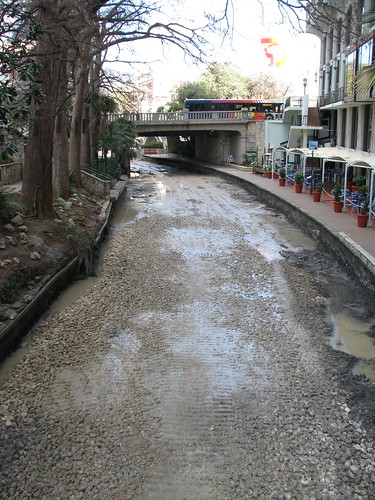
Since I had to be at work at 2 a.m, I decided to have breakfast for dinner and had an Ulster fry-up (bacon, eggs, sausage, tomato, beans, toast, and mushrooms) and an overpriced Guinness at Mad Dogs Pub. I went back to the room, finished reading Ender's Game (which had come highly recommended by my 13-year-old), and took a two-hour nap.
Work on site was done about 8, but I wrote up my trip report and answered e-mail as I had the hotel's breakfast for dinner. Finally got to bed about 11 and slept 'til 4:30 with Fox News droning in the background to drown out any extraneous hall noise. (Glenn Beck woke me up.)
My walk to get something to eat took me past a building that holds a historical scale model of the Alamo as it was in 1836. Price of admission was $3, and it was well worth it. There's a view of the excavation under the building, showing layers of debris from different periods, including a layer, about two feet down, with cannon balls, horseshoes, and animal bones. There's a recorded story to go with the diorama, and it's narrated by drummer, vocalist, and Alamo enthusiast Phil Collins. Spotlights on the diorama highlight the component buildings of the fort as Collins describes them, and then backed by the Degüello -- the haunting bugle call meaning "take no prisoners" -- Collins tells the story of the battle. The presentation helped me get a better sense for how the siege and battle progressed.
The diorama is connected with The History Shop next door, which specializes in antique maps, documents, books, and weapons.
Just west of the diorama is the Emily Morgan Hotel, a 1924 Gothic Revival building that has some Philtower-like gargoyles depicting various medical ailments. (Originally, it was the Medical Arts Building.)
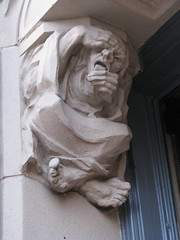
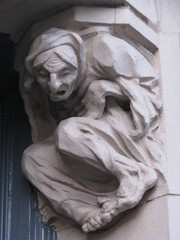
The stroll onward took me past a new Walgreens at Houston and Navarro. The building was completed last year, and it replaces an older Walgreens that had been there since the '30s. The new building retains the old neon signage and has the form of the old, but the new store is about twice as big. The upper stories of the old building were unused; the new building has offices in its second story. It's a very nice job of urban infill.
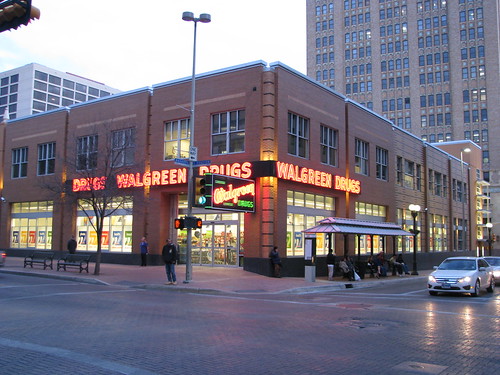
Dinner was at Schilo's deli, just next door to Casa Rio on Commerce Street. This is an old fashioned German deli, and it was hard to decide which dinner entrée to choose. I went with the jaegerschnitzel, accompanied by German potato salad, a delicious cup of split pea soup, and a chilled mug of Spaten Optimator.
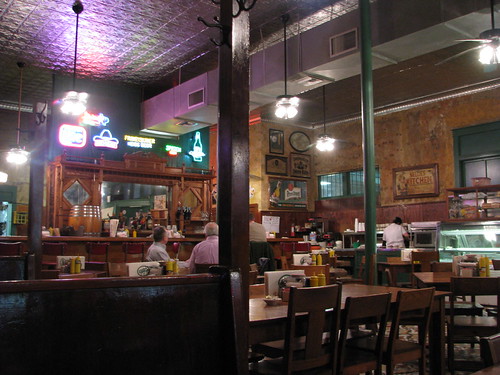
MORE: Before heading home on the 12th, I had some time to take more photos around downtown, including the San Antonio Express-News building, and daytime shots of the drained San Antonio River, and time to have lunch at Schilo's. The pastrami was underwhelming (thin sliced, lean, not steamed), but the split pea soup and homemade root beer were good.
(Finished at last and posted on February 19, 2010.)
BOOKMARKED: Memories of San Antonio places from someone who left in 1961. Many of the photo links are dead, but the narrative is interesting.
As with Tulsa's struggle over applying new fire codes to older buildings, Dallas is experiencing a battle between historic preservation and downtown revitalization on the one hand and strict enforcement of building codes on the other.
The building in question is at 508 Park Avenue, a three-story Art Deco building from the late 1920s. Originally the Warner Brothers Film Exchange, in the 1930s it was used by Brunswick Records for storage and as a recording studio. Bob Wills and the Texas Playboys recorded there, as did many other country, folk, and western swing acts of the day. Legendary blues guitarist Robert Johnson made his last recording there in 1937.
The longtime owners filed a demolition permit back in January, a permit that has so far been denied by the city's Landmarks Commission. (Dallas, like Oklahoma City, but unlike Tulsa, has historic preservation ordinances with teeth.) The owners might have been content to continue their half-century ownership of the building, but city inspectors began fining them for code violations, part of an effort to clean up neglected buildings downtown. As Observer writer Robert Wilonsky put it, "So, as far as Glazer's Distributors is concerned, after 50 years of ownership better a parking lot near City Hall than a code-violations fine machine."
As of August, the owners had spent $50,000 to bring the building up to code and were being fined $1,000 per day per violation.
Preservation Dallas responded with a plea to spare the 508 Park Ave. building, not only for its own historic significance, but for the blight created by multiplying vacant lots where buildings once stood. Some choice quotes from their press release:
A demolition permit for 508 Park was sought following a recent code violation sweep in downtown in which 36 vacant and/or underutilized historic and non- historic properties were targeted for code citations and threatened with litigation. Despite the City's good intentions of furthering revitalizing efforts in downtown, the code violation sweep will likely lead to these ham-fisted remedies. We recognize that while some properties owners are at fault for letting their facilities fall into a state of disrepair, other owners are seeking to either sell their properties or are working diligently on a plan to rehabilitate them. But in these difficult economic times, the City's actions may force many property owners to consider demolition. Preservation Dallas contends this code violation campaign will result in the loss of many significant Dallas historic buildings.
Misguided property assessments can have the same effect, as we have already seen here in Tulsa. The Preservation Dallas statement pointed to another part of downtown, cleared many years earlier, of the urban connectivity problems created by demolition:
"The City seems to believe that vacant lots, particularly in central Dallas, would be an improvement over these existing and often historic buildings. Although they are treating this as a code enforcement issue, vacant lots aren't a quick fix," said Seale. One has only to look at the 'dead zone' at the west end of downtown between the Earle Cabell Federal Building and the County Courthouse complex for evidence. This area, the result of demolitions dating from the 1960s, is a major impediment to the Convention Center connecting to the core of downtown Dallas, and it isolates the County buildings. Those historic buildings that are no longer there would have been good candidates for redevelopment; they would have offered opportunities for residential and commercial uses in the western portion of downtown- a stated goal of the City's. As it turns out, the walkability of this sector of downtown Dallas is dismal at best, and not something the City should encourage or pursue in the rest of downtown....Vacant lots are an impediment to further redevelopment efforts in downtown. Vacant lots do not make downtown more livable. Nor do vacant lots provide a context for downtown. They are eyesores. A building, however, has potential for re-development.
Apropos to my previous entry on downtown housing -- if we really want to repopulate downtown Tulsa and the inner neighborhoods, we need to reduce obstacles to renovating historic buildings, rather than focusing on new development projects out of the price range of most Tulsans.
Where do Dallas' downtown residents live? 5,000 people live in downtown Dallas and almost all of them live in historic buildings rehabilitated for residential use. In most cases these now successful buildings were in worse shape than the buildings now targeted by the city.
On that page, you can see before-and-after photos proving their point.
Finally, Preservation Dallas points out that an overlooked section of the city's landmark ordinance already provides a resolution of the tension between code enforcement and historic preservation:
To address the city's concern regarding neglectful property owners, the City should strengthen and proactively pursue the Demolition by Neglect section of the enabling Dallas Historic Landmark ordinance. Destroying historic buildings due to the City's code violation drive does damage to the original intent of the initiative as well as lasting damage to Downtown Dallas.
Today, the owners are asking the City Plan Commission to approve their demolition permit, despite the denial by the Landmarks Commission and despite the fact that the building is not an imminent danger to life or property.
MORE: A 2002 story in the Dallas Morning Newson the history of 508 Park.
UPDATE 2009/11/23: On November 19, the Dallas city plan commission denied the demolition permit for 508 Park on the grounds that the building did not pose an imminent danger to health and safety. There is still a possibility that the commission would grant a demolition permit on economic viability grounds.
I was googling for a restaurant sign in an old photo of Bob Wills' tour bus, the restaurant turned out to be the Old Tascosa in Amarillo's Herring Hotel. The Herring Hotel, like Tulsa's Mayo and Oklahoma City's Skirvin, is still standing but has been closed for over 30 years, waiting for someone to bring it back to life.
My search led me to this wonderful page of Amarillo postcards, photos, and news clippings, mainly from the 1960s. I've never been to Amarillo, but the pictures still managed to inspire some nostalgia, as I saw a number of places that were familiar from Tulsa's past. For example:
- A Zuider Zee Restaurant -- Tulsa had one on the north service road of I-44, east of Memorial Drive.
- Woolco, a department store that would anchor Amarillo's Western Plaza Mall in 1967, just like Tulsa's Woolco at the western end of Southroads Mall, two years later.
- A Shamrock gas station (before the shamrock leaves became diamonds)
- A Ramada Inn neon sign, with the innkeeper and his horn -- Tulsa's was on the south I-44 service road, west of Yale
- T. G. & Y. (5¢ TO $1.00)
- Furr's -- here it's always been a cafeteria; in Amarillo it was a grocery chain
- A neocolonial Borden Milk plant, just like the one that used to stand on the southwest corner of 51st and Garnett
- Plenty of roadside hotel chains along Route 66 -- Howard Johnson and Holiday Inn
- Local motels with cool mid-century architecture and neon
- Restaurants with Japanese-style architecture and faux Chinese food -- chop suey and chow mein -- like Tulsa's Pagoda
Here's another page of Amarillo pix with
- a downtown much like ours once was
- drive-in theaters and drive-in restaurants, including a Griff's Burger Bar (ours was on 21st up the hill from Sheridan)
- a streamline deco bus depot
- a downtown building with a lighted tower that showed the weather forecast
- a Downtowner Motor Inn -- ours is still standing at 4th and Cheyenne
- Polk Street -- the main drag -- all lit up at night
Too tired and on the verge of getting sick, so no actual writing tonight, but here are a few links of interest from hither and yon:
Steve Lackmeyer raises a concern for "Lost Bricktown," the part of Oklahoma City's warehouse district west of the Santa Fe tracks that escaped 1960s urban renewal. These surviving buildings may be doomed by Core to Shore, and these most vulnerable buildings are slated to be the last to be covered by a historical survey of downtown architecture and may be gone by the time the survey gets around to them. Pictures here.
Chicago-based blogger Anne Leary, whom I had the pleasure of meeting at last year's RNC, had an interesting encounter with Bill Ayers, the unrepentant terrorist and pal of Barack Obama, at the Starbucks at Reagan National Airport. Apparently prompted by Anne's statement that she was a conservative blogger, Ayers told her that he wrote Dreams of My Father, Barack Obama's autobiography, at Michelle Obama's request. In a more recent post she rounds up some of the reaction. Was he pulling her leg? Christopher Andersen's new book on the Obamas' marriage reports that Ayers took Obama's notes and tapes and turned them into the book.
Tulsa Chigger offers a platform for public education reform in Tulsa and salutes the announcement that charter school founder Janet Barresi is running for State Superintendent.
Ephemeral Isle has a birthday salute to Le Corbusier. And there's a link to this interesting BBC story on how central heating has changed family life, not necessarily for the better.
Doncaster, Yorkshire, England, has a mayor named Peter Davies who ran on an anti-political-correctness platform. He is canceling funding for the gay rights parade ("I don't see why council taxpayers should pay to celebrate anyone's sexuality"), ended the town's sister cities relationships ("just for people to fly off and have a binge at the council's expense"), asked to reduce the number of councilors from 63 to 21, saving £800,000 a year, got rid of the mayoral limousine, cut his own salary by more than half, and cut council tax by 3 percent. All that in his first week in office. (The Metropolitan Borough of Doncaster has just under 300,000 residents, somewhat smaller than the City of Tulsa.) By the way, Doncaster uses a limited form of instant runoff voting that has voters mark their second preference. If no candidate receives a majority all but the top two candidates are eliminated and their votes redistributed according to second preference. Not the ideal, but better than no runoff at all. Telegraph blogger Gerald Warner writes of Davies:
Davies, the father of Tory MP Philip Davies, is one of just 11 directly elected mayors and he is enjoying increasing media exposure because of his outrageous agenda which, against all the tenets of consensual British politics, consists of doing what the public wants.You may be feeling disorientated, overcome by a surreal sensation, on hearing such extraordinary, unprecedented views. They are the almost forgotten, forcibly extinguished voice of sanity which most people had thought forever excised from British politics. These policies are common sense, which is something we have not experienced in any council chamber, still less the House of Commons, in decades. The establishment is moving heaven and earth to discredit and obstruct Davies. He is that ultimate embarrassment: the boy who reveals that the Emperor has no clothes.
Yet another linkfest: I washed, dried, folded, and distributed seven loads of laundry yesterday, so I'm lagging behind. Meanwhile, Tulsa area bloggers are turning out plenty worth reading.
In a post titled, "Why I am a Republican," Man of the West relates the evolution of his political philosophy, having started out as a Ayn Rand-inspired Libertarian, then moving to a conservative perspective under the influence of the Bible and writers like Francis Schaeffer. He had been registered as an independent, but "In registering Independent, I began to see, I, and other conservatives like me, were actually making it easier for the Republican Party to continue its slide into political and philosophical incoherence." He came to see the Republican Party as the only hope for promoting and electing officials who would pursue conservative policies.
So I changed my registration to Republican. I vote in the primaries, and I always vote for the most conservative candidate available. But please understand: it's not the Republican Party per se that matters to me; it's the election of conservative candidates. The Republican Party is not my nation, and certainly not my God. The Republican Party is merely a vehicle. And if and when that vehicle isn't getting me where I want to go, I feel free to abandon it, or its candidates.
And that brings him to the impending election:
At the time of writing, there's a candidate for Tulsa mayor--Dewey Bartlett, Jr.--that campaigned in the primary as a "conservative," despite having previously endorsed a pretty liberal Democrat for re-election, despite having supported some very questionable local governmental maneuvers, and having, in his first ads, made rather obvious reference to local conservatives via referring to people's partisanship and "bickering." In my estimation, he appears to have less loyalty to the Republican Party than I do--I certainly never endorsed Kathy Taylor's re-election--and is running as a "conservative" for no other reason than that he knows that being a liberal is political poison in this city. In his case, the vehicle isn't getting me where I want to go, and I refuse to put any "gas"--money or time--into it.
Elsewhere in the Tulsa blogosphere:
Steven Roemerman doesn't like Lucky Lamons's legislation to require pseudoephedrine to be sold only by prescription and he points out the unintended consequences of restrictions on pseudoephedrine sales. (I agree with Steven that phenylephrine -- the drug being substituted for pseudoephedrine in many cold products -- just isn't as good at unblocking sinuses.)
Don Danz has some sweet photos of his boys, including his middle son's third birthday and his smallest learning to pray.
Scot Law remembers his uncle, pianist Larry Dalton, in the latest episode of Goodbye Tulsa.
The Pioneer Woman has some reassuring words for those suffering from the October Homeschooling Blues.
Stan Geiger takes a closer look at what the stimulus money coming to Oklahoma is actually stimulating:
From down the turnpike, Steve Lackmeyer's OKC Central blog presents a post on Oklahoma City's future by Nick Roberts. Nick thinks the core-to-shore plan needs to be reworked, but beyond his interesting ideas on that topic, I really like this guiding principle that he sets out:
In order to visualize Downtown OKC in 2020 we have to visualize Downtown OKC in 2000, and 1990, and so on. Most importantly I think we need to visualize Downtown OKC in 1920, 1930, and 1940. OKC needs to go back to the future to a time when it had excellent downtown parks, a great streetcar network, and downtown vibrancy.
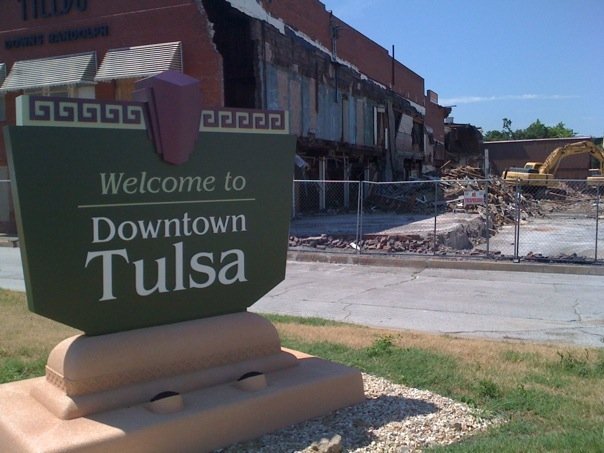
Photo by Daniel Hickman.
On Saturday I went to a barbecue with lots of good food and a wide variety of people. One of the highlights of the day was a lesson in the economics of downtown preservation and demolition.
In the midst of a political discussion across the table with someone I knew, the lady to my right found a break in the conversation to tell me that she tore down the old Page-Glencliff Dairy. She encouraged me to post the story of the building's demise on this website.
Her name is Elenore "Snowie" Roberts. She and her late husband Raymond Roberts owned the building, which was most recently occupied by Fields Downs Randolph. It has been vacant for many years.
Mrs. Roberts told me that her husband wouldn't be happy to learn of the demolition, but he's gone on to heaven. It had been getting too expensive to insure the building, pay the taxes, and keep the building secured against squatters. (They thought they had the building secured but they found someone who got in somehow and was living on the top floor.) Paying the ballpark assessment -- a per-square-foot rate on that enormous old building -- on top of everything else was too much.
People told her she should convert it into lofts, but she didn't have that million-plus it would take to do the renovations, and no one else had the money either.
The building was on the market, but for most of the last few years it was under option to Global Development Corp, which had planned to build a stadium and mixed use development on the eastern edge of downtown, and then to John Williams, the Claremore developer who had been working on Wal-Mart, offices, and residential development in the area. While those plans were pending, it wasn't available, even if someone had wanted to buy it and renovate it.
Mrs. Roberts hired a company out of Oklahoma City to take the building down. They would clear away all the concrete, even the basements, down to the dirt, take away the concrete, grind it down and recycle it as roadbuilding material. Another company she considered would only go four feet down and then fill it in with dirt. It was a sturdy building, and leaving the foundation might cause problems for the next building to go up on the site. She said that during the demolition many folks who used to work at the dairy came by to ask of a brick as a memento.
With the building pulled down, the property taxes are much lower (no improvements on the site) as is the ballpark assessment. She only has to pay a small amount of liability insurance. There are no more expenses to keep the building secured against intruders. Mrs. Roberts is hopeful that the land will be more attractive to potential buyers now that the building is not an obstacle to redevelopment. She thinks it would be a great place for a new Central Library. I told her that Jamie Jamieson has been talking up that idea for several years.
I don't like to see buildings pulled down, but it's hard to fault Mrs. Roberts for taking that step. The building couldn't be occupied without expensive renovation. Anyone buying the land from her would either have to pay to fix up the building or to tear it down themselves. Even if she had given the building away, there would have been few potential owners in a position to cover those costs.
I hate downtown demolition, and I wish it would stop. But it's important for those of us who are preservationists to recognize the pressures that make demolition the best of a series of bad options. Local building and fire codes, Federal laws on asbestos and accessibility, property taxes that go down when the building is gone, courts that punish building owners for injuries incurred by vandals and trespassers, and special assessments that take no account of the marketability of the building -- all of these add to the cost of keeping a building standing.
While the demolition of the Page-Glencliff Dairy was an unintended consequence, it was not unforeseen. Councilor John Eagleton, who voted against the Tulsa Stadium Improvement District and the assessment roll, asked me to pass this message from him along with Mrs. Roberts's story:
"I told you so."
MORE: A reader writes with an analysis of the cost savings that Mrs. Roberts will realize by tearing down the building:
Tax Parcel: 00500-92-01-41420
Tax Year: 2008
Annual Tax: $9,874
Land Assessment: $925,200
Improvement Assessment: $419,900
Total Assessment: $1,345,100% Improv: 31%
Taxable Assessment: $80,850
Lot Sq Ft: 92,517.084
Building Sq Ft: 95,361Calculations for Tulsa Stadium Improvement District (TSID):
Annual land contribution to ballpark: 92,517.084sf x $0.043/sf = $3,978.23
Annual land contribution to street maintenance/cleaning: 92,517.084sf x $0.022/sf = $2,035.37Annual bldg contribution to ballpark: 95,361sf x $0.043/sf = $4,100.52
Annual bldg contribution to street maintenance/cleaning: 95,361sf x $0.022/sf = $2,097.94(I'm assuming that if the building's value was approximately 31% of the taxable assessment, then its part of the total tax was proportional.)
Annual bldg portion of the total tax: 419,000/1,345,100 x $9,874 = $3,082.36
Annual TSID assessment fee savings after bldg demo: $4,100.52 + $2,097.94 = $6,198.46
Annual tax savings (at year 2008 assessment and rate) after bldg demo: $3,082.36
Annual insurance premium savings after bldg demo: $ ???
Annual operation and maintenance savings after bldg demo: $ ???
Robert N. Going, blogger, author, radio talk show host, and mover-and-shaker in the upstate New York city of Amsterdam, has given up waiting on the city's official website to go on line after "a year and a half and $20,000". He got a sneak preview of the under-construction site and was underwhelmed.
Pretty pictures. The writing is pretty mediocre, I think, but that's me. Given they copied the format from elsewhere, I find it difficult to believe this would have taken more than a week to put together if done by a couple of semi-bright high school students.
So he took matters into his own hands.
[UPDATE] OK, I hired a couple of semi-bright high school students and they worked on this for a couple of hours. Here's what they came up with. I deny responsibility for any of the content.
For what it lacks in pizazz, the City of Amsterdam, New York, website [proposed, unofficial, draft version] more than compensates with brutal honesty.
Welcoming. Accessible. Affordable. It's hard to imagine a better life than the life you'll find here, unless you've ever been anywhere else, or seen a movie, or watch television.
Notes about demolition and neglect, here and elsewhere:
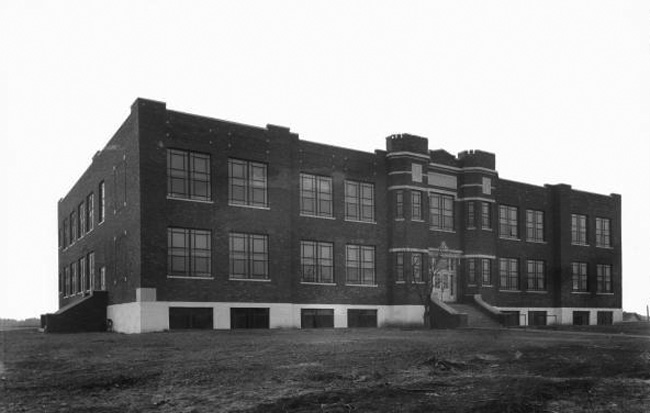
From the Beryl Ford Collection/Rotary Club of Tulsa, Tulsa City-County Library and Tulsa Historical Society.
Red Fork's oldest remaining high school building is to be demolished. The 1925 building served for most of its history as Clinton Middle School, but when first built it was the high school for the Red Fork district, which was previously located on the Park Elementary campus, which dates back to 1908. (The Park high school was built in 1918, according to the Sanborn map, but has been gone for decades.) Clinton continued as a high school until 1938, when Daniel Webster High School opened. This story tells about the time capsule discovered in its cornerstone:
When officials took down the cornerstone, they found a copper box not much bigger than a car stereo in a gap in the brick wall.In it, they found a small U.S. flag with 48 stars, several yellowed copies of The Tulsa Tribune newspaper, and lists of members of the Order of the Eastern Star, Red Fork Masons, Red Fork school board members and faculty and staff members at Clinton, which was a high school in 1925.
The Tulsa Public Schools website has a slide show and high resolution images of some of the objects in the Clinton Middle School cornerstone.
The first time I found my way onto W. 41st Street many years ago, I was impressed and amazed by the civic buildings along this half-mile stretch between Union Ave. and Southwest Blvd:Trinity Baptist Church, Pleasant Porter School (originally Clinton Public Grade School), sited in a shady grove of tall trees, Clinton Middle School, and the Clinton Memorial First Baptist Church of Red Fork -- each had a certain dignity that marked Red Fork not as a suburb, but as a town in its own right. The old Baptist Church was demolished to make way for the new Clinton Middle School; now the old school is being torn down after 84 years of service.
(Here's some more historical information on the Clinton family and the school that stood on their old homestead.)
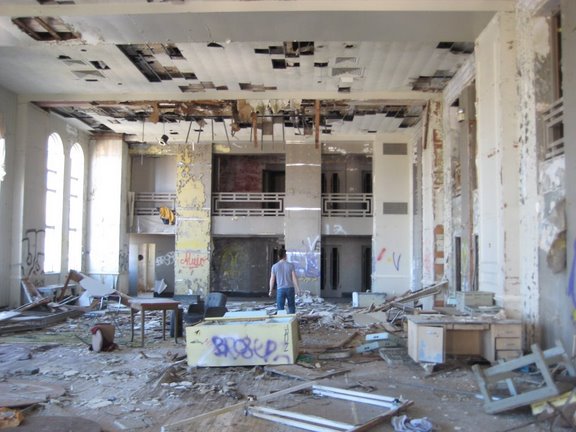
Four miles north-northeast, someone has taken photos of the interior of the Tulsa Club building, on the northwest corner of 5th and Cincinnati. The art deco building has been left to rot, unsecured, by its current owner, and it has become the target of graffiti vandals who seem to know that no one cares. I've been in the building twice: Once for the school prom ("Dutchman Weekend") my sophomore year in high school, and once just after the Tulsa Club shut down for good and the fixtures were auctioned off. There are hints of what once was, but the interior is pretty well trashed.
On to Detroit, where the last vestiges of old Tiger Stadium, aka Briggs Stadium, are being demolished for no good reason. The infield stands still stood, and preservationists had been working successfully to raise funds to preserve them, maintain the diamond as a community ball field, and use the stadium structure as a museum to house broadcaster Ernie Harwell's collection of memorabilia. Despite the progress of preservationists in raising funds, the Detroit City Council decided to turn even more of their once-bustling city into flat nothingness.
Neil de Mause explains what made Tiger Stadium special and worth saving:
Tiger Stadium is now the last surviving example of an old-style upper deck overhang. Yankee Stadium will be gone shortly; Fenway Park doesn't have an upper deck to speak of; and Wrigley Field, for all its charms, has a top deck set way back from the action. That leaves the sliver of stands still standing in Detroit as the only place in the world where baseball fans will be able to experience what was once commonplace: cheap seats that, thanks the miracle of cantilevering and the willingness to make some field-level patrons sit in the shade, are closer to the field of play than all but the priciest field-level seats at modern stadia -- stunningly close at Tiger, where Tom Boswell famously wrote that sitting in the upper deck behind home plate and watching Jack Morris pitch enabled him to truly learn the importance of changing speeds.
I saw a game there once. In 1988, my last full summer of bachelorhood, my friend Rick Koontz and I went on a week-long "Rust Belt Tour" that took us to Wrigley Field, Comiskey Park (the original one), Tiger Stadium, Cleveland Municipal Stadium ("the mistake by the lake"), and Riverfront Stadium. 21 years later, only Wrigley still stands. We had great seats to watch the Tigers play the Yankees, a game the Tigers won, 7-6 in the bottom of the ninth, a six-run inning that concluded with an Allan Trammell grand slam home run. It was the most exciting game of the trip, and a great place to watch a game. (It was also the night the Pistons lost to the Lakers in Game 7 of the NBA finals. We were relieved, given Detroit's reputation for violent celebrations.)
National Trust for Historic Preservation president Richard Moe writes of Tiger Stadium:
Demolishing the stadium is a mistake. Even in its diminished, partly demolished state, the stadium served as a defining feature of the historic Corktown neighborhood-a reminder of better days, but also a cornerstone for future revitalization of the community. Redevelopment of this iconic historic place for, among other things, youth baseball leagues, could transform it back into the thriving center of community activity that it once was. Now, city leaders have chosen a course that will in all likelihood lead to yet another empty lot in Detroit-the last thing the city needs.
More from the National Trust for Historic Preservation on Tiger Stadium's demolition:
Despite a protest at Tiger Stadium last week, Detroit contractors began razing the 1923 structure the following day. Late Friday afternoon, a judge issued a temporary restraining order, which should have halted all destruction, but crews continued demolition until the end of the day.On Monday Wayne County Circuit Judge Prentis Edwards lifted the restraining order and rejected the conservancy's request for the injunction.
"[Demolition crews] were out there an hour after the decision. They didn't waste any time," says Michael Kirk, vice president of the Old Tiger Stadium Conservancy, which requested a permanent injunction to halt the demolition. "We don't understand it. There's no other development deal pending for the site, so the need for speed doesn't make any sense."
City attorneys argued that the conservancy could not raise enough for the $27 million construction project to retain Navin Field, the oldest part of the existing stadium complex.
Plans to demolish the remaining section of the old stadium were set back in motion after a 7-1 vote on Tuesday, June 2, by the board of Detroit's Economic Development Corporation. Waymon Guillebreaux, executive vice president, said in a statement last week that the Old Tiger Stadium Conservancy "is still far short of its targets" agreed upon in a memorandum of understanding with the city that was signed last fall and claimed the conservancy did not have "secure commitments for funding the project."
The board acted despite $3.8 million earmarked by Sen. Carl Levin (D-Mich.) for the Old Tiger Stadium Conservancy's plan; an identified $19 million from new market, "brownfield," and state and federal historic tax credits (some of which were already applied for and approved); and $500,000 in grants, loans and private donations.
Lowell Boileau, a painter, created a website in the late '90s called The Fabulous Ruins of Detroit, a site that contains hundreds of images of abandoned and now-demolished buildings, including abandoned suburban buildings that took the place of previously abandoned urban buildings.
Zimbabwe, El Tajin, Athens, Rome: Now, as for centuries, tourists behold those ruins with awe and wonder. Yet today, a vast and history laden ruin site passes unnoticed, even despised, into oblivion.Come, travel with me, as I guide you on a tour through the fabulous and vanishing ruins of my beloved Detroit.
It's a tour worth taking -- well-organized with an "express" path that hits the highlights, and "detours" that allow deeper exploration.
Sadly, at a time when mainstream public support for historic preservation is growing, the National Trust for Historic Preservation has decided to squander its hard-won credibility by turning its blog over to the promotion of "gay pride" during the month of June, in a series of posts that have nothing to do with preserving and protecting historic buildings. (One exception: There is a post about preservation in West Hollywood; the "gay" connection is that it was written by a preservationist drag queen.) The latest example is this essay on "gayborhoods" entitled "Pardon Me Sir, But Can I Queer Your Space." This is a classic example of a venerable organization being hijacked to serve someone's personal agenda rather than the cause for which it was founded.
More linkage, less thinkage, until I get out from under the pile:
Abandoned Oklahoma is a website devoted to photography of abandoned places around the state. Homes, industrial sites, parks, schools, churches. Sites include the Labadie Mansion in Copan (north of Bartlesville), the Santa Fe Depot in Cushing, the Page-Woodson School in Oklahoma City, the Hissom Memorial Center near Sand Springs. The photos are fascinating, often poignant.
A similar site, Underground Ozarks, has several pages devoted to Monte Ne, southeast of Rogers, Ark.
The abandoned million-dollar resort known as Monte Ne was the dream of former Liberty Party presidential candidate William Hope "Coin" Harvey. In 1901, the eccentric Harvey purchased 320 acres near Rogers, Arkansas to become a health resort, political headquarters, and place for civilization to arise after the apocalypse (which Harvey believed was imminent). The resort had two massive hotels, an enclosed plunge bath, a golf course, and gondolas to ferry visitors across the lagoon. In later years, Harvey even added a Roman amphitheater, which is now submerged under Beaver Lake.
Russell Johnson has much more information about Monte Ne and Coin Harvey.
And now for a deliberate, man-made ruin:
(This really deserves an entry of its own, but for now I just want you to see the link.)
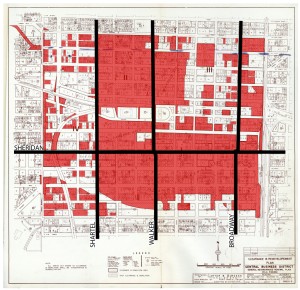 Blair Humphreys is getting caught up on his blogging, and the most dramatic thing he's posted is this map of the Oklahoma City urban renewal plan. The map, created in 1965 by MIT-trained architect I. M. Pei and Carter & Burgess, defined the areas of downtown to be cleared and redeveloped according to the Pei plan. Blair has shaded the map to highlight the doomed zones. It's nearly everything from NW 6th to SW 3rd, from Western Ave. to the Santa Fe tracks. (Bricktown, east of the tracks, was spared.) Click through to see a much larger image and to read Blair's comments.
Blair notes that "old plans can tell us a lot about how the city came to be the way it is." He has scans of many important Oklahoma City plans and hopes to put them all online in the future.
Via Gerard Vanderleun, I found a provocative blog entry on the cost of light rail and other forms of fixed-route mass transit:
When Phoenix was building its light rail system, I made the following two-part bet:
- I could take all the money spent on construction and easily buy a Prius for every single daily rider, with money to spare
- I could take the operating deficits for light rail and buy everyone gas to run their Prius 10,000 miles per year and still have money left over.
This bet has been tested in a number of cities, including LA and Albuquerque, and I have not lost yet. Now the numbers are in for Phoenix initial ridership, and I am winning the first half of my bet in a landslide.
He says that buying a Prius for each of the line's 18,500 daily riders would cost $425 million; the light rail line cost $1.4 billion.
In the same entry the blogger challenges the idea that light rail serves the poor:
...light rail is simply not transit for the working poor. It is transit for yuppies that happens to be used by some working poor. They are built for white collar workers commuting to town who are too high and mighty to be caught dead in a "grubby" bus. But since light rail is orders of magnitude more expensive than buses, two things happen in every city that ever builds light rail.1) Light rail fares skyrocket to cover their immense operating deficits and capital costs, giving the lie to politicians that sold these systems as helping working poor.
2) Bus service, the form of transit that serves most of the working poor even today in the Bay Area, is cut back to help pay for rail.
Light rail is the worst enemy of providing transit services to the working poor ever devised in this country.
A commenter says there's a worse enemy to affordable transportation for the working poor:
It seems to me that making transit services a city-imposed monopoly is a pretty ferocious enemy. If private companies were allowed to operate buses and jitneys under traffic rules comparable to those for delivery trucks now, and if people were free to advertise carpooling arrangements involving fees, would low-cost non-personal-auto transport be worse or better than it is now?Also, it might be interesting to run a back-of-the-envelope calculation on the impact of limiting imports of relatively economical Japanese cars, too. How many marginal buyers became unable to afford their own car? I have no idea, but it might be large. Possibly the number compares to the number who ride buses every day?
The theory, as I understand it, is that cities with some combination of great public amenities, natural beauty, and a vibrant cultural scene will attract the Creative Class. Bright young people now pick a place to live, whether or not they have a job waiting for them. The presence of these creative young people will attract employers who need intelligent and creative employees and who will pay them well. The creative young people themselves, as they mix and mingle around town, will create new ventures that will attract new dollars into the local economy.
The recession may be giving us a chance to see how that theory plays out in the real world. Via See-Dubya, I learned of a May 16, 2009, Wall Street Journal story headlined "'Youth Magnet' Cities Hit Midlife Crisis: Few Jobs in Places Like Portland and Austin, but the Hipsters Just Keep on Coming":
This drizzly city along the Willamette River has for years been among the most popular urban magnets for college graduates looking to start their careers in a small city of like-minded folks. Now the jobs are drying up, but the people are still coming. The influx of new residents is part of the reason the unemployment rate in the Portland metropolitan area has more than doubled to 11.8% over the past year, and is now above the national average of 8.9%.Some new arrivals are burning through their savings as they hunt for jobs that no longer exist. Some are returning home. Others are settling for low-paying jobs they are overqualified for....
The worst recession in a generation is disrupting migration patterns and overturning lives across the country. Yet, cities like Portland, along with Austin, Texas, Seattle and others, continue to be draws for the young, educated workers that communities and employers covet. What these cities share is a hard-to-quantify blend of climate, natural beauty, universities and -- more than anything else -- a reputation as a cool place to live. For now, an excess of young workers is adding to the ranks of the unemployed. But holding on to these people through the downturn will help cities turn around once the economy recovers.
Portland has attracted college-educated, single people between the ages of 25 and 39 at a higher rate than most other cities in the country. Between 1995 and 2000, the city added 268 people in that demographic group for every 1,000 of the same group living there in 1995, according to the Census Bureau. Only four other metropolitan areas had a higher ratio. The author of the Census report on these "youth magnet" cities, Rachel Franklin, now deputy director the Association of American Geographers, says the Portland area's critical mass of young professionals means it has a "sustained attractiveness" for other young people looking for a place to settle down.
One of the Portland migrants actually had a job on arrival, but lost it:
Tyler Carney, a 29-year-old computer programmer, moved here from Tulsa, Okla. in September when the Internet-security company he was working for relocated to downtown Portland. He was laid off two months later, and today is living off the $417 in weekly unemployment checks. He has trimmed expenses, such as cutting out restaurant meals, ending cable and switching to slower Internet service. Mr. Carney is spending most of his days job-hunting, but has no plans to go back to Tulsa anytime soon. "Portland is a little more progressive than Tulsa was, as far as the culture goes," he says. "This town is awesome. Tulsa tended to roll up the streets at night."
The company, not named in the WSJ story, appears to be Vidoop. Vidoop, which specializes in the user authentication aspect of computer security, was founded in Tulsa. In February 2008, they hired Scott Kveton of the OpenID Foundation as "VP of Open Platforms and the Director of the company's new West Coast office in Portland." In June, they announced that they would move the entire company to Portland. The reasons for the move seem to fit the Creative Class theory of economic development:
"The food was the kicker," [co-founder Joel] Norvell joked. Portland's restaurant scene helped sell them on the Rose City, but it's the city's community of software developers that hooked them. Although Vidoop's tools are proprietary, they interface with an open source login standard called OpenID. Vidoop hopes to tap into the collaborative spirit behind open source software that's prevalent in Oregon's developer community. "We need a certain kind of developer with a certain kind of expertise, and that just did not exist in Oklahoma," [co-founder Luke] Sontag said.
In September, a group of employees moved by caravan from Tulsa to Portland, a trip involving "forty-two people, eight pets, five U-HAUL(R) trucks, four RVs, two trailers, two cars, one camera crew and one blueberry bush."
In November, Vidoop announced a layoff. Last week, there was another layoff.
MORE: Vidoop not only moved the company to Portland, they moved the band Black Swan (now known as No Kind of Rider) as well, but the band seemed more than content with the Tulsa scene:
Any of you who know any of us will know that over the two years of our existence, there's one topic that we talk about the most:the Tulsa scene.
It is the fans who come out to show after show (even in the same week), when we have nothing to put in their hands and the bands who support each other, share and trade shows, verbally abuse each other during Halo and generally push each other to be better.
It is the venues and the record store that incubated us when we had no equipment, 4 songs and even fewer fans at the show -- that invite us back even after we blow the speakers on their sound system.
It is the coffee shops and bars you can visit any night and see all these people and not even talk about music, but about everything else in the world in a real way. Its that we have journalists in our local papers who actually give a damn about GOOD music, who will both promote AND show up at a show.
(Found via Oklahoma Rock.)
One of Vidoop's programmers was Black Swan's lead singer, Sam Alexander, so the company president offered to move the whole band to Portland if the programmer would stay with the company. In Gary Hizer's profile of Black Swan in the Feb. 27, 2008, Urban Tulsa Weekly, band members talk affectionately of the Tulsa music scene.
An edited version of this column was published in the April 29, 2009, edition of Urban Tulsa Weekly. The published version is no longer available online. Posted July 15, 2021. See the end of this entry for a postscript.
Cityscope
By Michael D. Bates
Parking wars
Will success spoil Tulsa's midtown entertainment districts?
In the '80s and '90s, entrepreneurs discovered the old retail buildings along 15th between Peoria and Utica. They converted the old storefronts into specialty boutiques, cafes, and nightspots. Since then, Cherry Street has become increasingly popular, a place that Tulsans like to show off to out-of-town guests.
That success has brought its share of challenges. One of those challenges: Where do you park if you want to visit more than one establishment?
I've seen the problem firsthand. About once a month, when my wife is at a moms' night out and my oldest son is at his violin lesson downtown, I take my two youngest children over to Cherry Street. They like Subway sandwiches for dinner, and while their palates aren't yet sophisticated enough to appreciate a "Hippie Sandwich" or a Greek salad at Coffee House on Cherry Street (known as CHoCS for short), they love the baked goods there, like the cream-cheese brownies and chocolate chip cookies.
CHoCS is right across the street from Subway, so you'd think it would simple to hit both in one trip. You'd be wrong.
I can't leave the car in the Subway parking lot after we finish our sandwiches and head across the street to CHoCS for dessert, because they have signs saying parking is for customers only, with a 15 minute limit and a $75 towing charge for violators. It's their property, and while I'd be upset if Subway had my car towed right after I bought a meal there, they'd be within their rights.
Neither do I want to take up one of the limited spaces at CHoCS while I'm at Subway. While CHoCS doesn't have any signs posted threatening a tow, their neighbors do. It's a popular place, and when the lot is full, some CHoCS customers have inadvertently parked in a space belonging to a neighboring business, only to find a warning note taped to the car, singling out CHoCS as the source of all the world's troubles. So as not to make a tight parking situation even tighter, I wouldn't think of parking in CHoCS's lot while visiting another Cherry Street merchant.
And I absolutely refuse to do something as stupid and wasteful as parking in one store's lot, getting back in the car, driving 100 feet, and parking in another store's lot. So instead of using either lot, I park in a public spot on a nearby side street, and my children and I walk to both destinations.
CHoCS' relatively easygoing attitude about parking is a rarity on Cherry Street, where signs threatening tow trucks and wheel boots are the rule. The every-merchant-for-himself arrangement discourages patrons from leaving their car parked in one place, strolling the street, window-shopping, and visiting several different retailers on the same trip.
Instead, a customer is more likely to park at the establishment he came to patronize, do his business, then get back in his car. Once he's back in his car, it's as easy (maybe easier) to head to someplace in Brookside or Utica Square as to go to another Cherry Street merchant.
The zeal to protect one's own parking is understandable, given the city zoning code requirement for each merchant to provide, individually, sufficient off-street parking for the worst-case scenario. By worst-case, I'm talking about the Best Buy lot on Christmas Eve.
To meet Tulsa's parking requirements, some merchants have had to purchase and clear entire house lots; they then need approval from the Board of Adjustment to use a detached parking lot. One restaurant has gone so far as to install automatic gates to protect its investment; you need the validation code from your dinner receipt to get out.
Under our current zoning code, approved in 1970, parking requirements are based on business type. Converting a storefront from a clothing store to a café triples the parking requirement. The requirements assume that everyone will be arriving by car and will be visiting only that one establishment before leaving by car.
But Cherry Street was developed before World War II, long before our current zoning code was put in place, to serve as a shopping area for residents within walking distance. Merchants weren't required to provide off-street parking, and for the most part they didn't. Customers could and did walk to do their shopping. Many stores would deliver.
When shopping districts like Cherry Street changed from serving nearby residents to serving customers from all over the city, parking became an issue. Years ago, cars would be lined up on Brookside's residential streets for blocks either side of Peoria. Residents had to deal with late-night traffic, cranked car stereos, and sometimes worse - drunken yelling, fights, and the public exercise of excretory functions.
The houses nearest Peoria were cleared and replaced with parking lots in order to meet the zoning requirements for restaurants and nightclubs. The new lots helped to keep the cars and the corresponding problems out of the residential areas. On a recent Saturday night research visit, I found there were almost no cars parked on the side streets, which were pretty quiet once I was a half-block or so away from Peoria.
Adding more parking lots as Brookside did would be harder to do for Cherry Street. Land north of 15th is at a premium; most of the land south of 15th is within a historic preservation district.
Even if the land were available, converting tree-lined lots to asphalt parking reduces available housing (and housing nearest the commercial area is often the most affordable), reduces shade, and creates an ugly, pedestrian-friendly moat of asphalt cutting the valuable link between the commercial and residential areas.
You might think that in an area like Cherry Street, with a variety of merchants whose actual parking demand ebbs and flows over the course of a day, that the merchants could pool their parking and reduce the total number of spaces required to make all the customers happy.
The zoning code doesn't make that possible, unless you have at least 100,000 sq. ft. in a single Planned Unit Development, and even then you only get to cut the parking requirement by 10% if the Board of Adjustment gives its permission.
Perhaps because of the extra parking lots, it appears that Brookside merchants are much more easy-going about parking than their Cherry Street counterparts. Most of the lots I mentioned above are available for anyone to use at any time - no signs to indicate who owns the lot or any restrictions on who can park there, no threats that Mater will come to haul your Lightning McQueen off to the impound lot.
For example, one church in the bustling heart of Brookside has a large parking lot, but restaurant and bar customers were parking there, and I didn't notice any signs forbidding it.
Brookside's open-handed approach to parking means that you can have dinner at a restaurant on one block, have drinks on another block, go dancing on yet another block, and cap the night off with coffee on yet a fourth block, all the while leaving your car parked in one spot.
I'm not sure how Brookside has managed this level of cooperation, but the district seems to accommodate the crowds without loading down neighborhood streets and without causing heartburn between merchants.
If Cherry Street merchants would pull together, they could work out a solution that would meet the needs of merchants, customers, and neighbors alike.
The solution I have in mind would respect the property rights of existing parking lot owners and would avoid eroding the neighborhood with more parking lots. My solution would require a minimal amount of government involvement and a willingness on the part of the merchants each to pony up a small amount of money - less than it would cost them individually to acquire more land for parking.
The solution is to create a business improvement district. Collecting the funds to provide shared facilities for a group of adjacent properties is exactly the sort of situation that an improvement district is meant to address.
The improvement district would cover property owners along Cherry Street, each of whom would pay an assessment proportionate to the degree of benefit from the district's improvements. The formula could be based on frontage, square footage, the number of parking spaces required by the zoning code, or some combination of those factors.
Assessment funds would be used to pay the owners of existing parking lots to open their parking spaces for the general use of customers of any merchant on Cherry Street. Lease payments could be based on the number of spaces and how many hours the spaces are available for general parking.
One lot owner might choose to make more money by allowing wide-open parking at any time. Another owner might choose to forgo some lease revenue, reserving her spaces during her peak business hours. Some lot owners would choose not to participate at all and would miss out on using their empty parking lot to generate some extra money. The more spaces you make available, the more hours you allow open parking in your lot, the more lease money you'd receive from the improvement district.
As a purely hypothetical example, a school might allow open parking except when the space is needed during the school day or for special events. The school could use parking revenues to fund special school projects.
Assessment revenue could also be used to pay for a few security guards to walk a beat on busy evenings, deterring vandalism and other kinds of misbehavior in the parking lots.
As a further incentive, the City Council could cut the required number of parking spaces for properties in improvement districts that provide shared parking.
Of course, the simplest and least bureaucratic solution for all concerned would be for the city to reduce off-street parking requirements to a reasonable level and for property owners to be more easy-going and open-handed about who parks where.
Failing that, a business improvement district may be the best way to defuse tensions among Cherry Street merchants and to allow customers to get full enjoyment out of one of Tulsa's finest shopping and dining districts.
POSTSCRIPT 2021/07/13: The problem persists. New construction on Cherry Street has taken more homes to the north to meet the parking requirements; meanwhile Brookside parking lot owners have become stricter about not allowing after-hours use of their lots. (The office building north of Shades of Brown Coffee recently deployed orange cones blocking the south entrance to the parking lot, and some years ago the office park to the west installed an automatic gate to prevent after-hours parking.)
Recently, Addison Del Mastro, a prolific writer on urban and suburban planning, raised a related issue affecting suburban commercial development:
As I've been driving around and exploring places, one of the interesting things I've run into is trouble parking.... the issue is that there's too much parking, but it's all private and specific to disconnected strip malls or office complexes (or churches!) ...it makes it pretty much impossible to walk in a suburban setting if you arrived by car (as most customers and visitors will.)On a more mundane and less conceptual level, the private, specific nature of suburban parking, with no public lots and little centrally located on-street parking, also means that there's no incentive or possibility to treat the commercial strip like a street, even if you want to. It's not unusual to hit two or three different shopping centers or stores on a shopping trip, some of which may be near each other. But you're technically risking getting your car towed if you walk off the property where you parked it.
Del Mastro asks, "What if these parking lots were treated as public and open?" You can read more of his work on his Substack newsletter, The Deleted Scenes, in the archive of his New Urbs columns for The American Conservative, and in City Journal, where his first piece has recently appeared, advocating for small towns as a model for denser but humane growth.
Of recent note in local blogs:
At Choice Remarks, Brandon Dutcher salutes State Rep. Jabar Shumate (D-Tulsa) for his efforts to expand school choice with a bill that will allow tribal governments to sponsor charter schools.
Tulsa Chigger has posted a 1934 Chicago Tribune cartoon lampooning the New Deal, headlined "Planned Economy or Planned Destruction." In the corner of the cartoon, a Trotsky-esque fellow writes a placard: "Spend! Spend! Spend under the guise of recovery -- bust the government -- blame the capitalists for the failure -- junk the constitution and declare a dictatorship." Chigger writes, "Strangely similar to our situation now, isn't it?"
Chris Medlock writes about State Sen. Randy Brogdon's upcoming announcement as a candidate for governor and the impact of a Scott Pruitt candidacy on the race.
Owasso blogger James Parsons wonders about the conservative credentials of another GOP gubernatorial possibility, former Congressman J. C. Watts, who has spent the last seven years as a corporate lobbyist.
Yogi gets quote of the week honors: "I love little 'creases' in time and space." Me, too. He's referring to unexpected places like an Italian mining community in southeastern Oklahoma named Krebs that boasts legendary Italian food. Yogi recounts a recent visit to Pete's Place -- it's been too long since my last meal there.
OKDad is working on a mystery: A statue of a farmer, erected for the American Bicentennial in 1976 and currently under restoration, turns out not to be a bronze after all, but "some sort of hardened concrete-plaster hybrid." "He was planned as a bronze. Molds of him were made in preparation for a bronze. Funds were apparently raised for him to be cast in bronze. The papers from July 4, 1976 (the day he was dedicated and unveiled) clearly state he is a statue of bronze stature. So, where's the bronze?" The mystery is still unsolved, but here's the latest development.
Rod Dreher has posted an 1999 article by Russell Hittinger about how a Benedictine monastery came to be established in Cherokee County. (Driving directions on the monastery website include prayers to St. Jude and St. Benedict in the event of high water. Irritated Tulsan might advise prayers if you decide to follow the restaurant recommendation on the same page -- I've eaten at said restaurant three times and never had a problem.)
Irritated Tulsan's Tulsa Tuesday post last week on The Lost Ogle: Tulsa's Worst Remodels, including a Pizza Hut turned adult novelty and lingerie shop, a Wal-Mart-to-church conversion and a KFC (complete with bucket on the sign) turned chiropractor's office. (I wonder if you can still get a chicken wing there -- either the food kind or the wrestling kind.)
Down the turnpike:
Steve Lackmeyer has posted a series of videos featuring urban planner Jeff Speck's comments on downtown Oklahoma City. The latest segment hits a harsh reality in Speck's comments: When you optimize a street for moving cars at high speeds, you inherently make it hazardous for pedestrians. Here are the three earlier entries in the series:
Jeff Speck Video No. 1 on urban parking
Jeff Speck Video No. 2 on giving people what they want
Jeff Speck Video No. 3 -- outlook for downtown
JenX67 has a gorgeous photo of nightfall in OKC's Plaza District.
Nick Roberts has an interesting chart showing Oklahoma City's population by decade since its founding. Noting the massive growth the city experienced in the 1920s and 1950s, he wonders whether, despite great rankings in a variety of categories, OKC will ever again be a place to which people flock.
Finally, congrats to Blair Humphreys and the MIT design team for their victory in the 2009 Urban Land Institute design competition. The design is for a transit-oriented development to replace big-box and strip-mall retail in Denver.
A couple of nice accolades:
Forbes named Tulsa the 5th most livable city in America, just ahead of Oklahoma City in 6th.
The top 10:
- Portland, Me.
- Bethesda, Md.
- Des Moines, Ia.
- Bridgeport/Stamford, Conn.
- Tulsa, Okla.
- Oklahoma City, Okla.
- Cambridge, Mass.
- Baltimore, Md.
- Worcester, Mass.
- Pittsburgh, Pa.
The criteria:
To form our list, we looked at quality of life measures in the nation's largest continental U.S. metropolitan statistical areas--geographic entities defined by the U.S. Office of Management and Budget for use by federal agencies in collecting, tabulating and publishing federal statistics. We eliminated areas with populations smaller than 500,000 and assigned points to the remaining metro regions across five data sets: Five-year income growth per household and cost of living from Moody's Economy.com, crime data and leisure index from Sperling's Best Places, and annual unemployment statistics from the Bureau of Labor Statistics.
Tulsa's best stats were in income growth (50th out of 379 metro areas) and unemployment (21st). We may have been helped by timing -- mid-2003 is when we began climbing back up after the bursting of the tech bubble. Our worst stat -- the only measure that had us below the median was crime: 4,462 per 100,000 population, ranking 250th.
40 miles to the north, Bartlesville made American Cowboy magazine's list of the top 20 places to live in the West. (Via proud Bartian Brandon Dutcher.)
Charles G. Hill has brought together two interesting items about cul-de-sacs, those dead end streets often hailed as the acme of suburban living. One is a Washington Post report that Virginia is requiring all new subdivisions to have streets that connect to other subdivisions, rather than dumping all traffic out through a single entrance onto an arterial street. The other is an analysis of the financial benefit to developers of not using a street grid -- grids require a developer to build more streets and leaves less land for houses.
I was struck by a comment in the Post story from a spokesman for the homebuilders' lobby:
"Cul-de-sacs are the safest places in America to live," said Mike Toalson, executive vice president of the Home Builders Association of Virginia, which opposes the new rules. "The first lots sold are often on the cul-de-sacs because they are safe." As for developments with single entrances and exits, Toalson said, such configurations ensure that all traffic is local, neighbors watch out for each other and speeds are kept down. "Crooks look for multiple exits."
That last comment is the opposite of reality. The less the traffic down a street, the more opportunity a criminal has to work undisturbed by passers by. A house on a cul-de-sac, especially a long one, or on any street near the back of a development, would be easier to burgle unnoticed than a house on a busy through street.
I heard recently about a family that has what sounds like an ideally quiet living situation -- on a cul-de-sac, backing up to a park, in a well-regarded suburban school district. But their house has been burglarized and vandalized repeatedly. Neighboring homes have been hit as well. The park, open only to homeowners, makes it easy for idle youths to sneak unobserved into someone's backyard. They wouldn't be noticed from the street, as few cars or pedestrians would go past -- it's not on the way to anywhere. (See Jane Jacobs' Death and Life of Great American Cities for more about the problem with parks that extend too far from the nearest traffic.)
A neighborhood with a single entrance and exit also concentrates traffic on the main collector street, while a grid disperses the traffic, without overburdening any single street. The single-entrance neighborhood creates congestion at that entrance, as left-turners and right-turners are thrown together. In my neighborhood, with a modified grid, I can pick my neighborhood exit based on the direction I need to go, so I never have to make a left turn into heavy traffic.
A grid also prevents local traffic from having to use arterials. Tulsa's 71st Street would be far less congested if there were other east-west roads providing local access between stores.
There are times when it would be nice to have a cul-de-sac. The lack of traffic gives kids a place a fairly safe place to ride bikes and scooters, shoot baskets, and skate. But there are other ways to calm traffic and provide a safe, paved place to play. One idea is the woonerf or living street. Shallow cul-de-sacs -- perhaps only a couple of lots deep, attached to a grid of streets might provide the best of both worlds: Enough traffic to deter troublemakers but bays of calm away from the main flow.
Oklahoma City taxpayers raised their sales tax rate to build a new state-of-the-art arena and renovate their convention center (the Myriad -- rechristened as the Cox Convention Center). The same tax built a new baseball park and a canal. A later incarnation of the same tax was used to revamp the barely-five-year-old arena to accommodate the whims of a small number of freakishly tall millionaires.
Surely all that public investment is sufficient to stimulate private investment. Surely free enterprise can handle things from here.
Not according to a consultant hired by the Greater Oklahoma City Chamber of Commerce:
Oklahoma City is faring well as a conference destination, but its convention center is inadequate and must be replaced if the city is to remain competitive, according to a study commissioned by the Greater Oklahoma City Chamber.The study by Conventions, Sports & Leisure International, released today, suggests that replacing the 38-year-old Cox Convention Center will cost between $250 million and $400 million.
Mayor Mick Cornett has suggested for the past two years that any MAPS 3 should include a new convention center as a priority project. That call is being joined by the Greater Oklahoma City Chamber.
No matter how much the taxpayers give them, it's never enough.
Blair Humphreys has downloaded the latest version of Google Earth, 5.0, and reports a feature that will delight urban historian types: The ability to go back in time to earlier images.
The coolest new feature of the program is that it allows you to search historical aerials. With Oklahoma City, there are approx. 10 different aerial sets dating back to 1991, though only a few are from before 2002. Still, it is great to have access to a tool that records urban transformation.
He demonstrates with images of Bricktown from 1995 to 2003 to 2007. It's striking to see that, for all the new development -- the ballpark, the canal, the new development south of Reno -- very little was demolished over that 12 year period. Bricktown began with a great stock of older buildings, and those buildings have been reused, not replaced.
MORE: Although OKC did plenty of demolition as part of the I. M. Pei plan, their pre-World War II Civic Center -- City Hall and the Music Hall and the connecting mall -- replaced an old Rock Island rail yard. Doug Loudenback has a fascinating historical sketch of the planning and development of the Oklahoma City Civic Center.
Last September, the Oklahoma City Chamber of Commerce won approval under that city's downtown design guidelines for a new headquarters building at 4th and Gaylord, where Gaylord jogs left to connect to Broadway. Approval was controversial, because of the suburban site plan -- the building sits back from the street, and a good deal of the site is devoted to surface parking. An opportunity was missed to reverse an urban design mistake from the '60s and restore a street grid that would make pedestrian movement through the area easier than it is today: Six-lane Gaylord acts as a barrier between the downtown core and the Flatiron District.
The project is not yet under construction, and one quiet critic of the plan, Blair Humphreys, is now speaking up in hopes of urging a rethink of the plan. Back before the project came before the Downtown Design Review Board, Humphreys wrote a critique of the plan, but decided to keep it under wraps:
At the time, the proposal was still weeks away from initial urban design review and I hoped to contribute to the dialogue, or more accurately, initiate a dialogue about the proposal and the constraints placed on the project by the flawed planning of the I.M. Pei Plan. But then, after receiving advice that it would damage my future job prospects in OKC, I chose to stay silent.
Humphreys is studying urban planning at MIT. I started to write that it's stunning to think that someone with his name and education could hurt his job prospects by uttering some constructive criticism, but it really isn't. Although OKC has been more forward-thinking in its urban policy than Tulsa, its social structure is not that different from Tulsa's. Telling the emperor that his clothes are somewhat transparent, even if it's said in the most polite way, is never appreciated by the emperor.
His decision to remain silent gnawed at him:
It is a tough deal because I love Oklahoma City. I have always dreamed of helping to shape the future of the city and want to make it great - that is why I left development to pursue a career in planning. As a student of history I appreciate and respect the vital role the Chamber has played - and continues to play - in Oklahoma City's rise from train depot, to State Capitol, to Big League City. However, I have never felt right about the way I stayed quiet on this issue. From now on, I will not back down from contributing my thoughts on contentious issues, but I will try to do so in the most respectful manner possible.
In a later entry, he posts his critique of the Chamber's proposal.
One of my frustrations over the last decade or so of active involvement in local issues is how many Tulsans, active in community affairs, will tell me their concerns or objections to some public plan privately but don't dare speak out publicly. To speak up might alienate a potential compliant, might cost their non-profit a major donation, might get them ostracized from their social circle. (I wrote about this frustration at length last June.)
I can understand their reluctance. Criticizing the plans of the powerful doesn't earn you praise, position, or riches.
But being willing to speak has its rewards as well as its costs. You give others who share your opinion the reassurance that they aren't alone, which may give them the courage to speak up, too. If you're a well-trained urbanist like Blair Humphreys, your words can give laypeople a vocabulary for expressing their gut feelings about neighborhoods and buildings and places. Eventually, you may have the satisfaction of seeing your ideas become the conventional wisdom.
You can't shape the public debate unless you're willing to debate publicly.
Here are a bunch of links to items of note about cities:
Blair Humphreys looks at urban density and finds some surprising stats: The Los Angeles urbanized area is the most densely populated in the nation. Oklahoma City and Boston have the same density, about 900 people per km2. (Again, this is urbanized area and includes suburbs, but excludes undeveloped areas.)
In another recent post, Blair reviews the Oklahoma City government website and offers suggestions for improvements that will increase public participation. The 2nd coolest idea: Google-map agenda items. The coolest idea: Let citizens draw areas of interest on a map, then register to be notified whenever an agenda item for any committee falls within that area. We have the technology.... (A commenter notes that OKC's adoption of Accela software for permitting has been helpful for everyone involved in the process.)
Steve Patterson has been delving back into the history of urban design in St. Louis and writes, "I'm beginning to get a greater understanding about why planners from the past did what they did. The problem is a solution to a 1920s problem was not only the solution at the time but for decades to follow -- passed down from one generation to the next without anyone questioning why or if the problem being solved still existed." He has a chart showing how attitudes have changed toward issues like one-way streets, on-street parking, building height and setbacks.
As an example of changing trends in urban design, Steve has posted a document from the early 1970s, a history of St. Louis' urban renewal program. I've just skimmed it, but I'm struck by how early the city began clearing land and relocating people. Steve notes that two of the renewal projects celebrated by this document have since been demolished.
One more from Steve, and it's applicable to Tulsa, too: St. Louis' Outdated Zoning Mandates Excessive Parking.
Nick Roberts is working on a class project: Putting together a historic preservation plan for an area in Lawton. "Obviously Lawton's situation is unique, as a urban renewal-aspiring army town that already tore down pretty much anything worth preserving in the 60s. The challenges are high, but the potential is higher. Good stuff, and I look forward to posting it up." Lawton replaced much of its historic downtown with a suburban indoor mall, complete with vast parking lots.
Steve Lackmeyer has a neat picture: The owners of a five-story warehouse in Oklahoma City's Bricktown have fixed the lighting on the vacant upper floors so that they can light them up at night. As Steve notes, it's "a rare sight in Bricktown - the appearance of life above the second floor."
Charles G. Hill follows up on an earlier post about William Hudnut's idea of increasing taxes on land and decreasing taxes on improvments -- an emptiness tax. Charles points to a critique of Hudnut's idea at Market Urbanism, where the unintended consequences are considered.
Tulsa Mayor Kathy Taylor has included the controversial proposed bridge across the Arkansas River at Yale Ave. in a laundry list of city infrastructure projects that Taylor says are ready for immediate funding. Taylor's wish list is part of a collection of over 11,000 projects compiled by the U. S. Conference of Mayors in an effort to get a share of federal stimulus money. 1170 KFAQ had the story earlier today.
The USCM report, released on Monday, is called "Ready to Go" Jobs and Infrastructure Projects (click this link to download the report as a 4 MB PDF) From the introduction to the report:
Today The U.S. Conference of Mayors releases the second in its series of reports on infrastructure projects that are "ready to go" in cities across the nation - projects that can be started quickly after funding is received and generate the significant numbers of jobs that are needed to strengthen the economies of our metro areas and our nation as a whole.Today we are reporting that in 427 cities of all sizes in all regions of the country, a total of 11,391 infrastructure projects are "ready to go." These projects represent an infrastructure investment of $73,163,299,303 that would be capable of producing an estimated 847,641 jobs in 2009 and 2010.
The Conference of Mayors MainStreet Economic Recovery plan, developed under the leadership of Miami Mayor Manual A. (Manny) Diaz, the President of the Conference, calls for federal investments in 10 sectors that will quickly create jobs in metro areas, improve the infrastructure that the private sector needs to succeed, help the small businesses of Main Street America, and produce lasting economic and environmental benefits for the nation....
In early November, cities across the nation provided the Conference of Mayors with examples of needed infrastructure projects that could be started quickly and completed in 2009 if additional federal funding were made available for them in any of the 10 MainStreet infrastructure investment sectors. For these projects, the cities gave us their estimates of the amount of funding that would be needed and the number of jobs that would be created.
A report describing more than 4,600 projects in 154 cities capable of creating well over a quarter-million jobs was released by the Conference in Washington on November 13.
A week after the release of this first report, President-elect Obama stated a goal of creating 2.5 million jobs in America by 2011 - a goal strongly supported by the nation's mayors. The President-elect described a two-year initiative to rebuild the nation's crumbling infrastructure. In response, the Conference invited cities to again submit information on infrastructure projects, this time on projects that could start quickly in 2009 and be completed by
the end of 2010.Many of the cities included in the Conference's first report submitted additional projects, and many other cities submitted their projects, greatly increasing our total estimates of federal infrastructure funding that could be used and jobs that could be created.
This report combines the information on projects included in the first report and projects submitted in response to the Conference's second request.
Here are the two biggest items on Tulsa's list of 50 projects:
South Yale Avenue Bridgeâ€Construct bridge over Arkansas River at 121st and Yale Ave., $115,000,000; 600 jobs.
Roadway Improvementsâ€Improve 74 roadway segments thru pavement rehabilitation and lane widening to reduce congestion, and improve public safety; $200,731,000; 1,200 jobs.
Since the quoted cost of the bridge in the past has been far, far below $115 million, I would hope that that number includes the cost of needed improvements to the streets connecting to the bridge. Perhaps some of the $200 million for pavement rehab and widening would cover those areas as well.
The key thing to understand is that projects are on this list because the city believes they can be completed within the next two years if only the money were in hand. The point of this list is to say to the federal government, "give us the money and we can put hundreds of thousands of people to work right away." The list of projects implies that Tulsa could put nearly 4,000 people to work on construction over the next two years.
Other big-ticket items on the list:
Downtown Housing (onâ€going stimulus package; Downtown Tulsa Master Plan Update; current C.I.P. funding list); $20,000,000; 200 jobs.
Property Acquisitions †Federal Building and Post Officeâ€Strategic Property Acquisitions †Federal Building and Post Office ( Downtown Master Plan Update; ongoing program & redevelopment efforts of Convention & BOK Centers; current C.I.P. funding); $54,000,000; 324 jobs.
Regional Training Centerâ€A regional fire training center to provide fire and homeland security training for Tulsa and surrounding communities. The center will also be used to train Tulsa Community College students in hospitality for hotel, motel operation; $40,000,000; 100 jobs
Facilities Improvement Projectsâ€Construct and rehabilitate 14 City of Tulsa facilities
improving Public Safety thru the elimination of safety and code voliations and to provide enhanced facilities which would allow for improved service delivery to the public; $34,376,000; 204 jobs.
Public Safety Information Technology Improvementsâ€Implement 20 information technology projects to improve the City of Tulsa's computer aided dispatch system, provide for backup 911 service, public safety automatic vehicle location, enhanced radio communications; $109,504,200; 318 jobs.
UPDATE 2008/12/11: Mayor says she's pulling the bridge from the list. And here's an easier way to look at the list of Tulsa's requests on the US Conference of Mayors website.
For the first time in many years, Tulsa will have a downtown ice rink, for a month anyway. It's a nice idea, but the implementation doesn't seem to have been well thought out.
Rather than put it somewhere with nearby activity, they've put the rink on the backside of the BOKarena, blocking off Frisco Ave. between 2nd and 3rd Street, thus rendering the 2nd Street exit all but useless for getting into downtown. You can only turn north on Frisco, and then you have to turn west on 1st. There's a way to get headed back to the east and into downtown, but it's not easy to find or to describe.
The area is windy and treeless and bordered by the Trigen plant (they provide steam to older downtown buildings that still use steam heat), the BOKarena, and the Federal Building. No retail, no restaurants nearby. (They will have concessions and port-a-potties.) No synergy with other centers of downtown activity -- which is the problem with the BOKarena location to begin with.
Too bad they couldn't have put this on part of the big parking lot between 1st and 2nd east of Elgin.
It's been compared to Rockefeller Center, but the real Rockefeller Center rink is surrounded by stores and restaurants, in the heart of a busy pedestrian area, not on the backside of a squashed tin can.
Oklahoma City has an outdoor rink, too, but it has a nicer backdrop -- the Civic Center Music Hall. And while it's not close to the heart of downtown life, it's just a block or so from the art museum and the library. Other "Downtown in December" activities will be happening in Bricktown.
From St. Louis, Steve Patterson reminds us that "only failed spaces require 'programming'":
"Programming" is one of those catch words used by many to indicate events like festivals, concerts, bazaars and such. These are often suggested for spaces that otherwise have little to no natural active users...Having a concert in an urban space doesn't mean it has failed as a space. But having to bring events to otherwise seldom used space is a good sign it is a failed environment....
We need to not rely on "programming" spaces and simply design better space. Of course, "bold" "world-class" "statements" are often among the worse spaces.
Downtown St Louis has an enormous amount of acreage tied up in space that needs programming to attract anyone. But programming is expensive and it takes a lot of work. One of the best un-programmed spaces
in our city is Soulard Market. Whenever they are open you will see people. It is a great place for people watching.Most farmers' markets are great. They are not programming -- they are commerce. Bring food to the city from the country is an old tradition. People may go to Soulard Market and buy very little but still leave enriched.
The former 14th Street Pedestrian Mall in Old North St Louis is another example of a poorly designed space. The once active street was deliberately killed off in the name of saving it. It failed big time. Work is nearing completion to reopen the street.
Whenever you hear anyone suggest "programming" for a space be wary. It is a red flag the space needs more than three concerts in the summer.
Failed spaces are made up of dead patterns. Lively patterns, places that are connected to other places, attract people in a self-sustaining way, through normal activity, without the need for special programming.
RELATED: Interesting correlation between downtown parking, employment, and liveliness:
You see, the deadest downtowns have the best, cheapest, most available parking. An international study by Peter Newman and Jeffrey Kenworthy (1999) analyzed downtown parking levels in 32 cities. They were hunting for a correlation between a city's livability and amount of parking in downtowns. One could hypothesize that, the less of the built environment of a downtown area that remains, and the more parking that has replaced it, the less active it is; the less safe it is; the less attractive it is; and so on.
This week's column in Urban Tulsa Weekly is about what we can learn about urban design from the commercial success of painter Thomas Kinkade:
Thomas Kinkade seems to understand that places--houses and shops, landscapes and streetscapes--have the ability to touch the heart. In his choice of subjects and his depiction of main streets, neighborhoods, country cottages, townhouses, and bungalows, he strikes a chord with the viewer.His cinematic suggestions brought to mind what architect Christopher Alexander called the "Timeless Way of Building."
This timeless way expresses itself in patterns in the way we make a town or a building.
Every building, neighborhood, town, and city is constructed from a collection of patterns. Alexander observed that some patterns are living and some are dead. The ones that are living are those that connect in some way with human nature--they attract people, making them feel at home and alive.
Dead patterns repel people, making them feel ill at ease and restless. A place shaped by dead patterns becomes neglected and uncared for and attracts trash, decay, and crime.
In the book A Pattern Language: Towns, Buildings, Construction, Alexander and his colleagues identified and gave names to 253 lively patterns that appear to be timeless, recurring across cultures and centuries. Kinkade's suggestions to his filmmakers echo many of these patterns: Pools of Light, Magic of the City, Four-Story Limit, Paths and Goals, Warm Colors, Street Windows, Shielded Parking.


Supplemental links:
- Thomas Kinkade's website
- Thomas Kinkade cityscapes gallery
- Christopher Alexander's PatternLanguage.com -- many interesting topics to be explored here
- Christopher Alexander's Building Living Neighborhoods website
- List of patterns from Alexander's A Pattern Language
- An outline of Alexander's The Timeless Way of Building
- David Sheen's summary of The Timeless Way of Building
- My column about what makes Cherry Street special
UPDATED 2021/07/13 with current link for Thomas Kinkade's cityscapes gallery (formerly here, and Wayback Machine link for thumbnail and other dead links. The list of patterns and descriptions at downlode.org has been scrubbed from archive sites for copyright violations, but you can find a list of patterns on Christopher Alexander's Pattern Language site; access to descriptions and examples are for subscribing members only.
An edited version of this column was published in the November 26, 2008, edition of Urban Tulsa Weekly. The published version is available online at the Internet Archive's Wayback Machine. Here's my blog entry linking to the article. Posted July 13, 2021.
Urban lessons from the Painter of Light
My topic for today is the artistic vision of Thomas Kinkade and its implications for urban design.
I'll pause while you roll your eyes.
Earlier this month, Vanity Fair magazine published an item on its website titled, "Thomas Kinkade's 16 Guidelines for Making Stuff Suck."
The piece was occasioned by the discovery of a memo the Painter of Lightâ„¢ issued to the makers of his film, Thomas Kinkade's Christmas Cottage, advising them how to recreate on celluloid the trademark "look" that has sold millions of prints of his paintings and made him a very wealthy man.
The guidelines include darkening around the corners and edges of the frame to create a cozy look, keying colors to the desired mood ("cooler tones to suggest somber moods, and warmer, more vibrant tones to suggest festive atmosphere").
Kinkade told the filmmakers to use a standing adult's eyepoint, rather than "off-kilter vantage points," to include in each scene "dramatic sources of soft light" ("dappled light patches, glowing windows, lightposts"), and to prefer a "gauzy" look to hard-edged realism.
Schlock and kitsch, you shout, and I won't stop to debate the artistic merits (or lack thereof) of Kinkade's cinematic vision.
But I was struck by a couple of points toward the end of his list of guidelines:
"Favor shots that feature older buildings, ramshackle, careworn structures and vehicles, and a general sense of homespun simplicity and reliance on beautiful settings."
"Older buildings are favorable. Avoid anything that looks contemporary -- shopping centers, contemporary storefronts, etc."
"Hidden spaces. My paintings always feature trails that dissolve into mysterious areas, patches of light that lead the eye around corners, pathways, open gates, etc. The more we can feature these devices to lead the eye into mysterious spaces, the better."
Those rules could be dismissed as an expression of romantic nostalgia, but I think they reflect an intuitive grasp of something deeper and timeless about places and people.
Thomas Kinkade seems to understand that places - houses and shops, landscapes and streetscapes - have the ability to touch the heart. In his choice of subjects and his depiction of main streets, neighborhoods, country cottages, townhouses, and bungalows, he strikes a chord with the viewer.
His cinematic suggestions brought to mind what architect Christopher Alexander called the "Timeless Way of Building."
This timeless way expresses itself in patterns in the way we make a town or a building.
Every building, neighborhood, town, and city is constructed from a collection of patterns. Alexander observed that some patterns are living and some are dead. The ones that are living are those that connect in some way with human nature - they attract people, making them feel at home and alive.
Dead patterns repel people, making them feel ill at ease and restless. A place shaped by dead patterns becomes neglected and uncared for and attracts trash, decay, and crime.
In the book A Pattern Language: Towns, Buildings, Construction, Alexander and his colleagues identified and gave names to 253 lively patterns that appear to be timeless, recurring across cultures and centuries. Kinkade's suggestions to his filmmakers echo many of these patterns: Pools of Light, Magic of the City, Four-Story Limit, Paths and Goals, Warm Colors, Street Windows, Shielded Parking.
(The list of patterns, with brief descriptions, is online at http://downlode.org/Etext/Patterns/) UPDATE 2021/07/13: That link is dead, but you can find a list of patterns (sans descriptions) on Christopher Alexander's Pattern Language website, with descriptions and examples available to paying subscribers.
Those same living patterns are evident in Kinkade's paintings.
Kinkade's cottages are perhaps his best known images, but he's produced nearly as many cityscapes. Some depict the busy streets of San Francisco (a favorite subject of his), Paris, Kansas City, Charleston, and Chicago. Others show the slower pace on the main streets of resort towns like Key West, Mackinac Island, and Carmel. Some of the paintings feature landmarks, but most are ordinary street scenes.
Although his work may be sold in suburban malls to be hung on suburban walls, the realities of suburban life do not intrude onto Kinkade's canvas.
In Kinkade's cityscapes, the townhouses and commercial buildings come up to the sidewalks and have windows that allow passersby to see inside. In his neighborhood scenes, the houses have porches and big windows facing the street.
The buildings have eye-catching details above the windows and along the rooflines. The scale of the buildings and the details are proportionate to the pedestrians passing by. The light is gentle, coming through building windows, from small lights reflecting on the façade or signage, or from subdued streetlights.
In Kinkade's world, there are no glaring "acorn" streetlights blinding the viewer from seeing anything else. There are no surface parking lots, blank walls, or mirrored glass surfaces. I have looked through Kinkade's collection and can't find a single painting of a McMansion or a Garage Mahal.
Try to imagine a Kinkade-style painting of a snout house - the sort where the garage is the most prominent feature of the home, sticking out toward the street. There wouldn't be any windows for his trademark warm light to shine out of. It wouldn't work, and it wouldn't sell.
But I could imagine him painting the Charles Dilbeck-designed home at 19th and Peoria - with the snow on the peaked Tudor-style roof and diagonally-paned vertical windows framing a glowing Christmas tree within.
I could imagine a successful Kinkade painting of Cherry Street, but not one of 71st Street.
Kinkade's paintings sell because they depict places where people want to be, places that are full of life.
But thanks to zoning laws with their setbacks and segregations by use and minimum numbers of parking spaces, thanks to modern commercial building practices and lending practices, thanks to indiscriminate demolition and the lack of conservation ordinances, places like these are harder and harder to come by.
And so instead of inspiring in their suburban owners the hope of living in such a place, these paintings embody a bittersweet nostalgia for the kind of streets that, they have been led to believe, can not exist in the modern world. Oh, maybe in a big city on the east coast, or over in Europe, but not in a sprawling Sun Belt metropolis like Tulsa.
If a painter can sell millions of prints by depicting places that have a timeless quality, places that are composed of patterns that are full of life, then it suggests that real-world places with those qualities would be popular, too.
A strategy suggests itself: Protect those places in your city that have that same timeless quality. Instead of mandating (through the zoning code) the use of dead patterns for new development, encourage new development that employs those lively patterns of place-making.
In practical terms, that means urban conservation districts and form-based land-use codes. It means Tulsa protects places like Brookside and seeks to create similar districts elsewhere.
(For example, make Elgin Avenue, from the new ballpark through the Blue Dome district to 11th Street, a replacement for the Main Street that the urban planners of the '60s and '70s destroyed.)
Imagine that Tulsa could be so beautiful and full of life that people who had never been here would hang paintings of our streetscapes on their walls and dream of someday coming here.
My column in this week's UTW is a recap of the National Preservation Conference, which came to Tulsa back in late October. Below are some blog entries with reactions from conference staff and other conference attendees, but first I want to spotlight a blog I've just recently learned about: Rex and Jackie Brown are fans of mid-century modern architecture, and they post photos of buildings of that sort from around Oklahoma on their blog, Oklahoma Modern.
I've got some photos from the conference, too, and I'll get those uploaded and linked here sometime this weekend.
Here are those links:
PreservationNation: Tulsa Poster Presentations: Phillips 66 Stations: the Good, the Bad and the Ugly
PreservationNation: Plenary, Reception Officially Open the National Preservation Conference
PreservationNation: The Old and the New: Native Americans and Preservation
PreservationNation: Video: Charles Stevens Dilbeck - The Tulsa Homes
PreservationNation: Breaktime in Tulsa: Exhibit Hall Offers Treats, Information
PreservationNation: The Tall, the Ornate, and the Sacred: Strolling Through Downtown Tulsa
PreservationNation: Rehab Solutions for Aging Moderns
PreservationNation: Candlelight House Tour Puts Tulsa Hospitality on Display
PreservationNation: Two Trust Bloggers Treat Themselves to a Day Trip to Bartlesville
PreservationNation: Tulsa Poster Presentations: Making an Impression, Poster-Style
PreservationNation: Going Green Tulsa Style: Final Thoughts on the National Preservation Conference
PreservationNation: 1950/60s Neighborhoods... What to Save and Lose?
1950/60s Neighborhoods... What to Save and Lose? | Teardown Post
Tips for Better Boards « National Trust Historic Sites Weblog
House Museums and Ultimate Use « Time Tells
Oklahoma Business Q&A with Richard Moe | NewsOK.com
National Trust For Historic Preservation Press Website - Press Releases
If you have any interest at all in fixing up older buildings (even if you don't think of them as particularly historic), visiting and promoting historic landmarks, economic revitalization of small towns and rural areas, walkable communities, "green" buildings, infill that respects existing development -- if you like pecans or fudge or Frankoma pottery -- if you want to connect with fellow Tulsans interested in protecting and preserving our great neighborhoods or our classic downtown and midtown buildings -- if you'd love to support preservation while winning a weekend away in a historic hotel -- if you want to learn how lasers are used to support restoration of historic buildings -- if you are interested in a degree program in preservation (or know someone who is) -- if you want to visit with the architects converting the Atlas Life Building into a Courtyard by Marriott -- if you want to know what communities across the country are doing to turn history into economic development ....
You need to come down to the Tulsa Convention Center on Friday, between 9 and 5, to spend some time at the exhibit hall for the National Preservation Conference. It's free and open to the public, and it's a great way to learn a lot. Friday between 9 and 5 is your last opportunity to see the exhibits. Yes, it would be nice if they had evening or weekend hours, but they don't. Come on your lunch hour, have a look around, and meet fellow Tulsans and people from across America with an interest in preservation.
The 2008 National Preservation Conference is underway right here in Tulsa.
On Wednesday some conventioneers took buses to field sessions here in Tulsa and around northeastern Oklahoma, while others attended panel discussions and workshops on various topics related to historic preservation. Late in the afternoon was the opening plenary session, held at First Presbyterian Church.
Coming up today, tomorrow, and Saturday, there are some open-to-the-public opportunities worth your time and interest:
Thursday, 6 pm to 7 pm: The National Preservation Awards ceremony, at Will Rogers High School, 3909 E. 5th Pl., one of our somewhat hidden Art Deco treasures.
Friday, 5:45 to 6:45 pm: A lecture by Route 66 sherpa Michael Wallis on the "Romance of the Mother Road," at First United Methodist Church, 10th & Boulder, downtown.
Saturday, 10:30 am to noon: Closing plenary session, in the assembly hall of the Tulsa Convention Center, featuring talks by art historian Nell Irvin Painter and Anthony Tung, author of Preserving the World's Great Cities: The Destruction and Renewal of the Historic Metropolis
The exhibit hall, at the Convention Center, is also free and open to the public from 9 a.m. to 5 p.m. on Thursday and Friday. Exhibitors include universities with degree programs related to historic preservation, booksellers, companies that make building products used in restorations, government agencies, consulting firms, and non-profit groups.
Many of the exhibitors are from Tulsa and the surrounding region, so it's an opportunity to connect with others who are engaged in preserving our irreplaceable places. A partial list of local exhibitors:
Coalition of Historic Neighborhoods of Tulsa
The Coury Collection
Frankoma Pottery
Brown Mansion, Coffeyville, Kans.
Tulsa City-County Library System
Yellow Pad, Inc.
Saline Preservation Association, Pryor, Okla.
Oklahoma Route 66 Association
Oklahoma Tourism & Recreation Dept.
Oklahoma Main Street Center
Loman Studios (stained glass)
MATRIX Architects Engineers Planners
Guthrie Chamber of Commerce
GH2 Architects
Cherokee Nation
Bryant Pecan Co.
I'll add links later. You can see a full list of exhibitors in the conference program, beginning on p. 54 (3 MB PDF).
Finally, there may still be some tickets available for purchase for some of Saturday's field sessions and events. Even if you're a lifelong Tulsan, you'll learn new things about your city on these tours.
I took the Tulsa Art Deco tour on Tuesday afternoon. The tour included an inside look at the fascinating house Bruce Goff designed for Adah Robinson at the corner of 11th Pl. and Owasso Ave., an all-too-brief stop at the Tulsa Historical Society (which has a fascinating exhibit on Tulsa in the 1920s), and a reception in the lobby of the ONG Building on the NW corner of 7th and Boston. The Hille Foundation owns the building and is exploring plans to convert the upper floors into condominium lofts, as a real estate investment for the foundation. The building is a beautiful example of late '20s zigzag deco, and it was exciting to get a look inside. This would be the first condominium conversion of a downtown office building.
Staffers with the National Trust for Historic Preservation have been blogging about their experiences in Tulsa on the Preservation Nation blog. Here's an account of the Sacred Spaces bus tour, which included a number of downtown churches, Temple Israel, and the Oral Roberts University campus.
MORE: Ron of Route 66 News has found much of interest at the conference, including a seminar on the preservation of neon signage.
The long-anticipated National Preservation Conference, the annual convention of the National Trust for Historic Preservation, is just around the corner -- next week! -- and that's my column in the current issue of Urban Tulsa Weekly is a preview of what Tulsans will find in the exhibit hall, field sessions, and workshops. The conference will bring about 2,000 people with an interest in preserving historic buildings to Tulsa, but Tulsans can participate as well. There's still time to register online at the pre-conference rate.
If you live in Tulsa and are interested in preserving our historic buildings, neighborhoods, and streetscapes, you should make plans to attend. Not only will you learn valuable strategies and information, you'll have the chance to connect with other Tulsans who share your concerns.
RELATED: A couple of years ago, I wrote a column about resistance by downtown property owners and Downtown Tulsa Unlamented to a set of proposals to encourage downtown preservation. That column began with a spoof letter welcoming delegates to the 2008 National Preservation Conference:
Dear Delegate, Welcome to Tulsa and the 2008 National Preservation Conference! We want to do everything we can to make your stay a pleasant and memorable one.Tulsa is a young city, but one with a rich history. As you walk the streets of downtown, we invite you to imagine the bygone days of wildcatters and oil barons and to imagine the bygone buildings where they did their deals, dined, shopped, and were entertained.
For those of you staying at the
WestinAdam's MarkCrowne Plazawhatever the heck it's called now, you're sure to enjoy the history of the walk between the Convention Center and your hotel.Fourth Street was once Tulsa's Great White Way, home to vaudeville and cinematic spectaculars. Close your eyes and you can imagine the Ritz (southeast corner of 4th and Boulder, now a parking garage), the Majestic (southwest corner of 4th and Main, part of the same parking garage), and the Orpheum (east of Main, south of 4th, now part of one of downtown Tulsa's foremost attractions, the Big Hole in the Ground).
Don't miss the site of the Skelly Building on the northeast corner of 4th and Boulder, designed by famed architect Bruce Goff, now an exclusive deluxe gated, 12-space parking community owned by the Tulsa World.
As you head north on Main Street, you'll be awed by the Totalitarian-Moderne Tulsa World building, a design inspired by the pillbox gun emplacements built by longtime Albanian dictator Enver Hoxha.
Main Street dead-ends at 3rd, cut off by your hotel's conference rooms, symbolically celebrating the irreparable division between north and south Tulsa.
We hope you'll take time to get some kicks on old Route 66. 11th Street, also known as the Mother Road, is today a lovely tree-lined boulevard, no longer cluttered with unsightly old motels and diners, which were cleared out to provide an attractive approach to the gateway to the portal to the grand entrance to the University of Tulsa.
We've got an "explosive" event planned for the final night of the conference - or should we say implosive! This town will rock! Promptly at sunset, every downtown building at least 50 years old will be simultaneously demolished in a symphony of light, sound, and debris.
"Clean Slate 2008" is made possible through the generous sponsorship of Twenty-First Properties, the Tulsa World, Ark Wrecking, the Tulsa Parking Authority, and Downtown Tulsa Unlamented.
Enjoy your visit!
Tulsa Convention and Visitors Bureau
Tulsa is about a half-century past due for developing a culture that supports historic preservation. I'm hoping this conference will kick-start the process.
Amongst all the other sad news is this: The New York Sun will cease publication today after nearly seven years of publication. The revived Sun (the original version ceased publication in 1950) was known for a thoughtful, conservative editorial bent, thorough reporting on local government, and lively writing on arts and culture. The paper was praised as a must-read even by the public officials who were the objects of its editorial-page criticism, as noted by editor Seth Lipsky in his farewell remarks to the paper's staff:
We have all been taken aback and, I would say, humbled by the surge of support that has been conveyed since the announcement a month ago that we might have to close. Mayor Bloomberg, despite our differences on many issues, was our constant reader and encourager. We had messages from some of our greatest rabbis, and from His Eminence Edward Cardinal Egan. Three of New York's former governors spoke of the importance of the Sun, including Governor Pataki, who called what you have created "the best paper in New York." Much as I appreciated the remark, I wouldn't want to make too much of it -- for me, it was privilege enough to be simply one among the newspapers in this magnificent newspaper town.Some of the messages that touched me most were readers who sent in checks, with letters about what the Sun meant to them, and calls or comments from those with whom we don't often agree on policy. The Central Labor Council and the president of the teachers union, Randi Weingarten, or Speaker Quinn or Comptroller Thompson, the Public Advocate, Betsy Gotbaum, and all the others who talked to our reporters, or wrote, or called to let us know how much they appreciated the intelligence, the passion, and the energy you brought to your beats. I sense in some of my conversations with them that they appreciated the fact that you covered their important work at all and that you dealt with them on the substance, and they will miss you as much as you will miss them.
The Sun was as close in style to the great British broadsheets as I've ever seen an American newspaper come. It's sad to see the paper close down. I'm especially sad because I've just discovered the Sun's wonderful blog on urban design, Culture of Congestion by Sandy Ikeda. I hope the blog continues in some form.
(In a recent entry, Ikeda linked to a blog worth following: Market Urbanism: "Urbanism for Capitalists / Capitalism for Urbanists.")
(Today is the anniversary of the demise of another fine newspaper. The Tulsa Tribune ceased publication 16 years ago today. Tulsa became a one-daily-newspaper town, to the detriment of public awareness and civic discourse.)
I was honored to have two brief moments in the Sun four years ago. I was one of several delegates to the Republican National Convention interviewed by Daniel Moreau for his August 24, 2004, story about the intentions of protesters to disrupt the proceedings:
"I have a lot of faith in New York's finest," said Michael Bates, 40, a Republican delegate from Tulsa, Okla. "I know a lot of effort is being made to maintain security."Tight security is nothing new for delegates, who are used to far-away parking and having their personal belongings searched. Most delegates will either walk or ride a delegation bus between their hotel and Madison Square Garden....
Mr. Bates spoke of the protesters as if they were part of New York's eccentric scenery. "I'll have my camera ready so I can catch any crazy protesters," he said. "They expect us to be wearing monocles and top hats. They only believe in free speech for themselves."
The next evening, after arriving in town to cover the pre-convention platform and rules committee meetings, I met Sun reporter Gary Shapiro at a gathering organized by blogger and then-New York Post copy editor Dawn Eden. In his column the following Monday, August 30, Gary mentioned my report on BatesLine about the Communists for Kerry rally in Union Square:
Tulsa-based software engineer Michael Bates arrived in town as an Oklahoma delegate. He blogs at www.batesline.com where he reported seeing the pro-Bush political theater group "Communists for Kerry" perform in "Soviet Union Square." They shouted slogans such as "End the two Americas! Create one homogenous welfare state!" and "End tax cuts! Stop the menace known as 'success'!"
In addition to all the writing I did for BatesLine during the Republican National Convention, I managed to turn out three pieces for this week's issue of Urban Tulsa Weekly:
The cover story about the upcoming PLANiTULSA citywide planning workshops. The folks at the City of Tulsa Planning Department and Fregonese Associates were very helpful as I put this story together. I had a copy not only of the publicity materials but the instructions for the facilitators -- the volunteers at each table who answer questions and keep the mapping process on pace to finish within the alloted time. From those instructions, I tried to put together a vivid description of what workshop participants will experience. My feeling is that the more you know about what will happen, the better prepared you'll be to participate fully and advocate effectively for your ideas for Tulsa's future.
I spoke to Theron Warlick, one of the City of Tulsa planners assigned to PLANiTULSA, and he told me that about 500 people had already signed up, with about a week and a half to go. Mayor Bill LaFortune's 2002 Vision Summit drew about 1100.
If you haven't signed up yet, visit PLANiTULSA.org and register online.
Also this week, I have a story about the the Republican National Convention as seen through the eyes of Tulsans who attended the convention.
The week before, I spoke to Jackie Tomsovic, a first-time delegate to the Democratic National Convention in Denver, and covered the surprising political resurrection of former Gov. David Walters, co-chairman of the Democrats' convention rules committee.
My column this week relates both to St. Paul and to planning. During my visit, I tried to learn what I could about how the city handles planning and zoning, river development, downtown, and affordable housing. I wound up with far more material than I could use on all of the above topics. I chose to focus on the way St. Paul connects citizens and neighborhoods with city government, using 19 independent, non-profit "district planning councils."
MORE: Here's a video of planner John Fregonese's presentation at the TulsaNow forum on July 15. He speaks about planning concepts, demographic trends, and the results of the planning team's survey of a thousand Tulsans.
(The embedded video was making this page load slowly, so if you want to watch it, visit the PLANiTULSA channel on blip.tv.)
I broke the journey back from St. Paul into two legs, was later than planned getting out of town, and that put me in downtown Des Moines Saturday morning. I didn't have time for a look around on the way up, so I took time on the way back. I last passed through in 1995, and since Des Moines has been cited as a model of downtown redevelopment -- remember Bill LaFortune's "No more! to Des Moines" at the BOK Center groundbreaking? -- I was curious to see what was new.
I found the Iowa Events Center, cited six years ago by Whirled sports columnist Dave Sittler as a compelling reason for Tulsa to build a new downtown arena. The nearby area was as dead as can be -- parking ramps, parking lots, office buildings. The arena sits near the river, but turns its back to it.
There's a beautifully hideous modern building nearby, designed in the 1960s by the famed firm of Skidmore, Owings and Merrill, with a beautifully hideous sculpture garden. I could imagine a progressive Des Moiner (?) being quite proud that the city has such a place, but preferring never to spend any time there.
One of the sculptures, not in the garden, but in a kind of sunken plaza, was actually rather cool: A large golden sphere, with part of its skin ripped away to reveal gears inside. Couldn't find out the name of the piece or its sculpture. As interesting as it was, it reminded me uncomfortably of the sphere that once stood on the World Trade Center plaza, mangled by the 9/11 disaster, and now reinstalled in Battery Park.
I parked near the new baseball stadium, Principal Park, which is next to the river and "in" downtown, but doesn't really connect to either. The stadium is surrounded by surface parking. An old warehouse building nearby has been converted to lofts, but then it's a few blocks to the next nearest retail or residential development.

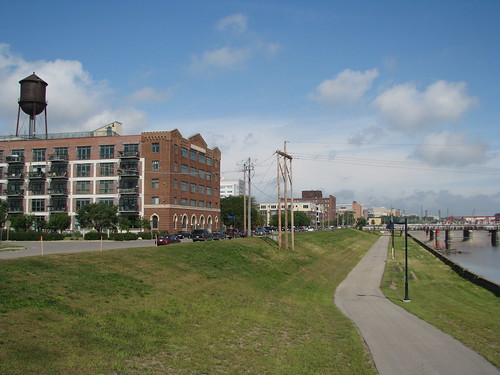
(More about downtown Des Moines, and more photos, after the jump.)
Oklahoma City bloggers are agog at the unveiling of Devon Energy's plans to build the state's tallest building. Steve Lackmeyer, who blogs about downtown OKC development for the Oklahoman, has been covering the story extensively. Some of the land in question is owned by the city's urban renewal authority, which voted yesterday to approve the plan. The tower will be 54 stories, 925 feet tall, the 21st tallest building in America. At the moment the state's two tallest buildings are in Tulsa -- the Bank of Oklahoma Tower at 667 feet and the central tower of Cityplex (née City of Faith) at 649 feet.
Over at TulsaNow's public forum, some participants are feeling tower envy, wishing for some deep-pockets oil company to build some new skyscrapers in downtown, but we have to recall that Oklahoma City took a pass, for the most part, on the building frenzy of the late '70s, early '80s oil boom. While OKC's tallest building is of that era, the next tallest is from the '30s. From the late '60s to the early '80s, Tulsa built five new skyscrapers: Fourth National Bank (now Bank of America), Cities Service Building (now 110 W. 7th), 1st National Bank (now First Plaza), the BOk Tower, and the Mid-Continent Tower -- the addition that stands beside and is cantilevered over the original Cosden Building at 4th and Boston.
There are rumors of even more tall towers in Oklahoma City, and some OKCers are giddy at the thought of "filling the gaps in the skyline."
The thing about filling those gaps is that the new skyscrapers have to touch the ground at some point, and how these towers meet the street is what matters most to downtown's vitality. It may look beautiful from five miles away, it may have a great view from the top story, but how does it look to someone walking by on the street?
David Sucher is fond of saying, "Site plan trumps architecture."
Putting it yet another way, what happens more than 30 or so feet off the sidewalk is of only secondary importance.
The important thing it to create an urban, walkable space at sidewalk level by following Sucher's simple Three Rules -- build to the sidewalk, make the building front "permeable" with doors and windows you can see through (no blank walls or mirrored glass, and, preferably, with spaces that are open to the public along the street, such as storefronts), and put the parking behind the building.
It took a while to find a site plan of the Devon building; Doug Loudenback has it. The building will be on an existing 2-by-2 superblock, just north of another 2-by-2 superblock where Myriad Gardens is located. A public park will occupy the southwest corner of the site. A six-story building will be connected to the tower by a rotunda. There will be retail in the six-story section, but it's unclear if it will be accessible along the exterior of the building. Only a small portion of the six-story section will front the street; the tower itself will be surrounded by a moat.
Somewhere I saw it mentioned that this building will anchor Harvey St. as a north-south axis which will ultimately connect the downtown core to the North Canadian River's shore. In fact, Harvey will remain closed through this superblock, a missed opportunity to correct a planning mistake from the past. Like the Williams Center in Tulsa, it will act more as an obstacle than a link.
Some things I wrote elsewhere about Devon's plans:
On TulsaNow's public forum, I had this initial reaction:
I don't care about how far this thing sticks up as much as I care how it meets the street. I haven't seen pictures yet, but the descriptions indicate some sort of plaza and moat. A work of high art rather than a working part of a walkable urban streetscape. Bleh.We got our allotment of skyscrapers in the '70s and early '80s. Oklahoma City built a few towers during that period, but none as tall as Tulsa's.
Tulsa would be far better off to fill all our parking lots with four-story buildings -- storefronts on street level, offices on the second level, apartments on the third and fourth floors -- than to build even one new skyscraper.
Tulsa's skyscraper boom may have satisfied some corporate egos, but it hastened the conversion of downtown from a real downtown to an office park. Buildings that used to house people and small retail were cleared away for the towers and for the parking that the towers required.
In response to a comment that you can build towers and pay attention to the street at the same time, I wrote:
Yes, you can, and it was done all the time before WWII -- e.g., the Empire State Building has street-level retail -- but I'm hard-pressed to think of an example from the last 40 years of a skyscraper that conforms to the Three Rules for generating urban places....
No one else could think of one either. It sort of goes against the starchitect code of honor -- you have to put a plaza around your masterpiece, create some distance between the street and the building so people are able to see more of it and admire it. Plazas -- unless they are surrounded on all sides by some sort of wall to create a kind of room -- don't work well. They are rarely done the right way in America. They may look nice as you drive by at 30 mph, but name me one plaza in Oklahoma where people choose to linger.
I posted this comment on an entry at Steve Lackmeyer's blog about the possibility of other towers in downtown OKC.
What happens at street level is far more important to the long-term health of downtown than how tall the buildings are. Go ahead and build a skyscraper, but make sure you don't clear out block after block of three and four story buildings to make room for the parking. Make sure the ground floor relates well to the street, with human scale elements, like street-fronting retail space.Tulsa's 1970s skyscraper binge hastened downtown's conversion from a traditional mixed-use downtown to a 9-to-5 office park. We're only now starting to recover, with the renovation of the handful of old low rise buildings that weren't razed for the sake of parking.
TRACKBACK: Steve Lackmeyer responds with a post called "Blank Walls," which mentions urban critic William Whyte's observations of Oklahoma City in the early 1980s. Whyte's ideas influenced pioneering Bricktown developer Neal Horton. Quoting Whyte from a 1983 article in Time:
"The Blank Wall is on its way to becoming the dominant feature of many United States downtowns," Whyte complained. "Without the windows or adornment to relieve their monotony, the walls are built of concrete, brick, granite, metal veneer, opaque glass and mirrors ... designed out of fear - fear of the untidy hustle and bustle of city streets and undesirables - the walls spread fear."..."By eliminating the hospitable jumble of shop fronts, restaurant entrances and newsstands, the walls deaden the very city the buildings claim to revitalize."
(This appears to be the Time story: "Drawing a Blank Downtown" by Wolf von Eckhardt, which quotes Whyte and mentions a collection of his photographs illustrating the problem.)
Steve has photos of Leadership Square and the Pioneer Telephone building, which illustrate the point about blank walls, and there is a thoughtful discussion underway in the comment section.
Some recent finds worth telling you about:
Here are two fairly new "news around town" blogs devoted to Tulsa: Tulsa Loop and This Tulsa.
This Tulsa has a very cool logo (featuring the BOK Tower, the Mid-Continent Tower, and University Club Tower), and they encourage readers to submit links of local interest. (If you've missed Beef Baloney, the site has a video with Matt Zaller interviewing Bill Hader and talking about growing up in Tulsa.)
TulsaLoop aspires to be "Your Tulsa City Guide," offering a calendar of events, a list of attractions, and news about happenings around town.
I noticed Kick the Anthill when the blog weighed in on the CAIR-OK EEOC complaint against the Woodland Hills Abercrombie Kids store. The three bloggers cover a wide range of topics:
We're a small group of ants that got tired of getting kicked, so we decided to kick back. We're mad about movies, conservative politics and our Christian faith. Safe to say we're just mad in general. We also like to yak about Oklahoma (which, seemingly coincidentally, is just one gigantic anthill itself) and other completely random things. Thanks for joining us.
I've already been following Terra Extraneus, but I just noticed that blogger Terry Hull has a separate, personal blog, with entries that link to things I need to read, like this one about someone who makes more than $100,000 a year blogging, and this entry linking to Writer's Digest's 101 Best Websites for Writers.
I've come across a number of blogs devoted to real estate and development in Oklahoma: The Journal Record has a blog called Oklahoma per Square Foot, covering the commercial real estate industry in Oklahoma City and Tulsa. Oklahoma City homebuilder Jeff Click writes Modern Land Run.
Blair Humphreys dreams about Oklahoma City's future on his blog imagiNATIVEamerica. Right now he's in living car-free in Boston, where he's studying planning and urban design. Here's a great post, illustrated with photos and maps, about what makes for pedestrian friendliness.
Nick Roberts is a fellow right-winger and urban advocate who has just started blogging at A Downtown ontheRange. He lives in Calgary, but considers Oklahoma City his adopted hometown:
Obviously OKC is a very special place to me, and I'd rather not be away from it at this point in my life, but I promise I will come back home better positioned to leave the kind of impressions that I would want to on my adopted hometown. Whether I settle down in OKC, or Galveston where I was born, remains up in the air, but the only thing certain at this point is that I am hardly finished with OKC. I want this blog to have the same kind of impact that Doug Dawg, Steve's OKC Central, and other blogs have had, in informing readers about the life of urban OKC, and perhaps Tulsa, too! And I will be making comparisons to beautiful Calgary whenever possible, just for the purpose of expanding you guys' horizons.
A couple of other bloggers are in Oklahoma but a long way from where they grew up:
Sarah, Brit Gal in the USA, moved here from the UK after falling for an Oklahoma man she met in an online backgammon room. Her blog helps you expand your transatlantic vocabulary with a "Brit Word of the Day" -- Wednesday's word was bollard.
Stuart Campbell, the Dusty Traveler, is from New Zealand, and he's been photographing scenic spots around Oklahoma, including the Wichita Mountains, Red Rock Canyon, Turner Falls, Maysville, and Natural Falls. He finds it a challenge to capture the grandeur of the Great Plains:
Big mountains are dramatic. A big lake is peaceful. A big city is bustling. The plains are just BIG. There is a lot of space with nothing going on and it is hard to capture nothing and make it look spectacular.Some secrets I am discovering; color- go early or late but the middle part of the day dilute the color. The sky- watch what is happening above as the clouds are fascinating in themselves and can add to a wide open space. Find things to put in the picture -- whether it be natural or man made it can add character to a scene.
But capture it he does. Click that link and have a look at our photogenic home state.
I found many of these new blogs via the BlogOklahoma web ring -- a list of nearly 900 Oklahoma-based blogs, with brief descriptions for each. To give you an idea of how Oklahoma's blogosphere has exploded, BatesLine joined in March 2004 as blog number 39. The latest addition to the web ring -- yesterday -- is called I Don't Think I'm a Grown Up Yet -- number 861. And it's not an exhaustive list: The oldest Oklahoma-based blog of all isn't a member of BlogOklahoma (which is akin to Switzerland not joining the United Nations -- when you're Switzerland, you don't need to join the UN to prove yourself as a peace-loving nation-state).
There's an exciting lakeside community planned for Oklahoma, unlike anything in the state, but hopefully a model for many more to come. New urbanist city planner Andres Duany has been hired by former Oklahoma City mayor Kirk Humphries to plan Carlton Landing on 1600 acres beside Lake Eufaula. The result of a design charrette -- a kind of brainstorming session -- was presented earlier this week in Oklahoma City.
Duany planned the Gulf Coast town of Seaside, Fla., turning that tiny piece of the Redneck Riviera into a popular resort town and generating similar developments all along that stretch of the Florida Panhandle's shore.
As Seaside was, Carlton Landing is family-owned land that has never been developed.
Instead of the usual resort community pattern of only residences along winding roads, Carlton Landing will have a heart, right on the shore, with shops, dining, recreation facilities, and even a chapel. The 1600 acres will be home to about 2500 people -- not high density, but more dense than a typical lakeside development. Duany has almost complete freedom to set design and development standards -- there are no existing land use rules to work around.
From a fleeting glimpse of a map in this slideshow from the charrette (about 2:14 into the video), it appears the Carlton Landing property is centered around the marker on this map:
I've had my differences with Kirk Humphries, but I admire him for doing something different and daring with this land. Instead of, say, asking taxpayers to spend $600 million create a vibrant community out of the middle of a river, he's making it happen with his own money and land. A couple of years ago I suggested that the folks behind the Channels could do the same thing right here in Tulsa:
Tulsa Stakeholders, Inc., (TSI), the group led by John-Kelly Warren of the Warren Foundation which is proposing The Channels development, has a commendable desire to create a thriving, pedestrian-friendly urban place in Tulsa. So instead of asking the taxpayers to spend $600 million to build three tiny islands on which a walkable community can be built, why doesn't TSI create or restore a walkable community on land that already exists, and thus encourage the creation of this kind of neighborhood all over Tulsa?(It may be cheeky for me to tell TSI what to do with their money, but since they're telling us taxpayers what we should do with ours, turnabout is fair play.)
TSI could demonstrate that traditional neighborhood development will succeed, even in car-bound Tulsa. They could use their deep pockets and risk tolerance to blaze a trail for more risk-averse conventional developers.
Building a traditional mixed-use neighborhood on taxpayer-subsidized islands would send the message that such developments are too fragile to survive in the free market.
Building or restoring the same kind of neighborhood with private money on private land would set an example that other developers could follow with confidence.
There are many opportunities for TSI to do pioneering work in this area. They could build a New Urbanist community on undeveloped land somewhere in the metro area. They could incorporate walkability and mixed use into the Warren Foundation's own developments (e.g. the Montereau retirement community).
TSI could do some of the exciting infill development recommended by the East Tulsa Community Plan (http://www.cityoftulsa.org/Community/Revitalization/EastTulsa.asp), helping to knit together a lively international district and creating a walkable center for a vast swath of car-bound suburbia.
Perhaps the most strategic investment TSI could make would be in the Pearl District (aka the 6th Street Corridor); on the charitable side, its assistance could fund implementation of the stormwater project for the three-square-mile Elm Creek basin.
This would take land out of the floodplain, making restoration and infill practical. Full public funding for the plan--about $35 million to create stormwater detention ponds and to link one of them to Centennial Park by a canal--is at least a decade away.
Fixing Elm Creek not only helps 6th Street, but it would improve drainage in the Gunboat Park and 18th and Boston areas. (Elm Creek flows underground through both neighborhoods, emptying into the Arkansas River at 21st Street.)
On the private side, it could set an example for other developers by doing some quality infill development and restoration in accordance with the Pearl District Infill Plan (http://www.cityoftulsa.org/Community/Revitalization/6thStreet.asp). No need to use condemnation to assemble vast tracts of land--restore some existing buildings to their former glory, or build new brownstones on already vacant lots.
TSI's leadership would make it safe, maybe even fashionable, for other investors to get involved in the district and to create walkable places in other parts of the metro area.
The revival of the Pearl District would strategically patch a hole in Tulsa's original urban fabric, reconnecting centers of activity--downtown, Cherry Street, Kendall-Whittier, TU, and the Utica medical corridor--which are quite close to each other but which now seem miles apart. And it would make it possible for more Tulsans to make walking a part of daily life, not a specially scheduled activity.
Through private action to create or restore a walkable neighborhood, TSI would send the message, "Come on in, the water's fine," to Tulsa's developers. It might not be as splashy as islands in the river, but such a project would create ripples that would spread far beyond the riverbank, making all parts of our metro area healthier, livelier, and more attractive as a place to live, work, and play.
A couple of weeks ago the Land Use Prof Blog had a post about the challenges of infill development and about how Tulsa is dealing (or failing to deal) with them:
One of the dilemmas of infill -- allowing new construction in an already developed area -- is that it often upsets the expectations of landowners and residents concerning the land use and density of the community. Whether it is allowing stores in an area that has been exclusively residential, or allowing larger houses in a neighborhood of one-story ranch houses, infill often faces strong local opposition, or at least local skepticism. And political scientists tell us that legal efforts often fail if they offer, on one hand, broad but thin public benefits (as some infill does, by counteracting sprawl) and, on the other hand, narrow but concentrated costs upon citizens (such as those owners whose expectations may be upset) who fill tooth and nail against the plan.
I think the prof (Paul Boudreaux of Stetson University) has overlooked a significant factor in this cost-benefit analysis. There is also a narrow but concentrated benefit to developers who want to plop suburban-style development into popular traditional neighborhoods. The benefit to developers of this particular kind of infill is more concentrated than the cost to the broader group of property owners in established neighborhoods who want infill development to be harmonious with existing development.
Most of Tulsa's infill development is not increasing residential density, but merely house size. The QuikTrip at 21st and Harvard has been described as infill, but it's really dedensification -- two retail spaces and six living units will be replaced with a slightly larger version of the existing QT store.
The prof's specific comments about Tulsa:
Tulsa, Oklahoma, is currently undergoing such a debate. In the face of a variety of infill plans, the city has proposed authorizing some "neighborhood conservation districts," which would give some power to neighborhoods to regulate their land use. Some see this as a means of controlling unwanted infill; others see it as an odious regulation of private property. Whither infill in Tulsa? Not surprisingly, the Tulsa Metropolitan Area Planning Commission stated last week that it is in no rush to change its policies with regard to infill. Stay tuned ...
The prof mislabels some of the players. The city as a government didn't propose NCDs; neighborhoods did with the support of one (now former) city councilor. Still, it's an interesting perspective on an interesting blog about urban planning.
In a more recent entry, Boudreaux calls attention to infill in Philadelphia, where a project called Infill Philadelphia hopes to breath new life into old neighborhoods by adapting existing buildings to modern expectations.
This Old House, the pioneering PBS series on home restoration has saluted Tulsa's Brady Heights neighborhood as one of the best places in the country to buy an old house:
Brady Heights existed before Oklahoma was a state. The area, originally known as the Silk Stocking neighborhood, saw hard times before making a comeback in the 1980s. Now on the National Register of Historic Places and just blocks from downtown Tulsa, Brady Heights is adjacent to the Tulsa branch of Oklahoma State University and encompasses an eclectic choice of housing, populated by a diverse mix of owners and renters. Four churches and an active community group that helps older residents take care of their homes provide the social glue....Tate Brady, an early city booster and real estate entrepreneur as well as the neighborhood's namesake, built his mansion here in 1907. You'll also find bundles of bungalows and Foursquares built between 1900 and 1924, along with Colonial Revival, Folk Queen Anne, Folk Victorian, Craftsman, Italian Renaissance Revival, and Prairie School houses.
The neighborhood, which covers Denver and Cheyenne Avenues between Marshall St. and Fairview St., just north of the Inner Dispersal Loop, is listed by the "This Old House" site as one of the best for old-home buyers who are first-time buyers, retirees, "city slickers," those interested in craftsman houses, and those looking for an older home in the midwest. You can find a simple bungalow in the neighborhood for as little as $40,000.
Via Preserve Midtown, which notes:
Those homes that are sometimes referred to as "eyesores" do have great value with some time and effort put in to make them shine like they did when they were new.
Homes like this were built with care and with the intent of having them last for a century or more.
Houses of similar style and vintage could once be found all the way east to Detroit Ave. But the city promised the University Center of Tulsa 200 acres for its campus, and during the '90s the land south of Emerson Elementary School was bought up by the Tulsa Development Authority and the homes demolished. Footings, staircases, and other remnants are still visible.
Brady Heights has an active neighborhood association, is listed on the National Register for Historic Places, and has historic preservation overlay zoning, meaning that exterior modifications have to be reviewed for appropriateness by the Tulsa Preservation Commission, in order to preserve the historic character of the neighborhood and protect the investments made in restoring these homes.
It happened in Bartlesville, but the lesson applies everywhere: You can't expect people to adapt and reuse your historic buildings or build high quality new construction which fits in a historic area if you allow someone to throw up a metal building in the midst of it:
In November 2007, Shelby Navarro, Tulsa architect who is currently involved with an investment group re-developing 70 buildings in the Pearl District of Tulsa, and J. Elliot Nelson, owner of McNally's [McNellie's] Pub in Tulsa and of other pubs and restaurants in both Tulsa and Oklahoma City, came to Bartlesville at Clyde Sare's invitation. They toured the BRTA [Bartlesville Redevelopment Trust Authority] buildings at Second Street and Keeler Avenue with the idea of developing them and other buildings downtown into a dining/entertainment/retail complex. Mr. Nelson was already committed to installing a pub at the Pioneer Building on Dewey Avenue.After the BRTA overturned the Design Review Committee's decision regarding construction of a metal building in the Downtown District, Mr. Rankin and his associates, as well as Shelby Navarro and J. Elliot Nelson, decided to put their plans on hold. They were concerned that such lax enforcement of design guidelines would be harmful to future investments. In Rankin's words, "There needs to be a stable environment to protect the investors who risk their capital in a historical district."
Emphasis added. At least Bartlesville has a Design Review Committee, but it doesn't do much good if they override the rules and allow incompatible design and cheap, throwaway buildings.
Doug Loudenback has a post from a month or so ago featuring beautiful vintage postcards of Oklahoma City. Mixed into the pastel tinted images of Prairie Commercial, Sullivanesque, and Art Deco buildings was a fact that should make you gasp:
[The Kingkade Hotel] survived until the 1960s-1970s Urban Renewal era when 447 buildings were destroyed by the Urban Renewal Authority and another 75 more by private owners.
That may be hard to believe, but when you look at a satellite view of OKC, it makes sense. Four blocks cleared for the Myriad arena (Cox Business Center), another four for a massive parking deck, another four for Myriad Gardens, one for Stage Center. I would guess that the two blocks (maybe more) just north of the Cox Business Center were also urban renewal zones. Seven blocks were run through with I-40. I don't know if Doug's number includes Deep Deuce (OKC's version of Greenwood) the area cleared for I-235, or the research park just east of I-235.
Oklahoma City urban renewal was an insane master plan conceived, I'm ashamed to say, by an MIT alumnus, I. M. Pei.
Tulsa's leaders weren't any wiser than Oklahoma City's, just less ambitious, with much of the demolition being accomplished by private, rather than public interests. But Tulsa government did enough damage clearing away buildings that were nicer and more substantial than those you'll find in the Blue Dome District, demolishing nearly all of Greenwood, and blitzing the residential neighborhoods adjacent to the central business district.
Every city has them: Small creeks and streams that have been converted into culverts and buried beneath streets and buildings. The bend in the San Antonio River that became Paseo del Rio narrowly escaped being converted to a storm sewer in the 1930s. Two recent blog entries highlight underground streams in two of the world's greatest cities.
Strange Maps has a map and descriptions for London's lost rivers, 15 streams that flow into the Thames, including the River Fleet:
The Fleet flows under King's Cross, which was originally known as Battle Bridge, after a place where Queen Boudicca is reputed to have fought the Romans. It ends in the Thames under Blackfriars Bridge. The river gave its name to Fleet Street, which in turn became a collective term for the British press, as most newspapers had their offices there. It almost gave its name to a tube line, but since its opening coincided with the Queen's silver jubilee, the Fleet Line was named the Jubilee Line. On a quiet moment in front of the Coach and Horses pub in Ray Street, Farringdon, you can still hear the Fleet's flow through the grating.
And Ace has this item about fishing in the basements of Manhattan buildings, where there is access to streams that were long ago covered over:
It seems that the many rivers and streams that flowed through Manhattan before it was turned into a vast concrete jungle could not simply be paved over. Those waterways had to be diverted and channeled underneath the buildings that now tower above them.
Here in Tulsa, there are several buried streams in downtown and midtown, including Elm Creek, which runs from the western part of Kendall-Whittier neighborhood, to Centennial Park (where it is in the open briefly), then underground through the Gunboat neighborhood and the 18th & Boston area to its outlet beneath the east end of the 21st Street bridge. (There was a proposal to reopen Elm Creek near 18th & Boston about 15 years ago as a riverwalk promenade, and the Sixth Street Task Force has proposed reopening the creek as a canal down the middle of 6th Street.) Cat Creek runs under Archer downtown and empties into the Arkansas River beneath I-244. Mill Creek, in the eastern part of Midtown, is underground until it reaches McClure Park.
Via Mister Snitch, a beautiful collection of photos of New York, arranged chronologically, beginning with 1885, when horse-drawn carriages and trolleys dominated Manhattan's streets. Most of the pictures were taken when skyscrapers looked like steeples, turrets, and minarets, before the 1960s influx of flat-topped glass and steel boxes. (Click the thumbnails to see full-sized images.)
Mister Snitch calls them "photos of a romantic, antique, B&W New York," and I think they deserve a romantic soundtrack, so here's Charlie Spivak and his orchestra.
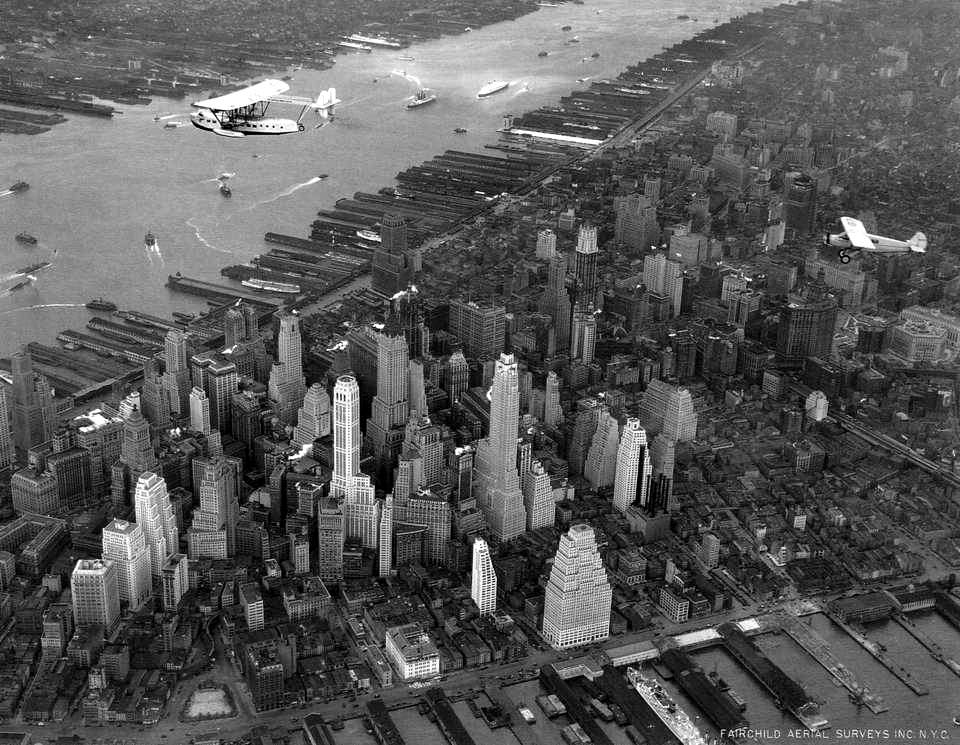
This photo and its caption are worth highlighting:
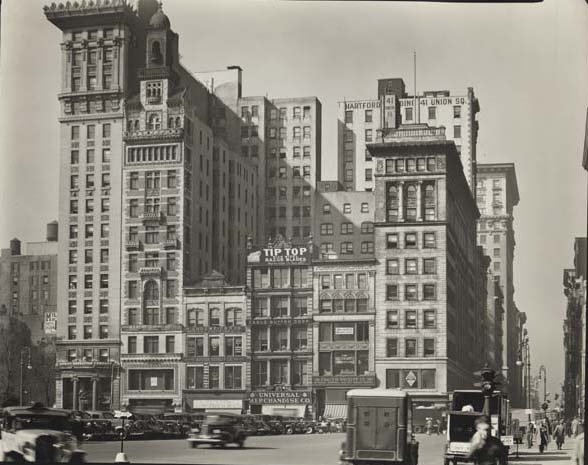
Union Square West. A hilarious jumble gets A+ for accidental design. These lots once held town houses. Their dainty footprints have been preserved, so the buildings have a delicate scale regardless of their height. One is a miniature skyscraper. Scale-obsessed NIMBYs take note: you need to object to a building's footprint, not its height.
A great point. The constraints of lot lines, alleys, and the street grid generate a more pedestrian-friendly experience at the ground level. Instead of one large building with a single entrance framed by blank walls or reflective glass, you have at least five building entrances in a single block -- five different window displays to catch your eye, five places to duck in out of the rain, five places to escape from a creep. Changes in construction finance provided the deep pockets to enable developers to buy out an entire block at once, rather than buying and redeveloping one lot at a time. Urban renewal cleared whole blocks at a time, and cities became willing to vacate streets and alleys to suit the demands of developers.
My biggest complaint against the proposed Bomasada development in Brookside is not its height, but the fact that it is one huge blocky building with a single entrance, and rather than creating more connections between the residential and commercial areas, it creates more obstacles. A development of individual three to four-story townhomes or apartment buildings (2 or 3 units per floor) with separate entrances, and at least one public way connecting 39th Street to the Old Village Shops, would "enhance the value, image and function of area properties" in a way that satisfies the condition on page 7 of the Brookside Infill Plan for higher-density residential development in the residential area on the boundary with the commercial area.
Although bits and bytes are its bread and butter, no major studio better embodies humanity in film than Pixar. A recent interview with Pixar director Brad Bird presents ten ways that Pixar promotes innovation. (Hat tip to Joe Carter's Evangelical Outpost.)
I found two points especially interesting. This one ought to interest Forrest Christian, who has been writing about adult underachievers over at his Requisite Writing blog:
Lesson One: Herd Your Black SheepThe Quarterly: How did your first project at Pixar--The Incredibles--shake things up?
Brad Bird: I said, "Give us the black sheep. I want artists who are frustrated. I want the ones who have another way of doing things that nobody's listening to. Give us all the guys who are probably headed out the door." A lot of them were malcontents because they saw different ways of doing things, but there was little opportunity to try them, since the established way was working very, very well. We gave the black sheep a chance to prove their theories, and we changed the way a number of things are done here.
Later, Bird explains how geography contributes to creativity.
Then there's our building. Steve Jobs basically designed this building. In the center, he created this big atrium area, which seems initially like a waste of space. The reason he did it was that everybody goes off and works in their individual areas. People who work on software code are here, people who animate are there, and people who do designs are over there. Steve put the mailboxes, the meetings rooms, the cafeteria, and, most insidiously and brilliantly, the bathrooms in the center--which initially drove us crazy--so that you run into everybody during the course of a day. [Jobs] realized that when people run into each other, when they make eye contact, things happen. So he made it impossible for you not to run into the rest of the company.
There are urban design parallels: The layout of some cities makes chance encounters likely; in others a serendipitous meeting is all but impossible. Chance encounters enable the cross-pollination of ideas, which makes the whole city smarter.
If you are walking to work, riding the bus, hanging out a neighborhood coffee shop, walking across downtown for a meeting, you're more likely to bump into someone you know and have that conversation you've been meaning to have when you get some time. If you're going from place to place in your car, you might wave at someone you know, but you're not going to stop for a chat.
Broken Evangelical Outpost link redirected to the Internet Archive on January 29, 2020. I modified the title from "Pixar innovation" to make it more descriptive. To elaborate on why cross-pollination and serendipitous encounters matter: A skill, idea, contact, or anecdote belonging to one person might be the missing piece of the puzzle for a problem that someone else is trying to solve.
Basketball boosters were quite happy to say that a relocated NBA franchise would belong to the whole state, when they were convincing credulous legislators to vote for $60 million in corporate welfare to the billionaire owners of the Seattle SuperSonics (the subject of last week's column in UTW).
Now that the deal is done, the City of Oklahoma City has announced that it will be a condition of the arena lease that the team will bear the name of the city, not the state. (Hat tip to Mad Okie.)
RELATED: Fellow "naysayer" Jim Hewgley sends along a link to a very detailed review of research on the economic impact (or lack thereof) of pro sports facilities and the history of public subsidy for them.
The article's author, Dennis Coates, is professor of economics at the University of Maryland, Baltimore County. His own research studied yearly data for per capita personal income, employment, and wages in metro areas hosting a major league baseball, basketball, or football franchise, looking at the impact of new stadium construction or franchise relocation. He found a decrease in per capita personal income as a result of new sports facilities or teams in a metro area. Here are a couple of possible explanations for the observed decrease (emphasis added):
First, consumer spending on sports may simply substitute for spending on other types of entertainment--and on other goods and services generally--so there is very little new income or employment generated. Sports fans that attend a game may reduce their visits to the movies or to restaurants to free up finances for game tickets and concessions. Patrons of local restaurants and bars who come to watch the games on television also are likely to cut back on their other entertainment spending.Second, compared to the alternative goods and services that sports fans may purchase, spending related to stadium attendance has a relatively small multiplier effect. This is because spending at the stadium translates into salaries for wealthy athletes, many of whom live outside the city where they play. High-income individuals generally spend a smaller fraction of their income than low- and middle-income people--and much of the spending professional athletes do occurs in a different community than where they earned it. So the money paid to players does not circulate as widely or abundantly as it would were it paid to people with less wealth and more attachment to the city.
Recall that the recently-passed expansion of the Oklahoma Quality Jobs Program to sports teams includes salaries not taxable in Oklahoma in the calculation of the "rebate," thus ensuring that the team still gets a subsidy for non-resident players who are paid out of state and who therefore likely spend most of their money out of state.
Coates reviews research which uses other, more focused measures of economic activity related to projected impacts from the presence of major-league sports teams (e.g., hotel room nights and less sales tax data). He also considers when subsidizing a stadium might be justified, despite the lack of positive economic impact.
The beginning of the article looks back at the beginnings of public ownership of sports venues. The urge to build large memorials to fallen of the Great War and the need for make-work projects during the Great Depression were two contributing factors.
Coats also touches on the hidden costs of public stadium subsidy. Initial construction costs are just the tip of the iceberg.
It's worth reading the whole thing.
FOR MUCH, MUCH MORE: Here's the Heartland Institute PolicyBot's collection of links to studies on public subsidy of sports facilities and convention centers. (Thanks to Brandon Dutcher for calling it to my attention.)
A few days ago, Jon Swerens posted an entry at The Good City called "Politics can't save urbanism." Jon's point, in a nutshell, was that we can't use legislation and regulation to impose high-density urban living on a populace that believes it to be undesirable. The culture has to change.
I responded with a comment that in some ways the culture is changing and what could be done in cities like Tulsa and his hometown of Fort Wayne, Ind., to help that change along. Jon was kind enough to spotlight the comment in a subsequent blog entry. Here's what I had to say:
You make a good point about the cultural issue. Two generations have been raised to see the tidy segments of the suburbs as normal and the city as a messy mix that needs sorting out. That's starting to change, and a significant number of people have experienced the pleasures of urban living, either directly, or vicariously through TV shows like Seinfeld and Friends. (And it could be argued that the appealing depiction of urban life on those programs was made possible by Giuliani's cleanup of New York in the '90s.)I think the starting point is for cities like Fort Wayne and Tulsa to create and preserve urban places for the many who already know they want to live there. As these areas thrive, others will see that urban excitement is possible close to home, not just on the East Coast or in Europe. Over time there may be enough demand to redevelop badly aging post-war suburban neighborhoods in a new urbanist fashion.
Politics still matters: You need councilors and planning commissioners with the courage and vision to approve a pilot project for form-based codes or special zoning with design guidelines to protect traditional neighborhood development from suburban-style redevelopment.
But mostly you need entrepreneurial types willing to reuse old buildings in traditional neighborhoods, and others who are willing to build new in a traditional style. Recreating a vital urban core will happen the same way it was destroyed: one building at a time.
Thinking further about cultural influences in support of traditional urban settings, I've noticed that a fair number of children's TV programs and books are (or have been) set in urban environments. First and foremost, there's Sesame Street, with its row houses and corner grocery. Mister Rogers' Neighborhood is a traditional mixed-use neighborhood with shops and a trolley line within walking distance.
When my oldest son was small, he watched "The Busy World of Richard Scarry" nearly every day. The cartoon, which featured characters like Lowly Worm, Huckle Cat, and Bananas Gorilla, was set in Busytown, a vaguely northern European small city, filled with street-fronting small businesses like bakeries and green grocers. Here's the show's opening credits:
If you can think of other pop culture elements -- novels, music, movies, TV series -- that make urban living seem appealing, please post them in the comments below.
My most recent Urban Tulsa Weekly column is about the correlation between urban vitality and the combination of good urban form and older buildings, factors that are actively protected in cities like Austin and San Antonio, cities that Tulsans frequently say they wish to emulate. Those factors seem to make the difference between a lively riverfront, like San Antonio's, and a commercially inactive riverfront like Austin's.
As I mentioned in the column, I visited Austin and San Antonio recently. You can find the photos I took in downtown San Antonio on Flickr. I've geocoded each picture and explained what I found interesting, particularly from an urban design perspective.
Here are some links where you can learn more about San Antonio and Austin's zoning and land use policies:
- A collection of planning maps for San Antonio, including the location of historic districts, river overlay districts, and areas under neighborhood plans.
- Home page for the historic preservation division of the City of San Antonio's planning department, linking to pages about the city's historic districts, designated landmarks, viewsheds, and special River Improvement Overlay (RIO) districts.
- This page has links to maps and design guidelines for San Antonio's Neighborhood Conservation Districts and other special overlay districts, like those which govern development around key "gateways" to the city.
- Austin is in the process of developing neighborhood plans for every neighborhood in the city, with the aim of incorporating neighborhood-specific rules into the zoning code.
- The Austin City Council has made a Vibrant Urban Fabric a priority. That linked PDF file explains that "Vibrant Urban Fabric" means neighborhood plans incorporated into the zoning code and commercial design standards.
Twelve years ago, on a week-long business trip to Silicon Valley, I came up with the idea of doing a column for UTW that I would have called "Urban Elsewhere," describing the good and bad examples of urban design that I came across in my travels, describing vibrant districts and trying to explain why they work and how we might apply those examples to Tulsa. It took a few years, but through this blog and my column in UTW I've been able to do that from time to time, which gives me a lot of satisfaction. Perhaps some day our city leaders will draw lessons from other cities that don't involve massive tax increases for major public projects.
By the way, the Austin electronics store I mention at the beginning of the column is a branch of a store I first came across during that trip to Silicon Valley -- Fry's Electronics. It's Nerdvana -- like a Best Buy + CompUSA + Radio Shack on steroids. It's Bass Pro Shops for technogeeks. Every part or gadget you could imagine, you can find it at Fry's. Having a Fry's, or something like it, in Tulsa would do more than acorn lamps along the river to convince tech-heads that they want to live and work here.
An edited version of this column appeared in the April 2, 2008, issue of Urban Tulsa Weekly. The published version is available on the Internet Archive. Posted on August 4, 2018.
A Tale of Two Texas River Cities
By Michael D. Bates
On a recent business trip to San Antonio, I found myself in need of an obscure computer item - a tape for an ancient (i.e., 15 year old) drive. No place in San Antonio stocked the item, but an Austin electronics store had it, so I zipped an hour north on I-35.
My mission accomplished, I took my time heading back to San Antonio. I stopped for coffee, a calzone, and wifi at La Tazza Fresca, a little independent coffeehouse just north of the University of Texas campus. It's right next door to Groovy Lube, which also provides free wifi for its customers. (They change oil, in case you were wondering.)
I drove down Guadalupe St. to downtown, running into the Warehouse District, west of Congress between 3rd and 5th Streets. Even at eleven o'clock on a mild, early spring Thursday night, the area was bustling with people, with music spilling out of the old commercial buildings lining both sides of the streets.
I turned south on Congress and drove for about a mile, well past Lady Bird Lake (formerly Town Lake, but renamed last year to honor the late First Lady), before I hit another center of activity - the South Congress (SoCo) district. Here was another stretch of older buildings that had been creatively reused to create an eclectic neighborhood of shops, restaurants, coffeehouses, and pubs.
At one corner in SoCo, an Irish folk band was performing an impromptu set on the sidewalk - not in front of a particular establishment, just on the sidewalk - as a crowd gathered around them. The band and the audience all seemed to be in their late teens or early twenties.
Here's what caught me by surprise: For all the youthful, late-night activity within walking distance to the north and to the south of the lake, the shores of the lake itself were dark and evidently empty.
I was surprised by this because a number of Tulsans used Austin as a prime example of why Tulsa taxpayers urgently needed to modify the Arkansas River. They argued that having a lake on the southern edge of downtown was the key to Austin's vitality and to the special weirdness that makes it such a draw for creative and high-tech-oriented young people.
If the river was so all-fired important to Austin, where was the riverfront development? Why were all the people somewhere else?
Town Lake was created in 1960 by damming the Colorado River about six miles downstream from Congress Ave. The lake, about 10 miles long and 700 feet wide, is surrounded by parks with walking trails - much like our own River Parks. A few hotels and apartment buildings come up to the riverfront, but there isn't any significant commercial development on the river.
If you want a nice jog in Austin, head to the lake, but if you want to find music, beer, and young people, if you want to see where people are spending money and generating sales tax revenue, find the nearest cluster of old warehouses or storefronts.
The following afternoon, I had some time before I had to catch a flight home, so I walked around downtown San Antonio, near the River Walk and the Alamo, taking photos of streetscapes and buildings.
To a Tulsan, one of the most striking things about downtown San Antonio is how few surface parking lots there are and how many older commercial buildings are still standing. Houston Street, San Antonio's main shopping street from the 1930s to the 1960s, has only a single surface parking lot on the five-block stretch from Alamo Plaza to the San Antonio River. The street runs parallel to the north leg of the bend in the river.
There is nevertheless plenty of parking in the area, with multistory parking garages concealed behind street-level retail. What the pedestrian sees is a continuous street wall on both sides of the street, creating a kind of outdoor room lined with interesting buildings.
At the heart of Houston Street is the Majestic Theater. Just like downtown Tulsa's Ritz Theater, the Majestic was designed by Romanian-born architect John Eberson, an atmospheric theater in Italian Renaissance style, with a projector that throws clouds across a ceiling filled with twinkling lights.
Unlike Tulsa's Ritz, San Antonio's Majestic wasn't torn down in the redevelopment madness of the '60s and '70s. Instead, the Majestic was restored and reopened in 1989 as a 2,000-seat performance venue, home to the San Antonio Symphony Orchestra and traveling Broadway productions.
There are still some empty storefronts on Houston, but they're starting to be redeveloped with hotels and condos on the upper floors. In the meantime, the vacant spaces are still in use - for a recent downtown arts festival the storefronts were converted to gallery space.
And what about the River Walk? The water is pleasant, but what makes it an attractive place to stroll are the restaurants and shops that line the narrow stream. Some of the buildings are old, some are relatively new, but all provide have some sort of connection to the walk at river level, such as display windows or dining terraces.
Many of the buildings were already in place in 1929, when San Antonio created an upstream dam to reduce flooding risk and a cutoff to allow floodwaters to bypass the bend in the river. The San Antonio Conservation Society (undoubtedly denounced as naysayers by the Forces of Progress) successfully stopped plans to turn the bend into a covered storm sewer.
Architect Robert H. H. Hugman promoted the idea of turning the bend into a promenade of shops, and in 1941 his vision was realized. A plaque near his office on the River Walk explains the crucial role that history and urban design played in his concept:
"Hugman was convinced that the ideal future of the Paseo del Rio rested in preserving the historic character peculiarly San Antonio's own; that the flavor of our Spanish, Mexican, and Southwest traditions must be emphasized in all future development; that our 'little river' should be treated as a stage setting on which people are transported to the unusual; that all future architectural growth avoid modern styles; and further, that the river's tempo must be jealously guarded, remaining slow and lazy, in complete contrast with the hustle and bustle of street-level modern city life."
Up at San Antonio's street level, you'll find streetscapes that will transport you to back to Hugman's day. The massive Joske's Department Store on Alamo St. wasn't demolished; instead it's in use as a Dillards, linking Joske's imposing late-1930s Art Deco façade to the 1980s Rivercenter Mall.
Across the street, there's a continuous row of small commercial buildings. Although they vary widely in style - everything from late Victorian to Mid-Century Modern - they have a consistent scale and setback with street-level storefronts.
The strongest predictor of where you'll find interesting shops, favorite local hangouts, and nighttime vitality in a city is not the presence of water, but the presence of a continuous concentration of old buildings with storefronts that come up to the sidewalk, an urban layout that pre-dates the prevalence of the private automobile. While water can enhance such a district, these places seem to thrive even without any nearby body of water.
You'll also find that most cities have protected these areas with some sort of overlay zoning that requires new construction to imitate the basic urban characteristics of what's already there. New and old buildings alike conform to guidelines resembling David Sucher's "Three Rules" for generating walkable urban environments: Build to the sidewalk, make the building front permeable (windows, not blank walls), put any off-street parking behind the building.
In San Antonio, downtown is covered by a number of different overlay districts with requirements that new construction fit in with existing development. In many of the districts, a developer seeking demolition must prove that it is the only economically feasible option.
Austin also uses overlay districts, and the city's plan for a "vibrant urban fabric" calls for the development of neighborhood plans for the entire urban core and for incorporating those plans into the city's zoning code by 2010.
The rules in place in these vibrant, growing cities go far beyond the very modest Neighborhood Conservation District proposal currently under consideration in Tulsa, and they'd no doubt be considered draconian by a development lobby used to building anything it wants, anywhere it wants.
Almost 50 years ago, Jane Jacobs devoted an entire chapter of her classic The Death and Life of Great American Cities to "the need for aged buildings." Jacobs observed the importance of old buildings to innovation and urban vitality:
"Chain stores, chain restaurants and banks go into new construction. But neighborhood bars, foreign restaurants and pawn shops go into older buildings. Supermarkets and shoe stores often go into new buildings; good bookstores and antique dealers seldom do....
"As for really new ideas of any kind - no matter how ultimately profitable or otherwise successful some of them might prove to be - there is no leeway for such chancy trial, error and experimentation in the high-overhead economy of new construction. Old ideas can sometimes use new buildings. New ideas must use old buildings."
There's a lesson to be learned from our successful neighbors across the Red River. But if you'd rather not follow a Texas example, just look around you. Where you find innovation and vitality in Tulsa - Brookside, Blue Dome, Cherry Street, 18th & Boston, Brady Village - you find older buildings that were overlooked by the planning fads of the past.
The proposed Neighborhood Conservation District ordinance for residential areas is a good first step. But Tulsa is long overdue for positive action to protect our remaining stock of older commercial buildings, to stop the spread of surface parking, and to require that new infill reinforce the urban character of these older commercial neighborhoods.
UPDATE 2022/10/03: Here's an album of photos from the aforementioned 2008 visit to San Antonio and further visits in subsequent years.
My one-day, work-related trip yesterday was kind of a bust, but it did leave me with some time to explore San Antonio before my flight home. I drove into downtown and took a set of photos illustrating what's right about downtown San Antonio's urban design. As I was walking down Houston St. and snapping pictures of buildings, a fellow called out and told me I should take a picture of him and his friend. So I did.
(Clicking on any photo below will take you to the Flickr photo page, where you can see larger images.)
That's Mike on the left and Jesse on the right. (Mike is the one that hollered at me.) They work for a company that does convention and event decorating, and they were fitting out a vacant retail space for use as a gallery during an upcoming downtown arts festival. I told them I'd post the photo on my blog, and Mike wrote down the URL. Mike told me that some of these older buildings (the sort that Tulsa real estate types would call "functionally obsolete" and therefore wrecking ball bait) were being converted to hotels, to meet the growing convention demand. San Antonio, he said, is great for conventions year-round, since it never gets that cold. (It was sunny and 91 yesterday.)
The striking thing about downtown San Antonio is that there are so few surface parking lots. This is one of the few, and the sidewalk is screened with palm trees to mitigate the visual impact.
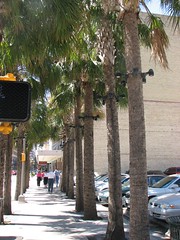
Parking garages have street-level retail. (In the picture below, that's a parking garage on the left in the foreground.)
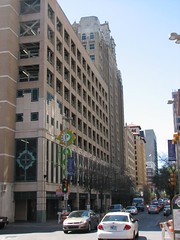
You have a continuous street wall on both sides of the street that obeys the Three Rules -- David Sucher's guidelines for creating walkable urban places.

Instead of tearing down their grand old theaters, they saved one, the Majestic, as a performing arts center:
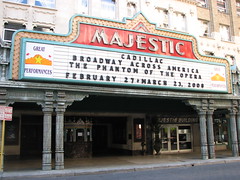
They saved the facade and the box office kiosk of the Texas Theater and built a new building behind it. Not the ideal form of preservation, but better than nothing.
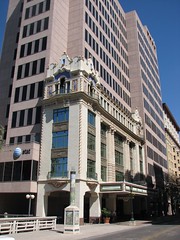
I took a number of photos to illustrate that compatibility doesn't mean uniformity, a salient point in the debate over neighborhood conservation districts. (In some cities, conservation districts protect commercial areas. The ordinance being discussed for Tulsa only covers residential areas.) This photo of Alamo Plaza shows buildings from a number of different eras and in a number of different styles -- late Victorian, Plains commercial, Art Deco, Mid-Century -- but similar in scale and setback and all with street-level windows for retail spaces.
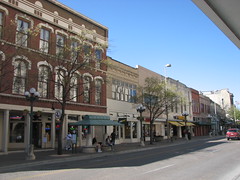
And as Tulsa's wise men know, major retailers will never come to a city where they can't build their standard store designs. They will shun areas with conservation district overlays. Right?
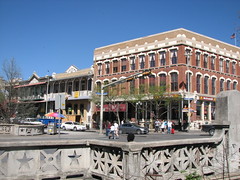
That's a McDonald's on the right, next to a Subway, next to a Fuddruckers.
There is plenty right with downtown San Antonio. I suspect the history-proud Texans of that city have some rules in place to keep it that way. I'll let you know what I find out.
MORE: These are the zoning districts (base zoning and overlay) that apply to various parcels in the River Walk and Alamo area:
D Downtown District (Sec. 35-310.11)
This zone provides concentrated downtown retail, service, office and mixed uses in the existing central business district. Examples of permitted uses include: Indoor Theatres, Taxi Service, Apartments (6 dwelling units through 50 dwelling units per gross acre), Hotels, Motels, Offices (no restrictions on square footage
unless otherwise prescribed), and Telephone Equipment Infrastructure.
H Historic Districts and Landmarks (Sec. 35-333)
These are areas in which the cultural or archaeological identity, architectural features, or overall character are considered historically significant. Historic Districts often contain one or more buildings, objects, sites, or structures designated as significant or exceptional historic landmarks.
HS Historic Significance Districts (Sec. 35-333)
Historic Significant Landmarks are those considered to be important and their demolition would mean a serious loss to the character of the city.
HE Historic Exceptional Districts (Sec. 35-333)
Historic Exceptional Landmarks are those considered most unique in terms of historic, cultural, archeological significance. Demolition would mean an irreplaceable loss to the quality and character of the city.
RIO 1-6 River Improvement Overlay District (Sec. 35-338)
Overlay district that imposes regulations to protect, preserve and enhance the San Antonio River and its improvements by establishing design standards and guidelines for properties located near the river.
VP Viewshed Protection Districts
Overlay district that imposes regulations to protect, preserve and enhance the views and vistas of historic places, landmark buildings, and other sites of cultural importance.
Here's a link to the San Antonio Unified Development Code and the starting page for launching the city's GIS map viewer for zoning.
A major league sports team doesn't add squat to a city's economy.
That's not something uttered by an opponent of Oklahoma City's proposed one-cent sales tax, which would raise $110 million for upgrades to the very new Ford Center and pay for other facilities to lure an NBA team to the city.
That's from the owners of the team they hope to lure to OKC. Seattle SuperSonics owners asserted their team's economic uselessness in a recent court brief, as reported in the January 18, 2008, Seattle Times:
The team made the argument in papers filed in U.S. District Court this week, seeking mediation or a speedy trial to allow the team to abandon city-owned KeyArena before 2010. In the documents, Sonics' attorneys dispute the city's contention that the team's departure would have a broad and hard-to-quantify impact."The financial issue is simple, and the city's analysts agree, there will be no net economic loss if the Sonics leave Seattle. Entertainment dollars not spent on the Sonics will be spent on Seattle's many other sports and entertainment options. Seattleites will not reduce their entertainment budget simply because the Sonics leave," the Sonics said in the court brief.
The Sonics also said they would produce a survey showing that 66 percent of Seattleites say the team's exit would make "no difference" in their lives, while only 12 percent said they'd be "much worse off."
Those sentiments belie what Sonics' boosters -- and sports teams in general -- have argued when asking for taxpayer help to build a new arena. Teams and their supporters generally portray professional sports as a boon, bringing a city millions in revenue, hundreds of jobs and immeasurable civic pride.
I wonder if Messrs. McClendon and Bennett intend to make this a part of their case to Oklahoma City's voters in the upcoming MAPS for Millionaires vote on March 4.
Via Field of Schemes, a blog about sports facility extortion, which I've now added to the BatesLine blogroll headlines page.
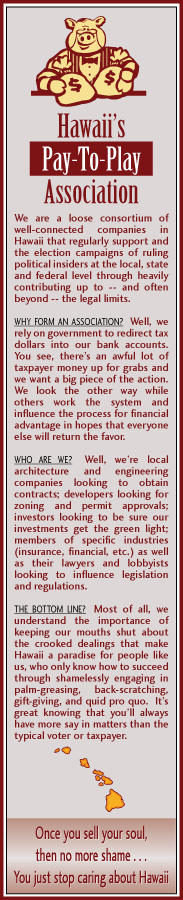 Via Michelle Malkin, I came across this Hawaiian political satire website called ZeroShibai.com. It may be the closest thing I've seen in the US to the quality of satire, tone, and wit you get in Britain's Private Eye. The humor is backed by what appears to be serious research on the issues. The website's perspective is anti-government-corruption, anti-racial-preferences, and anti-insider-deals. (Shibai is a local political term borrowed from Japanese and is used to mean lies.)
One of the biggest issues at the moment is a plan to create a Hawaiian native government, somewhat akin to tribal governments here in Oklahoma, which would control a large amount of Hawaiian land. According to the website, this new government would be funded by all taxpayers but would exist for the benefit of those with native Hawaiian heritage, and would duplicate services already provided by state and local governments. The lead article on January 31 (sorry, they don't seem to have permalinks for individual stories) suggests that the whole point is to leverage Haole guilt to create a bunch more phony-baloney jobs for political insiders.
The site got some heat from the state government over a satire of the "Kau Inoa" program that is enrolling native Hawaiians for eligibility to participate in the new tribal government.
ZeroShibai.com is worth visiting for a couple of reasons:
(1) The fake ads in the sidebar which skewer both political parties, the governor, Honolulu city government, developers, the teachers' union, and just about every other major interest group. A copy of one is on the right; I picked it because it's relevant to another story I hope to post later this evening.
(2) It's a great example of what local political satire could and should be. Imagine the sturdy research of OCPA or the Heritage Foundation, but delivered with biting wit. Maybe someone here in Tulsa could learn to do as well.
(3) If you're interested in sustainability, you'll want to read their front page item about agriculture in Hawaii by
David Wethington. What happens to Hawaii's food supply if there's a terrorist-related disruption on the mainland? As state government encourages more development at the expense of local agriculture, the situation is not self-sustaining.
Why all this chaos over a dock closing 2500 miles away? Because Hawaii has at best a 6 day supply of food in the wholesaler's warehouses - if there is no panic! Hawaii's governments at both county and state levels, have for decades stood by and watched local agriculture whither and die. Too many government officials, like many residents, have become addicted to the lifeline from the mainland. Now that the lifeline is cut, panic ensues and people die.This does not need to happen! There is enough open land on Oahu, Molokai and Lanai that if turned to agricultural use, in time could supply the people of Hawaii with all the food they need. However, growing food takes time. Starting something the day of the West Coast dock closings is obviously far too late.
This author has said for decades that Hawaii is making several grave mistakes in our food management: The shackling of local agriculture; the conversion of huge tracts of ag land to residential; the ever growing dependence upon container ships to bring food to Hawaii; and the lack of any plan whatsoever of what to do in an emergency. We have no vast storehouses of food, just a few very vulnerable warehouses that will be exhausted in hours.
In combination, these actions have put Hawaii residents in danger. Only a very few understand this danger, the rest will find out only when their stomachs growl.
Oklahoma isn't as vulnerable as Hawaii, surrounded as it is by thousands of miles of ocean, but it's worth asking the question: If disaster or skyrocketing fuel prices made importing food into the state impossible, could we feed ourselves? For how long?
James Lileks asks a reasonable question:
But what if we could move the same number of people for 25% of the cost? Would it be acceptable if the ride took 25% longer? I'm talking about buses. (Again.) Light rail is much nicer than buses, of course, and that's why people want the state to spend huge sums of money on the project. It's simply cool to see a light rail train sliding up to the new high-tech station; it's not cool to see a bus lumber up to the curb chuffing and sighing, disgorging passengers by a busted bench and a bent sign. Light rail makes people feel modern and urban and part of a smart, well-managed community, and that's why we're willing to spend billions on these lines, even at the expense of other transit options. It's all emotional.
Via Dustbury. You can read my recent UTW column about rail transit here.
Of all the lovely presents I received this Christmas, one of my favorites is a gift from my in-laws: The book My Grandfather's Son, the memoirs of Supreme Court Justice Clarence Thomas. Thomas is one of my favorite Supreme Court justices, not only because of his respect for the Constitution and his incisive legal mind, but for the character he displayed under assault during his confirmation and in the years since.
So far, I've read through his childhood in Pinpoint and Savannah, Georgia, his years in seminary, and his decision to enroll in Holy Cross College, in Worcester, Mass.
During my tenure at FlightSafety, I took several business trips to Savannah and spent every free hour exploring the city, particularly the historic district. I drove through Pinpoint, a little fishing village along an estuary south of town, near the Bethesda orphanage. Thomas grew up in a part of the city I've never seen; as he put it, "Savannah was hell."
Tonight I started reading the book to my two older children, ages 11 and 7. While I won't take them through the whole book -- at their ages they don't need to know about all the ugliness of his confirmation hearings -- I think they'll benefit from hearing his vivid descriptions of the poverty in which he spent his early years, the hard work and discipline of his years living with his grandparents, and the impact of racism on his life. I read part of the first chapter to them tonight and both of them were disappointed when it was time to close the book and go to bed.
Many political memoirs -- including some written by conservatives -- aren't worth the paper they're printed on. My Grandfather's Son looks to be not only an insight into one of America's most influential men, but a book full of valuable life lessons.
For nearly 40 years, I have been traveling to and through the two counties -- Washington and Benton -- that constitute what is now the northwest Arkansas metro area. My grandparents lived in Bella Vista in the late '60s, with brief stays in Bentonville and Rogers. When they moved to Mountain Home in the '70s, we drove through Siloam Springs and Springdale to get there. In 1986, I began dating someone who lived in Rogers and Fayetteville, and so made a trip there at least a couple of times a month. In 1989, I married her, and so there have been regular trips to see the in-laws ever since.
1986 was also the beginning of the construction of the superhighway -- now I-540 -- linking Fayetteville, Springdale, Rogers, and Bentonville. In 1989, the rolling hills of the pig farm across Horsebarn Road from my in-laws place was staked out to become Champions Country Club.
So it's from that perspective that I say this:
What planners and developers have done to northwest Arkansas is analogous to using the works of John Constable for toilet paper.
With some foresight and vision, growth could have been accommodated while preserving open space and extending what had traditionally been walkable communities. Instead, cities have deliberately enabled the worst of strip development (think 71st Street on steroids) and segregation of uses.
The northwest Arkansas suburban smear is 25 miles long and about five miles wide. Because of the way jobs and retail are strewn along the corridor, it's likely that a NWArkie's typical day involves more driving than that of a Tulsa metro resident, and the region is going to suffer more from higher energy costs than more compact areas.
It's tempting to go into a Jim-Kunstler-esque rant here, but Jim Kunstler does it so much better than I ever could. He's never been to Walmartland as far as I know, but he's seen plenty of places that look just like it. (Note: That link leads to extremely salty language, an attempt at conveying the urgency of the situation he sees and his frustration at the idiocy of the response. This speech from two years ago is a good, non-salty summary of his concerns about sprawl development, peak oil, and how it adds up to what he calls "The Long Emergency.")
From The American Magazine, a sad story about eminent domain. Dr. Joseph Erondu, an immigrant from Nigeria, opened a dental clinic in Gaslight Square, a rundown neighborhood in St. Louis. After years of being a lone bright spot in a neighborhood known for drugs and prostitution, he heard the magic words: "I'm from the government, and I'm here to help."
Erondu was later thrilled to learn that the city was planning to redevelop the area--until he learned that he wasn't welcome in the new Gaslight Square. St. Louis wound up acquiring his land using eminent domain, forcing Erondu to rebuild his practice from scratch in another neighborhood. Perhaps as a result of the stress, Dr. Erondu fell ill while his new practice was being constructed. He died on June 23rd, 2005, the same day the Supreme Court handed down its infamous Kelo decision.Erondu's property loss is a story that has been repeated across Missouri and across the United States. Entrepreneurs purchase property in a marginal neighborhood and struggle to build a viable business, only to have the city take their property and give it to a wealthier business with better political connections. Every time that happens, it sends a powerful message to future entrepreneurs that they should think twice before setting up shop in low-income communities.
That's just one of the ways in which urban renewal policies designed to help the poor do just the opposite. Many urban planners argue that the power of eminent domain is needed to combat "blight" in urban areas. But closer examination shows that eminent domain only shifts the problems of poverty to another neighborhood, while destroying the social fabric that is essential for a genuine revitalization of poor neighborhoods. States that truly care about the welfare of their urban poor should prohibit the use of eminent domain for private urban redevelopment projects.
The author of this article, Timothy B. Lee, has coauthored a policy paper outlining the history of eminent domain and its uses and abuses for the Show-Me Institute, a free-market-oriented public policy think-tank based in Missouri.
(Via Eminent Domain Review.)
This week in Urban Tulsa Weekly, I tackle the teardown trend, infill development, and the concept of Neighborhood Conservation Districts as a means of ensuring that new infill construction is compatible with existing development.
I have two photo credits in this issue: A photo from the statehood procession reenactment from the big statehood centennial celebration in Guthrie, which graces the table of contents, and a photo of the prime example of out-of-scale and out-of-character infill development which accompanies the column. A hat tip to tulsanow.net forum member "yayaya" for tipping everyone off to this monstrosity. You can see more pictures on my Flickr set page, Tulsa Midtown McMansions.
Here are some supplemental links on the topic of teardowns and neighborhood conservation districts (NCDs):
- Preserve Midtown
- National Trust for Historic Preservation page on Teardowns
- National Trust for Historic Preservation Teardowns Resource Guide
- What's Wrong with Teardowns: A Visual Analysis (PDF)
- 1999 Tulsa Infill Task Force final report (PDF)
- Oklahoma City review of historic preservation and conservation ordinances (PDF)
- Architecture Coach: Get on Top of the Teardown Trend: Advice to real estate professionals on when teardowns might be appropriate
- Dallas overview of conservation districts
- Washington Post: The Big Question: Municipalities Consider Ways to Restrain Ever-Expanding Houses
For any OKC readers who were offended by a recent entry about the Oklahoma River, let me say that neighborhood conservation is an area where Oklahoma City is decades ahead of Tulsa.
Those who've accused Councilor Roscoe Turner and north Tulsa residents of unjustifiable complaining about the closing of Albertson's at Pine and Peoria need to listen to the podcast of Saturday's Darryl Baskin show. The guest at the beginning of the show was Steve Whitaker of John 3:16 mission, and the topic was "food deserts."
Not desserts. Deserts.
There's a big one in Tulsa. Whitaker said a food desert is defined as an area where it's more than three miles to the nearest full-service grocery. Tulsa has a six-mile wide band without supermarkets that goes all the way across the city.
There are no full-service grocery stores in the City of Tulsa north of Admiral Place. There's a Piggly Wiggly on Admiral east of Harvard, a Warehouse Market at 3rd & Lewis, and another Warehouse Market at 66th & Peoria in Turley. Beyond that you have to go to Owasso to shop.
A food desert makes life harder for those already on the margins of poverty. There are no supermarkets within walking distance. There might be a convenience store, but prices are higher, and the store isn't likely to carry produce or much in the way of healthy food. Driving is getting more expensive as fuel costs rise. Public transit is rarely available when people are off work and can go shopping.
Whitaker and Baskin wondered why, since everyone has to buy food, no one has filled the vacuum left by Albertson's departure.
I read an explanation recently -- can't remember where -- that made a lot of sense. Even though everyone has to buy food, lower income people tend to buy basics and items on sale. In other words, they buy items with low markups. In supermarkets in middle class and upper income areas, shoppers buy more expensive, high-markup items which subsidize the basics. If everyone that shops at a particular grocery buys only the low-markup items, the grocery won't be able to afford to stay in business.
UPDATE 2007/11/30: I took a little drive up Peoria and back down Lewis to check on grocery locations. There are no supermarkets on N. Peoria until you are beyond Tulsa city limits and in unincorporated Turley, which has a Warehouse Market. There is a greengrocers called "Week's" at Apache and Lewis, but I don't know if it's open out of season. At Pine and Lewis, the old Safeway (the newer old Safeway on the northwest corner) is split between a RentQuik and a Save-A-Lot. Although the Save-A-Lot doesn't have a sign out front, banners in the store visible through the windows showed the name. There's a big Supermercado on Lewis just north of I-244. I didn't stop to investigate, so I don't know what hours these stores keep or how their prices and selection compare to stores in my neighborhood.
Reflecting on the decline of the standalone video rental storefront, Steve Patterson directs our attention to the importance of building form over any given use:
It is interesting to see all these changes in the video market, something that didn't exist 30 years ago. Many storefronts, often built for these places, are left scattered around the landscape. Some will remain vacant while others will find new uses. This is yet another reason why the building form should be a higher priority over the use of a structure. The use will likely change over the years but the building form remains in place as long as the building remains standing. As a society, we cannot afford to change buildings for each and every change of use.
People are amazingly creative in the reuse of buildings, but buildings designed for multiple small storefronts seem to be the most flexible. This is evident as you look at the history of Cherry Street or Brookside. What was built to house a small grocery might become a used bookstore and then a restaurant. It's possible to combine several small spaces for a larger use, but it's much harder to take a building designed for one large tenant (a big box) and split it up in a practical way for many small tenants. Part of the problem is the depth of the building. How would you take a 100,000 sq. ft. building, like a small Wal-Mart, and split it practically into spaces of 1,000 to 2,000 sq. ft.?
It's my impression -- commercial real-estate experts correct me if I'm wrong -- that the bigger the space, the harder it is to find a tenant.
UPDATE: In the comments manasclerk mentions the book How Buildings Learn by Stewart Brand. I haven't read it, but I'm impressed by what I read in this Wikipedia entry about one of the concepts discussed in the book: Shearing layers.
The Shearing layers concept views buildings as a set of components that evolve in different timescales; Frank Duffy summarized this view in his phrase: "Our basic argument is that there isn't any such thing as a building. A building properly conceived is several layers of longevity of built components."
The layers that make up a building are, in descending order of longevity from eternal to ephemeral: site, structure, skin, services (electrical, HVAC, plumbing), space plan (walls and partitions), and stuff.
According to the Wikipedia entry, Brand says that traditional buildings are more adaptable because they "allow[] 'slippage' of layers: i.e. faster layers (services) were not obstructed by slower ones (structure)." New construction (and by "new" I mean anything built since World War II) generally doesn't allow slippage -- the structure, skin, systems, and space plan are too tightly coupled, probably because that's a less expensive way to build.
No time to elaborate, but here's a comparison for your consideration -- two Tulsa hotels that once catered to VIPs, the Mayo and the Camelot.
TRACKBACK 2007/11/29 from the Planning Commissioners Journal Planning Quote of the Day blog, which I am now adding to my Newsgator page.
UPDATED 2020/01/02 to fix dead links. Tulsa's Mayo Hotel evolved from derelict, to partial reuse (basement parking, event space in the restored lobby), to full reuse (hotel and apartments). Tulsa's Camelot Hotel was demolished in 2007. And only one Blockbuster video store remains in operation. Redbox, noted by Steve Patterson as a novelty in 2007, is still around.
An idea advanced by Tulsa City Councilor John Eagleton that the Tulsa Whirled editorial board found silly beyond their intellectual capacity to explain is already in use in Minneapolis, Minnesota.
The following text appears in Chapter 2, Section 5A of the Minneapolis City Charter (emphasis added):
Section 5A. Conduct of Elections. Notwithstanding the provisions of Minnesota Statutes, Section 205.17, subdivision 2, or any other provision of law and except as otherwise provided in this section, the City General Election for Mayor and City Council shall be conducted in the manner provided by law for elections for nonpartisan offices. All such candidates shall, however, state the name of their political party or political principle, stated in three words or less, on their affidavits of candidacy and affidavits of candidacy for Mayor and City Council shall otherwise conform with all requirements of the Minnesota general election laws pertaining to affidavits of candidacy for partisan offices. The political party or political principle shall be placed on the General Election ballot with the names of the candidates for such offices. (As amended 6-13-55; 3-29-68; 81-Or-145, § 1, 6-12-81; 11-8-83; Charter Amend. No. 161, § 1, ref. of 11-7-06)
While this chapter was amended last November, by a referendum replacing a non-partisan primary and runoff with Instant Runoff Voting, the requirement to "state the name of their political party or political principle" was not part of the amendment, so it dates back at least to 1983.
This candidate list from the 2001 election gives you an idea of what candidates submitted for "political party or political principle." As you'd expect in Minneapolis, many candidates are DFL (Democratic-Farmer-Labor), but you'll also see Green, Republican, Independent, Conservative Democrat, Independent Fiscal Conservative, Empowering Your Community, Social Justice, Affordable Housing Preservation, Old Skool, No Snow Emergencies, Better Democracy/Capitalism, Service, Accountability, Change, Preserving Individual Rights, Sense with Dollars, and New Voices Party, among others.
So what you have now is Minneapolis is what I've endorsed for Tulsa -- multi-partisan elections with Instant Runoff Voting.
From the Wikipedia entry on Kissimmee, Florida:
The Houston Astros conduct spring training in Kissimmee, at Osceola County Stadium. The Astros' farm system formerly included a Kissimmee entry in the Florida State League. In order to prevent jokes, the team's nickname was the Cobras rather than the Astros.
One evening after all the meetings were over, I decided to visit two towns, one old, one new, south of Orlando's main tourist district.
First stop was Kissimmee. Most people who have been there know the town for US 192, Irlo Bronson Way, a busy strip of tourist businesses that lead to the Maingate area of Walt Disney World. But south of 192 there's an actual town, the county seat of Osceola County, with a main street (Broadway), a courthouse square, an Amtrak station, and a lakefront.
When I was searching for Wi-Fi locations before my trip, I learned that the Kissimmee Utility Authority had established a free Wi-Fi zone in their downtown, so I was curious to see how it was working.
Although Kissimmee's Broadway has some handsome old buildings, plus some new mixed residential and retail buildings being constructed in a classic urban fashion, they all seem to house businesses that are open only in the daytime: banks, real estate offices, a photographer, a guitar store, a Christian book store, antique shops, a bakery, a couple of cafes. Only one restaurant was open, just off of Broadway. I don't imagine a free Wi-Fi zone helps boost downtown business much if the only place to use it is sitting on the curb or behind the wheel of your car. Just to test it out, I did try to connect from inside the minivan, found several of KUA's access points, but none of them strong enough to hold a signal.
The most interesting sight in old Kissimmee is the Monument of States. It has a homemade quality to it that reminds me of Ed Galloway's work near Foyil. It is a 50 foot high pyramid-like structure with rocks from every state embedded in painted concrete, and it dates back to World War II, a project of the Kissimmee All-States Tourist Club. The rock from Oklahoma was a polished slab (quartz, probably) with Gov. Leon Phillips' name engraved in it. It's at the base on the north side, in the lower left of this photo, to the left of the words "MONUMENT OF STATES."
Other inscriptions on the monument appear to have been etched out of the concrete by hand. Here's a vintage postcard of the monument. Here's a fairly recent Flickr photoset. Like our beloved Blue Whale, it was refurbished a few years ago with the help of the good folks at Hampton Inn.
I left Kissimmee and headed to Celebration; more about that in a later entry.
Those are two questions about two major thrusts of the campaign for the proposed Tulsa County sales tax increase for river-related projects. In this week's column in Urban Tulsa Weekly, I ask whether this river tax plan is what we need to do for the sake of Tulsa's children and young adults.
In response to the first question, I deal in passing with one river tax cheerleader's active involvement in destroying a place of fun and happy memories for Tulsa's children, and pass along a suggestion, made by my wife, for how you could protest Bell's eviction from the Tulsa County Fairgrounds, should you decide not to boycott this year's Tulsa State Fair entirely:
In addition to the obvious -- don't spend money on the Murphy Brothers midway -- here's a homemade idea for those who go to the fair but wish to protest Bell's eviction: Wear bells to the fair. You can buy a big bag of jingles at a craft store for a few dollars. Thread a bunch on a ribbon to wear around your neck. Bring extras to give to friends or fellow fairgoers.
And if you want to make the point explicit, stick a nametag on your shirt with the slogan that's been spotted around town: "No Bell's. No fair."
 Accompanying that suggestion on page 7 of this week's UTW is the first published work by a budding young cartoonist named Joe Bates, depicting a weeping Bell. He's got some more political cartoons in the work. The demolition of Bell's is something my two older kids saw happening on an almost daily basis, and it saddened them both greatly. I'm proud to see my son express his sentiments so eloquently in art. He's already working on some more cartoons.
I mentioned in the column that skipping the fair entirely is hard for a lot of people from Tulsa and the northeastern Oklahoma. Going back to the '40s my great-grandmother and grandmother would enter the craft competitions, and in recent years my two older children have had fun submitting their own creations. Joe has won two blue ribbons, one in 2004 for an acrylic painting and one last year for a convertible built with Legos. Both he and his little sister plan to enter some items again this year. To us, and to a lot of families, the Tulsa State Fair was here before Randi Miller and Clark Brewster and Rick Bjorklund, and it'll be here when they've all moved on to other things. But I can certainly understand those who plan to abandon the fair altogether.
Regarding young professionals, in my column I mention a recent visit to Orlando and a Saturday evening spent on lively Orange Avenue, between Church Street and Washington Street in that city's downtown:
Downtown Orlando has shiny new skyscrapers, a basketball arena, and a beautiful 23-acre lake with a fountain. But I didn't find the crowds around any of those. There were only a few people walking the path around the lake, and the sidewalk along Central Boulevard next to the lake was empty except for me.
Instead, the throng of twenty-somethings was promenading up and down four blocks of Orange Avenue, a street lined with old one-, two-, and three-story commercial buildings. The storefronts of those buildings were in use as bars, cafes, and pizza joints. The same kind of development stretched for a block or two down each side street. There were hot dog stands on every corner. Pedicabs ferried people to and fro. The numbers of partiers only grew larger as the little hand swept past 12.
An observation from that visit that I didn't include in the column: The block of Orange between Pine and Church Streets has these old commercial buildings crowding the sidewalk on the west side and a spacious plaza framed by two modern, round, glass and steel buildings on the east side. Where do you suppose people chose to walk? 90% of the foot traffic stayed next to the old storefronts and avoided the big modern plaza.
This morning on KFAQ, Gwen Freeman and Chris Medlock interviewed real estate expert and urban critic Joel Kotkin. Last week in the Wall Street Journal, Kotkin wrote a pointed takedown of cities that chase the "Creative Class" with civic improvement schemes -- arenas, convention centers, government-planned entertainment districts, light rail, etc. -- while neglecting basic infrastructure and overlooking the concerns of middle-class families. Here are a few key paragraphs:
Governments prefer subsidizing high-profile but marginally effective boondoggles -- light-rail lines, sports stadia, arts or entertainment facilities, luxury hotels and convention centers.Over the past decade, according to a recent Brookings Institution study, public capital spending on convention centers has doubled to $2.4 billion annually; nationwide, 44 new or expanded centers are in planning or under construction. But the evidence is that few such centers make money, and many more lose considerable funds. The big convention business is not growing while the surplus space is increasing. New sports centers add little to the overall economy.
Critically, misguided investments shift funds that could finance essential basic infrastructure. Pittsburgh has spent over $1 billion this decade on sports stadia, a new convention center and other dubious structures. Heralded as major job creators and sources of downtown revitalization, they have done little to prevent the region's long-term population loss and continued economic stagnation. Much the same can be said of Milwaukee's new Santiago Calatrava-designed Art Museum, or Cleveland's Rock and Roll Hall of Fame.
Transportation priorities are also skewed. Government officials in Minnesota spent mightily on a light-rail system that last year averaged barely 30,000 boardings daily. It did not focus nearly as much on overstressed highway bridges, or the bus systems serving the bulk of its mostly poor and minority transit riders. Most other light-rail systems, built in cities with highly dispersed employment, also have minuscule ridership, but consume a disproportionate share of transit funds that might go to more cost-efficient systems, including bus-based rapid transit.
In this morning's interview on KFAQ, Kotkin expanded on this theme. Here's a link to the MP3 file for the hour containing the Joel Kotkin interview. He packed a lot of important ideas about cities into a very short segment. I'll try to unpack some of them before too long, but two that come to mind:
- The fact that downtowns were designed for commerce, not for residential living, but close-in neighborhoods were designed well for housing, while providing a customer base for downtown businesses. My response: Tulsa tried to save its downtown by destroying or amputating major sections of its close-in neighborhoods to make way for parking and freeways and to eliminate "blight". (Of course, the blighted homes and apartment buildings were not much different from those in now-valued neighborhoods like Brookside and Swan Lake.) Now we're trying to undo the damage by converting commercial buildings with residential space, something I've supported, although Chris Medlock pointed out that we've spent a lot of public money per person added to the downtown population.
- The importance of parks in every neighborhood, not just a handful of centrally-located showplace parks. I need to transcribe exactly what he said, because it was spot on -- something about having to "make a day of it" to visit one of these showplaces, rather than being able to integrate a neighborhood park into your everyday life. Every neighborhood needs its gathering places, whether that's a park or a playground or a coffee house.
There's also an interview with Kotkin on townhall.com, conducted by Bill Steigerwald, about the continued importance of manufacturing to the economies of American cities. Steigerwald is a Pittsburgh native, so it's natural that the conversation would focus on the departure of heavy industry and billions spent on stadiums, light rail, and other pretty things at the expense of basic government services.
Increasingly it's the Sunbelt where manufacturing is sought and celebrated, not the old Rust Belt, which views its history with the same kind of "cultural cringe" that fashionable Tulsans feel about cowboys, Indians, and oil:
I have to tell you, almost every place I go in this country, particularly where the economy is growing, if you ask business people what is it that would really help them, they say "skills." Machinists. Welders. It's not like there's a Ph. D. shortage, generally speaking. But there is a welder shortage, there's a plumber shortage, there's a machinist shortage. But nobody wants to talk about this. Cities that have lost their industrial base don't want to talk about it, and many cities that still have it are almost ashamed of it. In one of the great historical ironies, the places where they are not ashamed of manufacturing are places like Houston and Charleston and Charlotte. But the places with the great industrial traditions, it's almost as if they are ashamed of their lineage.
Kotkin makes some great points about how manufacturing brings outside money into a city (our Chamber of Commerce seems to believe that only conventions and tourism are capable of doing that), and how people forget about skilled labor jobs:
Everyone talks about how we're becoming a society of low-end service workers and high-end information workers. But here's something in between -- basically the logistics and manufacturing industry -- and nobody seems to be focused on it.
What can governments do to attract this sort of business? The basics:
I would say infrastructure and training are the two big things -- and if you think of the training as part of the infrastructure, it's really one thing. You need roads that go in and out. You need modern industrial space. You need reliable electricity. You need shipping facilities. You need workers who are relatively skilled, trainable and reliable. It's really not rocket science that you can do that and that would promote the manufacturing sector of the economy.
And to retain and rebuild a city's manufacturing base?
Are there companies that would like to expand? Are there companies that want to stay? Ask them what they want.
But that isn't what cities are doing:
We live in this dream world where we say, "Well, if we have a fancy stadium with sky boxes, that will keep businesses here." Well, what do you mean by businesses? Do you mean the gauleiters who represent multinational corporations, so they can hang out at a fancy football game? Or are we talking about somebody who's got 15 people working for him in a shop somewhere in the suburbs and would like to get to 30? What are his issues? Are they tax issues? Are they training issues? Are they regulatory issues? You've got to go ask! I don't see anyone interested in that anymore. It's all "What does some 23-year-old, footloose student want? Does he have enough jazz clubs to go to?" Or some footloose 50-year-old corporate henchman. "Does he have enough arts facilities?"As a country, we're kind of delusional about our economies. I've found a few places in the country where they focus on this stuff, but I'm kind of becoming a persona non grata for raising these issues. I'm not raising them as a conservative, saying we shouldn't have taxes or shouldn't have regulations. I'm just saying, "How do you provide for a broad-based economic opportunity for your people? Isn't that what's it about?" Unfortunately, for most mayors in America, that's not what's it's about. What it's about is, "How do I keep the public employees happy? How do I keep the people at the very top of society happy? And how do I put on a good enough show so that everybody thinks I have a hip, cool city."
The conversation between Kotkin and Steigerwald ends with the role of local papers in pushing these projects of questionable value:
[Kotkin:] I'll tell you the truth, a lot of the blame comes to the journalists. The journalists never ask the tough questions. They basically follow the scripts that they are given. And also part of the problem, and we've talked about this in general about journalism these days, you have got a bunch of young kids who are there for two or three years. They don't understand what crap this is. To them it's all, "Well, there's an art museum downtown. That'll be good for me." If there is some "starkitect" -designed building, they say, "Wow, that's sort of fun for me." They don't care.[Steigerwald:] I've always said the newspapers of America should be indicted en masse for having countenanced 50 or 60 years of the destruction of cities. I bet 95 percent of newspapers have applauded and cheered every boondoggle, every urban-renewal project back in the 1950s, every new light-rail project -- no matter what it was, newspapers cheered them on.
[Kotkin:] And what happens if you have the temerity to suggest that this may not be the way to go? You're "anti-city," you're "pro-suburbs," you're a "neoconservative" -- like I'm Dick Cheney or something. You get name-called. And all you're saying is, "Look, are we sure that what we are putting our money into is really what matters, given the tremendous pressing needs that every city has?"
This comment on an earlier entry by S. Lee was so well-made that I thought it deserved spotlighting here:
Rather than be accused of a being a "nay sayer" (which, as we all know, is almost as bad as being a fan of Ann Coulter), I would suggest using Cleveland, OH as an example of how buying stuff does not constitute economic development. Cleveland is a great example of a city population that was sucked into to voting for tax increase after tax increase to pay for stuff that would magically transform the city into greatness. Instead, all they got was rapid population loss, high taxes, and a crime rate even higher than Tulsa's.Much of what is being hustled to Tulsa voters and the method of hustling looks like Cleveland deja vu all over again. Take a look at Cleveland's web site. If stuff was what made a city, then Cleveland ought to be solid gold. But it ain't. People are moving out of Cuyahoga county over to Lorain county ... where the taxes are lower (probably crime too). Brothers and sisters, can I have a Homer Simpson "Doh!"
Note a web page about living downtown; and (egad!) a waterfront project.
I've read comments about how full the Arkansas river has been lately, and wouldn't it be nice if it were always like that. I wouldn't know since you can only see the river from a very, very small part of Tulsa where I've not taken the time to go so I can see a river. Wow! A river! I'm sure I missed out on the thrill of my life -- but I sure have seen a lot of bad roads. I'll trade some better roads and lower crime for a sandy river (that I don't often see) any day, any time.
It might be interesting, at one of the county meetings, to get a show of hands of how many people know what kind of convention center and city offices Charlotte, NC has. How many people at the meeting care about what other stuff Charlotte has bought lately? If they got a job offer in Charlotte, would they be asking what kind of stuff has Charlotte bought lately; or would they be more interested in mundane things such as transportation, crime rate, and schools?
Some folks are just so stinkin' boring.
It's been a while since I've been to Cleveland, but I attended two weddings in Cleveland and a third in Canton back in the early '90s. I remember going with some friends down to the Flats and eating at (ho hum) TGI Fridays on a Friday night. (It was May 1992 and the night of Johnny Carson's last tonight show.) The Flats is a former industrial / warehousing area on the banks of the Cuyahoga River which was converted into an entertainment district, much like Bricktown in Oklahoma City or Laclede's Landing in St. Louis. I was surprised to read not long ago that the Flats are now under re-re-development.
Ron of Route 66 News evaluates one of Lady Bird Johnson's legacies:
But the Highway Beautification Act of 1965, which restricted billboards along our nation’s highways, proved to be damaging to Route 66 businesses when they were struggling to survive amid the continuing rise of the interstates.These Mother Road businesses were struggling enough against the chains. Restricting the use of billboards — a crucial advertising tool — made it harder....
[R]ich and powerful companies managed to skirt the law, while many mom-and-pop businesses didn’t have the influence to so.
From family trips back in the early '70s, I remember the stark difference between driving the Turner and Will Rogers Turnpikes and the Indian Nations Turnpike. The Turner and Will Rogers were built in the '50s and had many signs (evidently grandfathered) pointing to nearby Route 66 businesses like the Thurman Motel, Buffalo Ranch, and the Lincoln Motel, along with the requisite notice to save your appetite for a free 72 oz. steak dinner in Amarillo.
The Indian Nations Turnpike, built after Ladybird's Law, had no signs. This meant there was nothing to entice a passing traveler to venture off the highway, no indication that, for example, the McAlester exit could lead him to a land of hearty Okie-style Italian food. A traveler wouldn't know anything about available service stations or accommodations that might be just a few hundred yards away from the turnpike.
For kids, the Highway Beautification Act meant no practical way to play the Alphabet Game.
At some point, states began posting official exit services signs, with little logos to notify the traveler of available restaurants, gas stations, and motels. Of course, this favored the chains as well: An out-of-state motorist would know exactly what to expect from seeing a McDonald's or Cracker Barrel logo, but a logo isn't enough for a local cafe to tell you about its chicken fried steaks and pies.
(Then there was the case of the Okie Gal Restaurant in California, which wasn't even allowed space on the exit services sign because the highway department deemed "Okie" a derogatory term.)
Ron praises Lady Bird's work on behalf of wildflowers, as does Joshua Trevino, writing at National Review Online. You could see the wildflower and anti-sign initiatives as consistent, both favoring the natural over the man-made, but there is also something contradictory about them: Wildflowers are a kind of rebellion of local color against the monotony and standardization of a perfectly green, perfectly manicured right-of-way. But ads along the highway are also a splash of local color, a hint about the distinctive qualities of the next town and the people who live there.
Marvin Olasky mentions in passing another example of the damage caused by "beautifiers":
Coney Island, part of New York City, is famous in American literature and film. In "The Great Gatsby," Gatsby invites Nick to go to Coney Island, and in Clara Bow's 1927 silent film "It," the neighborhood's amusement park is practically a co-star. After 1950, though, waves of officials such as New York City Parks Commissioner Robert Moses looked down on the "tawdry" amusements that characterized the boardwalk area. They pulled strings to substitute tawdry housing projects that became gang havens.Coney Island went through bad decades, but even bureaucrats can't take away the ocean, and the beachfront location has inspired some entrepreneurs to ignore planners' sandcastles and attempt to develop new small businesses and privately owned housing.
Tulsa has had its share of destructive "beautifiers": The barrenness of the Civic Center, the Williams Center, and the OSU-Tulsa campus parking lots are their legacies.
To go back to an entry from last Tuesday, if Tulsa's Civic Center Plaza is a bad example of a public space -- in fact is one of many examples of failed plazas that can be found across the country, even in major pedestrian-friendly cities like Boston -- what makes for a good public space?
Back in the 1970s, architect Christopher Alexander and his team set out to identify successful design patterns in the construction of homes, neighborhoods, and cities. One of the patterns was called "Small Public Squares":
A town needs public squares; they are the largest, most public rooms, that a town has. but when they are too large, they look and feel deserted.
The solution was to keep the square to a maximum width of 70 feet. A square could be any length, but the width should be "smaller than you would first imagine." I've seen wider public squares that are successful -- for example, most of Savannah's squares are about 180 feet across on the narrow side, but the space is shaded by tall live oaks, broken up with grass, paths, fountains, and statuary, and every point in the square is with in eyeshot and earshot of the nearest street.
During our trip to Britain, we came across one very lively public square in the City of Durham. On Saturday afternoon, it was packed with people visiting market booths in the square and visiting the shops along the square and in neighboring streets. There was a small teacup ride for children. You could buy candy floss and other treats. The square, about 90 feet wide and 150 feet long, was defined on two sides by buildings with storefronts and the other two sides by narrow streets (at most 15 feet across), with buildings and storefronts on the other side.
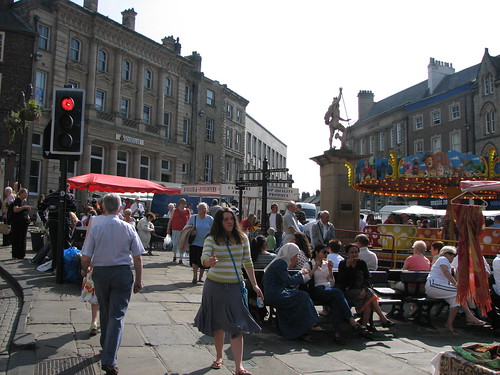

Sorry for the recent silence. The 24-hour bug that has been going around town hit our family, too. The toddler had it on Tuesday night, his big brother and sister and mom got it Thursday night, and I had it Friday night. Saturday was a day of quiet recuperation -- everyone was past the worst, and we all lazed around, read, and watched TV.
On YouTube, I just came across a 1960 documentary about Greenwich Village, narrated by author and raconteur Jean Shepherd (the writer and narrator of the classic movie "A Christmas Story"). "Village Sunday" follows a white-gloved young matron from uptown as she explores the Village on a sunny September Sunday afternoon. She stops by a folk music jam session at the Circle in Washington Square, sits for a portrait at a sidewalk art show, negotiates a cobblestone street in heels, tries an Italian sausage at the Feast of San Gennaro, and has listens to a beat poet in a coffee house.
(Mild content warning -- there is some Picasso-type nudity painted on the walls of the coffee house toward the end of the film.)
As I watched the film, it occurred to me that this was the Greenwich Village that Jane Jacobs and others were working so hard to save. Jacobs began work on The Death and Life of Great American Cities in 1958, and it was published in 1961. (Over the same period, a strongly anti-urban comprehensive plan for Tulsa was under development.)
Here's one more YouTube video for your enjoyment. Earworms are nothing new. The Hut-Sut Song was a hit in 1941 (you can hear an instrumental version in one of the kitchen scenes of "A Christmas Story"), with its peppy melody and mangled Swedish lyrics. This soundie spoofs the song's infectious quality and features the King's Men, a quartet who performed regularly on the popular "Fibber McGee and Molly" radio show.
St. Louis urban observer Steve Patterson has been traveling through Kansas and Missouri, visiting Garden City, Kansas, Hutchinson, Kansas, Wichita, Kansas, St. Joseph, Missouri, Shenandoah, Iowa, Salina, Kansas, and Lee's Summit, Grandview, and Blue Springs, Missouri.
Every entry has lots of photos (with links to more in his Flickr account) illustrating architecture, streetscaping, and urban planning, and each photo is accompanied with an observation about whether the subject of the photo is good or bad urban design and why. It's like a miniature course in city design.
There's a certain amount of sarcasm and cynicism, but Steve keeps it clean (unlike James Kunstler, whose sharp observations are seasoned heavily with four-letter words). There's a lot here in these entries about the latest city revitalization fad: streetscaping.
Many thanks to Steve for putting together such an informative series of entries.
One of the four NCAA men's regionals was held last weekend at the Meadowlands (aka the Hackensack Swamp) in the midst of the industrial wasteland of northern New Jersey. (I spent the worst year of my life there one week.) The University of North Carolina team was put up for the weekend at the Hilton in Fort Lee, N. J. The hotel is on the eastbound lanes of State Highway 4, just before it joins with I-95 as the approach road to the George Washington Bridge, which connects Fort Lee to Manhattan. A few days ago, the highway was the scene of a tragic fatal accident involving a college senior.
As best as I can gather from various news reports, this is what took place: Friday afternoon at about 3:45 pm, Jason Ray, who wore the mascot costume ("Rameses") for the Tar Heels, was walking back from a nearby convenience store, where he'd gone to buy a Coke and a burrito. There is no sidewalk, so he was walking along the shoulder, with his back to the traffic. Crossing over to walk against traffic was not an option for Jason -- the shoulder of the westbound lanes of Highway 4 are separated from the shoulder of eastbound lanes by more than 20 lanes of traffic.
(My observations of the area are based on this Google satellite image, which has the Hilton at the center. If anyone who has first hand knowledge of that area can correct or enhance my understanding of it, please leave a comment.)
Even though a narrow strip of trees separates the hotel parking lot from a two lane city street (Jones Road), there is no access between that street and the hotel. The only pedestrian or vehicular access to the hotel property is via the westbound lanes of Highway 4. Even If he had made it to Jones Road, he'd have had to walk at least half a mile to find a place for a Coke and something cheap to eat. The area immediately west of the hotel is occupied by a single-use suburban residential development and a cemetery. (If the gas station on the highway had also had access to Jones Road, he wouldn't have had to walk as far.)
I would bet that the lack of vehicular access to the hotel from Jones Road was dictated by the town's zoning code or subdivision regulations, perhaps to allay residents' concerns about cut-through traffic.
An SUV hit and fatally injured Ray. The driver stopped and rendered aid, and no charges have been filed against him. The driver was not intoxicated or impaired. The weather was cloudy, but there had been some light rain earlier in the afternoon.
Why was Jason Ray walking along a busy highway? This is speculation, but I think it's reasonable: Here's a college student on a budget, and he's hungry. He came with the team on the plane, and he's stuck, without a car, at a "full service hotel" -- the kind of place you pay two bucks for a Coke or candy bar from the vending machine. He's not going to order room service or get something at the hotel's restaurant -- too pricey and probably not what he's hungry for. So he walks a couple of hundred yards along the highway to a gas station with a convenience store, the nearest place to buy something cheap and filling.
So what killed Jason Ray? No sidewalk along, but set back from, a busy highway, plus no alternate road or path for local traffic (access to the hotel and the gas station only from the highway), plus the confiscatory food and drink prices typical of a full service hotel which likely drove him to look for a convenience store in the first place.
Louisville, Kentucky, recently adopted a "complete streets" policy that requires accommodation for pedestrians, bicycles, wheelchairs, and strollers when a street is built or rebuilt.
When an area is designed with only car travel in mind, it puts the pedestrian at a severe disadvantage. Sometimes that disadvantage is fatal.
UPDATE: The Independent Weekly, serving the UNC area, notes that what happened to Jason Ray has happened closer to home:
The tragic death of Jason Ray, the UNC-Chapel Hill senior who played Tar Heel team mascot Rameses, is the latest reminder of the senseless danger of pedestrian-unfriendly roadways. Reports say that Ray was walking along New Jersey's Route 4, returning to his hotel room from a convenience store at about 4 p.m., when he was hit by an SUV. The driver wasn't drunk, according to police. It was just an accident on a road designed for cars, not for people. Sad to say, such an accident might have happened on Raleigh's Capital Boulevard, where eight people have been killed along a 10-mile stretch since 2002. Or it might have happened on U.S. 15-501 between Durham and Chapel Hill—in fact, a similar incident did happen there in 1999, when two lacrosse players from George Mason University, in town for a match with UNC-Chapel Hill, were struck by a car while trying to get from a shopping center to their hotel room. And last year, UNC Emeritus Psychology Professor David Galinsky was killed trying to cross Fordham Boulevard on his way to a Tar Heels game and Arthur McClean was killed the same day, trying to cross U.S. 15-501 near Southern Village.Makeshift memorials are scattered across the Triangle's dangerous intersections, even as more hotels, restaurants and shopping centers are built there. Many of those intersections are under the purview of the state Department of Transportation, for which pedestrian safety continues to be among the lowest priorities. How long will traffic engineers continue to ignore these deaths?
Jon Cook has more to say about Jason Ray:
Ray was due to graduate in May with a major in business administration and a minor in religion. He already had a job waiting for him as a sales and marketing rep for a company in Raleigh, North Carolina.The former Eagle Scout had a long history of social activism, including a church-sponsored mission trip to Honduras.
Ray's job as the Tar Heels' mascot, Ramses the ram, fused his passions for UNC basketball and making people smile and laugh. Jodi Stewart, a neighbor of the Ray family who attends the same church in Concord, N.C. described Jason as "an awesome kid" to the Raleigh News & Observer.
"I never knew a kid who was more full of life," said Stewart. "He was excited every day. He loved what he was doing, he loved God, his family, and being the school's mascot."
Stewart also noted that Jason was a bit of a "miracle" baby, being born when his parents were both in their 40s.
"They cherish this boy. You cannot put into words what this child means to them," she said. "Jason is their life. They live their life for him."
Some time ago, David Sucher, author of the great urban design book City Comforts, rechristened his blog as "City Comforts, temporarily known as Viaduct, The Blog." His focus has narrowed from a wide variety of urban design issues to (mainly) a single crucial issue affecting his hometown of Seattle: Whether to replace the Alaskan Way Viaduct, an earthquake-damaged double-decker freeway between downtown and Puget Sound, with a stronger viaduct, a tunnel, or something else. Sucher's blog has been so focused on the details of the issue, it's been hard to get the big picture, but USA Today provides a summary in today's edition.
Sucher's solution is "repair and prepare": "Repair the Alaskan Way Viaduct so that we can prepare to tear it down in an orderly fashion." Don't build a new viaduct, don't build a tunnel, but strengthen the current structure. Meanwhile begin to create the transit infrastructure that can replace the people-moving capacity that will be lost when the viaduct is eventually removed.
Seattle certainly doesn't need to endure what Boston suffered with the Big Dig, the 15-year, $15 billion project to convert a similar elevated expressway, separating downtown from the waterfront, to a tunnel. But many cities have simply removed waterfront freeways. Portland removed Harbor Drive in 1974. When the 1989 earthquake weakened the Embarcadero Freeway in San Francisco, it was closed and remained closed until it was demolished, turning real estate in the shadows of an elevated expressway into sunny waterfront property. (Casper Weinberger, later U. S. Secretary of Health, Education, and Welfare and Secretary of Defense, opposed the building of the Embarcadero Freeway as a member of the California Assembly and was gratified to see it torn down at long last.)
In the '70s, Milwaukee stopped the construction of a lakefront expressway, and just a few years ago the city demolished an expressway spur that cut off downtown from the Milwaukee River and the north side.
And other cities are reconsidering waterfront highways. A citizens' group in Louisville is arguing against the widening of "Spaghetti Junction" -- where three interstate highways come together between downtown Louisville and the Ohio River -- and instead calling for the removal of a segment of I-64 between downtown and the river, realigning the route along an existing loop road.
Thanks to the work of citizen activists in the '70s and in the '90s, Tulsa has avoided having either a limited-access freeway or a high-speed six-lane parkway cutting off access between the river and the rest of the city. We don't have to remove what we never built.
We made our own mistakes, however, in the construction of the Inner Dispersal Loop, which cut downtown off from its surrounding neighborhoods, blighting land on both sides of each leg of the road. The construction of I-244 and the last section of the Broken Arrow Expressway from 15th Street into downtown also split and damaged neighborhoods.
An element of Nashville's 50 year vision is to eliminate its own inner expressway loop, making hundreds of acres of land available for new development. Perhaps Tulsa should envision a similar long-range plan to reconnect neighborhoods, downtown, and the river.
Don't know which of her books or articles they came from, but I like these:
A culture is unsalvageable if stabilizing forces themselves become ruined and irrelevant. . . The collapse of one sustaining cultural institution enfeebles others, makes it more likely that others will give way . . . until finally the whole enfeebled, intractable contraption collapses.Cities have the capability of providing something for everybody, only because, and only when, they are created by everybody.
No one had left the house since I got home from work Friday afternoon, and the plan was that no one would leave the house at all today, until my daughter woke up complaining of a very sore throat. So I made a trip to the drugstore late this morning, hoping to get there and back before the freezing rain began.
Our driveway has a bit of a slope, and I had my doubts as to whether I could get back up the hill on the Zamboni-quality sheet of ice that had been laid down on Friday. To avoid that problem, I even considered walking to the drugstore, only about 3/4 mile away, but I didn't like the idea of walking back through an Icee downpour.
While it's certainly possible to get hurt walking on ice and snow, you can't do as much damage as you can with a car, and you have more possible paths to follow. On foot, you're not as likely to get stuck behind someone trying unsuccessfully to get up a hill.
The new supermarket in our neighborhood is scheduled to open on Wednesday. It will be wonderful to be able walk a couple of blocks, without going onto a major street, to pick up necessities.
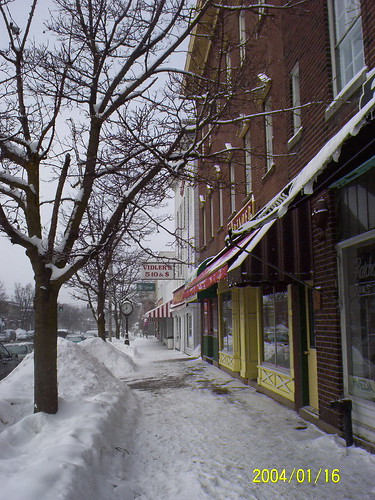
In the winter of 2004, I spent several weeks in East Aurora, New York, about 20 miles southeast of Buffalo and just as susceptible to heavy lake-effect snows. A heavy snow was already falling as I flew in for my first trip, right after New Year's. I took it slowly and made it to the hotel all right. But now there was at least a foot of snow on the ground, the plows had yet to catch up, I had yet to get anything for dinner, and the hotel didn't have a restaurant.
If I'd been in a typical suburban hotel, surrounded by parking lots and office buildings, I'd have been stuck with eating from the vending machine. In East Aurora, there was no problem. I put on my snow boots, walked one block up to Main Street, and stepped into a cozy tavern, where I read the newspaper over a slice of prime rib and a Guinness. I had three or four other good choices within a couple of blocks. It didn't hurt that, with the snow falling, East Aurora's Main Street is like a scene out of It's a Wonderful Life.
EAST AURORA EXTRA: Photo sets of the whimsically painted fire hydrants of East Aurora, Arts-and-Crafts movement inspired trash cans on the town's Main Street, and the town's classic five-and-dime, Vidler's. And, finally, here are my photos of East Aurora from January and May 2004.
An edited version of this column was published in the December 27, 2006, edition of Urban Tulsa Weekly. The published version is available on the Internet Archive's Wayback Machine. Here's my blog entry linking to the column. Posted July 13, 2021. See the end of this entry for a postscript.
As I walked out of the Coffee House on Cherry Street late Sunday night, I looked up and down 15th Street. The buildings were lit by a soft glow. No one was on the street, but it didn't feel lonely.
Even today, as a cold steady rain comes down, there's still something cheery about Cherry Street.
Is this the best street in Tulsa?
To be sure, there are other streets in Tulsa with a similar history and pattern: Brookside (Peoria between 31st and 38th), Harvard between 11th and 21st, 15th between Columbia and Harvard, 18th and Boston, 6th east of Peoria. All of them feature small commercial spaces, originally for groceries and other shops to serve homes within walking distance. Some of these other places are thriving today, some have yet to be rediscovered. Some never developed as a continuous commercial street; others did but have been damaged by incompatible redevelopment.
Can we figure out what makes Cherry Street work, bottle it, and sprinkle it on the rest of the city?
Here's my attempt at distilling l'essence de la Rue Cerise.
Cherry Street (in case you're new here) is the marketing name adopted by the businesses lining 15th Street between Peoria and Utica Avenues. The name "Cherry Street" appeared on the plat for the Orcutt Addition, laid out in 1908. In the late 'teens city street names were standardized and Cherry Street became an extension of 15th Street.
Like most healthy urban places it did not spring full-blown from a planner's brow, but evolved piecemeal over time, and it did so in a period before it was common for every family to have a car, so that most daily errands were accomplished on foot or with the help of public transit.
The 1932 Sanborn Fire Map of Tulsa shows Cherry Street as nearly all single-family dwellings, except for the Alhambra Building at the northeast corner with Peoria, a filling station where Subway now sits, Lincoln School, St. Mark's Methodist, and the Sacred Heart Church and School (now Christ the King Parish and Marquette School), a couple of two-story apartment buildings and a few small, isolated shop buildings.
Sitting on the section's center line, a boundary between 160-acre Dawes Commission allotments, Cherry Street lined up with streets in neighboring subdivisions, so it developed naturally as a through street. As a through street, it was a natural place to locate a business catering to residents of the Orcutt Addition and other residents on what was then the far east side of Tulsa.
In 1926, the Oklahoma Highway Department designated 15th Street between Boston and Harvard Avenues as US Highway 64, cementing the street's importance as a commercial corridor. That stretch of 15th Street would carry that designation until the completion of the Broken Arrow Expressway in the early '80s.
Over the decades, one by one, homes on 15th were replaced with the sturdy brick retail buildings that are there today.
Surprisingly, Cherry Street was never a streetcar route, but two streetcar lines served it - a Tulsa Street Railway line terminated just to the north of 15th, while the Oklahoma Union Railway's line to Orcutt Amusement Park (now Swan Lake Park) crossed 15th on St. Louis Ave., jogging a bit on 15th because of a misalignment of streets with the subdivision to the north.
Cherry Street works as a place because it "obeys" some basic rules about the relationship between buildings and street. In his book City Comforts: How to Build an Urban Village, David Sucher boiled it all down to Three Rules that bear repeating:
"(1) Build to the Sidewalk (i.e. Property Line): Create a strong 'streetwall' in which each building meets or comes close to the sidewalk....
"(2) Make the Building Front 'Permeable': Connect the inside of the building and the sidewalk outside with windows and doors....
"(3) Prohibit Parking in Front of the Building: Put on-site parking above, below, behind, or beside. Sub-Rule: Allow on-street parking: Stop-and-go parking is essential to real shopping districts."
At the time the street developed, this was the conventional way to build. Cherry Street Square at the corner of Trenton Avenue is a good example of a modern development that follows the rules and provides off street parking without significantly interrupting the "street wall."
There are a few places along Cherry Street where the rules aren't obeyed - the full block of parking for Lincoln Plaza, the blank wall along Marquette School's parking lot, the lack of a sidewalk in front of Subway, the car wash. But these exceptions aren't so concentrated that they change the essential character of the street.
Please note that Cherry Street is a pleasant place despite (or perhaps because of) the fact that it has yet to be "streetscaped" by the city. The conventional wisdom is that, in order to revitalize a street, you need to replace concrete sidewalks with brick pavers, add fancy cast iron "street furniture" (benches and trash cans), street trees, planters, and "bump outs" to narrow the street and slow traffic flow.
Almost always, streetscaping entails erecting an old-fashioned looking streetlight every 50 feet, each with an acorn-shaped light fixture sitting atop a fluted cast iron post. Instead of giving off the gentle glow of the early 20th century gaslights they are intended to imitate, these acorn lights are as bright as something you'd find in a maximum-security prison. The glare is a distraction to passing drivers, blocking the view of store facades and display windows. These lights shine everywhere but where the light is needed - on the sidewalk.
If you want to see the ugliness that these lights can cause, go up North Main in Brady Village some Saturday night. The acorn lights block and obscure the lovely and historic "Cain's Ballroom Dancing" neon sign. This is an abomination and must be changed.
Cherry Street's sidewalks are plain concrete, and there are few street trees. It has only 10 streetlights, all mounted high atop utility poles at street intersections, and yet it is not a gloomy or foreboding place at night. The streetlights are complemented by incandescent façade lighting on the buildings. (Go look at the Bourbon Street Café for an example.) There's plenty of light for making your way down the sidewalk, but not so much that it wrecks your night vision.
There are two significant threats to Cherry Street. Both have to do with Tulsa's zoning code, which was designed with suburban development on undeveloped land in mind. The zoning code is a bad fit for traditional commercial districts like Cherry Street.
There were no parking requirements when most of the buildings on Cherry Street were built. It was expected that customers would either walk or park on the street. Today, Tulsa's zoning code requires a certain ratio of parking spaces to square footage, with a different ratio for each type of business. Each business has to have its own parking on its own lot, or else get special zoning permission for parking on a separate lot. A minor change in use for a retail space can mean a drastic change in the number of required parking spaces.
It ought to be possible to create a parking district, allowing businesses, churches, and schools to share off-street parking if they wish. The required number of spaces ought to take into account differences in peak parking demand for different businesses in the district.
The other threat is from the catch-all Commercial High Intensity (CH) zoning classification that was applied en masse to traditional neighborhood commercial districts when the zoning code was adopted in the '70s.
While CH zoning allows you to build a traditional sidewalk-fronting brick commercial building, it also allows you to build an enormous metal-sided, windowless barn, separated from the street by acres of parking.
Many cities have a specific "neighborhood commercial" zoning classification for such areas or use a "neighborhood conservation district" to establish standards that closely match Sucher's Three Rules.
Cherry Street has a lot to teach us about successful urban places in Tulsa. Let's make sure we learn the right lessons from it.
POSTSCRIPT 2021/07/13: Cherry Street has changed dramatically in the last 15 years. The streetscapers finally did get a hold of it, reducing the street to two lanes, adding bumpouts and replacing some parallel parking with back-in angle parking. Some genuine zebra crossings were added, helping pedestrian safety. The car wash (NW corner of 15th and Trenton) and a couple of older homes that had served as retail buildings (north side between Rockford and Saint Louis, NW corner of 15th and Troost) were replaced with new buildings that obey David Sucher's Three Rules, despite the absence of zoning requirements to do so. Swan Lake Historic Preservation District continues to appreciate in value. On the other hand, the little neighborhood to the north, wedged between the Broken Arrow Expressway and Cherry Street and unprotected by historic preservation zoning, has been devastated by demolition to support excessive minimum parking requirements for these new Cherry Street buildings. And then there's Bumgarner's Folly: The open field between Troost and Utica south of 14th Street, rezoned as Office High Intensity in 2008, was cleared of mature trees and historic homes and apartment buildings and has sat largely empty for a dozen years, except for the occasional produce tent and now a coffee drive-through.
Steve Patterson of Urban Review STL has an analysis of a plan for redoing three blocks of Euclid Avenue in St. Louis -- paving, lighting, streetscaping -- the same sort of treatment we've seen here in Tulsa along Brookside, Main Street, and in the Blue Dome District. Steve's article is full of brilliant insights about the gap between what actually makes a street lively and what cities tend to spend a lot of money on.
(UPDATE: Here's a link to a Google map of the target area. It extends one block north and two blocks south of the green arrow, from Lindell on the north to Forest Park Blvd. on the south.)
Steve attended a public meeting about the plan, and he heard one commenter suggest eliminating on-street parking altogether. Steve says that would kill the street:
“But how would eliminating parking kill the street,†you ask? Simple, we do not have the density required to keep the sidewalks busy at all times. Sure, we have a number of pedestrians now that make the street look lively but take away the cars and those same number of pedestrians now looks pathetic. We’d need considerably more pedestrians on the sidewalks to make up for the loss of perceived activity contributed by the parked cars. You might argue that removing parked cars from the street would increase pedestrian traffic but such a cause-effect is only wishful thinking. Density is what increases pedestrian traffic, not the absense of parked cars. Without parked cars the street would look vacant and as it looked vacant you’d have less and less pedestrians because they would not feel as safe on the street. Eventually we’d see less stores as a result. The street would die a slow death. On-street parking can only be eliminated in very special circumstances and none of those exist, or are likely to ever exist, in the St. Louis region. We all need to accept on-street parking as part of the activity of the street.
He also mentions that a row of parked cars provides a buffer between pedestrians and traffic, and it has a traffic-calming effect.
The proposed re-do of these three blocks is expected to cost $600,000 to $1,000,000 per block. That doesn't include $400,000 in design fees! Steve writes:
City streetscapes do not need to be fancy. They need good paving, concrete is a perfectly fine material. They need to be lined with good-sized street trees (spend a bit more on bigger trees). Streets need attractive and quality lighting, nothing too fancy or garish. In short, streets need to just be streets. Zoning, signing and things like opening windows to restaurants are the factors that make for an exciting street.
So why do designers focus on the fancy?
You see the design community has the nagging problem, the portfolio. The portfolio or gallery is where they show off their projects to their peers and prospective clients. It takes the really flashy stuff to show up well in photographs. A well-designed streetscape (or building) that is reasonable conventional but part of a dynamic urban context will look far too boring in a designer’s portfolio. Often they want projects that look exciting when empty, hard to accomplish unless you go all out.
I've heard complaints that the same sort of thing is happening in Tulsa. The reopening of Main Street left far too few on street parking spaces. The lighting in front of Cain's Ballroom is too bright (those horrid "acorn" fixtures) and at a height that blocks the facades of Cain's, Bob's and the Sound Pony from the view of passing cars. Worse still, the light fixtures actually obscure part of the Cain's neon sign.
In Brookside, the curb bumpouts eliminated some valuable street parking spaces for businesses like Shades of Brown and Brookside Lao-Thai. Overly-fancy streetscaping means that we don't have the funding to revert downtown streets to two-way as quickly as if we used basic but good street treatments.
I hope every Tulsa planner and the laypeople who sit on design task forces will read all that Steve Patterson has to say.
MORE: Steve has also posted a critique of new suburban sidewalks. Very pretty, but do they actually make the street walkable? Would you feel safe walking on them?
The following comment, by Tom Gulihur of CalCoast Realty, was posted on a much earlier entry, Will the Real New Urbanism Please Stand Up? Gulihur is a California-based real estate broker and financier with a fascinating resumé and deep Oklahoma roots.
This essay wasn't likely to get much readership in the comments of an old entry, so I'm posting it here. I think you'll find it as thought-provoking and well-written as I did.
I come from land rush era Oklahoman stock on both sides of the family and I lived in Oklahoma until I was ten years old, when my family moved to LA, like true Okies. Parents and grandparents are OU alums and paternal grandparents are OSU alums. I love Oklahoma in a nostalgic way, but I understand why many people outside of Oklahoma blanche at the corny Wal-Mart mentality there (and the rest of the South and Midwest).
But some real estate development business is bringing me back to OK. There's a downtown revitalization occurring in Tulsa and I'm involved in a project there. I've been reading gobs of information on Tulsa and urban renewal there and want to explain a fundamental challenge that Tulsans need to overcome. I've seen San Diego's urban renewal and have studied New Urbanism enough to understand how this has to work. First, the public has to buy-in to most of the concepts of New Urbanism or the whole thing will flop. Here is a quick version of what it requires:
- Create dense and intense development at the urban core using form based zoning code. That means don't classify building by use, but rather by their shape. Encourage mixed-use buildings but not only retail-office-residential; enable all mixed uses similar to the early 1920’s in America (it should basically look like Disney’s Main Street USA).
- Create a pedestrian-friendly environment. Expand public transit to de-emphasize the use of the car. Of course this is difficult in an economy that is based on big oil and Detroit steel (now Japanese and German steel too).
- Design an attractive public realm. Plant corridors of street trees, install traffic-calming devices, open corridors of greenbelts with paths and walkways to enable pedestrian and bicyclist activity, build 'vest-pocket parks'. Honor public institutions through architecture and placement. A well designed public realm, whether it’s a residential neighborhood (think of Georgetown, in Washington, D.C.), a public square, a village green, a park or a retail shopping street, they should all encourage people to want to ‘hang out’, ‘hang around’ or walk through it and walk to it. All this hanging out and walking around has a second major benefit to society besides the individual’s personal enjoyment of the experience, is that CRIME IS REDUCED where there are a lot of citizens with their eyes open. Democratic values are also strengthened when the public realm is strong.
- Build using environmentally sustainable techniques. Use all active and passive solar technologies available and use recycled or recyclable building materials.
- Mix housing types in random and close proximity. Don't just build high-rise condos that all cost from $300k to $500k because that fosters elitist classicism. This is the biggest challenge facing New Urbanists everywhere because of the conventional way residential projects are financed according to target market segments that naturally form socio-economic groups that lead to isolation of other groups. A truly democratic and vibrant culture occurs when a CEO and a janitor can live as compatible neighbors, although that's an extreme example.
It's important for the public to learn more about New Urbanism, which is also called Traditional Neighborhood Development (TND), Transit Oriented Development (TOD), Smart Growth, or other similar concepts. The American leader in this concept is Andres Duany and his wife Elizabeth Plater-Zyberk. Their architecture and urban planning firm is at DPZ.com and at CNU.org (The Congress for the New Urbanism). Better yet, read Duany's entertaining book, SUBURBAN NATION, THE RISE OF SPRAWL AND THE DECLINE OF THE AMERICAN DREAM. Then you will ‘get’ New Urbanism.
Some conservatives see a political subcurrent to it and there really is an environmental concern and inclusionary aspect to it. But hey, the icecaps seem to be melting from global warming aren't they? Ten years ago you could argue against that assertion but it's different now. The inclusionary aspect of democratic society is an important part of New Urbanism that doesn't necessarily disagree with a conservative agenda, unless it includes environmental abuse.
In my experience, residential development always leads retail development because retail business owners cannot follow the ludicrous mantra of 'build it and they will come'. Retail will die on the vine if there it is not surrounded by a sea of 'rooftops', meaning the rooftops of consumers. So there's always a lag of retail development behind residential development. And the biggest complaint of the first wave of downtown dwellers when a city starts a downtown renaissance is that there is no convenient or good grocery store downtown. And there are the homeless, who often represent a security problem for wealthy urbanites.
But if Tulsa wants to be the next SOHO or downtown Vancouver, or Portland, or San Diego then it needs to loosen up the archaic liquor laws, IMHO. You need to get a Trader Joe's in downtown for sure, and TJ's needs to be able to sell its selection of wines and beers, which is probably only about 10% of their business, but a crucial 10%. So you guys need to dump the blue laws and welcome to the 21st century. Get out of the Wal-Mart fundamentalist attitude, open your minds and live and let live.
Tulsa has always enjoyed a more cosmopolitan flair than larger Oklahoma City (from where my family hails), although some people on the left and right coasts would snort at the words 'cosmopolitan' and 'Oklahoma' in the same sentence. What Oklahoma has all over the snobbier coastal societies is a warm friendliness that says 'you're OK!', to borrow a partial phrase from Transactional Analysis and Rogers and Hammerstein.
Good luck Okies! I'm rooting for you. But you'll need to loosen your liquor laws and learn about New Urbanism before real progress can move forward.
A couple of comments: (1) Of course I'm curious to know which downtown Tulsa project Gulihur is involved with, and pleased to know someone familiar with these concepts is involved in a downtown project. (2) There's a reference in his comment to financing, and Gulihur is involved in the financial end of real estate. One of the obstacles to building mixed-use or traditional neighborhood developments is that the money people don't understand it and don't have comparables to guide their lending decisions. (The Next American City had an in-depth article on the topic, "Why Building Smart Is So Hard," in the inaugural issue.) I'd be interested in Mr. Gulihur expanding on that issue from his experience.
Once upon a time, there was a famous architect of Asian descent who produced a plan that radically altered the center of a major Oklahoma city.
No, not Bing Thom and Tulsa, but I. M. Pei, whose plan to redevelop Oklahoma City resulted in the demolition of most of its original commercial district and the creation of the Myriad Gardens, the Myriad Convention Center, and that Habitrail-like thing just west of Myriad Gardens.
Via Doug Loudenback, we learn of a new book that puts Pei's plan in the context of fifty years of history of downtown Oklahoma City's decline and renaissance.
According to the book's blog, OKC, Second Time Around: A Renaissance Story, by Steve Lackmeyer and Jack Money, "chronicles a 50-year period in which hundreds of buildings were demolished in downtown OKC, the demise of Urban Renewal, early development of Bricktown, and downtown's recent resurgence."
Loudenback, an online chronicler of Oklahoma City history, gives the book five stars plus an infinite number of plusses, for providing both beautiful pictures and informative text covering the history of downtown OKC in detail, both positive and negative. I was especially interested in Loudenback's description of the chapter on Neal Horton, an early advocate for Bricktown, whose pleas for city investment in basic infrastructure fell on deaf ears, and who didn't live to see his visions come to pass.
I plan to pick up a copy of this book when I'm next in Oklahoma City. The same kind of book needs to be written about Tulsa.
I found this item on the Fort Worth Architecture forum, on a topic about the Trinity River Vision, a project that involves Bing Thom of The Channels fame. This item has nothing to do with the project specifically, but it says so many things so well that I'm going to quote it in full. It's by Kip Wright, and it's in response to someone who wants Fort Worth to be a city of towers, just like Dallas. If this applies to Fort Worth, it applies even more so to Tulsa. (I've added emphasis in a few places.)
O.K., Jonny, at the risk of sounding anti-progress or, at worst, a sentimental old geezer, I'm gonna tell you a story about a little boy. (This is also for some others of you out there who yearn for the tall, glass towers of Dallas.)This little boy grew up in Atlanta, Ga., and he was VERY proud of his town: The Big Peach, Capital of the Empire State of the South, Hotlanta, site of one of the most decisive battles of the War Between the States, home to "Gone with the Wind." And home to the 2nd Six Flags! The sports teams sucked, but he is, to this day a big Falcon-Braves fan. He loved Atlanta for what it was, but he wanted MORE!
When National Geographic did a cover story about his town, ca. 1976, he was very excited. He dreamed of his city getting REALLY BIG with tall glass towers -- a mecca to which many would come, from far and near.
In 1978 he watched the historic old Henry Grady Hotel on Peachtree Street emploded. Not only was it cool to watch, it was to replaced by the 79-story Westin Peachtree Center Hotel! WOW! But his grandmother had quite another take. As her eyes filled up with tears, she said "I can't believe they've demolished the Henry Grady!" (And there was nothing wrong with it either!) It had been the site of many important Atlanta events, not to mention the site of proms, when Atlanta had only three or four high schools. She had been upset, too, when, a few years earlier, Atlanta's landmark Terminal Station (with Morrocan influence) had been demolished for a pitifully unremarkable 30-story federal building.
Shortly thereafter, the Loew's Grand, site of the world premiere of "Gone with the Wind" was slightly damaged by arson. It was soon "decided" that it was not salvagable and would have to be replaced by the 53-story world headquarters for Georgia Pacific. Then, like a falling domino, came the demand by Georgia Pacific that the landmark Coca-Cola sign, gigantic and resplendent with red and white neon lights that swirled at varying speeds, would have to go, too. They could not have this "eyesore" across the street from THEIR building! An icon of over 50 years was removed.
The little boy went away to college in the 1980s. It seemed like every time he went home, another old landmark had been eradicated for "progress." The 1890s dairy farm with dwellings and outbuildings, at the intersection of Briarcliff and LaVista, was removed, with over 100 gigantic oaks, for a strip shopping center, as Atlanta sprawled, far and wide. A ca. 1920 brick gas station, with porte cochere, was removed for a parking deck next to Emory University. The list went on and on . . .
In the early 1990s, just before his grandmother passed away, the little boy took his grandmother downtown to see the changes. She mostly just said, "Ooooooh, would you look at that." Her city was almost unrecognizable. And saddest of all, to them, was the replacement of the old S&W Cafeteria and the old Woolworth's (site of many of their lunchtimes) by (guess what?) a 60-story office tower.
The little boy moved away from his beloved home town because he got his wish. Atlanta is now a super big city with lots of gleaming glass towers, 16-lane interstate highways, and umpteen gazillion corporate headquarters. Everyone is now going to Atlanta -- but him. The city is TOO BIG, there are TOO MANY glass towered office complexes, there are TOO MANY Damn Yankees who have moved to that mecca. Development, cars, and pollution now dominate his town.
Now, I suppose I'd live there again . . . if a really good reason to do so appeared. I still have a lot of friends there. I love the big trees and green everywhere.
But there is a disconnect -- many, many of the landmarks that made Atlanta what it was to me are there no longer. It is now something else to me, in many ways. (Not to mention all the Damn Yankees who live there!) It's not Atlanta to me any more.
Old buildings create a continuity between generations, they give a city an identity and a soul.
Atlanta had a hell of a time during the Olympics in deciding on an identity. Its mascot was the blue thing, "Whatizit." How can one have an identity when one scorns the past and tradition? Everything about Atlanta was "looking to the future." But everything we are today is a result of what's happened in the past. This is what makes different parts of America unique, even as we speed on towards a goal of homogeneity.
It is a given that cities are going to change, but how will they do it? Growing with a seriously-planned eye to the past, improving upon what exists? Or wipe-the-slate-clean with cost-effectiveness, highest-and-best-use, biggest-bidder-take-all, and the-bottom-line? Flirt like a whore for the developer's dollar? Sit-up and roll-over like a dog, begging for a bone?
Some of you will smirk at me as a sentimental fool, but it is you whom I pity. With your eyes only on the bank ledger you will miss texture, lines, the patina of age, the walls that can't talk, the structures that connect us with our past.
As I live here in Fort Worth, I connect to it through people and places. People die, but it gives me hope that some of the buildings will live. I hope Fort Worth wakes up before it does more to destroy its legacy. Very few landmarks have even nominal protection in this town.
So, my good Jonny, you want your city to be like Dallas? This little boy says don't wish that on Cowtown (Dallas only WISHES it were "Cowtown," so its football team mascot would make sense!) I think "Cowtown" is good like it is. Sure, progress is good, but at what cost? If you want Dallas or Atlanta, then go there -- I think you'll eventually come home.
Hearty congratulations to Kevin Walsh, webmaster of Forgotten NY, a site devoted to the physical remnants of decades and centuries past in the five boroughs and environs -- old neon, abandoned subway stations, abandoned diners, humpback street signs (think Sesame Street), vanished streets, ghost ads -- and that's just scratching the surface. It's a site you can explore for hours.
Kevin's years of diligent research have spawned a book of the same title. Forgotten New York: Views of a Lost Metropolis, published by Collins, made its debut last month in hardcover and paperback. Kevin has a page devoted to the book's release party, held at a Greenwich Village pub that was once a speakeasy. Naturally, Kevin provides a short history of the bar, its famous customers, and explains how the term "86" is connected to the place.
Time Out New York put the book on its cover, with a feature story and several sidebars. And Kevin's cousin, Tom Paul, posted a web scavenger hunt as a contest. While the contest is long over, the five questions he asks will send you searching through forgotten-ny.com looking for the answers, giving you an overview of the hidden treasures you'll find there.
Urban Tulsa Weekly has a bright and shiny new website!
All the links in my archive category are now broken! But it's worth it! (And they'll be easy enough to fix -- it will just take time.)
(There's a really simple forwarding trick they could do to fix all the broken links on the server side.)
Here's this week's column, part 6 in the series dealing with The Channels proposal, this week asking about the best way to create a more pedestrian-friendly city, learning a lesson from the success of a waterfront development in Florida.
When I posted my entry, Will the real New Urbanism please stand up?, I also e-mailed the Congress for the New Urbanism to ask them what they knew about this website called newurbanism.org. That's the site that comes up as the first result on a Google search of the term "New Urbanism," but which contains a lot of radical rhetoric that goes well beyond anything I've heard advocated by a new urbanist planner or architect.
In response to my e-mail, I received a reply from Steve Filmanowicz, Communications Director for the Congress for the New Urbanism (emphasis added by me):
Thanks for contacting us and alerting us to the new content at the site, newurbanism.org. Newurbanism.org is an independent, one-person operation with no ties to the Congress for the New Urbanism and little to no apparent following among New Urbanists. The site is run by a person named Andy Kunz who registered the domain name years ago. Because of the confusion the site creates, and the misimpression it leaves with some visitors that it is a source of authoritative information about New Urbanism, CNU has asked him to surrender the domain name. Since CNU refused Kunz' demand of $30,000 in exchange for the rights to the domain, the site remains in his control, unfortunately.Your blog entry featured an accurate and insightful description of New Urbanism, whereas NewUrbanism.org offers a distorted portrayal. While there are many environmental benefits associated with the compact, walkable neighborhood-based development promoted by New Urbanists (see information on the LEED-ND project at cnu.org), the calls for things such as bans on airport expansions and road extensions and mandates for widespread installations of solar roof panels are independent positions of Mr. Kunz that further reveal that his site is a highly unreliable source of information about its namesake.
As I mentioned previously, the authoritative source of information about the New Urbanist approach to architecture and urban planning is the Congress for the New Urbanism, and that organization's website is www.cnu.org. Mr. Filmanowicz said in his e-mail that a new and improved CNU website is to be released by November.
It appears to me that Andy Kunz is a cybersquatter, holding the domain name hostage. In fact, I wonder if he really is an overzealous environmentalist, or if he is deliberately posting these draconian ideas as a way to embarass CNU into paying him for the domain name.
Given the likelihood of confusion -- indeed, actual confusion, as Kunz's views have been attributed to the New Urbanist movement as a whole -- I wonder if there is a basis for the CNU to take legal action against Kunz, at the very least to require him to post a disclaimer on every page.
If not, Mr. Kunz has discovered an ingenious way to make an organization's life miserable: Grab a domain name that would logically belong to that organization, make it look professional and add enough detail to make it appear to the casual websurfer that this is an authoritative site about said group. (But carefully avoid stating that you are speaking on behalf of the group.) Then notify the group of your ransom demand. If they refuse to pay, add some off-the-wall content that would harm their reputation (but plausible enough so that the site still seems authoritative) and raise the price. Continue to raise the stakes until the victim pays up. The same strategy could be used against a public figure, such as a candidate for office.
I've got to hope that there are legal remedies to protect groups against that kind of attack.
This morning I heard some talk on the radio about "New Urbanism." The backers of The Channels -- the $788 million plan to build islands in the middle of the Arkansas River -- have made reference to the New Urbanist movement.
The discussion I heard this morning linked New Urbanism with radical environmentalism -- specifically, support for Al Gore's movie An Inconvenient Truth, calls for moratoria on road and airport construction and expansion, putting solar panels on every building in America, and calls to divert the U. S. defense budget for the complete remaking of the American landscape.
I've been hearing about and reading about New Urbanism for the last 10 years or so, and that's not the movement I'm familiar with. The New Urbanism I know is about relearning lessons from our past about how to build neighborhoods, towns, and cities that are pleasant and safe places to live.
The traditional approach to urban development got lost around the end of World War II, when the theoreticians took over and began to use the power of government to make city development fit their theories. The theoreticians were more interested in putting things in neat categories, rather than understanding and appreciating the complexity present in a healthy city. Government engaged in market-distorting activities that subsidized the construction of new suburbs and the building of infrastructure to serve those new suburbs over the restoration of existing neighborhoods and existing infrastructure. Zoning codes required the strict separation of homes from shops from workplaces, on the grounds that there was something inherently unsanitary about living within walking distance of a grocery store. New neighborhoods were built without basic civic infrastructure like small parks and sidewalks. When older, traditional neighborhoods were devalued by the government-subsidized construction of new neighborhoods, or split in two by Federally-funded freeways, the Federal government then provided funds to bulldoze those traditional neighborhoods, often to remake them after the suburban model. And Federal and local government policies have in turn molded private lending and development practices to encourage more of the same.
The post-WWII approach to development, which has dominated local and Federal government policies for over 50 years, has more in common with Communist centralized planning than the free market and traditional American values.
New Urbanism is an attempt to relearn the traditional way of building cities and adapt it to modern circumstances. New Urbanists are involved in preserving traditional, walkable, mixed-use neighborhoods where they exist and in creating new developments in the traditional style, while incorporating the kind of modern amenities that we expect in our homes and workplaces. Sometimes these new developments are infill, replacing obsolete industrial or commercial sites ("brownfields", dead malls, rundown strip shopping centers) or vacant land in the midst of a city.
Some examples of New Urbanist projects:
- Seaside, Florida, a newly built beach town
- Stapleton, the redevelopment of Denver's decommissioned airport as a walkable community of 30,000 people, with schools, offices, parks, and shops
- Legacy Town Center, creating a focal point for a Dallas suburb that lacked one.
- Southlake Town Square, another effort to create a center for a sprawling Metroplex suburb, bringing together the town hall, county offices, a library, national chain stores and restaurants, medical and professional offices, and brownstone residences
- Celebration, Florida, a small town created by Disney
- Har-Ber Meadows, a newly-built "traditional" neighborhood on the west side of Springdale, Arkansas
- The Crossings, Mountain View, California -- the dead Old Mill Mall was converted into an 18-acre mixed use neighborhood
Here in the Tulsa area, New Urbanism's influence can be seen in the proposed East End development and the Village at Central Park, and in the neighborhood plans for Brookside, 6th Street (the Pearl District), Brady Village, and east Tulsa's 21st Street corridor.
When I think of New Urbanism, the names of three urban planners immediately come to mind: Andres Duany and Elizabeth Plater-Zyberk and Peter Calthorpe. These planners have been involved in countless innovative new developments and redevelopments around the world.
While I've heard New Urbanists tout the environmental benefits of more compact traditional neighborhoods, I haven't heard them advocating any radical anti-human environmental policies. So I was surprised at what I heard on the radio this morning, and I did a Google search on the phrase "New Urbanism."
The first hit was a site called newurbanism.org. Sure enough, here were all the radical proposals that were being mentioned on the air this morning.
I did some digging through the site, but I never could find out the name of the individual or organization who had set up the site. I went to completewhois.com to find out who owned it, and this was the result (the same info was provided for admin and tech contacts):
Registrant ID: 39693217-NSI
Registrant Name: New Urbanism.org LLC
Registrant Organization: NewUrbanism.Org, LLC
Registrant Street1: 824 King St, Suite 103
Registrant Street2:
Registrant Street3:
Registrant City: Alexandria
Registrant State/Province: VA
Registrant Postal Code: 22314
Registrant Country: US
Registrant Phone: +1.1231231234
Registrant Phone Ext.:
Registrant FAX:
Registrant FAX Ext.:
Registrant Email: email@newurbanism.org
Note that the phone number is fake, and you can't find a phone number or a name anywhere on the website.
The real, credible website for the New Urbanist movement is www.cnu.org, the Congress for the New Urbanism. You can read a history of the organization, founded in 1993, here. You will not find a radical Earth First manifesto here. In fact, here is a Flash-animated tour explaining what New Urbanism is all about.
The backers of The Channels plan have referred to a 2004 study done by the firm Booz Allen Hamilton called Dallas at the Tipping Point: A Road Map for Renewal (800 KB PDF file). The study was commissioned by the Dallas Morning News to answer the questions:
- What are the key challenges facing the City of Dallas?
- How well is City Hall positioned to cope with these challenges?
- What does the City of Dallas need to do to position itself for long-term success?
I've had a copy for some time, but finally had the chance to start reading it today.
The Channels backers point to the report's discussion of the cycle of decline which leads to a hollow urban core: Quality of life declines, businesses and individuals migrate to surrounding areas, the tax base declines, infrastructure requirements are underfunded, resources for city services decline, and the tax burden increases, leading to a decline in the quality of life, which feeds another round of the cycle. The Channels backers call this the Death Spiral and they say that Tulsa, like Dallas, is in this vicious cycle. They believe we need their project -- spending $600 million in public funds to build islands in the Arkansas River -- to break us out of that cycle.
In light of that, it was interesting to read what Booz Allen recommended to Dallas. There were no mentions of islands, arenas, or other big-ticket amenities. In fact, they called on Dallas officials to focus on delivering basic government services efficiently. They called for adjustments to the city's governmental structure so that authority, responsibility, and accountability align and the buck actually stops somewhere.
Like Tulsa, Dallas has a high violent crime rate, even with more than 2 police officers per thousand population. Fixing the problem isn't rocket science:
A programmatic approach is needed to reduce crime, improve education, and encourage economic growth.... Successful approaches to each of these are already well understood. From New York's crime reduction success to Cleveland's success in economic development, there is little mystery as to basic building blocks for improving quality of life. What is missing in Dallas is a comprehensive focus and a cross-department program for delivering the change.
Improving the quality of life index was the first of three strategic imperatives. The other two: Attract middle-class families to the city and address the city's under-funded liabilities (e.g. deferred infrastructure maintenance and city employee pensions).
Note: They don't say to attract more of the Creative Class types, as much as they can add to a city, but to be effective at competing with the suburbs for middle-class families, who provide a stable base for retaining employers and retailers in the city, with their accompanying tax base. (Joel Kotkin is one urban analyst who has bucked the Creative Class tide and insisted on the importance of middle-class families to a city's well-being.)
(Related thought: By going to Tulsa County to seek public funding for their project, The Channels backers have guaranteed that the funding package will include proportionate amenities for the county's other municipalities, neutralizing any competitive advantage the core of the City of Tulsa would have gained by implementing their plan.)
The Dallas Morning News has a special online section devoted to their report on Dallas, including a 2005 update on the situation, also prepared by Booz Allen Hamilton.
End of an era: Today was the final minor league ballgame at Ray Winder Field in Little Rock. The Arkansas Travelers beat the Springfield Cardinals 7-3. Next year the Arkansas Travelers will play at a new ballpark in North Little Rock. The Democrat-Gazette had two front-page stories (online, but subscriber-only) -- an interview with a fan who had been at the park's opening day in 1932, and a story about possible futures for the stadium. Options include leaving the playing field, but converting part of the stands to office space, and demolishing the whole thing to make way for expansion of the neighboring zoo.
Here are links to memories of the park and reports on the final game:
Harry King of the Morning News remembers the Travelers of the '50s and '60s.
KATV talks to some of the 8,000 fans at the final game.
I only attended one game there, back in 1991. I drove down from Tulsa and met my friend Rick Koontz, who flew American Airlines non-rev from DFW. In '88 Rick and I had done a "rust belt tour" of five midwestern major league parks -- Wrigley, Comiskey, Tiger Stadium, Cleveland Municipal, and Riverfront.
Before the game we visited the State Capitol. There he was across the room, big as life, chatting up and getting photographed with a female tourist -- potential presidential candidate Gov. Slick Willie his own self. To this day, I regret not having gone over to ask, "Confidentially, Governor, where can a fella go for a good time in this town?" I feel sure he would have been a fount of useful information in that regard.
Details are fuzzy after 15 years, but I am pretty sure that what we saw was a legendary Saturday night double-header against the Shreveport Captains. For years, the Travs never played at home on Sunday, but would always play two the night before instead. I seem to recall that this had to do with the financial implications of not being allowed to sell beer on a hot summer Sunday afternoon.
As we arrived, we noticed "shaggers" waiting in the parking lot for foul balls during batting practice, just like at Driller Stadium in Tulsa. (Note to British readers: Retrieving a ball that has gone astray is a possible meaning of the verb "shag" in the USA.)
At the time, Shreveport was a Giants affiliate and the Travs were a Cardinals team, and in the minors when two National League affiliates played each other, they did so without a designated hitter.
The seats were very close to the field. I remember that the diamond was a couple of inches higher than foul territory, which must have been tricky to handle.
I would rank the experience at Ray Winder Field up there with an evening at Durham Athletic Park, the old home of the Bulls. Nothing fancy about it -- just baseball, an evening breeze, the sound of the organ, a Coke, a pretzel, and a scorecard.
MORE: A couple of columns about Ray Winder Field from Paul Greenberg (another one of my favorite things about Little Rock) -- Opening Day 2005 and Opening Day 2002.
Andy Donovan-Shead sends along a couple of interesting solutions for keeping cities green while accommodating the built environment:
Rubber sidewalks made from recycled tires (Chips, naturally) are better able to accommodate growing trees without the usual heaving and cracking of concrete walks. The downside: Higher initial cost, but with the benefit of saving valuable shade trees, and the material handles temperature extremes.
Green roofs are sprouting all over Chicago, starting with City Hall. Grass and trees on rooftops help reduce stormwater runoff and clean and cool the air.
I'm reminded of the concept of permeable driveways -- using a minimal amount of solid material to make for a stable surface for cars to drive and park on, but allowing as much grass as possible, which again reduces stormwater runoff and reduces heat. If you have a driveway long enough, it's going to crack and grass will start growing through it anyway. Anyone know if this sort of thing would meet the Tulsa zoning code's requirement for parking on an "all-weather" surface?
A week from Tuesday, Springdale, Arkansas, citizens will vote on a tax package to build a $46 million AA-quality minor league baseball stadium in the southwestern part of the city. According to the Grand Slam for Springdale website, a AA team would relocate to Springdale if a new park is built. (I'm guessing Texas League, as there are three TL teams nearby -- Tulsa, Springfield, Mo., and Little Rock.)
Northwest Arkansas is a booming area and could support a minor league baseball team. The region's prosperity has three pillars: Wal-Mart, poultry, and trucking. Wal-Mart's world HQ has attracted sales reps for hundreds of manufacturers to the northern part of the metro area, in Bentonville and Rogers, where whole neighborhoods of McMansions are springing up in what used to be hog pastures and chicken farms.
Hilly, green Fayetteville, anchoring the southern end of the region, is the cultural center, home to the University of Arkansas. The city has grown, but in a less dramatic fashion, and with more of an eye to preserving its historic neighborhoods and college-town walkability.
Springdale, in between, has always been a homely place. Food processing and trucking are the main industries. A tiny remnant of a downtown is surrounded by ugly '70s strip development. At the crossroads of US 412 and US 62, it's on the way to lots of places, but not much of a destination.
So a ballpark could be a good thing for Springdale and the region, but it's interesting to see the proponents of the stadium trot out the same old tactics. The website tells voters to say yes to three propositions, but doesn't explain what those propositions will accomplish. (It appears to be a refinancing of revenue bonds for an existing sales tax for roads, and the sales tax would be extended to generate enough to build a stadium.)
There was a feasibility study done by Conventions, Sports, and Leisure, International -- the same bunch that did the feasibility study for Tulsa's arena -- which claims that the stadium will result in 300 new jobs and $600,000 in new "revenues" to the city, in the form of increased sales taxes and stadium lease payments. The website doesn't bother to say how much the city's net income will increase if at all -- no word about the expense side of the ledger.
The targeted team is reported to be the Wichita Wranglers, which plays in Lawrence-Dumont Stadium, just across the Arkansas River from downtown Wichita. Wichita has the right to buy the team if the Wranglers break their stadium lease before its 2009 expiration.
The latest big development appears to be the defection of Rev. Ronnie Floyd, pastor of First Baptist Church, Springdale, who no longer supports the stadium because beer will be sold there. Perhaps he really fears the baseball team will be entertainment competition for his kids' church with its fire engine baptistery. (Here is a rather lengthy comment thread on the propriety of Floyd's endorsement in the first place and the sincerity of his reversal.)
I don't in the least begrudge Springdale a minor league team, but we are talking about an entertainment venue that will be competing against restaurants, theatres, concerts, and nightclubs for regional entertainment dollars. It seems like the private sector ought to be jumping at the chance to build such a facility if it really were economically feasible.
MORE: Meanwhile, there are plans for a privately-funded 9,000 seat arena in Bentonville. Global Spectrum (bypassed for Tulsa's BOk center) would manage the facility, and the arena owners would own the minor-league sports teams that would play there.)
Found on a MySpace blog during a Technorati search for "Tulsa", this is from Suburban Nation: The Rise of Sprawl and the Decline of the American Dream by Andres Duany, Elizabeth Plater-Zyberk, and Jeff Speck:
Another word for dependent is burden, and that term better describes these parents' perception of the children who rely upon them for mobility. Mothers often derail their careers so that their children can experience a life beyond the backyard. The role of journalist, banker, or marketing director is exchanged for that of chauffeur, with the vague hope that their career will resume when the last child turns sixteen; thus the term soccer mom -- a distinctly suburban euphemism. The plight of the suburban housewife was powerfully conveyed in a letter we received in 1990 from a woman living outside of Tulsa:"Dear Architects:
"I am a mother of four children who are not able to leave the yard because of our city's design. Ever since we have moved here I have felt like a caged animal only let out for a ride in the car. It is impossible to walk even to the grocery store two blocks away. If our family wants to go for a ride we need to load two cars with four bikes and a baby cart and drive four miles to the only bike path in this city of over a quarter million people. I cannot exercise unless I drive to a health club that I had to pay $300 to, and that is four and a half miles away. There is no sense of community here on my street either, because we all have to drive around in our own little worlds that take us fifty miles a day to every corner of the surrounding five miles.
"I want to walk somewhere so badly that I could cry. I miss walking! I want the kids to walk to school. I want to walk to the store for a pound of butter. I want to take the kids on a neighborhood stroll or bike. My husband wants to walk to work because it is so close, but none of these things is possible. . . And if you saw my neighborhood, you would think that I had it all according to the great American dream."
TRACKBACKS:
See-Dubya, out on the Left Coast, says we should count our blessings:
You live in one of the greatest little cities in America, lady. I’d love to have your problems. I’d be up at Grand Lake this weekend, buzzing around in my bass boat with the rich people. I’d go all Lileks on one of the most beautiful Art-Deco downtowns in the country. I’d take my kid to the JM Davis gun museum or Woolaroc or Gilcrease or Philbrook or out to wander around in some little brick downtown with an Indian name like Warneka or Beufala that still has its feed stores right there on Main Street....I can walk three blocks to a grocery store here, too, and it’s a fancy-pants rinky-dink Whole Foods knockoff that’s never open when I need it. Safeway is two miles up a commuter-jammed highway. I could walk to church, but to find one that actually believes in the Trinity requires a five-mile trip in the family truckster.
Charles G. Hill, down at the other end of the turnpike, sees a lot of walkers in his neighborhood, but not a lot of kids:
And I don't expect this to change any time soon: if you're buying a house in town and you've got school-age kids, your friendly agent will steer you away from my neighborhood, despite its manifest advantages, because it's in an urban school district and you can't possibly want that.
(My apologies for not having trackbacks turned on, but I got tired of deleting 40-60 spam trackbacks a day, and my old spam-deterrent techniques were no longer working. As soon as I get MT 3.2 installed, I'll turn them back on. In the meantime, I'll manually add trackback links as I find them or if they're e-mailed to me at blog at batesline dot com.
Jane Jacobs, the urban observer who helped blow away the cobwebs of urban planning dogma so that we could see what really makes a city work, passed away in April. My Urban Tulsa Weekly column last week was a salute to Jane Jacobs, highlighting three lessons from her landmark 1960 book, The Death and Life of Great American Cities, one of my favorite books.
Also of note last week: Jamie Pierson's first column for UTW, in which she recalls a suburban Tulsa upbringing, gives thanks for her midtown-based young adulthood, and gives a tongue-in-cheek call for deannexing everything south of I-44.
An edited version of this piece was published in the June 7, 2006, issue of Urban Tulsa Weekly. The edited, published version of the piece is online in the Internet Archive. Posted on the web September 17, 2013.
Remembering Jane Jacobs
By Michael D. Bates
"This book is an attack on current city planning and rebuilding. It is also, and mostly, an attempt to introduce new principles of city planning and rebuilding, different and even opposite from those now taught in everything from schools of architecture and planning to the Sunday supplements and women's magazines.... It is an attack... on the principles and aims that have shaped modern, orthodox city planning and rebuilding."
She was labeled a naysayer and an obstructionist, anti-growth and anti-progress. She had no training in city planning or architecture, but she challenged the professionals and the experts. In the mid-'50s, when her neighborhood was threatened with demolition by New York's orgy of expressway construction, she and her neighbors fought back and won. Their victory opened the door for the economic resurgence of the neighborhoods of lower Manhattan.
She transcended political boundaries. In the late '60s, she and her family left the United States for Toronto to keep her son out of the Vietnam War draft, and yet two of her books were listed among the hundred best non-fiction works of the 20th century by the conservative fortnightly National Review.
What Jane Jacobs had was a keen eye for detail, a gift for description, and a stubborn determination to see streets, neighborhoods, and cities as they really are, not distorted through the lens of academic theory. It is that quality that makes her landmark book, The Death and Life of Great American Cities, still fresh and relevant nearly half a century after its publication.
Her death on April 25, at the age of 89, brought to an end Jane Jacobs' long and productive life. She deserves to be remembered, and so do her observations about what makes a city a safe and pleasant place to live and work and, just as important, an incubator for new businesses and new ideas.
Here are just three of the lessons she taught, lessons that many of Tulsa's leaders have yet to learn:
1. Believe your eyes, not your theories:
Jacobs' ideas about cities ran counter to the accepted wisdom of city planning, which she considered a dangerous kind of quackery, as apt to kill the patient as heal it: "As in the pseudoscience of bloodletting, just so in the pseudoscience of city rebuilding and planning, years of learning and a plethora of subtle and complicated dogma have arisen on a foundation of nonsense."
Planners clung to their dogma, regardless of its real-world effects: "The pseudoscience of planning seems almost neurotic in its determination to imitate empiric failure and ignore empiric success."
Jacobs wrote of a friend who was a city planner in Boston, who told her that the North End, the old Italian district with its chaotic tangle of narrow streets and untidy mixture of homes and businesses, was a dreadful, crowded, unhealthy slum that needed to be cleared. And although he concurred with her observation that the neighborhood was a lively, pleasant, and safe place, an observation backed up by low crime and mortality rates, he chose to believe the negative view of the neighborhood dictated by accepted planning theory.
Here in Tulsa there seems to be a reluctance to catalog and acknowledge the planning failures of the last fifty years. Perhaps it is because many of the responsible decision makers of the '60s, '70s, and '80s are still living and still influential. But until we are willing to admit that following the fads of the past - urban renewal, superblocks, pedestrian malls, urban expressway loops - caused more damage than good, we will remain susceptible to ignoring reality and uncritically embracing the next fashionable concept.
2. The safety of a city is a function of its design:
Jacobs saw, in the traditional urban neighborhoods that had escaped dismemberment by urban renewal and expressway construction, a complex organic system that planners tamper with at their peril.
The mixture of residences, jobs, and shopping gives people a reason to be on the sidewalks, coming into or through the neighborhood from early in the morning until late at night. That, combined with buildings that overlook those sidewalks, creates a kind of natural surveillance - a phenomenon she called "eyes on the street." She wrote, "No amount of police can enforce civilization where the normal, casual enforcement of it has broken down."
Contrast that with a typical 1970s Tulsa subdivision. The neighborhood has sidewalks, but they don't lead anywhere you would need to go. The houses turn a blind eye to the street; living rooms look out on the back yard, with no windows facing the street. It doesn't matter how many street lights you put up; if no one needs to be walking down the street, and no one can easily look out to observe the street, you have only managed to create a well-lit workplace for vandals and car thieves.
3. Old buildings matter:
"Cities need old buildings so badly it is probably impossible for vigorous streets and districts to grow without them. By old buildings I mean not museum-piece old buildings... but also a good lot of plain, ordinary, low-value old buildings, including some rundown old buildings."
Think about the most lively and interesting places in Tulsa, the kind of places you'd take a visitor for a night on the town: Brookside, the Blue Dome District, Brady Village, Cherry Street, 18th and Boston. Each of those districts had an abundance of old buildings, buildings that are for the most part unremarkable. But those buildings provided an inexpensive place for someone with a dream to start a new business.
You might have seen the same kind of vitality develop in the south part of downtown, with business springing up to serve the tens of thousands who attend classes at TCC's Metro Campus or participate in activities at the downtown churches, but so many of the buildings have been taken for parking by the churches and by TCC that a prospective business owner would be hard-pressed to find a location.
"As for really new ideas of any kind - no matter how ultimately profitable or otherwise successful some of them might prove to be - there is no leeway for such chancy trial, error and experimentation in the high-overhead economy of new construction. Old ideas can sometimes use new buildings. New ideas must use old buildings."
Time and space allow us only to scratch the surface of Jacobs' wisdom here. You will have to read The Death and Life of Great American Cities for yourselves to see what she had to say about why some parks are lively and safe and others are dull and dangerous, why certain areas become magnets for used car lots and other unattractive uses, how to accommodate cars without killing an urban neighborhood, and how to keep a successful district from self-destructing.
The principles Jacobs drew from her observations are timeless because they are grounded in unchanging human nature, although the application of those principles will vary from one place to another. Would that every City Councilor and every planning commissioner would read and ponder Jacobs' works.
As Tulsa revisits its Comprehensive Plan for the first time in 30 years, as we consider moving from use-based to form-based planning, we have the opportunity to align our practices with those timeless principles, so that once again our urban core can become a lively and dynamic engine for the culture and prosperity of our city and our region.
Jane Jacobs showed us the way. Perhaps, a half-century later, Tulsa is ready to follow her path.
If you have trouble finding your way around the tidy Cartesian grid that defines Tulsa's street network, imagine learning your way around an ancient, complex, and chaotic street network, and keeping that map entirely in your head.
From the Transport for London website:
All licensed taxi drivers in the Capital must have an in depth knowledge of the road network and places of interest in London - the 'Knowledge'. For would be All London drivers, this means that they need to have a detailed knowledge of London within a six mile radius of Charing Cross. Suburban drivers need to have a similarly detailed knowledge of their chosen sector.
From a PDF document about the Knowledge of London examination system:
In order to complete the Knowledge you will need to know any place where a taxi passenger might ask to be taken and how to get there. To do this you will need to know all the streets, roads, squares etc. as well as specific places, such as parks and open spaces, housing estates, government offices and departments, financial and commercial centres, diplomatic premises, town halls, registry offices, hospitals, places of worship, sports stadiums and leisure centres, stations, hotels, clubs, theatres, cinemas, museums, art galleries, schools, colleges and universities, societies, associations and institutions, police stations, civil, criminal and coroner’s courts, prisons, and places of interest to tourists. Such places are known as ‘points’.
How do you organize all this information in your brain? You learn 320 "runs", divided into 20 lists of 16 runs. A run connects two major points, and you learn the route from one end to the other, the reverse route (which may differ because of one-way streets and turn restrictions), all points of interest along the way, and all points of interest with a quarter-mile of each end point.
After an introductory talk, you have six months to learn the first 80 runs, then you go through a self-assessment, just to see if you've got the hang of it. You have another 18 months to learn the remaining 240 runs. Then there are four stages of oral examinations, each of which may involve multiple exams before advancing to the next stage. According to Transport for London:
On average it takes an All London applicant 34 months to learn the Knowledge and pass through the examination process, 26 months for a suburban applicant.
Small wonder that that London cabbie was able to keep his composure when he unexpectedly found himself being interviewed on TV about an Internet intellectual property case. (Hat tip on the cabbie story to The Dawn Patrol.)
Mysterious California investors are buying historic office buildings... in downtown Oklahoma City:
California investors bought First National Center on Friday in a fast deal that could turn what many see as an albatross around downtown’s revival into a “crown jewel” in time for the state’s centennial.It was a $21 million cash transaction, said Tim Strange of Sperry Van Ness, which handled the sale of the largest office complex downtown.
The buyers, who were not revealed, have no connection to Oklahoma, he said. Nonetheless, the deal could hit Oklahomans in the heart if the Californians are successful in resurrecting the capital city’s downtown landmark.
“Plans are to bring it back to its former glory as the crown jewel of downtown Oklahoma City. To fill it up - and dress her up and take her to the ball. Have a centennial ball in the Great Banking Hall,” Strange said.
Here's a photo of the Great Banking Hall
My first thought when I read about this at Dustbury was, "Hey, these had better not be our Californians!"
But our guys -- Maurice Kanbar and Henry Kaufman, who have purchased over 25% of downtown Tulsa's office space, with plans to create housing, retail, and art galleries -- don't fit the description in the Oklahoman story, as they have ties to the state, through their Tulsa buying spree. Kanbar's ties go back at least as far as his purchase of Tulsa's Council Oak Books.
So maybe this is the new California trend. Somewhere in Malibu, at a cocktail party, someone is going on about the office building he bought that cost less than his beach house, and someone else tops that with the tale of the gem he bought for less than his Lamborghini. As California trends go, at least it's constructive.
I originally posted part of this as a comment on Catholic Ragemonkey in response to Fr. Shane Tharp's mentioning that he's in Wichita:
Wichita is a nice place to visit. I took several business trips there in the not-too-distant past, and I always found time to get out and explore a bit.
If you're much of a meat-eater, Wichita has a great barbecue buffet in the most unlikely place. It's called B&C Creations. The front part sells antiques, gift, and art; the buffet (lunch only) is in the back. You pay a laughably low price and get all you can eat of the some of the best smoked ribs and pulled pork you'll ever have. They have garlic coleslaw, too, which is amazingly good. It's on the eastern edge of Old Town, 355 N. Washington.
Watermark Books on East Douglas is an independent bookseller with a cafe and free WiFi. Exploration Place, the science museum across the river from downtown, is a lot of fun, and you're just an hour away from the second-biggest collection of spacecraft in the world -- the Cosmosphere in Hutchinson.
I neglected to mention the Orpheum Theatre, a classic downtown movie palace which is under restoration. I went there to see Reefer Madness, Plan 9 from Outer Space, and The Terror of Tiny Town during one of my trips. I even got a tour of the projection booth.
Wichita is a nicer place to visit than you might think. The key is to get away from the main highways. Driving the length of Douglas east to west is a good way to see the most interesting parts of town, including downtown, which hasn't been as devastated by parking lots and urban renewal as Tulsa's downtown has, and the old village of Delano, just west of the river.
To city officials who say that eminent domain is the only way to revitalize cities, look at Anaheim, California:
Anaheim's old downtown was obliterated in the 1970s through past uses of eminent domain and urban renewal. Now, the city (population: 328,000) wants to build a new downtown, and the target location is called the Platinum Triangle, an area of one-story warehouses near Angel Stadium.
Sounds a lot like Tulsa. Our Main Street is all but gone, as is the old Black Wall Street, thanks to urban renewal, so we're looking for substitutes, areas that were left unscathed by urban renewal. Because we destroyed most of our downtown commercial and residential buildings, we're looking to repurpose office and warehouse buildings to create a downtown commercial/residential core where it had never existed before.
In the typical world of redevelopment, officials would choose a plan and a developer, offer subsidies and exclusive development rights, and exert pressure on existing property owners to leave the area.
That is a pretty good description of the approach Tulsa tried to take with the "East Village," the 115 acres bounded by Elgin, the Frisco tracks, the east leg of the Inner Dispersal Loop, and 7th St. Proposals were solicited, and a St. Louis big-box shopping center developer called Desco was given exclusive rights to develop the area, with the city's power of eminent domain as a resource available for assembling property for the private developer. Desco wasn't able to get anything going and their rights lapsed. In the meantime, small property owners had lived in fear of losing their property and weren't inclined to invest in improvements.
Instead, Anaheim created a land-value premium by creating an overlay zone that allowed almost any imaginable use of property. Because current owners could now sell to a wider range of buyers, the Platinum Triangle is booming, with billions in private investment, millions of square feet of office, restaurant and retail space, and more than a dozen new high-rises in the works.
Tulsa's CBD zoning district offers that kind of freedom, and it applies to most land within the Inner Dispersal Loop, although some of that land is in one of the industrial districts (IL, IM, or IH), which restricts less intensive uses. I think this might be the case in party of the East Village and Brady Village. In practical terms, industrial zoning puts hurdles in the way of retail or residential uses.
Anaheim's example deserves closer examination.
(Hat tip to U. S. Rep. John Doolittle's Morning Murmur.)
Steve Patterson of Urban Review - St. Louis posted an entry recently about that city's '70s plan to "deplete" much of the older sections of northern St. Louis. The idea was to write off parts of the city for lost, discourage new investment in those areas, and provide a minimum amount of services for those remaining, until they all die off or move away. A quote from the plan:
Efforts must be made to adjust services and public investments so as to provide for those who are remaining in these areas. Yet these efforts should be pursued without encouraging new investment until the City determined that Redevelopment can and should begin.
Steve links to this item on PubDef.net, which in turn links to this 2002 article: "Quiet Conspiracy: The Team Four Plan and the Plot to Kill North St. Louis". The Team Four Plan was an update to the City of St. Louis' comprehensive plan, and it recommended the demolition of 70,000 homes in the predominantly African-American part of the city.
The plan was drafted in response to a 1973 RAND Corporation study that predicting that the City of St. Louis would no longer be the commercial hub of the metro area and the city should accept its fate as just another municipality among many. The cause for this decline?
The report largely blamed federal government policies for the City’s fate. Very similar to what was happening at the same time in New York City, the report said that highway construction, federal home mortgage programs, and property tax incentives all encouraged the exodus of people and commerce from the City into suburban areas.
Any of this sound familiar yet, Tulsans? (A related side note: I was at a political event a few weeks ago and met Tom Kimball, the head of economic development for Owasso. He told me that right now, about half the population of the metro area lives within the City of Tulsa, and half without. He said that it's natural for the center city to become an even smaller proportion of the metro area, and pointed to St. Louis as an example. I thought, but didn't say, that Tulsa tripled its land area in 1966 precisely to avoid getting hemmed in by its suburbs. I forget the exact number he quoted me, but I believe he suggested that Tulsa shouldn't complain about ending up at around a quarter to a third of the metro area population.)
In an update, PubDef.net links to this 2004 story about city planner Rollin Stanley. A couple of points caught my eye. St. Louis' 1947 comprehensive plan called for demolishing "a large swath" of the most urban part of the city and rebuilding it with suburban-style homes. The other is the amount of distrust between the African-American community and City Hall because of plans that called for the neglect and demolition of their neighborhoods.
The idea of depleting parts of St. Louis was a popular urban "revitalization" strategy, even though it sounds more like death by exposure than healing and restoration. Another term for the idea is "planned shrinkage," described in this article by Gregory Heller, as applied to a neighborhood in New York City:
Like others in the South Bronx, Harlem, and Brooklyn, this district [Manhattan's Lower East Side] was generating very little tax revenue while costing the city great expenses for social services. These neighborhoods were an economic drain on the financially troubled city. Planned shrinkage, a policy conceived by Roger Starr in 1966 and officially implemented during his tenure as Commissioner of Housing Preservation and Development under Mayor Abe Beame in 1976, was a way to expedite the "death" of these troubled neighborhoods to make way for their eventual redevelopment (Wallace and Wallace, 1998, p. 18-19, 24-25).
Insurance and mortgage company redlining, withdrawal of city services, cutting back on code enforcement and police patrols, no new investment in streets and public amenities -- all resulted in vacant buildings, followed by urban renewal condemnation and demolition of blight, followed by site assembly for new private developers. Heller says that Mayor Rudy Giuliani halted the city's collection of land for redevelopment and began to get the property back into the hands of the private sector.
(Again, I'm reminded of complaints by northside Tulsa leaders about the amount of land the city has accumulated and seems to be just sitting on.)
I don't have the time or energy right now to connect all the dots. The articles I've linked will give you a sense of some of the currents of thought in urban policy since World War II, currents that affected every major American city, and not in a good way. They'll also give you an understanding of the roots of the suspicion that many north Tulsa residents have about the substandard housing initiative and other revitalization plans. Food for thought.
A vision is a "compelling description of your preferred future," not a collection of public construction projects. This week's column is about comprehensive planning and developing a real vision for Tulsa's future. Tulsa's comprehensive plan is about 30 years old, but the process to get a new one is underway. Kansas City redid theirs in the '90s, and they have an ongoing effort to implement it. Dallas has unveiled a draft comprehensive plan with a strong theme of making more of Dallas pedestrian-friendly. Tulsa could learn a lot from these cities, but the scorched-earth approach of the development lobby may stop Tulsa from having the kind of visionary leadership we need.
I first learned about the Dallas plan thanks to this topic on the TulsaNow forum.
Some supplemental links:
The report of Comprehensive Plan Process Task Force: transmittal letter, draft report, and draft process.
ForwardDallas, Dallas's comprehensive planning effort.
ForwardDallas's draft comprehensive plan documents.
The urban design element of ForwardDallas (14.5 MB PDF).
Dallas Morning News (free registration required) story on the plan: "Pedestrians, not cars, star in draft of plan, but code changes sought"
Dallas does moratoriums, too. One example: building permits and certificates of occupancy within 1000 feet of a section of Fort Worth Avenue were halted for four months, to allow time for a development study to be completed. This is much stricter, although shorter in duration, than the eminent domain moratorium being proposed for Tulsa.
The big infill development battle in Dallas has been over McMansions -- tearing down smaller homes in older neighborhoods and building houses that fill their lots and dwarf neighboring homes. Here's a blog devoted to the fight against McMansions. (In Tulsa, it's been more typical to replace a sprawling ranch home on a multiple-acre lot with several multi-story houses.)
DallasBlog.com is an interesting community blogging effort at creating an alternative news presence online. I intend to explore it further.
Here's the home page for FOCUS Kansas City.
Jane Jacobs is one of my heroes, my city planning guru. If there's one book I wish every city official would read, it's her Death and Life of Great American Cities.
There's an excellent introduction to Jane Jacobs' life and work over on 2Blowhards. It not only gives you the basic bio, but it puts her life in the context of the post-war, government-driven, in-the-name-of-progress madness that destroyed so much of our nation's urban fabric. Reading this article will help you understand why so many "revitalization" attempts not only failed but actually made things worse.
If you're a Tulsa voter, and more importantly if you're a candidate or a reporter or a leader in Step Up Tulsa! or a participant in Leadership Tulsa or on the board of the Tulsa Metro Chamber or in the leadership of the Tulsa Real Estate Coalition, if you have the notion that all urban critics are cranky naysayers, you need to read this, preferably with an open mind. Even if you can't manage an open mind, read it anyway. It still might help.
Hat tip to David Sucher's City Comforts Blog.
TRACKBACK: Forrest Christian at Requisite Reading links to a post from his archive, about the application of Jacobs' urban observations to the office environment, and the importance of relationships with "weak ties" to innovation.
This morning I met up with Steve Patterson of Urban Review - St. Louis at Shades of Brown Coffee in Brookside to talk about urban developments here and there.
Steve was heading back to St. Louis after visiting family in Oklahoma City. True city aficionado that he is, he wanted to get a sense of the urban situation here in Tulsa and set aside some time this morning on his way home to explore and take a few photos. He quizzed me about interesting urban places in Tulsa, and I look forward to reading his observations of our city.
One topic that came up in our conversation was Tulsa's "East Village", the 115 acres between 1st and 7th, Elgin and Lansing. A St. Louis developer, Desco, had won a contract to redevelop the area, but they failed to do anything, which Steve indicated was a good thing. Desco is a suburban developer, connected with the Schnucks supermarket chain. Here's an example of how Desco builds in an urban environment -- cookie-cutter suburban design with the big parking lot, no pedestrian connection to the neighborhood, no respect for the traditional street grid. Looks like we dodged a bullet.
Lately he's been writing about the fight to preserve a historic church building, St. Aloysius Gonzaga and about revitalization in Old North St. Louis. This entry about the conversion of a north St. Louis middle school into apartments not only reviews the project itself, but gives you a sense of the context -- the surrounding neighborhood.
If we're going to make headway in preserving and recreating urban places in Tulsa, we'll have to learn lessons from other cities. The number of urban design blogs is growing, and Steve's blog is a great example of the emerging genre.
Not "free" the adjective, but "free" the imperative verb. America's most public-transit-dependent city has been hit with a strike of public transit workers, and the solution is to liberate public transit from the state-owned monopoly that controls it.
Karol at Alarming News sees a silver lining in the cloud of the transit strike:
I like that people get to see what Unions really are, and what they really do. What private sector employee gets a mandatory 8% non-performance-based raise each year? What private sector employee has a standard retirement age of 55?
In the comments one of her readers defended the union's strike as an exercise of freedom of association and good ol' capitalism, using the leverage they have to get more money. Here's my reply:
If this were a situation where free markets and freedom of association were at work, the city would be able to fire every worker who didn't show up today and replace them with someone willing to work. Instead, the union can put city government over a barrel because they have a federally-enforced monopoly over the labor supply for the transit system. That, in turn, puts the citizens of New York over a barrel because of laws that keep the private sector out and give city government a monopoly over mass transit.
I linked to a background paper by the Institute for Justice, which was involved in a case in New York defending entrepreneurs who wanted to provide bus service in areas that aren't well-served by the city's system. Click through and read that paper -- these are classic examples of creative people who saw a need and a way to earn a fair wage by filling that need, but they were shut down by unnecessary regulation. Ultimately, state law in New York allows the city to keep private bus companies out, which is the case in most of the country. Laws against private bus companies don't serve the public interest -- they serve entrenched interests like the union and the city transit bureaucracy.
David Sucher at City Comforts, the blog, reminds us that there is a better alternative to eminent domain for dealing with blight -- nuisance abatement. If a property is blighted in the literal sense of the word, require the owner to clean it up, or clean it up for him and send him the bill.
We already do this to some extent -- the city will mow the grass on an untended property then bill the owner, for example. This alternative wouldn't satisfy some public officials, because the aim of some urban renewal is not to clean up blight, but to get ownership out of the hands of one group of owners into the hands of another, and "blight" is defined broadly enough to make this possible.
In the previous entry, Sucher calls attention to a new meaning for the word "persuade":
Pittsburgh Mayor Tom Murphy has said that eminent domain is an important tool. The city used the threat of eminent domain to persuade Pittsburgh Wool Co. to make way for an expansion of H.J. Heinz Co. facilities, which were later purchased by Del Monte Food Co.
The city was persuasive in the same way that a man with a gun at your head is persuasive.
Reason knows how to throw an urban policy conference.
The Dynamic Cities Conference is November 4-6 at the Mirage in Las Vegas, and it will feature convention center expert Heywood Sanders, urban critic Joel Kotkin, Logan Darrow Clements, who's behind the plan to protest Kelo v. New London by condemning Justice Souter's home and turning it into the Lost Liberty Hotel, columnist Christopher Hitchens, X Prize winner Burt Rutan, and a dozen or so editors, writers, and scholars from the Reason Foundation and Reason, the magazine. Comedian Drew Carey will speak at the opening reception.
The Reason Foundation is a libertarian think-tank, and the conference program begins with the question, "How do policies based on freedom and choice make a city great?" Here are some of the topics on the agenda:
- Misguided Megaprojects: Drawing lessons from downtown revitalization efforts, sports stadiums, and convention centers
- Command and Control. What happens when urban planners and meddlers ignore what people want and stifle innovation?
- Trains, Buses, and Automobiles: Are governments offering transit to accommodate people’s choices or control them?
- The City: The evolution of cities and meaning of urban life
- The Evolution and Economics of Gaming in Las Vegas…and throughout America
- Kelo Backlash: Public and political reaction to a devastating Supreme Court decision on property rights
- What can Las Vegas teach liberals and conservatives who fear and loathe it?
- Prague’s Dazzling Diversity: How Europe’s urban jewel is threatened most by its “protectors.”
- Rescuing Failed Urban Schools
It looks like it will be a terrific conference, full of ideas that need to make their way back to Tulsa. But, of course, that can only happen if someone goes out there from Tulsa to cover it. Between registration, hotel, and airfare, it would cost about $1,000 to go.
On a completely unrelated note, I just realized that when I reorganized my template a couple of weeks ago, I neglected to include the PayPal donation button, which looks like this:
It's up again as one of two ways -- advertising through BlogAds is another -- to support hosting and research expenses for this site.
Mister Snitch asks, "What happens when liberalized eminent domain laws meet corrupt politicians?" And he has the answer, by way of recent example.
Doing some research and came across this article, which appeared in The Freeman: Ideas on Liberty, in August 1994: "Houston Says No to Zoning." It was written about a year after Houston voters had, for the third time in 50 years, defeated a zoning ordinance. The author, James D. Saltzman, makes the case that Houston is a healthier city for not having a zoning ordinance. He points out that Houston is not entirely without land-use regulation -- there are 17 separate land-use ordinances covering the city, and in many areas, private deed restrictions are in effect. He also argues that in cities with zoning, those with enough money to work the system can find ways around the regulations anyway.
The link above doesn't constitute an endorsement of the article, but it's food for thought.
I'm pleased to announce that I'm writing a weekly column for Urban Tulsa Weekly. My first column is in the current issue, and it's on urban design, walkability, and what that means for Tulsans who, by reason of disability or age, cannot drive:
For tens of thousands of our fellow Tulsans, walkability isn’t about rows of trendy cafes and quirky consignment shops, or about sidewalks to nowhere; it’s about independence. For them, driving simply isn’t an option. I’m not talking just about those who can’t afford to operate a car. There are those who are physically unable to drive.Many senior citizens, troubled by glare at night or uncertain of their reflexes, prefer to drive only during daylight or not at all. Teenagers are old enough to get around on their own, but either can’t drive yet or shouldn’t. For those who can’t drive, urban design makes the difference between freedom and frustrating dependence.
The focus of my column will be city issues and city politics. Many thanks to UTW publisher Keith Skrzypczak for the opportunity to write a column, and to UTW reporter G.W. Schulz, whose very kind profile of me in July started the ball rolling on this.
An edited version of this piece was published in the September 14, 2005, issue of Urban Tulsa Weekly. The archived version is no longer online. Posted on the web April 3, 2012.
Walkability and Disability
by Michael D. Bates
Urban design can be a dry topic, and the details of urban design - scale, setbacks, screening - can make your eyes glaze over, but it's all about the shape of our city and how it shapes our everyday lives.
A few weeks ago, my wife spotted a man making his way down our street, sweeping a white cane in front of him. Like most Tulsa neighborhoods built since the 1920s, when the automobile came into common use, our mid-'50s neighborhood doesn't have sidewalks, so this gentleman was in the street itself, close to the curb.
This blind gentleman told my wife that he was out "having a look" (his words) around the neighborhood where he grew up. He was happy to learn from her that our neighborhood would once again have a supermarket. He had heard that his neighborhood supermarket was closing. In the future, going to the store would mean walking an extra mile and a half - entirely without sidewalks - and making his way across one of the city's busiest intersections.
Urban planners talk about the importance of "walkable" neighborhoods, with homes, shops, and workplaces in close proximity. Walkability is more than sidewalks; the sidewalks have to lead somewhere useful.
Tulsa doesn't have many walkable neighborhoods, and the few that exist were built mainly in the 1910s and 1920s, before most people had their own cars and before Tulsa adopted a zoning code designed to strictly segregate homes from shops and offices from factories. Many walkable neighborhoods were destroyed by urban renewal or dismembered by freeway construction, and our biggest and oldest walkable neighborhood - downtown - has been reduced to little more than a suburban office park.
For tens of thousands of our fellow Tulsans, walkability isn't about rows of trendy cafes and quirky consignment shops, or about sidewalks to nowhere; it's about independence. For them, driving simply isn't an option. I'm not talking just about those who can't afford to operate a car.
There are those who are physically unable to drive. Many senior citizens, troubled by glare at night or uncertain of their reflexes, prefer to drive only during daylight or not at all. Teenagers are old enough to get around on their own, but either can't drive yet or shouldn't. For those who can't drive, urban design makes the difference between freedom and frustrating dependence.
Danny, a friend from church, has cerebral palsy and suffers from seizures. He can't drive, and he can only walk short distances with a cane, but he can get around with his electric scooter. Unfortunately, he lives on South Lewis, and he's been pulled over by the police more than once trying to go to the supermarket on his scooter. There aren't any sidewalks, and the only way to get to the store is on the street. Using Tulsa Transit's LIFT paratransit service requires booking a day in advance, waiting outside up to an hour for a ride, and leaving early enough to pick up and drop off other passengers on the way to his destination. LIFT isn't available on Sundays. If the next errand isn't reachable from the first by foot or scooter, it means another bus ride and another long wait. Because of the shape of our city, Danny doesn't have the freedom to go where he wants to go when he wants to go, and it makes Tulsa a frustrating place to live.
Compare Danny's situation to that of Nick, whom I met earlier this year at a pub trivia night in
New York City. Nick, a walking encyclopedia of pop music who led our team to victory, is blind, but that doesn't seem to limit his ability to get where he wants to go. Nick arrived at the pub on his own and left on his own, aided only by his cane. Was it the shape of New York City that made his independence possible? He told me that the grid of streets and avenues made most of Manhattan easy to navigate; public transit covers most of the city and runs frequently and all night; you can get a cab just about anywhere, anytime; wide sidewalks make it safer to get from the public transit stop to his destination; and there are usually people on the street to give directions and warn of hazards. Notice that last point: Because getting around on foot is convenient for people who could be driving, the streets are that much safer for someone for whom driving is not an option.
Notice, too, that more frequent and longer-running public transit service isn't a solution by itself. It still has to be safe and convenient to get from the transit stop to the store or the doctor's office by foot. In Tulsa, after you get off the bus, you still have to dodge cars and endure the weather on your quarter-mile trek across the parking lot to the store's entrance.
Most of Tulsa is designed for the private automobile, but there ought to be at least a part of our city where those who can't drive, those who'd rather not drive, and those who'd like to get by with just one car can still lead an independent existence. At least one section of our city ought to be truly urban.
Making that happen involves urban design. It means rethinking the way we build neighborhoods, thinking beyond the isolated building or subdivision, and thinking about how the parts come together to create the whole. It involves elected officials, the planning commission, property owners, developers, and neighborhood leaders. It means dealing with scale, setback, density, and a good mixture of uses. It requires learning from other cities, and applying those lessons to the details of Tulsa's land use regulations.
Some of that urban design work is already underway, and in the weeks to come we'll look at how good urban design can make Tulsa a more livable city.
Chris Norby, a county supervisor in Orange County, California, argues in an Orange County Register op-ed that eminent domain doesn't promote economic development, and often has the opposite effect:
Widespread use of eminent domain by cities has demolished whole neighborhoods and destroyed tight-knit communities. "Urban renewal" became a catch phrase for instant slums and urban deserts created through massive use of eminent domain.Widespread eminent domain and billions in subsidies for commercial development have produced no net economic benefits, according to the 1998 Public Policy Institute of California study, Subsidizing Redevelopment in California.
Half-empty "ghost malls" include the Hollywood-Highland center, now worth a quarter of its original value. Costa Mesa's Triangle Square, built on land seized by eminent domain, now sits virtually empty.
Anaheim residents still mourn the complete destruction of their historic downtown during the 1970s by the redevelopment agency.
By contrast, cities like Orange, Fullerton and Santa Ana have respected the rights of small property owners and have thriving downtowns.
Having learned from its past, the Anaheim City Council has now sworn off the use of eminent domain for private development.
The new Platinum Triangle is thriving because the city is allowing greater land use freedom and flexibility - not dictating land ownership or land use decisions from above.
The role of government is to protect public safety and provide public services. It is not the role of any government to micromanage land use or dictate who can - and cannot - own property. That is the role of free enterprise, where there is a free exchange of goods and services on a voluntary basis.
Earlier in the same piece, Norby makes some points about the "compensation" paid for condemned property:
"Fair market value" must still be paid, but this is meaningless in a forced sale. People have strong sentimental attachments to their home and neighbors.A small business owner has loyal local customers. They cannot be compensated by a theoretical "fair market value."
One of the hidden costs of urban renewal is the destruction of the social capital that develops in a neighborhood over decades. You can buy everyone in the old neighborhood an equivalent house somewhere else, but you can't rematerialize the neighborhood -- and all the ways neighbors come to take care of each other -- somewhere else.
(Via PrestoPundit, with a hat tip to reader Mel Rippy.)
Oklahoma City's Downtown Guy has fascinating information about an underground Chinatown that existed under the basements of some of downtown Oklahoma City's buildings, from the turn of the 20th century until the 1940s.
In 1921 the Oklahoma Department of Health began a campaign to improve sanitation and living conditions in the state´s boarding houses, restaurants, grocery stores and the like. So in January, state health inspectors swarmed over eighty locations in Oklahoma City - six inspectors and one sheriff went underground. The inspectors were doubly amazed when they entered the subterranean village via a blue door in the alley off Robinson between Grand (Sheridan) and California - they did not expect the underground area to be so extensive nor did they expect it to be so clean.The inspectors found several caverns of sleeping rooms extending from a central living room and kitchen and they reported that all the passageways were expertly dug and quite securely designed. Apparently two men shared a hollowed out room with dirt walls and floor and slept on grass mats placed on the floor. There were enough of these rooms to house an estimated 200 people. One inspector reported that the area seemed well-suited for three things - sleeping, eating, and gambling. Inspectors assured the Chinese inside that they weren´t concerned with gambling, just safety, and went about their business. At first they had assumed there were only two levels, but when they were all-too-eagerly greeted by men at the far end of the system, they realized there must´ve been a third level below which allowed someone to run ahead and alert the other residents.
This is the sort of mysterious place you wanted to believe really existed.
There's a lot more information in the Downtown Guy's entry.
More encouraging news: Tulsa State Rep. Mark Liotta, a Republican, issued the following statement last Thursday in response to the U. S. Supreme Court's ruling in the eminent domain abuse case Kelo v. New London:
OKLAHOMA CITY – A U.S. Supreme Court decision allowing governments to seize private property to benefit developers sets a dangerous precedent that must be fought, a state lawmaker said Thursday.“When I first read the story, I could not believe it could happen in this country. said Rep. Mark Liotta R-Tulsa The U.S. Supreme Court ruled Thursday that governments may seize individuals’ homes and businesses to benefit private economic development if the new development will generate new tax revenue to the government.
“This ruling is outrageous and undermines the foundation of the American dream – the right to truly own your home,” said Liotta, “It’s a direct slap in the face of property owners. Eminent domain can be used for the public good, but the court has stretched that definition way beyond reason by saying ‘the public good’ now includes the personal financial gain of private developers, if it translates to increased revenue to the local government. Every homeowner and potential homeowner should be outraged.”
Supreme Court Justice Sandra Day O’Connor warned in her dissent that the beneficiaries of the court ruling “are likely to be those citizens with disproportionate influence and power in the political process, including large corporations and development firms.”
Liotta agreed, saying the decision opened the door for wealthy individuals to run roughshod over middle-class families. “This decision opens the door for massive corruption at all levels of government,” Liotta said. “Every community is now open to the possibility of hidden deals between unscrupulous developers and their cronies on city councils or state legislatures to take property for private gain.”
Liotta warned “I intend to study current state statutes to see if there is any possibility of further protecting Oklahoma property owners during the next legislative session. We simply cannot sit by and wait until it’s your home or my home they come after. This fight is not over.”
He's right -- no home, no business, no church is safe under this ruling and under Oklahoma's current laws. I'm very happy to see that the Republicans in our state legislature are taking this issue seriously and looking for ways to protect property owners.
This makes me want to stand up and cheer:
Oklahoma State Senate Communications Division State Capitol Oklahoma City, Oklahoma 73105For Immediate Release: June 27, 2005
Senator Brian Crain
Sen. Crain Says Legislation Needed to Prevent Abuse of Eminent Domain
Sen. Brian Crain is planning to introduce legislation limiting the circumstances local governments can use for taking personal property. He said last week’s Supreme Court decision was a serious blow to the rights of individual property owners.
“I support the use of eminent domain for roads, bridges and other kinds of infrastructure projects that clearly benefit the public. But I do not support selling eminent domain powers to the highest bidder. That’s what I’m afraid this Supreme Court ruling could do,” said Crain, R-Tulsa.
Crain said he was very surprised by the ruling but said it was indicative of the kind of judicial activism that has raised concerns throughout the nation by legislators and private citizens alike.
“I believe the Constitution is very clear as to what circumstances justify the use of eminent domain. I plan on introducing legislation that will preserve the power of local governments to use it for projects that truly are for the public good but I think the idea of allowing local government to seize property for the city’s financial benefit opens up the door for cronyism and corruption,” Crain said. “That should simply not be allowed to happen.”
Sen. Crain said more than just home ownership could be at risk because of the court decision.
“I fear that this decision could extend to water rights, mineral rights and any other rights involving real property. We need to protect the property rights of all Oklahomans by limiting the use of eminent domain to its traditional purposes.
For more information contact:
Senate Communications Office - (405) 521-5774
Brian Crain is a freshman Republican state senator from Tulsa, an attorney with a background in real estate law. It's encouraging to see that our new Republican legislators are focused on putting their principles into practice. That was evident in this past legislative session, with the passage of landmark pro-life legislation, a road bill that reallocated existing resources to make road rehabilitation a priority without raising taxes, and the achievement of workers compensation reform.
As I noted yesterday, some see a political opportunity for Democrats in the aftermath of Kelo v. New London, but if Republicans stick to their principles, we'll see the GOP leading the charge for limits on the use of eminent domain. There are certainly those Republicans in name only who are comfortable with abusing government power to reward their cronies, but it's my observation that Brian Crain is far more typical of the Republican caucus in the Oklahoma legislature.
David Sucher of City Comforts has posted a number of interesting thoughts about the Supreme Court's ruling in Kelo v. New London. His initial reaction -- you don't need eminent domain to promote economic development:
The central planning notion put forward by New London, Connecticut -- that it needs to assemble large tracts to encourage development -- is simply a lie. There is no basis to demonstrate that such assemblages even work. Economic growth -- just take a look at Seattle - does not come from government intervention in the land assembly process but from the energy and enterprise of individuals trying to something crass like make a buck.
He asks a question of those who applaud the Kelo decision -- "Why do you need the ability of being able to condemn one piece of private property and sell it to another private owner?" -- and challenges them to cite a project that would not have happened without condemnation to transfer property from one owner to another.
Sucher seems to think the Kelo decision offers an opportunity for political realignment in favor of the Democrats, if they can get away from "the expected statist/big government response." I agree it's an opportunity for realignment, but more at the local level and not necessarily around national partisan labels. What may happen is what has started to happen in Tulsa, where opponents of crony capitalism on both left and right work together to oppose eminent domain abuse, injustices in land use regulation, and other situations where the wealthy and well-connected pull strings to get their way at the expense of the rest of us.
Senate Majority Leader Bill Frist sent out the following response last Friday to the Supreme Court's ruling in Kelo v. New London:
As you may have heard...The United States Supreme Court issued an opinion yesterday that has raised great concern among private property owners across America.
Understandably so.
In this case, known as Kelo vs. New London, the Court held that local governments can seize private property and give it to private developers -- if it is determined that those development projects also serve a public purpose.
The concern here -- as voiced by Justice Sandra Day O'Connor in her dissent -- is that "under the banner of economic development, all private property is now vulnerable to being taken and transferred to another private owner."
Indeed, I share that concern.
The U.S. Constitution -- as provided under the Fifth Amendment -- gives government the right to take private property for public use after paying the property owner just compensation (eminent domain).
And, make no mistake, without this power it would be very difficult to build the roads, schools, and parks we all need and use.
Yet there are many important questions that we need to consider...
How can we be sure that a public purpose is served, when government transfers property from one private owner to another?
Does this decision give governments too much power over private property owners?
What assurances do Americans have -- those who work so hard to buy their own homes -- that government will not take those homes away?
Will this decision give undue advantages to politically connected developers and wealthy individuals?
Private property has long been a cornerstone of the Constitution and our American society. Indeed, our economy is based on the principle of private ownership of property.
It was John Adams who said:
"Property is surely a right of mankind as real as liberty."
Any infringement on that right cannot be undertaken lightly.
We should give careful consideration to these questions and explore the practical implications of this decision.
Bill Frist
(Hat tip to David Rollo for sending that along.)
I'm pleased to see that the Senate Majority Leader is concerned, even though his conclusion is comically vague. I hope his concern means that he will see to it that the next justice appointed to the Supreme Court is a strict constructionist -- someone who understands that "public use" means just that, not "public benefit" or "public purpose." And by "see to it" I mean break through a filibuster if necessary for a strict constructionist nominee and block any nominee from the White House that has a record of not reading the Constitution as written.
Assuming that that probably won't happen, what can be done to protect private property from being seized for political reasons? Here are some steps that Congress could take:
- Eliminate the Federal tax exemption for local government bonds issued to finance condemnation except for public infrastructure.
- Ban the use of Community Development Block Grant money (or other Federal funds) for condemnation except for public infrastructure.
The Oklahoma state legislature could do even more, since Oklahoma's counties and municipalities are creatures of the state:
- Tighten the statutory definition of blight to be restricted to real dilapidation. At the moment, your property could be considered blighted if it suffers from "arrested economic development," "inadequate parcel size," "predominance of defective or inadequate street layouts," or "diversity of ownership."
- Restrict the condemnation power of cities, counties, and public trusts, with a strict standard for "public use" and some sort of automatic independent review of whether the proposed use meets that standard.
At the local level, the matter is in the hands of the voters:
- Amend the city charter to restrict the scope of condemnation.
- Elect local officials -- mayor, city councilors, county commissioners -- who reject the use of condemnation except for public infrastructure.
Excellent post by Mary Katherine Ham on Townhall.com's C-Log on the Supreme Court's ruling Thursday in Kelo v. New London:
I own a 2-bedroom, 1,500 sq-ft house.No you don't. Because someone wants to put a 5-bedroom, 4,000 sq-ft house on your lot. It will bring in more property taxes.
I own a 5-bedroom, 4,000 sq-ft house.
No you don't. Because a local BBQ-purveyor wants to turn your lot into a restaurant, which will turn a profit and produce more taxes than your home.
And so on up the chain.
Maybe we could get a "My Home is My Castle" Amendment going? Are you allowed to amend the Constitution to say what it already said?
That's the problem. When we propose countering an overreaching judiciary by passing new laws and constitutional amendments, what's to say those judges won't just ignore the new laws or deconstruct them into oblivion? I'd say impeach justices that ignore the Constitution, but I'm not sure they wouldn't rule the impeachment unconstitutional.
The U. S. Supreme Court issued its ruling today in the case of Kelo v. New London, a test of the limits of government power to use eminent domain. The Court, by a 5-4 majority, ruled in effect that there are no limits, that government may use the threat of force to take private property for the purpose of giving it to another private party, as long as they can make some claim to public benefit, such as increased tax revenues.
If I lived in the neighborhood between I-44 and Promenade Mall, I'd be very nervous right now. That'd be a great place for new retail, what with the freeway access, and the city sure could use the increased sales tax revenues.
The coalition concerned about eminent domain abuse is a broad one, extending across the political spectrum. This outcome will disappoint conservatives who believe in limited government, strict construction of the constitution, and the sanctity of private property. This outcome will disappoint liberals who hate to see government use its power on behalf of big business to pick on the little guy.
To my liberal friends who are disappointed in this result: Please note that the Court's four strict constructionists dissented in this case. The five justices who voted to uphold a city's right to practice crony capitalism:
John Paul Stevens -- appointed by Gerald Ford, a liberal on social issues.Stephen Breyer -- appointed by Bill Clinton, a liberal on social issues.
Ruth Bader Ginsberg -- appointed by Bill Clinton, a liberal on social issues.
Anthony Kennedy -- appointed by Ronald Reagan after Robert Bork was rejected by the U. S. Senate for being a strict constructionist. Reagan settled on someone with a mushy moderate reputation as the best he could do with a majority of Democrats in the Senate. (If Robert Bork were on the Court instead of Anthony Kennedy, the outcome today would have been very different.)
David Souter -- the stealth justice appointed by George H. W. Bush. Souter's views on contentious issues were unknown, and the Bush administration wanted a nominee with no "paper trail" that could be used by Senate Democrats to "bork" him. Now we know that if there had been a paper trail, Senate Democrats would have embraced Souter enthusiastically.
So we have three justices appointed by social liberals, and two justices appointed at a time when social liberals controlled the confirmation process in the U. S. Senate.
These five justices have discovered previously unknown "rights" in the Constitution, such as the right to sexual expression. Sometimes they ignore the Constitution entirely and find the material for their rulings in European law. For a group so quick to see things that aren't there in the Constitution, it's strange that they can't see a limitation on the power of government that clearly is there.
To my liberal friends: Having a Supreme Court majority willing to interpret the Constitution creatively has gotten you some changes you wanted, changes you would have waited a long time to achieve through the legislative process, but your victories have come at a price. That same Supreme Court majority is unwilling to uphold the plain meaning of the Constitution when it limits government power.
I understand why liberals dislike strict construction, because it means that the societal advances liberals seek will take an excruciatingly long time to accomplish, as they try persuade a majority of the public to support their views, but our liberties are most secure when the Constitution is honored as it was written. Using the Supreme Court to blaze a shortcut by legislating from the bench is tempting, but dangerous.
I'm reminded of something from the play "A Man for All Seasons":
Roper: So now you'd give the Devil benefit of law!More: Yes. What would you do? Cut a great road through the law to get after the Devil?
Roper: I'd cut down every law in England to do that!
More: Oh? And when the last law was down, and the Devil turned round on you - where would you hide, Roper, the laws all being flat? This country's planted thick with laws from coast to coast - man's laws, not God's - and if you cut them down - and you're just the man to do it - d'you really think you could stand upright in the winds that would blow then? Yes, I'd give the Devil benefit of law, for my own safety's sake.
You don't like the laws -- use the legislative process to change them. You don't like the Constitution -- there's a process to amend it. It's not easy, but it isn't supposed to be easy. Can't we all, left and right, agree that, if making change easy means putting every liberty at risk, it isn't worth it? We need judges who understand that, too.
I hope my liberal friends will keep that in mind when the next Supreme Court appointment is before the Senate.
UPDATE: Michelle Malkin has a round-up of opinion and analysis on the decision.
Earlier this week, Michael DelGiorno interviewed urban development expert Joel Kotkin. Kotkin knows Tulsa well, having visited and written about our city during the tech boom and the tech crash.
As you might expect, the topic of the interview was Vision 2025, and whether a downtown arena and convention center is going to be the answer to our city's woes.
An MP3 of the interview is linked from the KFAQ home page. It's about 25 MB, so I downloaded it, converted it to a lower bitrate (which means lower quality, but still good enough for voice), and have it available here, weighing in at about 3 MB. (I used Total Recorder to do the conversion, which does a great job of converting between audio file types. It's also capable of capturing any audio on your computer, such as streaming audio of a radio broadcast from any source. It's well worth the price.)
Kotkin visited Tulsa in May 2002 at the invitation of Brent Johnson of SecureAgent.com, as preparations for the Mayor's vision summit were underway. About a year later, I wrote an entry about Kotkin's visit and speech, with links to the Tulsa Whirled news story and op-ed on his visit, as well as his own piece in the Wall Street Journal.
It was fun to think back to that speech and the Q&A that followed. I submitted a question about whether city leaders were right in thinking that expanding the convention center and building a new arena was the key to Tulsa's economic future. From the Whirled's news story:
Kotkin's discouragement of cities seeking to build new arenas and convention centers drew some applause from the crowd."I think those leaders are living in the wrong decade," Kotkin said, referring to backers of expanded convention industry facilities. ...
Kotkin contends the convention industry has "played itself out."
"I can think of better things to do with the money," Kotkin said.
Mayor LaFortune's response was funny, but not intentionally so, and looking back, it was an early sign that we weren't getting the bold reformer we had voted for. He began to try to get Kotkin to agree that in Tulsa's case it would be a good idea to invest in convention facilities. Here's what he said in a later interview:
"I was surprised to hear him say that was not necessary as we move forward," LaFortune said in a Friday interview."I hear very little dissension in Tulsa that our Convention Center that exists today either needs to be upgraded and modernized or a new convention center built elsewhere," LaFortune said.
"I believe the Chamber officials can point specifically to business we've lost which translates to lost sales tax revenues and impacts the quality of life in our city because we don't have the sales tax dollars that make the basic improvements to our streets and infrastructure," he said.
There was a moment there when Bill LaFortune could have moved forward as a real leader, defying the conventional wisdom and leading Tulsa in a visionary direction, but I guess he didn't have it in him.
I appreciate a couple of things about Kotkin. First, he's skeptical of urban revitalization fads and looks to see if the data are there to back up the claims made for whatever is the latest rage. Second, he understands the value that middle class families add a city, at a time when many urban analysts seem to believe that families are too boring to be important, and that the key is to cater to the tragically hip. I encourage you to browse his website, which not only features his own work, but articles of interest by other authors, like this recent op-ed by John Tierney on the "Circus Maximus Syndrome" that afflicts American mayors. Tierney has this to say about the demise of plans to build a new football stadium on the west side of Manhattan:
The proposed stadium would have been a generic hulk like most other new arenas and convention centers, sitting empty most of the time and preventing the surrounding area from becoming the kind of space that urbanites really revere: a neighborhood with homes and businesses and street life.Those neighborhoods are hurt by grand public buildings that take up valuable real estate and must be paid for with higher taxes, which drive businesses and the middle class to the suburbs. Older cities have made comebacks the past decade by getting back to that core function of protecting people's lives, but most still haven't figured out how to restore their commercial marketplaces.
Instead, their leaders build projects whose economic benefits go to the Circus Maximus industrial complex: real estate developers, construction workers, bond traders, owners of hotels and sports teams. Aside from the thanks of these groups, politicians also get a pleasant distraction from their mundane duties.
That last paragraph is comes close to containing a concise and accurate list of who pushed Vision 2025 and who's been paid so far from Vision 2025 tax money.
Still waiting for the U. S. Supreme Court's ruling in Kelo v. New London, expected to be a landmark case on whether governments have the power to take property by eminent domain for private use. This week's edition of Phyllis Schlafly Live, an hour-long radio show, is an interview with Steven Greenhut, author of Abuse of Power: How the Government Misuses Eminent Domain. A caller to the program talked about an attempt to add checks and balances to the eminent domain process in Missouri (House Bill 258).
You can hear the show until about midday tomorrow on www.rightalk.com, where you can also hear this week's edition of Hoist the Black Flag with Ace and Karol, featuring a chat with National Review editor and music critic Jay Nordlinger.
It surprised me the first time I noticed it, but Phyllis Schlafly and her organization Eagle Forum have been stalwarts on issues that you would normally associate with libertarianism, not social conservatism. Eminent domain abuse is one example, but the first such issue that came to my attention was freedom of encryption. Eagle Forum opposed Clinton administration efforts to require use of encryption schemes with "back doors" accessible to law enforcement. Eagle Forum also opposed the 20-year extension of copyright passed in the late '90s. (That last link has links to Schlafly's writing on the subject and to an article in The Nation. It's been my experience that social-issue "wingnuts" like Schlafly -- and me -- are more concerned about abuse of government power and corporate welfare than socially moderate and liberal Republicans.)
Here's a story about a city planner who considers the city's comprehensive plan a "mandate," and he's leading the effort to update the plan, which was last updated in ... 1998! The last update lead to the creation of the city's first historic districts.
The process of gathering public input is designed to help draw out residents' dreams for their city in twenty years' time:
Shaw hopes the session will be made more lively and interactive by the approach of asking residents in attendance a series of questions about what they would most like to see happen in [the city] and what they expect to see happen as a way to promote discussion of the future development of the community.One query will ask residents to identify what they think [the city]'s strengths and weaknesses are. Another will tap into the creativity of meeting participants.
"We'll ask, if you were given a camera and asked to take photos of the five strongest features of [our city], what would they be?" Shaw said.
"We're also going to ask the question that a lot of us ask this time of year. If you have friends or relatives coming in from out of town, what three places do you want most to take them to, and what three places do you least want to take them to?" Shaw said.
A final question will require those attending the meeting to think like a journalist.
"The scenario that we'll present is, imagine that it's 2025, 20 years from today," Shaw said. "You're a reporter for a major magazine, and you've been assigned to do a story about [our city]. What are you writing about? What happened over the previous 20 years that led [our city] to where it is? What were the successes, and how did they get there? What challenges did they face, and how did they work to overcome them?"
It's not Tulsa, obviously -- our comprehensive plan hasn't been updated since the '70s. It's Waynesboro, Virginia.
Good news from Utah -- the governor has signed into law a bill prohibiting redevelopment authorities from the exercise of eminent domain. In the name of increasing tax revenues or economic development, redevelopment authorities seize land from one private owner to sell it to another private entity. While there is hope that the U. S. Supreme Court will declare the practice unconstitutional when it rules in Kelo v. New London, it's nice to see that elected officials recognize the abuse of eminent domain and are taking steps to stop it. The Heartland Institute, an Chicago-based free market think tank, has published an analysis of the new law.
(Hat tip to Eminent Domain Watch.)
Oklahoma City's Downtown Guy links to Doug Loudenback's web collection of photos, postcards, and maps of downtown Oklahoma City from the beginnings in 1889 up to the beginning of urban renewal in the 1970s. Much of OKC's commercial district was razed at the recommendation of architect I. M. Pei (MIT-educated, I'm ashamed to say), but you can see it in its glory days in these photos.
David Hall (a doctor and a friend from church, not the disgraced former Oklahoma governor) called my attention to an article about urban design in the latest issue of byFaith, an excellent new magazine published by the Presbyterian Church in America. One of the things I appreciate about the PCA, and the broader realm of Reformed ("Calvinist") evangelical Christianity, is the commitment to applying the Lordship of Christ to every aspect of life, not just the spiritual realm. That's how you end up with blogging PCA missionaries out on the streets of Kiev, helping the Orange Revolution get its message to the English-speaking world.
And it's how you end up with an article by an Atlanta-based architect and urban planner about how we glorify God with the places we build. Christopher Leerssen says that because God made the physical world and made us to dwell in it, the built environment matters to God. He says that how we build cities affects sustainability and our stewardship of the natural environment. Pedestrian-hostile urban design destroys the connections that make a place a community and burdens people for whom driving isn't an option -- the poor, the young, the old, the disabled. Cookie-cutter building practices obliterate the natural uniqueness of a place. Restrictive laws discourage the construction of affordable housing.
David, the friend who tipped me to the article, is part of a group working to start a new PCA congregation in south Tulsa. He observed that neighborhood and home design in that part of town makes it tougher to reach out to people. It's so easy just to zip home, pull into the garage, and isolate yourself.
Why is that? Homes are oriented away from the street. Porches, if they exist, are symbolic and non-functional. If a neighbor were to pass by on the sidewalk, you'd never see him, because you're in the living room in the back of the house. You might go for a walk, but the sidewalk doesn't lead to any place you really need or want to go.
Where are the gathering places? Where do you find people who are open to having a conversation with someone they just met? Leerssen writes:
Perhaps most importantly, modern communities lack venues for outreach and discourse. Recently our church struggled with a decision of where to have an evening outreach to neighbors in the affluent part of our city. Our aim wasn’t to go bar-to-bar or stand on the street corners screaming about Jesus, but rather to simply engage skeptics and unbelievers; to discuss everyday issues in order to bring the Gospel into focus. Where would we find them, and that atmosphere?There aren’t many places where this naturally occurs, but a city does provide options. A coffee shop is private. The local bookstore may be the right spot. But the fact is, there are not many venues that comfortably accommodate discourse. In the end, we rented a nearby bread shop one evening a week and invited people to join us. To the Lord’s glory there was fruit born out of these efforts. The city does provide options.
Go read the whole thing. And be sure to sample some of the other articles in the current issue:
- From Science Vs. Theology to a Theology of Science
- PCA Artists: Pointing to the Creator, Shaping the Culture -- doing art for its own sake, to the glory of God
- Those with Disabilities Help to Make Us Whole -- a Biblical understanding of disability, ministering to those with disabilities, and helping them to exercise their gifts in the church
Here are a couple of interesting comments on the web regarding Miami 21, Miami Dade County's proposed replacement for its ancient and complicated zoning code. (You'll find my comments in the previous entry.)
From Out of Control, the blog of the libertarian Reason Public Policy Institute -- New Urbanism can be market-oriented and freedom-friendly:
For those of us that advocate market-oriented planning approaches, it is important to make a distinction between "new urbanism" and the control-minded "smart growth" movement that it typically gets confused with. Free marketers generally have no objection to new urbanist design principles per say; the objection comes when NU design is promulgated through highly prescriptive and coercive policy mechanisms. For more on this, check out this Practice of New Urbanism listserve discussion on the relationship between Libertarian and New Urbanist ideals; participants include Reason's own Sam Staley and NU guru Andres Duany, who will be leading Miami's zoning code rewrite.Also check out this piece by Reason's Chris Fiscelli, which lays the groundwork for a market-oriented new urbanism.
Over at Planning Livable Communities, Sharon Machlis Gartenberg says the new code won't change Miami overnight, but will have an impact over time:
Even if this goes through, it will likely take years - perhaps decades - for a new zoning code to have major impact on a city the size of Miami. But in 2020, 15 years of development will have taken place with or without the zoning change. Miami 2020 will have a seriously different look and feel depending on the outcome of this zoning plan. Big kudos to them for making the effort.The mistake so many local officials make is to look at hideous development patterns, whether in Miami or Rte. 9 in Framingham, and throw up their hands in despair. Had our local officials done something like this 20 years ago, we’d all be enjoying a nicer quality of life now in 2005.
A reader sends along a Miami Herald article (free registration required) about Miami's plans to dump its antiquated zoning code for a form-based code. It would be the largest city to adopt this approach to land use regulation, an approach that promises to make the process work better both for developers and for property owners. (Tulsans can learn more about form-based codes this Wednesday at TulsaNow's forum on the topic: "Passing the Popsicle Test: Building a Better Tulsa by Design." It's free and open to the public; 6:30 pm at the OSU-Tulsa Auditorium.)
A new high-rise condo building is cited as an example of the problems with the current code. Edgewater, an older neighborhood of single family homes, began to decline in the '70s and was dramatically "upzoned" to allow high-rises. Now you have a street of bungalows interrupted with a nine-story building with nothing but a garage entrance facing the street. Miami is trying to find a way to accommodate redevelopment and increasing density, while respecting the integrity of existing neighborhoods and encouraging a walkable environment. (A densely developed area combined with a streetscape that discourages walking is a recipe for traffic nightmares.)
The article cites several of the problems with the existing zoning code:
The explanation begins with the fact that parts of the current code date to the early 1900s, city officials say.Since then, new regulations have been layered atop the old, so that the code has become dauntingly complex, filling several volumes and requiring developers and homeowners to hire lawyers for any significant work. Coconut Grove, for instance, has 22 different zoning designations, according to the planning department.
Sometimes, zoning has been rewritten for individual projects. Variances introduce even more unpredictability. Canny land-use lawyers make a living exploiting loopholes, and developers' political pull has often determined the outcome. The result is inconsistent decisions that lead to urban incoherence and embittered residents.
"We have a city that's the result of people being able to build whatever they want," said Elizabeth Plater-Zyberk, the prominent planner and University of Miami architecture dean hired by the city to oversee Miami 21. "It was never planned, just platted and developed."
The current code regulates building uses and density, Plater-Zyberk said, but says little to nothing about urbanism -- the art of ensuring that individual buildings blend into a cohesive landscape that respects the human scale. There is nothing in it about how buildings should meet the sidewalk, where parking garages should go, where entrances should be, or requirements for streetfront shops and cafes to spur pedestrian activity.
Let me try to translate: Miami's current zoning code is concerned with controlling factors that don't really affect the city's livability, while ignoring the factors that really do make a difference. After eighty years of experimenting with zoning, it's apparent that zoning doesn't produce the kinds of neighborhoods and cities that are interesting and pleasant places to live. Decades of ham-handed regulation and government-driven redevelopment have created dead downtowns and suburbs with beautiful sidewalks that lead nowhere interesting. The traditional urban neighborhood has been outlawed. The automobile has gone from being a convenience to an absolute necessity for survival, and we've stranded the young, the old, and the handicapped.
New Urbanists, like Elizabeth Plater-Zyberk, who was quoted above, look back and seek to learn from the way cities were built before zoning codes were widely in use. Plater-Zyberk is one of a growing number of New Urbanist design professionals developing new approaches to land use regulation that provide more freedom for developers, provide more predictability for everyone involved in the process, and promise better results.
Miami 21, Miami's proposed new approach to land use regulation, has a home page, with links to a FAQ and a slideshow (a very large PDF file) illustrating the complexity and ineffectiveness of the current code and the promise of the proposed approach. One slide promises that the new approach will "make development decisions predictable, fair and cost effective thus thwarting speculative development and reducing fear and opposition of development." And later, "The developer and the public have a clear set of regulations to know what to expect from the very beginning, in any given area, both in the public and private realm."
A clearer, fairer, more predictable process, resulting in better communities -- that should be what we're all after. Let's watch and see if Miami 21 can deliver on its promises.
Searching for blog references to Tulsa, I came across a website called The Big Apple, the core mission (sorry) of which is to provide extensive explanation and evidence for the origins of that fruity phrase, perhaps the best-known nickname for New York City. I'll give you a clue -- it has to do with horseracing. Another clue -- it has nothing to do with "road apples."
The site also features the origins of other city and state nicknames like "the Show-Me State," "the Big Easy," and "the Garden State."
Beyond the nicknames, there's a wealth of New York trivia about buildings, businesses (and their slogans), food and drink, songs, phrases, streets, neighborhoods, and sports teams. Most of the entries feature newspaper or magazine citations, trying to track down the earliest published reference to a name or phrase.
It's a fascinating site, but not very visual. If it's New York City photographs and history you want -- and plenty of both -- you need to visit Kevin Walsh's Forgotten NY.
(Oh, the Tulsa reference? It was a letter to the editor in the March 4, 2005, Tulsa Whirled, perpetuating a myth about the name's origin. A letter correcting the myth was sent to the Whirled, but never published.)
Charles G. Hill reports that the American Podiatric Medical Association has ranked 200 American cities for walkability and issued its findings. Tulsa was ranked the 78th of America's Best Walking Cities; Oklahoma City was 123rd, both higher than the eminently walkable Savannah, Georgia (ranked 131st). Charles was surprised that Oklahoma City did as well as that, and I'm amazed at Tulsa's finish in the top half. With the exception of a few neighborhoods that were built before the Model T and have somehow avoided being urban-renewed to death, Oklahoma's two big cities are notably pedestrian-unfriendly.
The 14 factors used to rank walkability include percentage of dog owners, the percentage of athletic show buyers, the percentage who visit beaches, and something called a "Golf Index." Percentage walking to work and percentage using public transportation are factors, too, but the focus is clearly on walking for exercise or leisure, rather than walking integrated into everyday life. (Dog ownership and walking aren't going to correlate strongly in a city of big fenced yards.)
Here's another strange thing: San Antonio plummeted from 9th in 2004 to 132nd this year. And New York City slipped from 2nd last year to 7th this year. The explanation is in a change of criteria. Last year's criteria included Body Mass Index, Urban Sprawl Index, air quality, days of precipitation, and number of podiatrists. Clyde Haberman of the New York Times, in a piece about the new rankings, finds out how the changes affected New York City:
Greater emphasis, for example, is now put on how active people are. One obvious question is whether they walk to work. In New York, 12 percent do, the survey finds. And 51 percent use public transportation - a higher number, it should not shock you, than for any other city in the Top 10.But do people also walk for exercise, buy athletic shoes, backpack, go to beaches? When those questions are also asked, New York apparently lags behind.
"This was an attempt to look at the phenomenon of walking in terms of the activity being done, rather than the attractiveness of the facilities or impediments like crime," Mr. Fisher said. And so, when all the factors were weighed and allowances made for cities' varying sizes, Arlington, not even on the list last year, found itself No. 1.
The constant shifting of APMA's criteria shows how difficult it is to quantify walkability. The best measure would reflect the degree to which you can integrate walking into everyday, necessary activities. The inverse of that measurement is whether you have to drive yourself to a special place and set aside time to go for a walk. Both measures have to do with city design, and much of Tulsa is designed so that however nice the sidewalks are in your neighborhood, they won't take you anywhere you need to go. The sidewalk may lead you to the main road, but the nearest store is half a mile away along a precarious path between the road and the bar ditch. It's no wonder that there's a link between urban sprawl and obesity.
A friend recently mentioned a simple test for the walkability of a neighborhood -- the popsicle test: Can a child safely walk from his home to the store to buy a popsicle? The absence of this kind of walkability means a loss of independence for children, the disabled, and the elderly who no longer feel confident behind the wheel of a car. It also gives us less flexibility to cope with rising fuel costs -- we can't choose to walk to the corner store rather than drive to the supermarket.
At the very least, Tulsa needs to be sure that we protect the few neighborhoods that still possess this kind of walkability and encourage new development that's made for walking.
Sorry that comments weren't open on this entry. It was inadvertent, and now it's fixed.
It's audience participation time -- I'm going to throw out a question, and I'd like to see your answers in the comments or via trackback.
There are cities like Tulsa where a car is an absolute necessity for survival. Nearly the entire city was built post-Model T, with the assumption that everyone had a car at his disposal -- very low density, no sidewalks, segregation of uses. A day's necessary travel may put 30 or 40 miles on the odometer. Even with a good public transit system, getting around would be inconvenient, and we don't have a good public transit system.
There are cities like New York where a car is an inconvenience. The city was built when most people had to get around on foot, and the public transit system is excellent (even if the natives don't believe it).
There are cities in-between -- most people get around by car, but it is possible and practical to live comfortably without one. I suspect this is true of a lot of college towns. Some parts of town would be inaccessible to you, but there is at least a densely-developed core where you can find housing, employment, shopping, and entertainment within walking distance. Savannah, Georgia, seems to fit this description.
So here's my question: In what American cities / metro areas is it possible to live comfortably, as an employed adult, without a car? I'm not looking for speculation -- I'd like to know if you've managed it yourself or know someone who has. I'd be especially interested to know of cities where people have managed to raise a family sans car. I'm excluding dorm-dwelling college students -- it's easier to get by without a car when you don't have to buy your own groceries, get to a job, or maintain your own dwelling. Also, by the phrase "live comfortably," I exclude having to walk five miles along an arterial street with no sidewalk and bad lighting to get to your job. Some folks here have to do that to survive, and I applaud their determination, but it doesn't make Tulsa a city suited for car-free living.
A couple of things prompted this. One is that I've been working on a piece about how urban design affects the independence of people with disabilities, inspired by the contrast between someone I met recently in New York and some folks I know here in Tulsa, and how easy or challenging they find it to get around on their own. I am coming to believe that every city of a certain size ought to preserve or recreate at least one area where car-free living is possible, for the sake of accommodating those who can't or shouldn't or choose not to drive.
The other thing that prompted this question is a post by Dawn Eden about her job search. She doesn't drive, so the job needs to be some place where you can survive without a car. That made me wonder if there are places besides older, bigger cities like New York where that is possible.
One more ground rule -- your anecdotal evidence should be from the last 20 years, more or less. Both my grandmothers got through most of their lives without driving, living within walking distance of the downtowns of Dewey and Nowata, Oklahoma, respectively, but in the '40s, '50s, and '60s, these towns offered all the basic necessities downtown, and many merchants would deliver. (Their husbands drove, so they weren't completely car-free, but most of the time a car was not at their disposal.) Now that everyone has a car, we'll drive several miles for better prices and better selection -- the small neighborhood store can't compete, and living car-free in a small town isn't an option any more.
I'm looking forward to your responses.
The latest issue of Forbes explains why cities keep building more convention space when the convention industry is shrinking. After one story of failure after another, we read this:
"The assumptions that go into feasibility studies are the problem," says Anne Van Praagh of Moody's. "The outside firms have no financial stake in the business."Robert Canton, director of PricewaterhouseCoopers' convention and tourism practice, offers this defense: "We don't recommend to build or not to build. We're just being asked if there is a potential demand."
The answer is almost always yes. Out of 75 potential projects reviewed by the firm that Oregon hired, only 4 were deemed completely unfit. SAG partner Jeffrey Sachs says that is evidence of his shop's "objectivity." "You lose clients if you shoot down projects. They've already made up their minds by the time they come to us," he says.
Where do the experts get their rosy predictions? "We have to make a lot of assumptions. This industry isn't tracked very well," says Sachs. The most oft-cited data come from Tradeshow Week, which is owned by Reed Elsevier, a British company that also produces 430 trade shows. Its primary measure of the industry's health is its annual list of the 200 best-attended shows, making for a convenient survivor bias, and based solely on data from show managers who have an interest in masking serious declines.
Advisers' conclusions often fly in the face of logic. Consulting firm Convention, Sports & Leisure was hired by Cincinnati in 1999 to ask meeting planners what they thought of the city as a show destination. Only 39% answered positively, trailing perceptions of Kansas City (60%), Boston (56%) and Nashville (62%). CSL subtly encouraged construction by suggesting the city could improve its image. Cincinnati is under way with a $160 million expansion. A study for Minneapolis done by Coopers & Lybrand in 1994 went so far as to suggest that obvious obstacles to success like frigid temperatures and location could be overcome by "specific marketing efforts."
Read it, and, if your city is silly enough to dump more money into this dying industry, weep.
Spent some time Tuesday and Wednesday evenings in Greenwich Village, the picturesque and historic neighborhood that was rescued from ruination in the early '60s by a band of "anti-growth, anti-progress" meddlers who stopped Robert Moses' plans to turn the area into freeways and parking lots. (Jane Jacobs, author of The Death and Life of Great American Cities, was a leader in that fight. Here's a good interview with her that tells some of that story.)
(You Tulsa folks, read those articles and tell me if you don't think the rhetoric from the "pro-progress" bunch sounds a bit familiar.)
Tuesday evening I showed up on my own for Tuesday Night Trivia at the Baggot Inn, a pub on West 3rd Street. I was welcomed onto a team by Jill and Corey, two-year regulars at the competition, and we were joined later by Barry, Frank, and Nick Sarames. (Nick got a mention - with his last name badly misspelled - in Wednesday's New York Observer profile of Dawn Eden. I recognized him when he came in - while at the Will Rogers Memorial, Dawn remarked on Nick's resemblance to the Oklahoma legend.)
Corey came up with our team's name, taking a shot at the prize for the funniest name: "Michael Jackson: From Kiddie Pool to Jury Pool." Eleven teams competed through five rounds of 10 points each -- general knowledge, current events, top 10, audio round, visual round. My principal contributions were recognizing a list of area codes as belonging to the state of Texas, and knowing that Sen. Jon Corzine was planning a run for governor of New Jersey. There was considerable controversy over which baseball team Tropicana Field was built for. A couple of teams pointed out that Tropicana Field (aka the Suncoast Dome) was built to lure the San Francisco Giants to Tampa Bay, but the official accepted answer was the team that plays there now -- the Tampa Bay Devil Rays.
In the top 10 round, the team gets a half-point for getting one of the items anywhere in the list, and another half-point if it's in the right place. Nick drew from his encyclopedic knowledge of pop music to rattle off Madonna's first ten top-forty hits in order -- forgetting only one, and putting the team on the path to triumph.
The audio round required recognizing 10 songs based on 30 seconds of the guitar riff. Easier than I expected -- all of them had been hits. The final, visual round involved 10 photos of guys who go by Al (e.g. Gore, Capone, Roker, D'Amato, Kaline, Franken) -- a half-point for knowing the last name, a half-point for knowing the full first name.
Our team led after the first three rounds with 25.5 points and finished with 43 points, a solid victory. The prize: A $25 bar tab for the team, which left us with $12 bucks and a tip to cover between the six of us. One of my teammates said there are other trivia nights at other pubs, some for considerable cash prizes, but the competition is cutthroat and one or two teams dominate -- Tuesday Night Trivia is much friendlier and much more fun.
(This is the second team trivia triumph I've been a part of in a little over a year. Last January I was invited to join my best friend from school and some other classmates and friends of friends on an existing team at the annual Holland Hall Trivia Night. The team had run close in previous years, but last year we blew the competition away. For winning each of us won a $25 gift certificate to In the Raw Sushi and a couple of passes to Philbrook Museum. Pretty nice. The trophy, a gold-spray-painted wooden shoe atop a gold-spray-painted foam-core obelisk, was susceptible to spontaneous disassembly. It spent some time in our living room, but another team member planned to take it along for a climb up Mt. Kilamanjaro. He didn't say which of the twin peaks he planned to climb.)
Wednesday night I headed to the monthly meeting of one of New York City's two Young Republican clubs. (This was the official party-sanctioned club.) There I caught up with Scott Sala of Slant Point, and we had an interesting conversation about local Republican party politics and the inner workings of the party machinery here and back home. Scott was a credentialed Republican National Convention blogger; we first met up at a Communists for Kerry rally in Union Square the Saturday before the convention. I chatted with Judith Weiss of Kesher Talk, too -- we met at a blogger event just before the convention. I spoke to a Republican city council candidate named Bob Capano, who is running against an incumbent Democrat in the Bay Ridge section of Brooklyn in this year's elections. I also met a woman who said she's planning to attend the 2005 Texas Blogfest in Dallas in March.
It was a nice break to get into the city and to renew some acquaintances, meet some new folks, and walk down some pleasant city streets.
Earlier this week, the City of Newark, New Jersey, and the New Jersey Devils signed an agreement to build a new arena in downtown Newark for the hockey team. The arena will hold 18,000 fans and will cost $310 million, $210 million from the city, $100 million from the team. It's supposed to be completed in time for the 2007 NHL season, not long from when Tulsa's similarly sized arena is scheduled to be complete.
Granted that cost of land and cost of labor is higher in Newark than in Tulsa, but it still ought to concern the folks running Vision 2025, given that they have less than $200 million to spend on the same size arena, with the added burden of carrying out starchitect Cesar Pelli's grand vision.
Former Milwaukee Mayor John Norquist used a series of thought experiments or "tests" to help people think about whether a proposed development was really going to help the process of revitalization:
- The postcard test. Is this building something you'd see on a postcard trumpeting the unique qualities of your city? Norquist did several companion slides comparing old historic buildings in the city's center (such as the library) with their new, uninspired counterparts in the suburbs. Lacing his talk with ample humor, Norquist labeled one particularly ugly new structure 'a monument to totalitarianism.'
- The parade test. Is your street design and the buildings that frame the street a place you could imagine the public congregating for a parade or similar public festival?
- The century test. Is the building designed to last? Will it be around 100 years from now? Is it attractive enough that you'd even want it around 100 years from now?
Oklahoma City's Downtown Guy makes a comment that suggests an additional test of urban design goodness:
One more random thought: if there is no interest in downtowns or hip urban locales, why is it that the most popular video games don’t feature races and other adventures with backdrops of big box retail shopping centers? Think about it – the coolest video games all take place in urban areas where the architecture is anything but suburban. What’s capturing the attention of today’s youth – you got it – they want to be downtown.
Let's call it the "video game test": If the cityscape isn't cool enough for a popular video game, it isn't cool enough for our city.
Downtown Guy also discovers a map of the Great Plains and that that's where Oklahoma City is. Interesting to see the way the boundary curves around and through Tulsa. That same entry lists an MIT professor's tips regarding design review, a process used in cities that have urban conservation districts, where proposed new developments in existing neighborhoods are evaluated for compatibility with the neighborhood's character. Charles G. Hill, whose Surlywood estate is located in such a district, has some comments on the same topic here.
Tulsa doesn't have any design review districts, as such. We have historic preservation districts that are strictly residential and are concerned with maintaining the appearance of the appropriate period on a home's facade. Urban or neighborhood conservation districts focus less on the building in isolation and more on its relationship to other buildings and the street. The focus is not on preserving buildings of historical significance, but on preserving any valued characteristic of a neighborhood. It would be a great tool for preserving the small and shrinking parts of our city that are truly urban and pedestrian-friendly.
A friend forwarded this week's update from the Brookings Institute Metropolitan Policy Program, with links to lots of interesting articles about urban policy. The lead article is by Heywood Sanders, the nation's leading expert on the convention industry, and once again, Prof. Sanders has dared to compare the promises made by those promoting new and expanded publicly-owned convention centers to the actual numbers generated by these facilities. It's a declining industry, but cities persist in believing that convention centers will bring a return on investment. They don't.
Report Urges Caution on Convention Centers
In the last decade, state and local governments have made massive commitments to tourism and conventions, hoping to jumpstart local economies and boost downtowns. Unfortunately, this spending—some $2.4 billion per year nationally—may target a business in decline.
A new analysis by Heywood Sanders for the Metropolitan Policy Program shows that the convention and tradeshow business is ailing, that the decline began even prior to 9-11, and that a large number of new cities are entering the competition for these events. The upshot: As with stadiums and sports teams, state and local leaders should think carefully before making big bets on these facilities. Simultaneously, they should consider other options for scarce public funds, such as attracting and increasing residential life and 24-hour activity in business areas.
In that vein, several other recent program publications have also examined what works—and what doesn't work—in local and regional economic development. One discussion paper notes that the information technology revolution extends far beyond the technology sector to encompass not just tech companies in Sun Belt locales but all kinds of companies in "old" as well as "new" economy sectors. Similarly, another reportreviews how five smaller regions in Washington state have sought to broaden the impact of the 1990s tech boom beyond Seattle by investing in broadband infrastructure and linking local research institutions to the local economy.
By contrast, a more skeptical publication assesses the structure and nature of the biotechnology industry with an eye to local development prospects. The report concludes that the extreme concentration of the biotech industry and its high demand for capital, talent, and cutting-edge research make it a long-shot economic panacea for most regions.
As Christopher Leinberger, a key player in the resurgence of downtown Albuquerque, will show in an upcoming policy program publication: The most effective downtown and local economic revitalization strategies don't focus on a single venue, but rather on a holistic approach to development that includes arts and entertainment, housing, retail, restaurants, and a strong office economy.
Note that last item -- last night at the TulsaNow annual meeting, an urban planner commented that Tulsa's leaders seem to think that it's enough for downtown that we're building the arena, and no one is thinking about how Denver Avenue will develop, or what kind of development is needed to connect the arena to the Blue Dome district and the Brady district. TulsaNow's members are certainly thinking about the holistic approach, as are some sharp people in the city's urban development department, but it hasn't trickled up to the people who can make it happen.
I'm on my way back from a few days in Savannah, Georgia, which continues to be one of my very favorite cities. I've been traveling here periodically for nearly eight years and have learned much about the city's history, how they wisely rejected urban renewal and promoted restoration, and how they carefully guard the historic district while accommodating new development. When a junior college wanted to tear down a historic block for their new campus, the city worked to find alternative accommodations and preserved the block. A private college, the Savannah College of Art and Design, has made the historic district their campus, not by asking the city fathers to condemn a hundred acres or so for a campus that looks like a shopping mall, but by buying older buildings that would have had trouble finding a new use and converting them to classroom, studio, and dorm space.
They've made so many good decisions here, that's it's almost enough to make one despair about Tulsa and all the bad decisions that have been made, decisions that have all but killed downtown and still threaten our beautiful older neighborhoods. To make matters worse, Tulsa now has the old guard that made all those bad decisions seeking to destroy the first slight movement toward progressive urban policy.
I am filing this entry from a free Internet connection in the Savannah airport -- that's right, free. They believe in making visitors feel welcome, rather than nickel-and-diming them to death. The hotel tax here -- despite the popularity of the city as a convention and tourism destination -- is only 6%. Same for the sales tax -- only 6%.
Better stop -- time to get on the plane.
The Club for Growth's blog links to an op-ed that says government economic development programs don't work, but they do encourage businesses to spend lots of time and money trying to game the system:
Yet, the sad truth is: Government economic development programs rarely have lasting benefits -- for the simple reason that they run counter to good business practices.The most glaring flaw in these programs is the fact that they increase a behavior known to economists as "rent-seeking," a euphemism for business efforts to secure government favors. Businesses pay lobbyists, lawyers and consultants large sums of money to help them obtain economic development funds. Unfortunately, this makes less money available for higher priorities, such as capital investment.
Besides, when a business succeeds in gaining government favor -- the $40 million Texas Enterprise Fund provided Sematech for an "Advanced Materials Research Center," for example -- the recipient firm gains an unfair advantage over other businesses, both direct competitors and those competing indirectly for capital and workers. ...
The Government Accountability Office in Washington has attempted to measure the impact of economic development programs using sophisticated econometric modeling. The agency (then called the General Accounting Office) reported nearly a decade ago, in 1996, that it was "unable to find any study" by any reputable organization "that established a strong causal linkage between a positive economic effect and an agency's economic development assistance." Yet, the spending continues.
What should government do to encourage economic development?
Unsatisfying as it may be to the many proponents of economic development programs, government can best promote economic growth and prosperity by sticking to the basics: protecting private property rights, enforcing the law, providing basic services, and keeping taxes and regulations to a minimum. It should then do one final thing: Get out of the way and let the economy work.
How boring! How will the politicians take credit for creating jobs if we stick to the basics?
Meanwhile, Tulsa Mayor Bill LaFortune is off to Tiberias, Israel, to tell them that their 38,000 residents can be as prosperous as Tulsa if they raise local taxes and build a 20,000 seat arena downtown.
Twenty-five "friend of the court" briefs have been filed on behalf of the homeowners in Kelo v. New London, the eminent domain abuse case before the U. S. Supreme Court. You can read all the briefs here on the Institute for Justice website. Here's a press release with excerpts of several briefs. The list of amici bears out my earlier comment that eminent domain abuse makes strange bedfellows. First on the list is Jane Jacobs, author of the landmark book The Death and Life of Great American Cities. Others include the American Farm Bureau Association, AARP, NAACP, Becket Fund for Religious Liberty, former Milwaukee Mayor John Norquist, and a number of free-market policy thinktanks and property rights groups.
The most surprising entry is a brief jointly issued by the National Association of Home Builders and the National Association of Realtors. Here's an excerpt:
While NAHB include property owners and development interests, its primary goal is to preserve opportunities for housing. Affordable housing projects have proven to be helpful to support the widely-recognized public purpose of redevelopment of a blighted area or slum. Additionally, many NAHB members participate in non-blight redevelopment projects at the local level.However, NAHB recognizes that housing will almost never afford a community with the economic development benefits that a commercial application will. If economic development as a sole justification for public use is decided using a rational basis test with deference to local legislative bodies, then the door is left open for local governments to abuse their eminent domain powers and take developable land from NAHB members as they could from any other property owner. Therefore, NAHB must adhere in this case to its long-standing objective to protect private property rights from abuses by local government.
Translation: Sometimes we like condemnation, because it gives us a chance to build new houses where there used to be old houses. The problem is that a house will never bring in as much tax revenue as commercial property occupying the same footprint. That may tempt government to take land we want to develop for homes and develop it instead for more lucrative commercial uses.
I have only skimmed the brief, but it seems to oppose banning public condemnation for private use altogether, advocating instead for heightened review and application of a "clear and convincing" evidence standard for cases where public condemnation will put property into private hands. This brief and several others make the case that deferring to the legislature regarding the definition of public use effectively disables the protections of the public use clause of the 5th Amendment.
Hat tip to Eminent Domain Watch, which also reports that the Bush Administration is considering filling a brief in support of the City of New London.
Eminent domain abuse -- using the power of the state to take land from ordinary folks and make it available to the politically connected -- is an issue that brings together social and economic liberals and social and economic conservatives. Both ends of the economic spectrum see the injustice of it, and liberals hate to see the power of the state used for special favors for big corporations, while conservatives hate to see government wielding such raw power on anyone's behalf. It's part of a continuum of issues, involving government doing special favors for special people, rather than serving all of its citizens. These issues bring left and right together, and create the kind of bipartisan coalition that now enjoys a majority on Tulsa's City Council.
While I've blogged about condemnations of eminent domain abuse from libertarian and conservative sources, a reader sends along an article from Mother Jones, a thoroughly left-wing publication, involving an eminent domain abuse case that was new to me. The case is set in Norwood, Ohio, a suburb of Cincinnati. The article details how easy it is to get a neighborhood -- any neighborhood, no matter how nice -- designated "blighted." In this case, the developer paid the city to conduct an urban renewal study on the area he wanted -- a preliminary step to condemnation. The developer also set up the deal to ensure maximum peer pressure on the owners who did not wish to sell: If all owners sell willingly, everyone will be paid 35% above market value. If even one owner holds out, every property will go through condemnation. The article is well done, and they've also got an interview with an Institute for Justice attorney and a story about a reunion for a New Haven, Connecticut neighborhood lost to urban renewal in the '50s. Well worth reading.
(Reminds me of something I came across while browsing through the National Lampoon Newspaper Parody at the bookstore a couple of nights ago. I'll tell you about it later.)
Dino Paspalakis was sure his business was secure. For 17 years, as co-owner of Joyland Amusement Center, a popular arcade in Daytona Beach, Florida, he's been pouring his money into upgrades, drawing a consistent clientele, and carrying on the family business. His father opened the arcade in the 1960s, after working every snack bar on the Daytona Beach boardwalk to make money to buy it, Paspalakis, 40, says.But now he faces a threat. The city of Daytona Beach, using a legal doctrine called eminent domain, is trying to take the property and give it to developers to build high-rise condos and hotels. In February [2004], they told me they'll be seizing the land. Developers are pushing out [independent] shops, he says.
That's from the January 2005 issue of Entrepreneur magazine, in an article warning small business owners that they may face the same threat. Hat tip to Eminent Domain Watch for publishing the story online.
Here's what's on the front page in Wednesday's Branson Daily News:
Aldermen want more infoBy Cliff Sain
BDN Staff WriterBranson aldermen want to be more involved with a $300 million lakefront project, now that large bills are being paid.
During an informal meeting before Monday's Branson Board of Aldermen meeting, Alderman Dave Edie said he needed more information from City Administrator Terry Dody about the Branson Landing project, a $300 million retail project along Lake Taneycomo whose cost is being shared between the city and HCW Development Company, the developer of the project.
"I feel left out of the loop," Edie said.
Branson Landing, which is expected to be completed by 2006, will have a boardwalk, a town square, a water fountain display, a hotel, a Bass Pro Shops, a Belk department store and several other shops and restaurants. Next door, along Sycamore Street, the city and HCW plan to build a convention center and hotel, to be completed in 2007.
Of concern to Edie is that the bills coming in on the project are getting much bigger, as high as $600,000.
"I keep seeing these bills for hundreds of thousands of dollars," Edie said.
Currently, aldermen are supplied with a detailed list of bills before each board meeting, but several aldermen said they'd like a chance to look through the bills earlier.
The cheek! And the shocking thing is that the Branson Daily News didn't accompany the story with unflattering photos of the aldermen or quotes from the Branson Chamber of Commerce leadership explaining how unreasonable the aldermen are being. No word yet whether a recall is planned. Clearly the Daily News needs a few lessons in how to run a city for fun and profit from their counterparts at the Tulsa Whirled.
The Hampton Roads, Virginia, area is blessed to have a newspaper that opposes the abuse of government's power to condemn property. Eminent Domain Watch reprints an editorial in the Virginian-Pilot about the pending New London, Connecticut, case before the U. S. Supreme Court:
In 1981, the Michigan Supreme Court OK’d the condemnation of a Polish neighborhood in Detroit to make way for a new Cadillac plant.Ever since, too many municipal officials have assumed they had carte blanche to take title to one person’s land and then sell it to someone else pledging to extract more jobs and taxes from it.
That’s why it’s welcome news that the U.S. Supreme Court has decided to intervene. It has taken up an outrageous case of eminent domain abuse on appeal from Connecticut. The case permits the court to curb a surge in condemnations motivated solely for economic development, not for the legitimate reasons of clearing slums and blight, or public necessities, such as roads, schools and hospitals.
And EDW reprints a Phyllis Schlafly op-ed on the same topic. Schlafly is head of the Eagle Forum, a conservative women's organization. Although best known for her advocacy for conservative positions on social issues, Schlafly has been outspoken in opposition to government violations of property rights and privacy rights. This column beautifully depicts the impact of eminent domain abuse:
The American Dream is to start a small business and develop it through years of hard work and investment. Millions of small businesses form the backbone of the United States' economy, annually creating between 60 percent and 80 percent of new jobs.Location is the key to most businesses, and entrepreneurs typically build their reputation at a particular spot. But lately, many have been greeted by a surprise message from city hall: Their town is taking their property for the benefit of someone else.
A lifetime of effort is suddenly snuffed by the arbitrary decision of a few councilmen or unelected city planners. Business owner can claim only an appraised value for the hollow building and land that he actually owns. He receives zero compensation for the goodwill and revenue stream from customers he has nourished for years. A business leasing its property usually receives no compensation. Employees get nothing.
That's a pretty good description of what Peggy Jones of the Denver Grill faced, although in her case the property will be used for a publicly-owned facility, a use of eminent domain that is not in dispute.
There are forces in Tulsa that would love to misuse the government's power to condemn for private gain. I'm hopeful that the Supreme Court will make it clear that condemnation is only to be use for public use, not private benefit.
What makes a city a desirable place to live? Author David Sucher has written a book called City Comforts which tries to isolate the keys to answering the above question effectively. Here's the home page for the book:
Our purpose is to help make our urban civilization more...well...civilized. By and large our cities lack comfort and grace. Oh, they have their bright spots -- and there is lots of good work being done -- but overall it's pretty dreary.The 'theory' of this book is that we don't pay attention to the small details of cities that really make the difference in our comfort. We spend a lot of time planning, a lot of time thinking about how wonderful it could all be. But we don't spend a whole lot of effort dealing with the thousands of small details that make up our daily experience. We are great on large-scale strategy and a bit inept at tactics.
There are many people all across the world who see both the poverty of our urban environments and see a way to evolve out of it. Speaking loosely, this approach can be called 'the new urbanism.' (I say loosely because there are many threads to this emerging urban tapestry and some pull in different directions. But they are all tied together by the desire to create cities built to human scale, where people can walk and where there is a sense of community.)
The simple patterns and simple details shown in City Comforts are not any panacea but they provide a framework for judging new construction, for separating the simple but crucial patterns from the trivial matters of style. This simple framework asks us to examine a very few elements of the urban landscape but it will go a long way to improve our cities.
He's got a blog which covers urban design issues, as well as other topics:
What is this blog about? Cities, architecture, the 'new urbanism,' real estate, historic preservation, urban design, land use law, landscape, transport etc etc from a mildly libertarian stance. Our response to problems of human settlement is not "better planning" and a bigger budget for local government. But alas, conservative and libertarian (not the same, to be sure) response to shaping our cities is too often barren and in denial. Our goal is to take part in fostering a new perspective. But not too earnestly.
I'm pleased to see someone approaching urban design issues from a libertarian stance. The centralized, mandated approach to fixing bad urban design or prescribing good urban design usually doesn't work and is foreign to America's ideal of private property rights. If anything, central planning has usually led to the destruction of good urban design and the construction of dead urban areas. Let's figure out how to work with market forces to make our cities livelier.
Sucher has a helpful blogroll of other sites dealing with the built environment and a list of his favorite blog entries. Here are a couple of recent highlights.
Here is an animated GIF illustrating the contrast between urban and sub-urban design -- it all starts with where you put the parking.

He asks what could be done to improve the graphic, and I think there are a couple of things that would help communicate the visual impact of a huge suburban parking lot separating the pedestrian from where he wants to go.
(1) The cross-section view at the bottom would be clearer with some subtle elevation differences, for example, showing the sidewalk and bottom of the building at a slightly higher level than the street, alley, and parking lot. A tree between the pedestrian and the street might also help make the distinction.
(2) A view showing the front of the building as seen from the sidewalk would help -- the urban version with the front door and display windows right there, and the suburban version with the front of the building far in the background, with asphalt and a few cars in the foreground.
This entry contains a link to a PDF excerpt from City Comforts the book, which outlines three simple rules, which he calls "the 'pattern generator' for creating 'city-ness'". Here are the rules, all of which have to do with the relationship of the building to its surroundings, rather than building height and style:
- Build to the sidewalk (i.e., property line).
- Make the building front "permeable" (i.e., no blank walls).
- Prohibit parking lots in front of the building.
Some day, when I have a few minutes to spare, I hope to post some photos I took along Rue Ste. Catherine in Montréal back in July, which illustrate how buildings in a variety of styles, ages, and sizes all work together to create an interesting and pleasant place to walk, as long as the buildings adhere to those rules.
In the meantime, I've bookmarked the City Comforts blog and encourage you to visit there frequently.
UPDATED 2023/04/13 to replace the links to citycomforts.com with Internet Archive links from its final incarnation in 2019, as it appears that someone else has grabbed that domain name. Here's the September 2004 version of citycomforts.com from around the time I wrote this entry. Amazingly, the blog, on Typepad, is still there, although it hasn't been updated since 2017. There is a newly launched @citycomforts Twitter account and a hint in the account bio of a possible 3rd edition, which would be welcome in a time when more cities and citizens are talking about urban design. From the 2019 website intro:
The book:...shows examples of small things -- city comforts -- that make urban life pleasant: places where people can meet, methods to tame cars and to make buildings good neighbors, art that infuses personality into locations and makes them into places.
Many of these small details are so obvious as to be invisible.
The challenge with the North American city is to create a walkable city without giving up the car. My belief is that we are so wedded to cars that if you wait for better urbanism to give up cars then you will wait a very long time indeed.
That's what my book is about: reconciling the walkable city and the car. It has taken me decades to accept such a bizarre notion. But it's what I see.
I found the Twitter account from Sucher's reply to a Strong Towns tweet that all residential neighborhoods should allow corner stores and small cafés by right:
How do you control the parking impacts?and please don't tell me "no cars no parking" etc. let's talk reality.
I love the idea of a small corner store, a block and a half away. I don't want one right across from my house.
I did eventually post my Montreal photos on Flickr (all of them, even the lousy ones, taken with an early Kodak digital camera), and added some comments on aspects of urban design and architecture illustrated by the photos. There's also a photo of my plate of viande fumée at Schwartz's Deli, which will illustrate the proper texture and thickness for pastrami and other types of brined and smoked meats. A city comfort indeed.
Kelo v. City of New London is headed to the Supreme Court. This case is about a neighborhood in New London, Connecticut, which city officials saw fit to condemn, not because the area was blighted, not because the land was needed for widening a road or constructing an important public facility, but because the city officials thought the property would generate more tax revenue if a certain private company owned it. This abuse of property rights and the power of eminent domain is becoming increasingly common, and here's hoping the Supreme Court affirms the Bill of Rights which clearly says that government can only take private property for public use, not for someone else's private use.
The Institute for Justice is defending the rights of the small businesses and homeowners who would be displaced by this scheme. You can find their press release here, which has a link to their certiorari brief asking the Supreme Court to take the case.
Here's an excerpt from the beginning of the brief's statement:
Petitioner Wilhelmina Dery was born in her house in the Fort Trumbull neighborhood of New London, Connecticut in 1918. She lives there now, as she has for her entire life, along with her husband of over fifty years and the rest of her family. She and her neighbors, the other Petitioners in this case, stand to lose their homes through eminent domain to make way for private business development.Mrs. Dery’s city government and a private development corporation hope that the new development projects will create more tax revenue and jobs than the homes that currently occupy this peninsula of land along the Thames River. Petitioners have poured their labor and love into their homes. They are places where they have lived for years, have raised their families, and have grown old.
Petitioners do not want money or damages. They merely seek to stop the use of eminent domain to take away their most sacred and important of possessions: their homes.The Fort Trumbull neighborhood originally consisted of approximately 115 land parcels with a mixture of homes and small businesses. On January 18, 2000,
respondent City of New London (“the City”) adopted the Fort Trumbull Municipal Development Plan (“development plan”) as prepared by respondent New London
Development Corporation (“NLDC”), a private, nonprofit development corporation. ...The NLDC will own the land located in the development area but lease it to private developers. App. 6. At the time of the trial, the NLDC was negotiating with Corcoran Jennison, a private developer, to enter into a ninety-nine year lease for development projects in parcels 1, 2, and 3 of the area. Under the terms of the lease, Corcoran Jennison would pay the NLDC the rent of $1 per year. Corcoran Jennison would then develop the land and select tenants for the projects. When it adopted the development plan, the City delegated to the NLDC the power of eminent domain to acquire properties within the Fort Trumbull development area. In October 2000, the NLDC voted to use eminent domain to acquire the remaining properties in the Fort Trumbull area from owners who would not sell voluntarily, including homes owned by Petitioners. Starting in
November 2000, the NLDC began to file the condemnation actions against Petitioners that gave rise to the present case. The NLDC brought all condemnation actions in this case not under Connecticut’s urban renewal law (C.G.S. Chapter 130, §§ 8-124, et seq.), which permits the use of eminent domain to clear slums or blighted areas, but rather under C.G.S. Chapter 132, §§ 8-186, et seq., which governs Municipal Development Projects.
These cases are becoming more and more common, as tax-greedy governments are willing to do anything to increase the take, even if it means throwing their own citizens out of their homes. A town in upstate New York wanted to condemn a neighborhood to allow Ikea to build a new furniture store. A southern California city tried to seize part of a church's property in order to build a Costco discount warehouse store.
You can learn more about eminent domain abuse by visiting the Castle Coalition website and the Eminent Domain Watch blog.
Karol and Jessica (Halliburton's Sweetheart) flew from NYC to Dallas last weekend for a conservative film festival. Here's how they wound up their wild weekend:
Jessica and I spent our last night in Dallas at some sort of house music/sushi bar with two guys who are launching a online conservative 'tv' station this week. At 3am, the four of us ended up at Wal-mart snapping photos with a disposable camera and playing with soccer balls and talking Care Bears. Our flight was supposed to leave the next day at 5am but we called (from the Wal-mart, actually) and got it changed to a noon one.
They have discovered what we do for late-night entertainment out here. How can they be content with NYC nightlife now that they've sampled the electric atmosphere of a Supercenter at 3 am, as the aisles bustle with shelf-stockers?
Here's a contest for my readers: Rewrite lyrics for either of Petula Clark's '60s anthems about urban nightlife -- "Downtown" and "I Know a Place" -- to fit a late-night visit to a Wal-Mart Supercenter. I have no idea what the prize will be, beyond public recognition.
UPDATE: Jessica's blog is back and her account of the trip is up -- part 1 and part 2:
The boys were kind enough to provide true Texan entertainment at 3 a.m. by taking us to Wal-Mart. Highlights of our adventures in the glorious store were rapping to a toddler's speech education toy, posing for pictures with T-shirts that said 'Your future ex-girlfriend' and discussing which women's granny-like undergarments we preferred. And I couldn't think of a better way to say goodbye to Dallas.
Jessica hearts Waffle House, too. (Another of flyover country's late night hotspots!)
Lileks today has a gem of a paragraph on the different influences exerted on the development of streetcorners by the streetcar and the motorcar:
I love the small commercial nodes left behind by the vanished trolley car system – you can tell where the cars used to stop, because there’s always some old brick buidings from the 20s crowding the corners. Two stories – stores on the ground floor, apartment buildings for singles, old maids, drifters and lonely souls above. The antithesis of these corners are those strange intersections where once there stood four gas stations, erected in the bitter genocidal Gas Wars of the 60s. As much as I love gas stations, I regret those four-station corners – they demolish the peculiar humanism you get with four two-story brick buildings crowding the sidewalk. Even if the stations turn into other stores, which they often do, they have the tell-tale taint of a two-bay gas station sitting in the back of the lot like motionless lizards waiting for prey. If you want to reclaim the city, you have to knock it down and start again.
Strong language from the son of a gas station owner. But he's right. It's the streetcar stops, with the two-story brick buildings hugging the sidewalk, that have formed the basis for Tulsa's successful boutique-and-restaurant shopping districts. While jumping on the gas stations chime is fun (assuming they still have one), it's more fun to be able to look in the shop window because it's right next to the sidewalk. Also, the presence of the building right next to the sidewalk means you don't have to watch for cars suddenly crossing your path from that direction or muggers leaping out of a shadowy place. It's called a "street wall", and it's something that works at a subconscious level -- we're more comfortable walking next to a building, particularly with windows, than next to an open and undefined space.
A great quote from urban observer Jane Jacobs, who has a new book out, and whose Death and Life of Great American Cities will get a "BatesLine Bookshelf" entry one of these days:
New York still has so much pizzazz, because people make it new every day. Like all cities, it’s self-organizing. People looking for a date on Third Avenue make it into a place full of hope and expectation, and this has nothing to do with architecture. Those are the emotions that draw us to cities, and they depend on things being a bit messy. The most perfectly designed place can’t compete. Everything is provided, which is the worst thing we can provide. There’s a joke that the father of an old friend used to tell, about a preacher who warns children, "In Hell there will be wailing and weeping and gnashing of teeth." "What if you don’t have teeth?" one of the children asks. "Then teeth will be provided," he says sternly. That’s it—the spirit of the designed city: Teeth Will Be Provided for You.
Thanks to Marvin Olasky in World Magazine's blog who linked to an entry on Blog9 which linked to the New Yorker's Talk of the Town item on Jane Jacobs.
And here is a link to blog9's account of Jane Jacobs' recent talk promoting her new book.
A friend sends along a couple of Chicago Tribune articles (free registration required) about Paducah, a small city (27,000) on the Ohio River in western Kentucky. The city is providing incentives to encourage artists to relocate in and revitalize a struggling older neighborhood. So far they've spent $600,000 on direct incentives, are spending another $1.2 million on infrastructure improvements in the neighborhood, and they claim to have seen $7 million in private investment by the artists themselves.
(Here's a link to another article about Paducah on the National Trust for Historic Preservation's website which doesn't require registration.)
The inspiration was Paducah's Artist Relocation Program, which has exerted the same magnetic pull on others who've dreamed of living, working and, most importantly, owning in a neighborhood of like-minded residents. In 2 1/2 years, nearly 40 people have moved here to transform a beat-up area of homes known as Lower Town into a blossoming art colony.The newcomers have come from as far away as San Francisco and Massachusetts to take advantage of incentives making it easy for them to buy old houses -- at dirt-cheap prices -- to turn into studios and galleries. Almost to a person, these painters, sculptors, muralists, printmakers and jewelers say they never, ever pictured themselves moving to Kentucky.
I had this notion that I'd have plenty of time for blogging during my recent business trip, without the responsibilities of home for a week or so. Instead, I've worked some 10- to 12-hour days, and the last thing I felt like doing once I got back to the hotel room was thinking and typing. Often, being back at the hotel room just meant a chance to use the high-speed Internet connection to get more work done. Some lengthy e-mail replies to friends were started but never finished.
So there are all these random thoughts in my head -- about baseball, nightlife, Fisher-Price, foliage -- we'll see how many I can get typed on the flight back home.
A week ago Friday night I attended the Buffalo Bisons' season opener at Dunn Tire Park in downtown Buffalo. It was a beautiful evening, and I managed to walk up at game time and get a ticket on the front row near third base -- apparently a lone seat in between two blocks of season tickets. The park is about 15 years old, designed by HOK in a way that fits its downtown surroundings. It seats about 20,000, biggest park in the minor leagues. When the park first opened, the Bisons had a string of six straight years drawing over a million fans a year. Opening night drew over 17,000 and badly overloaded the concession stands -- some of my neighbors would go for food or beer and disappear for three innings. Somehow, as I came in, I found the only concession stand with a short line. Got a beef-on-weck sandwich (along with horseradish packets, of course) and a big Diet Coke and I was set for the game.
Some Buffalo-area political notes:
New York takes a different approach to local school funding. A school board approves a budget, and calculations are done to figure out the property tax adjustment needed to bring in the required amount of money. Citizens vote on the budget in mid-May. If the budget is rejected, the board can make a second proposal. If that one fails, the board "would be forced to adopt a contingency budget." Thursday's Buffalo News had a story on suburban Orchard Park, where the school board president announced he would campaign against the 9% budget increase which was adopted by a 4-3 vote, because of the impact on taxpayers with fixed incomes. The board president had proposed a 6% increase. Here's the element of this story that will be familiar to Tulsans: board members on the winning side of the vote insist that the board president should support the adopted budget:
"I'm not going to comment on other board members, but they know how they should act, " said Joseph F. Bieron.Jacqueline J. Paone, executive director of the Erie County Association of School Boards, said the law does not prevent a board member from campaigning against a budget, though such a situation is rare.
"When a school board makes a decision, regardless of what the vote is, the intent is the entire board would then support that decision," she said. "Does that happen all the time? No. But that's the advice we always give."
If a board member thinks a budget is bad enough to vote against, it only makes sense for him to try to make the same case to the electorate. Some people want to treat a school board or a city council as if it were like a president's cabinet, where members serve largely at the president's pleasure and together represent the president to the public. You would expect a cabinet to discuss policy options behind the scenes then unite behind whatever course of action the president chooses.
But a school board or a city council is a legislative body, and its members are individually responsible to the constituents who elected them. Insisiting on institutional solidarity will usually result in the betrayal of the interests of the voters.
Indian casinos are much in the news here. The Seneca Nation, which developed a casino in the old convention center in Niagara Falls, NY, plans to build one east of the airport in Cheektowaga. (And you thought Oklahoma was the only state with interesting Indian place names. Up here, they've also got Gowanda, Tonawandas -- North and plain, Lackawanna -- maybe they can borrow one from Tonawandas.) Buffalo pols are frustrated because they thought they helped push through the state gaming compact which authorized a casino in the Buffalo area. City officials thought they had a promise that the casino would be in the city limits, preferably in downtown. The Senecas point out that the compact wasn't that specific, and that they couldn't find a place in the City of Buffalo to meet their requirements. City officials are threatening lawsuits. A better approach might be to trademark the city's name so that the Seneca Nation can't use it in the name of the casino. If they want to call it "Seneca Buffalo" casino, they'd have to put it in Buffalo. Otherwise they'll have to hope people can remember where Cheektowaga is.
Reports are that the casino has done nothing for hotel occupancies in Niagara Falls, NY. Ontario has a competing casino across the river with slightly lower minimums, along with a better view of the falls and a range of tourist attractions from natural beauty to businesses that would be equally at home on Highway 76 in Branson. The Ontario casino is sandwiched between Ripley's Believe-It-Or-Not, Hard Rock Cafe, Planet Hollywood, a Hershey Store, a Coca-Cola Store, and is just a few steps away from the gorge's edge. The New York casino is in a dead part of downtown Niagara Falls, surrounded by surface parking lots, apparently the result of earlier urban renewal efforts.
The cheapest blackjack table is CAN $15 in Ontario; US $15 at the Senecas' casino. That's a lot of money to bet on the turn of a single card, and it reflects the difference between a state-enforced gambling monopoly and the free market that exists in Nevada. In Nevada, you can sit down at a $2 minimum table with a $50 bankroll -- what you might otherwise spend on an evening's entertainment -- and play for a long time. That makes it easier for people to play without going over a prudent limit. In New York, you can lose it all in four hands -- if you're going to play for an hour or so you'll need to be prepared to lose a lot more. I suspect that the high minimum casinos attract more local compulsive gamblers and not the casual players from out of state that you would find in Vegas or Mississippi -- the kind that actually bring money into the state. If Oklahoma's going to open the door to gambling, we ought to allow free competition (with appropriate regulation), not a state-sponsored monopoly.
I've spent a lot of time in Hampton Inns over the last year -- one in the historic district of Savannah, Georgia, one a block away from Main Street in East Aurora, New York, and one next to an Autoroute in the industrial and office park wasteland north of Montreal's Dorval Airport. Driving around downtown Buffalo, I noticed a new Hampton Inn at the corner of Delaware and Chippewa, in the heart of a lively entertainment district. These hotels were all built in the last few years.
What is striking about the Hampton Inns built in urban areas is how well adapted they are to their surroundings. The technical term for this is "sensitive infill". I wonder whether this is a strategic choice by the hotel owners or by the chain, and to what degree local zoning regulations mandated design choices.
I'm still up here in East Aurora, New York, east of Buffalo, where the daffodils are just starting to bloom.
I just spent a pleasant hour at Tony Rome's Globe Hotel, which is not a hotel at all, but a restaurant in what was an inn for a century or so. Over a prime rib dinner and a Guinness (which really is good for you), I perused the two weekly newspapers which compete for the patronage of the 6,000 or so residents of East Aurora, and the 30,000 more who live in the surrounding townships, a semi-rural area on the eastern edge of Erie County.
The East Aurora Advertiser is an independent broadsheet paper, in operation since 1872. Its publisher channels the ghost of Millard Fillmore at the 13th president's annual birthday bash here.
The East Aurora Bee is part of a chain of tabloid weeklies circling Buffalo.
Both papers devote a lot of space to detailed coverage of various town, village, and school board meetings in the area, along with local columnists and civic events. Can you imagine it? Two different detailed accounts of the village council meeting. You might actually gain some perspective.
Zoning and budgets seem to get a lot of attention here. East Aurora's village council passed a budget that won't require raising property taxes for the coming year. The board almost deferred the vote, because there was a question about whether the work session qualified as a public meeting under the state's Open Meetings Law. According to the story, the Advertiser's publisher has "criticized local officials for improperly condeucting business behind closed doors." (Imagine, a newspaper publisher who wants public officals to have their debates in public!)
The village board is also considering a moratorium on the development of gas stations and automotive businesses. This was prompted by a convenience store company buying a commercially-zoned house two lots behind an existing Main Street location, deeper into the neighborhood. The broader concern is about homes which are zoned commercial and could be converted to any commercial use, no matter what the context is. They may convert these homes to "residential-commercial" zoning which would allow small offices, but not gas stations. There's also talk of a moratorium on auto-related businesses and drive-throughs on Main Street. The village board's attitude is interesting, because they seem to place preserving the character of Main Street and the neighborhood above the value of new development, and they don't seem to be concerned about being sued for changing the zoning after the property has been bought by a commercial interest.
The Bee covered most of the same stories, complimenting the accounts in the Advertiser. The Bee does not have much content online, but they do have a very long page of police blotter entries, taken from all of the chain's papers, with links to the best of the blotter for each of the past eight years. The blotter page in the paper itself runs with the following disclaimer:
The Bee's police blotter is a sampling of unusual, sometimes humorous calls received by the police department. It is not intended to be a complete record of all incidents reported.
Some recent entries in the blotter:
Authorities were called to settle a dispute in which the daughter of an East Aurora woman alleged her mother read her diary.Three pudding containers were thrown at a residence on Osgood Avenue, damaging a shutter.
Read on for more....
I noticed yesterday morning that the rental car didn't have an ice scraper and snow brush. The reason I noticed yesterday morning is because there was a half-inch of wet snow on the car.
Traveling north from Tulsa in April is like hitting rewind on the Earth's orbit and going back a month and a half. Once again today, I found myself leaving Green Country at its most glorious to experience the tentative beginnings of spring in western New York State.
When I arrived a week ago, there were still icicles dangling from north-facing eaves, patches of snow covering deep green grass, and, at the edges of parking lots, four-foot high piles of grey ice, reminders of knee-deep snow falls from two months ago. Snow had fallen Palm Sunday weekend, and we got a few flurries early Good Friday morning. But Maundy Thursday afternoon was sunny, and I enjoyed a free hour to wander the streets of East Aurora. The trees were still bare, but crocus could be seen in every lawn.
Heading from the airport to the hotel, as I turned onto Transit Road this afternoon, I could see that spring had truly arrived: Salvatore's Italian Gardens had removed the classic cars on display from their winter cocoons of plastic shrinkwrap. The cold rain over the weekend had been warm enough to dissolve the last of the slush piles. A few buds can be seen in the trees. Spring is here, again.
No Federal elections this year, and only a handful of governor's races on the ballot, but many cities around the nation hold their municipal elections in the fall of odd-numbered years. (A good time of year for elections, but it appears that a proposal to move Tulsa's elections to the fall won't be on the ballot anytime soon. Instead we may end up with an early January primary and campaigning during the Christmas season. Bleah.)
It's interesting to see how many of these local elections turned on questions of development and growth, dealing with the nitty-gritty of zoning codes and land-use plans. Here in Tulsa, such issues have not been a major factor in city elections, at least not in terms of open debate -- but development interests have funnelled huge amounts of campaign dollars to favored candidates, and the Tulsa Whirled has managed the trick of endorsing candidates based on their redevelopment philosophy without actually mentioning the issue on their editorial page or in their news coverage.
But elsewhere in the country these issues loomed large and were given significant coverage in the local press.
* Savannah has a number of historic home tours, and one is presenting a variation on the traditional haunted house. The Isaiah Davenport house (Historic Savannah Foundation's first preservation success) has a living history presentation this month called "Deadly Pestilence", a depiction of the yellow fever epidemic of 1820, based on the diaries of a doctor and other historical records. Small group tours watch as the doctor treats a victim of the "black vomit", as it was also known, and hear period characters discuss the epidemic and the evacuation of the city.
* One of the pleasures of visiting several times over the last six years is seeing the city's progress. Broughton Street has improved by leaps and bounds, most notably with the restoration of the 150-year oldMarshall House Hotel. The beautiful Lucas Theatre is finally open -- the long restoration was finally getting back underway when I first visited in '97. The Pulaski monument had been taken down in 1997 before it fell down -- now it's back in place, fully restored. Vacant lots in the southwest corner of the Historic District are being replaced with new townhouses done in the local style -- an area now called the "Gardens District". (Infill development that fits its surroundings is another lesson Tulsa can learn from Savannah.)
* Another example of sensitive infill is the Hampton Inn on Bay Street, where I stayed this trip. It was built in 1997, with the right materials, scale, and details to make it a good fit for the area.
* A great example of adaptive reuse is Parkers' Market, an old gas station on Drayton Street restored a few years ago as a gourmet convenience store. (Think of a small Wild Oats Market. Here are pictures of the inside.) The covered forecourt is striped for three lanes of customers -- left lane has three gas pumps, the right two lanes are for other shoppers -- and each lane can accommodate three or four vehicles. You pull up as far as you can, and you may have to wait a bit for the person in front to leave, but usually not long. The forecourt was a convenient shelter on Saturday night. I was out for a late walk, stopped in for a bottle of pop. It was close to midnight but the store was full of shoppers -- many of them students from nearby SCAD residences. While inside, the skies opened up, and so I spent the next twenty minutes under the canopy drinking my Diet Dr Pepper, watching the downpour and the customers come and go, and waiting for the rain to slacken enough so I could walk back to the hotel. (The only exterior photo I can find is this one, as it's being boarded up for an oncoming hurricane.)
* Sunday morning, I worshipped (with only 22 others) at Thunderbolt Baptist Church, and after lunch went for a walk in Bonaventure Cemetery, remarkable for the variety of statuary and monuments, the last resting place of Johnny Mercer and Conrad Aiken, and famous as the site of the photo that graces the cover of "Midnight in the Garden of Good and Evil". (The "bird girl" statue in the photo is now in the Telfair Museum downtown.) It was a beautiful afternoon, a fine day for contemplating one's mortality (particularly as one's 40th birthday is rapidly approaching). And there is something wonderful about a live oak tree draped with spanish moss, and the way it filters the sunlight, and even more wonderful to walk down a lane lined with live oaks.
I'm back from Savannah, as of late last night, but I still have observations to pass along.
The weather was just beautiful -- mid-70s, blue skies, a dry breeze from inland. October is still hurricane season, but except for one stormy night, the weather was ideal. Most of my trips have been in July and August, so this trip evened things out a bit.
I fell off the low-carb wagon this week. I did Atkins over the summer and lost about 25 pounds. I regained a few this week, thanks to sweet tea, fresh biscuits and gravy, and candied yams. Savannah's the home of Dixie Crystals, so you don't think they'll use Splenda in their recipes!
My last morning in town -- I've packed up, checked out of the hotel, and have some time to walk around and get some lunch before going to the job site, and then on to the airport.
It's a bit OCD of me, but when I'm in town, I like to set foot in all 24 of the historic district's squares, even the two (Liberty and Elbert) that were nearly obliterated back in the '30s. That way I cover the entire historic district -- get my exercise and see what's changed since last time. So I was finishing my rounds and crossing Jones Street. It's about 12:45 and I notice that the line outside Mrs. Wilkes' Dining Room is not very long. I had not figured that eating at Mrs. Wilkes' place would be possible this trip, and had planned on getting my last fix of Southern cuisine at a buffet I hadn't tried yet, on my way to the job site.
It took about 15 minutes to get seated. Mr. and Mrs. Wilkes ran the house as a boarding house for railway workers, using the raised basement (basements in Savannah are at street level, front doors are 8 feet or so above) as a dining room. Food is still served boarding house style. I sat with tourists from New England, Florida, and Oregon. As dictated by the dynamics of family dinners, all the serving dishes tended to cluster on one side or the other.
There are usually about 20 dishes on the table. Wednesday we had fried chicken, beef stew, mashed potatoes, gravy, white rice, brown rice, pickled beets, candied yams, boiled okra and tomatoes, collard greens, green beans, lima beans, boiled cabbage, potato salad, macaroni and cheese, sliced tomatoes, butter beans, turnips, squash, biscuits and cornbread, sweet tea, and banana pudding for dessert. All for $13.
So I completed the trifecta of Savannah Southern restaurants -- The Lady and Sons (now about three weeks away from opening in their new, much bigger space a couple of blocks east), Nita's Place, and Mrs. Wilkes'.
Paula Deen, the owner of the Lady and Sons, has her own show on Food TV, and her restaurant is always packed. With the new location, it will finally be possible once again to show up for lunch without a reservation. This time, we booked ahead for Tuesday at 11, and were there when one of the cooks came out to announce the menu, ring the dinner bell, and holler "Come and get it!" My first visit was back in '97. I needed a place to eat Sunday lunch, and Mrs. Wilkes' is closed on weekends. I saw a little newspaper ad for a Southern buffet, and decided to give it a try. Paula was out meeting and serving the customers, and she autographed a copy her self-published cookbook for my wife. (My anniversary gift to her that year.)
The Lady and Sons have an incredibly rich dessert called gooey butter cake, which comes in various flavors -- I've tried pumpkin, chocolate, and lemon, and I've even made chocolate gooey butter cake for potlucks ("providential dinners" as we Calvinists call them).
Nita's Place used to be here on Abercorn; now it's on Broughton, the main shopping street. Meg Ryan ate here and loved it. Postcards from satisified diners from around the world are on the walls and under the glass on the table tops.
I had no shortage of good meals in Savannah:
* Barnes' Restaurant -- good ribs and brunswick stew
* Don's Famous Barbecue -- Lexington, North Carolina, style sliced pork in downtown Pooler, Ga.
* A Big House breakfast at the Huddle House in Garden City, on my way in to work at 1:30 a.m. (Huddle House restaurants bear a shocking resemblance to Waffle House -- not sure who copied whom, but sure looks like someone copied someone.) Listened to the only other customer in the place pour out his troubles to the waitress -- his wife doesn't understand why he needs to go down to Huddle House in the middle of the night for coffee, a cigarette and time to clear his head.
* A big omelet at Clary's Cafe
* And bubble tea (boba nai cha) at Boba!, the Internet cafe in City Market. I won't try to explain it -- read about it here.
I'm grateful I didn't gain any more back than I did.
Iain Murray has linked to a report called "The Cost of Policing New Urbanism". The report concerns "Operation Scorpion", a British research project to determine whether a new urbanist neighborhood is more "criminogenic" than the suburban cul-de-sac form. The report claims that a New Urbanist neighborhood requires three times the police coverage as a neighborhood that is "Secured by Design".
Here is how the report describes the "Secured by Design" neighborhood:
Table 1 - Some Key Features of the "Secured By Design" Scheme * Create defensible space and territoriality. * Organise the built environment so that anti-social behaviour is less likely to be ignored. * Create space that generalises a sense of ownership (so restrict the amount of public space, and create 'buffer zones' between public and private spaces) rather than space which promotes anonymity. * Restrict the number of escape routes available to criminals (which is a large part of the explanation for why the Secured by Design scheme has come to be associated with the cul-de-sac). * Promote natural surveillance from residents' houses. * Restrict the number of crime generators such as: - footpaths which link places together; - supermarkets and other activities which are out of scale with the locality because they are intended for a wider community; - 'honeypots' (such as fast food take-aways) which encourage people to concentrate; - 'hotspots' (places which already have a record of criminal and anti-social behaviour); - 'fear generators' (places which cause perceptions of fear) * Effective site management regimes, that promote the sense of a cared-for environment.
This is the traditional suburban form as we have come to know it in America: Being able to walk from your house to a store or a restaurant is a Bad Thing, because Bad People might walk from the store to your house. A neighborhood is only for the people who live there. Public places should be segregated from neighborhoods.
New Urbanists would point out that Secured by Design neighborhoods will tend to empty out during the work day, making them prime targets for burglary. And because of the cul-de-sacs, chances are the burglars will be able to work unobserved and undisturbed by passing vehicles or pedestrians.
I think the author of the report has misunderstood New Urbanist principles, because the photos accompanying the report, described as of a high-crime, New Urbanist development in the northern Home Counties, show a development that violates many New Urbanist principles: pathways that take pedestrians out of sight of roads and houses, bollards blocking traffic, walls and underpasses that create hiding places and block passageways from public view. Jane Jacobs would not approve. Bricks, paving stones, and decorative lighting do not constitute a New Urbanist neighborhood.
A real New Urbanist neighborhood would allow for parking on the street, would keep pedestrian walkways alongside streets, and would have homes that provide "eyes on the street". This is described as a feature of "Secured by Design" -- "natural surveillance from residents' houses" -- but most homes in cul-de-sac neighborhoods are designed to minimize the view of the street from the home (and vice versa). Garages are prominent, entries are small, and the biggest windows face the fenced backyard, leaving the public space to whatever hooligans wander by.
I look forward to reading a rebuttal of this report from a prominent New Urbanist designer.
The prime force behind the restoration of Savannah's historic institutional buildings is the Savannah College of Art and Design. Founded 25 years ago, SCAD began in the armory in the Historic District. As the college expanded, it continued to acquire and restore individual buildings across the Historic District and in the Victorian District to the south. SCAD now owns 2 million square feet of space in 50 buildings. You can visit the buildings online through this link. (This page has links to a brief description for each of SCAD's buildings, and many of the building descriptions have a further link to a website with more detailed information.) SCAD's inventory includes a '60s motel now used as a residence hall, a department store that serves as the library, an art moderne movie theatre that serves as the school auditorium, a diner, and the old county jail, which houses the athletic department and the English as a Second Language program.
A college typically wants a large contiguous campus, isolated from the rest of the world and fully under its control. In Tulsa, college campus development has relied heavily on urban renewal. The City of Tulsa promised to acquire 240 acres for the campus of the University Center of Tulsa (now OSU-Tulsa). Greenwood had already been demolished to form the core of the campus; the western portion of the campus has been acquired by demolition of homes on Standpipe Hill overlooking downtown. Many of these homes were two-story, of the sort and vintage that you find in North Maple Ridge and Brady Heights. The University of Tulsa has also enjoyed the help of the city's power of eminent domain to acquire the property of homeowners unwilling to sell.
By acquiring and adapting buildings across the Historic District, SCAD has integrated its campus with the surrounding community, reused historic institutional buildings that would have been unsuited for residential or commercial use, and added 24/7 life to Savannah's downtown, as SCAD's nearly 6,000 students go between dorm rooms, classrooms, studios, and shopping. The approach to campus-building is in perfect harmony with the school's mission, providing to its students a responsible example they can follow throughout their careers as architects, designers, and city planners.
(Here's a large PDF map showing the location of SCAD's buildings.)
Skeptics will object to my use of Savannah as a role model for Tulsa. Savannah, after all, was founded in the 1730s, the first city in the colony of Georgia. It's renowned for its beautifully restored historic district, full of buildings which were around long before the railroad came to Tulsa.
All this is true, but one of the most interesting streets in the historic district is full of buildings that were built in the first decades of the 20th century about the same time, and in the same character, as those once lining Tulsa's Main Street. Broughton Street is a major east-west thoroughfare through Savannah's historic downtown, a commercial street of buildings from one to four stories high, mostly two or three stories. Every building has a storefront on the first floor, nearly all of them with an active business. The continuity of buildings is a major reason that the street is a pleasant place to be at any hour -- the street as a whole seems intact, not a shattered remnant.
Like every other American Main Street, Broughton Street went through a long decline as the population moved to the suburbs and the retailers followed. Remaining retailers tried to bring customers back by refacing their classic turn-of-the-century buildings with "modern" metal cladding. But unlike the Main Streets in most other medium-sized cities, Savannah did not indulge in an orgy of government-funded demolition in the name of "renewal". The buildings remained, albeit neglected and underutilized, and there remained eight or nine blocks lined on both sides with a nearly continuous row of storefront buildings, a tremendous resource to be rediscovered.
The rediscovery began to happen in the '90s, just one phase of a long-term commitment from city government and the private sector to restoration of Savannah's historic district. One of the ways city government is helping is with a facade rehabilitation revolving fund. A building owner or tenant (with the owner's permission) can borrow from $12,000 to $30,000 at low interest over eight years to pay for restoring the building's facade to its historic condition. Over the 10 years of the program, $600,000 in public investment has leveraged $6.5 million in private investment and the rehabilitation of 28 buildings. (Click the previous link to look at a couple of examples and see program details.) The city also offers sprinkler cost assistance loans to encourage the redevelopment of the upper stories of these buildings. More and more upper stories have been converted into loft condos, selling for over $100 per square foot.
Broughton storefronts have filled with restaurants -- on this trip so far, we've had lunch at Nita's Place, a famous soul food cafe that relocated to Broughton a couple of years ago, and dinner at the Casbah, a Moroccan restaurant featuring belly dancing. There are bars and clubs, clothing stores, and the Gap has arrived, which may herald the return of national retailers to the street.
The Savannah College of Art and Design (SCAD) restored an 1947 art moderne movie theatre as their school auditorium and performance hall, now called Trustees Theatre. (Can you imagine if some Tulsan had had the vision to reuse one of our glorious downtown movie palaces as a concert hall?) Across the street, an 85,000 square foot department store, built in the 1890s, is now the college library.
There are still a few gaps in the streetscape ripe for infill development. Savannah has rules (scroll down to "Commercial Design Standards") to ensure that new development is consistent with the historic character of the street, thus protecting the investment made by those who have restored older buildings.
Tulsa can't bring back our Main Street as it was, but we can protect our successful historic commercial districts, like Brookside and Cherry Street, and where old commercial buildings still exist, the public and private sectors can take steps to encourage their preservation and renovation. Sadly, demolition continues to be the preferred approach to redevelopment, and there is a sense of resignation when a historic building is demolished.
Here in Savannah, resignation was replaced with outrage back in the '50s, when the city market, a Romanesque structure, was demolished for a hideous parking garage, and when historic 18th and early 19th century homes were being torn down for brick to be used in new suburban homes. Private resources were marshalled to purchase and preserve endangered properties, and laws were changed to provide protection for historic buildings. Today the public and private consensus supports rehabilitation and adaptive reuse and sees demolition as a last resort rarely required.
Tulsa has historic preservation zoning, but by all accounts homeowners, developers, and preservationists are all dissatisfied with the way the system works. There is no protection at all for historic commercial buildings in Tulsa. When will Tulsa reach the tipping point?
UPDATE: Added link above to Savannah zoning regulation governing the Historic District. The entire Savannah zoning code can be found here.
Saturday was a work day for us, and in fact I had to go back in to work that evening. I got the call about 10 p.m., went out to the site, and got back sometime after 1 a.m.
As I drove back to the hotel in downtown, I was amazed at the numbers of people still out on the streets in the wee hours. Mostly young, some middle-aged. So I decided to park the car and take a late night walk.
You need to know that Savannah is not a huge city -- less than 300,000 people in the metro area. I was in Montreal a couple of months ago, another city with a bustling street life, mostly the result of high population density -- a million people in a few square miles.
On my walk, there were lines outside night clubs -- as some clubgoers left, others were admitted to keep under the fire marshal's limit. Groups of young people stood around on the sidewalk and in the city market district's plaza. Hot dog vendors on the street had a steady line of customers.
With all this activity, there must be a 20,000 seat arena nearby!
Well, there is an arena, built in the '60s and ugly in the style of government buildings of that era. At 9,600 seats it's about the size of Tulsa's downtown arena. The Civic Center also has a 2,500 seat theatre which appears to be busier than Oklahoma City's Ford Center. But nothing was happening at the arena that night, so why the crowds?
Savannah has a promenade along the Savannah River, in front of the old cotton warehouses, now filled with restaurants, bars, and souvenir stands, but that's not where the crowds were. They were along Broughton Street, in the City Market district, and along Bay Street, well away from the river.
Even tonight, there's been a steady flow of people through the internet cafe (Boba, in the City Market district).
So what was the attraction in Savannah? My guess is that people came because they knew lots of other people would be there.
Isn't this what young Tulsans are really after when they talk about entertainment options? Not sitting for hours in an arena listening to a concert, but going from club to cafe, mixing and mingling. So how did Savannah bootstrap that process? Building an arena -- even if we pick the ideal location -- by itself won't create that kind of excitement. We need to understand the other elements at work in cities that have the qualities we're after.
Savannah is a port city. Located on the Savannah River, about 20 miles inland from the Atlantic, it was a key port for cotton shipments and today is a major container port, handling over 13 million tons of cargo last year, about 9 times the cargo handled by Tulsa's Port of Catoosa.
The other night, I was down on River Street, where Savannah's old cotton warehouses have been converted to restaurants and souvenir shops, walking past a huge yacht and a couple of Royal Canadian Navy vessels, and people-watching, when I saw, barely visible in the darkness, this huge thing coming downstream under the Talmadge Bridge. The deck of this suspension bridge hangs 185 feet above the water, and this huge thing must have covered 80% of that height. It was a container ship, the MOL Discovery, Panamanian registry, its deck stacked six high with containers -- the kind you see pulled behind semis -- and the bridge and towers looming even higher.
I watched in awe as this massive ship obscured our view of Savannah's convention center on the other side of the river. It had come from New York and Newport, and was on its way to the Panama Canal, then Yokohama, Pusan, Shanghai, Yantian, Hong Kong, and Kaohsiung, a 32 day journey. This ship can carry 16,000 tons of cargo.
The sight of this behemoth drove home the meaning of the phrase, "deep water port", oft mentioned in the context of Boeing's search for a home for its 7E7 final assembly plant. A deep water port can accommodate an oceangoing vessel like the MOL Discovery; Tulsa's port can't. In the time it takes for a vessel coming from the Pacific to reach New Orleans for cargo transfer to a barge, the same vessel could be unloading cargo in Savannah.
Savannah has been mentioned as a finalist for the 7E7. In addition to the deep-water port, Savannah has a trained workforce, thanks to the presence of Gulfstream Aerospace, which does design and final assembly of its luxury business jets here. It's a very livable city, hot and humid in the summer, but pleasant the rest of the year, and beautiful all year round, with plenty of cultural and entertainment options. If Boeing doesn't stay in Washington, I'll bet that Savannah gets the nod.
(Yes, I'm aware that Boeing is now talking about moving subassemblies by large cargo plane rather than ship, but the winning city will have to pay for the planes, and Boeing says that a port is still a necessity.)
As I type this, I am sitting at a corner table in Boba, a 24-hour internet café on the second floor of an old commercial building in Savannah's City Market, a double cappuchino next to my laptop, which is connected to the internet at high speed via a wireless connection (free for customers). Some folks are out on the balconies listening to live music downstairs in the market. Others are surfing the web, playing checkers, studying.
I'm in Savannah, Georgia, for a few days on business. It's one of my favorite cities to visit, and in the next few entries I'm going to try to convey what makes it such a wonderful place, and what lessons Tulsans can learn.
Tulsans have been talking about how to make our city more exciting, how to create a lively urban district, how to attract to tourists and new companies, how to make our young people want to stay here. I wish every Tulsan concerned about these issues would visit this city. Savannah is by no means a perfect city, but it has many of the qualities Tulsans want for our city, as well as most of the qualities we already enjoy (such as family-friendliness, a strong Christian community, a relatively low cost of living, not too big and not too small). Savannah has made its mistakes and has its problems, but Tulsa would do well to make it a role model.
Urban design experts talk about walkability and a pedestrian-friendly environment -- Savannah embodies those concepts, and you see people (normal people) out walking until the wee hours.
I'll be posting some observations from this and earlier visits over the next couple of days. In the meantime, here are some links that will give you an introduction to the city.
The Savannah Morning News: The daily paper
An aerial photo of the historic district
Savannah Convention and Visitors Bureau
A brief historical sketch from the Savannah CVB site.
Historic Savannah Foundation, the driving force behind the revival of downtown Savannah.
Savannah Development and Renewal Authority -- imagine, an urban renewal authority that looks for alternatives to demolition!
Over on National Review Online, Jonah Goldberg has caught on to eminent domain abuse and puts it all in a nutshell:
OUT-FRICK'N-RAGEOUS [Jonah Goldberg]I blame myself for not being up-to-speed on this issue already, but man oh man, if you saw "60 Minutes" last night and aren't outraged by the use of eminent domain to kick people out of their homes, you should re-read the constitution. Cities and states across the country are simply seizing peoples homes and businesses -- with some shut-up money, to be sure -- and then handing the property to deep-pocketed developers so the government can collect higher taxes. They profiled one city in Ohio where a lovely neighborhood has been designated a "blighted area" so the government can give the land to condo-builders. In order to make that plausible, they had to redefine "blight" to include any homes without attached garages or central air conditioning. In other words a home is blight if it is inconvenient to the state. Thank goodness the Institute for Justice is on the case.
"A home is a blight if it is inconvenient to the state." That's certainly the case in Oklahoma. Here are the state's "declarations and findings" regarding blight, and the state's legal definition of "blight":
1. "Blighted conditions" means conditions which, because of the presence of a majority of the following factors, substantially impair or arrest the sound development and growth of the municipality or constitute an economic or social liability or are a menace to the public health, safety, morals or welfare in its present condition and use:a. a substantial number of deteriorated or deteriorating structures,
b. predominance of defective or inadequate street layout,
c. unsanitary or unsafe conditions,
d. deterioration of site improvements,
e. absentee ownership,
f. tax or special assessment delinquency exceeding the fair value of the land,
g. defective or unusual conditions of title,
h. improper subdivision or obsolete platting or land uses,
i. the existence of other conditions which endanger life or property by fire and other causes, or
j. conditions which create economic obsolescence, or areas containing obsolete, nonfunctioning or inappropriately developed structures;
Definition "j" could be called the elastic clause -- blight is truly in the eye of the beholder.
The Local Development Act has an even broader definition of what can be condemned for the sake of "economic development":
"Reinvestment area" means any area located within the limits of a city, town or county requiring public improvements, including but not limited to transportation-related projects identified by any transportation authority pursuant to Section 1370.7 of Title 68 of the Oklahoma Statutes, to reverse economic stagnation or decline, to serve as a catalyst for retaining or expanding employment, to attract major investment in the area or to preserve or enhance the tax base or in which fifty percent (50%) or more of the structures in the area have an age of thirty-five (35) years or more. Such an area is detrimental to the public health, safety, morals or welfare. Such an area may become a blighted area because of any one or more of the following factors: dilapidation; obsolescence; deterioration; illegal use of individual structures; presence of structures below minimum code standards; abandonment; excessive vacancies; overcrowding of structures and community facilities; lack of ventilation, light or sanitary facilities; inadequate utilities; excessive land coverage; deleterious land use or layout; depreciation of physical maintenance; and lack of community planning. Such an area includes a blighted area as defined in Section 38-101 of Title 11 of the Oklahoma Statutes at the time of approval of the project plan;
The bottom line is, if government thinks it can get more tax dollars out of your land with you out of the way, prepare to move. More later about some egregious local abuses and attempted abuses.
Glenn Reynolds, the Instapundit, writes about the joys of wireless blogging from a downtown Knoxville pub:
I LOVE WI-FI: I'm wireless-blogging from the Downtown Grill and Brewery, which is yet another in the list of wifi equipped local businesses.I note that Shannon Okey is playing up the idea of free wireless hotzones as tools for downtown redevelopment. I think that there's a lot of room for that sort of thing. Knoxville's Market Square, downtown, has wireless access now. I'd like to see that sort of thing spread.
Of course it may be -- as Paul Boutin suggests -- that businesses will take care of this everywhere. (That's actually how it is in Knoxville -- the City hasn't done squat). And in fact, as Boutin also points out, the biggest hassle and expense in setting up a for-pay wifi hotspot is the billing setup. I think that means that wireless internet access may really be "too cheap to meter." Though perhaps that will change as wifi becomes more popular. In the meantime, be sure the hotspots have backup power, so that people can post photos to their blogs during blackouts!
Here's a related story:
Somerville [Massachusetts] is considering setting up an urban hot zone in Davis Square to provide free wi-fi to customers of participating businesses and three parks. The cost to merchants is expected to be approximately $30 per month with no charge to the city for access in the parks.This is a great idea conceived by Wi-Fi activist Michael Oh of Tech Superpowers (who first set up the NewburyOpen.net hot zone prototype along Newbury Street) and Patrick J. McCormick, the chief information officer for the City of Somerville.
Why not in the Blue Dome and Brady and Greenwood districts -- and why not now? This could be a cheap way to get people excited about downtown and send a message that Tulsa is a city committed to technology. And it could be done by businesses alone or in partnership with government.
Are there any wi-fi hot zones or wi-fi-equipped coffee shops, bookstores, or restaurants around town? E-mail me and I'll give said businesses a free plug.
(Wi-Fi is short for wireless fidelity, a system for wireless computer networking.)
Neal Boortz tells a horror story from Alabaster, Alabama. A mall developer wants to build next to the Interstate, but some property owners don't want to sell. As Boortz puts it,
That, my friends, should be the end of the story. If one private individual wants to own a certain piece of property, but the legal owner of that piece of property doesn’t want to sell it, the private property rights of the owner of the real estate should be recognized, and the person trying to buy the property should back off.
Next week the Alabaster city council will begin condemnation proceedings to seize the land by eminent domain. The council will then sell the seized land to the mall developer.
How can they do this? The 5th Amendment only allows government to take private property for public use. How can this town's leadership justify taking private property for the benefit of another private party?
So, Alabaster’s “public use” excuse is that the current owners of the land simply don’t pay enough taxes. The land needs to be seized and turned over to someone who will generate some more tax payments. Those additional taxes can then be spent on the public. There’s your “public use.”You do realize, don’t you, that this very same excuse can be used by any government entity anywhere in the United States that wants to increase its tax revenues? Let’s say that you’re sitting fat and happy in a home that has been in your family for generations. You’re sitting on about five acres in a prime location near a major city. A local developer wants your property to build a subdivision of cluster-mansions. You don’t want to sell. The developer goes to the county commission and tells them that if he had that property he could build at least 15 homes there worth about $600,000 each. The developer correctly points out to the politician that the county could collect thousands of dollars in additional property taxes if he could just get his hands on that land and build those homes. A few weeks passes and one day you get a letter from the county attorney telling you that your property is going to be seized by the county. Their only excuse is that they can get more tax dollars if your five acres had 15 homes than they can with your 60 year-old farmhouse. The “public use?” More tax revenues.
If governments can abuse the concept of eminent domain in this manner then your private property rights are virtually non-existent. You own your home only so long as the local politicians tolerate that ownership. Let some developer come along with a better idea, and you can kiss your dirt goodbye.
Can't happen in Tulsa? It happens all the time. The Tulsa Development Authority used eminent domain to seize much of the land where the Reynolds Center now sits, and some of the land in the new section of University of Tulsa's campus west of Delaware Avenue. The University of Tulsa is a private, sectarian institution. TU let the city know what land it wanted, and the city took care of removing recalcitrant owners.
So far as I am aware, the City of Tulsa hasn't used condemnation powers at the direct request of a business, but some city leaders have openly discussed the possibility. Developers want to build retail in Midtown, now that Midtown is fashionable again. But most of Midtown's commercial areas are too small to accommodate suburban big box stores. The developer's preferred solution is not to redesign the store to fit the site, but to take adjacent houses and assemble enough property for a big development. If some of the owners won't sell, city officials would force them to sell.
There is an organization monitoring eminent domain abuse -- the Castle Coalition, a branch of the Institute for Justice.
Here is the Castle Coalition's list of the top 10 eminent domain abuses, summarized by Boortz:
* Removing an entire neighborhood and the condemnation of homes for a privately owned and operated office park and other, unspecified uses to complement a nearby Pfizer facility in New London, Connecticut.* Approving the condemnation of more than 1,700 buildings and the dislocation of more than 5,000 residents for private commercial and industrial development in Riviera Beach, Florida.
* A government agency collecting a $56,500 bounty for condemning land in East St. Louis, Illinois, to give to a neighboring racetrack for parking.
* Replacing a less-expensive car dealership with a BMW dealership in Merriam, Kansas.
* Condemning a building in Boston just to help the owner break his leases so that the property could be used for a new luxury hotel.
* Seizing the homes of elderly homeowners in Mississippi and forcing them and their extended families to move in order to transfer the land to Nissan for a new, privately owned car manufacturing plant, despite the fact that the land is not even needed for the project.
* Taking the building of an elderly widow for casino parking in Las Vegas, claiming it was blighted but without ever even looking at the building .
* Improperly denying building permits to a church in New Cassel, New York, then condemning the property for private retail as soon as it looked like the church would begin construction.
* Condemning 83 homes for a new Chrysler plant in Toledo, Ohio, that was supposed to bring jobs but ended up employing less than half the projected number because it is fully automated.
* Forcing two families (along with their neighbors) to move for a private mall expansion in Hurst, Texas, while spouses were dying of cancer.
James Lileks is one of my favorite writers and webmeisters. His beautifully designed site features his daily musings (The Bleat), the "Institute of Official Cheer", an archive of the unintentional humor of advertising, postcards of motels, diners, and restaurants, matchbook covers, and postcard-based urban studies of Minneapolis, New York, and his hometown of Fargo, North Dakota. Lileks combines laugh-out-loud humor with keen insight and some writing that can move you to tears.
Monday's and Tuesday's Bleats were even more thought-provoking than usual.
Monday's Bleat describes taking the old highway (US 10) from Minneapolis to Fargo, which leads to a meditation on small towns that vanish and those that stay.
Some of the towns are just rusty smears - a busted down garage, a grain elevator, a Cenex gas station, a tavern whose sign has the Hamm’s Beer logo from 1967. You wonder who lives here; you wonder if this is just a large disorganized nursing home, with old widows counting out the few last pennies of summer #78. In ten years the town will lose its postal designation. In twenty it’ll be gone. When people can get from A to C in 27 minutes, there’s no reason for B to exist. And so it dies.But A and C thrive nicely, if they’re near a lake. To the modern small town in Minnesota, a lake has the value a railroad line once had. They bring the tourists, and the tourists like to golf, too. They like to eat. They like to hunt. They buy bait in the summer and bullets in the fall and Miller Beer all year round. Add the needs of the local farmers - insurance, implements, hospitals, groceries - and you have a petri dish of urban life. If the town’s big enough to have a north side and a south side, you have rivalries and reptuations. You can't imagine how much you'd learn if you stopped and spent a year.
The prosperous cities have a water tower; they have a proper traffic light at the intersection of Front and Main. They have a sign that welcomes you with a variation of the same old sentiment: Warborg: A nice place to call home! Smagsburg: You’ll feel at home here! Stupley: You’ll Get Used to the Turkey Barn Smell! The sign is spattered with the emblems of the local booster boys, the Lions, Kiwanis, Eagles, Elks, Wombats, etc. There’s a sign reminding the world that the New York Mills girls softball team have been State “A” champs three years in a row. The downtown saw better days, but it’s seen worse ones as well. The old bank on the corner: antique store. The old movie theater: antique store. (The old antique store: espresso.) Names are carved in the cornice of every brick building, the names of the men who put up these whimsies in the middle of nothing for reasons you can only guess.
Tuesday's Bleat features a meditation on malls and downtowns, inspired by a visit home for his birthday:
But they’re spiffing up downtown - the trees that smothered Broadway are gone. The “mall” has been ripped up; there’s angle parking again. It looks as if someone cares, which is more you can say for many towns with dying downtowns. Dying? No: dead. At least for retail. Picturesque and historic as it is, it’ll never come back until you block off freeway access to the burbs, and force people downtown at gunpoint. Spending a lot of time and money trying to bring it back to life is like disinterring the first mayor and putting the paddles on his brittle bones. CLEAR! Bzzzz. Crackle. Damn.I say this with no cheer, since I love downtowns, especially this one. ...
My wife and child were at West Acres Mall, so I drove out to meet them. And here I learned where everyone was on a gloomy Saturday. The place was jammed. The Mall was finally rehabbed a few years ago, and it’s one of the more incoherent overhauls I’ve ever seen, but the place still draws the traffic. And why not? All these bright stores close together, all these commingled scents of coffee and doughnuts, of candles and perfume; all these people - packs and claques of teens, rumpled weary families with small kids, idle middle-aged men cooling their heels in Mission easy chairs, stolid moms and tarted-up daughters shopping for shoes and face-paint. There’s more life here on a Saturday than you’d ever find downtown outside of the day before Christmas. No weather; no worries.
It’s the inescapable truth: people prefer malls to downtown. Malls lack the character, the history, the charm, the serendipity. But they are intensely social in ways downtowns never are, aside from the occasional parade or summertime farmer’s market. Fargo made its choice. It’s ugly, but it works for them.
And Fargo's downtown appears to be far more intact than Tulsa's is. I think downtown's best hope for life is as a BoBo (bohemian bourgeoisie) neighborhood -- an urban alternative to the suburbs, because not everyone aspires to live on a cul-de-sac. The slow process to build that kind of neighborhood is underway, a process that will only be stunted by closing streets, demolishing old buildings (which are the least expensive and therefore best opportunities for new ventures), and plopping big faceless public buildings and big-box stores all over the landscape.
Lileks.com is a daily stop for me, and it should be for you, too.
I said earlier that Tulsa was mentioned in an essay the new issue of The Next American City. I received permission from Kevin Adams, the author of the essay, to post it here and distribute it. He also provided me with some additional material -- specific policy recommendations which flesh out his ideas. Here is his bio from the magazine:
KEVIN ADAMS works as an economic development analyst for the metropolitan planning organization of Southern New Jersey and Southeastern Pennsylvania. He is a native Tulsan, but aggravated with the lack of residential choice in his hometown, currently resides on a traditional American street in the heart of Center City Philadelphia.
Here are a few excerpts from the article; the full article is linked at the end of this entry.
Here's how he begins:
I recently met a woman who had given up her job as a Houston oil company executive to sing full-time in a national touring company. I asked her if she had ever performed in Tulsa, and what she thought of the city. Her response was polite and restrained. After some prodding, she admitted that it was one of the least hospitable cities she had visited. Car-less and trapped in a downtown hotel, she and her fellow performers couldn’t wait to get back on the road.
About the 1997 "Tulsa Project":
In the late 1990s, Tulsa’s city government proposed a grand building scheme known as the Tulsa Project, hoping to rescue Tulsa from its image void while revitalizing the downtown. The effort resembled countless other so-called urban revitalization schemes that larger cities had employed, with a few twists.Tulsa’s big idea was to take a failed model and scale it down to Tulsa size. ...
About the current vision process:
While it’s exciting to see community spirit thrive in the face of so many failures, the friction from our collective wheel-spinning is becoming unbearable. I want to scream out to Tulsans to think. If these projects are getting us nowhere, what’s the point of yet another?Tulsans understandably want an American city to be proud of, but we should slow down and think about the quality urban places we love and why we love them. Is New York just its skyscrapers? Is San Francisco only a bridge? What do these cities, big or small, have that Tulsa does not?
Is Tulsa a real, defineable, urban place? No, but it could be.
In its present form, all of Tulsa looks suburban. Even downtown is more an office park than an urban village. Cars are used for all trips. Consequently, each element of city life—housing, jobs, stores—is increasingly separated from others by miles of asphalt, creating a city of parking lots, expanding highways, and little else. How can an outmoded, suburban Tulsa compete with a shinier and even less dense suburb on our fringe? We should leave the suburban market to the suburbs and try to develop a new urban market for ourselves, incorporating the time-honored principles of Jane Jacobs’ school of urbanism. We should focus on creating exciting urban streets, which will encourage personal and economic exchange qualitatively different from the social and economic interactions of the suburbs.
Richard Florida has received a lot of press recently for his new book about the "creative class" and how a city prospers when it is a place that the creative class wants to be. There was a review of his book in the first issue of The Next American City.
In the latest issue of American Enterprise, Joel Kotkin questions some of Florida's assumptions, and observes that most of the growth today is occurring in family-friendly and business-friendly regions, like southern California's Inland Empire:
Alvarez, who bought his Ford-Lincoln agency seven years ago and added a Jaguar dealership last year, has boosted his sales from ten cars per month in the mid 1990s to 114 a month now. He credits most of his success, and that of the other 15 dealers at the Riverside Auto Center, to the remarkable demographic and business growth that has made the Riverside-San Bernardino region of Southern California into arguably the strongest regional economy in the nation. Since June 2001, this highly suburban region east of Los Angeles, known locally as the Inland Empire—with a population exceeding 3 million people—has enjoyed annual job growth of over 3 percent.
No other area of the country of comparable size has experienced anything like this rate of job creation during the current soft economy. According to Economy.com, California’s overall job numbers fell by 0.2 percent during the same period (driven largely by a rapid collapse of the over-inflated, over-hyped tech sector in the San Francisco Bay area), while the national rate dropped by a full percentage point.
The striking success of the Inland Empire—and the poor performance of places like San Francisco and other glamour economies of the late ’90s such as New York City, Boston, and Seattle—sharply rebuts recent conventional media wisdom on the underpinnings of economic growth. In the late 1990s, a trendy argument launched by academics and propagated by journalists held that future economic growth depended on attracting high-technology workers and affluent yuppies. It was said that this in turn would happen only in places with lots of graduate students, artists, bohemians, homosexuals, and unmarried singles packed into a vertical city with loads of nightlife. In other words, places exactly the opposite of the sprawling, highly familial, lower-bourgeois Inland Empire....
Kotkin identifies a number of growth cities that don't fit the "Creative City" mold -- not only family-friendly, but more accommodating to business, and less wedded to high-tech.
America’s new growth spots tend to be economies centered around basic industries like construction, distribution, retail, and low-tech manufacturing. This can be seen in the relative success of such diverse economies as Portland, Maine; Sioux Falls, South Dakota; and McAllen, Texas. Some tech centers—like Boise, Raleigh, Austin, and Provo—also rank as family-friendly locales, with well-above-average rates of married-with-children households.In addition to being much more family friendly places, today’s growth regions tend to differ from fashionable but economically lagging parts of the Northeast and coastal California in another way: They have different attitudes toward business and enterprising. Places like the Inland Empire are very friendly toward founders and builders of business establishments. In these places, expansion is regarded by citizens, local government, and regional media much more as a good thing than as a source of problems. That attitude is reversed in many more culturally liberal regions—and in the national media.
Tulsa seems to fit this description to a T -- so why aren't we prospering in the same way as Provo and McAllen? Kotkin doesn't say, but I'll suggest that Oklahoma is not as friendly toward capital formation and job creation as it needs to be, and that's a change that can only be made at the State Capitol, by modifying our tax and regulatory regimes.
Got word today that Tulsa Now was mentioned in the the second issue of The Next American City, which describes itself as
a new national magazine that explores the transformation of America's cities and suburbs, asking tough questions about how and why our economy, society and culture are changing. ["Our Mission"]
Unfortunately, the article that refers to Tulsa Now, entitled "Tulsa Time Blues", is not yet online; only selected articles from the current issue are available. There are plenty of interesting articles online, however:
- Why building "smart" is hard -- the article describes, among other obstacles, how the real-estate lending system breaks down when a mixed-use development is under consideration.
- The three-acre lot versus the town center -- How can smart growth accommodate market demand for rural living?
- A review of The Rise of the Creative Class by Richard Florida -- a sympathetic review, but which intelligently challenges some of Florida's conclusions using the evidence he presents.
The description of that book review is a fair characterization of the approach that The Next American City is taking: Sympathetic to "smart growth", New Urbanism, and related concepts, but willing to examine honestly their theoretical contradictions and practical problems.
One complaint: The website is not Mozilla-friendly. You can only get to the drop down menus and therefore to many pages on their site if you are using IE.
Can't wait to find out what they said about Tulsa Now, but until then, there's plenty of stimulating material to ponder.
Someone sent me this -- a Bob and Ray bit with Ray as Hubert C. Waxford, chairman of the "Far Sighted Planners for Urban Renewal":
Bob: I understand you put forth a number of new theories on urban renewal from your office in Washington.
Waxford: I did have an office in Washington, but it was torn down on the recommendation of another urban renewal planner.
Bob: Well, in any event....
Waxford: I'll get him for that, too, if it's the last thing I ever do. Yeah, he turned my office into a parking lot for his office....
Later, Waxford demonstrates more far-sighted urban renewal ideas:
Waxford: Now for instance, I recently calculated that Tucson, Arizona, could become a city of one million if it had a good harbor on the Pacific Ocean. But we'd have to tear down San Diego and replace it with Tucson to do that. However, I'm hoping that some of the people who had to move away when we tore all the buildings down may eventually come back. If they do, they'll find that it's much better planned than it used to be.
Bob: Well, I'm sure that's true, and you've given us all a better understanding of how you improve communities by destroying them, Mr. Waxford....
They really nail the urban renewal ethos. You can hear it on Bob and Ray: The Lost Episodes, Volume Three.
Sorry for the slow pace the last few days. Life has been busy.
I received a couple of interesting responses to my report on Atlanta's downtown and why nothing seems to have worked, and also to my item about the proposed downtown Tulsa sports arena, redubbed the "regional events center". The writers have consented to be quoted here. Here's one comment:
Why the Bricktowns of the world (also the Buckhead area of Atlanta and the Dallas West End) are doing so well is simply that people crave Authenticity.Tulsa, too had a Bricktown, which was north of the Williams Center to Archer between Cheyenne and Detroit area. Unfortunately, aggressive urban renewal razed those old buildings to make mostly parking lots in the late '60's/early 70's. OKC and Dallas just were not as aggressive as Tulsa in the Demolition Derby, and managed to save a critical core of the older brick office buildings and warehouses. I remember when ALL the Dallas West End had going for it was a Spaghetti Warehouse, and an undistinguished hamburger stand, circa 1980, plus many, many old vacant cotton warehouses. It did have a slight advantage in being 4 blocks from Dealey Plaza, though.
I fully expect to see a new Tulsa Project III additional one-cent Tax Blitzkrieg to be launched on us about 60 days before a scheduled special election. The proponents will be well-organized, well-financed, and speak with a well-honed message from Turnbo and Snakey. They will blitz the airwaves with the message to just spend one more itty-bitty penny and HALLELUJAH -- Salvation will come to Tulsa. The 60-day blitzkrieg is to prevent an opposition groups from a) getting organized, and b) getting a different message to the voters.
Tulsa's core problems are lack of new high paying jobs, and holding on to the ones we've still got.
In a later comment, the same writer adds:
Finally the idea about people craving authenticity is not truly an original idea of mine. Michael Crichton introduced me to this idea in his fine book Timeline. I think this craving has something to do with the success of E-Bay, where people can buy tiny bits of Americana or memorabilia, stamps, coins, collectables, hoola-hoops, Davy Crockett Caps, etc. Or, witness the popularity of antique stores, frequently in small town America. Guthrie comes to mind. It's a living Bricktown!
Then there's this from a well-traveled young entrepreneur -- the kind of person everyone says we need to attract to Tulsa:
...when I read the draft of projects being considered the other day, my primary reaction was: "Tulsa Regional Events Center---What in the World and Why?!?" Why would something suddenly appear "out of the blue" and warrant almost 100 million dollars of tax money? What is the purpose for it? We already have an event center going up west of downtown. And where would it be?
Your comments answered my question of "What is it" (leading to a subsequent feeling of depression and nausea...and confirming my worst suspicions), but what I don't understand is why the new administration (who is supposedly more enlightened and concerned about the vitality of Tulsa) refuses to take into account proof of research and the similar mistakes of other cities? When plans were announced for the music pavillion, I thought this issue of the arena was taken care of....
I appreciate the article about Atlanta. In fact, I have visited Atlanta a number of times, and although I drove through downtown for the first couple of times looking for SOMETHING to do (unsuccessfully--I might add), I always spent my time in Buckhead--quite disappointed that a city of such size would have only a very small area of vitality and interest. So I quit visiting Atlanta. The one time I did anything in downtown Atlanta was go to a Braves game, then immediately left downtown when the game was over to drive back to Nashville where things were more interesting. And when I spent a few years in Nashville, it was prior to the building of their arena. And I can tell you...that city was ALIVE downtown...years before the building of an arena. People flocked to the restaurants, clubs, eclectic shops, and entertainment in the downtown district. (I still miss my old hangout--the jazz club.) And I had friends who lived in loft homes above the downtown retail shops.
Thus, even my own limited travel experience disproves the theory that an arena revitalizes anything! So why in the world are they ignoring research and the mistakes of other cities to still consider an arena of primary importance for tax money? I have always thought that if it's such a great idea, a savvy private investor will take advantage of the opportunity and do it him/herself. (Oops! Someone just did that...or something very like.)
That last parenthetical comment is a reference to the Oklahoma Music Pavillion, a privately funded venture for a 20,000 seat concert venue scheduled to break ground this month.
Last week ground was broken on a new downtown destination for Atlanta, the $200 million Georgia Aquarium, to be funded entirely by a donation by Home Depot co-founder Bernard Marcus. The Atlanta Journal-Constitution used the occasion to take a sober look at the likely impact on downtown Atlanta's vitality:
Construction cranes will raise hopes along with girders. Finally, boosters exhort, Atlanta's urban core will have the last major draw it needs to turn back 35 years of downtown resembling a ghost town at dusk....Gov. Sonny Perdue adds his voice to the chorus. "This area can be a dramatic destination for people to stay longer in Atlanta," he said this week.
If the hyperbole sounds familiar, it is. Downtown Atlanta's recent past is checkered with the "next big thing" that was to save it.
The renovation of Underground Atlanta was the buzz in the 1980s. The 1990s were a whirlwind with the opening of the World of Coca-Cola museum near Underground and the decision of the Atlanta Falcons football team to stay downtown rather than move to the suburbs, not to mention the 1996 Summer Olympics, which were to make everyone want to live in the city center.
Each event was a step forward. But collectively the projects have remade downtown into the home of no more than 2,500 residents. It is not a destination that keeps suburban residents returning to events such as $3 summer concerts at Centennial Olympic Park and free ones at Woodruff Park, or packing Underground's restaurants on the way to a Braves game.
This year alone, Macy's closed its historic department store and the prominent King & Spalding law firm announced it would move out to Midtown. Last year, Georgia-Pacific scrapped plans for an office building once slated to rise more than 20 stories above Peachtree Street.
Note that Atlanta's downtown population is pretty close to Tulsa's. (2,487 was the population within Tulsa's Inner Dispersal Loop in the 2000 census.) If billions of dollars of public and private investment in large edifices haven't made the difference for downtown, will one more tourist-oriented facility bring it back to life? The article goes on to give hints as to what is holding downtown Atlanta back:
This is a break from traditional planning in Atlanta, where attractions are plunked down with little effort to link them. Atlanta's hotel district is not within easy walking distance of the football and baseball stadiums, the convention center or Underground....These days, walking the streets is not a pleasant experience, in part because sidewalks are broken and filthy and homeless loiterers use shrubs as toilets and aggressively hit up pedestrians for cash. Few of downtown's narrow streets beckon tourists to stroll along them in hopes of finding that funky gift for friends back home....
The lack of restaurants downtown could become a bigger issue once the aquarium and Coke museum open. Several fancy places already exist near the park and downtown hotels. But they are priced for diners on expense accounts, beyond the reach of families on a budget....
There's also a clue as to what might help the most:
Meanwhile, Georgia State University's downtown expansion is helping to make streets feel safer.Thousands of students trek daily to and from the main campus, classrooms and studios in the historic Fairlie-Poplar district, which lies between Peachtree Street and Centennial Olympic Park. GSU President Carl Patton believes the students and faculty are boosting the area's vibrancy. Still, the college crowds have not prompted many new restaurants to open.
Maybe there's a clue here -- people, not big buildings, make a downtown more vibrant. Atlanta Mayor Shirley Franklin summarized the problem, as quoted in a sidebar to the other article:
"We see a thriving Buckhead. We see a Midtown with a great plan and a revitalization under way," she said. "But in downtown -- while we have assets like the Georgia World Congress Center, the hotels, Philips Arena, the Georgia Dome, Centennial Olympic Park -- it still doesn't seem to come together. You don't have a sense of place. And you don't know you are in Atlanta."
I've not spent much time in Atlanta, but I read that Buckhead is a district of historic residential neighborhoods and walkable shopping districts, while Midtown Atlanta also offers historic neighborhoods and landmarks like the fabulous Fox Theatre. Downtown has big sports/convention facilities, but the areas that are thriving have history, local character, and, most of all, people living there.
I note that the AJC's article was picked up by the Tulsa World over the weekend. Let's hope that the members of the Dialog / Visioning leadership team read the article and take Atlanta's lessons to heart as they choose a package to put before the voters.
Yesterday I wrote about our visit to wonderful Riverside Park in beautiful Independence, Kansas. All along our route we noticed well-kept, attractive towns.
Ottawa has a picture perfect courthouse and a well preserved Main Street. (A 1999 series in the Ottawa Herald indicates concerns about their downtown, but it appears that the community has acted to save what they have.)
Garnett is another town with an intact Main Street and tree-lined residential streets.
Lawrence is set beautifully on hills overlooking the Kansas River. Massachusetts Avenue is the main drag -- a bustling Main Street serving both town and gown.
Here's an observation and a question: I am a proud Oklahoman, and yet I can't help but notice a quality and pride in these Kansas towns that I don't see in towns of similar size in Oklahoma. These Kansas towns seem to be surviving and thriving, while many similar towns in Oklahoma are on the wane, with Main Streets falling into disrepair, storefronts vacant or filled with sub-optimal uses and public spaces showing signs of neglect. The pride I've observed in Kansas I've also seen in many parts of Texas, Missouri, Iowa, Minnesota, Arkansas, and Illinois. What accounts for the difference? I have some theories, but I'd love to see some of your ideas first.
A couple of interesting items yesterday regarding vagrancy (or as they call it these days, "homelessness"). John Derbyshire reports on the "battalions" of street people he encountered at City Hall Plaza in San Francisco, and reports that city leaders can't understand why the "homeless" population is increasing "despite" all the money they spend on the problem.
San Francisco is indeed generous to street people. A homeless adult on county welfare gets $395 a month, more than in any neighboring jurisdiction. There is no requirement that recipients have any roots in the county, nor is there any work requirement. I am willing to bet, though I haven't found a source, that there is not even a requirement for U.S. citizenship. So far as I have been able to discover, there are no requirements whatsoever. You just quit your job, move to a place with the most agreeable climate in the world, cease attending to matters of personal hygiene, get yourself a substance habit, and sign on for a hundred bucks a week, no questions asked. And Ms. Lelchuk wonders why the "homeless" population is growing!
Elsewhere on National Review Online, Jay Nordlinger links to a story from Oklahoma City TV station KFOR, in which Brad Edwards investigates what panhandlers do with the money people give them:
And, at another favorite panhandler intersection, I watched a crippled man flying a "need help" sign. He received four donations from drivers in only 17 minutes.A local convenience store manager says the man doesn't limp when he's in using the donations to buy quarts of beer.
I approached him outside and the homeless man admitted to having cirosis of the liver and hepatitis, probably from alcohol abuse....
Meanwhile, back to our group of organized panhandlers who work their signs in two-hour shifts. They claimed the money wasn't for alcohol or drugs, they wanted to find a way off the streets. This, even though we found them sitting, well away from the highway, and out of sight. Drinks went behind the bench as we approached.
Tulsa has plenty of "hand-out" services for vagrants, but there is also a "hand-up" available. The best way you can help a street person who truly wants to escape self-medicated vagrancy is to get them to John 3:16 Mission, which offers a long-term rehabilitation program, as well as emergency food, shelter, and clothing.
John 3:16 Mission provides this list of eight ways to help the homeless.
Hearing news of a large tornado hitting the southern Oklahoma City metro area, nearly four years to the day after an F5 tornado cut a wide swath, like an expressway right-of-way across the southern and eastern suburbs of Oklahoma City.
Last weekend's Oklahoma Republican Convention was in Midwest City at the newly opened Reed Center, built in the midst of an area cleared by the 1999 tornado. Just a mile east on I-40 is Tinker Plaza, a now-rundown shopping center with a few tenants still in business, including Atkinson Development, the company that developed Midwest City after the opening of Tinker Air Depot. . I vaguely remembered going there once or twice as a child while visiting my cousins in town.
The center is surrounded by empty, razed blocks, another result, I assumed, of the same tornado. As I drove through I marveled that the tornado had spared the massive water tower -- tallest thing for miles -- and Tinker Plaza, but had destroyed everything in between. Turns out it wasn't the tornado's work after all, but a redevelopment project to create a "new urbanist" city center on 83 acres at the heart of the original 1940s development.
Does devoting half the area to
If I read the site plan right, Tinker Plaza will vanish completely, so here's a photo with links to a couple more:
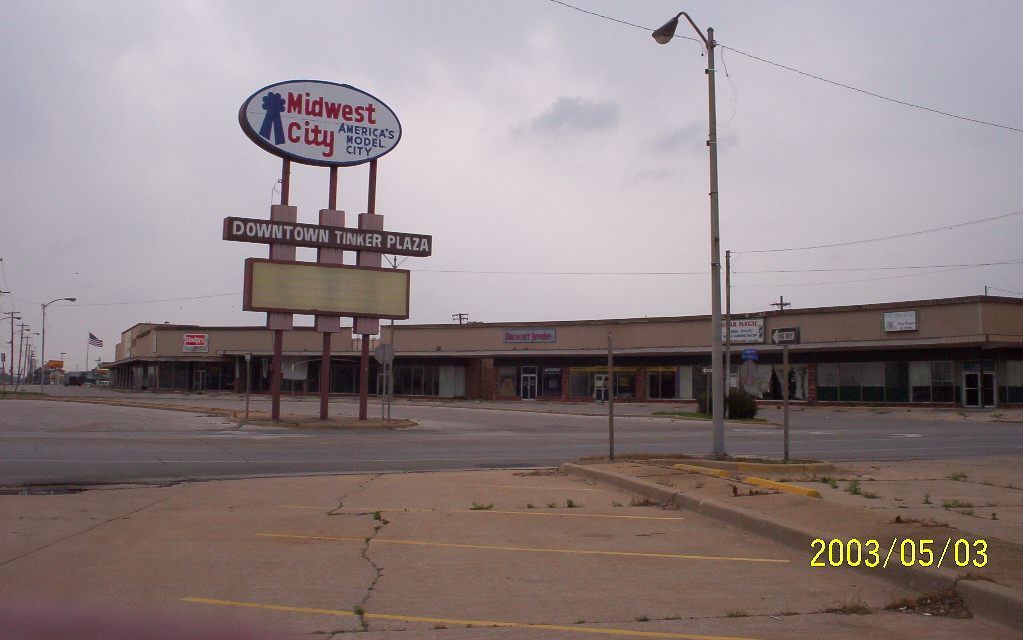
A highlight of the Republican convention was a quick visit to Oklahoma City's Bricktown. A half-dozen of the Tulsa contigent drove in from Midwest City after the banquet Friday night, paid $5 to park in the garage. Parking was not too hard to find, but there seemed to be plenty of activity on the streets. It was bustling but not claustrophobic. Several of the clubs had lines out to the sidewalk. Being that I was the baby of the group (age 39) and that none of us looked hip enough to gain admittance, we passed by the rope lines and strolled down to the Bricktown Brewery for an hour or so of specialty beers (I stuck with Dr Pepper) and half-heard conversation.
As Tulsans look longingly at Oklahoma City for how to revive our city's spirit and recreate a lively urban center, people tend to focus on the new Ford Center arena, the Canal, and the Bricktown Ballpark. But there was nothing scheduled at the Ford Center tonight, and the Redhawks were out of town. So what was bringing people in to spend money in Bricktown?
Bricktown is its own attraction. It was a success long before the Ford Center opened. The baseball stadium hosts less than 70 games a season. The big ticket, publicly-funded facilities may have called attention to the nightclubs and restaurants, but there is no question that these privately-owned businesses, and the variety of people that they draw, are the big attraction. People want to be where other people already are. Once you build a critical mass of people, more and more will come. That's why I believe targeted investments in public infrastructure (e.g. streets and sidewalks), aimed at encouraging investments like those already made by Michael Sager and other urban pioneers, will do more to make downtown vibrant again than an arena or ballpark. If we make it easier for more people to live in downtown, and if we remove anything in the public sphere that deters new investment, we'll see the kind of new life we've been hoping for.
 Subscribe to this blog's feed:

